MinneapolisUprising

2,851 photos · 2020–2025

2,851 photographs tagged MinneapolisUprising, 2020–2025.
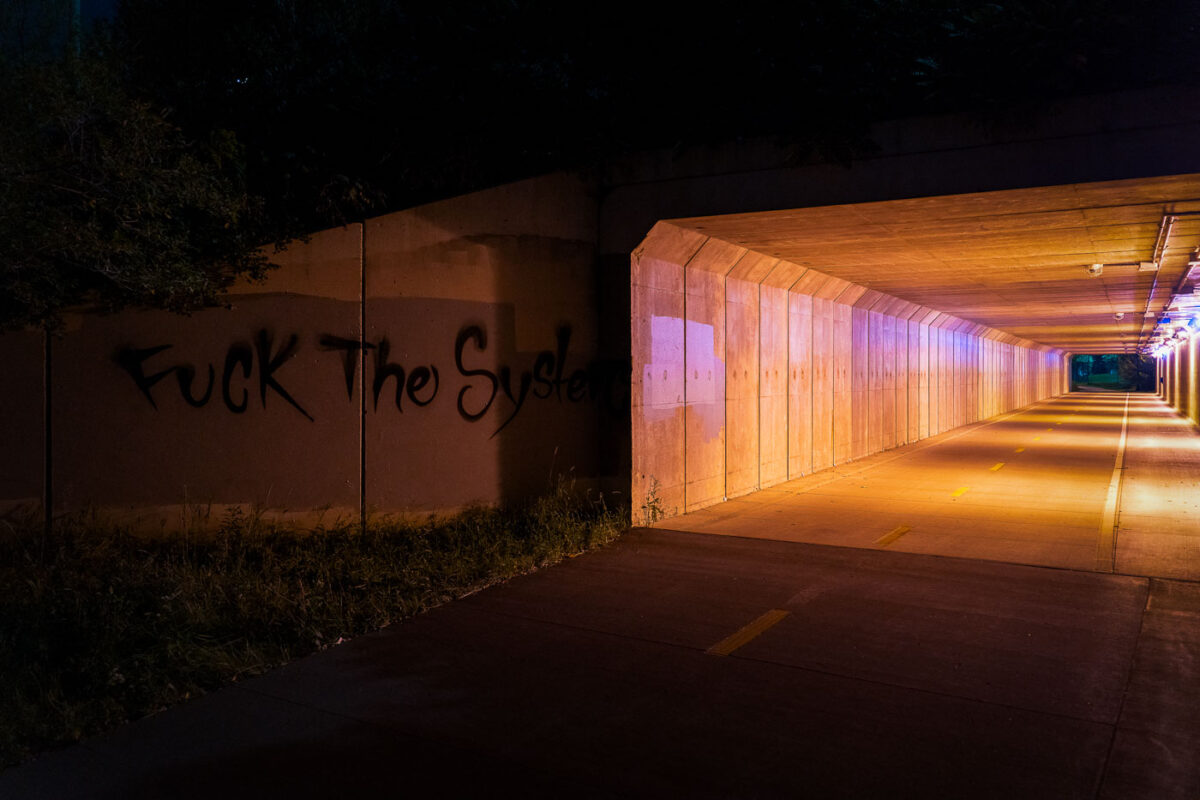
Graffiti reading "Fuck The System" on a concrete wall beside an illuminated bicycle tunnel in Minneapolis.
Graffiti reading “Fuck The System” is painted on a concrete wall beside a bike trail tunnel in Minneapolis. The illuminated underpass has marked lanes for cyclists and pedestrians and forms part of the city’s off-street trail network.

“Fuck The System” Graffiti at a Minneapolis Bike Tunnel
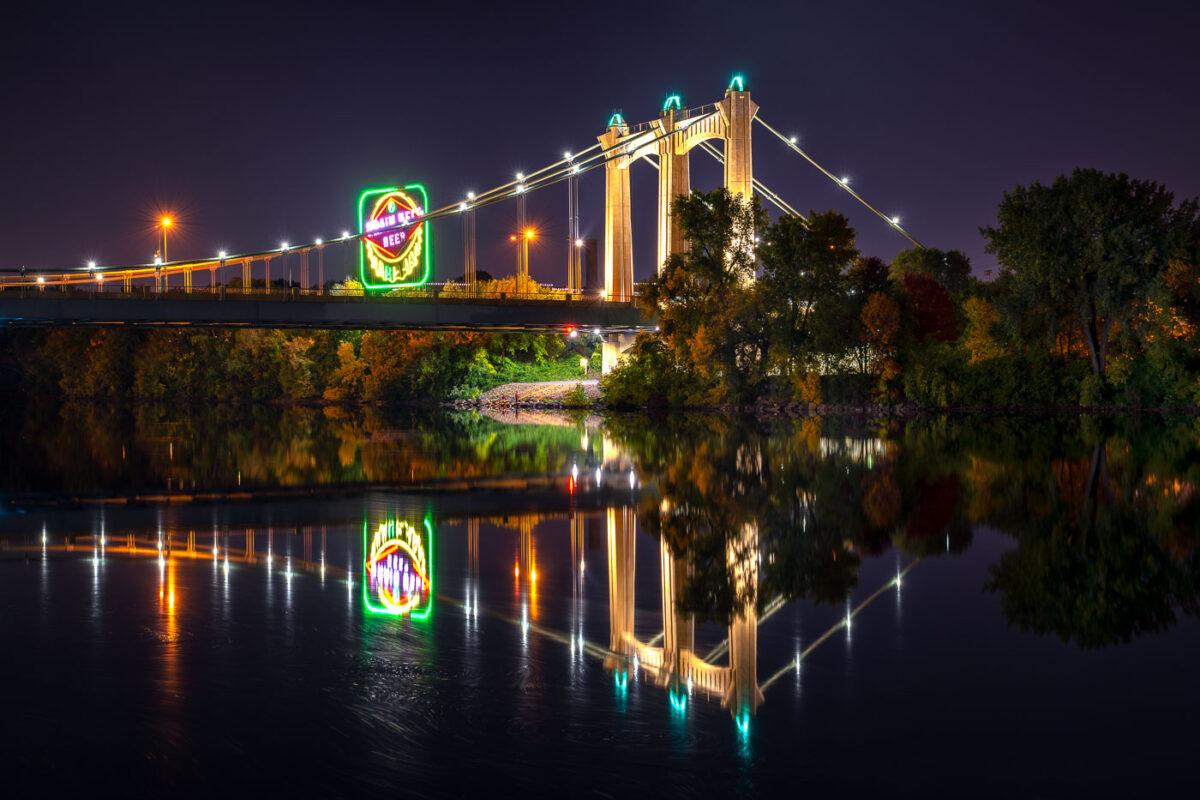
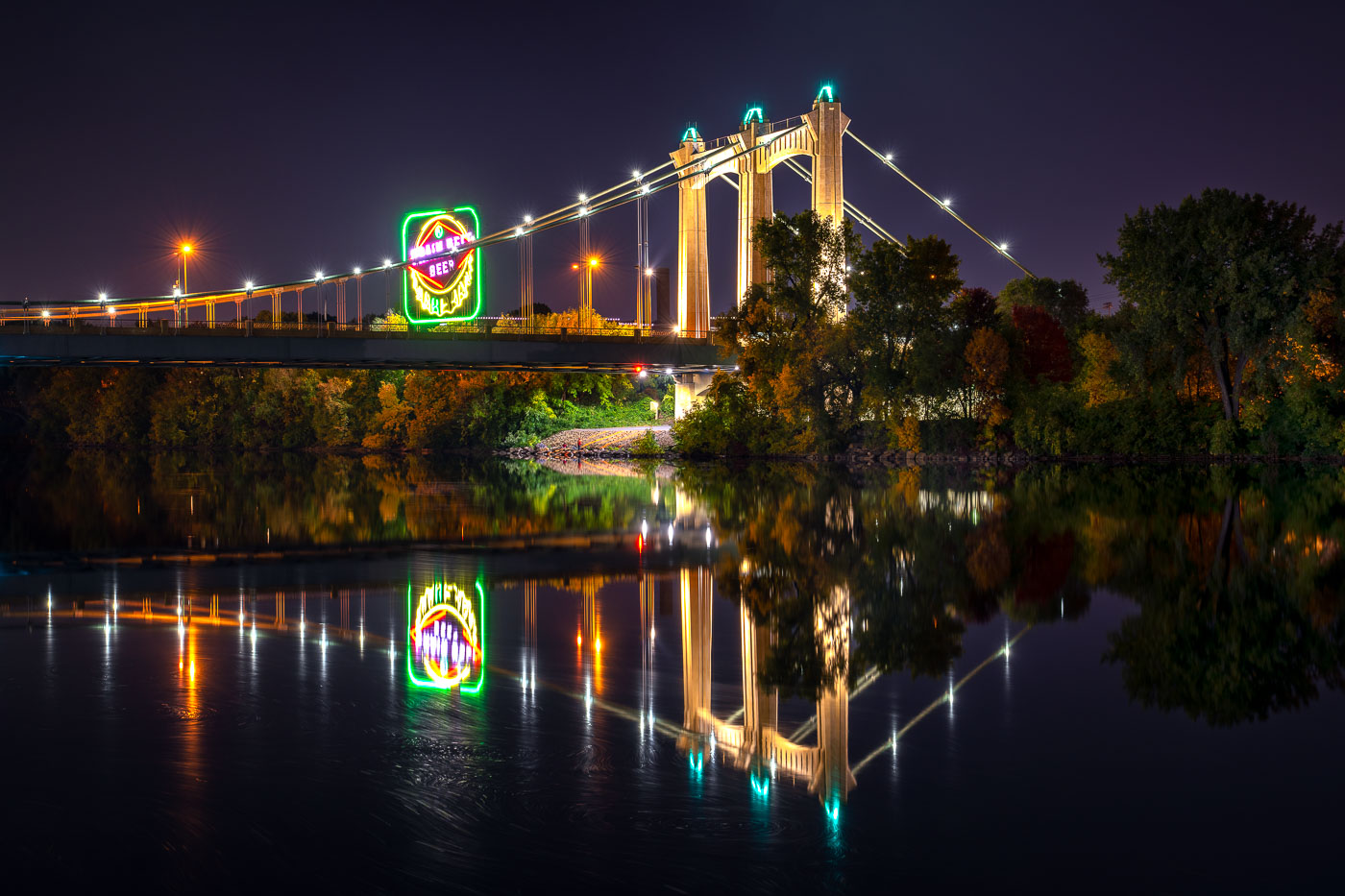
Hennepin Avenue Bridge spans the Mississippi River at night with illuminated suspension cables and a glowing Grain Belt beer sign
The Hennepin Avenue Bridge crosses the Mississippi River in Minneapolis, connecting downtown with Northeast Minneapolis. The suspension bridge, completed in 1990, is the fifth structure at this crossing, where the city’s first bridge over the Mississippi once stood.

Grain Belt Beer Sign Reflected Beneath the Hennepin Avenue Bridge

Hubert Humphrey statue stands before boarded Minneapolis City Hall with yellow flowers in foreground garden.
The Hubert H. Humphrey statue stands outside Minneapolis City Hall in downtown Minneapolis, with plywood covering the building behind it and a City Hall Victory Garden in the foreground. The bronze memorial honors Humphrey, who served as mayor of Minneapolis, a U.S. senator, and vice president of the United States.

Hubert Humphrey Statue Beside the Victory Garden at Minneapolis City Hall

Hennepin County Public Safety Facility in downtown Minneapolis barricaded at night with graffiti on a street sign.
The Hennepin County Public Safety Facility in downtown Minneapolis is shown at night behind metal barricades, traffic barrels, and stacked crowd-control fencing. Plywood covers the building’s ground-level windows and doors, and graffiti reading “fuck MPD” is written on the back of a street sign in the foreground. The county complex houses jail and court functions, and the security measures visible here were in place in September 2020 after protests in the area.

“Fuck MPD” Graffiti Outside Hennepin County Public Safety Facility

Graffiti reading "Do Good Guys Use Emergency Prep Bulldozers?" on concrete barricades outside downtown Minneapolis jail.
Concrete barricades, chain-link fencing, and metal crowd-control barriers stand outside the downtown Minneapolis jail in September 2020. Graffiti on the barriers includes the message “DO GOOD GUYS EMERGENCY PREP. USE BULLDOZERS?”.

“Do Good Guys Use Bulldozers?” Graffiti on Jail Barricades in Minneapolis
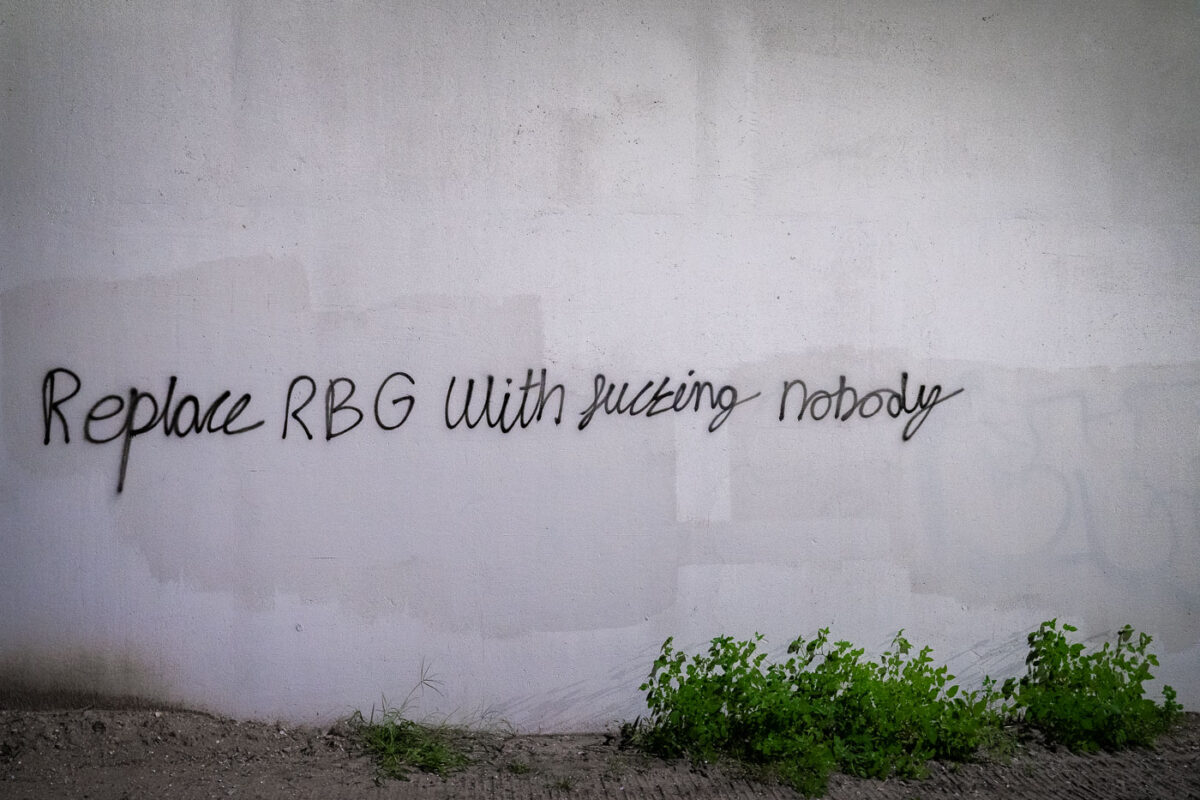
Graffiti message on a wall along the Midtown Greenway in Minneapolis referencing the Supreme Court vacancy.
Graffiti reading “Replace RBG With fucking nobody” is painted on a wall along the Midtown Greenway in Minneapolis. The message refers to the vacancy on the U.S. Supreme Court following the death of Justice Ruth Bader Ginsburg in September 2020.

“Replace RBG With Nobody” Graffiti Along the Midtown Greenway

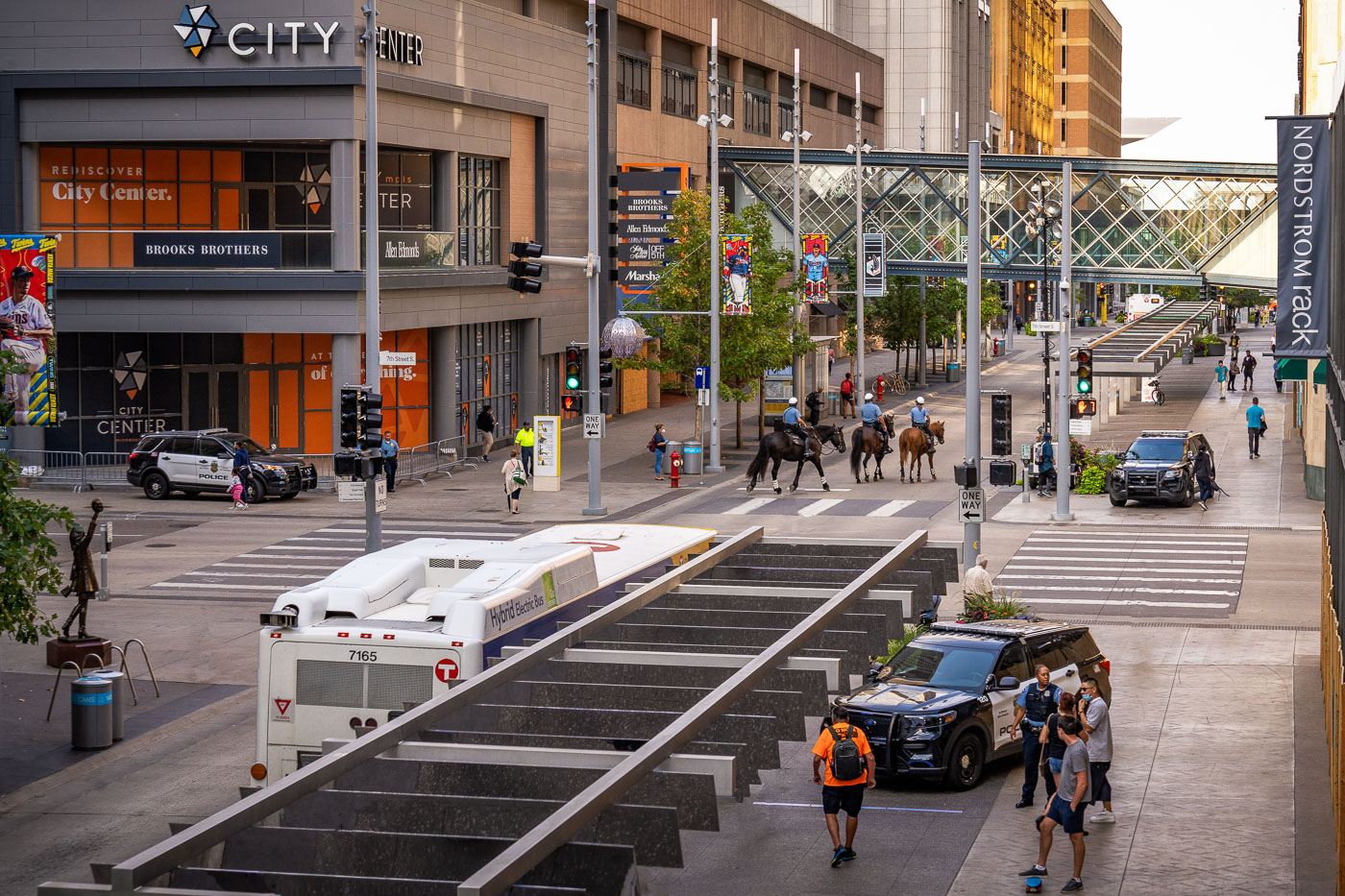
Minneapolis police officers and mounted unit patrol Nicollet Mall at South 7th Street downtown.
Minneapolis Police officers, including a mounted unit, patrol Nicollet Mall at South 7th Street in downtown Minneapolis on September 25, 2020.

Mounted Police Unit Crossing Nicollet Mall at 7th Street

Beauty Paradise Hair & Wigs storefront displays mannequin heads and a grand opening banner at 405 West Lake Street in Minneapolis.
Beauty Paradise Hair & Wigs at 405 West Lake Street in Uptown Minneapolis is pictured during its grand opening on September 26, 2020. A large banner reading “Grand Opening” hangs across the storefront.

Grand Opening at Beauty Paradise Hair & Wigs on Lake Street

Boarded Popeyes Louisiana Kitchen storefront on Lake Street at night with graffiti markings.
Popeyes Louisiana Kitchen on Lake Street in Minneapolis stands boarded up at night, with plywood covering its windows and graffiti visible across the storefront.

Boarded-Up Popeyes on Lake Street at Night

Dakota Jazz Club storefront boarded with plywood on Nicollet Mall in downtown Minneapolis at night.
The Dakota Jazz Club & Restaurant on Nicollet Mall in downtown Minneapolis is boarded over with plywood on its doors and street-facing windows.

Boarded Storefront at the Dakota Jazz Club on Nicollet Mall

Boarded storefronts line Nicollet Mall in downtown Minneapolis at night, September 2020.
Boarded storefronts line Nicollet Mall in downtown Minneapolis at night in late September 2020.

Nicollet Mall at Night After Downtown Minneapolis Unrest

Red star with "George Floyd" painted on First Avenue concert venue exterior wall in downtown Minneapolis.
The George Floyd memorial star is painted on the exterior wall of First Avenue in downtown Minneapolis. Added in 2020 after Floyd’s killing, the memorial placed his name on one of Minneapolis’s most recognizable entertainment landmarks during a period of mourning and protest in the city.

George Floyd’s Star on First Avenue’s Wall of Fame

Boarded storefronts on Lake Street in Minneapolis display spray-painted messages "Do Not Burn" and "People Live Here" at night.
Boarded storefronts on Lake Street in Minneapolis are marked with spray-painted messages reading “Do Not Burn” and “People Live Here” in this nighttime view from September 2020. The plywood covers retail windows and doors along a commercial corridor that was heavily damaged after protests following the killing of George Floyd in May 2020.

“Do Not Burn, People Live Here” Spray-Painted on Lake Street Plywood

Boarded storefront on Lake Street in Minneapolis displays murals including "Love Your Enemy" and "Justice for Floyd" messaging.
Murals and graffiti cover the exterior wall of the former K-Mart building on Lake Street in South Minneapolis. The painted boards include the large phrase “LOVE YOUR ENEMY,” an “MPLS” mural with the words “JUSTICE FOR FLOYD NOW,” and other artist panels installed across the boarded facade.

“Love Your Enemy” Mural on Former K-Mart on Lake Street

Lynlake Brewery storefront and neighboring businesses on Lyndale Avenue in Uptown Minneapolis at night with illuminated trees and
LynLake Brewery and neighboring storefronts on Lyndale Avenue in Uptown Minneapolis are pictured at night in September 2020.

Lyndale Avenue at Night Near Lynlake Brewery in Uptown

A mural on the side of the former Kmart
A mural featuring a Native American chief and the quote "Let us put our minds together and see what life we can make for our children" is displayed on the side of a former K-Mart building on Nicollet Avenue in South Minneapolis.

Mural on Former K-Mart, Nicollet Ave, Minneapolis

A Minneapolis Police Officer under the burned out Wells Fargo Bank on Nicollet Ave. The bank sits across the street from the Fifth Precinct and was burned during unrest.

Police guarding burned Wells Fargo

Panda ACAB Evict The Cops
A building wall in South Minneapolis displays both a community mural and protest graffiti. The mural, featuring a panda holding a "HOPE" balloon and Chinese characters for "hope", is painted on a brick section. Adjacent to it, graffiti on a painted concrete block wall reads "ACAB" and "EVICT THE COPS".

South Minneapolis Mural & ACAB Graffiti on Building Wall

Live Laugh Loot
The phrase "Live Laugh Loot" is spray-painted on the sidewalk in front of a damaged US Bank branch located on Lake Street in Midtown Minneapolis.

“Live Laugh Loot” Graffiti on Damaged US Bank, Lake Street

Flagship Target store boarded up on Nicollet Mall
The Target Flagship Store on Nicollet Mall in downtown Minneapolis stands with its entrance boarded with plywood.

Boarded Flagship Target Store, Nicollet Mall, Minneapolis

Cleared out AutoZone lot
The cleared site of the former AutoZone retail store stands on Lake Street at Minnehaha Avenue in Minneapolis. This commercial building was destroyed during the widespread protests and unrest that occurred in the city following the May 25, 2020 death of George Floyd.

Lake Street AutoZone Site After 2020 Riots

Riot damaged Dominos Pizza store
A Domino's Pizza retail store in Minneapolis stands damaged by fire, secured by a chain-link fence and marked with graffiti. This building was affected during the civil unrest that followed the May 25, 2020 death of George Floyd.

Burned Domino’s Pizza, Minneapolis Uprising
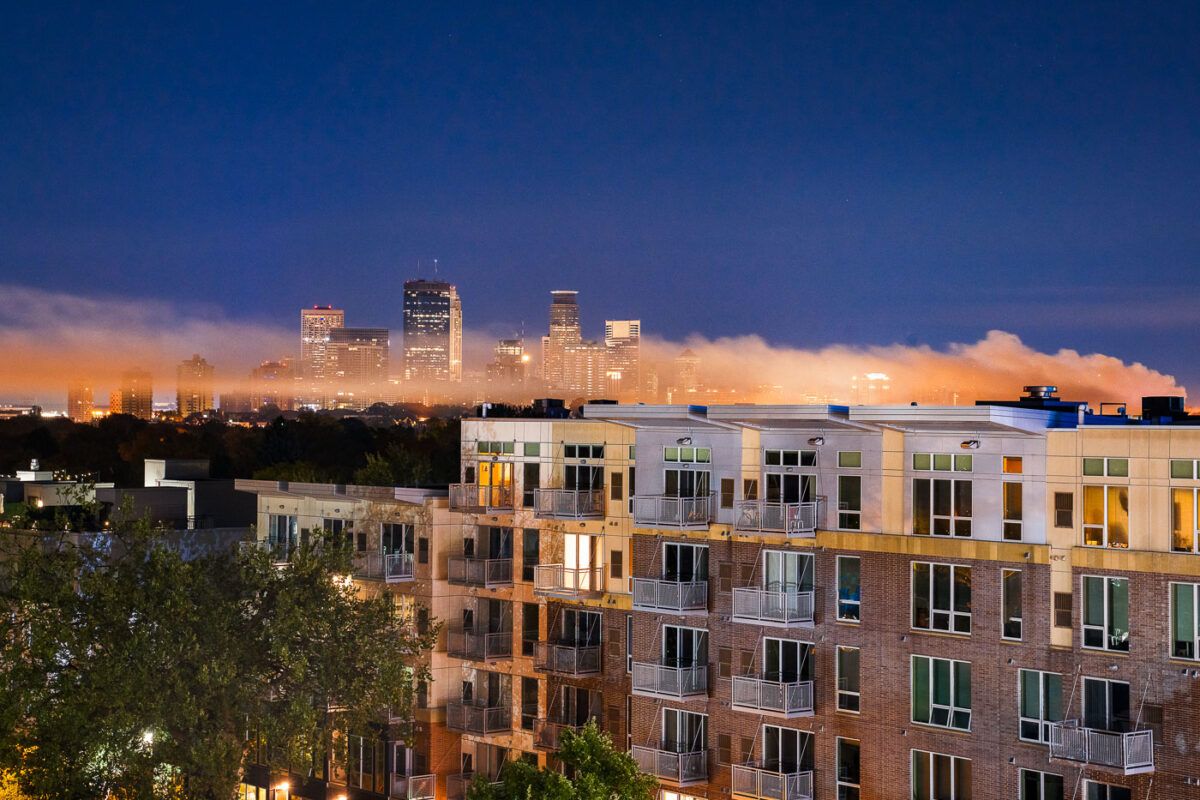
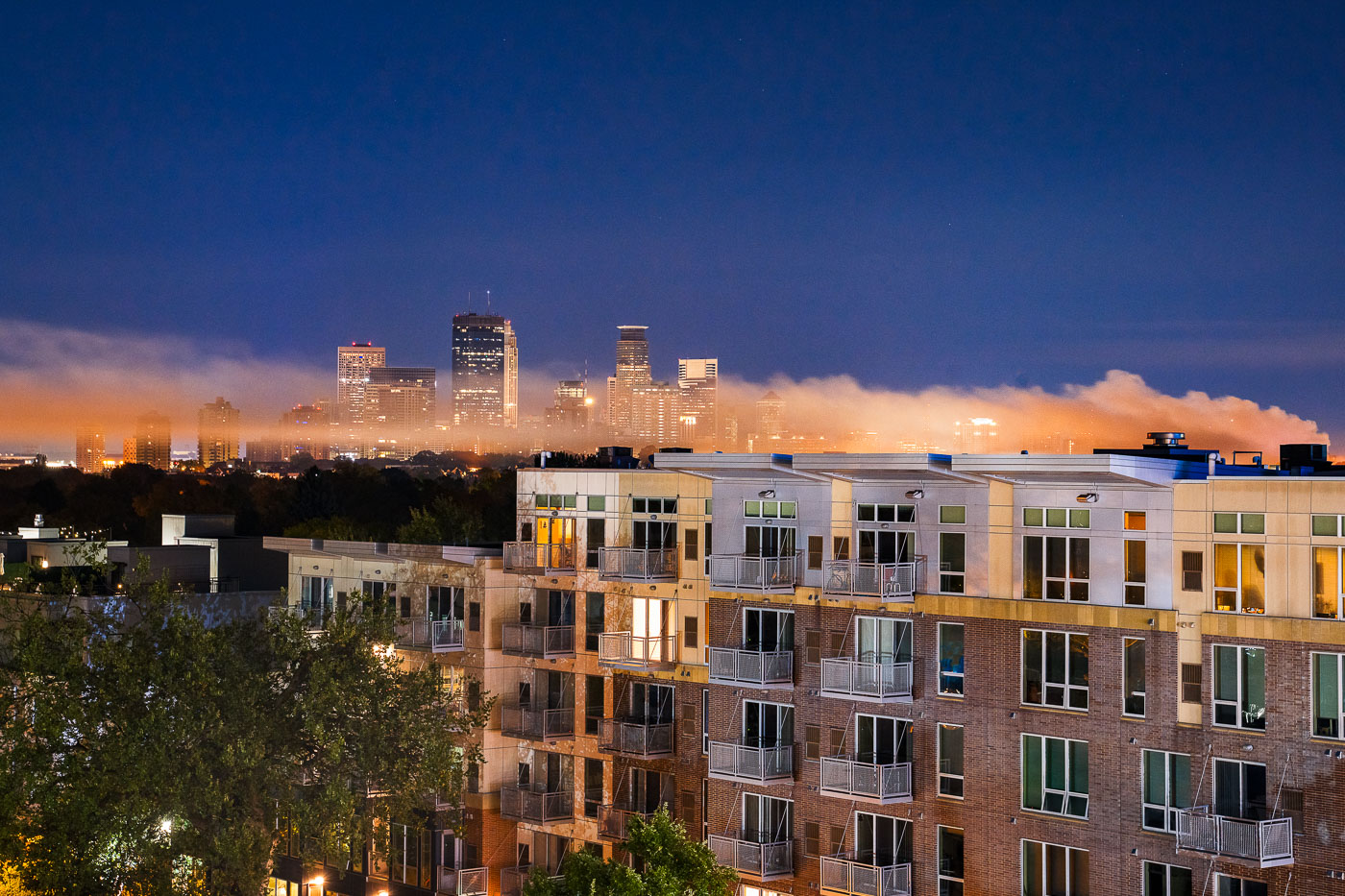
Smoke floating through Minneapolis
Smoke from a vacant home fire on South 4th Avenue rises over the Minneapolis skyline in the early morning hours of October 4th, 2020. This incident occurred during the Minneapolis Uprising, a period of significant civil unrest and protests in the city.

Smoke from South 4th Ave Fire over Minneapolis Skyline

No KKKops No Pipelines banner
A protest banner displaying the message "NO KKKOPS NO PIPELINES" is affixed to the Martin Olav Sabo Bridge in Minneapolis. This cable-stayed bridge, completed in 2007, is a dedicated pedestrian and bicycle crossing over Hiawatha Avenue, named for former U.S. Representative Martin Olav Sabo.

Protest Banner: No KKKops No Pipelines on Martin Olav Sabo Bridge

Nordstrom Rack boarded up at IDS Center
The Nordstrom Rack store is located within the IDS Center, a prominent skyscraper in downtown Minneapolis. Its street-level windows are covered with white-painted boards, installed following widespread civil unrest and property damage that occurred in August 2020.

Boarded Nordstrom Rack, IDS Center, Minneapolis

WCCO TV boarded up in Downtown Minneapolis
The WCCO-TV building on Nicollet Mall in downtown Minneapolis is shown with its exterior boarded up.

WCCO-TV Building Boarded Up on Nicollet Mall, Minneapolis

The time is always right to do what is right
The State Theatre, a historic performing arts venue on Hennepin Avenue in downtown Minneapolis, features a marquee displaying a quote from Martin Luther King Jr. The message, "The time is always right to do what is right".

State Theatre Marquee, MLK Quote & Murals, Minneapolis

Mobile Walgreens pharmacy in Minneapolis
A temporary Walgreens mobile pharmacy stands illuminated on Lake Street in Minneapolis. This modular facility was established in response to widespread damage and looting of retail stores, including pharmacies, during the 2020 protests and civil unrest in Minneapolis. It provided essential pharmaceutical services to the community when many permanent drug stores were unable to operate.

Mobile Walgreens Pharmacy on Lake Street, Minneapolis

Lisa Bender Must Go graffiti
Graffiti reading "Lisa Bender Must Go" is visible on the boarded-up windows of Fox Den Salon at 2727 Hennepin Avenue in Uptown Minneapolis. Lisa Bender served as the Minneapolis City Council President during a period of significant social and political unrest in the city.

Lisa Bender Must Go Graffiti, Fox Den Salon, Hennepin Ave

Defaced George Floyd mural
The George Floyd mural is prominently displayed on the exterior wall of Cup Foods, located on East 38th Street within George Floyd Square in Minneapolis. This site holds profound historical significance as the location where George Floyd was murdered on May 25, 2020, an event that catalyzed global protests against racial injustice and police brutality.

George Floyd mural with graffiti at Cup Foods, Minneapolis

Minneapolis Police along with State Patrol Conservation Officers arrive to the 5th Precinct with a large amount of tactical gear to clear out and arrest 51 people protesting after Derek Chauvin is released on bail.

51 Arrested at Minneapolis 5th Precinct After Chauvin Bail

Minneapolis Police along with State Patrol Conservation Officers arrive to the 5th Precinct with a large amount of tactical gear to clear out and arrest 51 people protesting after Derek Chauvin is released on bail.

Officers arrest 51 after Derek Chauvin makes bail

Minneapolis Police along with State Patrol Conservation Officers arrive to the 5th Precinct with a large amount of tactical gear to clear out and arrest 51 people protesting after Derek Chauvin is released on bail.

Officers in riot gear after Derek Chauvin makes bail

Minnesota State Patrol arrive to arrest protesters gathering at the Minneapolis Police 5th precinct after Derek Chauvin was released on bail.

State Patrol officers outside the 5th precinct

Protests outside the Minneapolis police 5th precinct police station as Derek Chauvin makes bail.

ACAB car and protests at 5th precinct

Protesters raise fists outside 5th precinct police station
Protesters kneel on Nicollet Avenue outside the Minneapolis Police 5th Precinct. This protest occurred following the pre-trial release of former police officer Derek Chauvin on bond, who was charged in the May 25, 2020 death of George Floyd.

Minneapolis Protesters Kneel at 5th Precinct, Nicollet Ave

MPLS loves PDX graffiti
The phrase "MPLS <3 PDX" is spray-painted on concrete barriers in Downtown Minneapolis, positioned across from the Hennepin County Jail. This graffiti signifies a connection between Minneapolis and Portland, Oregon, two cities that experienced significant protest activity during the Minneapolis Uprising.

MPLS Loves PDX Graffiti near Hennepin County Jail, Minneapolis

Jail not bail for killer kkkops
Protesters gathered outside the Hennepin County Government Center in Downtown Minneapolis, advocating for "Jail Not Bail" following the release of former Minneapolis Police Officer Derek Chauvin on bond. Chauvin was charged in connection with the May 25th death of George Floyd.

Minneapolis Protest: ‘Jail Not Bail’ for Derek Chauvin

Hennepin County Government Center waterfall
Protesters gather outside the Hennepin County Government Center in Downtown Minneapolis on October 8, 2020. This protest occurred the day after former Minneapolis Police Officer Derek Chauvin was released from jail on bond. Chauvin was charged in the May 25, 2020, death of George Floyd, an event that sparked widespread protests in Minneapolis and globally. The Hennepin County Government Center serves as the primary administrative and judicial hub for Hennepin County, housing courts and government offices.

Hennepin County Government Center Protest after Chauvin Bail

Protesters outside downtown police station
Protesters march through Downtown Minneapolis in October 2020, the day after Derek Chauvin was released on bail. This march was part of sustained protests against police brutality and racial injustice, which intensified following the killing of George Floyd earlier that year. Participants carried signs demanding 'Justice for George Floyd' and advocating for the 'Defund And Abolish' movement, reflecting widespread calls for systemic change.

Protesters march Downtown Minneapolis after Derek Chauvin release

Protests after Derek Chauvin is released from jail
A protest sign reading "Hey Derek you forgot your hat!" is held during a march in downtown Minneapolis, the day after former Minneapolis Police Officer Derek Chauvin was released on bond. The sign also features a drawing resembling a Ku Klux Klan hood, with additional text including "BREAK THE THIN BLUE LINE" and "ARREST KILLER KKK OPS?". Protesters marched towards the Minneapolis Police 1st Precinct to voice opposition to Chauvin's release and demand police accountability.

Minneapolis Protest Sign: ‘Hey Derek you forgot your hat’

Protesters walk by the 1st precinct police station
Protesters march past the Minneapolis First Precinct in Downtown Minneapolis. This march occurred the day after former Minneapolis Police Officer Derek Chauvin was released on bond. Chauvin had been charged in the May 25, 2020 death of George Floyd, an event that sparked widespread protests against police brutality and racial injustice.

Protesters march past Minneapolis First Precinct after Chauvin release

Toussaint Morrison speaks outside of Minneapolis City Hall
Toussaint Morrison addresses a crowd during a protest in Downtown Minneapolis. This march took place the day after former Minneapolis Police officer Derek Chauvin was released on bond. Chauvin was charged in connection with the May 25th death of George Floyd in South Minneapolis.

Toussaint Morrison speaks at Minneapolis protest after Chauvin release

Minneapolis police at convention center
Following the destruction of the Minneapolis Third Precinct in May 2020, the Minneapolis Police Department relocated its operations to the Minneapolis Convention Center in Downtown Minneapolis.

Minneapolis Police Station at Convention Center Night

Murals on boards of the former k-mart
Murals adorn the boarded-up exterior of the former K-Mart building on Nicollet Avenue in South Minneapolis.

Murals on former K-Mart, Nicollet Ave, South Minneapolis

Look down at Nicollet Mall from above
An aerial perspective reveals the distinctive glass-pyramid roof of the Crystal Court, a prominent indoor public plaza located within the IDS Center in downtown Minneapolis.

Crystal Court Roof, IDS Center, Downtown Minneapolis

Food being offered at George Floyd Square
A community food distribution takes place at George Floyd Square in Minneapolis. This event, held on what would have been George Floyd's 47th birthday, provides essential supplies to local residents. Volunteers distribute a variety of provisions, including fresh produce, bread, canned goods, and diapers, from tables set up under a tent. George Floyd Square, located at the intersection of 38th Street and Chicago Avenue, became a focal point for protests and community organizing following George Floyd's murder in May 2020, and continues to serve as a site for mutual aid and remembrance.

Community Food Distribution at George Floyd Square, Minneapolis

Angela Harrelson speaks at George Floyd Square
Angela Harrelson, aunt of George Floyd, addresses a gathering at George Floyd Square in Minneapolis. The event took place on what would have been George Floyd's 47th birthday, commemorating his life and the ongoing movement for racial justice. George Floyd Square, located at the intersection of 38th Street and Chicago Avenue, became a protest site and memorial following Floyd's murder by police in May 2020.

Angela Harrelson speaks at George Floyd Square on 47th Birthday

George Floyd’s family speaks at George Floyd Square
George Floyd's aunt Angela Harrelson, cousin Paris Stevens, and memorial caretaker Jeanelle Austin speak at George Floyd Square in Minneapolis. They gathered to commemorate what would have been George Floyd's 47th birthday. George Floyd Square, located at the intersection of 38th Street and Chicago Avenue, became a community memorial and protest site following Floyd's murder by police on May 25, 2020.

George Floyd’s family speaks at George Floyd Square on his 47th birthday

Community gathers on George Floyd 47th birthday
A community gathering took place at George Floyd Square in Minneapolis to commemorate what would have been George Floyd's 47th birthday. A bouncy castle was set up at the Speedway gas station, a prominent location within the square, as part of the remembrance activities. George Floyd Square, located at the intersection of 38th Street and Chicago Avenue, emerged as a memorial and protest site following George Floyd's murder by Minneapolis police in May 2020.

Minneapolis: George Floyd Square, Bouncy Castle, 47th Birthday

Protesters push for community control of police
Students for a Democratic Society (SDS) at the University of Minnesota organized a protest in Dinkytown, Minneapolis, advocating for community control of the University of Minnesota Police Department (UMPD). The event specifically demanded the establishment of a Civilian Police Accountability Council (CPAC).

UMN Students Demand Police Accountability & CPAC in Dinkytown

Protesters warm their hands at George Floyd Square
Protesters gather around a fire pit for warmth at George Floyd Square in Minneapolis. This site became a focal point for protests and community organizing following the murder of George Floyd in May 2020. The square, located at the intersection of 38th Street and Chicago Avenue, served as a sustained protest zone during the Minneapolis Uprising.

Protesters warming hands by fire pit, George Floyd Square

Community members at George Floyd Square
Community members gather under the canopy of the former Speedway gas station, now known as People's Way, within George Floyd Square in Minneapolis. This site became a focal point for protests and a permanent memorial following the murder of George Floyd in May 2020. The People's Way station serves as a community hub, offering resources and a space for ongoing dialogue and remembrance.

George Floyd Square: Community at People’s Way station

US Bank is closed sign
A notice posted on the boarded-up US Bank branch on Lake Street in South Minneapolis announces its closure due to damage sustained during the civil unrest of May 2020. This branch, a key retail banking establishment, was significantly impacted during the widespread protests and associated riots that followed the death of George Floyd.

US Bank Lake Street Closed After 2020 Minneapolis Riots

Heavy snow falls on George Floyd Square
The first snowfall of the season blankets George Floyd Square at the intersection of 38th Street and Chicago Avenue in South Minneapolis. This site became a global focal point for protests against racial injustice following the murder of George Floyd by Minneapolis police on May 25, 2020.

First Snowfall at George Floyd Square, 38th & Chicago

Snow falls on George Floyd Square
A community greenhouse stands covered in the first snowfall at George Floyd Square in Minneapolis. This structure was erected as part of ongoing community efforts at the site, which became a memorial and protest space following the murder of George Floyd in May 2020. The greenhouse is enclosed to protect plants and maintain a green space through the colder months. George Floyd Square, located at the intersection of 38th Street and Chicago Avenue, has served as a focal point for remembrance, activism, and community organizing since the Minneapolis Uprising.

George Floyd Square Greenhouse, First Snowfall

Buses do not stop here
George Floyd Square, located at the intersection of 38th Street and Chicago Avenue in Minneapolis, serves as a permanent memorial and protest site following the murder of George Floyd in May 2020. Amidst a snowfall, a Metro Transit bus stop sign is overlaid with a handmade message declaring "BUSES DO NOT STOP HERE: Effective: NOW Reason: We Need Justice," reflecting the community's ongoing demands.

George Floyd Square: Buses Do Not Stop Here, Minneapolis Snow

Nekima Levy Armstrong speaks outside the 4th precinct
Community activist Nekima Levy Armstrong addresses a protest outside the Minneapolis Police 4th Precinct. The gathering was part of the 25th annual National Day of Protest to Stop Police Brutality, Repression and the Criminalization of a Generation. The 4th Precinct, located in North Minneapolis, has historically been a significant site for protests concerning police conduct and accountability.

Nekima Levy Armstrong speaks at Minneapolis 4th Precinct Protest

Protesters holding up signs outside the 4th precinct
Protesters gather outside the Minneapolis Police 4th Precinct during the 25th annual National Day of Protest to Stop Police Brutality. Participants hold signs expressing dissent against the justice system and police, reflecting themes central to the Black Lives Matter movement. This annual protest, observed on October 22nd, addresses ongoing concerns regarding police conduct and systemic injustices.

Protesters with anti-police brutality signs, Minneapolis 4th Precinct

Michelle Gross speaks outside the 4th precinct police station
Michelle Gross, founder of Communities United Against Police Brutality, addresses a gathering at the Minneapolis Fourth Precinct. The protest was organized as part of the 25th National Day of Protest to Stop Police Brutality. This location, the Minneapolis Police Fourth Precinct, has been a focal point for numerous protests against police misconduct and racial injustice in the city.

Michelle Gross addresses Minneapolis 4th Precinct Protest

Black Lives matter protesters march through North Minneapolis
Protesters march during the 25th National Day of Protest to stop police brutality in North Minneapolis. Prior to the march, they gathered outside the Minneapolis police 4th precinct police station.

25th National Day of Protest to stop police brutality march in Minneapolis

Chalk on the sidewalk outside the mayors home
Chalk art on the street outside Minneapolis Mayor Jacob Frey's home in Northeast Minneapolis, The protest addressed the city's policies regarding homeless encampment evictions. The message, 'Jacob + Police = ", reflects public sentiment and criticism directed at the mayor and law enforcement.

Chalk Message at Minneapolis Mayor Frey’s Home Protest

Michael Toussaint at George Floyd Square
Michael Toussaint, father of Myon Burrell, speaks at a protest held at George Floyd Square in Minneapolis. Burrell was convicted of murder in 2002, and his case has drawn widespread calls for exoneration due to concerns about the conviction. George Floyd Square, located at the intersection of 38th Street and Chicago Avenue, became a memorial and a site for ongoing protests and advocacy following the murder of George Floyd in May 2020.

Michael Toussaint Speaks at George Floyd Square, Minneapolis

Myon Burrells son speaks at George Floyd Square
Myon Burrell Jr., son of Myon Burrell, speaks at an exoneration rally in George Floyd Square, Minneapolis. Myon Burrell Sr. was convicted of murder in 2002, and his case has since garnered significant public attention and calls for his release. The rally advocates for his exoneration, highlighting ongoing efforts to address perceived injustices within the legal system. George Floyd Square, located at the intersection of 38th Street and Chicago Avenue, serves as a prominent site for protests and community gatherings related to racial justice and police accountability in Minneapolis.

Myon Burrell Jr. at George Floyd Square exoneration rally

Protesters asking for the release of Myon Burrell
Supporters gather at George Floyd Square in Minneapolis for a protest concerning the case of Myon Burrell. Burrell was convicted of murder in 2002, and his case has drawn widespread attention, with many calling for his exoneration due to questions surrounding the investigation and evidence. George Floyd Square, located at the Speedway gas station at 38th Street and Chicago Avenue, became a permanent memorial and site for community organizing and protest following the murder of George Floyd in May 2020. The square continues to serve as a significant public space for addressing issues of racial justice and criminal justice reform in Minneapolis.

Rally for Myon Burrell at Speedway, George Floyd Square

Elizer Darris speaks at George Floyd Square
Elizer Darris of the ACLU speaks at a protest for Myon Burrell at George Floyd Square in Minneapolis. Supporters gathered to call for the exoneration of Myon Burrell, who was convicted of murder in 2002. His case has drawn significant attention and criticism regarding the justice system. George Floyd Square, located at the intersection of 38th Street and Chicago Avenue, has become a prominent site for protests and calls for racial justice following the murder of George Floyd in 2020.

Elizer Darris speaks at Myon Burrell rally, George Floyd Square

Protesters march down Lake Street in solidarity with Philadelphia
A march proceeds down Lake Street in Minneapolis, expressing solidarity with Philadelphia following the killing of Walter Wallace Jr. Participants carried signs, some advocating for "Black Lives Matter" and justice for victims of police violence, as they moved along the commercial thoroughfare. Lake Street.

Minneapolis Lake Street March for Walter Wallace Jr.

Protesters again outside the 3rd precinct
Protesters march from South High School to the Minneapolis Third Precinct, expressing solidarity with Philadelphia following the killing of Walter Wallace Jr. in October 2020. The Minneapolis Third Precinct, which was a significant site during the 2020 protests for George Floyd, served as a symbolic location for this demonstration against police brutality. This march highlights the continued demands for police accountability and racial justice in Minneapolis and across the United States.

Minneapolis 3rd Precinct Protest for Walter Wallace Jr.

Protesters hold signs up after the killing of Walter Wallace
Protesters march on Lake Street in Minneapolis, holding signs advocating for an anti-racist future. This march, originating from South High School and heading towards the Minneapolis Third Precinct, was held in solidarity with Philadelphia following the killing of Walter Wallace Jr. Participants carried signs, including one stating 'A MAN WAS LYNCHED YESTERDAY,' reflecting ongoing calls for racial justice and accountability in the city and nationwide.

Minneapolis Protest: Anti-Racist Future Sign, Lake Street

Walter Wallace Jr memorial in South Minneapolis
A temporary memorial for Walter Wallace Jr. stands under a light rail bridge in Minneapolis. Walter Wallace Jr. was killed by police in Philadelphia in October 2020, an event that sparked protests across the United States.

Walter Wallace Jr Memorial under Light Rail Bridge, Minneapolis

Burned out building on Lake Street
The remains of a commercial building on Lake Street in Minneapolis, which previously housed restaurants, stand damaged. This structure was affected during the civil unrest that occurred in May and June 2020. The unrest followed the murder of George Floyd and significantly impacted the commercial corridor around the Minneapolis Police Third Precinct.

Burned Restaurant Remains, Lake Street, Minneapolis

Police arrest protesters at Bryant Square Park in Minneapolis on election night, November 3, 2020.
Bryant Square Park, a public park in the Uptown neighborhood of Minneapolis, was the site of arrests following a protest march on the night of November 3, 2020. Officers from the Minneapolis Police Department, Minneapolis Park Police, and Hennepin County Sheriff's Office took part in detaining marchers after the group arrived at the park. That night's demonstration was one of several held across the city as results from the 2020 presidential election came in.

Police Detain Protesters at Bryant Square Park on Election Night

"Vote Here" sign outside Westminster Presbyterian Church in downtown Minneapolis during the 2020 election.
Westminster Presbyterian Church sits at Nicollet Mall and 12th Street in downtown Minneapolis. Founded in 1857, it's one of the city's oldest congregations and has occupied its current Romanesque-style building since 1897. On this Election Day, a digital marquee reading "Vote by Nov. 3!" stood alongside a sidewalk sign marking the church as a polling location. Churches and other community institutions across Minneapolis regularly polling sites during municipal, state, and federal elections.

“Vote by Nov. 3” Sign at Westminster Presbyterian Church

Hennepin and Lagoon Avenue intersection in Uptown Minneapolis at night with illuminated storefronts and traffic.
Hennepin Avenue crosses Lagoon Avenue at the center of Minneapolis's Uptown neighborhood, a commercial strip that grew up around the Lagoon Theater and streetcar lines running through the district in the early 20th century. Williams Uptown Pub & Cafe has operated near this corner for decades, part of a stretch of bars and restaurants that made Uptown a nightlife destination for the city. The intersection sits a few blocks from the Chain of Lakes, connecting the neighborhood's residential streets to its retail core along Hennepin and Lake Street.

Hennepin Avenue at Lagoon Avenue in Uptown Minneapolis

AT&T retail store on Lake Street in Uptown Minneapolis with boarded windows at night.
This AT&T store sits on Lake Street in Uptown Minneapolis, a commercial corridor that saw widespread property damage after the killing of George Floyd in May 2020. Many businesses along the strip boarded their windows in the aftermath and kept the plywood up for months afterward, some using it as makeshift signage during reconstruction. A "Now Open" banner on the boards here signals the store's return to business despite the unfinished repairs. Lake Street has long served as one of South Minneapolis's primary retail and transit corridors, connecting the Midtown Greenway to neighborhoods stretching from Uptown to the Mississippi River.

AT&T Store Reopens Behind Plywood on Lake Street

Law enforcement officers conduct arrests at Bryant Square Park in Minneapolis on Election Night.
Bryant Square Park sits at Bryant Avenue South and West 31st Street in the Uptown neighborhood of Minneapolis, a few blocks from the corridor where a march passed earlier that night. Officers from the Minneapolis Police Department, Minneapolis Park Police, and Hennepin County Sheriff's Office converged on the park following the demonstration, making a series of arrests. The operation came on Election Night 2020, months after the killing of George Floyd had drawn sustained protest activity to Minneapolis streets and parks.

Police Move Through Bryant Square Park After Election Night March

Minneapolis Police officers conduct arrests at Bryant Square Park in Uptown Minneapolis on election night.
Bryant Square Park sits in the Uptown neighborhood of Minneapolis, at the corner of Bryant Avenue South and 33rd Street. The park has served as a gathering point for marches and demonstrations in the years since George Floyd's death in police custody in May 2020. On the night of November 3, 2020, Minneapolis Police officers and members of the press assembled near the park as a march moved through the area, part of a wider pattern of protest activity that continued across the city into the fall election season.

Police Gather Outside Bryant Square Park on Election Night

Minneapolis Police officer stands in street during election night protest in Uptown Minneapolis.
A Minneapolis police officer stands watch beside a squad car during an election night protest in Uptown Minneapolis on November 3, 2020. Officers deployed in tactical gear and rifles that night as marches moved through the neighborhood toward Bryant Square Park, where police made several arrests. The response came amid a broader wave of unrest that had gripped Minneapolis for months following George Floyd's killing that May, with departments across the city on heightened alert for potential Election Day disturbances.

Armed Officer Stands Guard During Uptown Election Night Protest

Target storefront in Uptown Minneapolis with graffiti reading "Stand Up Fight Back" and "Free Stuff" on its windows.
Target's Uptown Minneapolis store sits at 900 W Lake Street, a location that opened in 2018 as part of a mixed-use development along the Lake Street corridor. The entrance doors were tagged with "Stand Up Fight Back" and "Free Stuff!" after a night march down Lake Street. Target boarded and reinforced several Minneapolis-area stores that year following repeated break-ins and vandalism at its locations.

“Stand Up Fight Back” Spray-Painted on Uptown Target Doors
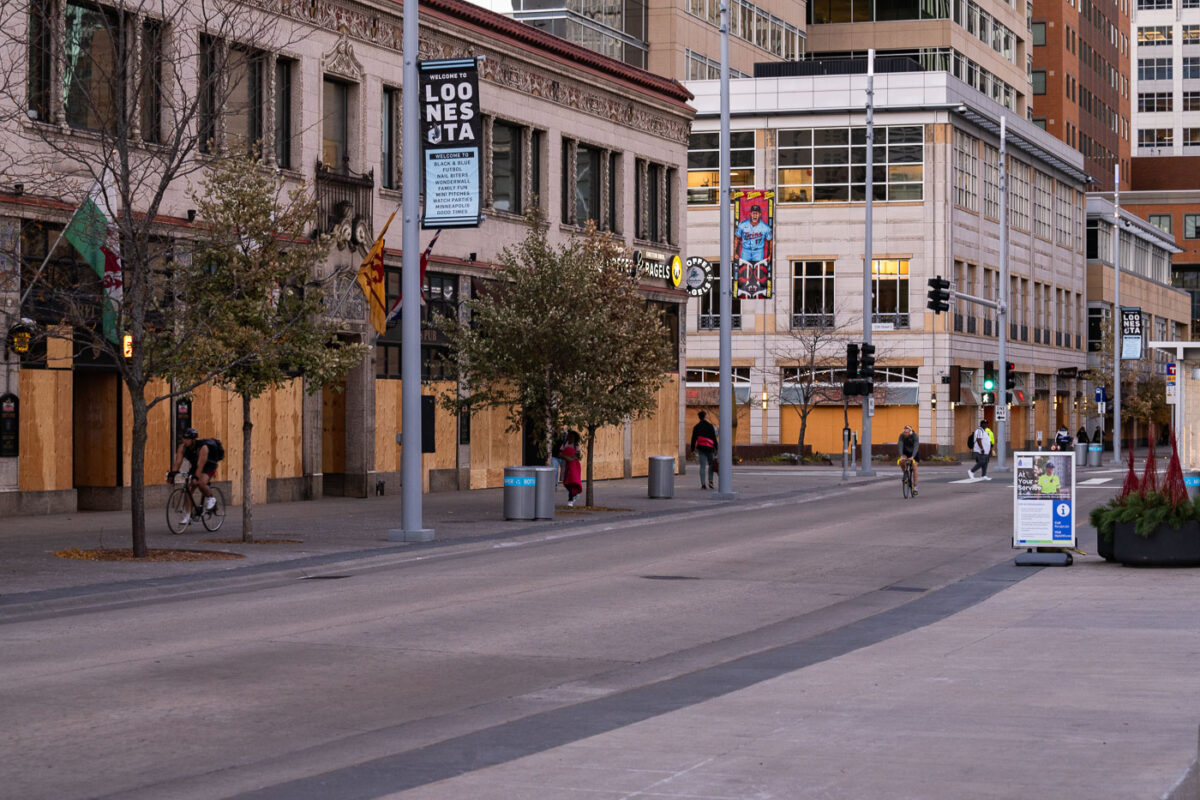
Cyclists and pedestrians move through downtown Minneapolis's Nicollet Mall, where plywood boards cover ground-floor storefronts.
Nicollet Mall in downtown Minneapolis with plywood covers on many ground-floor storefronts in the months after the unrest that followed George Floyd's killing in May 2020.

Boarded Storefronts Along Nicollet Mall

Graffiti art covers protective boards on the John Fluevog store at Hennepin and Lagoon Avenues in Uptown Minneapolis.
The plywood covering John Fluevog's storefront on Hennepin Avenue became a canvas for hand-lettered messages and drawings, including references to James Baldwin, Grace Jones, and the phrase "Love Is Not Dead." The shoe retailer, known for its avant-garde designs since founding in Vancouver in 1970, operates a location here in Uptown Minneapolis near the corner of Lagoon Avenue. Business owners across the city boarded up storefronts for protection following the unrest that spread after George Floyd's killing in May 2020, and many of those boards were later turned into sites for murals and text-based artwork by local artists.

“Love Is Not Dead” Mural on the John Fluevog Storefront

Saks Off 5th Avenue storefront in Downtown Minneapolis displays boarded windows with civic unity signs.
The Saks Off 5th storefront on Nicollet Mall in downtown Minneapolis stands boarded in plywood, with two posters reading "100% In For Democracy" and "Stronger Together, Better Together, Always Together." Both bear the logo of the Civic Alliance, a nonpartisan coalition of U.S. companies formed in 2020 to encourage voter participation and support election integrity. Saks Off 5th, the discount division of Saks Fifth Avenue, joined dozens of national retailers that boarded storefronts ahead of the 2020 presidential election, anticipating possible unrest tied to the vote count. The image was captured on Election Day, November 4, 2020.

“100% In for Democracy” Signs on Boarded Saks Off 5th Storefront

News helicopter flying over Minneapolis City Hall's spires against a blue sky.
Minneapolis City Hall, completed in 1906, houses the seat of government for both the city and Hennepin County under one Romanesque Revival roof. Its clock tower rises 345 feet, making it one of the taller landmarks on the downtown skyline. The building was designed by Long and Kees and remains listed on the National Register of Historic Places.

Helicopter Circles Minneapolis City Hall’s Clock Tower

Protesters hold a banner reading "No Killer Cops Ice Raids US Wars Black Native Stolen Lives Matter" during a Minneapolis march.
The banner reading "No Killer Cops, ICE Raids, US Wars, Black Native Stolen Lives Matter" appeared during a nighttime march along Cedar Avenue in Minneapolis's West Bank neighborhood on November 4, 2020, the night after the presidential election. The route passed the storefront of Midwest Mountaineering, a longtime outdoor-gear retailer at 309 Cedar Avenue South. The demonstration linked opposition to police killings with calls against immigration raids and foreign wars, continuing demands raised during the protests that followed George Floyd's killing by Minneapolis police in May 2020.

“No Killer Cops” Banner at a Minneapolis Protest March

Night protest march on Interstate 94 in Minneapolis with participants carrying signs and banners for social justice.
This march moved onto Interstate 94 near downtown Minneapolis, shutting down a stretch of the freeway that links the city's core to neighborhoods on its edges. Demonstrators carried signs and a banner reading "All Power to the People," part of a wave of protests that followed the 2020 election. Minnesota State Patrol and Minneapolis police later closed in on marchers on the freeway, leading to roughly 646 arrests and citations — one of the largest mass detentions in the state's history.

Protesters March Onto Interstate 94 at Night in Minneapolis

Nighttime protest on Interstate 94 in Minneapolis with hundreds of demonstrators holding signs and banners advocating for police
Interstate 94 cuts through downtown Minneapolis, linking the Twin Cities and carrying tens of thousands of vehicles daily under normal conditions. Marchers shut the freeway down as they moved through carrying banners reading "No Killer Cops" and "The Whole Damn System Is Guilty as Hell." Protesters occupying the interstate led Minnesota State Patrol and Minneapolis police to close lanes and, on several nights that fall, make mass arrests of demonstrators for blocking the roadway. Banners referencing Black, Native, and immigrant communities point to organizing coalitions that linked police violence with ICE raids and broader demands for systemic change.

Banners and Marchers Fill Interstate 94 at Night

Minnesota State Patrol officers form a line across Interstate 94 in Minneapolis during a November 2020 nighttime protest march.
Interstate 94 runs through the heart of Minneapolis, connecting downtown to St. Paul and serving as a major route for commuters and freight alike. On the night of November 4, 2020, following the presidential election, Minnesota State Patrol troopers formed a line across the freeway's lanes to stop a march that had moved onto the highway from surrounding streets. State Patrol, rather than Minneapolis police, holds jurisdiction over incidents on the interstate system within city limits. That night's march ended with 646 arrests, one of the largest mass detentions in Minnesota history, after demonstrators were held on the freeway for several hours before being processed and released.

State Patrol Blocks I-94 During Post-Election Protest March

Minneapolis police officers monitor protesters marching on Interstate 94 during a November 2020 demonstration.
Officers from the Minneapolis Police Department hold a pedestrian overpass above Interstate 94 as protesters fill the freeway below. The demonstration followed the November 2020 election, when marchers moved from downtown Minneapolis toward Cedar-Riverside to protest the presidential race outcome. Minnesota State Patrol and Minneapolis Police later blocked both ends of the freeway and detained roughly 646 people, one of the largest mass arrests in the state's history. Interstate 94 links Minneapolis and St. Paul and has been a repeated site of demonstrations shutting down traffic in both cities.

Police Line an I-94 Overpass During Minneapolis Protest

Minneapolis Police mounted officers on horseback at night during post-election march crowd management.
Minneapolis Police Department's mounted patrol unit responded to a march that followed the 2020 presidential election, when demonstrators moved onto Interstate 94. That night's march ended with roughly 646 arrests, one of the largest mass detentions in Minneapolis history.

Mounted Police Await Orders During Minneapolis Post-Election March

Police officers confront protesters on Interstate 94 in Minneapolis on November 4, 2020, during post-election demonstrations.
Minnesota State Patrol troopers moved in on Interstate 94 near downtown Minneapolis after marchers left city streets and walked onto the highway on the night of November 4, 2020, hours after Election Day. Officers blocked both directions of traffic and held the group on the roadway before arresting 646 people, one of the largest mass arrests in Minnesota history. Most of those detained were released without formal charges in the days that followed.

State Patrol Detains Protesters on I-94 After Election Night March

Police officers and Minnesota State Patrol conduct mass arrests of protesters on Interstate 94 in Minneapolis on November 4, 2020.
Interstate 94 in Minneapolis was the site of a mass arrest on November 4, 2020, the day after Election Day, when Minnesota State Patrol troopers and Minneapolis police stopped a march that had moved onto the freeway's eastbound lanes near downtown. Officers detained 646 people that night, one of the largest mass arrests in Minnesota history, loading protesters onto transit buses brought in for the operation. The march followed the national call of the presidential race for Joe Biden and was one of several demonstrations moving through downtown Minneapolis that week.

Armored State Patrol Vehicle on I-94 During Minneapolis Mass Arrest

Minneapolis police officer stands guard near Interstate 94 during a November 4, 2020 protest, with "FLOYD" graffiti visible on
Interstate 94 cuts through central Minneapolis, connecting downtown to the University of Minnesota area and beyond. On the night of November 4, 2020, demonstrators marched onto the freeway following the presidential election, part of a wave of protests that had continued in the city since George Floyd's killing that May. State troopers and Minneapolis police shut down the highway and moved in to clear it, ultimately arresting roughly 646 people—the largest single mass arrest in Minnesota history. Graffiti reading "FLOYD" marks the concrete retaining wall beneath the overpass, one of many such markings left across the city during that period.

Police Officer Near “FLOYD” Graffiti Along I-94 in Minneapolis

Minneapolis Police officers stand on Interstate 94 during a November 2020 nighttime protest against Trump's election challenges.
Minneapolis police officers stand along a fence on the I-94 overpass, monitoring a crowd gathered on the highway after the November 2020 presidential election. Protesters had marched onto the interstate to oppose President Trump's attempts to challenge the election results. Law enforcement closed the highway and arrested 646 people that night, the largest mass arrest in Minnesota history. Many demonstrators carried signs calling for community control of police and denouncing voter suppression.

Minneapolis Police Watch Over I-94 Protesters After the 2020 Election

Stop Trump voter suppression sign at a Minneapolis protest on November 4, 2020.
A protest sign reading “Stop Trump racist voter suppression” is carried during a march in Minneapolis on November 4, 2020. The sign also identifies the Party for Socialism and Liberation. The gathering took place the day after the 2020 presidential election.

Stop Trump Voter Suppression Sign, Minneapolis

A protester holds a Freedom Road Socialist Organization sign reading "The Whole Damn System Is Guilty as Hell."
Freedom Road Socialist Organization is a Marxist-Leninist group founded in the 1980s that organizes around anti-capitalist and anti-police causes in cities including Minneapolis. The phrase "the whole damn system is guilty as hell" has circulated in leftist protest movements since the 1970s, often invoked after police killings to argue that reform efforts fall short of addressing root causes.

FRSO Sign Reads “The Whole Damn System Is Guilty as Hell”

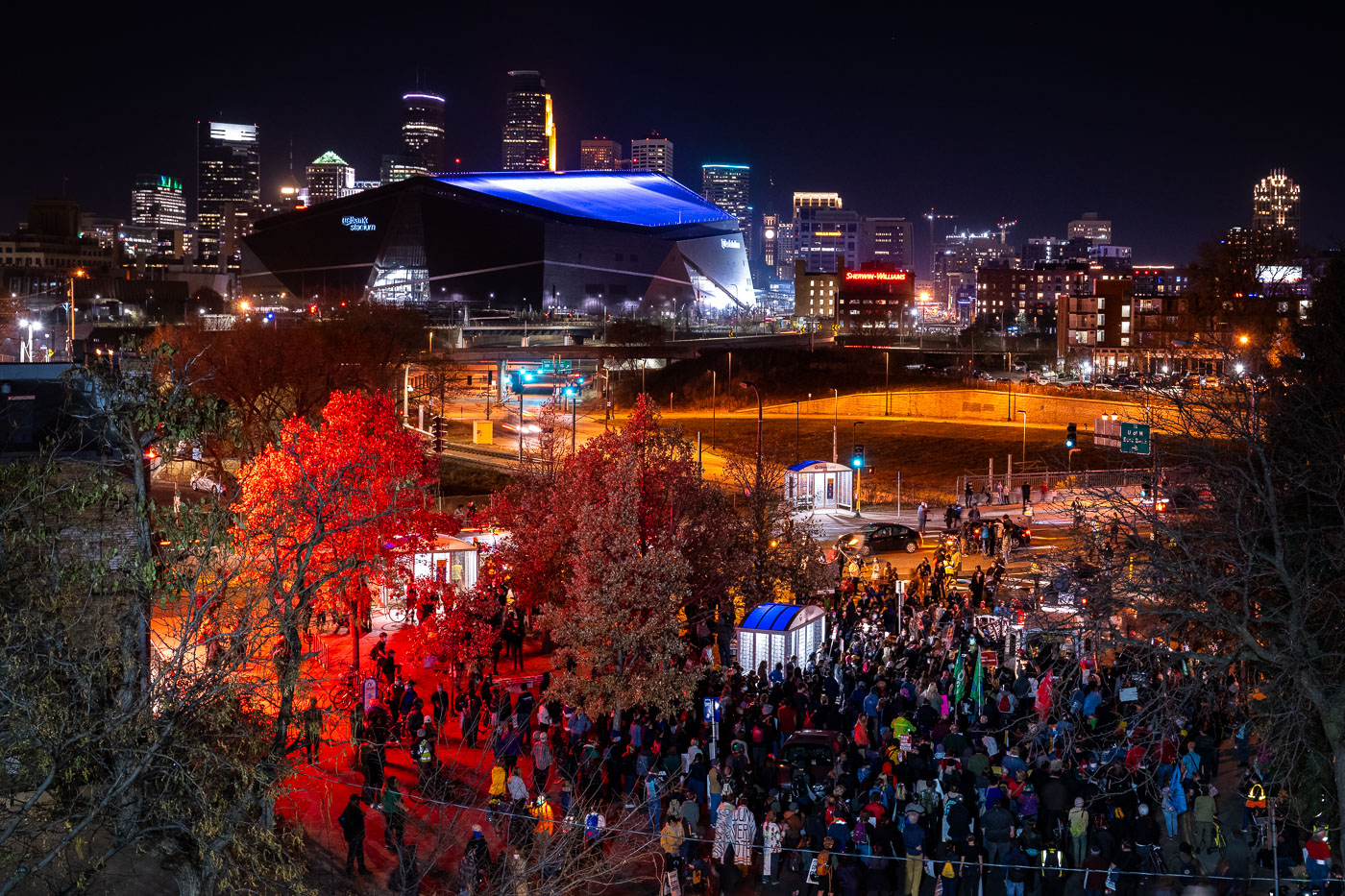
Crowd of protesters gathers in downtown Minneapolis at night near U.S. Bank Stadium during November 2020 march.
Crowds gathered near U.S. Bank Stadium on the night of November 4, 2020, the evening after Election Day, before marching toward Interstate 94. Minnesota State Patrol and Minneapolis police later arrested 646 people for occupying the highway, the largest mass arrest in state history.

Post-Election Protest March Near U.S. Bank Stadium

US Bank Plaza entrance in downtown Minneapolis with boarded plywood windows during November 2020.
US Bank Plaza rises 40 stories at 200 South 6th Street, one of downtown Minneapolis's taller office towers since its completion in 1981. The building takes its name from its anchor tenant, U.S. Bank, though it houses numerous other business tenants across its floors. Plywood paneling over its ground-floor entrances as a precaution many downtown property owners took to guard against window damage during periods of unrest in the city.

Plywood Covers the Entrance at US Bank Plaza

Minnesota State Patrol vehicles and arrestee transport buses parked at Minneapolis Convention Center temporary precinct at night.
The Minneapolis Convention Center, at 1301 Second Avenue South, became a temporary precinct for Minneapolis police after the Third Precinct building on Lake Street burned during the unrest following George Floyd's killing in May 2020. Minnesota State Patrol vehicles and prisoner transport buses staged at the center's loading docks, marked D East and C West, during subsequent demonstrations in the city. The convention center, which normally hosts trade shows and public events, sits blocks from the Nicollet Mall skyway system and downtown high-rises visible along the skyline behind it.

Prisoner Transport Buses at the Minneapolis Convention Center

Minnesota State Patrol LRAD and arrest buses parked at Minneapolis Convention Center at night.
The Minneapolis Convention Center became a temporary base for Minneapolis Police's Third Precinct after the original station on Lake Street burned during the unrest following George Floyd's murder in May 2020. Minnesota State Patrol units, including LRAD (Long Range Acoustic Device) vehicles and transport buses, staged at the center's loading docks during subsequent protests in the city. The Third Precinct's relocation to the Convention Center kept a police presence in downtown Minneapolis while officials debated whether and where to rebuild the burned station.

State Patrol Bus Staged at Minneapolis Convention Center Loading Dock

Protesters gather on Minnehaha Avenue outside Hook and Ladder theater in Minneapolis carrying "Rise" and "People Power" signs.
The Hook and Ladder Theater & Lounge sits on Minnehaha Avenue in Minneapolis's Longfellow neighborhood, inside a converted firehouse that now serves as home base for the Firehouse Performing Arts Center. The building stands a few blocks from the Minneapolis Police Third Precinct station, which was set ablaze during the unrest following George Floyd's killing in May 2020. Marchers carrying "Rise" and "People Power" flags passed the venue on November 7, 2020, the day major news networks projected Joe Biden as the winner of the presidential election.

Post-Election March Passes the Hook and Ladder on Minnehaha Avenue

Protesters gather outside Minneapolis Police Third Precinct holding a "No Coup" sign during a November 2020 demonstration.
The Minneapolis Police Third Precinct sits on Lake Street in South Minneapolis, and it was here that protesters gathered after Joe Biden was declared the winner of the 2020 presidential election. A demonstrator's hand-lettered "No Coup" sign spoke to fears that Donald Trump would refuse to concede the race. The precinct building had been burned during the unrest following George Floyd's death in May 2020, and by this gathering it remained fenced off and reinforced with concrete barriers as the department continued to operate out of temporary quarters elsewhere in the city.

“No Coup” Sign Outside the Minneapolis Third Precinct

Protesters hold signs reading "No Burning Trash" and "Stop Environmental Racism" at a Minneapolis gathering in November 2020.
Marchers carried hand-painted signs reading "No Burning Trash" and "Stop Environmental Racism" through Minneapolis on November 7, 2020, the day major news outlets projected Joe Biden as the winner of the presidential race. The demonstration linked opposition to waste incineration and pollution in low-income neighborhoods with the broader wave of marches that followed the election call. Environmental justice organizing in the Twin Cities has long focused on facilities like the Hennepin Energy Recovery Center, a downtown trash-burning incinerator that critics have targeted for its emissions impact on nearby communities of color.

“Stop Environmental Racism” Signs at a Minneapolis March

Protesters wearing orange "Democracy Defender" vests gather outside Minneapolis Police Third Precinct on Lake Street.
"Democracy Defender" vests mark volunteers from Nonviolent Peaceforce, a global nonprofit that trains civilians in unarmed protection work at protests and conflict zones. The group deployed monitors at marches across Minneapolis following the 2020 presidential election, positioning themselves between demonstrators and police to de-escalate potential confrontations. A "Green New Deal" sign carried nearby points to the range of causes represented in the crowd that day. The Third Precinct station had already become a of unrest in Minneapolis months earlier, drawing continued demonstrations through the fall.

“Democracy Defenders” March Near Minneapolis Police 3rd Precinct

Protesters gather outside Minneapolis Police Third Precinct on Lake Street carrying signs for environmental justice and social
The Minneapolis Police Third Precinct sits on East Lake Street, rebuilt after the original station was burned during the unrest that followed George Floyd's killing in May 2020. This gathering came on the day Joe Biden was declared the winner of the 2020 presidential election, drawing marchers carrying "Green New Deal" signs and a "Rise" banner tied to environmental justice organizing.

Climate Justice March Rebuilds Outside the Third Precinct

Indigenous ceremonial performer wearing feathered headdress, beaded regalia, and face mask holds incense pot during Minneapolis
Aztec dance traditions, known as danza azteca or mexica, trace back to pre-Hispanic ceremonial practice and remain active today among Indigenous and Chicano communities across North America. The feathered headdress worn here, called a penacho, is typically built from pheasant or macaw feathers and signals rank or role within a dance troupe. The clay vessel held in this image is used to burn copal, a resin incense central to purification rites performed before and during ceremonial dances. Face coverings were required at outdoor public gatherings in 2020, the year this march took place along Lake Street in Minneapolis.

Aztec Dancer in Feathered Headdress on Lake Street

Diverse marchers including Indigenous participants carry signs and decorative banners on Lake Street in Minneapolis during a 2020
Marchers moved along Lake Street near South 17th Avenue in Minneapolis after news broke of Joe Biden's win in the 2020 presidential election. Signs carried through the crowd read "Count Every Vote," "Land Back," and messages supporting workers' rights, tying the moment to causes beyond the election itself. Aztec danzantes in feathered headdresses marched among the crowd, a common presence at Lake Street demonstrations tied to the Twin Cities' Indigenous and Chicano communities. Lake Street itself runs through some of Minneapolis's most ethnically diverse neighborhoods, including the Latino commercial corridor around Midtown.

Post-Election March on Lake Street Near S 17th Avenue

Person wearing blue shirt with "Defund the Police" graphic at Minneapolis protest.
"Defund the police" became a national rallying cry after George Floyd was killed by Minneapolis police in May 2020, with activists calling for cities to shift funding from police departments toward housing, mental health, and community-based safety programs. In Minneapolis, the phrase appeared on signs, murals, and clothing throughout that year's protests. This march took place on November 7, 2020, the day major news networks called the presidential race for Joe Biden, when demonstrators in the city combined election reactions with continued demands for police reform.

“Defund the Police” T-Shirt at a Minneapolis March
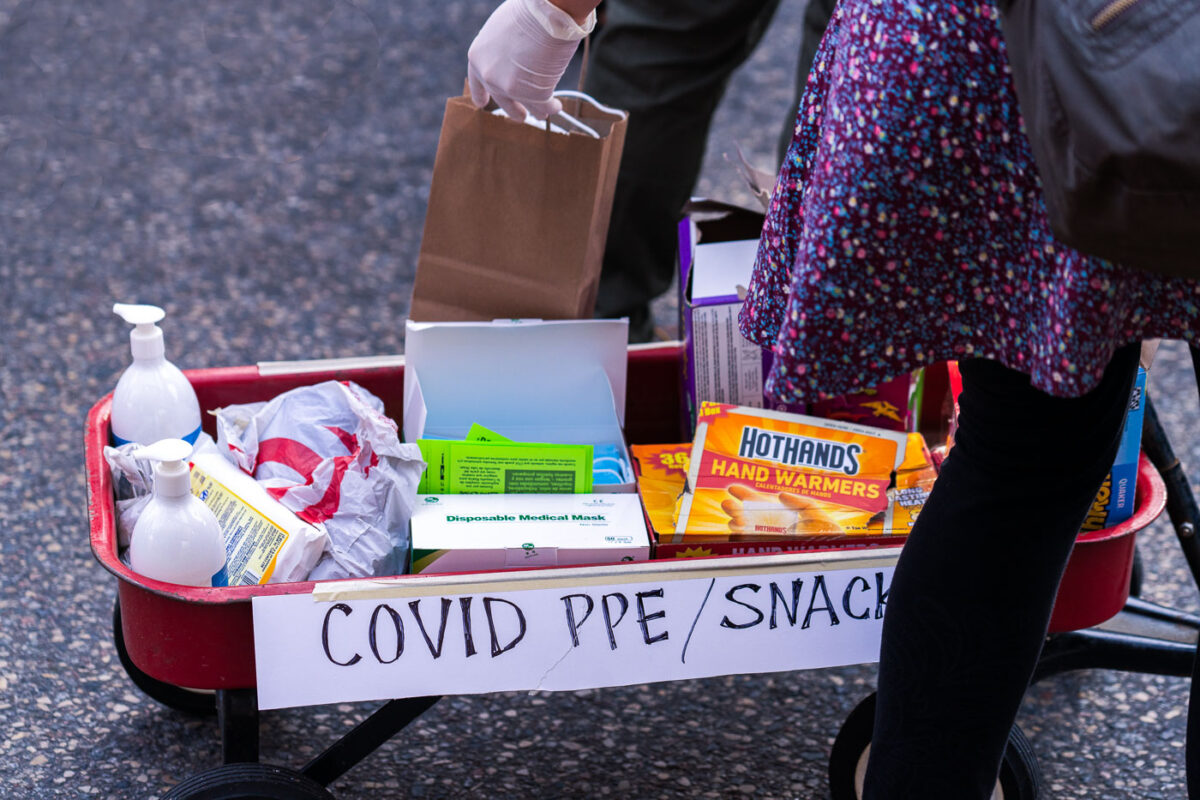
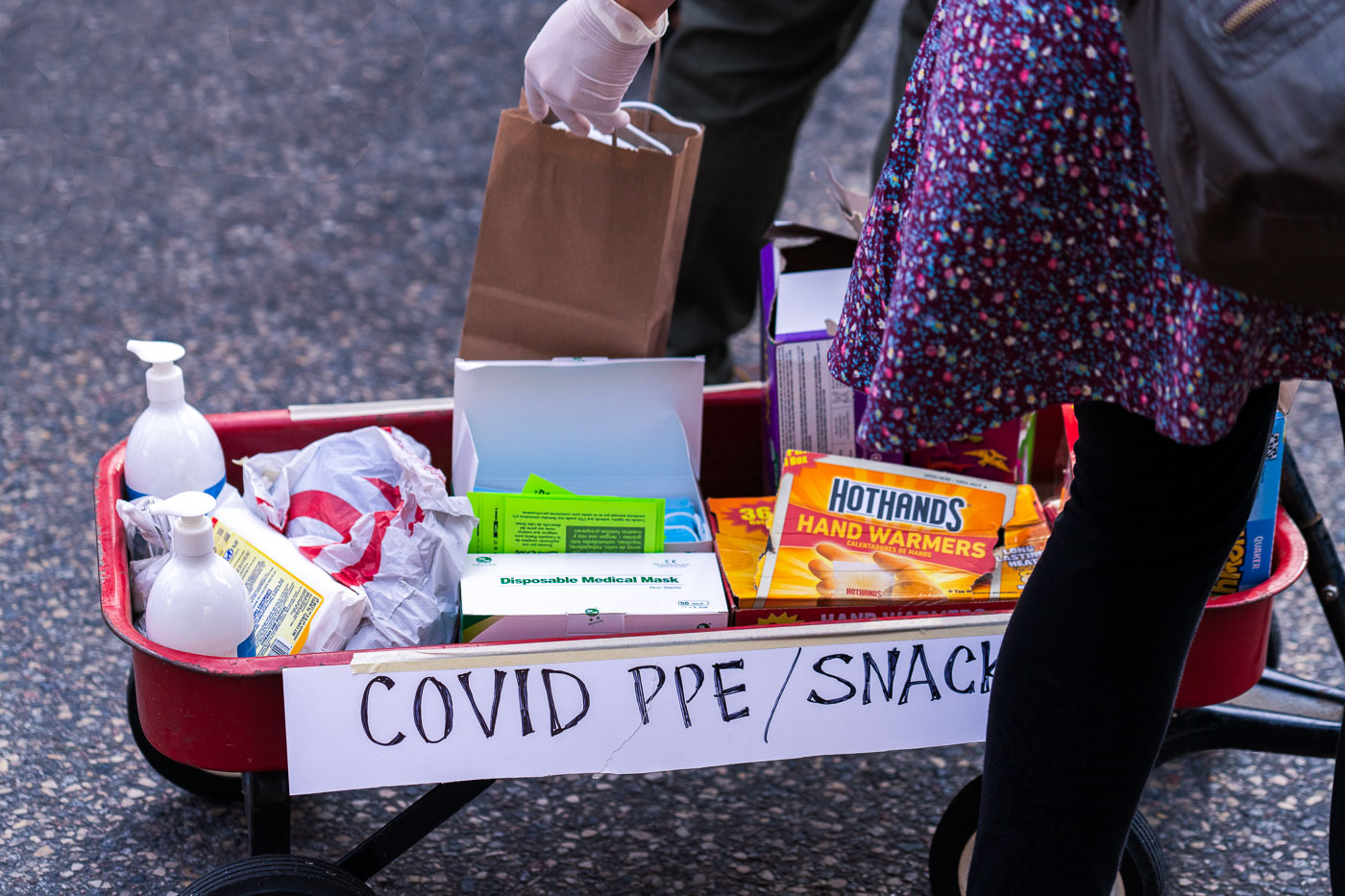
Red wagon stocked with COVID-19 PPE, hand warmers, and snacks for protest participants in Minneapolis.
A hand-lettered sign reading "COVID PPE / Snacks" identifies this wagon as a mutual aid station, stocked with hand sanitizer, disposable medical masks, hand warmers, and packaged snacks. Volunteers organizing such stations typically distribute supplies free of charge to marchers, a practice that became common at Minneapolis demonstrations during the COVID-19 pandemic. The mix of protective gear and warmers the practical needs of participants marching outdoors in November, when the city's temperatures often fall near freezing.

A Mutual Aid Wagon Marked “COVID PPE / Snacks”

Protester wearing denim vest with Hitler-Trump patch at Minneapolis post-election march.
Powderhorn Park, on Minneapolis's south side, was a gathering point for marches following the November 2020 presidential election. Marchers moved from the park through nearby streets, with signs and patches expressing opposition to Donald Trump, including imagery comparing him to Adolf Hitler. The neighborhood had already served as a staging ground for demonstrations earlier that year following the killing of George Floyd, making it a familiar assembly point for organizers by the time of the election.

“Hitler” Trump Patch on a Denim Jacket at Powderhorn Park March

Protesters carrying "Jews Against Fascism" and racial justice banners march along Lake Street in Minneapolis.
Marchers carry a "Jews Against Fascism" banner down Lake Street on November 7, 2020, the day major networks declared Joe Biden the winner of the presidential election. The route passed the former Minneapolis Police Third Precinct at Lake Street and Minnehaha Avenue, burned by protesters in May 2020 after the killing of George Floyd.

“Jews Against Fascism” Banner Leads a Lake Street March

Crowd of protesters with signs and flags marches past colorful mural on Lake Street in Minneapolis.
The mural above the marchers depicts a farmworker and desert plants, one of many large-scale works commissioned along Lake Street after the corridor sustained heavy damage following George Floyd's killing in May 2020. Lake Street is a major east-west commercial corridor through South Minneapolis and has long served as a hub for the city's Latino and immigrant-owned businesses. The march passing beneath it took place on November 7, 2020, the day media outlets projected Joe Biden as the winner of the presidential race. Demonstrators carried signs addressing policing and housing as they moved along the street.

Post-Election March Passes a Mural on Lake Street

Coliseum Building on Lake Street in Minneapolis with boarded storefronts decorated with community murals.
The Coliseum Building stands on Lake Street in Minneapolis, its ground-floor storefronts boarded with plywood after damage during the 2020 civil unrest. Built in 1917, the building originally housed a theater along with retail and commercial tenants serving the Longfellow neighborhood. Community members later painted the plywood panels with murals and messages, turning the boards into a temporary public canvas.

Murals Cover Boarded Windows at the Coliseum Building on Lake Street

"Abolish The Police" Mural at Moon Palace Books
"Abolish The Police" mural on Moon Palace Books. Seen in November 2020.

“Abolish The Police” Mural at Moon Palace Books

Artist paints Black Lives Matter mural on boarded storefront along Lyndale Avenue in Uptown Minneapolis.
The mural reading "Black Lives Matter, All Year Round" covers boarded-up storefronts on Lyndale Avenue in Uptown Minneapolis. Plywood panels like these went up over windows and doors across the city after unrest broke out in the wake of George Floyd's killing in May 2020, and many were later painted by local artists rather than removed. Months after the initial unrest, murals such as this one remained in place, turning storm boards into lasting public artwork.

“Black Lives Matter, All Year Round” Mural on Lyndale Avenue

Boarded Tires Plus storefront on Lake Street, Minneapolis, with graffiti including "Stop Line 3" and "No More Prez" messages
Tires Plus operates a tire and auto repair shop on Lake Street in Minneapolis's Uptown neighborhood. Plywood covering its windows carries the message "Stop Line 3," a reference to opposition against Enbridge's Line 3 oil pipeline expansion through northern Minnesota. Other markings reading "No More Prez" and "Riots 2020" were added amid the unrest that followed George Floyd's death in 2020.

Boarded-Up Tires Plus on Lake Street After 2020 Unrest

Uptown Smoke Shop storefront on Lake Street with boarded windows displaying colorful "Help + Love each other" graffiti mural.
The mural reading "Help + Love Each Other" covers boarded-up windows at Uptown Smoke Shop, an e-cigarette retailer at 1408 Lake Street in Minneapolis's Uptown neighborhood. Plywood went up over storefronts along Lake Street after the unrest that followed George Floyd's killing in May 2020, and many of those boards became canvases for community-painted messages rather than being removed once repairs were made.

‘Help + Love Each Other’ Mural at Uptown Smoke Shop on Lake Street

Illuminated art installation by Juxtaposition Arts on Target store facade, Lake Street, Minneapolis, featuring "WE STAND TOGETHER
Juxtaposition Arts, a Minneapolis youth-focused art and design nonprofit based in North Minneapolis, created the mural covering the Target store's exterior wall on Lake Street. The panel reads "We Stand Together, We Build Together," spanning the length of the building in a series of connected murals. This Target location sits near the site of the Minneapolis Police Third Precinct, which was damaged during the unrest following George Floyd's death in May 2020. The store itself sustained damage in the same period and later reopened with the mural installed along its street-facing wall.

“We Stand Together” Mural at Target on Lake Street

Damaged building at Minnehaha Avenue and East 28th Street in Minneapolis during snowfall, November 2020.
This building at Minnehaha Avenue and East 28th Street in South Minneapolis sustained fire and structural damage during the unrest that followed George Floyd's killing in May 2020. The corner sits within the Longfellow neighborhood, a stretch of Minnehaha Avenue where several storefronts burned or were looted that week. Months later, by November 2020, the structure remained partially collapsed, its ruins boarded and marked with graffiti through the winter.

Collapsed Building at Minnehaha Avenue and East 28th Street

Worker operating snow blower on downtown Minneapolis sidewalk during heavy snowfall, November 2020.
A worker clears fresh snow from a downtown Minneapolis sidewalk with a walk-behind snow blower, working past a U.S. Bank branch. Minnesota's first significant snowfall of the 2020-21 season arrived in mid-November, catching the Twin Cities before many businesses had switched from fall to winter maintenance routines. Downtown property managers and city crews typically have a matter of hours to clear walkways after a storm, since Minneapolis code requires adjacent property owners to keep public sidewalks passable.

Clearing Snow Outside a U.S. Bank Branch in Downtown Minneapolis

Maruso Bar's neon sign glows on Hennepin Avenue in downtown Minneapolis during heavy November snowfall.
Maruso Bar sits on Hennepin Avenue in downtown Minneapolis, a stretch of the street long associated with the city's nightlife and entertainment district near First Avenue and the Hennepin Theatre District.

Snowfall Outside Maruso Bar on Hennepin Avenue

© 1996–2026 Chad Davis