Snow-Covered Markers at “Say Their Names Cemetery,” George Floyd Square
January 2023
—
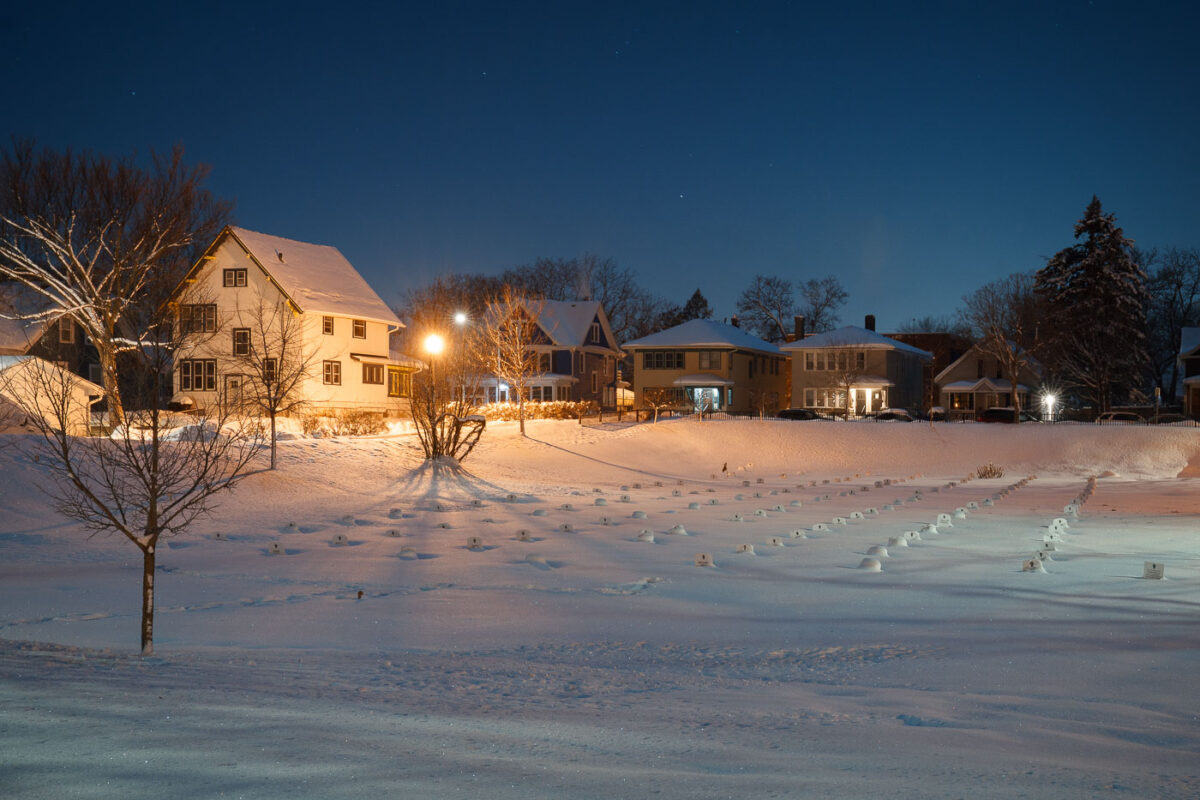
"Say Their Names Cemetery" near George Floyd Square on January 7, 2023. The memorial was installed not long after George Floyd's murder in May 2020. Each headstone holds the name of a victim of police violence.
Fire-Damaged House Near George Floyd Square After Snowfall
January 2023
—
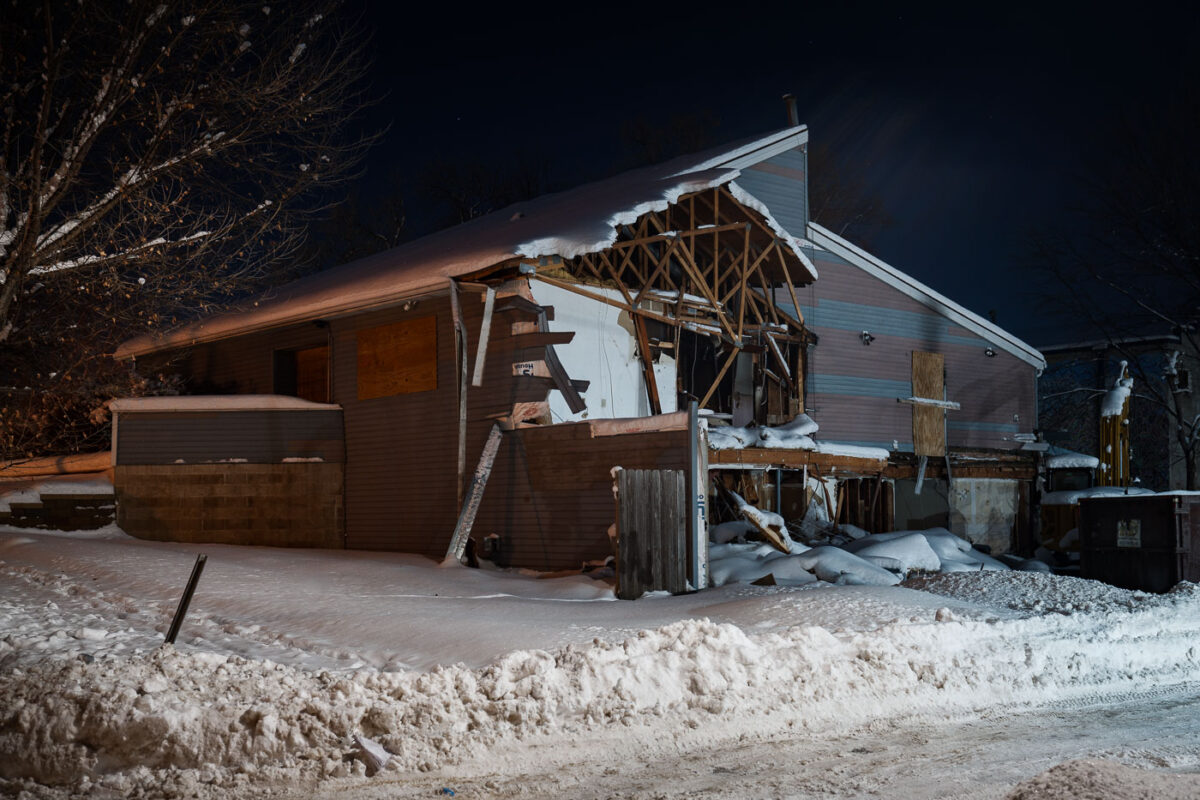
The remains of "the blue house", a building near George Floyd Square on January 7, 2023. It had sat vacant after a fire broke out inside. It's since been demolished.
Snow-Covered Fist Sculpture at George Floyd Square
January 2023
—
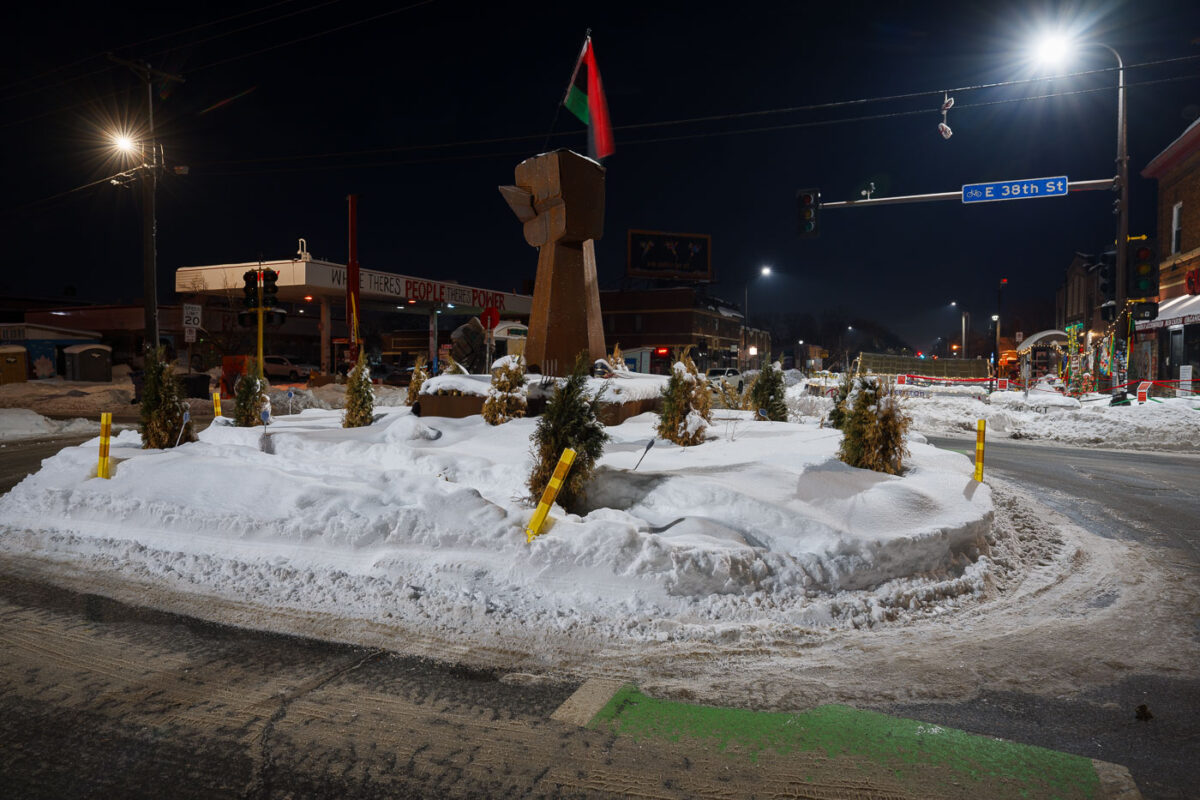
The first at the intersection of 38th and Chicago Avenue on January 7, 2023 in Minneapolis near where George Floyd was murdered. The area has been an active protest zone since May 2020 and is known as George Floyd Square.
Snow-Covered Cars at a Lake Street Dealership
January 2023
—
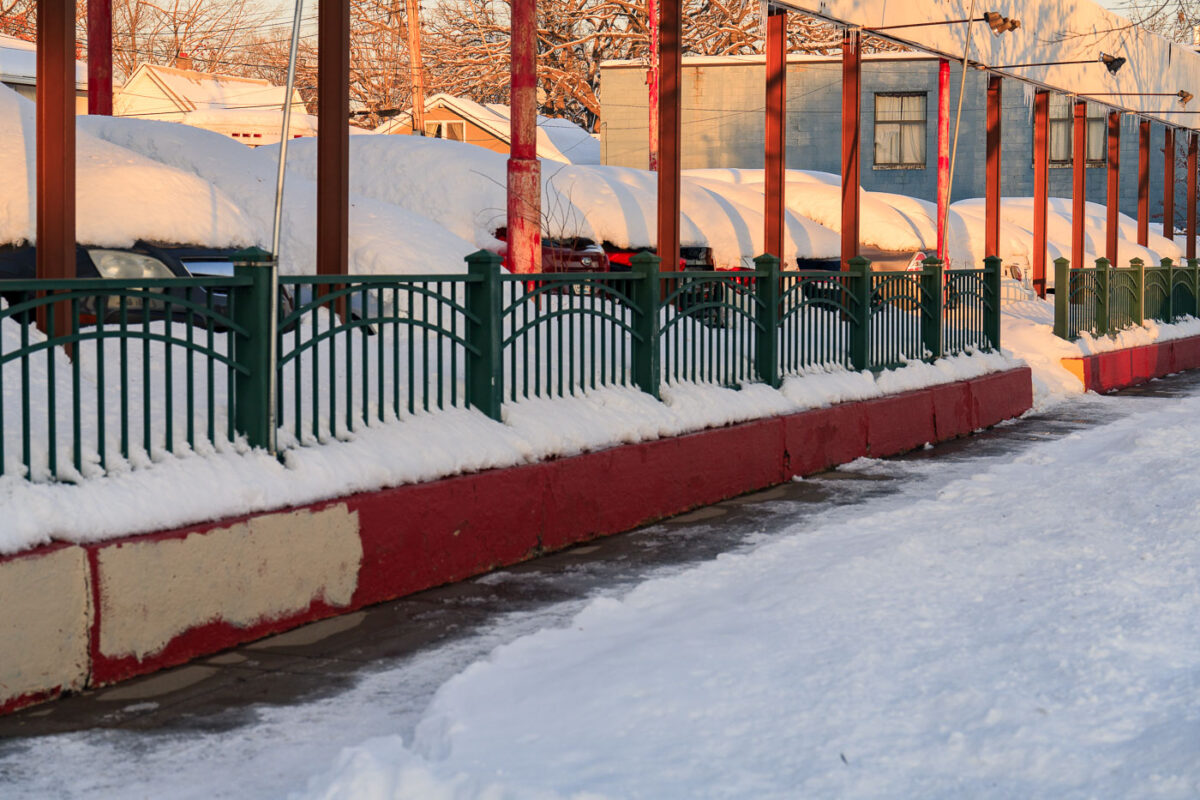
Snow covering cars at a dealership on Lake Street in Minneapolis on January 7, 2023.
Uptown Minneapolis: Cars Buried After 14″ Snowfall on James Ave
January 2023
—
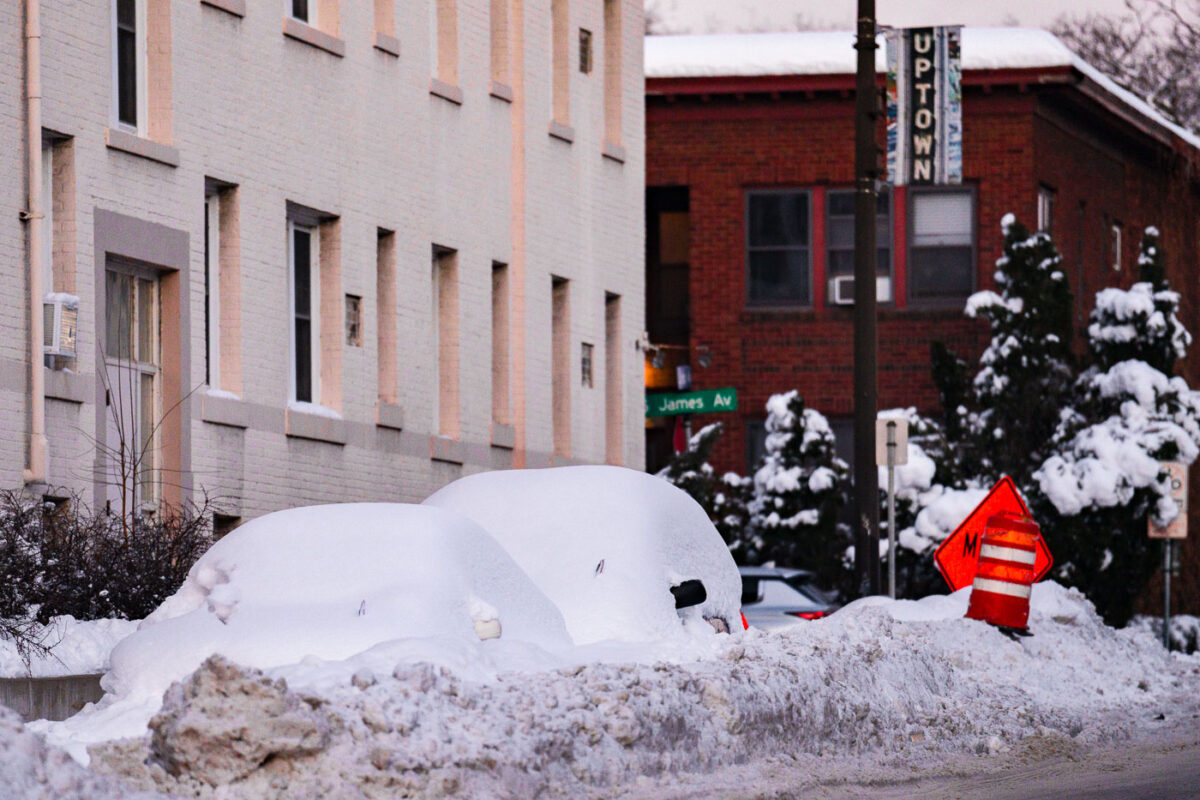
Cars under the snow following a 14" snowfall in Uptown Minneapolis.
Snowboarders at Bde Maka Ska, Minneapolis
January 2023
—
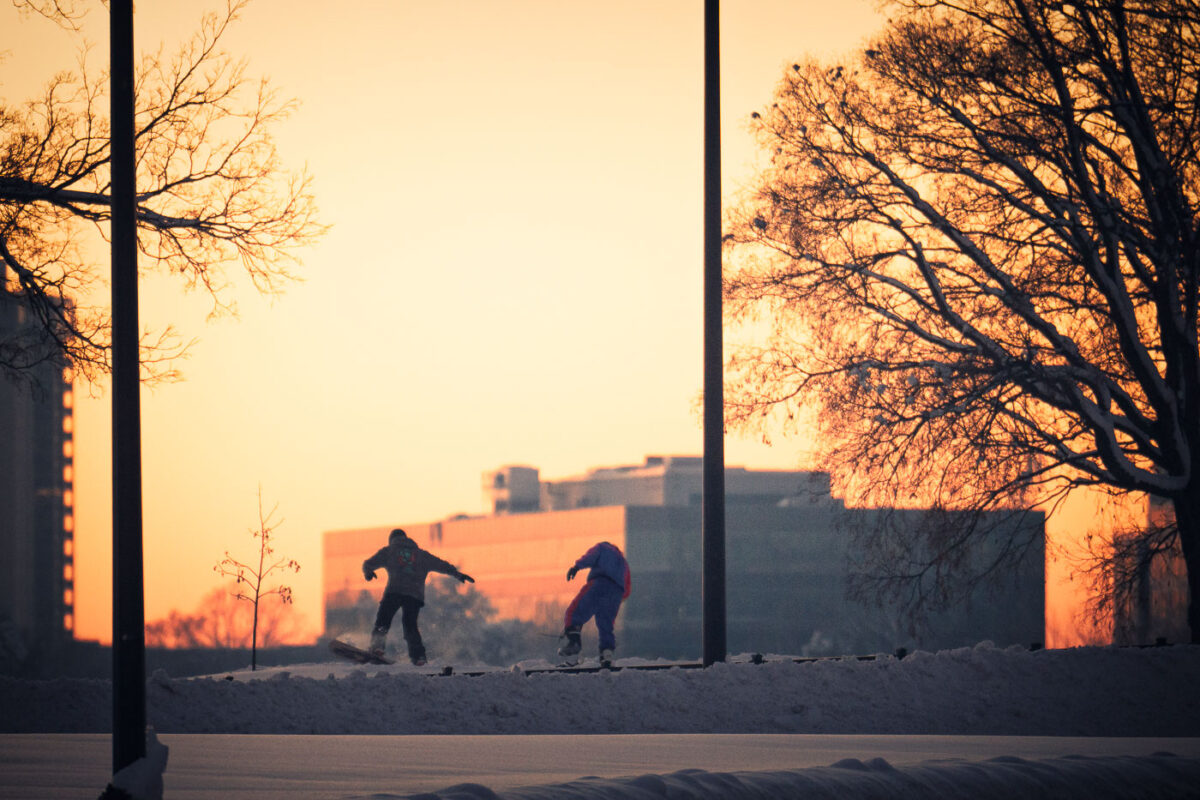
Two snowboarders make use of fresh snow along the parkway near Bde Maka Ska in Minneapolis after a major winter storm. The lake—renamed in 2018 to restore its Dakota place name—anchors the Chain of Lakes system and serves as one of the city’s most heavily used recreation areas year-round. Heavy snowfall often transforms the surrounding trails and embankments into informal terrain for skiing, snowboarding, and winter biking, reflecting how quickly the area adapts to seasonal conditions. The early-morning light and cleared parkway signal the coordinated snow-response efforts that keep the city’s lakes district accessible even during severe weather.
Target Field Station and Snow Plows
January 2023
—
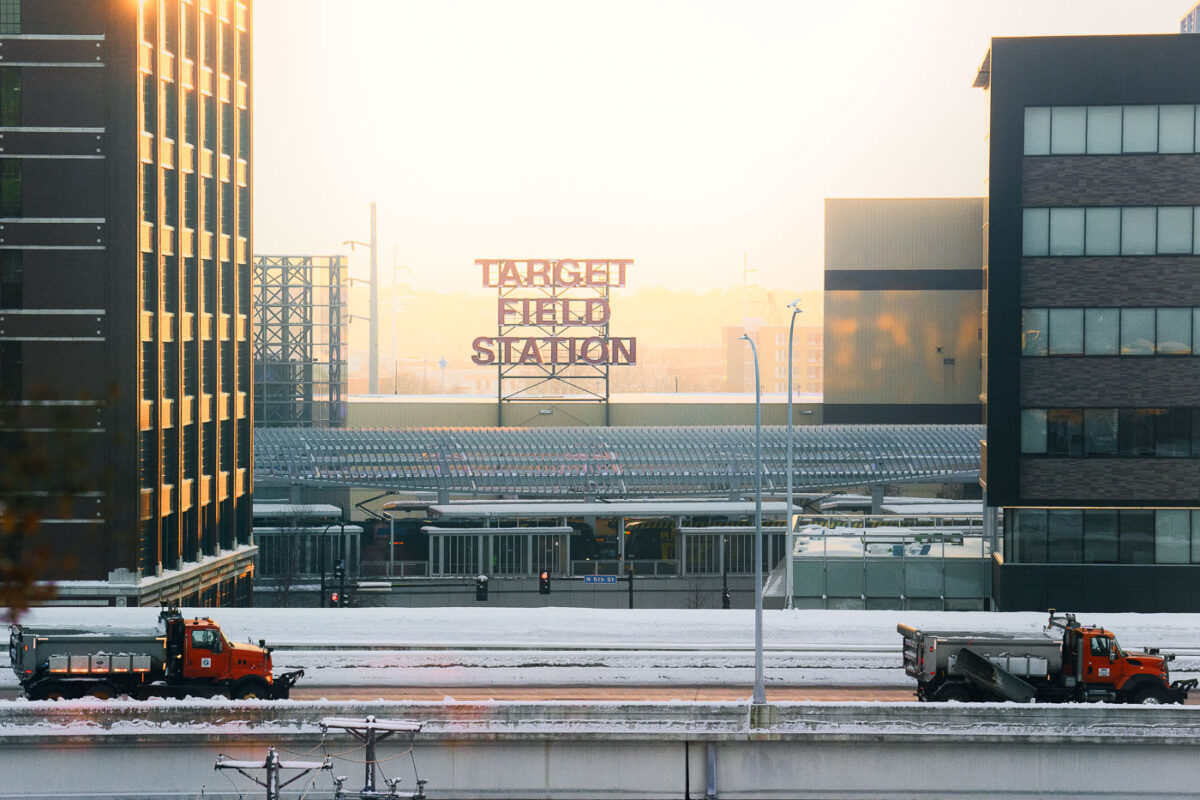
Target Field Station in Minneapolis during a winter sunrise, viewed across the railyard as snowplow trucks clear nearby roadways. Opened in 2014, the station serves as the western terminus for METRO Blue and Green Line light-rail service and functions as a multimodal hub for events at Target Field and the surrounding North Loop district. Its distinctive steel canopy and track arrangement were designed to accommodate both current transit operations and future extensions, reflecting the region’s long-term rail planning strategy. The elevated vantage also highlights the mix of transit, freight infrastructure, and redevelopment that continues to reshape this former warehouse district.
Foosball Table Figures in Afternoon Light
January 2023
—
A close-up view of a classic foosball table shows rows of molded player figures lined up on chrome-plated rods, illuminated by soft afternoon light from a nearby window. The design—bright jerseys, simple facial features, and sturdy construction—reflects the durable style common in commercial and recreational tables since the mid-20th century. Often found in community centers, break rooms, and pubs, foosball tables like this one are built for fast play and social interaction, with standardized layouts that mirror the positioning of real soccer formations.
“Honor the Dead, Fight for the Living” Sign at Tortuguita March
January 2023
—
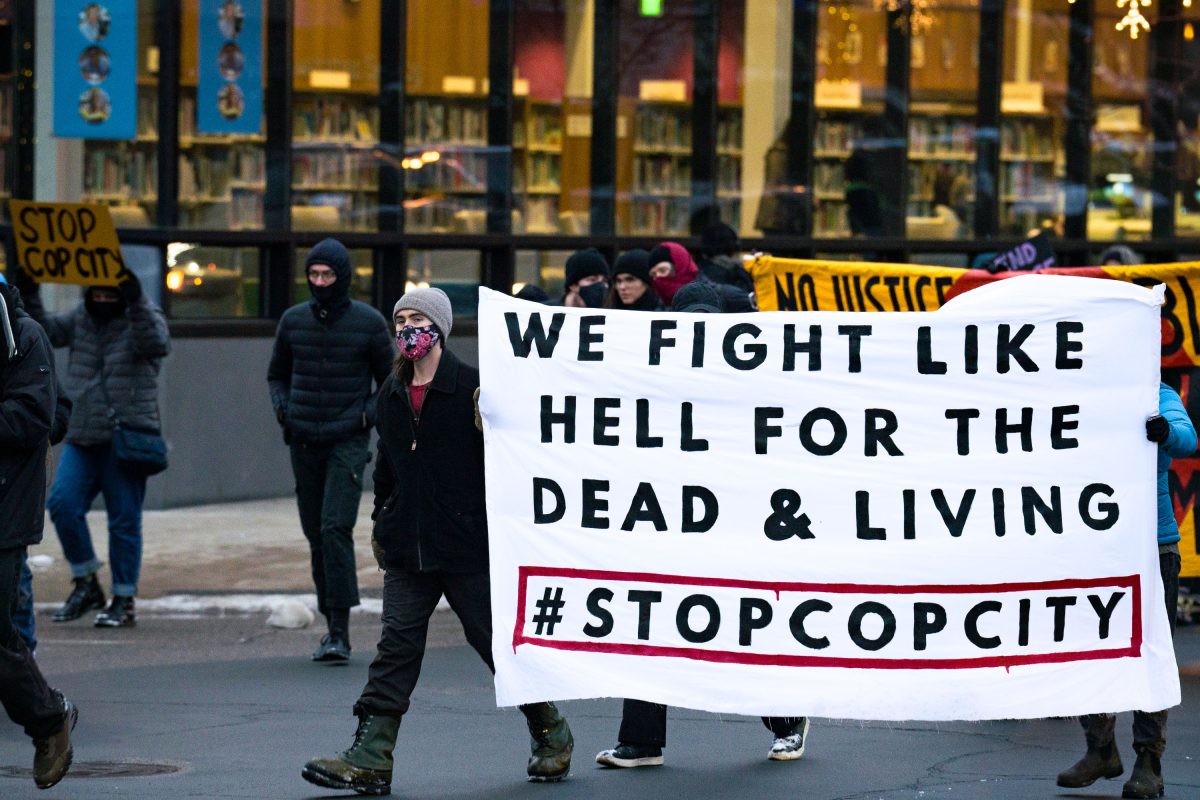
“We Fight Like Hell” Banner at Tortuguita March in Minneapolis
January 2023
—
Minneapolis March for Manuel Teran and Local Remembrance
January 2023
—
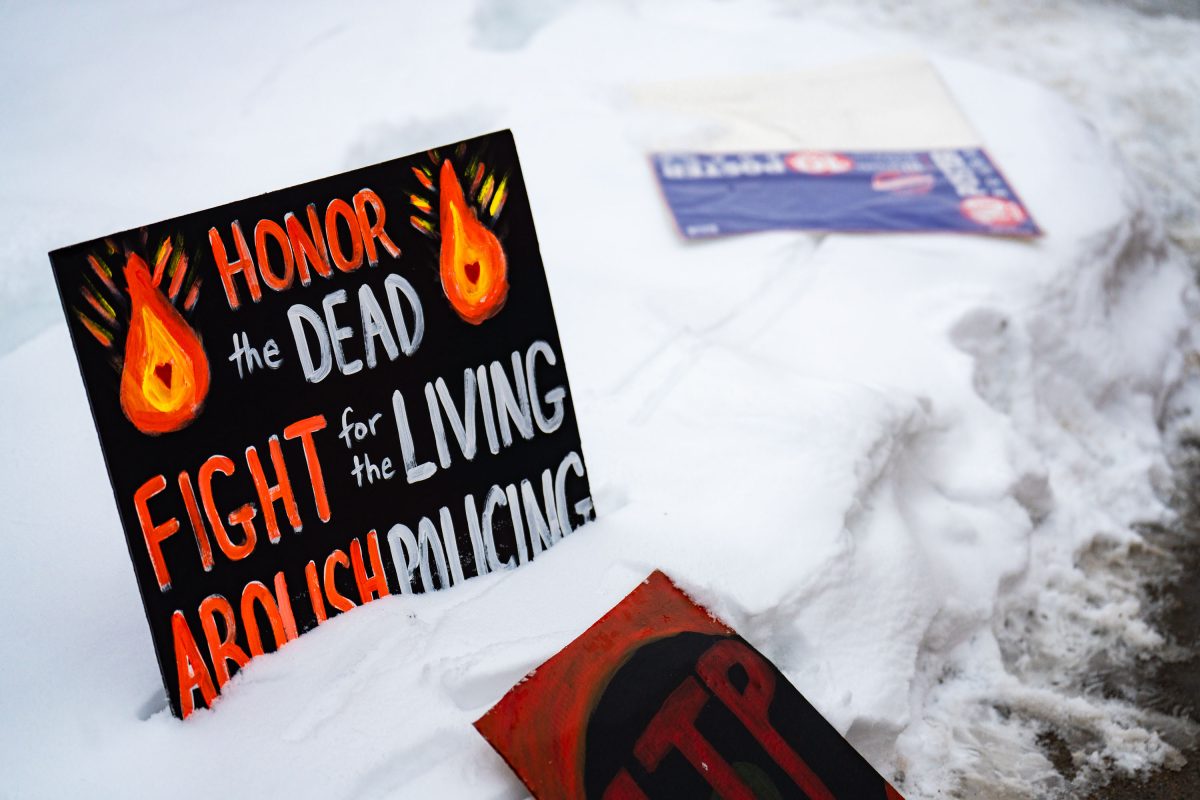
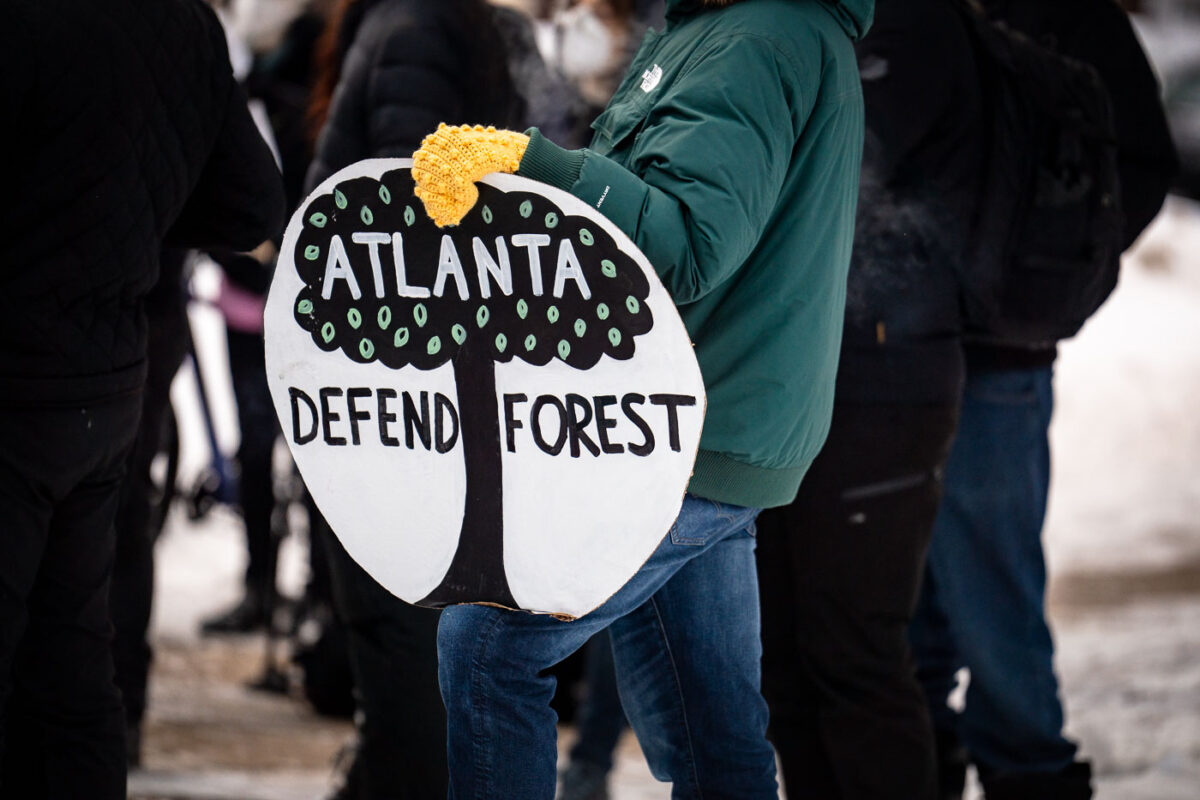
rotesters gather near Hennepin Avenue and Lake Street in Minneapolis to honor Manuel “Tort” Teran, who was killed during a long-running protest effort in the South River Forest near Atlanta. Demonstrators held signs and marched in solidarity with organizers nationwide, linking the Atlanta case to local histories of protest in Minneapolis. The group paused at Lake Street and Girard Avenue, the site where Deona Marie was killed on June 13, 2021, during demonstrations following the police shooting of Winston Smith. The march connected these separate events through a shared emphasis on community memory, public accountability, and the long-term impacts of protest-related violence.
Defend The Atlanta Forest Protest Sign
January 2023
—
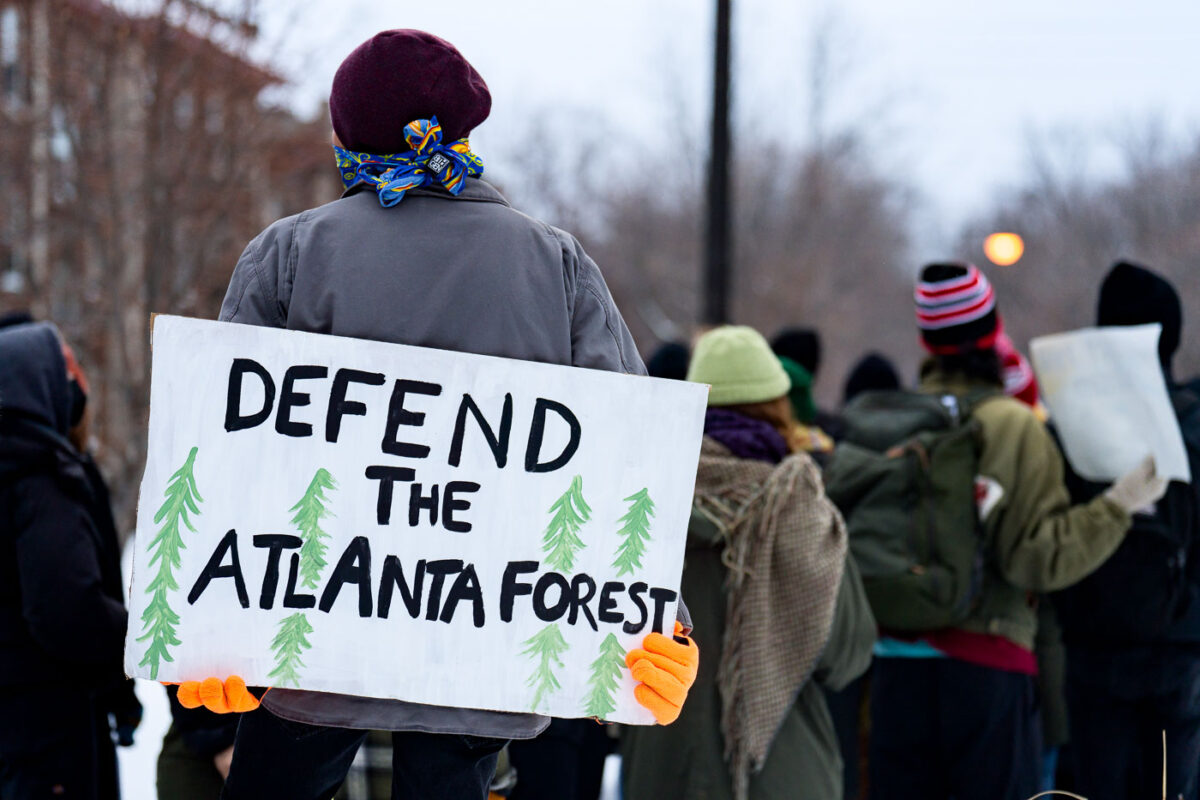
Protesters marching in Minneapolis near Hennepin/Lake remembering Manuel Teran(Tort), who was shot and killed by officers at a prolonged protest in an Atlanta forest after they say he fired upon them. They stopped at Lake/Girard where protester Deona Marie was killed on 06/13/21.
Police Vehicles Behind Fencing at the Temporary 3rd Precinct Site
January 2023
—
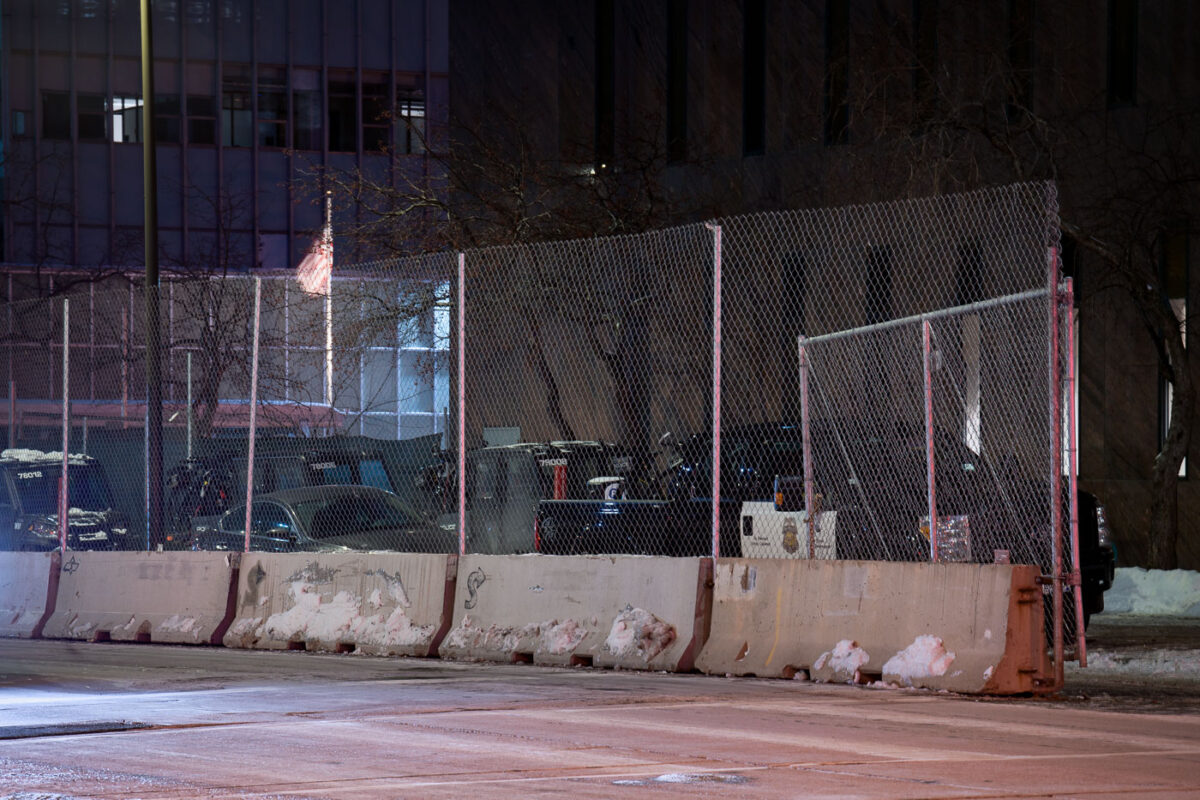
Minneapolis police vehicles parked outside a barricaded temporary third precinct on January 28, 2023. The temporary precinct is due to the original third precinct being burned on May 28th, 2020.
Fenced Entrance at Minneapolis Police 5th Precinct at Night
January 2023
—
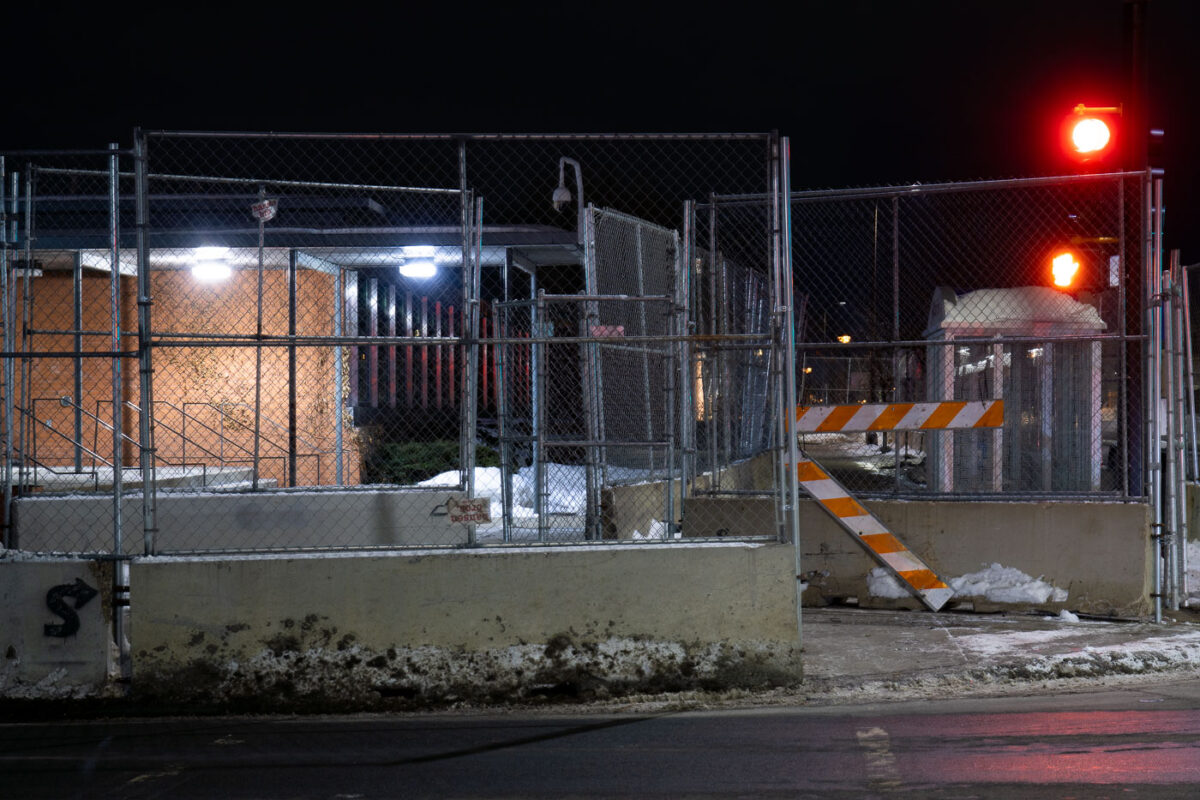
Security fencing installed again around the precinct just as written closing arguments are submitted in the case of Tou Thao.
Capybara at Sustainable Safari, Maplewood Mall
January 2023
—
A capybara at the Sustainable Safari zoo in the Maplewood Mall.
Resting Capybara, Sustainable Safari at Maplewood Mall
January 2023
—
Capybara sitting at Sustainable Safari in Maplewood.
January 2023
—
Capybara at Sustainable Safari in Maplewood Minnesota.
We’re Hiring! Minnesota Department of Corrections
January 2023
—
We're Hiring! Minnesota Department of Corrections signage at the Mall of America in Bloomington.
Minneapolis Squad Car in Uptown Minneapolis 2023
February 2023
—
A Minneapolis Squad Car parked on Lagoon Avenue in Uptown Minneapolis.
No Right Turn Sign Under a Weathered “W Lake St” Marker at Night
February 2023
—
W. Lake St. sign on Hennepin Ave in Uptown Minneapolis. The paint peeling from burning dumpsters during unrest following the law enforcement killing of Winston Smith in June 2021.
Running Room and Ragstock on a Snowy Night in Uptown
February 2023
—
Running Room and Ragstock on Lake Street in Uptown Minneapolis on February 5, 2023.
Arts + Rec Sign Glows Along Lake Street in Uptown Minneapolis
February 2023
—
Arts + Rec Uptown at Lake Street and Girard Ave on February 5, 2023.
“Justice for George Floyd” Stickers in a Hennepin Avenue Window
February 2023
—
"Justice for George" stickers in a storefront on Hennepin Avenue in Uptown Minneapolis.
“The New Uptown Cafe” Sign Lit Up at Night on Hennepin Avenue
February 2023
—
The New Uptown Cafe on Hennepin Avenue in Minneapolis.
Police Squad Cars Outside Fire House Bar in Uptown Minneapolis
February 2023
—
Minneapolis Police parked outside Fire House bar/restaurant in Uptown Minneapolis.
Graffiti that reads “No Good cops. No bad protesters”
Green Room’s Marquee Glows at Night in Uptown
February 2023
—
Snowy Night on Hennepin Avenue in Uptown Minneapolis
February 2023
—
McDonald's at Hennepin and Lagoon in Uptown Minneapolis on February 5, 2023.
Police Squad Cars at Uptown Ties Lounge & Rooftop
February 2023
—
Minneapolis Police parked outside Uptown Ties Lounge & Rooftop on Lagoon Ave.
Micro Center Store, St. Louis Park
February 2023
—
Micro Center in St. Louis Park, Minnesota.
Tower Crane at High-Rise Construction Site, Downtown Minneapolis
February 2023
—
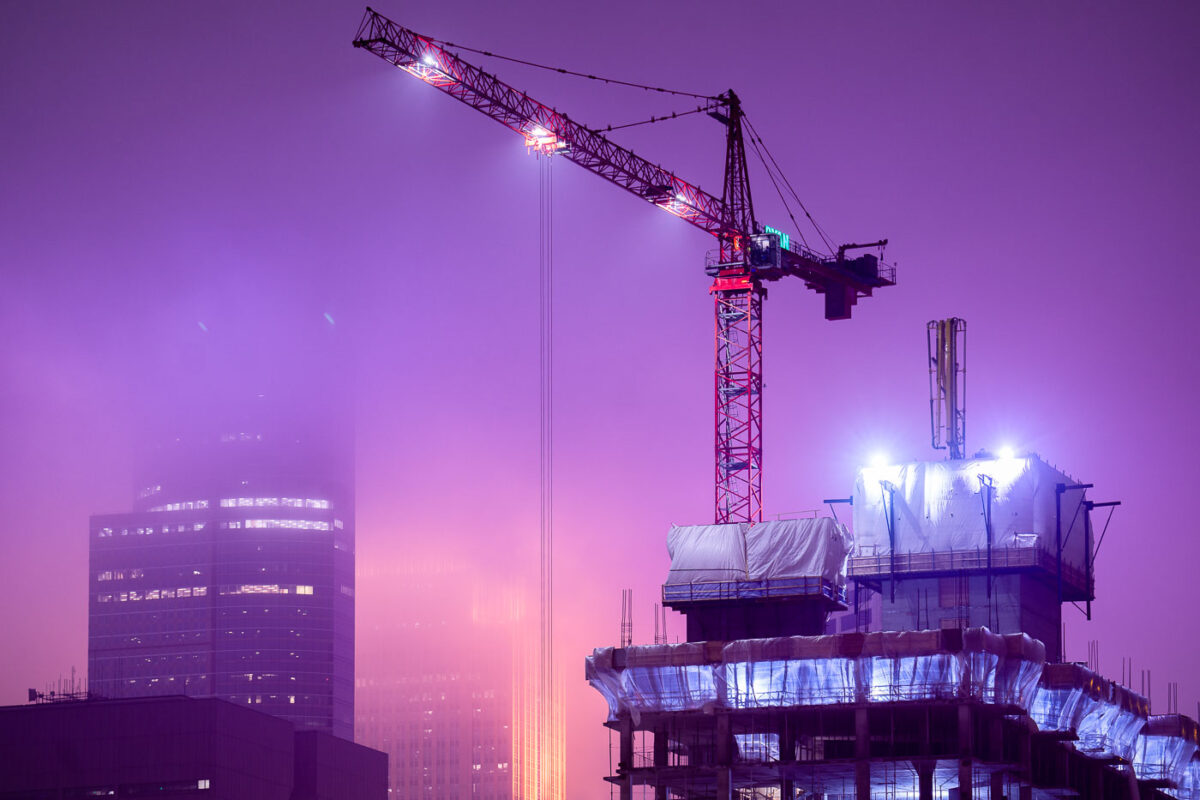
Foggy night with construction cranes in Downtown Minneapolis.
Bus Reflected in Williams Pub’s Window on Hennepin Avenue
February 2023
—
Looking inside the closed Williams Pub on Hennepin Avenue in Uptown Minneapolis.
Neon Sign Glows Above Williams Pub on Hennepin Avenue
February 2023
—
Williams Pub signage on Hennepin Avenue in Uptown Minneapolis.
Dragon City Cafe on East Lake Street
February 2023
—
“Urban Farm: Grow Our Future” Sign at the Roof Depot Site
February 2023
—
Roof Depot Urban Farm property in South Minneapolis.
“Depot Pool” Graffiti on Water Tower at Roof Depot Site
February 2023
—
Roof Depot Urban Farm property in South Minneapolis on February 18, 2023.
Everlake Apartments at Dusk Near Lake Street’s Target Store
February 2023
—
Everlake Apartments in South Minneapolis on February 18, 2023. The building was destroyed by fire during construction during riots following the murder of George Floyd in May 2020.
“The George Floyd Uprising” Book Release Poster at Seward Cafe
February 2023
—
A flyer for "The George Floyd Uprising" book by "Vortex Group" seen at George Floyd Square on February 18, 2023.
Night at George Floyd Square Outside Cup Foods
February 2023
—
The George Floyd Memorial at George Floyd Square on February 18, 2023. The area has been a protest zone since the May 25, 2020 murder of George Floyd.
George Floyd’s Chair in the Snow at Say Their Names Cemetery
February 2023
—
A chair with "George Floyd" written on it in the snow at Say Their Names Cemetery on February 18, 2023.
City of Lakes Luminary Bag at the Loppet on Lake of the Isles
February 2023
—
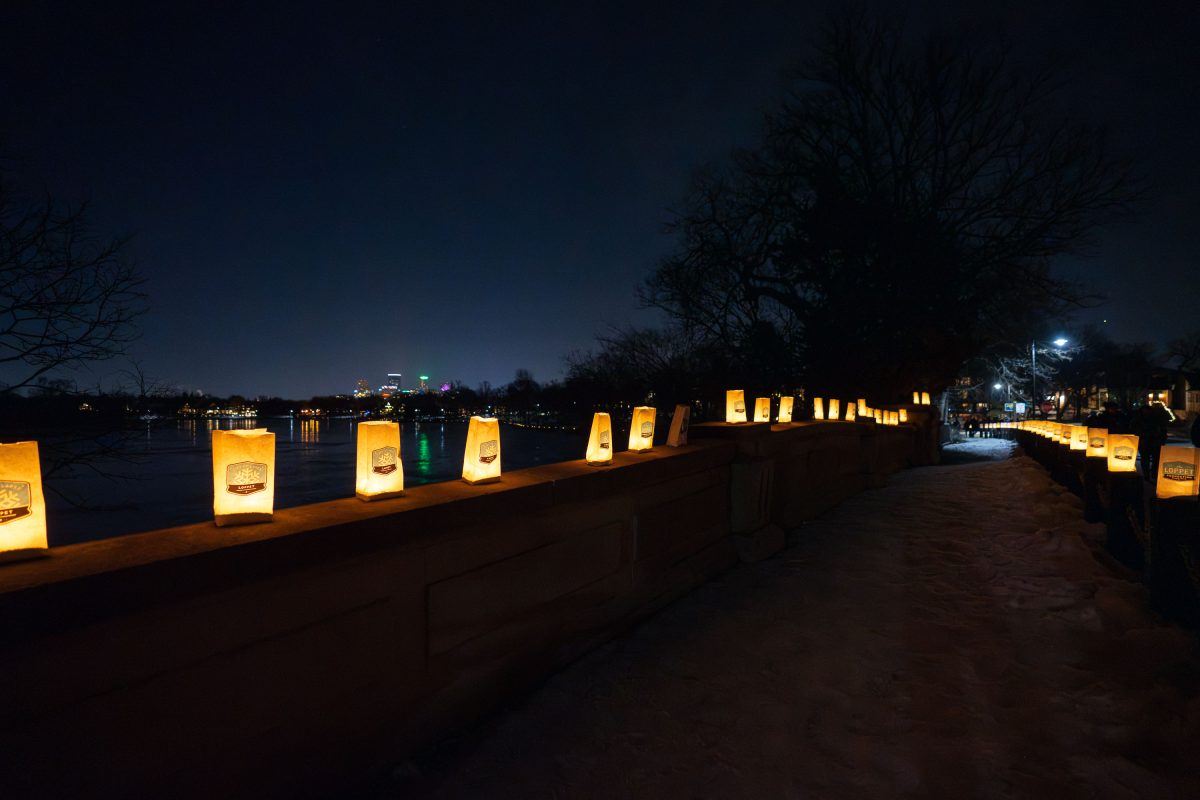
The Luminary Loppet finally happened last night, although not on the Lake, after being pushed back from January due to heavy snow and warm weather. Thousands came out to whats easily the most lit event each year.
Cedar Isles Condominium Sign, Minneapolis
February 2023
—
Cedar Isles condominiums in Minneapolis.
“Justice for Tyre Keenan & Tortuguita” Sign at The Peoples Way
February 2023
—
The signage at "The Peoples Way" reading “Justice for Tyre, Keenan & Tortuguita!!!"
Luminary Loppet Lights around Lake of the Isles
February 2023
—
Lake of the Isles Channel during the Luminary Loppet in Minneapolis
February 2023
—
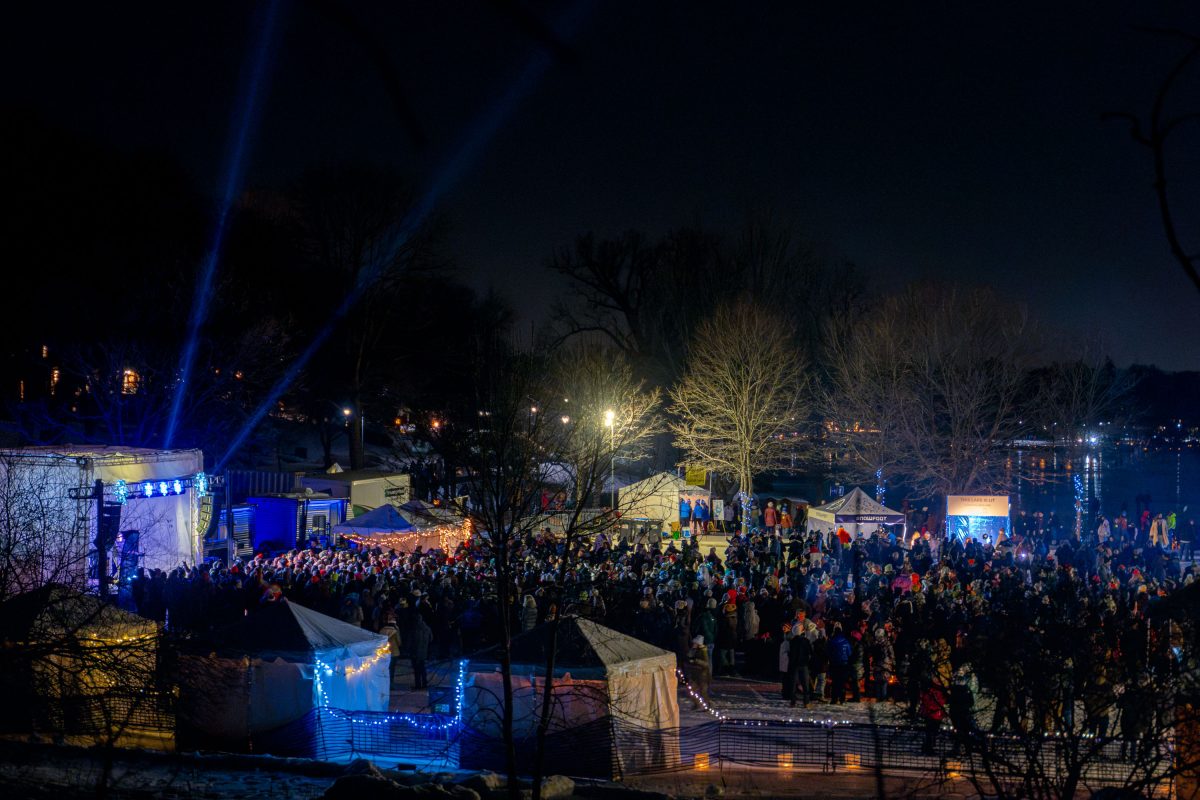
Crowd gathers at the 2023 Luminary Loppet in Minneapolis
February 2023
—
Metro Green Line Train Near Riverside Plaza in Cedar-Riverside
February 2023
—
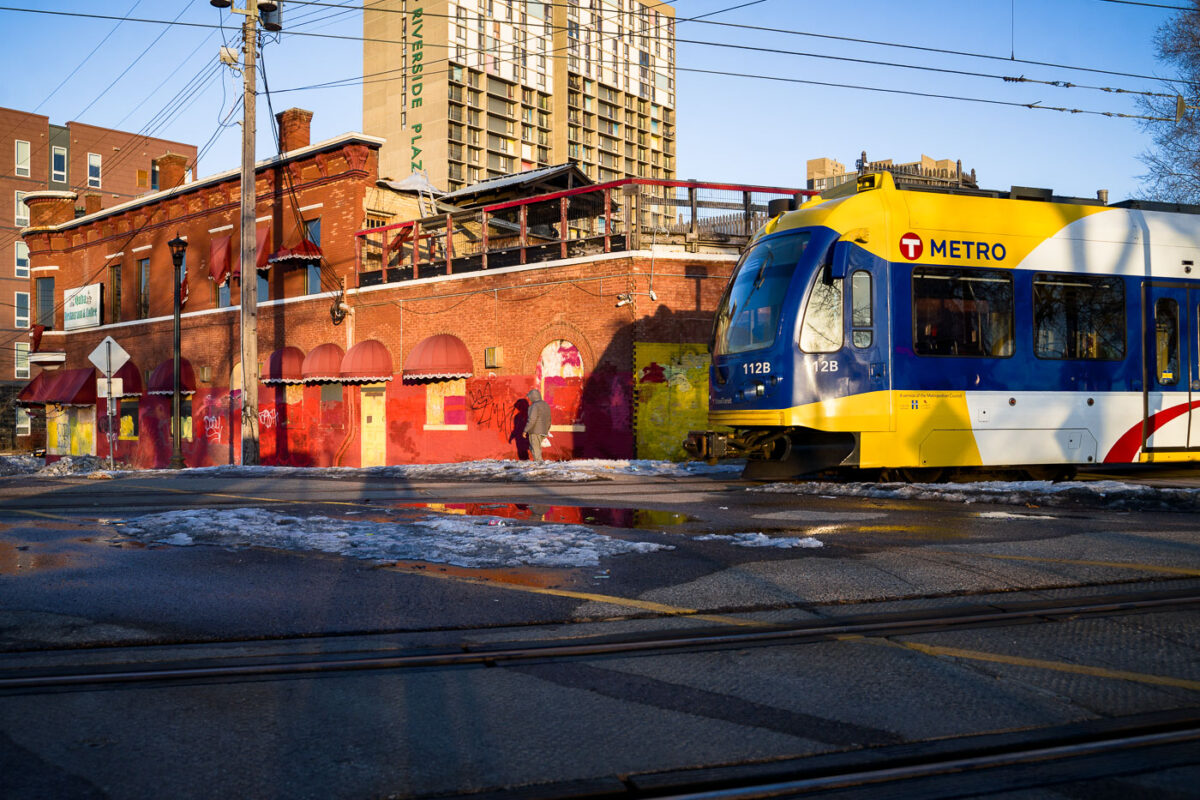
Train moves through the Cedar Riverside train station in South Minneapolis on February 19, 2023.
Water Tower and Smokestack Near the Roof Depot Site
February 2023
—
Roof Depot Urban Farm property off the Midtown Greenway in Minneapolis on February 19, 2023.
“Weak Mayor” Sticker on a Sign Along the Midtown Greenway
February 2023
—
"Weak Mayor" sticker on a sign on the Midtown Greenway in Minneapolis on February 19, 2023.
Snowy Night by the Minnehaha Liquors Sign on Lake Street
February 2023
—
A mural on the side of a building on East Lake Street. The building across from the Minneapolis Police third precinct survived the riots. Minnehaha Liquors was not as lucky, however the sign remains.
“Don’t Demo Roof Depot” Graffiti Along I-35W in Minneapolis
February 2023
—
“DONT DEMO ROOF DEPOT” is the message on 394 as environmental groups continue the years long fight over a South Minneapolis warehouse and pollution. The city wants their public works facilities on the former EPA superfund site. Community groups want housing and an urban farm.
Bunkers Music Bar & Grill in North Loop Minneapolis
February 2023
—
Bunkers Music Bar & Grill on Washington Avenue in the North Loop area of Minneapolis.
Sikorsky S-64 Skycrane lifts HVAC unit onto US Bank Building, Minneapolis
February 2023
—
A heavy-lift Sikorsky S-64 Skycrane Helicopter in downtown Minneapolis bringing HVAC materials to the US Bank Plaza roof.
Sikorsky S-64 Skycrane lifts HVAC to US Bank Plaza, Minneapolis
February 2023
—
A heavy-lift Sikorsky S-64 Skycrane Helicopter in downtown Minneapolis bringing HVAC materials to the US Bank Plaza roof.
Erickson Skycrane S-64 Helicopter N4035S in Flight
February 2023
—
A red Erickson S-64 Skycrane helicopter hovers in vivid daylight, its twin engines and external load hook visible beneath the fuselage. Designed for precision heavy lifting, firefighting, and construction, the Skycrane’s exposed mechanical systems exemplify functional aviation engineering. The unique cockpit placement gives pilots maximum visibility during load operations, making it one of the most distinctive helicopters ever built.
Sikorsky S-64 Skycrane Cockpit, US Bank Plaza HVAC Lift, Minneapolis
February 2023
—
A heavy-lift Sikorsky S-64 Skycrane Helicopter in downtown Minneapolis bringing HVAC materials to the US Bank Plaza roof.
Sikorsky S-64 Skycrane Hoists HVAC Unit Near Minneapolis City Hall
February 2023
—
A heavy-lift Sikorsky S-64 Skycrane Helicopter in downtown Minneapolis bringing HVAC materials to the US Bank Plaza roof.
MSP Airport Fire Truck at Minneapolis-St. Paul International Airport
February 2023
—
An airport fire truck at Minneapolis-St. Paul International airport.
The January 6th Report Book at an Airport
February 2023
—
A display shelf at an airport bookstore showcases The January 6th Report beside Greenwich Park by Katherine Faulkner, capturing a blend of contemporary political documentation and suspense fiction. The contrasting covers — one stark and formal, the other lush and cinematic — reflect the range of traveler interests, from real-world governance and accountability to immersive storytelling. Positioned between titles like The Nineties and Underneath the Sycamore Tree, this scene illustrates how airport bookshops often curate a microcosm of cultural conversation, offering both timely reflection and escape for readers on the move.
Airport Fire truck at MSP Airport
February 2023
—
A Minneapolis–St. Paul International Airport fire truck, painted in its distinctive lime-yellow livery, is seen positioned on the tarmac. Marked “Airport Fire” and operated by the Metropolitan Airports Commission, the truck is equipped for rapid response to aircraft and runway emergencies. Its specialized design includes high-capacity foam systems and reinforced compartments for rescue tools, reflecting the critical role of airport fire units in ensuring safety across one of the Midwest’s busiest aviation hubs.
Shimbashi Station Signage, Tokyo
March 2023
—
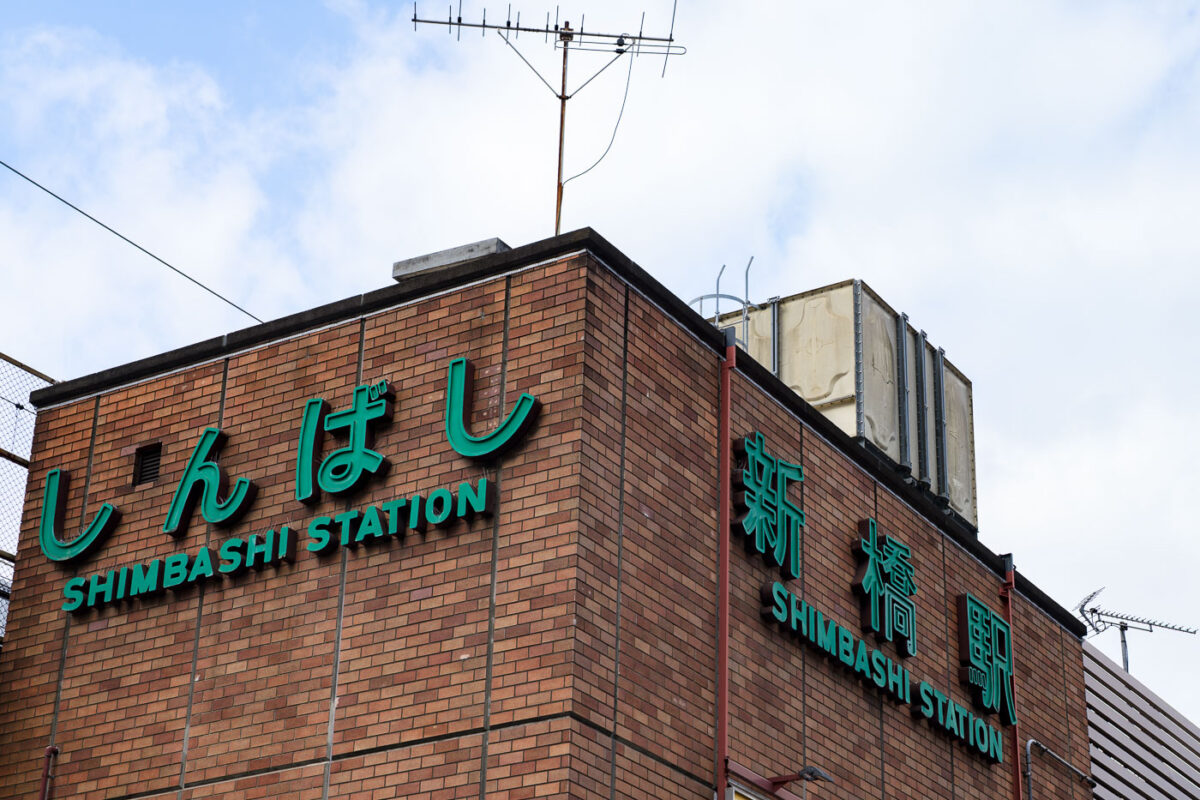
The brick exterior of Shimbashi Station displays its bold green lettering in both Japanese and English, marking one of Tokyo’s busiest commuter hubs. Opened in 1872 as Japan’s first railway terminal, Shimbashi holds deep historical significance while continuing to serve modern rail lines, including JR East and Tokyo Metro. The building’s retro façade contrasts with the skyscrapers surrounding it, symbolizing Tokyo’s seamless blend of heritage and contemporary transit infrastructure.
IC Card Charging Machine, Shinjuku Station, Tokyo
March 2023
—
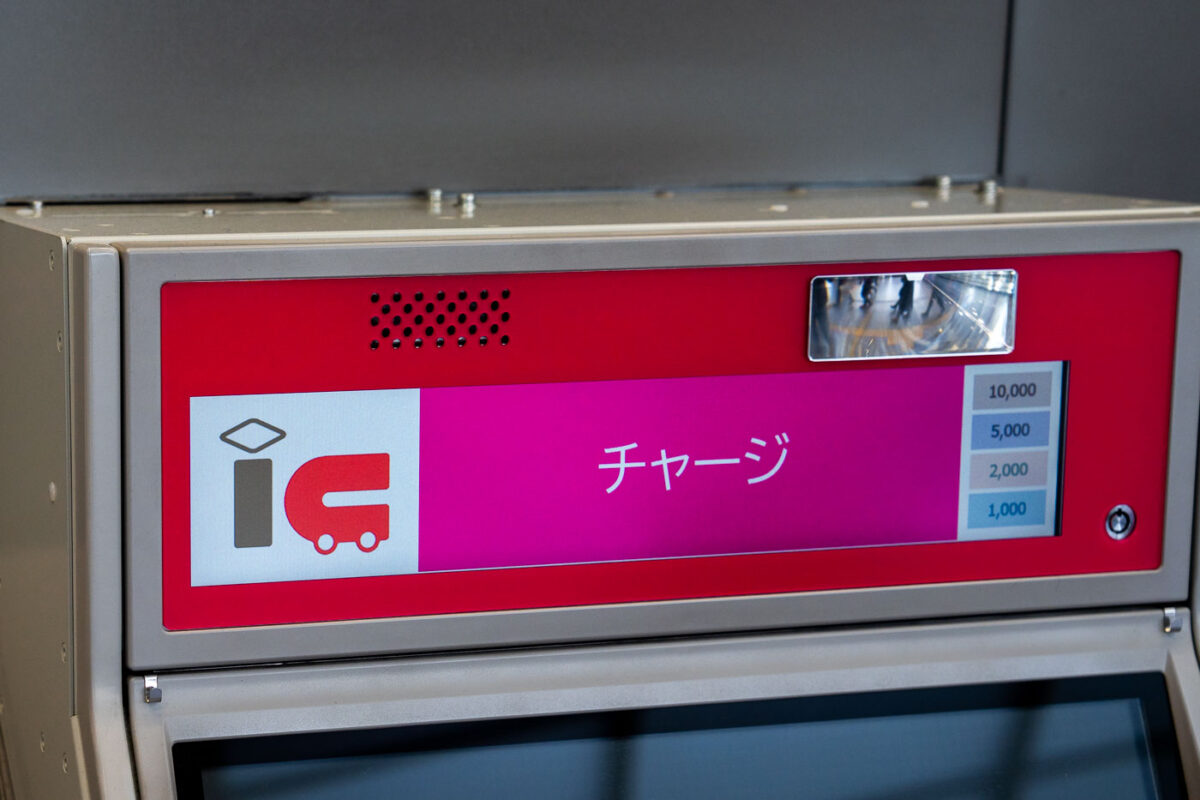
A close-up of a Japanese IC card recharge machine shows a bright pink interface with the word “チャージ” (charge) displayed prominently. The IC logo indicates it’s used for topping up transit smart cards like Suica or Pasmo. On the right side, selectable amounts range from 1,000 to 10,000 yen. The machine’s metal casing and reflective surface hint at its location inside a modern subway or train station.
Inverted Pyramid Facade, Tokyo Big Sight
March 2023
—
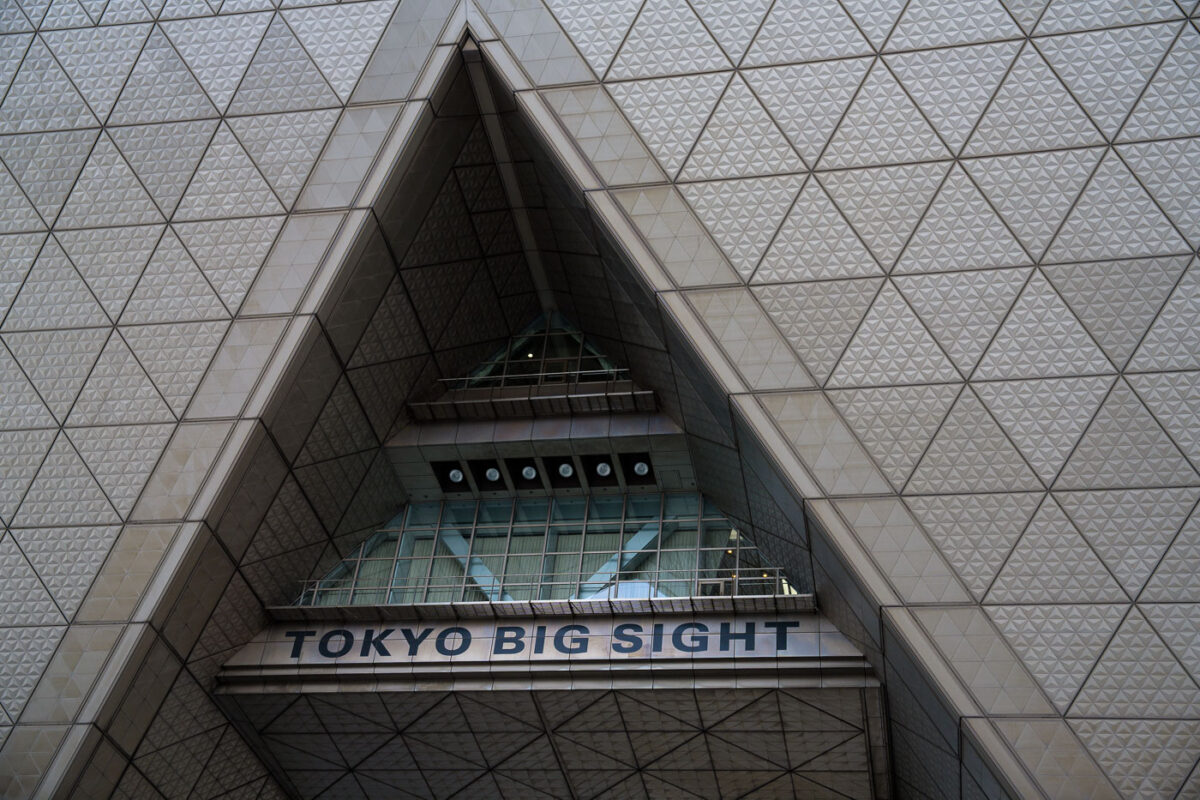
Tokyo Big Sight—officially known as the Tokyo International Exhibition Center—is Japan’s largest convention and exhibition complex, located in the Ariake district on the western edge of Tokyo Bay. Opened in 1996, the complex is best known for its iconic Conference Tower, composed of four massive inverted pyramids clad in reflective titanium panels that shimmer under changing light.
The architectural design, by AXS Satow, integrates advanced engineering with postmodern geometric motifs, balancing the heavy concrete and steel structure with triangular glass façades and intricate diamond-patterned surfaces. Standing 58 meters tall, the Conference Tower houses international meeting halls, press facilities, and observation decks overlooking Odaiba and the Rainbow Bridge.
Tokyo Big Sight regularly hosts global-scale events such as the Tokyo Motor Show, Comiket, and international technology expos, serving as a central hub for commerce and culture in modern Japan. The design reflects both the futuristic optimism of the 1990s and Tokyo’s ongoing commitment to bold, large-scale civic architecture.
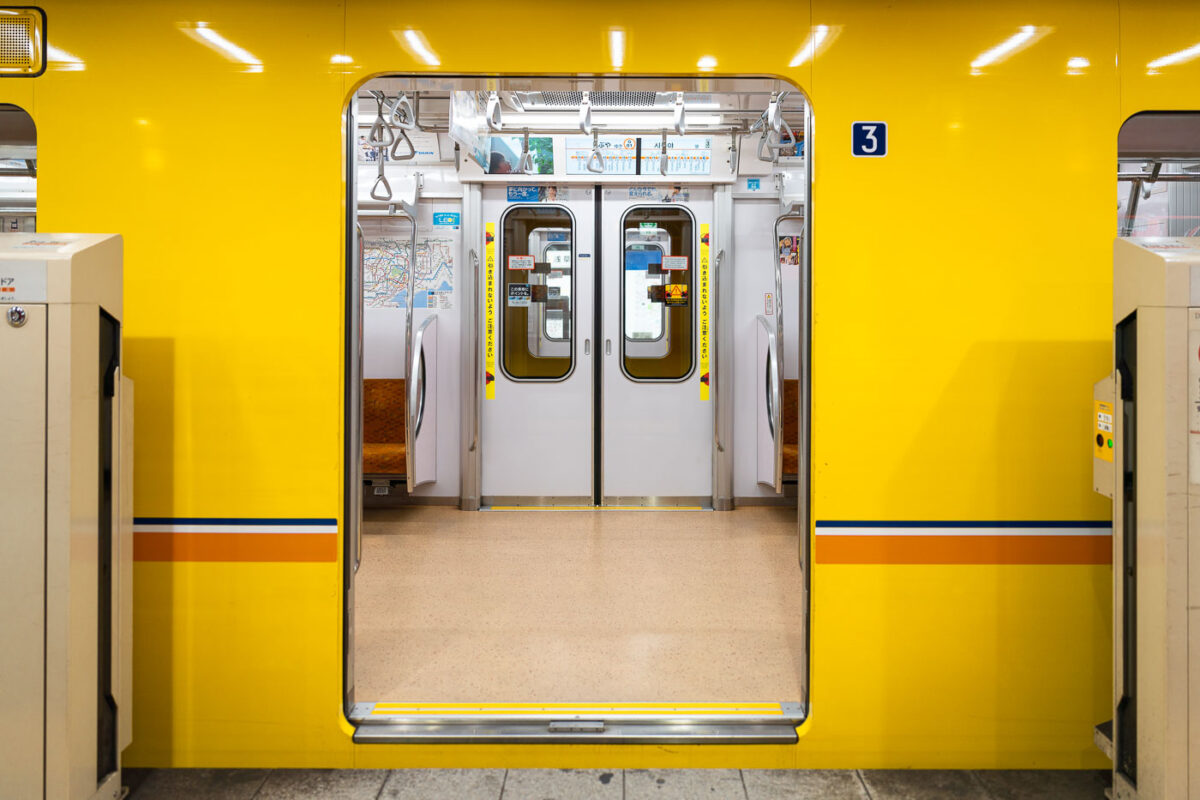
Tokyo Metro Marunouchi Line Series 2000 Doorway
March 2023
—
Tokyo’s Marunouchi Line is one of Japan’s oldest and busiest subway routes, linking major commercial and governmental districts through a network that dates back to 1954. This view shows the Series 2000 rolling stock, a modernized fleet introduced by Tokyo Metro beginning in 2019 to replace aging Series 02 cars.
The trains feature energy-efficient LED lighting, regenerative braking, and improved accessibility through wider doorways and level boarding. Their bright yellow exterior, trimmed with red and blue stripes, preserves the line’s traditional color while emphasizing the sleek, minimalist design typical of contemporary Japanese transit engineering.
Inside, the cabin layout prioritizes capacity and passenger flow, with longitudinal bench seating covered in patterned orange upholstery and overhead digital route displays in both Japanese and English. The Marunouchi Line operates on a 1,500 V DC overhead catenary and runs entirely underground except for a brief surface section near Nakano-Sakaue, connecting Ikebukuro to Ogikubo over a 24.2-kilometer route that handles hundreds of thousands of passengers daily.
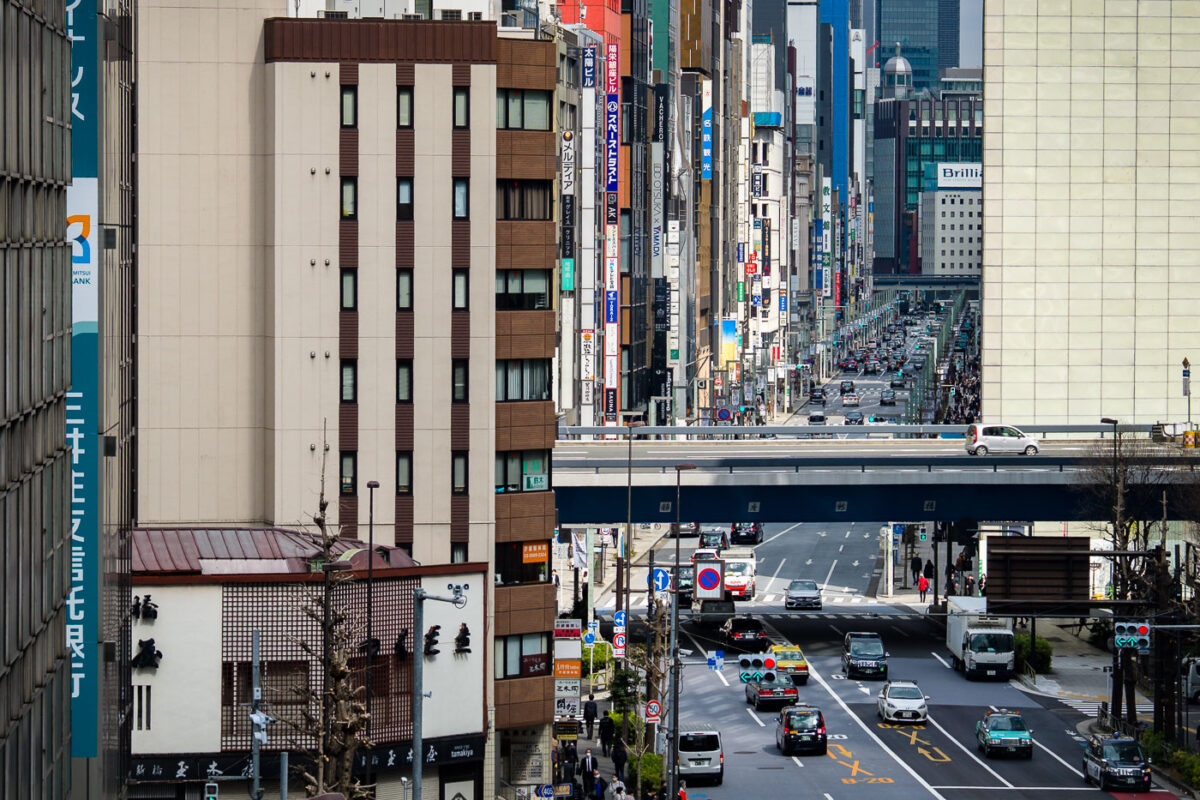
Chuo-dori Elevated Expressway Overpass, Ginza, Tokyo
March 2023
—
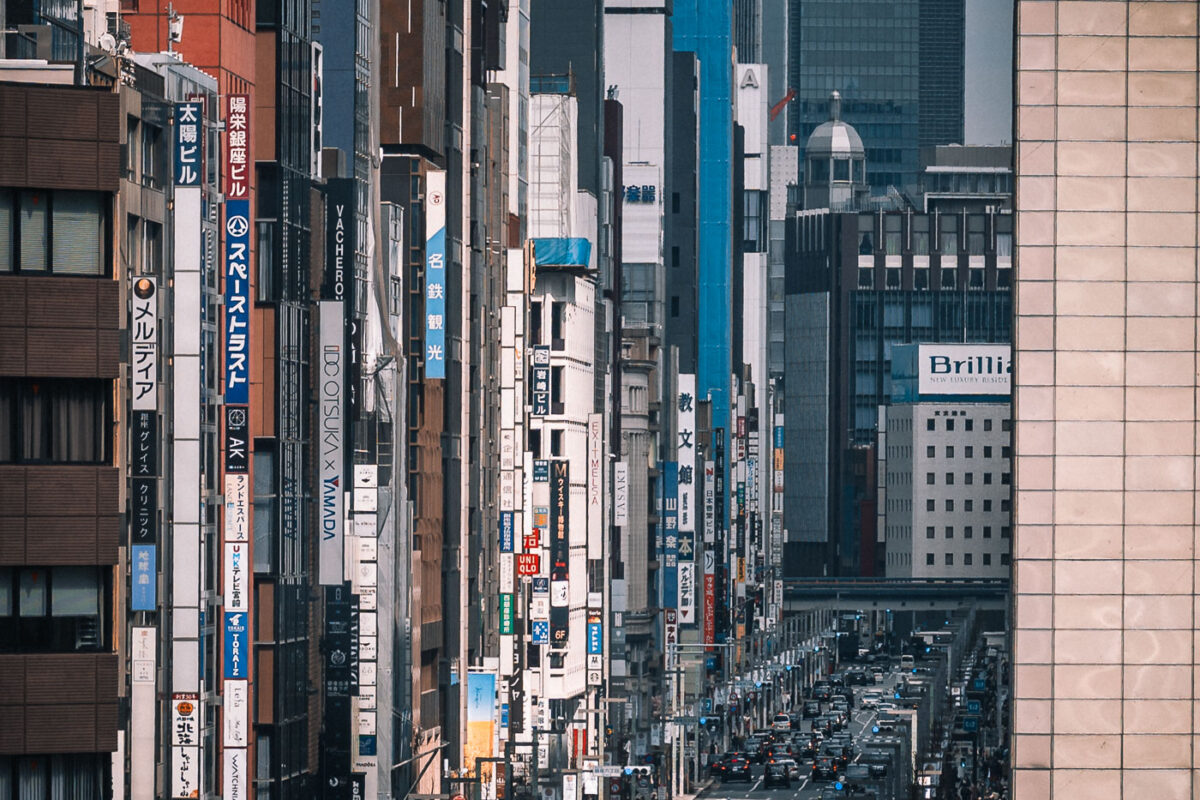
Route 20 (Koshu Kaido) Corridor, Yotsuya-Sanchome, Tokyo
March 2023
—
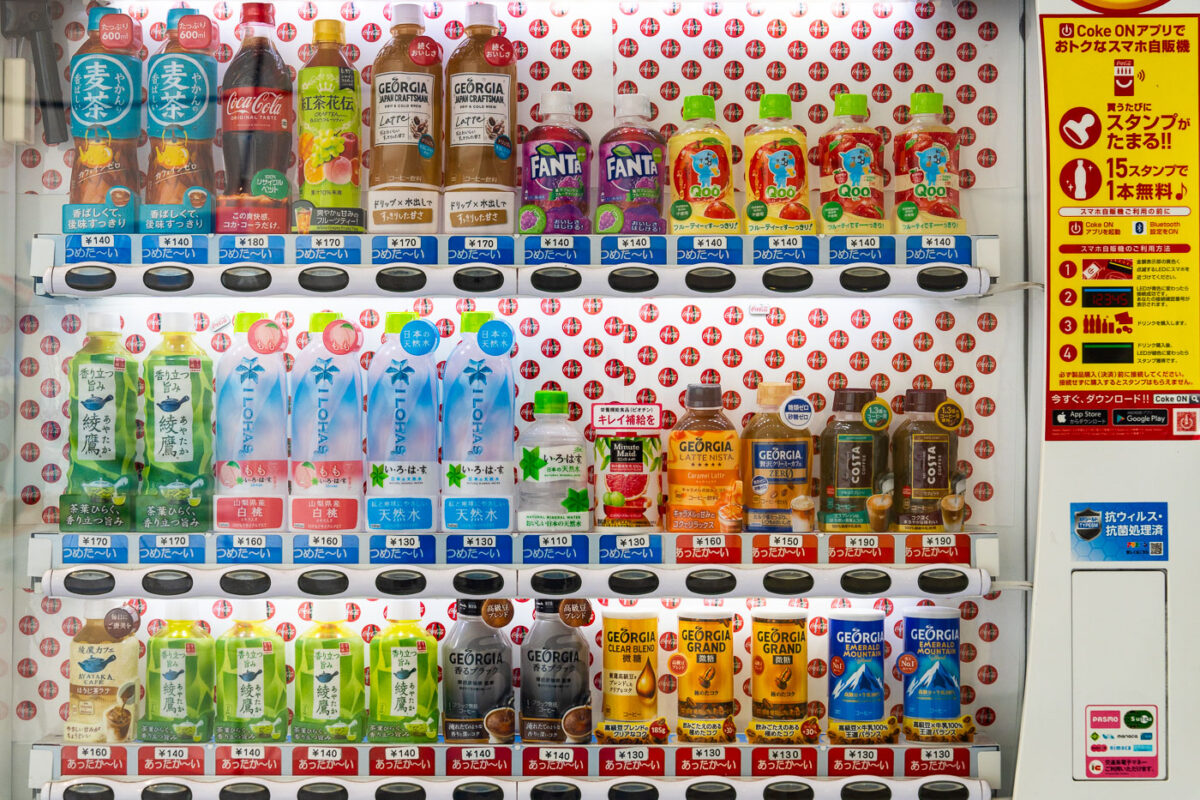
Coca-Cola Vending Machine with Georgia Coffee and Fanta, Tokyo
March 2023
—
A brightly lit Japanese vending machine displays a meticulously arranged lineup of drinks—from Coca-Cola and Fanta to bottled teas, mineral waters, and Georgia coffee blends. Each row is clearly priced, some marked with blue “つめたい” (cold) or red “あったかい” (hot) labels, offering both chilled and warmed beverages. The right panel promotes the “Coke ON” smartphone app, merging tradition with tech-driven convenience. This snapshot captures Japan’s signature vending culture: accessible, efficient, and surprisingly aesthetic in its everyday precision.
Bandai Flat Gashapon Machines, Tokyo
March 2023
—
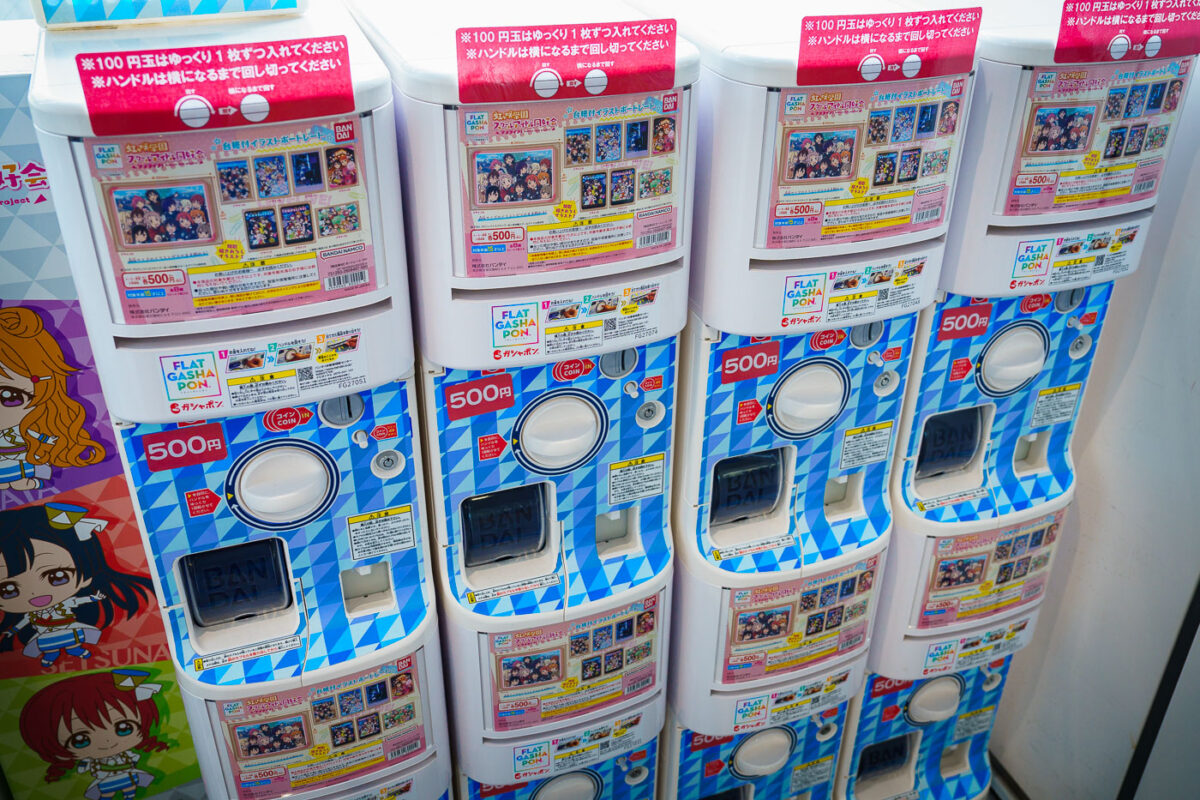
A neat row of colorful Gashapon capsule toy machines stands ready to dispense collectible surprises. Each unit, labeled with the Bandai logo and priced at 500 yen, features themed flat-pack items tied to anime or pop culture series. The bright geometric design and cheerful signage reflect Japan’s mastery of micro-entertainment—where vending and chance intersect to deliver small bursts of joy. These machines, common in train stations and malls, embody a blend of nostalgia, design precision, and everyday whimsy unique to modern Japanese street culture.
Yurikamome Pins DX Capsule Toy Machine, Tokyo
March 2023
—
A souvenir capsule vending machine featuring “Yurikamome Pins DX” collectibles, themed after the Yurikamome Line—Tokyo’s automated, elevated transit system linking Shimbashi with the waterfront district of Toyosu via Odaiba. The pin set celebrates key stations and landmarks along the route, such as Fuji Television, Rainbow Bridge, and Tokyo Big Sight, reflecting the line’s blend of technology and tourism appeal.
Opened in 1995, the Yurikamome Line was Japan’s first fully automated guideway transit system, operating without onboard drivers. It was conceived to connect Tokyo’s redeveloped bayside area with the city center, helping transform Odaiba from a reclaimed industrial zone into a futuristic entertainment and business hub. Its name, “Yurikamome,” comes from the black-headed gull native to Tokyo Bay—a fitting emblem for this sleek, seafront line.
Inverted Pyramid Towers, Tokyo Big Sight, Ariake
March 2023
—
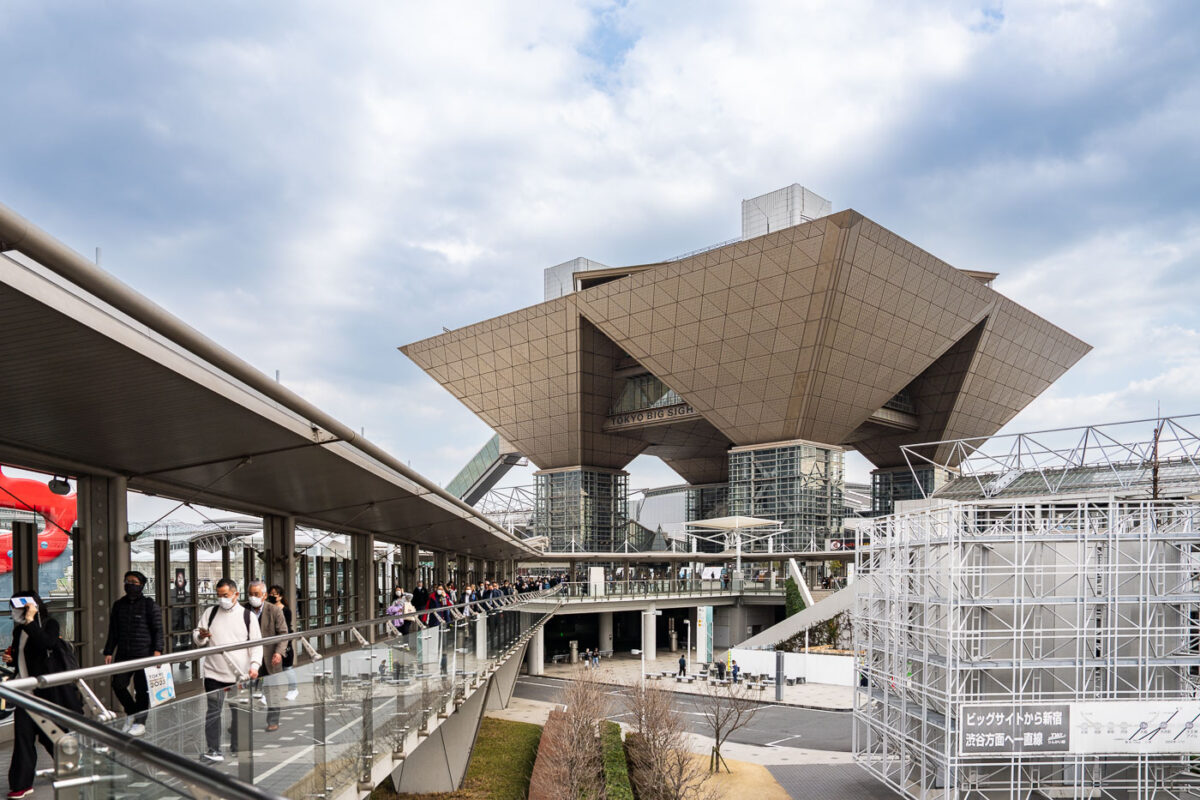
Tokyo Big Sight—officially the Tokyo International Exhibition Center—stands out with its striking inverted-pyramid conference towers, a landmark of the Odaiba and Ariake waterfront districts since its opening in 1996. Designed by architect AXS Satow, the building’s geometric titanium-clad forms and elevated walkways embody the futuristic aesthetic that defined Tokyo’s 1990s bay-area redevelopment. The elevated pedestrian route shown here leads toward the main entrance, filled with visitors streaming in for one of the venue’s frequent trade fairs, expos, and cultural events.
The convention center was built as part of a sweeping effort to revitalize reclaimed land along Tokyo Bay, transforming former industrial zones into hubs for technology, design, and international commerce. Its proximity to the automated Yurikamome transit line helped anchor Odaiba as a showcase for modern urban planning, connecting attractions like Rainbow Bridge, Fuji TV, and the waterfront parks. Today, Tokyo Big Sight remains one of Japan’s busiest exhibition complexes and a defining piece of the city’s contemporary architectural heritage.
Sensor-Flush Urinal Row in a Tokyo Public Restroom
March 2023
—
A perfectly symmetrical row of urinals inside a modern public restroom in Japan, where minimalist design meets meticulous cleanliness. The glossy white fixtures and pale reflective flooring emphasize balance and precision, creating an unexpectedly architectural sense of order in a utilitarian space. The visual rhythm of repetition — identical forms mirrored across the corridor — captures Japan’s cultural devotion to hygiene, geometry, and quiet functionality in even the most mundane public settings.
Roll-on/Roll-off Cargo Ship, Tokyo Port
March 2023
—
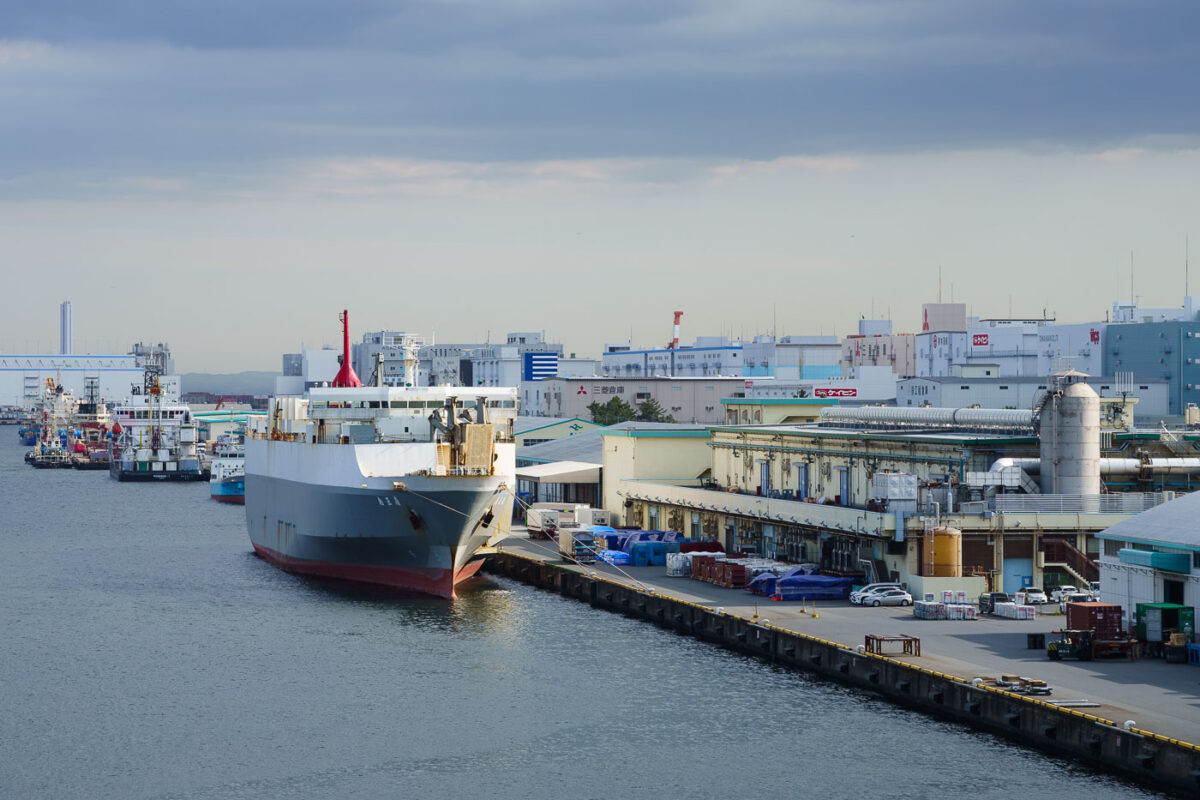
A cargo ship is docked at an industrial pier surrounded by warehouses and factory buildings, their signs bearing familiar Japanese corporate logos. The port’s calm waters and moored vessels hint at the steady rhythm of maritime logistics, with goods flowing in and out of Japan’s manufacturing heartlands. Overhead, a muted sky and the ship’s red funnel add contrast to the subdued industrial palette, capturing a typical day in one of the nation’s bustling coastal trade zones.
Gantry Cranes at Oi Container Terminal, Shinagawa, Tokyo
March 2023
—
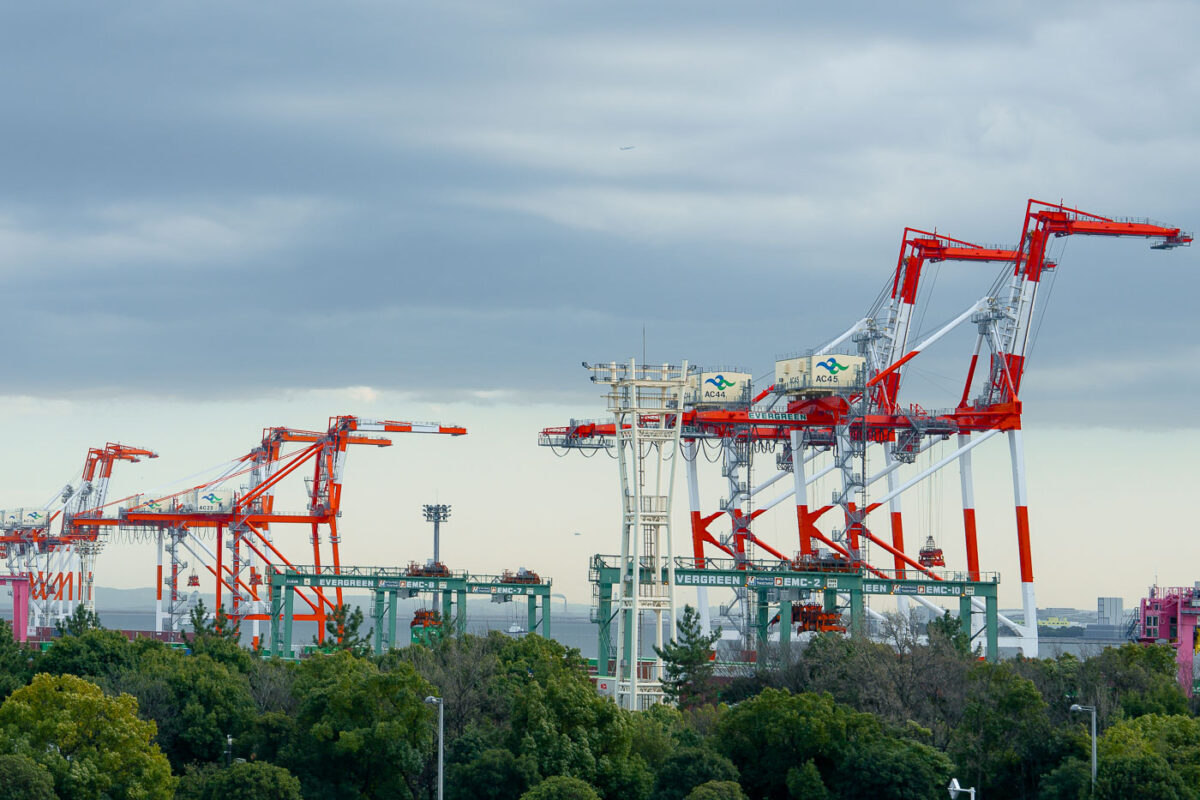
Towering gantry cranes line the waterfront at a Japanese container terminal, their red and white frames contrasting sharply against the overcast sky. The cranes, marked with “Evergreen” and “K” Line logos, are used to load and unload massive cargo ships that connect Japan to global trade routes. Surrounded by greenery and infrastructure, the scene reflects the blend of industry and environment common to Japan’s modern port cities—where precision logistics and advanced automation keep goods moving efficiently through one of the world’s busiest maritime networks.
Ginza Line 1000 Series Train, Tokyo Metro
March 2023
—
Reserved Seat Ticket Vending Machines, Shinbashi Station, Tokyo
March 2023
—
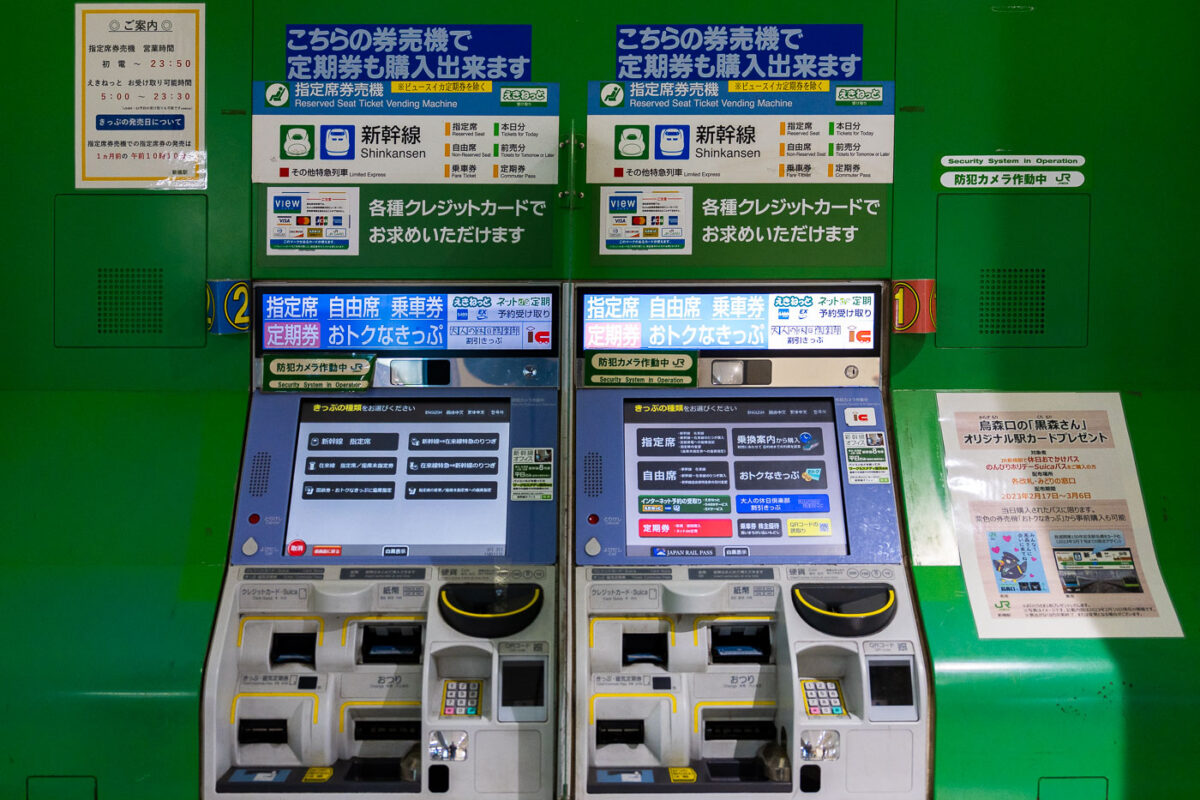
A pair of Shinkansen ticket vending machines at a Japanese railway station, featuring multilingual touchscreens and payment slots for both cash and IC cards. These machines allow travelers to purchase reserved and non-reserved tickets for Japan’s high-speed rail network, as well as commuter passes and regional fare cards. The bright green backdrop and clear signage reflect Japan Rail’s emphasis on efficiency and accessibility, enabling quick transactions even during the busiest travel hours.
Soba and Udon Counter, Asakusa Underground Street, Tokyo
March 2023
—
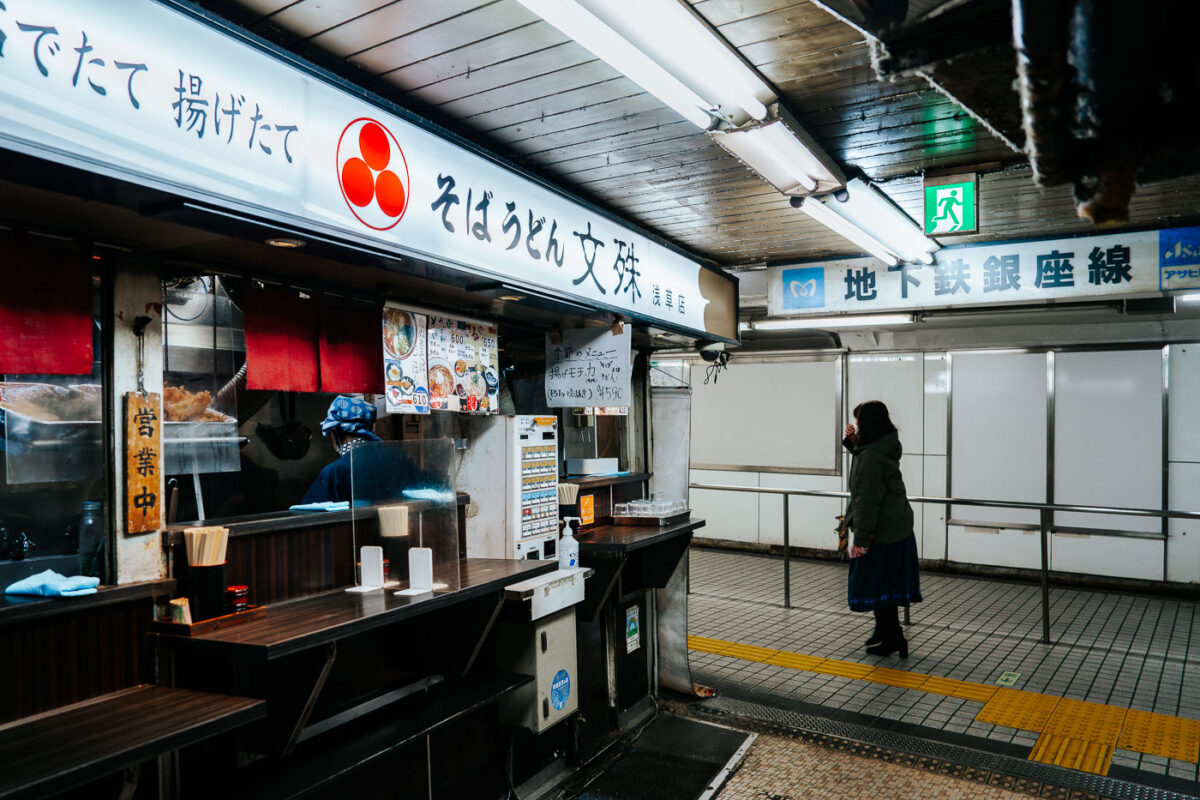
A small soba counter operates inside Asakusa Underground Street, one of Tokyo’s oldest surviving subterranean shopping arcades. Tucked beneath the streets near Asakusa Station, these compact eateries serve quick bowls of soba and udon to commuters and visitors moving between the metro and the surrounding neighborhood.
Opened in 1955, Asakusa Underground Street is considered the oldest underground shopping street in Japan. Its narrow corridors, low ceilings, and tightly packed storefronts preserve a postwar atmosphere that has largely vanished from Tokyo as major stations modernized. The passageway originally developed as a practical connection point for transit riders, but it evolved into a lively network of bars, snack counters, tobacconists, and small service shops. Today, despite gradual renovation, it remains one of the city’s most atmospheric relics of mid-20th-century urban life—an example of how Tokyo’s underground spaces doubled as both transportation infrastructure and neighborhood social hubs.
Green NTT Payphone with Telephone Card Slot, Tokyo
March 2023
—
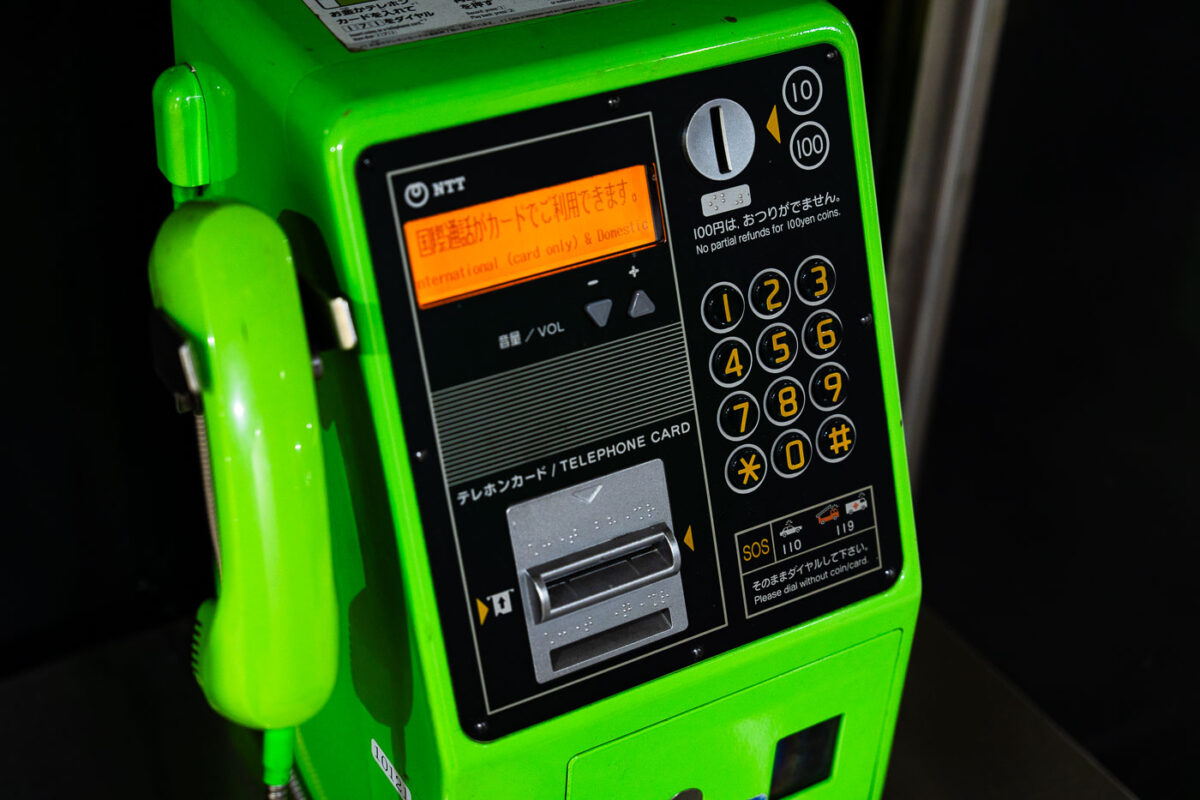
A bright green NTT public payphone, once a fixture of every Japanese street corner and train station, stands as a reminder of Japan’s pre-smartphone era. Its sturdy metal receiver, telephone card slot, and bilingual instructions highlight the country’s enduring attention to accessibility and precision. Still functional today, these phones remain a quiet symbol of Japan’s blend of reliability and retro technology.
Nightlife District near Nippori Station, Arakawa Ward
March 2023
—
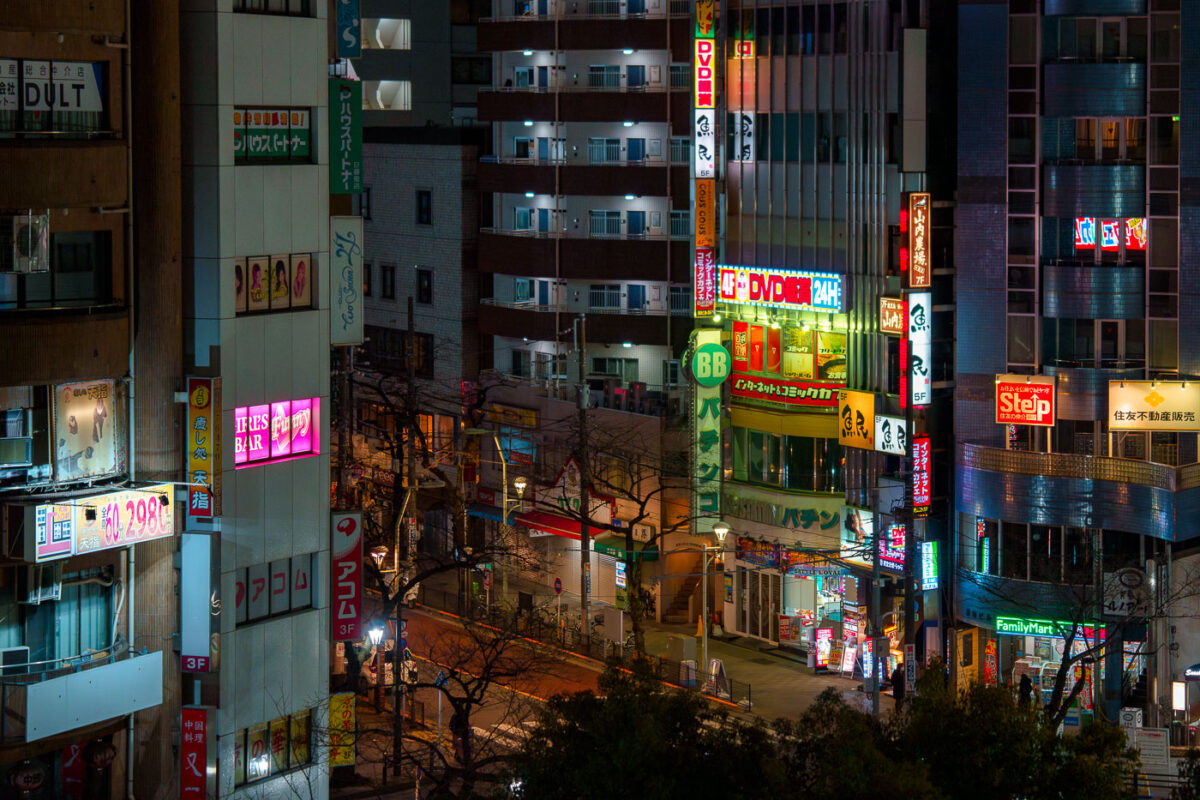
A nighttime view of the commercial streets southwest of Nippori Station in Tokyo’s Arakawa ward, where pachinko parlors, DVD shops, cafés, and convenience stores fill the dense blocks between Nippori and Nishi-Nippori stations. The brightly lit BB Pachinko building and the FamilyMart at street level serve as local landmarks, with narrow side streets branching off toward older residential buildings. The mix of neon signage, small restaurants, and multi-story entertainment businesses reflects the typical streetscape found along the fringe of Tokyo’s major commuter hubs.
This part of Nippori sits just outside the historic Yanaka district, one of the few neighborhoods that survived the 1923 Great Kantō Earthquake and wartime bombing. As the city expanded after the war, the areas around Nippori Station developed into a transit-oriented commercial zone—first serving textile shops and wholesalers, then gradually shifting toward pachinko centers, cafés, and commuter-friendly stores. Today the district remains a blend of old and new Tokyo: dense, walkable, illuminated late into the night, yet still closely connected to the quieter temple districts just a few blocks away.
Covered Pedestrian Walkway near a Tokyo Train Station
March 2023
—
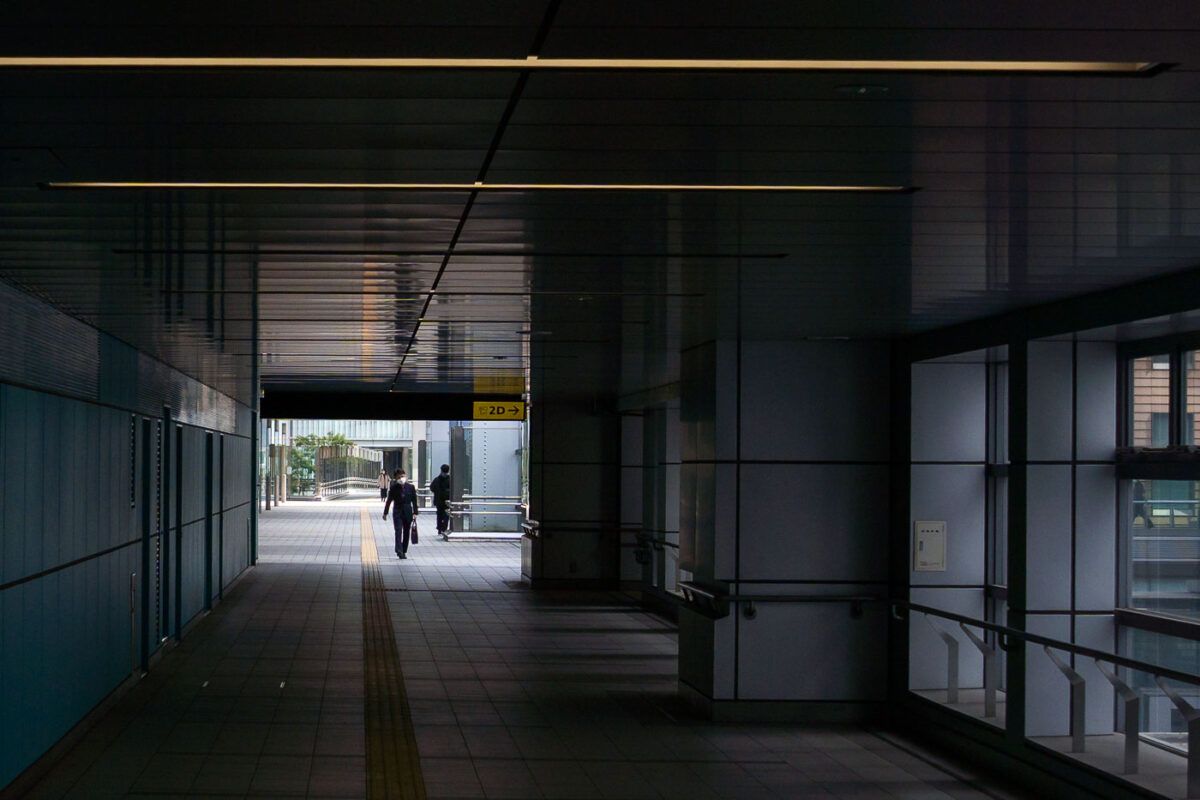
A quiet, modern pedestrian corridor connects parts of a Japanese transit hub, its metallic walls and ceiling panels reflecting soft daylight from the far exit. Yellow tactile paving guides commuters toward the outside, where a brief view of greenery contrasts with the tunnel’s rigid geometry. The minimalist design and clean lines reflect Japan’s approach to functional urban infrastructure—precise, orderly, and human-scaled.
Elevated Guideway at Shimbashi Station’s Yurikamome Terminal
March 2023
—
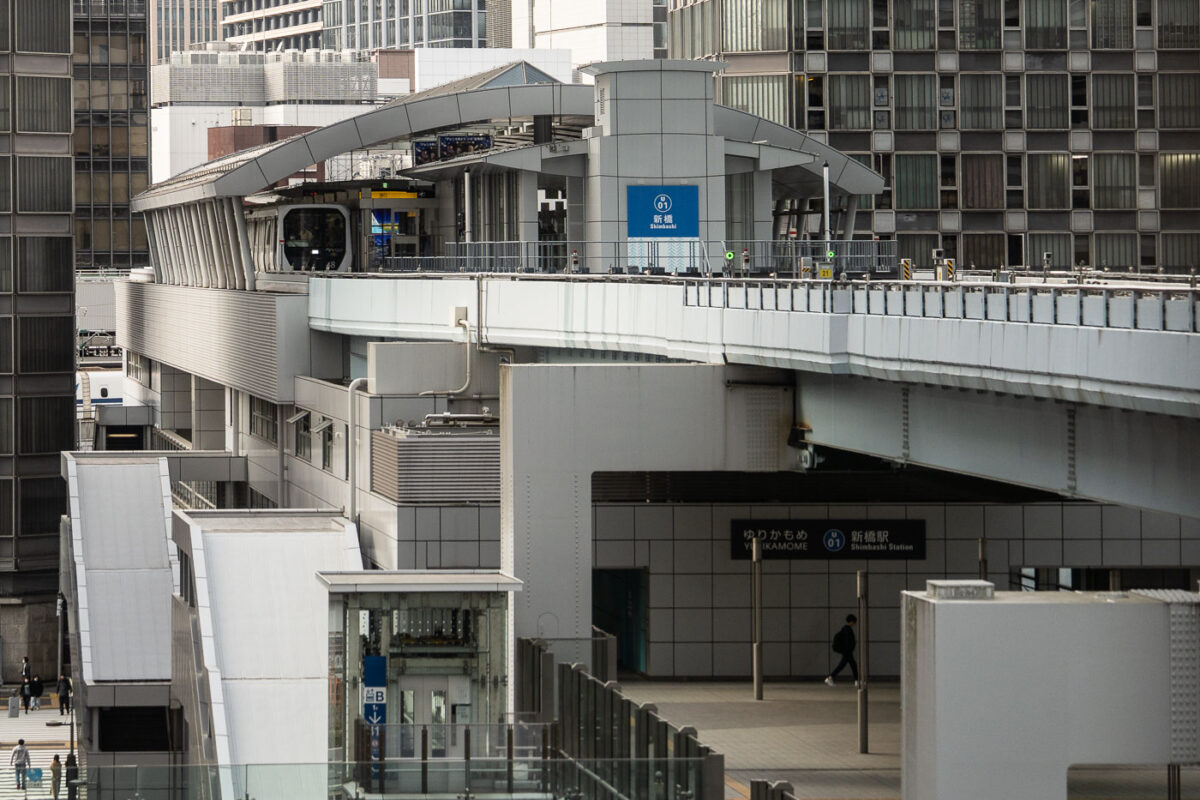
Shimbashi Station serves as a key interchange between Tokyo’s dense urban rail systems, connecting JR East lines with the Yurikamome automated transit route to Odaiba. The elevated Yurikamome track, seen here curving above the city streets, is a fully driverless, rubber-tired train line that opened in 1995 to link Tokyo’s central business districts with its reclaimed waterfront developments.
This structure’s sleek metallic architecture and tiered design reflect Japan’s approach to maximizing space efficiency in high-density transport corridors. The network below includes the JR Yamanote Line, Tokyo Metro Ginza Line, and the Toei Asakusa Line, making Shimbashi one of the most vertically integrated transit hubs in Japan.
Commuters Walk the Platform at Shiodome Station
March 2023
—
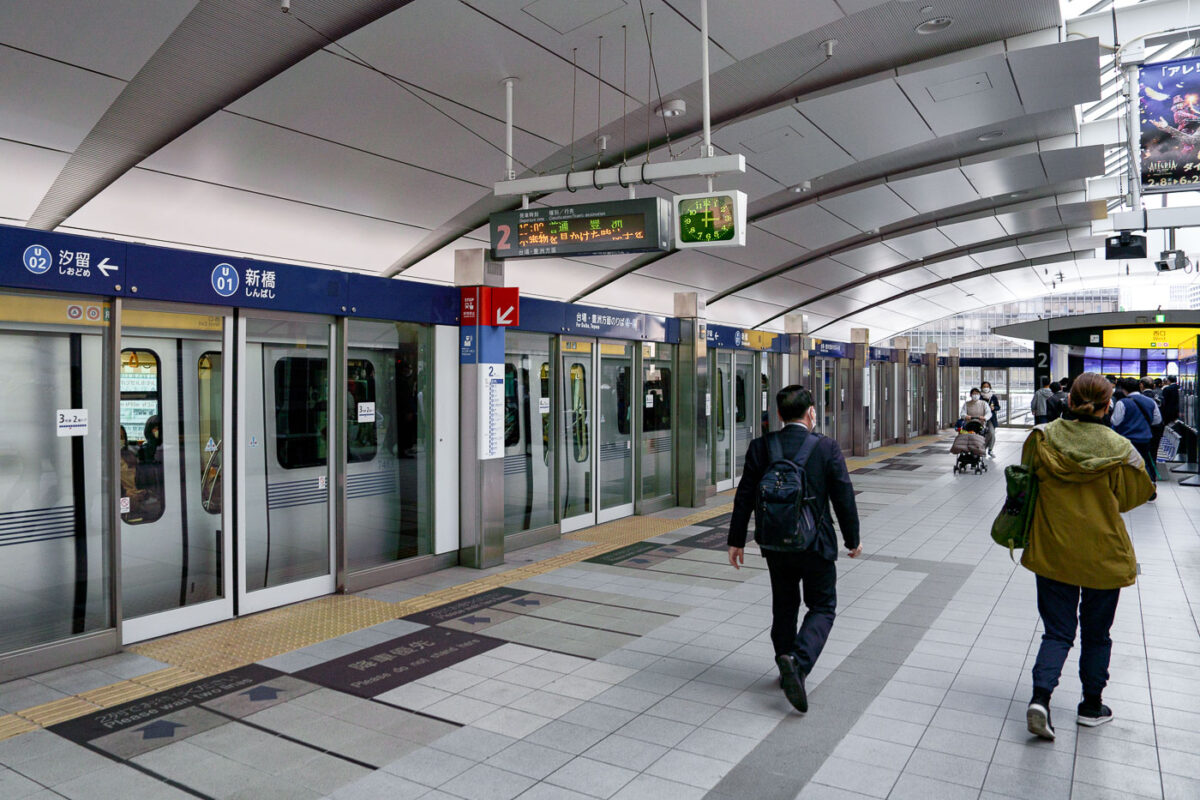
Shiodome Station in Minato Tokyo Japan.
Night View of Rail Yard Tracks Near Nippori Station, Tokyo
March 2023
—
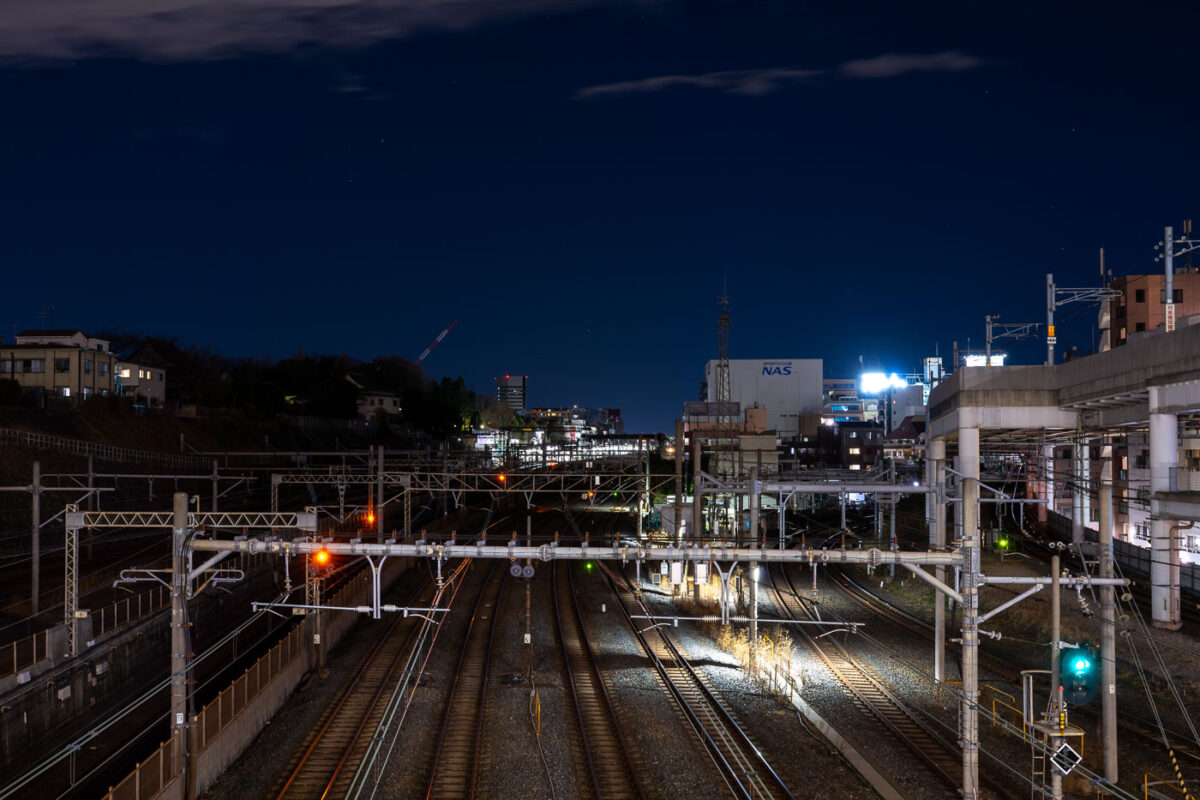
Multiple rail lines converge near Nippori Station in Tokyo, a key junction connecting the JR Yamanote, Keisei, and Joban lines. The illuminated signals and overhead power lines reveal the complexity of the city’s rail infrastructure as it weaves through residential and industrial zones. To the right, elevated expressway supports and nearby buildings frame the corridor, emphasizing Tokyo’s dense layering of transport systems and urban development.
Night Train Blurs Past Concrete Pillars at Nippori Station
March 2023
—
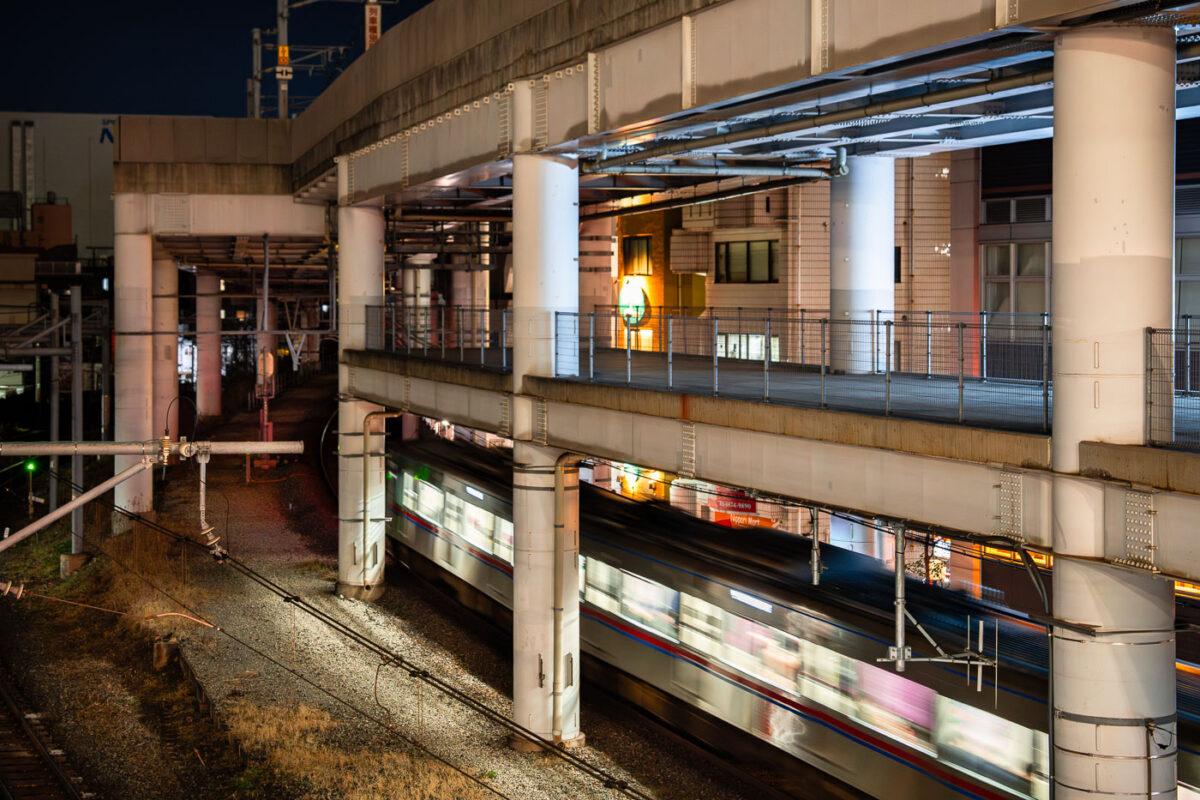
A commuter train passes through Nippori Station in Tokyo beneath an elevated expressway. Nippori is a major interchange for the JR Yamanote, Keisei, and Joban lines, connecting central Tokyo with Narita Airport and surrounding neighborhoods. The scene reflects the district’s tightly integrated infrastructure, where multiple rail lines and highways converge within a compact urban corridor.
Ginza Line Entrance 4 at Asakusa Station
March 2023
—
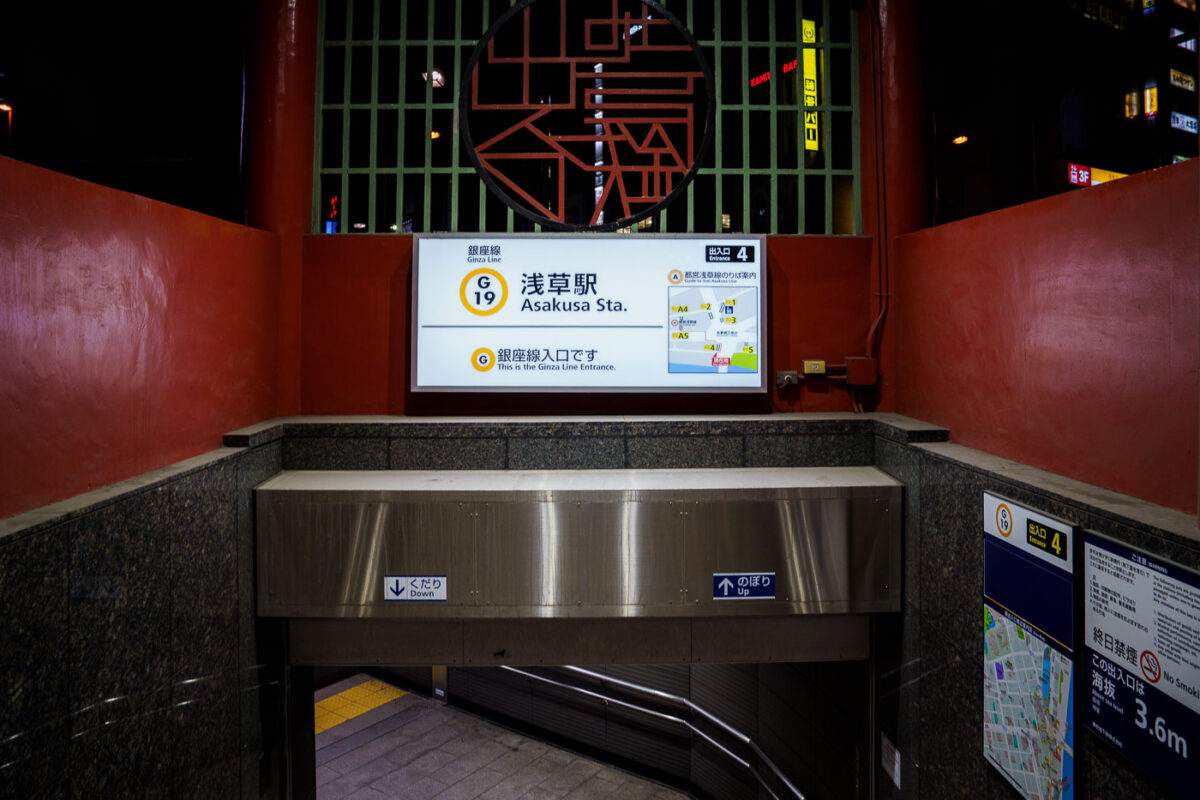
An entrance to Tokyo Metro’s Asakusa Station on the Ginza Line, marked with the station code G-19, leads commuters down a clean, tiled stairway under the red-painted gateway structure. The illuminated signage displays route maps and directional guidance, combining modern wayfinding with the surrounding area’s traditional aesthetic. Located near Sensō-ji Temple, this entrance reflects Asakusa’s balance of old Tokyo charm and contemporary transit design.
Commuters Queue at Ginza Line Ticket Gates, Shimbashi Station
March 2023
—
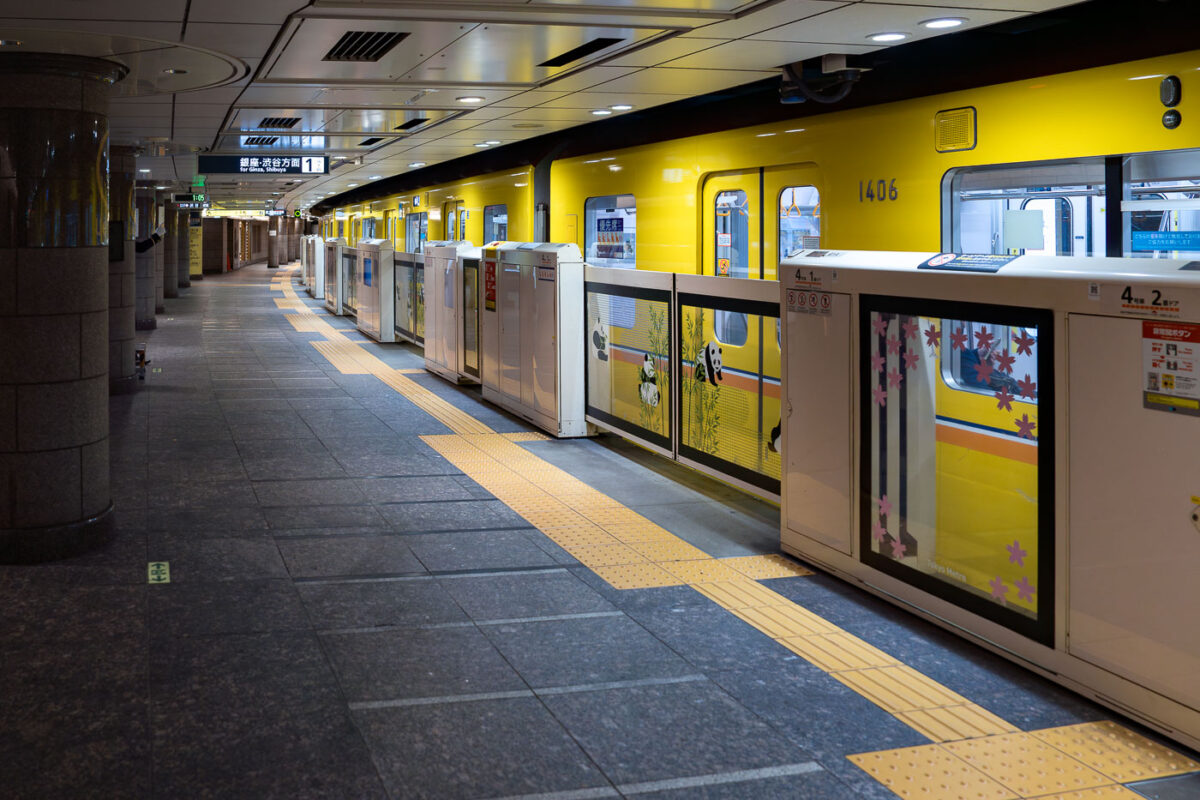
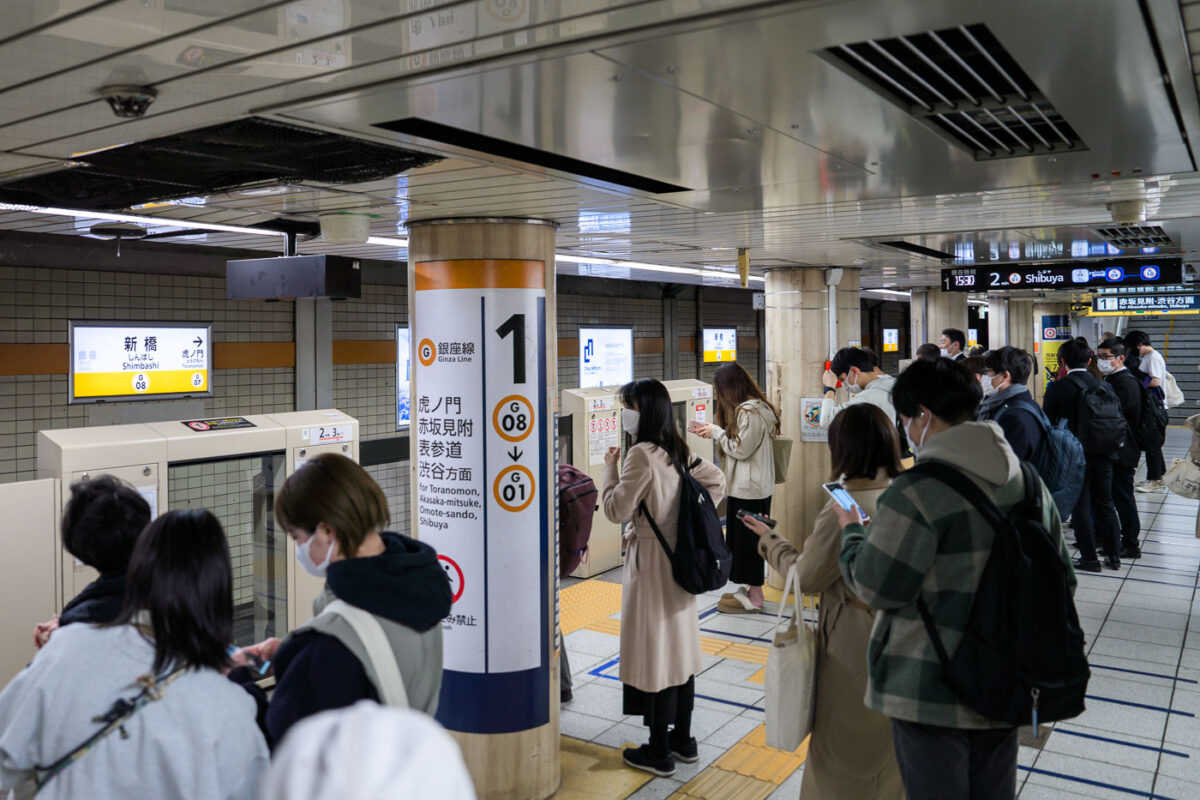
Commuters wait for the next train on the Tokyo Metro Ginza Line, Japan’s oldest underground subway line and one of the city’s most heavily traveled routes. This platform—serving trains toward Toranomon, Akasaka-mitsuke, Omote-sando, and Shibuya—captures a typical weekday scene with riders lining up at designated doors, phones in hand, as screen doors stand ready to open with the arriving train.
Opened progressively between 1927 and 1939, the Ginza Line was Asia’s first subway, modeled after London’s Underground and New York’s early lines. Its development helped shape modern Tokyo by linking emerging commercial districts—including Asakusa, Ginza, and Shibuya—into a cohesive urban network. Today, despite being nearly a century old, the line remains a backbone of the city’s transportation system, continually upgraded with platform doors, advanced signaling, and refreshed stations to meet the demands of one of the world’s busiest transit cities.
Lone Passenger with Suitcase Aboard a Yamanote Line Train
March 2023
—
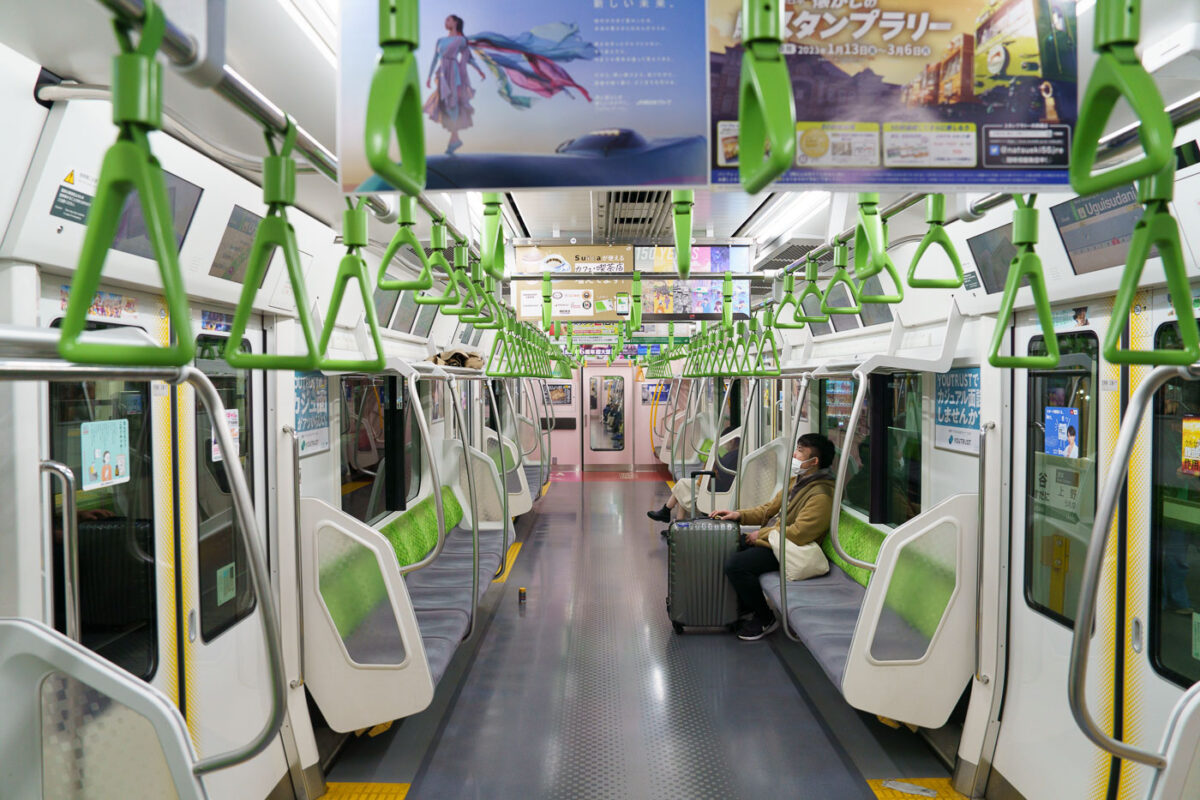
An interior view of a JR East E235 series train on the Yamanote Line, photographed in March 2023. Introduced beginning in 2015, the E235 fleet modernized one of Tokyo’s busiest rail corridors with full-width LCD displays, energy-efficient systems, and redesigned seating meant to improve passenger flow during peak congestion.
The Yamanote Line has operated as Tokyo’s central loop since 1925, linking major districts such as Shinjuku, Shibuya, Ueno, and Tokyo Station. Its frequent headways—often under three minutes—make it a fundamental component of the city’s rail network.
In this off-peak moment, the largely empty car highlights features typical of contemporary JR East design: bright color-coded grab handles, platform-screen door alignment, and extensive in-car advertising screens catering to both commuters and visitors navigating the metropolitan loop.
Blue-and-Red Stairs to the Skyliner at Nippori Station
March 2023
—
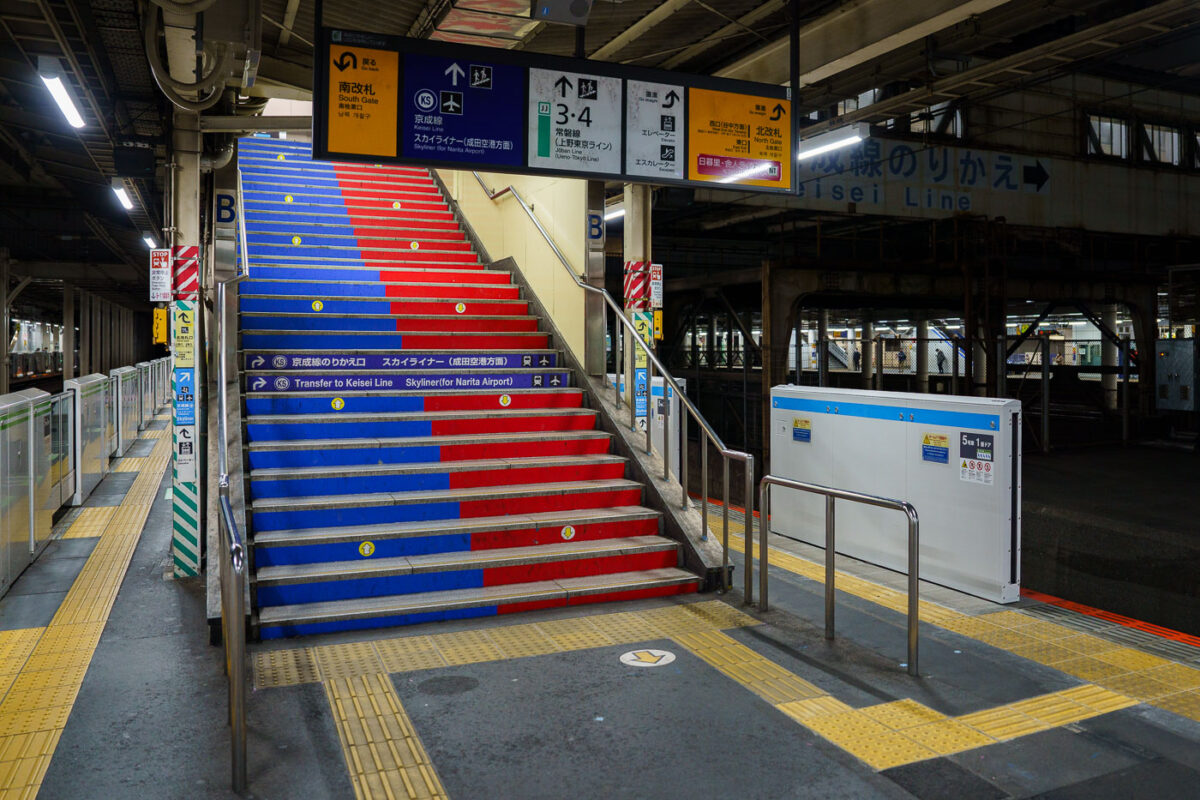
A color-coded stairway inside Nippori Station directs passengers to the Keisei Line platforms, the primary transfer point for travelers heading to Narita Airport on the high-speed Skyliner. Nippori serves as a major interchange between JR East lines, the Keisei Main Line, and the Nippori–Toneri Liner, linking northern Tokyo neighborhoods to the broader regional network. The mixed architecture—older steel passageways alongside newer safety upgrades like platform-edge barriers—reflects the station’s layered development since its opening in 1905. Today, Nippori remains one of Tokyo’s most important cross-rail transfer nodes, especially for airport-bound passengers navigating the city’s extensive transit system.
Weathered Signage Pointing to the Keisei Line at Nippori Station
March 2023
—
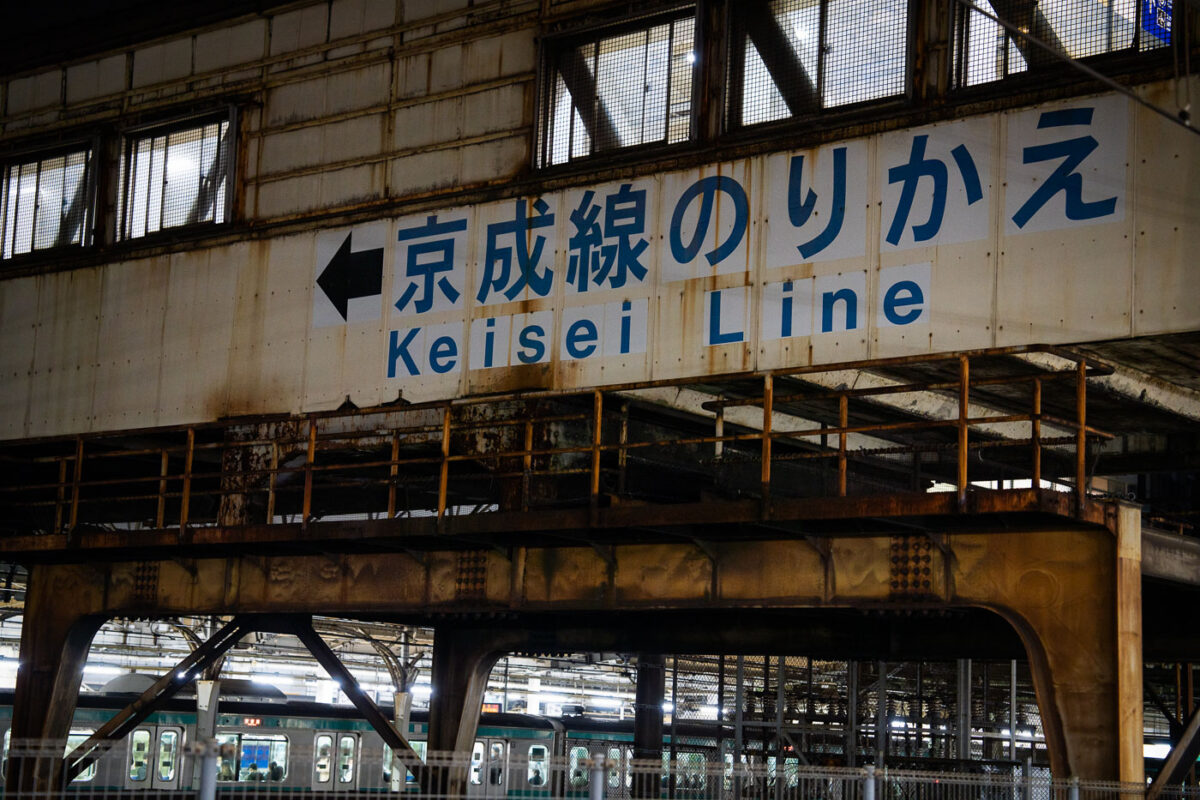
A weathered overhead passage at Nippori Station directs passengers toward the Keisei Line, one of Tokyo’s key links to Narita Airport via the Skyliner service. Nippori has served as a major interchange since the early 20th century, connecting JR East’s Yamanote, Keihin-Tōhoku, and Jōban lines with the private Keisei network.
The aging steelwork and faded signage reflect the layered construction of the station complex, where older elevated structures remain in daily use alongside modernized ticketing halls and platform edge barriers. Despite its utilitarian appearance, this transfer point moves thousands of airport-bound travelers each day, making it one of Tokyo’s busiest cross-rail connections.
Inside a Tokyo 7-Eleven
March 2023
—
A 7-Eleven convenience store in Japan displays partially empty refrigerated shelves during what appears to be a restocking period or supply shortage. Packaged sandwiches, rice balls, and ready-made curry meals fill the remaining spaces under a banner advertising a “Curry Festival.” The bright fluorescent lighting and orderly layout reflect the precision and consistency typical of Japanese convenience stores, even in moments of limited stock—showing the country’s deep integration of convenience culture into everyday urban life.
Please Call With The Button
March 2023
—
A small black service button sits on a restaurant table in Japan, labeled with both Japanese and English text inviting customers to “Please call with the button.” Common in Japanese cafés and family restaurants, these devices let diners discreetly summon staff without interrupting conversation or raising their voice. Surrounded by laminated menus and neatly displayed food promotions, the scene reflects Japan’s hallmark blend of politeness, efficiency, and thoughtful service design.
Tokyo Metropolitan Government Mask Sign
March 2023
—
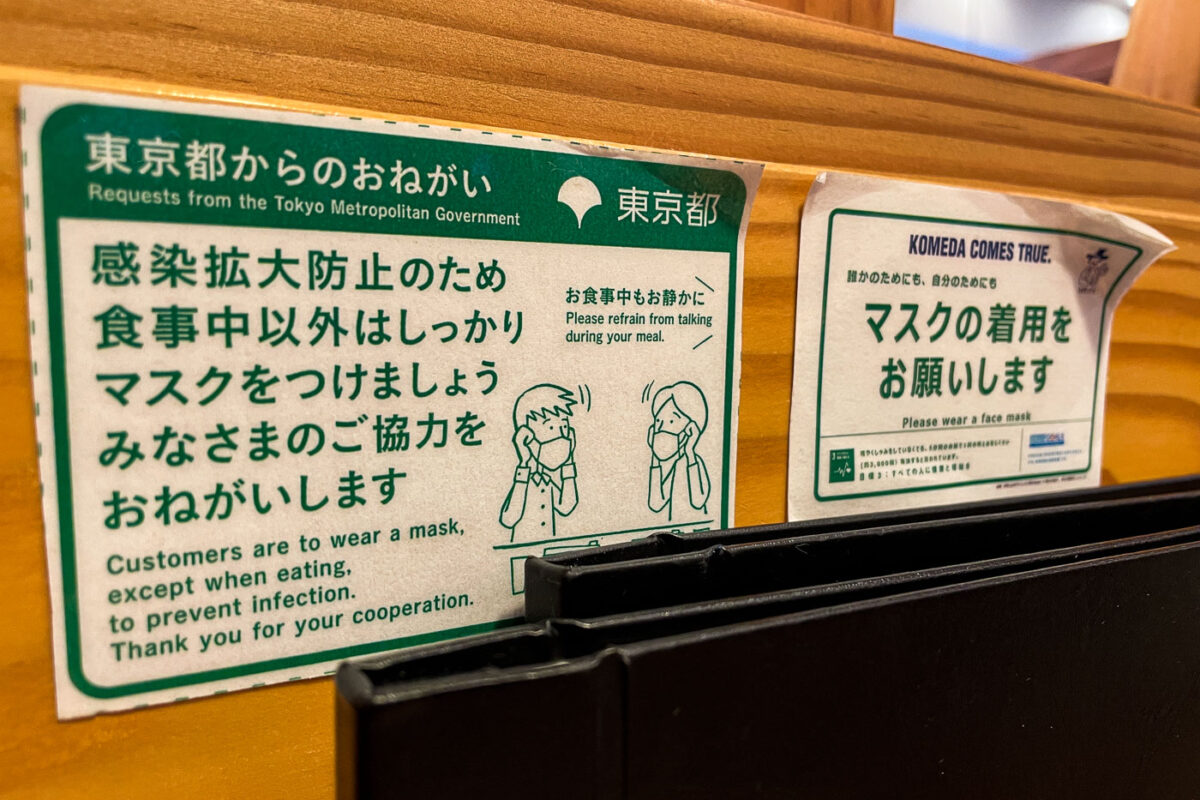
Printed notices from the Tokyo Metropolitan Government remind customers to wear masks except while eating, part of Japan’s ongoing public health etiquette during the pandemic era. The bilingual signs, featuring polite phrasing and simple illustrations, reflect Japan’s emphasis on community responsibility and quiet cooperation.
Kabukichō Ichiban-gai Arch, Shinjuku, Tokyo
March 2023
—
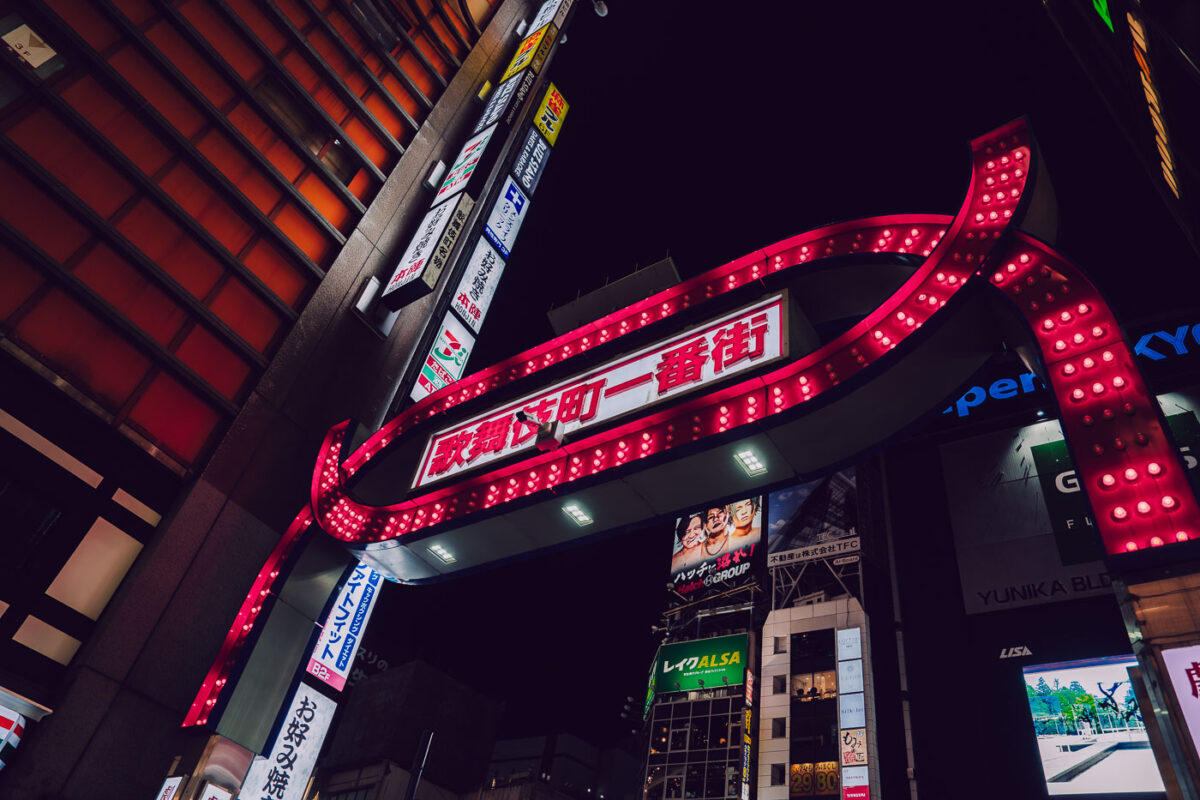
The iconic illuminated gate marking Kabukichō Ichiban-gai, photographed in Shinjuku, Tokyo. Installed in the late 1960s and redesigned several times since, the red archway has become one of the most recognizable entrances to Tokyo’s largest entertainment district.
Kabukichō developed after World War II as a planned theater district—its name comes from a never-built kabuki theater—before evolving into a dense zone of restaurants, bars, cinemas, and nightlife venues. The gate’s bright bulbs and bold lettering serve as a symbolic threshold into the neighborhood’s tightly packed streets, which remain active late into the night.
Yodobashi Camera Storefront, Nishi-Shinjuku, Tokyo
March 2023
—
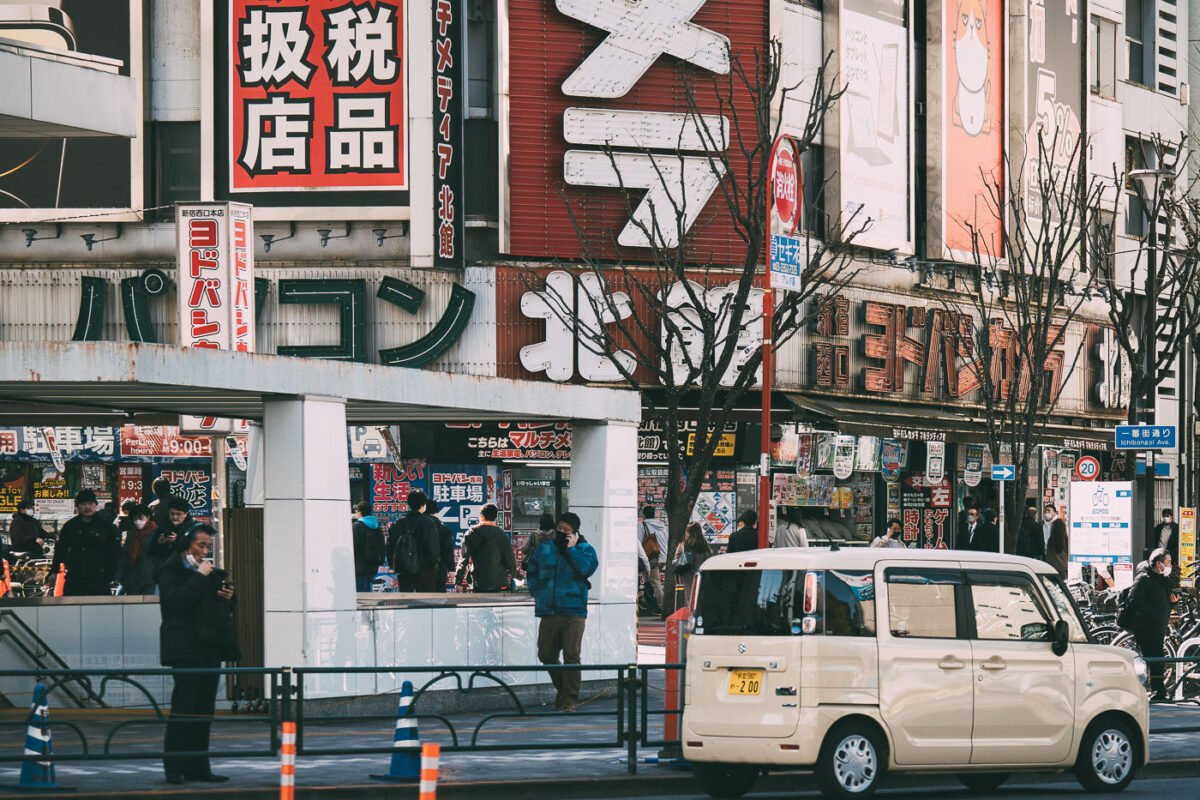
Outside Yodobashi Camera’s flagship complex in Shinjuku, one of Tokyo’s largest and most recognizable electronics retail districts. The chain has been a central part of Shinjuku’s commercial landscape since the 1970s, growing alongside the area’s transformation into a major hub for cameras, audio equipment, computers, and home electronics.
By the early 2000s the Shinjuku stores had expanded into a multi-building network around the west side of the station, offering tax-free shopping, dedicated gaming and computer floors, and an extensive camera department that continues to attract both professionals and tourists. Shinjuku’s dense signage, narrow traffic lanes, and steady crowds reflect the district’s role as one of Japan’s busiest shopping zones, with Yodobashi Camera remaining a key anchor of the neighborhood’s retail identity through 2023.
Battery Aisle at Yodobashi Camera, Shinjuku
March 2023
—
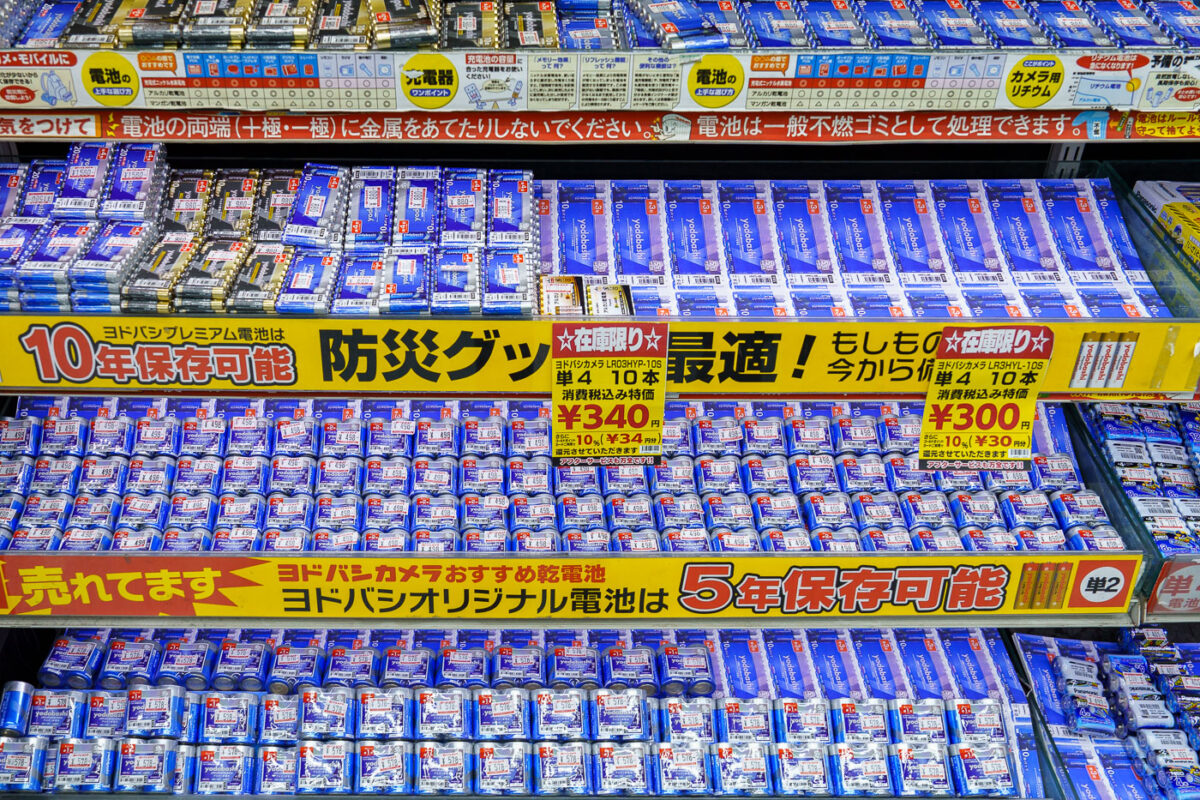
A densely stocked battery display inside Yodobashi Camera’s Shinjuku complex in March 2023. Yodobashi’s in-house battery line is prominently featured, with signage advertising long shelf-life options—10-year storage for premium models and 5-year storage for standard packs. Clear price labeling, bulk multi-pack options, and emergency-preparedness messaging reflect the store’s emphasis on reliability and daily-use electronics.
Yodobashi Camera Shinjuku is one of Tokyo’s largest electronics hubs, spanning multiple buildings near the west exit of Shinjuku Station. Its battery aisles exemplify the retailer’s merchandising style: bright color-coded labels, multilingual product cues, and high-volume stock arranged for quick comparison by commuters and tourists alike.
Huawei Laptop Display, Yodobashi Camera Shinjuku
March 2023
—
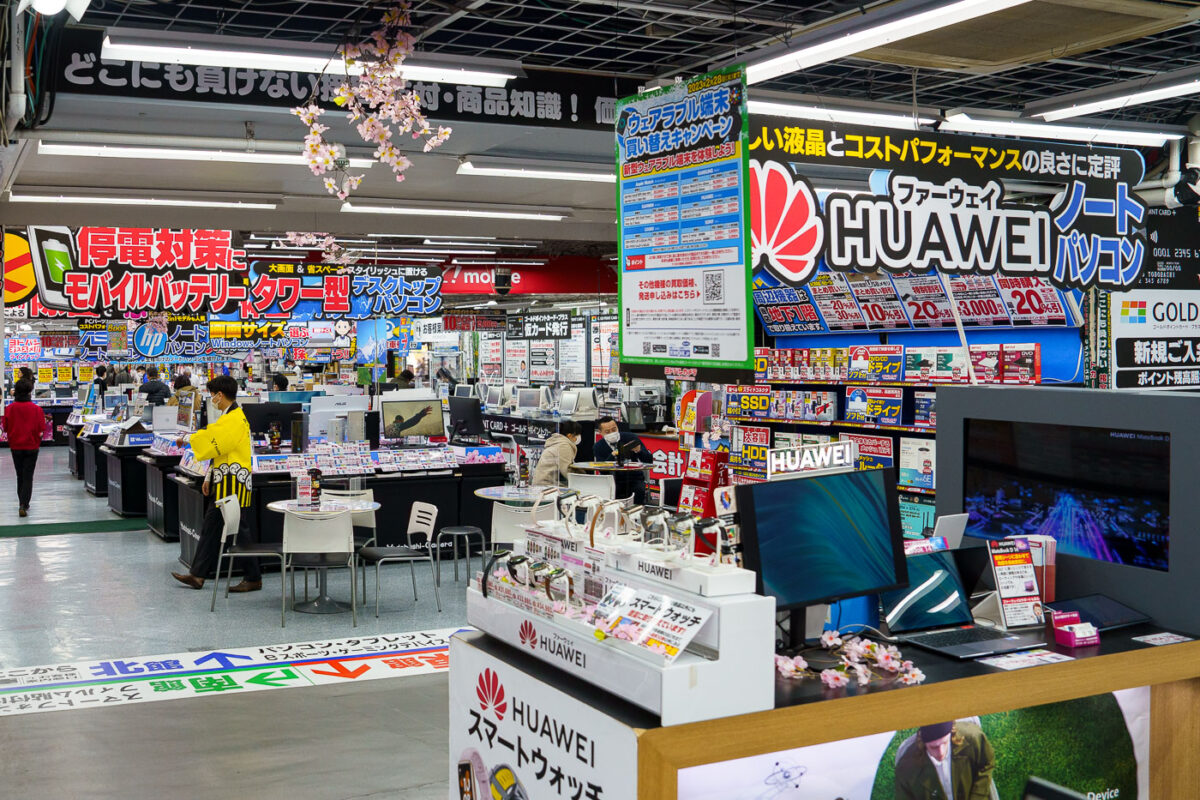
An interior view of Yodobashi Camera’s sprawling Shinjuku complex in March 2023, showing the densely organized electronics floor where computer hardware, mobile devices, and accessories are displayed under bold, color-saturated signage. The store’s characteristic layout—aisles packed with laptops, desktop components, peripherals, and promotional displays—reflects its role as one of Tokyo’s most comprehensive electronics retailers.
Prominent branding for Huawei laptops and smartwatches fills the foreground, while the surrounding aisles feature comparative pricing banners, point-reward offers, and emergency power supply promotions. Yodobashi Camera’s Shinjuku location spans multiple interconnected buildings near the west exit of Shinjuku Station, drawing commuters, hobbyists, and tourists with its high inventory turnover, product variety, and multilingual support.
Community Road Sign in Shinjuku Ward, Tokyo
March 2023
—
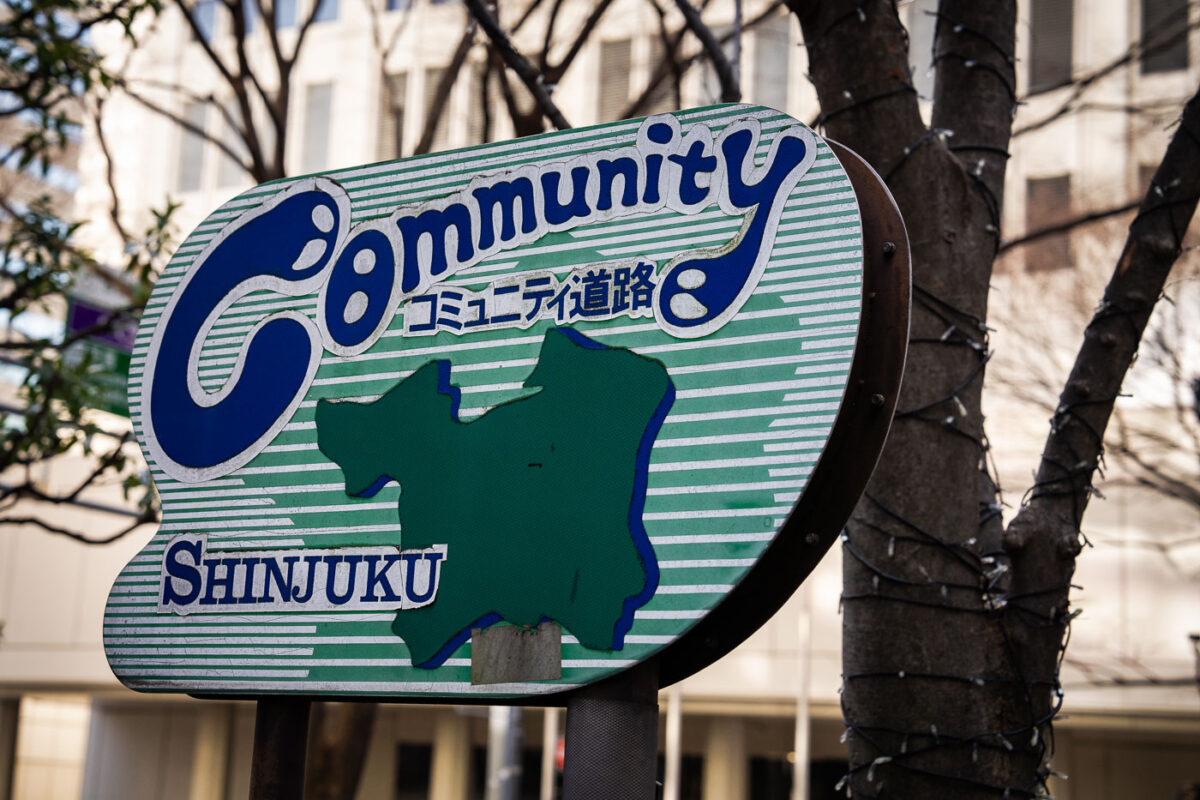
An older enamel “Community Road” sign in Shinjuku, Tokyo, photographed in March 2023. These signs—marked with コミュニティ道路 (“community road”) and a stylized map of the ward—were installed beginning in the late 1970s and 1980s as part of a municipal effort to identify quieter local streets prioritized for pedestrians, schools, and neighborhood traffic rather than through-traffic.
Although many have faded or disappeared as Shinjuku redeveloped, surviving signs like this one remain a small reminder of earlier phases of the ward’s streetscape planning. The hand-drawn lettering, green stripes, and simplified ward outline reflect the graphic design style common in Tokyo’s municipal signage of that era.
Paper Lanterns at a Kabukichō Izakaya, Shinjuku
March 2023
—
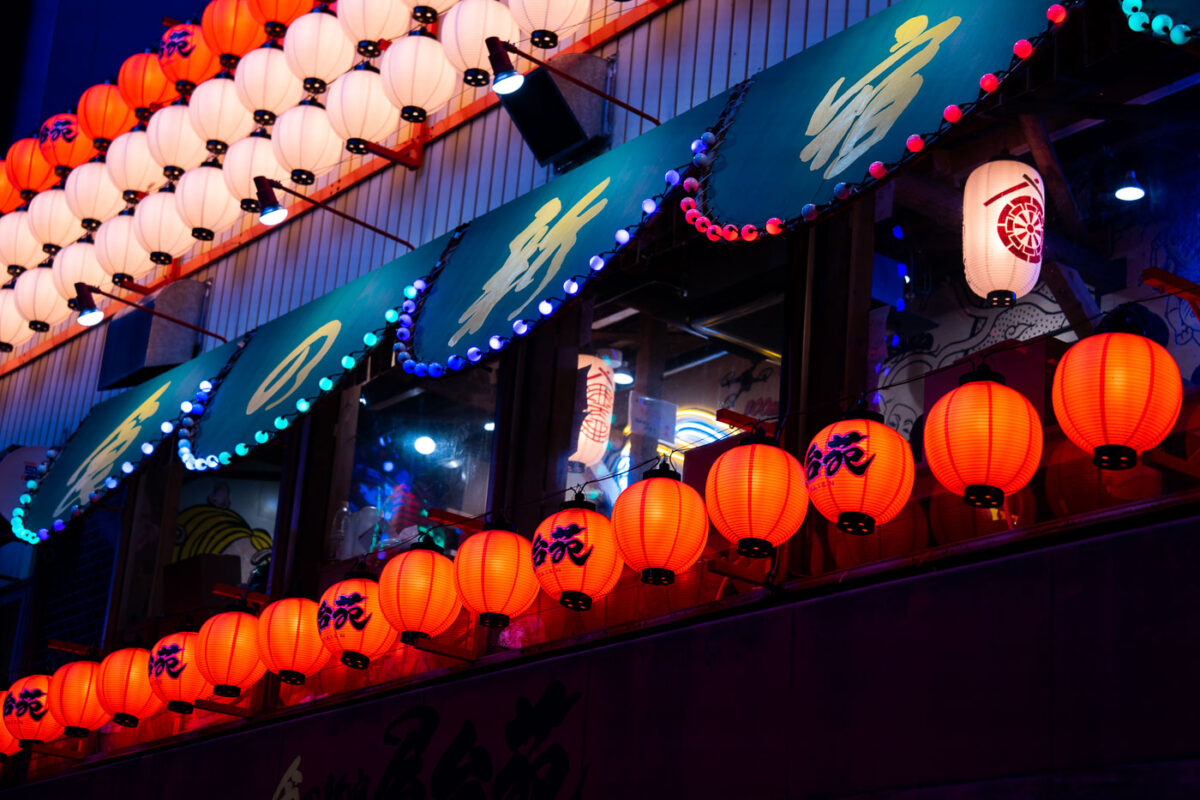
A cascade of red and white paper lanterns illuminates the facade of an izakaya in Shinjuku, Tokyo, casting a warm glow against the cool blue tones of the evening. Each lantern is hand-painted with calligraphy, evoking a blend of tradition and nightlife energy that defines Tokyo’s dense entertainment districts. The upper awnings—lined with blue bulbs and framed by wooden beams—hint at the layered complexity of urban Japan, where old-world craftsmanship meets electric color and constant reinvention. The faint reflections of neon and interior lighting merge through the windows, creating a luminous dialogue between the street and the world within.
Busta Shinjuku Bus Terminal, Shinjuku Station, Tokyo
March 2023
—
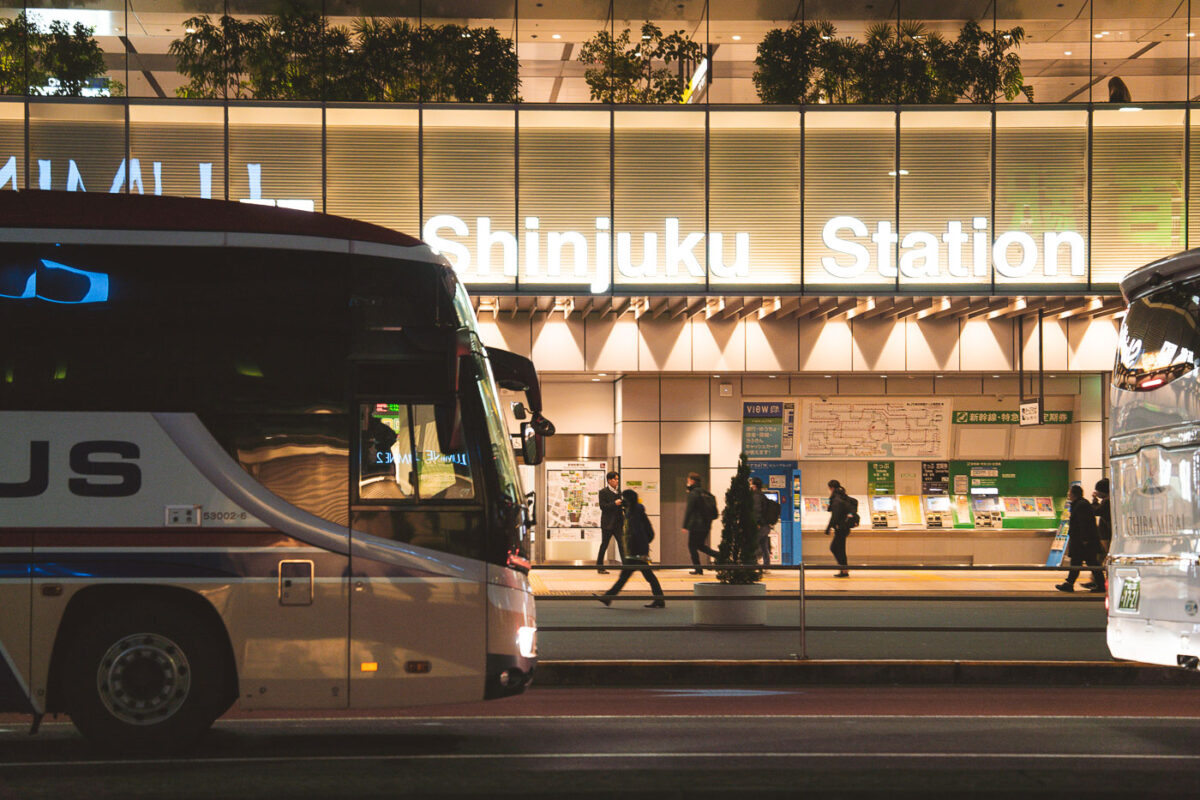
Intercity buses line up outside Shinjuku Station in Tokyo, one of the busiest rail hubs in the world and a major transfer point for long-distance coach services. The station’s west side is home to a dense cluster of express bus platforms that connect Tokyo with destinations across Honshu, Hokkaido, and Kyushu.
Captured in March 2023, the photo shows the steady flow of evening commuters moving between the station concourse and the bus loading area, illuminated by the station’s modern façade lighting. The scene reflects Shinjuku’s role not only as a metropolitan transit hub but also as a key gateway for regional travel throughout Japan.
Tokyo Station’s Marunouchi Dome at Night, Tokyo
March 2023
—
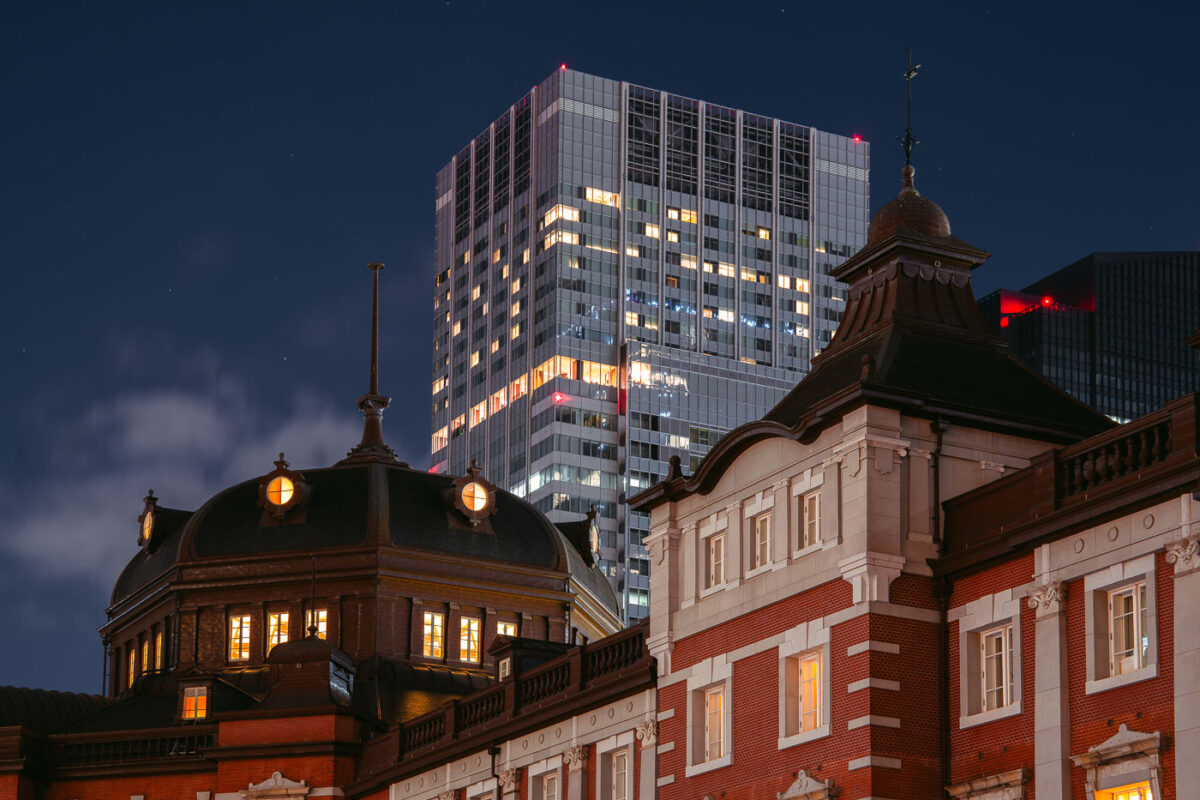
The historic Marunouchi side of Tokyo Station glows warmly at dusk, its red-brick exterior and copper domes standing in contrast to the modern skyscrapers of the surrounding Marunouchi business district. Opened in 1914 and designed by architect Tatsuno Kingo, the station served as the central gateway for Japan’s expanding rail network during the early 20th century.
The dramatic juxtaposition in this March 2023 photograph highlights more than a century of architectural evolution: the restored station building—meticulously reconstructed after wartime damage—foregrounds the sleek high-rise towers that define contemporary central Tokyo. Together, they illustrate how Tokyo layers historic preservation and modern development within one of the busiest transport hubs in the world.
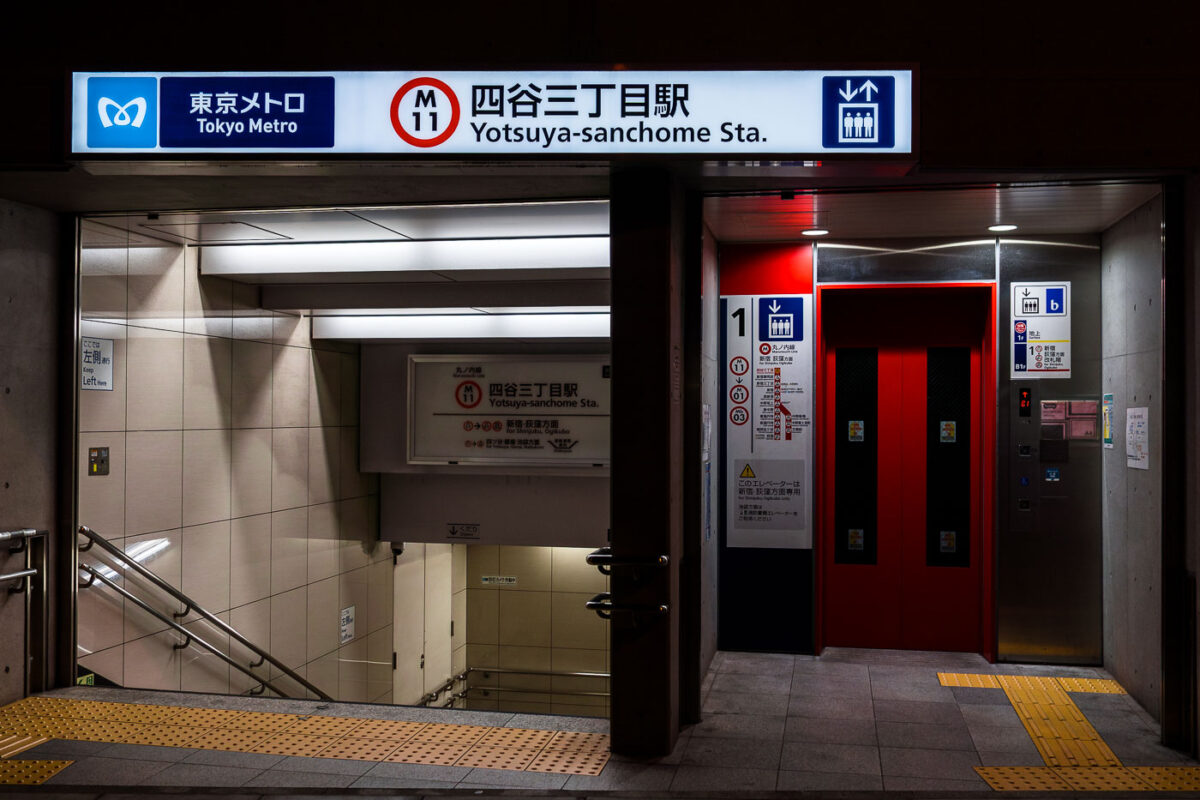
Yotsuya-sanchome Station Elevator Entrance, Tokyo Metro Marunouchi Line
March 2023
—
The entrance to Yotsuya-sanchome Station on Tokyo Metro’s Marunouchi Line (M11) is shown at night, featuring a clean, modern design with bright signage and red elevator doors. The station serves the Shinjuku district and connects to key destinations like Shinjuku, Ogikubo, and Tokyo Station. Braille paving and clear bilingual signs reflect Tokyo Metro’s accessibility standards and emphasis on wayfinding.
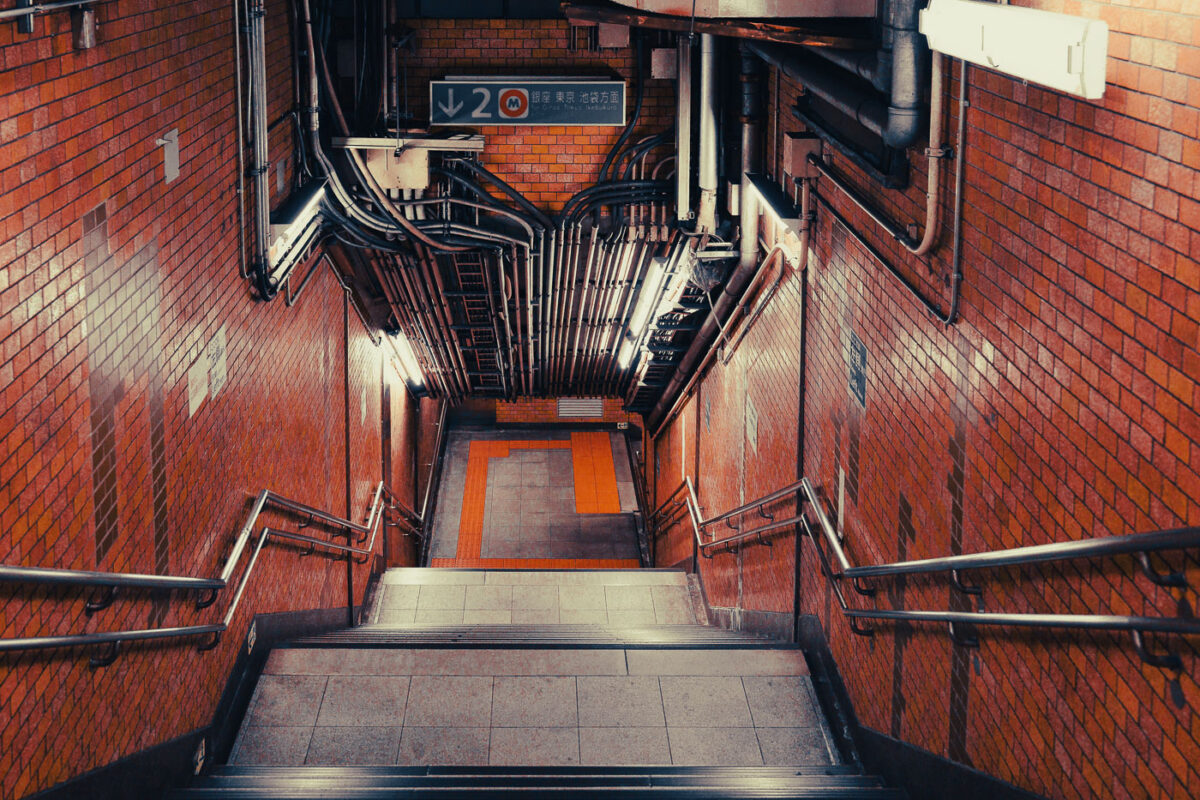
Exposed Conduit Over Stairwell on the Marunouchi Line
March 2023
—
A passageway leading down to the Tokyo Metro Marunouchi Line, part of one of Tokyo’s oldest surviving subway corridors. The Marunouchi Line began opening in stages between 1954 and 1962, making it the second-oldest subway line in the city after the Ginza Line. Many stations along the route—especially the early central segments—retain architectural and material choices from Japan’s postwar reconstruction period, including ceramic wall tile, exposed conduit, and compact stairways built before modern accessibility standards were introduced.
The dense overhead wiring found in older Marunouchi Line interchanges reflects decades of retrofits to accommodate improved lighting, ventilation, fire-suppression systems, and communication networks, all integrated into the original structural envelope. These spaces remain essential transfer points connecting central Tokyo’s commercial districts with major JR East hubs such as Shinjuku, Tokyo Station, and Ochanomizu.
Although the Marunouchi Line has undergone rolling upgrades—including new rolling stock (02 series replacements), platform screen doors, and improved wayfinding—the underlying layout in many stations still conveys the functional, space-efficient design philosophy of mid-20th-century Japanese subway engineering.
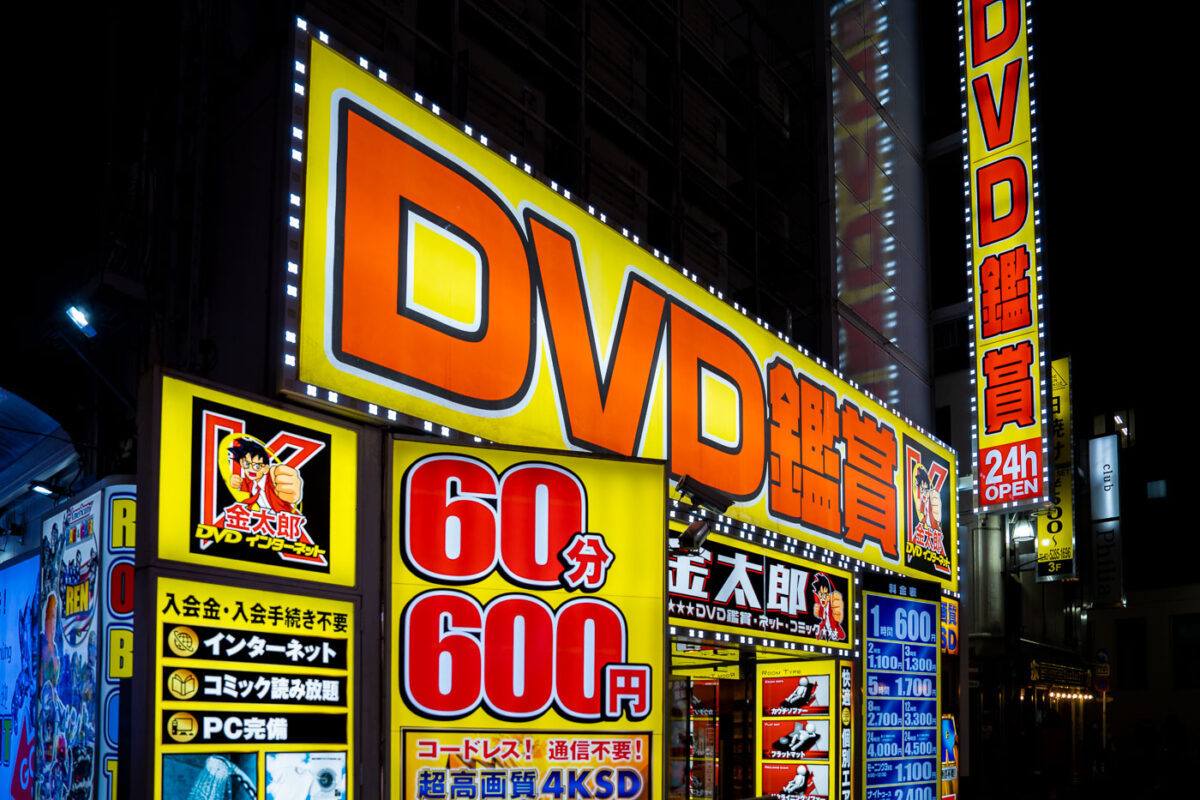
Shinjuku 24-Hour DVD and Internet Cafe Neon Signs
March 2023
—
In Tokyo’s Shinjuku district, the saturated glow of neon signage spills across the streets, advertising one of the countless 24-hour DVD and manga shops that once defined the city’s late-night entertainment culture. Massive orange and yellow panels compete for attention, illuminated by LED frames and plastered with bold pricing for hourly booths and media rentals. These storefronts — dense with color, typography, and nostalgia — reflect the enduring presence of Japan’s analog media scene even as digital streaming dominates elsewhere. The atmosphere captures Tokyo’s constant dialogue between old and new, where high-tech convenience meets the tactile energy of Showa-era retail culture under an endless canopy of light.
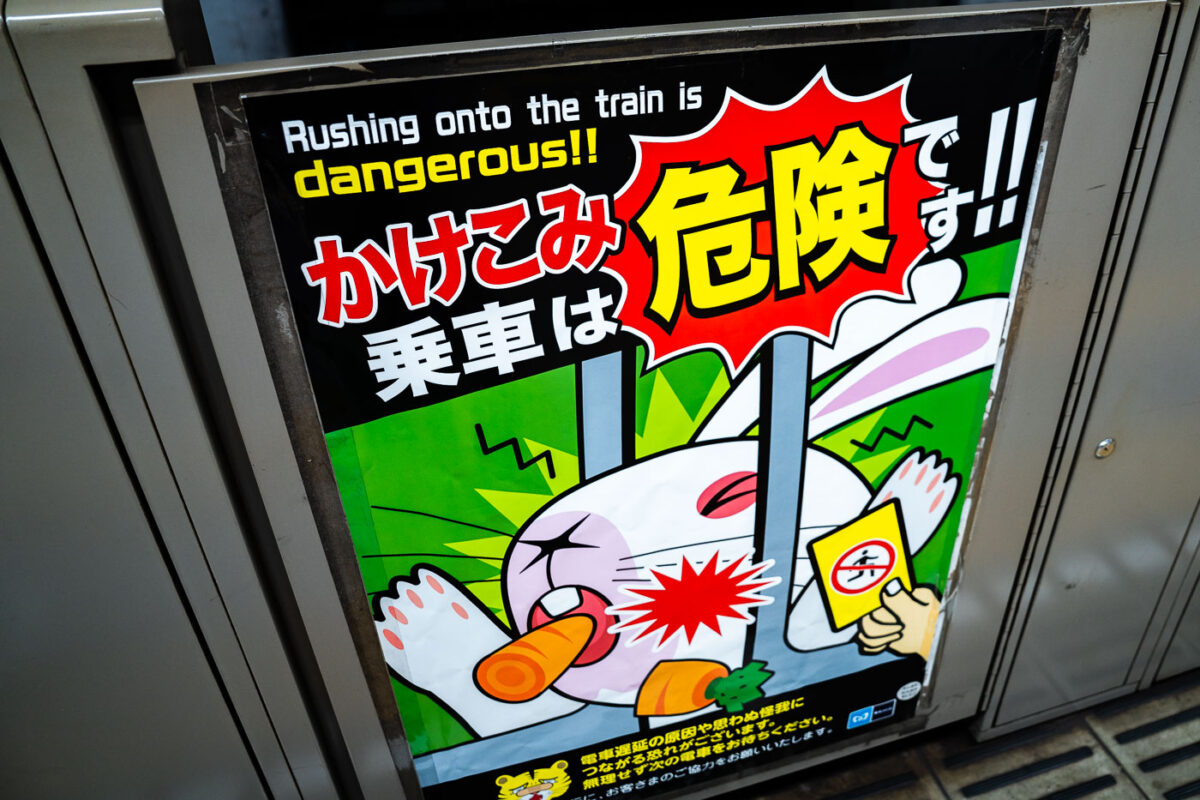
Tokyo Metro Safety Poster – “Rushing Is Dangerous”
March 2023
—
A safety poster inside a Tokyo Metro station warns passengers not to rush onto closing trains—a longstanding focus of the network’s passenger-safety campaigns. Tokyo’s subway operators, including Tokyo Metro and Toei, use a mix of mascots and bold graphic styles to discourage last-second boarding, which remains one of the most common causes of platform accidents and door malfunctions.
These posters are typically placed on or near platform screen doors, which have been installed progressively across the network since the early 2000s to reduce injuries and improve train-dwell consistency. The messaging reflects Japan’s broader public-transportation safety culture: preventing delays, protecting passengers, and maintaining precise headways in some of the most heavily used rail corridors in the world.
This particular design features a cartoon warning style common in Metro stations along lines such as the Marunouchi, Yamanote interchanges, and the Keisei connection points at Ueno and Nippori.
Yodobashi Camera Head Store Sign, Shinjuku, Tokyo
March 2023
—
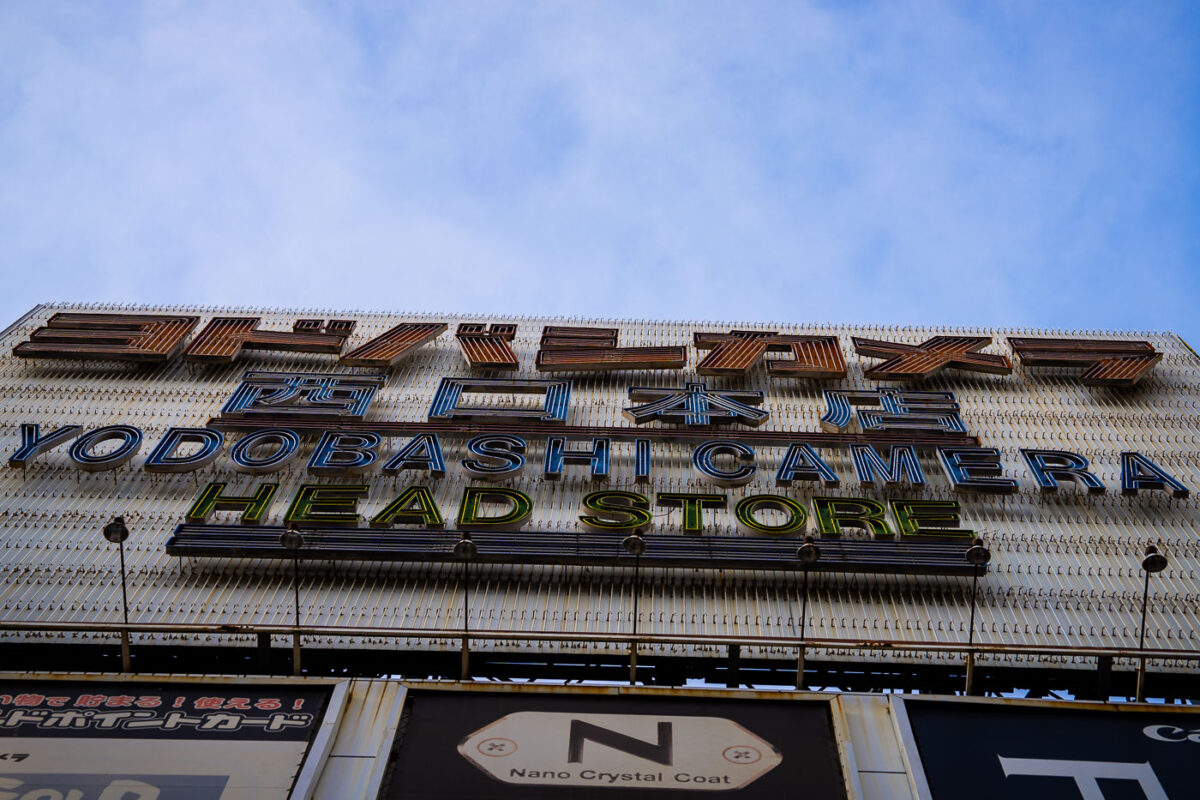
The iconic neon sign of Yodobashi Camera’s head store in Shinjuku is seen from street level, with its mix of Japanese and English lettering. The large retro-style signage, lined with anti-bird spikes, reflects the store’s long-standing presence as one of Tokyo’s biggest electronics retailers. Yodobashi Camera’s Shinjuku West Exit location serves as the flagship branch, anchoring the city’s vast camera and tech shopping district.
Sichuan Restaurant Signage, Kokusai Dori, Shinjuku, Tokyo
March 2023
—
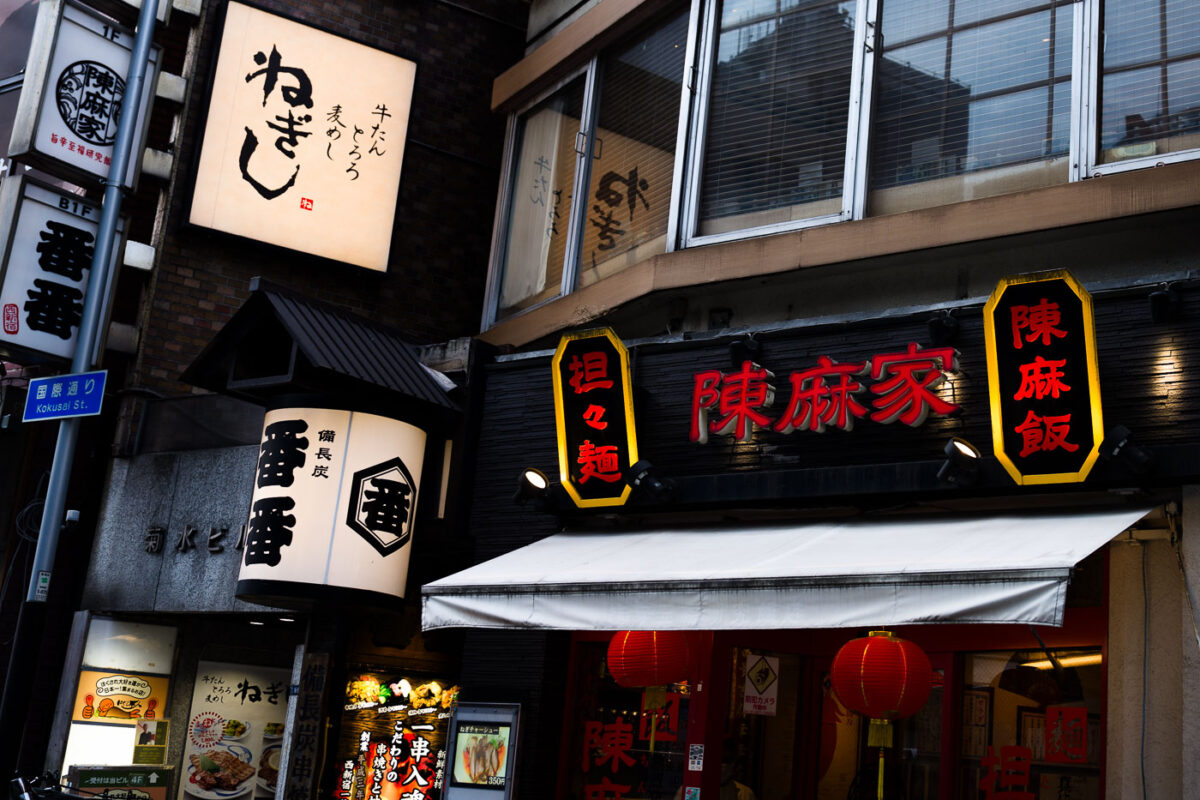
A cluster of restaurants along a narrow Shinjuku street glows with layered signage in both Japanese and Chinese scripts. The red and gold lettering of a Sichuan-style noodle house stands out beneath the muted tones of surrounding izakayas, each sign competing for attention with subtle variations in type and light. Red paper lanterns hang just above the entrance, signaling warmth and spice within, while the larger illuminated kanji above advertise dishes like “tan-tan men” and “mapo rice.” The mix of fonts, textures, and light reflects Tokyo’s dynamic blend of regional cuisines and visual clutter—a dense, living typography of urban appetite and identity.
Restaurant Row on Sanbangai Street, Shinjuku, Tokyo
March 2023
—
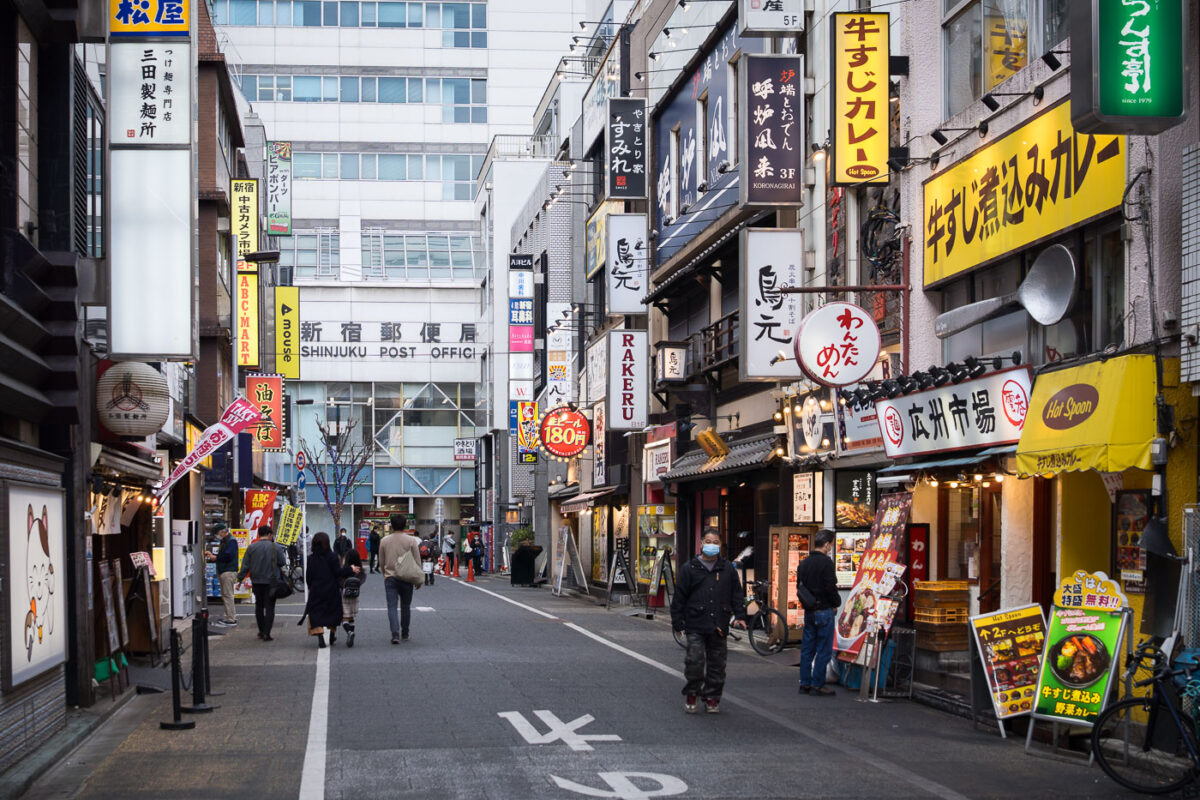
Sanbangai Street sits just west of Shinjuku Station and is part of the dense network of narrow commercial lanes that define this section of the city. The area developed rapidly after the mid-20th-century reconstruction of Shinjuku and is now lined with small restaurants, curry shops, bars, and specialty eateries catering to commuters and office workers moving through the station district each day.
The nearby Shinjuku Post Office has long served as a recognizable landmark on the north side of the station, anchoring a neighborhood known for its mix of long-established storefronts and constantly rotating food businesses.
Godzilla Statue atop Toho Cinemas, Kabukichō, Shinjuku
March 2023
—
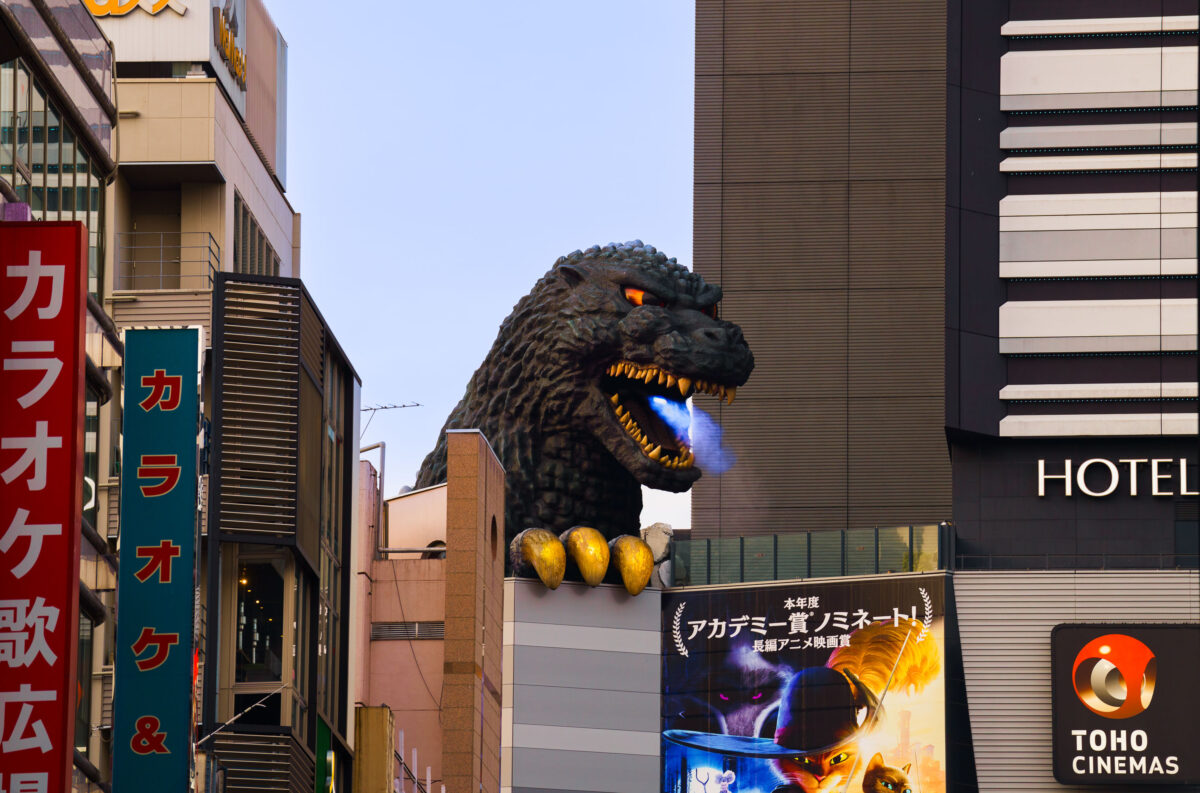
The Godzilla Head overlooking Kabukichō is one of Shinjuku’s most recognizable modern landmarks. Installed in 2015 to mark the opening of the Toho Cinemas Shinjuku complex—the studio responsible for the original 1954 Godzilla film—the sculpture rises above the building’s eighth floor, facing the main entertainment district.
The installation recreates Godzilla’s appearance from the 1990s Heisei-era films, and several times a day it emits sound, smoke, and light effects that mimic the creature’s trademark atomic breath. Positioned above the Kabukichō streetscape, the figure is intended as both a tribute to Japan’s most famous movie monster and a visual anchor for this entertainment-heavy part of Shinjuku.
Toyota Crown Comfort Taxi, Kabukichō, Shinjuku
March 2023
—
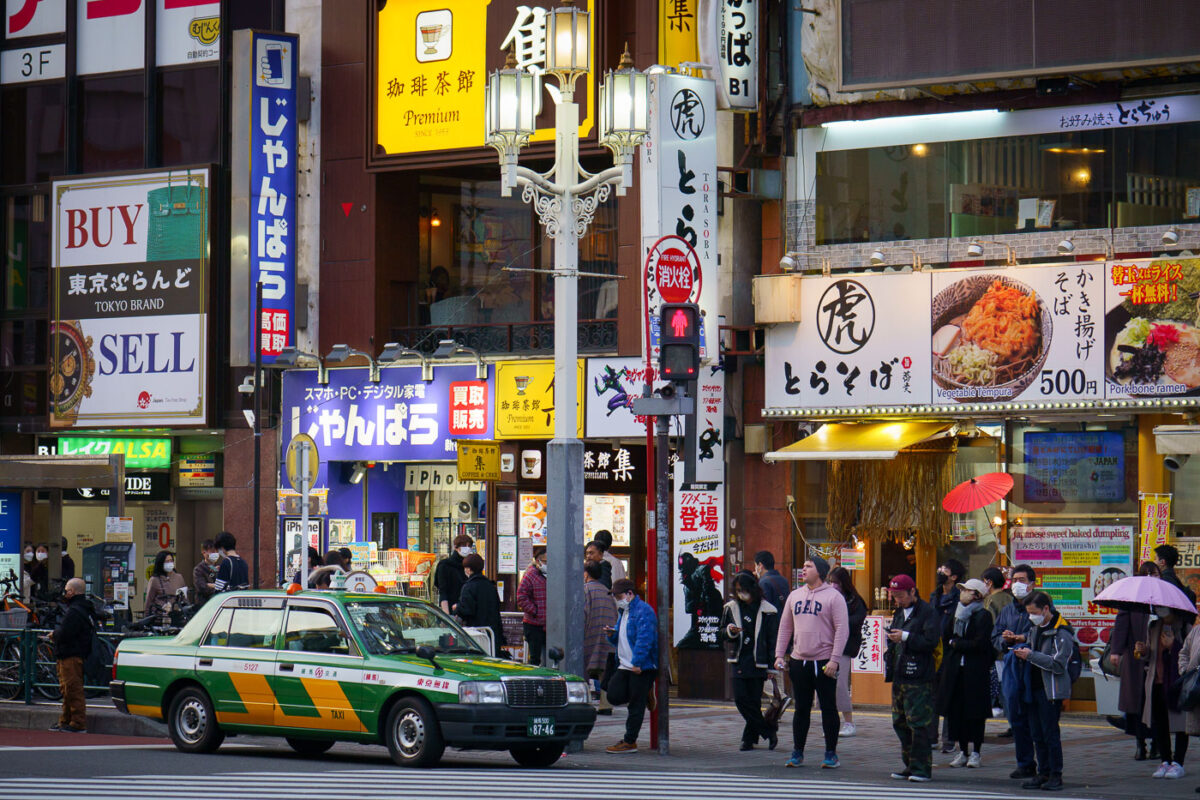
A Tokyo taxi waits at a crossing in Kabukichō, the entertainment district of Shinjuku known for its dense concentration of restaurants, bars, and late-night businesses. The area around Yasukuni-dōri and Shinjuku Station’s east side has long been one of Tokyo’s busiest pedestrian zones, with a mix of small eateries, electronics resellers, and long-established cafés occupying the mid-rise commercial blocks.
The green-and-yellow taxi livery seen here is one of Tokyo’s standard color schemes, used by several of the city’s major cab companies since the late twentieth century. The surrounding storefronts reflect Kabukichō’s layered commercial history, where postwar restaurants, national chains, and contemporary pop-culture signage coexist within the same streetscape.
Delivery Scooter Crossing Central Road, Kabukichō, Tokyo
March 2023
—
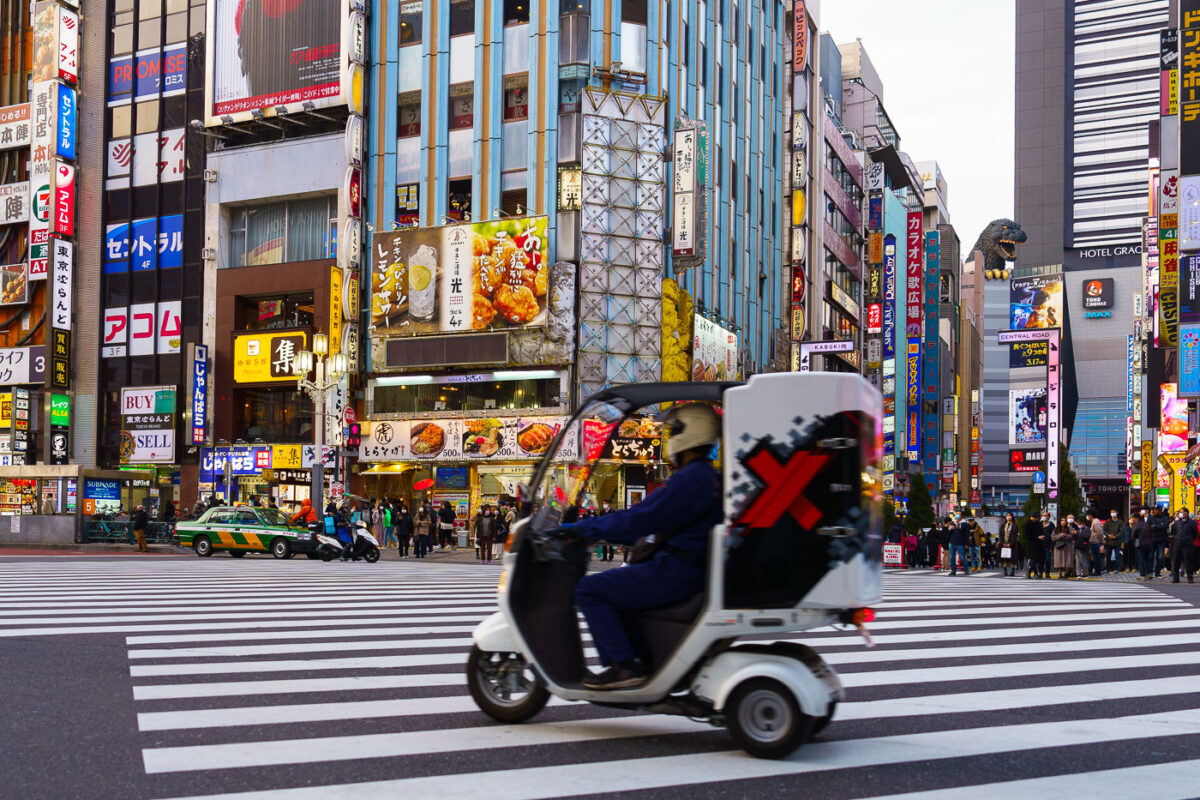
A delivery scooter moves through the large scramble crossing on Central Road in Kabukichō, one of Shinjuku’s busiest commercial corridors. This stretch of the district, located just north of Yasukuni-dōri, has been a dense entertainment zone since the postwar reconstruction era, eventually becoming known for its mix of cinemas, restaurants, arcades, karaoke towers, and neon advertising stacked across narrow mid-rise buildings.
The tall signs and narrow storefronts reflect the vertical commercial pattern typical of Shinjuku’s nightlife blocks, where multiple businesses occupy each floor and compete for visibility at street level. In the distance, the Godzilla head mounted atop the Hotel Gracery Shinjuku—installed in 2015 as part of the Toho Cinemas complex—has become one of the district’s most recognizable landmarks, connecting the area’s contemporary tourism appeal with Japan’s long-running film history.
Tohoku Gyozabou Storefront Near Shinjuku Gyoen, Tokyo
March 2023
—
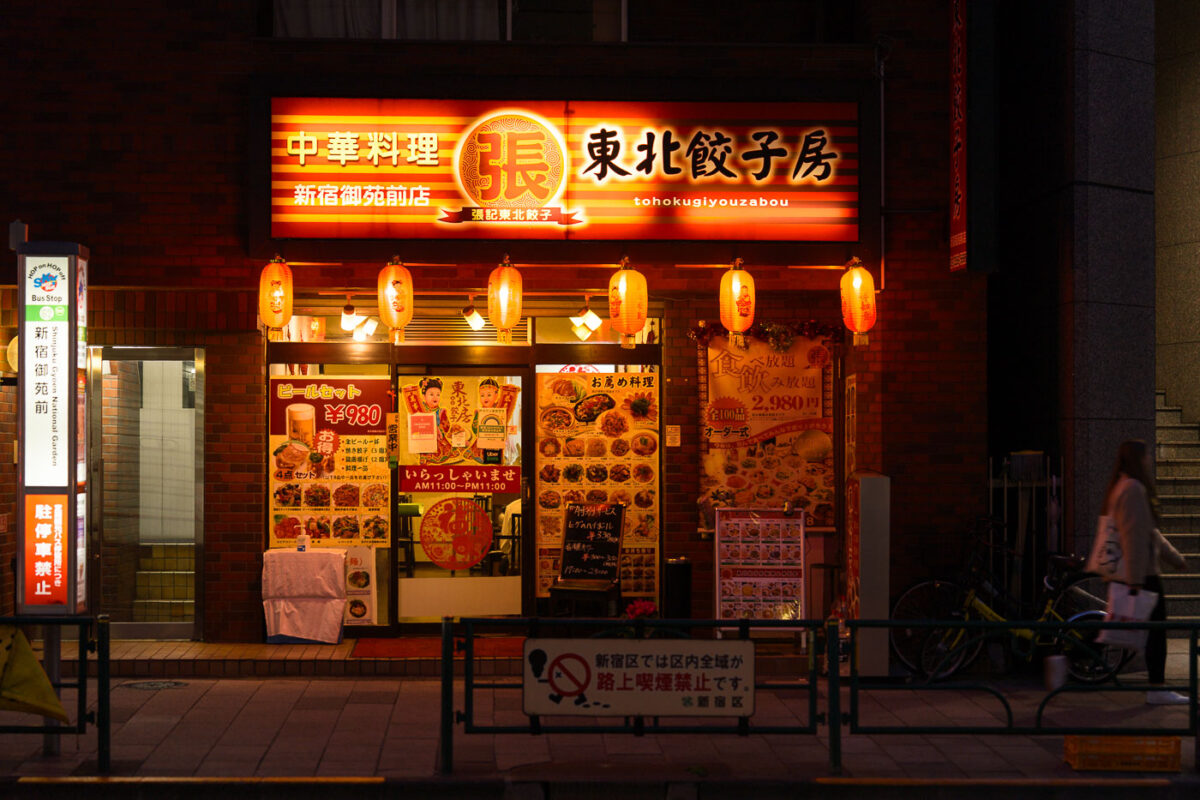
Tohoku Gyozabou, located just east of Shinjuku Gyoen National Garden, is one of many small neighborhood restaurants that serve the area’s mix of office workers, residents, and visitors. Spots like this are common throughout Shinjuku’s quieter side streets, offering regional Chinese-style dishes and set meals late into the evening, contrasting with the larger entertainment corridors to the west around Shinjuku Station and Kabukichō.
The surrounding district developed after World War II as Shinjuku expanded outward from the rail hub, creating a network of narrow commercial blocks filled with independent eateries. Many of these restaurants continue to display brightly illuminated exterior menus and lantern signage, part of the city’s longstanding street-level food culture that encourages casual walk-in dining.
NTT Docomo Yoyogi Building Above Shinjuku Gyoen, Tokyo
March 2023
—
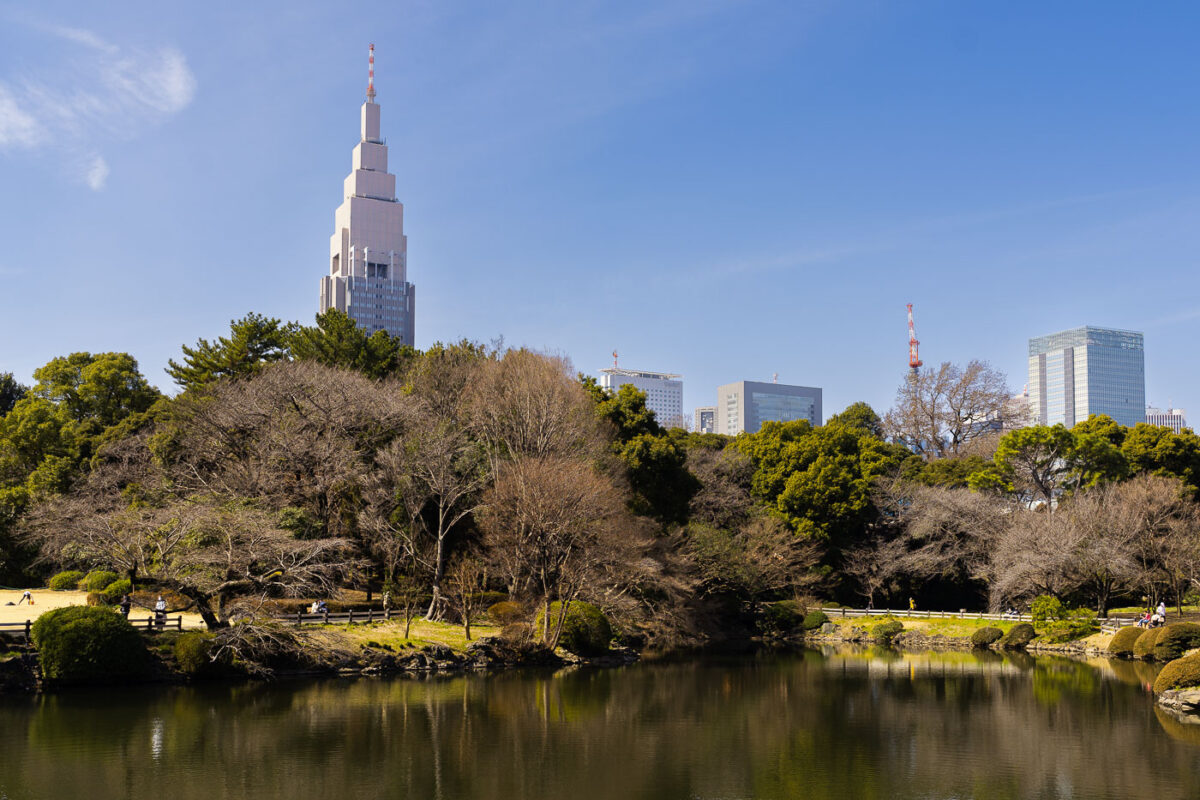
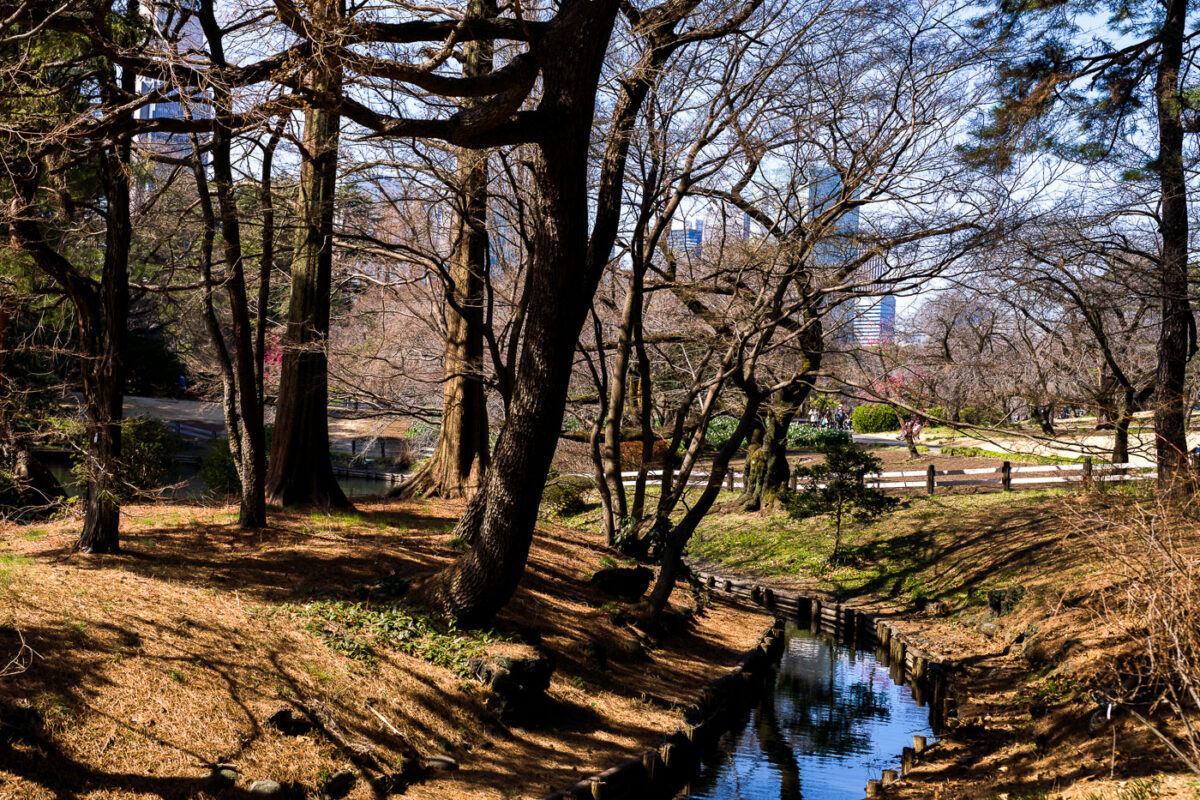
Shinjuku Gyoen National Garden offers a calm, expansive contrast to the dense urban core that surrounds it. Originally part of a feudal estate in the Edo period and later a botanical garden under the Imperial Household Agency, Shinjuku Gyoen opened to the public in 1949 and remains one of Tokyo’s most significant landscaped parks.
In this March 2023 photograph, the garden’s central pond reflects late-winter trees and early seasonal light, while the tiered silhouette of the NTT Docomo Yoyogi Building rises prominently in the background. The juxtaposition underscores how Shinjuku Gyoen functions as a large green refuge within one of the busiest districts in Tokyo, blending historical landscape design with the city’s modern skyline.
Stream and Skyline View, Shinjuku Gyoen National Garden, Tokyo
March 2023
—
Shinjuku Gyoen National Garden has long served as one of Tokyo’s largest and most historically layered urban parks, transitioning from an Edo-period feudal estate to an Imperial garden before opening to the public after World War II. This March 2023 view reflects the quiet season just before cherry blossoms begin to emerge, when the garden’s network of footpaths, streams, and wooded slopes show more of their underlying structure.
Morning light filters through leafless trees onto a narrow waterway lined with timber edging—an example of the garden’s blend of traditional Japanese landscape elements and early modern design introduced during its redevelopment in the early 20th century. In the distance, visitors walk among early-blooming shrubs with Shinjuku’s skyline rising beyond the treetops, underscoring the park’s role as a transitional space between dense city life and calm, curated nature.
Slot Parlor Storefront, Kabukichō, Shinjuku
March 2023
—
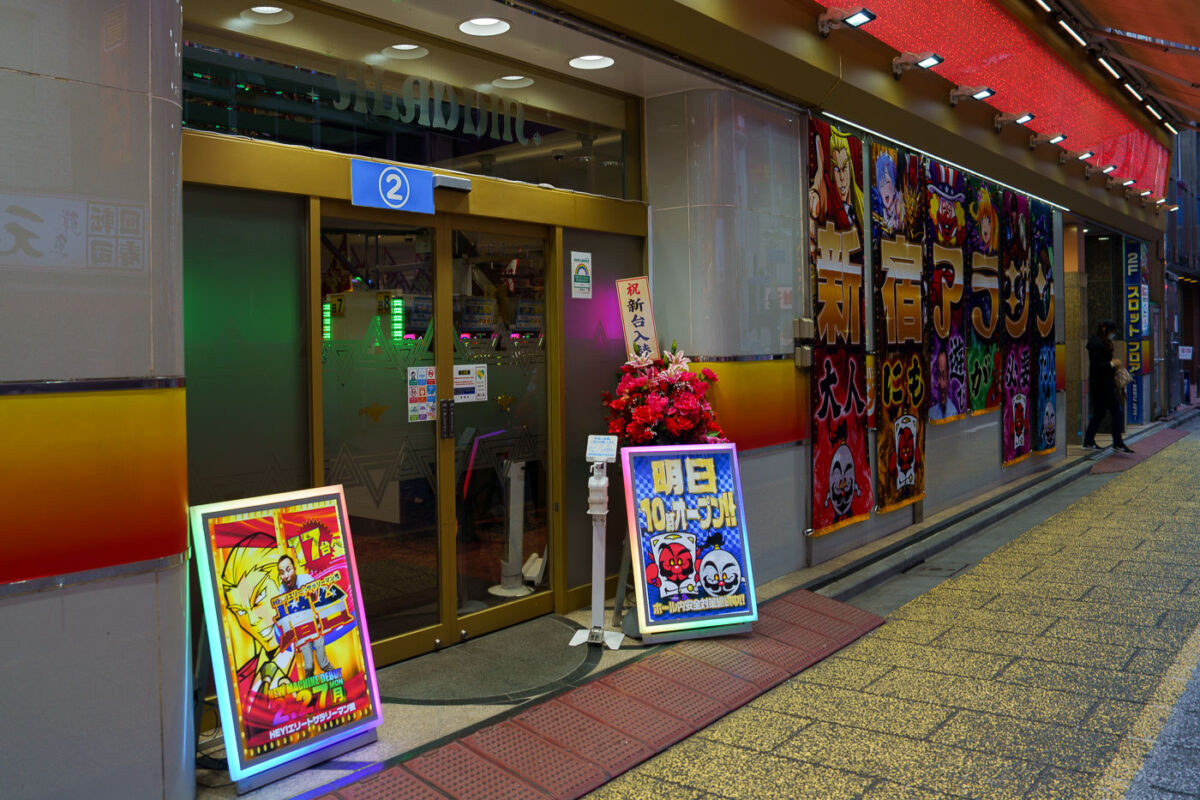
Pachinko parlors remain a defining part of Japan’s postwar entertainment landscape, evolving from small mechanical game halls into large, brightly lit venues that line the streets of major cities. This Shinjuku location reflects the modern industry’s mix of gambling-adjacent gaming, animated advertising, and elaborate storefront displays designed to attract commuters and tourists.
Although pachinko operates in a legal gray zone—winnings are exchanged off-site to comply with gambling regulations—it has grown into a multibillion-yen sector with deep cultural roots, from the machines’ lineage in early 20th-century children’s games to their present role as a staple of urban nightlife.
Yodobashi-Akiba Storefront at Night, Akihabara, Tokyo
March 2023
—
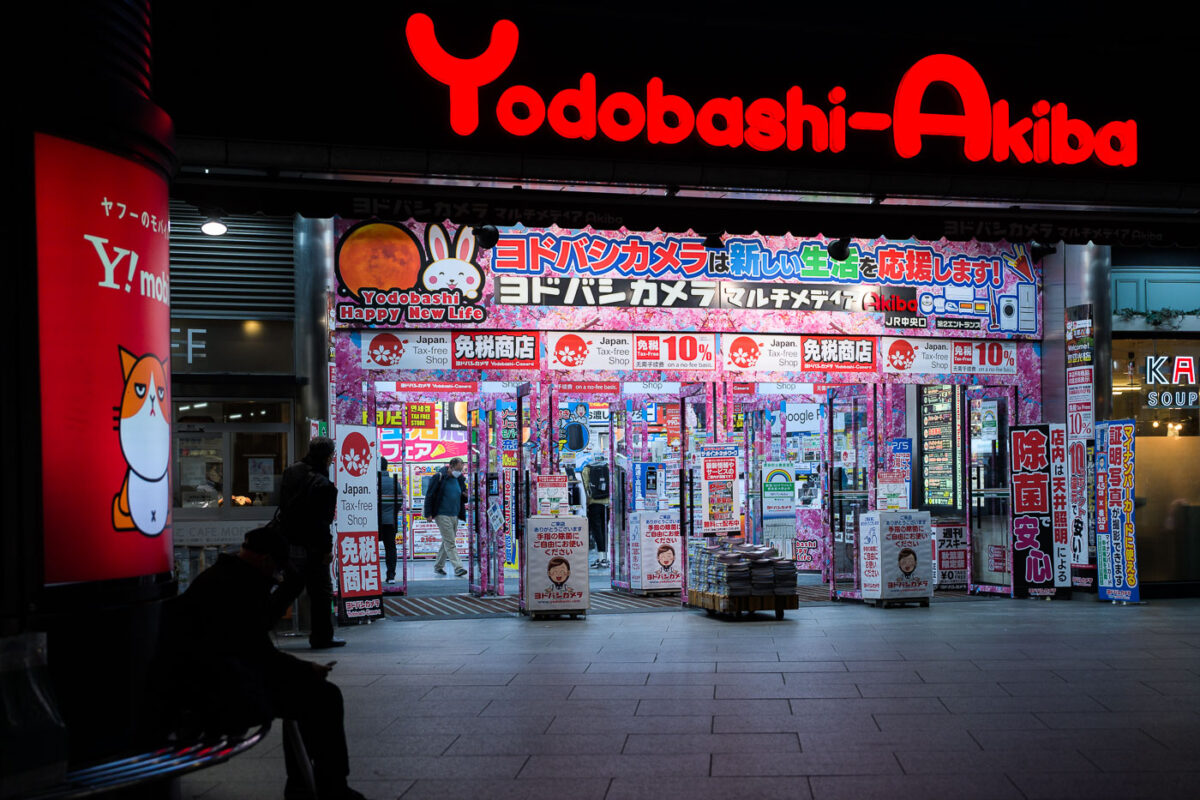
Yodobashi-Akiba, photographed in March 2023, is one of Tokyo’s largest electronics retail complexes and a major landmark in the Akihabara district. Opened in 2005 as part of a wider redevelopment effort around JR Akihabara Station, the multi-story store consolidated several specialty floors—computers, cameras, gaming, home appliances, musical instruments—into a single destination that helped redefine the area’s retail identity in the 2000s.
Its brightly illuminated entrance, typically covered in seasonal and promotional signage, reflects the competitive electronics market that shaped modern Akihabara. The building also connects directly to the Tsukuba Express line and sits beside the redevelopment zone that transformed the district from its postwar reputation as “Electric Town” into a mix of technology retail, office towers, and entertainment venues.
Crane Game Aisle at Gigo Akihabara, Tokyo
March 2023
—
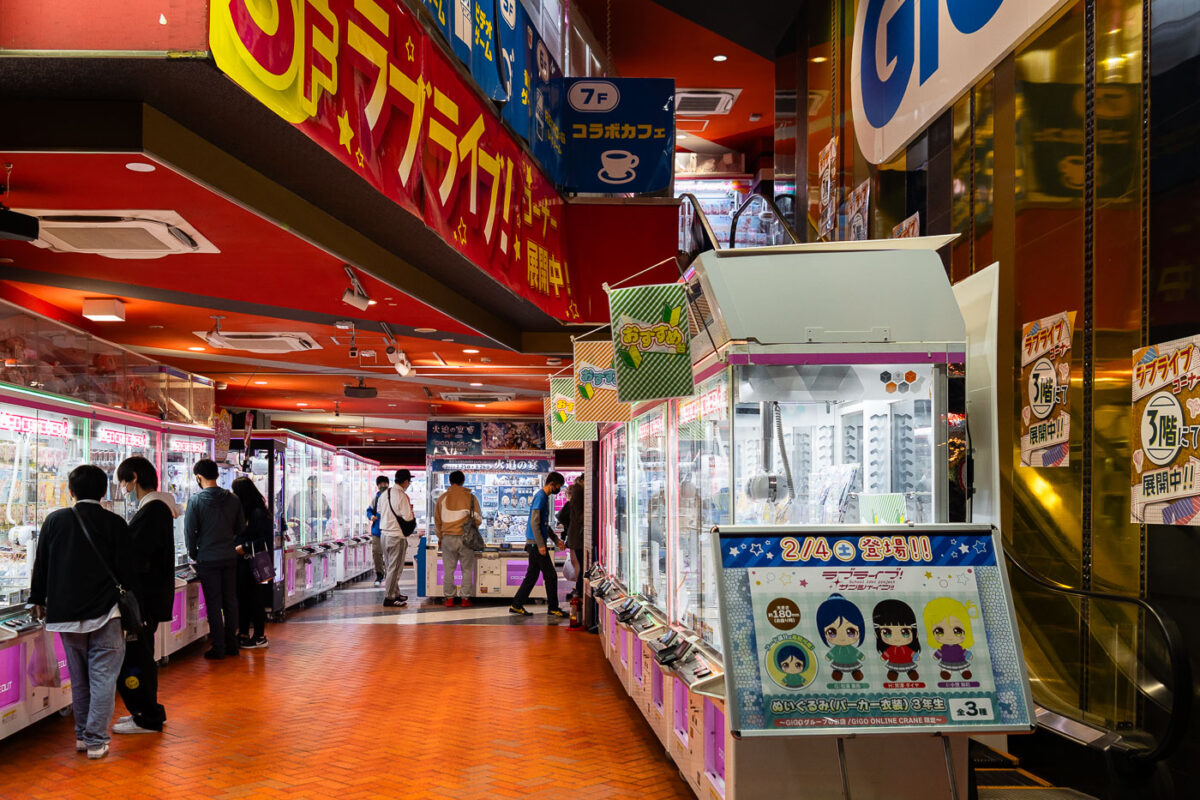
Inside the multi-floor Gigo arcade complex in Akihabara, photographed in March 2023, rows of brightly lit crane and prize machines fill an entire level dedicated to character-themed merchandise and limited-run collectibles. Facilities like this became a defining part of Akihabara’s post-2000s shift from an electronics-focused district to a broader entertainment hub centered around gaming, anime culture, and specialty retail.
Originally operated under the SEGA brand until a 2022 rebranding, Gigo retained the large-scale arcade format that has long been a staple of Tokyo’s urban leisure landscape. The popularity of crane games—often refreshed with seasonal or collaboration prizes—continues to draw both local players and visitors exploring the district’s modern pop-culture identity.
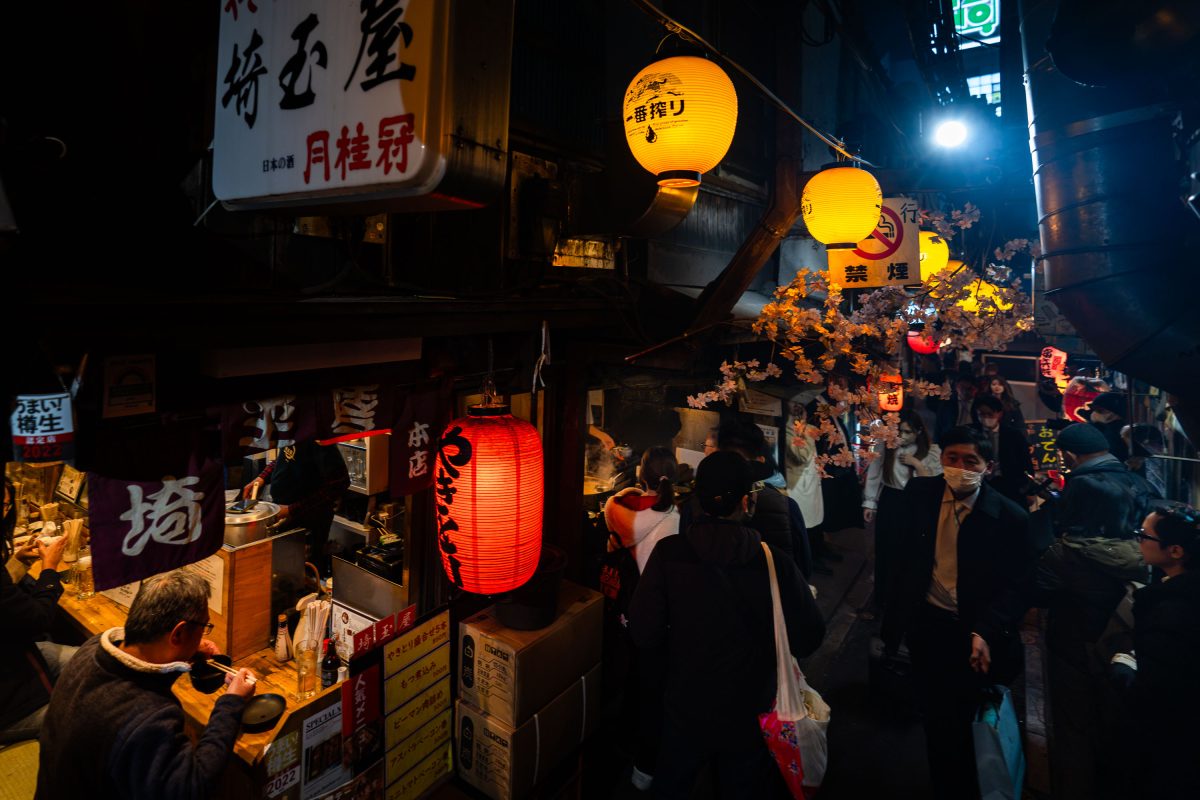
Yakitori Alley, Omoide Yokocho, Shinjuku
March 2023
—
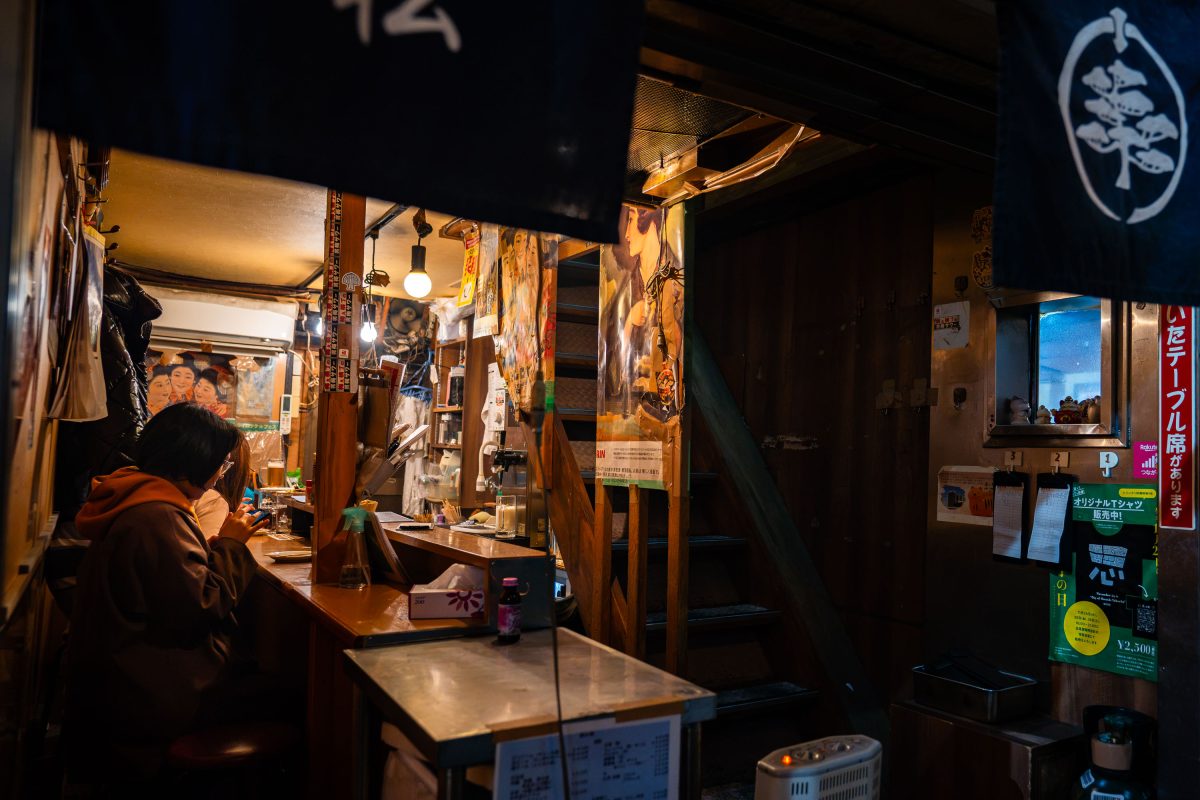
Tiny Izakaya Bar Counter, Japan
March 2023
—
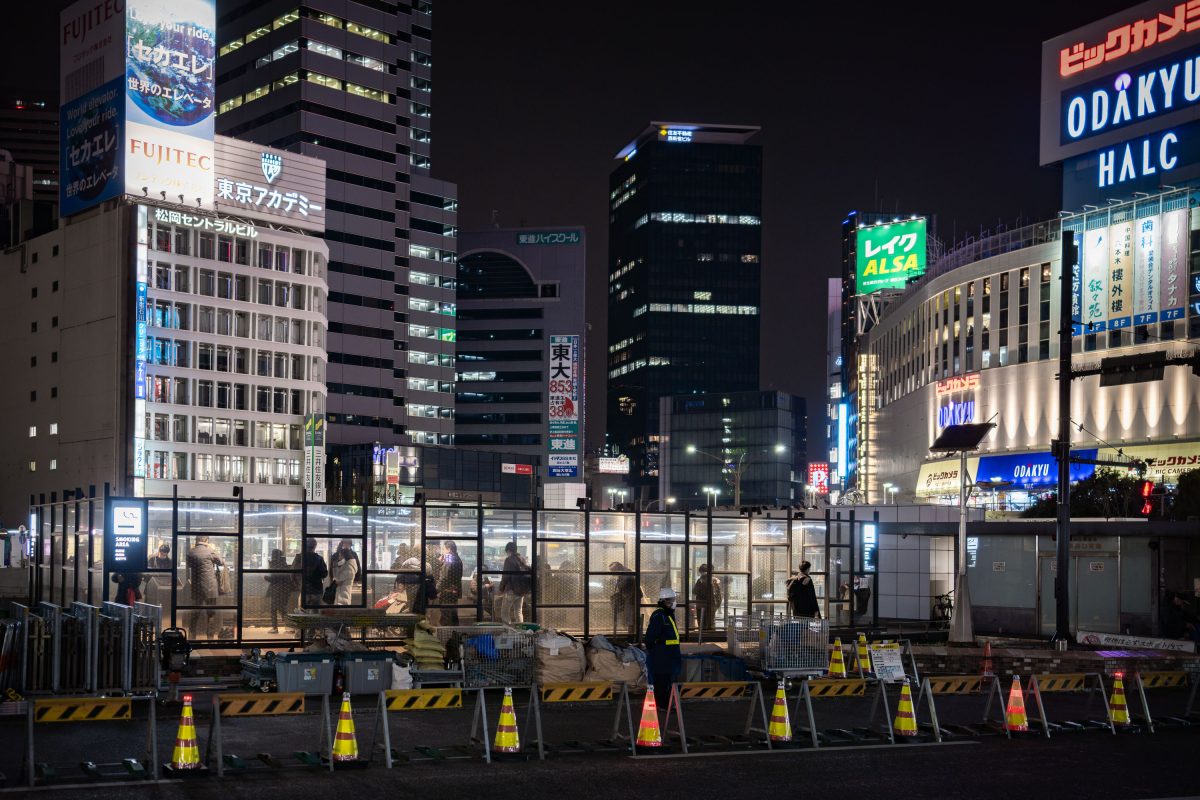
Odakyu HALC and Shinjuku Skyline at Night, Tokyo
March 2023
—
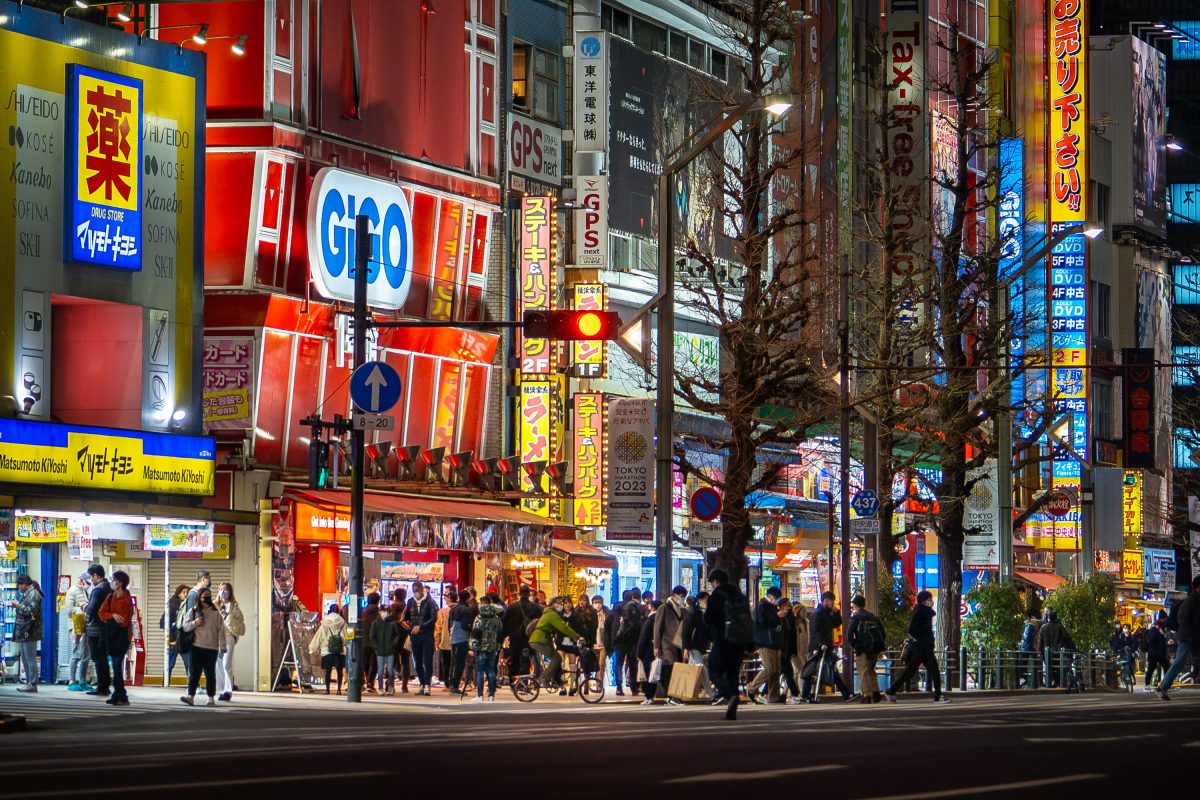
Akihabara Electric Town at Night, Tokyo
March 2023
—
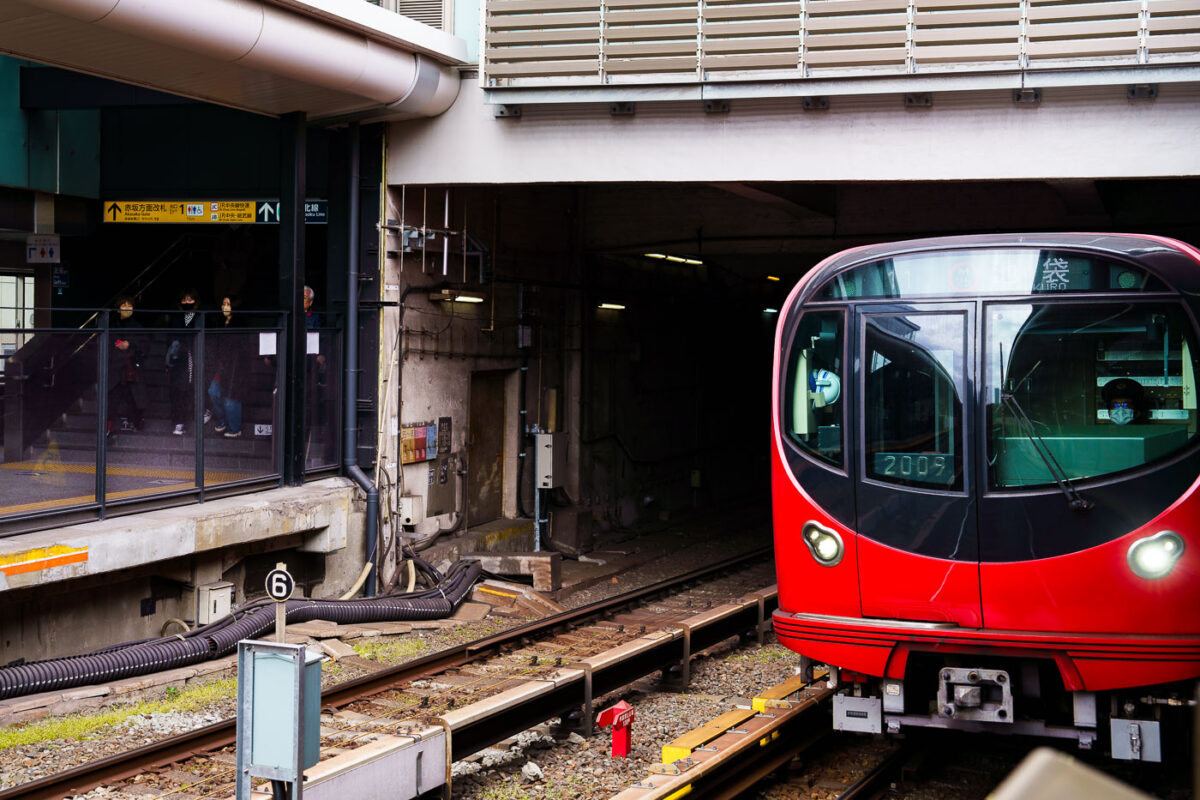
Marunouchi Line Train Entering Yotsuya-Sanchome Station
March 2023
—
A Tokyo Metro Marunouchi Line train approaches its terminal platforms during a March 2023 visit. The Marunouchi Line, one of Tokyo’s earliest postwar subway routes, opened in 1954 and played a key role in connecting the expanding Yamanote district centers with government and commercial areas in central Tokyo. Its distinctive red livery has remained a defining visual identity for decades, even as the rolling stock has undergone multiple modernizations.
Ikebukuro, the northern terminus of the line, is one of Tokyo’s busiest rail hubs, jointly served by JR East, the Seibu and Tobu railway networks, and several Metro lines. The station complex was heavily rebuilt throughout the late 20th century to handle increasing commuter volumes, resulting in the multi-level platform and passageway layout still in use today.
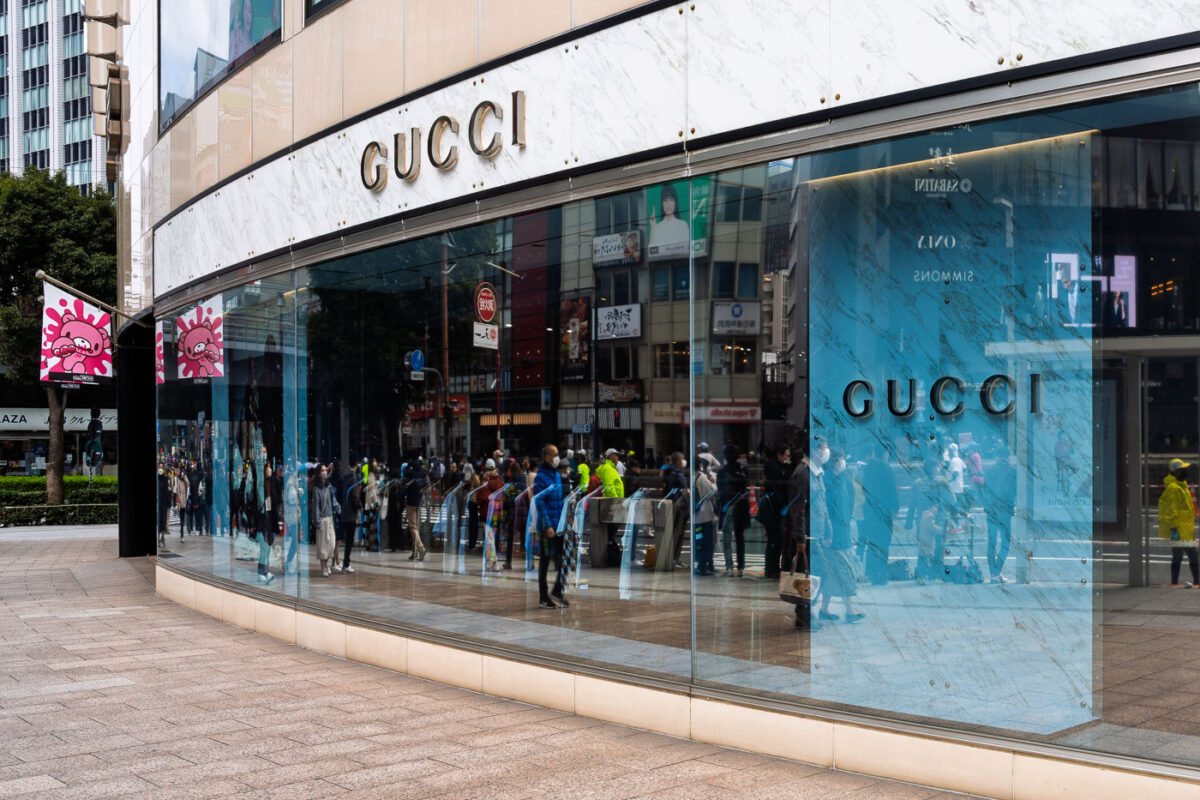
Gucci Ginza storefront, Tokyo
March 2023
—
Marathon runners outside the Gucci flagship store in Tokyo’s Ginza district, their reflections merging with the pale blue marble of the storefront’s curved glass façade. The mirrored surface creates a layered composition — a city within a window — blending luxury retail architecture with the urban motion of shoppers and commuters. Behind the glass, soft interior lighting contrasts with the bustle outside, capturing a quiet tension between aspiration and reality. The scene evokes Ginza’s dual identity as both a symbol of global consumer culture and a distinctly Japanese streetscape, where design, commerce, and reflection coexist seamlessly.