Downtown Minneapolis

1,173 photos · 2009–2026

1,173 photographs tagged Downtown Minneapolis, 2009–2026.
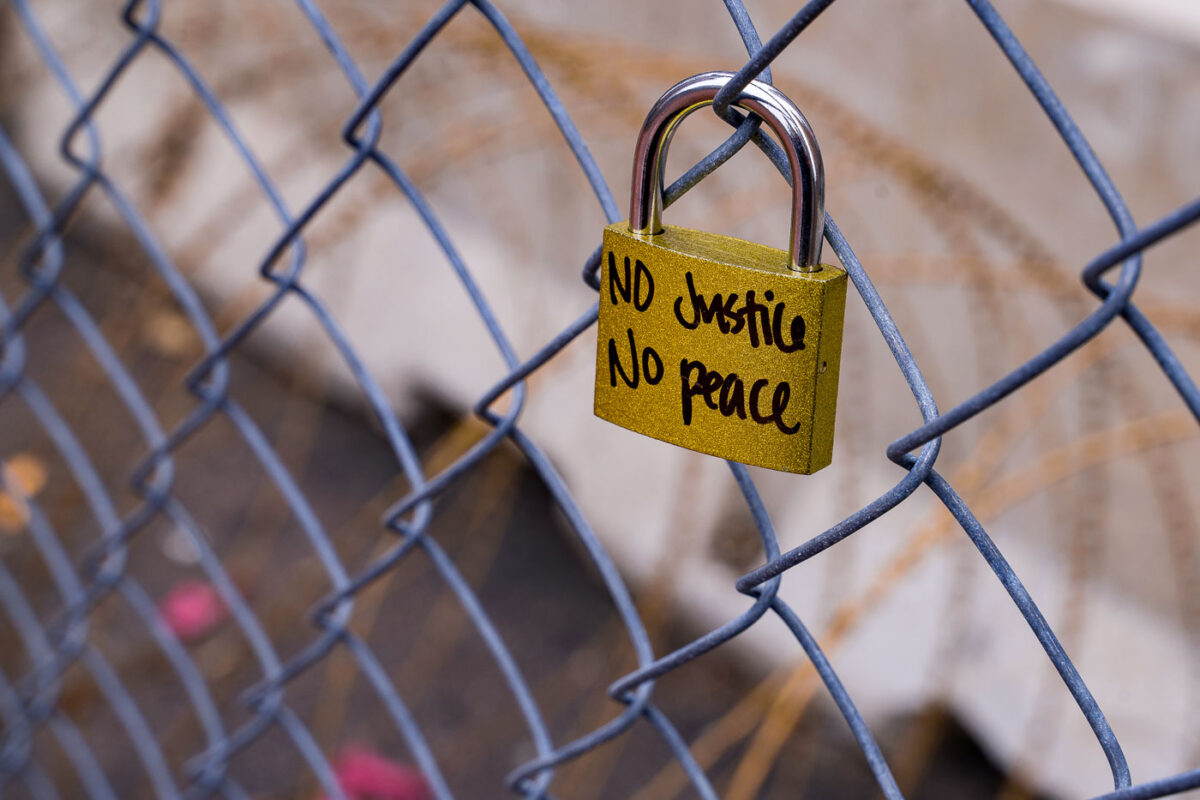
No Justice No Peace lock at Chauvin trial
A padlock inscribed with "No justice, No peace" is affixed to a chain-link fence surrounding the Hennepin County Government Center in Minneapolis. This security measure was in place during the 2021 trial of Derek Chauvin, a former Minneapolis police officer charged with the murder of George Floyd. The trial, held in the same building, drew significant public attention and protests related to racial justice and police brutality.

Minneapolis: Lock on fence at Hennepin County Government Center during Chauvin trial
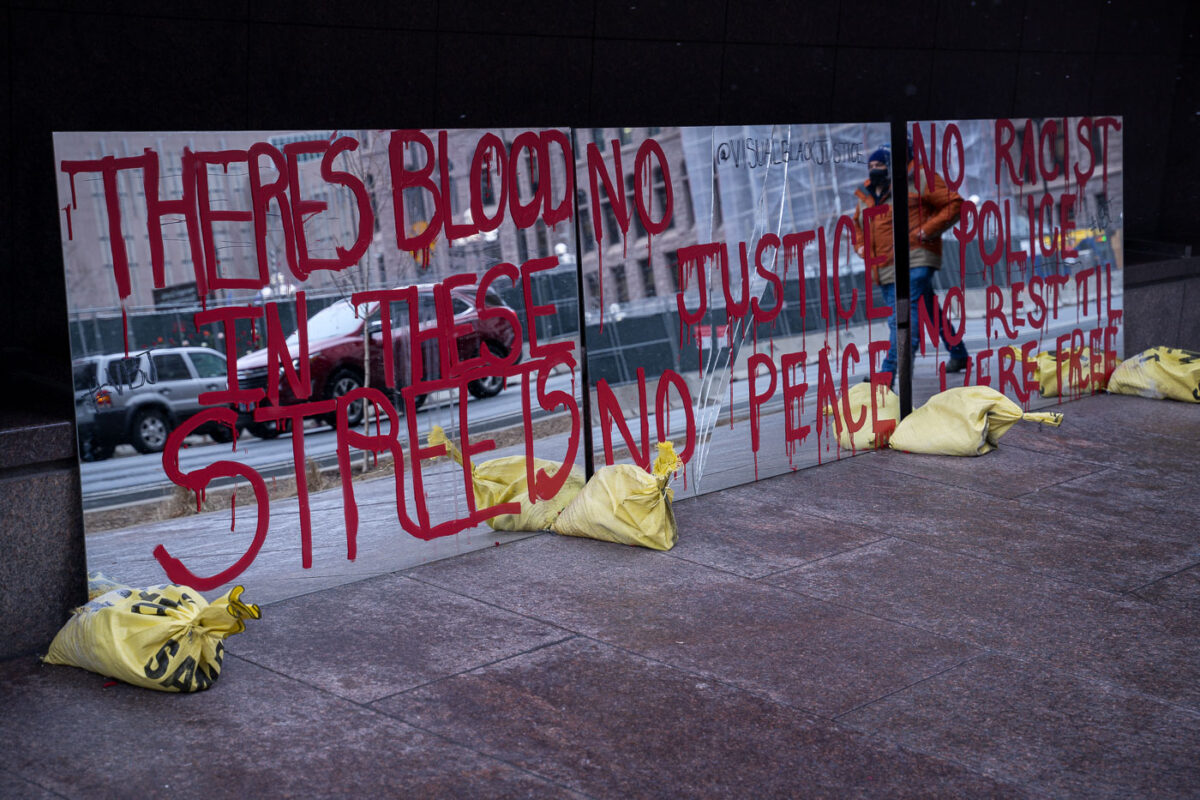
Theres Blood In These Streets mirror art
Mirrored panels bearing protest messages, including "There's Blood In These Streets" and "No Justice No Peace," are displayed outside the Hennepin County Government Center in Minneapolis. The courthouse was the site of the trial for Derek Chauvin, a former Minneapolis police officer charged in the death of George Floyd on May 25, 2020. The messages reflect the ongoing protests and calls for justice that followed Floyd's murder and highlighted systemic issues within law enforcement.

Minneapolis: Mirror Art at Hennepin County Government Center During Chauvin Trial
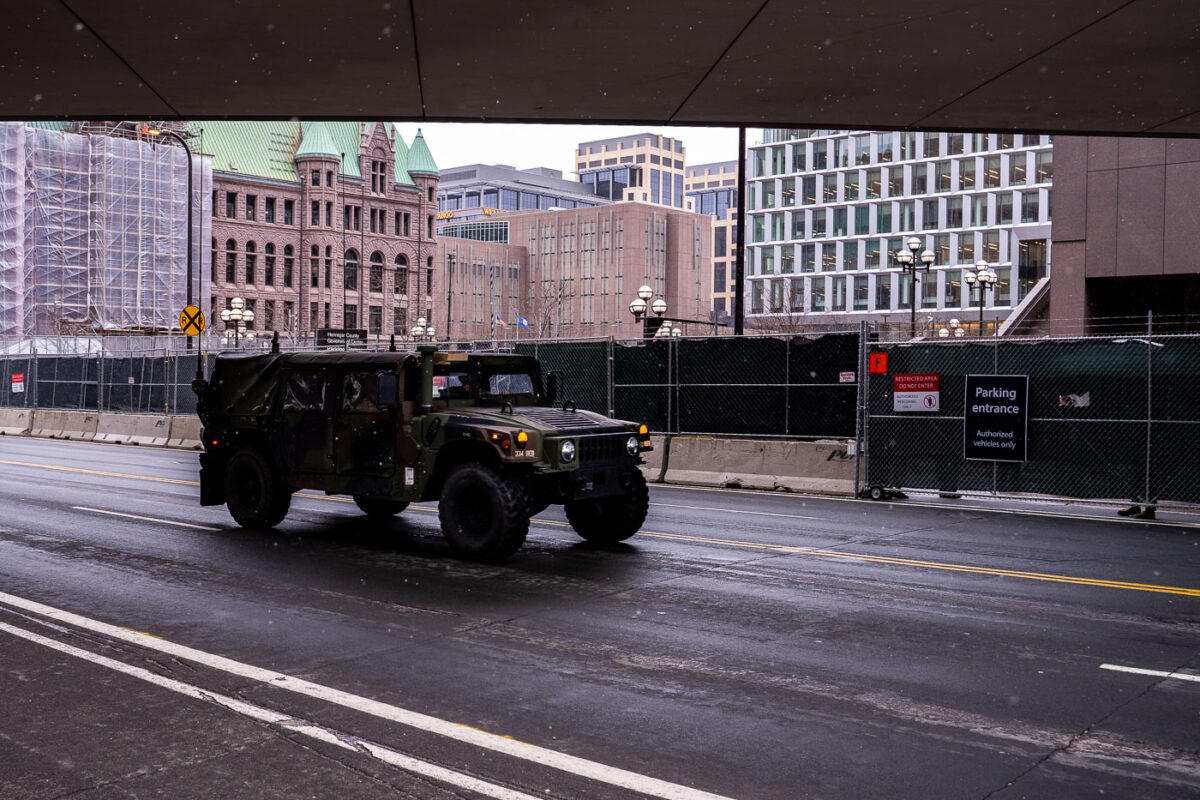
National Guard military vehicle outside Chauvin trial
A Minnesota National Guard vehicle is parked near the Hennepin County Government Center in Minneapolis. The courthouse was the site of the trial for Derek Chauvin, the former Minneapolis police officer charged in the May 25, 2020, murder of George Floyd. The presence of military vehicles underscored the heightened security and tension surrounding the trial, which began in March 2021.

National Guard vehicle near Hennepin County Government Center, Minneapolis
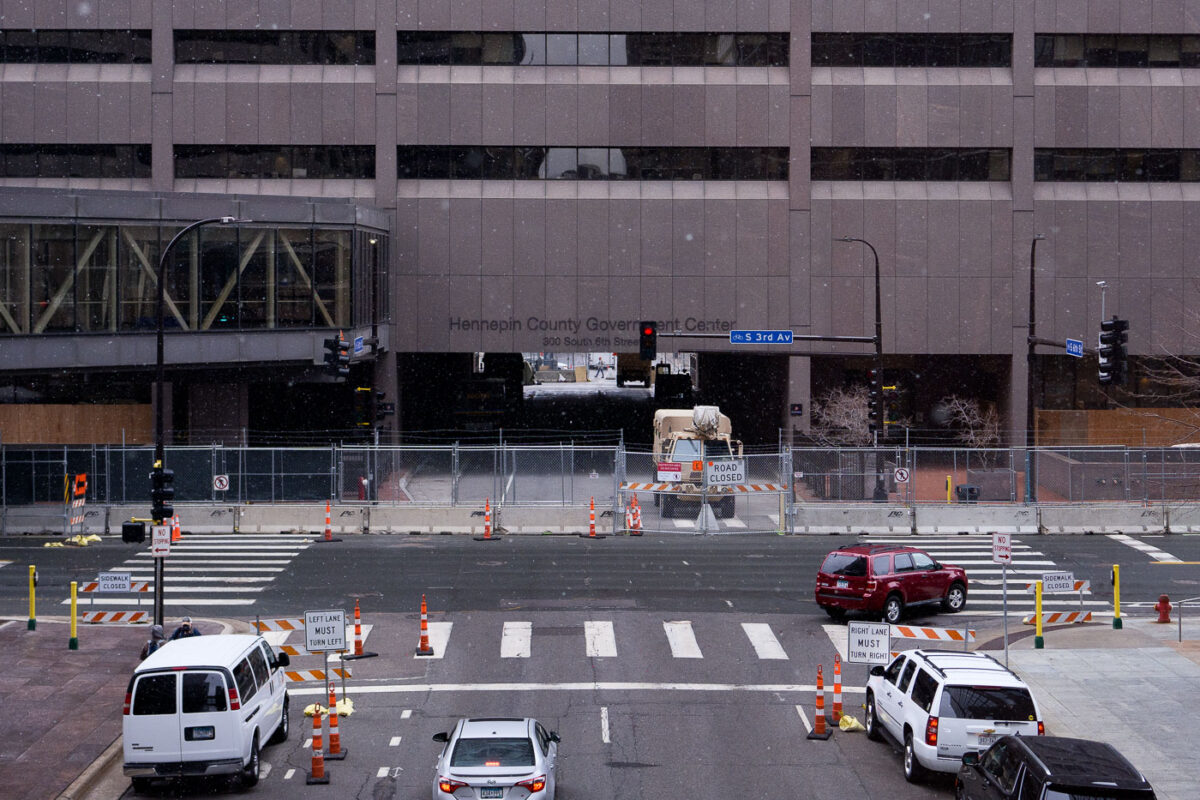
Hennepin County Courthouse Derek Chauvin Security
The Hennepin County Government Center in Minneapolis, Minnesota, served as the courthouse for the trial of Derek Chauvin, the former police officer charged in the death of George Floyd. The incident occurred on May 25, 2020, in South Minneapolis, sparking widespread protests and national attention. The building, completed in 1977, houses county administrative offices and courtrooms, functioning as a central hub for local government operations. During the trial, security measures were significantly heightened around the courthouse, reflecting the gravity of the proceedings and the public interest they generated.

Hennepin County Government Center during Derek Chauvin Trial
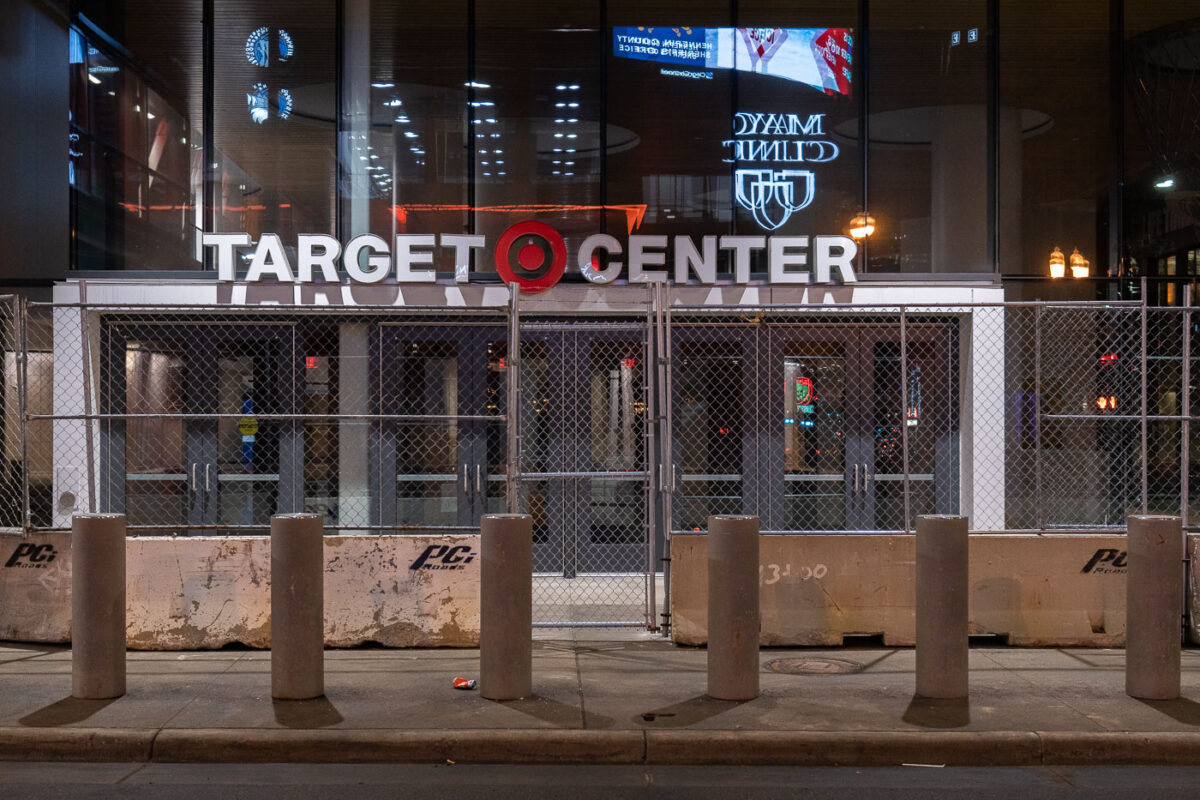
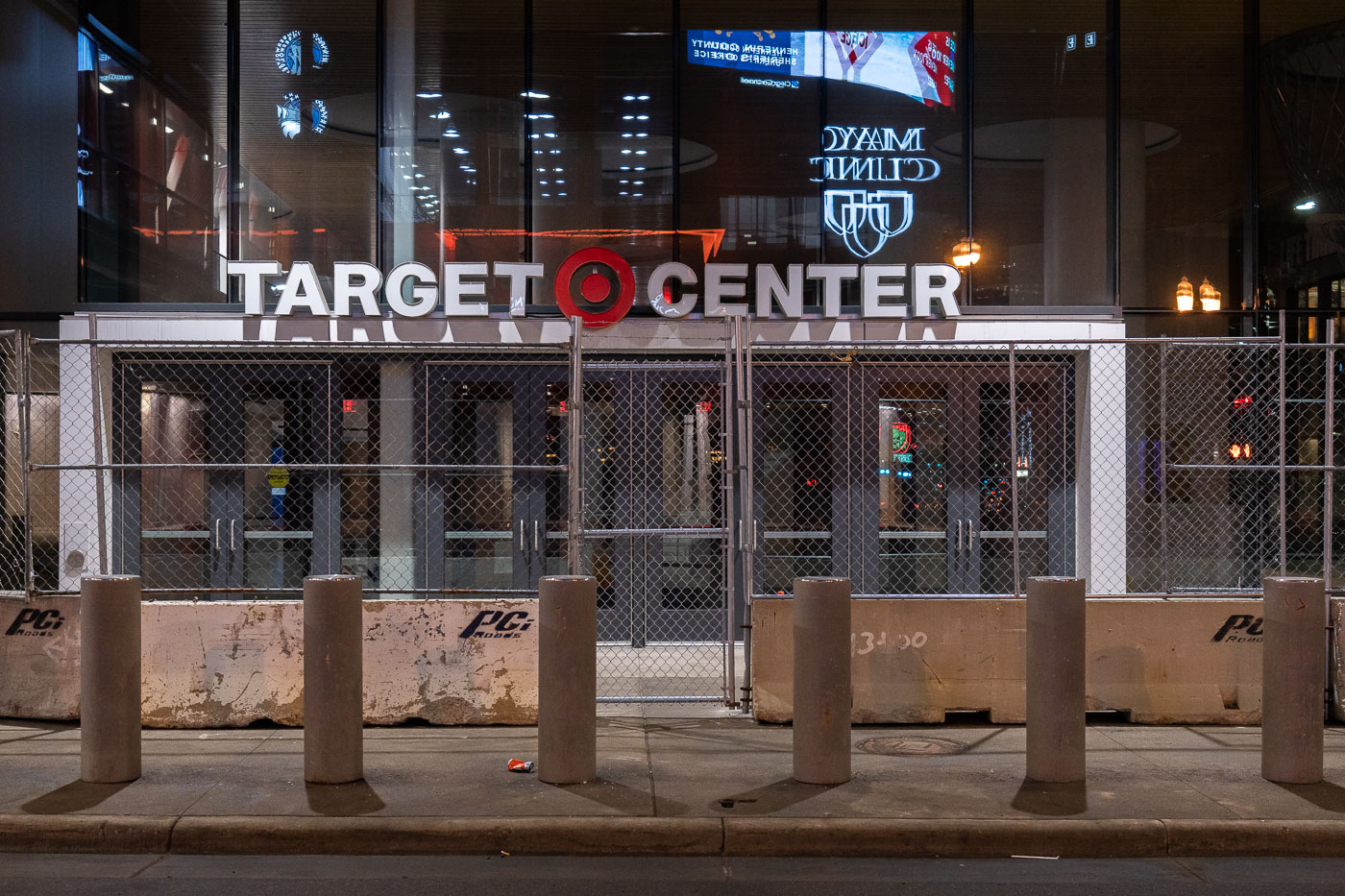
Target Center behind security fencing during Chauvin trial
The Target Center in Minneapolis, a multi-purpose arena, was secured with fencing and concrete barriers during the trial of Derek Chauvin in April 2021. This measure was implemented to enhance security and prevent potential unrest, mirroring precautions taken at other city-owned properties. The arena, which hosts sporting events and concerts, became a focal point of heightened security due to its proximity to the courthouse and the national attention surrounding the trial.

Target Center secured with fencing during Chauvin trial

Minneapolis police 1st precinct security door
The Minneapolis Police Department's 1st Precinct building, located in Downtown Minneapolis, is shown with a newly installed security door. This retractable barrier is designed to slide down and cover the building's windows, enhancing security. The installation of such measures reflects the heightened security concerns and the department's response to events such as the Minneapolis Uprising, which significantly impacted the city and its public institutions.

Minneapolis Police 1st Precinct Security Door Installation

Roses in blood art installation at Chauvin trial
Roses, some appearing to be stained with red paint to resemble blood, were placed in a puddle outside the Hennepin County Government Center in Minneapolis. This installation occurred during the trial of Derek Chauvin, a former Minneapolis police officer charged with the murder of George Floyd. The trial, held in April 2021, drew significant national attention to issues of police brutality and racial justice.

Roses in paint outside Hennepin County Government Center during Chauvin trial

Reflect art installation outside Chauvin trial
An art installation reading "REFLECT" stands outside the Hennepin County Government Center in Minneapolis. The installation was present during the trial of Derek Chauvin, a former Minneapolis police officer charged with the murder of George Floyd on May 25, 2020. The trial, which began on March 8, 2021, drew significant public attention and protests related to police brutality and racial justice. The "REFLECT" installation, along with scattered roses and protest signs, served as a visual reminder of the ongoing discourse surrounding Floyd's death and its broader implications.

Reflect art installation outside Hennepin County Government Center

Protesters with mirrors and flowers outside Chauvin trial
Flowers and mirrors are placed on the street outside the Hennepin County Government Center in Minneapolis, Minnesota. This display occurred during the period of protests and unrest following the murder of George Floyd in May 2020 and the subsequent trial of Derek Chauvin. The mirrors, some bearing red paint, likely symbolize reflection and accountability, while the flowers serve as a memorial to victims of police brutality. The Hennepin County Government Center was a focal point for many demonstrations during this time.

Flowers and mirrors outside Hennepin County Government Center

Bringing In the National Guard flyer
A sign posted on a chain-link fence surrounding the Hennepin County Government Center in Minneapolis reads "Bringing in the National Guard. What Could Possibly Go Wrong?" The poster includes a photograph from the Kent State shootings on May 4, 1970, where the Ohio National Guard fired on unarmed students during a protest. This juxtaposition of historical imagery with the contemporary presence of the National Guard in Minneapolis, likely during the protests following the murder of George Floyd, serves as a pointed commentary on the potential for state-sanctioned violence. The inclusion of flowers suggests a memorial or a somber reflection on the events.

Hennepin County Government Center: National Guard Sign

Black Lives Matter chalk on black boards
Messages of protest and solidarity are chalked onto boarded-up windows of a building near the Hennepin County Government Center in Minneapolis. The messages, including "Justice for George Floyd," "Stop Killing Us," and "Black Lives Matter," were created in the context of the trial of former Minneapolis Police Officer Derek Chauvin. Chauvin was charged with murder in the death of George Floyd on May 25, 2020, an event that sparked widespread protests against police brutality and racial injustice.

Minneapolis: BLM messages on boarded-up building near Chauvin trial

Justice for George Floyd chalk on boards
Following the murder of George Floyd by Minneapolis police officers in May 2020, protests erupted across the city and the nation. In response to potential unrest, businesses and public buildings, including the US Bank Building in downtown Minneapolis, were boarded up. This photograph shows the building's facade covered with plywood, adorned with chalk messages reflecting the sentiments of the time. Slogans such as "Justice for George Floyd," "Black Lives Matter," and "Stop Killing Us" are visible, alongside calls to "Abolish MPD" and "Hold Police Accountable." The messages also reference "8:46," the duration of Floyd's fatal encounter with police, and "White Supremacy is the Real Pandemic." The "Retail is Open" sign indicates that despite the surrounding social upheaval, some businesses continued to operate.

Minneapolis US Bank Building boarded with protest messages

Minnesota National Guard outside Hennepin Courthouse
A member of the Minnesota National Guard stands in front of a military vehicle outside the Hennepin County Government Center in Minneapolis. This deployment occurred during a period of heightened tension and unrest in the city, following the murder of George Floyd and the subsequent trial of Derek Chauvin. The National Guard was activated to support local law enforcement and maintain order amidst widespread protests against police brutality. The Hennepin County Government Center, a prominent civic building in downtown Minneapolis, served as a focal point during these events.

Minnesota National Guard at Hennepin County Government Center

Justice 4 George Floyd and All Stolen Lives in Minneapolis
A large crowd gathered in downtown Minneapolis on March 8, 2021, to protest the murder of George Floyd and demand justice. The protest occurred outside the Hennepin County Government Center on the morning of the first day of the trial for former Minneapolis police officer Derek Chauvin. Chauvin was charged with second-degree murder and manslaughter in connection with Floyd's death on May 25, 2020. The "Black Lives Matter" movement gained significant momentum following Floyd's death, highlighting issues of police brutality and racial injustice.

Minneapolis Protest for George Floyd and Stolen Lives

Protesters march through downtown at start of Chauvin trial
A large crowd gathered in downtown Minneapolis for a protest related to the trial of Derek Chauvin, the former Minneapolis Police Officer charged in the murder of George Floyd on May 25, 2020. The protest took place outside the Hennepin County Government Center prior to the start of the trial. Many carried signs with messages such as "Justice for George Floyd," "Convict Killer Cops," and "Black Lives Matter," reflecting the broader movement against police brutality and racial injustice.

Protesters march downtown Minneapolis for Derek Chauvin trial

George Floyd pins being sold outside courthouse
Pins commemorating George Floyd and bearing the slogan "I Can't Breathe" are displayed for sale outside the Hennepin County Courthouse in Minneapolis. This location was the site of the trial of Derek Chauvin, the former Minneapolis police officer convicted of Floyd's murder in April 2021. The sale of such merchandise reflects the broader cultural and political impact of Floyd's death and the subsequent Black Lives Matter movement, which gained significant momentum following the incident in May 2020. The courthouse itself is a significant civic building in downtown Minneapolis, serving as a central hub for legal proceedings in the county.

George Floyd Pins Sold Outside Hennepin County Courthouse

Minneapolis is under military occupation
Protesters gathered outside the Hennepin County Government Center in Minneapolis on March 8, 2021, the day the Derek Chauvin murder trial began. The sign, held by a protester, reads "Minneapolis is under military occupation," reflecting the sentiment of many during the widespread protests against police brutality that followed George Floyd's murder. The trial itself was a focal point for ongoing activism and calls for justice and accountability within the Minneapolis community and beyond.

Minneapolis Protest Sign: “Minneapolis is under military occupation”

Protester writes with chaulk at Chauvin trial
During the trial of Derek Chauvin, a protester writes messages in chalk outside the Hennepin County Courthouse in Minneapolis. The trial, which began in March 2021, centered on the murder of George Floyd, a Black man who died in police custody. The courthouse and surrounding areas became a focal point for protests and demonstrations related to police brutality and racial justice. The chalk messages serve as a form of public expression and a visual record of the community's response to the ongoing legal proceedings and broader social issues.

Chalk message at Hennepin County Courthouse during Chauvin trial

Protesters behind security fencing at Chauvin trial
Protesters gathered outside the Hennepin County Government Center in Minneapolis during the trial of Derek Chauvin. The courthouse was surrounded by security fencing, a measure implemented due to the high-profile nature of the trial and concerns about potential unrest. The trial, which began in March 2021, stemmed from the murder of George Floyd by Minneapolis police officer Derek Chauvin in May 2020. Protests against police brutality and racial injustice, often under the banner of Black Lives Matter, had been ongoing in Minneapolis and across the nation since Floyd's death.

Protesters at Hennepin County Government Center during Chauvin Trial

Large protest in Minneapolis at start of Chauvin trial
Protesters gathered outside the Hennepin County Government Center in Minneapolis on March 8, 2021, awaiting the start of the trial for former police officer Derek Chauvin. Chauvin was charged with murder and manslaughter in the death of George Floyd on May 25, 2020, an event that sparked widespread protests against police brutality and racial injustice. The Hennepin County Government Center serves as a key administrative and judicial hub for the county, and its proximity to the site of Floyd's murder made it a focal point for demonstrations.

Minneapolis Protest Outside Hennepin County Government Center

Abolish Police and Prisons protest sign
Protesters gathered outside the Hennepin County Government Center in Minneapolis on March 8, 2021, ahead of the Derek Chauvin trial. Chauvin, a former Minneapolis police officer, was charged in the murder of George Floyd on May 25, 2020. The sign "Abolish Police + Prisons" reflects a central demand of the Black Lives Matter movement, which gained widespread attention following Floyd's death and has continued to advocate for systemic reform of law enforcement and the justice system.

Minneapolis Protest: Abolish Police and Prisons Sign

The World Is Watching protest in Minneapolis
Protesters gathered outside the Hennepin County Government Center in Minneapolis on March 8, 2021, the morning of the Derek Chauvin trial. Chauvin, a former Minneapolis police officer, was charged with the murder of George Floyd on May 25, 2020. The banner reads "Justice 4 George Floyd & All Stolen Lives. The World Is Watching." This event highlights the broader Black Lives Matter movement and calls for accountability in cases of police brutality.

Minneapolis Protest for George Floyd Outside Hennepin County Government Center

Military vehicles behind razor wire for Chauvin murder trial
National Guard vehicles are positioned outside the Hennepin County Government Center in Minneapolis during the overnight hours. The presence of military vehicles and barricades indicates heightened security measures, likely in response to the civil unrest and protests that occurred in the city. These events were largely sparked by the murder of George Floyd and the subsequent trial of Derek Chauvin, highlighting the complex relationship between law enforcement, the National Guard, and public demonstrations in urban environments.

National Guard vehicles at Hennepin County Government Center

Protesters put hands up outside courthouse during Chauvin trial
Protesters gather outside the Hennepin County Government Center in Minneapolis on March 7, 2021. The demonstration occurred the day before the start of jury selection in the trial of Derek Chauvin, the former Minneapolis police officer charged with the murder of George Floyd on May 25, 2020. The government center is a prominent civic building in downtown Minneapolis, serving as the seat of county government and a site for significant public events and protests.

Protesters raise fists outside Hennepin County Government Center, Minneapolis

Protesters enter a secured area around Chauvin trial
Protesters approach the Hennepin County Government Center in Minneapolis, Minnesota, during the trial of Derek Chauvin. The "Cage," a temporary security perimeter constructed with chain-link fencing, plywood, and barbed wire, was erected around the courthouse to manage crowds and ensure safety. This measure was implemented in response to widespread protests against police brutality and racial injustice that followed the murder of George Floyd in May 2020. The "Justice for All" signs carried by some individuals reflect the broader movement's demands for accountability and systemic change.

Protesters enter security perimeter at Hennepin County Government Center

Dismantle White Supremacy protest
Thousands marched in Downtown Minneapolis on March 7, 2021, the day before the start of jury selection in the trial of former Minneapolis Police officer Derek Chauvin. Chauvin was charged with the murder of George Floyd on May 25, 2020, an event that sparked widespread protests against police brutality and white supremacy. The marchers carried signs with messages such as "Dismantle White Supremacy" and "We Need Justice," reflecting the ongoing calls for racial equity and accountability.

Minneapolis Protest: Dismantle White Supremacy, March for Justice

Police are tools of white supremacy
Thousands marched in downtown Minneapolis the day before jury selection began in the trial of former police officer Derek Chauvin. Chauvin was charged with the murder of George Floyd on May 25, 2020, an event that sparked widespread protests against police brutality and racial injustice. The marchers carried signs with messages such as "Police = Tools of White Supremacy" and "Dismantle White Supremacy," reflecting the broader movement for Black Lives Matter. The protests highlighted deep-seated issues of systemic racism and police accountability in the United States.

Minneapolis Protest: “Police = Tools of White Supremacy” Sign

Thousands march at start of Chauvin trial
Thousands of protestors marched near the Hennepin County Government Center in Minneapolis on March 7, 2021. The march occurred the day before the start of jury selection in the trial of former Minneapolis police officer Derek Chauvin, who was charged with the murder of George Floyd on May 25, 2020. The event was part of ongoing protests against police brutality and racial injustice that followed Floyd's death.

Protestors march near Hennepin County Government Center, Minneapolis

Protesters in downtown Minneapolis in March 2021
A protest march took place in downtown Minneapolis on March 7, 2021, the day before Derek Chauvin's trial for the murder of George Floyd began. Participants carried a scroll listing over 470 names of individuals killed by Minnesota police officers. Organizers highlighted that Chauvin was involved in five of those cases, underscoring the broader issue of police brutality. The march proceeded from the Hennepin County Government Center down Hennepin Avenue, drawing attention to systemic issues of racial injustice and police accountability.

Minneapolis Protest for George Floyd Victims March 2021

Defund White Supremacy protest sign
Protesters gather outside the Hennepin County Government Center in downtown Minneapolis on March 7, 2021, during a march and rally held the day before jury selection began in the trial of former Minneapolis police officer Derek Chauvin for the murder of George Floyd. Demonstrators carry signs calling for justice for Floyd and denouncing white supremacy, while many participants wear masks during the ongoing COVID-19 pandemic. The Government Center was a regular assembly point for demonstrations tied to Floyd’s killing on May 25, 2020, and to court proceedings in the Chauvin case.

Minneapolis Protest: Defund White Supremacy Sign

Thousands march at the start of Derek Chauvin trial
Thousands marched in downtown Minneapolis on March 7, 2021, the day before jury selection began in the trial of Derek Chauvin. The former Minneapolis police officer was charged with the murder of George Floyd, who died on May 25, 2020, sparking widespread protests against police brutality and racial injustice. The marchers carried signs and a casket adorned with flowers, symbolizing their grief and demand for accountability.

Minneapolis Protest for George Floyd, Trial Begins

Special operation officers outside Derek Chauvin trial
A Hennepin County Sheriff's Special Operations vehicle is visible behind security fencing and concrete barriers outside the Hennepin County Government Center in Minneapolis. The building served as the courthouse for the trial of Derek Chauvin, the former Minneapolis police officer charged in the murder of George Floyd. The trial, which began in March 2021, drew significant public attention and necessitated heightened security measures in the downtown area. The presence of the Special Operations vehicle underscores the security protocols implemented during this high-profile legal proceeding.

Hennepin County Sheriff Special Operations Vehicle at Derek Chauvin Trial

Minneapolis City Hall's arched stone entrance secured behind chain link fencing and orange construction barriers.
Minneapolis City Hall, downtown Minneapolis. Barricades and temporary security structures were installed at the building entrance before the start of the Derek Chauvin trial.

Fenced-Off Archways at Minneapolis City Hall at Night

Red and white restricted area sign and detailed use of public spaces regulations posted on chain link fencing at Hennepin County Government Center.
Signage indicating a restricted area and "Authorized Personnel Only" is posted on secure fencing surrounding the Hennepin County Government Center in Minneapolis.

“Do Not Enter” Signs on Fencing at Hennepin County Government Center

Derek Chauvin Razor Wire at Hennepin Courthouse
Razor wire fencing, a security measure, surrounds the Hennepin County Government Center in Minneapolis. This installation was part of Operation Safety Net, a multi-agency effort to provide security during the Derek Chauvin murder trial. The trial, which began with jury selection on March 8, 2021, followed the death of George Floyd and subsequent protests. On May 25, 2020, Minneapolis police officer Derek Chauvin murdered 46-year-old George Floyd during an arrest outside Cup Foods at the intersection of 38th Street and Chicago Avenue in south Minneapolis. Video recorded by bystanders showed Chauvin kneeling on Floyd’s neck for more than nine minutes while Floyd repeatedly said he could not breathe. Three other Minneapolis police officers - J. Alexander Kueng, Thomas Lane, and Tou Thao — were also present during the arrest and later faced criminal charges for their roles in Floyd’s death. Floyd’s murder sparked protests and civil unrest across Minneapolis and around the world, leading to widespread demonstrations against police violence, major policy debates on policing, and the conviction of Chauvin on murder and manslaughter charges in 2021.

Razor Wire Security at Hennepin Courthouse, Minneapolis
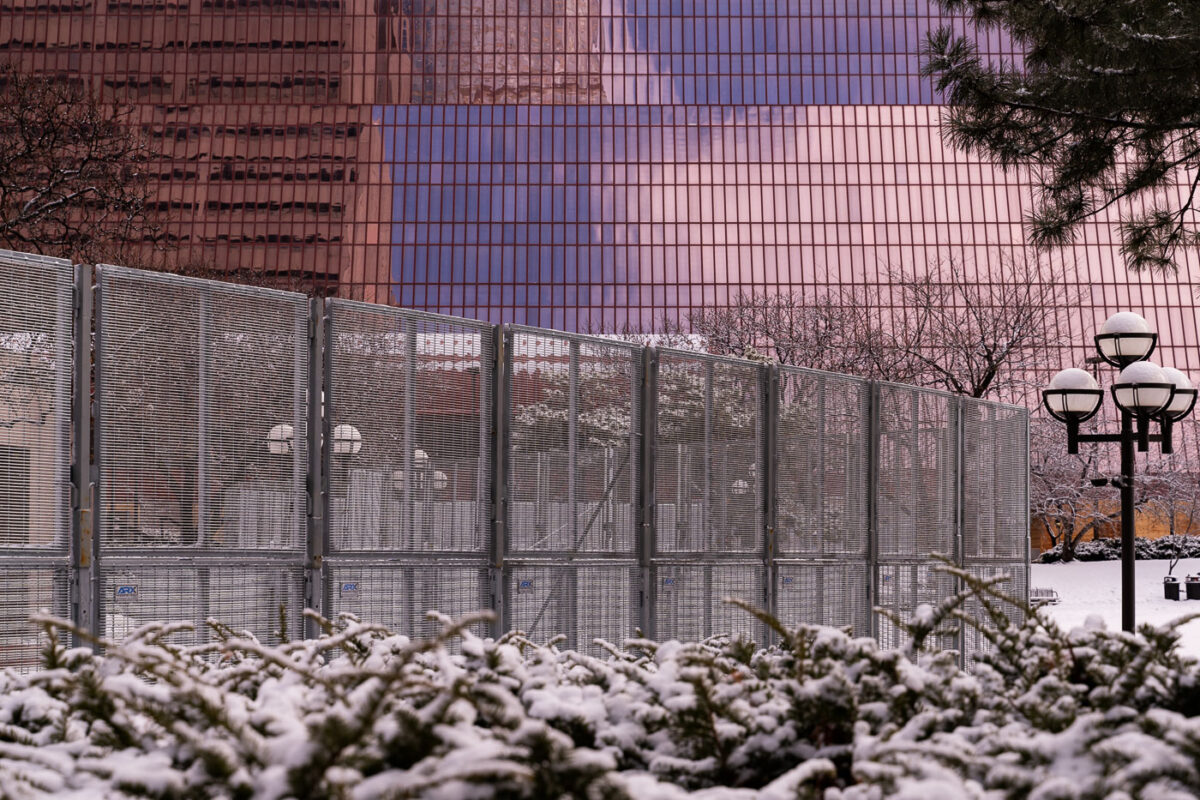
APX Perimeters fencing at Derek Chauvin murder trial
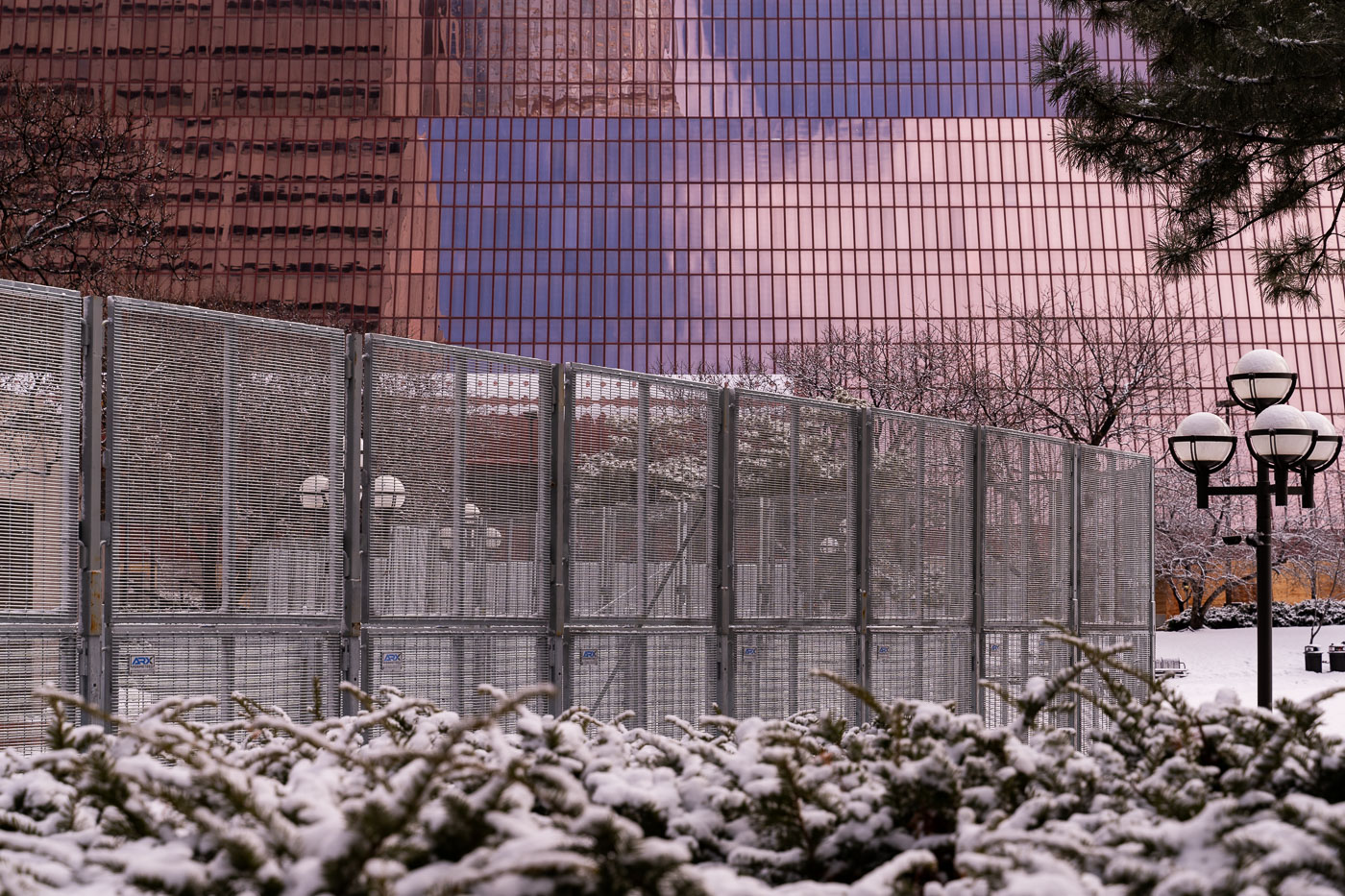
Temporary fencing by APX Perimeters surrounds the Hennepin County Government Center in Minneapolis, in anticipation of the Derek Chauvin murder trial. The installation of this security measure was part of Operation Safety Net, a multi-agency response to ensure public safety during the trial and potential unrest following the death of George Floyd. Jury selection was scheduled to begin on March 8, 2021, making the courthouse a focal point of national attention.

APX Perimeters Fencing at Hennepin County Government Center, Minneapolis
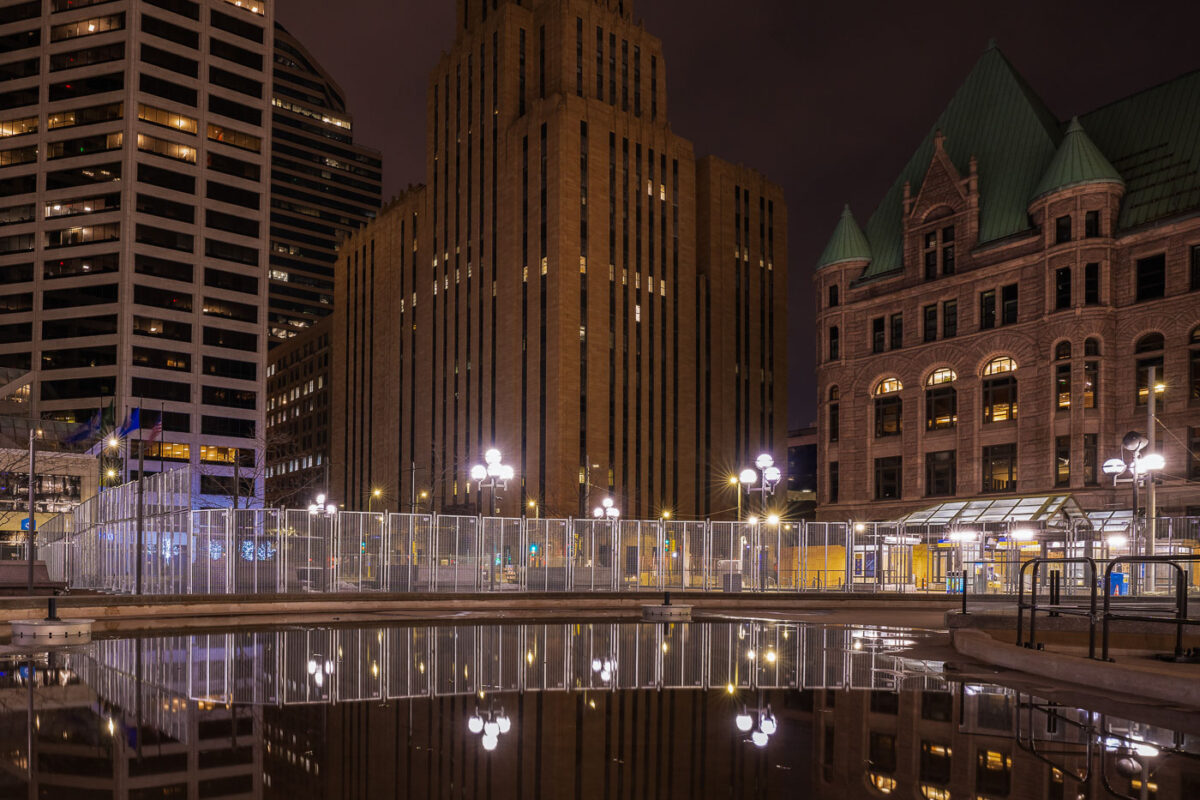
Reflections outside Minneapolis City Hall and Government Center
Security fencing surrounds the Hennepin County Government Center in Minneapolis, Minnesota, in anticipation of the Derek Chauvin murder trial. The trial, which began jury selection on March 8, 2021, followed the death of George Floyd and subsequent protests. The fencing, part of Operation Safety Net, was installed to secure the courthouse and surrounding areas during the high-profile legal proceedings. On May 25, 2020, Minneapolis police officer Derek Chauvin murdered 46-year-old George Floyd during an arrest outside Cup Foods at the intersection of 38th Street and Chicago Avenue in south Minneapolis. Video recorded by bystanders showed Chauvin kneeling on Floyd’s neck for more than nine minutes while Floyd repeatedly said he could not breathe. Three other Minneapolis police officers - J. Alexander Kueng, Thomas Lane, and Tou Thao — were also present during the arrest and later faced criminal charges for their roles in Floyd’s death. Floyd’s murder sparked protests and civil unrest across Minneapolis and around the world, leading to widespread demonstrations against police violence, major policy debates on policing, and the conviction of Chauvin on murder and manslaughter charges in 2021.

Minneapolis Courthouse Fencing for Chauvin Trial
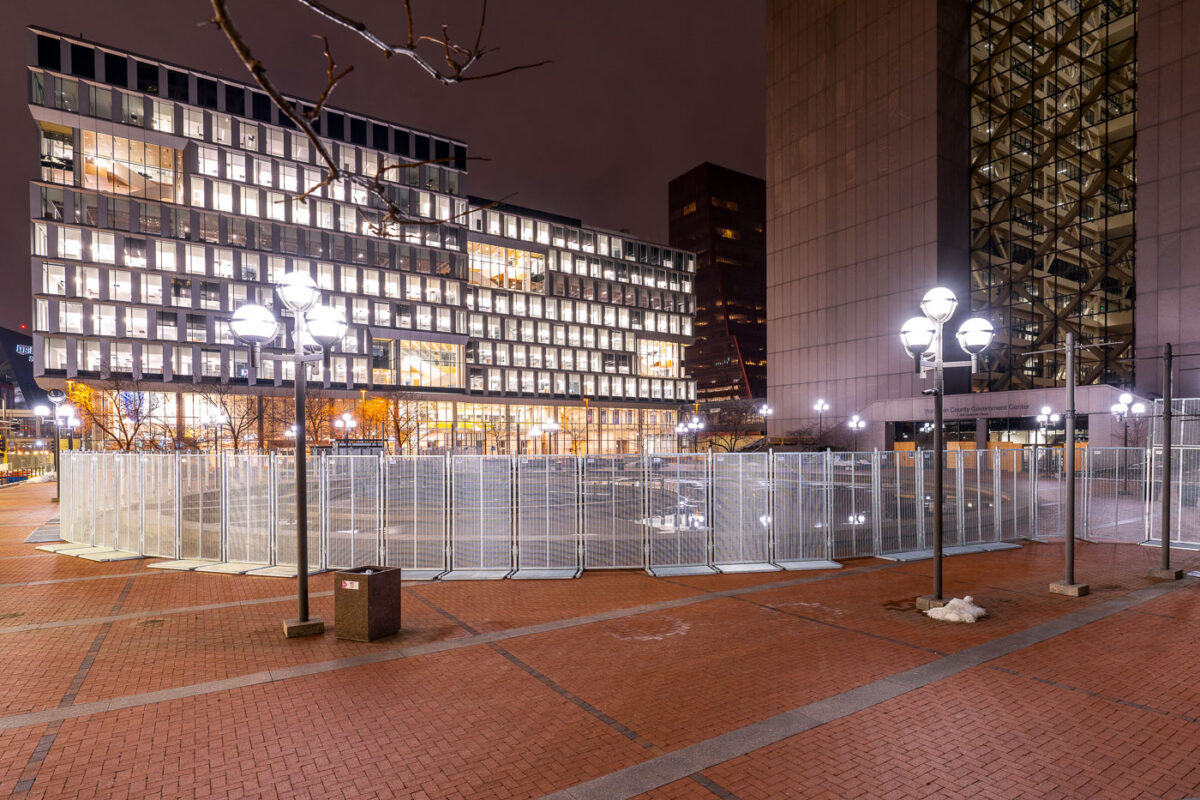
Hennepin County Government Center Derek Chauvin Trial Security
Temporary security fencing is erected around the Hennepin County Government Center in Minneapolis on February 28, 2021, in anticipation of the Derek Chauvin murder trial. The installation of this fencing, part of Operation Safety Net, was a measure to secure the courthouse and manage potential public gatherings during the high-profile trial, which began jury selection on March 8, 2021. The courthouse complex, a significant piece of Brutalist architecture in downtown Minneapolis, was the site of the trial for the death of George Floyd, an event that sparked widespread protests and unrest. On May 25, 2020, Minneapolis police officer Derek Chauvin murdered 46-year-old George Floyd during an arrest outside Cup Foods at the intersection of 38th Street and Chicago Avenue in south Minneapolis. Video recorded by bystanders showed Chauvin kneeling on Floyd’s neck for more than nine minutes while Floyd repeatedly said he could not breathe. Three other Minneapolis police officers - J. Alexander Kueng, Thomas Lane, and Tou Thao — were also present during the arrest and later faced criminal charges for their roles in Floyd’s death. Floyd’s murder sparked protests and civil unrest across Minneapolis and around the world, leading to widespread demonstrations against police violence, major policy debates on policing, and the conviction of Chauvin on murder and manslaughter charges in 2021.

Hennepin County Government Center: Trial Security Fencing
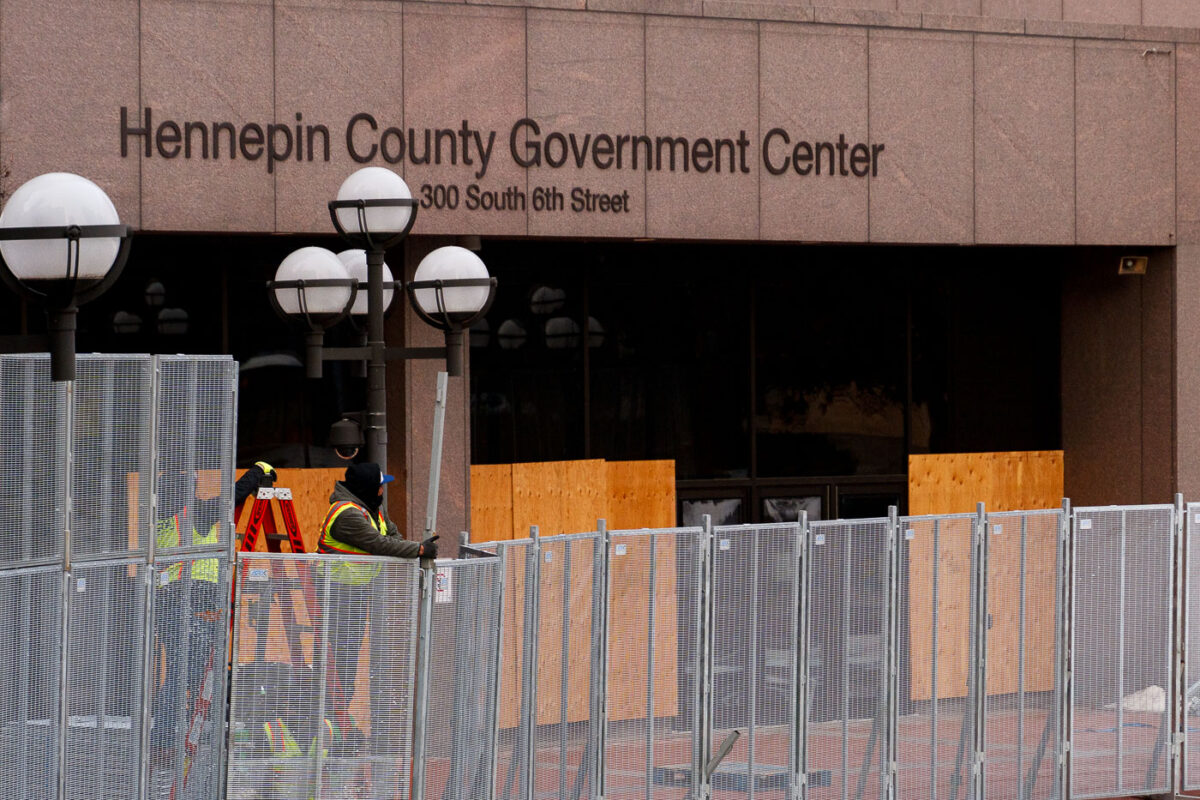
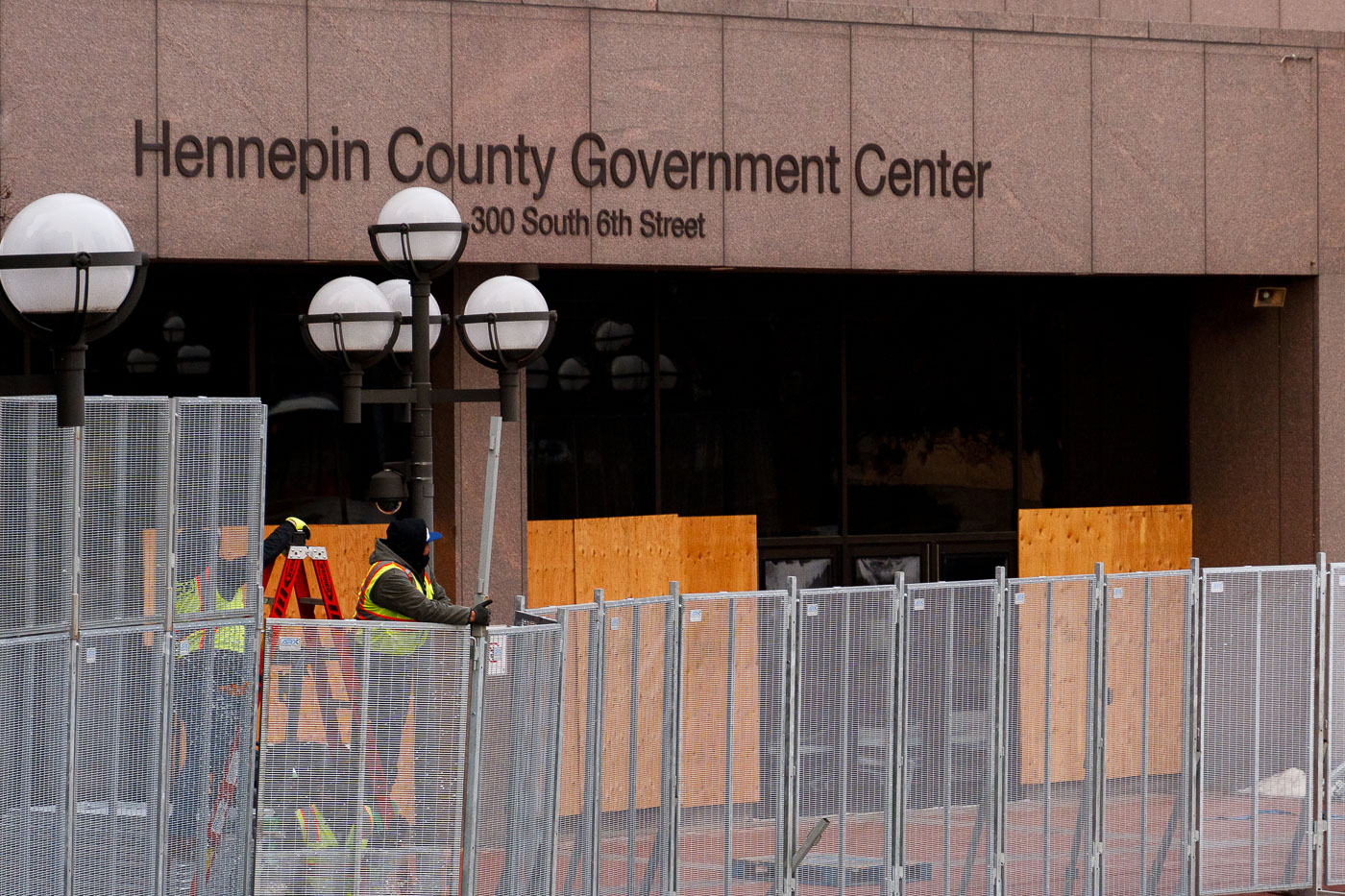
Workers installing security fencing at courthouse for Chauvin trial
Temporary fencing is being installed around the Hennepin County Government Center in Minneapolis, located at 300 South 6th Street. This security measure was put in place in anticipation of the trial of Derek Chauvin, a former Minneapolis police officer. On May 25, 2020, Minneapolis police officer Derek Chauvin murdered 46-year-old George Floyd during an arrest outside Cup Foods at the intersection of 38th Street and Chicago Avenue in south Minneapolis. Video recorded by bystanders showed Chauvin kneeling on Floyd’s neck for more than nine minutes while Floyd repeatedly said he could not breathe. Three other Minneapolis police officers - J. Alexander Kueng, Thomas Lane, and Tou Thao — were also present during the arrest and later faced criminal charges for their roles in Floyd’s death. Floyd’s murder sparked protests and civil unrest across Minneapolis and around the world, leading to widespread demonstrations against police violence, major policy debates on policing, and the conviction of Chauvin on murder and manslaughter charges in 2021.

Hennepin County Government Center Security Fencing Installation

Michelle Gross speaks at Hennepin County Government Center
Michelle Gross speaks to a crowd at the Hennepin County Government Center announcing plans to protest the start of the Derek Chauvin murder trial.

Michelle Gross speaks at Hennepin County Government Center

Nekima Levy Armstrong at 2021 rally
Nekima Levy Armstrong, a prominent activist, speaks at a press conference held outside the Hennepin County Government Center in Downtown Minneapolis on February 25, 2021. The conference announced a March 8th protest, with participants expressing their determination to demand justice and change despite perceived fortifications around government buildings. The signs held by attendees call for the conviction of Derek Chauvin and justice for George Floyd and other victims, reflecting the ongoing protests and calls for accountability following the murder of George Floyd. On May 25, 2020, Minneapolis police officer Derek Chauvin murdered 46-year-old George Floyd during an arrest outside Cup Foods at the intersection of 38th Street and Chicago Avenue in south Minneapolis. Video recorded by bystanders showed Chauvin kneeling on Floyd’s neck for more than nine minutes while Floyd repeatedly said he could not breathe. Three other Minneapolis police officers - J. Alexander Kueng, Thomas Lane, and Tou Thao — were also present during the arrest and later faced criminal charges for their roles in Floyd’s death. Floyd’s murder sparked protests and civil unrest across Minneapolis and around the world, leading to widespread demonstrations against police violence, major policy debates on policing, and the conviction of Chauvin on murder and manslaughter charges in 2021.

Nekima Levy Armstrong at Downtown Minneapolis Protest

Michelle Gross speaks prior to Derek Chauvin Trial
Michelle Gross speaks at a press conference outside the Hennepin County Government Center in Minneapolis on February 25, 2021. Activists gathered to announce a protest planned for that day, demanding justice and change in the wake of the Derek Chauvin trial. The signs held by attendees called for the conviction of Chauvin and justice for George Floyd. On May 25, 2020, Minneapolis police officer Derek Chauvin murdered 46-year-old George Floyd during an arrest outside Cup Foods at the intersection of 38th Street and Chicago Avenue in south Minneapolis. Video recorded by bystanders showed Chauvin kneeling on Floyd’s neck for more than nine minutes while Floyd repeatedly said he could not breathe. Three other Minneapolis police officers - J. Alexander Kueng, Thomas Lane, and Tou Thao — were also present during the arrest and later faced criminal charges for their roles in Floyd’s death. Floyd’s murder sparked protests and civil unrest across Minneapolis and around the world, leading to widespread demonstrations against police violence, major policy debates on policing, and the conviction of Chauvin on murder and manslaughter charges in 2021.

Michelle Gross speaks at press conference before Derek Chauvin Trial

Community Control of MPD
A protester holds a sign reading "COMMUNITY CONTROL OF MPD" outside the Hennepin County Government Center in Minneapolis on February 25, 2021. The protest was announced for March 8th, coinciding with the start of the Derek Chauvin trial. This event highlights ongoing calls for police reform and community oversight of law enforcement in Minneapolis, a movement that gained significant momentum following the murder of George Floyd in 2020. On May 25, 2020, Minneapolis police officer Derek Chauvin murdered 46-year-old George Floyd during an arrest outside Cup Foods at the intersection of 38th Street and Chicago Avenue in south Minneapolis. Video recorded by bystanders showed Chauvin kneeling on Floyd’s neck for more than nine minutes while Floyd repeatedly said he could not breathe. Three other Minneapolis police officers - J. Alexander Kueng, Thomas Lane, and Tou Thao — were also present during the arrest and later faced criminal charges for their roles in Floyd’s death. Floyd’s murder sparked protests and civil unrest across Minneapolis and around the world, leading to widespread demonstrations against police violence, major policy debates on policing, and the conviction of Chauvin on murder and manslaughter charges in 2021.

Minneapolis Protest for Community Control of MPD

CourtTV broadcast van parked outside Hennepin County Government Center during Derek Chauvin trial coverage in February 2021.
CourtTV van outside the Hennepin County Government Center in downtown Minneapolis. The broadcast vehicle was stationed near the courthouse during coverage of the Derek Chauvin trial in February 2021.

Court TV Satellite Truck Parked at Night Near Hennepin County Government Center
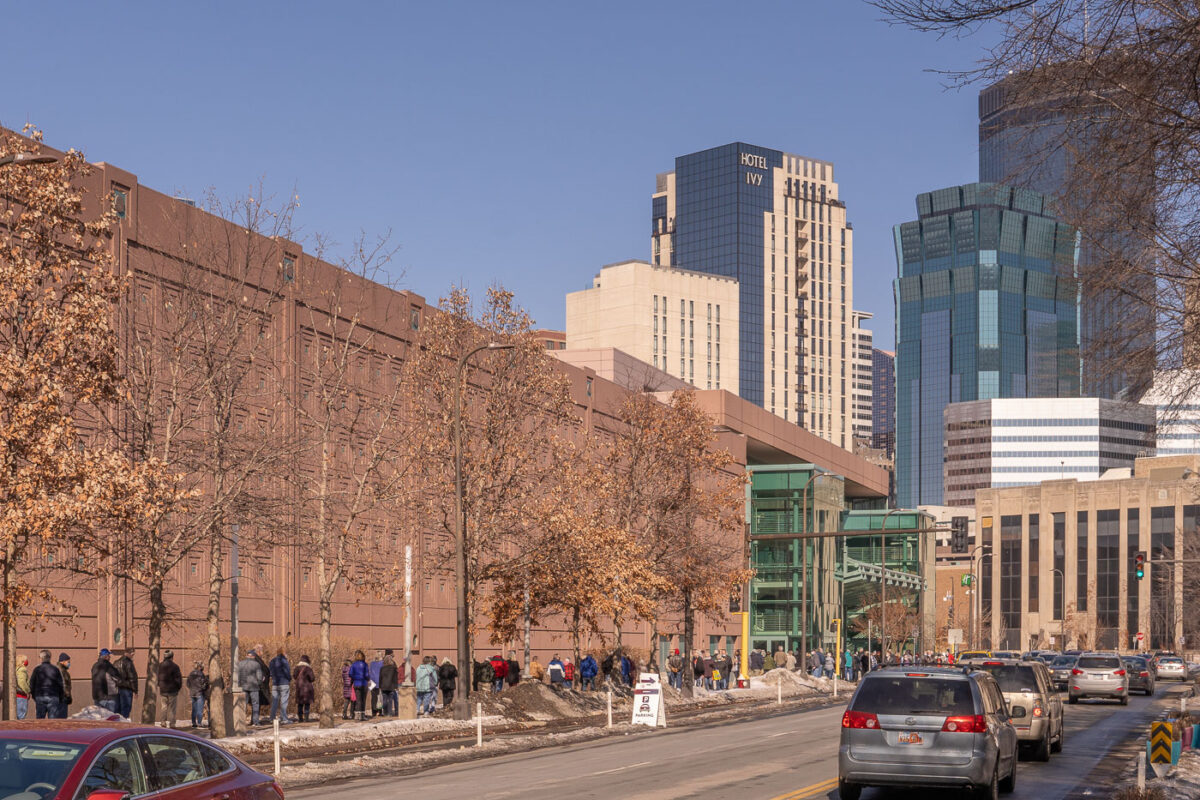
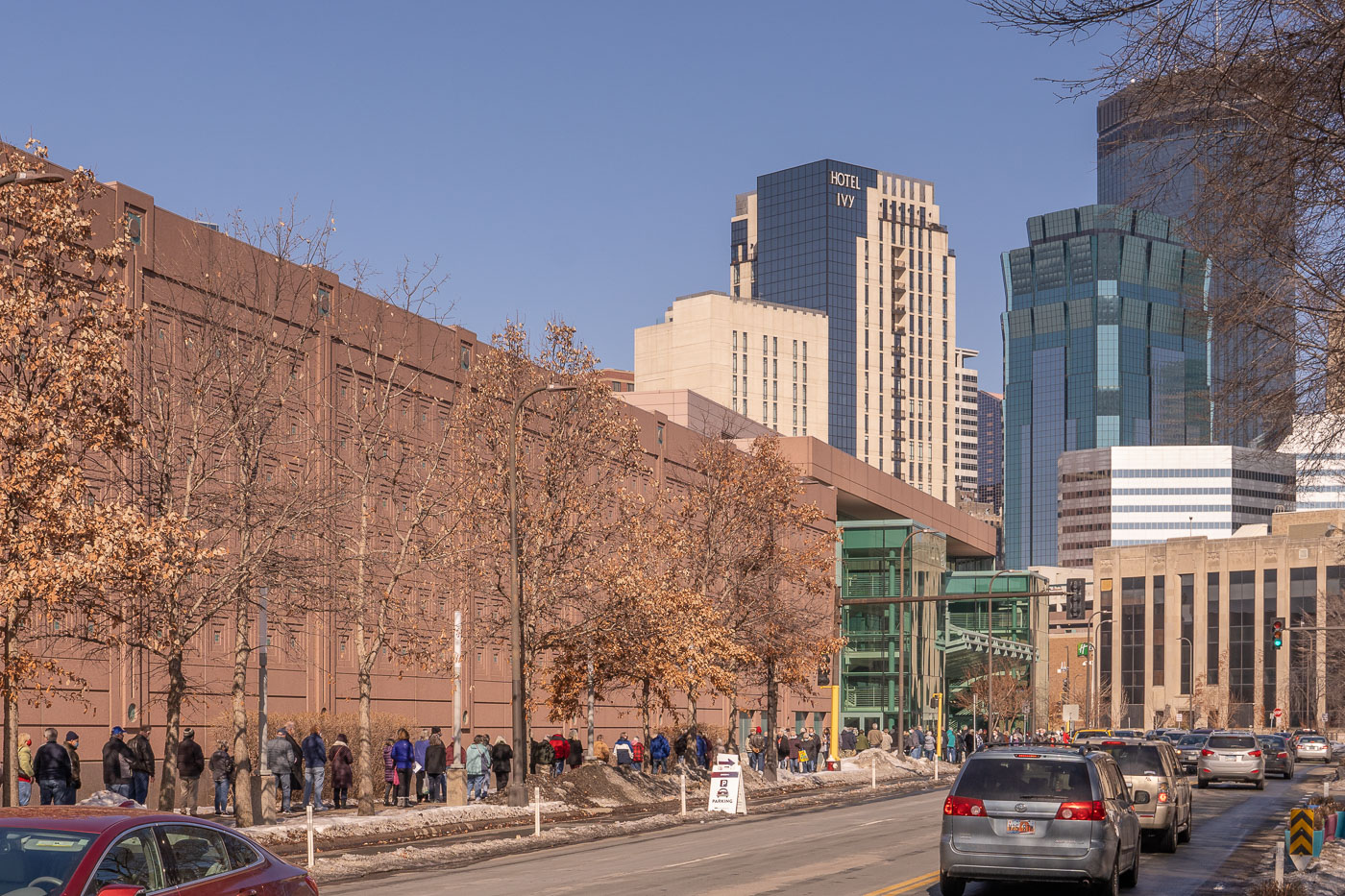
COVID vaccine line outside Minneapolis Convention Center in downtown Minneapolis.
Minneapolis Convention Center in downtown Minneapolis, Minnesota. People wait in line outside the venue for COVID-19 vaccinations during the winter 2021 rollout. The convention center was used as a mass vaccination site as public health agencies expanded access to the vaccine.

COVID vaccine line at Minneapolis Convention Center
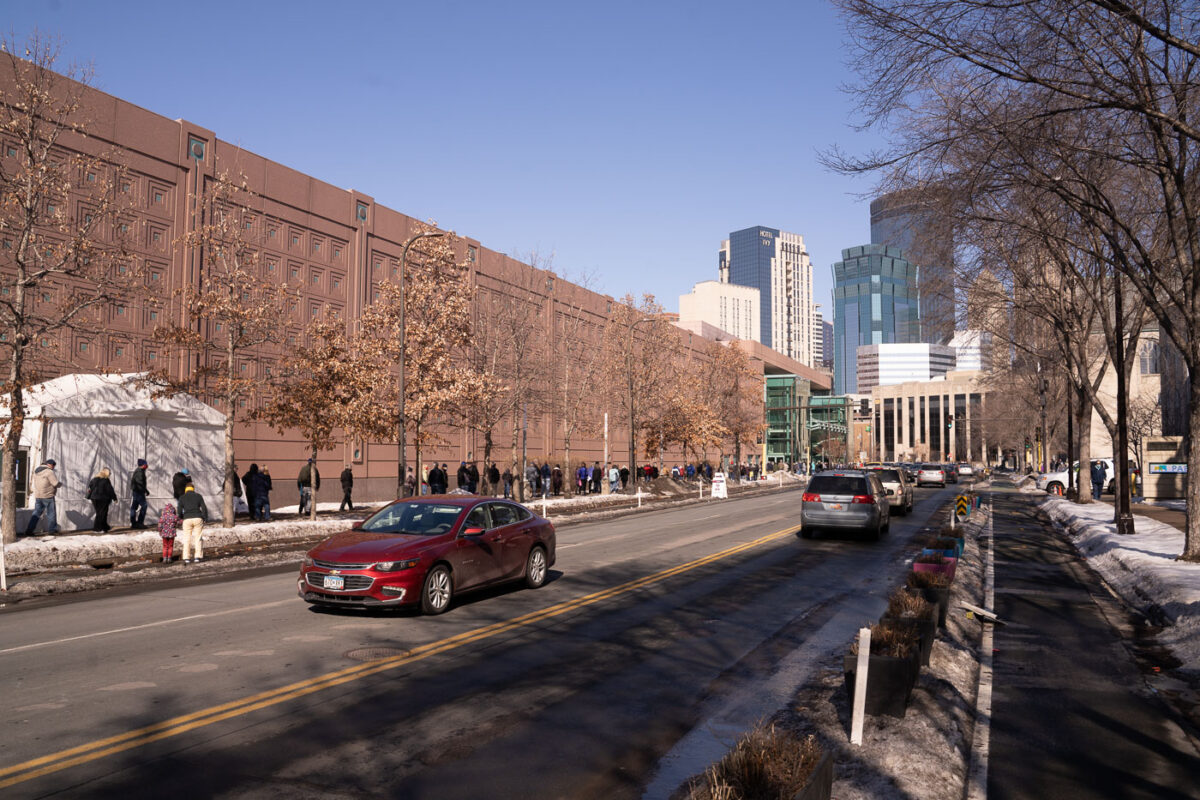
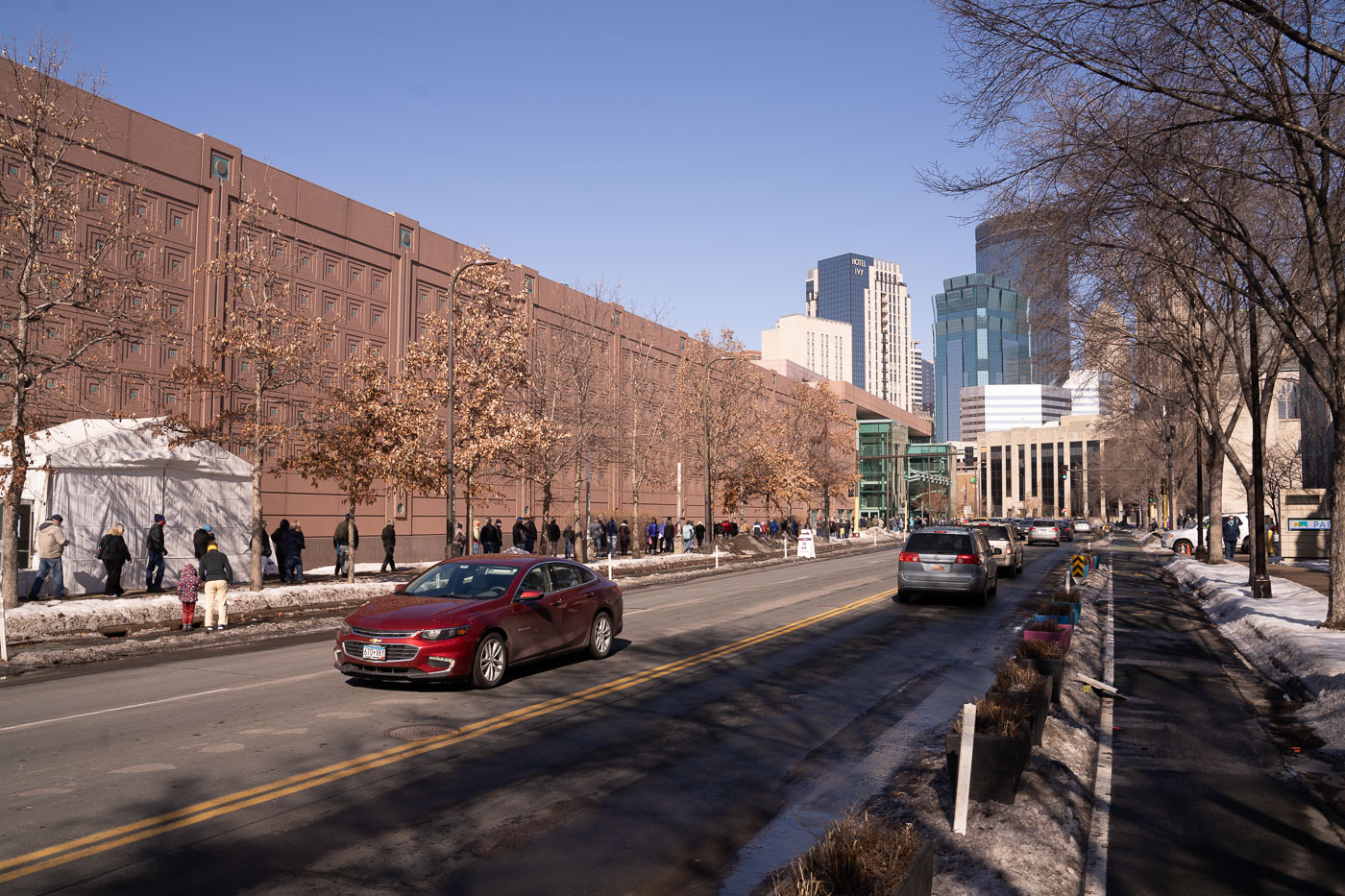
Minneapolis Convention Center in downtown Minneapolis with people waiting outside for COVID-19 vaccines.
Minneapolis Convention Center in downtown Minneapolis, Minnesota, during a COVID-19 vaccination event. People wait outside the building for vaccine appointments along the street beside the convention center.

Minneapolis Convention Center COVID-19 Vaccine Line
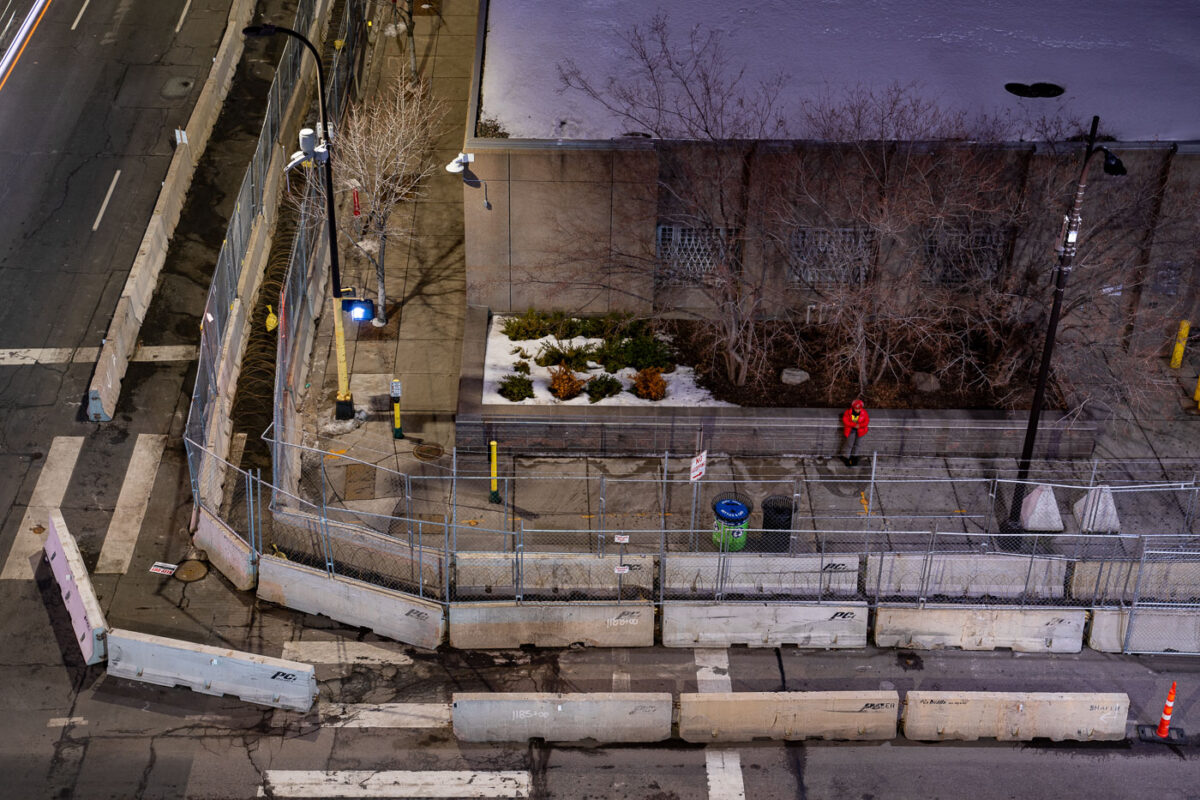
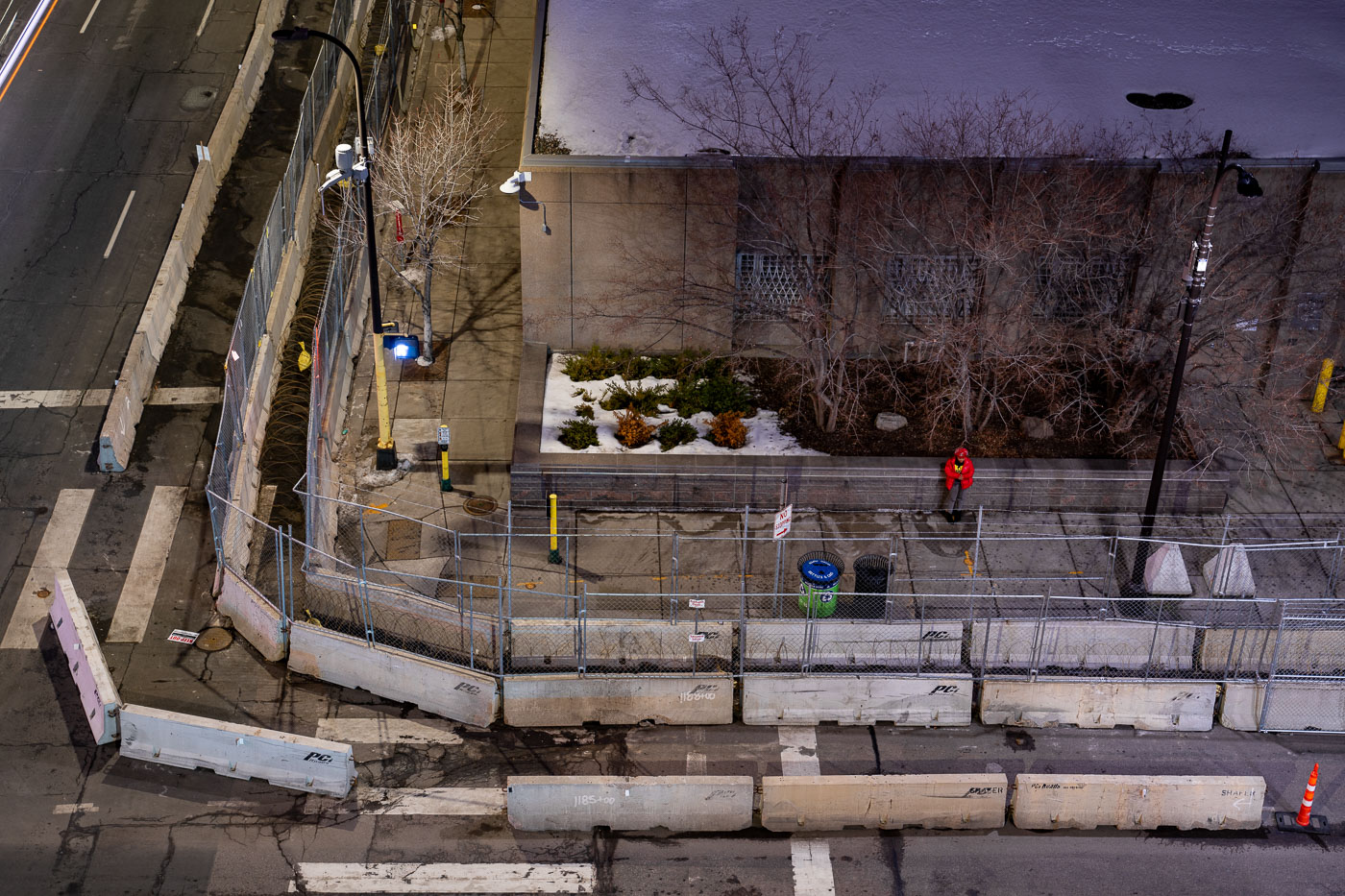
Barricades at the Hennepin County Public Safety Facility
Security barricades and fencing surround the Hennepin County Public Safety Facility in Minneapolis on February 24, 2021 in anticipation of the Derek Chauvin murder trial. The extensive security measures, including concrete barriers and razor wire, were implemented to manage potential protests and ensure the safety of the courthouse and surrounding areas. On May 25, 2020, Minneapolis police officer Derek Chauvin murdered 46-year-old George Floyd during an arrest outside Cup Foods at the intersection of 38th Street and Chicago Avenue in south Minneapolis. Video recorded by bystanders showed Chauvin kneeling on Floyd’s neck for more than nine minutes while Floyd repeatedly said he could not breathe. Three other Minneapolis police officers - J. Alexander Kueng, Thomas Lane, and Tou Thao — were also present during the arrest and later faced criminal charges for their roles in Floyd’s death. Floyd’s murder sparked protests and civil unrest across Minneapolis and around the world, leading to widespread demonstrations against police violence, major policy debates on policing, and the conviction of Chauvin on murder and manslaughter charges in 2021.

Hennepin County Jail Barricades for Chauvin Trial
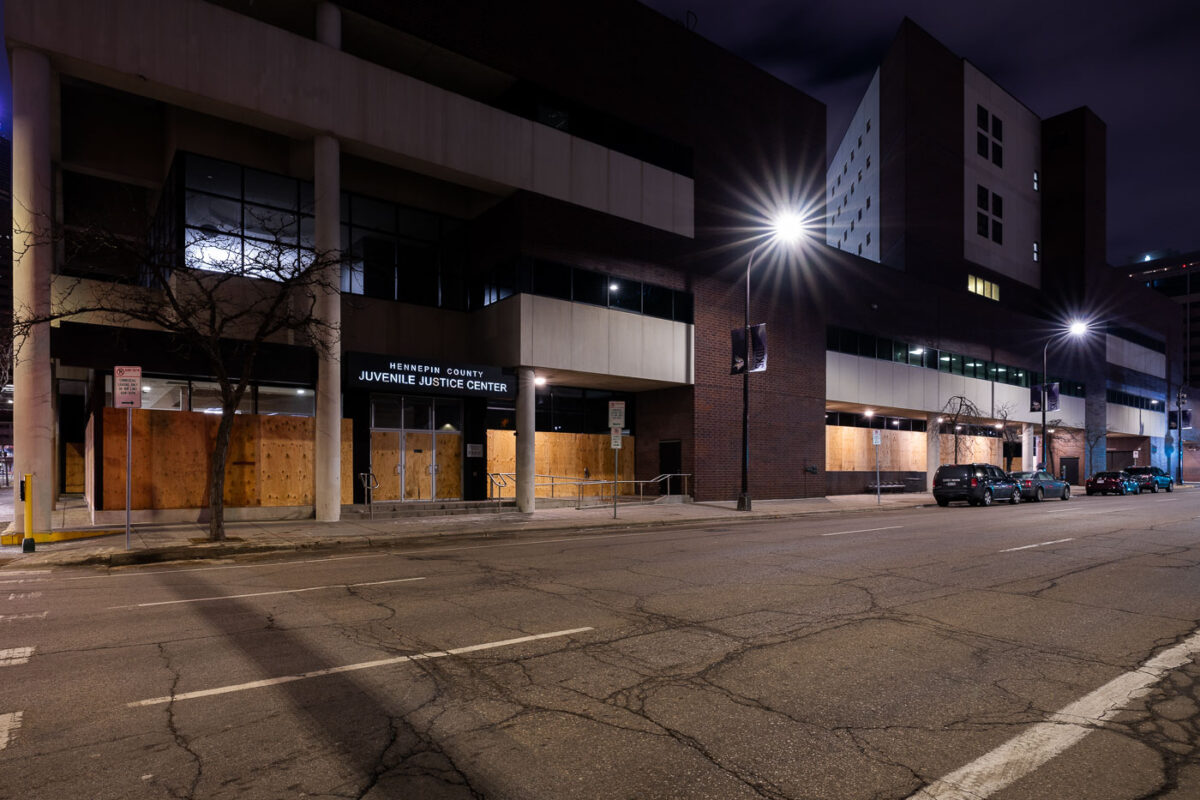
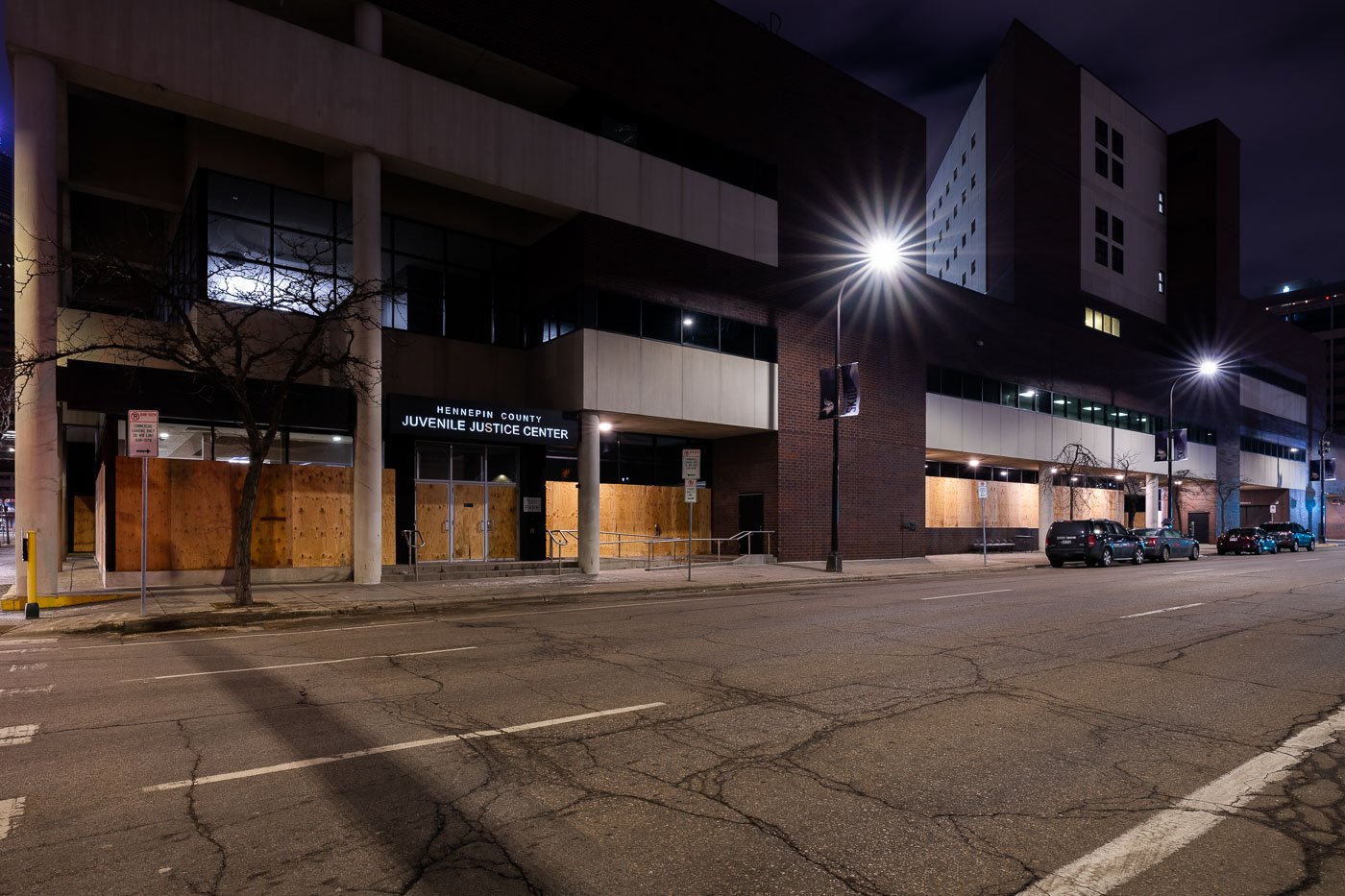
Hennepin County Juvenile Justice Center in downtown Minneapolis boarded with plywood panels during February 2021 trial security preparations.
The Hennepin County Juvenile Justice Center in downtown Minneapolis is shown boarded up in anticipation of the Derek Chauvin trial in April 2021. The building, located at 590 Park Avenue, serves as a courthouse for juvenile legal proceedings. The extensive boarding and security measures were implemented in response to concerns about potential unrest and protests stemming from the trial, which followed the murder of George Floyd in May 2020.

Plywood Covers Entrances at the Hennepin County Juvenile Justice Center

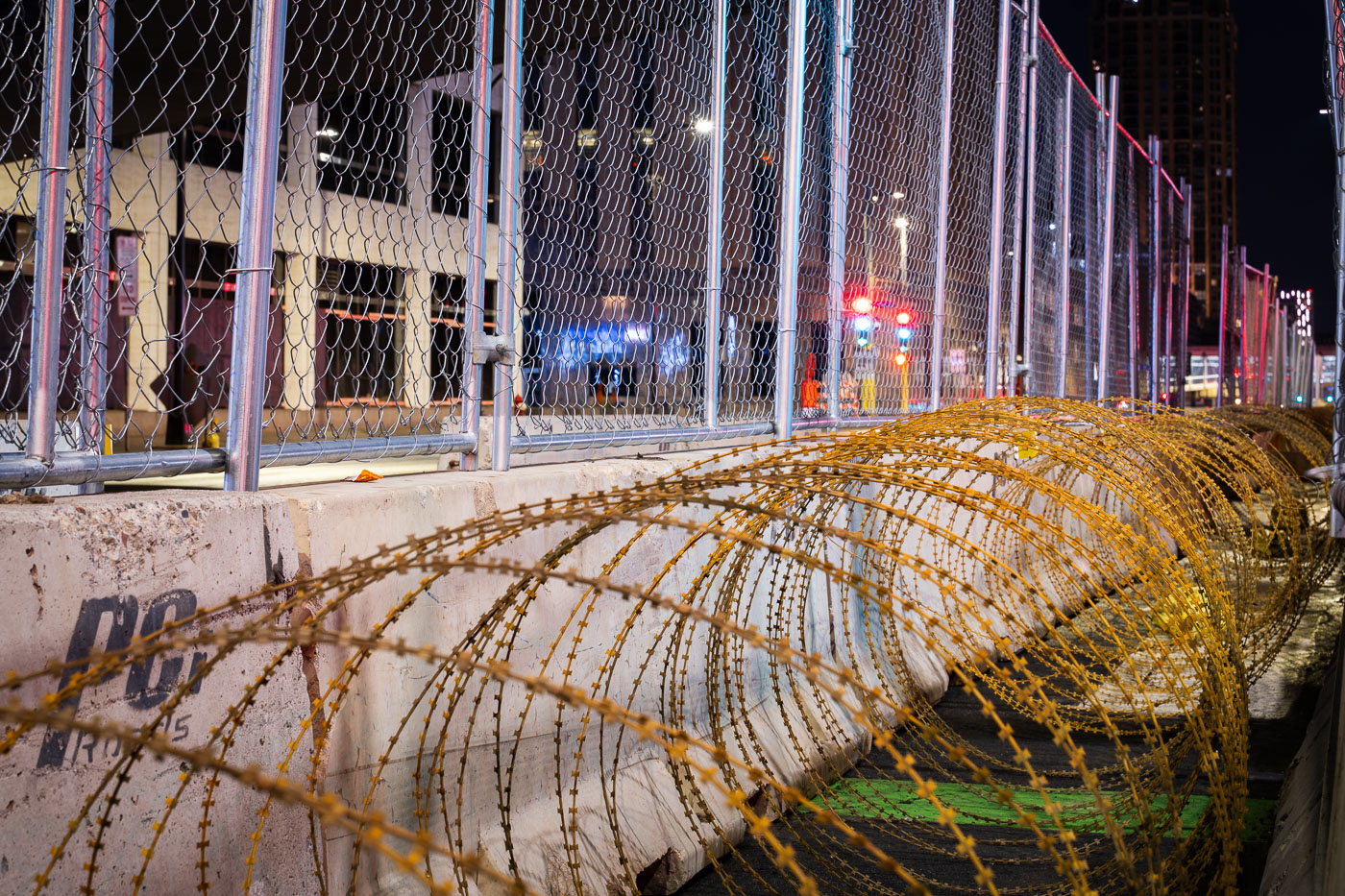
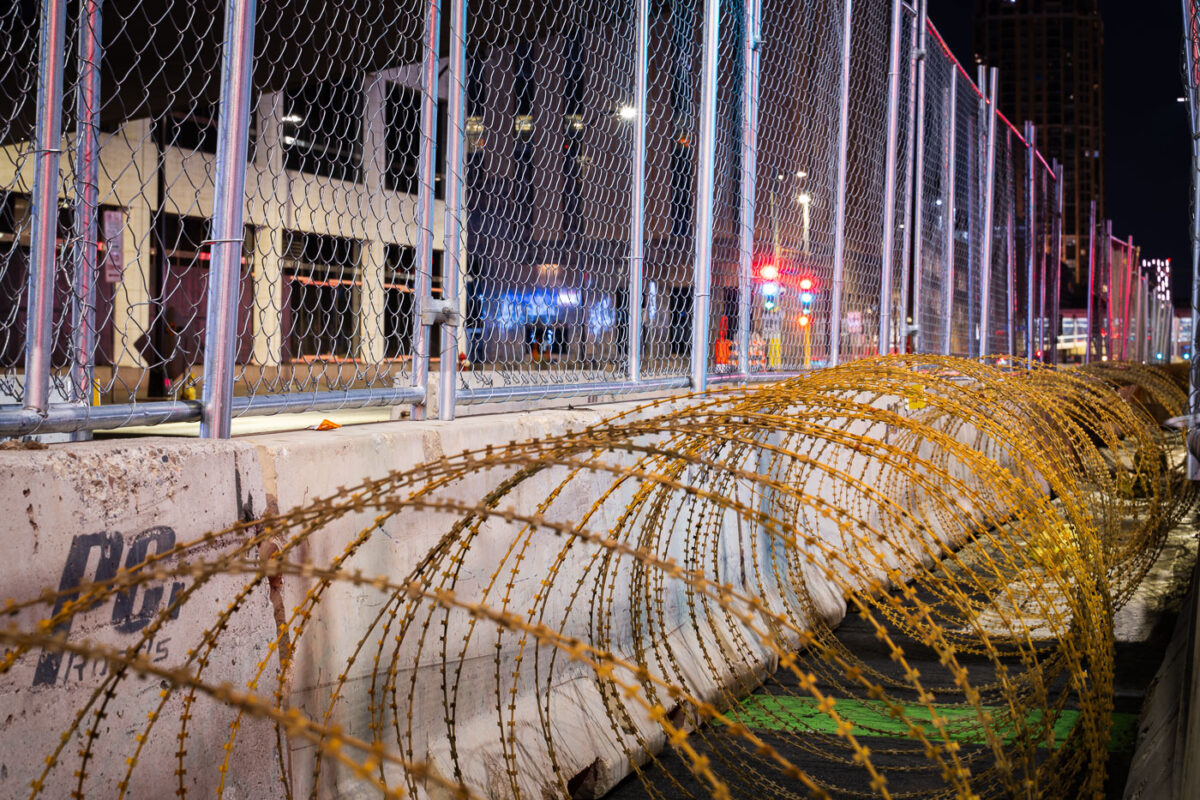
Yellow mesh security fencing and razor wire surround the Hennepin County Government Center during Derek Chauvin trial preparations in downtown Minneapolis.
Security measures, including razor wire and concrete barriers, were erected around the Hennepin County Government Center in Minneapolis in anticipation of the Derek Chauvin trial. On May 25, 2020, Minneapolis police officer Derek Chauvin murdered 46-year-old George Floyd during an arrest outside Cup Foods at the intersection of 38th Street and Chicago Avenue in south Minneapolis. Video recorded by bystanders showed Chauvin kneeling on Floyd’s neck for more than nine minutes while Floyd repeatedly said he could not breathe. Three other Minneapolis police officers - J. Alexander Kueng, Thomas Lane, and Tou Thao — were also present during the arrest and later faced criminal charges for their roles in Floyd’s death. Floyd’s murder sparked protests and civil unrest across Minneapolis and around the world, leading to widespread demonstrations against police violence, major policy debates on policing, and the conviction of Chauvin on murder and manslaughter charges in 2021.

Razor Wire Lines a Concrete Barrier Near Minneapolis City Hall at Night
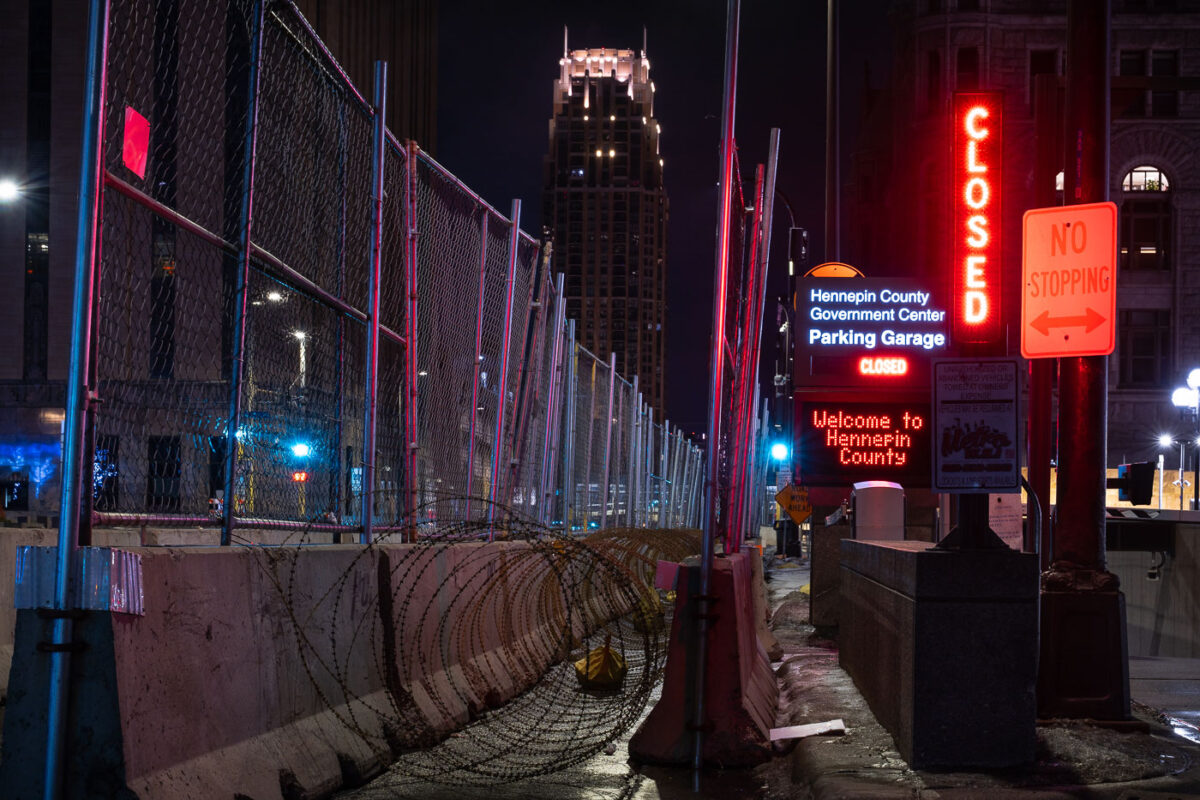
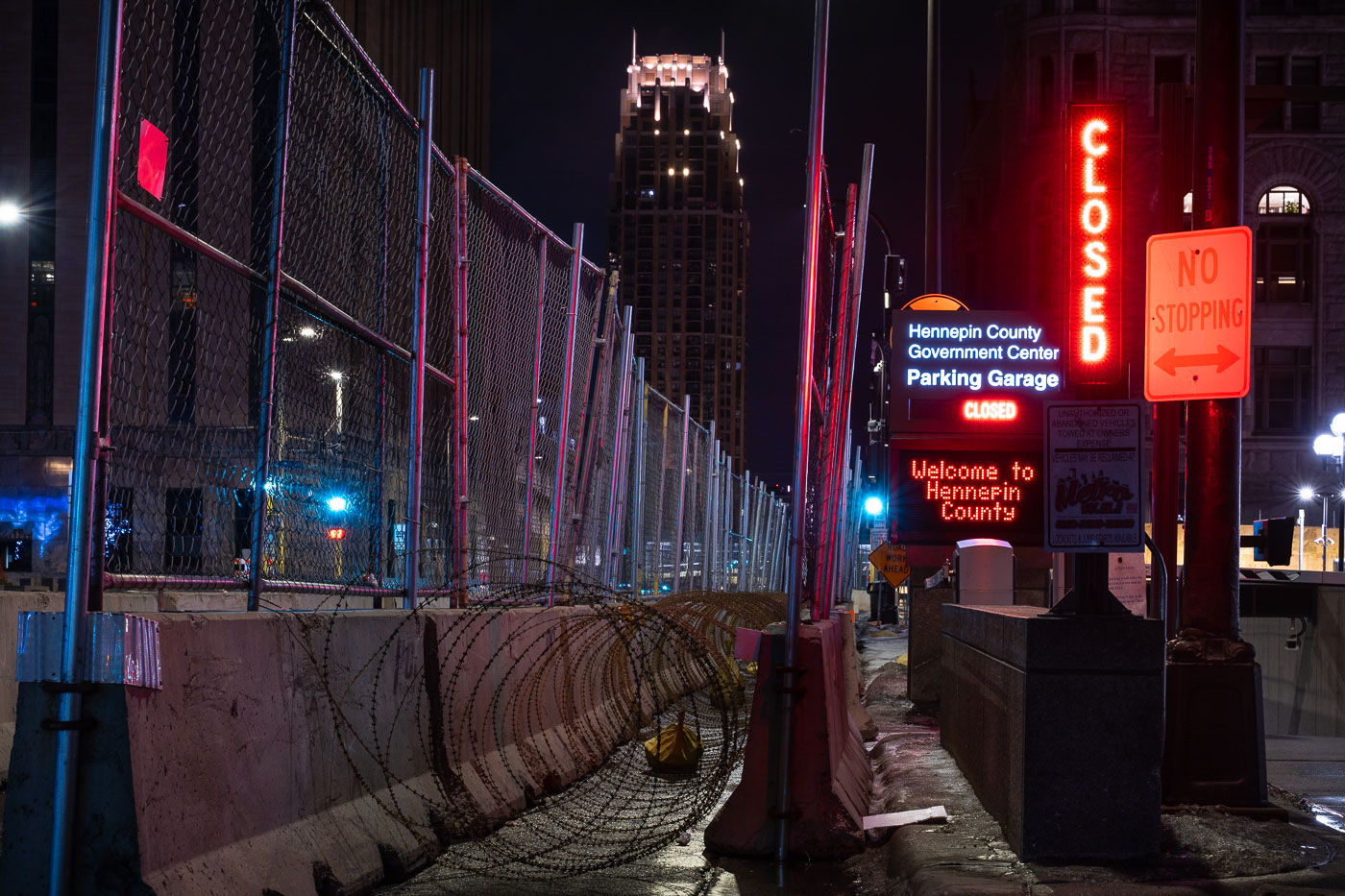
Razor wire fencing secures the Hennepin County Government Center in downtown Minneapolis during trial security preparations in February 2021.
Razor wire fencing is installed around the Hennepin County Government Center in Minneapolis, Minnesota. This security measure was put in place in anticipation of the Derek Chauvin trial, which was scheduled to begin less than two weeks after this photograph was taken. The trial stemmed from the death of George Floyd, whose killing by Chauvin in May 2020 sparked widespread protests and unrest in Minneapolis and across the nation.

“Closed” Parking Garage Sign Near Hennepin County Government Center at Night

Who's running for mayor newspaper
A discarded newspaper, featuring an article about the Minneapolis mayoral race, lies in the snow outside the Hennepin County Government Center. The article, titled "Who's running for Mayor of Minneapolis?", highlights the candidates and the political landscape of the city.

Wet Newspaper on Snow: Minneapolis Mayoral Race

Minneapolis Police Second Precinct Chauvin Security
Security fencing and concrete barriers surround the Minneapolis Police 2nd Precinct in northeast Minneapolis on February 23, 2021. This measure was implemented in anticipation of the Derek Chauvin murder trial in 2021. The precinct building itself, constructed in 1911, has served as a law enforcement facility for over a century. The heightened security reflects the significant public attention and potential for unrest surrounding the trial, which followed the murder of George Floyd. On May 25, 2020, Minneapolis police officer Derek Chauvin murdered 46-year-old George Floyd during an arrest outside Cup Foods at the intersection of 38th Street and Chicago Avenue in south Minneapolis. Video recorded by bystanders showed Chauvin kneeling on Floyd’s neck for more than nine minutes while Floyd repeatedly said he could not breathe. Three other Minneapolis police officers - J. Alexander Kueng, Thomas Lane, and Tou Thao — were also present during the arrest and later faced criminal charges for their roles in Floyd’s death. Floyd’s murder sparked protests and civil unrest across Minneapolis and around the world, leading to widespread demonstrations against police violence, major policy debates on policing, and the conviction of Chauvin on murder and manslaughter charges in 2021.

Minneapolis Police 2nd Precinct Security Ahead of Chauvin Trial

Chris Hawkey Avoid STD's Billboard
Billboard in downtown Minneapolis that reads: Avoid STD's Get Checked Regularly Paid for by Chris Hawkey

Chris Hawkey Avoid STD’s Billboard

Concrete barriers line a snowy downtown Minneapolis street at night near the Hennepin County Medical Examiner's Office during trial security preparations.
Concrete barricaded shown on February 22, 2021 around the Hennepin County Medical Examiner's Office in downtown Minneapolis in anticipation of the Derek Chauvin murder trial. On May 25, 2020, Minneapolis police officer Derek Chauvin murdered 46-year-old George Floyd during an arrest outside Cup Foods at the intersection of 38th Street and Chicago Avenue in south Minneapolis. Video recorded by bystanders showed Chauvin kneeling on Floyd’s neck for more than nine minutes while Floyd repeatedly said he could not breathe. Three other Minneapolis police officers - J. Alexander Kueng, Thomas Lane, and Tou Thao — were also present during the arrest and later faced criminal charges for their roles in Floyd’s death. Floyd’s murder sparked protests and civil unrest across Minneapolis and around the world, leading to widespread demonstrations against police violence, major policy debates on policing, and the conviction of Chauvin on murder and manslaughter charges in 2021.

Concrete Barriers Outside the Hennepin County Medical Examiner’s Office

Hennepin County Jail surrounded by chain link security fencing and metal poles at night in downtown Minneapolis.
Hennepin County Jail in downtown Minneapolis was surrounded by temporary security fencing in February 2021. Additional barriers were installed around government buildings in the area before the Derek Chauvin trial. The jail is part of the Hennepin County public safety and court complex.

Razor Wire Fencing Outside Hennepin County Jail at Night
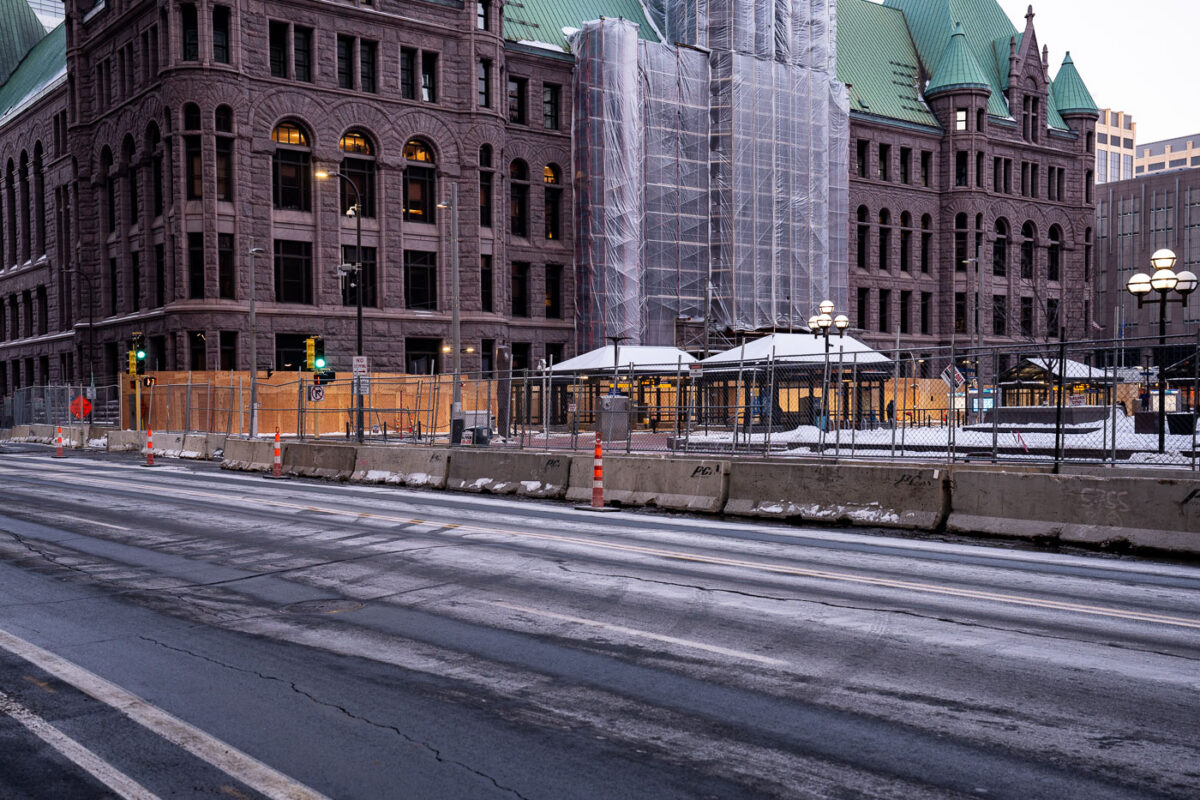
Historic Minneapolis City Hall stands behind security fencing and plywood boards during Derek Chauvin trial preparations in February 2021.
Minneapolis City Hall and the Hennepin County Government Center are shown fortified with security fencing and boarded-up windows. This measure was implemented in anticipation of the Derek Chauvin murder trial in 2021, reflecting heightened security concerns surrounding the proceedings.

South 6th Street Barricades Before the Chauvin Trial

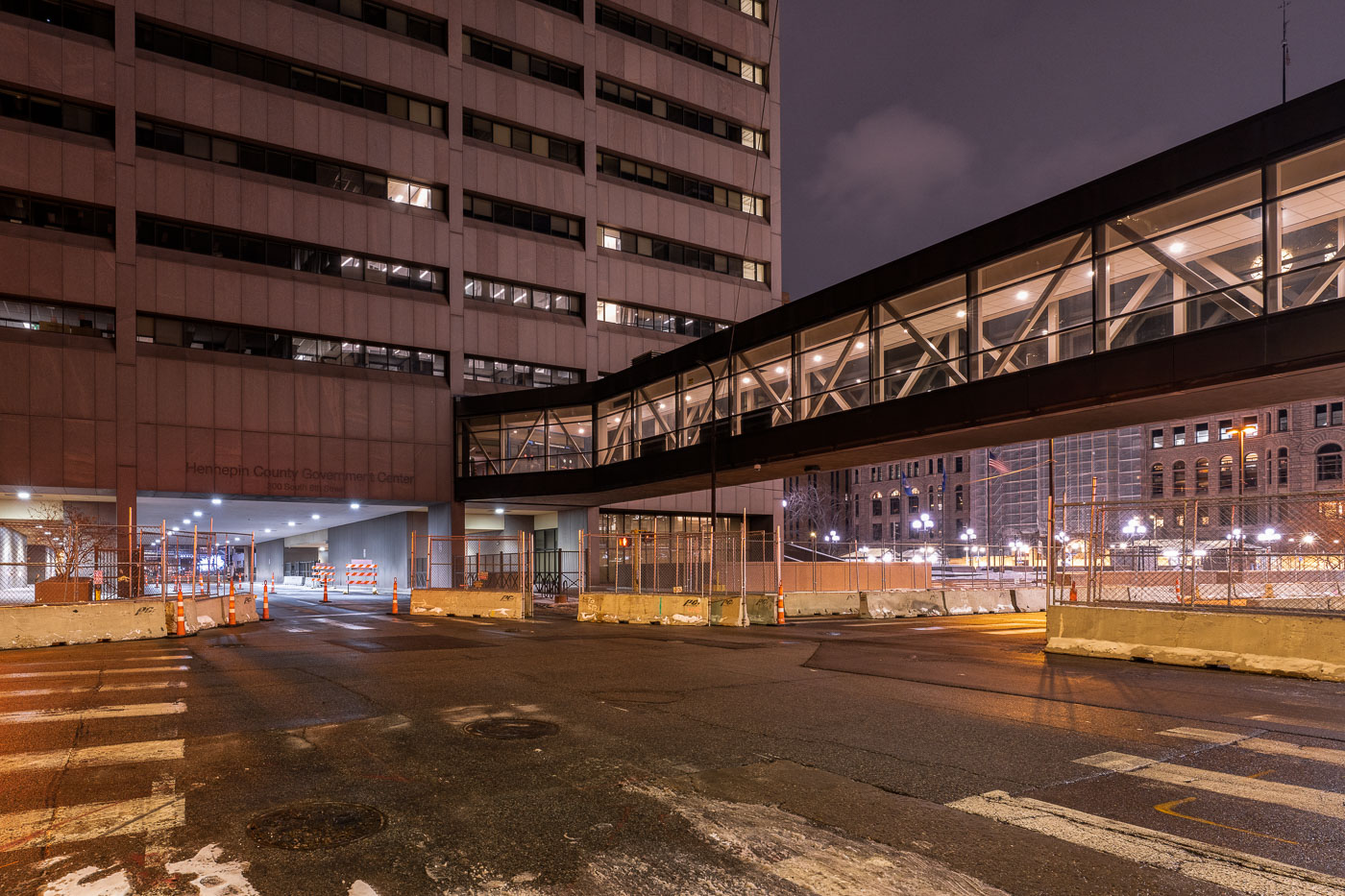
Hennepin County Government Center with overhead skyway and concrete barriers lining the street at night in downtown Minneapolis.
Hennepin County Government Center in downtown Minneapolis is surrounded by temporary fencing and concrete barriers. The county complex houses courts and county offices, and was under expanded security in early 2021 ahead of the Derek Chauvin trial. A skyway connects the Government Center to adjacent buildings above the secured street level.

Skyway Over a Barricaded Street at Hennepin County Government Center

Hennepin County Jail surrounded by temporary metal fencing and concrete barriers during February 2021 security preparations in downtown Minneapolis.
Hennepin County Jail, Minneapolis. Temporary fencing and concrete barriers surround the jail complex in downtown Minneapolis during security preparations tied to the Derek Chauvin trial in February 2021. The jail stands next to the Hennepin County Government Center campus.

Aerial View of Hennepin County Jail Security Barriers Before Chauvin Trial

Hennepin County Government Center entrance secured with orange traffic cones, concrete barriers, and chain-link fencing during trial security preparations in February 2021.
Temporary security barricades are erected on February 18, 2021 around the Hennepin County Government Center at 300 South 6th Street in Minneapolis. These measures were put in place in anticipation of the trial of Derek Chauvin, the former police officer charged in the May 2020 murder of George Floyd. On May 25, 2020, Minneapolis police officer Derek Chauvin murdered 46-year-old George Floyd during an arrest outside Cup Foods at the intersection of 38th Street and Chicago Avenue in south Minneapolis. Video recorded by bystanders showed Chauvin kneeling on Floyd’s neck for more than nine minutes while Floyd repeatedly said he could not breathe. Three other Minneapolis police officers - J. Alexander Kueng, Thomas Lane, and Tou Thao — were also present during the arrest and later faced criminal charges for their roles in Floyd’s death. Floyd’s murder sparked protests and civil unrest across Minneapolis and around the world, leading to widespread demonstrations against police violence, major policy debates on policing, and the conviction of Chauvin on murder and manslaughter charges in 2021.

Concrete Barriers Line South 6th Street Before the Chauvin Trial
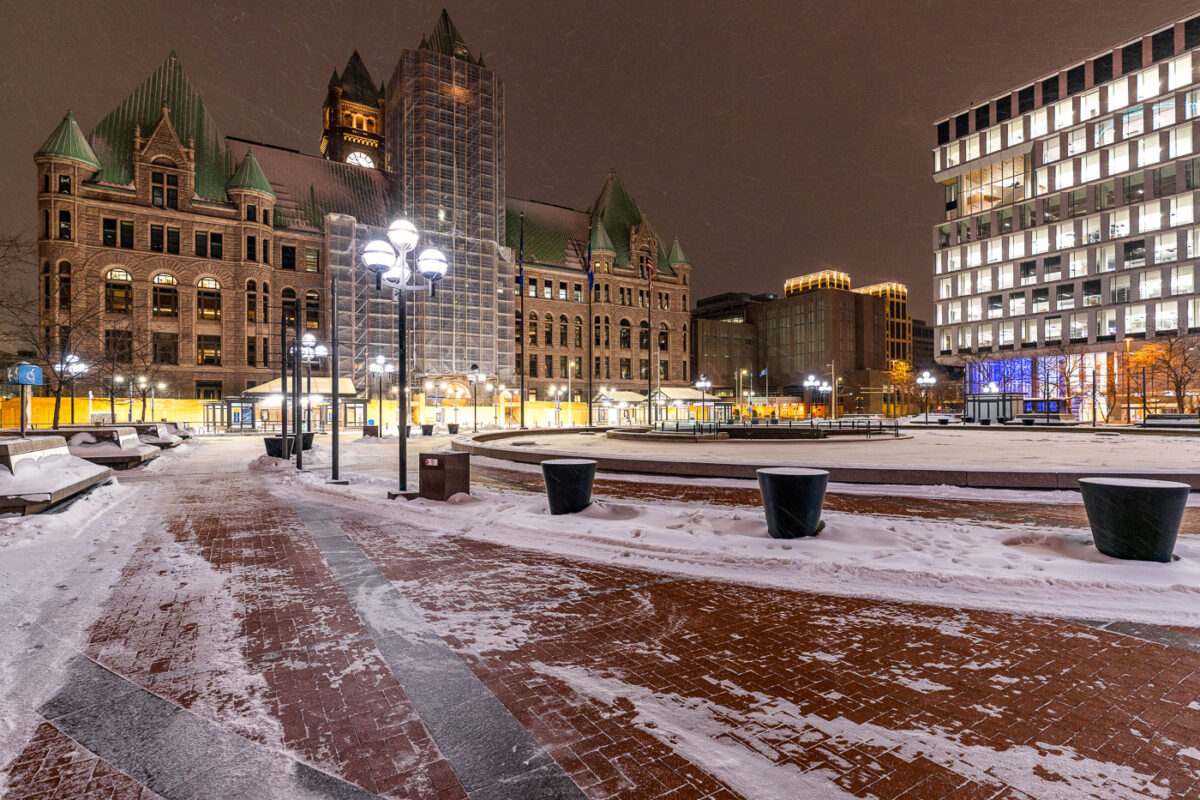
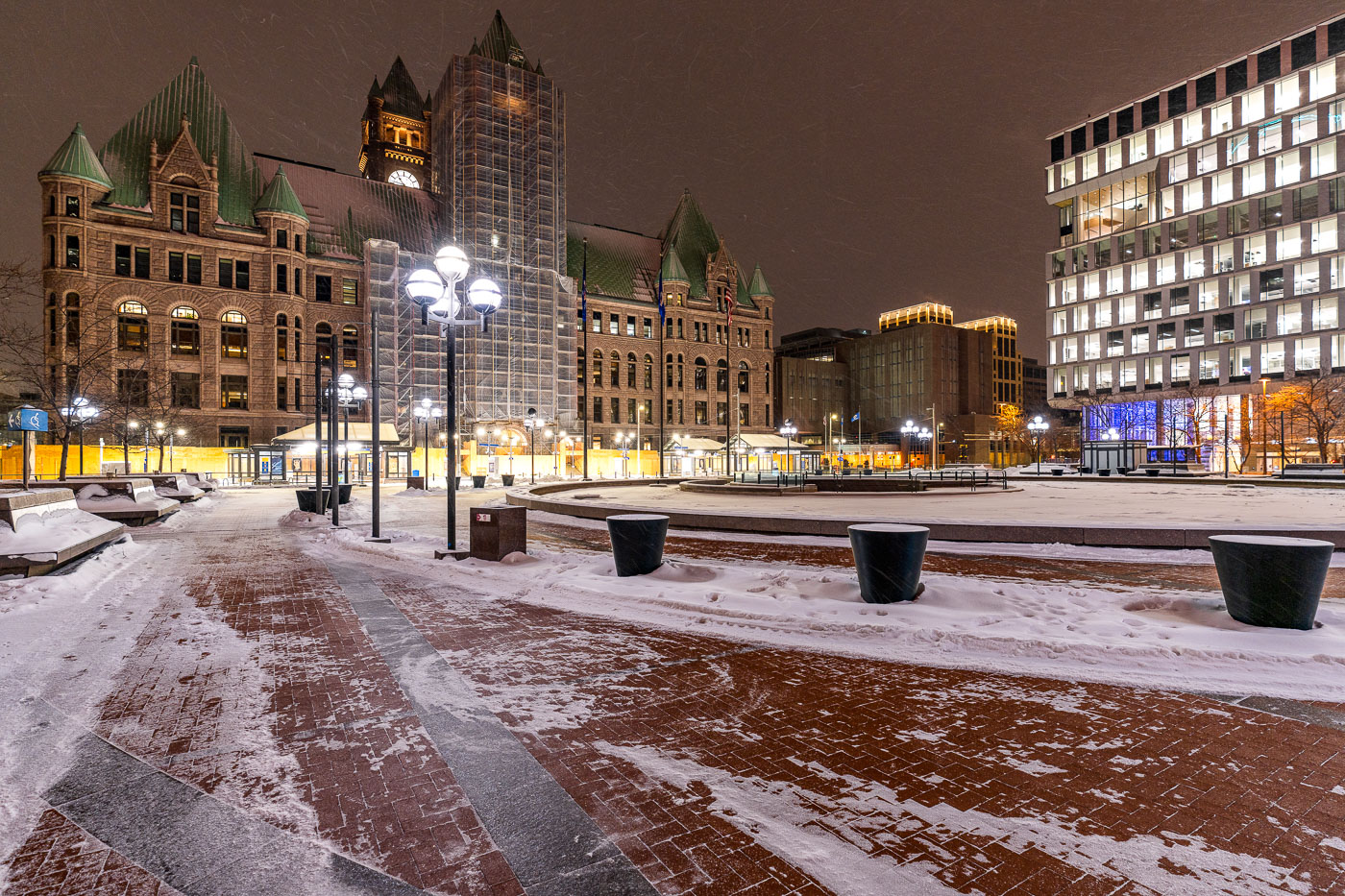
Snowstorm and Minneapolis City Hall prior to Chauvin trial
Minneapolis City Hall and Hennepin County Government Center are seen under snowfall as security preparations are underway for the Derek Chauvin trial. This measure reflects the heightened security concerns surrounding the trial of the former police officer accused in the death of George Floyd, which occurred in Minneapolis.

Minneapolis City Hall in Snow Before Chauvin Trial Security
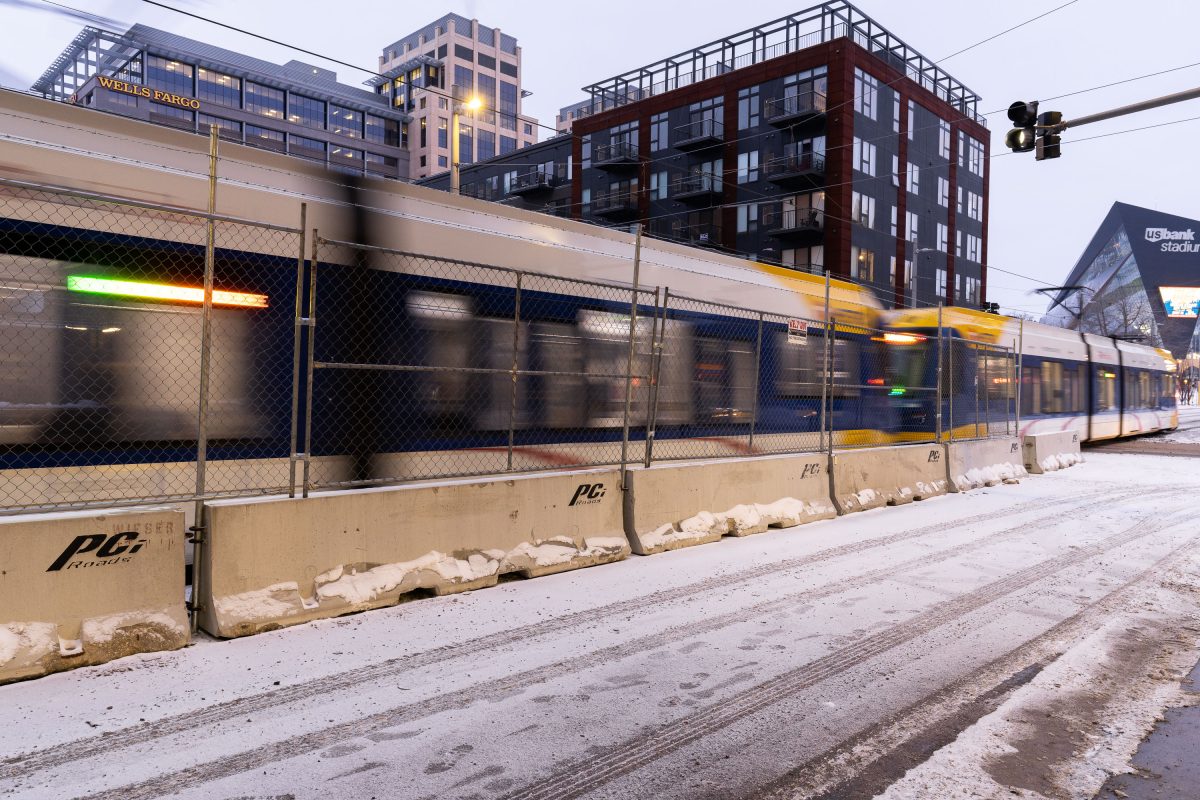
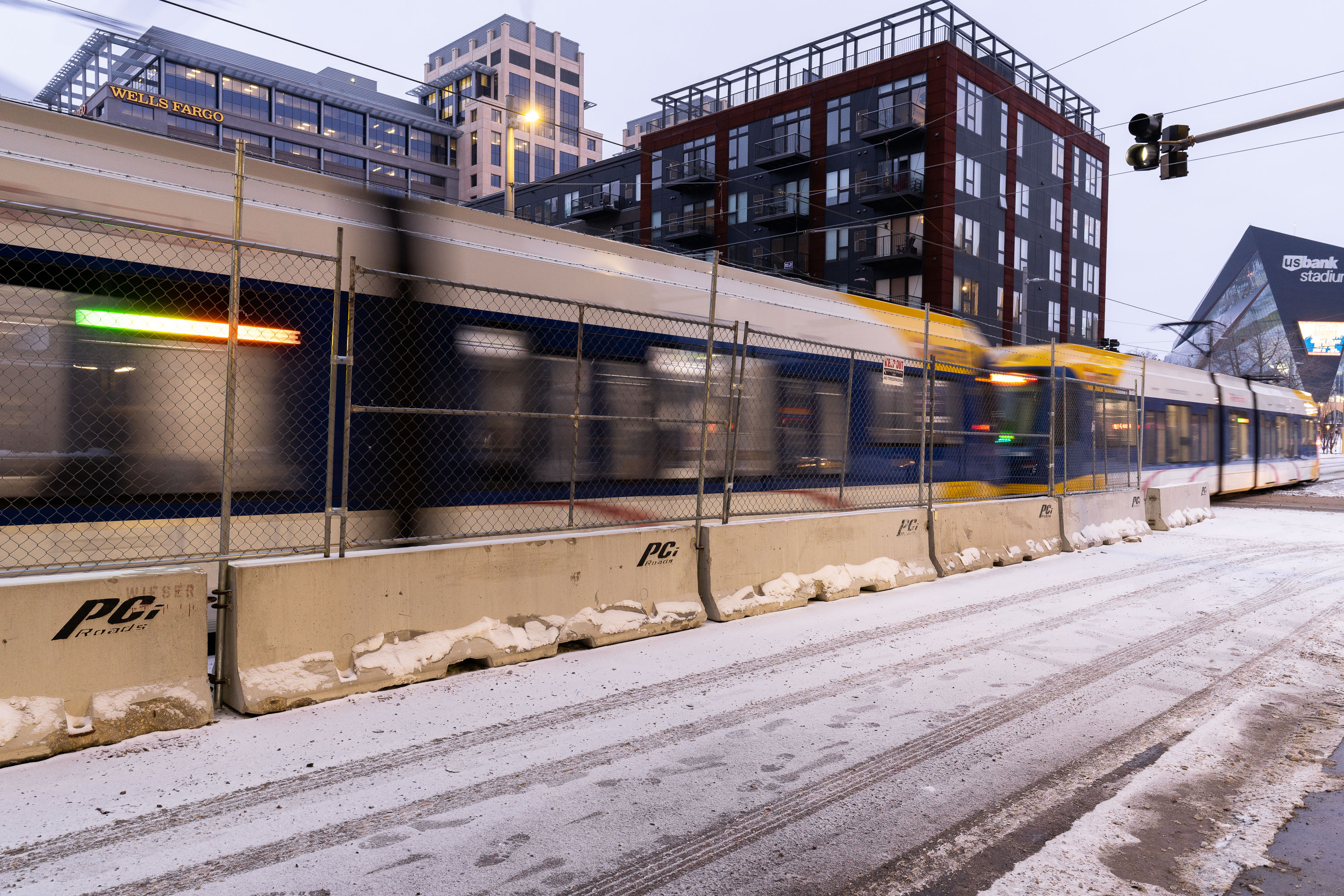
Metro Transit light rail train passes security fencing along South 5th Street near US Bank Stadium in downtown Minneapolis during winter.
A Metro Transit light rail train passes along South 5th Street near US Bank Stadium in downtown Minneapolis. This stretch of track serves the METRO Blue and Green Lines, connecting downtown to the stadium, Nicollet Mall, and surrounding neighborhoods.

Light Rail Passing Security Fencing Near US Bank Stadium in Snow

Hennepin County Government Center's ground-floor windows and entrances boarded with plywood during February 2021 security preparations.
The Hennepin County Government Center in downtown Minneapolis has plywood covering several ground-floor windows and entrances. The county courthouse complex was being secured in February 2021 ahead of the Derek Chauvin trial in the death of George Floyd. The building stands at 300 South 6th Street.

Plywood Covers Windows at Hennepin County Government Center Ahead of Chauvin Trial

Minneapolis City Hall with its distinctive clock tower stands behind security barriers and snow-covered streets during winter.
Minneapolis City Hall in downtown Minneapolis shown in February 2021. Security fencing going up around buildings in the area in preperation for the Derek Chauvin trial.

Snowy Morning Near Minneapolis City Hall
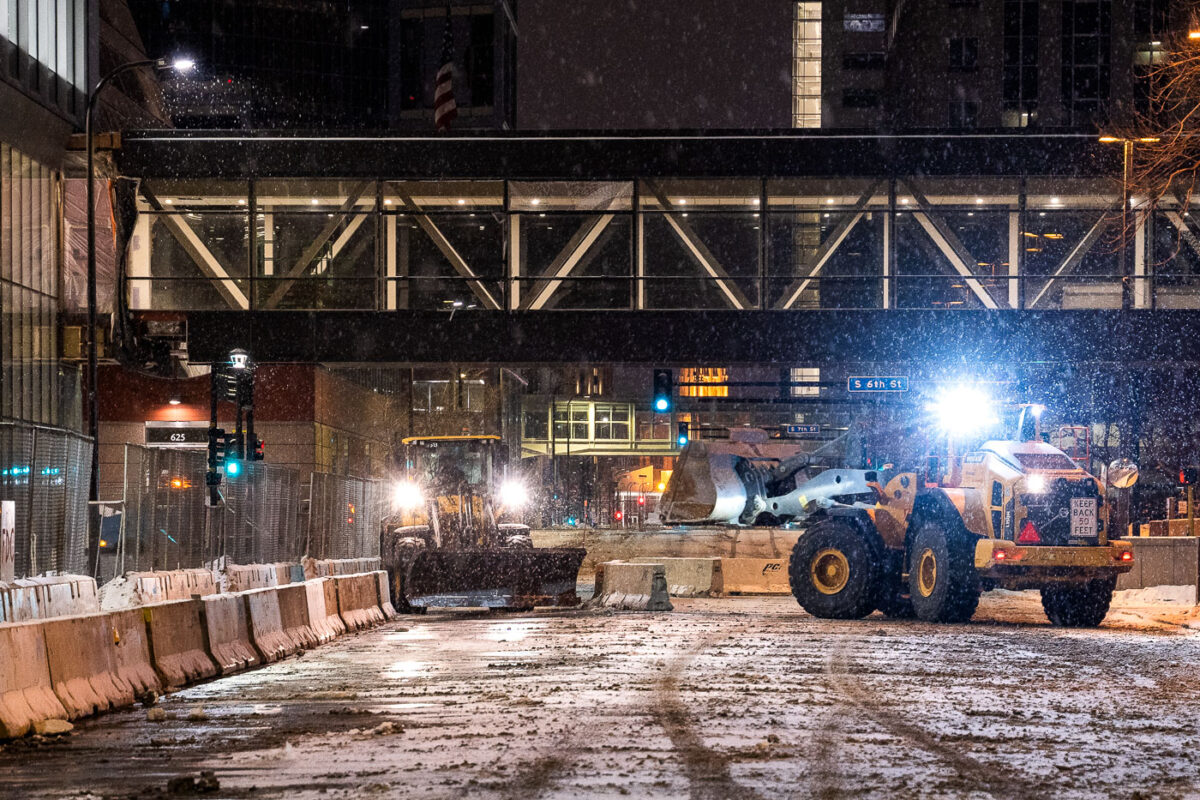
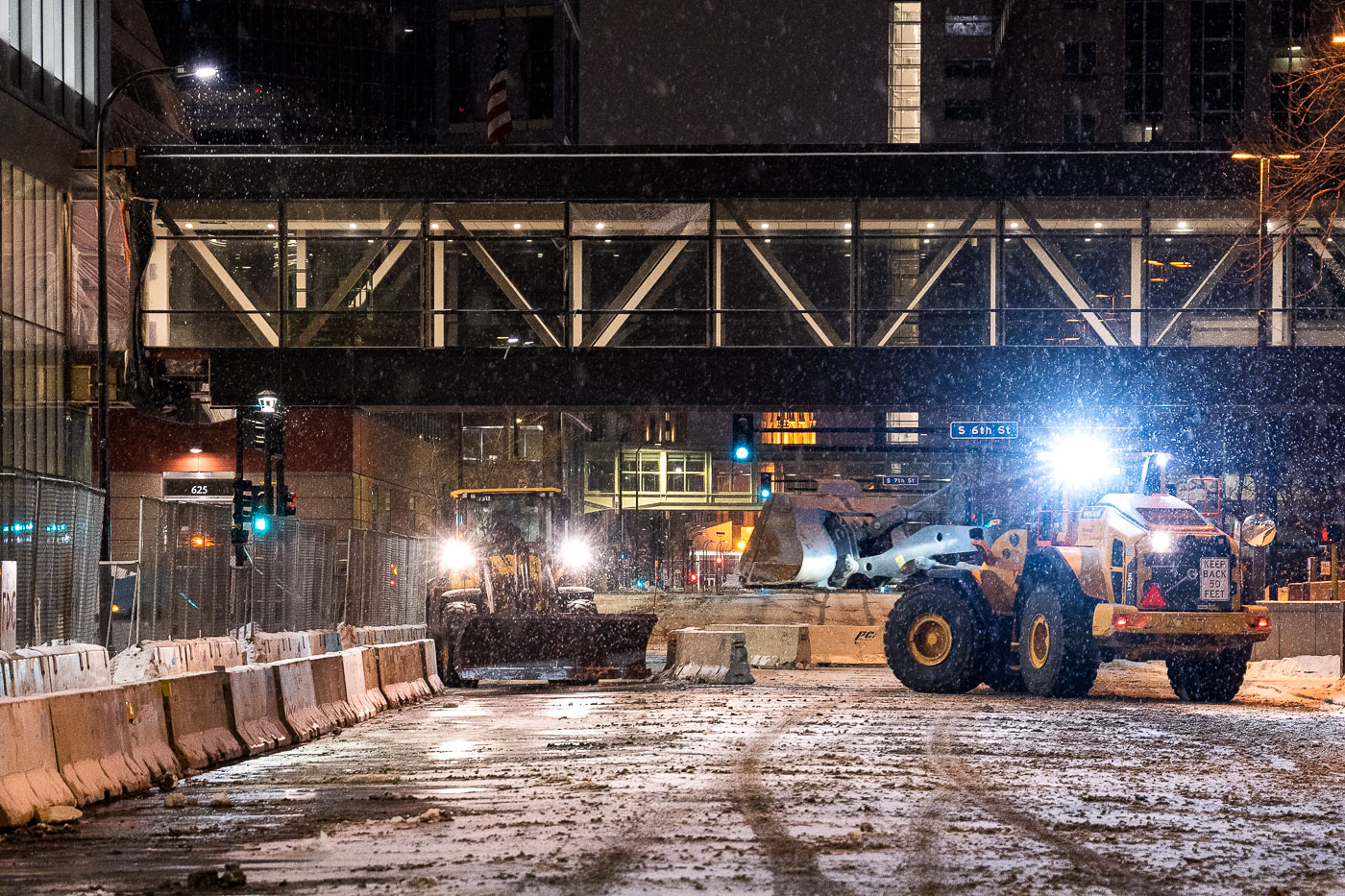
A front-end loader removes concrete barriers from a snowy downtown Minneapolis street at night near City Hall during trial security preparations.
Public Works vehicles install jersey barriers around government buildings in Minneapolis in anticipation of the Derek Chauvin trial. On May 25, 2020, Minneapolis police officer Derek Chauvin murdered 46-year-old George Floyd during an arrest outside Cup Foods at the intersection of 38th Street and Chicago Avenue in south Minneapolis. Video recorded by bystanders showed Chauvin kneeling on Floyd’s neck for more than nine minutes while Floyd repeatedly said he could not breathe. Three other Minneapolis police officers - J. Alexander Kueng, Thomas Lane, and Tou Thao — were also present during the arrest and later faced criminal charges for their roles in Floyd’s death. Floyd’s murder sparked protests and civil unrest across Minneapolis and around the world, leading to widespread demonstrations against police violence, major policy debates on policing, and the conviction of Chauvin on murder and manslaughter charges in 2021.

Front-End Loaders Install Jersey Barriers on South 6th Street at Night
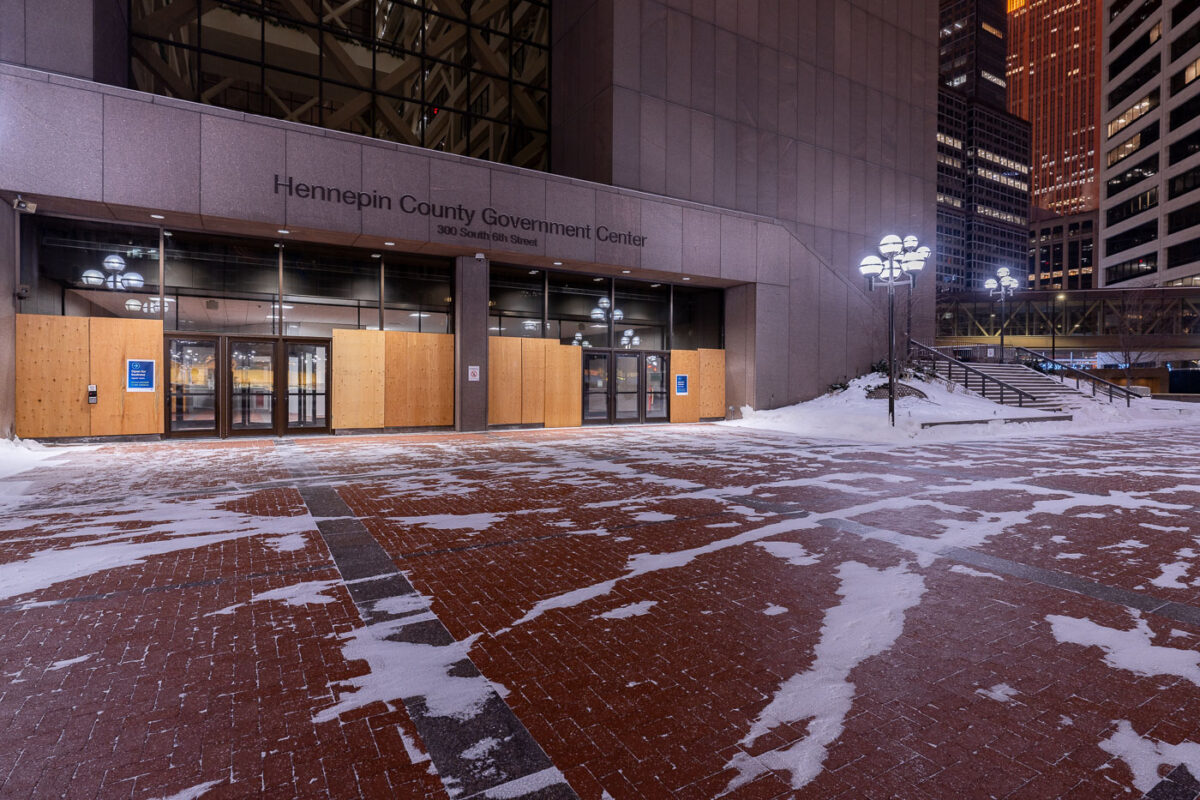
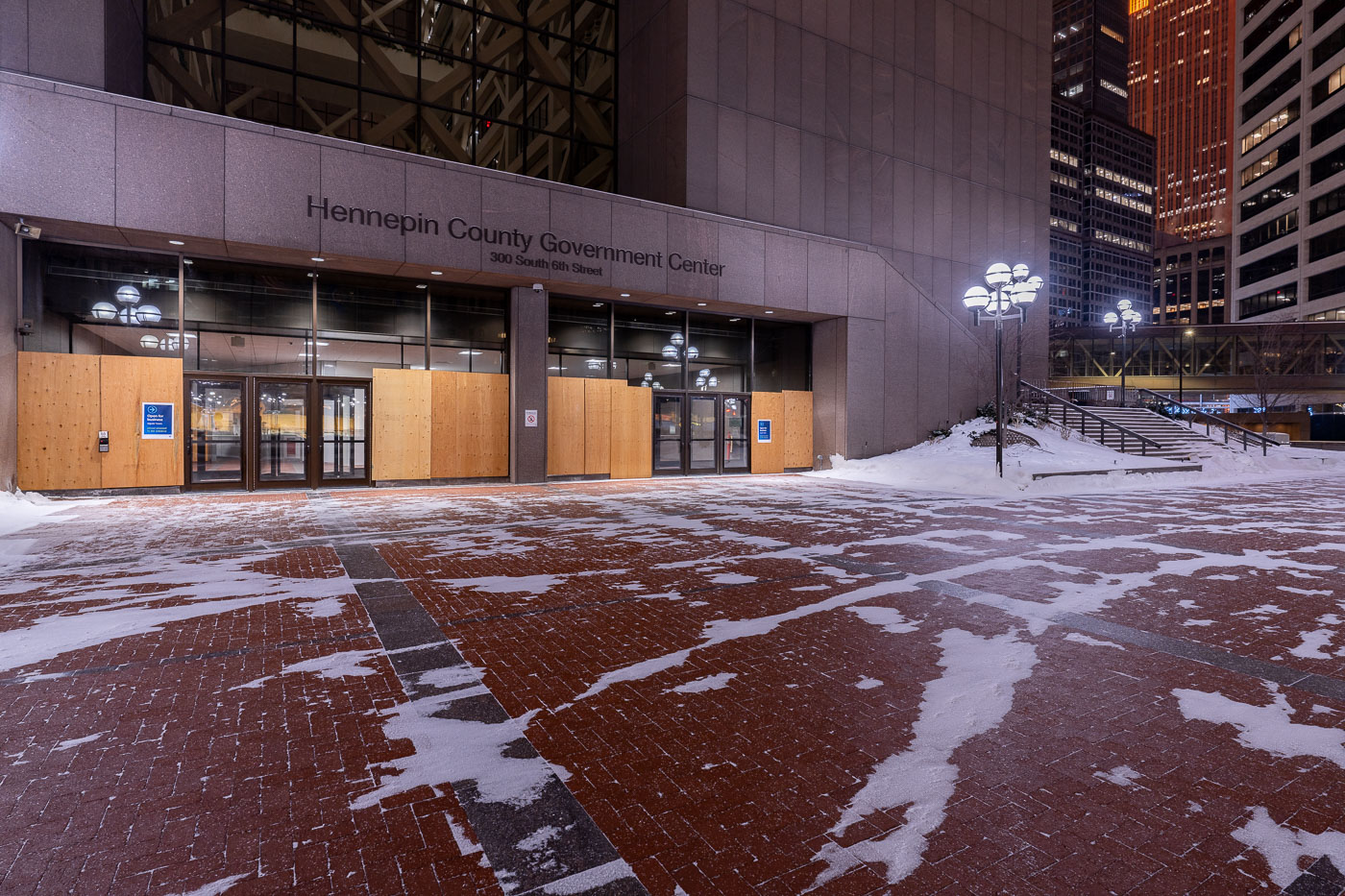
Hennepin County Government Center at 300 South 6th Street boarded with plywood panels during winter.
The Hennepin County Government Center in downtown Minneapolis was boarded up in anticipation of the Derek Chauvin trial in March 2021. The building, located at 300 South 6th Street, houses county government offices and courtrooms.

Snowy Entrance at Hennepin County Government Center After Dark
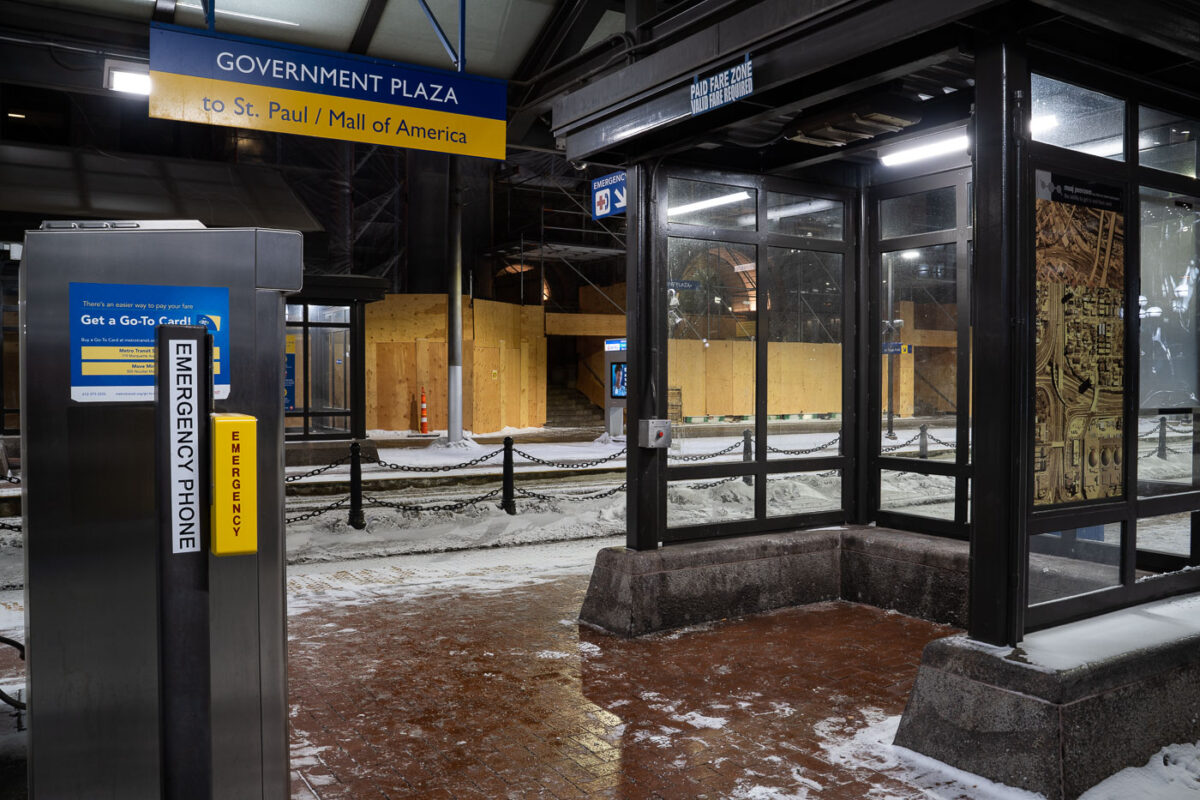
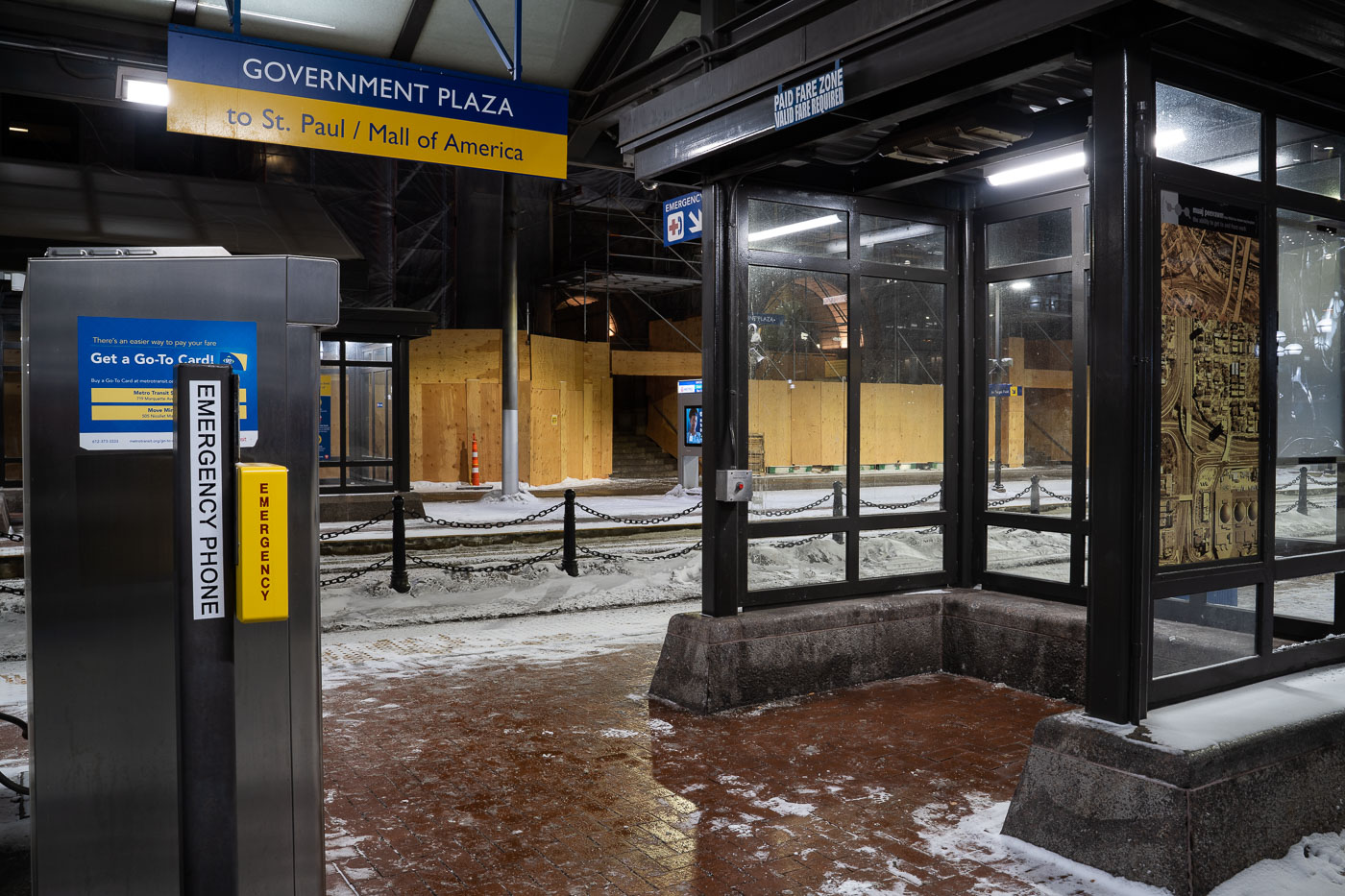
Government Plaza station entrance in downtown Minneapolis with plywood barriers and Metro Transit platform signage.
Government Plaza station in downtown Minneapolis serves Metro Transit Blue and Green Line trains. The platform signage directs riders toward St. Paul and the Mall of America. Plywood barriers were installed around parts of the station area in February 2021 during heightened security measures tied to the Derek Chauvin trial.

Government Plaza station entrance, Minneapolis

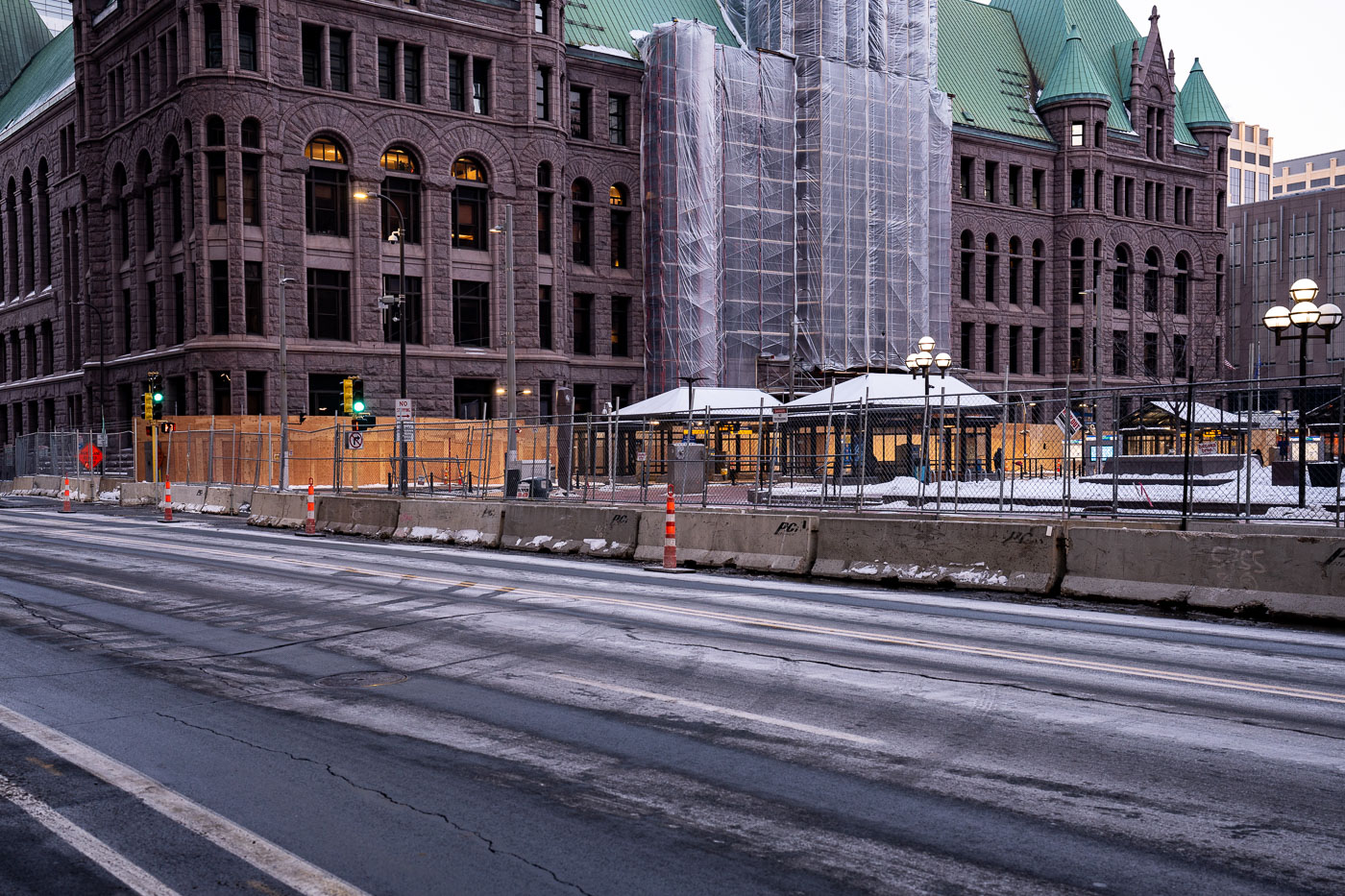
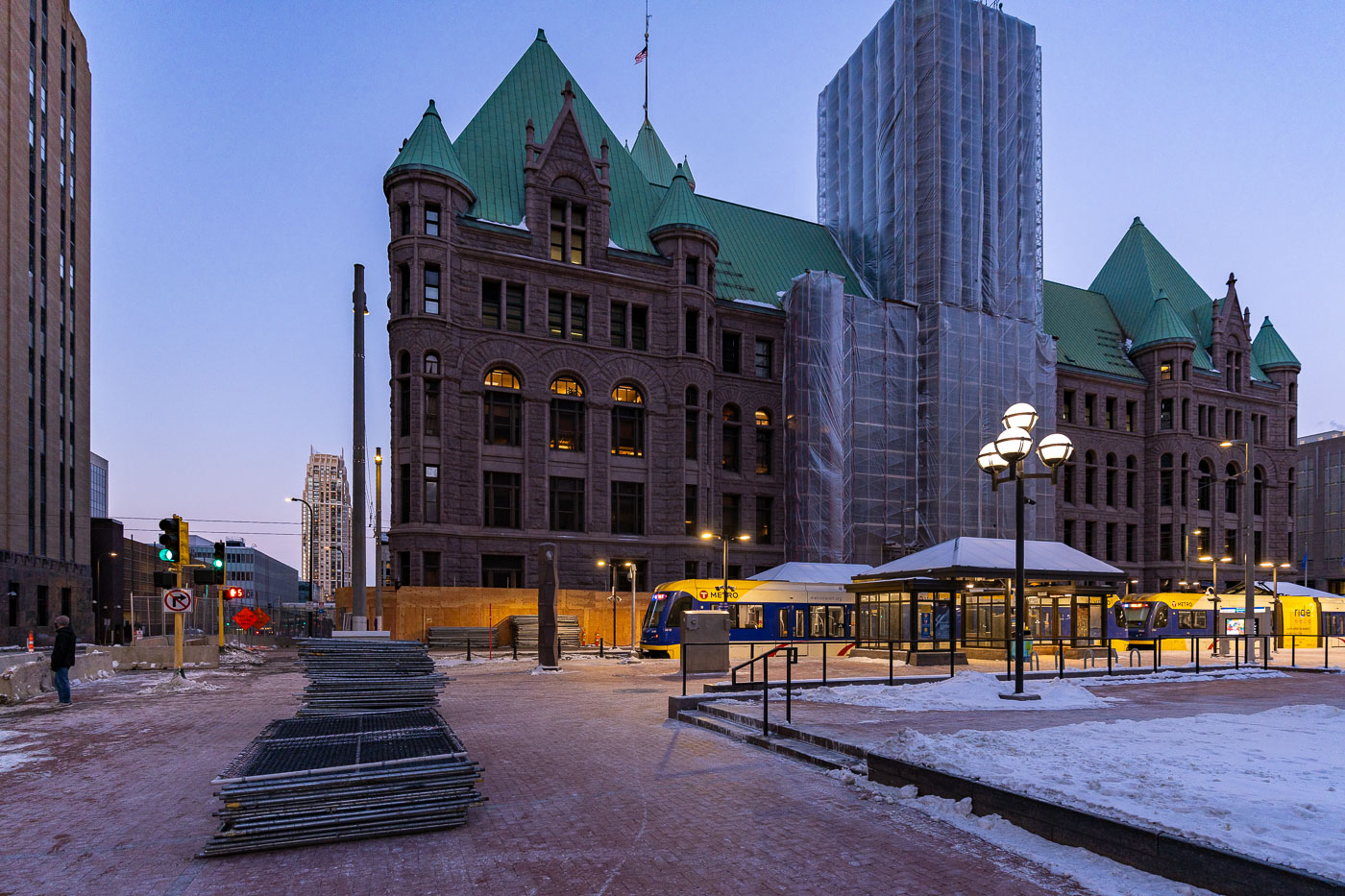
Minneapolis City Hall secured with chain-link fencing and concrete barriers in winter.
Fencing and barricades begin going up around Minneapolis City Hall. The layers of fencing and barriers are going up with 20 days remaining before jury selection begins in the George Floyd Trial.

Security Fencing Goes Up Along Minneapolis City Hall at Dusk
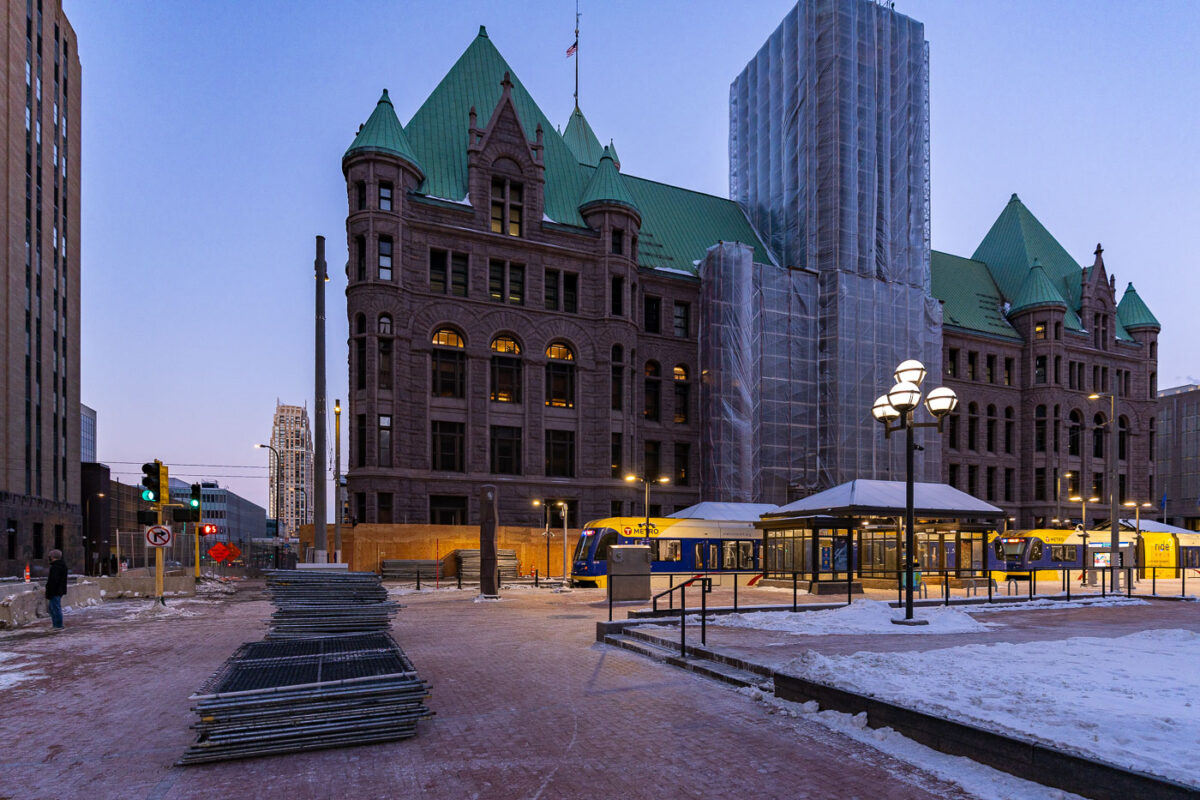
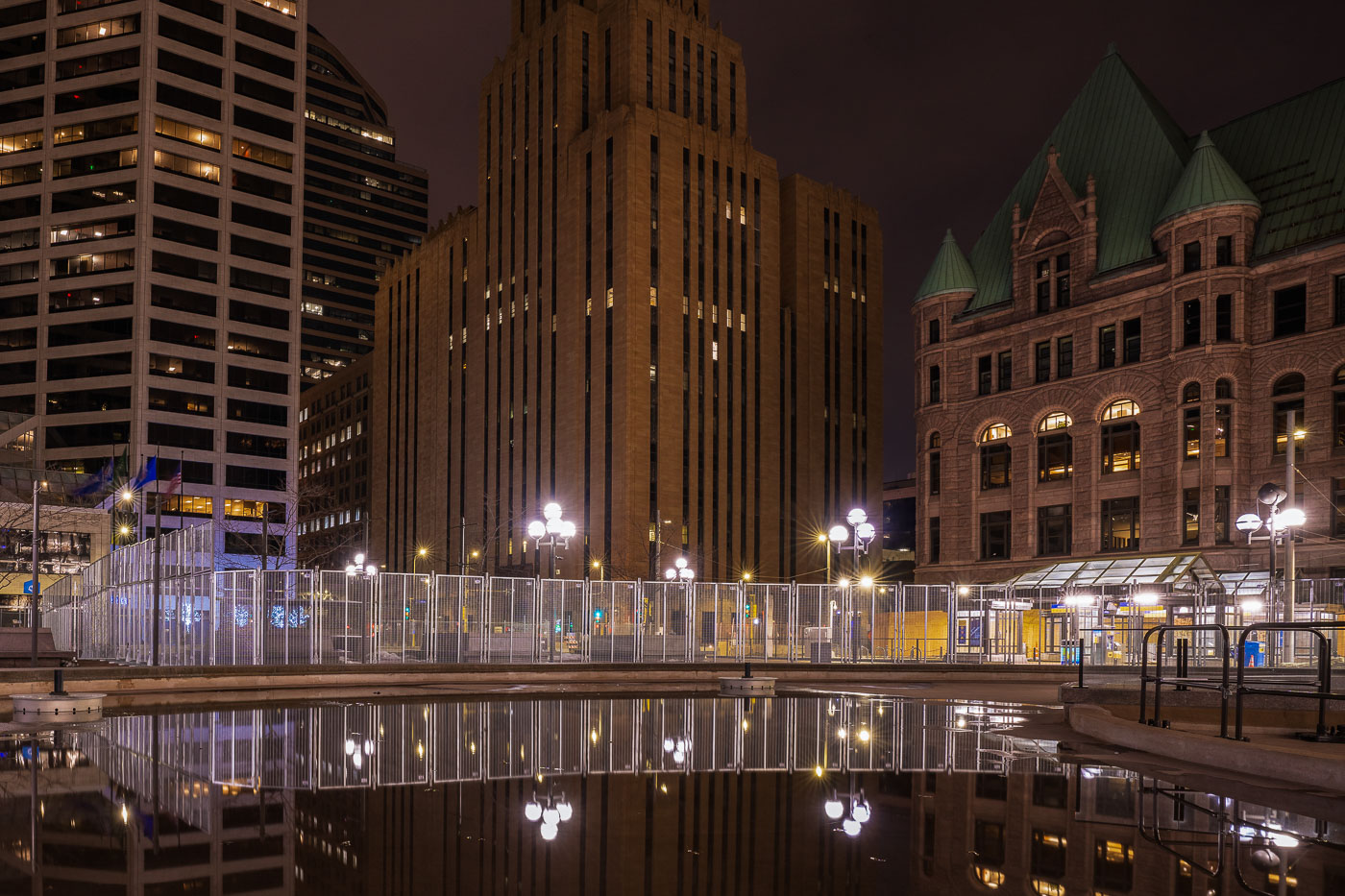
Minneapolis City Hall and Hennepin County Government Center surrounded by security fencing and barricades in February 2021.
Fencing and barricades surround Minneapolis City Hall and the Hennepin County Government Center in downtown Minneapolis on February 16, 2021. These security measures were installed in anticipation of the Derek Chauvin murder trial, which began on March 8, 2021. On May 25, 2020, Minneapolis police officer Derek Chauvin murdered 46-year-old George Floyd during an arrest outside Cup Foods at the intersection of 38th Street and Chicago Avenue in south Minneapolis. Video recorded by bystanders showed Chauvin kneeling on Floyd’s neck for more than nine minutes while Floyd repeatedly said he could not breathe. Three other Minneapolis police officers - J. Alexander Kueng, Thomas Lane, and Tou Thao — were also present during the arrest and later faced criminal charges for their roles in Floyd’s death. Floyd’s murder sparked protests and civil unrest across Minneapolis and around the world, leading to widespread demonstrations against police violence, major policy debates on policing, and the conviction of Chauvin on murder and manslaughter charges in 2021.

METRO Green Line Station at Minneapolis City Hall During Winter
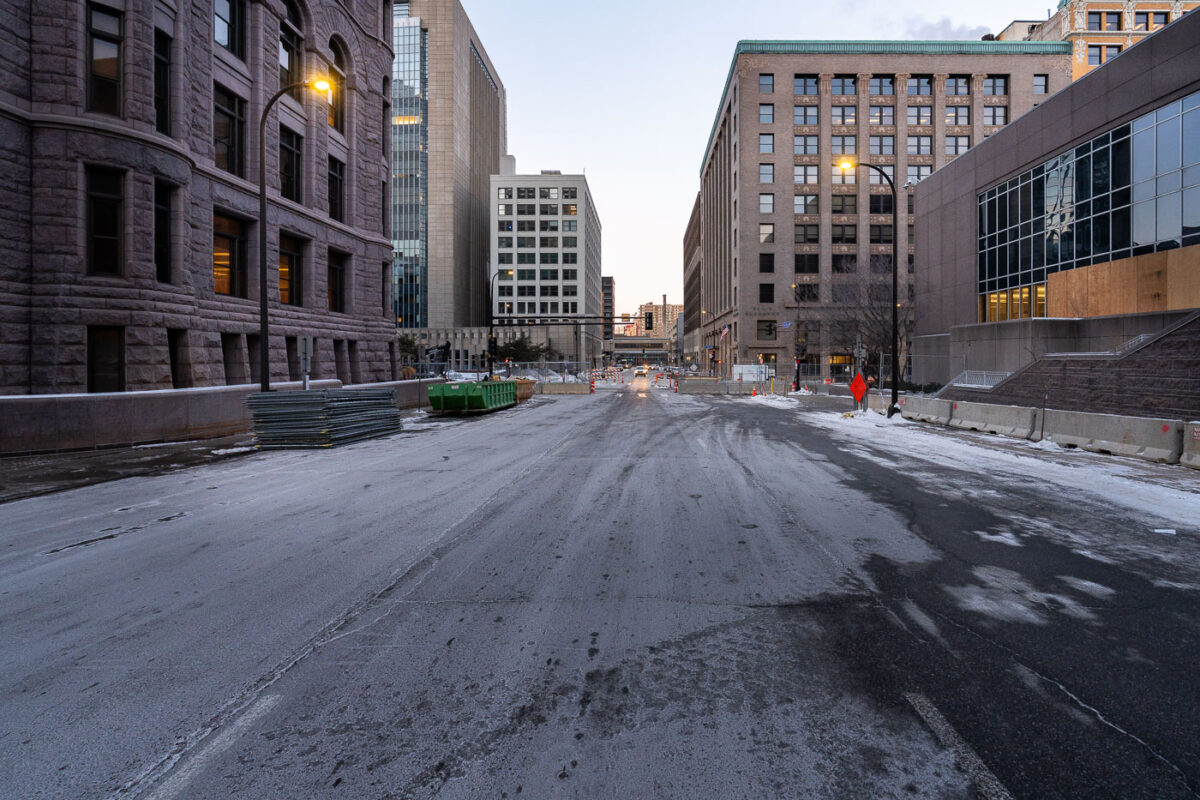
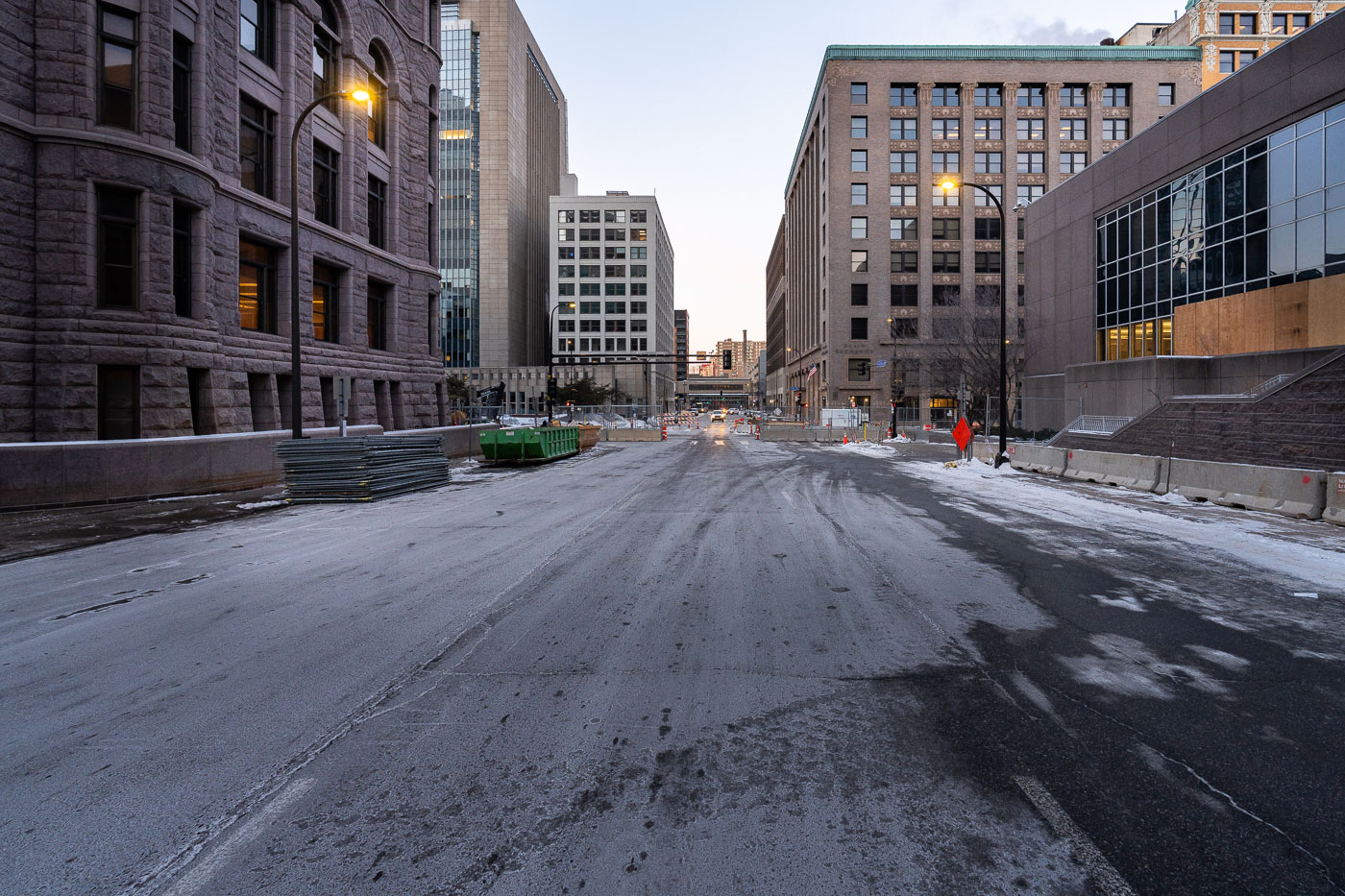
Snow-covered street lined with historic and modern buildings, security fencing, and barriers surrounding Minneapolis City Hall.
Security fencing and concrete barriers surround Minneapolis City Hall and the Hennepin County Jail in anticipation of the Derek Chauvin murder trial.

Empty Downtown Minneapolis Street Before the Chauvin Trial
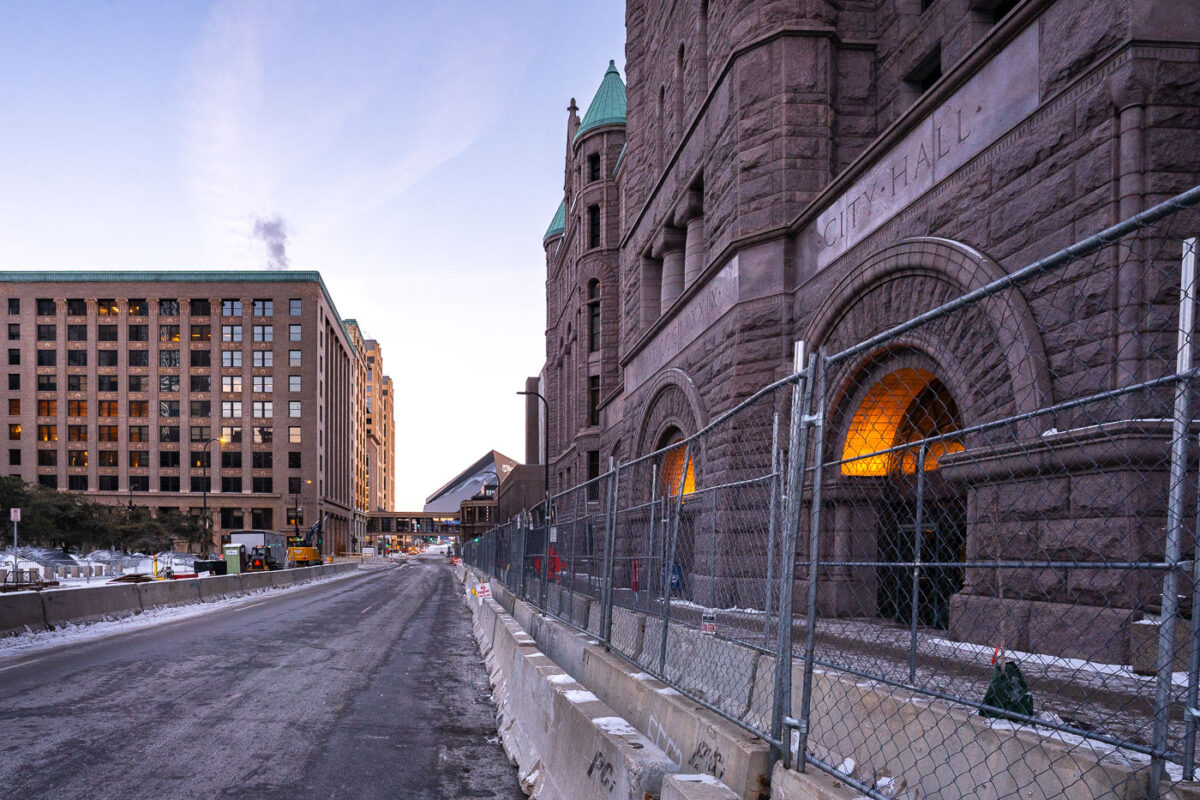
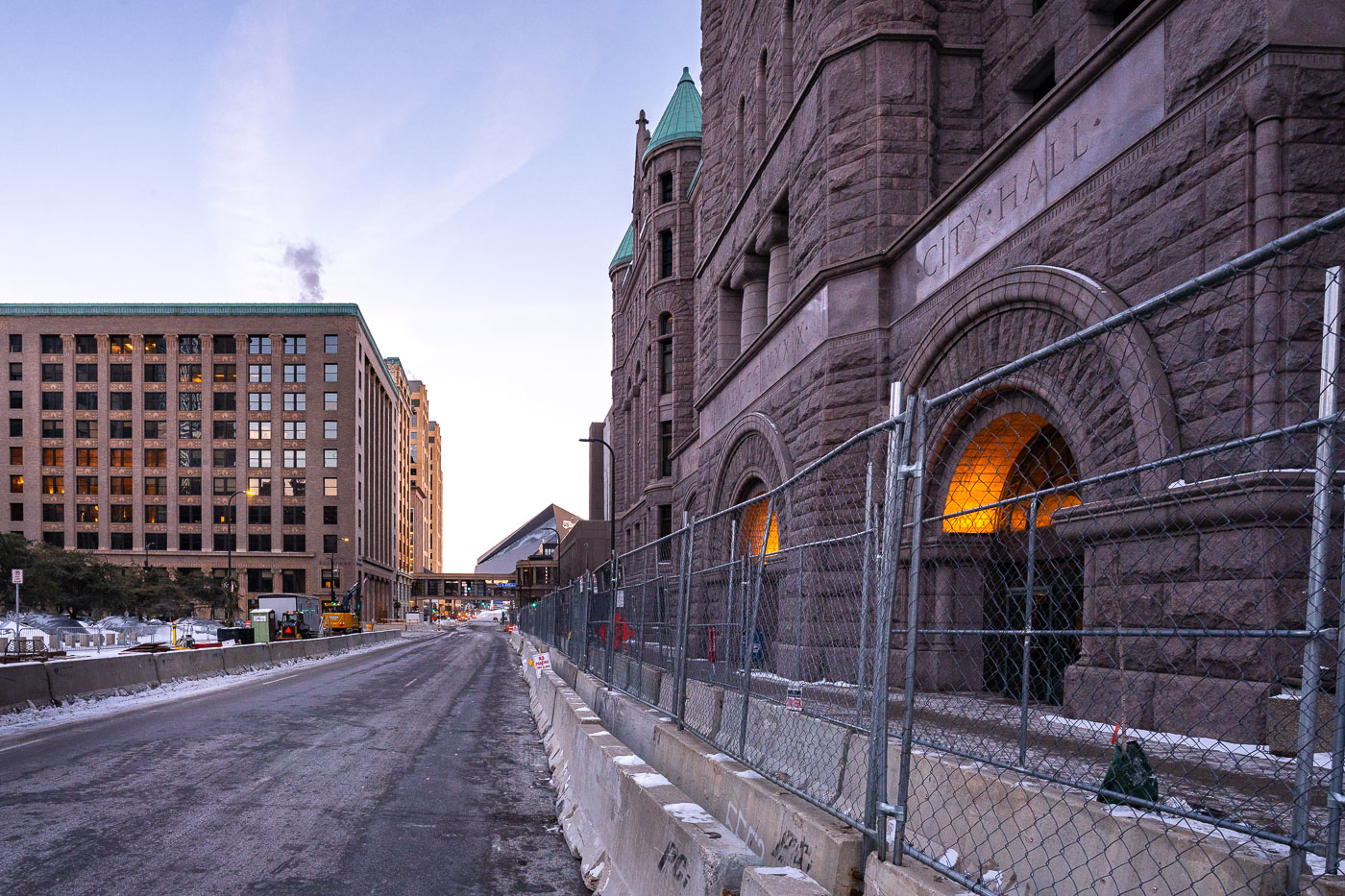
Metal fencing and concrete barriers surround Minneapolis City Hall's stone facade during preparations for the Derek Chauvin trial.
Fencing and barricades begin going up around downtown locations with Derek Chauvin trial just 20 days away.

Fourth Avenue Fenced Off Outside Minneapolis City Hall
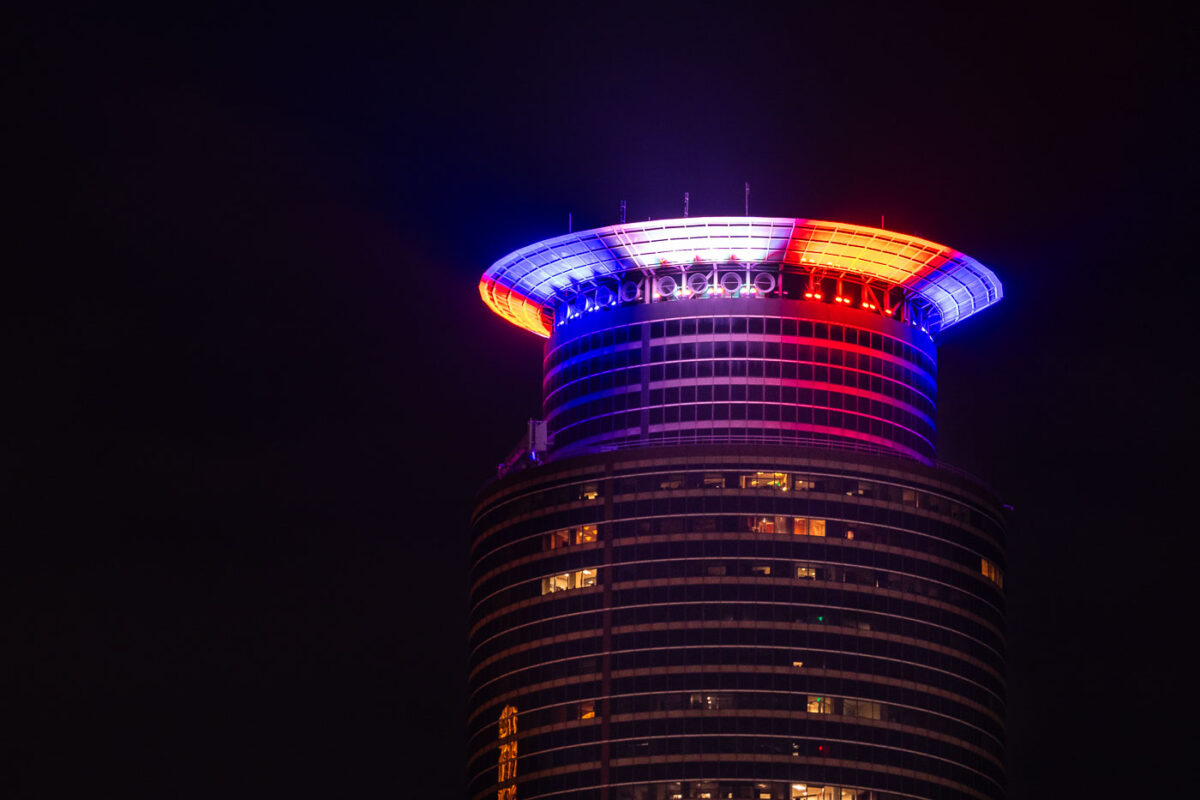
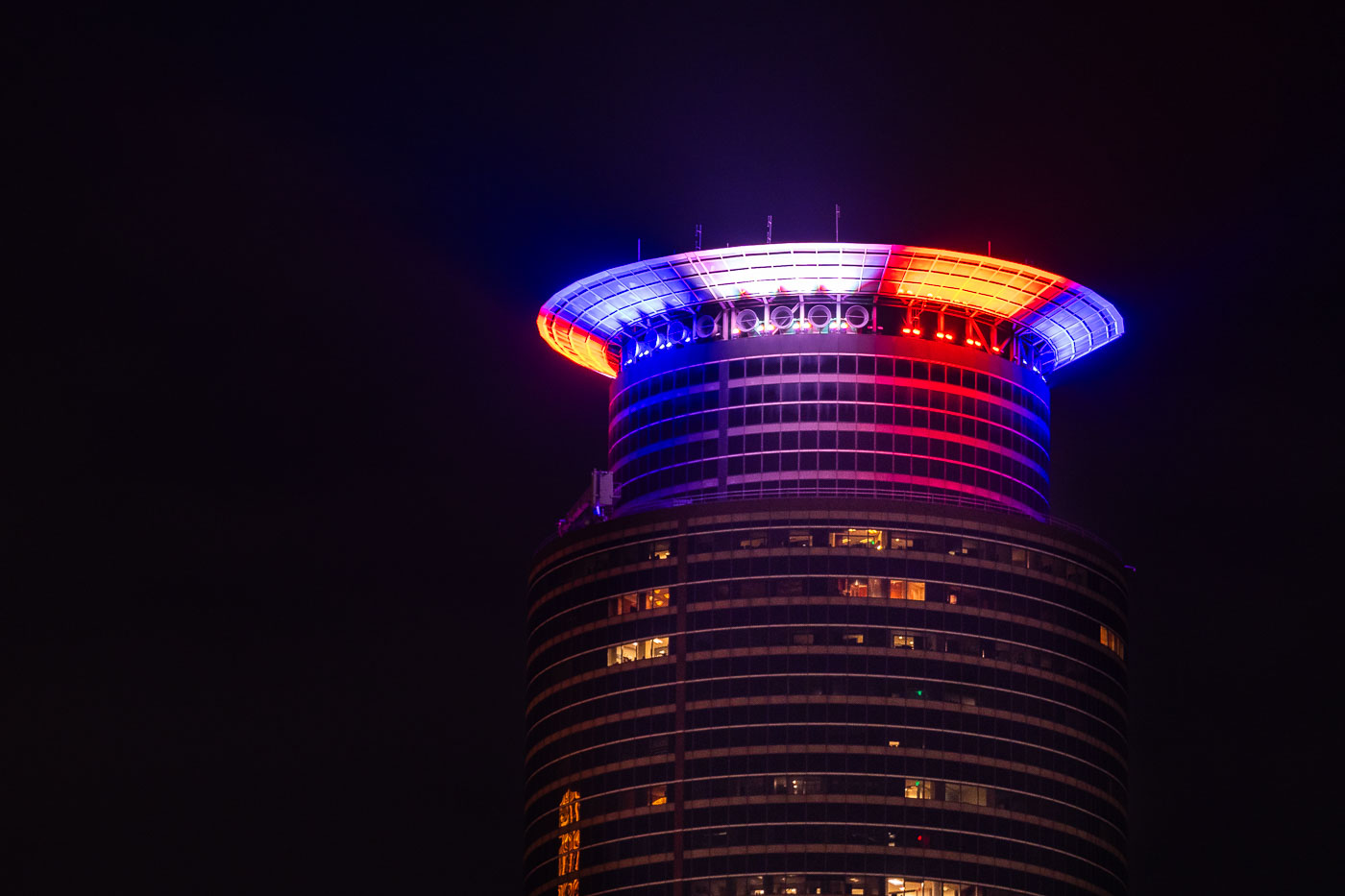
Capella Tower in red white and blue on January 6
Capella Tower in downtown Minneapolis is illuminated in red, white, and blue lights. The building, completed in 1992, is a prominent feature of the Minneapolis skyline and houses offices and hotel accommodations. The patriotic lighting on January 6, 2021, coincided with the attack on the United States Capitol Building in Washington D.C., reflecting a moment of national turmoil and remembrance.

Capella Tower, Minneapolis, Lit Red, White, Blue
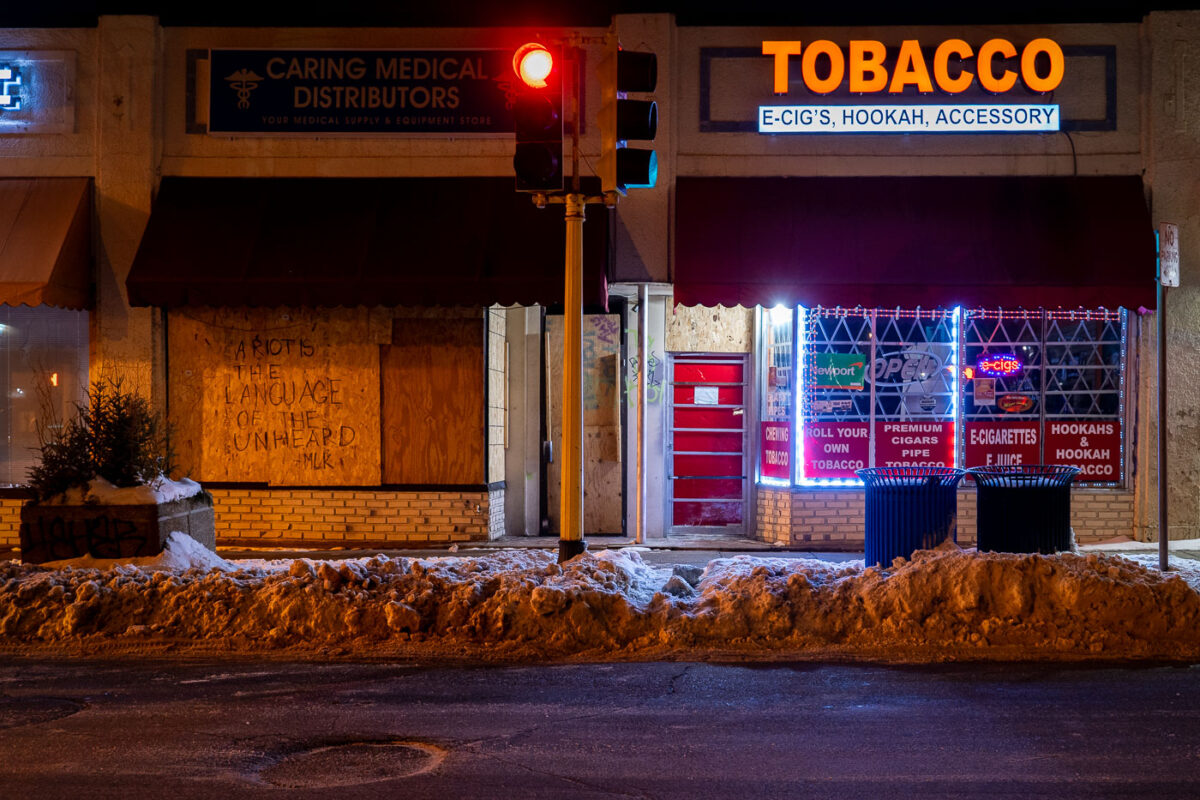
A riot is the language of the unheard on Nicollet Mall
Boarded storefronts on Nicollet Mall in Minneapolis, with graffiti reading "A riot is the language of the unheard" attributed to MLK. The image captures the aftermath of civil unrest, likely related to the Minneapolis Uprising of 2020, which followed the murder of George Floyd. Nicollet Mall, a prominent pedestrian mall in downtown Minneapolis, experienced significant damage and looting during this period. The plywood coverings and graffiti serve as a visual testament to the events and the community's response.

Nicollet Mall boarded storefront with graffiti, Minneapolis
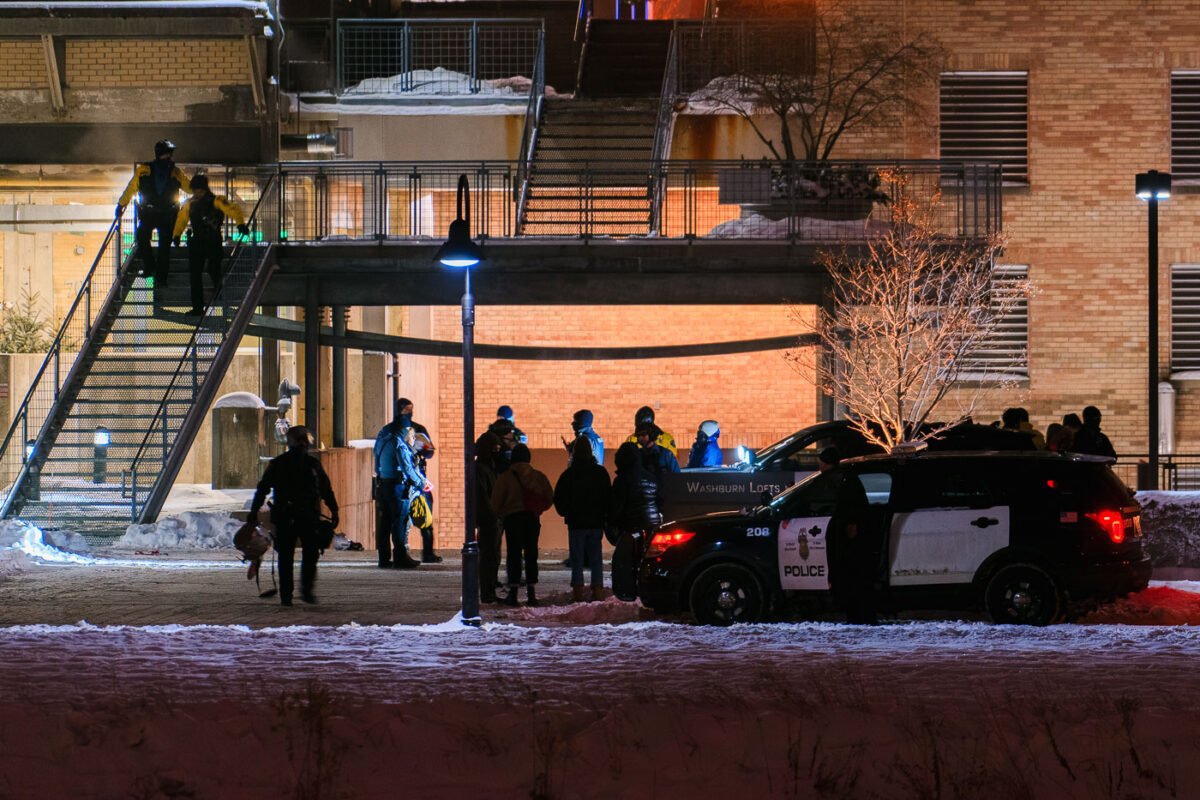
Minneapolis Police arrest 40 at Noise Demo protest
Minneapolis Police arrested approximately 40 individuals on New Year's Eve at Mill Ruins Park during an annual "Noise Demonstration." This protest, part of a nationwide movement, called for the abolition of prisons and expressed solidarity with incarcerated individuals. The demonstration took place in downtown Minneapolis, a location with a rich history tied to the city's milling industry and now a public space.

Minneapolis Police Arrest 40 at Noise Demo Protest
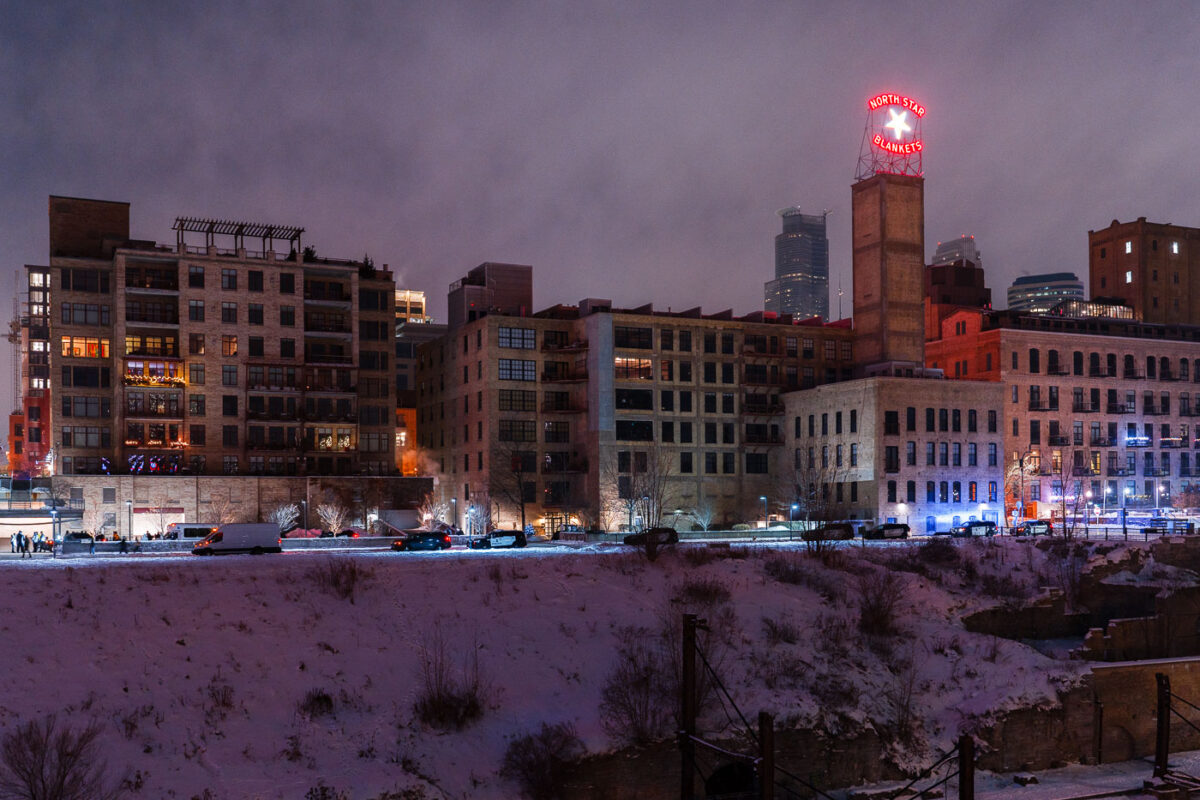
Minneapolis Police arrest 40 at New Years Eve protest
On New Year's Eve, Minneapolis Police arrested approximately 40 individuals at Mill Ruins Park during a "Noise Demonstration." This annual protest calls for the abolition of prisons and expresses solidarity with incarcerated people. The Mill Ruins Park area, located in downtown Minneapolis, is a historic site that was once the heart of the city's flour milling industry, with remnants of its industrial past visible in the ruins and repurposed brick buildings that now house residences and businesses.

Minneapolis Police Arrest 40 at New Year’s Eve Protest
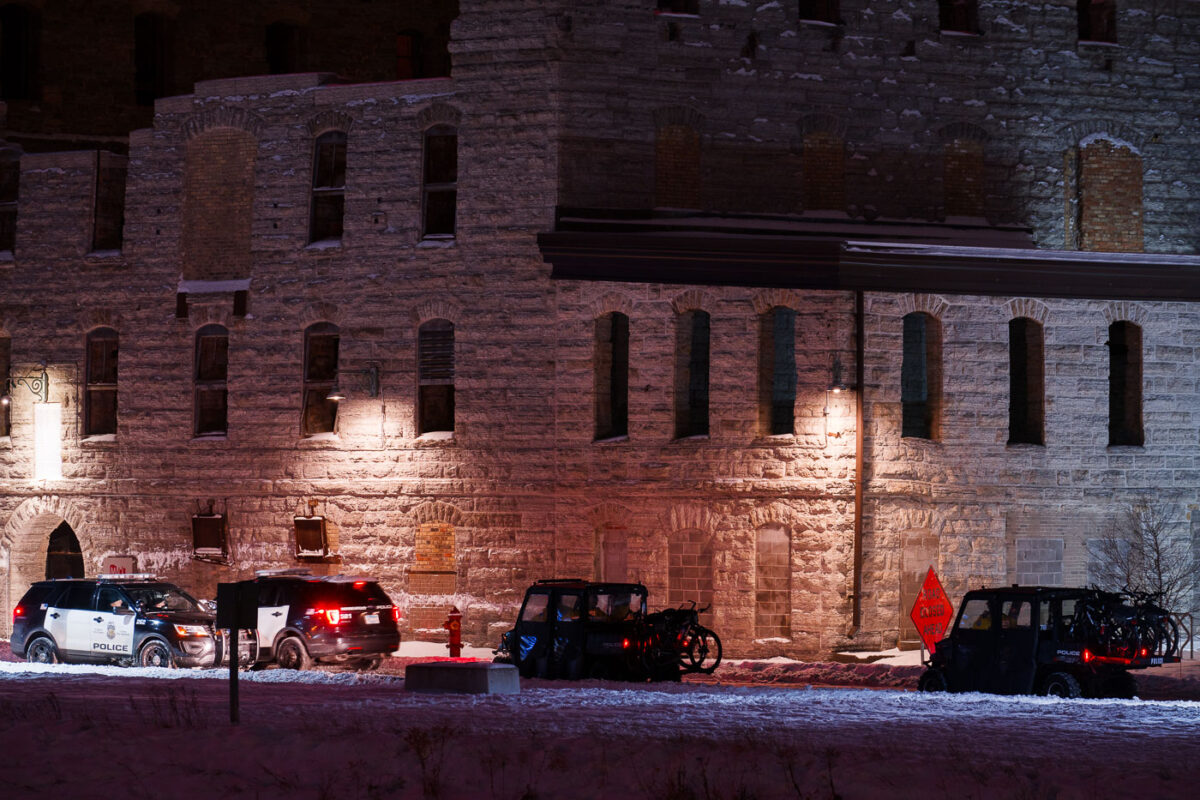
Mnneapolis police make arrest at Noise Demo protest
Police vehicles are present at Mill Ruins Park in Minneapolis on New Year's Eve, following a protest. Approximately 100 individuals gathered in response to a nationwide call to protest the imprisonment of state inmates. The protest escalated when the jail was spray-painted, leading to a significant police response involving Minneapolis Police, State Patrol, Golden Valley PD, and Hennepin Sheriffs, resulting in numerous arrests. Mill Ruins Park, located on the Mississippi River, is a historic site that was once the heart of Minneapolis's flour milling industry.

Minneapolis Police Arrests at Noise Demo Protest, Mill Ruins Park
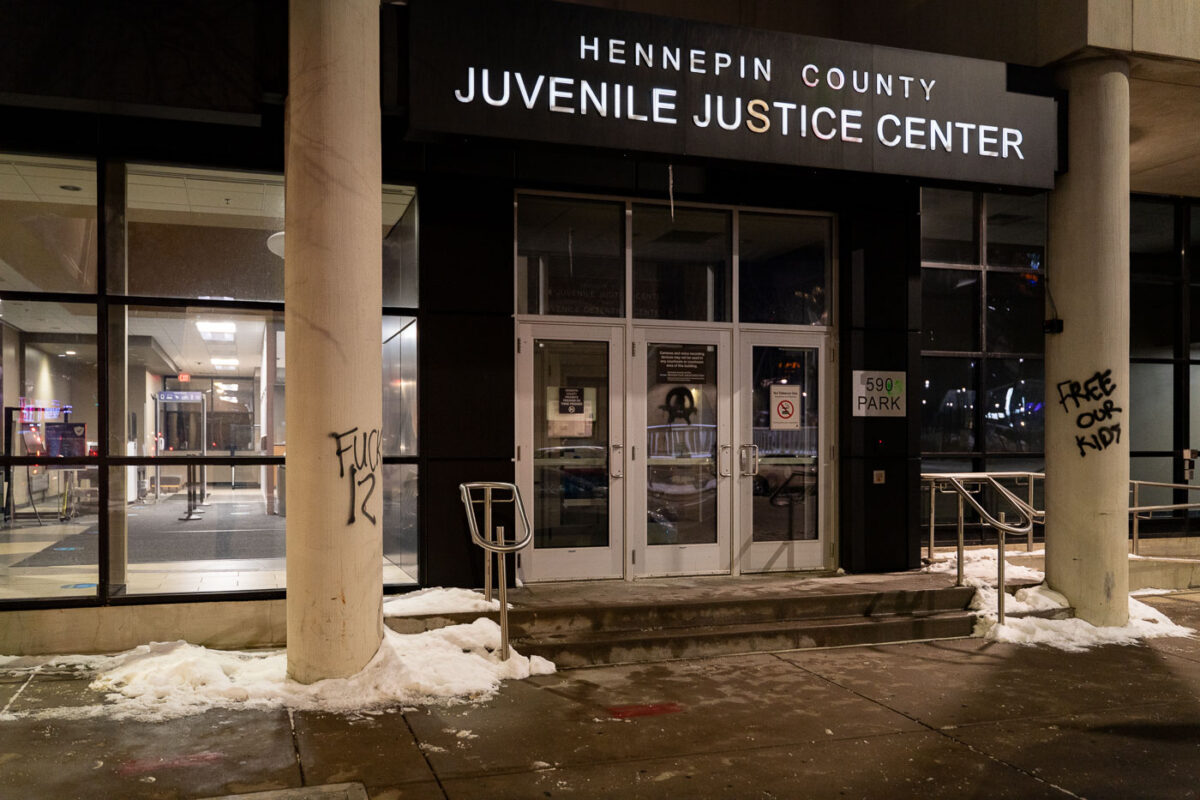
Anarchist Graffiti on Hennepin County Juvenile Justice center
On New Year's Eve, approximately one hundred individuals gathered for a nationwide call to protest in support of those incarcerated by the state. The Minneapolis Police Department, State Patrol, Golden Valley Police Department, and Hennepin County Sheriff's Office, along with aerial surveillance, responded to the Hennepin County Juvenile Justice Center. This response occurred after the building was spray-painted with graffiti, leading to the arrest of dozens of participants. The graffiti visible on the building's pillars includes the phrases "Fuck 12" and "Free Our Kids," reflecting anti-police sentiment and concern for youth in the justice system.

Minneapolis Juvenile Justice Center Graffiti and Protest Site
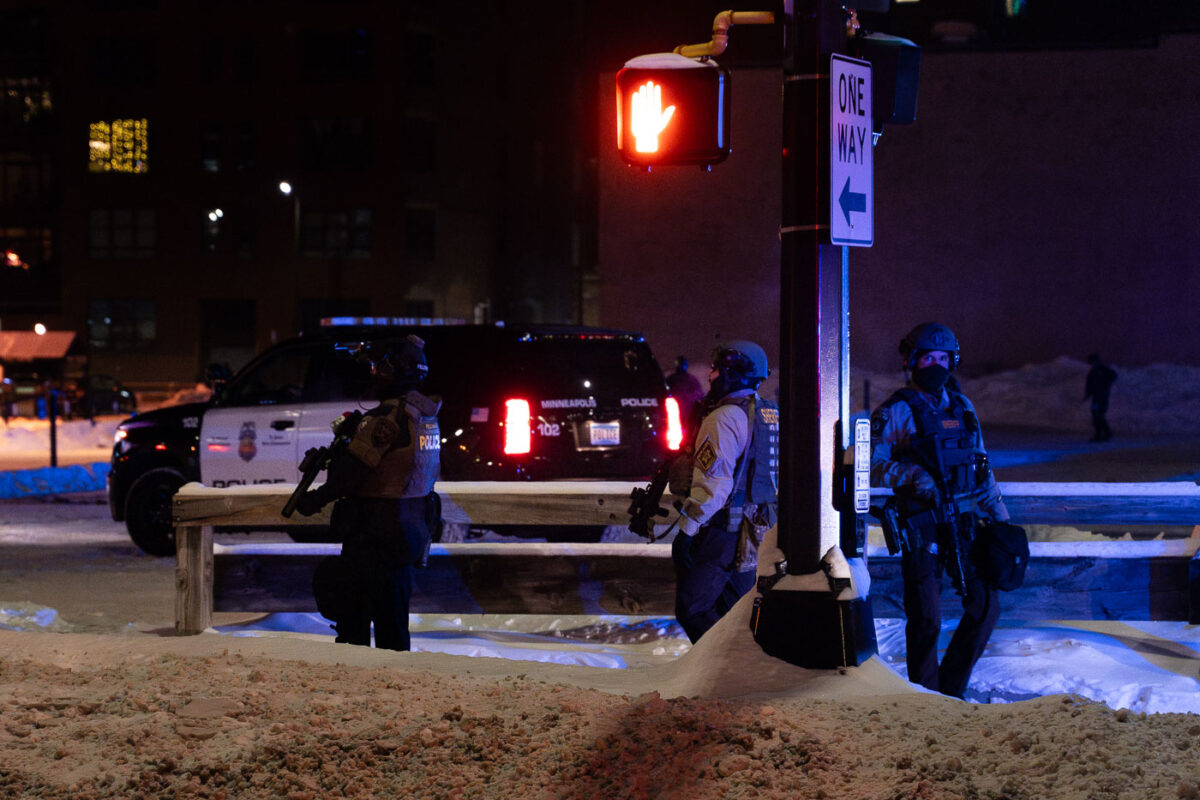
Police look for protesters on new years
On New Year's Eve, approximately 100 individuals gathered in Downtown Minneapolis for a nationwide protest supporting those imprisoned by the state. Following an incident where the Hennepin County Jail was spray-painted, multiple law enforcement agencies, including Minneapolis Police, State Patrol, Golden Valley Police Department, and Hennepin County Sheriffs, responded to the area. This coordinated response, which included state aerial surveillance, led to the arrest of dozens of participants.

Minneapolis Police & Hennepin Sheriff Respond to Noise Demo
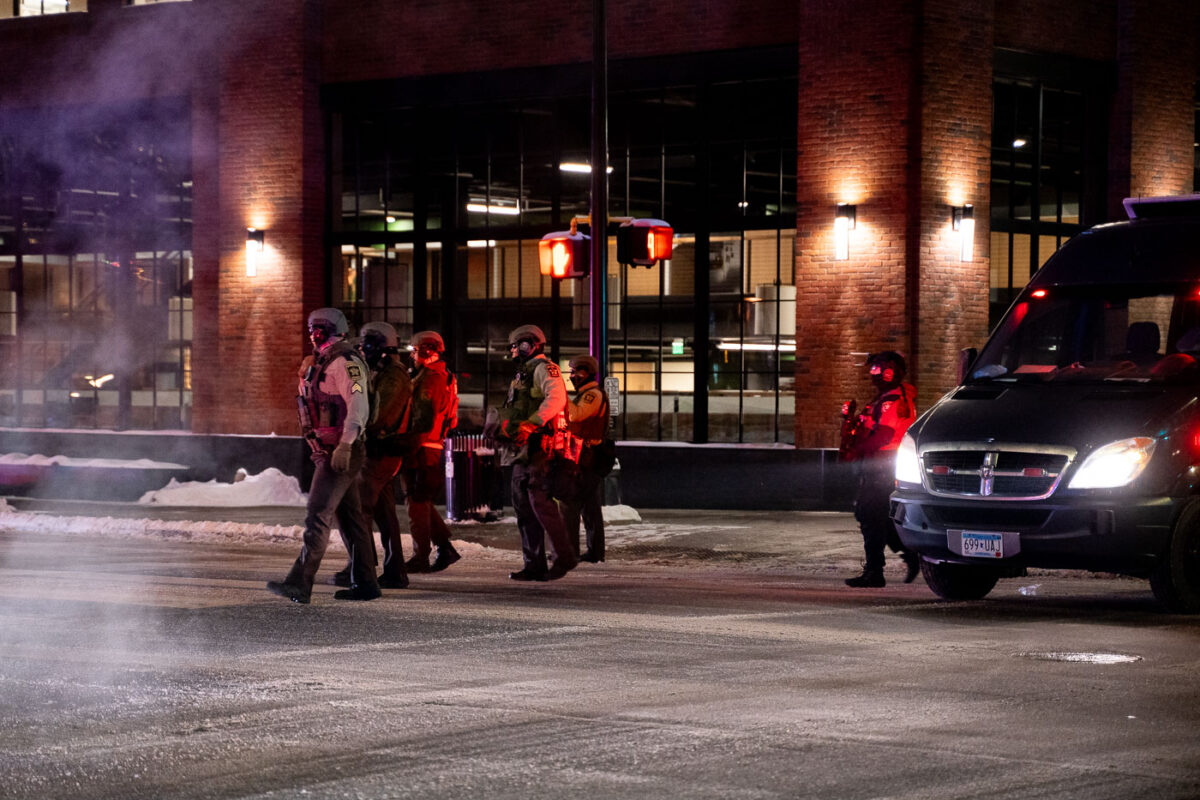
Police at new years eve protest
Hennepin County Sheriff's Department deputies are present in Downtown Minneapolis during a New Year's Eve protest. This event was part of an annual nationwide "Noise Protest" organized to call for the abolishing of prisons and to stand in solidarity with incarcerated individuals. The protest in Minneapolis led to approximately 40 arrests, reflecting ongoing public engagement with issues of criminal justice and incarceration.

Hennepin County Sheriff at Minneapolis New Year’s Eve Protest
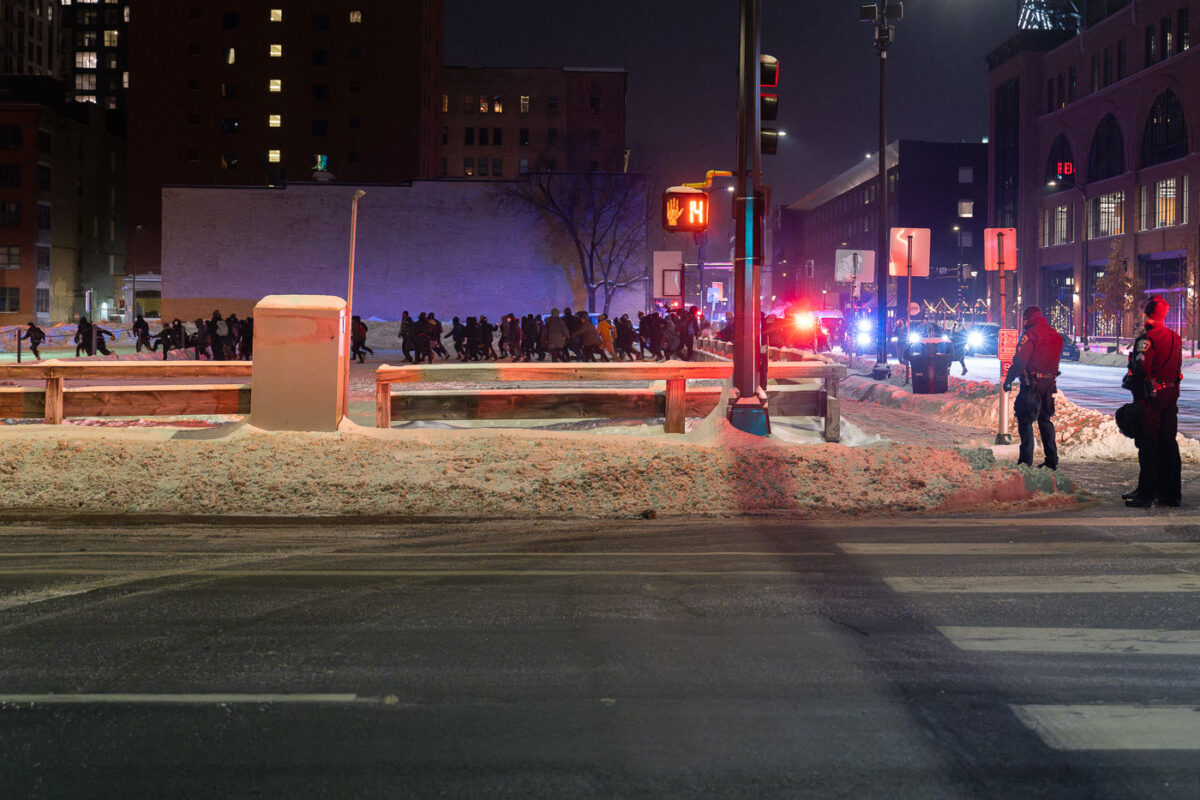
Noise demo protest in Minneapolis
A New Year's Eve protest took place in Downtown Minneapolis, part of a nationwide call to support individuals imprisoned by the state. Approximately one hundred participants gathered in the urban environment. Law enforcement agencies, including the Minneapolis Police, State Patrol, Golden Valley PD, and Hennepin Sheriffs, responded to the event. Dozens of arrests were made after the Hennepin County Jail was spray-painted during the protest.

Downtown Minneapolis Protest, Police Response

Demolition of a building in the snow
An excavator operates amidst snow-covered rubble at the demolition site of former businesses on Lake Street in Minneapolis. These structures, which included Minnehaha Liquors, a chiropractor’s office, and GM Tobacco, were destroyed during the widespread protests and civil unrest that followed the May 25, 2020 death of George Floyd.

Excavator at Minnehaha Liquors Demolition, Minneapolis
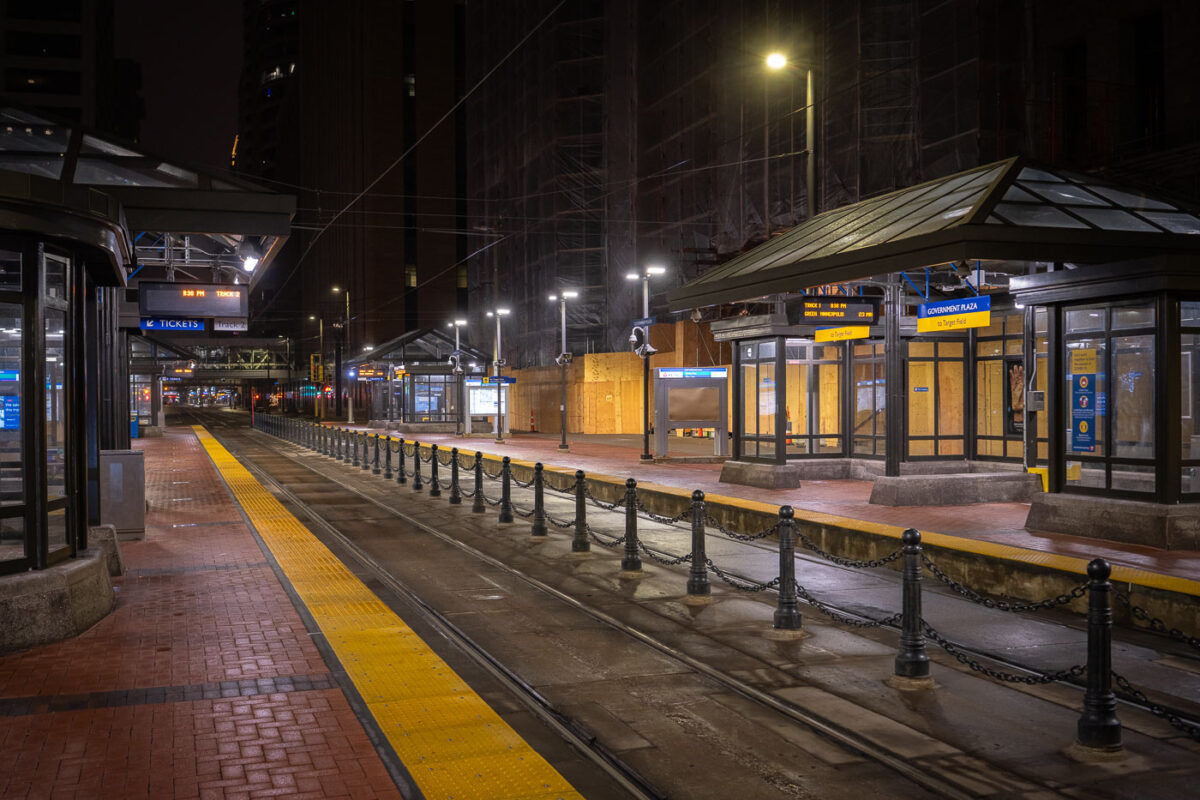
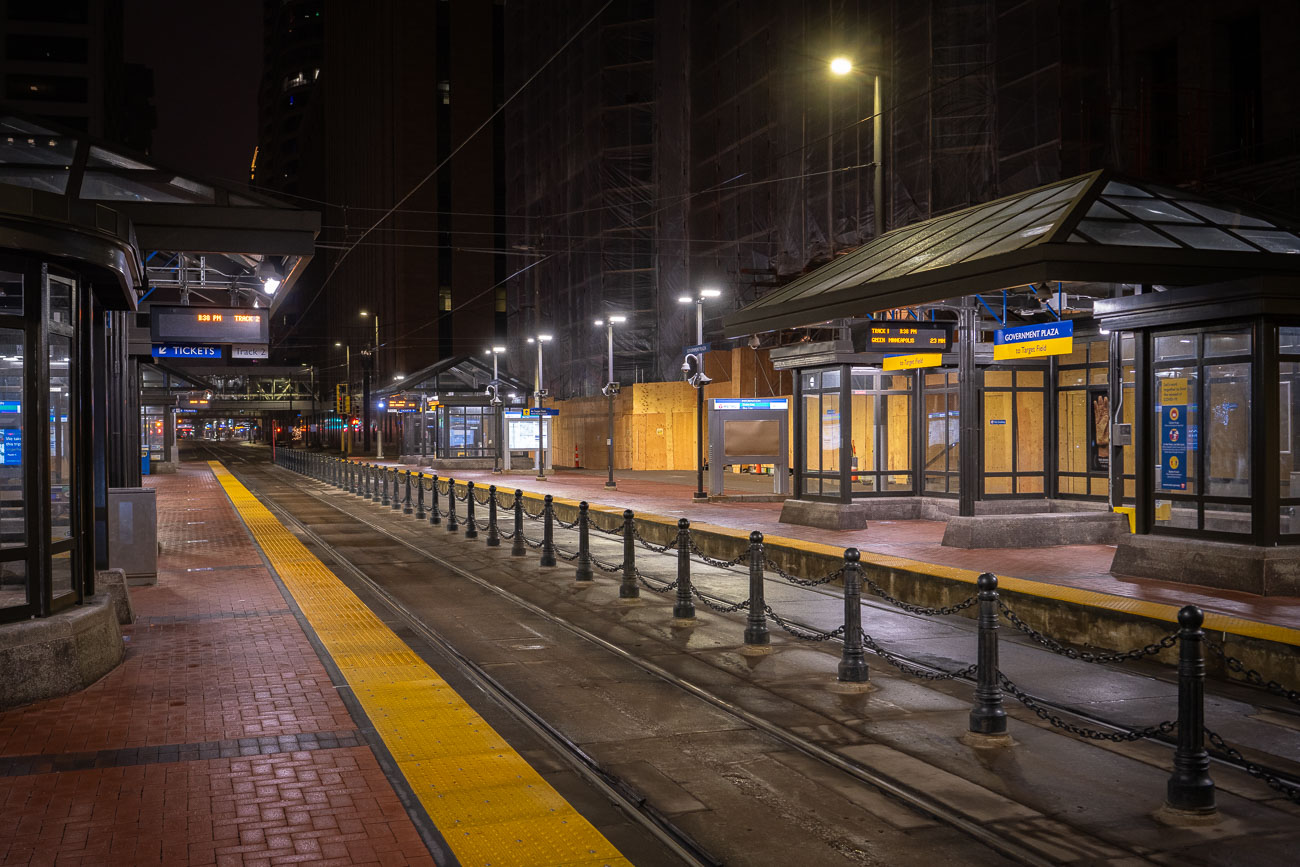
City Hall train station in Minneapolis
Government Plaza station serves as a key transit hub for the Green Line and Blue Line light rail services in downtown Minneapolis. Opened in 2004, the station is situated beneath the plaza of the same name, connecting commuters and visitors to the heart of the city's business and government district. Pictured here during COVID-19 shutdowns.

Government Plaza LRT Station, Downtown Minneapolis
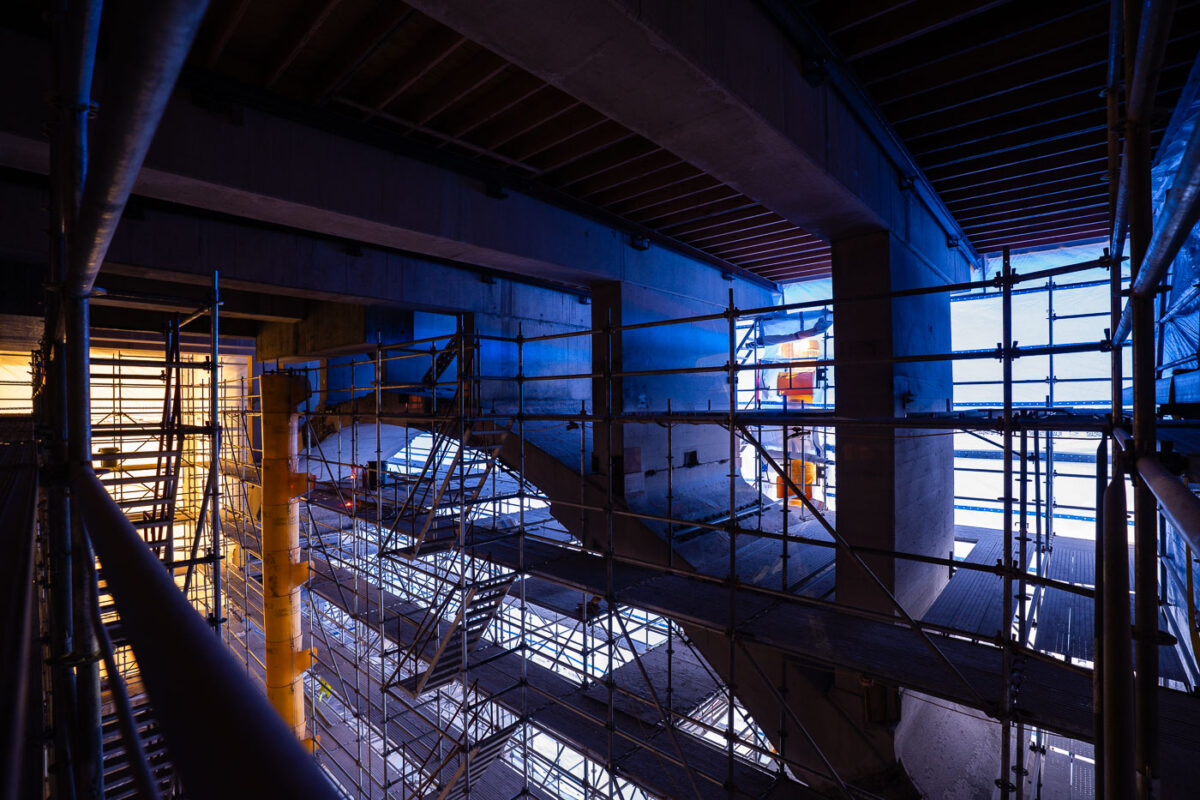
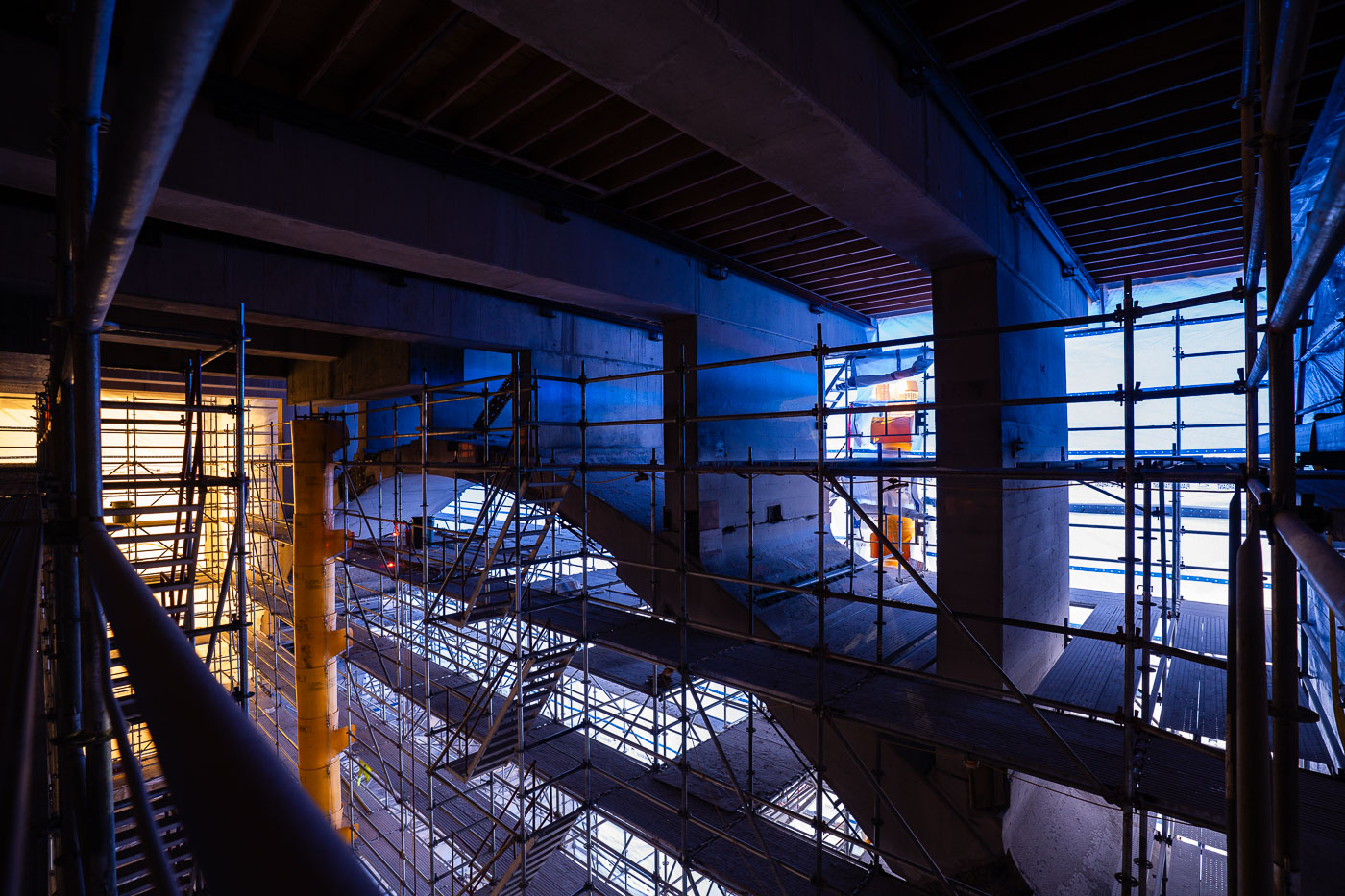
10th Avenue Bridge rehabilitation scaffolding beneath the bridge in downtown Minneapolis.
10th Avenue Bridge rehabilitation scaffolding in downtown Minneapolis. The temporary platform system surrounds the underside of the Mississippi River crossing during a major bridge rehab project. The structure provided worker access to bridge components during construction and maintenance work.

10th Avenue Bridge Rehabilitation Scaffolding, Minneapolis

Hilton Garden Inn hotel illuminated at night in downtown Minneapolis surrounded by office buildings.
The Hilton Garden Inn Minneapolis Downtown sits at 1101 Nicollet Mall, within a few blocks of the Minneapolis Convention Center and Orchestra Hall. It's part of the wave of hotel construction that filled in downtown Minneapolis blocks in the 2000s to serve convention and business travel near Nicollet Mall.

Hilton Garden Inn on Nicollet Mall, Minneapolis
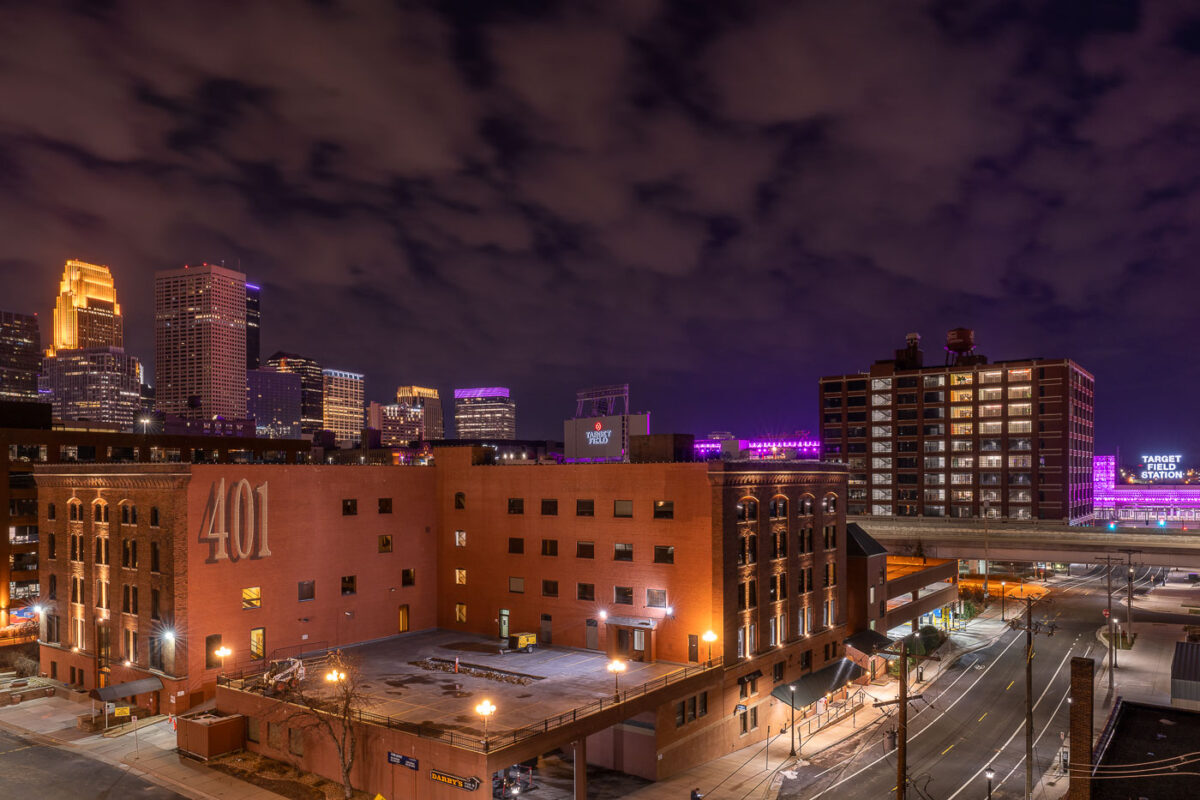
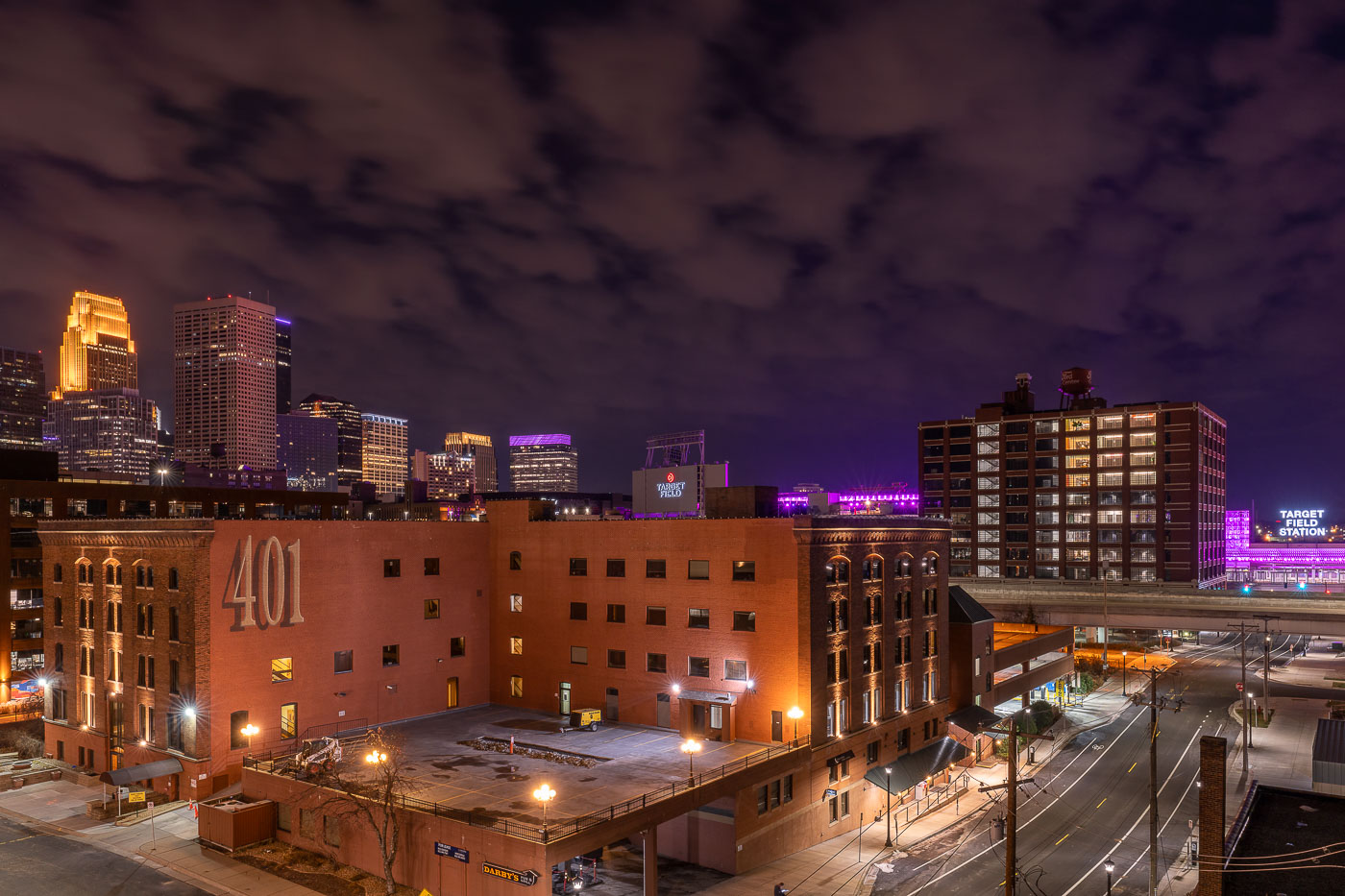
The 401 Building, a converted warehouse with residential units, anchors North Loop with downtown Minneapolis skyline beyond at
The 401 Building at 401 North Third Street began as a warehouse in the North Loop's old warehouse district, part of the milling and shipping infrastructure that once served the riverfront. Like many of its neighbors, it's since been converted to loft-style condominiums and commercial space, a common path for the district's brick-and-timber buildings since the 1980s. Target Field Station, visible to the east, opened in 2014 as a transit hub serving Northstar Commuter Rail, light rail, and bus routes, along with a public plaza used for Minnesota Twins game-day events. Downtown Minneapolis rises beyond both, its cluster of high-rises anchored by the IDS Center and Wells Fargo Center towers.

The 401 Building and Minneapolis Skyline From North Loop
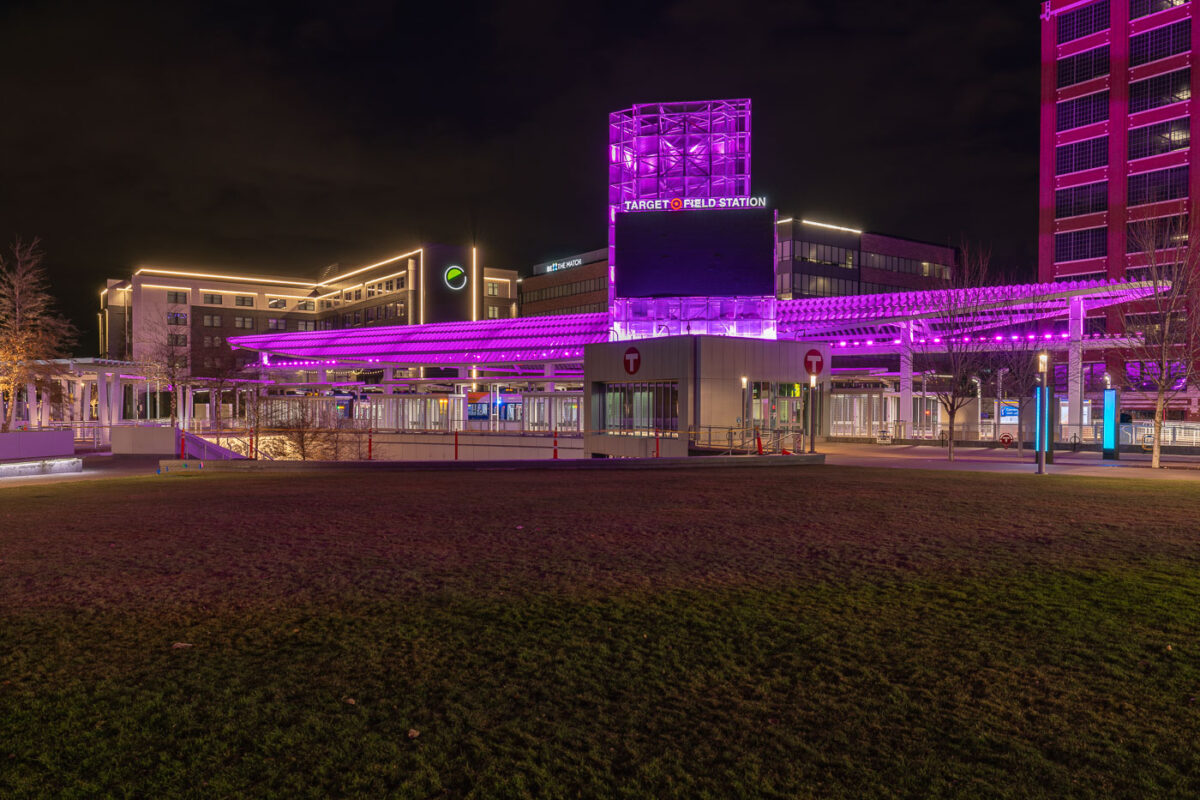
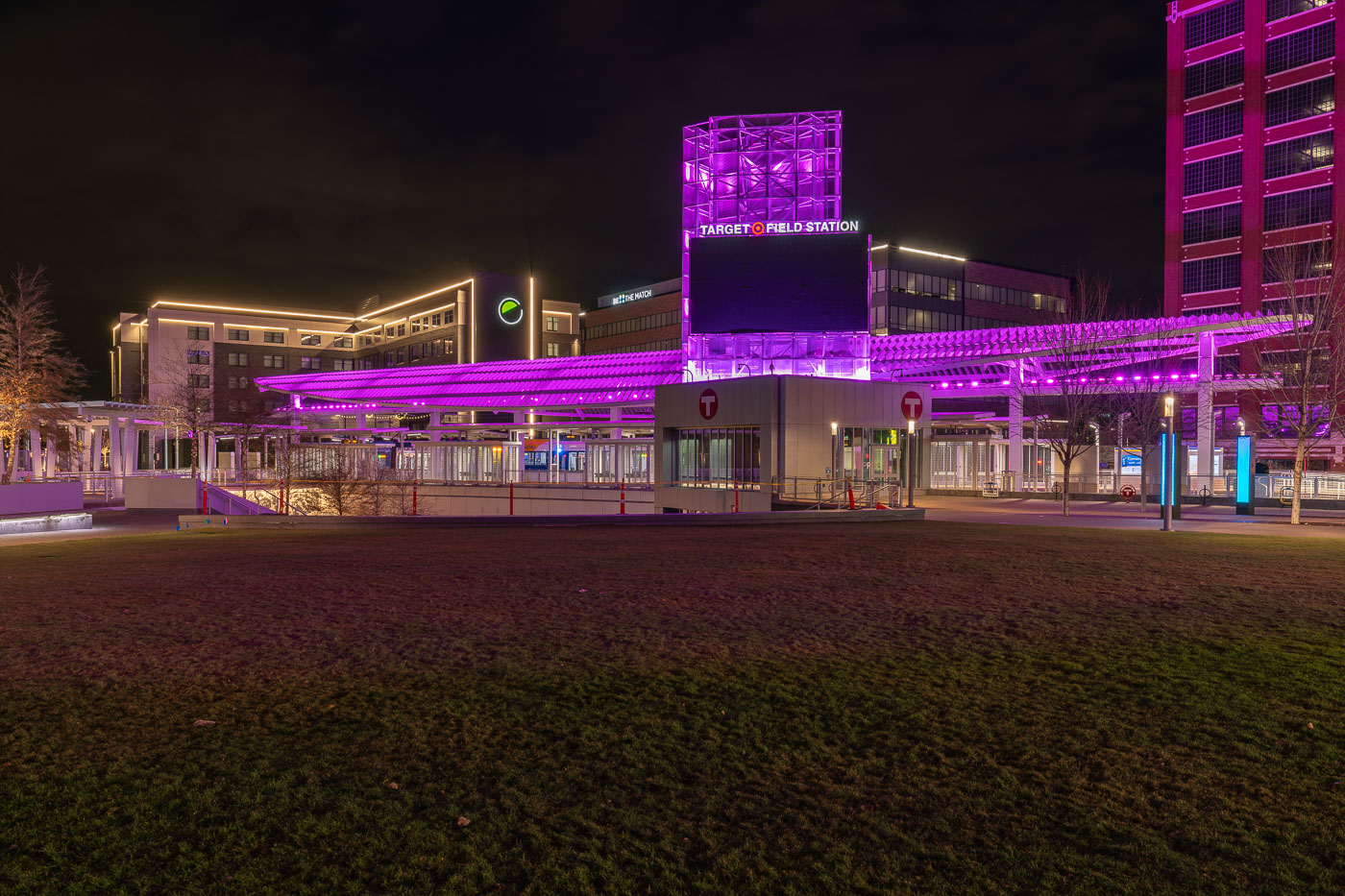
Target Field Station light rail transit hub glows with purple lighting at night in downtown Minneapolis.
Target Field Station opened in 2014 as the transit hub serving Target Field and the North Loop. It's a stop on both the METRO Green Line and Blue Line, connecting downtown Minneapolis to St. Paul, the airport, and Mall of America. A public plaza next to the station hosts pregame gatherings before Twins games.

Target Field Station in Downtown Minneapolis

Boarded UnBank branch on Hennepin Avenue displays "Open" banner despite plywood-covered windows during Minneapolis November 2020.
The UnBank Company operates check-cashing and short-term loan storefronts, marketed as an alternative to traditional banks for customers without conventional accounts. This branch sits on Hennepin Avenue in downtown Minneapolis, its windows and doors covered in plywood while a banner reading "Yes, We Are OPEN For You!" hangs across the boards. Neon signs for "Cash Loans" and "Checks Cashed" remain part of the storefront, advertising the same services the plywood was meant to protect. Metal barricades stand along the sidewalk in front of the entrance.

Boarded UnBank Branch on Hennepin Avenue, “Yes, We Are Open”

State Theatre marquee in downtown Minneapolis displays art installation and Martin Luther King Jr. quote during snowstorm.
The State Theatre opened in 1921 on Hennepin Avenue as a movie palace, part of downtown Minneapolis's early 20th-century theater district. Architect J.R. Davidson designed the building in the Renaissance Revival style typical of the era's movie palaces. After decades as a cinema, the theater was restored as a live performance venue and now operates under Hennepin Theatre Trust, alongside the nearby Orpheum and Pantages theaters. Its marquee has displayed "The Overseer: Divinity and Humanity," an installation by artist Reggie Leflore, paired with a quote from Martin Luther King Jr.

The State Theatre Marquee During a Hennepin Avenue Snowstorm

Maruso Bar's neon sign glows on Hennepin Avenue in downtown Minneapolis during heavy November snowfall.
Maruso Bar sits on Hennepin Avenue in downtown Minneapolis, a stretch of the street long associated with the city's nightlife and entertainment district near First Avenue and the Hennepin Theatre District.

Snowfall Outside Maruso Bar on Hennepin Avenue

Worker operating snow blower on downtown Minneapolis sidewalk during heavy snowfall, November 2020.
A worker clears fresh snow from a downtown Minneapolis sidewalk with a walk-behind snow blower, working past a U.S. Bank branch. Minnesota's first significant snowfall of the 2020-21 season arrived in mid-November, catching the Twin Cities before many businesses had switched from fall to winter maintenance routines. Downtown property managers and city crews typically have a matter of hours to clear walkways after a storm, since Minneapolis code requires adjacent property owners to keep public sidewalks passable.

Clearing Snow Outside a U.S. Bank Branch in Downtown Minneapolis

Minnesota State Patrol LRAD and arrest buses parked at Minneapolis Convention Center at night.
The Minneapolis Convention Center became a temporary base for Minneapolis Police's Third Precinct after the original station on Lake Street burned during the unrest following George Floyd's murder in May 2020. Minnesota State Patrol units, including LRAD (Long Range Acoustic Device) vehicles and transport buses, staged at the center's loading docks during subsequent protests in the city. The Third Precinct's relocation to the Convention Center kept a police presence in downtown Minneapolis while officials debated whether and where to rebuild the burned station.

State Patrol Bus Staged at Minneapolis Convention Center Loading Dock

Minnesota State Patrol vehicles and arrestee transport buses parked at Minneapolis Convention Center temporary precinct at night.
The Minneapolis Convention Center, at 1301 Second Avenue South, became a temporary precinct for Minneapolis police after the Third Precinct building on Lake Street burned during the unrest following George Floyd's killing in May 2020. Minnesota State Patrol vehicles and prisoner transport buses staged at the center's loading docks, marked D East and C West, during subsequent demonstrations in the city. The convention center, which normally hosts trade shows and public events, sits blocks from the Nicollet Mall skyway system and downtown high-rises visible along the skyline behind it.

Prisoner Transport Buses at the Minneapolis Convention Center

US Bank Plaza entrance in downtown Minneapolis with boarded plywood windows during November 2020.
US Bank Plaza rises 40 stories at 200 South 6th Street, one of downtown Minneapolis's taller office towers since its completion in 1981. The building takes its name from its anchor tenant, U.S. Bank, though it houses numerous other business tenants across its floors. Plywood paneling over its ground-floor entrances as a precaution many downtown property owners took to guard against window damage during periods of unrest in the city.

Plywood Covers the Entrance at US Bank Plaza

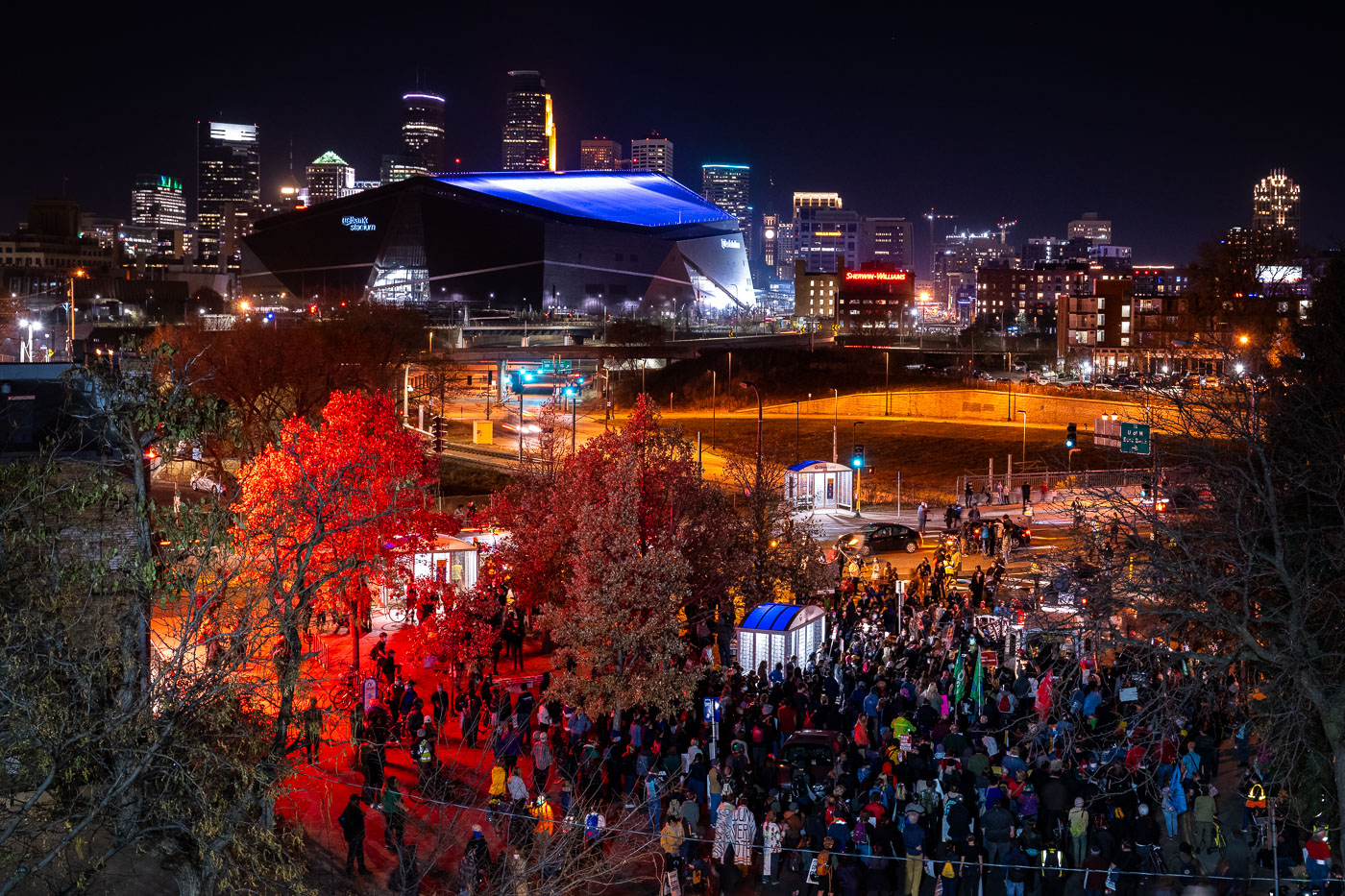
Crowd of protesters gathers in downtown Minneapolis at night near U.S. Bank Stadium during November 2020 march.
Crowds gathered near U.S. Bank Stadium on the night of November 4, 2020, the evening after Election Day, before marching toward Interstate 94. Minnesota State Patrol and Minneapolis police later arrested 646 people for occupying the highway, the largest mass arrest in state history.

Post-Election Protest March Near U.S. Bank Stadium
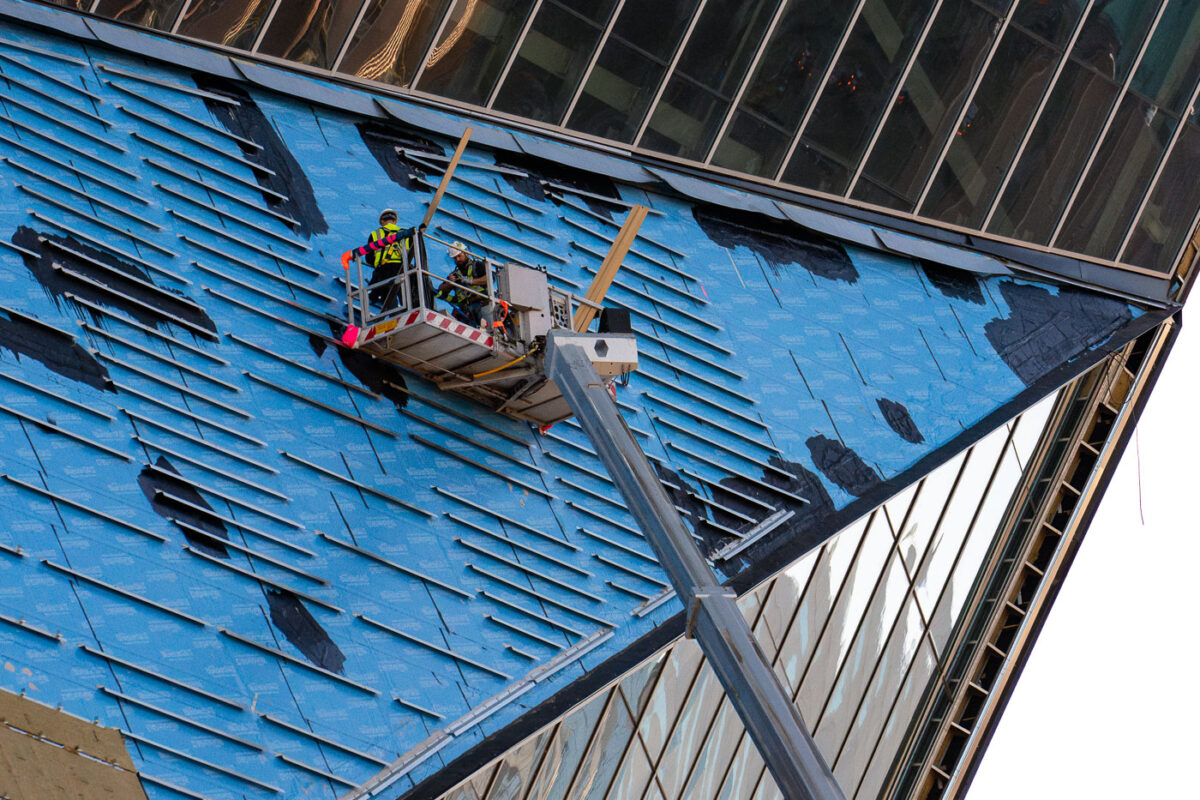
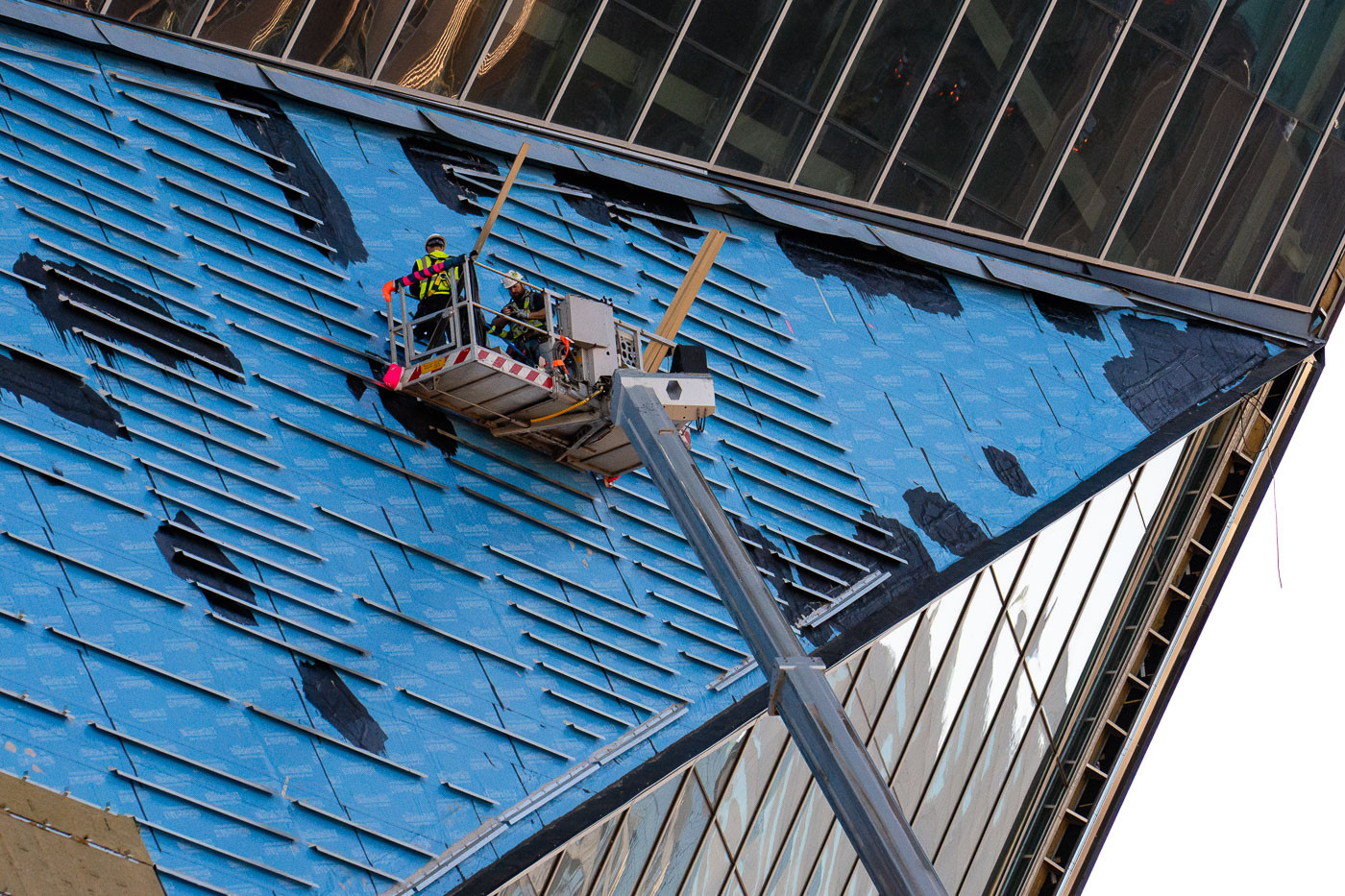
US Bank Stadium exterior repair work in downtown Minneapolis with workers in a lift.
US Bank Stadium in downtown Minneapolis underwent exterior repair work in November 2020. Workers in a lift were repairing damaged sections of the stadium’s angular outer facade.

US Bank Stadium Exterior Repair, Minneapolis

Minneapolis police officers monitor protesters marching on Interstate 94 during a November 2020 demonstration.
Officers from the Minneapolis Police Department hold a pedestrian overpass above Interstate 94 as protesters fill the freeway below. The demonstration followed the November 2020 election, when marchers moved from downtown Minneapolis toward Cedar-Riverside to protest the presidential race outcome. Minnesota State Patrol and Minneapolis Police later blocked both ends of the freeway and detained roughly 646 people, one of the largest mass arrests in the state's history. Interstate 94 links Minneapolis and St. Paul and has been a repeated site of demonstrations shutting down traffic in both cities.

Police Line an I-94 Overpass During Minneapolis Protest

Nighttime protest on Interstate 94 in Minneapolis with hundreds of demonstrators holding signs and banners advocating for police
Interstate 94 cuts through downtown Minneapolis, linking the Twin Cities and carrying tens of thousands of vehicles daily under normal conditions. Marchers shut the freeway down as they moved through carrying banners reading "No Killer Cops" and "The Whole Damn System Is Guilty as Hell." Protesters occupying the interstate led Minnesota State Patrol and Minneapolis police to close lanes and, on several nights that fall, make mass arrests of demonstrators for blocking the roadway. Banners referencing Black, Native, and immigrant communities point to organizing coalitions that linked police violence with ICE raids and broader demands for systemic change.

Banners and Marchers Fill Interstate 94 at Night

Night protest march on Interstate 94 in Minneapolis with participants carrying signs and banners for social justice.
This march moved onto Interstate 94 near downtown Minneapolis, shutting down a stretch of the freeway that links the city's core to neighborhoods on its edges. Demonstrators carried signs and a banner reading "All Power to the People," part of a wave of protests that followed the 2020 election. Minnesota State Patrol and Minneapolis police later closed in on marchers on the freeway, leading to roughly 646 arrests and citations — one of the largest mass detentions in the state's history.

Protesters March Onto Interstate 94 at Night in Minneapolis

News helicopter flying over Minneapolis City Hall's spires against a blue sky.
Minneapolis City Hall, completed in 1906, houses the seat of government for both the city and Hennepin County under one Romanesque Revival roof. Its clock tower rises 345 feet, making it one of the taller landmarks on the downtown skyline. The building was designed by Long and Kees and remains listed on the National Register of Historic Places.

Helicopter Circles Minneapolis City Hall’s Clock Tower

Saks Off 5th Avenue storefront in Downtown Minneapolis displays boarded windows with civic unity signs.
The Saks Off 5th storefront on Nicollet Mall in downtown Minneapolis stands boarded in plywood, with two posters reading "100% In For Democracy" and "Stronger Together, Better Together, Always Together." Both bear the logo of the Civic Alliance, a nonpartisan coalition of U.S. companies formed in 2020 to encourage voter participation and support election integrity. Saks Off 5th, the discount division of Saks Fifth Avenue, joined dozens of national retailers that boarded storefronts ahead of the 2020 presidential election, anticipating possible unrest tied to the vote count. The image was captured on Election Day, November 4, 2020.

“100% In for Democracy” Signs on Boarded Saks Off 5th Storefront
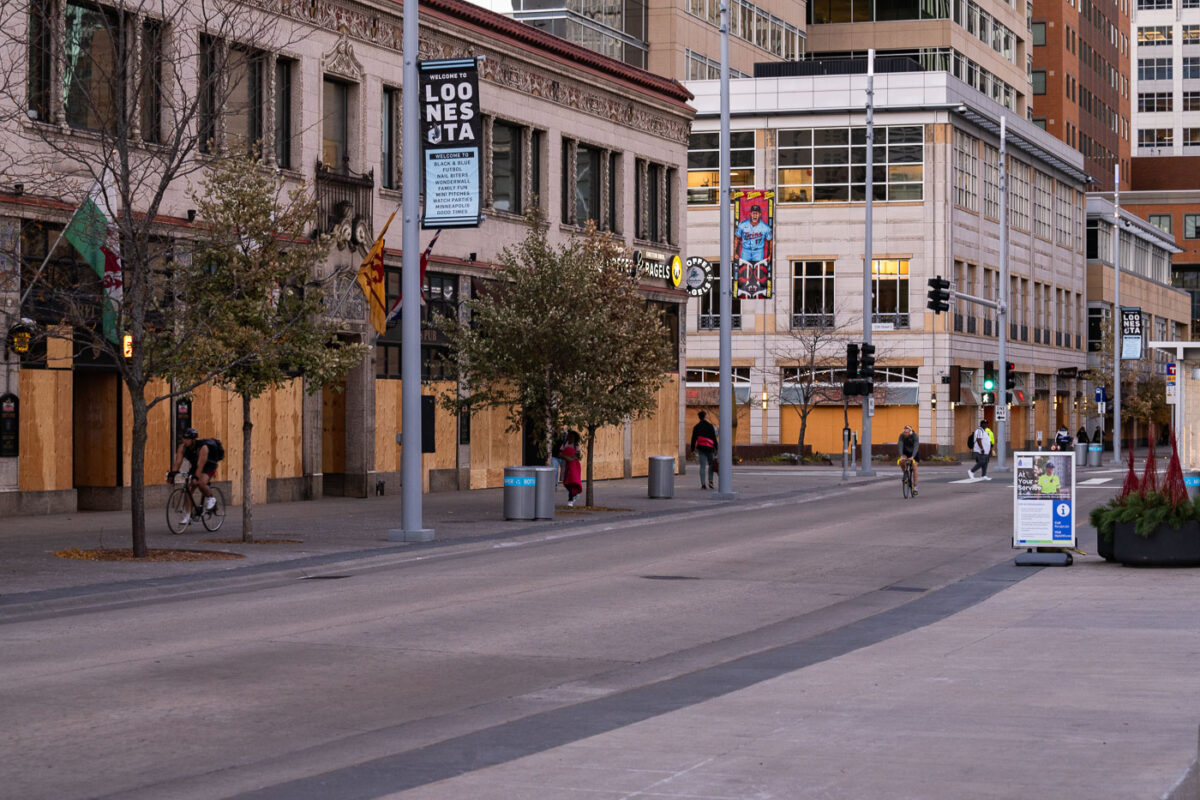
Cyclists and pedestrians move through downtown Minneapolis's Nicollet Mall, where plywood boards cover ground-floor storefronts.
Nicollet Mall in downtown Minneapolis with plywood covers on many ground-floor storefronts in the months after the unrest that followed George Floyd's killing in May 2020.

Boarded Storefronts Along Nicollet Mall

"Vote Here" sign outside Westminster Presbyterian Church in downtown Minneapolis during the 2020 election.
Westminster Presbyterian Church sits at Nicollet Mall and 12th Street in downtown Minneapolis. Founded in 1857, it's one of the city's oldest congregations and has occupied its current Romanesque-style building since 1897. On this Election Day, a digital marquee reading "Vote by Nov. 3!" stood alongside a sidewalk sign marking the church as a polling location. Churches and other community institutions across Minneapolis regularly polling sites during municipal, state, and federal elections.

“Vote by Nov. 3” Sign at Westminster Presbyterian Church

Look down at Nicollet Mall from above
An aerial perspective reveals the distinctive glass-pyramid roof of the Crystal Court, a prominent indoor public plaza located within the IDS Center in downtown Minneapolis.

Crystal Court Roof, IDS Center, Downtown Minneapolis

Riverside Plaza towers in Cedar-Riverside, Minneapolis, with downtown buildings nearby.
Riverside Plaza is a high-rise apartment complex in Minneapolis’s Cedar-Riverside neighborhood. The development includes multiple residential towers near downtown Minneapolis and the Mississippi River. It is one of the largest housing complexes in the area.

Riverside Plaza towers, Cedar-Riverside Minneapolis

Minneapolis police at convention center
Following the destruction of the Minneapolis Third Precinct in May 2020, the Minneapolis Police Department relocated its operations to the Minneapolis Convention Center in Downtown Minneapolis.

Minneapolis Police Station at Convention Center Night

Toussaint Morrison speaks outside of Minneapolis City Hall
Toussaint Morrison addresses a crowd during a protest in Downtown Minneapolis. This march took place the day after former Minneapolis Police officer Derek Chauvin was released on bond. Chauvin was charged in connection with the May 25th death of George Floyd in South Minneapolis.

Toussaint Morrison speaks at Minneapolis protest after Chauvin release

Protesters walk by the 1st precinct police station
Protesters march past the Minneapolis First Precinct in Downtown Minneapolis. This march occurred the day after former Minneapolis Police Officer Derek Chauvin was released on bond. Chauvin had been charged in the May 25, 2020 death of George Floyd, an event that sparked widespread protests against police brutality and racial injustice.

Protesters march past Minneapolis First Precinct after Chauvin release

Protests after Derek Chauvin is released from jail
A protest sign reading "Hey Derek you forgot your hat!" is held during a march in downtown Minneapolis, the day after former Minneapolis Police Officer Derek Chauvin was released on bond. The sign also features a drawing resembling a Ku Klux Klan hood, with additional text including "BREAK THE THIN BLUE LINE" and "ARREST KILLER KKK OPS?". Protesters marched towards the Minneapolis Police 1st Precinct to voice opposition to Chauvin's release and demand police accountability.

Minneapolis Protest Sign: ‘Hey Derek you forgot your hat’

Protesters outside downtown police station
Protesters march through Downtown Minneapolis in October 2020, the day after Derek Chauvin was released on bail. This march was part of sustained protests against police brutality and racial injustice, which intensified following the killing of George Floyd earlier that year. Participants carried signs demanding 'Justice for George Floyd' and advocating for the 'Defund And Abolish' movement, reflecting widespread calls for systemic change.

Protesters march Downtown Minneapolis after Derek Chauvin release

Hennepin County Government Center waterfall
Protesters gather outside the Hennepin County Government Center in Downtown Minneapolis on October 8, 2020. This protest occurred the day after former Minneapolis Police Officer Derek Chauvin was released from jail on bond. Chauvin was charged in the May 25, 2020, death of George Floyd, an event that sparked widespread protests in Minneapolis and globally. The Hennepin County Government Center serves as the primary administrative and judicial hub for Hennepin County, housing courts and government offices.

Hennepin County Government Center Protest after Chauvin Bail

Jail not bail for killer kkkops
Protesters gathered outside the Hennepin County Government Center in Downtown Minneapolis, advocating for "Jail Not Bail" following the release of former Minneapolis Police Officer Derek Chauvin on bond. Chauvin was charged in connection with the May 25th death of George Floyd.

Minneapolis Protest: ‘Jail Not Bail’ for Derek Chauvin

MPLS loves PDX graffiti
The phrase "MPLS <3 PDX" is spray-painted on concrete barriers in Downtown Minneapolis, positioned across from the Hennepin County Jail. This graffiti signifies a connection between Minneapolis and Portland, Oregon, two cities that experienced significant protest activity during the Minneapolis Uprising.

MPLS Loves PDX Graffiti near Hennepin County Jail, Minneapolis

The time is always right to do what is right
The State Theatre, a historic performing arts venue on Hennepin Avenue in downtown Minneapolis, features a marquee displaying a quote from Martin Luther King Jr. The message, "The time is always right to do what is right".

State Theatre Marquee, MLK Quote & Murals, Minneapolis

WCCO TV boarded up in Downtown Minneapolis
The WCCO-TV building on Nicollet Mall in downtown Minneapolis is shown with its exterior boarded up.

WCCO-TV Building Boarded Up on Nicollet Mall, Minneapolis

Nordstrom Rack boarded up at IDS Center
The Nordstrom Rack store is located within the IDS Center, a prominent skyscraper in downtown Minneapolis. Its street-level windows are covered with white-painted boards, installed following widespread civil unrest and property damage that occurred in August 2020.

Boarded Nordstrom Rack, IDS Center, Minneapolis

Flagship Target store boarded up on Nicollet Mall
The Target Flagship Store on Nicollet Mall in downtown Minneapolis stands with its entrance boarded with plywood.

Boarded Flagship Target Store, Nicollet Mall, Minneapolis
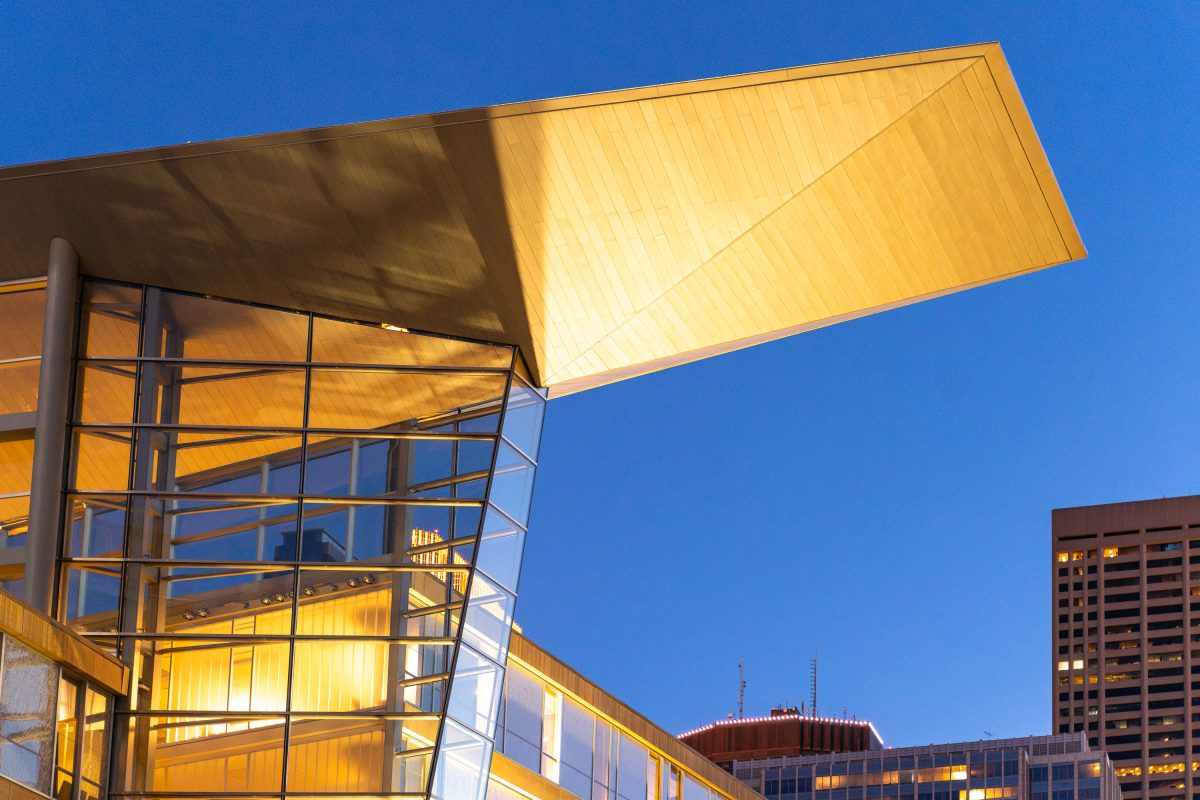
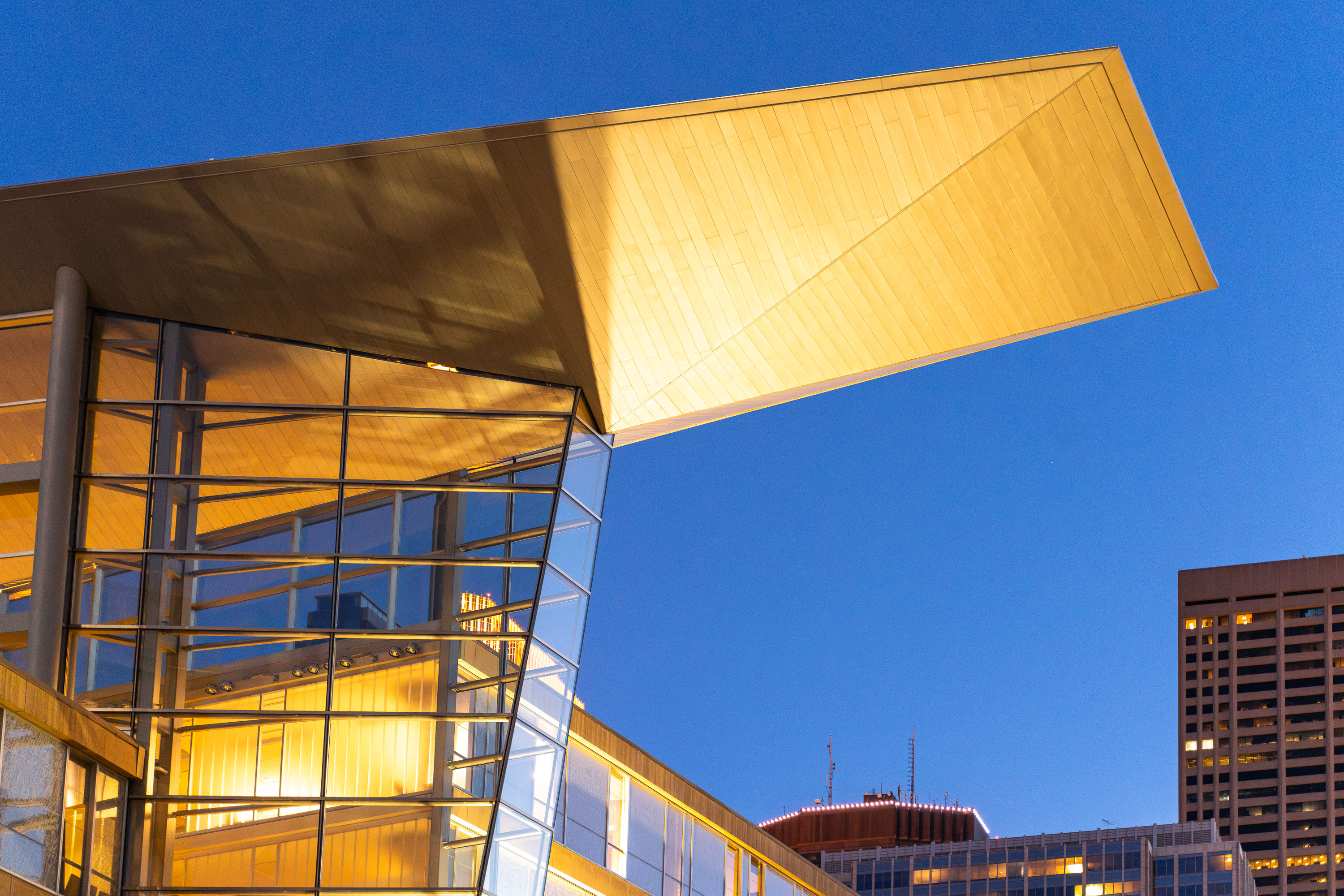
Cantilevered Roof, Minneapolis Central Library
The Minneapolis Central Library sits at 300 Nicollet Mall, designed by Cesar Pelli and opened in 2006 as the fourth building to house the city's central library collection. The building spans about 353,000 square feet across four levels and cost roughly $150 million to construct. Its roof is a signature element of Pelli's design, a cantilevered canopy clad in wood paneling that extends beyond the glass curtain wall below. The library holds the Hennepin County Library system's central collection and includes a rooftop garden, an art gallery, and a special collections department documenting local history.

Cantilevered Roof, Minneapolis Central Library

Red star with "George Floyd" painted on First Avenue concert venue exterior wall in downtown Minneapolis.
The George Floyd memorial star is painted on the exterior wall of First Avenue in downtown Minneapolis. Added in 2020 after Floyd’s killing, the memorial placed his name on one of Minneapolis’s most recognizable entertainment landmarks during a period of mourning and protest in the city.

George Floyd’s Star on First Avenue’s Wall of Fame

Boarded storefronts line Nicollet Mall in downtown Minneapolis at night, September 2020.
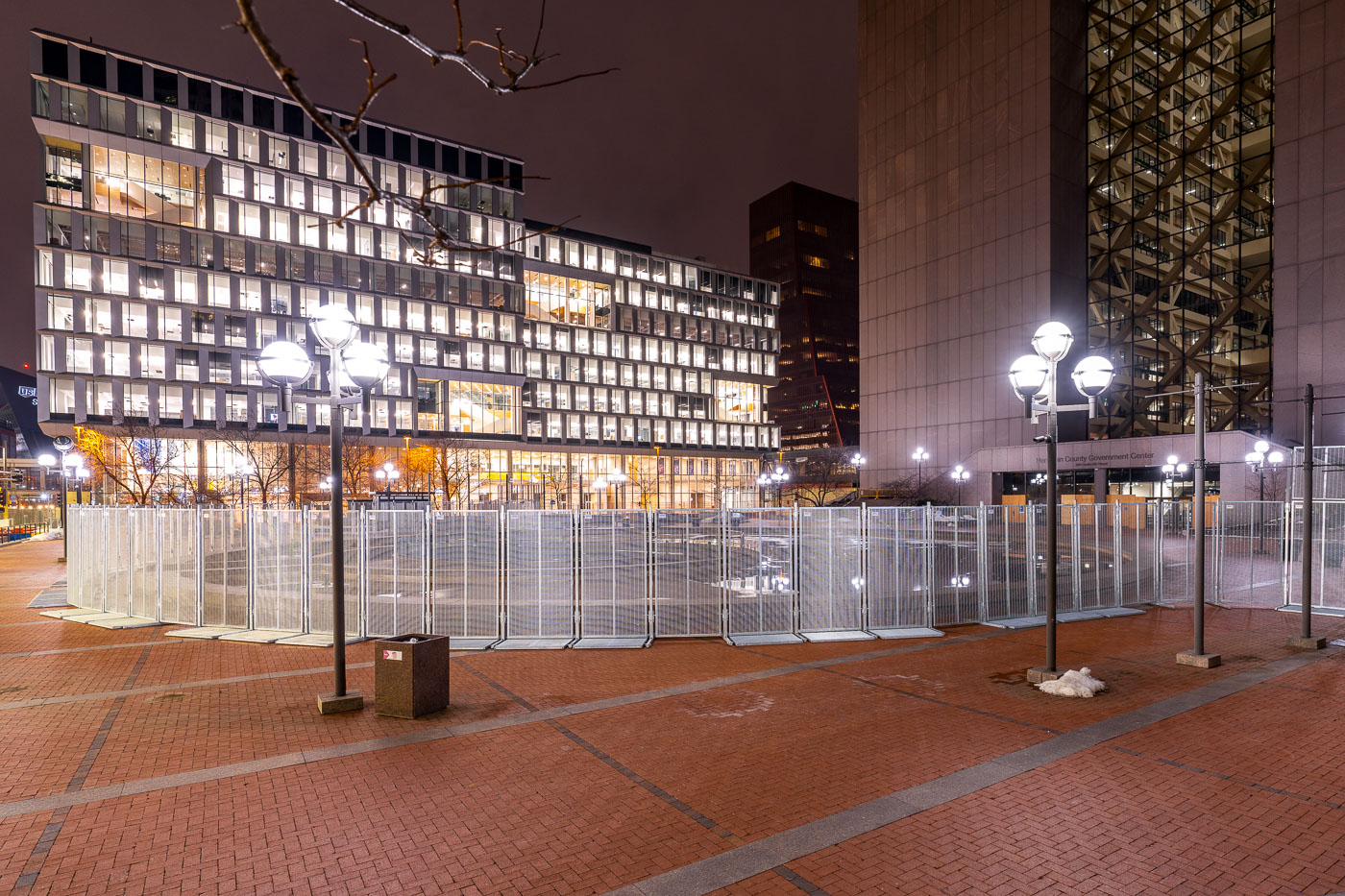
Boarded storefronts line Nicollet Mall in downtown Minneapolis at night in late September 2020.

Nicollet Mall at Night After Downtown Minneapolis Unrest

Dakota Jazz Club storefront boarded with plywood on Nicollet Mall in downtown Minneapolis at night.
The Dakota Jazz Club & Restaurant on Nicollet Mall in downtown Minneapolis is boarded over with plywood on its doors and street-facing windows.

Boarded Storefront at the Dakota Jazz Club on Nicollet Mall

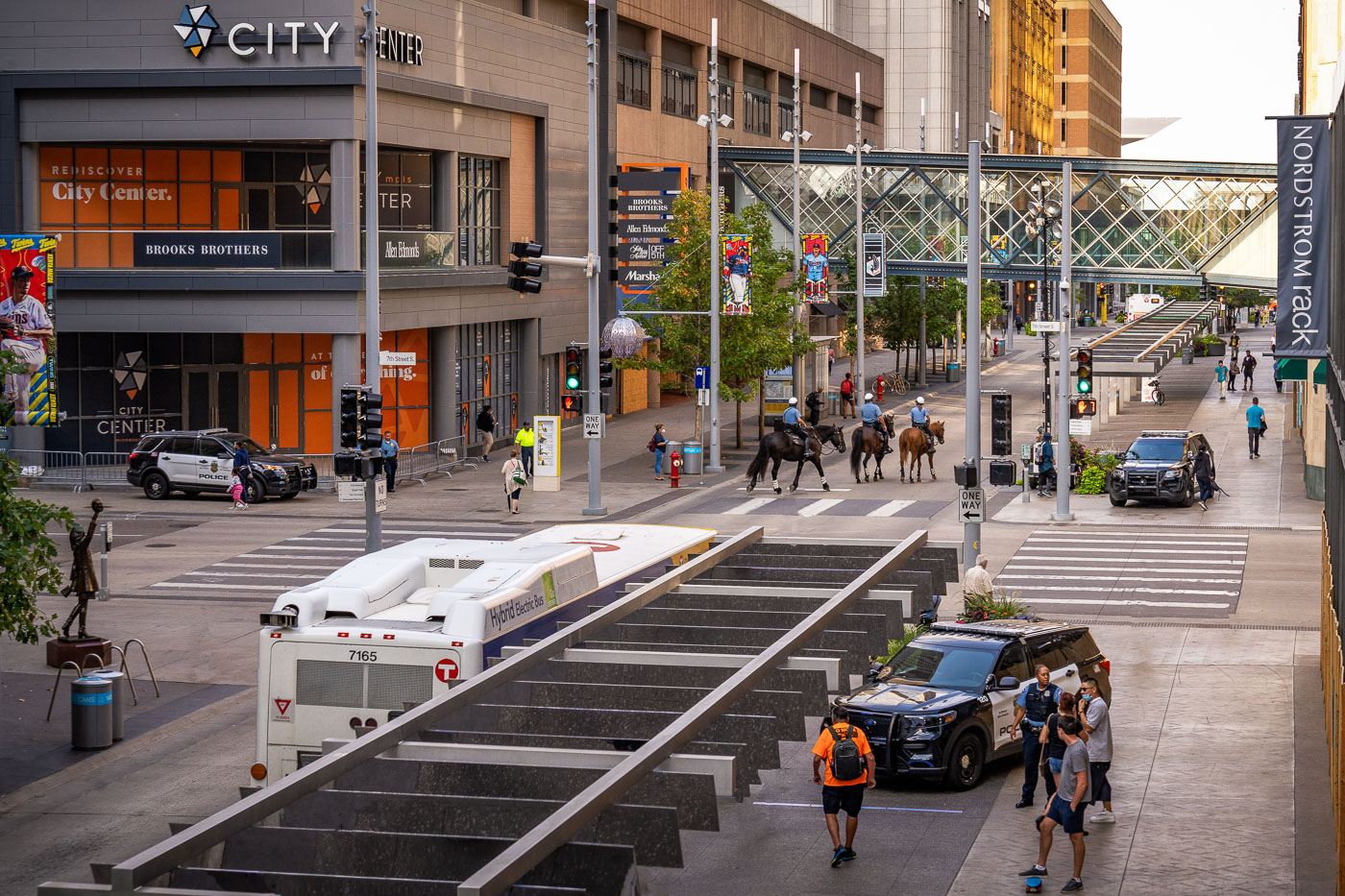
Minneapolis police officers and mounted unit patrol Nicollet Mall at South 7th Street downtown.
Minneapolis Police officers, including a mounted unit, patrol Nicollet Mall at South 7th Street in downtown Minneapolis on September 25, 2020.

Mounted Police Unit Crossing Nicollet Mall at 7th Street