Minneapolis

5,036 photos · 2008–2026

5,036 photographs tagged Minneapolis, 2008–2026.
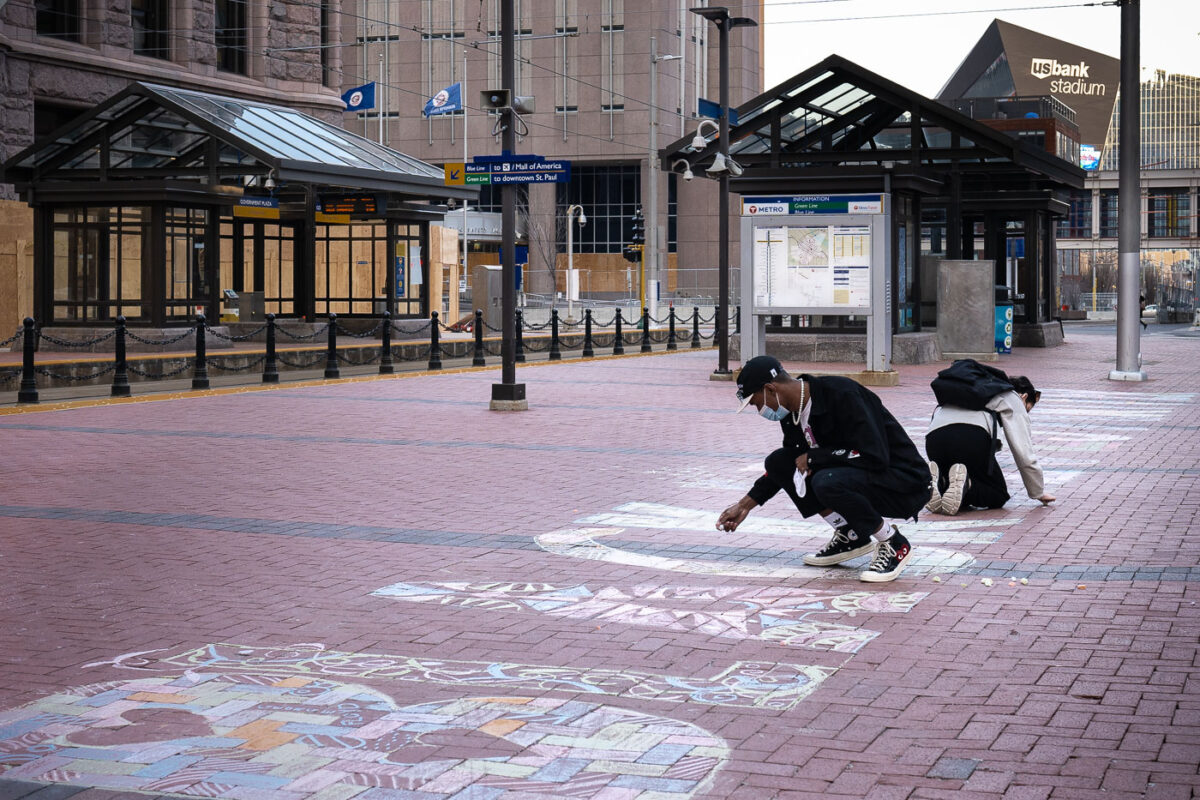
People making chalk art at Hennepin County Government Center plaza in downtown Minneapolis.
During the trial of Derek Chauvin, a Minneapolis police officer charged with the murder of George Floyd, community members created chalk art on the plaza outside the Hennepin County Government Center. The mural, which included Black Lives Matter messaging, was a public expression of solidarity and a call for justice. The Government Center is a prominent civic building in downtown Minneapolis, serving as the seat of county government and a courthouse.

Minneapolis: BLM Mural Chalk Art at Hennepin County Government Center

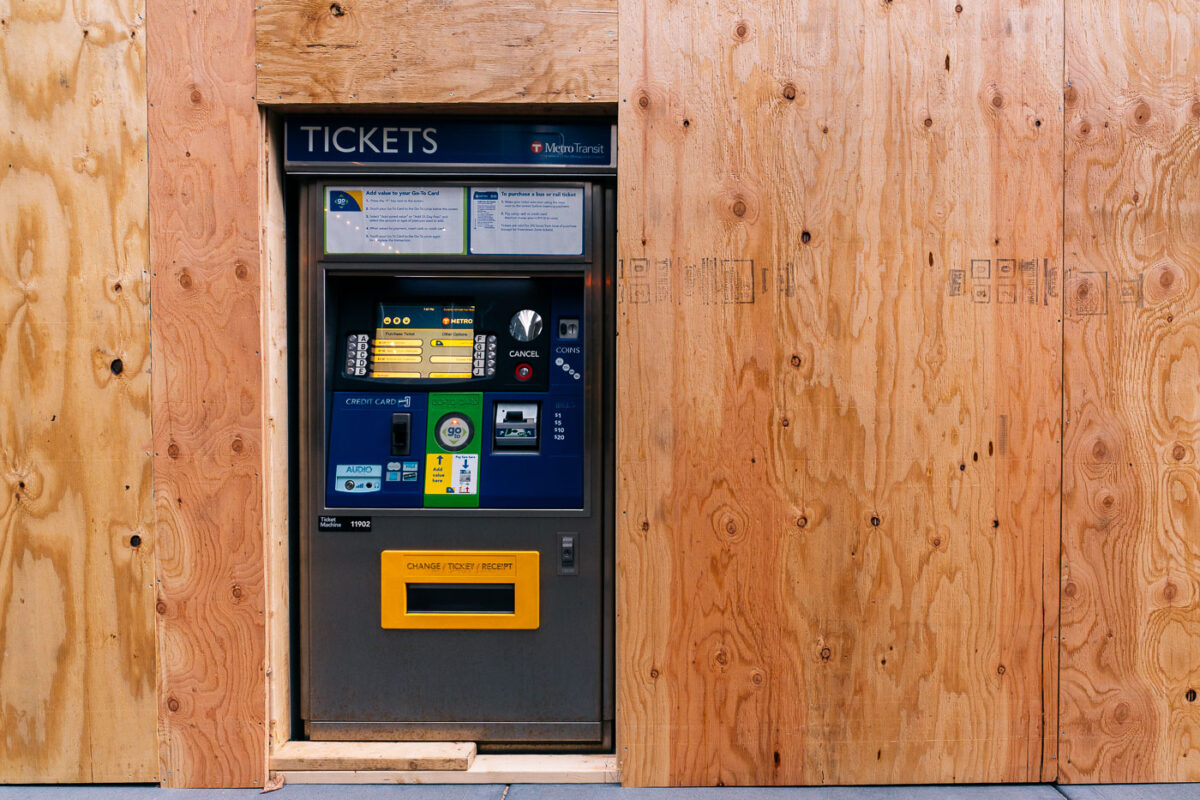
Metro Transit ticket machine boarded into a plywood wall on Marquette Avenue in Minneapolis.
A Metro Transit ticket machine stands on Marquette Avenue in Minneapolis, encased in plywood. This machine is part of the public transportation system serving the Minneapolis-Saint Paul metropolitan area. Its presence on Marquette Avenue, a major downtown street, highlights its role in facilitating daily commutes and travel for residents and visitors. The plywood enclosure suggests recent events or ongoing construction that necessitated temporary protection for the infrastructure.

Metro Transit Ticket Machine, Marquette Ave, Minneapolis
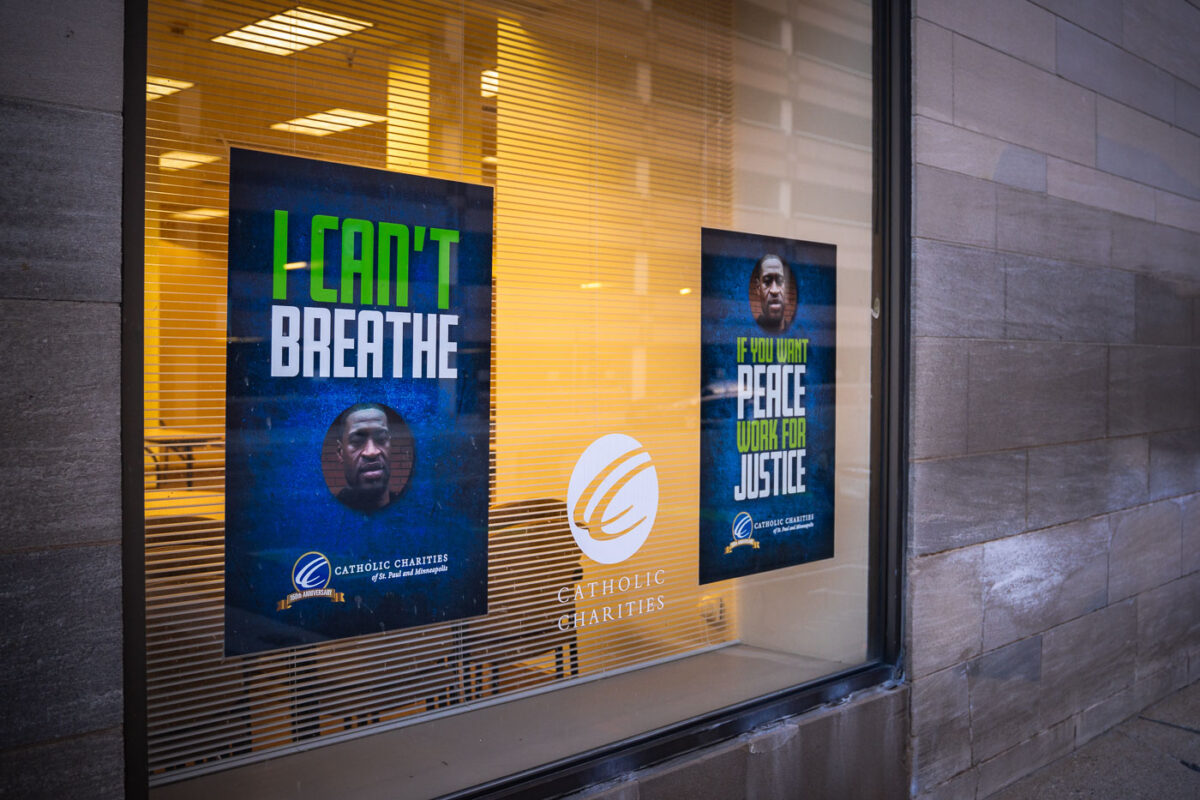
George Floyd posters in a Catholic Charities window in Minneapolis.
Posters displayed in the window of Catholic Charities of St. Paul and Minneapolis reflect the widespread sentiment following the murder of George Floyd. One poster reads "I CAN'T BREATHE," a direct reference to Floyd's final words and the circumstances of his death. Another poster states, "IF YOU WANT PEACE WORK FOR JUSTICE," urging action and systemic change. These signs appeared during the period of unrest in Minneapolis in 2020, a time of significant public outcry and protest against racial injustice and police brutality.

Catholic Charities Minneapolis: George Floyd Signs
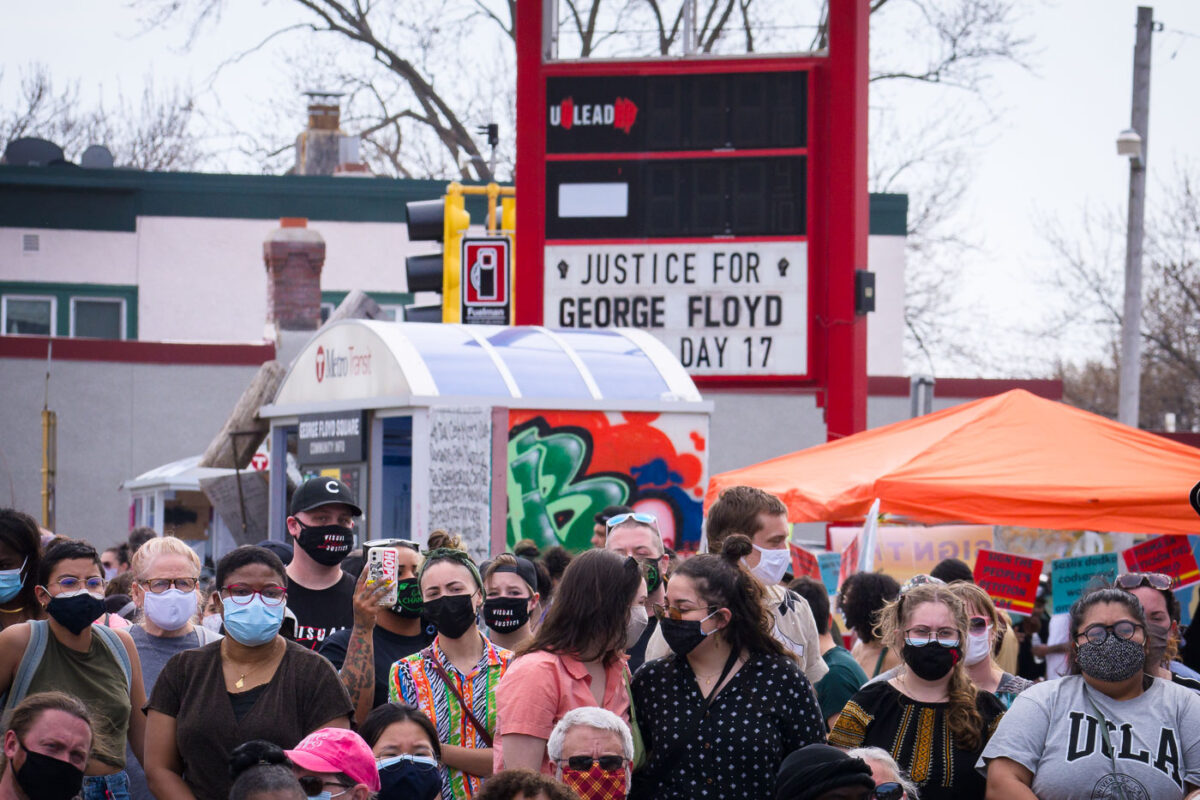
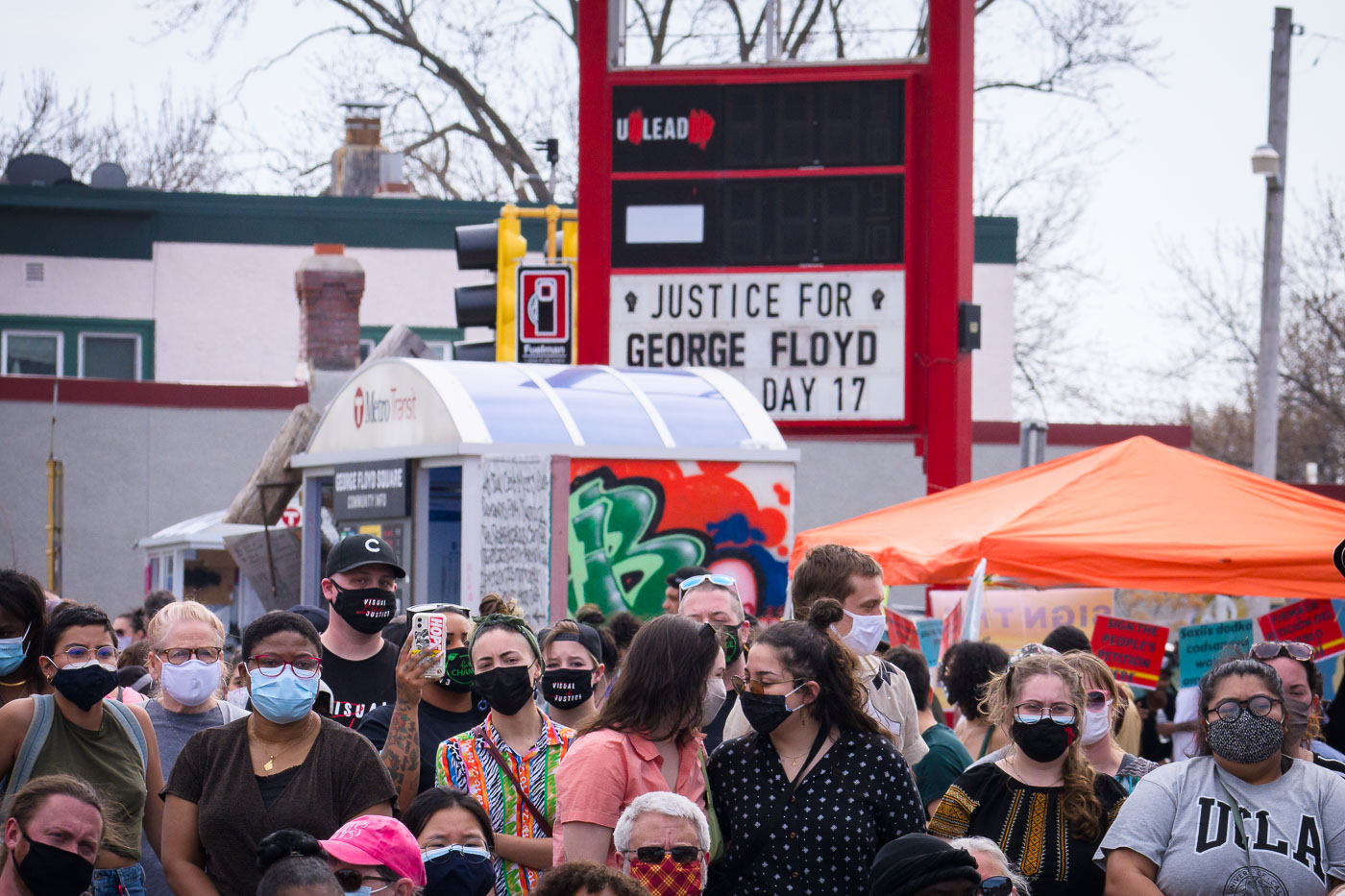
Protesters at George Floyd Square in Minneapolis beneath a Justice for George Floyd Day 17 sign.
Protesters gather at George Floyd Square in Minneapolis in April 2021, marking the 17th day of demonstrations following the murder of George Floyd. This intersection, formerly known as the intersection of 38th Street and Chicago Avenue, became a focal point for racial justice protests and a symbol of community resistance. The square was established by activists and residents in the days following Floyd's death on May 25, 2020, and remained a site of ongoing activism and community organizing.

George Floyd Square Protest, Minneapolis, April 2021
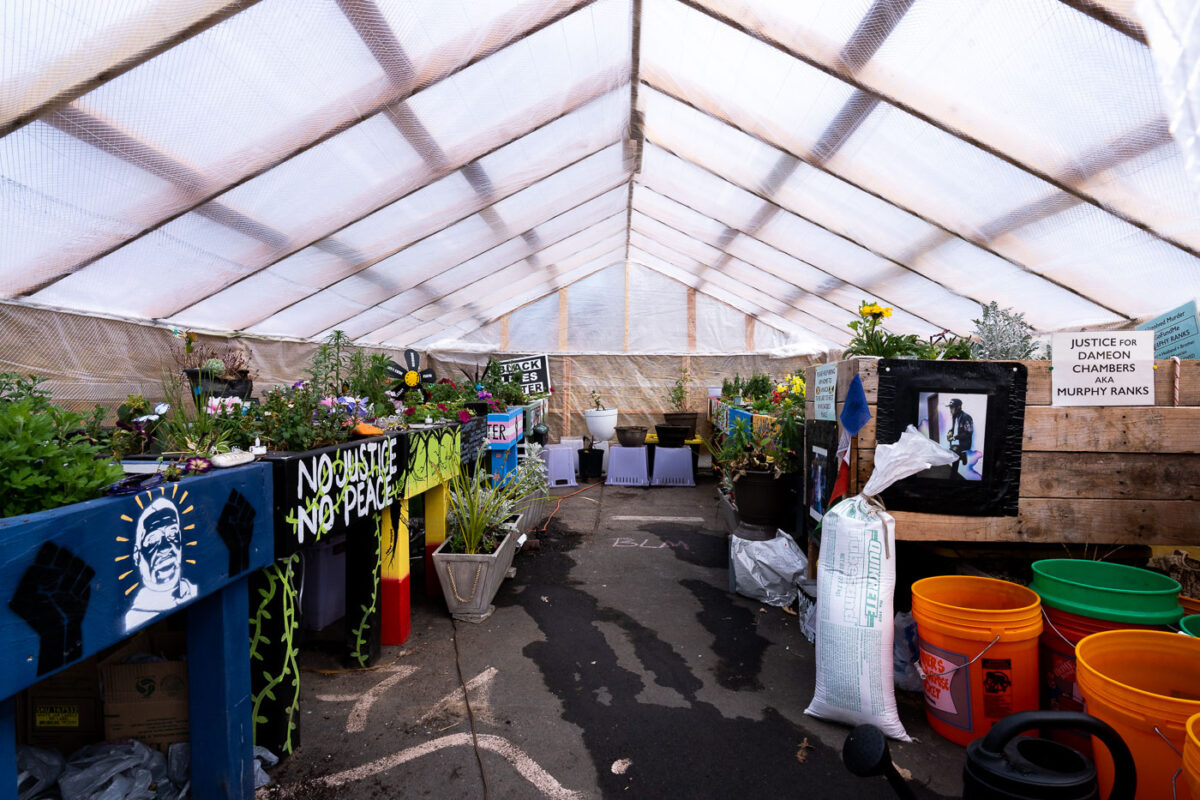
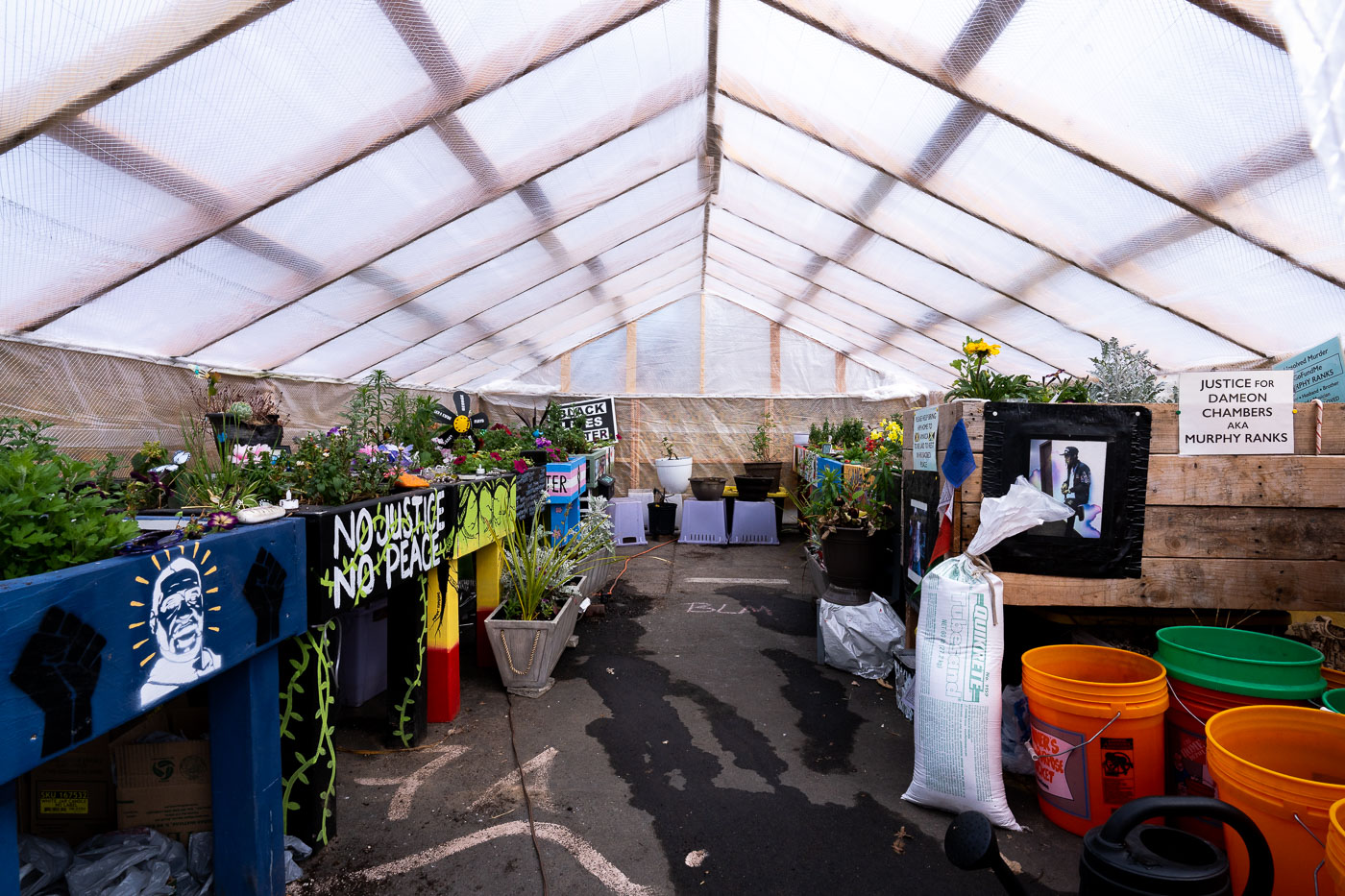
Greenhouse at George Floyd Square in Minneapolis with memorial signs and painted planters.
This greenhouse at George Floyd Square in Minneapolis served as a protected space for plants during the winter months, following the memorialization of George Floyd. The structure, adorned with tributes and artwork, including references to "No Justice No Peace" and "Black Lives Matter," reflects the ongoing significance of the square as a site of protest and remembrance. The plants, now brought back into the square, symbolize resilience and continued growth amidst the historical context of racial justice activism.

Greenhouse at George Floyd Square, Minneapolis
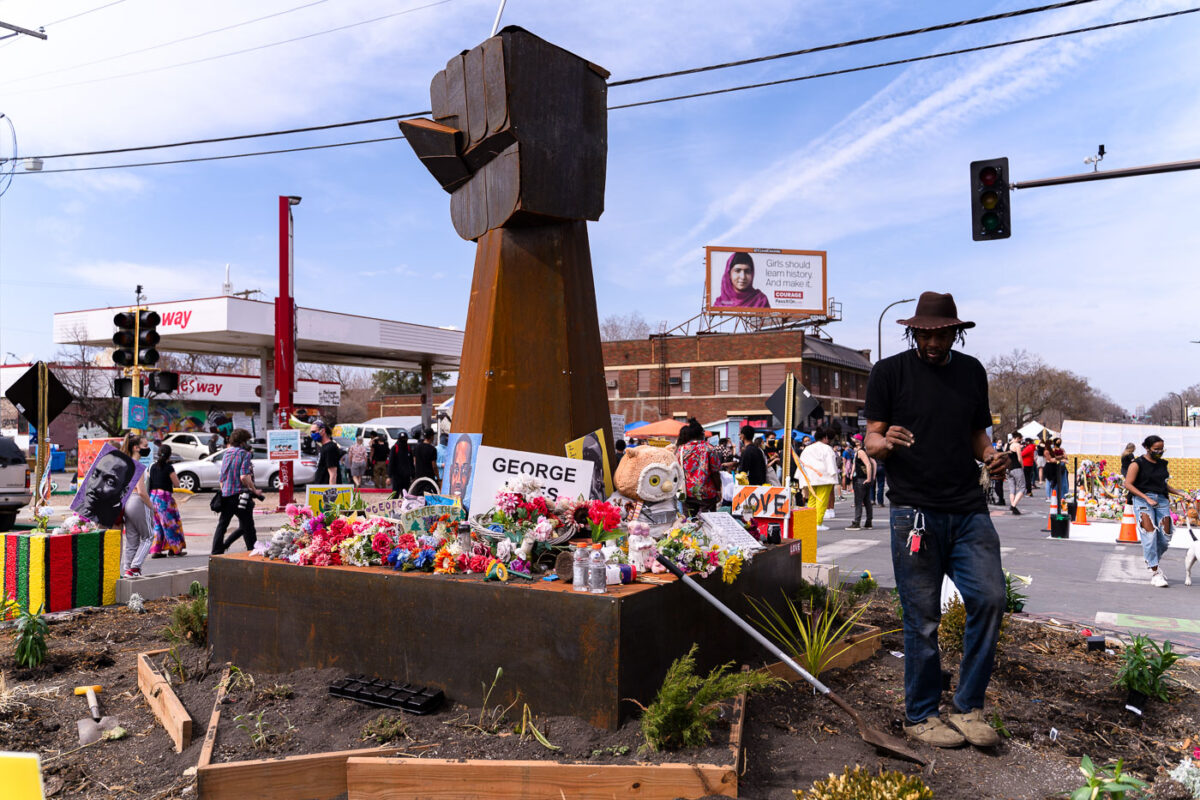
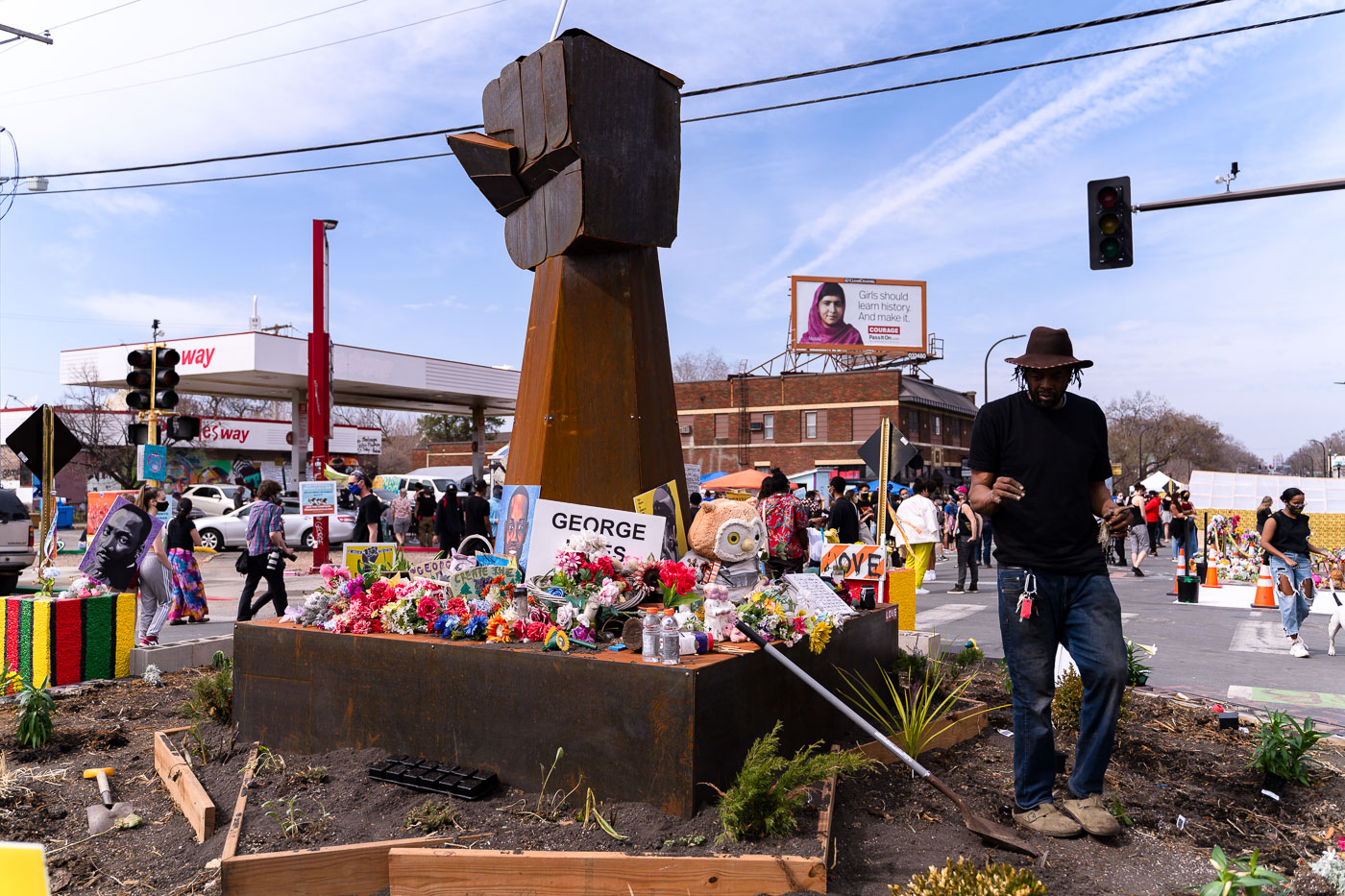
George Floyd memorial garden at George Floyd Square in Minneapolis with floral tributes and raised-fist sculpture.
The George Floyd Square Memorial Garden in Minneapolis is a space dedicated to the memory of George Floyd, who died in police custody in May 2020. The square, located at the intersection of 38th Street and Chicago Avenue, became a focal point for protests against racial injustice and police brutality following Floyd's murder. This memorial garden, with its central sculpture and surrounding floral tributes, serves as a place of remembrance, reflection, and ongoing community engagement. It represents the community's efforts to transform a site of tragedy into a space of healing and activism.

George Floyd Square Memorial Garden, Minneapolis
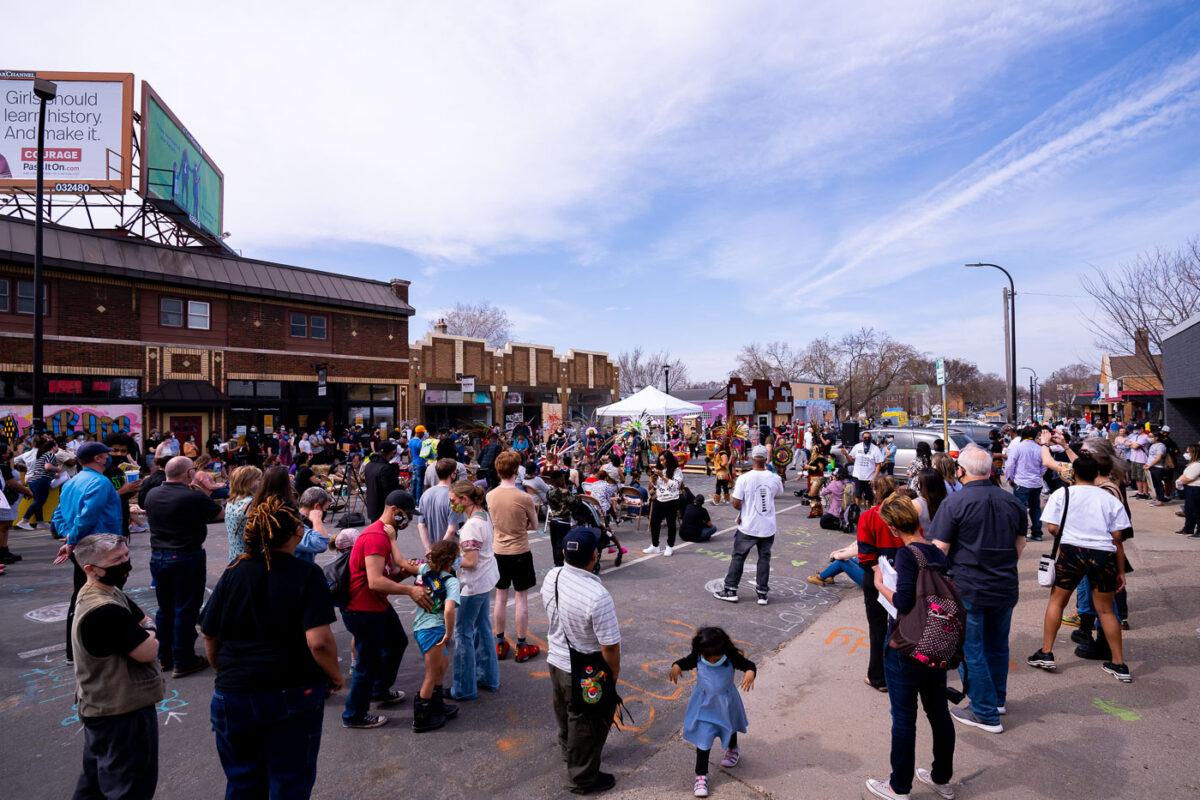
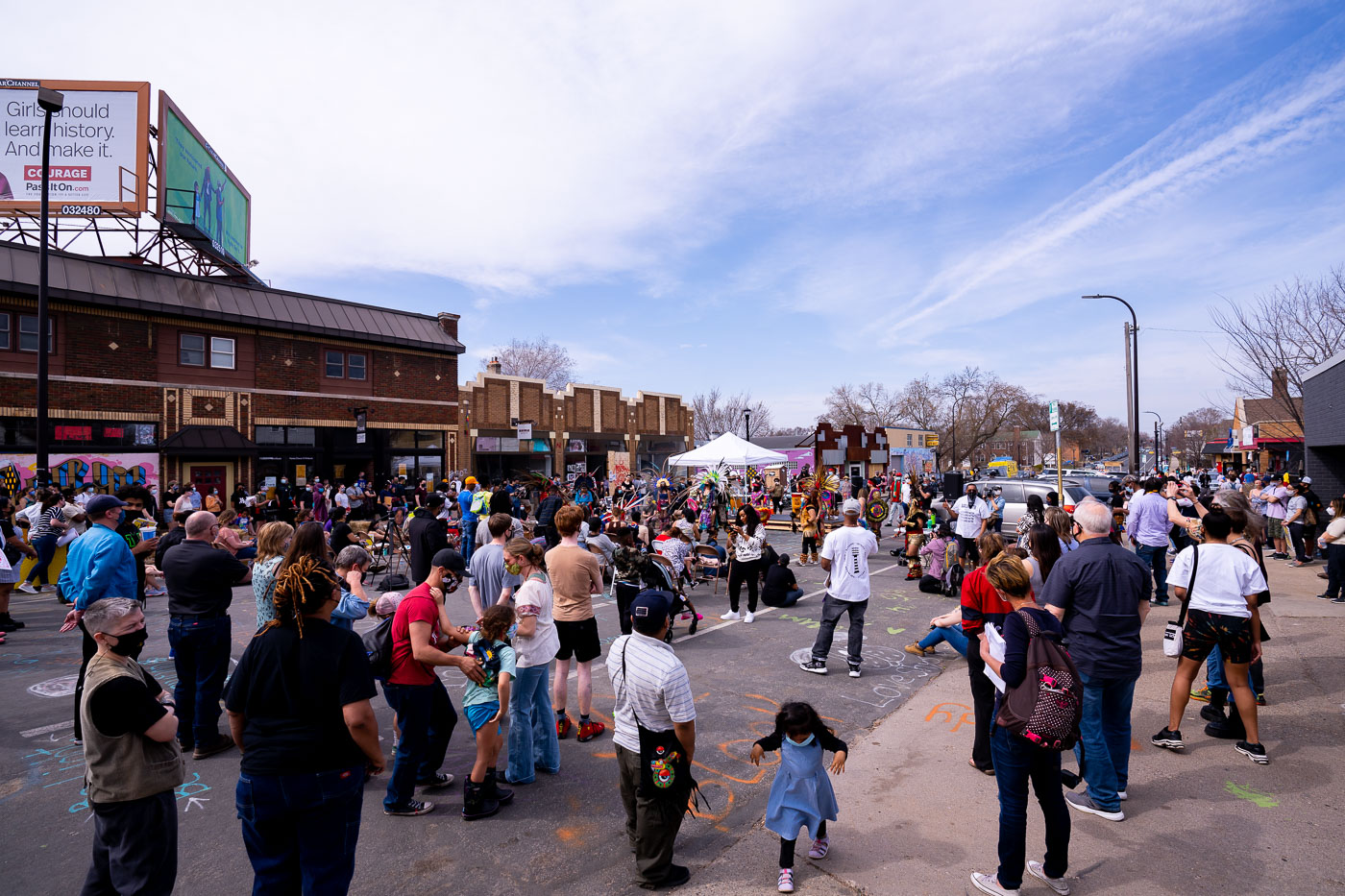
Crowd at George Floyd Square in Minneapolis during the Peoples Power Love Fest.
The Peoples Power Love Fest, a community gathering, took place at George Floyd Square in Minneapolis. This location, formerly known as the intersection of 38th Street and Chicago Avenue, became a focal point for protests and activism following the murder of George Floyd in May 2020. The square has since transformed into a space for remembrance, community organizing, and cultural expression, reflecting the ongoing impact of the uprising and calls for racial justice. The festival itself featured music, performances, and community engagement, underscoring the square's continued significance as a hub for social and political dialogue.

Peoples Power Love Fest at George Floyd Square, Minneapolis
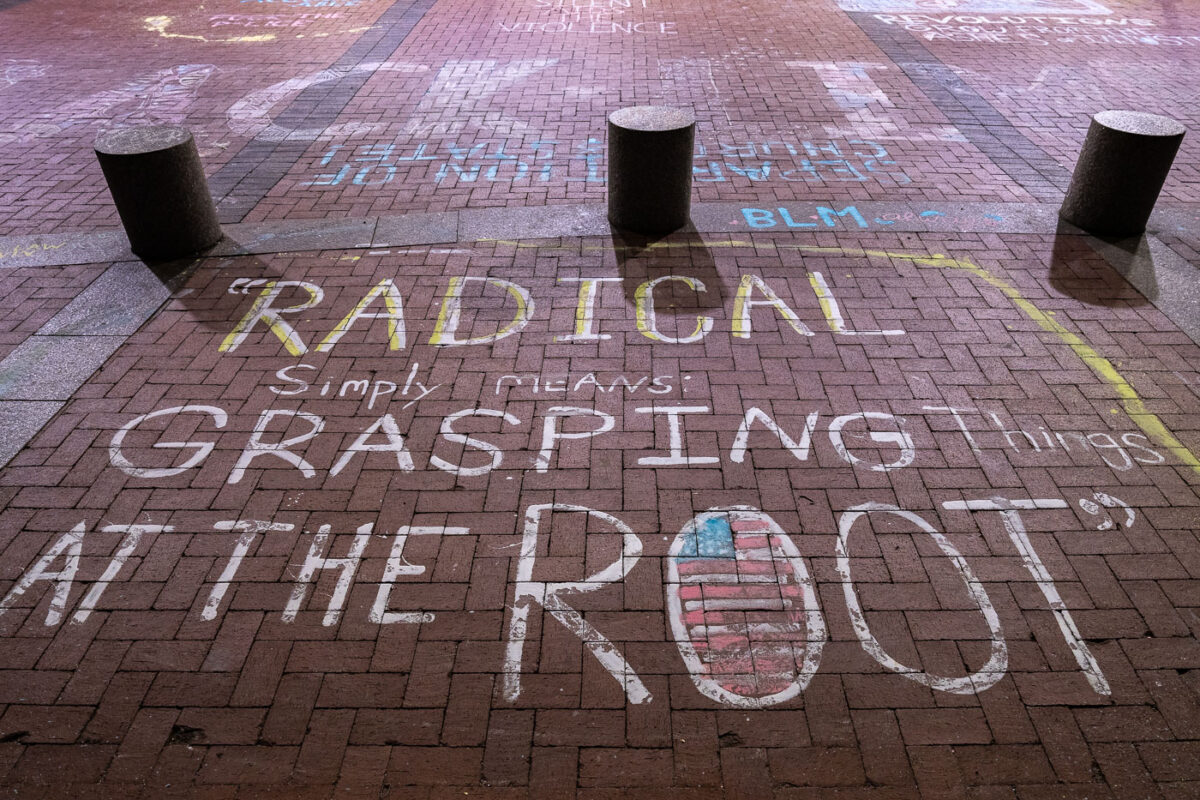
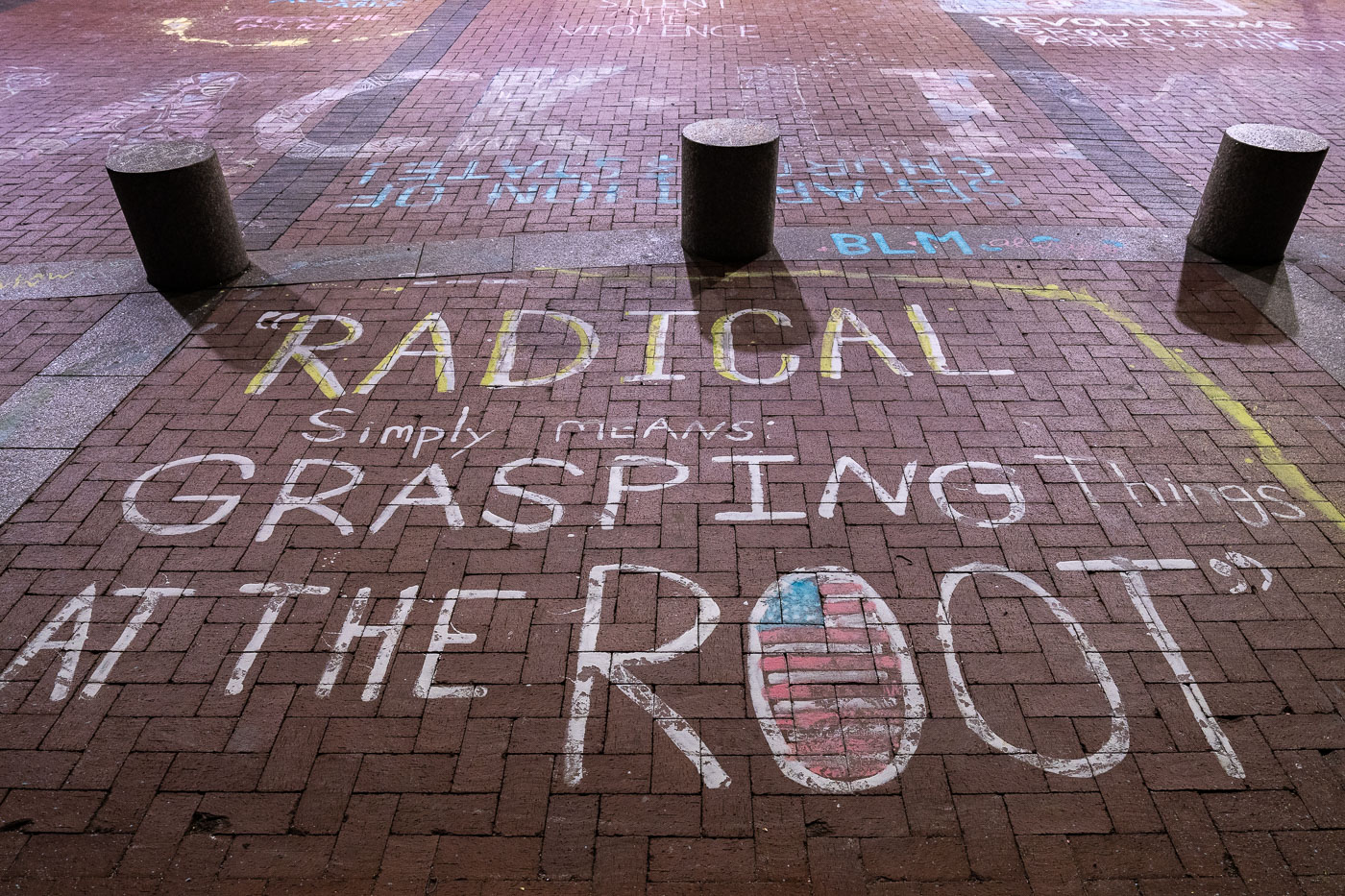
Chalk protest messages outside Hennepin County Government Center in Minneapolis, including “Radical” and “BLM.”
Chalk messages, including "RADICAL SIMPLY MEANS: GRASPING THINGS AT THE ROOT" and "BLM," adorn the plaza outside the Hennepin County Government Center in Minneapolis. This occurred during the period when the courthouse was the site of the Derek Chauvin murder trial. Chauvin was charged in the death of George Floyd on May 25, 2020, in South Minneapolis, an event that sparked widespread protests and a reckoning with racial injustice.

Chalk message outside Hennepin County Government Center, Minneapolis
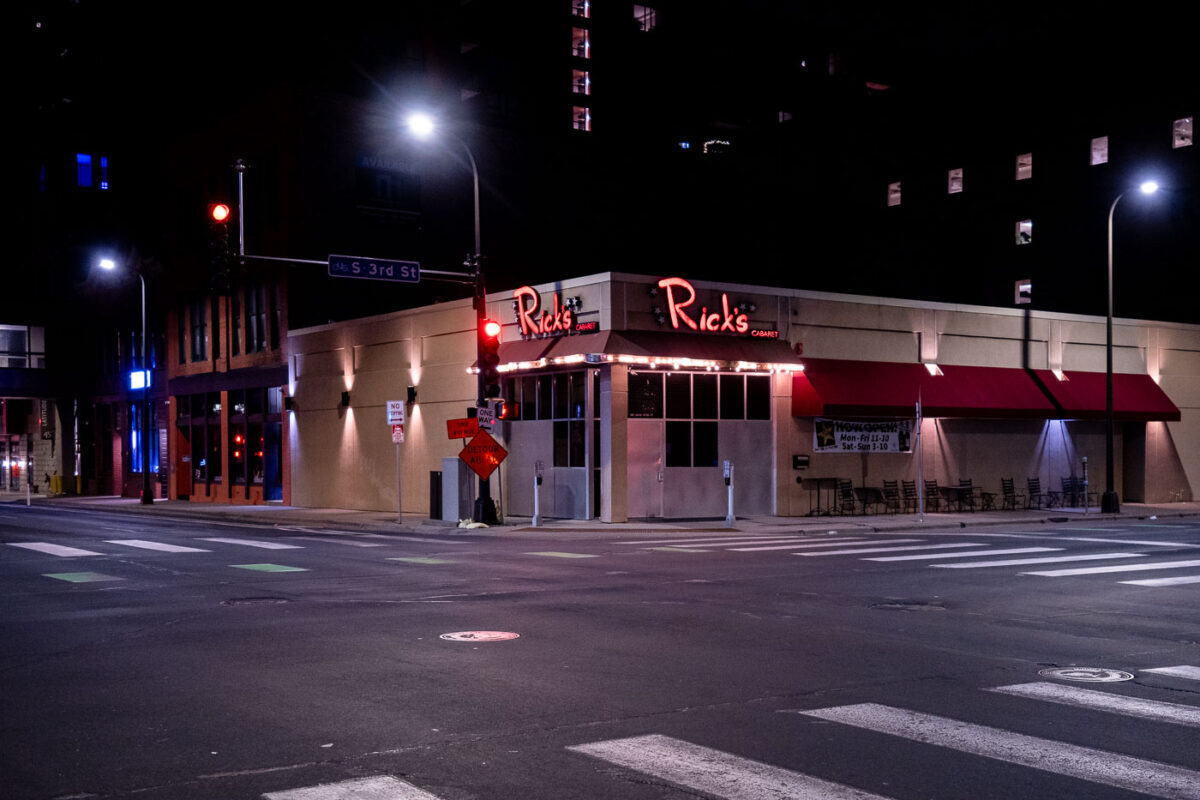
Rick's Cabaret at South 3rd Street in downtown Minneapolis with boarded windows at night.
Rick's Cabaret in downtown Minneapolis is shown boarded up with security measures in place. This occurred during the period of the Derek Chauvin murder trial in April 2021. The trial and subsequent verdict led to widespread public attention and protests in Minneapolis, prompting businesses to take precautions against potential damage or unrest. The boarding reflects the heightened security concerns and the impact of the trial on the urban environment.

Rick’s Cabaret Boarded Up During Derek Chauvin Trial, Minneapolis
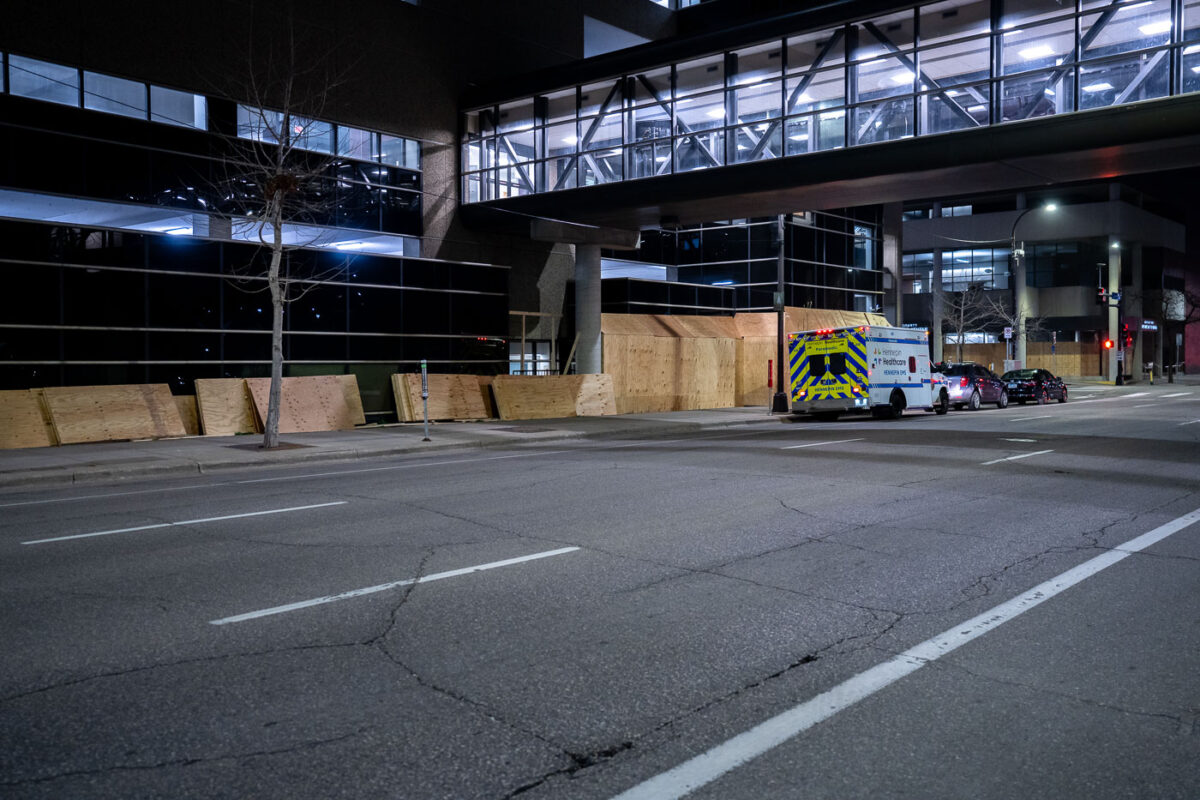
Boarded Hennepin Healthcare campus in Minneapolis with an ambulance parked outside at night.
Hennepin County Medical Center boarded up during the Derek Chauvin trial. The hospital, a major public health facility in Minneapolis, was secured with plywood as a precautionary measure amid concerns of unrest following the verdict in the trial of former police officer Derek Chauvin. Chauvin was on trial for the murder of George Floyd, an event that sparked widespread protests and civil unrest in the city and across the nation. The boarding up of the medical center highlights the tension and potential for disruption in the city during this period of heightened public attention and emotion.

Hennepin County Medical Center boarded up during Derek Chauvin trial
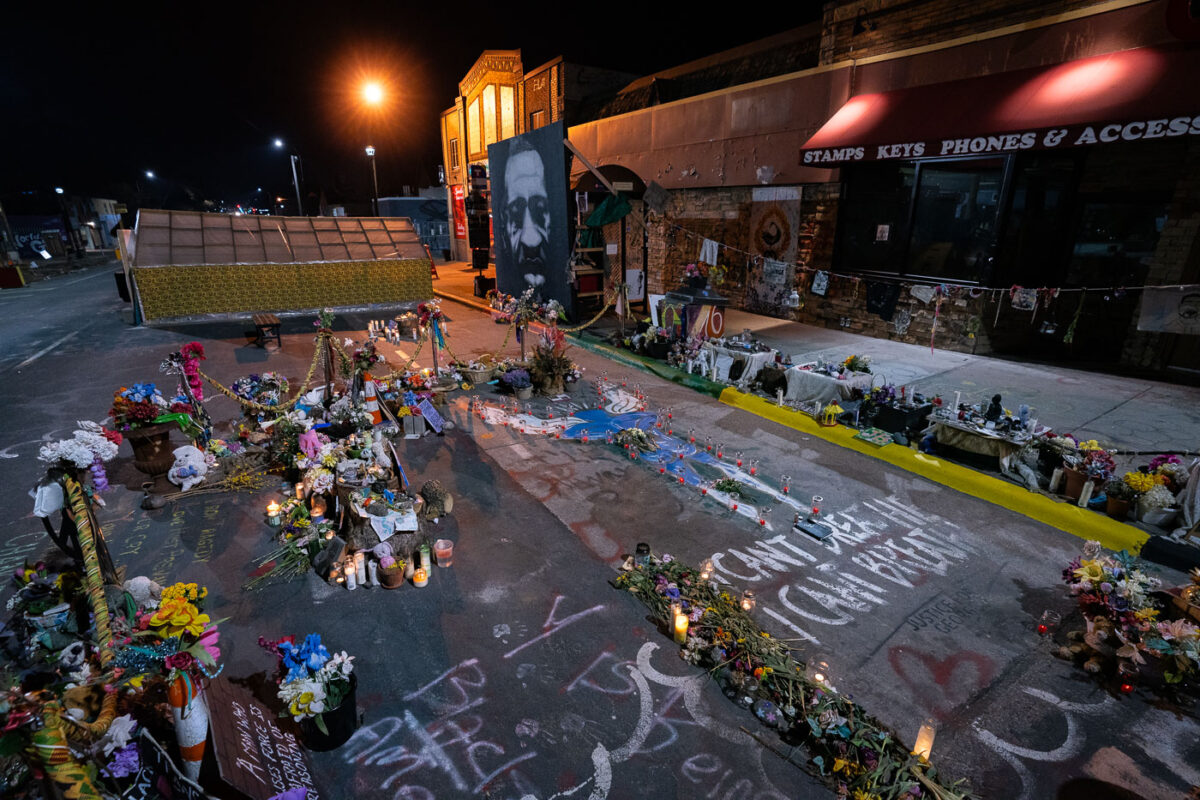
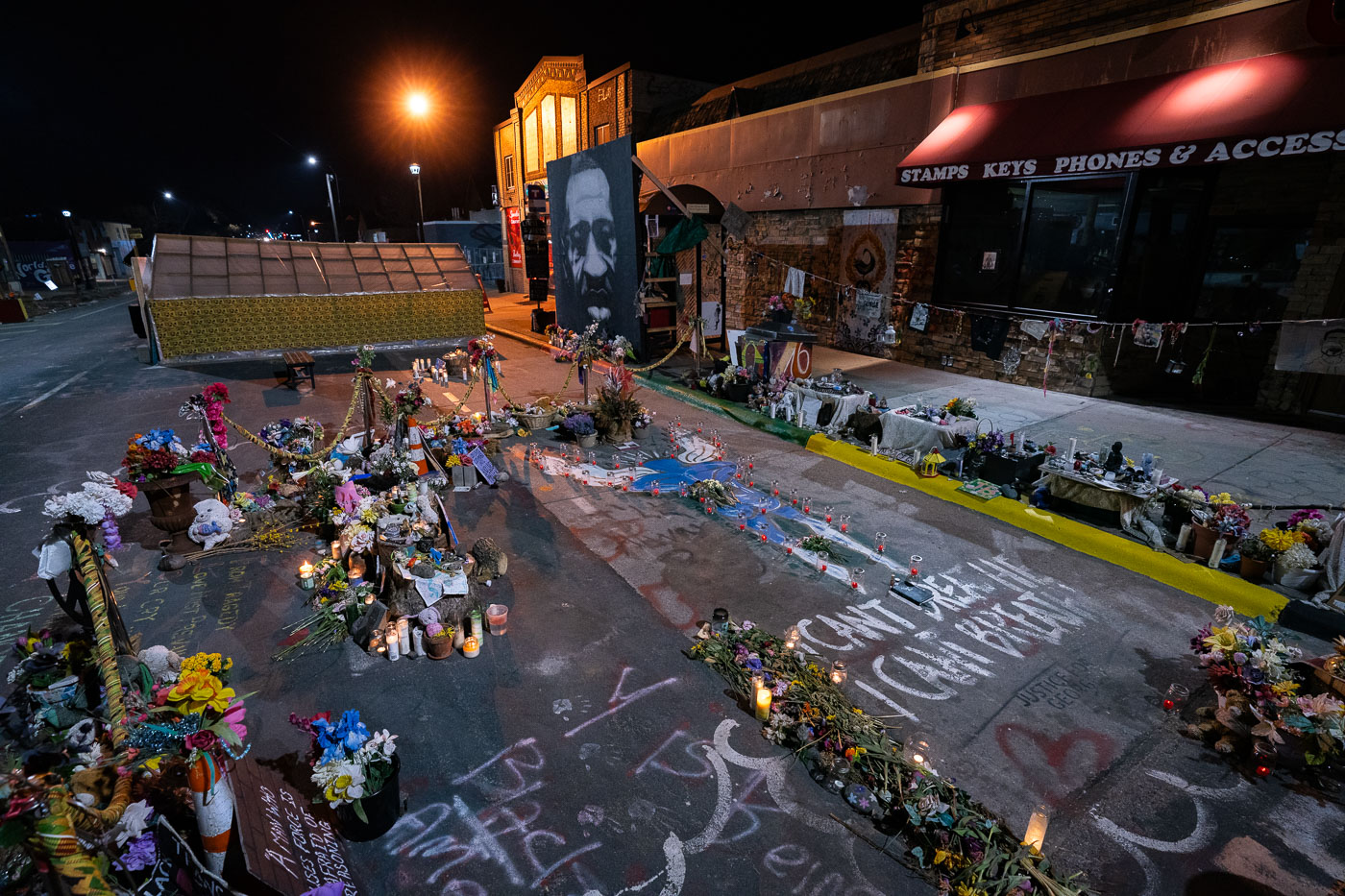
George Floyd Square memorial in Minneapolis with tributes and street messages at night.
George Floyd Square in Minneapolis, April 2021, is a memorial site established following the murder of George Floyd by police on May 25, 2020. The intersection, formerly known as the intersection of 38th Street and Chicago Avenue, became a focal point for protests against racial injustice and police brutality. The memorial features numerous tributes, including flowers, candles, artwork, and messages written on the pavement, such as "I Can't Breathe." This site served as a space for community remembrance and continued activism in the months following Floyd's death.

George Floyd Square Memorial, Minneapolis, April 2021
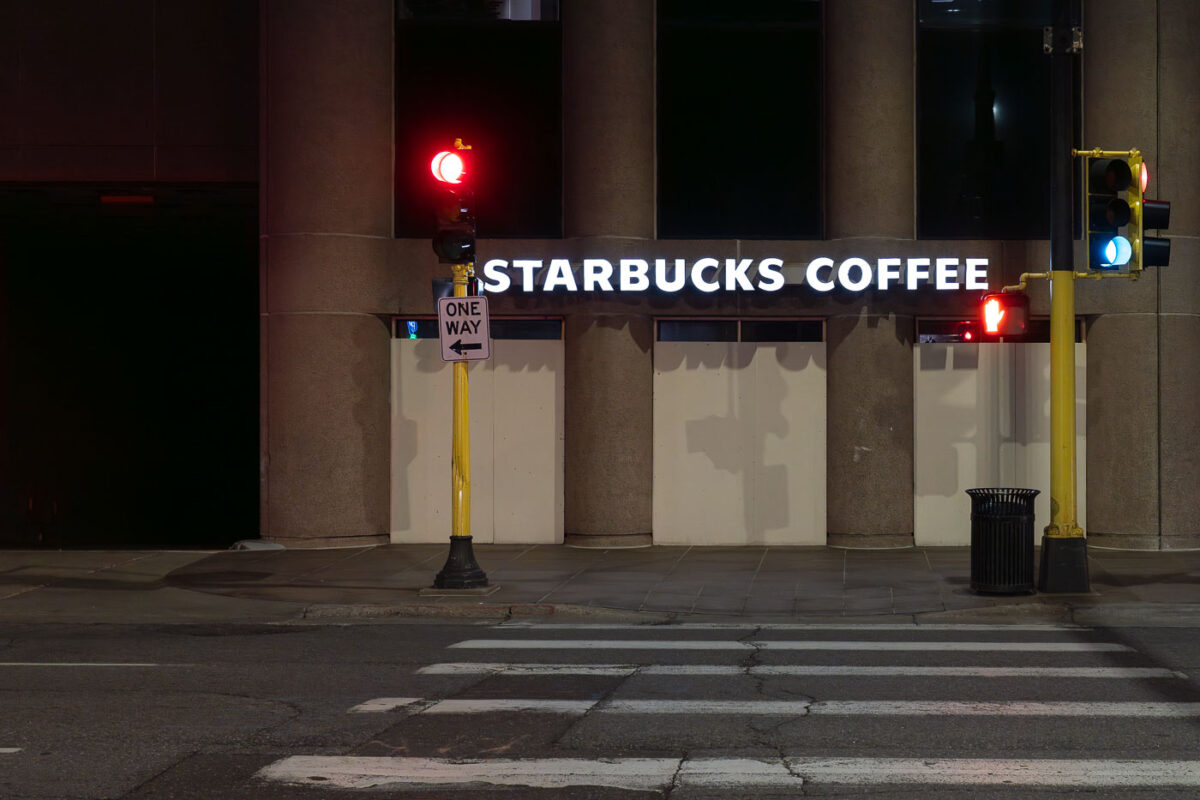
Boarded-up Starbucks Coffee storefront in downtown Minneapolis at a street corner.
Starbucks Coffee in downtown Minneapolis is boarded up along a street corner near traffic signals and a crosswalk. The storefront was secured during the Derek Chauvin trial period in 2021.

Starbucks Coffee boarded up in downtown Minneapolis
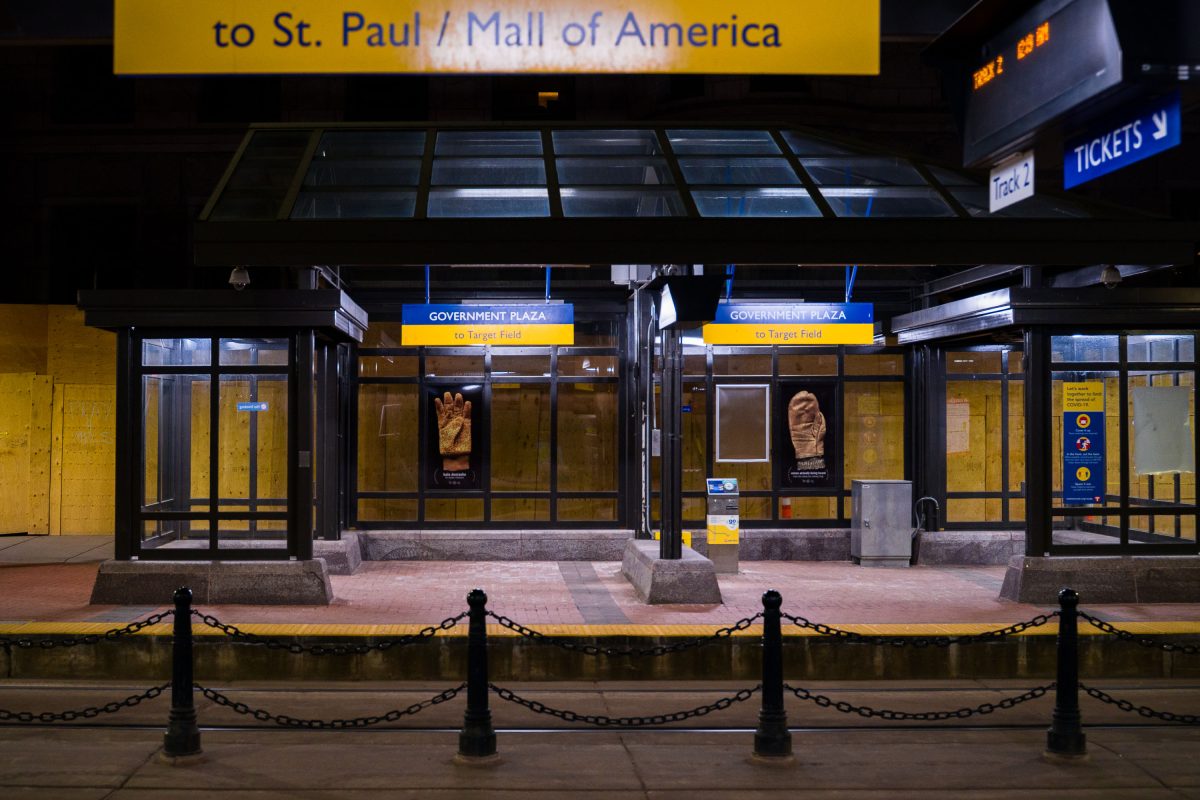
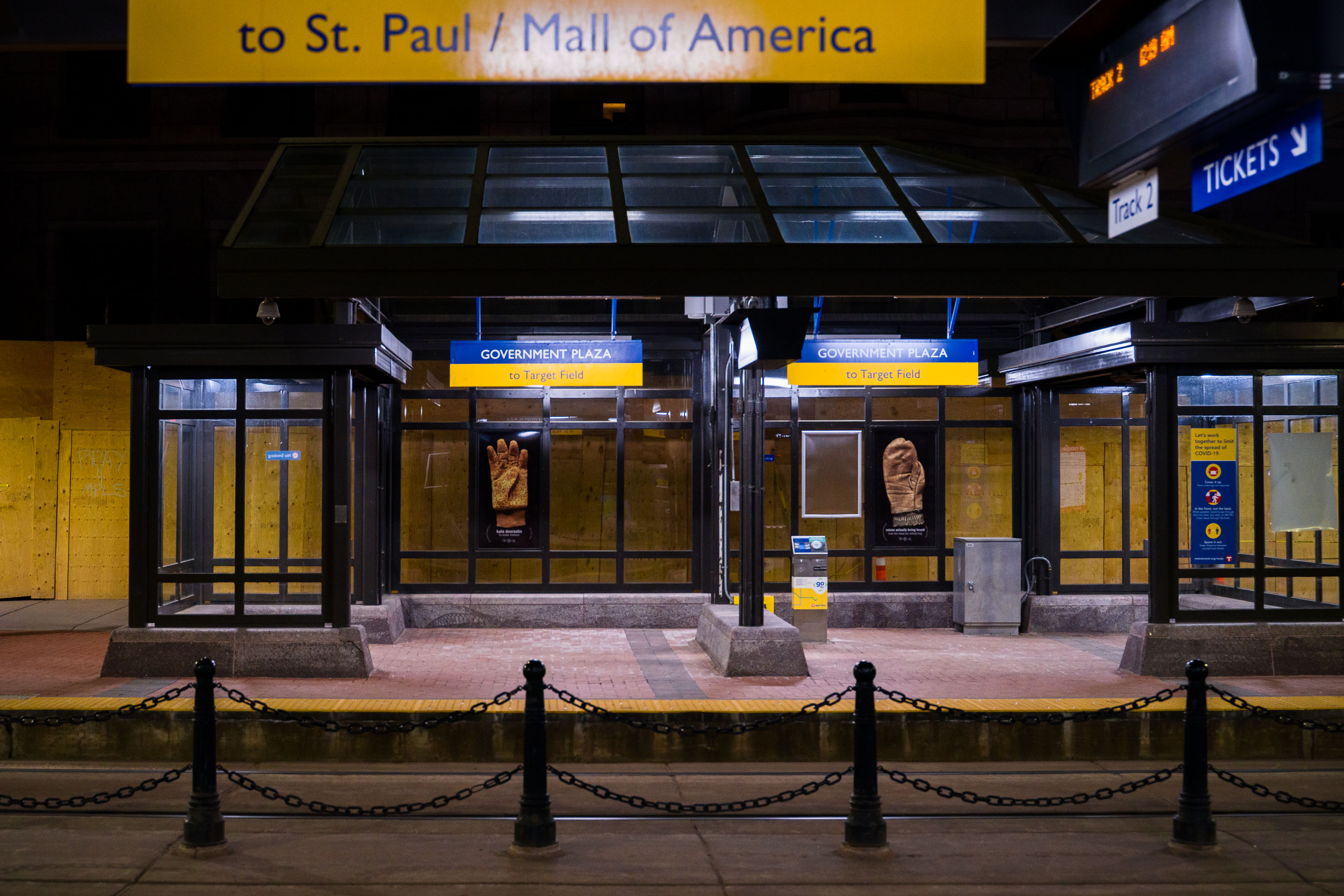
Government Plaza light rail station entrance in downtown Minneapolis with boarded-up glass panels and protective chain barriers.
Government Plaza Station serves the Blue and Green Line light rail routes in downtown Minneapolis, operated by Metro Transit. Located near the Hennepin County Government Center, the stop provides connections toward St. Paul, the Mall of America, and Target Field. The entrance shown here was boarded up along its glass panels during a period of civil unrest in the city in 2021.

Boarded-Up Entrance at Government Plaza Station at Night
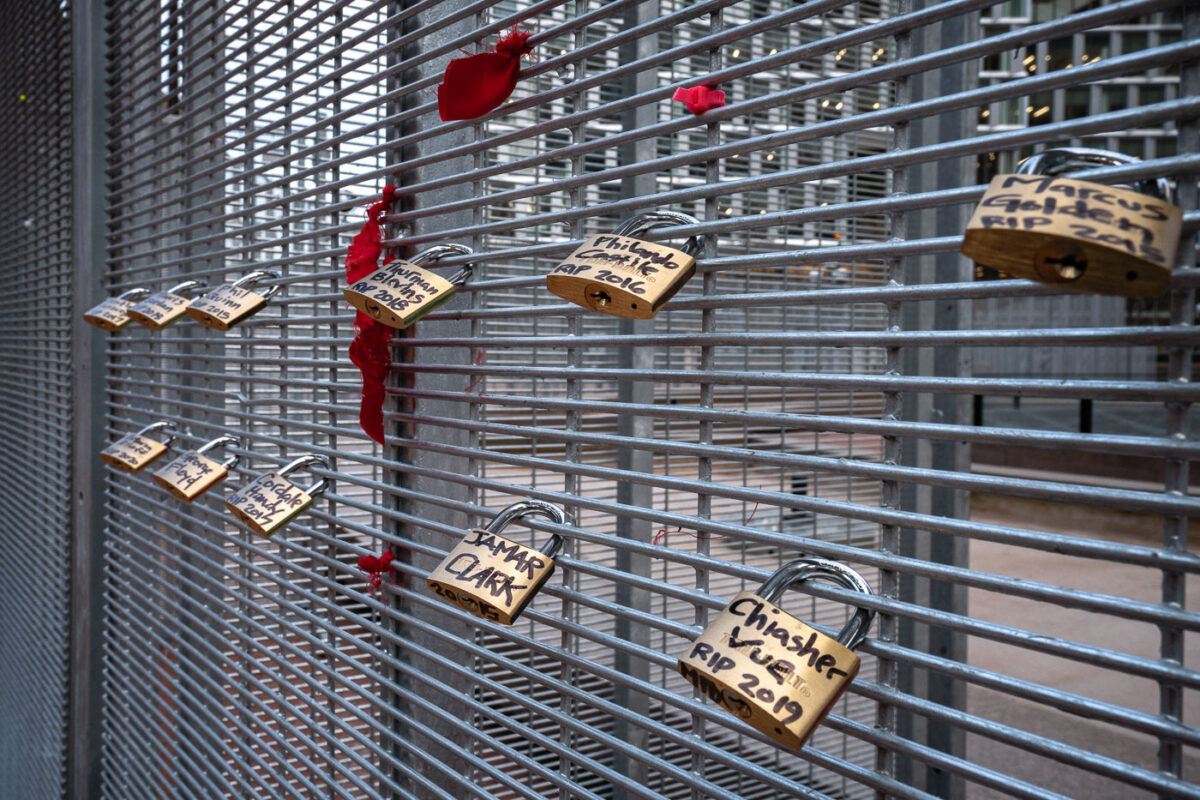
Memorial locks for victims of police violence on fencing at Hennepin County Government Center, Minneapolis.
During the trial of Derek Chauvin, a former Minneapolis police officer, locks bearing the names of victims of police violence were attached to the fencing surrounding the Hennepin County Government Center. These locks serve as a memorial to individuals such as Jamar Clark, Thurman Blevins, Philando Castile, Marcus Golden, Chiasher Vue, Cordale Handy, and George Floyd, all of whom died in incidents involving law enforcement. The display reflects the community's grief and demands for accountability in the wake of police brutality.

Hennepin County Government Center: Locks for Police Violence Victims
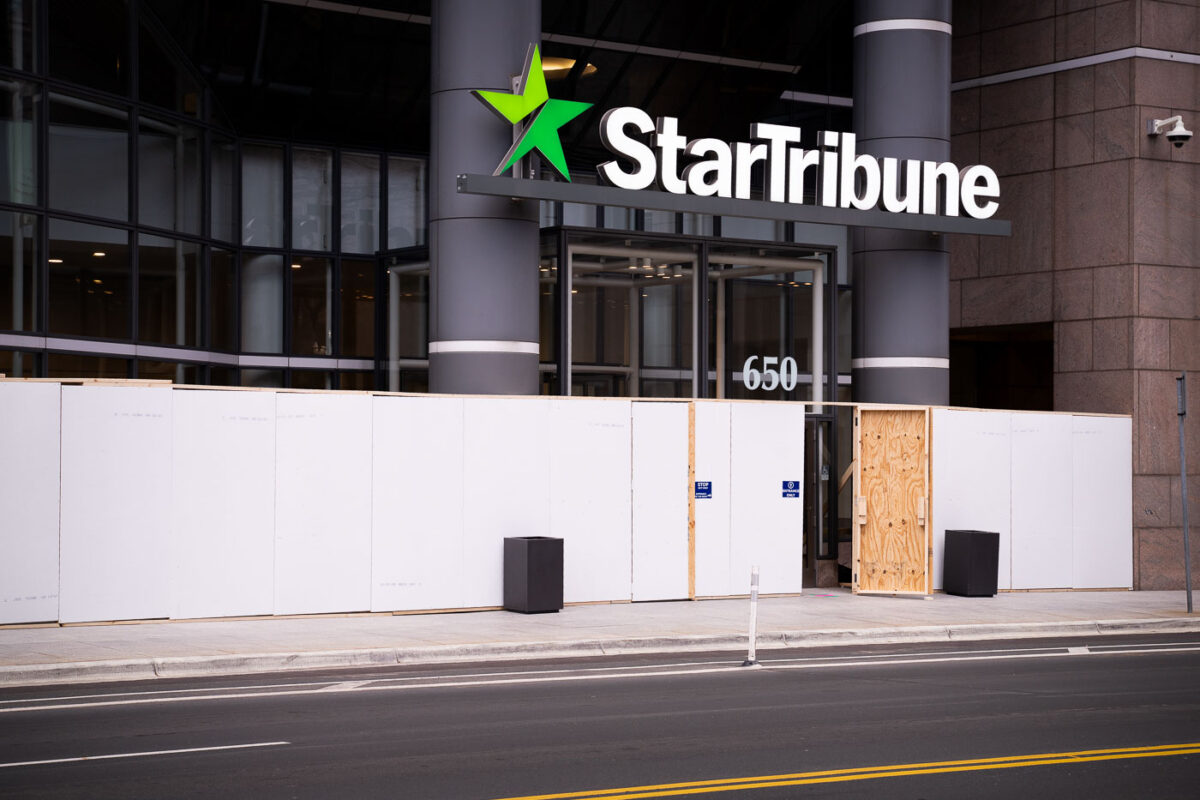
Boarded entrance at the Star Tribune building in Minneapolis.
Boards at the Star Tribune across from the courthouse.

Star Tribune Building Boarded Up, Minneapolis
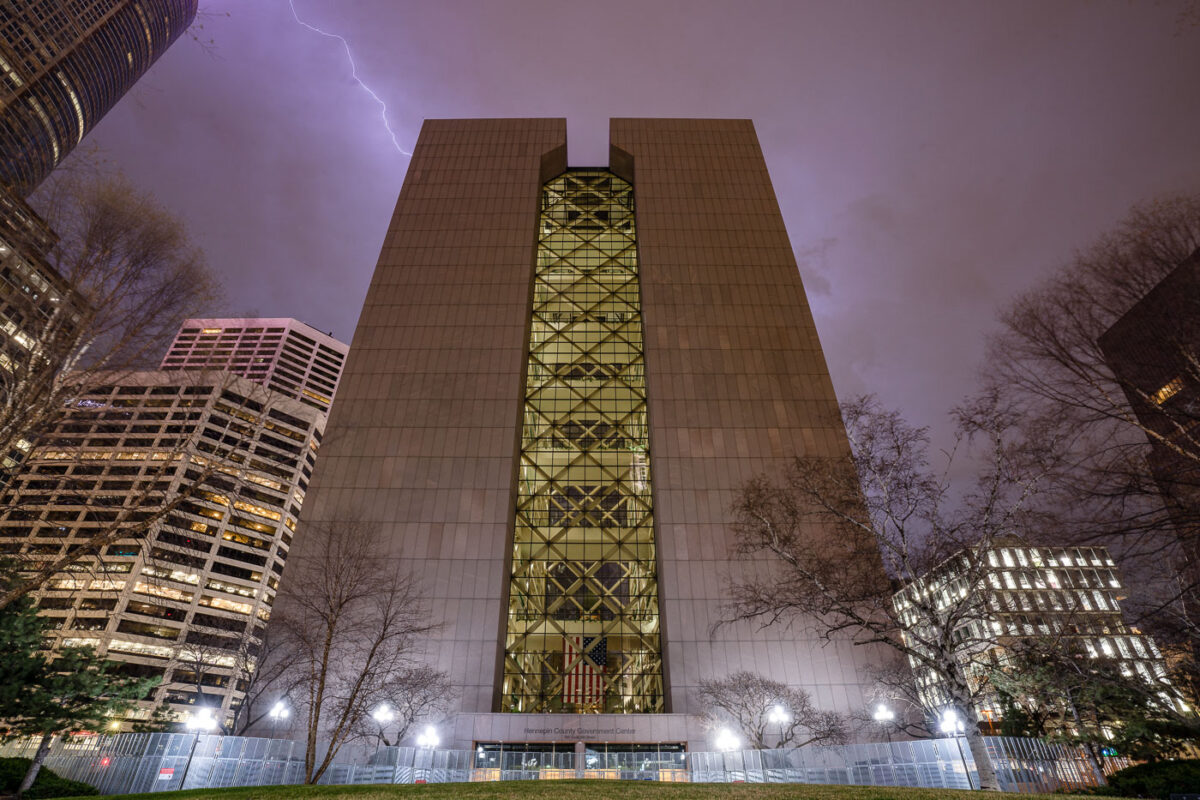
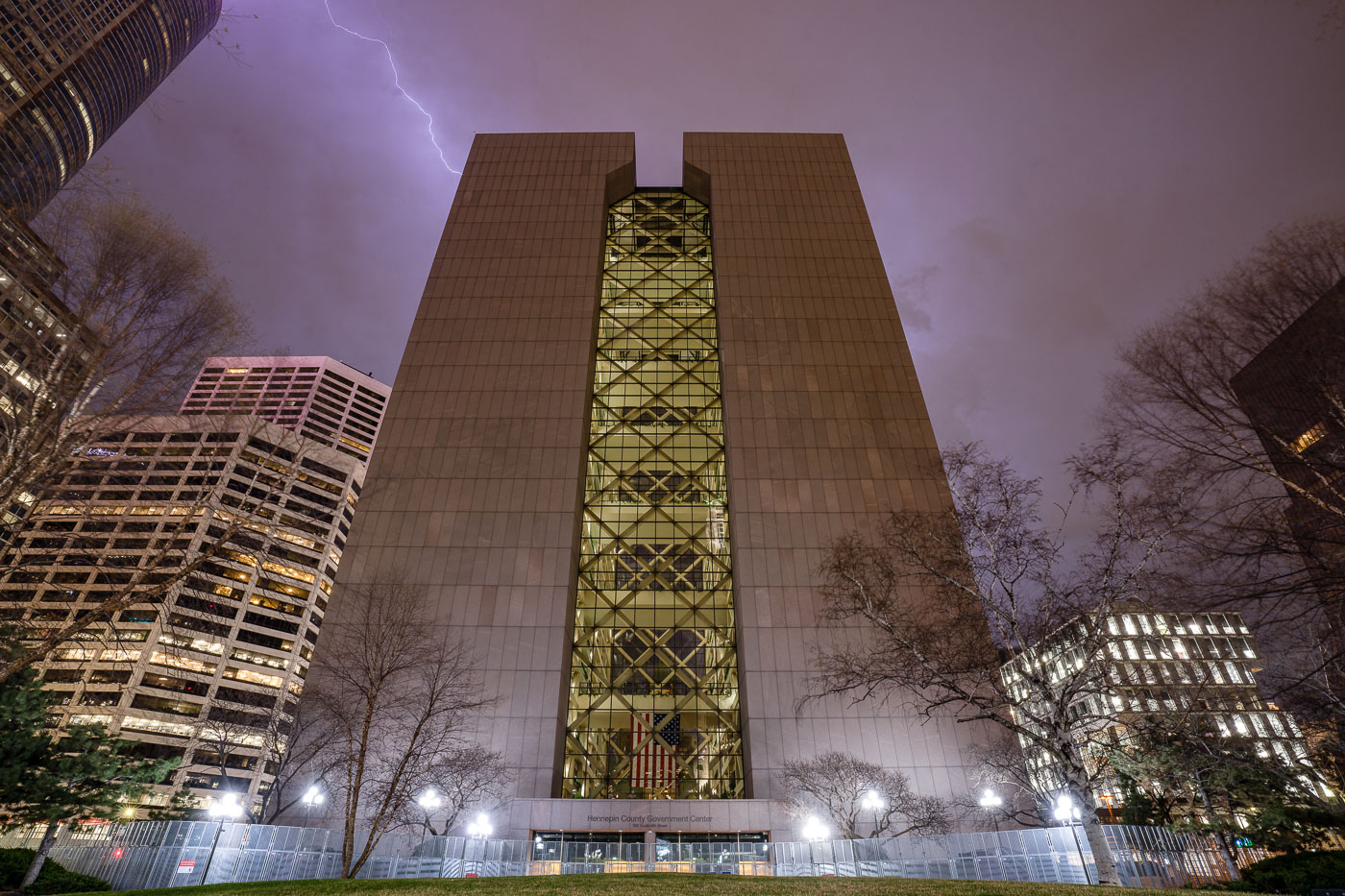
Lightning over Hennepin County Government Center in Minneapolis during the Derek Chauvin trial.
Lightning strikes the Hennepin County Government Center in Minneapolis during the trial of Derek Chauvin. The building, completed in 1977, serves as the primary administrative center for Hennepin County. During the trial for the murder of George Floyd, which took place in spring 2021, the courthouse was surrounded by extensive security fencing. The trial and its aftermath were significant events in the ongoing national conversation about racial justice and policing.

Lightning strikes Hennepin County Government Center during Chauvin trial
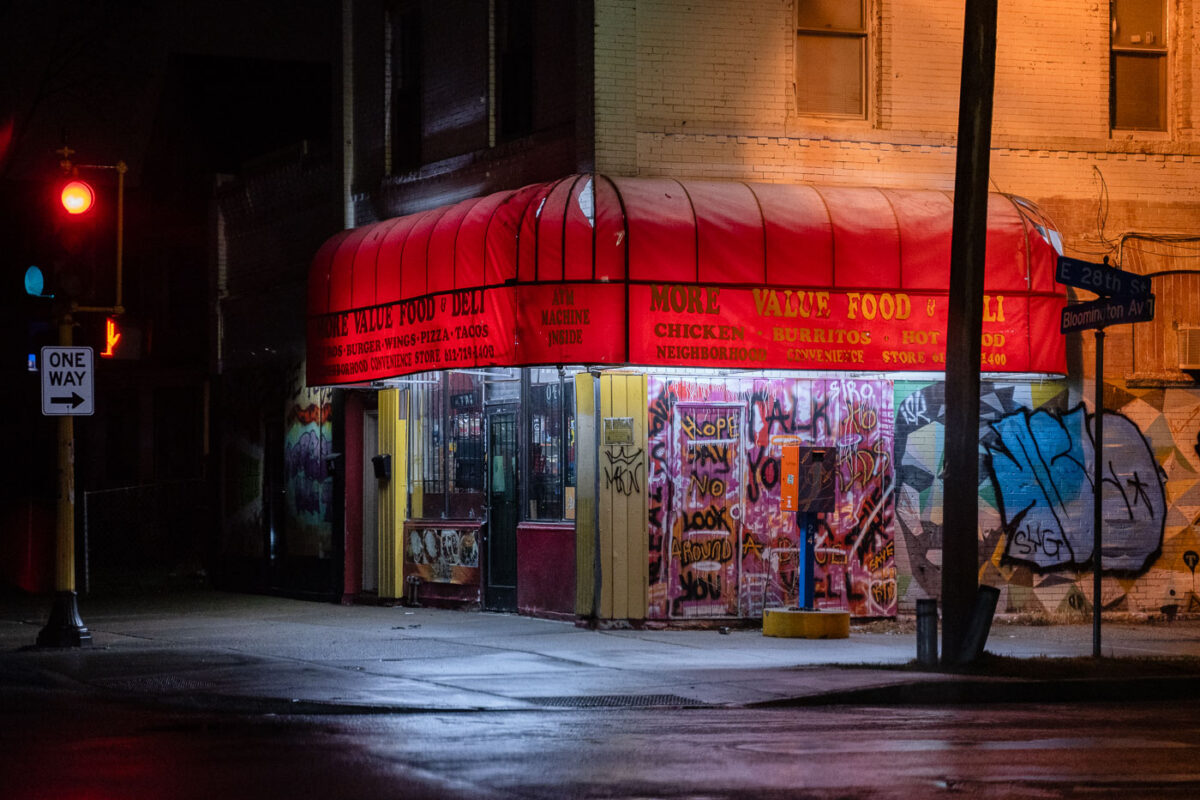
More Value Food & Deli at E 28th St and Bloomington Ave in Minneapolis, with graffiti-covered walls at night.
More Value Food & Deli, a neighborhood convenience store, is located at the corner of East 28th Street and Bloomington Avenue in Minneapolis. The store offers a variety of food items including chicken, burritos, and pizza, and also has an ATM inside. The surrounding brick building is covered in graffiti, a visual element that became more prominent in the area following the Minneapolis Uprising in 2020, which was sparked by the murder of George Floyd nearby. The store's location at this prominent intersection places it within a neighborhood that has experienced significant social and cultural shifts.

More Value Food & Deli at E 28th St and Bloomington Ave, Minneapolis
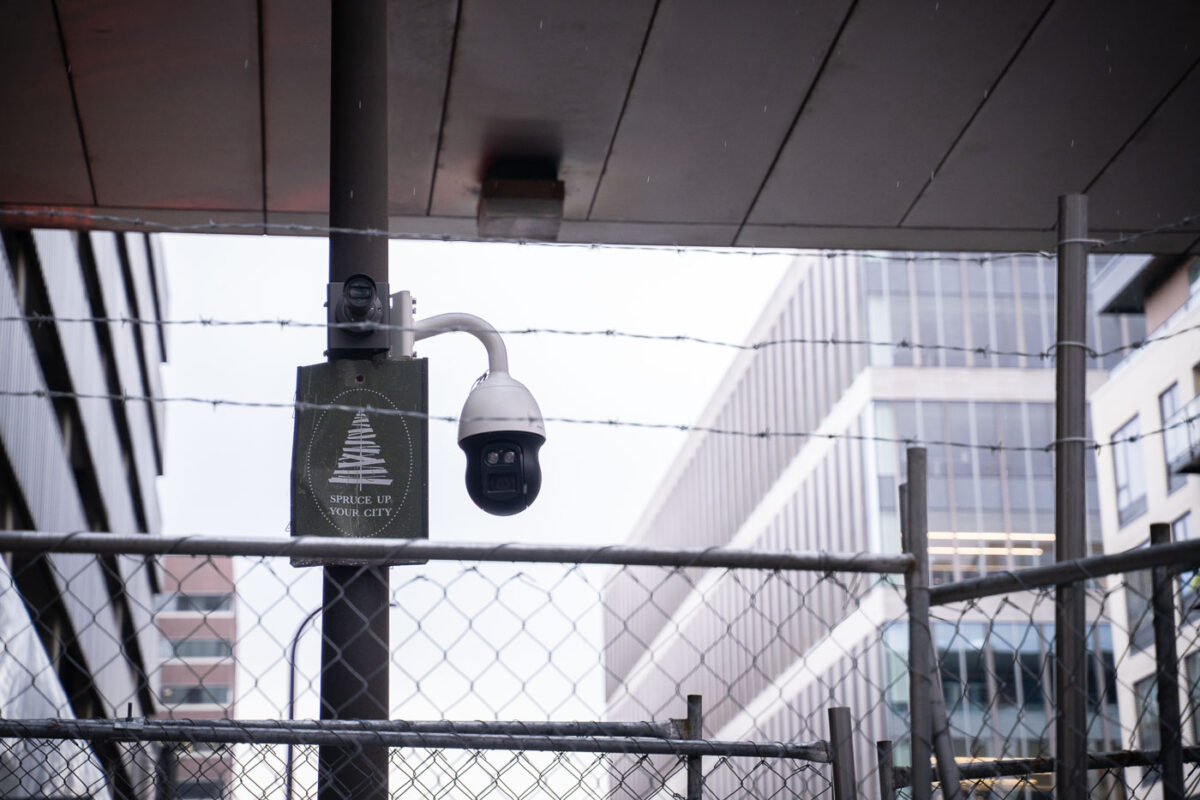
Security camera and barbed wire at the Minneapolis courthouse entrance beneath a Spruce Up Your City sign.
A surveillance camera and barbed wire are visible in front of the Minneapolis Courthouse, a structure that has been a focal point for public gatherings and protests. The "Spruce Up Your City" sign, ironically placed near security measures, suggests a contrast between civic beautification efforts and the heightened security presence. This juxtaposition became particularly relevant following the 2020 Minneapolis uprising, after which security around public buildings was significantly increased. The camera and wire serve as a visual reminder of the ongoing need for security in urban centers, especially in the aftermath of civil unrest.

Minneapolis Courthouse Security Camera and Barbed Wire
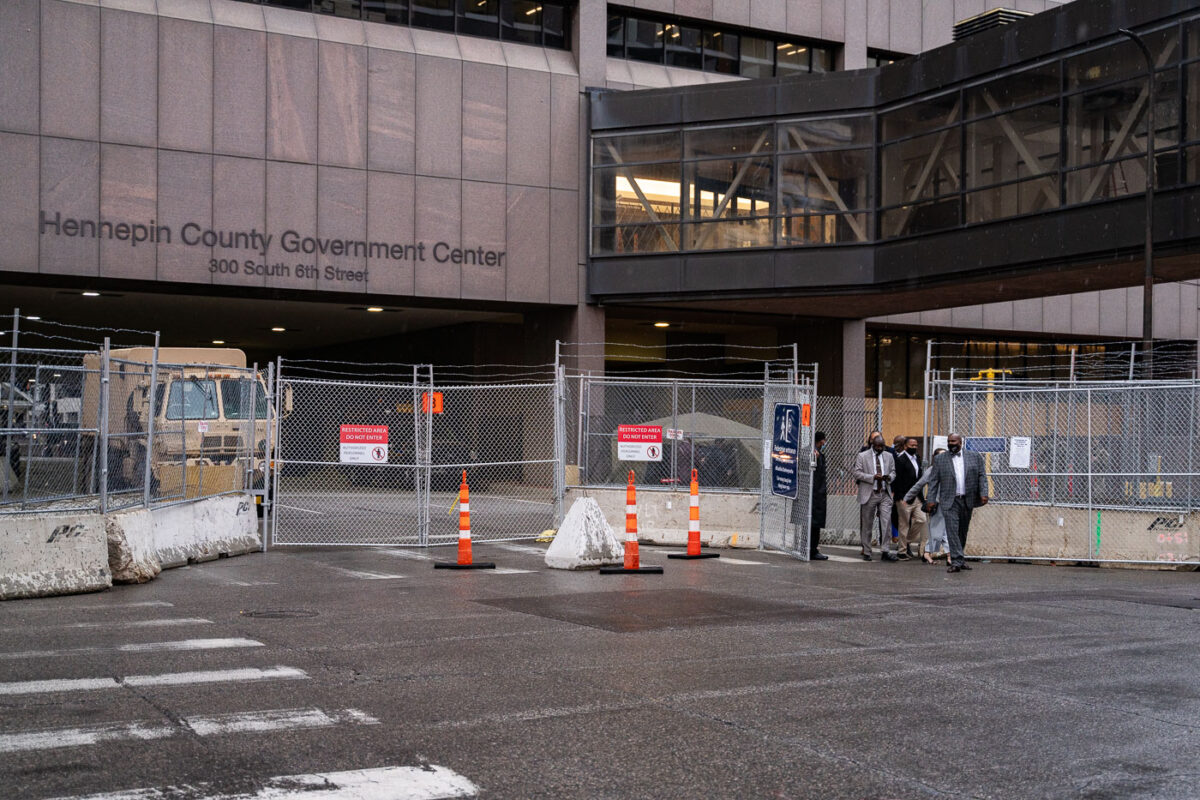
George Floyd's family leaving Hennepin County Government Center in Minneapolis past security fencing.
George Floyd's family departs the Hennepin County Government Center in downtown Minneapolis. The building, located at 300 South 6th Street, serves as a central hub for county administration and judicial proceedings. Its presence in the downtown core underscores its role in the civic life of Minneapolis. The security measures visible, including fencing and barricades, reflect the heightened tensions and public attention surrounding the Derek Chauvin trial, which was held within this government center.

George Floyd Family Departs Hennepin County Government Center
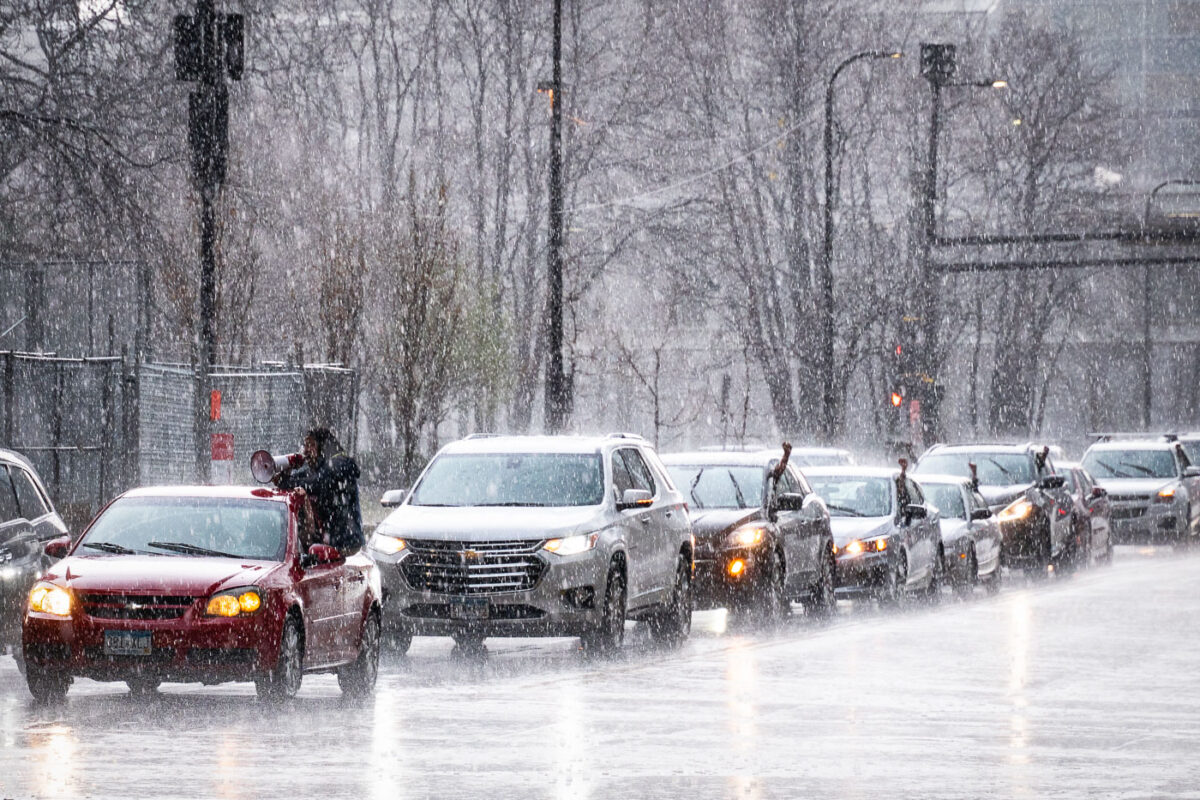
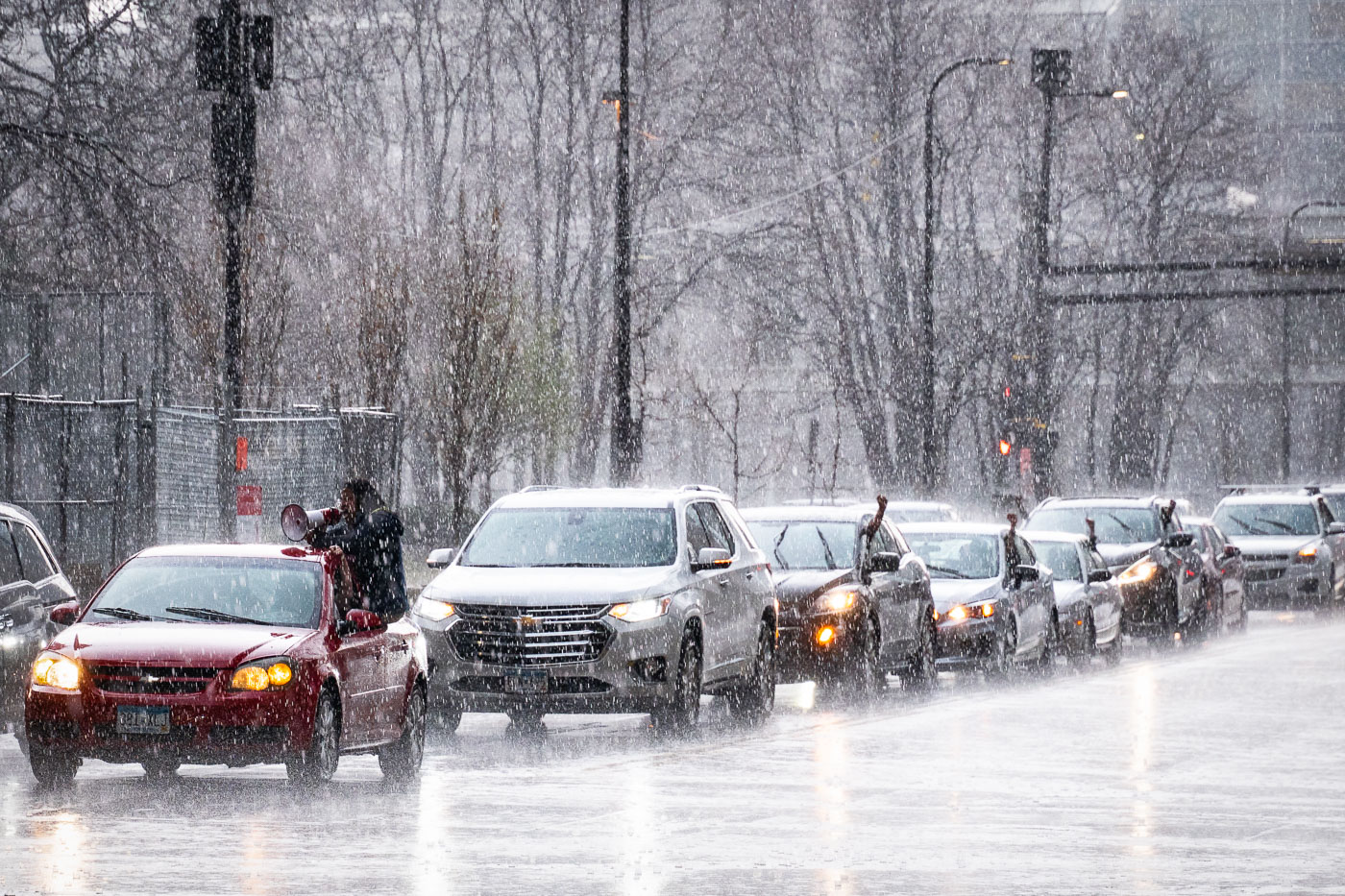
Protest caravan in downtown Minneapolis during heavy rain near the Hennepin County Government Center.
A protest caravan proceeds through downtown Minneapolis in heavy rain on April 19, 2021. The procession circled the Hennepin County Government Center, where the trial of former police officer Derek Chauvin was underway. Chauvin was on trial for the murder of George Floyd, an event that occurred on May 25, 2020, in South Minneapolis and sparked widespread protests. The caravan's route highlighted the courthouse's significance as the site of this nationally scrutinized legal proceeding.

Minneapolis Protest Caravan in Pouring Rain During Chauvin Trial
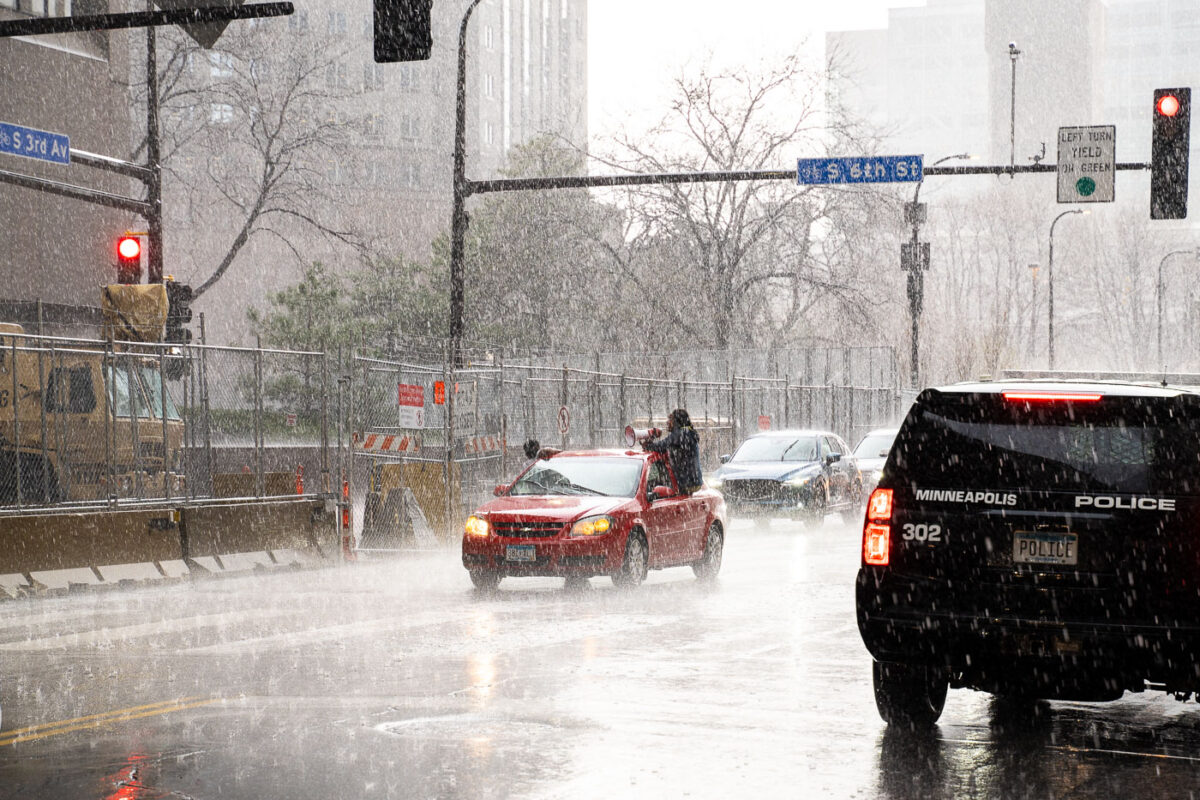
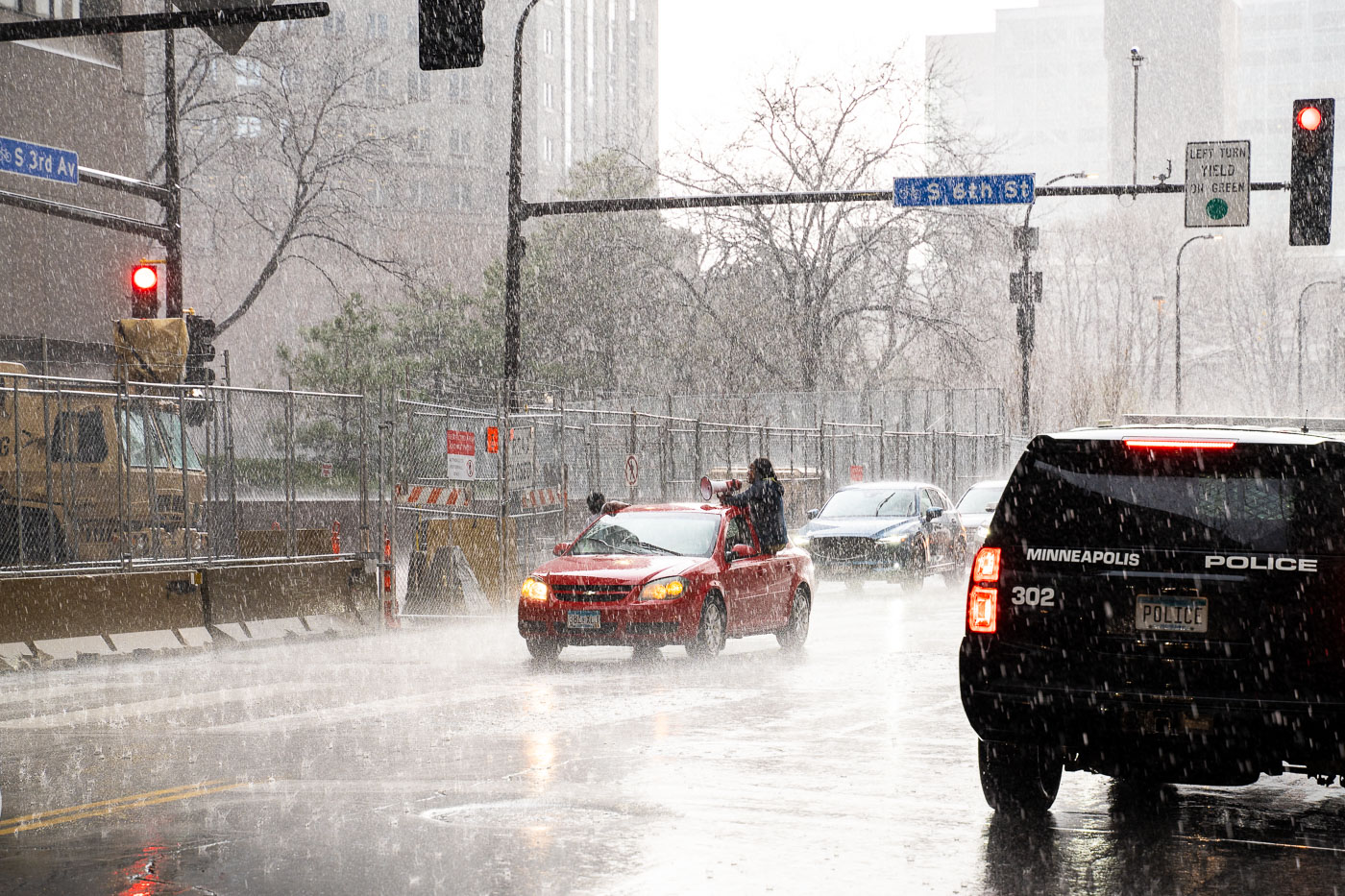
Protest caravan on South 5th Street in downtown Minneapolis during heavy rain.
A protest caravan navigates through heavy rain in downtown Minneapolis, approaching the Hennepin County Government Center. This event occurred during the trial of Derek Chauvin, the former Minneapolis police officer charged with the murder of George Floyd on May 25, 2020. The caravan's presence underscored the ongoing public attention and activism surrounding the trial and the broader issues of racial justice and police accountability.

Minneapolis protest caravan during Derek Chauvin trial in rain
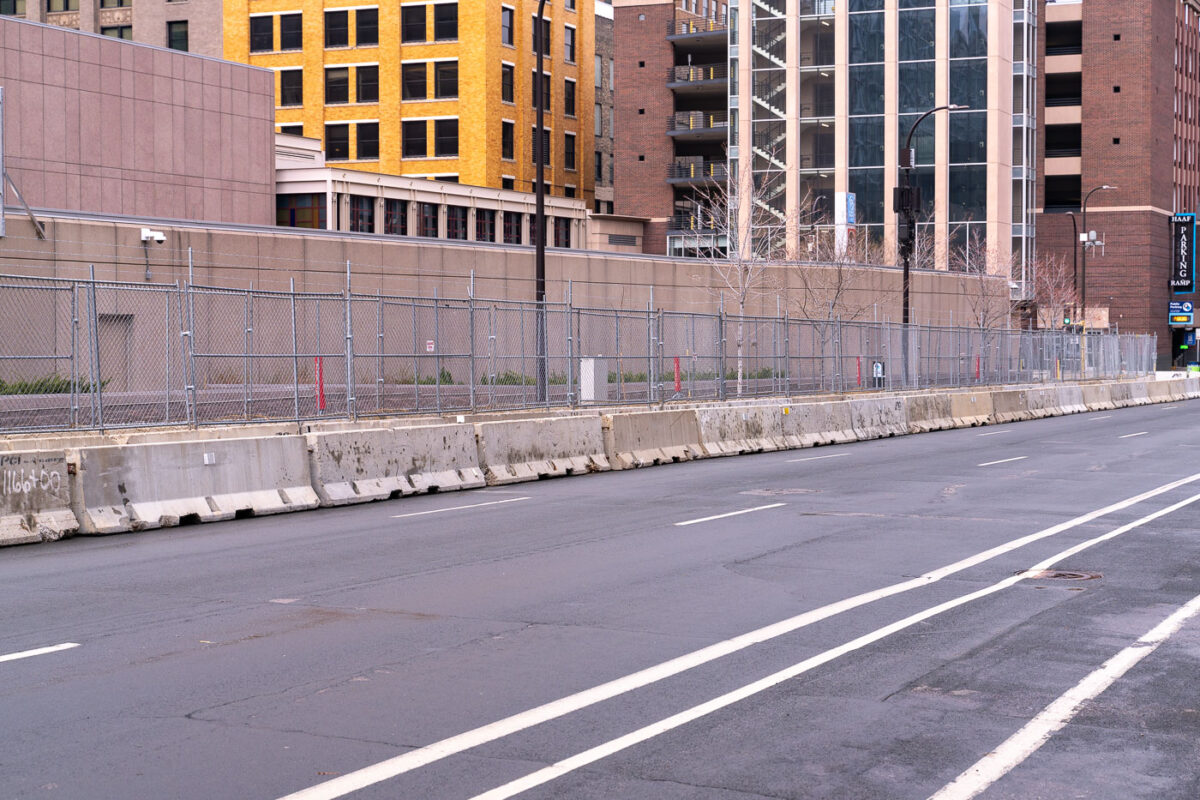
Barricades and fencing outside the federal courthouse in downtown Minneapolis during the Chauvin trial.
Barricades and fencing surround the United States Federal Courthouse in Minneapolis during the Derek Chauvin murder trial in April 2021. The courthouse, located in downtown Minneapolis, served as the venue for the trial of former police officer Derek Chauvin, who was accused of the murder of George Floyd. The extensive security measures were implemented to manage potential public gatherings and ensure the safety of the courthouse and its surroundings during this high-profile legal proceeding. The trial concluded with Chauvin's conviction on all charges.

Minneapolis Federal Courthouse Barricaded During Chauvin Trial
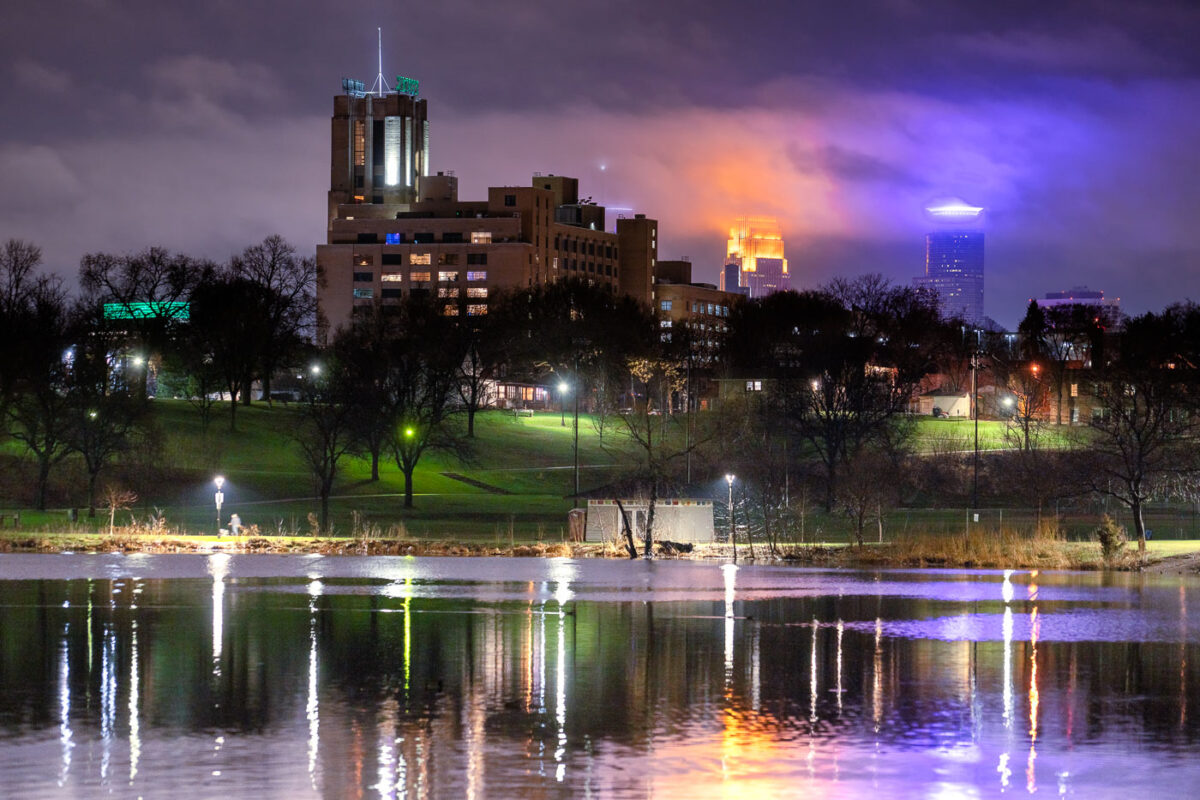
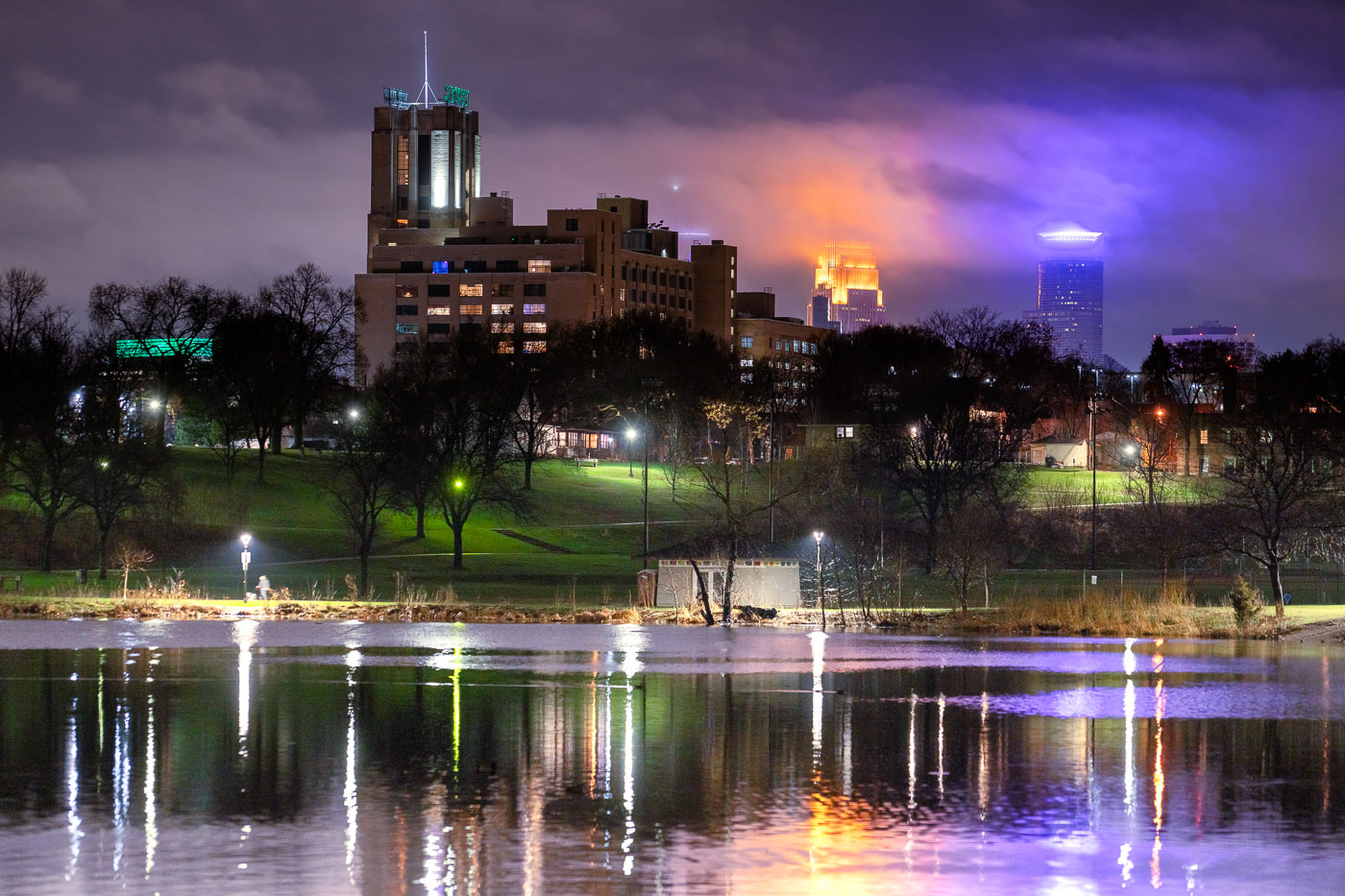
Powderhorn Park pond and Minneapolis skyline at night, seen from South Minneapolis.
Powderhorn Park in South Minneapolis is illuminated by the city's skyline at night. The park, established in 1889, is one of Minneapolis's oldest and most cherished public spaces, offering residents a place for recreation and community gathering. The prominent building in the foreground is likely part of the former Minneapolis General Hospital complex, which operated from the 1930s until the 1990s. The distant skyscrapers represent the modern urban core of Minneapolis, reflecting the city's growth and development over time.

Minneapolis Skyline and Powderhorn Park at Night
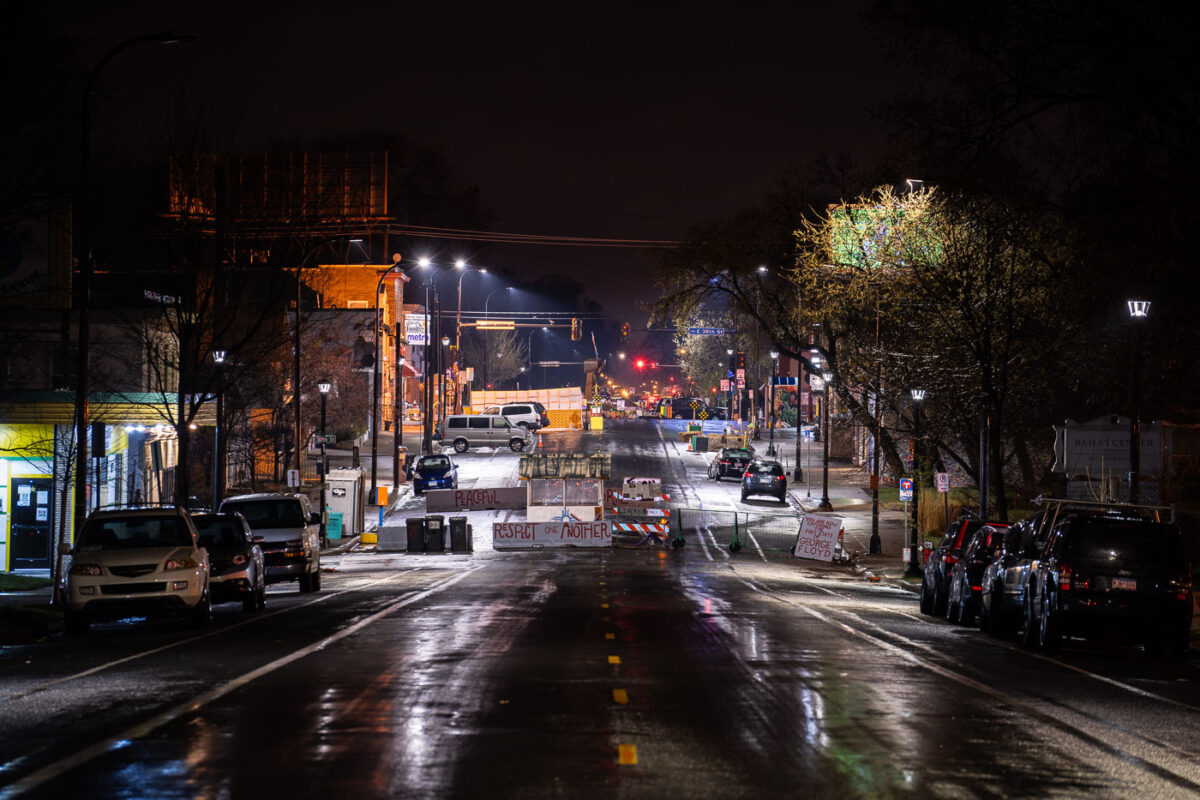
Barricades on Chicago Avenue at George Floyd Square in Minneapolis at night.
Barricades line Chicago Avenue in Minneapolis, marking the area known as George Floyd Square. This space was established by protesters following the murder of George Floyd in May 2020, serving as a site of remembrance and community organizing. The barricades, adorned with messages such as "Respect One Another," physically demarcated the zone and controlled access. The area became a focal point for activism and a symbol of the broader movement for racial justice.

George Floyd Square barricades on Chicago Ave, Minneapolis
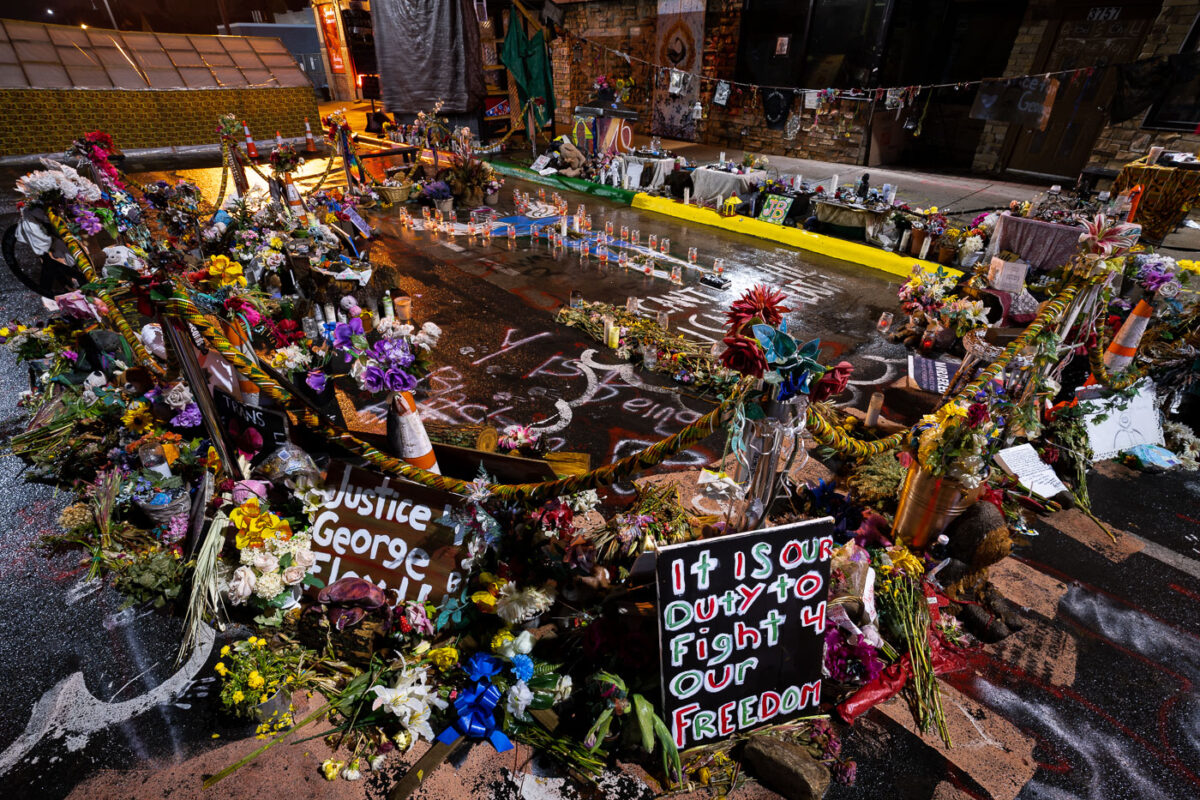
George Floyd memorial at George Floyd Square in Minneapolis, surrounded by flowers, candles, and protest signs.
The George Floyd Memorial at George Floyd Square in Minneapolis, Minnesota, on April 7, 2021. This site became a focal point for protests and activism following the murder of George Floyd in May 2020. The memorial, located at the intersection where Floyd was killed, features numerous tributes including flowers, candles, signs, and personal mementos. It serves as a space for remembrance, community gathering, and continued calls for racial justice and police reform.

George Floyd Square Memorial, Minneapolis, April 7 2021
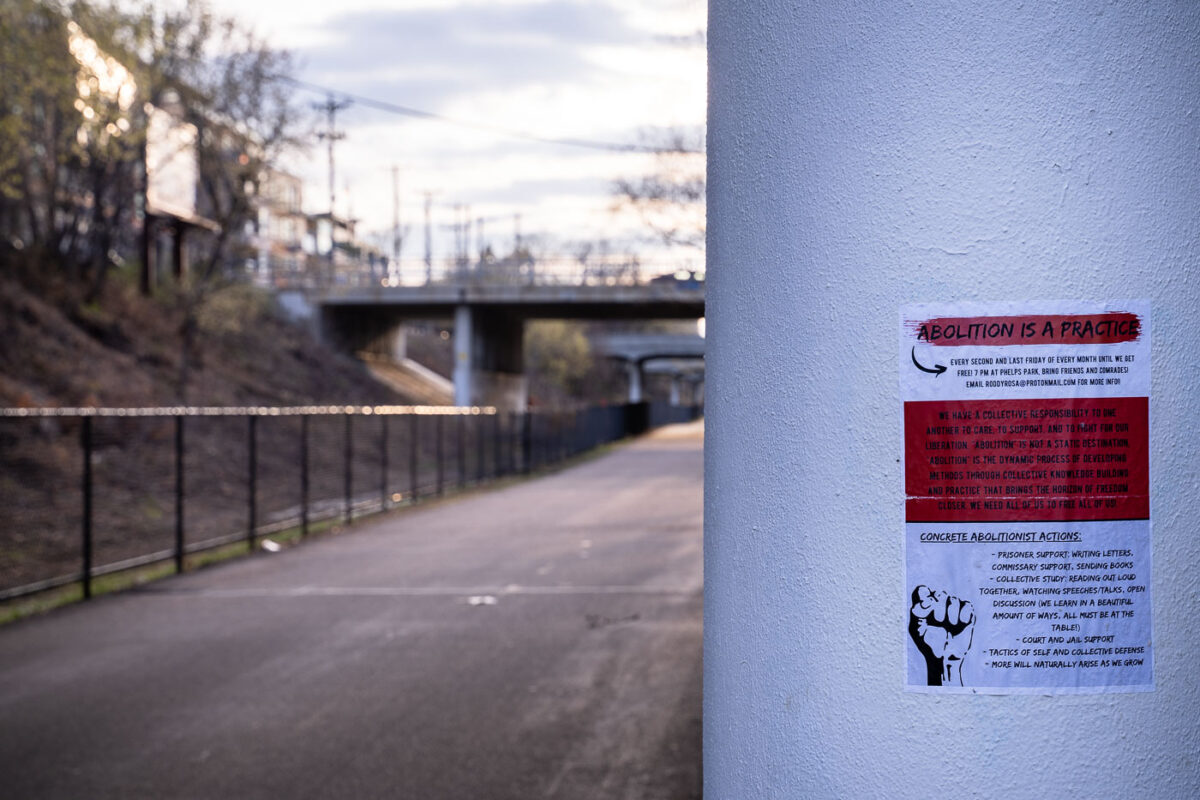
Abolition Is a Practice poster on a pillar along the Midtown Greenway in Minneapolis.
A poster advocating for police abolition is affixed to a pillar along the Minneapolis Midtown Greenway, a multi-use trail built on a former railroad corridor. The poster, titled "Abolition is a Practice," outlines the philosophy and actions of abolitionist movements, emphasizing collective care, support, and the development of freedom-building practices. It also lists concrete actions such as prisoner support, court and jail support, and tactics of self and collective defense. The presence of such messaging on public infrastructure reflects the ongoing discourse and activism surrounding policing and justice, particularly in the context of events like the Minneapolis Uprising of 2020.

Abolition is a Practice poster on Minneapolis Greenway
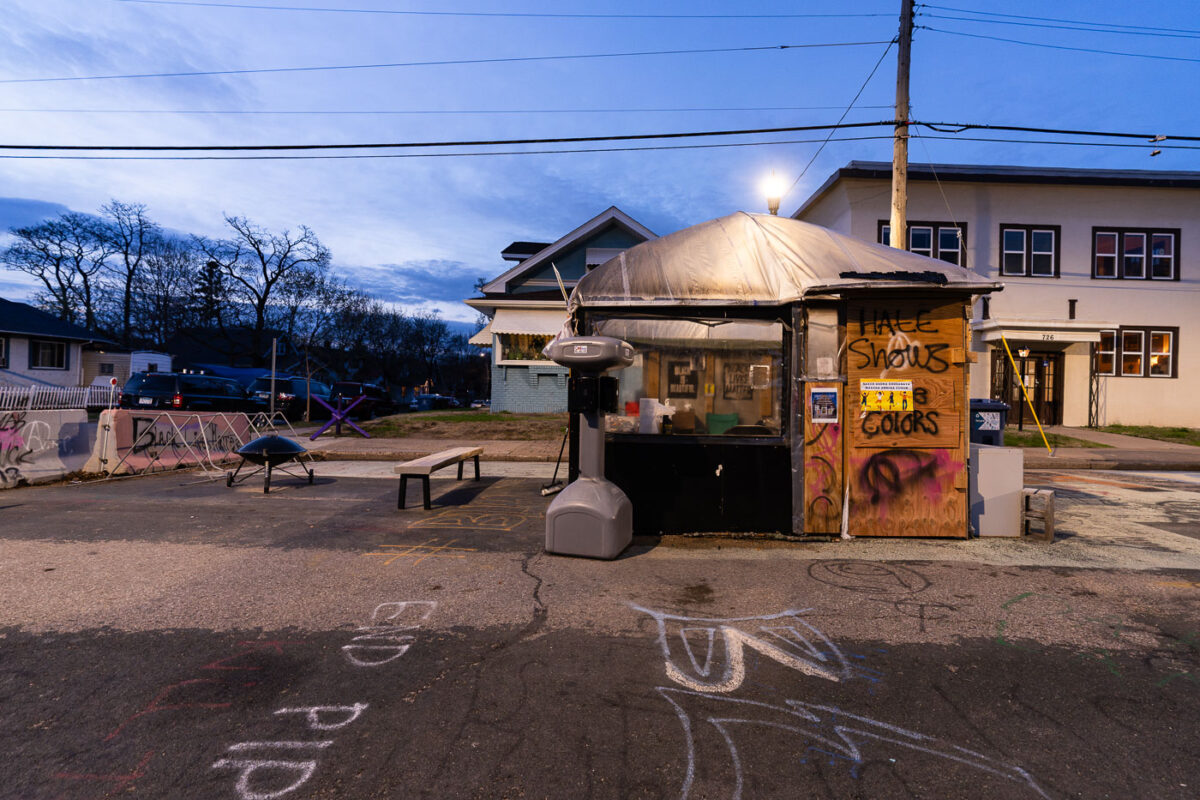
Warming station and barricades at George Floyd Square in Minneapolis.
George Floyd Square in Minneapolis was the site of a protest encampment following the murder of George Floyd in May 2020. This image from April 2021 shows a warming station and barricades that were erected by protesters to control access to the area. The square, located at the intersection of 38th Street and Chicago Avenue, became a symbol of the uprising and a space for community organizing and mutual aid. The warming station provided shelter and resources to those present, while the barricades served to protect the occupied space from external interference.

George Floyd Square Warming Station and Barricade, Minneapolis
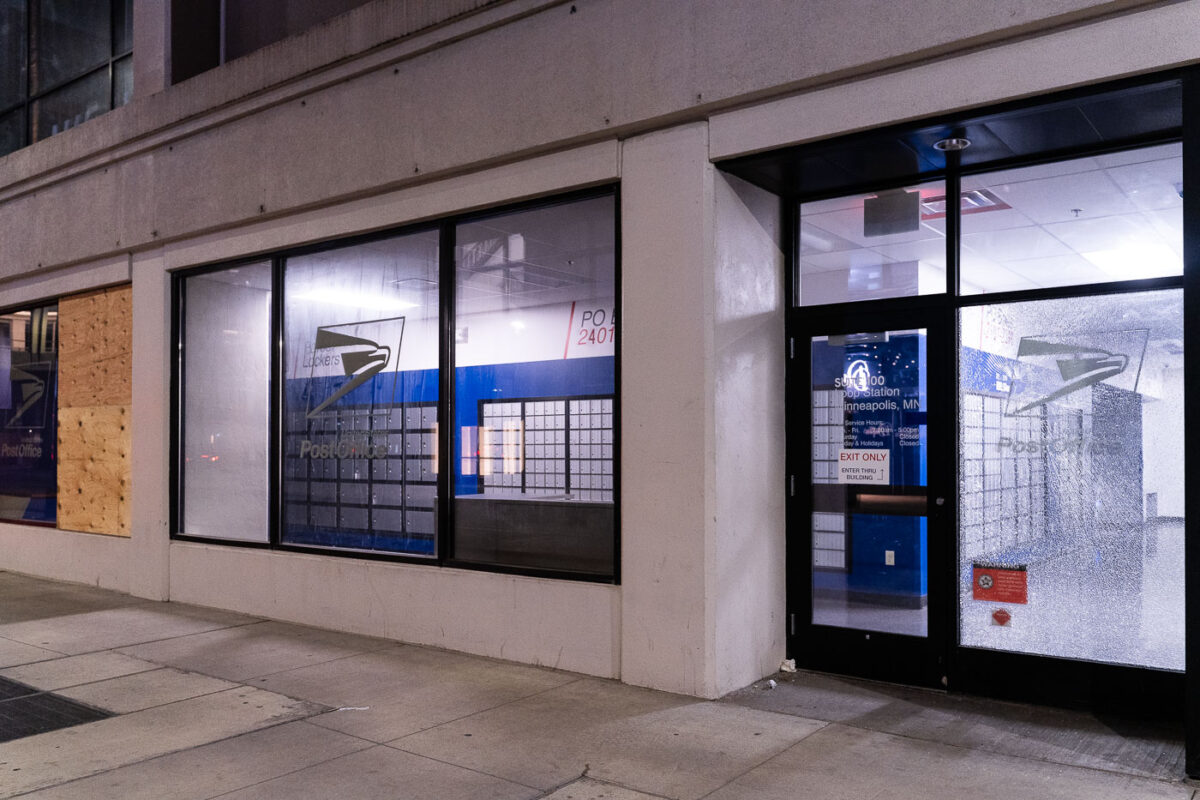
USPS Loop Station in downtown Minneapolis with boarded window and shattered glass door.
The Minneapolis USPS Loop Station, located in downtown Minneapolis, shows signs of damage with boarded-up windows and broken glass. This facility serves as a critical hub for postal services in the city, providing mail processing and delivery functions. The damage is indicative of the civil unrest that affected Minneapolis in the aftermath of George Floyd's murder in May 2020. The station's function as a public service infrastructure highlights its importance to the daily operations of the community and its vulnerability during periods of social upheaval.

Minneapolis USPS Loop Station: Boarded Windows, Broken Glass
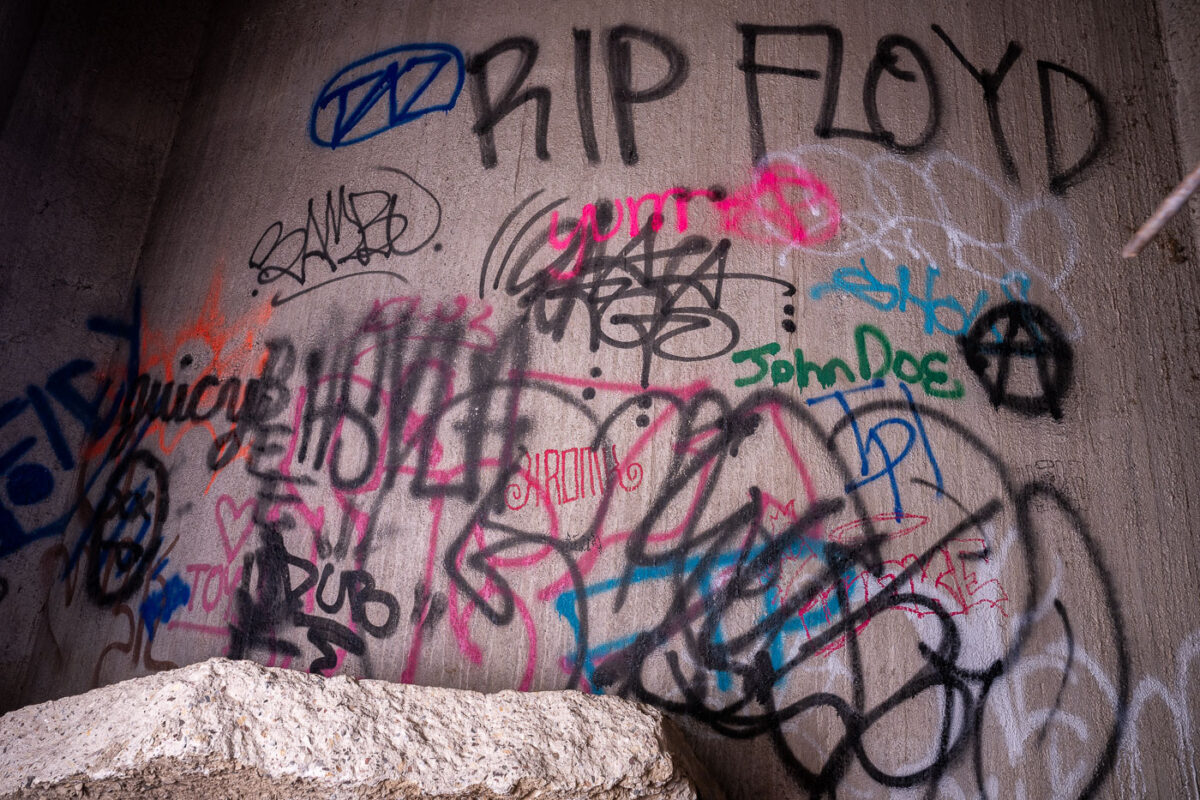
RIP Floyd graffiti on a wall inside an abandoned building in Minneapolis.
Graffiti art covers the interior walls of an abandoned structure in Minneapolis, including the prominent "RIP Floyd" tag. This artwork emerged in the context of the Minneapolis Uprising of 2020, following the murder of George Floyd. The building, a popular site for urban exploration and graffiti, reflects the city's response to the events of that year. The "RIP Floyd" message serves as a memorial and a statement of protest, rendered in a style common to street art and graffiti culture.

RIP Floyd Graffiti in Abandoned Minneapolis Building
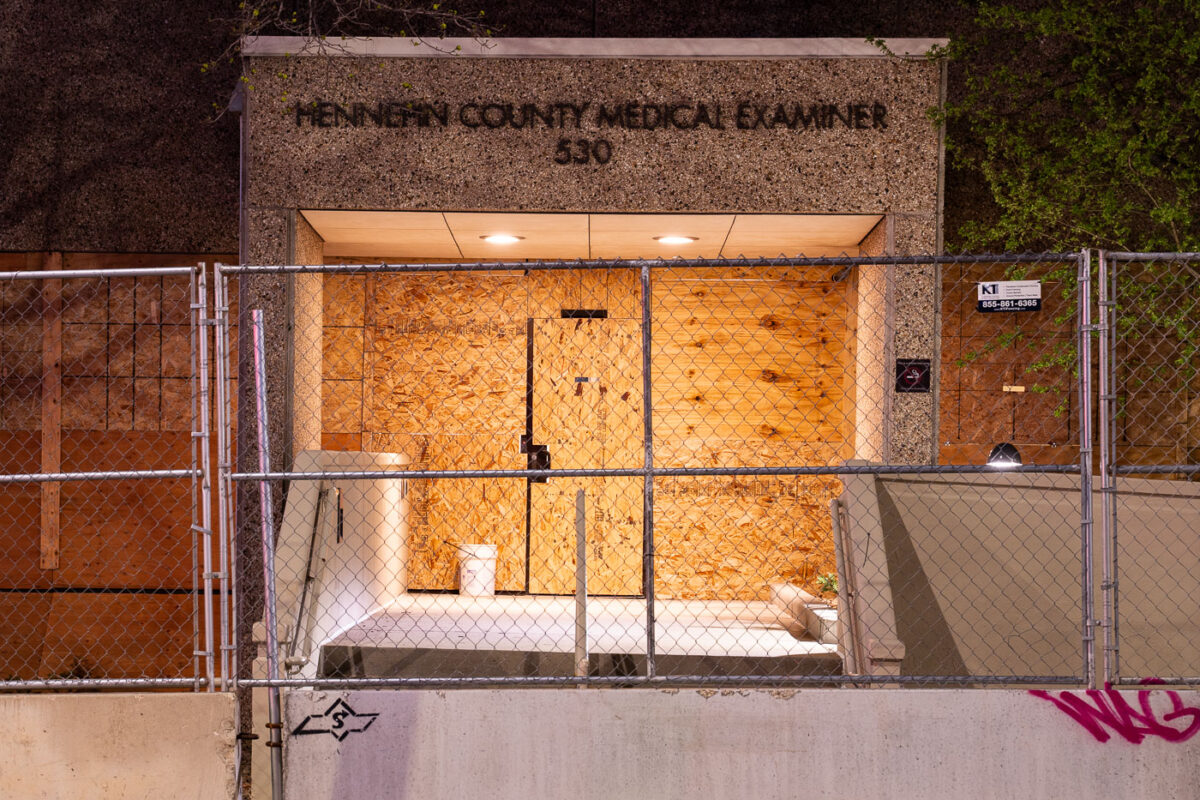
Boarded entrance at the Hennepin County Medical Examiner in Minneapolis behind security fencing.
Security fencing and boarded-up entrances surround the Hennepin County Medical Examiner's office at 530 5th Avenue in Minneapolis. This measure was taken in anticipation of the Derek Chauvin trial, which began in March 2021. The office is responsible for investigating deaths in Hennepin County, including those that occur under suspicious circumstances or involve law enforcement. The plywood covering the building's entrances suggests a response to potential unrest or damage during the period of heightened public attention surrounding the trial.

Hennepin County Medical Examiner’s Office Boarded Up
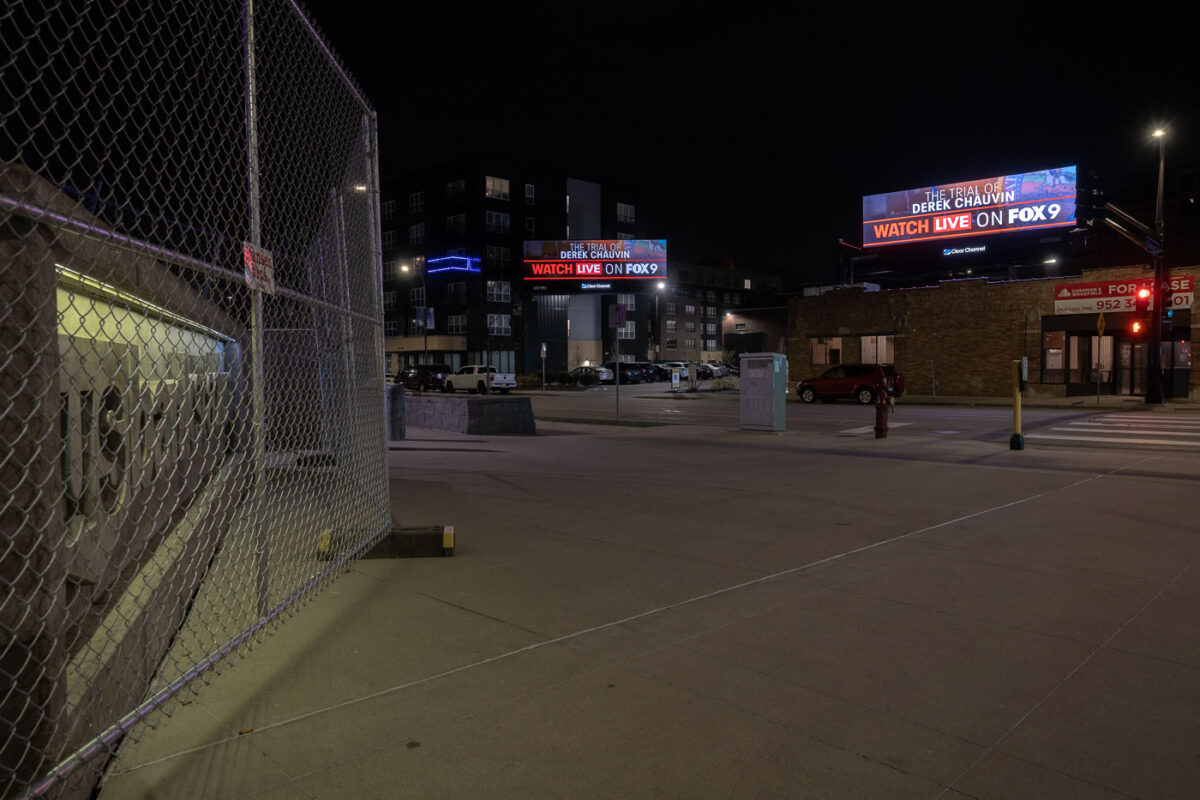
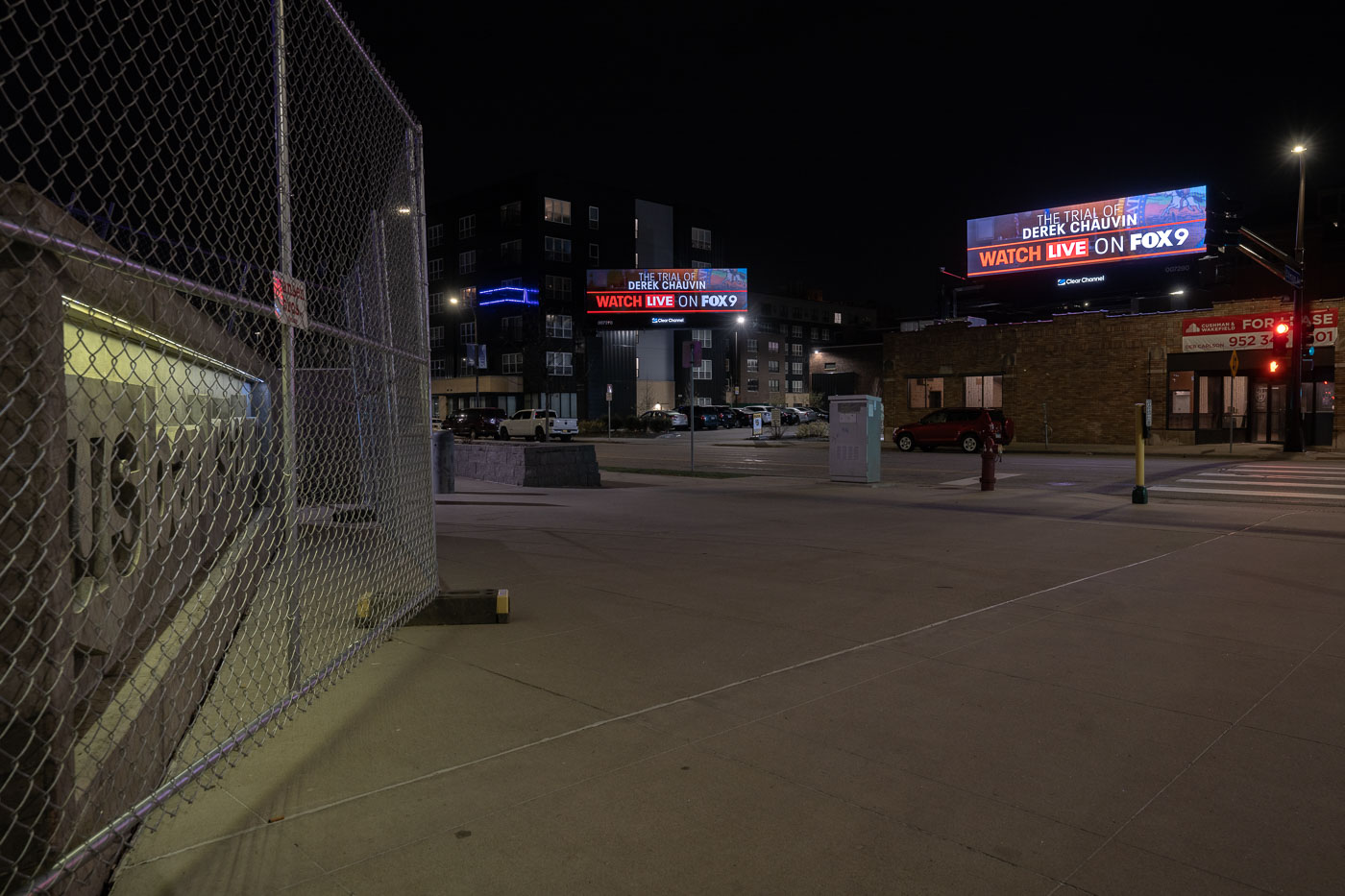
FOX9 billboards for the Derek Chauvin trial in downtown Minneapolis beside security fencing.
FOX9 billboards in downtown Minneapolis. US Bank Stadium to the left behind security fencing.

Minneapolis: FOX9 Billboards for Derek Chauvin Trial
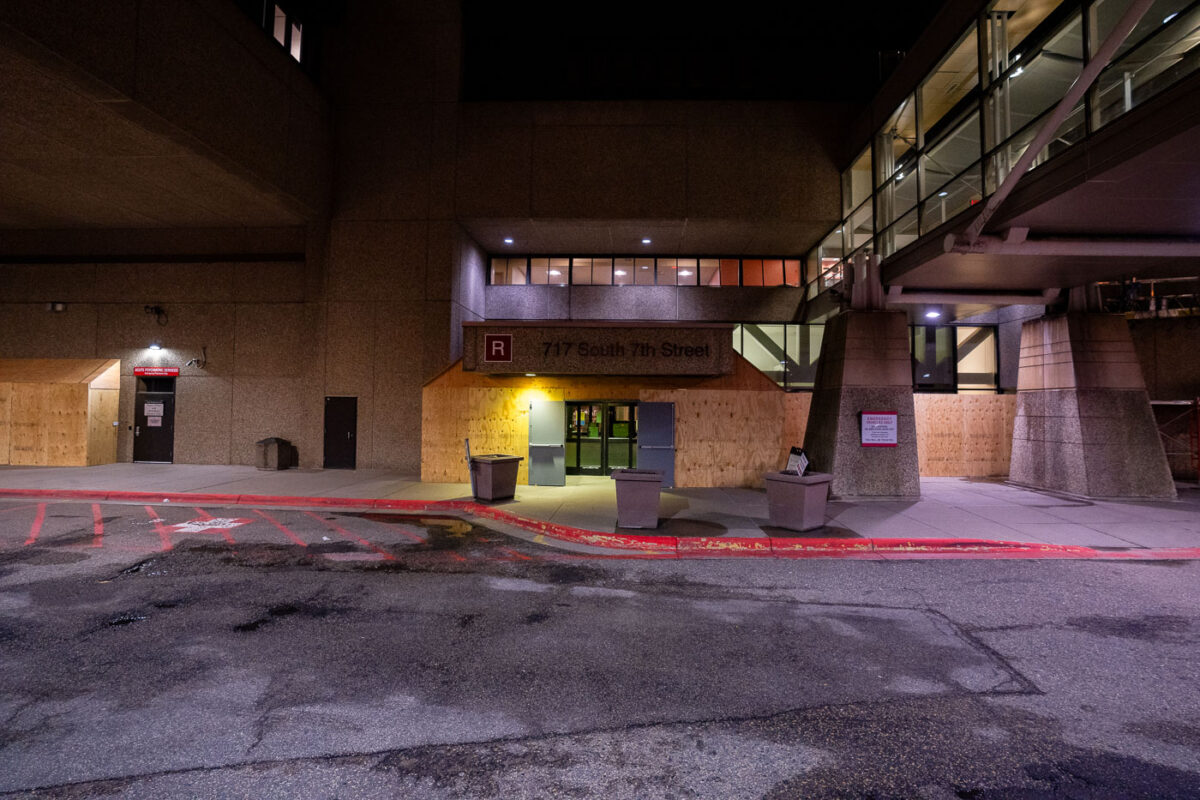
Boarded entrance of Hennepin County Medical Center at 717 South 7th Street in Minneapolis.
Hennepin County Medical Center, located at 717 South 7th Street in Minneapolis, Minnesota, had its windows boarded up during the trial of Derek Chauvin in April 2021. The hospital, a major public health facility serving the Twin Cities, was secured as a precautionary measure amidst concerns of potential unrest following the verdict in the murder trial of George Floyd. The plywood coverings served to protect the building's facade from damage during a period of heightened public tension and protests.

Hennepin County Medical Center boarded up during Chauvin trial
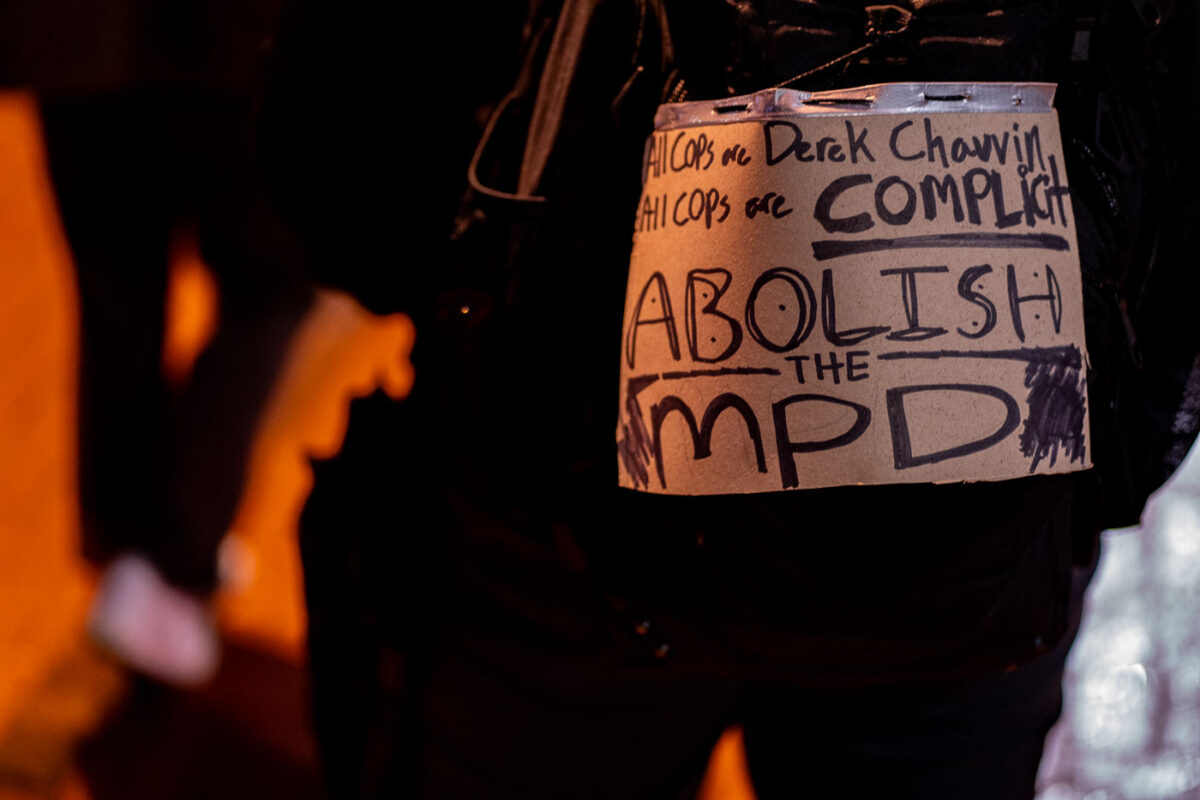
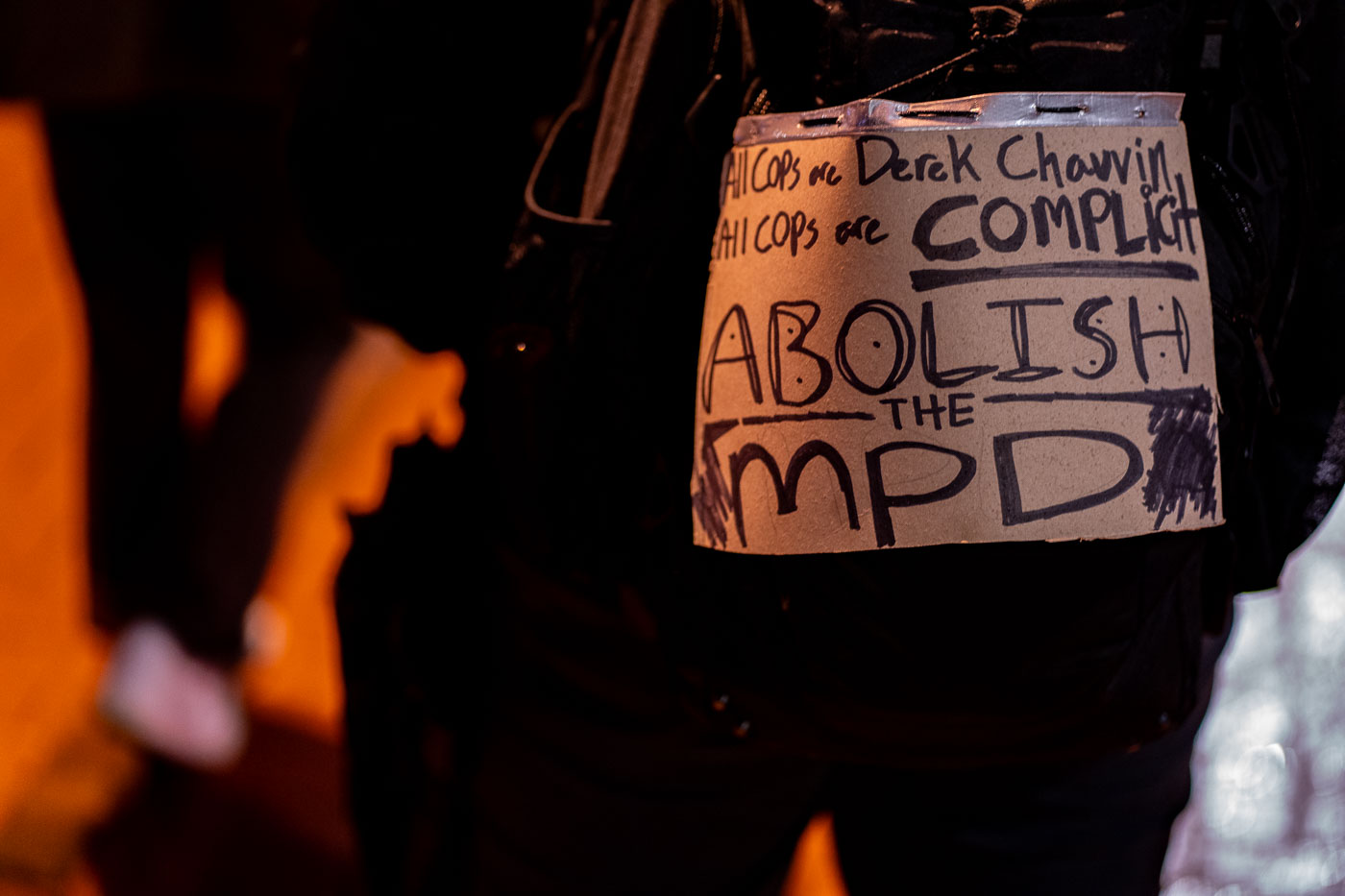
Abolish the MPD sign on a marcher in downtown Minneapolis.
Abolish the MPD protest sign on someones back during a march through downtown Minneapolis.

Minneapolis Protest Sign: Abolish the MPD
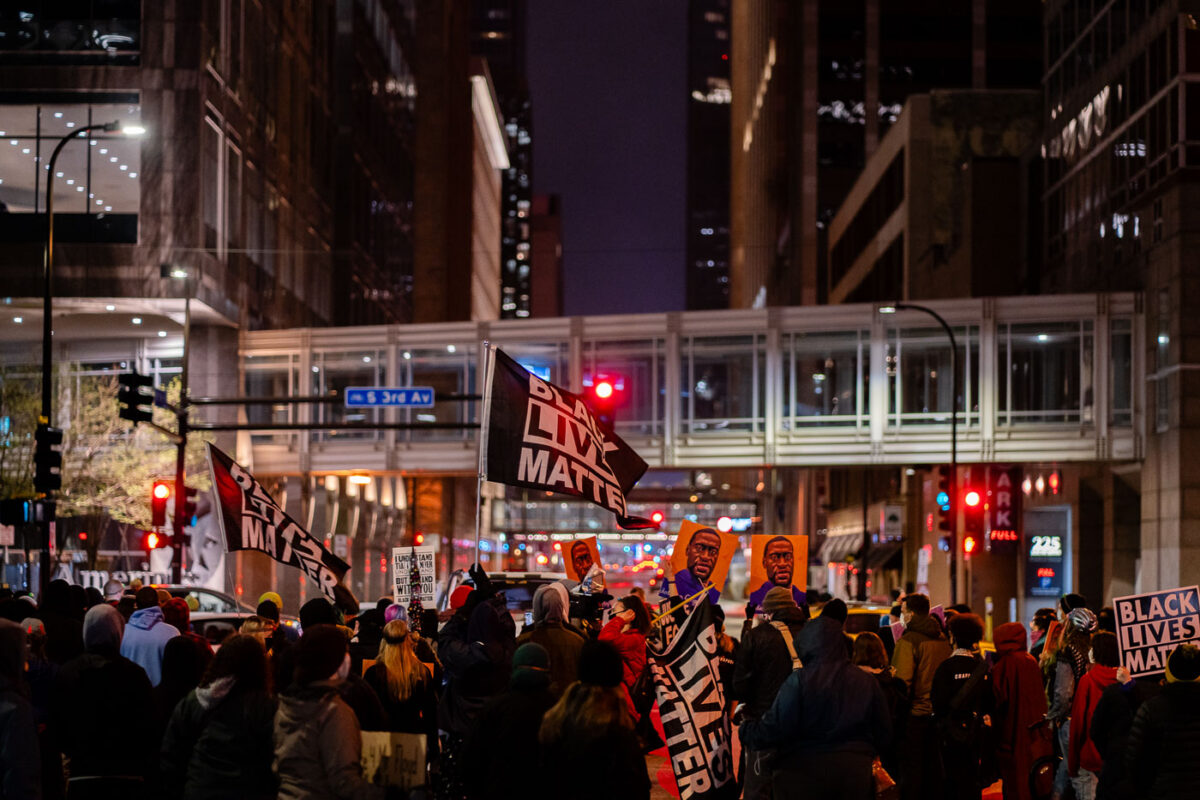
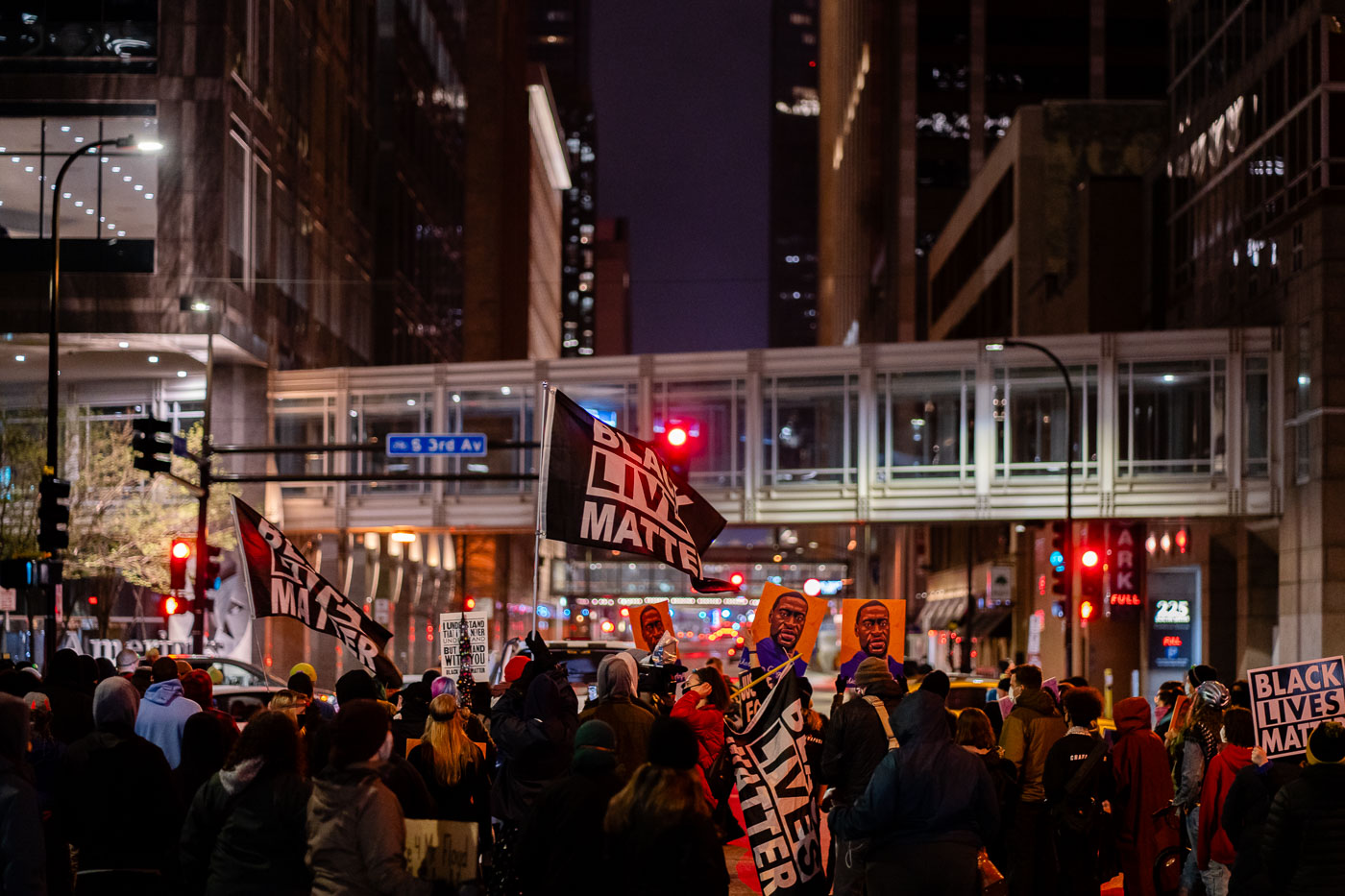
Protesters with Black Lives Matter flags on 3rd Avenue in downtown Minneapolis.
Protesters gathered in downtown Minneapolis outside the Hennepin County Government Center during the trial of Derek Chauvin, the former police officer charged in the murder of George Floyd. The "Black Lives Matter" flags and signs bearing Floyd's image reflect the broader movement for racial justice and police accountability that gained national attention following Floyd's death in May 2020. The courthouse, a significant civic building in Minneapolis, served as a focal point for demonstrations demanding justice and systemic change.

Minneapolis Protest for George Floyd Outside Hennepin County Courthouse
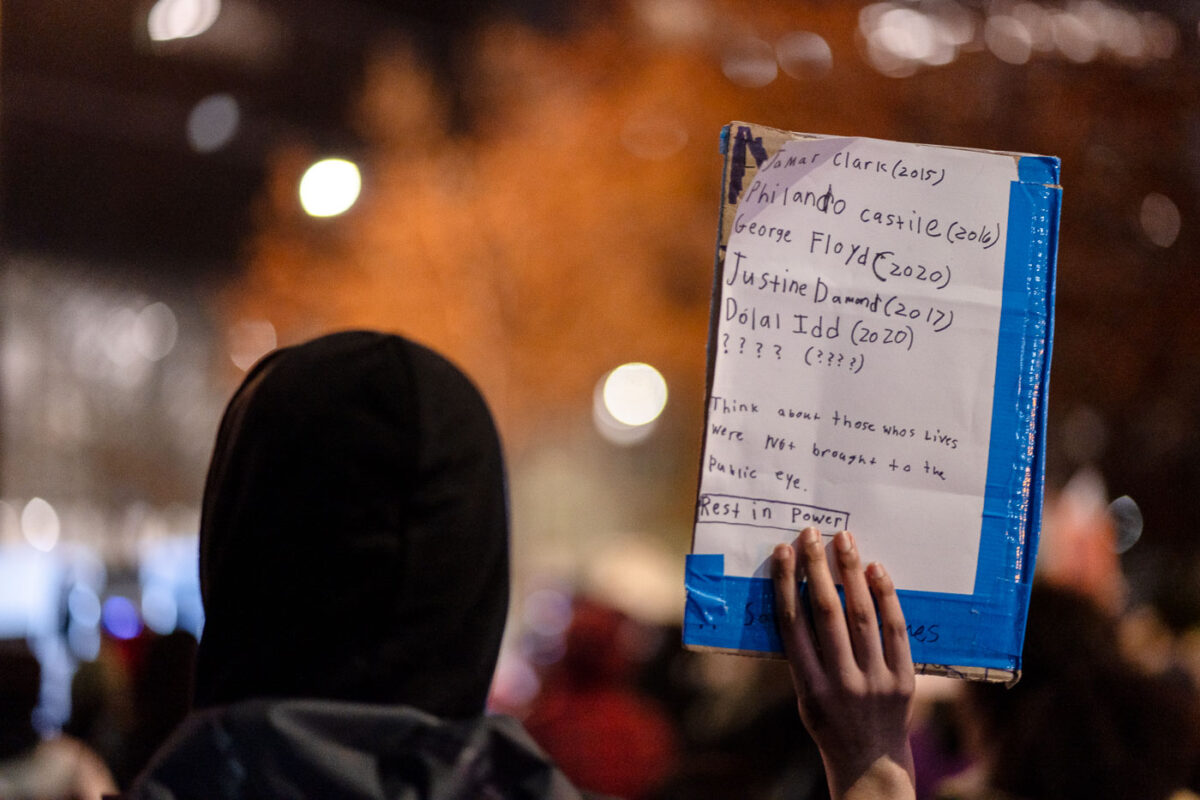
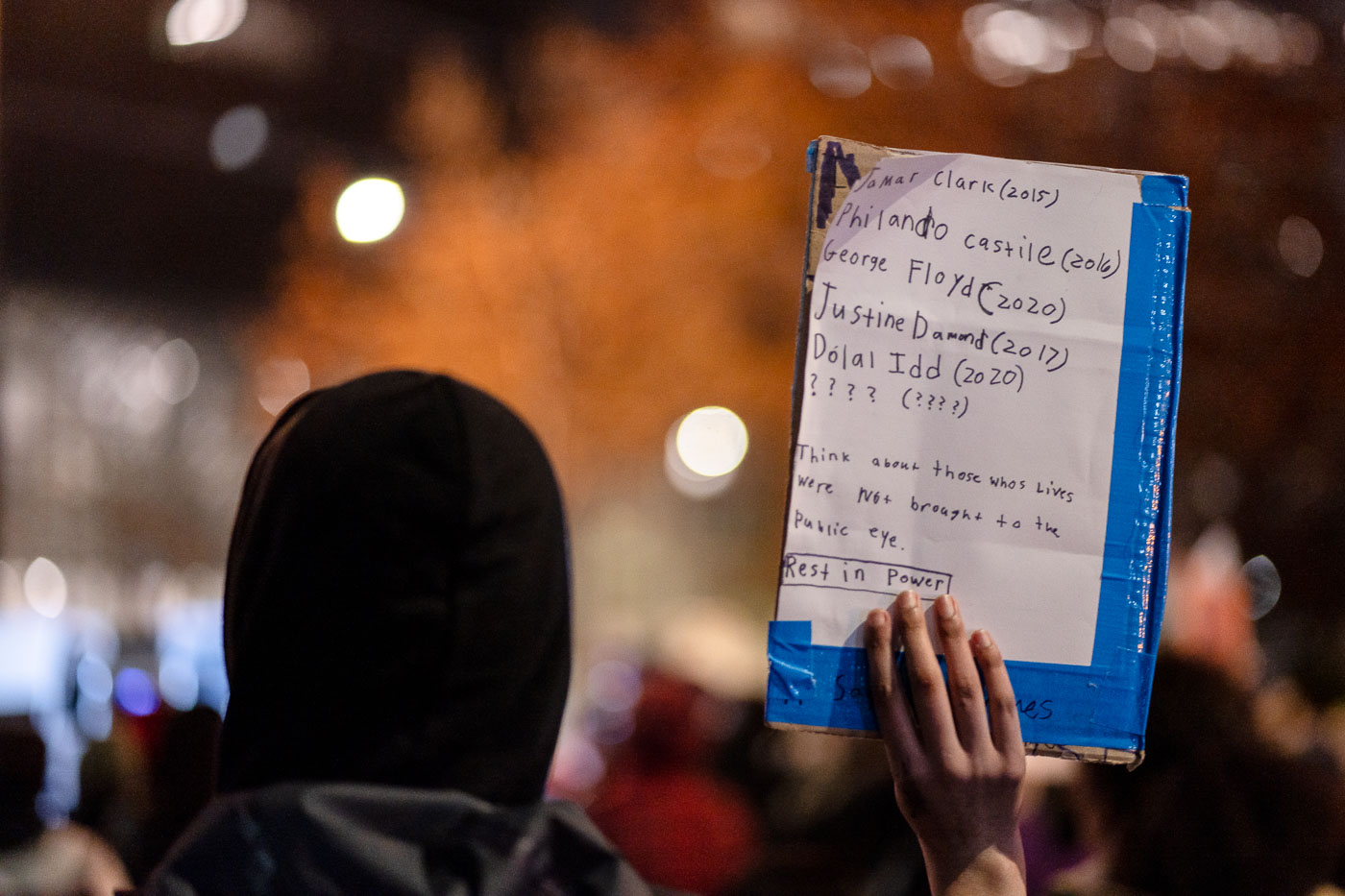
Protester in downtown Minneapolis holds a sign naming George Floyd and other people killed by police.
Protesters marched through downtown Minneapolis during the trial of Derek Chauvin, the former police officer accused in the murder of George Floyd. The sign held by a demonstrator lists names of individuals, including Floyd, Philando Castile, and Tamir Rice, who died in encounters with law enforcement. The list serves as a memorial to victims of police brutality and a call for accountability. The protest occurred amidst widespread national attention on racial injustice and police conduct.

Minneapolis Protest During Derek Chauvin Trial
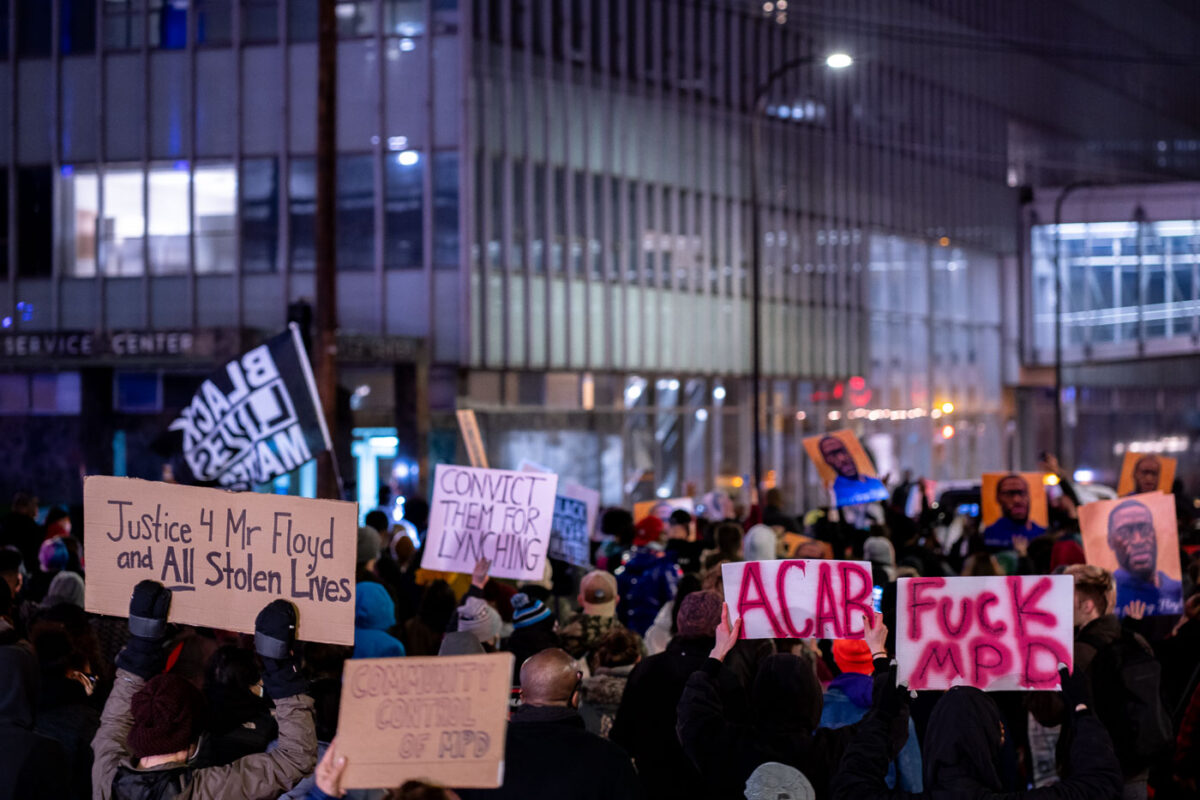
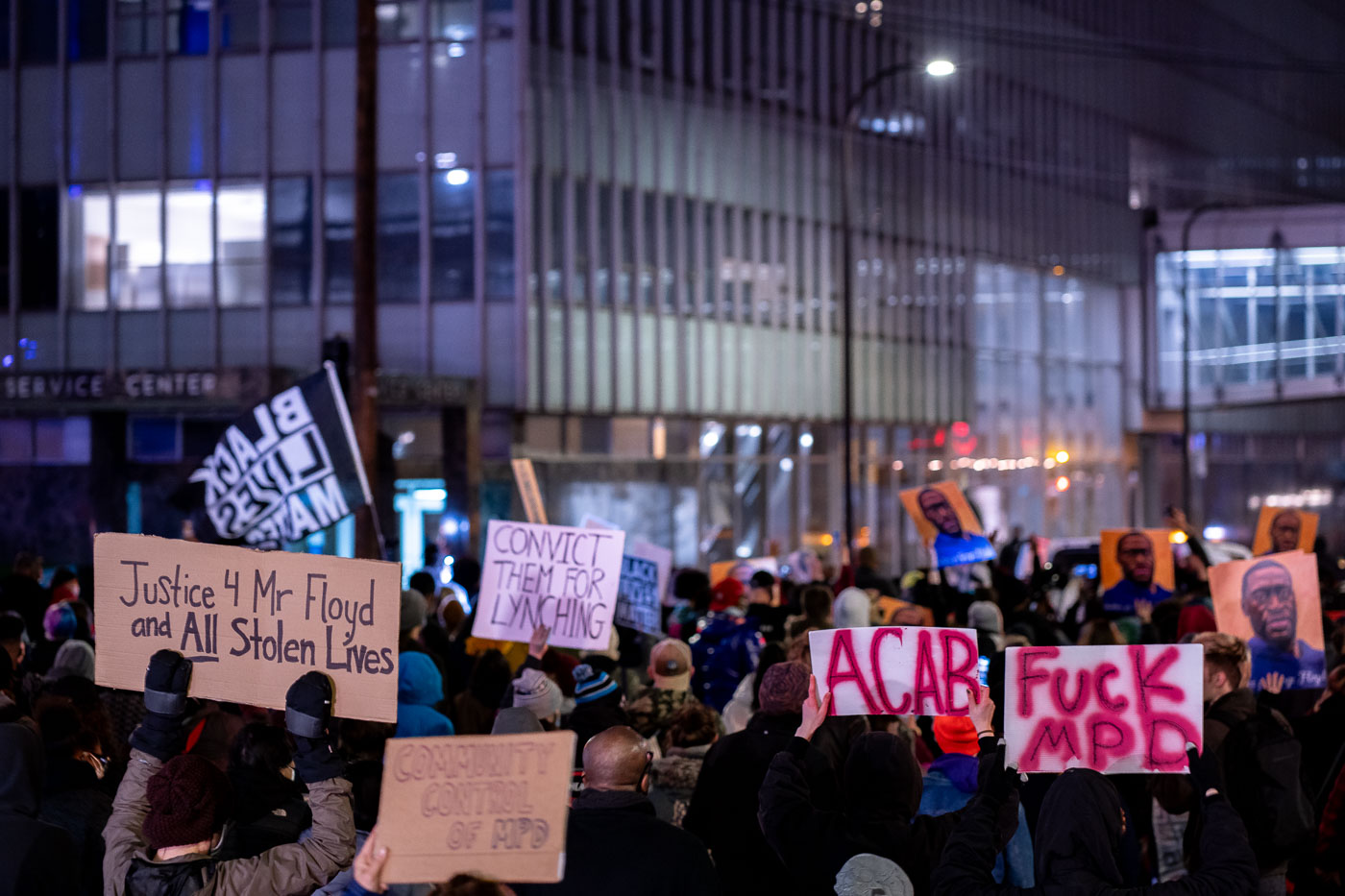
Protesters in downtown Minneapolis during the Derek Chauvin trial hold signs for George Floyd and against police.
Protesters gathered in downtown Minneapolis during the trial of Derek Chauvin, the police officer accused of murdering George Floyd. The demonstrations, which occurred in the spring of 2021, were part of a broader movement demanding justice for Floyd and other victims of police brutality. Signs held by participants called for accountability for Floyd's death and systemic changes within law enforcement. The protests highlighted ongoing tensions between the community and the Minneapolis Police Department.

Minneapolis Protest: Justice for George Floyd and All Stolen Lives
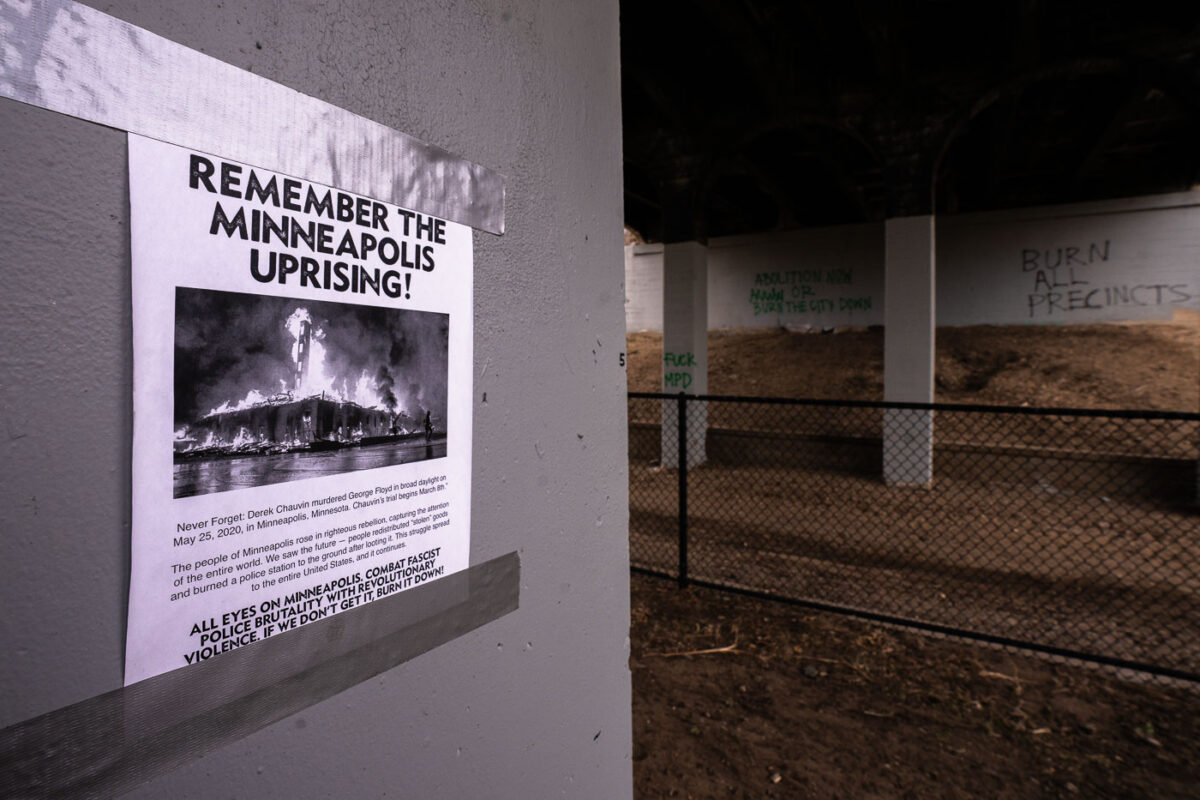
Flyer about the 2020 George Floyd protest on the Midtown Greenway in Minneapolis with anti-police graffiti nearby.
A flyer posted on the Minneapolis Midtown Greenway commemorates the "Minneapolis Uprising" that began on May 25, 2020, following the murder of George Floyd by Minneapolis police. The flyer includes an image of buildings engulfed in flames and text describing the events as "righteous rebellion" and "revolutionary violence." Graffiti on a nearby structure, visible in the background, echoes the sentiment with slogans such as "Abolition Now" and "Burn All Precincts." The Midtown Greenway is a popular urban trail built on a former railroad corridor, which became a site of public assembly and protest during the unrest.

Minneapolis Uprising Flyer on Midtown Greenway

Brooklyn Center police in riot gear on a residential street after the killing of Daunte Wright.
Brooklyn Center Police officers, some in tactical gear, are positioned on a residential street following the killing of Daunte Wright. The incident occurred on April 11, 2021, in Brooklyn Center, Minnesota, a suburb of Minneapolis. Wright's death during a traffic stop by police sparked protests and unrest in the area. The presence of heavily armed officers reflects the tense atmosphere and the response to public demonstrations that followed the event.

Brooklyn Center Police Respond After Daunte Wright Killing

Brooklyn Center police confront a protester in Brooklyn Center, Minnesota, after the killing of Daunte Wright.
Brooklyn Center Police officers in riot gear confront a protester on April 11, 2021, following the fatal shooting of Daunte Wright by Officer Kim Potter. The incident occurred in Brooklyn Center, Minnesota, a suburb of Minneapolis. Wright's death sparked days of protests and unrest, drawing national attention to issues of police brutality and racial injustice. The confrontation highlights the tense atmosphere between law enforcement and community members during the protests.

Brooklyn Center Police confront protester after Daunte Wright killing

Protester confronting police in Brooklyn Center, Minnesota after the Daunte Wright shooting.
A protester confronts a police officer in Brooklyn Center, Minnesota, following the shooting death of Daunte Wright by an officer on April 11, 2021. The incident sparked widespread protests and unrest in the Minneapolis suburb. The confrontation highlights the tension between law enforcement and community members during periods of heightened public scrutiny over police conduct. The presence of media and onlookers underscores the public nature of these events and the role of documentation in accountability.

Protester confronts police in Brooklyn Center after Daunte Wright shooting

Protesters on a Brooklyn Center police SUV during Daunte Wright protests in Brooklyn Center, Minnesota.
Protesters stand on a Brooklyn Center Police Department vehicle following the death of Daunte Wright. Wright, a 20-year-old Black man, was shot and killed by Officer Kim Potter during a traffic stop in Brooklyn Center, Minnesota, on April 11, 2021. The incident sparked days of protests and unrest in the Minneapolis suburb. The "Black Lives Matter" banner on the police car reflects the broader movement against police brutality and racial injustice.

Protesters on Brooklyn Center Police Car, Daunte Wright Protest
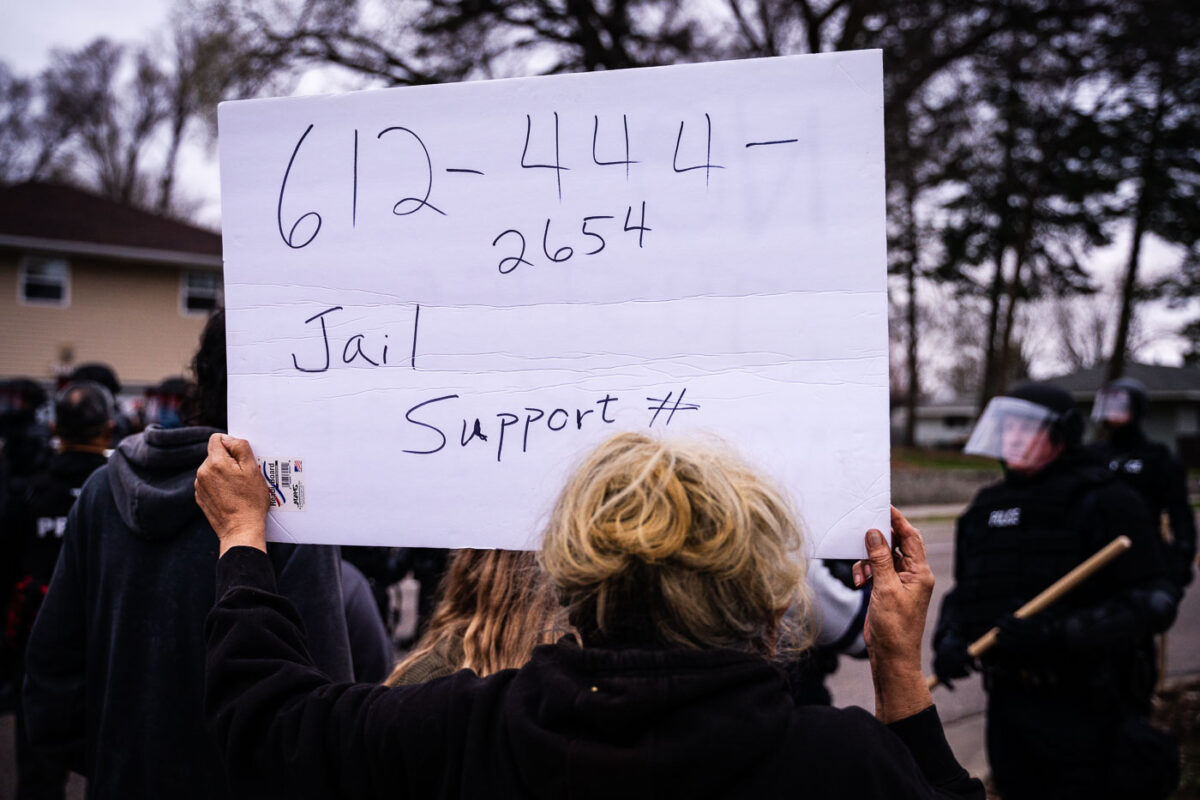
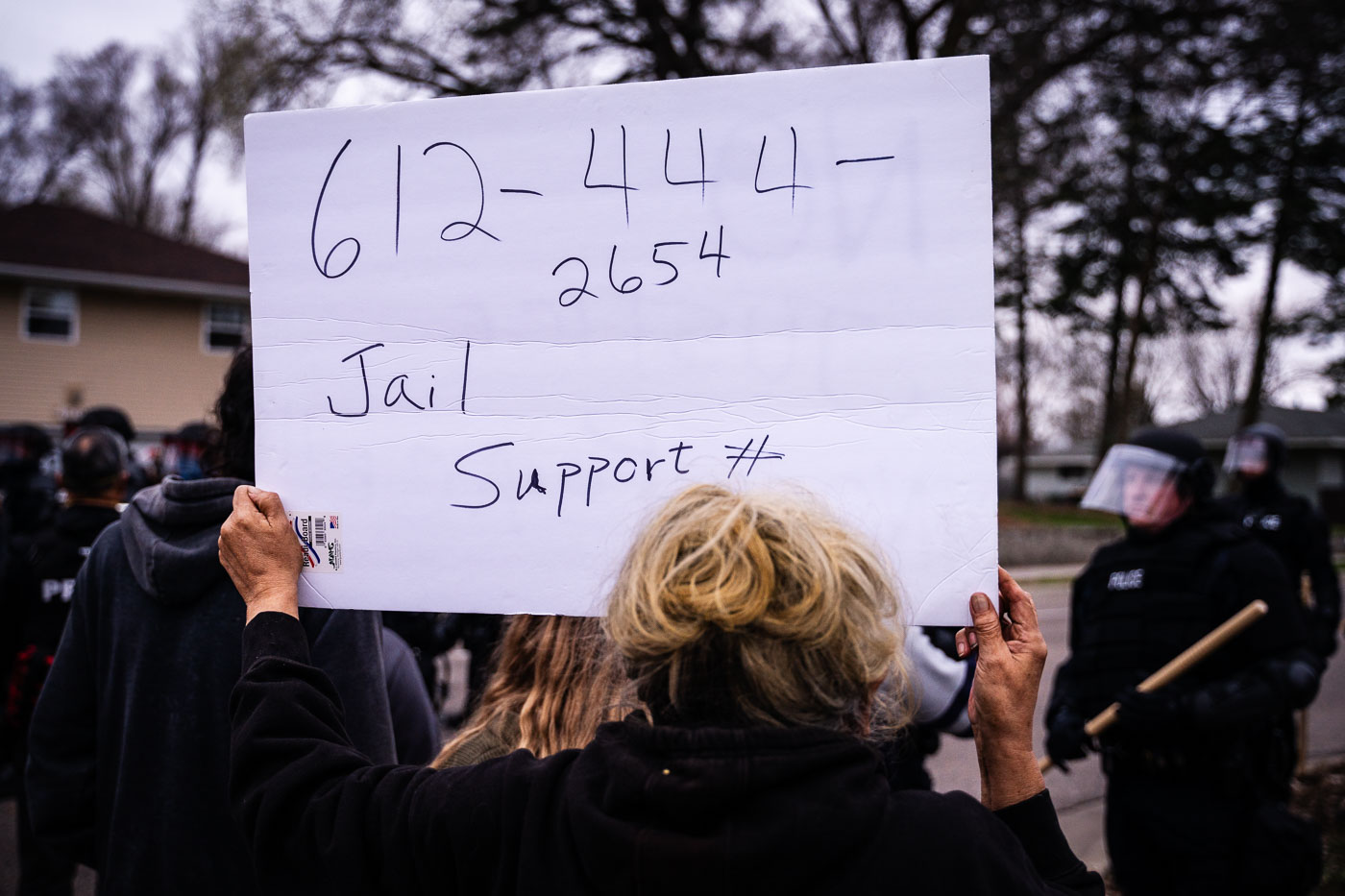
Protester with a jail support number sign in Brooklyn Center, Minnesota, facing police in riot gear.
During protests in Brooklyn Center, Minnesota, following the death of Daunte Wright in April 2021, a demonstrator holds a sign displaying a phone number for jail support. This number, likely for the National Lawyers Guild or a similar organization, was intended to provide legal assistance to those arrested during the demonstrations. The presence of law enforcement in riot gear underscores the tense atmosphere of the protests, which were a response to police violence and systemic issues.

Brooklyn Center Protest: Jail Support Number Displayed

Riot police facing protesters in Brooklyn Center, Minnesota after the Daunte Wright shooting.
Protesters gathered in Brooklyn Center, Minnesota, following the fatal shooting of Daunte Wright by a police officer on April 11, 2021. The incident sparked widespread protests and unrest in the Minneapolis suburb. The image shows a line of riot police facing a crowd of demonstrators, highlighting the tense confrontation that characterized the aftermath of the shooting. The events in Brooklyn Center became a focal point in the ongoing national conversation about police brutality and racial justice.

Brooklyn Center: Protesters face riot police after Daunte Wright shooting

Police in riot gear beside vans in Brooklyn Center, Minnesota, after the killing of Daunte Wright.
Police in riot gear arrived in Brooklyn Center, Minnesota, following the death of Daunte Wright. Protests erupted in the Minneapolis suburb after Wright, a Black man, was fatally shot by a police officer during a traffic stop. The incident occurred on April 11, 2021, and led to widespread demonstrations and unrest. The presence of heavily armored officers and tactical vehicles underscored the tense atmosphere in the community.

Brooklyn Center Police Arrive After Daunte Wright Killing

People gather around a chalk memorial for Daunte Wright in Brooklyn Center, Minnesota.
Community members gather in Brooklyn Center, Minnesota, to commemorate Daunte Wright following his death. The street is covered in chalk messages and a candle, serving as a makeshift memorial. Wright's death on April 11, 2021, during a traffic stop by a Brooklyn Center police officer, sparked protests and unrest in the Minneapolis–Saint Paul metropolitan area. This event highlighted ongoing concerns about police brutality and racial injustice.

Brooklyn Center: Community gathers at Daunte Wright memorial

Protester atop the Brooklyn Center Police Department sign during protests in Brooklyn Center, Minnesota.
Protesters gathered outside the Brooklyn Center Police Department on the night of April 11, 2021. The gathering occurred shortly after Daunte Wright, a 20-year-old Black man, was fatally shot by Brooklyn Center Police Officer Kim Potter during a traffic stop. The incident sparked widespread protests and unrest in the Minneapolis suburb.

Protester on Brooklyn Center Police sign after Daunte Wright shooting

Protester with a Justice 4 George sign faces police at Brooklyn Center Police Department, Minnesota.
Protesters gather outside the Brooklyn Center Police Department in Brooklyn Center, Minnesota, holding signs that read "Justice 4 George." The "Justice 4 George" slogan refers to George Floyd, a Black man who was murdered by a Minneapolis police officer in May 2020. The Brooklyn Center Police Department was the site of protests following the fatal shooting of Daunte Wright by an officer from that department in April 2021. The presence of riot gear-clad police officers indicates a tense confrontation during the protest.

Protester with Justice 4 George sign faces police at Brooklyn Center PD

Police line outside Brooklyn Center Police Department as tear gas fills the street during a protest.
Protesters gathered outside the Brooklyn Center Police Department following the fatal shooting of Daunte Wright by an officer during a traffic stop. The incident, which occurred on April 11, 2021, sparked widespread protests and unrest in the Minneapolis area. Law enforcement responded with tear gas and other less-lethal measures to disperse the crowds.

Brooklyn Center Police Use Tear Gas on Protesters

Riot police outside Brooklyn Center Police Department amid smoke after Daunte Wright protests.
Riot police formed a line outside the Brooklyn Center Police Department on April 11, 2021. The deployment followed the fatal shooting of Daunte Wright by an officer during a traffic stop earlier that day. The incident sparked protests and unrest in the Minneapolis suburb, leading to a significant law enforcement presence to manage the crowds and maintain order.

Brooklyn Center Police Station Surrounded by Riot Police

Emergency vehicles on closed I-694 in Brooklyn Center during protests after Daunte Wright's killing.
Following the killing of Daunte Wright by Brooklyn Center police, the Minnesota Department of Transportation closed Interstate 694 in both directions. The closure, which affected exits into Brooklyn Center, occurred during protests that followed the incident. The image shows emergency vehicles and traffic cones on the wet highway at night, indicating the disruption to normal traffic flow.

I-694 East and West Closed During Daunte Wright Protests

Minnesota National Guard and police near Brooklyn Center Police Headquarters during protests after Daunte Wright's killing.
Members of the Minnesota National Guard arrived near the Brooklyn Center Police Headquarters on April 12, 2021. Their deployment followed protests that erupted after the killing of Daunte Wright by a police officer during a traffic stop. The presence of the National Guard was intended to support local law enforcement and restore order amidst the unrest.

National Guard Arrives in Brooklyn Center Amid Protests

UMPD Officer Williams in a vehicle outside Brooklyn Center Police Department.
University of Minnesota Police Department Officer Williams is seen inside a vehicle outside the Brooklyn Center Police Department. This deployment occurred in April 2021 following protests and unrest after Daunte Wright, a Black man, was fatally shot by Brooklyn Center Police Officer Kim Potter during a traffic stop. The incident sparked widespread public outcry and demonstrations in the Minneapolis area.

UMPD Officer Williams at Brooklyn Center Police Department

Minneapolis police tactical officers exit a van in Uptown at night.
Minneapolis Police Department tactical officers emerge from a van in the Uptown neighborhood on the night of April 11, 2021. This deployment occurred in response to reports of looting following the fatal shooting of Daunte Wright by a police officer in nearby Brooklyn Center earlier that day. The events in Uptown were part of a broader period of unrest and protest in Minneapolis following Wright's death, which sparked widespread public attention and calls for police reform. The presence of tactical teams reflects the heightened security measures and police response during periods of civil disturbance.

Minneapolis Police tactical team exits van in Uptown

Minneapolis police officer near Chicago-Lake Liquors in Uptown Minneapolis at night.
Minneapolis police officers patrol near Chicago-Lake Liquors in Uptown Minneapolis on April 12, 2021. The patrol occurred in the aftermath of the killing of Daunte Wright by a police officer in nearby Brooklyn Center, Minnesota, which led to widespread protests and unrest. Chicago-Lake Liquors is a long-standing retail establishment in the Uptown neighborhood, a commercial and cultural hub of the city.

Minneapolis Police Patrol Near Chicago-Lake Liquors After Daunte Wright Killing

Police officer lifting a broken Walgreens window cover in Minneapolis after unrest.
A Minneapolis Police officer is seen holding open a broken window at a Walgreens store on April 11, 2021. This incident occurred in the aftermath of the killing of Daunte Wright by a police officer in nearby Brooklyn Center earlier that day. The events in Minneapolis were part of a period of unrest and protests following the death of George Floyd in 2020 and the subsequent killing of Wright. The Walgreens store, a common retail fixture in urban environments, became a focal point for some of the disturbances.

Minneapolis Police hold window open for looters at Walgreens

Worker moving plywood outside Calhoun Beach Framing in Minneapolis.
During the period of civil unrest following the murder of George Floyd and the police killing of Daunte Wright, businesses in Minneapolis took protective measures. Calhoun Beach Framing, a custom picture framing shop and art gallery located at 1517 West Lake Street, is shown here as plywood boards are prepared for installation. This proactive step was common for businesses in the Uptown Minneapolis area and across the city during the spring and summer of 2021, as well as in the aftermath of the 2020 protests.

Minneapolis: Calhoun Beach Framing boards up during unrest

National Guard vehicle on Lake Street in Minneapolis beside boarded storefronts.
A Minnesota National Guard vehicle is parked on Lake Street in Minneapolis following the killing of Daunte Wright by police in nearby Brooklyn Center. The presence of military vehicles on city streets was a response to unrest and protests that occurred in the days following Wright's death, which echoed the larger demonstrations that took place in the city after the murder of George Floyd in 2020. Businesses along Lake Street had boarded up their windows and storefronts in anticipation of potential damage, a common sight during periods of civil unrest in the city.

National Guard vehicle on Lake Street, Minneapolis
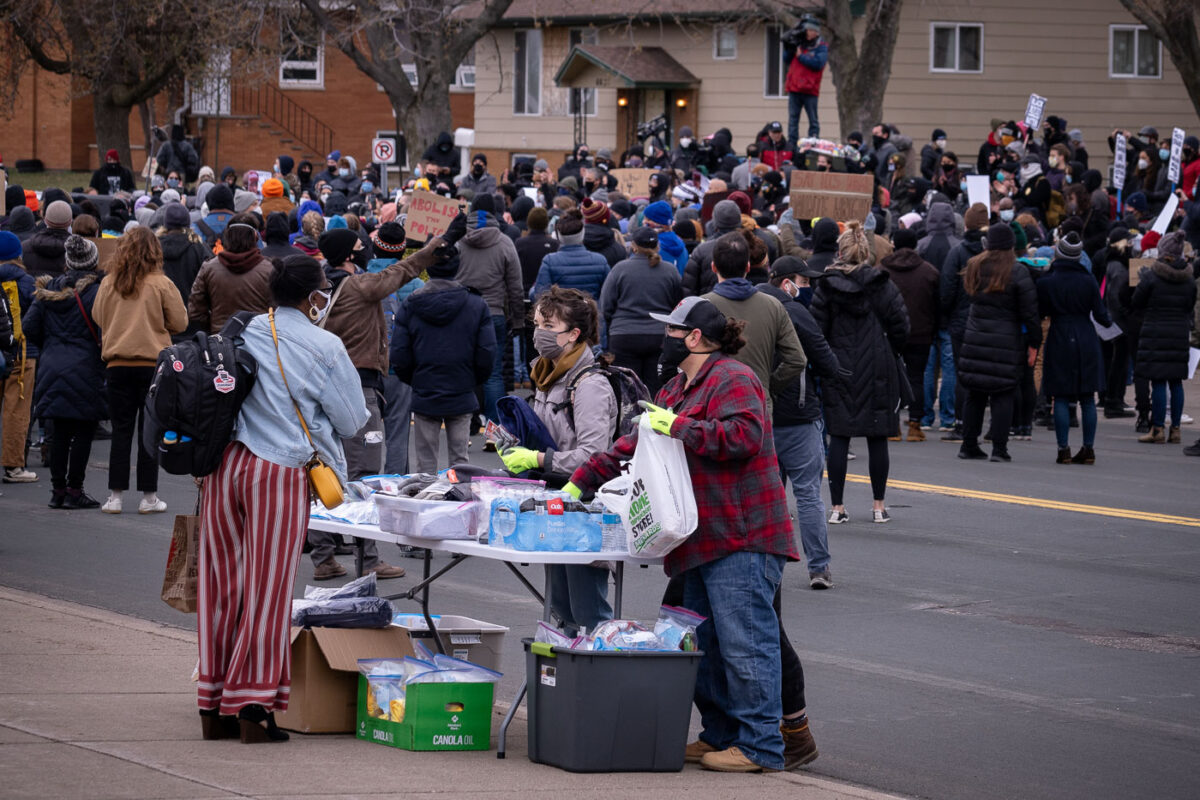
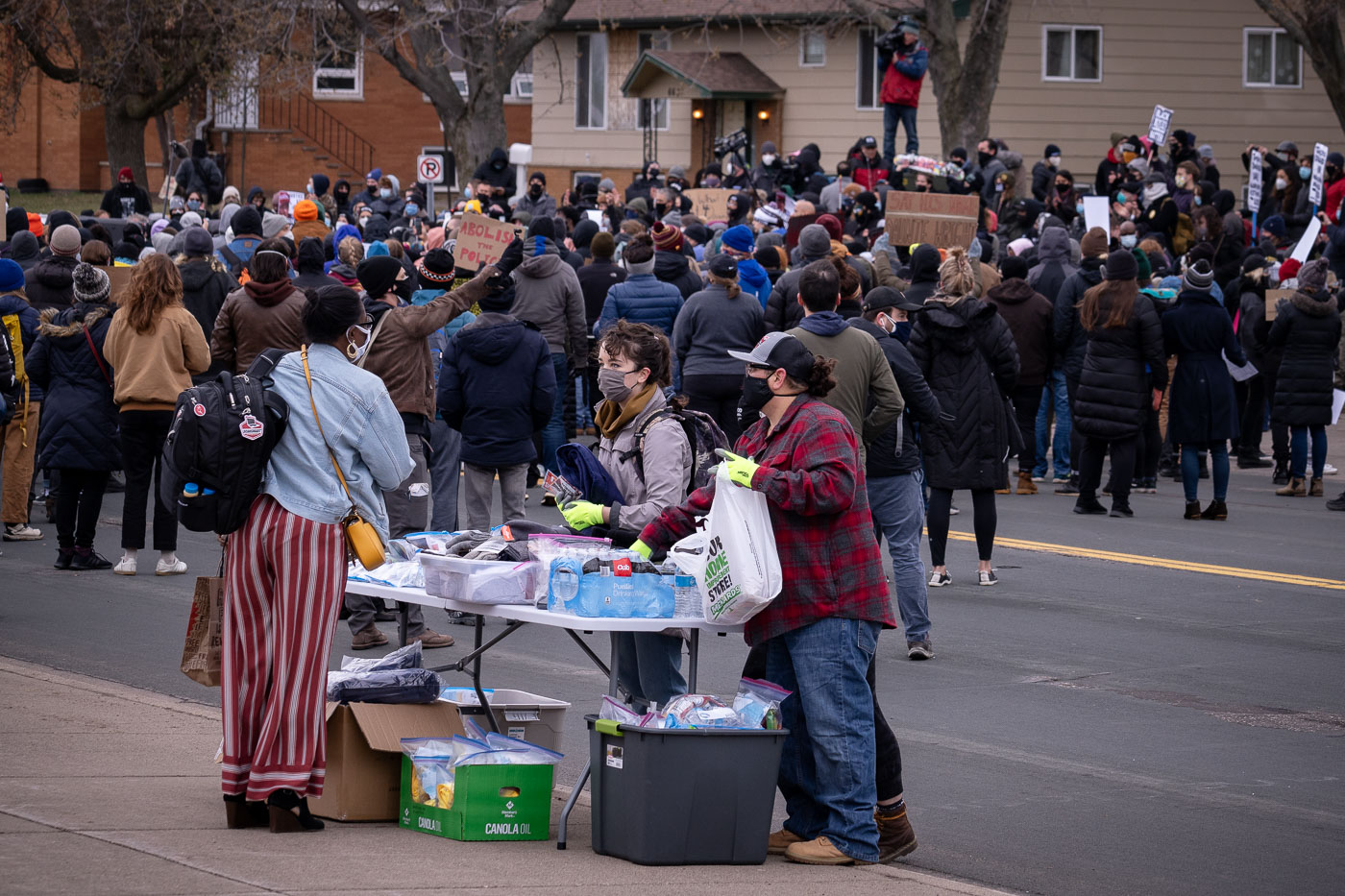
Support table distributing supplies during a protest in Brooklyn Center, Minnesota.
During protests following the death of Daunte Wright in Brooklyn Center, Minnesota, a support table was set up to distribute essential supplies to participants. The protests, which began on April 11, 2021, occurred outside the Brooklyn Center Police Department and in surrounding areas. This table provided items such as water, masks, and other necessities to those gathered. The distribution of supplies highlights the community's efforts to sustain and support the ongoing demonstrations.

Brooklyn Center protest support table distributing supplies
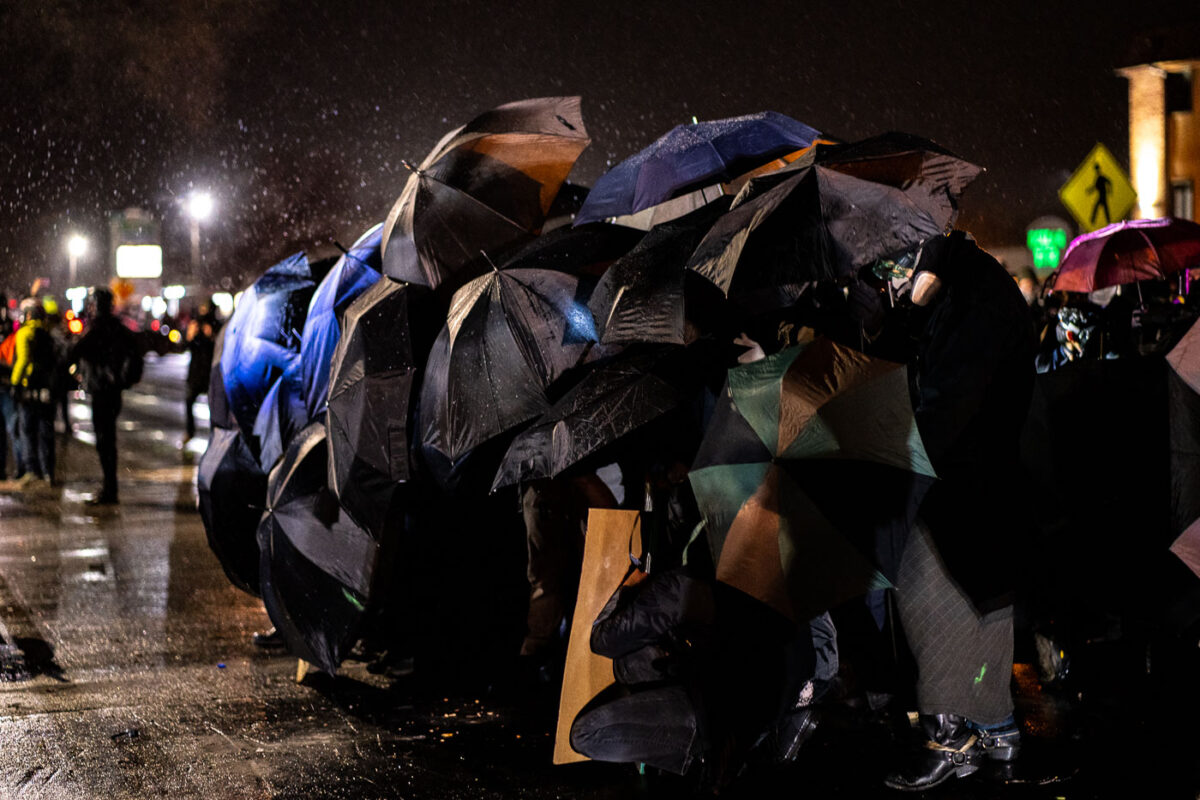
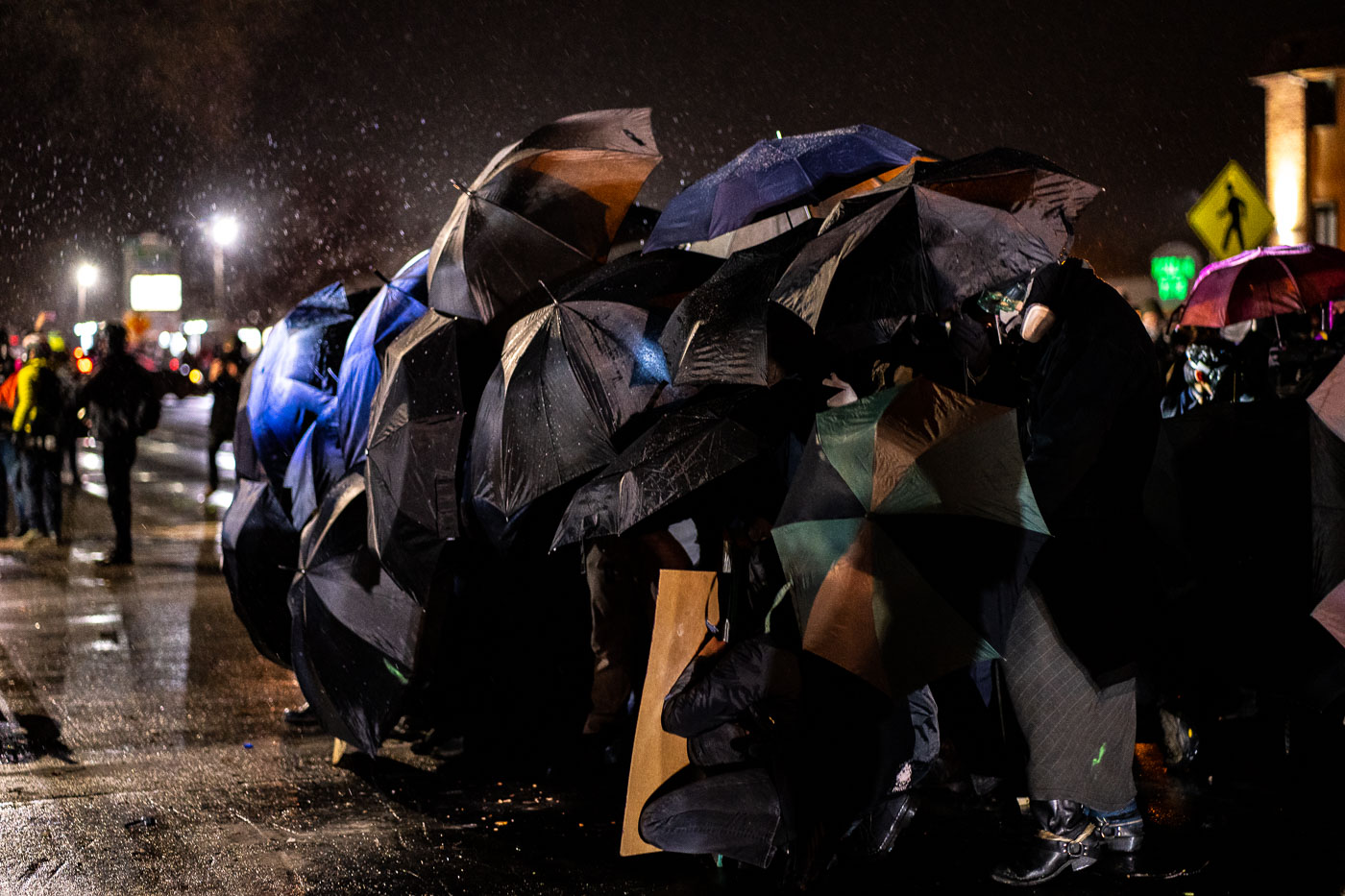
Protesters with umbrellas outside Brooklyn Center Police Department during the Daunte Wright protest.
Protesters gathered outside the Brooklyn Center Police Department on April 11th, 2021, to protest the shooting death of Daunte Wright. The demonstration occurred the day after Wright, a 20-year-old Black man, was killed by police during a traffic stop. Protesters used umbrellas to shield themselves from chemical irritants deployed by law enforcement.

Brooklyn Center protesters use umbrellas during Daunte Wright protest

National Guard soldier outside Juut Salon in Uptown Minneapolis at night.
Minnesota National Guard soldiers are stationed outside Juut Salon and AVEDA Institute in Uptown Minneapolis on April 13, 2021. Their presence followed the shooting death of Daunte Wright by a Brooklyn Center police officer, which ignited protests and civil unrest in the Minneapolis area. The National Guard was deployed to maintain order and protect property during this period of heightened tension.

National Guard at Juut Salon, Uptown Minneapolis

National Guard troops on N Broadway in Minneapolis after the killing of Daunte Wright.
National Guard troops are stationed on N. Broadway in Minneapolis following the killing of Daunte Wright by Brooklyn Center Police Officer Kim Potter on April 11, 2021. The deployment of military personnel was in response to widespread protests and civil unrest that occurred in the days following the incident. This event marked a period of heightened tension and public outcry over police brutality and racial injustice in the Minneapolis area.

National Guard on N. Broadway, Minneapolis after Daunte Wright killing

Minnesota National Guard soldiers beside a Humvee on Washington Avenue in Minneapolis during the Chauvin trial.
Minnesota National Guard soldiers and a Humvee are stationed on Washington Avenue in Minneapolis's North Loop neighborhood during the trial of Derek Chauvin in April 2021. The presence of military personnel was part of "Operation Safety Net," a joint effort by state and local law enforcement and the National Guard to maintain order and protect property during the highly publicized trial. The trial followed the murder of George Floyd by a Minneapolis police officer in May 2020, which sparked widespread protests and unrest in the city and across the nation.

National Guard on Washington Ave, Minneapolis during Chauvin Trial
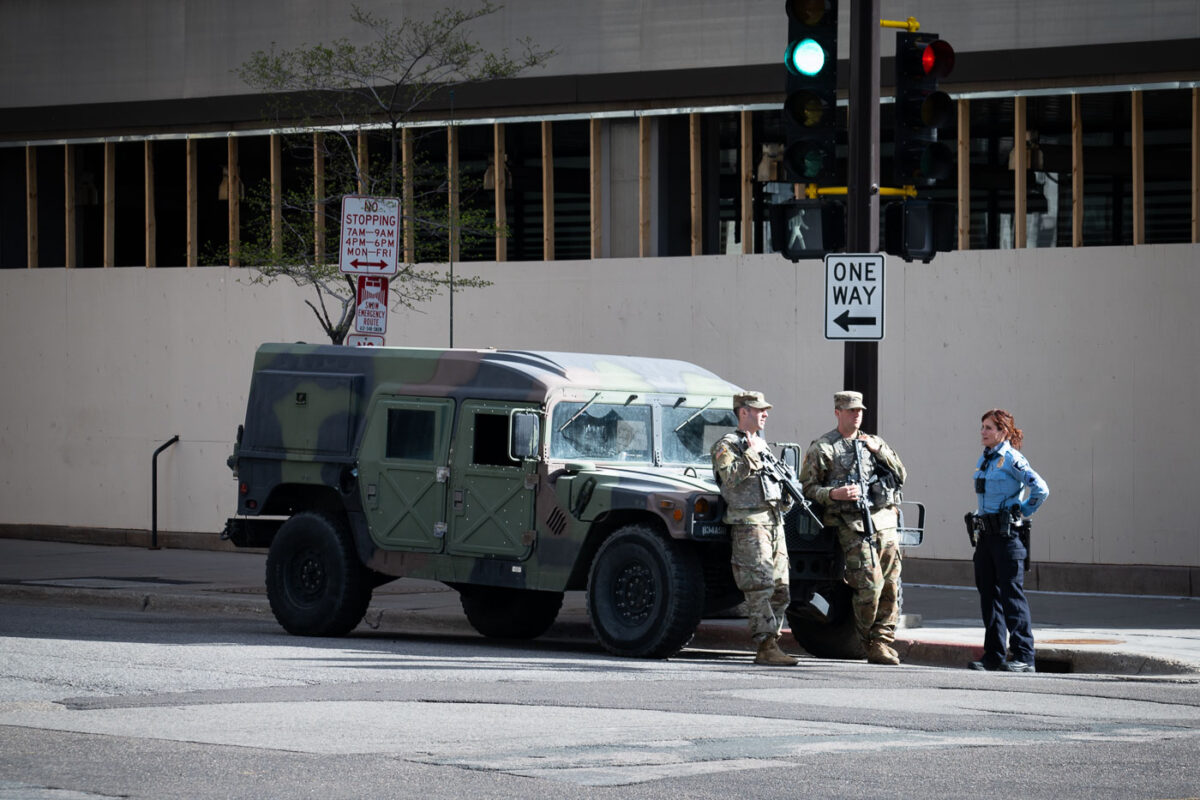
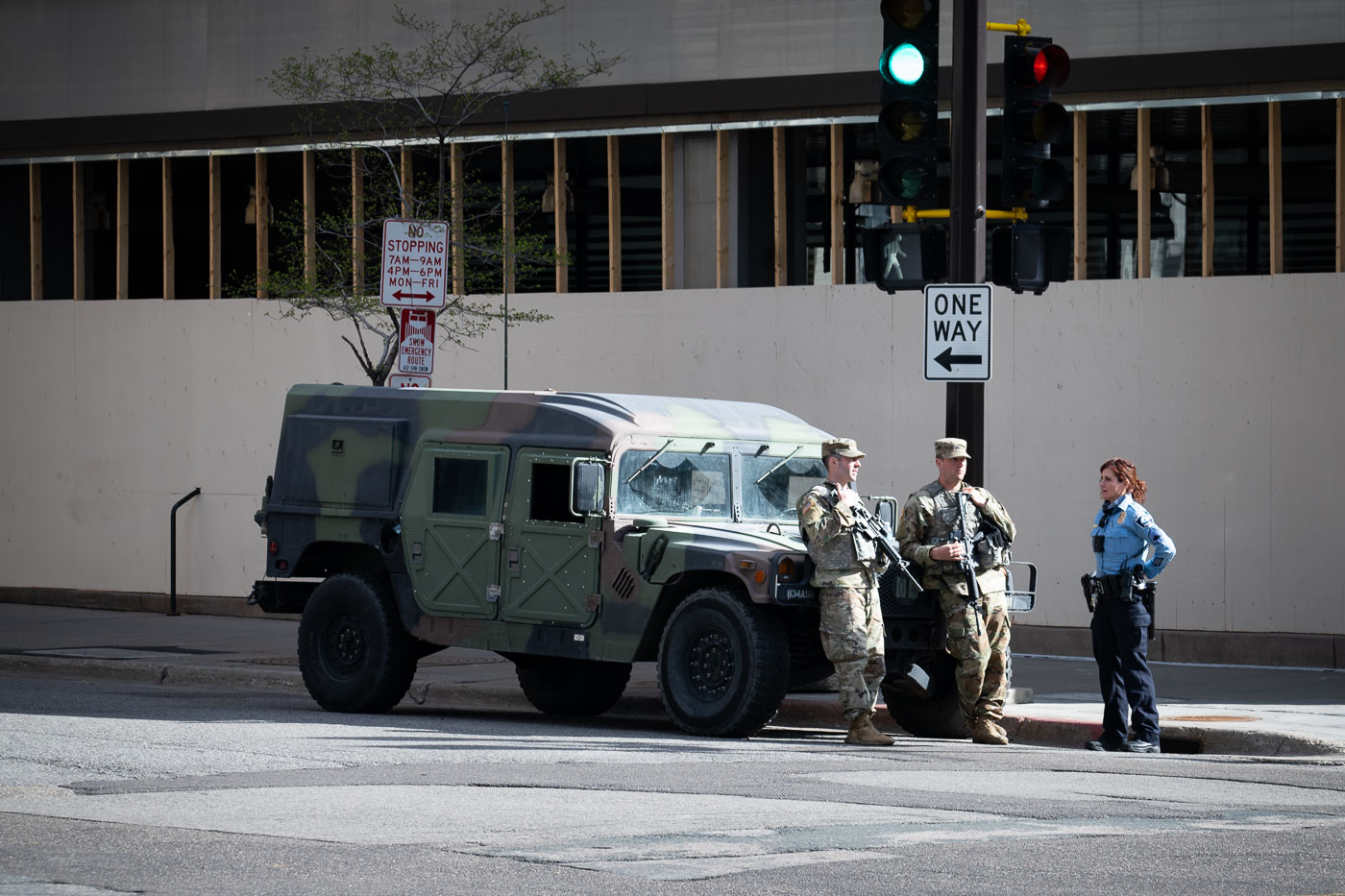
National Guard soldiers and a police officer beside a military vehicle in downtown Minneapolis.
National Guard and Minneapolis Police officers stand on duty near a military vehicle during the trial of Derek Chauvin in Minneapolis. The trial, which concluded in April 2021, stemmed from the May 25th, 2020, killing of George Floyd. The presence of law enforcement and military personnel underscored the heightened tensions in the city following Floyd's death and in anticipation of the trial's verdict.

Minneapolis National Guard and Police on Duty During Chauvin Trial
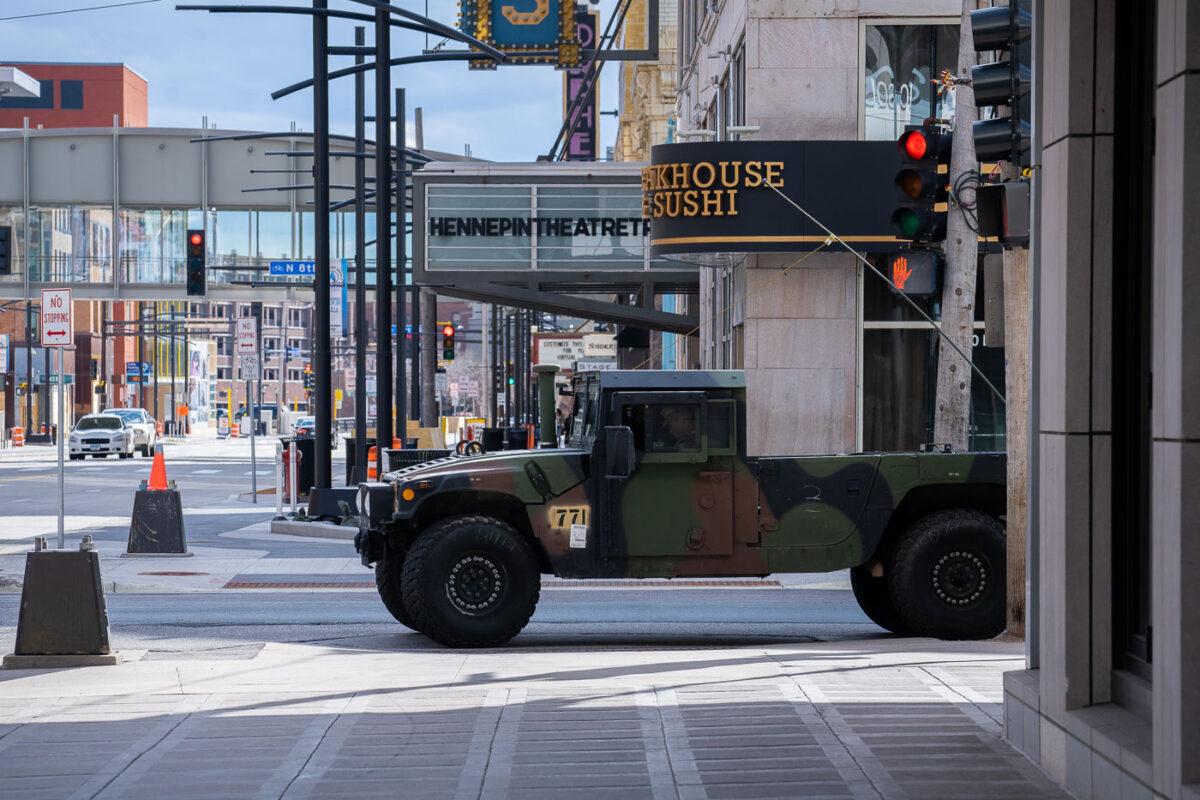
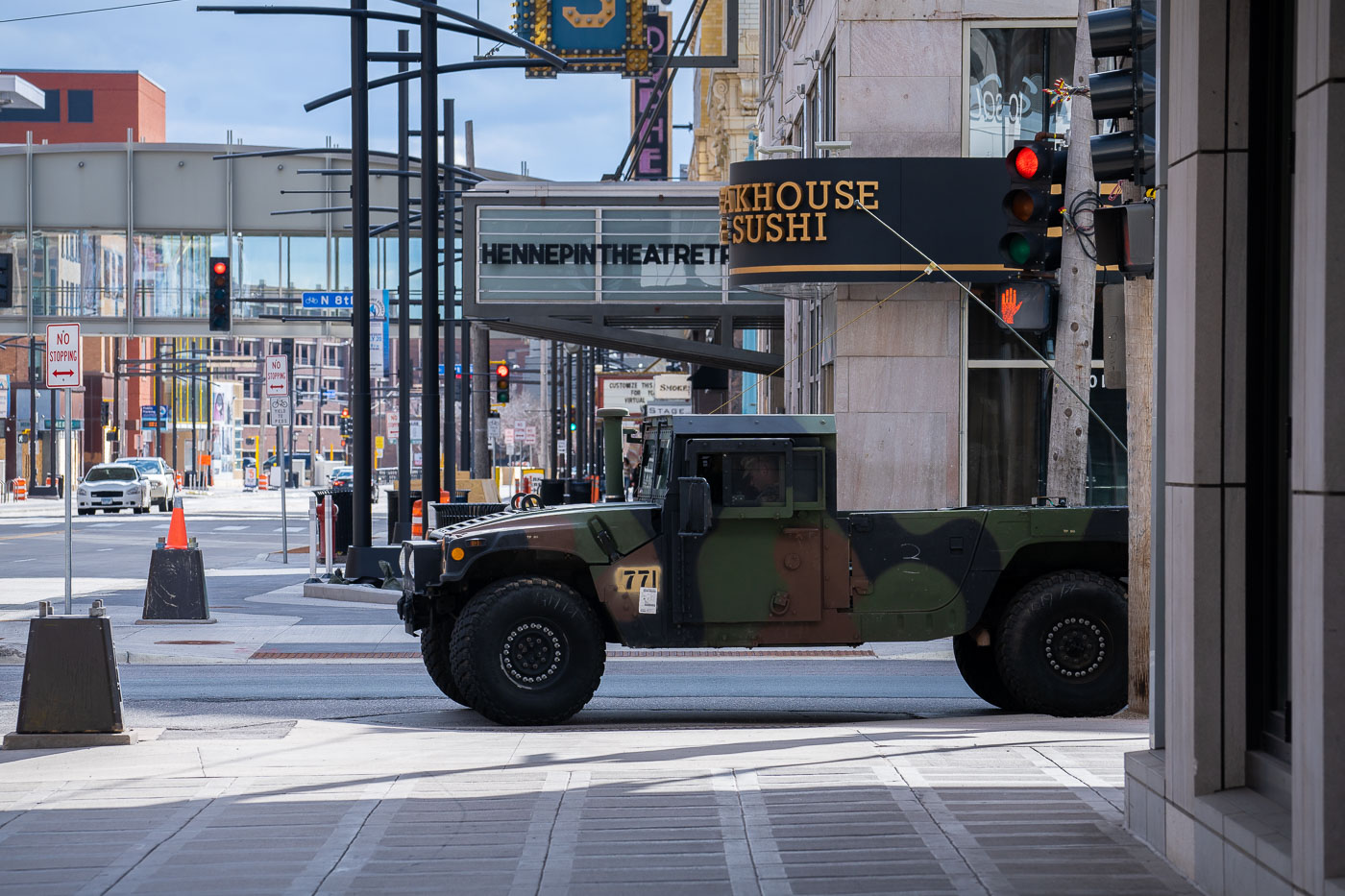
National Guard Humvee on Nicollet Mall in downtown Minneapolis near Hennepin Theatre Trust.
A Minnesota National Guard Humvee is parked on Nicollet Mall in Minneapolis. The presence of military vehicles on the downtown street reflects the heightened security and civil unrest that occurred in the city following the murder trial of Derek Chauvin for the death of George Floyd. Nicollet Mall, a pedestrian-oriented street, is a central commercial and cultural hub in Minneapolis, and its use by military vehicles underscores the extraordinary circumstances of the period.

National Guard Humvee on Nicollet Mall, Minneapolis
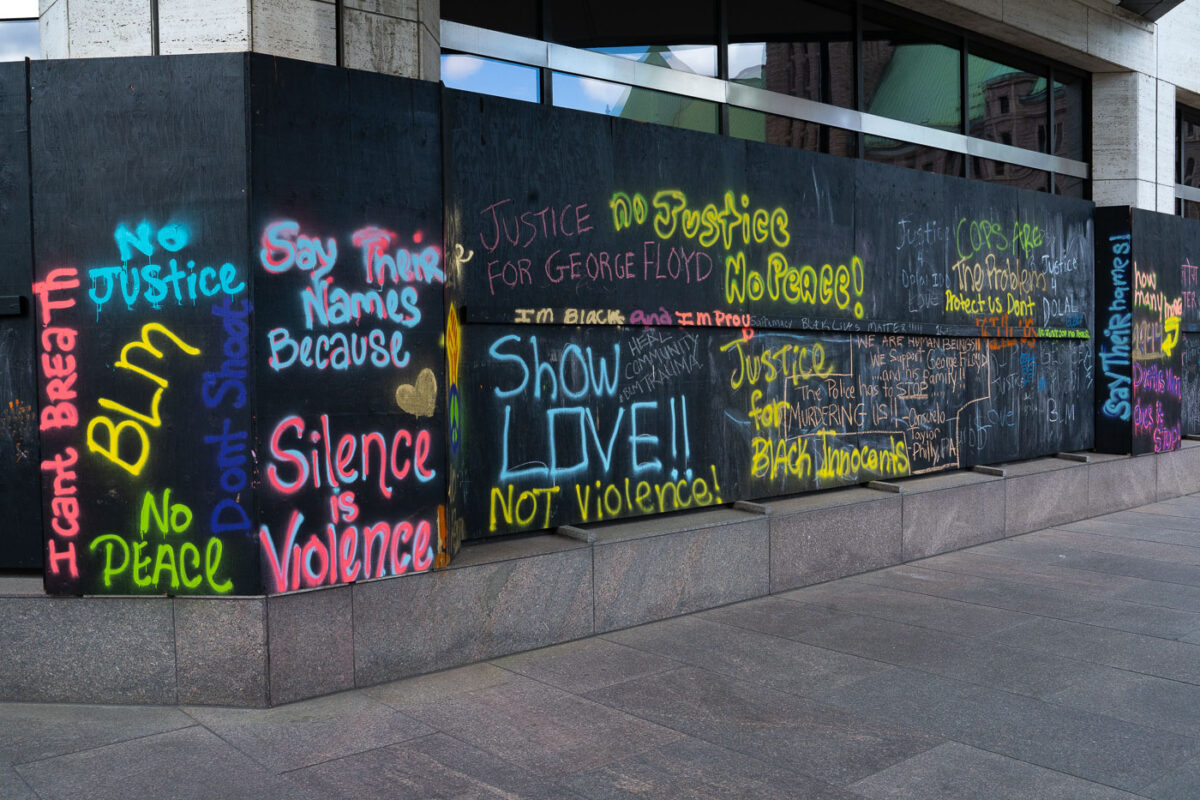
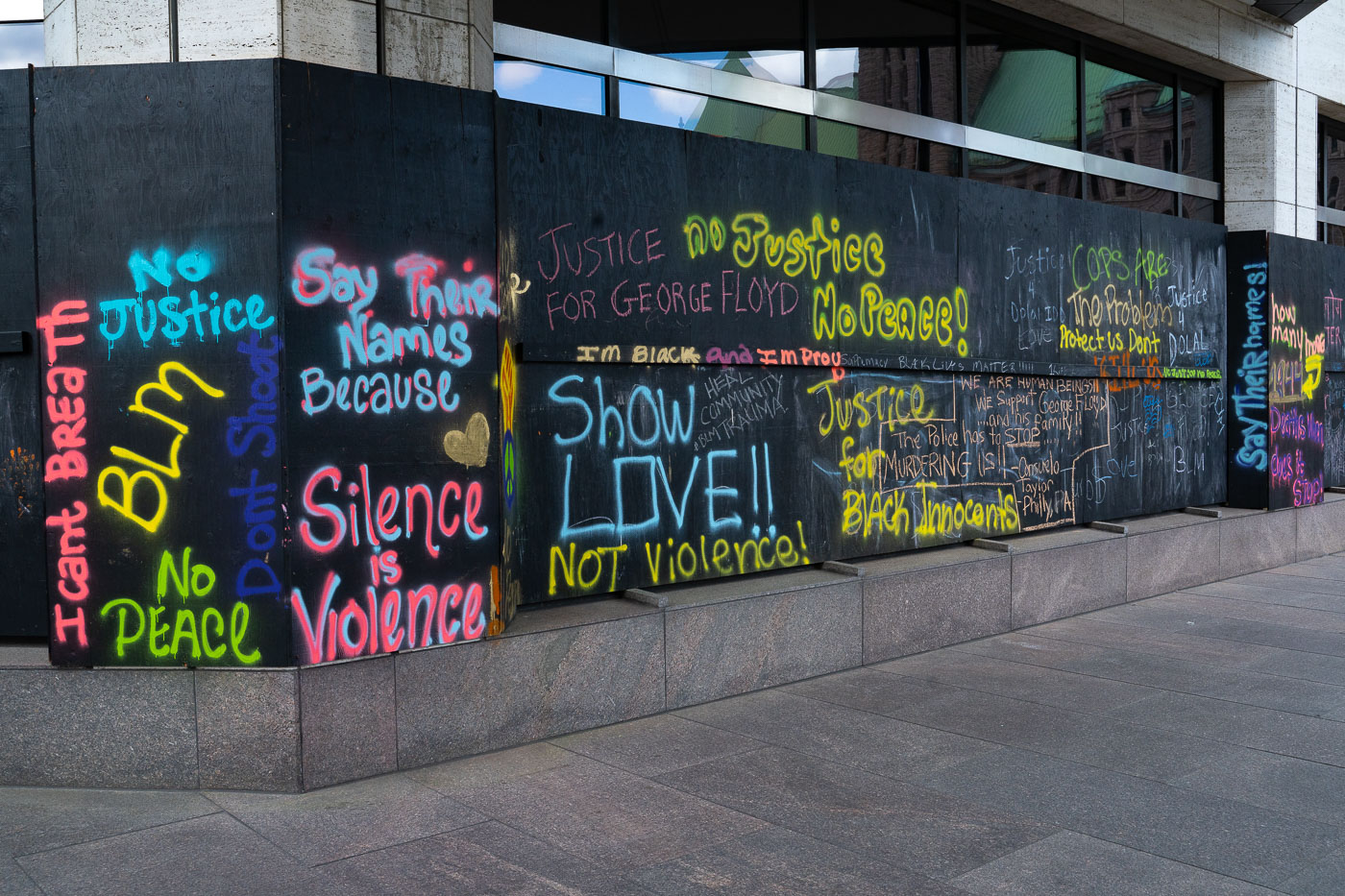
Protest graffiti on plywood outside Hennepin County Government Center in Minneapolis.
Graffiti art adorns plywood barriers erected outside a building in Minneapolis, near the Hennepin County Government Center where the trial of Derek Chauvin was held. The messages, including "No Justice No Peace," "BLM," and "Say Their Names," reflect the widespread protests and calls for racial justice that followed the murder of George Floyd in May 2020. The artwork served as a public expression of grief, anger, and demands for accountability during a period of intense civil unrest and national attention on police brutality.

Minneapolis: Protest Art Near Derek Chauvin Trial Site
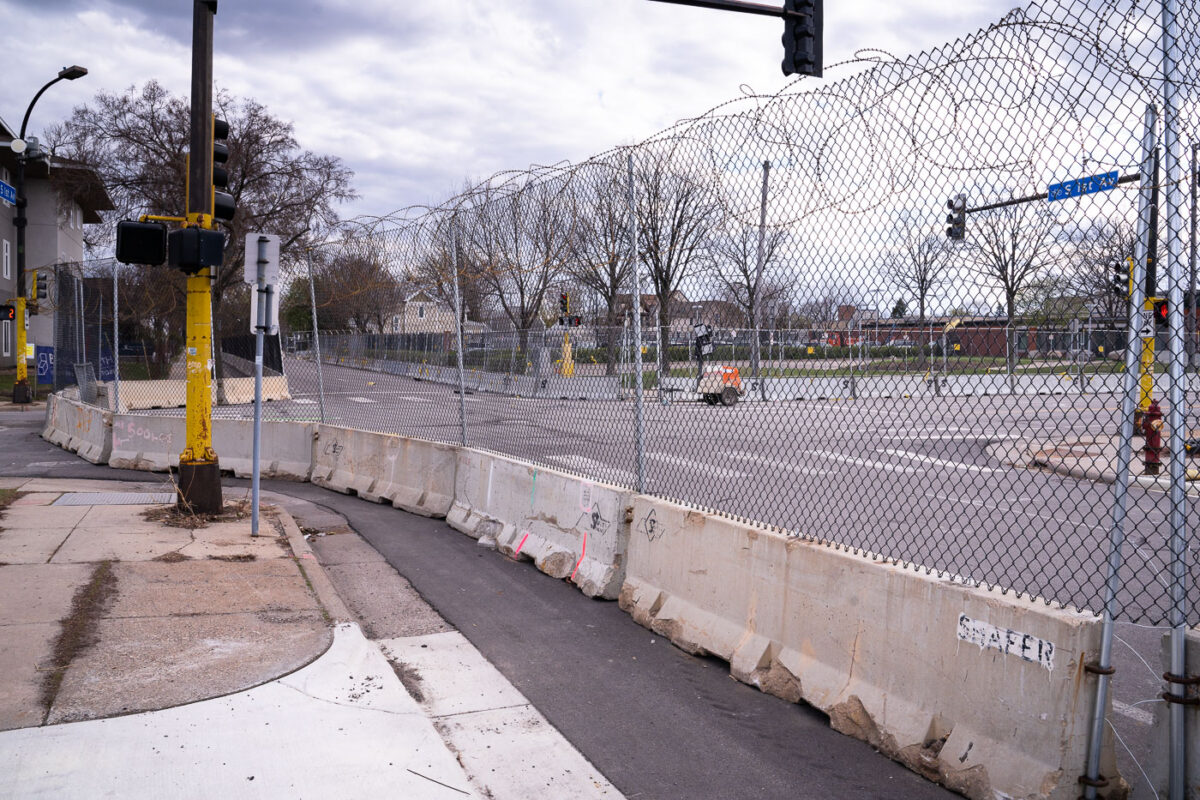
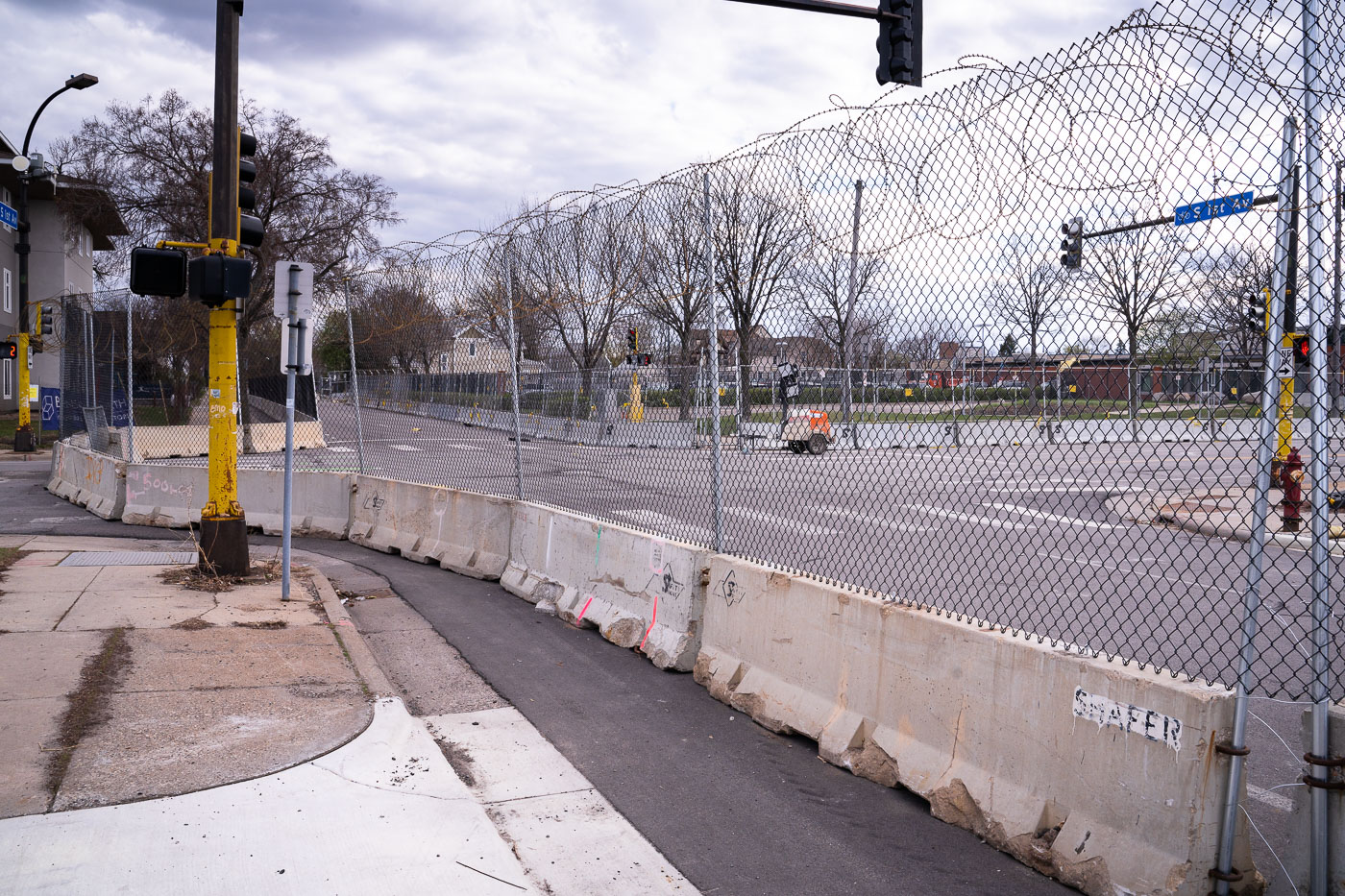
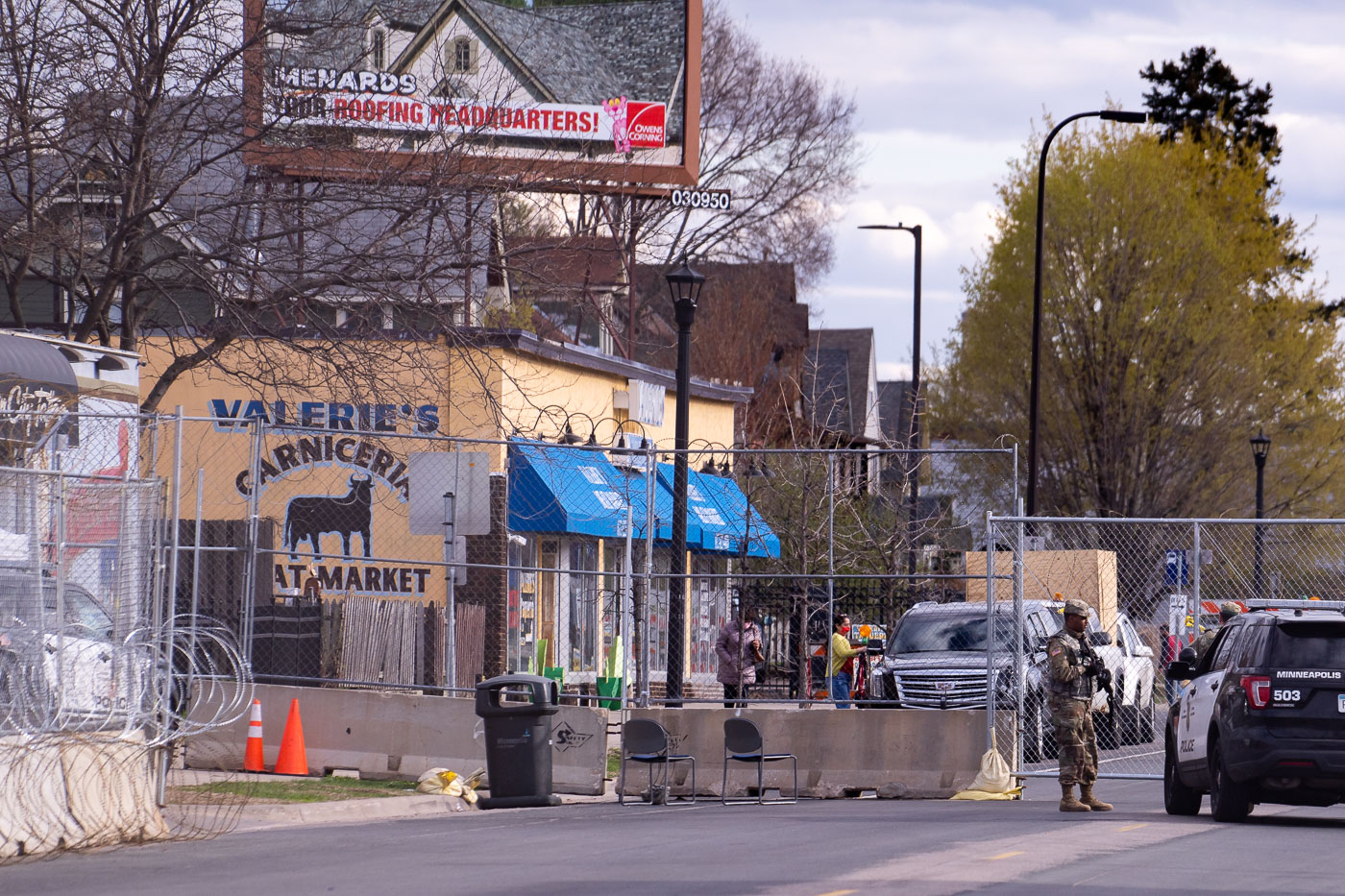
Barricades and razor wire around Minneapolis Police 5th Precinct in Minneapolis.
The Minneapolis Police Fifth Precinct is shown fortified with concrete barriers and razor wire. This security measure was implemented in response to protests and civil unrest that occurred in Minneapolis following the murder of George Floyd in May 2020 and the subsequent trial of Derek Chauvin. The precinct, located in the Powderhorn neighborhood, also experienced heightened security during the trial of Kim Potter for the killing of Daunte Wright in April 2021. The barriers are a physical manifestation of the increased tensions and security concerns surrounding law enforcement facilities during periods of public outcry.

Minneapolis Police 5th Precinct Fortified with Barricades and Razor Wire
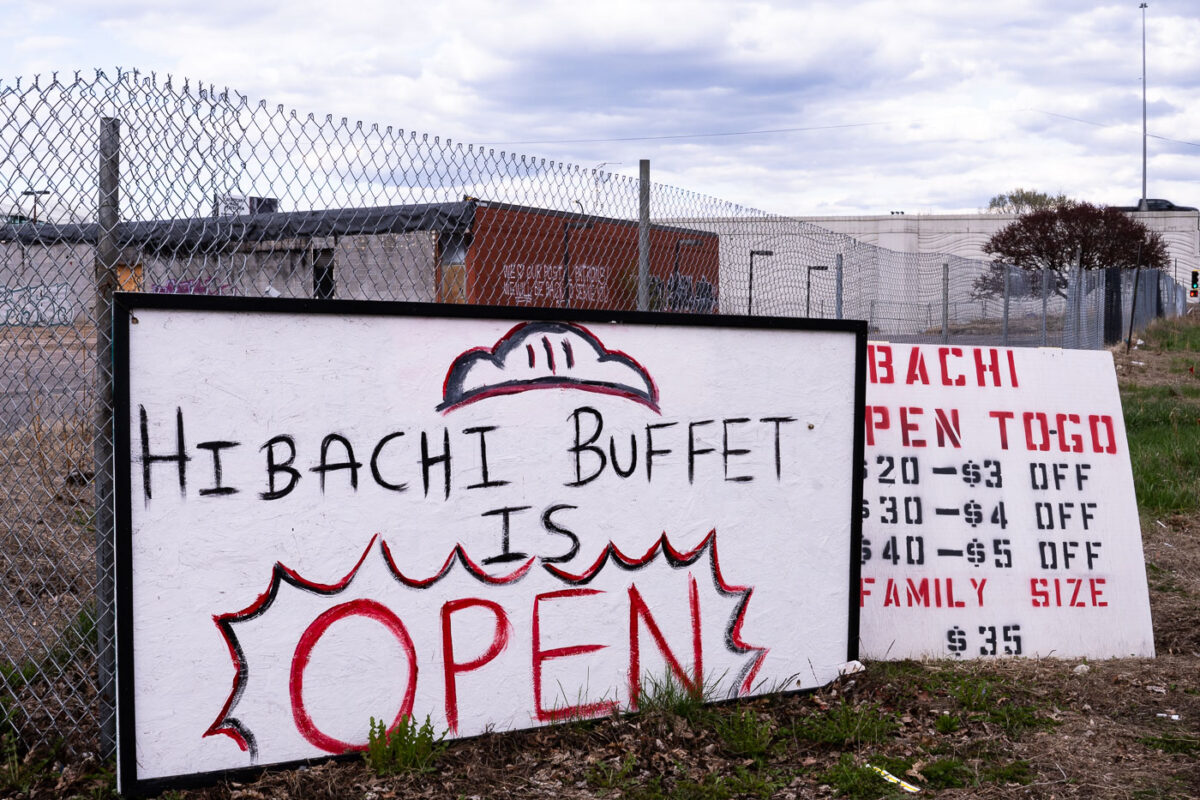
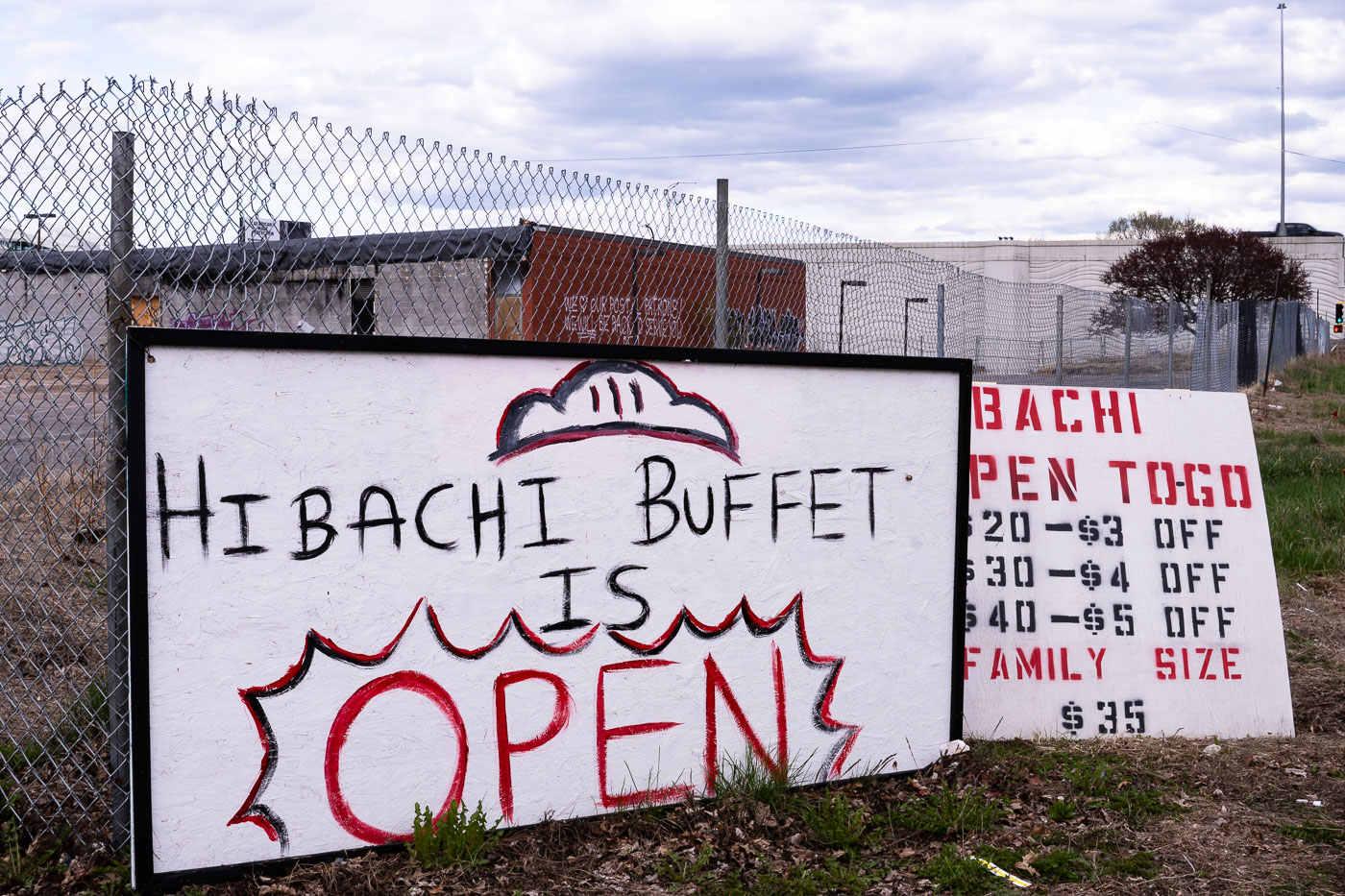
Hibachi Buffet open signs by the damaged Lake Street Station post office in Minneapolis.
A hand-painted sign announces that Hibachi Buffet is open for business, with additional signs detailing "Open Togo" specials. This sign is positioned in front of the burned remains of the Lake Street Station post office in Minneapolis. The post office building was damaged during the civil unrest that followed the murder of George Floyd in May 2020 and the subsequent trial of Derek Chauvin. The area has seen significant rebuilding efforts, but remnants of the unrest, like this temporary signage, remain visible.

Hibachi Buffet Open Sign, Minneapolis
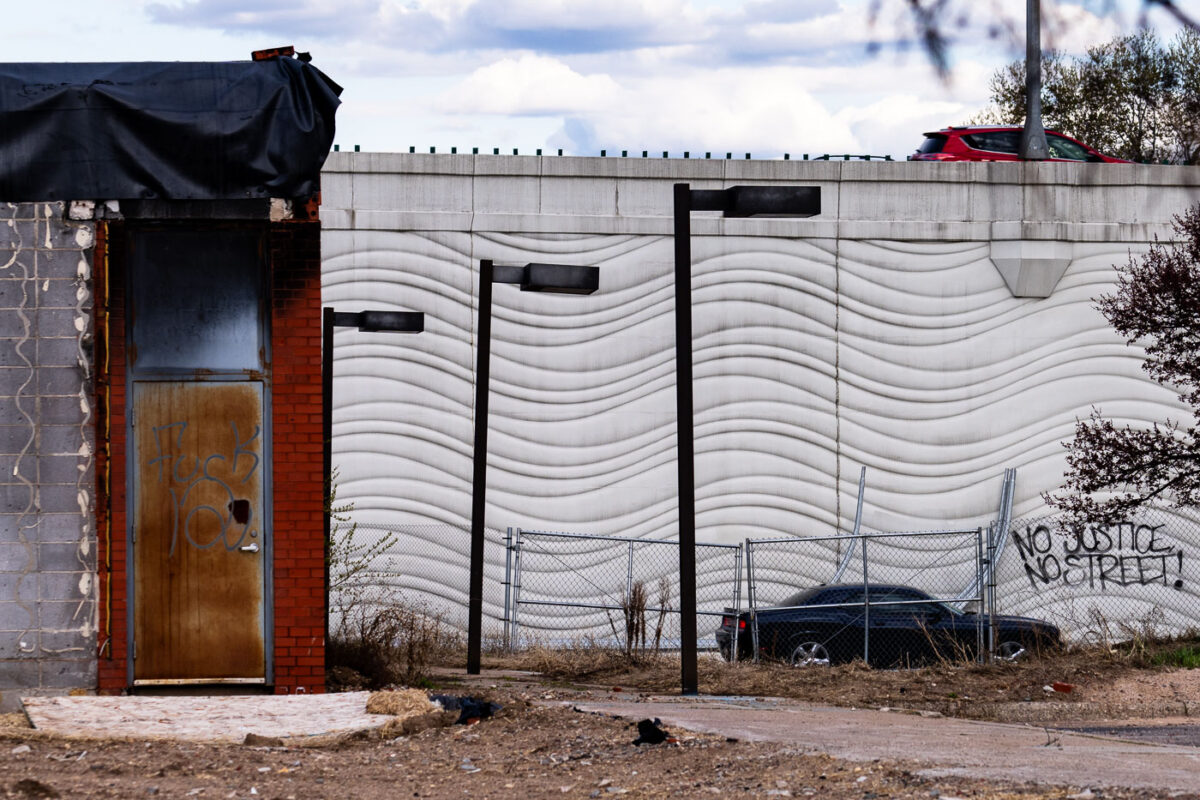
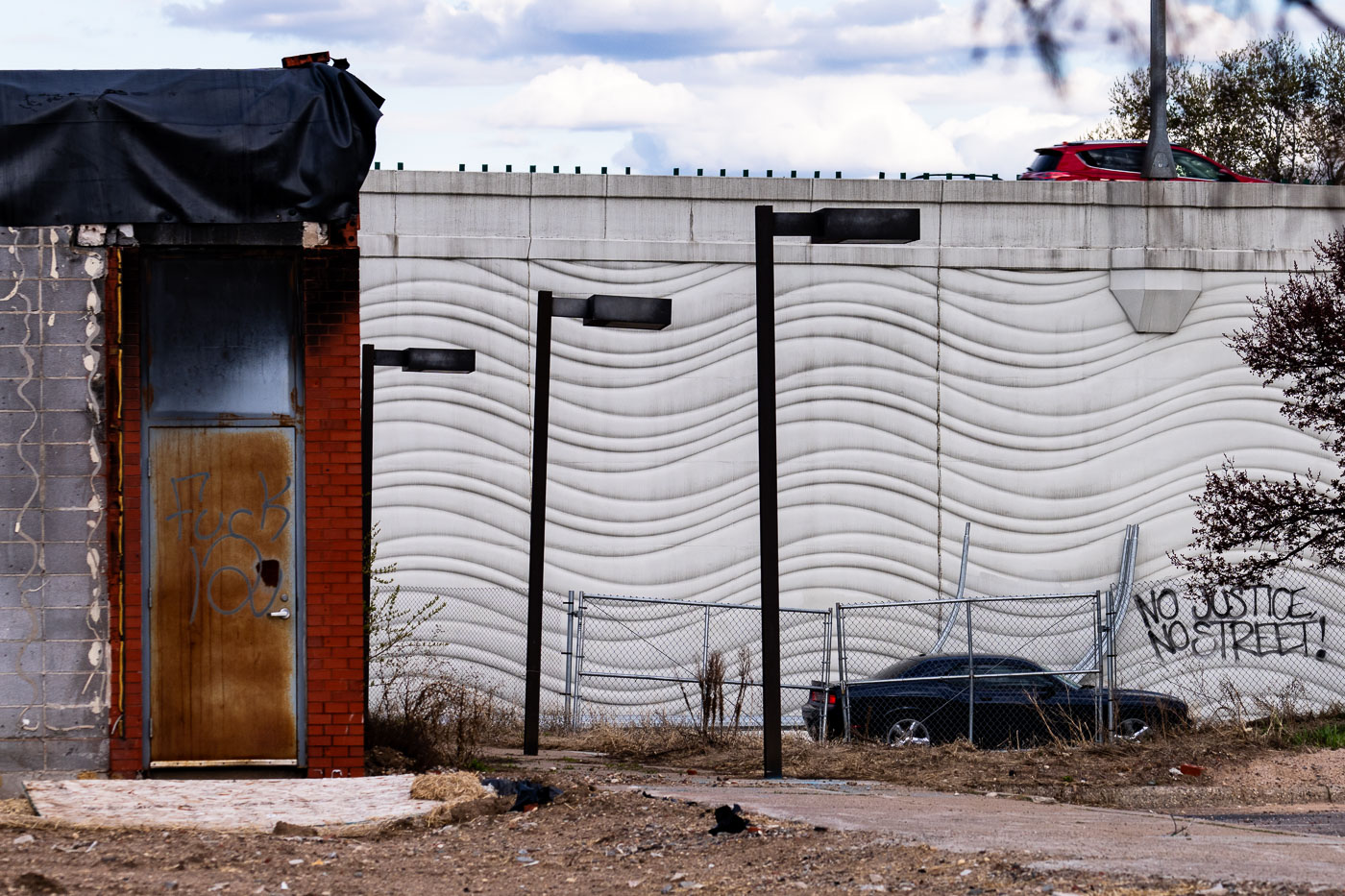
“No Justice No Street” graffiti beside Interstate 35W in Minneapolis.
Graffiti reading "No Justice, No Street!" is spray-painted on a white, wave-patterned wall adjacent to Interstate 35W in Minneapolis. This message emerged during the widespread protests and civil unrest that followed the murder of George Floyd in May 2020 and the subsequent trial of Derek Chauvin. The phrase reflects a sentiment of public anger and a demand for accountability and systemic change within the justice system. The location, near a former post office, and the prominent display on a major transportation artery underscore the public nature and urgency of these demands.

Minneapolis: “No Justice No Street” Graffiti on 35W
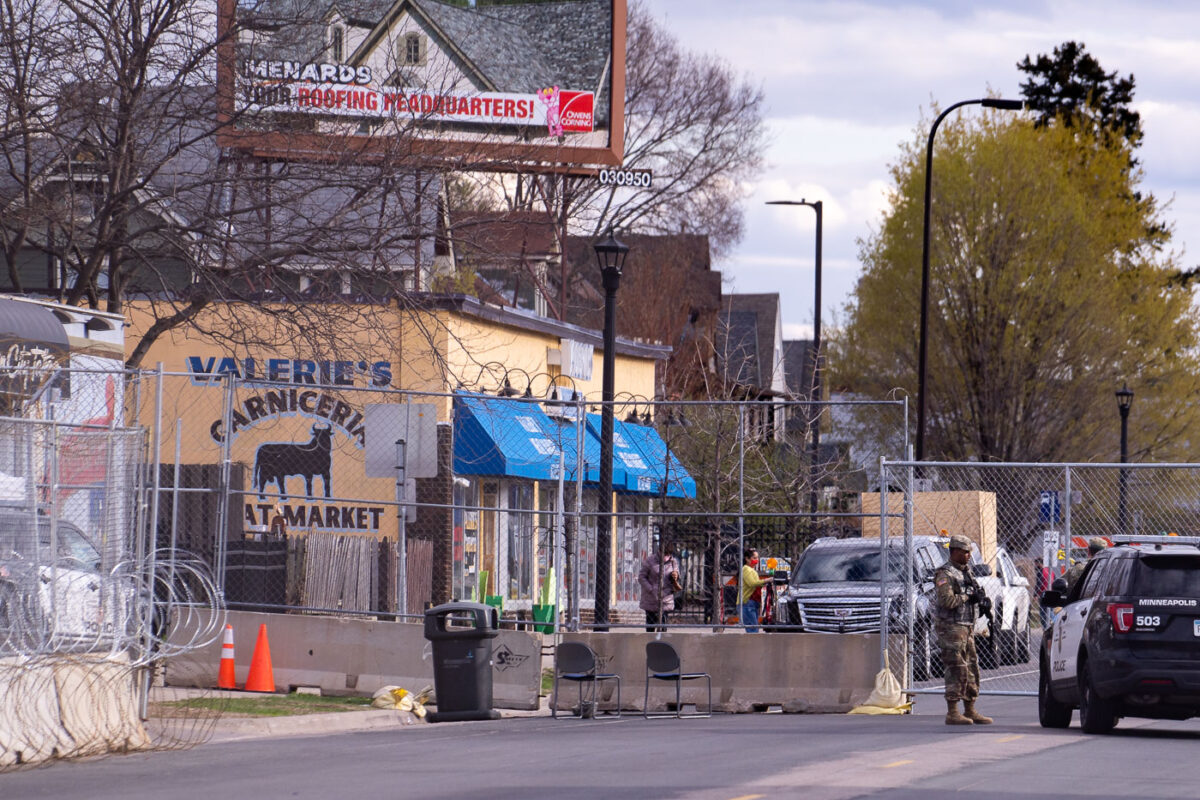
National Guard and police at Minneapolis Fifth Precinct behind fencing and razor wire.
National Guard soldiers and Minneapolis Police officers secure the perimeter of the Minneapolis Police Fifth Precinct in South Minneapolis. The precinct was fortified with concrete barriers and razor wire in response to widespread protests and civil unrest that followed the killing of George Floyd in May 2020 and the subsequent trial of Officer Derek Chauvin. The presence of the National Guard was a visible symbol of the state's response to maintain order during a period of intense public scrutiny and activism.

National Guard at Minneapolis Police Fifth Precinct
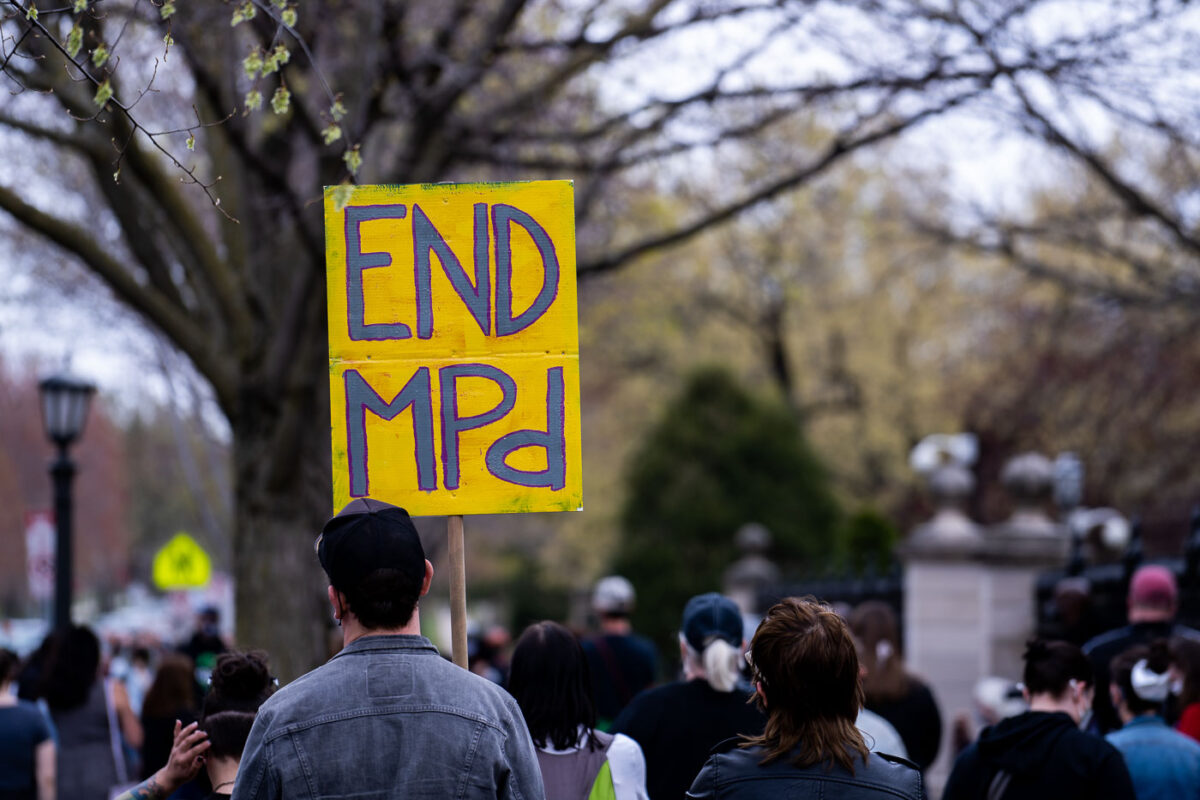
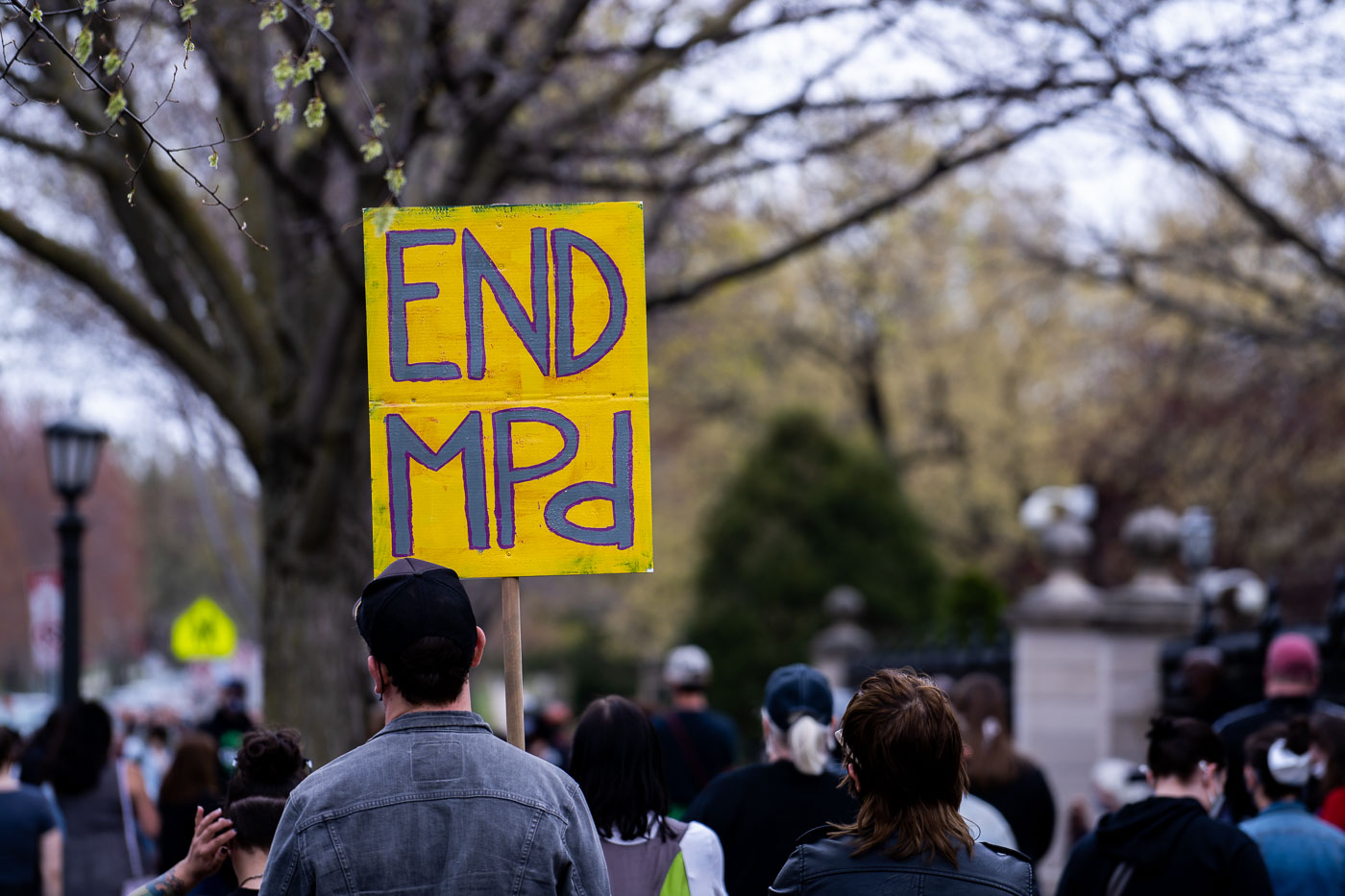
Protester with END MPD sign outside the Minnesota Governor's Residence in St. Paul.
Protesters gathered outside the Minnesota Governor's Residence in Saint Paul, Minnesota, holding signs that read "END MPD." This protest occurred in the context of broader demonstrations and unrest following the killing of Daunte Wright by police in nearby Minneapolis. The "END MPD" slogan calls for the dissolution of the Minneapolis Police Department, reflecting deep-seated concerns about police conduct and accountability that have been amplified by recent events.

Protester holds END MPD sign at Minnesota Governor’s Residence
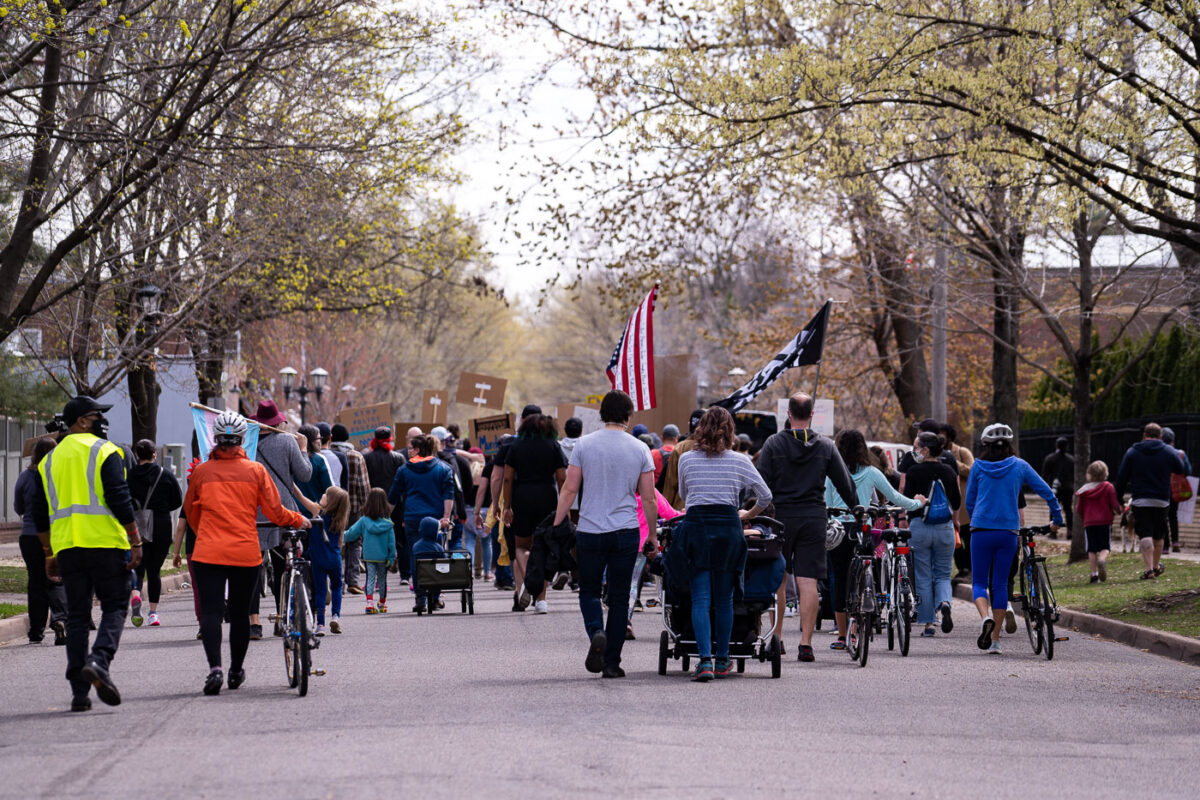
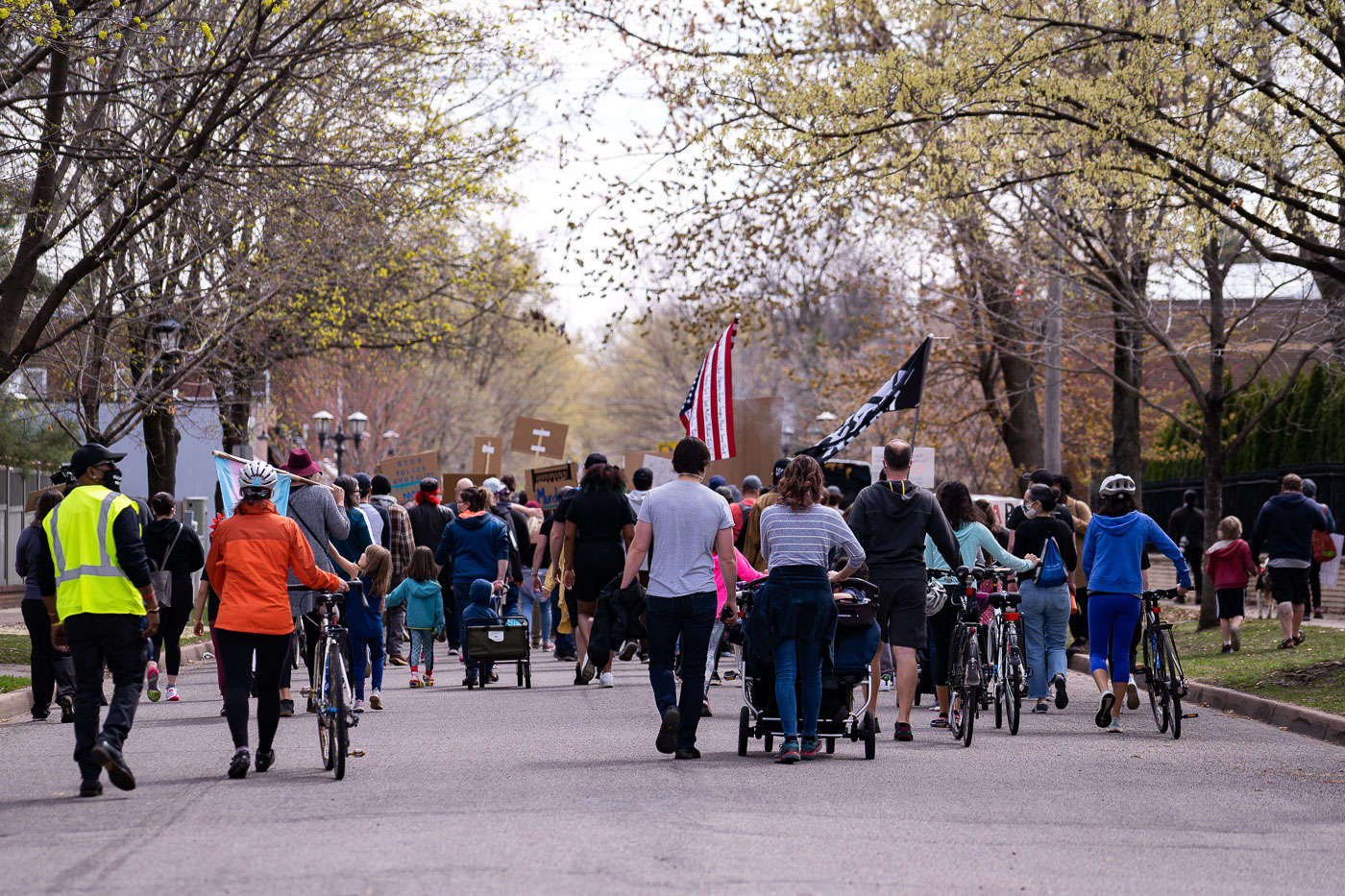
Protesters march toward the Minnesota Governor's Residence in St. Paul with signs, bicycles, and flags.
Protesters marched towards the Minnesota Governor's Residence in St. Paul to voice their concerns regarding the treatment of demonstrators in the preceding week. The march occurred in the context of ongoing protests related to the killing of Daunte Wright in nearby Minneapolis. This event highlights the intersection of public dissent and governmental response, as citizens gathered to express grievances directly to the state's chief executive.

Protesters March at Governor’s Residence in St. Paul

Minnesota National Guard Humvees outside Allianz Field in St. Paul.
Minnesota National Guard Humvees and personnel are stationed outside Allianz Field in St. Paul, Minnesota. This deployment occurred during "Operation Safety Net," a security measure implemented in response to the Derek Chauvin murder trial in April 2021. The presence of military vehicles and personnel underscored the heightened security concerns and potential for civil unrest in the Twin Cities following the trial and the murder of George Floyd in 2020. Allianz Field, a soccer stadium, was repurposed as a security perimeter during this period.

Minnesota National Guard at Allianz Field, St. Paul

National Guard troops outside Minneapolis Police 5th Precinct behind security fencing in Minneapolis.
National Guard soldiers are stationed outside the Minneapolis Police Fifth Precinct, a location that became a focal point during the trial of Derek Chauvin. The precinct was heavily fortified with fencing and concrete barriers to prevent damage and maintain order amidst protests following the murder of George Floyd. This security measure was part of "Operation Safety Net," a coordinated effort by law enforcement and the National Guard to manage public safety during the high-profile trial.

National Guard at Minneapolis Police 5th Precinct During Chauvin Trial

Protesters with George Floyd and Daunte Wright signs outside Hennepin County Government Center in Minneapolis.
Protesters gather outside the Hennepin County Government Center in Minneapolis on April 20, 2021, the day before the verdict in the Derek Chauvin trial. The signs reference George Floyd and Daunte Wright, both Black men killed by police in Minneapolis. The protest occurred during a period of heightened tension and activism following Floyd's murder in May 2020 and Wright's death in April 2021. The signs also include messages about vaccination and mask-wearing, reflecting the ongoing COVID-19 pandemic.

Minneapolis Protest for George Floyd and Daunte Wright
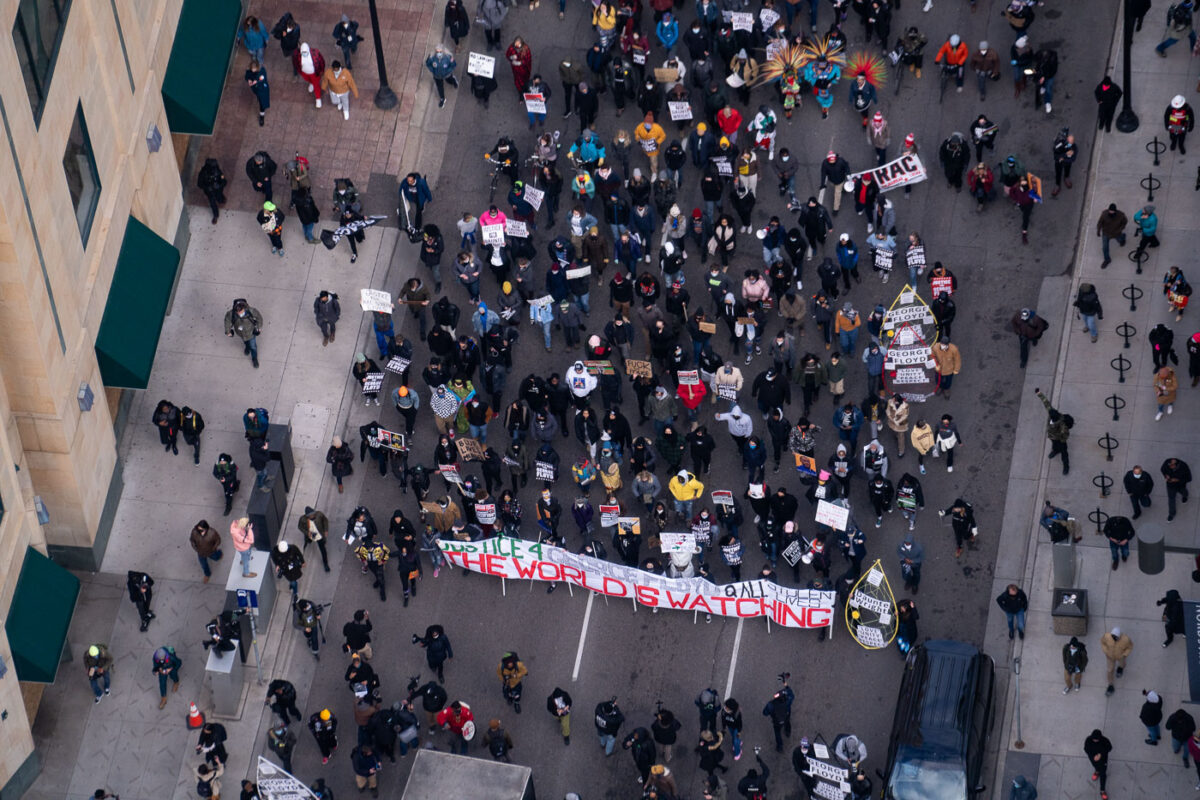
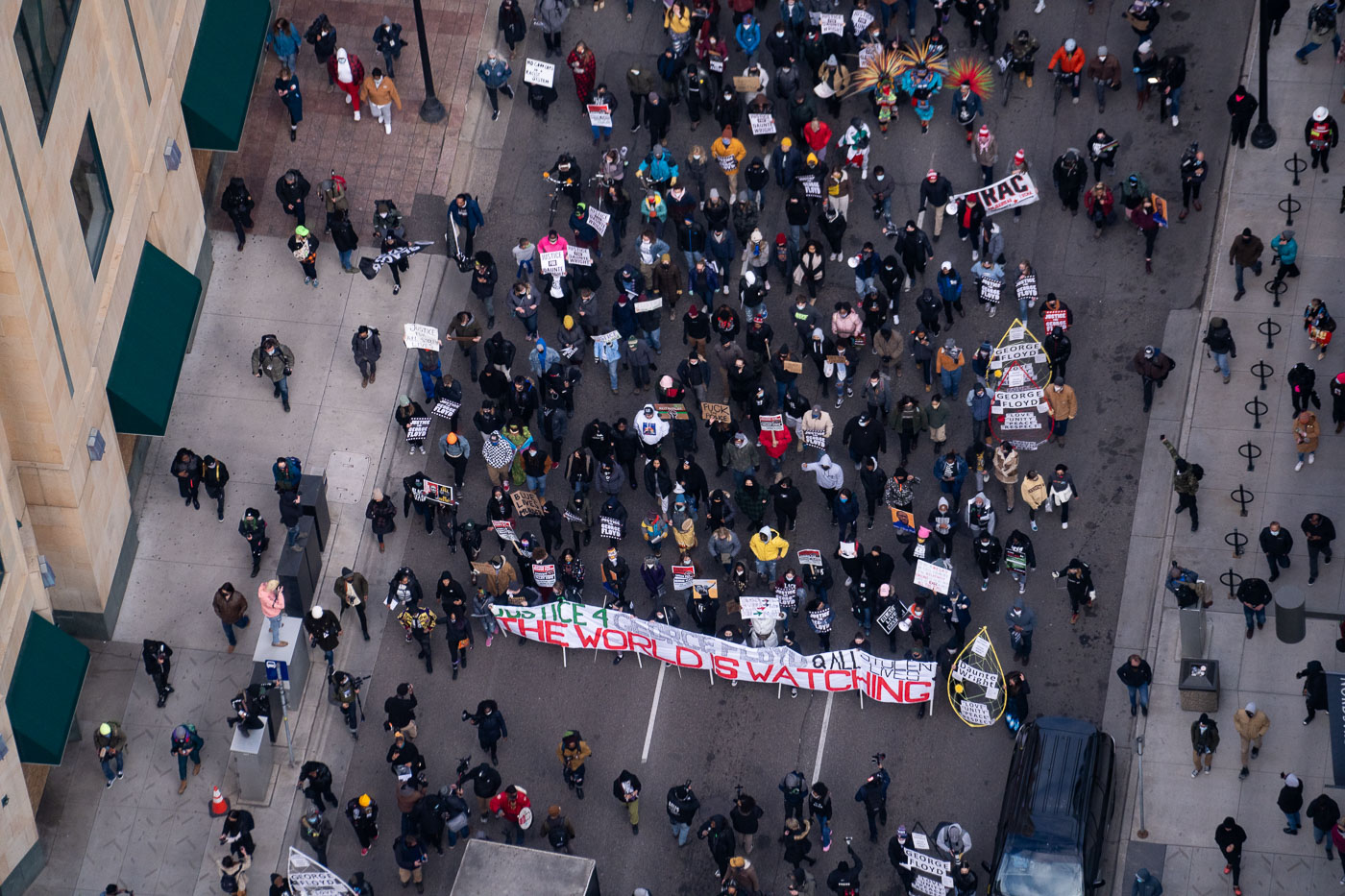
Protesters marching in downtown Minneapolis with a justice banner during the Derek Chauvin trial.
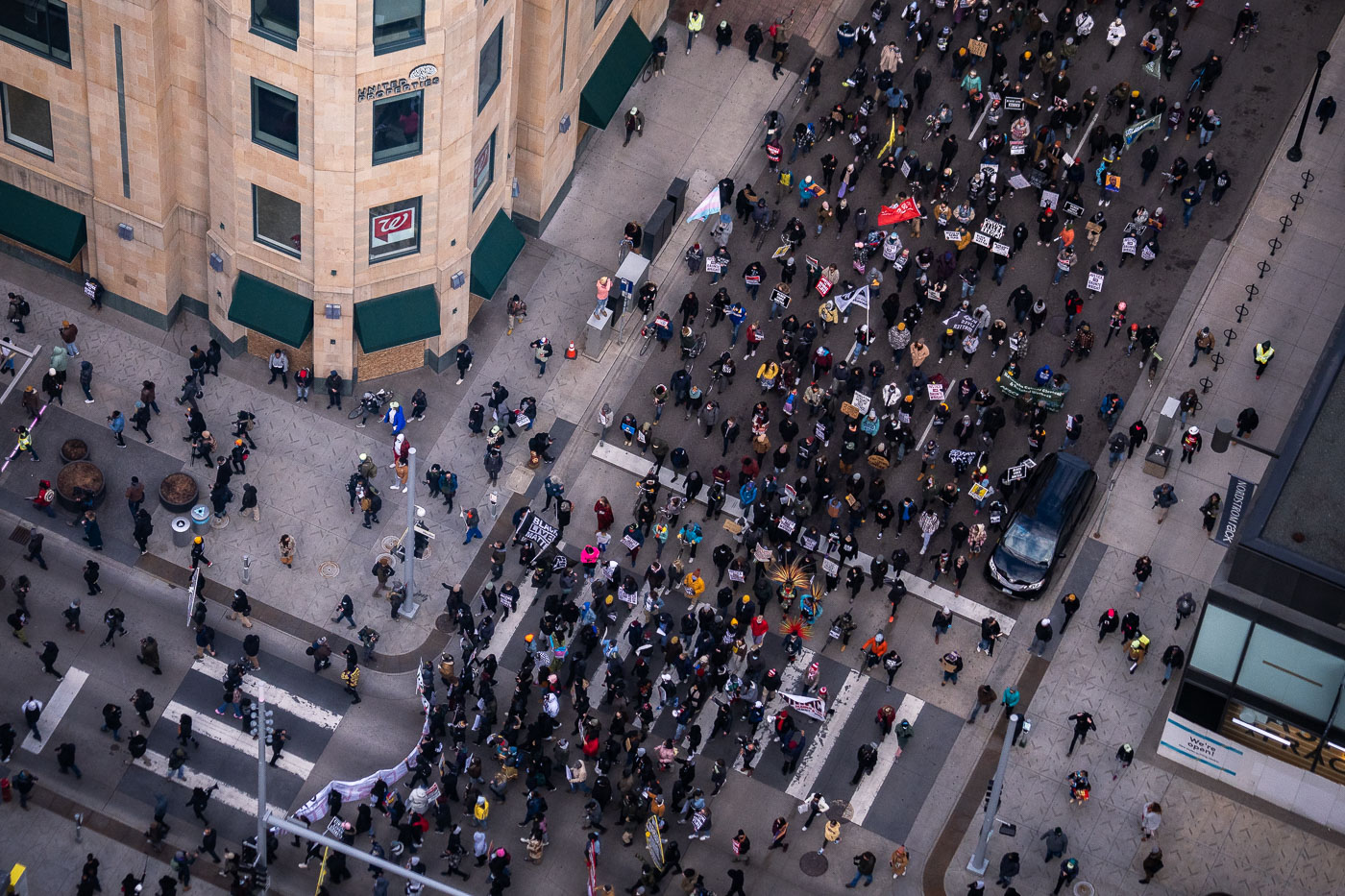
On April 19, 2021, hundreds marched through downtown Minneapolis as the jury began deliberations in the murder trial of Derek Chauvin. This protest was part of ongoing demonstrations that had occurred for nearly a year following the death of George Floyd. The marchers carried signs demanding justice and accountability, reflecting the broader movement for racial equality and police reform that gained national attention in 2020. The event highlighted the continued public engagement with issues of systemic racism and police brutality in the city and across the nation.

Minneapolis Protest for Justice on Chauvin Trial Jury Day
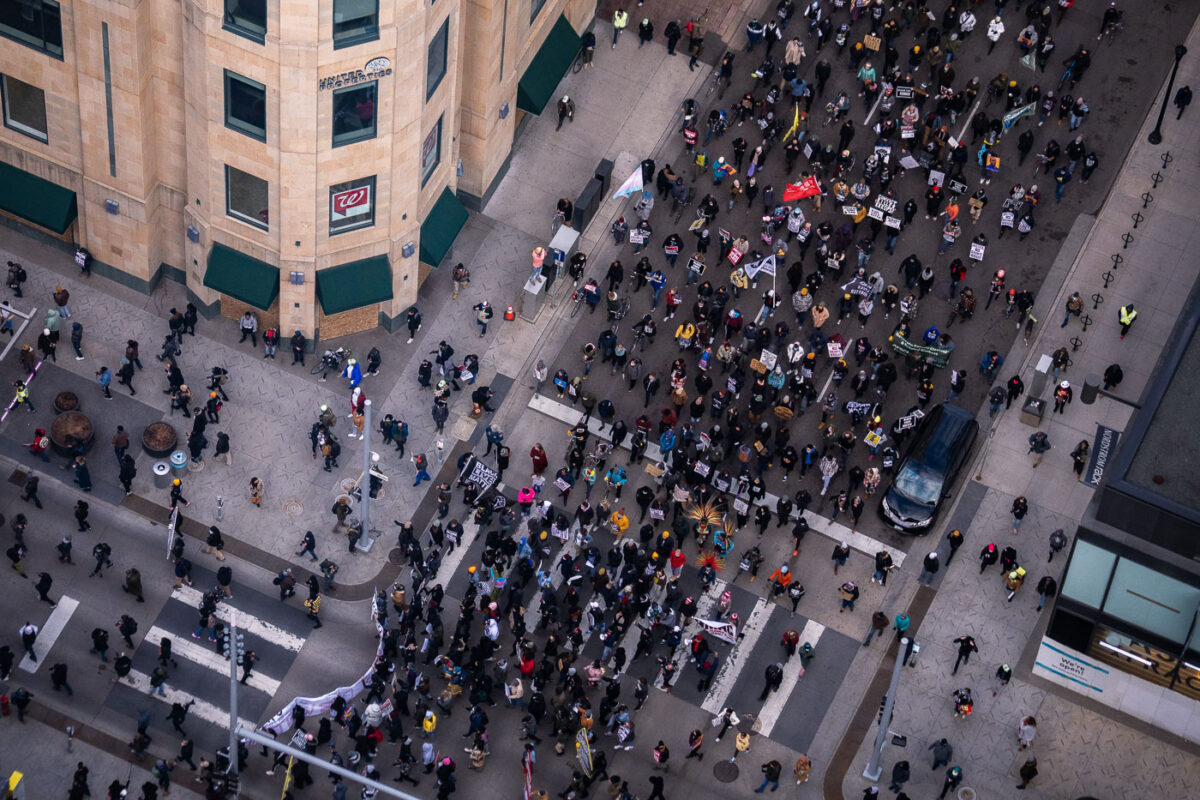
Protest marchers in downtown Minneapolis during jury deliberations in the Derek Chauvin trial.
On April 19, 2021, hundreds marched through downtown Minneapolis as the jury began deliberations in the murder trial of former police officer Derek Chauvin. The protest, which continued the year-long demonstrations for racial justice and police accountability, took place on the anniversary of George Floyd's murder. Protesters carried signs with messages such as "Justice for Daunte Wright" and "Black Lives Matter," reflecting broader concerns about police brutality and systemic racism in the United States. The march occurred in the same city where George Floyd's death in police custody sparked widespread unrest and calls for reform.

Minneapolis Protest for Justice as Chauvin Trial Jury Deliberates
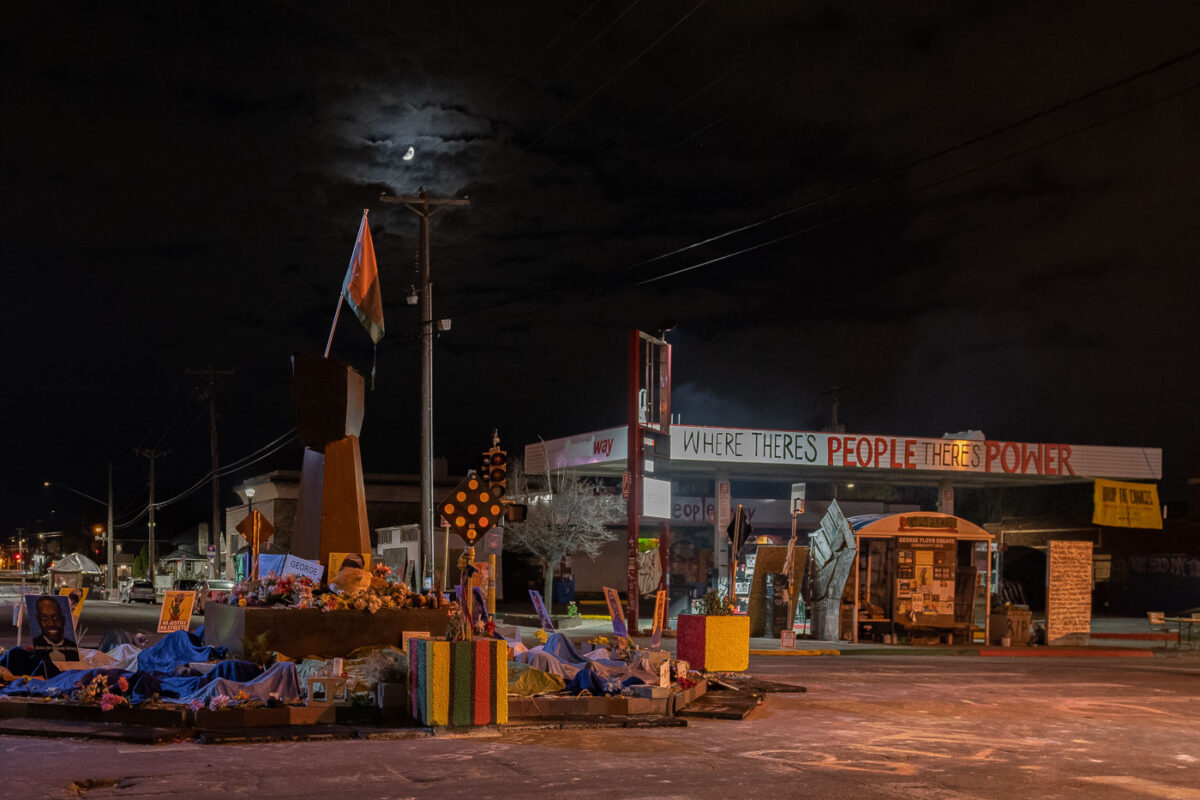
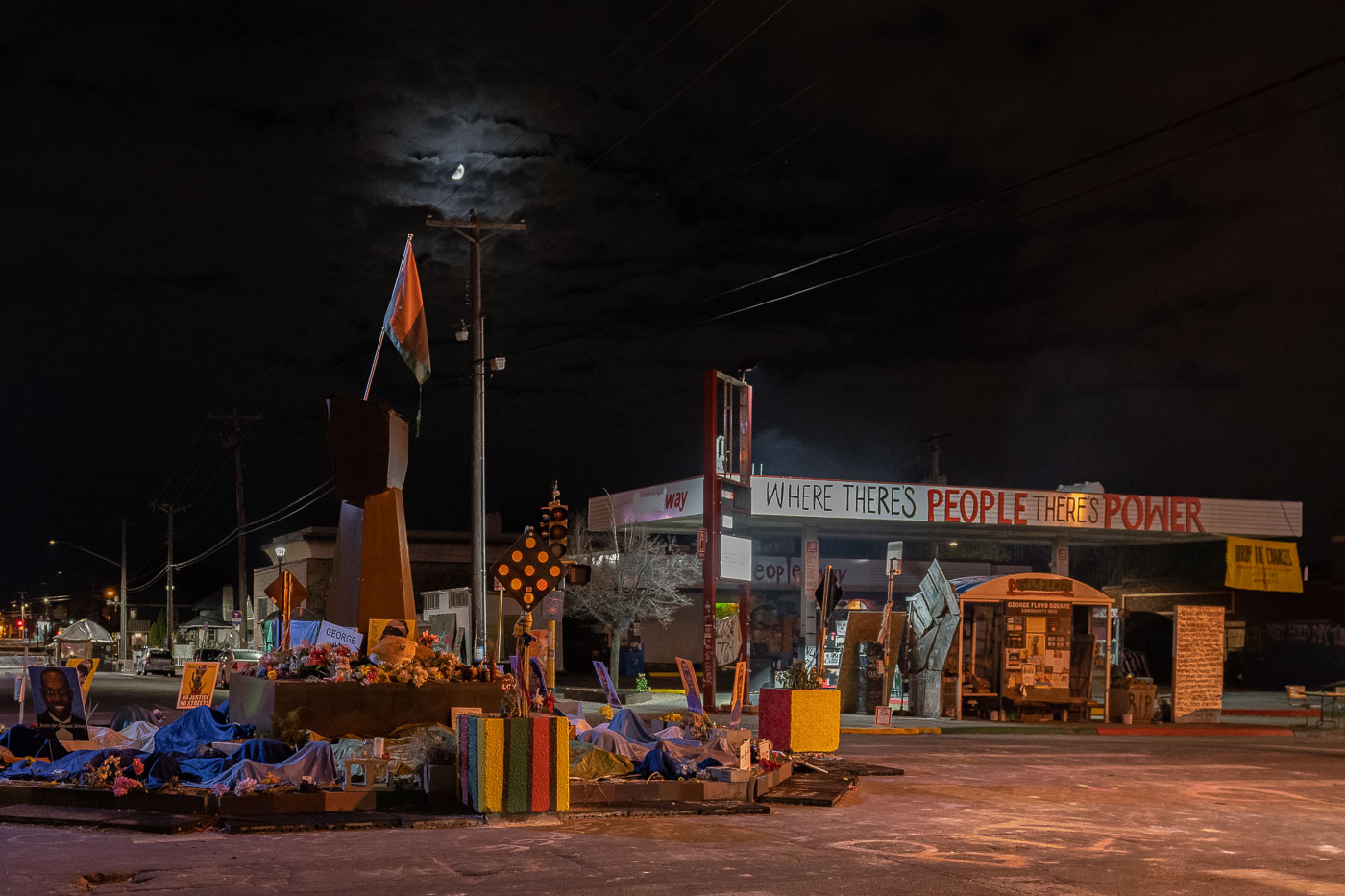
George Floyd Square memorial at 38th and Chicago in Minneapolis at night.
George Floyd Square, also known as "The People's Way," is a four-block area in Minneapolis that has been under community control since the murder of George Floyd on May 25, 2020. This memorial was photographed on the evening the jury began deliberations in the Derek Chauvin murder trial. The site serves as a memorial to George Floyd and other victims of racial injustice, and as a space for community organizing and expression.

George Floyd Square Memorial at Night, Minneapolis
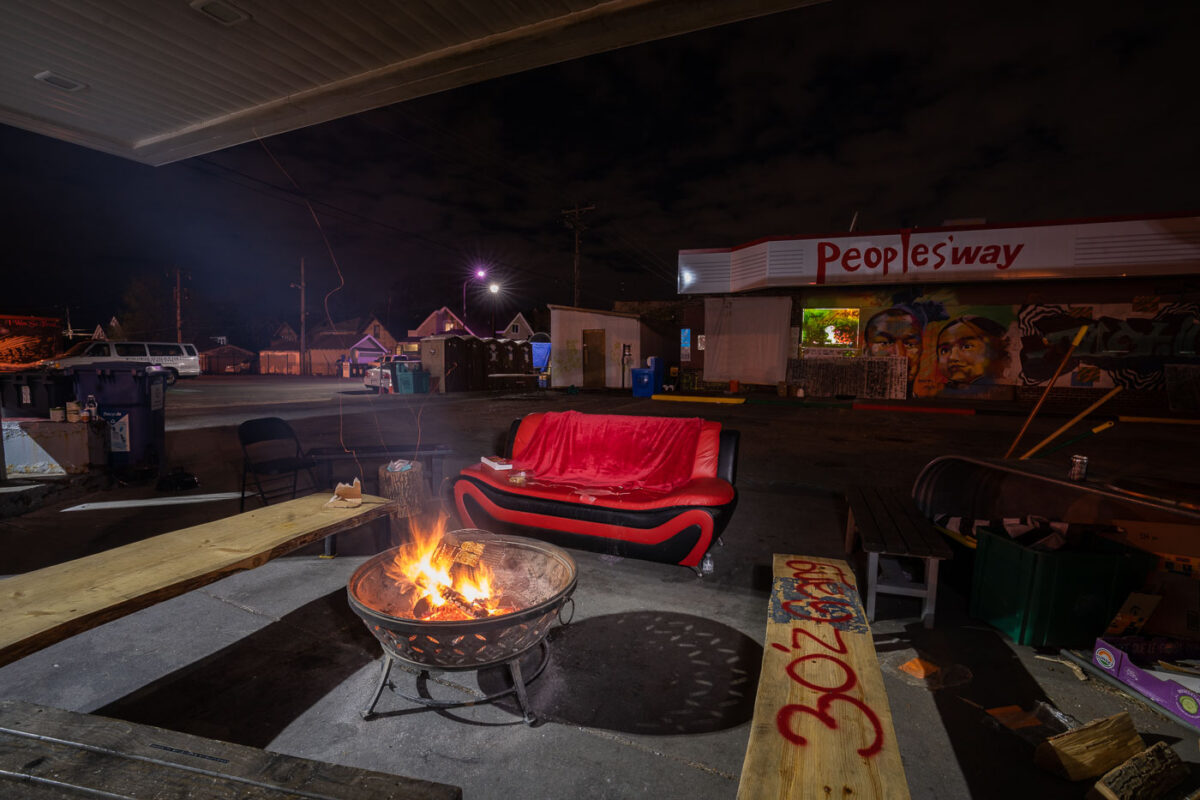
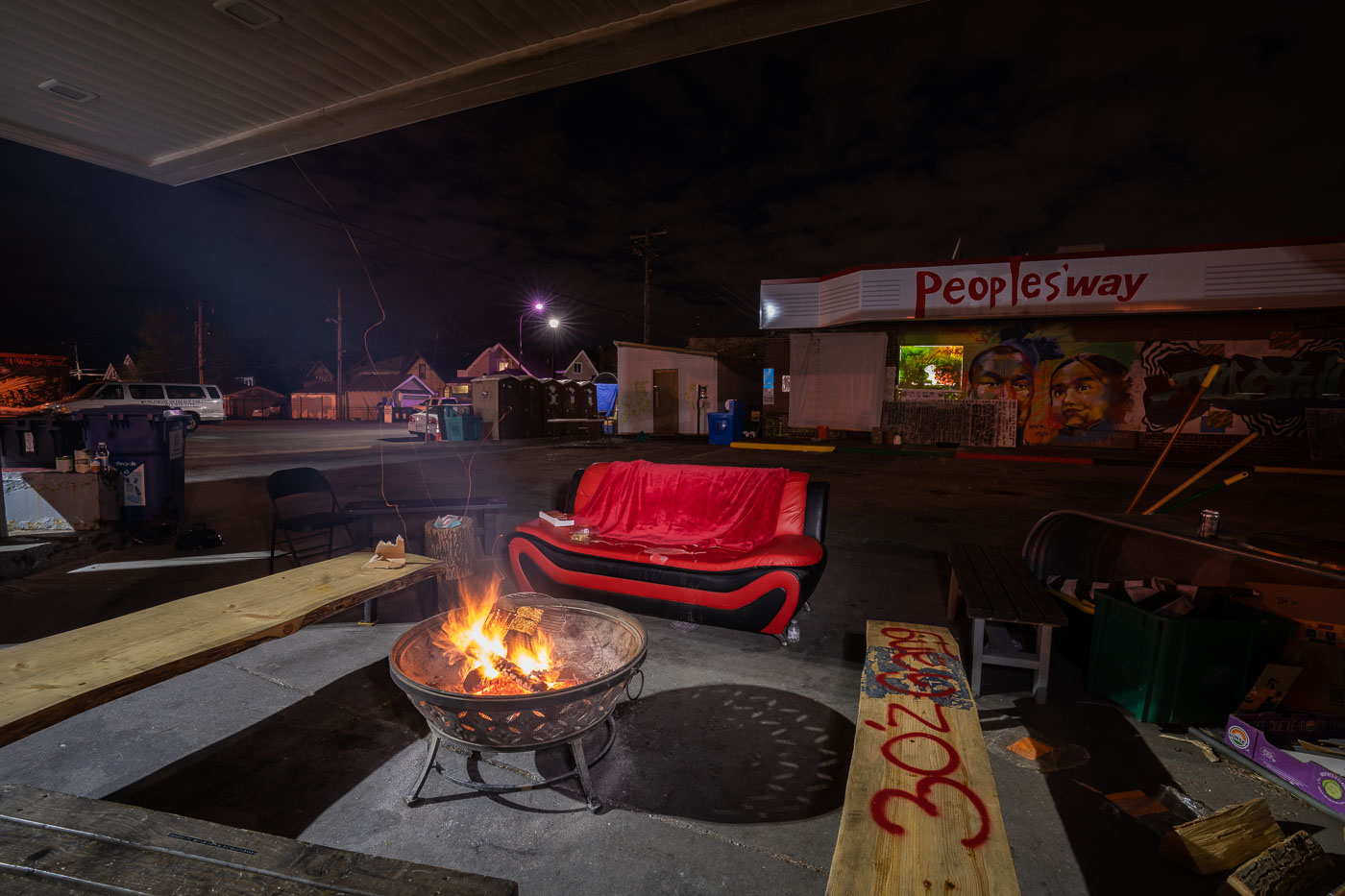
Campfire and seating at George Floyd Square in Minneapolis beneath Peoples Way signage.
A campfire burns at George Floyd Square in Minneapolis, April 2021. The site, located at the intersection of 38th Street and Chicago Avenue, became a focal point for protests following the murder of George Floyd in May 2020. The area was renamed "The People's Way" by activists and served as a space for community gatherings and continued demonstrations against racial injustice. The "Peoples Way" signage visible on the building in the background refers to this renaming.

George Floyd Square Campfire, Minneapolis, April 2011
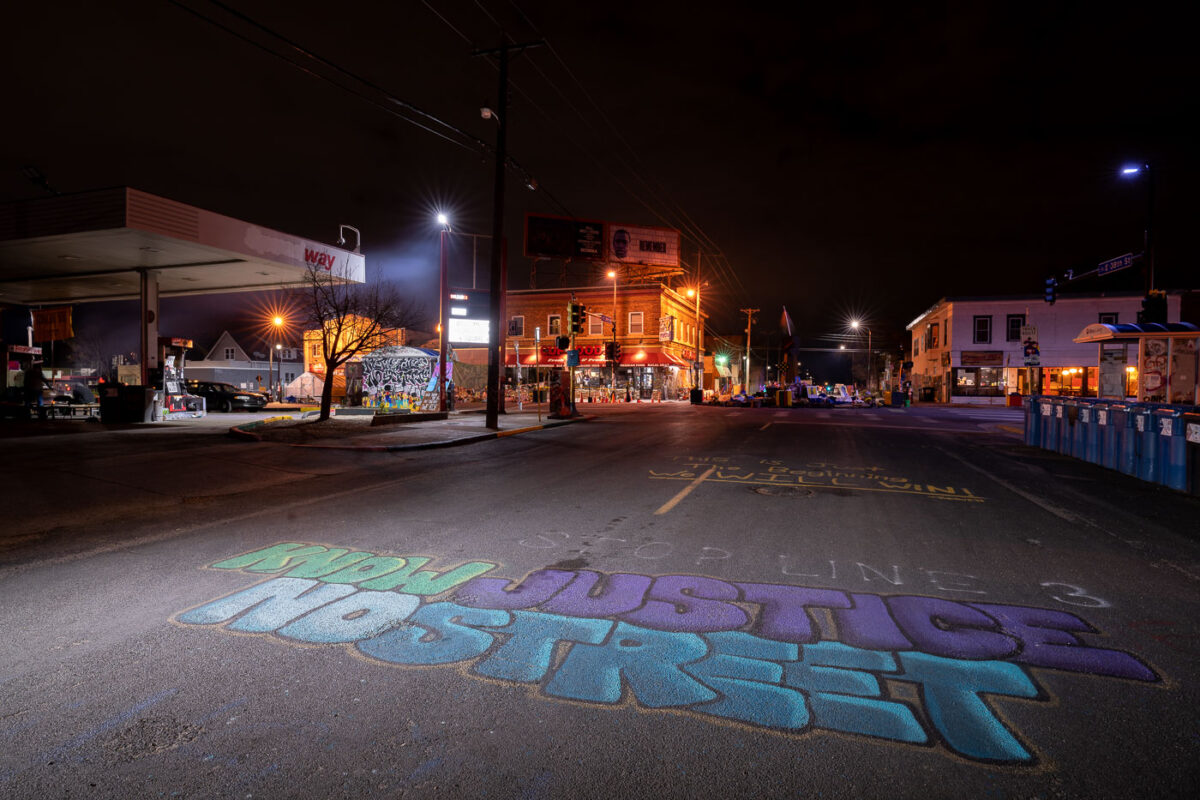
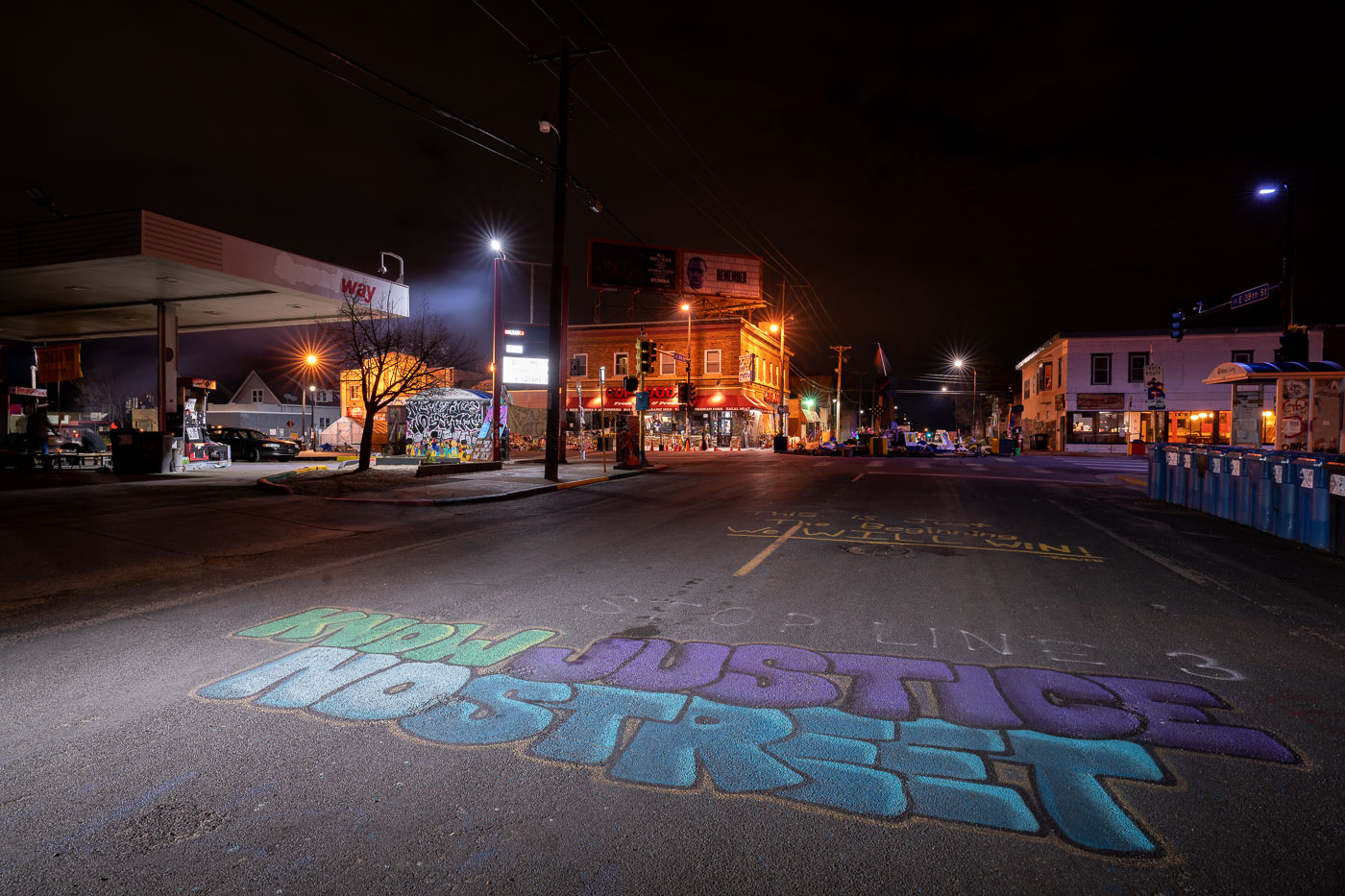
George Floyd Square at 38th Street and Chicago Avenue in Minneapolis with "No Justice No Street" painted on the road.
George Floyd Square, located at the intersection of 38th Street and Chicago Avenue in Minneapolis, became a focal point of protests following the murder of George Floyd in May 2020. The area was occupied by protesters for months, transforming it into a community space and a symbol of resistance. The phrase "No Justice No Street" painted on the asphalt reflects the protesters' demands for accountability and systemic change. The square has since become a significant site of remembrance and activism.

George Floyd Square, Minneapolis: “No Justice No Street”

Boarded-up Whole Foods Market in Minneapolis during the Derek Chauvin trial.
A Whole Foods Market in Minneapolis is boarded up with plywood in anticipation of potential unrest following the verdict in the Derek Chauvin murder trial. The trial, which began in March 2021, concerned the death of George Floyd, a Black man whose killing by Chauvin, a white police officer, sparked widespread protests in Minneapolis and across the nation. Businesses across the city took precautionary measures to protect property during this period of heightened tension.

Minneapolis Whole Foods Boarded Up During Derek Chauvin Trial

Marcia Howard speaks at George Floyd Square in Minneapolis after the Chauvin verdict.
Marcia Howard addresses a crowd at George Floyd Square in Minneapolis following the guilty verdict in the Derek Chauvin murder trial. The square, an area around the intersection of 38th Street and Chicago Avenue, became a focal point for protests against racial injustice and police brutality after George Floyd's death in May 2020. The verdict in Chauvin's trial, a former Minneapolis police officer, was seen as a significant moment in the ongoing movement for racial equity. Howard's speech at this location underscores the square's role as a space for community expression and remembrance.

Marcia Howard speaks at George Floyd Square after Chauvin verdict

Jesse Jackson arrives at Hennepin County Courthouse in Minneapolis as National Guard troops patrol.
Reverend Jesse Jackson, a prominent civil rights leader, arrived at the Hennepin County Courthouse in Minneapolis, Minnesota, during the trial of Derek Chauvin. Chauvin was charged in the death of George Floyd, which occurred on May 25, 2020, and sparked widespread protests. The courthouse, officially known as the Hennepin County Government Center, is a significant civic building in downtown Minneapolis. The presence of National Guard troops, as seen in the image, underscored the heightened security and tension surrounding the trial and its potential verdict.

Jesse Jackson arrives at Hennepin County Courthouse during Chauvin trial

Protesters outside Hennepin County Government Center in Minneapolis with signs during the Chauvin verdict.
A crowd gathers outside the Hennepin County Government Center in Minneapolis on April 20, 2021, awaiting the verdict in the trial of former police officer Derek Chauvin. Chauvin was charged in the death of George Floyd on May 25, 2020, an event that sparked widespread protests. The Hennepin County Government Center, located at 300 South 6th Street, serves as the administrative hub for Hennepin County government and houses courts and offices.

Minneapolis: Crowd Gathers at Hennepin County Government Center for Chauvin Verdict

Brandyn Tulloch speaks to a crowd at Hennepin County Government Center in Minneapolis.
Brandyn Tulloch addresses a crowd gathered outside the Hennepin County Government Center in Minneapolis on April 20, 2021. The gathering occurred as anticipation grew for the verdict in the trial of Derek Chauvin, who was charged in the May 25, 2020 death of George Floyd. The Hennepin County Government Center is a prominent courthouse and administrative building in downtown Minneapolis, serving as the seat of county government and a key location for legal proceedings in the region.

Brandyn Tulloch speaks at Hennepin County Government Center

Minnesota National Guard troops at Hennepin County Government Center in Minneapolis.
Members of the Minnesota National Guard were stationed outside the Hennepin County Government Center in Minneapolis on April 20, 2021. Their presence was in anticipation of the verdict in the trial of Derek Chauvin, a former Minneapolis police officer charged in the murder of George Floyd. The Hennepin County Government Center serves as a primary administrative and judicial hub for the county, and its security was heightened during this period of significant public attention and potential unrest.

National Guard at Hennepin County Government Center, Minneapolis

Man with Black Lives Matter flag at Hennepin County Government Center protest in Minneapolis.
On April 20, 2021, crowds gathered outside the Hennepin County Government Center in Minneapolis to mark the guilty verdict in the murder trial of Derek Chauvin. Chauvin, a former Minneapolis police officer, was found guilty on all three counts for the killing of George Floyd. The verdict was a significant moment in the ongoing national conversation about racial justice and police accountability, following widespread protests that began in Minneapolis in the summer of 2020.

Minneapolis: Black Lives Matter flag at Chauvin verdict protest

George Floyd's family leaves Hennepin County Government Center in Minneapolis after the Chauvin verdict.
The family of George Floyd departs the Hennepin County Government Center in Minneapolis on April 20, 2021, following the guilty verdict in the trial of Derek Chauvin. Chauvin, a former Minneapolis police officer, was convicted of second-degree unintentional murder, third-degree murder, and second-degree manslaughter in Floyd's death. The verdict was seen as a significant moment in the ongoing national reckoning with racial injustice and police brutality.

George Floyd Family Leaves Hennepin County Courthouse After Verdict

Roxie Washington leaves Hennepin County Government Center in Minneapolis after the Derek Chauvin verdict.
Roxie Washington, the mother of George Floyd’s daughter, leaves the Hennepin County Government Center in Minneapolis following the guilty verdict in the trial of Derek Chauvin. Chauvin, a former Minneapolis police officer, was convicted on April 20, 2021, of second-degree unintentional murder, third-degree murder, and second-degree manslaughter for his role in Floyd's death. The verdict was seen as a significant moment in the ongoing national conversation about racial justice and police accountability.

George Floyd’s family leaves Hennepin County Courthouse after verdict

People celebrate outside Hennepin County Government Center in Minneapolis after the Derek Chauvin verdict.
A crowd gathers outside the Hennepin County Government Center in Minneapolis to celebrate the guilty verdict in the murder trial of Derek Chauvin. Chauvin was found guilty on all three counts for the killing of George Floyd, an event that sparked widespread protests and a national reckoning on racial justice. The Hennepin County Government Center is a prominent civic building in downtown Minneapolis, serving as the courthouse for county legal proceedings. The verdict, delivered on April 20, 2021, marked a significant moment in the ongoing struggle for accountability and justice.

Minneapolis: Crowd Celebrates Derek Chauvin Verdict at Government Center

Man raising fist from a car outside Hennepin County Government Center in Minneapolis after Chauvin verdict.
A crowd gathered outside the Hennepin County Government Center in Minneapolis reacted to the verdict in the trial of Derek Chauvin. On April 20, 2021, Chauvin, a former Minneapolis police officer, was found guilty of second-degree unintentional murder, third-degree murder, and second-degree manslaughter in the death of George Floyd. The verdict was delivered after a highly publicized trial that drew national attention to issues of police brutality and racial injustice. The Hennepin County Government Center is a prominent civic building in downtown Minneapolis, serving as the seat of county government and a site for significant public events and gatherings.

Minneapolis: Fist raised after Chauvin conviction at Hennepin County Center

Crowd outside Hennepin County Government Center in Minneapolis after the Derek Chauvin verdict.
A crowd gathers outside the Hennepin County Government Center in Minneapolis on April 21, 2021, following the conviction of Derek Chauvin for the murder of George Floyd. The verdict in this high-profile trial, held in the same city where Floyd's death occurred, sparked widespread reactions and protests. The Hennepin County Government Center serves as a central hub for county administration and judicial proceedings, and its plaza has been a focal point for public gatherings and demonstrations.

Minneapolis Courthouse Crowd After Derek Chauvin Verdict
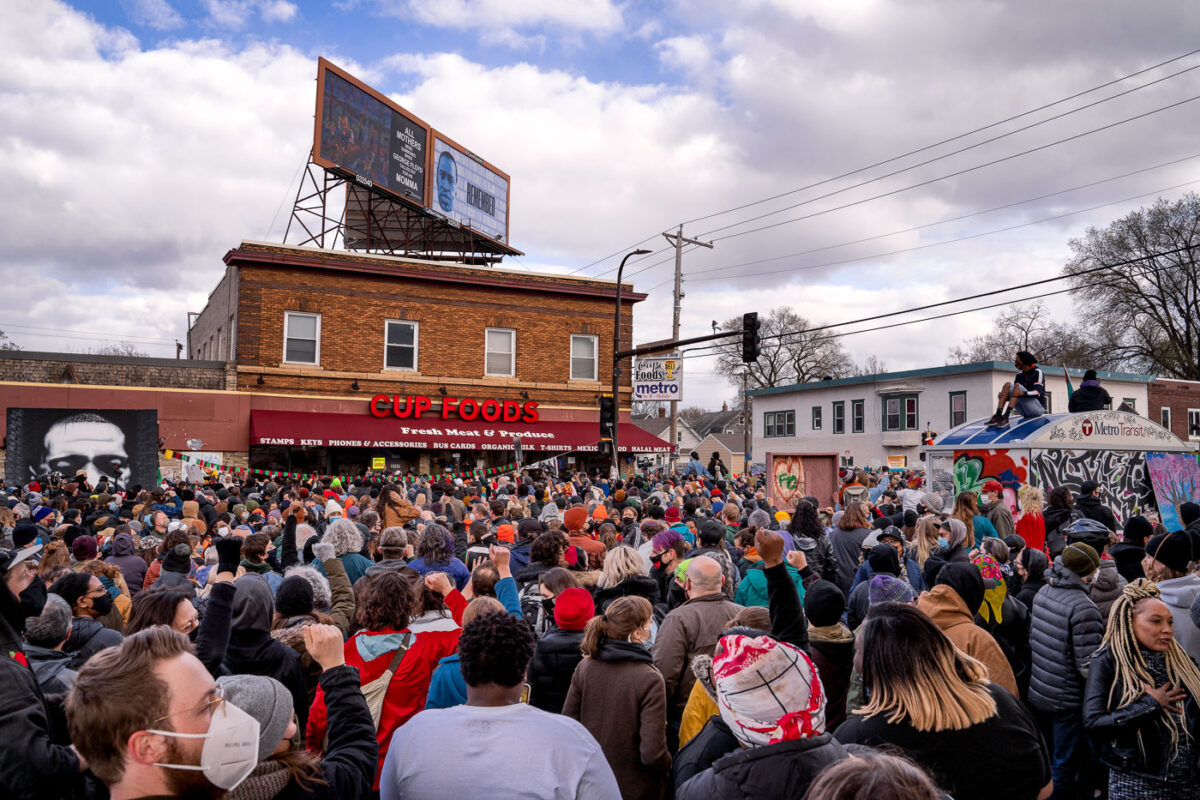
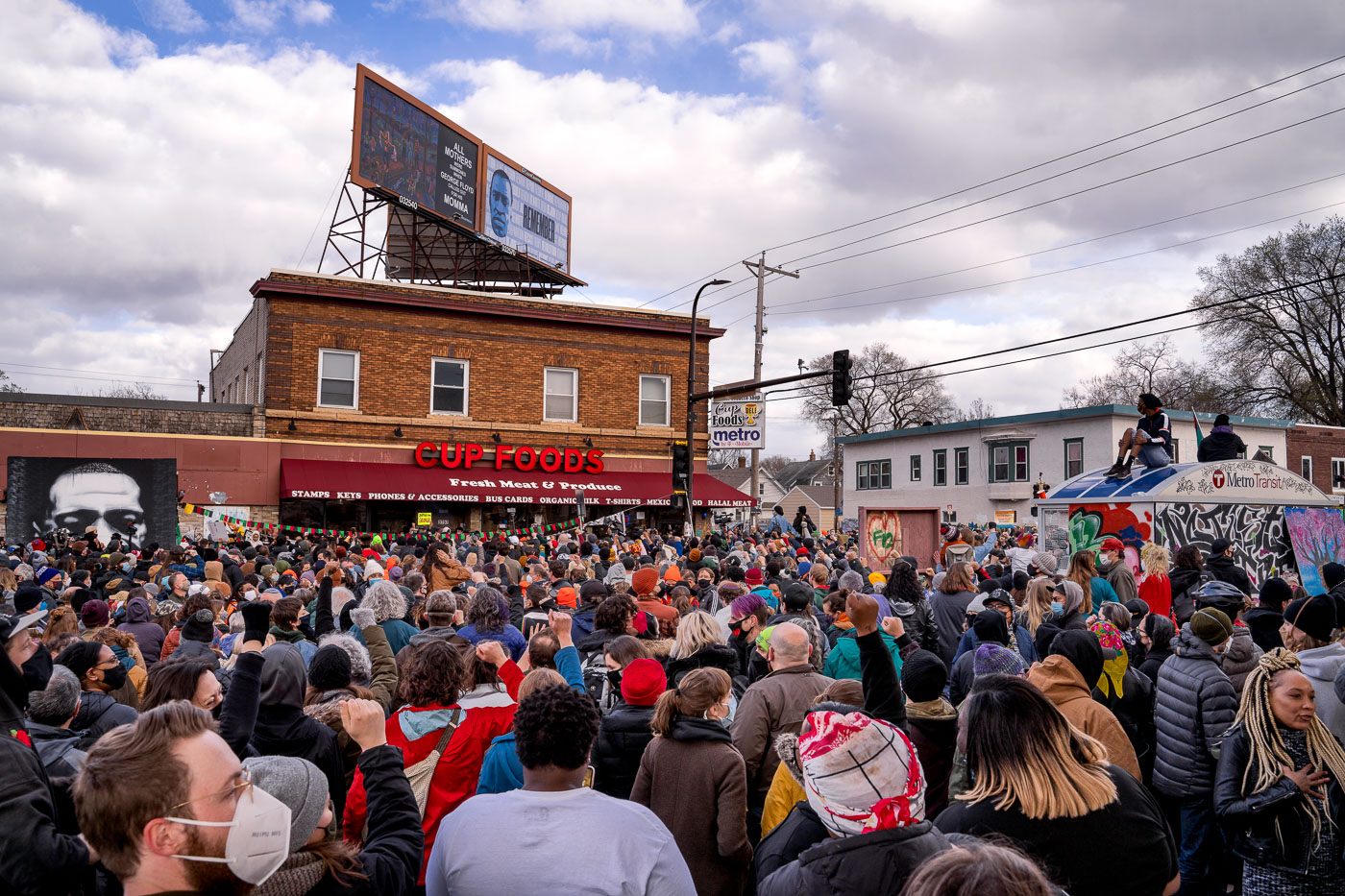
Crowd at George Floyd Square in Minneapolis after the Derek Chauvin verdict.
Crowds gather at George Floyd Square in Minneapolis following the conviction of Derek Chauvin for the murder of George Floyd. The square, located at the intersection of Chicago Avenue and 38th Street, became a focal point for protests and community organizing after Floyd's death in May 2020. The area has been transformed into a memorial and a space for ongoing activism, reflecting the community's demands for racial justice and police accountability. The billboards in the background display messages related to Floyd's death and the broader movement for justice.

Minneapolis: Crowds gather at George Floyd Square after Chauvin verdict
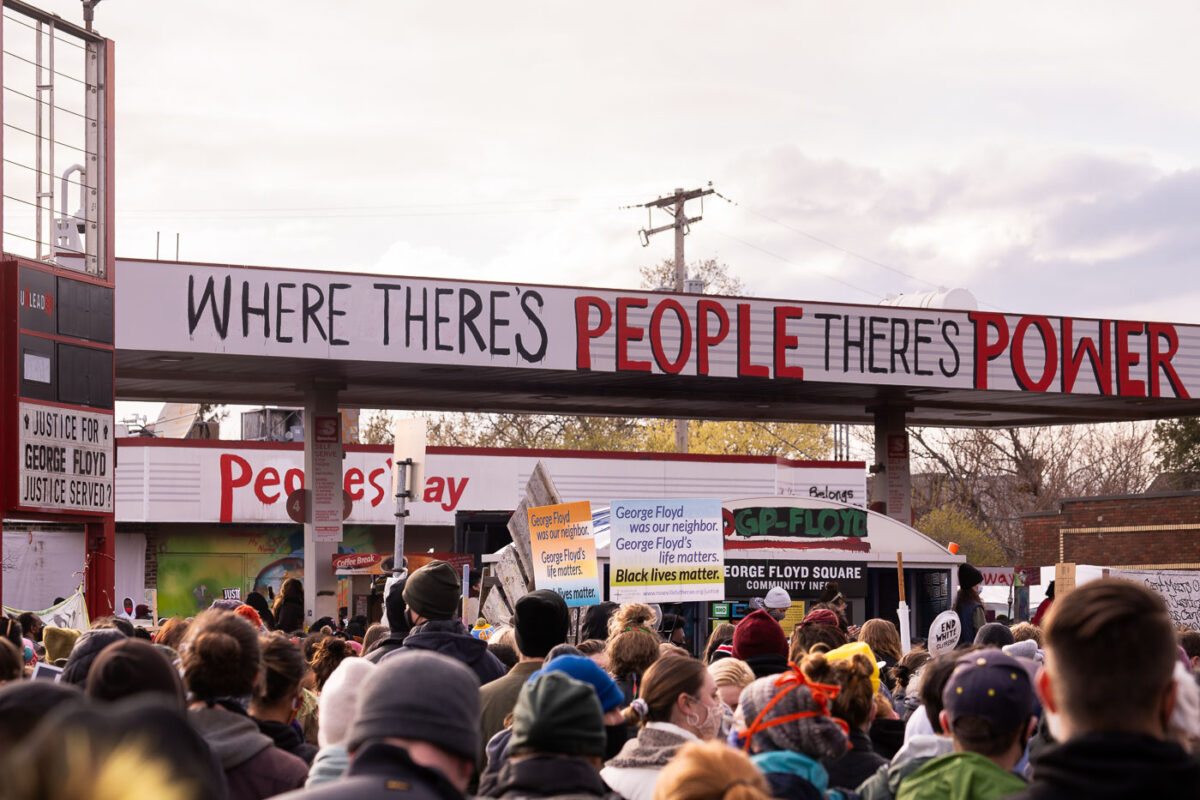
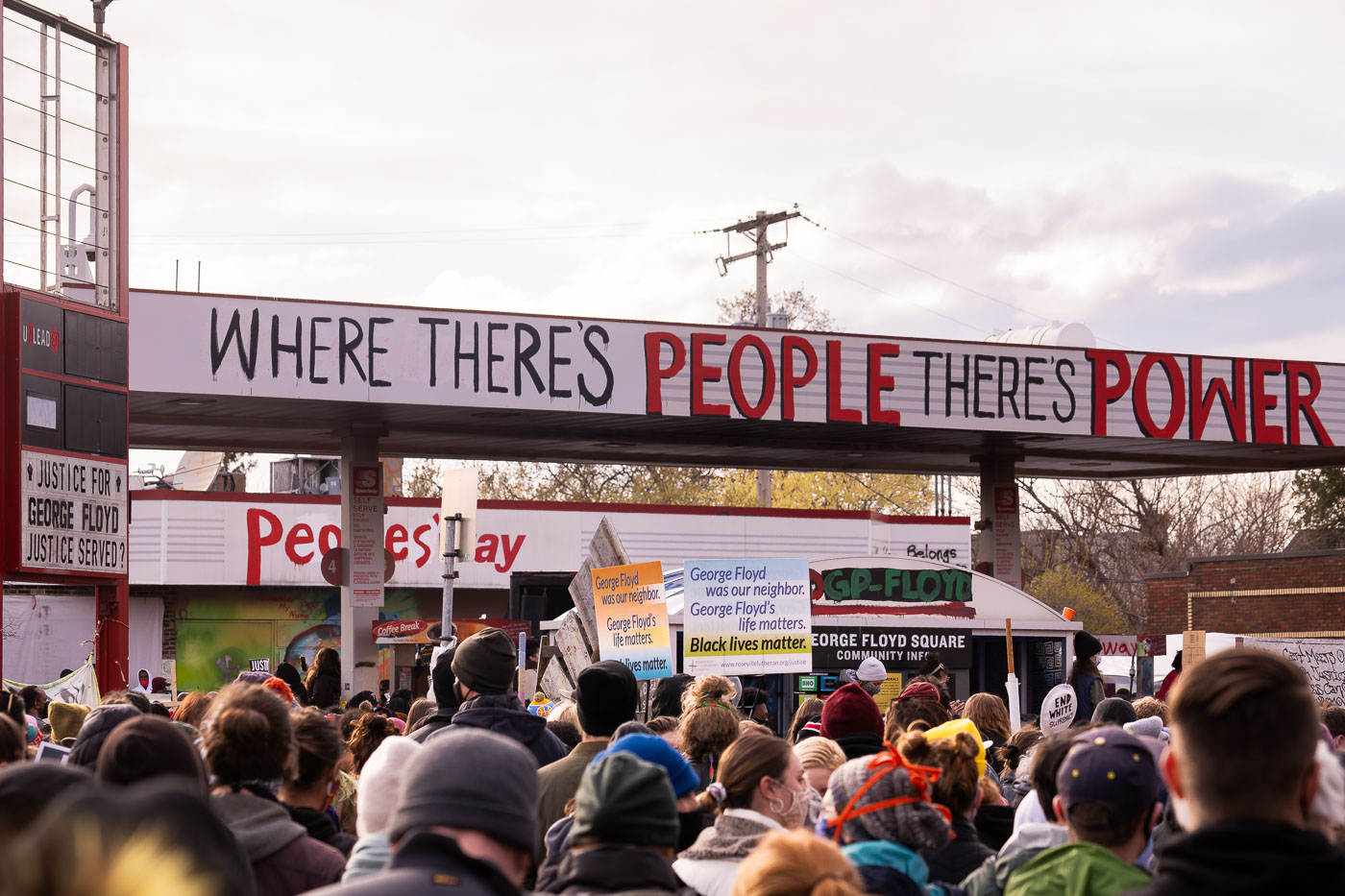
Crowd at George Floyd Square in Minneapolis beneath a "Where there's people there's power" sign.
A crowd gathers at George Floyd Square in Minneapolis following the guilty verdict in the trial of Derek Chauvin, the police officer charged with the murder of George Floyd. The intersection, formerly known as the intersection of 38th Street and Chicago Avenue, became a focal point for protests and activism after Floyd's death in May 2020. Signs and banners, including "WHERE THERE'S PEOPLE THERE'S POWER" and "George Floyd was our neighbor. George Floyd's life matters," reflect the community's ongoing engagement with issues of racial justice and police accountability.

George Floyd Square Gathering After Chauvin Verdict
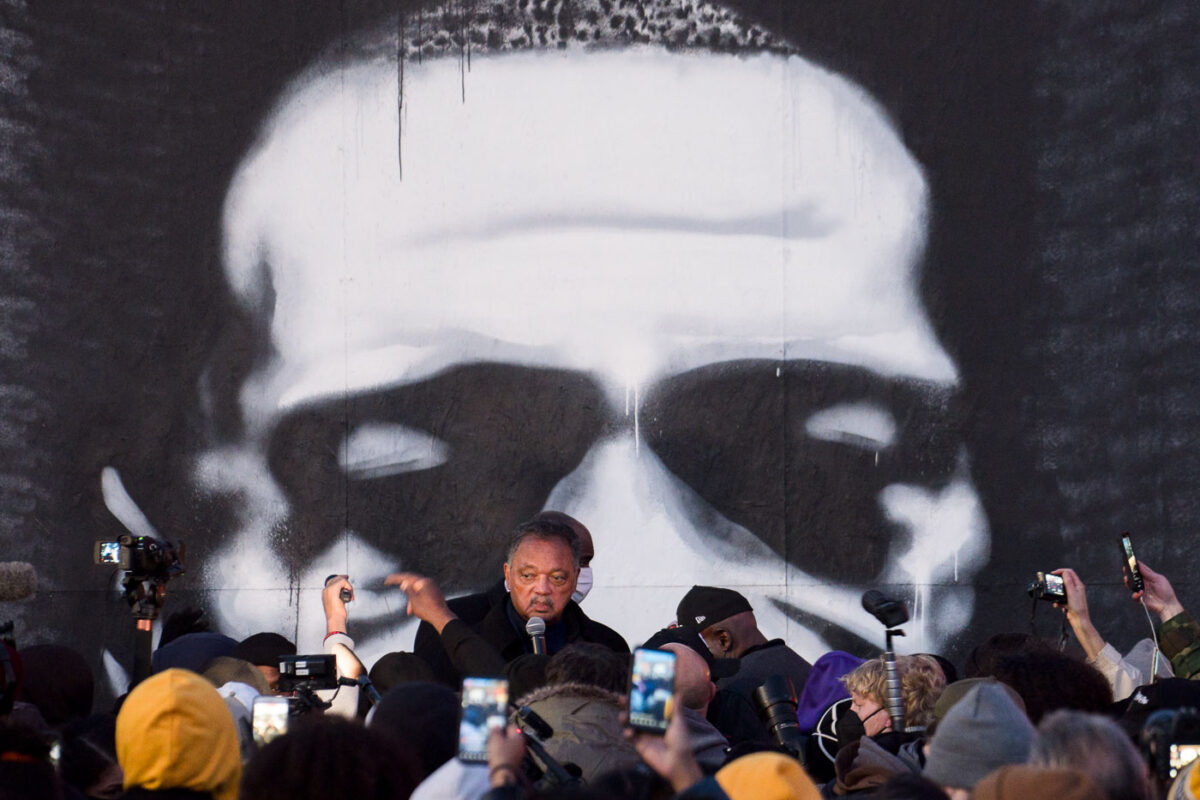
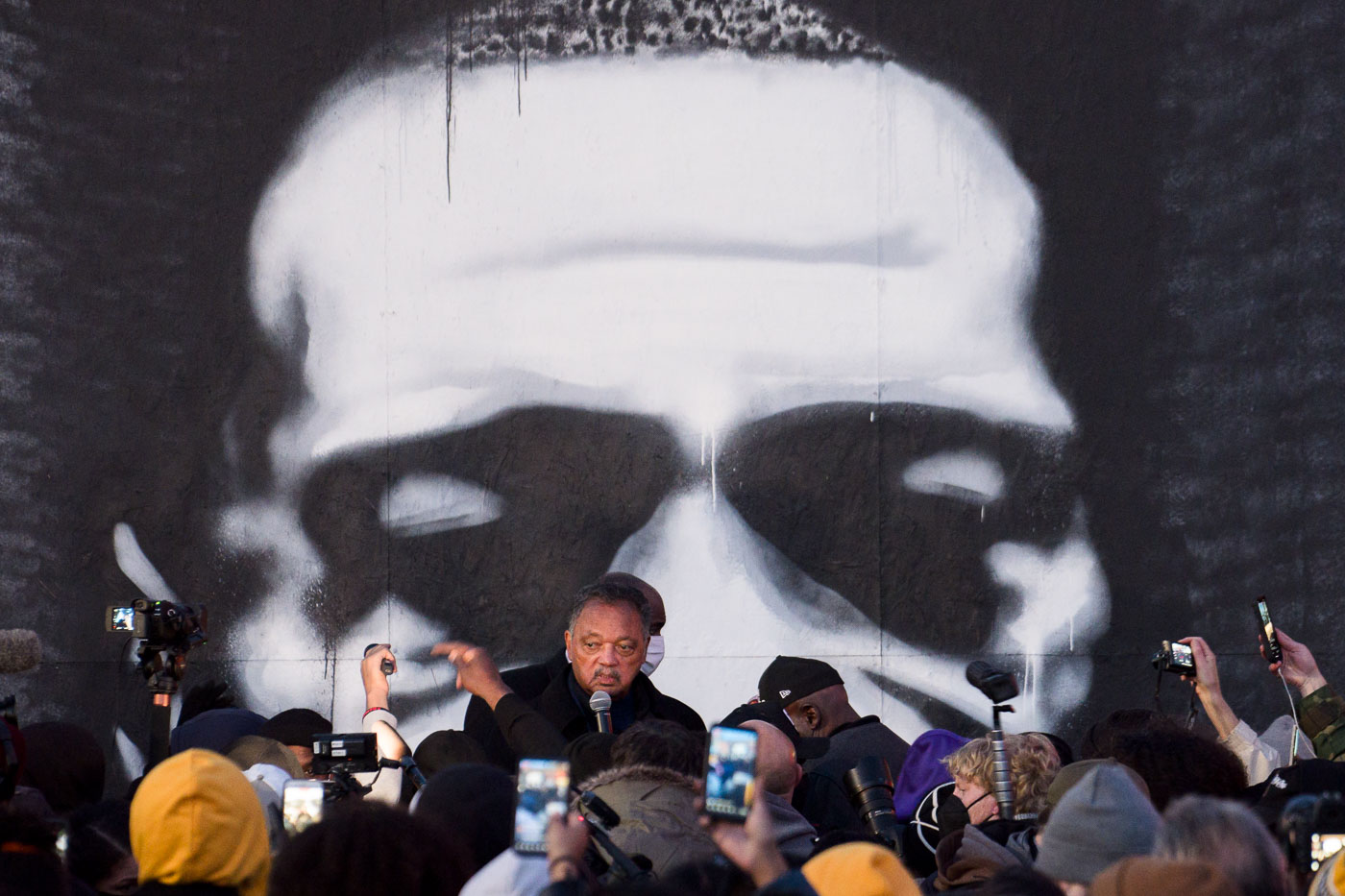
Jesse Jackson speaks at George Floyd Square in Minneapolis before a crowd and mural.
Civil rights leader Jesse Jackson addresses a crowd at George Floyd Square in Minneapolis. The square, located at the intersection of Chicago Avenue and 38th Street, became a focal point for protests following the May 25, 2020, killing of George Floyd by Minneapolis police officers. The area has since been transformed into a memorial and a site for ongoing activism and community gatherings.

Jesse Jackson speaks at George Floyd Square, Minneapolis

Pallbearers carry Daunte Wright's casket at Shiloh Temple in Minneapolis.
Mourners gather for the funeral service of Daunte Wright at Shiloh Temple in North Minneapolis. Wright's death on April 11, 2021, during a traffic stop in Brooklyn Center, Minnesota, sparked protests and unrest in the Minneapolis–Saint Paul metropolitan area. The funeral was held on April 22, 2021, at Shiloh Temple, a prominent church in the city's Northside neighborhood. The service honored Wright's life and brought together community members, activists, and family to mourn his loss and address issues of racial injustice and police brutality.

Daunte Wright Funeral Service at Shiloh Temple, Minneapolis
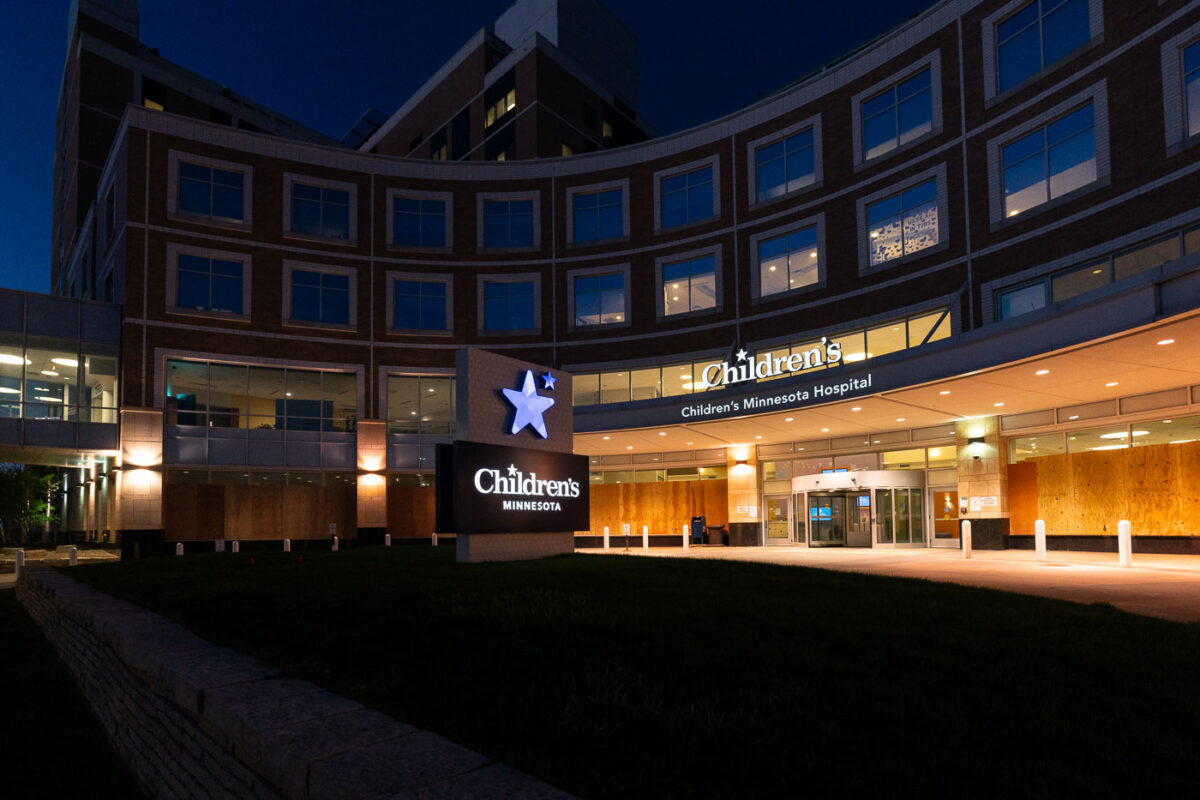
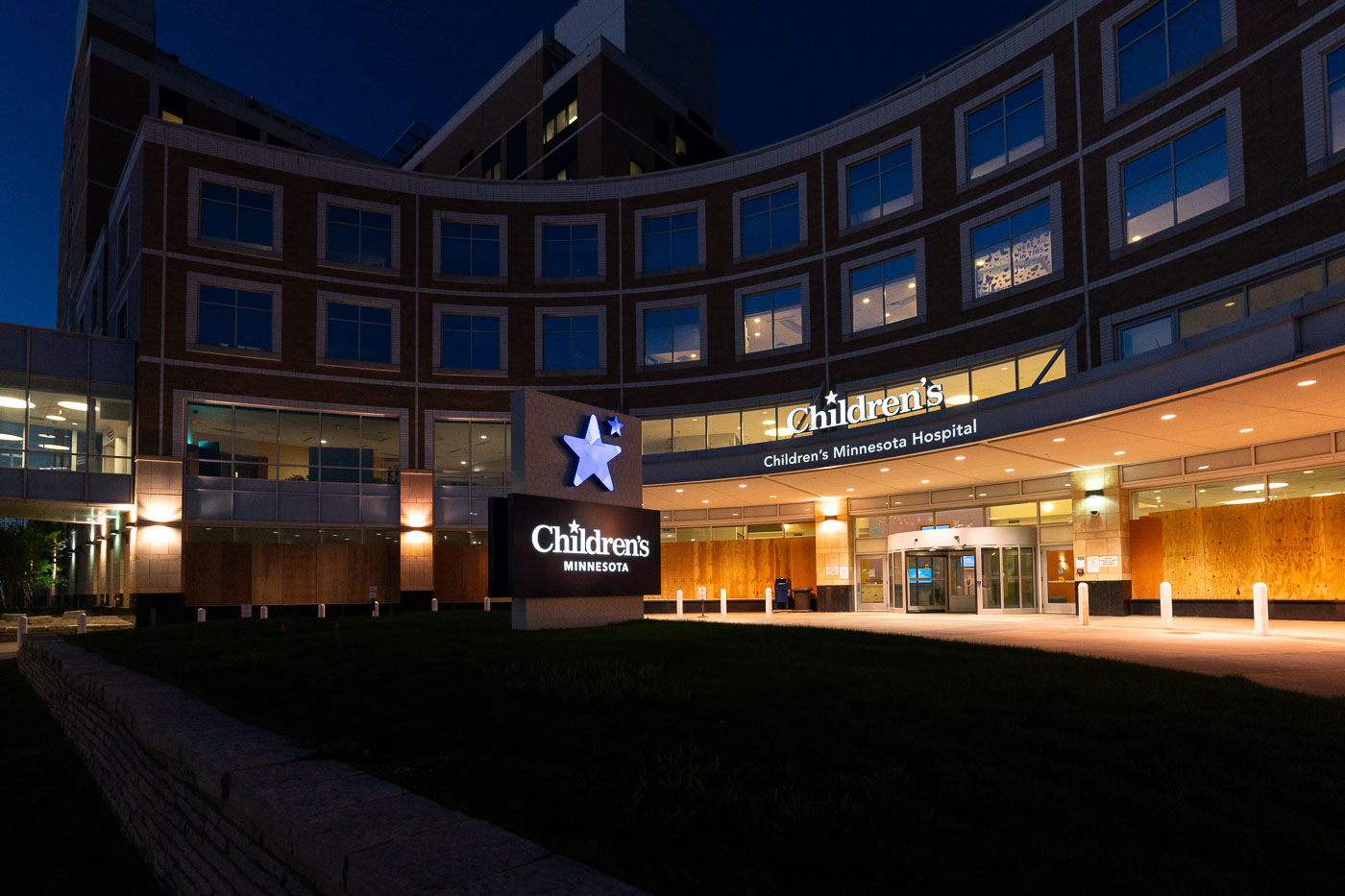
Children's Minnesota Hospital boarded up in Minneapolis during the Chauvin trial.
Children's Minnesota Hospital in South Minneapolis was boarded up in anticipation of potential unrest during the Derek Chauvin murder trial in April 2021. The trial, which followed the death of George Floyd, led to heightened security measures across the city. This hospital, a key medical facility for children in the region, was protected to ensure continued operations and the safety of patients and staff amidst the possibility of civil disturbance.

Children’s Minnesota Hospital Boarded Up for Chauvin Trial

Boarded storefronts at US Bank Plaza in downtown Minneapolis at night.
Buildings in downtown Minneapolis, including the US Bank Plaza, were boarded up in the aftermath of the Derek Chauvin murder trial. The plywood coverings, visible in this image, were a response to potential unrest following the verdict. Three days after Chauvin was found guilty of murder and manslaughter, the boarding began to be removed, signaling a return to normalcy in the city center. The trial, which stemmed from the death of George Floyd, had sparked widespread protests and a period of intense social and political focus on Minneapolis.

Minneapolis: US Bank Plaza boarded during Chauvin Trial aftermath
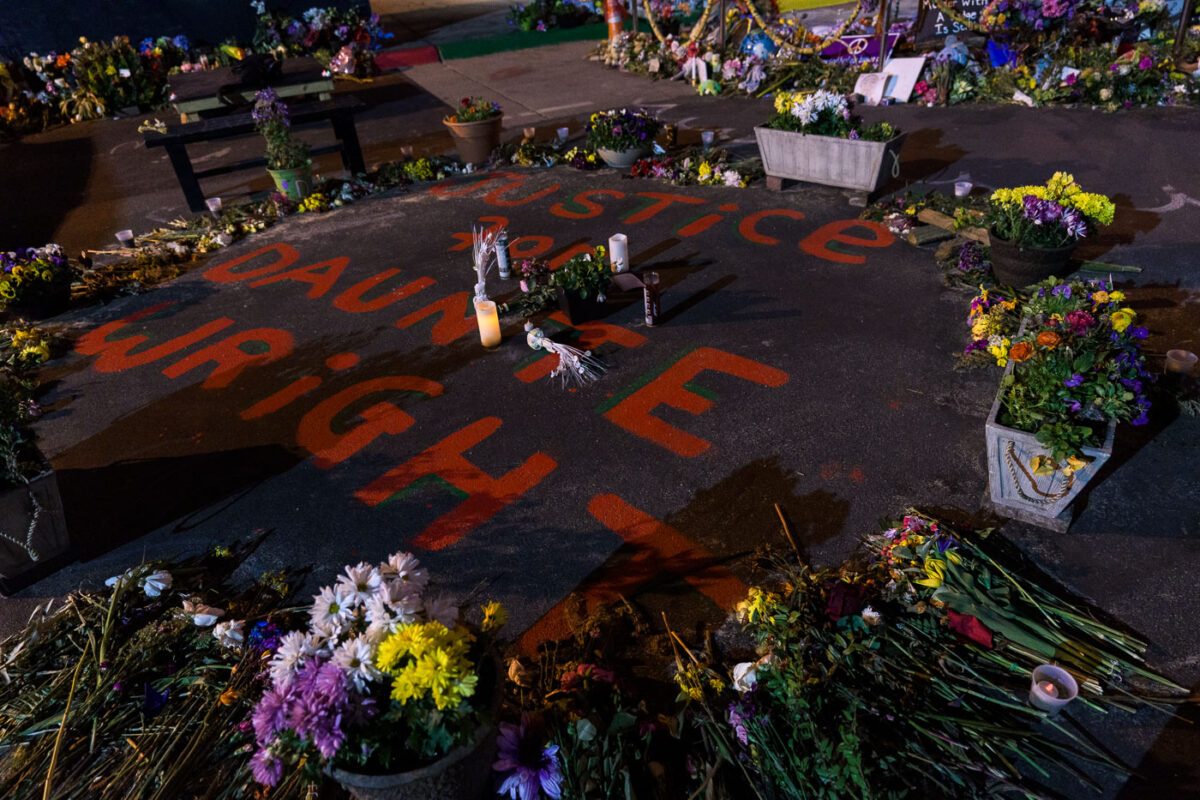
Daunte Wright memorial at George Floyd Square in Minneapolis, surrounded by flowers and candles.
A memorial for Daunte Wright is visible at George Floyd Square in Minneapolis. Wright, a Black man, was fatally shot by Brooklyn Center Police Officer Kim Potter on April 11, 2021, during a traffic stop in nearby Brooklyn Center. The incident sparked protests and unrest in the Minneapolis–Saint Paul metropolitan area. George Floyd Square, located in South Minneapolis, became a focal point for protests following the murder of George Floyd in May 2020.

Daunte Wright Memorial at George Floyd Square, Minneapolis
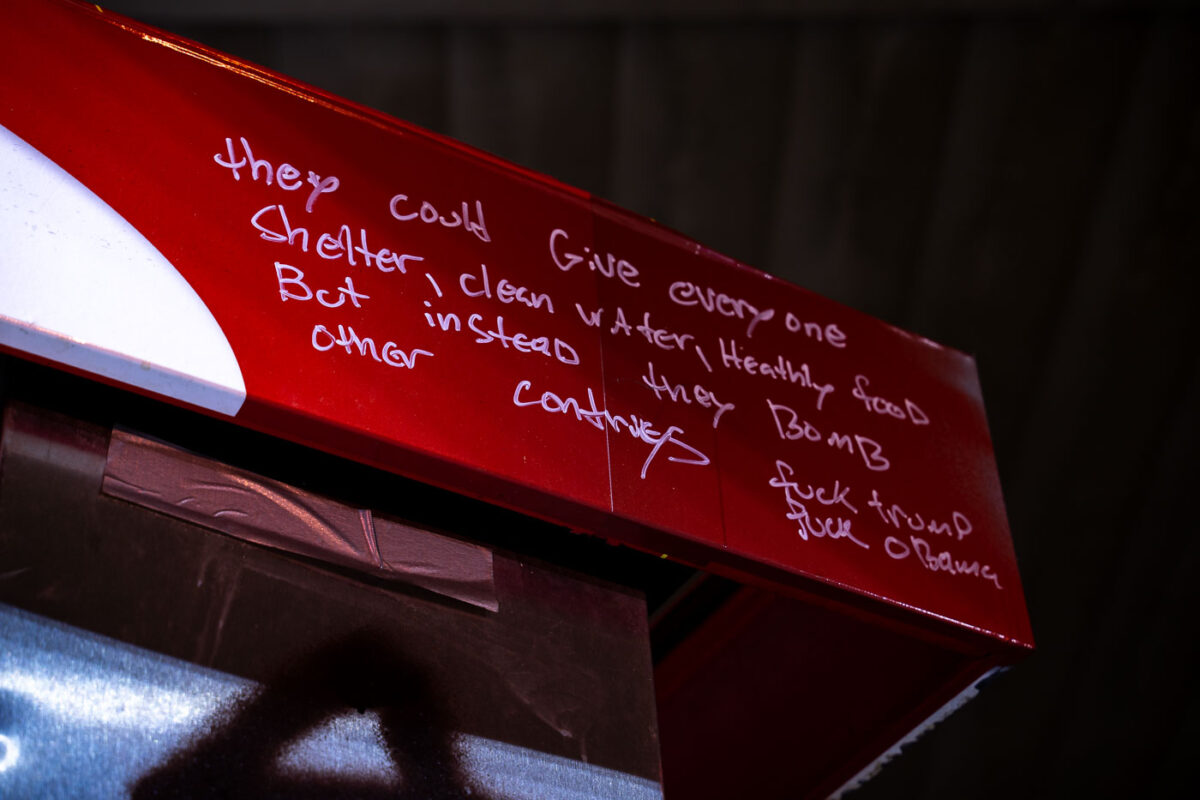
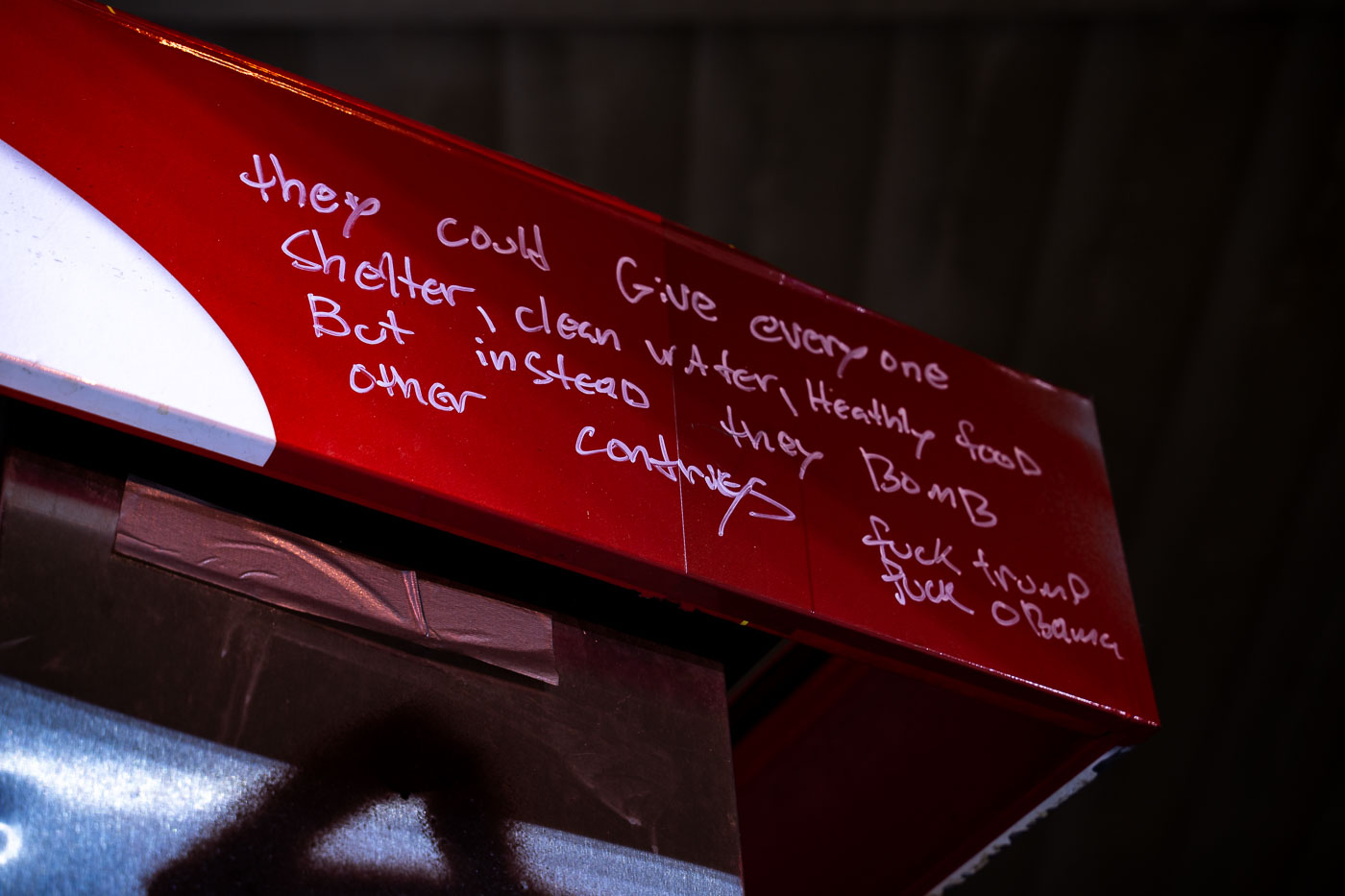
Graffiti on the former Speedway gas station at George Floyd Square in Minneapolis.
Graffiti on the former Speedway gas station at George Floyd Square in Minneapolis reads, "they could give everyone shelter, clean water, healthy food, but instead they bomb other countries. fuck trump fuck obama." This message reflects sentiments expressed during the period of unrest following the murder of George Floyd in May 2020, when the intersection was occupied and renamed by protesters. The Speedway station became a focal point within the autonomous zone, serving as a site for community gathering and artistic expression. The graffiti critiques perceived government priorities and foreign policy.

George Floyd Square Gas Station: “Fuck Trump Fuck Obama” Graffiti
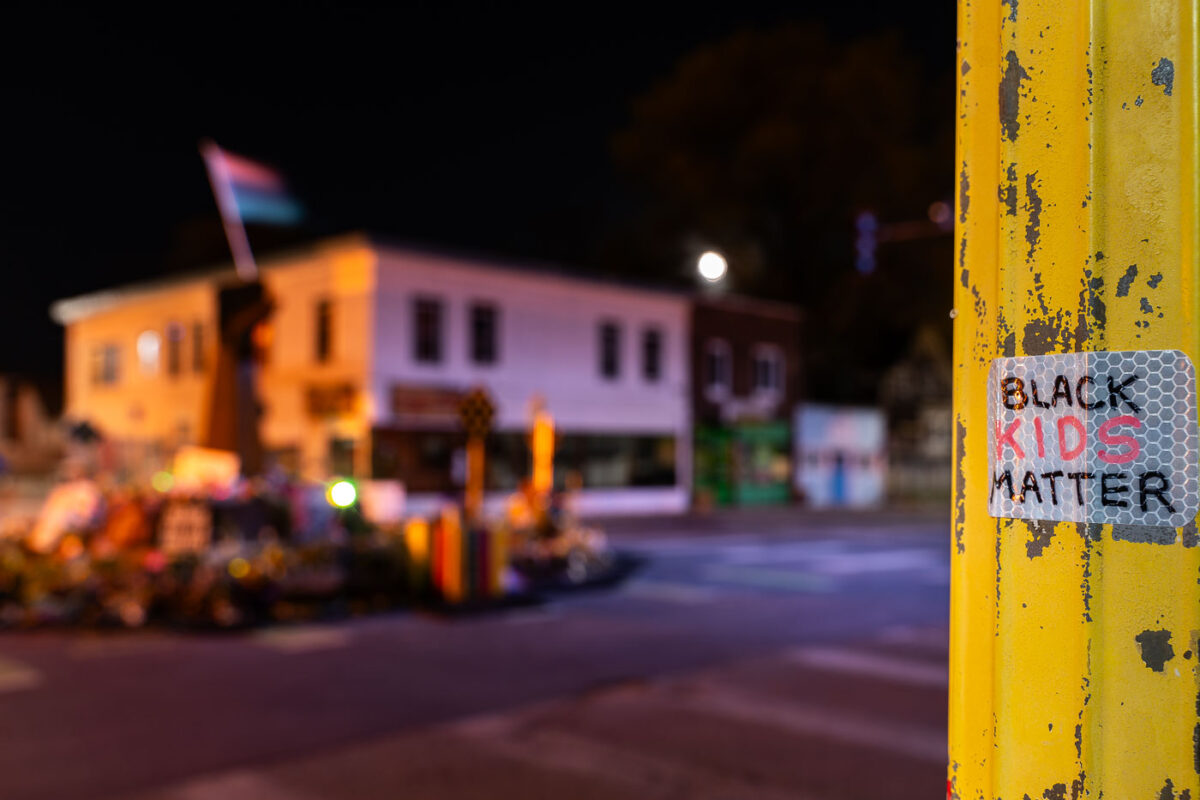
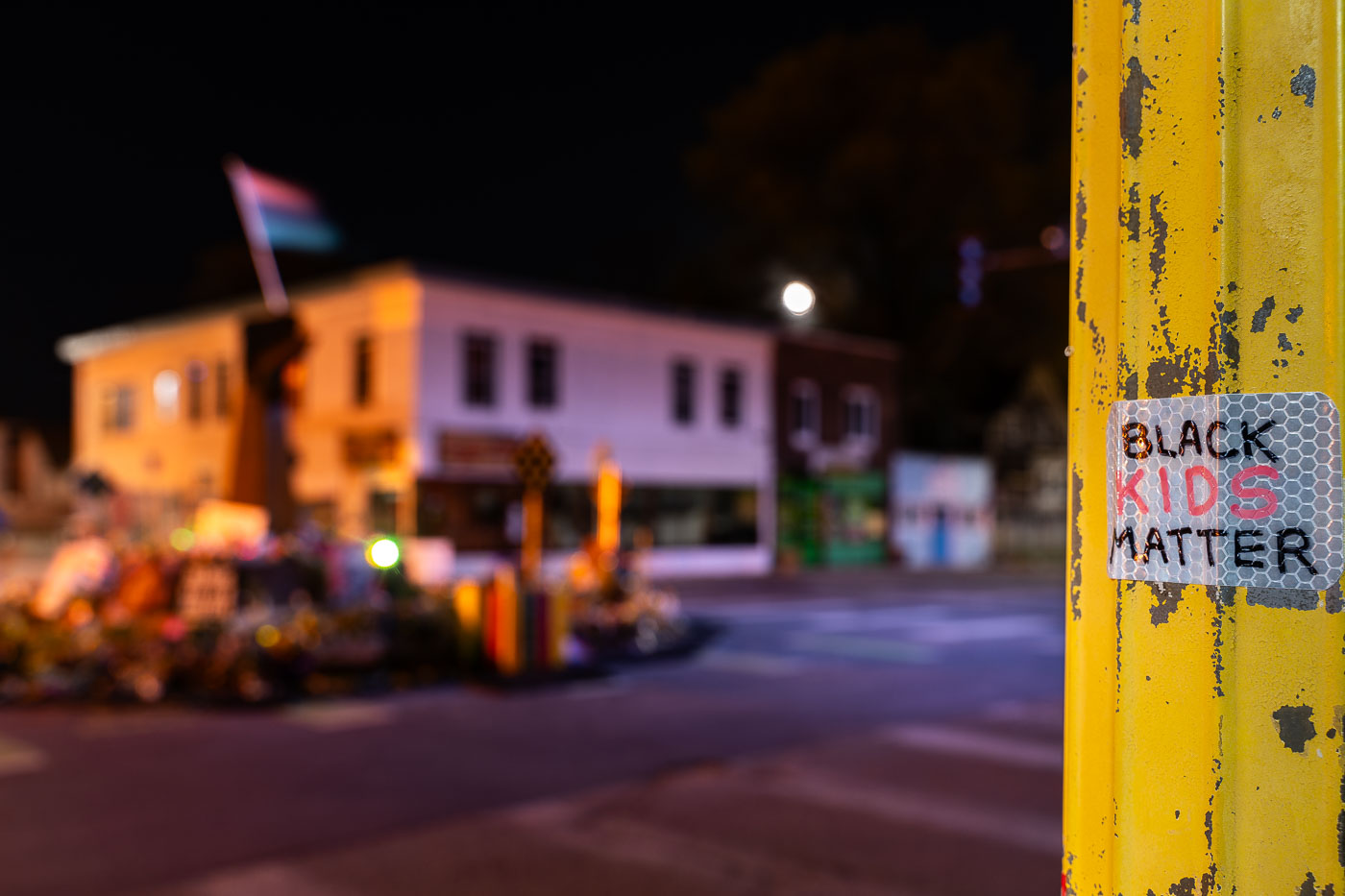
"Black Kids Matter" sticker on a light pole at George Floyd Square, Minneapolis.
A "Black Kids Matter" sticker is affixed to a weathered yellow light pole in George Floyd Square, located in South Minneapolis. This area became a focal point of protests and activism following the murder of George Floyd in May 2020. The square, established by protesters at the intersection of 38th Street and Chicago Avenue, served as a space for community organizing and remembrance. The sticker, a symbol of ongoing advocacy for Black youth, reflects the broader social justice movements that have taken root in this significant urban space.

George Floyd Square: “Black Kids Matter” Sticker on Light Pole

Boarded-up H&M store on Hennepin Avenue in Minneapolis with a "We're still open" sign.
The H&M store on Hennepin Avenue in Minneapolis was boarded up in anticipation of potential unrest following the murder trial of Derek Chauvin. This measure was taken to protect property during a period of heightened public tension and protests. The "We're still open" sign indicates the store's intention to continue operations despite the surrounding circumstances, highlighting the complex interplay between commerce and social events in the urban environment.

H&M Store Boarded Up on Hennepin Ave, Minneapolis
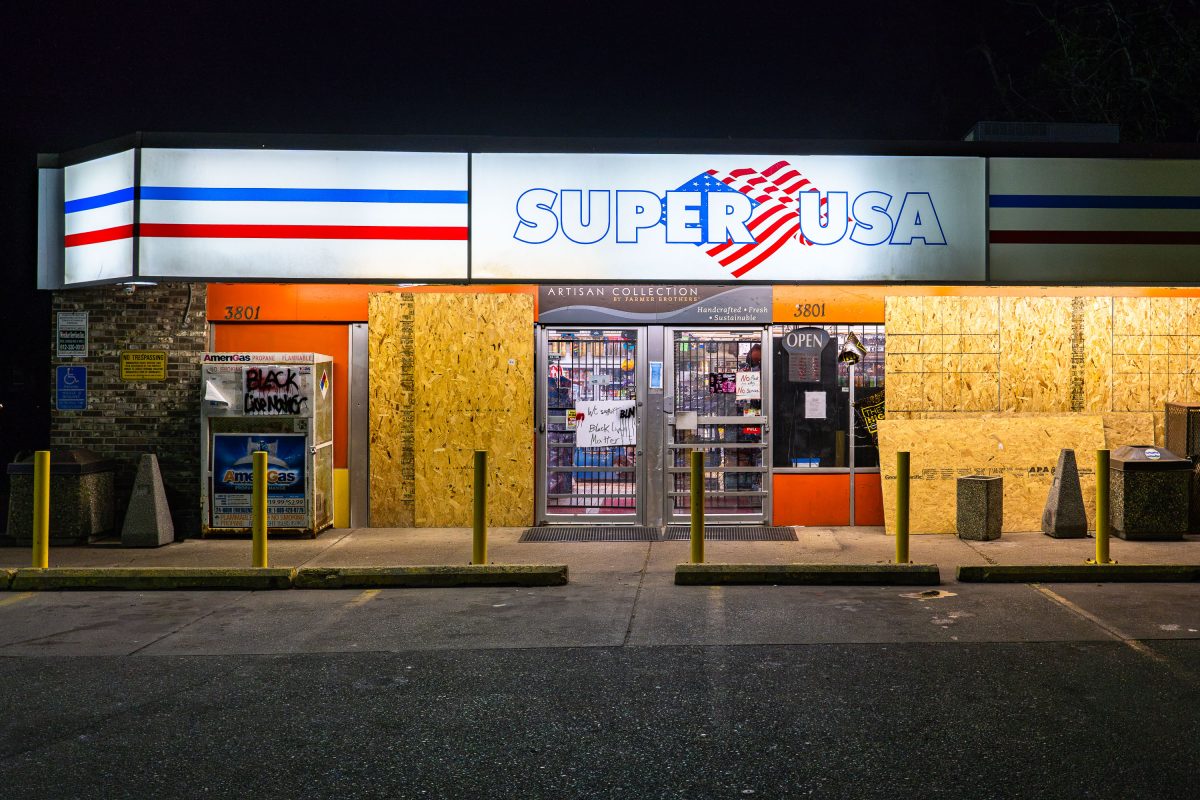
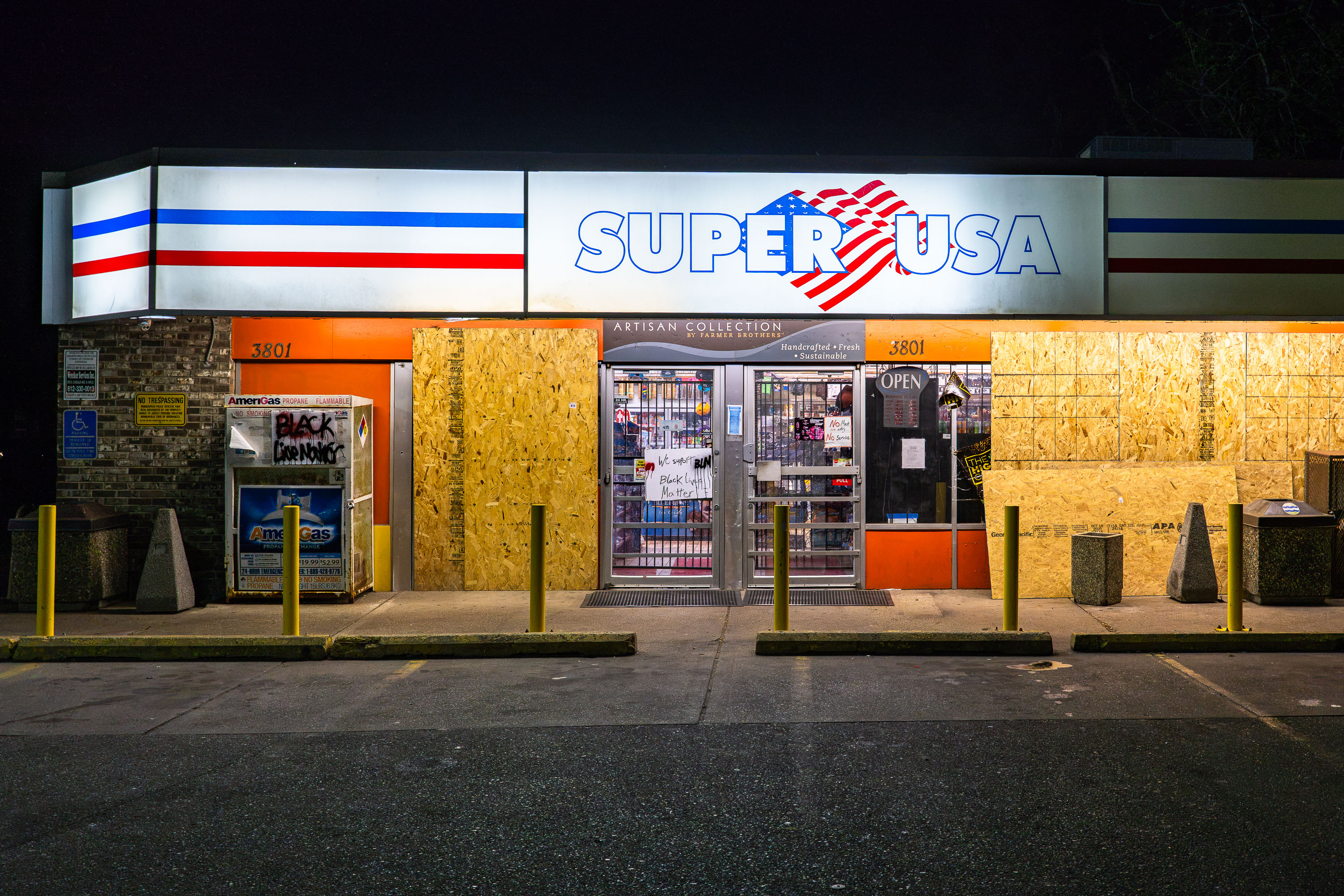
Super USA corner store in Minneapolis boarded with yellow plywood at night.
Super USA convenience store at 3801 Minnehaha Avenue in South Minneapolis.

Boarded Up Super USA Convenience Store, Minneapolis
Wendy's being rebuilt after riots
A worker installs equipment inside the nearly completed Wendy's restaurant in South Minneapolis, nearly one year after the building was destroyed by fire during civil unrest in the summer of 2020. The phrase "Blood on His Hands" is visible on the construction barrier out front.

South Minneapolis Wendy’s Rebuild Nears Completion

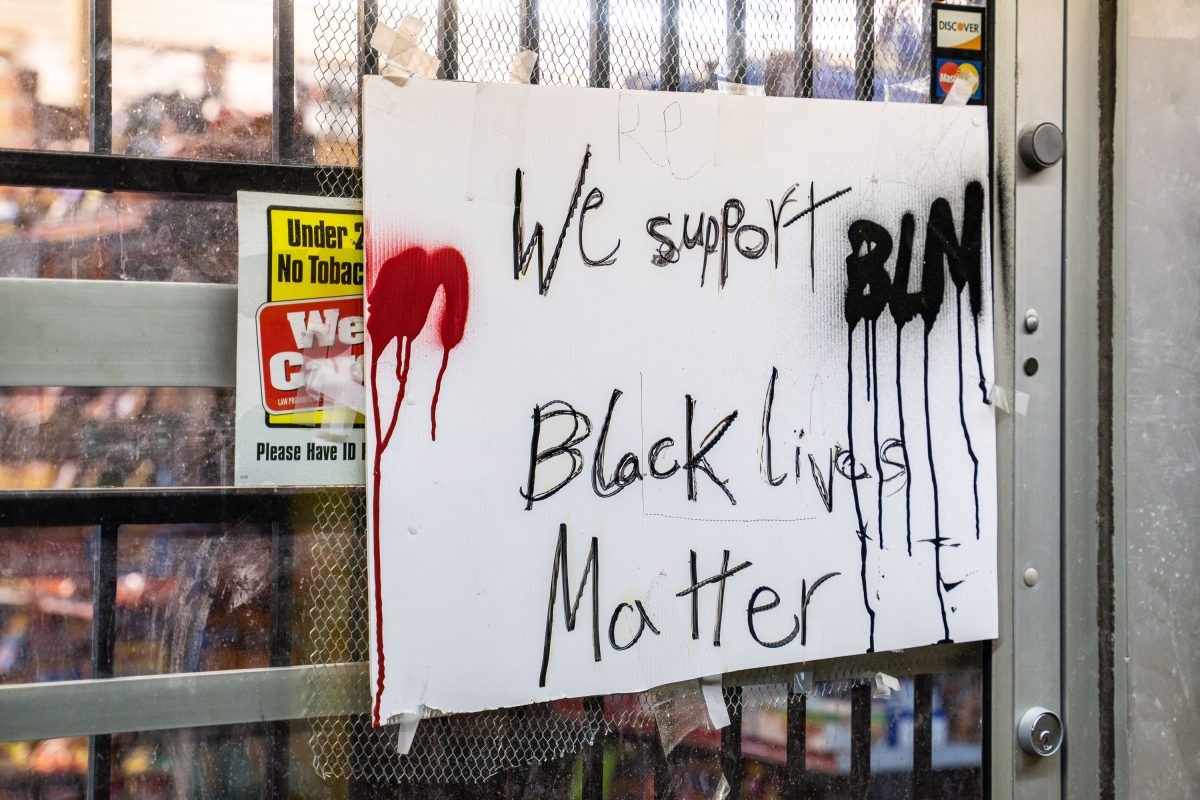
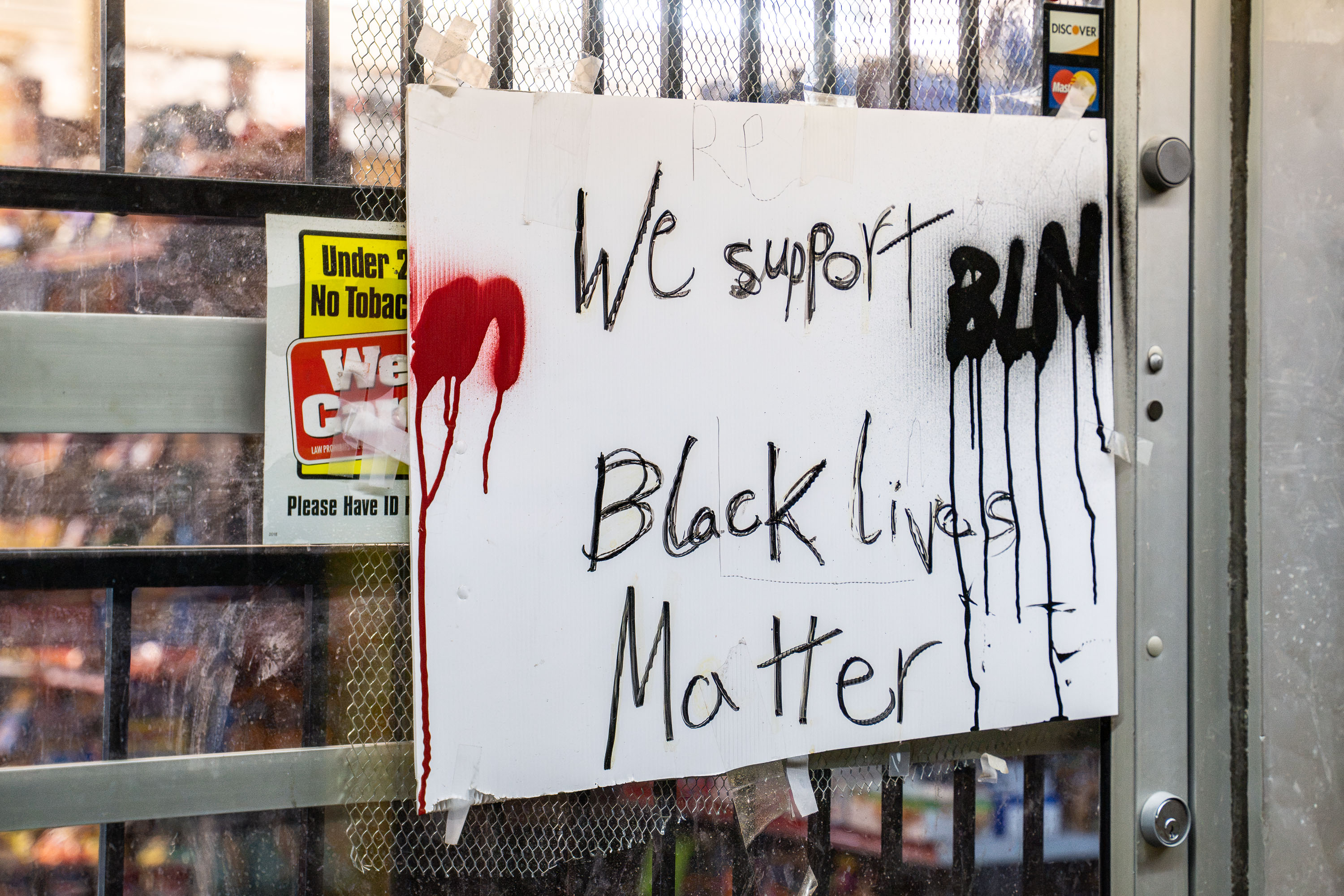
Hand-written sign reading "we support BLM Black Lives Matter" taped to a Minneapolis corner store window.
Corner stores across Minneapolis displayed handmade signs like this one, declaring support for Black Lives Matter, following the police killing of George Floyd in May 2020. Many small business owners posted such messages on their storefronts and security gates during the unrest and protests that followed, both as an expression of solidarity and, in some cases, as a way to prevent damage to their property. Stores in the Lake Street and South Minneapolis corridors, close to the site of Floyd's death, were especially likely to carry these markings well into 2021.

“We Support BLM” Sign on Corner Store Security Gate, Minneapolis

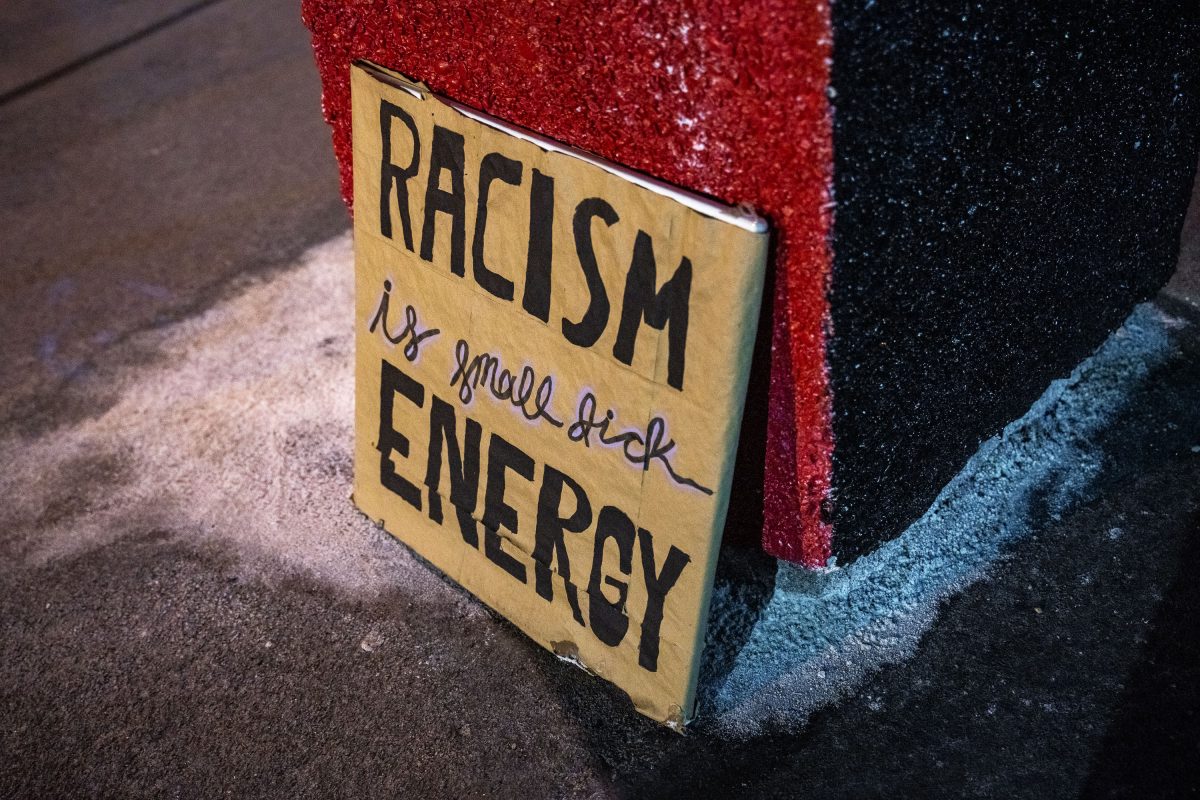
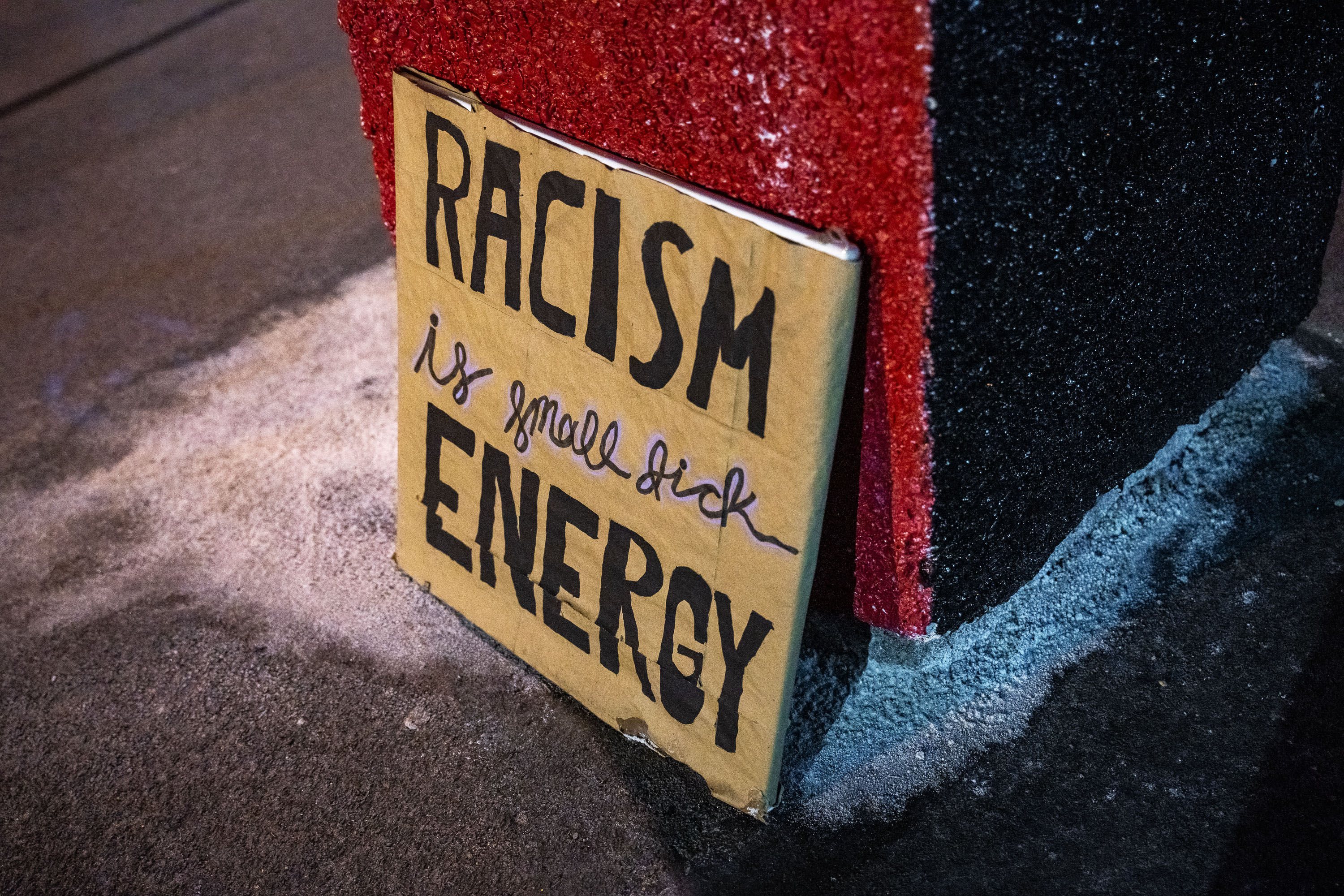
Handwritten sign reading "Racism is small dick energy" placed at George Floyd Square in Minneapolis.
George Floyd Square sits at the intersection of 38th Street and Chicago Avenue in Minneapolis, at the site where George Floyd died in police custody on May 25, 2020. Following his death, the intersection became a self-sustained memorial and protest gathering space, with residents barricading traffic and maintaining art installations, murals, and handwritten signs. Many of the signs left at the square address racism and police violence directly, reflecting the ongoing activism centered at the site. The square remained under community control for over a year before the city moved to reopen it to vehicle traffic in 2021.

Handwritten Protest Sign, George Floyd Square, Minneapolis
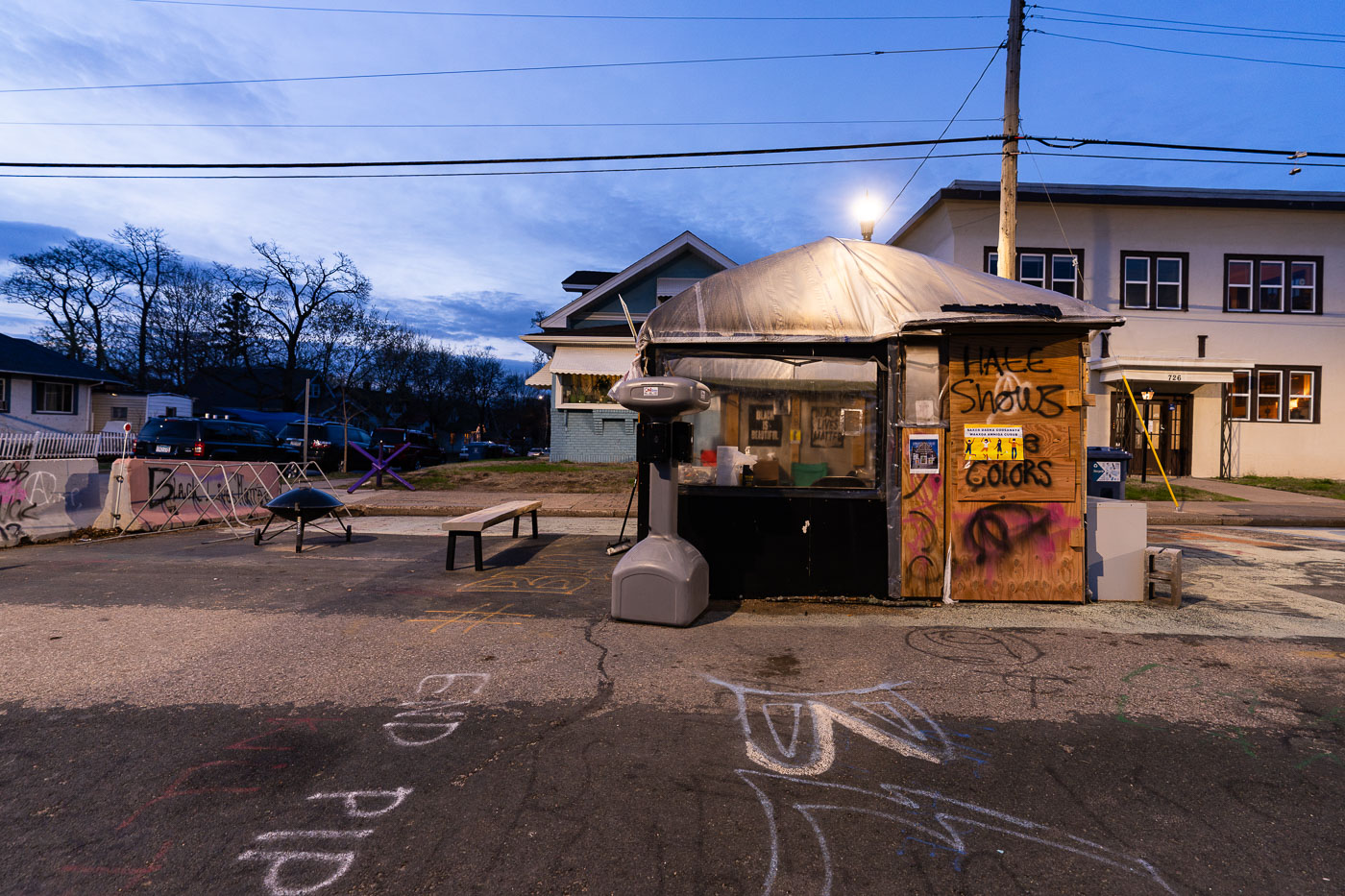
Gandhi Mahal property in South Minneapolis
Straw fencing surrounds the former Gandhi Mahal building in South Minneapolis, a site impacted by the unrest following the murder of George Floyd in 2020.

Gandhi Mahal, South Minneapolis: Fencing and Messages

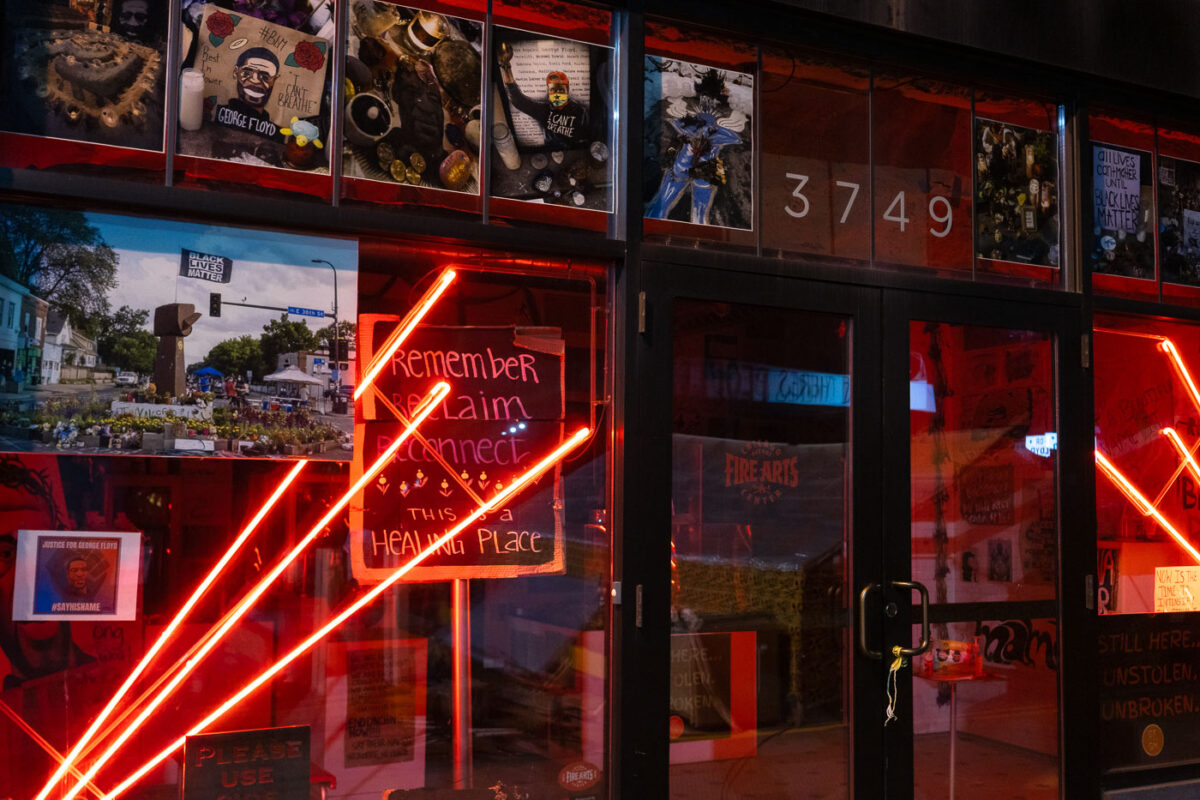
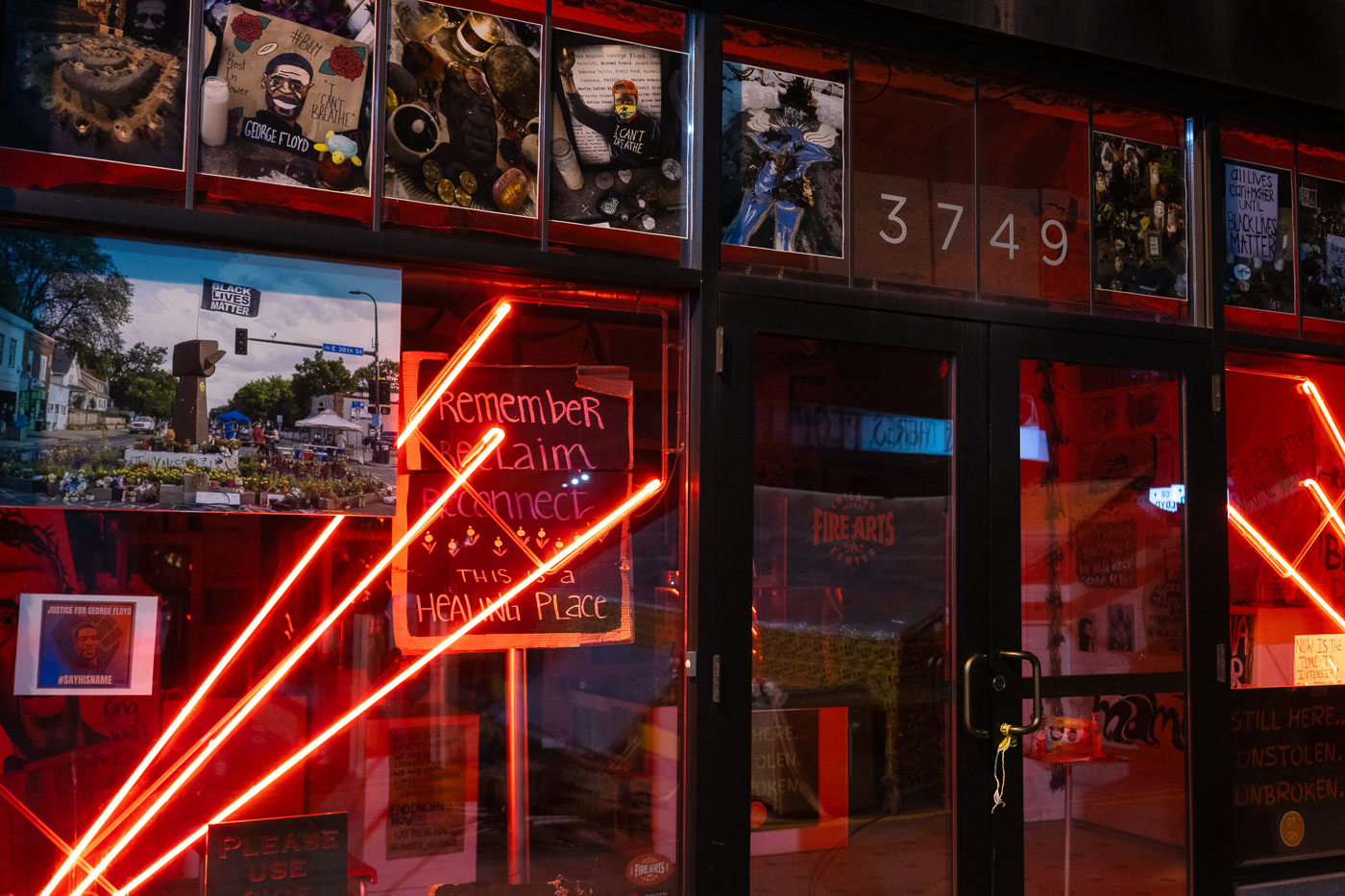
Fire Arts Center in George Floyd Square in May 2021
The Fire Arts Center, located at 3749 Chicago Avenue in South Minneapolis, became a focal point for community expression following the murder of George Floyd in 2020. The center's storefront displays tributes and messages related to the Black Lives Matter movement and the ongoing fight for justice. The surrounding area, known as George Floyd Square, transformed into a memorial and gathering space, reflecting the community's response to racial injustice and police brutality.

Fire Arts Center at George Floyd Square, Minneapolis

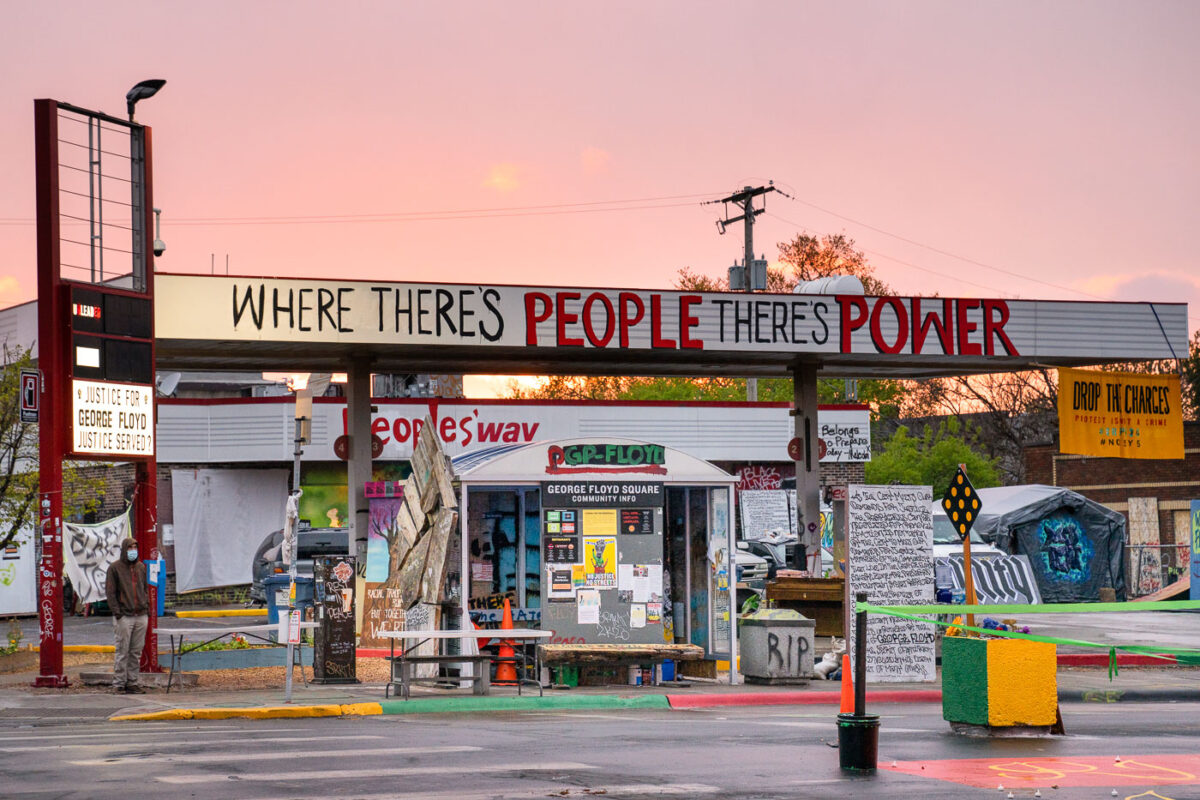
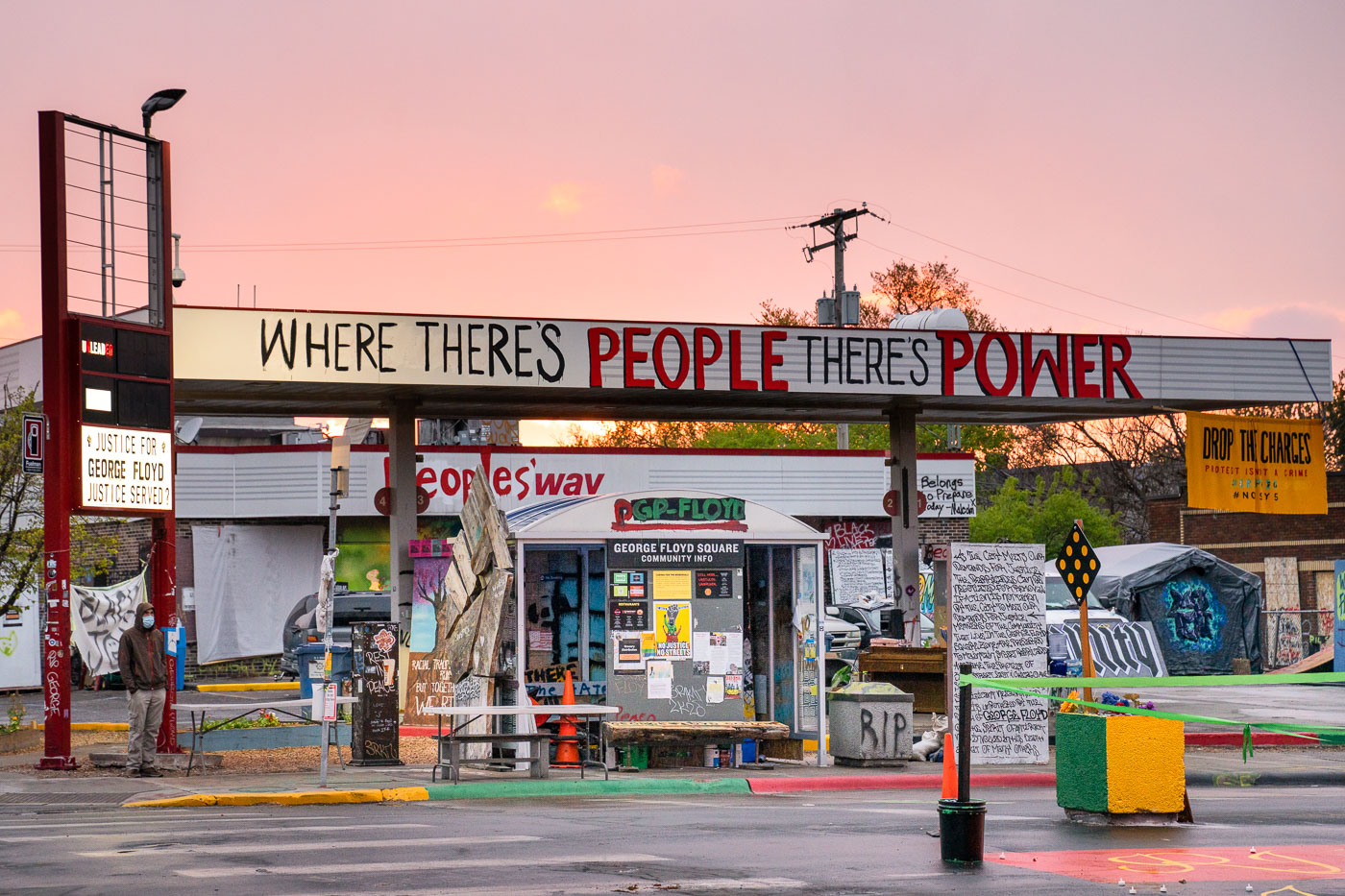
Sun sets behind The Peoples Way at George Floyd Square
The Peoples Way at George Floyd Square in Minneapolis. The area has been a place of protest since the May 2020 killing of George Floyd by Minneapolis Police officers.

George Floyd Square at Sunset, Minneapolis
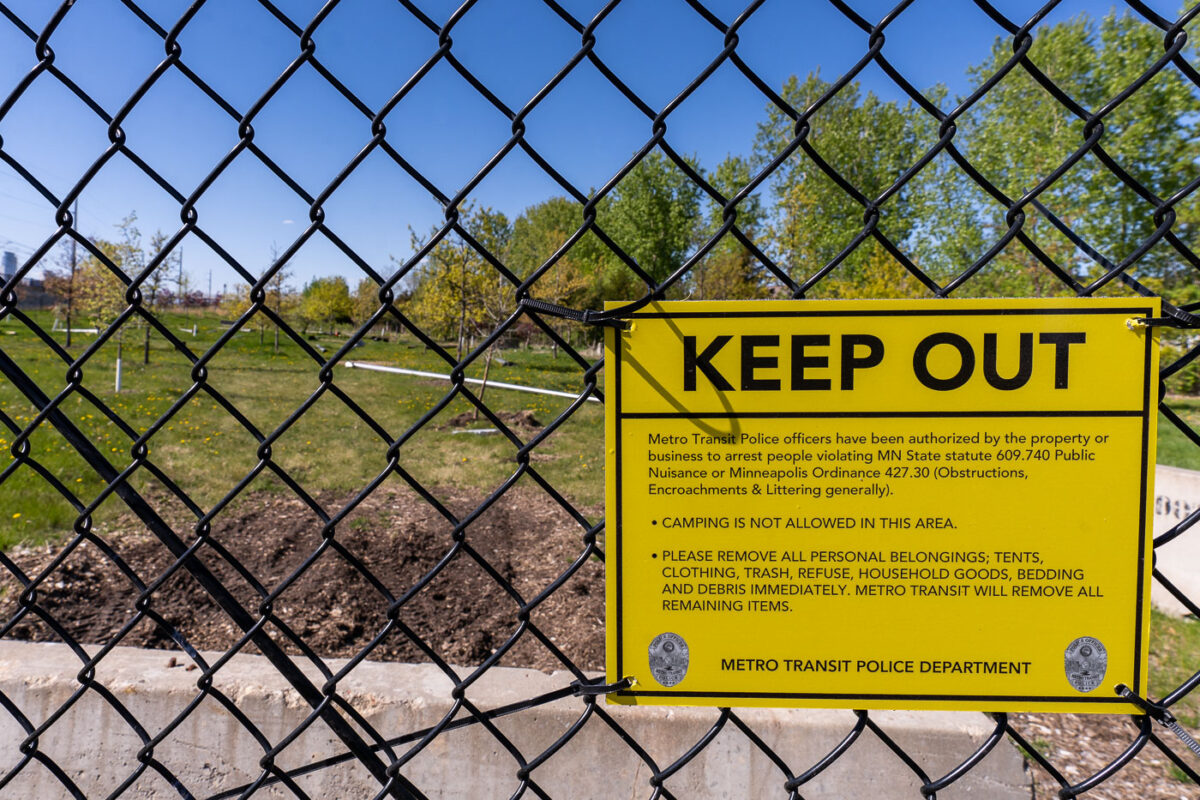
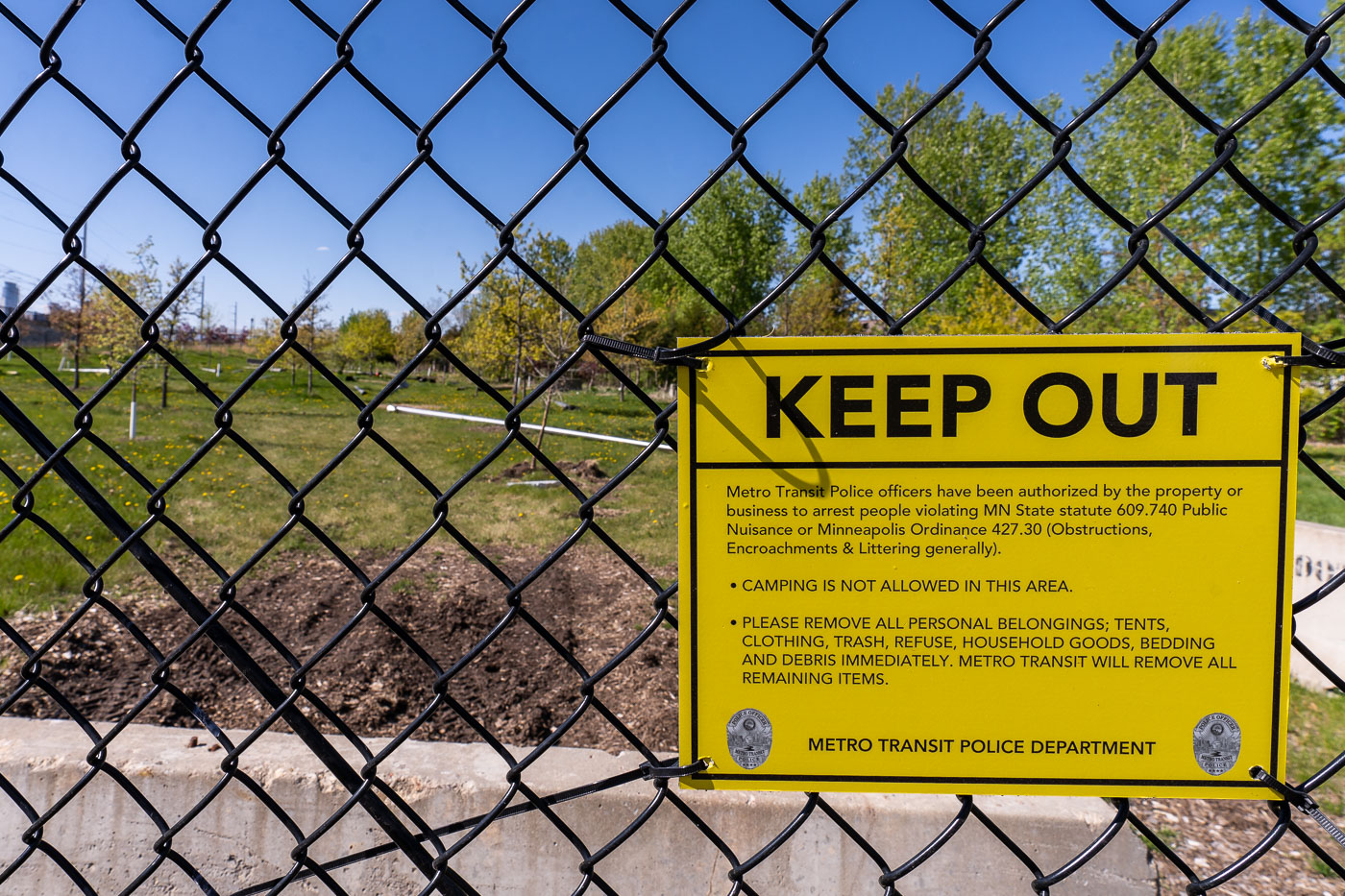
Metro Transit Police keep out sign on a fenced lot in Minneapolis.
Metro Transit Police in Minneapolis posted a notice prohibiting camping and requiring removal of personal belongings from the fenced area. The sign states that remaining items will be removed by Metro Transit and cites Minnesota public nuisance and Minneapolis obstruction ordinances.
Metro Transit Police keep out sign, Minneapolis
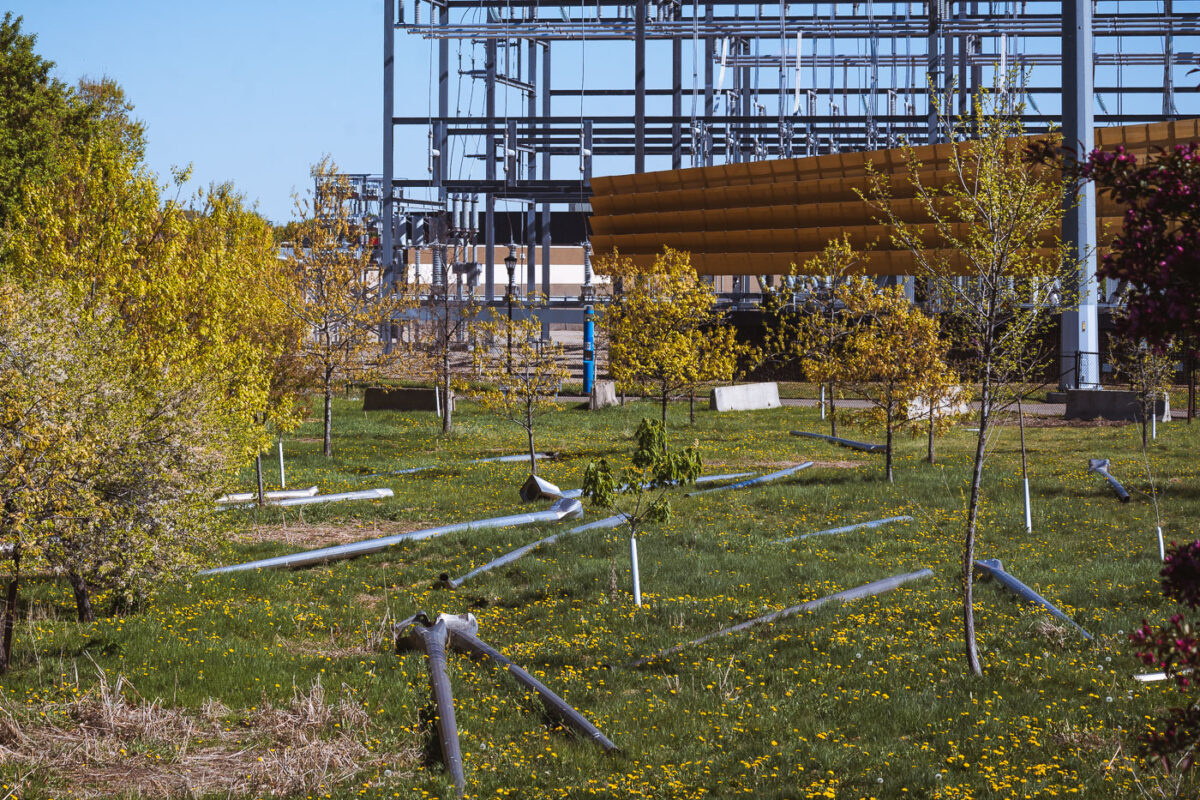
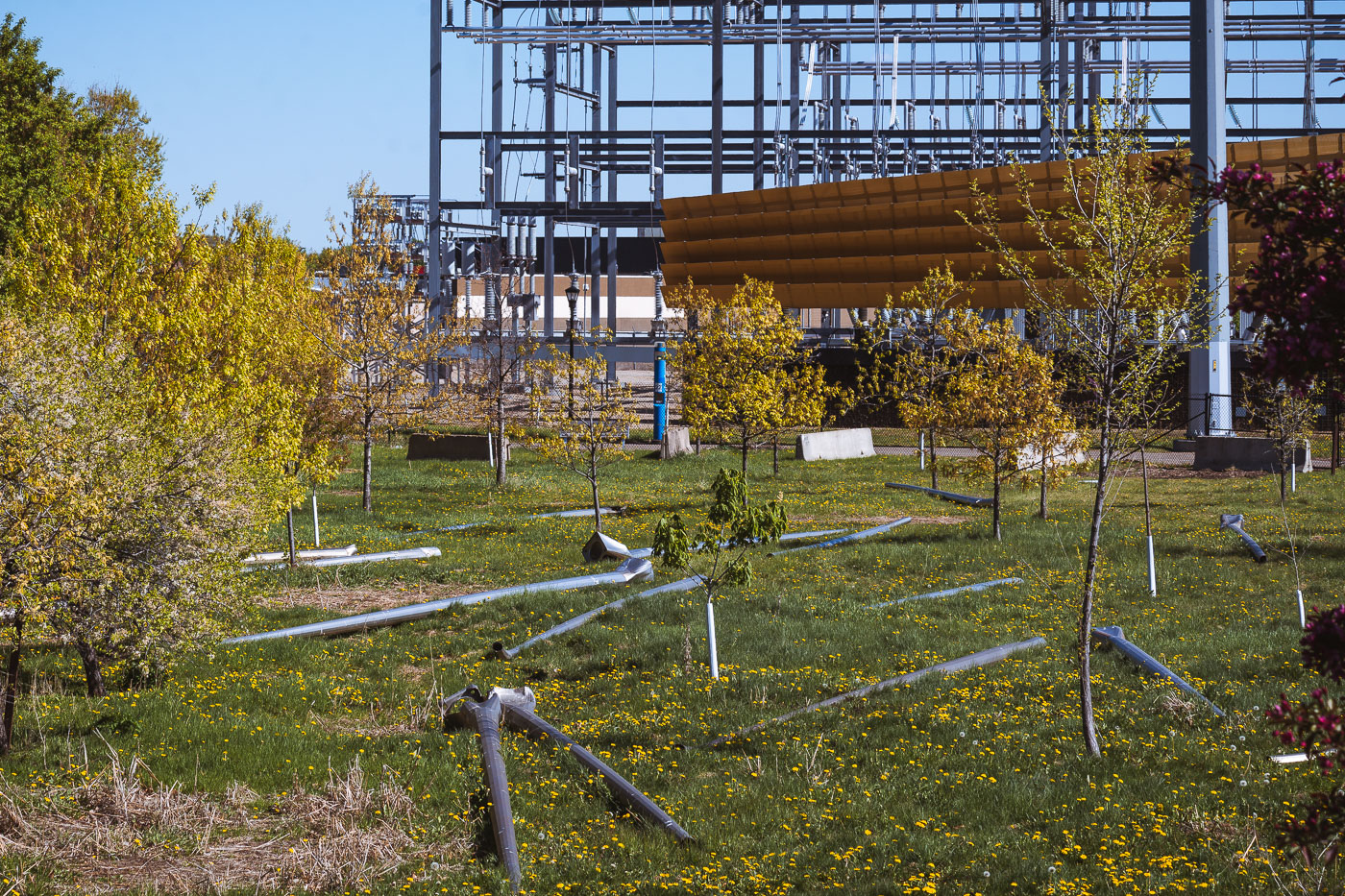
Former homeless encampment site in Minneapolis with street poles installed in the grass.
Former homeless encampment site in Minneapolis with street poles installed in the grass. The area is adjacent to a large steel-framed structure under construction. Metro Transit Police signage is visible on the site.
Street poles at former encampment site, Minneapolis

Pro Palestine march through downtown Minneapolis
A large crowd gathered for a Pro-Palestine march on Chicago Avenue in downtown Minneapolis. Participants carried signs and flags, expressing solidarity with Palestine. This event reflects ongoing global dialogues and local activism concerning the Israeli-Palestinian conflict.

Pro-Palestine March on Chicago Ave, Downtown Minneapolis

Pro Palestine protesters march in downtown Minneapolis
Protesters marched through downtown Minneapolis in solidarity with Palestine. The mural on the brick building reads, "Love is Love, Injustice Anywhere Threatens Justice Everywhere. Science is Real. Water is Life. Women's Rights are Human Rights. When Black Lives Matter, Then All Lives Will Matter. Kindness is Everything."

Pro-Palestine Protest March in Downtown Minneapolis

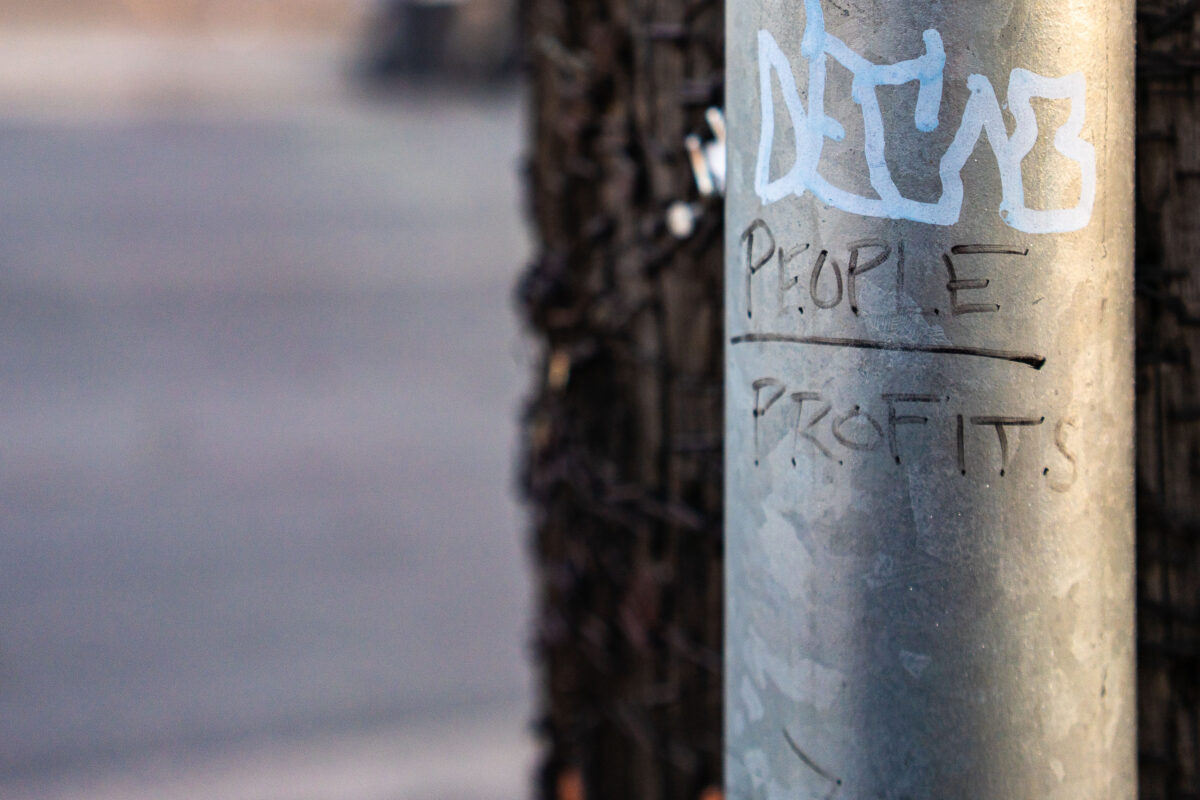
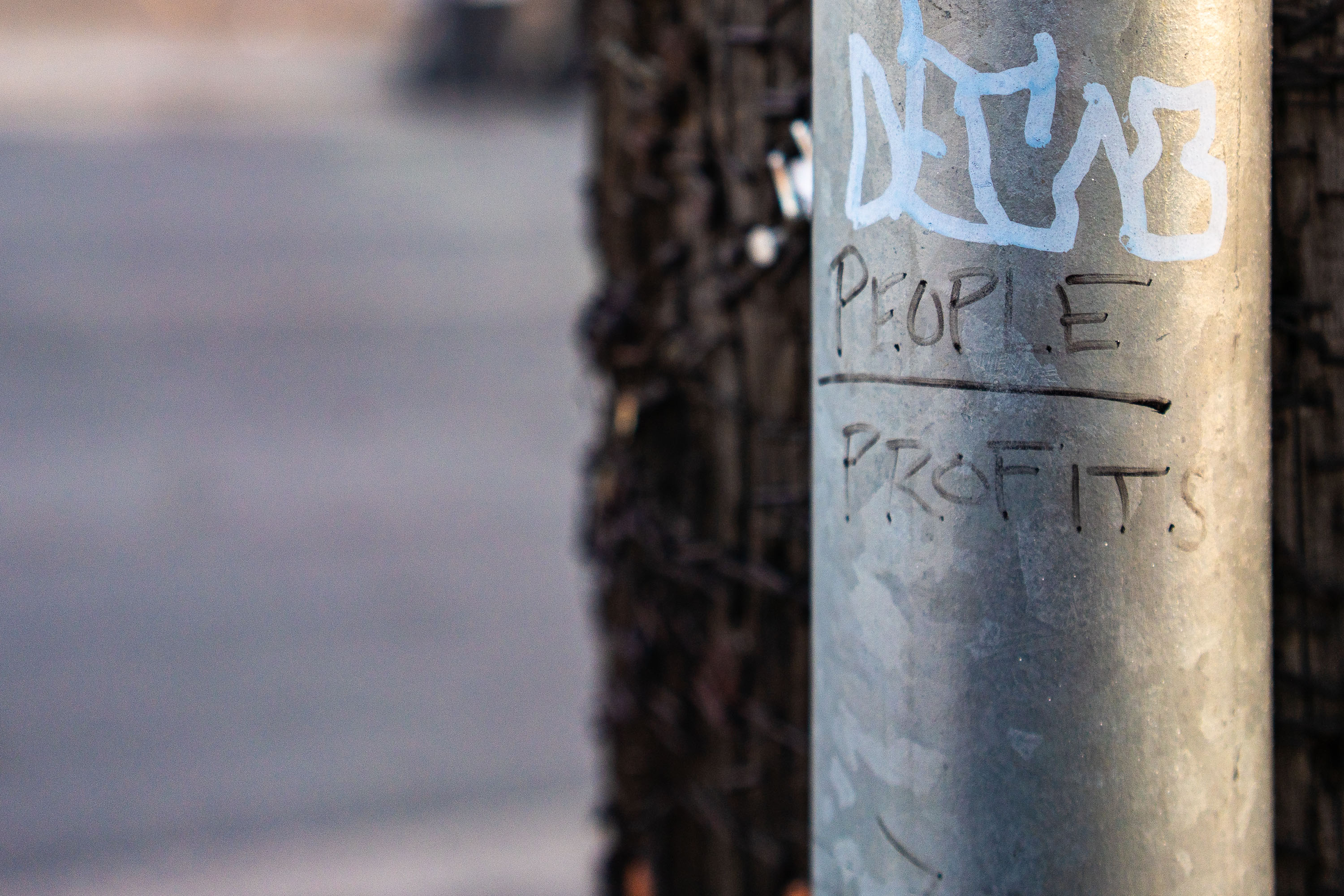
People Over Profit graffiti on a metal utility pole in South Minneapolis.
People Over Profit graffiti appears on a metal utility pole in South Minneapolis. A separate tag is painted above the handwritten words on the same pole.

People Over Profit Graffiti on Utility Pole, South Minneapolis

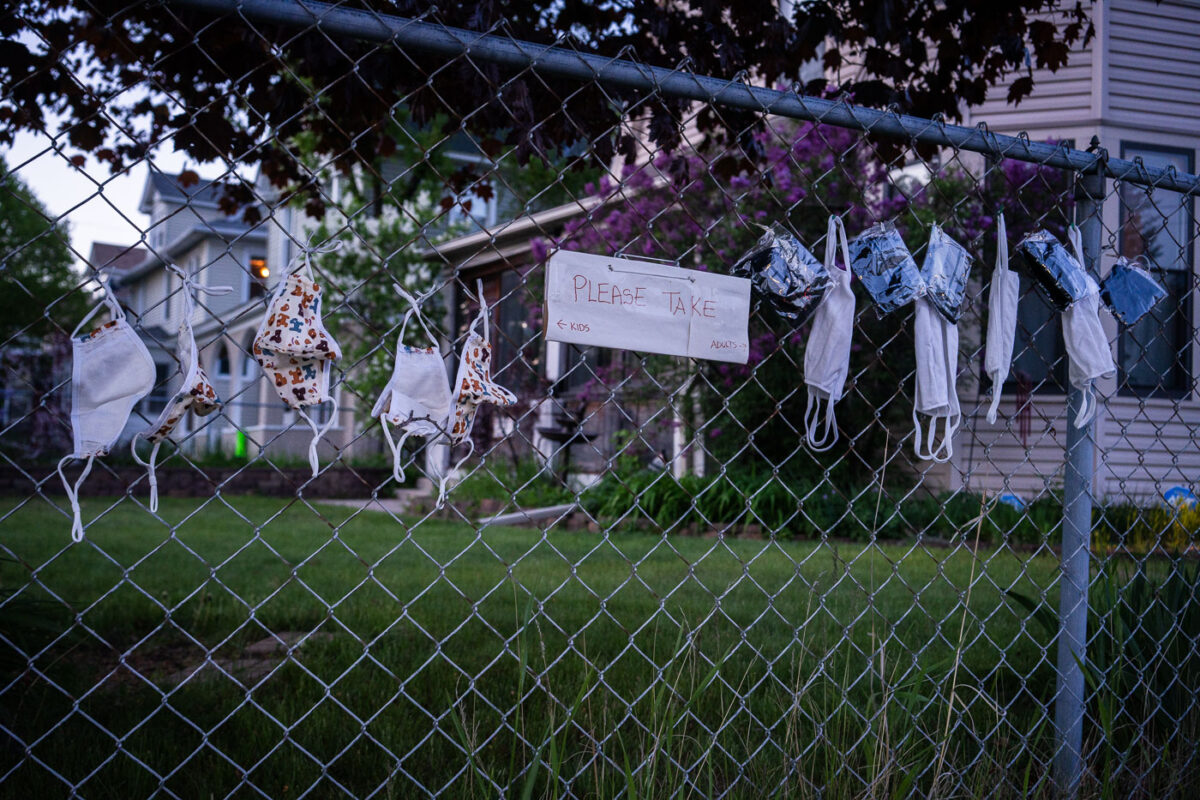
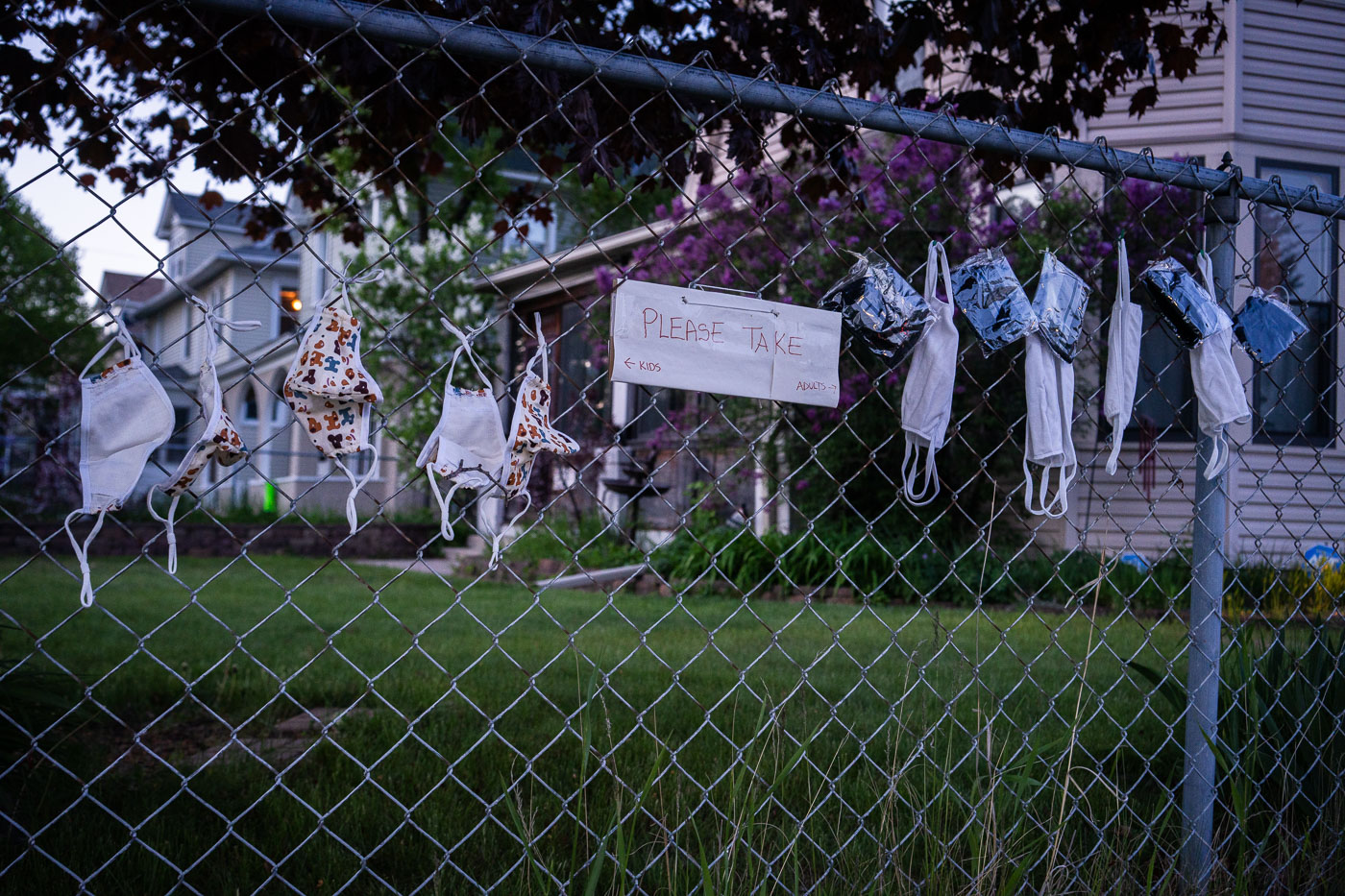
Free face masks on South Minneapolis fence
During the COVID-19 pandemic and the period of civil unrest following the murder of George Floyd in Minneapolis, residents offered mutual aid to their neighbors. This photograph shows a collection of free face masks hung on a chain-link fence in South Minneapolis, with a sign indicating they are available for anyone to take. The gesture reflects a community's response to public health needs and social solidarity during a challenging time.

Free face masks offered on South Minneapolis fence

Roller skating at George Floyd Square
The "Roll Skate Bounce" event took place at George Floyd Square in Minneapolis, a location that became a focal point for protests and community organizing following the murder of George Floyd in May 2020. The square, formerly known as the intersection of 38th Street and Chicago Avenue, was transformed into a space for remembrance, activism, and community gatherings.

Roll Skate Bounce event at George Floyd Square, Minneapolis

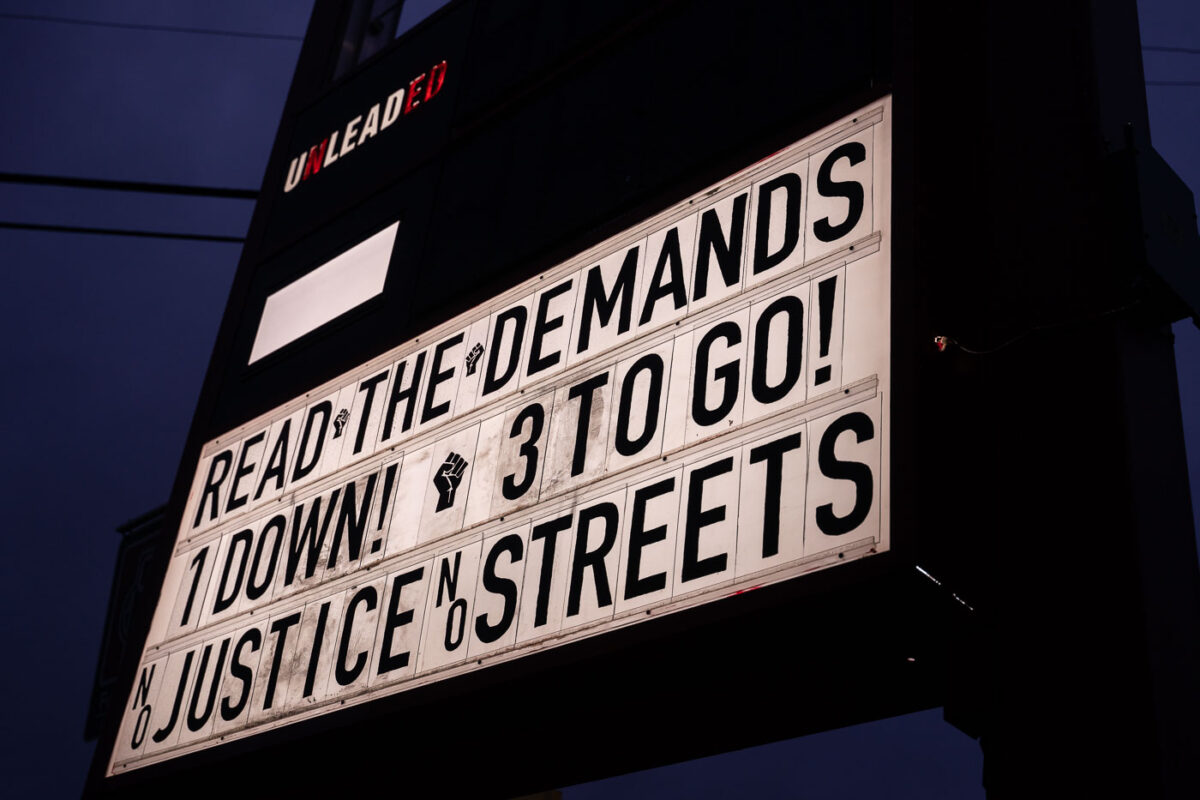
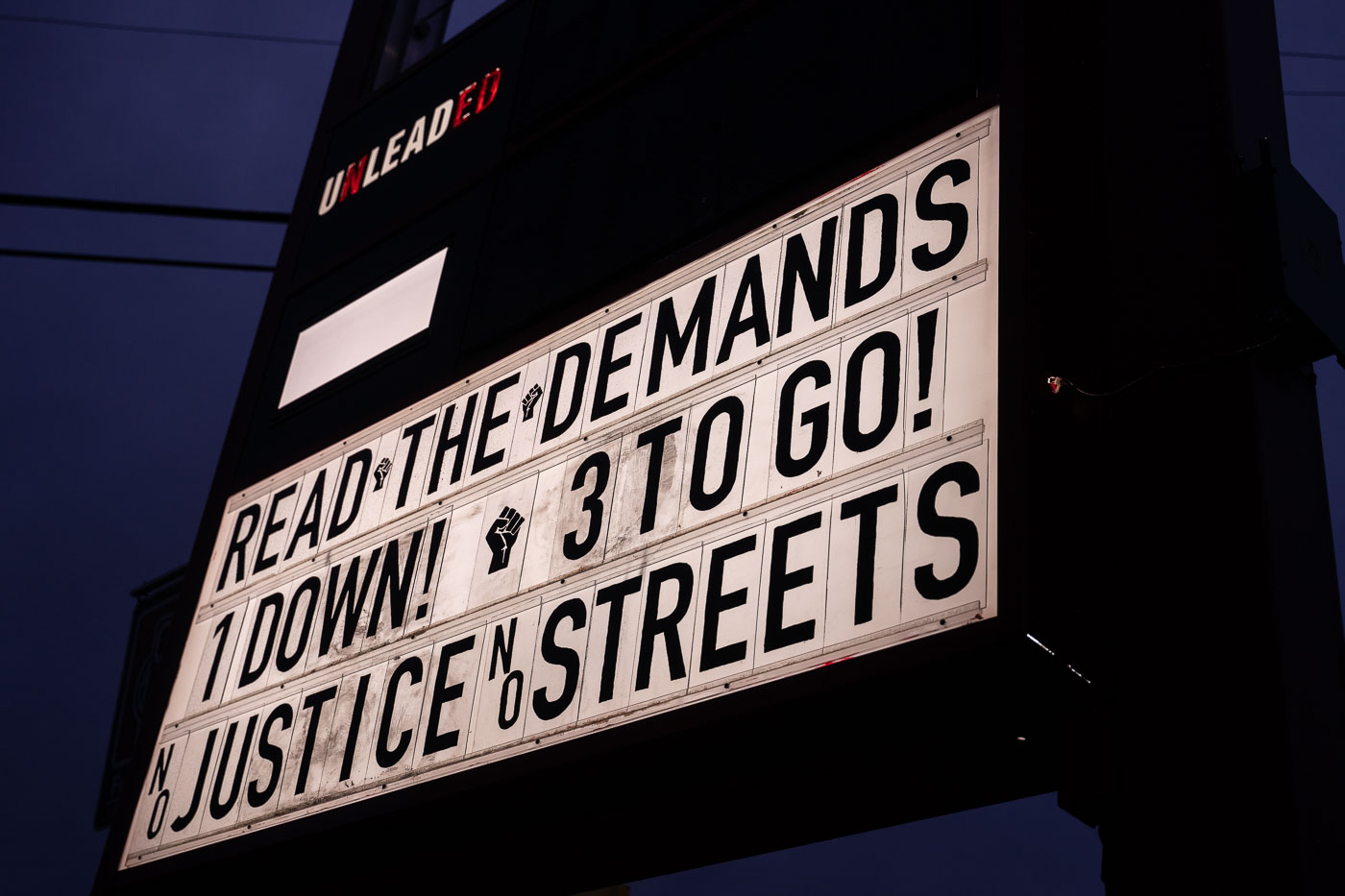
Read the Demands at George Floyd Square
A sign at George Floyd Square in Minneapolis reads "READ THE DEMANDS, 1 DOWN 3 TO GO! & JUSTICE 4 STREETS." This message reflects the ongoing activism and demands for justice following the murder of George Floyd in May 2020. The square, established in the summer of 2020, became a focal point for protests against racial injustice and police brutality.

George Floyd Square: “Read the Demands, 1 Down 3 to Go!”

Everything Must Go sign on a Minneapolis police station
A banner reading "Everything Must Go!!!" is displayed on the fencing surrounding the Minneapolis Police Third Precinct building. The precinct was heavily damaged during protests following the murder of George Floyd in May 2020.

Minneapolis Police 3rd Precinct: “Everything Must Go” Banner

Midtown Corner redevelopment progress
Construction continues on the Midtown Corner apartment building in Minneapolis, which was damaged during the May 2020 riots. The building, located in South Minneapolis, was under construction when it was set ablaze. The current work signifies the rebuilding and continuation of development in the area following the unrest.

Midtown Corner construction, Minneapolis

All Are Welcome here at Urban Outfitters
A Black Lives Matter statement is posted on the door of an Urban Outfitters store in Minneapolis. The notice states that store staff reject racial injustice and that all are welcome, placing the retailer among businesses that publicly aligned themselves with racial-equity protests after the murder of George Floyd in Minneapolis in May 2020. Made about a year later, the posting shows how such statements remained part of storefront messaging in the city in May 2021.
Urban Outfitters Minneapolis: Black Lives Matter Statement

Daunte Wright mural on West Lake Street
A mural honoring Daunte Wright adorns the exterior of Minnesota Food Grocery on West Lake Street in Minneapolis. The mural appeared following the killing of Daunte Wright by police in nearby Brooklyn Center in April 2021, an event that sparked protests and unrest in the Twin Cities.

Daunte Wright Mural at Minnesota Food Grocery, West Lake Street