August 2018
—
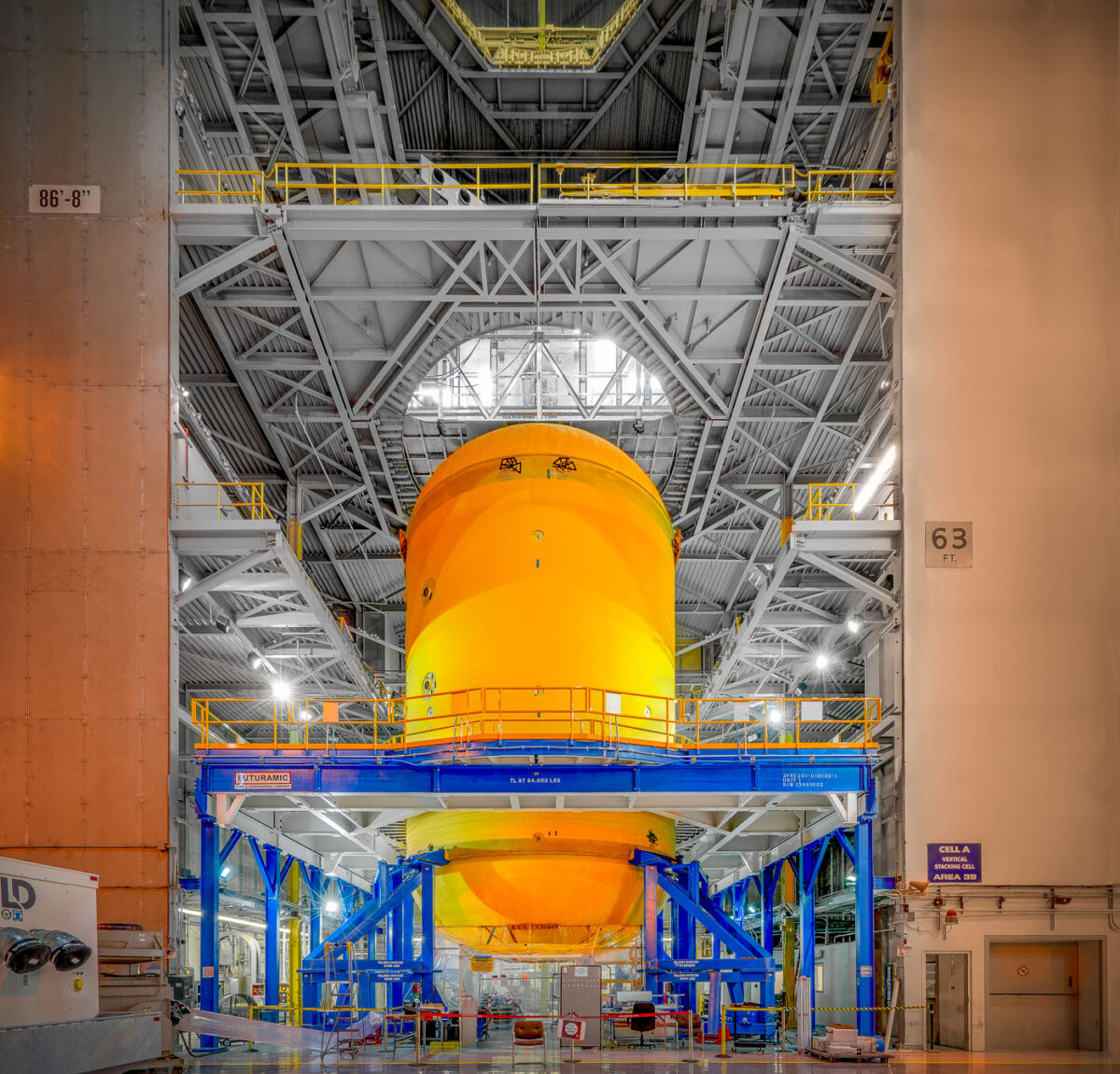
A Liquid Oxygen tank being worked on inside Cell A at NASA’s Michoud Assembly Facility. It’s part of the Space Launch System Core Stage. The tank will hold 195,000 gallons of liquid oxygen cooled to -297 degrees Fahrenheit.
NASA Michoud Vertical Weld Center, SLS Rocket, New Orleans
August 2018
—
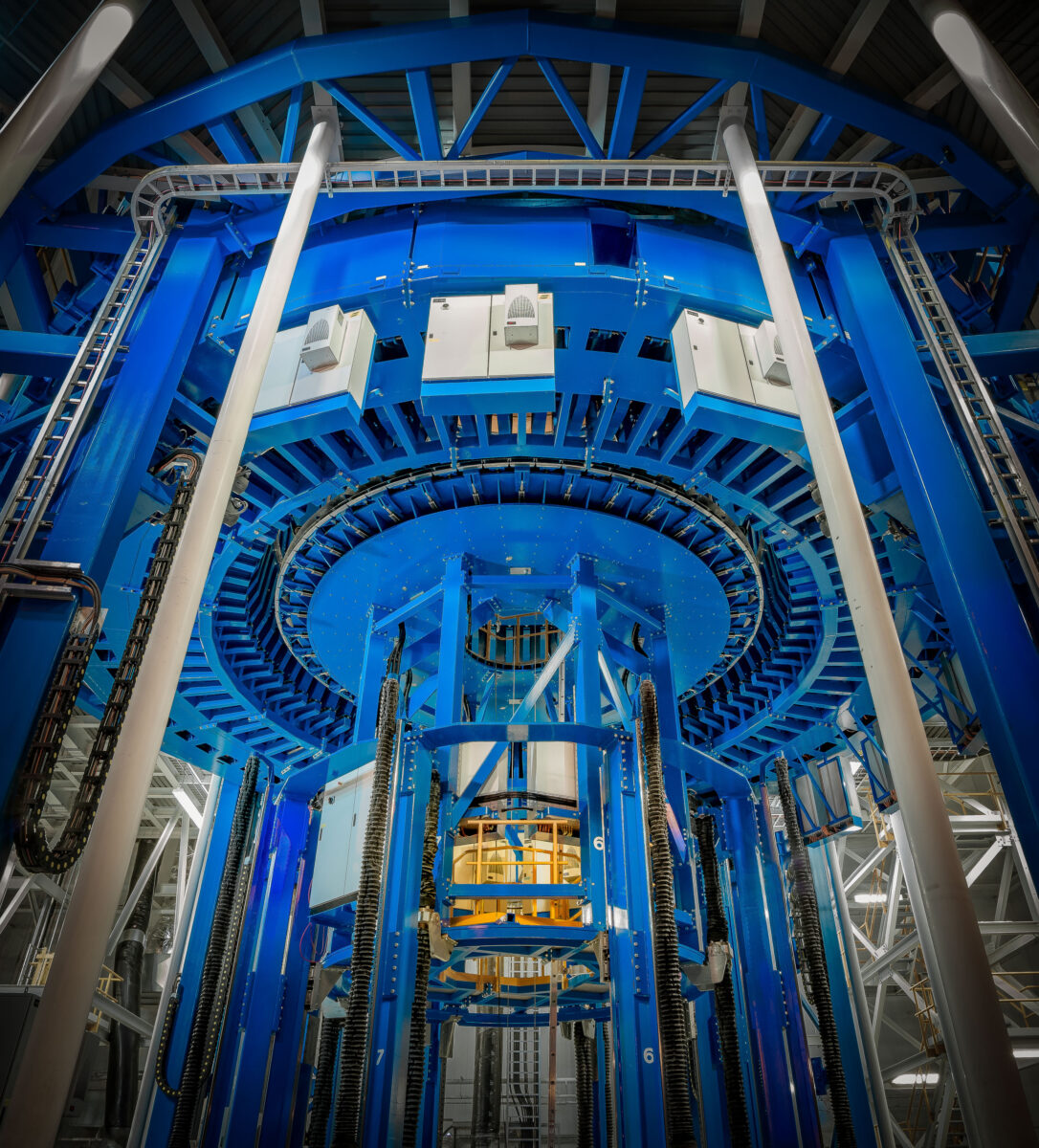
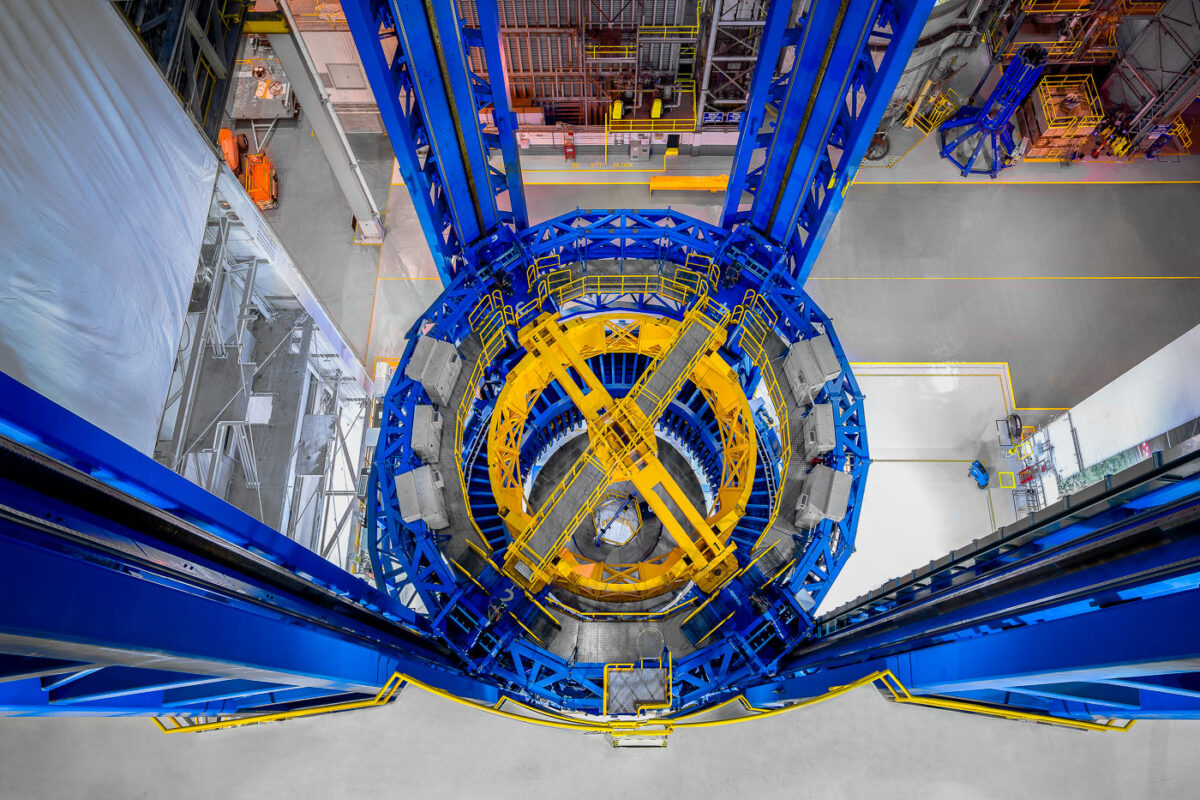
Inside NASA’s Michoud Assembly Facility in New Orleans, this massive blue structure is the Vertical Weld Center, used to fabricate the core stage of the Space Launch System (SLS) rocket. The machine employs friction-stir welding to join aluminum panels into large cylindrical sections that form the rocket’s fuel tanks. Operated by precision robotics, the weld center is one of the tallest of its kind in the world and plays a central role in preparing hardware for Artemis missions to the Moon and beyond.
NASA Michoud: SLS Rocket Vertical Assembly Bay
August 2018
—
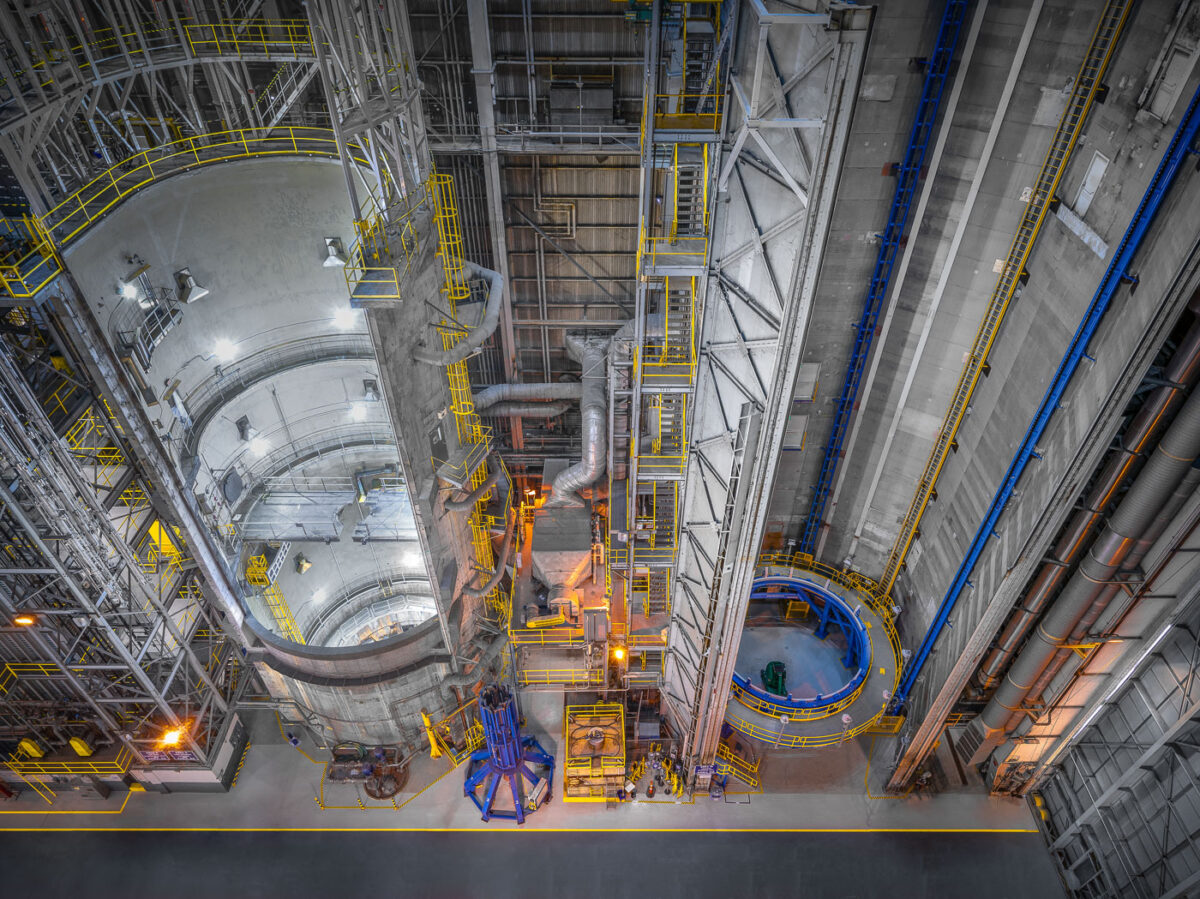
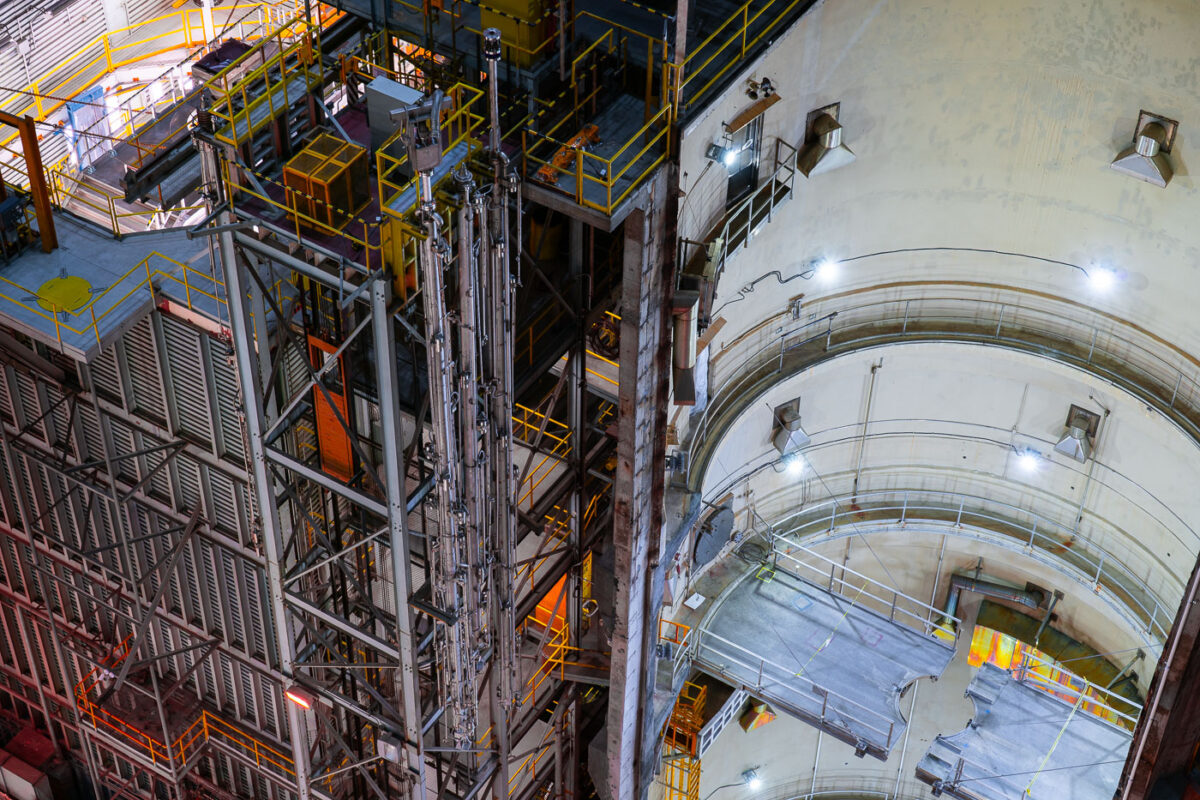
A high-angle view inside NASA’s Michoud Assembly Facility in New Orleans shows the enormous vertical welding and assembly bays used to build sections of the Space Launch System (SLS) rocket. The towering circular structure on the left is part of the Vertical Weld Center, where cylindrical rocket segments are precisely joined using friction-stir welding. Catwalks and access platforms ring the interior, supporting technicians during construction of the world’s most powerful launch vehicle for the Artemis program.
NASA Michoud: Yellow Rocket Assembly Cranes
August 2018
—
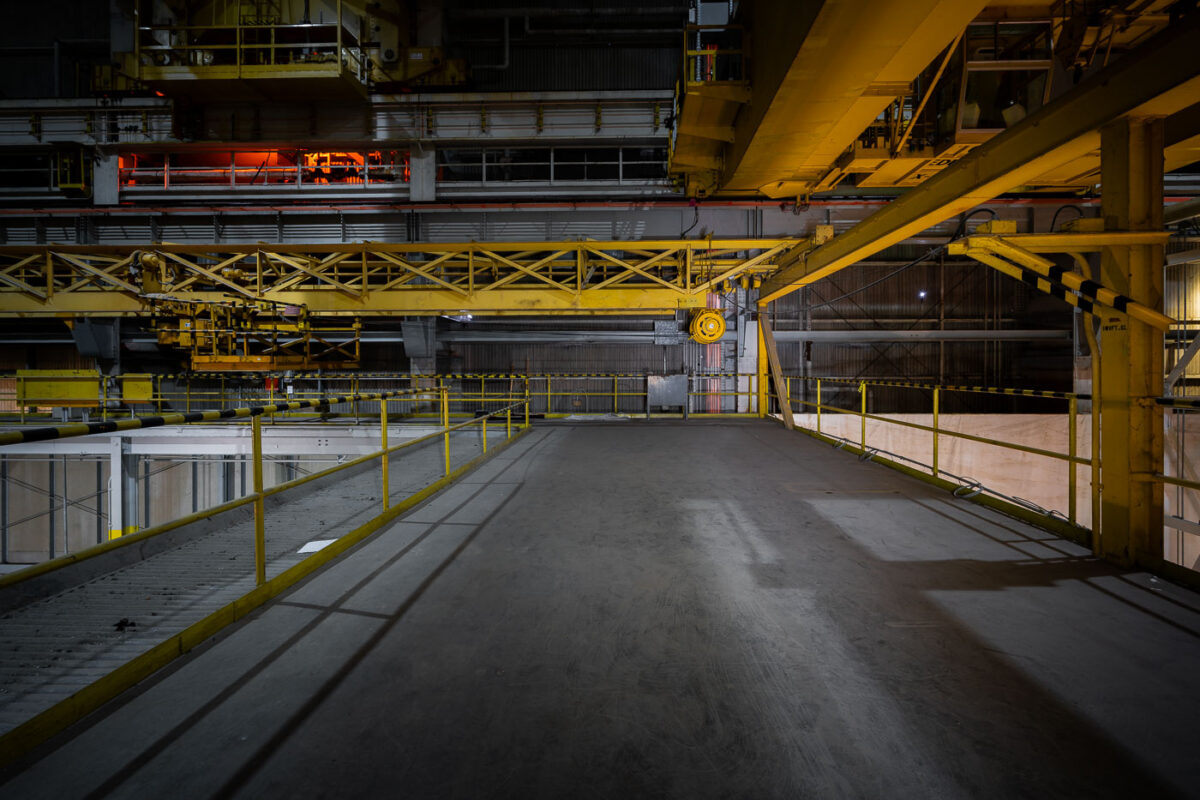
An elevated view of the overhead gantry crane system inside NASA’s Michoud Assembly Facility in New Orleans. These yellow steel cranes are used to lift and maneuver rocket sections, including the massive Space Launch System core stages, within the cavernous production hall. The network of platforms, rails, and suspended hooks demonstrates the industrial scale of spacecraft manufacturing that has taken place here since the Apollo and Space Shuttle programs.
NASA Michoud: SLS Core Stage Vertical Assembly Center
August 2018
—
Looking downward inside the Vertical Assembly Center at NASA’s Michoud Assembly Facility in New Orleans, this view shows the precision alignment and welding platform used to assemble rocket stages. The towering blue and yellow structure is part of the tooling for the Space Launch System core stage, where massive aluminum sections are friction-stir welded to form part of NASA’s Artemis launch vehicles.
Industrial Stairwell, NASA Michoud Vertical Assembly Center
August 2018
—
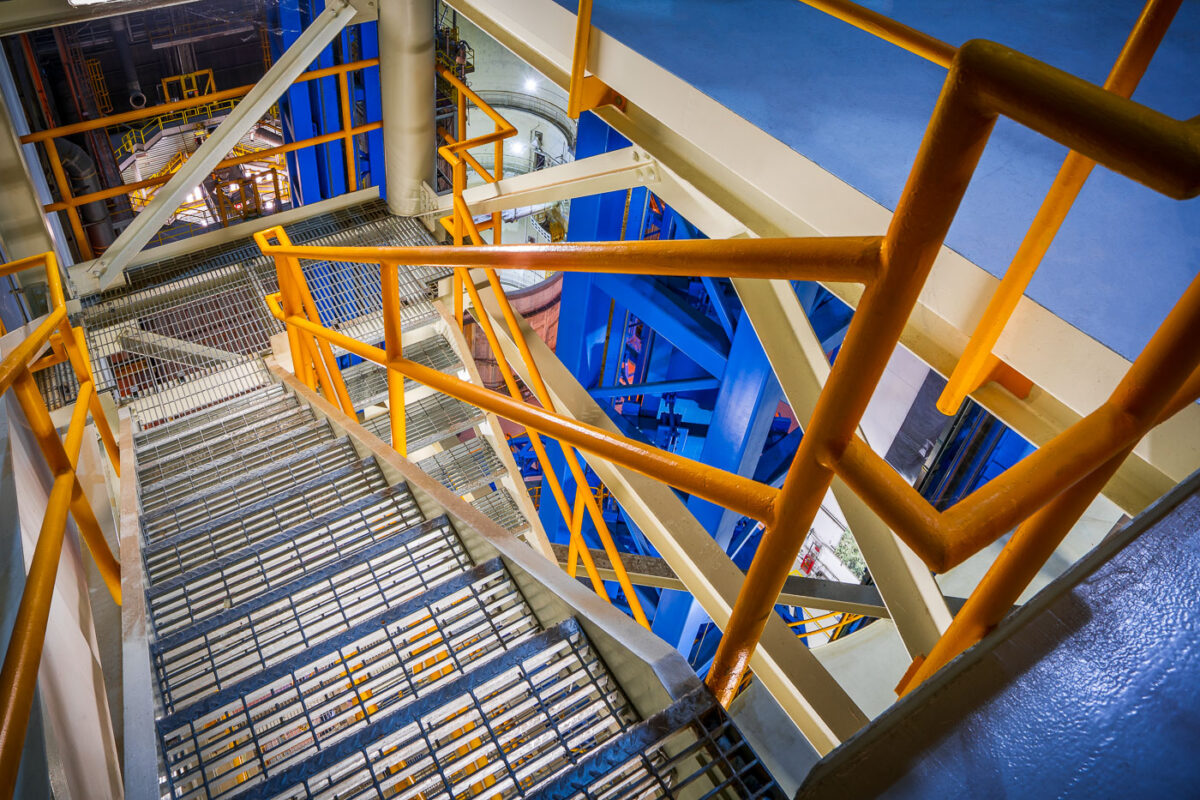
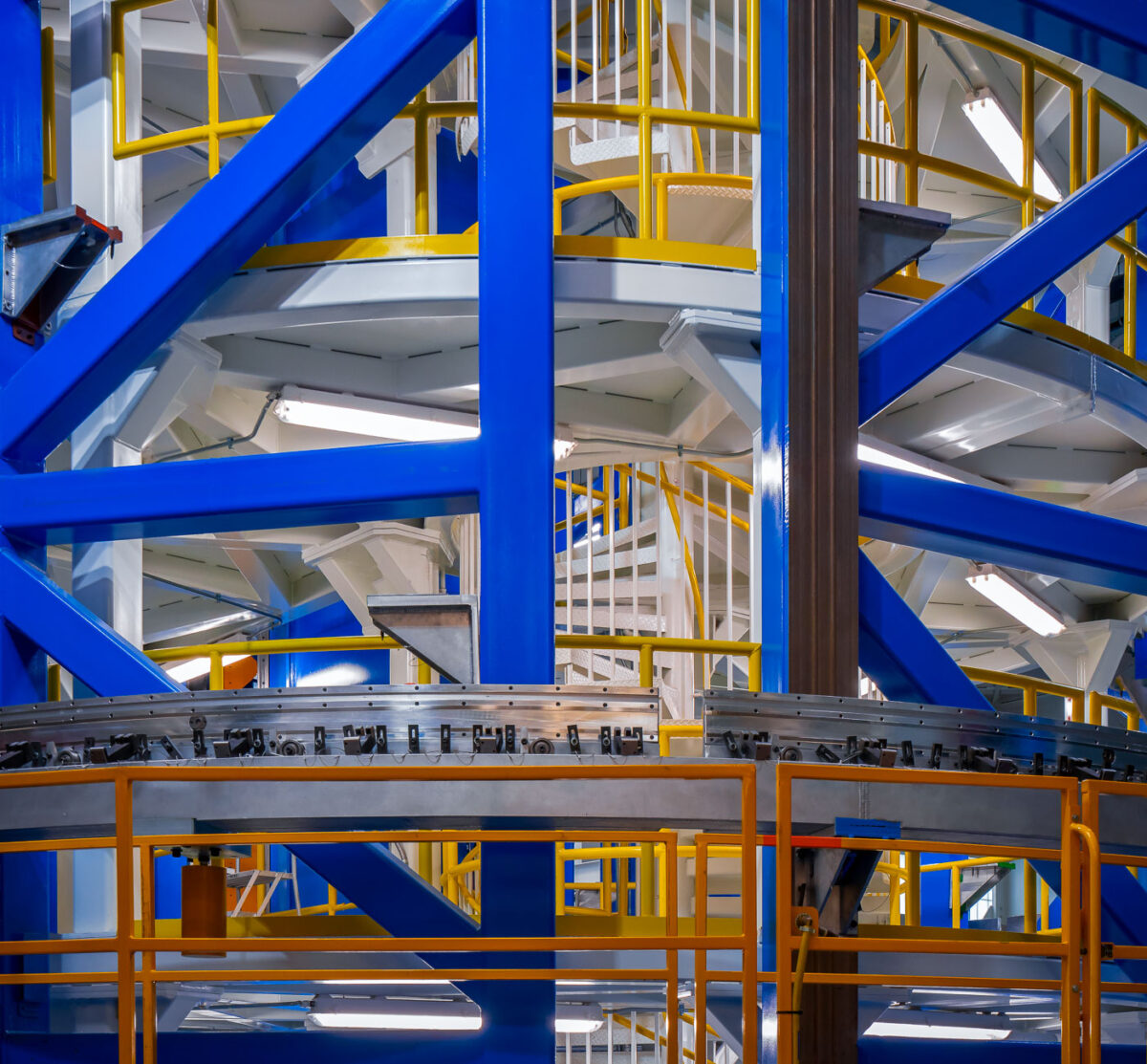
A stairwell winds through the interior of NASA’s Vertical Assembly Center at the Michoud Assembly Facility in New Orleans. The industrial structure, with its orange and blue framework, provides access to various levels of the 170-foot-tall welding system used to assemble core stages of the Space Launch System. The facility supports precision manufacturing for the Artemis program’s heavy-lift rockets.
NASA Michoud: SLS Core Stage Vertical Assembly Center
August 2018
—
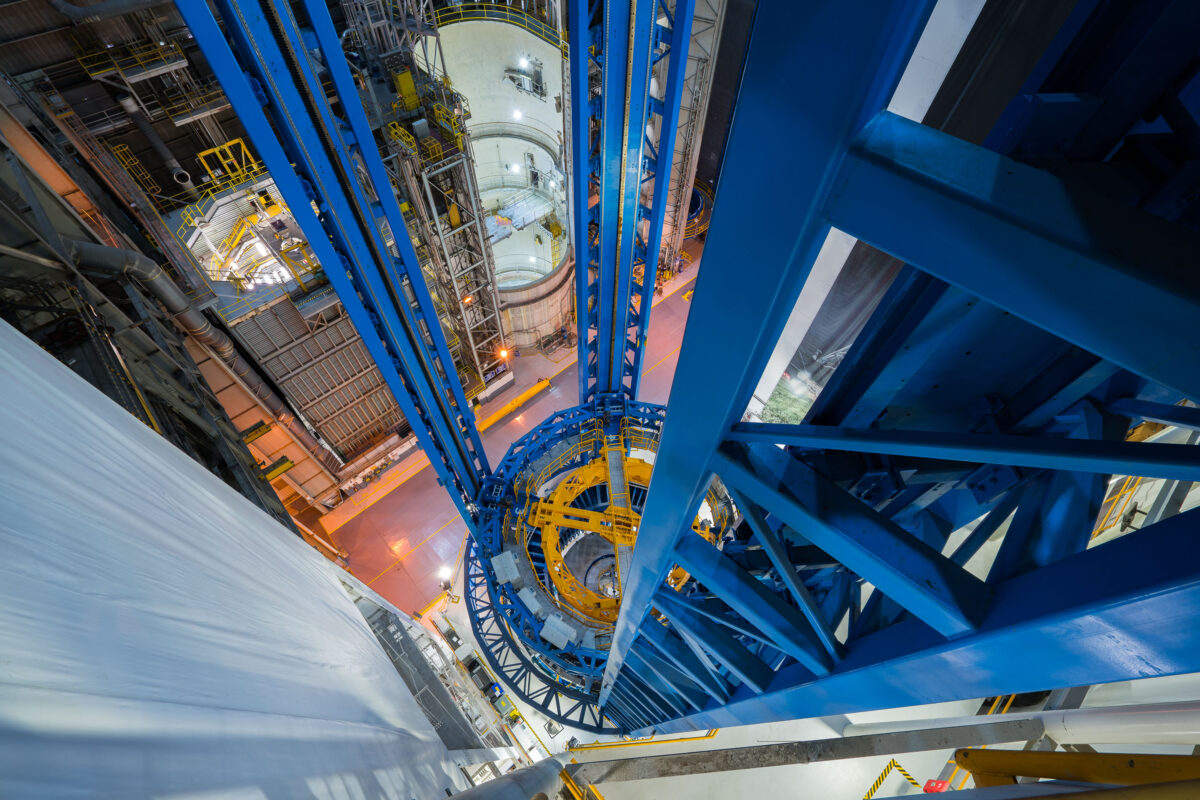
A view from the upper levels of the Vertical Assembly Center at NASA’s Michoud Assembly Facility in New Orleans. The massive blue structure supports the assembly and welding of the Space Launch System’s core stage, the primary rocket used for Artemis missions. This 170-foot-tall tool precisely aligns and joins large rocket sections, a key part of NASA’s ongoing production of deep space launch vehicles.
August 2018
—
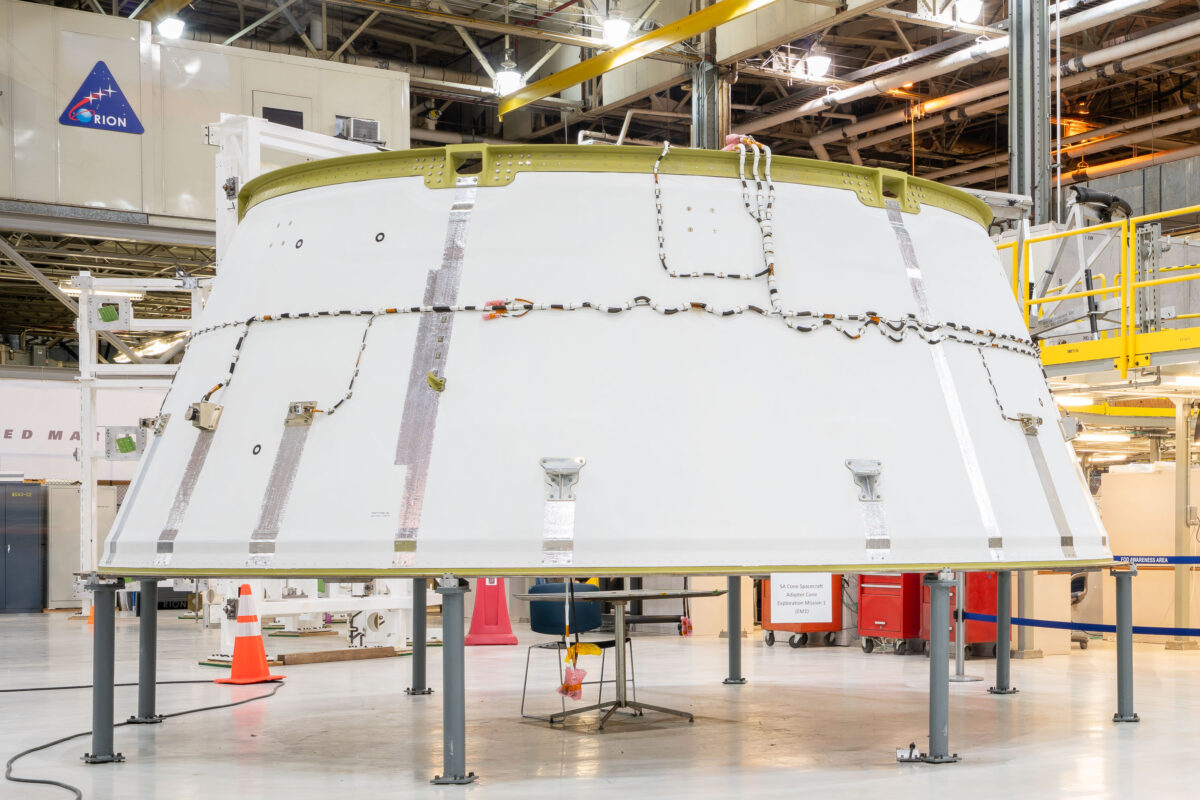
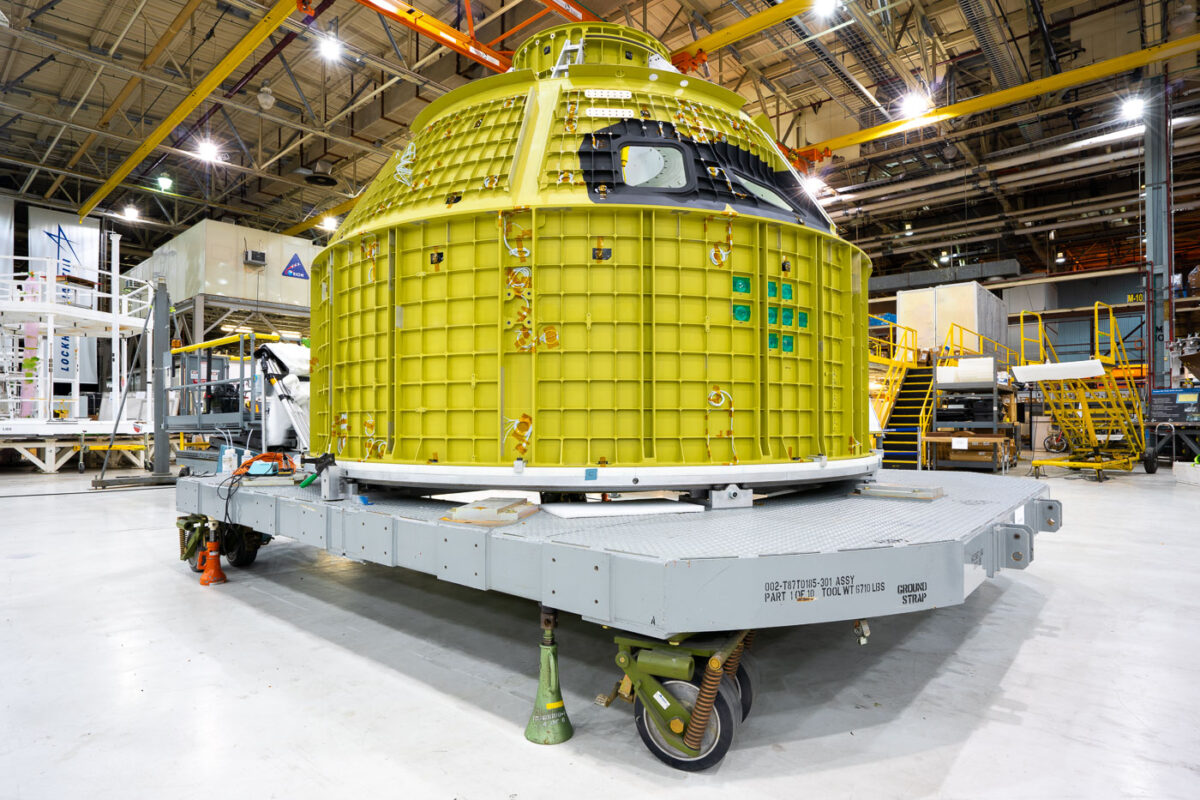
The Spacecraft Adapter Cone for NASA’s Orion Exploration Mission-1 (EM-1) is shown during assembly inside the manufacturing facility. This conical structure connects the Orion crew module and service module to the Space Launch System (SLS) rocket, housing critical components such as separation hardware, wiring harnesses, and payload deployment systems. Its reinforced aluminum construction includes visible thermal protection areas, structural attachment brackets, and integrated circuitry for communication and control. EM-1, later renamed Artemis I, was designed as an uncrewed test flight to evaluate Orion’s deep-space capabilities for future crewed lunar missions.
Orion Crew Module in Primer at NASA Michoud Assembly Facility
August 2018
—
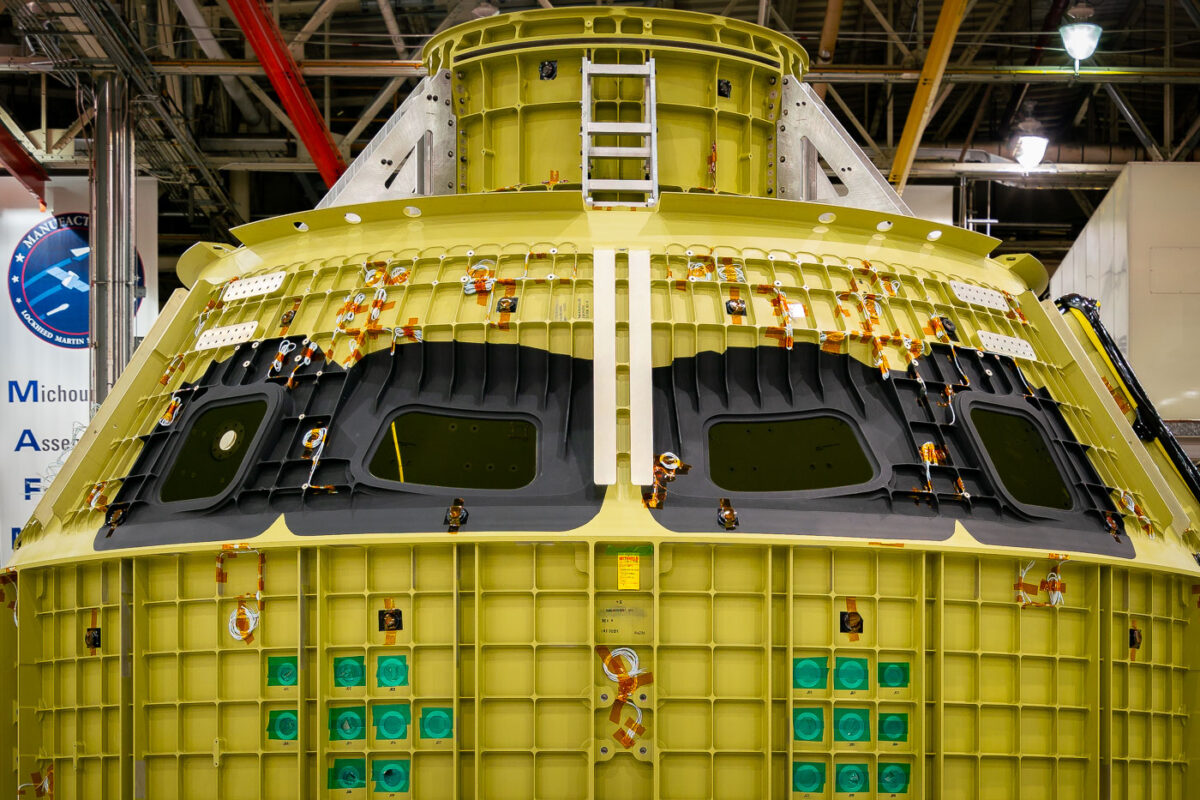
The Orion spacecraft’s crew module sits on a transport platform at NASA’s Michoud Assembly Facility in New Orleans, Louisiana. Built by Lockheed Martin, this pressure vessel is the primary structure that will house astronauts during Artemis missions to the Moon. The aluminum-lithium frame, painted in primer yellow, is designed to withstand both launch forces and the harsh conditions of deep space. Each module undergoes precision assembly and testing at Michoud before being shipped to Kennedy Space Center for outfitting and integration with the Space Launch System rocket.
Orion Crew Module Mid-Assembly at NASA Michoud
August 2018
—
The Orion crew module is seen in mid-assembly at NASA’s Michoud Assembly Facility in New Orleans. Built by Lockheed Martin, the pressure vessel forms the core structure of the spacecraft that will carry astronauts on Artemis missions to the Moon and beyond. The aluminum-lithium frame is precision-welded to withstand the stresses of launch and deep-space travel, while the black sections mark window openings for crew visibility during flight. Each unit is assembled and tested at Michoud before being shipped to the Kennedy Space Center for integration with the European Service Module and the Space Launch System rocket.
NASA Pegasus Barge Empty Cargo Bay for SLS
August 2018
—
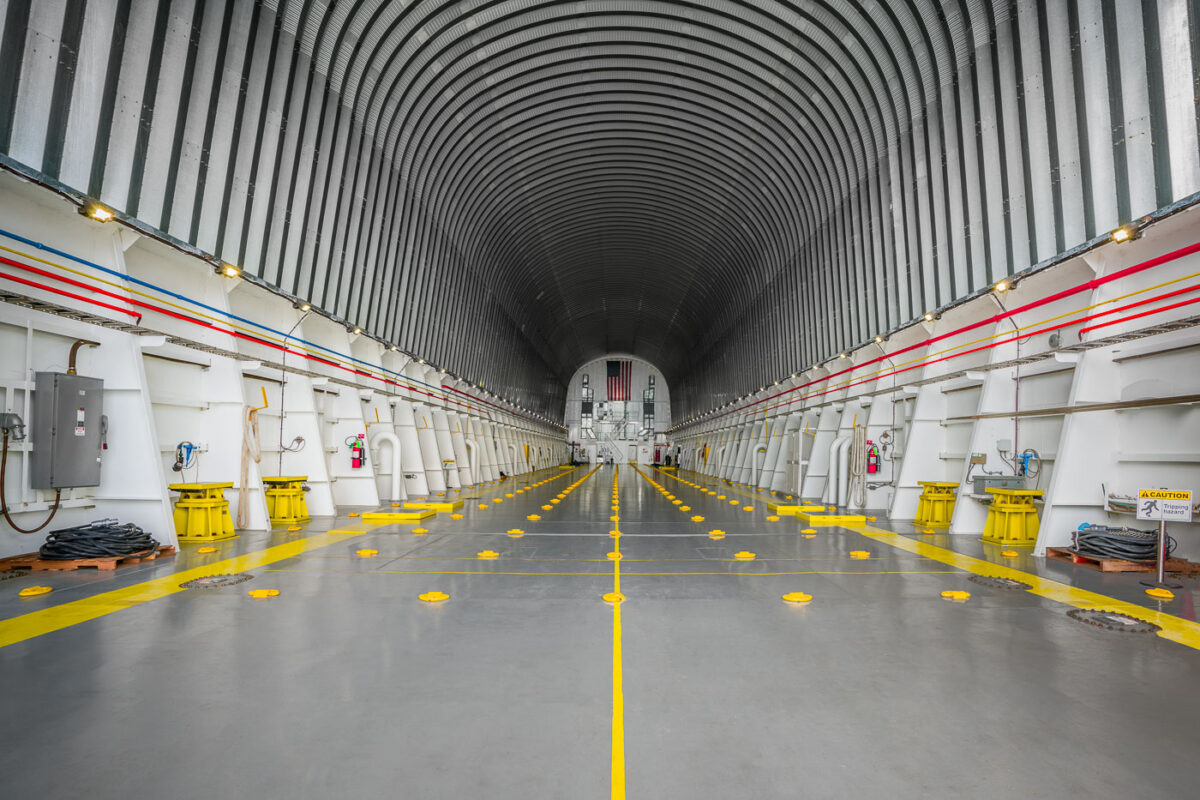
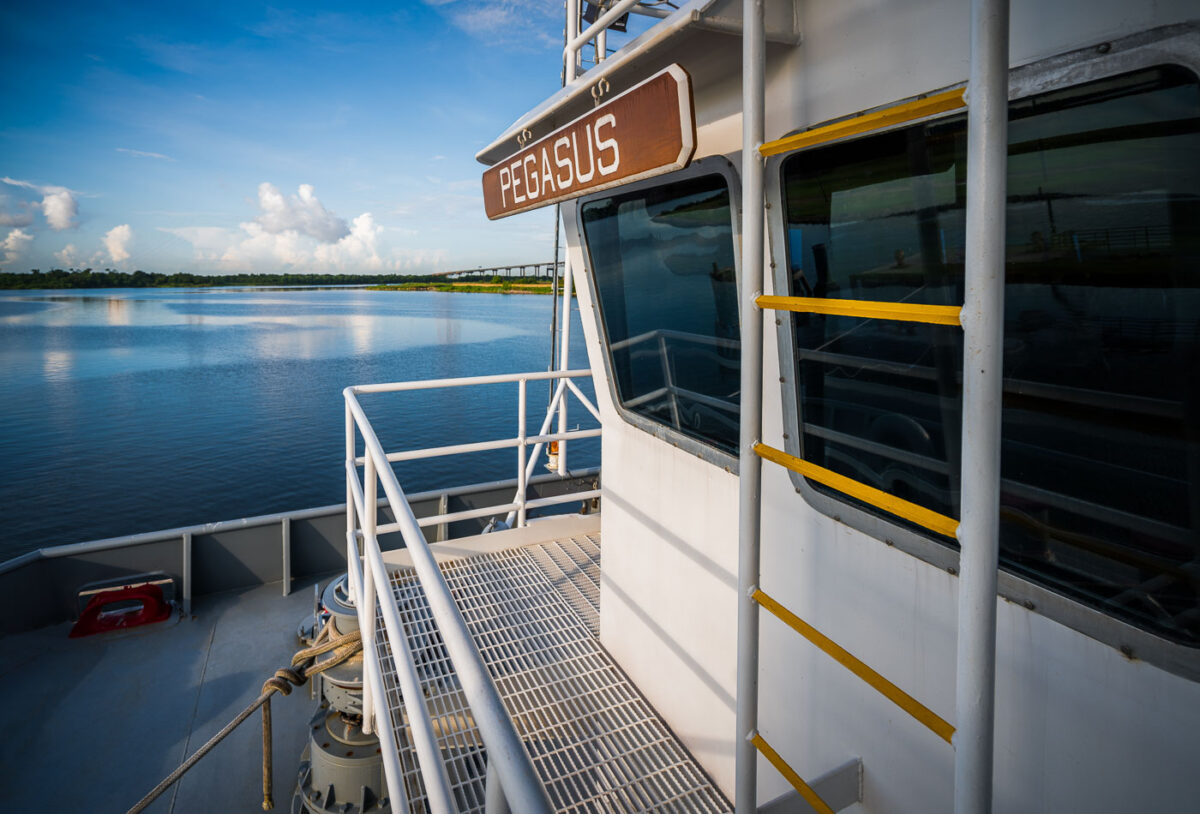
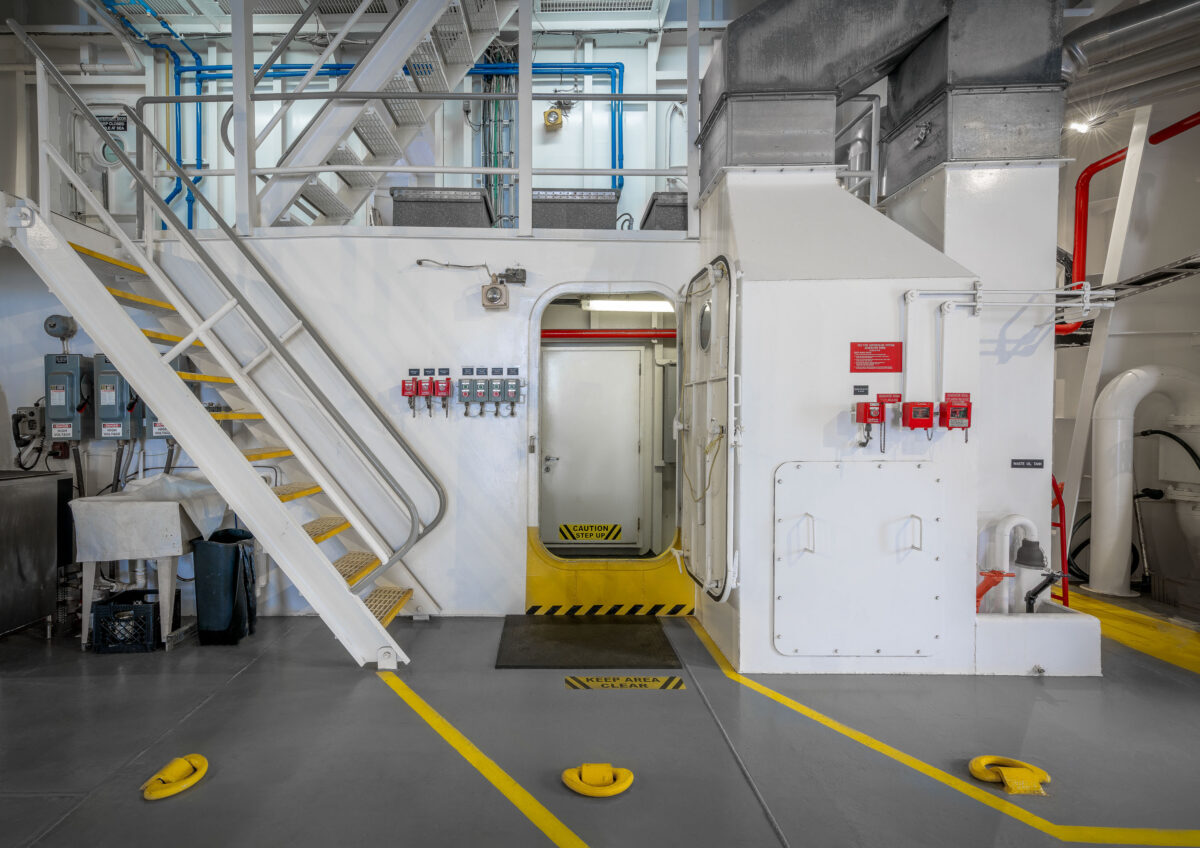
The interior of NASA’s Pegasus barge shows its cavernous cargo bay, designed to carry the massive Space Launch System (SLS) rocket stages from New Orleans to Florida. The reinforced hull and climate-controlled enclosure protect rocket components from Gulf Coast humidity and salt exposure during transit. Originally built in 1999 to move Space Shuttle external tanks, Pegasus was lengthened and upgraded in 2014 to accommodate the larger Artemis-era core stages. The vessel remains a vital part of NASA’s logistics network, connecting Michoud Assembly Facility with Kennedy Space Center via a 900-mile inland and coastal route.
NASA Barge Pegasus at Michoud Assembly Facility, Louisiana
August 2018
—
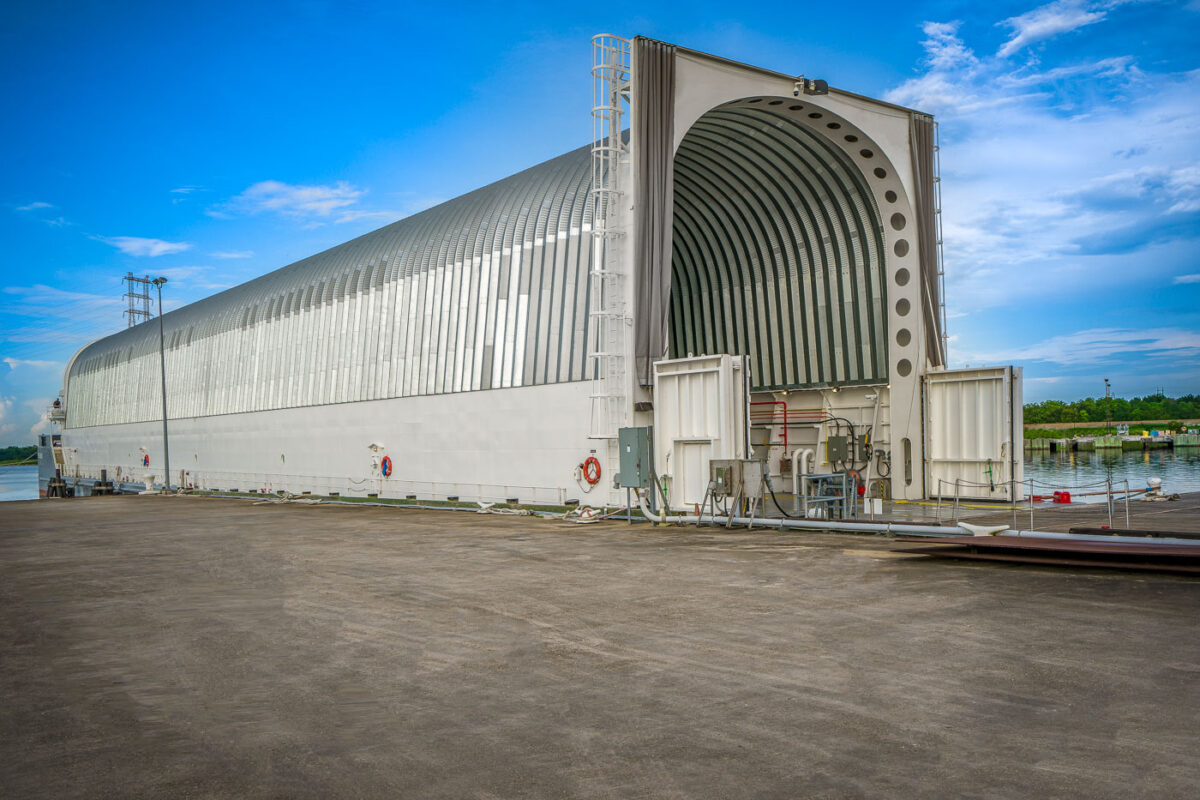
The NASA transport barge Pegasus is shown moored at the Michoud Assembly Facility in New Orleans, Louisiana. Designed to carry the massive core stages of the Space Launch System (SLS), Pegasus features a climate-controlled cargo hold and a retractable bow door to accommodate the rocket’s 212-foot-long components. Originally used to move Space Shuttle external tanks, the vessel was extensively refitted and lengthened in 2014 to support NASA’s Artemis program. It remains a key link between NASA’s Gulf Coast manufacturing site and the Kennedy Space Center in Florida.
NASA Barge Pegasus Moored on Intracoastal Waterway, LA
August 2018
—
The NASA barge Pegasus moored along the Intracoastal Waterway near New Orleans, Louisiana. Originally built in 1999 to carry Space Shuttle external tanks from Michoud to Kennedy Space Center, the vessel was later extended and modernized to transport the massive core stages of NASA’s Space Launch System (SLS). Operated by the U.S. Maritime Administration and NASA’s logistics teams, Pegasus remains a vital link between Gulf Coast manufacturing and Florida launch operations for Artemis missions.
NASA Pegasus Barge Interior, Michoud Assembly Facility
August 2018
—
Nasa's Pegasus barge that will carry fuel tanks for the Space Launch System to other NASA facilities for testing and launches.
More Info:
NASA Infographic: https://www.nasa.gov/exploration/systems/sls/multimedia/barge-pegasus-infographic
Pegasus Barge Fact Sheet: https://www.nasa.gov/sites/default/files/atoms/files/sls_pegasus_fact_sheet_508_final_04212017.pdf
August 2018
—
Inside NASA’s Michoud Assembly Facility in New Orleans, this image captures a detailed look at the Vertical Assembly Structure where components of the Space Launch System (SLS) core stage are integrated. Michoud is responsible for producing and assembling the massive cryogenic fuel tanks and structural sections for Artemis missions. The image highlights upper-level access platforms, fluid transfer lines, structural support towers, and work platforms surrounding cylindrical core stage hardware. The illuminated scaffolding, wiring harnesses, and service walkways reflect the precision required for assembling high-tolerance aerospace structures intended for deep space missions. The facility plays a key role in preparing the United States’ next-generation launch vehicles for lunar exploration.
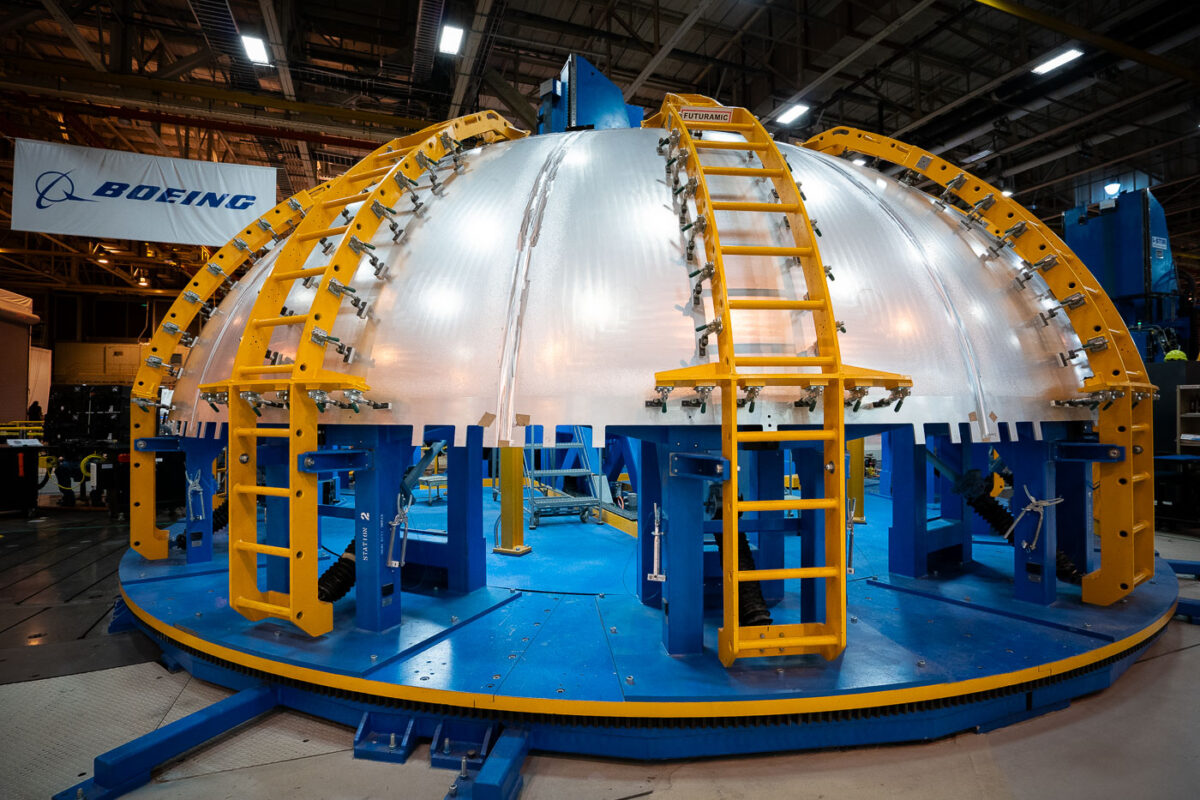
Futuramic Gore Weld Tool
August 2018
—
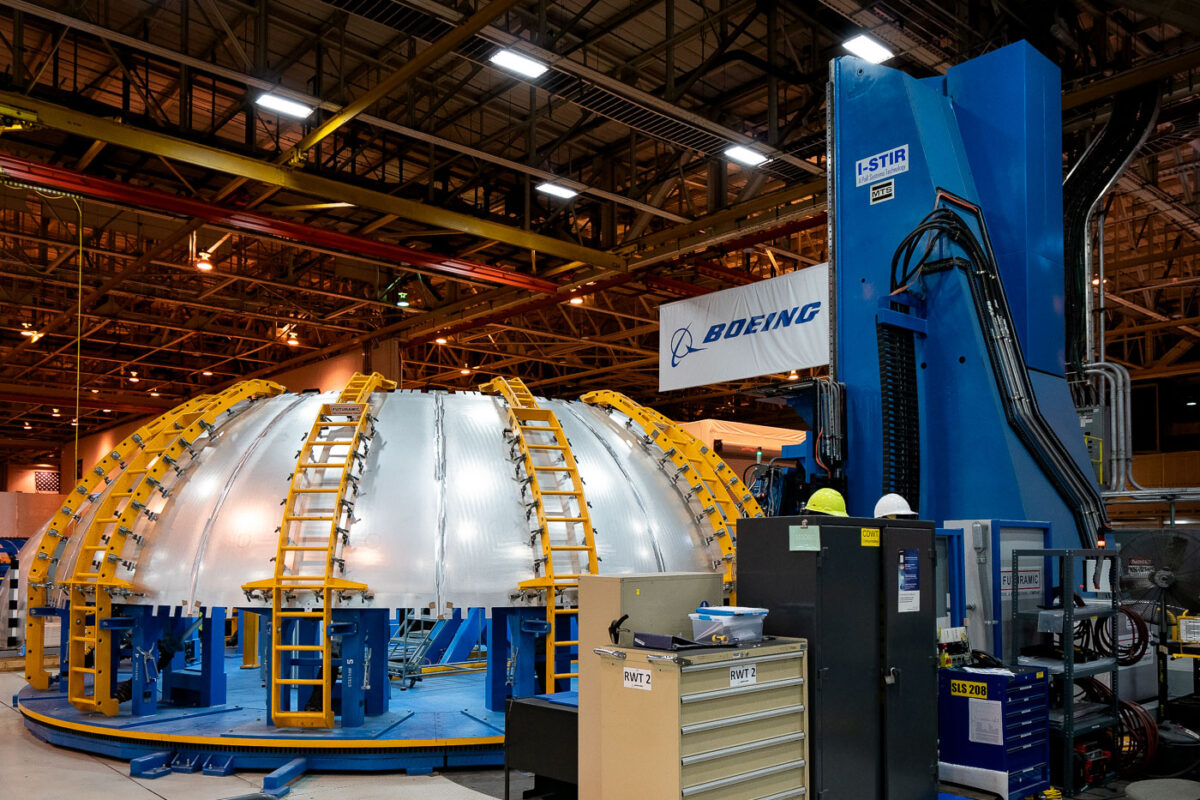
At NASA’s Michoud Assembly Facility in New Orleans, Boeing engineers use a PAR Systems I-STIR Friction-Stir Welder to join massive aluminum dome sections for next-generation aerospace vehicles. The process forges metal under intense pressure and heat without melting it, producing welds with exceptional structural integrity for components such as rocket fuel tanks and spacecraft pressure vessels. The Michoud facility, once home to Saturn V and Space Shuttle tank production, continues its role as one of the nation’s key centers for large-scale precision manufacturing and spaceflight hardware assembly.
NASA Vertical Weld Center, SLS & Artemis Production
August 2018
—
Inside the NASA Michoud Assembly Facility where the SLS and Artemis is being built.
NASA Michoud VAB, New Orleans, SLS Core Stages
August 2018
—
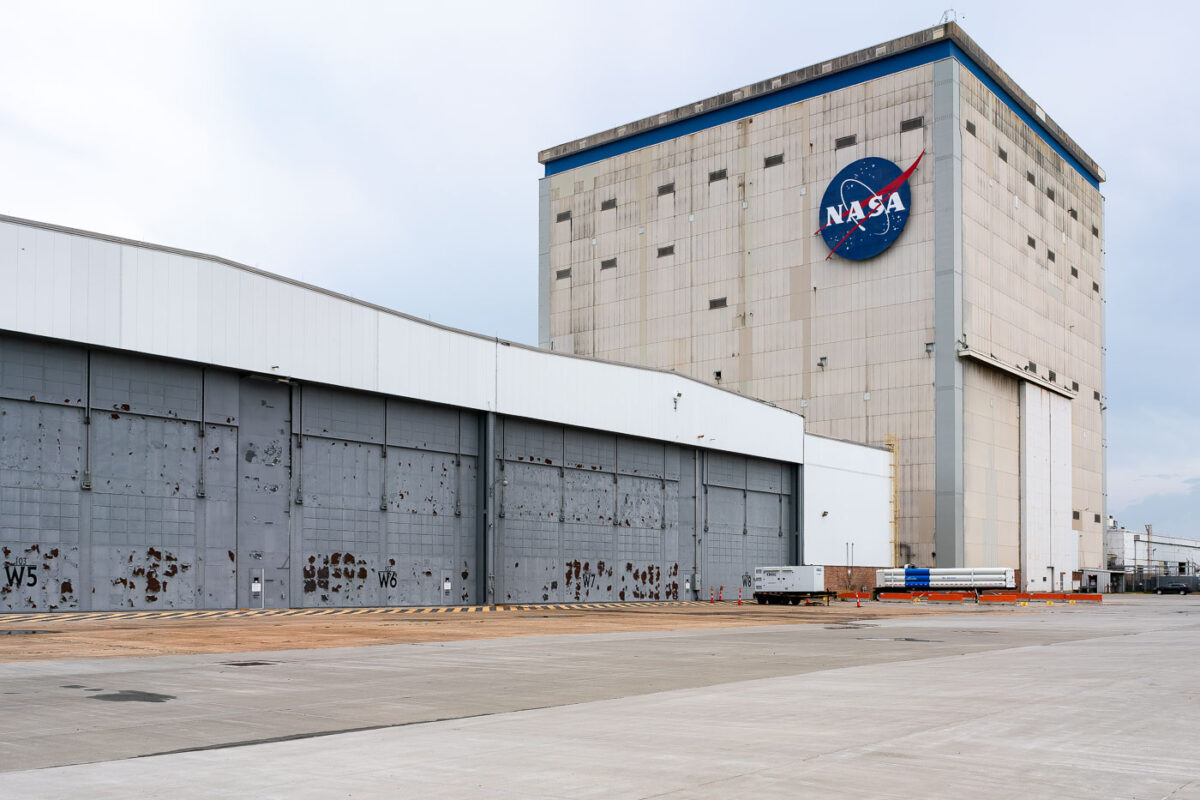
The main assembly hall of NASA’s Michoud Assembly Facility in New Orleans, Louisiana, seen from the west apron. Originally constructed during World War II for manufacturing Liberty ships and later used for Saturn V and Space Shuttle external tank production, the site continues to play a central role in the U.S. space program. Today, Boeing and NASA engineers fabricate and assemble the massive core stages of the Space Launch System (SLS) inside this facility for Artemis missions to the Moon and beyond.
Boeing SLS Core Stage Dome Section, NASA Michoud
August 2018
—
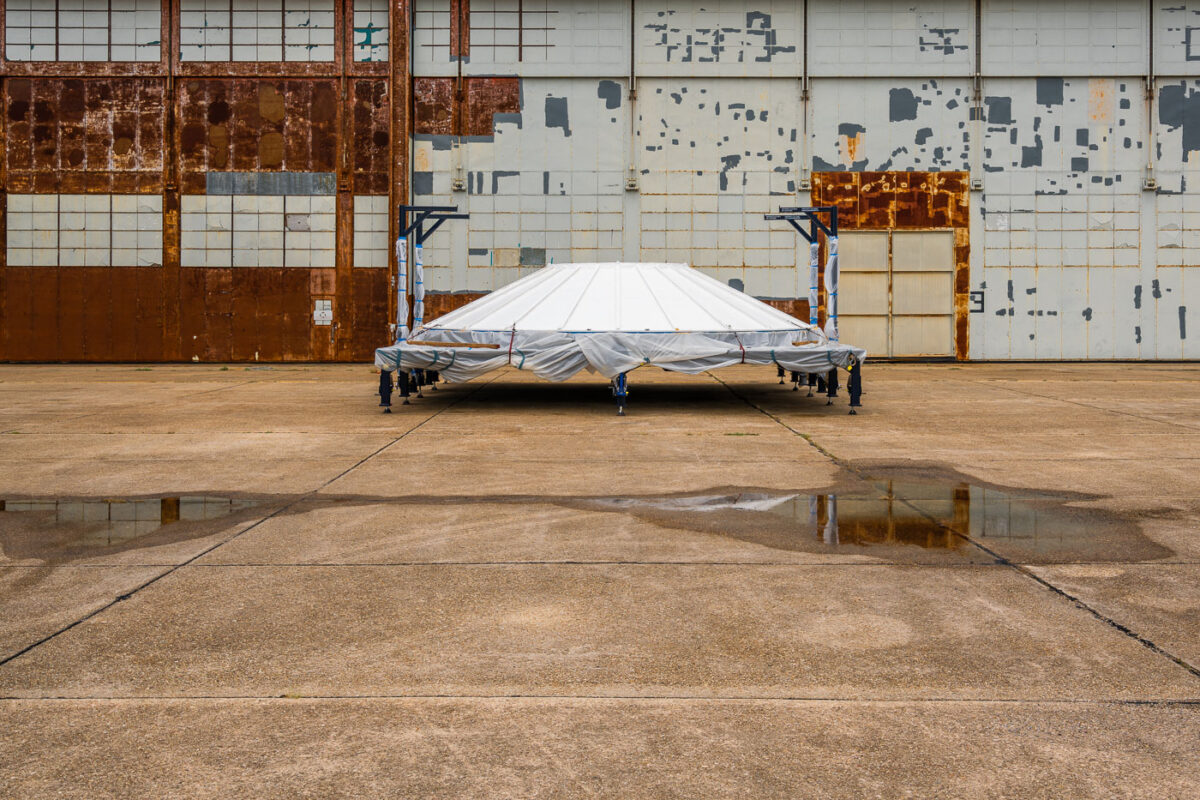
A completed dome section, likely part of the Space Launch System (SLS) core stage, sits wrapped and staged outside the Boeing production area at NASA’s Michoud Assembly Facility in New Orleans. The massive structure, used to cap propellant tanks, rests on a mobile transport frame against the weathered doors of an aging assembly hangar — a visual contrast between decades of industrial heritage and the cutting edge of modern rocketry. The surface reflections from the wet concrete emphasize the scale and symmetry of this aerospace component awaiting the next step in its journey toward integration.
NASA SLS Rocket Model for Barge Transport Test, Michoud
August 2018
—
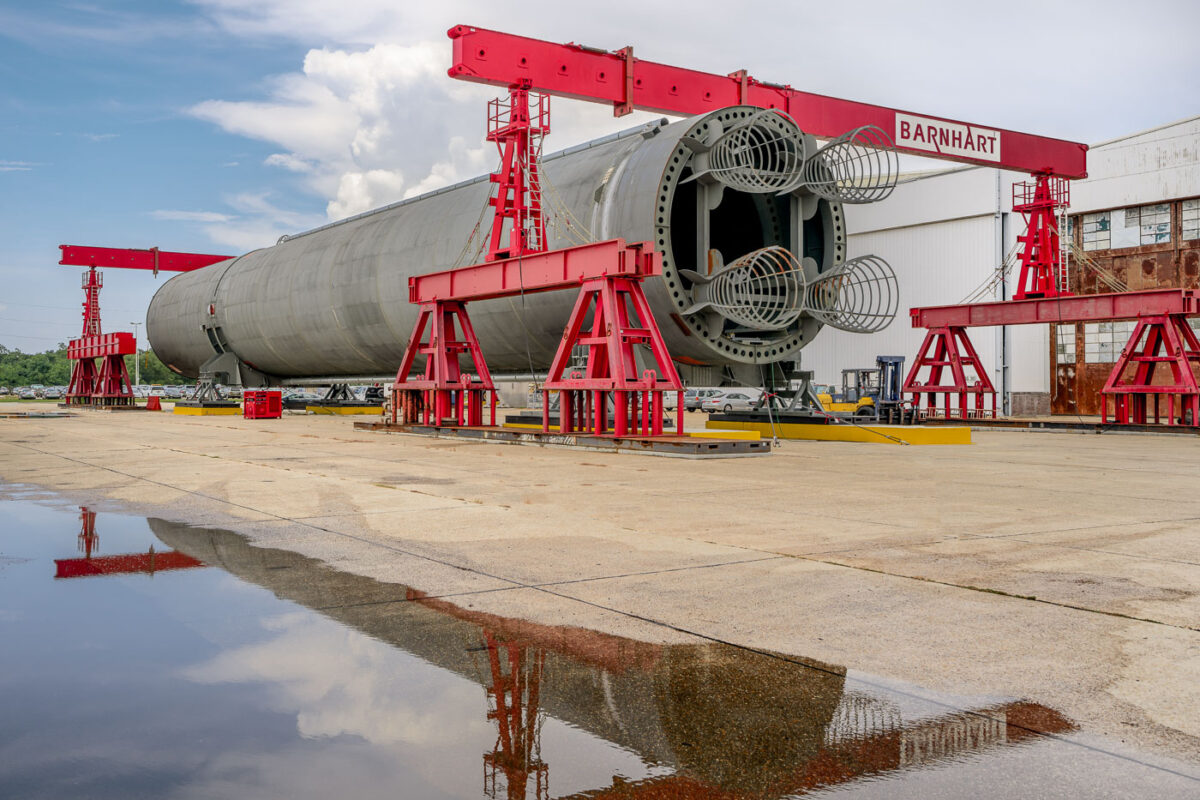
A model SLS rocket outside the NASA Michoud Assembly Facility. The model was used to test transporting on the NASA barge.
Boeing SLS Dome Friction-Stir Welding at NASA Michoud
August 2018
—
Inside NASA’s Michoud Assembly Facility in New Orleans, a massive aluminum dome section undergoes welding using a PAR Systems I-Stir Friction Welder — a precision tool developed for joining thick aerospace materials without melting them. This technique, essential for spacecraft and fuel tank construction, uses frictional heat and mechanical pressure to create exceptionally strong, defect-free joints. Boeing engineers employ the system for the assembly of rocket and space vehicle components, part of a long legacy of large-scale fabrication at Michoud dating back to the Saturn V and Space Shuttle programs.
NASA Basketball Court, Solar Lights – Michoud Assembly Facility
August 2018
—
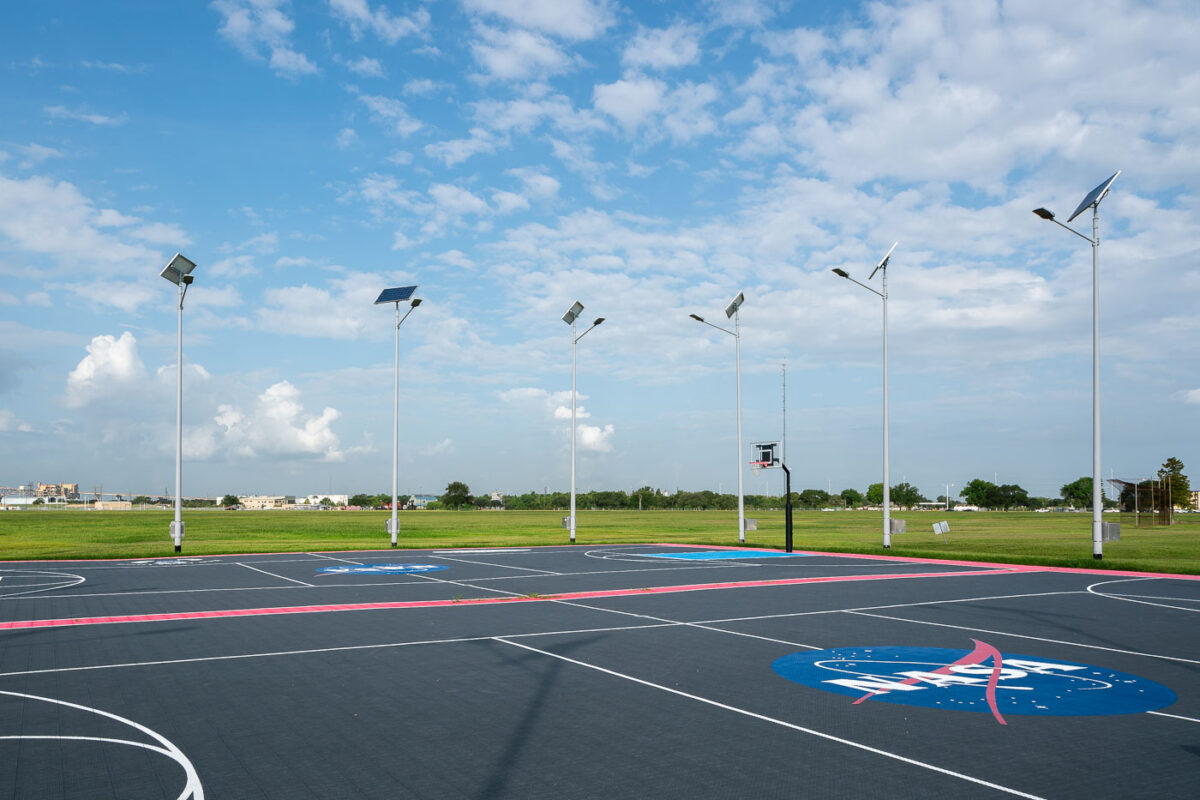
A recreational basketball court at NASA’s Michoud Assembly Facility in New Orleans features the NASA insignia at center court and solar-powered lighting along its perimeter. The court sits on the expansive campus where large-scale aerospace hardware is built, including rocket stages and spacecraft components. Michoud, once known for producing the Saturn V and Space Shuttle external tanks, remains an active center for both engineering and community life for NASA employees and contractors.
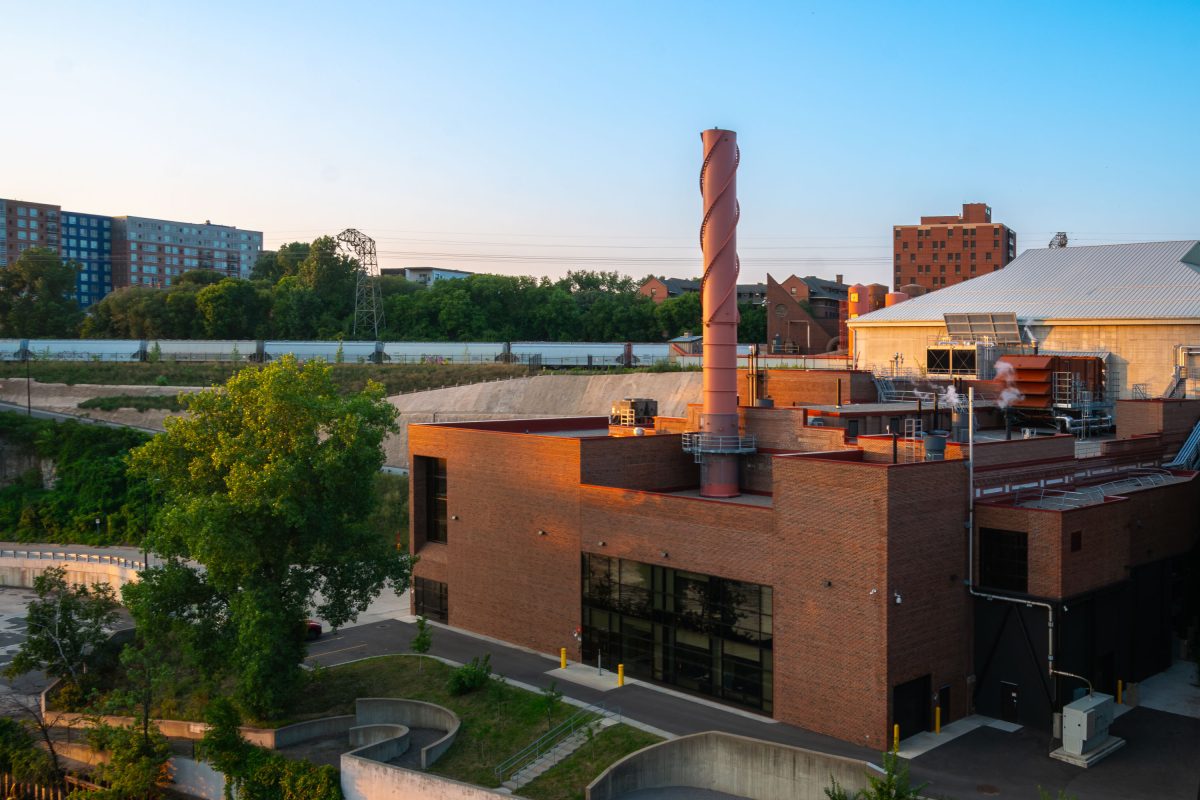
Southeast Steam Plant, University of Minnesota
August 2018
—
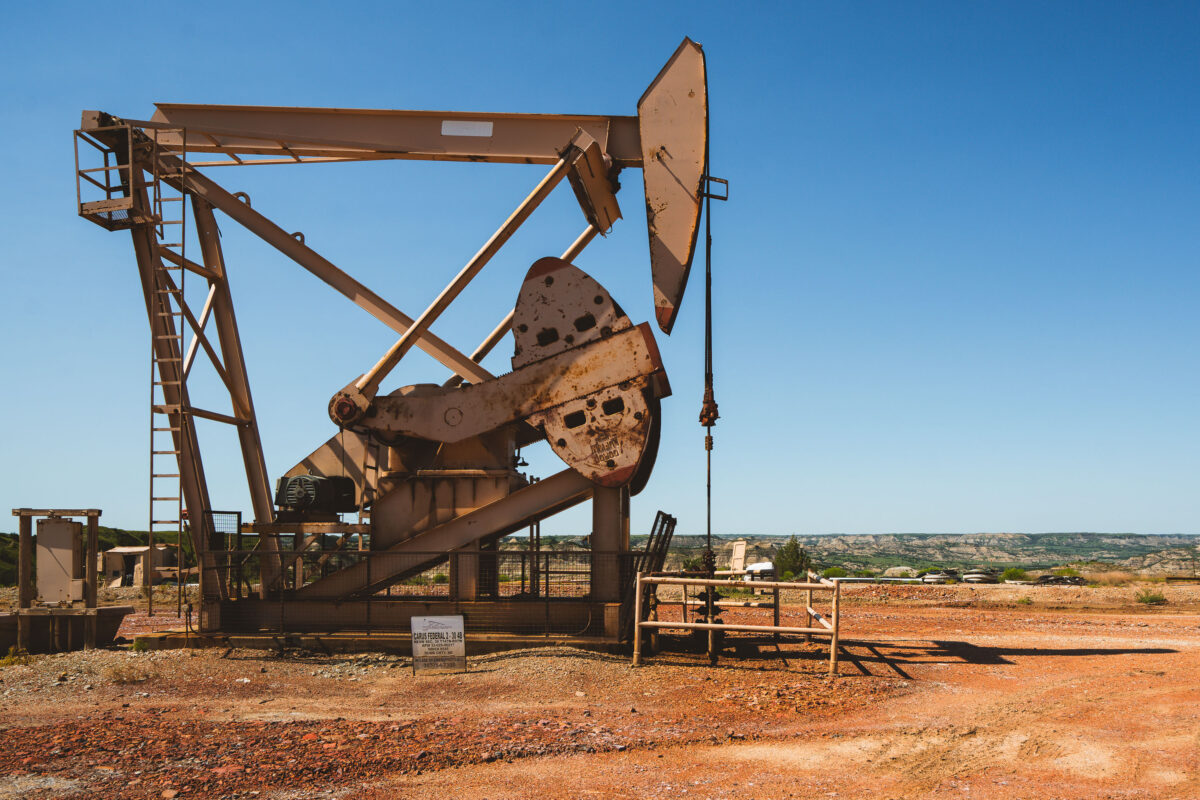
North Dakota Pumpjack Overlooking Badlands
July 2018
—
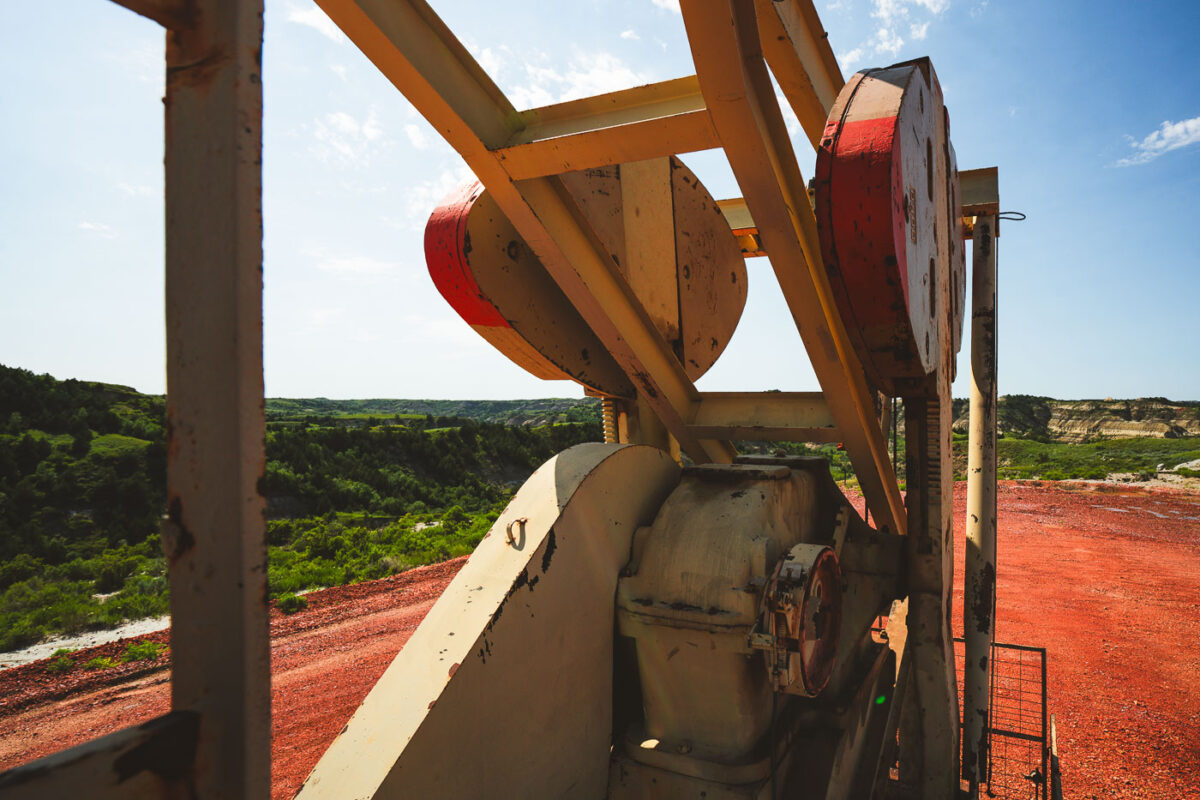
Viewed from behind the machinery, the pumpjack overlooks a sweeping stretch of North Dakota badlands. Its rusted gears and faded paint contrast sharply with the vivid red earth and green hills—a scene that captures both the rugged beauty and industrial imprint of the oil fields.
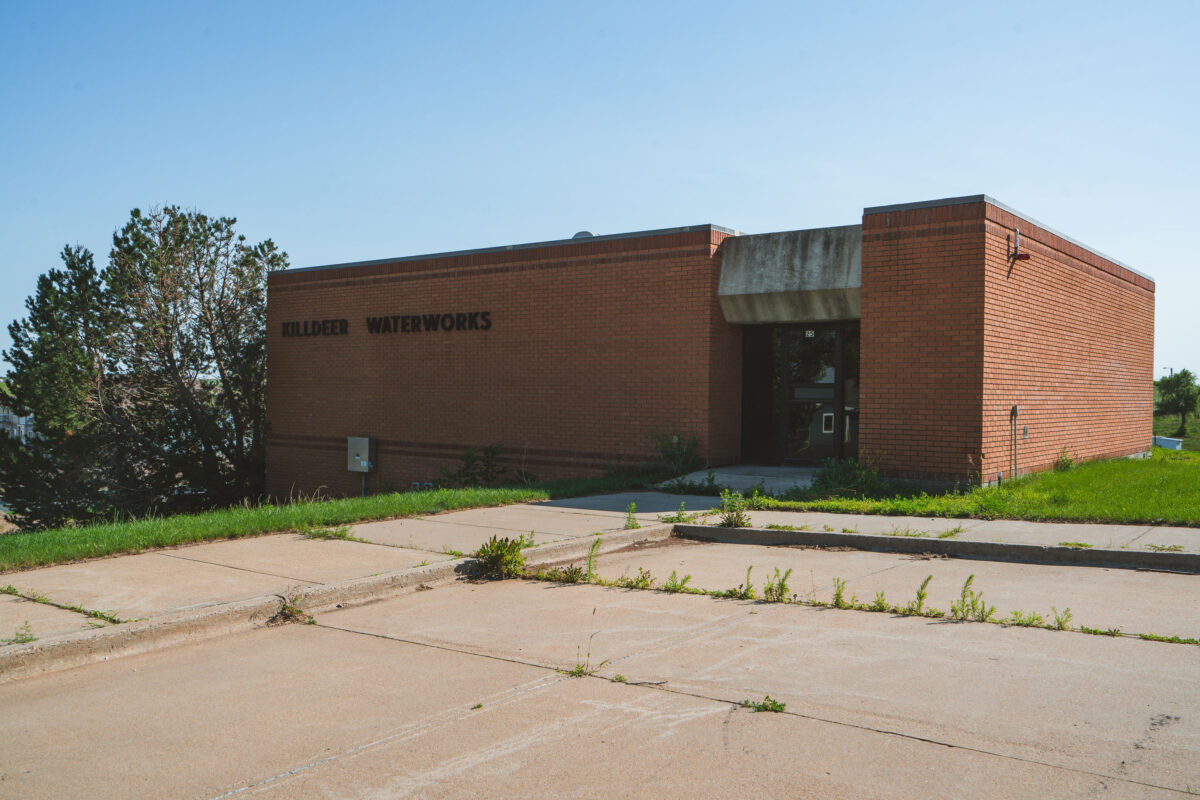
Killdeer Waterworks Facility, North Dakota
July 2018
—
Killdeer Waterworks building in North Dakota.
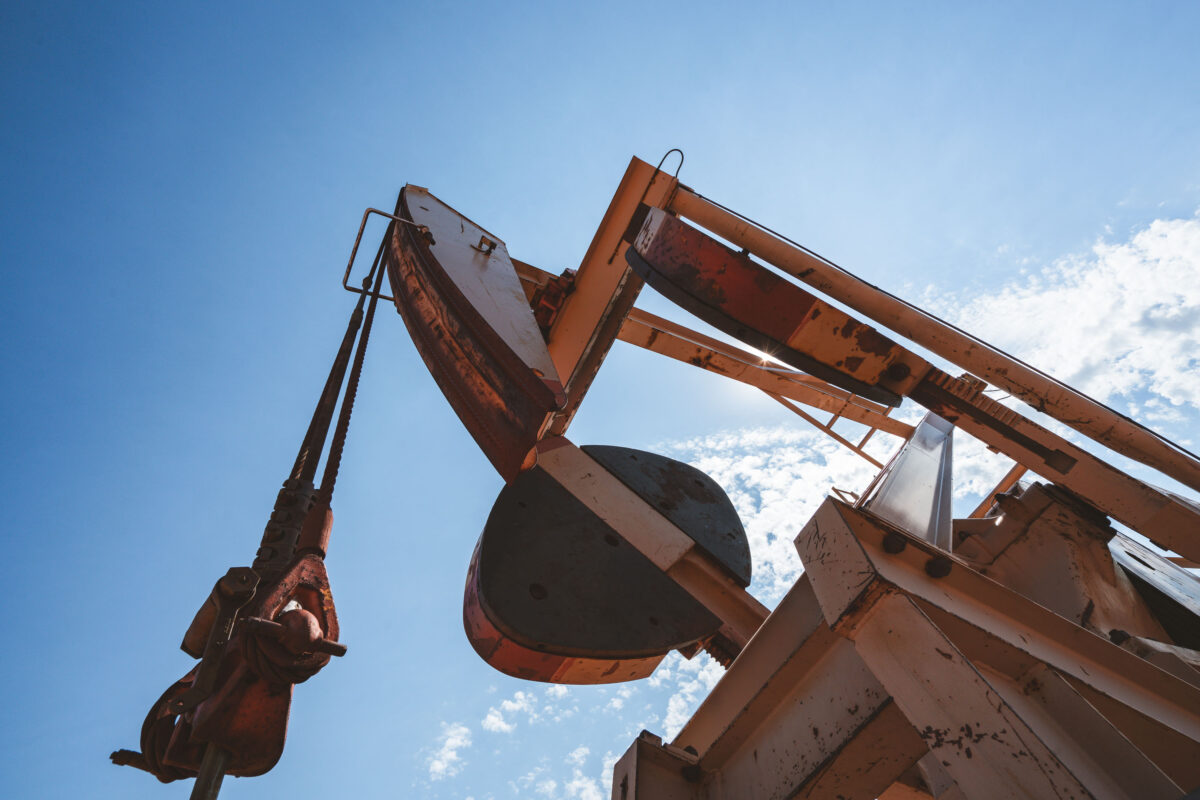
Pumpjack in North Dakota Oil Field Under Blue Sky
July 2018
—
Sunlight glints off the rusted steel of a working pumpjack, its rhythmic motion cutting through the quiet plains air. Shot from below, the towering machine looms against the sky—a reminder of the human industry that continues to shape the remote oil fields of the American West.
Pumpjack in Dunn County, North Dakota
July 2018
—
A weathered pumpjack rises from the red clay of western North Dakota, slowly rocking under the midday sun. Once a quiet symbol of rural industry, it now stands as a reminder of the region’s deep ties to oil production and the changing energy landscape of the American Plains.
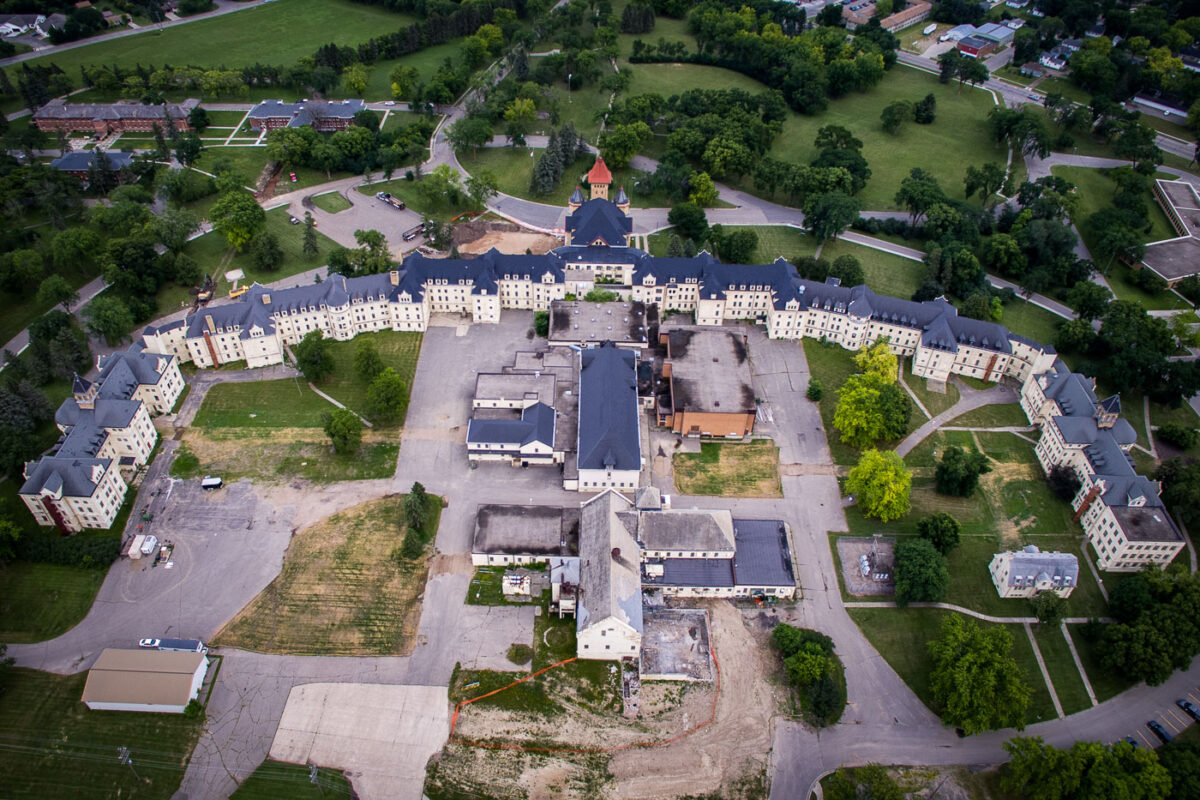
Kirkbride Complex, Fergus Falls Regional Treatment Center
July 2018
—
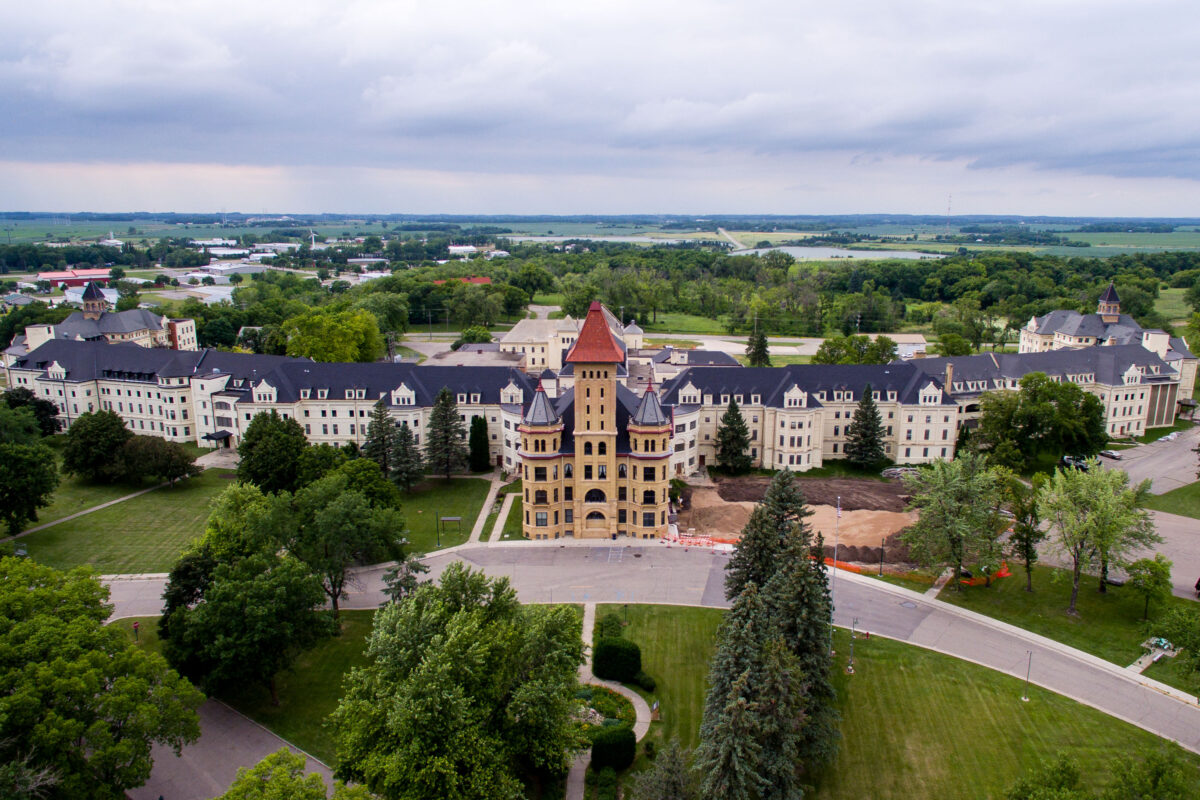
Fergus Falls Regional Treatment Center in Fergus Falls, Minnesota.
Aerial of Kirkbride Building’s Wings and Central Tower, Fergus Falls
June 2018
—
The now demolished General Mills plant in Janesville Wisconsin.
Science Museum of Minnesota Under Construction, St. Paul
June 2018
—
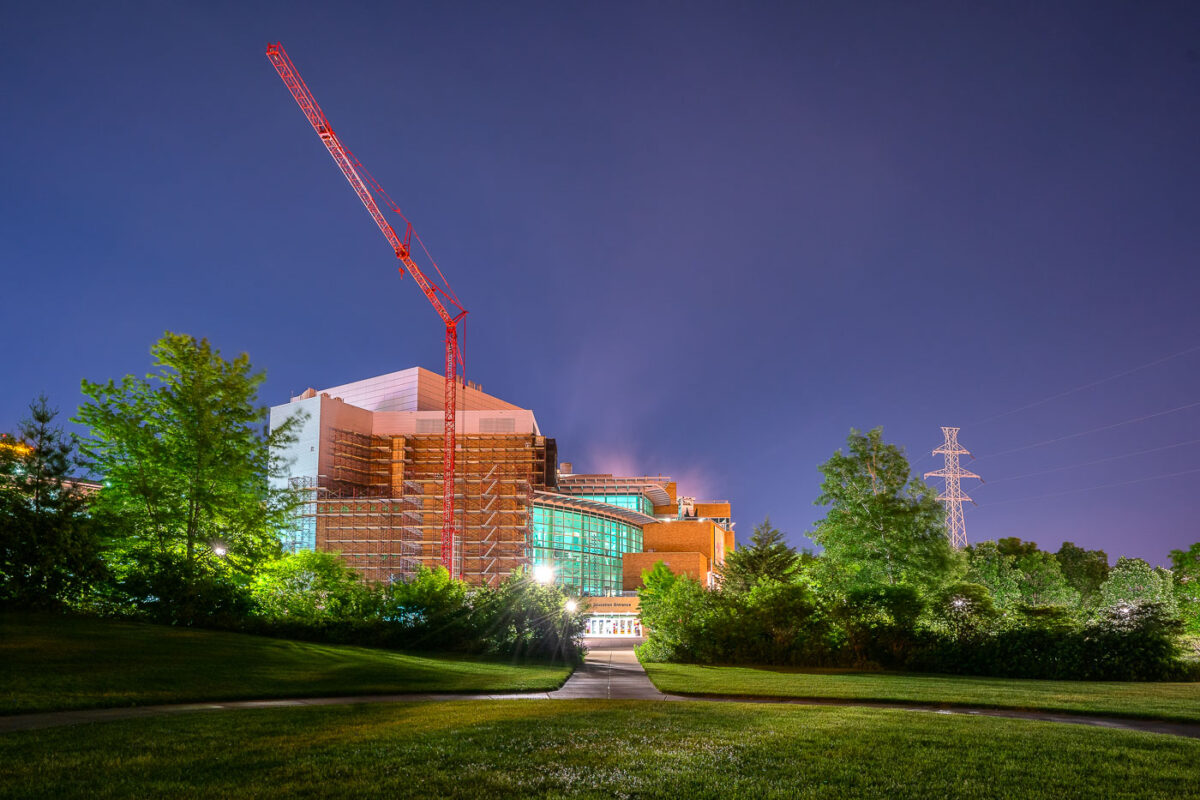
Scaffolding on the Science Museum of Minnesota in St. Paul.
Winter Park: Minnesota Vikings Practice Facility, Eden Prairie
May 2018
—
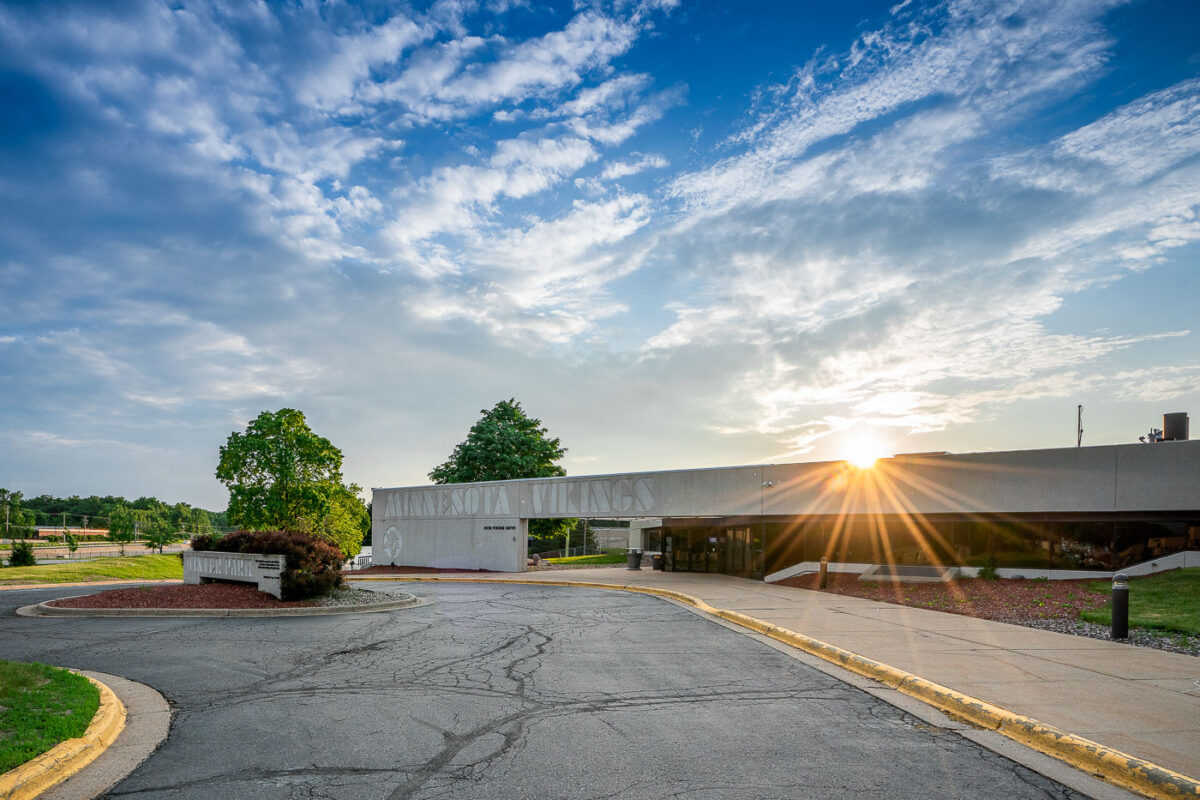
The final days of Winter Park, the Minnesota Vikings Eden Prairie, MN practice facility.
General Mills World Headquarters Entrance, Golden Valley, MN
May 2018
—
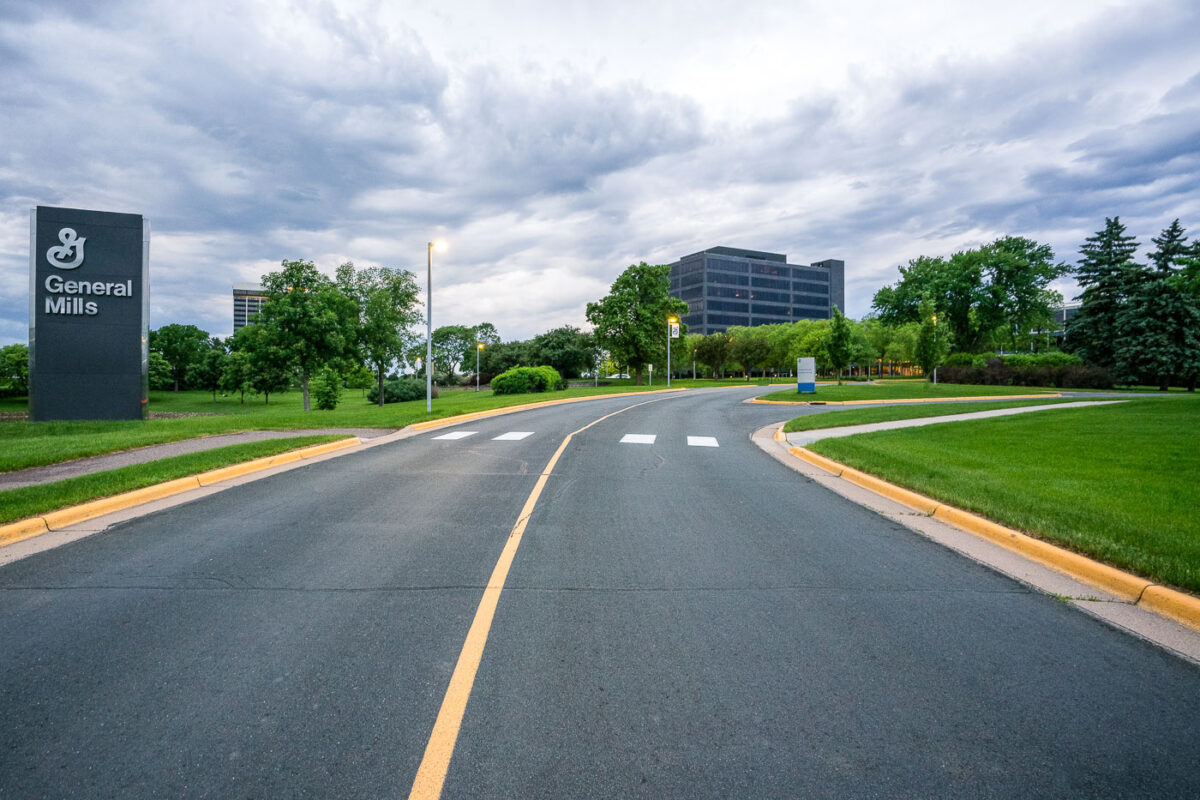
General Mills World Headquarters in Golden Valley, MN
Mann’s St. Louis Park Cinema Exterior, Closed 2018
May 2018
—
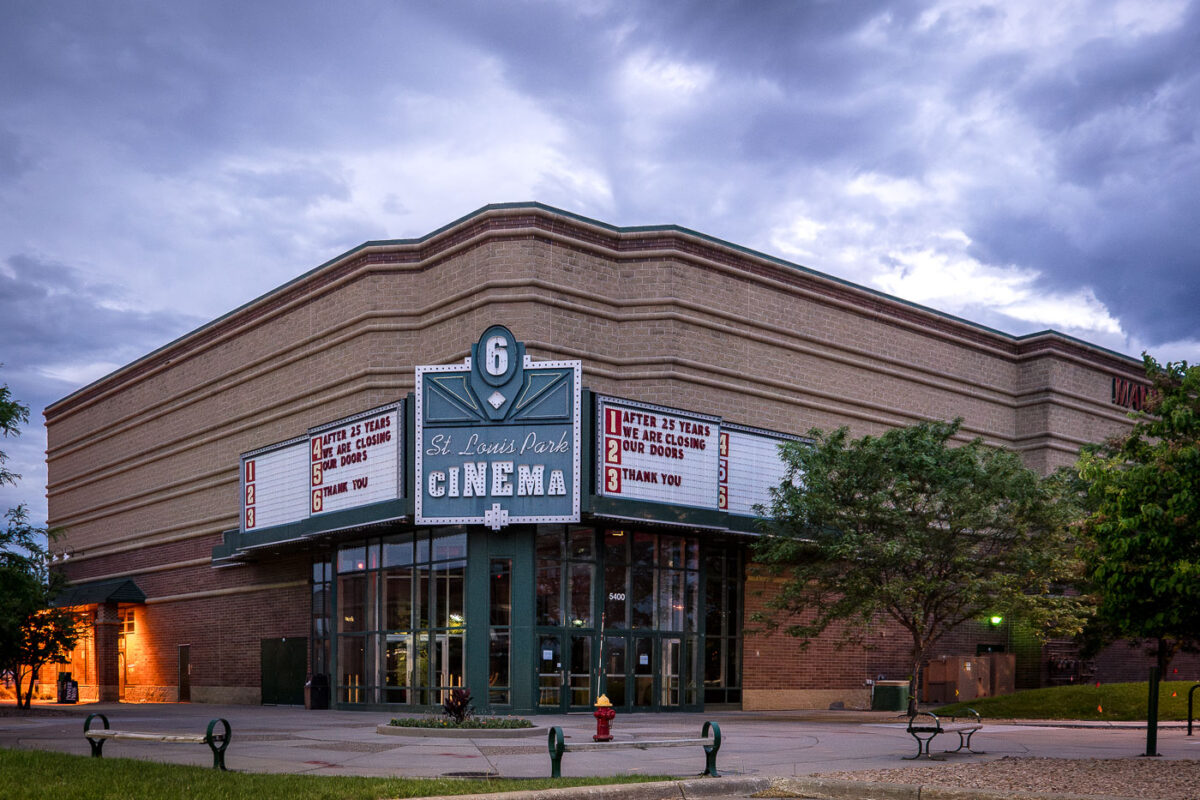
Closed in 2018 after 25 years, the Manns St. Louis Park Cinema.
General Mills Headquarters Sign, Golden Valley, Minnesota
May 2018
—
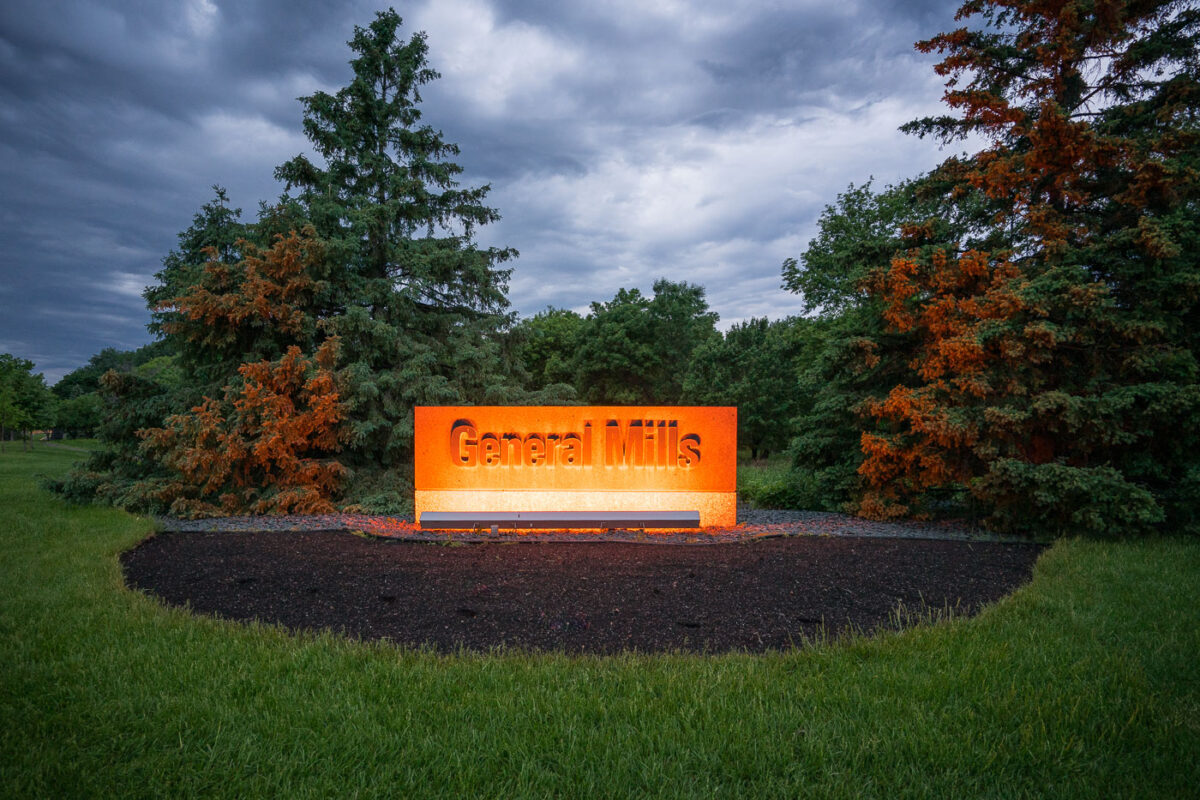
General Mills sign outside of their corporate headquarters in Golden Valley, Minnesota.
Aerial View of General Mills Corporate Campus, Golden Valley
May 2018
—
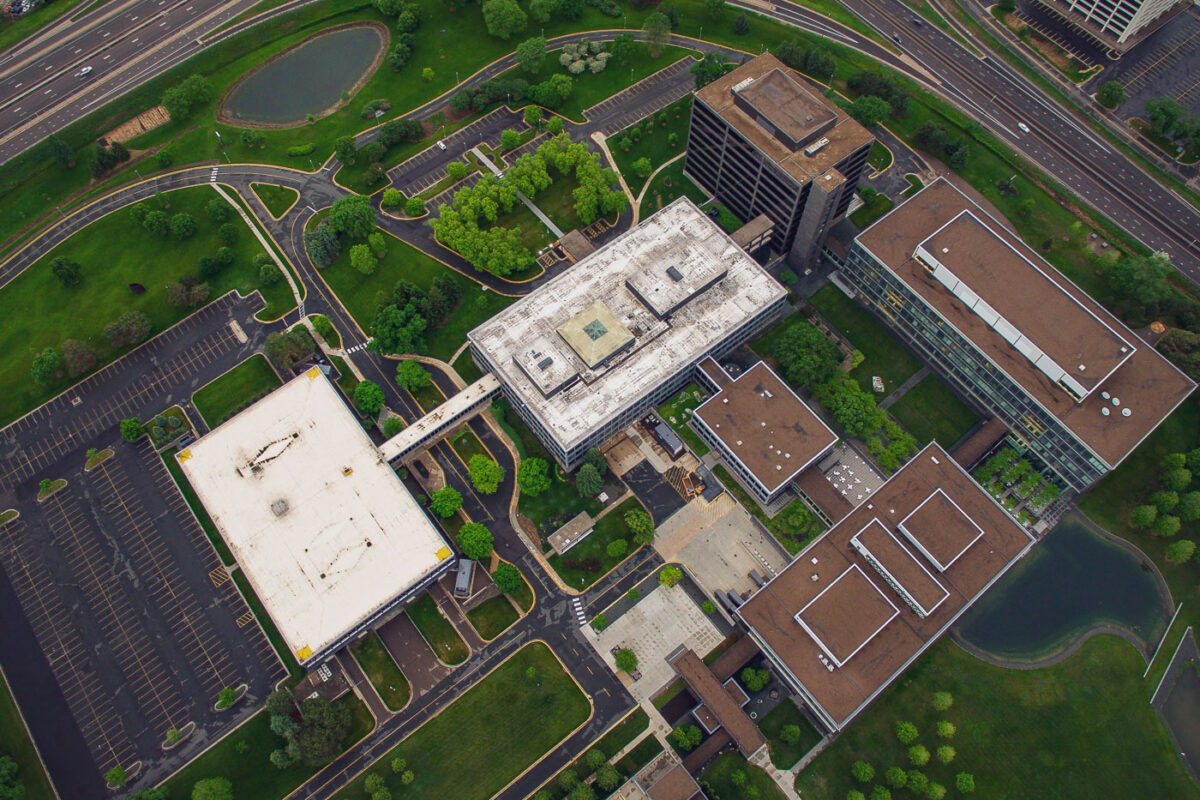
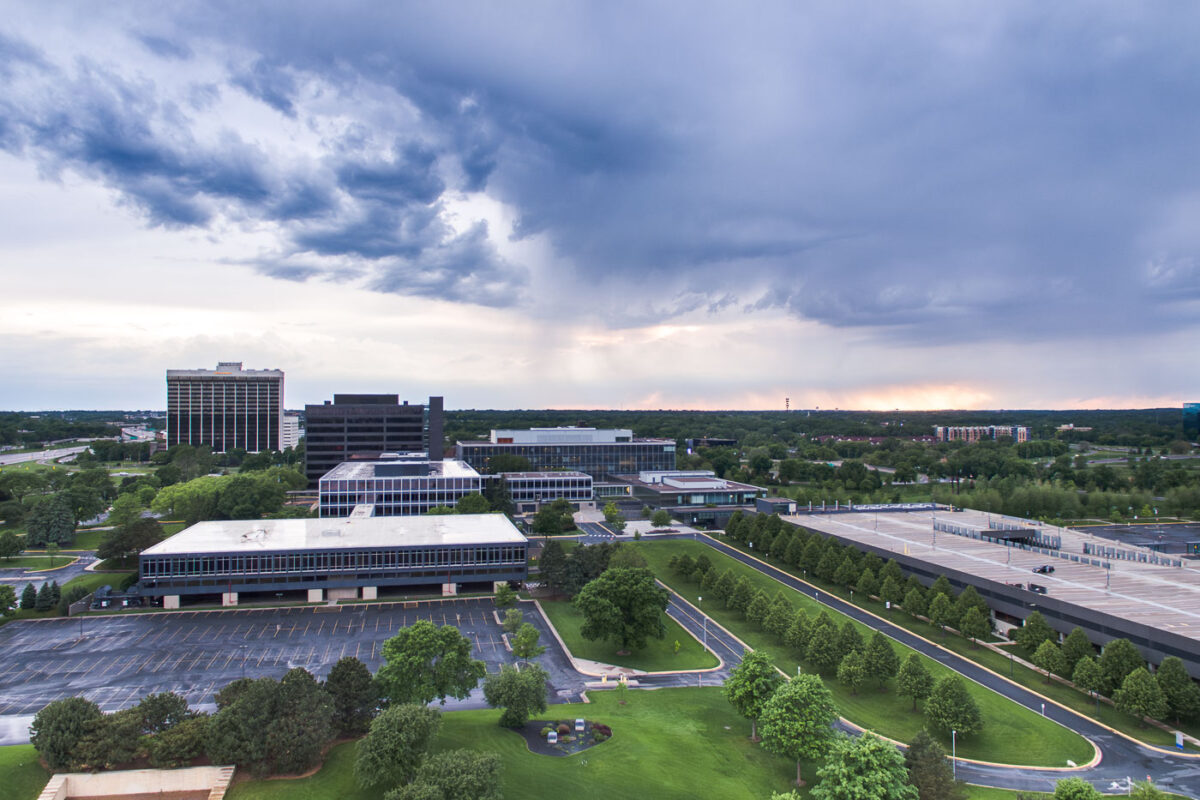
General Mills headquarters in Golden Valley, Minnesota.
General Mills Corporate Campus, Golden Valley, Minnesota
May 2018
—
General Mills World Headquarters just outside of Minneapolis.
General Mills Headquarters Sign, Plymouth, Minnesota
May 2018
—
General Mills sign at General Mills headquarters near Minneapolis.
Minneapolis Skyline and Mississippi River at Night
May 2018
—
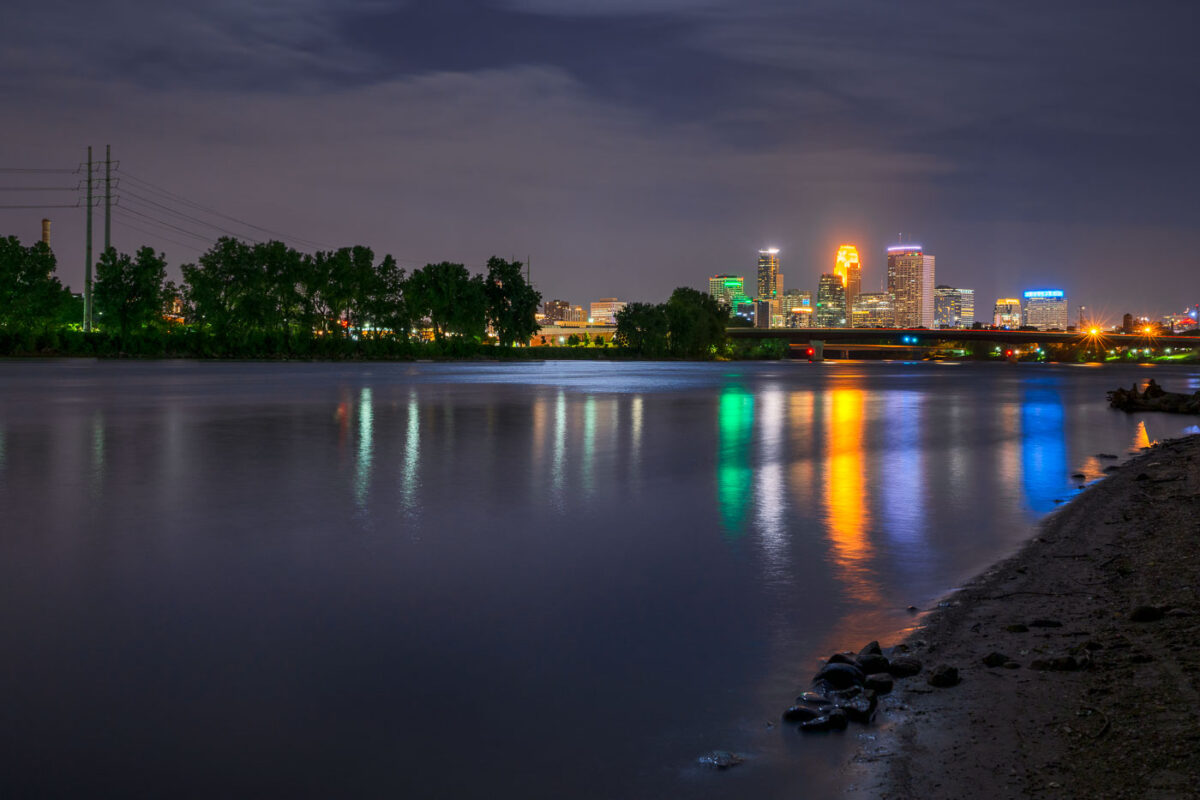
Downtown Minneapolis skyline as seen from the North on the Mississippi River.
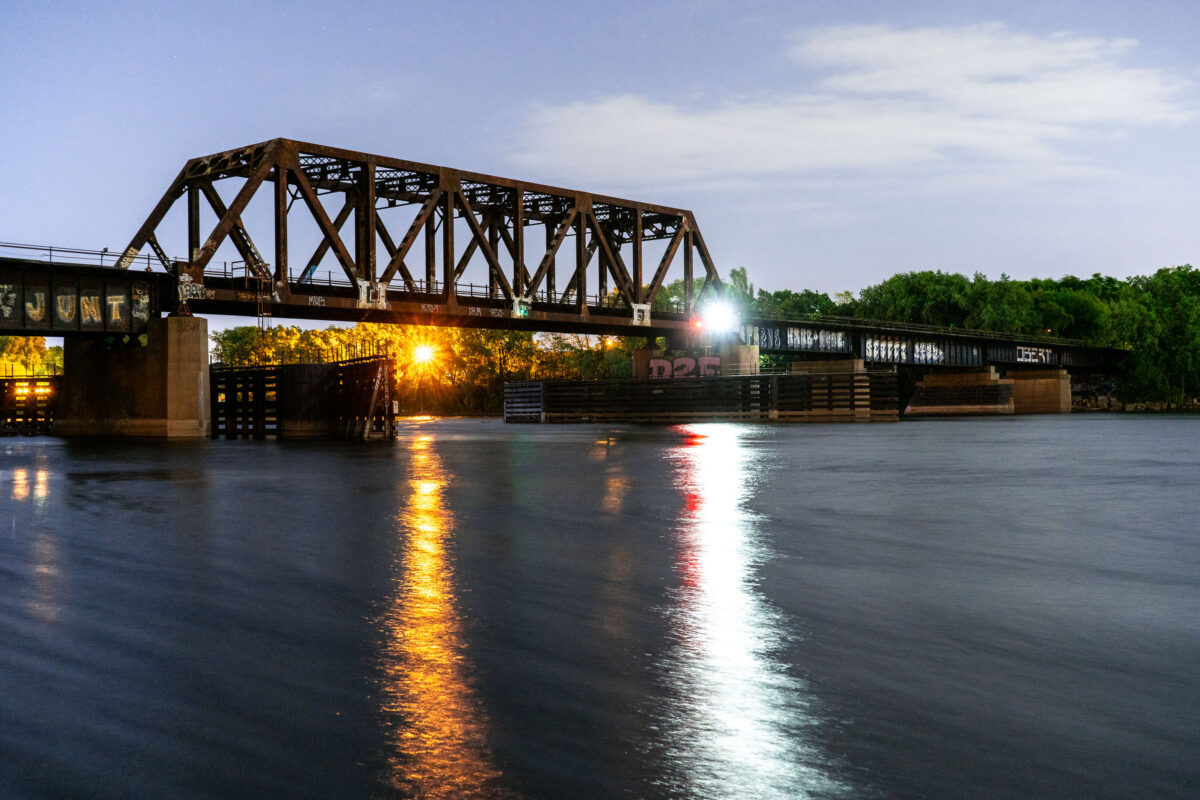
Northern Pacific BNSF Rail Bridge, Minneapolis
May 2018
—
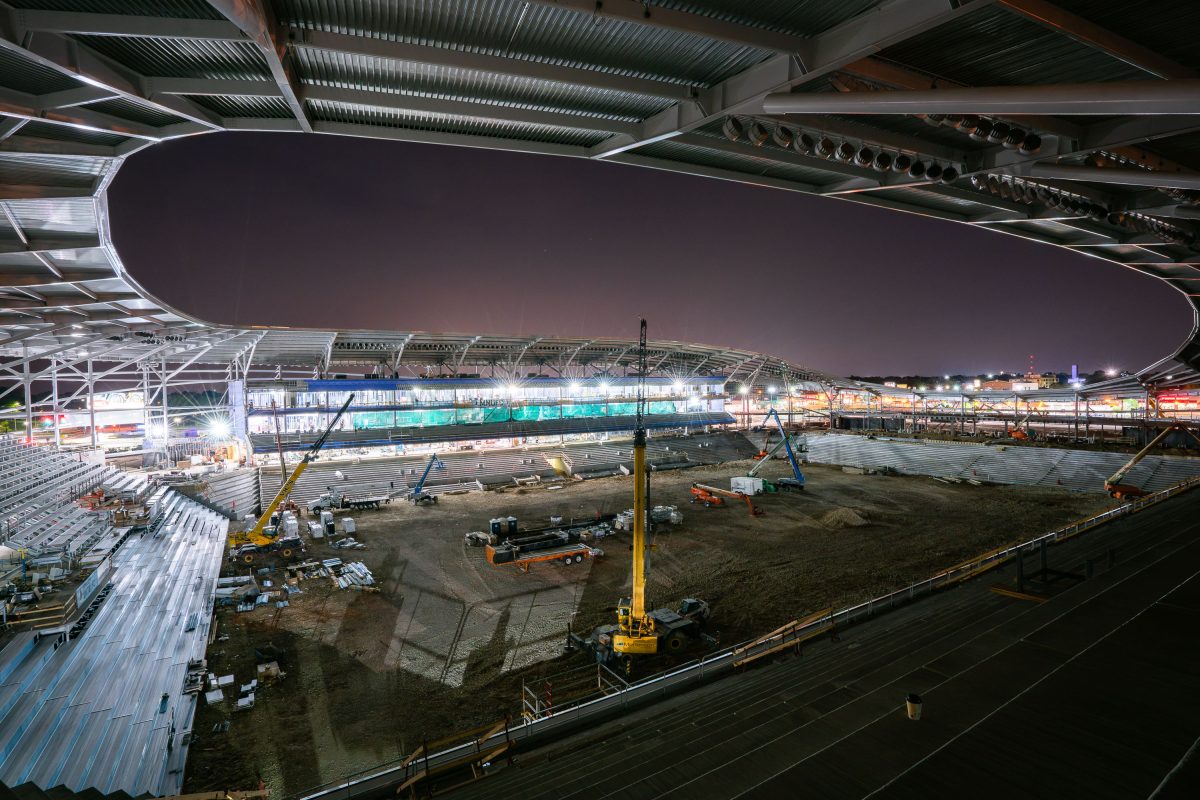
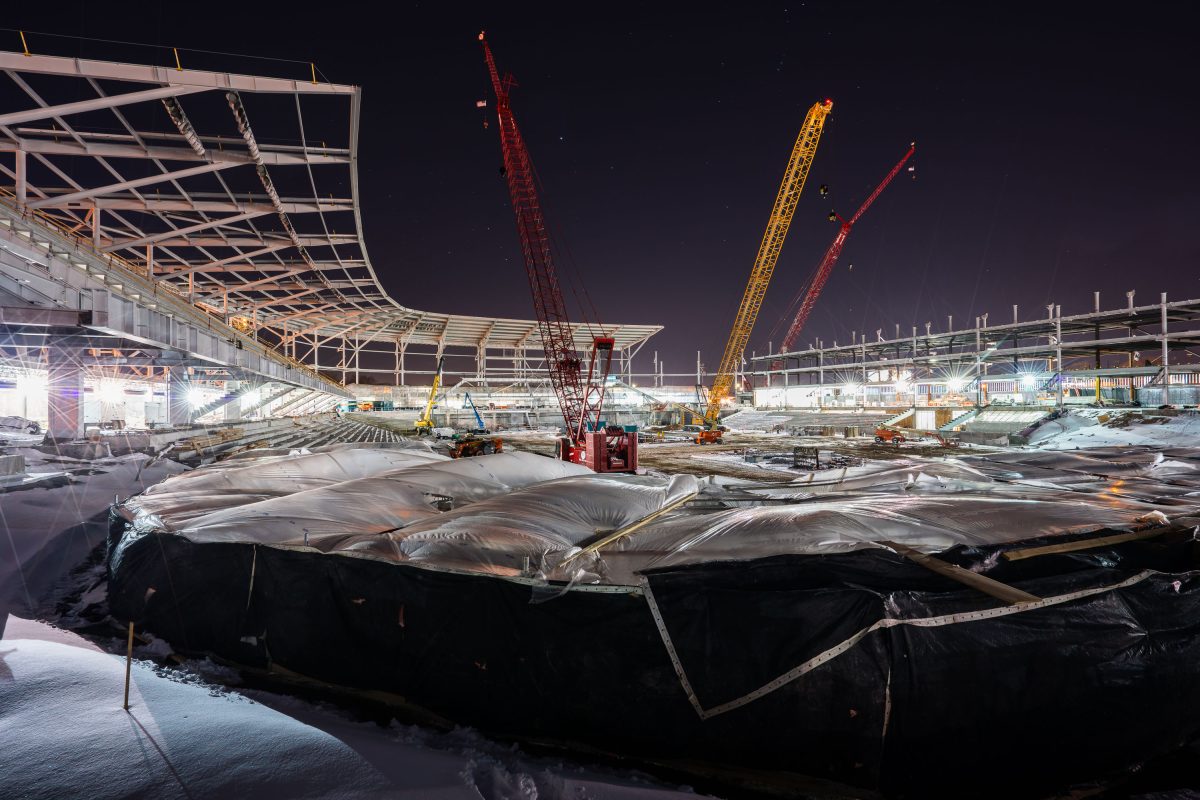
Field Excavation at Allianz Field Construction, St. Paul
May 2018
—
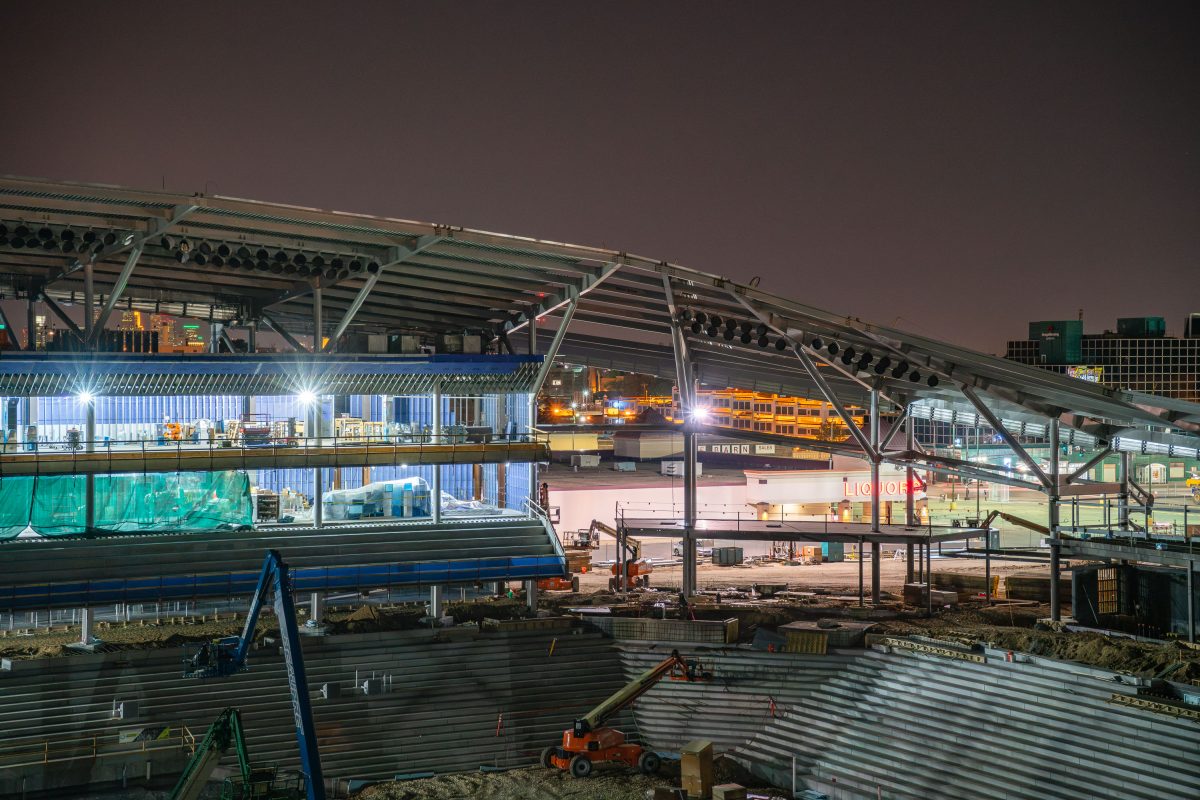
Night Construction Overlooking Snelling Avenue, Allianz Field, St. Paul
May 2018
—
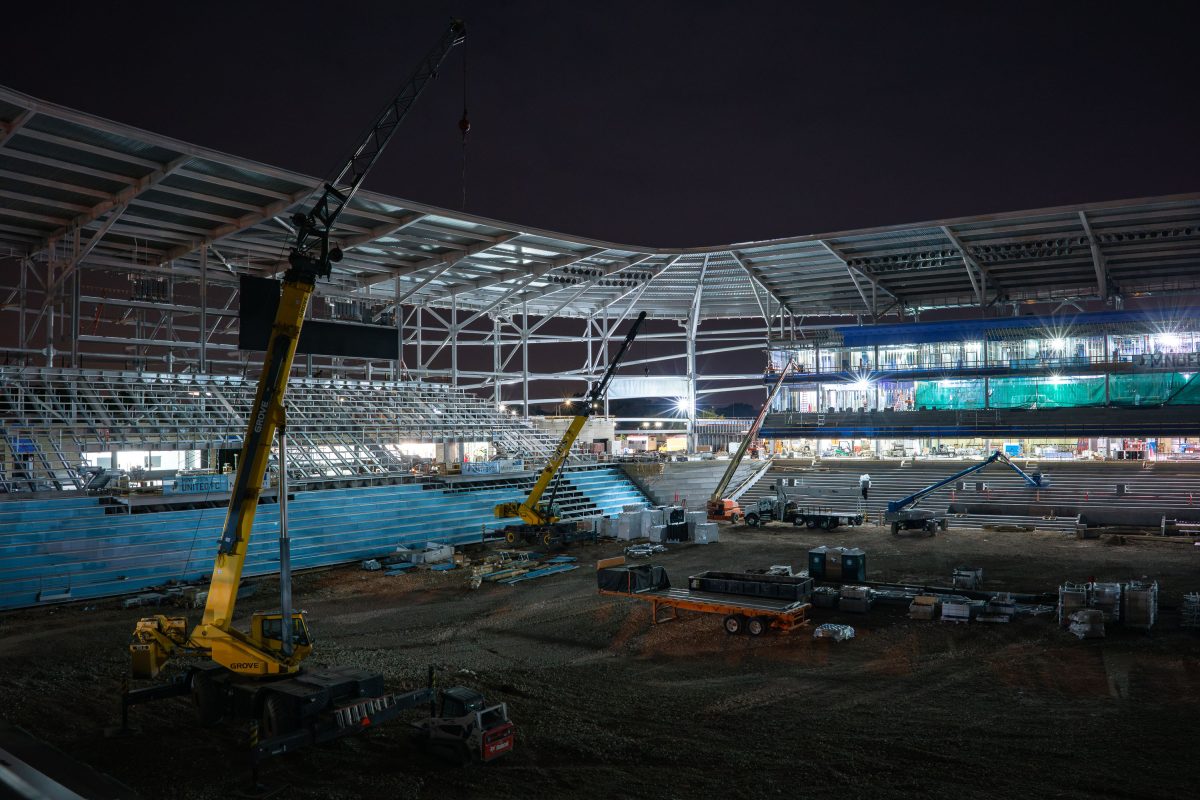
Boom Lifts Working Seating Bowl at Night, Allianz Field, St. Paul
May 2018
—
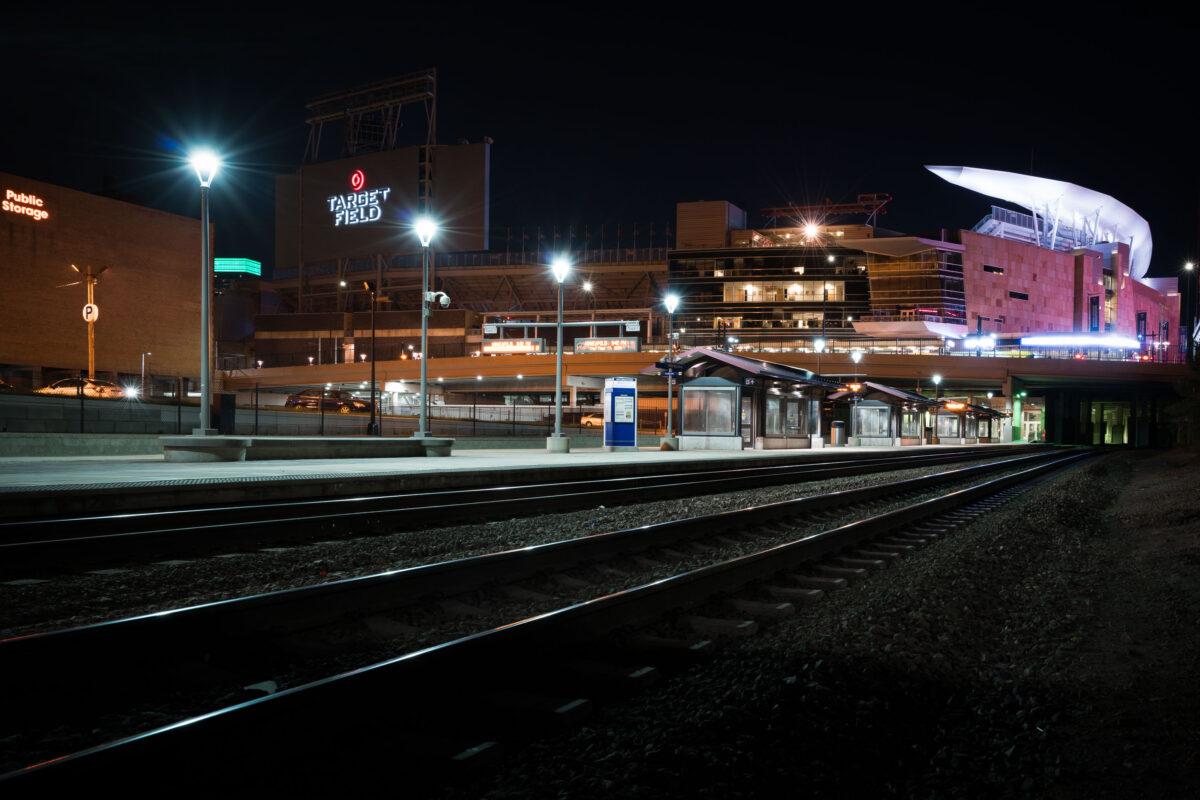
Target Field Station and Stadium, Minneapolis
May 2018
—
Target Field in Minneapolis. Homem of the Minnesota Twins.
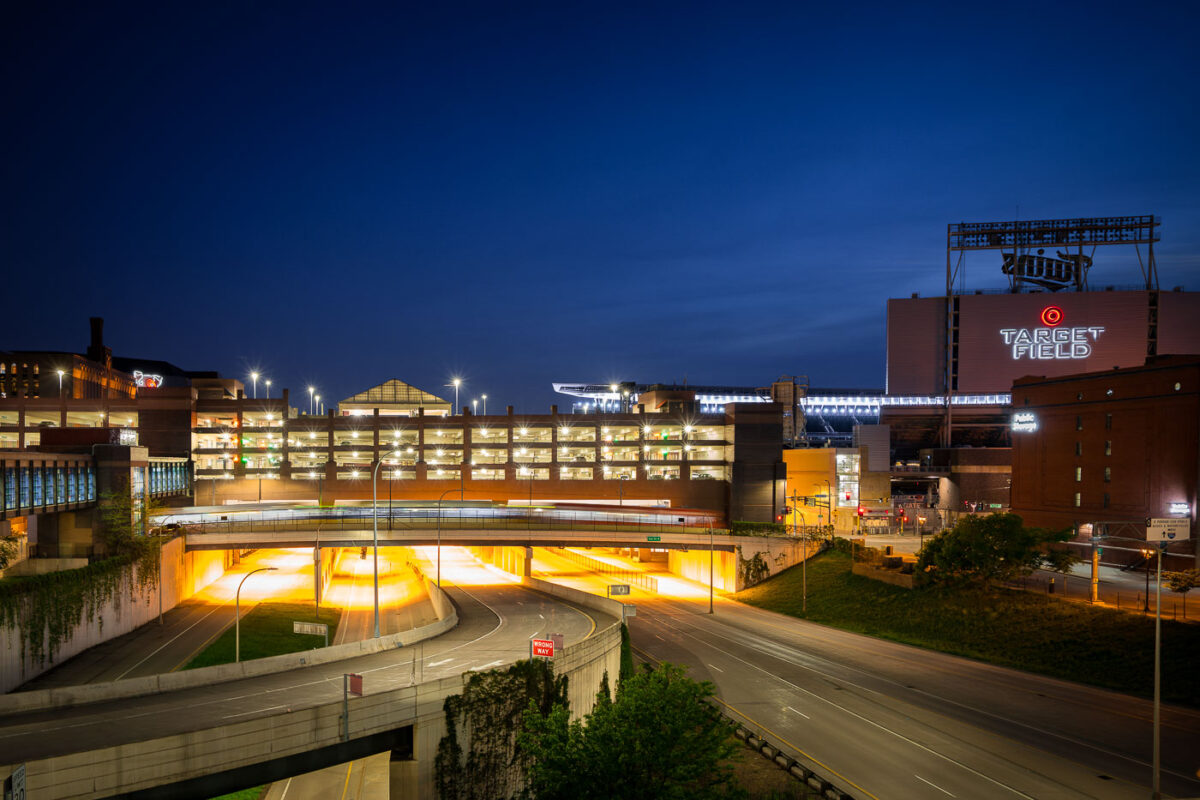
Target Field, Parking Ramp, I-394, Downtown Minneapolis Night
May 2018
—
Target Field, home of the Minnesota Twins, and Interstate 394 in Downtown Minneapolis.
Lowry Hill Tunnel, Minneapolis: Interior View at Night
May 2018
—
Lowry Hill Tunnel in downtown Minneapolis.
Minnesota Marsh with Algae Bloom and Deadwood
May 2018
—
Minnesota Marsh
Telmex Pay Phone, Mexico City
May 2018
—
A Telmex pay phone found in Mexico City.
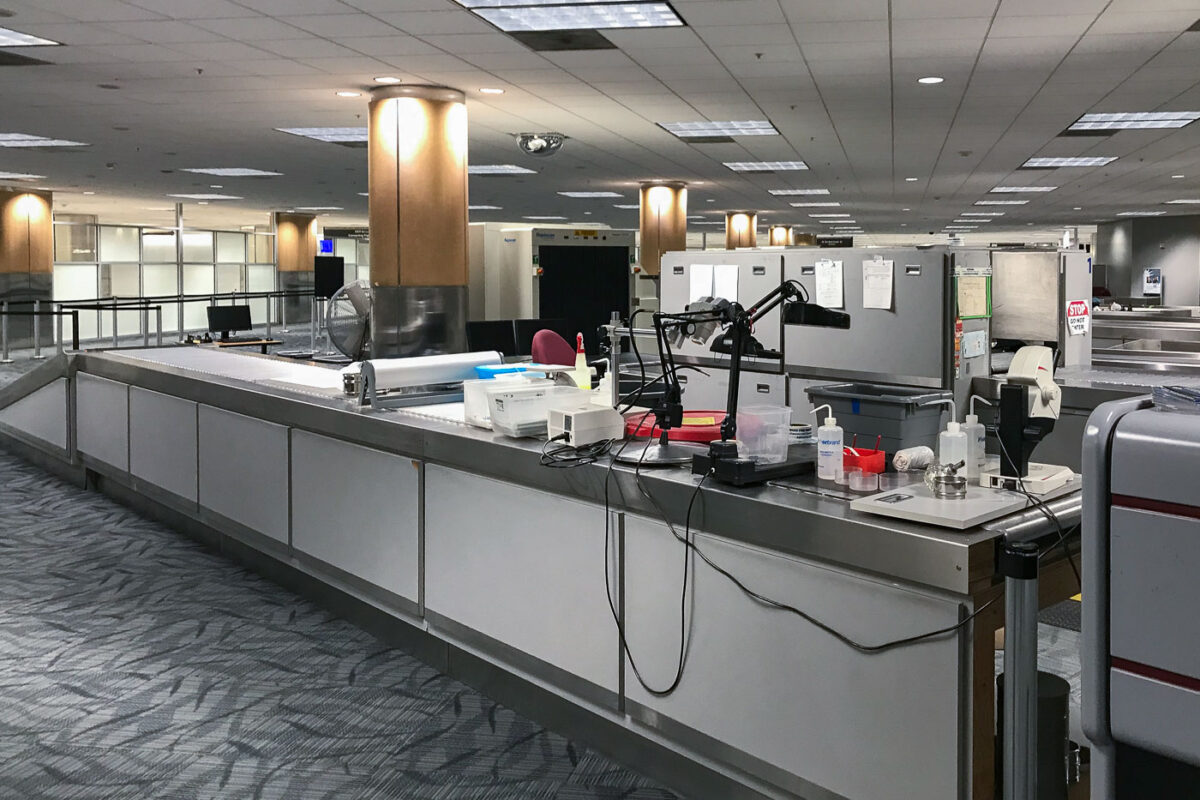
TSA Secondary Screening Area at Hartsfield-Jackson Atlanta Airport
May 2018
—
Secondary TSA screening at Hartsfield-Jackson Atlanta International Airport.
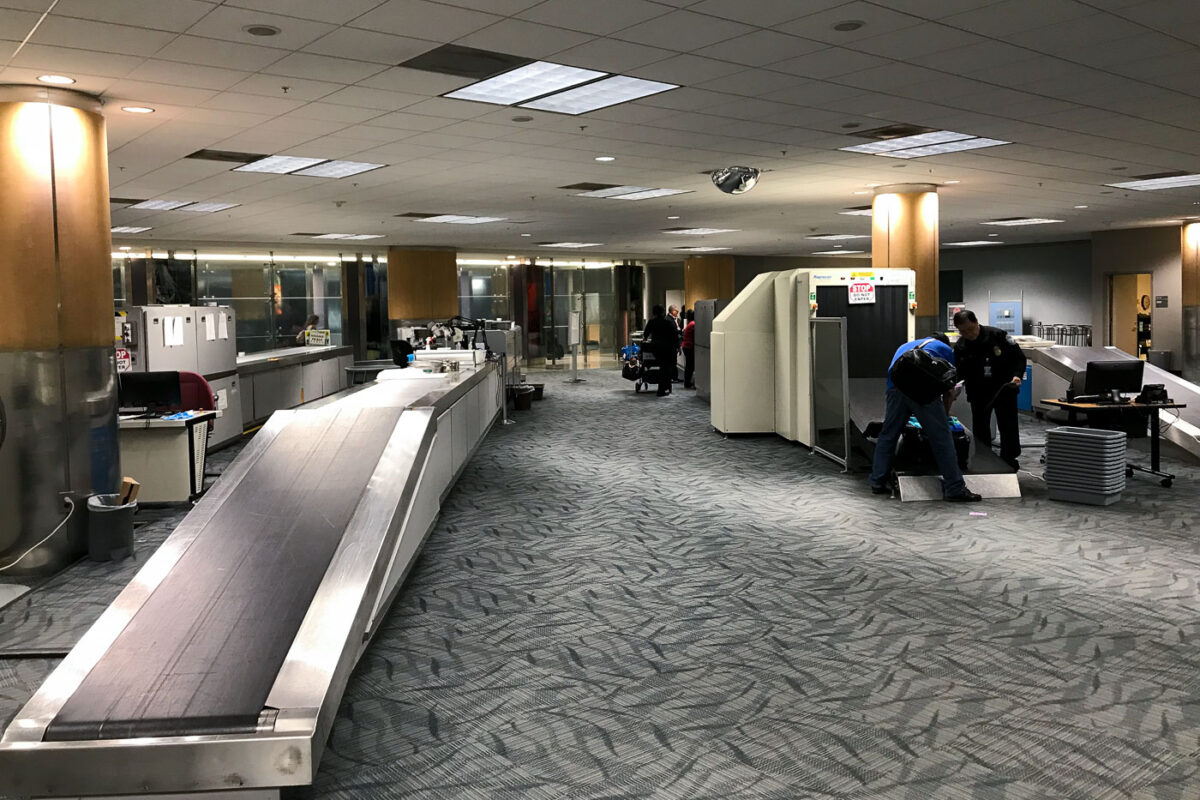
TSA Secondary Screening, Hartsfield-Jackson Atlanta International Airport
May 2018
—
Secondary TSA screening at Hartsfield-Jackson Atlanta International Airport.
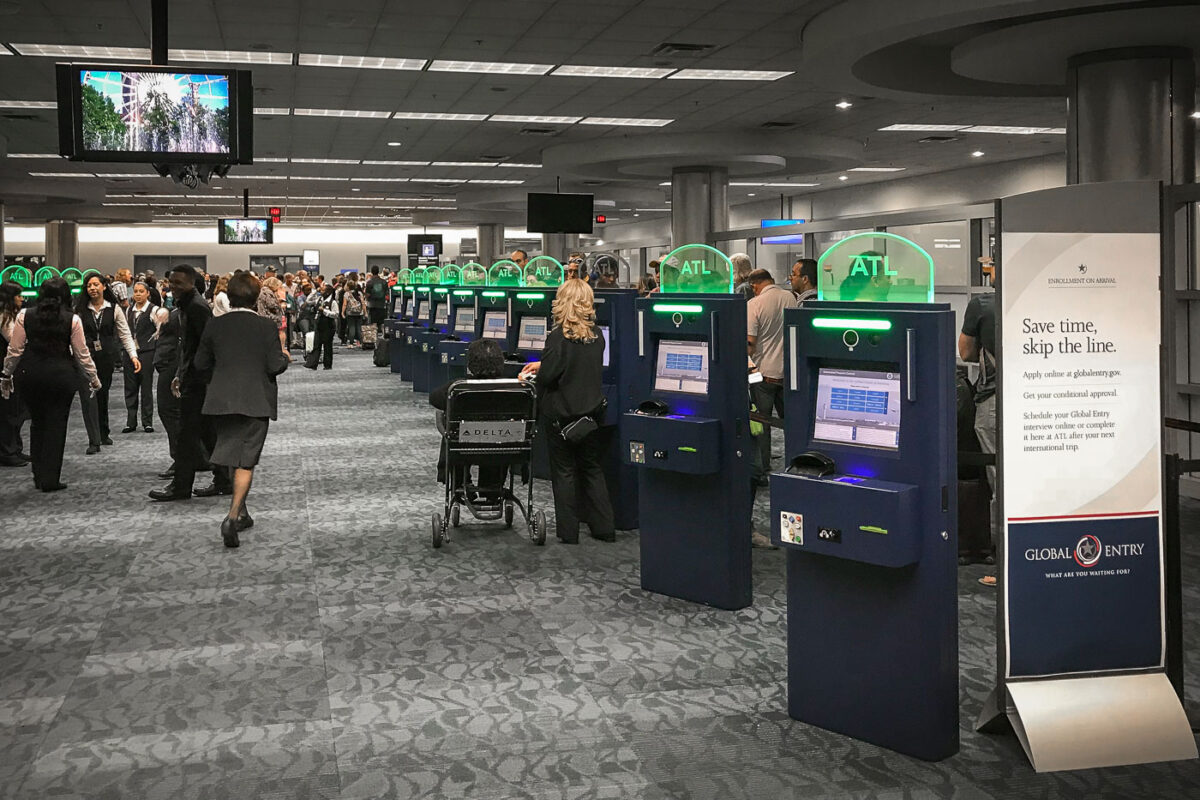
Global Entry Kiosks at Hartsfield-Jackson Atlanta International Airport
May 2018
—
Autoamted Passport Control (APC) at the Atlanta International Airport (ATL).
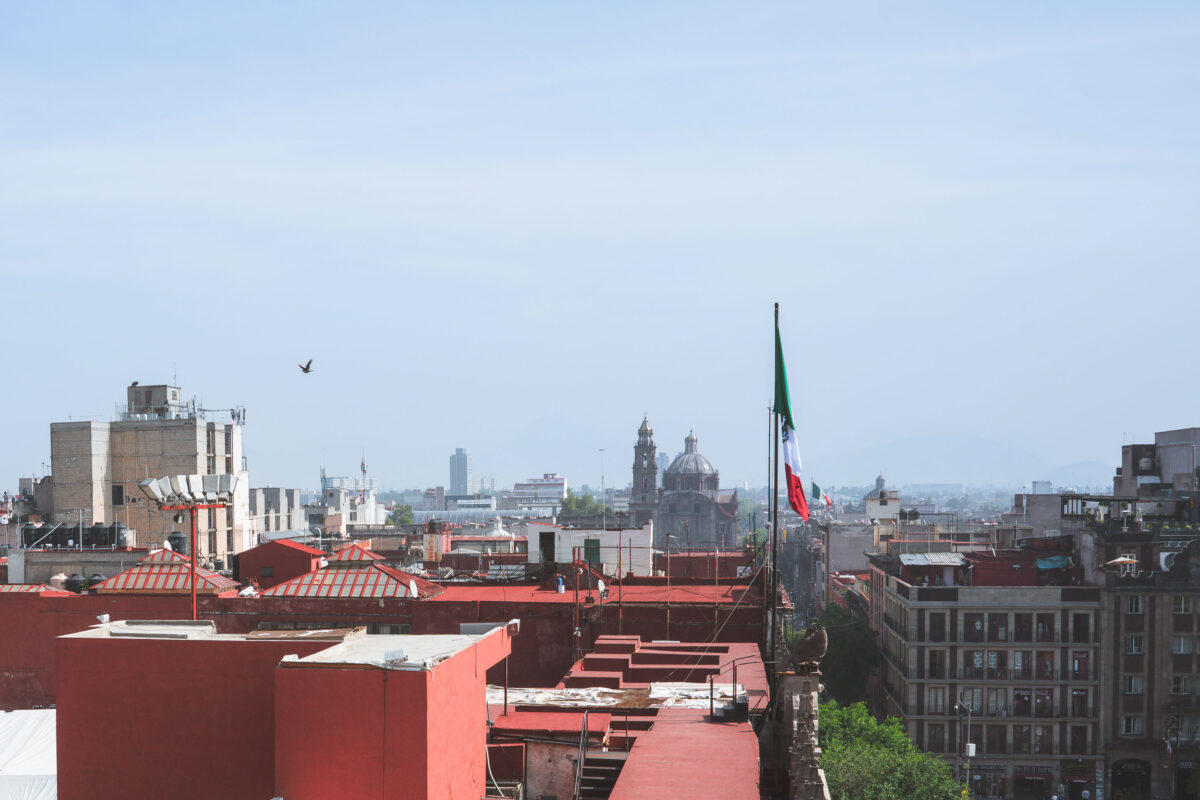
Mexico City Rooftops Near Zocalo with Mexican Flag
May 2018
—
View over the rooftops of central Mexico City, where a large Mexican flag is raised above the buildings near the Zócalo. In the distance, church domes and towers rise over the historic district, with modern high-rises visible further out along the skyline.
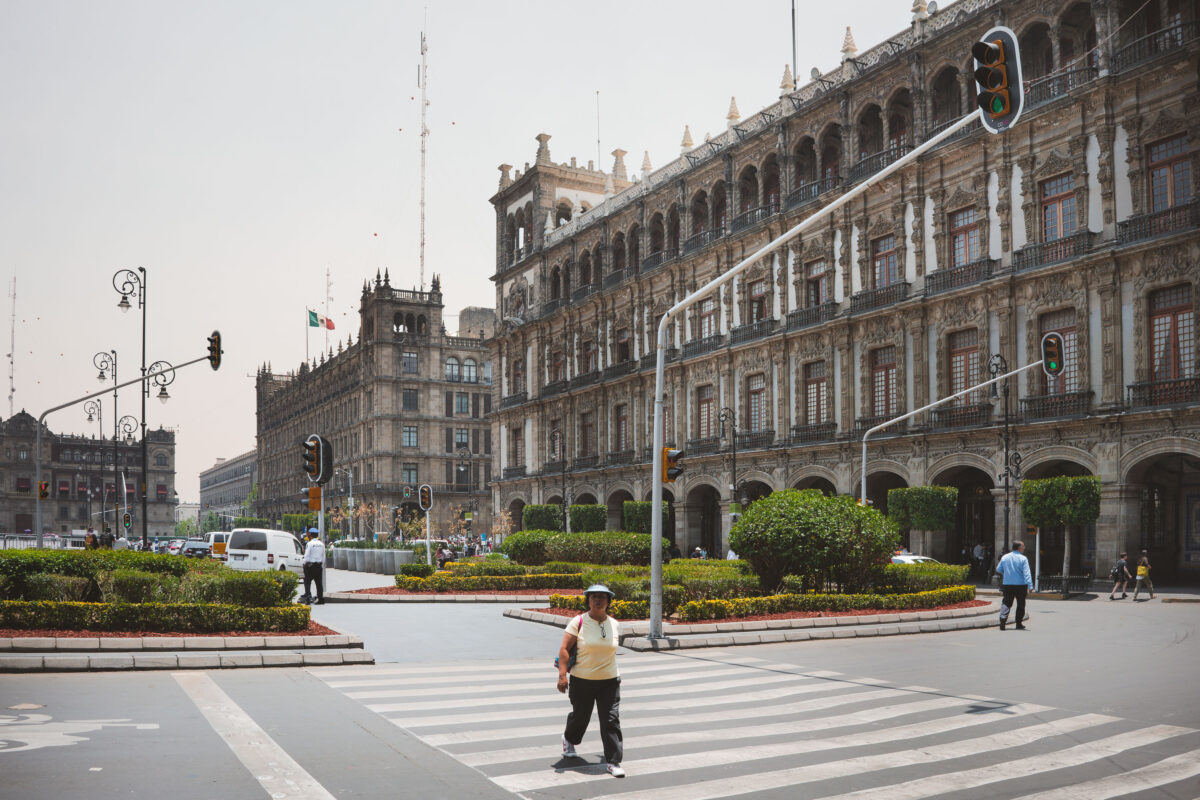
Palacio Nacional at the Zócalo, Mexico City
May 2018
—
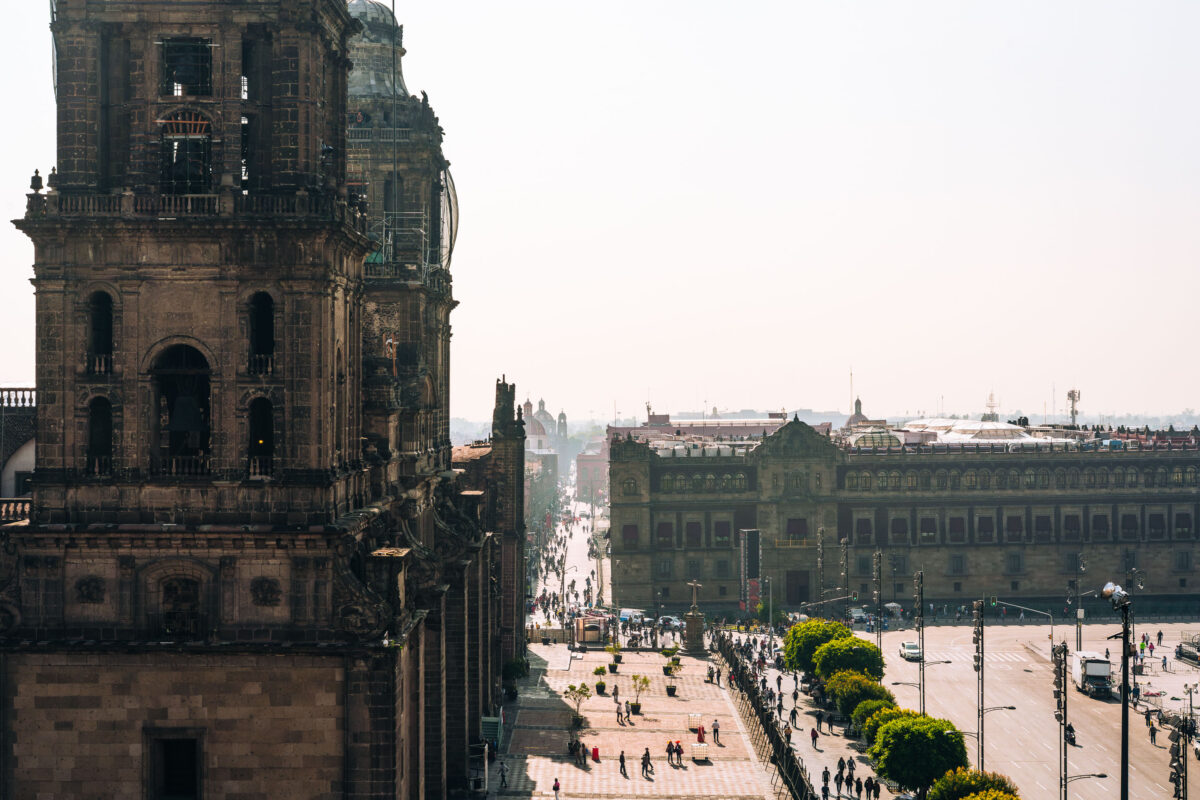
Pedestrians cross a street at Mexico City’s Zócalo, with the ornate colonial-era Government Palace and other historic administrative buildings lining the square. The Mexican flag is visible flying above the rooftops, while traffic lights and landscaped roundabouts frame the busy intersection.
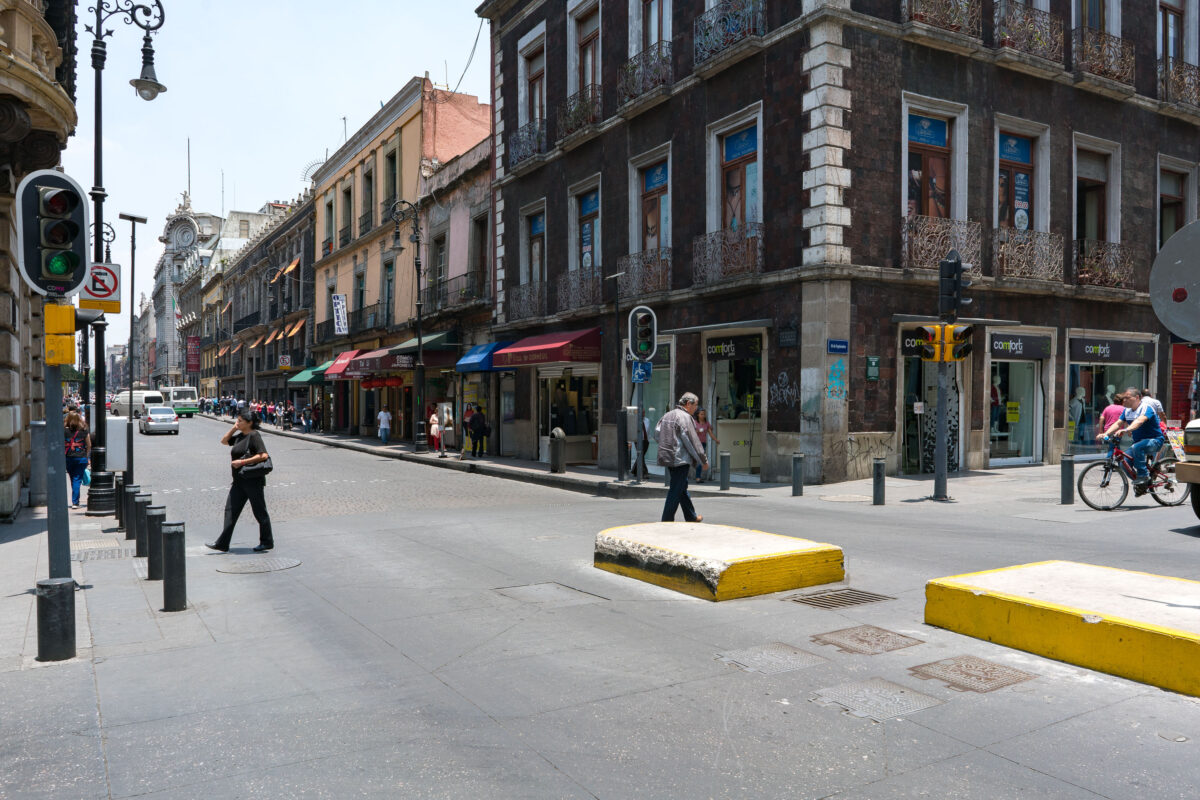
Calle 5 de Febrero and Calle República de Uruguay, Mexico City
May 2018
—
Intersection in Mexico City’s historic center with pedestrians crossing and cyclists moving along the street. Colonial-era buildings with balconies line the block, housing shops at street level. A bus and several storefronts with awnings are visible further down the road.
Hotel on Calle República de Uruguay, Mexico City
May 2018
—
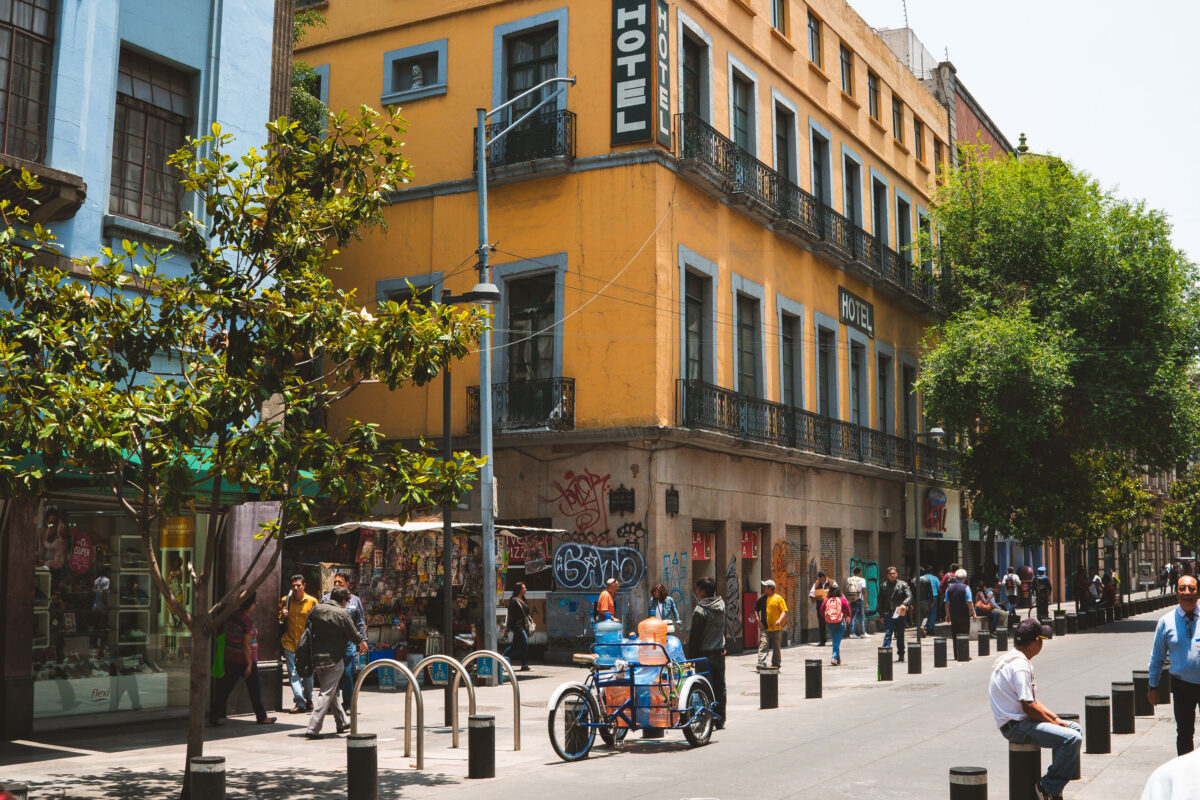
A street in Mexico City’s historic center with pedestrians walking past shops and vendors. A bright yellow hotel building with blue trim stands on the corner, while a tricycle cart carrying large water jugs moves through the scene. Trees line the walkway, and people gather along the shaded sidewalks.
Mexico City Rooftops with Torre Latinoamericana
May 2018
—
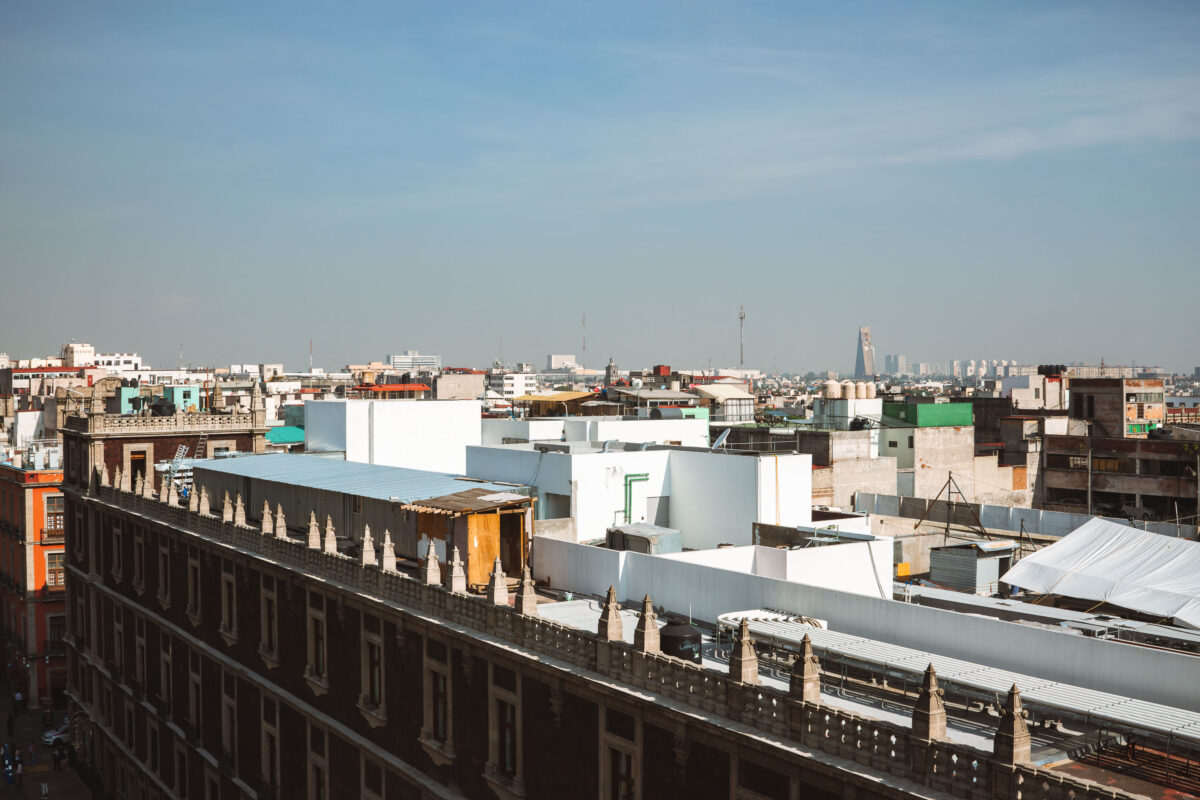
Rooftops of Mexico City’s historic center fill the foreground, with flat structures, water tanks, and makeshift additions visible across the skyline. Toward the horizon, modern high-rise buildings such as Torre Latinoamericana and Torre Reforma rise above the urban sprawl, contrasting with the older low-rise construction of the central district.
Francisco I. Madero Avenue from the Metropolitan Cathedral
May 2018
—
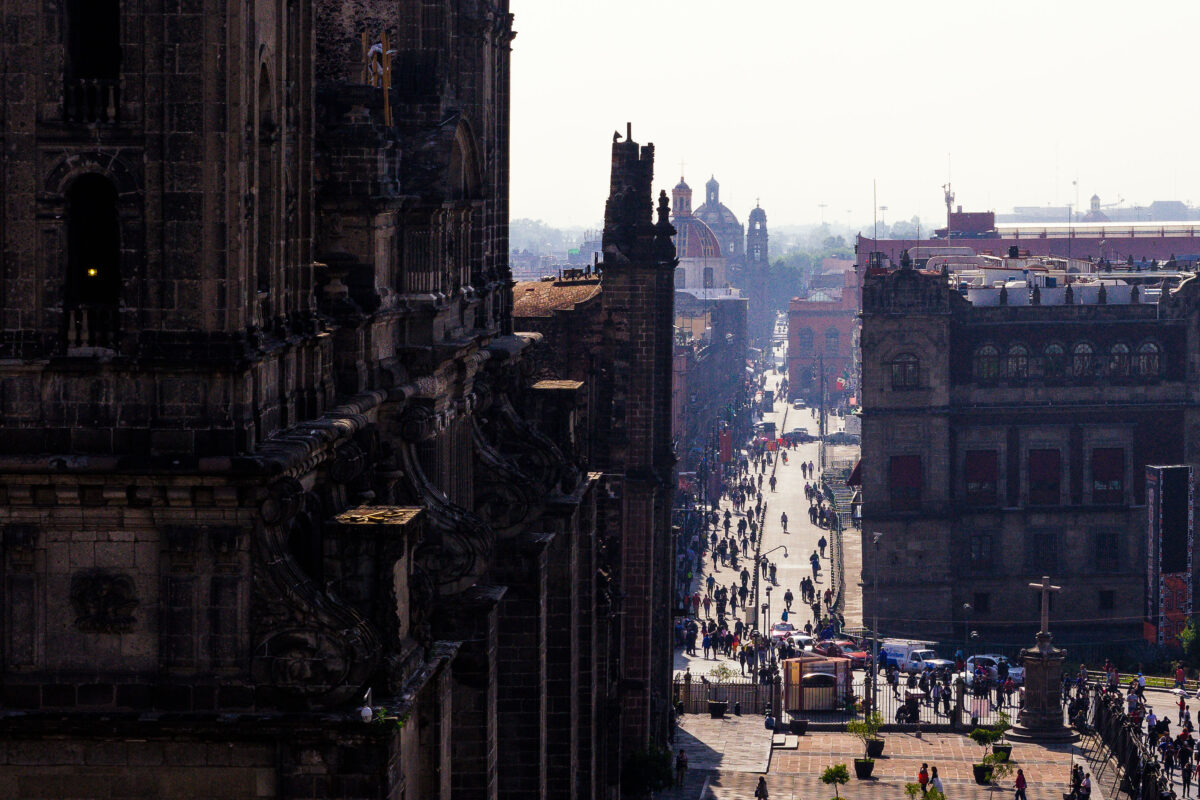
A busy street scene in Mexico City’s historic center, viewed from the steps of the Metropolitan Cathedral. Pedestrians fill the avenue leading eastward, lined with colonial-era buildings. In the background, the domes and towers of additional churches rise above the rooftops, marking the dense architectural landscape of the city’s downtown.
Metropolitan Cathedral, Mexico City Zócalo
May 2018
—
Nevado de Toluca, Central Mexico
May 2018
—
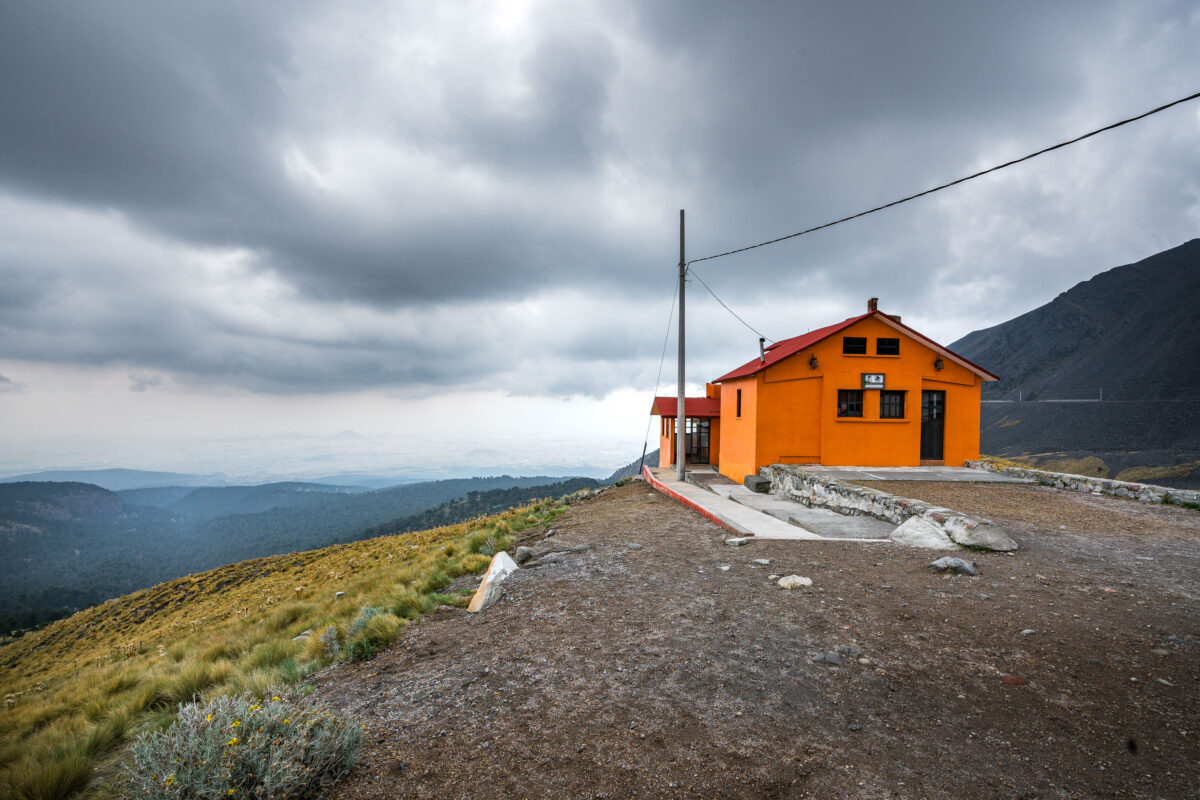
Nevado de Toluca mountain refuge, Mexico
May 2018
—
Mexico City Metro Line 1 train by Viaducto
May 2018
—
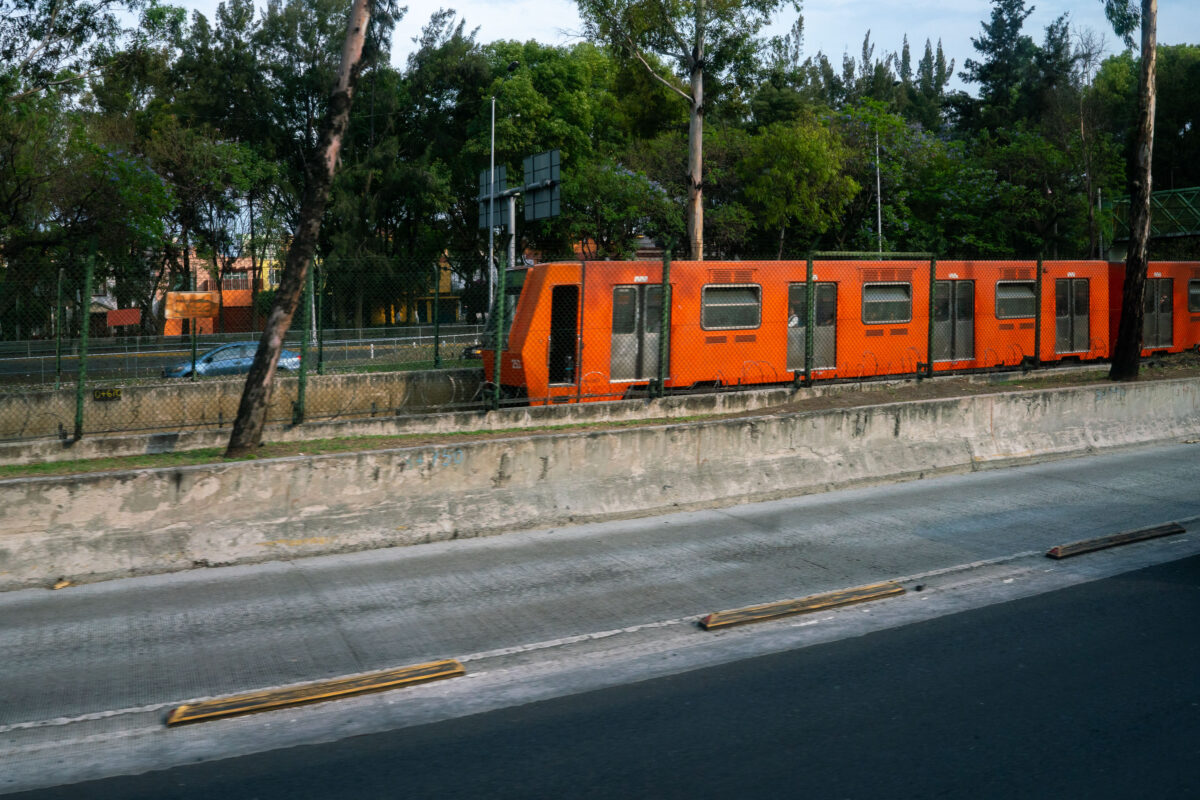
A bright orange Mexico City Metro train runs alongside the Viaducto highway, partially framed by trees and fencing that separate it from the busy traffic corridor. The train’s distinctive color has become a visual emblem of the city’s vast and aging transit network, originally launched in 1969. These rubber-tired trains serve millions of riders daily, threading through tunnels and elevated sections across the capital. Here, the contrast between greenery, concrete, and the orange carriages underscores the Metro’s integration into the urban landscape—an ever-moving artery of one of the world’s largest cities.
Mexico City Hotel Lobby with Celestial Mural
April 2018
—
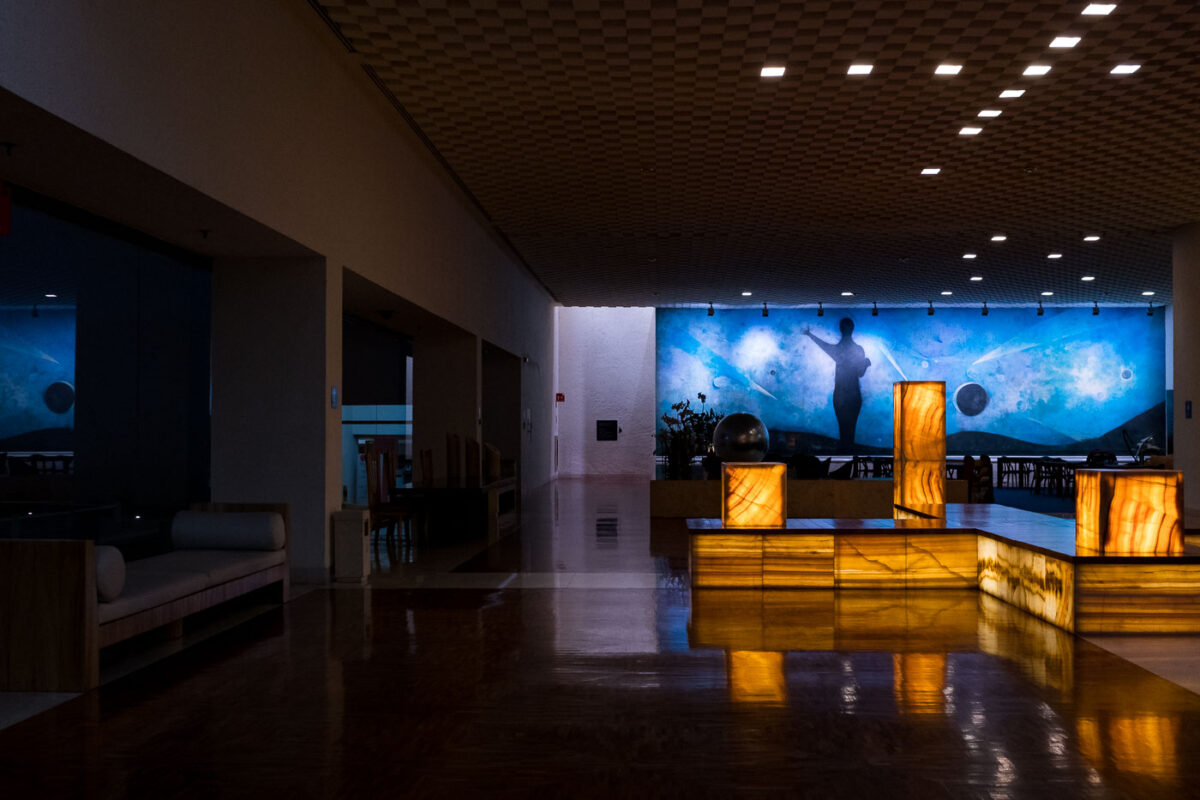
Inside a Mexico City hotel, warm amber lights from onyx columns reflect across a polished marble floor, creating a calm, cinematic glow. At the far end, a mural in rich blues depicts a silhouetted figure surrounded by celestial forms—part of the city’s long tradition of integrating public art into architectural spaces. The interior design blends modernist geometry with soft natural materials, emphasizing both luxury and restraint. Subtle symmetry, clean lines, and the interplay between shadow and illumination give the space a quiet sense of sophistication common in the capital’s mid-to-high-end hotels.
Motorcyclist by Fuente de los Buhos, Mexico City
April 2018
—
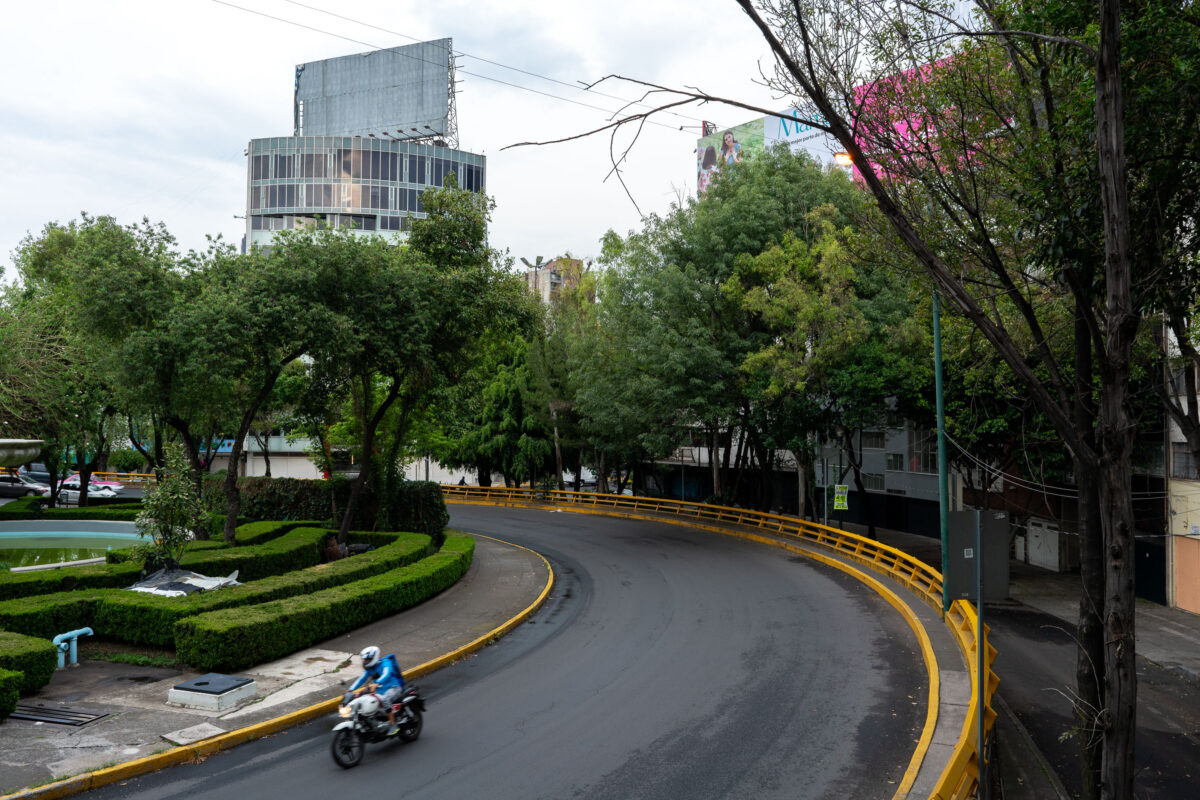
Someone driving a motorcycle around Fuente de los Buhos.
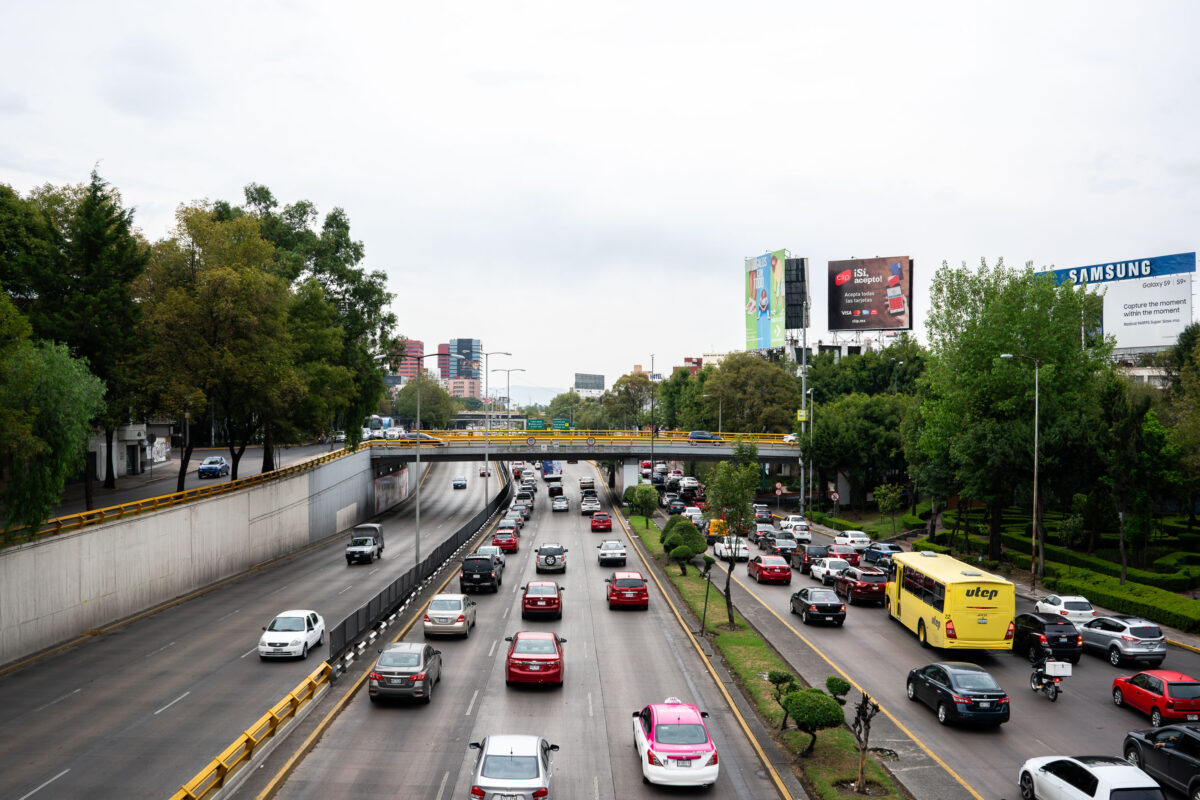
Circuito Interior Melchor Ocampo Traffic, Mexico City
April 2018
—
Cto. Interior Melchor Ocampo, Mexico City
Avenida Paseo de la Reforma, Mexico City
April 2018
—
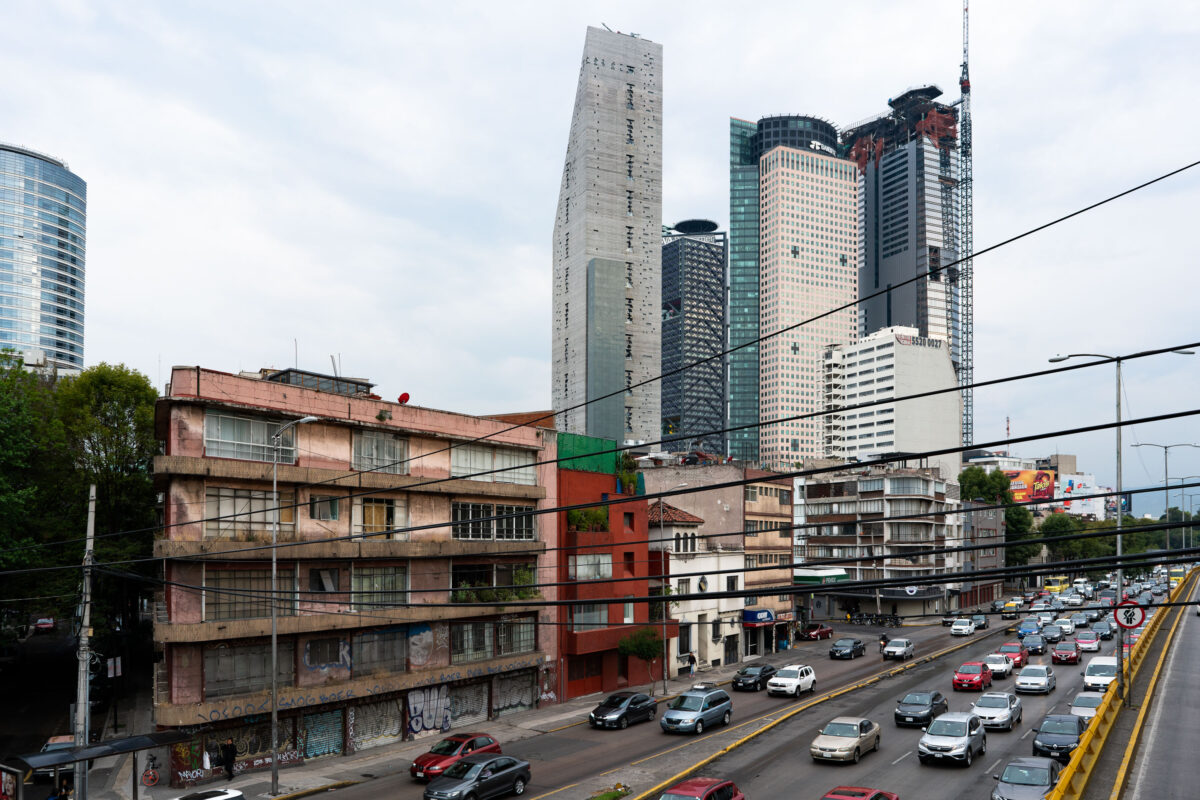
The dense vertical rhythm of Avenida Reforma captures Mexico City’s layered identity — a metropolis balancing past and future. In the foreground, aging residential blocks bear graffiti and sun-faded paint, symbols of mid-century urban life. Rising behind them are the glass and concrete spires of the city’s new financial core, including Torre Reforma, Torre BBVA, and Torre Mayor, among the tallest buildings in Latin America. The contrast is striking: the utilitarian decay of the 20th century meets the engineered ambition of the 21st. Beneath it all, traffic surges westward toward Chapultepec, reflecting the restless motion of a city forever under construction.
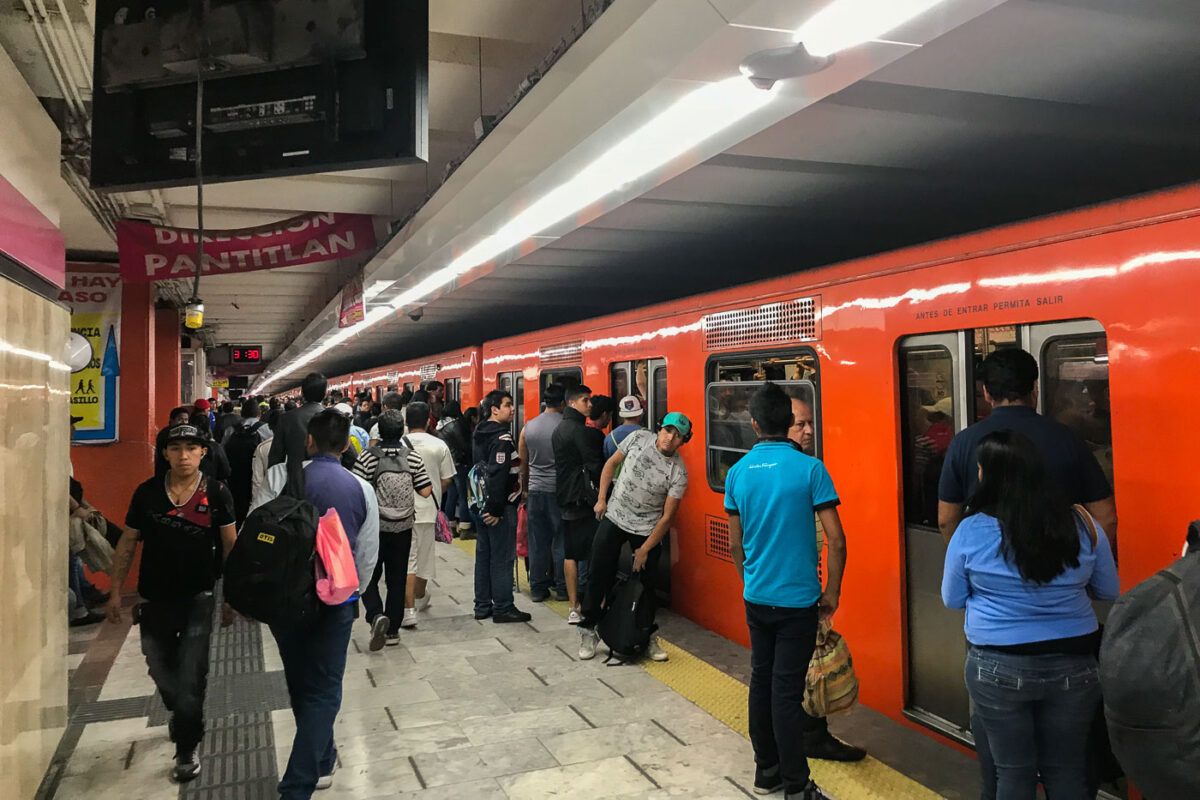
Mexico City Metro: Pantitlan Station Platform
April 2018
—
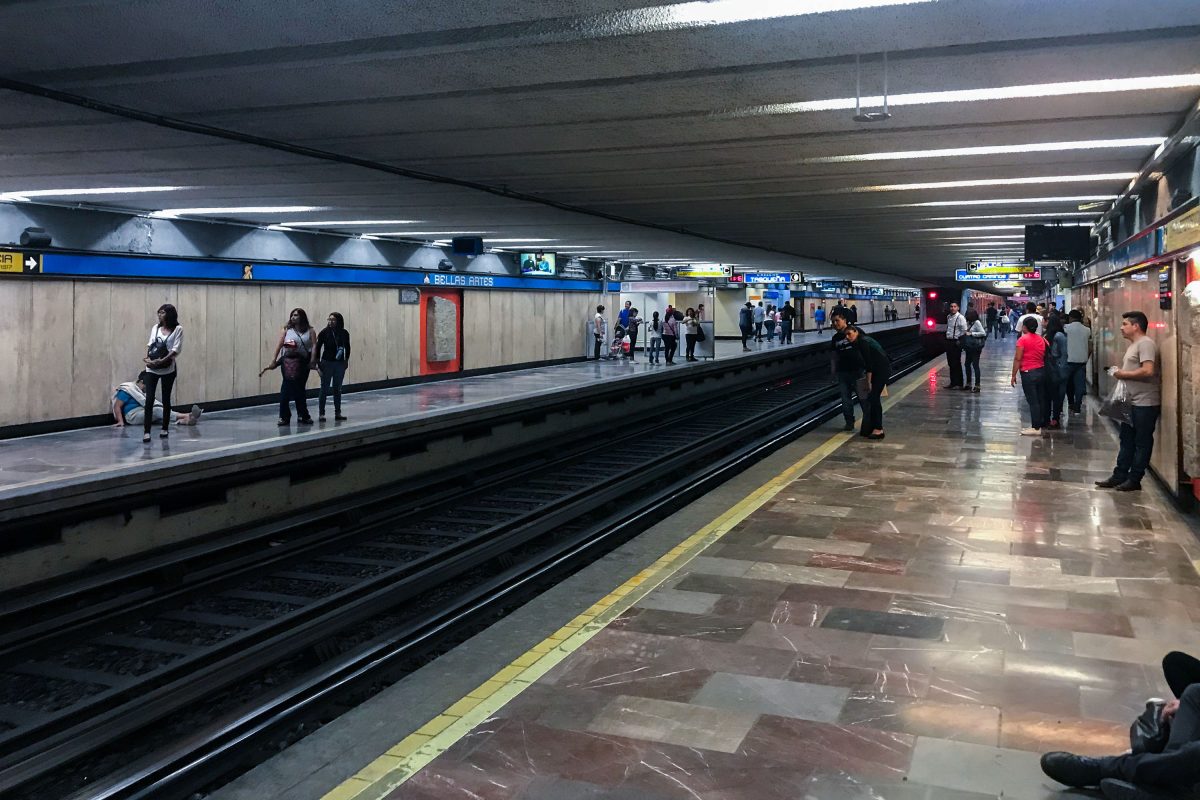
Bellas Artes Metro Station, Mexico City
April 2018
—
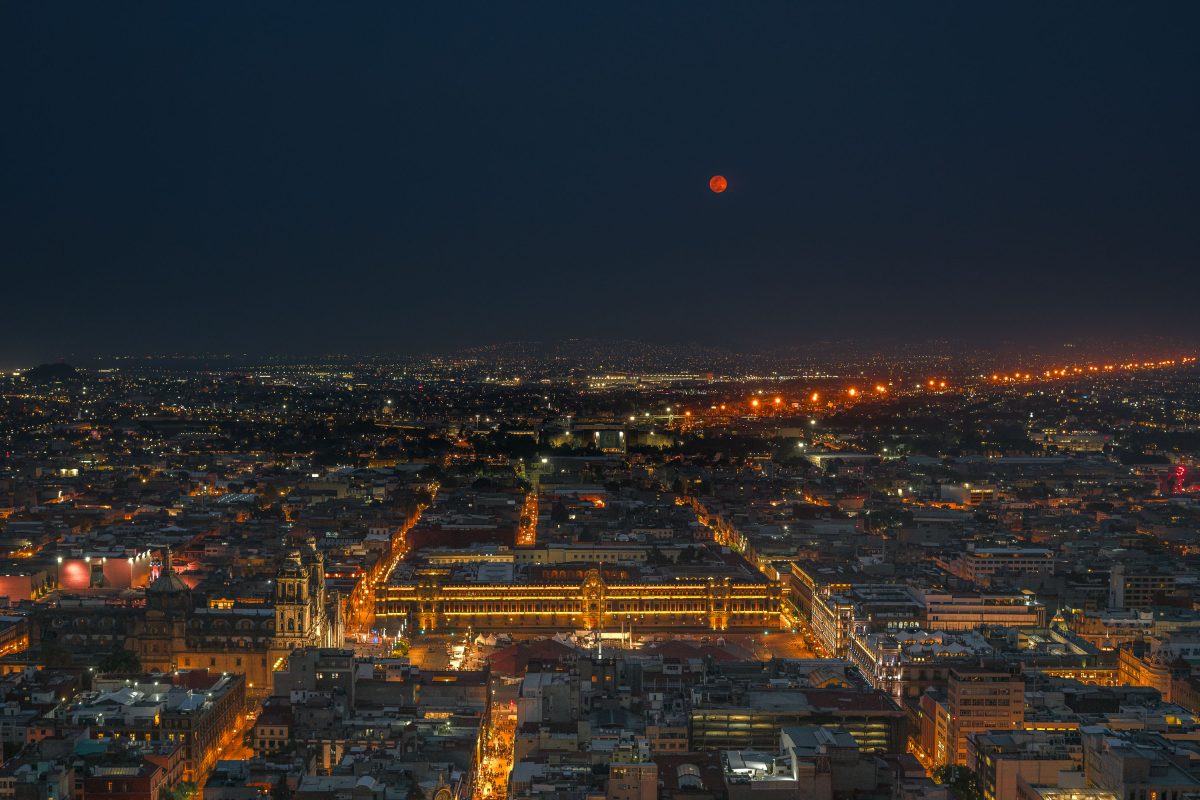
Blood Moon Rising Above Plaza de la Constitución
April 2018
—
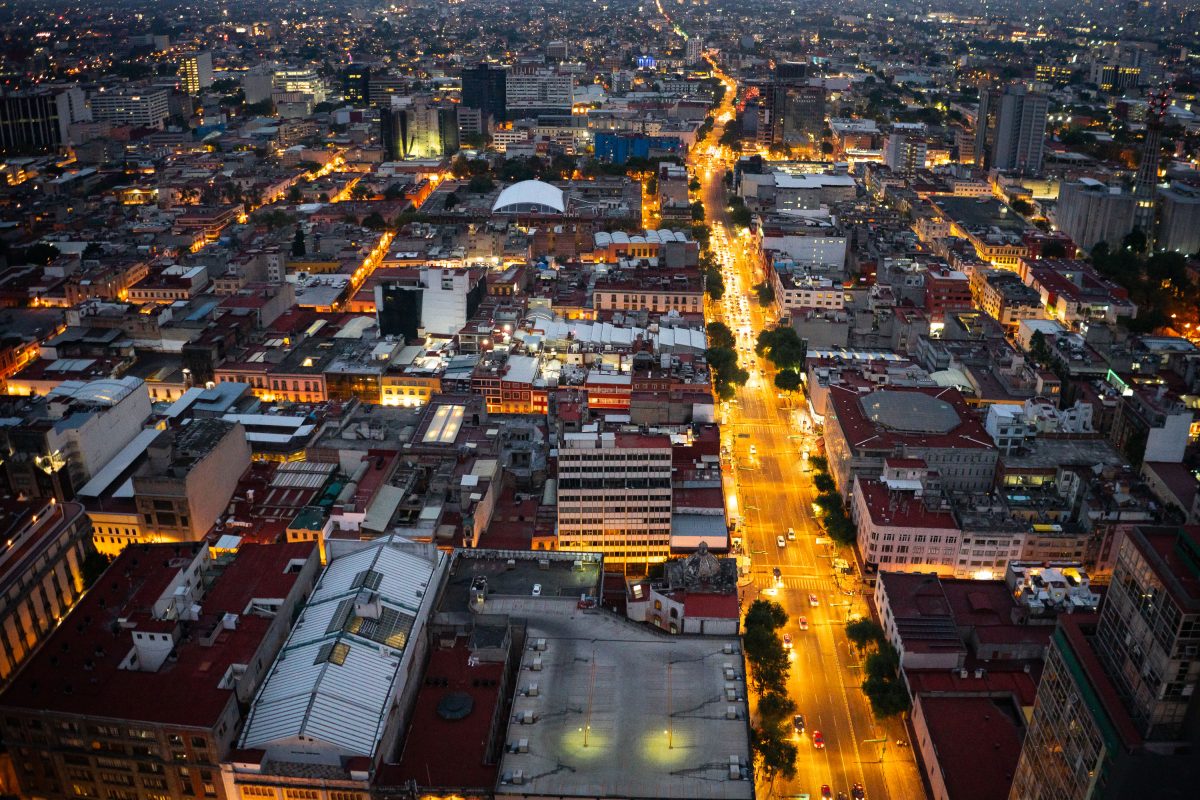
Eje Central Lázaro Cárdenas at Dusk, Centro Histórico, Mexico City
April 2018
—
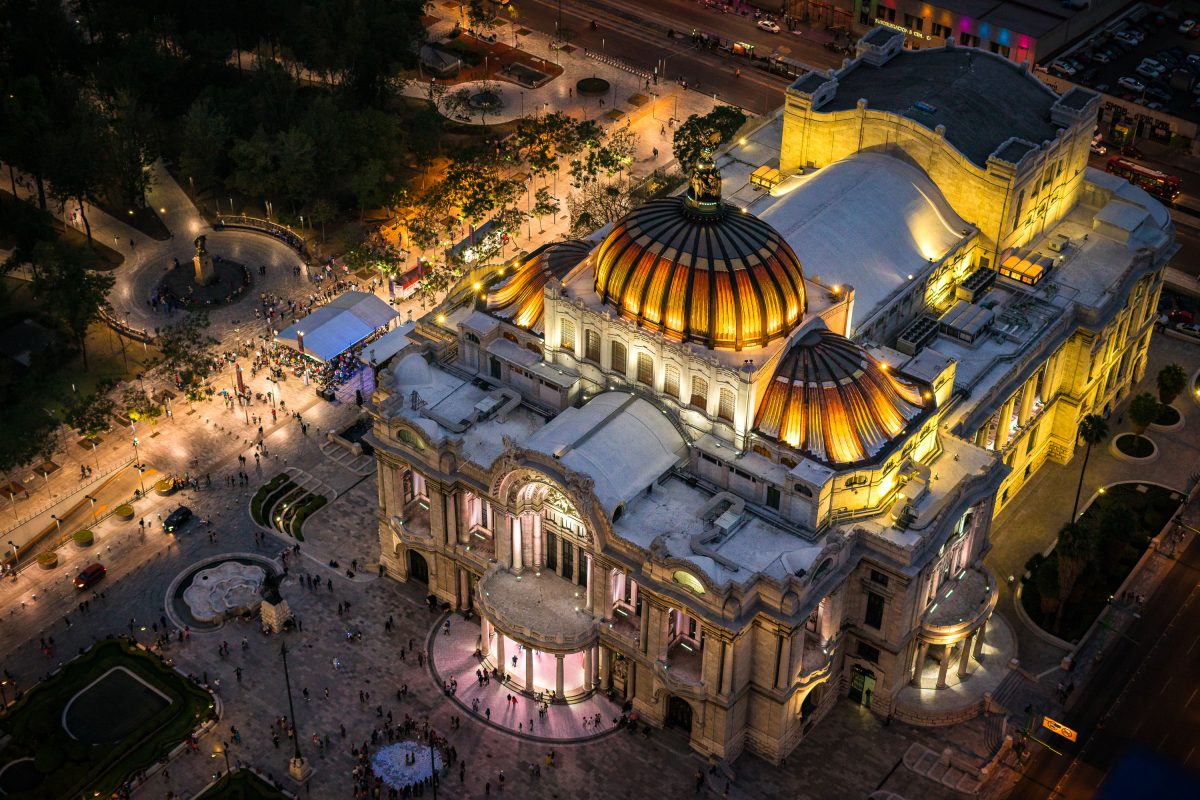
Domed Rooftop of Palacio de Bellas Artes at Night, Mexico City
April 2018
—
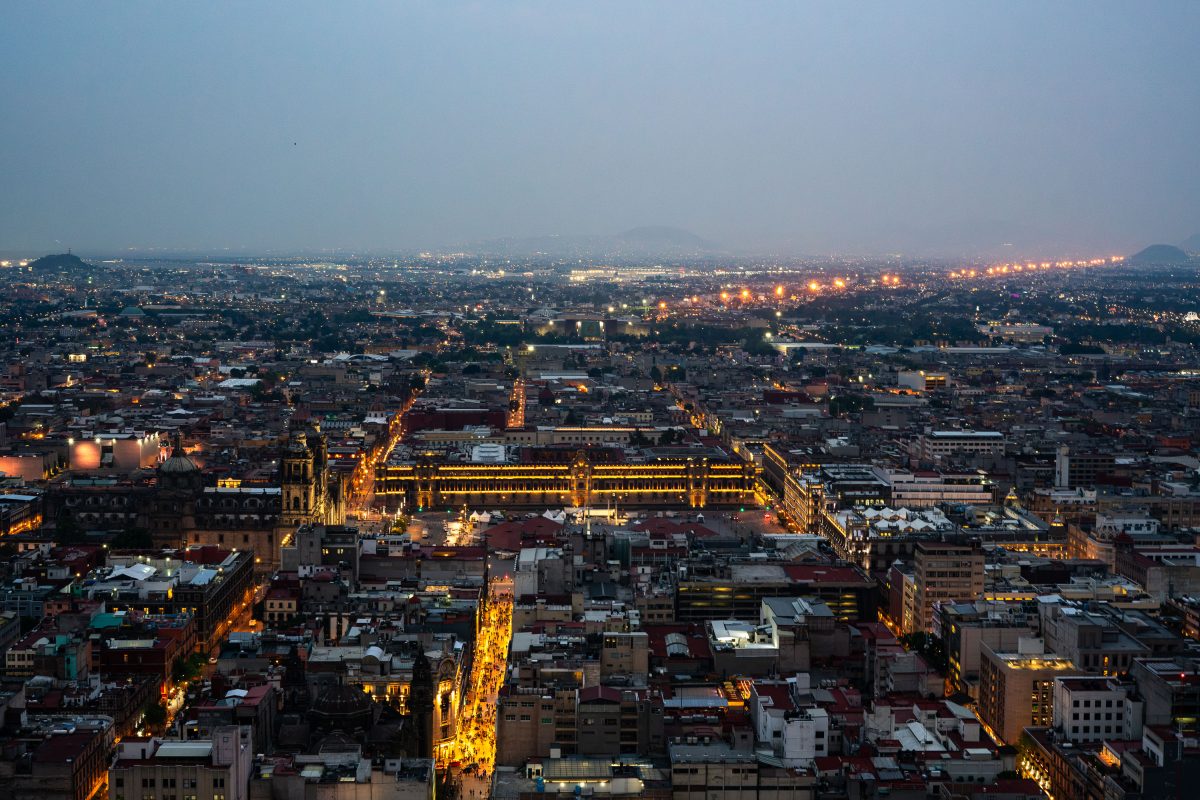
Zócalo and Historic Center Skyline, Mexico City
April 2018
—
Street Vendor Stand at República de Uruguay and 5 de Febrero, CDMX
April 2018
—
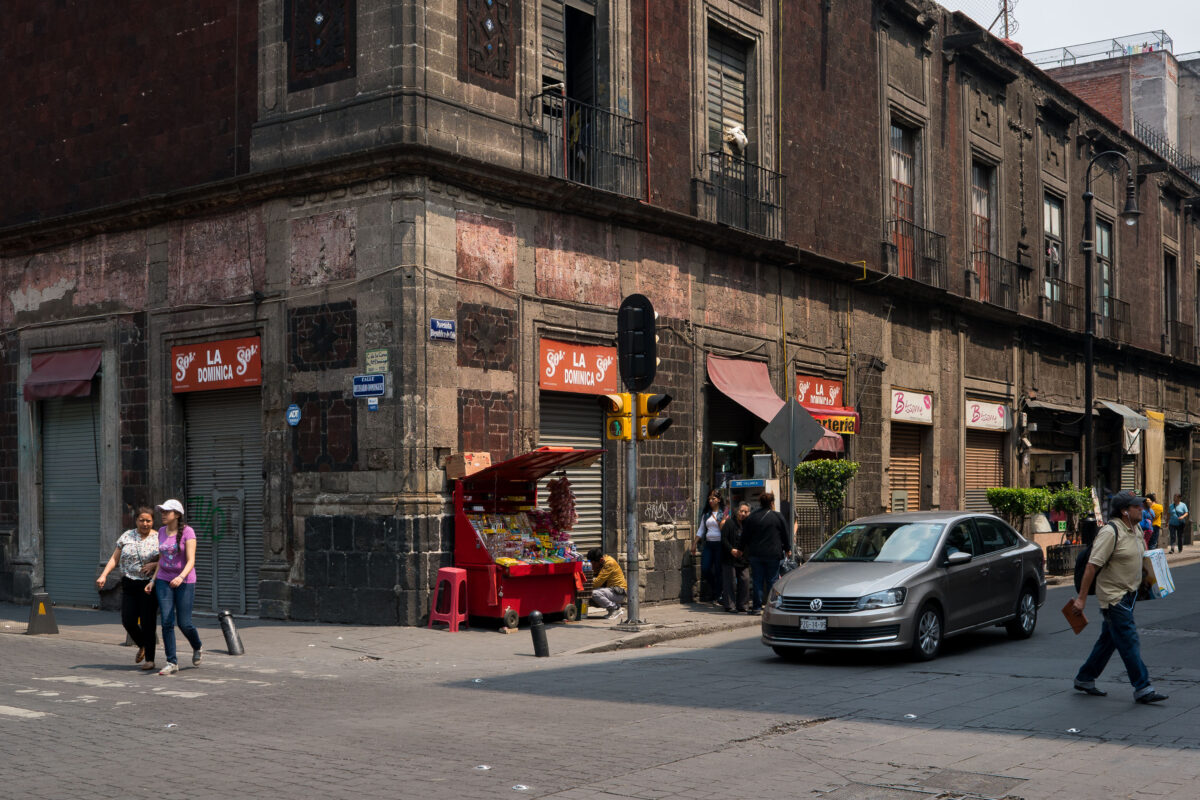
A busy corner in Mexico City’s Centro Histórico where Calle República de Uruguay meets Calle 5 de Febrero. The block’s centuries-old volcanic stone buildings, typical of the colonial period, now house small shops and street vendors that reflect the area’s dense commercial activity. The facade’s weathered cantera stone and red tezontle give the structure its distinctive character, common in pre-19th century civic architecture throughout the historic core.
Metrobús Line 4 Bus, Centro Histórico, Mexico City
April 2018
—
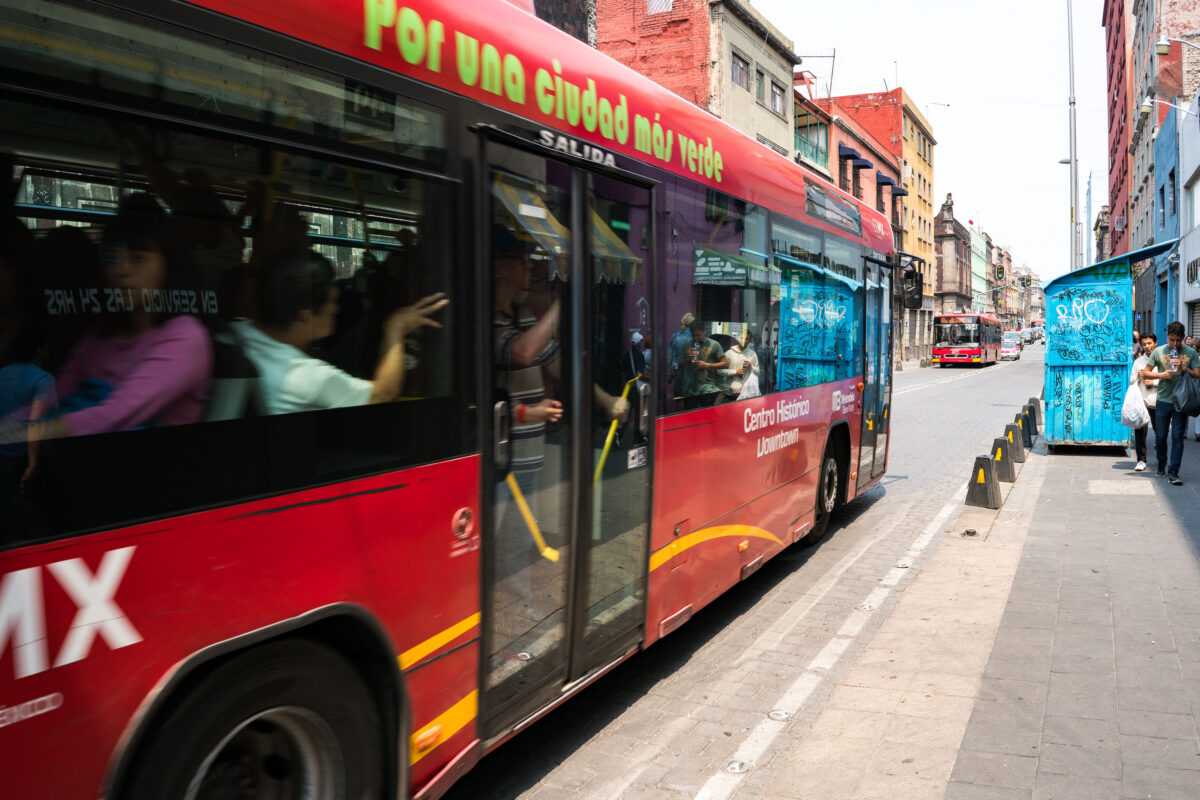
A Mexico City Metrobus on Line 4 passes through the narrow streets of the Centro Histórico, heading toward the San Lázaro terminus. This route, introduced in 2012, was designed to connect the downtown core with the city’s main transit hubs and the airport while reducing congestion in one of Latin America’s most crowded historic districts. The red articulated buses operate along corridors like República de Uruguay and República de El Salvador, part of an effort to modernize and green urban mobility.
Spiral Stairwell with Wrought-Iron Railings, Mexico City Hotel
April 2018
—
Hotel Bucareli Sign on Calle Bucareli, Mexico City
April 2018
—
Hotel Punta MX Restaurant, Mexico City
April 2018
—
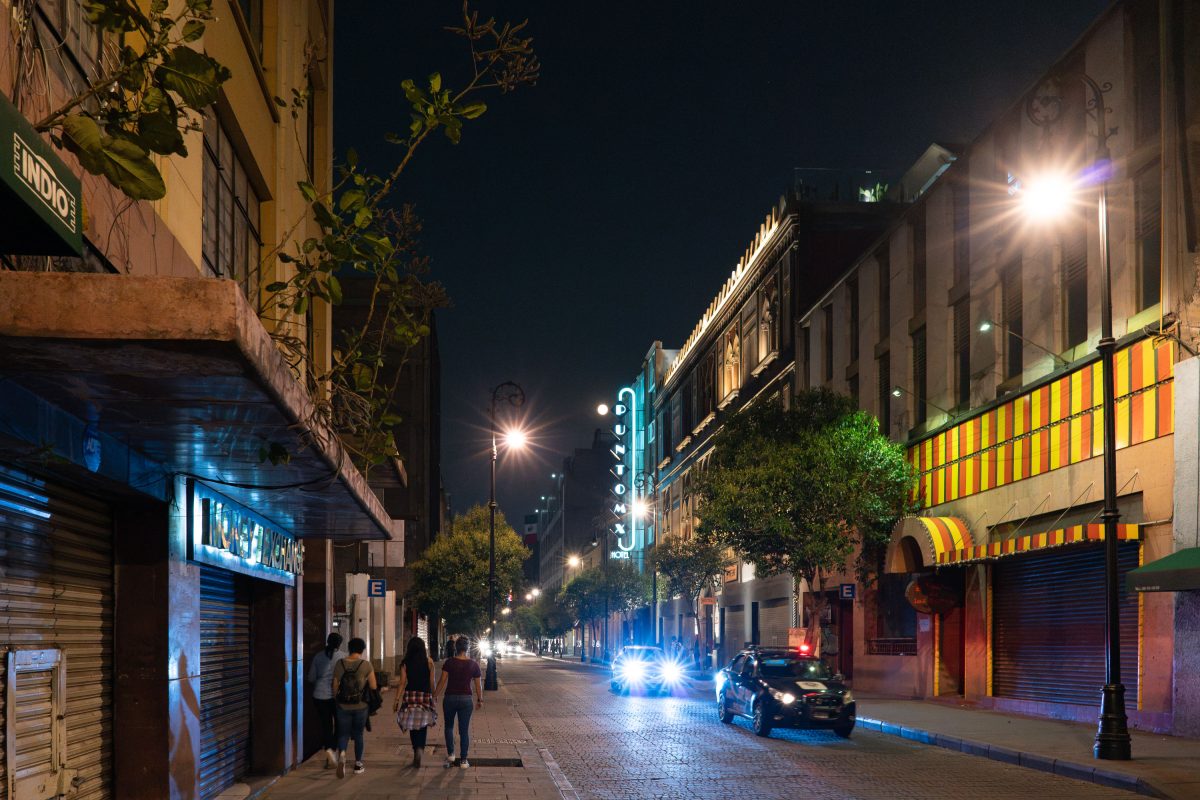
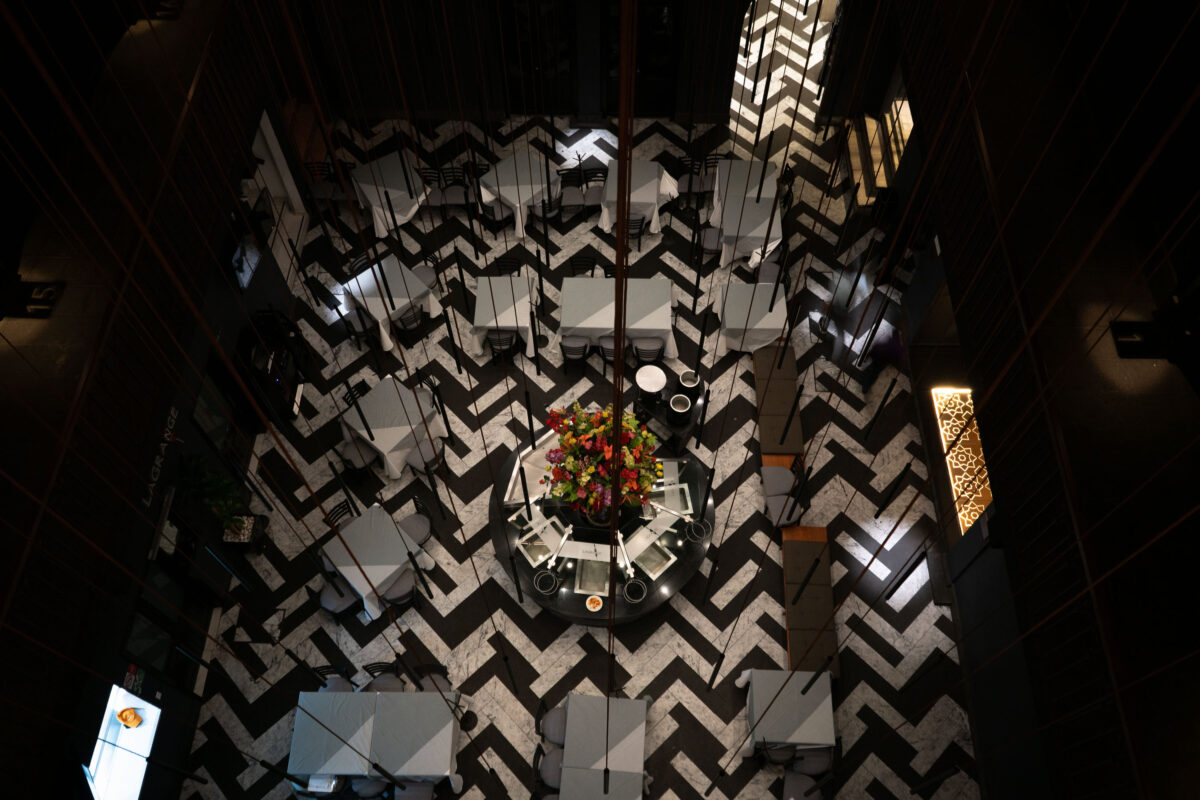
Hotel Restaurant in Mexico City.
Mexico City skyline at night
April 2018
—
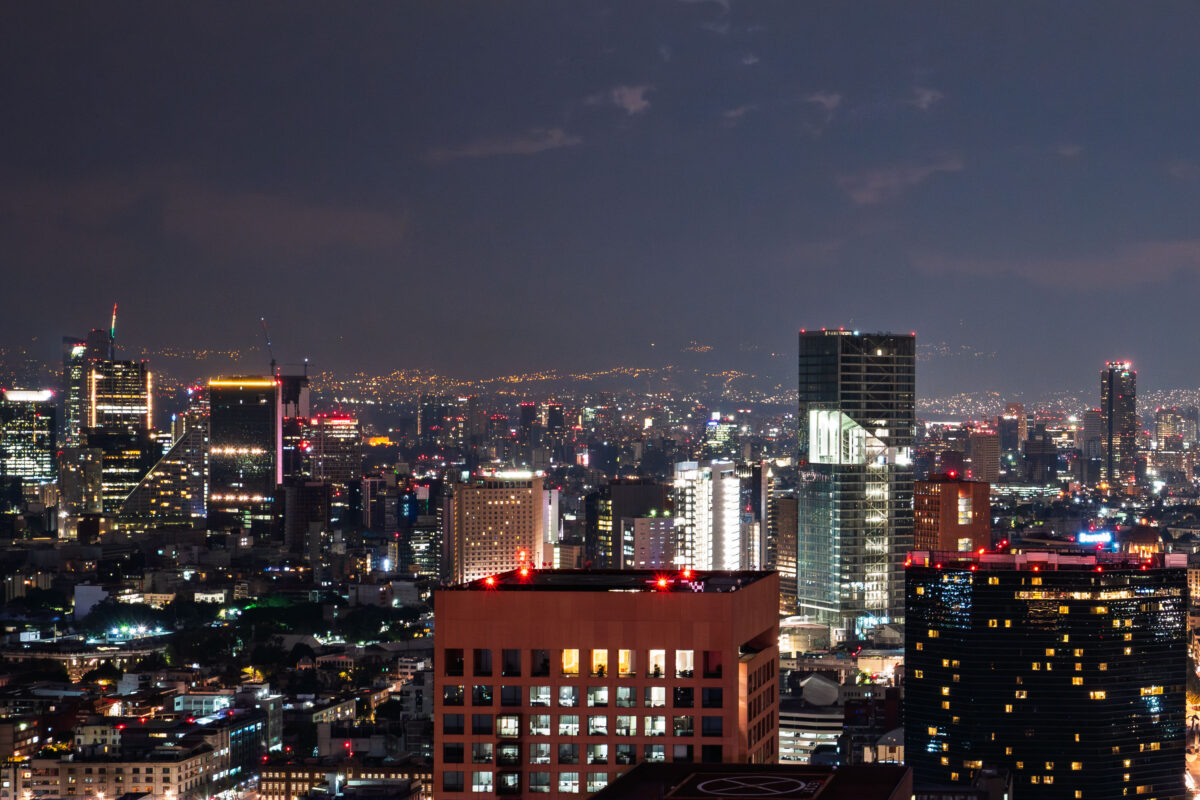
The night lights of Mexico City, Mexico.
Calle Francisco I. Madero from above, Mexico City
April 2018
—
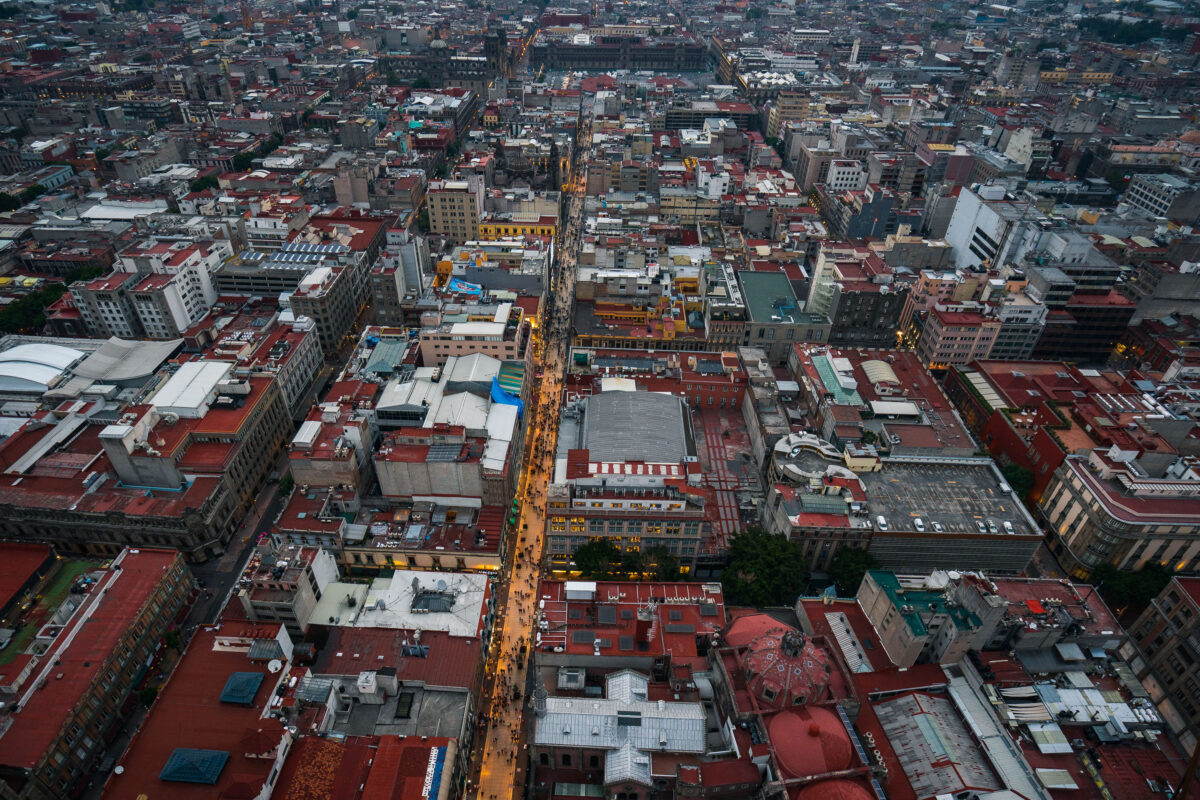
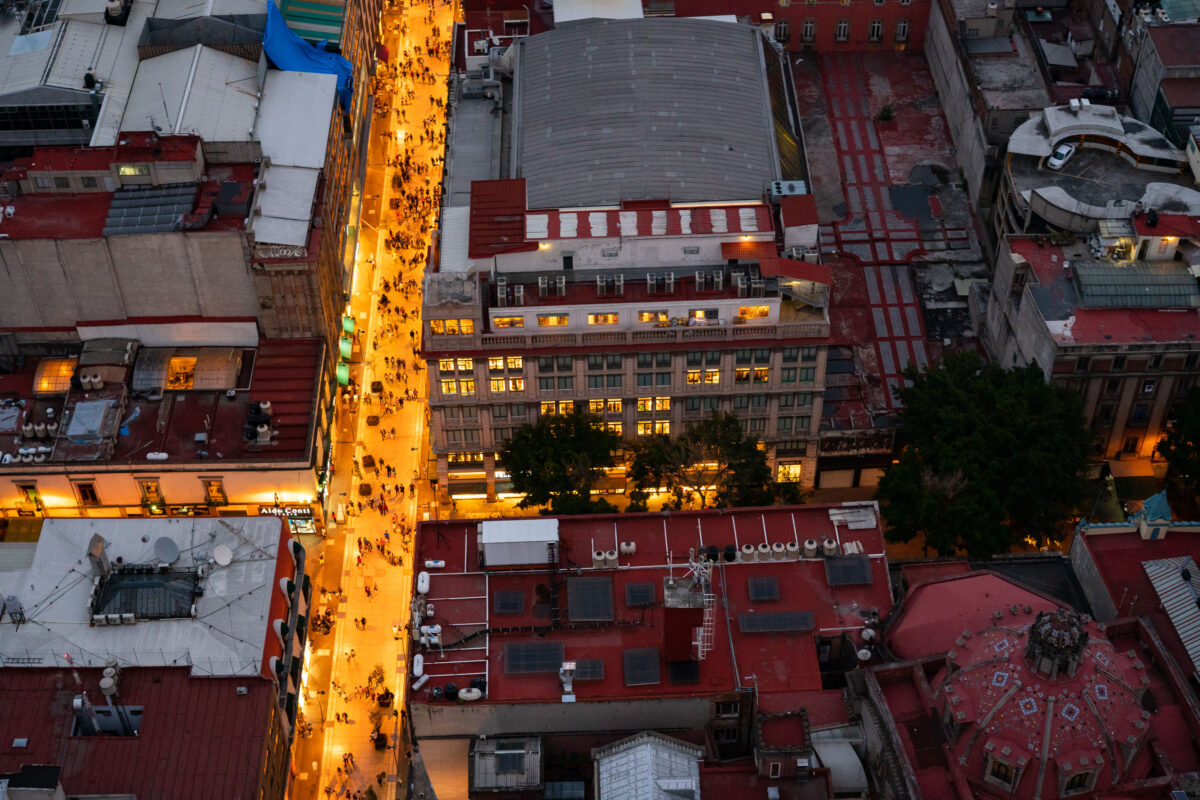
Calle Francisco I. Madero stretches eastward through Mexico City’s Centro Histórico, illuminated as evening falls. This pedestrian artery connects the Torre Latinoamericana to the Zócalo and has been a central commercial corridor since colonial times. Once known as San Francisco Street, its 2010 pedestrianization transformed it into one of the busiest walkways in Latin America, lined with historic facades, retail arcades, and landmarks like the Church of San Francisco and Casa de los Azulejos.
Alameda Central and Hemiciclo a Juárez, Mexico City
April 2018
—
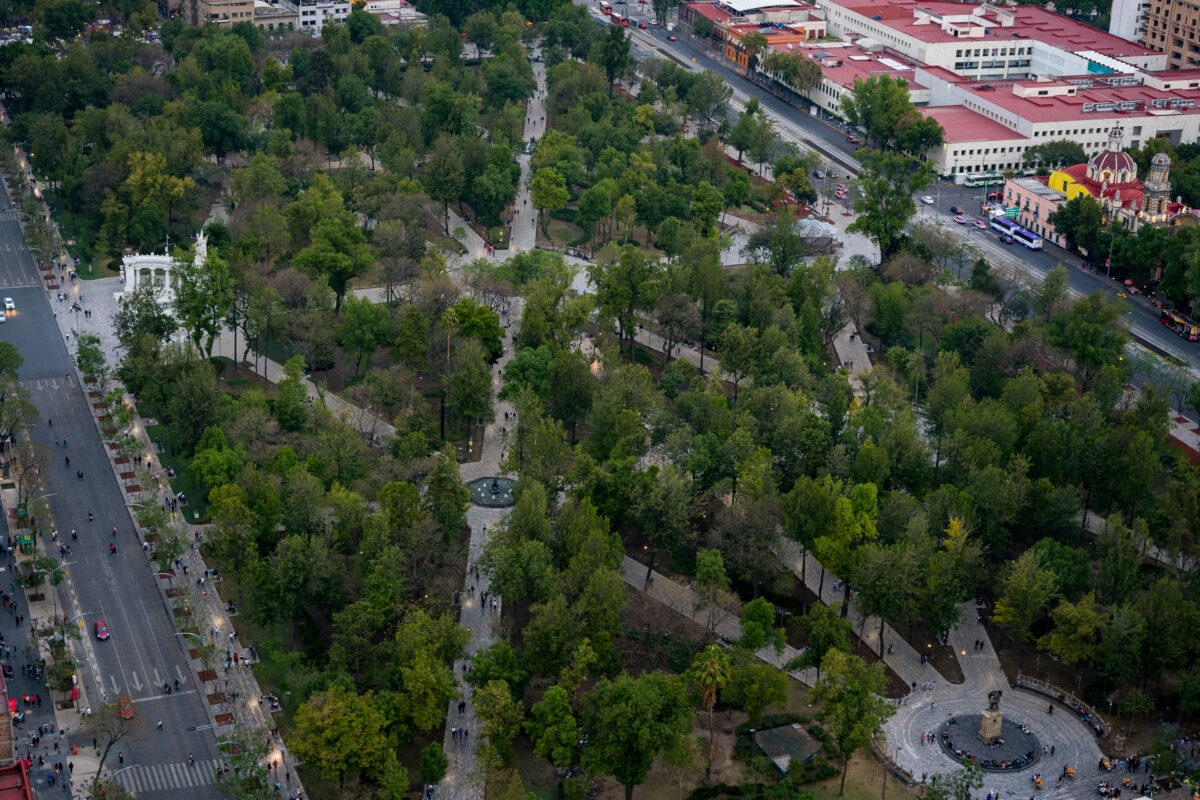
An aerial view of Alameda Central, Mexico City’s oldest public park, established in 1592 and redesigned in the 19th century in the European style. The white semicircular monument visible on the left is the Hemiciclo a Juárez, erected in 1910 to honor President Benito Juárez. The park’s grid of walkways, fountains, and neoclassical sculptures serves as a green centerpiece of the Centro Histórico, surrounded by civic and cultural landmarks like the Palacio de Bellas Artes.
Palacio de Bellas Artes, Mexico City
April 2018
—
Paseo de la Reforma and Mexico City skyline at dusk
April 2018
—
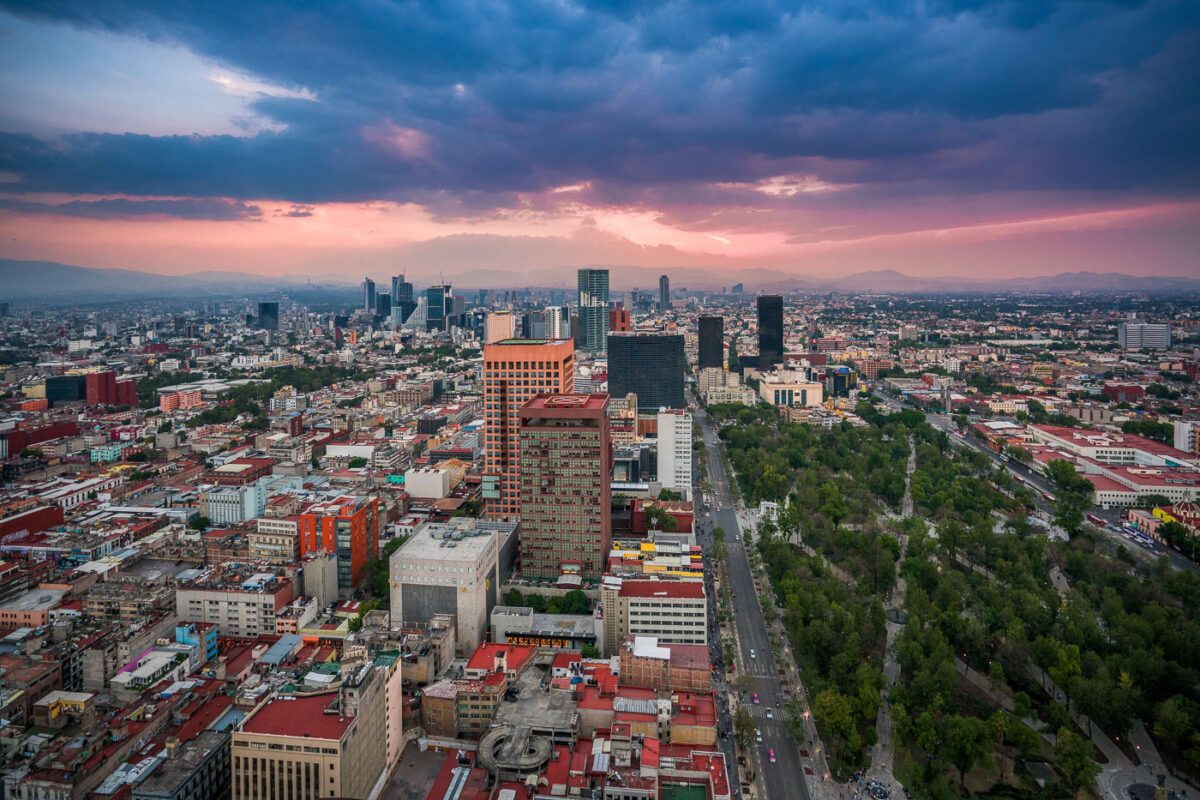
Mexico City is shown from above at sunset, with the Paseo de la Reforma running diagonally through the right side of the image. To the left, the dense central districts display mid-rise buildings with red rooftops, while clusters of high-rise office towers dominate the skyline further west. The large green area on the right is the Alameda Central park. In the distance, the Sierra Madre mountains form the backdrop under a layer of clouds.
Mexico City Panorama from Torre Latinoamericana
April 2018
—
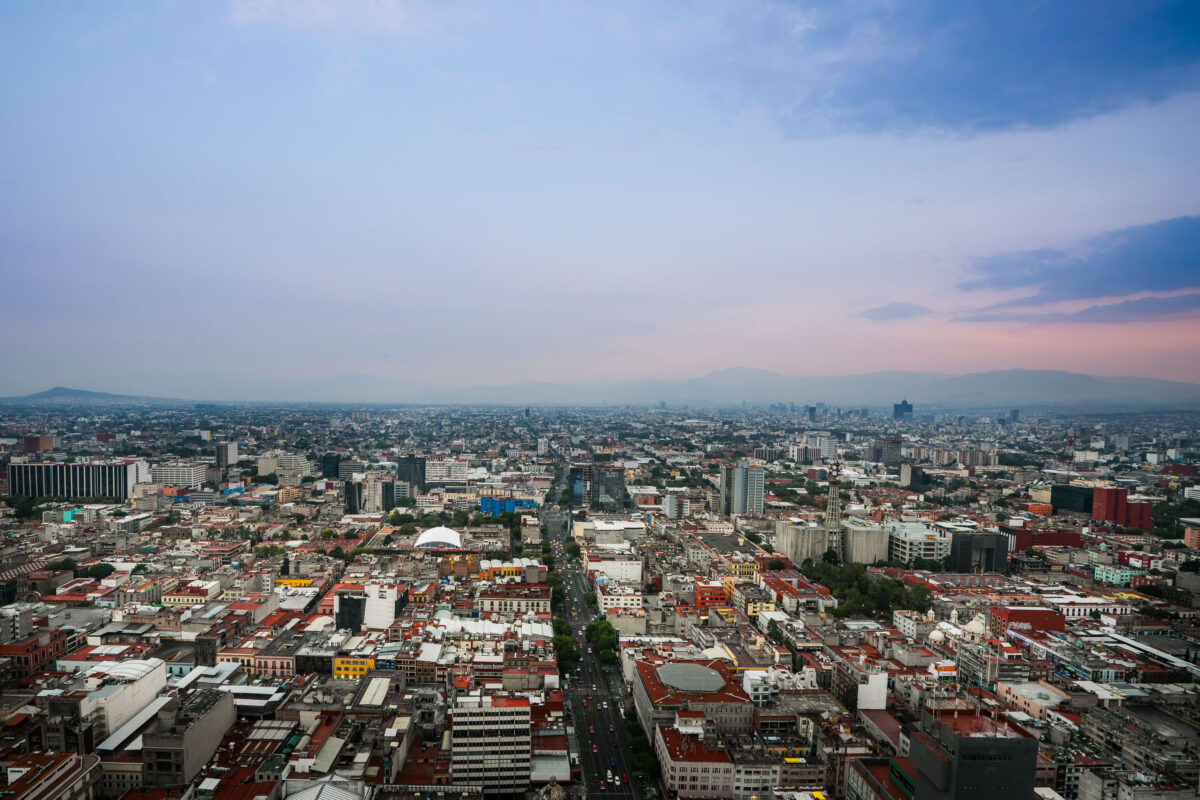
Looking south from the Torre Latinoamericana, this panoramic view captures the vast scale of Mexico City as it extends across the Valley of Mexico. The dense grid of the Centro Histórico transitions into modern commercial districts, framed by the distant volcanic mountains. Visible near the center are landmarks like Eje Central Avenue and the white dome of the historic Arena Coliseo, testifying to the city’s complex layering of colonial architecture and modern urban growth.
Calle República de Uruguay, Mexico City
April 2018
—
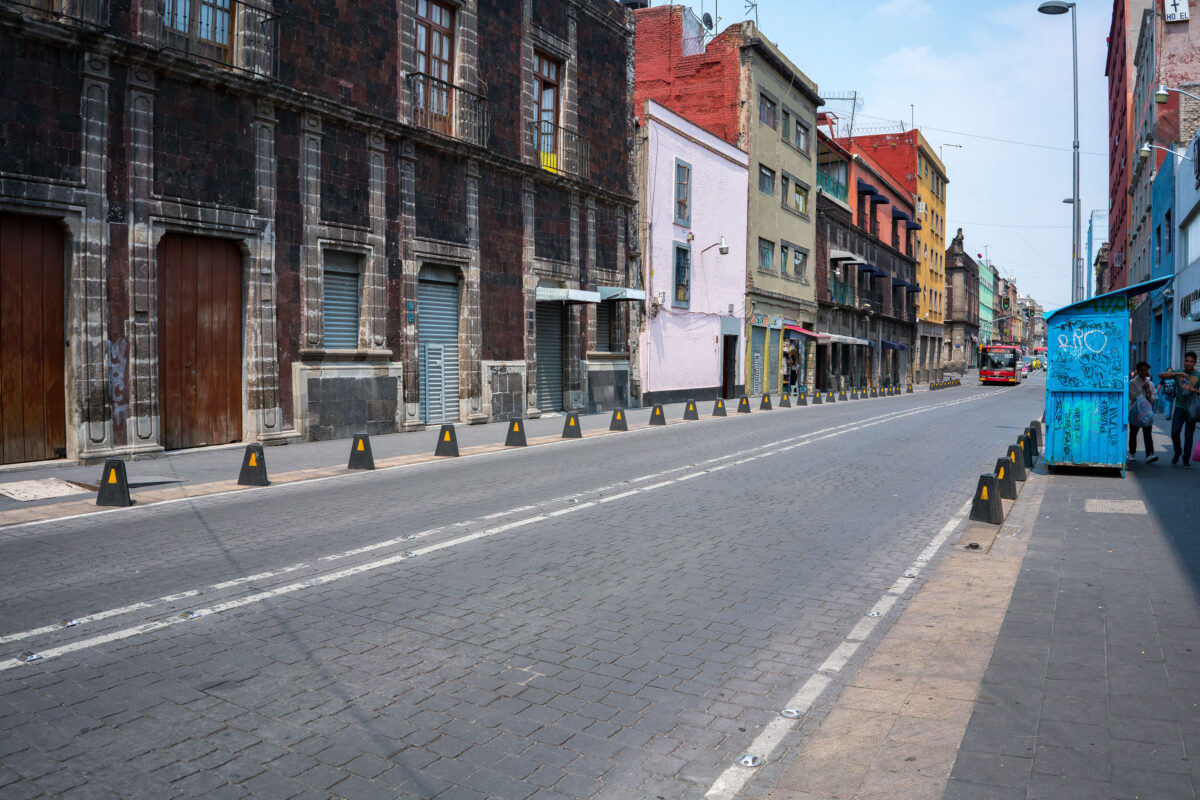
Calle República de Uruguay in the heart of Mexico City’s Centro Histórico, lined with colonial-era stone façades and early 20th-century buildings showing layers of renovation and age. The street, paved with basalt cobblestones, reflects the city’s dense architectural history where 18th-century walls coexist with modern storefronts and utilities. The corridor connects the Zócalo area with Eje Central, serving as one of the oldest commercial arteries in the capital.
Historic Mexico City Hotel Atrium with Copper Installation
April 2018
—
Calle Madero, Mexico City Historic Center
April 2018
—
Calle Madero at Night, Mexico City
April 2018
—
Templo Mayor Ruins, Mexico City
April 2018
—
Stray Dog Rummaging Through Trash Bags, Mexico City
April 2018
—
Ecobici Bikes Docked at Night, Centro Histórico
April 2018
—
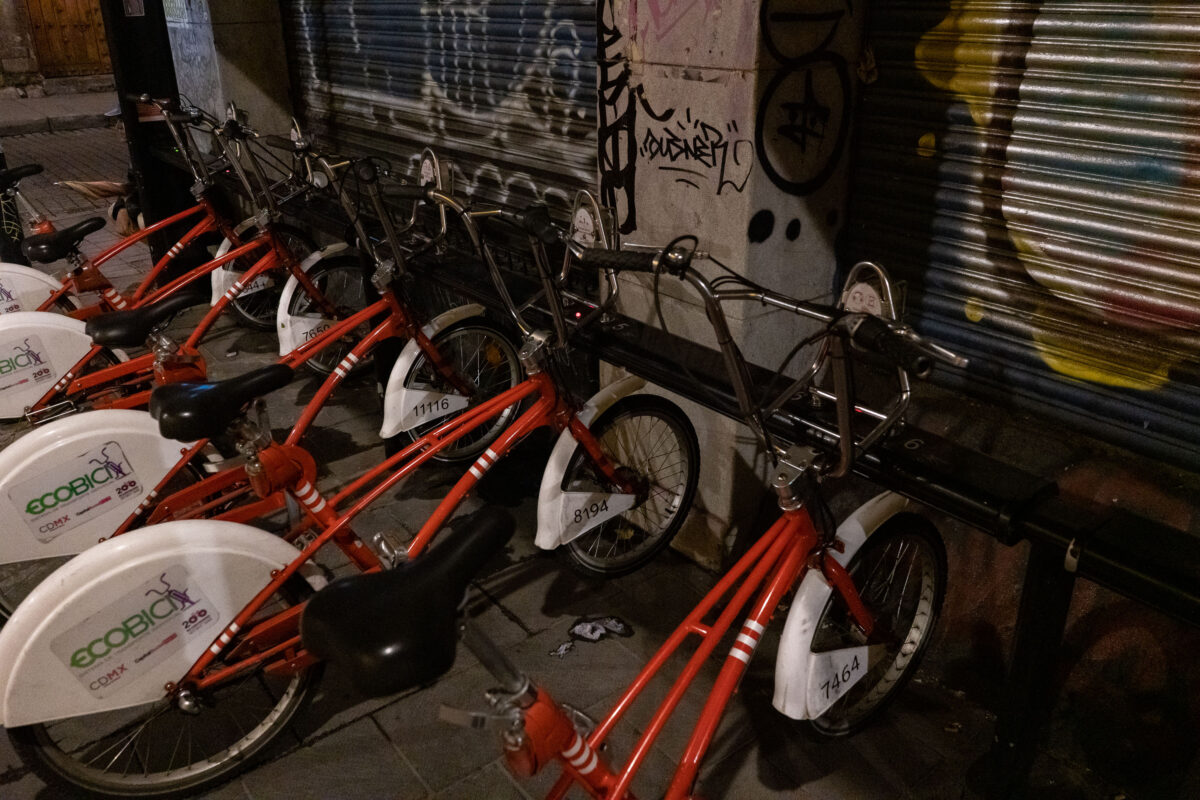
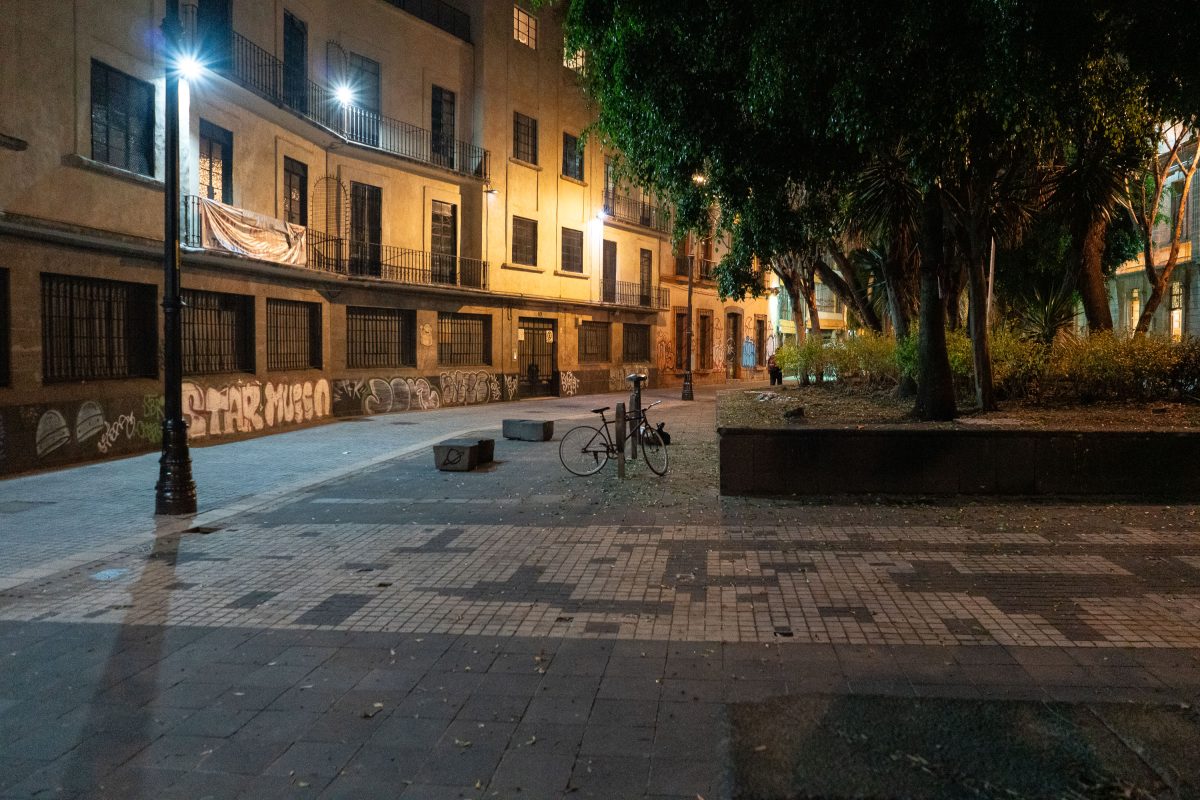
Rows of red Ecobici bicycles line a graffiti-marked wall in Mexico City’s historic center, their white fenders catching what little light remains from nearby street lamps. The city’s bike-share program, launched in 2010, represents one of Latin America’s most ambitious urban mobility projects, linking thousands of residents and commuters through sustainable transport. In the quiet of night, the empty docking station tells a different story — a pause between the day’s rush and the city’s nocturnal hum, where the blend of public art, infrastructure, and wear marks the pulse of daily urban life in the capital.
Night Vendors Along Avenida Madero, Mexico City
April 2018
—
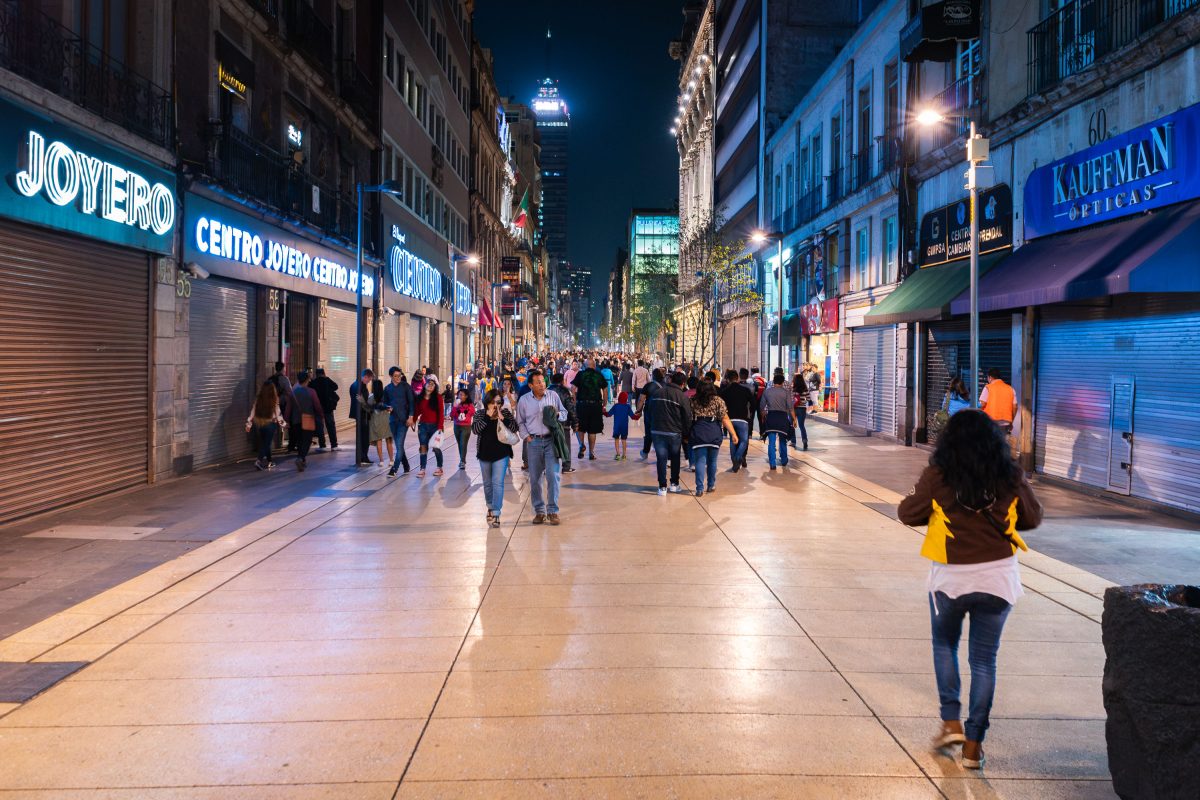
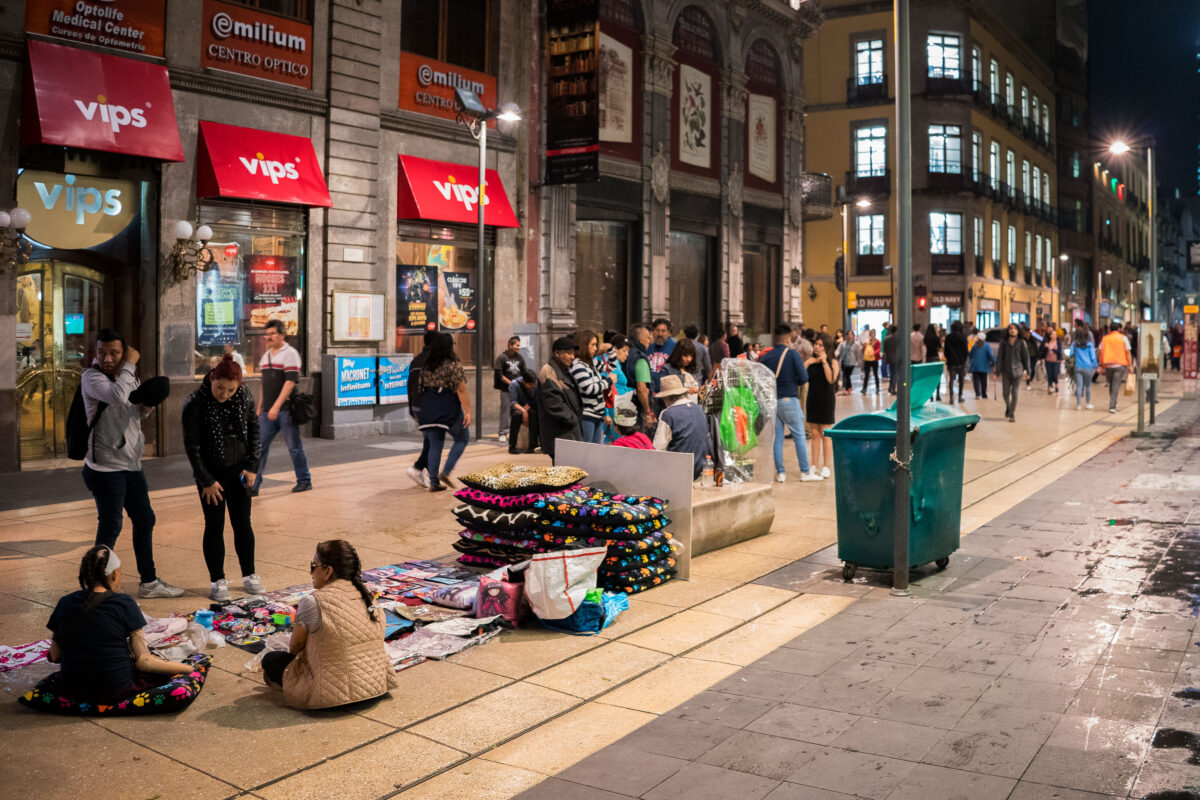
As evening settles over Mexico City’s Centro Histórico, informal vendors spread colorful textiles, pillows, and trinkets across the pedestrian walkway of Avenida Francisco I. Madero. The avenue, one of Latin America’s busiest foot corridors, connects the Zócalo to the Palacio de Bellas Artes and thrums with life well into the night. Illuminated storefronts and cafés like Vips cast reflections onto the restored stone façades of early 20th-century architecture. Beneath the glow of the streetlamps, the mingling of workers, families, and passersby captures the layered rhythm of Mexico City — a metropolis where commerce, tradition, and resilience coexist within its historic streetscape.
CDMX Taxi Crossing the Zócalo, Mexico City
April 2018
—
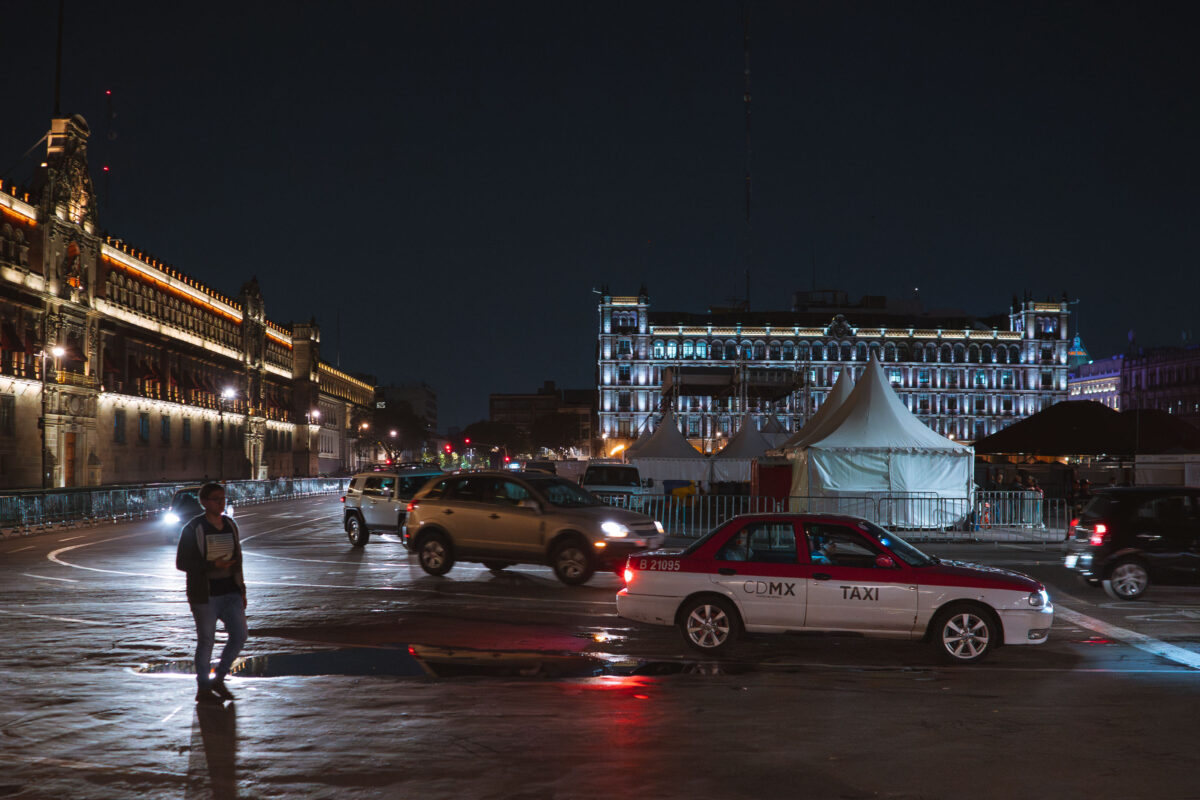
A taxi driver outside the Zócalo in Mexico City.
Calle de Regina at Night, Centro Histórico, Mexico City
April 2018
—
Bank of America Plaza and Fountain Place, Dallas Skyline
April 2018
—
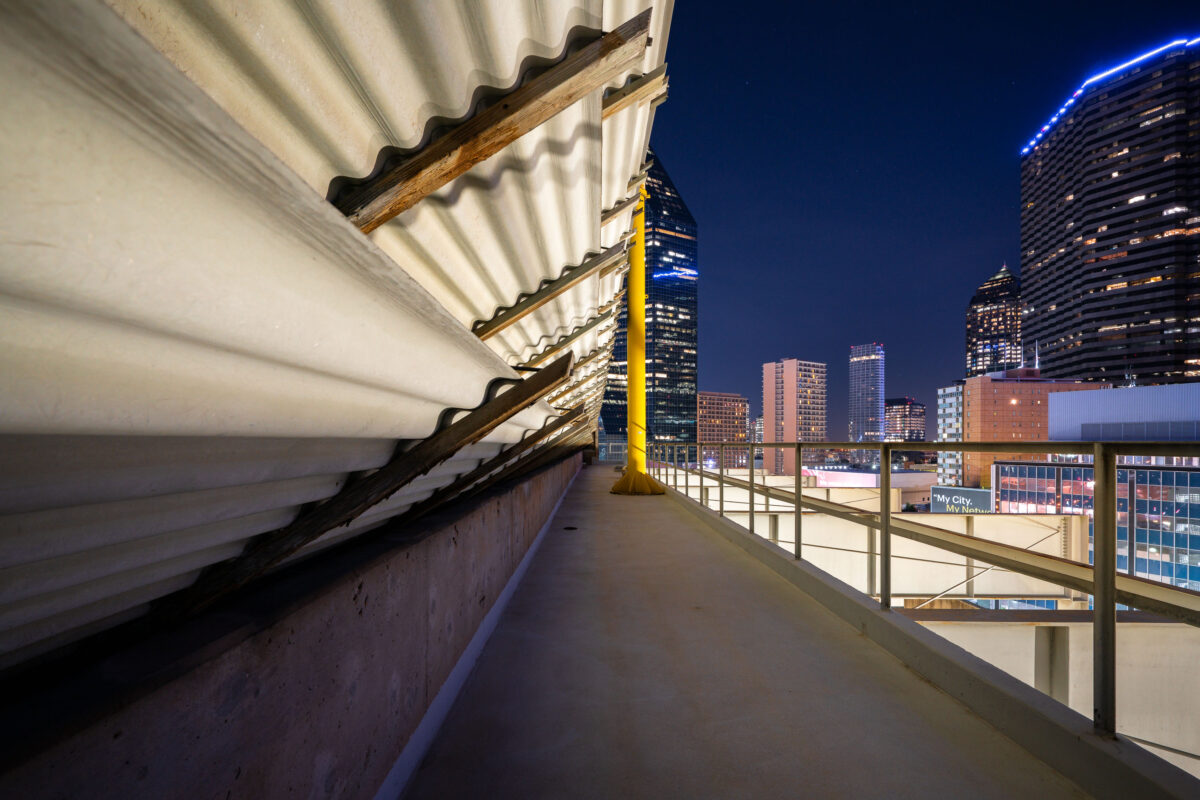
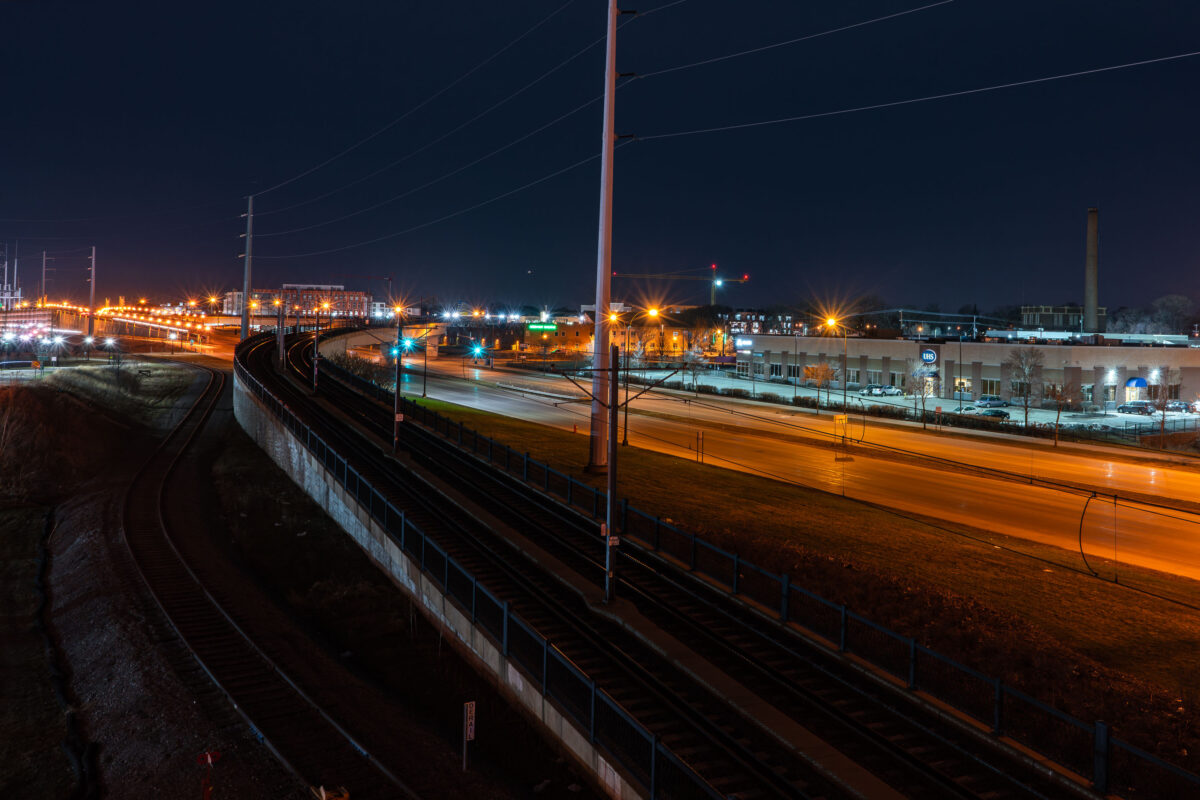
Skyline of Dallas Texas as seen from the top of a cooling unit.
Metro Transit Light Rail Bridge over Hiawatha Ave, Minneapolis 2018
April 2018
—
Metro Transit light rail bridge over Haiwatha Avenue in South Minneapolis.
Martin Olav Sabo Bridge at Night, Minneapolis
April 2018
—
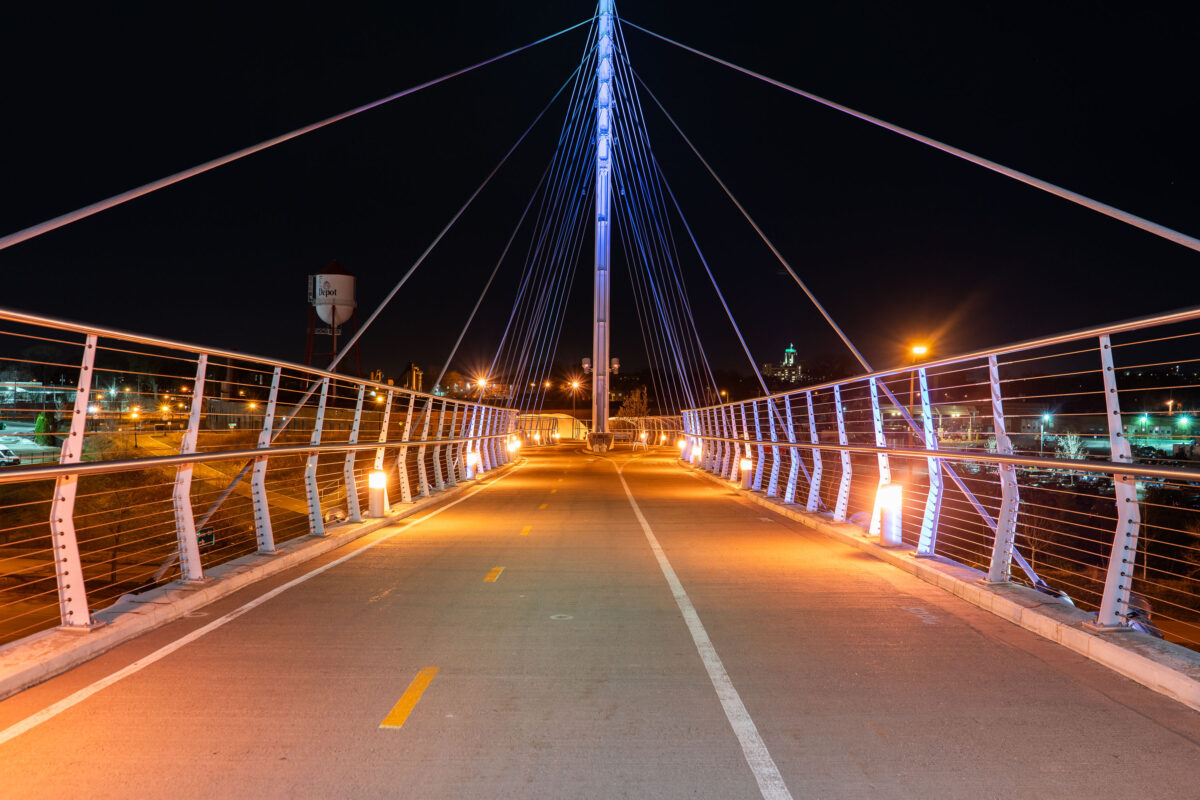
Martin Olav Sabo Bridge in Minneapolis. The lit up bridge crosses Haiwatha Avenue in South Minneapolis.
Tide Laundry Detergent Bottles on Target Shelf
April 2018
—
Tide laundry detergent at a Target store.
Xcel Energy Substation Near Downtown St. Paul
April 2018
—
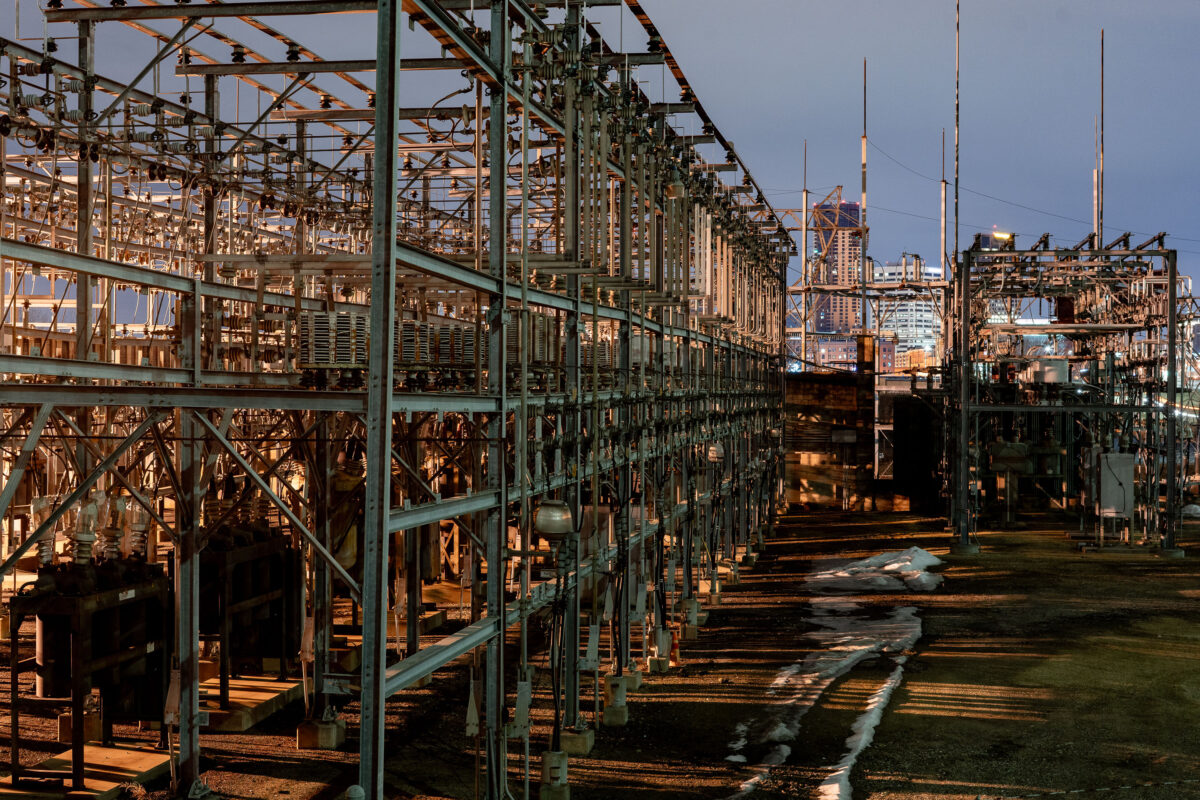
An Xcel Energy substaton near Downtown St. Paul, Minnesota.
CSL Plasma building with graffiti, Minneapolis
April 2018
—
Graffiti on the side of CSL Plasma. 2018
Metro Apartments in Minneapolis
March 2018
—
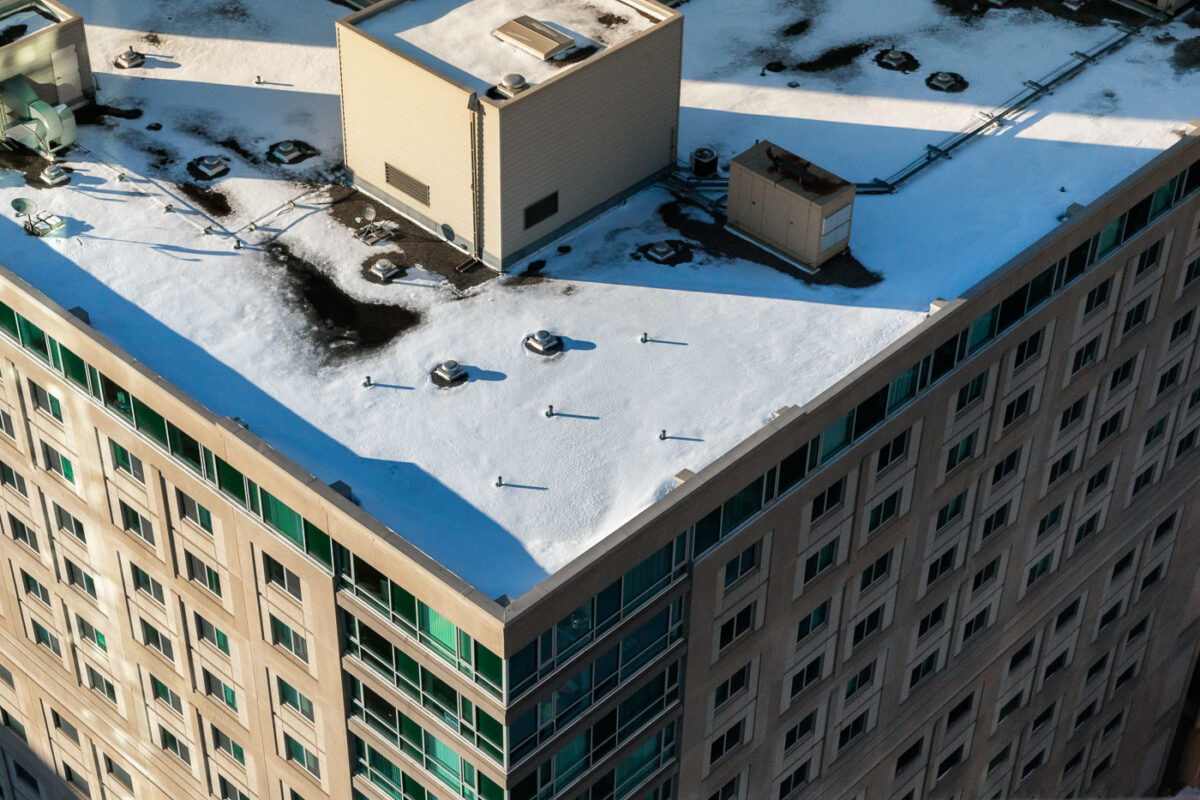
Metro Apartments building on Marquette Ave and S 9th St in Downtown Minneapolis.
Hotel Ivy and Minneapolis Convention Center, Minneapolis
March 2018
—
Hotel Ivy in downtown Minneapolis during winter.
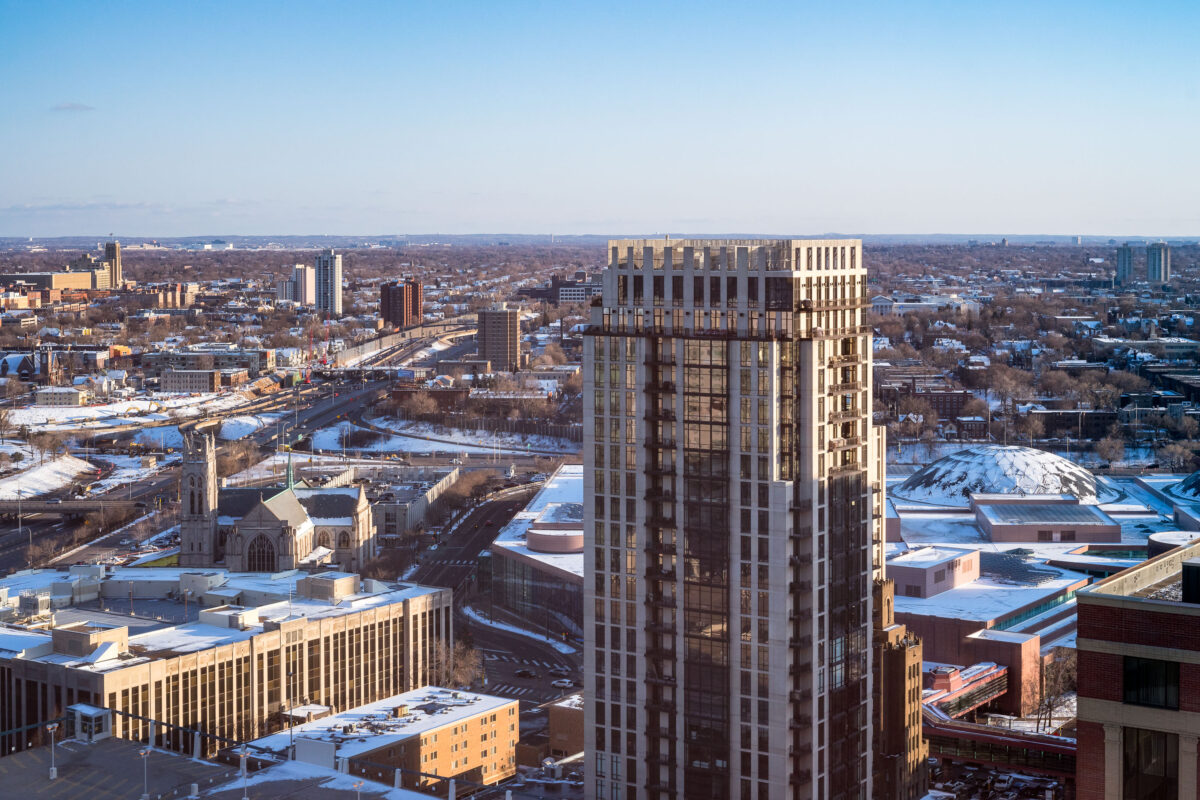
Skyline Along Marquette Avenue, Downtown Minneapolis
March 2018
—
University of Minnesota Demolition in 2018
March 2018
—
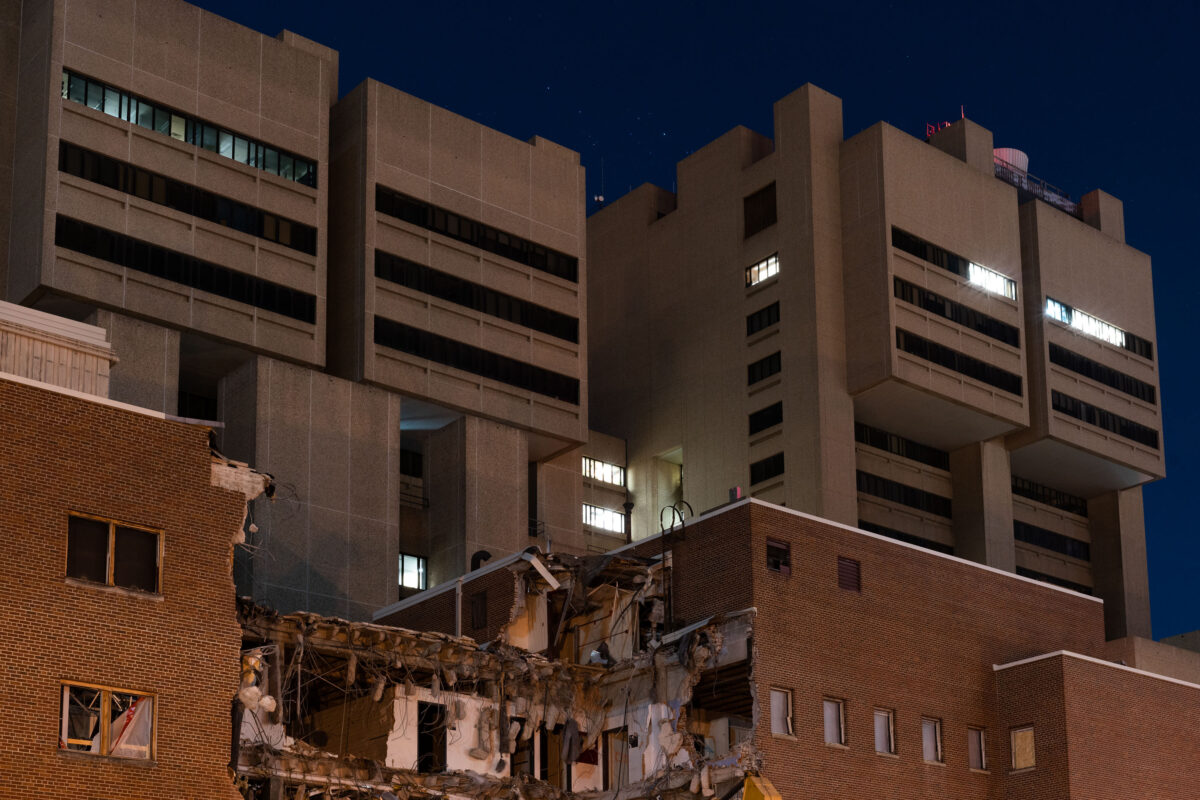
Demolition of a building on the campus of the University of Minnesota, Minneapolis.
Harris Machinery and Grain Elevator
March 2018
—
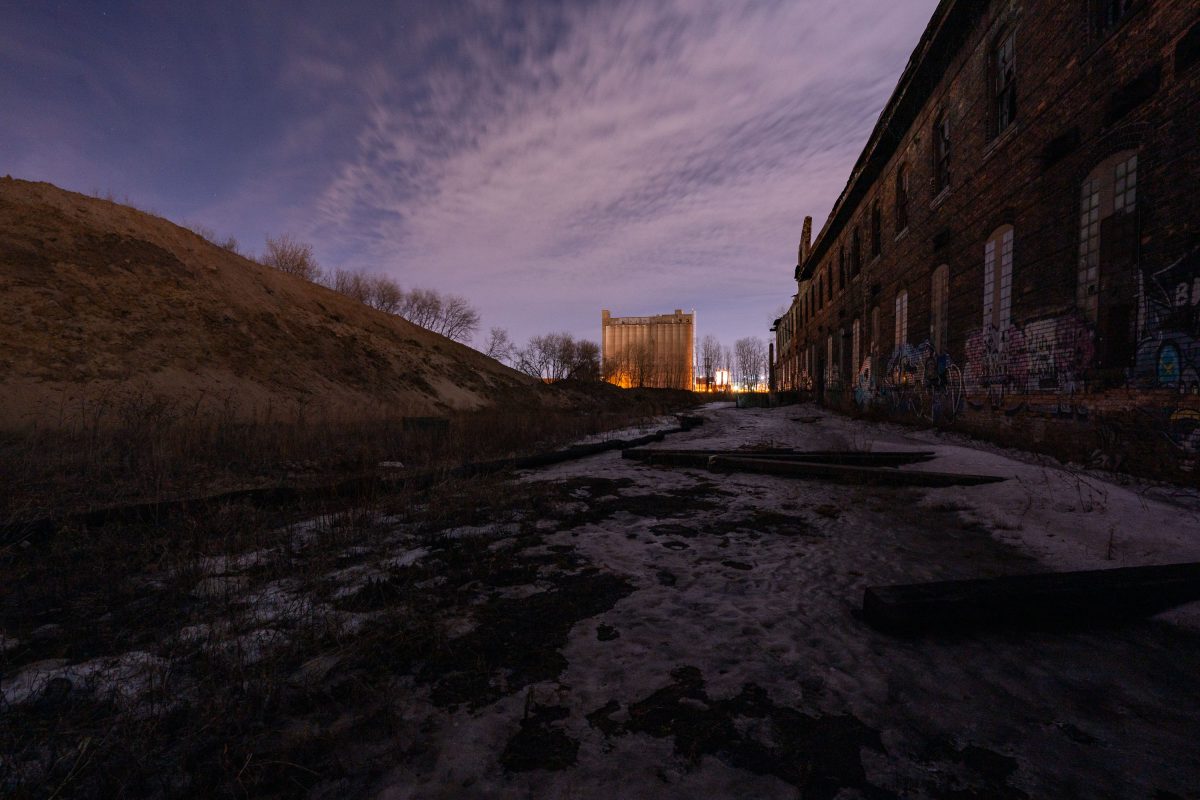
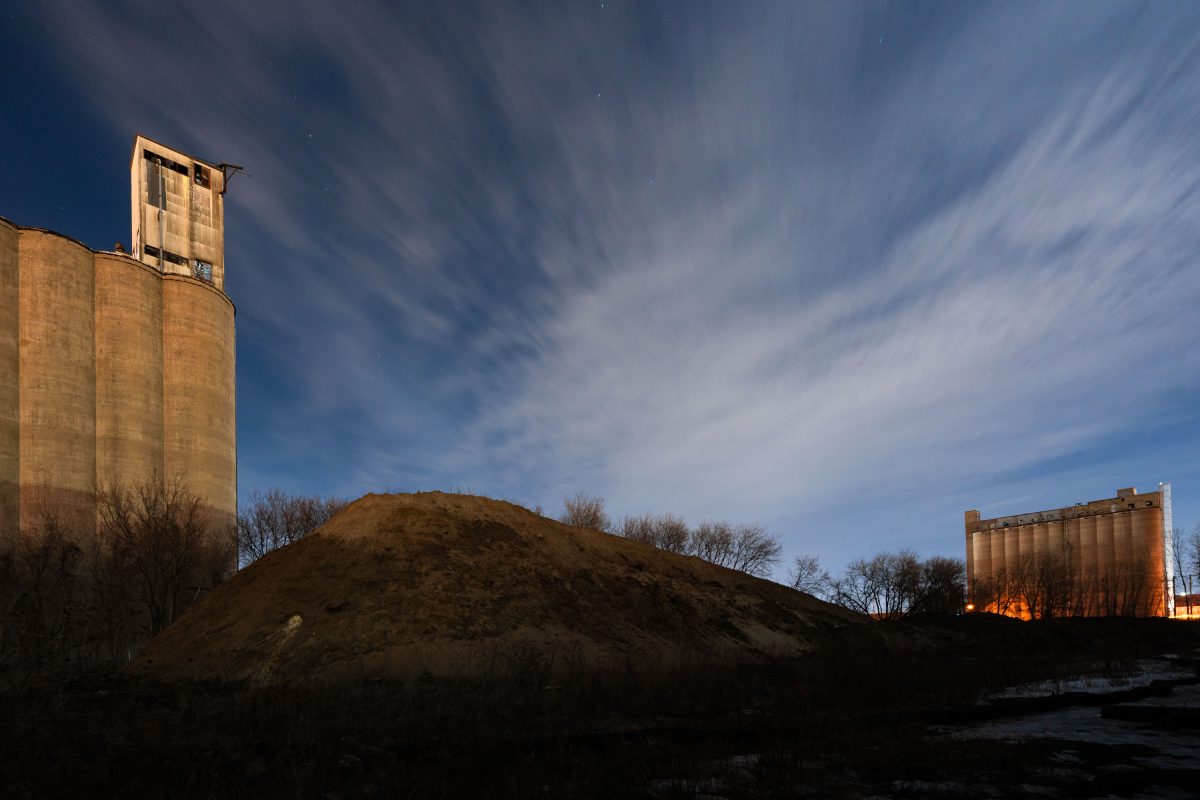
Concrete Grain Elevators Near Dinkytown, Minneapolis
March 2018
—
Tower Crane Over Dinkytown Construction, Minneapolis
March 2018
—
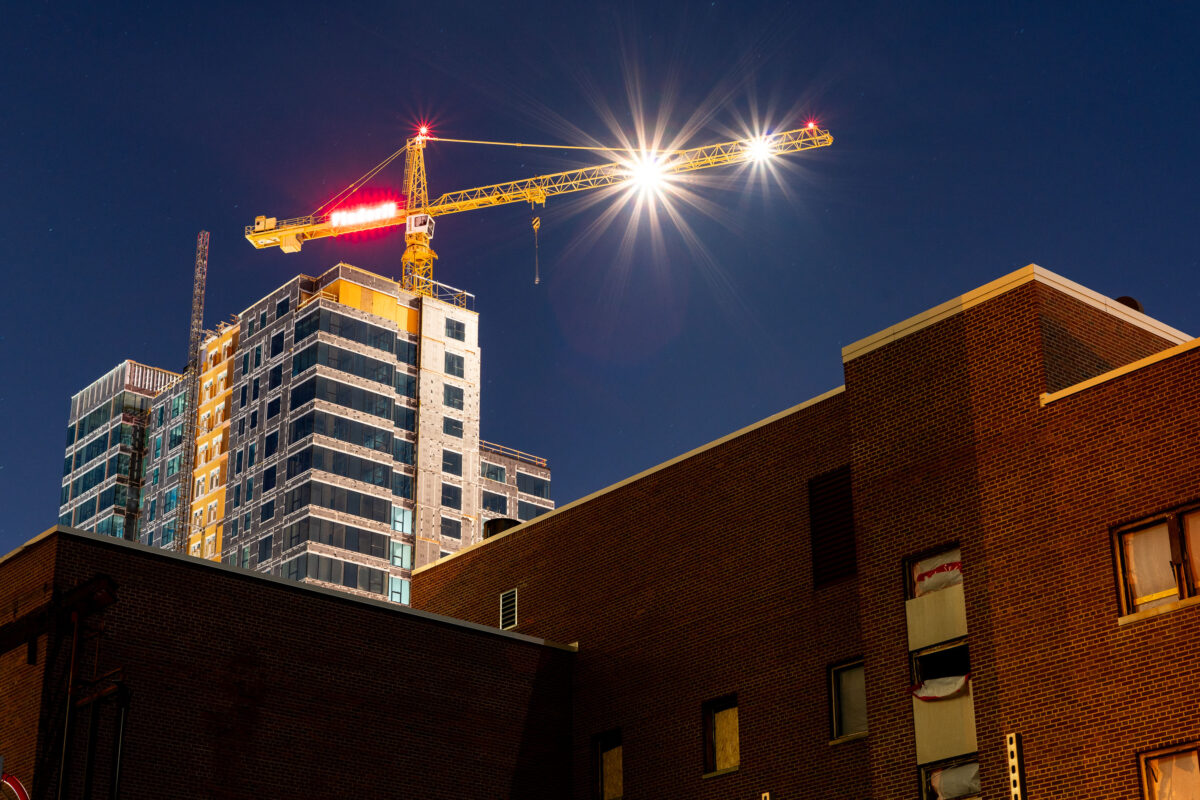
A building gets demolished as a new one rises in the background in Dinkytown, Minneapolis.
University of Minnesota Building Demolition, Minneapolis
March 2018
—
Demolition of a building on the campus of the University of Minnesota, Minneapolis.
Gold Medal Park and Guthrie Theater, Minneapolis
March 2018
—
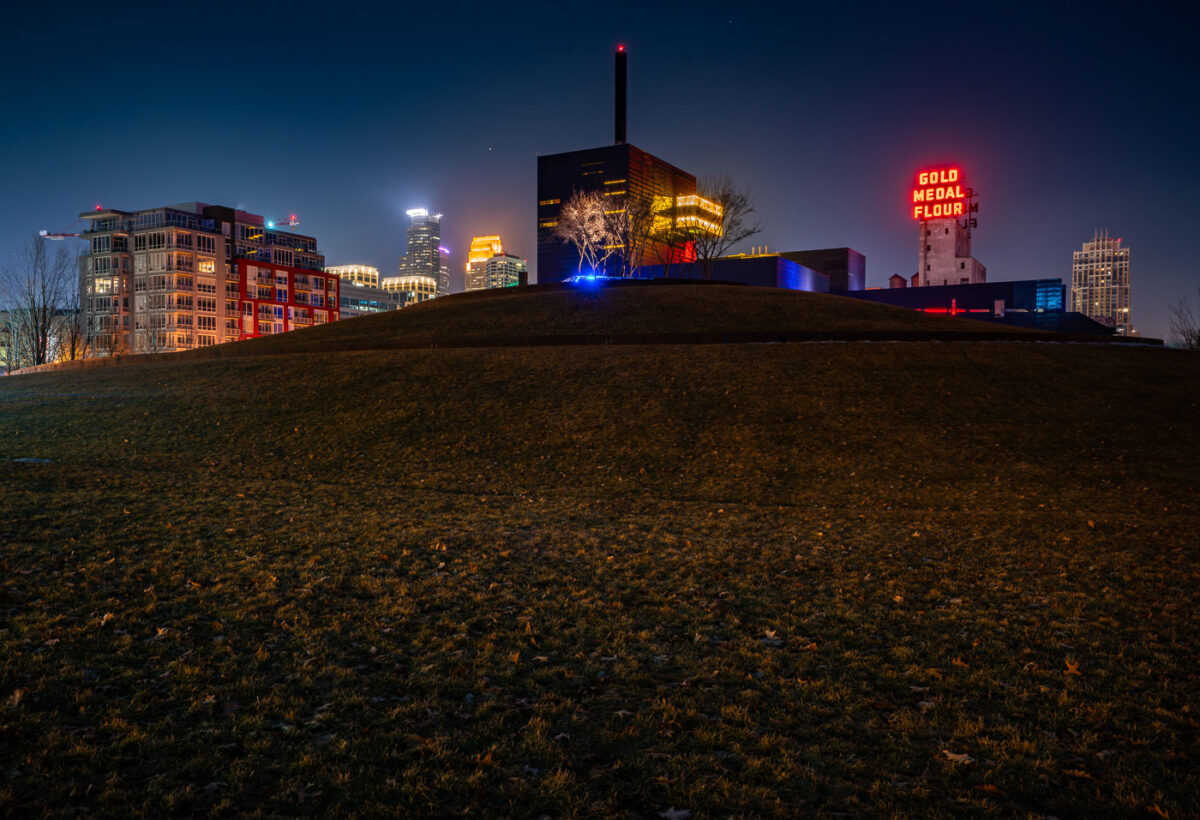
The Guthrie Theatre in Minneapolis as seen from Gold Medal Park.
Barge on the Mississippi River in St. Paul
March 2018
—
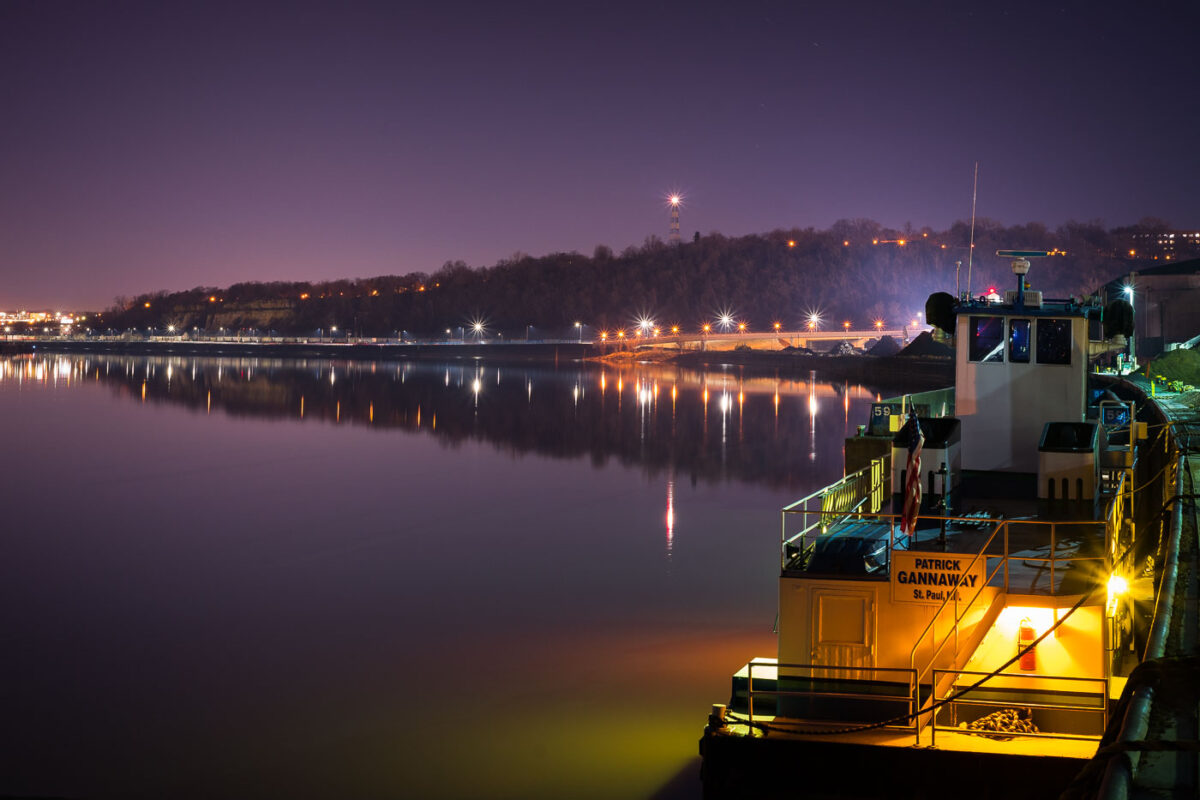
Patrick Gannaway Boat in St. Paul
March 2018
—
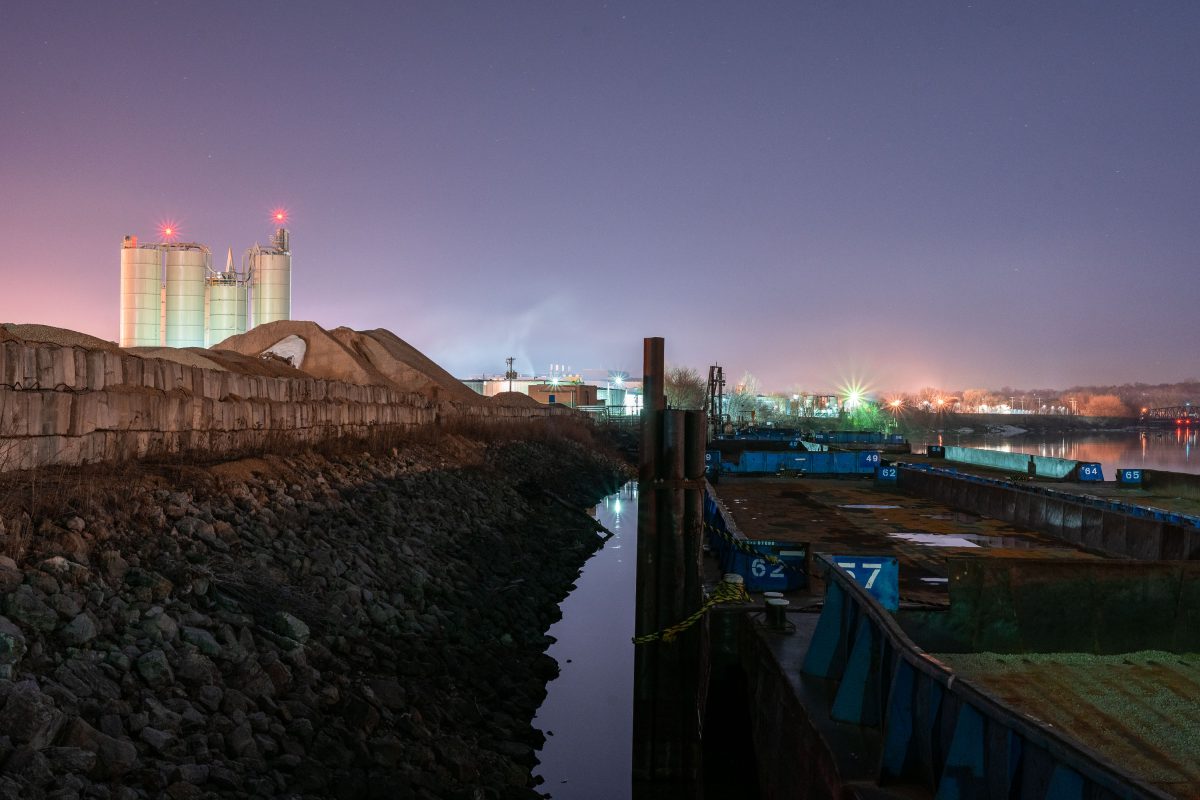
Patrick Gannaway docked on the Mississippi River in St. Paul, Minnesota.
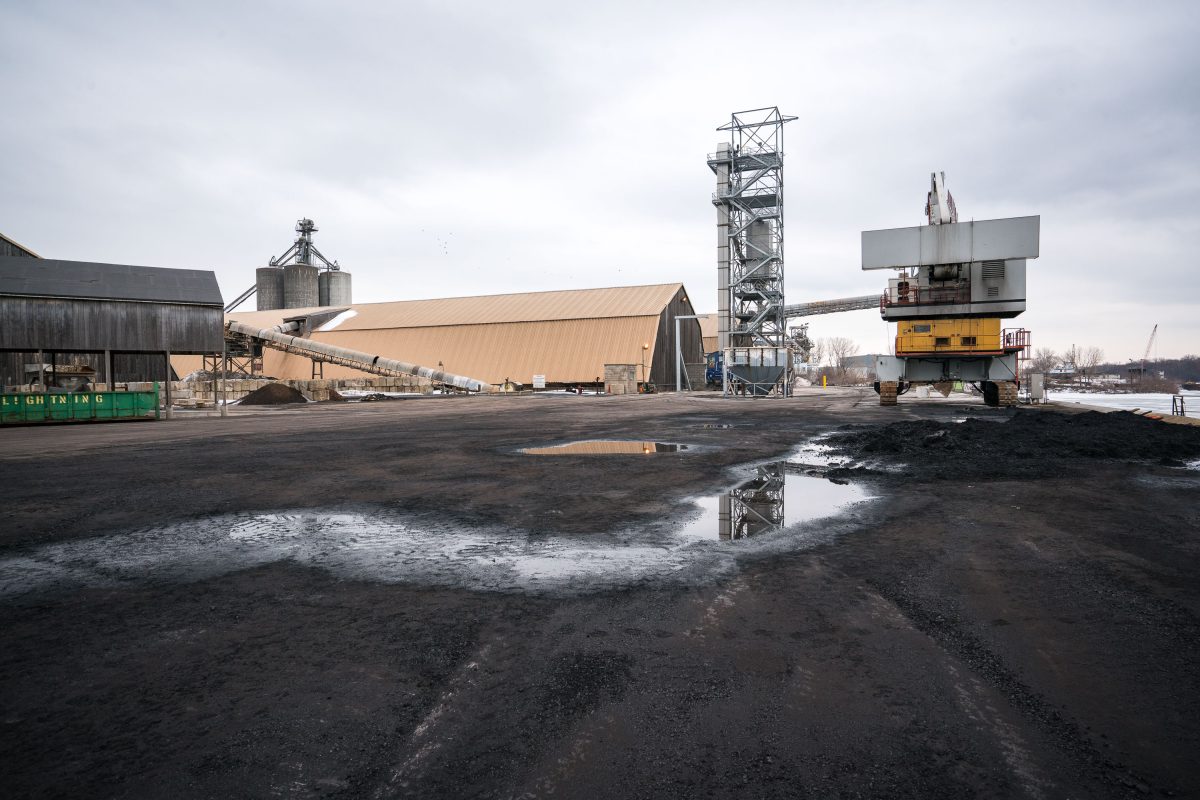
Gavilon Red Rock Elevator, South St. Paul
March 2018
—
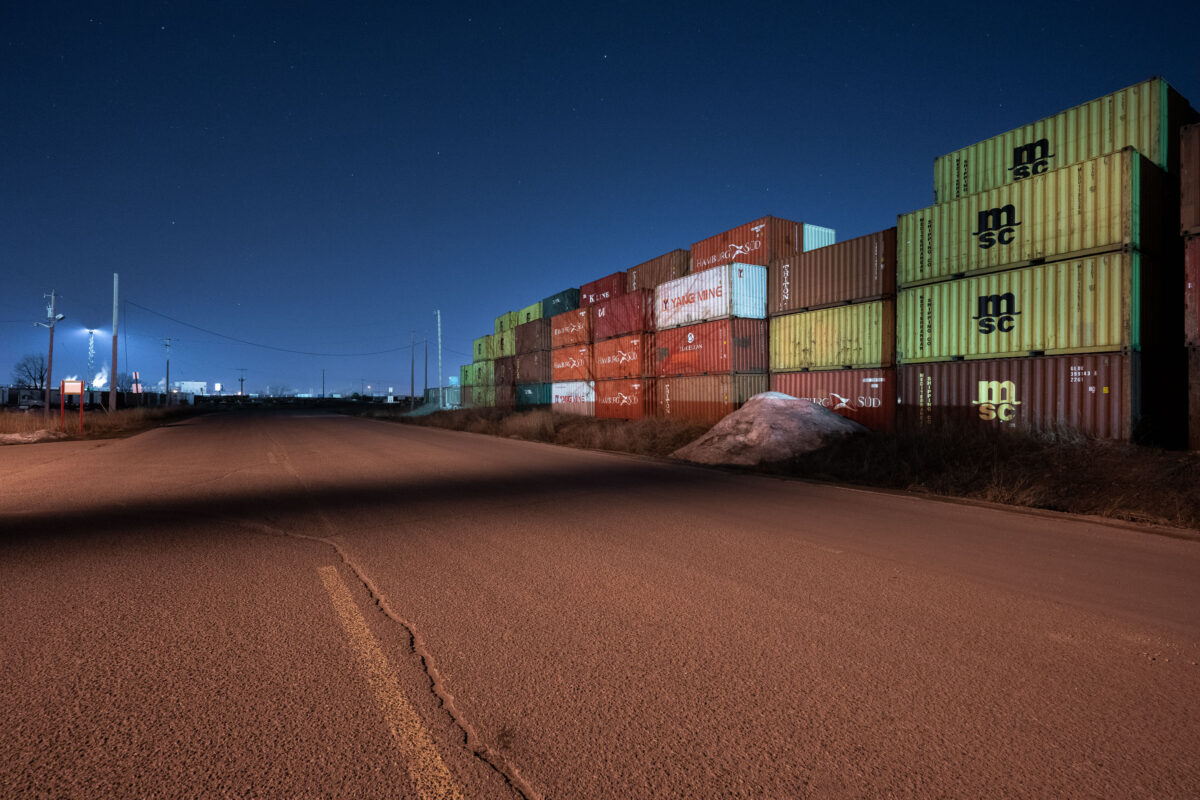
Intermodal Container Yard, Minneapolis
March 2018
—
Stacked shipping containers in Minneapolis.
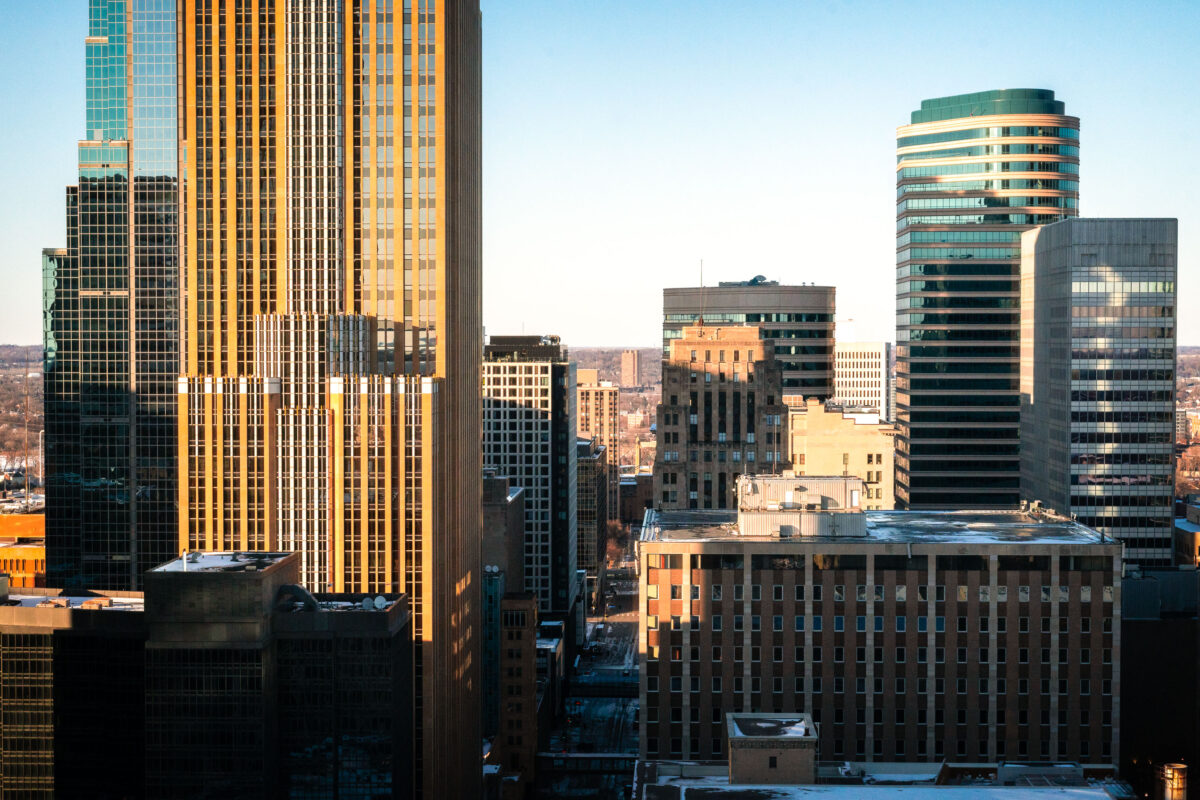
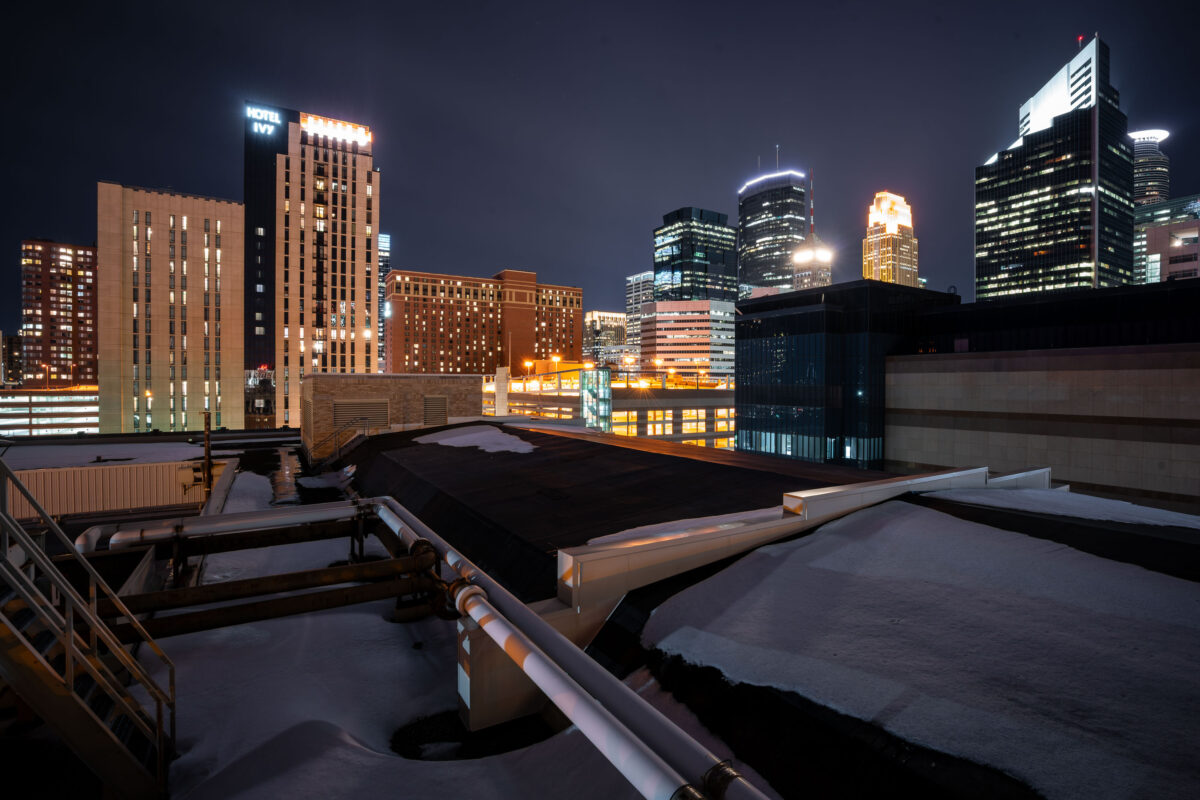
Hotel Ivy and IDS Center, Downtown Minneapolis
March 2018
—
Downtown Minneapolis as seen from the roof of Century Plaza. Now home to the Minneapolice Police 1st precinct.
Night Crane Work at Allianz Field Construction, St. Paul
March 2018
—
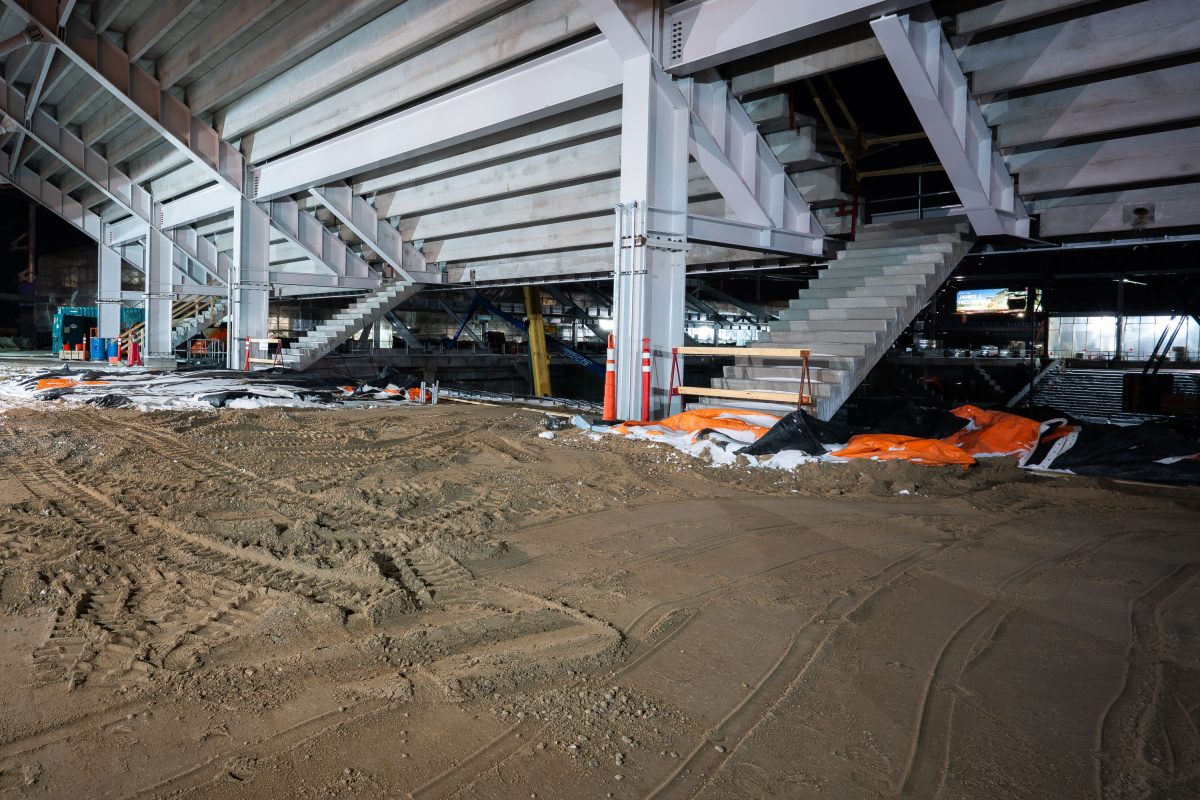
Concourse Stairwells Under Construction, Allianz Field, St. Paul
March 2018
—
Winter Construction Interior, Allianz Field, St. Paul
March 2018
—
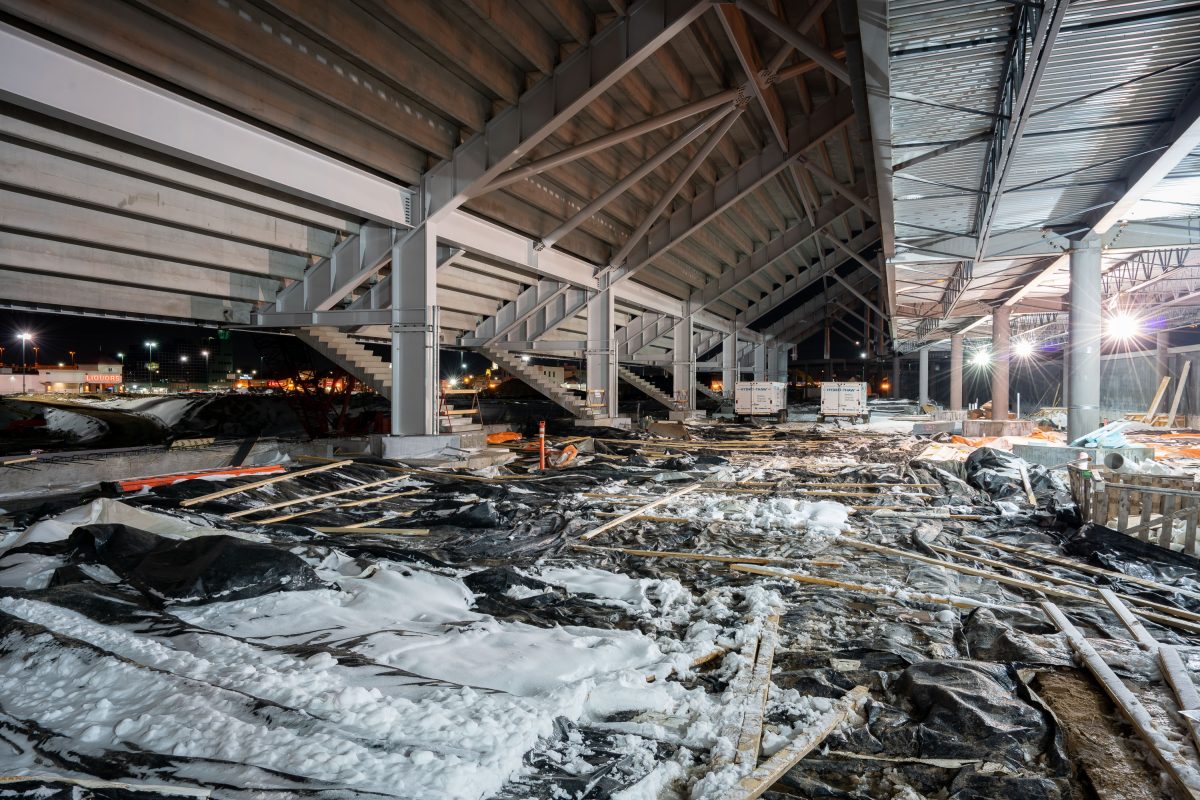
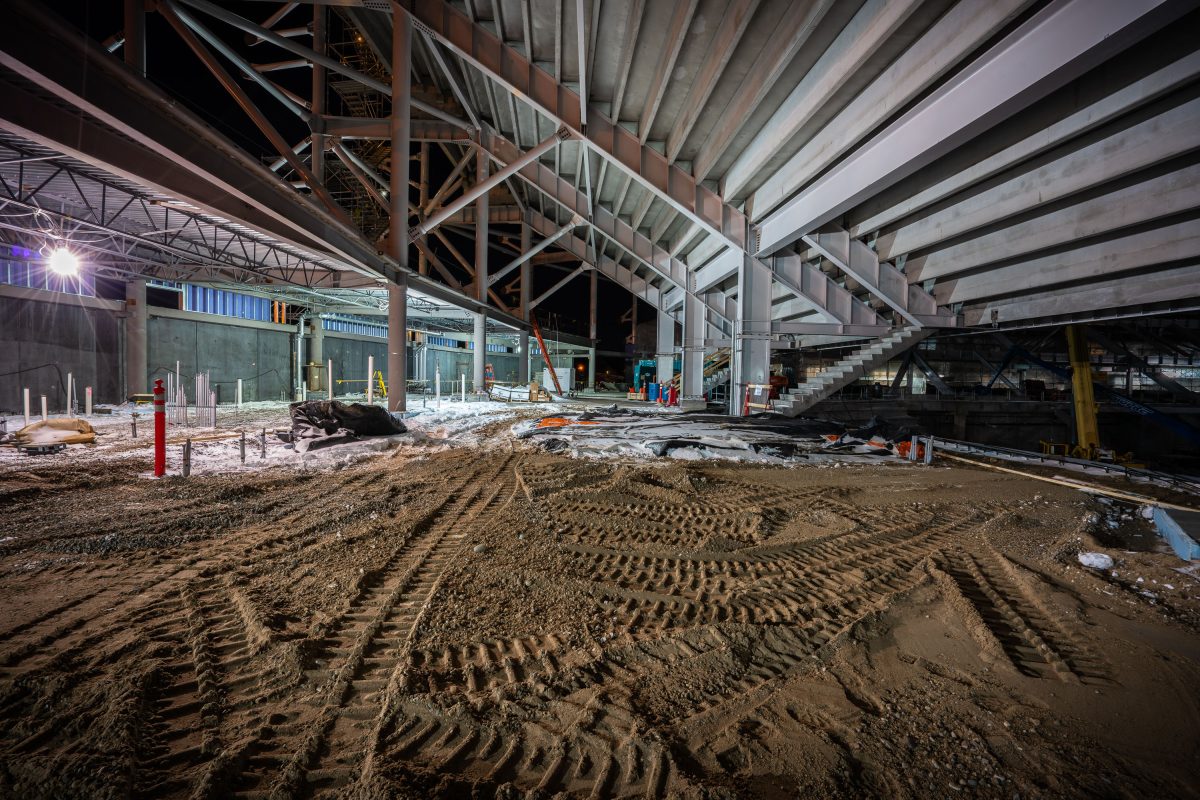
Concourse Grading Beneath Steel Trusses, Allianz Field, St. Paul
March 2018
—
Mechanical Room Rough-In, Allianz Field Construction, St. Paul
March 2018
—
Concourse Corridor Under Construction, Allianz Field, St. Paul
March 2018
—
Seating Bowl Construction, Allianz Field, St. Paul
March 2018
—
Built in Minneapolis
Minneapolis Photographer
Browse by location, move through long-running series, or start with recent work.