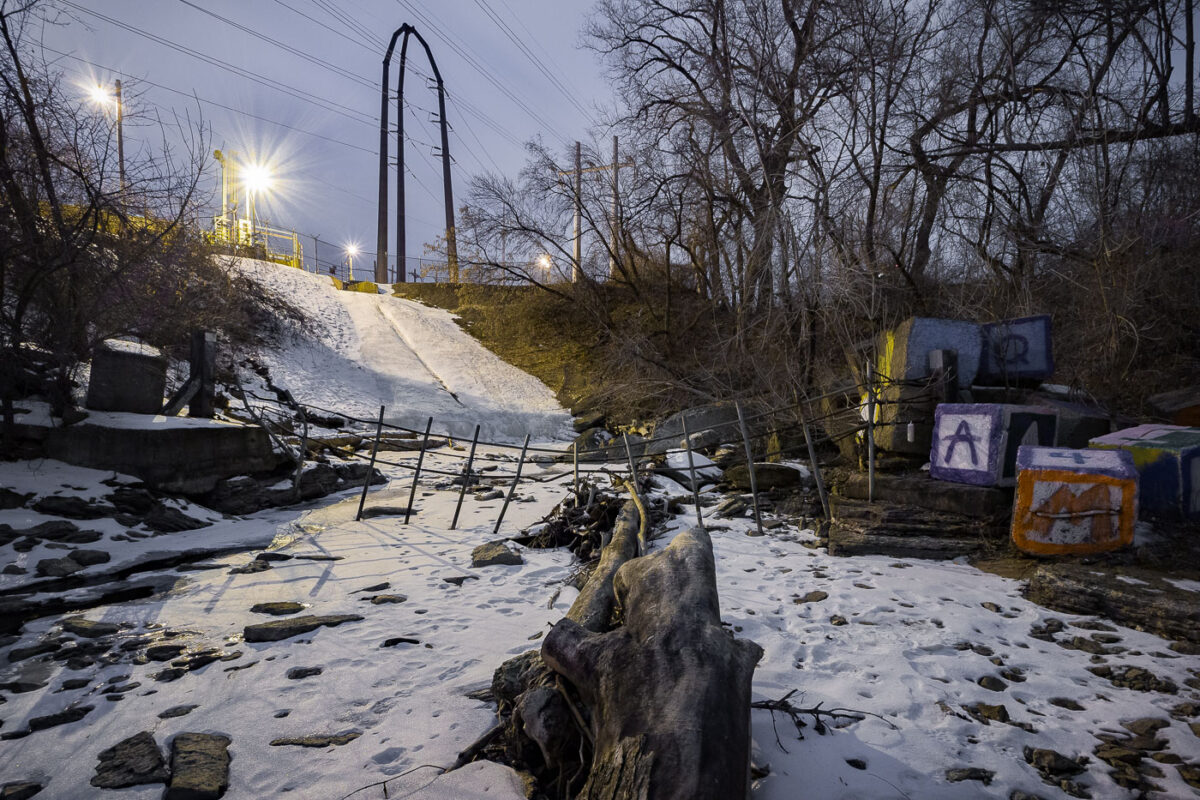
Minneapolis

5,178 photos · 2008–2026

5,178 photographs tagged Minneapolis, 2008–2026.
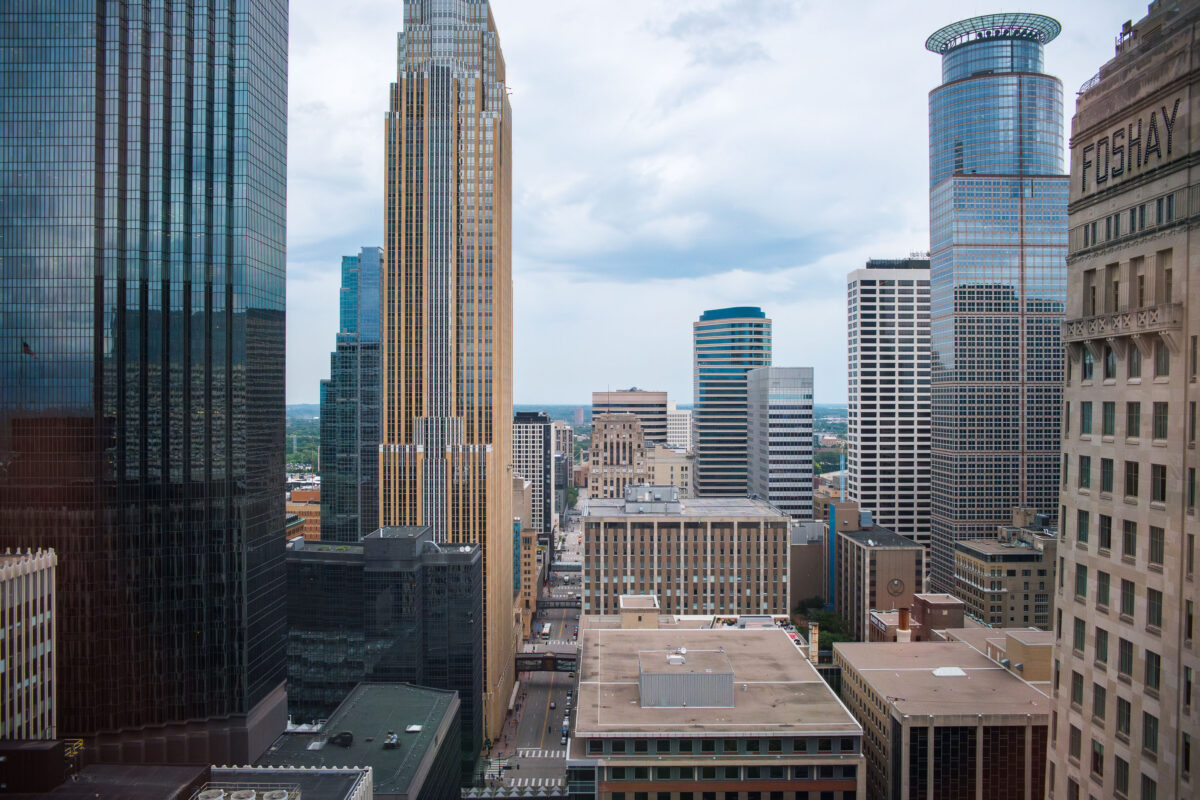
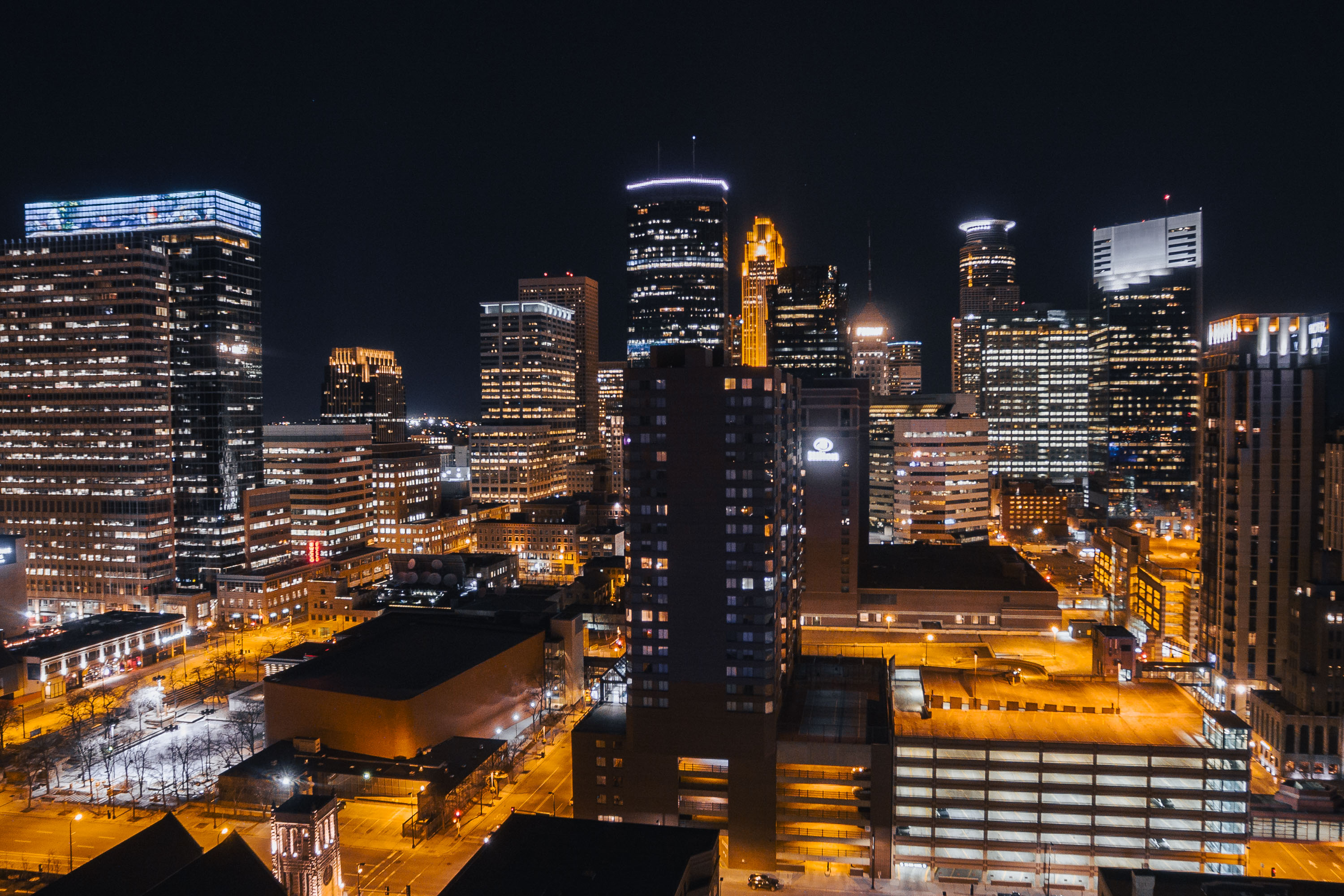
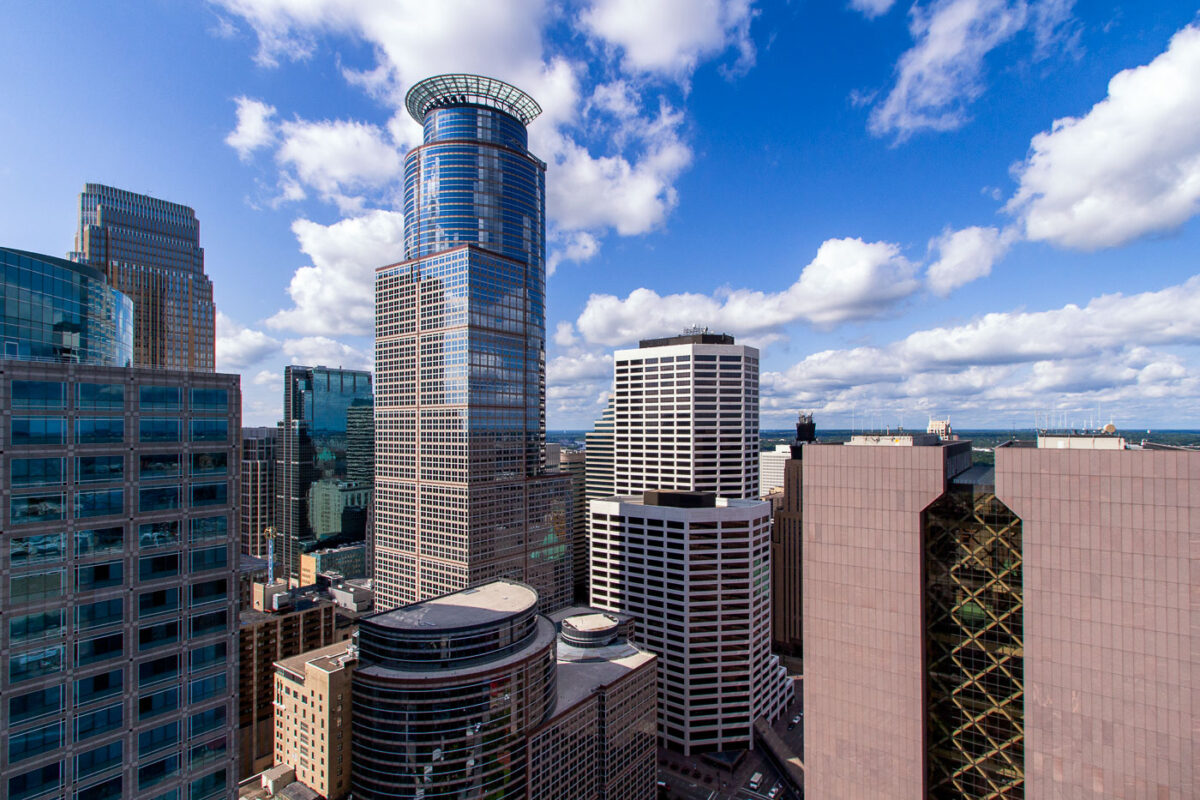
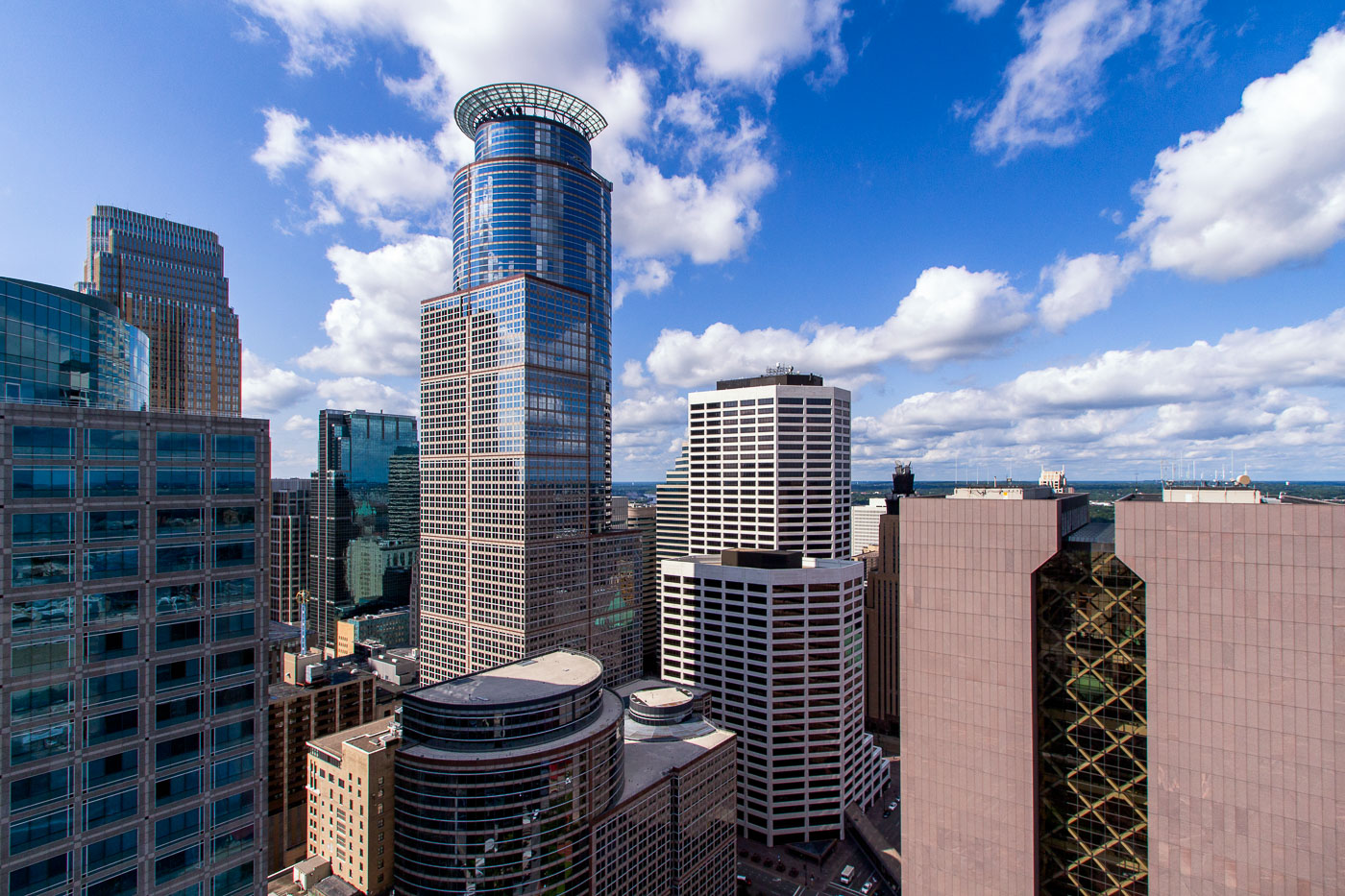
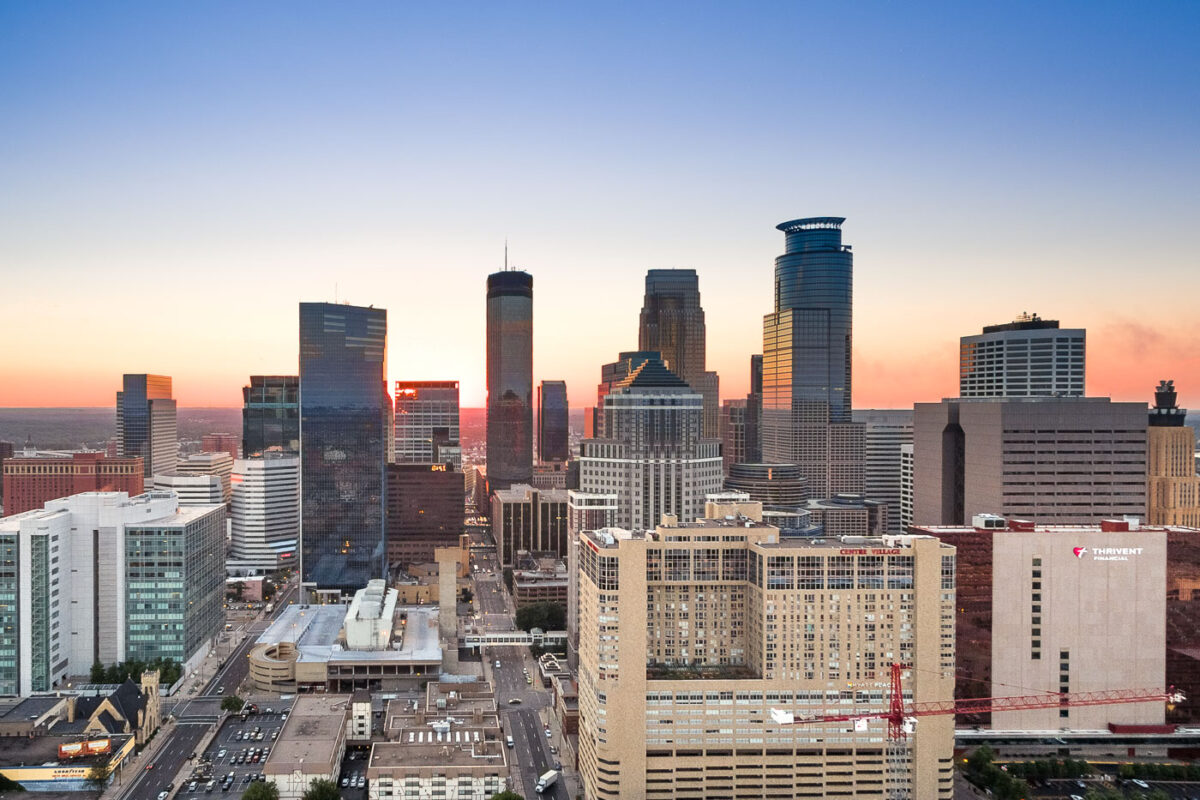
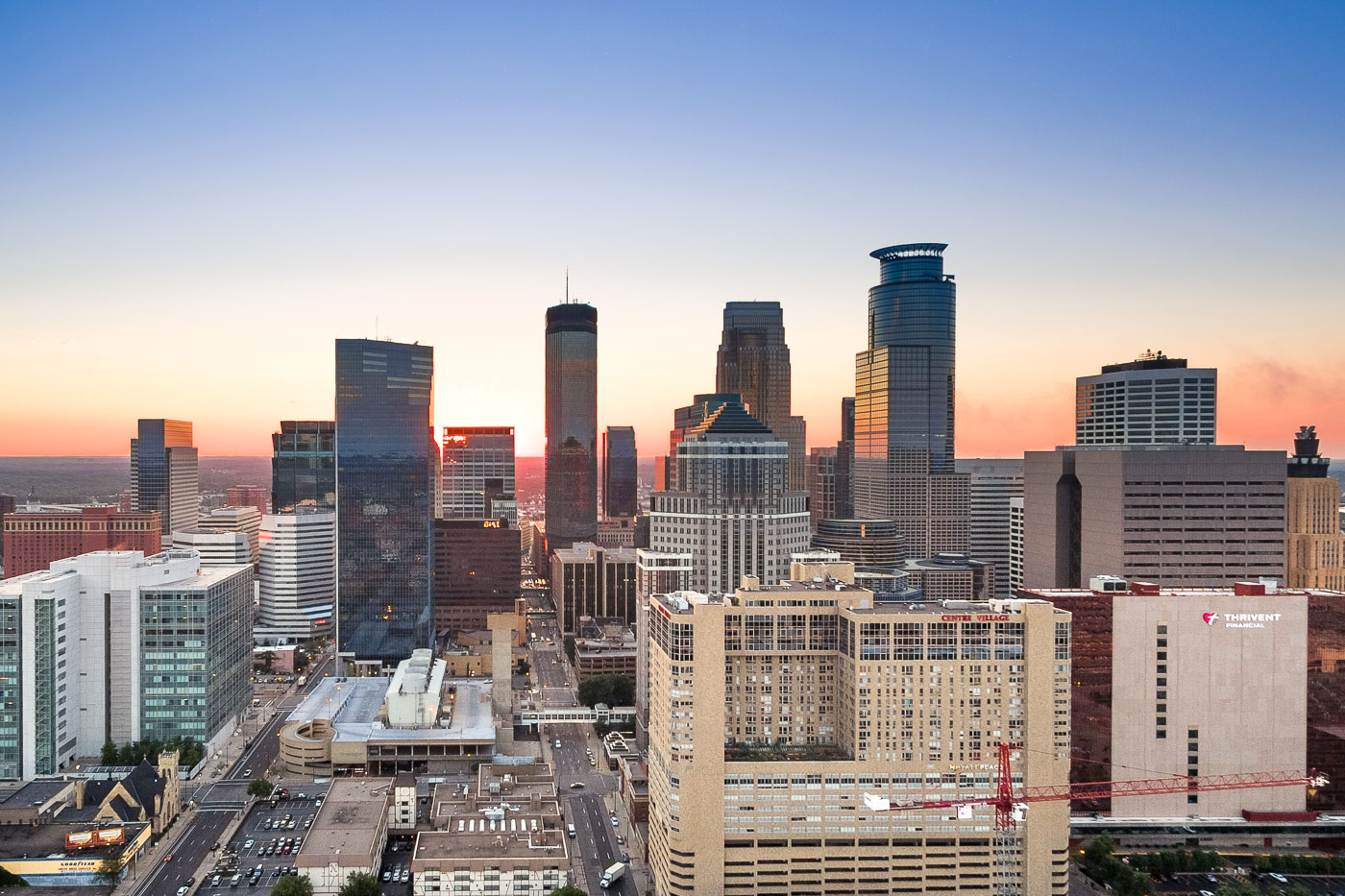
Downtown Minneapolis cityscape featuring Capella Tower, Wells Fargo Center, and Foshay Tower, representing key architectural developments.
This photograph looks out from the AT&T Tower, showcasing the downtown Minneapolis cityscape. Prominently featured are the Capella Tower, completed in 1992, and the Wells Fargo Center, which was the city's tallest building upon its completion in 1989. The image also includes the historic Foshay Tower, a landmark built in 1929 that was once the tallest building in Minneapolis. These structures represent significant periods of architectural development and economic growth in the city's central business district.

Downtown Minneapolis: Capella Tower and Wells Fargo Center
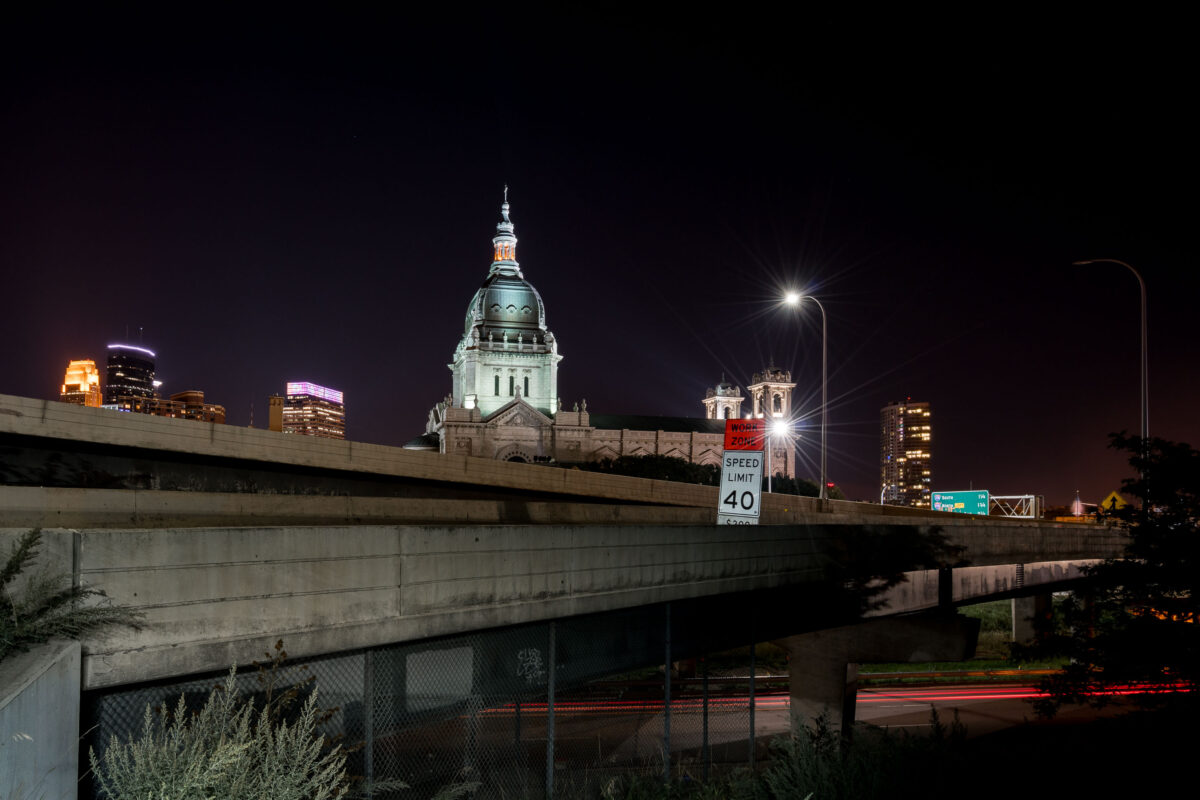
The Basilica of Saint Mary in Minneapolis is illuminated at night, with Interstate 94 passing beneath an overpass in the foreground.
The Basilica of Saint Mary, a prominent Roman Catholic church in Minneapolis, is illuminated at night, with Interstate 94 visible in the foreground. Construction of the basilica began in 1907 and it was consecrated in 1914, designed by architect Edward L. Masqueray in a French Renaissance style. It served as the seat of the Archdiocese of Saint Paul and Minneapolis until 2008. The interstate highway, completed in the 1960s, represents a significant piece of mid-20th century urban infrastructure that reshaped the city's landscape and transportation networks.

Basilica of Saint Mary and I-94 at Night, Minneapolis
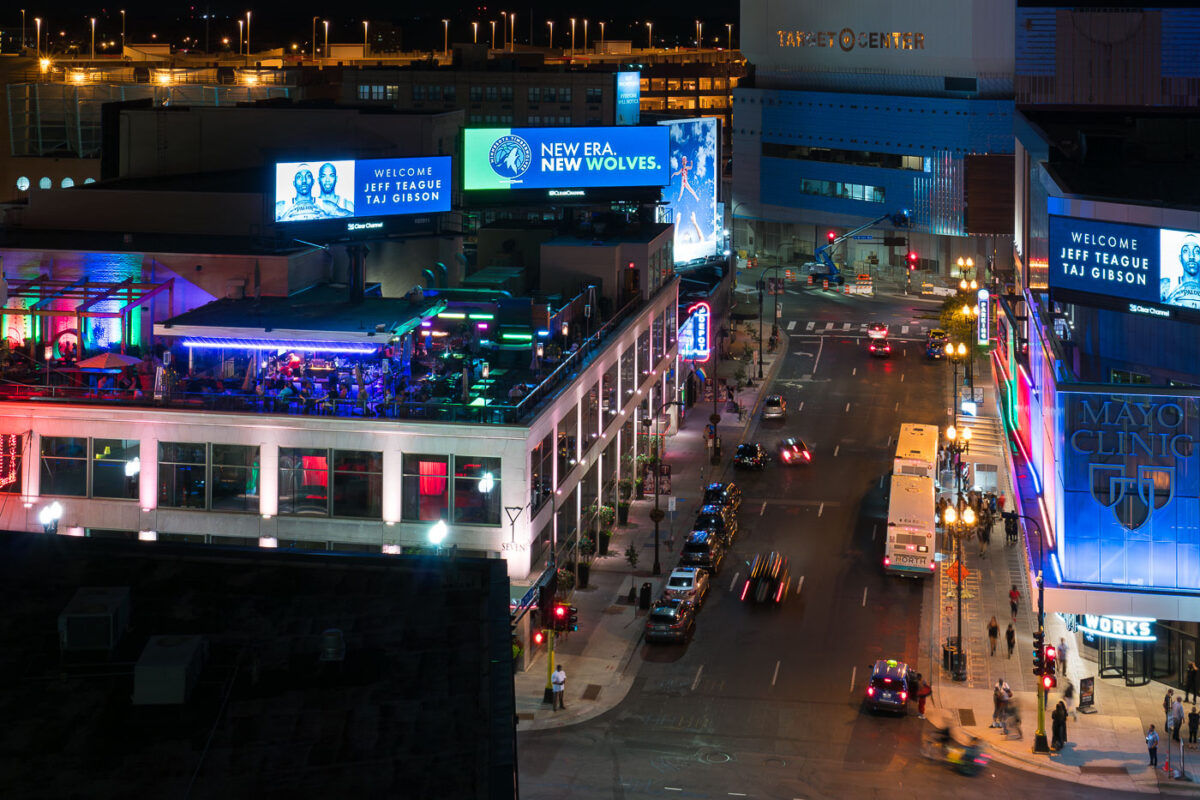
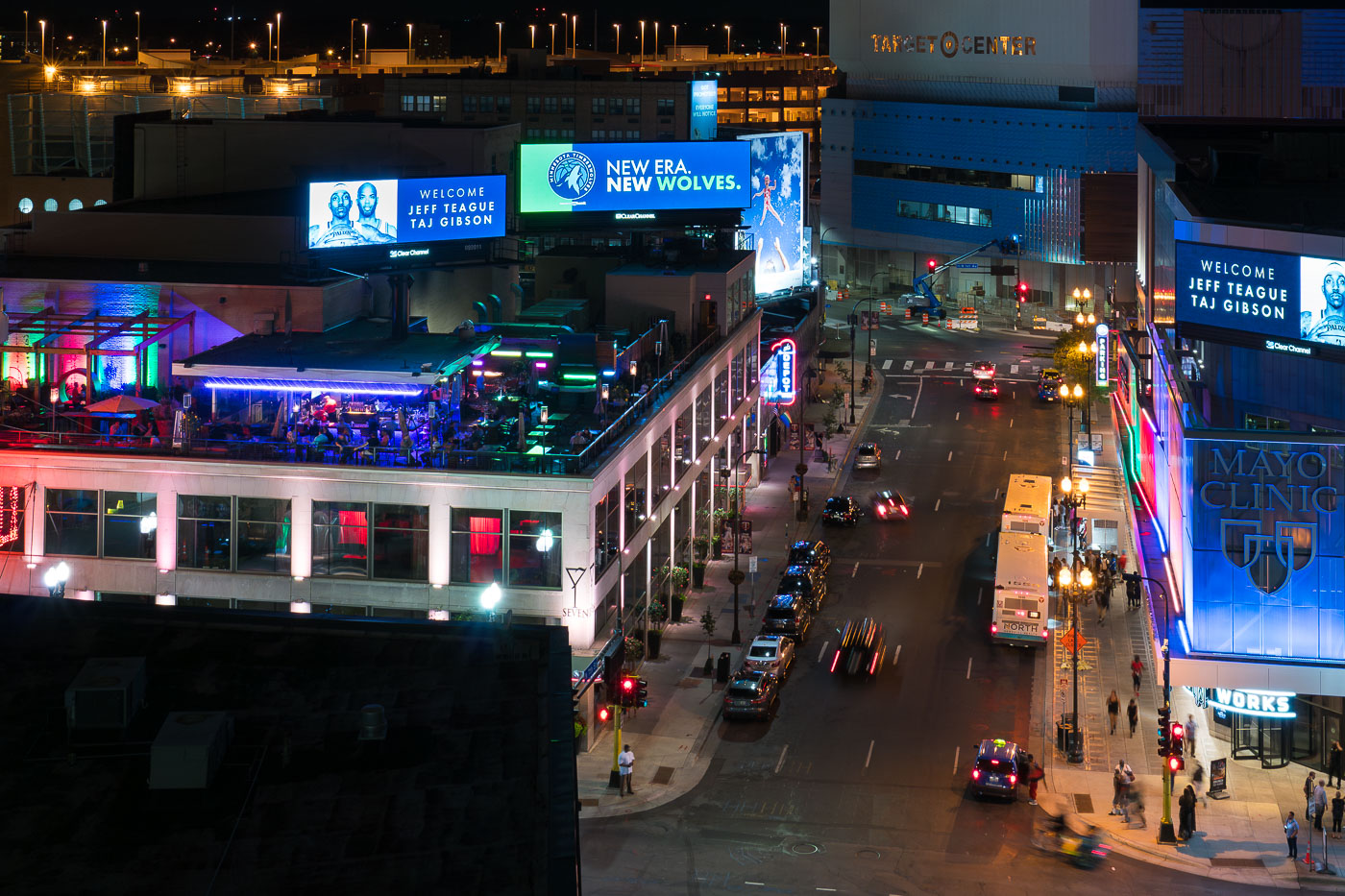
Night view of Target Center and Mayo Clinic Square in downtown Minneapolis with Seven Steakhouse rooftop bars and billboards.
Seven Steakhouse Sushi & Rooftop, located in downtown Minneapolis, operated from 2017 until its closure in the winter of 2022. The establishment was situated near prominent landmarks including the Target Center and the Mayo Clinic. This image, taken in June 2017, captures the vibrant atmosphere of the rooftop dining area and the surrounding urban environment, including advertisements for the Minnesota Timberwolves.

Seven Steakhouse Sushi & Rooftop in Downtown Minneapolis
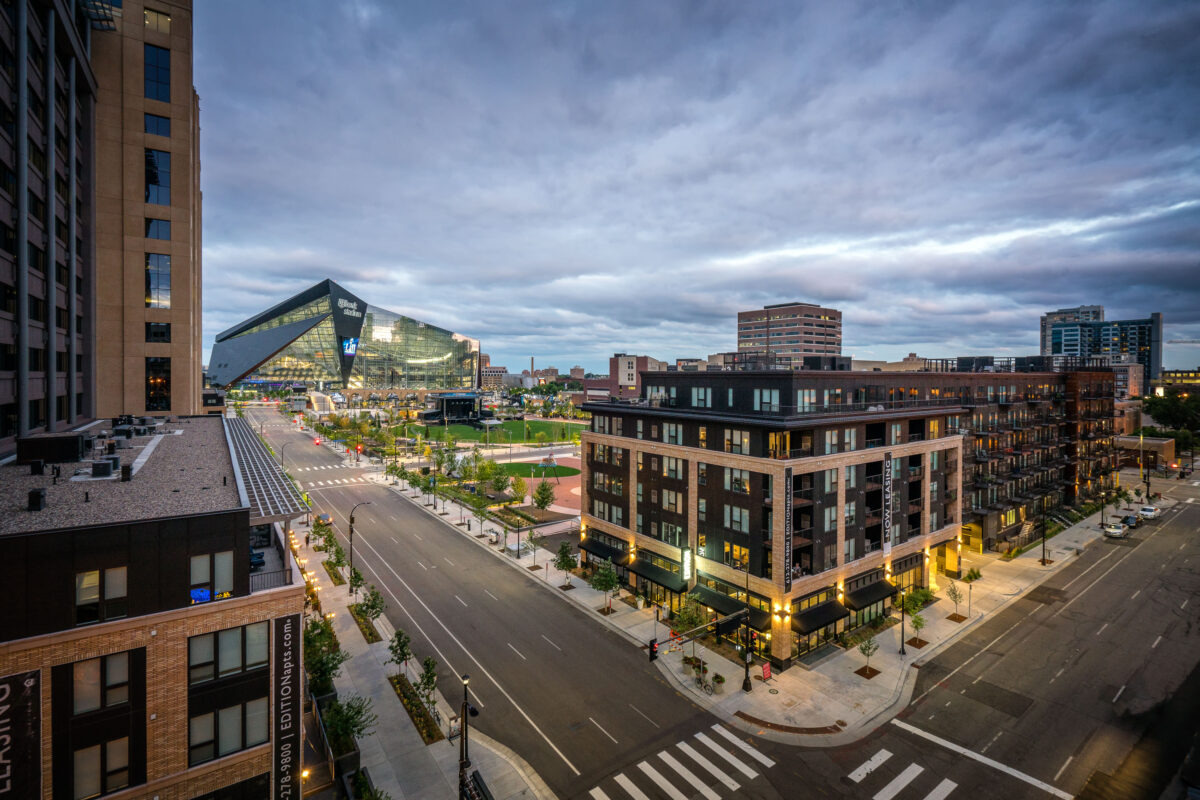
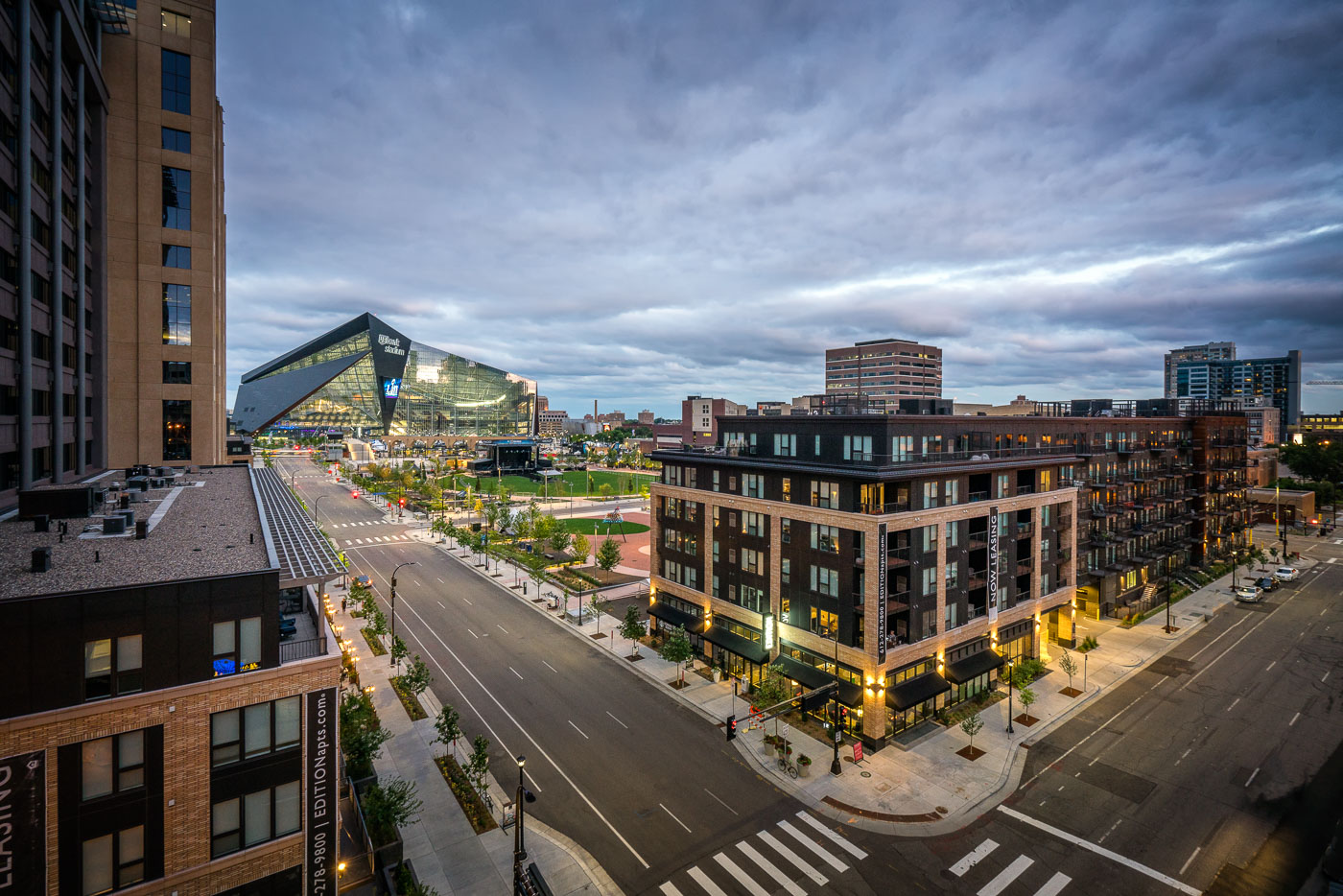
Edition Apartments and US Bank Stadium anchor the Downtown East neighborhood of Minneapolis at dusk.
US Bank Stadium, a multi-purpose venue completed in 2016, anchors the Downtown East neighborhood of Minneapolis. Adjacent to the stadium is the Edition Apartments.

Dusk Over Park Avenue Near US Bank Stadium and Edition Apartments
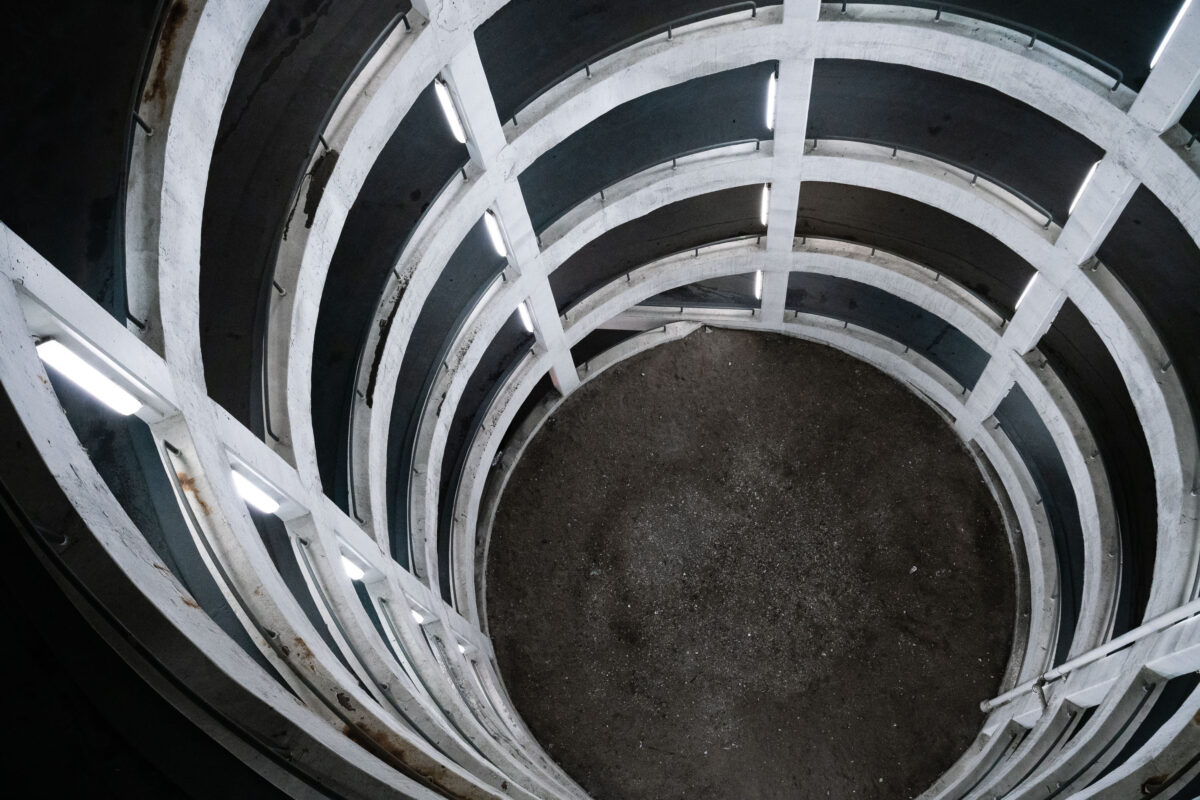
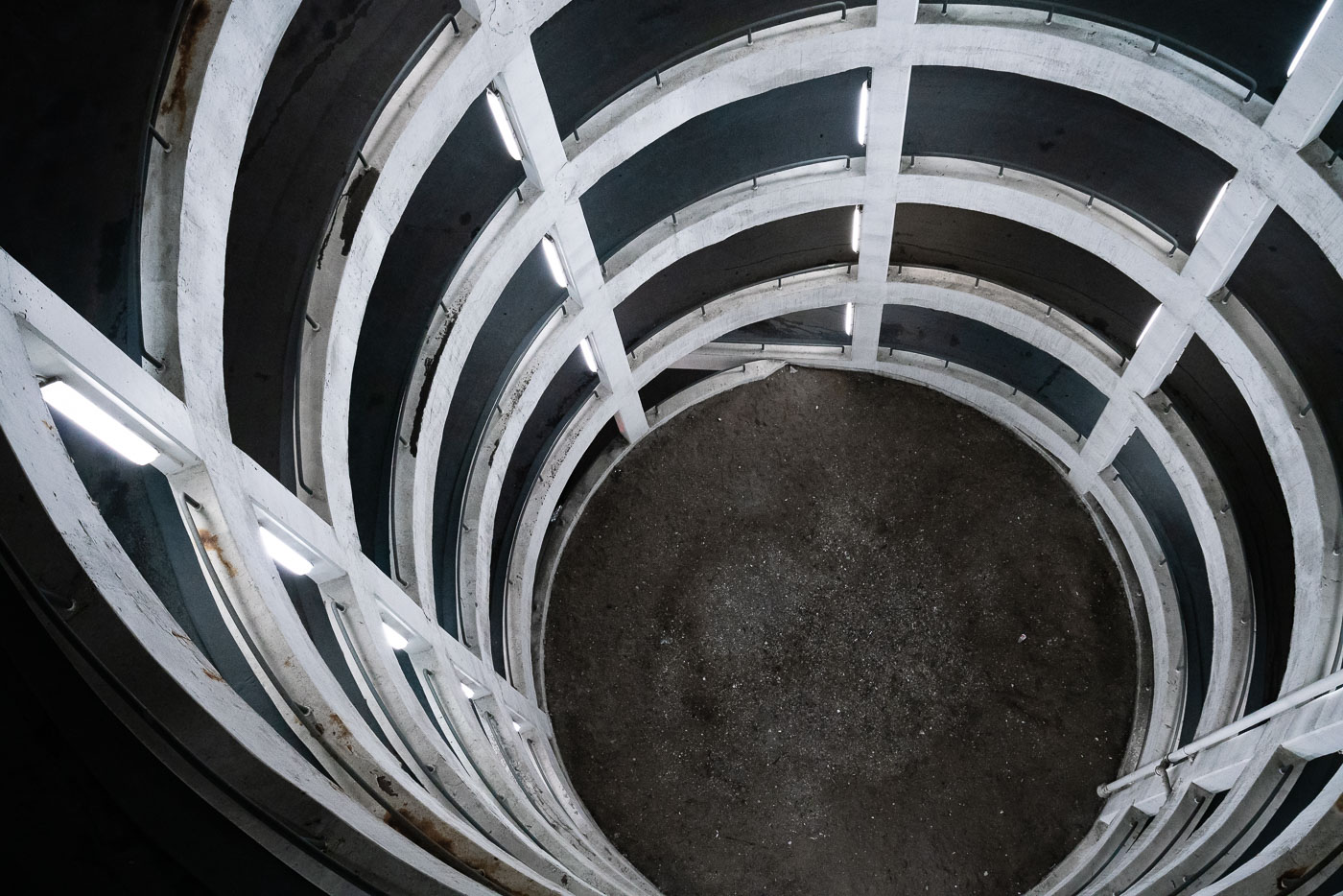
Spiral ramp inside Minneapolis Downtown Spiral Parking Garage in Minneapolis.
The Minneapolis Downtown Spiral Parking Garage, located in downtown Minneapolis, is a multi-level concrete structure designed to accommodate vehicles. Its distinctive spiral ramp design is a common architectural solution for maximizing parking capacity within a limited urban footprint. Such garages are essential components of urban infrastructure, facilitating access to commercial and residential areas by providing necessary parking facilities. This particular structure serves the needs of the downtown business and entertainment district.

Minneapolis Downtown Spiral Parking Garage

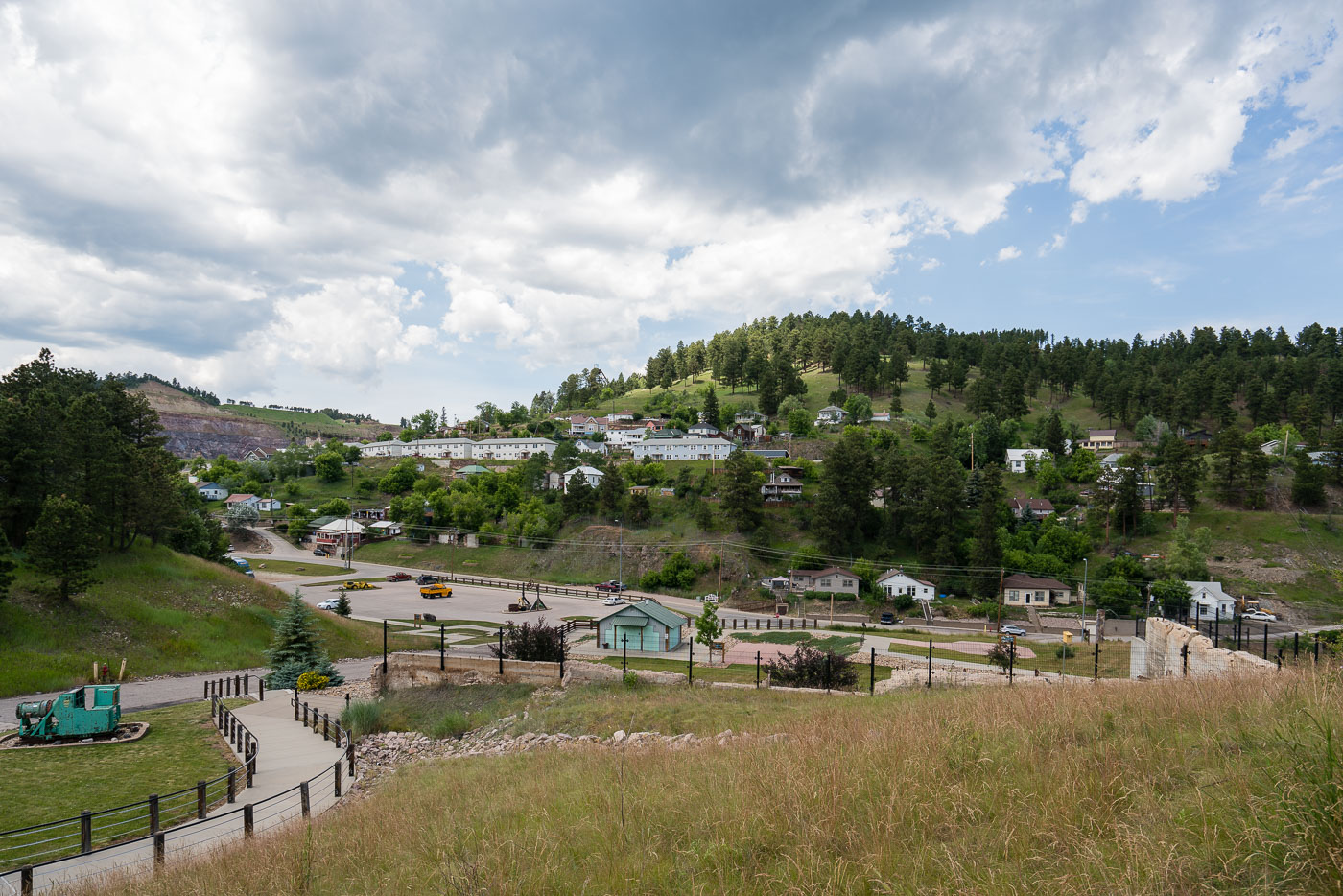
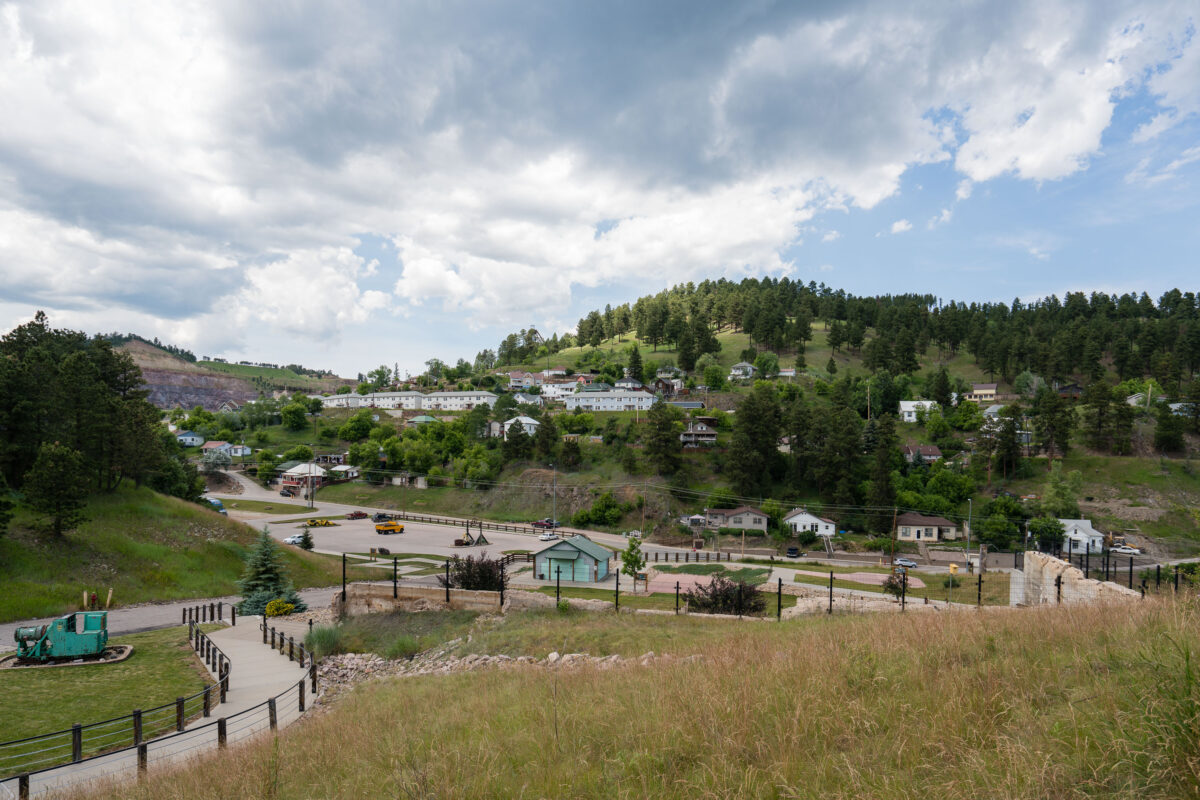
Gold Run Park in Lead, South Dakota, lies below hillside homes and pine-covered slopes.
Gold Run Park in Lead, South Dakota, occupies a hillside site below homes and pine-covered slopes in the Black Hills. The park includes paved paths, open lawn, preserved stone walls, and mining equipment connected with the area’s gold-mining history. Lead developed around the Homestake Mine, and Gold Run Park incorporates features tied to that local mining landscape.

Gold Run Park Below Lead Hillside, South Dakota
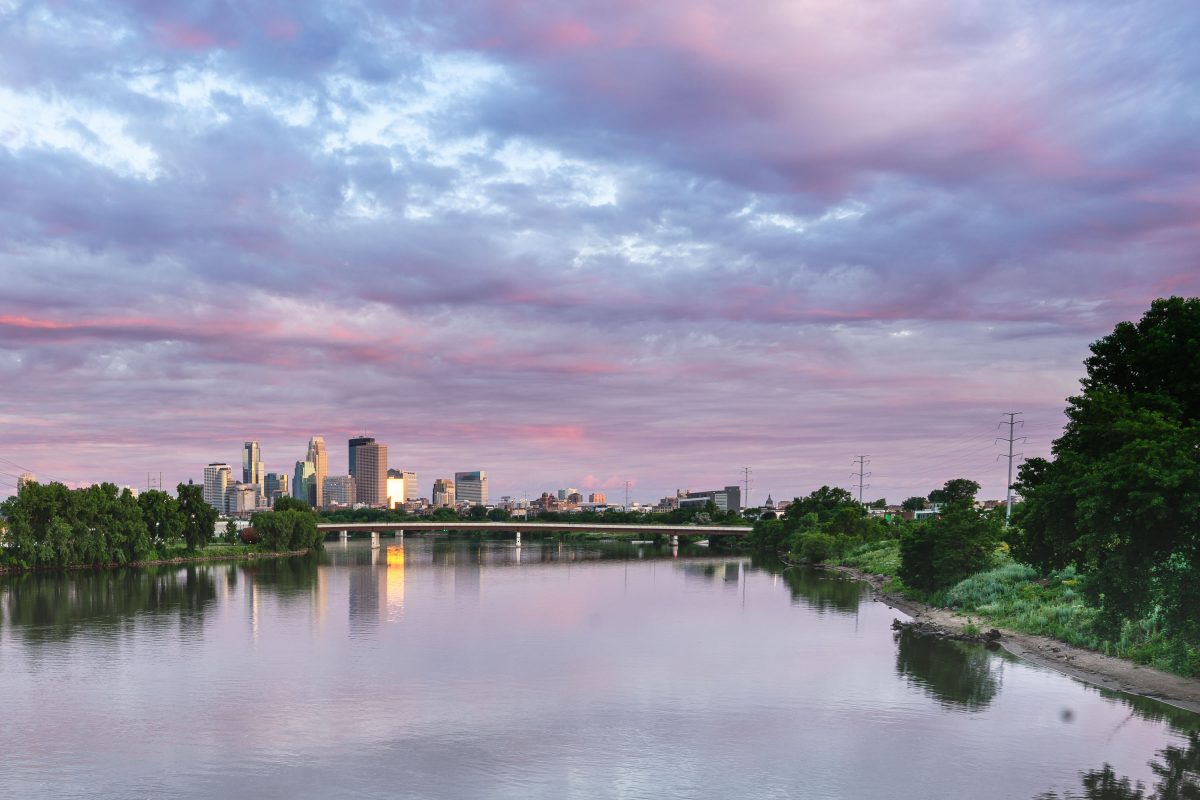
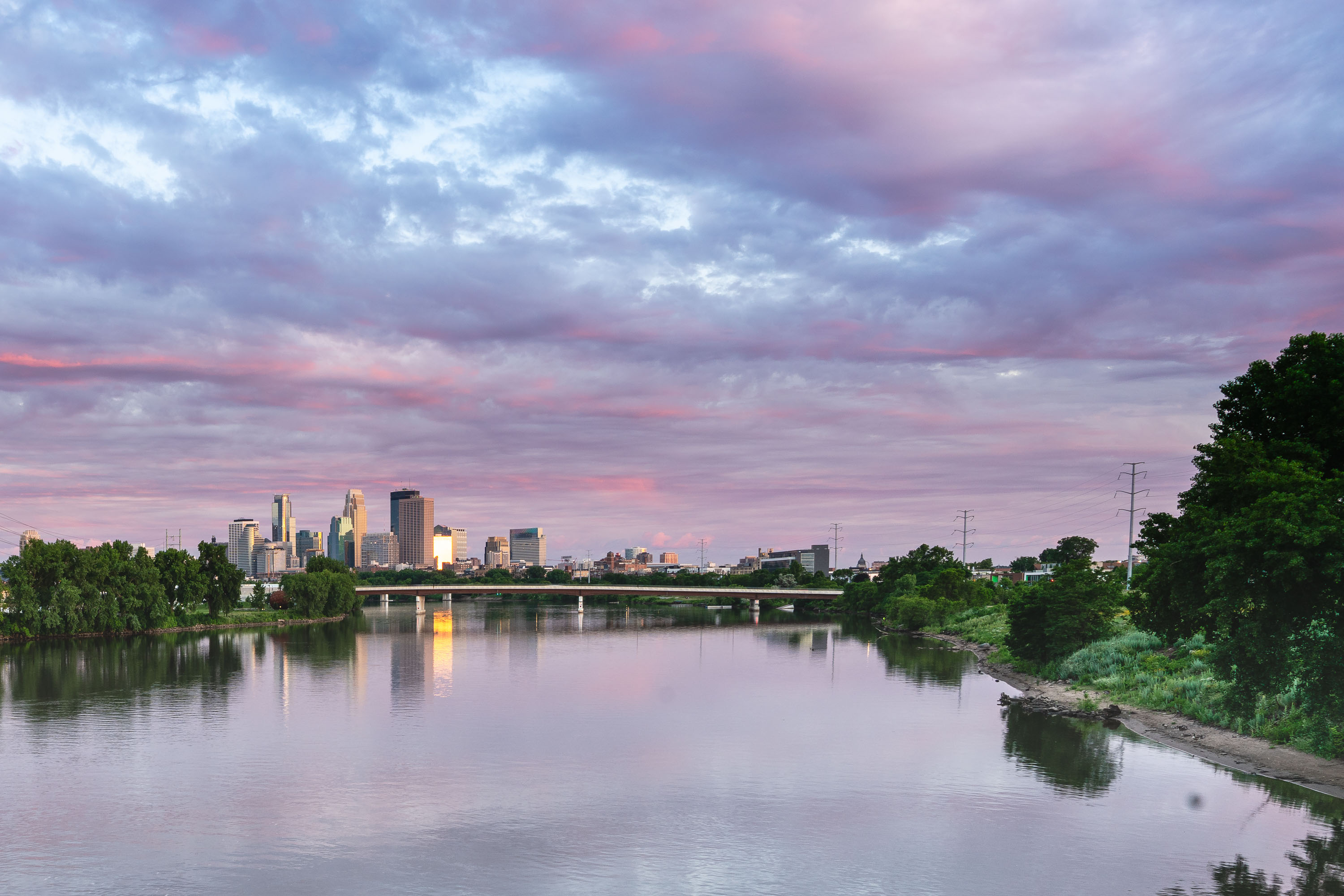
Minneapolis skyline beyond the Mississippi River under evening clouds.
The Minneapolis skyline rises beyond the Mississippi River in Minneapolis, Minnesota.

View of Minneapolis Skyline from the north side

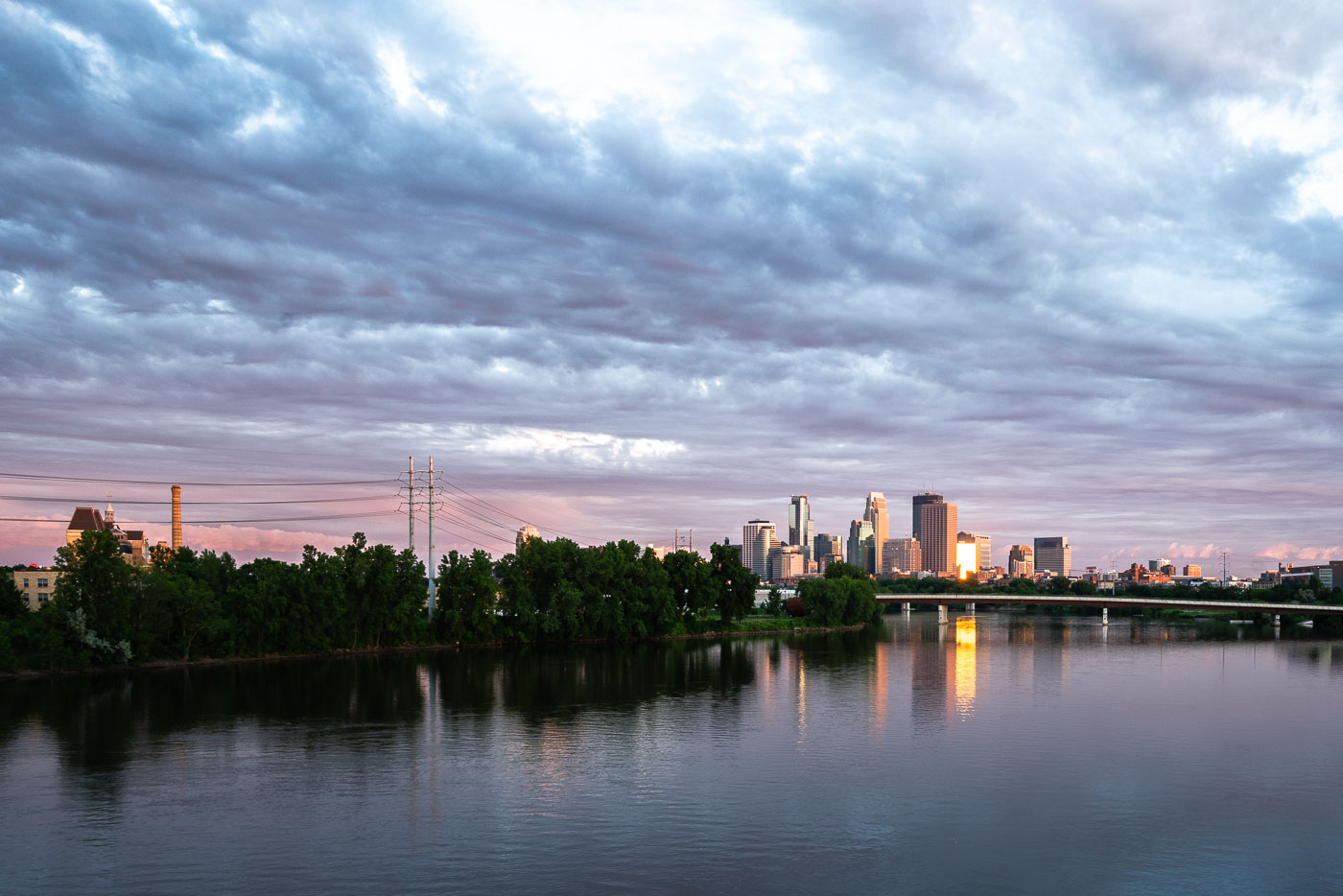
Minneapolis downtown skyline and Mississippi River at dusk with suspension bridge visible across the water.
Downtown Minneapolis along the Mississippi River, with the Third Avenue Bridge crossing toward downtown. The river marks the site of St. Anthony Falls, the only major waterfall on the Mississippi, which drew the flour mills that built the city's early economy.

Downtown Minneapolis Skyline Along the Mississippi River
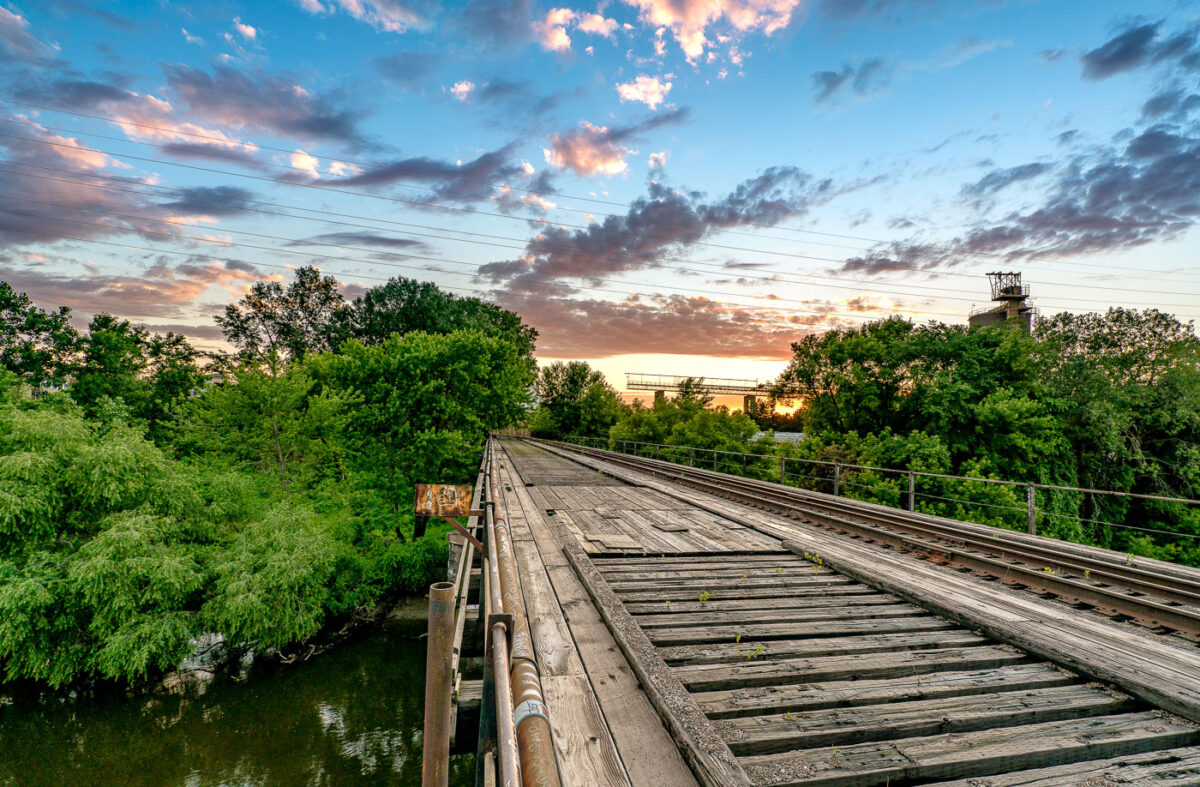
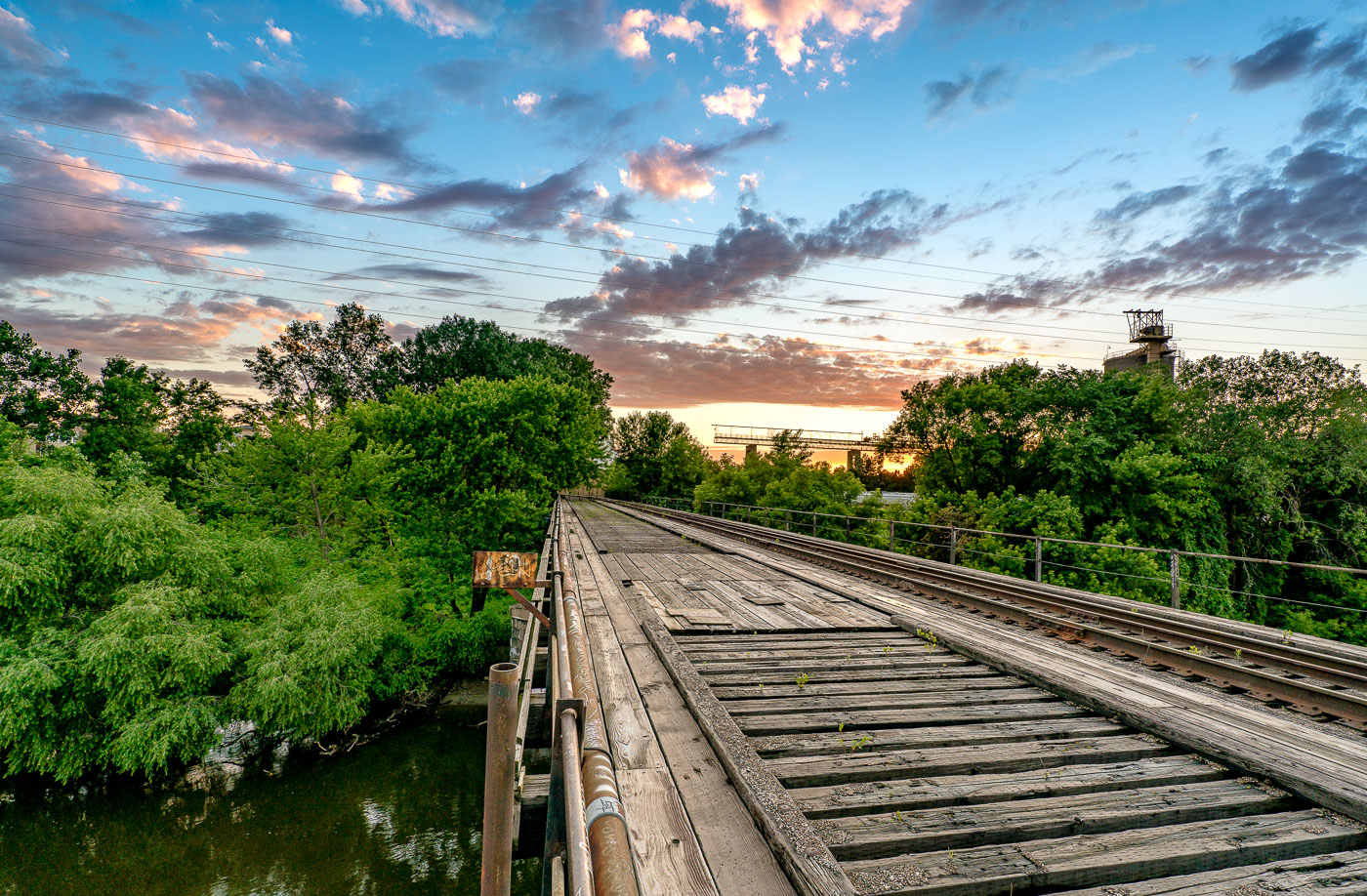
A wooden train bridge spans the Mississippi River in Minneapolis, Minnesota, at sunset, highlighting the historical importance of rail infrastructure.
A wooden train bridge spans the Mississippi River in Minneapolis, Minnesota. This structure, likely built to facilitate freight transport, highlights the historical importance of rail infrastructure in the region's development. The weathered timbers and visible tracks suggest a long operational history, while the surrounding greenery and sunset clouds offer a contrast between industrial utility and natural beauty. Such bridges were vital arteries for commerce and industry, connecting communities and enabling the movement of goods.

Wooden Train Bridge Over Mississippi River, Minneapolis
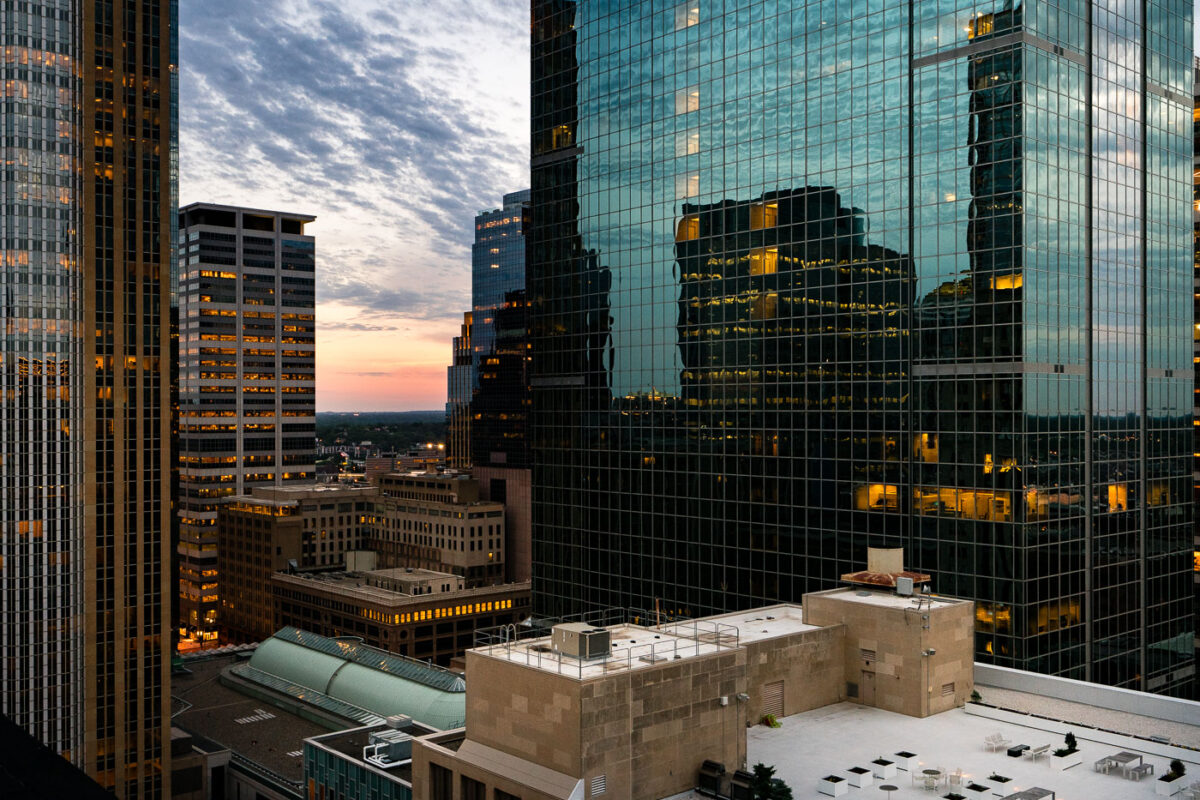
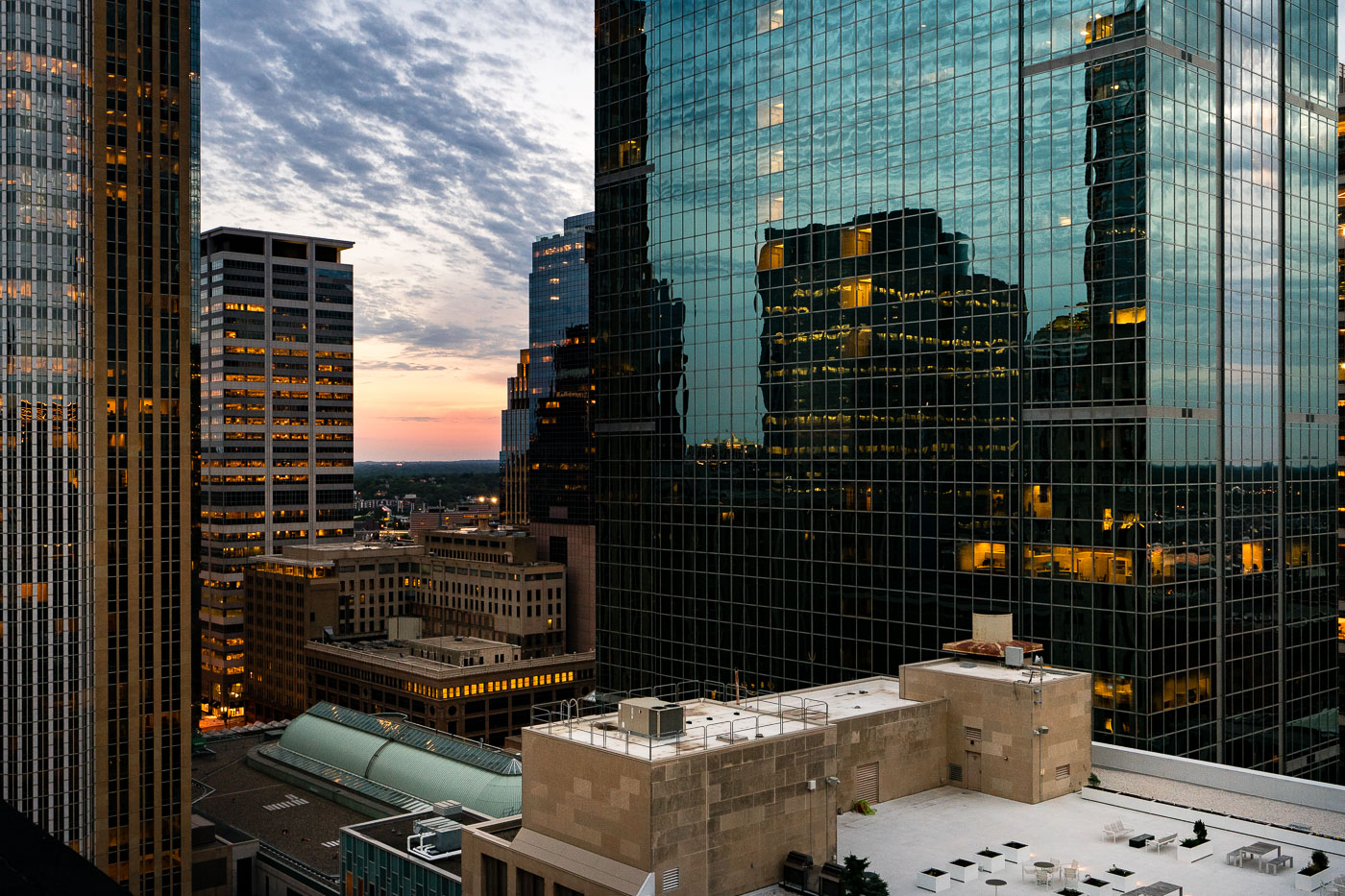
Downtown Minneapolis skyscrapers at sunset.
The setting sun casts a warm glow over Downtown Minneapolis, illuminating the windows of its modern skyscrapers. These buildings represent the city's economic and commercial core, housing numerous businesses and corporate offices. The architecture reflects a blend of contemporary design, with glass facades mirroring the sky and surrounding structures. As evening approaches, the lights within the offices signify the ongoing activity and the city's role as a hub for commerce and industry.

June sunset in Downtown Minneapolis

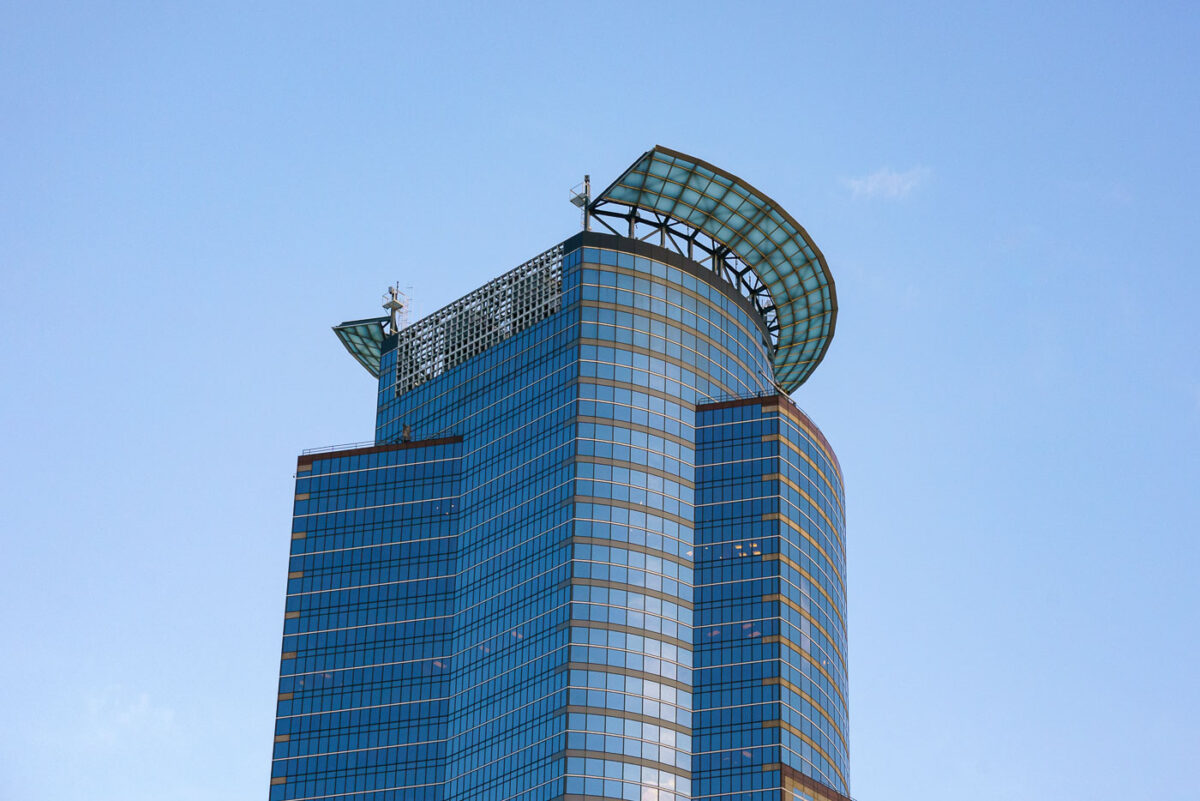
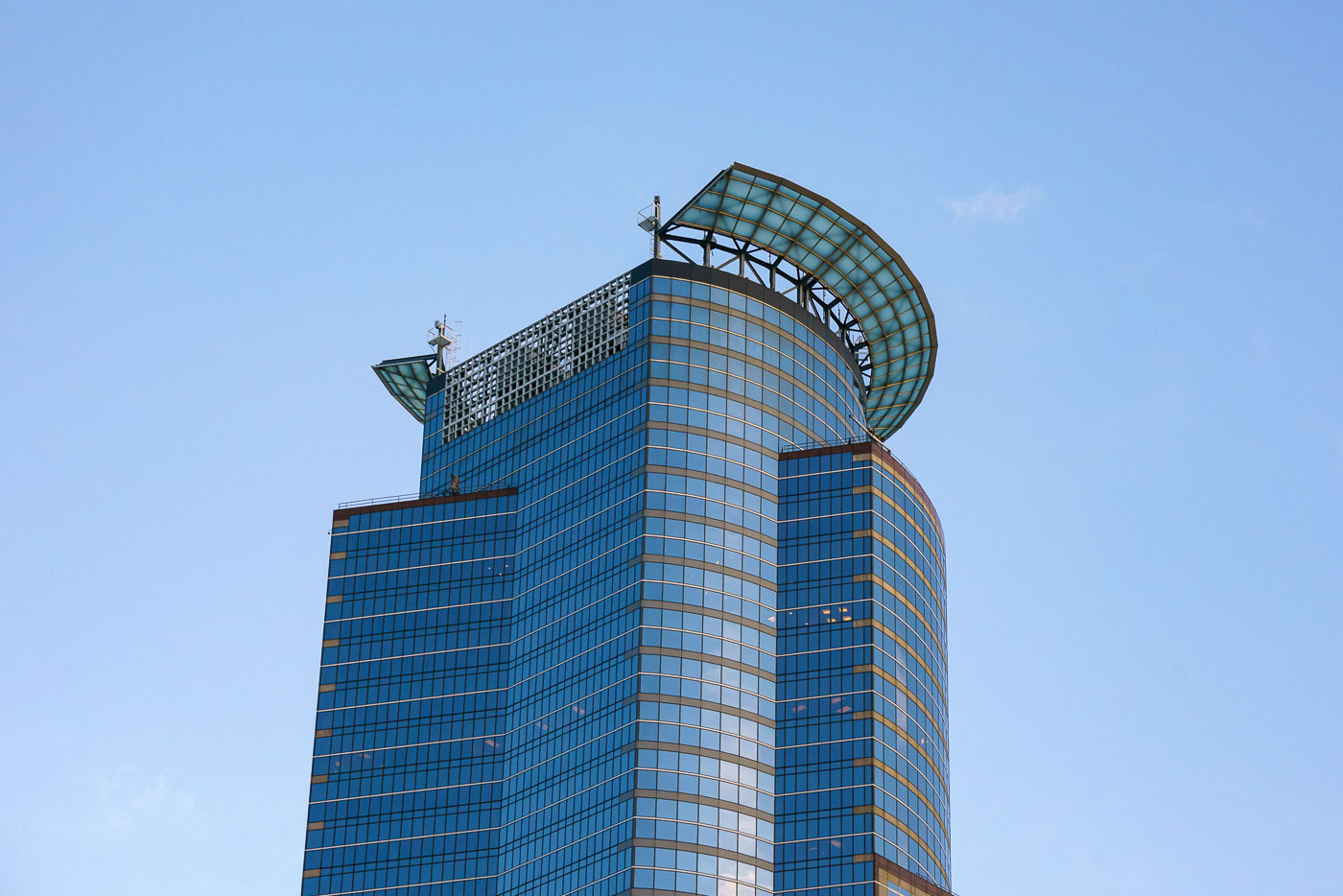
Capella Tower in downtown Minneapolis against a clear sky.
The Capella Tower, a prominent skyscraper in downtown Minneapolis, is topped by a distinctive crown structure. This crown was recently retrofitted with energy-efficient LED lighting, enhancing its visibility and reducing its energy consumption. Completed in 1992, the tower stands as a significant piece of the city's architectural landscape and continues to serve as a key commercial and office space.

Capella Tower Crown with LED Lighting, Downtown Minneapolis
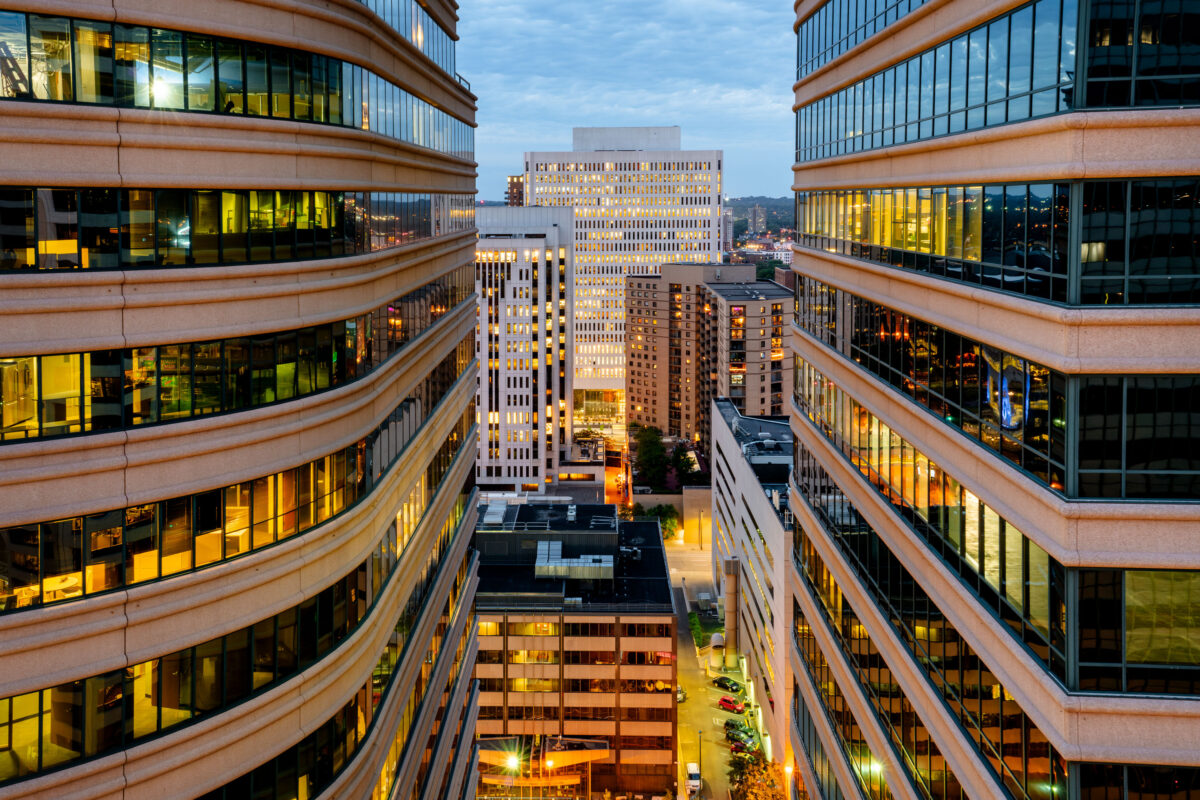
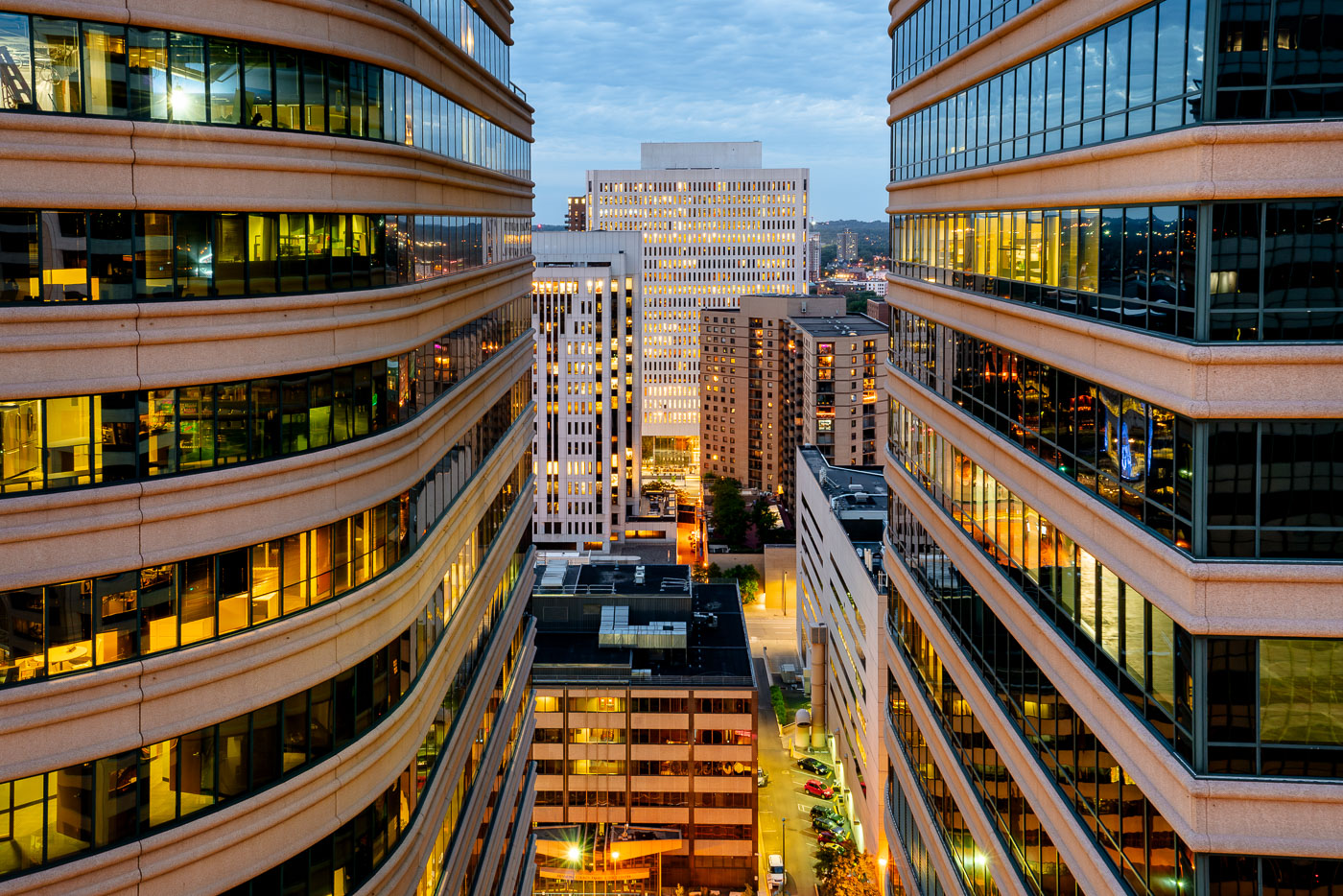
Fifth Street Towers in downtown Minneapolis at dusk.
The Fifth Street Towers, located in Downtown Minneapolis, are a pair of modern office buildings that contribute to the city's commercial core. Completed in the late 20th century, these structures feature distinctive curved facades and extensive glass exteriors, reflecting the surrounding urban environment. The towers house various businesses and professional services, serving as a key component of Minneapolis's business district. Their design and placement highlight the ongoing development and density of the downtown area.

Fifth Street Towers, Downtown Minneapolis
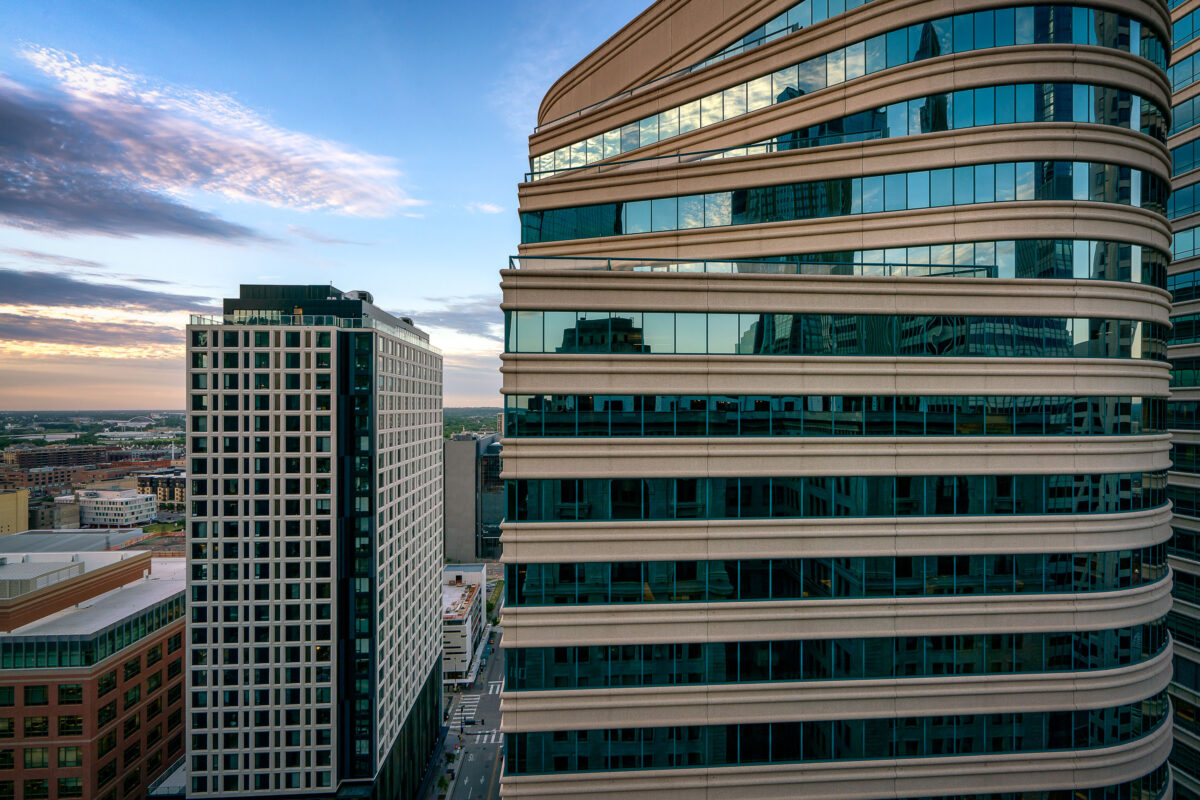
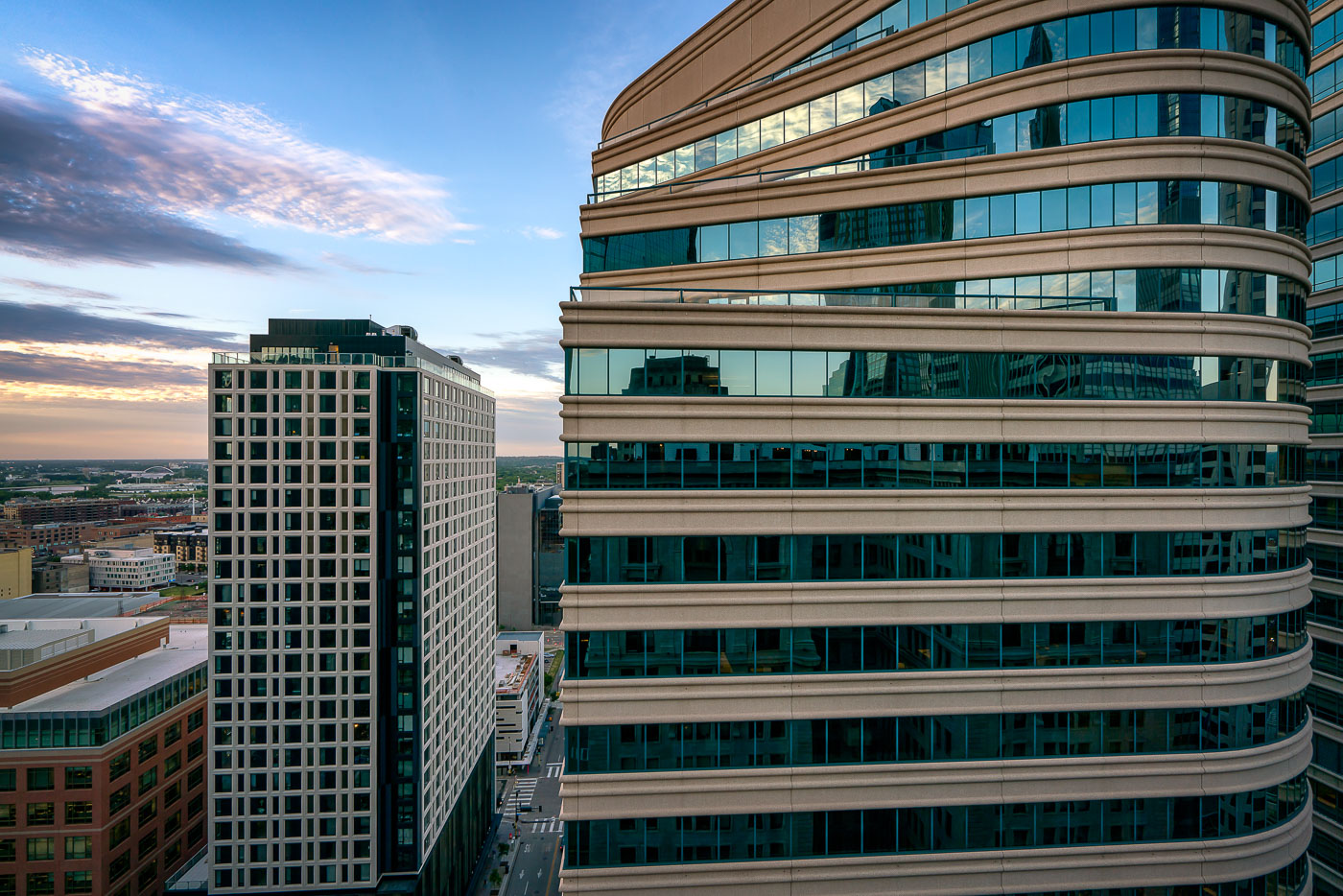
Fifth Street Towers in downtown Minneapolis at sunset
The Fifth Street Towers, a pair of modern office buildings in Downtown Minneapolis, are seen at sunset. The building on the right features a distinctive curved facade with horizontal bands of beige stone and blue-tinted glass, reflecting the sky and surrounding architecture. Its counterpart on the left is a more rectilinear structure with a grid of windows. These buildings are part of the central business district, housing various commercial enterprises and contributing to the city's economic activity.

Fifth Street Towers, Downtown Minneapolis at Sunset
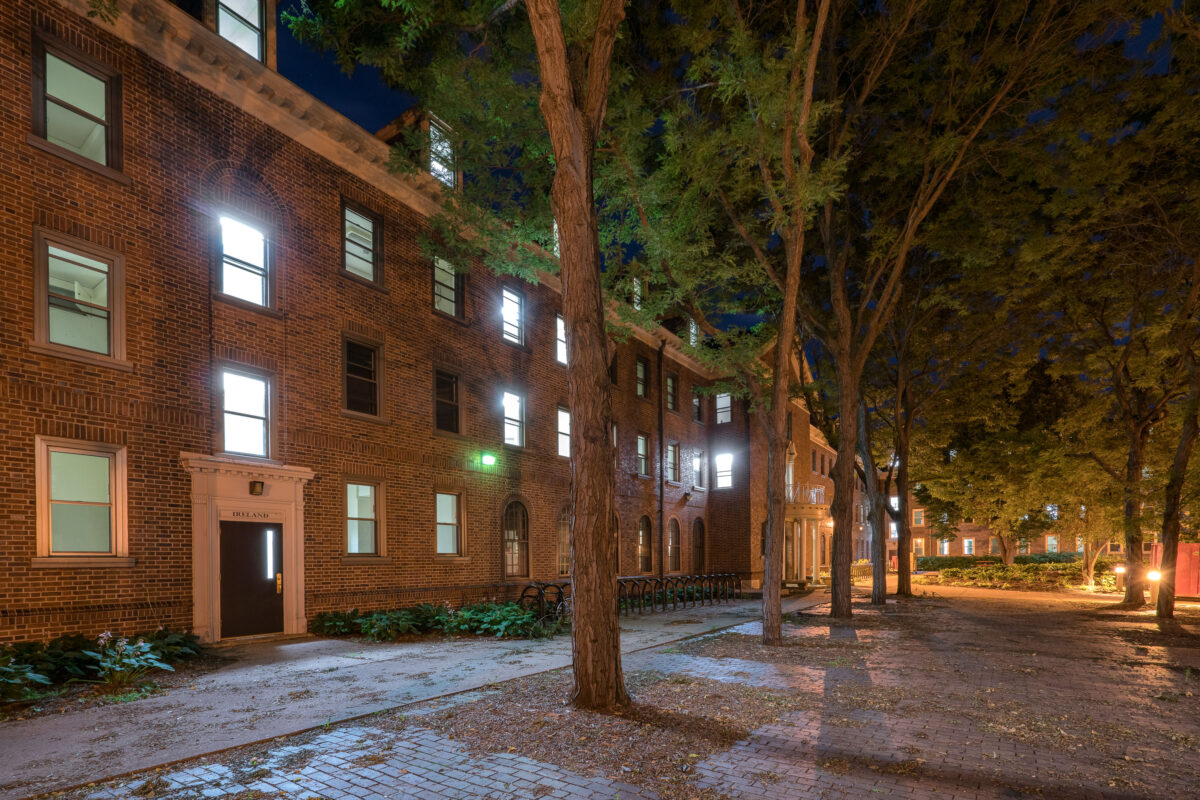
Pioneer Hall, University of Minnesota, 2017
Pioneer Hall at the University of Minnesota in Minneapolis is shown in 2017, before the residence hall’s 2018 renovation. The brick dormitory is part of the university’s historic East Bank housing complex, where several adjoining halls were built to accommodate undergraduate students. The renovation updated student rooms and common facilities while retaining the building’s historic exterior character.

Pioneer Hall, University of Minnesota, 2017

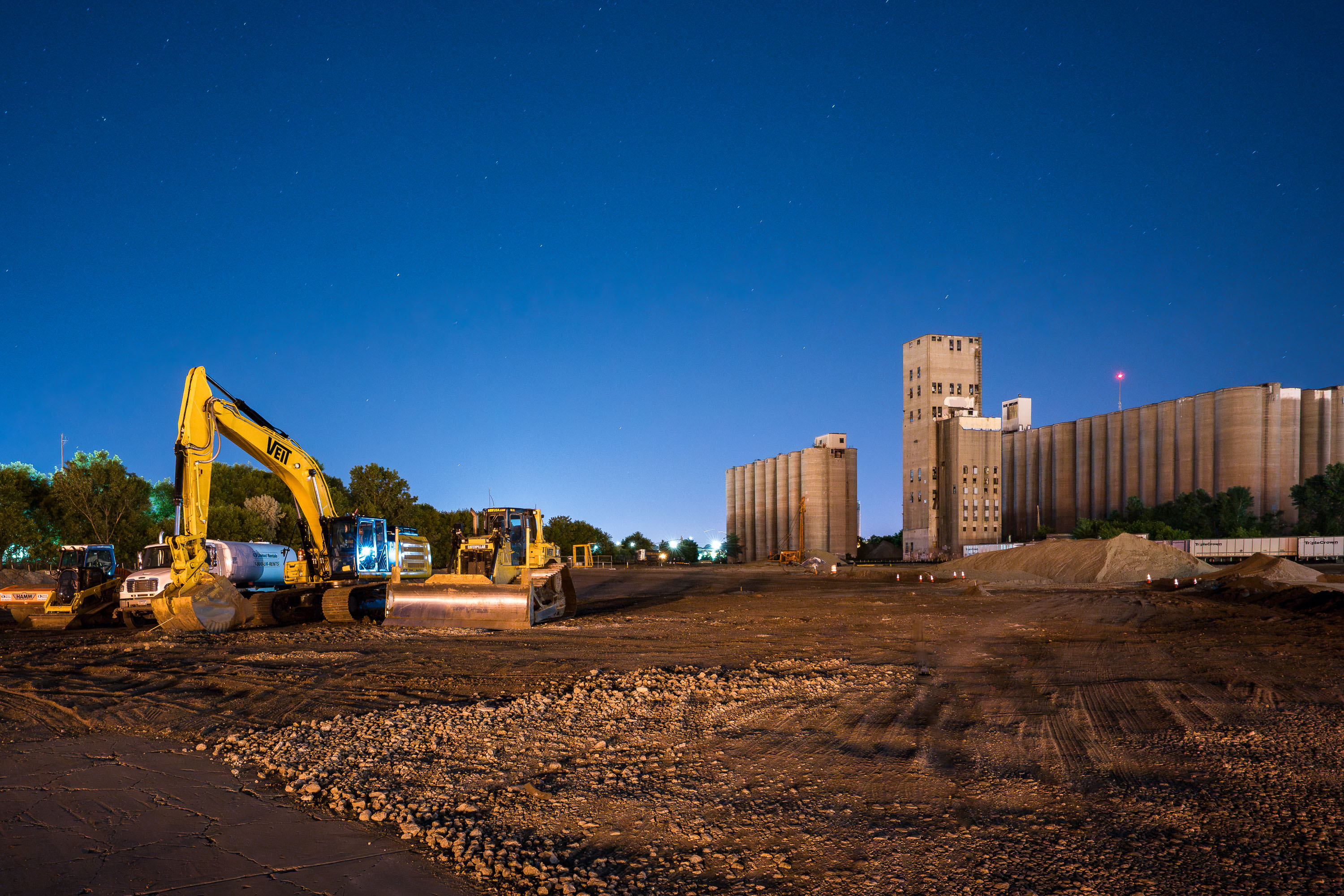
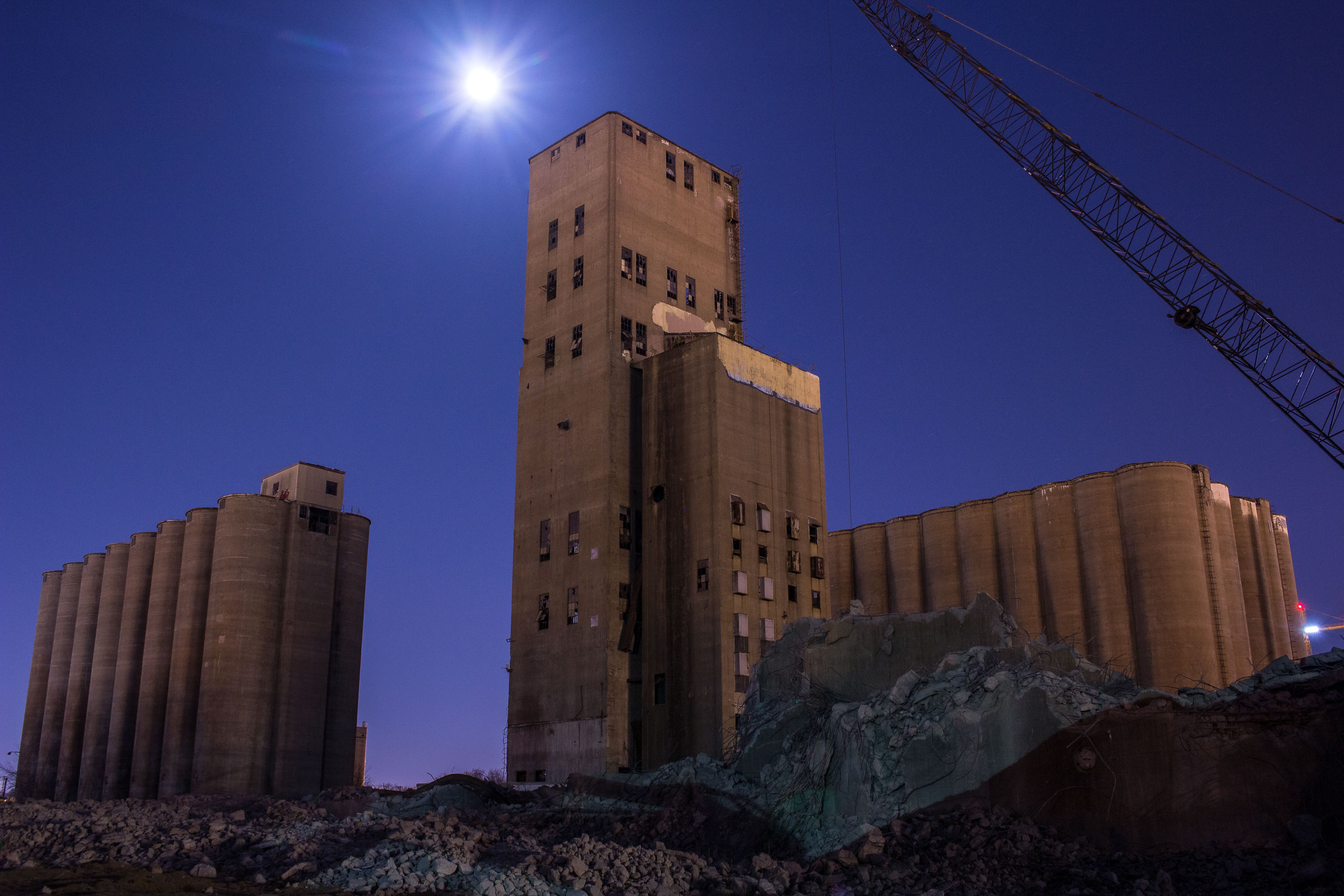
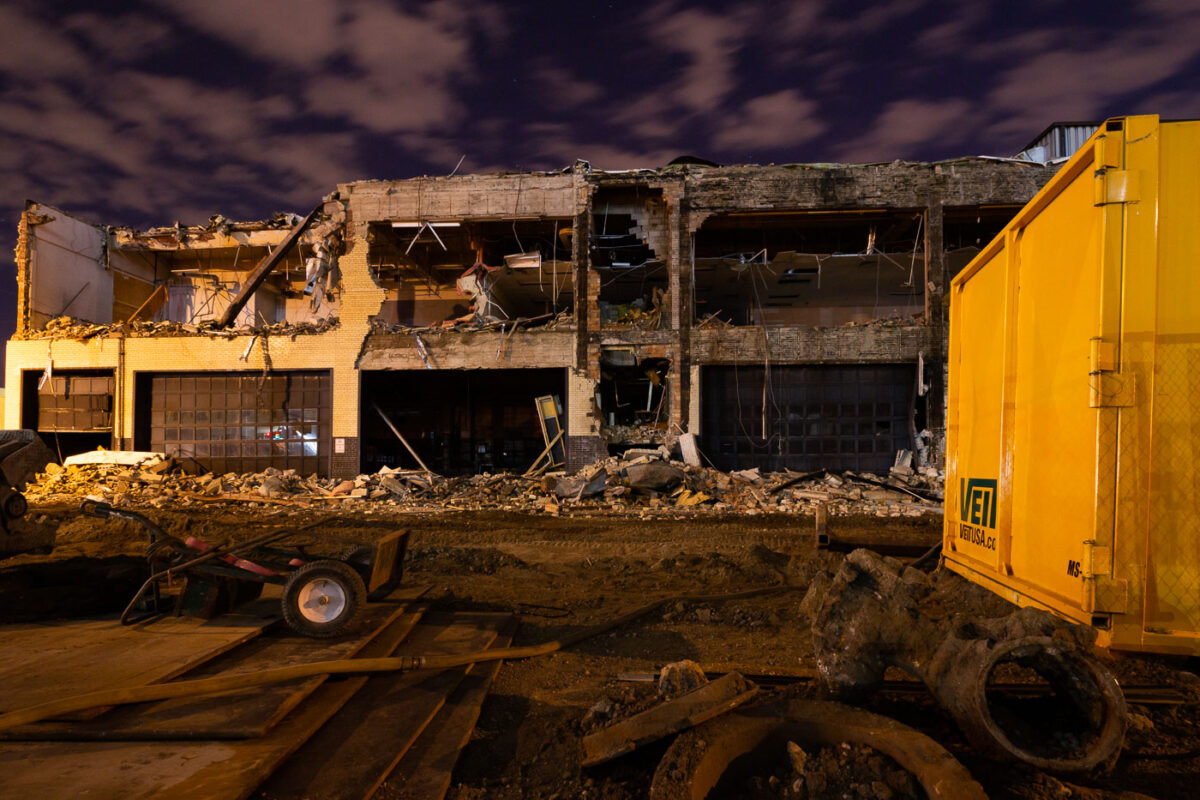
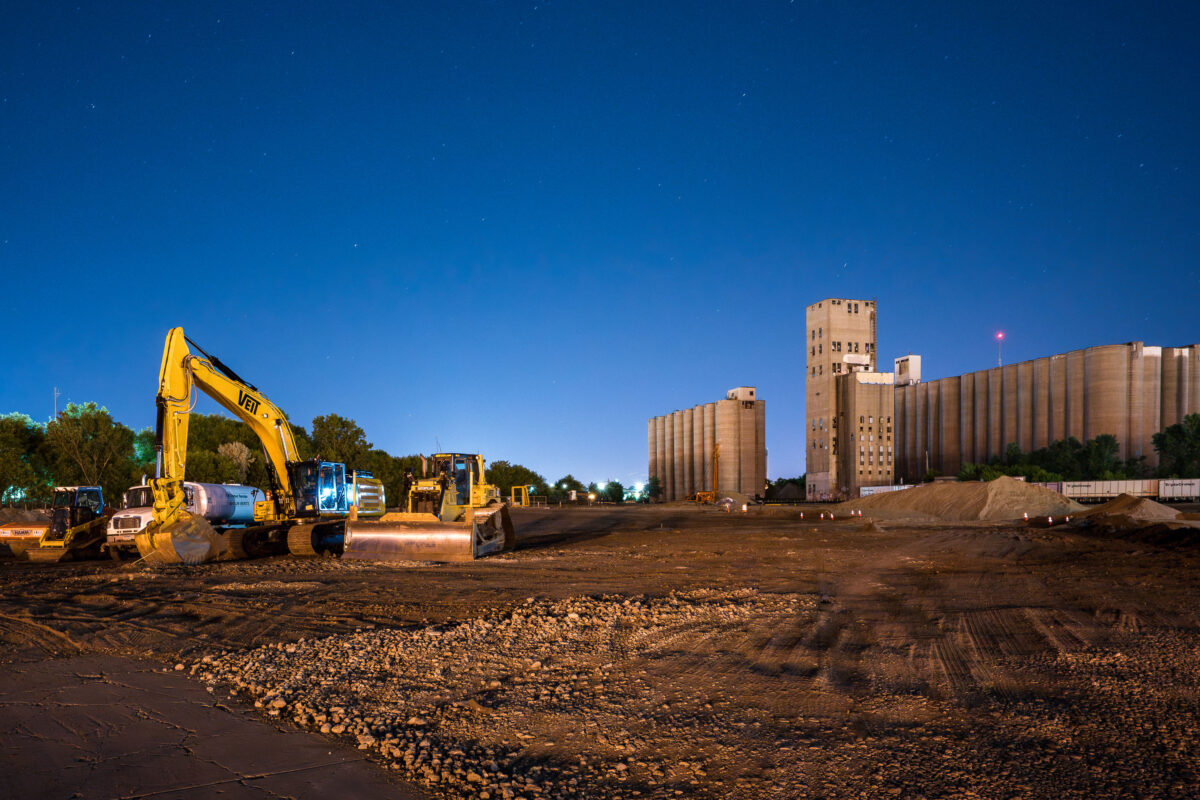
Demolition equipment at the Electric Steel and Kurth Malting grain elevator complex in Minneapolis's Dinkytown area.
The Electric Steel and Kurth Malting grain elevator complex in Minneapolis's Dinkytown area being demolished in June 2017.

Electric Steel and Kurth Grain Elevators Demolition, Minneapolis
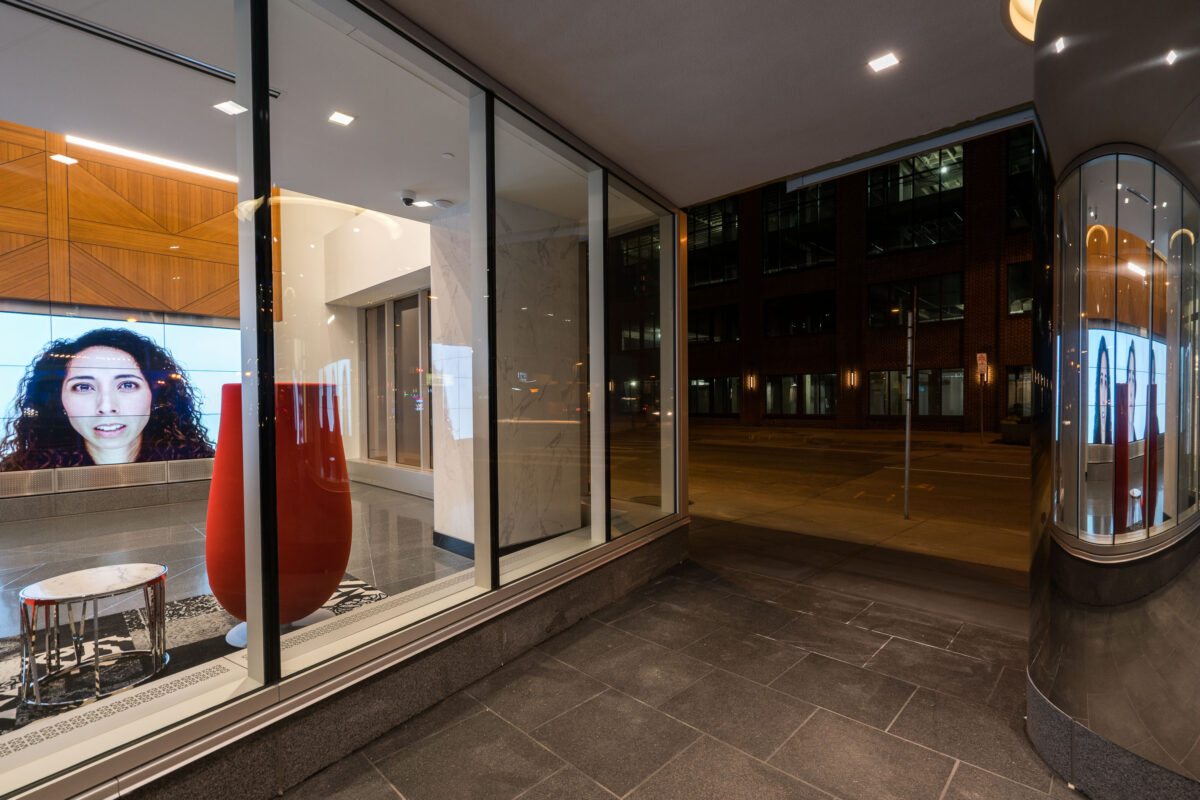
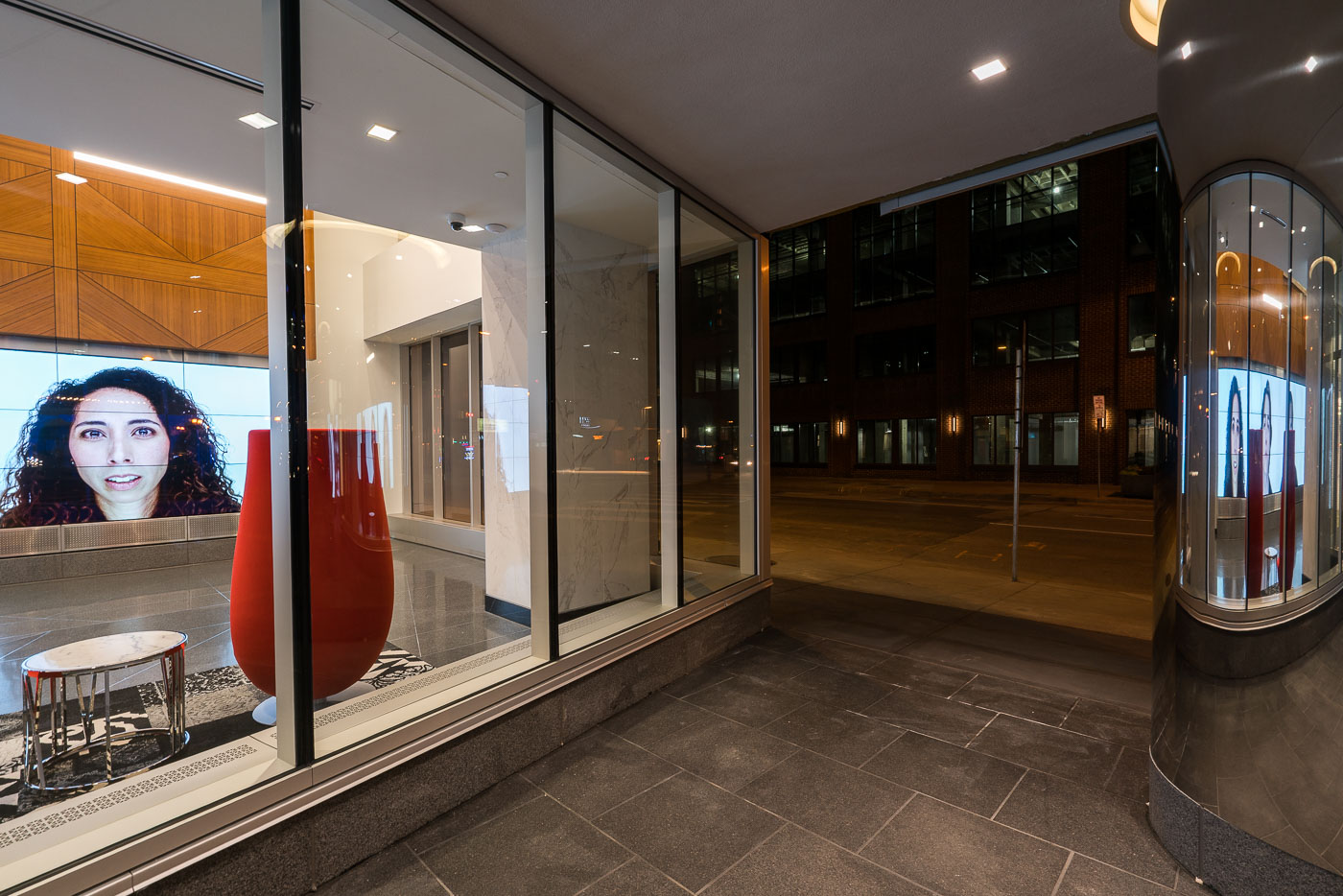
Baker Center lobby windows face a downtown Minneapolis street at night.
Baker Center in downtown Minneapolis is a mixed-use complex with office and retail space. Its street-level lobby fronts the sidewalk and connects the building’s interior tenant areas with the surrounding downtown street grid. The lobby includes digital display panels and seating for visitors and building users.

Baker Center Lobby Windows, Downtown Minneapolis
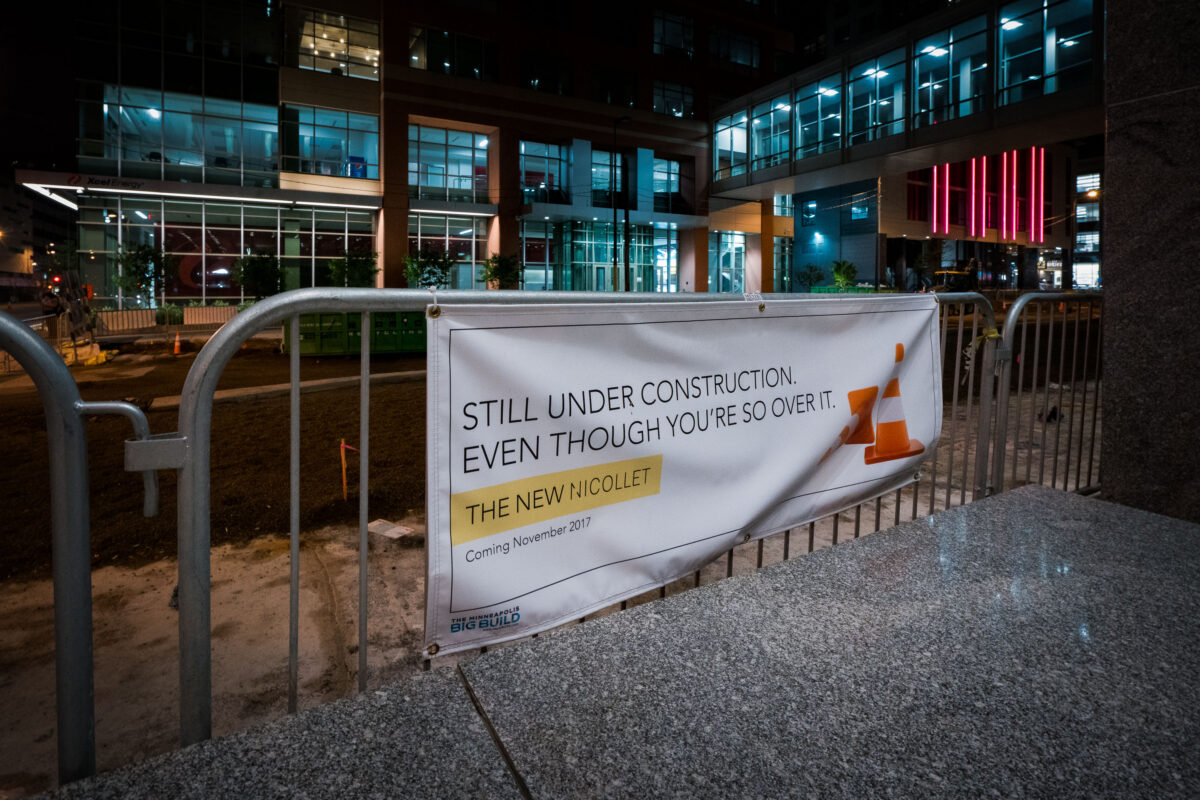
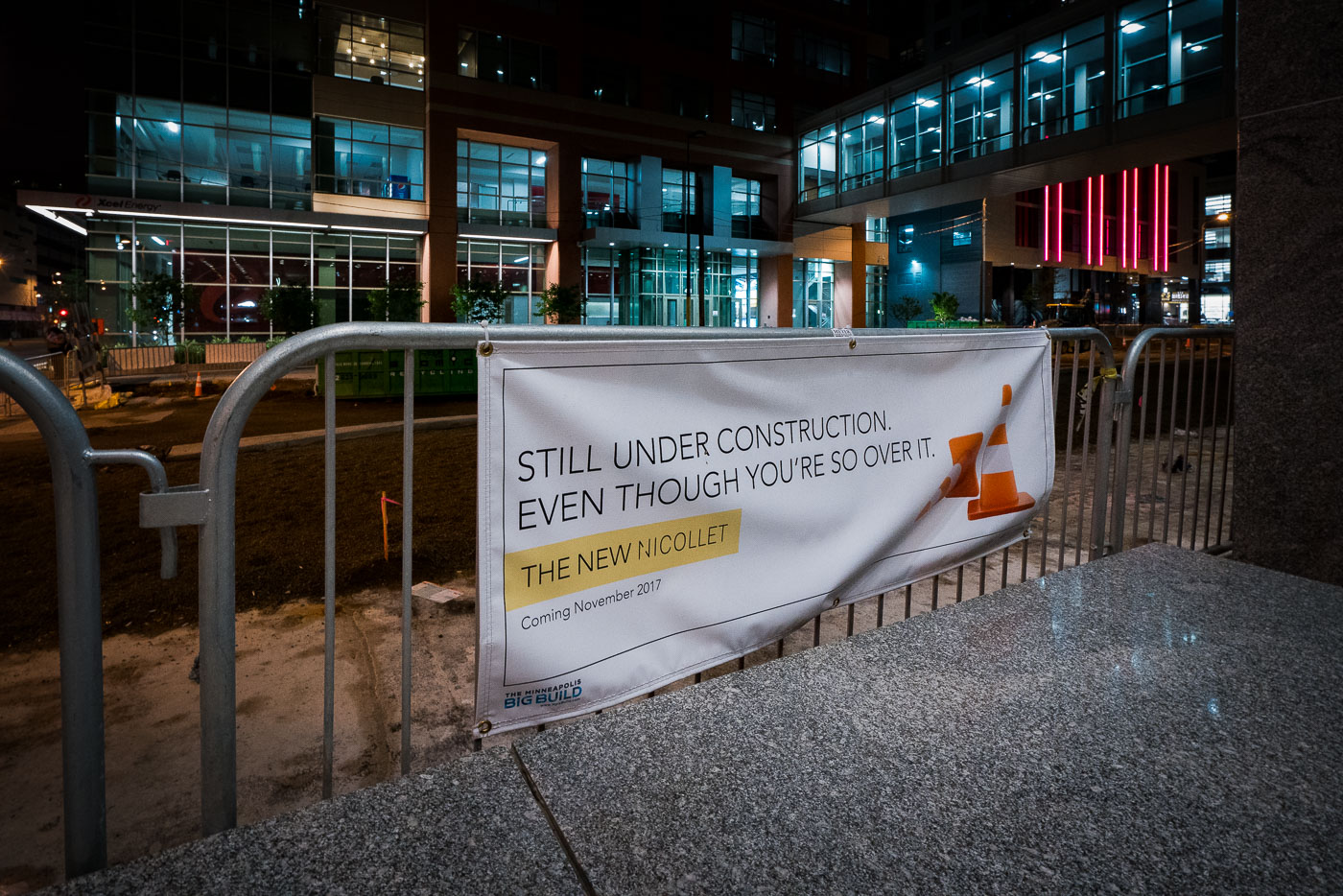
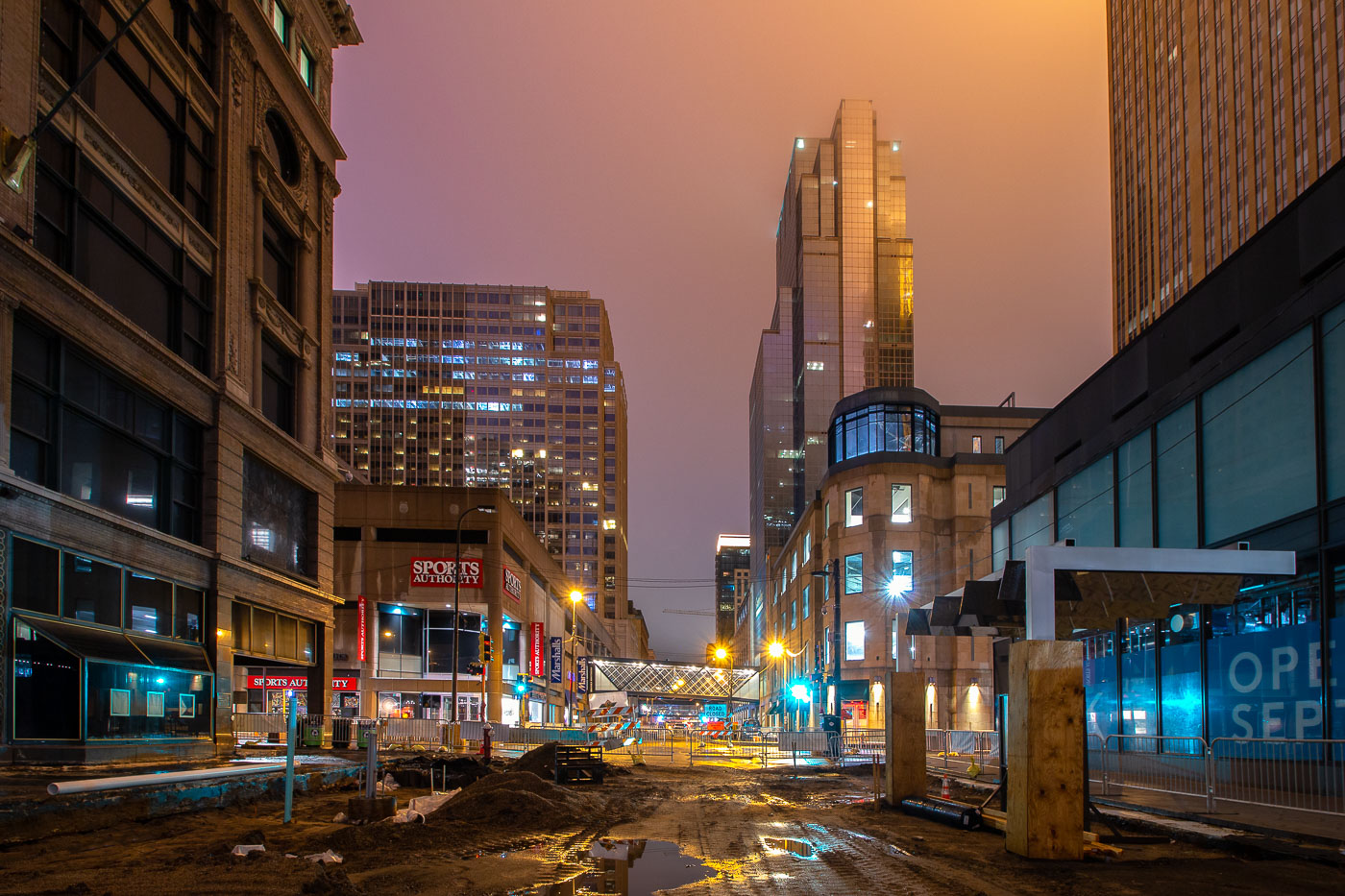
A construction barrier banner on downtown Minneapolis's Nicollet Mall announces "The New Nicollet" redevelopment project opening November 2017.
Nicollet Mall is downtown Minneapolis's main street, rebuilt between 2015 and 2017. A banner on the construction fencing promised the finished project, called "The New Nicollet," would be done by November 2017.

“The New Nicollet” Construction Banner at Night
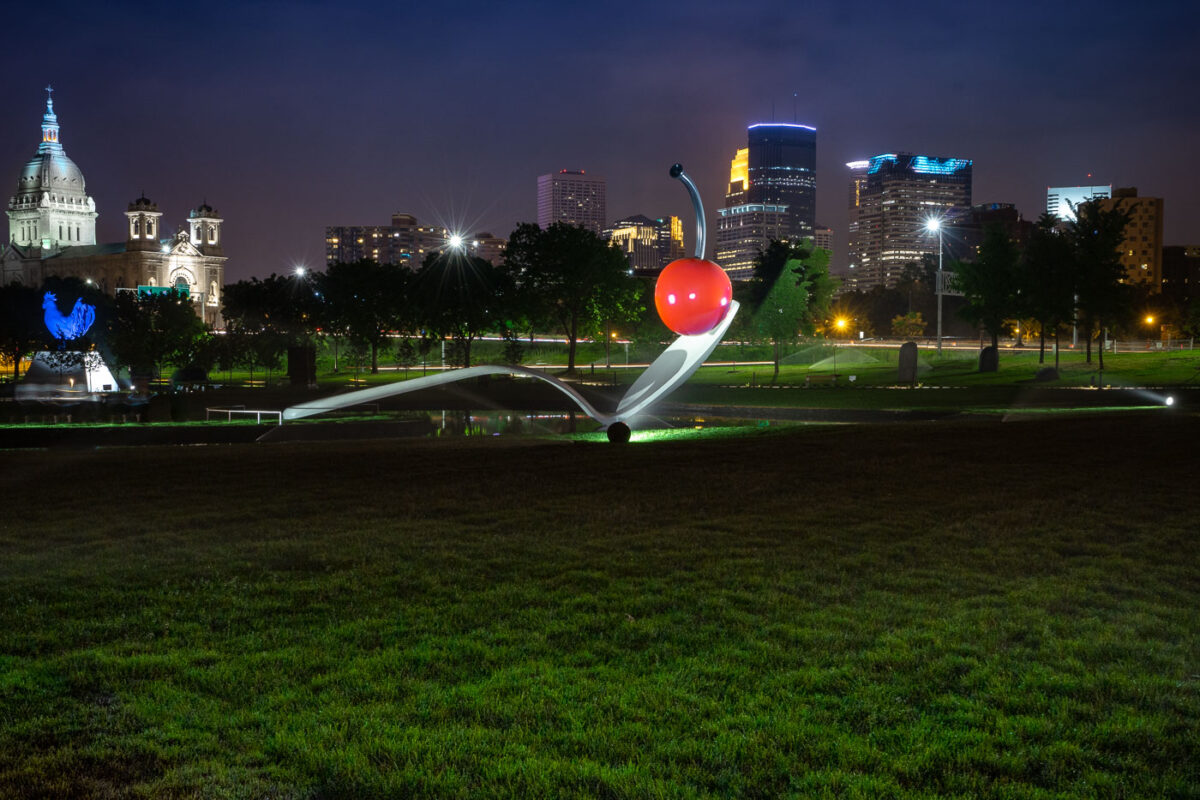
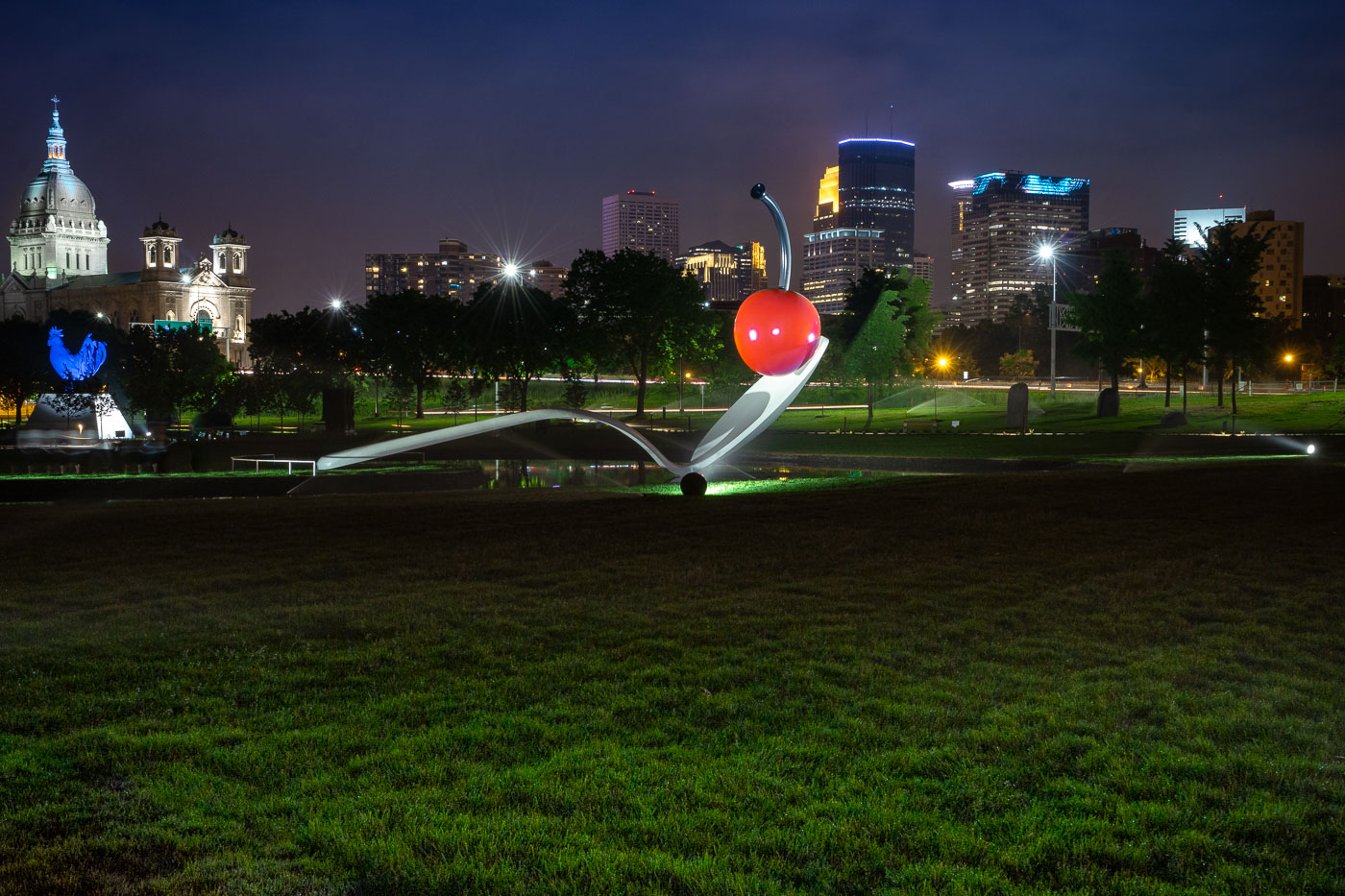
Spoonbridge and Cherry in the Minneapolis Sculpture Garden with the downtown skyline behind it.
Spoonbridge and Cherry is located in the Minneapolis Sculpture Garden near the Walker Art Center in Minneapolis. Designed by Claes Oldenburg and Coosje van Bruggen, the sculpture was installed in 1988 as part of the garden’s opening.

Spoonbridge and Cherry with Minneapolis Skyline
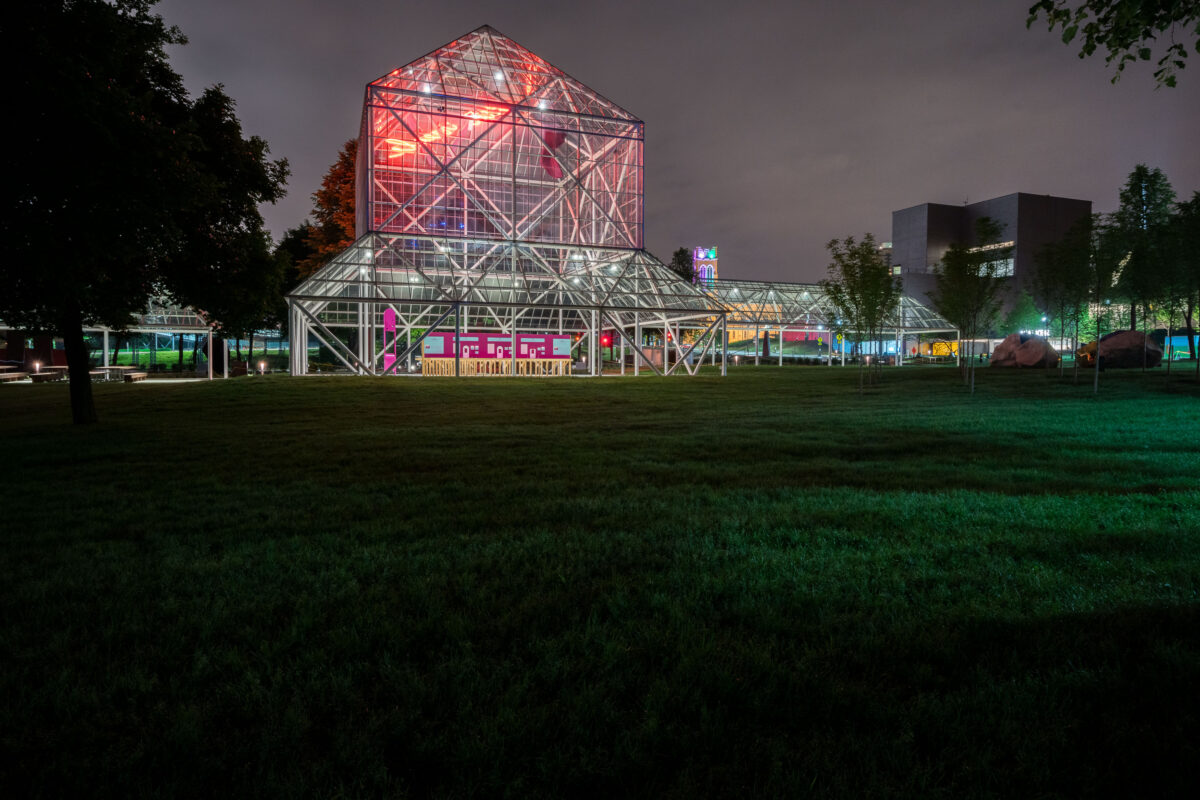
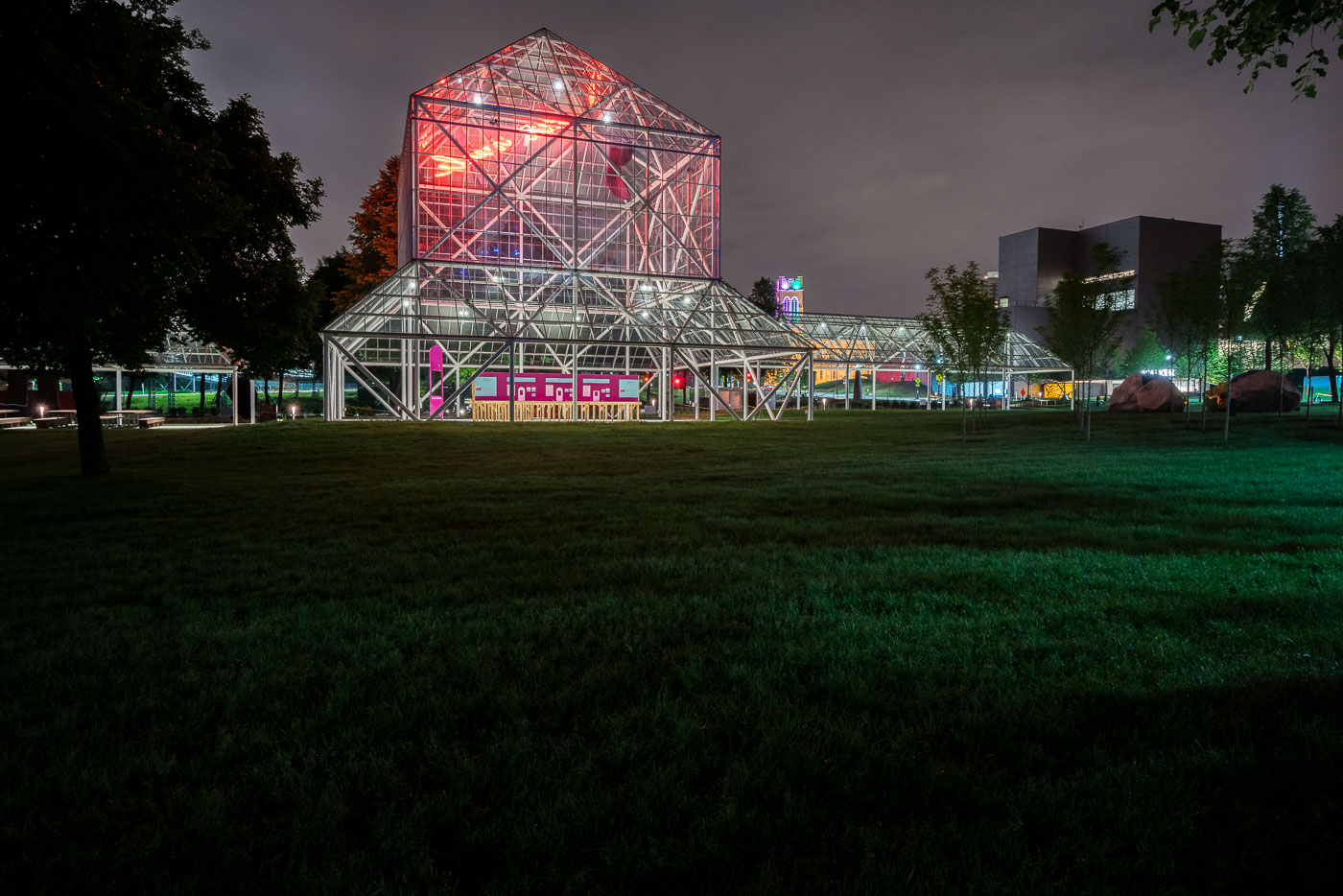
Walker Art Center Glass House in Minneapolis lit at night
The Walker Art Center Glass House stands in the Sculpture Garden in Minneapolis. The glass-and-steel structure is lit from within at night and serves as an entrance and exhibition space for the museum. Its geometric design and transparent facade are visible against the dark sky.

Walker Art Center Glass House, Minneapolis
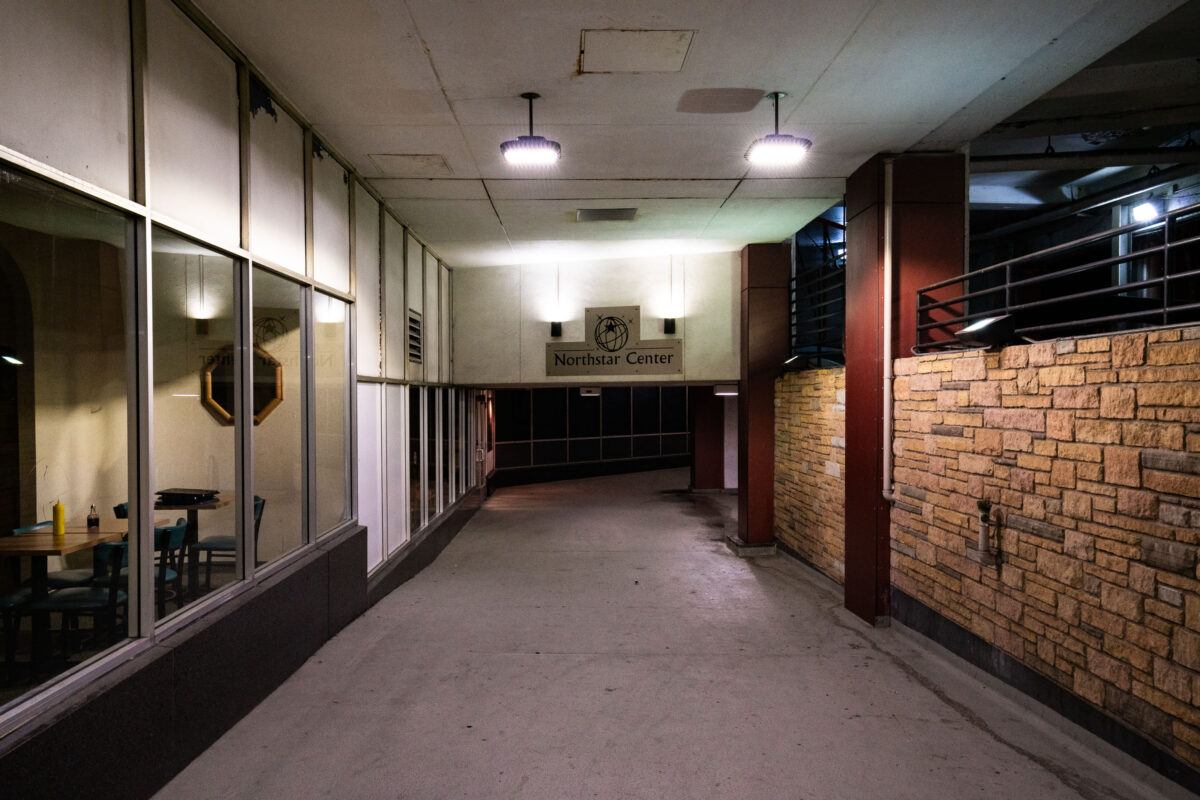
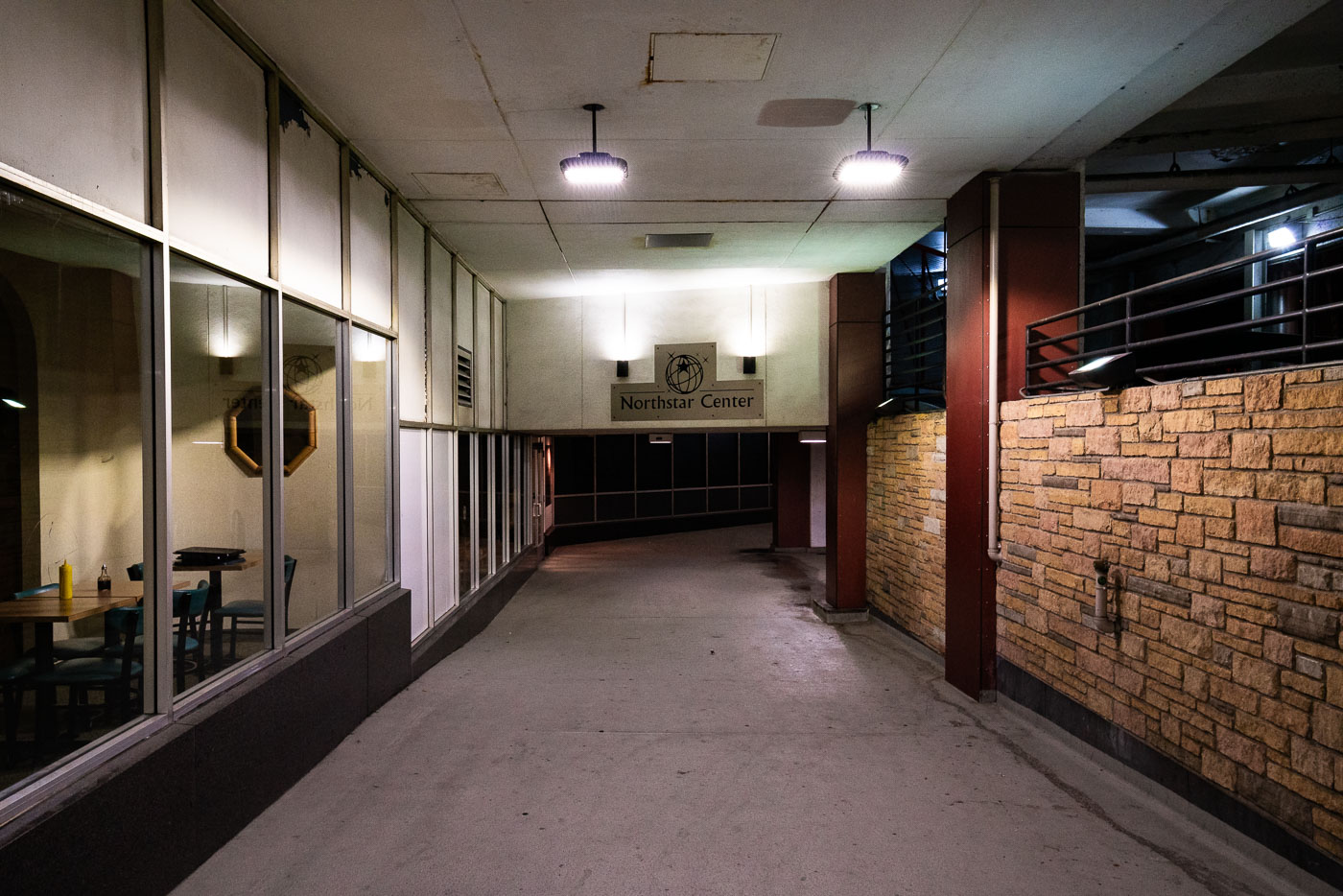
Northstar Center walkway in downtown Minneapolis, lit interior corridor with glass walls.
The Northstar Center, located in downtown Minneapolis, features this exterior walkway. The building, completed in 1960, was designed by architect Minoru Yamasaki, who also designed the World Trade Center towers. The Northstar Center was one of the first mixed-use developments in Minneapolis, intended to revitalize the city's central business district. The walkway connects various parts of the complex and provides pedestrian access, reflecting the mid-century modern architectural style prevalent at the time of its construction.

Northstar Center Exterior Walkway, Downtown Minneapolis
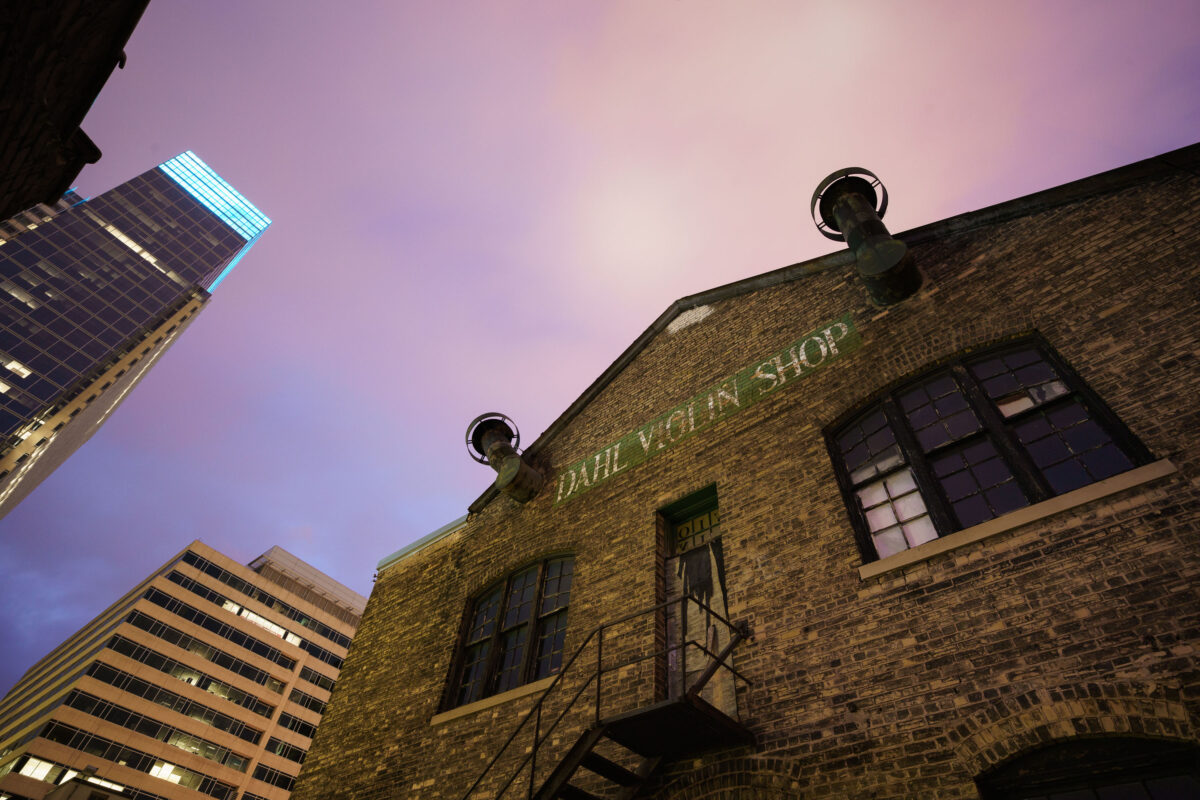
The Dahl Violin Shop building in downtown Minneapolis at night
The Dahl Violin Shop building, located in downtown Minneapolis, was a historic establishment dedicated to the sale and repair of stringed instruments. It's since been demolished.

Dahl Violin Shop, Downtown Minneapolis
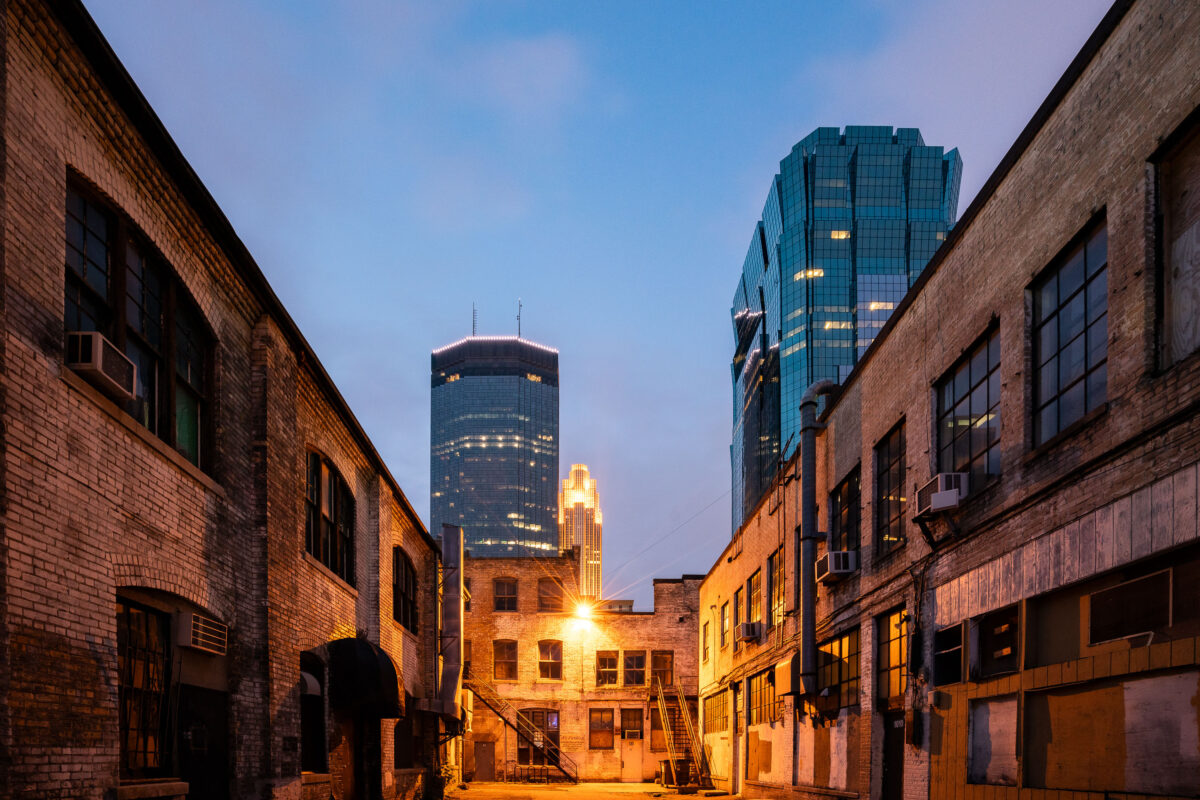
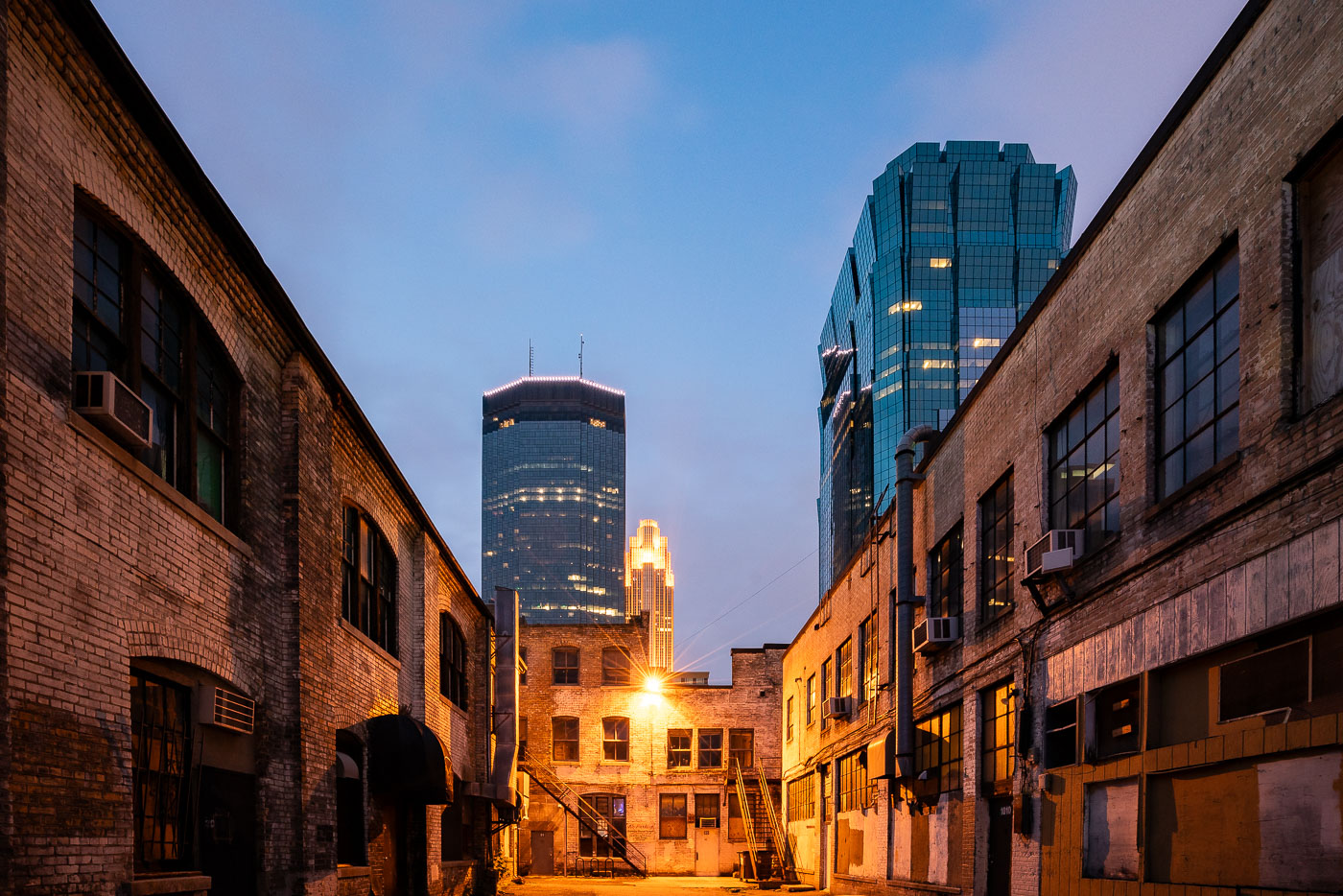
Alleyway in downtown Minneapolis framed by the IDS Center and AT&T Tower at dusk
An alleyway in downtown Minneapolis frames the IDS Center and the AT&T Tower. The older brick buildings lining the alleyway, likely dating from the early to mid-20th century, contrast with the modern skyscrapers. The IDS Center, completed in 1972, was Minneapolis's tallest building for many years and a significant example of modernist architecture. The AT&T Tower, also known as the Marquette Building, was completed in 1983. This view highlights the juxtaposition of older industrial or commercial structures with contemporary high-rise development in the city's central business district.

Alleyway with IDS Center, Minneapolis
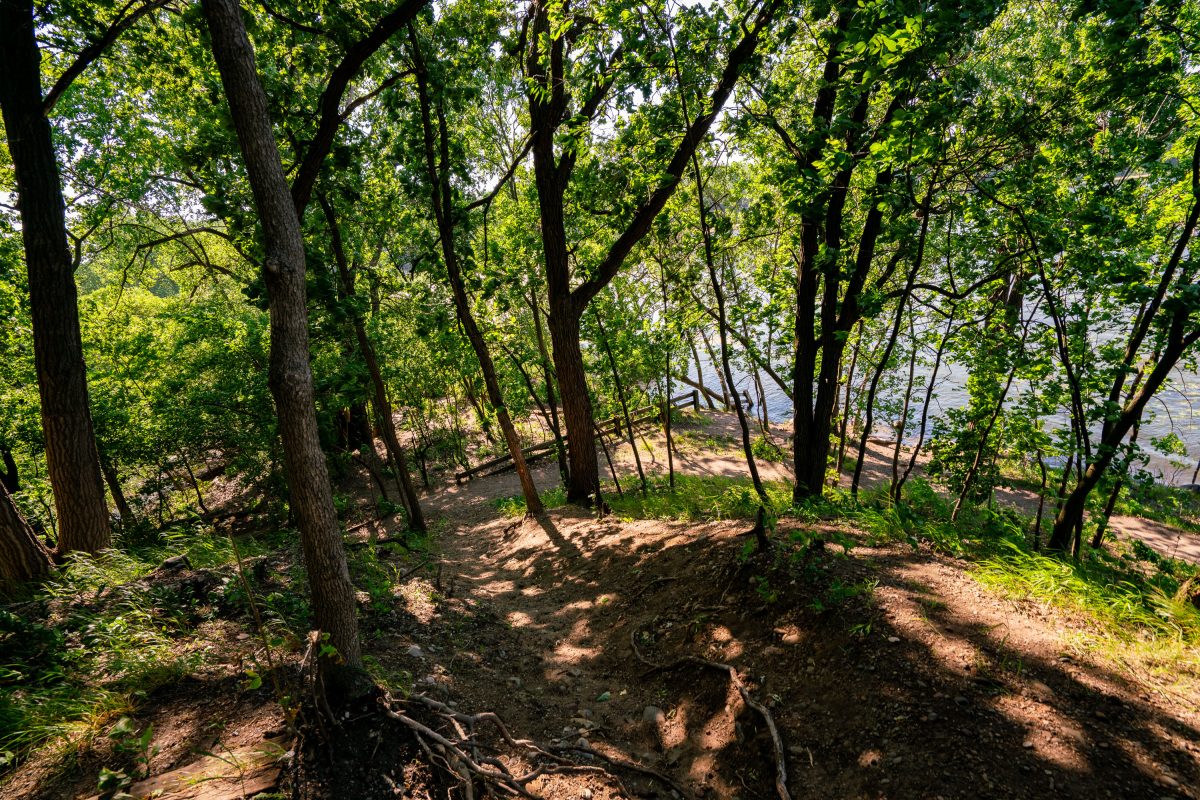
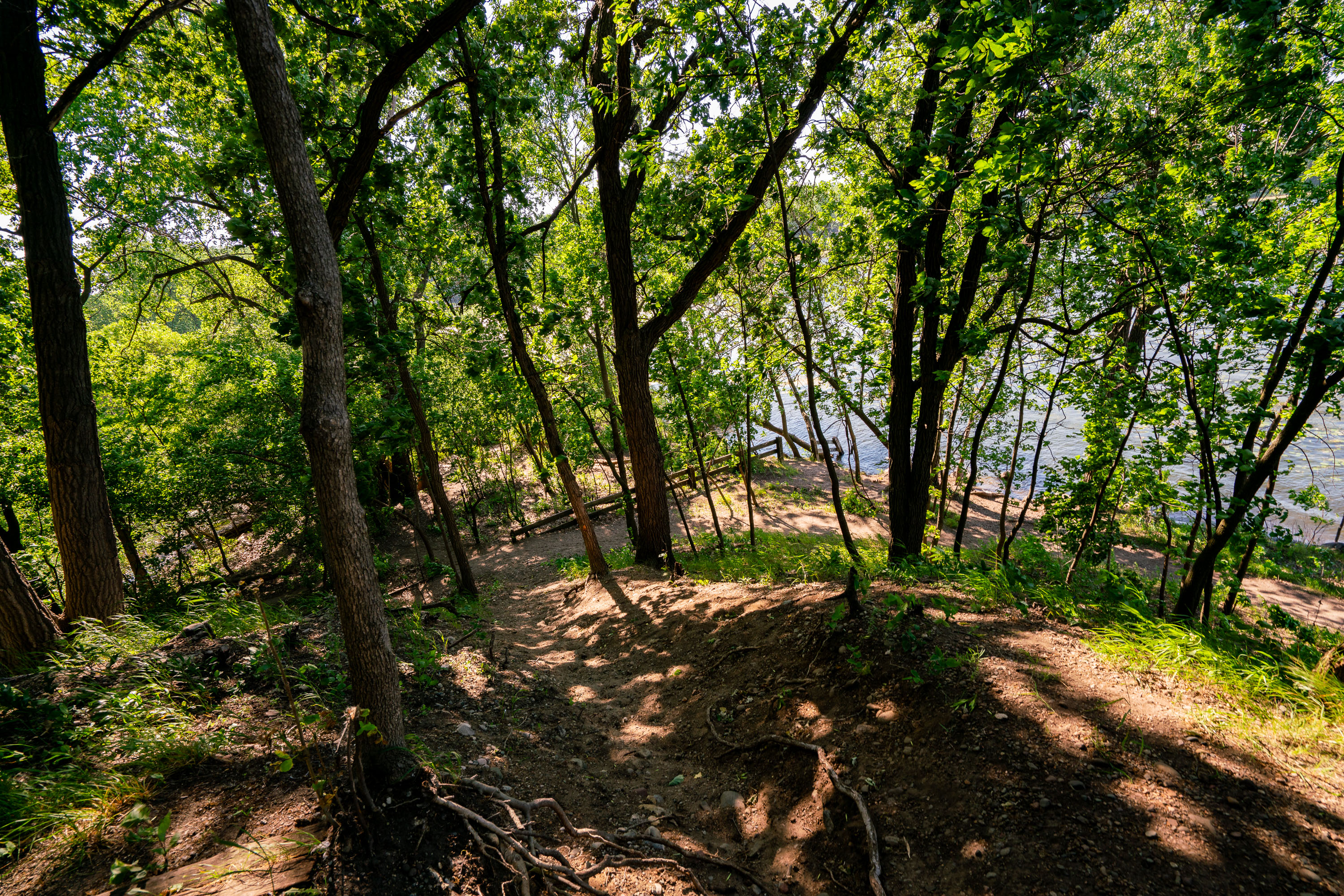
Wooded trail along the north shore of Cedar Lake in Minneapolis with sandy path and lake visible through trees.
Cedar Lake is one of the Minneapolis Chain of Lakes, tucked between the Kenilworth corridor and the Bryn Mawr neighborhood west of downtown. It covers about 170 acres and reaches roughly 51 feet at its deepest point, with a dirt path cutting down through the wooded shoreline to the water.

Wooded Trail Down to Cedar Lake’s North Shore
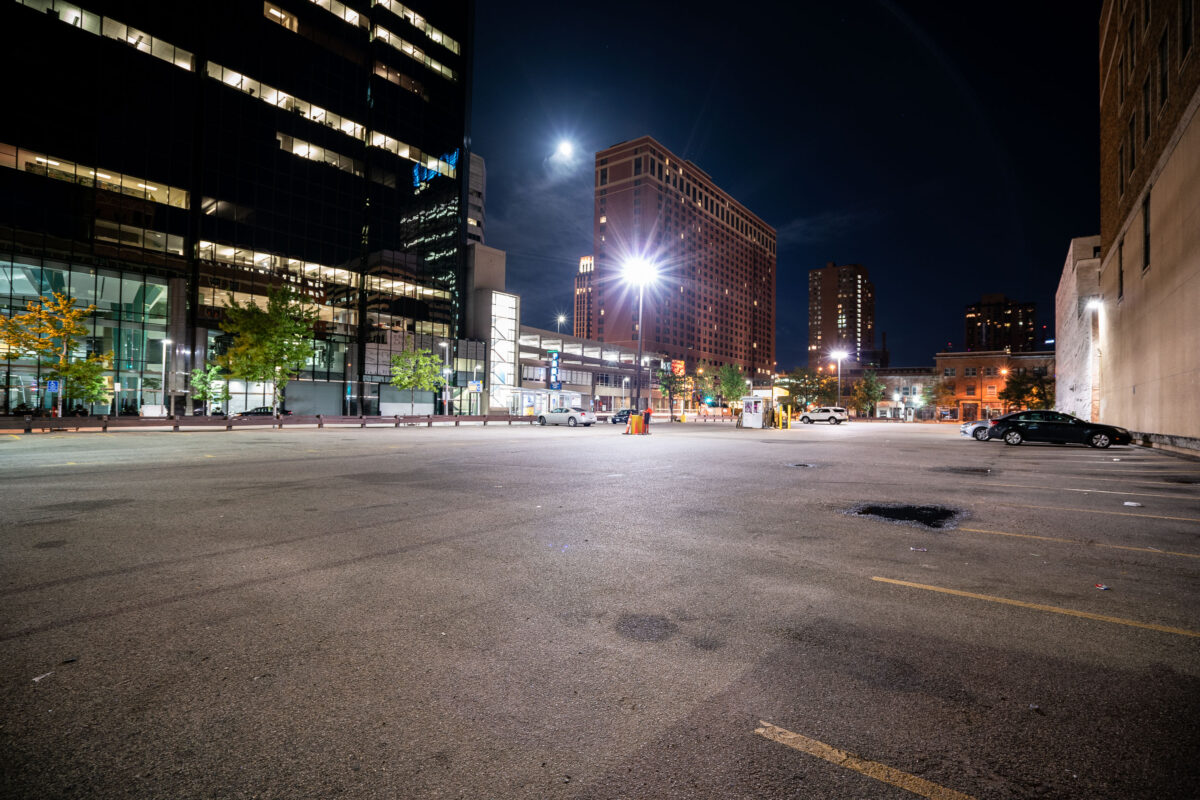
Marquette Avenue in downtown Minneapolis at night, with office towers and an open parking lot.
Marquette Avenue in downtown Minneapolis, a major north-south street in the city’s central business district.

Marquette Avenue Parking Lot at 9th, Minneapolis
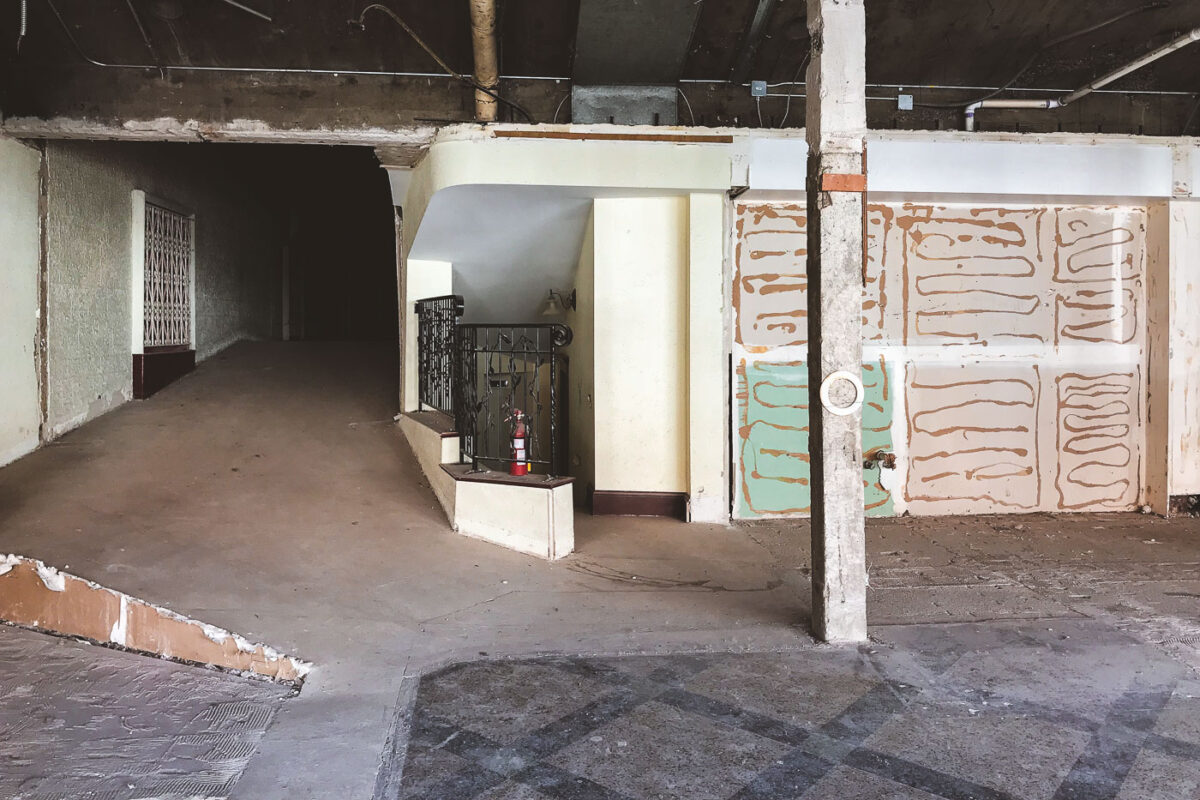
Suburban World Theatre interior renovation on Hennepin Avenue in Uptown Minneapolis.
Suburban World Theatre on Hennepin Avenue in Uptown Minneapolis was undergoing interior renovation in 2017. The building was a former movie theater in the Hennepin-Lake commercial district. Renovation work had opened lobby and circulation areas inside the former theater.

Suburban World Theatre Interior, Uptown Minneapolis
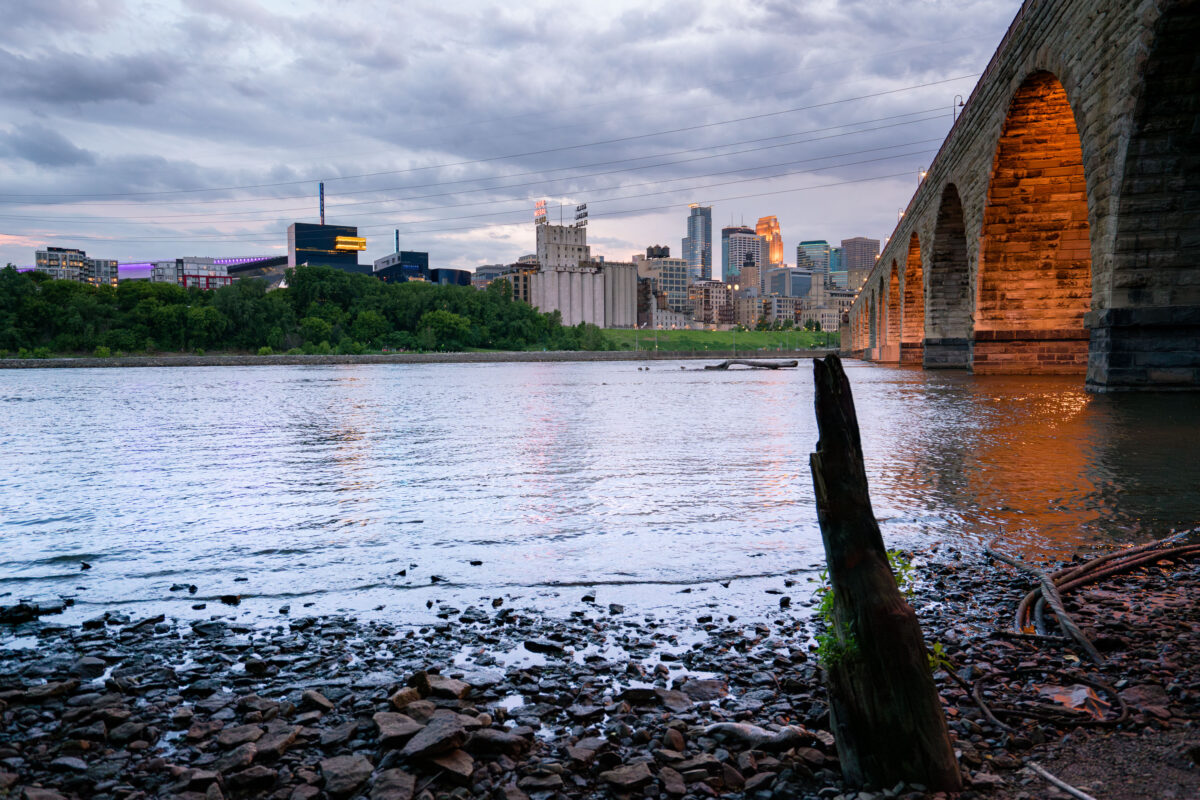
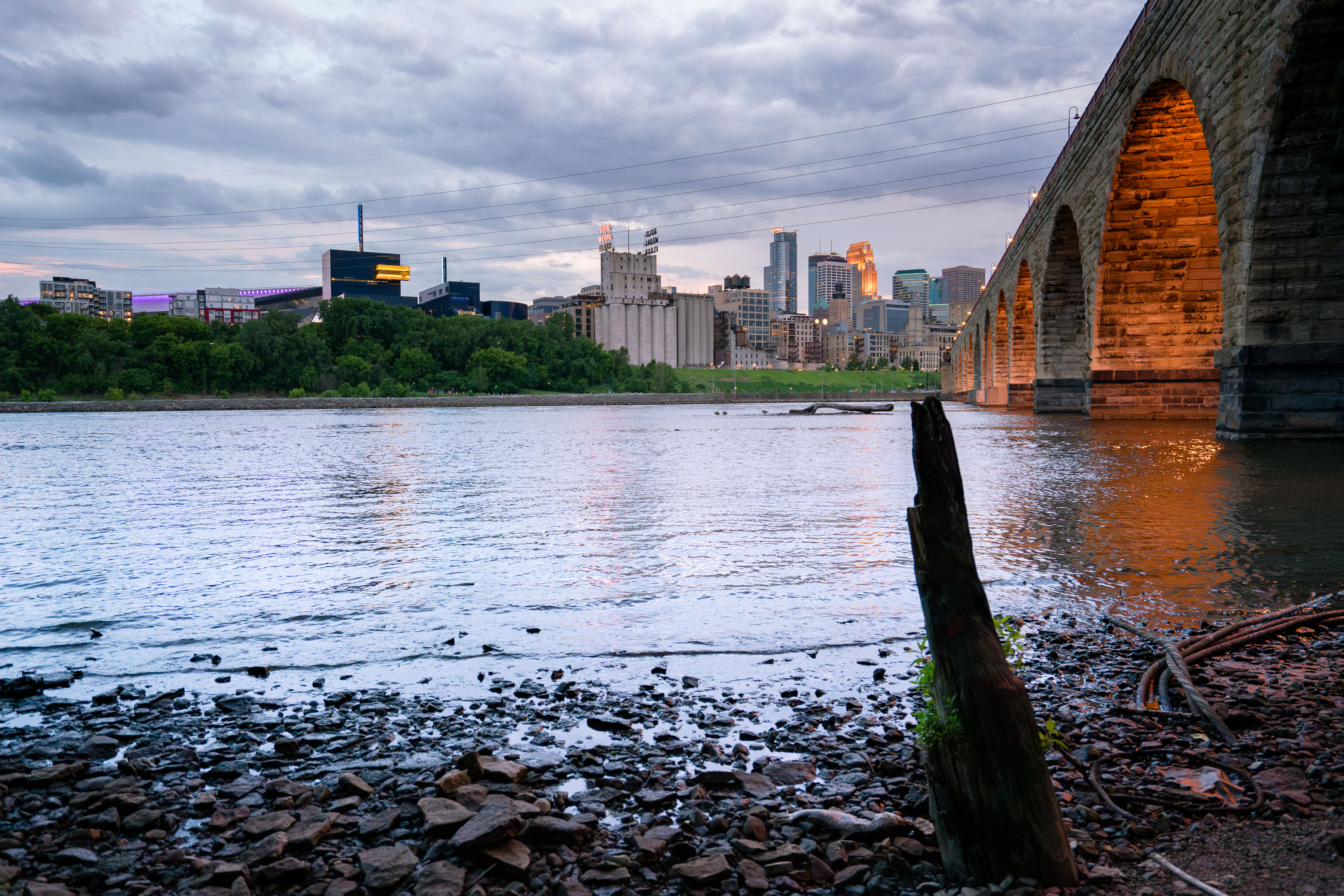
Minneapolis skyline and the Stone Arch Bridge over the Mississippi River.
Minneapolis skyline and the Stone Arch Bridge over the Mississippi River in Minneapolis, Minnesota. The former railroad bridge spans St. Anthony Falls and is part of the Mill Ruins Park area.

Minneapolis skyline from the Stone Arch Bridge
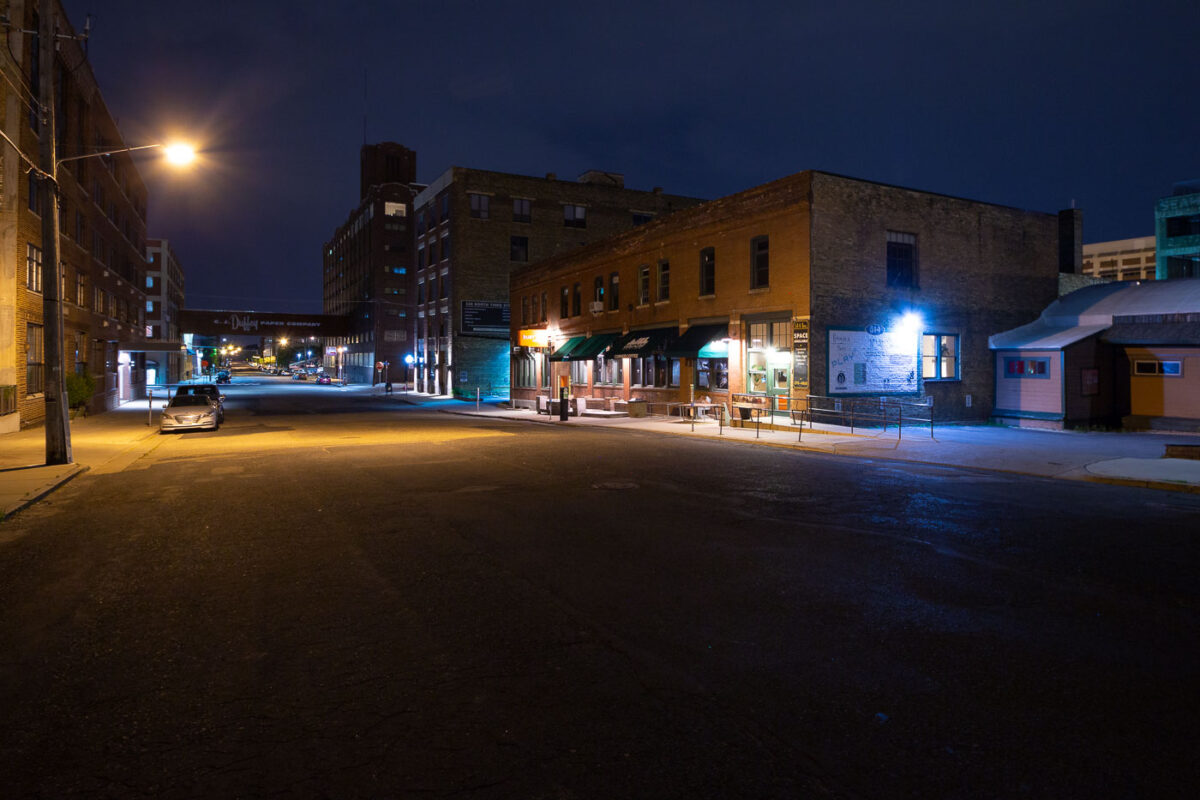
North 3rd Street in Minneapolis's North Loop neighborhood at night, lined with illuminated historic buildings and storefronts.
North 3rd Street in Minneapolis's North Loop neighborhood is illuminated at night.

North 3rd Street Under the C.J. Duffey Paper Co. Skyway at Night
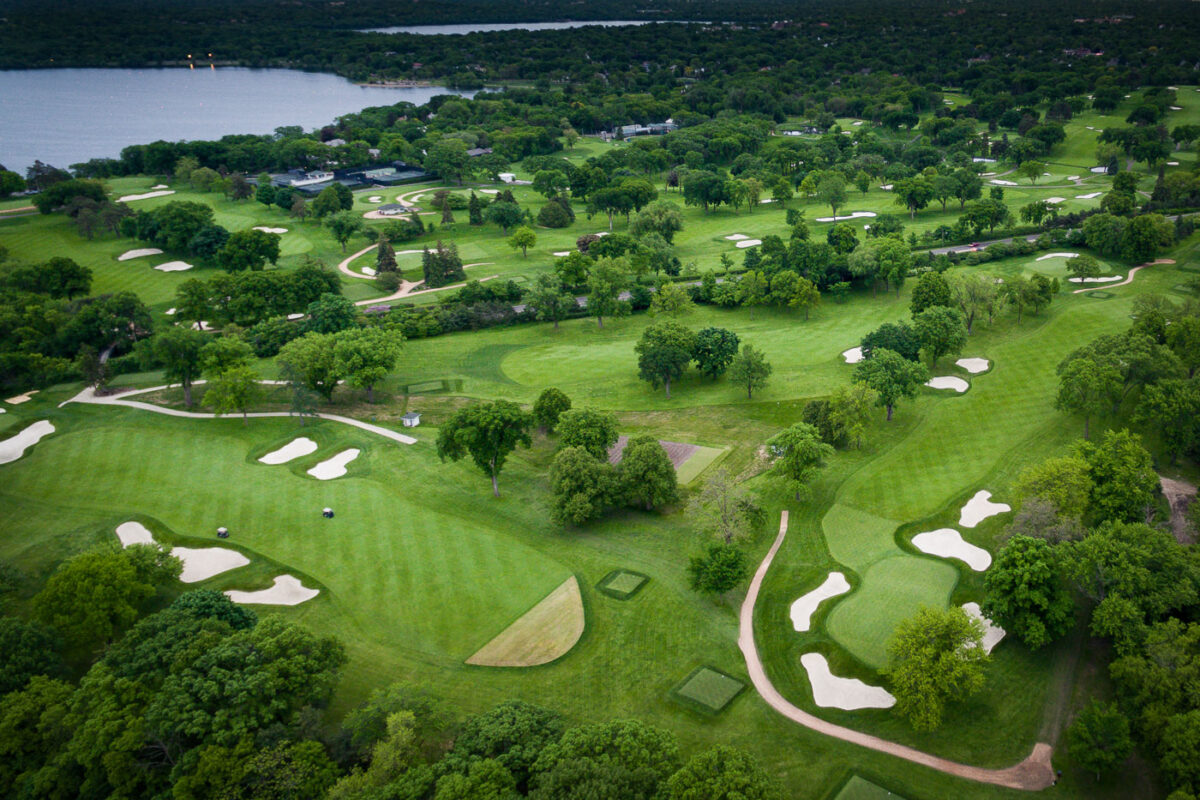
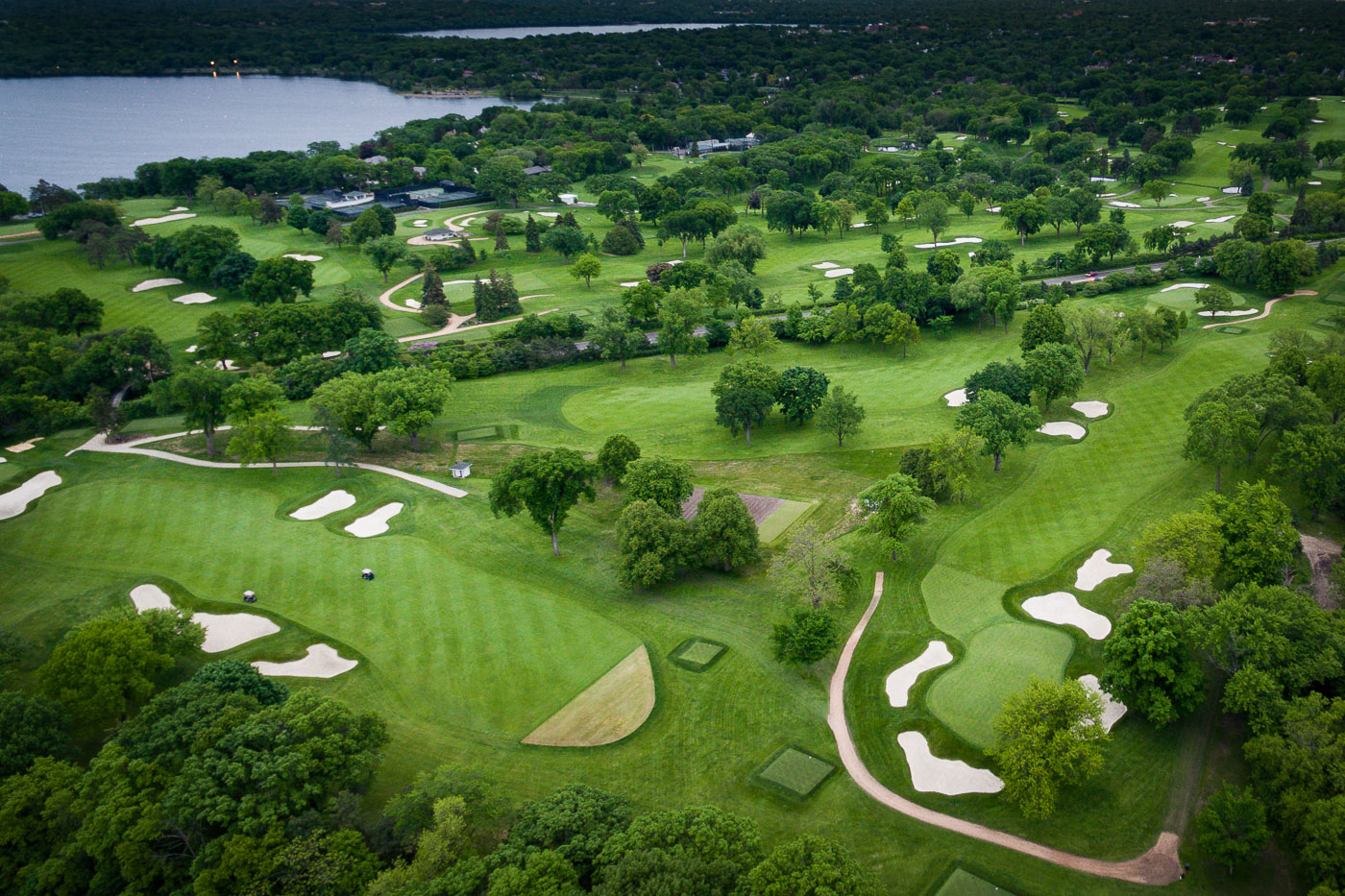
Aerial view of Minikahda Club golf course along Bde Maka Ska lake in Minneapolis, Minnesota.
The Minikahda Club golf course in Minneapolis, Minnesota, is situated along the shores of Bde Maka Ska lake. Established in 1901, the club features a championship golf course designed by William Watson and Robert F. Grant. The course is known for its challenging layout and mature trees, which have been a defining characteristic since its early development.

Fairways and Bunkers at the Minikahda Club Near Bde Maka Ska
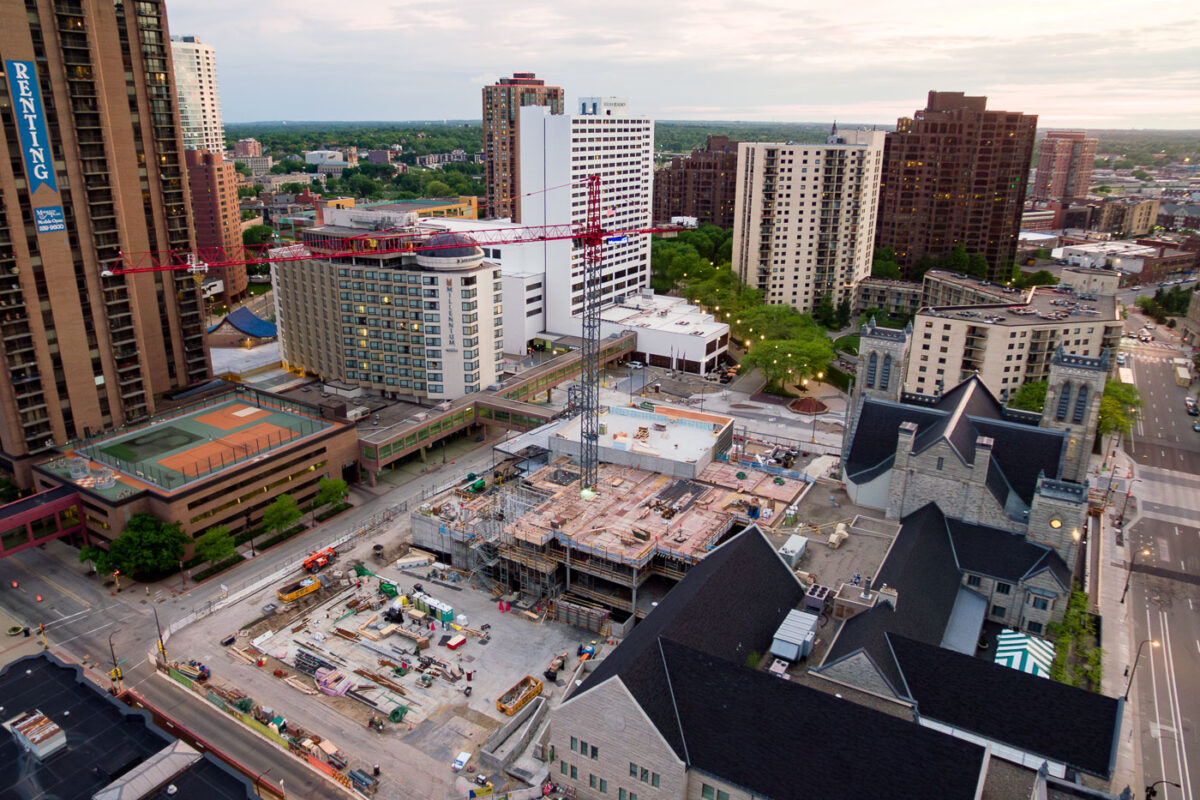
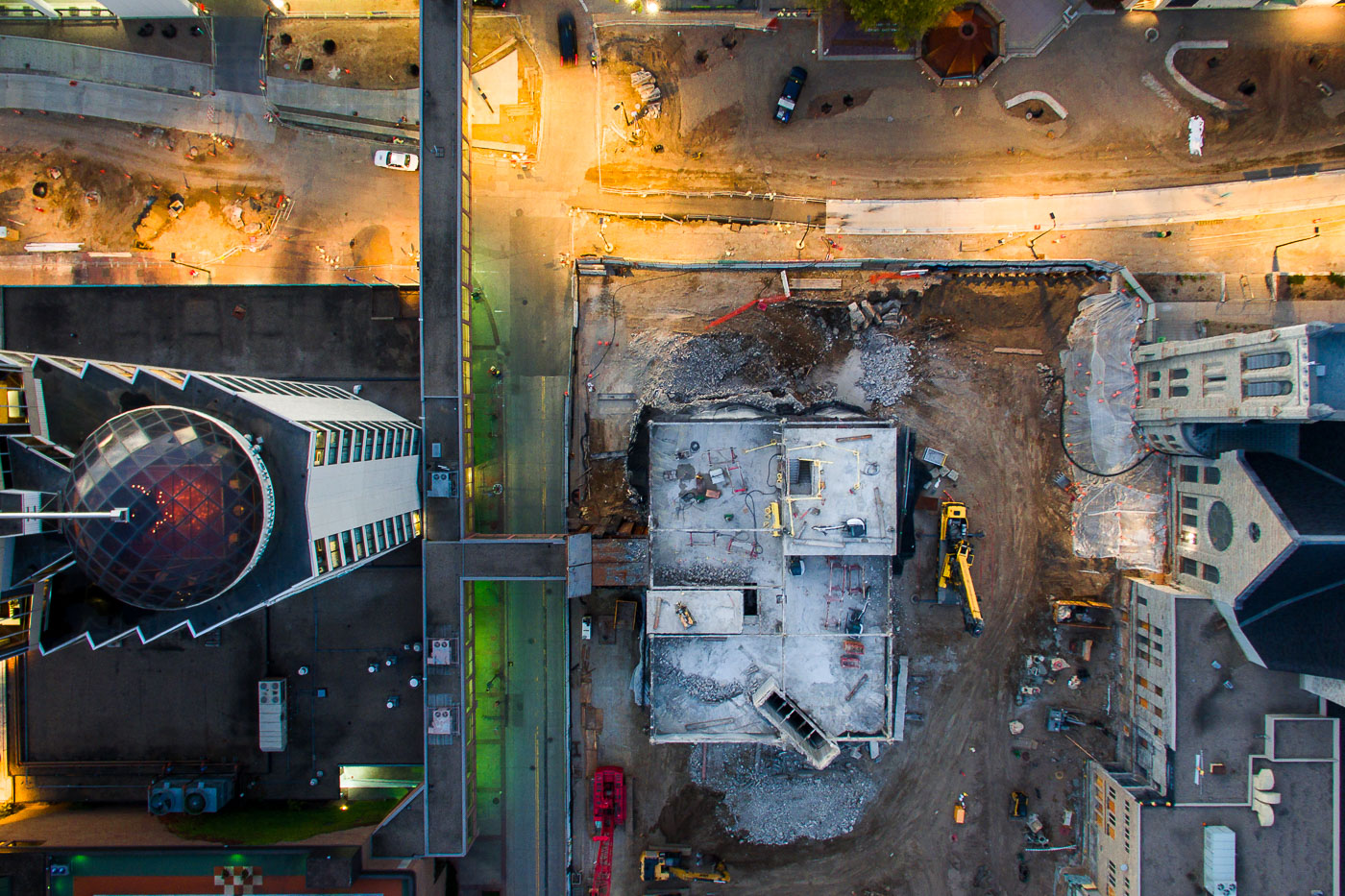
Westminster Presbyterian Church expansion under construction on Nicollet Mall in downtown Minneapolis, with tower crane and surrounding high-rise buildings.
Westminster Presbyterian Church stands at 12th Street and Nicollet Mall in downtown Minneapolis, a stone sanctuary dating to 1897. In 2017 the church built an underground addition and garden next to the historic building, with a tower crane rising over the construction site.

Westminster Presbyterian Church Addition Under Construction in Downtown Minneapolis
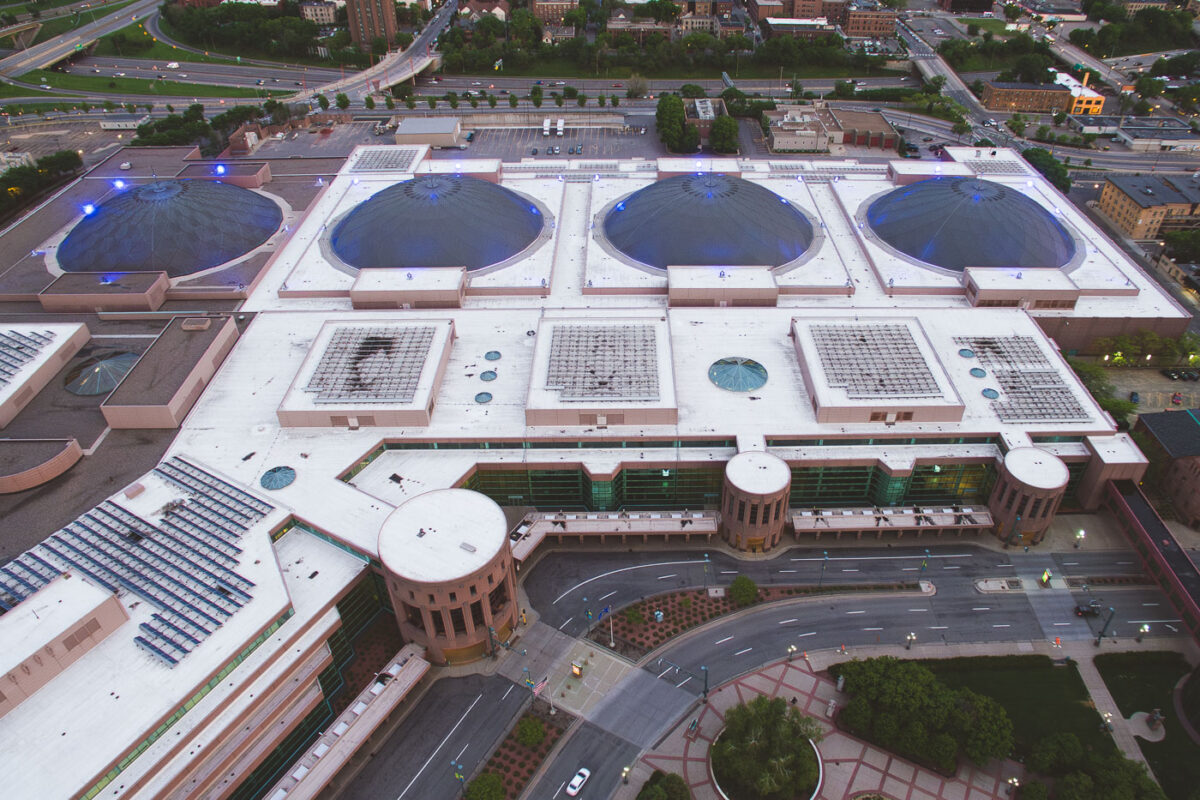
The Minneapolis Convention Center, featuring geodesic domes, is located in downtown Minneapolis, Minnesota.
The Minneapolis Convention Center, a large-scale public facility, is situated in downtown Minneapolis. Its distinctive architecture features multiple geodesic domes that cap its exhibition halls, providing expansive, column-free interior spaces. Opened in 1990, the center was designed to accommodate major trade shows, conventions, and public events, significantly boosting the city's capacity for hosting large gatherings.

Minneapolis Convention Center Domes and Surrounding Streets
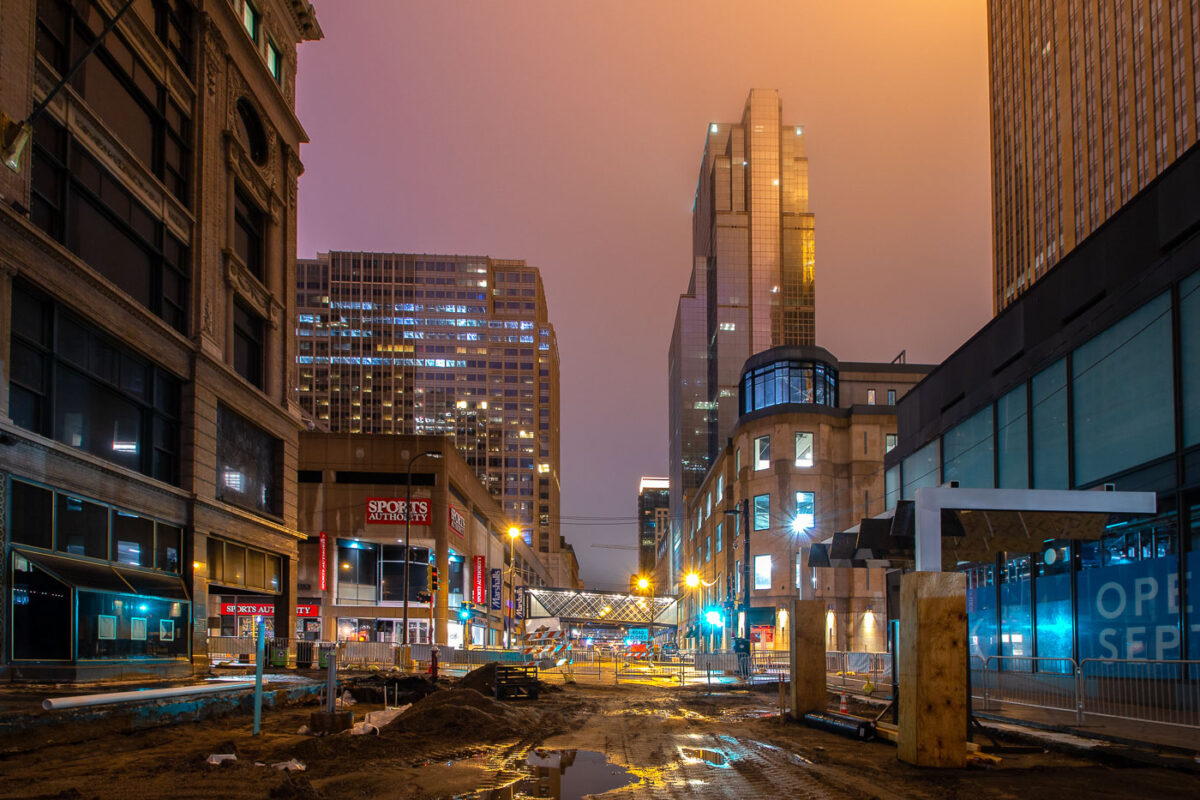
Nicollet Mall under construction at dusk in downtown Minneapolis, with the IDS Center tower illuminated in the background.
Nicollet Mall in Downtown Minneapolis during the COVID-19 shutdowns.

Construction Along Nicollet Mall Near the IDS Center
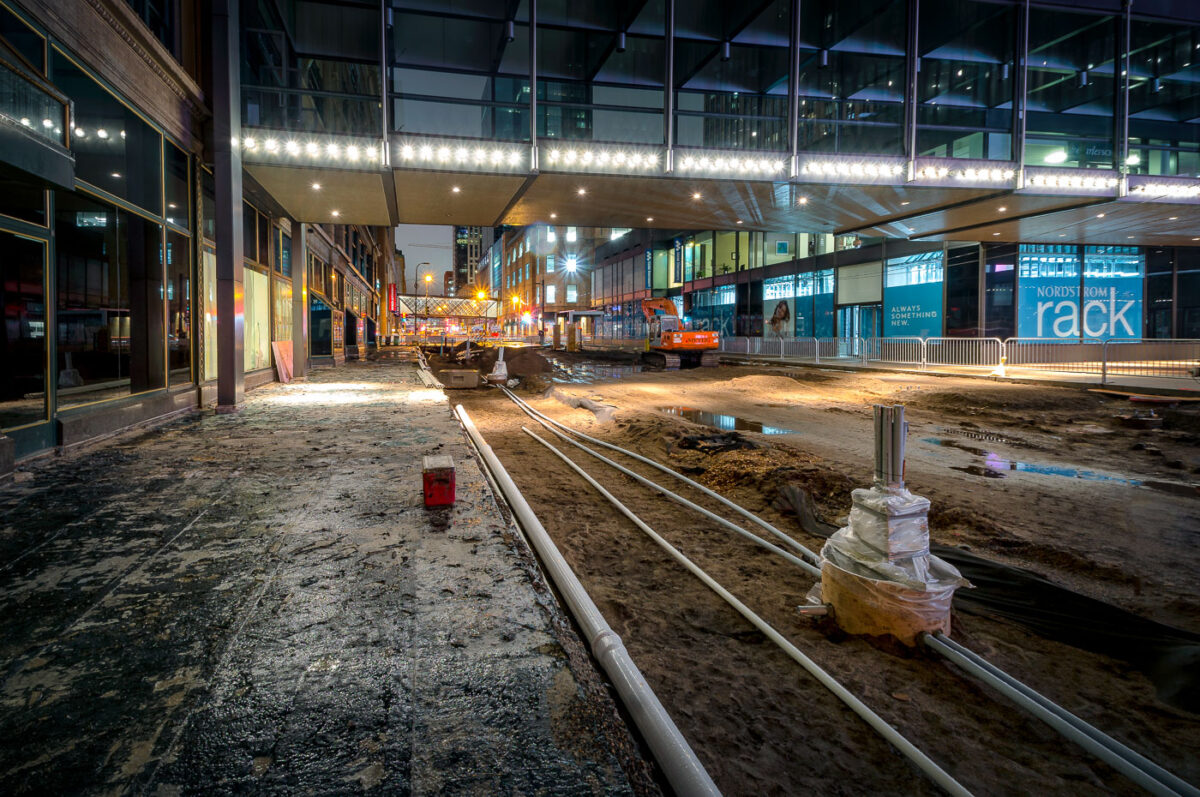
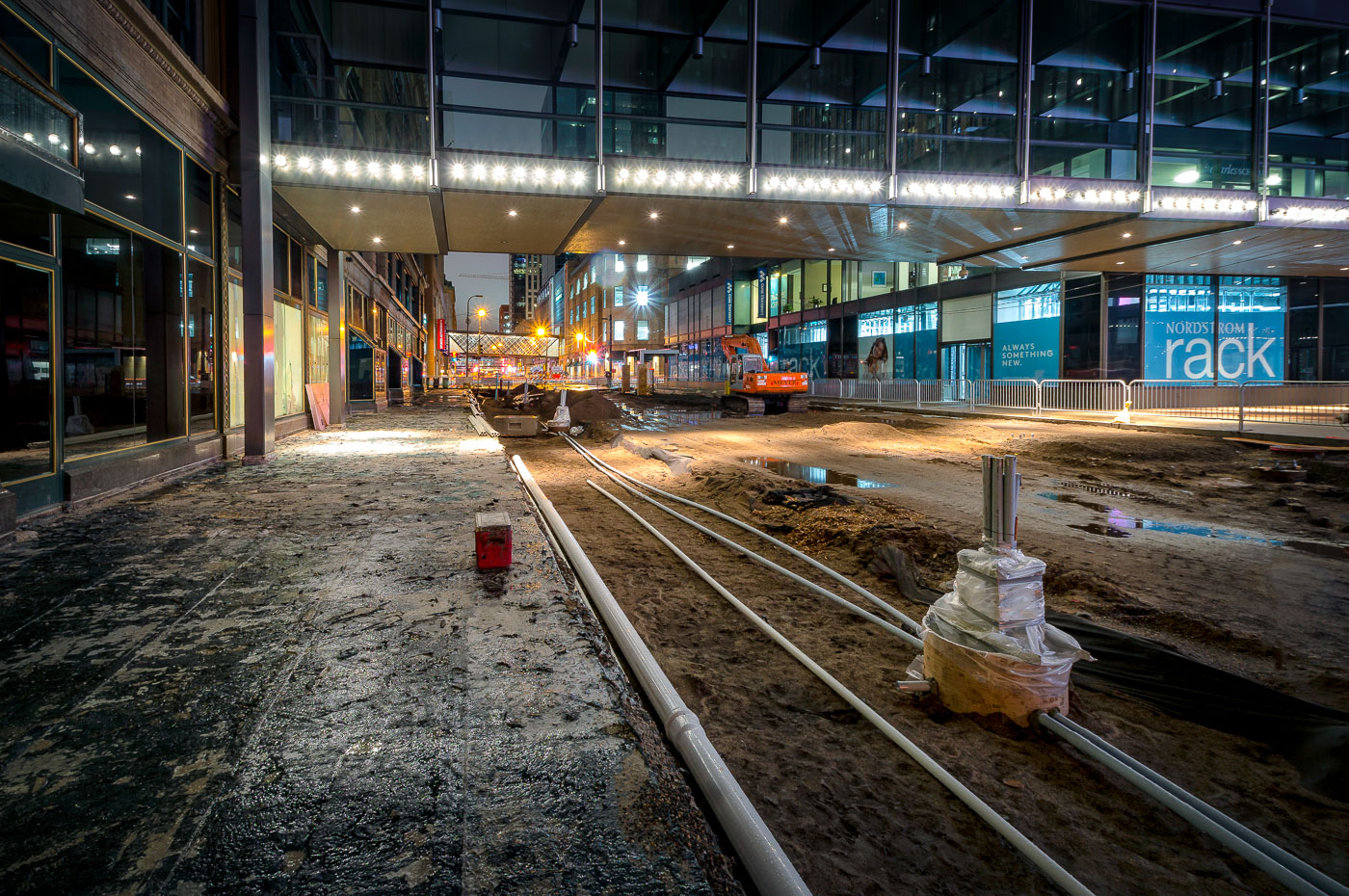
Construction on Nicollet Mall in downtown Minneapolis between the IDS Center and Nordstrom Rack involves infrastructure work and paving.
Construction on Nicollet Mall in downtown Minneapolis is underway, impacting the area between the IDS Center and Nordstrom Rack. This multi-year project aims to revitalize the pedestrian mall, a key thoroughfare in the city's business district. The construction involves significant infrastructure work, including the installation of new utilities and paving. Nicollet Mall, originally developed in the 1960s and redesigned in the 1990s, serves as a central hub for retail, dining, and public life in Minneapolis.

Nicollet Mall Construction, Minneapolis: Nordstrom Rack and IDS Center
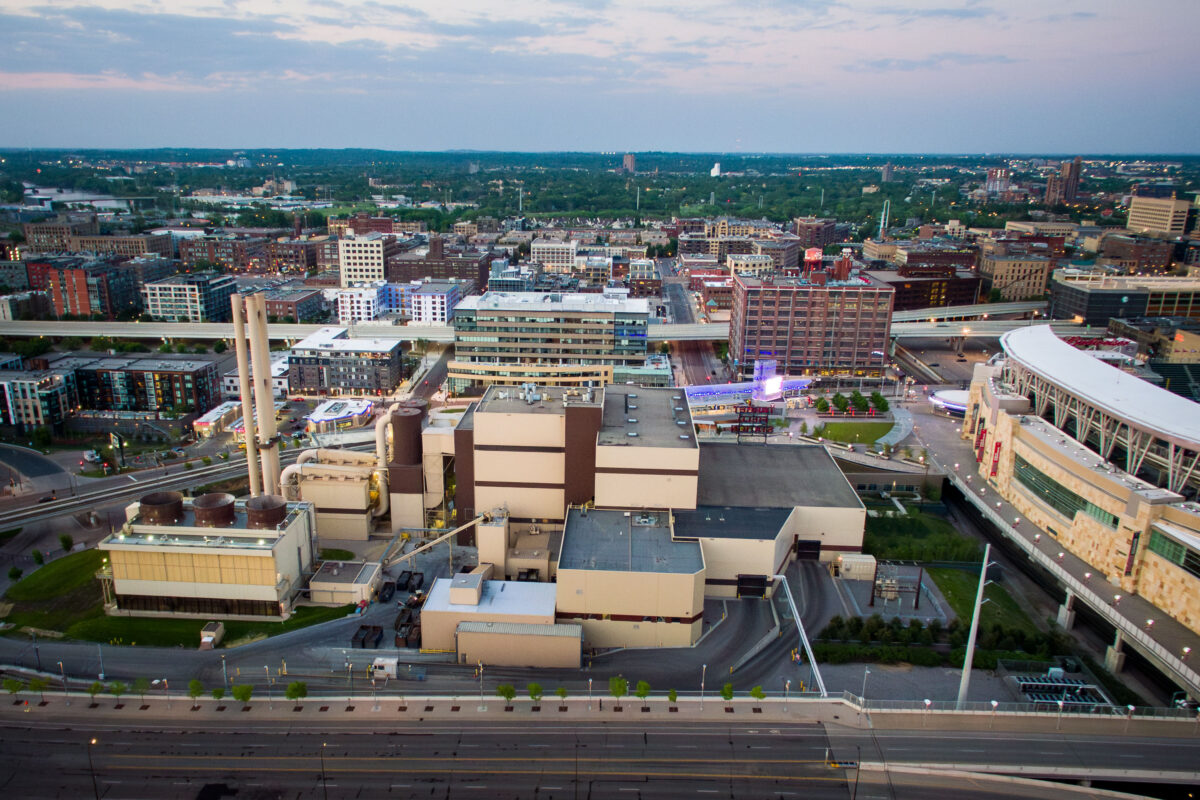
HERC Facility and Downtown Minneapolis
The Hennepin Energy Recovery Center (HERC) sits along 6th Avenue North on the edge of downtown Minneapolis, converting municipal solid waste into electricity and district steam.

Aerial View of HERC Near Target Field in Minneapolis
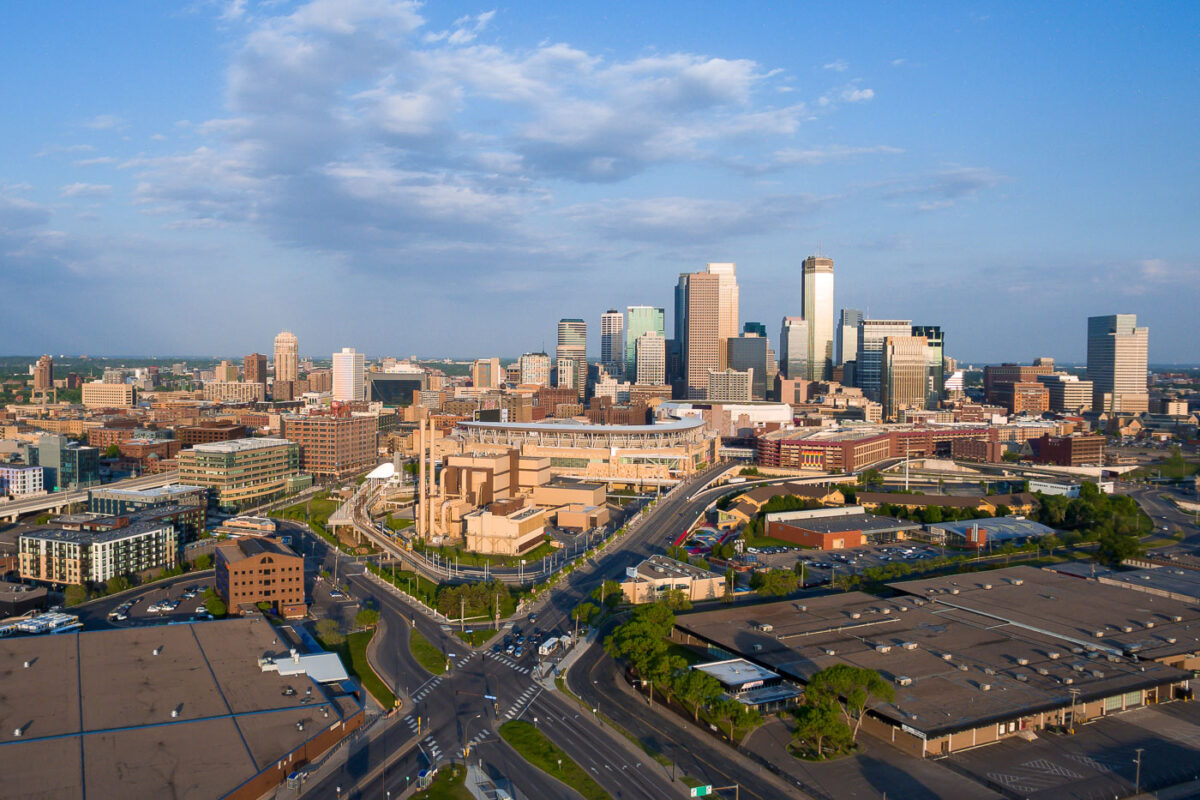
Downtown Minneapolis Skyline from the North
Downtown Minneapolis, is shown from the north with the central business district rising beyond Target Field and the warehouse district. Target Field, home of Major League Baseball’s Minnesota Twins since 2010, anchors the foreground near Interstate 394.

Downtown Minneapolis Skyline Target Field
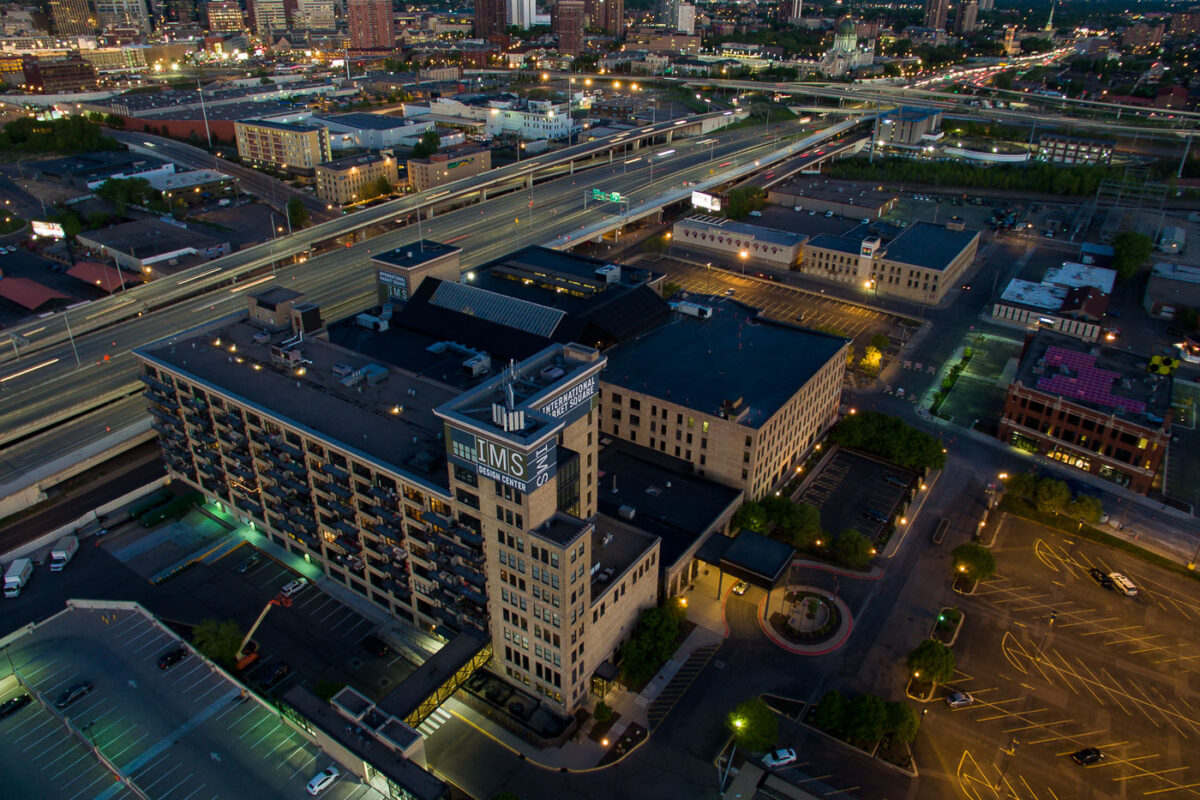
International Market Square, a mixed-use development in North Minneapolis, originally built in 1907 as a factory, now houses design spaces and residences.
International Market Square, Minneapolis Design Center, is a mixed-use development located in North Minneapolis. Originally constructed in 1907 as a factory for the Minneapolis Woolen Mills, the building has undergone significant redevelopment. It now houses a design center, event spaces, and residential units. The structure's industrial architecture is a notable feature, reflecting its manufacturing past.

International Market Square, Minneapolis Design Center
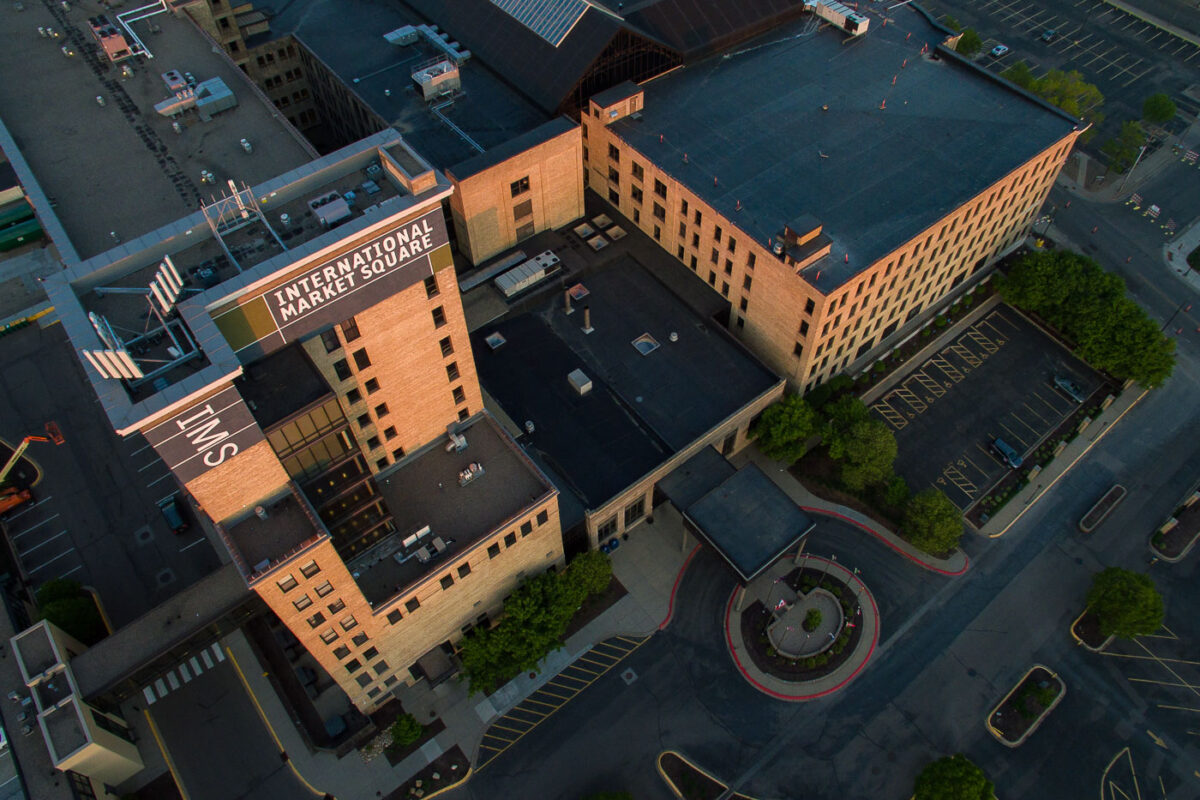
International Market Square, a historic building complex in Minneapolis, Minnesota, originally built in 1883 as a flour milling facility, now houses businesses and event spaces.
International Market Square, located in North Minneapolis, Minnesota, is a historic building complex originally constructed in 1883 as the headquarters for the Washburn Crosby Company, a predecessor to General Mills. The building served as a flour milling facility for decades before being repurposed in the late 20th century. Today, it houses a variety of businesses, showrooms, and event spaces, continuing its legacy as a significant commercial hub within the city.

International Market Square, Minneapolis, Minnesota
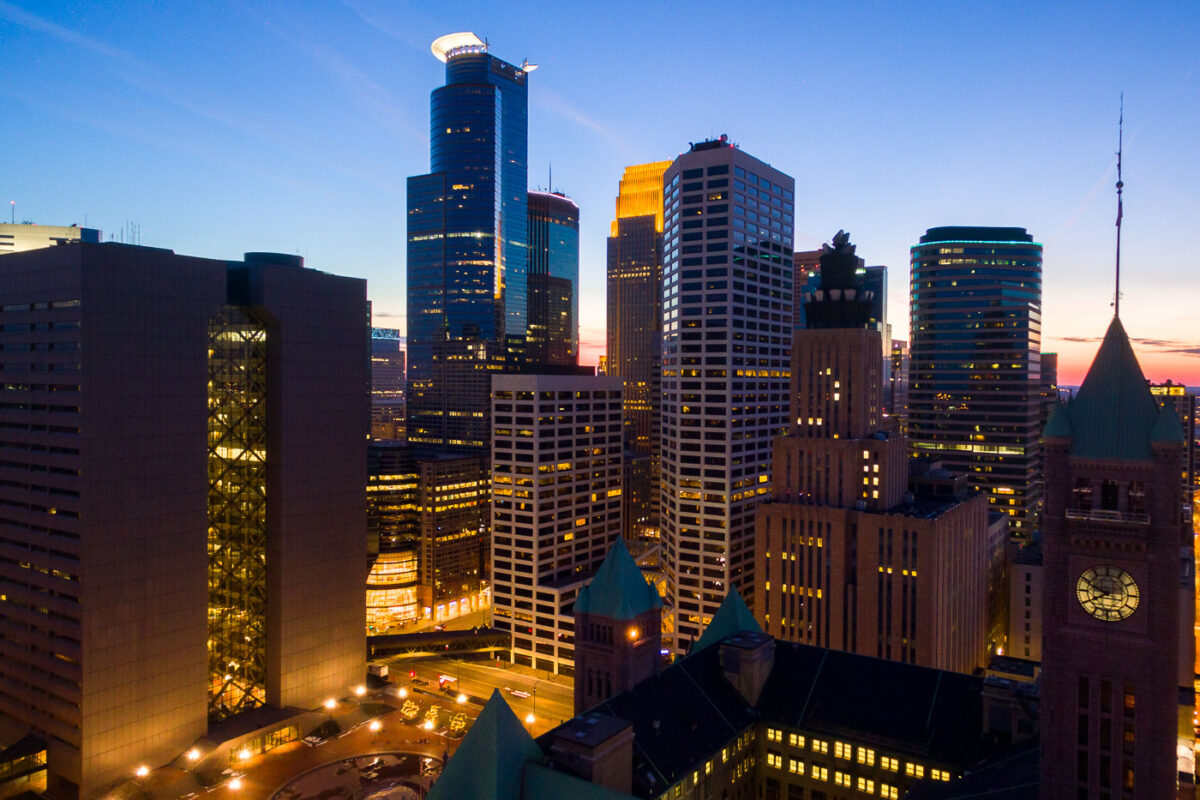
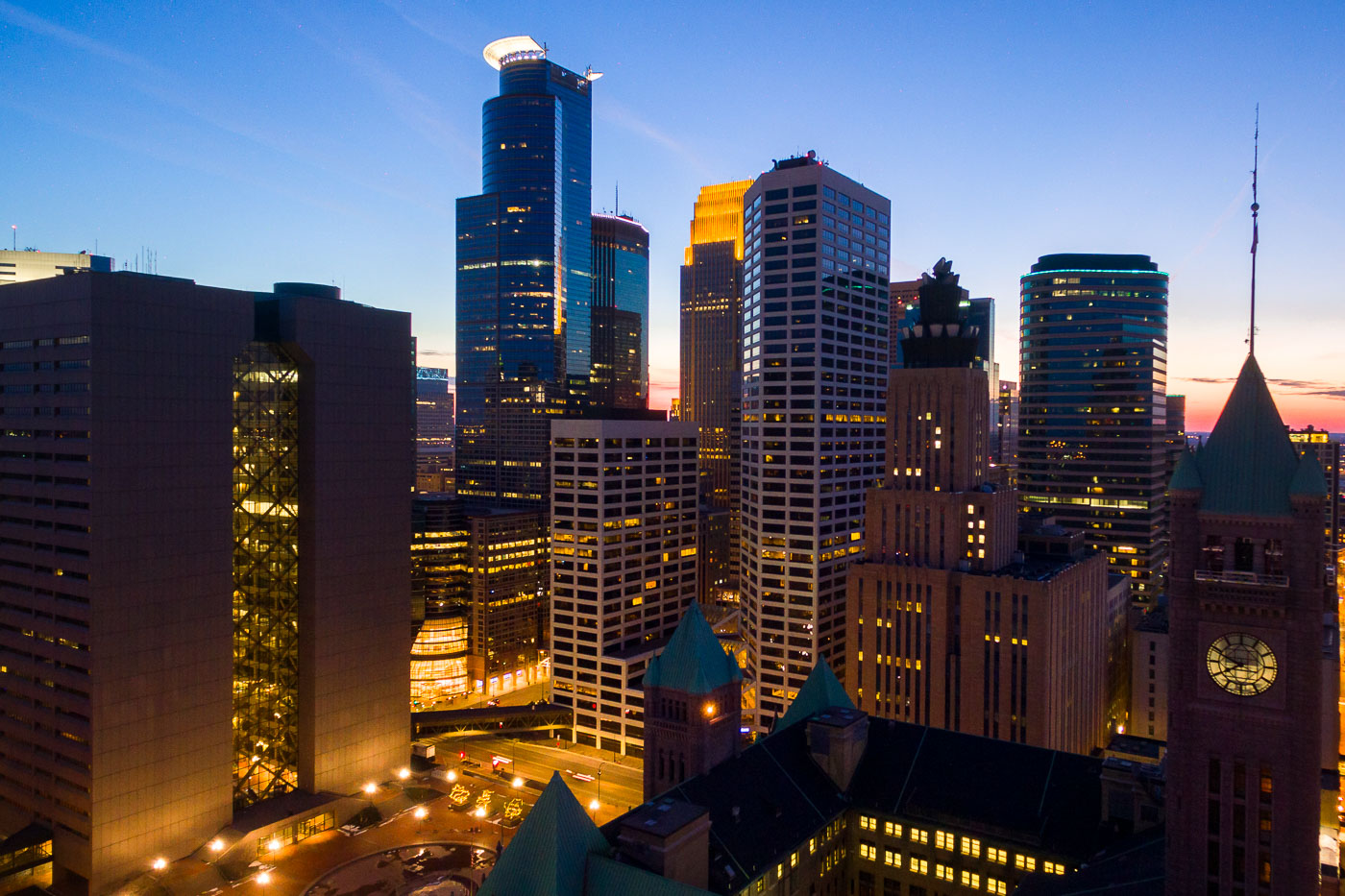
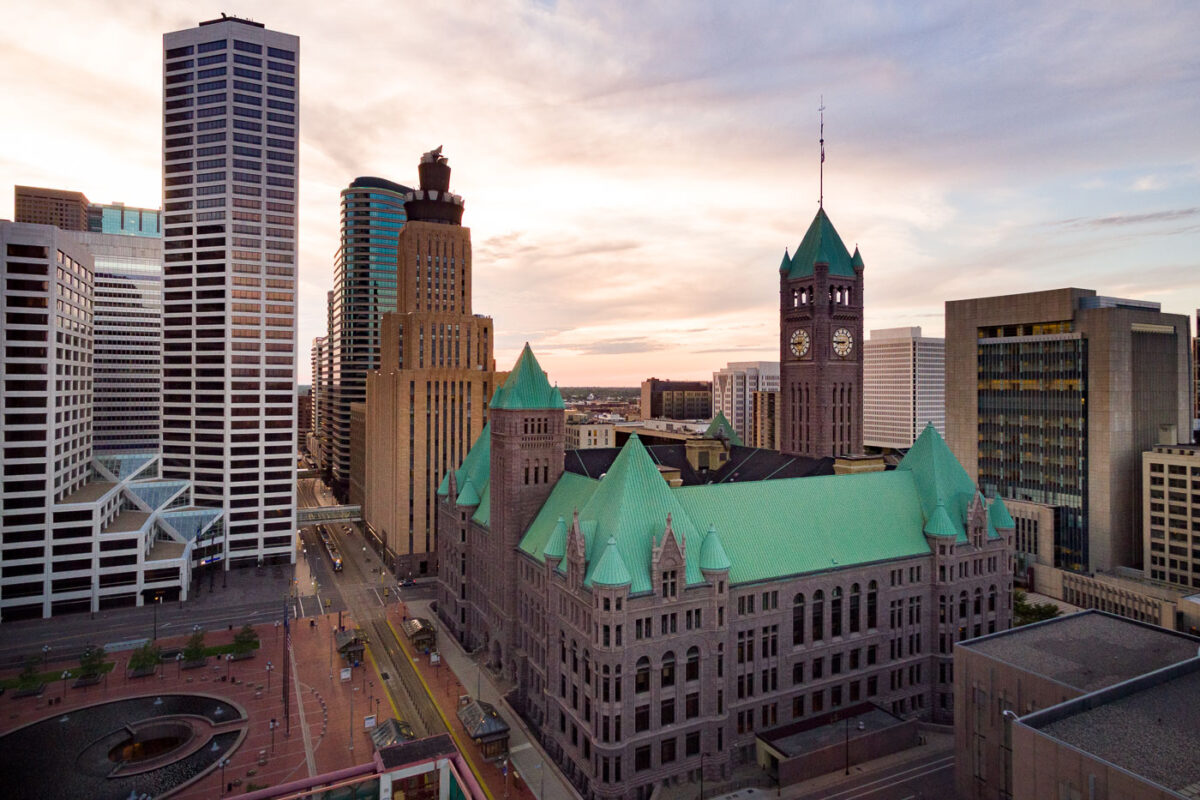
Minneapolis City Hall and downtown skyline at dusk with illuminated office and residential towers.
Minneapolis City Hall is a Romanesque Revival building completed in 1909. Its clock tower stands 345 feet tall and holds one of the world's largest handcarved marble statues, the Father of Waters, in its rotunda.

Minneapolis City Hall’s Clock Tower Beneath the Downtown Skyline
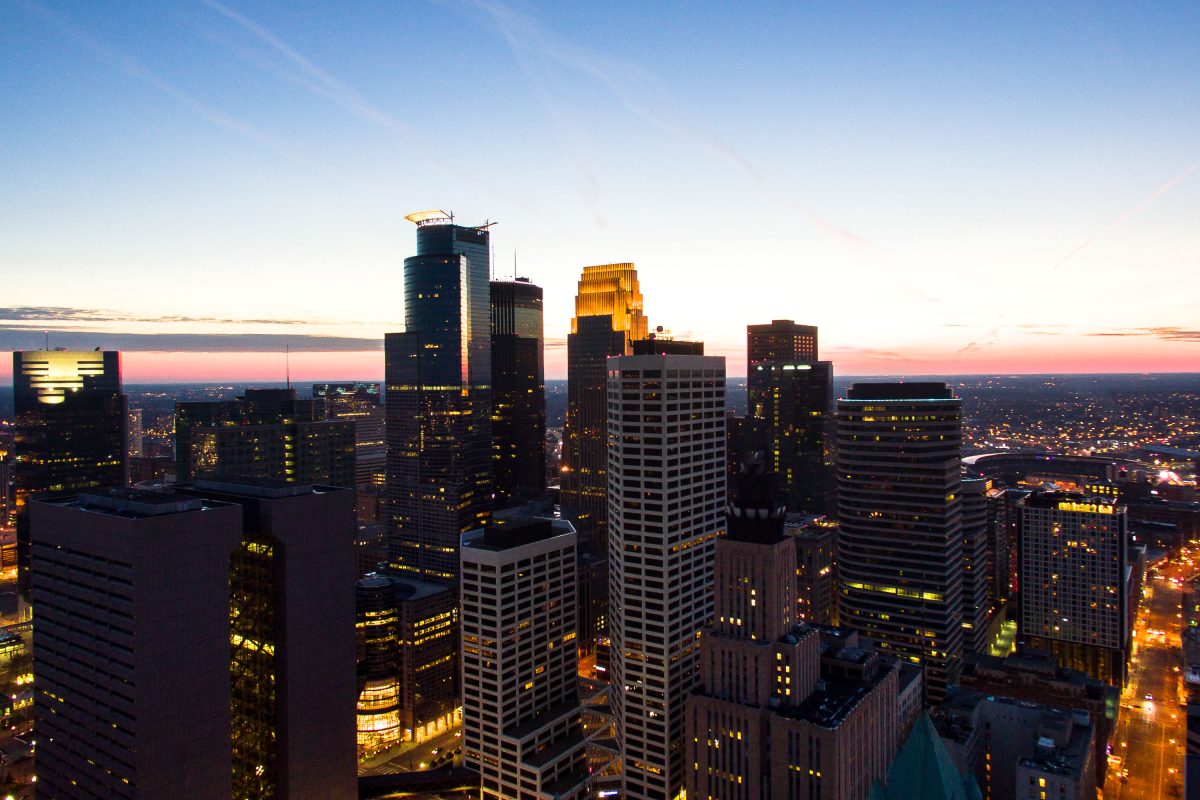
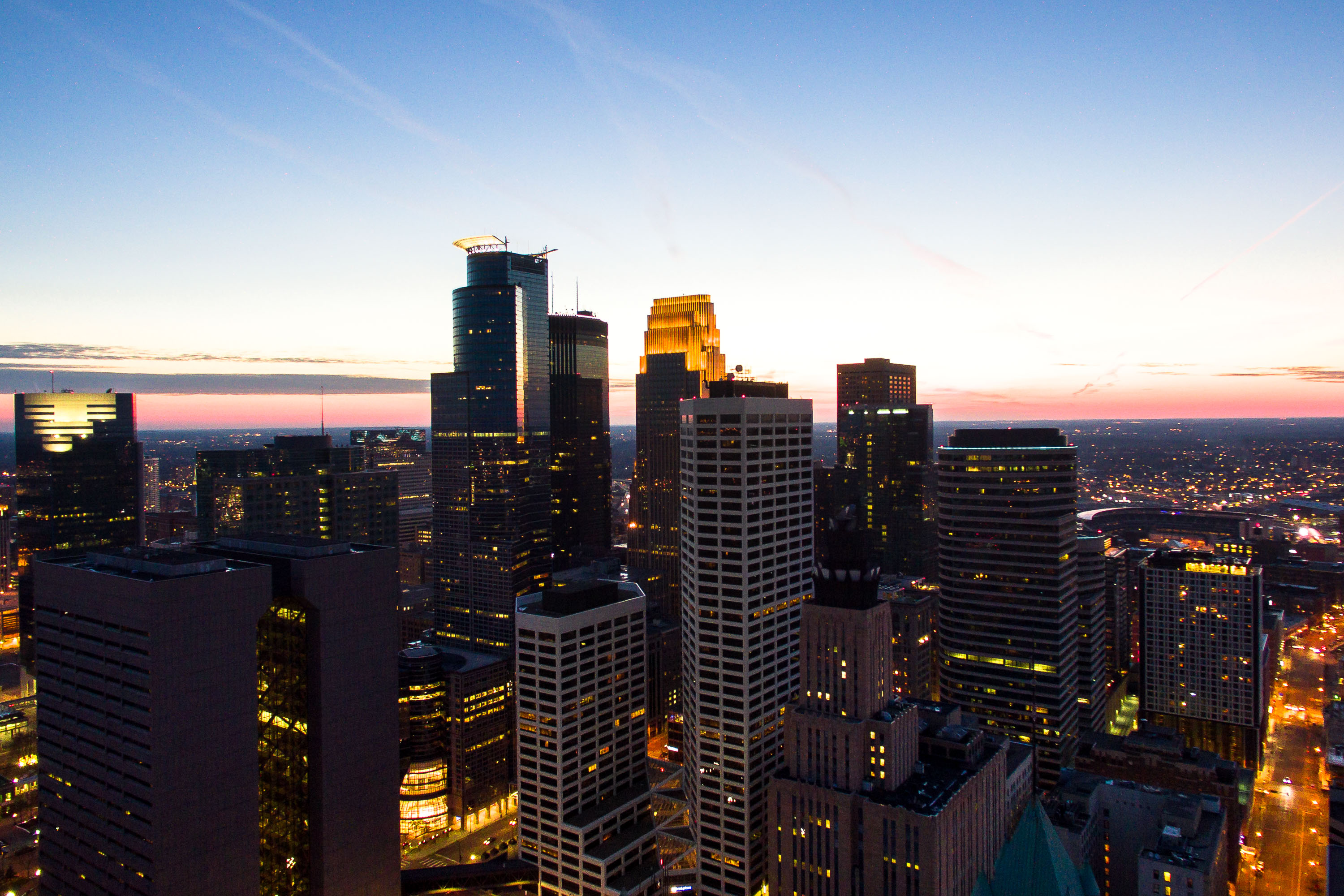
Downtown Minneapolis skyline at dusk with illuminated buildings against a blue and pink sky.
Downtown Minneapolis's skyline includes the IDS Center, at 792 feet the tallest building in Minnesota, completed in 1972. The Capella Tower stands nearby at 776 feet, built in 1992 and topped by a stepped crown.

IDS Center and Capella Tower at Dusk Over Minneapolis
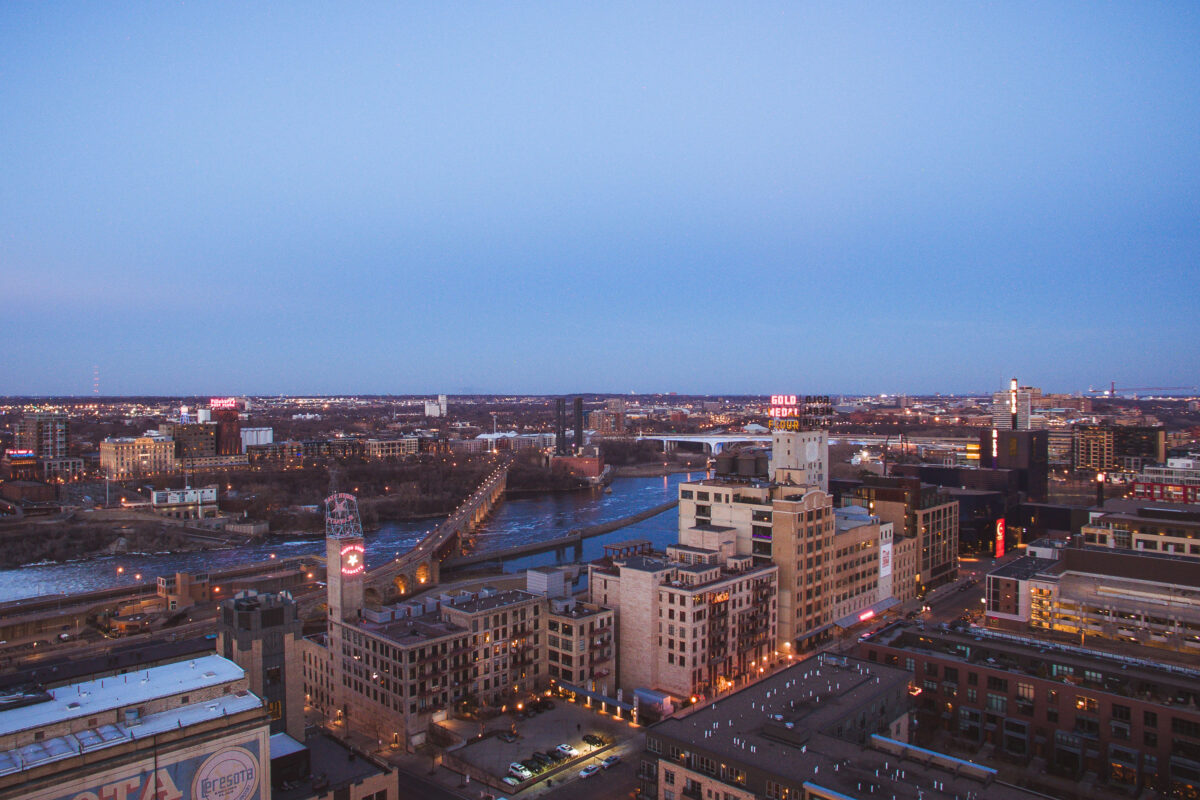
Downtown Minneapolis and the Mississippi River at dusk.
Downtown Minneapolis and the Mississippi River, Minneapolis, Minnesota. The view includes several downtown buildings, bridges crossing the river, and the riverfront area near the central business district.

Downtown Minneapolis and the Mississippi River

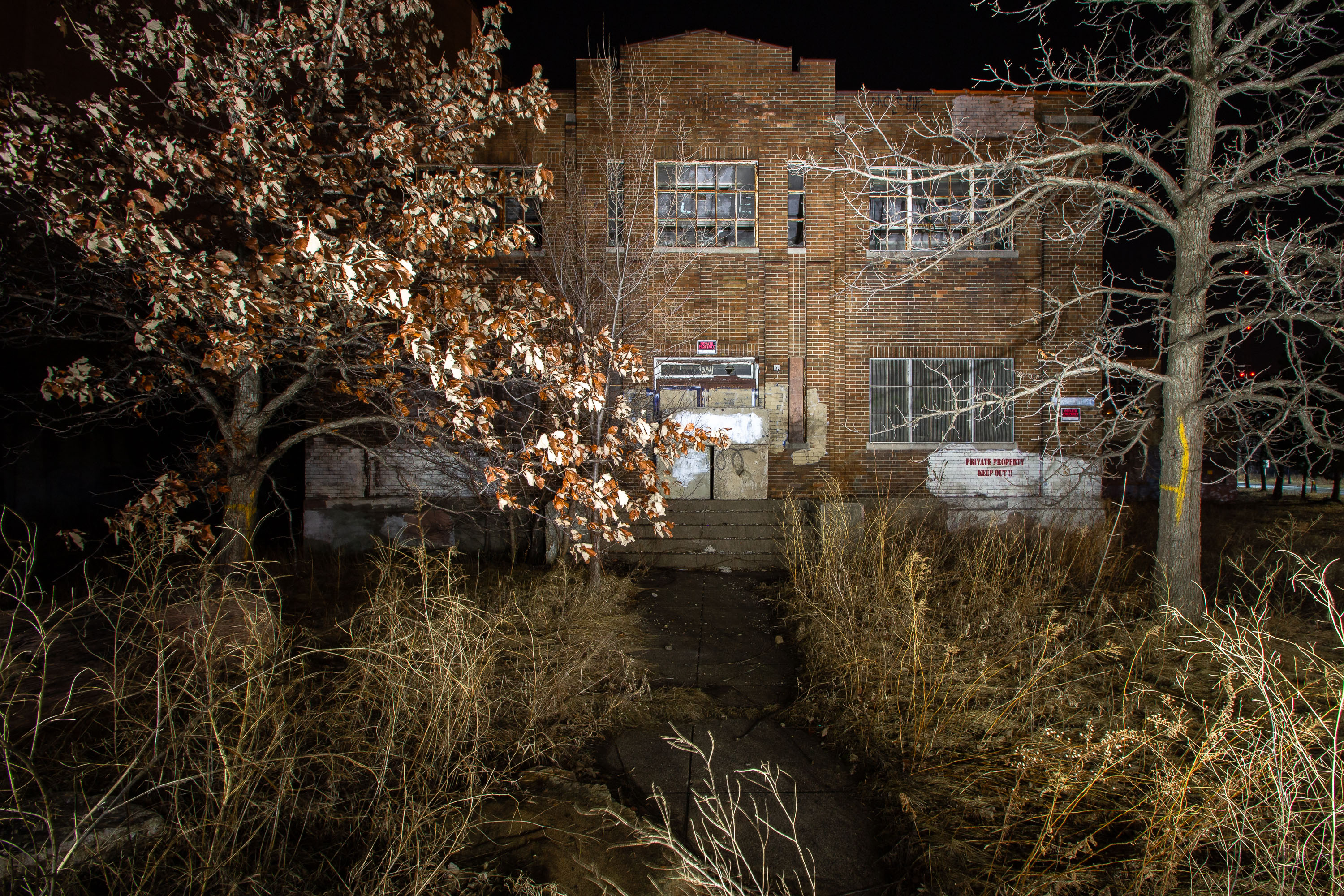
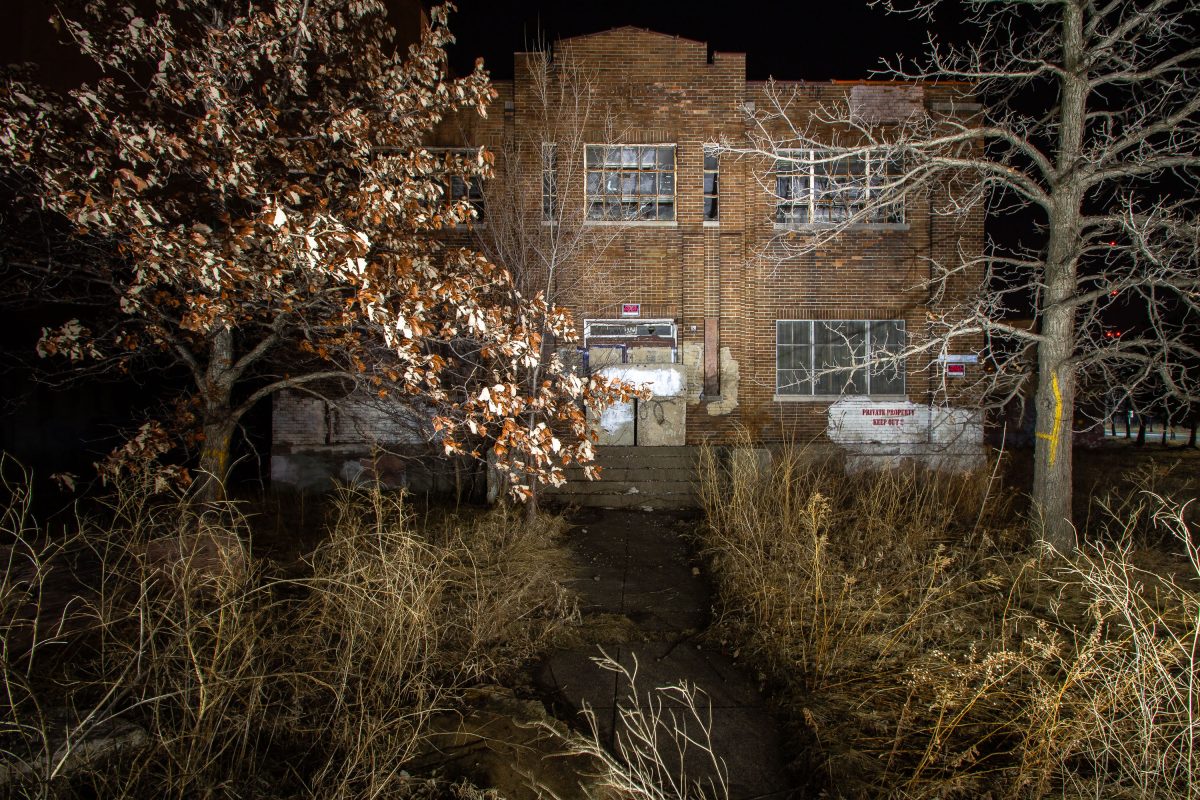
Abandoned brick laboratory building of the former Archer Daniels Midland grain elevator complex in Minneapolis.
The Stone Lab building at 421 29th Ave SE was once used by the University of Minnesota for environmental health research.

Stone Lab building in Minneapolis

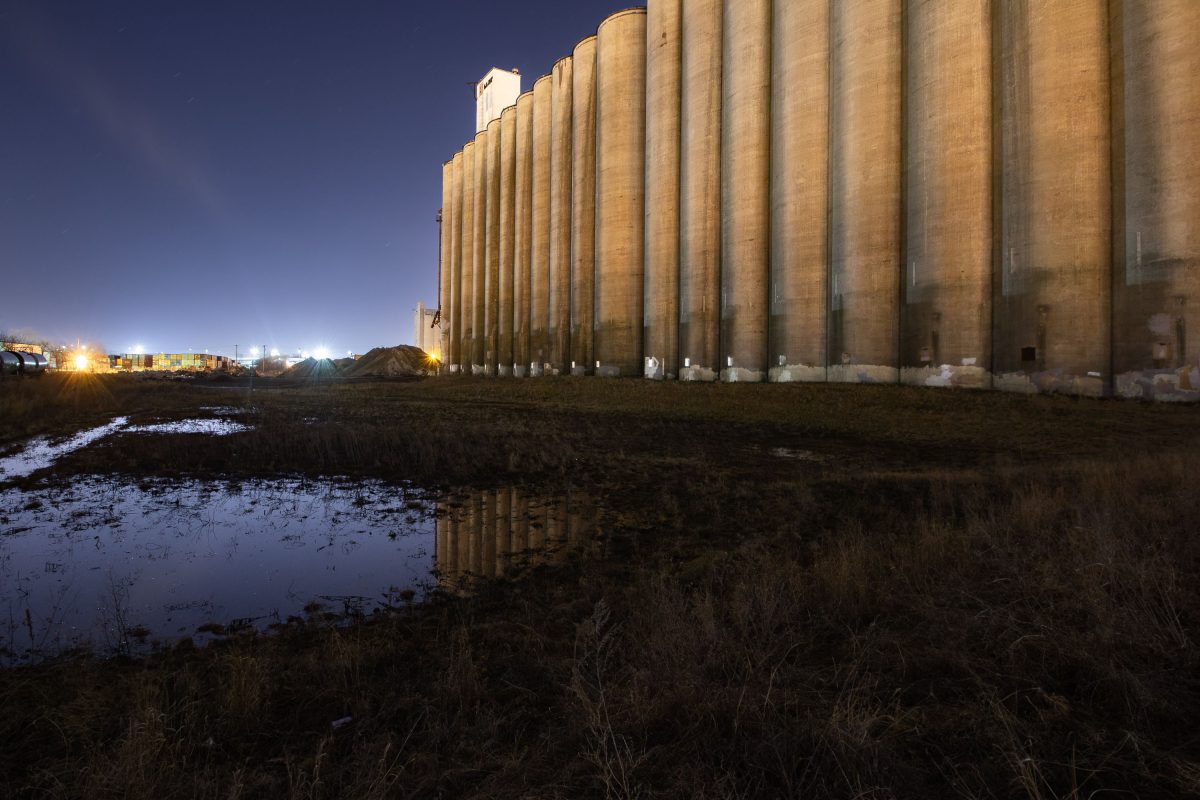
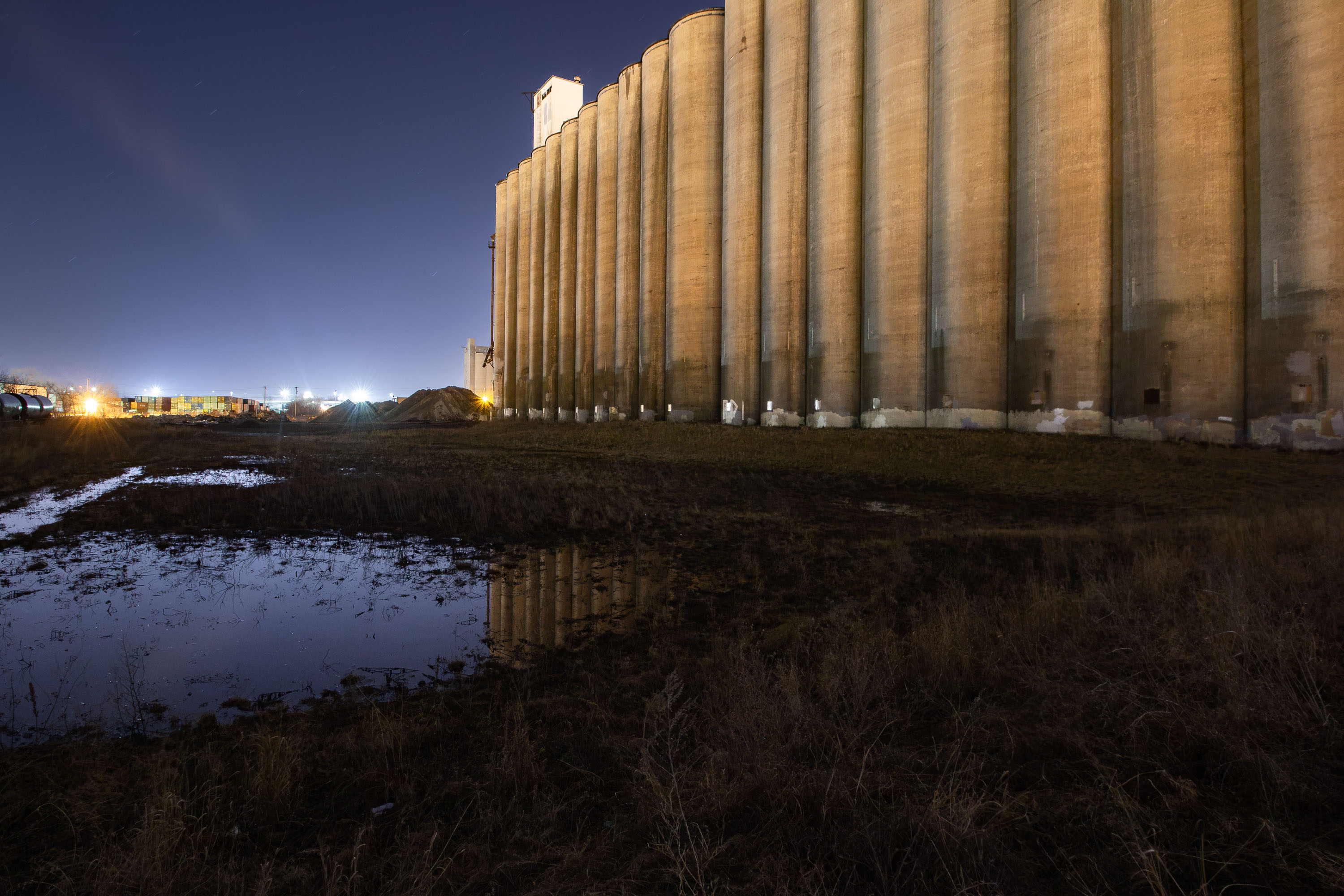
Concrete grain silos of the Archer Daniels Midland elevator in Southeast Minneapolis at night.
The Archer Daniels Midland grain elevator stands in Southeast Minneapolis near the Mississippi River. Its concrete silos are built in a cylindrical design common to grain elevators raised in the mid twentieth century to hold large volumes of grain for milling and export.

The ADM Grain Elevator in Southeast Minneapolis
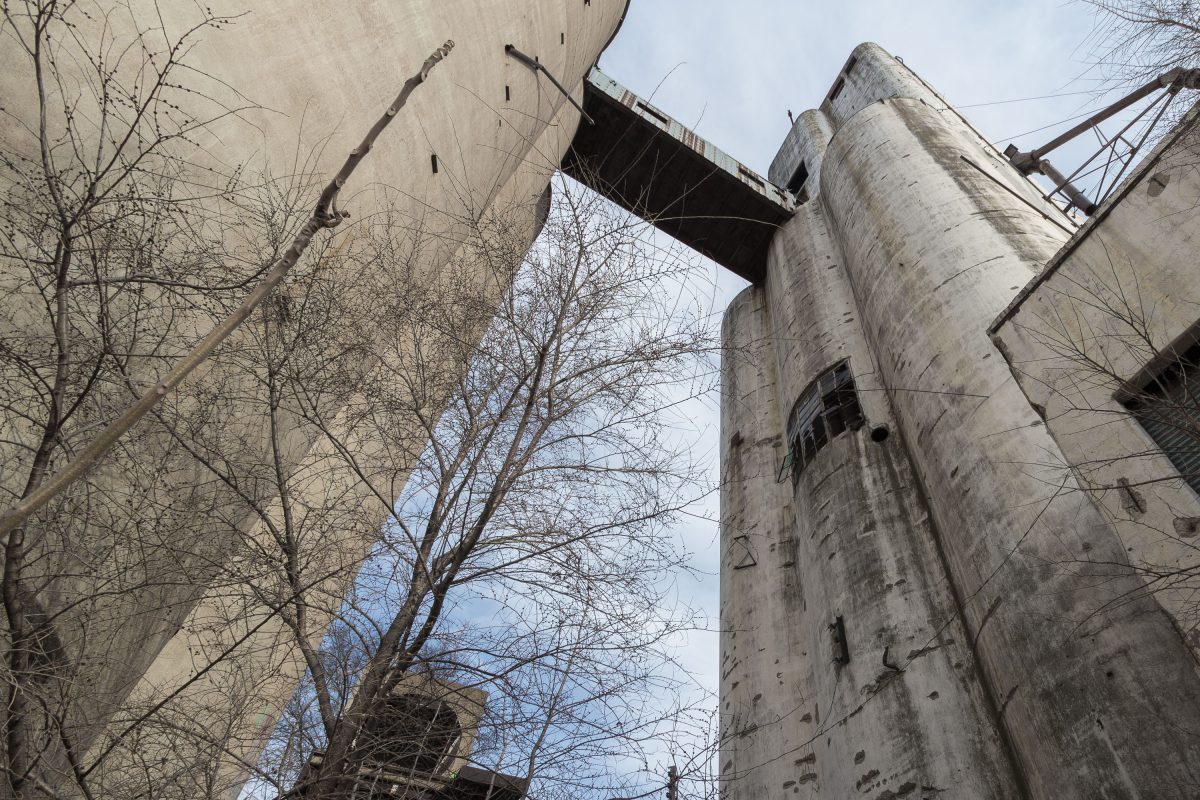
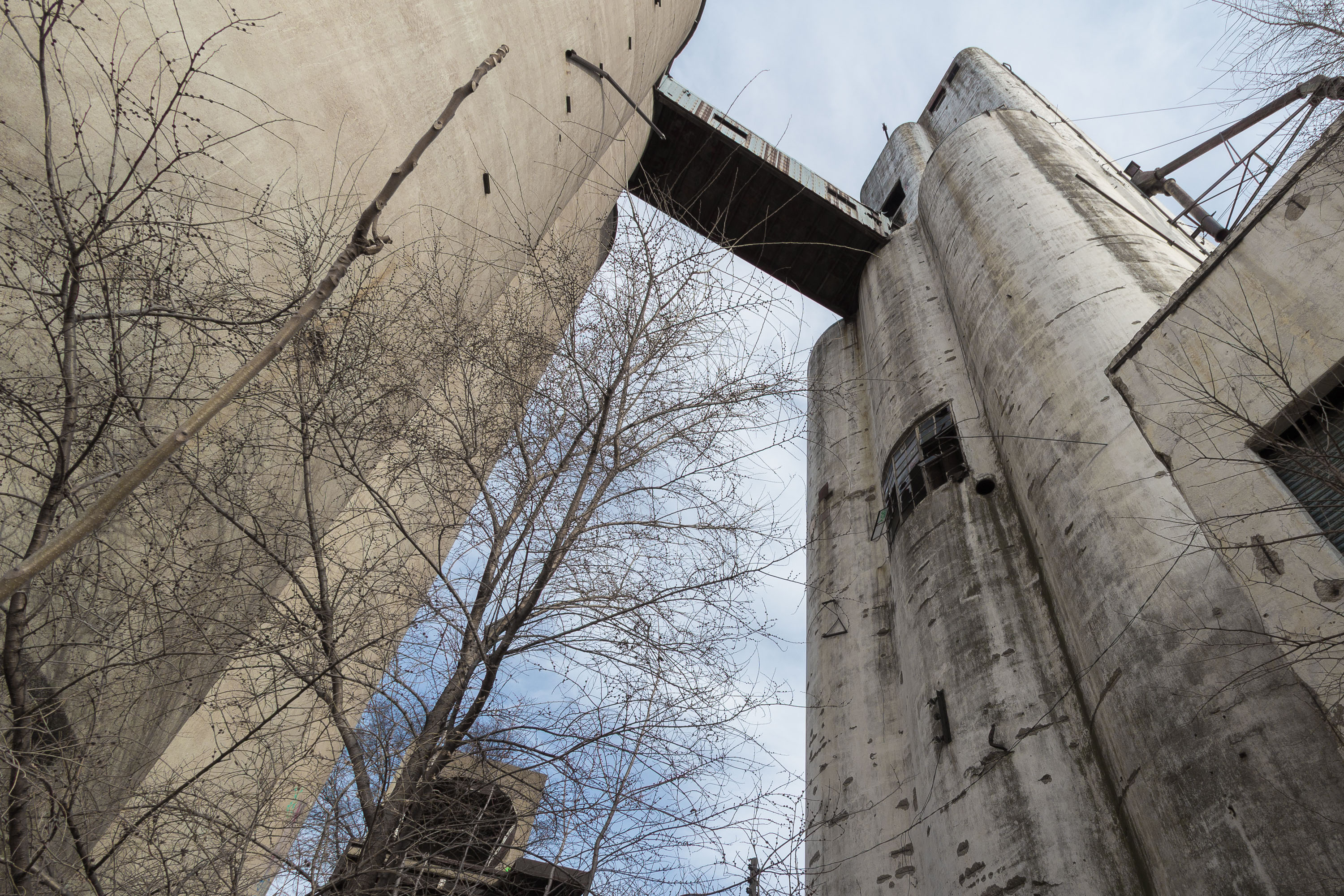
Concrete grain silos connected by an elevated enclosed walkway at a grain elevator complex in Omaha, Nebraska.
This grain elevator complex is located in Omaha, Nebraska. The structure consists of multiple reinforced concrete silos connected by an elevated enclosed walkway.

Concrete Grain Silos and Elevated Walkway, Omaha, Nebraska
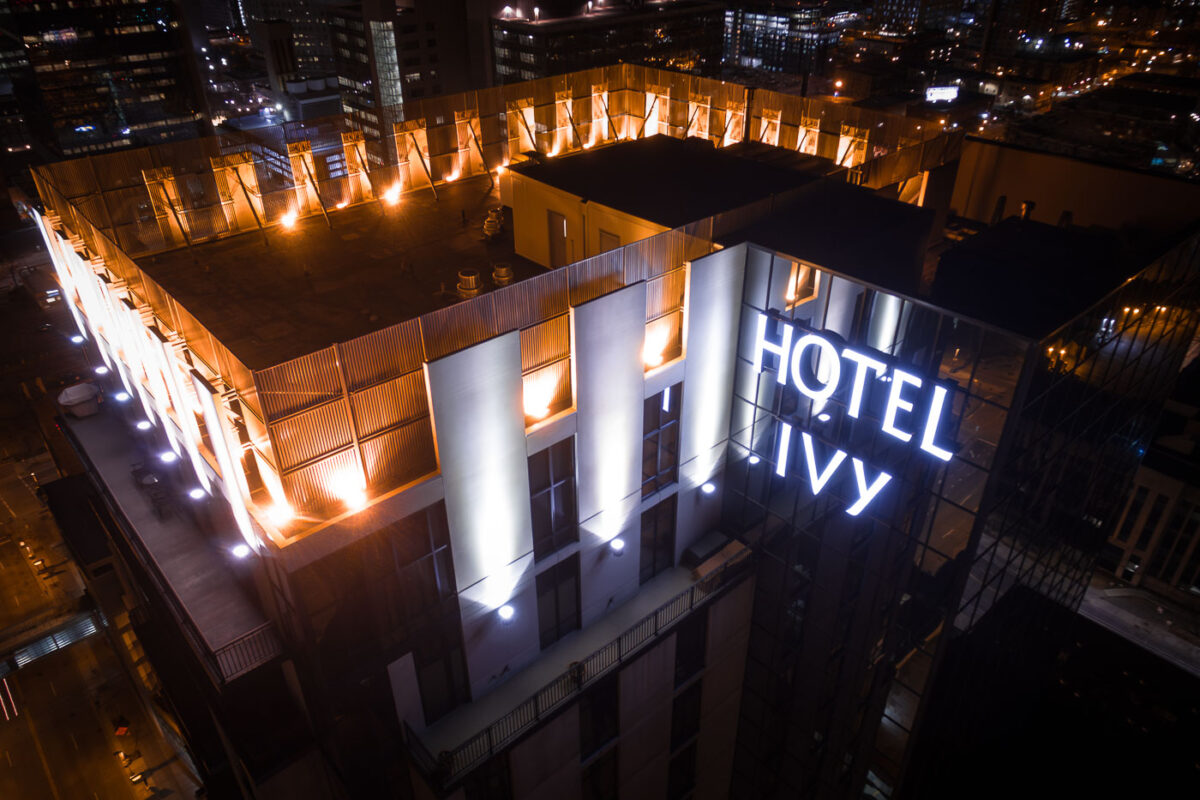
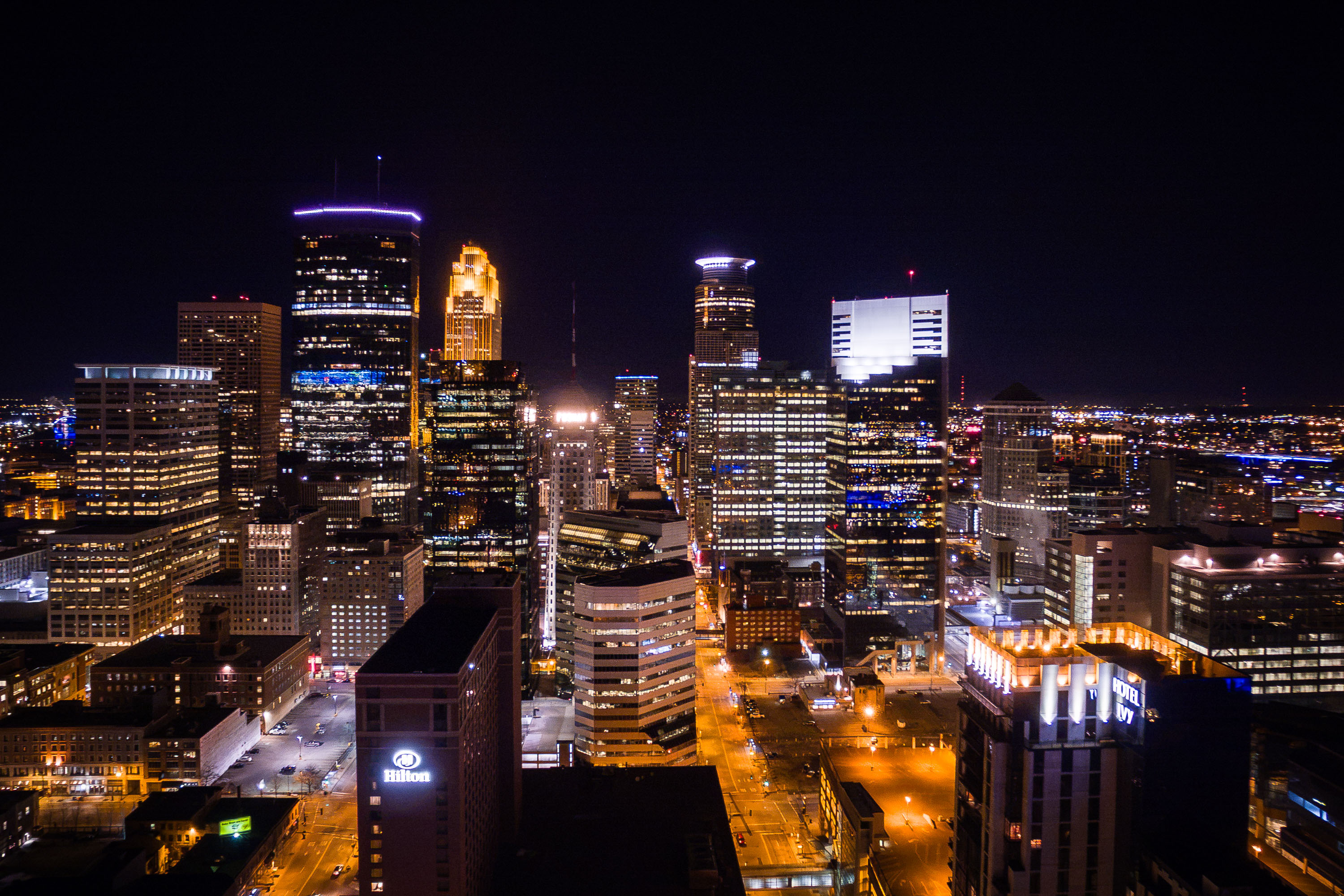
Hotel Ivy, a luxury hotel in downtown Minneapolis, is illuminated at night.
Hotel Ivy, a luxury hotel in downtown Minneapolis, is illuminated at night. The building, which opened in 2019, is part of the city's modern architectural development. Its rooftop area offers views of the surrounding urban environment, reflecting the ongoing growth and activity within the Minneapolis central business district.

Hotel Ivy Rooftop and Downtown Minneapolis at Night
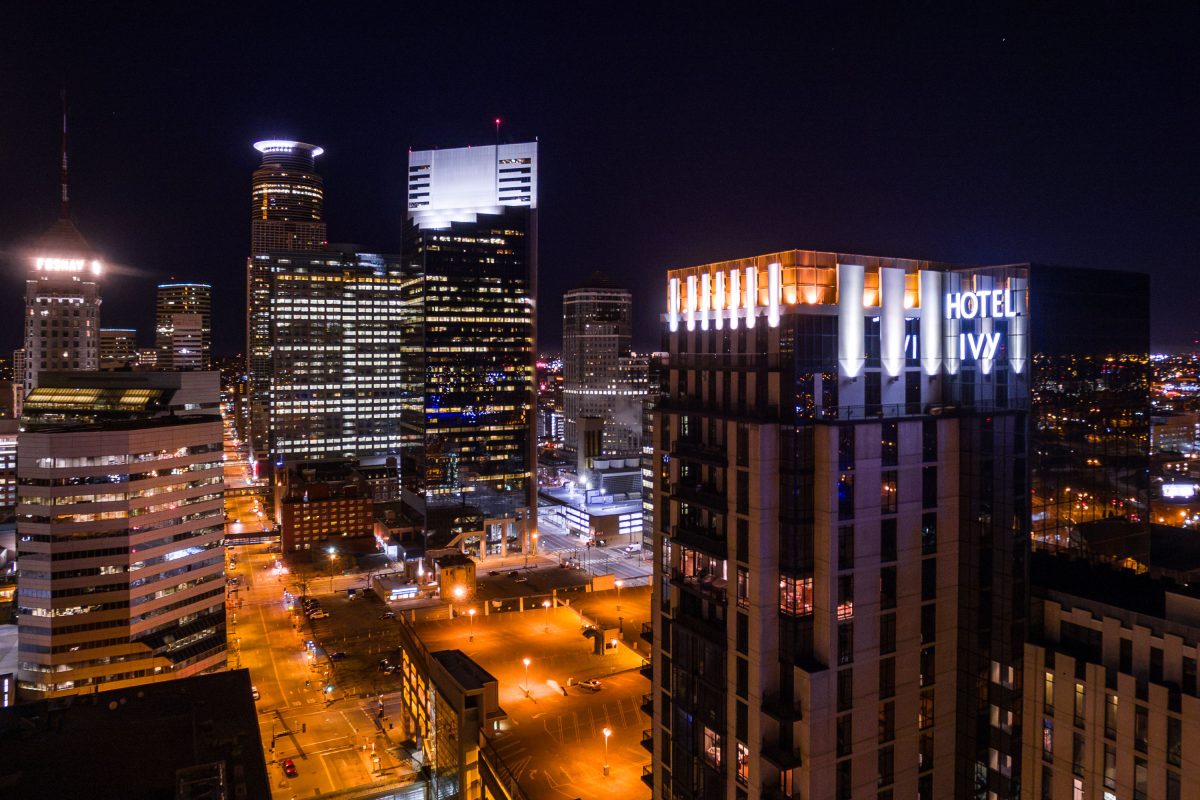
Hotel Ivy on Marquette Ave at night
Hotel Ivy on Marquette Avenue in Downtown Minneapolis lit up at night.

Hotel Ivy on Marquette Ave in Downtown Minneapolis
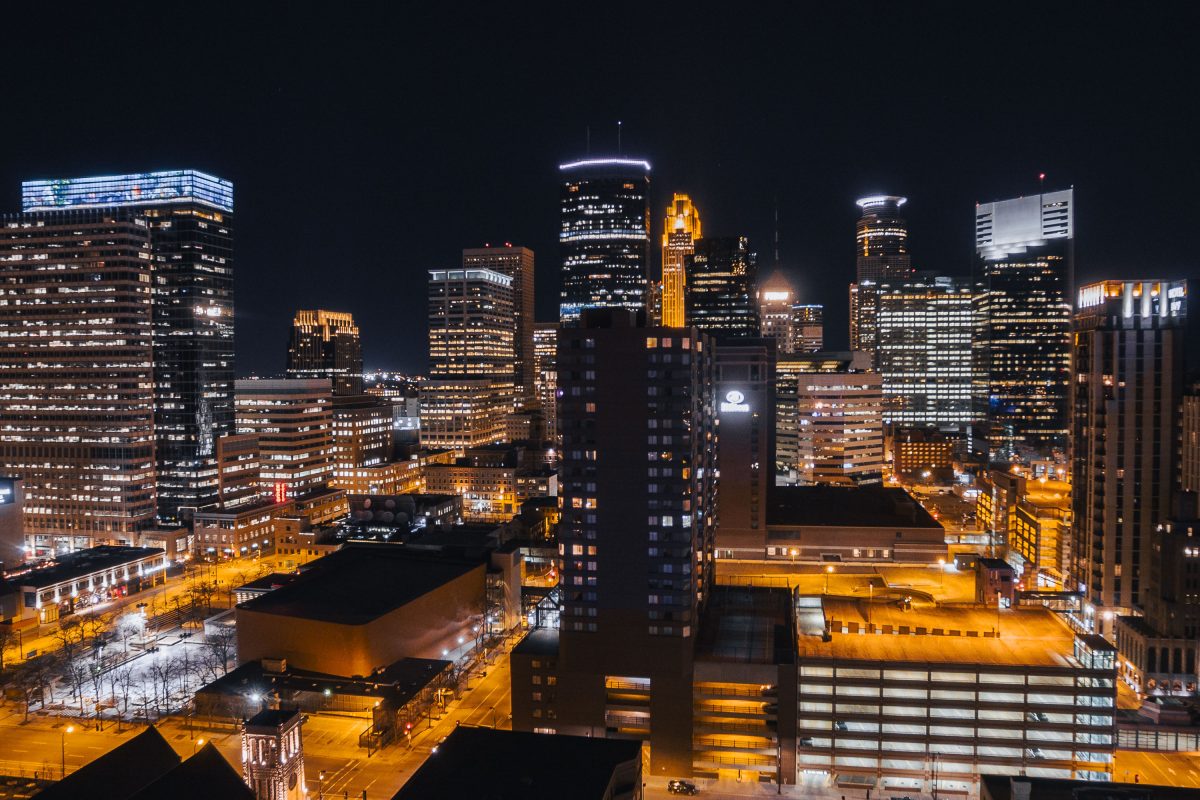
Downtown Minneapolis skyline at night with illuminated buildings and streets.
Downtown Minneapolis's skyline is anchored by the IDS Center, at 792 feet the tallest building in Minnesota, completed in 1972. Capella Tower, finished in 1992, and the Wells Fargo Center, built in 1988, stand nearby along Nicollet Mall and Marquette Avenue.

Downtown Minneapolis Towers After Dark in February 2017
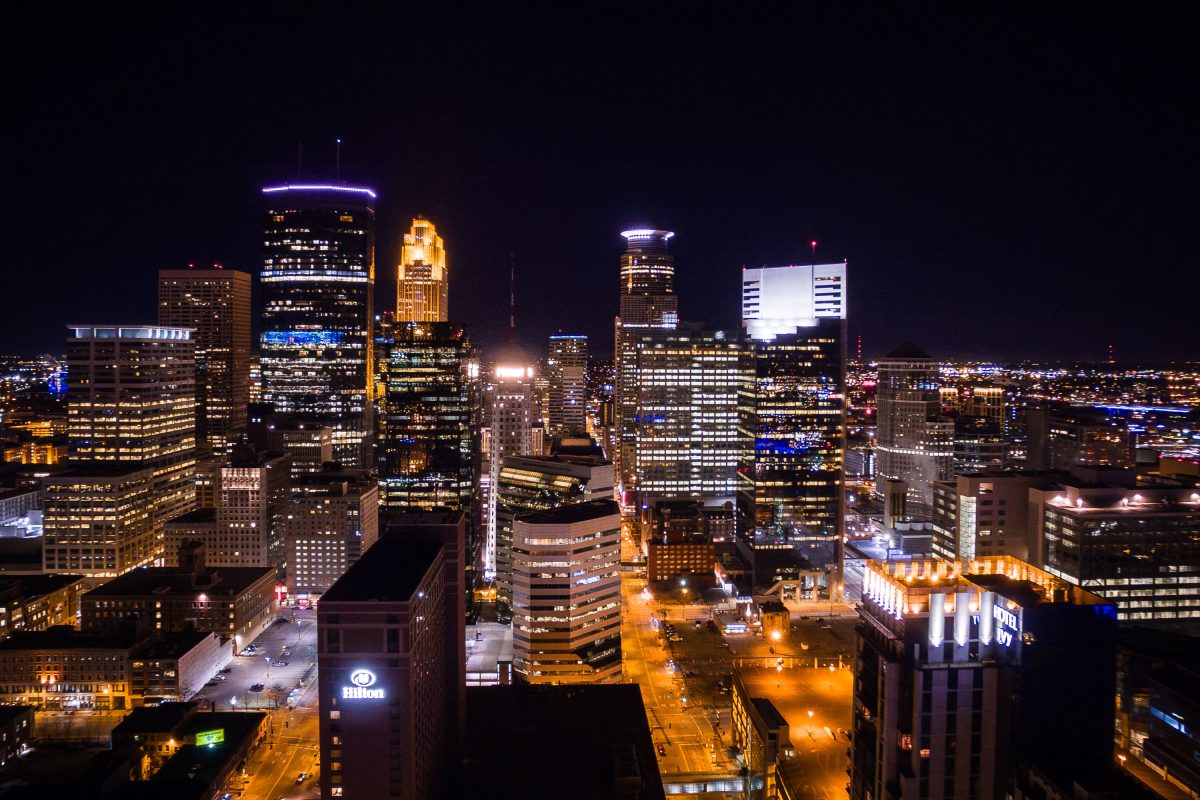
Downtown Minneapolis skyline at night featuring illuminated office and hotel towers including the Hilton and Hotel Ivy.
The Hilton Minneapolis is a 25-story hotel at 1001 Marquette Avenue South that opened in 1992 with more than 800 rooms, making it one of the largest hotels in the Twin Cities. Hotel Ivy occupies a 19-story tower built in 1930 as the Northwestern National Life Insurance Building, later converted into a hotel in 2008.

Downtown Minneapolis Skyline Above the Hilton and Hotel Ivy
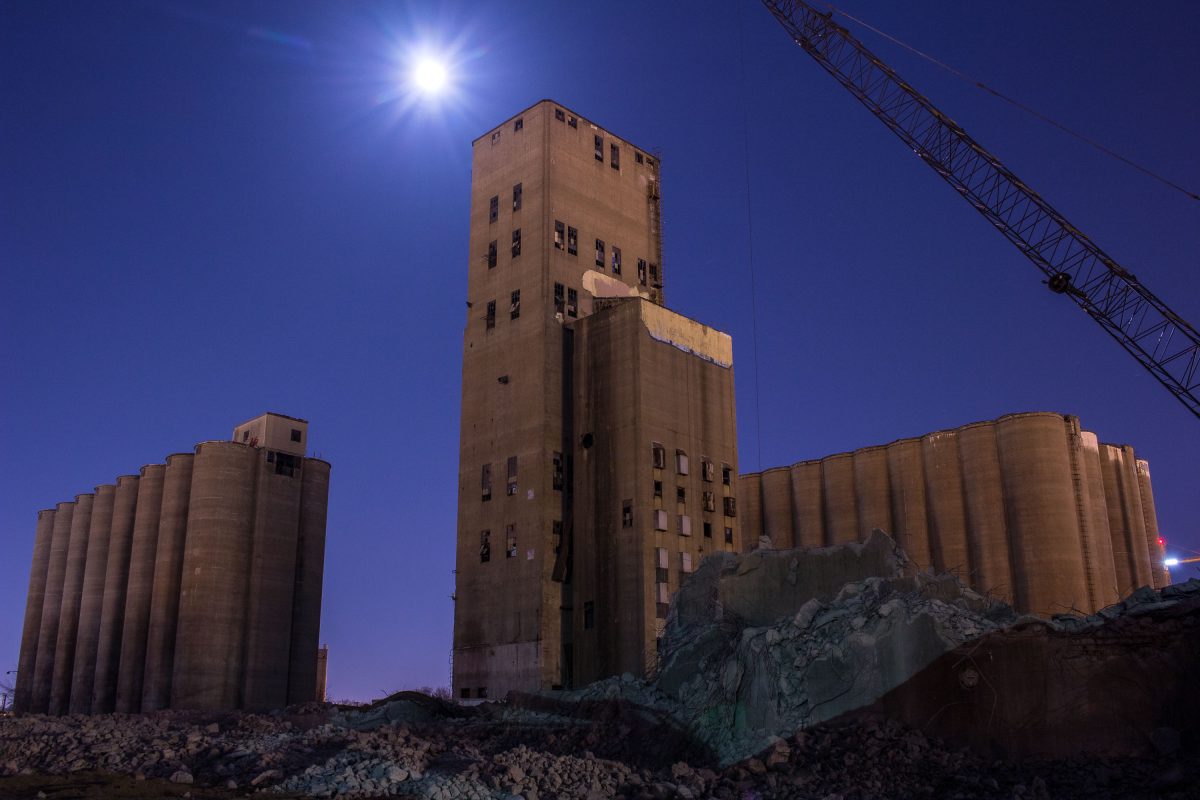
Concrete grain elevator complex with silos and headhouse during demolition in Dinkytown, Minneapolis.
Demolition of grain elevators in Minneapolis taking place in February 2017.

Dinkytown Grain Elevator Complex Under Demolition, Minneapolis
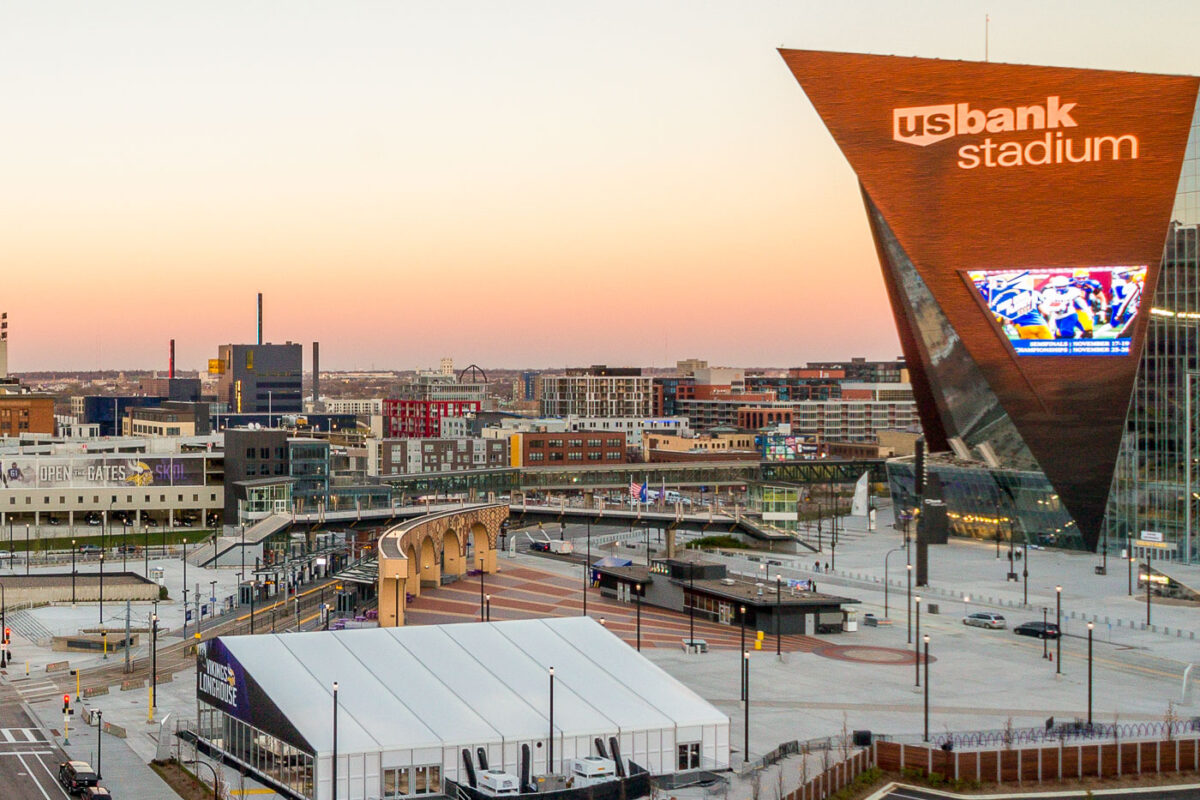
US Bank Stadium in Downtown East Minneapolis, Minnesota, at sunset. The stadium is home to the Minnesota Vikings and features a distinctive angular design.
US Bank Stadium, a multi-purpose indoor stadium in Minneapolis, Minnesota, serves as the home for the Minnesota Vikings. Opened in 2016, the stadium was built on the former site of the Metrodome and is a prominent feature of the Downtown East development. The surrounding area includes public plazas and transit connections designed to integrate the stadium into the urban fabric. The stadium's distinctive angular design and transparent facade are notable architectural elements.

US Bank Stadium and Downtown East Minneapolis at Sunset
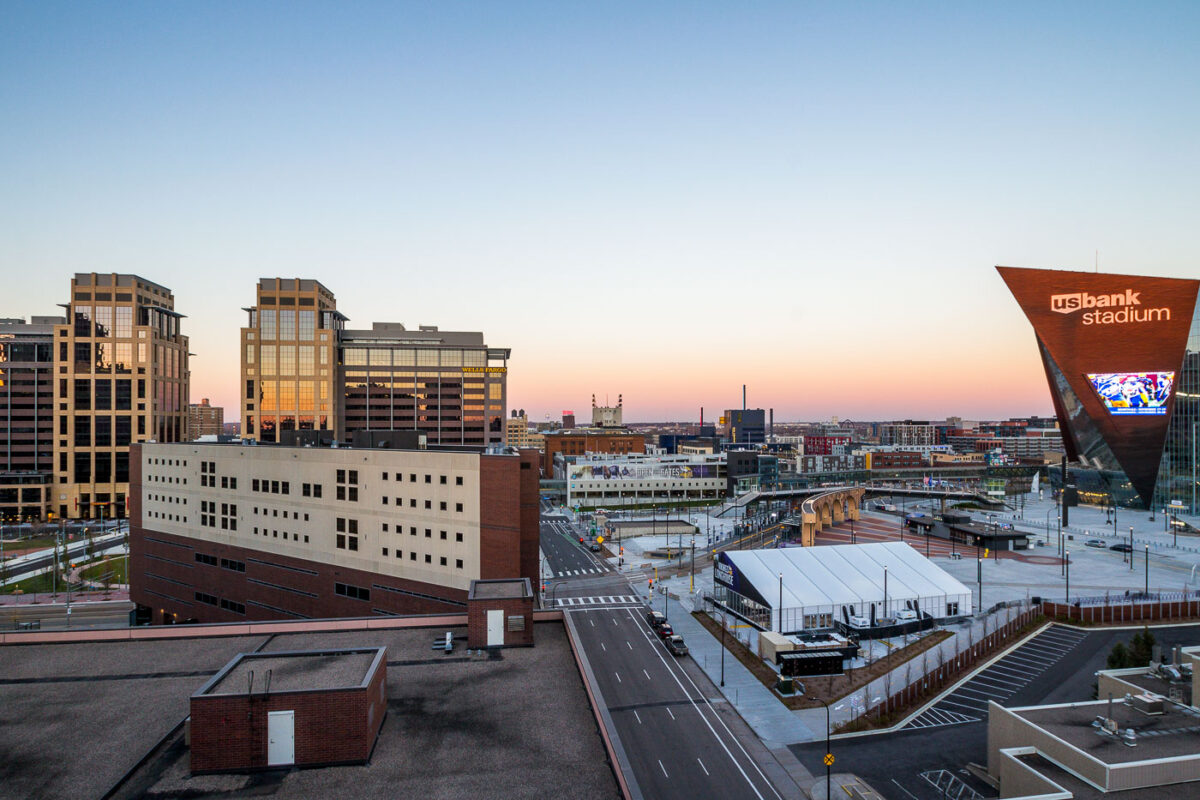
US Bank Stadium, home of the Minnesota Vikings, in Downtown East Minneapolis, completed in 2016, with surrounding urban development.
US Bank Stadium, a multi-purpose venue in Downtown East Minneapolis, was completed in 2016. The stadium serves as the home for the Minnesota Vikings of the National Football League and hosts major sporting events, concerts, and other public gatherings. Its distinctive angular design and brick facade are intended to complement the surrounding urban environment. The development of the stadium spurred significant redevelopment in the surrounding Downtown East neighborhood, transforming a former industrial area into a vibrant mixed-use district.

Downtown East Minneapolis: US Bank Stadium and Development
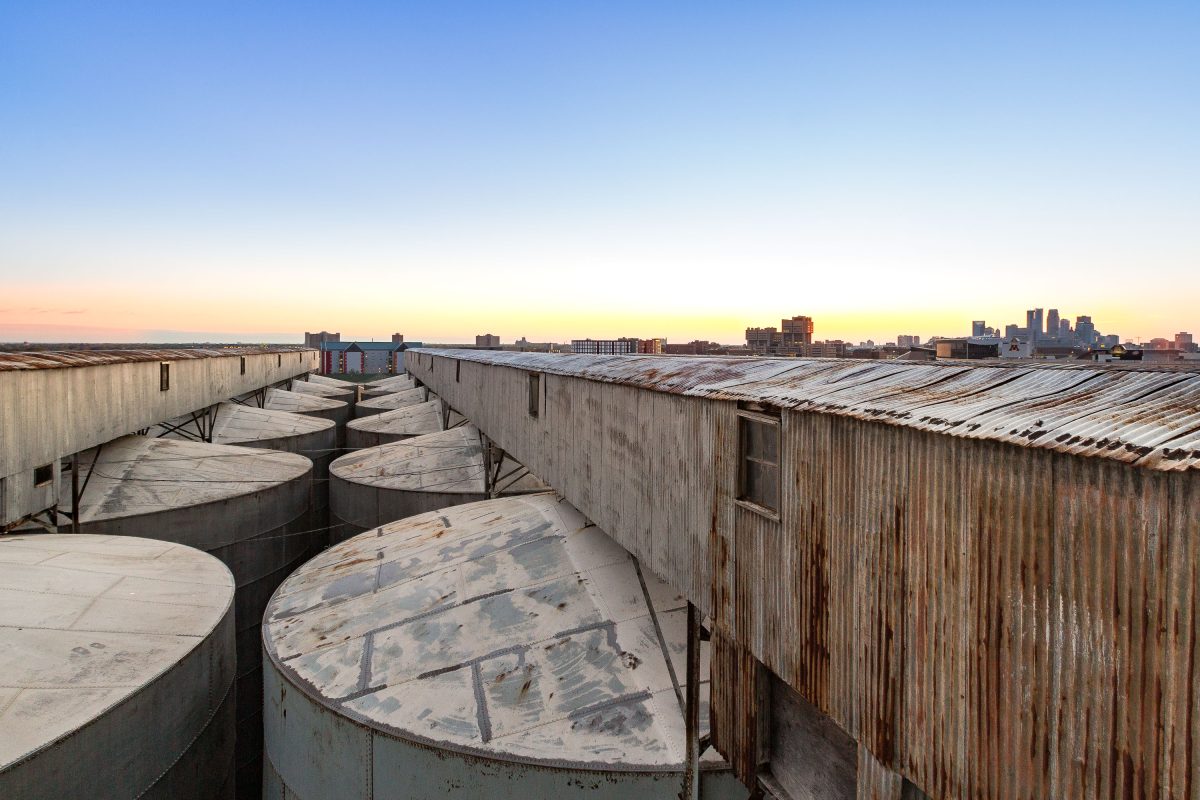
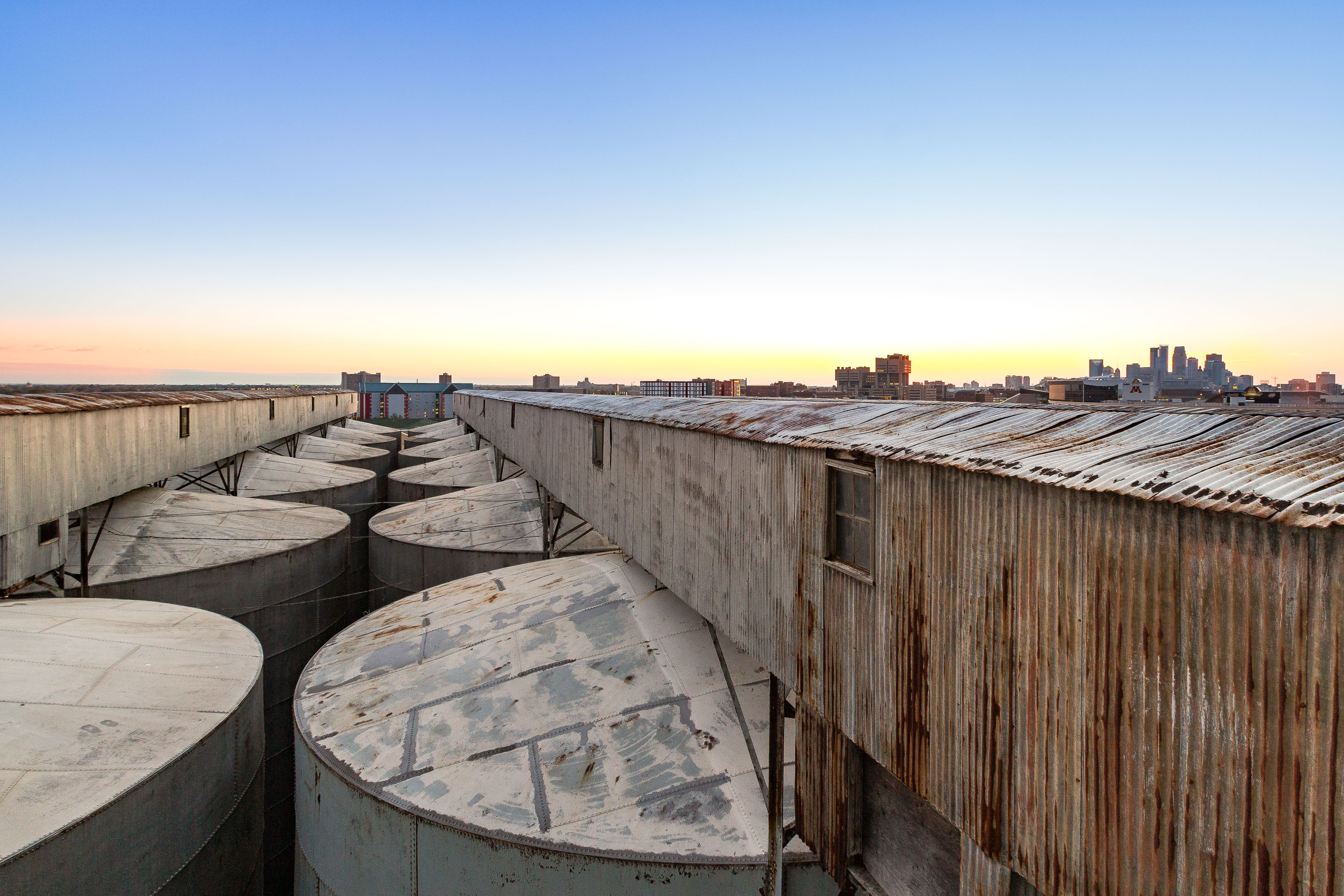
Abandoned Electric Steel grain elevator rooftop in Minneapolis with large storage tanks and downtown skyline at sunset.
The Electric Steel Elevator is a grain storage complex in Minneapolis, with rows of round steel bins topped by a corrugated metal shed.

Grain Bins at the Electric Steel Elevator With Downtown Minneapolis Beyond
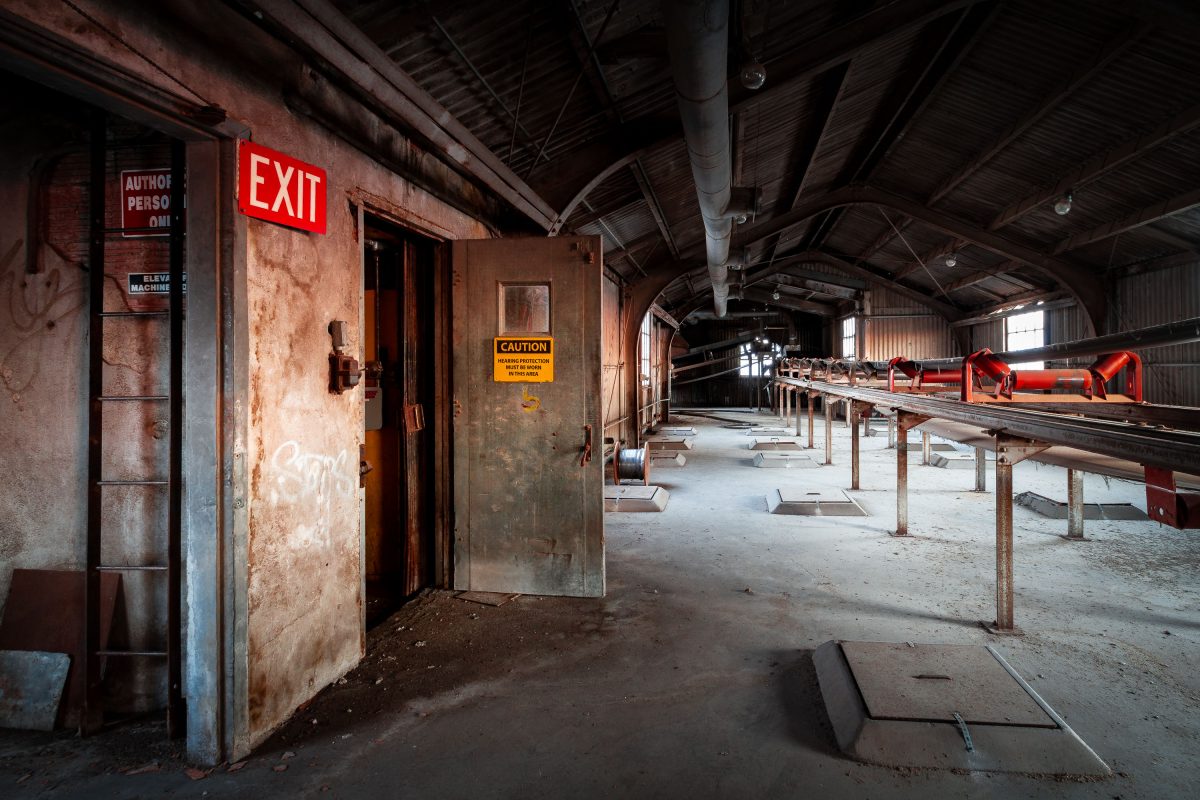
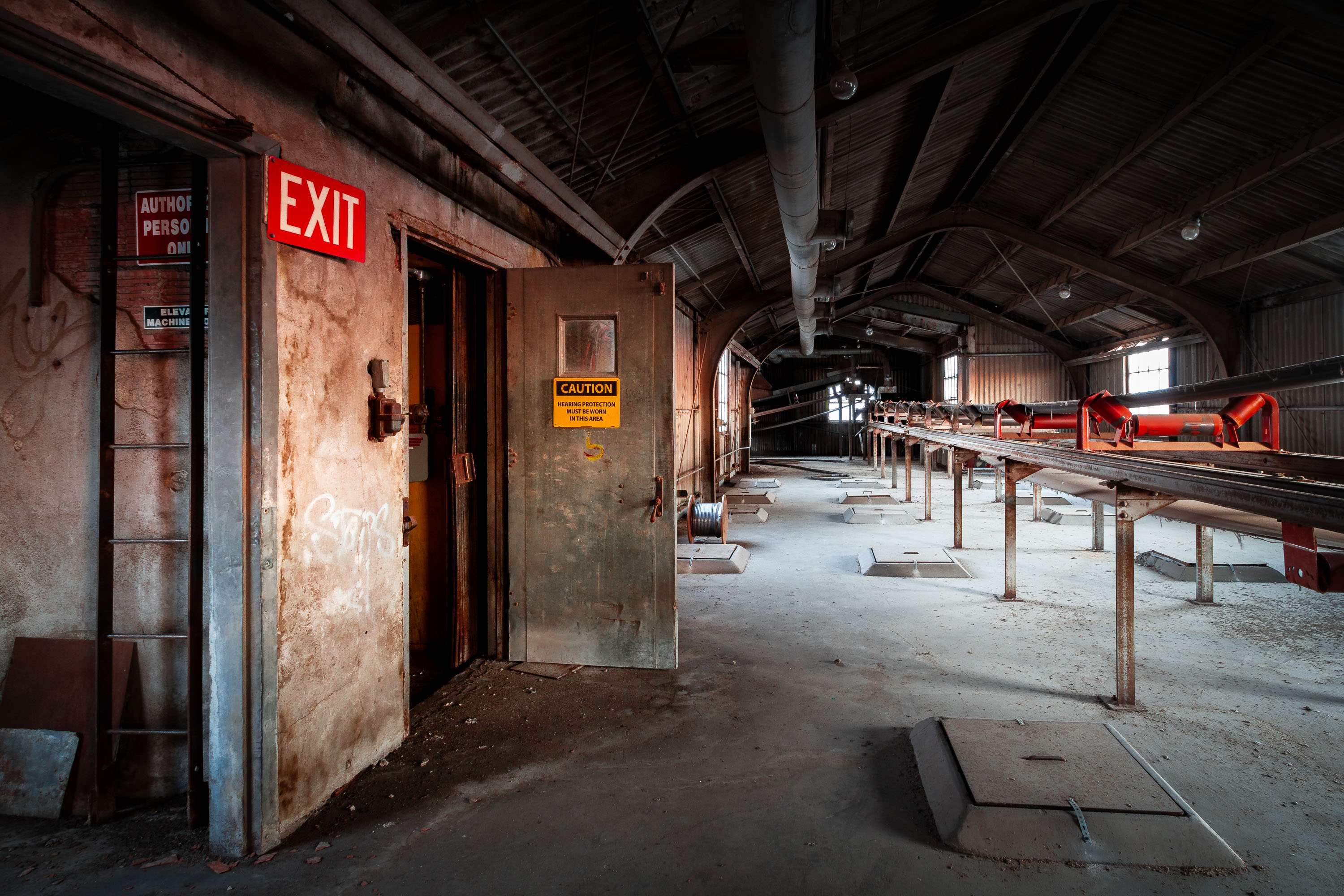
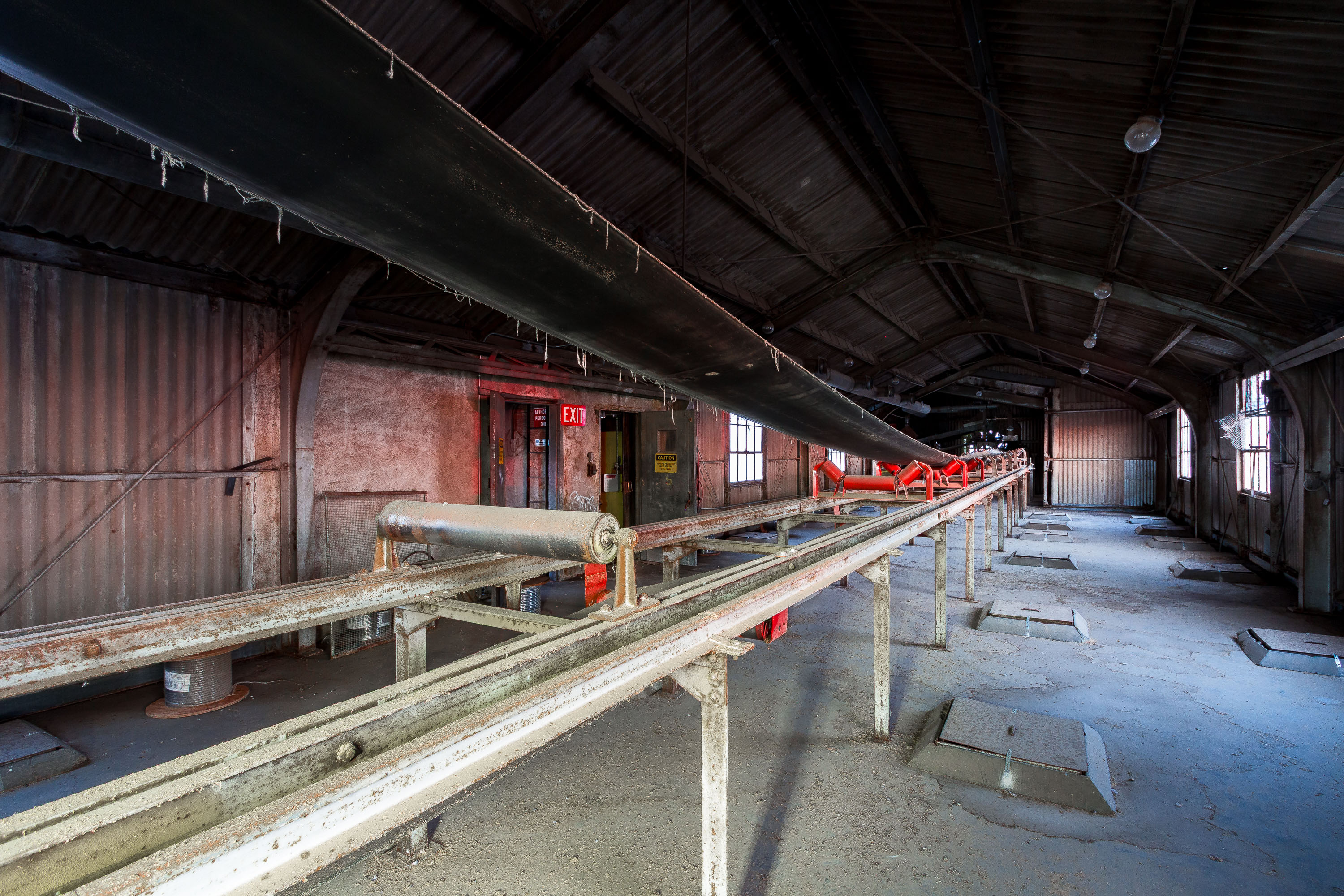
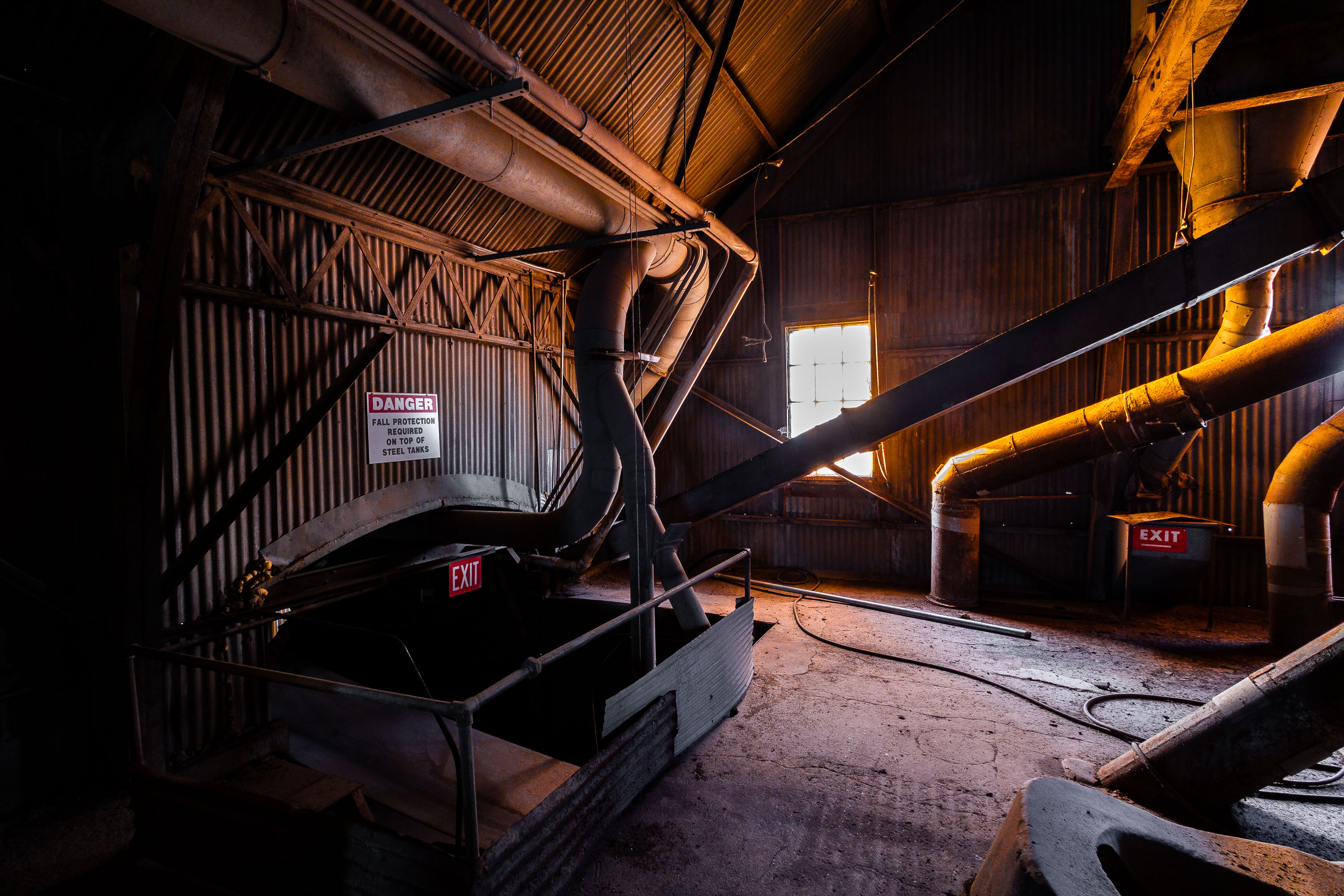
Abandoned Electric Steel grain elevator interior in Minneapolis with rusted machinery, conveyor systems, and red exit sign.
The Electric Steel Elevator is a grain elevator complex in Minneapolis, with a long conveyor gallery once used to move grain between storage and processing points. Steel doors, ladders, and warning signs like "Hearing Protection Must Be Worn in This Area" remain from its working days along the elevator's interior walkways.

Exit Door and Conveyor Gallery at Electric Steel Elevator
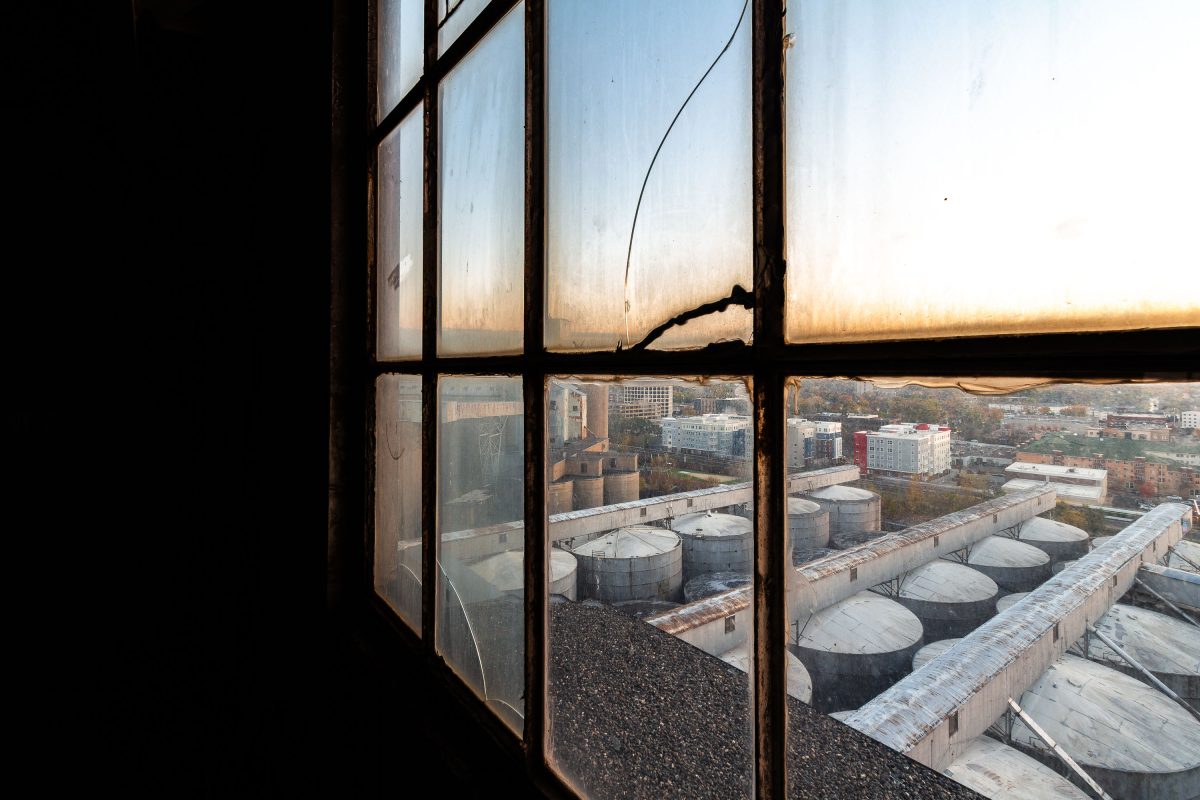
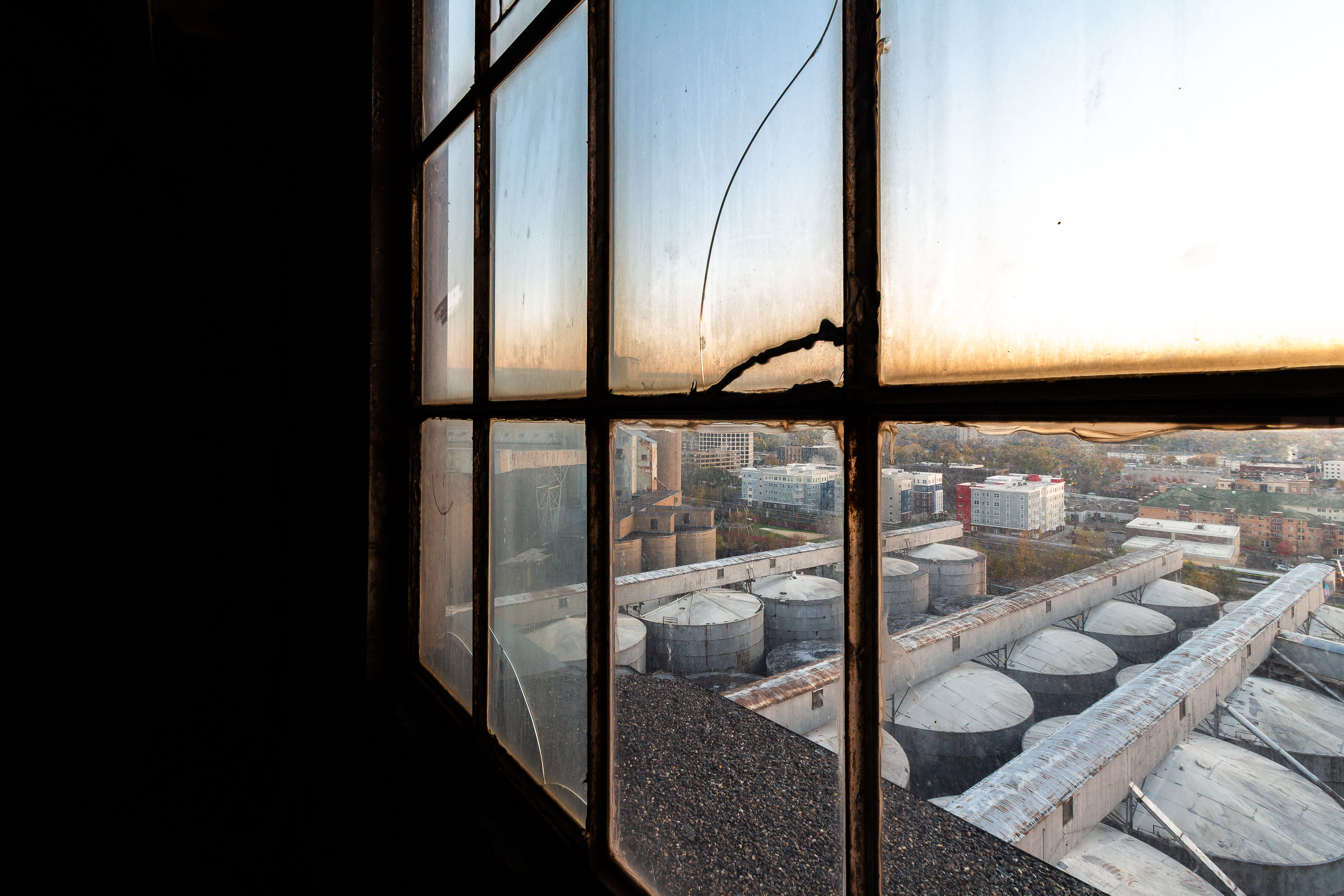
View from inside an abandoned Minneapolis grain elevator looking out at storage tanks and the city skyline at sunset.
The downtown Minneapolis skyline and surrounding neighborhoods lie beyond the tanks.

View of Grain Tanks Through a Broken Window at Electric Steel Elevator
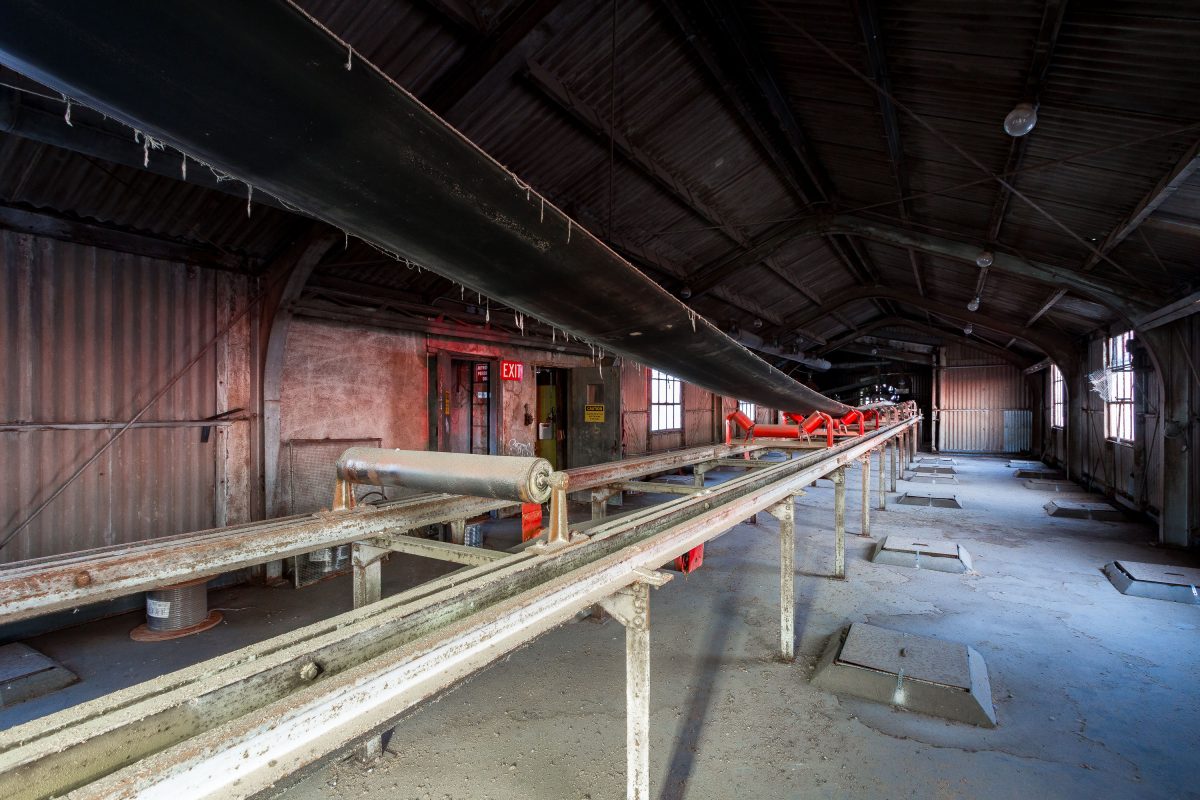
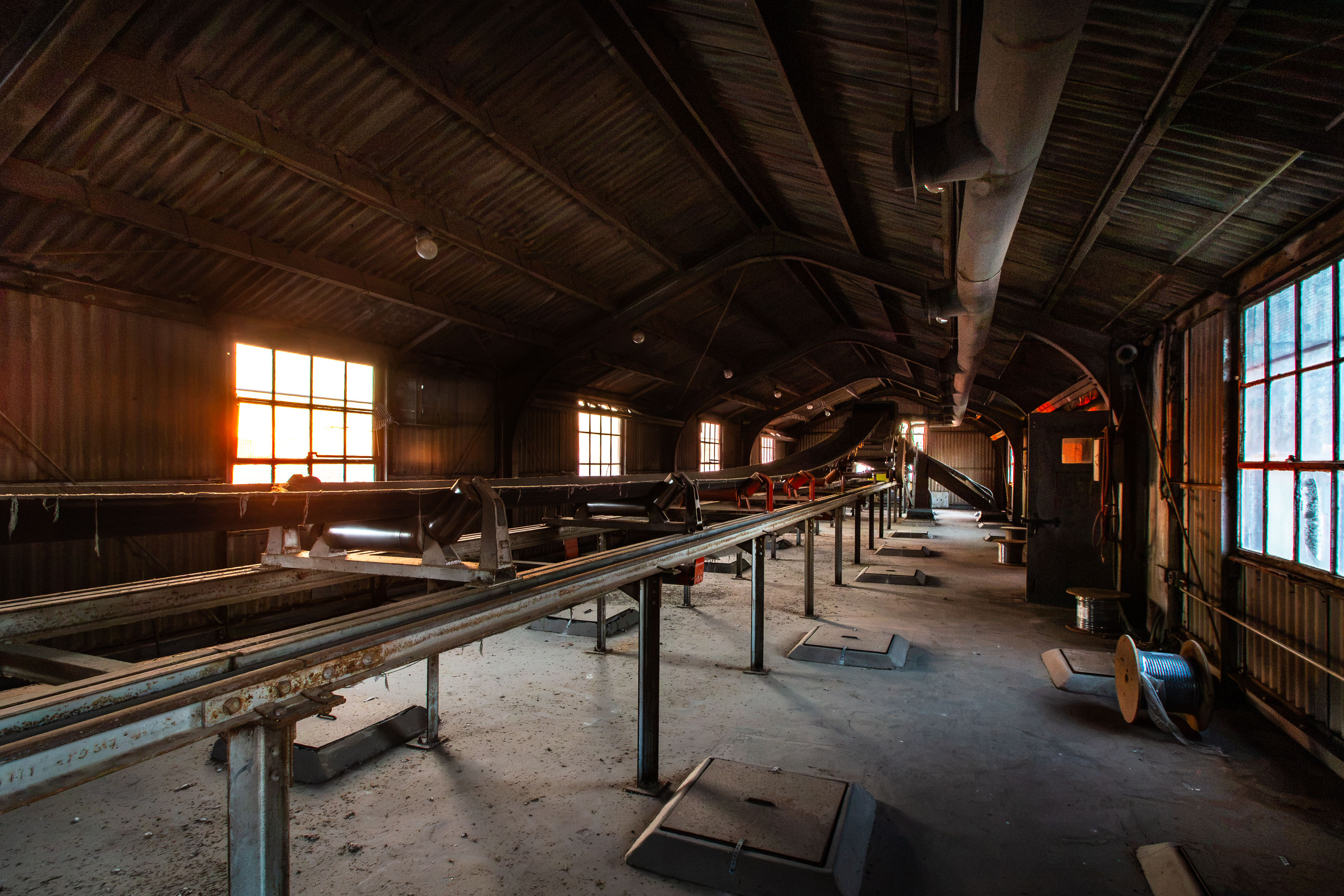
Interior of the Electric Steel Grain Elevator in Minneapolis showing weathered conveyor systems and industrial machinery beneath a metal-beam ceiling.
The Electric Steel Elevator is a former grain elevator in Minneapolis, built to store and load grain for shipment by rail. Inside, a long conveyor belt runs above a line of steel rollers that once moved grain through the building to waiting railcars.

Conveyor Belt and Rollers Inside Electric Steel Elevator in Minneapolis
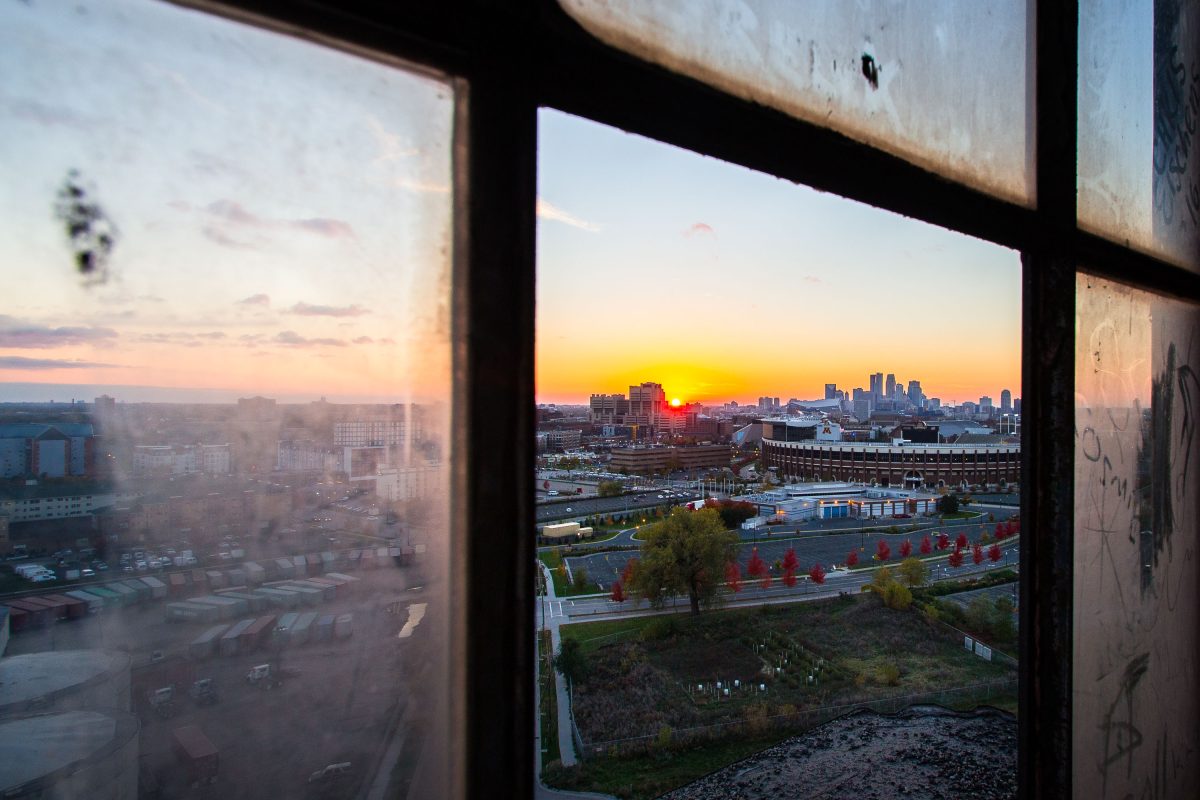
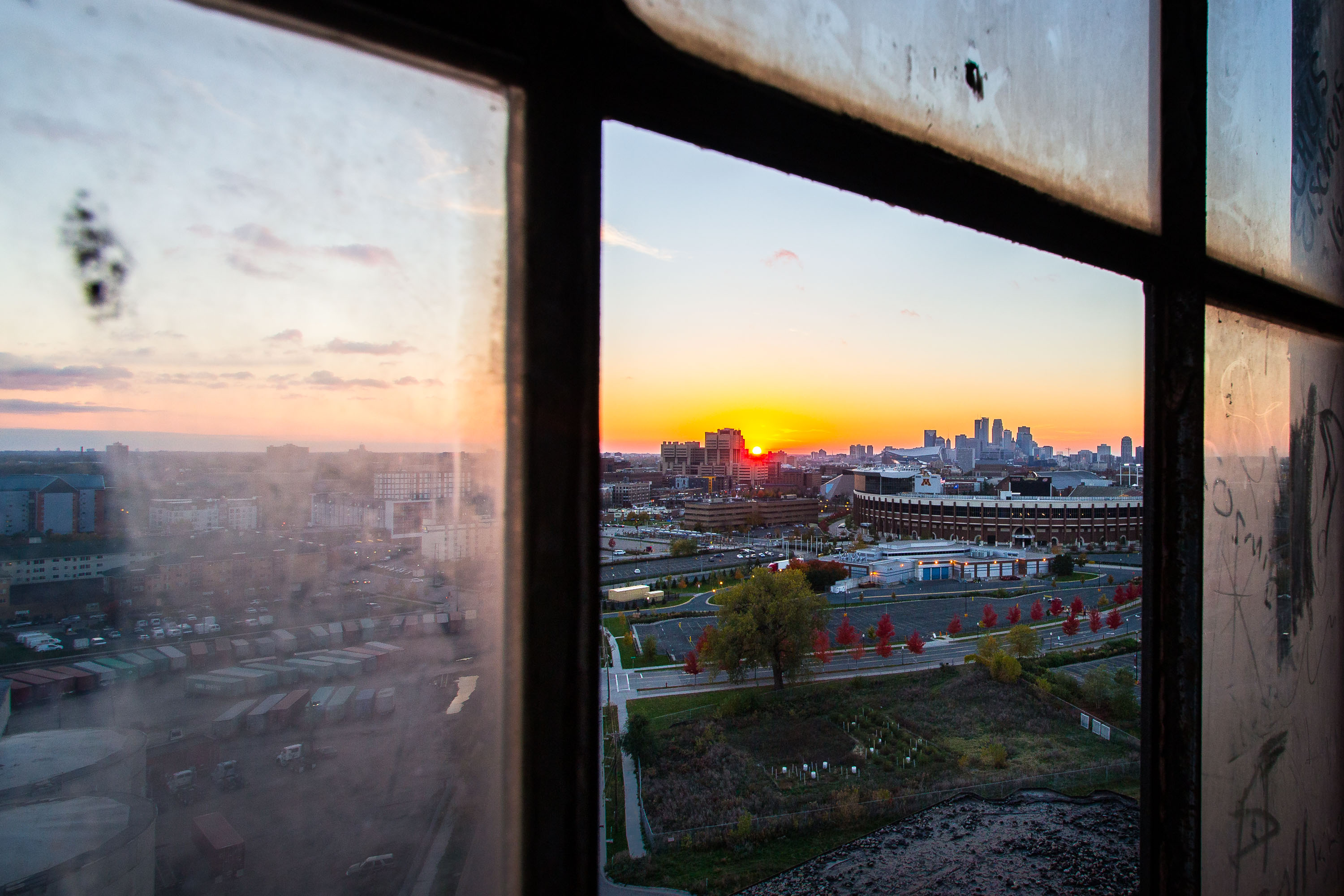
Minneapolis skyline at sunset viewed through an abandoned industrial building's window frame.
The downtown Minneapolis skyline from the Electric Steel Elevator, a decommissioned grain elevator in the Prospect Park neighborhood near the University of Minnesota. TCF Bank Stadium, home to University of Minnesota football since 2009, sits between the elevator and downtown.

Downtown Minneapolis Skyline at Sunset from the Electric Steel Elevator
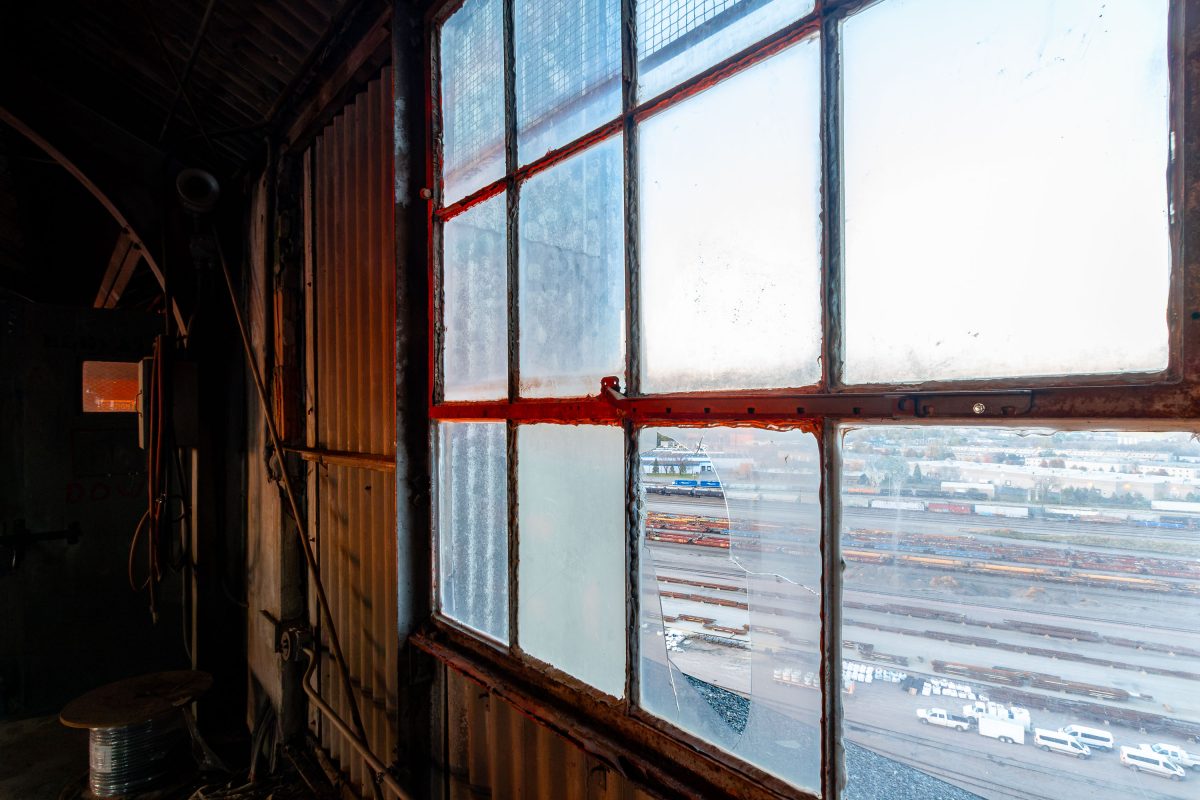
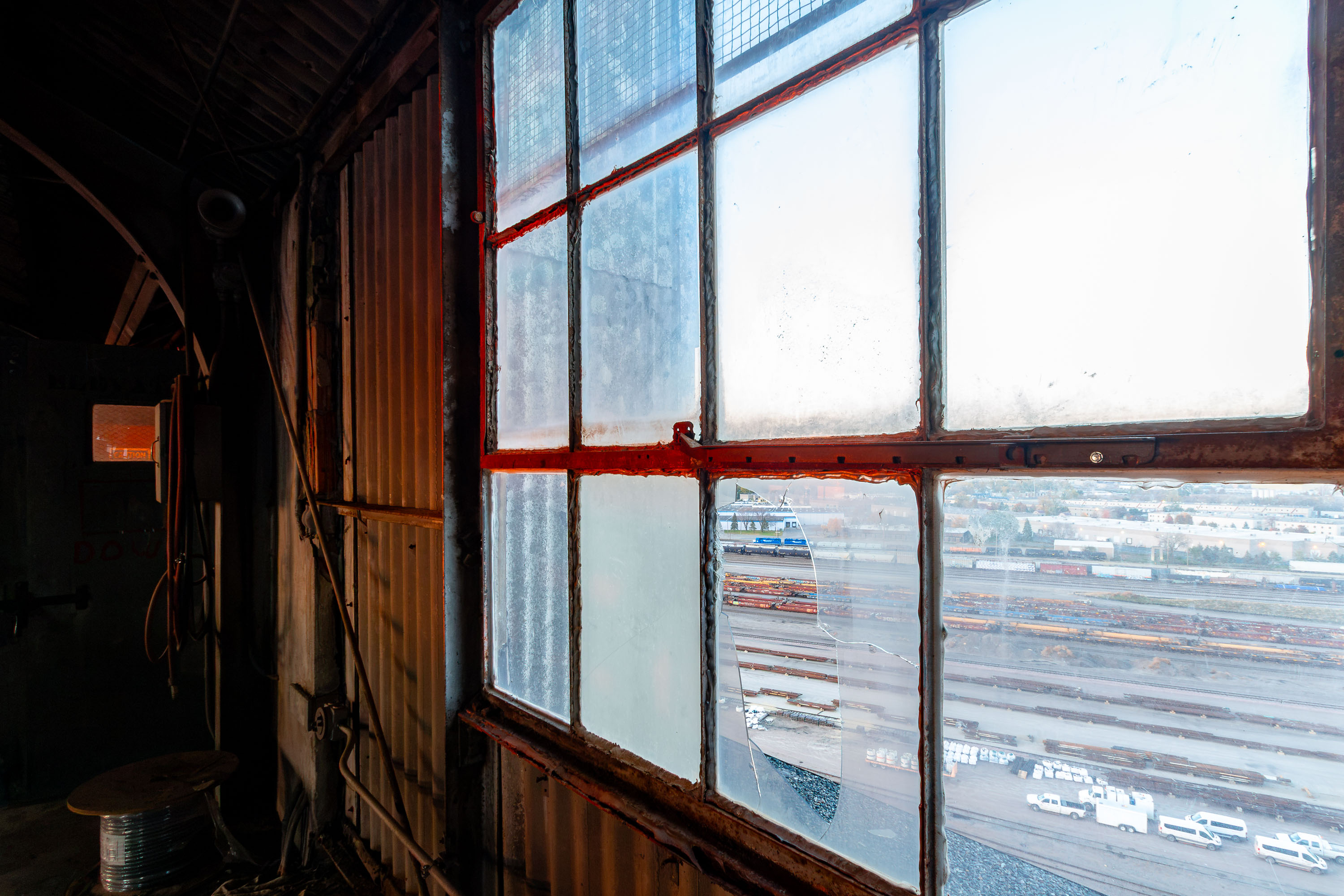
View from inside the abandoned Electric Steel Grain Elevator in Minneapolis looking out over railroad yards.
The Electric Steel Elevator is a former grain elevator in Minneapolis, built for storing and loading grain before shipment by rail.

Rail Yard View Through a Window at Electric Steel Elevator
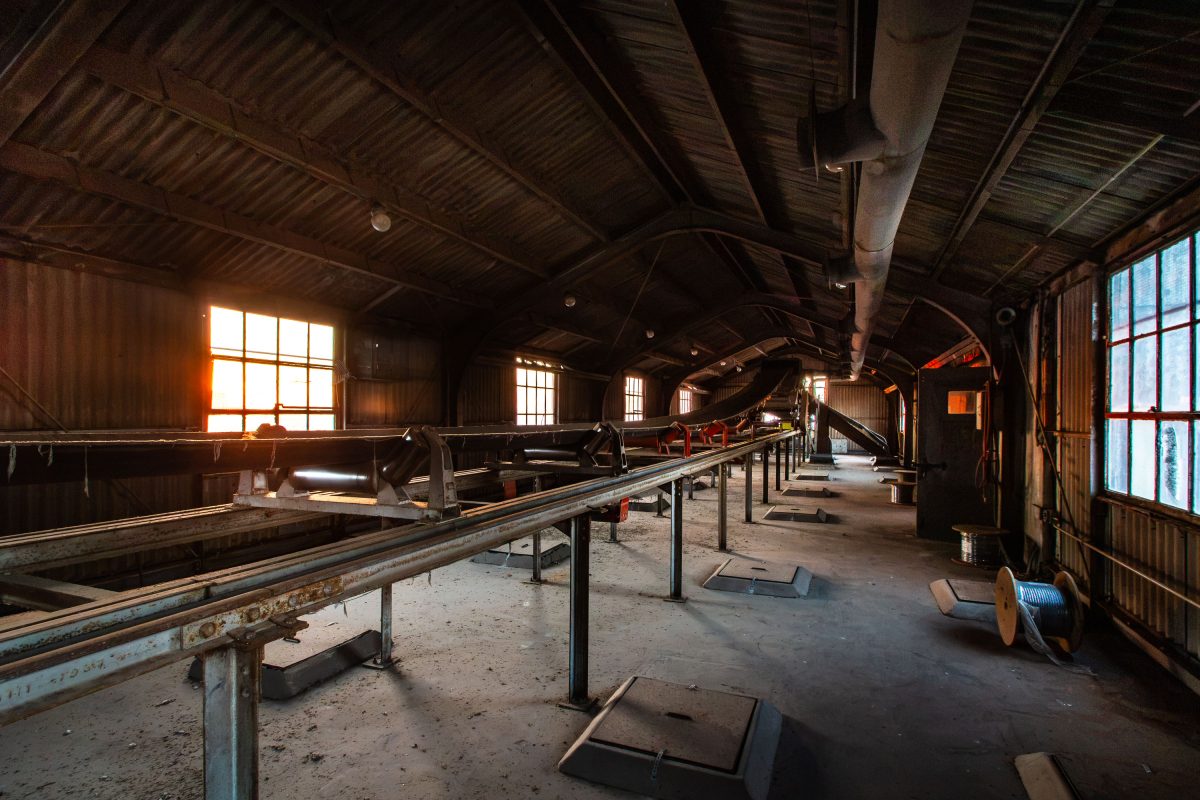
Abandoned warehouse interior with steel conveyor systems and industrial machinery lit by windows.
The Electric Steel Elevator is a grain elevator in Minneapolis along the Mississippi River. A long conveyor runs the length of the interior on a steel frame, once used to move grain through the structure.

Conveyor Belt Inside the Electric Steel Elevator in Minneapolis
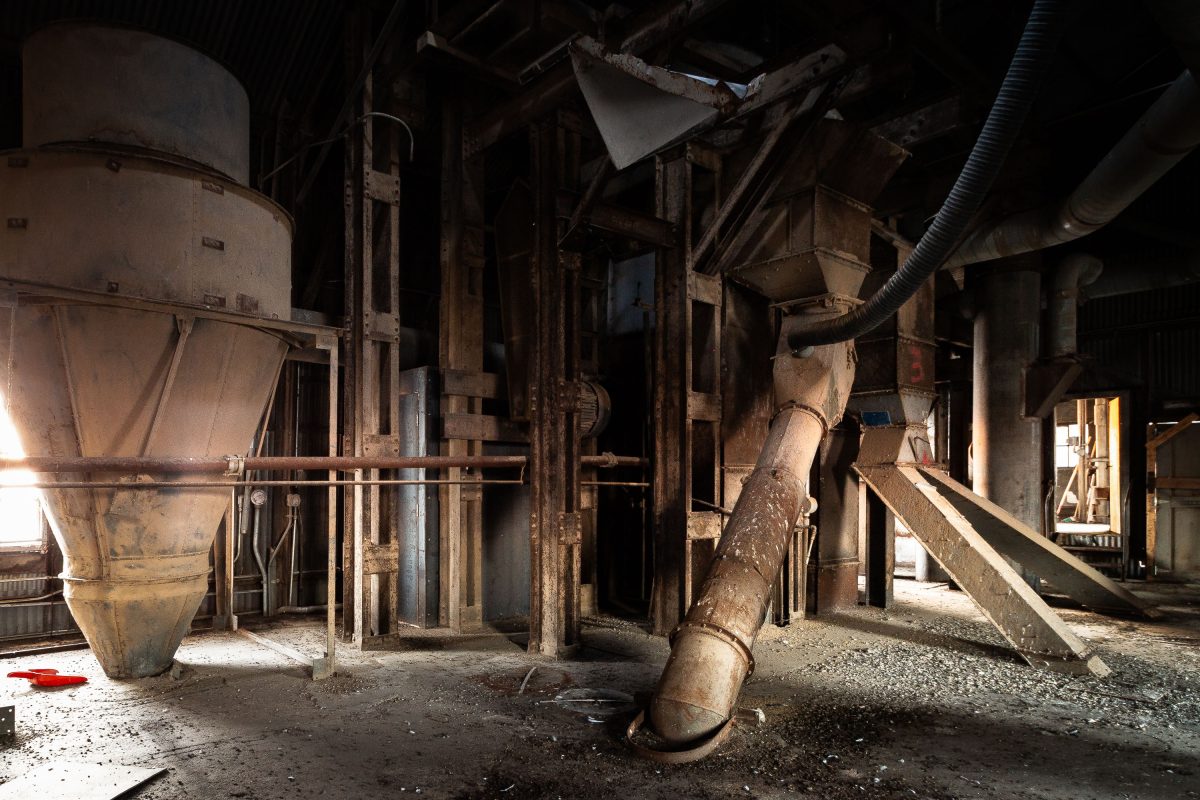
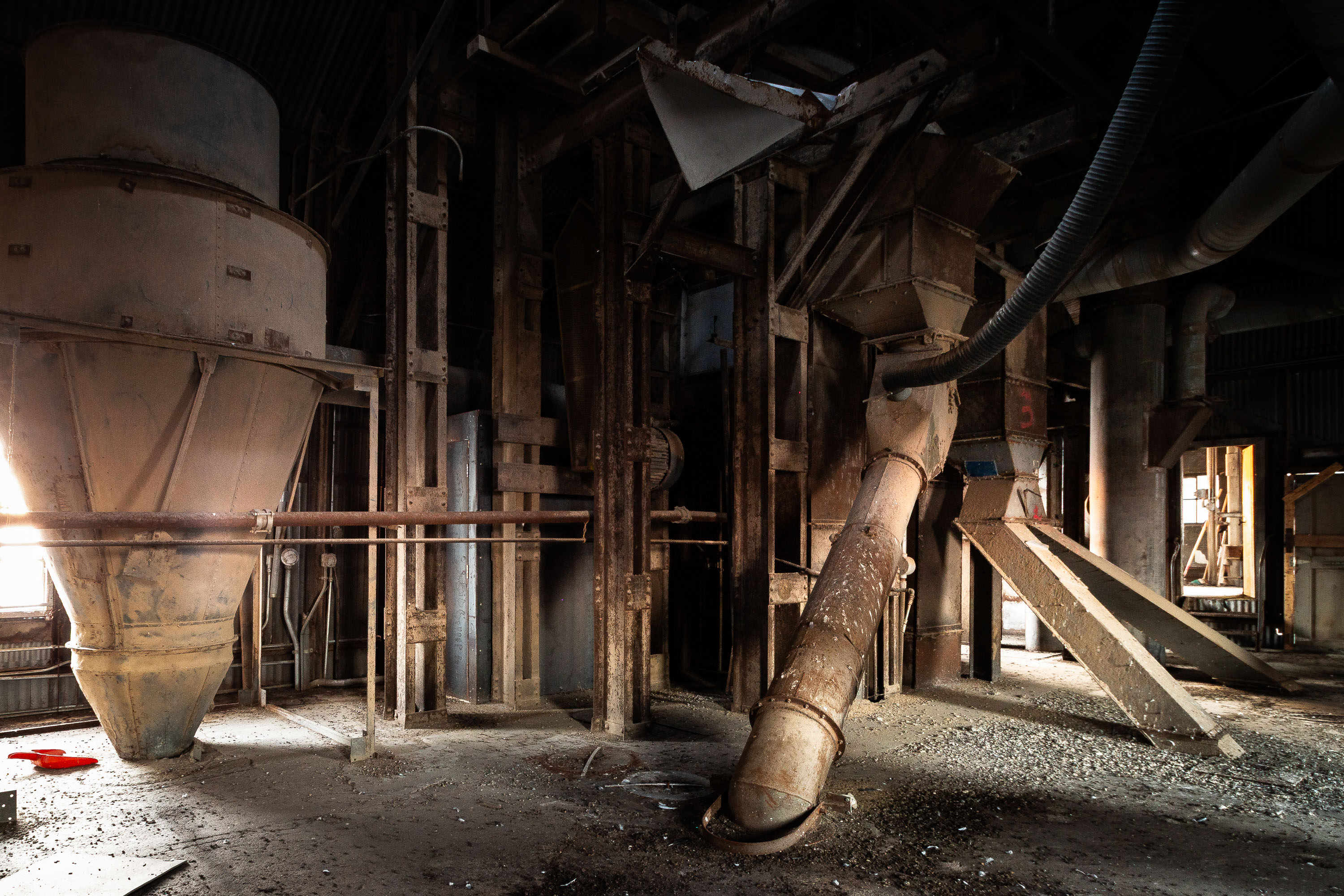
Interior of the abandoned Electric Steel grain elevator in Minneapolis, showing rusted industrial machinery and equipment.
The Electric Steel Elevator is a disused grain elevator in Minneapolis. Inside, rusted steel framing supports hoppers, chutes, and ductwork once used to move and clean grain before storage.

Inside the Electric Steel Elevator in Minneapolis
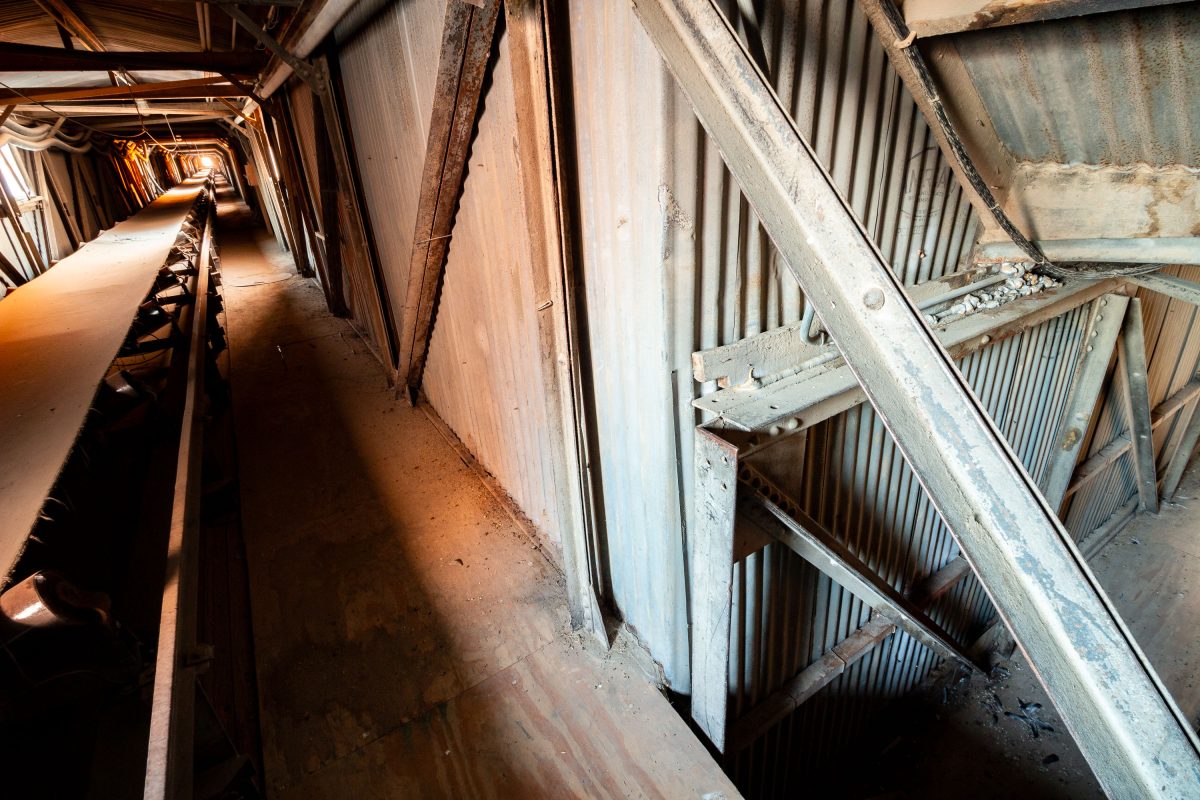
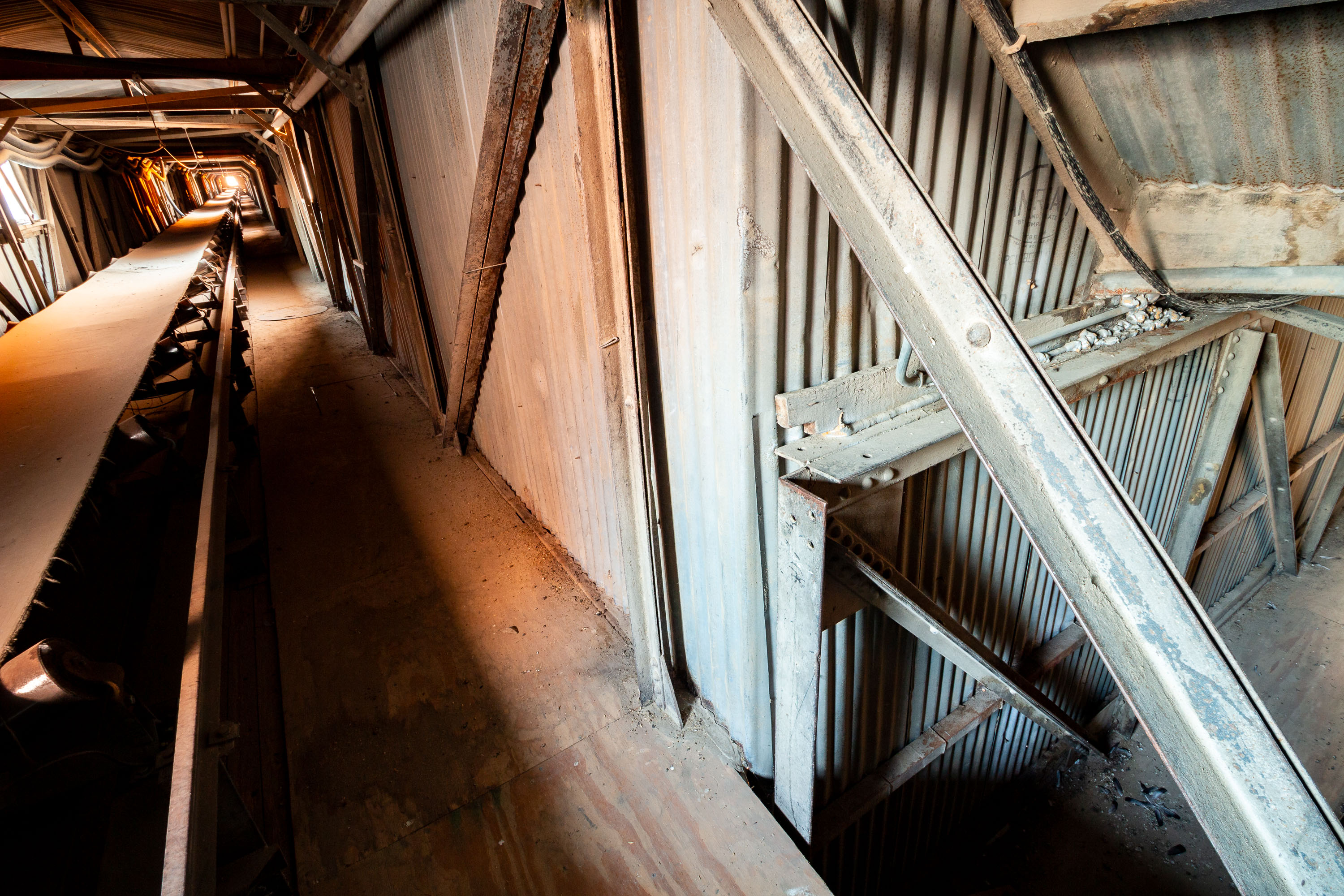
Interior of the Electric Steel grain elevator in Minneapolis showing a rusted conveyor belt and corrugated metal structural framework.
The Electric Steel Elevator is a grain elevator complex in Minneapolis. This enclosed gallery carries a conveyor belt between sections of the structure.

Conveyor Gallery Inside the Electric Steel Elevator in Minneapolis
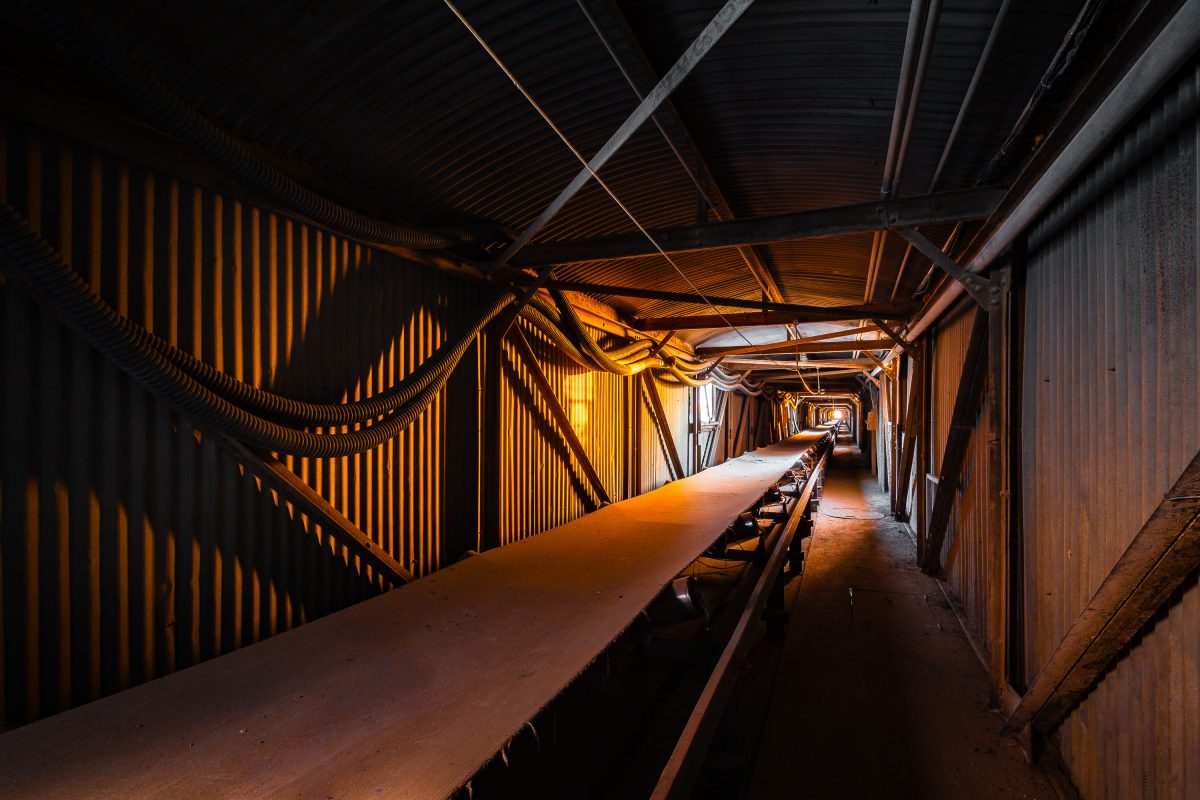
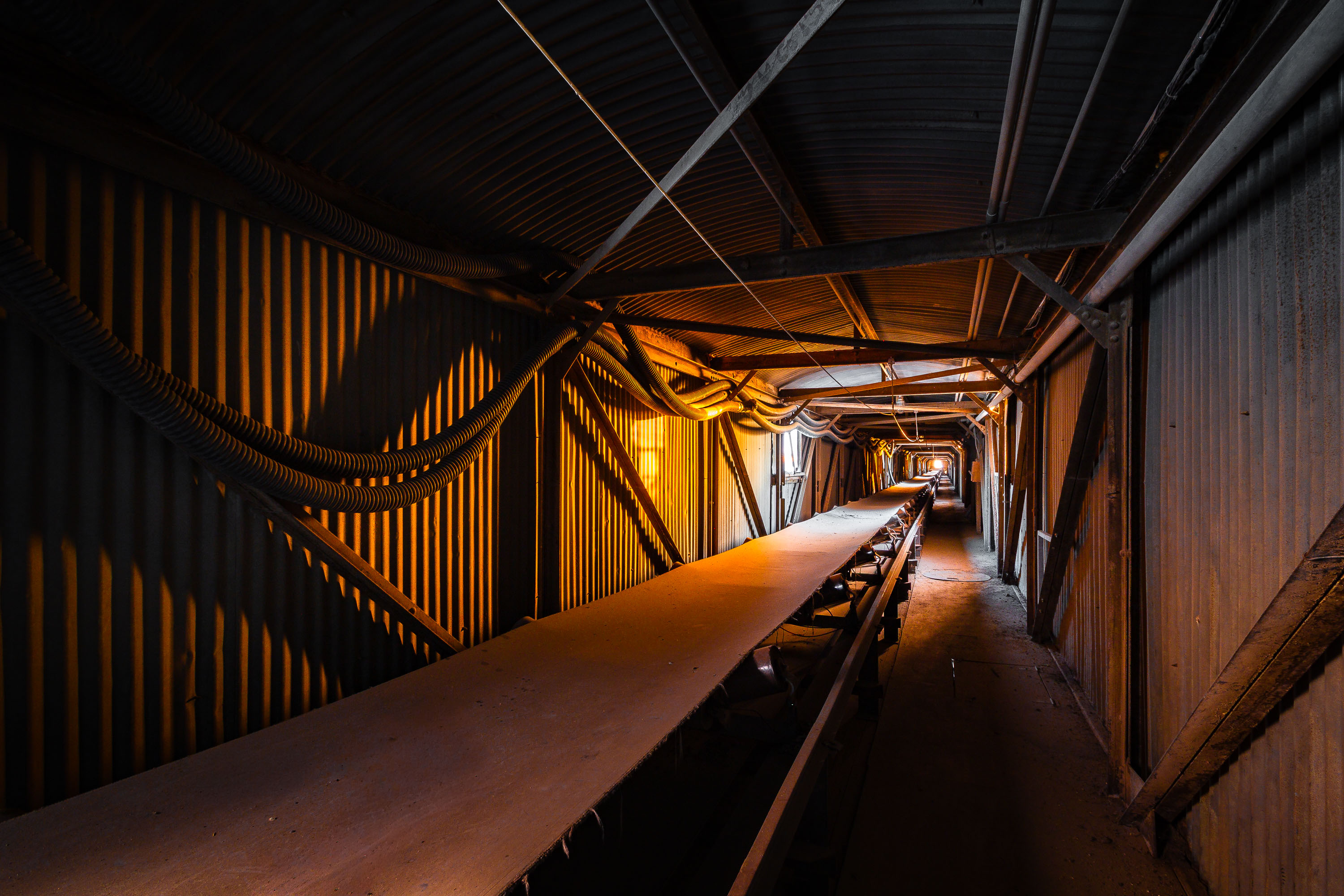
Interior of Electric Steel grain elevator in Minneapolis showing a long conveyor belt beneath industrial metal framework and corrugated walls.
The Electric Steel Elevator is a grain elevator in Minneapolis. A conveyor belt runs through an enclosed tunnel that carries grain between the storage bins and the head house.

Conveyor Tunnel Inside the Electric Steel Elevator in Minneapolis
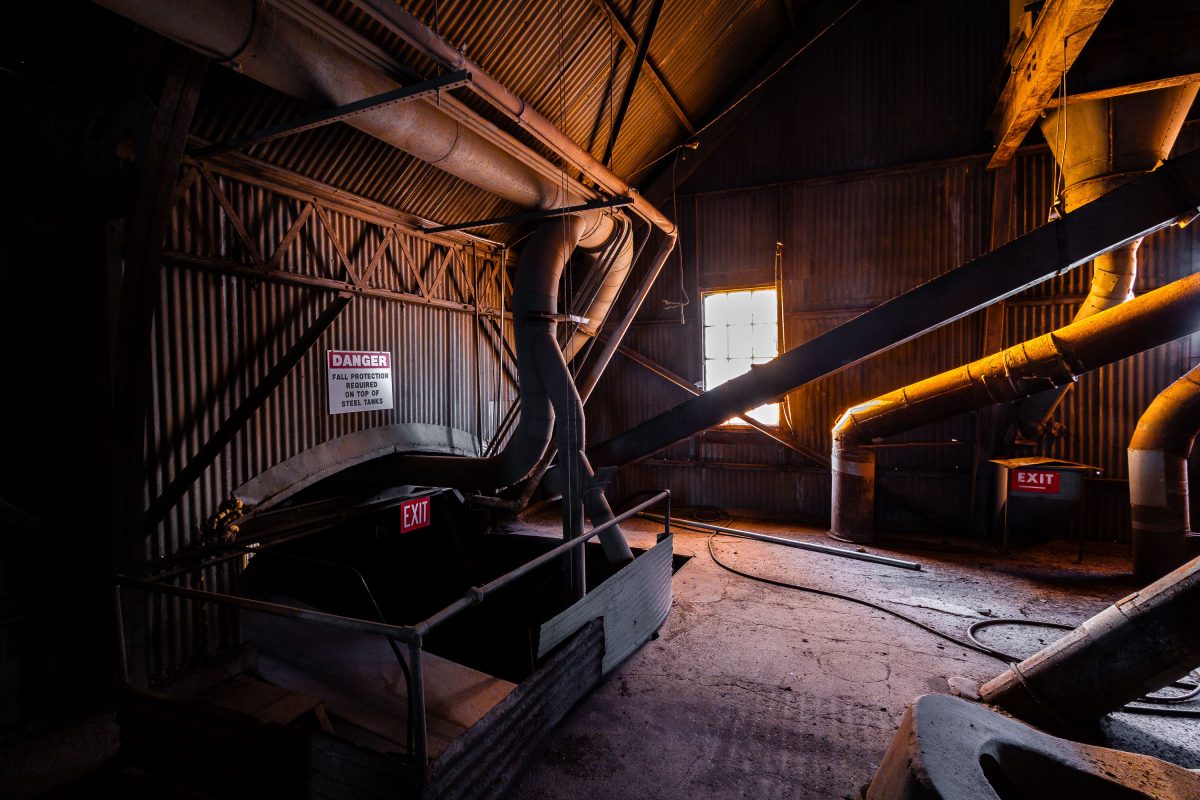
Interior of Electric Steel grain elevator in Minneapolis showing industrial pipes, metal infrastructure, and exit signage.
The Electric Steel Elevator is a former grain elevator complex in Minneapolis, built along the rail lines that once served the city's milling district. Inside, steel storage tanks connect to a network of conveyor pipes and chutes that moved grain between the bins and the head house.

Danger Sign Near the Steel Tanks at Electric Steel Elevator
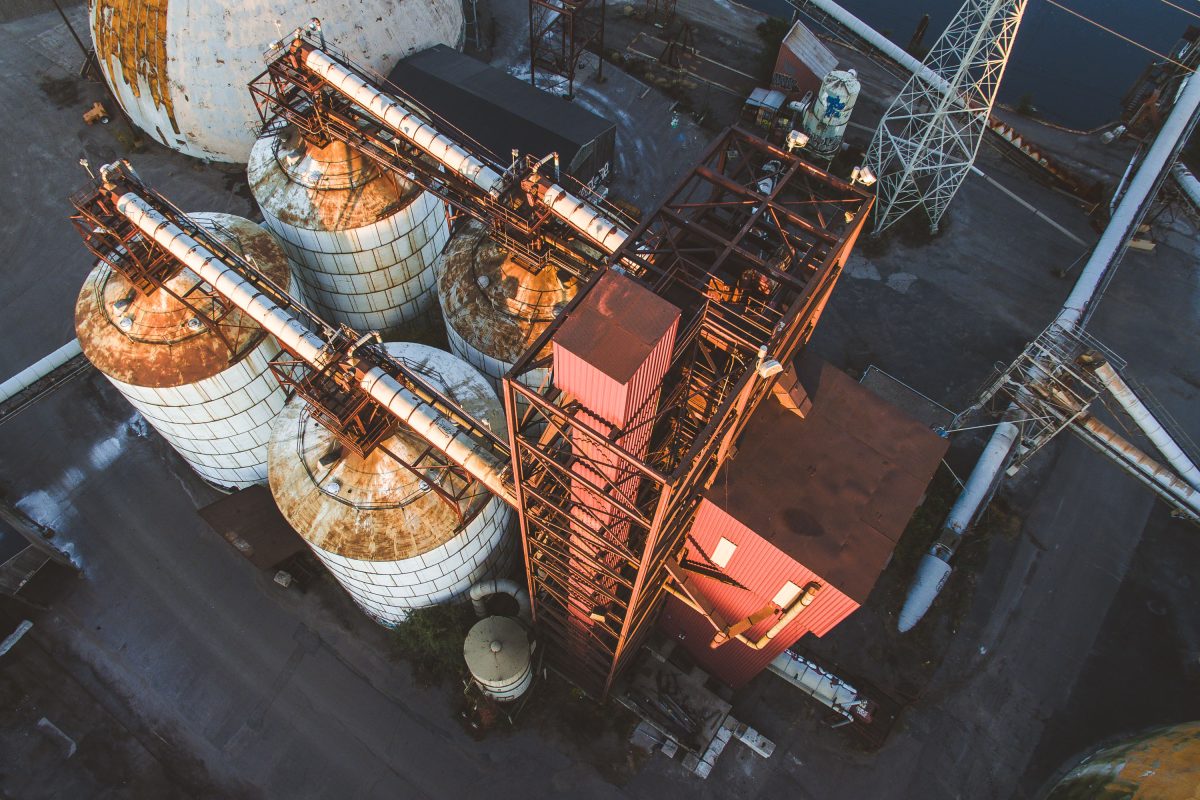
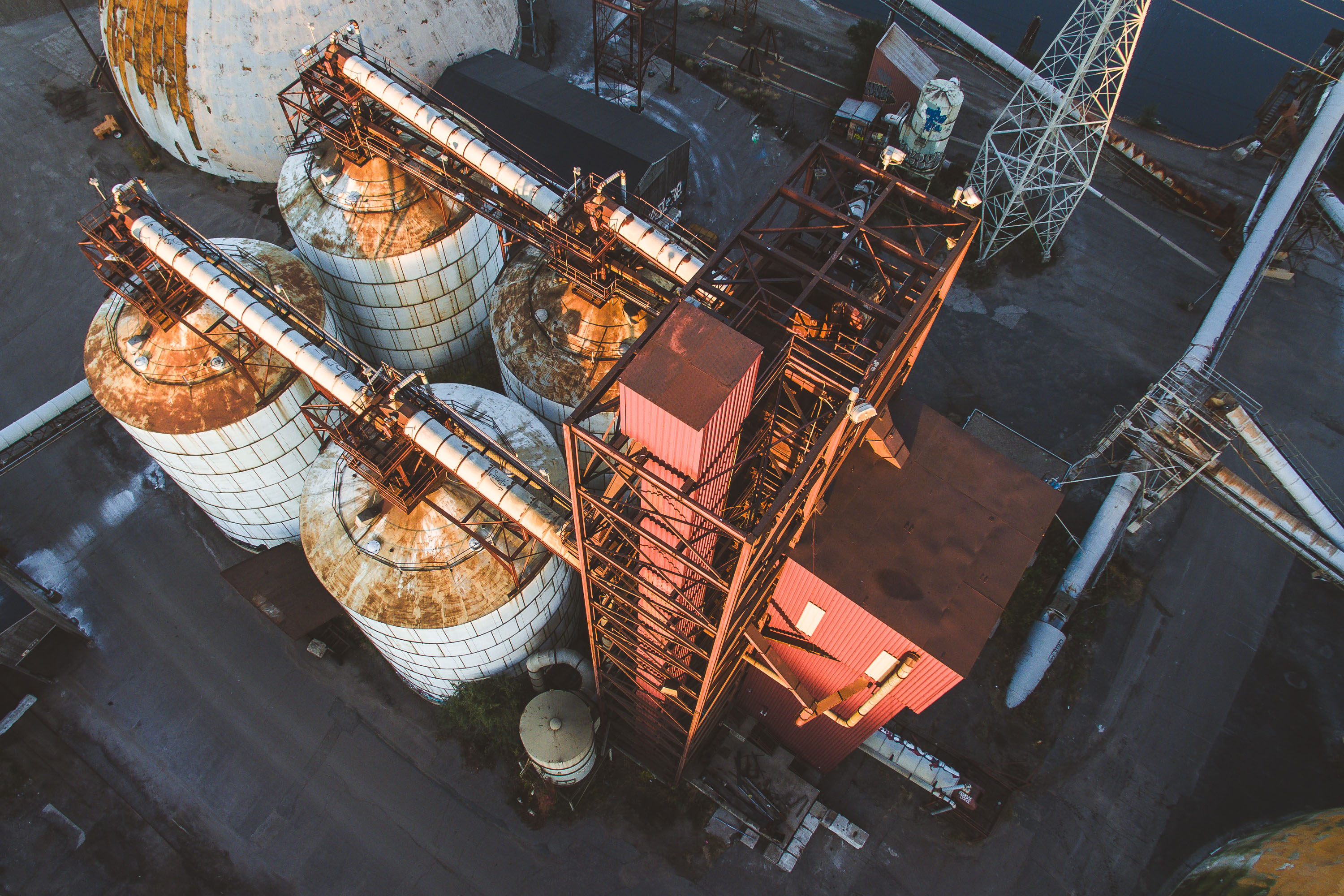
Aerial view of rusted storage domes and orange loading equipment at Upper Harbor Terminal, a defunct barge facility on the Mississippi River in Minneapolis.
Upper Harbor Terminal is a former city-owned barge terminal on the Mississippi River in north Minneapolis, upstream of the Upper St. Anthony Falls Lock and Dam. Opened in 1968, five years after the lock made the upper river accessible to commercial barges, it handled bulk freight for decades, including road salt, coal, and gravel. Barge operations ended in 2014, ahead of the lock’s closure to navigation in June 2015 to help prevent the upstream spread of invasive carp

Aerial View of Grain Elevator Towers at Upper Harbor Terminal
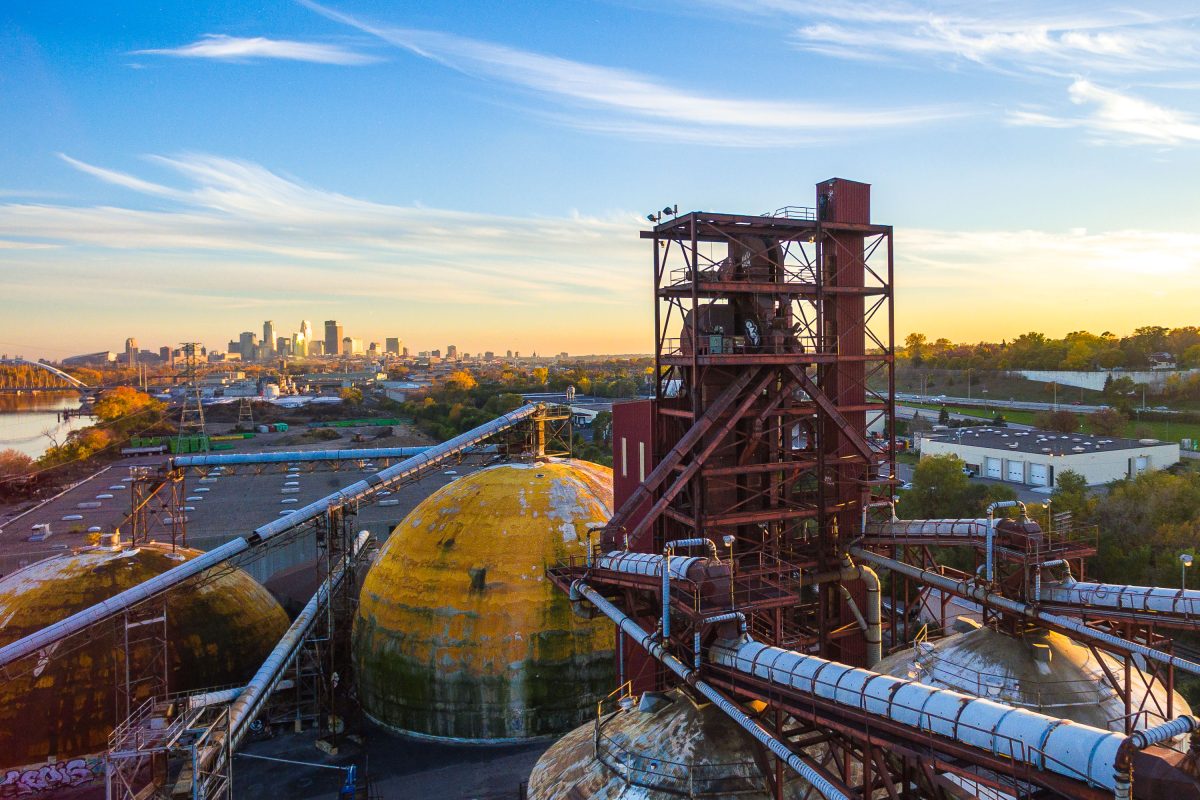
Abandoned Upper Harbor Terminal barge facility on the Mississippi River in north Minneapolis at sunset with industrial storage tanks and loading equipment.
Upper Harbor Terminal is a former city-owned barge terminal on the Mississippi River in north Minneapolis, upstream of the Upper St. Anthony Falls Lock and Dam. Opened in 1968, five years after the lock made the upper river accessible to commercial barges, it handled bulk freight for decades, including road salt, coal, and gravel. Barge operations ended in 2014, ahead of the lock’s closure to navigation in June 2015 to help prevent the upstream spread of invasive carp

Silos and Conveyor Towers at Upper Harbor Terminal at Sunset
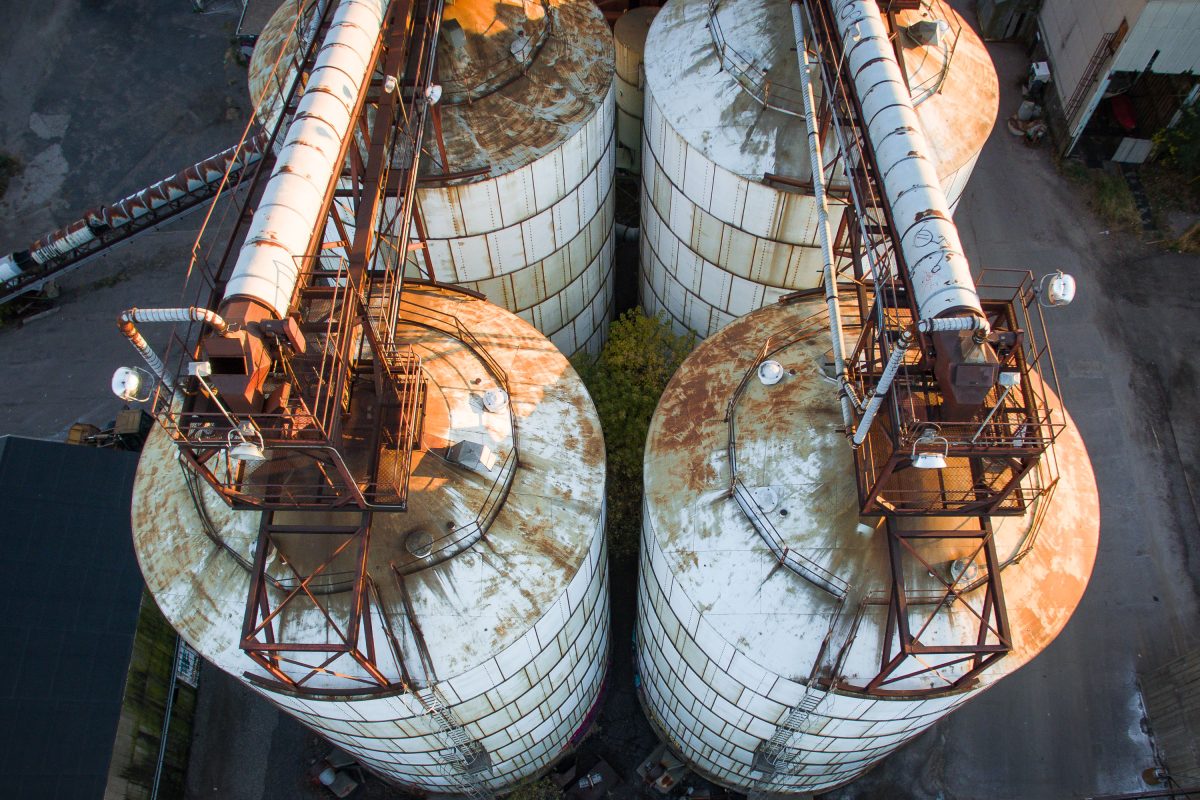
Aerial view of two large cylindrical storage tanks with rusted tops and metal loading structures at Upper Harbor Terminal on the Mississippi River in Minneapolis.
Upper Harbor Terminal is a former city-owned barge terminal on the Mississippi River in north Minneapolis, upstream of the Upper St. Anthony Falls Lock and Dam. Opened in 1968, five years after the lock made the upper river accessible to commercial barges, it handled bulk freight for decades, including road salt, coal, and gravel. Barge operations ended in 2014, ahead of the lock’s closure to navigation in June 2015 to help prevent the upstream spread of invasive carp

Aerial View of Grain Silos at Upper Harbor Terminal
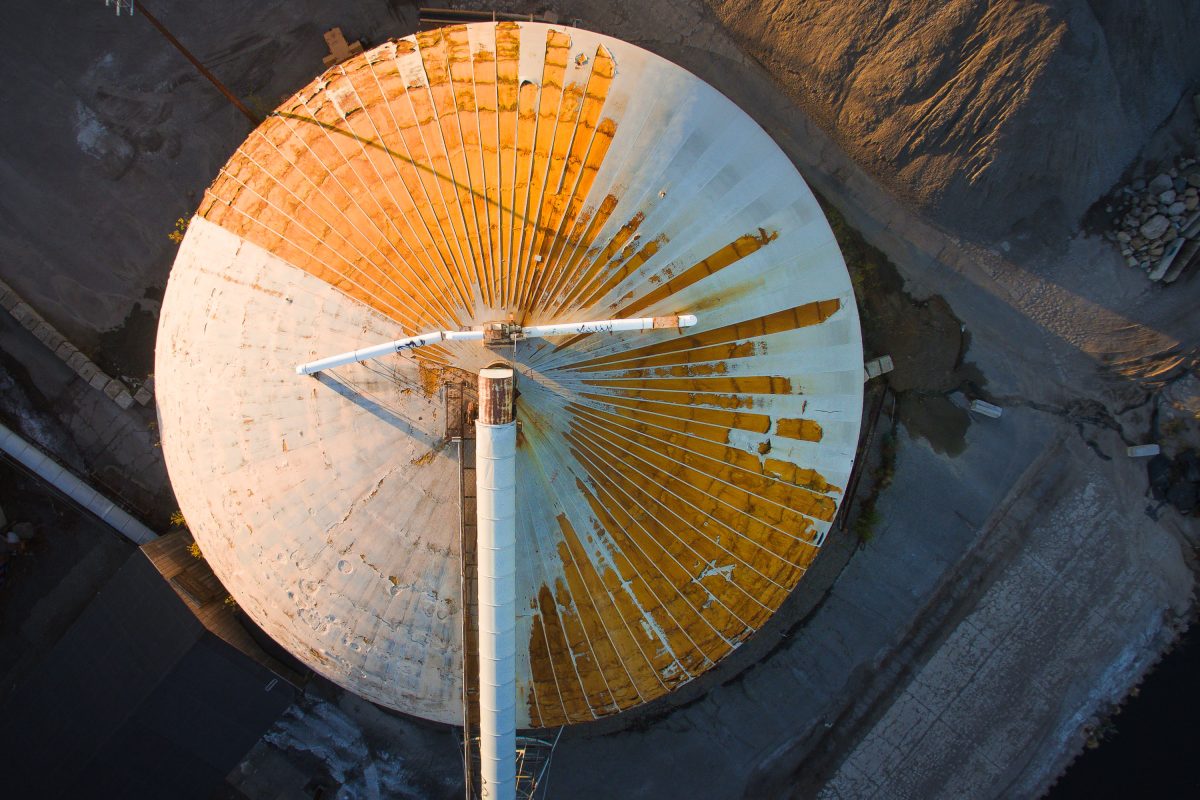
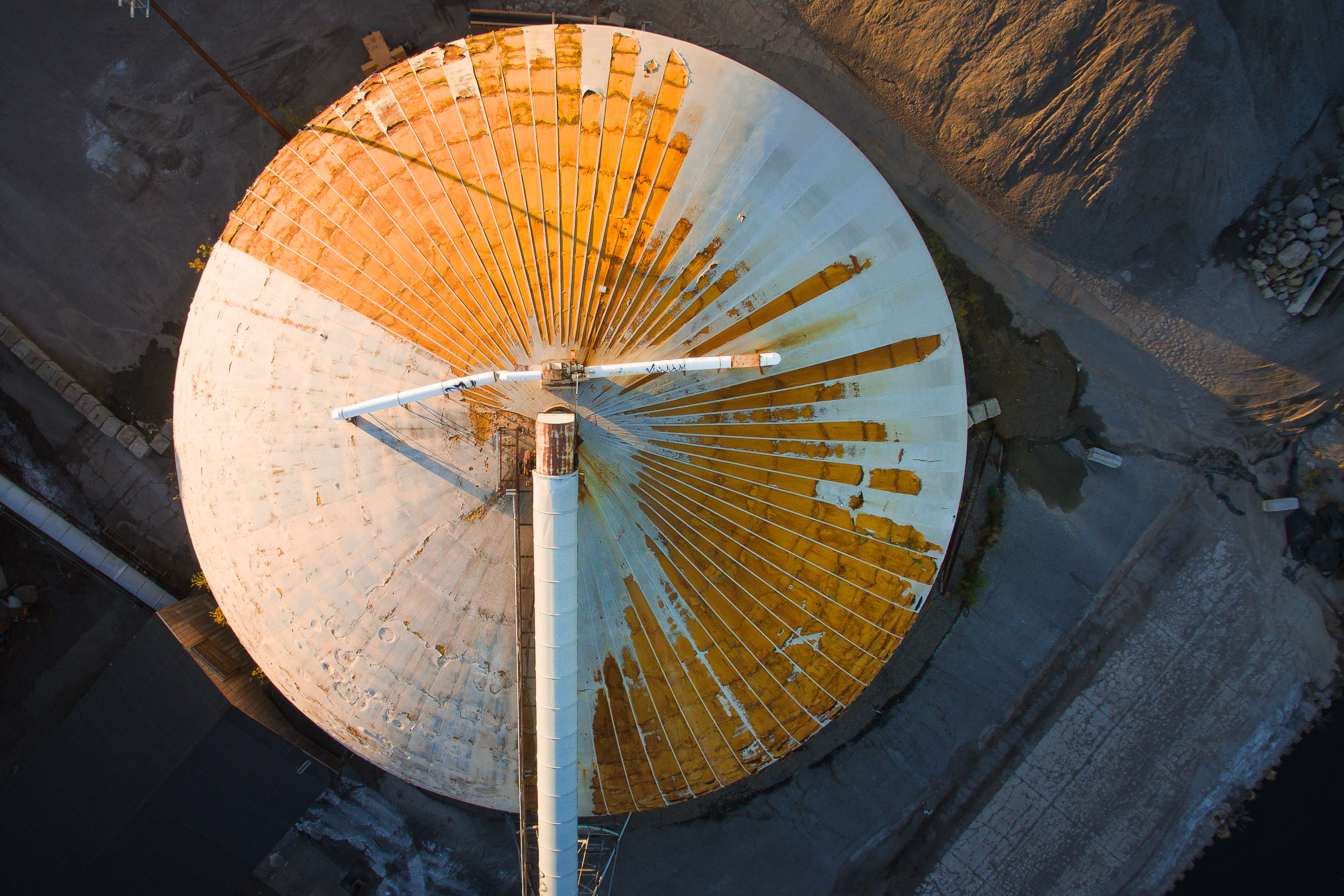
Aerial view of a circular barge loading dome at Upper Harbor Terminal on the Mississippi River in Minneapolis.
Upper Harbor Terminal is a former city-owned barge terminal on the Mississippi River in north Minneapolis, upstream of the Upper St. Anthony Falls Lock and Dam. Opened in 1968, five years after the lock made the upper river accessible to commercial barges, it handled bulk freight for decades, including road salt, coal, and gravel. Barge operations ended in 2014, ahead of the lock’s closure to navigation in June 2015 to help prevent the upstream spread of invasive carp

Aerial View of a Storage Dome at Upper Harbor Terminal
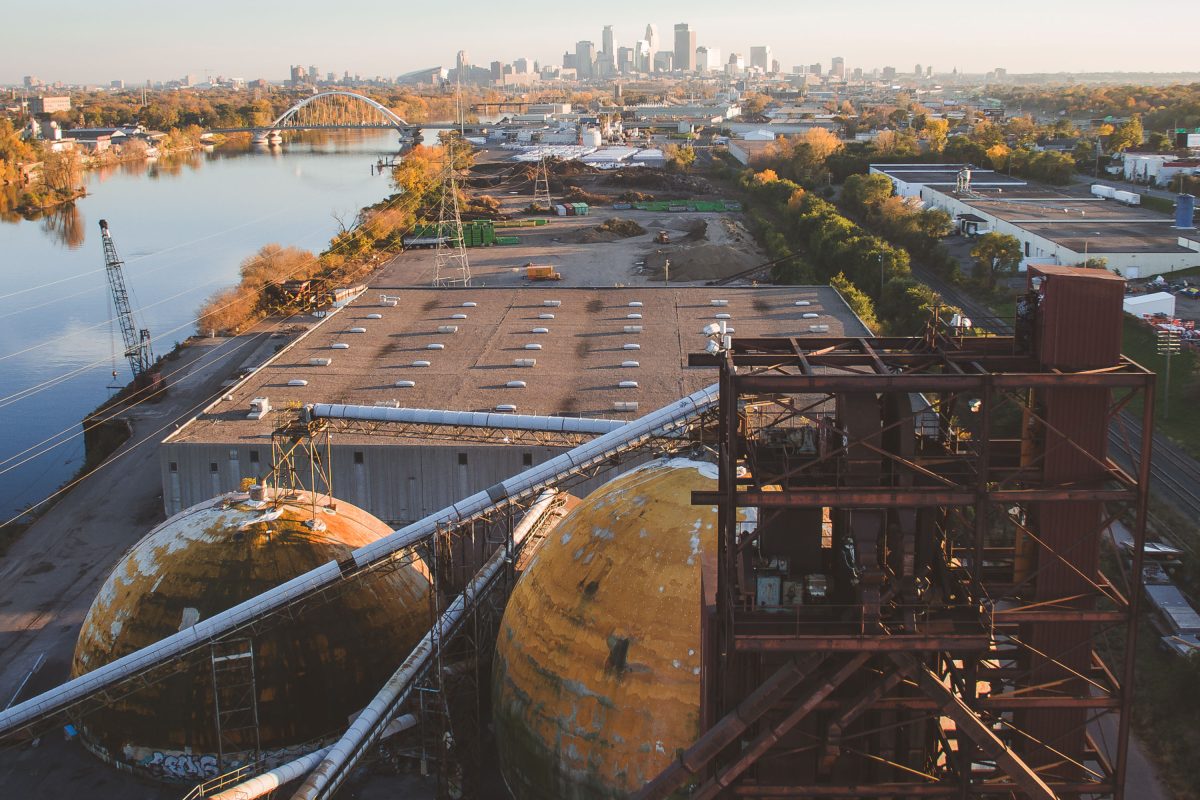
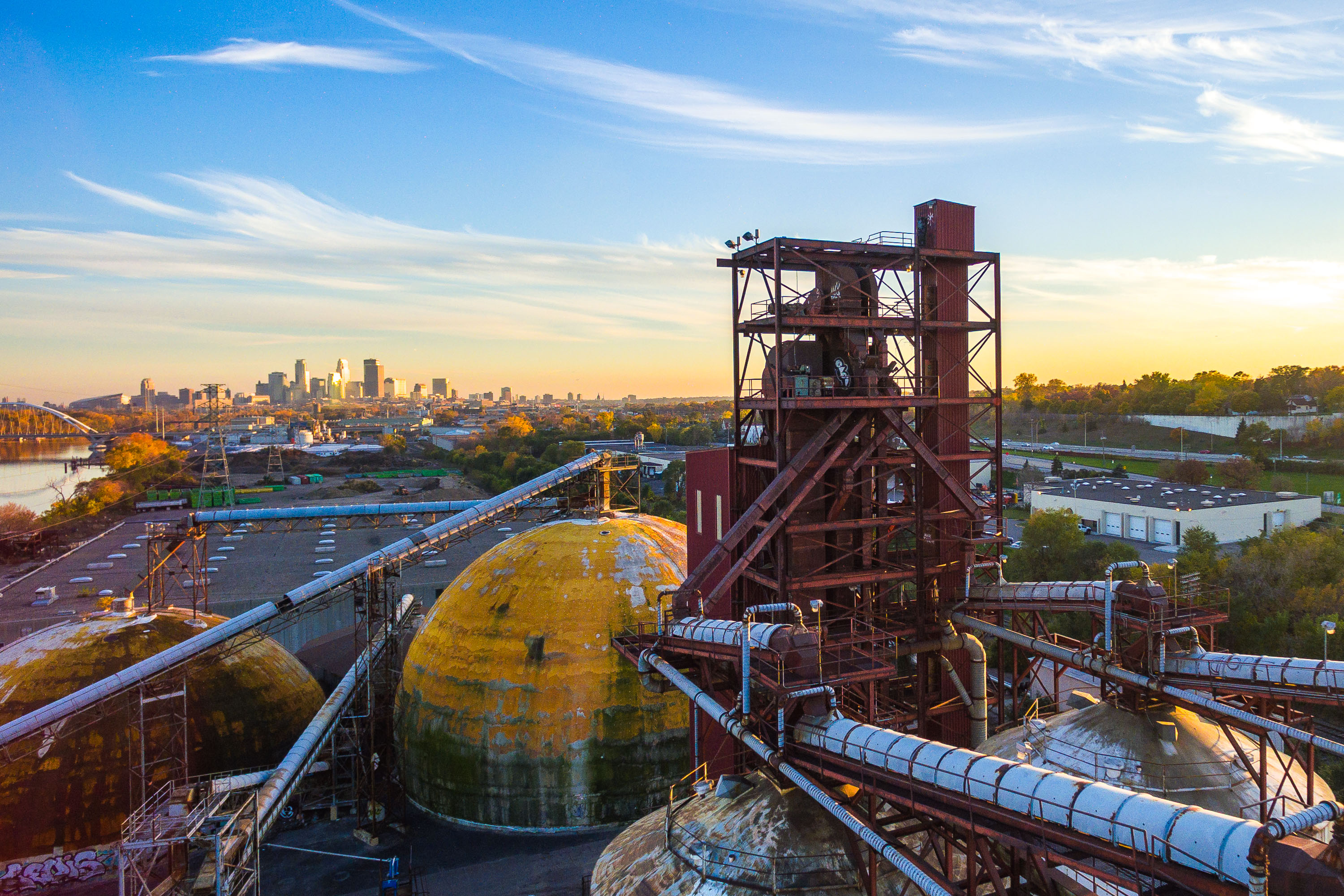
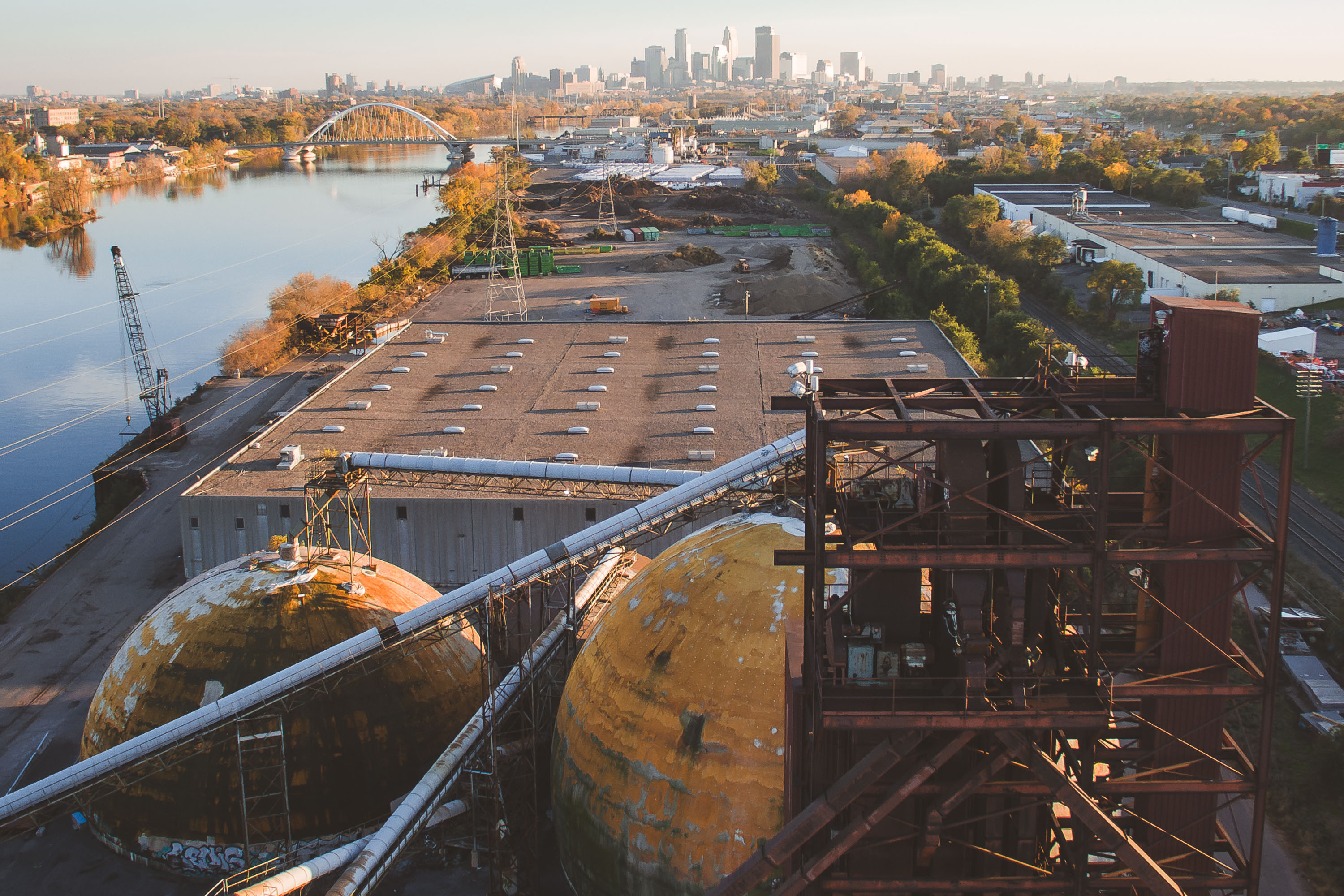
Upper Harbor Terminal, an abandoned barge facility on the Mississippi River in Minneapolis, with the downtown skyline visible beyond.
Upper Harbor Terminal is a former city-owned barge terminal on the Mississippi River in north Minneapolis, upstream of the Upper St. Anthony Falls Lock and Dam. Opened in 1968, five years after the lock made the upper river accessible to commercial barges, it handled bulk freight for decades, including road salt, coal, and gravel. Barge operations ended in 2014, ahead of the lock’s closure to navigation in June 2015 to help prevent the upstream spread of invasive carp

Rusting Storage Domes at Upper Harbor Terminal with Downtown Minneapolis Beyond
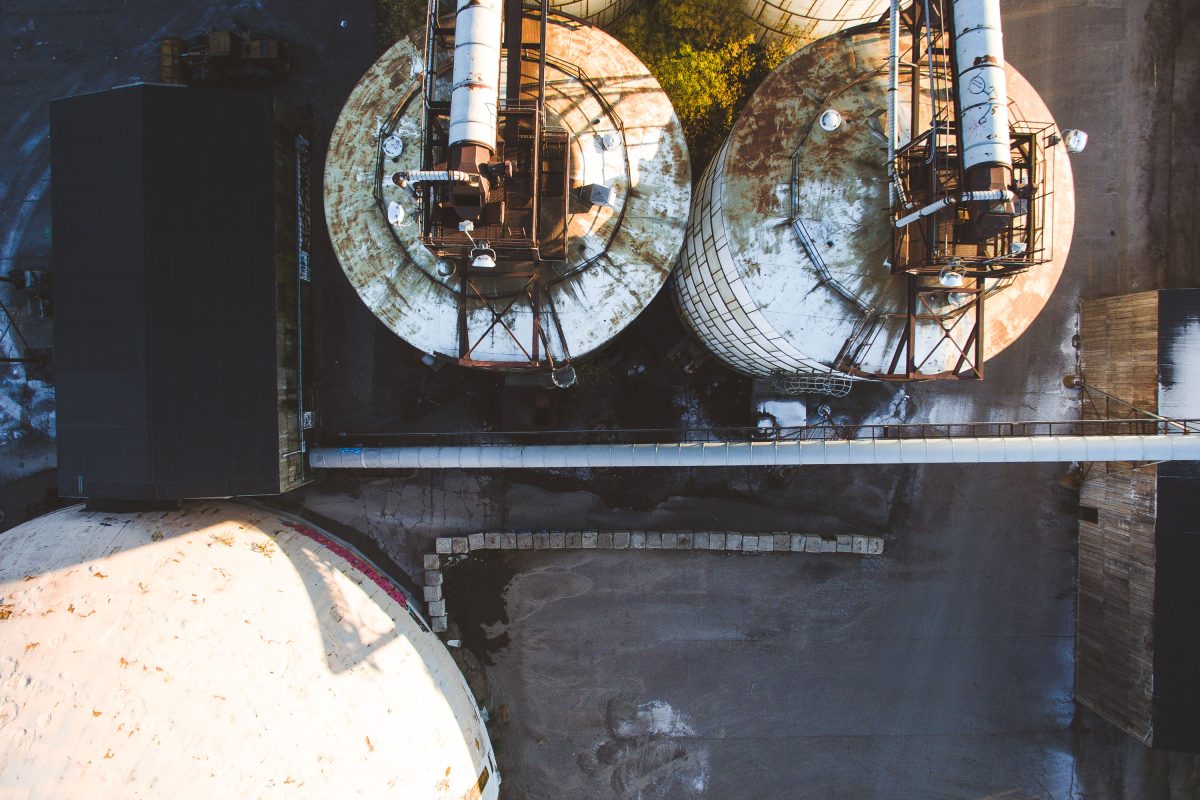
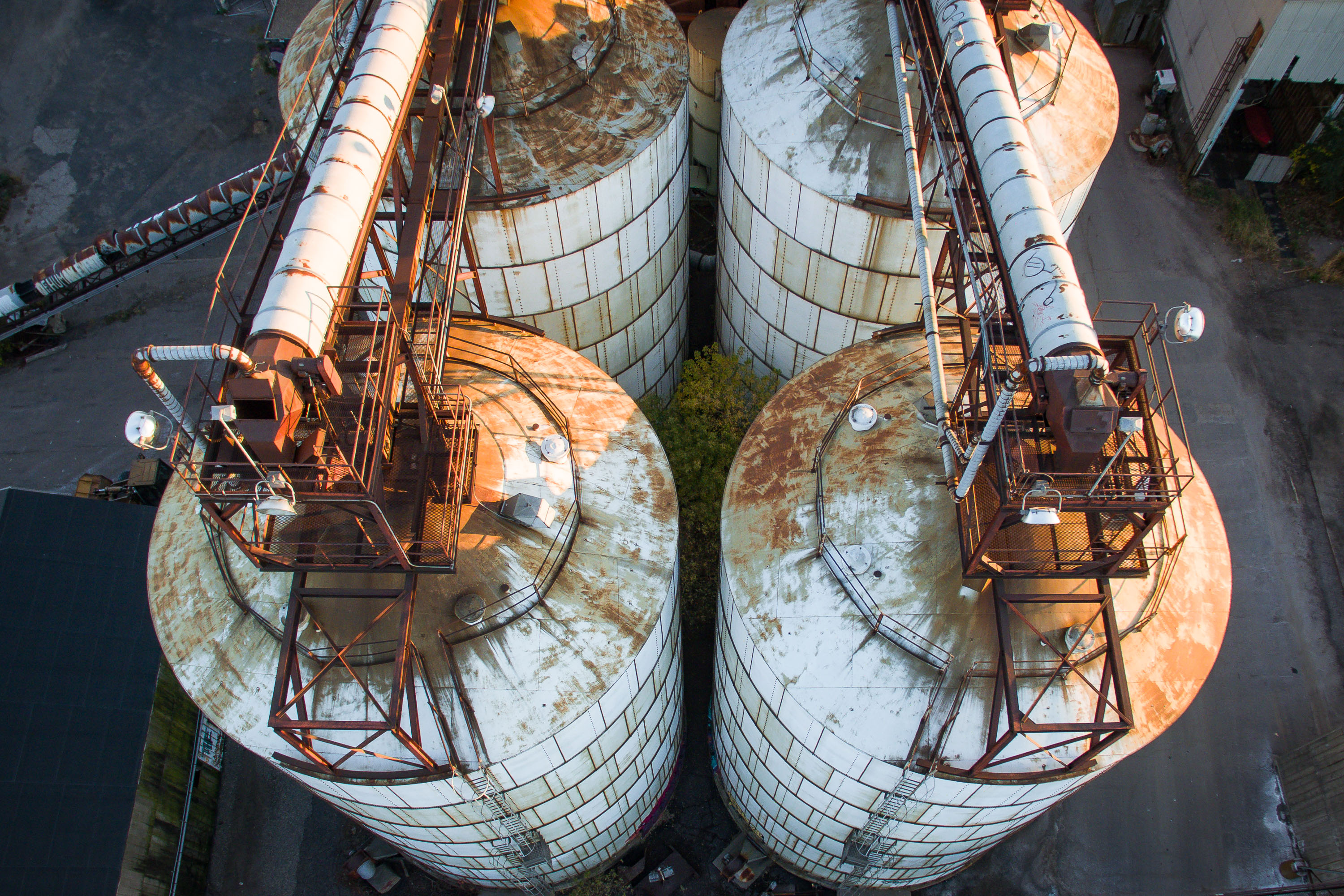
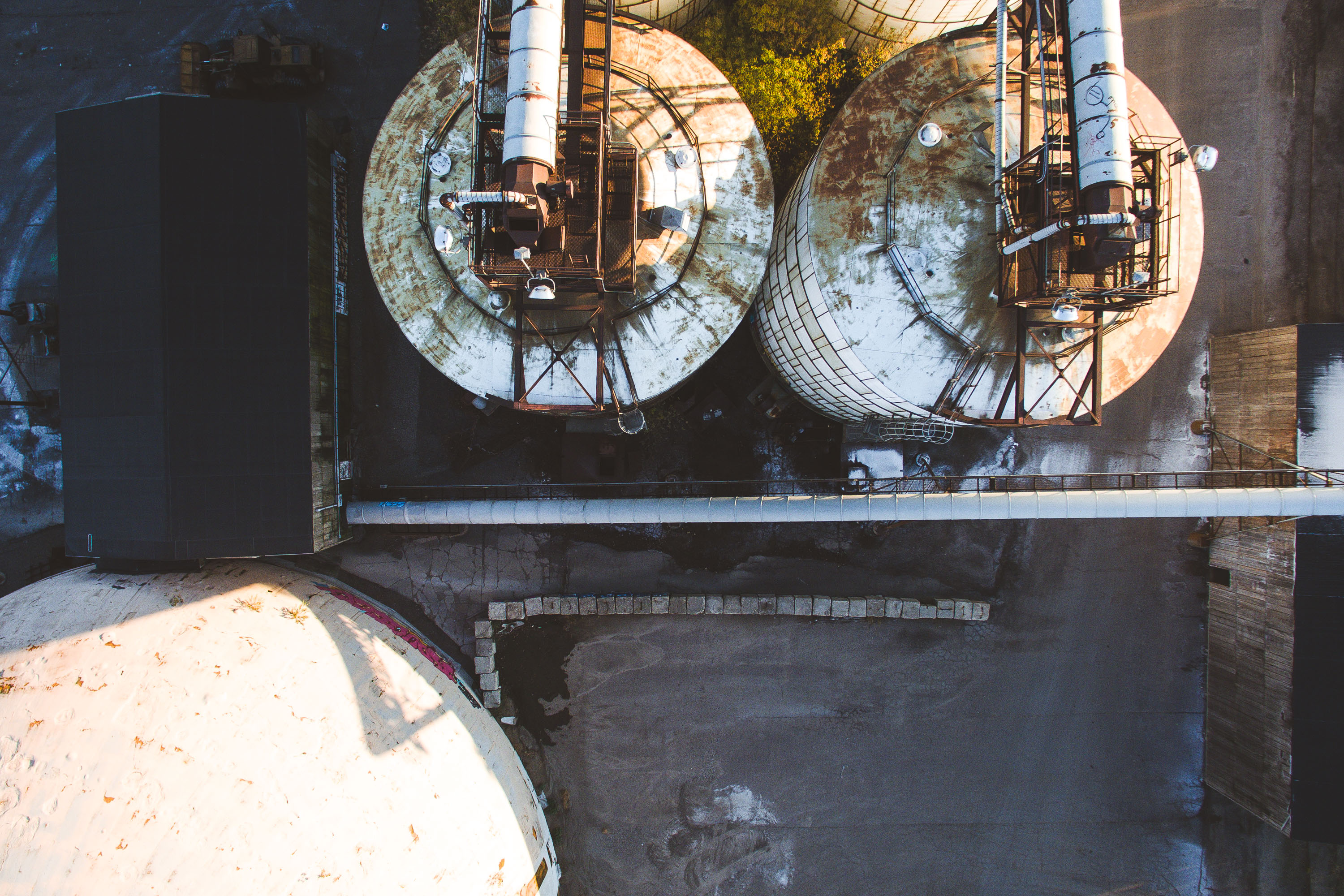
Aerial view of two large circular storage tanks at Upper Harbor Terminal, a former barge facility on the Mississippi River in Minneapolis.
Upper Harbor Terminal is a former city-owned barge terminal on the Mississippi River in north Minneapolis, upstream of the Upper St. Anthony Falls Lock and Dam. Opened in 1968, five years after the lock made the upper river accessible to commercial barges, it handled bulk freight for decades, including road salt, coal, and gravel. Barge operations ended in 2014, ahead of the lock’s closure to navigation in June 2015 to help prevent the upstream spread of invasive carp

Aerial View of Storage Silos at Upper Harbor Terminal
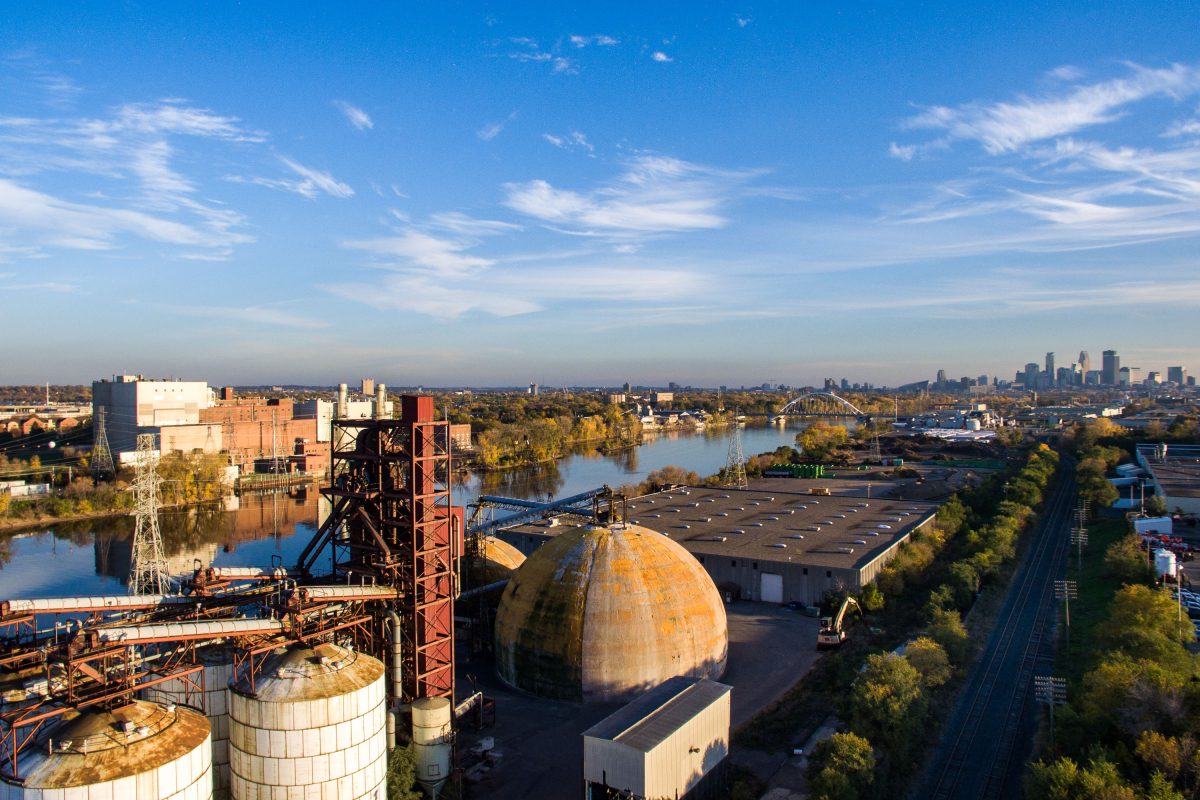
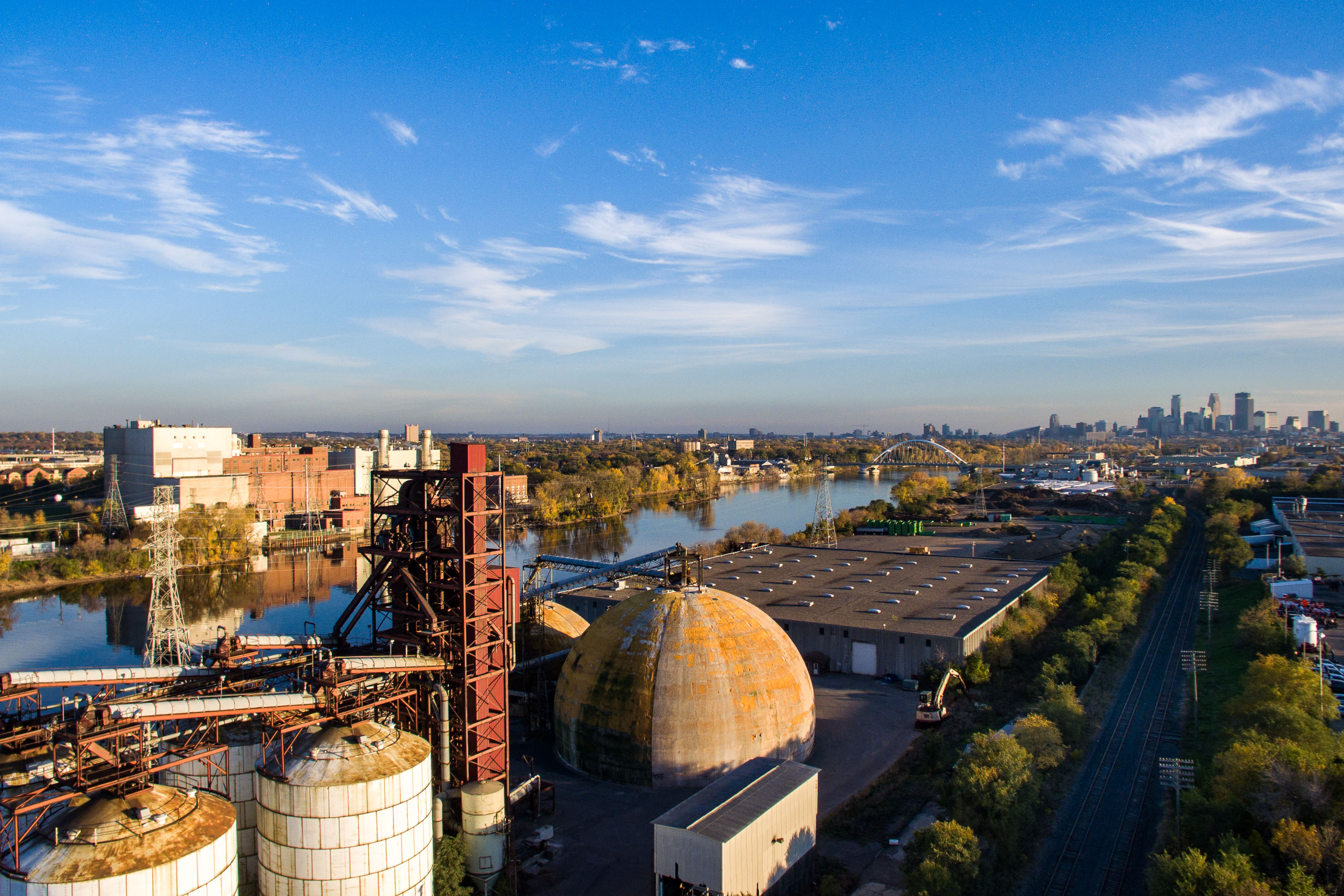
Upper Harbor Terminal, a former barge facility on the Mississippi River in north Minneapolis, sits idle with storage tanks and industrial structures visible.
Upper Harbor Terminal is a former city-owned barge terminal on the Mississippi River in north Minneapolis, upstream of the Upper St. Anthony Falls Lock and Dam. Opened in 1968, five years after the lock made the upper river accessible to commercial barges, it handled bulk freight for decades, including road salt, coal, and gravel. Barge operations ended in 2014, ahead of the lock’s closure to navigation in June 2015 to help prevent the upstream spread of invasive carp

Upper Harbor Terminal with the Minneapolis Skyline Beyond
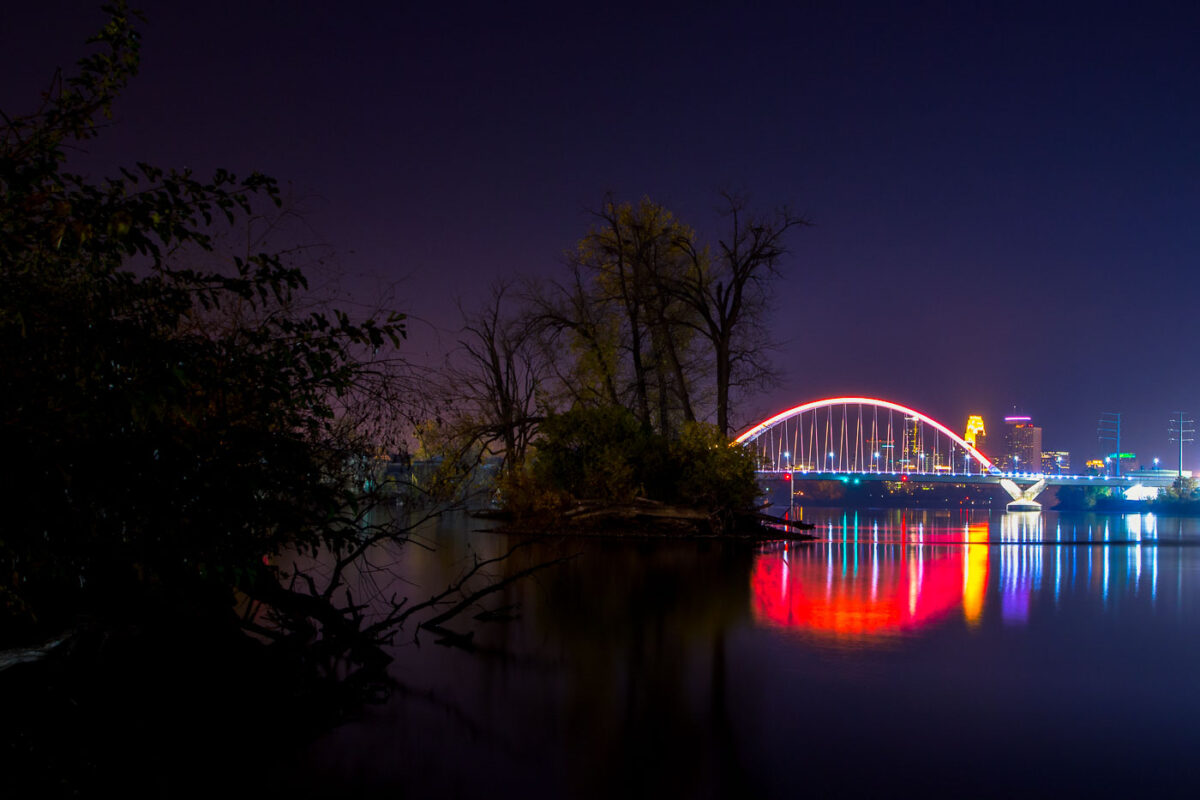
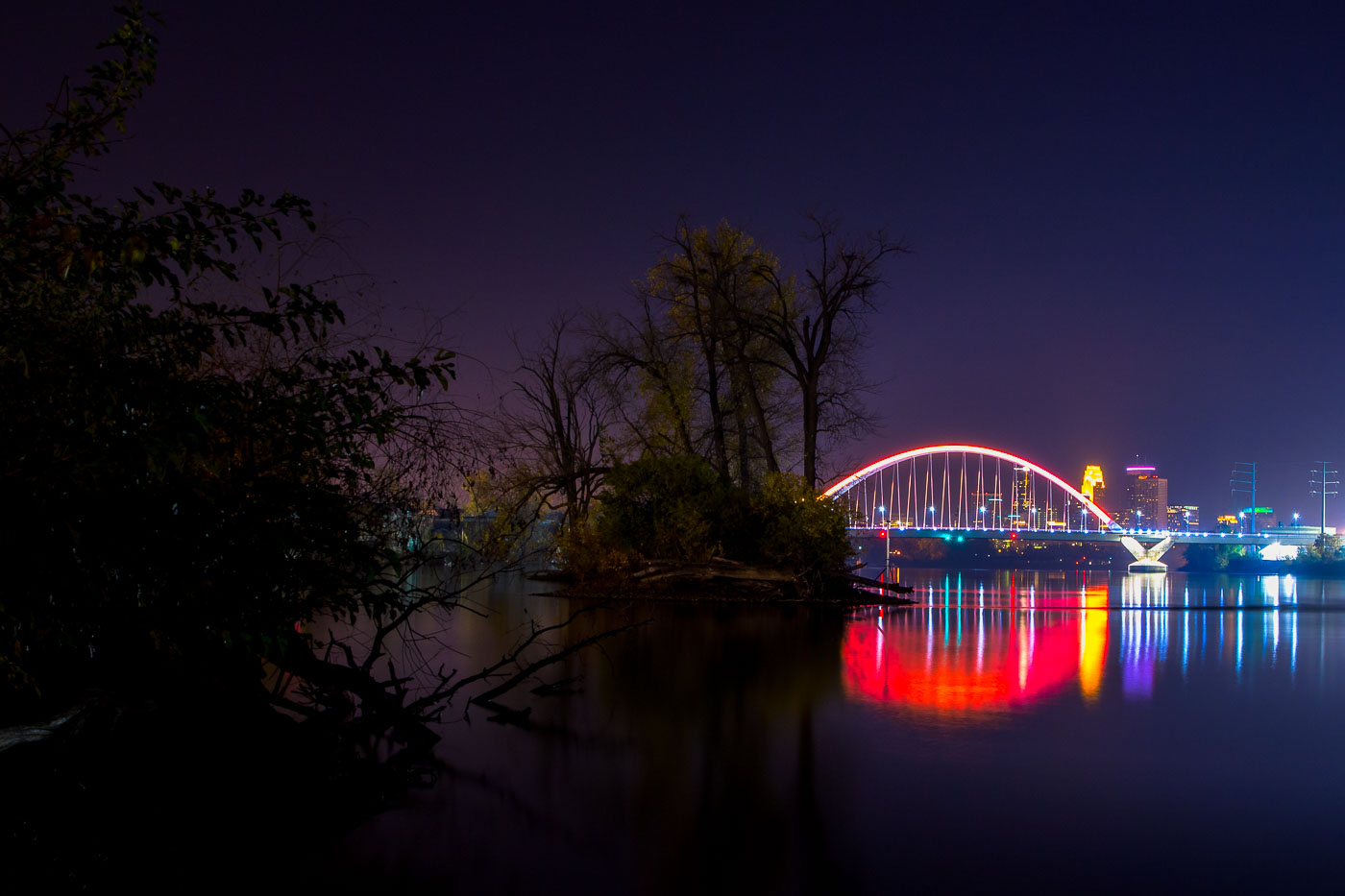
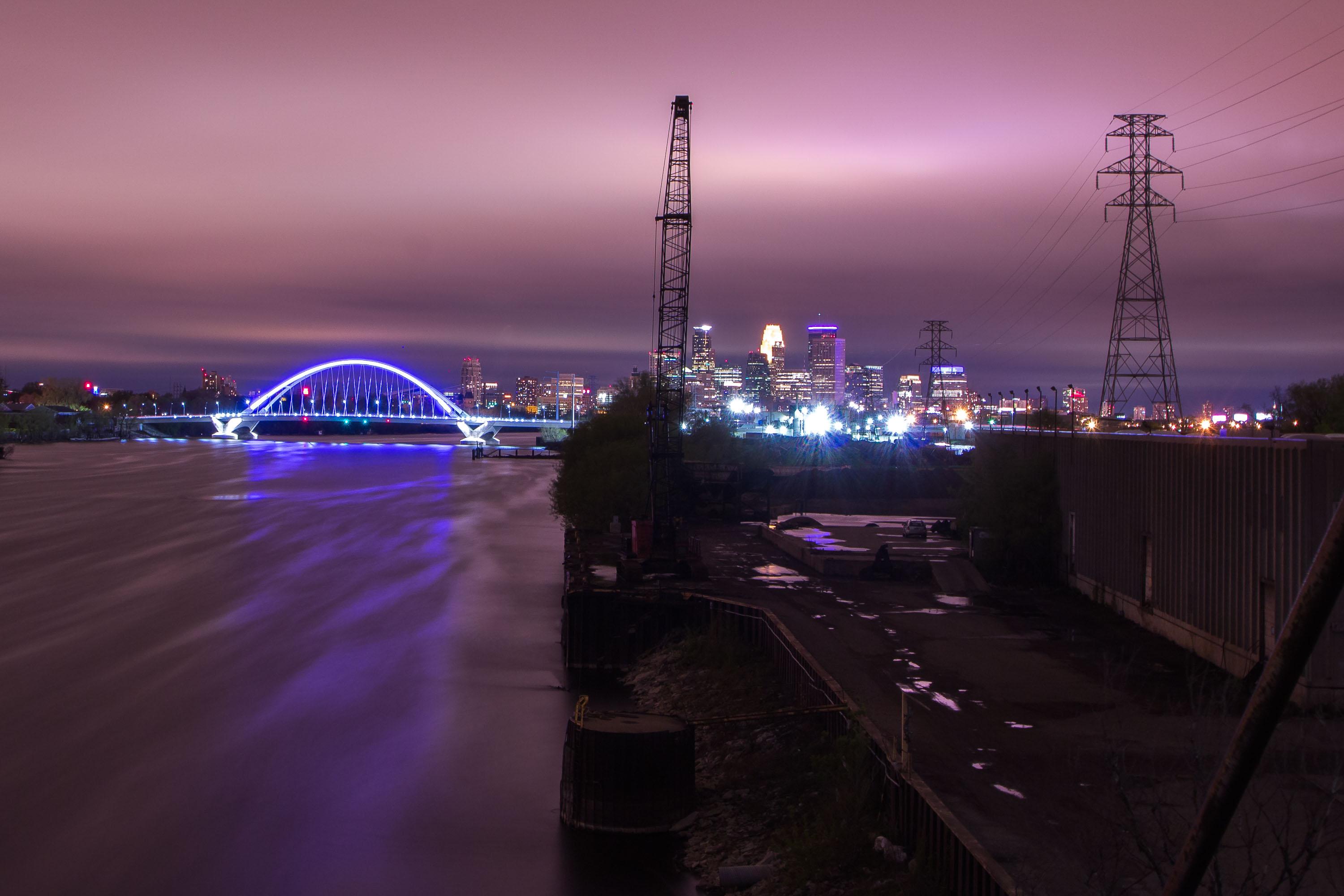
The Lowry Bridge and Minneapolis skyline are illuminated at night over the Mississippi River, with reflections of the city lights on the water.
The Lowry Bridge, a tied-arch bridge spanning the Mississippi River in Minneapolis. Opened in 1929, it was originally named the "Great Northern Railway Bridge" and served as a vital rail crossing. The bridge was reconstructed and renamed in 1987.

Lowry Bridge and Minneapolis Skyline at Night from Mississippi River
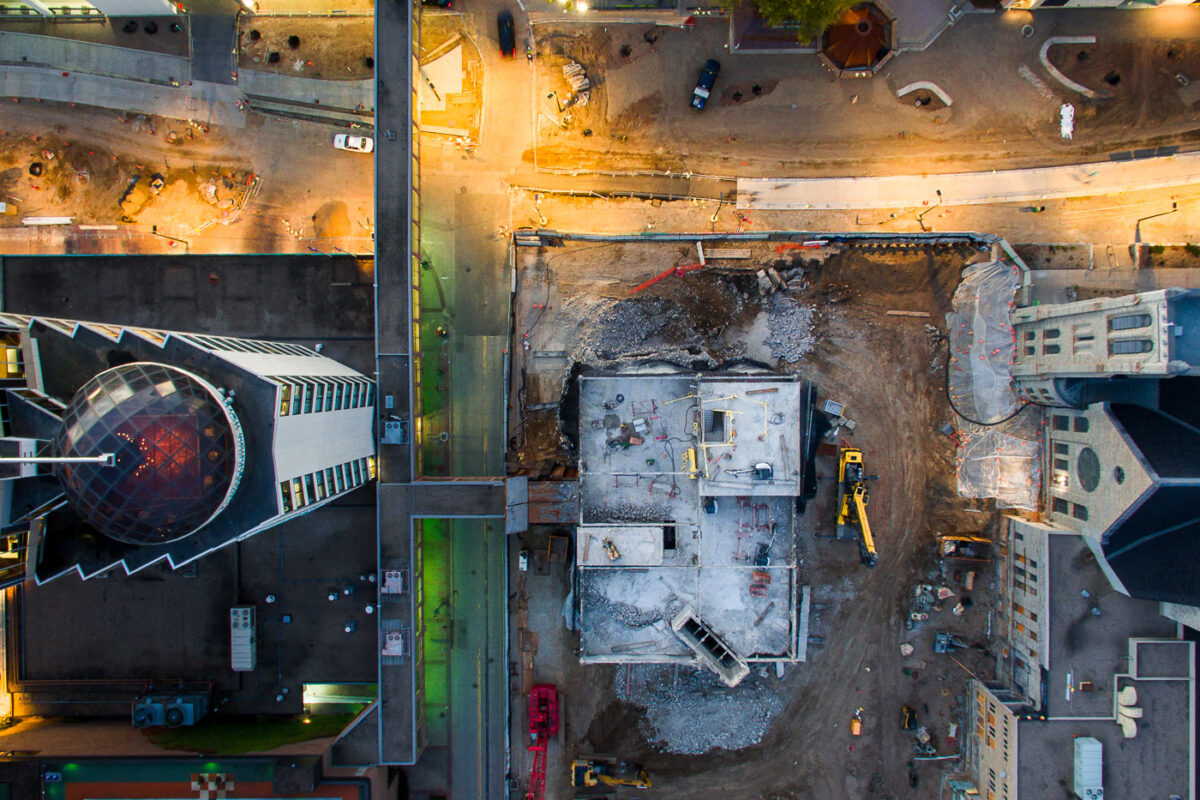
Demolition of an office building on Nicollet Mall in Minneapolis for the expansion of Westminster Presbyterian Church. The Millennium Hotel is visible.
Demolition work is underway on Nicollet Mall in downtown Minneapolis, clearing an eight-story office building to make way for an expansion of Westminster Presbyterian Church. The church, a prominent fixture in the city's core, is undertaking this project to increase its capacity and services. The adjacent Millennium Hotel is visible in the background, highlighting the ongoing development in this central business district.

Westminster Presbyterian Church Expansion, Minneapolis
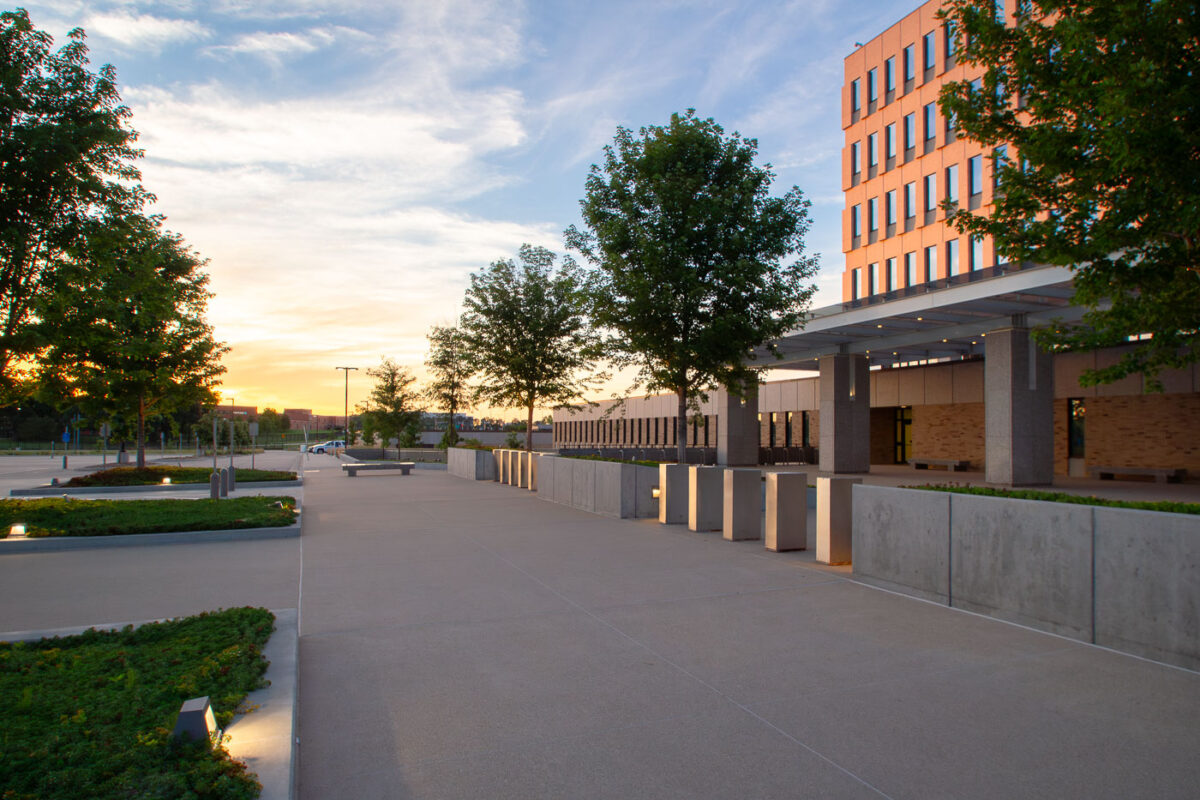
Bishop Henry Whipple Federal Building in Minneapolis at sunset.
The Bishop Henry Whipple Federal Building in Minneapolis houses the Immigration Court and other federal offices. The complex is a U.S. General Services Administration property used for administrative and judicial functions.

Bishop Henry Whipple Federal Building, Minneapolis
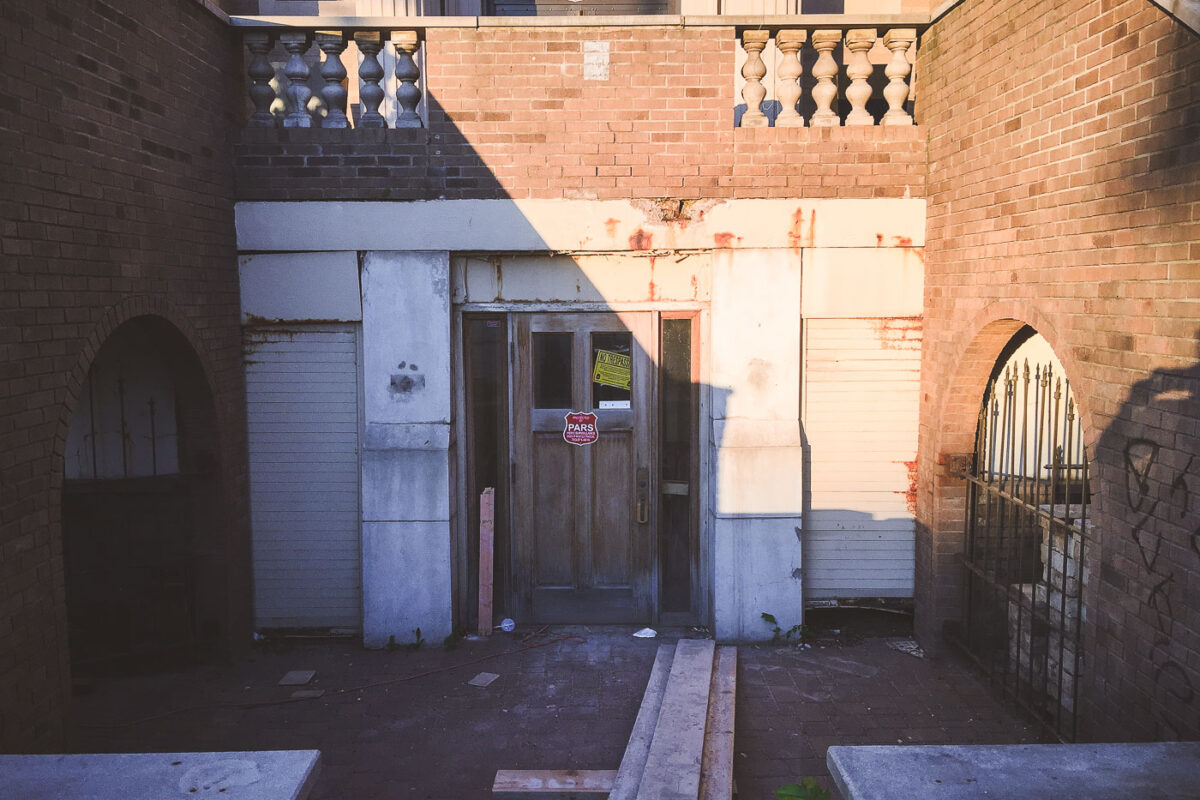
Boarded former Uptown Minneapolis Library on Hennepin Avenue with a locked entrance and graffiti-covered brick walls
The original Uptown Library on Hennepin. It's since been a fitness center and is currently a nightclub. A new library was built aross the street. Pictured here in 2016.

Former Uptown Minneapolis Library on Hennepin Avenue

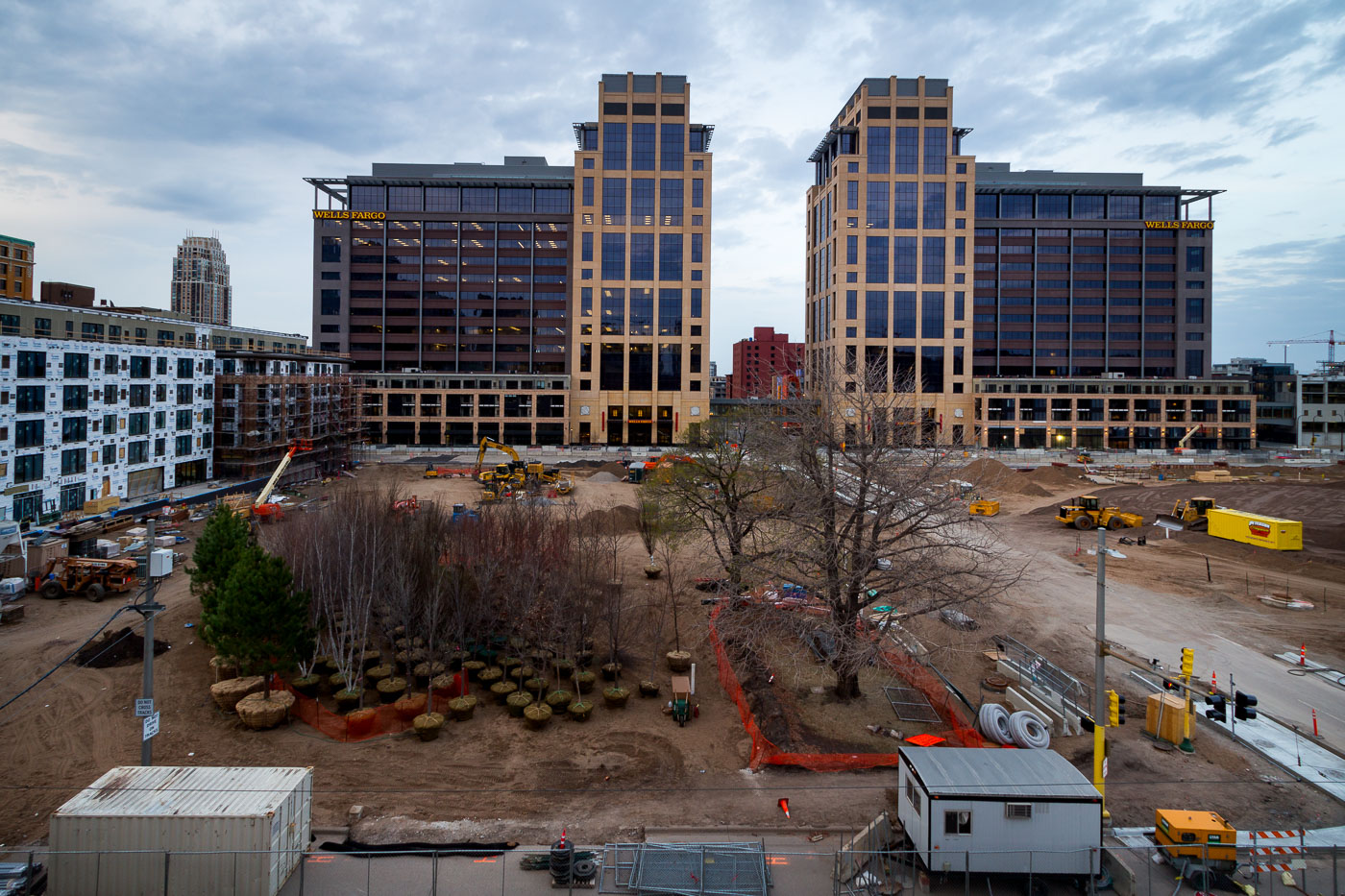
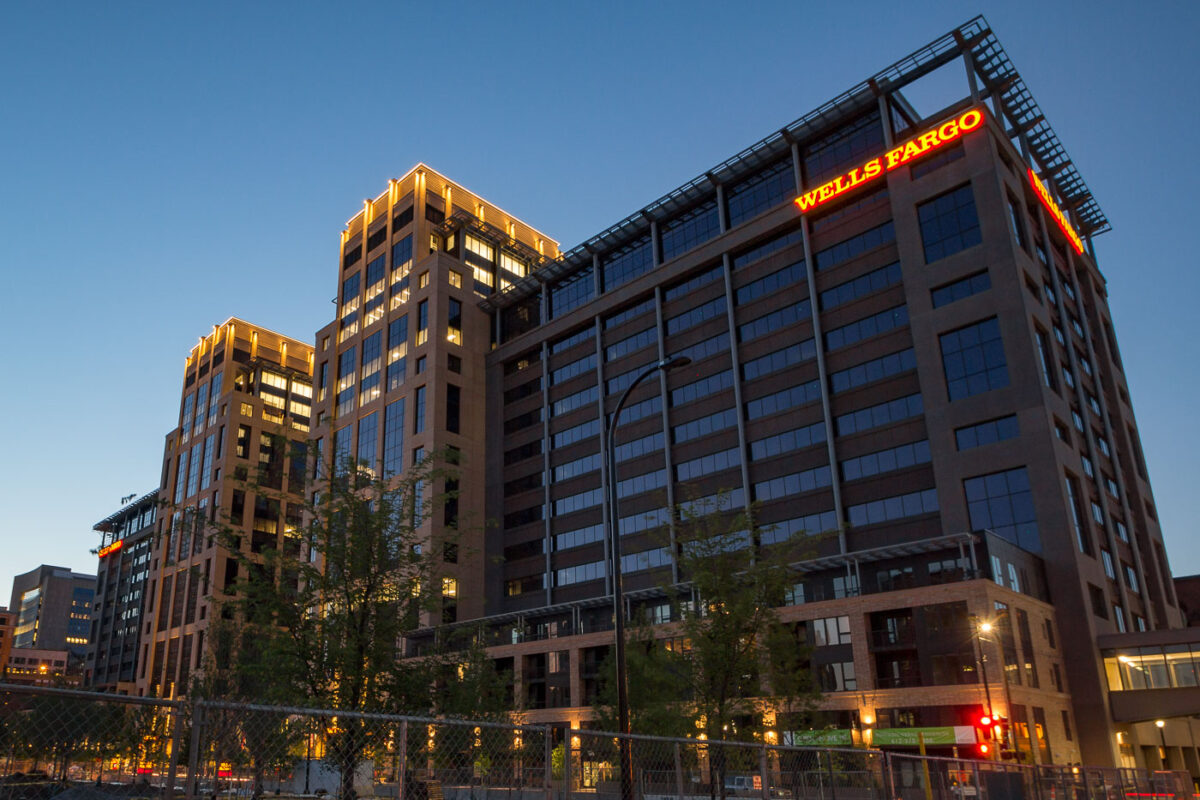
The Wells Fargo buildings in Minneapolis's Downtown East district are illuminated at dusk.
The Wells Fargo Towers in downtown Minneapolis shortly after construction. The towers were built as part of the Downtown East redevelopment along with US Bank Stadium.

Wells Fargo Buildings, Downtown East, Minneapolis
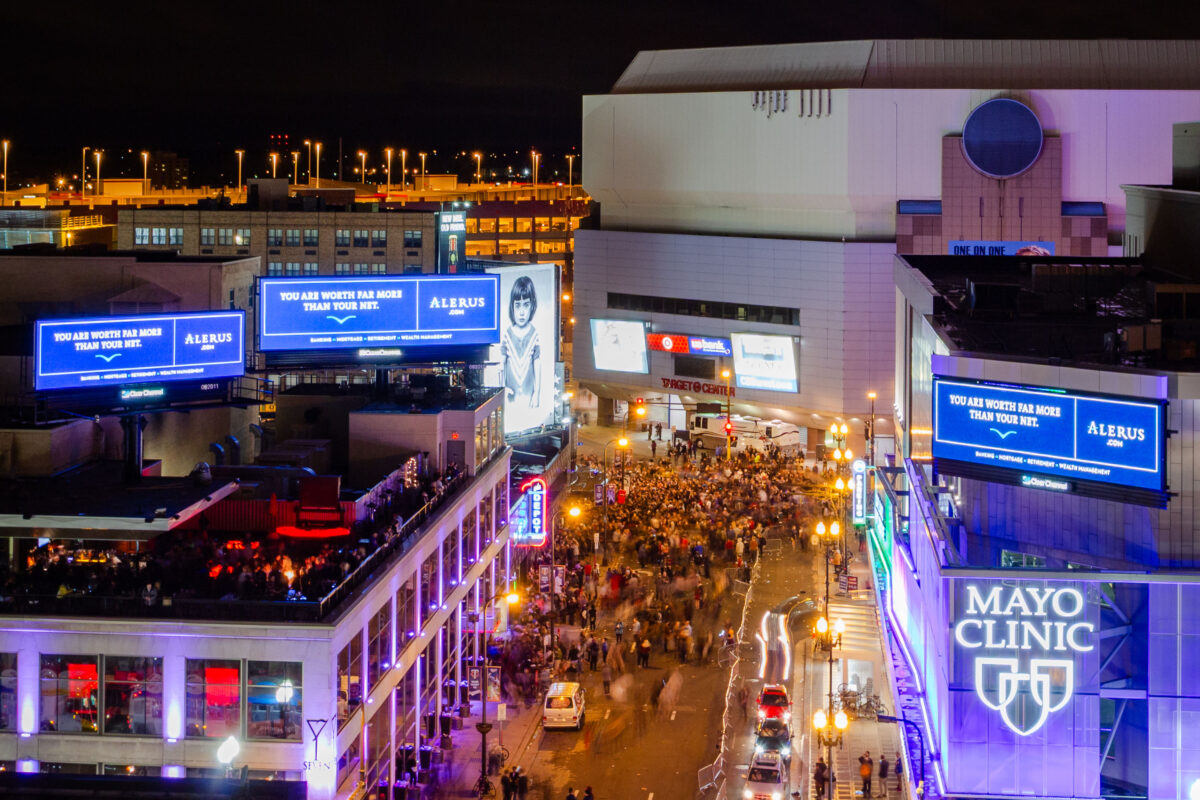
Crowd of mourners gathers outside First Avenue nightclub in downtown Minneapolis on April 22, 2016, following Prince's death.
A crowd gathers outside First Avenue in downtown Minneapolis after Prince's death on April 21, 2016. First Avenue, the nightclub associated with Prince and the film Purple Rain, became a public gathering place for fans that night.

Crowds Fill Seventh Street Near Target Center After Prince’s Death
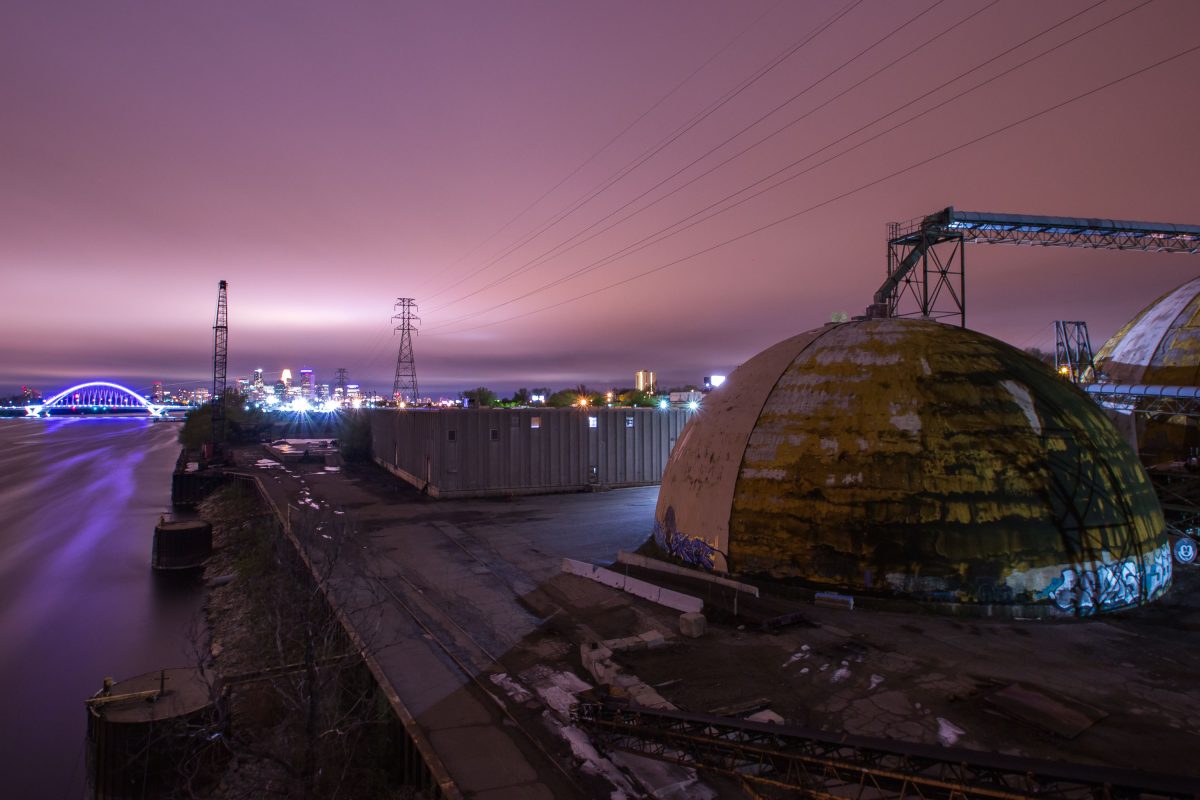
Abandoned barge terminal on the Mississippi River in Minneapolis at dusk, with industrial domes and loading equipment visible.
Upper Harbor Terminal is a former city-owned barge terminal on the Mississippi River in north Minneapolis, upstream of the Upper St. Anthony Falls Lock and Dam. Opened in 1968, five years after the lock made the upper river accessible to commercial barges, it handled bulk freight for decades, including road salt, coal, and gravel. Barge operations ended in 2014, ahead of the lock’s closure to navigation in June 2015 to help prevent the upstream spread of invasive carp

Storage Domes at Upper Harbor Terminal Overlooking the Lowry Bridge
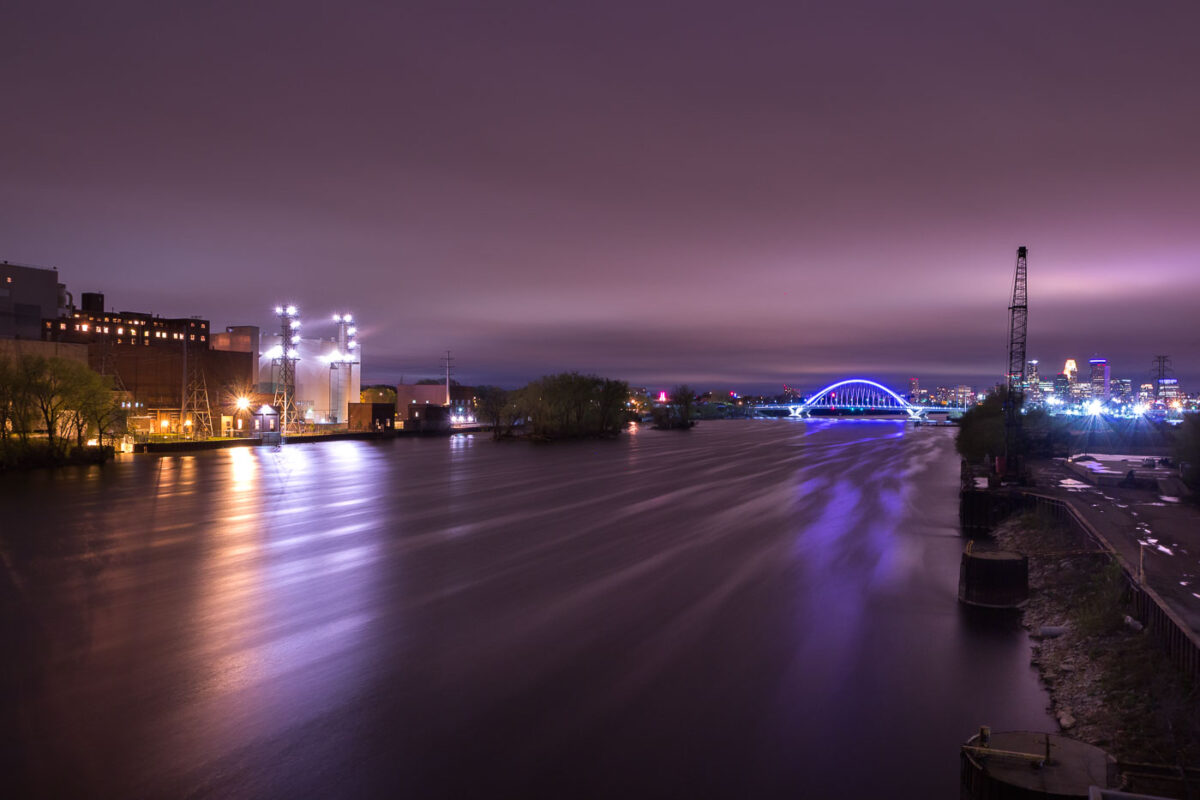
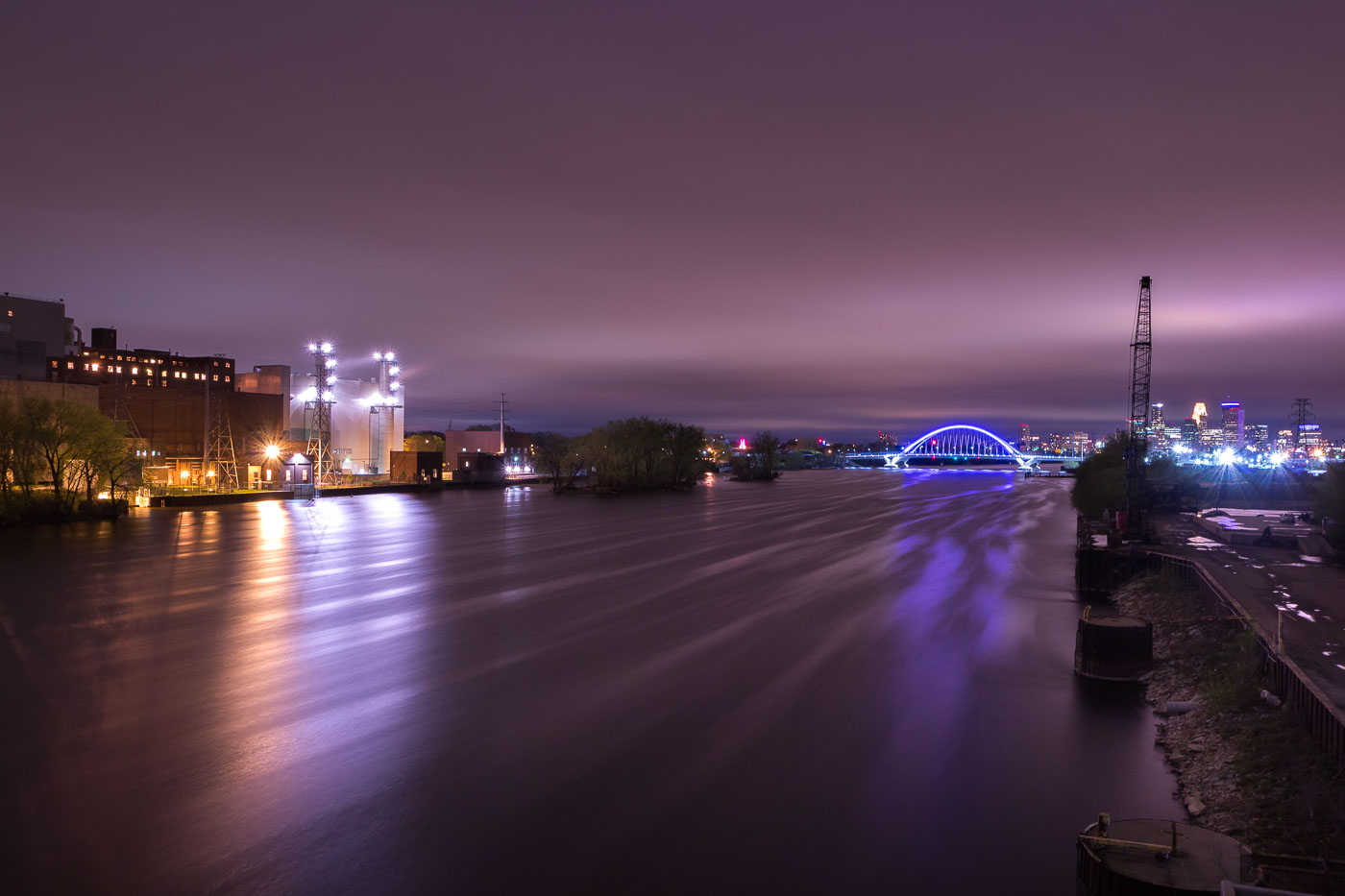
The Lowry Bridge's blue arch glows across the Mississippi River at dusk in Minneapolis, with the Riverside Generating Station visible on the left shore.
The Lowry Bridge and the Riverside Generating Station are visible across the Mississippi River in Minneapolis. The Riverside Generating Station, a coal-fired power plant, has been a significant source of electricity for the city since its construction in the early 20th century. The Lowry Bridge, a steel arch bridge, was completed in 2012, replacing an earlier structure and improving traffic flow across the river. The photograph captures the industrial and infrastructural elements of the city at night, with the illuminated bridge and power plant contrasting against the dark sky.

Lowry Bridge Glowing Blue Over the Mississippi River at Night
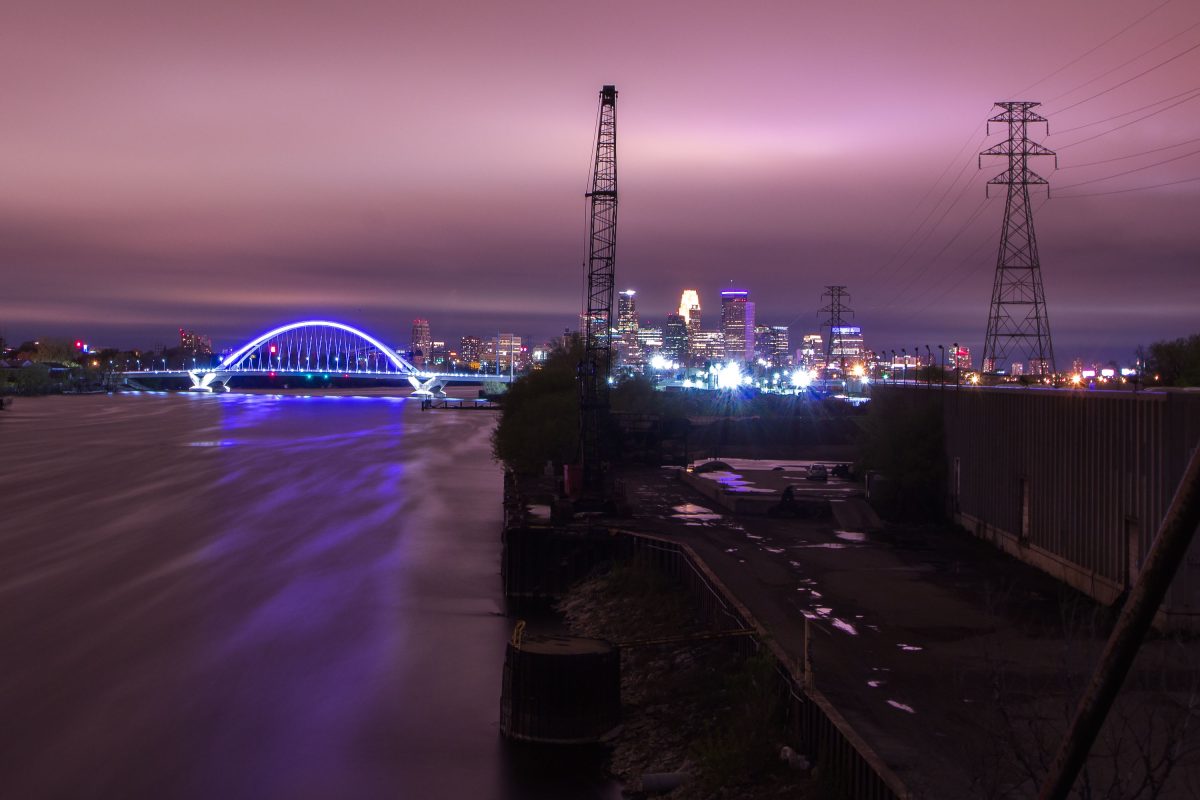
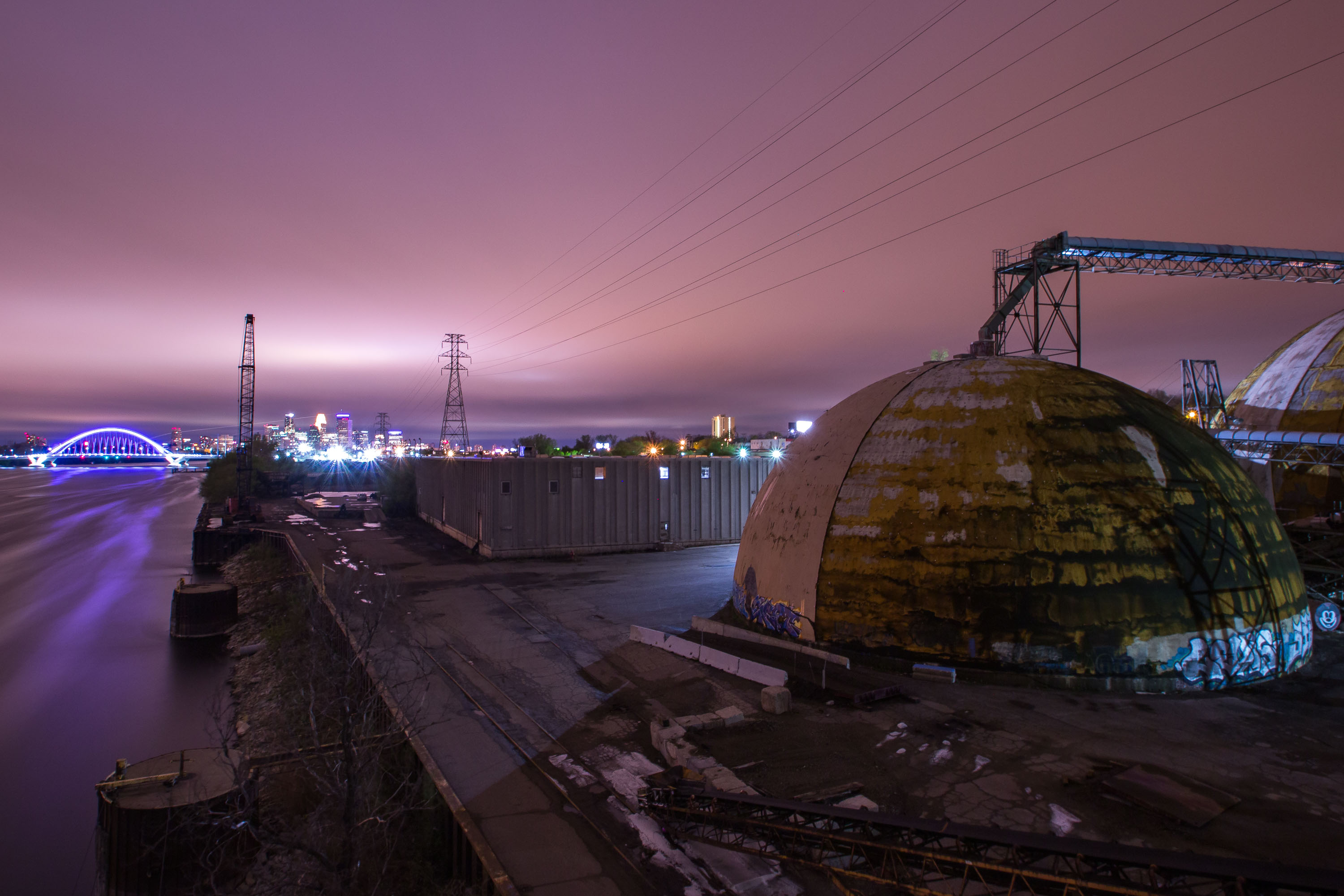
The Stone Arch Bridge illuminates blue over the Mississippi River at dusk, with Minneapolis downtown skyline and power transmission towers beyond.
Upper Harbor Terminal is a former city-owned barge terminal on the Mississippi River in north Minneapolis, upstream of the Upper St. Anthony Falls Lock and Dam. Opened in 1968, five years after the lock made the upper river accessible to commercial barges, it handled bulk freight for decades, including road salt, coal, and gravel. Barge operations ended in 2014, ahead of the lock’s closure to navigation in June 2015 to help prevent the upstream spread of invasive carp.

Lowry Avenue Bridge Seen From Upper Harbor Terminal at Night
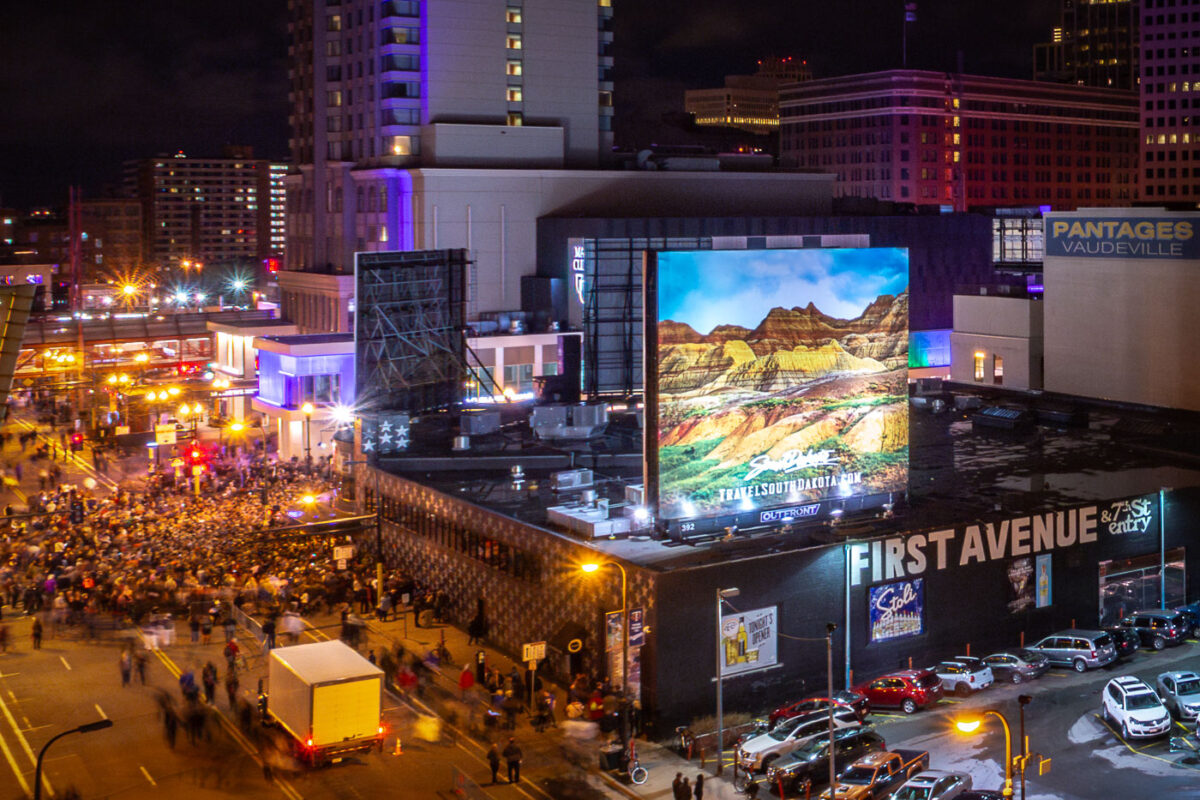
Crowds fill the street outside First Avenue music venue in downtown Minneapolis on April 21, 2016.
Thousands of mourners gathered outside First Avenue, a renowned Minneapolis music venue, on the evening of April 21, 2016, following the death of the artist Prince.

Mourners Fill the Street Outside First Avenue After Prince’s Death
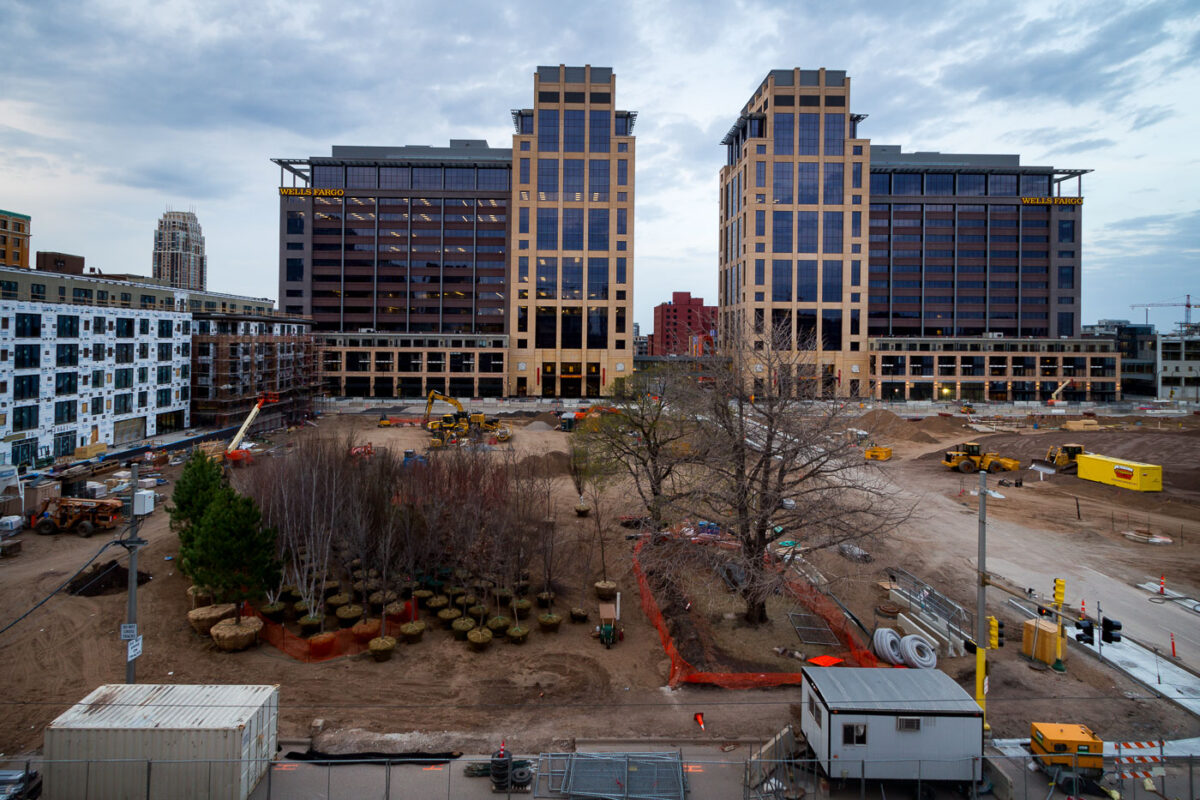
Construction in Minneapolis's Downtown East neighborhood in April 2016
Construction in Minneapolis's Downtown East neighborhood in April 2016, surrounding the development of the new US Bank Stadium. The project included the construction of the stadium itself, as well as surrounding infrastructure and commercial buildings, such as the Wells Fargo towers visible in the background.

Minneapolis Downtown East Construction April 2016
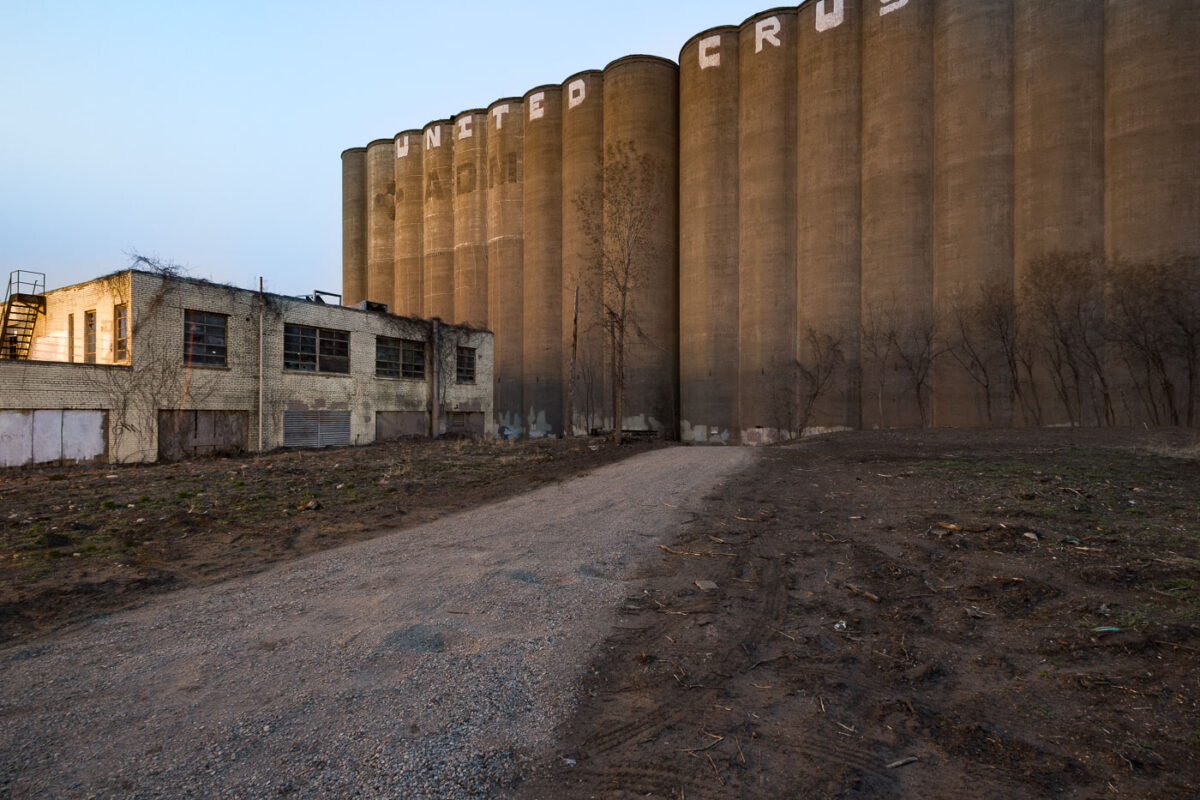
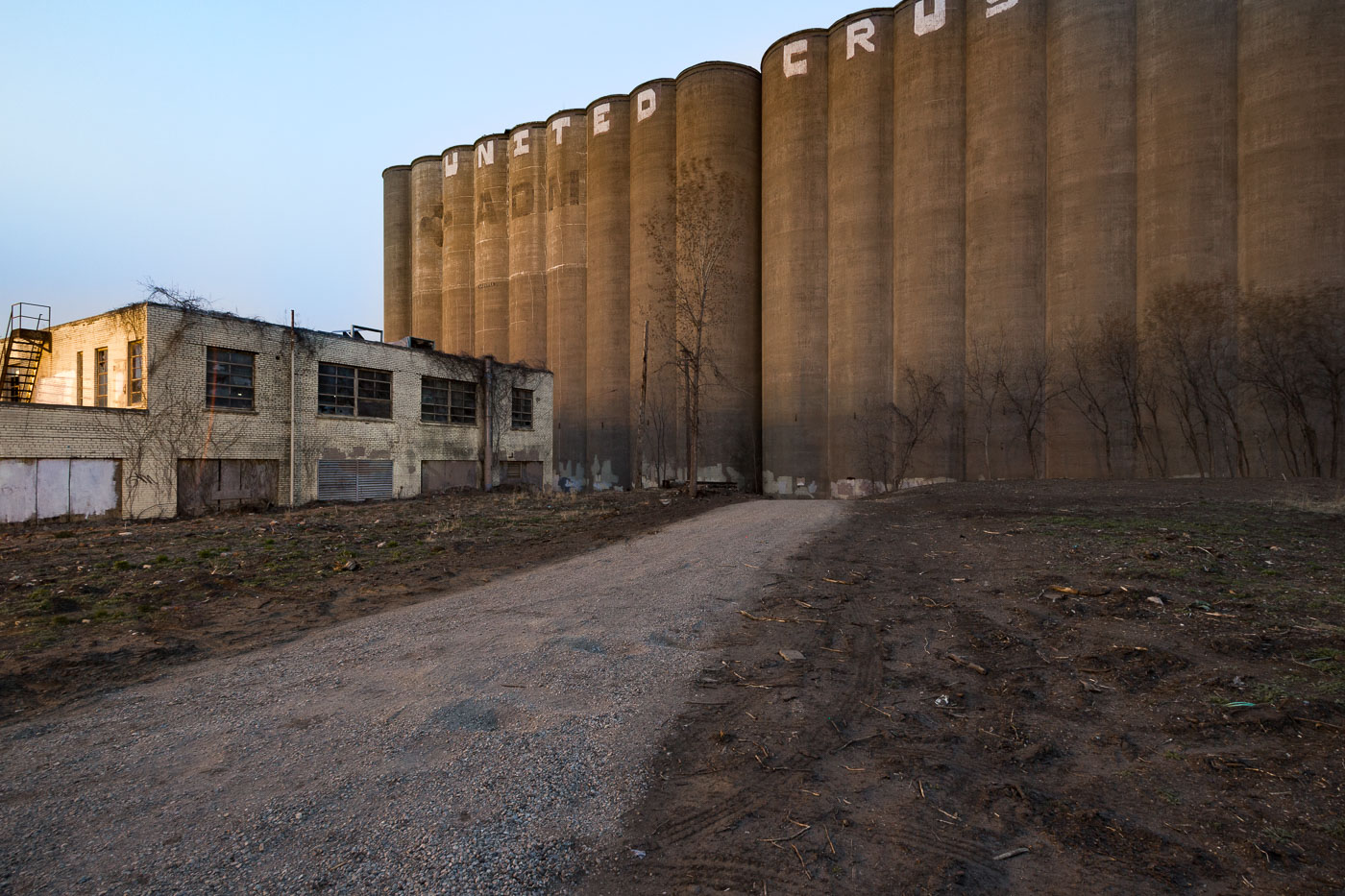
Abandoned ADM grain elevator complex in Dinkytown, Minneapolis, with "UNITED CRUSHERS" branding on silos.
The abandoned ADM grain elevator complex in Dinkytown, Minneapolis, stands as a relic of the city's industrial past. Originally part of the Pillsbury Company's operations, these concrete silos were constructed to store and process grain.

Abandoned ADM Grain Elevator, Dinkytown, Minneapolis
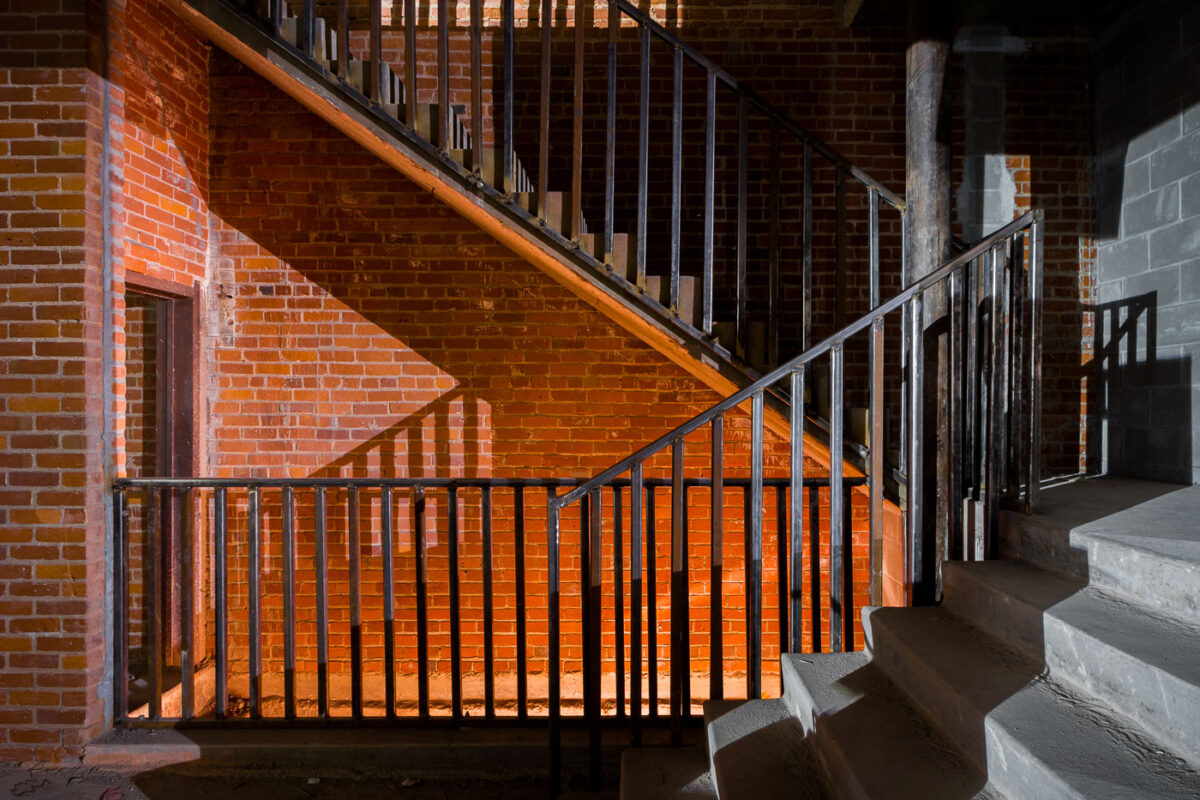
Renovated stairwell inside the former Western Containers building, Minneapolis, part of the Warehouse District's industrial heritage.
The former Western Containers building, located in Minneapolis's North Loop neighborhood, underwent renovation. This structure, part of the Warehouse District's industrial heritage, was originally built to serve commercial and industrial purposes. The renovation project included updates to its internal infrastructure, such as this stairwell, preserving the building's historical character while adapting it for contemporary use. The North Loop has seen significant redevelopment, transforming former industrial spaces into mixed-use properties.

Western Containers Building Stairwell Renovation, Minneapolis
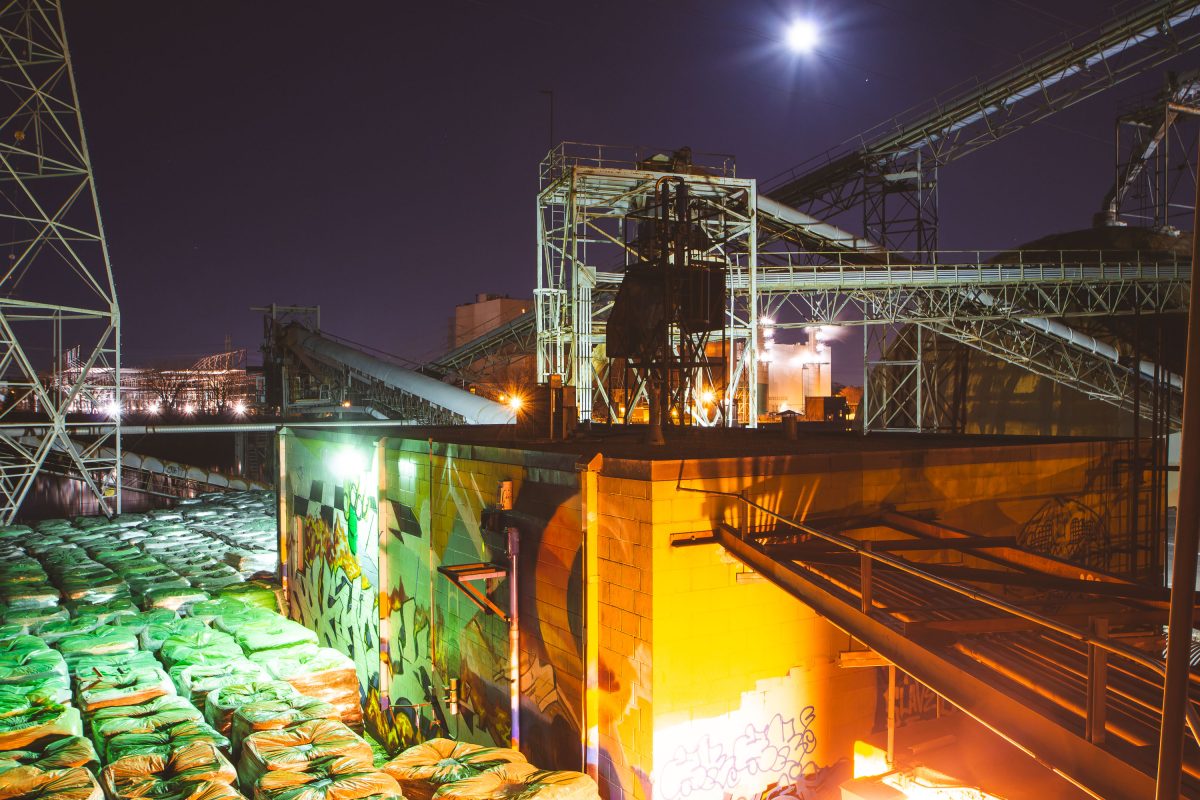
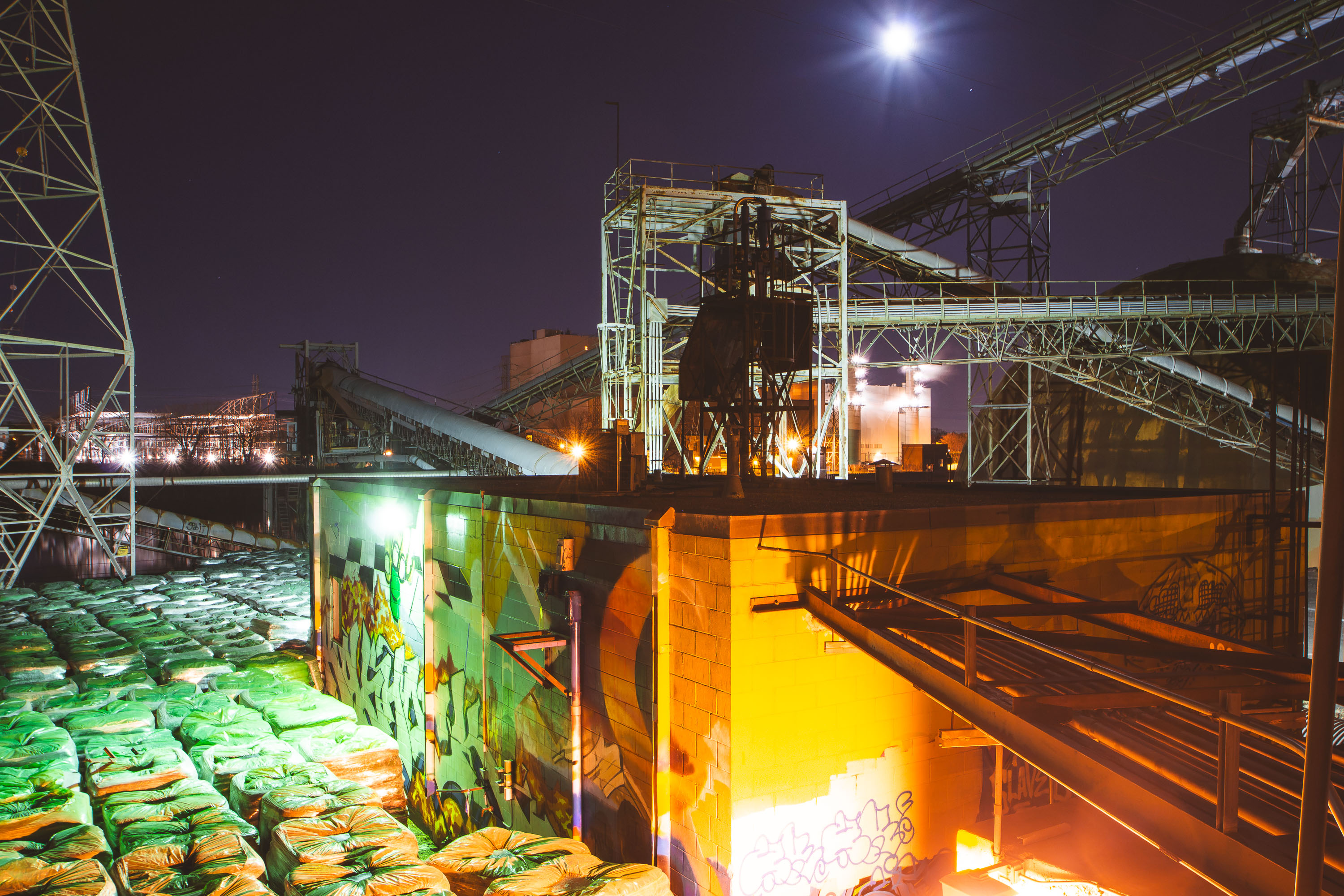
Upper Harbor Terminal barge facility on the Mississippi River in Minneapolis at night, with stacked bulk freight and industrial loading equipment illuminated.
Upper Harbor Terminal is a former city-owned barge terminal on the Mississippi River in north Minneapolis, upstream of the Upper St. Anthony Falls Lock and Dam. Opened in 1968, five years after the lock made the upper river accessible to commercial barges, it handled bulk freight for decades, including road salt, coal, and gravel. Barge operations ended in 2014, ahead of the lock’s closure to navigation in June 2015 to help prevent the upstream spread of invasive carp.

Moonlit Night at Upper Harbor Terminal
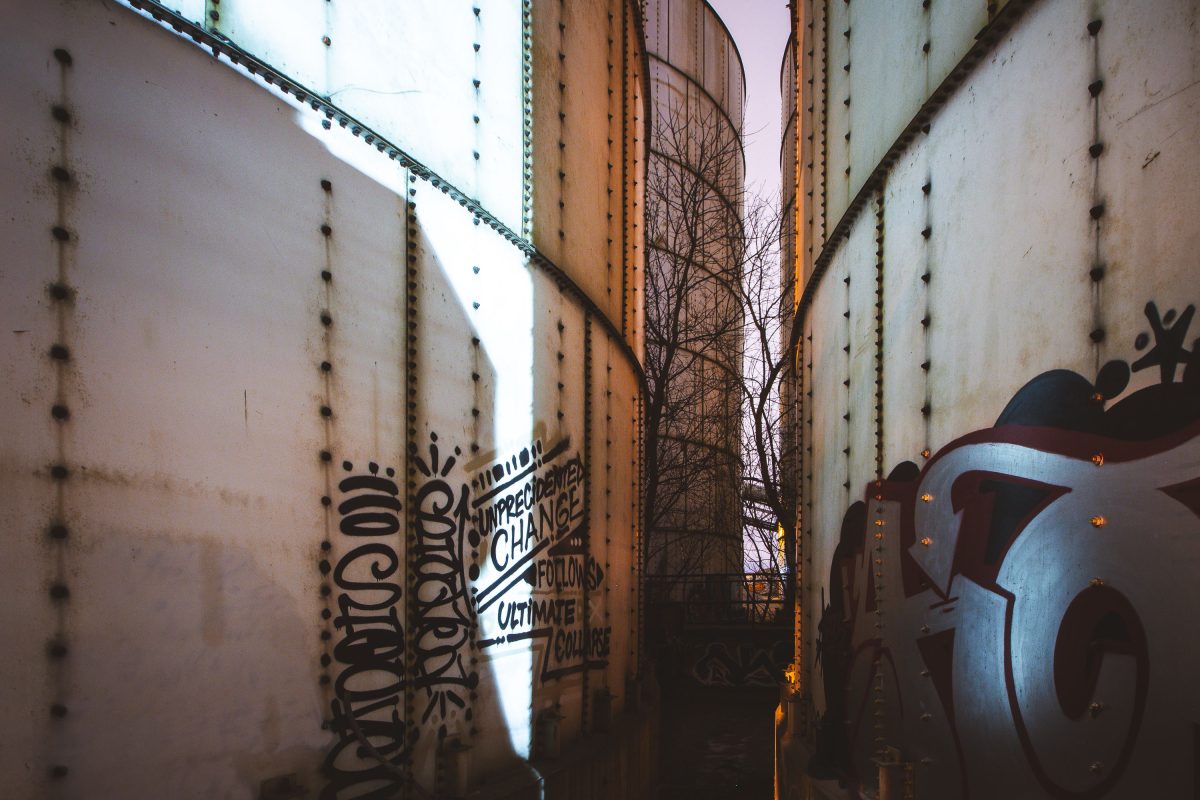
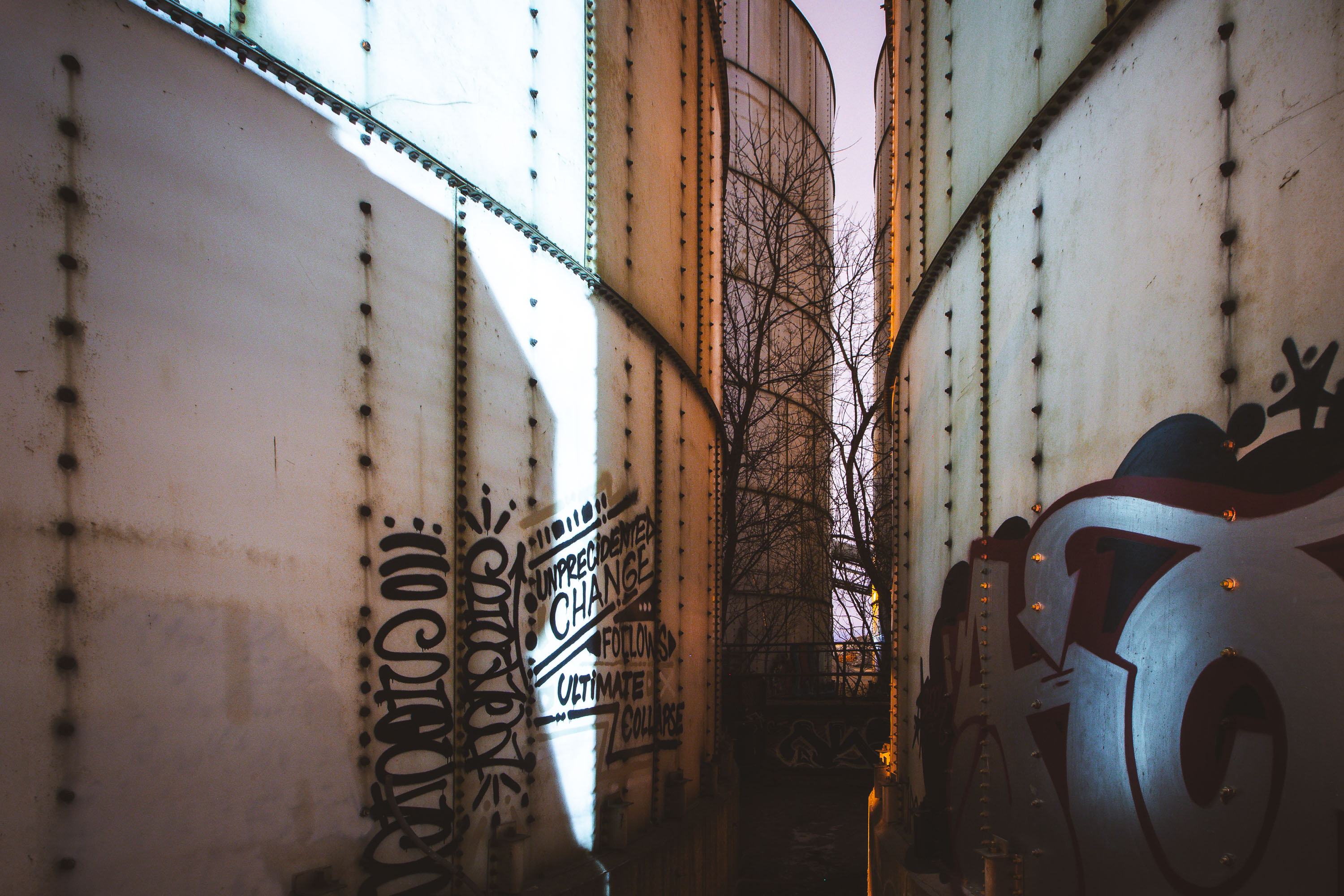
SHOCK graffiti reading "Unprecedented Change Follows Ultimate Collapse" on industrial metal structures at Upper Harbor Terminal in Minneapolis.
SHOCK/UC graffiti that reads "Unprecedented Change Follows Ultimate Collapse"

“Unprecedented Change Follows Ultimate Collapse” Graffiti at Upper Harbor Terminal
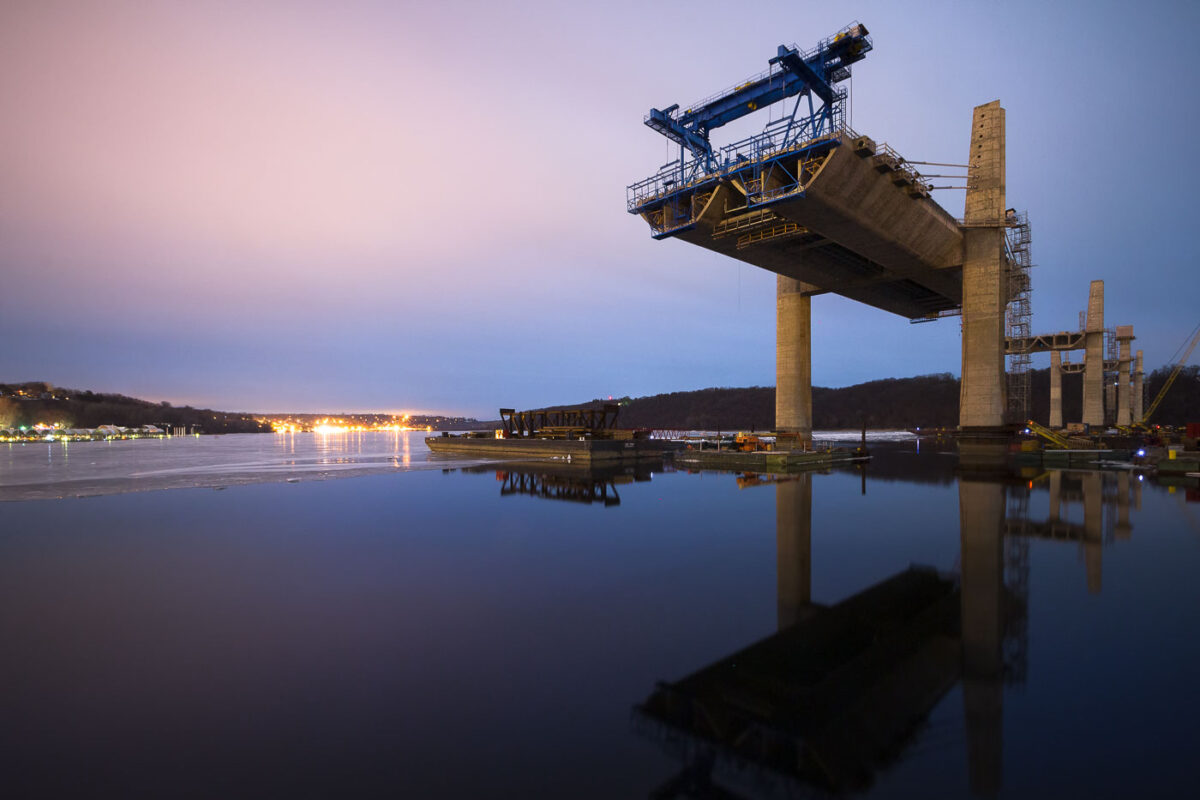
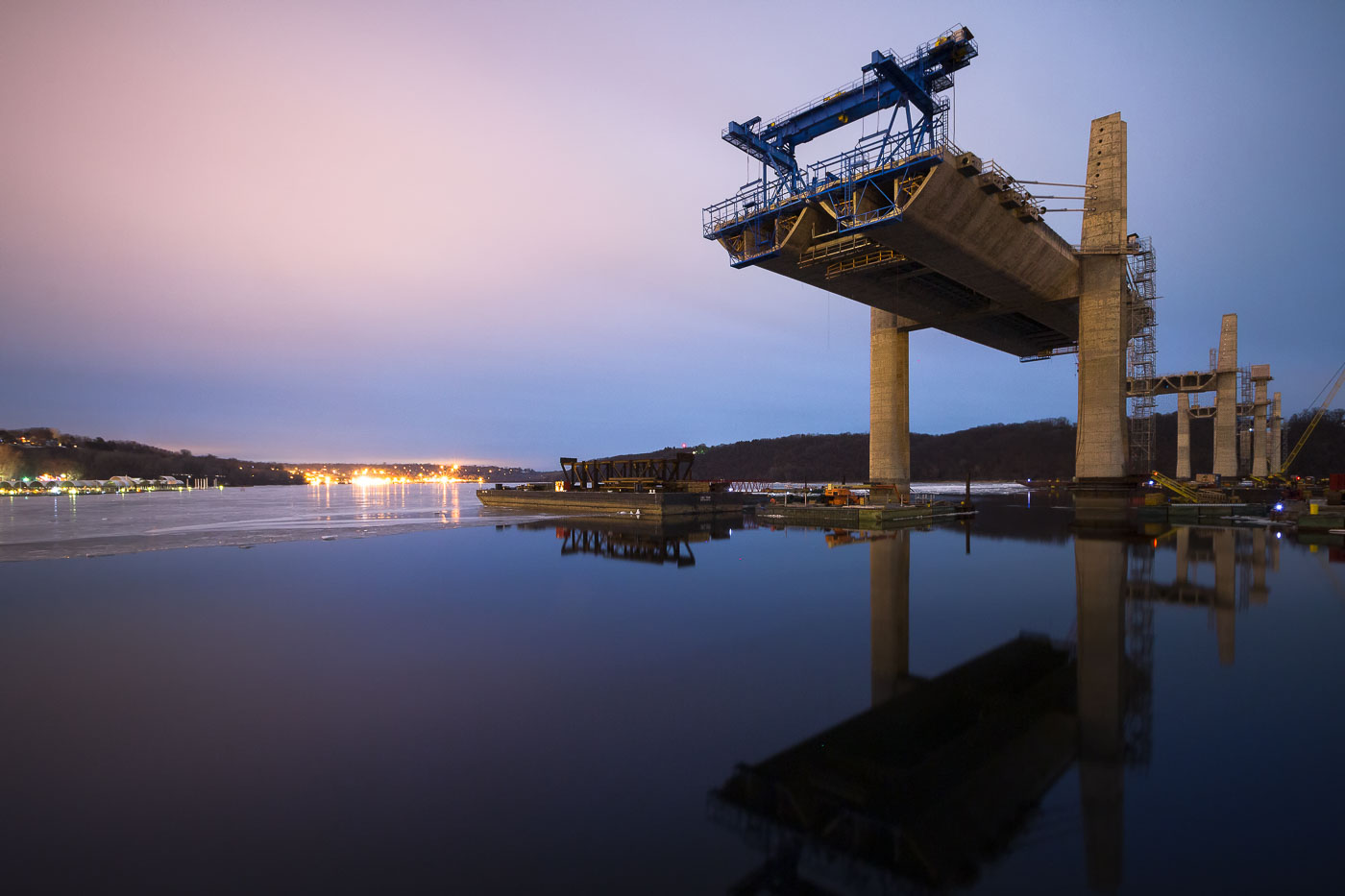
St. Croix Crossing bridge under construction over the St. Croix River in Stillwater, Minnesota.
St. Croix Crossing bridge construction in Stillwater, Minnesota, continues over the St. Croix River. The new span is being built to replace the older Stillwater Lift Bridge as a cross-river transportation link between Minnesota and Wisconsin.

St. Croix Crossing Bridge Under Construction, Stillwater
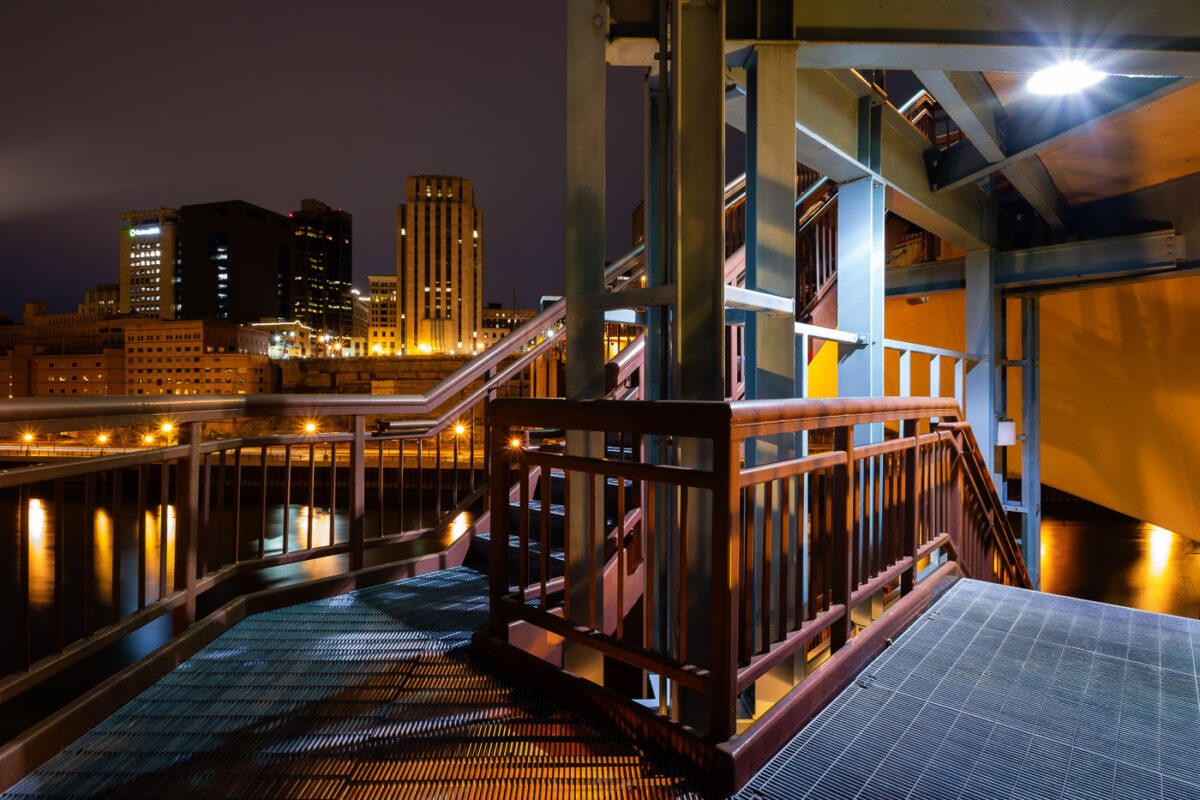
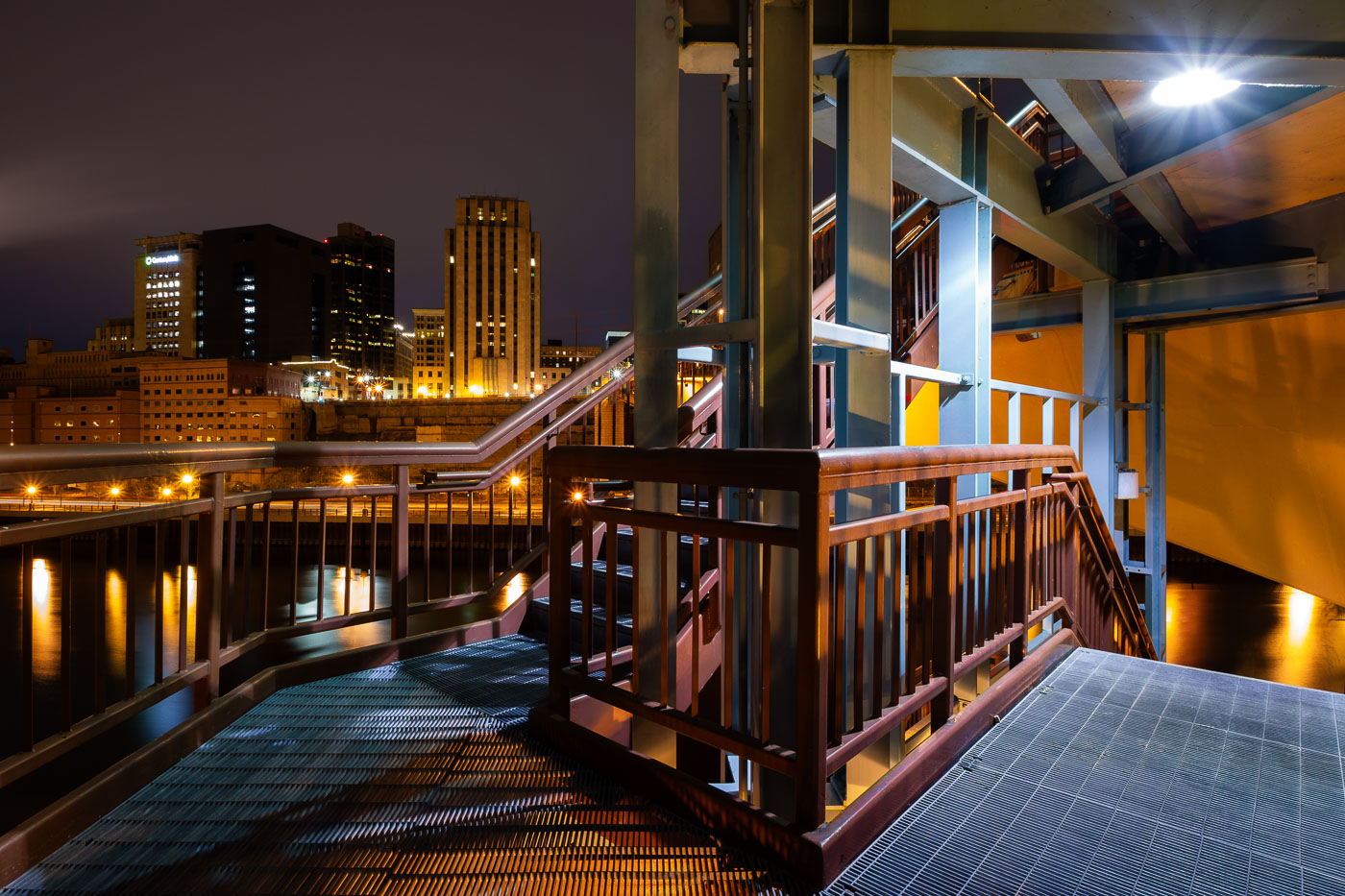
The Wabasha Street Bridge in St. Paul, Minnesota, spans the Mississippi River at night, connecting downtown to the West Side.
The Wabasha Street Bridge in St. Paul, Minnesota, spans the Mississippi River, connecting downtown to the West Side. Originally constructed in 1904, the bridge has undergone several reconstructions and renovations, with the current structure reflecting modern engineering and urban planning. It serves as a vital transportation artery for vehicles and pedestrians, offering views of the city's riverfront and skyline.

Wabasha Street Bridge, St. Paul, Minnesota at Night
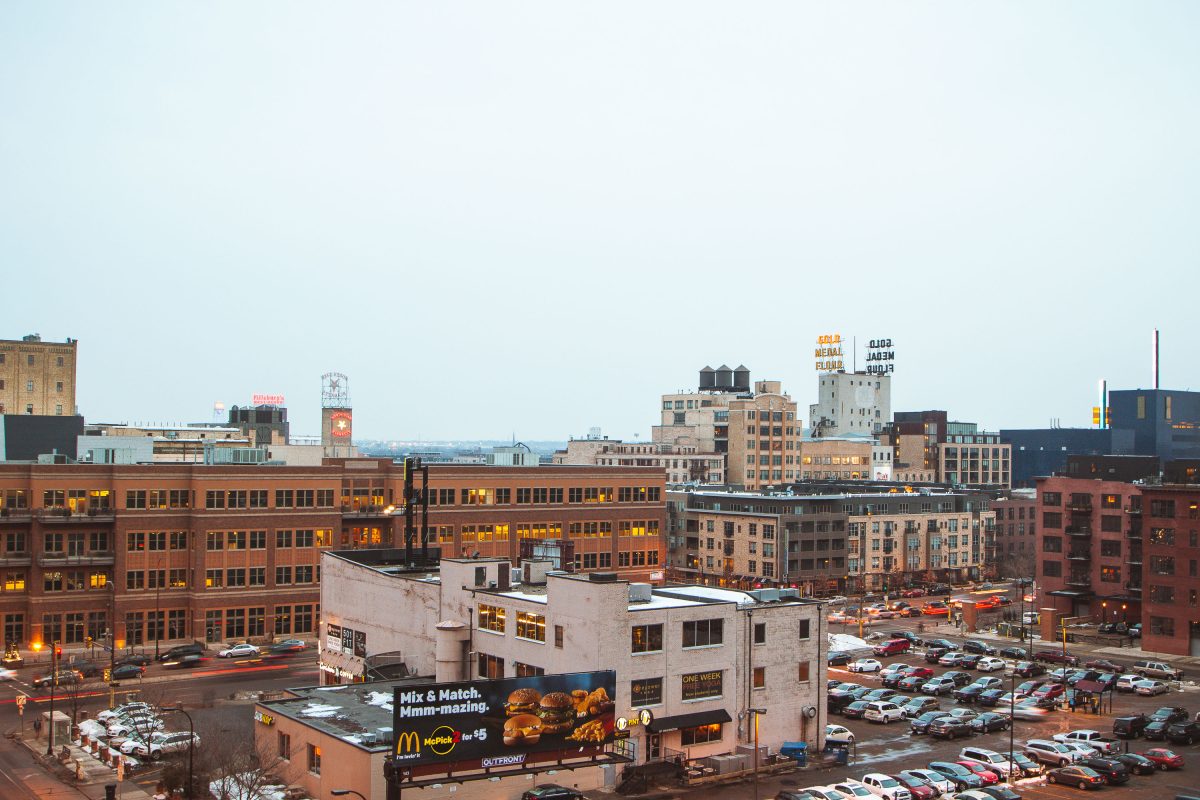
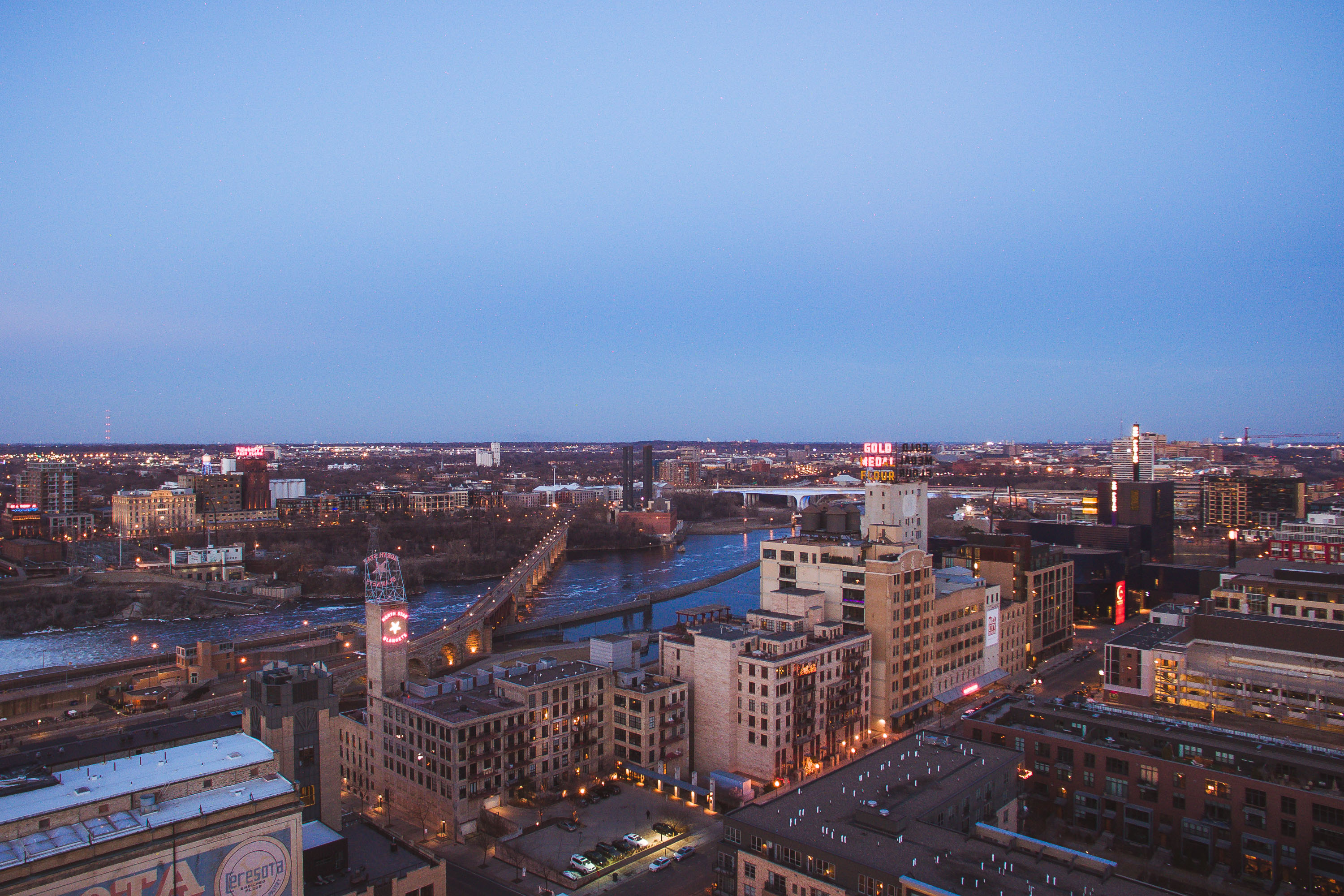
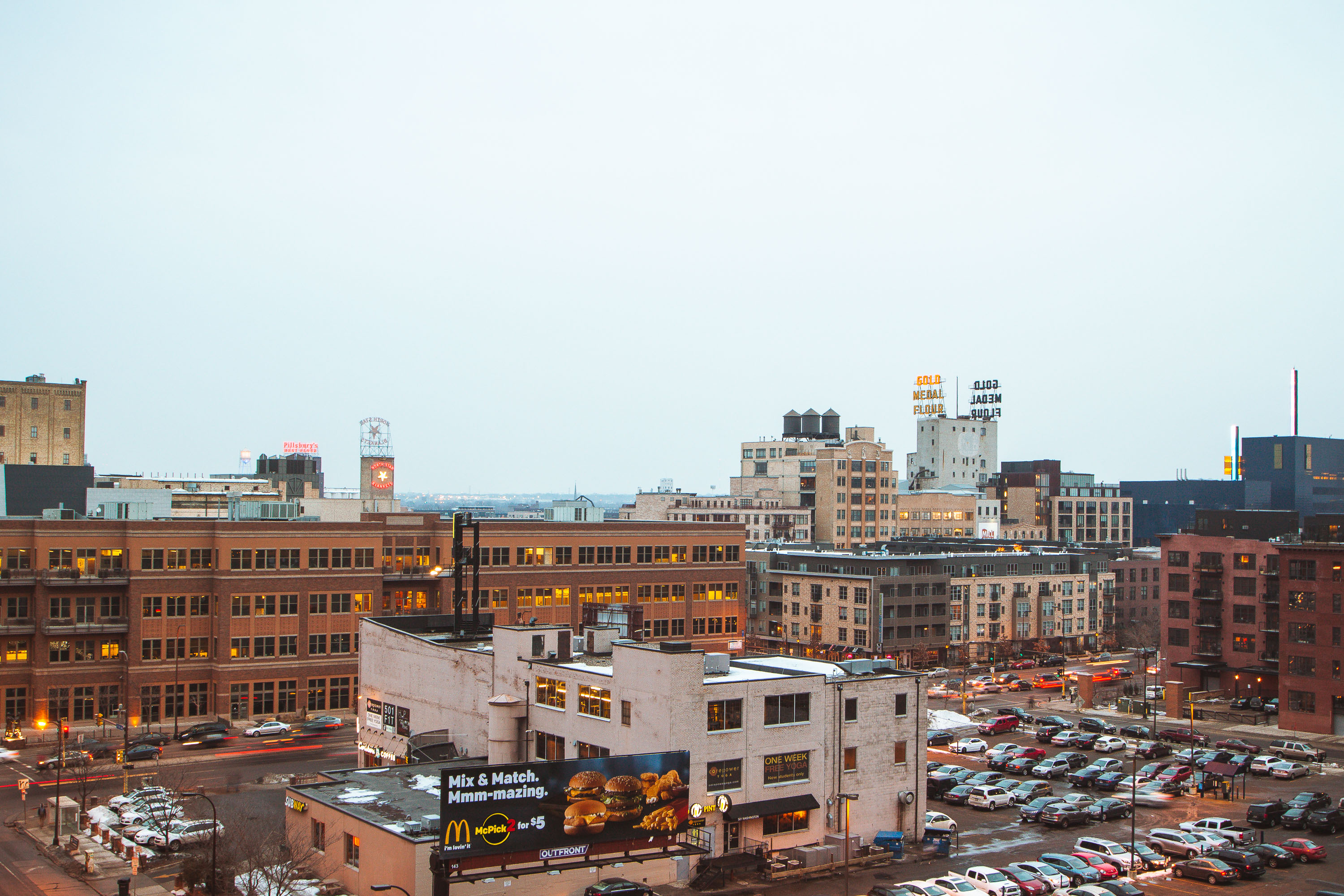
Downtown Minneapolis skyline with historic brick buildings and parking lot along Washington Avenue.
A look at Washington Avenue in Downtown Minneapolis with the old flour mills in the background.

Gold Medal Flour Sign Above Downtown Minneapolis at Dusk
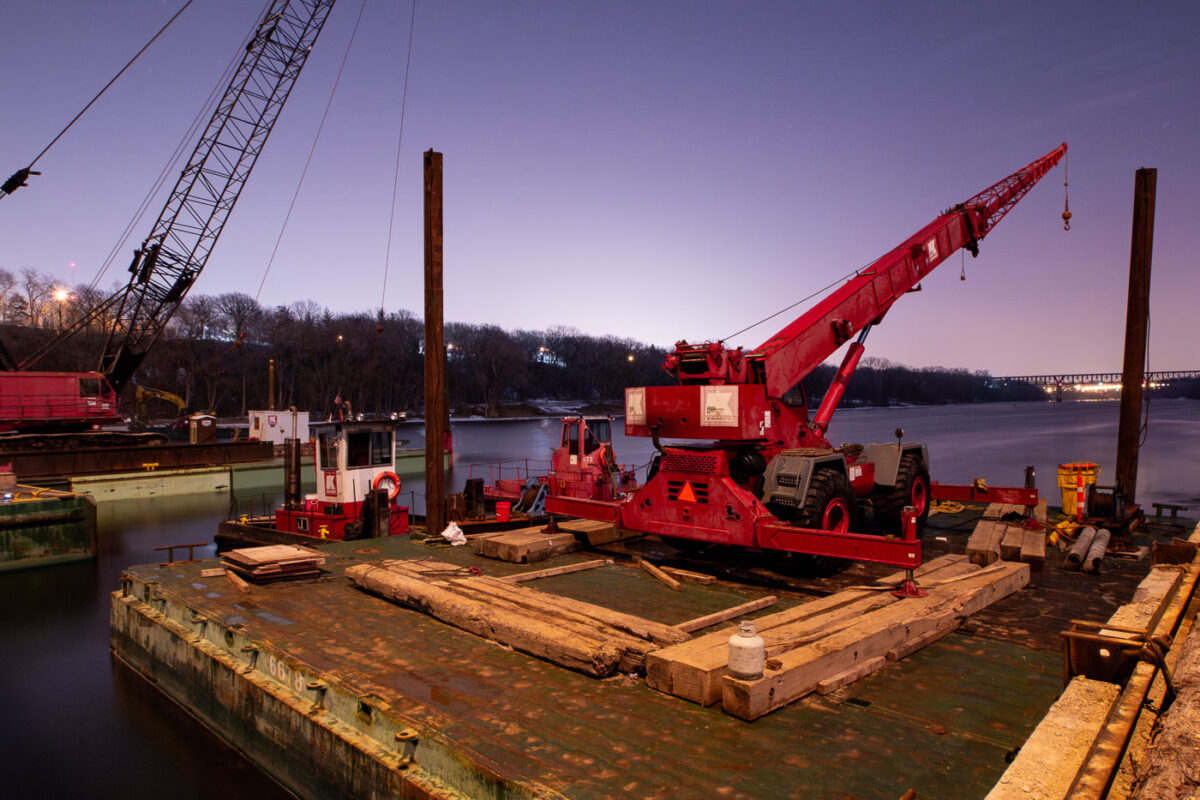
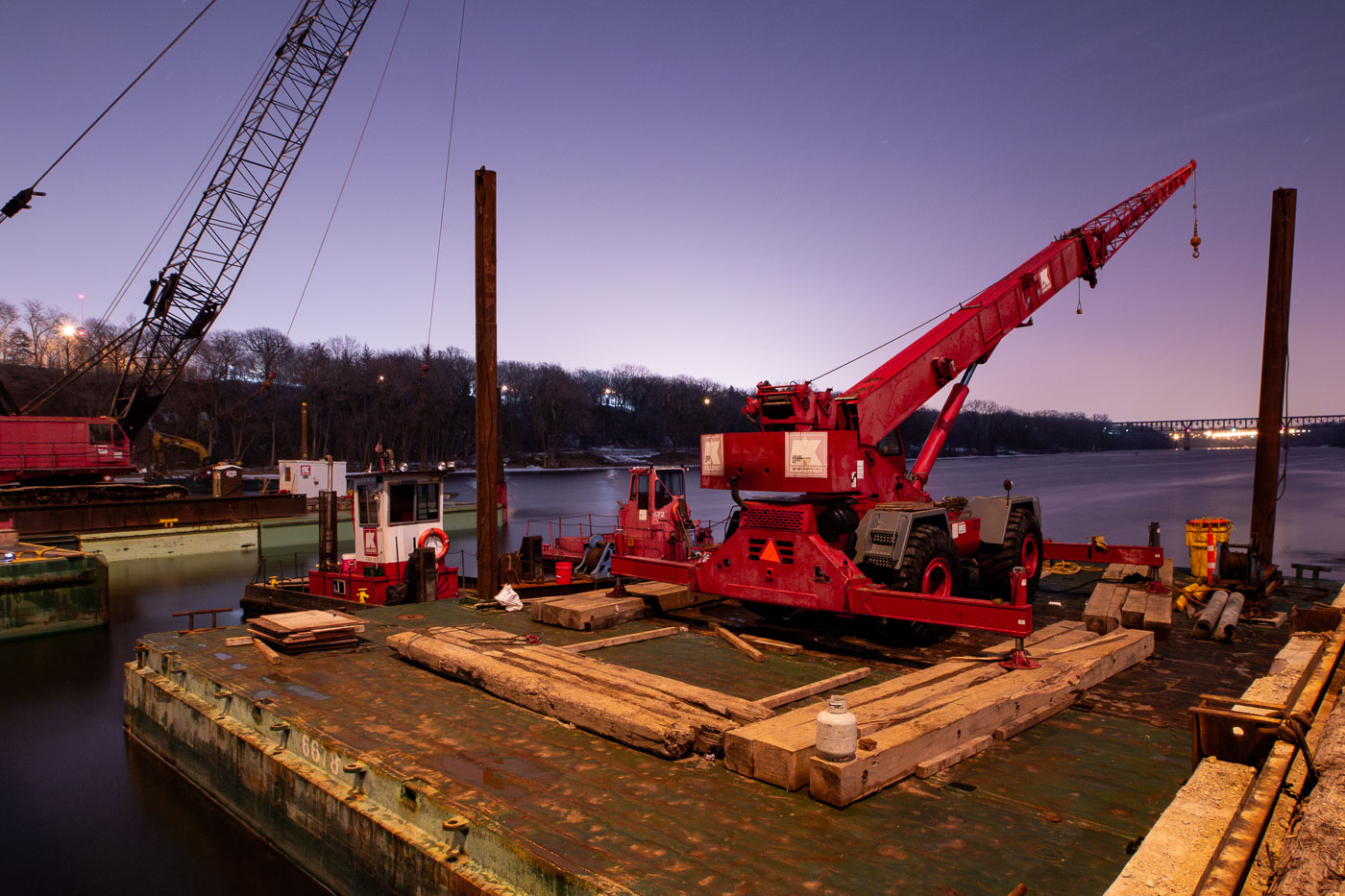
Cranes and barges on the Mississippi River in Minneapolis for repairs to the Franklin Avenue Bridge, a vital transportation link.
Construction barges and cranes are positioned on the Mississippi River for repairs to the Franklin Avenue Bridge in Minneapolis. The Franklin Avenue Bridge, originally constructed in 1923, is a vital artery connecting the city's south and north sides. Its ongoing maintenance and repair are essential for maintaining transportation flow and ensuring the structural integrity of this significant piece of Minneapolis infrastructure.

Franklin Ave Bridge Construction, Minneapolis
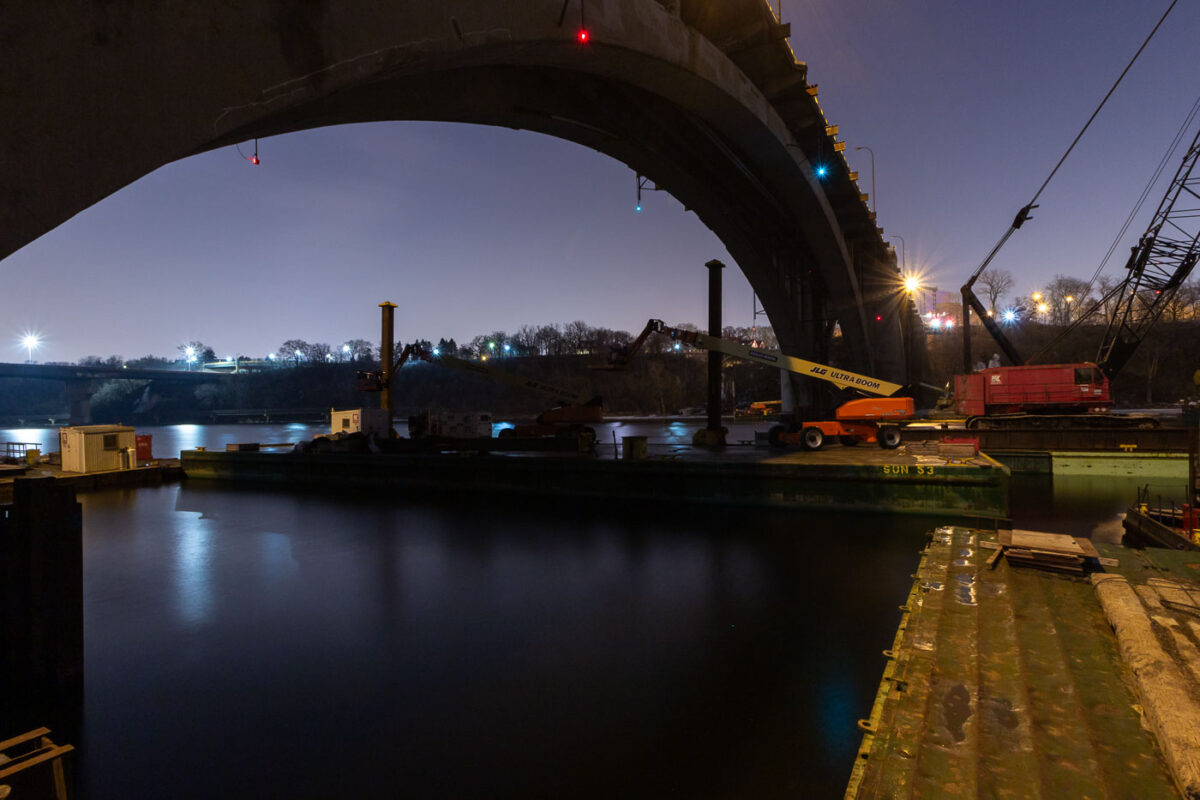
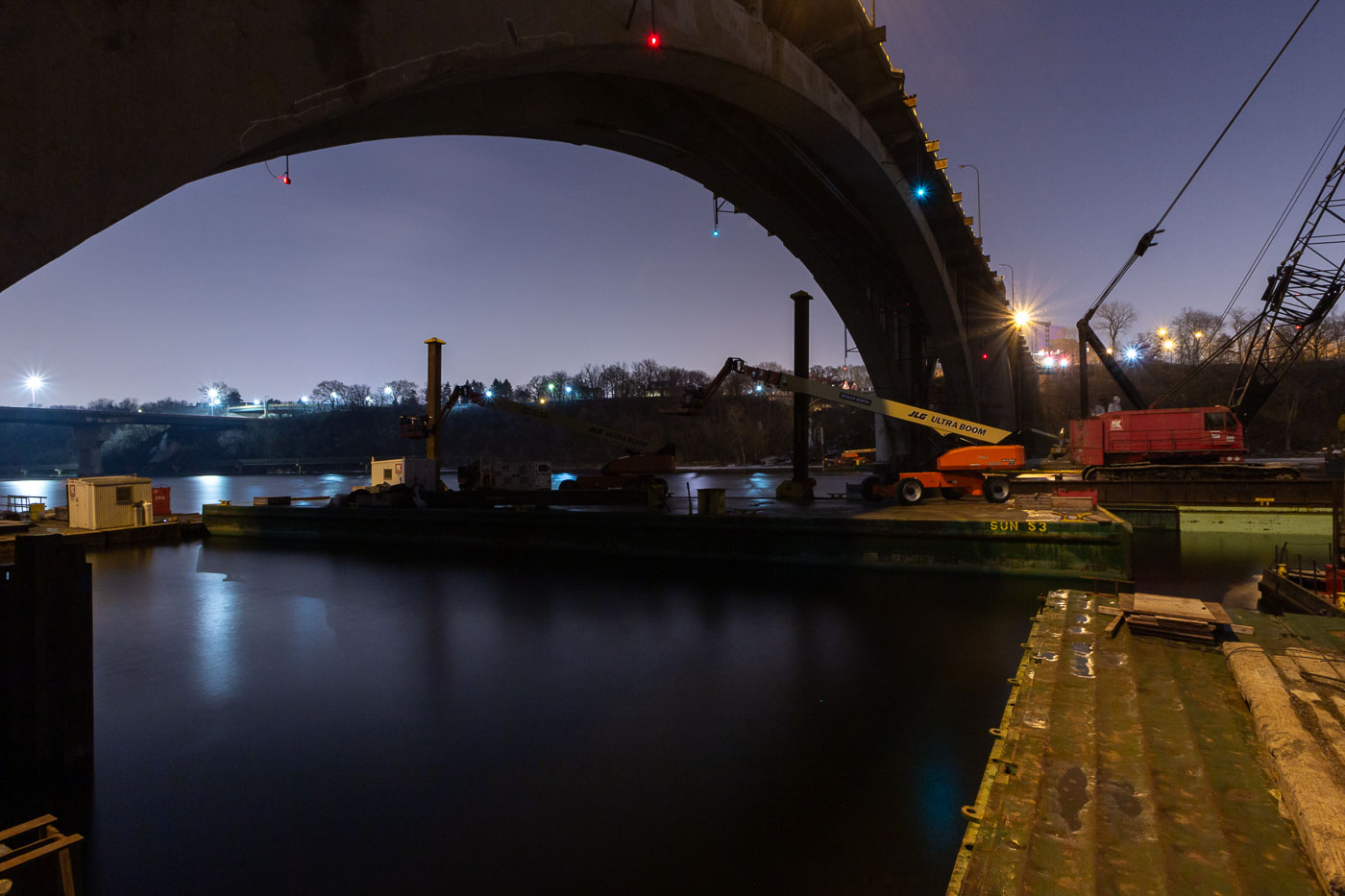
Nighttime construction work on the Franklin Avenue Bridge over the Mississippi River in Minneapolis, with cranes and equipment on barges.
Construction work is underway at night on the Franklin Avenue Bridge in Minneapolis, spanning the Mississippi River. The bridge, originally constructed in the 1920s, has undergone numerous repairs and upgrades throughout its history to maintain its structural integrity and capacity for traffic. This nighttime operation highlights the ongoing efforts to preserve this vital piece of Minneapolis infrastructure, ensuring its continued service to the city.

Franklin Avenue Bridge Construction Work at Night, Minneapolis

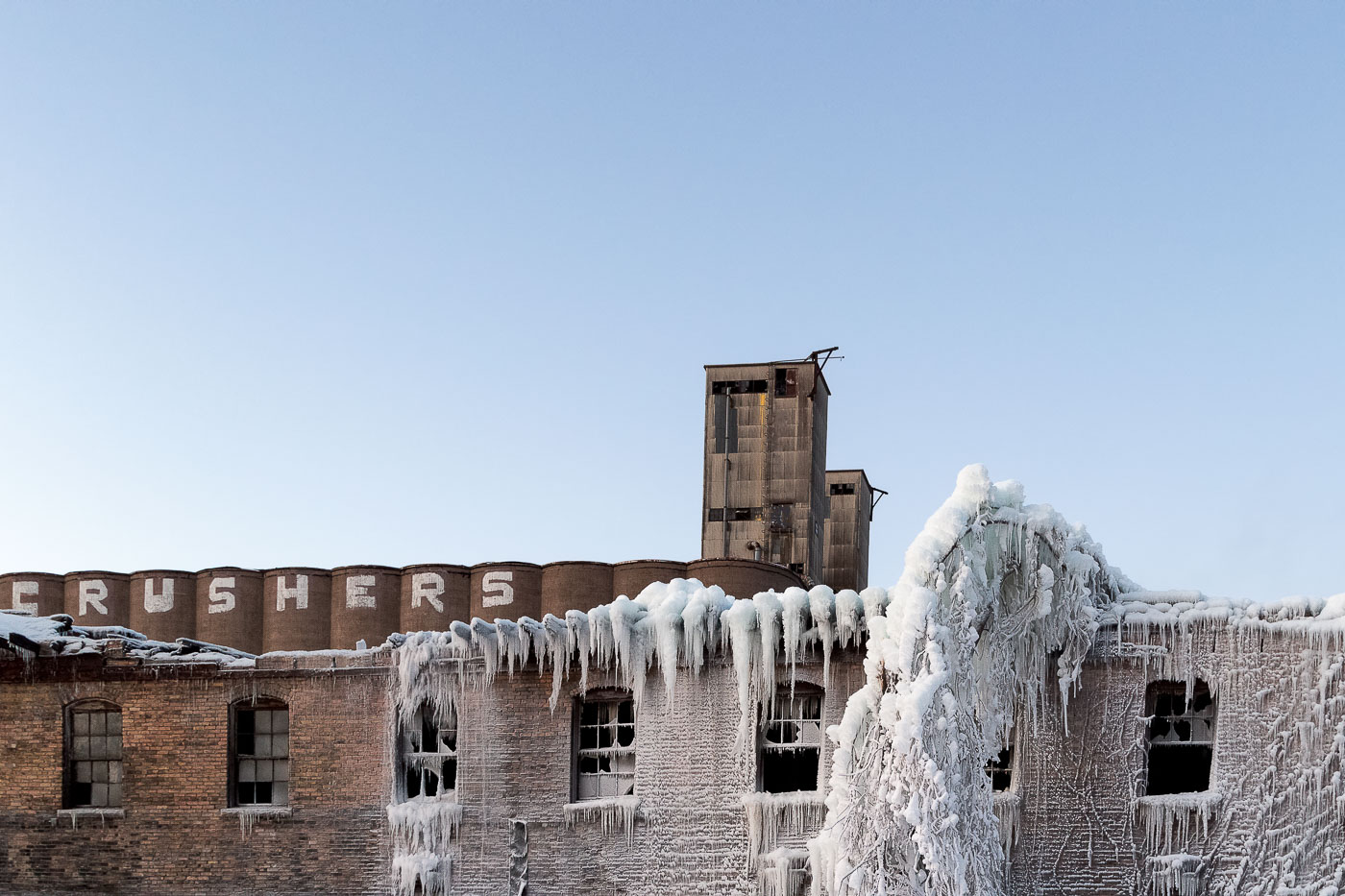
The ADM Grain Elevator and Harris Machinery buildings in Minneapolis's Prospect Park show fire damage and ice accumulation. The ADM silos are marked "CRUSHERS".
The ADM Grain Elevator and Harris Machinery buildings in Prospect Park, Minneapolis, show extensive ice and snow accumulation following a significant fire. The fire gutted the interior of the Harris Machinery structure, leaving its exterior heavily damaged and encased in ice.

ADM Grain Elevator and Harris Machinery Fire Damage, Prospect Park, Minneapolis
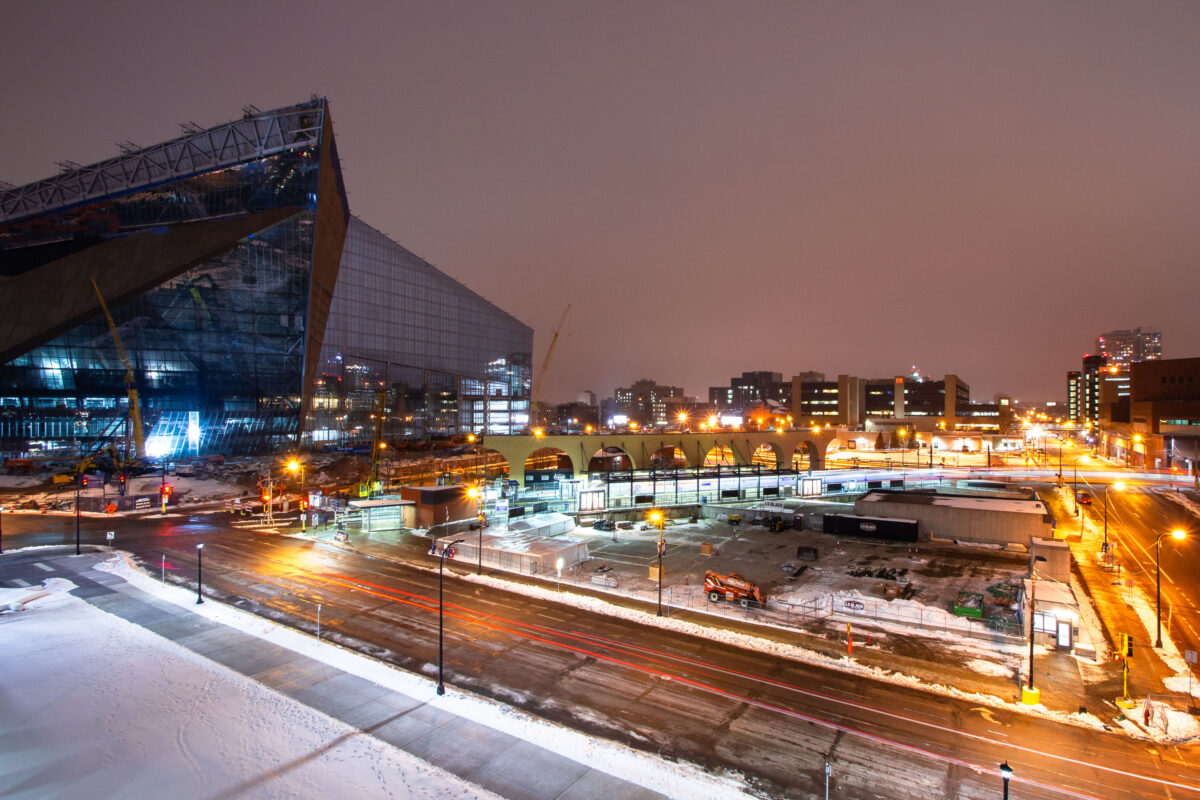
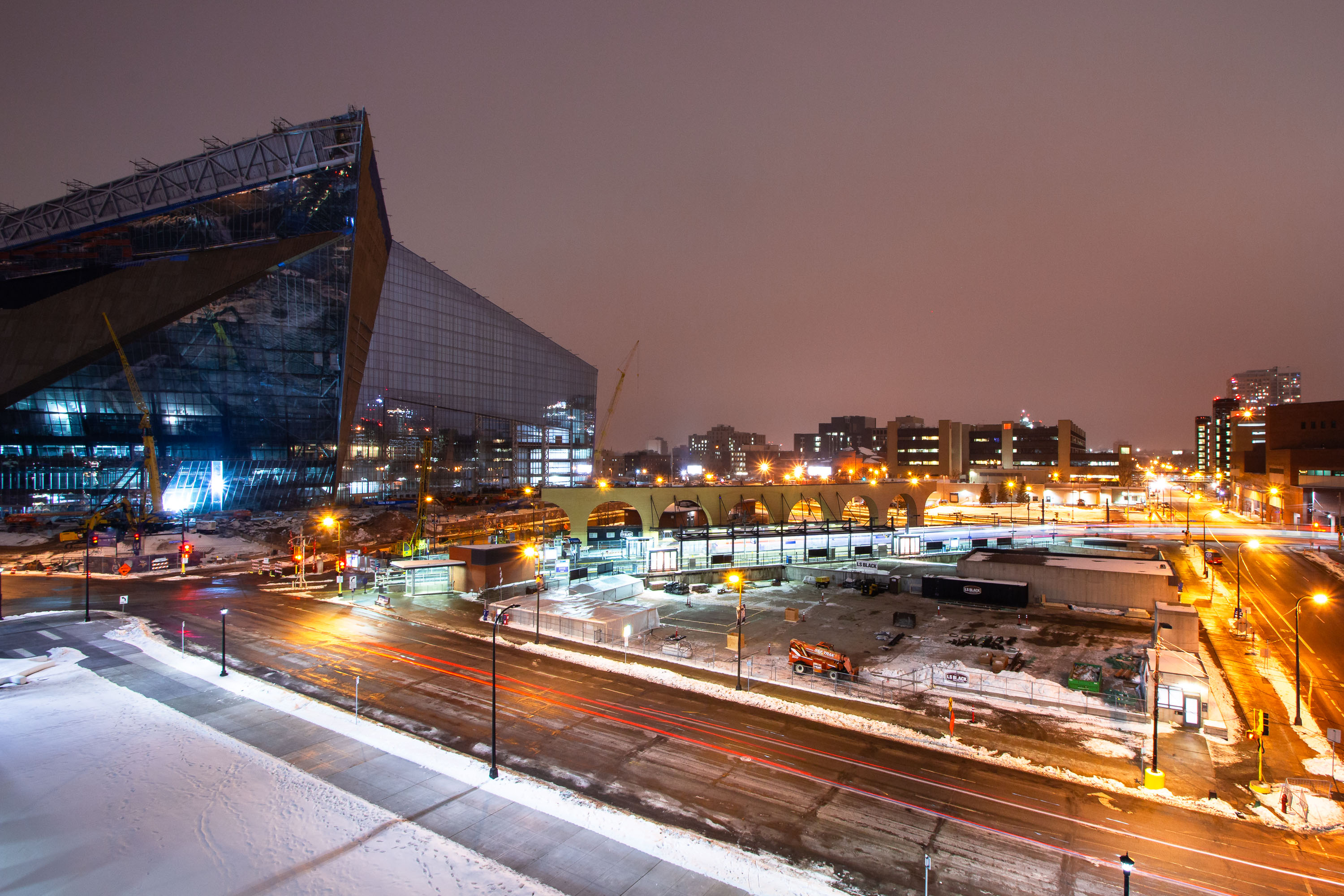
US Bank Stadium construction site in downtown Minneapolis at dusk with illuminated cranes, surrounding buildings, and active roadways.
US Bank Stadium under construction in Downtown Minneapolis in January 2016.

Snowy Night Over US Bank Stadium and Downtown East

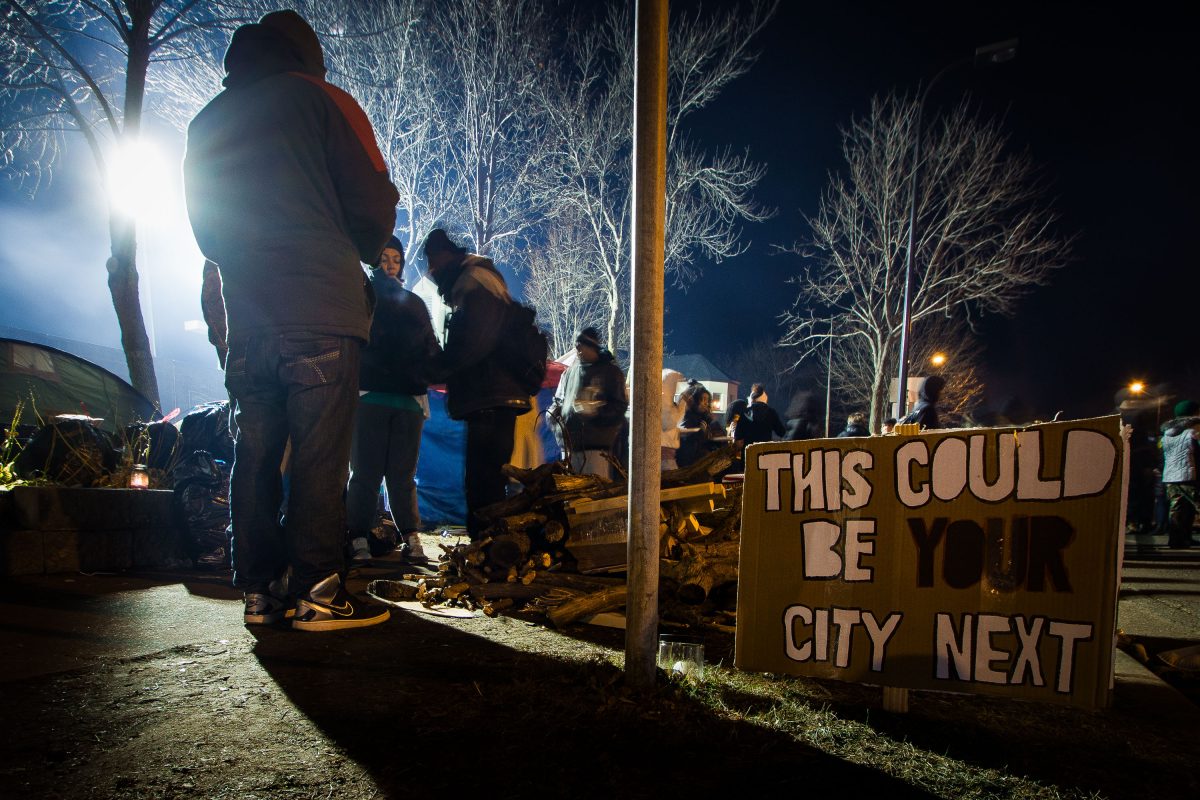
Protesters gather at night outside Minneapolis Police 4th Precinct station during Jamar Clark demonstration.
Protest at the Minneapolis Police 4th Precinct Police Station following the Minneapolis Police killing of Jamar Clark.

“This Could Be Your City Next” Sign at the Jamar Clark Vigil

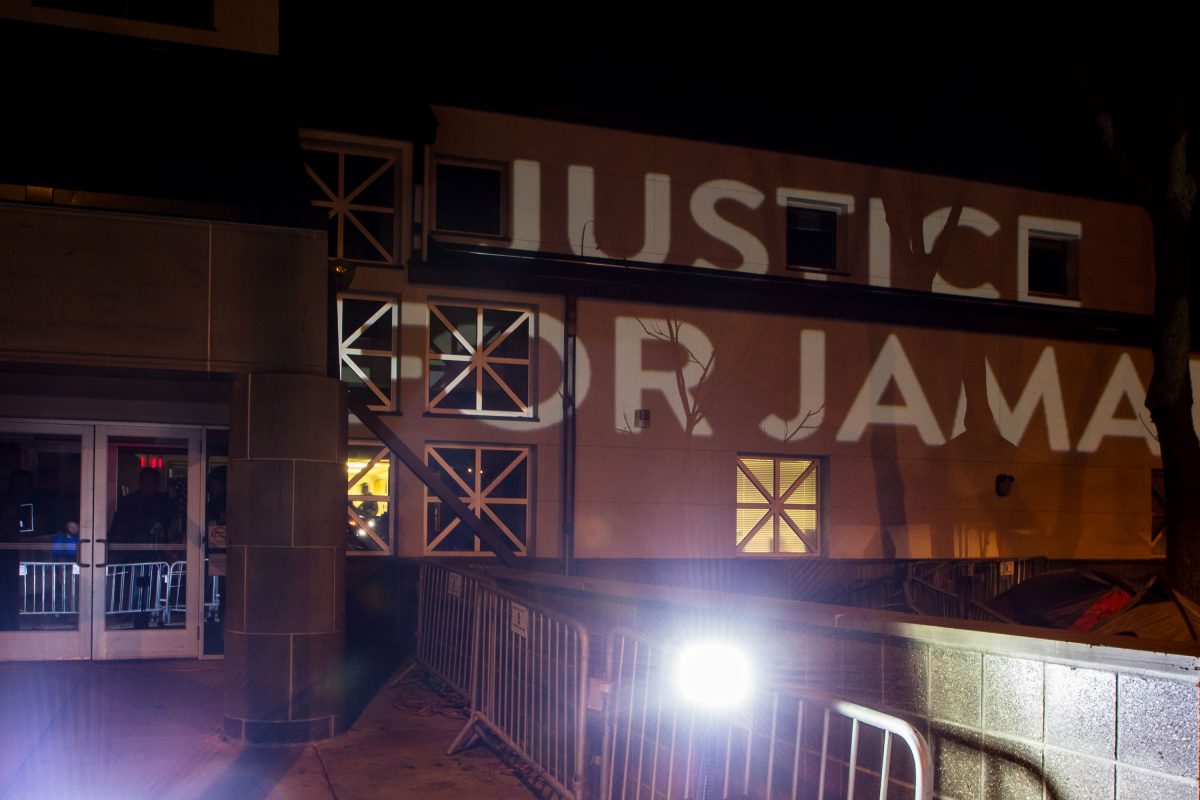
"Justice for Jamar" text projected onto the Minneapolis Police 4th Precinct building at night.
Protest at the Minneapolis Police 4th Precinct Police Station following the Minneapolis Police killing of Jamar Clark.

“Justice for Jamar” Projected on the 4th Precinct at Night

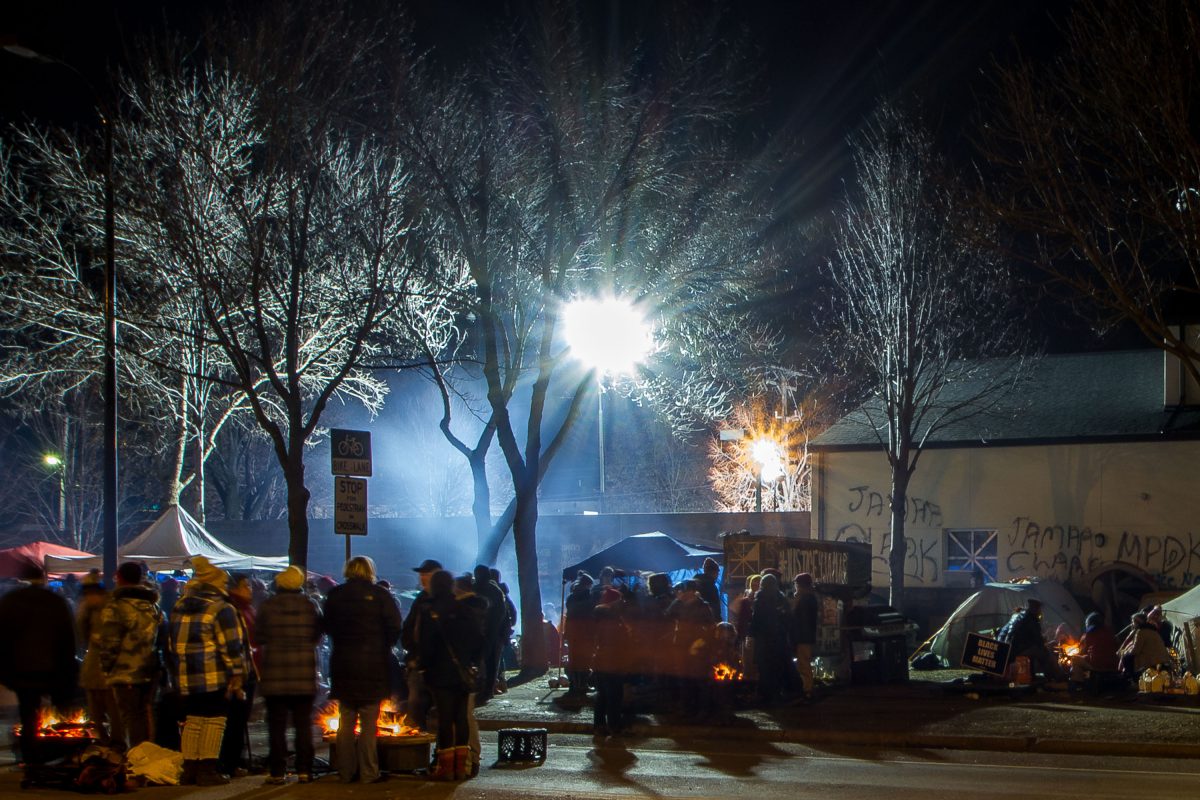
Protesters gather around fires at night outside the Minneapolis Police 4th Precinct station.
Protest at the Minneapolis Police 4th Precinct Police Station following the Minneapolis Police killing of Jamar Clark.

Night Vigil Outside the 4th Precinct During the Jamar Clark Protests

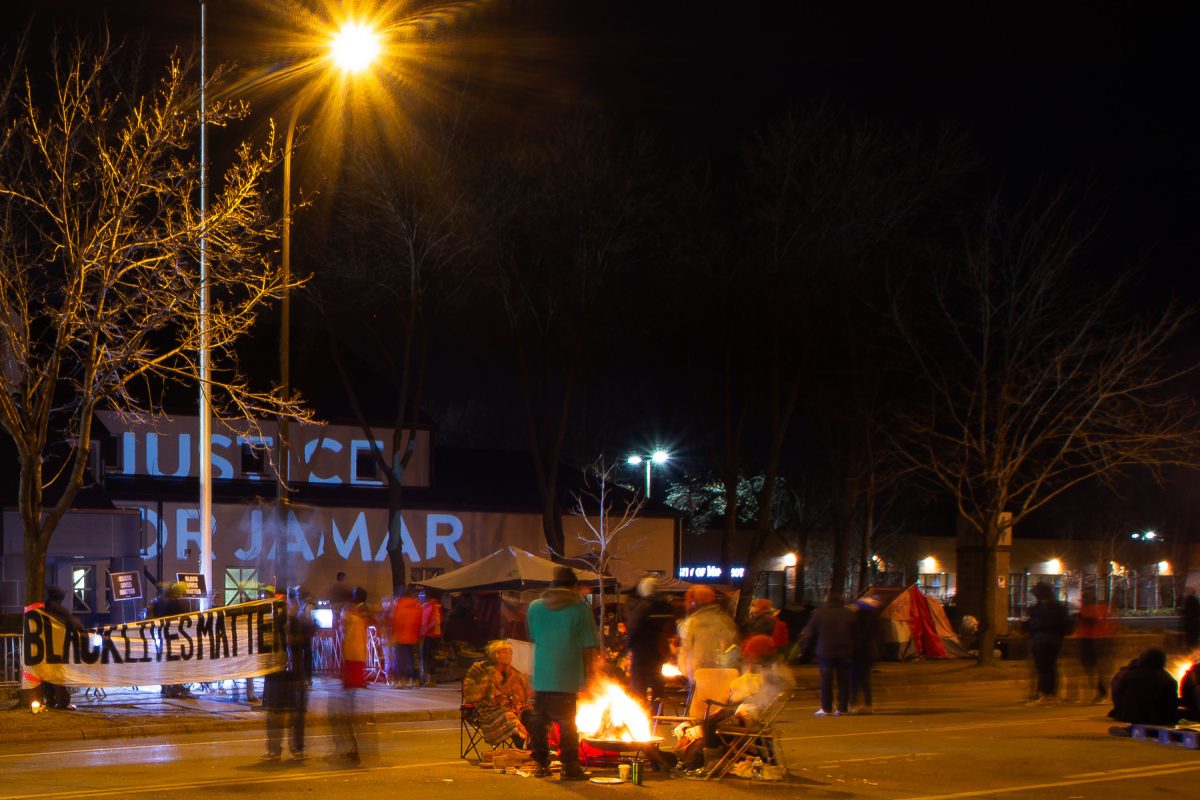
Nighttime protest at Minneapolis Police 4th Precinct with demonstrators gathered around a bonfire and Black Lives Matter signage.
Protest at the Minneapolis Police 4th Precinct Police Station following the Minneapolis Police killing of Jamar Clark.

Night Encampment at the Jamar Clark Protest Site

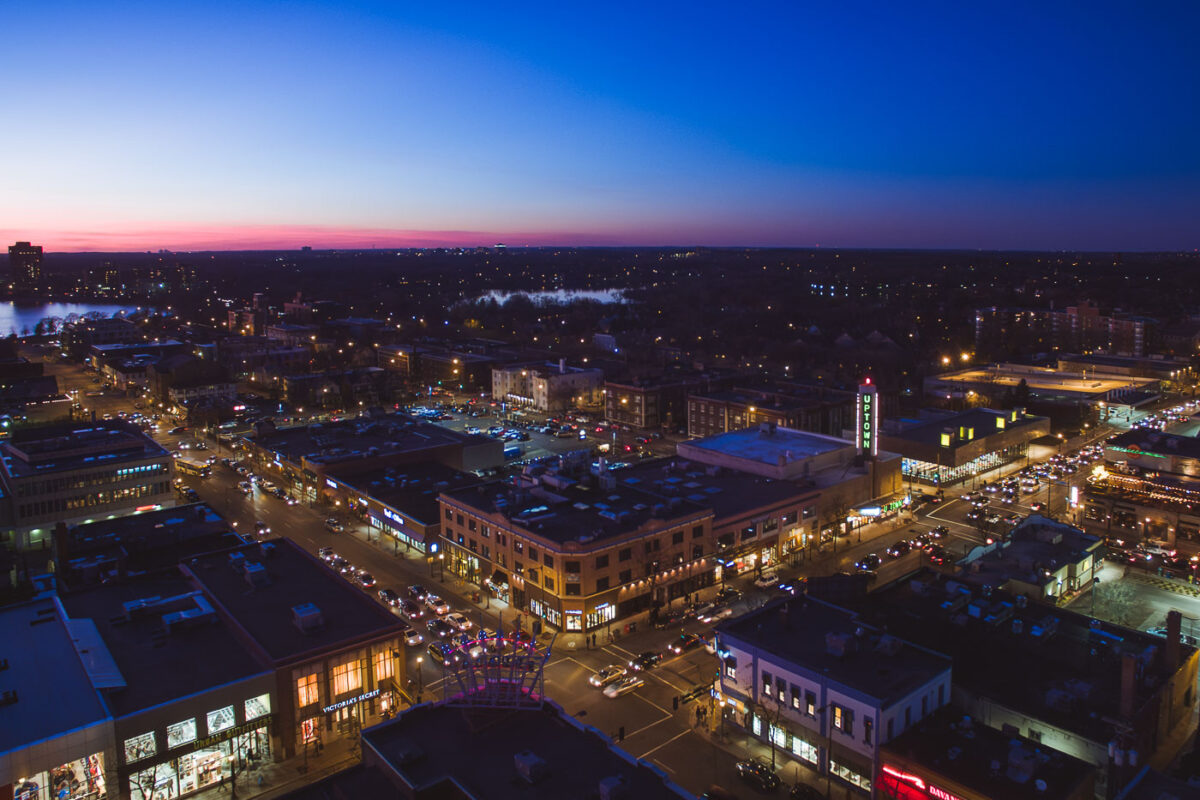
Aerial view of the Hennepin Avenue and Lake Street intersection in Uptown Minneapolis at dusk, with the illuminated Uptown Theater visible.
An aerial photo of the intersection of Hennepin Avenue and Lake Street in Uptown Minneapolis as seen in 2015.

Aerial View of Uptown Minneapolis at Twilight

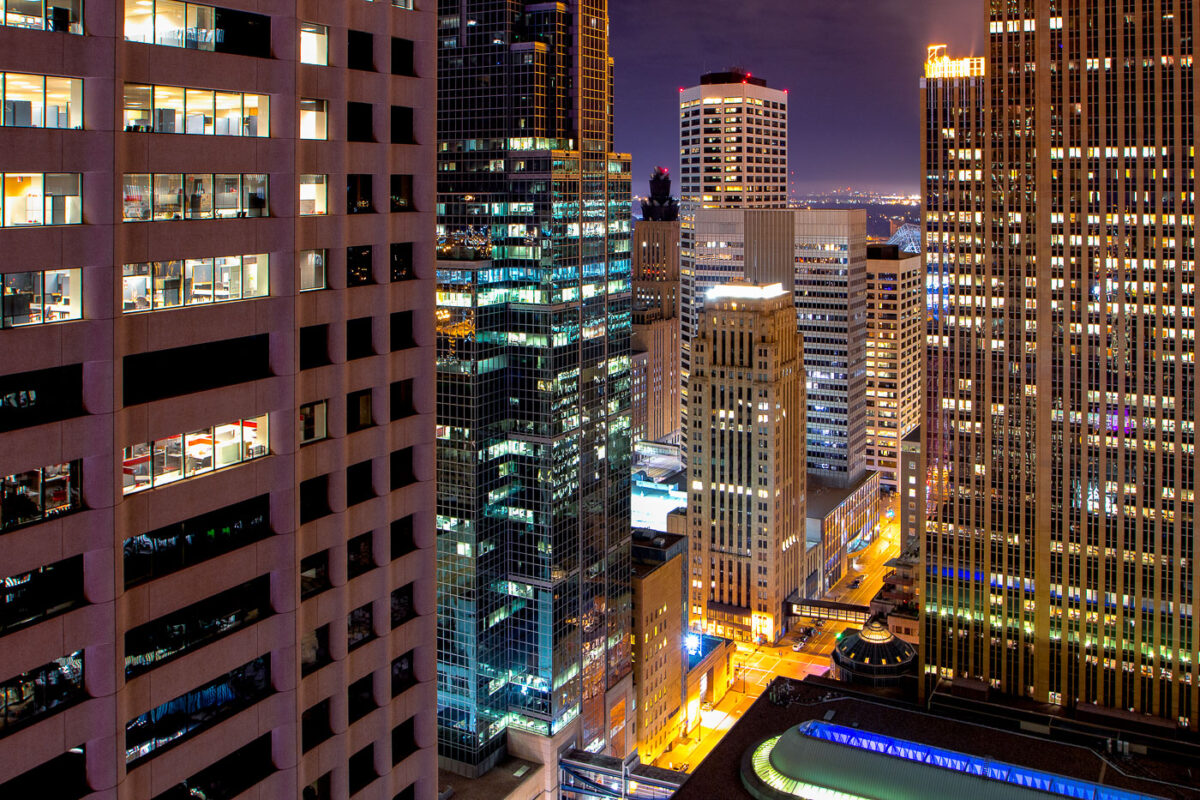
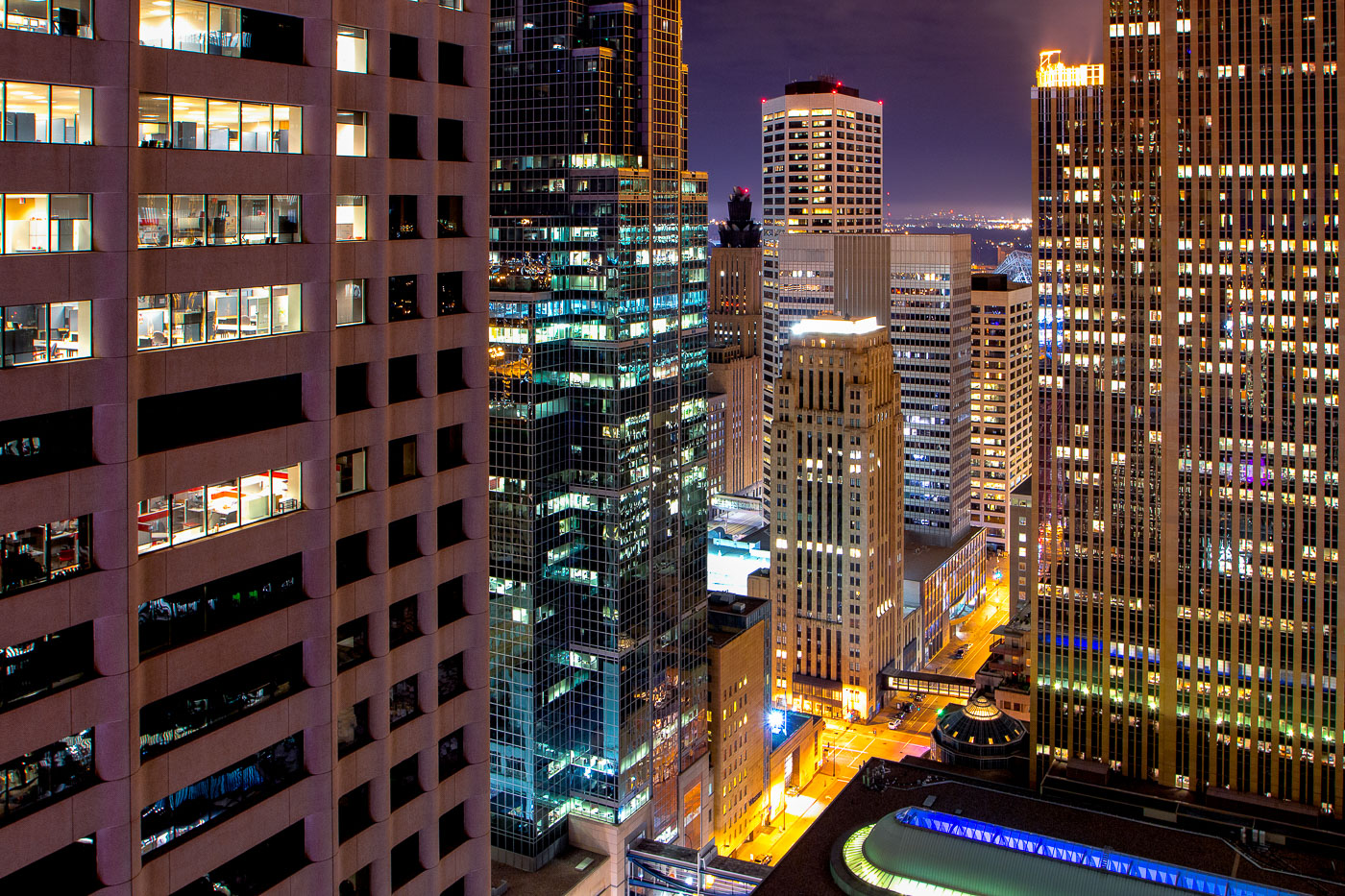
Downtown Minneapolis skyscrapers lit at night.
The core of Downtown Minneapolis is illuminated at night, showcasing a collection of office buildings and architectural styles. These structures represent the city's commercial and financial hub, with many dating back to the mid-20th century and later. The lights indicate ongoing activity within these business centers, reflecting their continued use for commerce and employment. This view highlights the density and verticality of the urban environment, characteristic of major American cities.

Downtown Minneapolis Buildings at Night

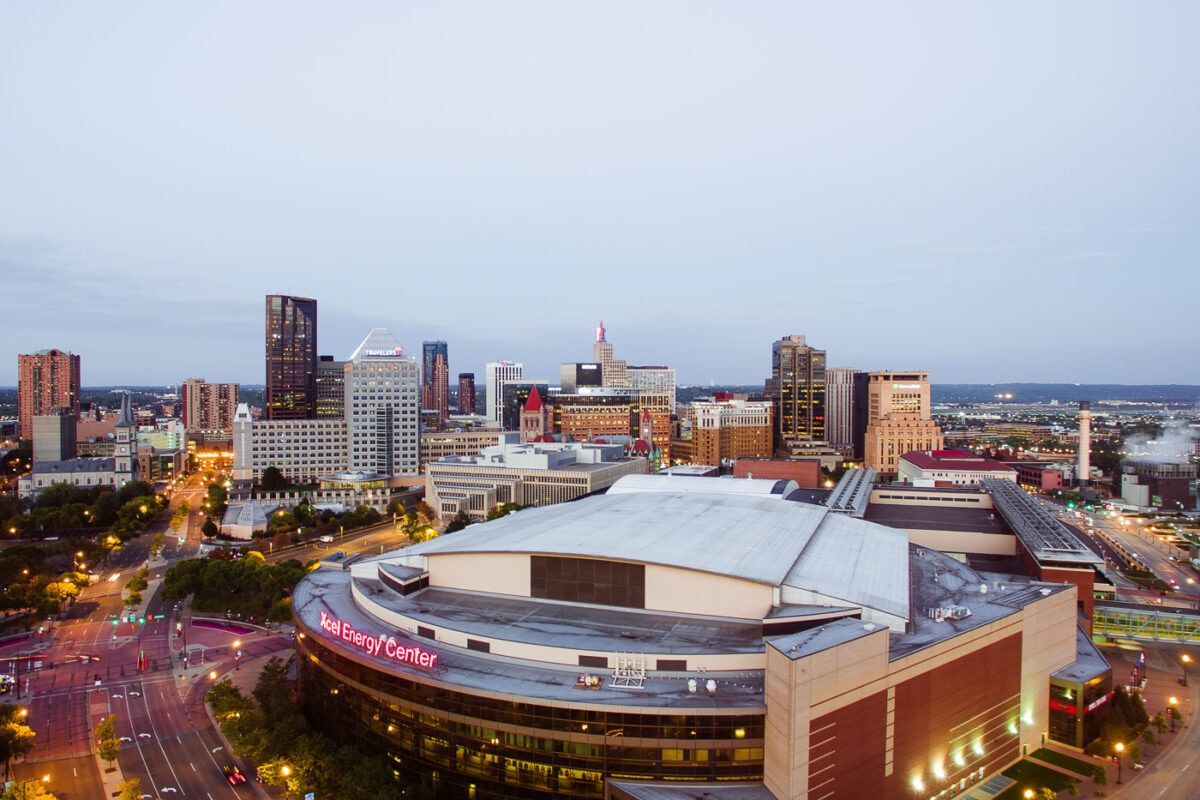
Xcel Energy Center in downtown St. Paul, Minnesota, home of the Minnesota Wild.
Xcel Energy Center in downtown St. Paul, Minnesota, opened in 2000 as a multi-purpose arena. It is the home arena of the NHL’s Minnesota Wild. The venue is also used for concerts, basketball, and other large events.

Xcel Energy Center, Downtown St. Paul

US Bank Stadium's white steel framework and red construction cranes rise above downtown Minneapolis during daytime construction.
US Bank Stadium replaced the Hubert H. Humphrey Metrodome on the same downtown Minneapolis site, opening in 2016 as the home of the Minnesota Vikings. The $1.1 billion project, designed by HKS Inc. and built by Mortenson Construction, seats about 66,000 for football and can expand to roughly 73,000 for events like the Super Bowl, which it hosted in 2018.

Aerial View of US Bank Stadium Taking Shape Above Downtown East

US Bank Stadium under construction in downtown Minneapolis with yellow cranes and steel framework visible among surrounding office buildings.
US Bank Stadium replaced the Hubert H. Humphrey Metrodome as the home of the Minnesota Vikings, rising on the same Downtown East site the Metrodome had occupied since 1982. Construction ran from 2013 to 2016 at a cost of roughly $1.1 billion, funded through a mix of state, city, and team contributions.

Aerial View of US Bank Stadium Rising Over Downtown East

Capella Tower in downtown Minneapolis with surrounding skyscrapers under a blue sky
The Capella Tower, completed in 1992, stands as a prominent skyscraper in downtown Minneapolis. Adjacent to it is the Hennepin County Government Center, a Brutalist structure designed by architect Gunnar Birkerts and completed in 1974. The Government Center houses various county administrative offices and courtrooms, serving as a central hub for local governance. Capella Tower, formerly known as First Bank Place, is a mixed-use building containing office spaces and retail establishments, contributing to the commercial vitality of the city's central business district.

Capella Tower and Hennepin County Government Center, Minneapolis

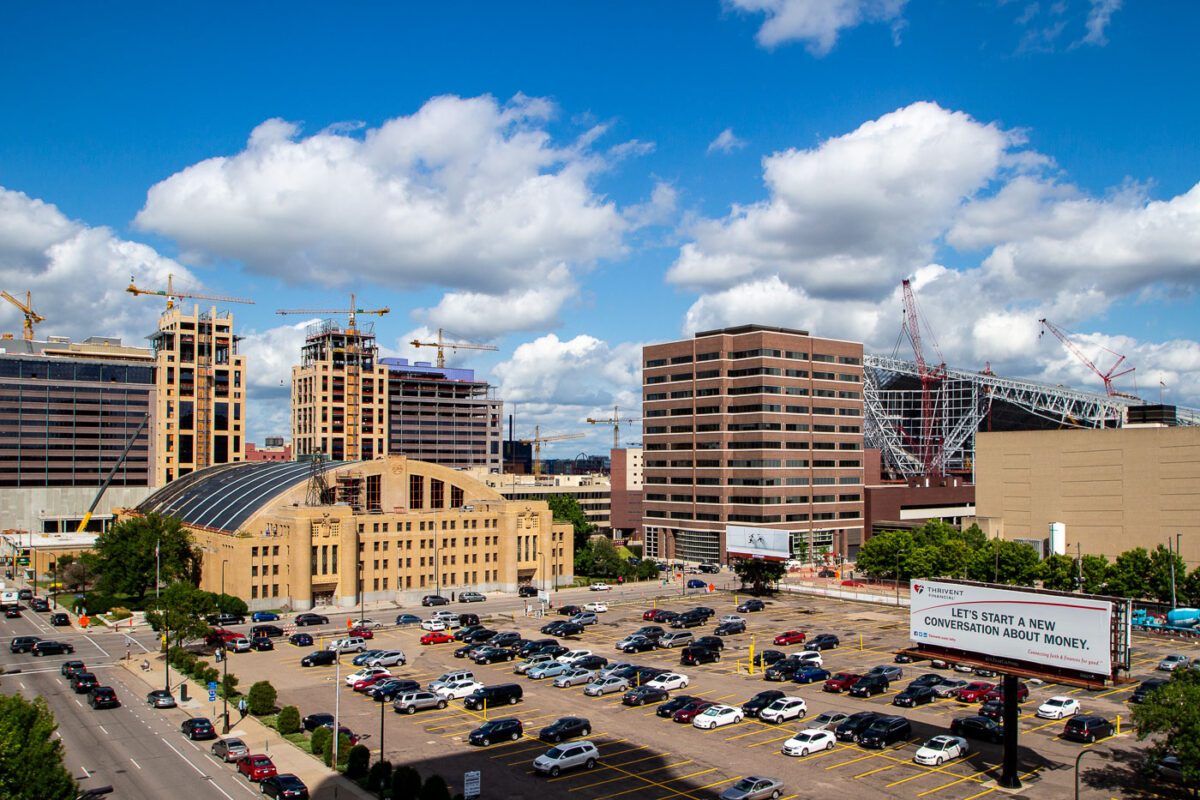
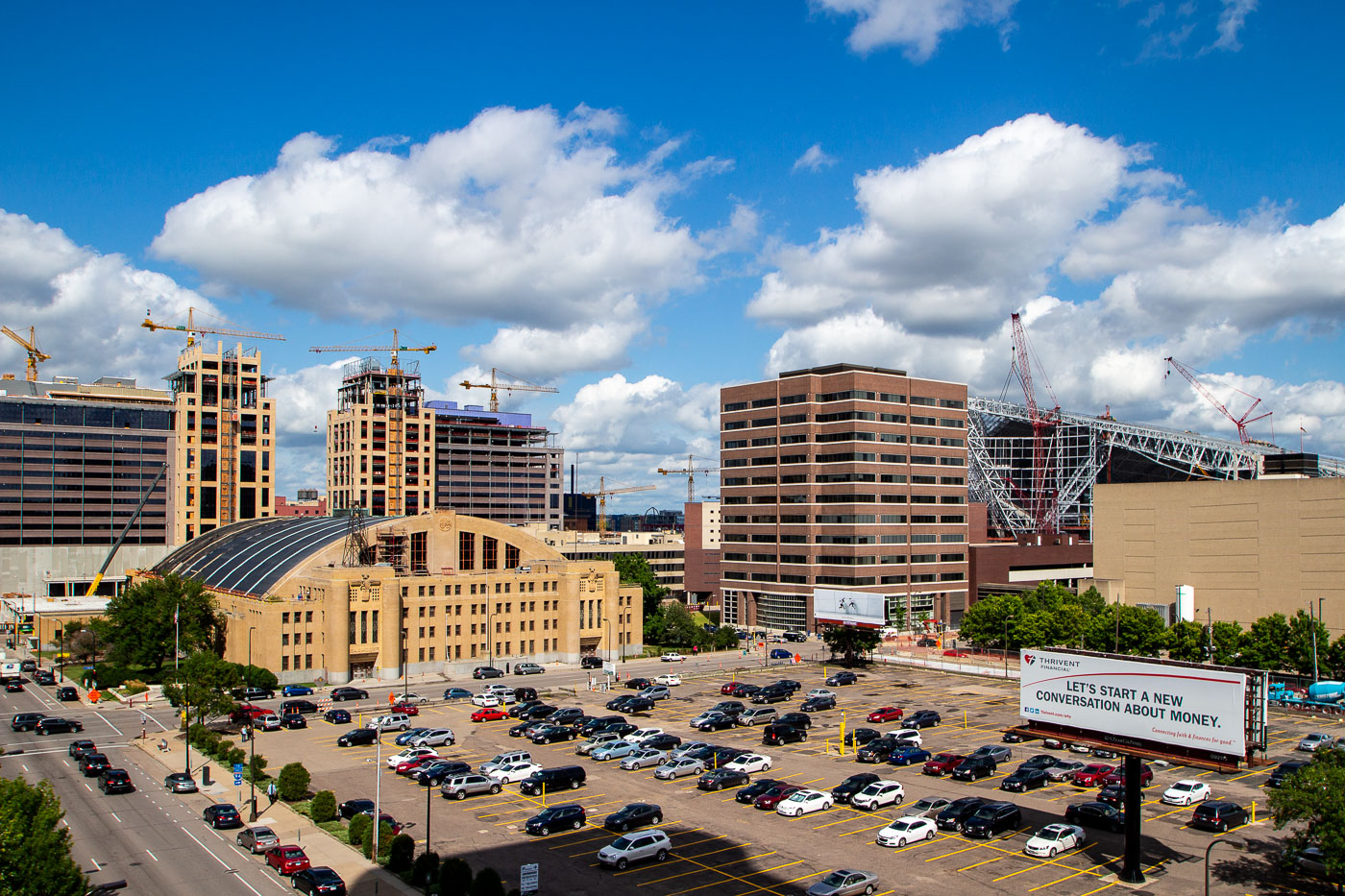
US Bank Stadium construction site in downtown Minneapolis with active cranes and surrounding office buildings during 2015.
Construction cranes dominate the Minneapolis skyline in the Downtown East neighborhood during 2015. With construction occurring on the 1.1 billion dollar US Bank Stadium, replacing the Metrodome.

The Armory and Parking Lots Beneath Rising Downtown East Towers

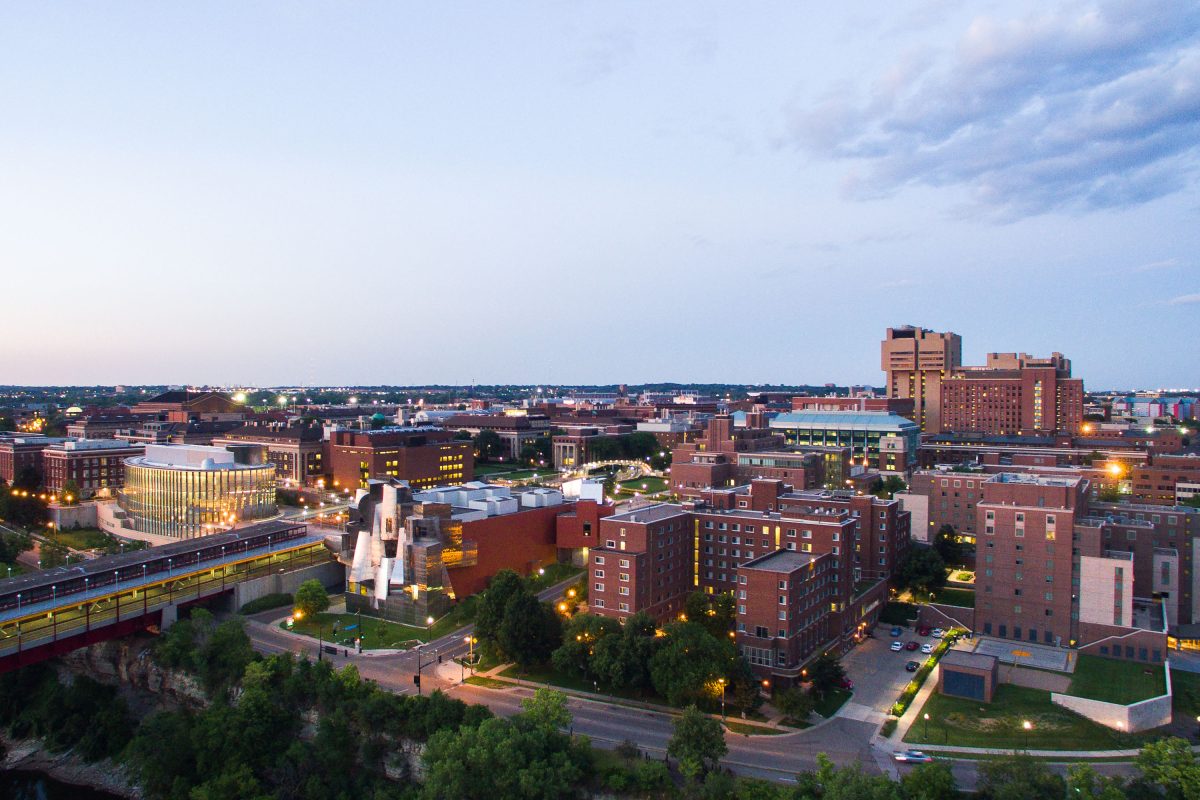
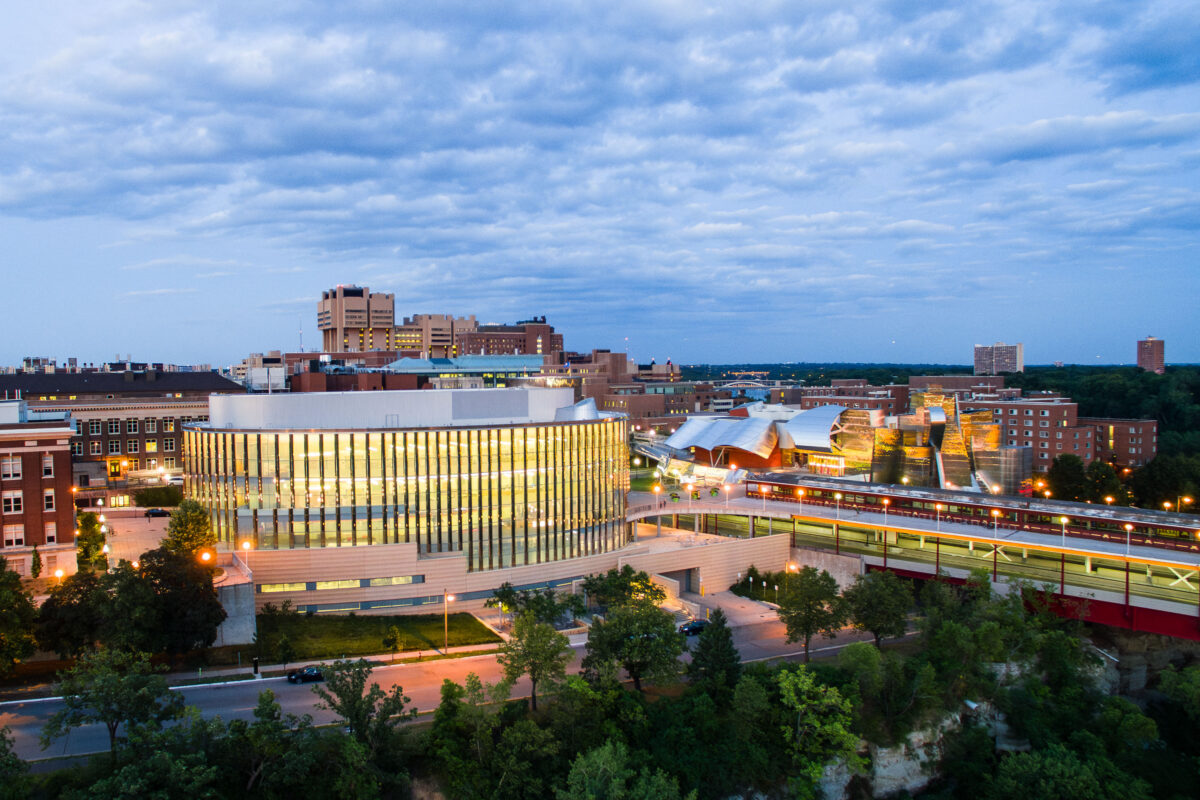
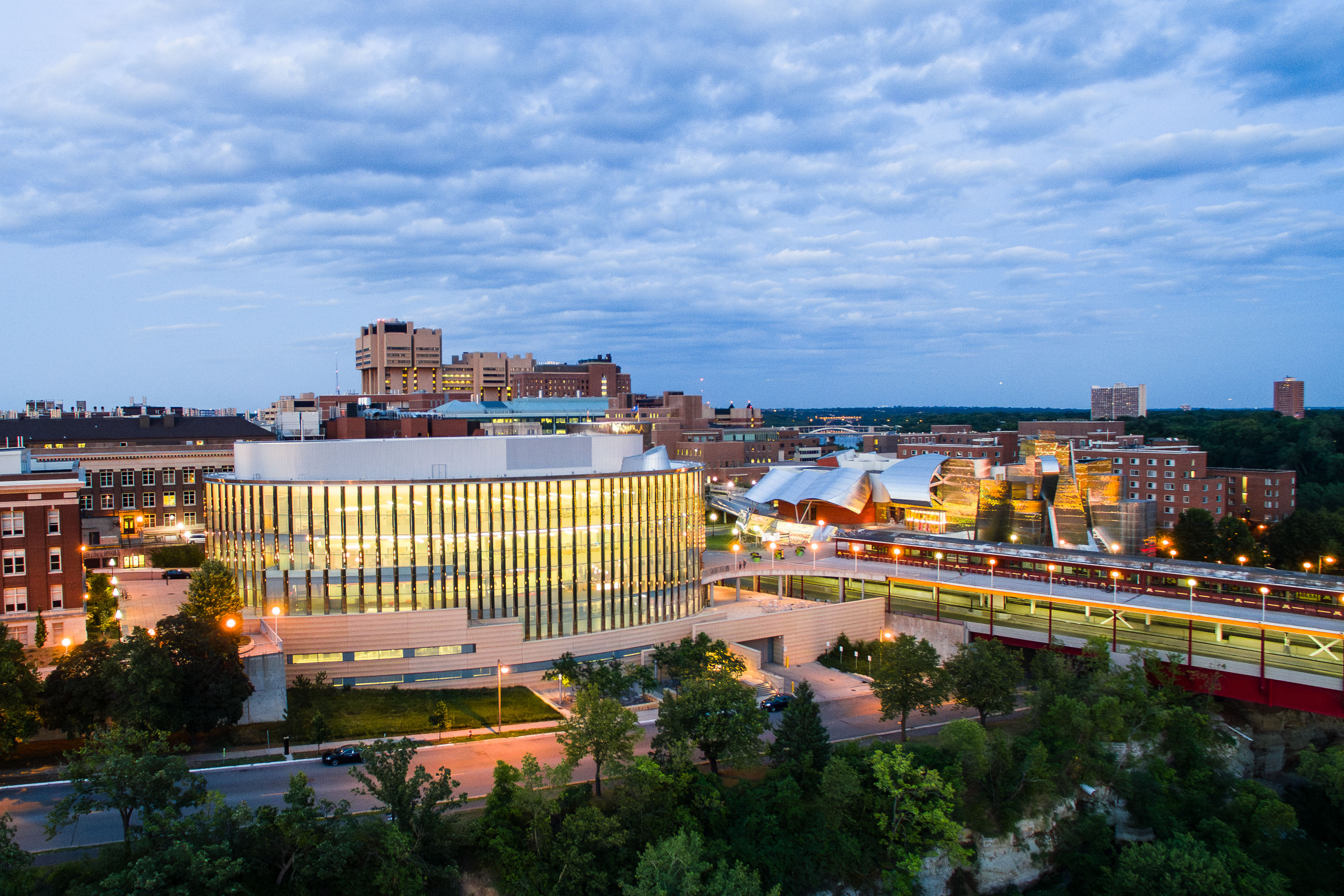
The Weisman Art Museum's stainless-steel building designed by Frank Gehry anchors the University of Minnesota's East Bank campus in Minneapolis at dusk.
The Weisman Art Museum anchors the foreground of the University of Minnesota's East Bank campus, its curving stainless-steel form designed by architect Frank Gehry and completed in 1993. The museum holds more than 25,000 objects, including strong collections of early twentieth-century American art, ceramics, and Mimbres pottery.

East Bank Campus Skyline at Twilight

Demolished Star Tribune building in downtown Minneapolis with construction equipment and debris during 2015 demolition for U.S
Demolition of the former Star Tribune building in downtown Minneapolis in 2015. The building was removed to clear the site for U.S. Bank Stadium and surrounding redevelopment.

Star Tribune Building Demolition, Downtown Minneapolis

Bruininks Hall at the University of Minnesota in Minneapolis, with nearby campus buildings and an elevated walkway.
Bruininks Hall at the University of Minnesota in Minneapolis near the East Bank. It is part of the Twin Cities campus and sits among other university facilities in the Dinkytown area.

Bruininks Hall, University of Minnesota, Minneapolis

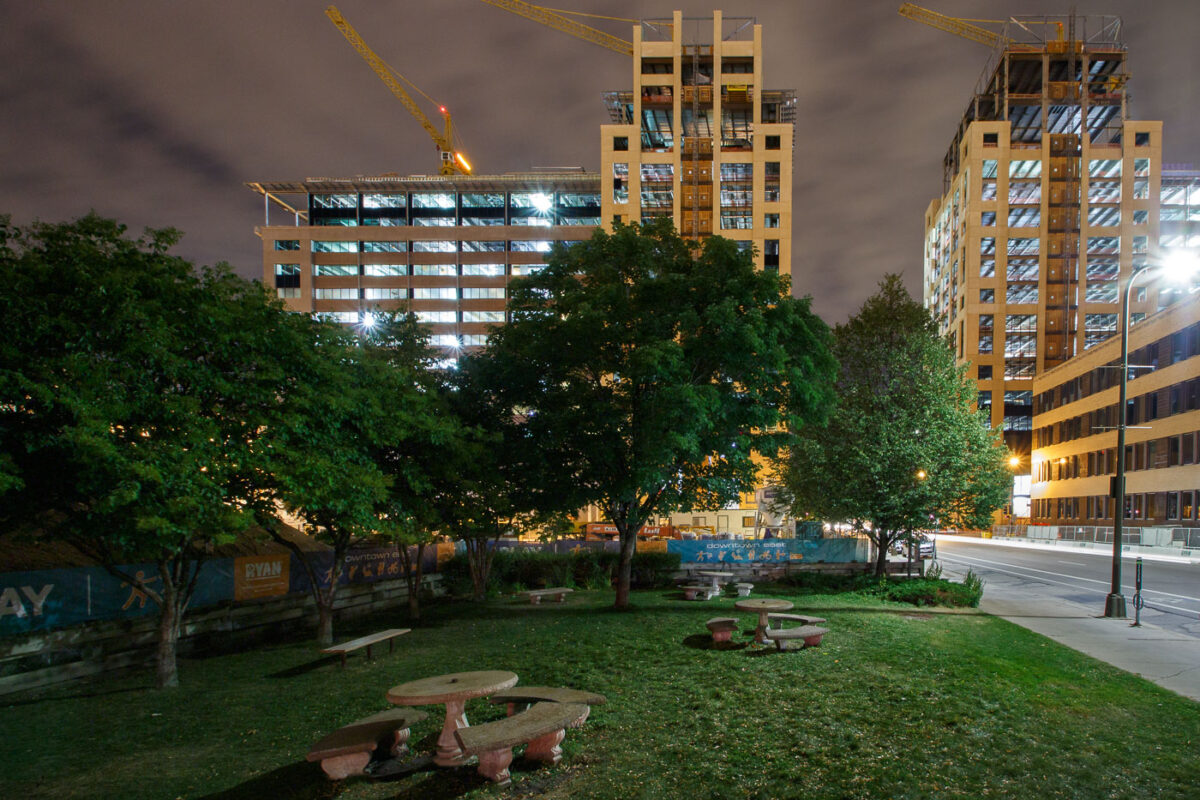
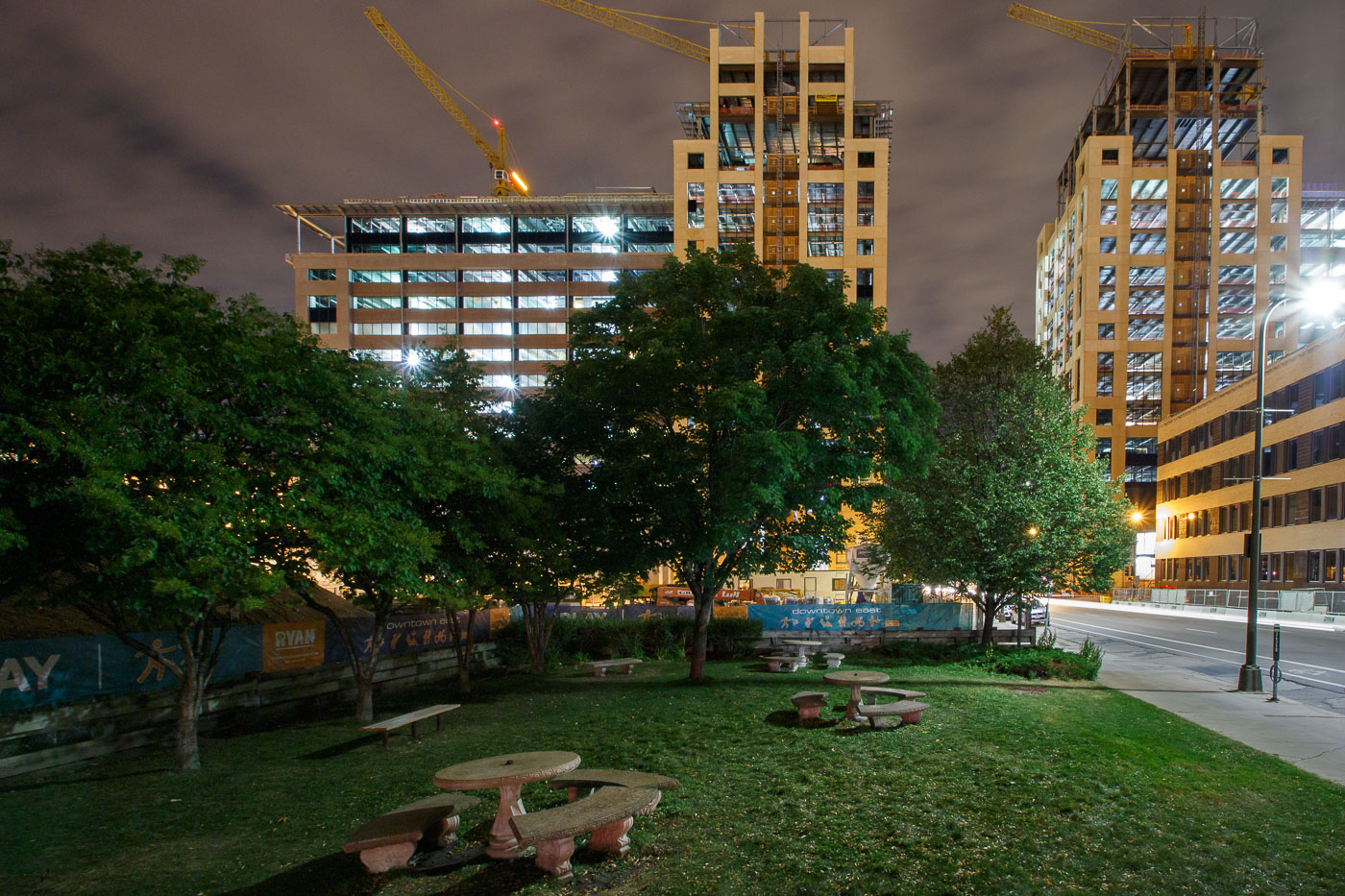
Two Wells Fargo office towers under construction at night in Downtown East Minneapolis, with illuminated floors and cranes.
The two Wells Fargo office towers in Downtown East Minneapolis were under construction in 2015 as part of a larger redevelopment built on the former Star Tribune printing plant site. Ryan Companies led the project, which paired the twin towers with a public park and retail space adjacent to U.S. Bank Stadium, home of the Minnesota Vikings.

Downtown East Park at Night Beneath the Wells Fargo Towers

Construction cranes and steel framework dominate the downtown Minneapolis site of US Bank Stadium under development in July 2015.
Construction of US Bank Stadium in Minneapolis's Downtown East neighborhood was underway in July 2015. This stadium was built to replace the Metrodome and serve as the home for the Minnesota Vikings.

Evening Light Over US Bank Stadium’s Rising Steel Frame

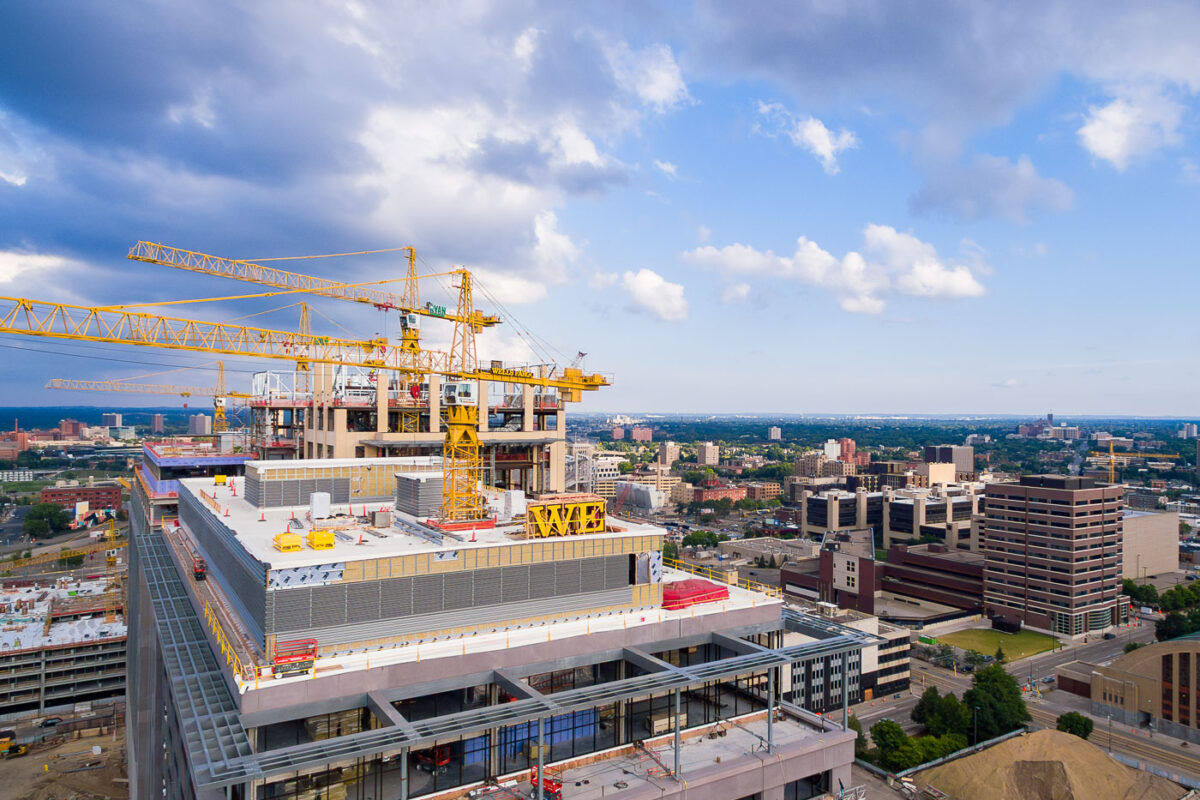
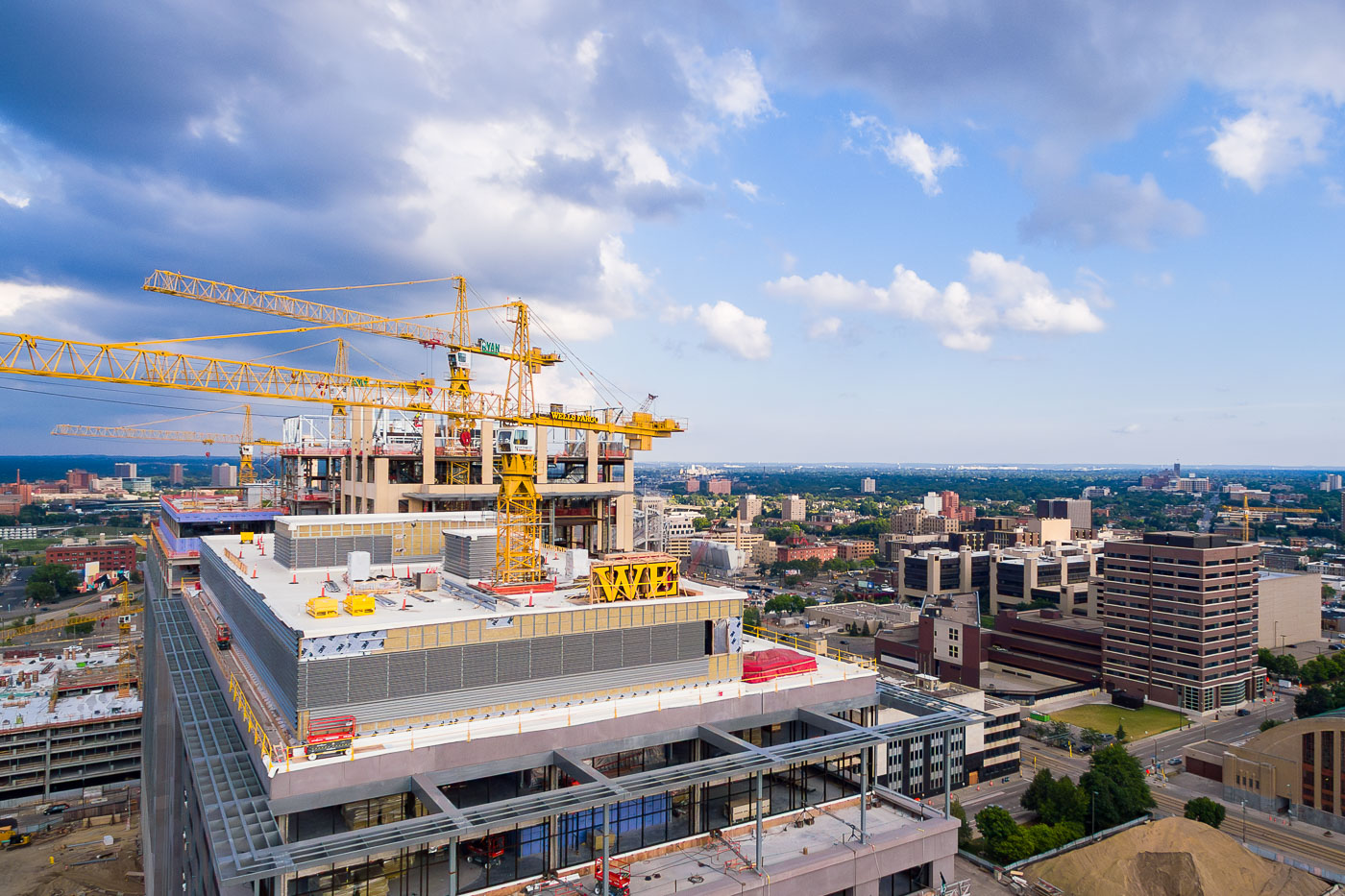
Yellow tower cranes operate above the Wells Fargo Towers construction site in downtown Minneapolis.
Construction of the Wells Fargo Towers in Downtown East, Minneapolis, in July 2015. These two skyscrapers, completed in 2019, house offices for Wells Fargo and other businesses.

Cranes Above the Wells Fargo Towers Construction Site, Minneapolis

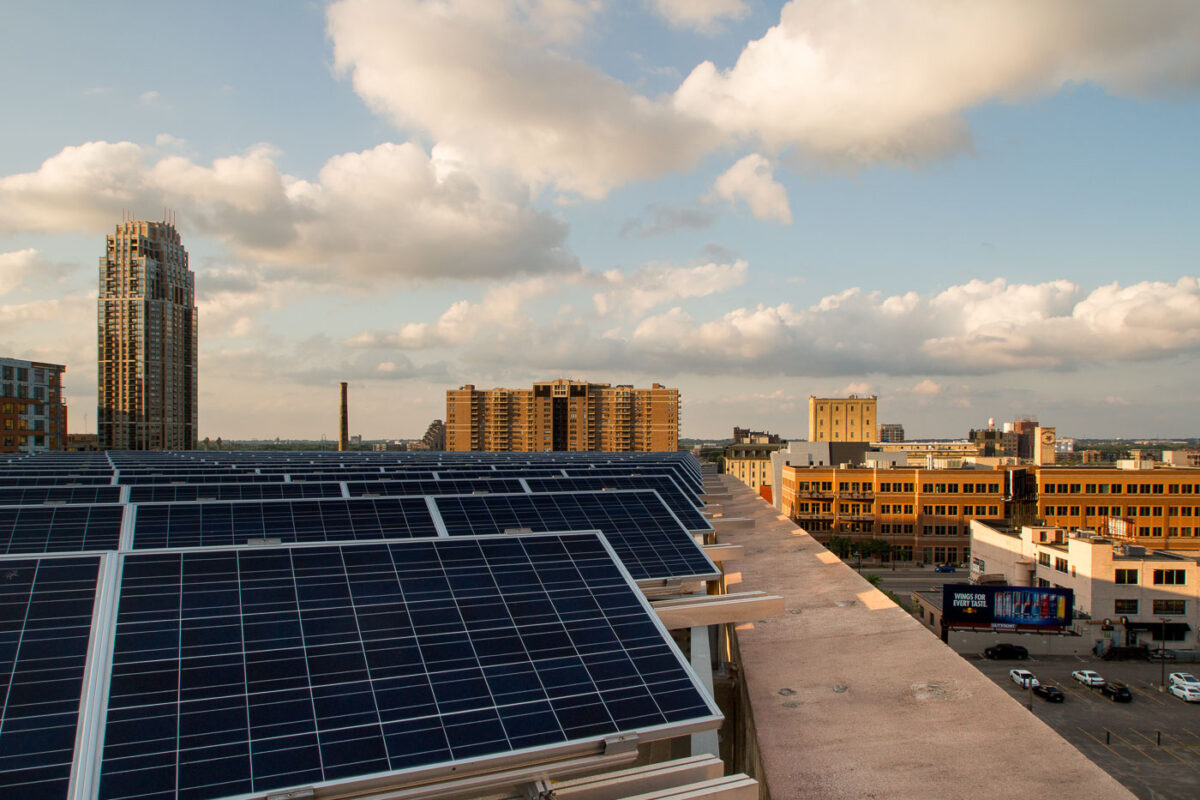
Jerry Haef Ramp solar panels in Downtown Minneapolis with city buildings beyond.
Jerry Haef Ramp in Downtown Minneapolis has solar panels installed across its rooftop. The parking structure combines vehicle storage with on-site power generation in the city center. Nearby high-rise and commercial buildings surround the ramp along the Minneapolis skyline.

Jerry Haef Ramp Solar Panels, Downtown Minneapolis

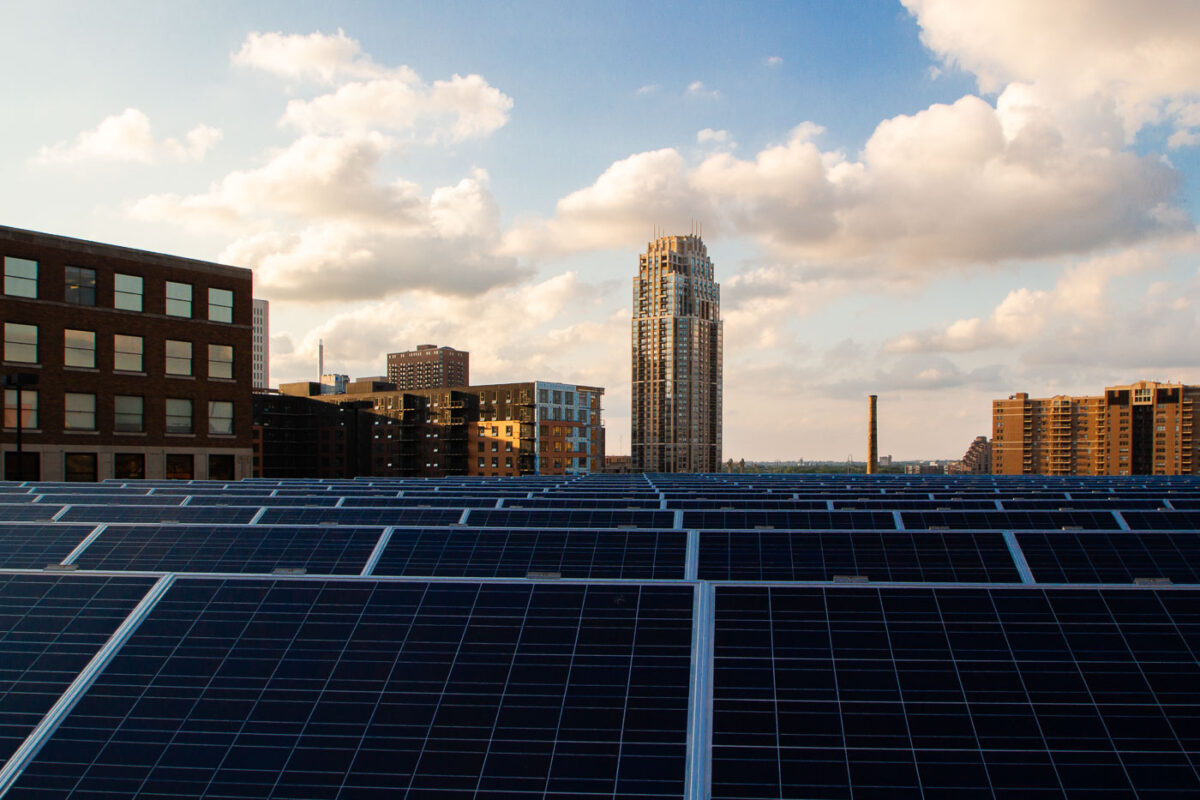
Downtown East in Minneapolis with rooftop solar panels on a downtown building.
Downtown East in Minneapolis has rooftop solar panels on a building in the East Town district. The installation adds electricity generation capacity to a dense downtown block.

Downtown East Rooftop Solar Array, Minneapolis

Minneapolis downtown skyline at sunset, showing the IDS Center, Capella Tower, and surrounding buildings.
Downtown Minneapolis is the city's business center, anchored by the IDS Center and Capella Tower. The IDS Center, completed in 1972, stands 792 feet tall and is the tallest building in Minnesota, while Capella Tower, finished in 1992, rises 775 feet with its signature crown of steel arches.

Capella Tower and the IDS Center Rise Above Downtown Minneapolis

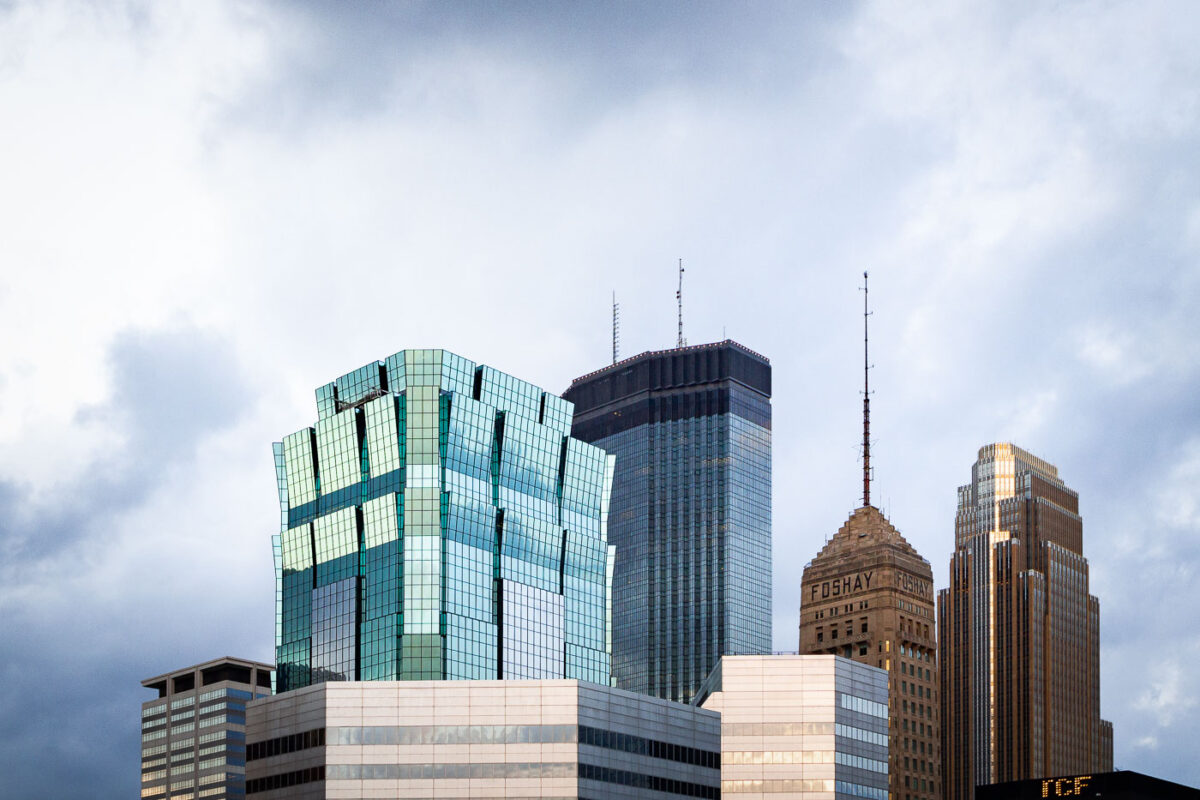
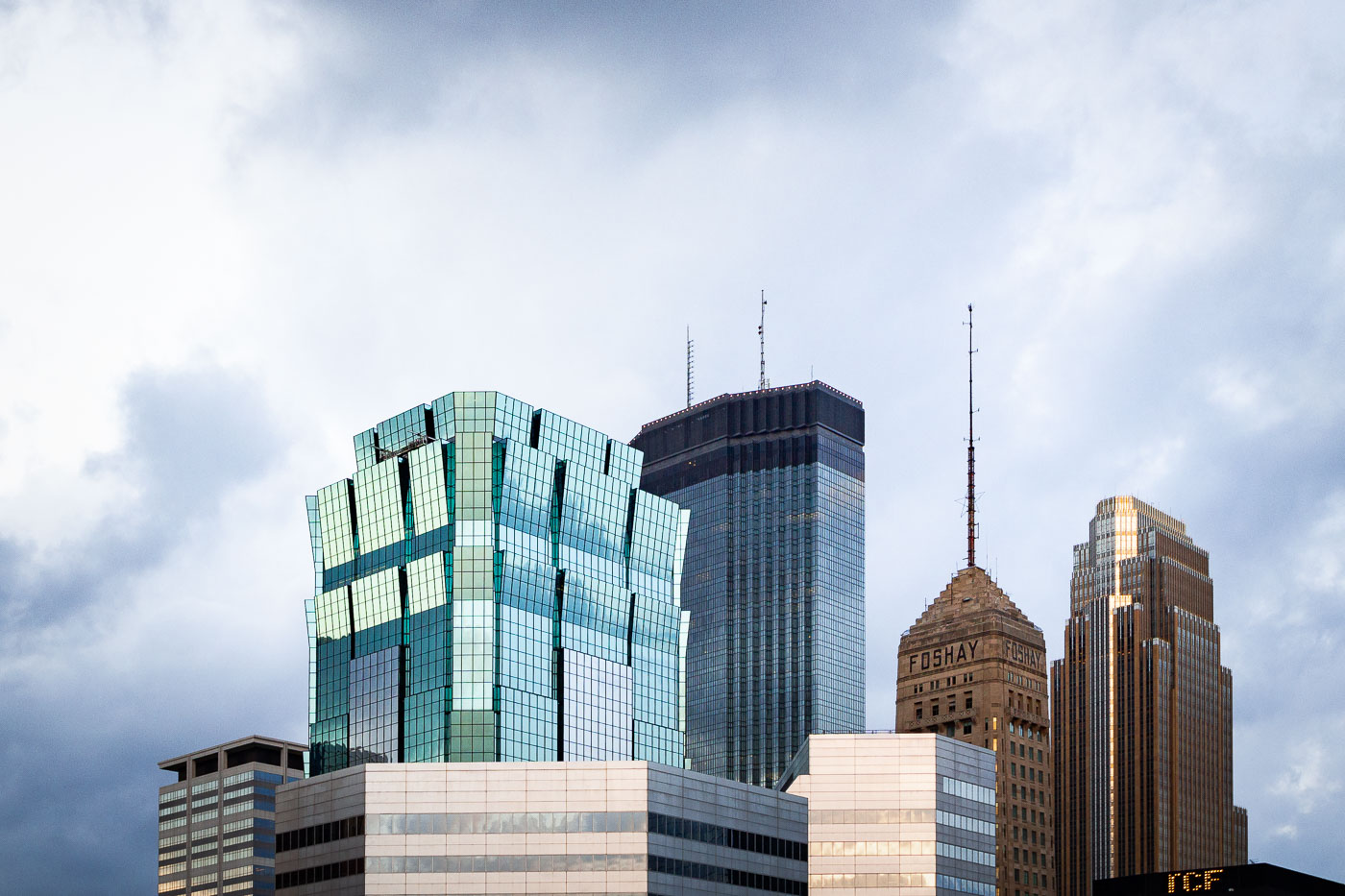
Minneapolis skyline featuring the 901 Marquette building, IDS Center, and Foshay Tower, with TCF Tower visible.
The Minneapolis skyline features several notable buildings, including the 901 Marquette building, the IDS Center, and the historic Foshay Tower. The Foshay Tower, completed in 1929, was once the tallest building in Minneapolis and served as a landmark for decades. The IDS Center, designed by Philip Johnson and John Burgee, was completed in 1973 and became the city's tallest building. The 901 Marquette building, a more recent addition, showcases modern architectural design with its distinctive glass facade.

901 Marquette, IDS Center, Foshay Tower, Minneapolis

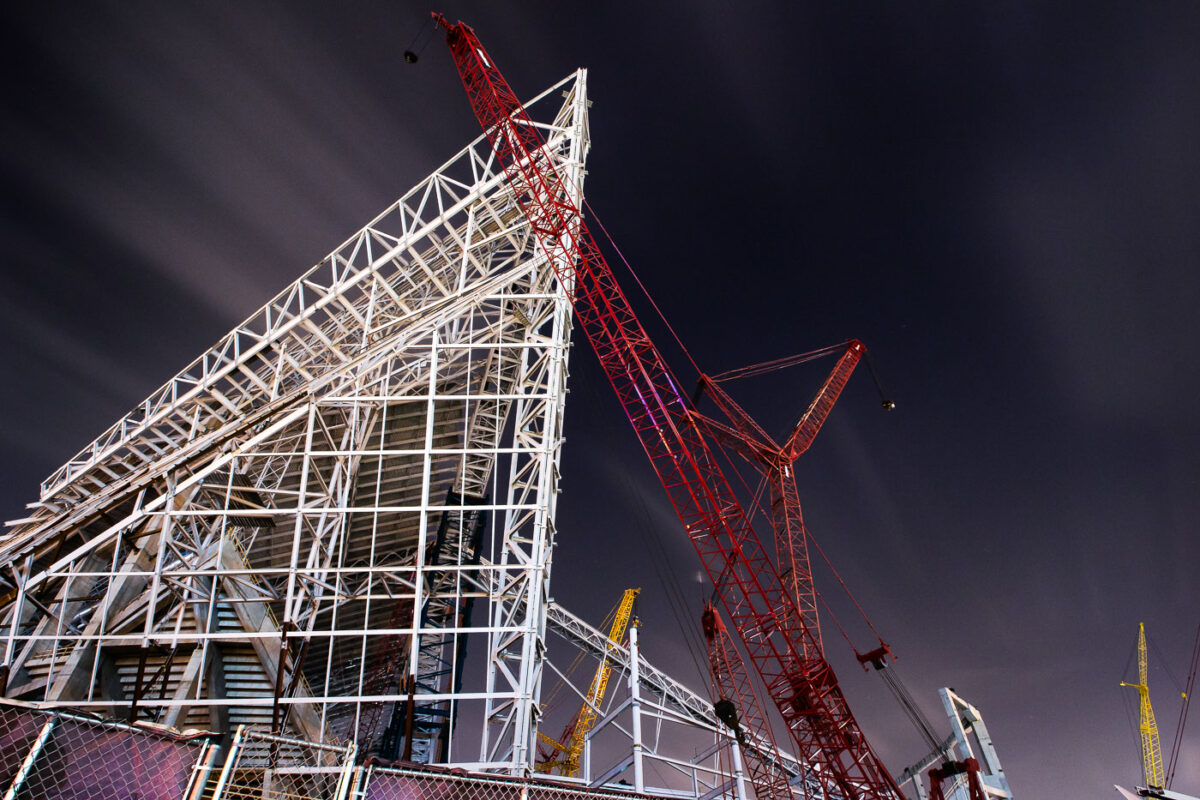
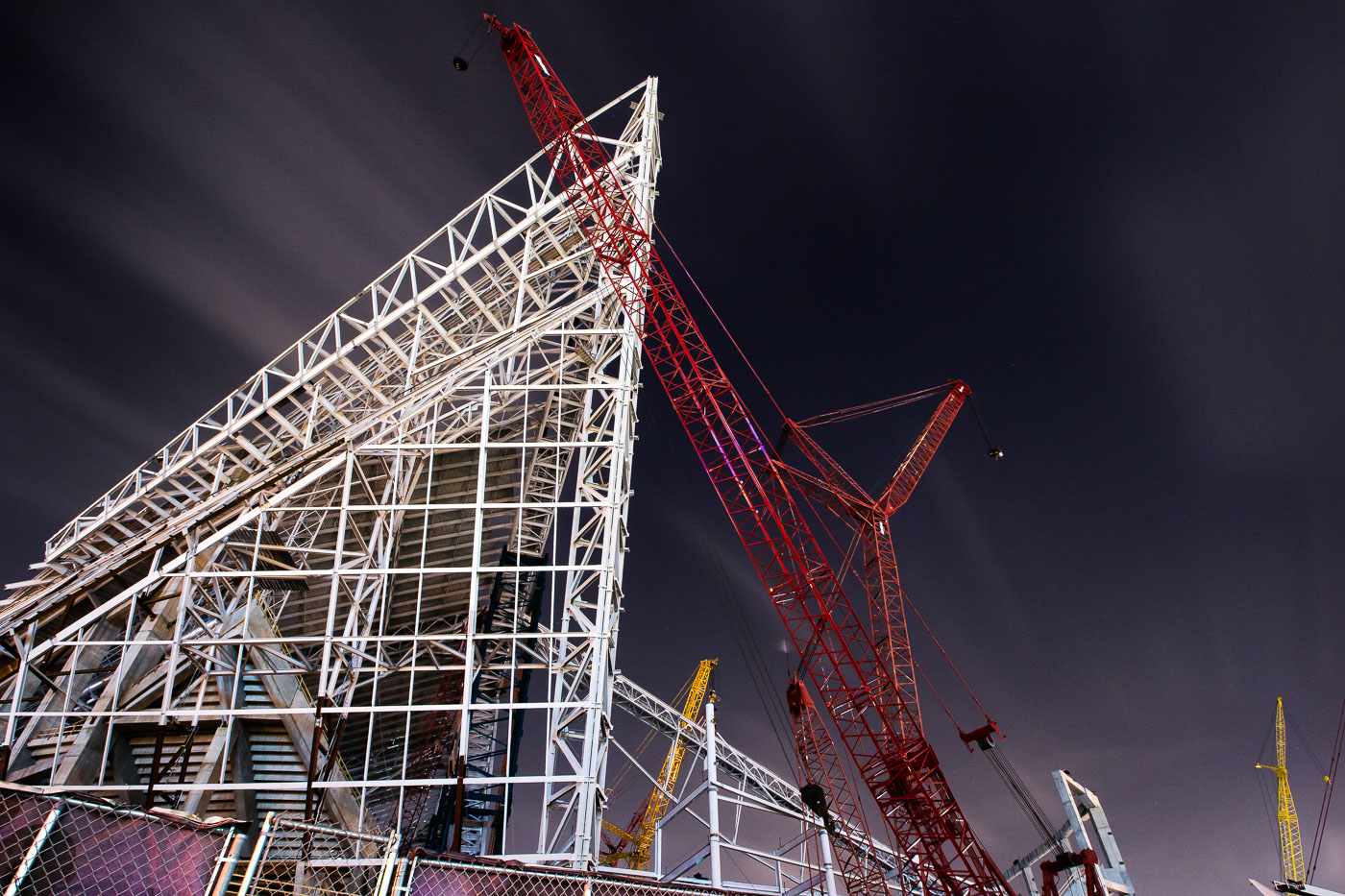
White steel framework and red construction cranes rise at night during U.S. Bank Stadium construction in Minneapolis.
Construction of U.S. Bank Stadium in Minneapolis, Minnesota, highlights the complex steel framework and towering cranes that defined its assembly. The project, initiated in December 2013 on the former site of the Hubert H. Humphrey Metrodome, was designed by HKS Architects and constructed by Mortenson.

Cranes Over US Bank Stadium’s Steel Frame at Night

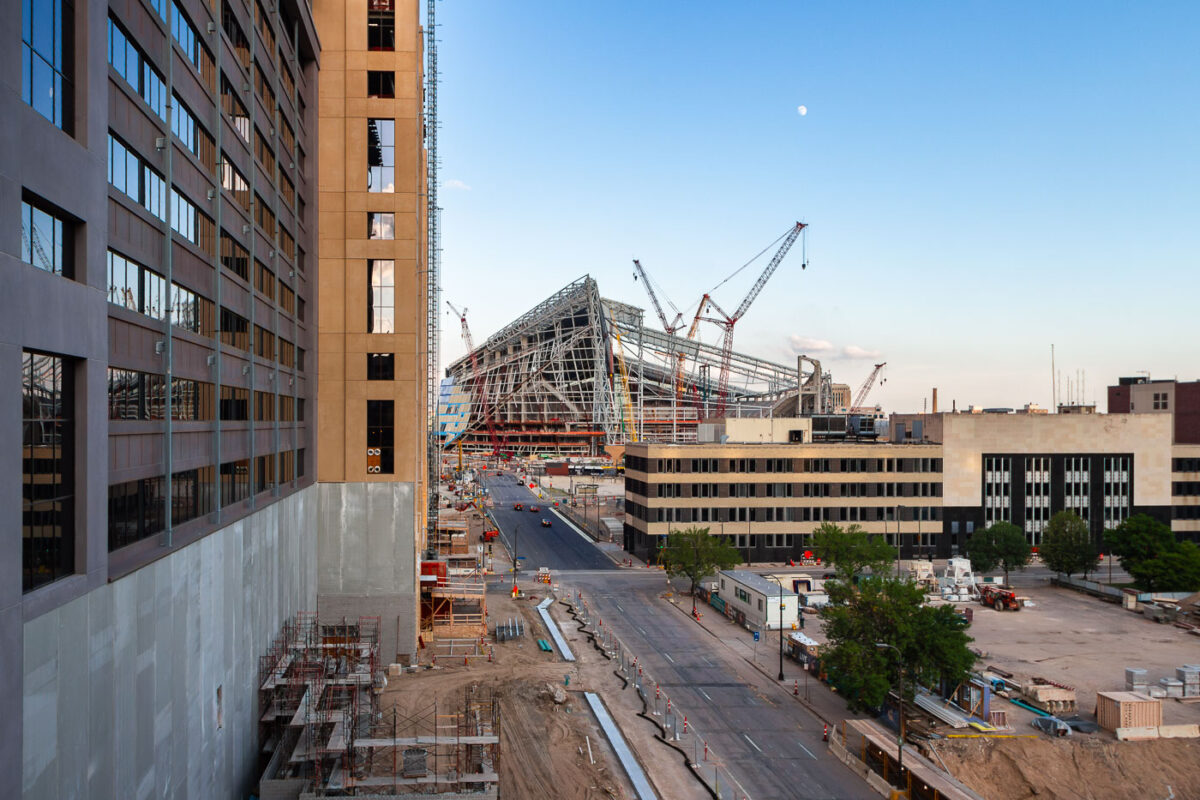
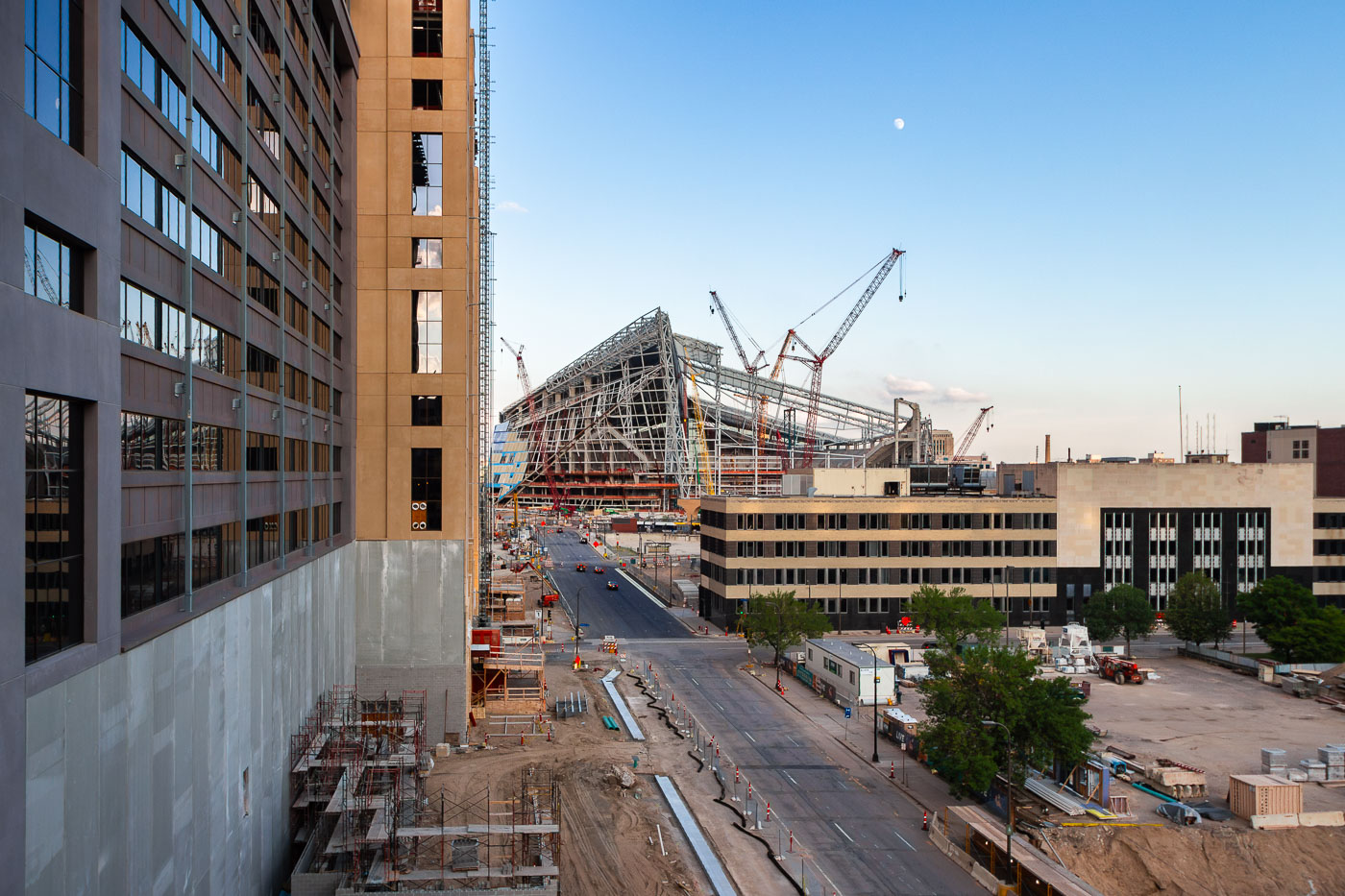
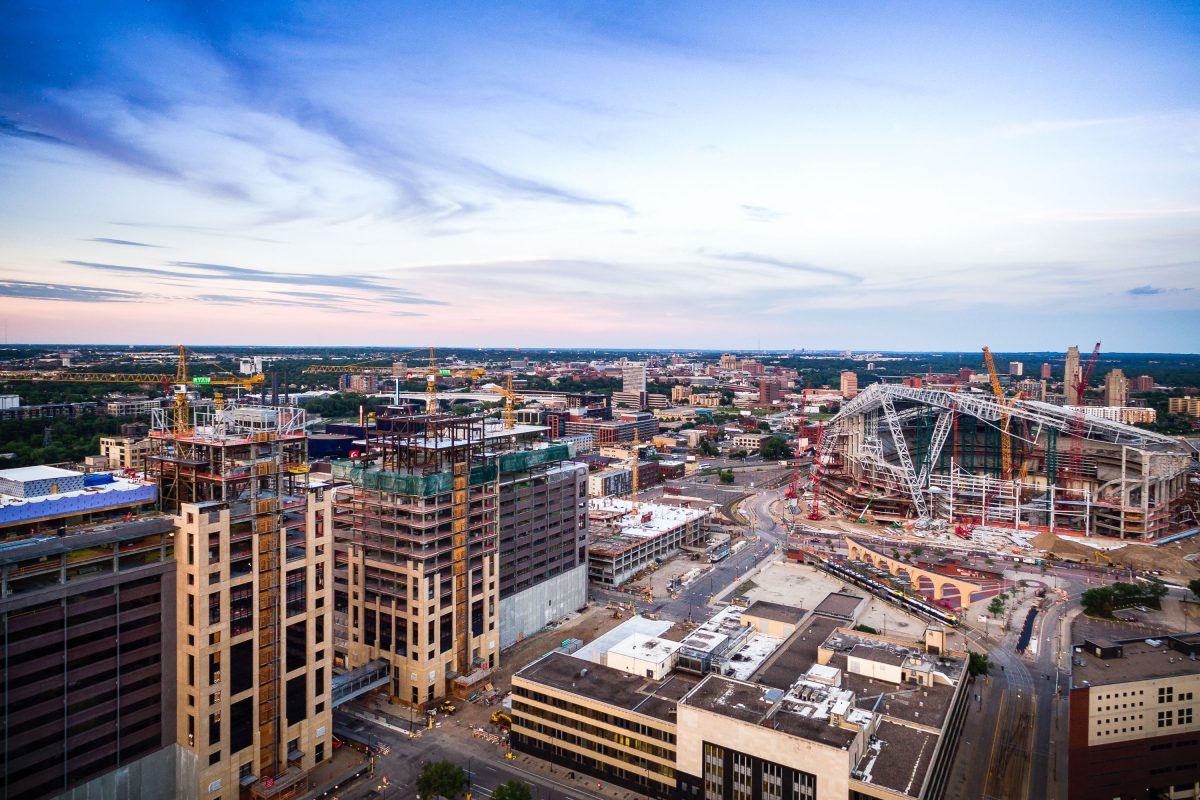
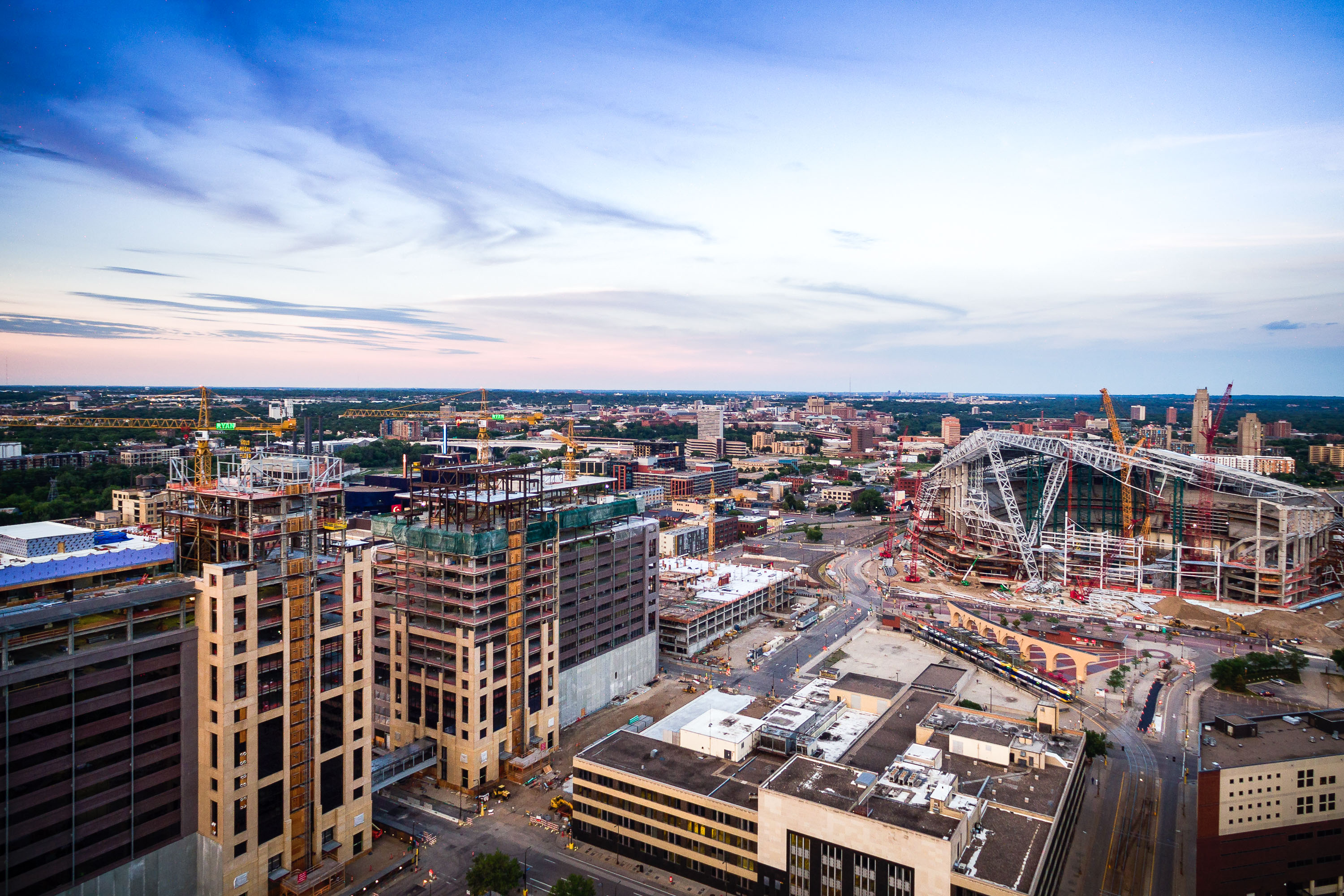
US Bank Stadium under construction in downtown Minneapolis with Wells Fargo office towers rising nearby.
US Bank Stadium, seen here under construction, opened in 2016 as the home of the Minnesota Vikings on the site of the demolished Metrodome. The stadium seats roughly 66,000 and cost about $1.1 billion to build, with a design featuring the largest transparent ETFE roof in North America. Ryan Companies developed the adjacent Downtown East project, including the two office towers visible here that became the Wells Fargo operations center, adding roughly 1.1 million square feet of workspace for thousands of employees.

Downtown East at Dusk and US Bank Stadium Construction

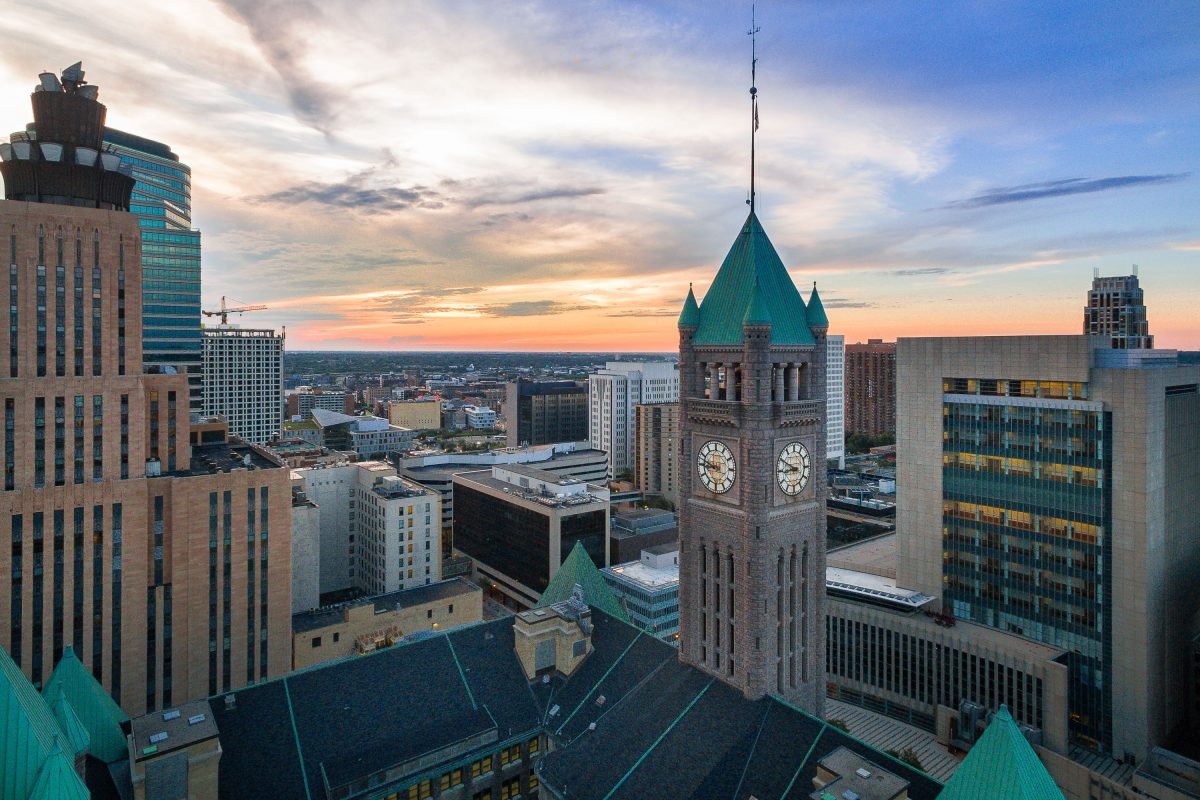
Minneapolis City Hall with its distinctive green copper roof stands among downtown office towers at sunset.
Minneapolis City Hall, also known as the Hennepin County Courthouse, stands at 350 South Fifth Street in downtown Minneapolis. Built of granite between 1888 and 1906, it houses both city and county offices under a shared roof. Its clock tower rises 345 feet and once held the largest four-faced clock in the country.

Clock Tower of Minneapolis City Hall Rises Above Downtown

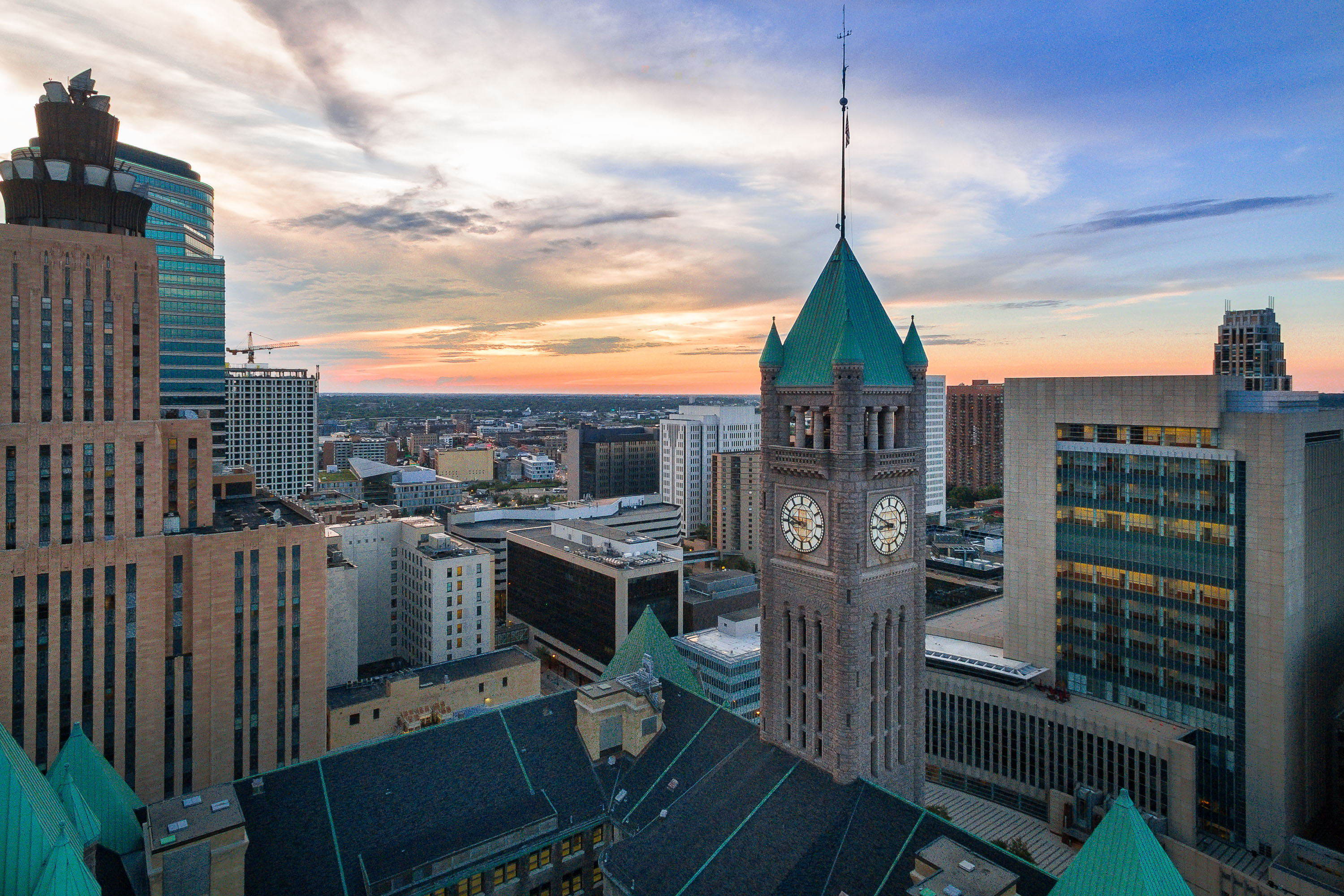
Minneapolis City Hall's clock tower with green copper roof rises above downtown buildings at sunset.
Minneapolis City Hall occupies the block bounded by 4th and 5th Streets and 3rd and 4th Avenues South, completed in 1905 after more than a decade of construction. Its clock tower rises 345 feet and once housed the largest four-faced clock in the world, cast by the E. Howard Clock Company of Boston.

Minneapolis City Hall Clock Tower at Sunset

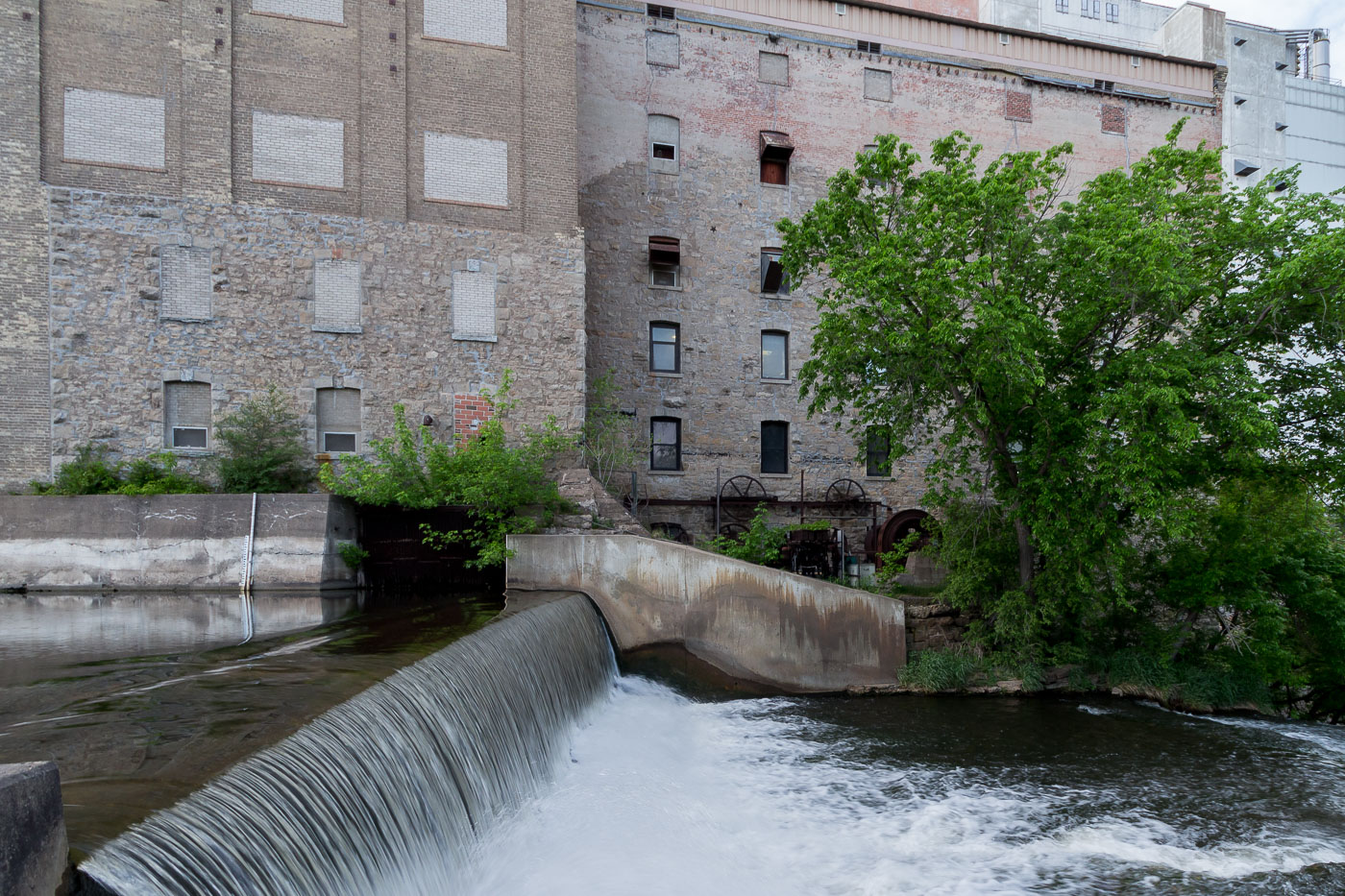
Ardent Mills flour mill building beside Vermillion Falls in Hastings, Minnesota, with water cascading over a weir.
Ardent Mills in Hastings, Minnesota, stands beside the Vermillion River at Vermillion Falls. The mill is part of the former Hastings Mill complex, which used the river’s water power for flour production.

Ardent Mills Rising Above Vermillion Falls in Hastings

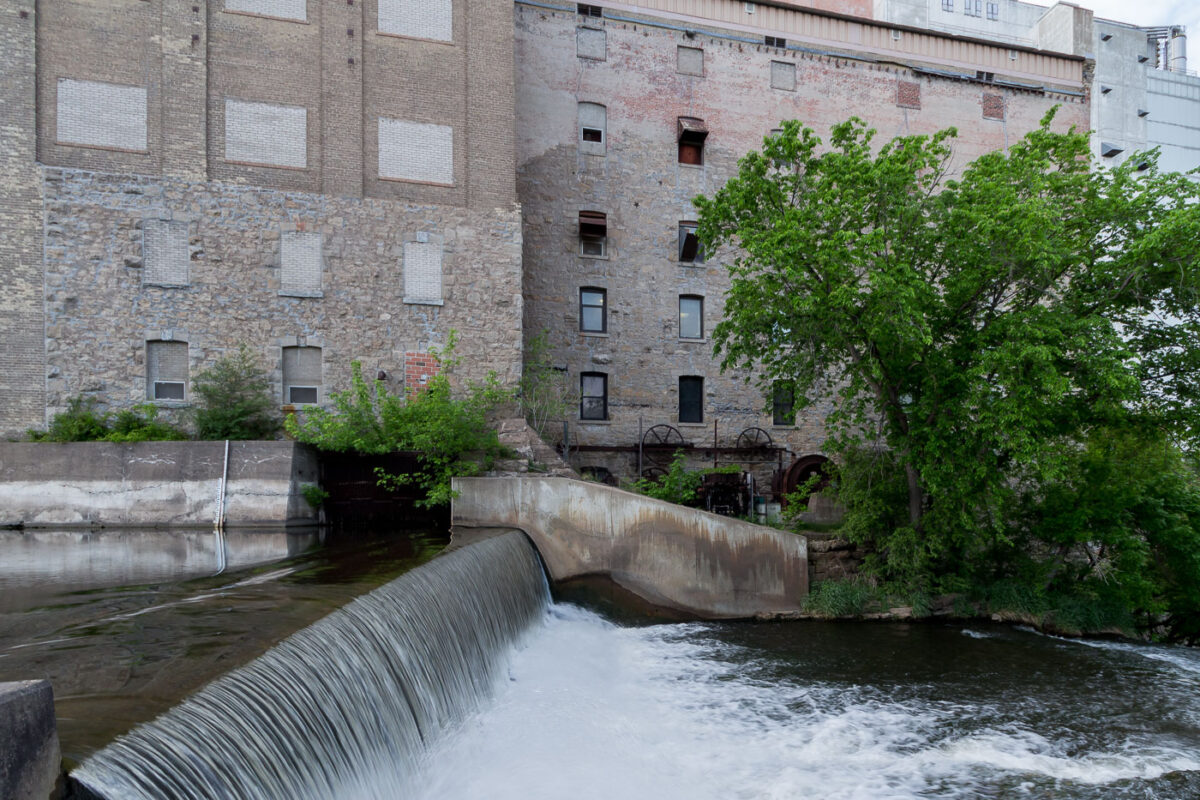
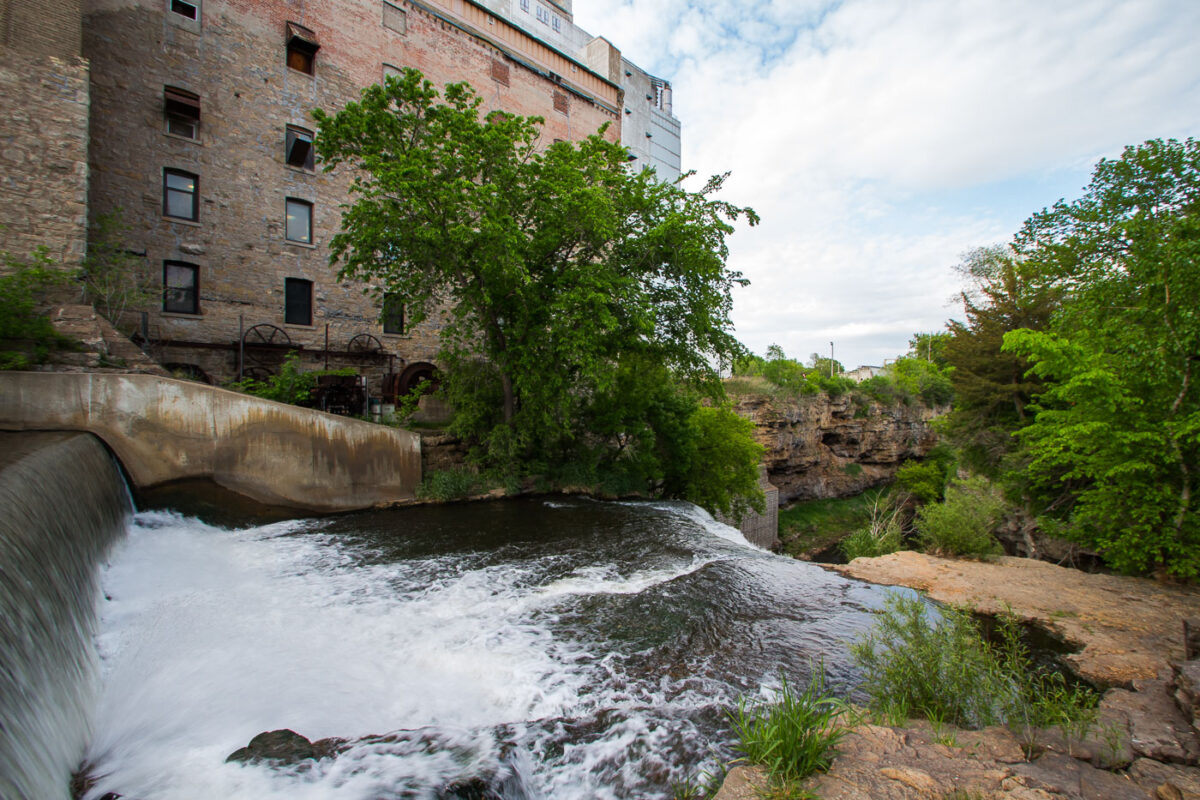
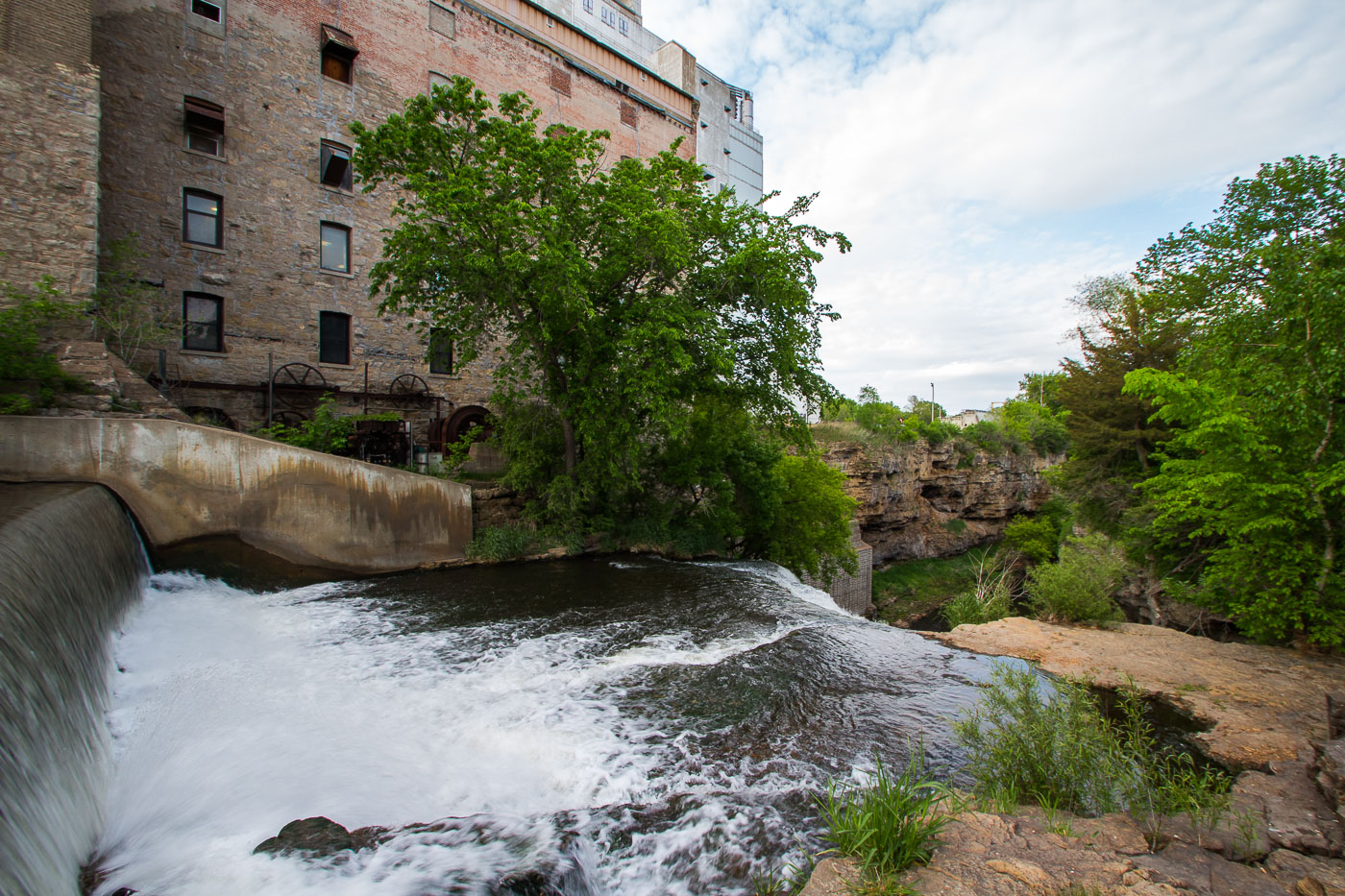
Vermillion Falls flows beneath a concrete spillway next to the historic Ardent Mills building in Hastings, Minnesota.
Vermillion Falls and Ardent Mills in Hastings, Minnesota, occupy a site on the Vermillion River long used for milling. The flour mill remains linked to the falls, which provided water power for earlier industrial operations along the river.

Vermillion Falls Below the Ardent Mills Building in Hastings

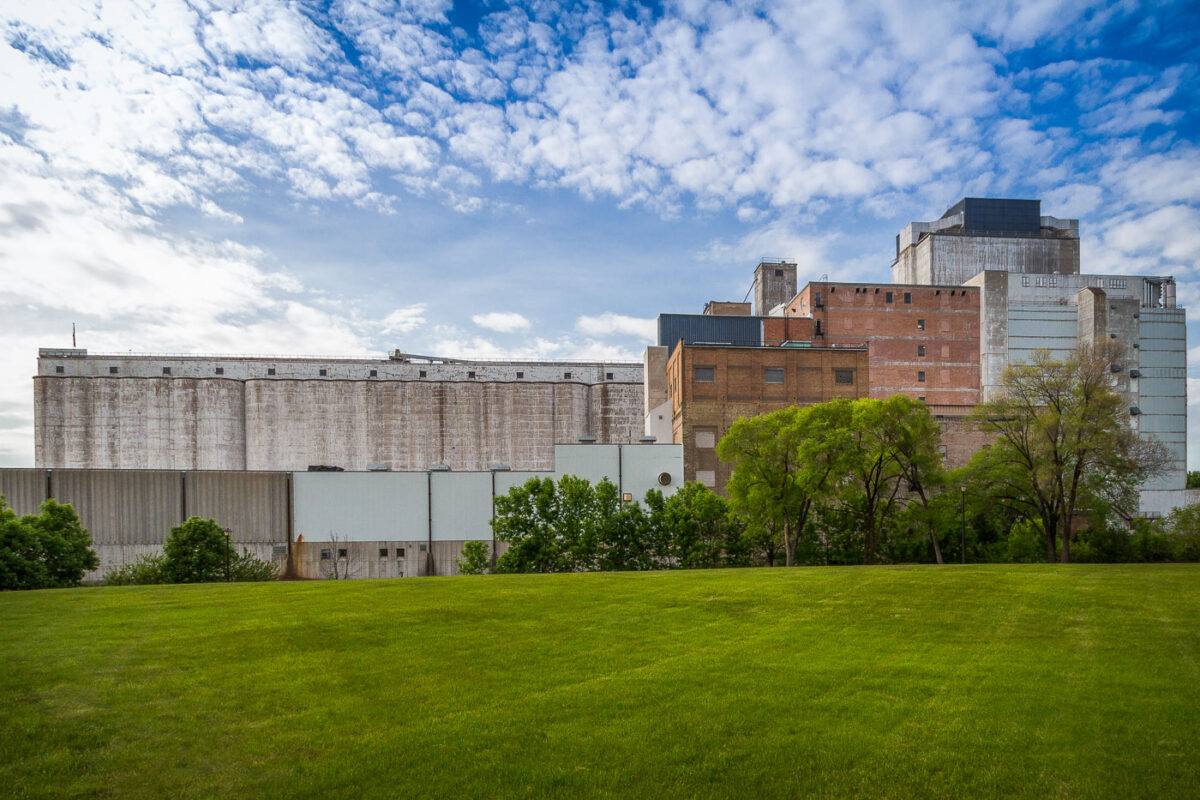
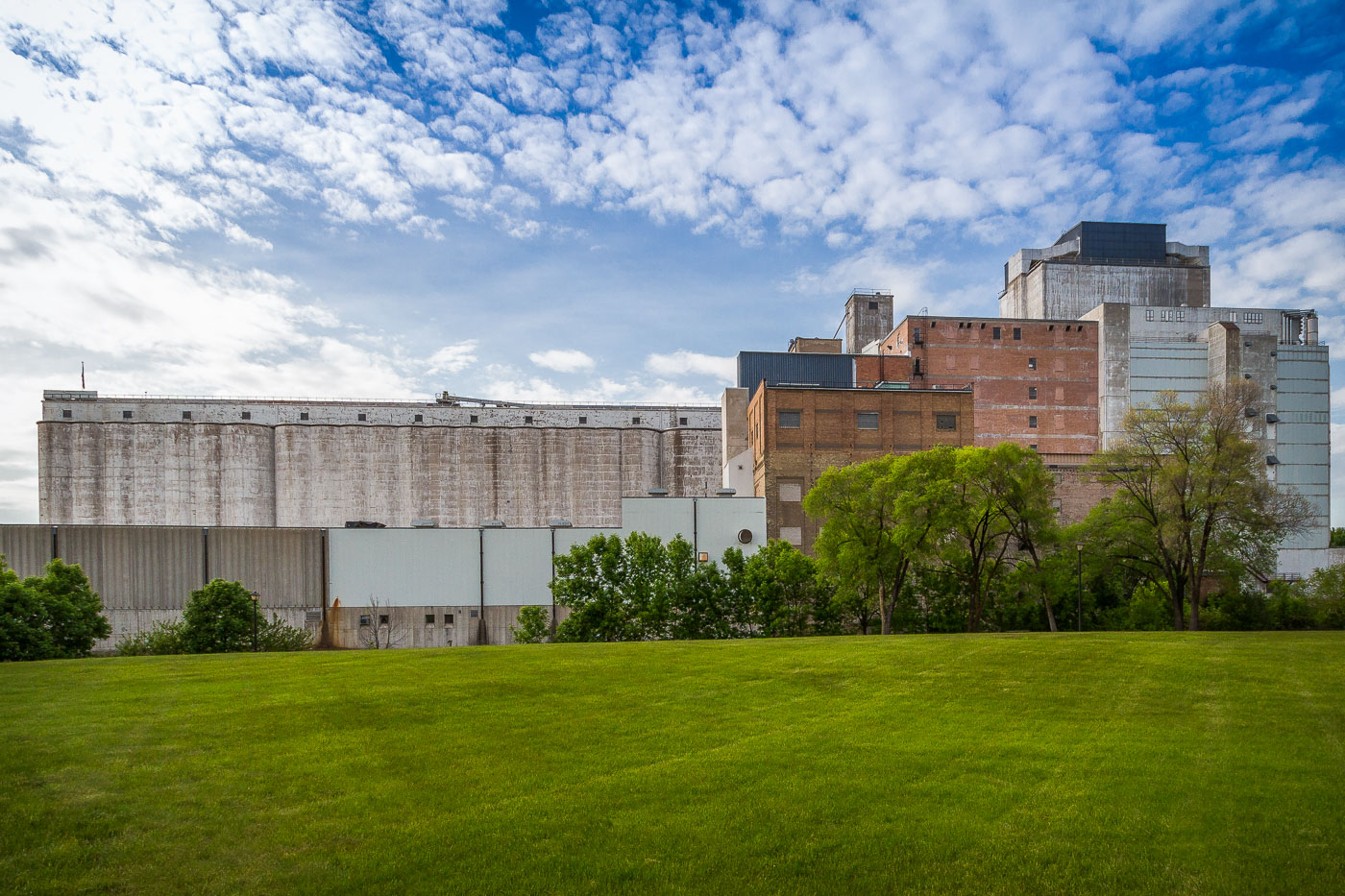
Ardent Mills flour mill facility in Hastings, Minnesota, with grain storage silos and brick buildings overlooking a green lawn.
The Ardent Mills facility in Hastings, Minnesota, stands as a significant historical site in the state's milling industry. Established as the first operating mill in Minnesota, this facility is credited with key innovations, including the development of the purifier, the patent barrel, and graham flour, according to the company.

Grain Elevators at Ardent Mills in Hastings

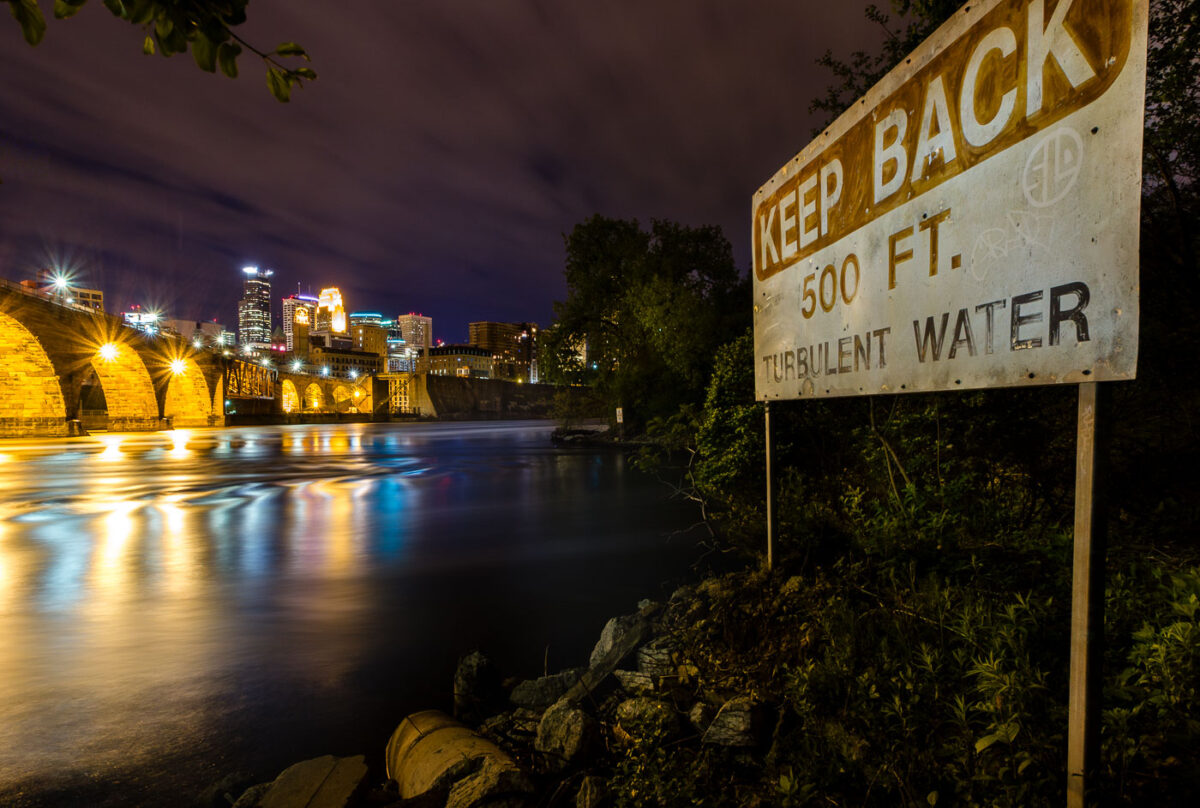
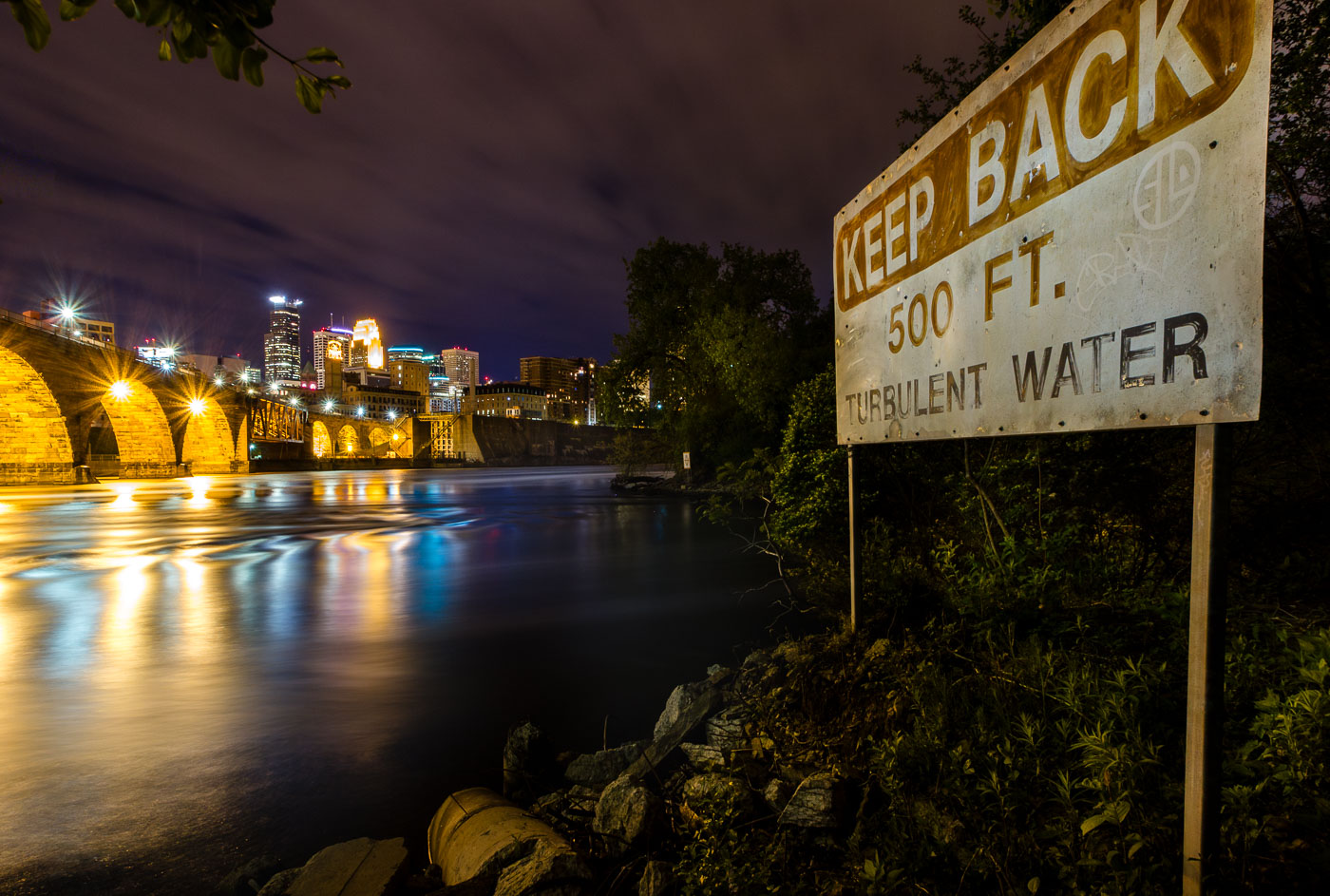
A "Keep Back 500 FT Turbulent Water" warning sign on the Mississippi River bank in Minneapolis, with the illuminated Stone Arch
This "Keep Back 500 Ft. Turbulent Water" sign warns boaters of the current below St. Anthony Falls, the only natural waterfall on the Mississippi River. The falls drop about 50 feet and once powered the flour and lumber mills that built Minneapolis into a milling capital in the late 1800s. The Stone Arch Bridge, visible upstream, was built in 1883 by railroad magnate James J. Hill to carry trains across the river just below the falls.

“Turbulent Water” Sign Near St. Anthony Falls on the Mississippi

US Bank Stadium going up in Downtown Minneapolis
Construction of U.S. Bank Stadium in downtown Minneapolis is shown during its development phase. The stadium, which broke ground in 2014 and opened in 2016, was built to replace the Metrodome and serve as the home for the Minnesota Vikings. Its construction represented a significant development project for the Downtown East neighborhood.

US Bank Stadium Construction, Downtown Minneapolis

Father Hennepin Bluff Park riverbank in Minneapolis with a steep snowy slope and wooded shoreline.
Father Hennepin Bluff Park in Northeast Minneapolis borders the Mississippi River below the downtown bluff. The park includes a steep riverside slope and a wooded riverbank along the river corridor. It is part of the Minneapolis park system.

Father Hennepin Bluff Park Riverbank, Minneapolis

© 1996–2026 Chad Davis