Graffiti

414 photos · 2008–2026

414 photographs tagged Graffiti, 2008–2026.
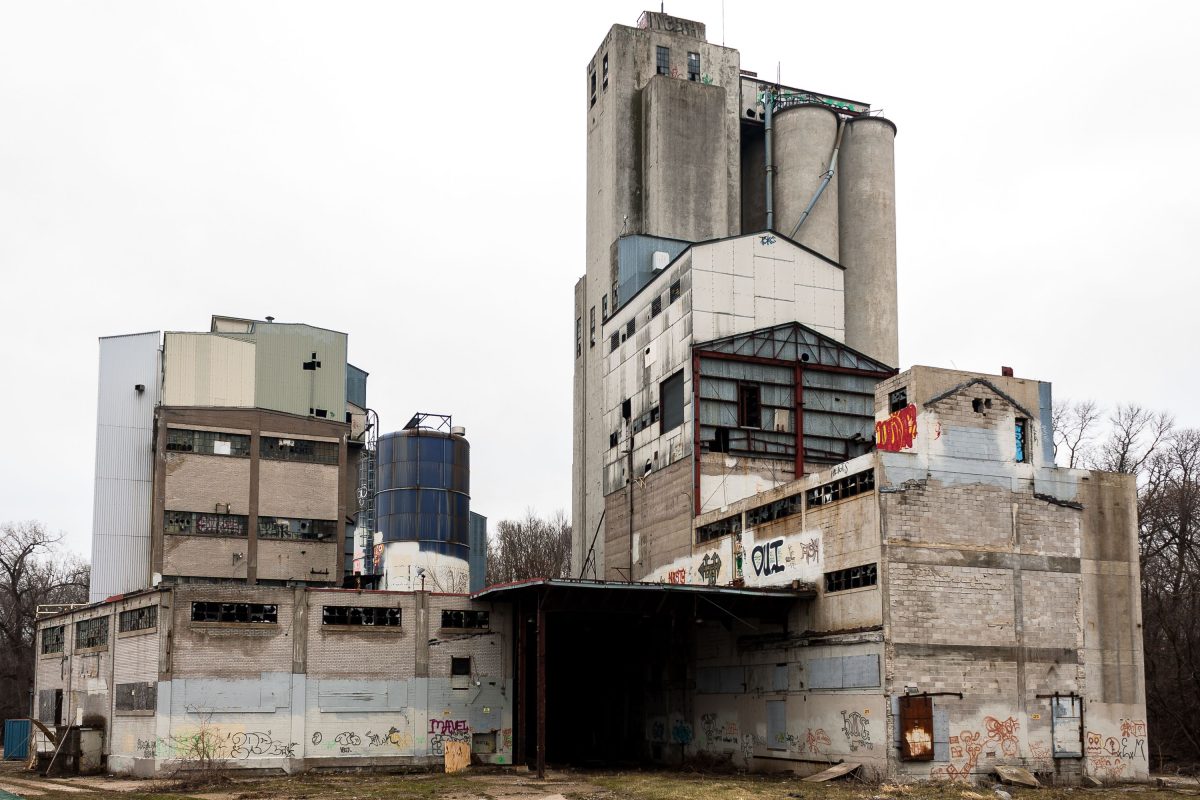
Abandoned Fruen Mill grain elevator complex with concrete towers and silos in Minneapolis.
Fruen Mill sits along Bassett Creek near Van White Memorial Boulevard in Minneapolis, on land tied to one of the city's earliest water-powered milling operations, dating back to the 1870s. The concrete grain elevator and adjoining steel-and-brick structures were built to store and process grain for regional distribution, part of the industrial corridor that once lined the creek west of downtown. The mill ceased operations decades ago, and the property has since sat vacant, drawing graffiti artists and urban explorers to its empty floors and silos. Bassett Creek itself was rerouted underground through much of Minneapolis in the 20th century as part of flood-control efforts, leaving this stretch as one of the few visible remnants of the waterway's industrial past.

Fruen Mill Grain Elevator, Minneapolis

Art Happens Here stencil art on a St. Paul, Minnesota sidewalk.
Art Happens Here stencil art in St. Paul, Minnesota, is painted on a sidewalk. The design combines block lettering with a skyline silhouette inside the text.

Art Happens Here Stencil on St. Paul Sidewalk

HOTTEA yarn installation on a chain-link fence in Minneapolis.
HOTTEA yarn installation in Minneapolis. The temporary site-specific work uses stretched yarn on a chain-link fence near downtown, where the artist regularly creates ephemeral public art in unexpected places.

HOTTEA yarn installation, Minneapolis
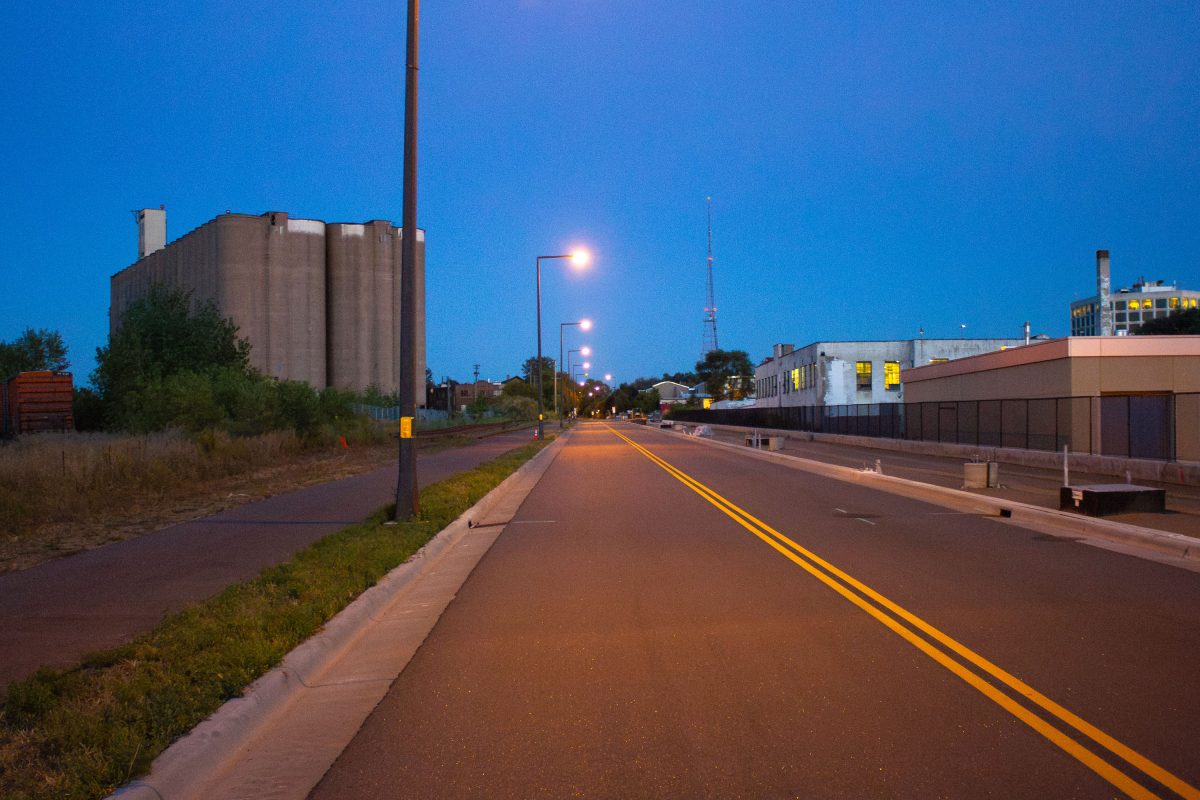
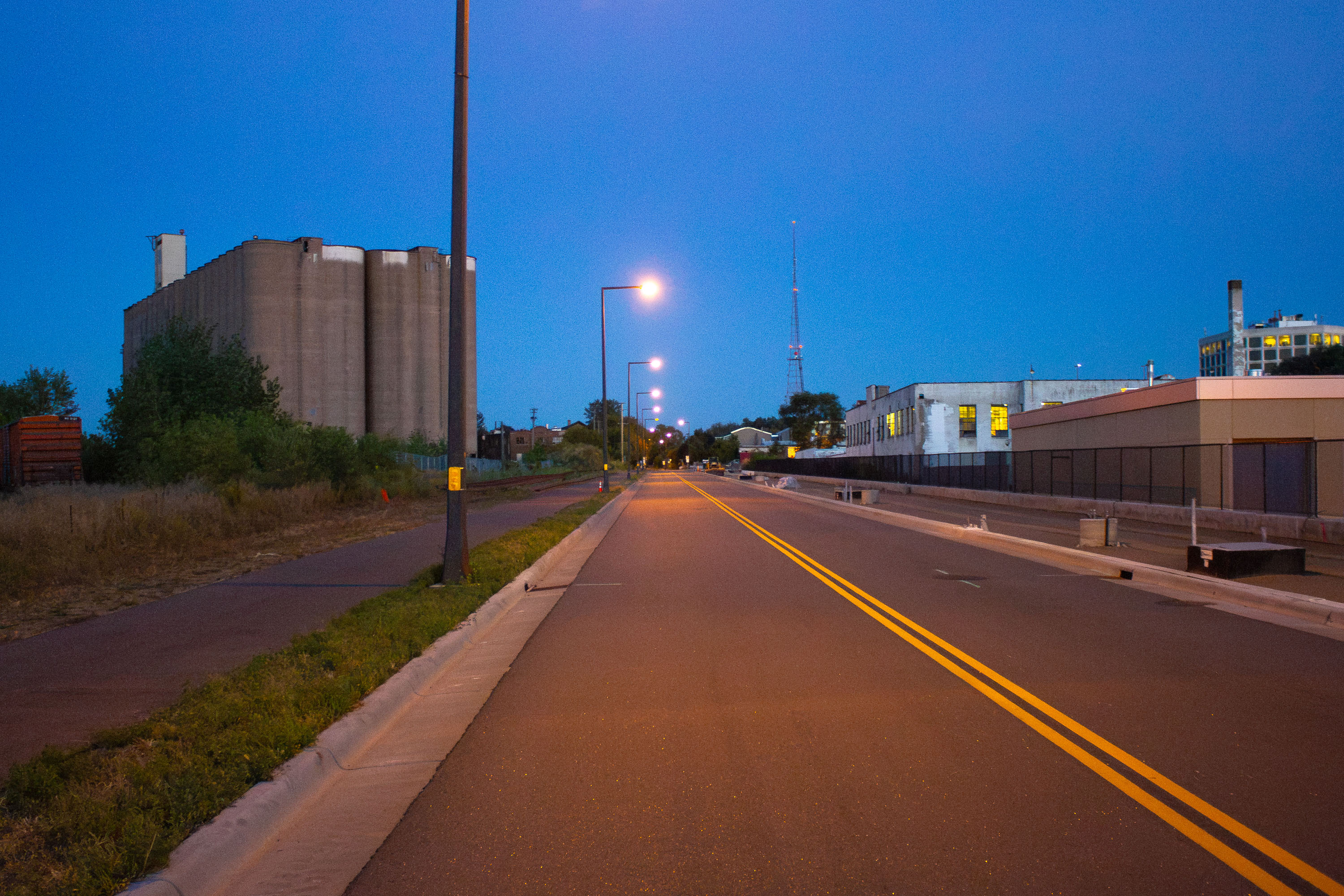
United Crushers grain elevator stands beside the University of Minnesota Transitway in the Dinkytown area of Minneapolis.
The University of Minnesota Transitway runs along the East Bank corridor in Minneapolis, carrying university and Metro Transit buses between the Twin Cities campuses.

United Crushers Elevator Along the Transitway, Minneapolis

Dinkytown graffiti in Minneapolis reads, “The banks got bailed out, the people got sold out.”
Dinkytown in Minneapolis is the site of graffiti reading, “The banks got bailed out, the people got sold out.” The wall sits near the University of Minnesota in a neighborhood known for student-oriented businesses and street art.

Dinkytown Banks Got Bailed Out Graffiti, Minneapolis

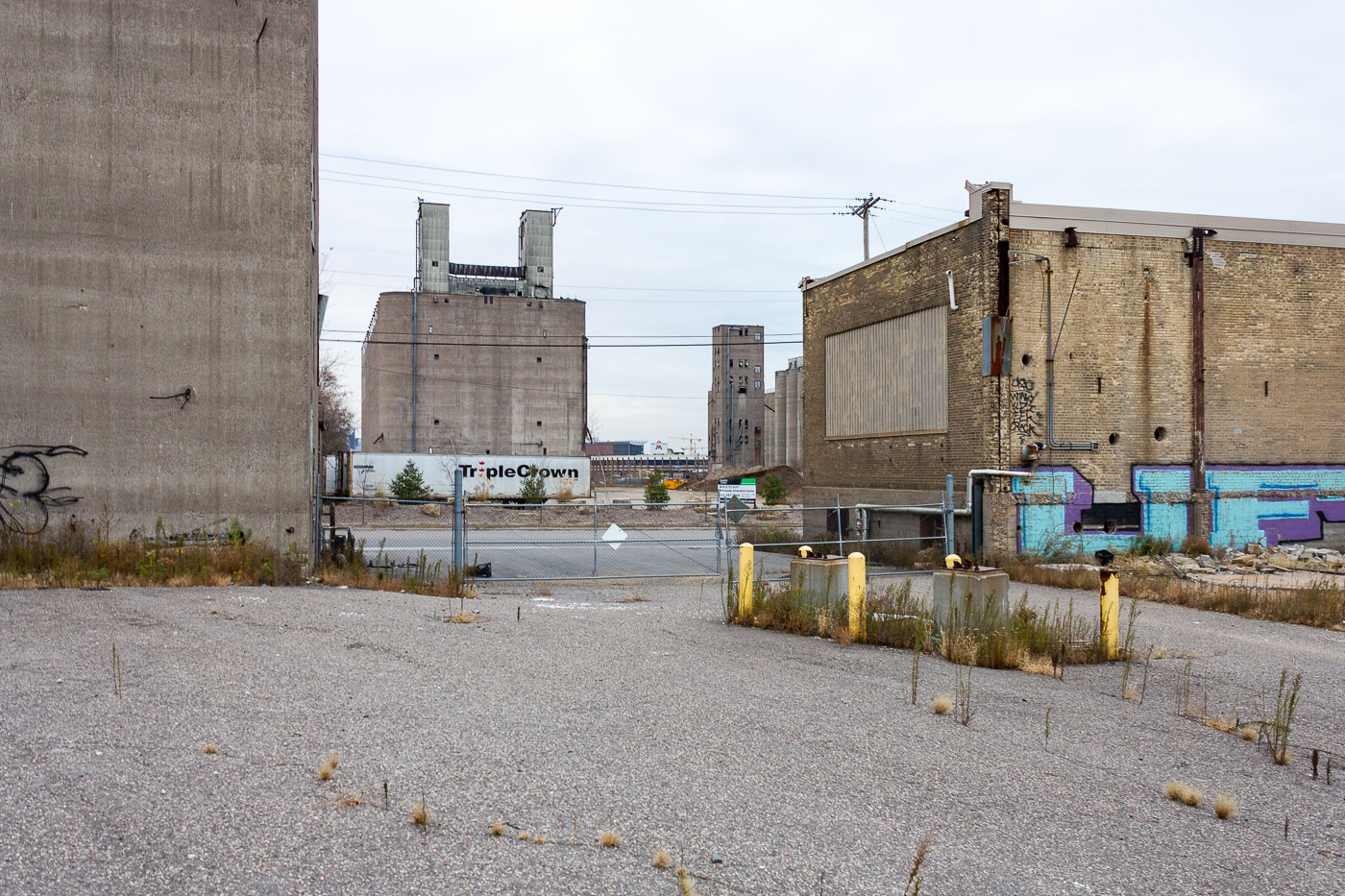
Abandoned grain elevators in Minneapolis, Minnesota, are covered in graffiti. A Triple Crown trailer is parked nearby, indicating ongoing activity at the derelict industrial site.
Abandoned grain elevators in Minneapolis.

Abandoned Grain Elevators and Graffiti, Minneapolis

The ADM Grain Elevator in Minneapolis, a concrete structure from mid-20th century industrial architecture, stands amidst overgrown vegetation and graffiti-adorned outbuildings.
The ADM Grain Elevator in Minneapolis. Constructed to facilitate the storage and handling of grain, such facilities were crucial for the region's economy, supporting farming communities and the food industry.

ADM Grain Elevator, Minneapolis

The ADM Grain Elevator complex, also known as United Crushers, in Minneapolis, Minnesota, is a large industrial facility for grain storage and processing.
The ADM United Crushers grain elevator complex in Minneapolis. The "United Crushers" tag at this point has become a historical tag in Minneapolis.

ADM United Crushers Grain Elevator, Minneapolis
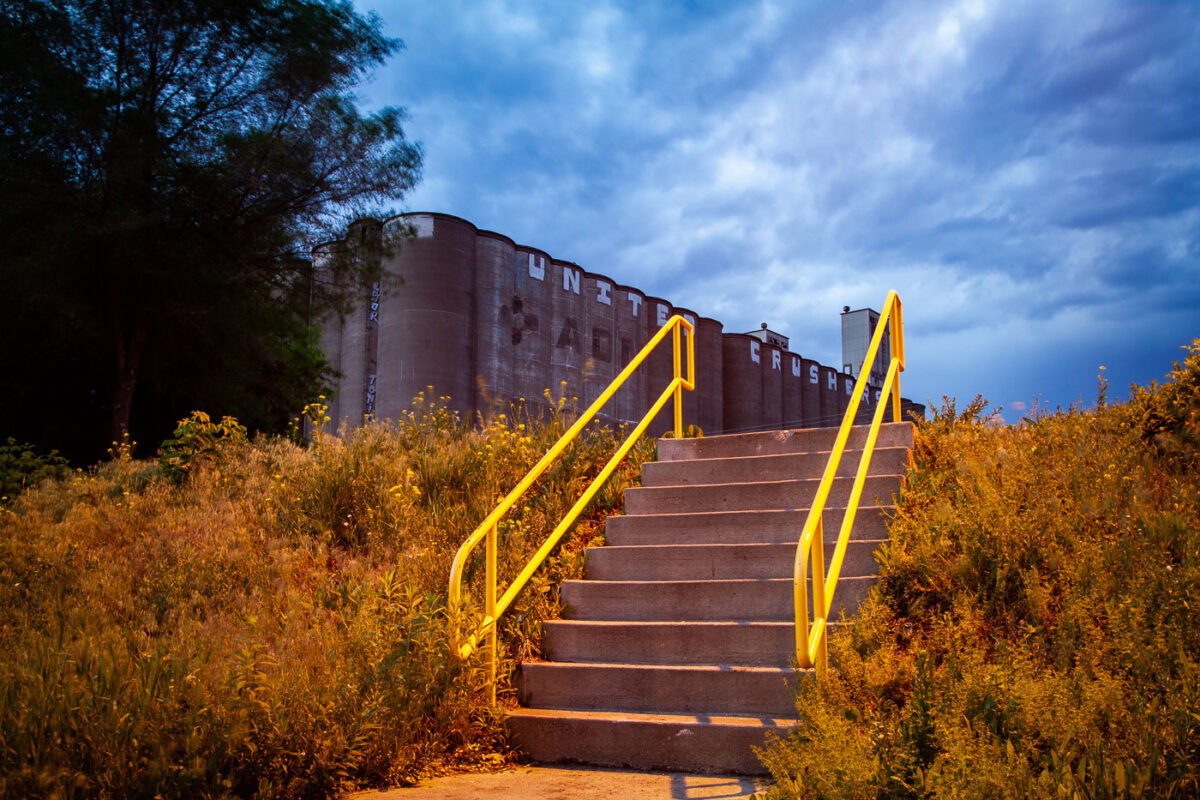
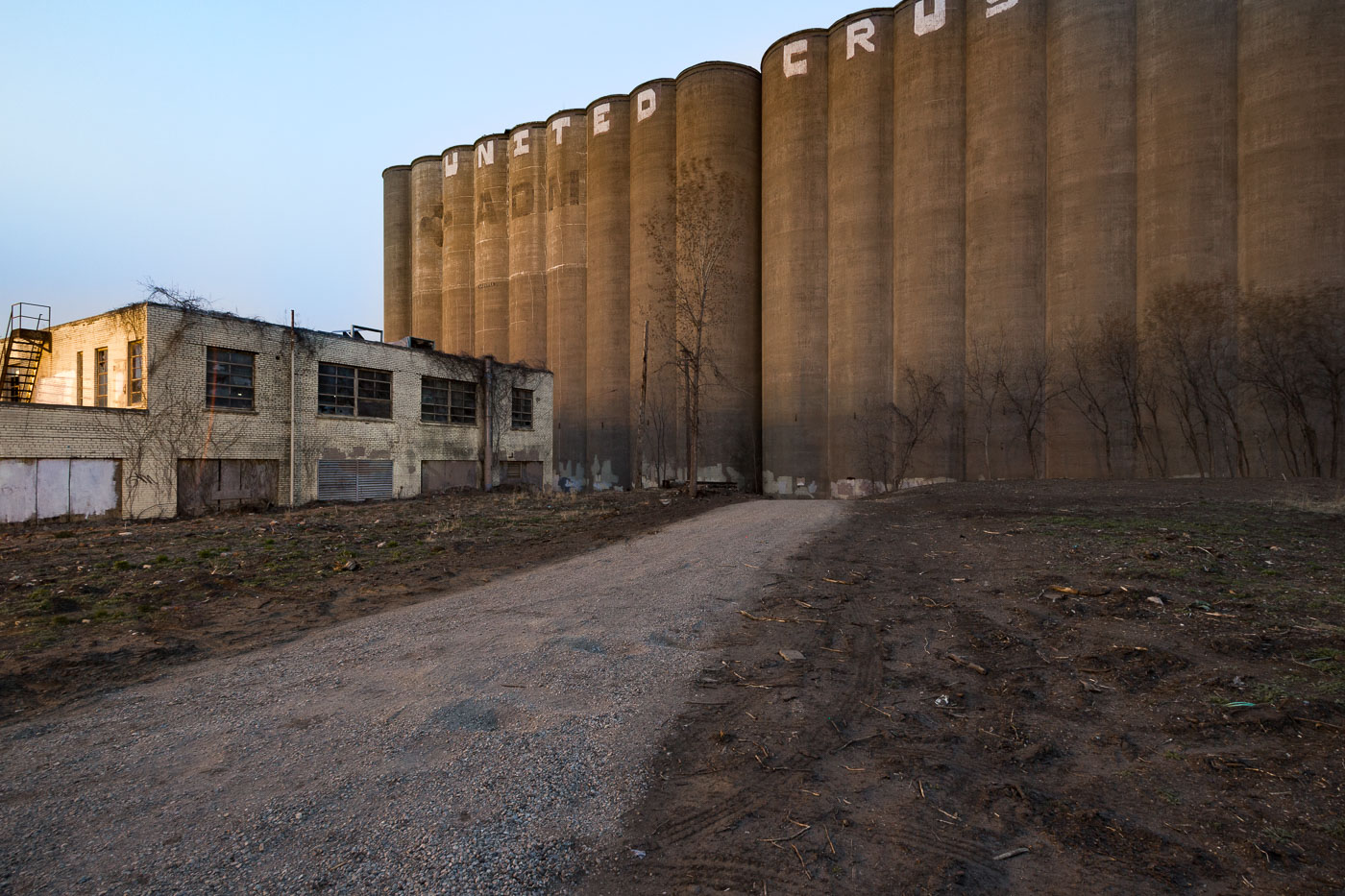
The ADM Grain Elevator in Dinkytown, Minneapolis, is marked with United Crushers graffiti. Grain elevators were vital to the Midwest's agricultural economy and industrial past.
The ADM Grain Elevator in Minneapolis's Dinkytown neighborhood is marked with graffiti by the United Crushers art collective. Grain elevators were essential to the agricultural economy of the Midwest, serving as vital storage and distribution points for harvested crops. This structure, like many others, represents a significant piece of the region's industrial past.

ADM Grain Elevator with United Crushers Graffiti, Dinkytown Minneapolis
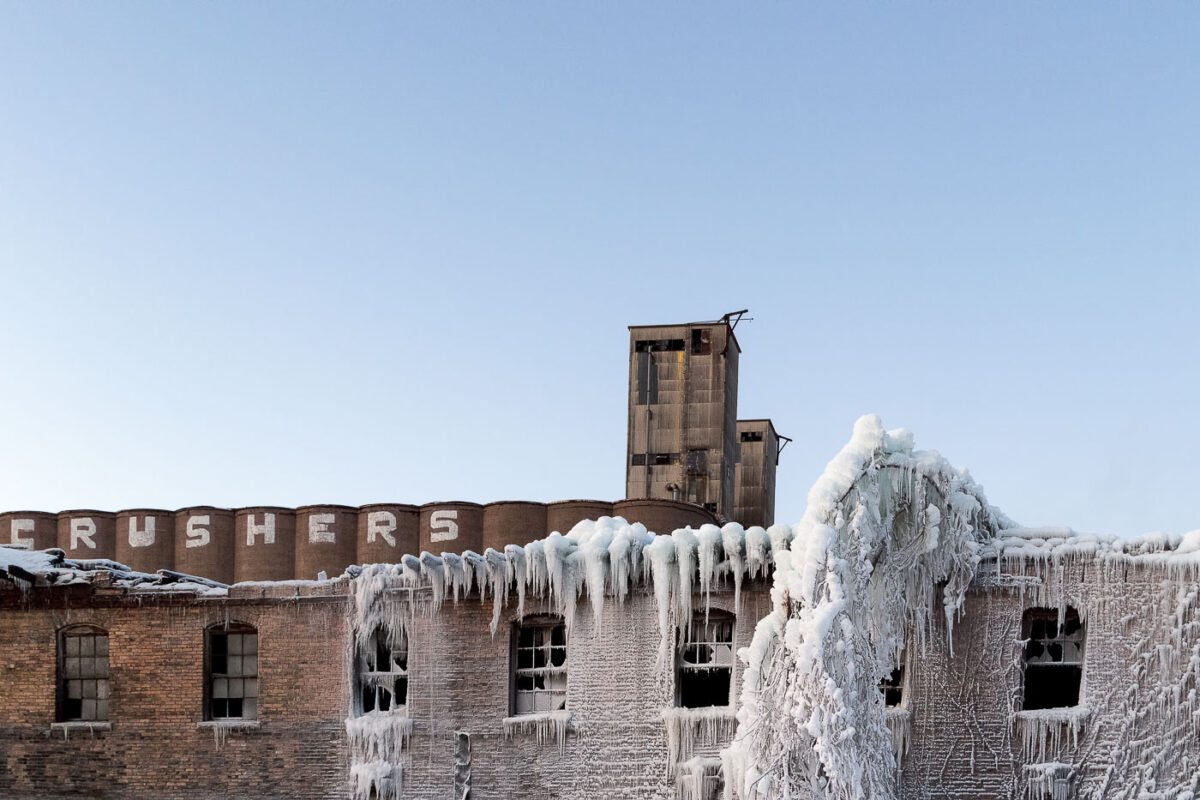
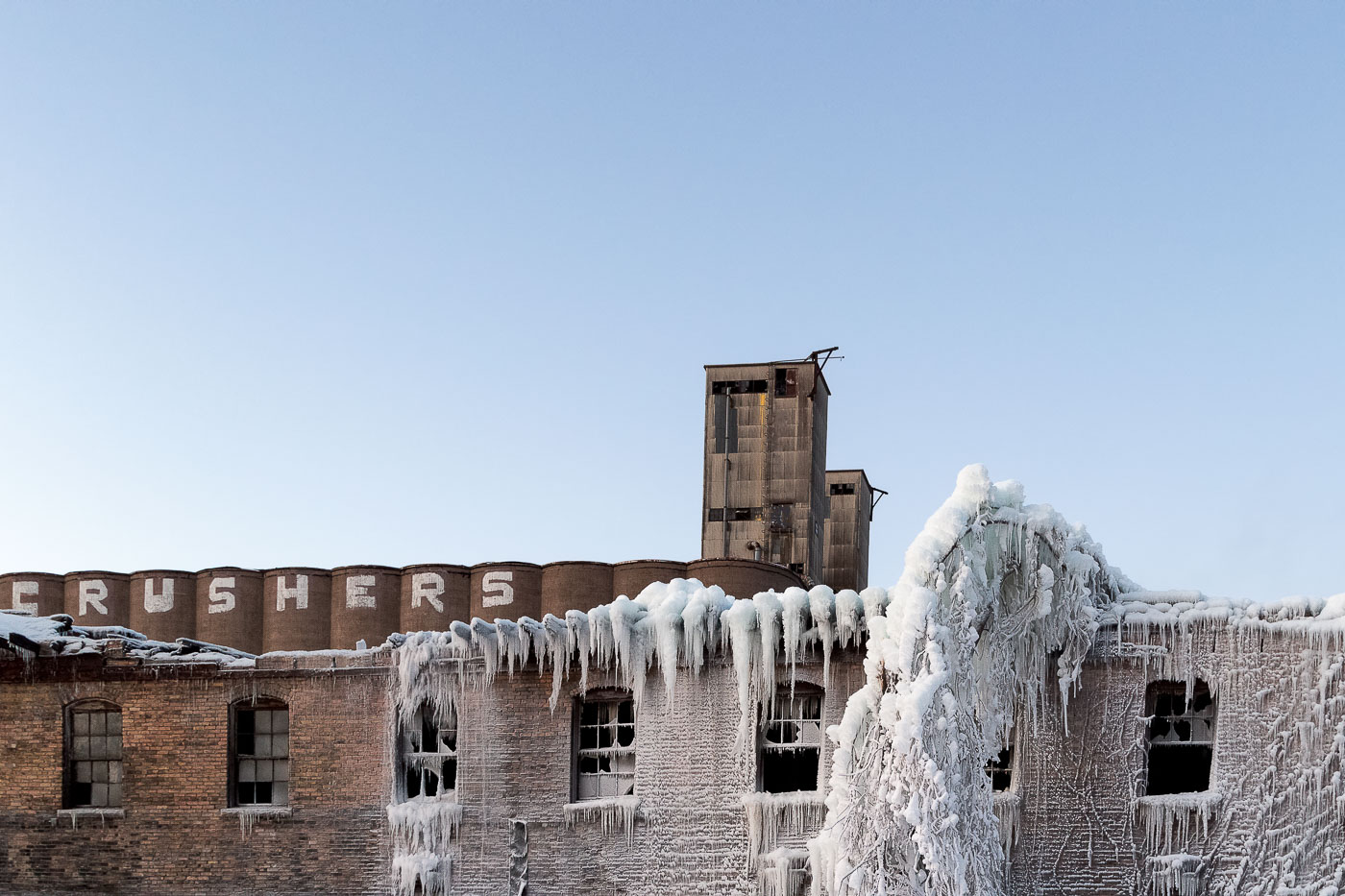
The ADM Grain Elevator and Harris Machinery buildings in Minneapolis's Prospect Park show fire damage and ice accumulation. The ADM silos are marked "CRUSHERS".
The ADM Grain Elevator and Harris Machinery buildings in Prospect Park, Minneapolis, show extensive ice and snow accumulation following a significant fire. The fire gutted the interior of the Harris Machinery structure, leaving its exterior heavily damaged and encased in ice.

ADM Grain Elevator and Harris Machinery Fire Damage, Prospect Park, Minneapolis
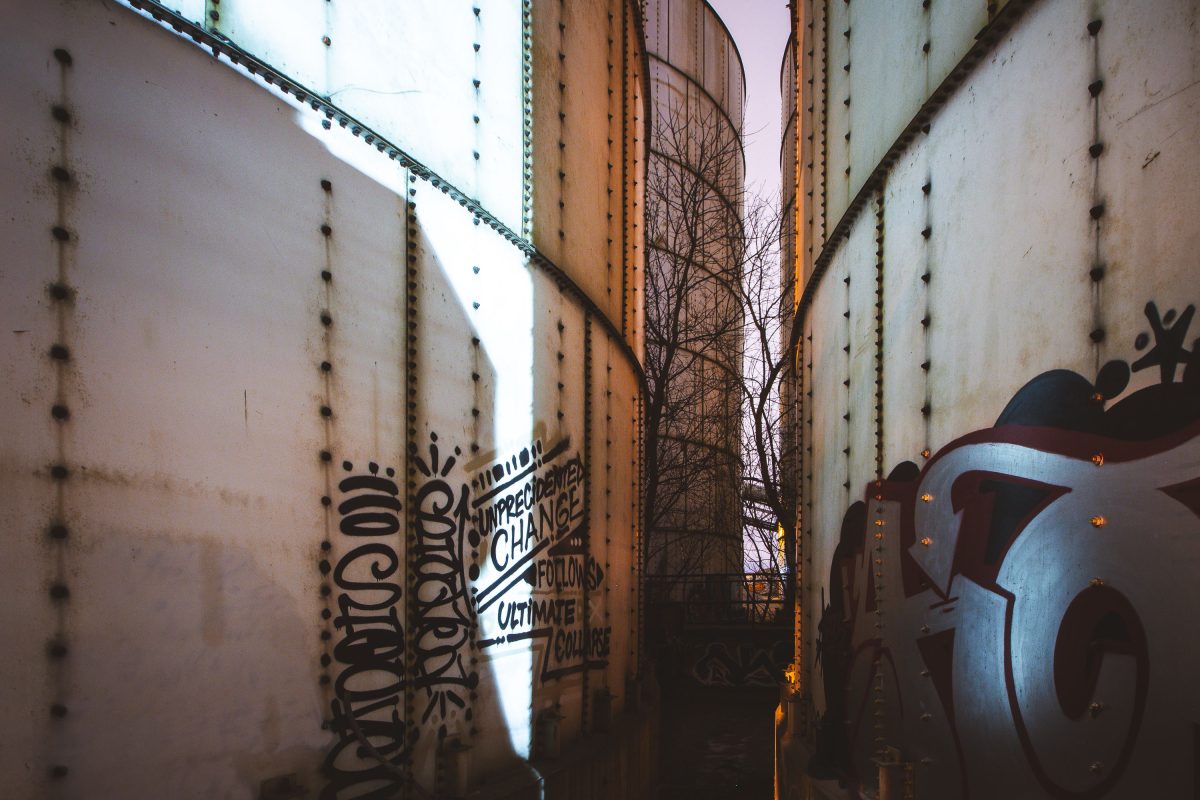
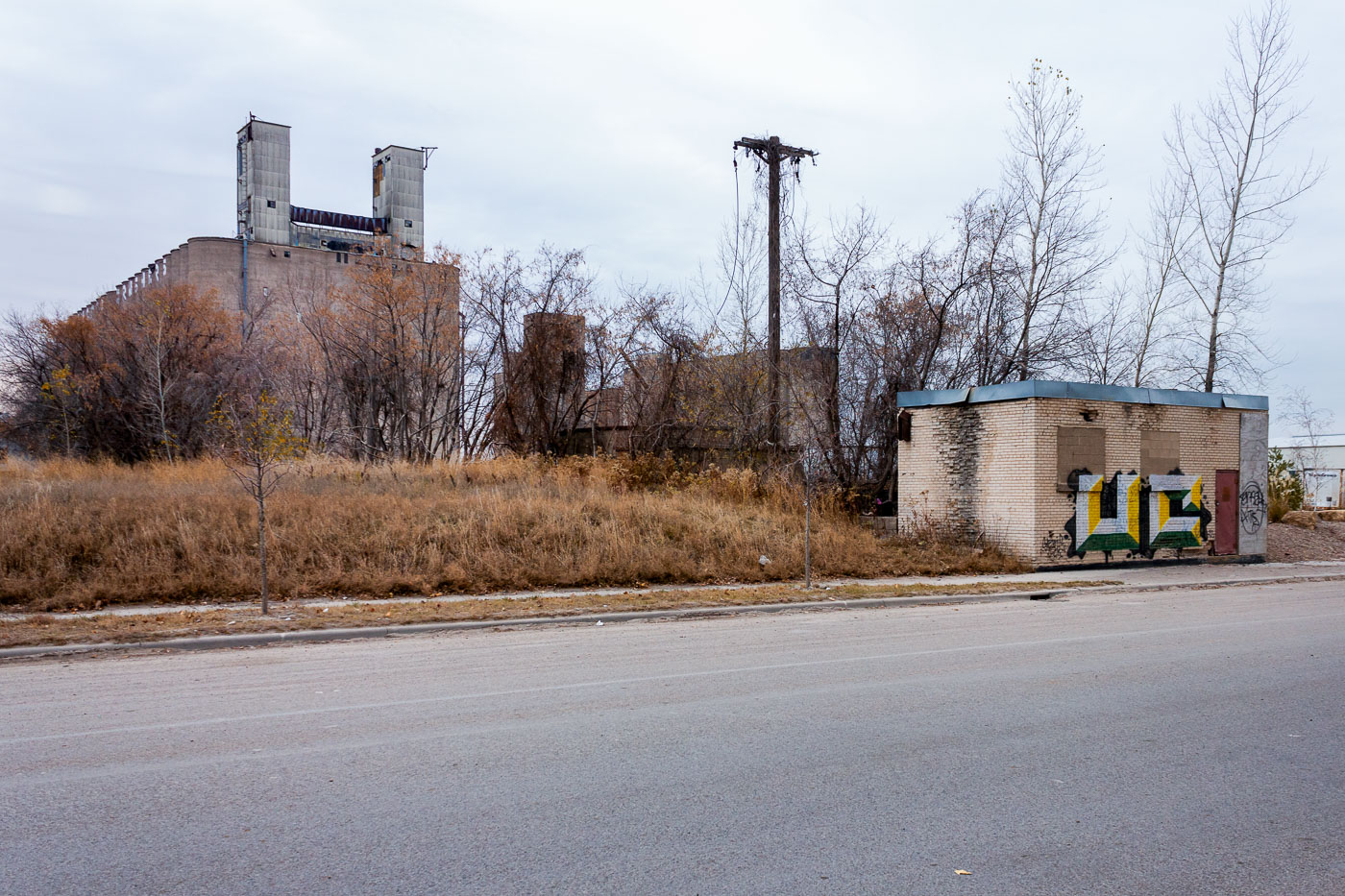
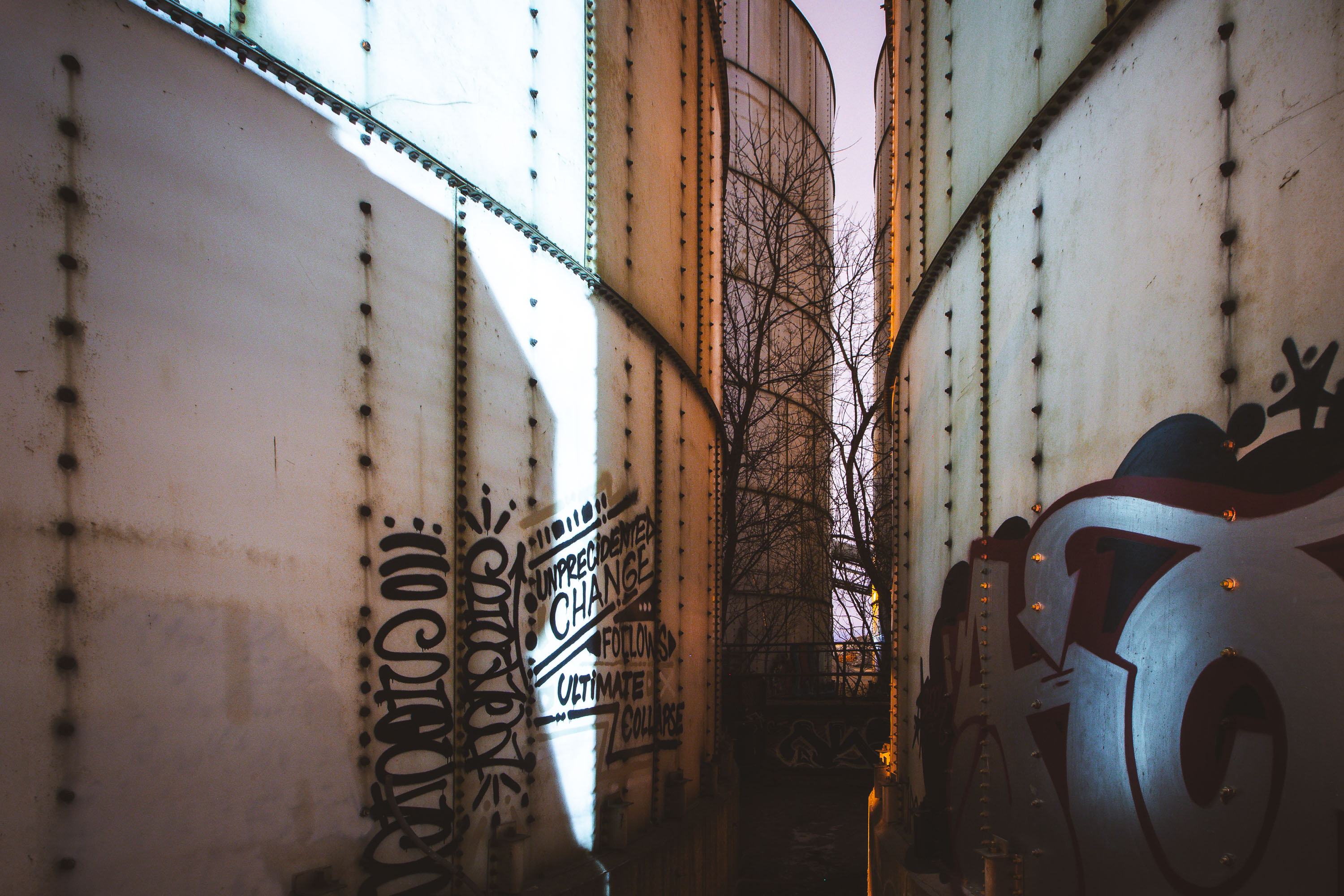
SHOCK graffiti reading "Unprecedented Change Follows Ultimate Collapse" on industrial metal structures at Upper Harbor Terminal in Minneapolis.
SHOCK/UC graffiti that reads "Unprecedented Change Follows Ultimate Collapse"

“Unprecedented Change Follows Ultimate Collapse” Graffiti at Upper Harbor Terminal
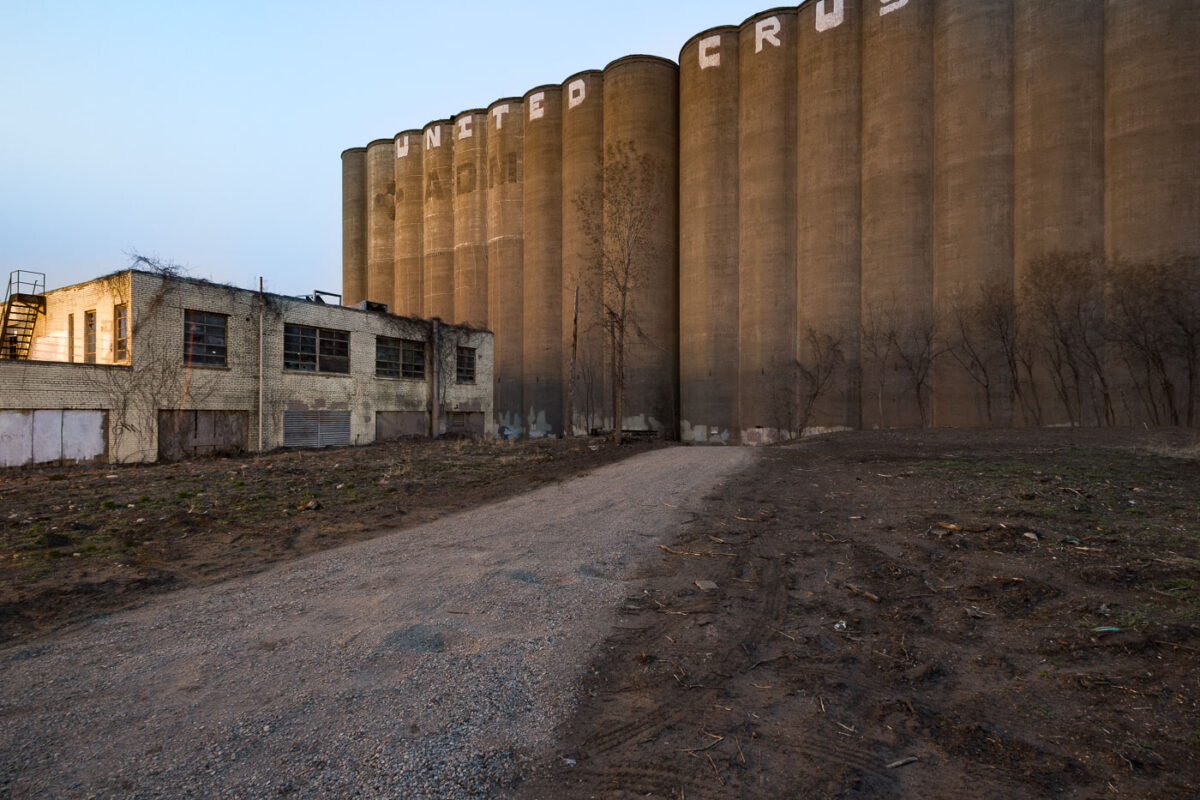
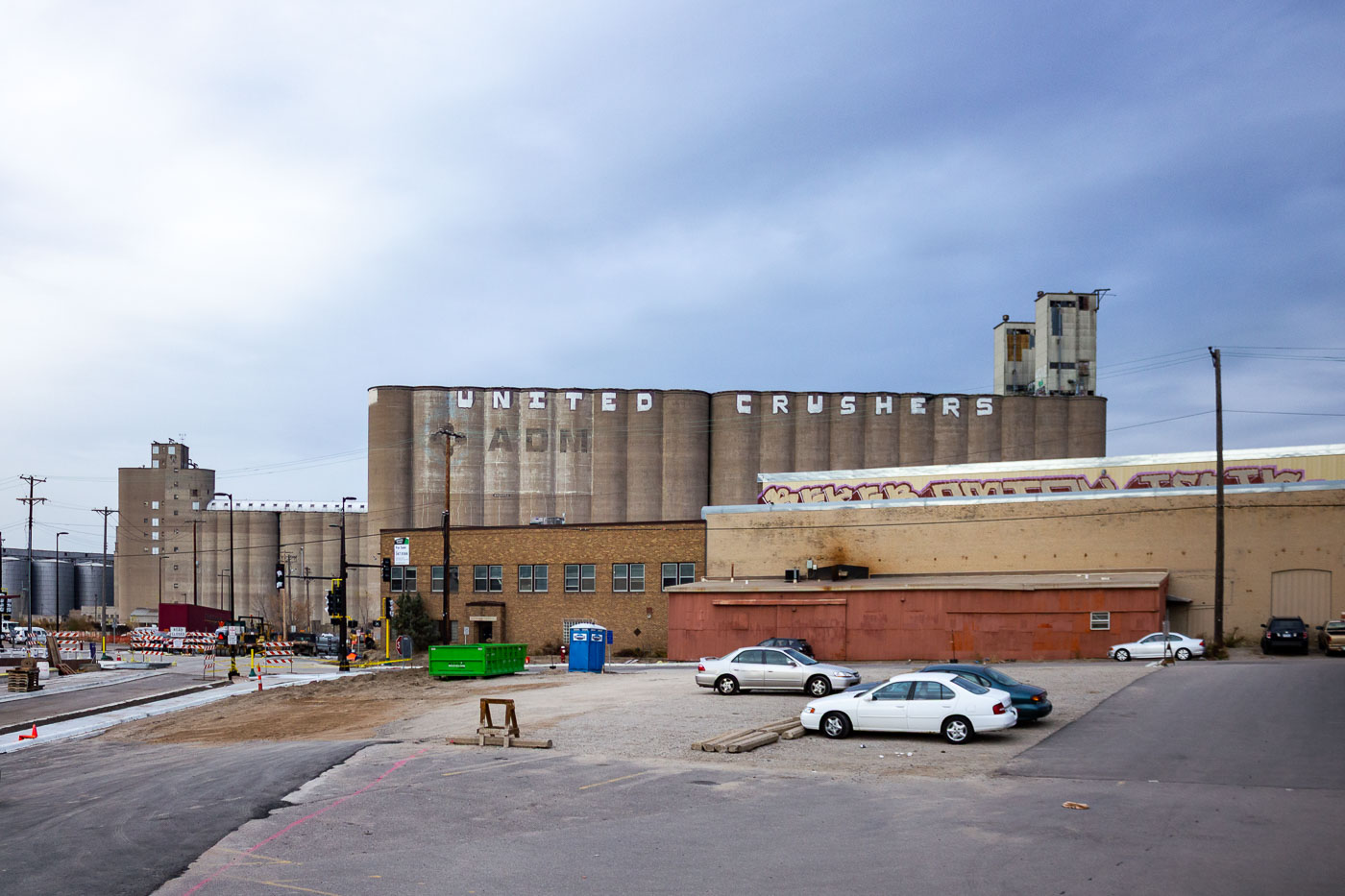
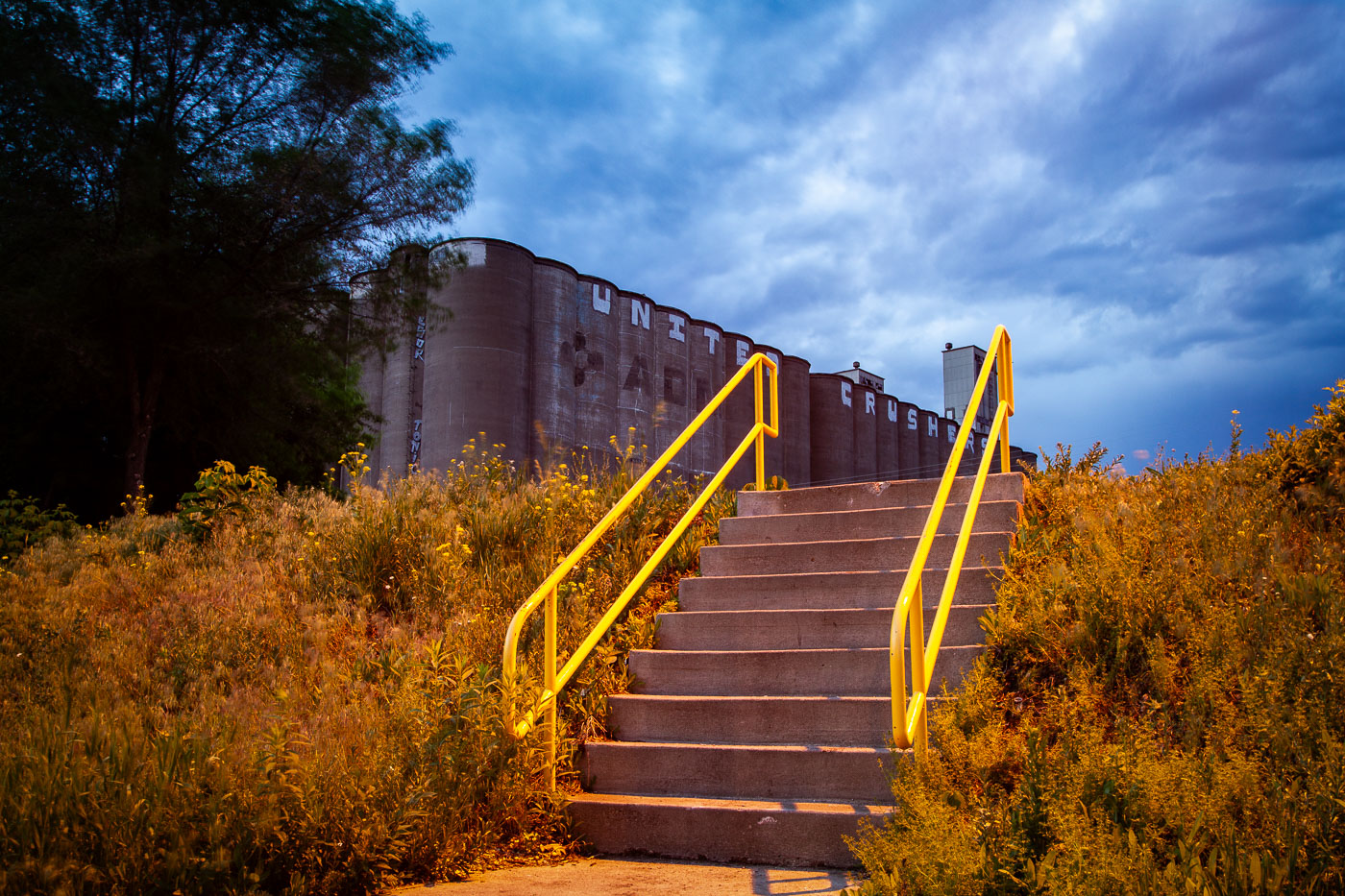
Abandoned ADM grain elevator complex in Dinkytown, Minneapolis, with "UNITED CRUSHERS" branding on silos.
The abandoned ADM grain elevator complex in Dinkytown, Minneapolis, stands as a relic of the city's industrial past. Originally part of the Pillsbury Company's operations, these concrete silos were constructed to store and process grain.

Abandoned ADM Grain Elevator, Dinkytown, Minneapolis
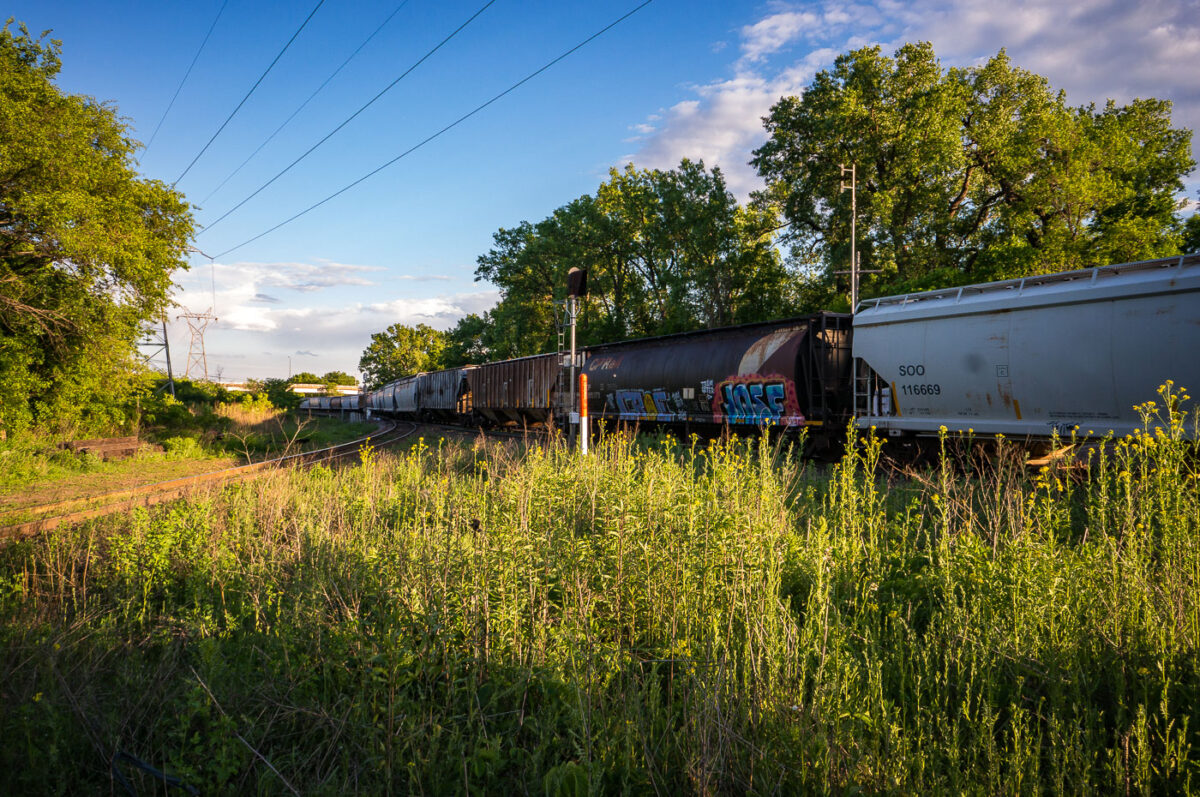
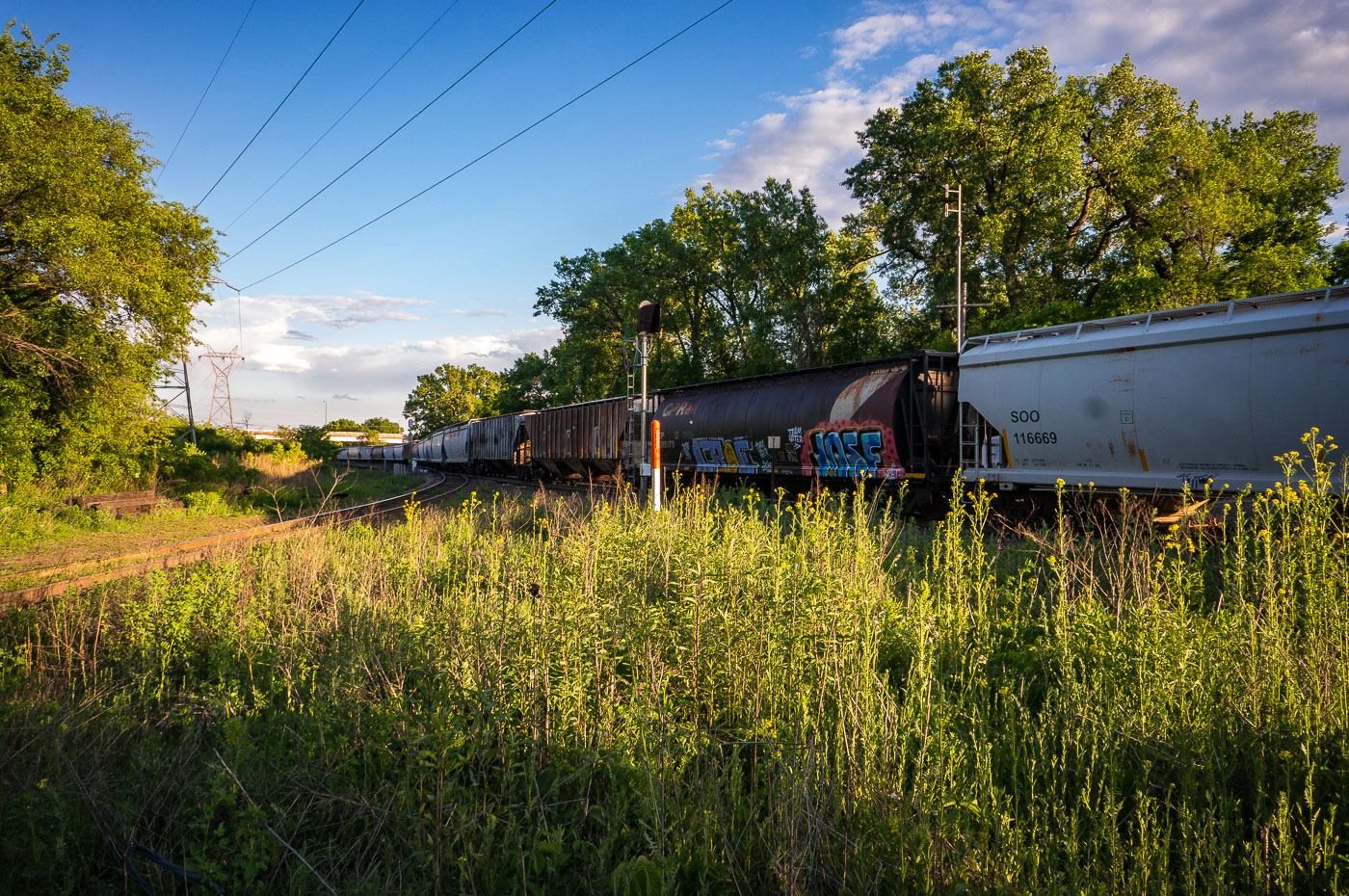
A graffiti-covered freight train travels on tracks in St. Paul, Minnesota, highlighting the city's vital rail transport for commerce and industry.
A long freight train, adorned with graffiti, travels along tracks in St. Paul, Minnesota. The train cars, a mix of covered hoppers and tank cars, are part of the extensive rail network that has historically served as a vital artery for commerce and industry in the Twin Cities region. Rail transport remains a significant component of the local and national economy, facilitating the movement of goods and materials.

Summer Freight Train with Graffiti in St. Paul
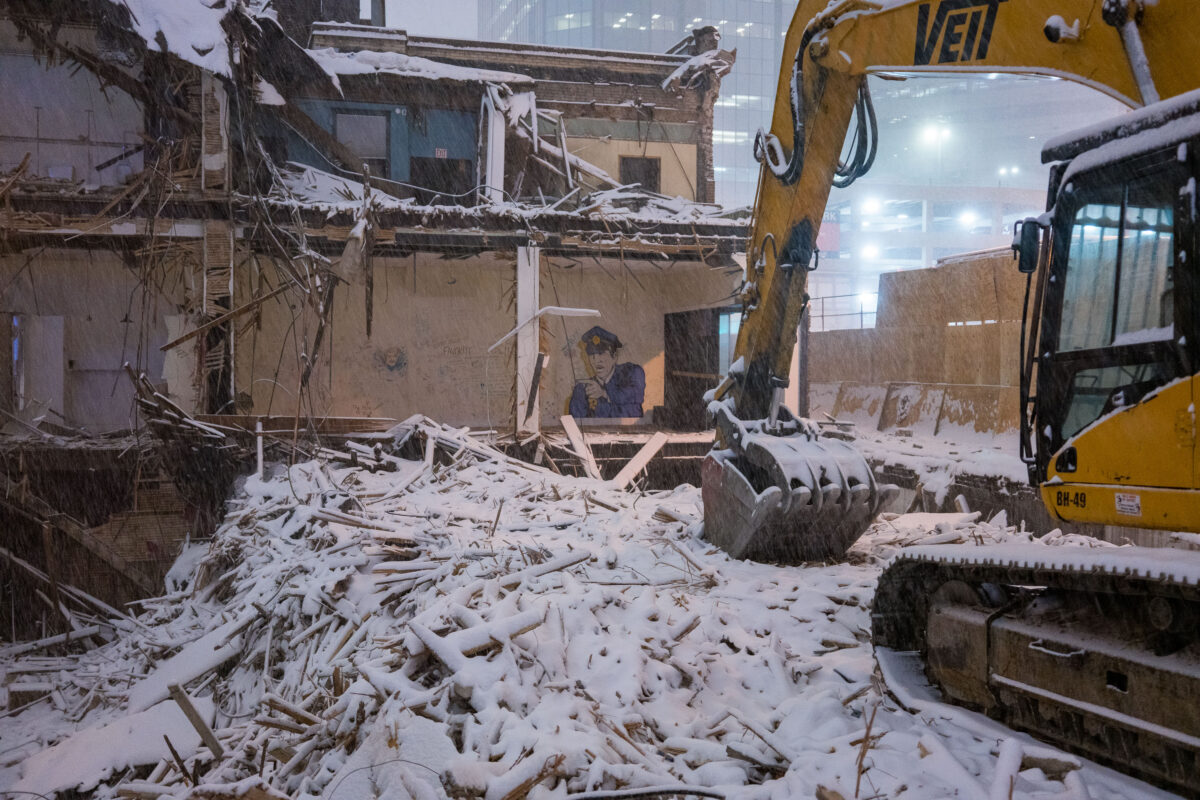
Excavator demolishes snowy building on Marquette Avenue in downtown Minneapolis, revealing police officer mural on adjacent wall.
Demolition work on Marquette Avenue in downtown Minneapolis clears a low-rise commercial building for the City Club Apartments redevelopment in February 2018.

Police Officer Mural Revealed in Snowy Marquette Avenue Demolition
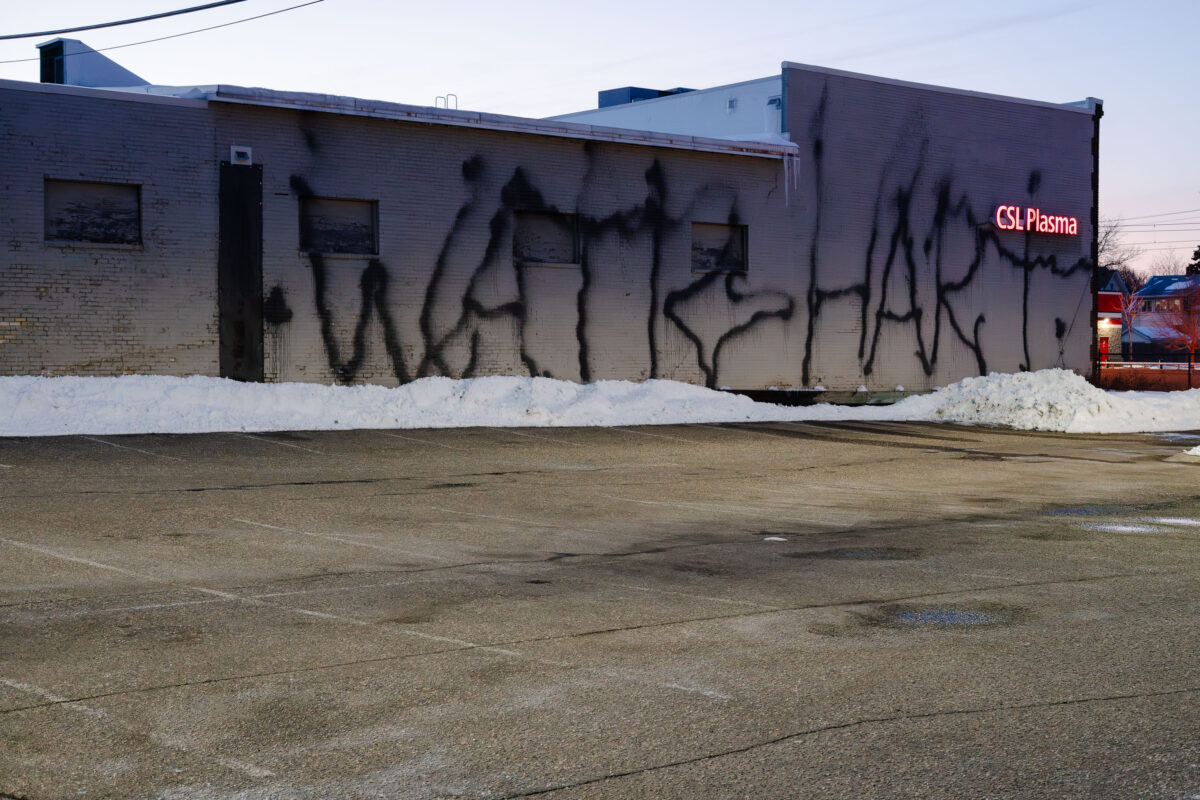
Industrial building with CSL Plasma signage covered in black graffiti in Minneapolis.
CSL Plasma, a blood plasma collection center, operates in Minneapolis. The building's exterior wall bears extensive graffiti, which accumulated over time in this industrial area. The facility collects plasma from donors for use in medical treatments and pharmaceutical manufacturing.

CSL Plasma building with graffiti, Minneapolis
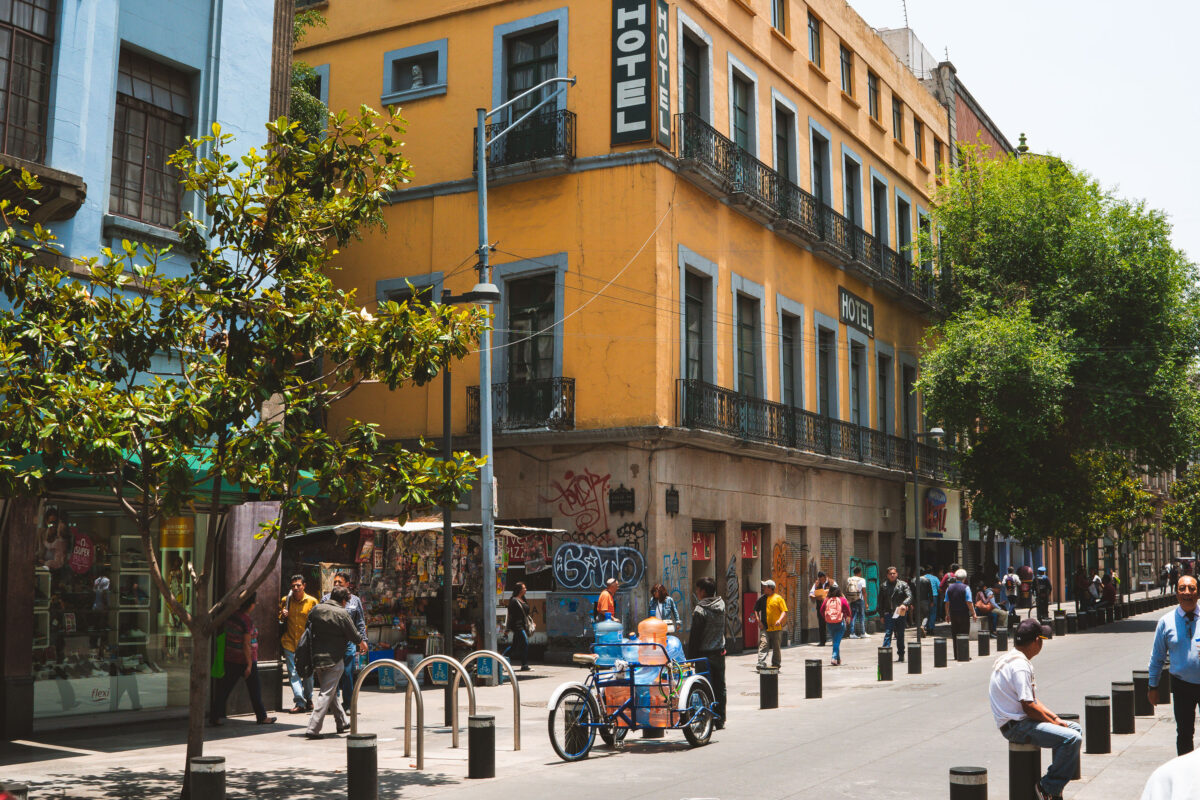
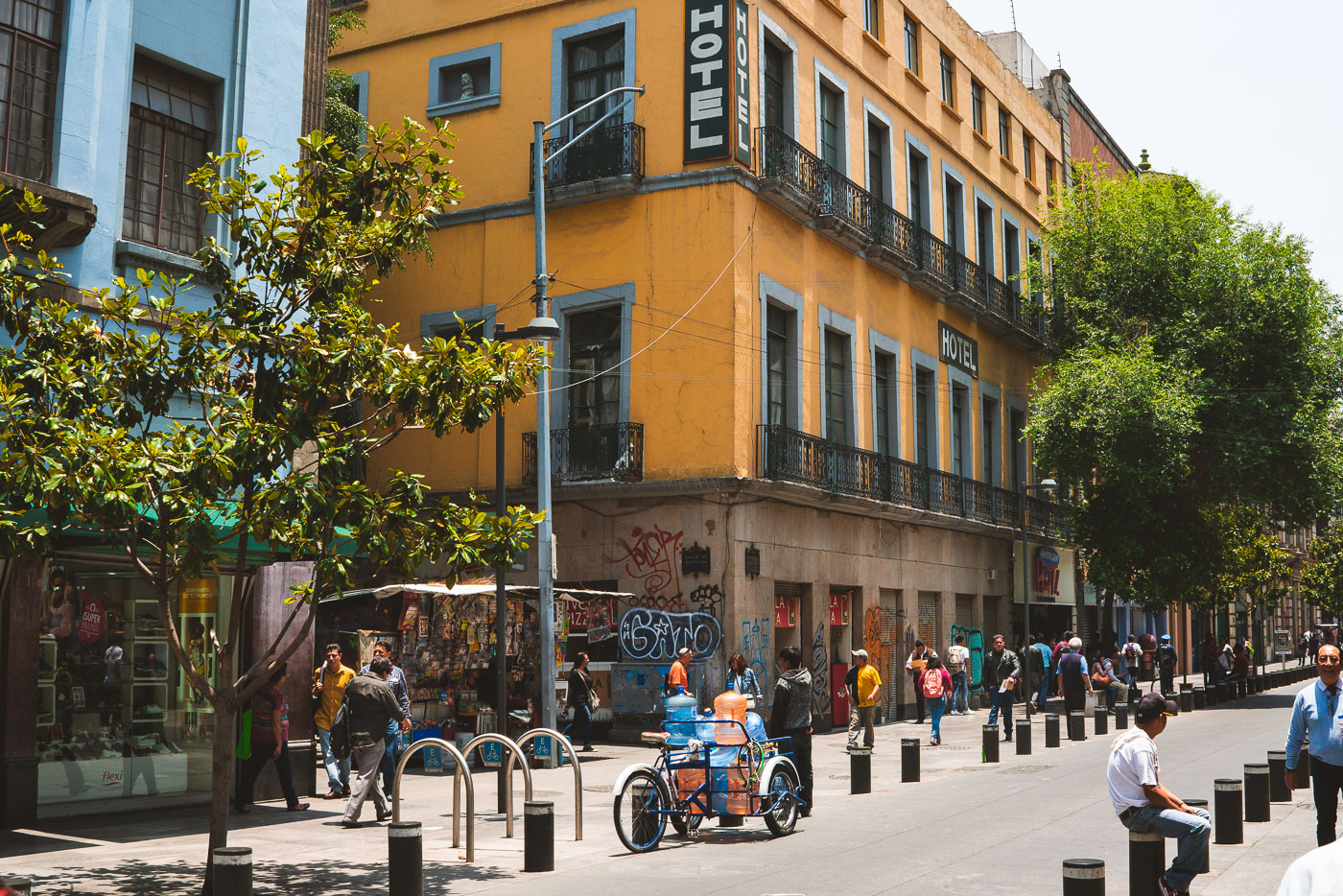
A yellow colonial-era hotel with blue trim stands on a pedestrian street in Mexico City's historic center surrounded by foot traffic and street vendors.
A hotel on Calle República de Uruguay in Mexico City's historic center anchors a busy pedestrian block near the city’s colonial-era core. The ground floor includes street-level storefronts and the surrounding block is used heavily by pedestrians and vendors.

Street Vendors Beneath a Hotel on Calle República de Uruguay
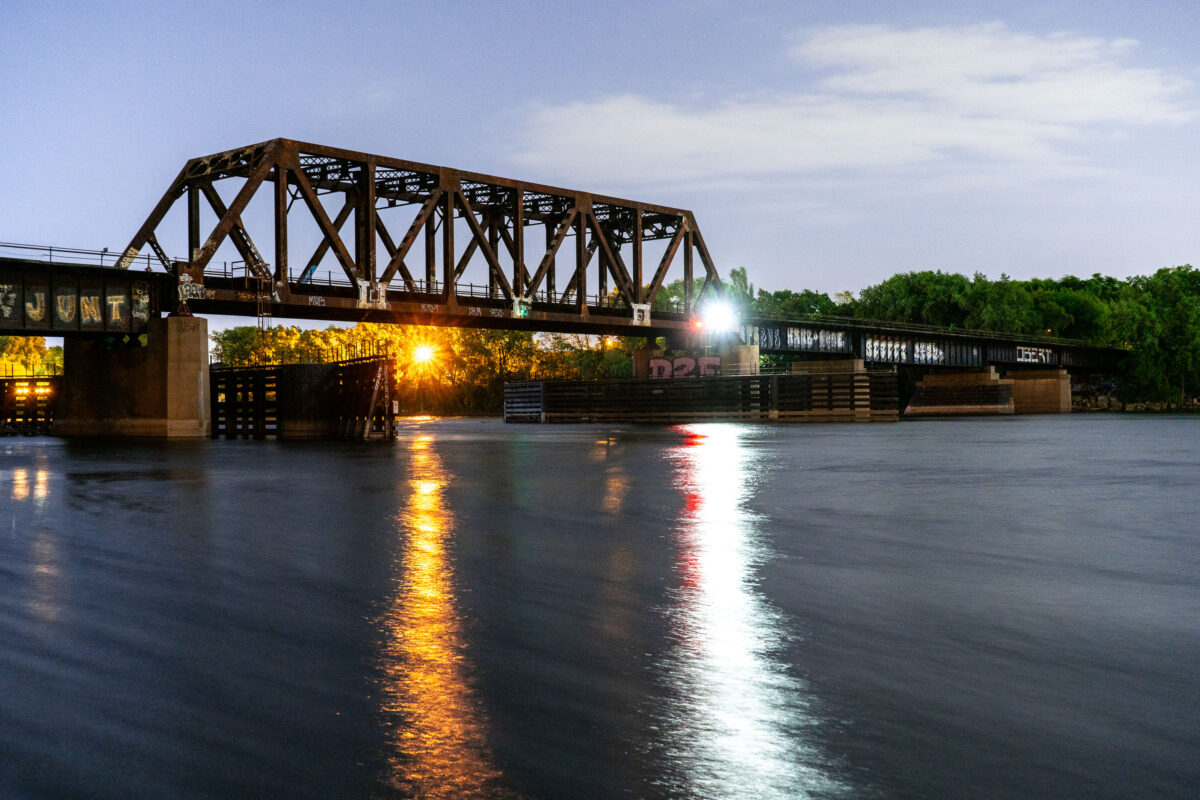
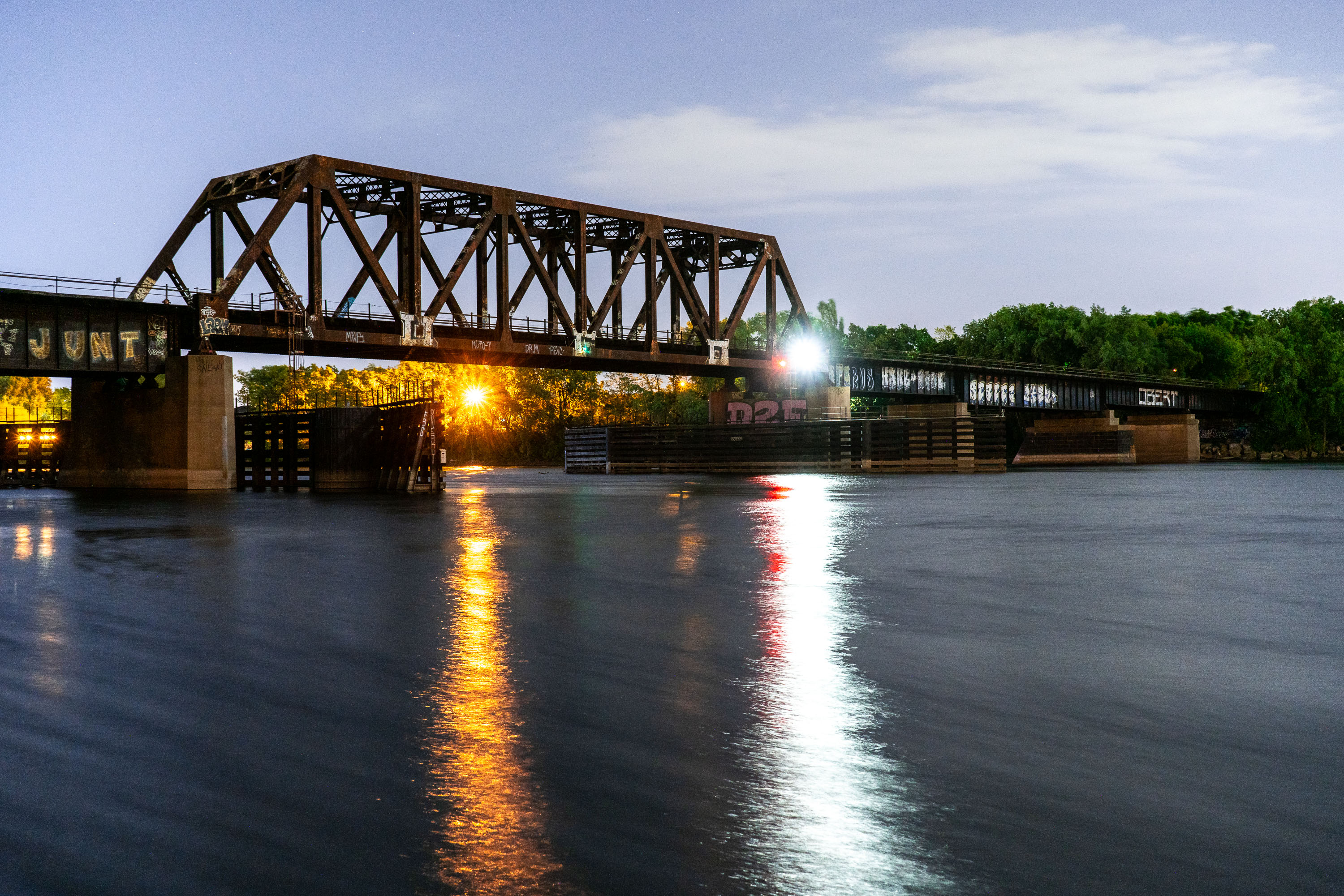
Northern Pacific BNSF Rail Bridge crosses the Mississippi River in Minneapolis.
Northern Pacific BNSF Rail Bridge spans the Mississippi River in Minneapolis between downtown and Northeast Minneapolis. Originally built in 1884 for the Northern Pacific Railway, it provided rail access to yards north of downtown. The bridge has been altered and repaired over time and remains part of BNSF Railway operations in the city.

Northern Pacific BNSF Rail Bridge, Minneapolis
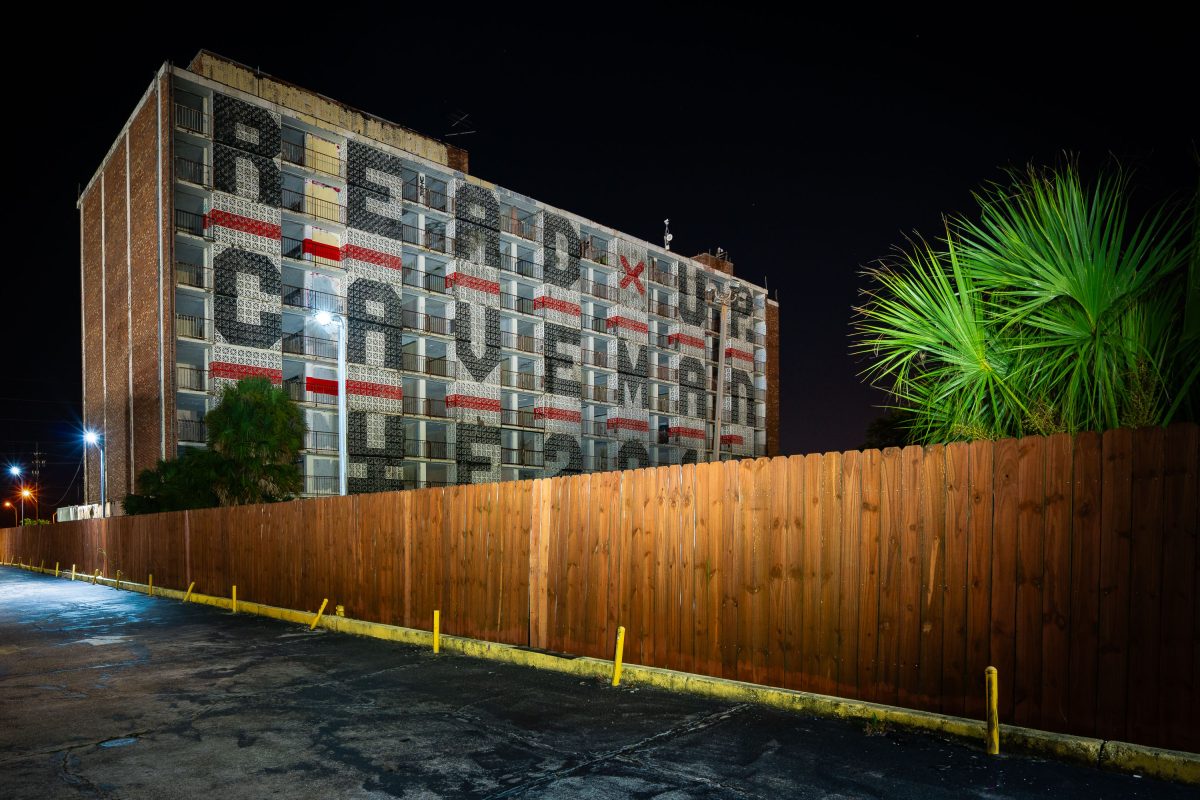
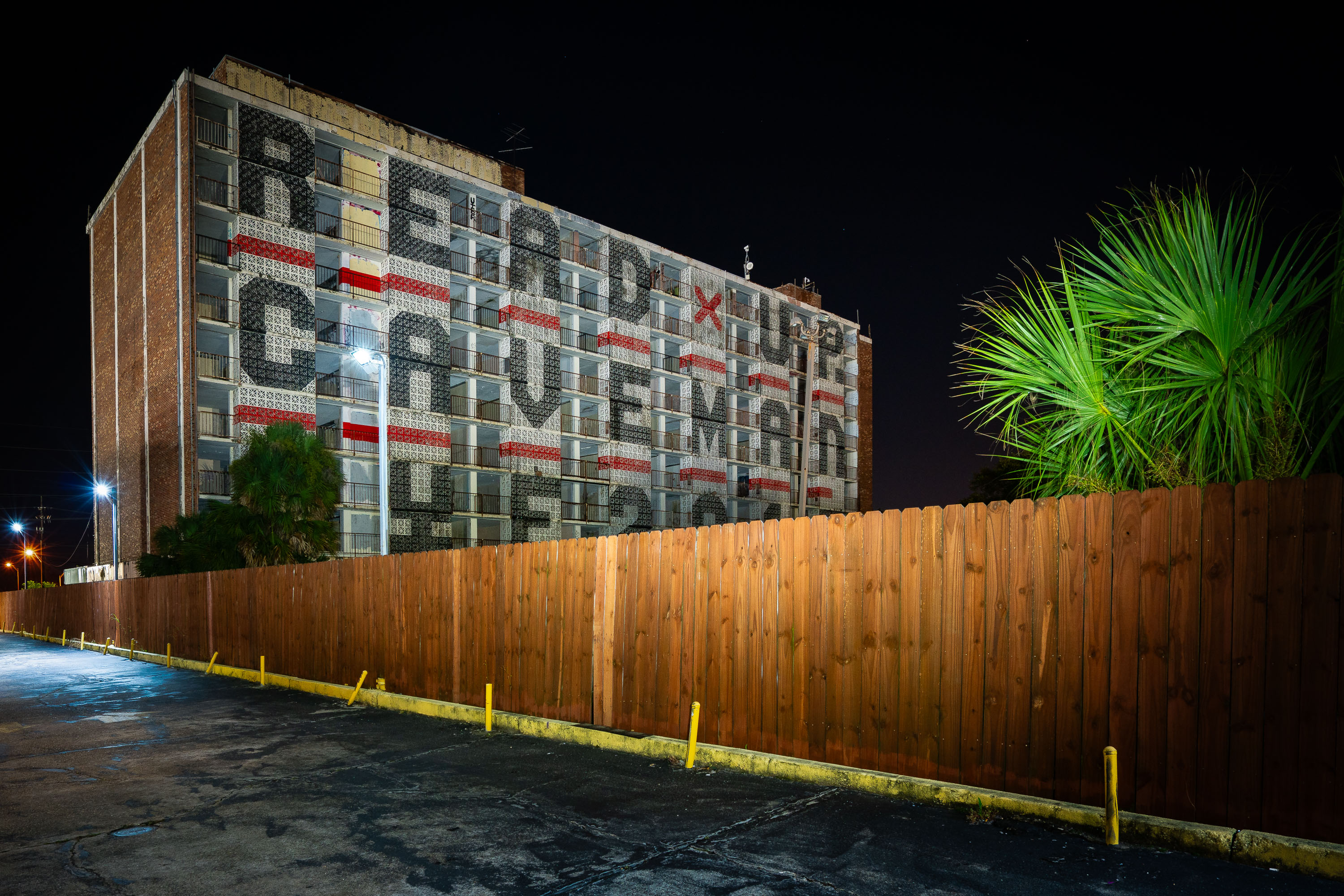
Caveman building in New Orleans with large-scale graffiti text on facade behind wooden construction barrier at night.
READ UP CAVEMAN building in New Orleans. The graffiti on the former Holiday Inn was removed in 2022 when the building was renovated to housing.

“Read Up Caveman” Graffiti on a Former Holiday Inn at Night
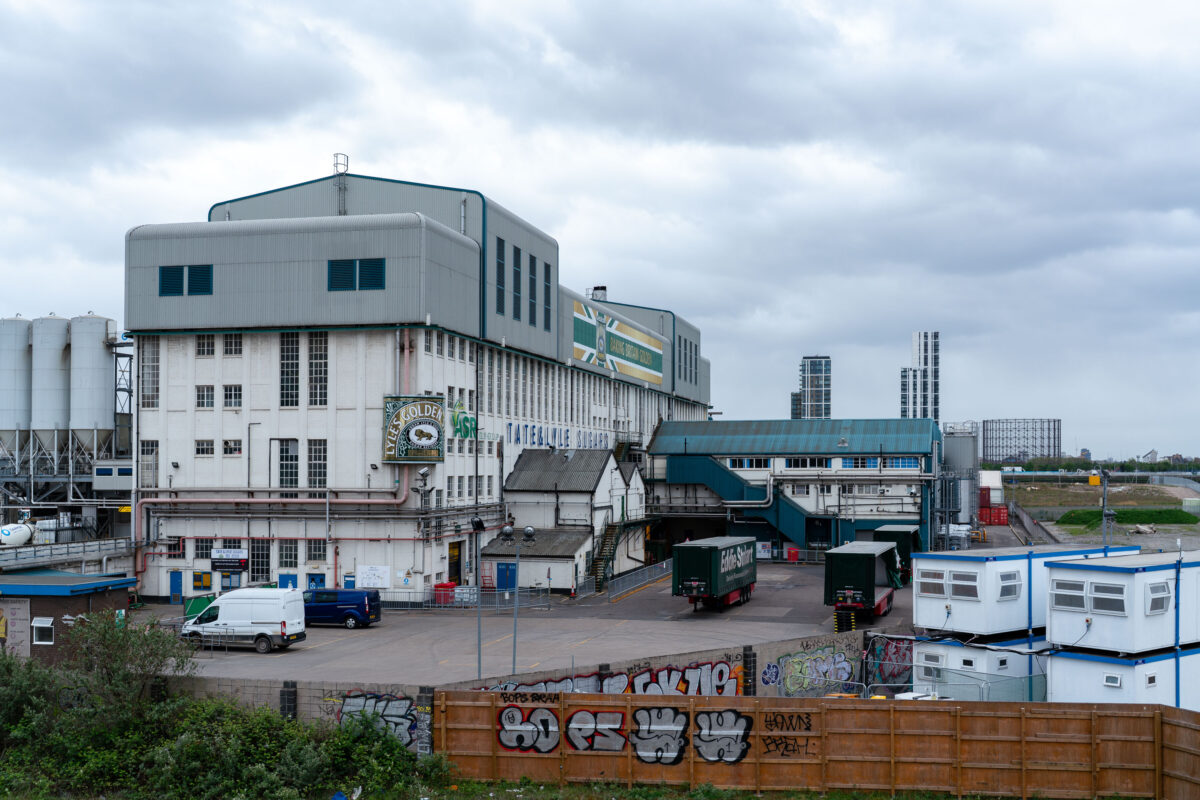
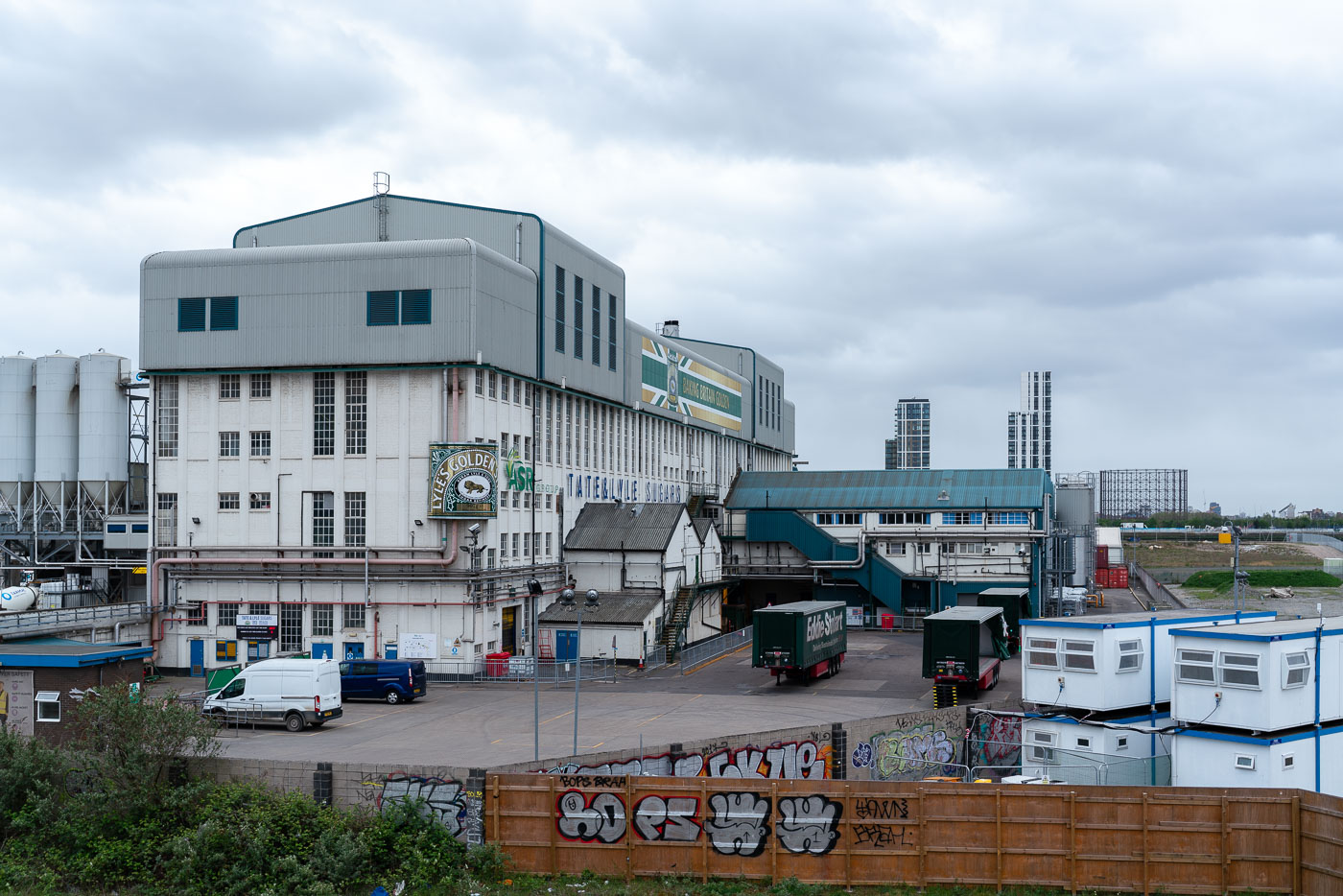
Tate & Lyle sugar refinery in Silvertown, London, with trucks and industrial buildings.
Tate & Lyle’s sugar refinery in Silvertown, east London, operates on the Royal Docks waterfront. The complex processes sugar and is associated with Lyle’s Golden Syrup, a product long linked to the site and its branding.

Tate & Lyle Sugar Refinery, Silvertown, London
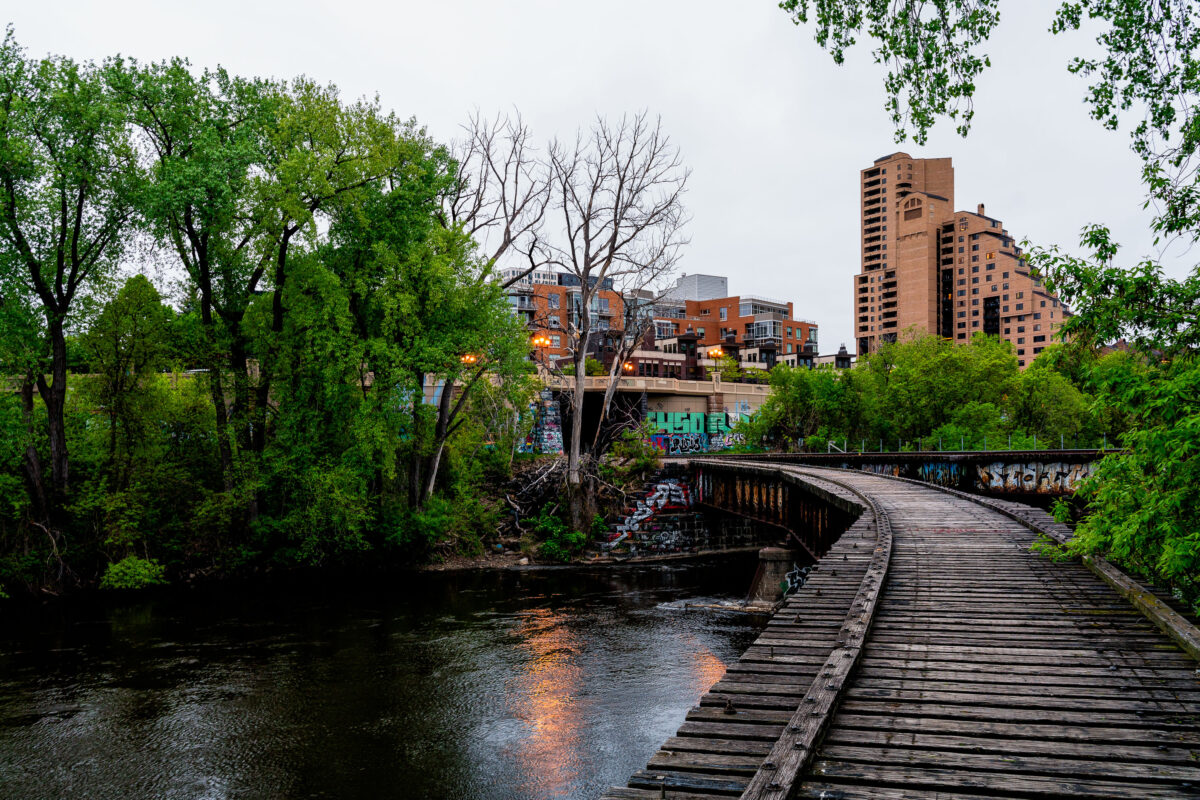
Abandoned railroad bridge on Nicollet Island crosses the Mississippi River in Minneapolis.
The abandoned railroad bridge on Nicollet Island in Minneapolis crosses the Mississippi River on a former freight spur. Built to connect industrial facilities near the river, it now stands as a remnant of the city’s rail and milling era.

Abandoned Railroad Bridge on Nicollet Island, Minneapolis
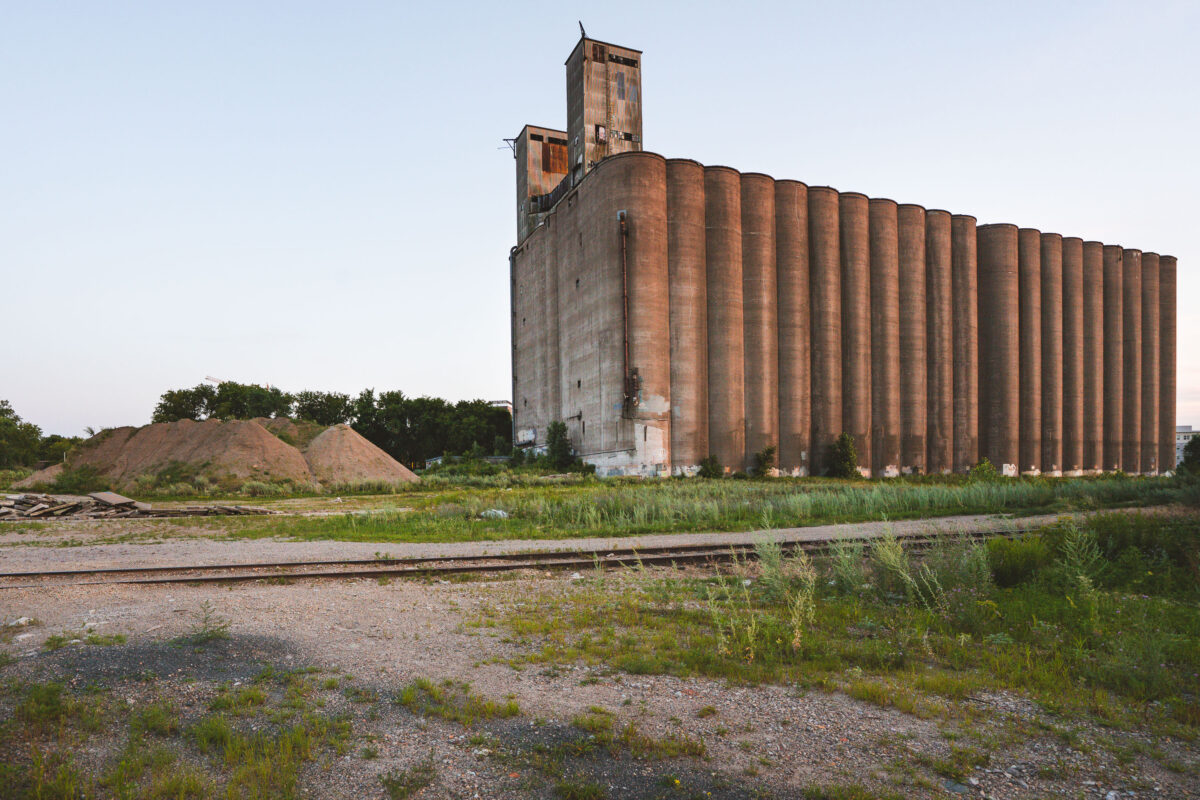
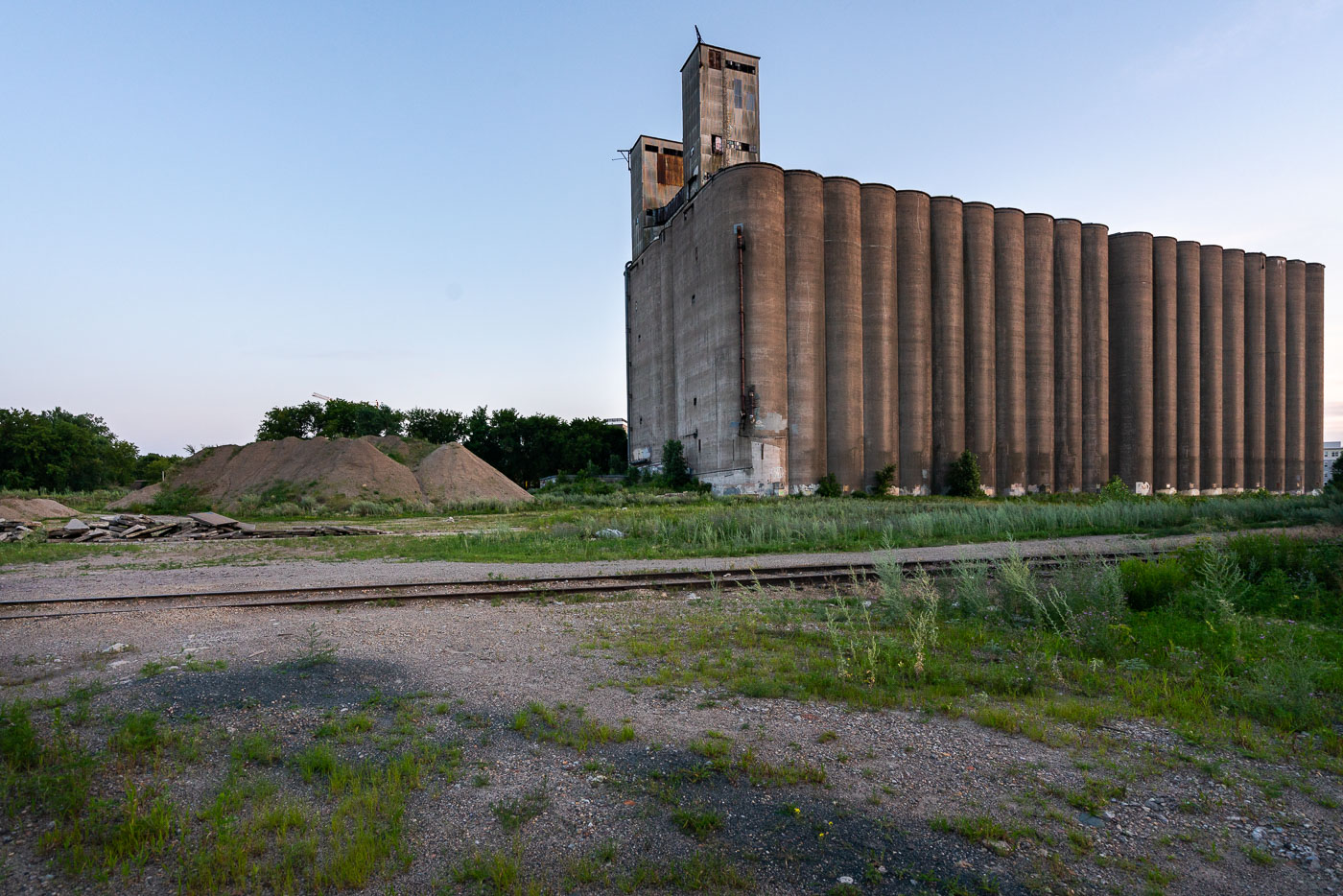
Archer Daniels Midland Delmar Elevator No 7
The long abandoned massive concrete Archer-Daniels-Midland Delmar Elevator No. 7 in Minneapolis. Known locally as the "United Crushers" mill after the large tag visible from miles away.

Archer Daniels-Midland Delmar Elevator No 7
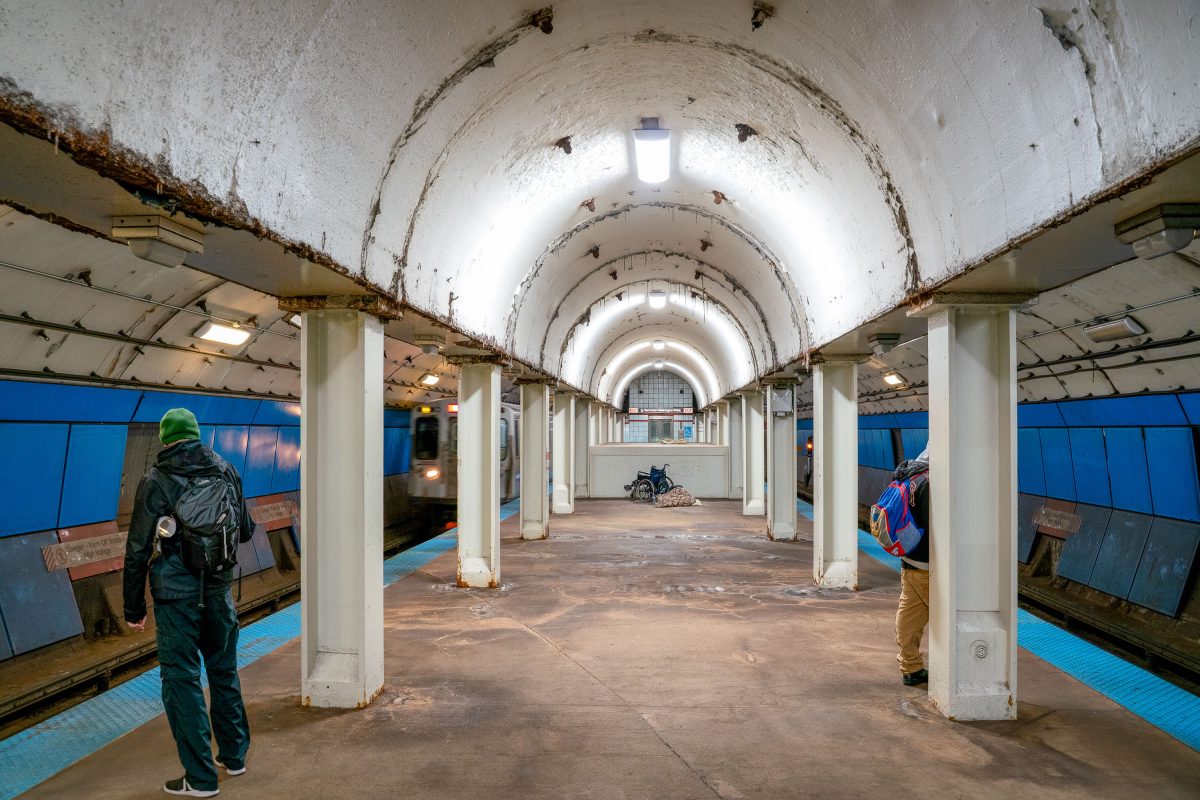
Commuters walk the vaulted platform at State/Lake CTA station in downtown Chicago.
This vaulted platform serves State/Lake station, a CTA Loop stop connecting the Green, Orange, Brown, and Pink lines in downtown Chicago. The station's barrel-arched ceiling and rows of concrete columns date to an earlier era of Chicago's elevated and subway transit construction, distinguishing it from more modern CTA stops. Located near Randolph and State Streets, the station provides access to the Loop's theater and retail district.

Waiting for a Train at State/Lake Station, Chicago
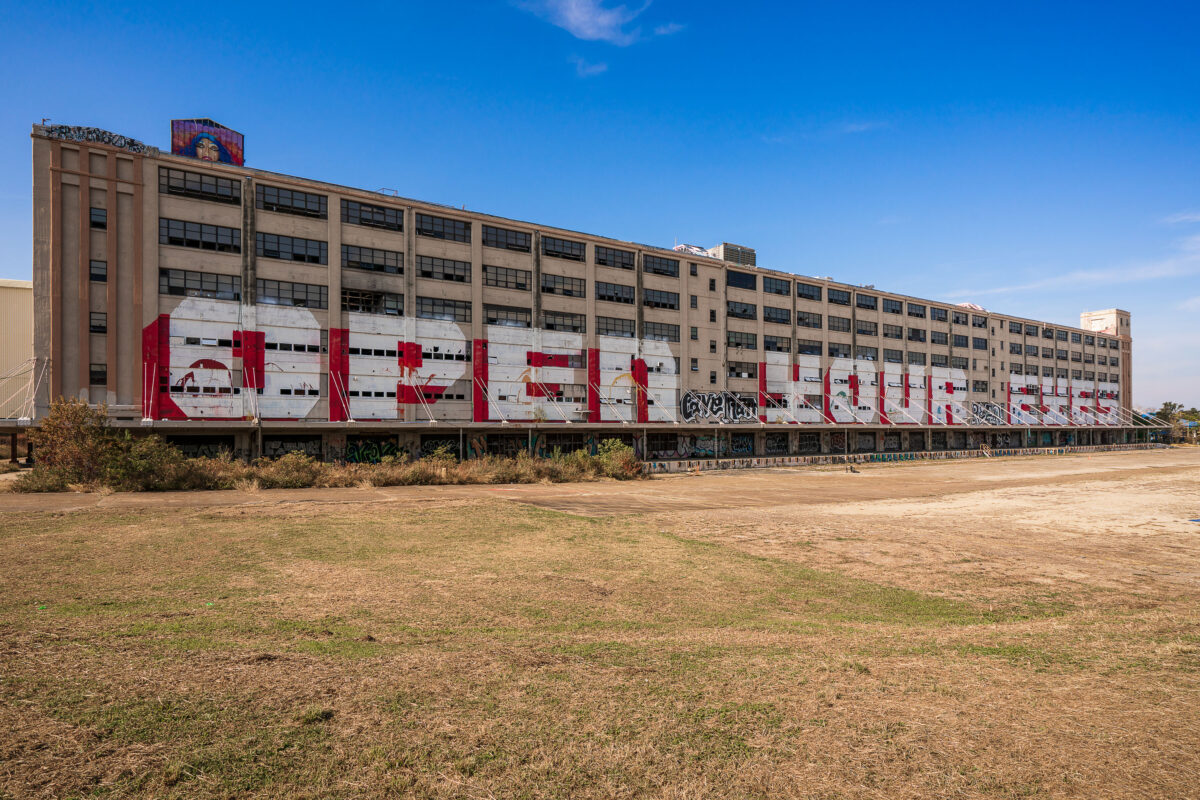
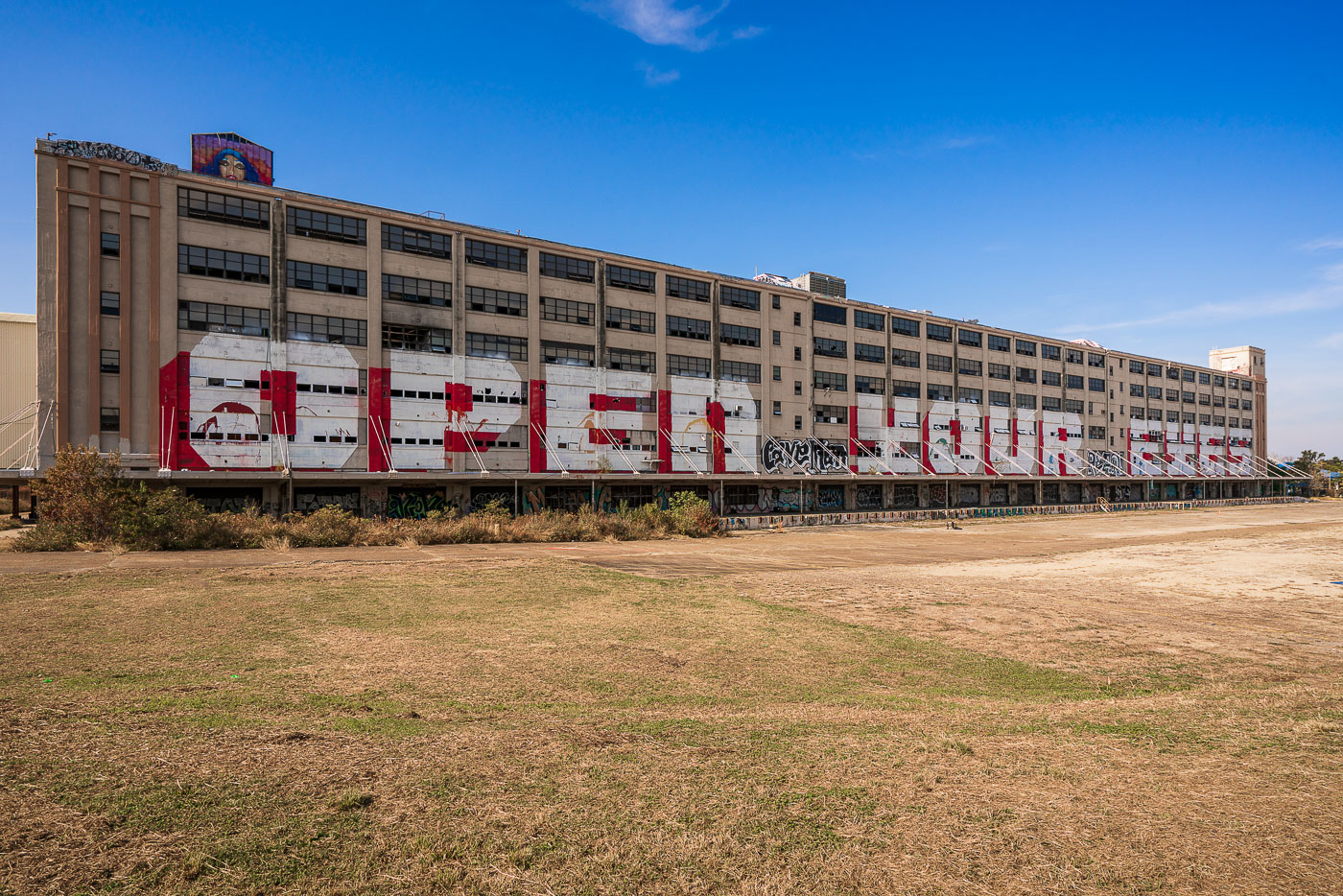
Large-scale red and white graffiti mural covers the facade of an abandoned Naval Support Activity warehouse in New Orleans.
Naval Support Activity New Orleans warehouse, New Orleans. The former military logistics building on the Mississippi River front has been covered with large-scale graffiti murals and tags. The base was decommissioned and has been awaiting redevelopment.

Large-Scale Graffiti Murals on the Naval Support Activity Warehouse
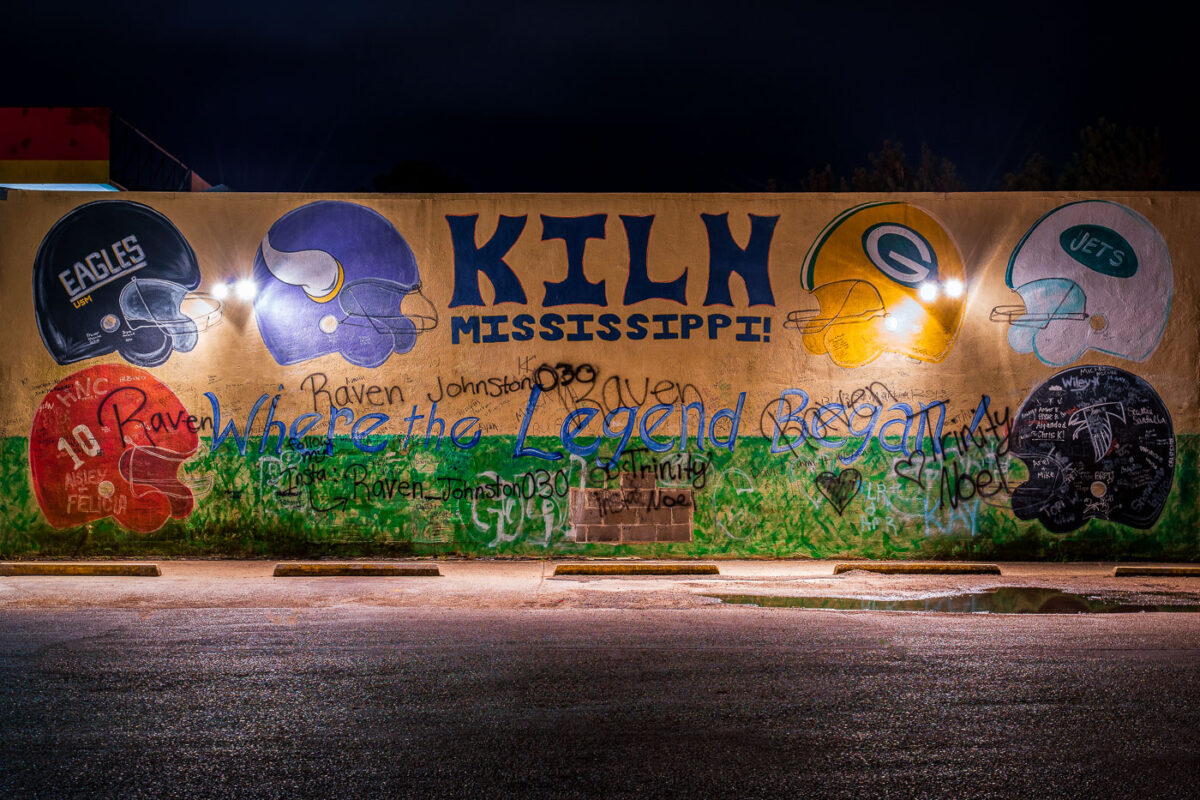
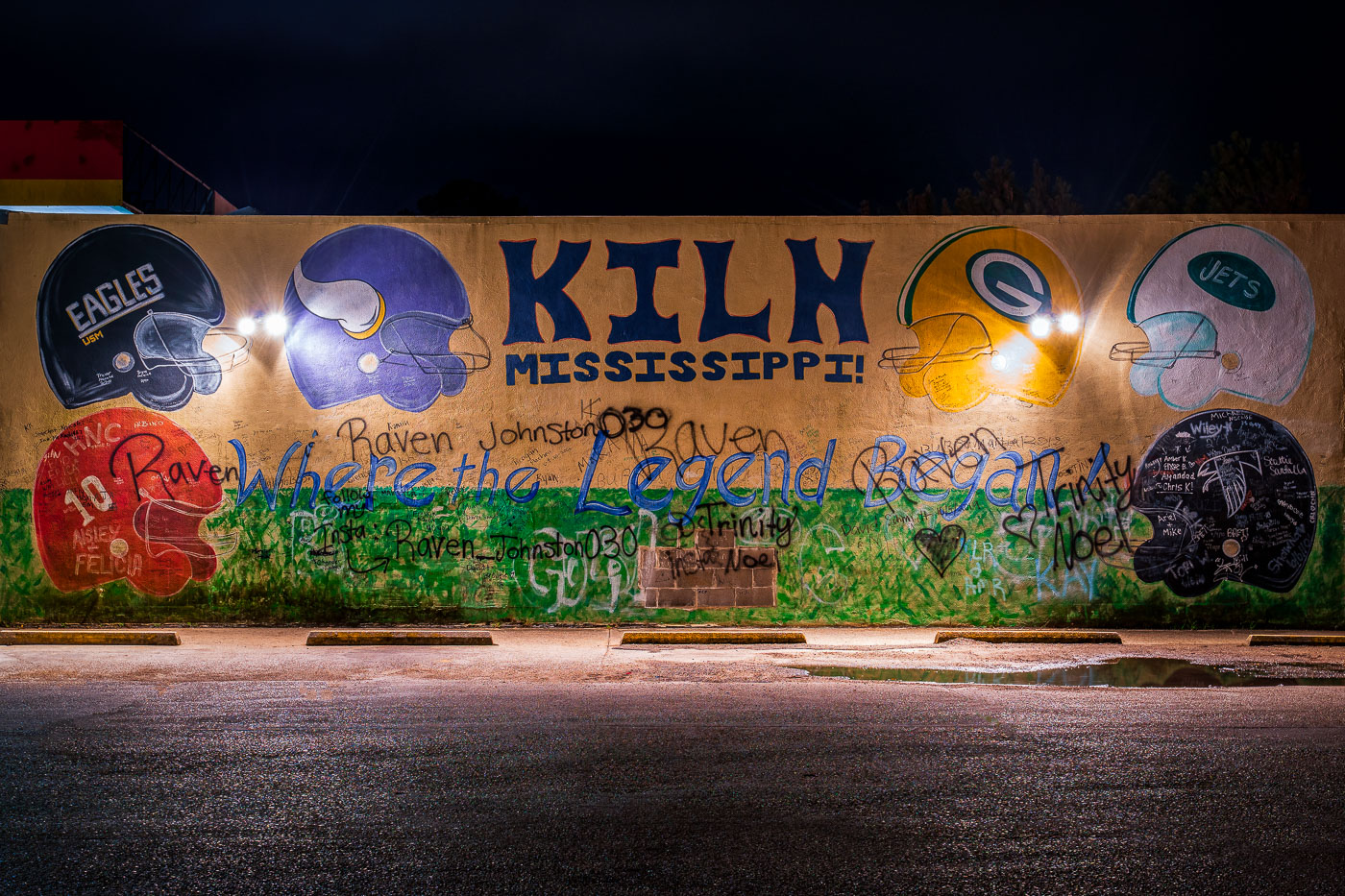
Brett Favre helmet mural in Kiln, Mississippi displays painted NFL team helmets honoring the quarterback's career.
Kiln, Mississippi, is the hometown of Brett Favre, the Hall of Fame quarterback who grew up here before starring at Hancock High School. This roadside mural marks that connection, pairing helmets from the four NFL teams Favre played for — the Atlanta Falcons, Green Bay Packers, Minnesota Vikings, and New York Jets — with the phrase "Where the Legend Began." Favre spent the bulk of his career with the Packers, where he won a Super Bowl following the 1996 season and set numerous passing records before later stints in Minnesota and with the Jets. The small unincorporated community, part of Hancock County near the Mississippi Gulf Coast, has leaned into its association with Favre as a point of local identity.

“Where the Legend Began” Mural in Kiln, Mississippi
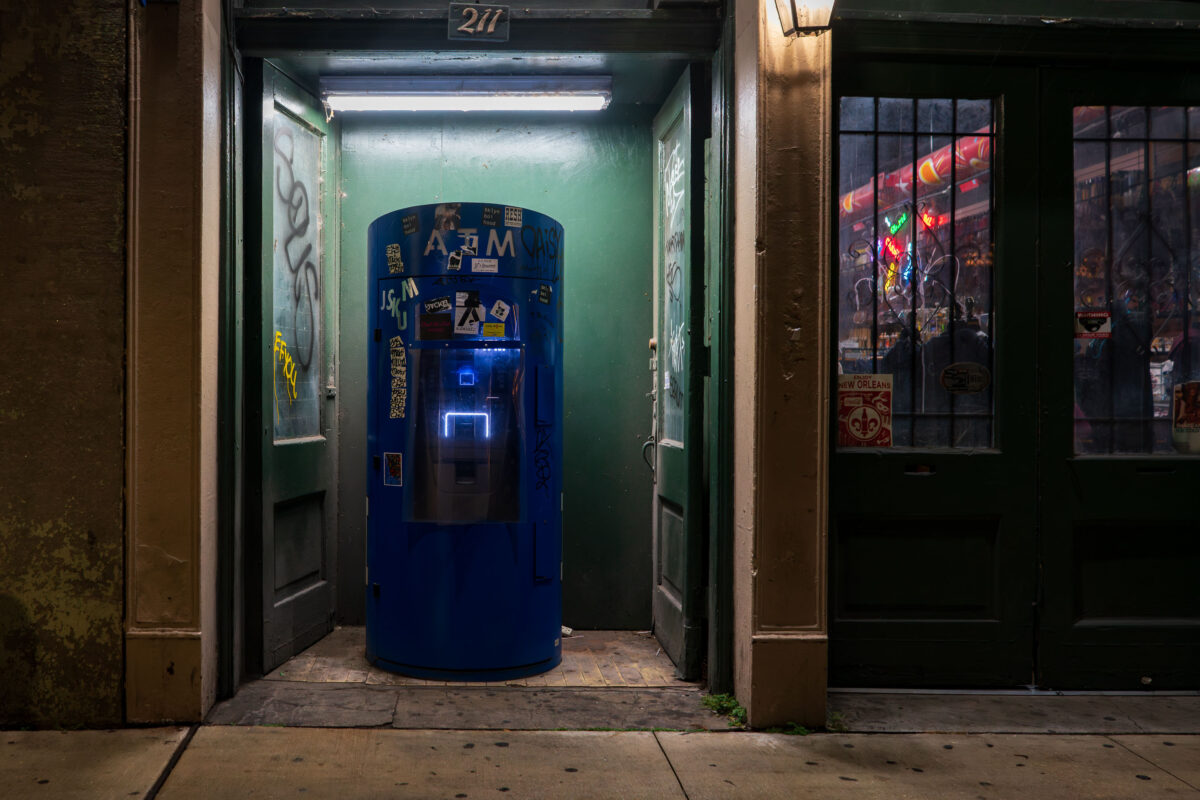
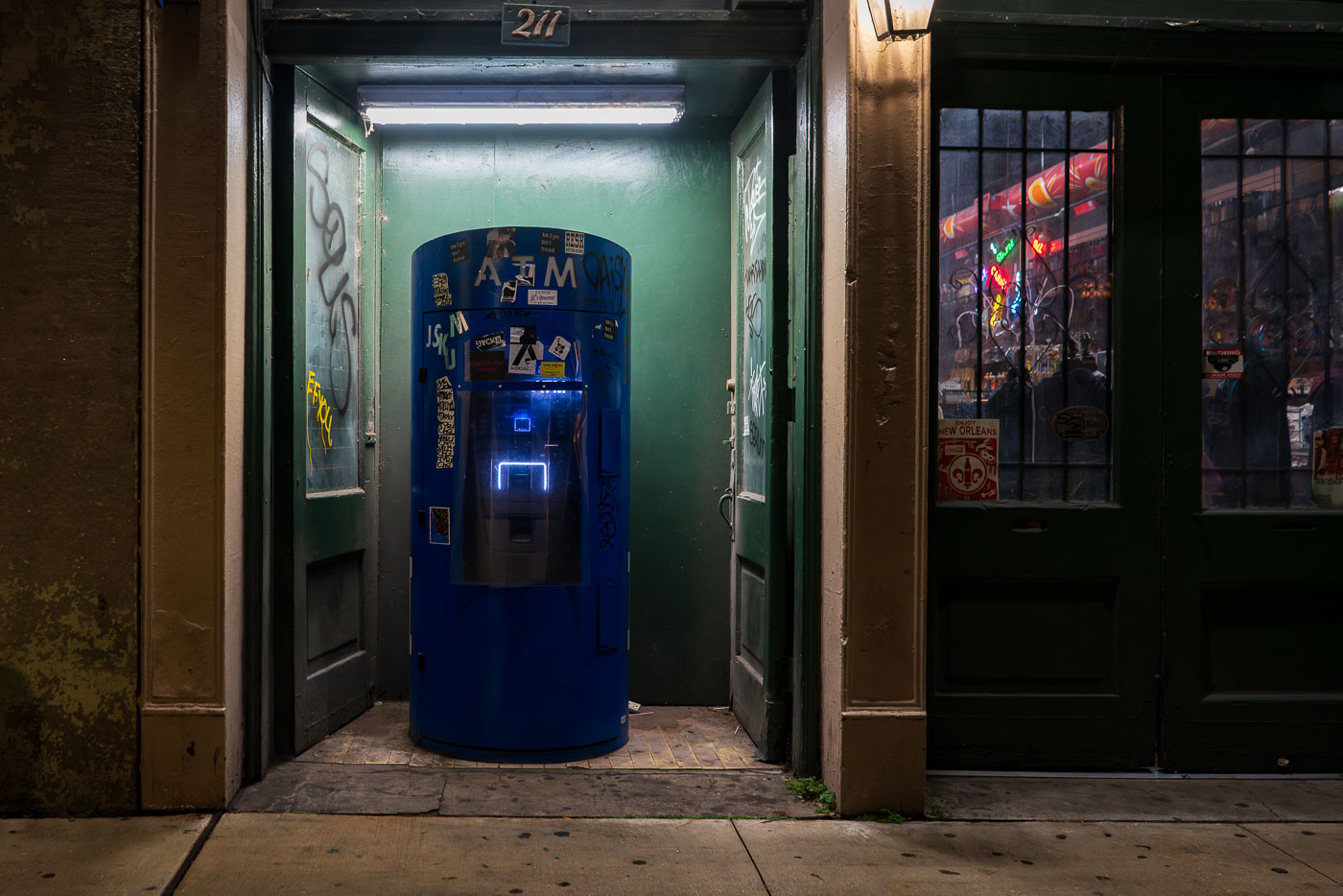
Blue ATM recessed in a narrow doorway at 211 Decatur Street in New Orleans' French Quarter.
211 Decatur Street in New Orleans’ French Quarter contains a freestanding ATM recessed in a narrow doorway. The machine is covered with graffiti and stickers. Decatur Street is a commercial corridor in the historic French Quarter.

Graffiti-Covered ATM in a Decatur Street Doorway
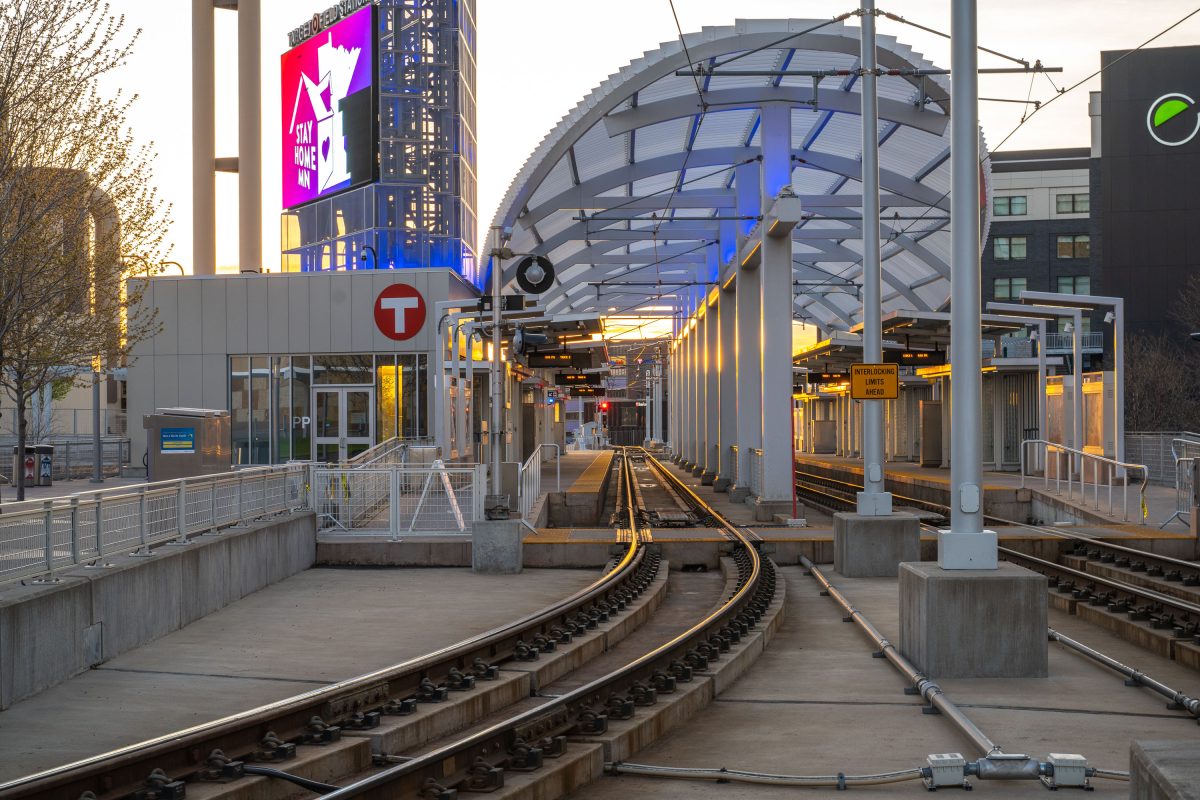
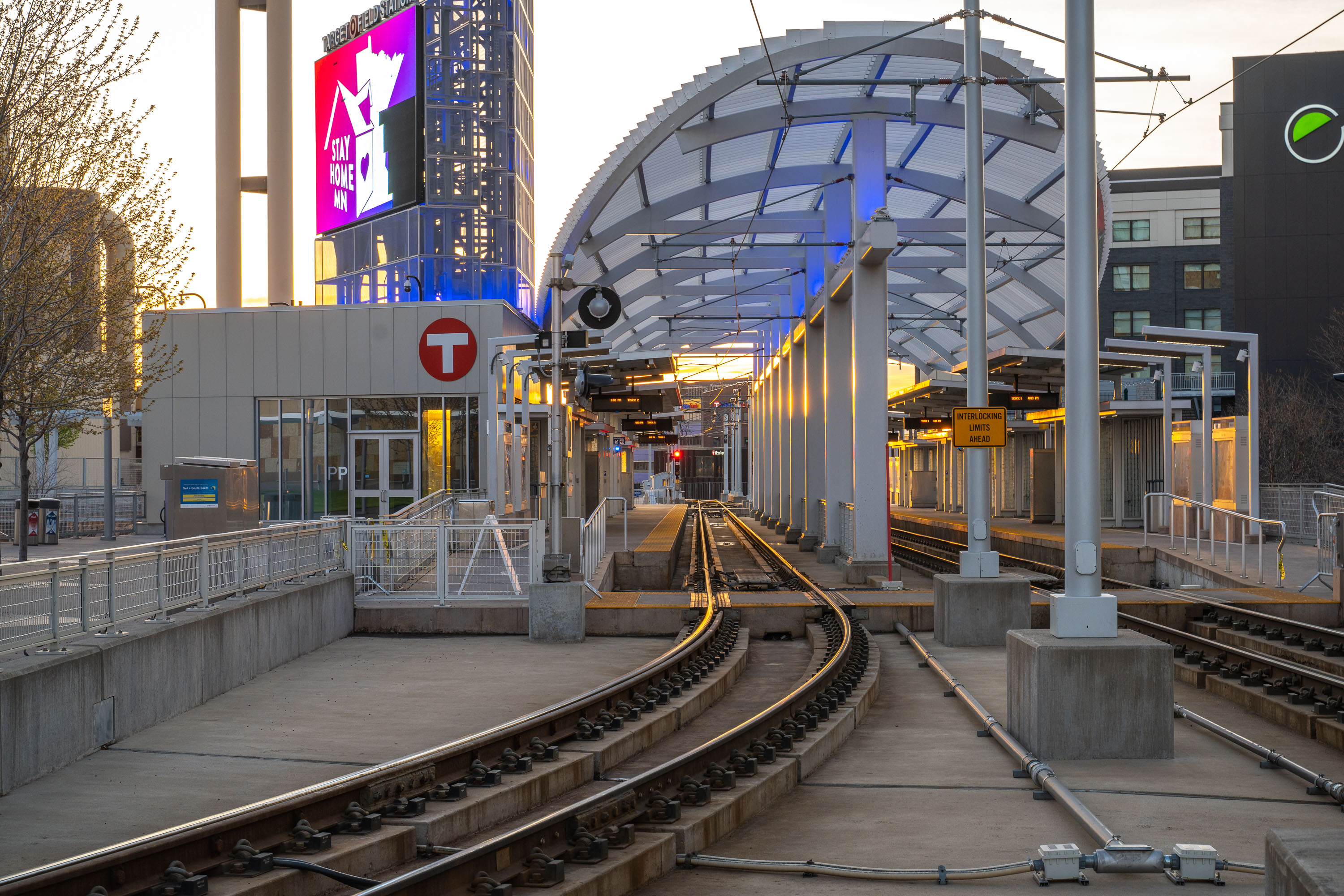
Empty platform at Target Field Station, a Minneapolis METRO light rail stop in the North Loop neighborhood.
Target Field Station sits in the North Loop neighborhood of downtown Minneapolis, serving as a stop on the METRO Blue and Green light rail lines. The station connects riders to Target Field, home of the Minnesota Twins, and links the North Loop to downtown Minneapolis and the broader METRO system.

“Stay Home MN” Sign Above Target Field Station at Dusk

Graffiti reading "RIP GEORGE FLOYD!!!" and a banner stating "COPS MURDER! ABOLISH POLICE!"
A banner reading "COPS MURDER! ABOLISH POLICE!" hangs below graffiti on a wall along Lake Street in South Minneapolis on May 26, 2020. The messages went up the day after George Floyd died in Minneapolis police custody on May 25, 2020.

“Cops Murder! Abolish Police!” Banner on Lake Street

A protester carries milk jugs outside the Minneapolis Police 3rd Precinct on May 26, 2020.
A protester carries jugs of milk outside the Minneapolis Police Department's 3rd Precinct station, spray painted with graffiti after demonstrations following the killing of George Floyd by police on May 25, 2020. Protesters often kept milk on hand to rinse tear gas and chemical irritants from their eyes during the unrest. The precinct building was abandoned by police and burned days later as protests continued.

Carrying Milk Jugs Outside the Minneapolis 3rd Precinct

Graffiti on a Target sign in Minneapolis as protesters gather below.
A Target shopping center sign in Minneapolis is marked with graffiti reading “Justice for George” and “Abolish Police” on May 27, 2020. The sign also lists Cub Foods and Dollar Tree, while a crowd gathers at street level near the commercial center. This location was across from the Minneapolis Police Third Precinct, which became a major gathering point in the protests following the killing of George Floyd.

Minneapolis Uprising Graffiti at Target Store

Graffiti reading "FUCK JACOB FREY" on a vacant storefront window in Minneapolis.
Graffiti reading “FUCK JACOB FREY” is painted on the window of a vacant retail storefront in Minneapolis on May 27, 2020. A Wellington Management “For Lease” sign remains posted inside the glass-fronted space, while additional white paint marks cover much of the facade. The image was made during the second night of protests after the killing of George Floyd, in the area near the Minneapolis Police Department’s Third Precinct.

Graffiti on Vacant Storefront, Minneapolis

FLOYD graffiti under the Hiawatha Avenue overpass near Lake Street in Minneapolis as a pedestrian walks past.
Graffiti reading “FLOYD” covers the tiled wall beneath the Hiawatha Avenue overpass near Lake Street in Minneapolis as a pedestrian walks past on the night of May 27, 2020. Additional messages including “RIP GF” and other anti-police graffiti surround the large tag. The markings appeared in the area during the protests and unrest that followed the killing of George Floyd.

Floyd Graffiti at Lake Street Overpass, Minneapolis

Wendy’s with ACAB wtritten on the side
A Wendy’s restaurant on 27th Avenue South in Minneapolis stands across from the Minneapolis Police Department’s Third Precinct on May 27, 2020. Graffiti including “ACAB” and references to George Floyd covers the restaurant exterior.

Wendy’s and Minneapolis Police, Minneapolis Protests

Wendy’s on fire with graffiti on the side
The Wendy's restaurant located on Minnehaha Avenue in Minneapolis was engulfed in flames on May 28, 2020. This occurred on the second day of widespread protests that erupted following the death of George Floyd while in police custody. The building's brick exterior is covered with graffiti, including messages expressing anti-police and anti-capitalist sentiments. The destruction of commercial properties, such as this fast-food establishment, became a visible manifestation of the intense civil unrest and community frustration during the Minneapolis Uprising.

Minnehaha Ave Wendy’s on Fire, Minneapolis Uprising

Protester spray-paints anti-police graffiti on a boarded Target sign in Minneapolis.
A protester spray-paints anti-police graffiti on a boarded Target sign in Minneapolis, Minnesota, near the Minneapolis Police 3rd Precinct on May 27, 2020. The messages on the panel include “COPS R SLAVE CATCHERS” and “Fuck 12,” written during unrest that followed the killing of George Floyd.

Graffiti on Target Sign, Minneapolis

Minneapolis police on the 3rd Precinct roof in south Minneapolis during protests.
Minneapolis Police officers stand on the roof of the department’s 3rd Precinct station in south Minneapolis on May 27, 2020. Several officers are equipped with helmets, shields, and less-lethal launchers as the building became a flashpoint during protests that followed the killing of George Floyd two days earlier.

Minneapolis Police 3rd Precinct Rooftop

A protester waked under Haiwatha Ave where “FLOYD” is written on the wall. This on the 2nd day of protests in Minneapolis following the death of George Floyd.

Protester walks past ‘FLOYD’ graffiti, Lake St, Minneapolis protests

Burning Wendy's on 26th Avenue South in Minneapolis during George Floyd protest unrest.
A Wendy’s restaurant on 26th Avenue South in Minneapolis burns in the early hours of May 28, 2020, during unrest following the killing of George Floyd. Flames are visible through the windows and across the roofline, while graffiti including “Justice 4 George” is painted on the building’s exterior. The fire occurred during several nights of destruction and protest in Minneapolis after Floyd was killed by Minneapolis police on May 25, 2020.

Wendy’s Fire, 26th Ave S, Minneapolis

Burning AutoZone on Minnehaha Avenue in Minneapolis with graffiti during May 2020 unrest.
The AutoZone store at 2700 Minnehaha Avenue in Minneapolis burns in the early hours of May 28, 2020, across from the Minneapolis Police Department’s Third Precinct. Flames have consumed much of the one-story commercial building, leaving the roofline partially collapsed as graffiti covers the exterior wall. The fire occurred during the first nights of unrest after the murder of George Floyd.

Burning Autozone with Graffiti, Minneapolis

Minneapolis police watch a burning building on Lake Street in Minneapolis during protests.
Minneapolis police officers stand on Lake Street in Minneapolis as a commercial building burns during overnight unrest on May 28, 2020. The fire occurred during the protests and property destruction that followed the murder of George Floyd by a Minneapolis police officer.

Building Fire on Lake Street, Minneapolis

Graffiti on Minneapolis Midtown Station wall reading anti-government messages during George Floyd protests.
Graffiti on the exterior of Minneapolis Midtown Station in Minneapolis includes the messages “THE PEOPLE shouldn’t be afraid of the gov. The gov should be afraid of THE PEOPLE!!!” and “RISE UP.” Photographed on May 28, 2020, the writing appeared during the unrest and protests that followed the murder of George Floyd.

Graffiti at Minneapolis Midtown Station

Boarded Wells Fargo on Lake Street in Minneapolis with protest graffiti and broken windows.
A Wells Fargo branch on Lake Street in Minneapolis stands boarded and spray-painted during the unrest that followed the murder of George Floyd in May 2020. Graffiti on the facade includes the messages “STEAL IT BACK!” and “KILL Bankers,” while broken glass and plywood cover parts of the entrance and windows.

Wells Fargo Bank, Lake Street, Minneapolis

Boarded storefront with Justice for Floyd sign on Lake Street in Minneapolis.
A boarded storefront on Lake Street in Minneapolis bears the message “Justice for Floyd” in the early hours of May 29, 2020. The sign appeared during protests and unrest following the killing of George Floyd, when many businesses in the corridor covered windows with plywood for protection.

Justice for Floyd Graffiti, Minneapolis

Traffic backed up on Interstate 94 in Minneapolis beneath a sign reading “CURFEW IN EFFECT 8PM TO 6AM.”
Traffic is backed up on Interstate 94 in Minneapolis, Minnesota, near the 1st Avenue South exit, as an overhead highway message board reads, “CURFEW IN EFFECT 8PM TO 6AM.” The photograph was made on May 29, 2020, during protests following the killing of George Floyd, when state and local officials imposed overnight movement restrictions across Minneapolis and other Twin Cities communities.

I-94 Traffic Jam During Minneapolis Curfew

Boarded storefronts in downtown Minneapolis marked with BLM and Black Owned graffiti.
Boarded storefronts in downtown Minneapolis are marked with the spray-painted messages “BLM” and “BLACK OWNED” on May 29, 2020. The plywood covers were installed to protect retail businesses during unrest following the killing of George Floyd by Minneapolis police earlier that week.

Boarded Businesses, Downtown Minneapolis

Wells Fargo bank burning on Nicollet Avenue in South Minneapolis on May 29, 2020.
A Wells Fargo branch on Nicollet Avenue in South Minneapolis burns on the night of May 29, 2020. The bank, across from the Minneapolis Police Department’s Fifth Precinct, was damaged during unrest that followed the killing of George Floyd. Flames are visible through the front windows as fire spreads across the ground-floor banking area.

Wells Fargo Bank Fire, Nicollet Ave, Minneapolis

Damaged Walgreens on Lake Street in Minneapolis with smoke and boarded windows at night.
A Walgreens pharmacy and food mart on Lake Street in Minneapolis stands damaged and smoking in the early hours of May 30, 2020. Plywood covers the entrance, windows are broken, and graffiti is visible on the exterior of the one-story commercial building. The store was photographed during the unrest that followed the police killing of George Floyd, when numerous businesses along the Lake Street corridor were damaged or burned.

Walgreens Fire, Lake Street Minneapolis

Hagen’s Auto Body on Nicollet Avenue in Minneapolis with boarded windows and a “WE ARE OPEN” banner.
Hagen’s Auto Body on Nicollet Avenue in South Minneapolis is pictured with its windows and doors boarded on May 30, 2020. The collision repair shop remained lit overnight, with a red “WE ARE OPEN” banner hanging on the brick facade and a message painted on the plywood reading, “WE HAVE BEEN PART OF THIS COMMUNITY FOR 50 YEARS AND WE CARE ABOUT IT.” The photograph was made during the fourth day of protests in Minneapolis following the death of George Floyd.

Hagen’s Auto Body, Nicollet Ave, Minneapolis, 2020
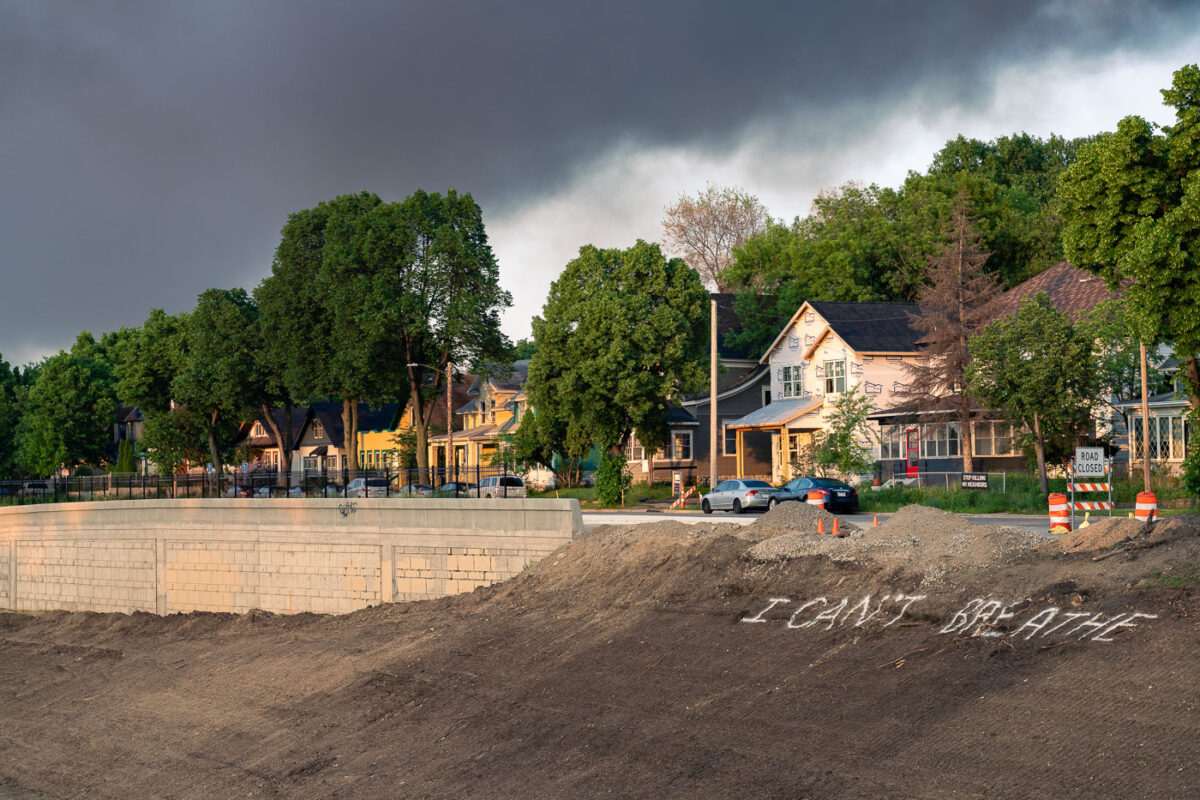
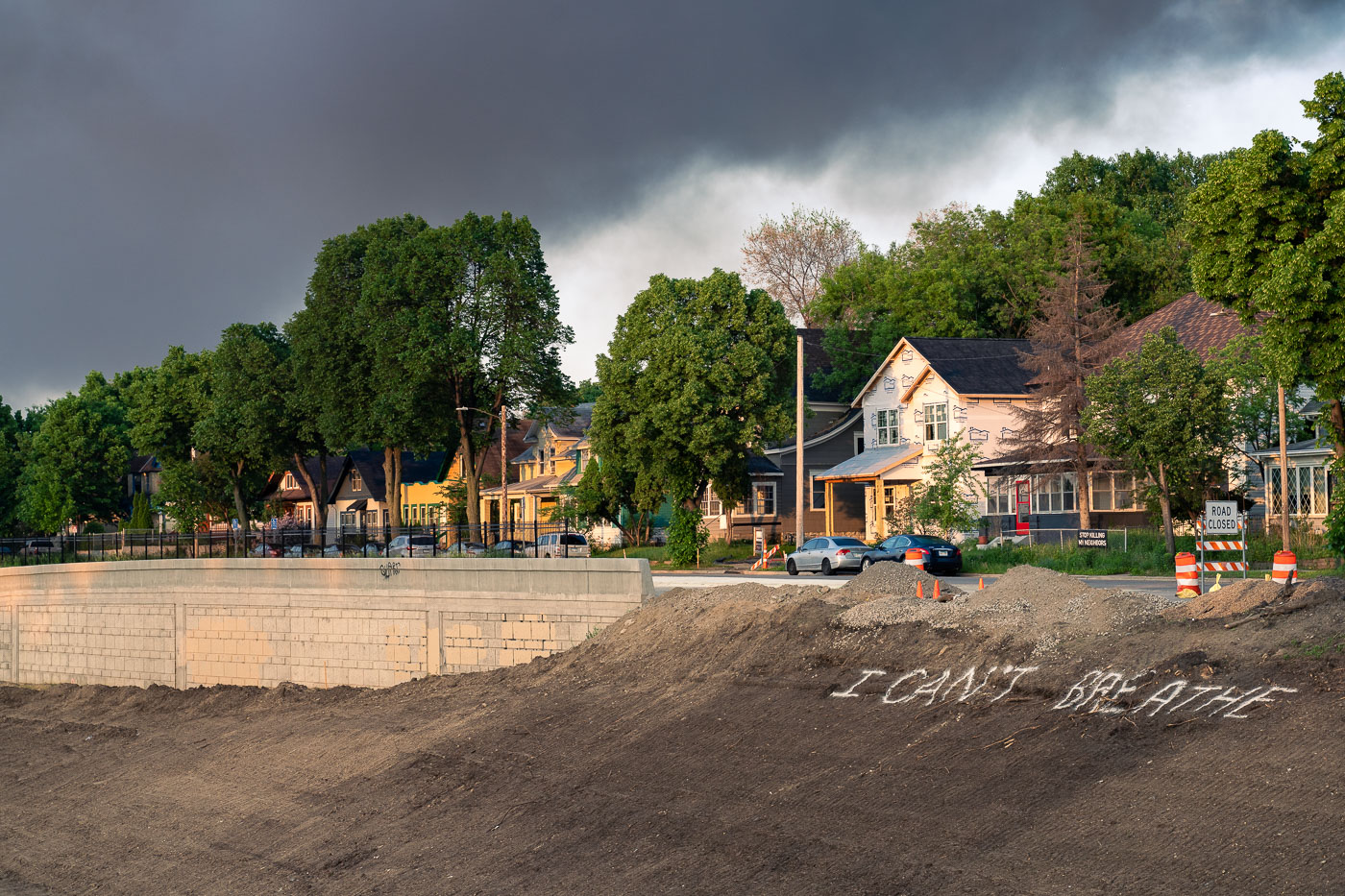
“I Can’t Breathe” graffiti on an embankment beside Interstate 35W in South Minneapolis under smoke-filled skies.
“I Can’t Breathe” is spray-painted on a dirt embankment beside Interstate 35W in South Minneapolis on May 30, 2020. The message appeared in the days after George Floyd was killed by Minneapolis police on May 25, during protests and unrest across the city. Morning light falls on nearby houses while smoke lingers over the neighborhood from fires set overnight.

I Can’t Breathe Graffiti, Minneapolis

Street artist painting a George Floyd portrait on boarded storefronts on Hennepin Avenue in Minneapolis.
A street artist paints a portrait of George Floyd on plywood boarding along Hennepin Avenue in Minneapolis on May 31, 2020. The temporary panels were installed over storefront windows after unrest and property damage following Floyd’s death in Minneapolis on May 25. Murals and memorial art appeared across the city during this period, using boarded facades as improvised public canvases.

Street Artist Painting George Floyd Portrait on Hennepin Ave

Burned Foot Locker on Lake Street in Minneapolis with a pedestrian passing by.
The burned Foot Locker storefront on Lake Street in Minneapolis stands damaged on May 31, 2020, with shattered upper windows, a collapsed ground-floor opening, and debris visible inside the retail space. The store was among the businesses affected during the unrest that followed the killing of George Floyd in Minneapolis in late May 2020. A pedestrian walks past the fire-damaged building as cleanup and recovery had yet to begin.

Burned Foot Locker, Lake Street, Minneapolis

Chicago-Lake Liquors boarded up on Lake Street in Minneapolis with graffiti and concrete barriers.
Chicago-Lake Liquors on Lake Street in Minneapolis stands boarded up on May 31, 2020, with graffiti on the plywood-covered entrance and on a concrete barrier in front of the store. The large corner liquor store, identified by its prominent sign and drive-in customer parking lot, was among many businesses in the area that installed protective coverings after unrest following the killing of George Floyd.

Chicago-Lake Liquors Boarded, Minneapolis

Graffiti-covered car outside a boarded-up US Bank on Lake Street in Minneapolis, with a cyclist passing.
A graffiti-covered damaged car sits outside a boarded-up US Bank branch on Lake Street in Minneapolis on May 31, 2020. The image includes the bank’s drive-through area and nearby commercial buildings along the Lake Street corridor, where many properties were closed or secured with plywood after unrest following the police killing of George Floyd. A cyclist passes in the foreground, contrasting with the visible damage and anti-police graffiti left on the car and bank building.

Graffiti Car at US Bank, Lake Street, Minneapolis

Graffiti on a Target store on East Lake Street in Minneapolis.
Graffiti covers the exterior of a Target store on East Lake Street in Minneapolis on May 31, 2020. The markings line the lower walls of the building while the store’s red facade and bullseye logo remain visible above. The site is near the Minneapolis Police Department’s 3rd Precinct, an area heavily affected during protests following the killing of George Floyd.

Graffiti on Target Store, East Lake Street, Minneapolis

Woman painting "Black Lives" on the street at George Floyd Square in Minneapolis.
A woman paints the words “Black Lives” on the pavement at George Floyd Square in Minneapolis on May 31, 2020. The site, at the intersection of East 38th Street and Chicago Avenue, became a gathering place for memorials and protest activity after the killing of George Floyd. Flowers and chalk markings visible around her reflect the informal tributes that covered the street during the early days of the memorial.

Woman Paints Black Lives Matter at George Floyd Square
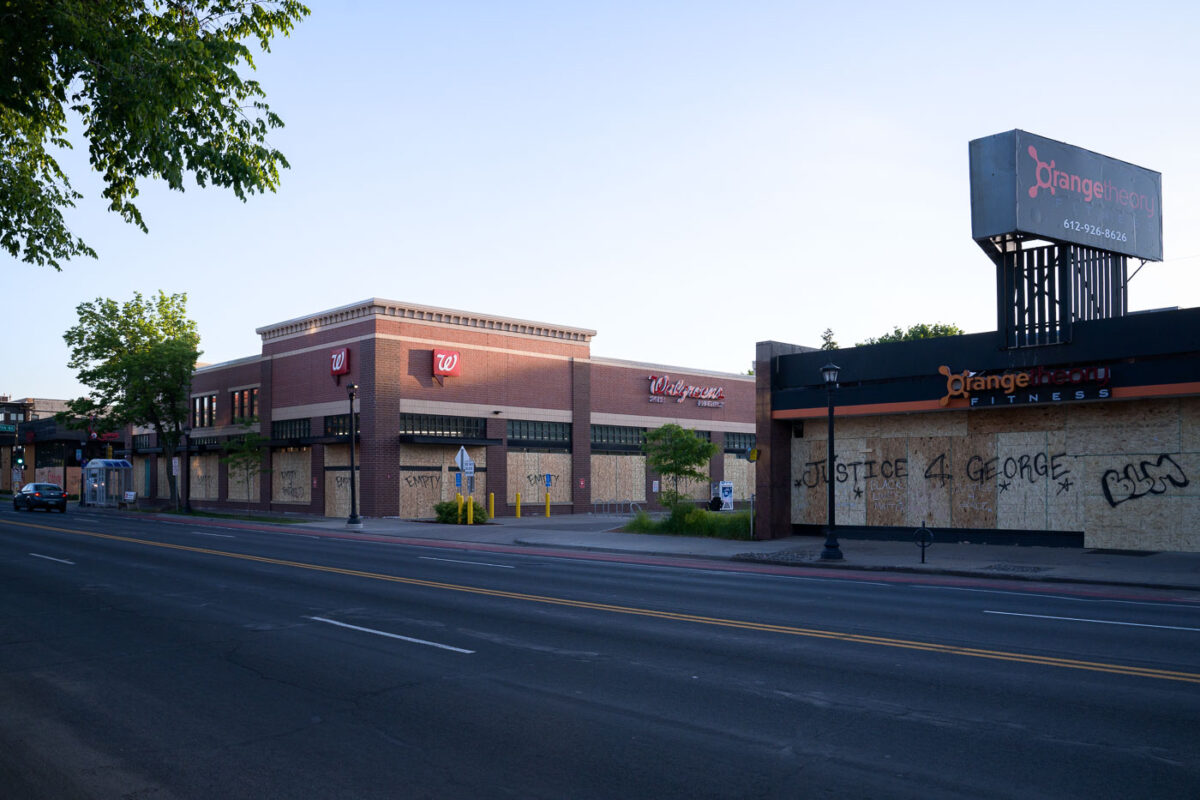
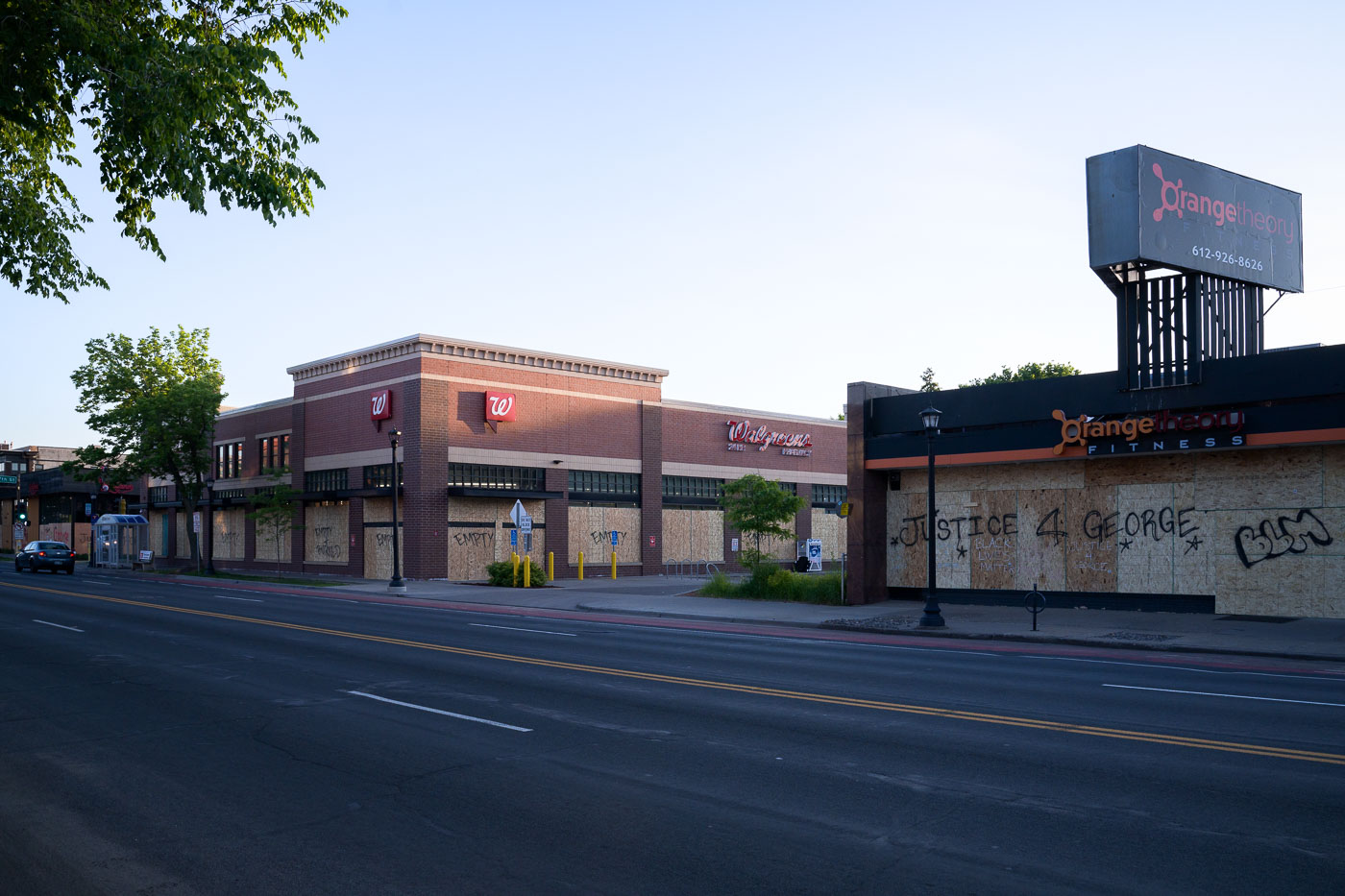
Boarded Walgreens and Orangetheory on Hennepin Avenue in Uptown Minneapolis, June 2020.
Boarded storefronts on Hennepin Avenue in Uptown Minneapolis, including a Walgreens and an Orangetheory Fitness, are shown on June 1, 2020. Plywood covers the windows and doors of both businesses following days of unrest in Minneapolis after the killing of George Floyd. Graffiti on the boards includes “JUSTICE 4 GEORGE” and references to Black Lives Matter.

Hennepin Avenue Boarded Walgreens & Orange Theory, Minneapolis
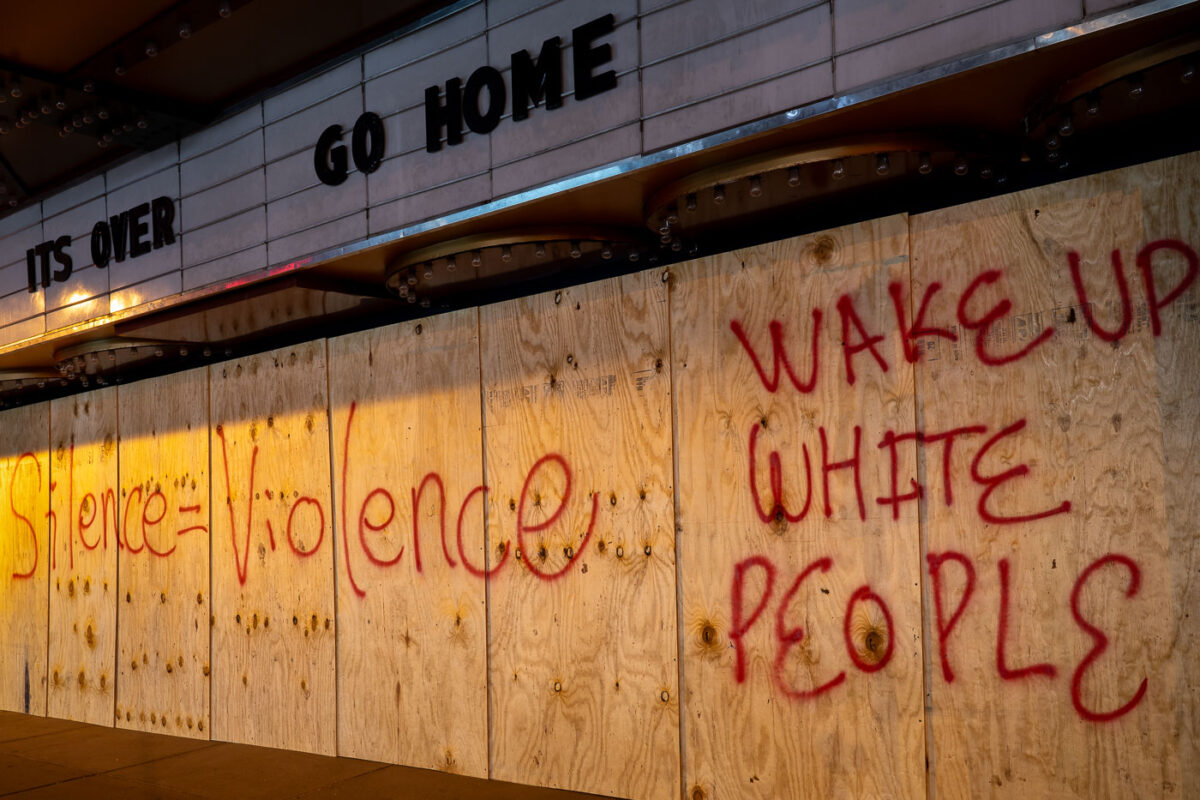
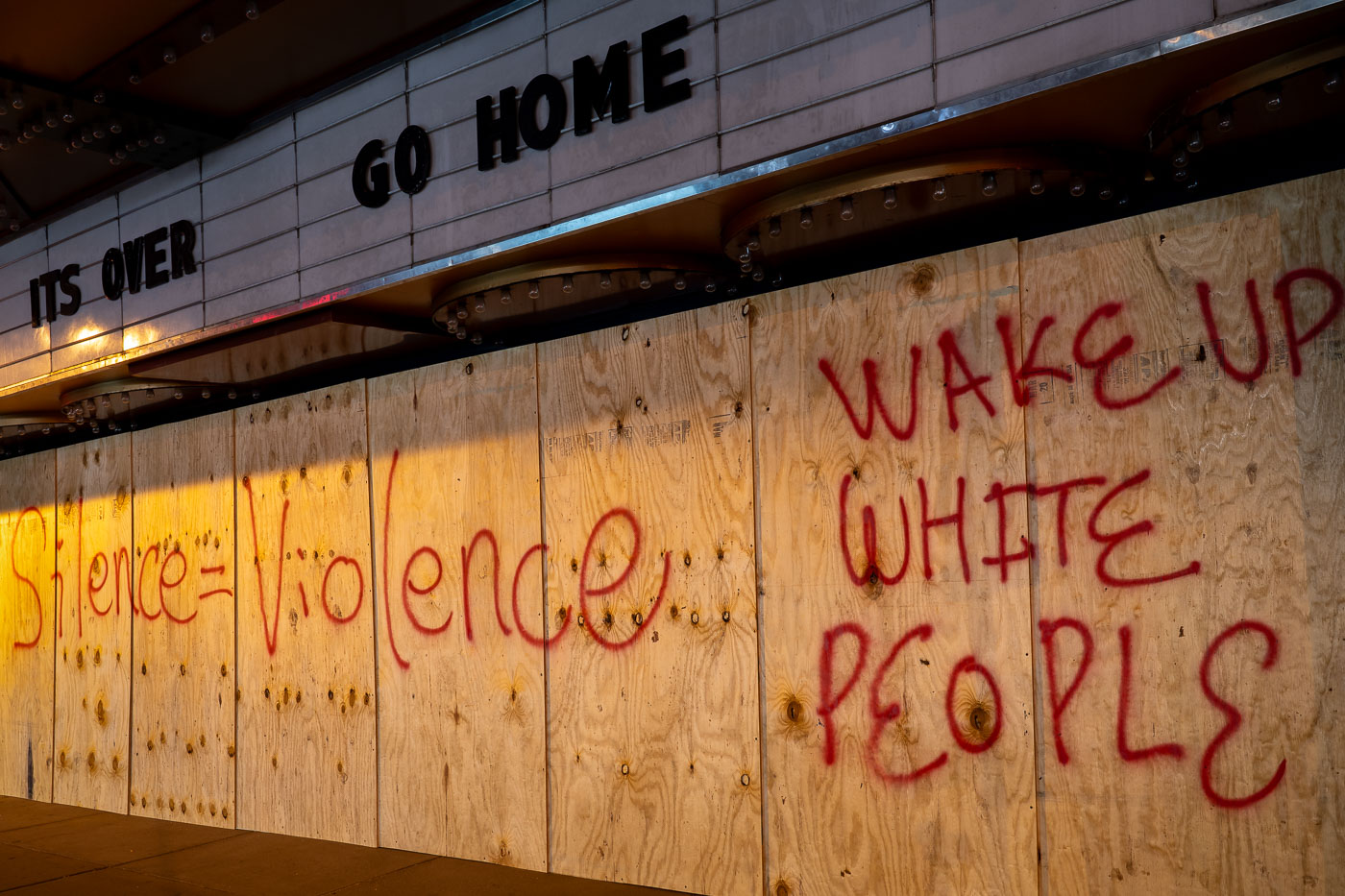
Boarded-up Uptown Theater in Minneapolis with red graffiti reading “Silence = Violence” and “Wake Up White People.”
The Uptown Theater in Uptown Minneapolis is shown boarded up on June 2, 2020, with protest messages painted across plywood covering its facade. Red spray-painted text on the boards reads “Silence = Violence” and “Wake Up White People,” while the marquee above says “ITS OVER” and “GO HOME.” The historic movie theater was among many Twin Cities buildings covered after protests that followed the murder of George Floyd.

Uptown Theater, Minneapolis: ‘Silence = Violence’ Boards
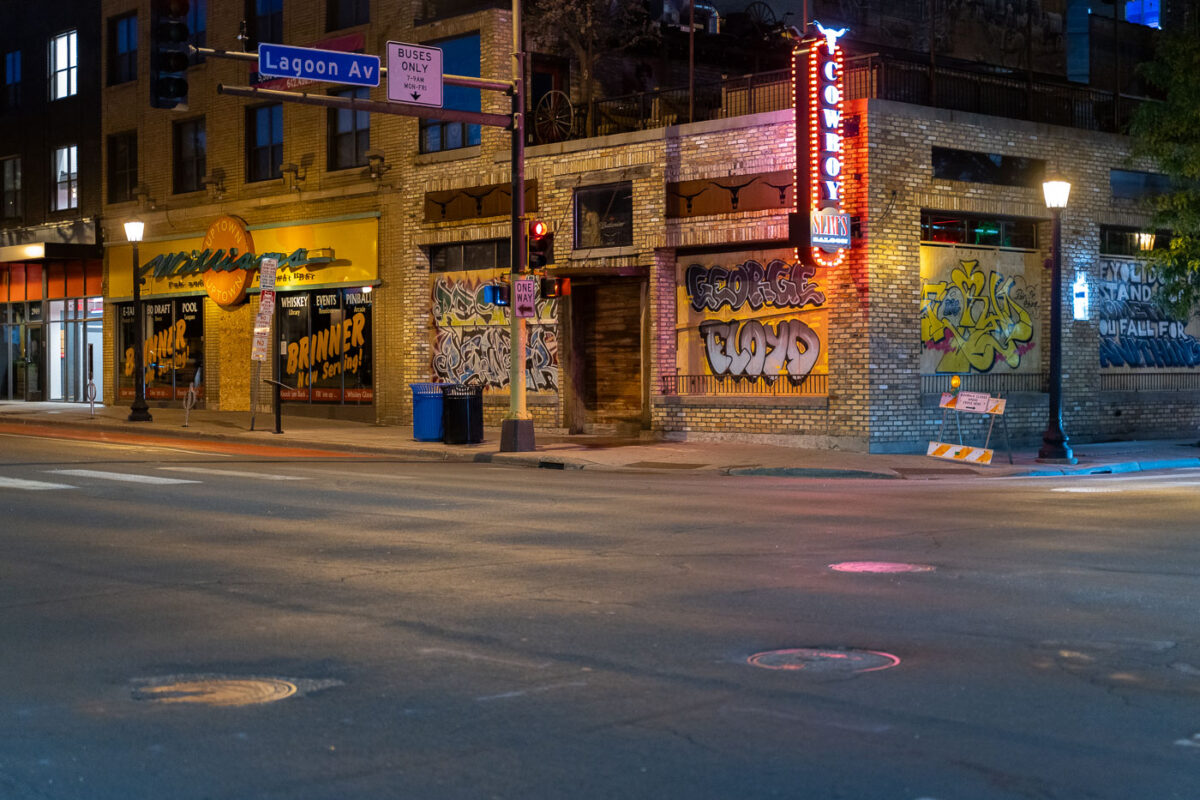
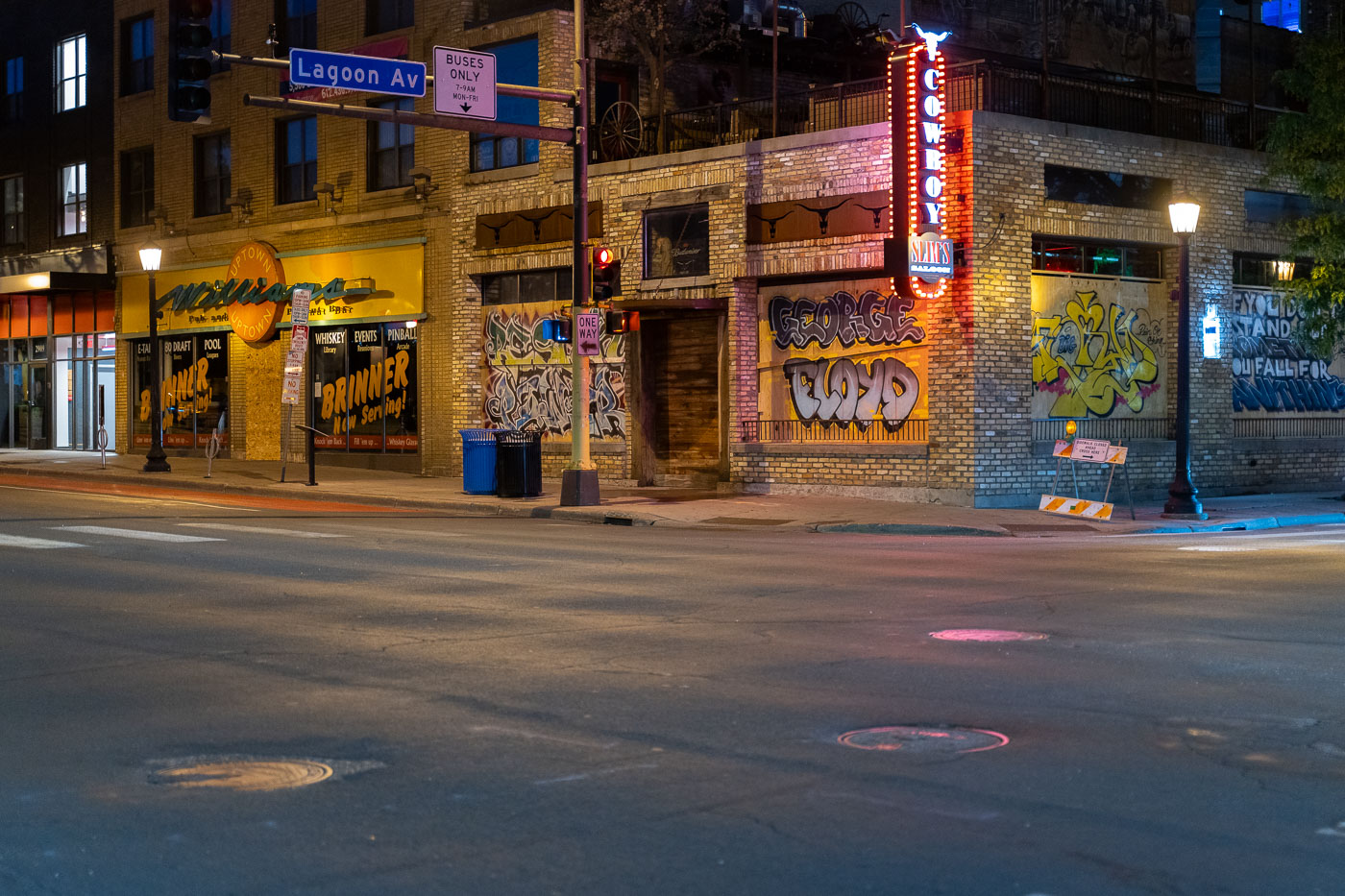
Cowboy Slim’s at Hennepin and Lagoon in Uptown Minneapolis, boarded and covered in George Floyd graffiti.
Cowboy Slim’s Saloon at Hennepin Avenue and Lagoon Avenue in Uptown Minneapolis is boarded up and covered in graffiti, including the words “GEORGE” and “FLOYD,” in a photograph made on June 2, 2020. The temporary plywood barriers and street barricade place the image in the period of protests and unrest following the May 25, 2020 killing of George Floyd. Neon signage remains lit above the boarded windows, contrasting the nightlife business’s normal appearance with the conditions in the neighborhood at that time.

Cowboy Slims, Hennepin & Lagoon, Minneapolis, George Floyd Graffiti
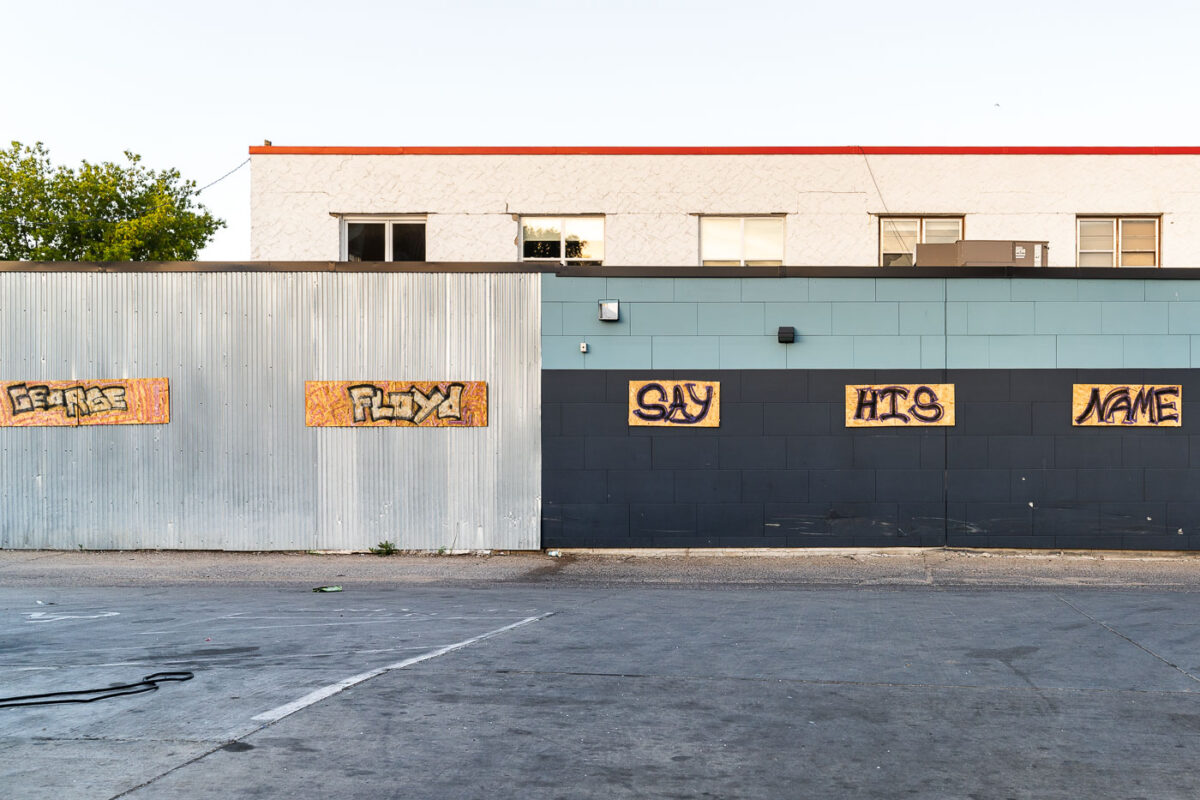
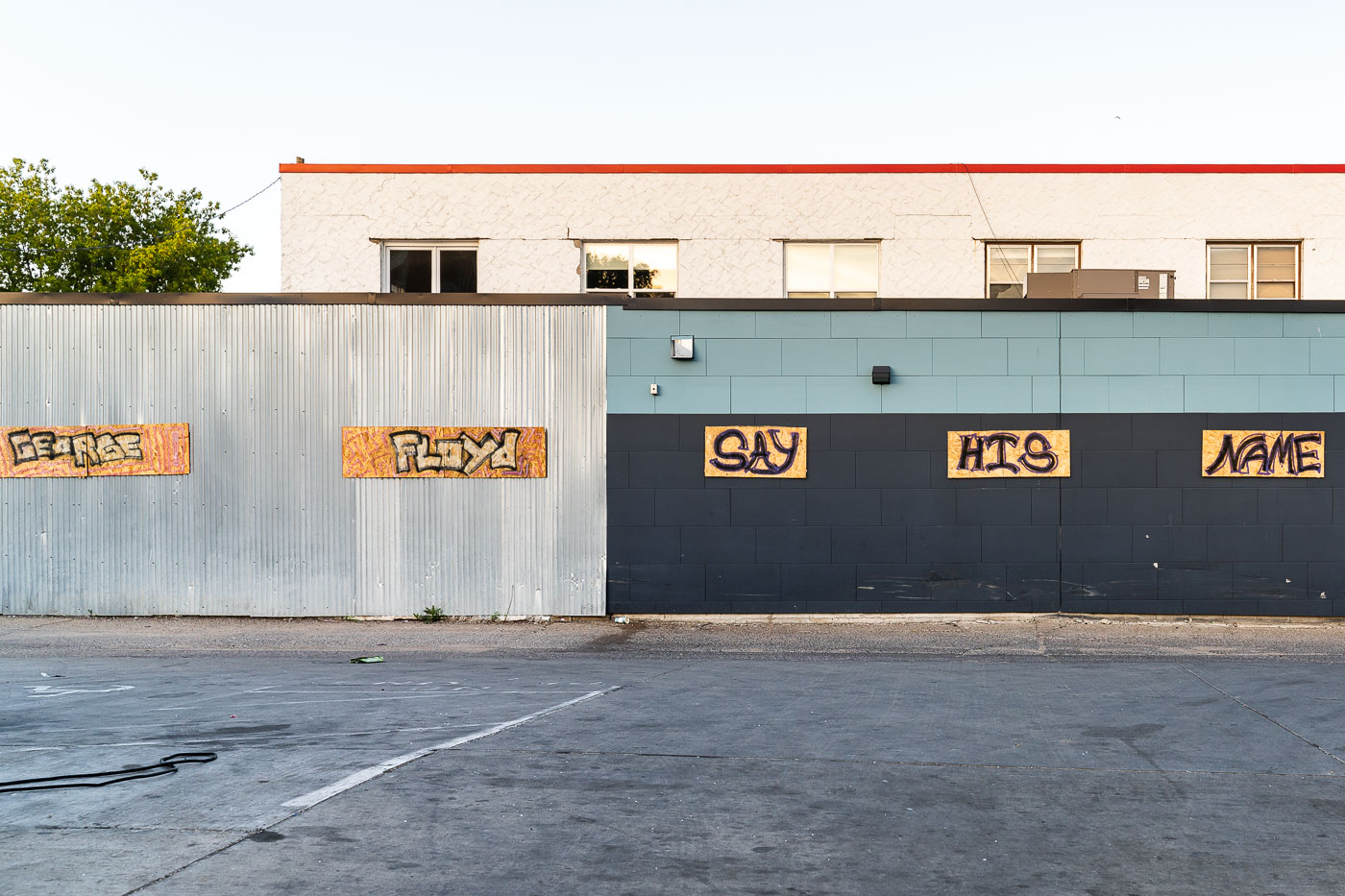
Wooden boards with yellow letters reading "Say His Name" and artist tags cover building facades in North Minneapolis.
Boards bearing the message "George Floyd Say His Name" are displayed on a building facade in North Minneapolis in June 2020.

“George Floyd Say His Name” Boards in North Minneapolis
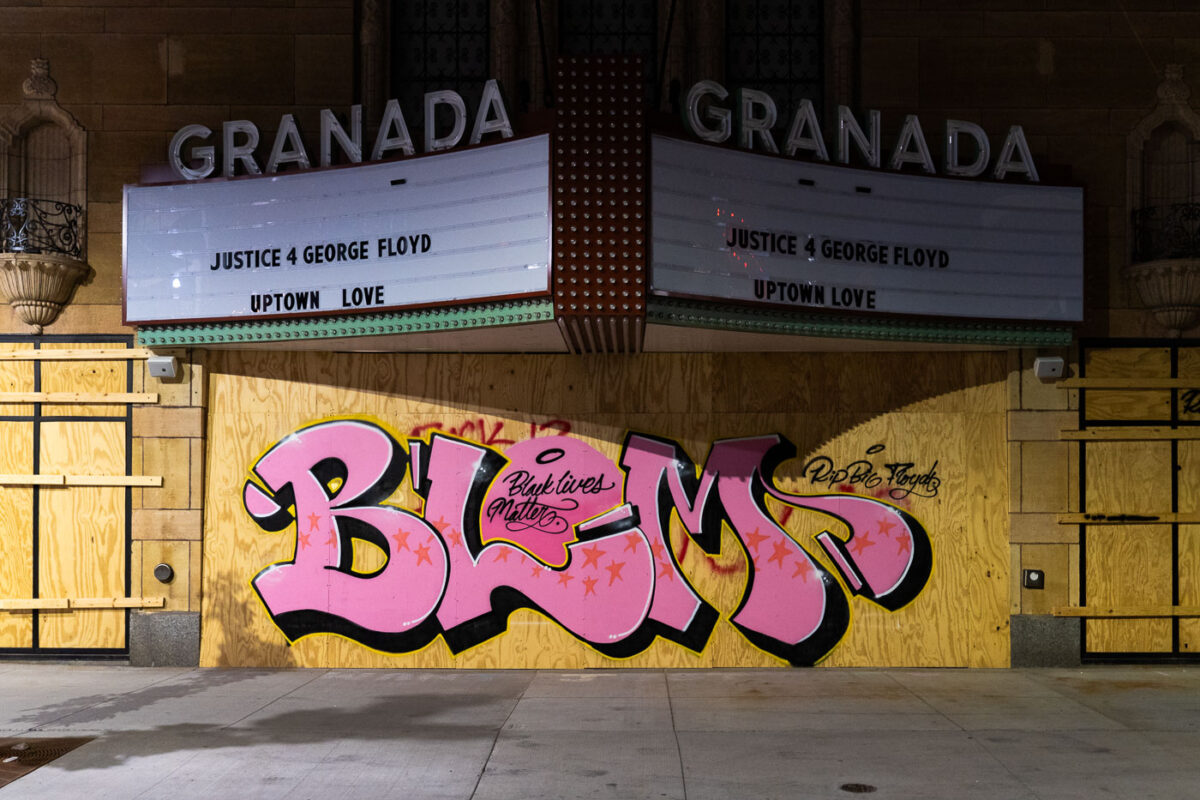
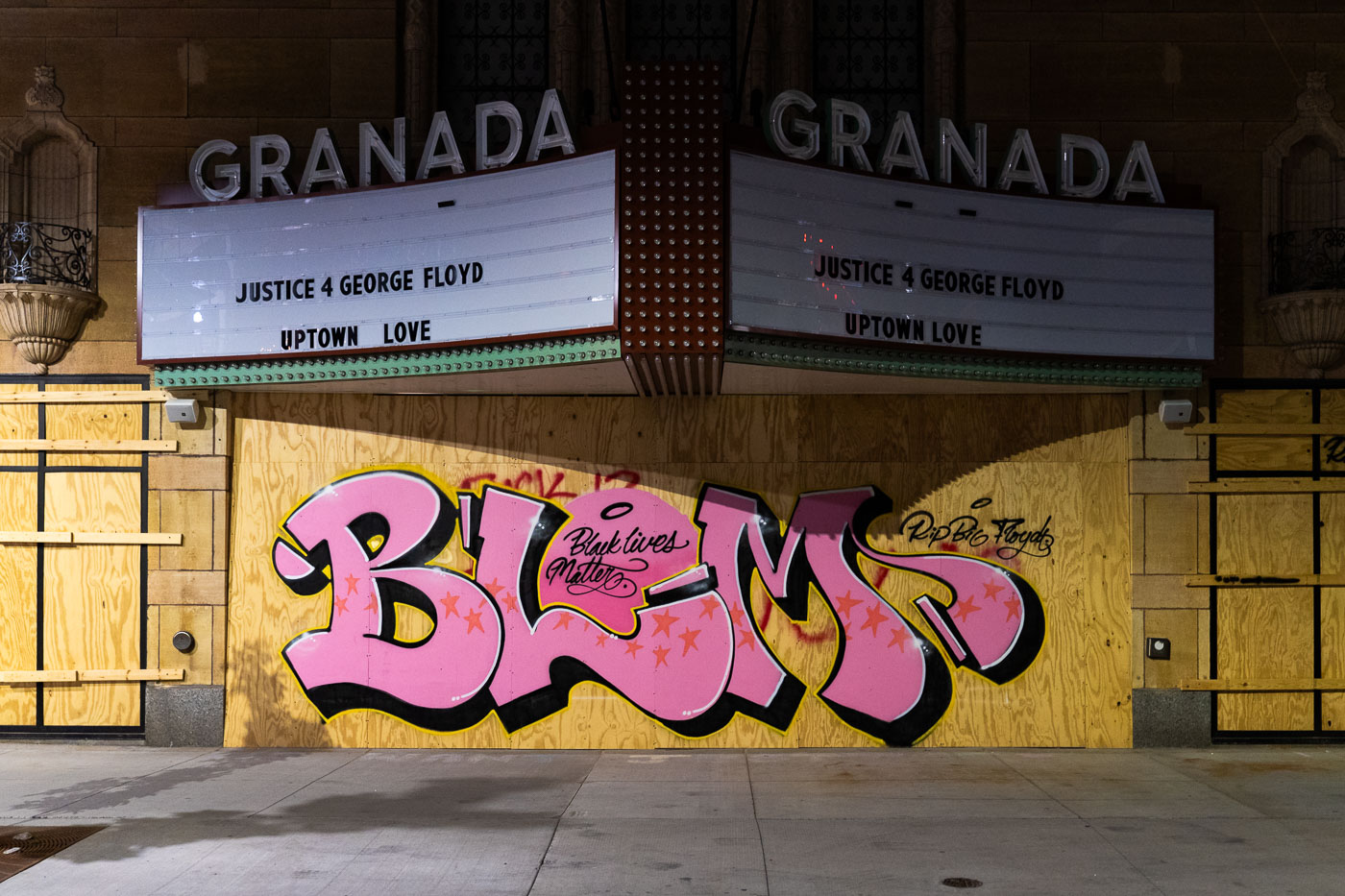
Granada Theatre in Uptown Minneapolis with Justice 4 George Floyd marquee and BLM mural on boarded facade.
The Granada Theatre on Hennepin Avenue in Uptown Minneapolis is shown boarded up with a marquee reading “Justice 4 George Floyd” and “Uptown Love.” A large pink “BLM” mural covers the plywood across the theater’s ground-floor facade. Photographed on June 4, 2020, the image documents how the theater’s exterior was used for messages tied to the protests and neighborhood response after the killing of George Floyd.

Granada Theatre, Justice 4 George Floyd Marquee & BLM, Uptown
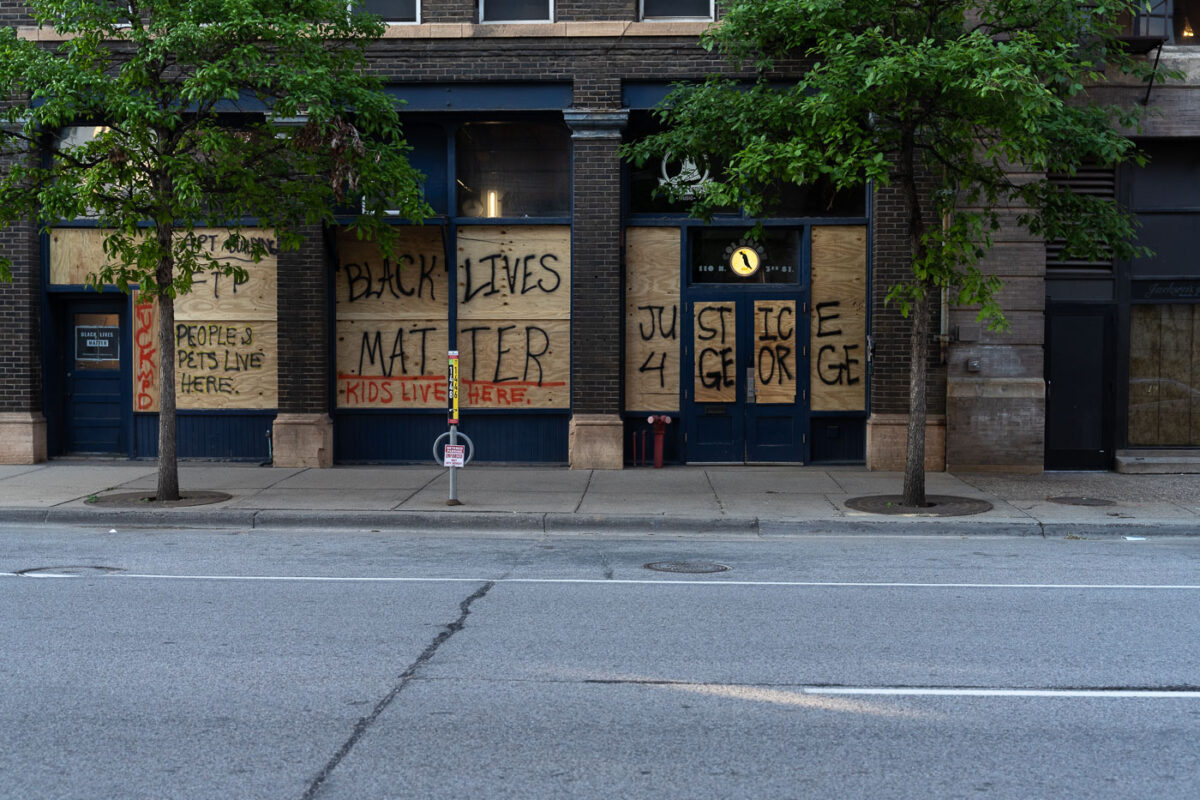
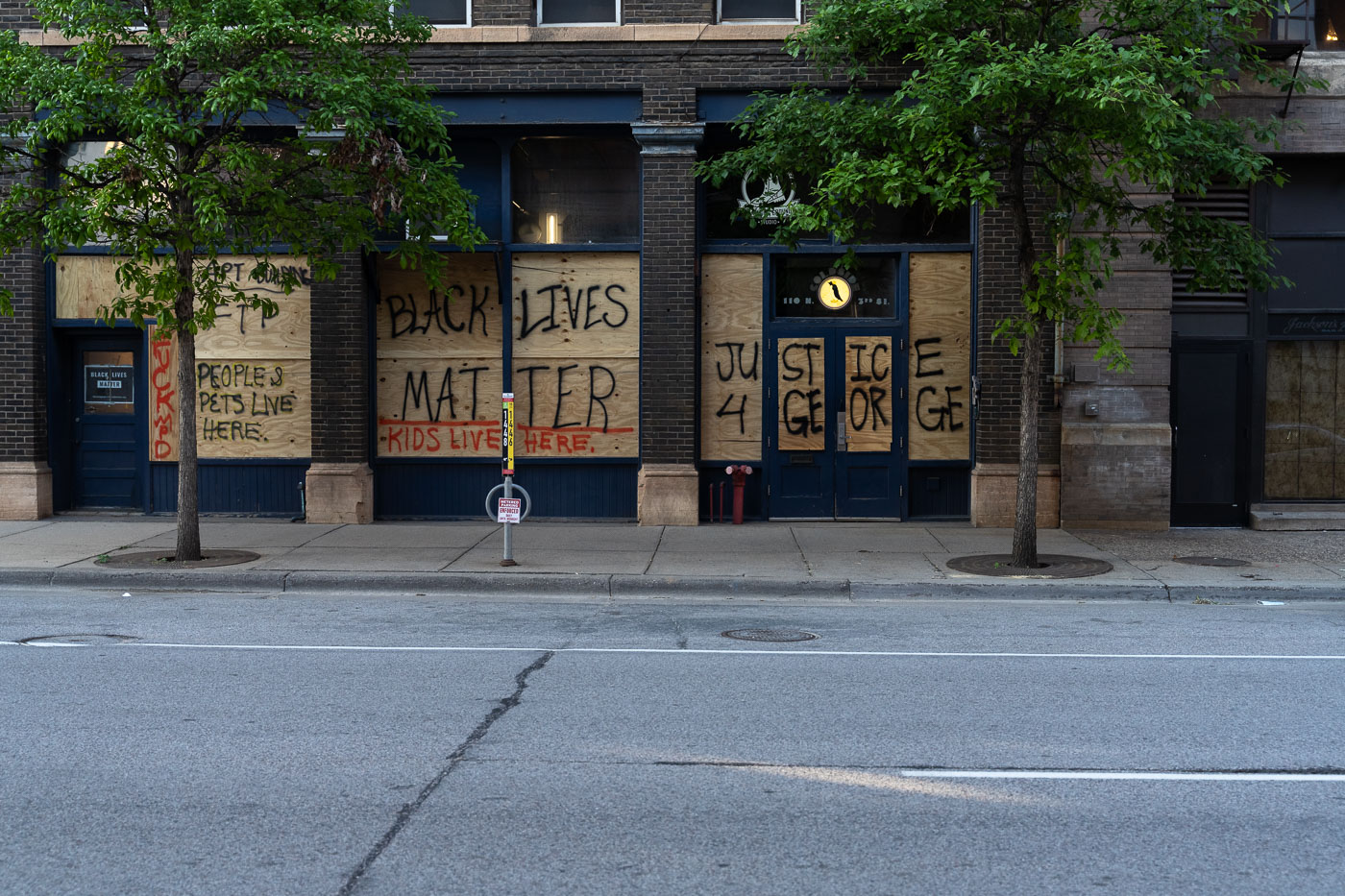
Boarded storefront at 110 N. 3rd St. in Minneapolis with Black Lives Matter and Justice 4 George messages.
Boards covering storefront windows at 110 N. 3rd Street in downtown Minneapolis bear hand-painted messages including “Black Lives Matter” and “Justice 4 George.” Photographed on June 4, 2020, the boarded facade also includes notes such as “People’s pets live here” and “Kids live here,” combining protest messages with notices to passersby in a mixed commercial and residential building. The markings appeared in the days after the murder of George Floyd, when plywood over downtown businesses became surfaces for mourning, demands for justice, and neighborhood communication.

Black Lives Matter & Justice 4 George Boards, Minneapolis
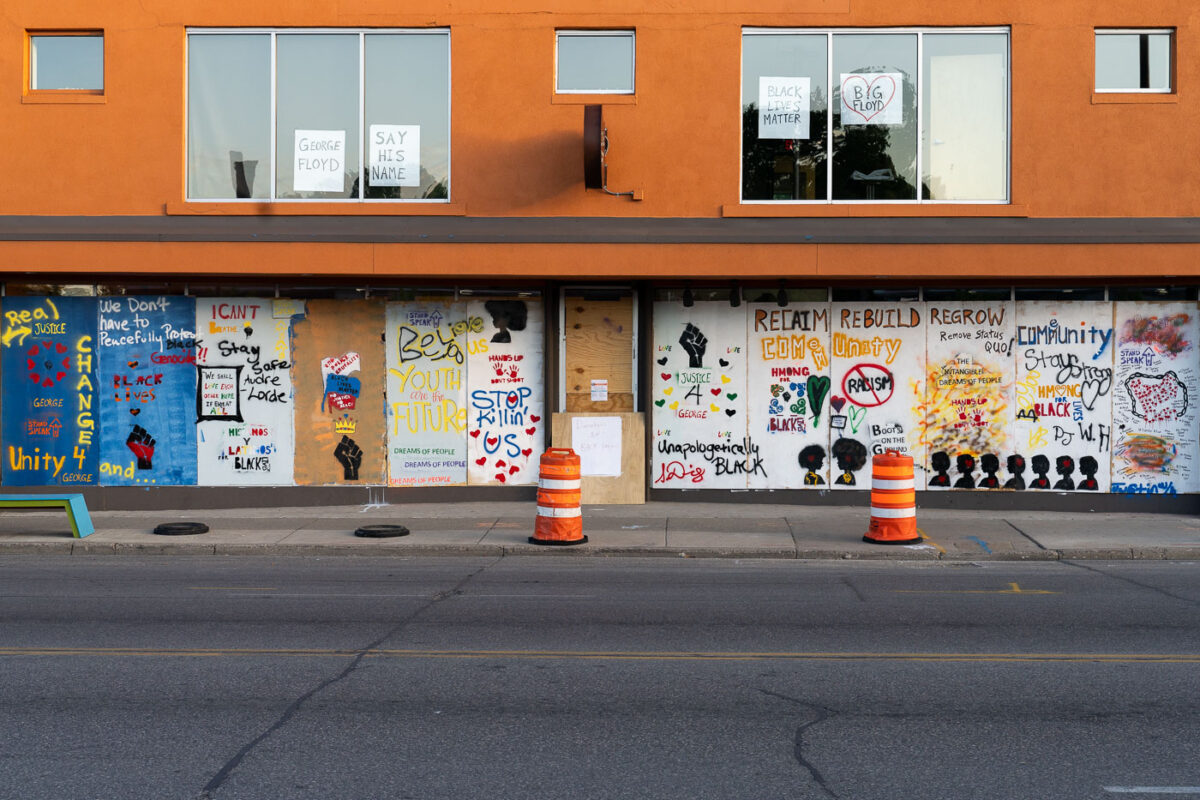
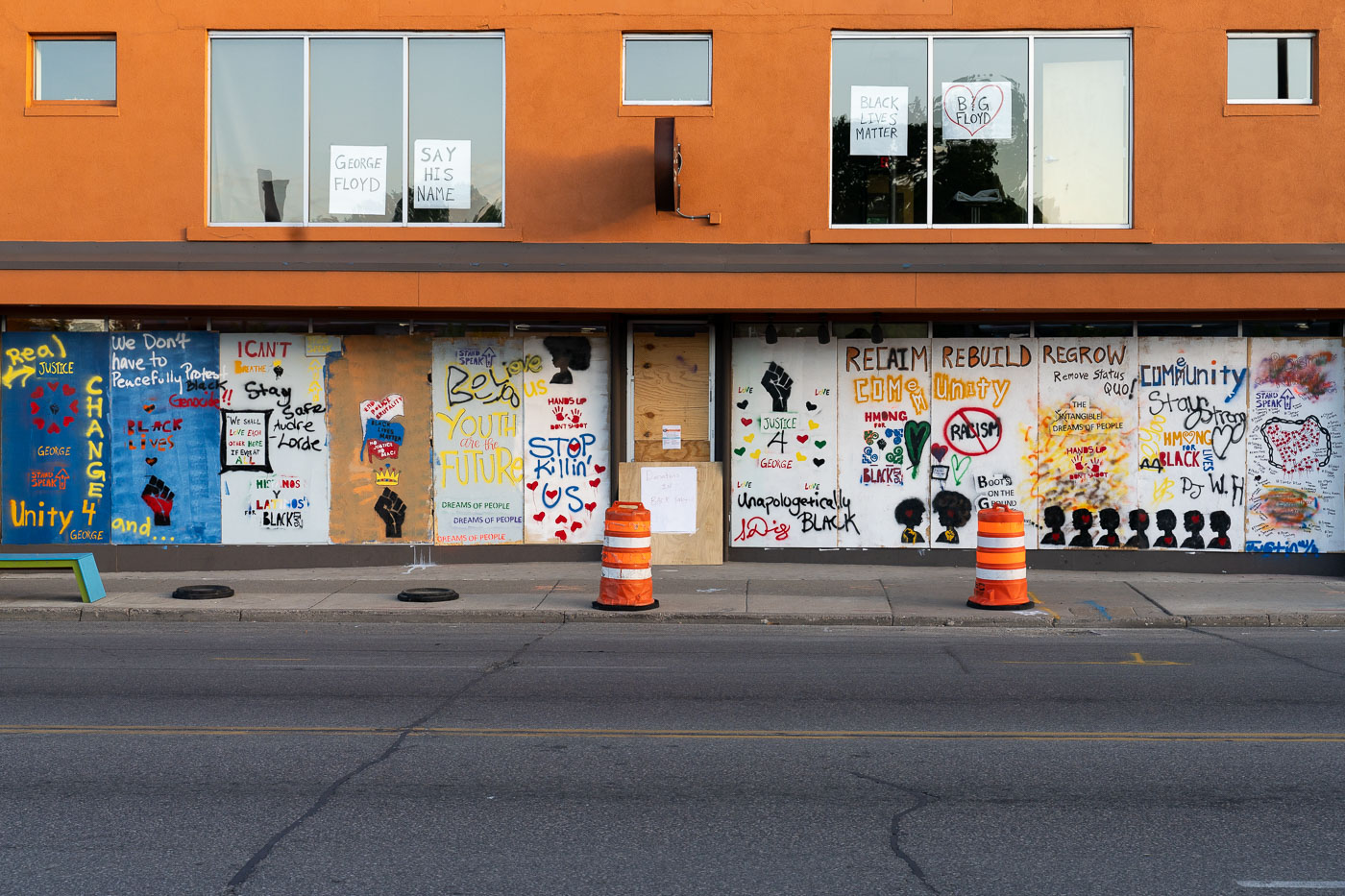
Protest murals on boarded storefronts on Broadway Avenue in North Minneapolis after George Floyd's killing.
Protest murals and handwritten signs cover the boarded storefronts of a commercial building on Broadway Avenue in North Minneapolis. Photographed on June 4, 2020, the messages reference George Floyd, Black Lives Matter, and demands for racial justice in the days after Floyd was killed by Minneapolis police on May 25. The temporary artwork turned plywood coverings on closed businesses into a public memorial and message wall, with calls to “say his name,” “stop killing us,” and “rebuild community” visible across the block.

George Floyd Protest Murals, Broadway, North Minneapolis
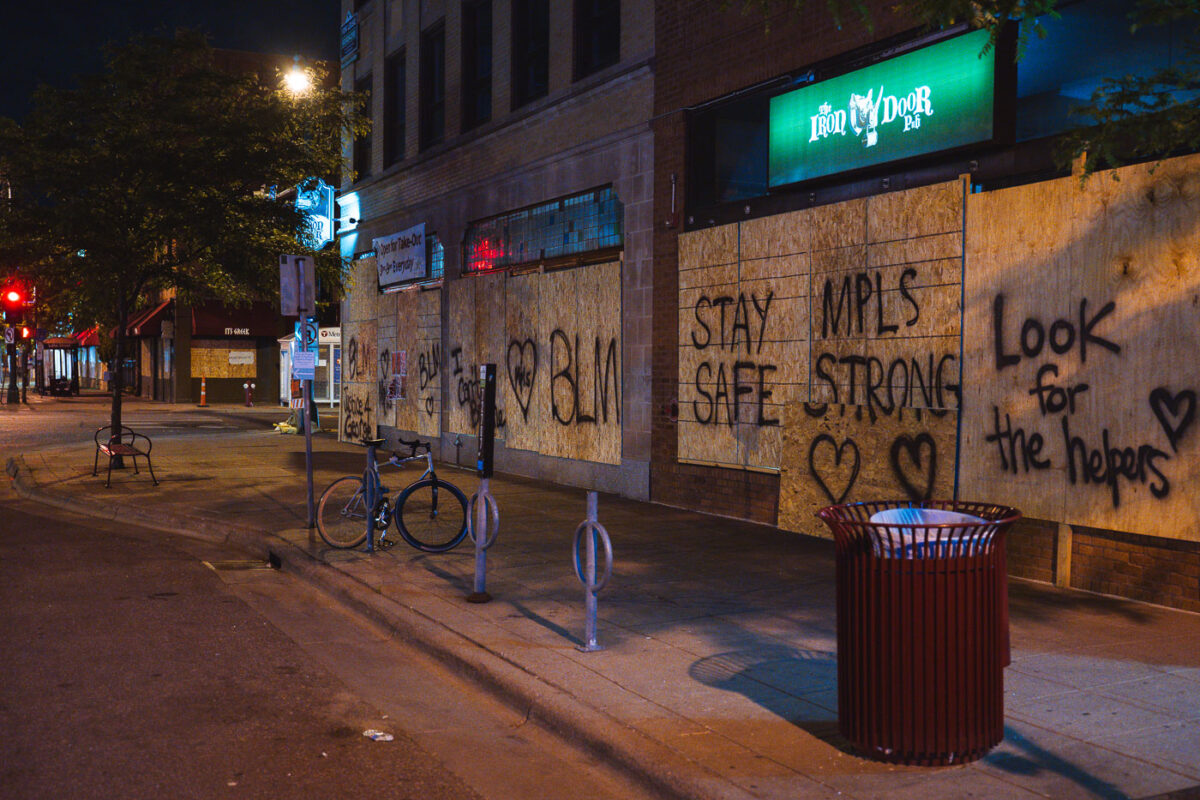
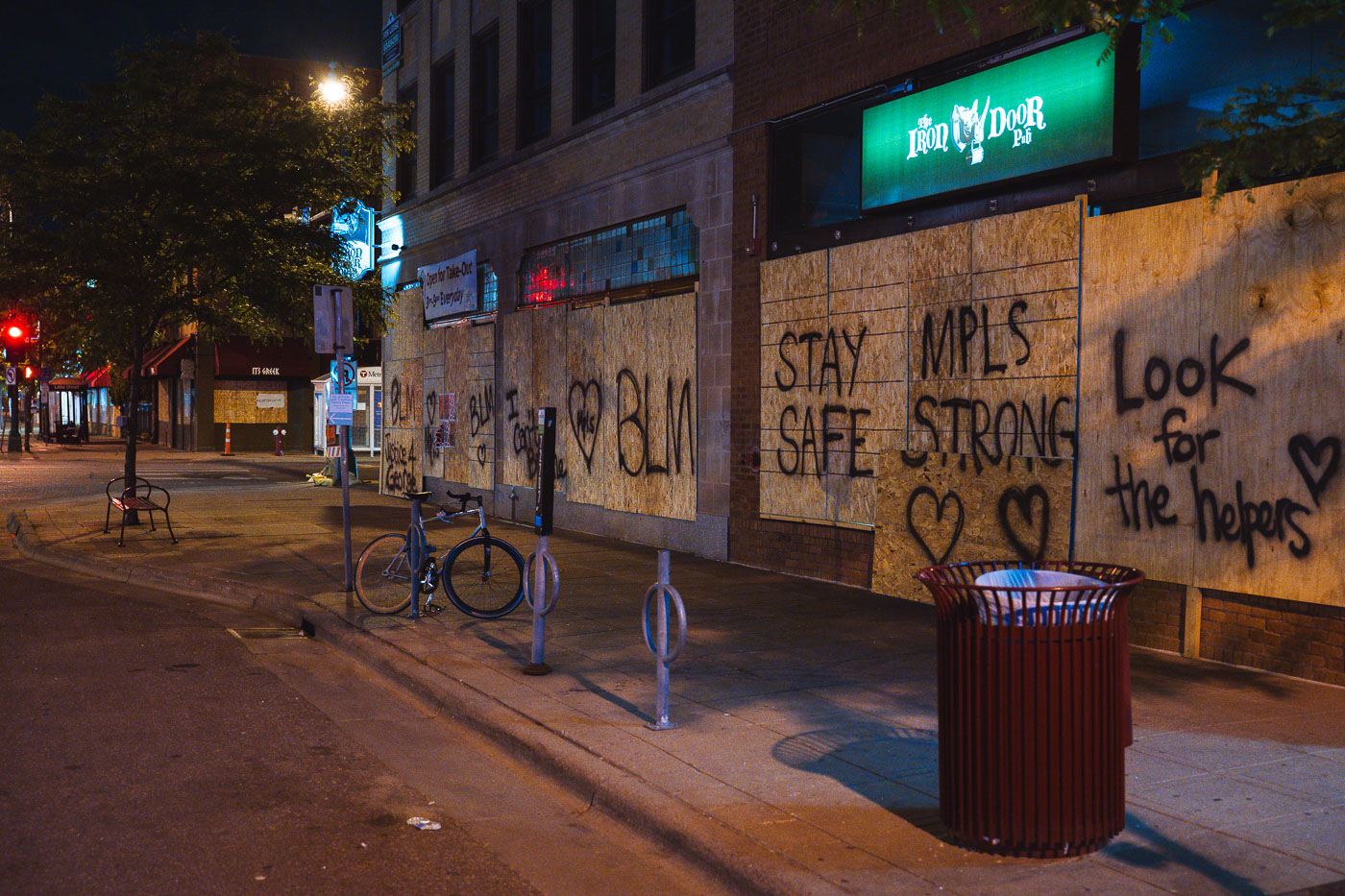
Boarded Iron Door Pub on Lyndale Avenue, Minneapolis, with BLM and protest graffiti in June 2020.
The Iron Door Pub on Lyndale Avenue in Uptown Minneapolis is boarded up in early June 2020, with plywood covering its windows and doors. Messages including “BLM,” “Stay Safe,” “MPLS Strong,” and “Look for the helpers” are spray-painted across the boards. Taken a week after the killing of George Floyd.

Iron Door Pub, Lyndale Ave, Minneapolis, Protest Graffiti
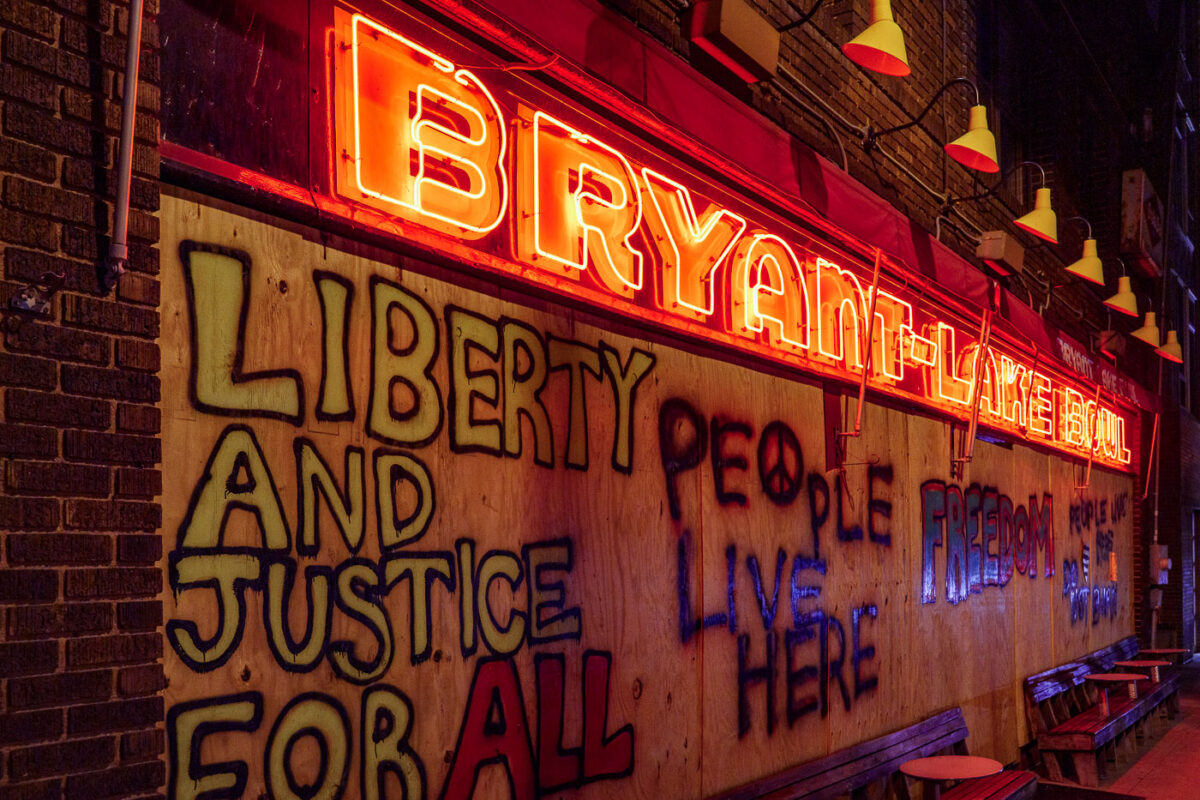
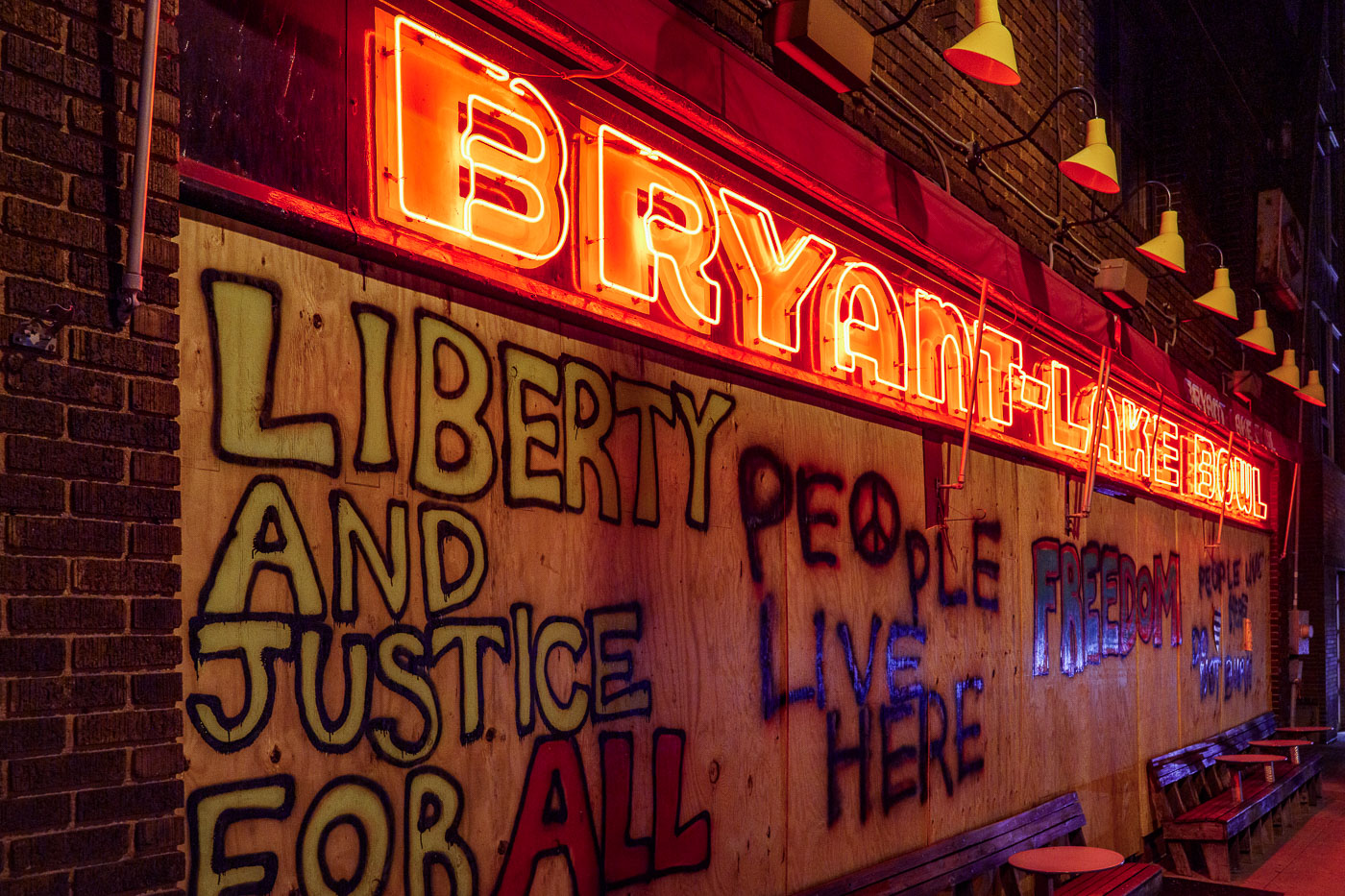
Bryant-Lake Bowl on Lake Street in Minneapolis, boarded with protest graffiti beneath a lit neon sign.
Bryant-Lake Bowl on Lake Street in Minneapolis is shown boarded up at night, with its neon sign lit above plywood covered in protest graffiti. Messages painted on the boards include “Liberty and Justice for all,” “People live here,” and “Freedom.” The bowling alley, theater, and restaurant was among the Lake Street businesses that secured their storefronts during the unrest following the May 25, 2020, killing of George Floyd.

Bryant-Lake Bowl, Boarded with Protest Graffiti, Minneapolis
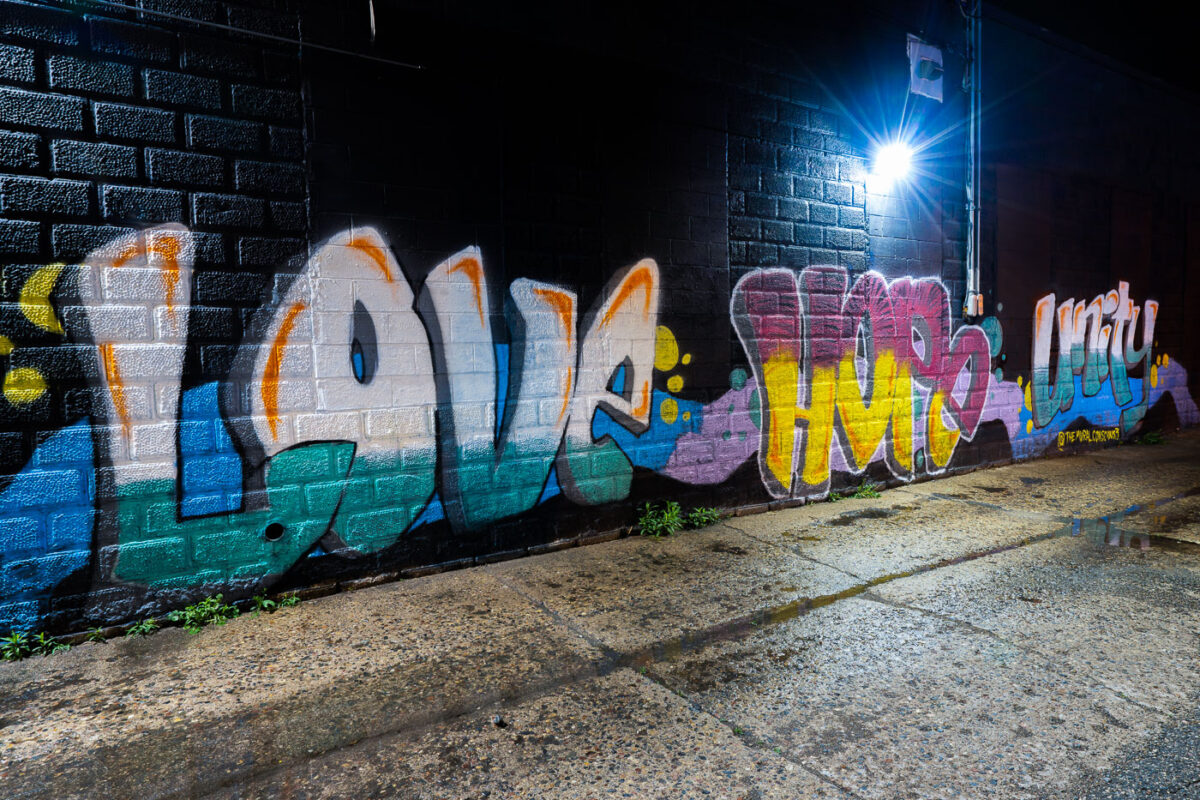
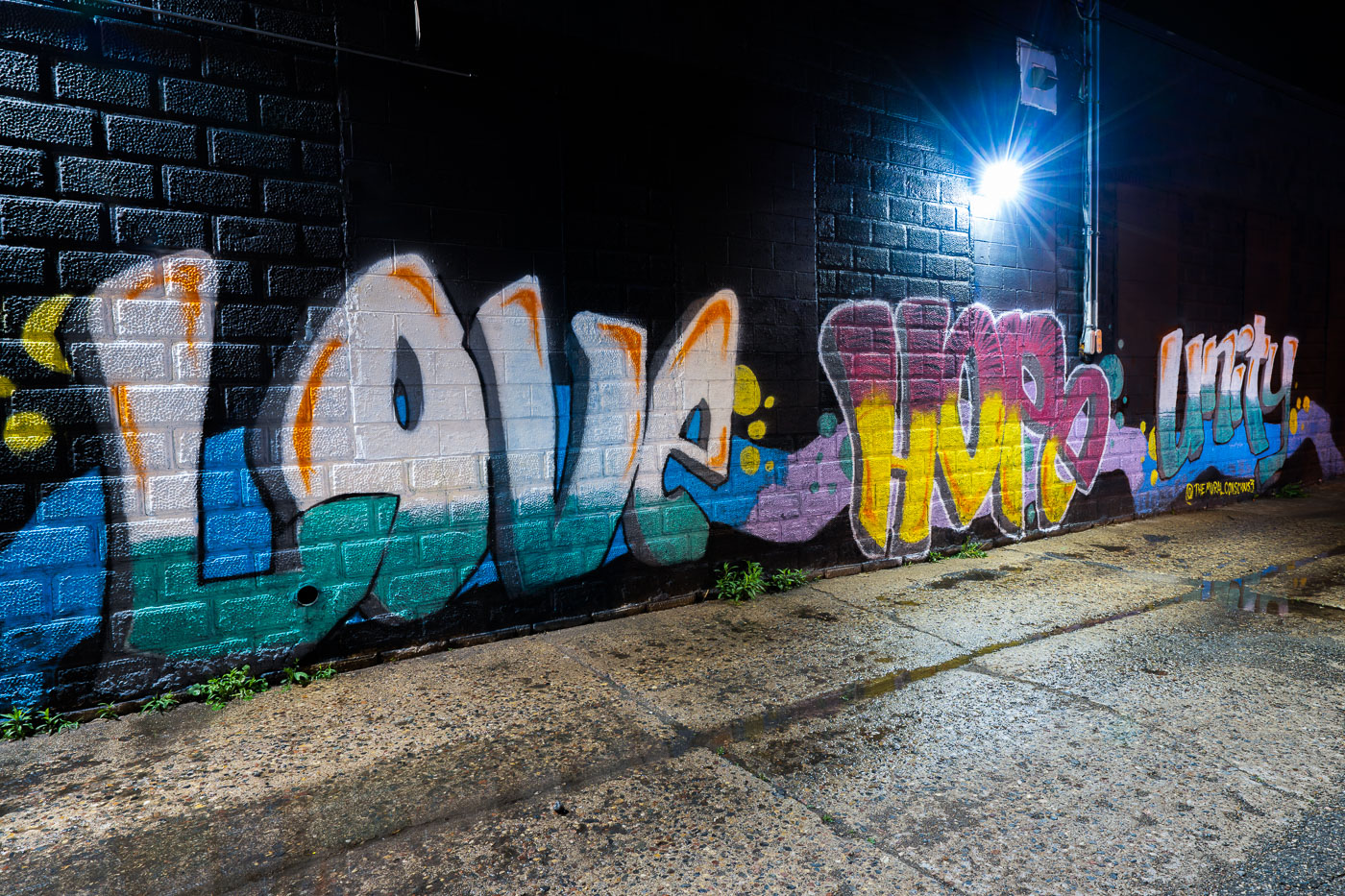
“Love Hope Unity” mural on an alley wall in Uptown Minneapolis, June 2020.
The “Love Hope Unity” mural in an alley in Minneapolis’s Uptown neighborhood covers a long black-painted brick wall with large multicolored graffiti-style lettering. Photographed in June 2020, the work is part of the wave of public art created across Minneapolis after the murder of George Floyd and the protests that followed. Its message of love, hope, and unity places the alley within the city’s wider landscape of memorial and response murals from that period.

Love Hope Unity Graffiti, Minneapolis Uptown Alley
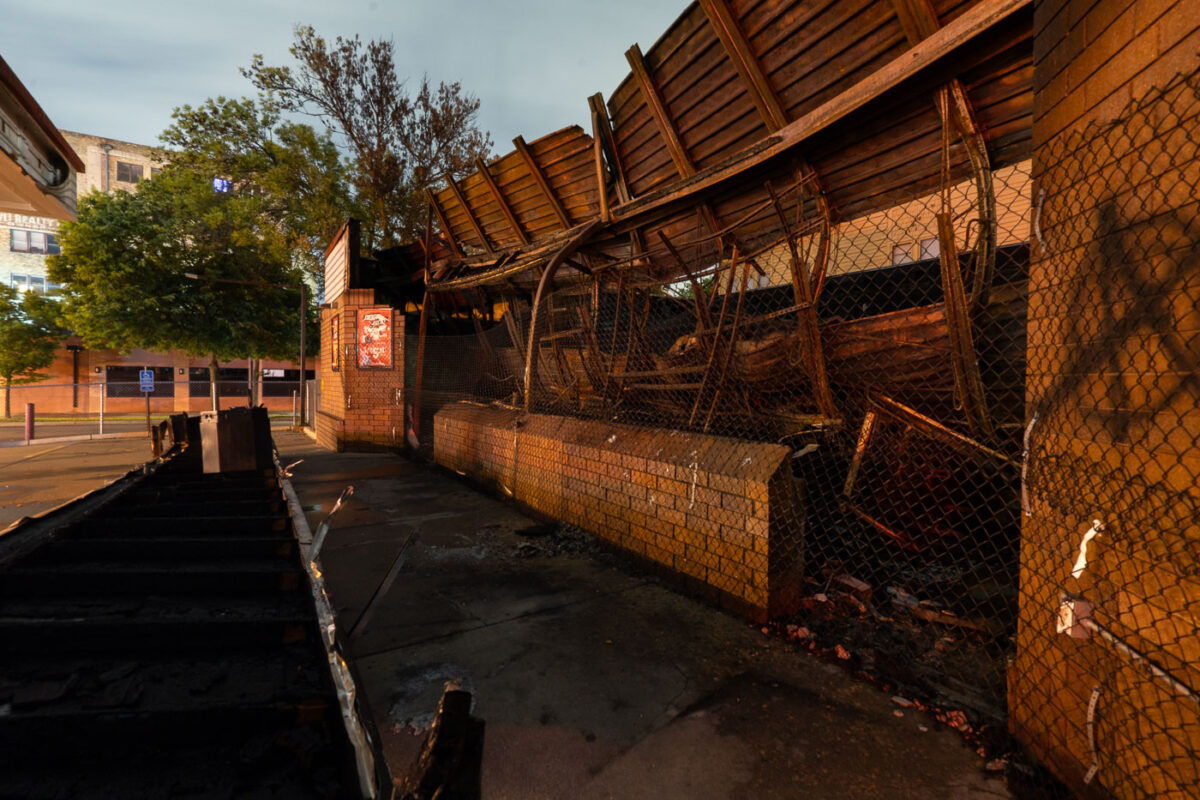
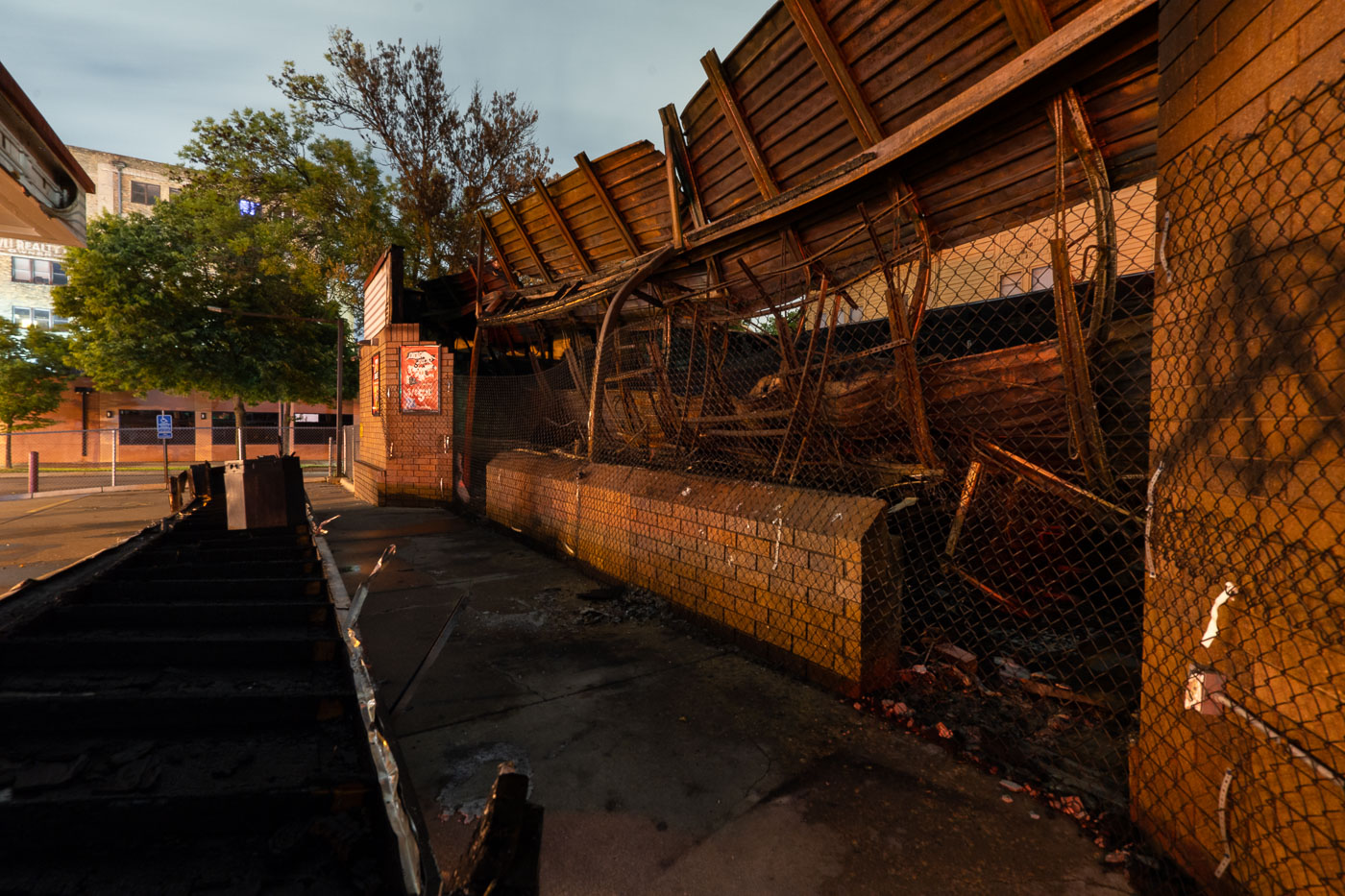
Burned SuperAmerica gas station on Lake Street in Minneapolis after unrest following George Floyd's killing.
The burned SuperAmerica gas station on Lake Street in Minneapolis stands behind a chain-link fence with its canopy collapsed and interior reduced to charred debris. The station was damaged during the unrest that followed the May 25, 2020 killing of George Floyd, when many businesses along the Lake Street corridor were burned or looted. Before the fire, the site provided fuel and convenience retail services on one of the city’s main east-west commercial streets.

Burned SuperAmerica Gas Station, Lake Street, Minneapolis
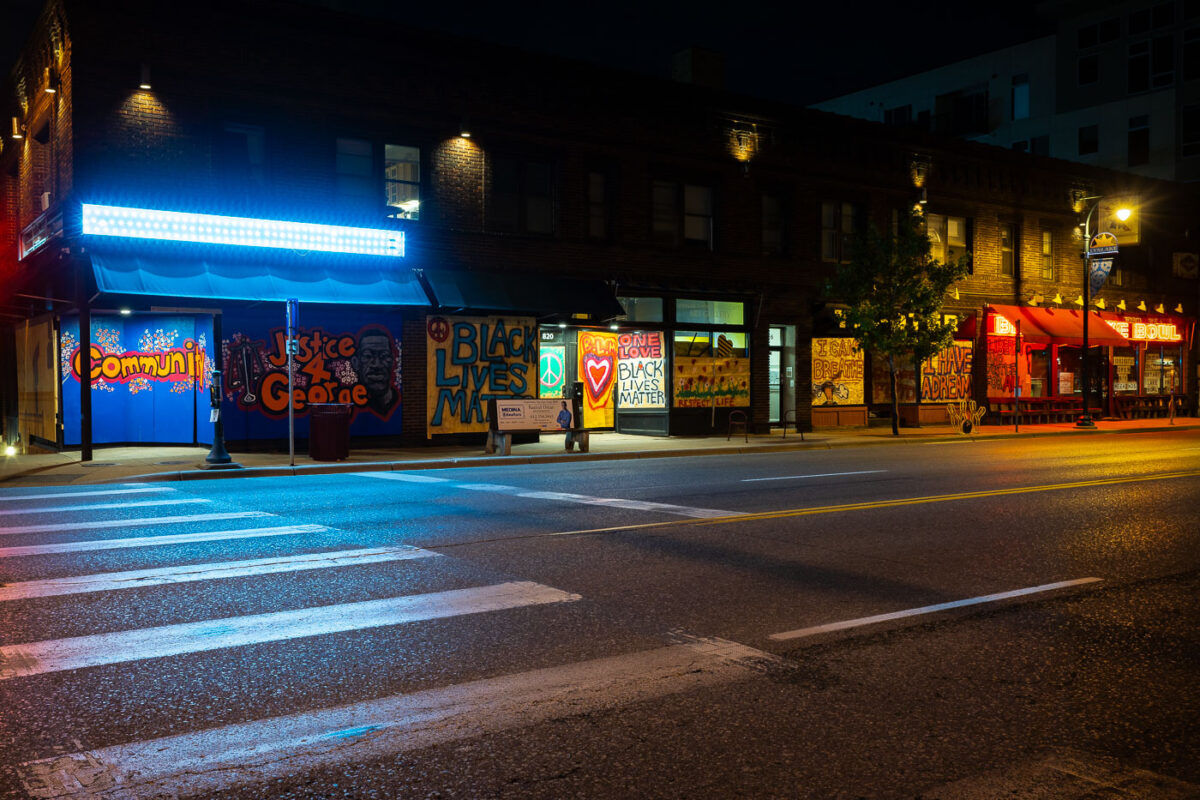
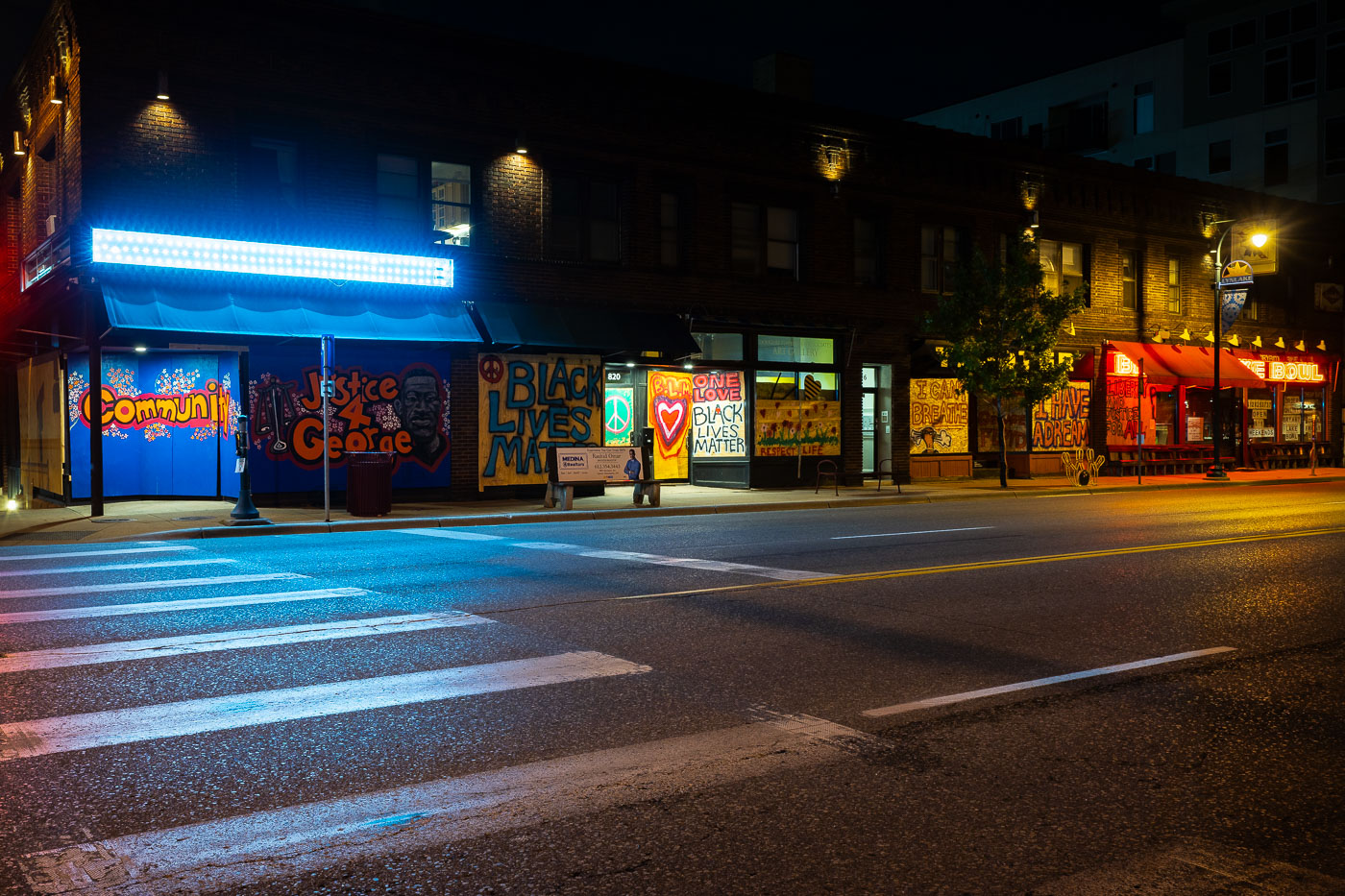
Boarded storefront murals on West Lake Street in Minneapolis with George Floyd and Black Lives Matter messages.
Boarded storefronts covered with murals line West Lake Street in Minneapolis in the early hours of June 7, 2020. The painted plywood panels include messages such as “Justice 4 George,” “Black Lives Matter,” “I Can’t Breathe,” and “I Have a Dream,” displayed across retail spaces protected after damage and unrest following the police killing of George Floyd in late May 2020. The murals turned the temporary barriers into a highly visible corridor of memorial and protest art along one of the city’s main commercial streets.

West Lake Street Murals on Boarded Stores, Minneapolis
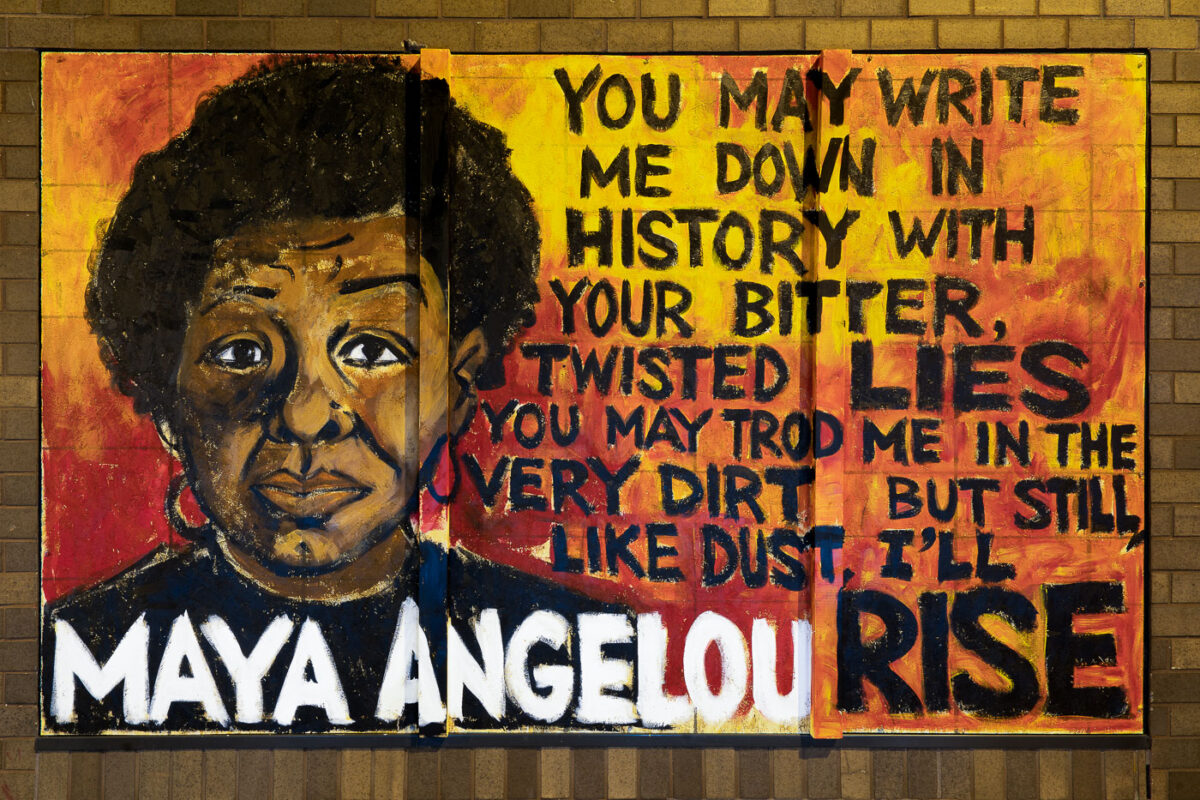
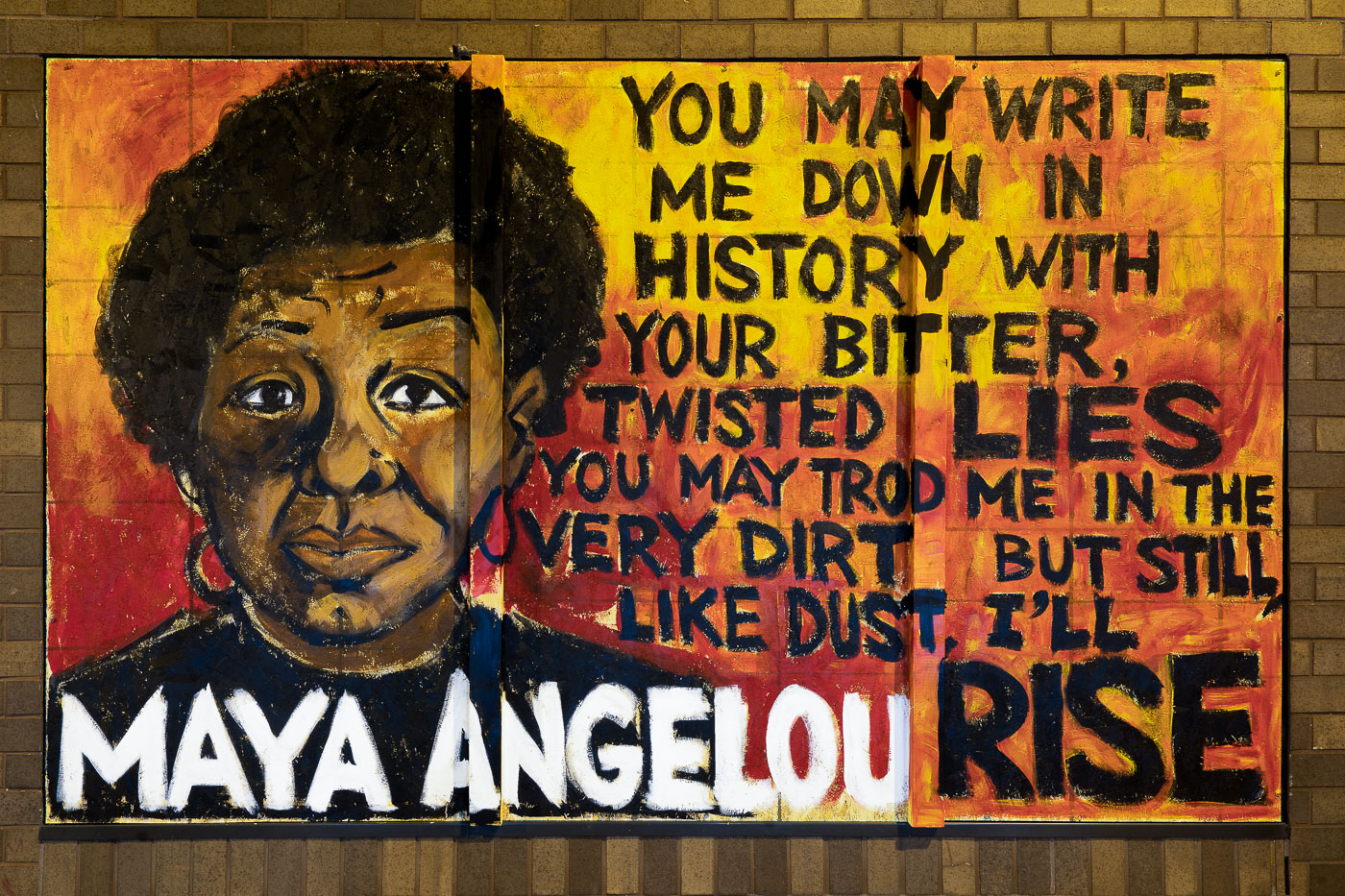
Maya Angelou mural on boarded windows at Calhoun Square in Minneapolis with a quote from “Still I Rise.”
A mural of Maya Angelou mounted on boarded storefront windows at Calhoun Square in Minneapolis features a passage from her poem “Still I Rise.” Installed along Hennepin Avenue in June 2020, the temporary artwork was part of the wave of protest murals and memorial art that appeared across the city after the murder of George Floyd. The painted boards combine Angelou’s portrait with the lines, “You may write me down in history with your bitter, twisted lies … but still, like dust, I’ll rise.”

Maya Angelou Mural at Calhoun Square, Minneapolis
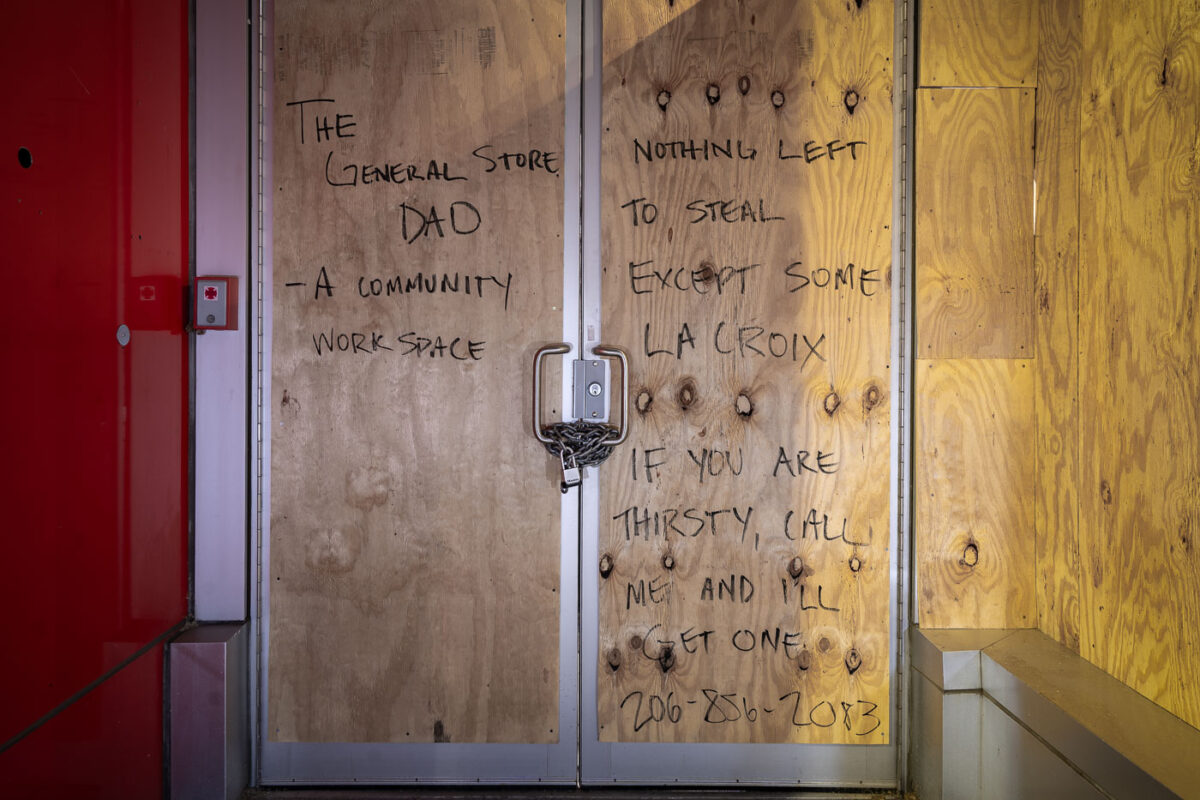
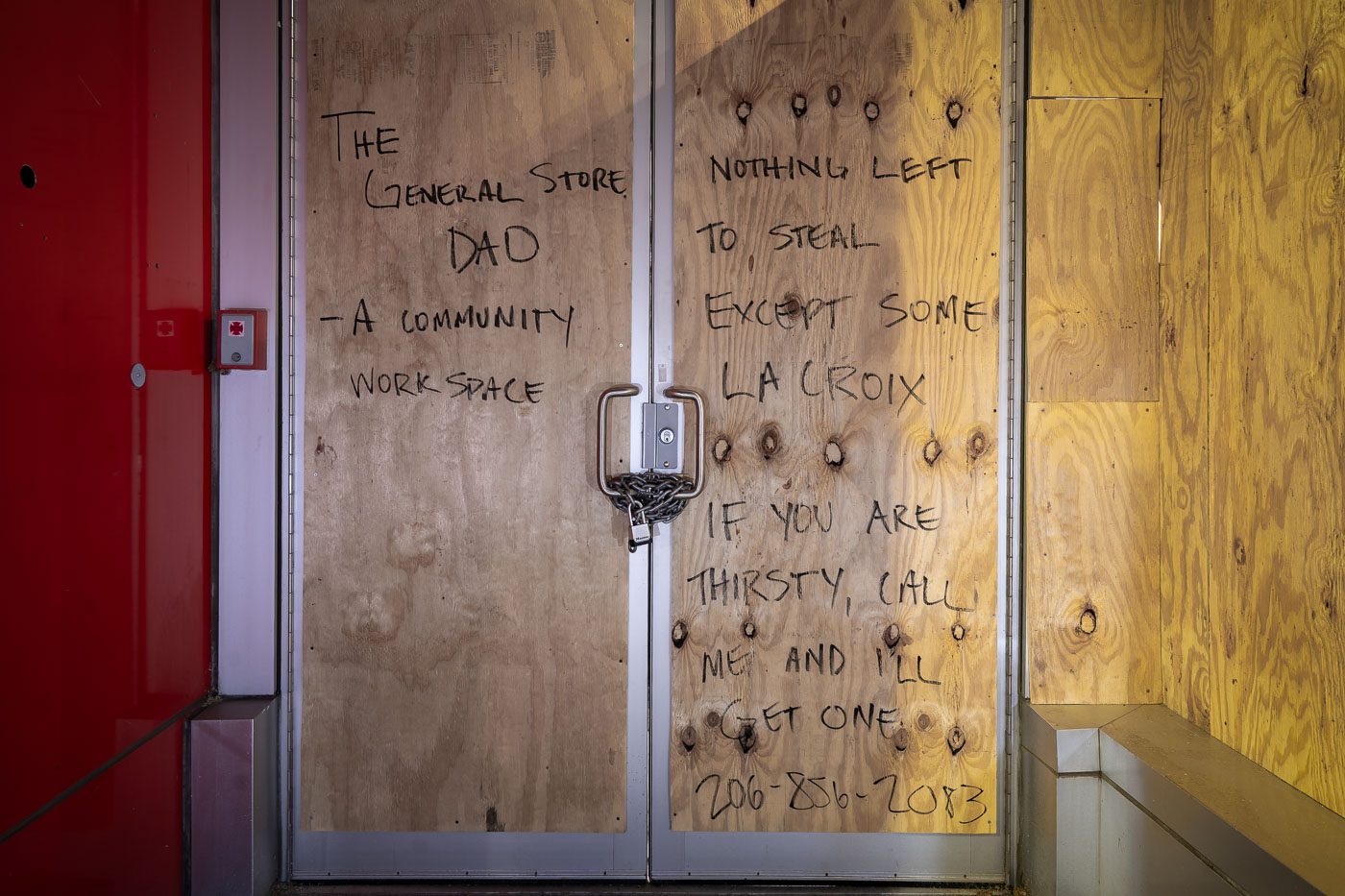
Boarded entrance of The General Store Dad on Hennepin Avenue in Uptown Minneapolis, June 2020.
The boarded entrance of The General Store Dad on Hennepin Avenue in Uptown Minneapolis is shown on June 7, 2020. Plywood panels cover the storefront doors and windows, with handwritten text identifying the business as “a community work space” and stating, “Nothing left to steal except some La Croix,” followed by an offer to call for a drink. The protective boarding was installed after protests and unrest in Minneapolis following the killing of George Floyd by Minneapolis police in May 2020.

General Store Dad Boards, Hennepin Ave, Minneapolis Unrest
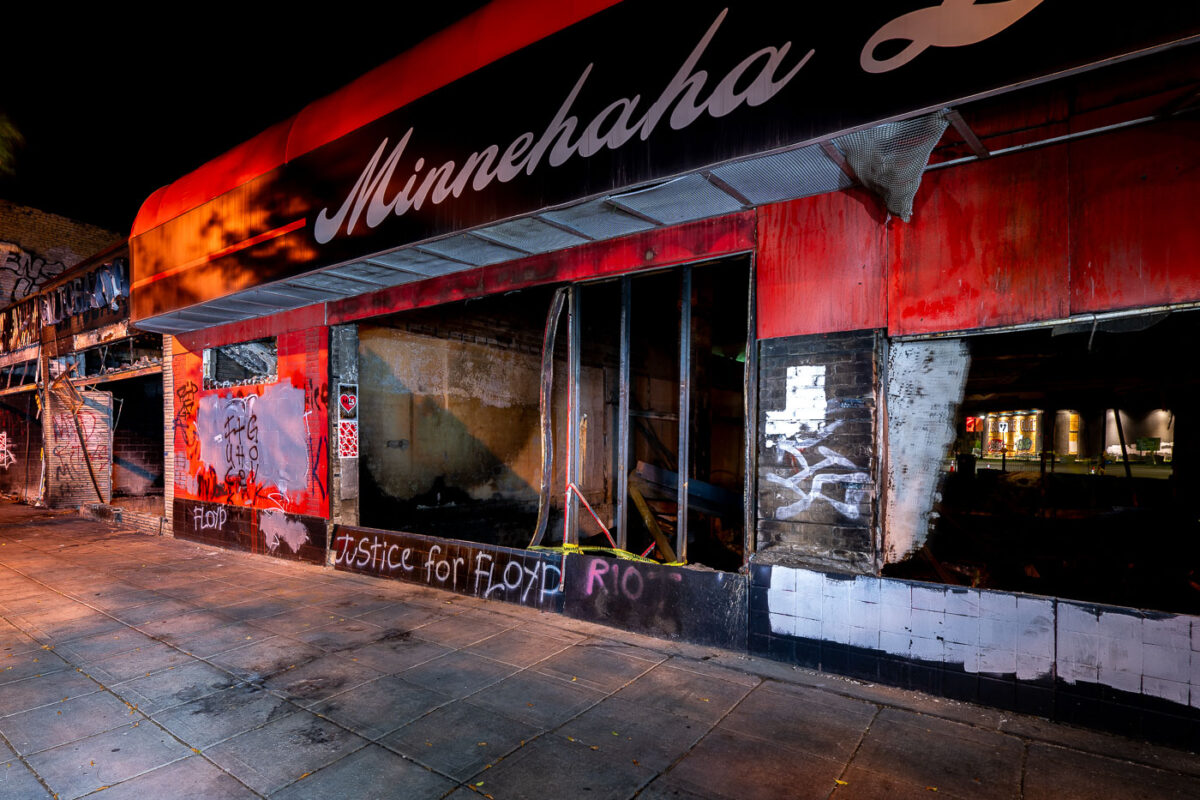
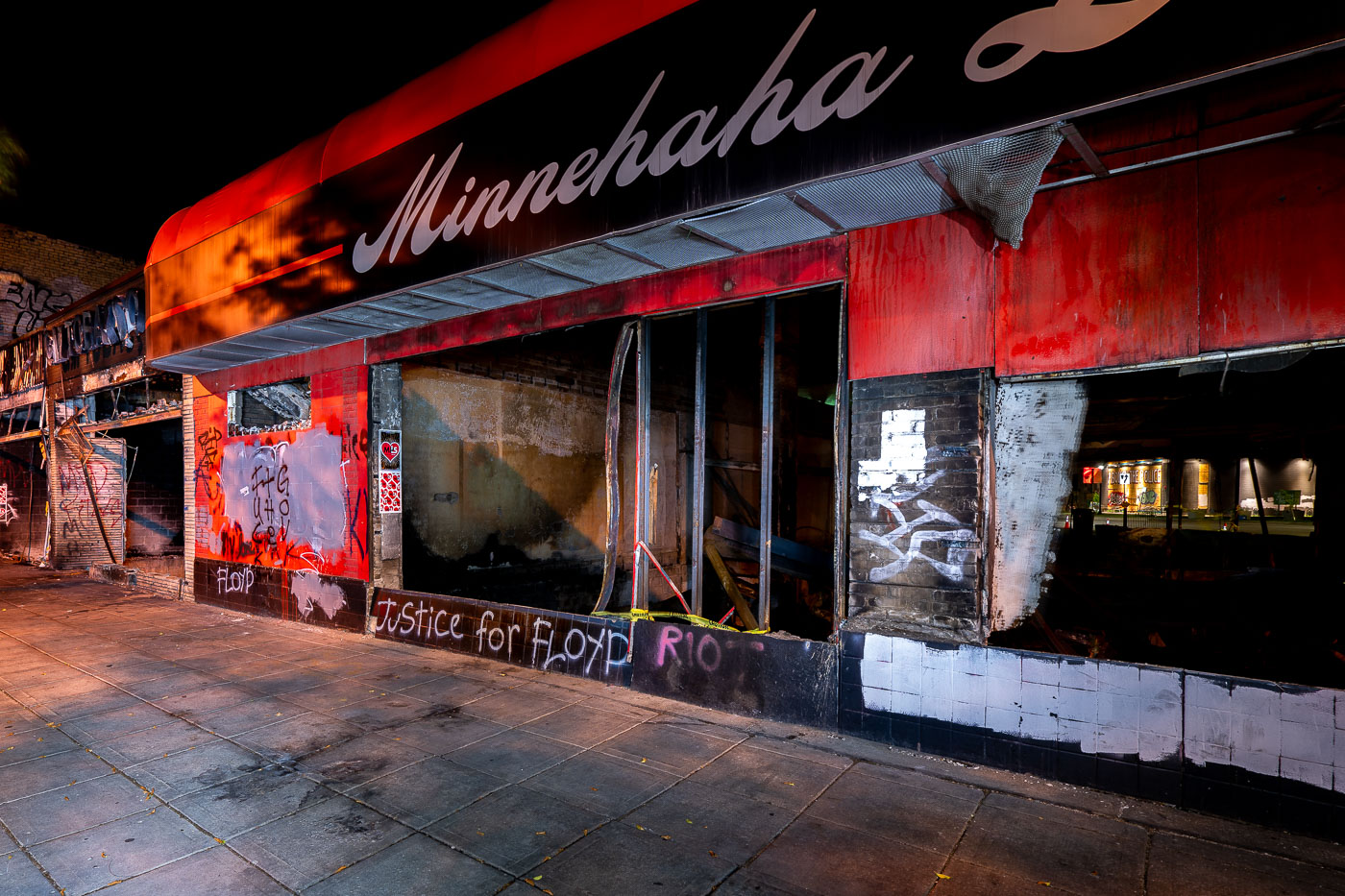
Fire-damaged Minnehaha Liquors on East Lake Street in Minneapolis, marked with “Justice for Floyd” graffiti.
Minnehaha Liquors on East Lake Street in Minneapolis stands fire-damaged in the aftermath of unrest following the May 25, 2020, killing of George Floyd. Broken windows, charred interiors, and boarded wall sections remain visible beneath the store’s sign. Graffiti on the facade includes the words “Justice for Floyd,” linking the damaged storefront to the protests and calls for accountability that spread along the Lake Street corridor in late May and early June 2020.

Minnehaha Liquors, E. Lake St, Post-Fire: Justice for Floyd
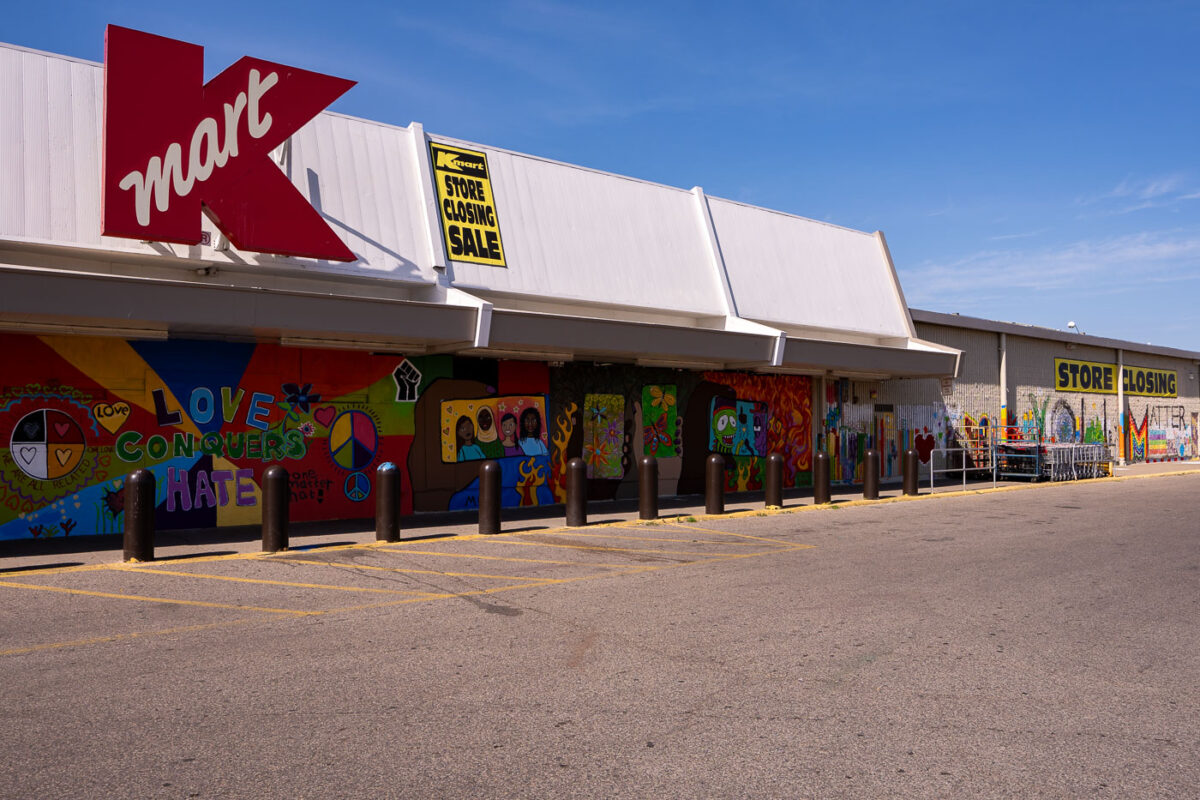
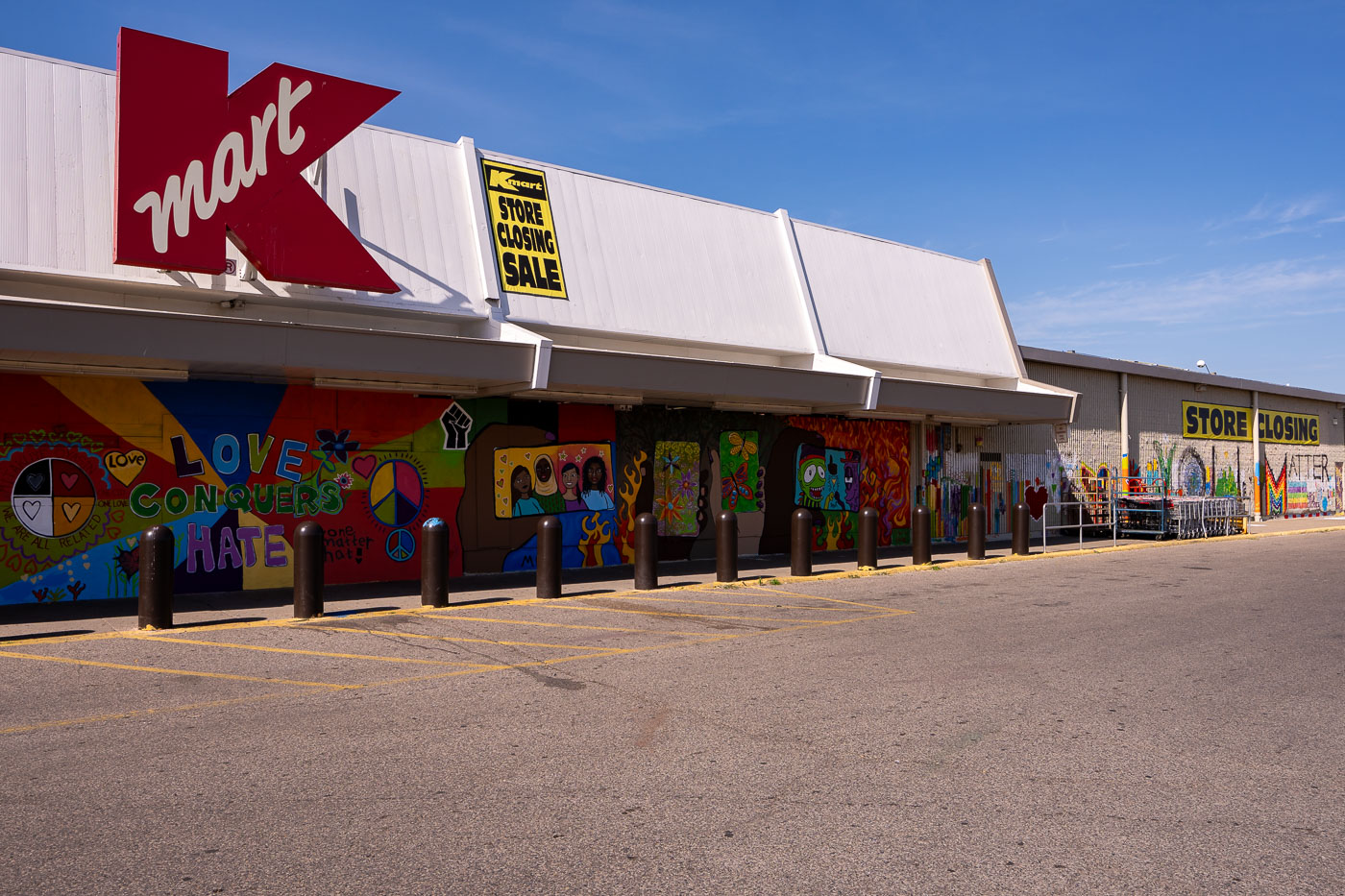
Kmart on Lake Street in Minneapolis with store-closing signs and murals on boarded windows, June 2020.
The Kmart store on Lake Street in Minneapolis is shown on June 14, 2020, with large “Store Closing Sale” banners and boarded storefront windows covered in murals and graffiti. Messages and images painted across the boards include “Love Conquers Hate,” peace symbols, and portraits, turning the facade into a temporary public art surface in the weeks after the murder of George Floyd. Shopping carts remain stacked near the entrance as the store stands closed behind the painted boards.

K-Mart Store Closing, Murals on Boards, Lake Street, Minneapolis
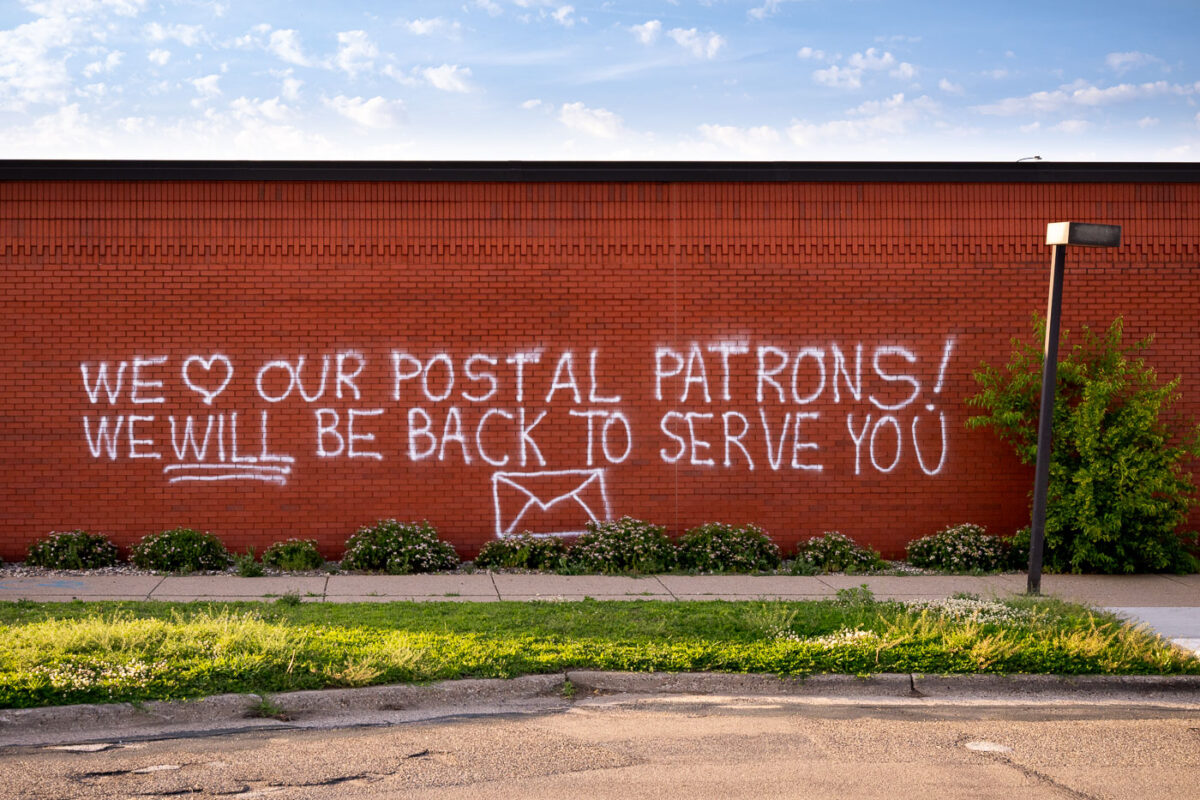
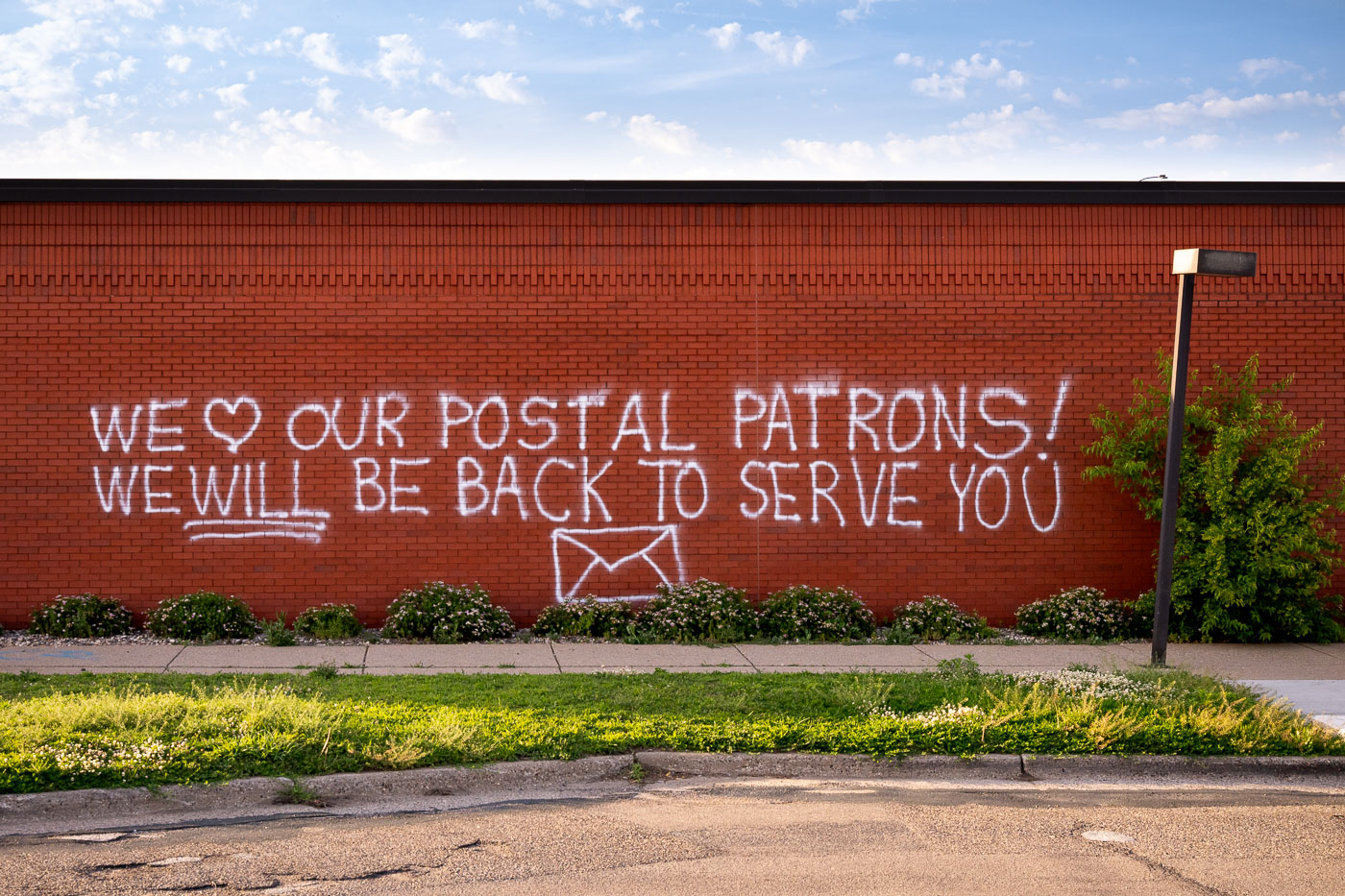
Graffiti on the former USPS post office on E 31st Street in Minneapolis promises a return to service.
Graffiti on the former USPS post office on East 31st Street in Minneapolis reads, “WE LOVE OUR POSTAL PATRONS! WE WILL BE BACK TO SERVE YOU.” The message covers a long brick exterior wall of the damaged postal facility, which was burned during the unrest that followed the murder of George Floyd in May 2020. Photographed in June 2020, the building remained closed as the handwritten message addressed customers and the anticipated return of mail service.

Graffiti on Burned USPS Post Office, E 31st St, Minneapolis
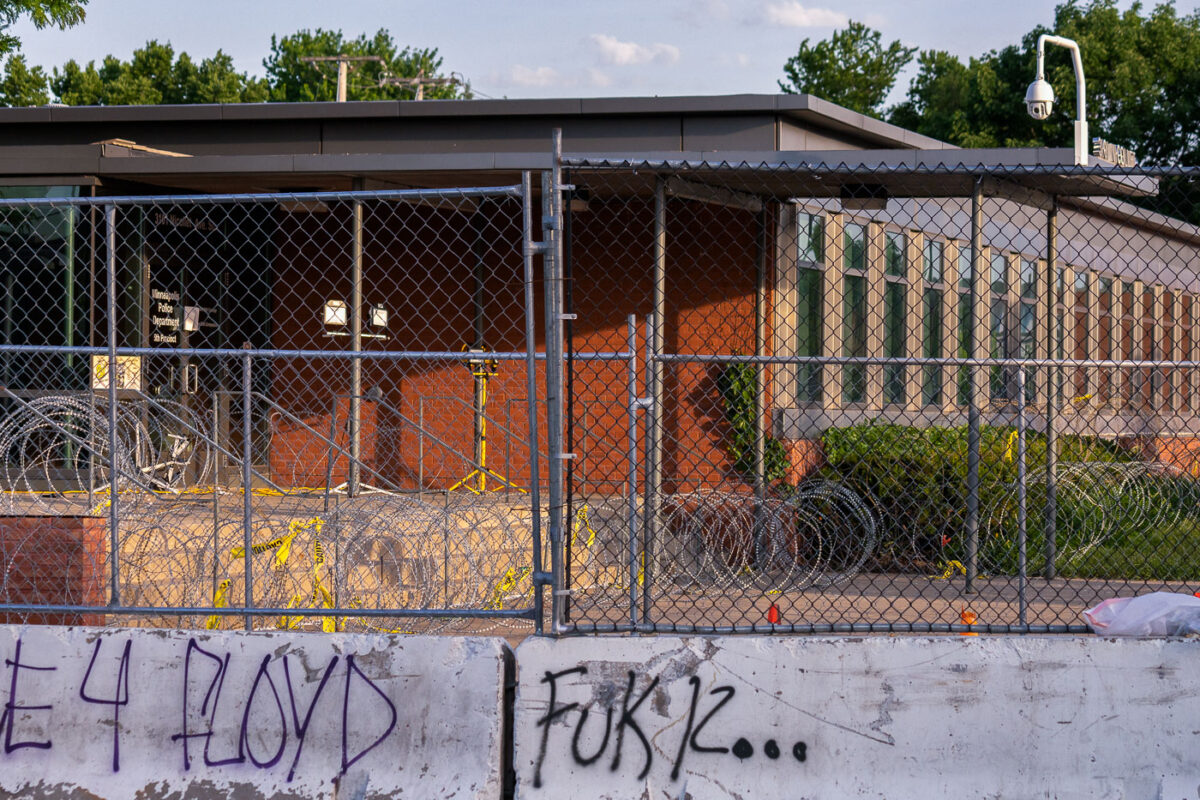
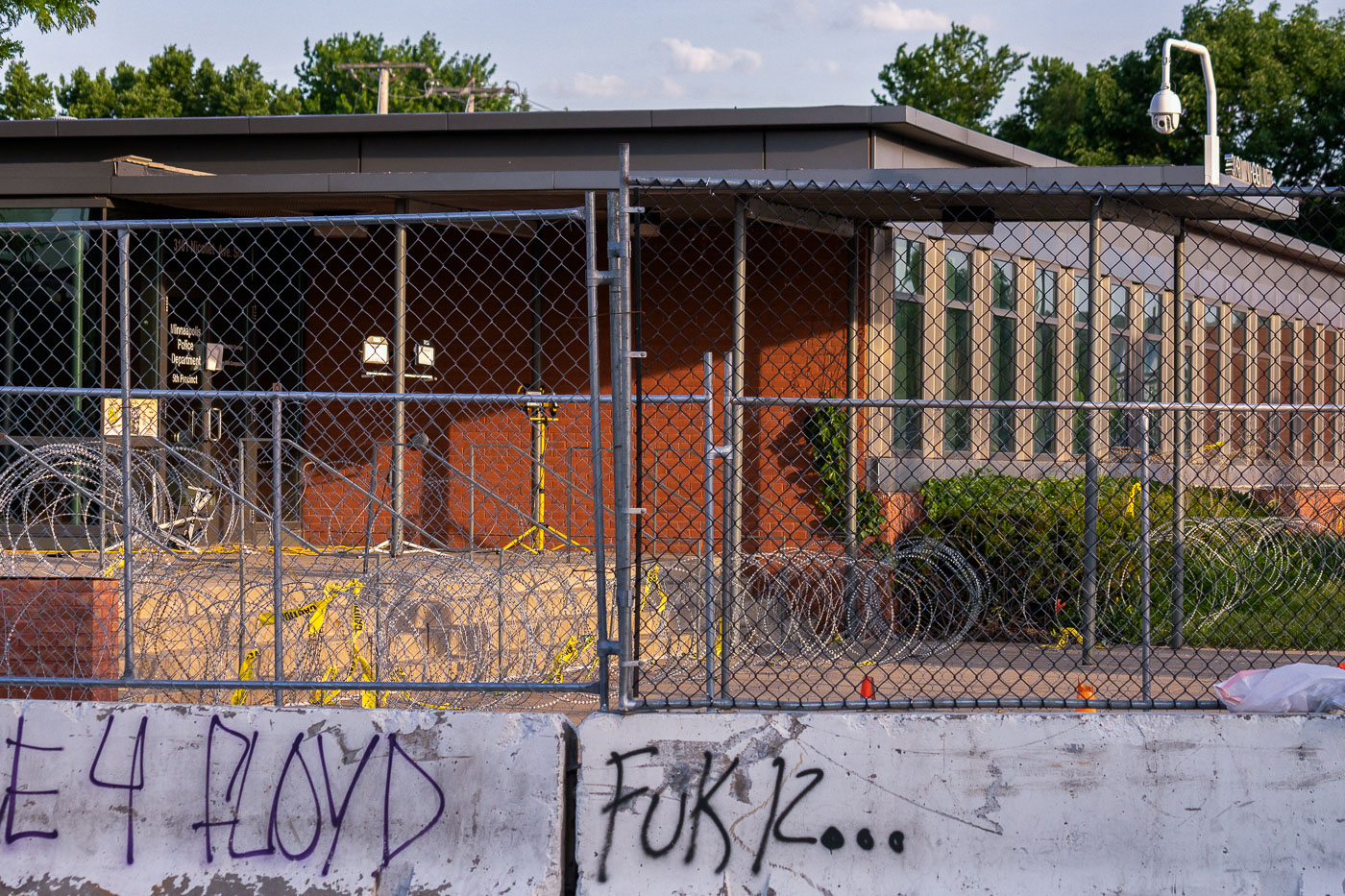
Minneapolis Police 5th Precinct on Nicollet Avenue behind fencing, razor wire, and graffiti-covered barriers.
The Minneapolis Police Department’s 5th Precinct station at 3101 Nicollet Avenue South in Minneapolis is surrounded by chain-link fencing, razor wire, and concrete barriers marked with graffiti. The image was made in June 2020, weeks after protests followed the killing of George Floyd and prompted added security at police facilities across the city.

Minneapolis Police 5th Precinct: Razor Wire & Graffiti
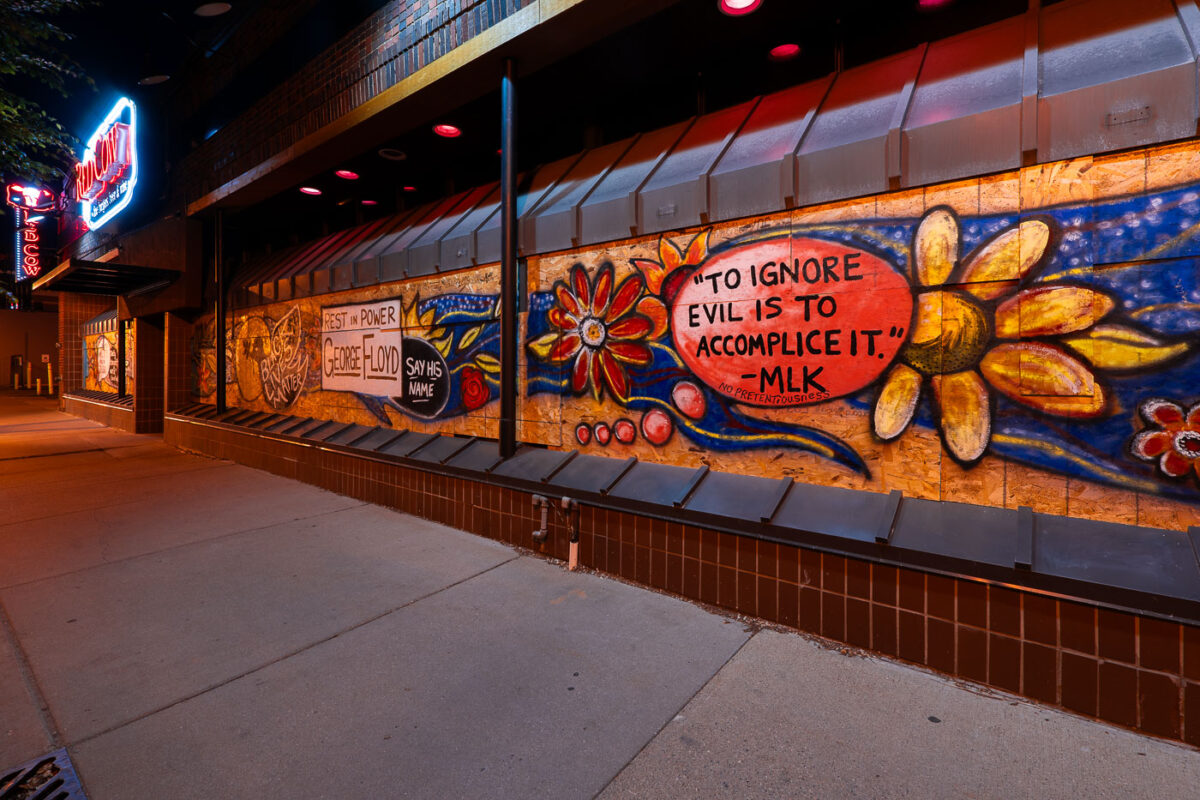
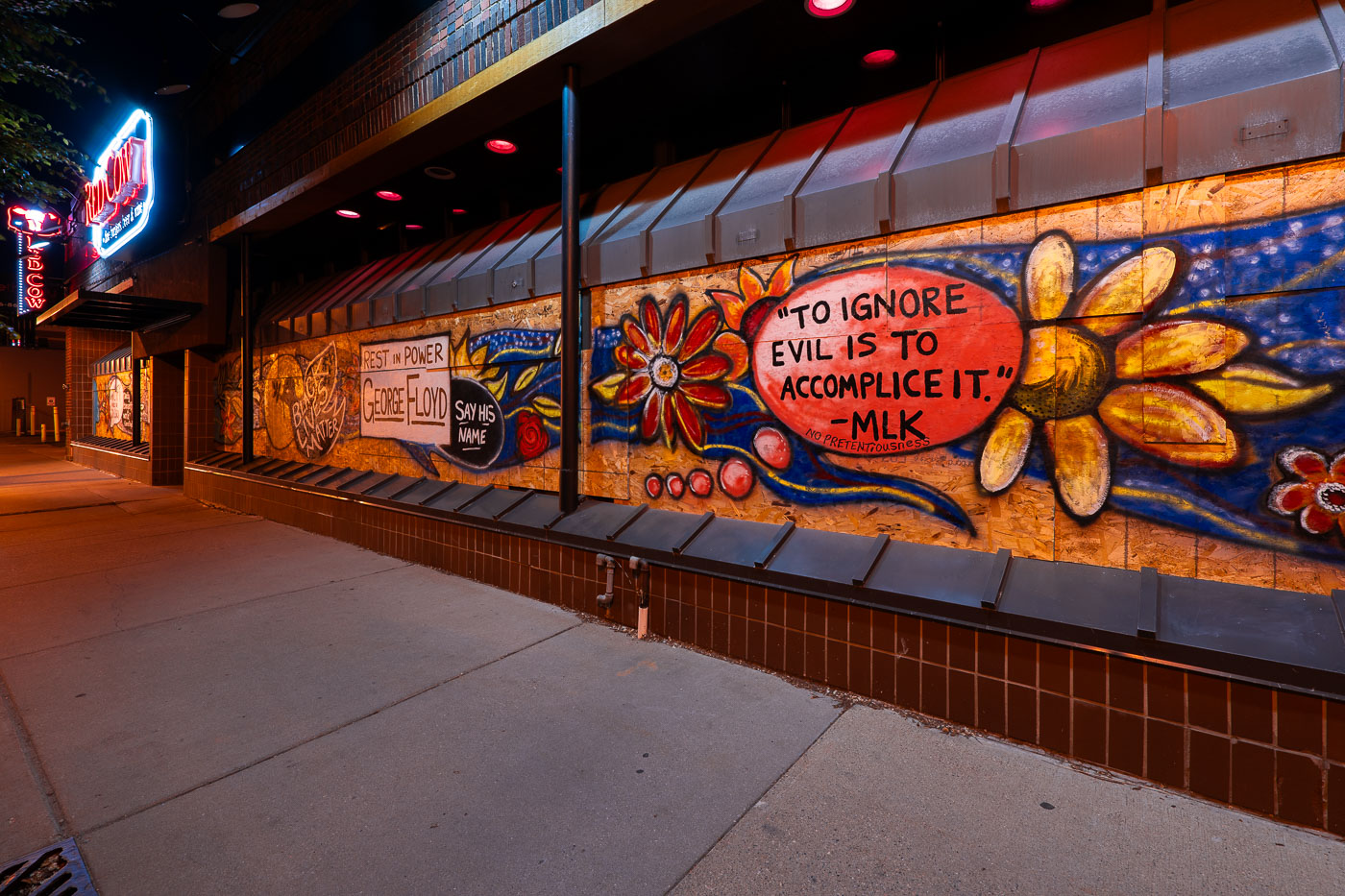
George Floyd and MLK mural on boarded Red Cow windows on Hennepin Avenue in Uptown Minneapolis.
A mural on the boarded windows of the Red Cow restaurant on Hennepin Avenue in Uptown Minneapolis honors George Floyd and Martin Luther King Jr. Painted after Floyd’s killing in 2020, the temporary storefront artwork includes the words “Rest in Power George Floyd Say His Name” and a quotation attributed to King. The boards turned the closed restaurant frontage into a memorial and protest surface during a period of unrest and mourning in Minneapolis.

MLK & George Floyd Mural, Red Cow, Uptown Minneapolis
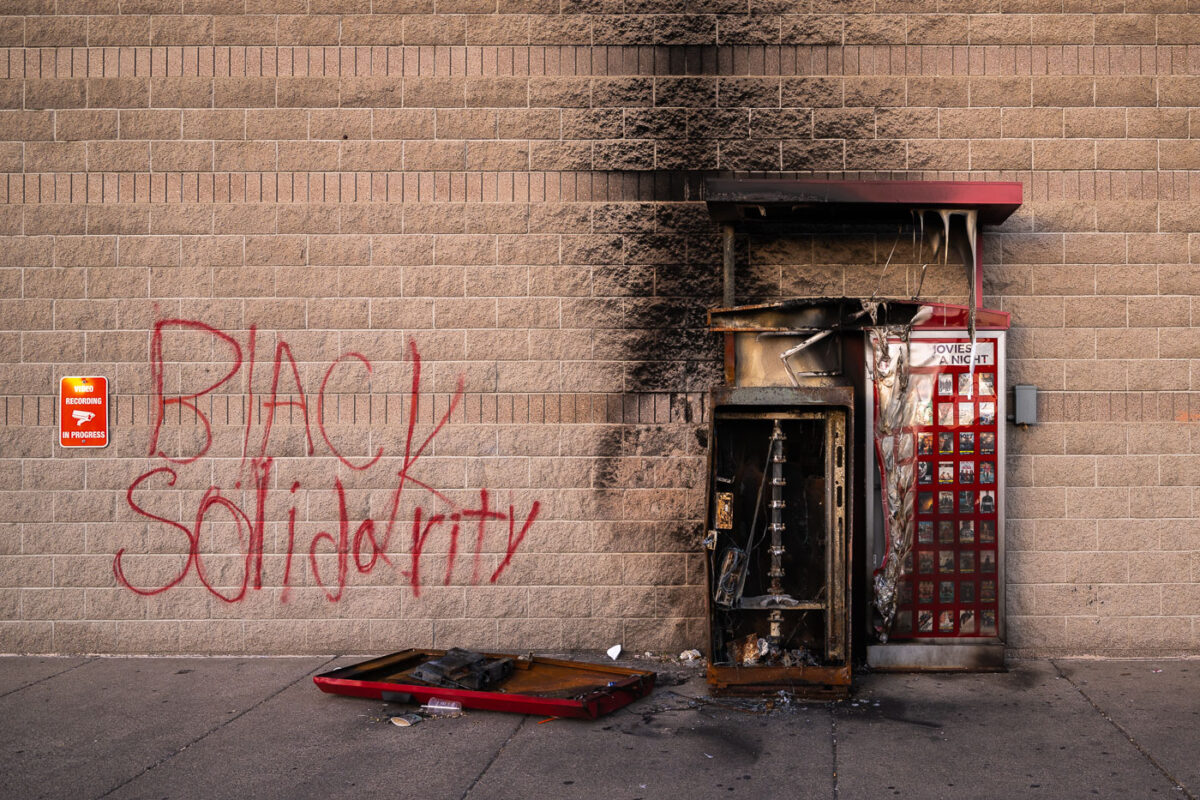
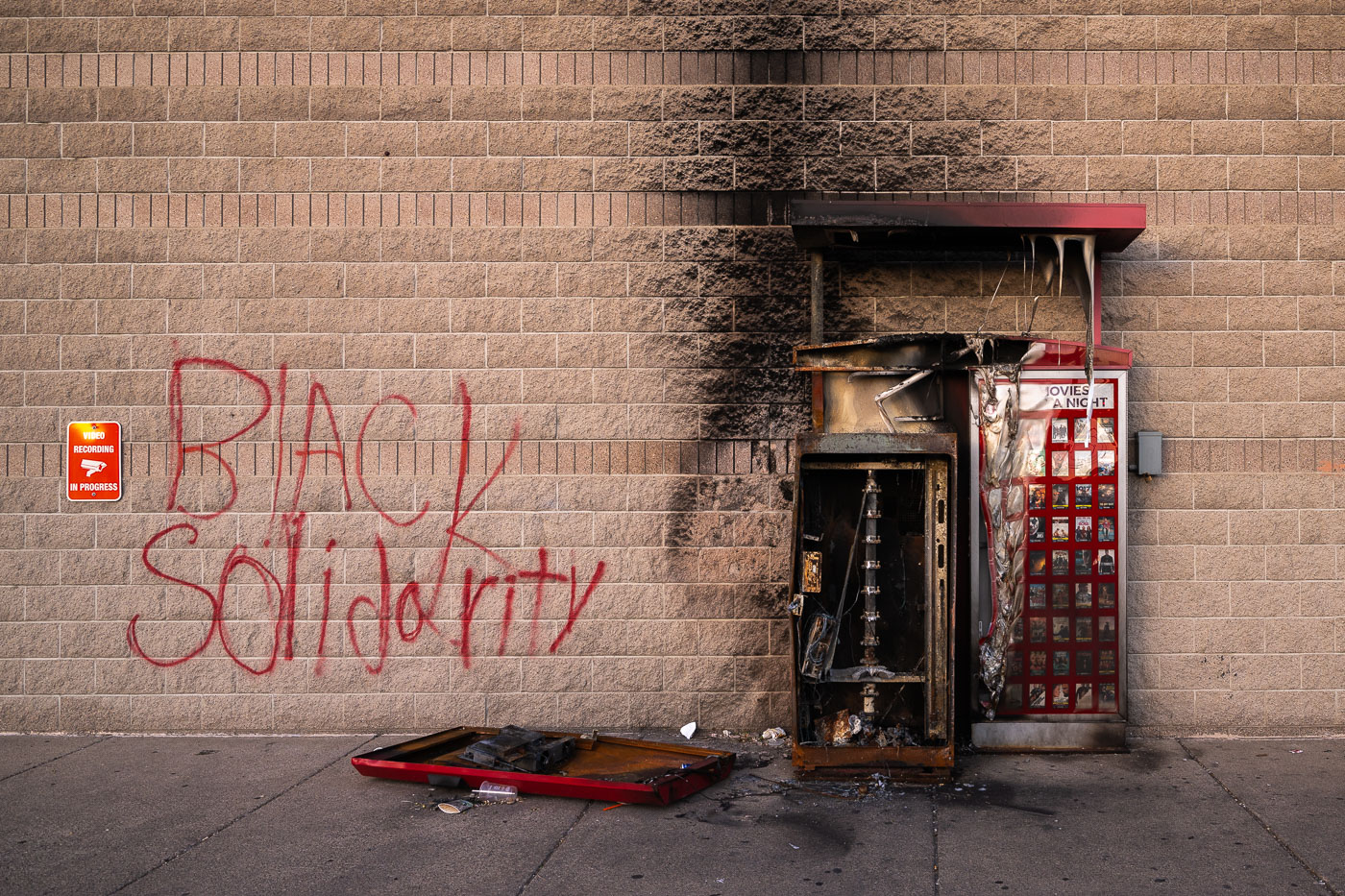
Burned Redbox kiosk outside a former Walgreens on Lake Street in Minneapolis, with “BLACK Solidarity” graffiti.
A burned Redbox kiosk stands outside a former Walgreens on Lake Street in Minneapolis. Black smoke stains mark the brick wall behind the kiosk, and red graffiti reading “BLACK Solidarity” is painted beside it. The photograph was made on June 16, 2020, weeks after the store was damaged during protests following the May 25 killing of George Floyd.

Black Solidarity Graffiti, Burned Red Box, Lake Street, Minneapolis
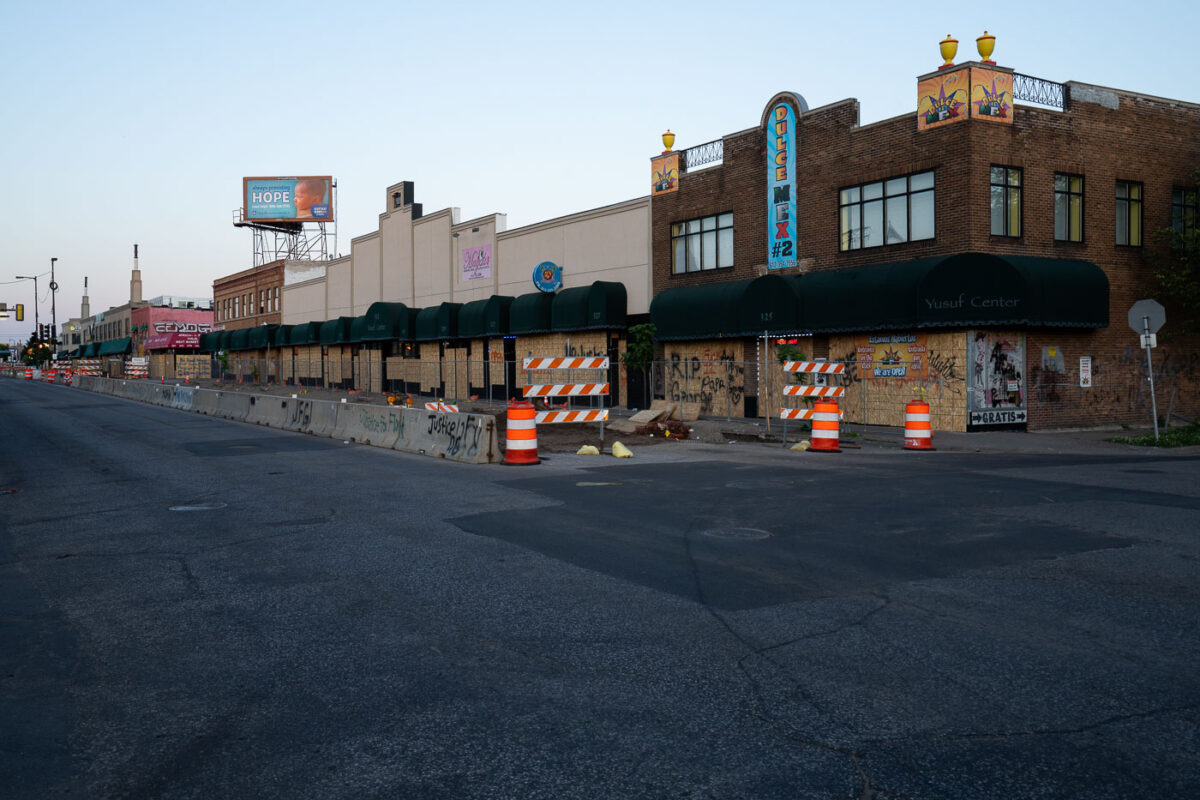
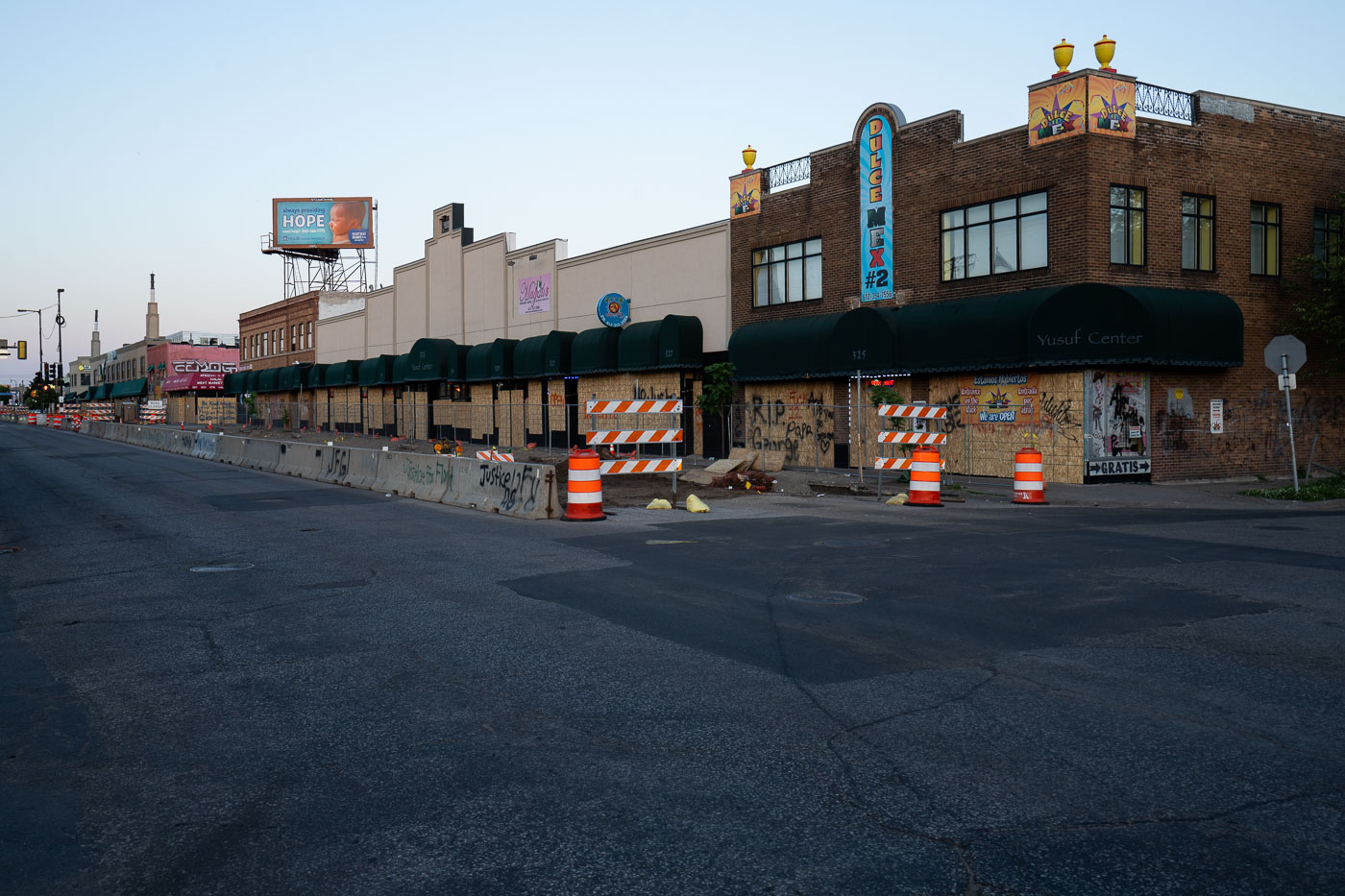
Boarded businesses on Lake Street in Minneapolis after George Floyd protests, June 2020.
Boarded storefronts along Lake Street in Minneapolis, including the Yusuf Center and Dulce Mex #2, are shown on June 16, 2020. Plywood covers the ground-floor windows and doors, with graffiti and memorial messages such as “RIP George” and “Justice for Floyd” visible on the barriers and concrete traffic dividers. The businesses were protected after the protests and unrest that followed the killing of George Floyd in Minneapolis in May 2020.

Lake Street Boarded Businesses After George Floyd Protests
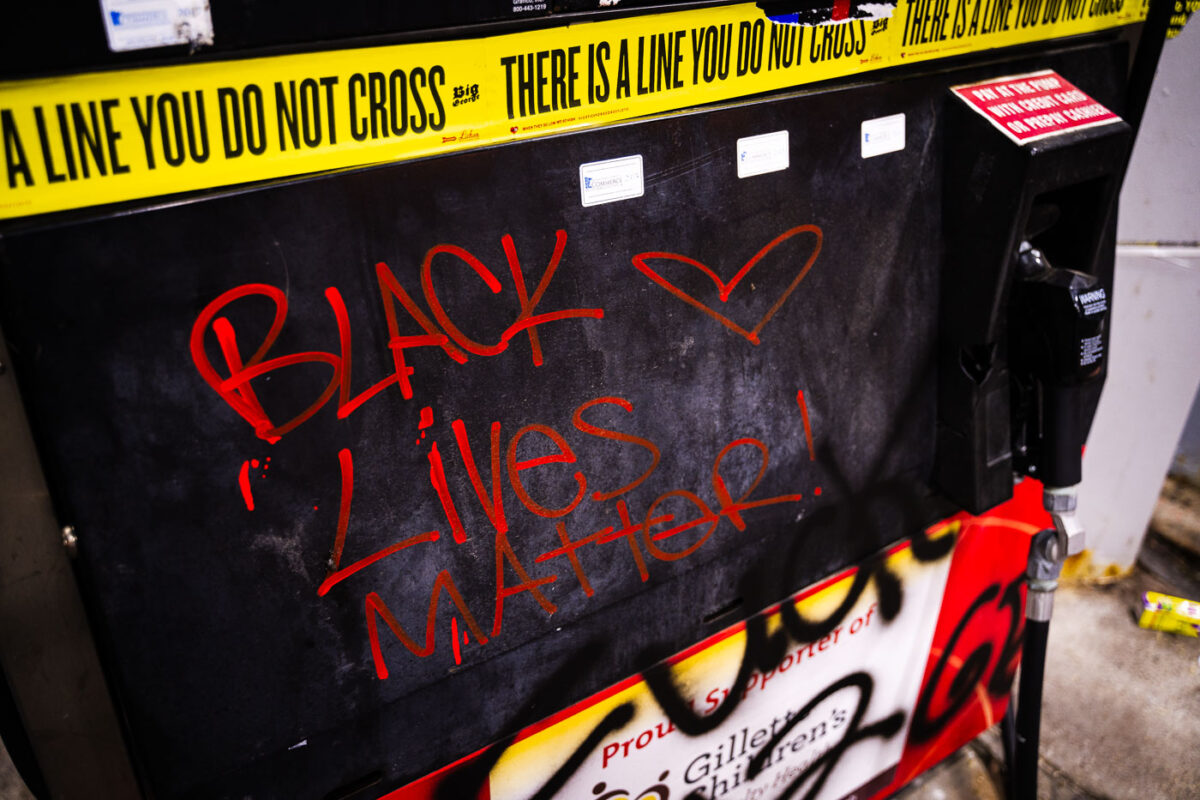
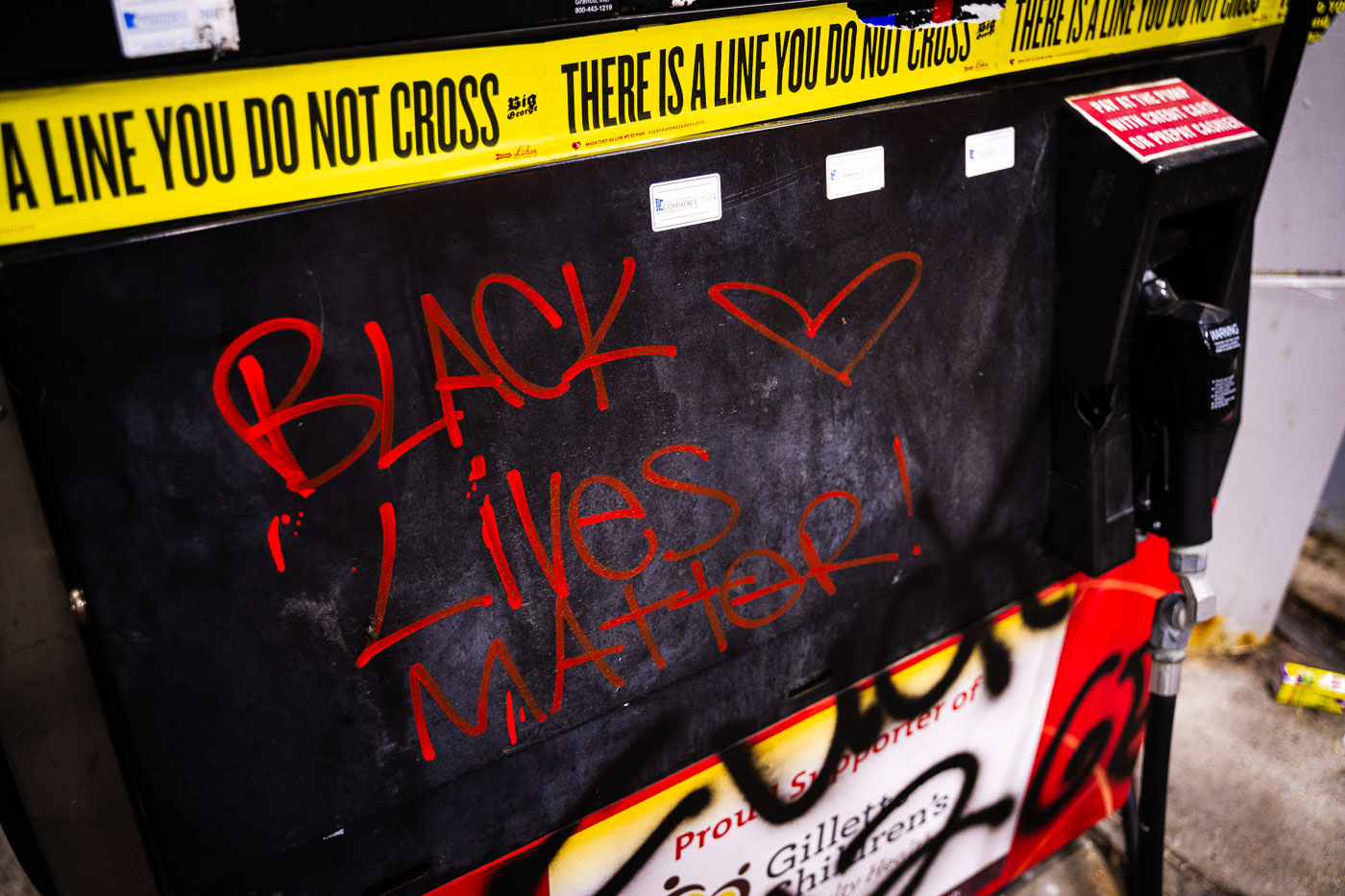
Black Lives Matter graffiti on a Speedway gas pump at George Floyd Square in Minneapolis.
A gas pump at the Speedway station in George Floyd Square, Minneapolis, is marked with red “Black Lives Matter” graffiti. The station stands across from the intersection where George Floyd was killed by Minneapolis police on May 25, 2020.

“Black Lives Matter” on Gas Pump, George Floyd Square, Minneapolis
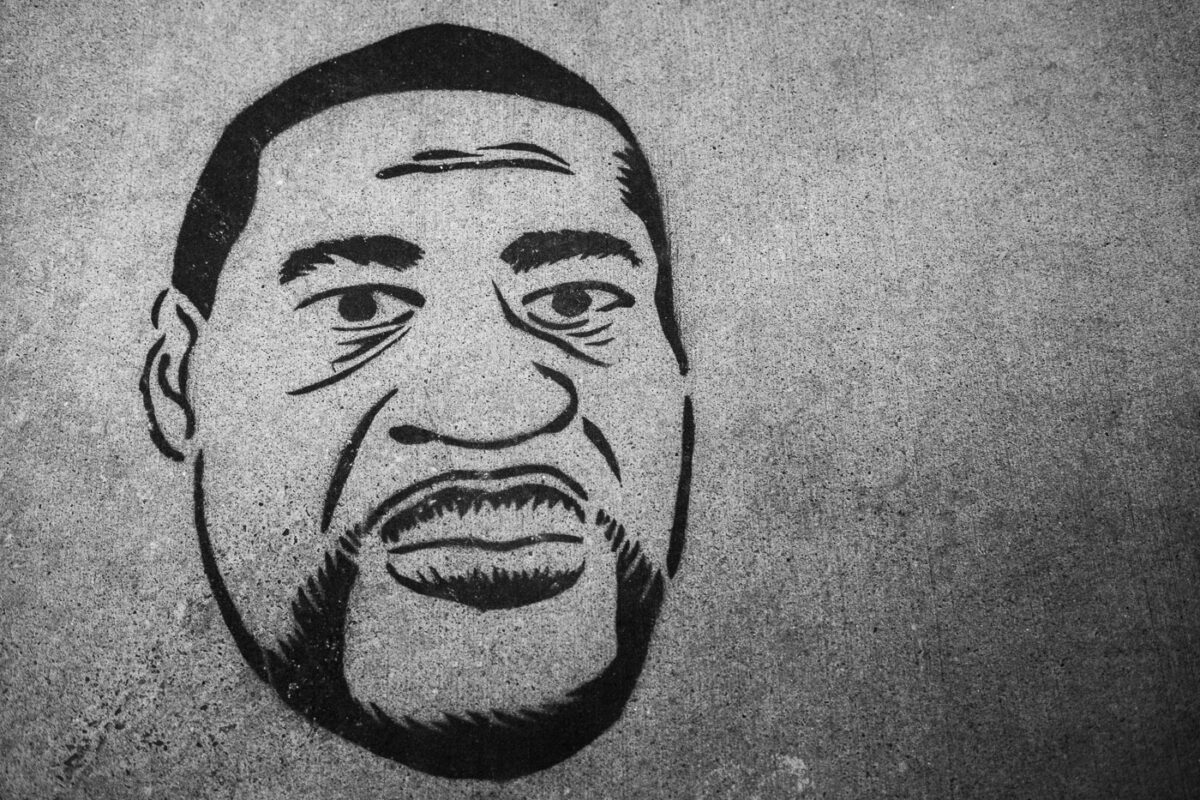
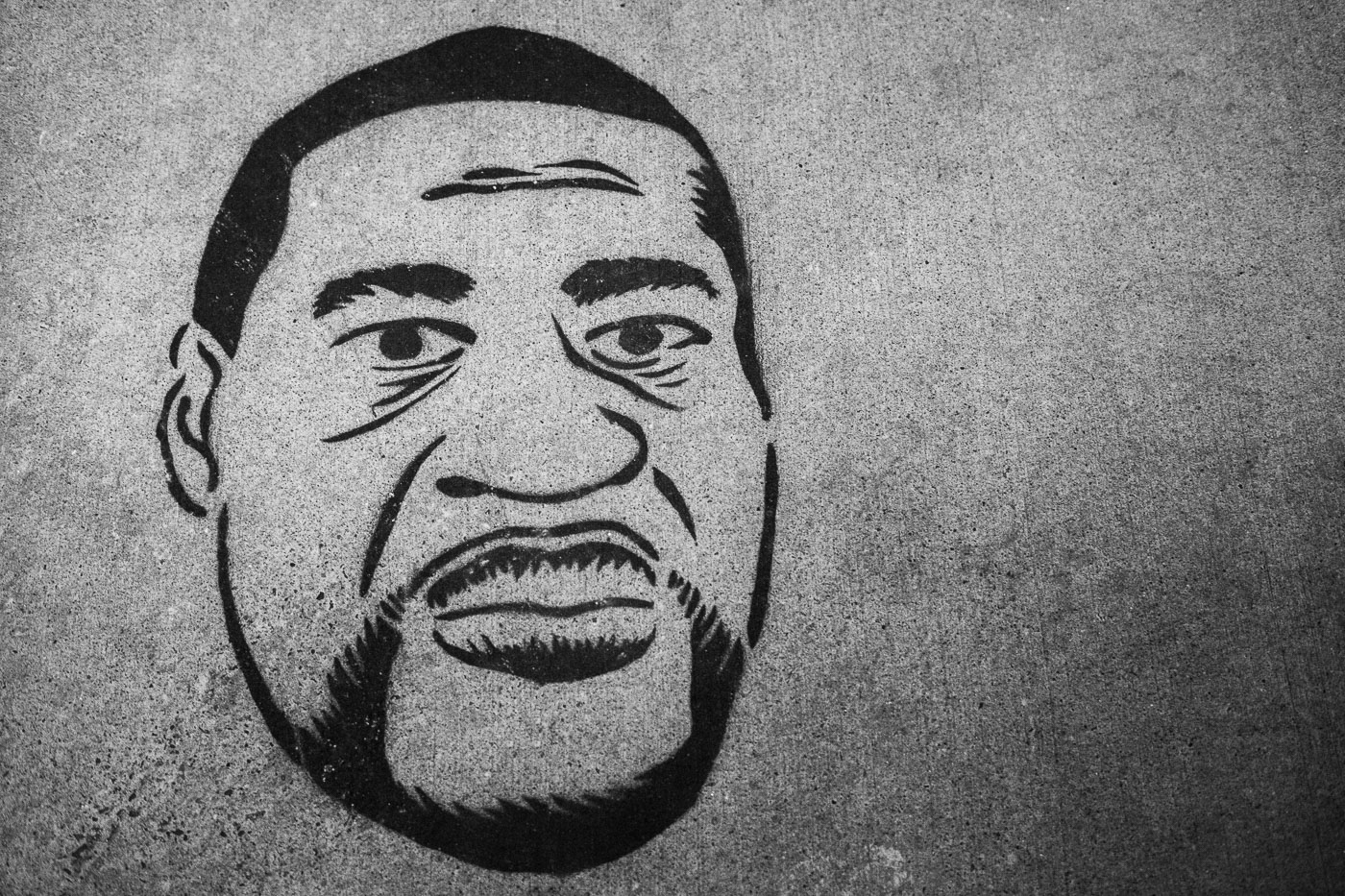
George Floyd stencil portrait on a Chicago Avenue sidewalk in Minneapolis.
A stencil portrait of George Floyd on a sidewalk along Chicago Avenue in Minneapolis is shown in close view. The work appeared in the area after Floyd was killed by Minneapolis police in May 2020, when streets around the corridor filled with memorials, murals, and protest art. Painted directly on the pavement, the portrait reflects how public space was used for remembrance and demands for racial justice during that period.

George Floyd stencil art, Chicago Avenue, Minneapolis
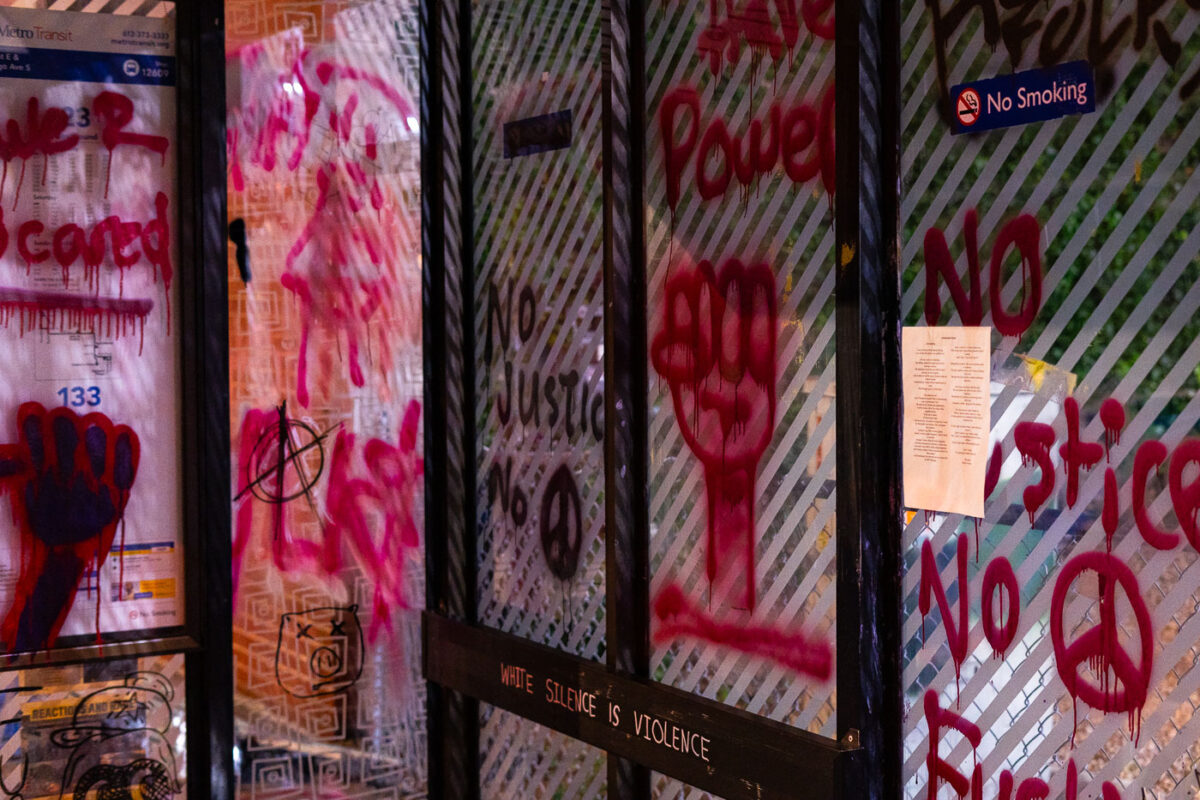
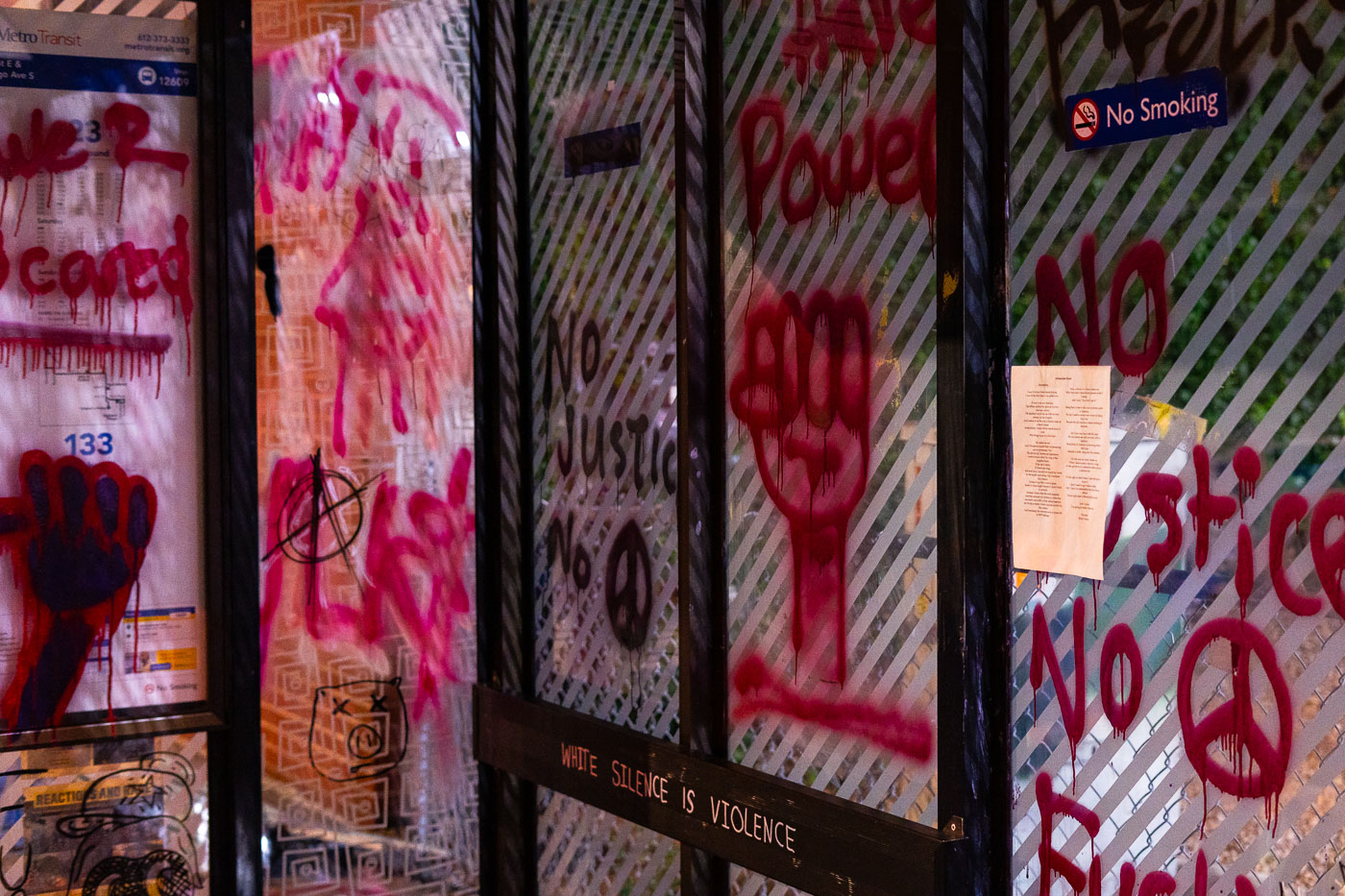
Protest graffiti on a former Metro Transit bus shelter at George Floyd Square in Minneapolis.
A former Metro Transit bus shelter at George Floyd Square in Minneapolis is covered with protest messages and symbols at the intersection of 38th Street and Chicago Avenue. The glass panels bear hand-painted phrases including “Power,” “No Justice No Peace,” and “White Silence Is Violence,” along with raised-fist imagery and other markings. After the murder of George Floyd in May 2020, the intersection became a community-maintained memorial and protest site, and transit structures there were repurposed as surfaces for mourning and political expression.

George Floyd Square Bus Shelter, Minneapolis: Protest Slogans
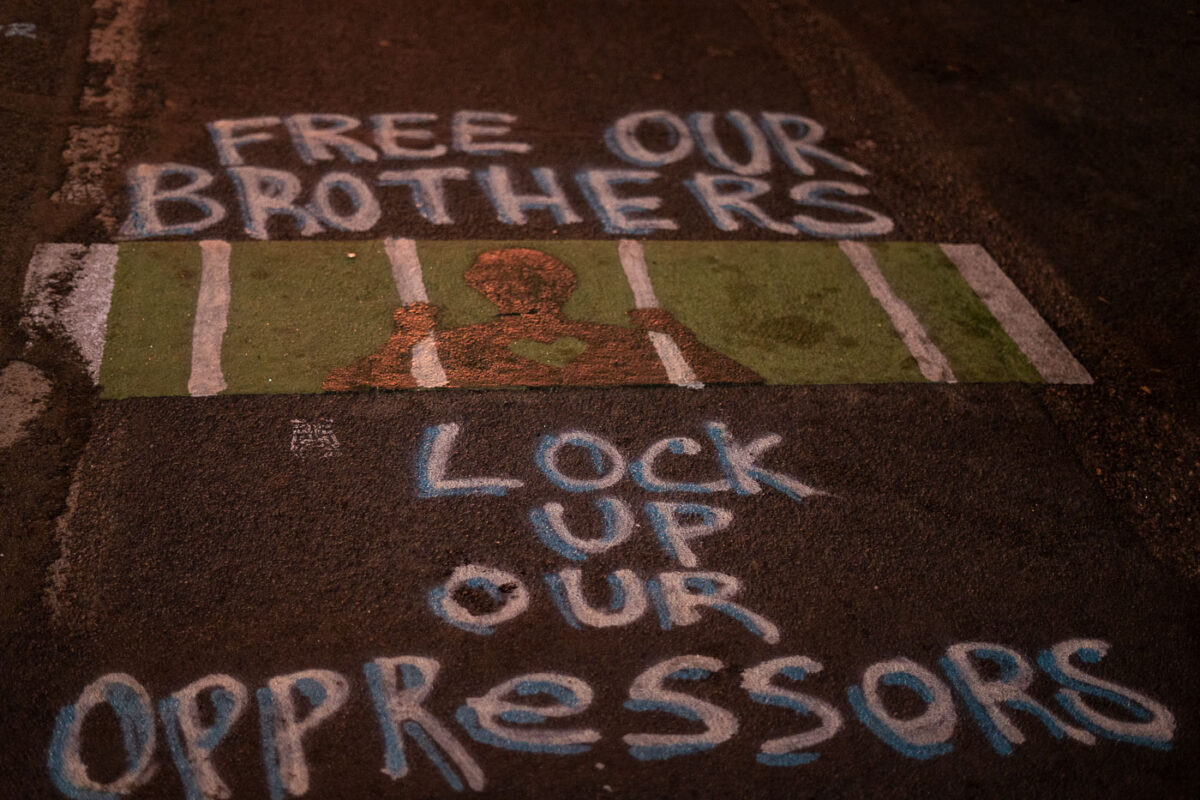
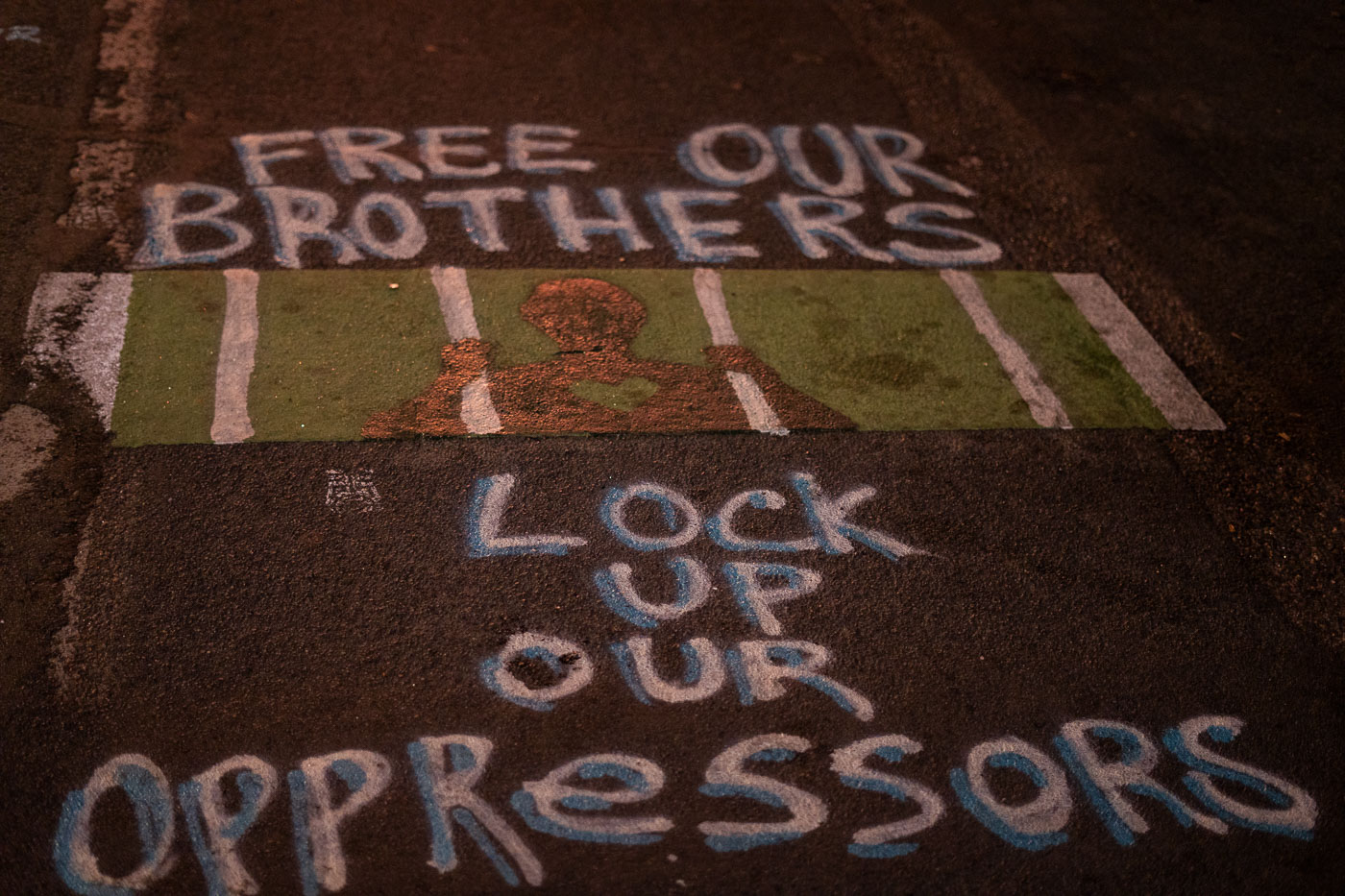
Chalk art on Chicago Avenue at George Floyd Square in Minneapolis reads “Free Our Brothers” and “Lock Up Our Oppressors.”
Chalk art on Chicago Avenue at George Floyd Square in Minneapolis reads “Free Our Brothers” and “Lock Up Our Oppressors.” Painted across the street with the image of a figure behind bars, the message was part of the protest memorials and street art that appeared at the site in June 2020 after the murder of George Floyd. George Floyd Square became a focal point for mourning, calls for police accountability, and community-led occupation of the intersection.

George Floyd Square Chalk Art: Free Our Brothers, Lock Up Our Oppressors
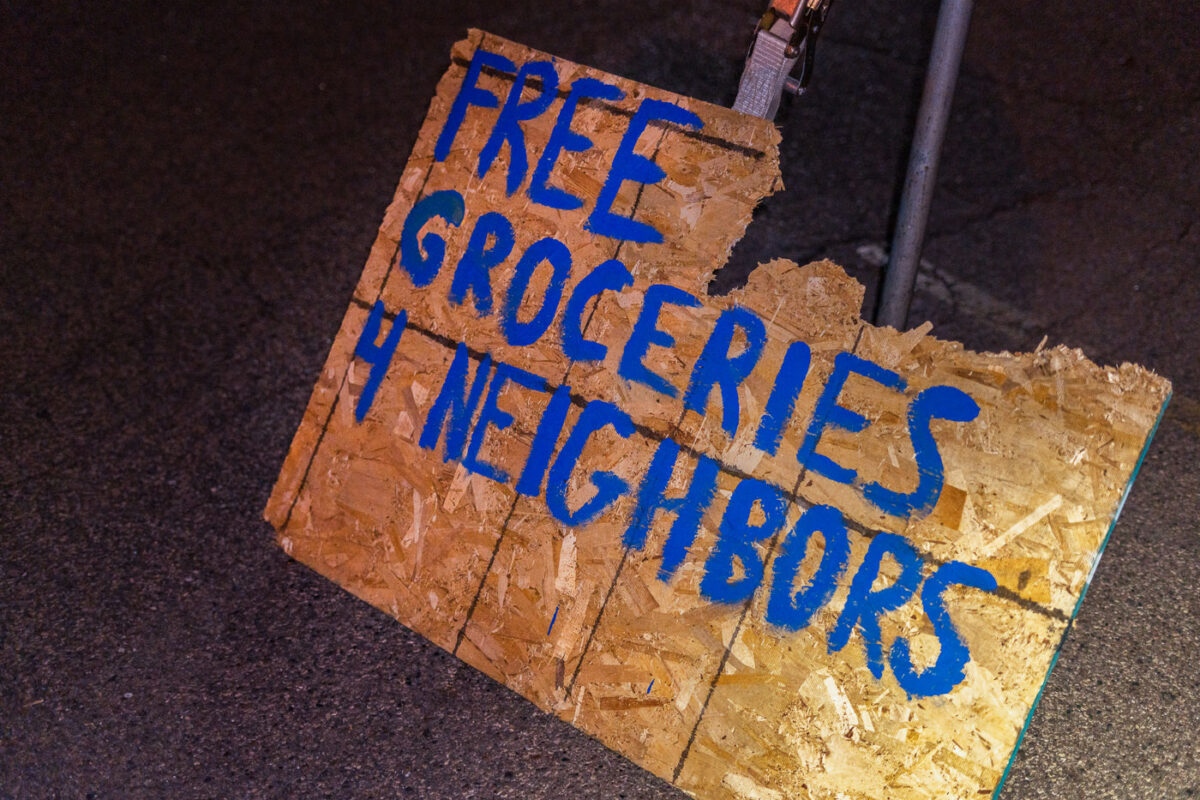
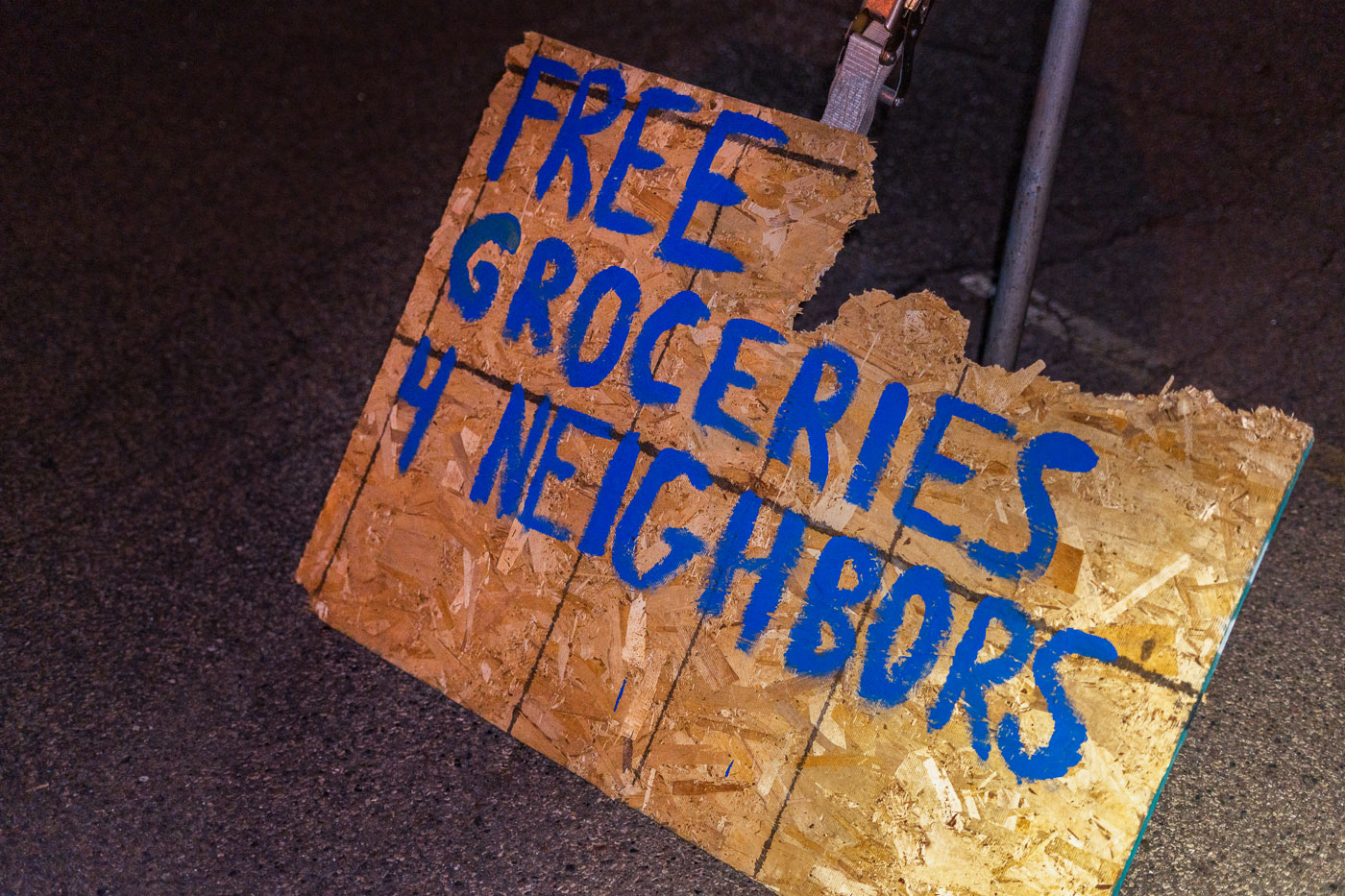
Handmade “Free Groceries 4 Neighbors” sign on a Minneapolis street during mutual-aid efforts in June 2020.
A handmade “FREE GROCERIES 4 NEIGHBORS” sign rests on a Minneapolis street in June 2020. Made from a rough sheet of wood and painted in blue letters, the sign points to neighborhood mutual-aid efforts that distributed food and other basic supplies after the police killing of George Floyd and the disruption of nearby businesses and services. Informal signs like this appeared across the city as residents organized local relief for their communities.

Minneapolis Free Groceries for Neighbors Sign
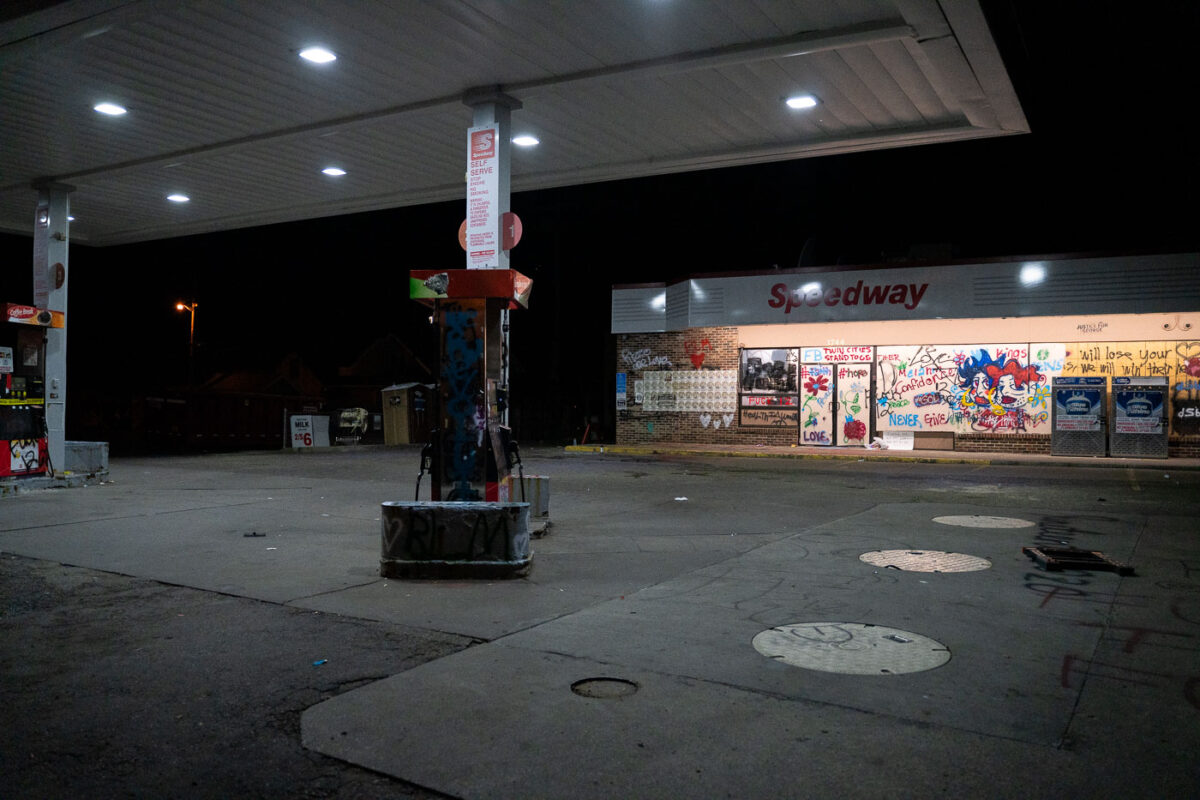
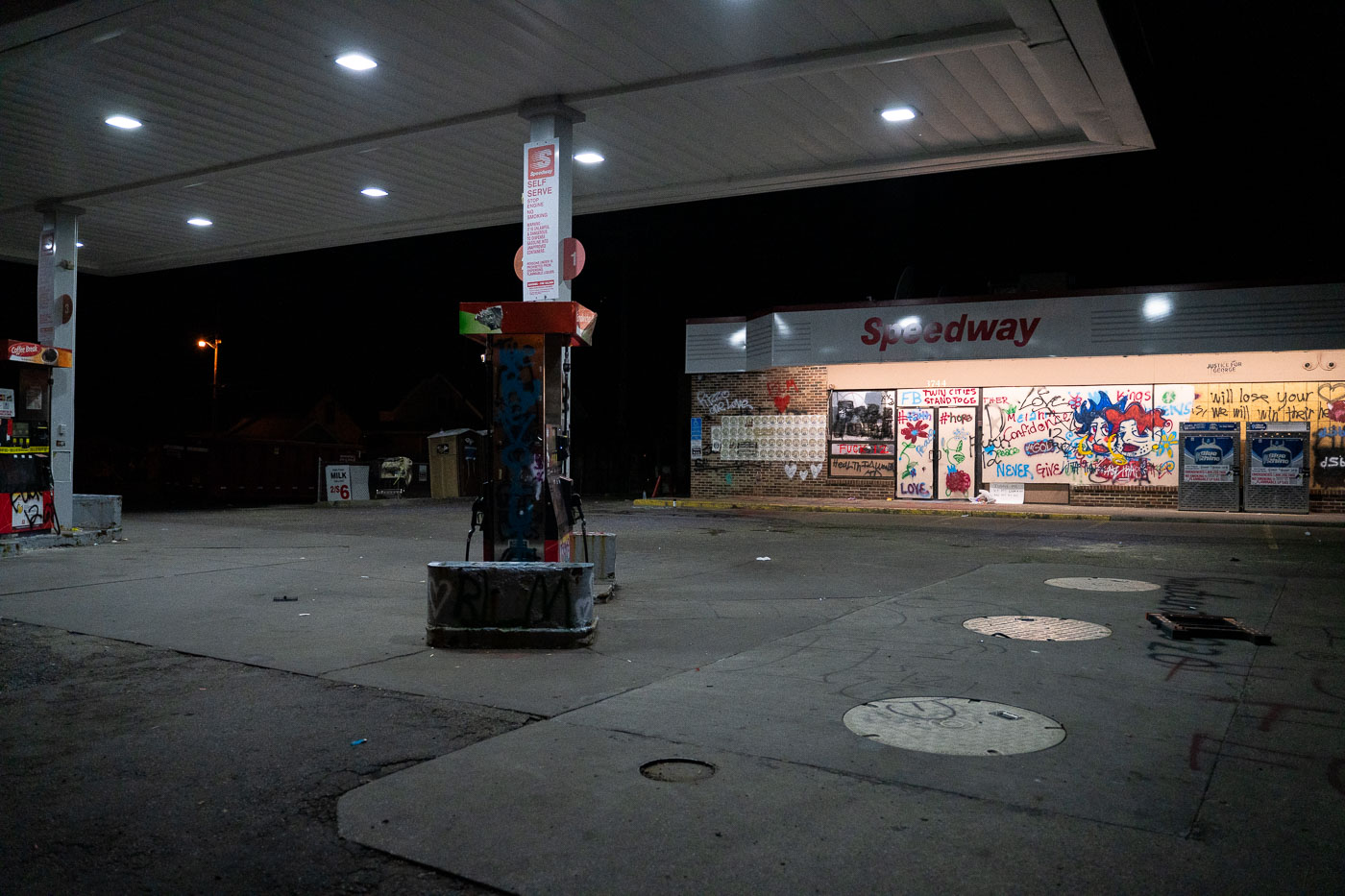
Graffiti-covered Speedway gas station at 38th Street and Chicago Avenue in Minneapolis, June 2020.
The Speedway gas station at East 38th Street and Chicago Avenue in Minneapolis is shown covered with graffiti and boarded storefront panels in June 2020. The station stood within George Floyd Square, the intersection where George Floyd was killed by Minneapolis police on May 25, 2020. In the weeks after his murder, the property became part of a memorial and protest site, with messages painted across the pumps, walls, and doors.

Speedway Gas Station with Graffiti, 38th & Chicago, Minneapolis
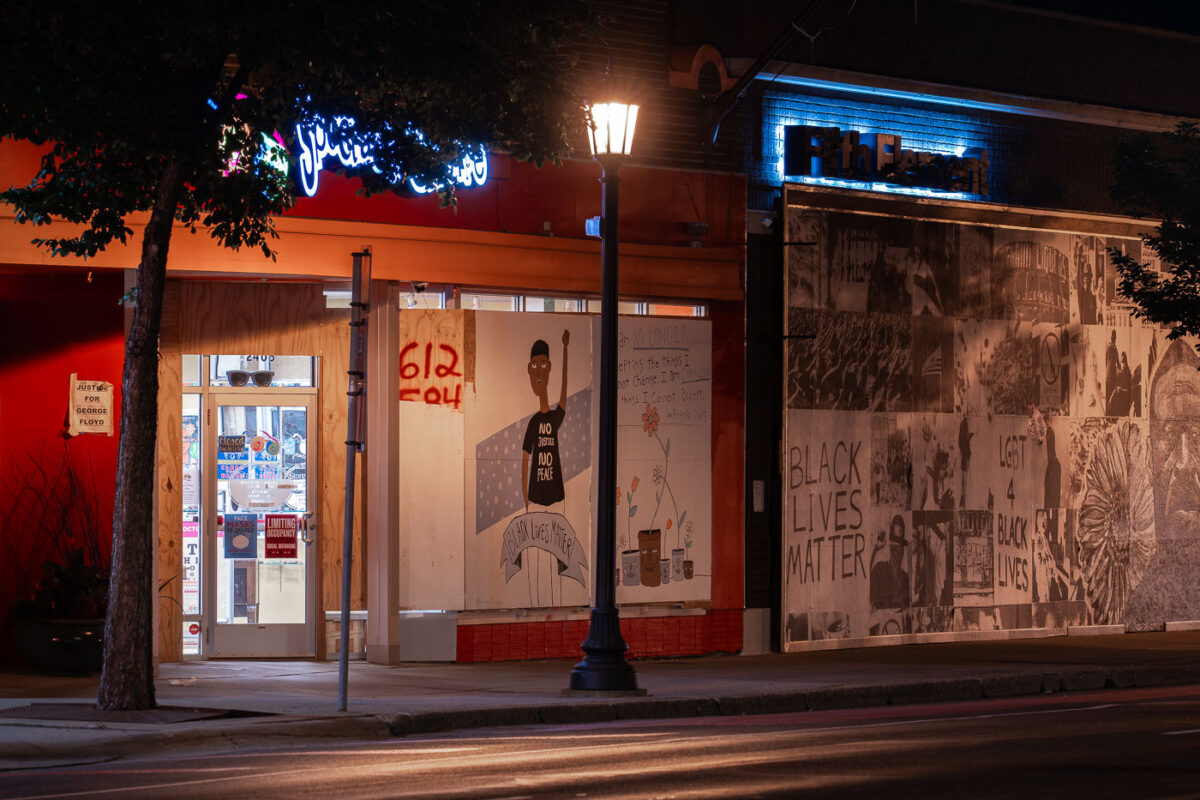
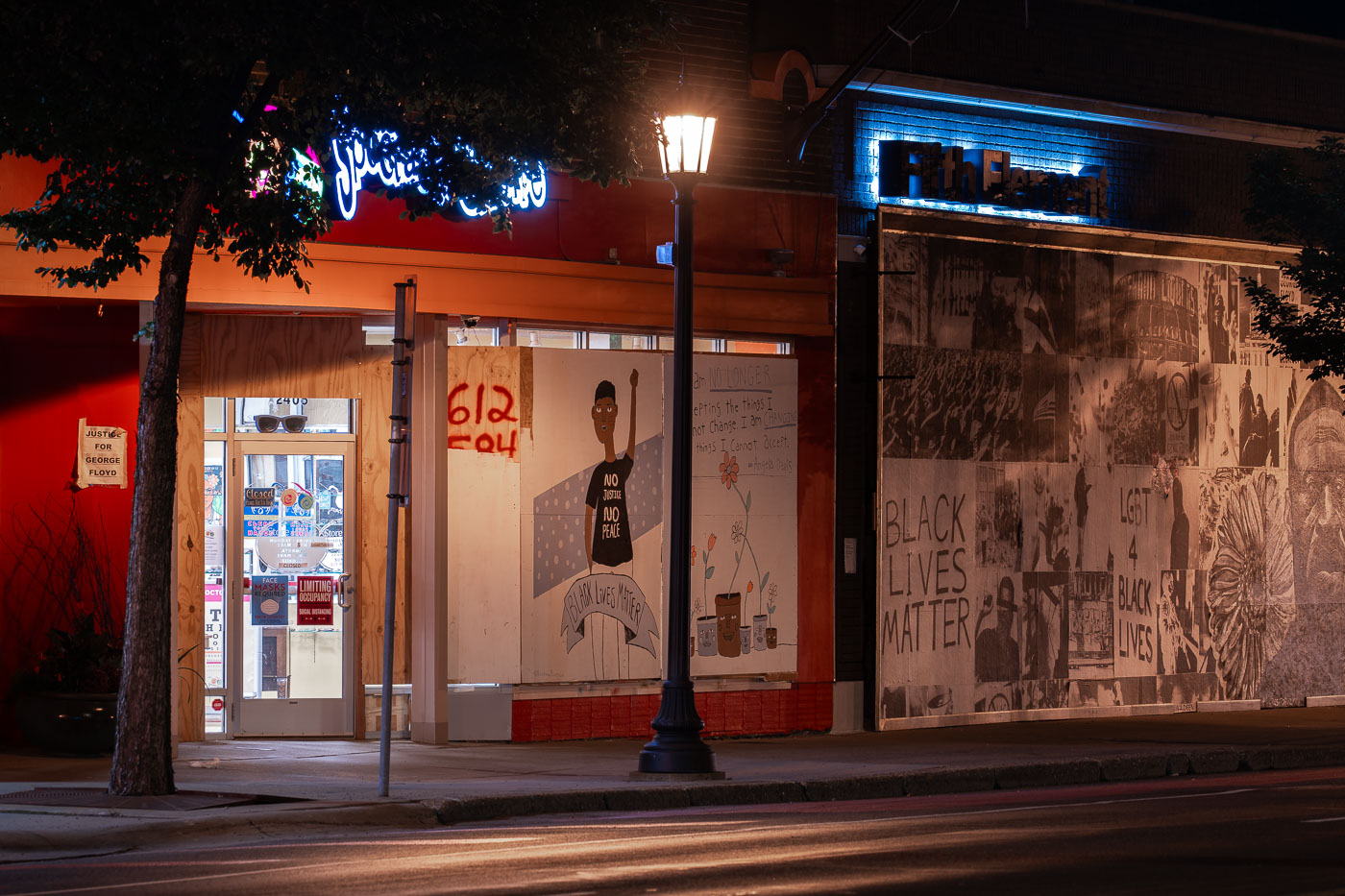
Boarded storefront murals at Fifth Element on Hennepin Avenue in Uptown Minneapolis, June 2020.
Boarded storefronts at Fifth Element on Hennepin Avenue in Uptown Minneapolis are covered with murals and protest messages in June 2020. The plywood panels include hand-painted portraits, “Black Lives Matter” text, and a memorial sign for George Floyd, whose killing on May 25, 2020, led many businesses across Minneapolis to install protective boarding.

Fifth Element Murals, Hennepin Ave, Minneapolis Uprising
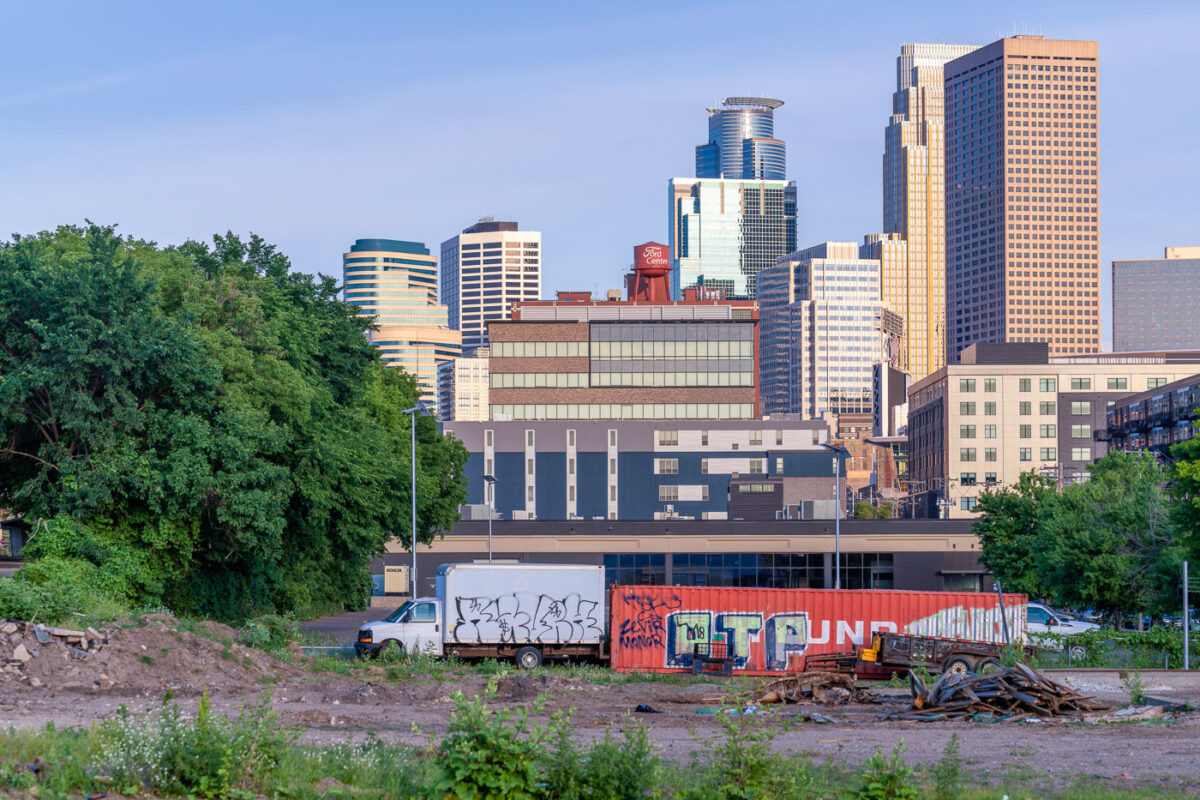
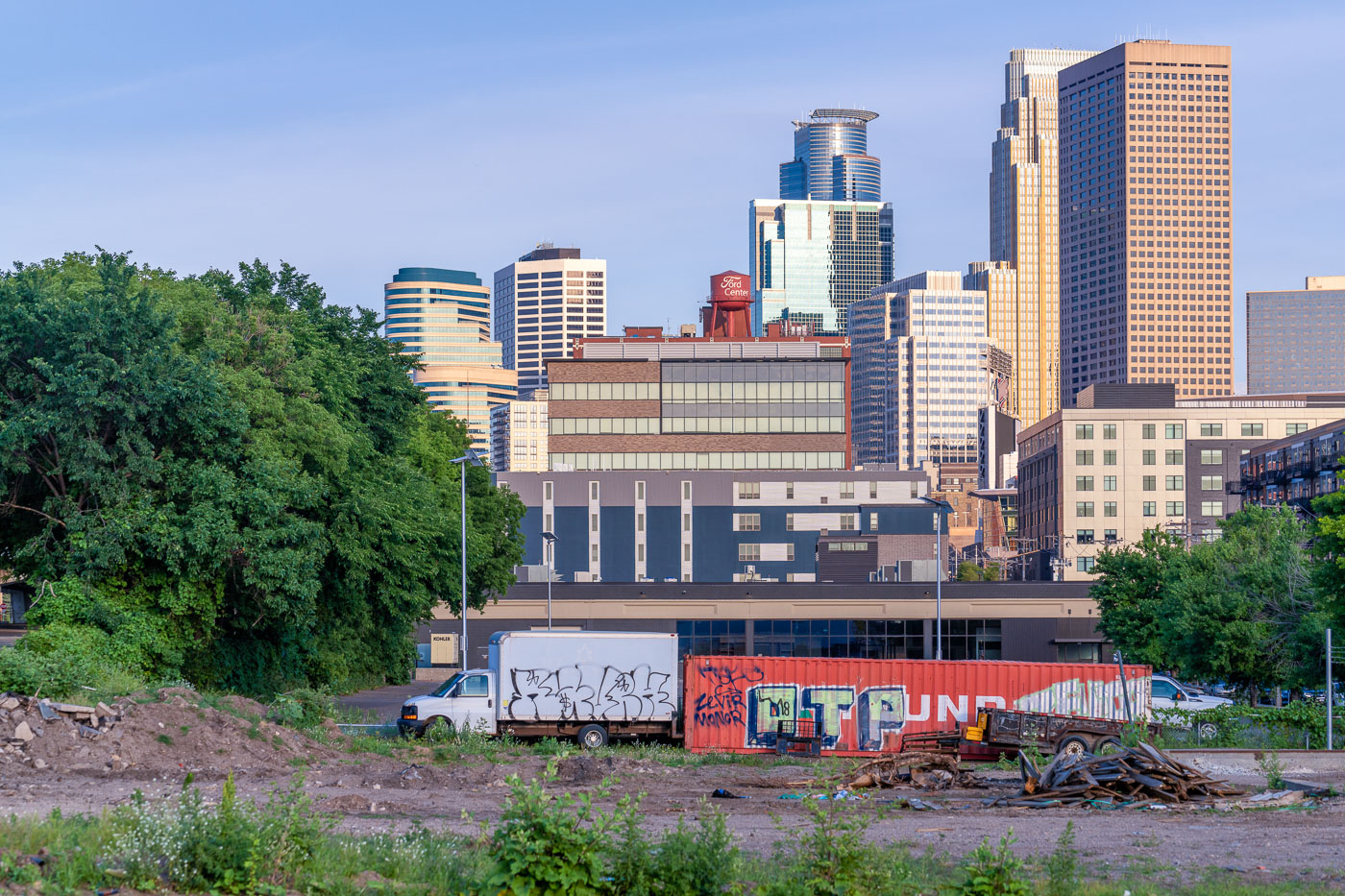
Downtown Minneapolis skyline above a vacant North Loop lot with a graffiti-marked truck and shipping container.
Downtown Minneapolis rises behind a vacant lot in the North Loop on June 27, 2020. A graffiti-marked box truck and shipping container stand on cleared industrial land west of the central business district, where former warehouse and service parcels have increasingly been converted to housing and commercial development.

Minneapolis North Loop Skyline, Graffiti-Covered Van, 06/27/20
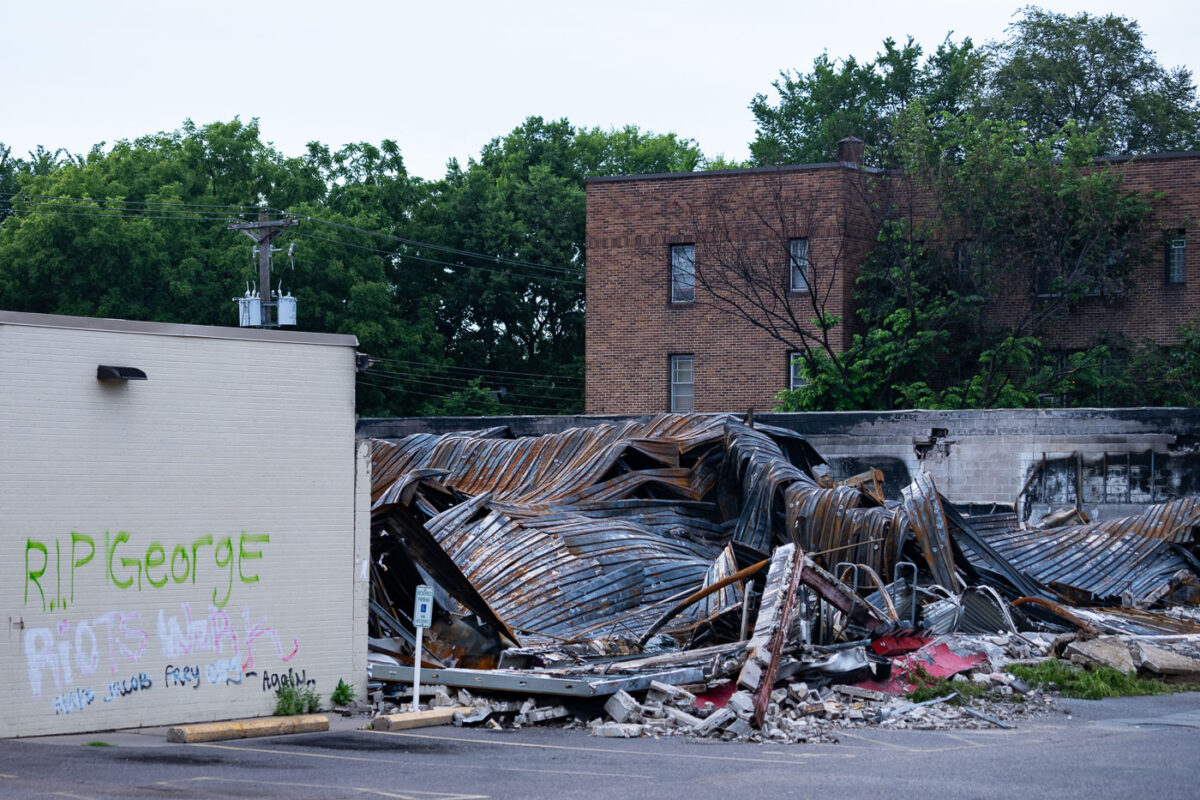
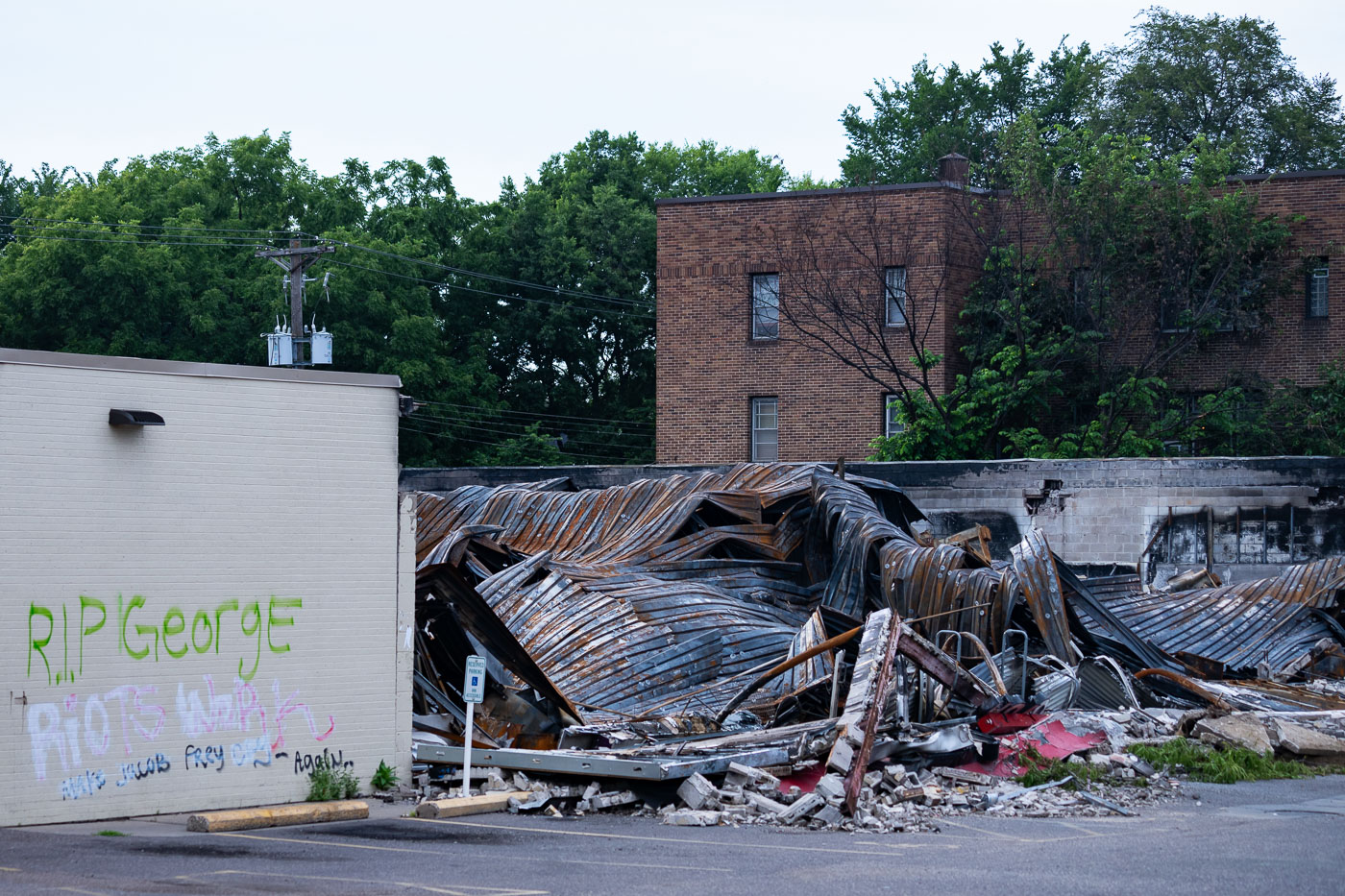
Burned O'Reilly Auto Parts remains on Nicollet Avenue in Minneapolis in July 2020.
Burned O'Reilly Auto Parts on Nicollet Avenue in Minneapolis remained collapsed and uncleared in July 2020. The store was damaged during the unrest that followed the murder of George Floyd in May 2020. Graffiti on the adjacent wall ties the site to that period in the city.

Burned O’Reilly Auto Parts on Nicollet Avenue, Minneapolis

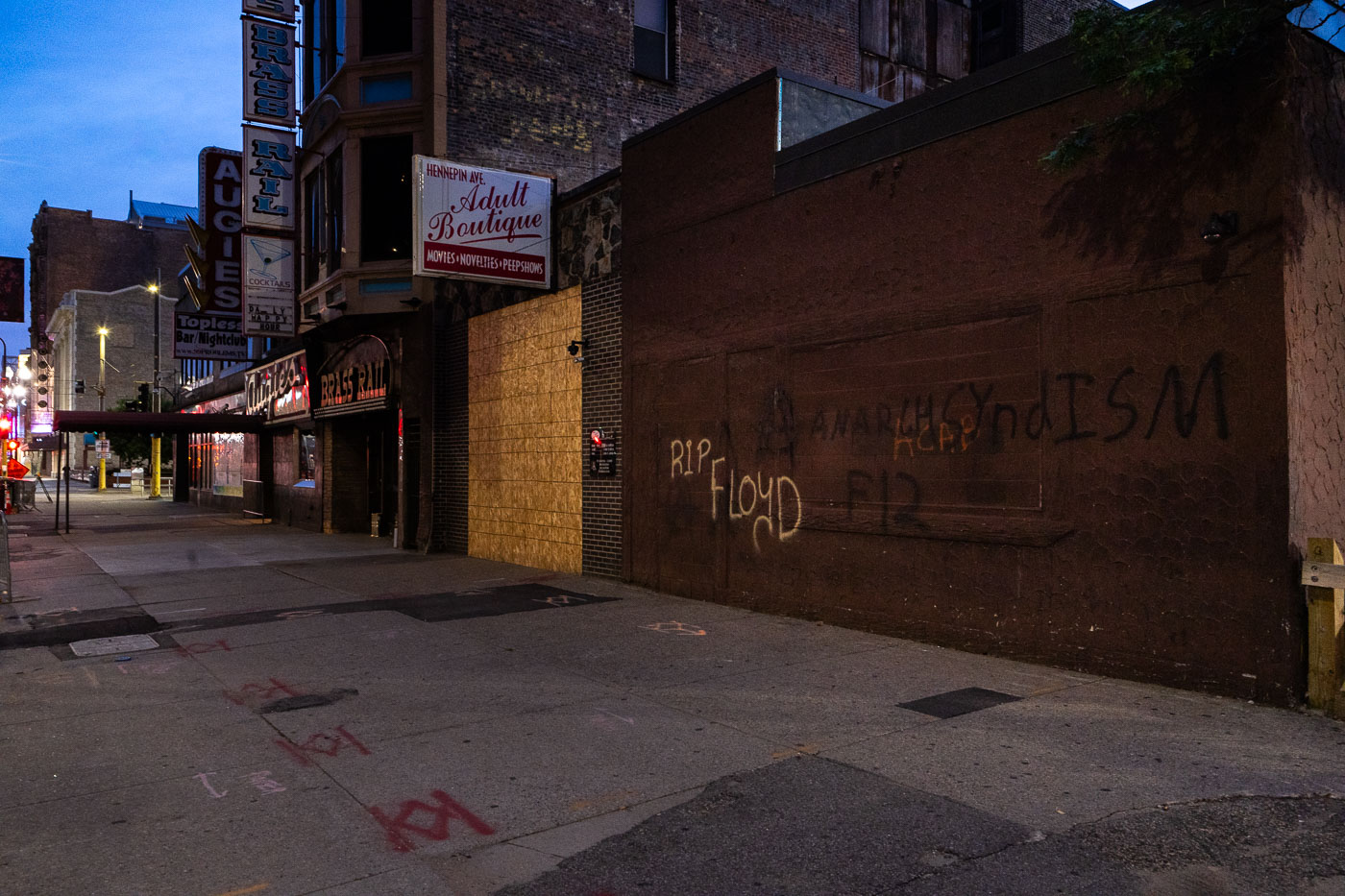
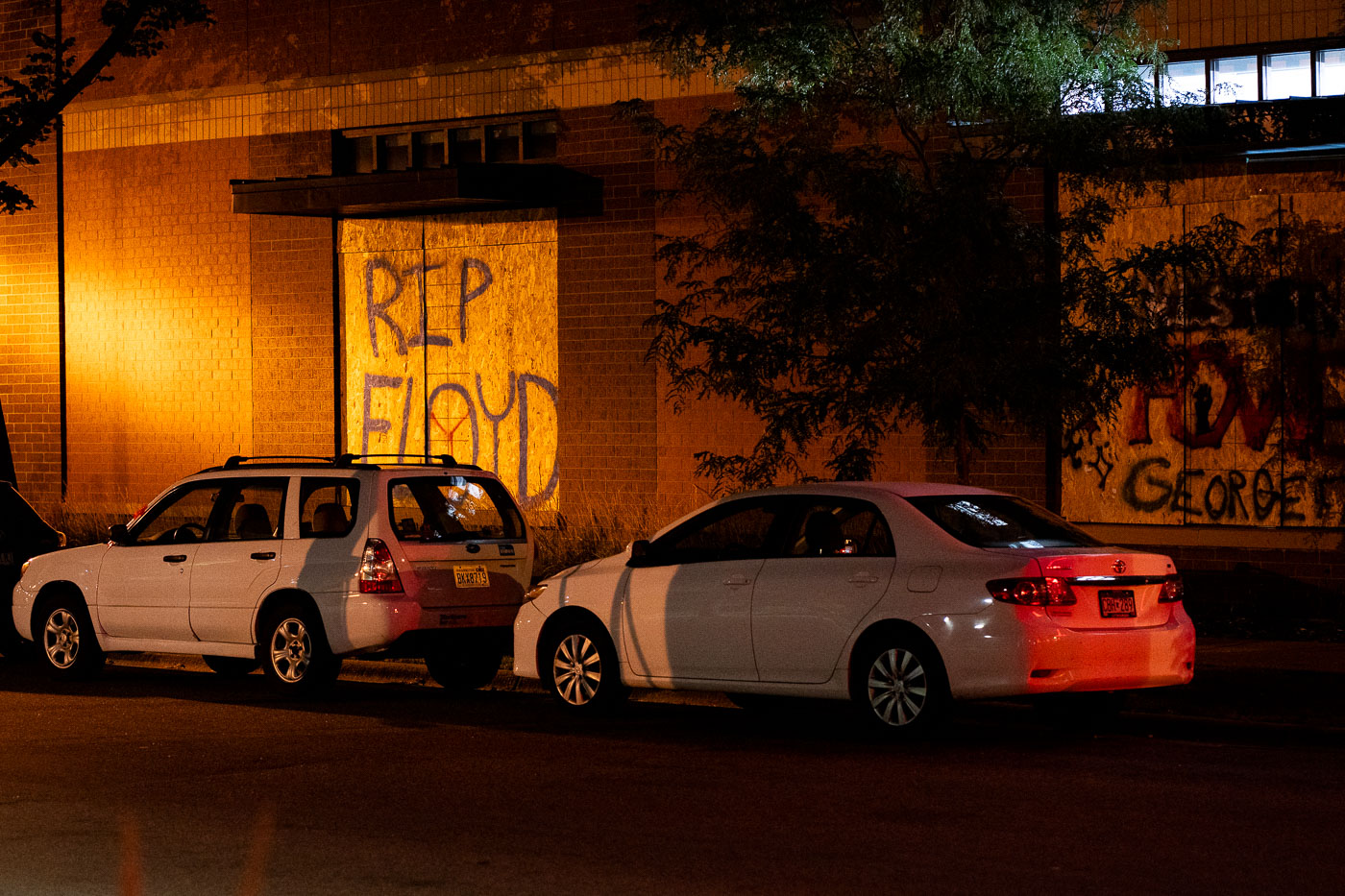
Adult boutique store with boards on it
The storefronts of Augies and Brass Rail, adult entertainment venues on Hennepin Avenue in Downtown Minneapolis, are boarded up. This measure was widely adopted by businesses during the Minneapolis Uprising in May 2020, following the killing of George Floyd. The plywood boards feature graffiti, including "RIP Floyd," "ANARCHY," and "ACAB," reflecting the public outcry and calls for justice. Hennepin Avenue has long served as a significant commercial and entertainment corridor in the city, and these boarded establishments document the period of civil unrest and its impact on the urban landscape.

Augies & Brass Rail, Hennepin Ave, Boarded with RIP Floyd Graffiti
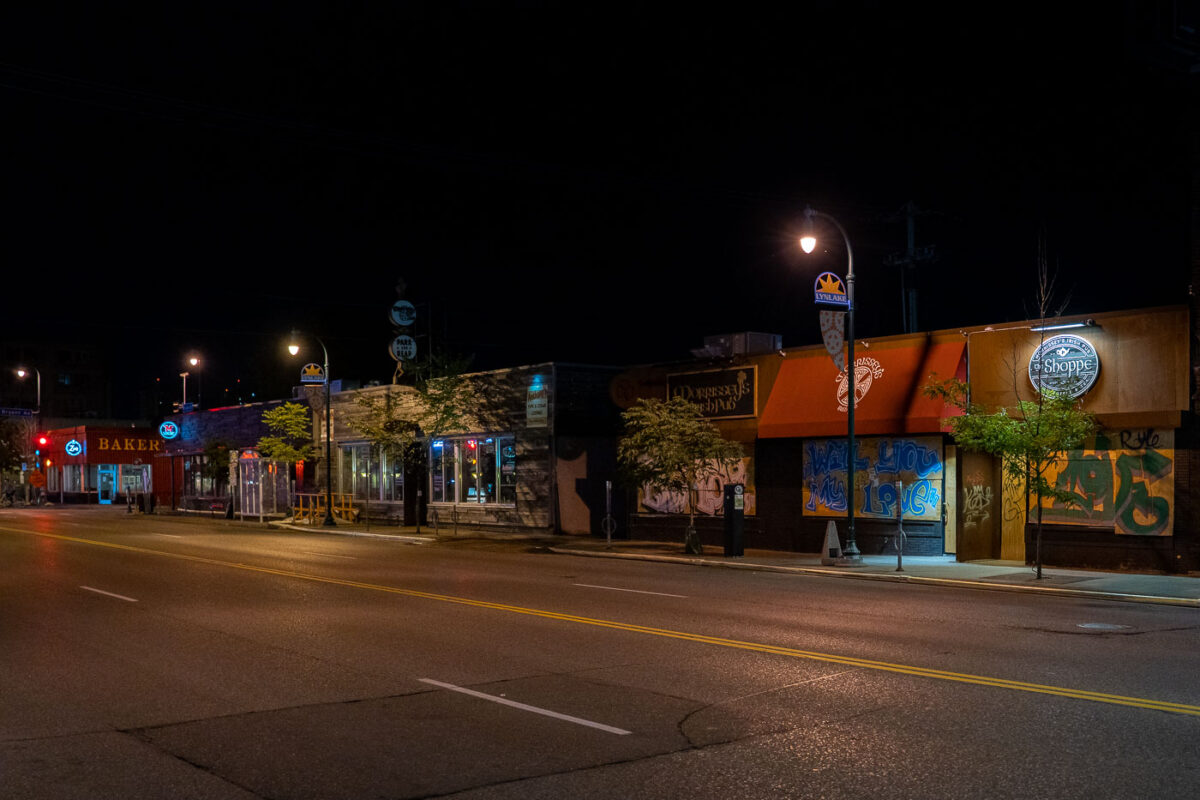
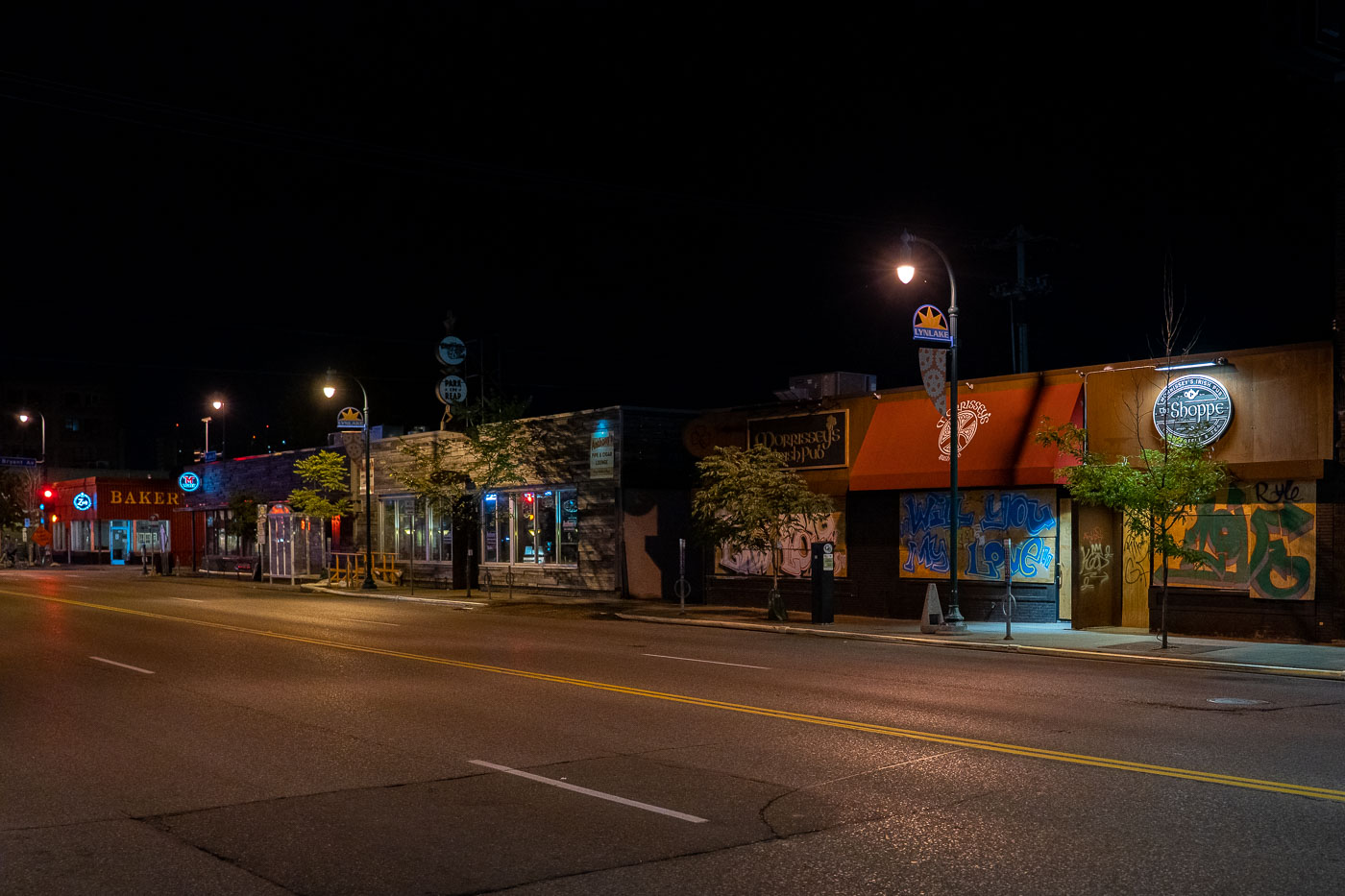
West Lake Street boarded up businesses
Murals adorn boarded-up storefronts along West Lake Street in Minneapolis's Lyn-Lake neighborhood. These boards were installed on businesses in July 2020 as a protective measure following civil unrest that occurred after the May 25, 2020 murder of George Floyd by Minneapolis police officer Derek Chauvin. Many of these temporary barriers were subsequently transformed into public art by various artists. The murals became a significant visual record of the period, contributing to the cultural landscape of Uptown Minneapolis.

West Lake Street Murals, Minneapolis, July 2020
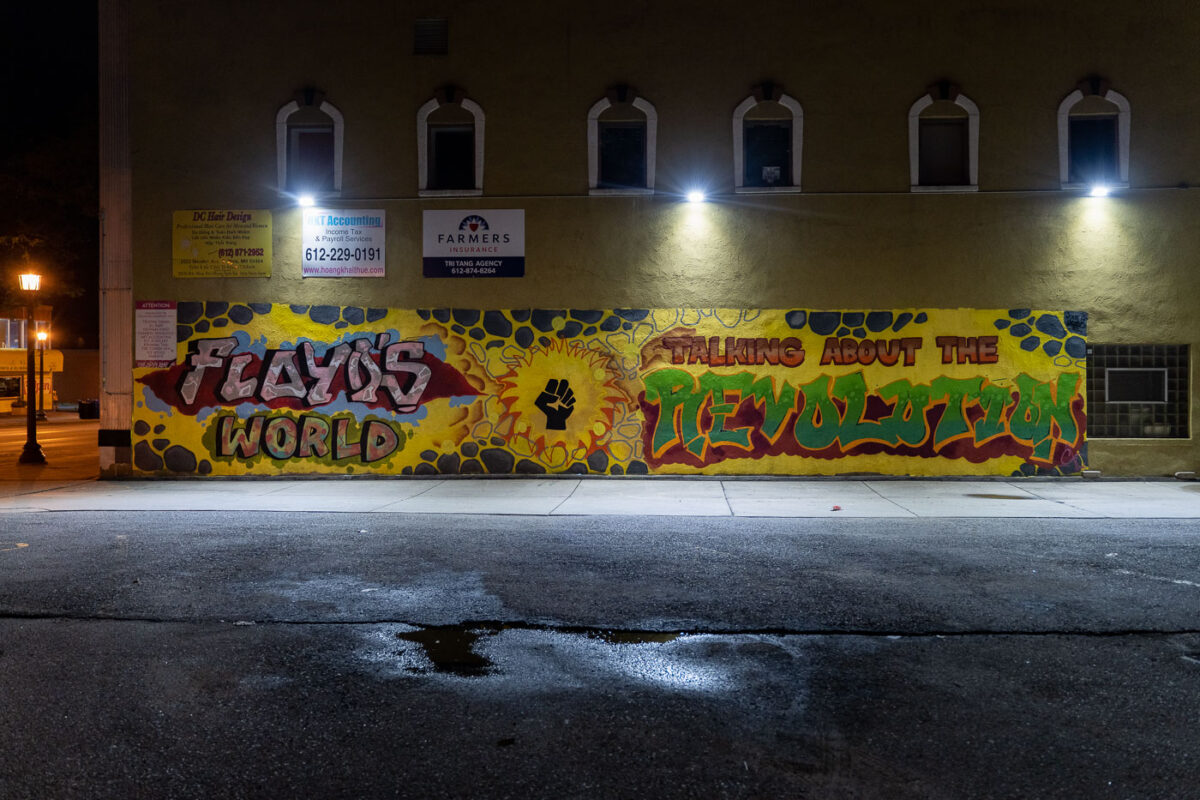
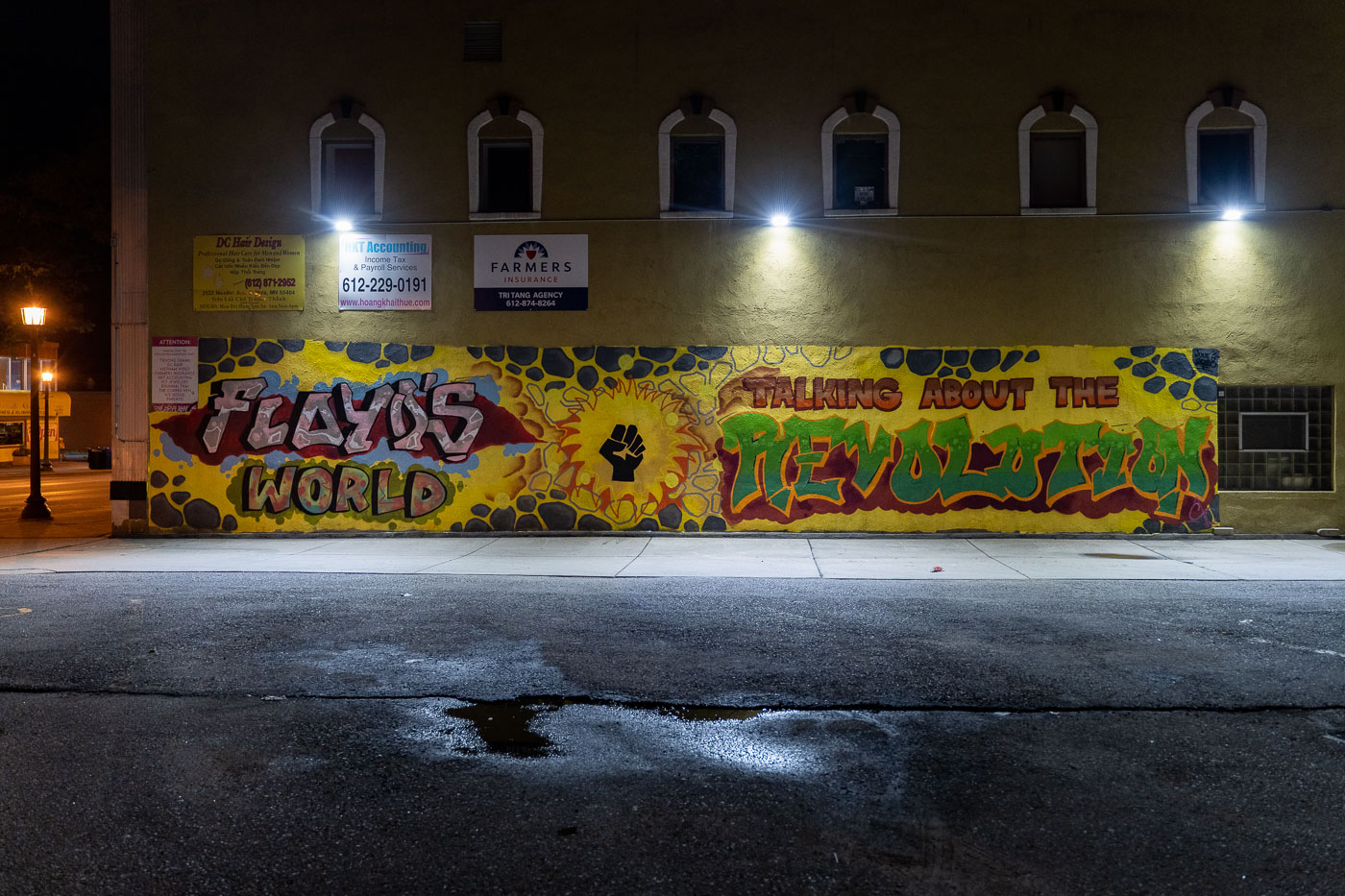
Large mural on the side of a building on Nicollet Ave
The "Floyd's World" mural, located on Nicollet Avenue in Minneapolis, was created on June 5, 2020, in the aftermath of George Floyd's murder and the Minneapolis Uprising. This large-scale graffiti art, painted on the side of a commercial building, features the phrases "Floyd's World" and "Talking about the Revolution," accompanied by a raised fist symbol. The mural serves as a public expression of grief, protest, and a call for social change, reflecting the community's response to the events of that period. It remains a significant piece of public art documenting a critical moment in Minneapolis history.

“Floyd’s World” Mural, Nicollet Avenue, Minneapolis
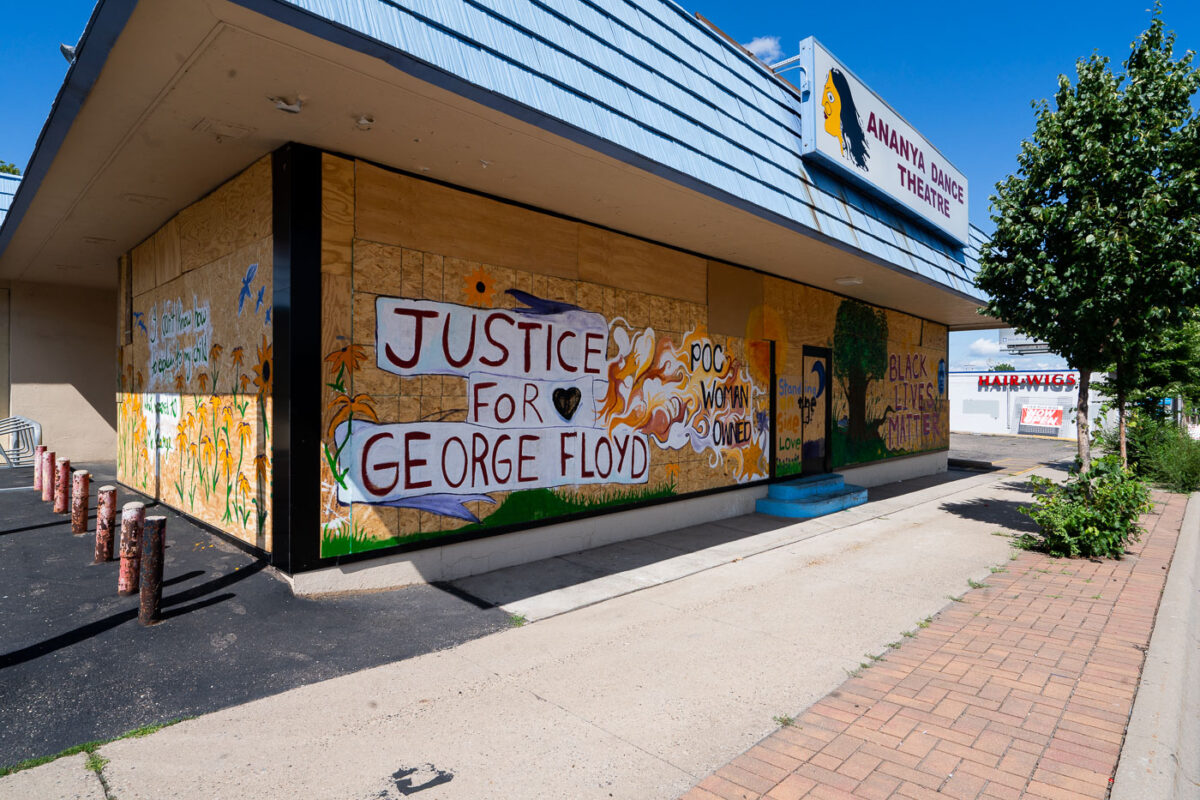
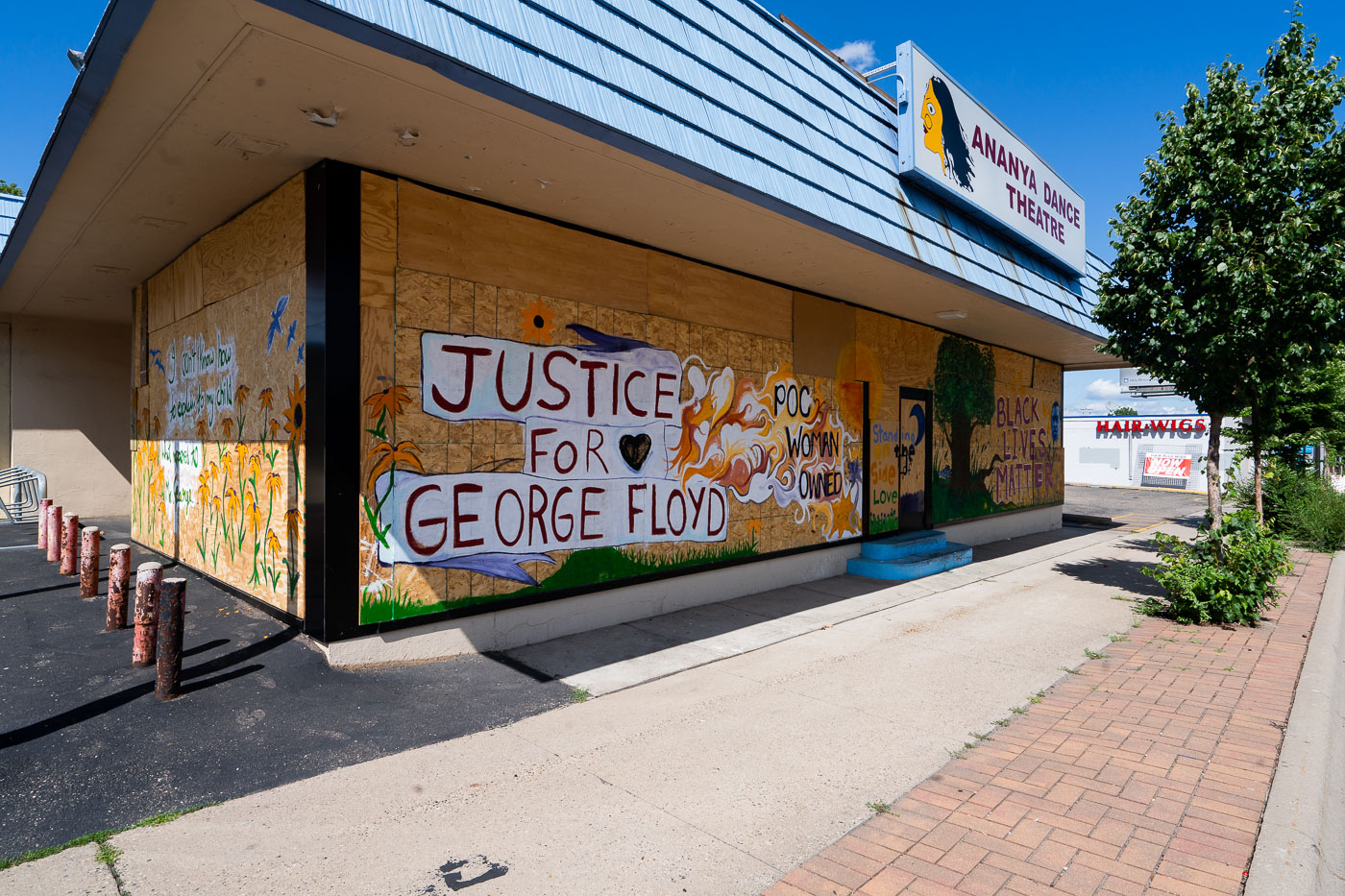
Boards on the Ananya Dance Theatre in St Paul
The Ananya Dance Theatre in St. Paul features murals painted on its boarded-up exterior. These artworks emerged in the aftermath of the 2020 protests following the murder of George Floyd, transforming the protective boards into a public expression of grief and calls for justice. The murals include messages such as "JUSTICE FOR GEORGE FLOYD" and "BLACK LIVES MATTER," alongside affirmations like "POC WOMAN OWNED," reflecting the theatre's identity and community solidarity. Ananya Dance Theatre, a professional dance company, uses performance to address social justice issues, making its building a fitting canvas for these protest art expressions.

Ananya Dance Theatre, St. Paul: George Floyd Mural
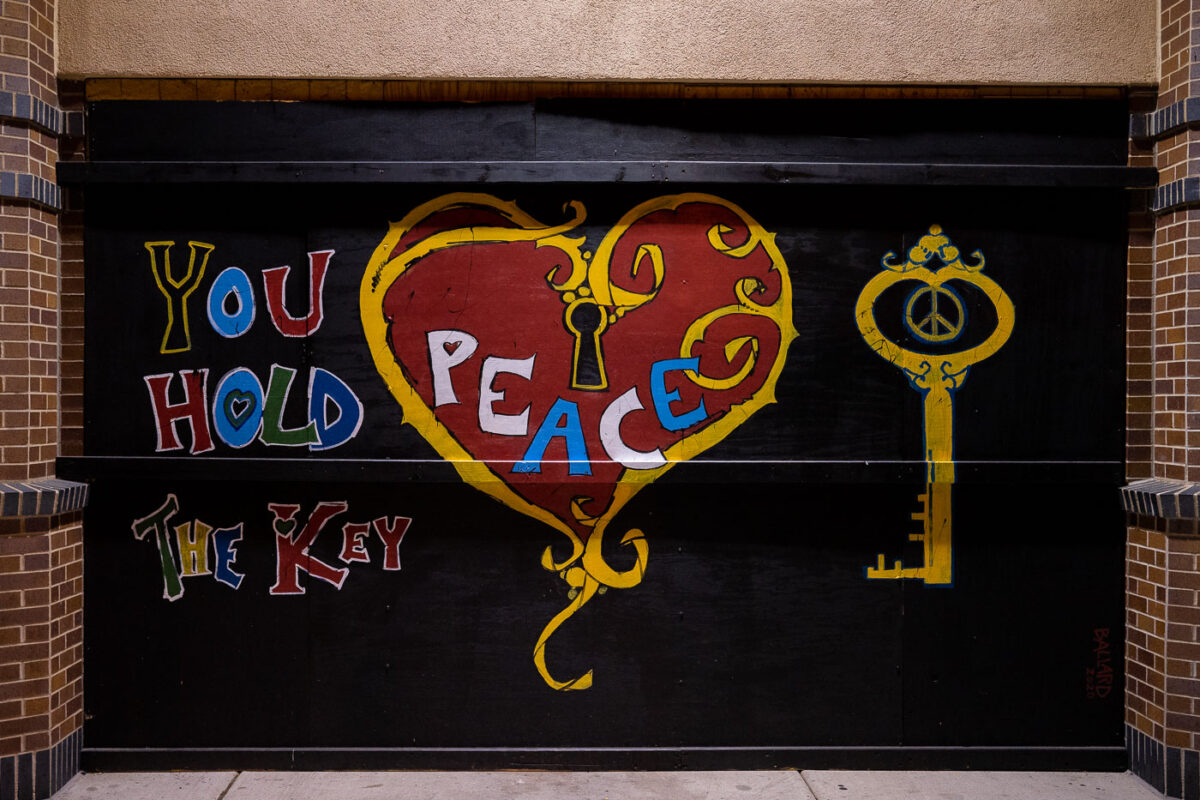
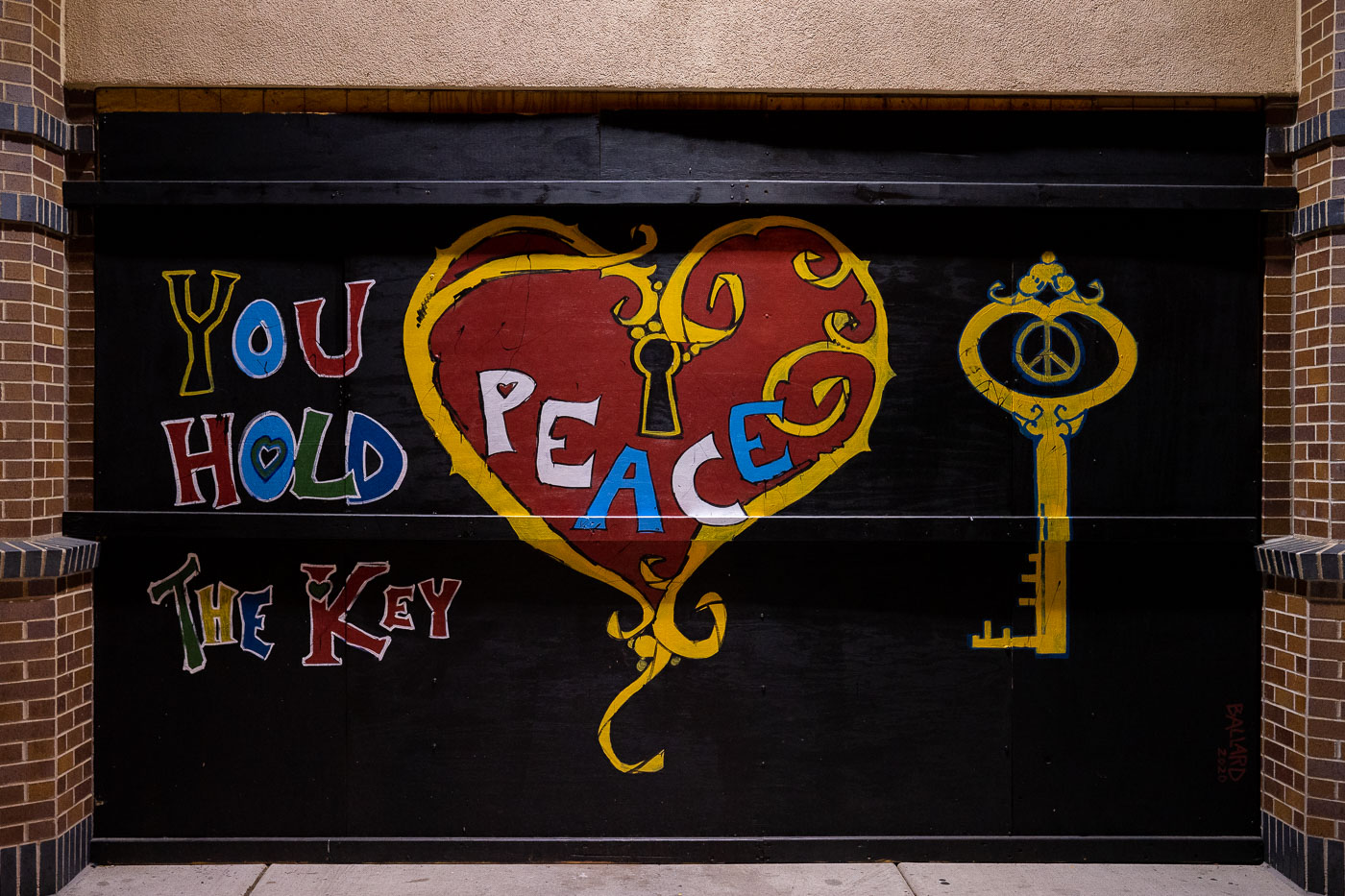
You Hold the Key mural on boarded-up CVS boards, Lake Street, Minneapolis
The "You Hold the Key" mural by Ballard covers a boarded-up CVS Pharmacy on Lake Street in Minneapolis. Painted in 2020, it features a heart, the word "PEACE," and a large key on protective boards over the storefront.

You Hold the Key Mural, Lake Street CVS, Minneapolis
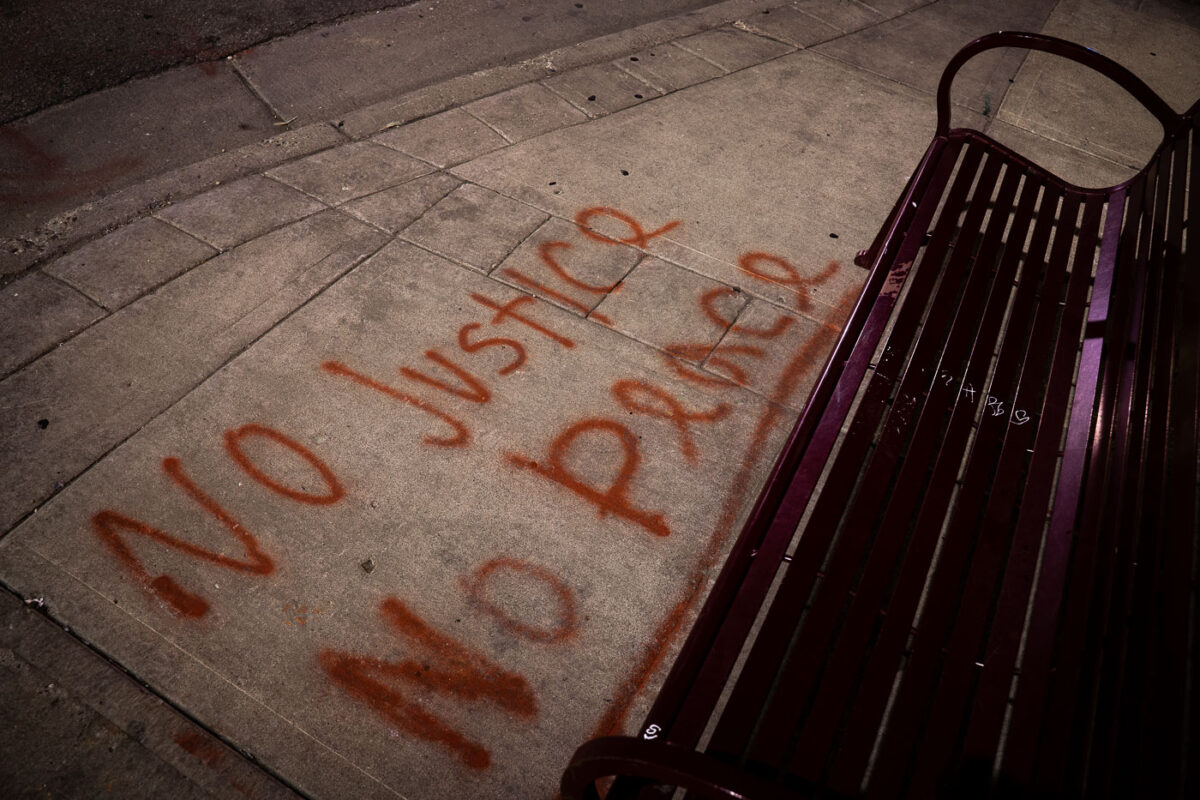
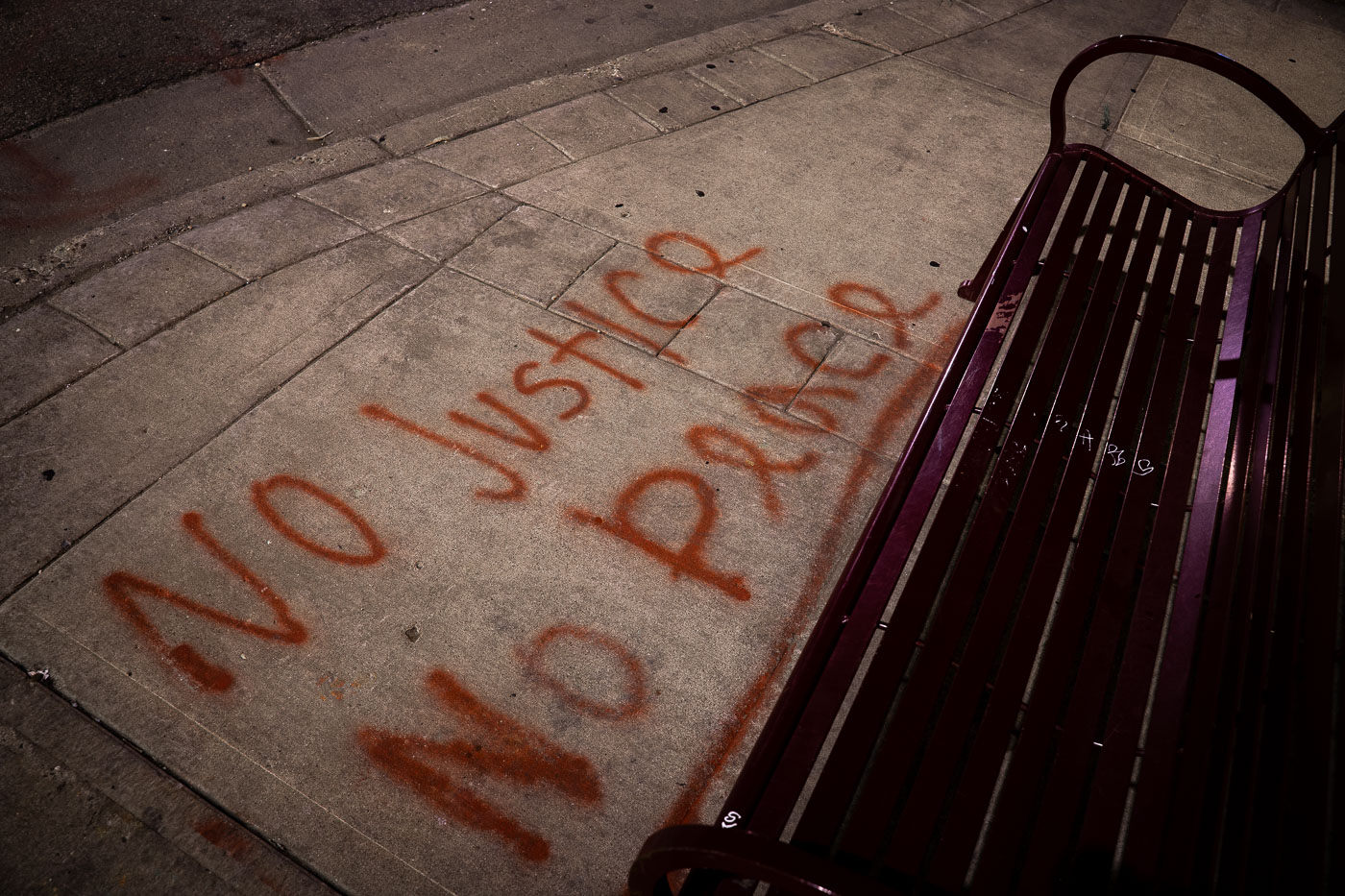
No Justice No Peace in front of South Minneapolis bench
The phrase 'No Justice, No Peace' is spray-painted in red on a sidewalk next to a public bench in South Minneapolis. This slogan became a prominent rallying cry during the widespread protests and civil unrest that followed the murder of George Floyd in Minneapolis in May 2020. Such public markings served as a direct expression of community grief, anger, and demands for systemic change, transforming urban spaces into sites of protest and remembrance. These messages, often temporary, marked the physical landscape of the city, reflecting the ongoing struggle for racial justice.

No Justice No Peace Graffiti on Sidewalk by Bench, South Minneapolis
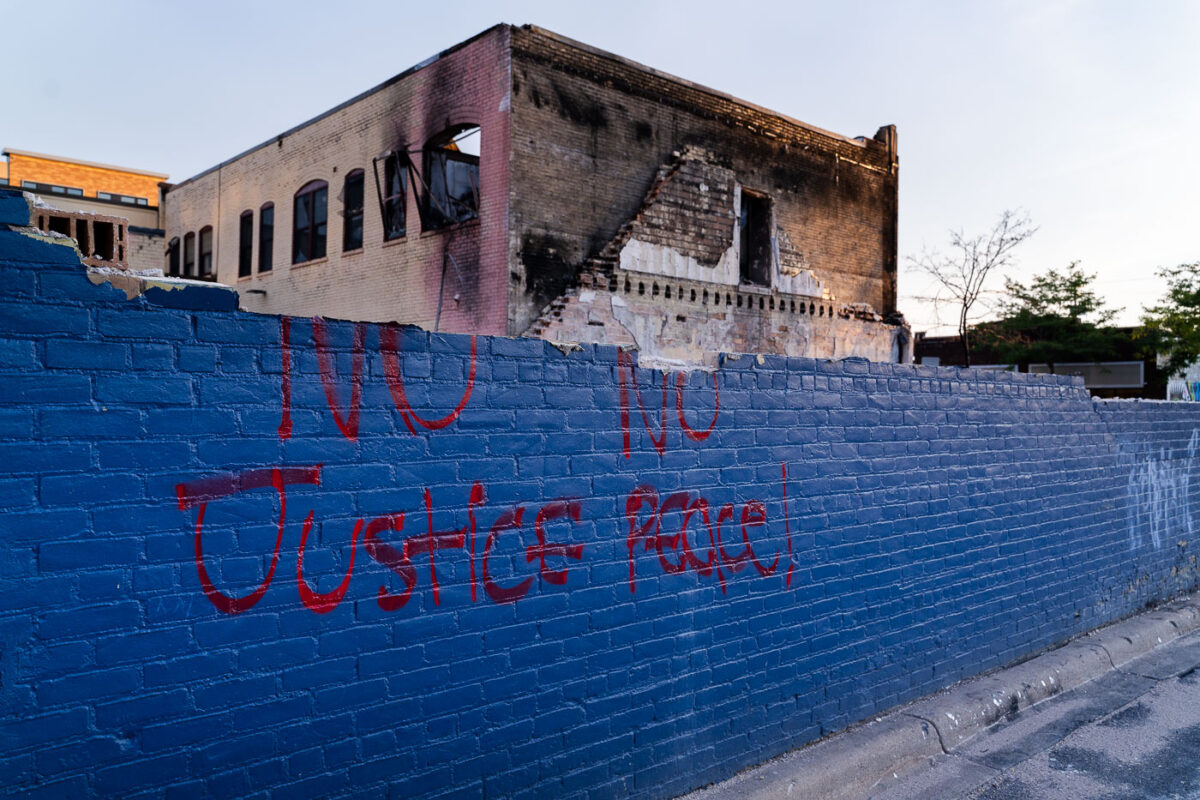
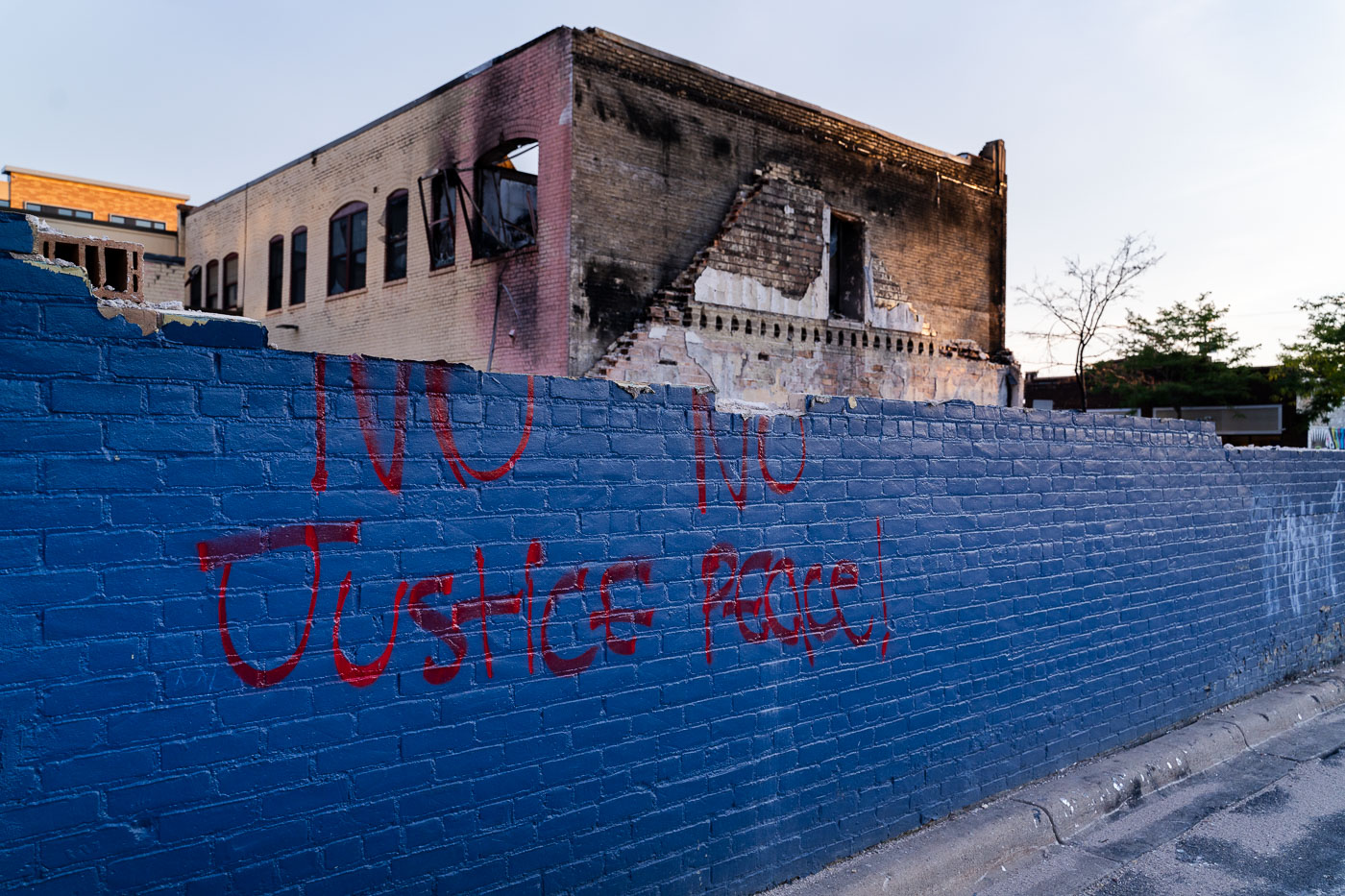
No Justice No peace on whats let of a burned building
The phrase "No Justice No Peace!" is spray-painted in red on a blue brick wall in Minneapolis. This graffiti marks the site of the former Chicago Furniture store on Chicago Avenue, which sustained extensive fire damage during the civil unrest that followed the death of George Floyd on May 25, 2020. The burned-out structure stands as a physical reminder of the widespread protests and property damage that occurred across the city. This message reflects the demands for social justice that emerged from the Minneapolis uprising.

“No Justice No Peace!” Graffiti, Burned Chicago Furniture
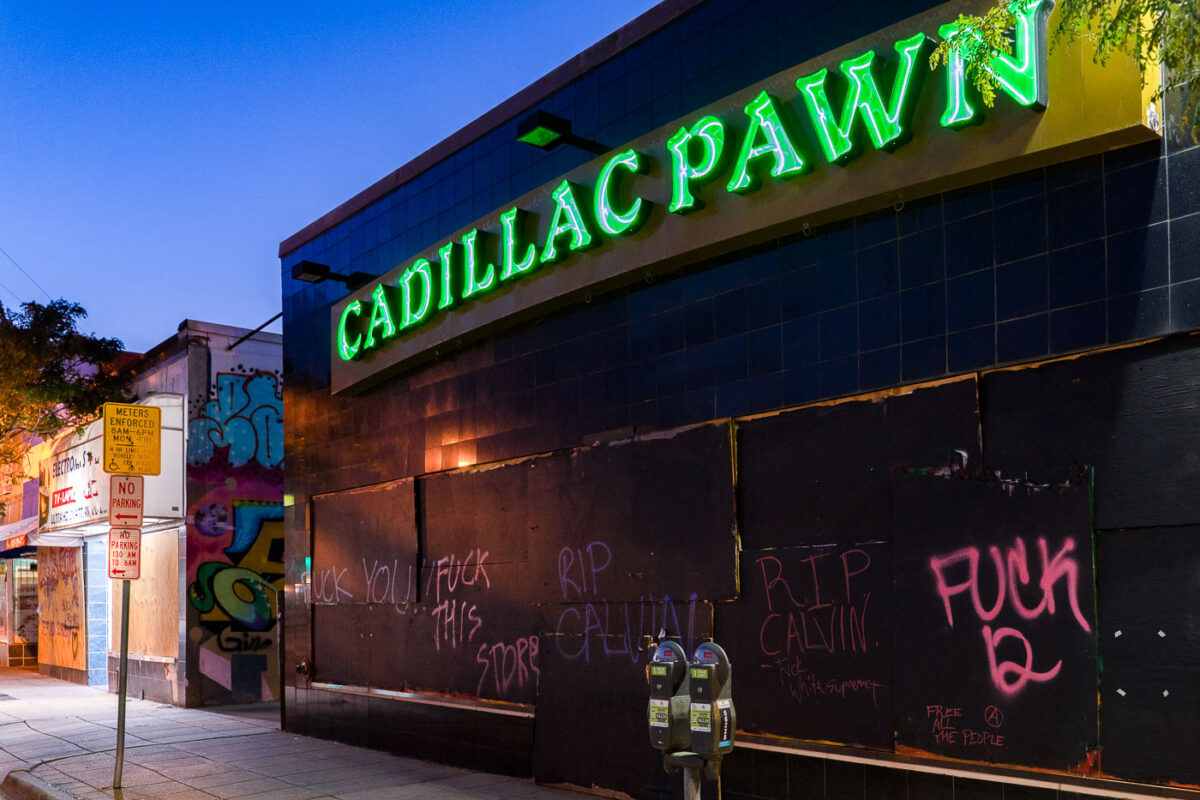
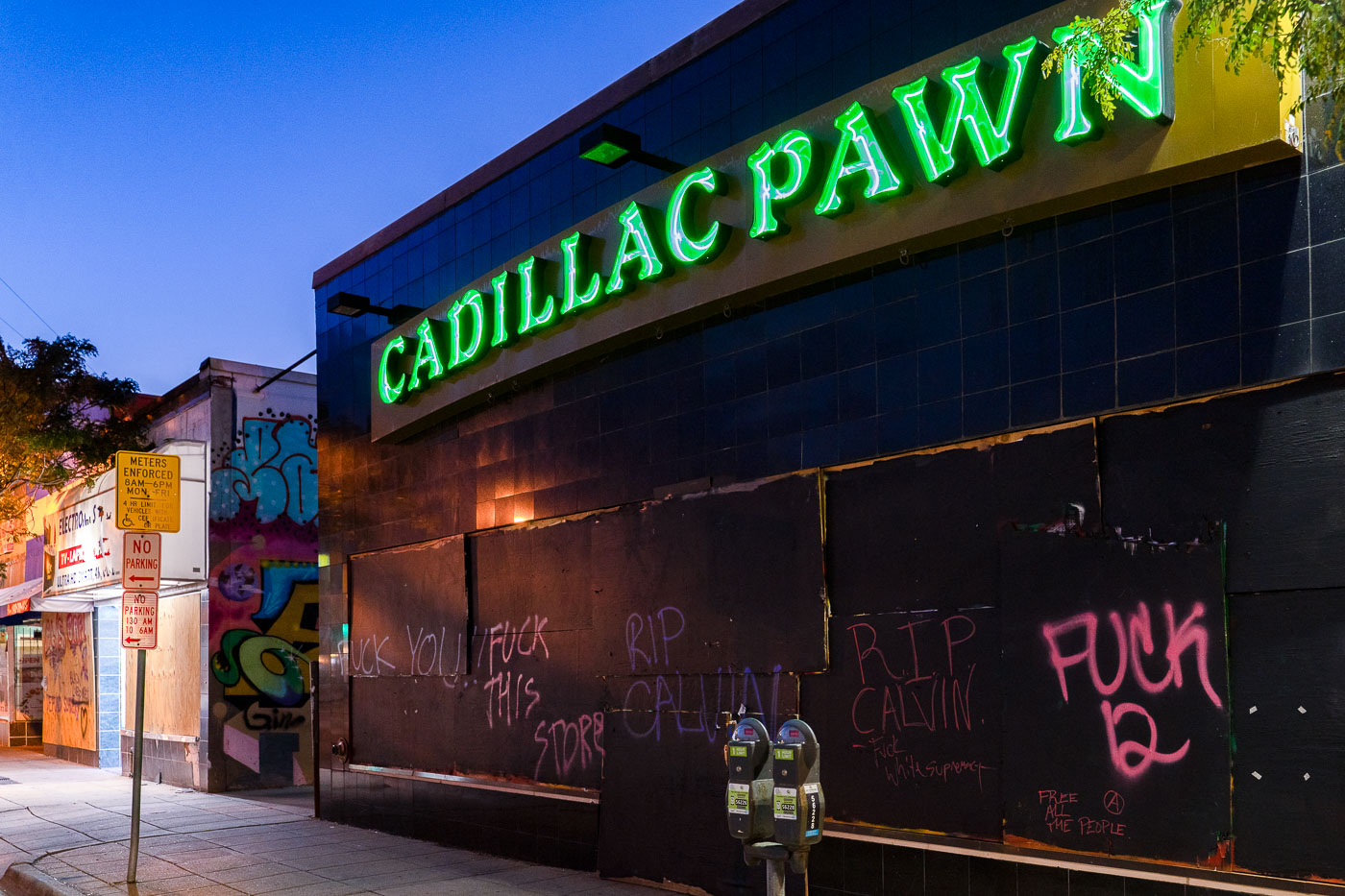
Boards on Cadillac Pawn on Lake Street reading Fuck 12
Cadillac Pawn, located at 1538 E Lake Street in Minneapolis, stands boarded with graffiti following the widespread unrest that occurred after the May 25th, 2020 death of George Floyd. The retail store was heavily looted during these events. Messages spray-painted on the boards include "RIP Calvin" and "Fuck this store," referencing Calvin Horton Jr., who was shot and killed by the store owner, with no charges filed in the case. This site serves as a stark reminder of the community's grievances and the profound impact of the 2020 protests on local businesses and the urban environment.

Cadillac Pawn, Lake Street, boarded with graffiti
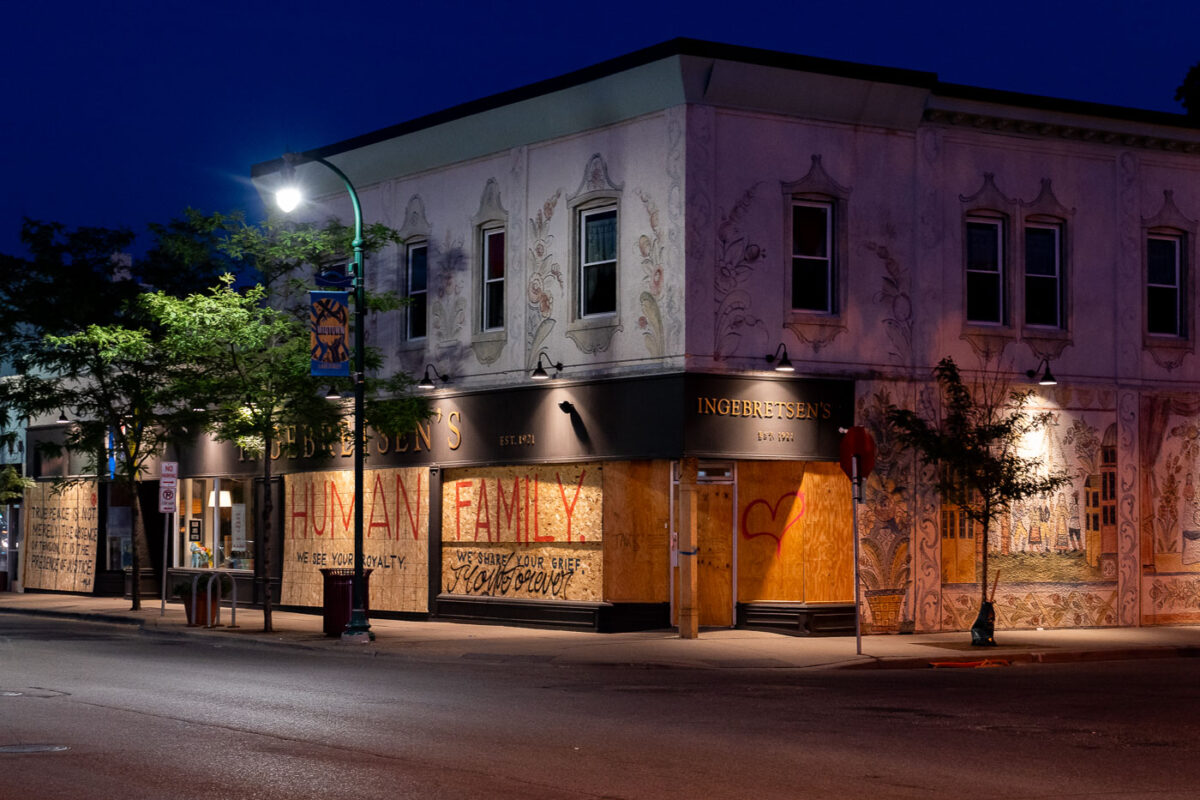
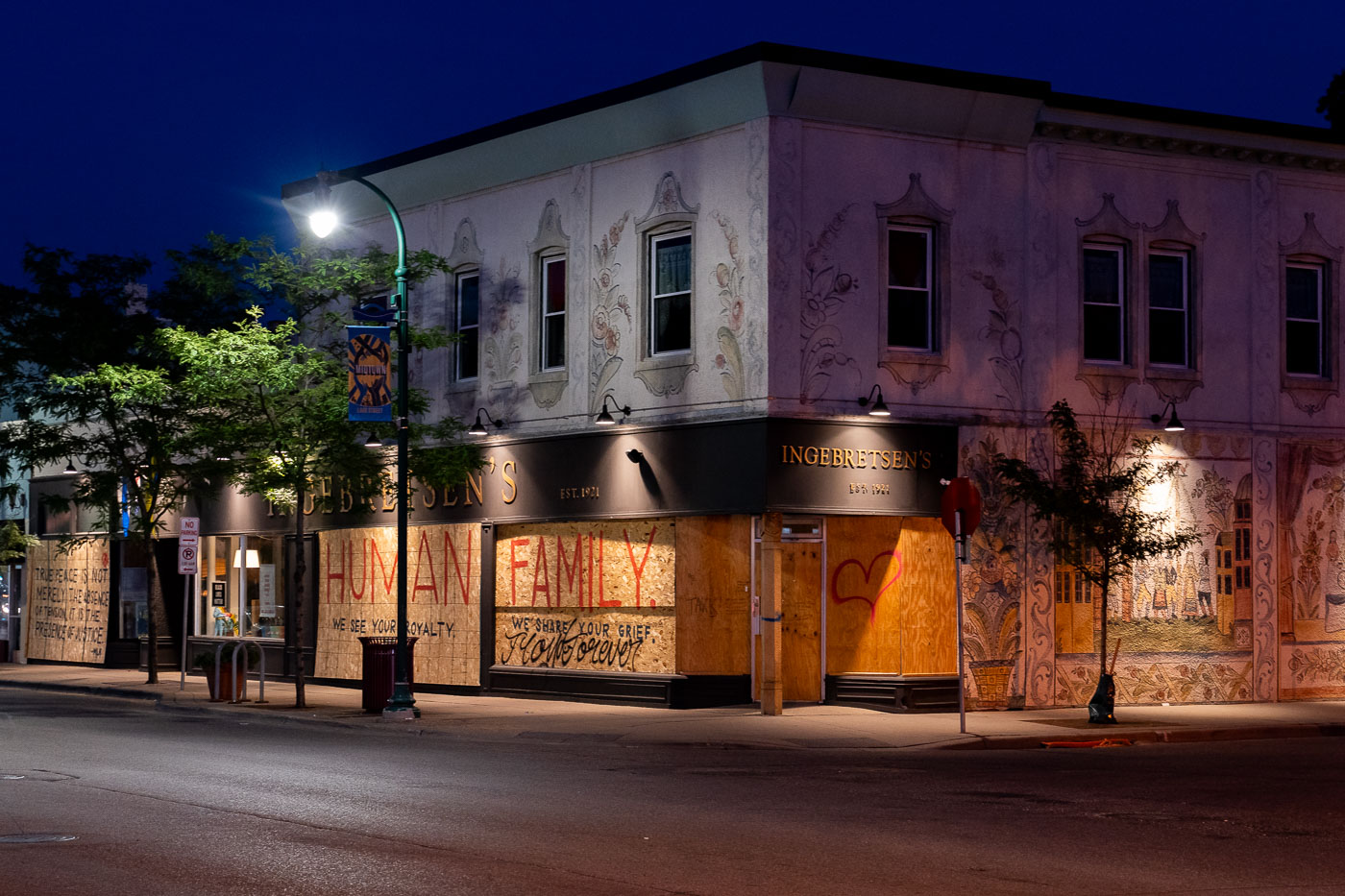
Ingebretsen’s store on Lake Street with boards
Ingebretsen's, a long-standing Scandinavian food market and gift shop, is located at 1601 E Lake Street in South Minneapolis. Established in 1921, the family-owned business has served as a cultural hub for the city's Scandinavian community for over a century. The store's windows were boarded and subsequently covered with protest messages and graffiti following the civil unrest in May 2020, which occurred after the death of George Floyd. Messages such as "HUMAN FAMILY" and a quote from Martin Luther King Jr. advocating for justice were painted on the protective boards, reflecting community sentiments during this period. This image documents the physical impact and public expression on local businesses along Lake Street during a significant moment in Minneapolis's recent history.

Ingebretsen’s Boarded Store with Graffiti, Lake Street, Minneapolis
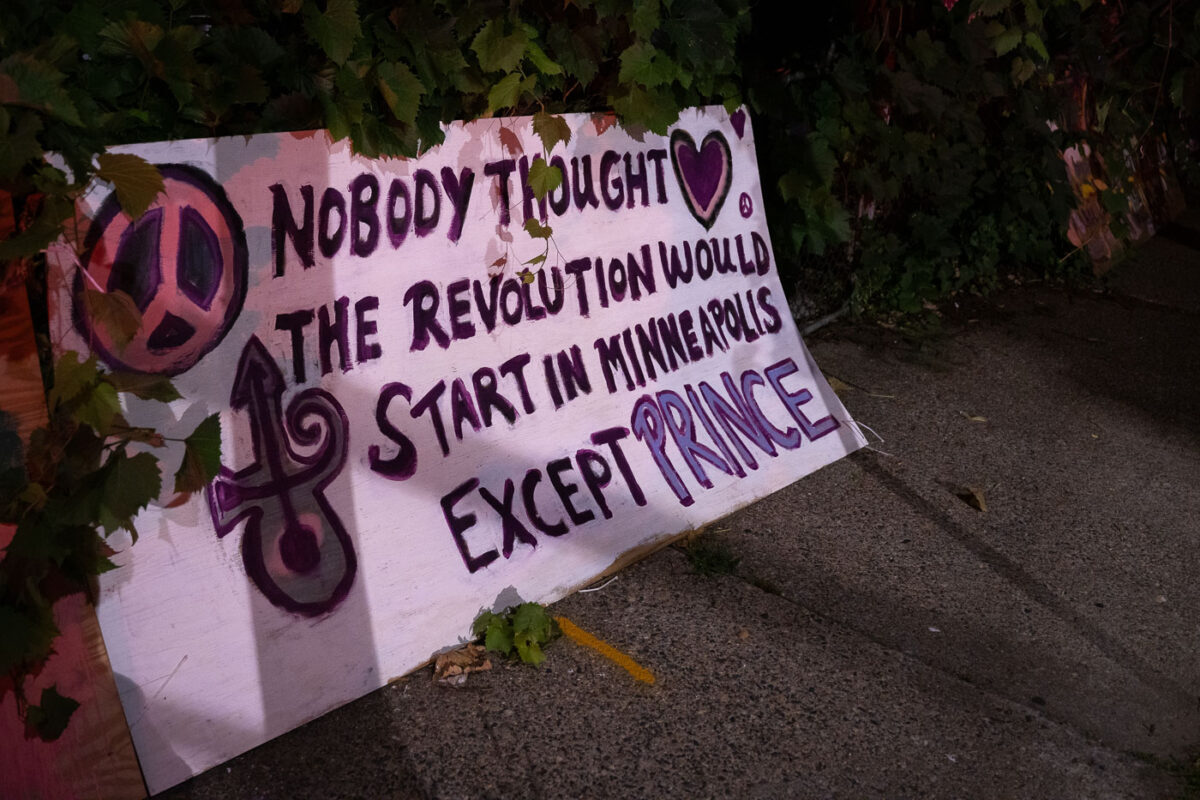
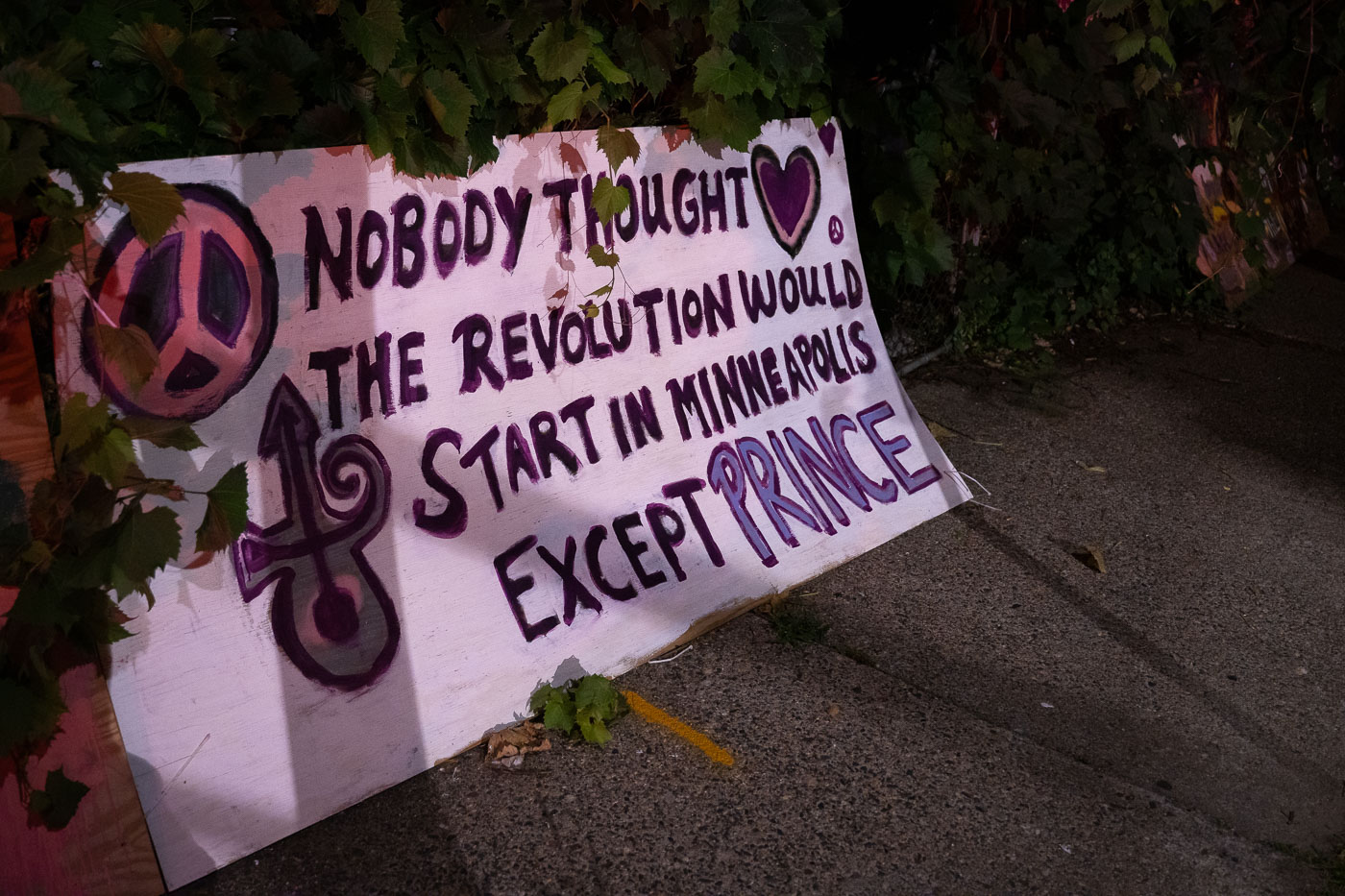
Hand-painted protest sign with Prince quote and peace symbol displayed on ivy-covered fence in South Minneapolis.
This protest sign, displayed in South Minneapolis, features a quote attributed to Prince: "Nobody thought the revolution would start in Minneapolis except Prince." The sign was out during the widespread protests and civil unrest that followed the killing of George Floyd in May 2020.

“Except Prince” Sign Among South Minneapolis Protest Boards
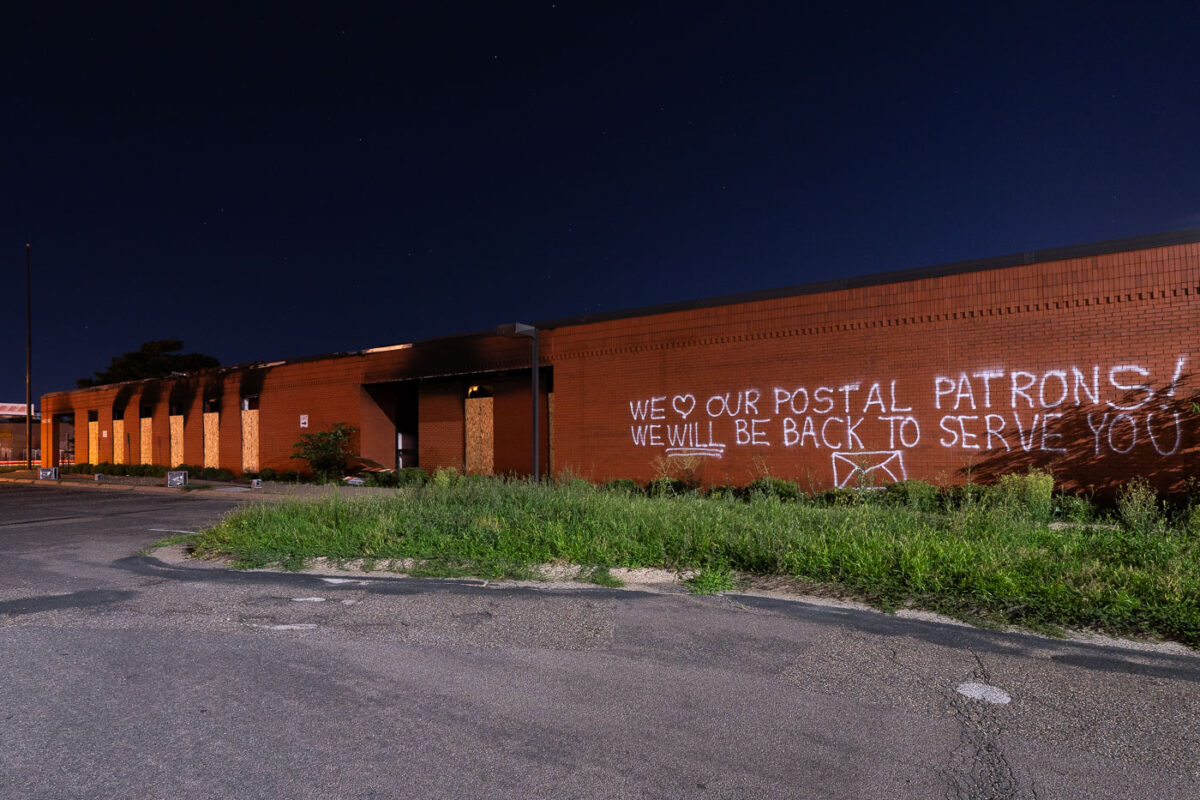
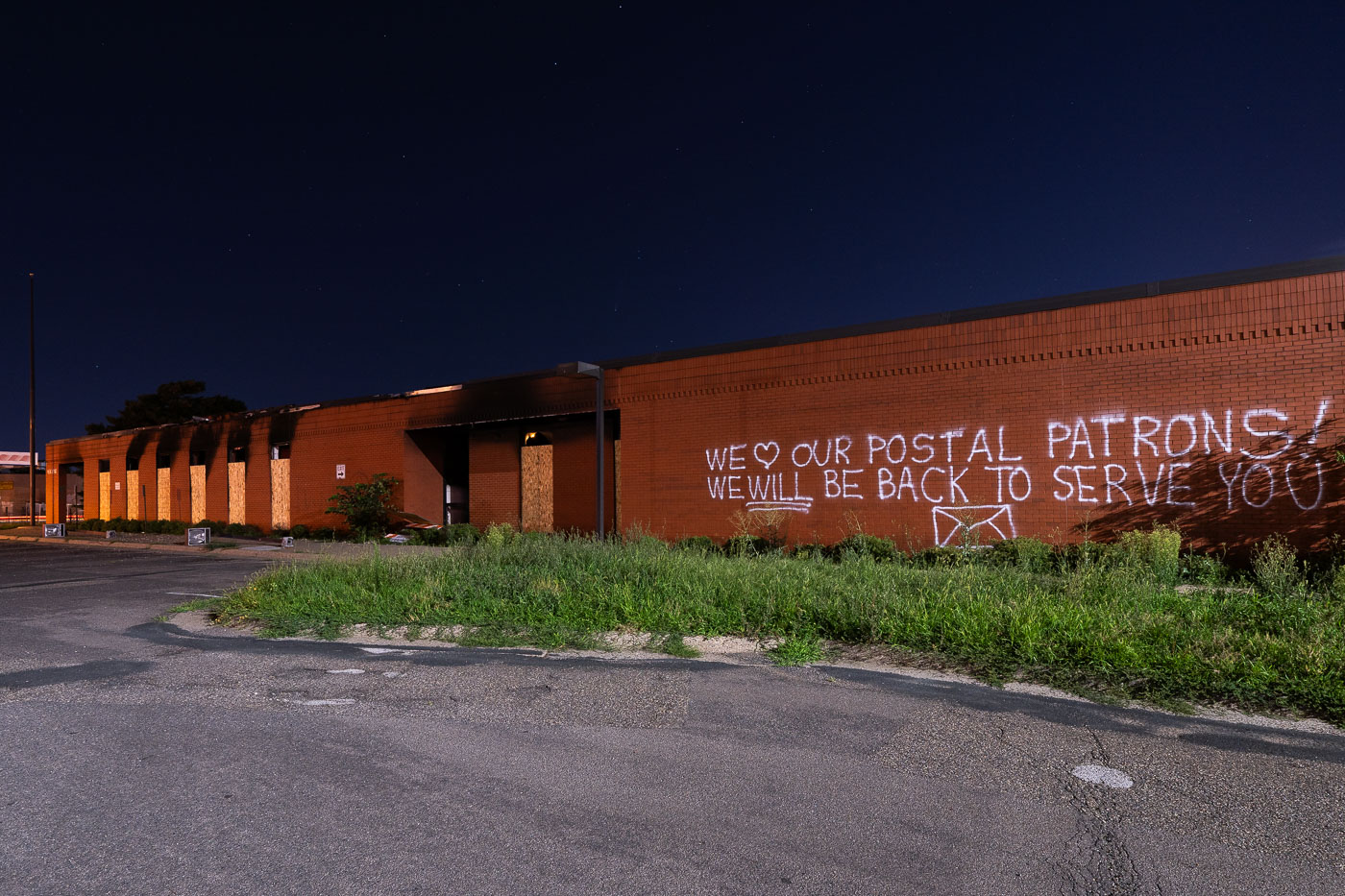
Graffiti on the side of burned USPS post office
The United States Postal Service (USPS) Lake Street Station in Minneapolis sustained significant fire damage during the Minneapolis Uprising. The brick building shows signs of charring and boarded-up windows, with white graffiti on its facade stating, "WE LOVE OUR POSTAL PATRONS! WE WILL BE BACK TO SERVE YOU!" This message reflects the station's commitment to its community despite the extensive damage from arson. As a critical piece of public infrastructure, the Lake Street Station provides essential postal services to residents and businesses in the surrounding Minneapolis neighborhood.

Burned USPS Lake Street Station with Graffiti
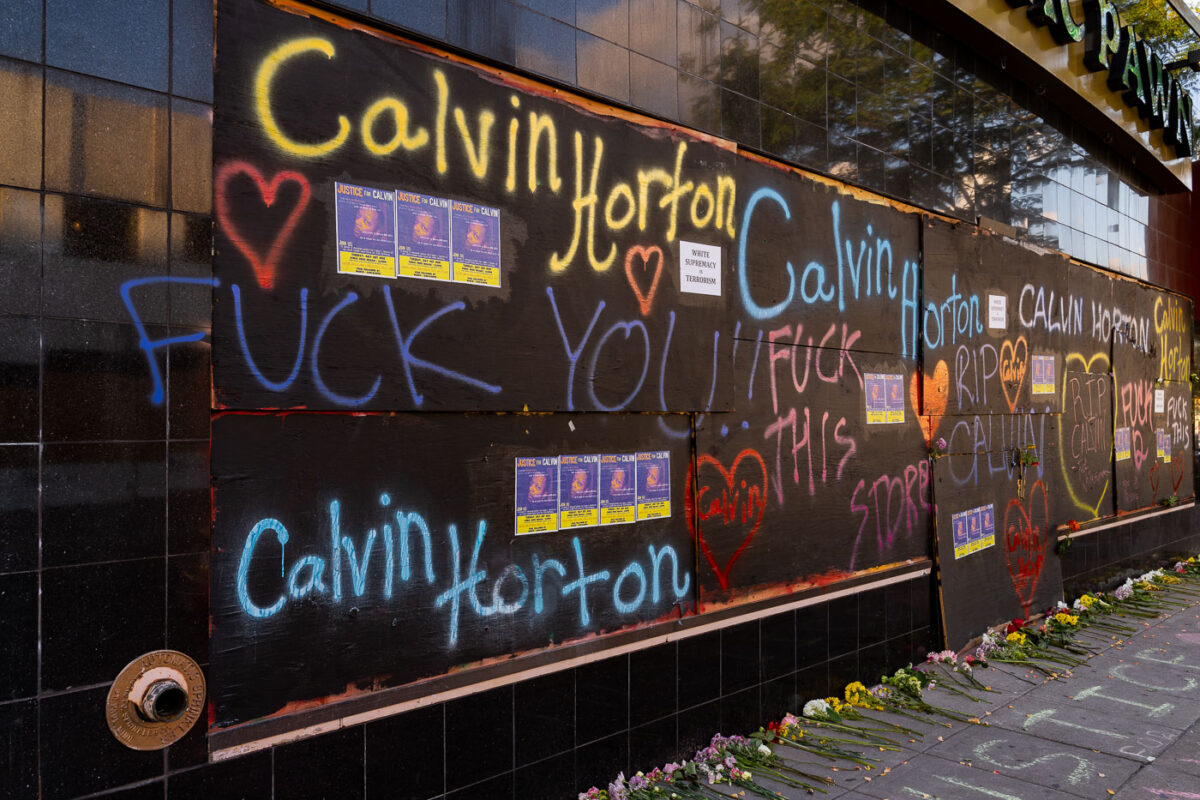
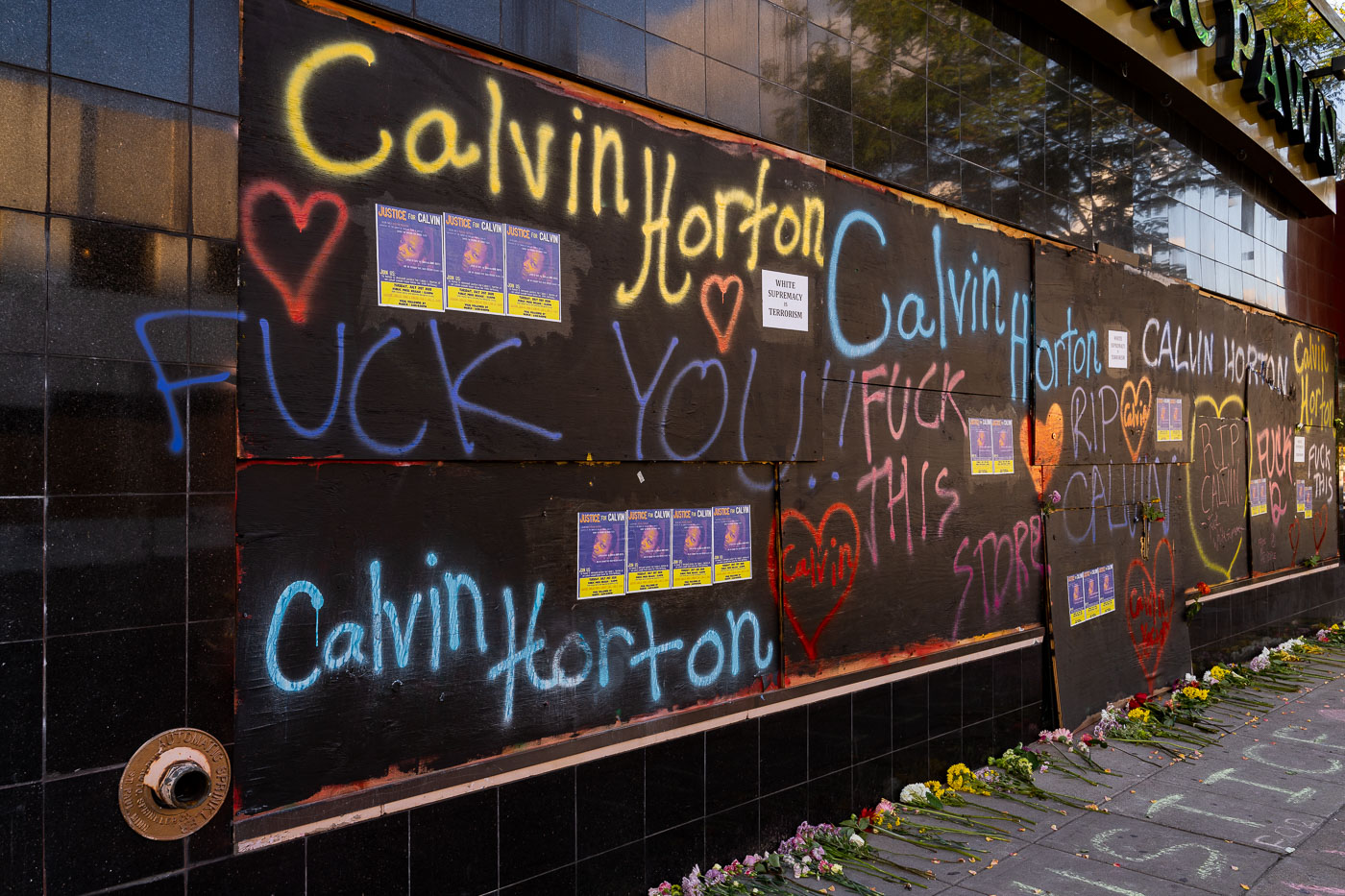
Boarded storefront of Cadillac Pawn on Minneapolis's Lake Street displays colorful graffiti and memorial messages honoring Calvin Horton Jr.
A boarded-up storefront of Cadillac Pawn on Lake Street in Minneapolis displays graffiti and memorial messages for Calvin Horton Jr. Horton Jr. was killed by the owner of the pawn shop on May 27, 2020, during the civil unrest that followed the murder of George Floyd.

“Fuck You” Graffiti and Memorials for Calvin Horton Jr. on Lake Street
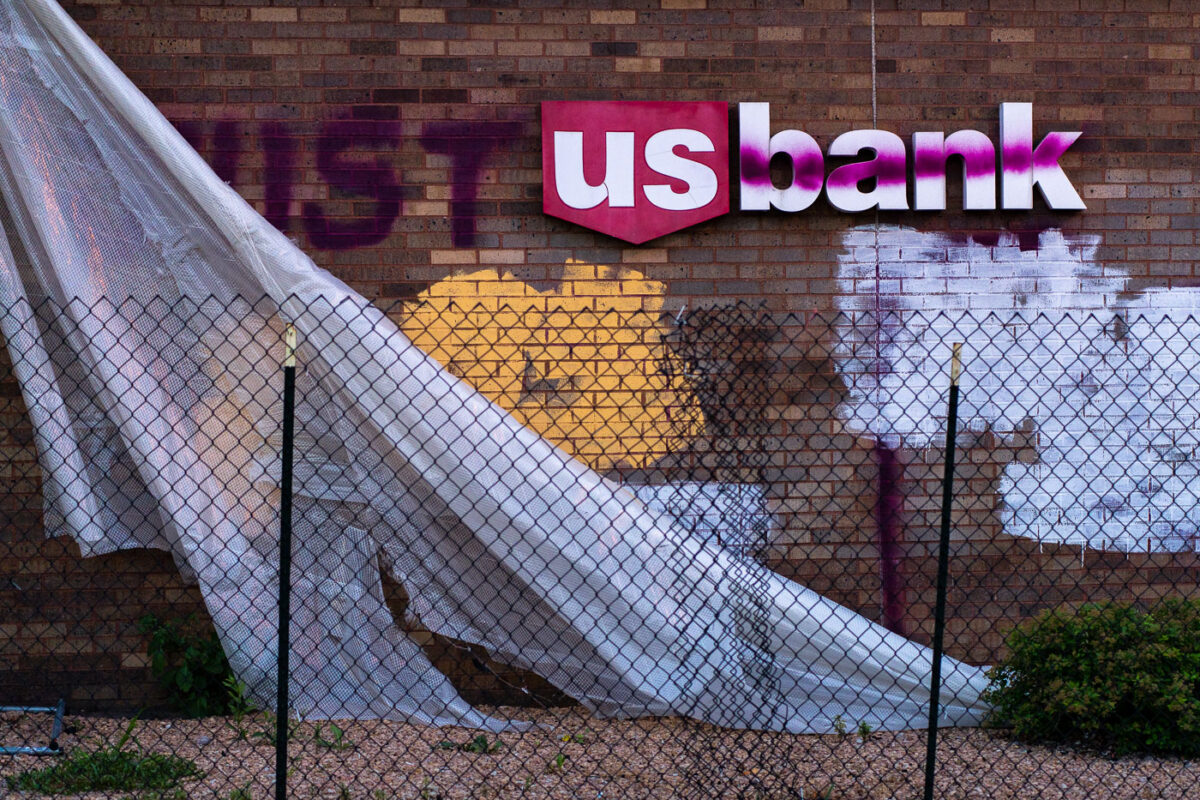
US Bank branch on Lake Street in Minneapolis with graffiti and boarded windows during 2020 civil unrest.
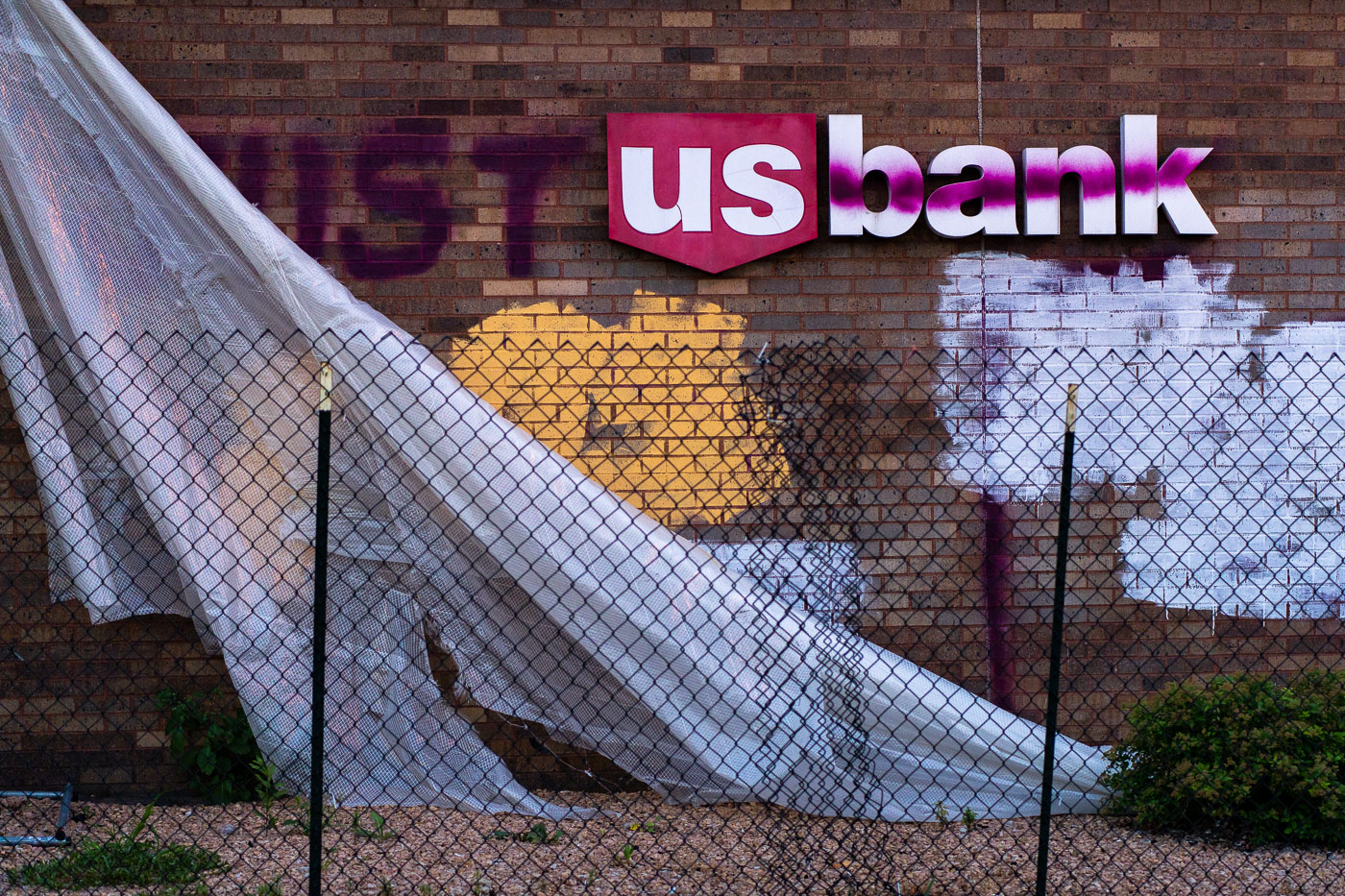
Graffiti covers the exterior of a US Bank branch on Lake Street in Minneapolis. This damage occurred during the widespread protests and civil unrest that followed the May 25, 2020 death of George Floyd.

Chain-Link Fence and Tarp Outside a US Bank Branch on Lake Street
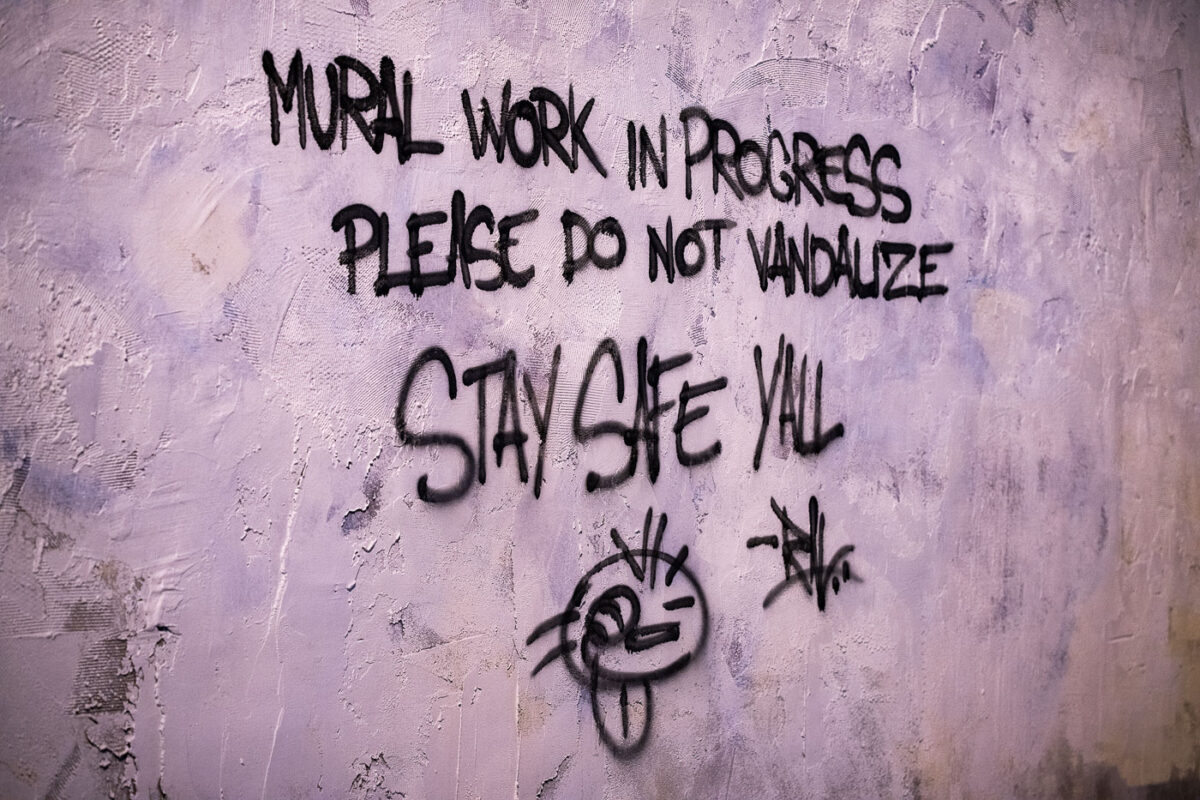
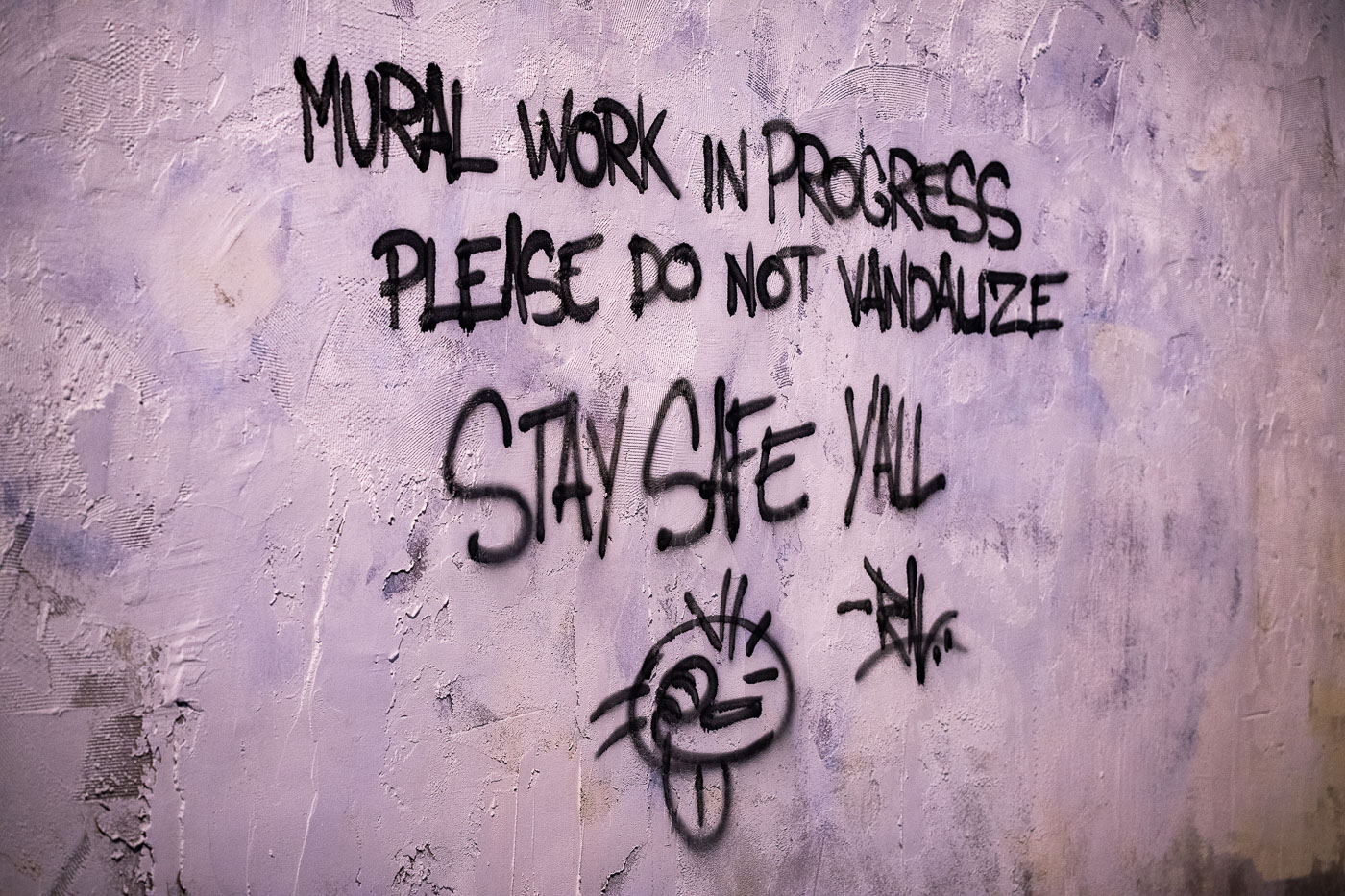
Moral work in progress
A temporary notice spray-painted on a wall along Lake Street in Minneapolis indicates ongoing mural work. This message, reading 'MURAL WORK IN PROGRESS PLEASE DO NOT VANDALIZE STAY SAFE YALL,' reflects community efforts to create public art in the aftermath of the 2020 Minneapolis Uprising. Following widespread protests and property damage, many businesses and community spaces along Lake Street became canvases for murals, transforming affected areas into sites of remembrance, resilience, and artistic expression. Such temporary signage served to protect these nascent artworks and foster a sense of collective ownership and respect for the rebuilding process.

Lake Street Mural Progress Notice, Minneapolis
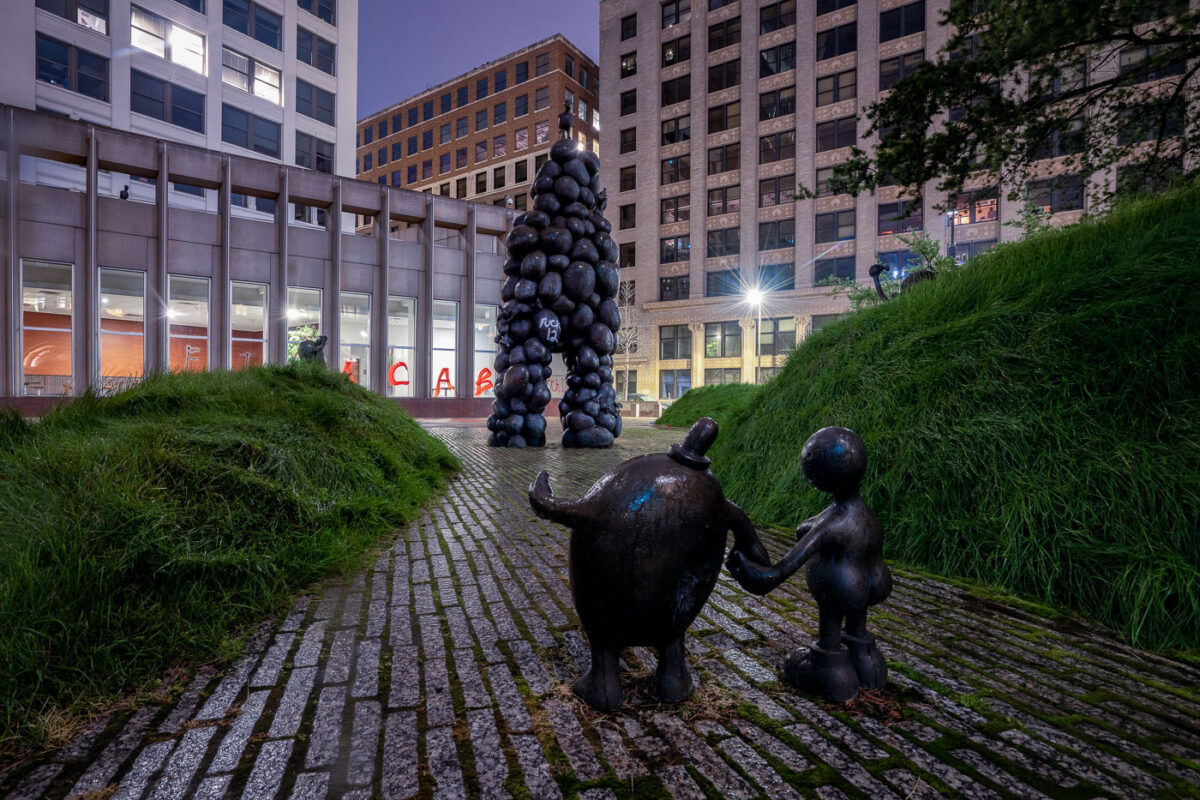
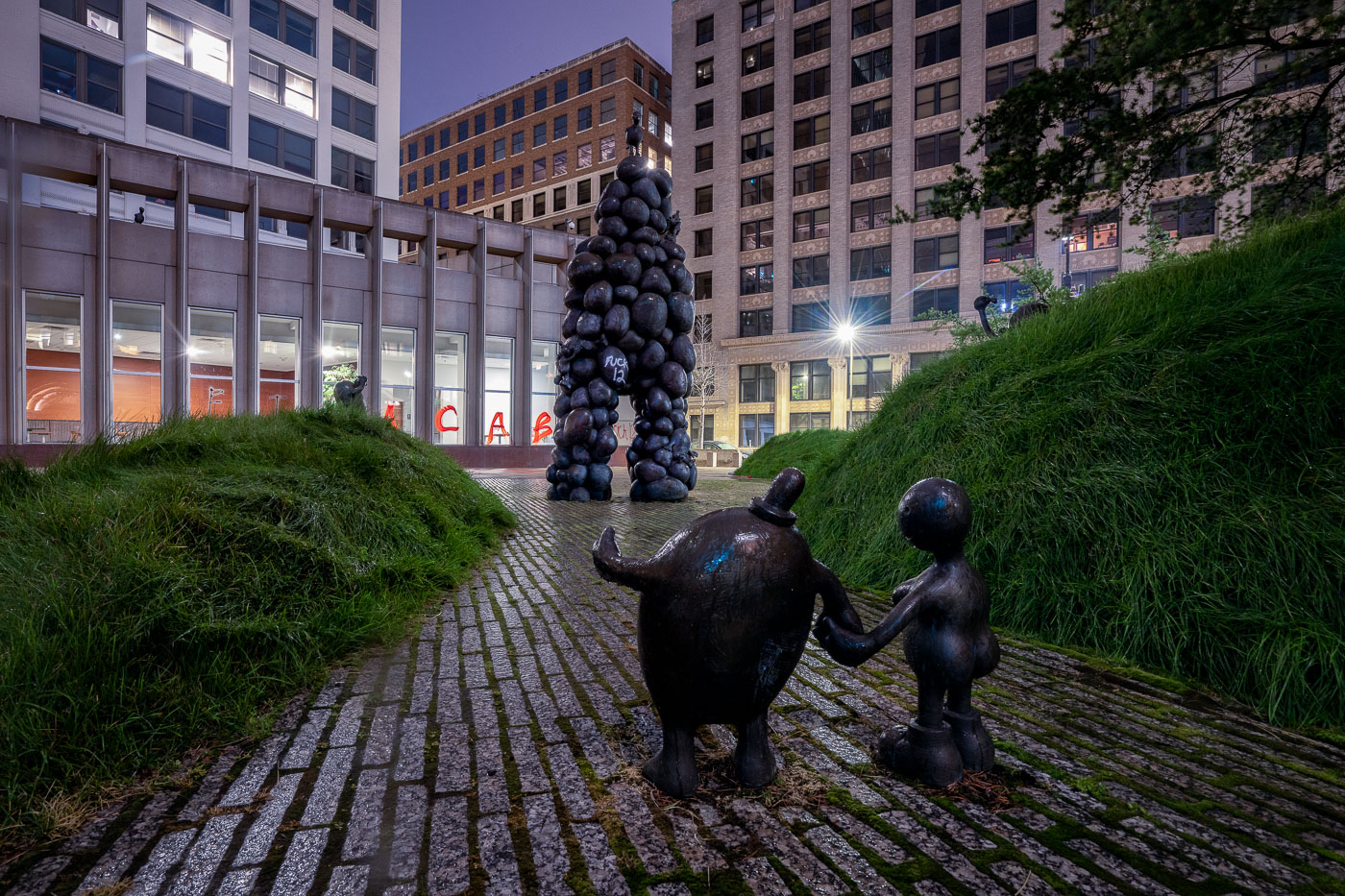
ACAB graffiti on Federal Courthouse at night
The Federal Courthouse in downtown Minneapolis, a key site for federal judicial proceedings, displays "ACAB" graffiti through its windows. This public expression emerged during the widespread protests and civil unrest that occurred in Minneapolis following the murder of George Floyd in May 2020. The building's prominent location made it a focal point for public sentiment during this period of social upheaval. In the foreground, sculptures from Tom Otterness's "The Goose Lake Cycle" series, installed on the courthouse grounds, also bear protest-related markings, reflecting the broader impact of the Minneapolis Uprising on the urban environment.

ACAB Graffiti, Minneapolis Federal Courthouse & Sculpture
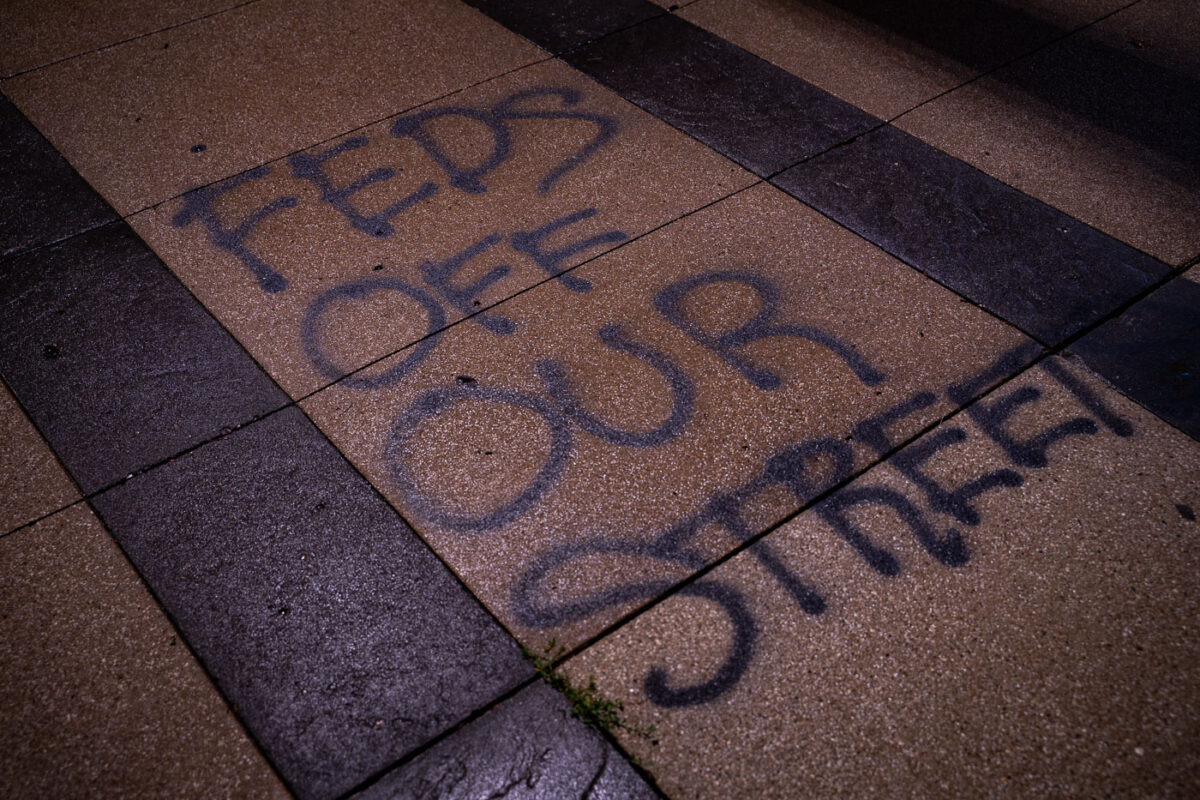
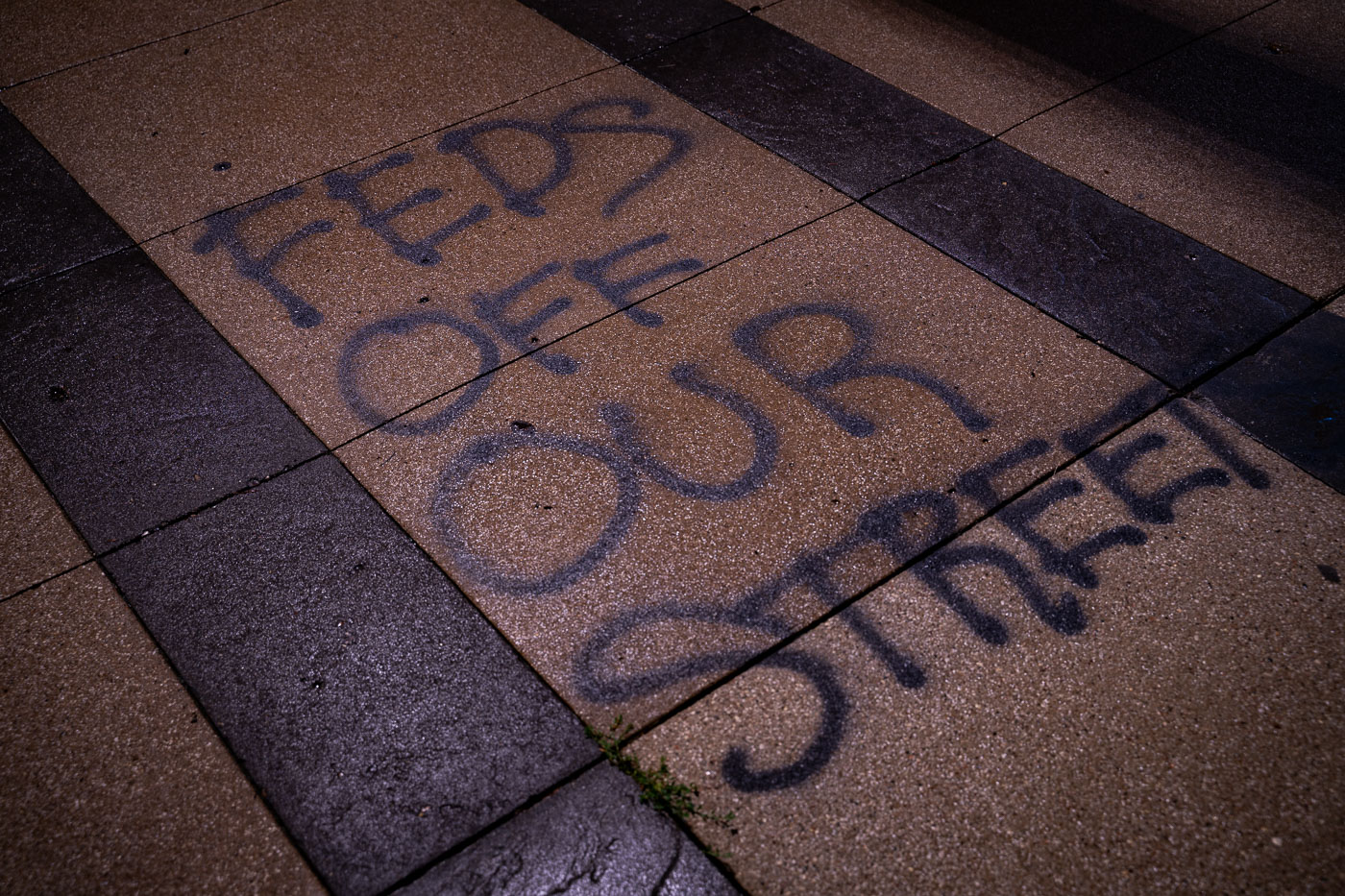
FEDS OFF OUR STREET graffiti
Graffiti reading "FEDS OFF OUR STREET" is visible on the pavement outside the US Federal Courthouse in Downtown Minneapolis. This message emerged during the Minneapolis Uprising, a period of widespread protests and civil unrest in 2020. The federal courthouse, a symbol of federal authority, became a focal point for expressions of dissent against government presence and actions during this time. Such markings reflect public sentiment and the charged atmosphere surrounding the events in Minneapolis.

“Feds Off Our Street” Graffiti, Minneapolis Federal Courthouse
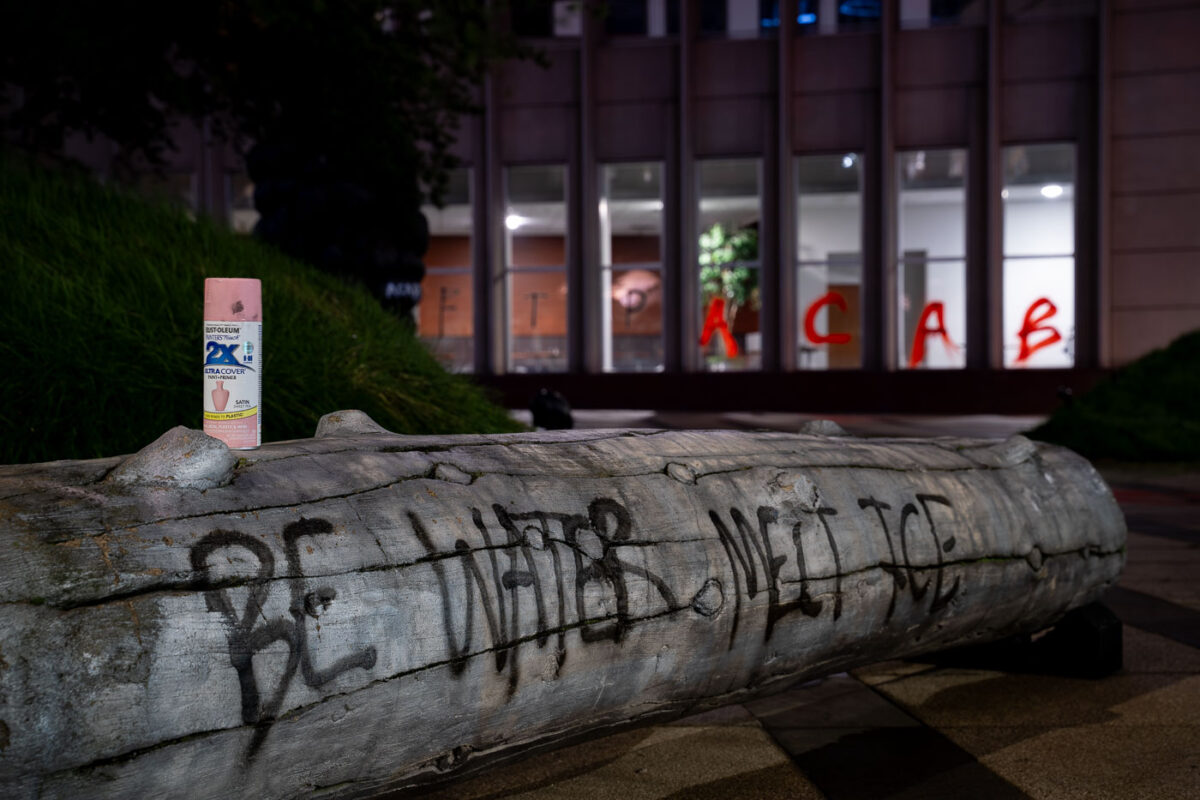
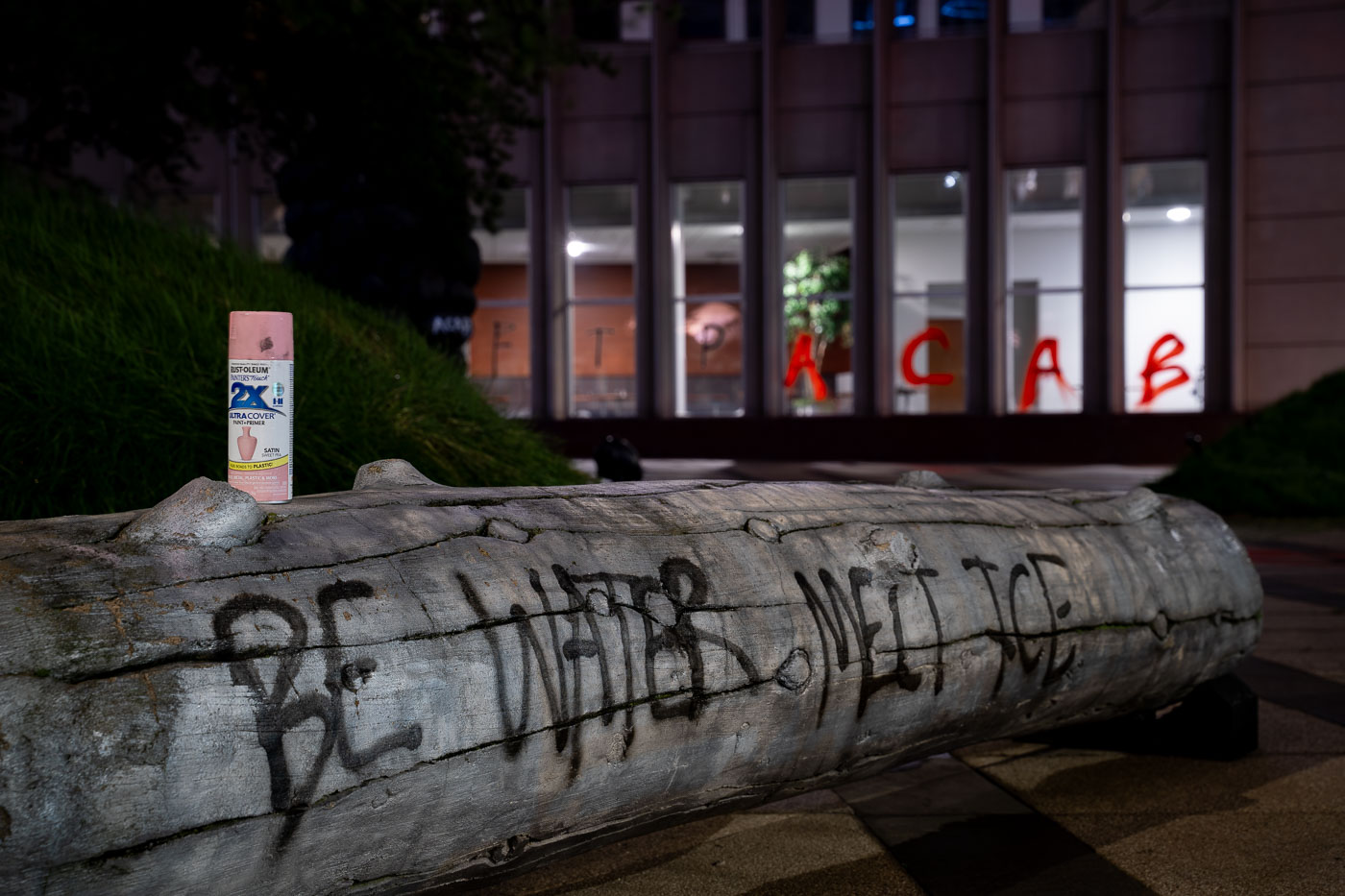
Be Water Melt Ice
Graffiti covers a large log and the windows of the Warren E. Burger Federal Building and U.S. Courthouse in downtown Minneapolis. The messages, including 'ACAB' on the courthouse windows and 'BE WATER MY FRIEND' on the log, emerged as expressions of dissent during the Minneapolis Uprising. This federal judicial center, completed in 1966, became a significant site for public protest in May and June 2020. The spray paint can resting on the log further highlights the direct and immediate nature of these statements made within the urban environment.

Graffiti on Log and Courthouse Windows, Minneapolis
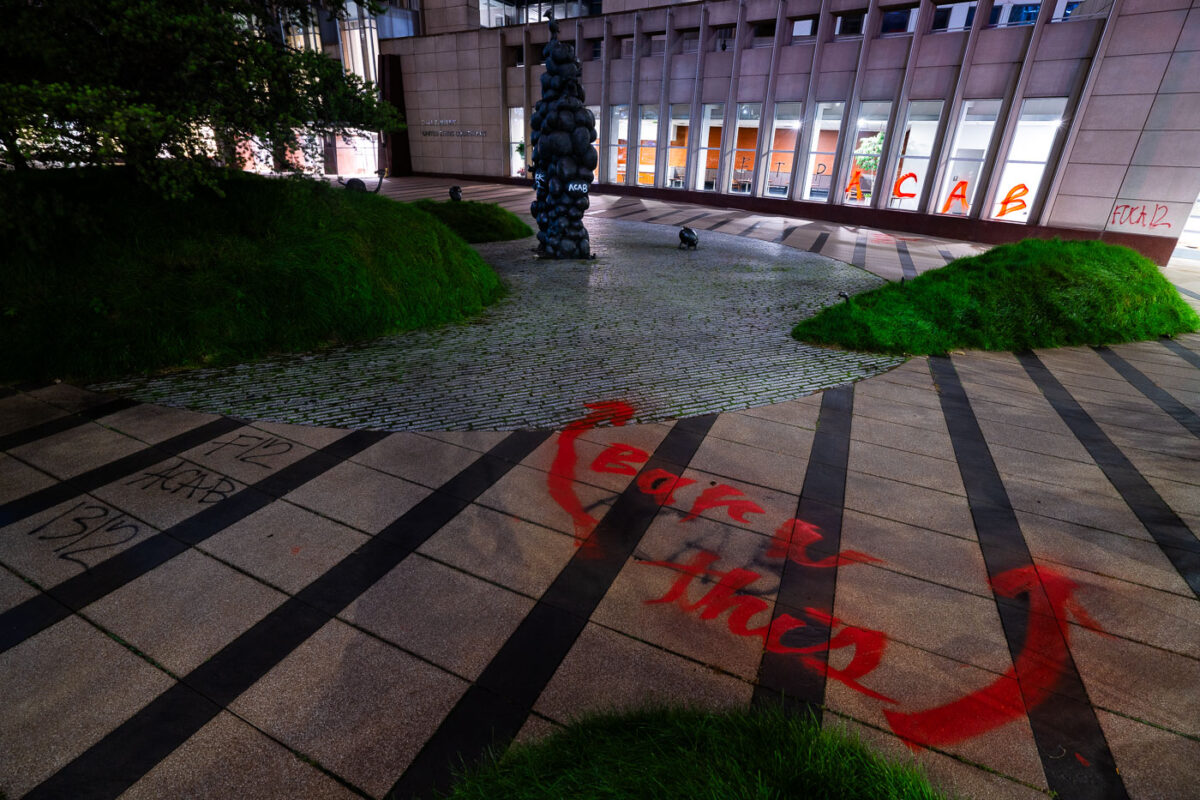
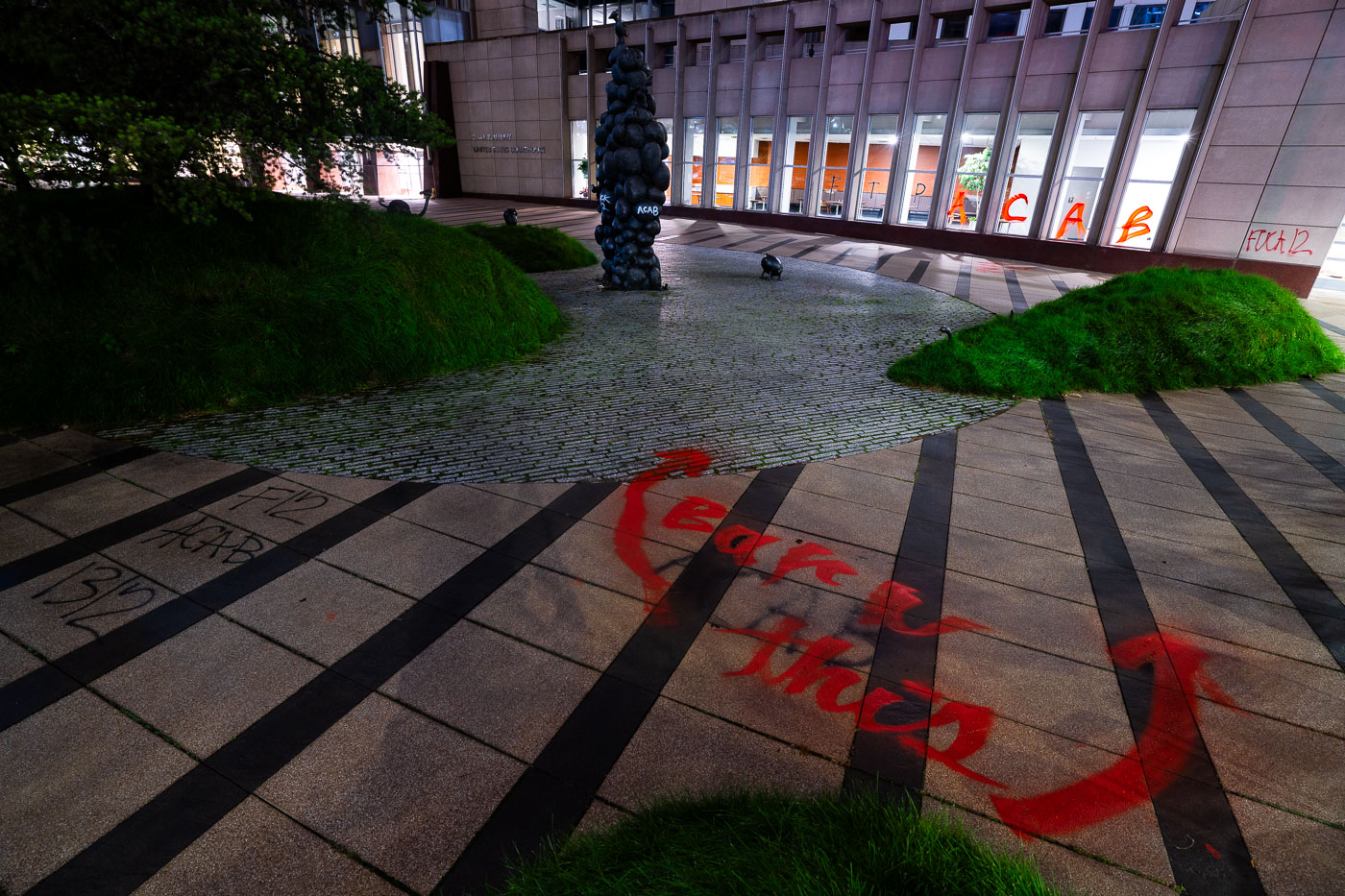
Burn this written on grounds of Federal Courthouse
Graffiti reading "Burn This", "ACAB", and "FUCK 12" is visible on the grounds and windows of the Diana E. Murphy United States Courthouse in downtown Minneapolis. This federal judicial building, completed in 1996, serves as a central location for federal legal proceedings in the district. The messages reflect the intense public sentiment and unrest that characterized the Minneapolis Uprising, a period of significant social protest following the killing of George Floyd. The graffiti on this government building underscores the anti-establishment and anti-police sentiments prevalent during this historical period.

ACAB Graffiti on Diana E. Murphy US Courthouse, Minneapolis
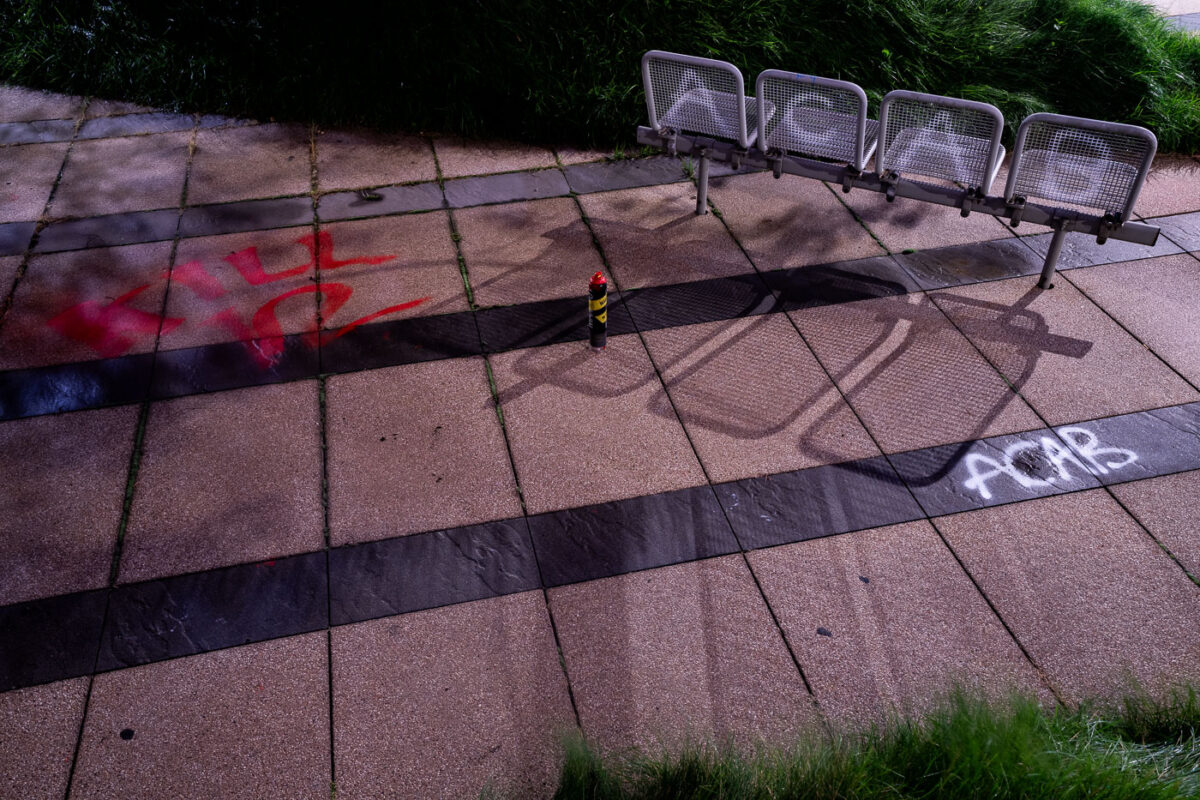
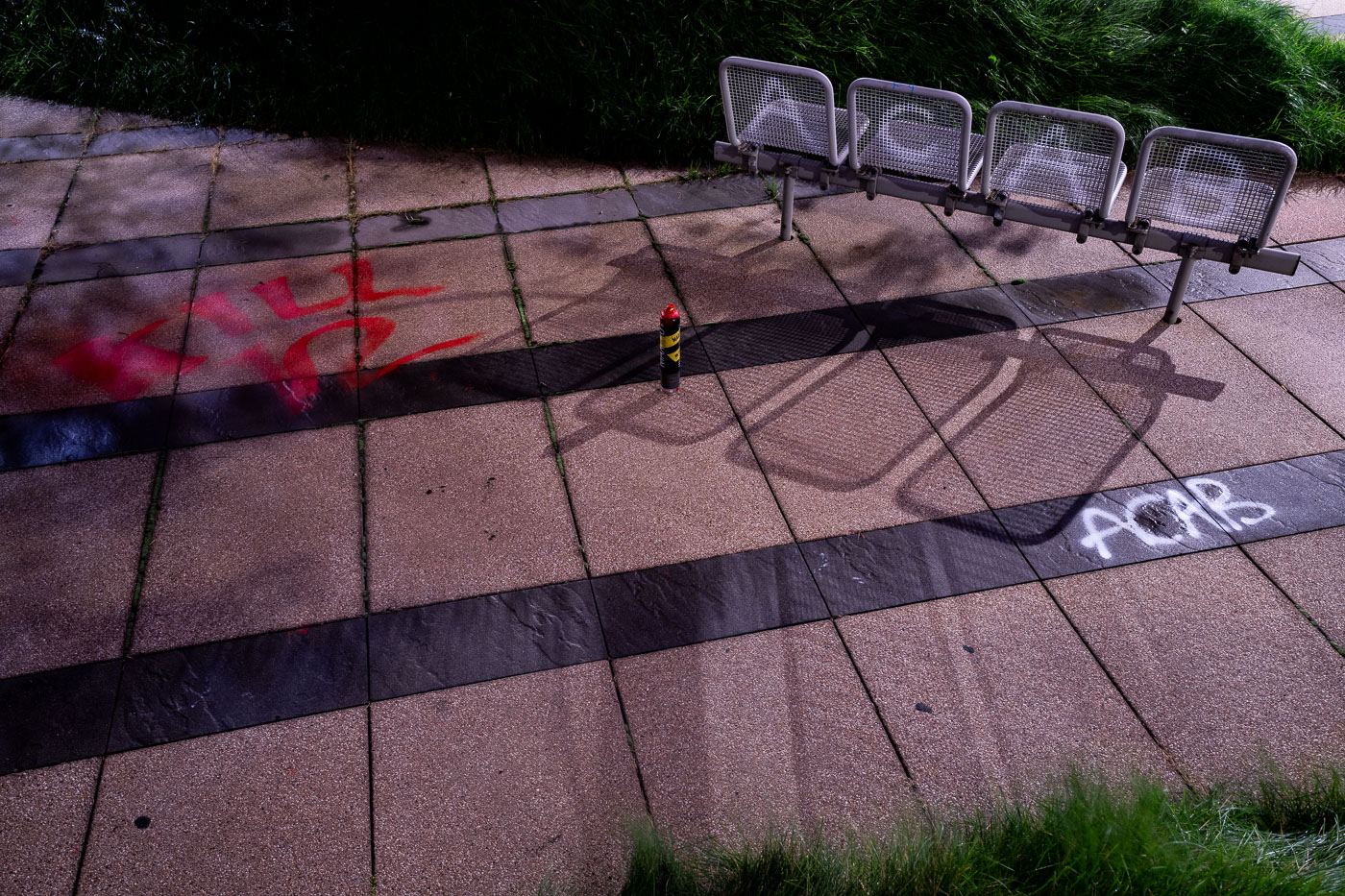
ACAB written on Federal Courthouse benches
Graffiti reading 'ACAB' and 'FUCK 12' is visible on the pavement outside the Federal Courthouse in downtown Minneapolis. This graffiti emerged during a period of widespread protests and civil unrest in Minneapolis, particularly following the murder of George Floyd in May 2020. Federal courthouses, as symbols of the justice system, often become focal points for public expression during protests concerning legal and social issues. The phrases 'ACAB' (All Cops Are Bastards) and 'FUCK 12' are anti-police slogans commonly used in protests against police brutality and systemic injustice.

Federal Courthouse ‘ACAB’ Graffiti, Minneapolis
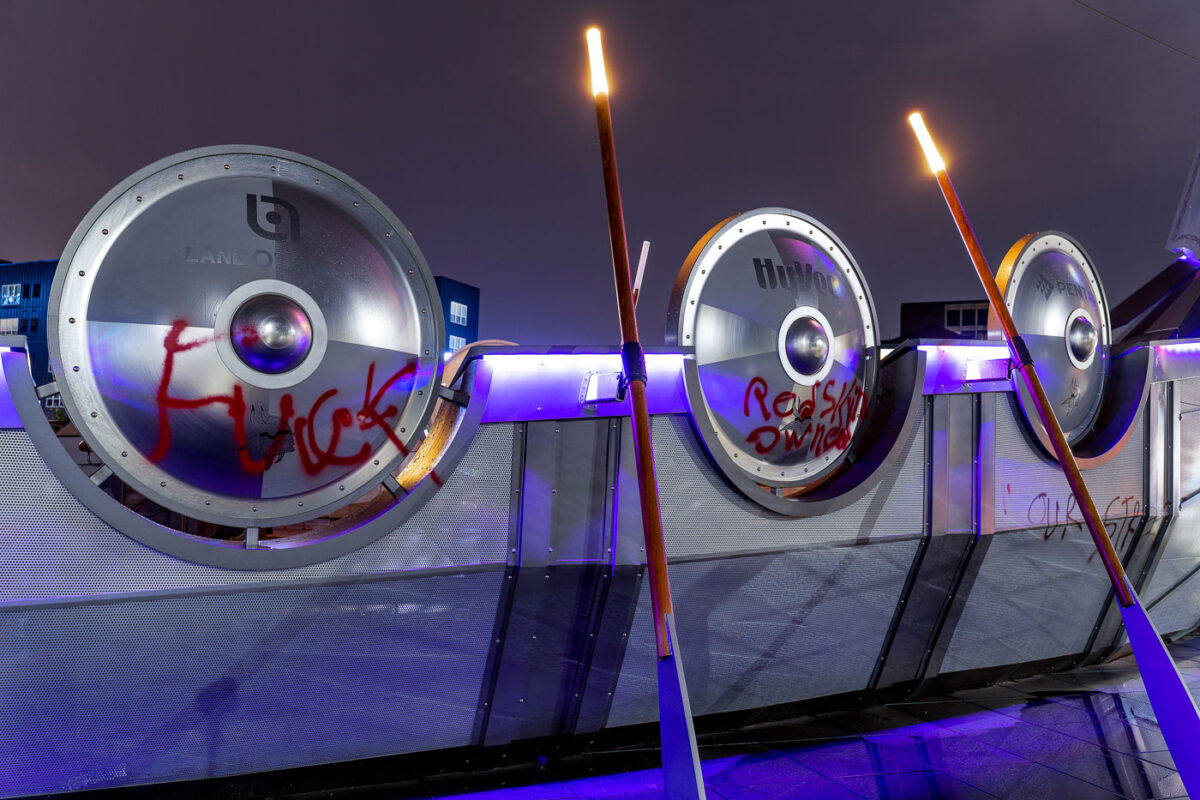
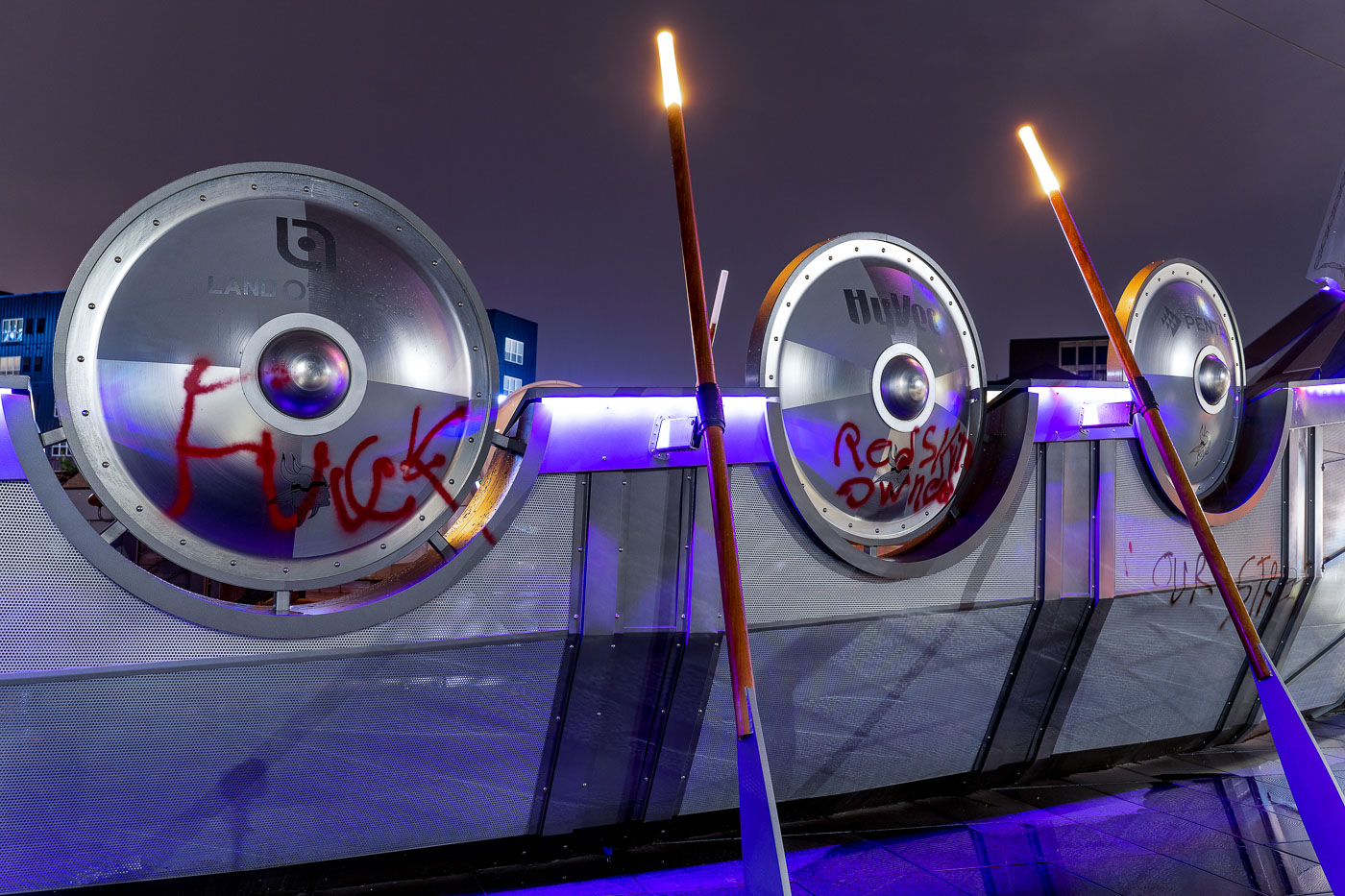
Graffiti on Vikings ship in Downtown Minneapolis.
Graffiti reading 'Fuck Redskins Owner' is visible on the Minnesota Vikings ship sculpture outside US Bank Stadium in Downtown Minneapolis. This act of vandalism occurred prior to a game between the Minnesota Vikings and the Washington Redskins, drawing attention to the long-standing controversy surrounding the Washington NFL team's name. The ship sculpture is a distinctive architectural feature of US Bank Stadium, which opened in 2016. Located in Downtown Minneapolis, the stadium serves as the home of the Minnesota Vikings and a major venue for sports and entertainment events.

Graffiti: ‘Fuck Redskins Owner’ on Vikings Ship, US Bank Stadium
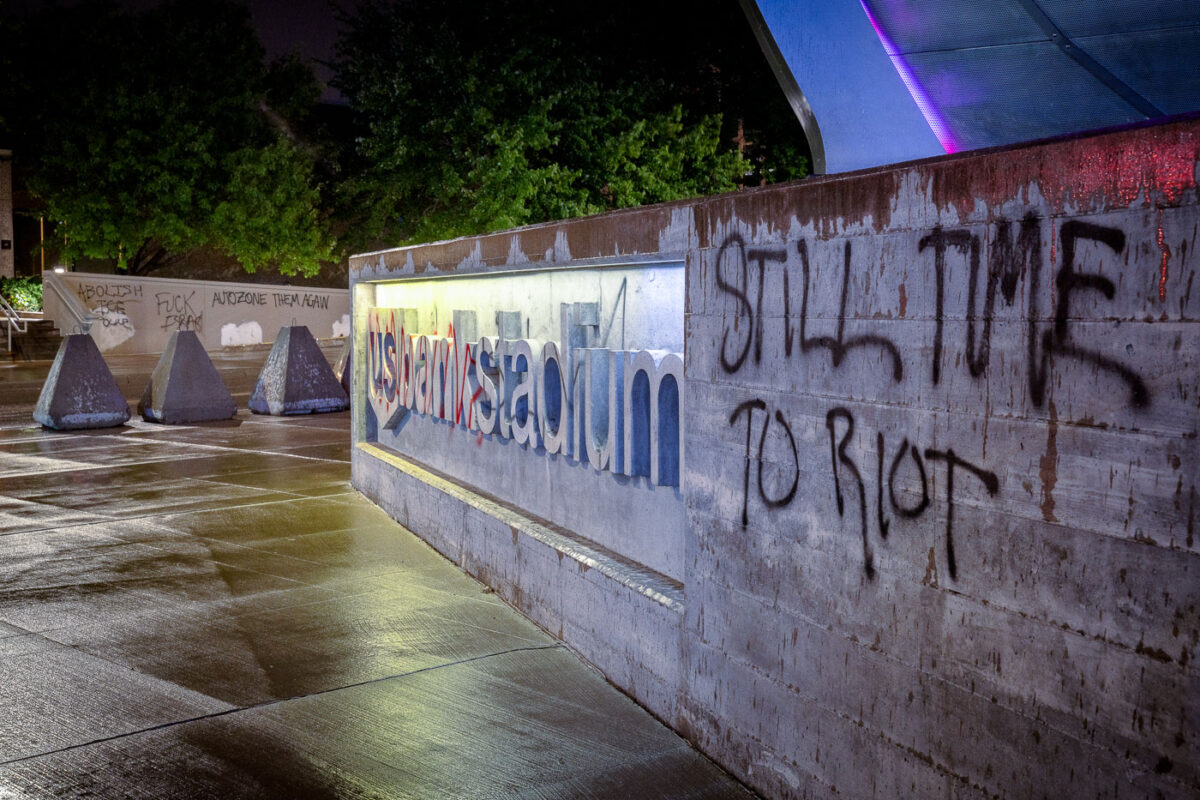
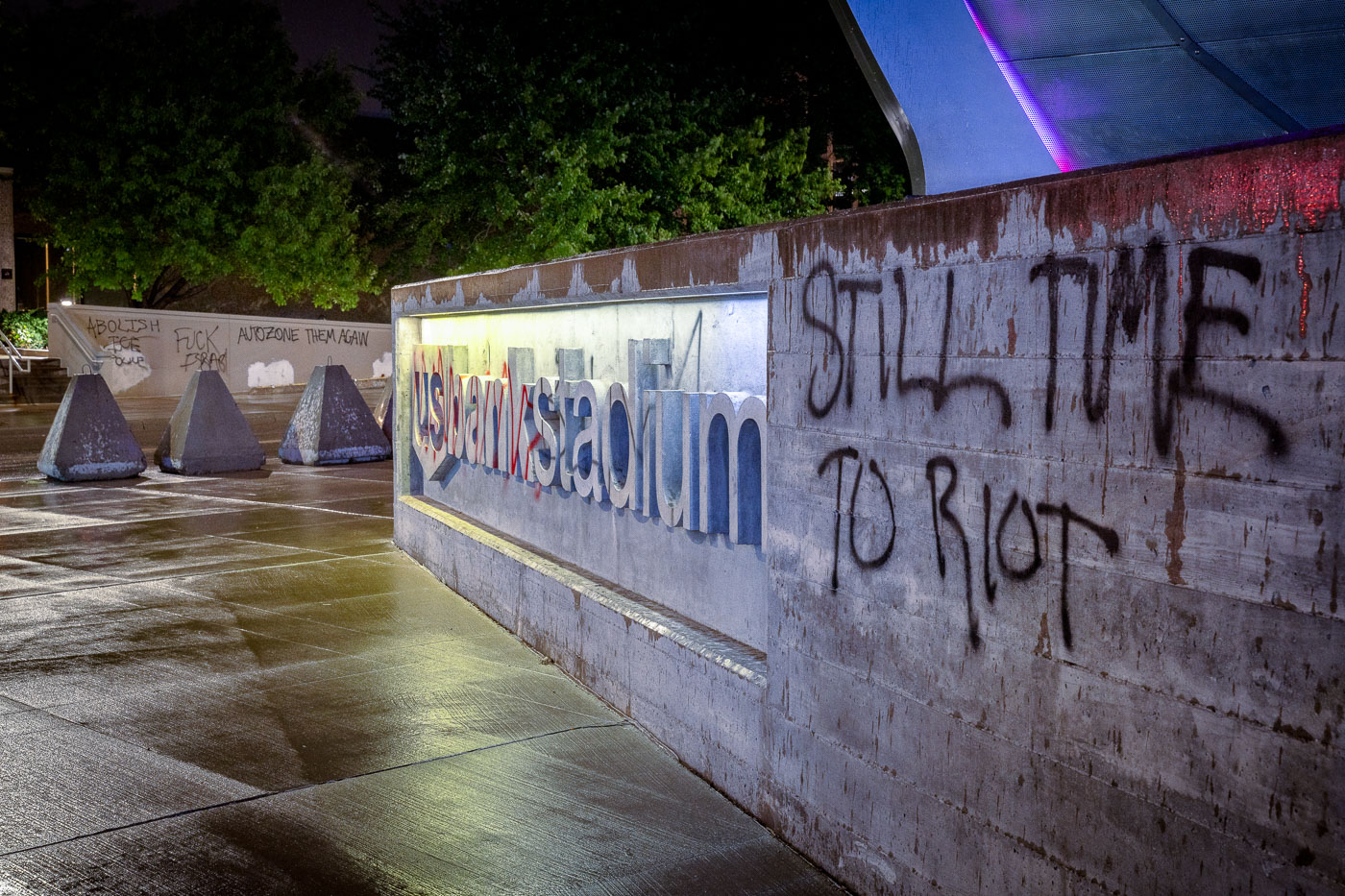
Still time to riot at US Bank Stadium
Graffiti reading 'Still time to riot' marks a concrete wall at US Bank Stadium in Downtown Minneapolis. This message, along with other protest-related inscriptions visible nearby, emerged during the Minneapolis Uprising of 2020. The multi-purpose stadium, completed in 2016, is the home of the Minnesota Vikings and a significant venue for major events in the city. The presence of such messages on public infrastructure underscores the period of intense social and political unrest that impacted Minneapolis.

US Bank Stadium Graffiti: ‘Still Time To Riot’, Minneapolis
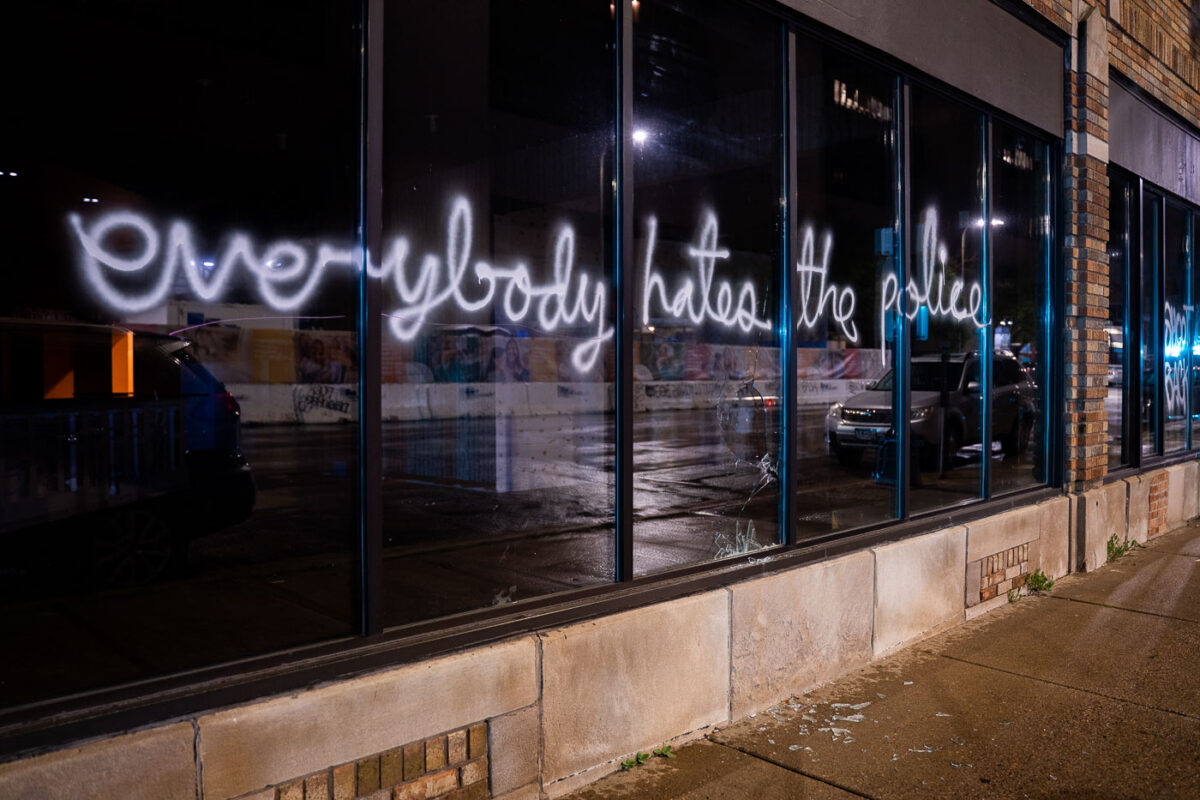
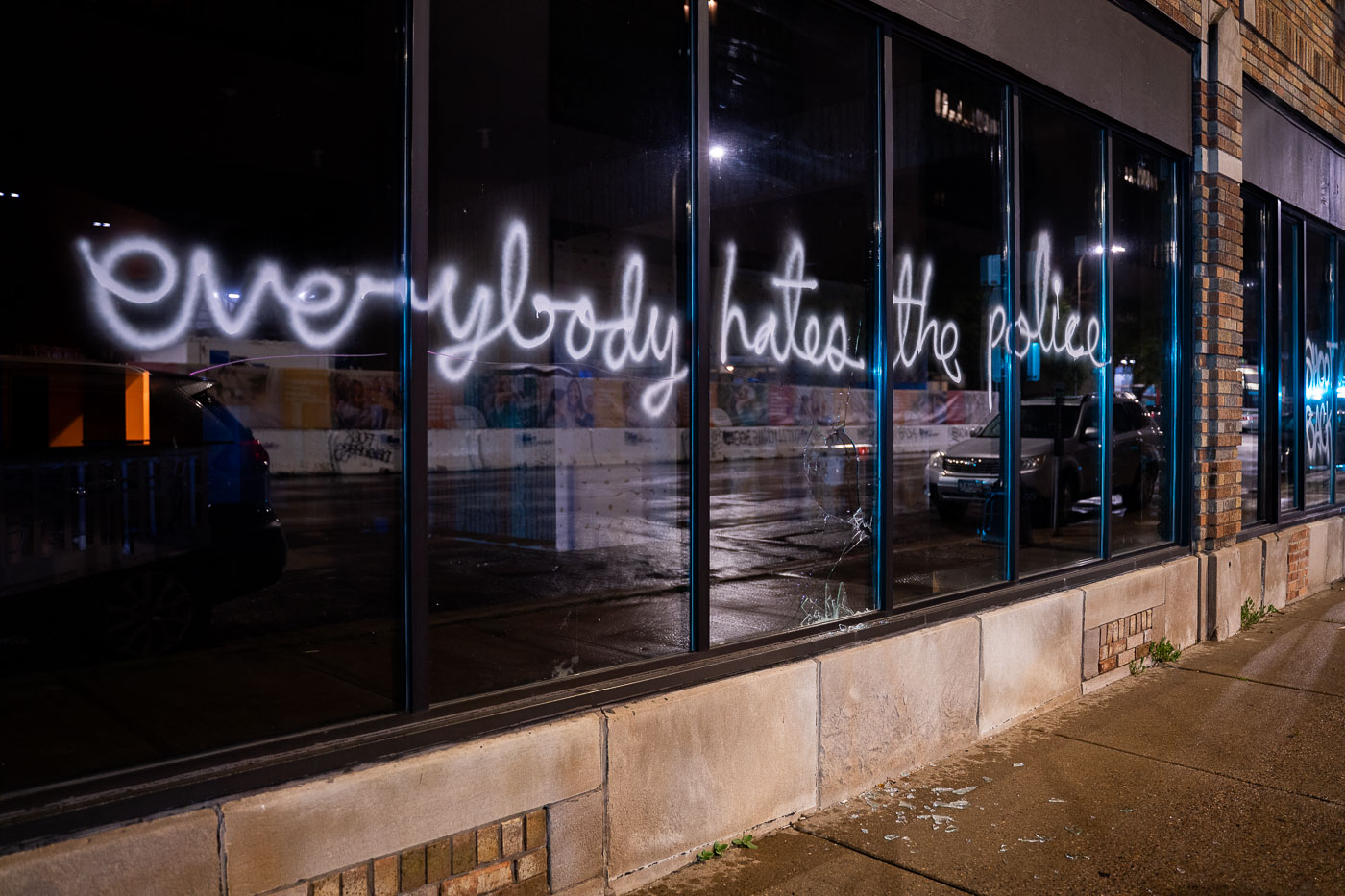
Everybody hates the police graffiti
Graffiti reading “Everybody Hates the Police” is visible on the windows of a building in downtown Minneapolis. This message emerged during the Minneapolis Uprising, a period of widespread protests and civil unrest that followed the killing of George Floyd in May 2020. The shattered window pane and concrete barriers in the background indicate the damage and security measures present in the area during this historically significant time. Such graffiti served as a direct expression of public sentiment and a visual record of the social and political climate in the city. It reflects the intense public discourse and community response to events that reshaped the urban landscape and social consciousness of Minneapolis.

“Everybody Hates the Police” Graffiti, Downtown Minneapolis
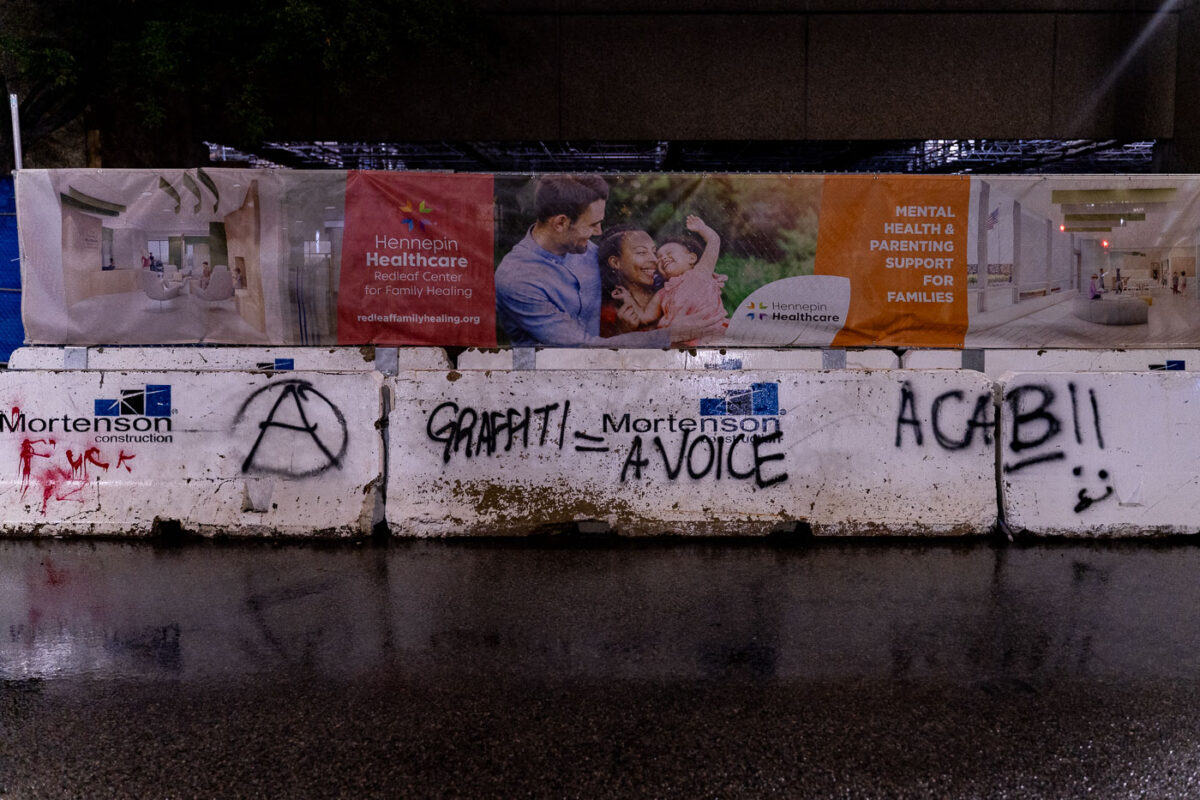
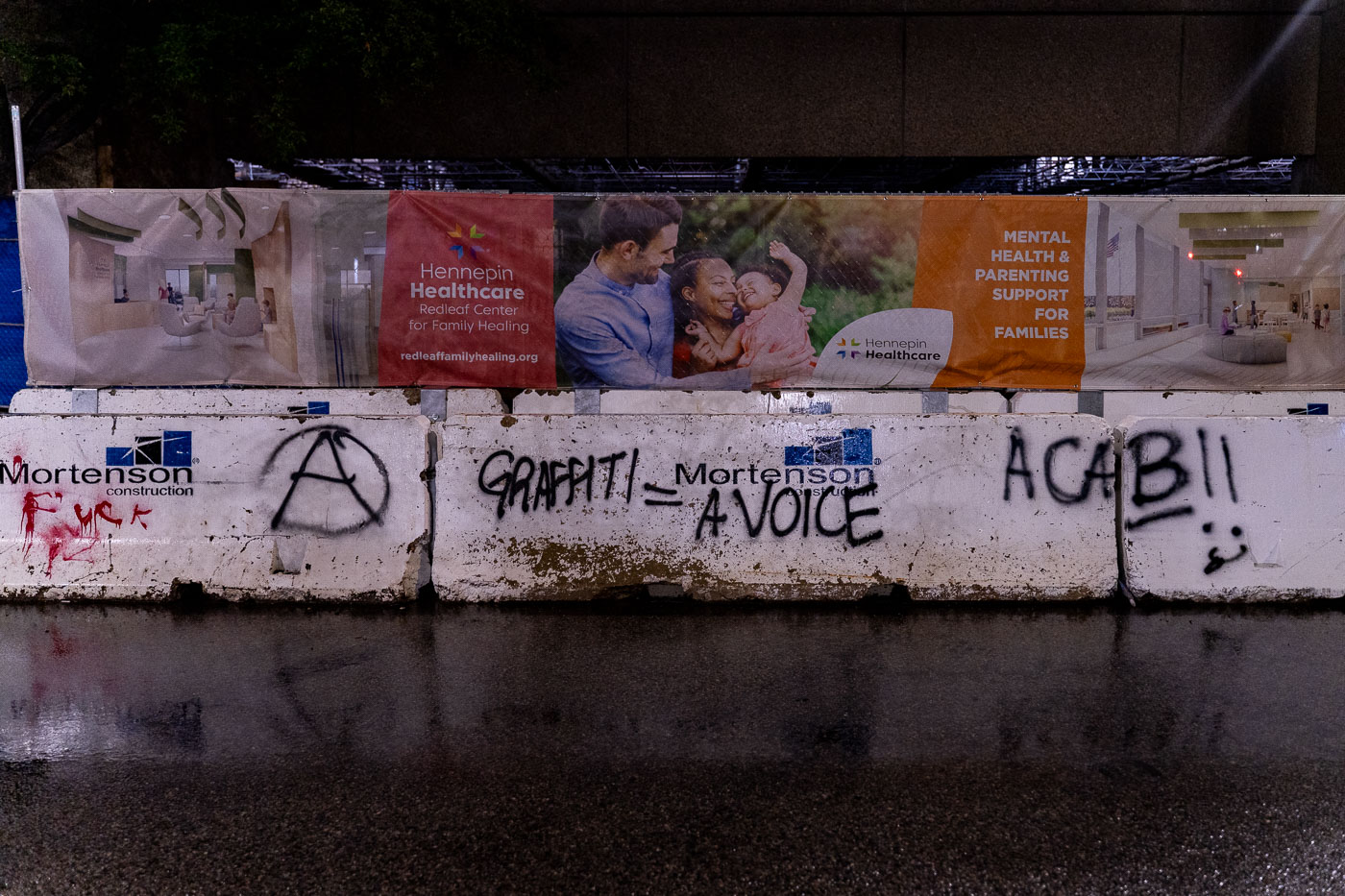
Graffiti equals a voice and ACAB graffiti
Concrete barricades in Downtown Minneapolis display graffiti, including the phrase 'Graffiti = A Voice,' alongside construction banners for Hennepin Healthcare. These barricades, often used for security or to delineate construction zones, became a canvas for public expression during the Minneapolis Uprising, reflecting a period of civil unrest and protest. Messages such as 'ACAB' and an anarchy symbol, alongside the statement 'Graffiti = A Voice,' underscore the role of street art as a form of dissent and communication in urban environments. The presence of Mortenson Construction branding on the barricades and Hennepin Healthcare banners above suggests an active construction site where temporary infrastructure intersected with public discourse.

“Graffiti = A Voice” on Downtown Minneapolis Barricades
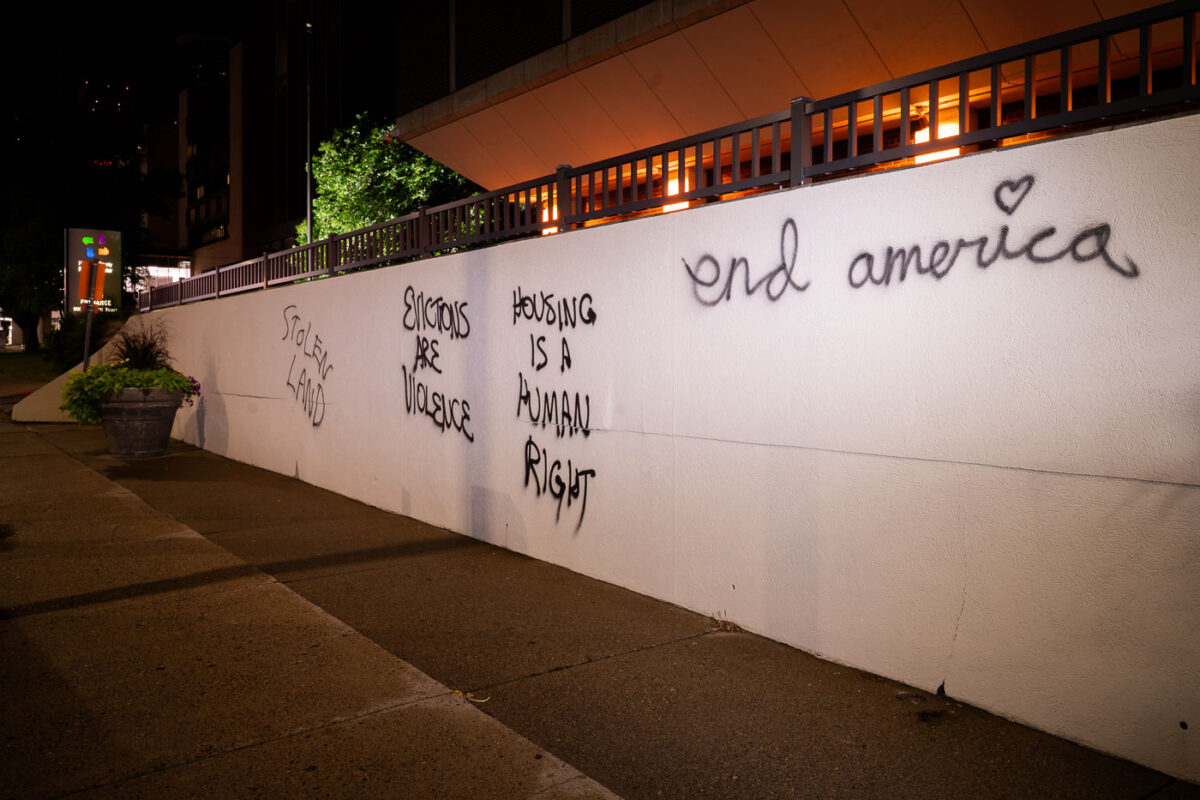
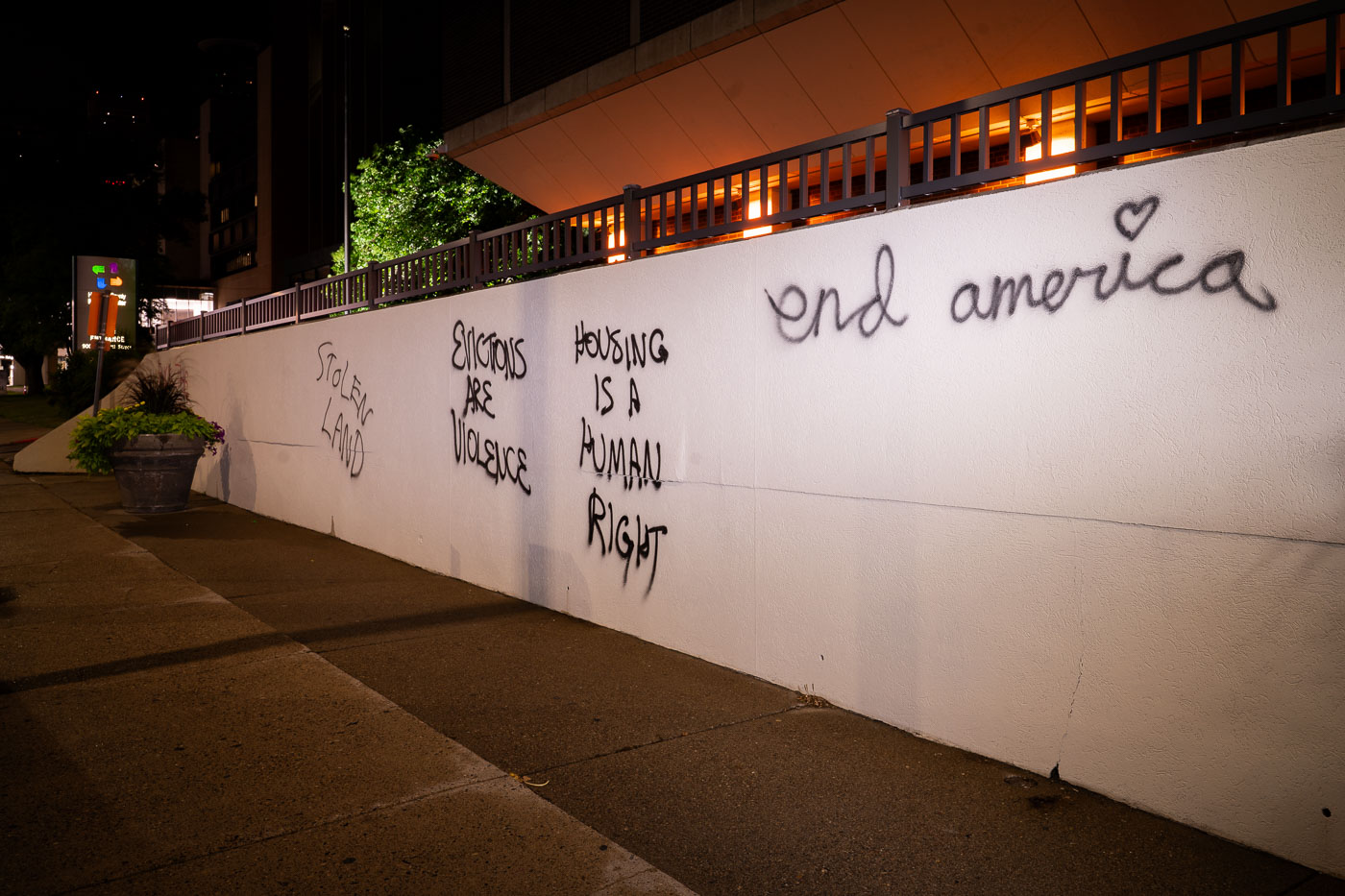
Housing is a human right graffiti on a building
Graffiti expressing messages such as "Stolen Land," "Evictions Are Violence," and "Housing Is A Human Right" is visible on a wall of the Hennepin County Medical Center in Downtown Minneapolis. These messages reflect themes of housing insecurity and social justice that gained prominence during the Minneapolis Uprising and subsequent protests in the city. As a major public hospital, Hennepin County Medical Center serves a diverse population in Minneapolis, making its exterior a visible site for public commentary on social issues. The phrases highlight ongoing discussions about land ownership, the right to housing, and systemic inequalities within urban environments.

Hennepin County Medical Center Graffiti: Housing is a Human Right
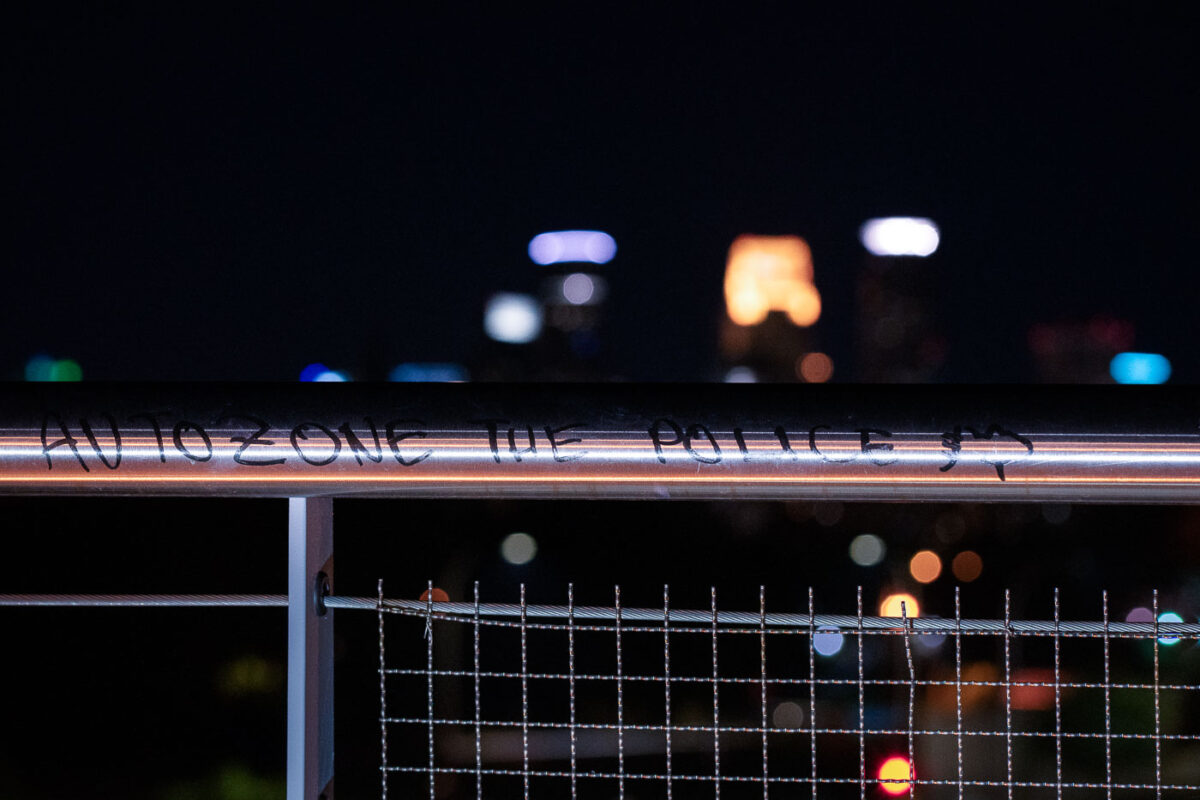
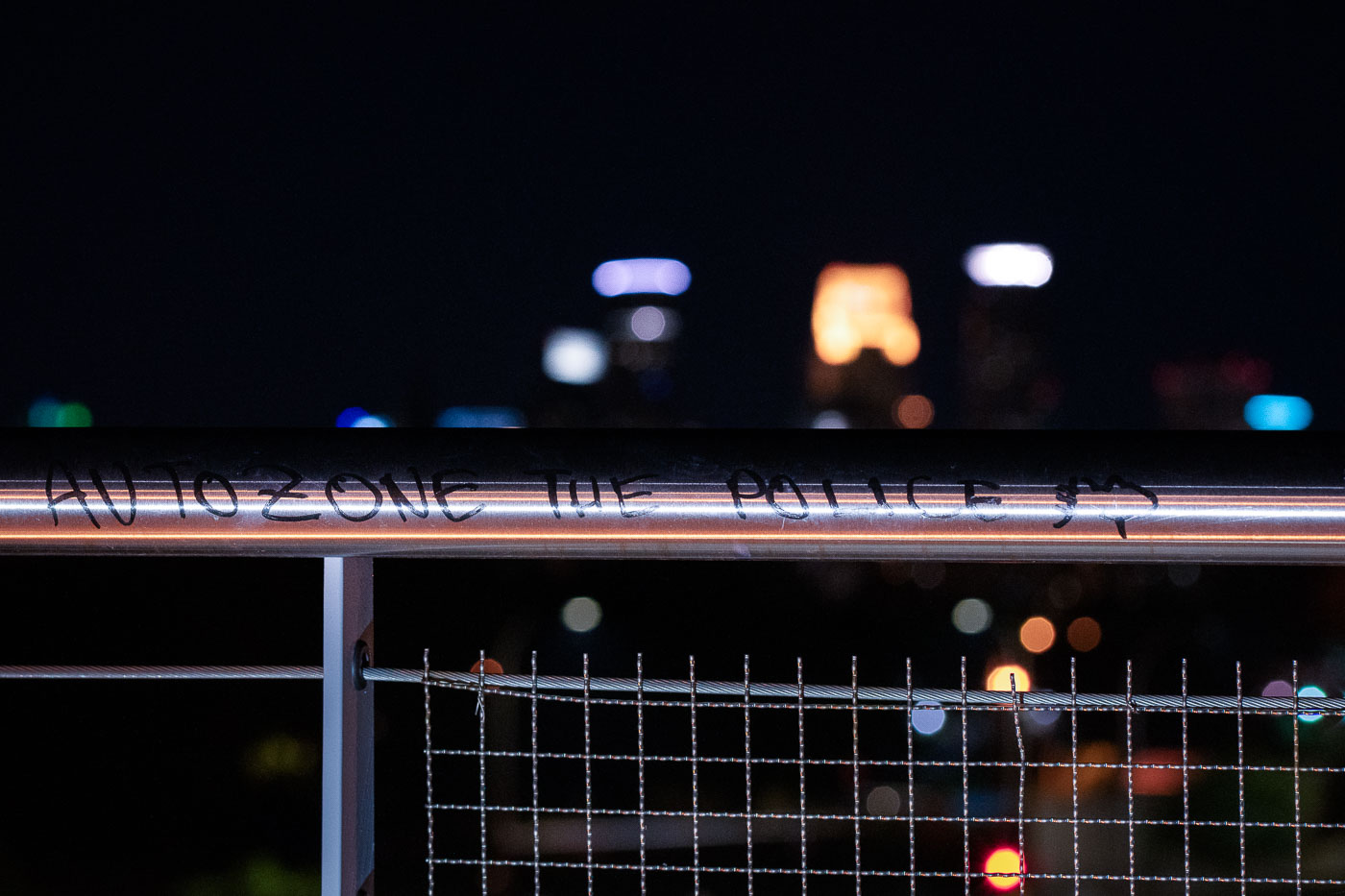
Graffiti reading "Autozone the police" on the Martin Olav Sabo Bridge railing in Minneapolis.
The Martin Olav Sabo Bridge carries the Midtown Greenway bike and pedestrian trail over Hiawatha Avenue and the METRO Blue Line tracks in Minneapolis. Built in 2007 and named for the longtime Minnesota congressman, the bridge links the Greenway to Minnehaha Avenue near the Midtown Farmers Market. The phrase "Autozone the police," written on its railing, refers to the AutoZone store on Lake Street that became the first building burned during the unrest following George Floyd's murder.

‘Autozone the Police’ Graffiti on the Martin Olav Sabo Bridge
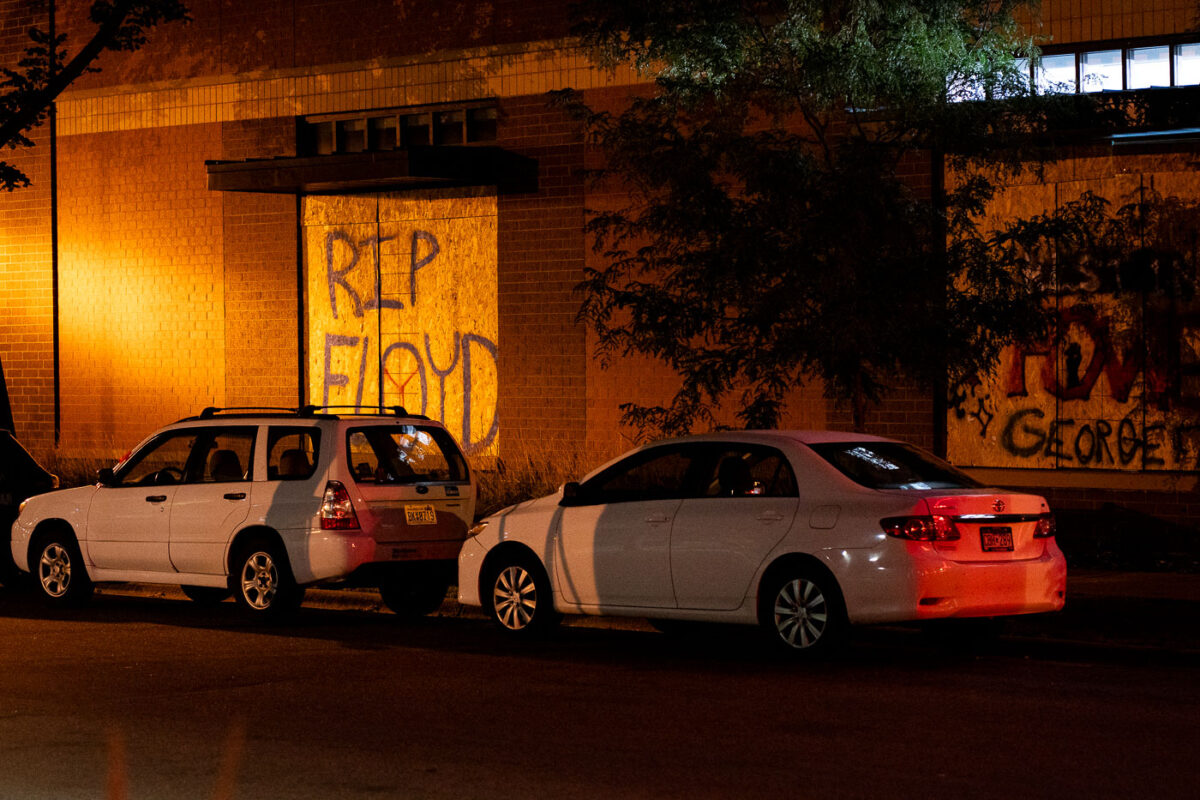
Graffiti reading "RIP FLOYD" and "LOVE GEORGE" on boarded Walgreens storefront, Hennepin Avenue, Minneapolis, August 2020.
Plywood covered this Walgreens on Hennepin Avenue after windows were broken during the unrest following George Floyd's death in police custody on May 25, 2020. Business owners across Minneapolis boarded up storefronts in the days that followed, and many of those panels turned into makeshift memorials and message boards. Here, someone spray-painted "RIP FLOYD" alongside a raised fist and the words "LOVE GEORGE," part of a wave of street tributes that spread through the city's commercial corridors that summer.

‘RIP Floyd’ Graffiti on a Boarded-Up Hennepin Avenue Walgreens
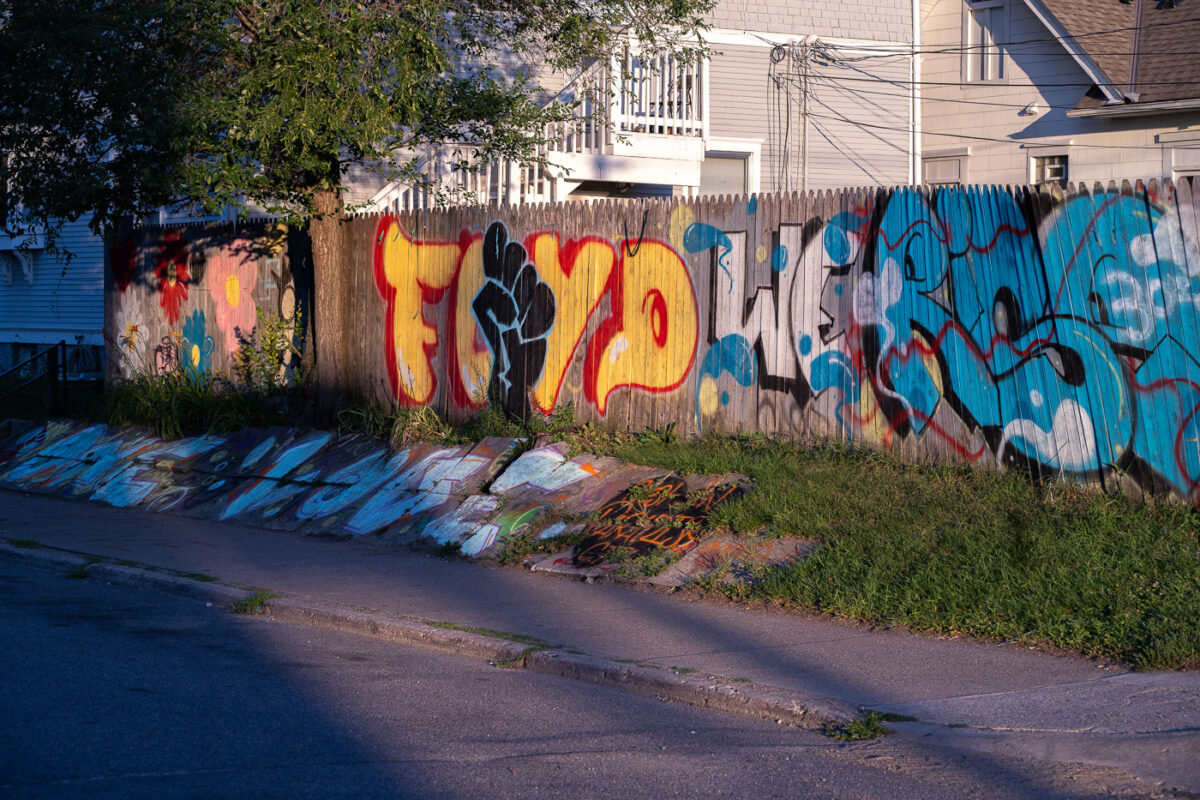
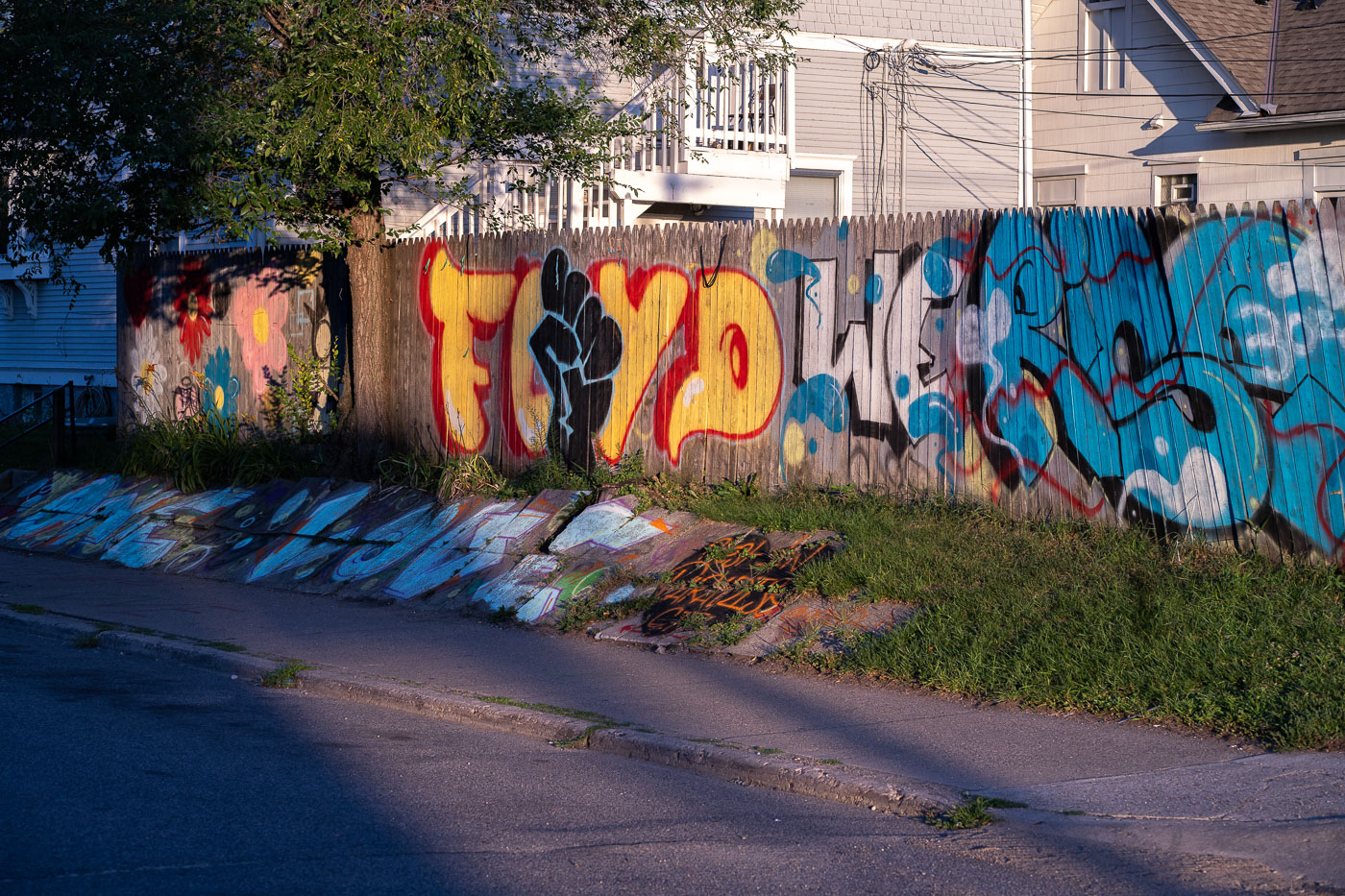
Graffiti mural with "FLOYD" text and raised fist on wooden fence at George Floyd Square, Minneapolis.
A George Floyd mural on a fence near near George Floyd Square. "ONE LOVE" written in the grass.

“FLOYD” Fence Mural Near George Floyd Square
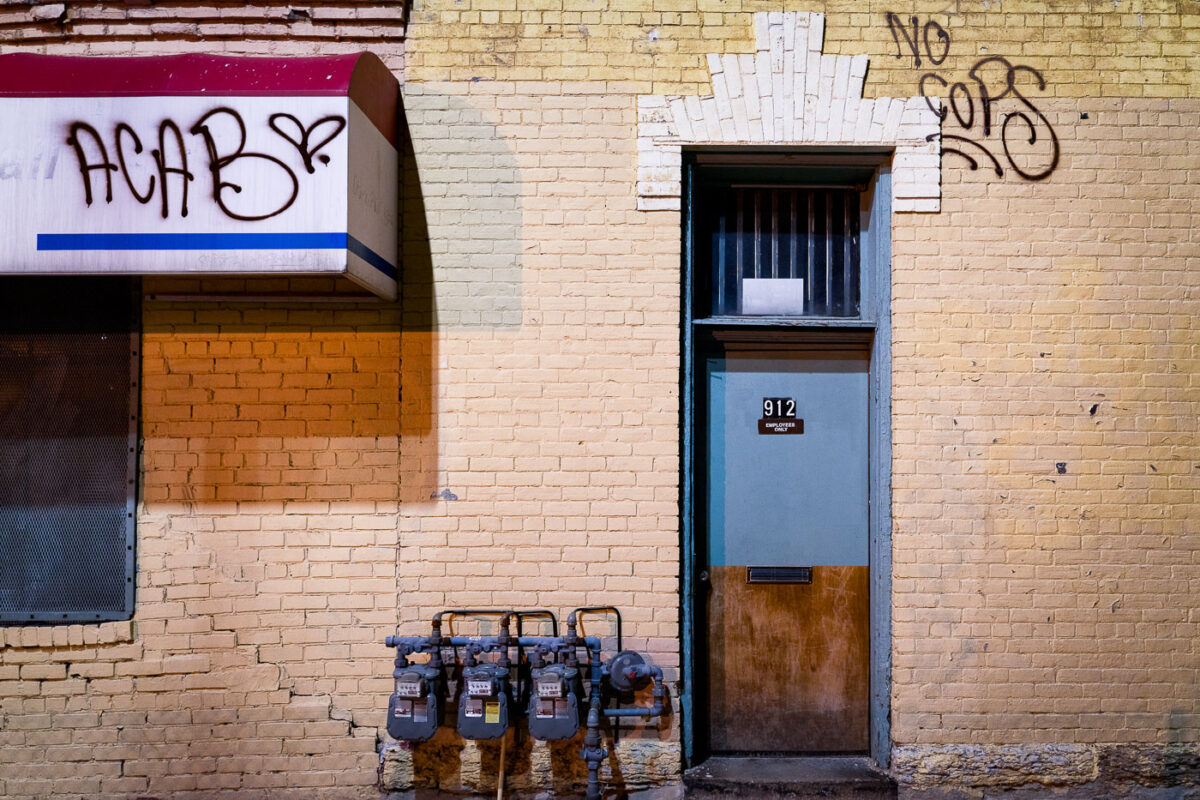
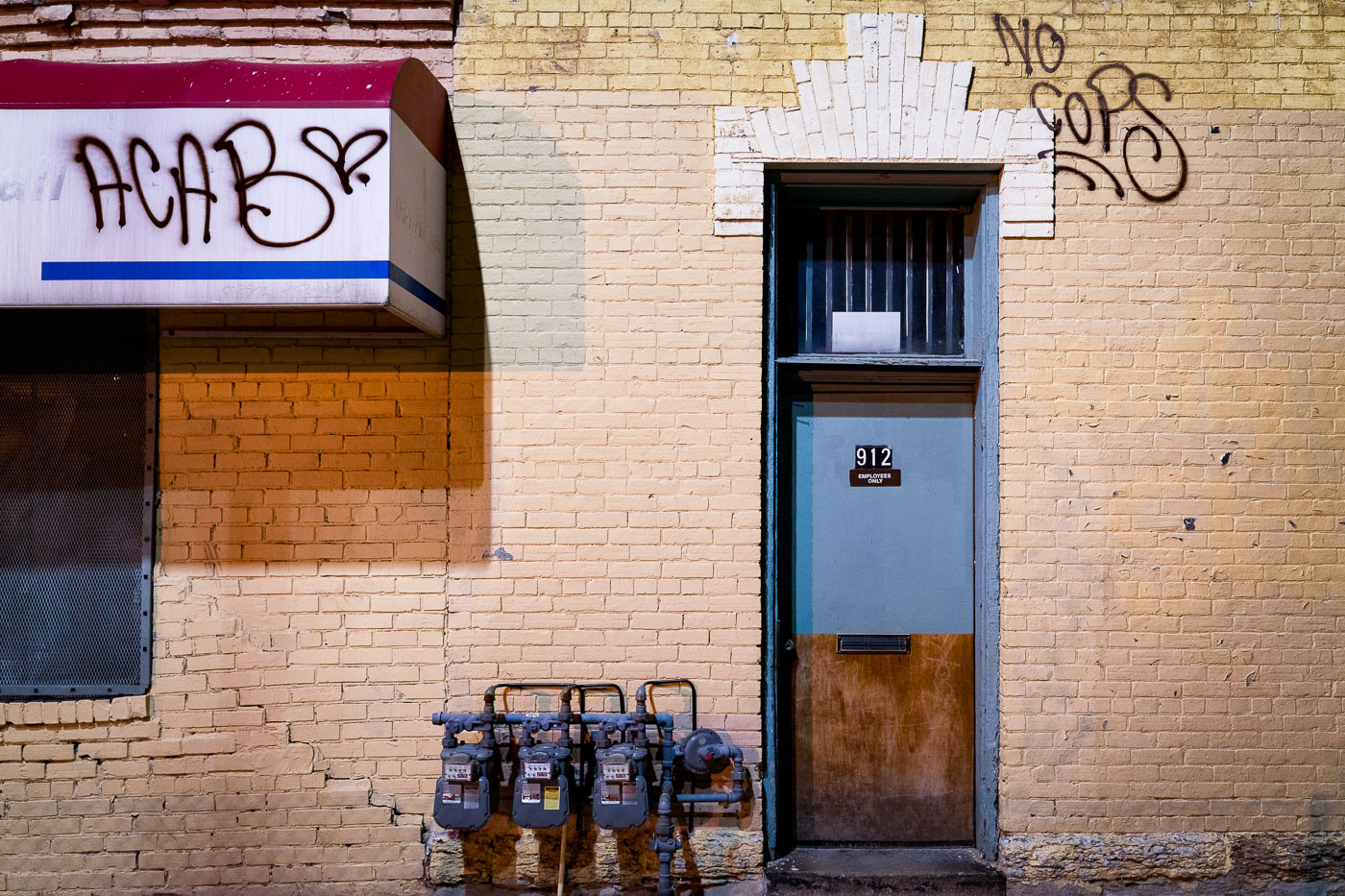
ACAB and No Cops graffiti on downtown Minneapolis building
Graffiti reading "ACAB" and "NO COPS" marks a brick building in downtown Minneapolis.

ACAB and NO COPS Graffiti on Downtown Minneapolis Building

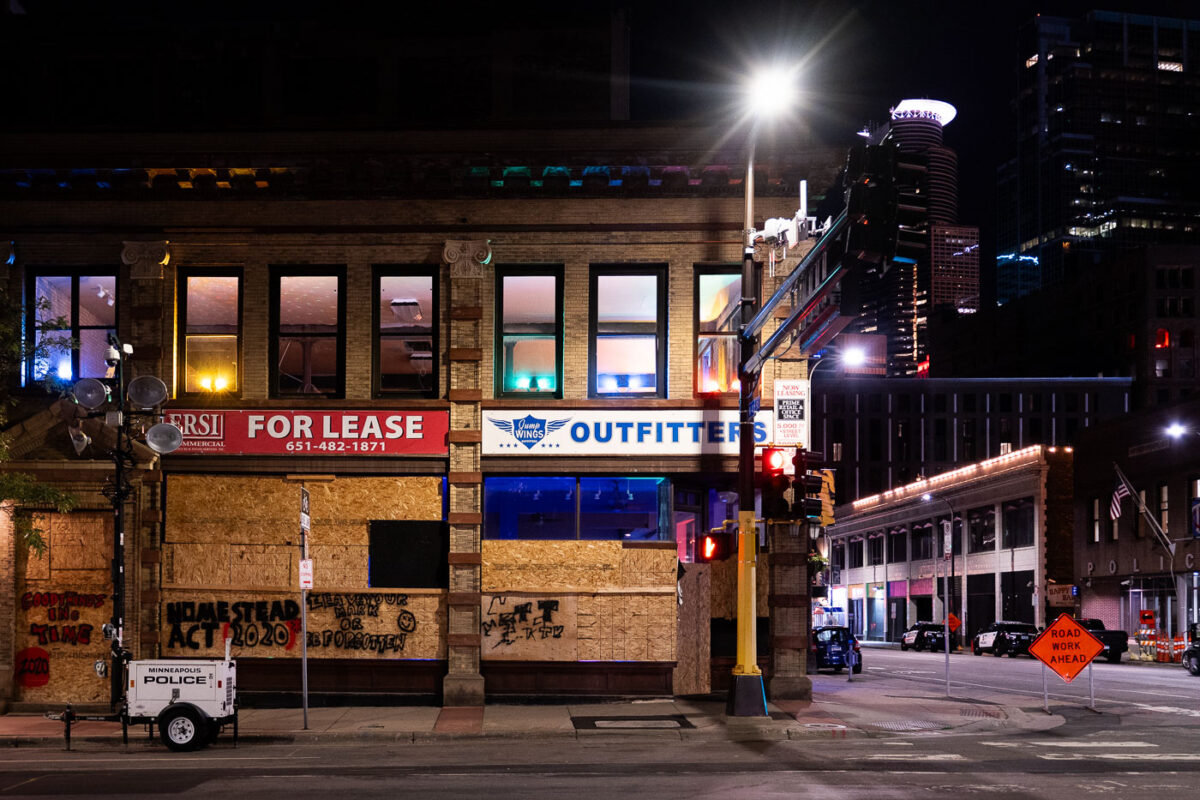
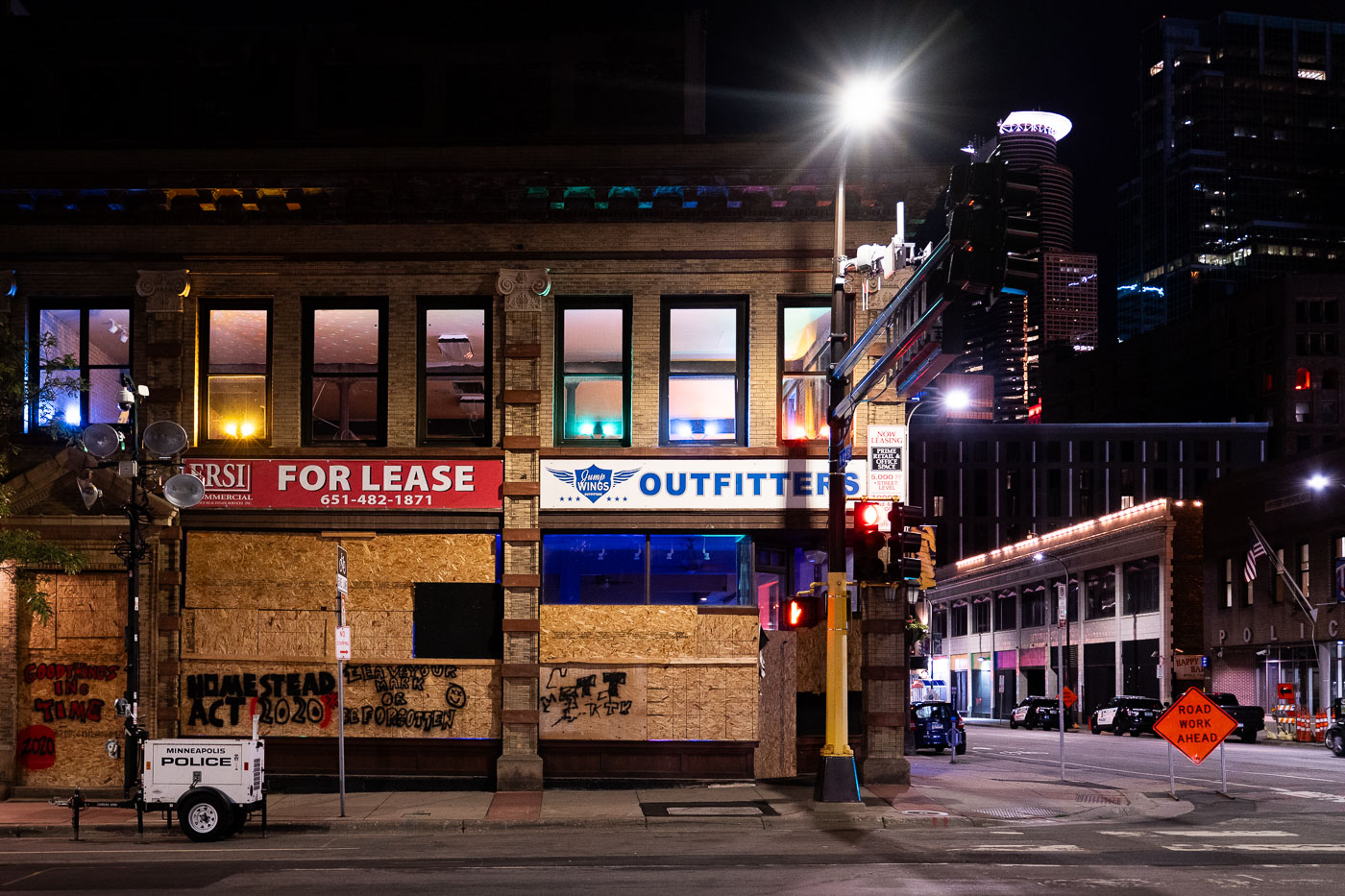
Minneapolis police surveillance camera in downtown Minneapolis
Boarded-up commercial buildings line a street in Downtown Minneapolis in August 2020. A Minneapolis Police mobile surveillance camera is positioned in the foreground, providing additional security monitoring near the boarded storefronts, which are located around the corner from the Minneapolis Police First Precinct station.

Downtown Minneapolis Boarded Buildings, Police Camera, Aug 2020

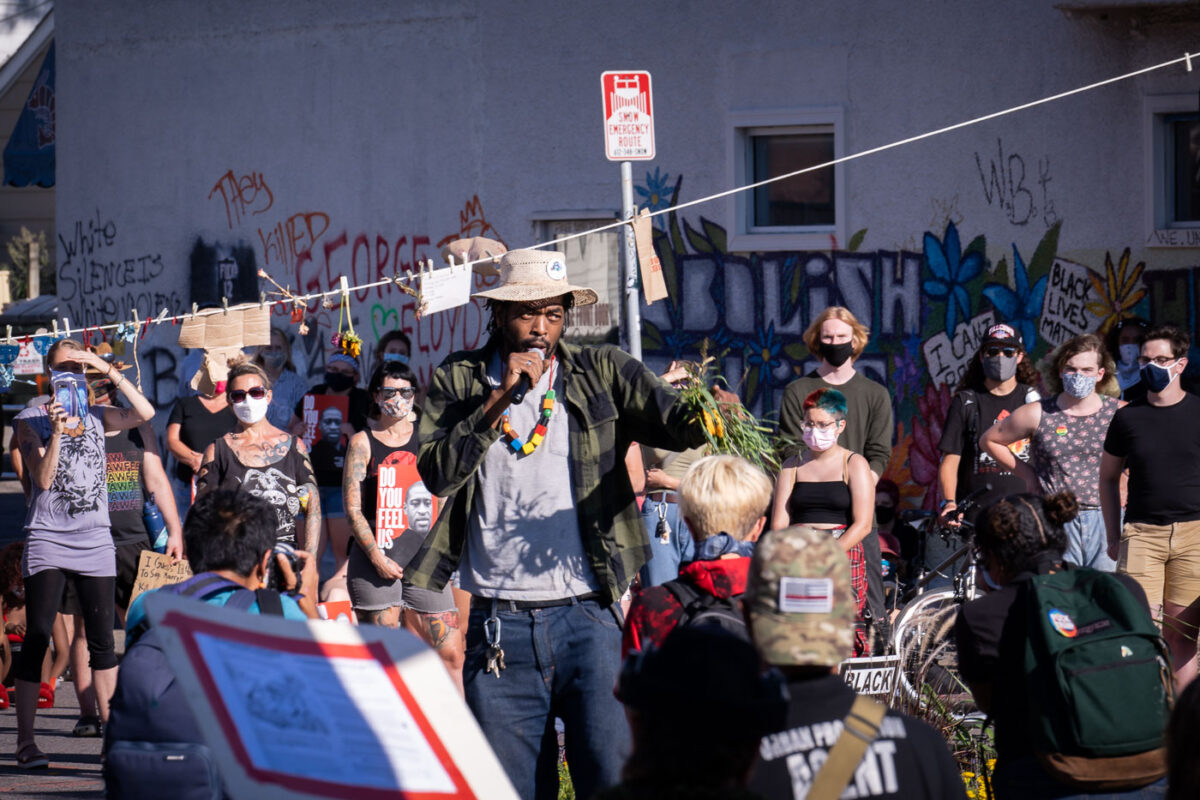
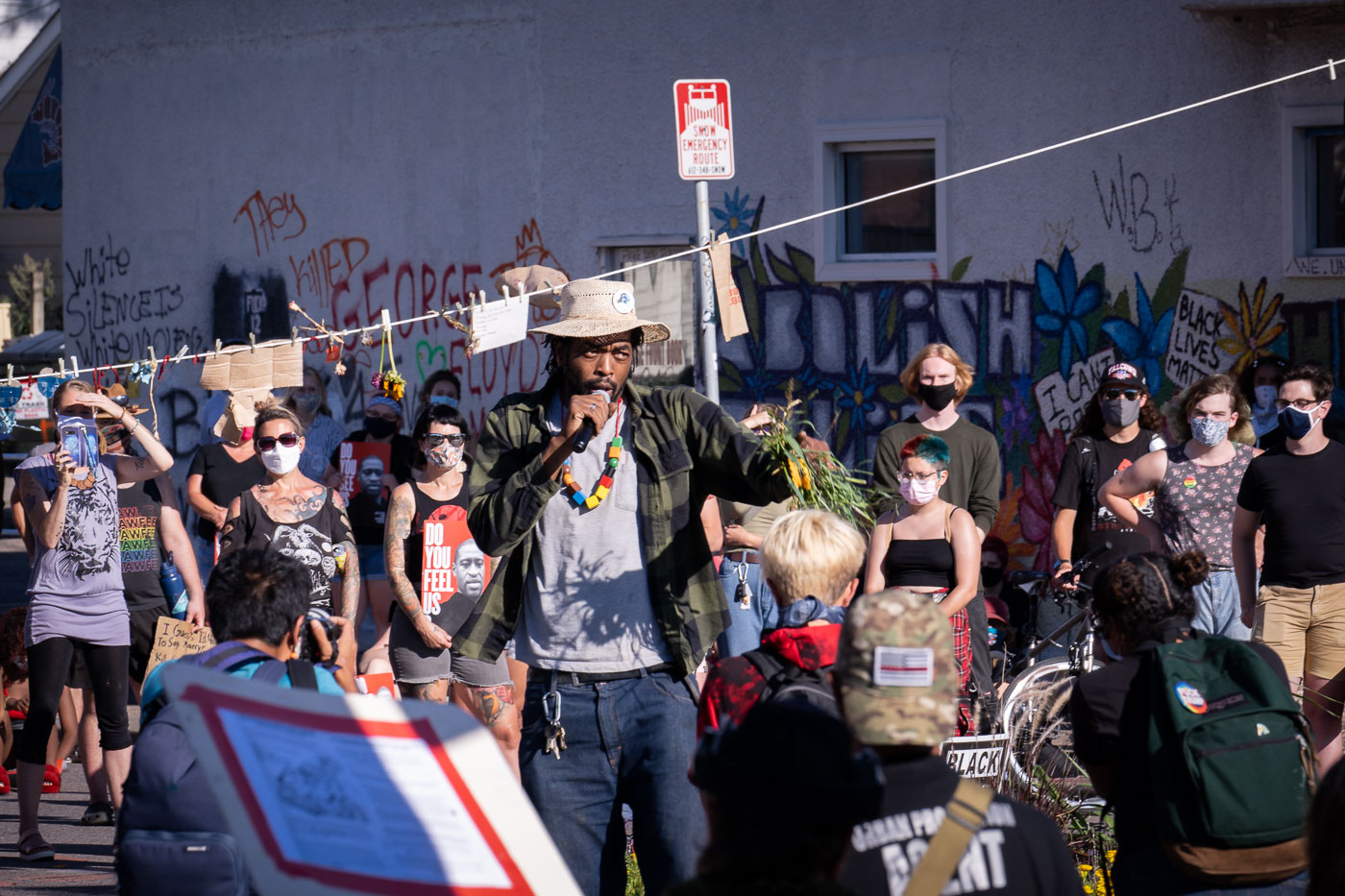
George Floyd Square garden caretaker Jay Webb
Jay Webb, caretaker of the George Floyd Square garden, addresses a gathering at a protest in Minneapolis. The rally took place at George Floyd Square, located at the intersection of Chicago Avenue and East 38th Street, a site that became a permanent memorial and protest space after the murder of George Floyd in May 2020. This particular protest occurred on a day when President Trump was visiting the city, adding to the local activism. The surrounding walls feature protest graffiti, including phrases like "Black Lives Matter" and "Abolish," reflecting the ongoing calls for justice and systemic change.

George Floyd Square Caretaker Jay Webb at Minneapolis Rally
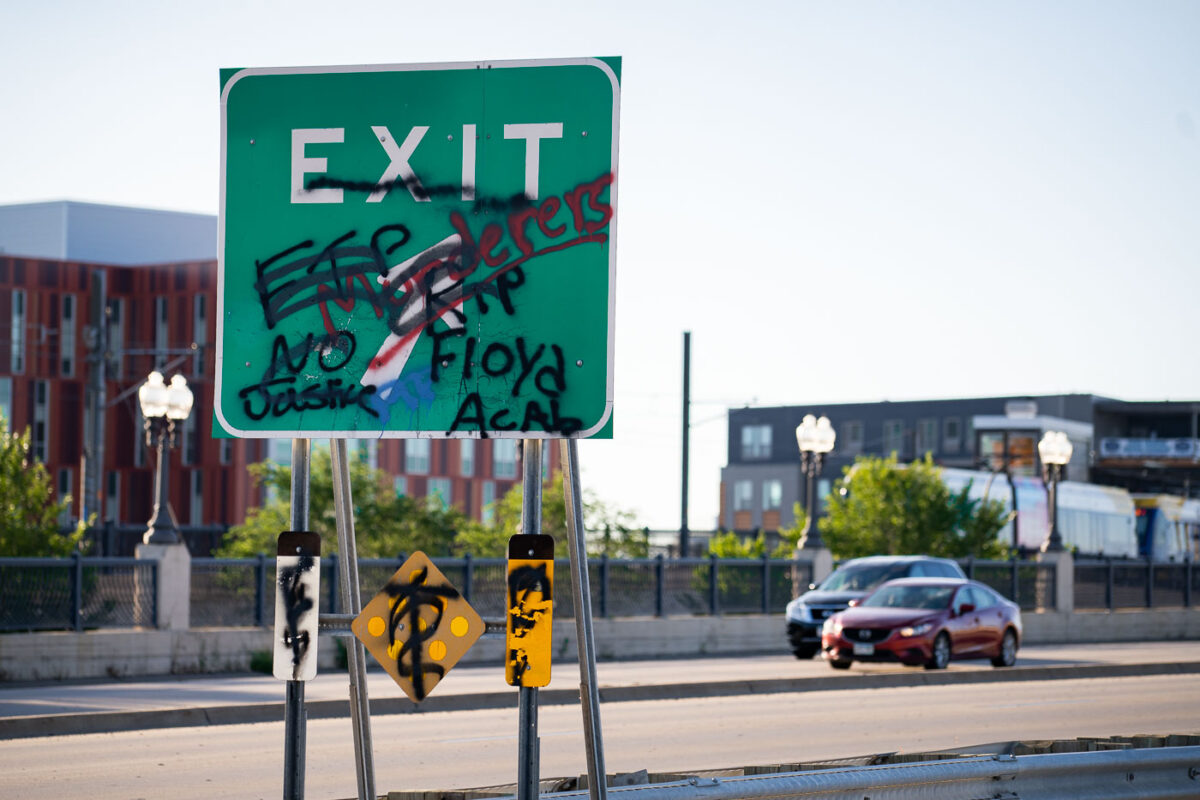
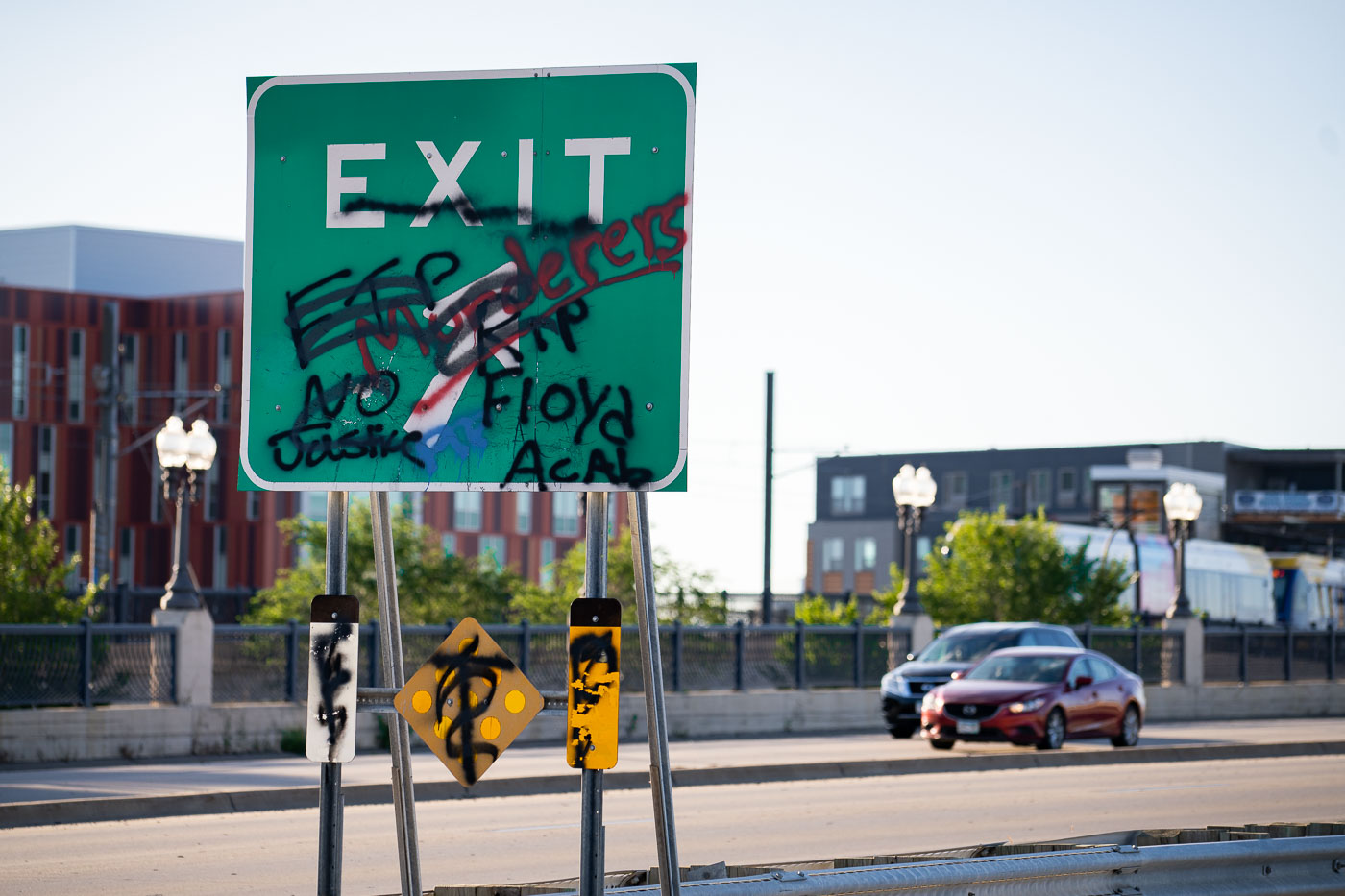
Haiwatha exit sign with graffiti
Graffiti covers an exit sign on Haiwatha Avenue in Minneapolis. This act of protest art, documented on August 17, 2020, emerged during the Minneapolis Uprising following the murder of George Floyd. Messages such as "Floyd" and "ACAB" reflect the widespread public outcry and calls for police accountability that characterized the period.

Haiwatha Avenue Exit Sign Graffiti, August 17, 2020

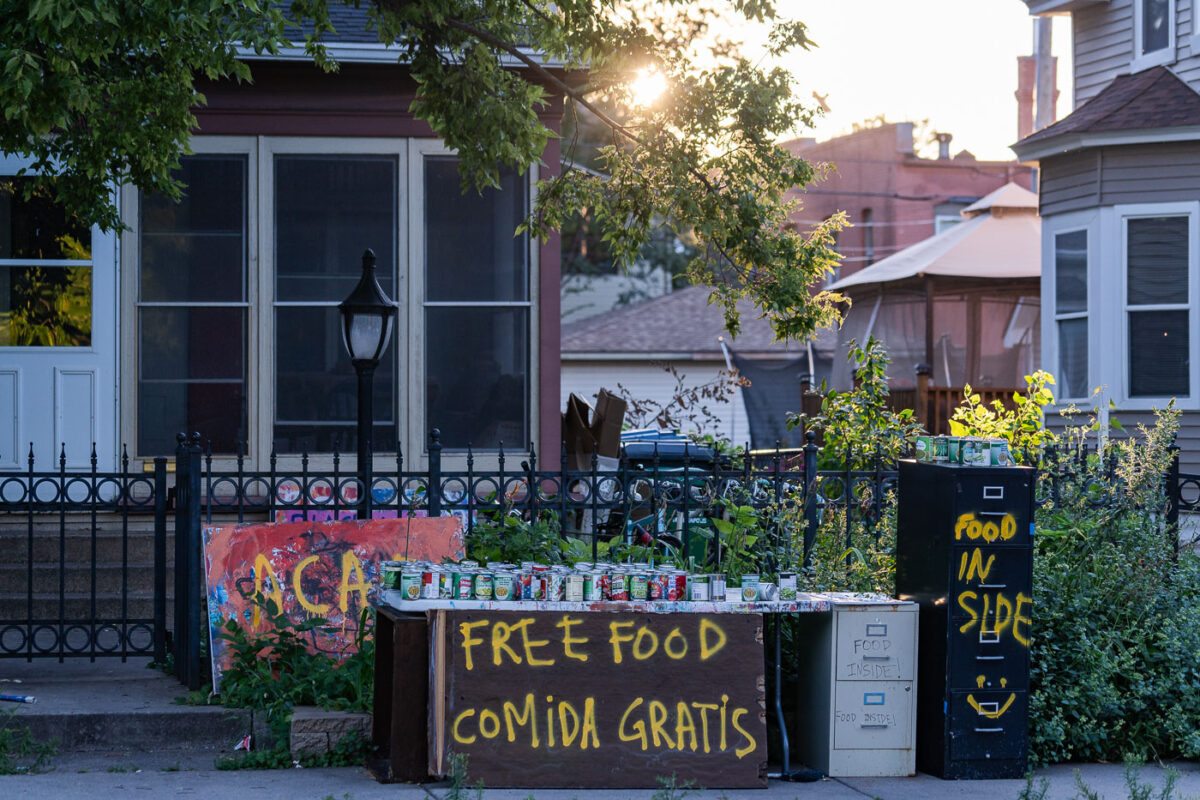
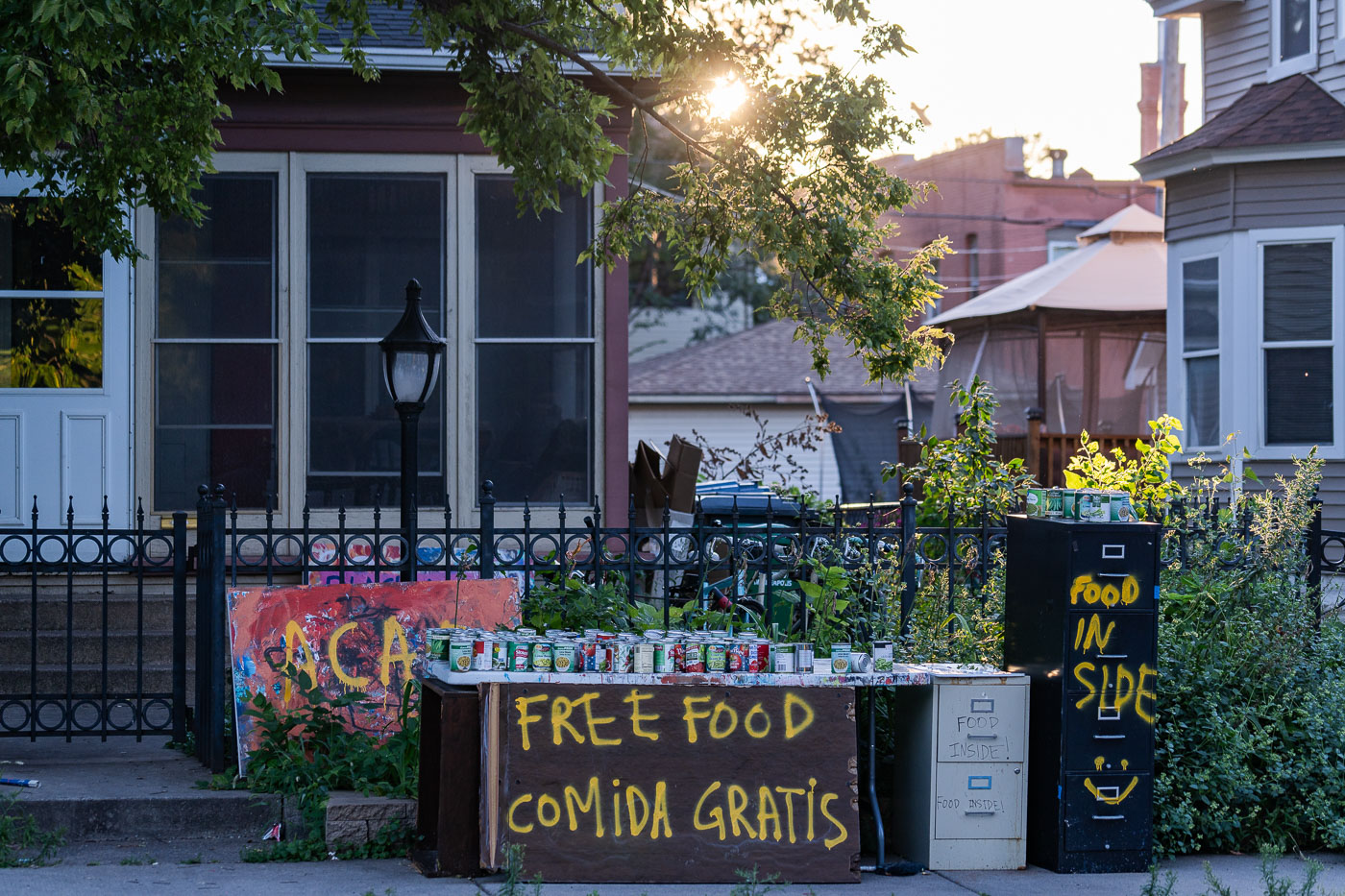
Free food comida gratis in South Minneapolis
A community food shelf operates on a sidewalk in a South Minneapolis neighborhood on August 17, 2020. This mutual aid initiative provides free food, indicated by the "FREE FOOD COMIDA GRATIS" signage, to residents. addressing immediate needs.

South Minneapolis Community Food Shelf

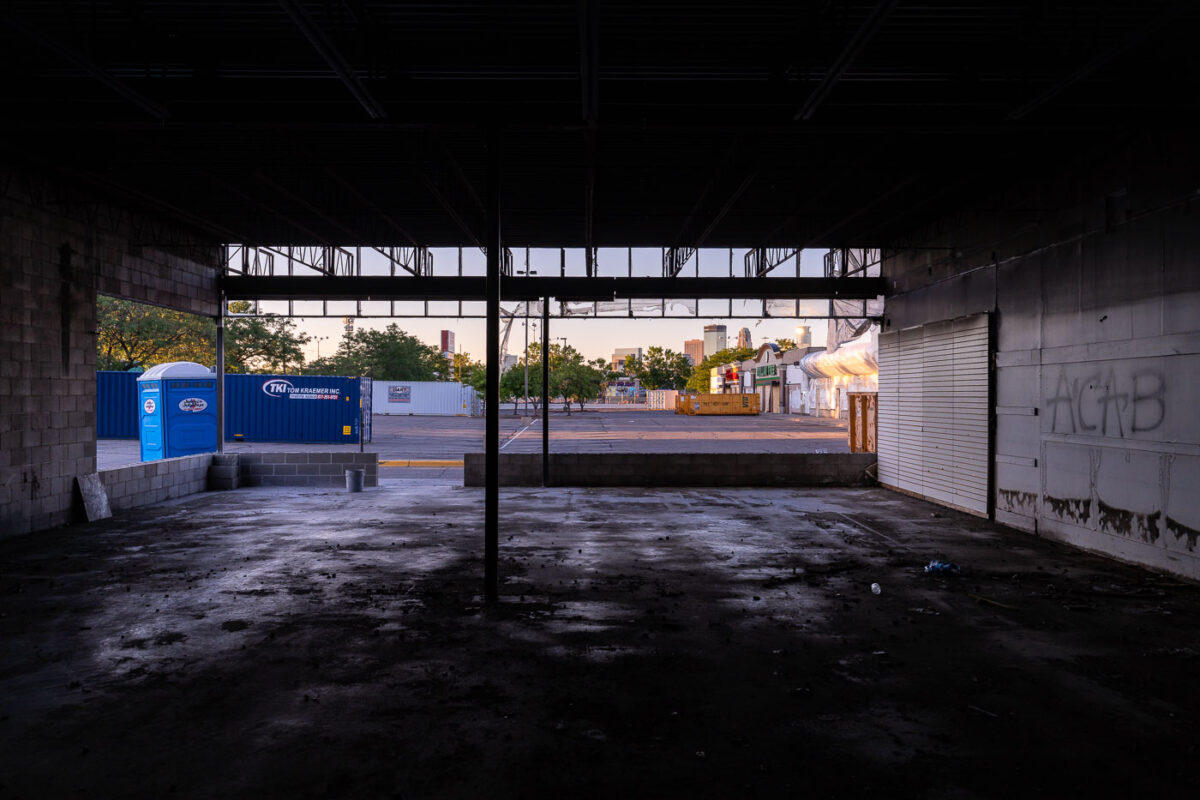
Inside riot damaged strip mall in August 2020
The interior of a strip mall undergoing renovation in South Minneapolis, located across from the Minneapolis 5th Police Precinct. This commercial property sustained significant damage during the protests that occurred in May 2020, following the death of George Floyd.

Minneapolis Burned Strip Mall Renovation Post-2020 Protests

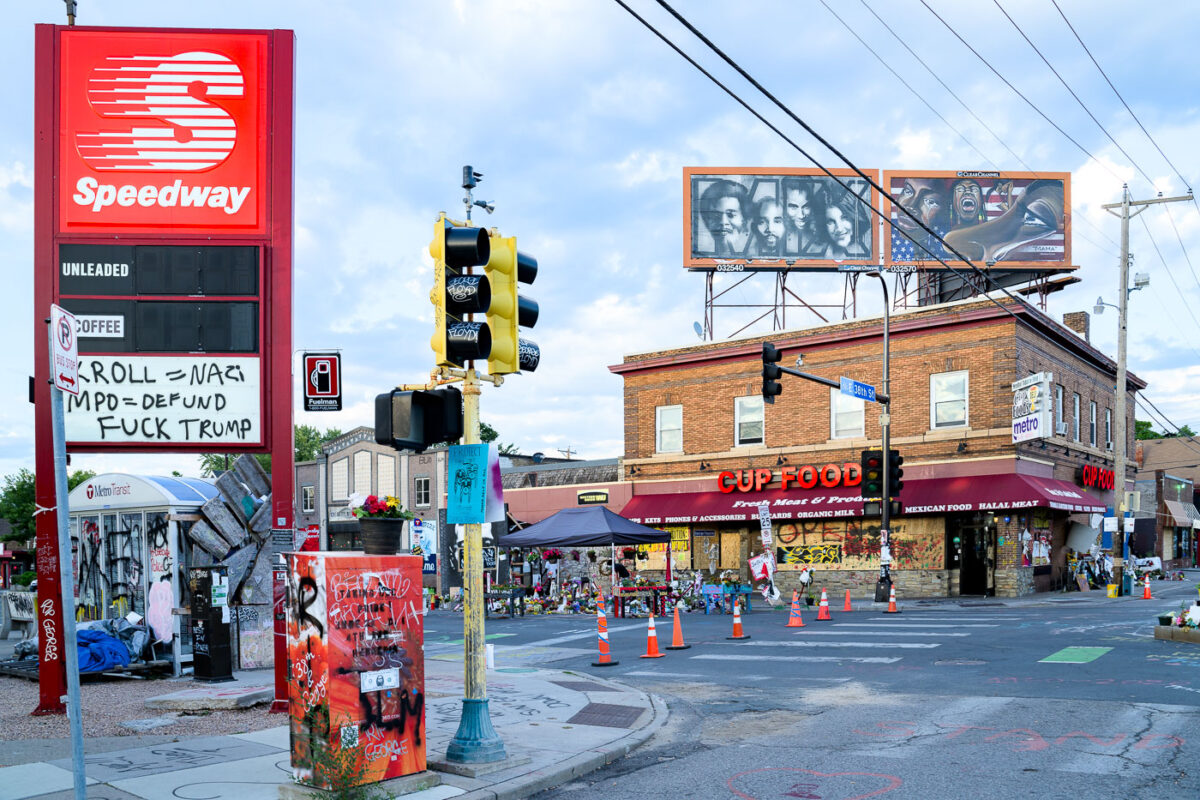
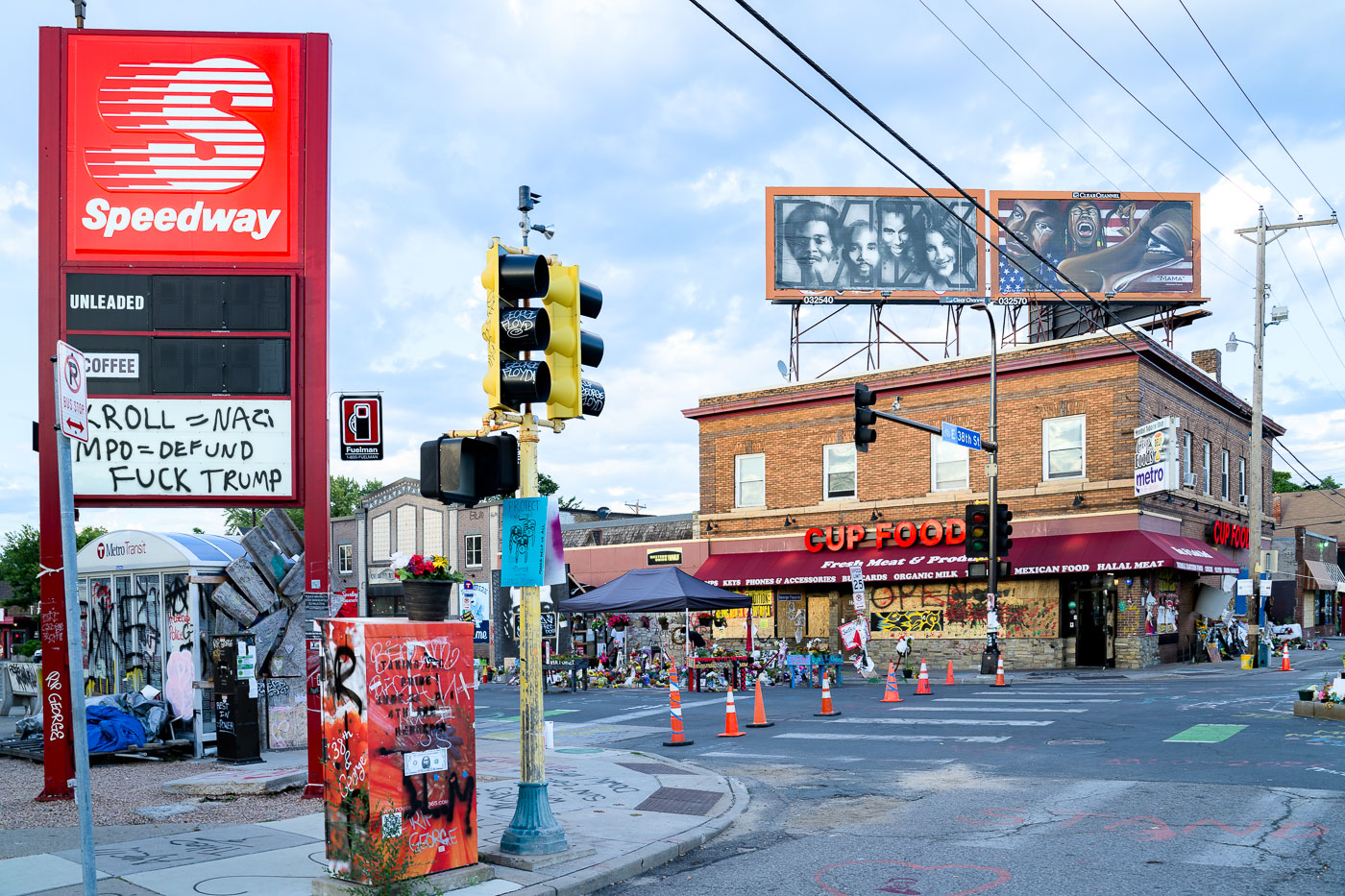
MPD defund fuck trump at George Floyd Square
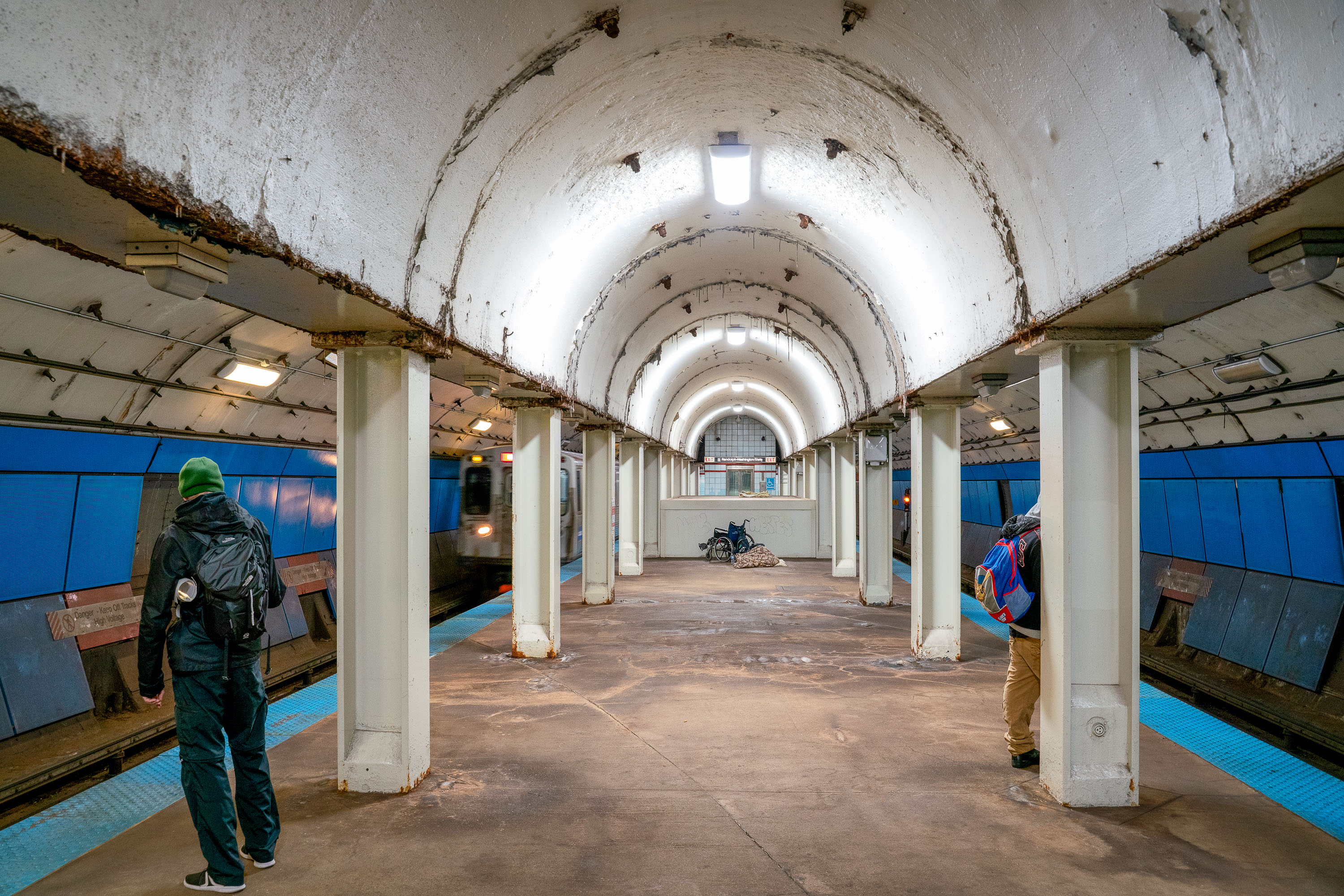
George Floyd Square, located at the intersection of Chicago Avenue and East 38th Street in Minneapolis, is shown on August 19, 2020. This site became a community-maintained memorial and protest zone following the murder of George Floyd by Minneapolis police on May 25, 2020, outside the adjacent Cup Foods. The Speedway gas station sign displays protest messages such as "MPD = DEFUND" and "FUCK TRUMP," while the surrounding area features numerous tributes, graffiti, and art installations. The square functioned as an autonomous zone for a period, serving as a gathering place for activism, remembrance, and community support.

George Floyd Square: Defund MPD, Fuck Trump on Speedway Sign

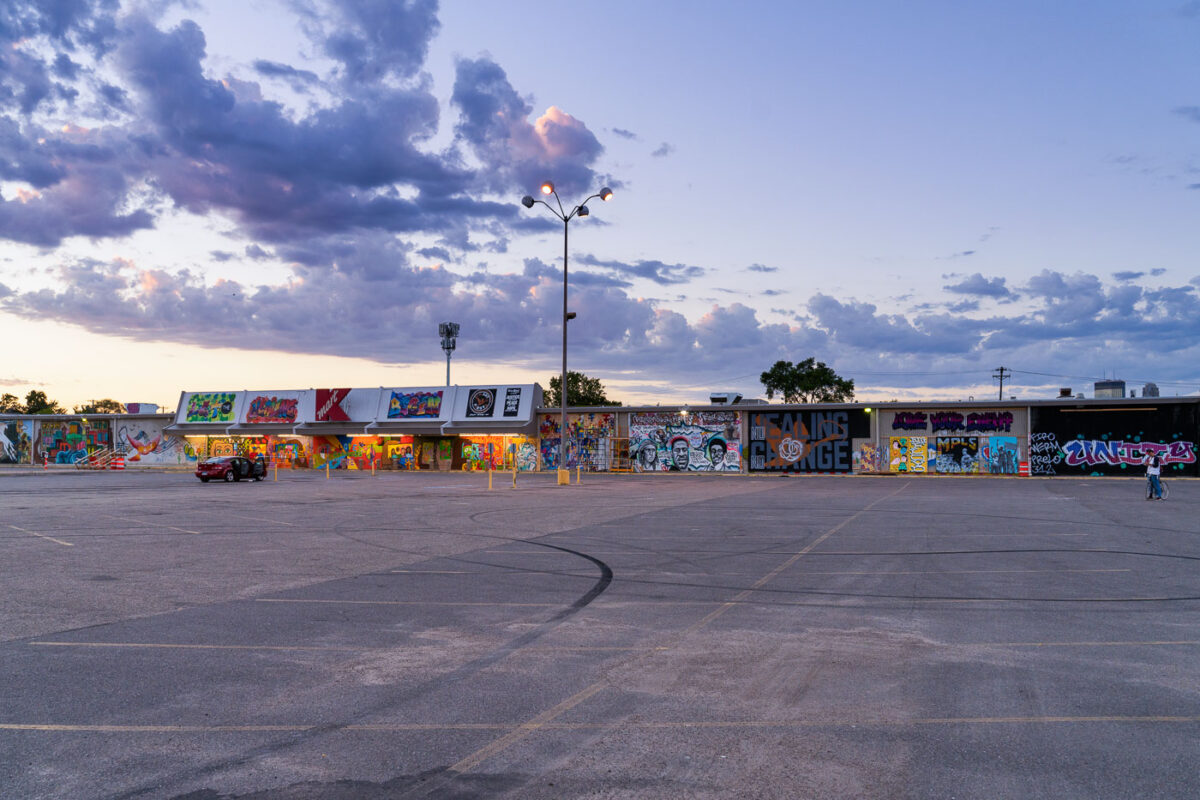
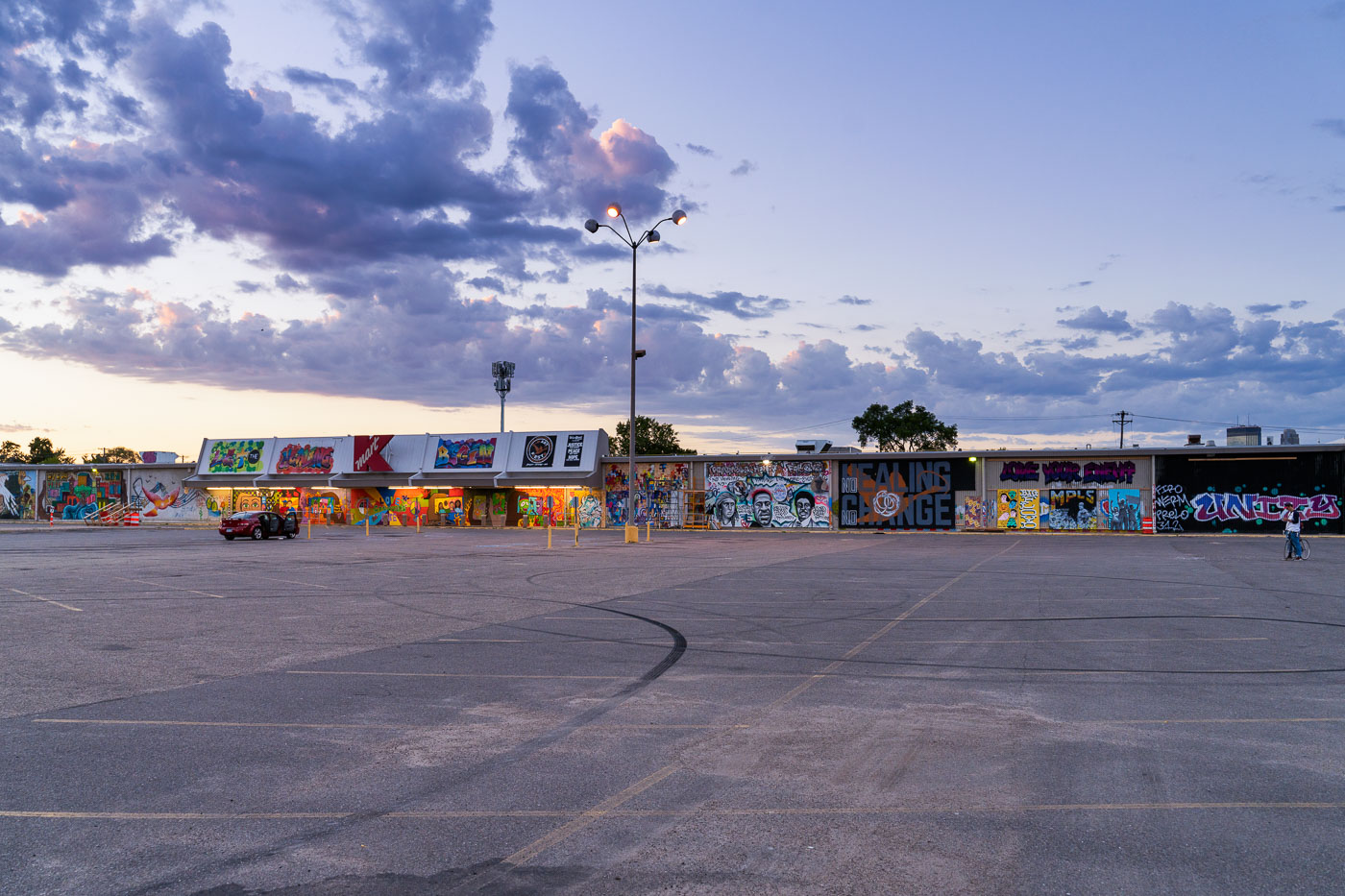
Kmart covered in art boards in August 2020
The former K-Mart store on West Lake Street in Minneapolis displays extensive murals created in the aftermath of the 2020 protests. These artworks, some depicting portraits and messages related to the Minneapolis Uprising, transformed the building's exterior into a public canvas. The retail store has since been repurposed as a United States Post Office, providing essential services after two local post offices were destroyed by fire during the protests.
Former K-Mart Murals, West Lake Street, Minneapolis
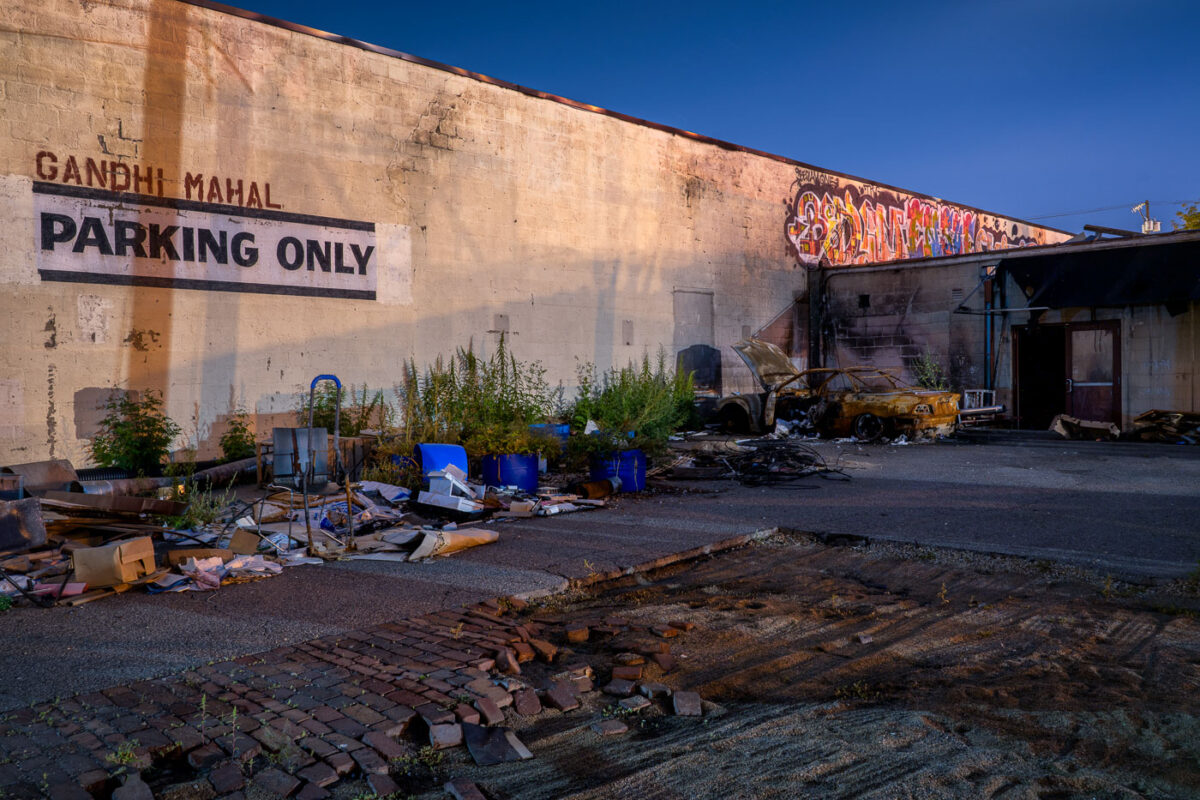
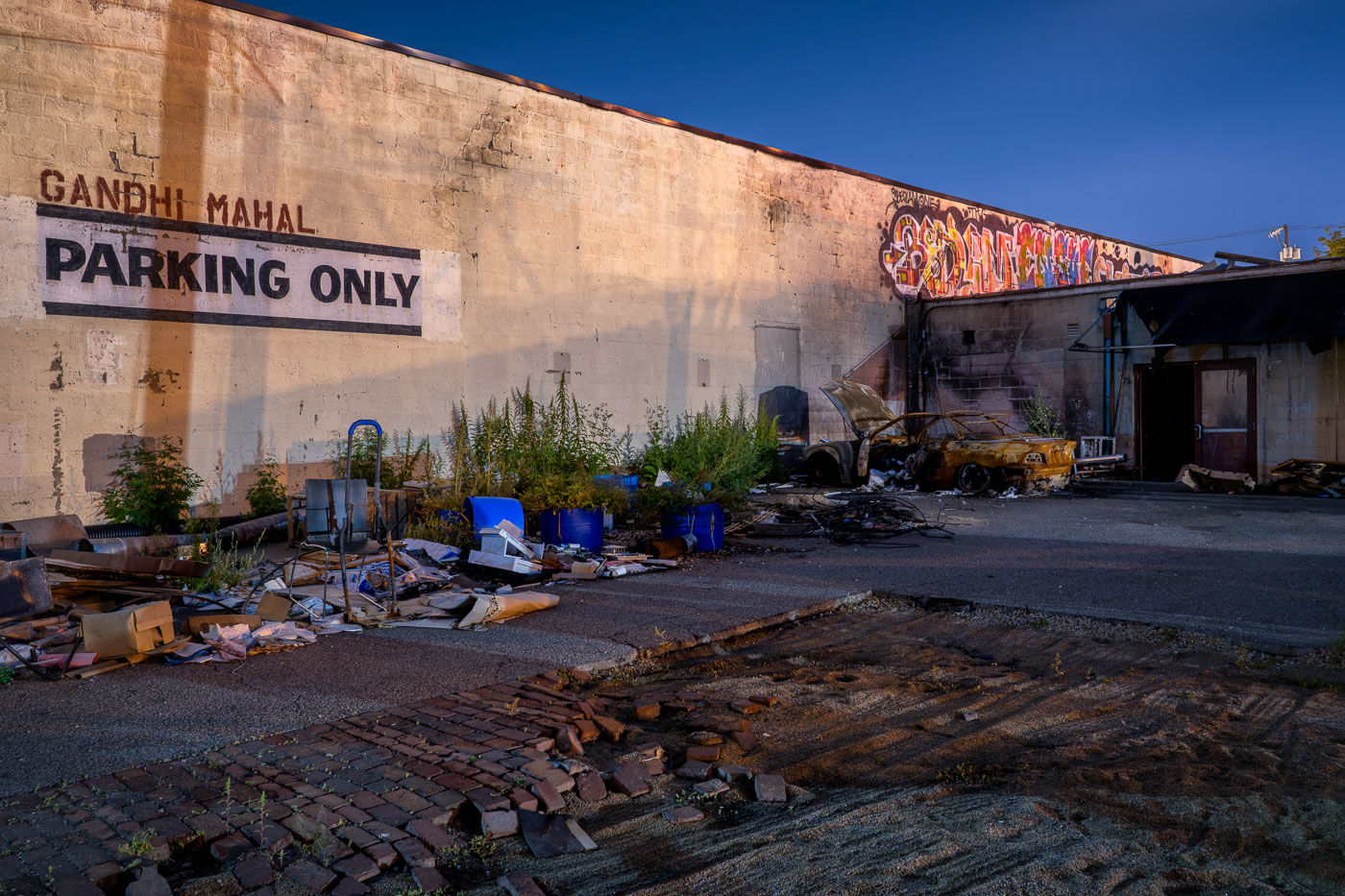
Burned out car in back of Gandhi Mahal
The parking lot of Gandhi Mahal restaurant on Lake Street in South Minneapolis shows a burned-out car and scattered debris. This site was significantly impacted during the civil unrest that occurred in Minneapolis following the May 25, 2020, death of George Floyd. Gandhi Mahal, a community-oriented establishment, was among numerous businesses on Lake Street that sustained damage.

Burned Car & Debris, Gandhi Mahal Parking Lot, South Minneapolis