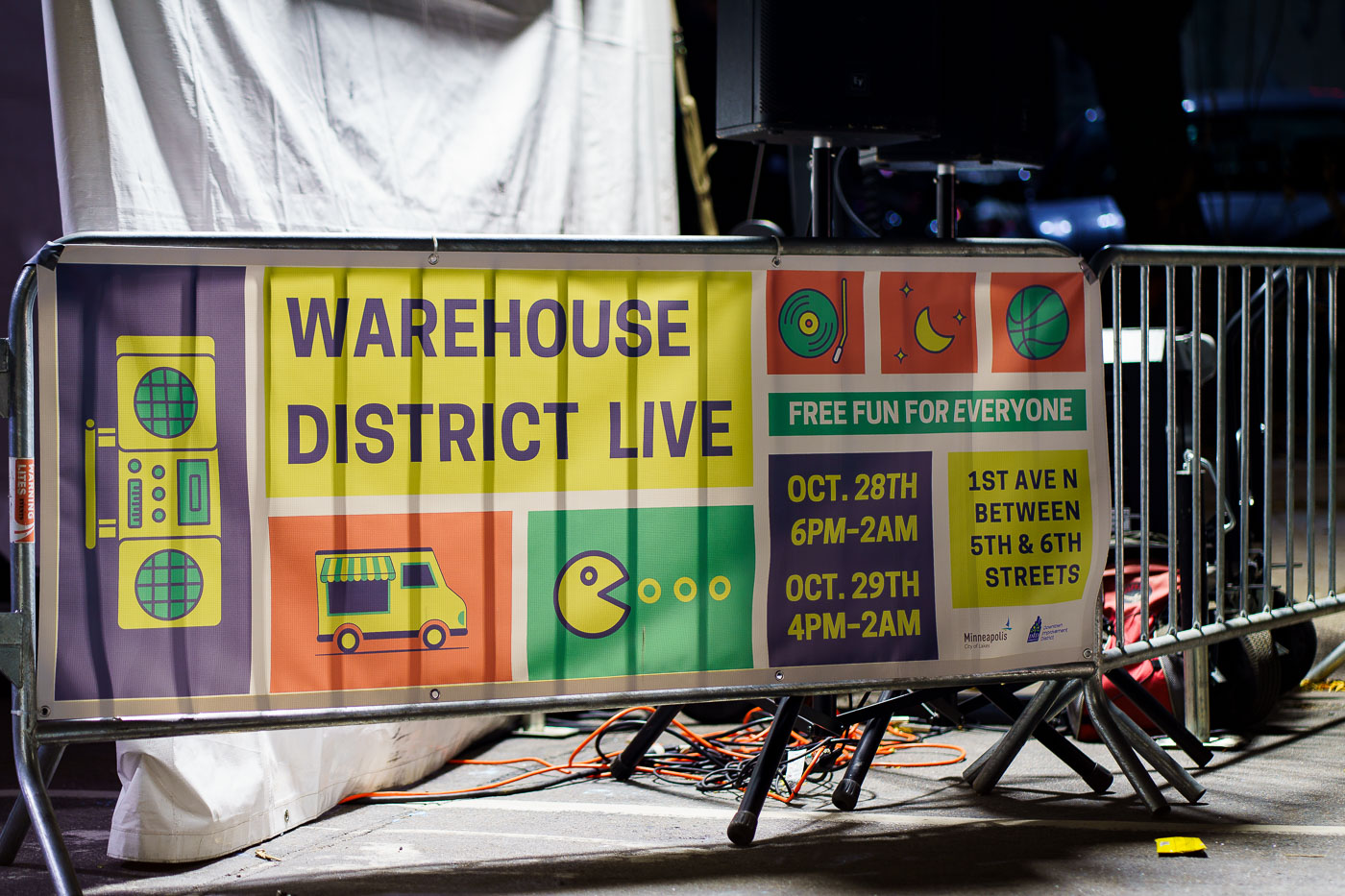
Warehouse District Live Event Sign, Minneapolis
A Warehouse District Live sign in Downtown Minneapolis as seen on Halloween.
A Warehouse District Live sign in Downtown Minneapolis as seen on Halloween.
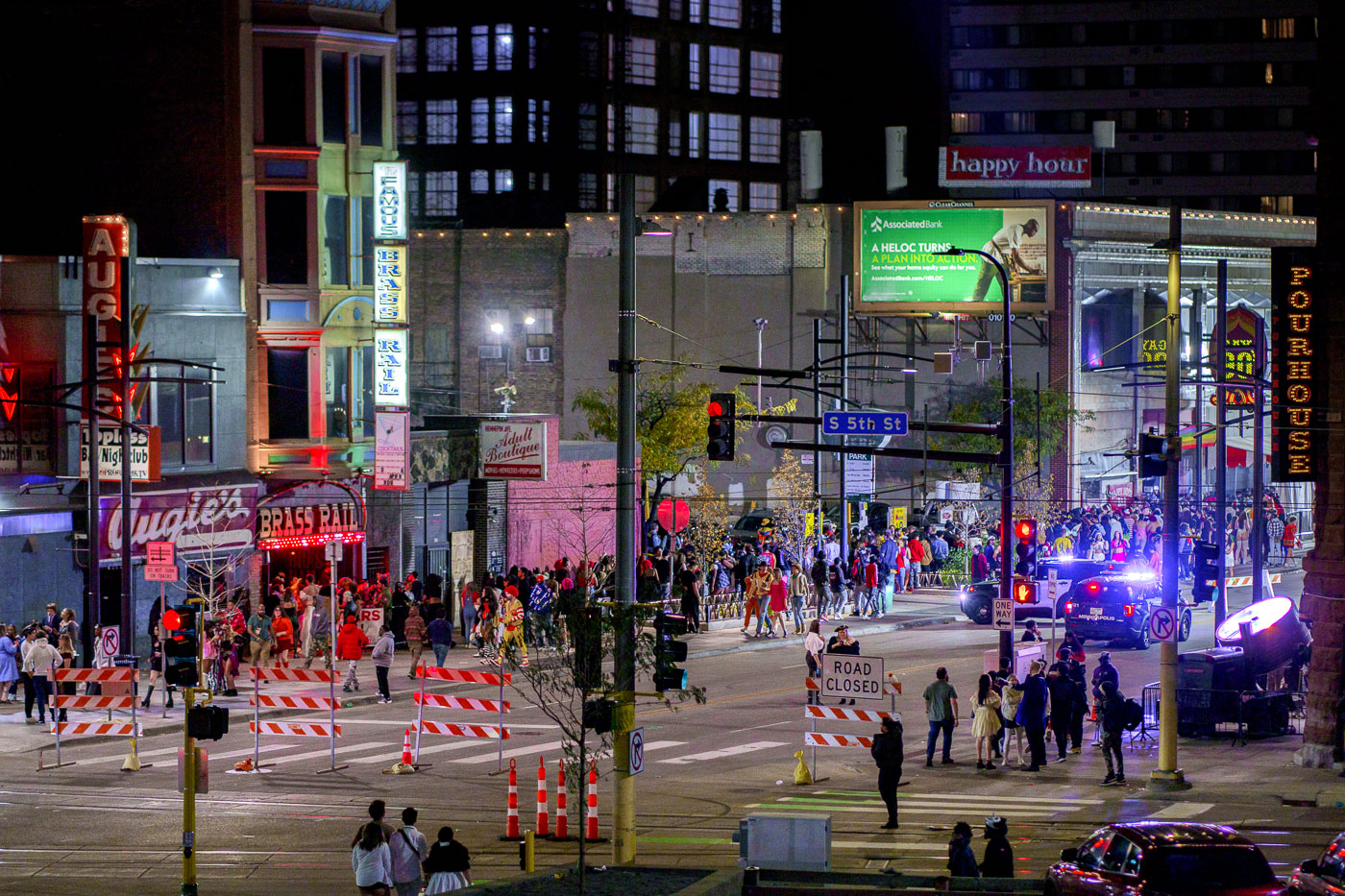
Thousands of costumed people downtown last night for various parties. Part of 1st Avenue was closed for Warehouse District Live with food trucks, arcades, and basketball hoops. Saw lots of bananas.
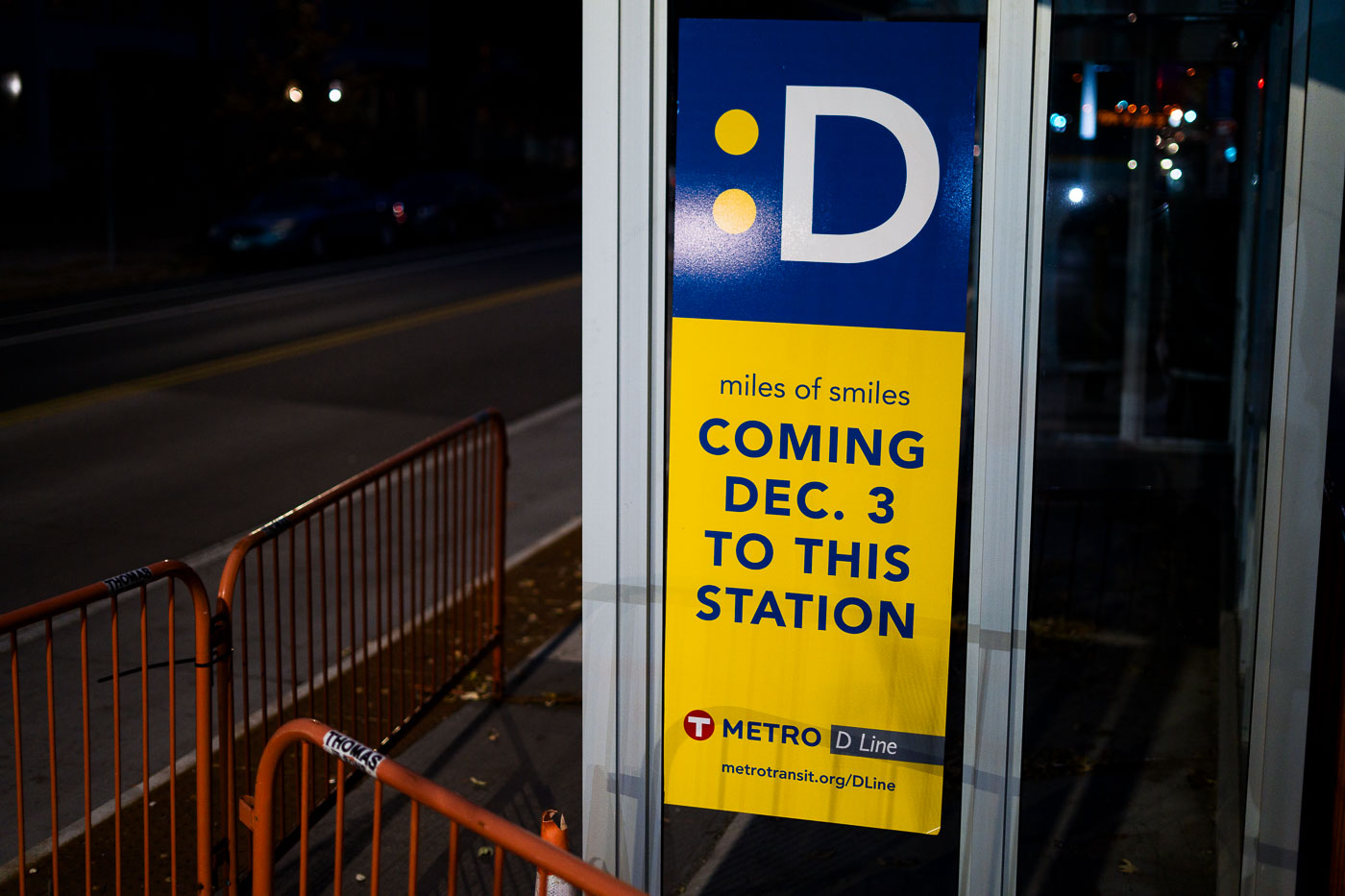
New Metro Transit D Line signage on Chicago Avenue in Minneapolis.
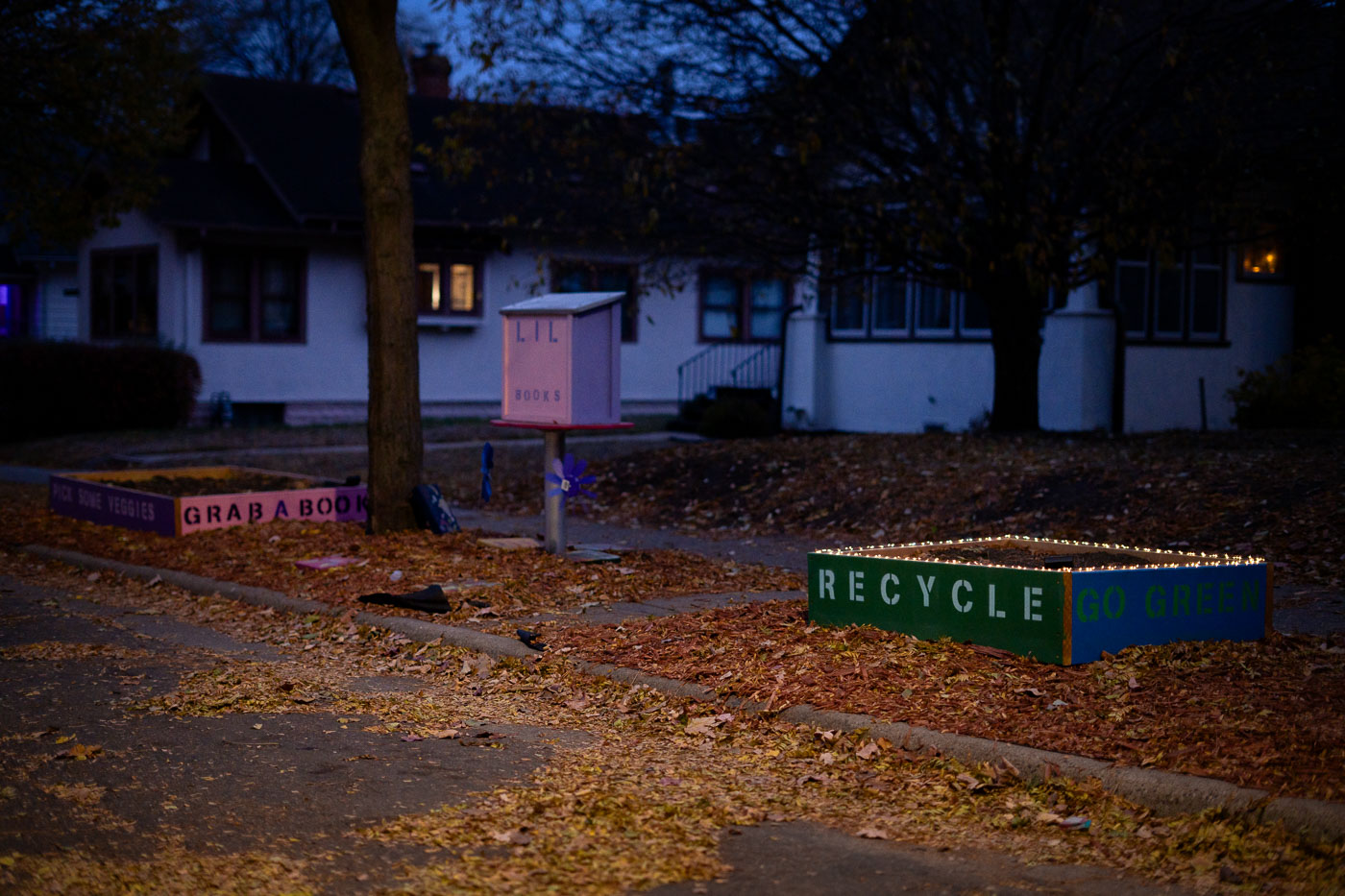
Flower bed boxes in a South Minneapolis neighborhood.
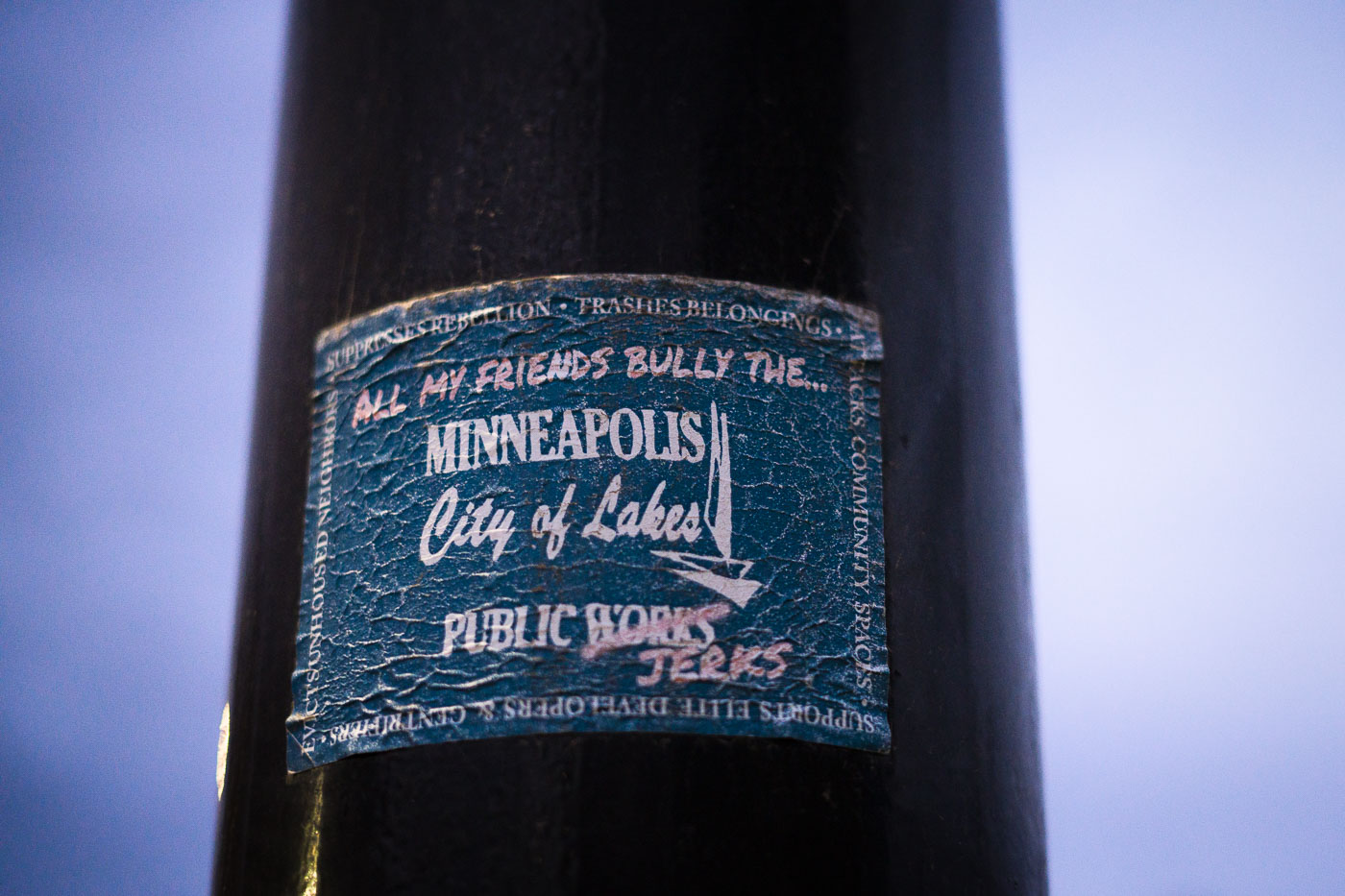
“All my friends bully the Minneapolis Public Works(Jerks)” sticker on a light pole. In response to Public Works participating in encampment clearings.
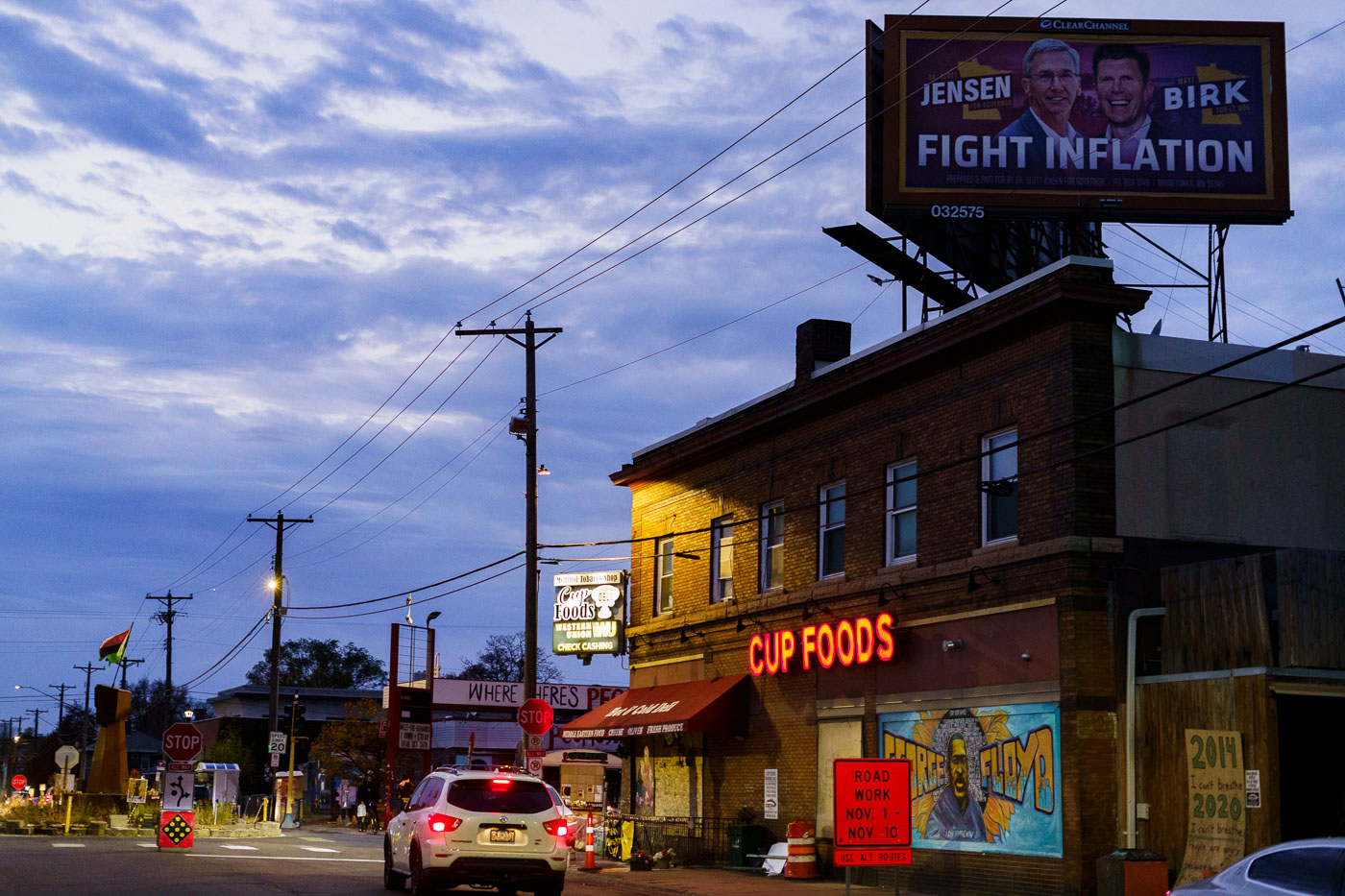
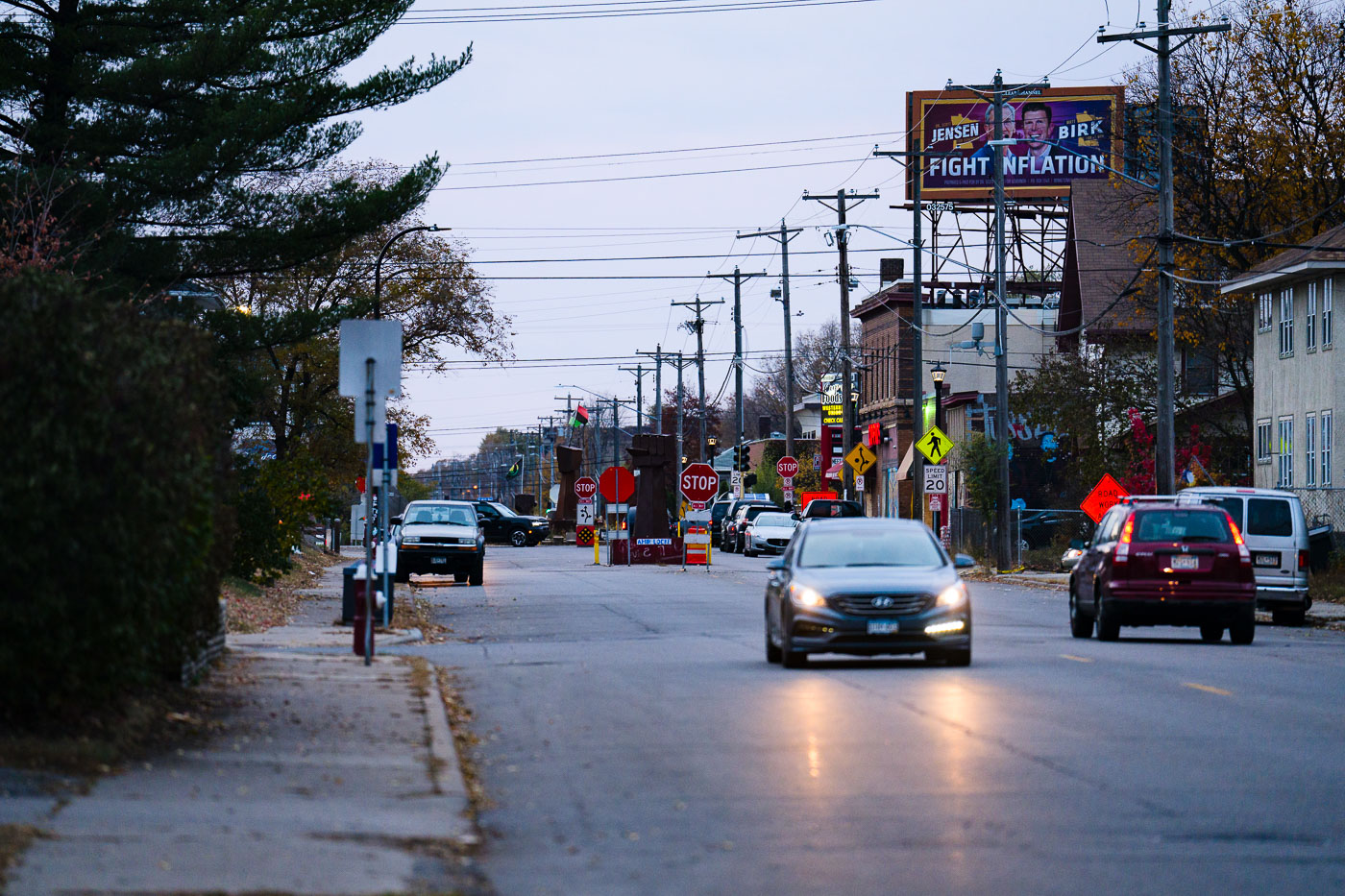
Scott Jensen, the GOP challenger to Governor Tim Walz, has his face on a billboard directly above the George Floyd mural at George Floyd Square.
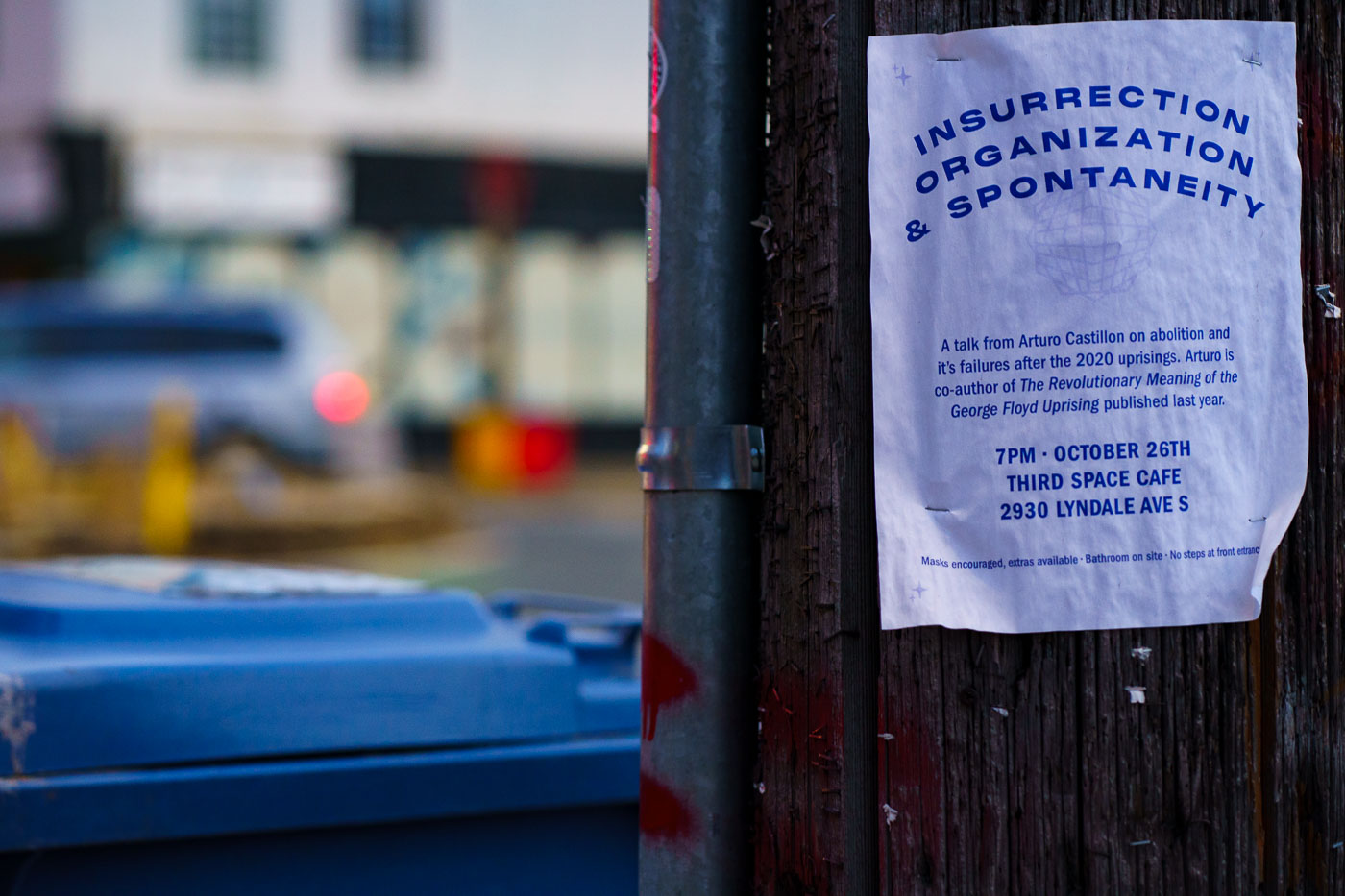
A flyer advertising a speaking event by Arturo Castillon.
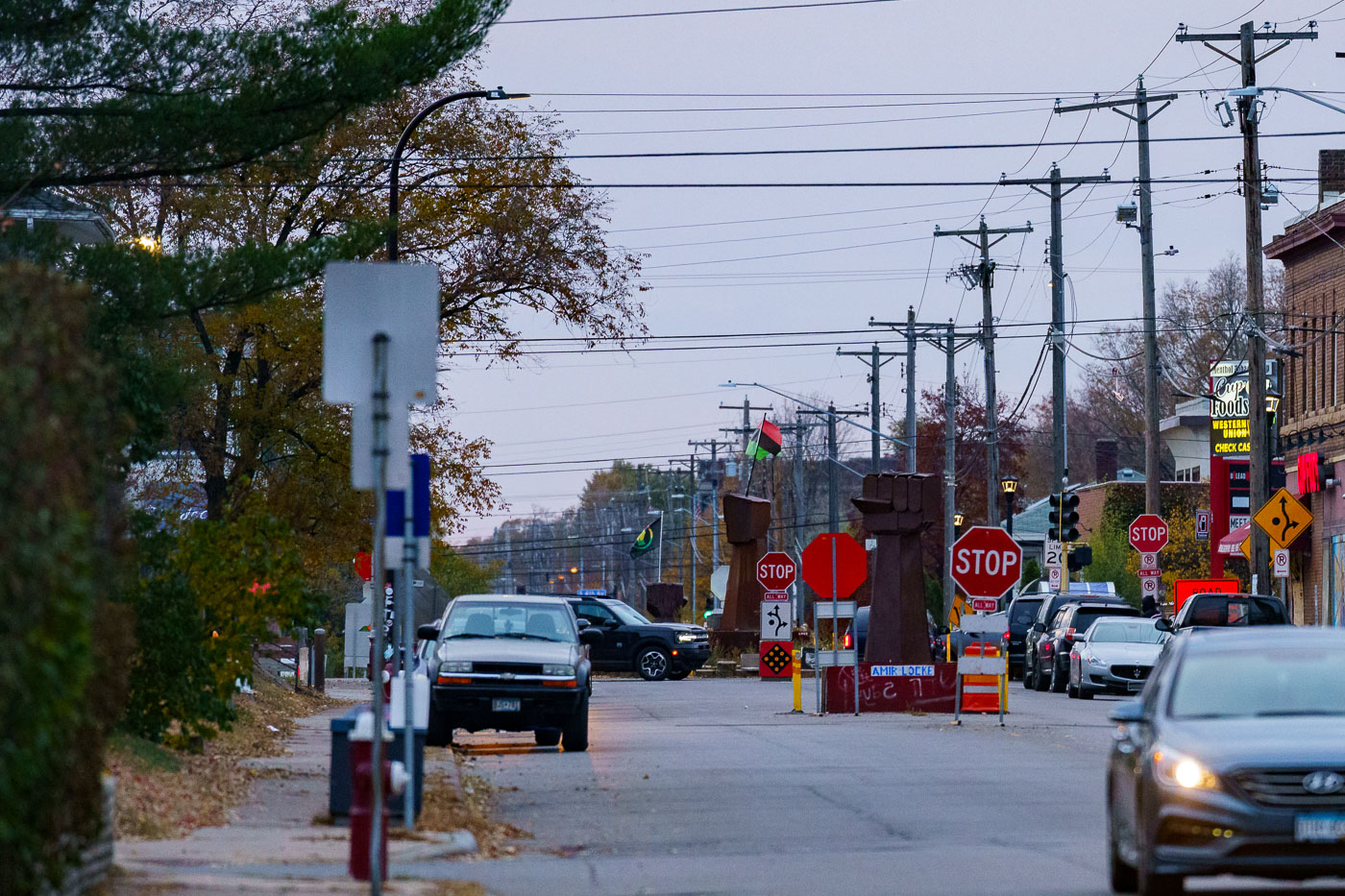
Scott Jensen, the GOP challenger to Governor Tim Walz, has his face on a billboard directly above the George Floyd mural at George Floyd Square.

Minneapolis police chief nominee Brian O’Hara speaking to South Minneapolis community members gathered at Stewart Park for a meet and greet. He spent time talking about the consent decree process Newark went through and differences between Newark and Minneapolis.

Minneapolis police chief nominee Brian O’Hara speaking to South Minneapolis community members gathered at Stewart Park for a meet and greet. He spent time talking about the consent decree process Newark went through and differences between Newark and Minneapolis.

Minneapolis police chief nominee Brian O’Hara speaking to South Minneapolis community members gathered at Stewart Park for a meet and greet. He spent time talking about the consent decree process Newark went through and differences between Newark and Minneapolis.

The missing uptown theatre letters. The developer says they are rehabbing them.
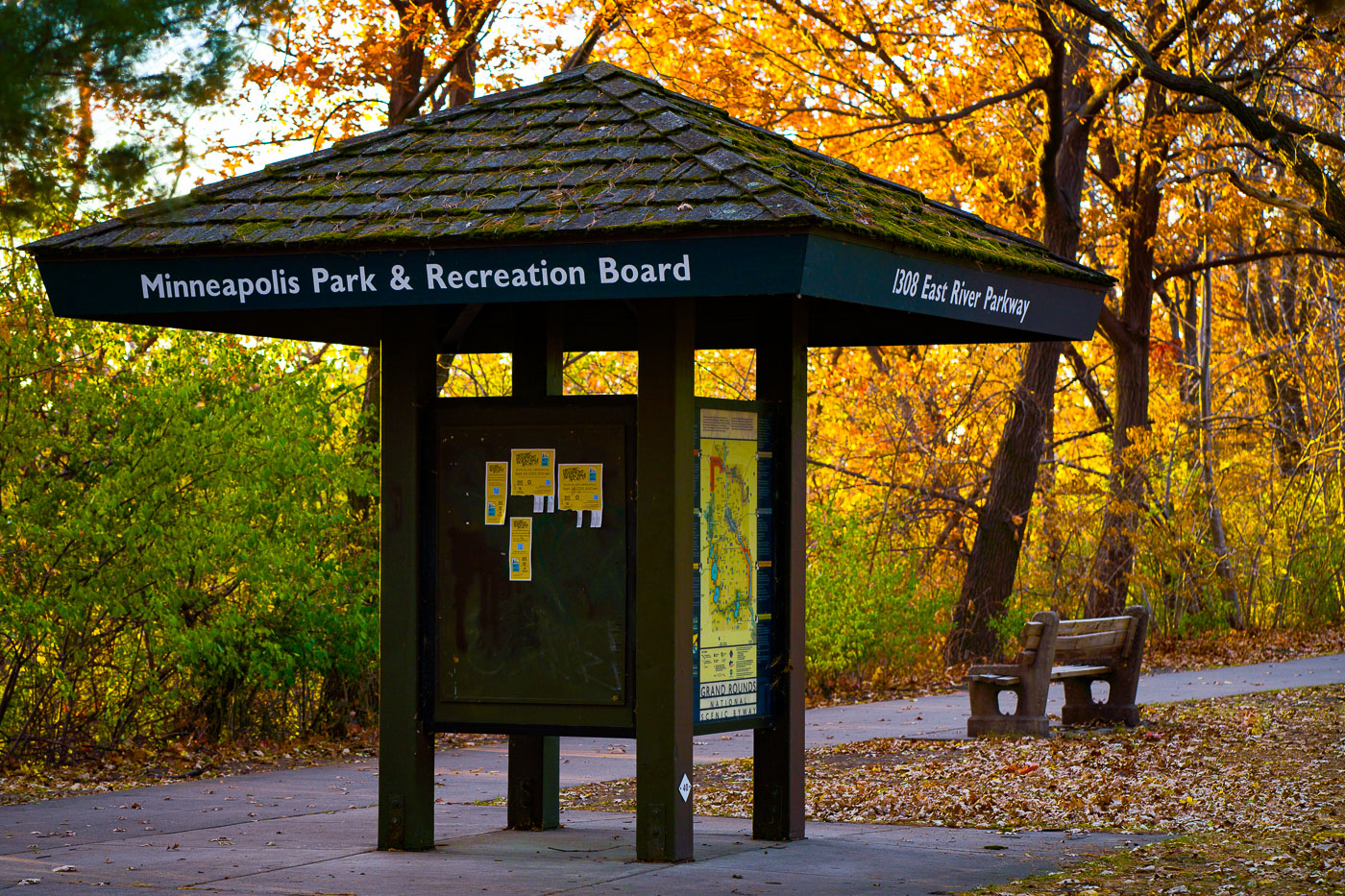
A Minneapolis Park & Recreation Board kiosk on East River Parkway in Minneapolis.
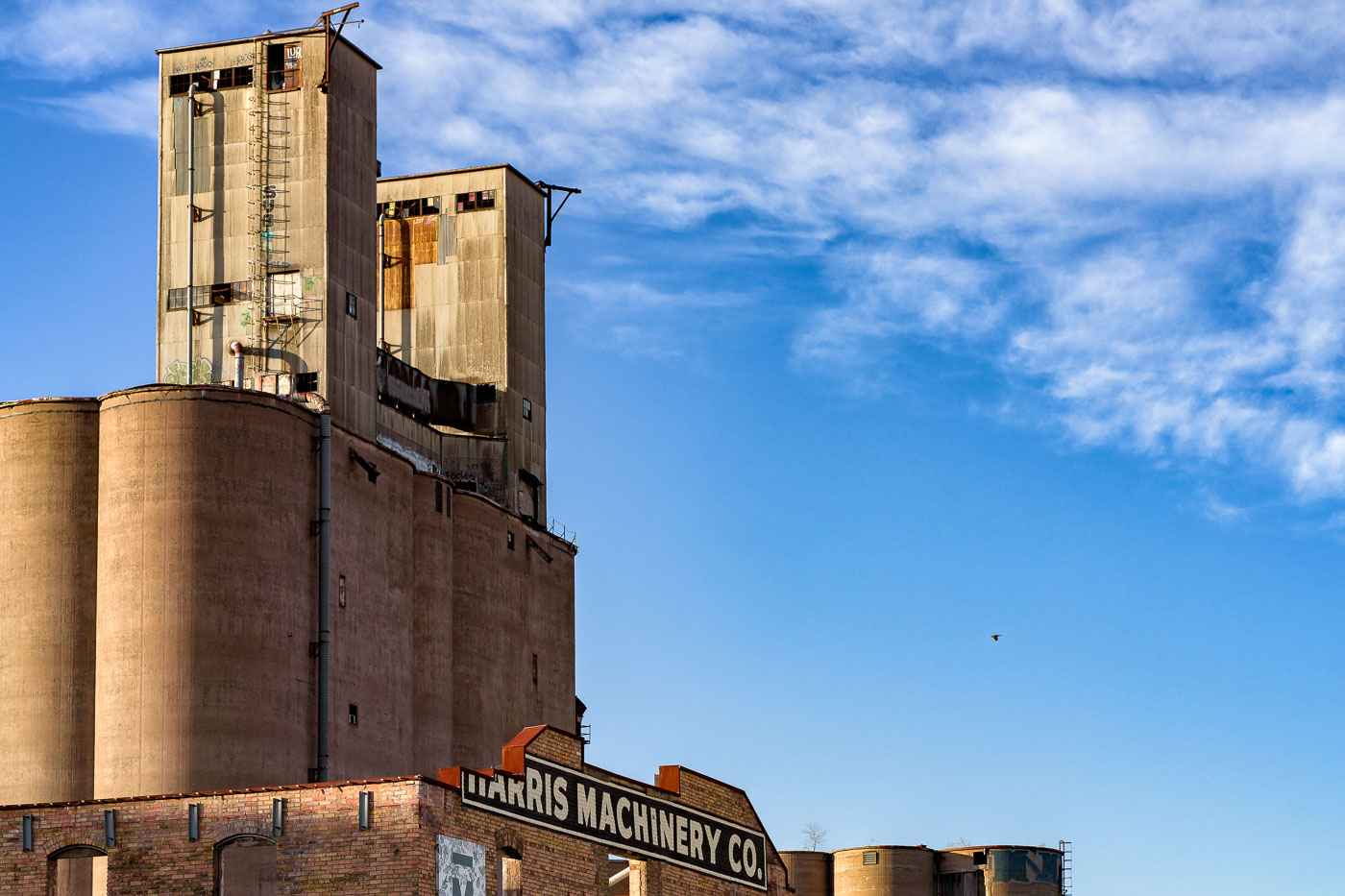
The aging ADM grain elevator rises over the Harris Machinery Co. building in Minneapolis, a reminder of the city’s long industrial relationship with grain milling and riverfront commerce. These concrete storage silos and metal-clad headhouses were once central to moving Midwestern grain through the milling district, part of an infrastructure network that fueled Minneapolis’s identity as the “Flour Milling Capital of the World.” Harris Machinery Co., a longtime supplier of industrial equipment, occupies the foreground, its brick façade contrasting with the weathered surfaces of the towering elevator. The structures together illustrate the layered industrial history of the city’s working riverfront.

A flyer taped to a pole in downtown Minneapolis advertises a search for an “aggressive guitar player” and “people who give a damn,” echoing the recruitment style of 1980s metal bands. The poster lists influences ranging from Vixen and Madam X to Mötley Crüe, Poison, Ratt, and Judas Priest—names that shaped the Twin Cities’ hard-rock and glam-metal culture during the era of small clubs and independent bands. Its DIY design and bold typography reflect the ongoing tradition of grassroots music promotion that still surfaces in the city’s urban corridors.
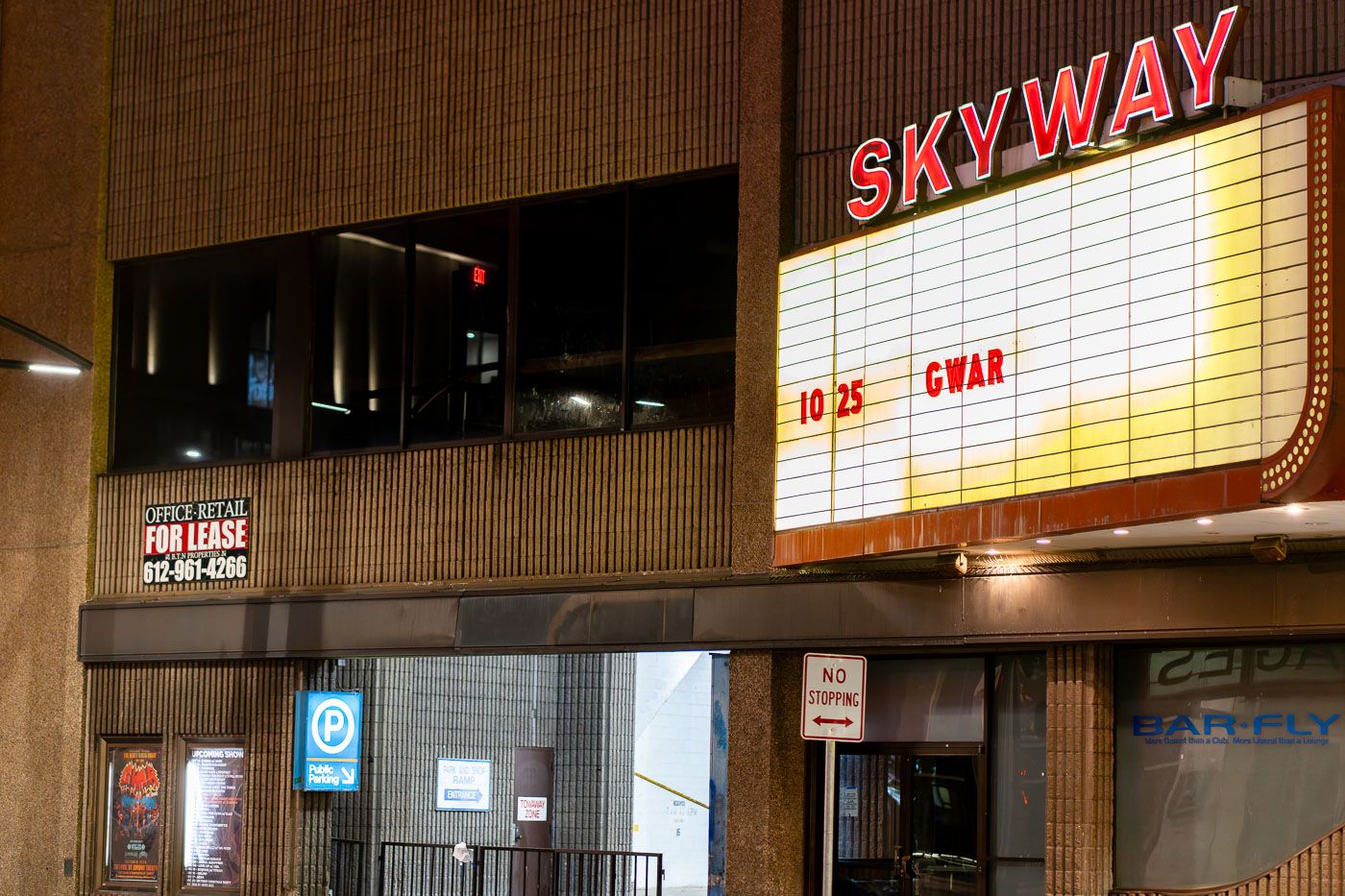
Gwar on the marquee of the Skyway Theatre in downtown Minneapolis.
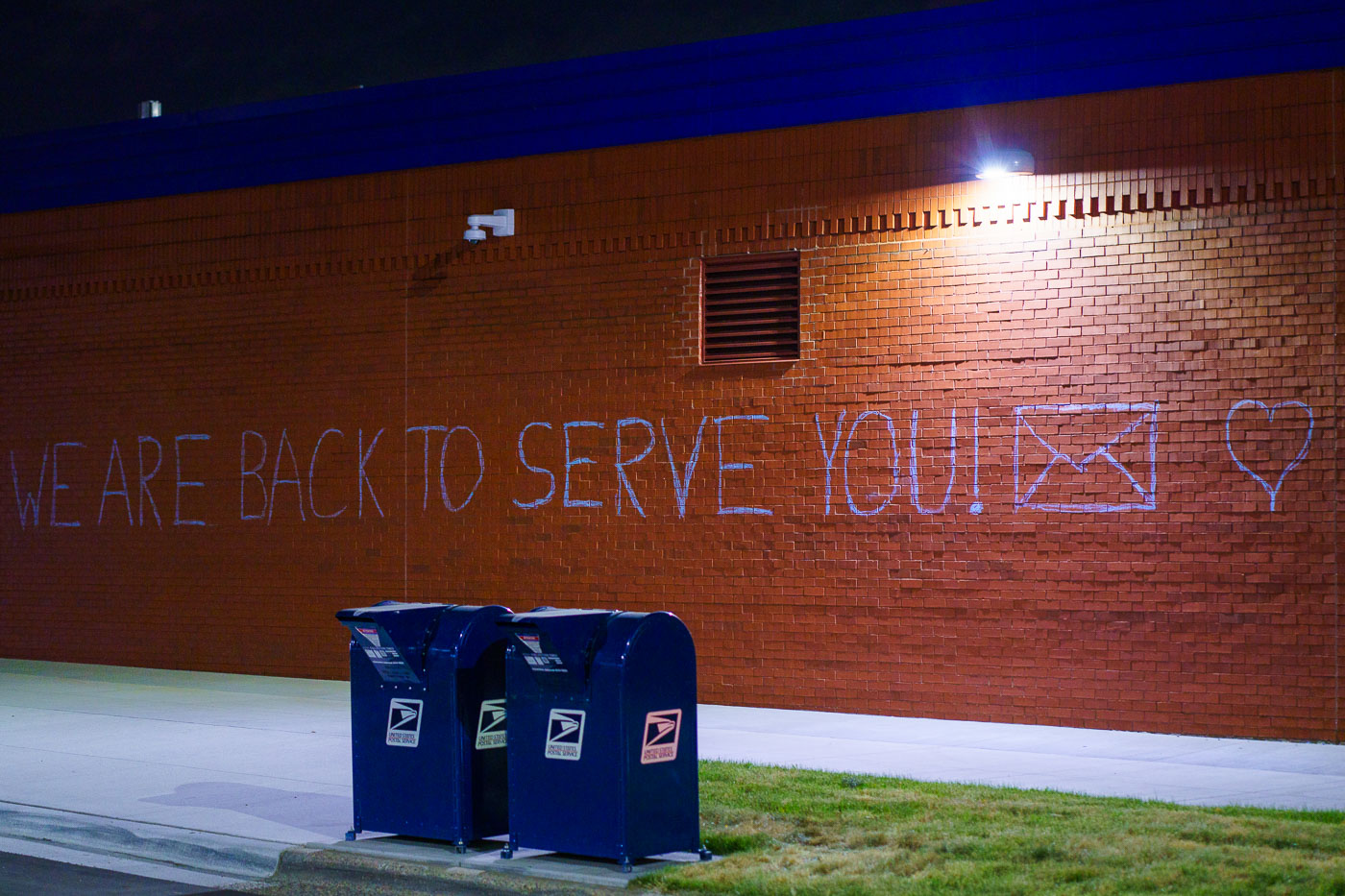
"We are back to serve you!" written on the side of the newly opened Lake Street Station. The post office was burned down during protests that followed the May 25th, 2020 murder of George Floyd.

Personal-care items—including toothpaste, toothbrushes, and other everyday hygiene products—sit behind locked Plexiglas cabinets at the Target flagship store in downtown Minneapolis. In recent years, large retailers across U.S. urban centers have expanded the use of secured cases for small, easily resold goods in response to rising shrink and merchandise loss. At this location, much of the oral-care section now requires staff assistance to access, reflecting a broader shift in store security strategies and retail operations in high-traffic downtown corridors.

Items behind locked cabinets at the flagship Target store in downtown Minneapolis.
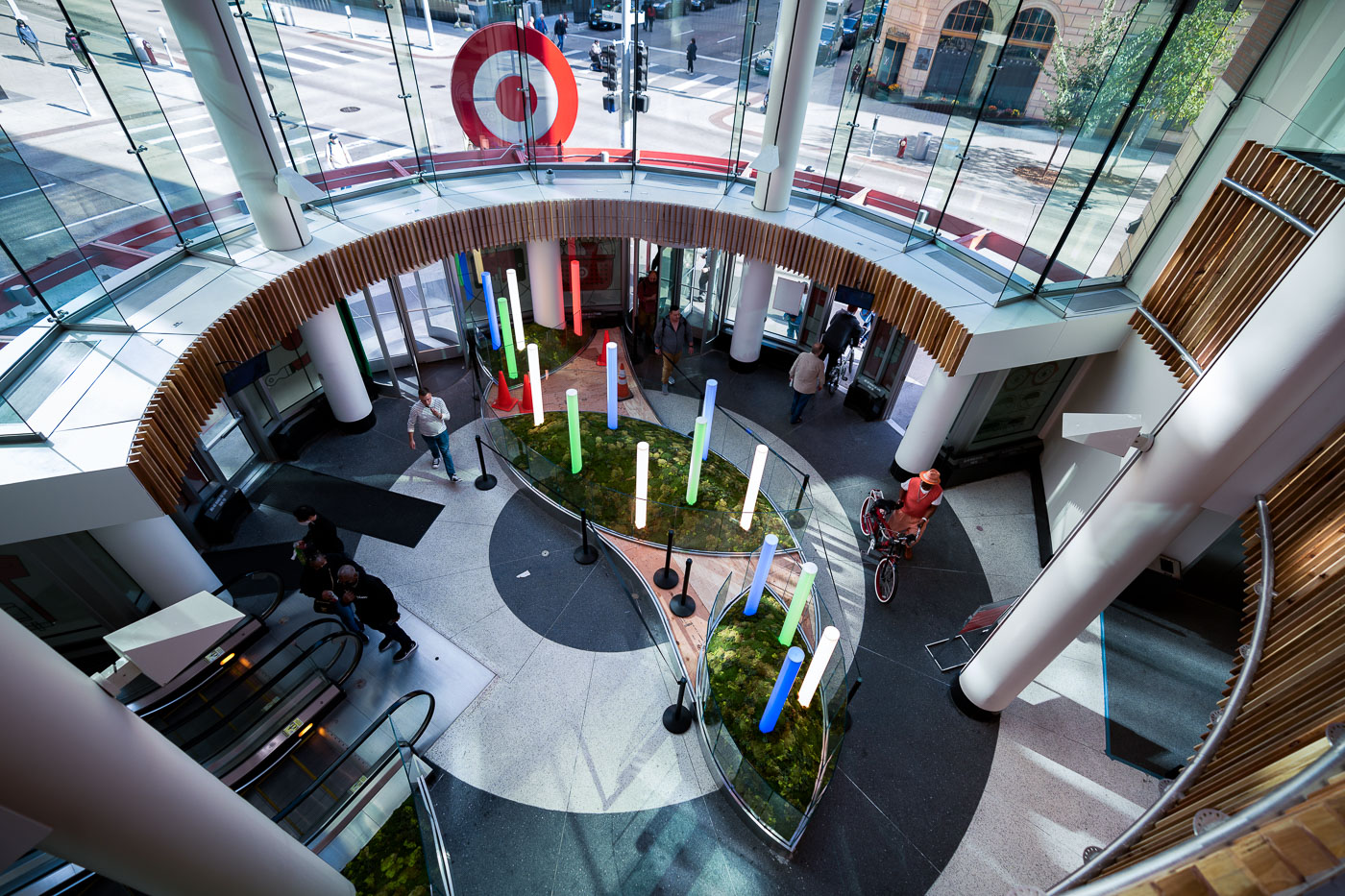
The new entrance at the flagship Target store in downtown Minneapolis.
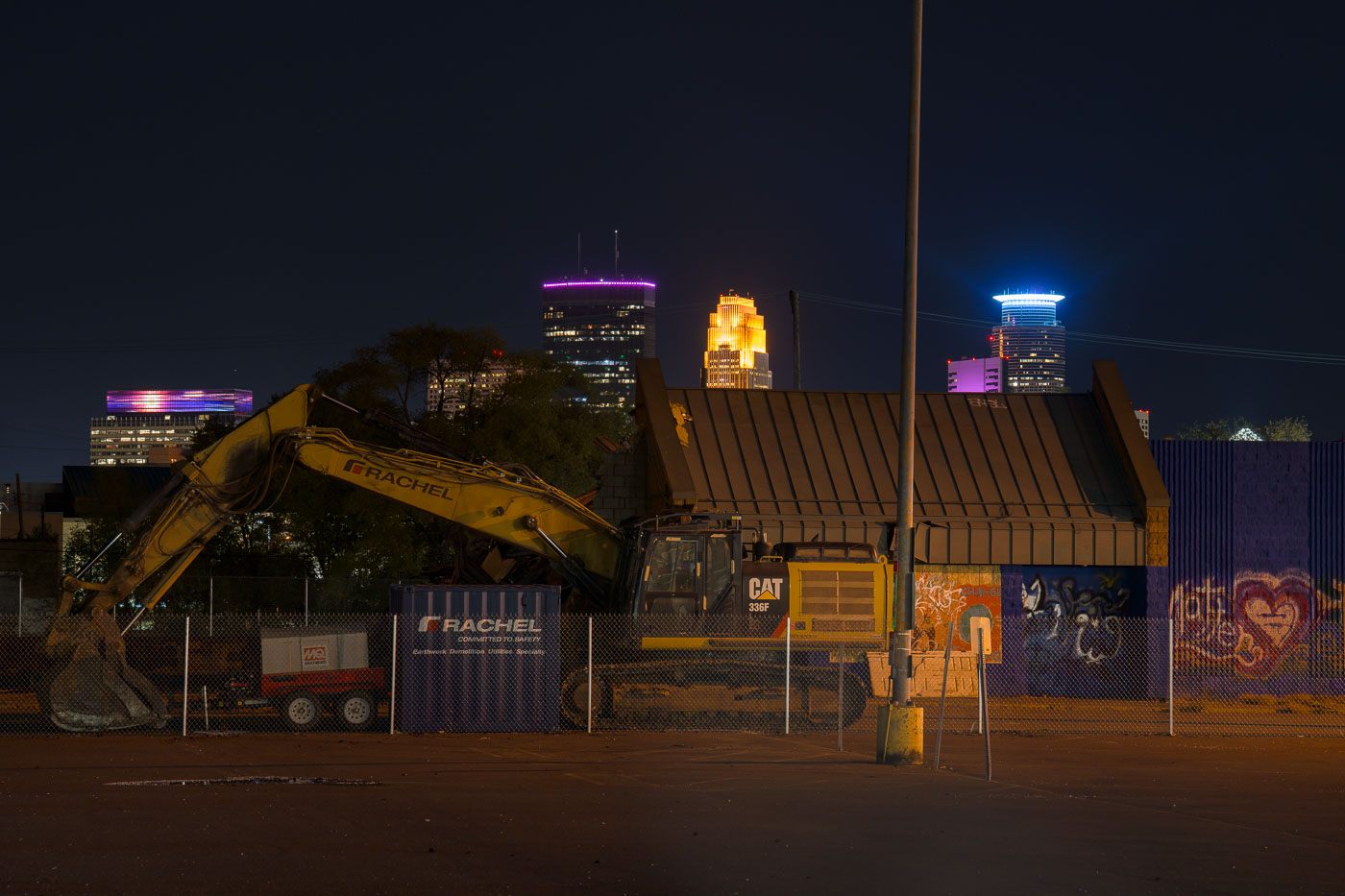
The demolition of the former supervalu store on Lake Street in South Minneapolis.
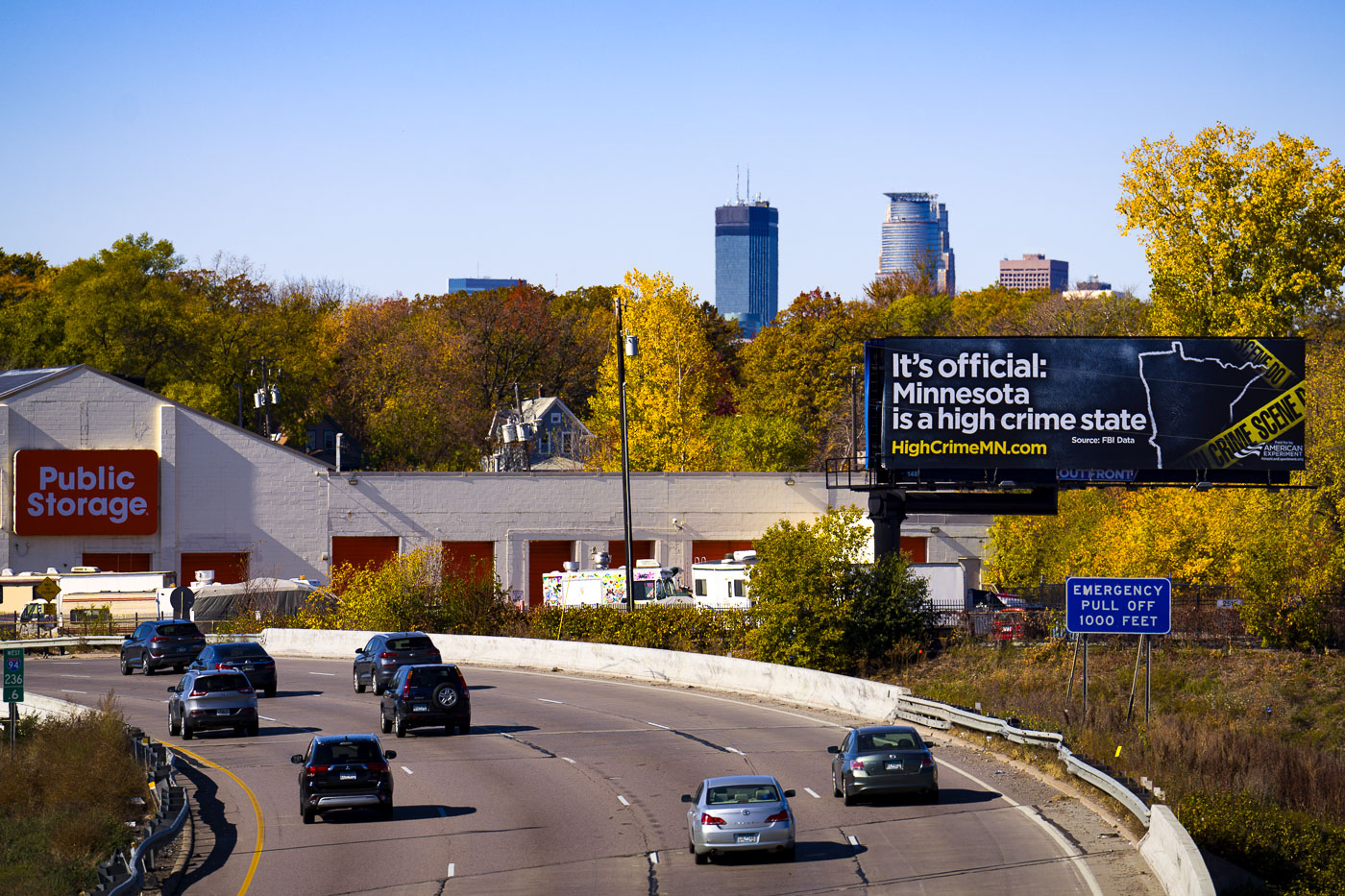
A billboard by a self described “leading public policy organization” at the I-94 Minneapolis border declares “It’s official” and directs motorists to a page where their interpretation of crime data shows crime rising years prior to the mass quitting of police officers in 2020-22.
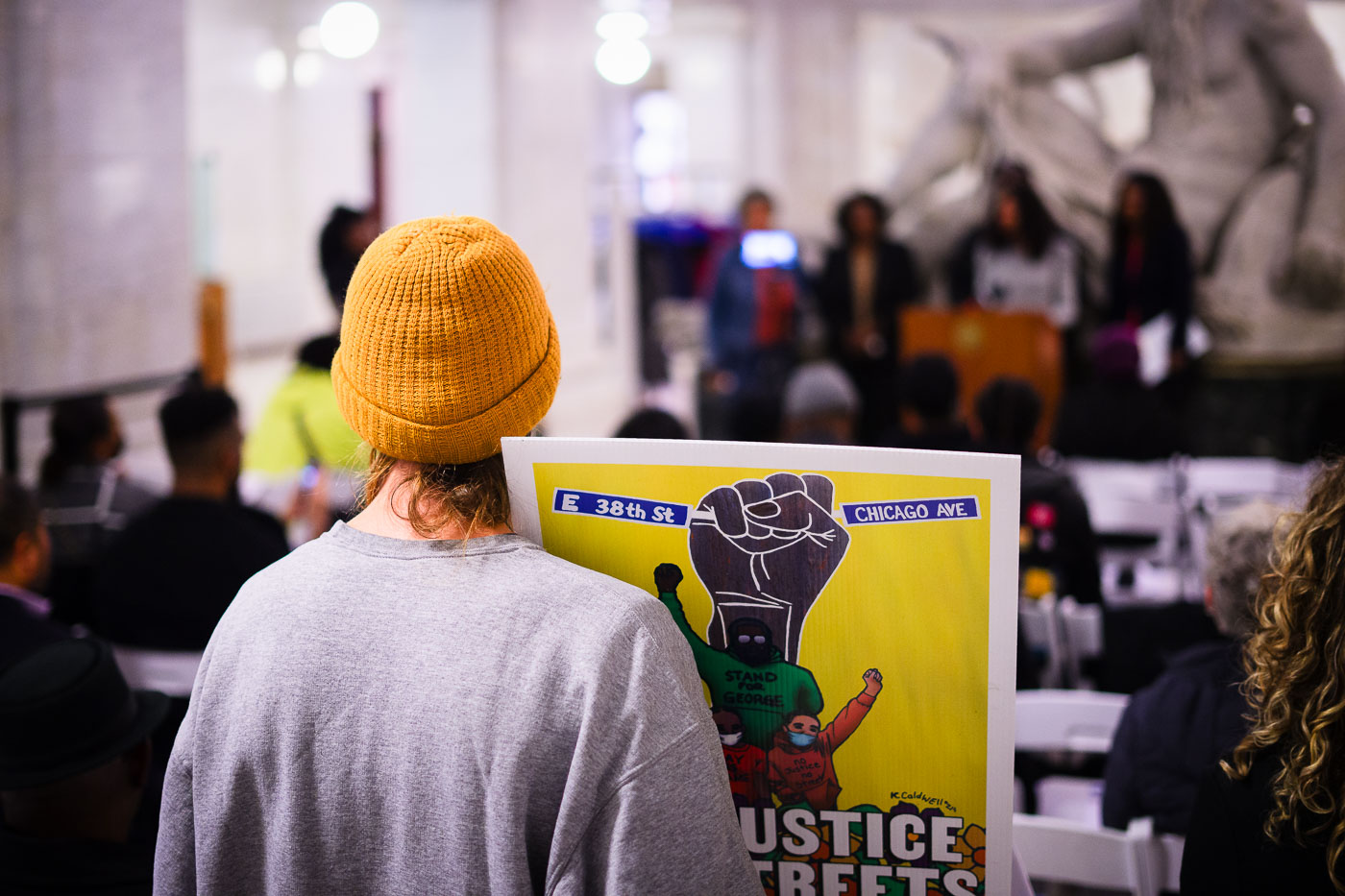
A protester holds up a sign reading “No Justice No Streets” as the Mayor Jacob Frey proclaims it George Floyd Day. It would have been Floyd’s 49th birthday.

Jacob Frey, the Mayor of Minneapolis, poses with the family of George Floyd on what would have been Floyd’s 49th birthday. The mayor had proclaimed it George Floyd Day.
Terrence Floyd, Paris Stevens, Angela Harrelson.

Jacob Frey, Mayor of Minneapolis, proclaims it George Floyd Day on what would have been Floyd’s 49th birthday.
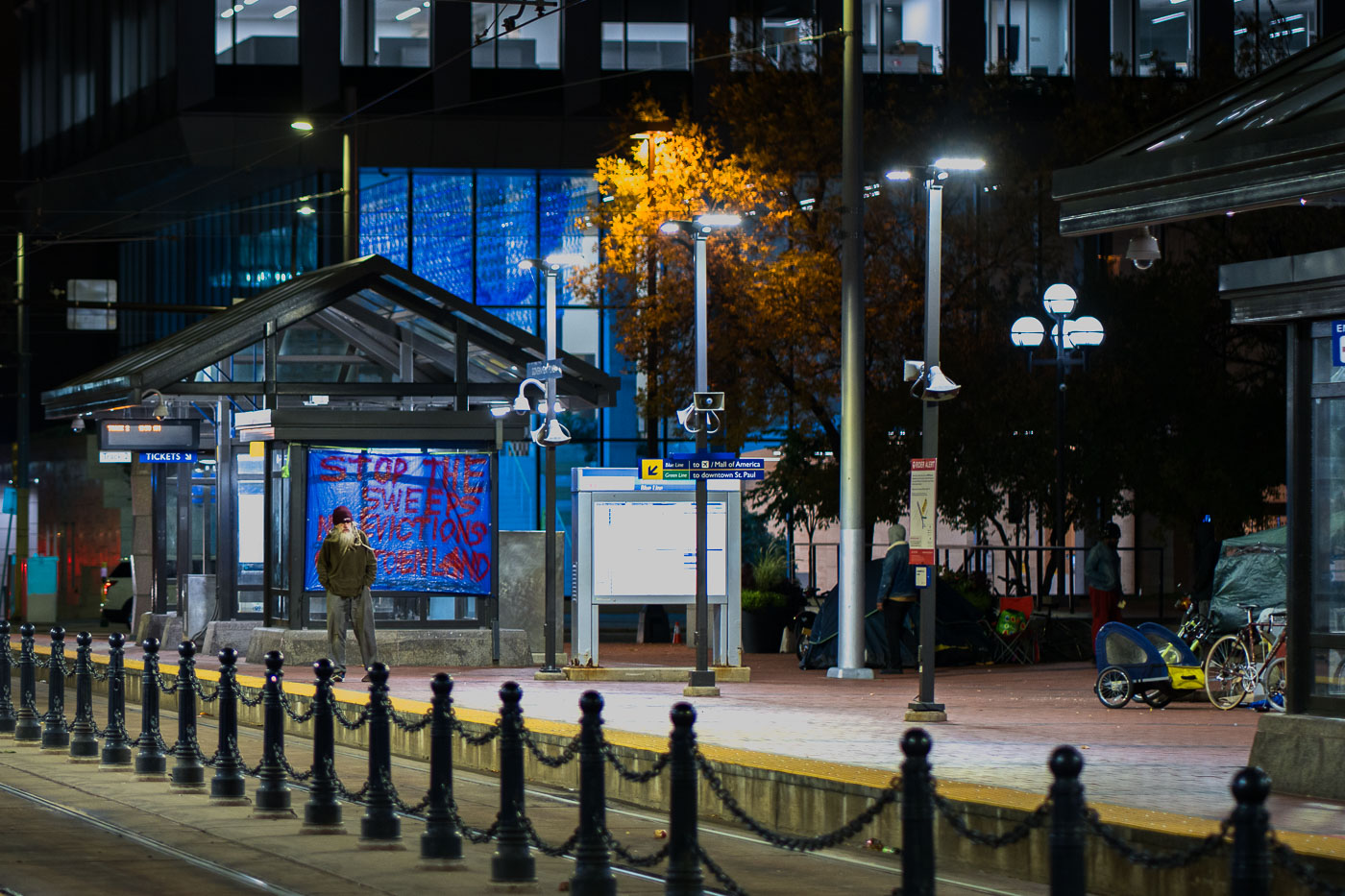
Protesters holding space at City Hall. They say they demand "a complete moratorium on the clearing of encampments, clear guidelines regarding the encampments and proof of funding for more permanent housing for unhoused residents and people in need"
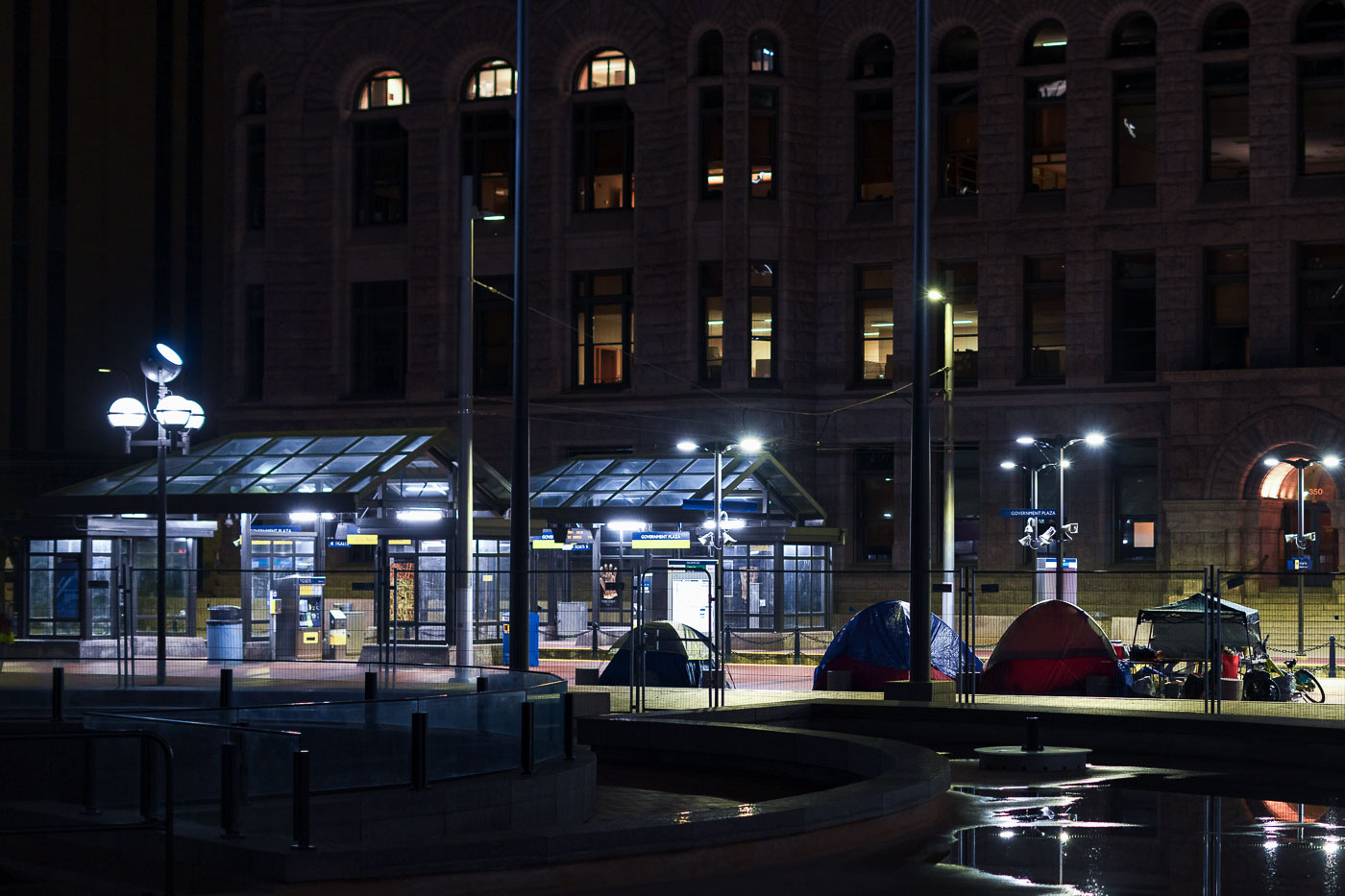
Protesters holding space at City Hall. They say they demand "a complete moratorium on the clearing of encampments, clear guidelines regarding the encampments and proof of funding for more permanent housing for unhoused residents and people in need"
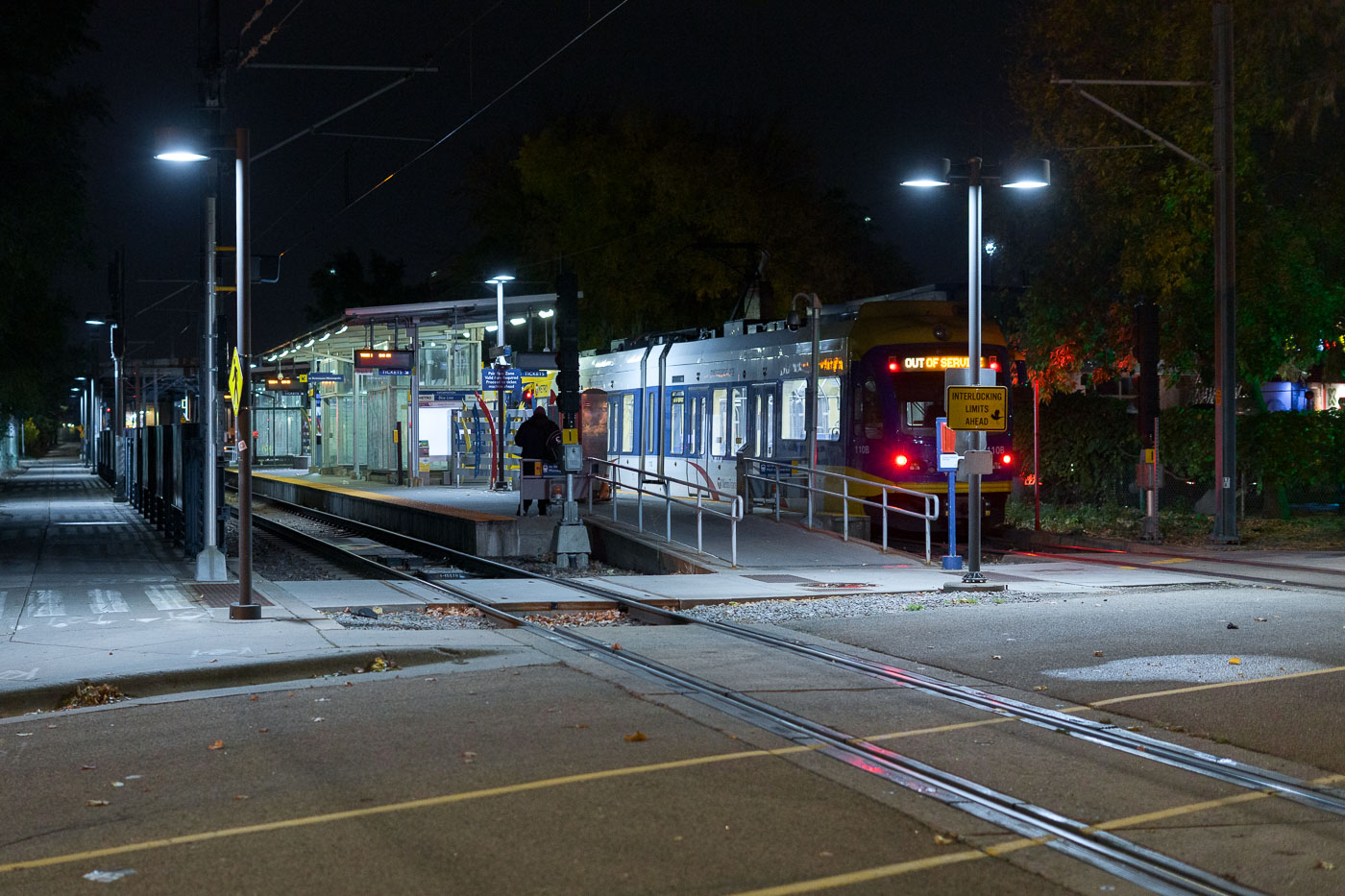
Cedar-Riverside train station in South Minneapolis.
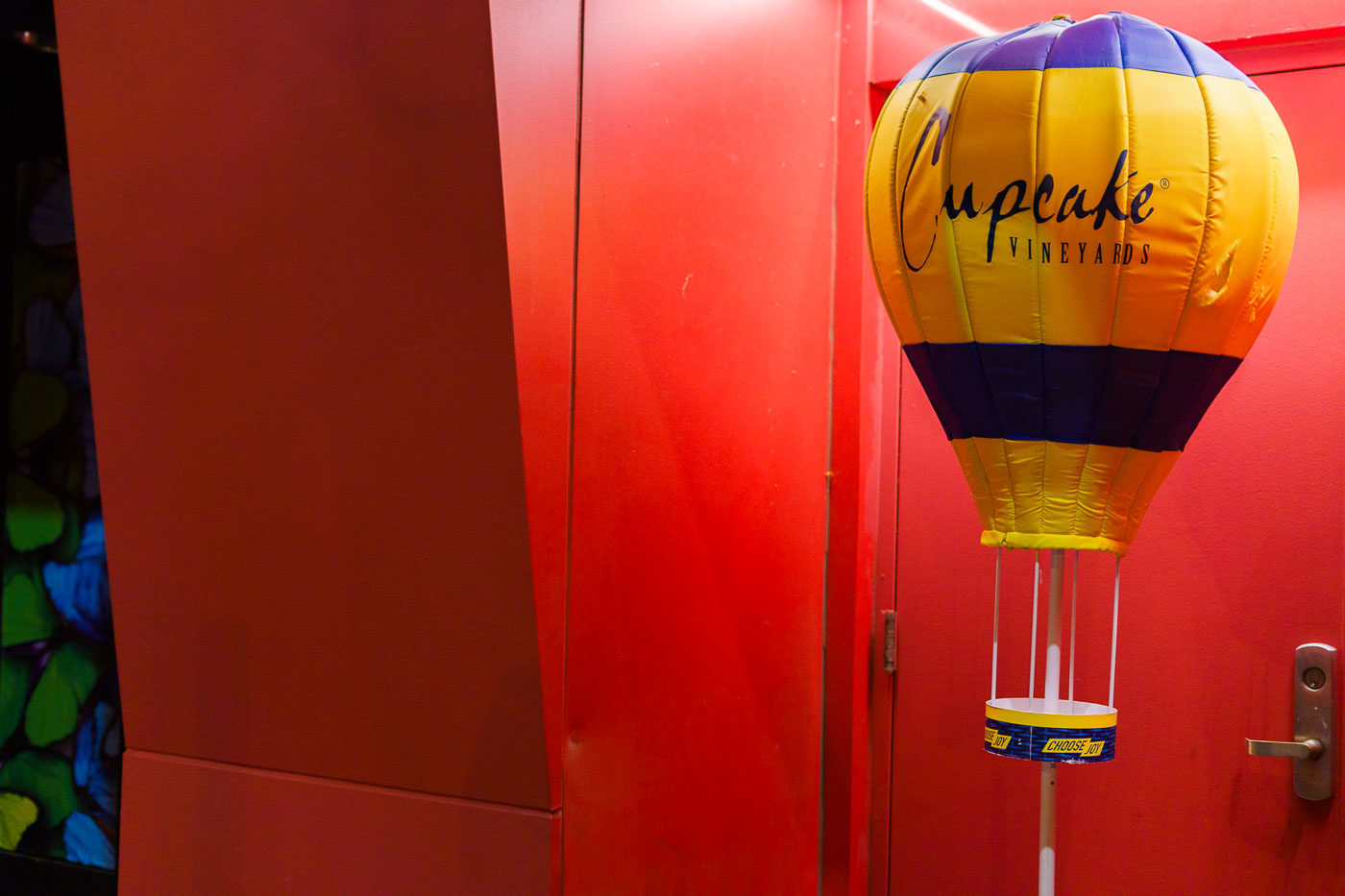
A Cupcake Vineyards promotional hot-air-balloon display stands at the edge of a red-lit entryway, its bright yellow and deep blue panels catching the saturated glow from the surrounding walls. These inflatable point-of-sale displays are common in liquor stores and bar entry corridors, designed to stand out under mixed lighting and draw attention to featured brands. The scene’s heavy red cast—likely from LED wash lighting or a painted interior corridor—creates a striking contrast with the cooler tones of the balloon, giving the space a graphic, almost stage-set quality often found in Minneapolis nightlife districts where narrow passages and dramatic lighting create strong visual color blocks.
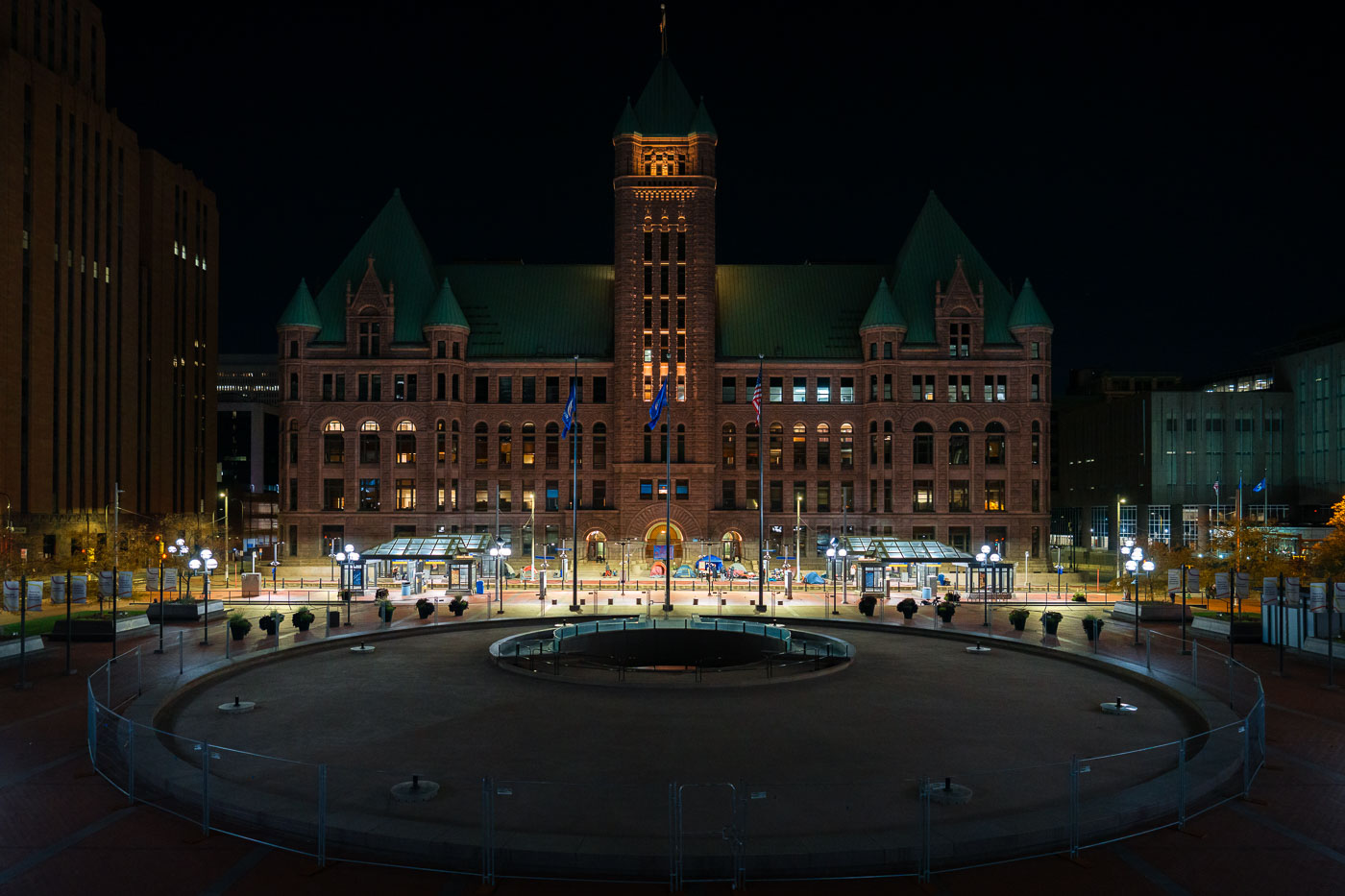
Protesters holding space at City Hall. They say they demand “a complete moratorium on the clearing of encampments, clear guidelines regarding the encampments and proof of funding for more permanent housing for unhoused residents and people in need”
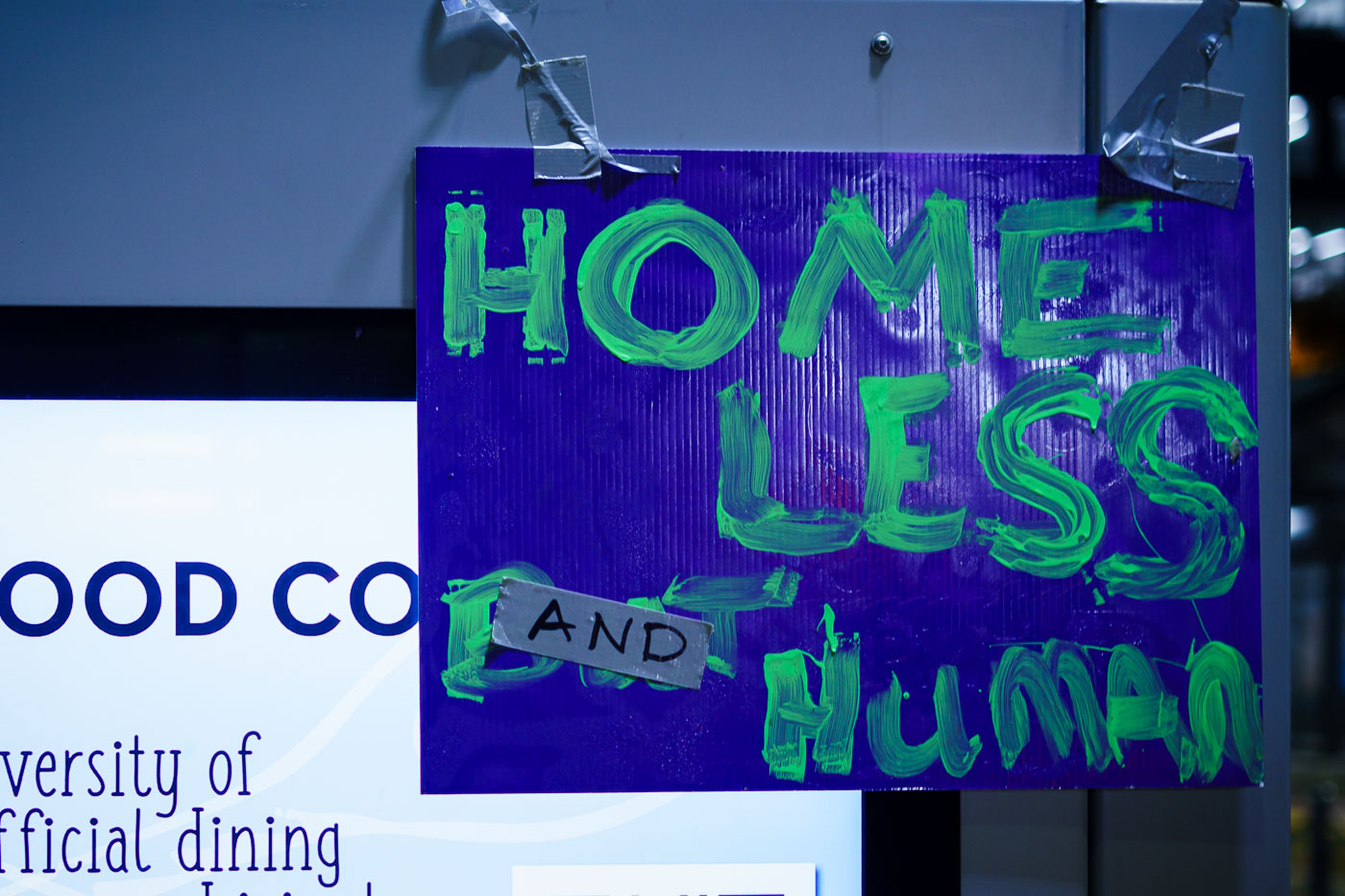
Protesters holding space at City Hall. They say they demand “a complete moratorium on the clearing of encampments, clear guidelines regarding the encampments and proof of funding for more permanent housing for unhoused residents and people in need”
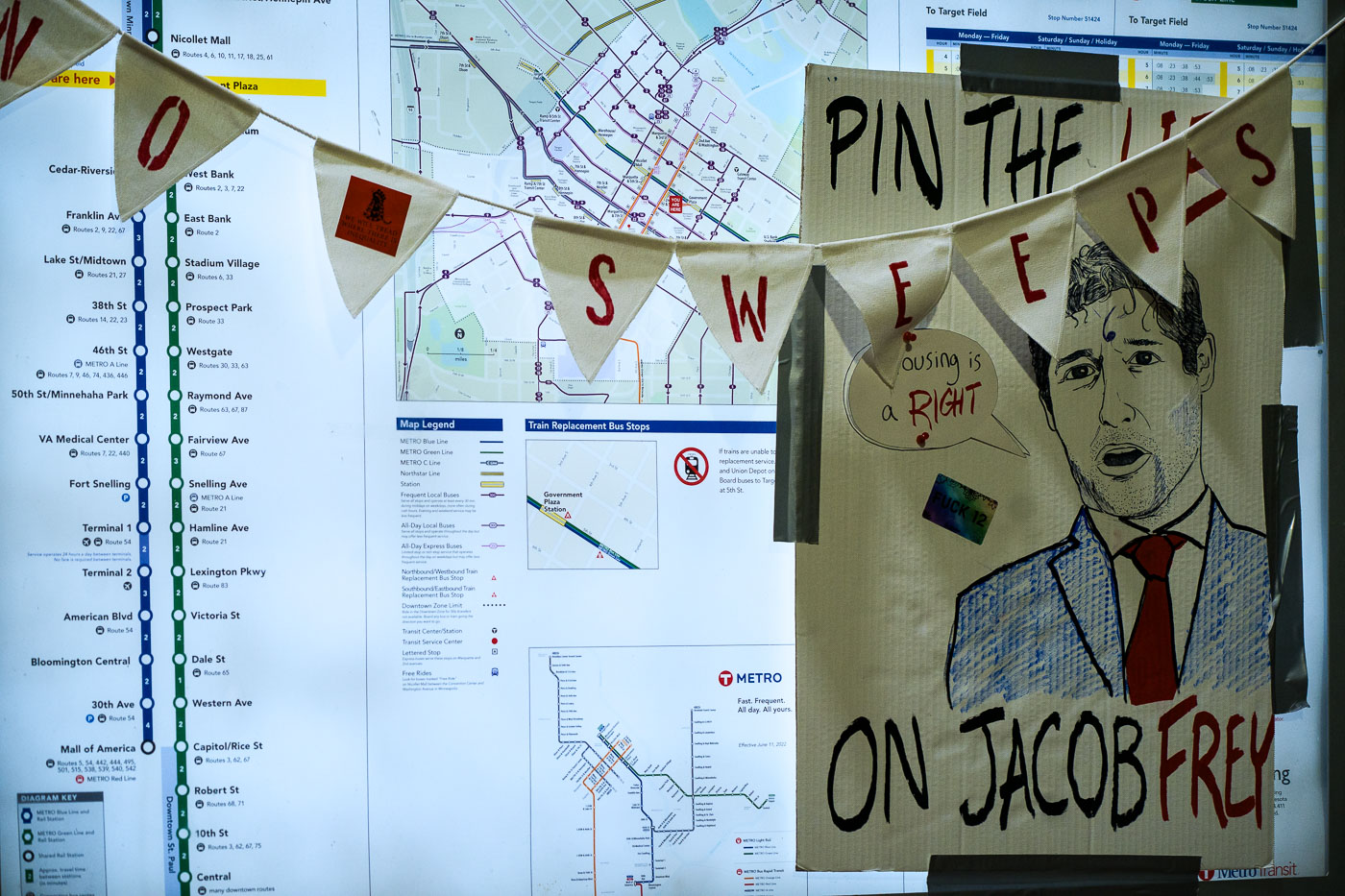
Protesters holding space at City Hall. They say they demand "a complete moratorium on the clearing of encampments, clear guidelines regarding the encampments and proof of funding for more permanent housing for unhoused residents and people in need"
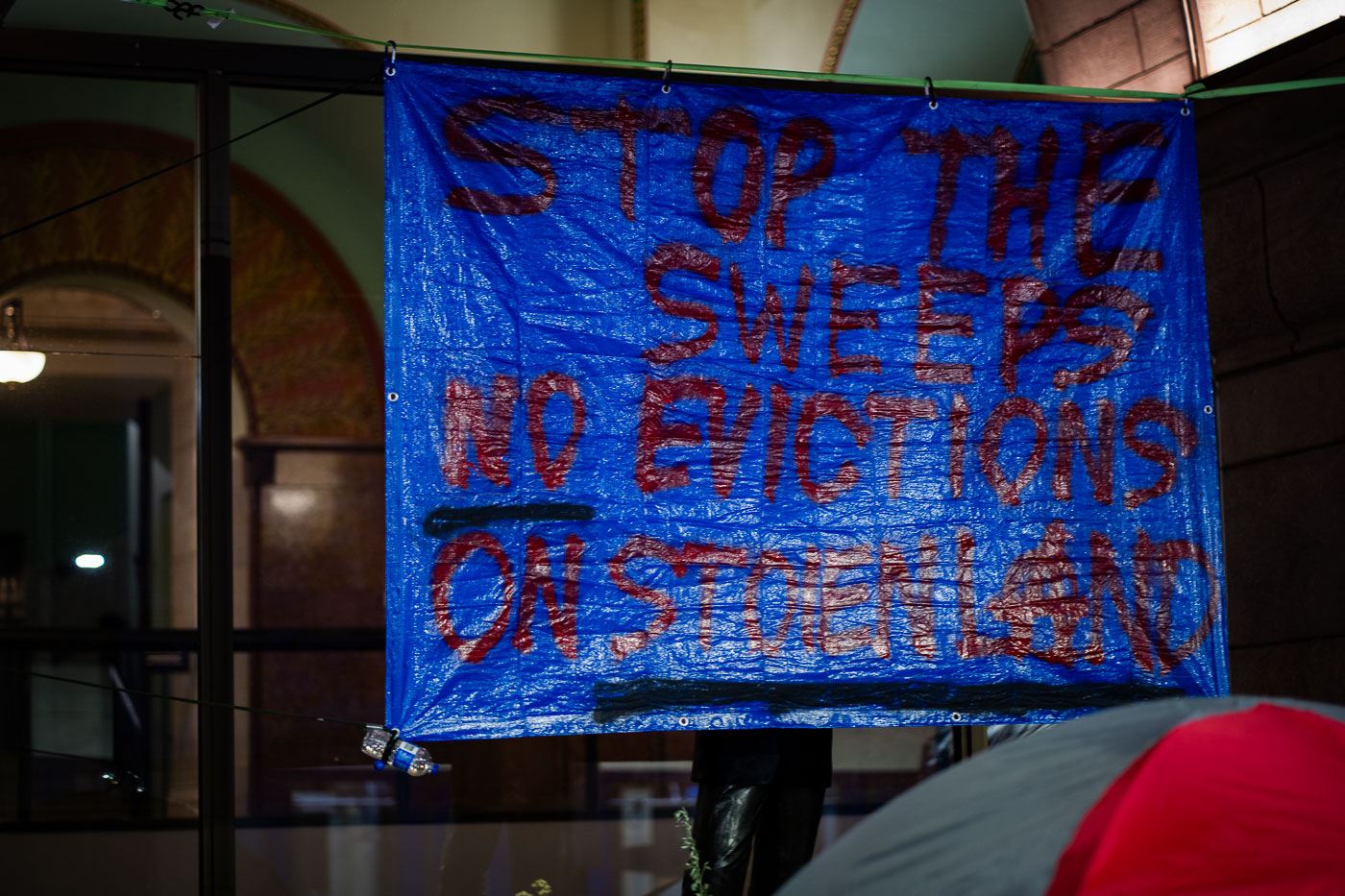
Protesters holding space at Minneapolis City Hall. They say they demand "a complete moratorium on the clearing of encampments, clear guidelines regarding the encampments and proof of funding for more permanent housing for unhoused residents and people in need”.
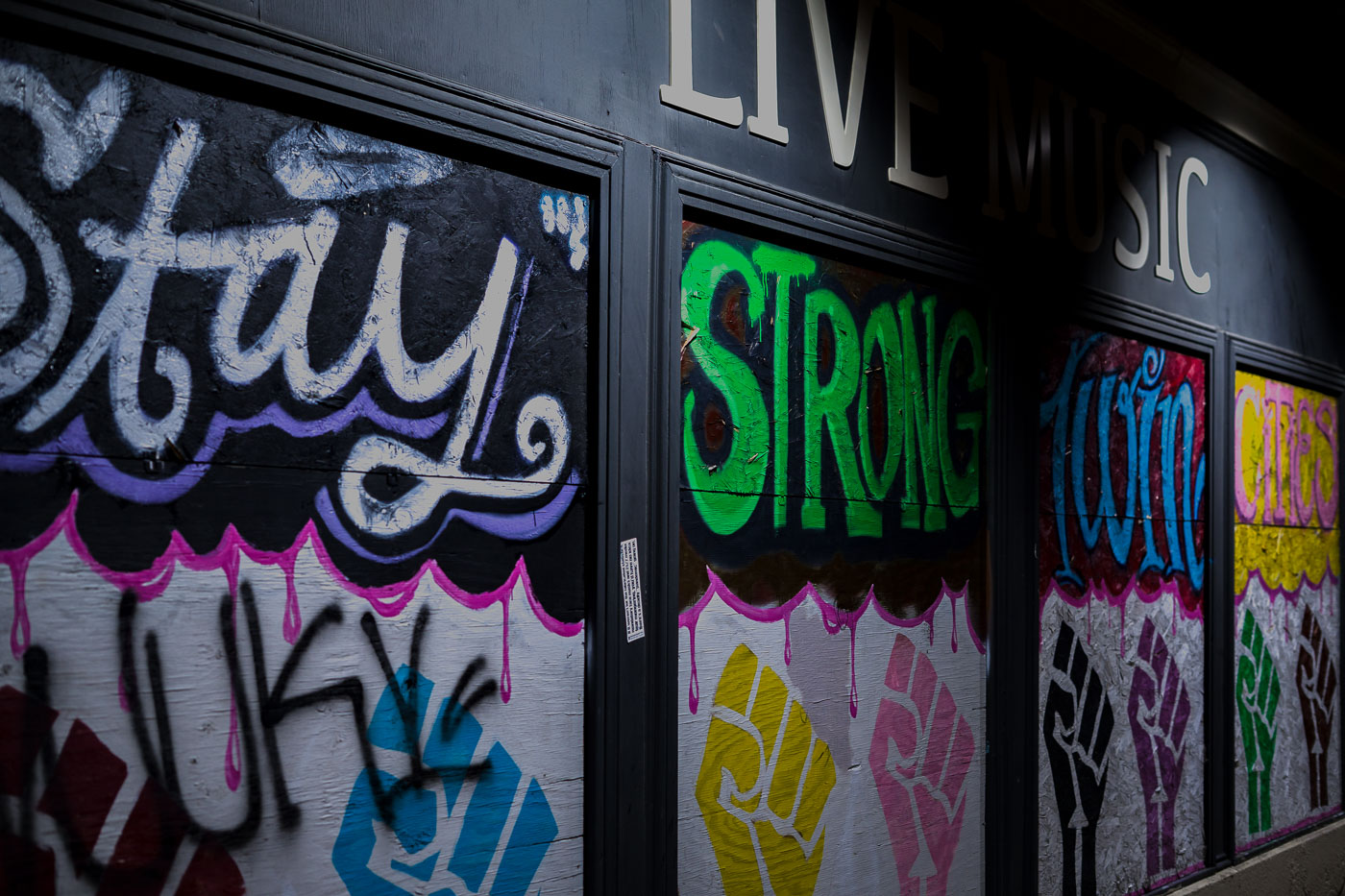
Painted boards on Mortimer’s on Lyndale Avenue in Minneapolis.

This aerial view looks over one of Lake Minnetonka’s shallow eastern bays, where a broad wetland of cattails and floating vegetation meets a line of private docks and covered boat slips. These marshy inlets are among the lake’s most ecologically important areas, filtering runoff, supporting migratory birds, and preserving habitat that once covered far more of the shoreline before 20th-century dredging and residential development. The fall canopy surrounding the bay shows the mix of hardwoods common in the Deephaven and Greenwood areas, with red maples, oaks, and ash trees creating a dense belt of color around the water. Farther in the distance, the channel and bridge leading toward Carson’s Bay hint at the lake’s extensive network of connected basins, many of which were linked by canals built in the late 1800s to support early resort traffic.
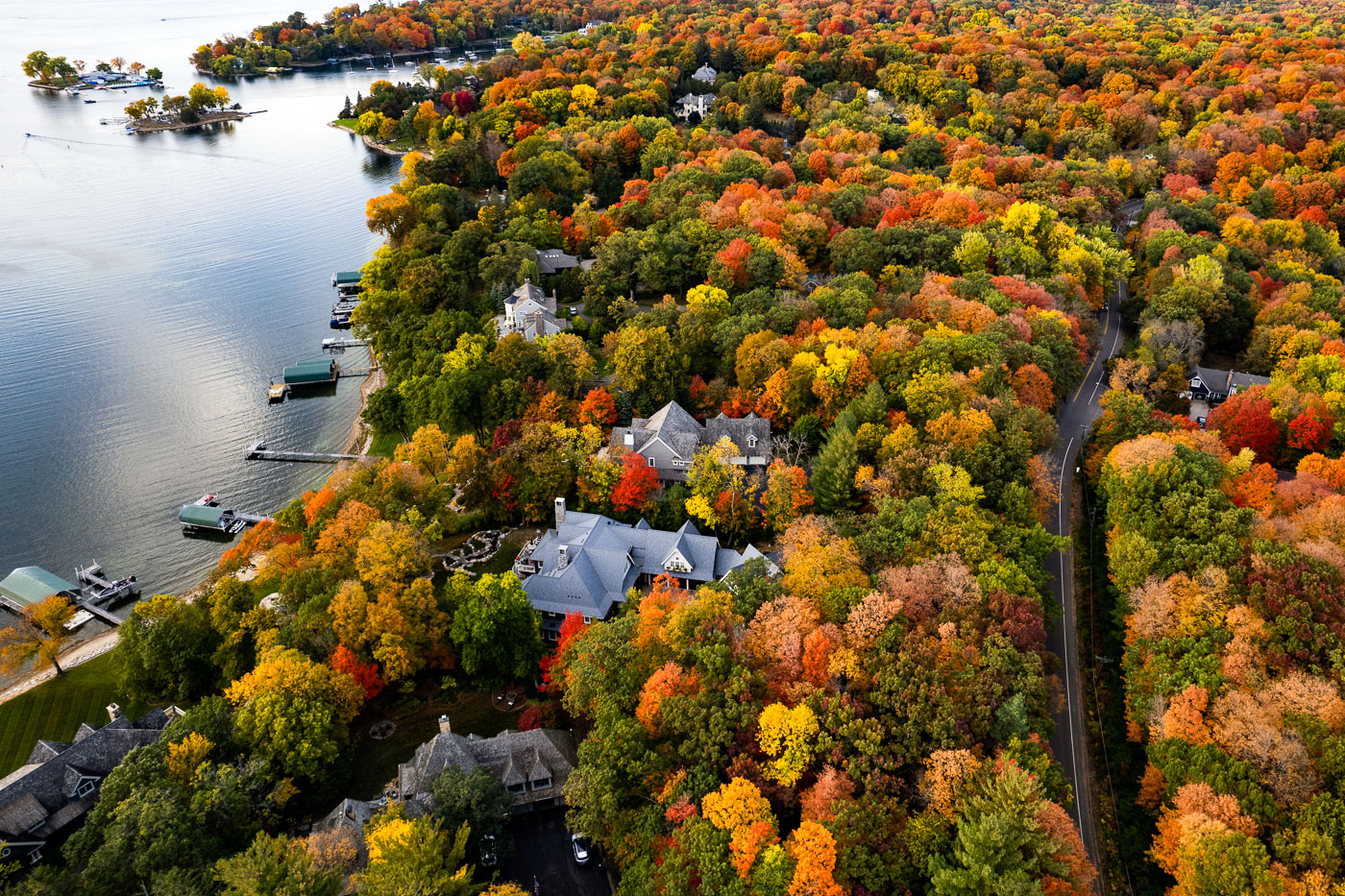
This aerial view follows the wooded shoreline of Deephaven, a small lakeside community on the southeast edge of Lake Minnetonka. The neighborhood developed around a combination of 19th-century summer cottages and later year-round homes, many of which were built on large forested lots that still preserve much of the area’s original tree cover. In autumn, the mix of maple, oak, and basswood trees creates a dense canopy of reds, yellows, and orange tones that nearly conceals the homes and winding shoreline roads below. Deephaven’s bay-front docks, protected inlets, and narrow peninsulas are distinctive features of this part of Minnetonka, reflecting the lake’s long history as a regional retreat and residential enclave.

An aerial view over Deephaven captures the dense hardwood canopy that defines the residential areas near Lake Minnetonka each autumn. The neighborhood’s winding roads and homes sit almost entirely beneath mature maple, oak, and basswood trees, which turn a concentrated mix of red, orange, and gold during peak color change. This part of the Minnetonka shoreline developed slowly through the mid-20th century, preserving large wooded lots and green corridors that create the nearly continuous tree cover seen from above. The forested character of these communities—rare for a metropolitan area—remains a major feature of Deephaven’s identity and contributes to its secluded, park-like landscape.

An overhead view of a small wetland basin in Deephaven shows the transition into late fall around Lake Minnetonka. Seasonal drawdown has exposed the cracked mudflats around the pond’s edge, while a layer of duckweed or algae collects in the remaining water at the center — a common pattern in shallow basins fed by spring runoff and intermittent groundwater. Surrounding hardwoods and pines move through peak color, forming the dense forest cover typical of the Minnetonka shoreline communities, where preserved ravines, lowlands, and wooded parcels give the area its distinctive mix of lakefront development and natural habitat.

An aerial view captures the dense fall canopy around Lake Minnetonka in Deephaven, where mature hardwoods and pines create a patchwork of orange, yellow, and deep red. Many of the winding roads in this part of the Lake Minnetonka shoreline were laid out in the early 20th century as the area transitioned from summer cottages to year-round neighborhoods. Today the tree cover remains one of Deephaven’s defining features, with protected woodland corridors and long-established residential plots preserving the character of this lakeside community.
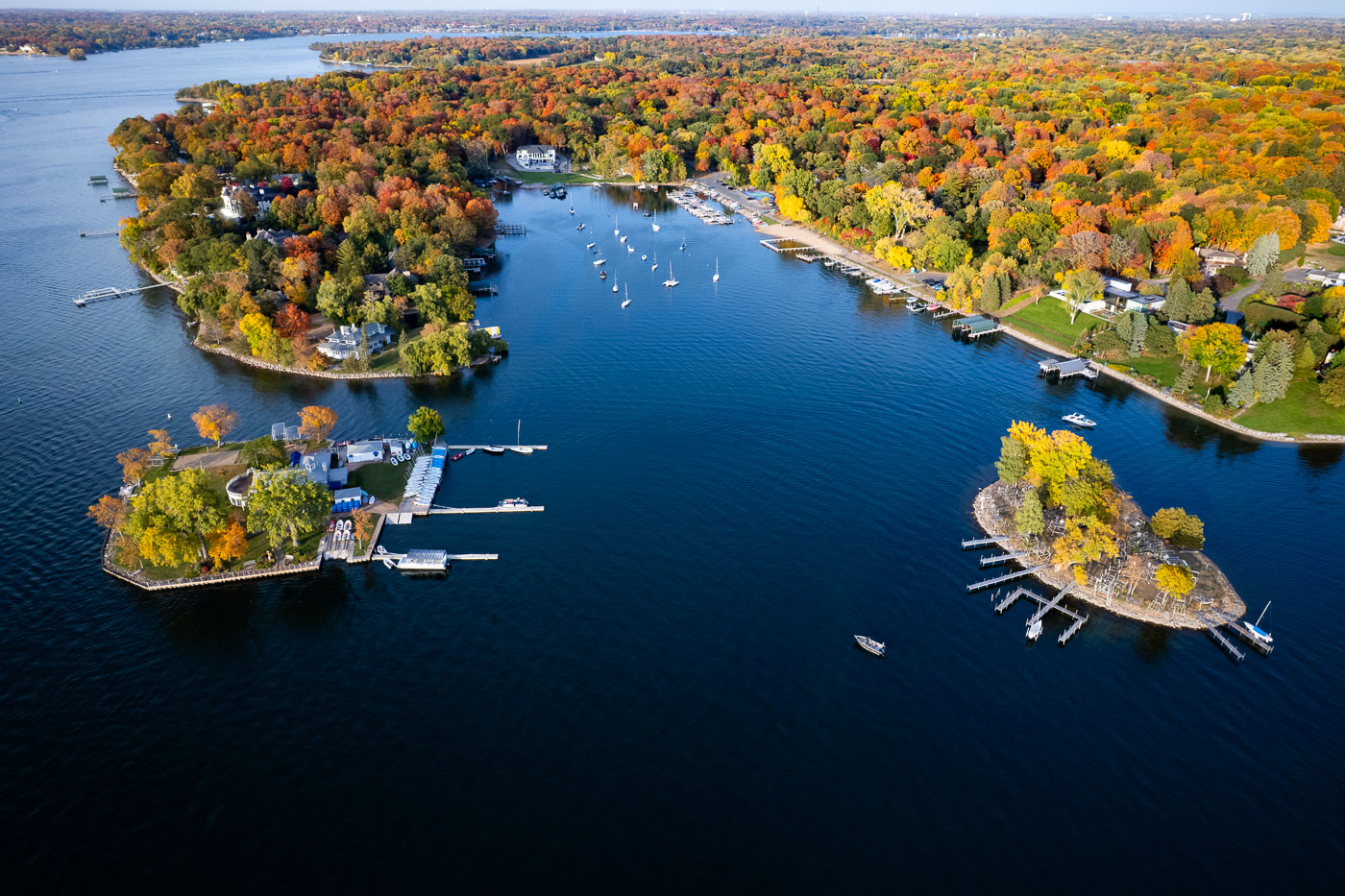
A high-elevation view over Lake Minnetonka captures several of the lake’s narrow peninsulas and sheltered bays at peak autumn color. The lake’s fragmented shoreline—shaped by glacial meltwater during the last Ice Age—creates dozens of protected inlets that became ideal sites for marinas, sailing clubs, and early resort development in the late 19th and early 20th centuries.
In this part of the lake, the docks and clustered sailboats reflect the area’s long-standing boating culture, while the densely wooded neighborhoods show how residential development was built around access to quiet coves rather than wide-open water. The surrounding canopy, shifting from green to deep red and gold, highlights why Lake Minnetonka remains one of the most photographed fall landscapes in the Twin Cities region.
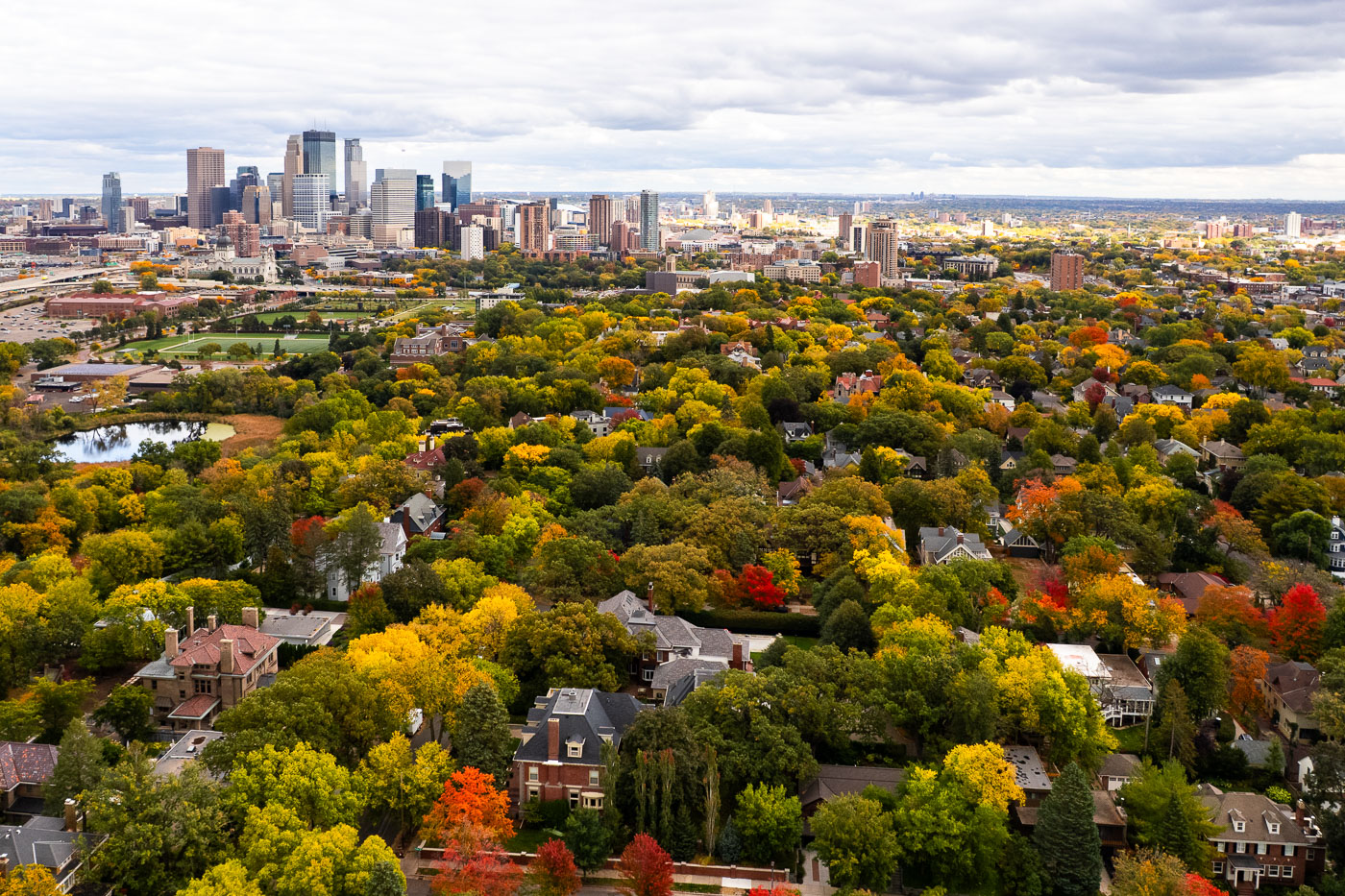
A wide aerial view looks east toward the Minneapolis skyline, rising above the dense canopy of the Kenwood and Lowry Hill neighborhoods during peak autumn color. This part of the city was developed in the late 19th and early 20th centuries as a streetcar suburb, designed around curving streets, large residential lots, and proximity to the Chain of Lakes. Many of the homes below are early Minneapolis mansions built by lumber and milling-era industrialists, now tucked beneath mature trees that give the neighborhood one of the city’s most dramatic fall transitions.
In the middle distance, the Basilica of Saint Mary, Loring Park, and the early downtown warehouse district reflect Minneapolis’s layered growth—from industrial rail corridors to modern glass towers. The contrast between the dense urban core and the tree-covered residential districts highlights how closely the city’s historic neighborhoods were shaped by parks, lakes, and the parkway system planned by Theodore Wirth in the early 1900s.

A sticker on a Minneapolis signpost references long-running allegations surrounding deputy “gangs” within the Los Angeles County Sheriff’s Department (LASD). Civil rights groups, journalists, and county oversight bodies have documented concerns for decades about informal deputy subgroups—some using matching tattoos or symbols—that critics say foster misconduct, retaliation, and internal loyalty structures.
Seeing a reference to those controversies on a street sign in Minneapolis reflects how national policing debates and accountability issues often circulate far beyond their place of origin, with artists and activists using stickers, posters, and small-scale street graphics to raise awareness or prompt online searches.
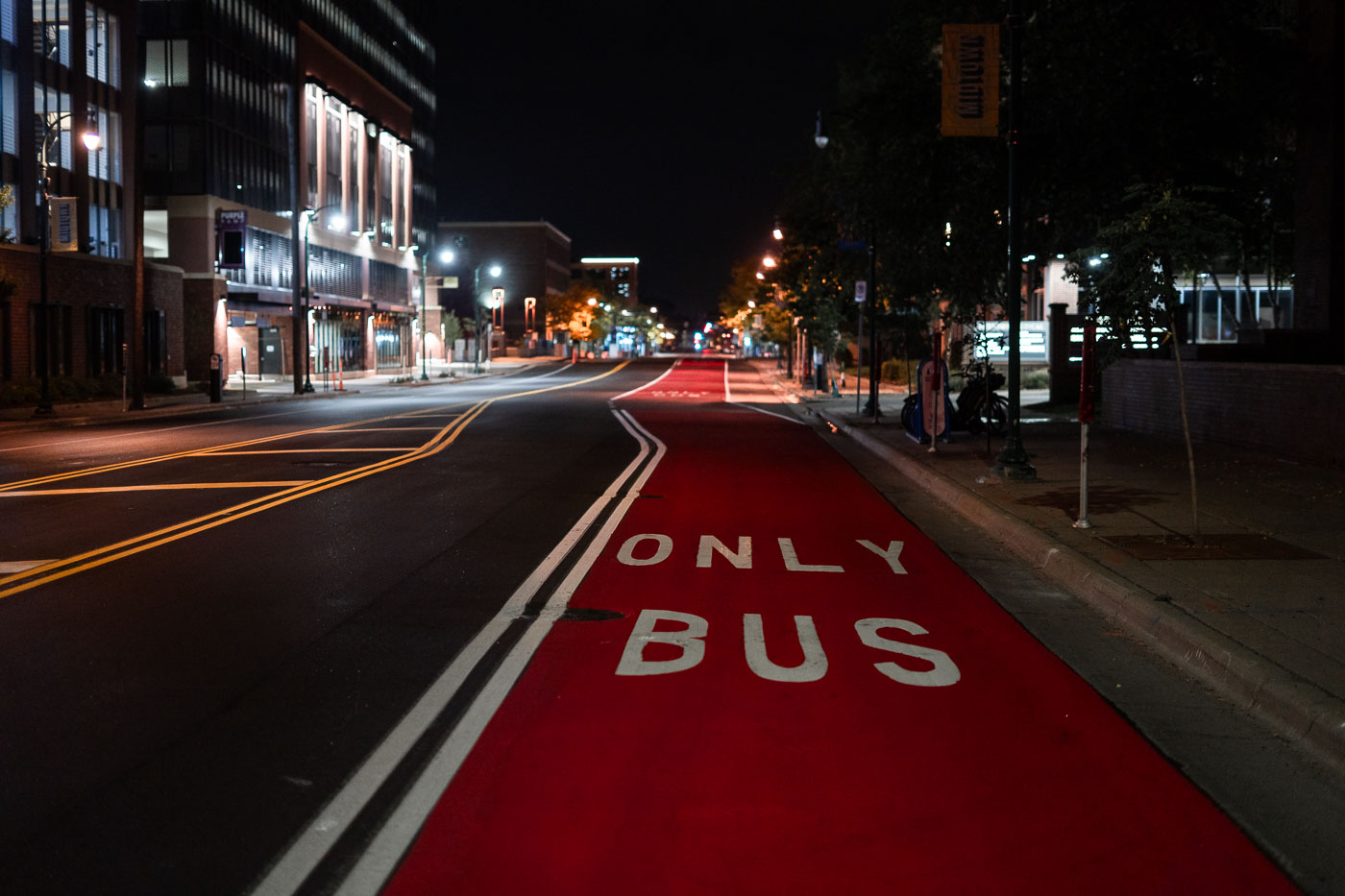
A dedicated red bus-only lane runs along Chicago Avenue in Minneapolis, part of the city’s recent investments in transit priority corridors. These painted lanes are designed to give buses consistent travel times through dense urban segments, especially during peak hours, and they align with regional plans to improve service reliability on key north–south routes. Late at night the corridor is quiet, with the reflective pavement markings and overhead lighting emphasizing the straight line of the transit path through the Midtown area.