Black Lives Matter

127 photos · 2015–2024

127 photographs tagged Black Lives Matter, 2015–2024.
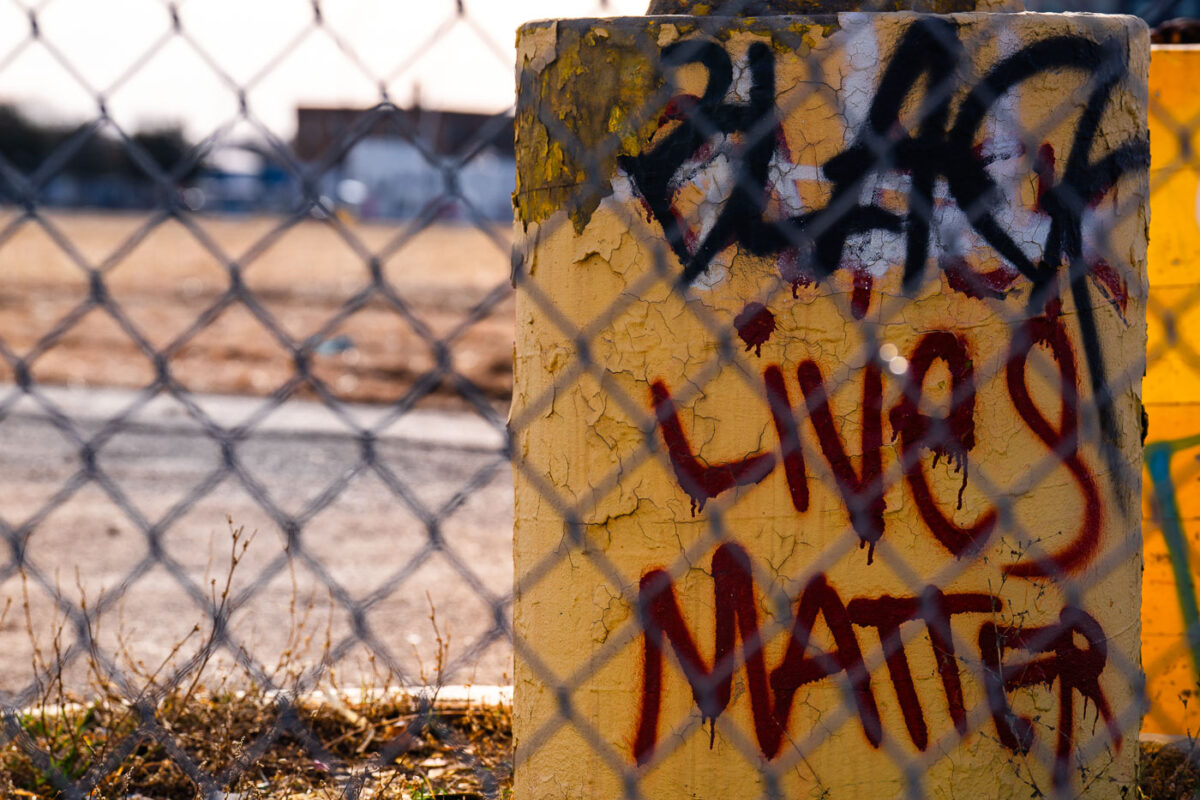
Black Lives Matter graffiti in black and red spray paint on a weathered yellow utility post behind a chain-link fence in South Minneapolis.
The phrase "Black Lives Matter" is spray-painted in black and red on a weathered utility post in South Minneapolis.

“Black Lives Matter” Spray-Painted on a Fence Post

Colorful portraits of George Floyd and Breonna Taylor displayed in Moxy Hotel Minneapolis interior.
Art adorns the interior of the Moxy Hotel Minneapolis, located on Hennepin Avenue in Uptown. The "Black Lives Matter" text is visible on a sign, alongside portraits of George Floyd and Breonna Taylor.

George Floyd and Breonna Taylor Portraits Inside Moxy Hotel Minneapolis

Black Lives Matter sign in the Moxy Hotel window on Lake Street in Minneapolis.
A "Black Lives Matter" sign is displayed in the window of the Moxy Hotel on Lake Street in Minneapolis's Uptown neighborhood.

“Black Lives Matter” Sign in a Moxy Hotel Window on Lake Street

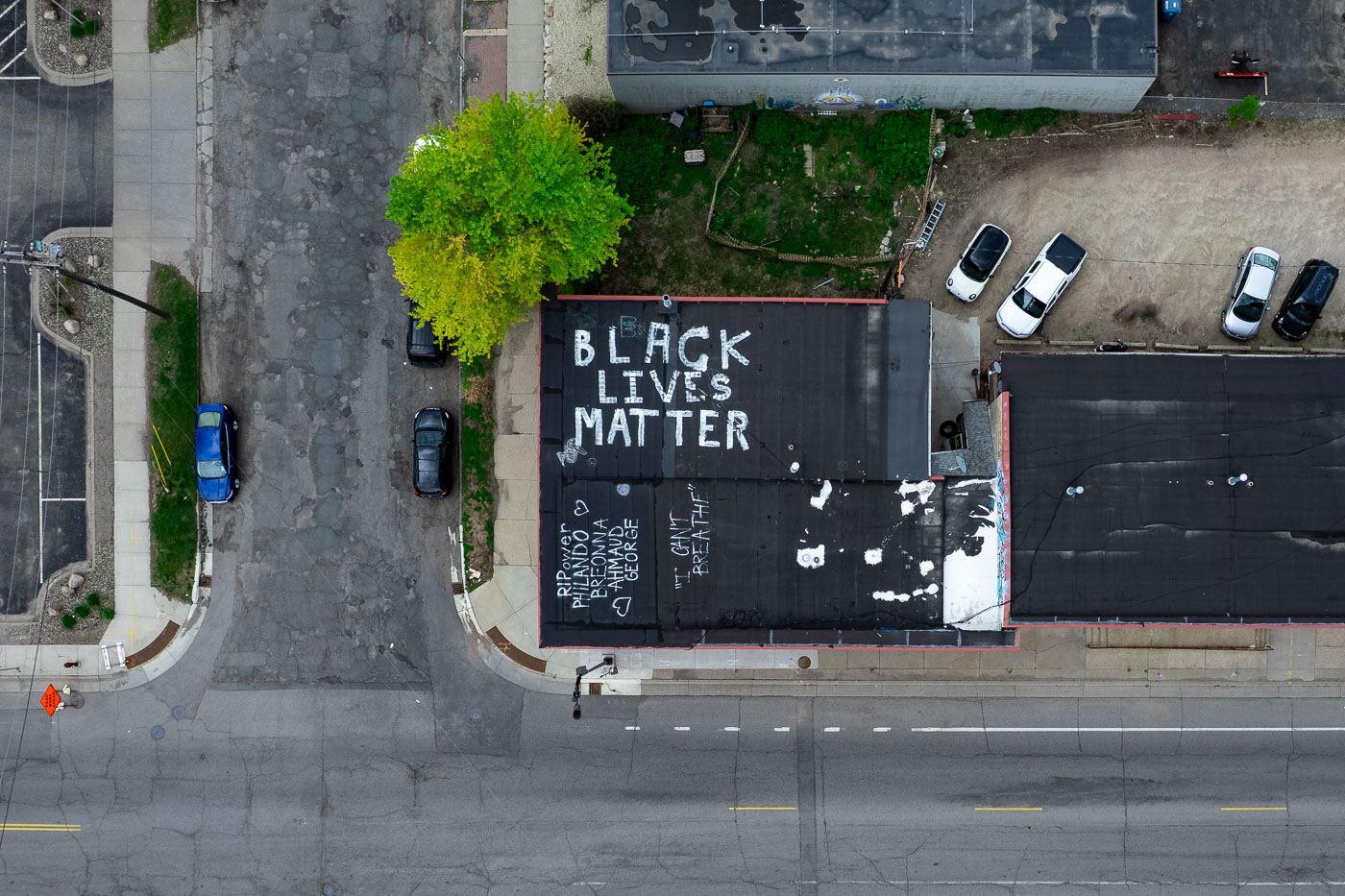
Black Lives Matter on top of North Loop building
A large "Black Lives Matter" mural is painted on the roof of a building in Minneapolis's North Loop neighborhood. The mural, created in response to the murder of George Floyd and subsequent protests, also includes the names of other victims of police brutality, such as Breonna Taylor and Ahmaud Arbery, and the phrase "I Can't Breathe."

Minneapolis: Black Lives Matter Mural on North Loop Building
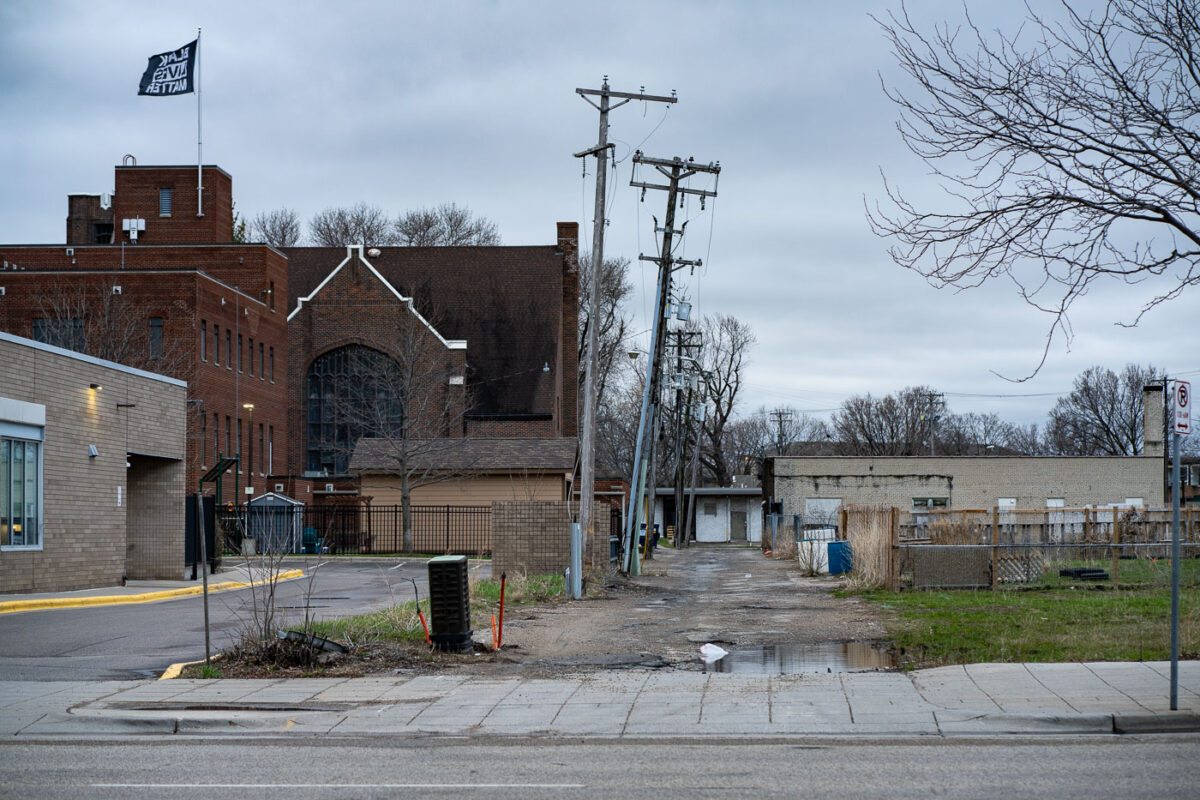
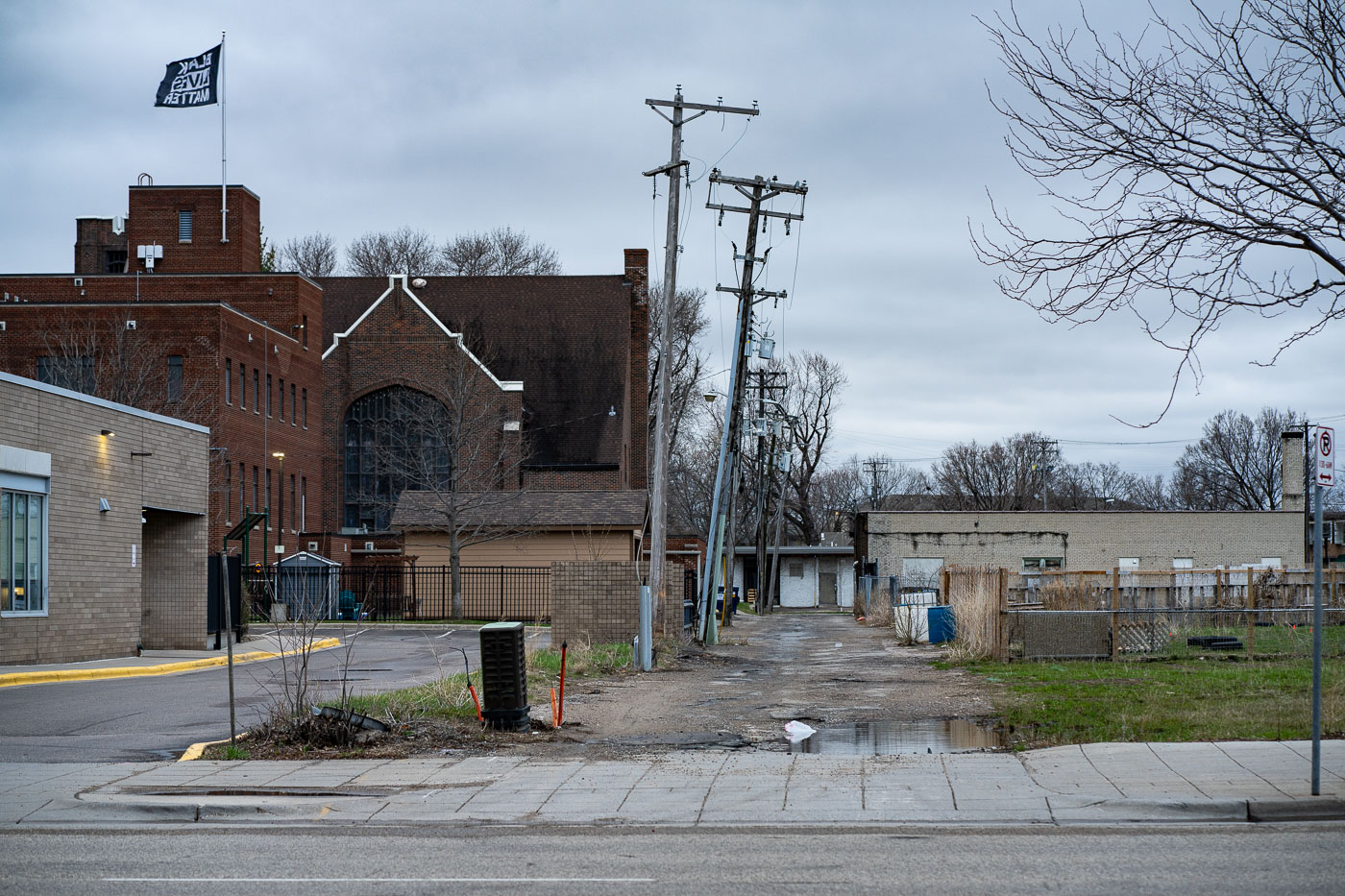
Black Lives Matter flag over a church near the burned Minneapolis police station
A Black Lives Matter flag flies atop a church in Minneapolis, near the site of the Third Precinct police station that was set ablaze during protests in May 2020. The flag's presence signifies solidarity with the movement for racial justice that gained national attention following the murder of George Floyd.

Black Lives Matter Flag Flies Over Minneapolis Church

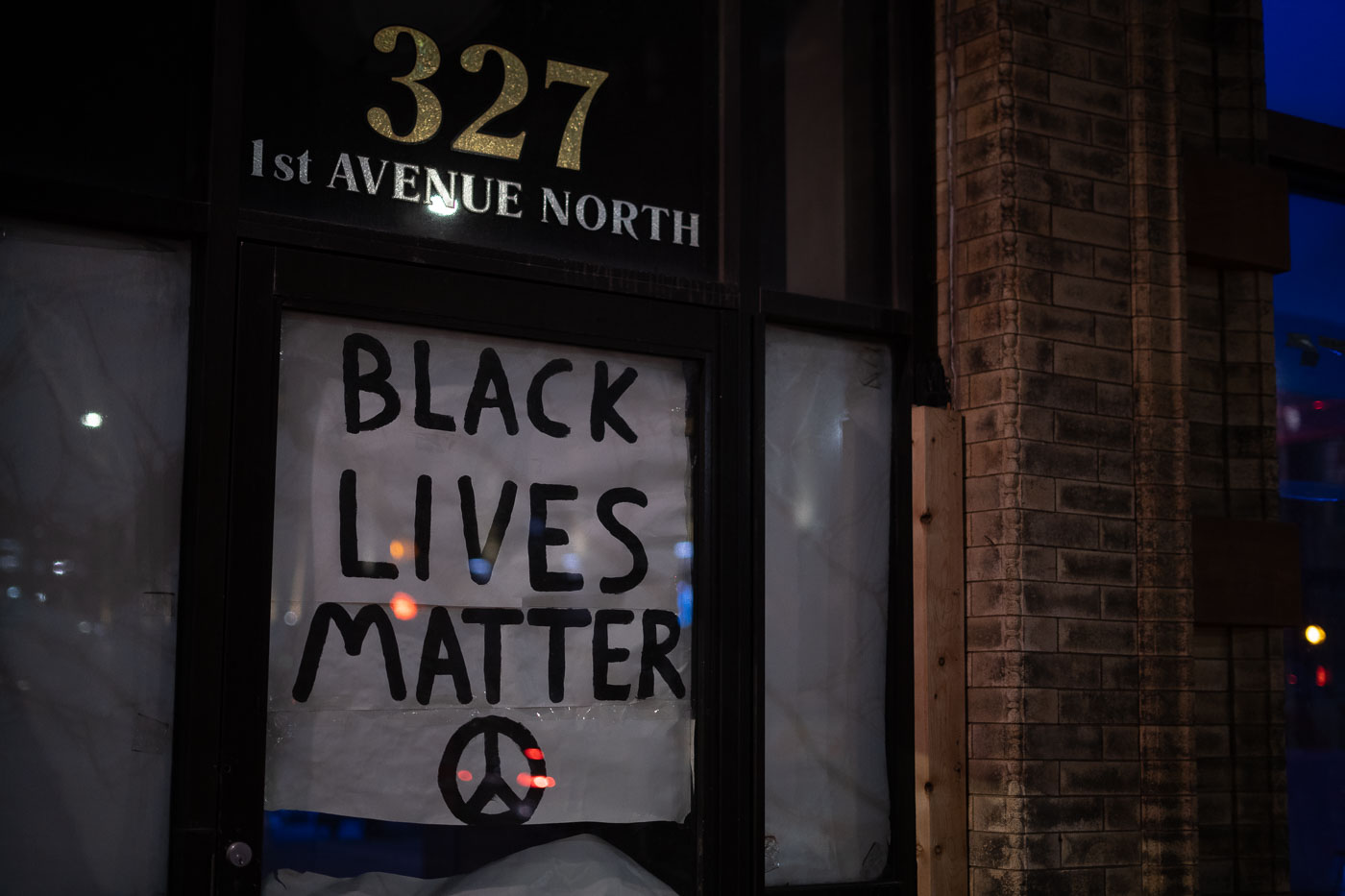
Black Lives Matter sign in Downtown Minneapolis April 2022
A "Black Lives Matter" sign is displayed in the window of a building at 327 1st Avenue North in Minneapolis. The sign, which includes a peace symbol, was visible in April 2022, more than a year after the murder of George Floyd in the city. The area around 38th Street and Chicago Avenue, known as George Floyd Square, became a focal point for protests and activism following Floyd's death.

Black Lives Matter Sign, 327 1st Ave N, Minneapolis April 2022

BLM mural and "Abolish MPD" graffiti on 38th Street in Minneapolis.
Murals related to the Black Lives Matter movement and the call to "Abolish MPD" (Minneapolis Police Department) are displayed on a wooden structure on 38th Street in Minneapolis.

38th St, Minneapolis: “Abolish MPD” and BLM murals

Protester holding a Black Lives Matter sign on a Minneapolis street at night near New Bohemia Wurst + BierHaus.
On February 4, 2022, protesters gathered outside the Minneapolis Mayor's residence to demand justice for Amir Locke, who was killed by police earlier that day. The protest, organized by the Black Lives Matter movement, saw participants, including many young people, voicing demands for accountability and systemic change in policing.

Minneapolis Protest for Amir Locke at Mayor’s Residence

Boarded American Outfitters storefront in downtown Minneapolis with a For Sale sign and Amir Locke graffiti.
The former American Outfitters store in downtown Minneapolis is boarded up, with a "For Sale" sign visible in the window. Graffiti honoring Amir Locke, who was killed by Minneapolis police in February 2022, is spray-painted on the plywood covering the adjacent storefront.

Minneapolis: American Outfitters boarded, “For Sale” sign, Amir Locke graffiti
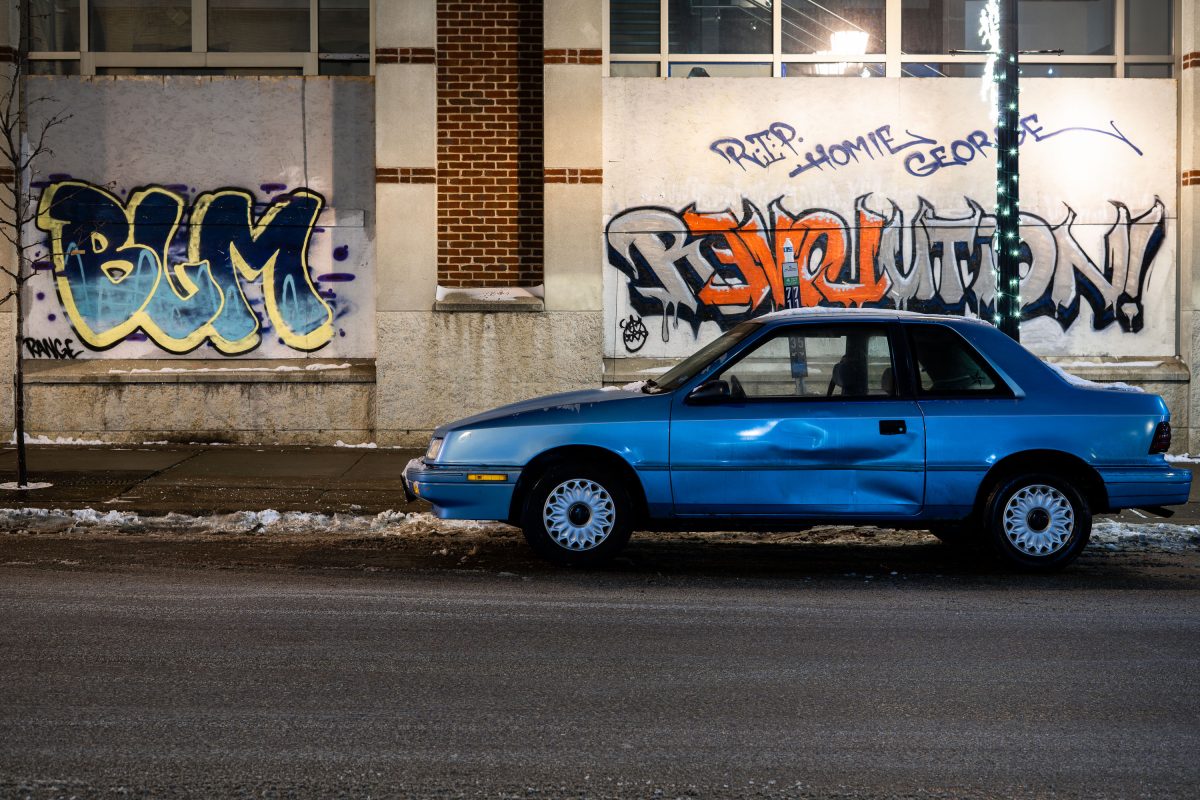
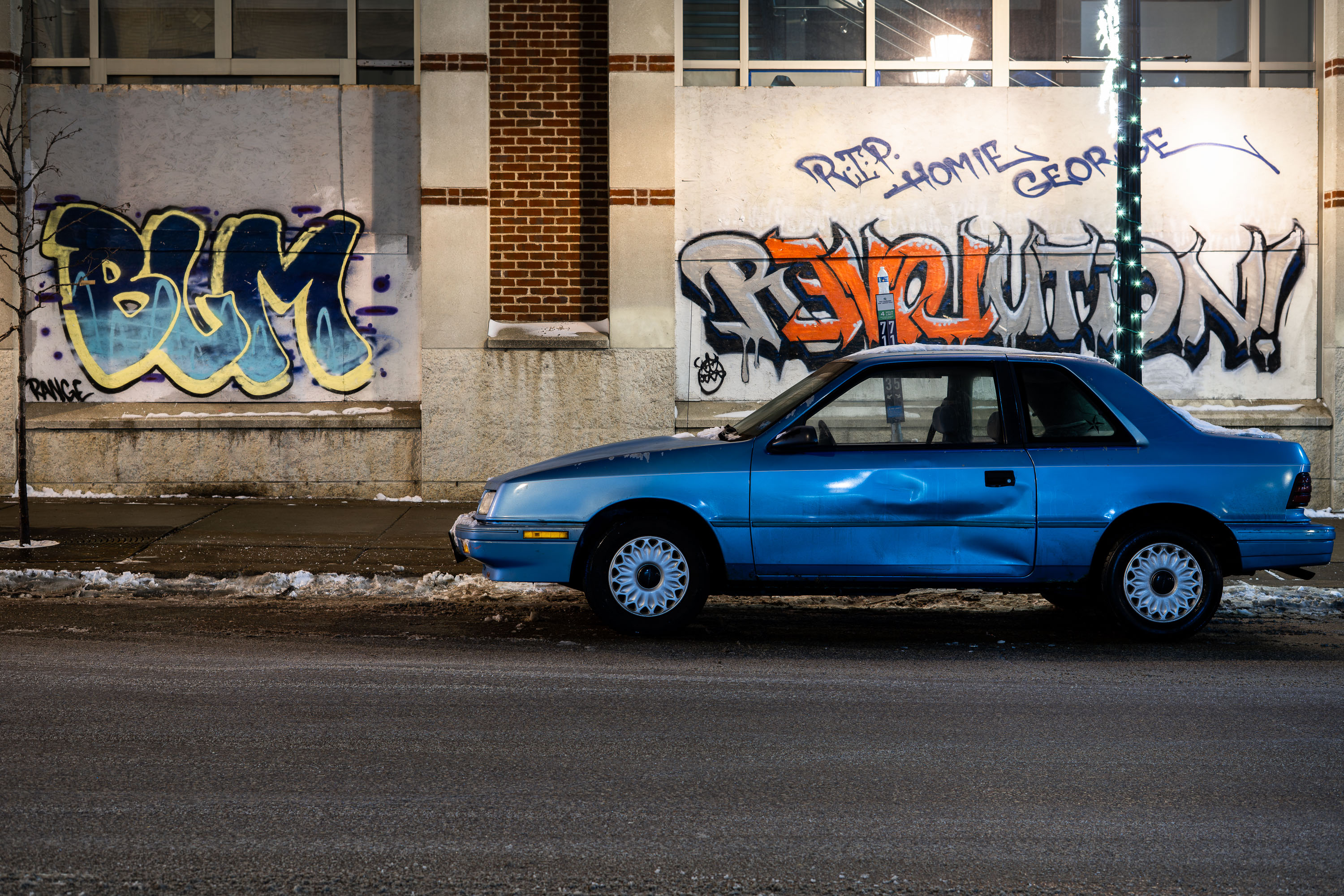
Revolution RIP George Floyd Mural on Lake Street, Minneapolis
A vehicle parked on Lake Street in Uptown Minneapolis in front of murals on a former Victoria Secret building.

Revolution RIP George Floyd Mural on Lake Street, Minneapolis

Black Lives Matter at Orchestra Hall in Minneapolis
A sign outside Orchestra Hall in Downtown Minneapolis displays a statement of solidarity with the Black Lives Matter movement. The message, "Music teaches us the value of listening. There is more for us to hear and more for us to do. Black Lives Matter," reflects the Minnesota Orchestra's commitment to addressing racial injustice. This statement was displayed during a period of heightened awareness and activism surrounding racial equity in the United States. Orchestra Hall, a prominent venue for the performing arts in Minneapolis, serves as a cultural anchor in the downtown area.

Orchestra Hall Minneapolis: Black Lives Matter Statement
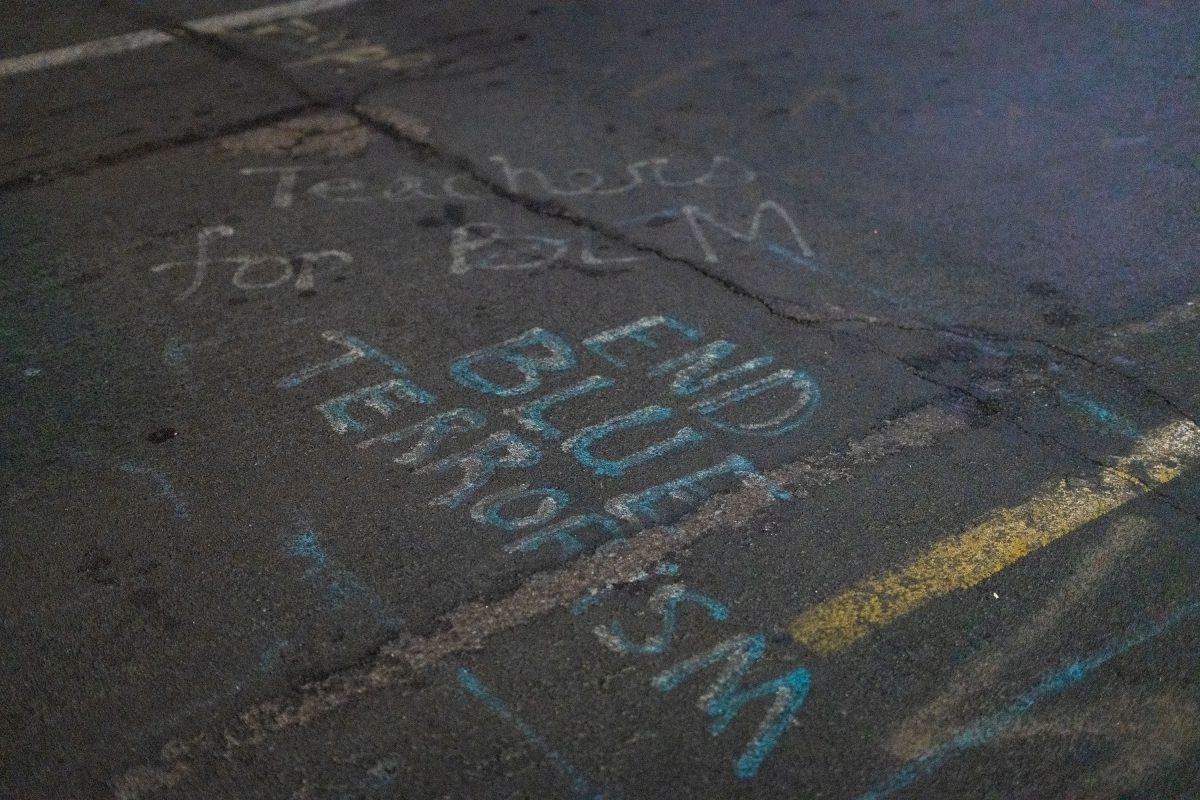
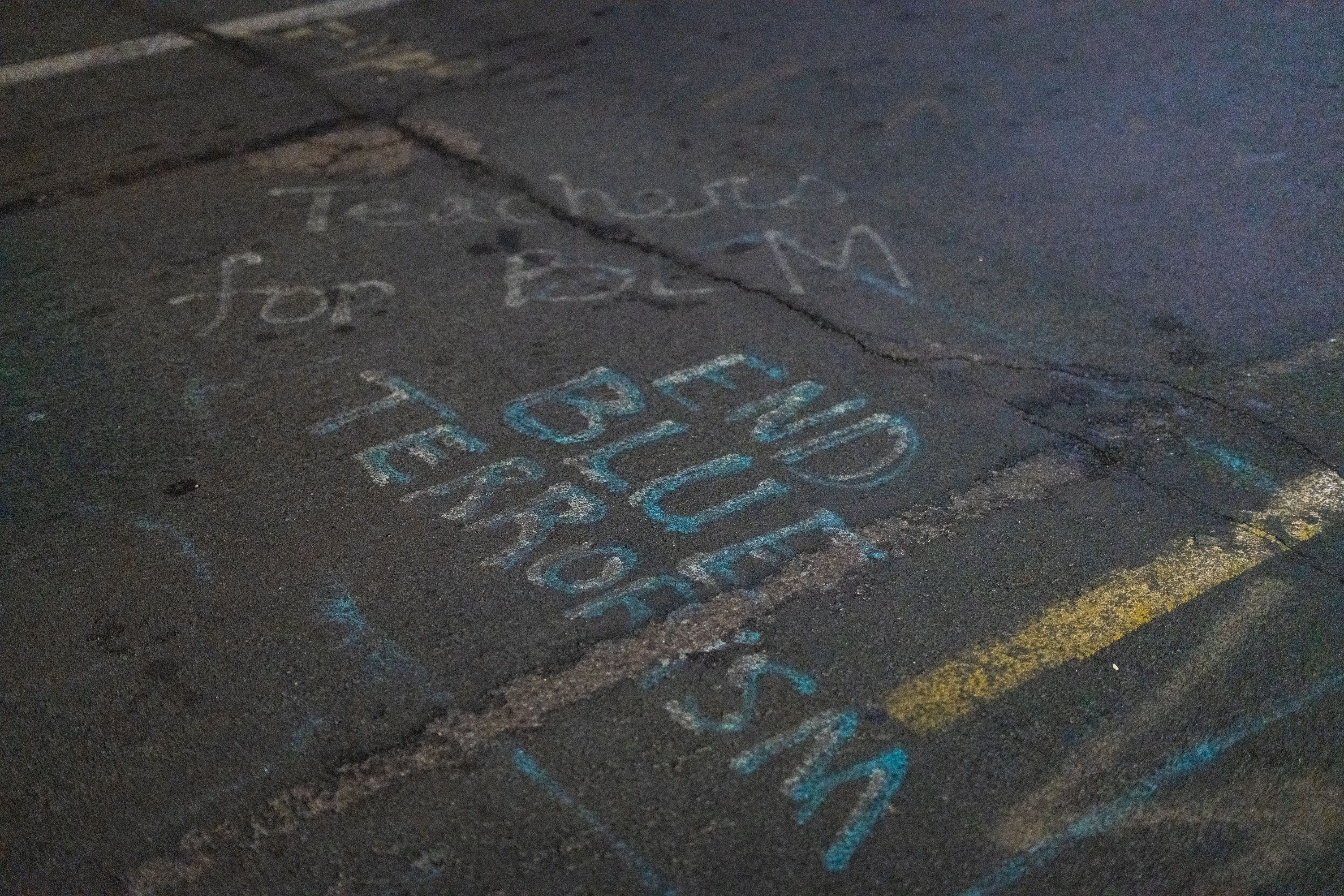
End Blue Terrorism
Graffiti on Chicago Avenue in South Minneapolis.

End Blue Terrorism Graffiti in Minneapolis
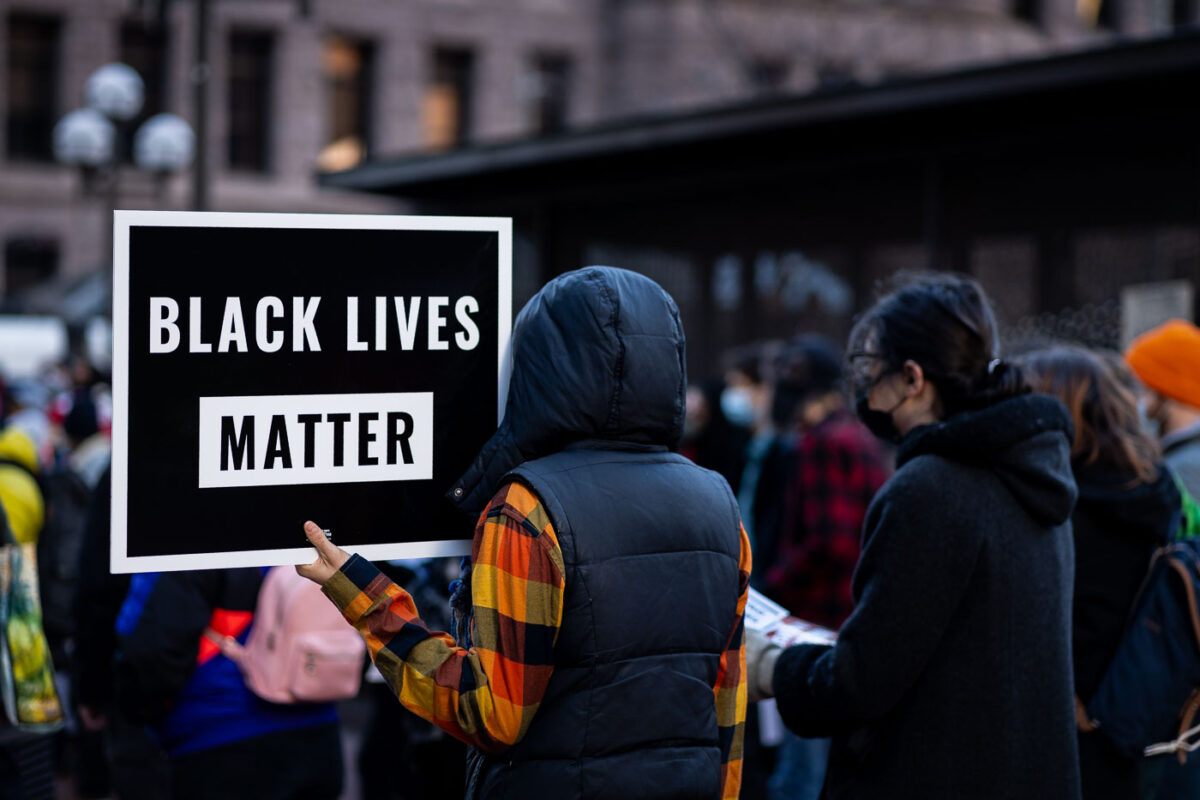
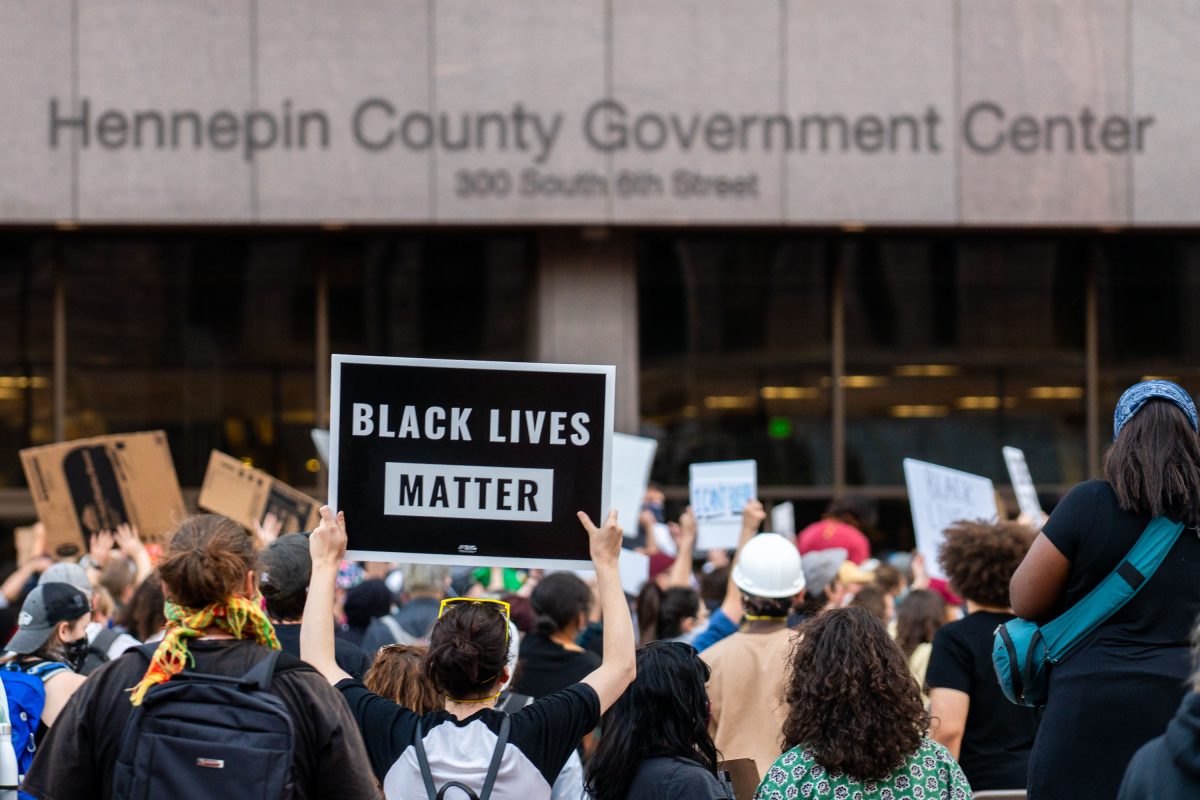
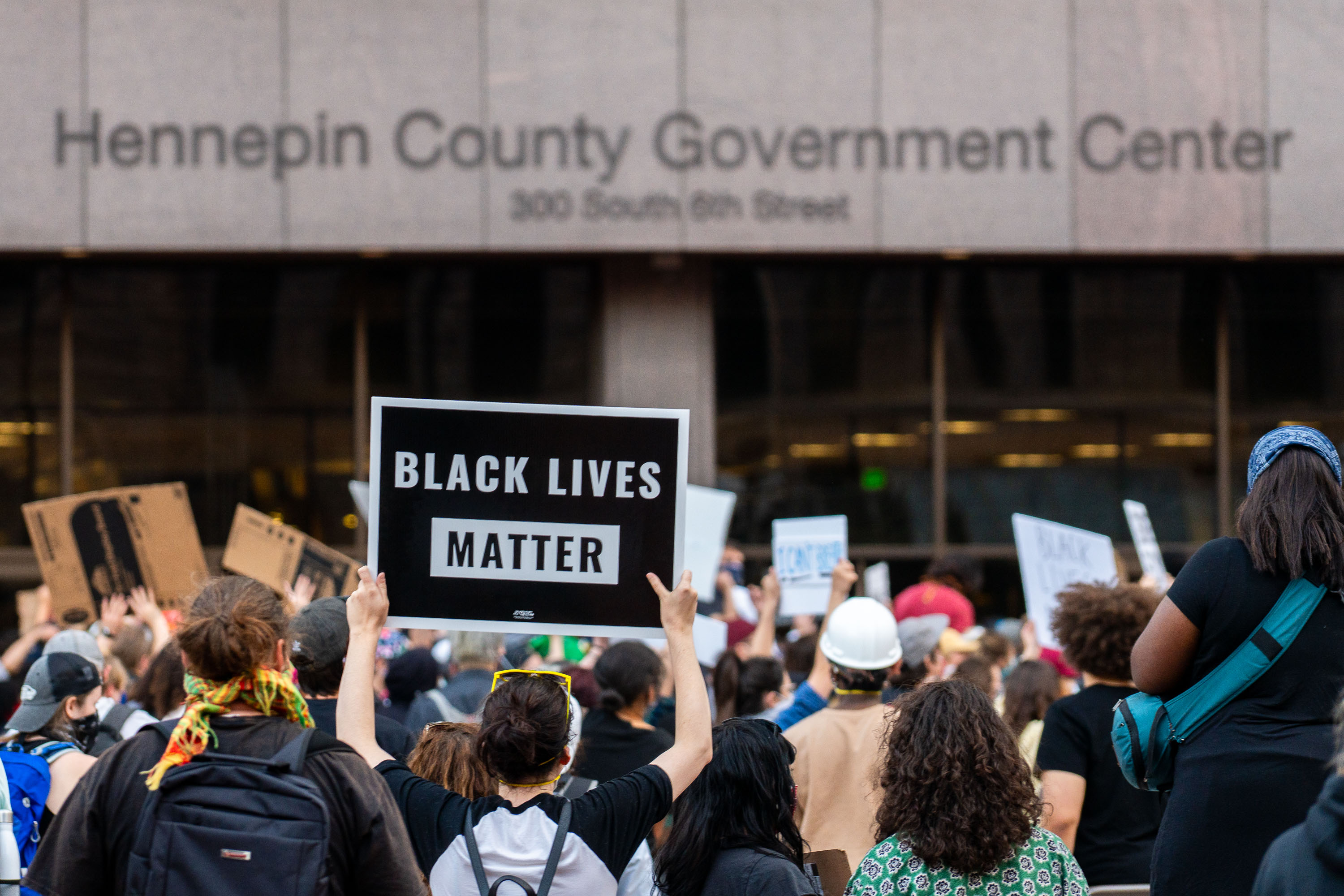
Protester holds Black Lives Matter sign in Downtown Minneapolis
Protesters gathered outside the Hennepin County Government Center in Minneapolis, holding signs that read "Black Lives Matter." This movement, which gained national prominence in 2013, advocates for the rights and liberation of Black people. The Government Center, a significant civic building in downtown Minneapolis, has been a focal point for various public gatherings and protests, reflecting its role as a center of local governance and public discourse.

Black Lives Matter Protest at Hennepin County Government Center, Minneapolis
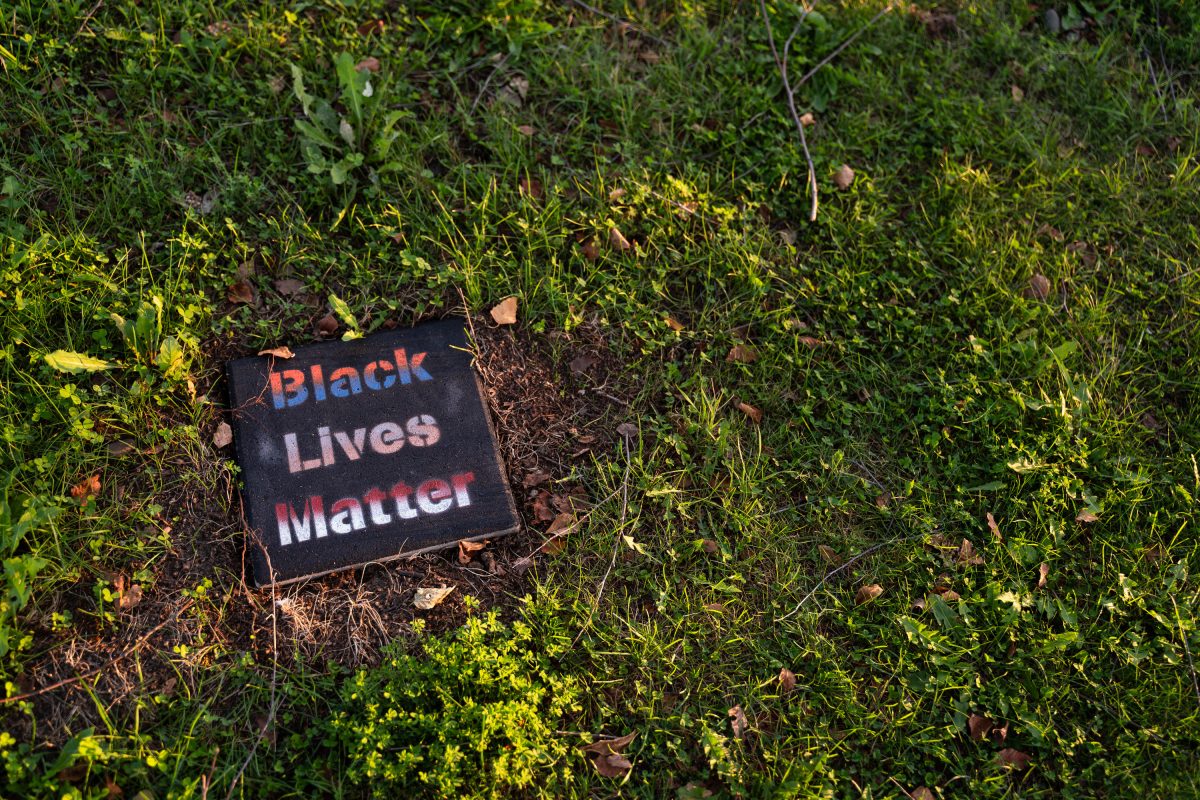
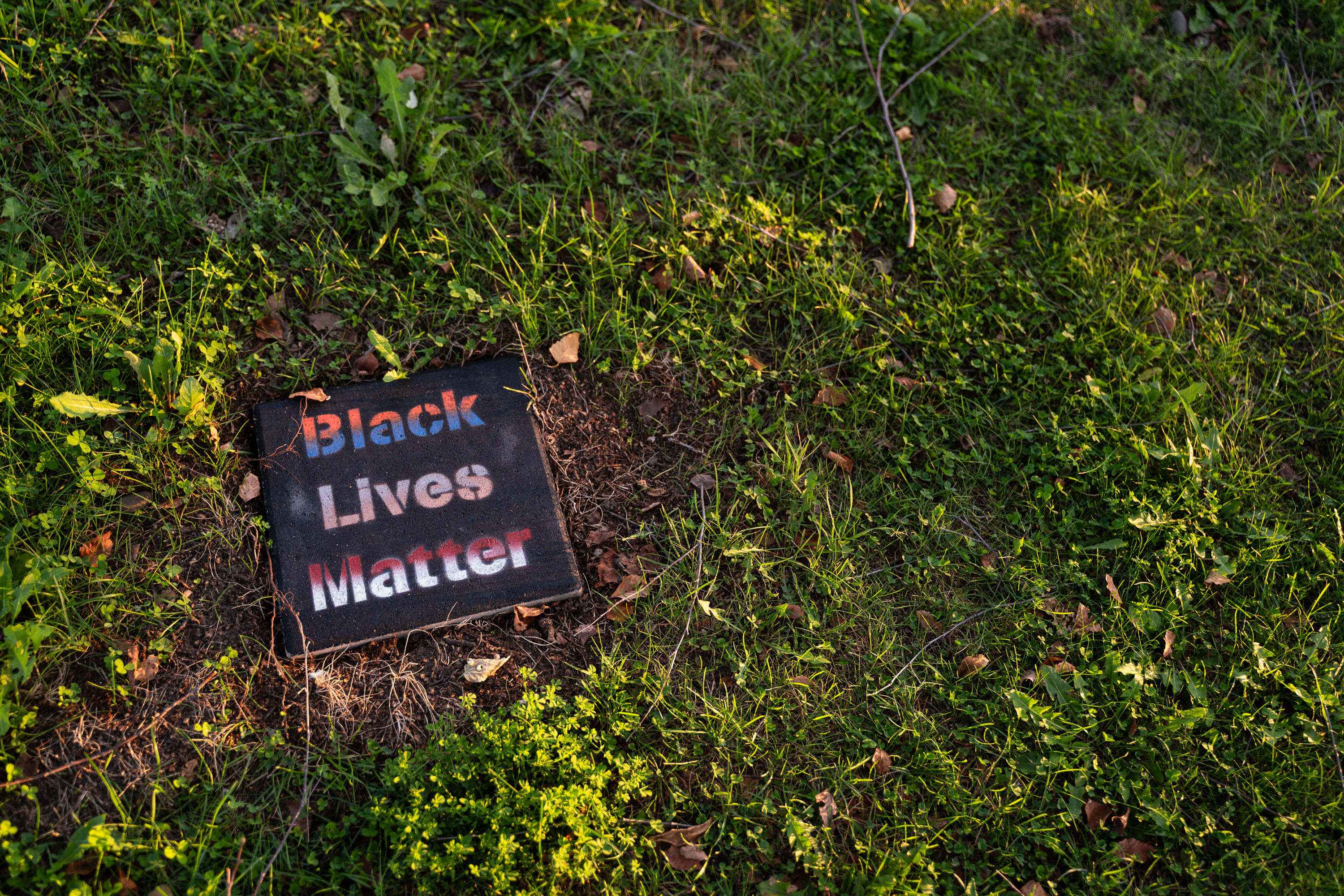
Black Lives Matter stencil on square tile
A Black Lives Matter concrete block in South Minneapolis.

Black Lives Matter on square tile

Protesters hold Black Lives Matter signs on Lake Street in Minneapolis.
Protesters hold "Black Lives Matter" signs on Lake Street at Hennepin Avenue in Minneapolis. The protest was in response to the law enforcement killing of Winston Smith on June 3, 2021, and Deona Marie on June 13, 2021. On June 13, 2021, 31-year-old Deona Marie Knajdek was killed when a driver accelerated into a group of demonstrators gathered in Minneapolis’ Uptown neighborhood during ongoing protests over the killing of Winston “Boogie” Smith Jr. Protesters had blocked the intersection of West Lake Street and Girard Avenue with vehicles and barricades when Nicholas Kraus drove a Jeep Cherokee into the crowd at high speed, killing Knajdek and injuring several others. Kraus was later charged with second-degree murder, two counts of second-degree assault with a dangerous weapon, and criminal vehicular operation. In 2023, he pleaded guilty to murder and assault charges and was sentenced to more than 20 years in prison for the attack. On June 3, 2021, members of a U.S. Marshals Service fugitive task force fatally shot 32-year-old Winston “Boogie” Smith Jr. on the top level of a parking ramp in Minneapolis’ Uptown neighborhood while attempting to arrest him on a felony warrant. Authorities said Smith fired a handgun from inside his vehicle during the encounter, while family members and activists questioned the official account and demanded the release of additional evidence. The killing led to weeks of protests, street occupations, and confrontations with police in Uptown, becoming another major flashpoint in Minneapolis during the period following the murder of George Floyd. Earlier in the day Minneapolis city officials along with The Agape Movement coordinated to open the streets that had been closed at George Floyd Square since his murder.

Black Lives Matter Protest on Lake Street, Minneapolis
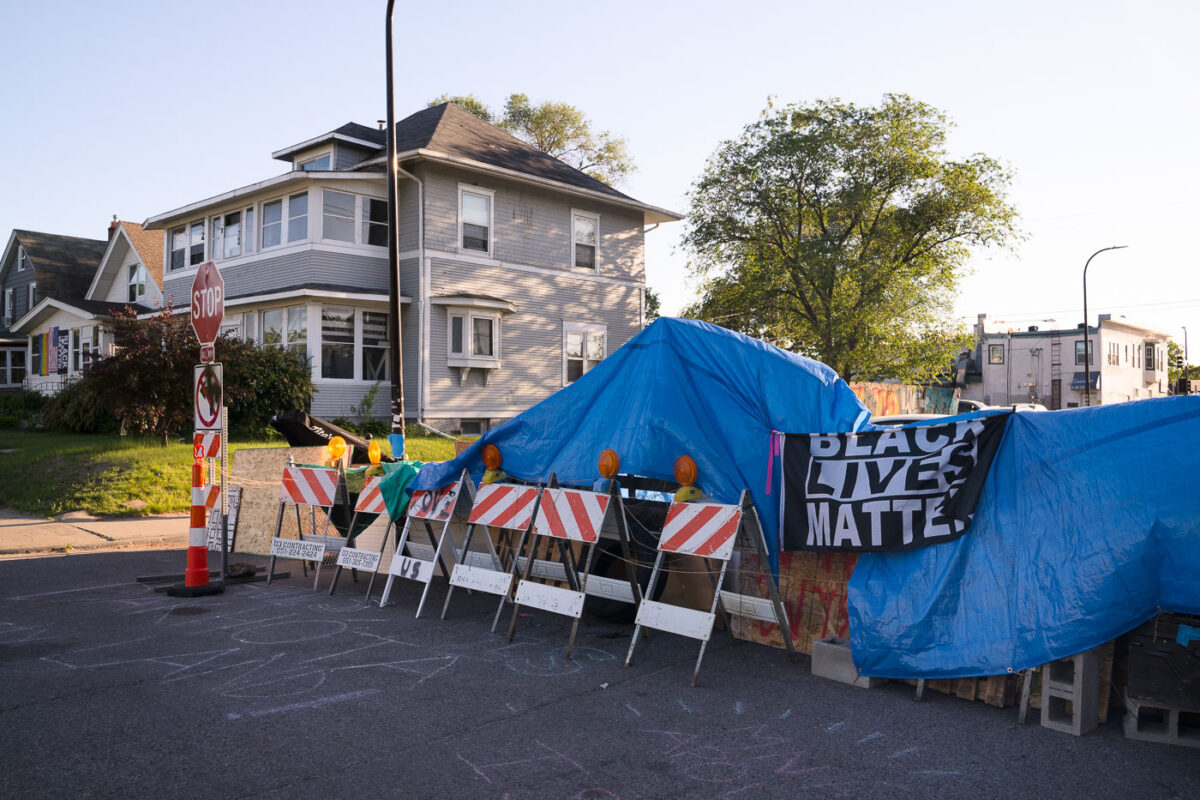
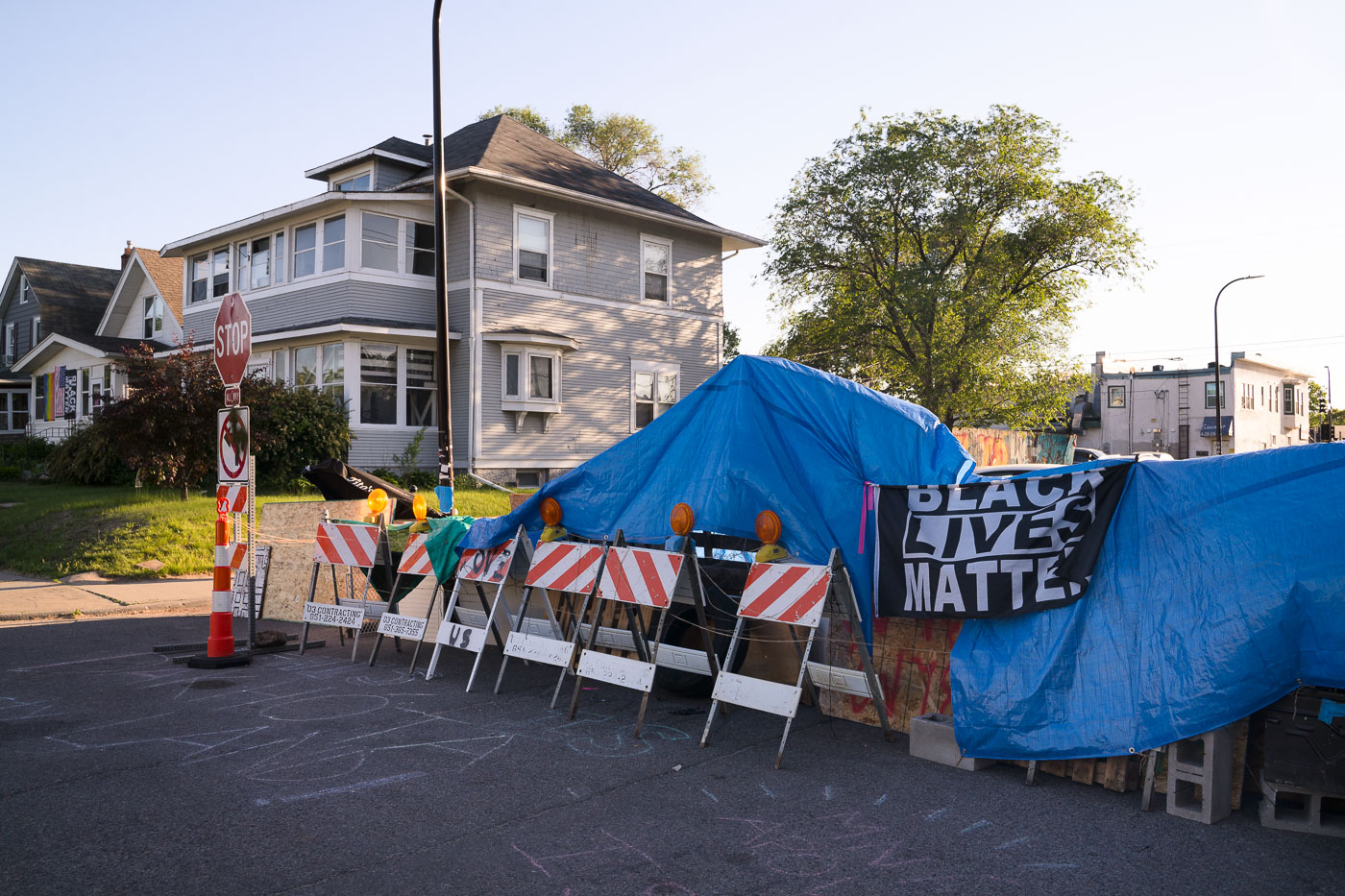
Barricades with a Black Lives Matter banner at George Floyd Square in Minneapolis
Barricades, including a Black Lives Matter banner, at George Floyd Square in Minneapolis. The square, located at the intersection of 38th Street and Elliott Avenue, was established as an autonomous zone following the murder of George Floyd in May 2020. City workers removed the barricades the day before this photograph was taken, marking a significant moment in the ongoing occupation and its eventual dismantling. On May 25, 2020, Minneapolis police officer Derek Chauvin murdered 46-year-old George Floyd during an arrest outside Cup Foods at the intersection of 38th Street and Chicago Avenue in south Minneapolis. Video recorded by bystanders showed Chauvin kneeling on Floyd’s neck for more than nine minutes while Floyd repeatedly said he could not breathe. Three other Minneapolis police officers - J. Alexander Kueng, Thomas Lane, and Tou Thao — were also present during the arrest and later faced criminal charges for their roles in Floyd’s death. Floyd’s murder sparked protests and civil unrest across Minneapolis and around the world, leading to widespread demonstrations against police violence, major policy debates on policing, and the conviction of Chauvin on murder and manslaughter charges in 2021.

George Floyd Square Barricades with BLM Banner, Minneapolis
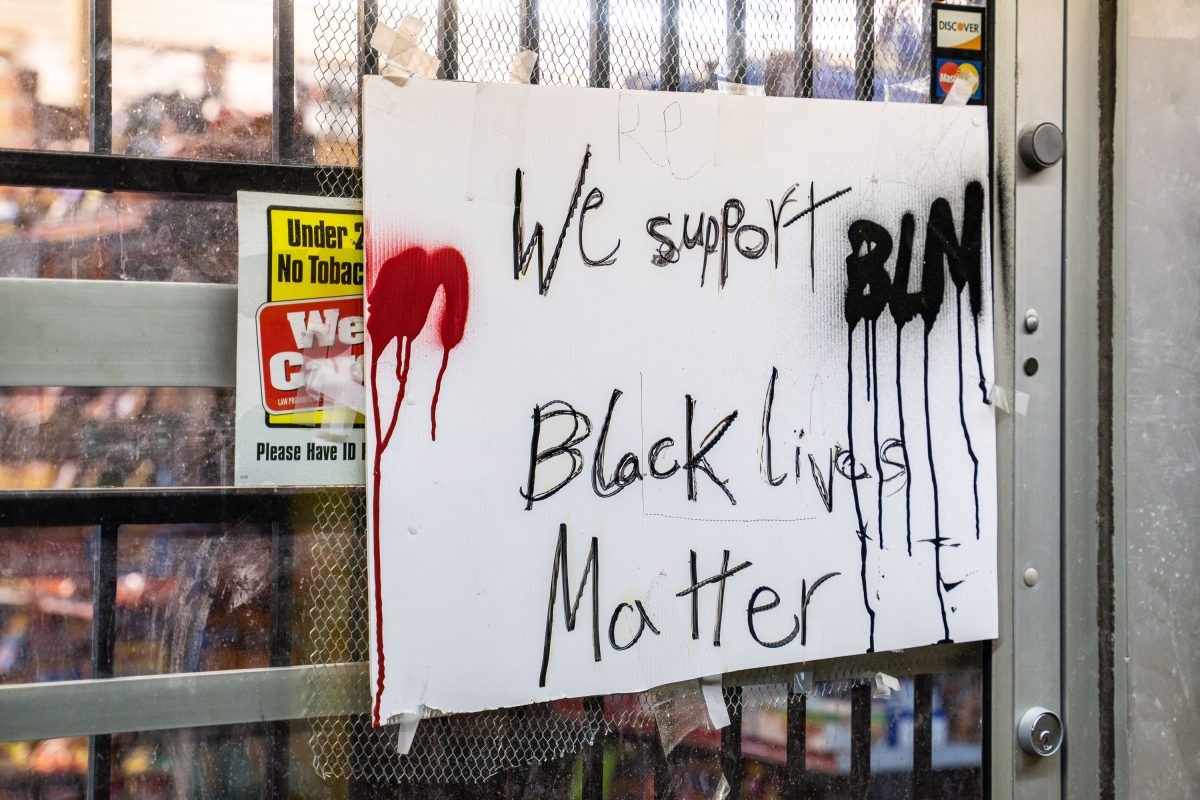
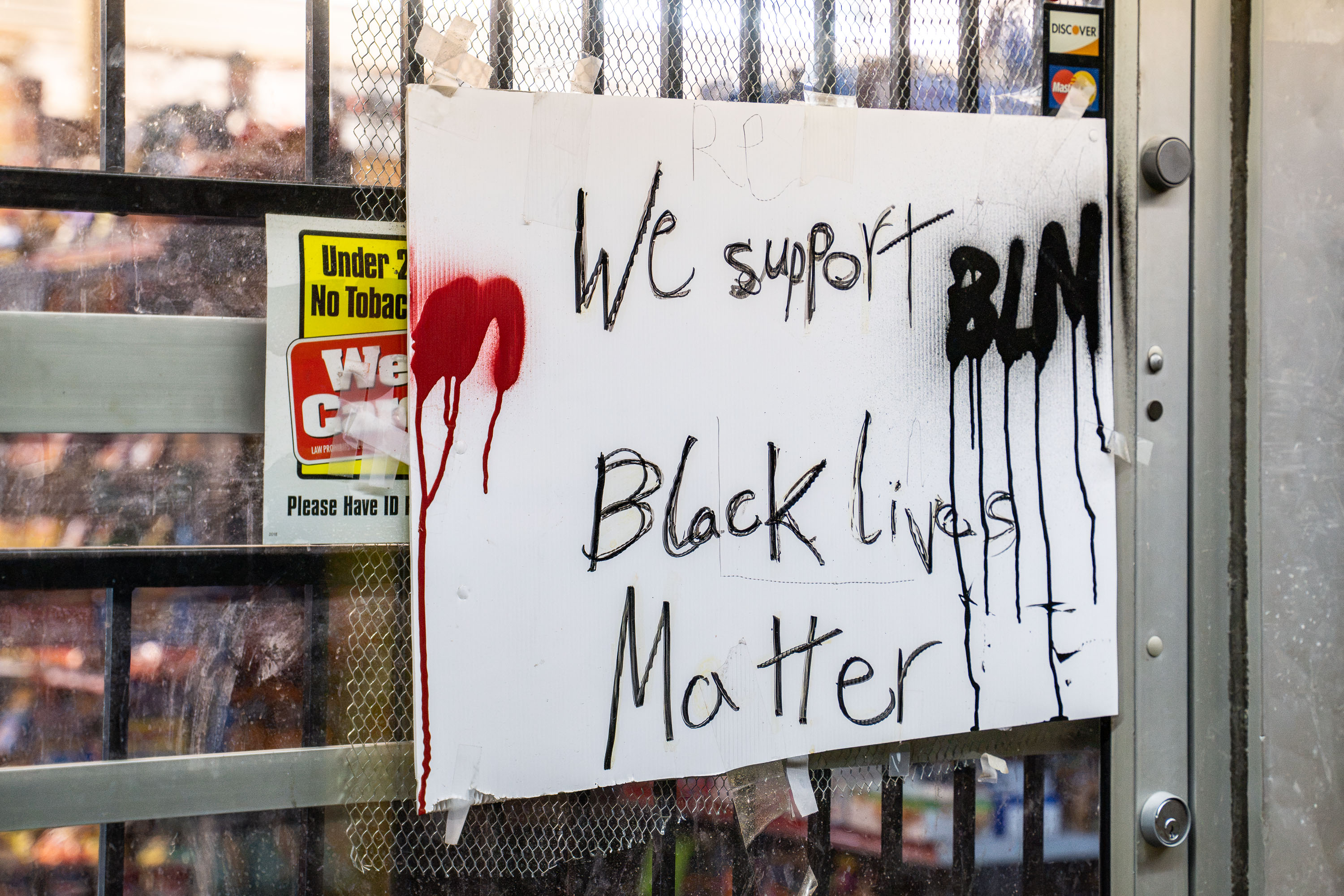
Hand-written sign reading "we support BLM Black Lives Matter" taped to a Minneapolis corner store window.
Corner stores across Minneapolis displayed handmade signs like this one, declaring support for Black Lives Matter, following the police killing of George Floyd in May 2020. Many small business owners posted such messages on their storefronts and security gates during the unrest and protests that followed, both as an expression of solidarity and, in some cases, as a way to prevent damage to their property. Stores in the Lake Street and South Minneapolis corridors, close to the site of Floyd's death, were especially likely to carry these markings well into 2021.

“We Support BLM” Sign on Corner Store Security Gate, Minneapolis
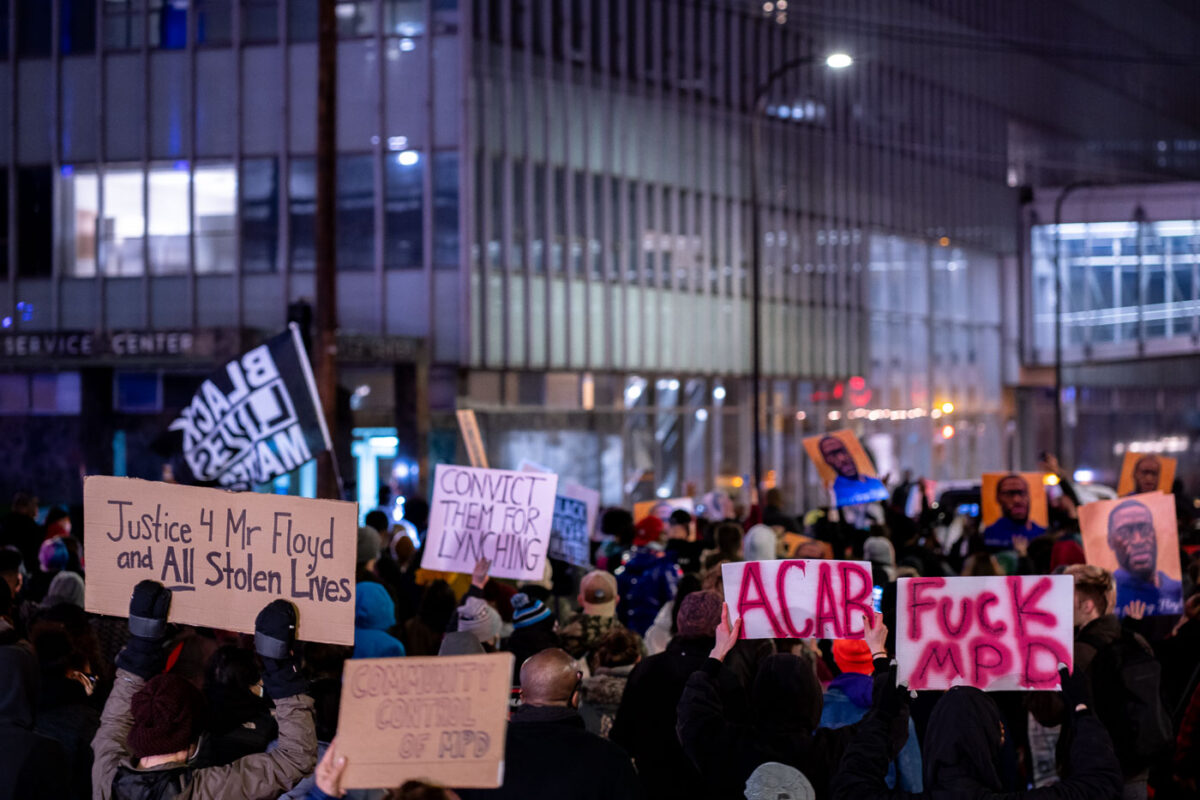
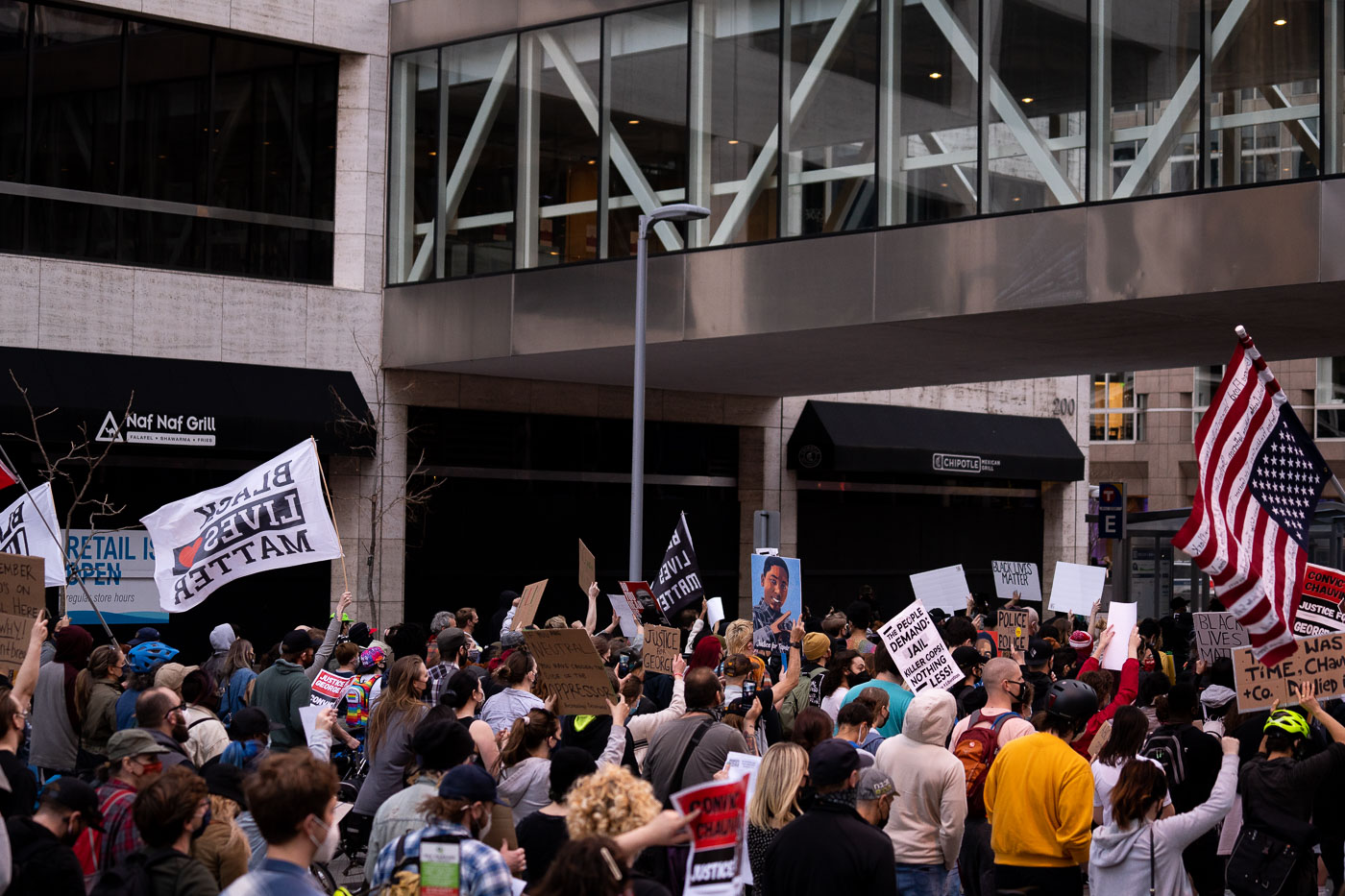
Protesters in downtown Minneapolis during the Derek Chauvin trial hold signs for George Floyd and against police.
Protesters gathered in downtown Minneapolis during the trial of Derek Chauvin, the police officer accused of murdering George Floyd. The demonstrations, which occurred in the spring of 2021, were part of a broader movement demanding justice for Floyd and other victims of police brutality. Signs held by participants called for accountability for Floyd's death and systemic changes within law enforcement. The protests highlighted ongoing tensions between the community and the Minneapolis Police Department.

Minneapolis Protest: Justice for George Floyd and All Stolen Lives
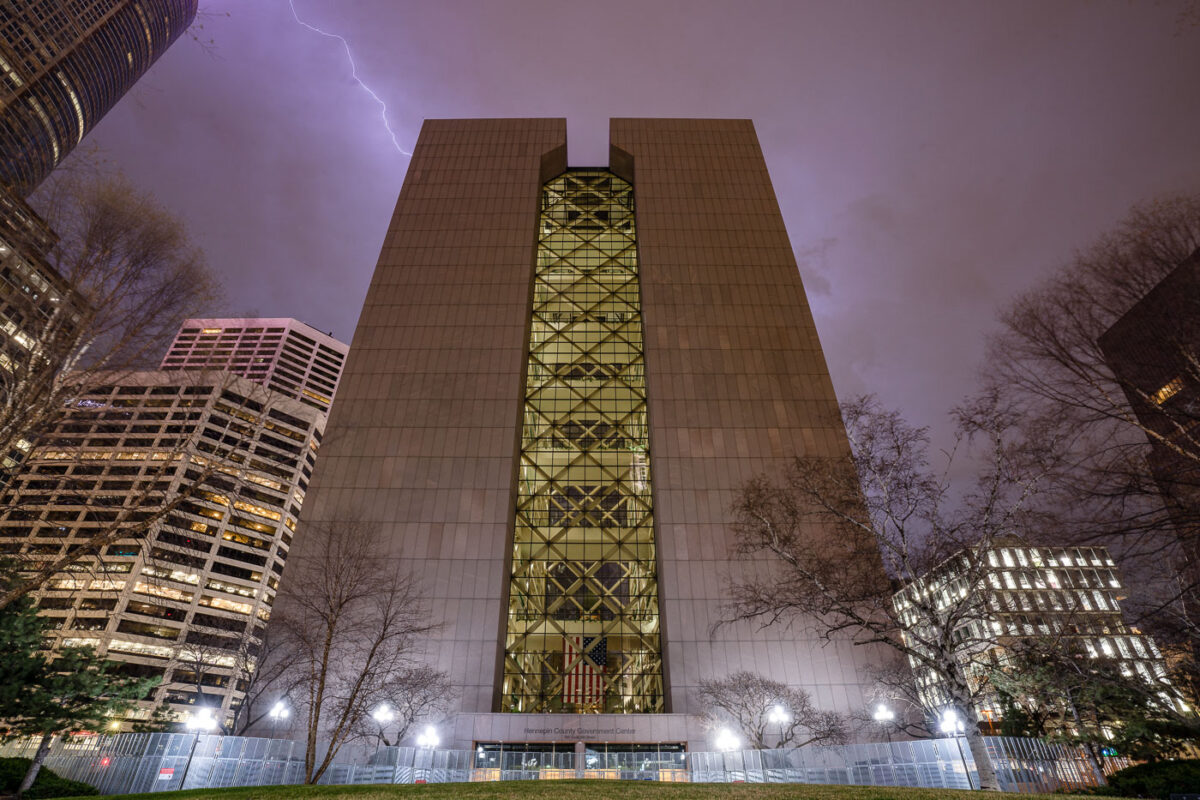
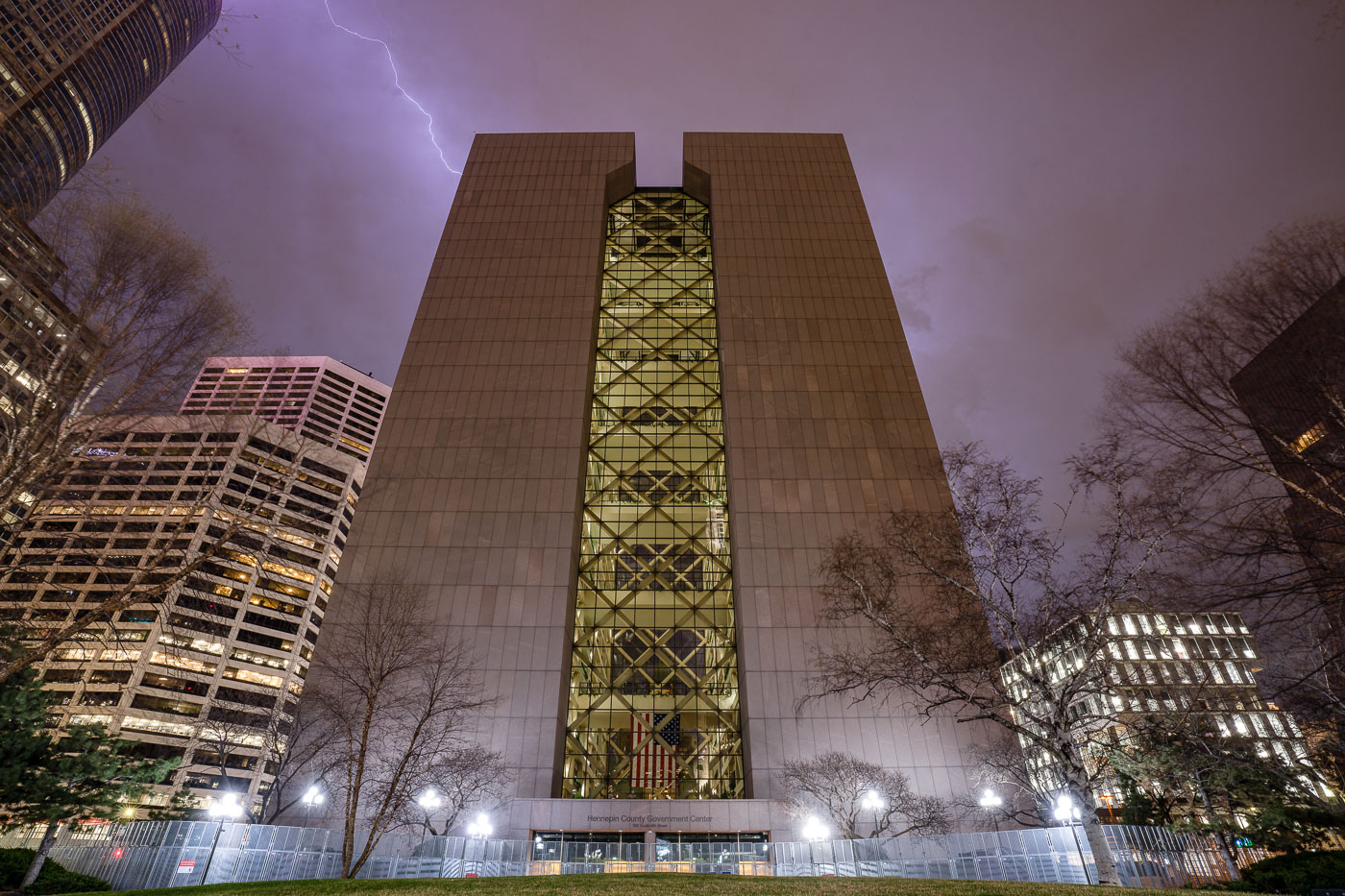
Lightning over Hennepin County Government Center in Minneapolis during the Derek Chauvin trial.
Lightning strikes the Hennepin County Government Center in Minneapolis during the trial of Derek Chauvin. The building, completed in 1977, serves as the primary administrative center for Hennepin County. During the trial for the murder of George Floyd, which took place in spring 2021, the courthouse was surrounded by extensive security fencing. The trial and its aftermath were significant events in the ongoing national conversation about racial justice and policing.

Lightning strikes Hennepin County Government Center during Chauvin trial
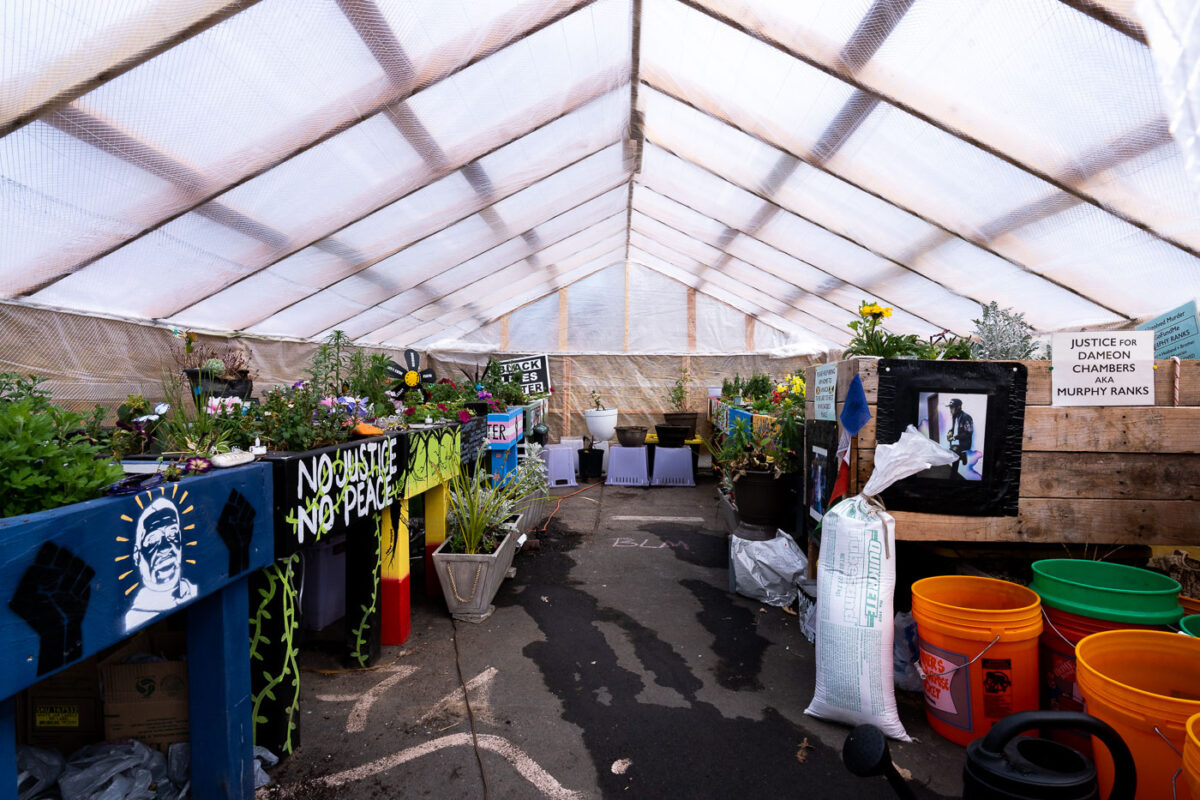
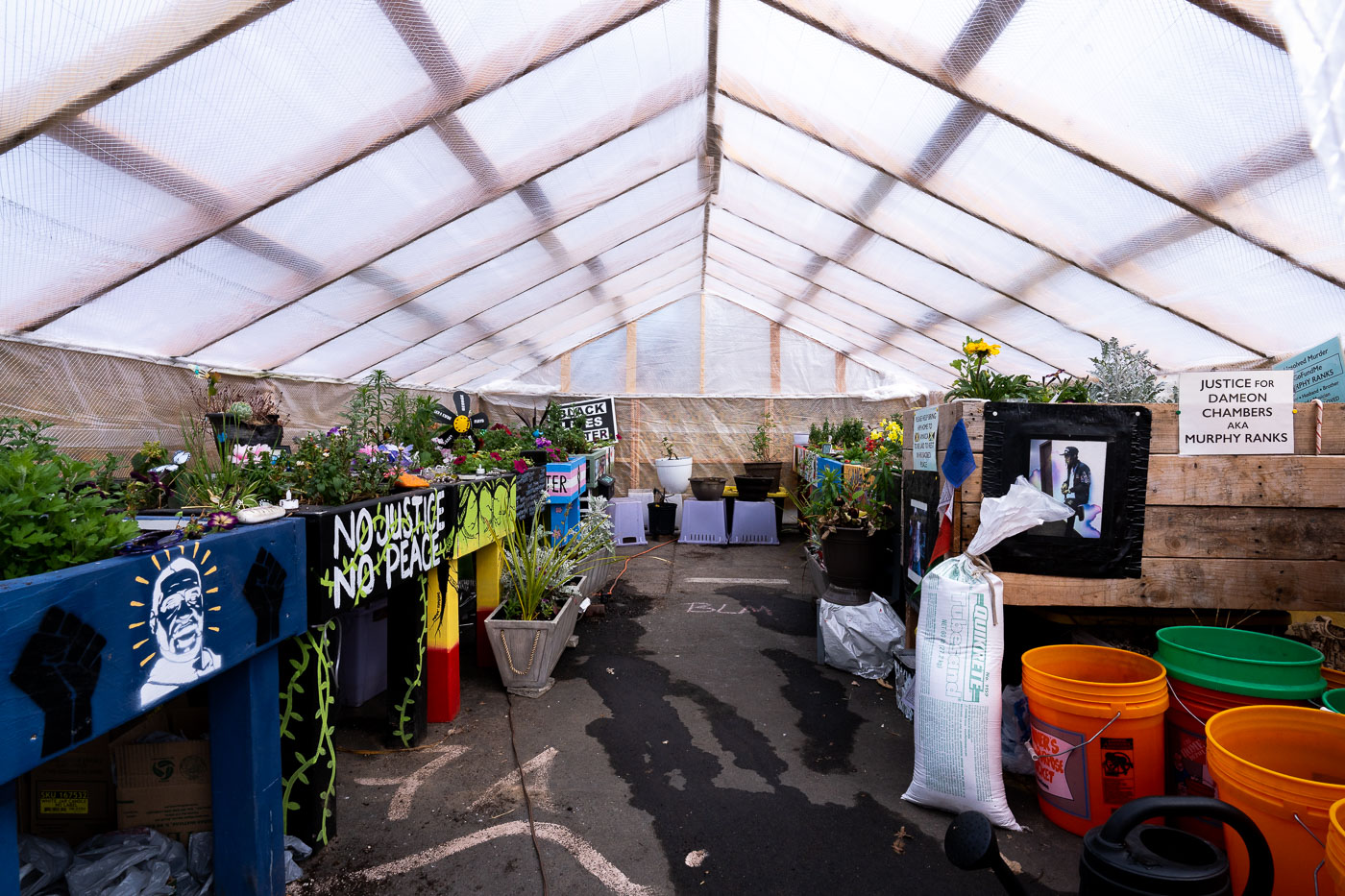
Greenhouse at George Floyd Square in Minneapolis with memorial signs and painted planters.
This greenhouse at George Floyd Square in Minneapolis served as a protected space for plants during the winter months, following the memorialization of George Floyd. The structure, adorned with tributes and artwork, including references to "No Justice No Peace" and "Black Lives Matter," reflects the ongoing significance of the square as a site of protest and remembrance. The plants, now brought back into the square, symbolize resilience and continued growth amidst the historical context of racial justice activism.

Greenhouse at George Floyd Square, Minneapolis
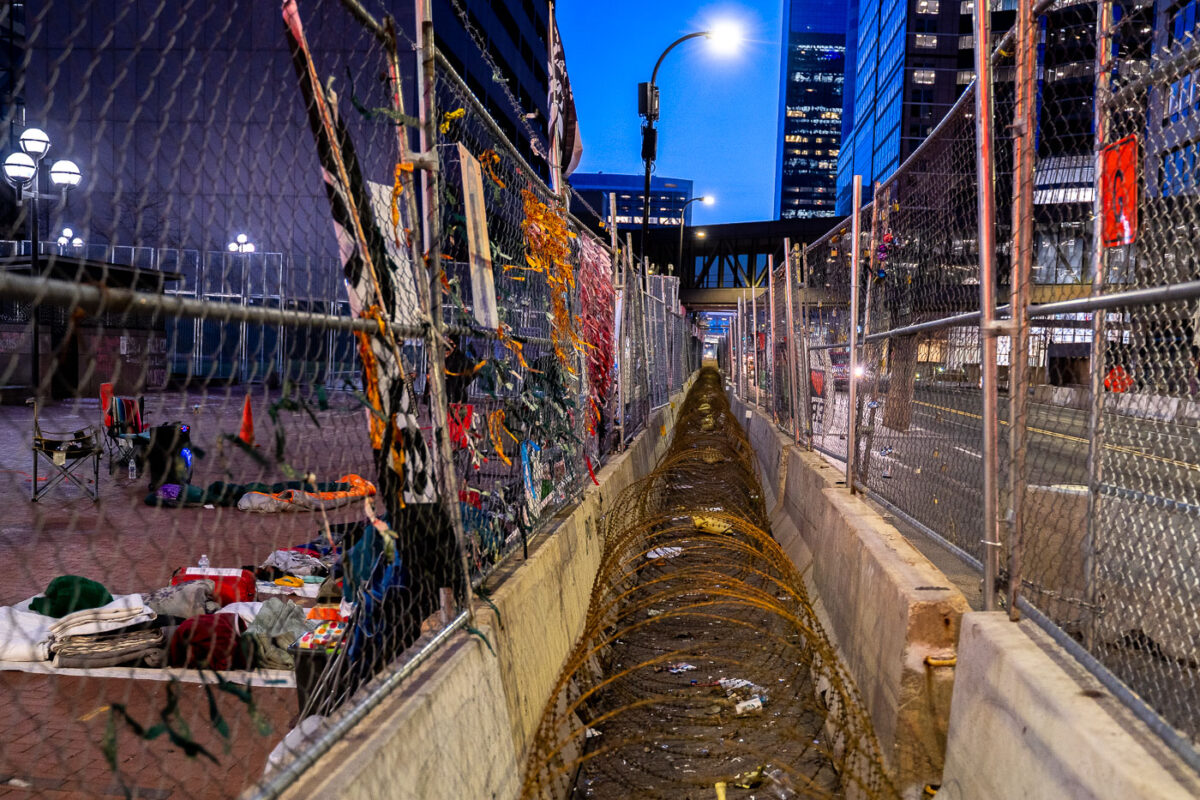
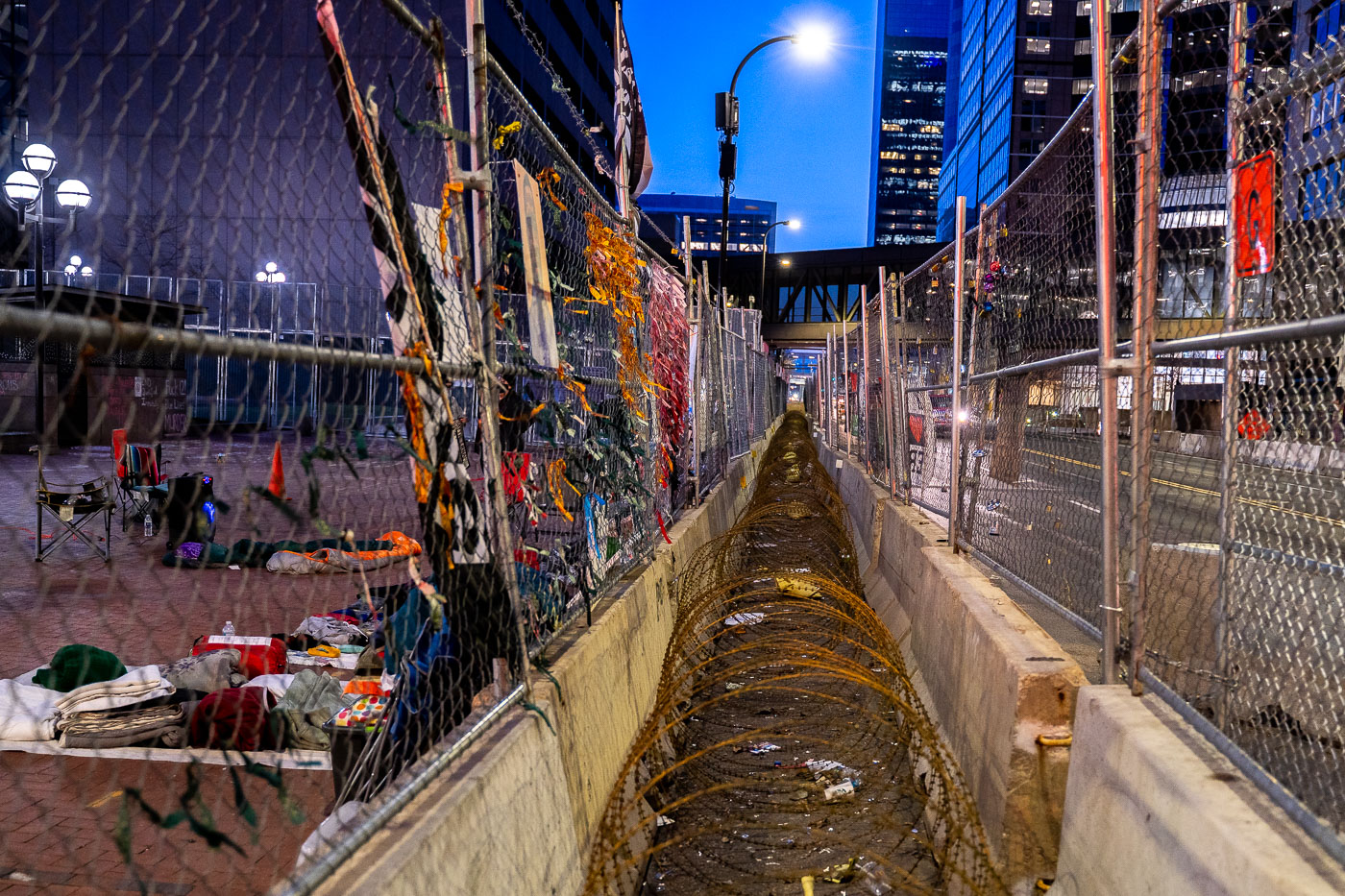
Razor wire and protest signs at Hennepin County Government Center in Minneapolis during the Derek Chauvin trial.
Razor wire and protest signs surround the Hennepin County Government Center in Minneapolis during the trial of Derek Chauvin. The security measures were put in place following the death of George Floyd on May 25, 2020, and the subsequent protests. The area has become a focal point for demonstrations, with protesters decorating the fencing with signs and ribbons, indicating a continuous occupation of the space.

Minneapolis Government Center: Razor wire and protest signs
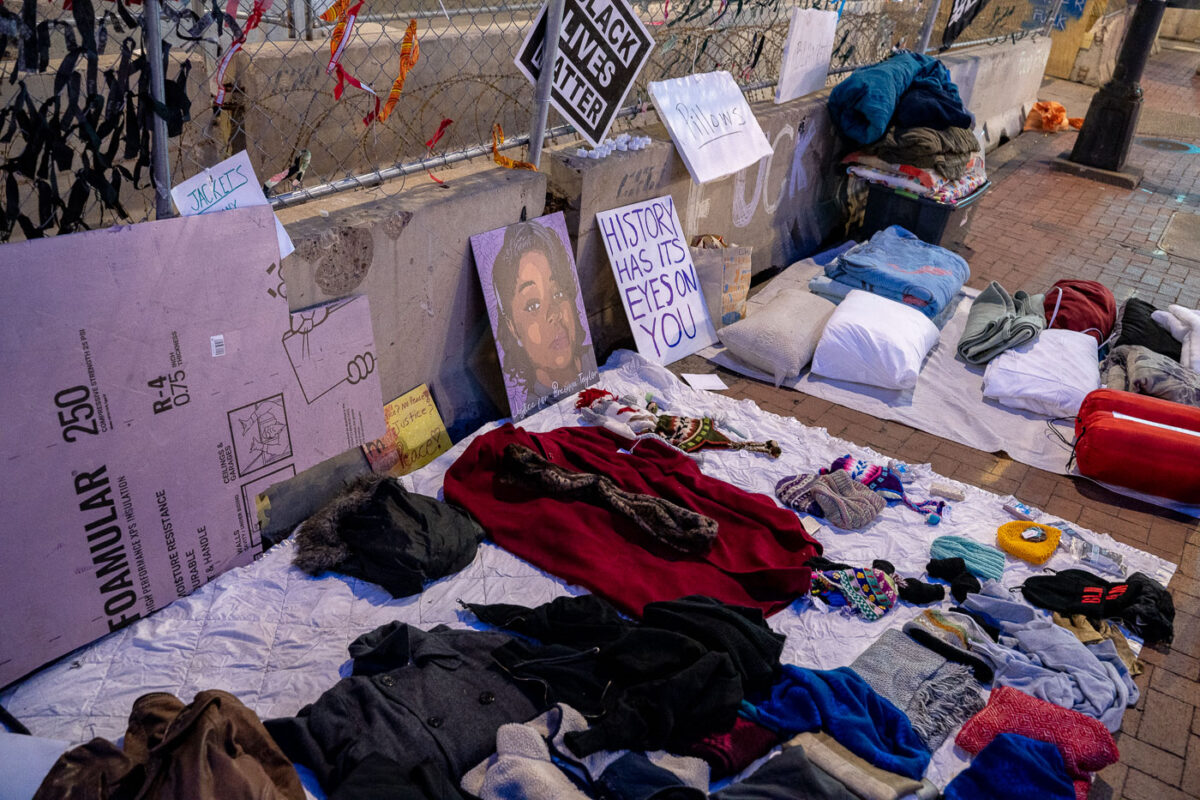
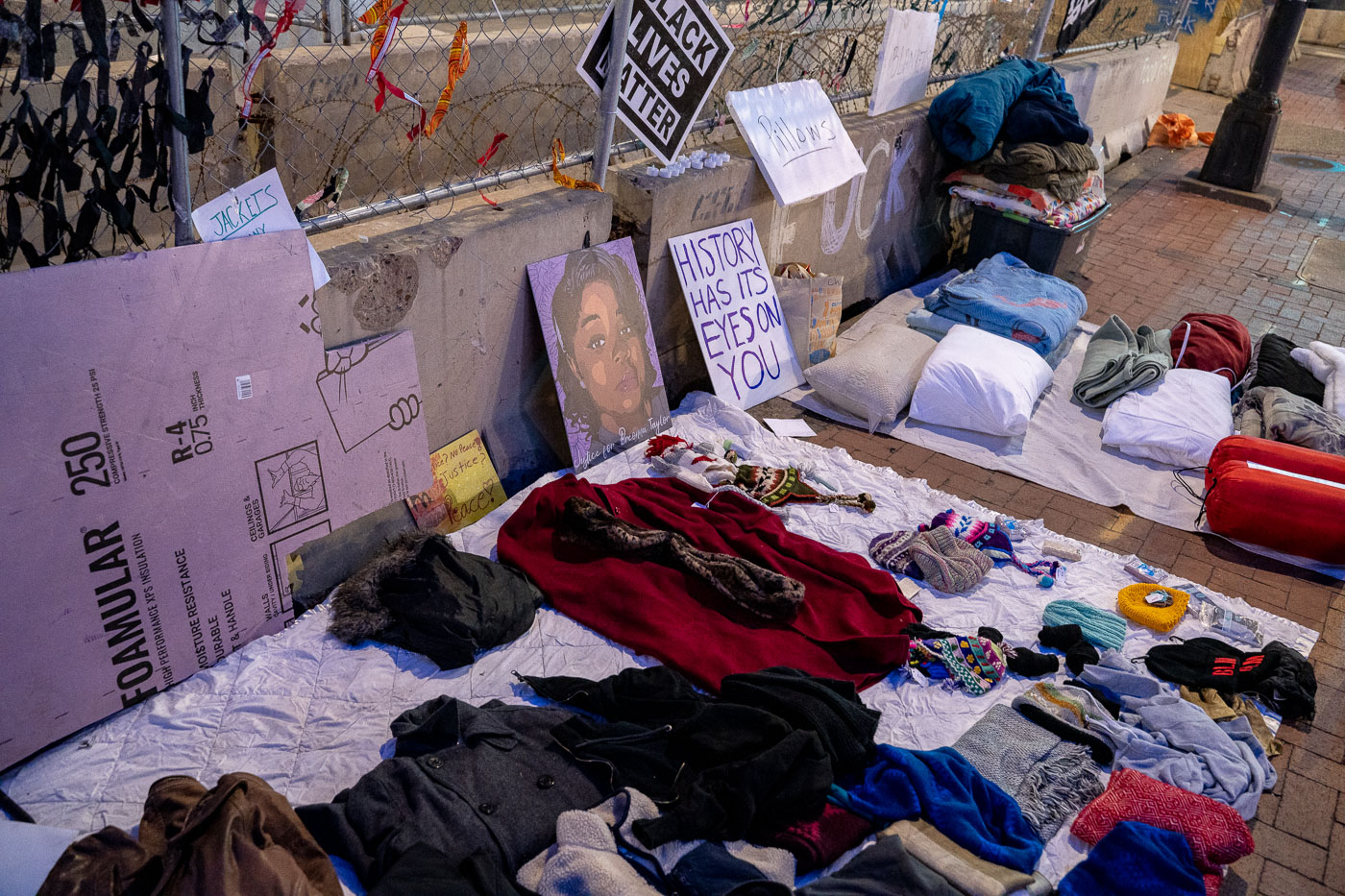
Blankets and clothing for protesters at Hennepin County Government Center in Minneapolis.
Supplies including blankets, pillows, and jackets were made available to protesters occupying the Hennepin County Government Center in Minneapolis. The occupation occurred during the 2021 Derek Chauvin trial, a period of heightened activism following the murder of George Floyd. The presence of these supplies highlights the sustained nature of the protest and the community's efforts to support those participating. The "Black Lives Matter" signs and portraits of victims of police brutality, such as Breonna Taylor, underscore the movement's core demands for racial justice and police accountability.

Minneapolis: Supplies for protesters at Hennepin County Government Center

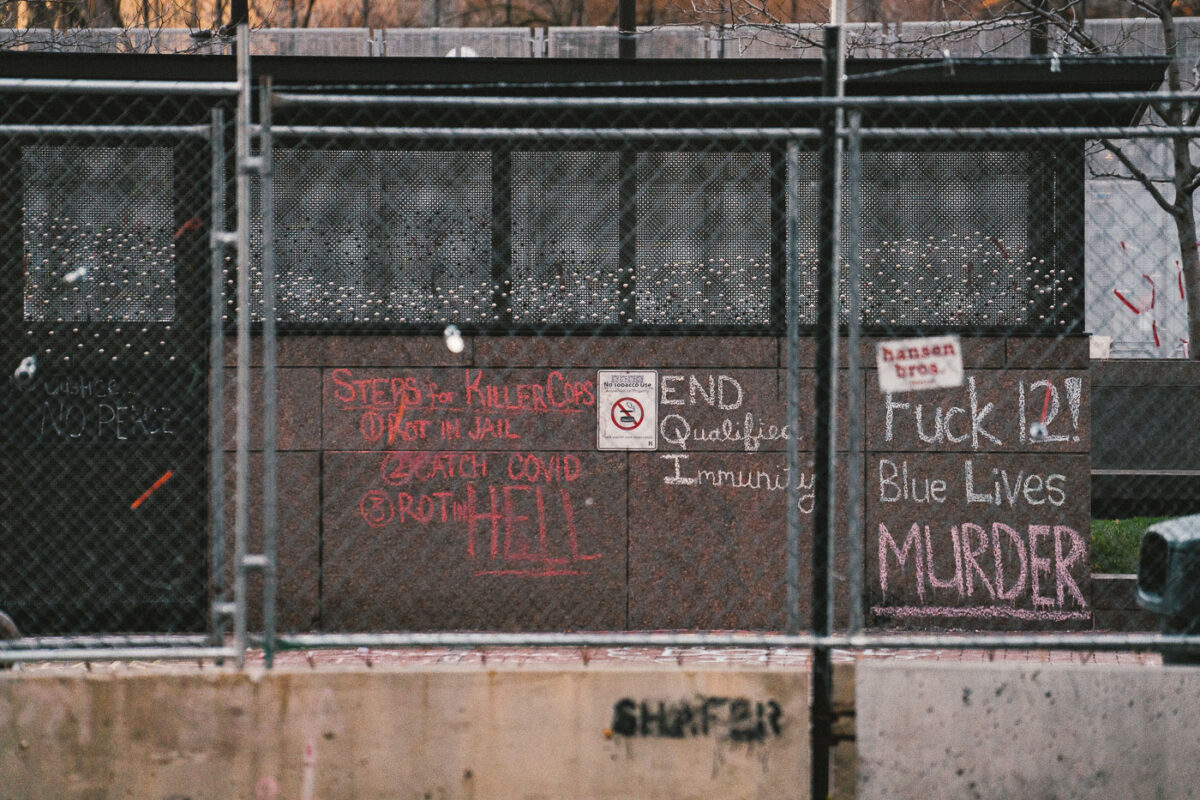
Chalk protest graffiti at Hennepin County Government Center in Minneapolis behind security fencing.
Chalk graffiti adorns the exterior of the Hennepin County Government Center in Minneapolis, a site that became a focal point during the protests following the murder of George Floyd on May 25, 2020. The messages, including "Steps for Killer Cops," "End Qualified Immunity," and "Fuck 12! Blue Lives MURDER," reflect the public outcry and demands for justice and accountability. The trial of Derek Chauvin, the officer accused of Floyd's murder, took place in Minneapolis, amplifying the significance of these messages as expressions of dissent and calls for systemic change.

Chalk Graffiti at Hennepin County Government Center, Minneapolis
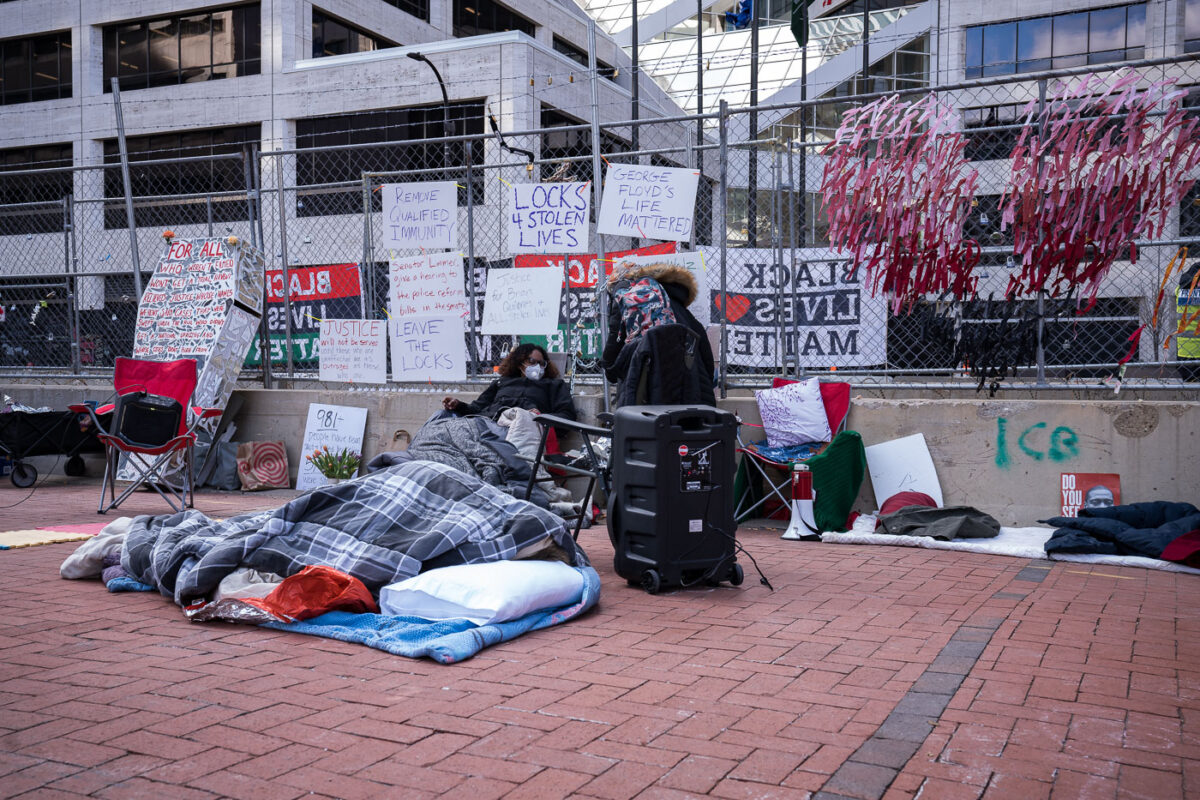
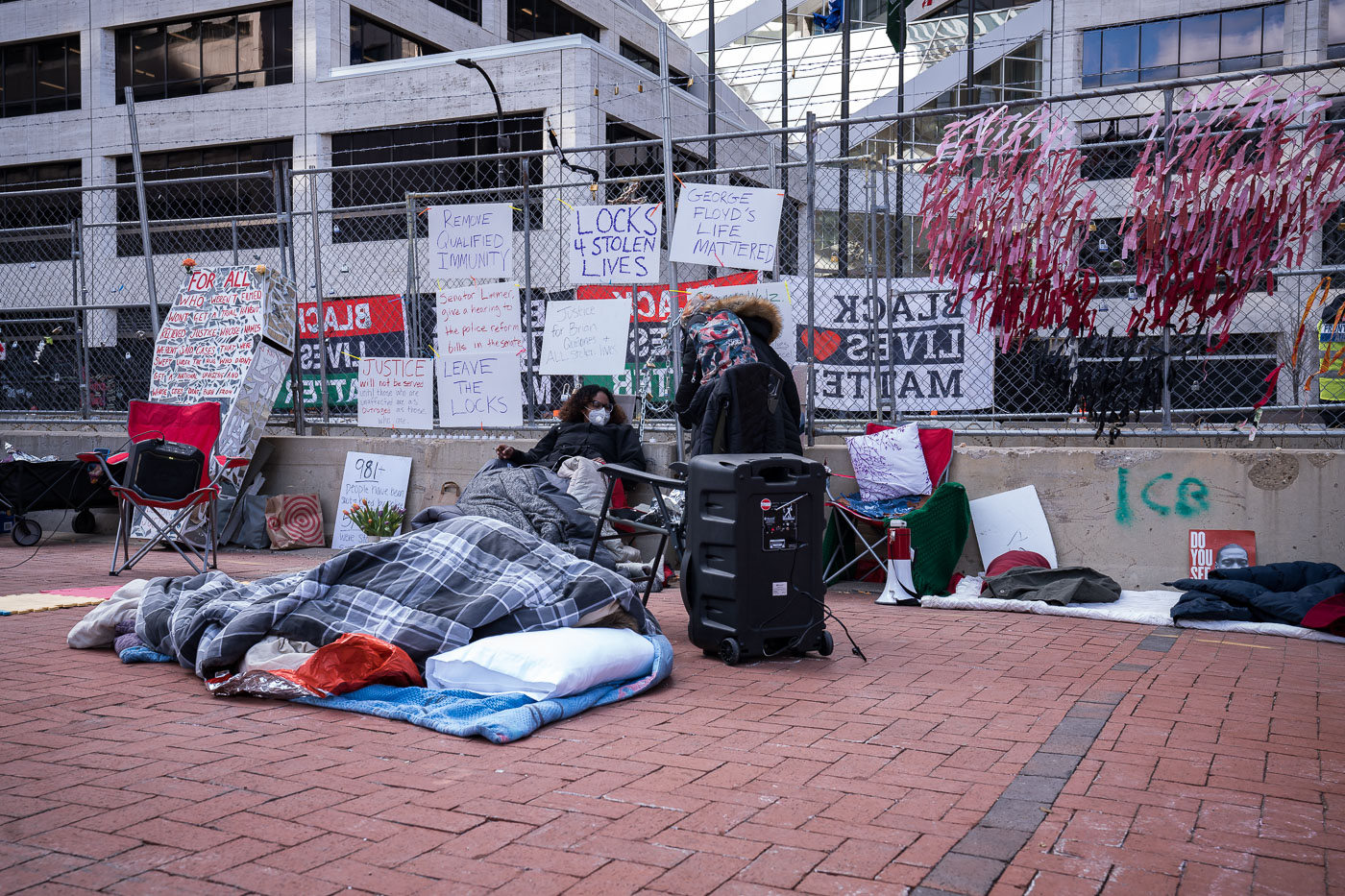
Protesters occupy courthouse property during George Floyd trial
Since March 15th, families and supporters have been placing locks inscribed with the names of victims of police brutality on the fencing surrounding the Hennepin County Government Center in Minneapolis. These locks are periodically removed by authorities, prompting protesters to maintain a continuous presence, with individuals locking themselves to the fence 24/7. Their demands include meetings with city and state officials, the abolition of qualified immunity for police officers, and legislative action on police accountability bills. The protest highlights ongoing concerns about police violence and accountability in the wake of high-profile incidents.

Hennepin County Courthouse Protest: Locks for Stolen Lives
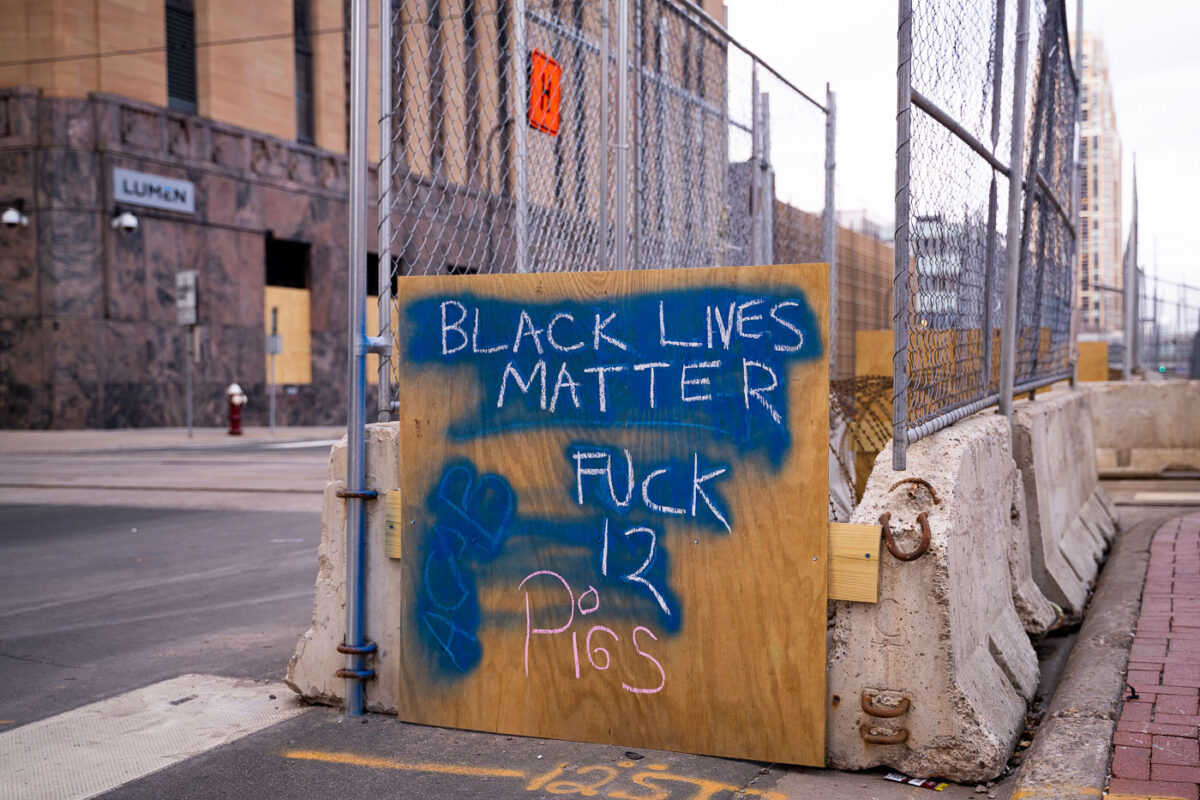
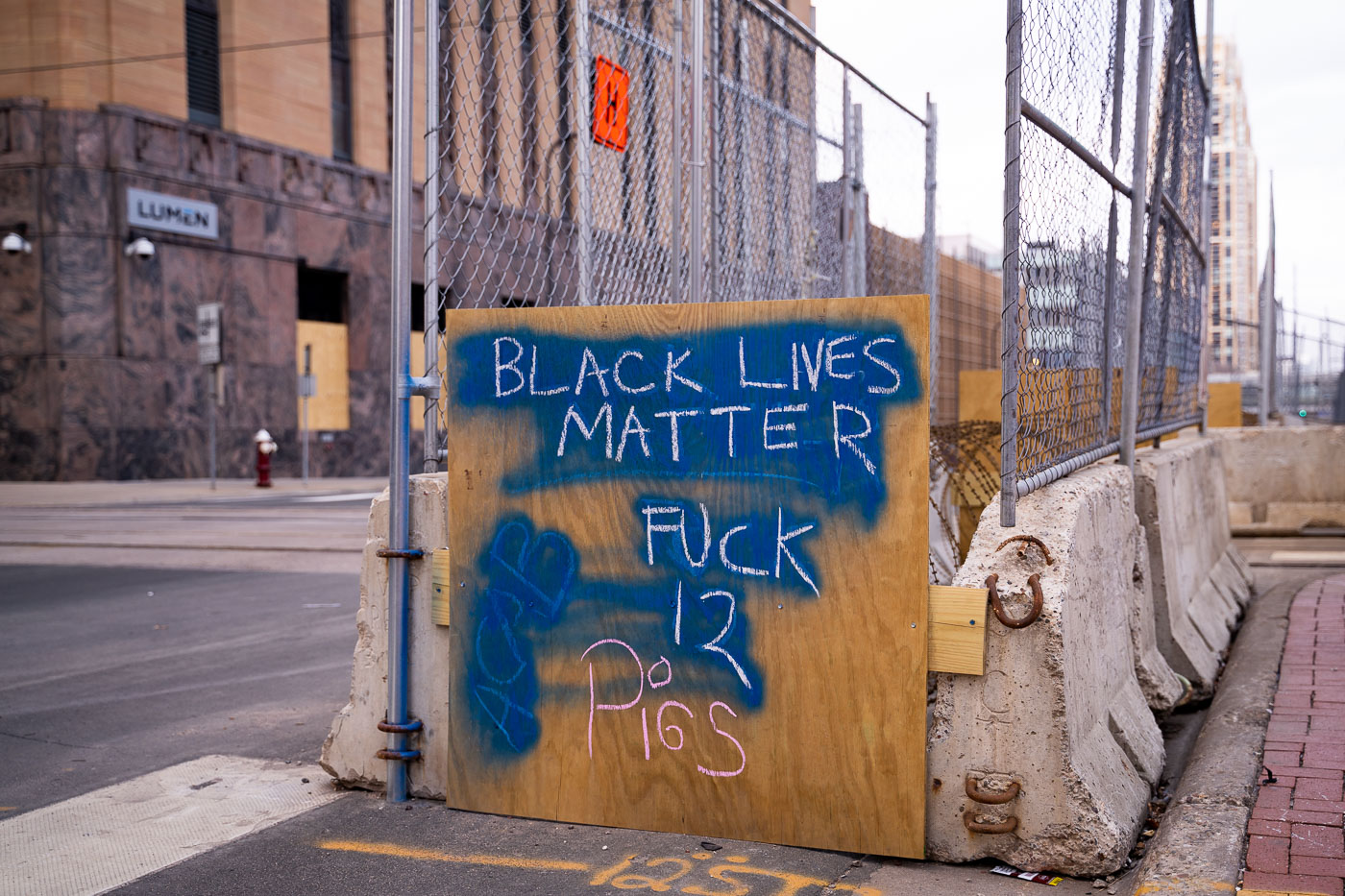
Black Lives Matter ACAB Fuck 12 Pigs
Security fencing and concrete barriers surround the Hennepin County Government Center in Minneapolis, a measure taken during the trial of Derek Chauvin for the murder of George Floyd. The plywood barrier displays protest art, including "Black Lives Matter" and "Fuck 12 Pigs," reflecting the sentiments of demonstrators. This fencing was erected to secure the courthouse and maintain order amidst significant public attention and potential unrest surrounding the trial.

Minneapolis Government Center Fencing with Protest Art
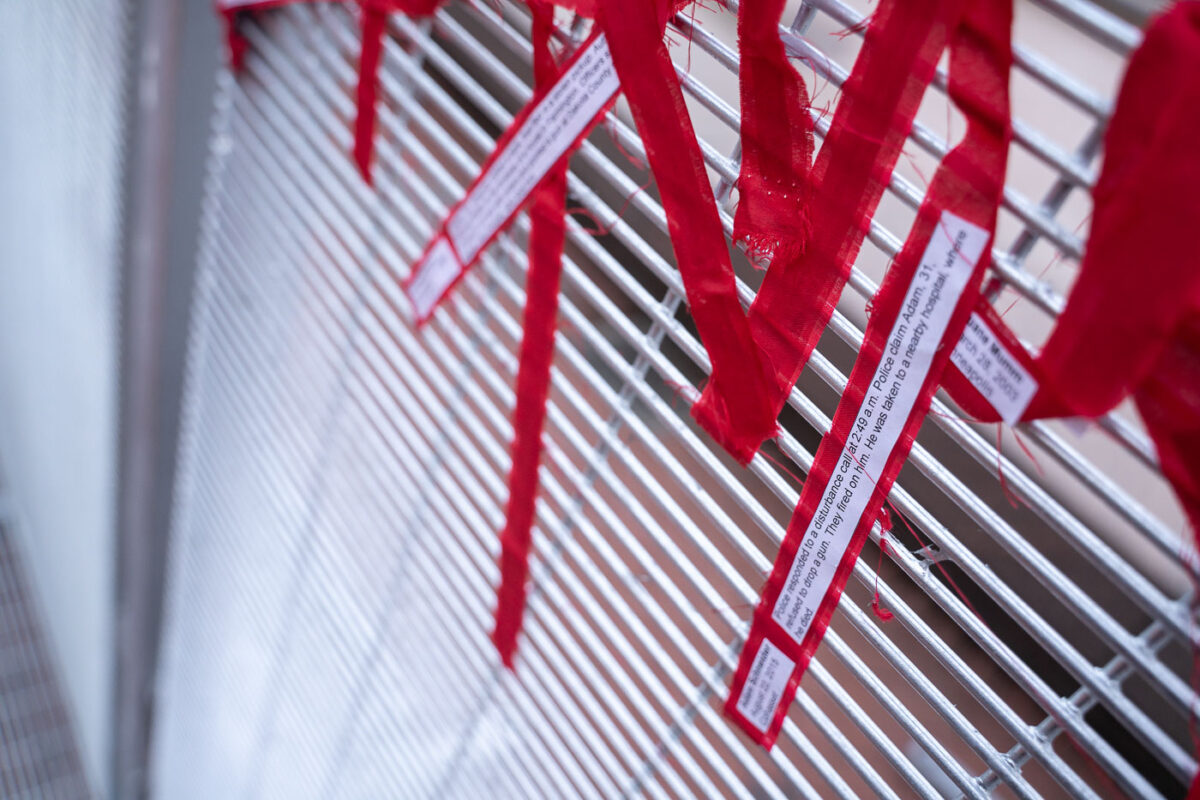
Art installation outside Hennepin County Courthouse
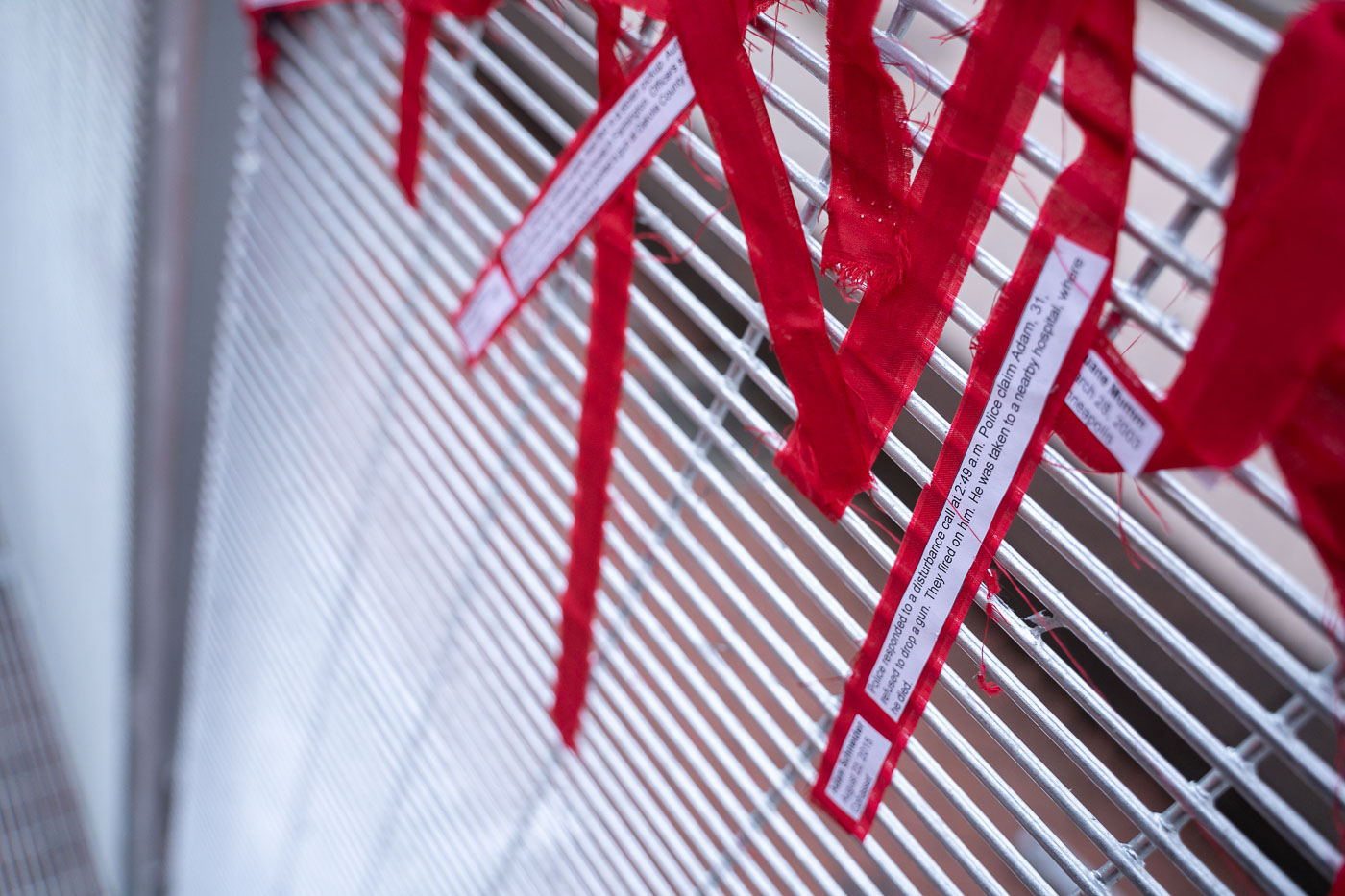
Red ribbons bearing the names and brief accounts of victims of police brutality are affixed to the security fencing surrounding the Hennepin County Government Center in Minneapolis. This display was visible on the day opening statements began in the trial of Derek Chauvin, who was accused of murdering George Floyd on May 25, 2020. The ribbons serve as a memorial and a protest, highlighting broader issues of police violence that have been a focus of public attention and activism.

Red ribbons with names of victims of police brutality on fence at Hennepin County Courthouse
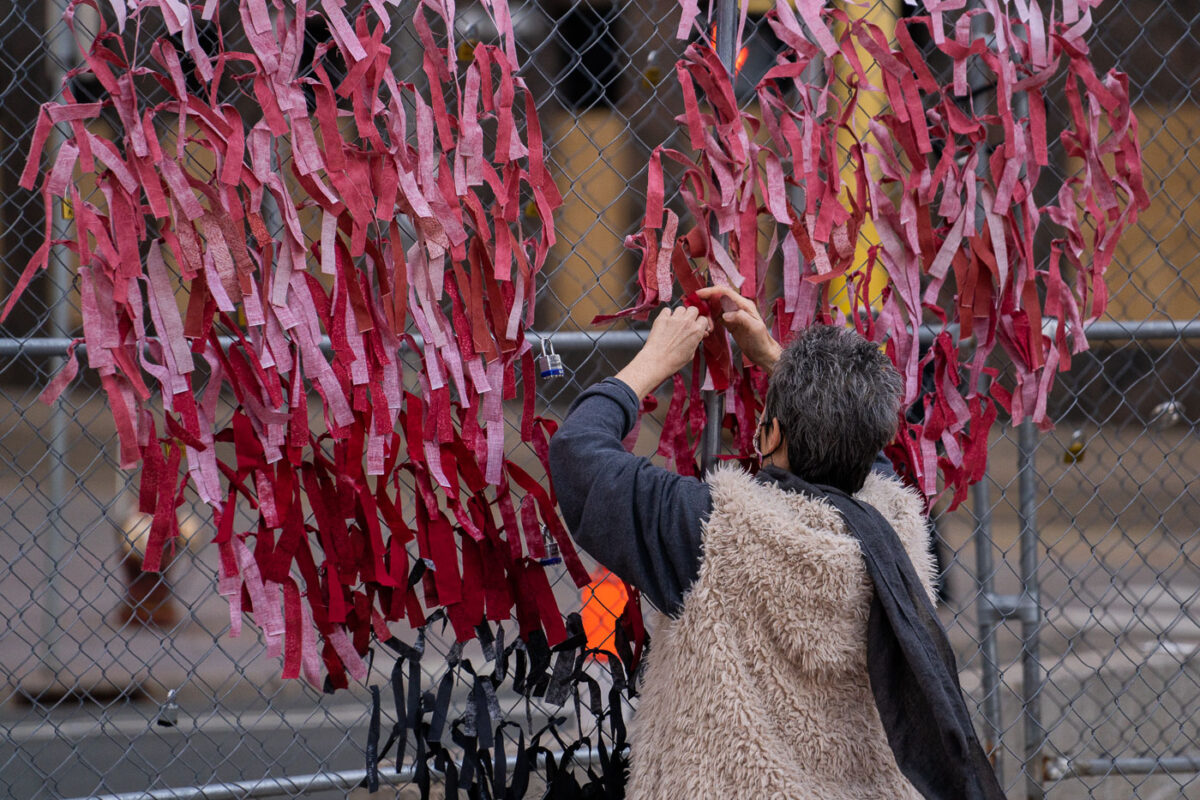
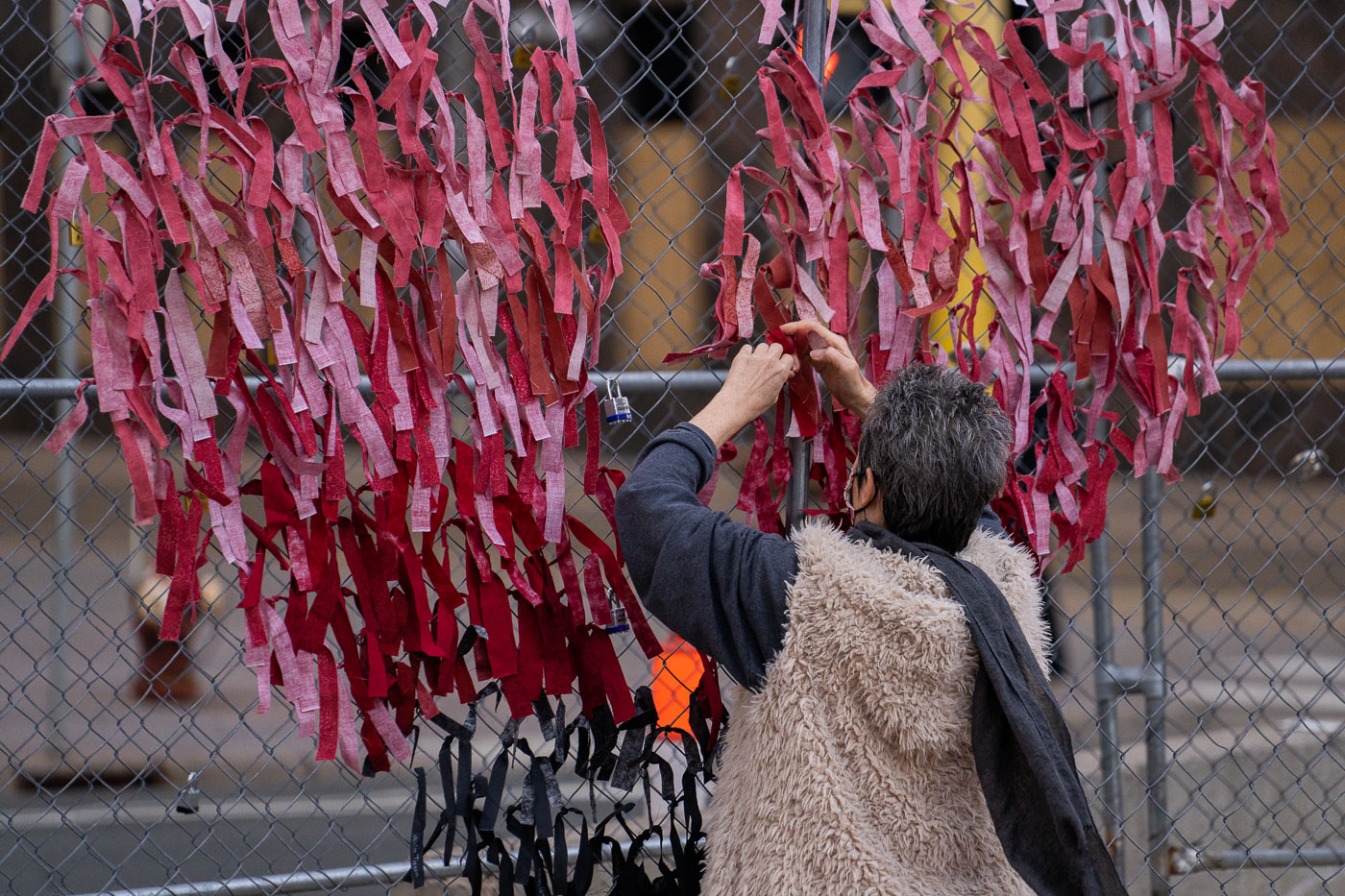
Art being put up on fence outside Chauvin trial
On March 29, 2021, the first day of opening statements in the trial of Derek Chauvin, a former Minneapolis police officer accused of murdering George Floyd, a woman tied red ribbons to security fencing surrounding the Hennepin County Government Center. The ribbons, arranged in the shape of a heart, served as a public memorial and a symbol of solidarity. The security measures were put in place due to anticipated protests and unrest following the trial, which was a focal point for national conversations about racial justice and police brutality.

Minneapolis: Ribbons on Chauvin Trial Security Fence
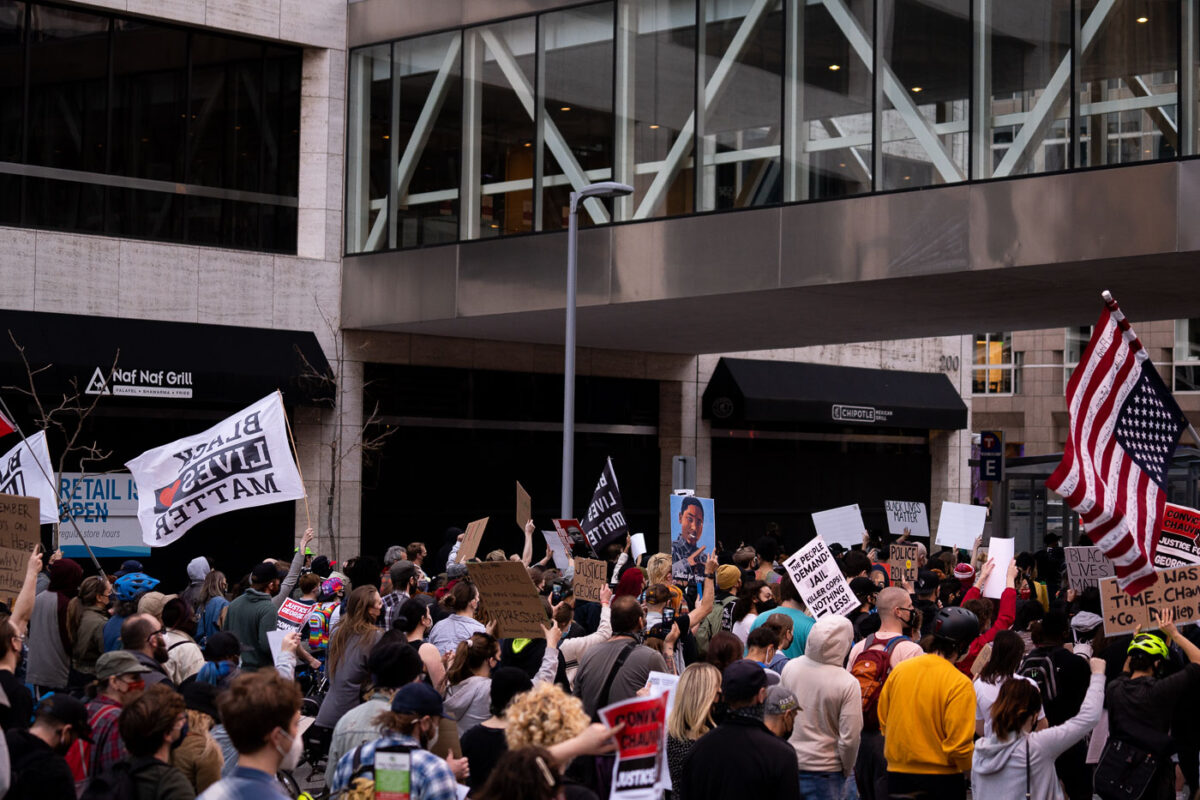
Protesters rally in downtown Minneapolis during George Floyd opening statements
Protesters gathered in Downtown Minneapolis on March 29, 2021, the day opening statements began in the trial of former police officer Derek Chauvin. Chauvin was accused of murdering George Floyd on May 25, 2020, an event that sparked widespread protests against racial injustice and police brutality. The signs carried by the crowd reflect the ongoing calls for accountability and justice for Floyd and other victims of police violence.

Minneapolis Protest for George Floyd Trial Opening Statements
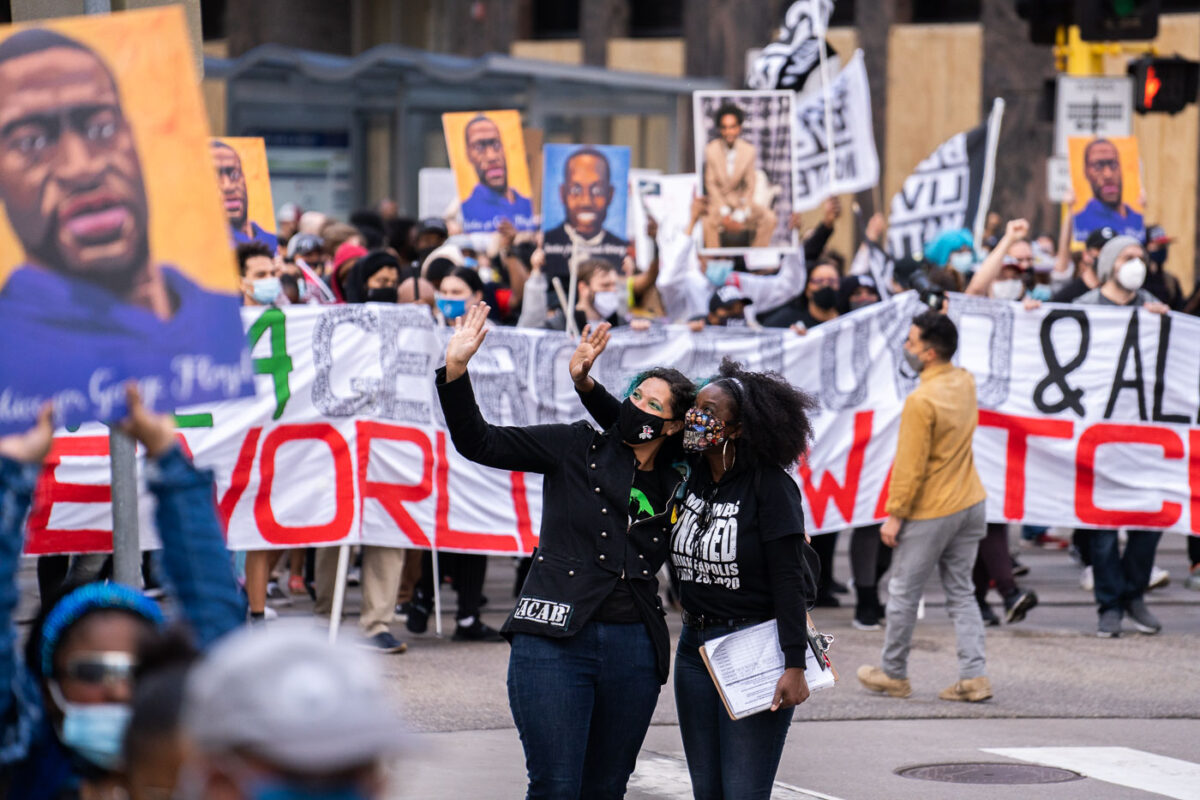
Protester with ACAB patch during Chauvin march
On the opening day of the Derek Chauvin trial, protesters gathered in Downtown Minneapolis to march and rally. Chauvin, a former Minneapolis police officer, was accused of murdering George Floyd on May 25, 2020. The protest signifies the ongoing public response to Floyd's death and the subsequent calls for justice and police reform.

Minneapolis Protest for George Floyd, Chauvin Trial Opening
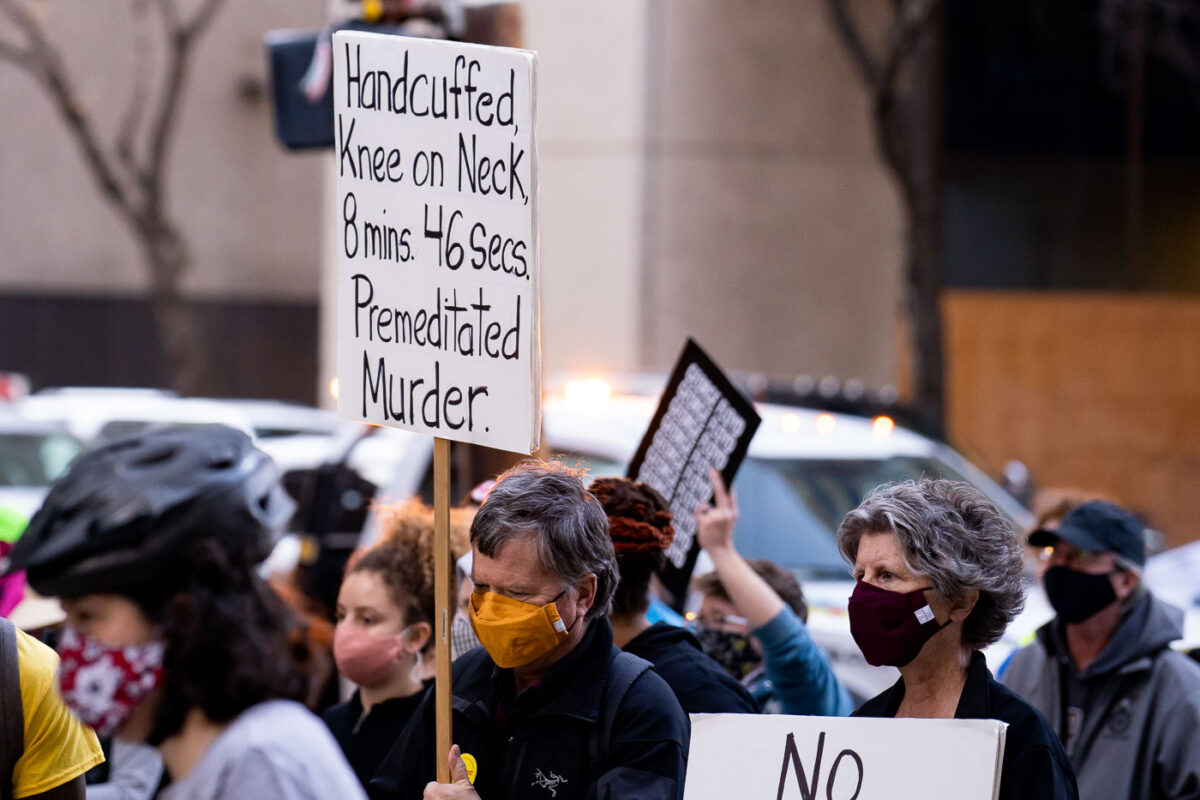
Handcuffed Knee on Neck 8 Minutes 46 Secs Premeditated Murder
Protesters gathered in Downtown Minneapolis on March 29, 2021, the day opening statements began in the murder trial of former police officer Derek Chauvin. Chauvin was accused of killing George Floyd on May 25, 2020, after a video showed him kneeling on Floyd's neck for over eight minutes. The protest highlighted the duration of the restraint and the circumstances surrounding Floyd's death, which sparked widespread demonstrations against police brutality and racial injustice.

Minneapolis Protest: Chauvin Trial Begins, Signs Detail Floyd Murder
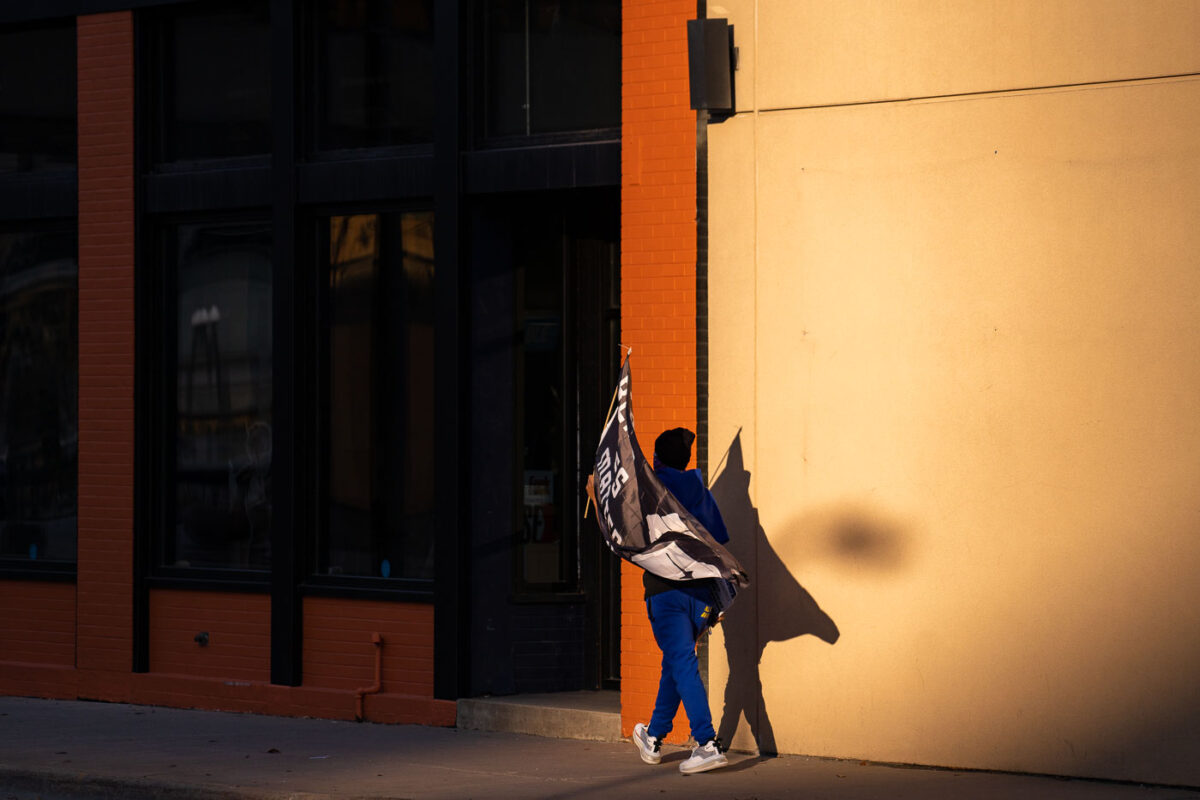
Man with a Black Lives Matter flag in downtown Minneapolis
A protestor carries a Black Lives Matter flag through Downtown Minneapolis on March 8, 2021, the day opening statements began in the trial of Derek Chauvin. Chauvin, a former Minneapolis police officer, was accused of murdering George Floyd on May 25, 2020, an event that sparked widespread protests against police brutality and racial injustice. The trial took place in Hennepin County District Court, with significant public attention and ongoing demonstrations in the city.

Minneapolis: BLM protestor walks during Chauvin trial opening statements
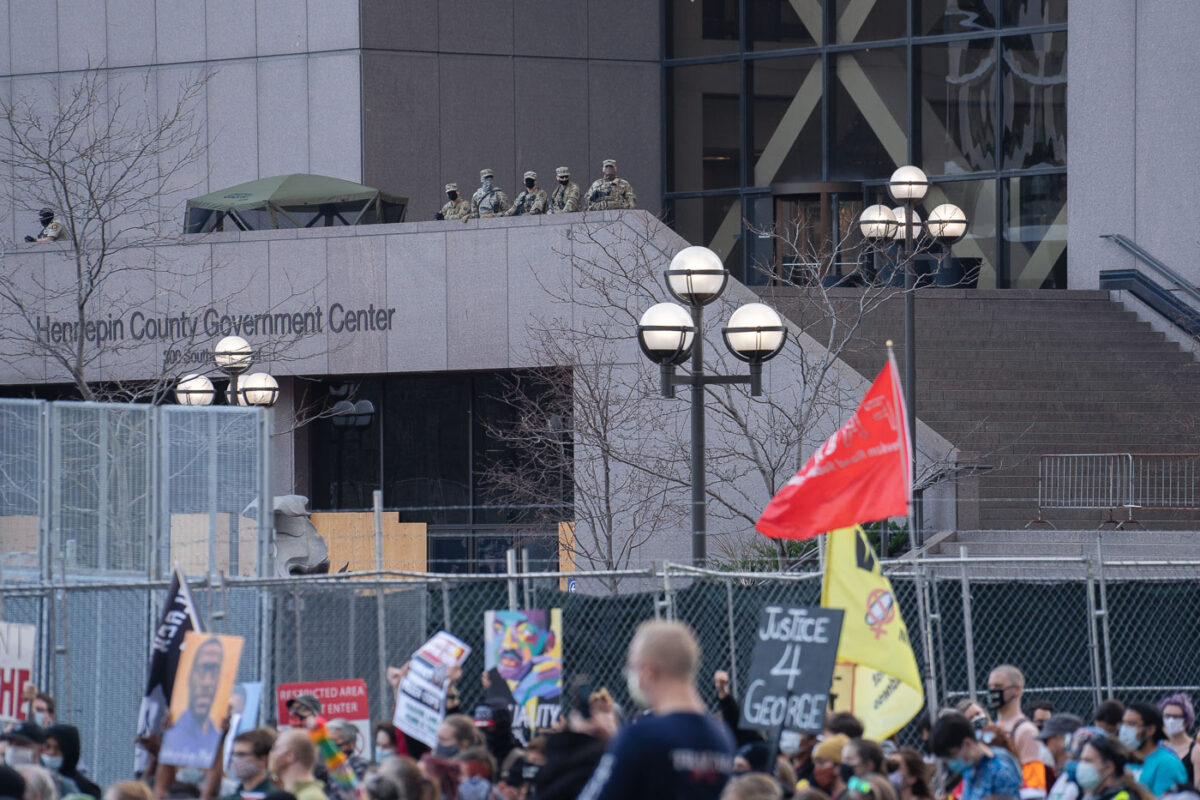
Hennepin County police look down on protesters at Chauvin trial
On March 8, 2021, protesters gathered outside the Hennepin County Government Center in Minneapolis to rally and march on the day opening statements began in the trial of Derek Chauvin. Chauvin, a former Minneapolis police officer, was accused of murdering George Floyd on May 25, 2020. The building, located at 300 South Sixth Street, serves as the seat of county government and houses courtrooms and administrative offices. Security forces, including National Guard members, were visible on the building's upper levels, and barricades were erected around the perimeter.

Hennepin County Government Center: Police observe Chauvin trial protest
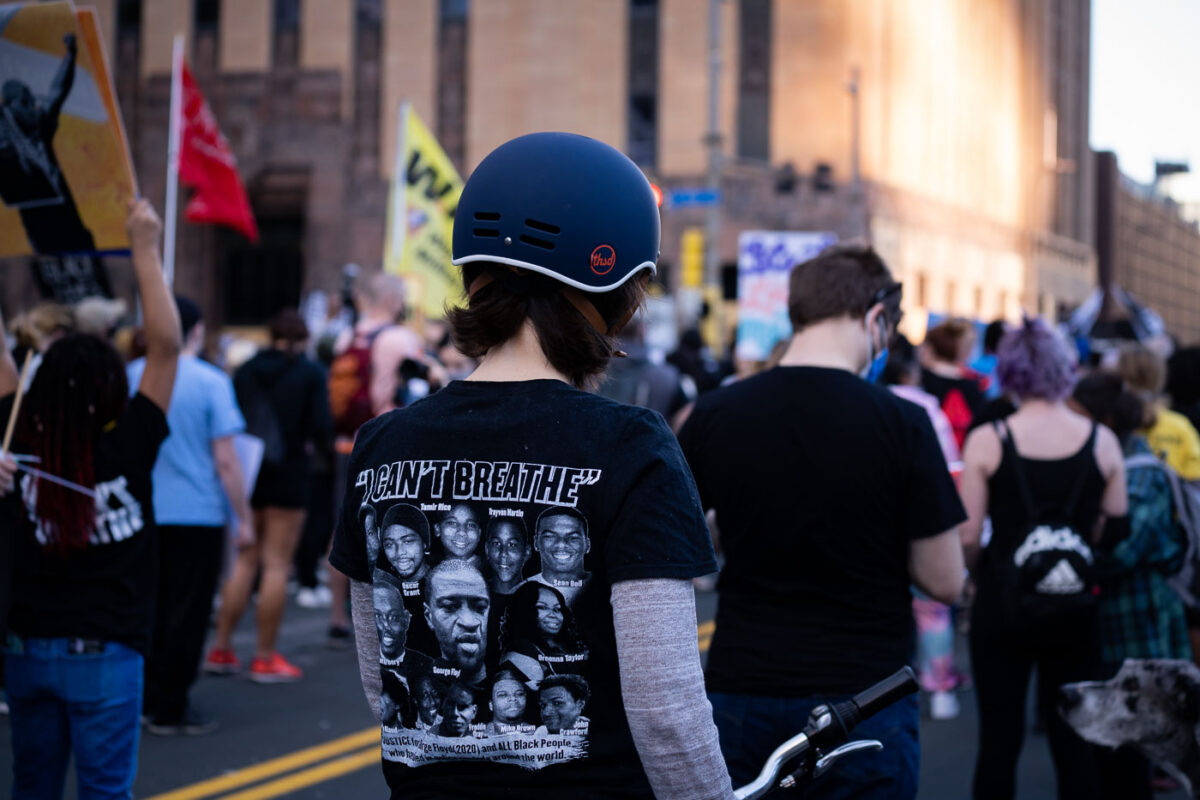
Protester with I Cant Breathe shirt on at start of George Floyd trial
Protesters gathered in Downtown Minneapolis on March 8, 2021, the day opening statements began in the trial of Derek Chauvin, the former police officer accused of murdering George Floyd on May 25, 2020. The shirt worn by the individual in the foreground displays "I Can't Breathe" along with portraits of Floyd and other Black individuals who died in encounters with law enforcement. This protest was part of a broader movement demanding justice for Floyd and accountability for police brutality.

Minneapolis Protest for George Floyd Trial
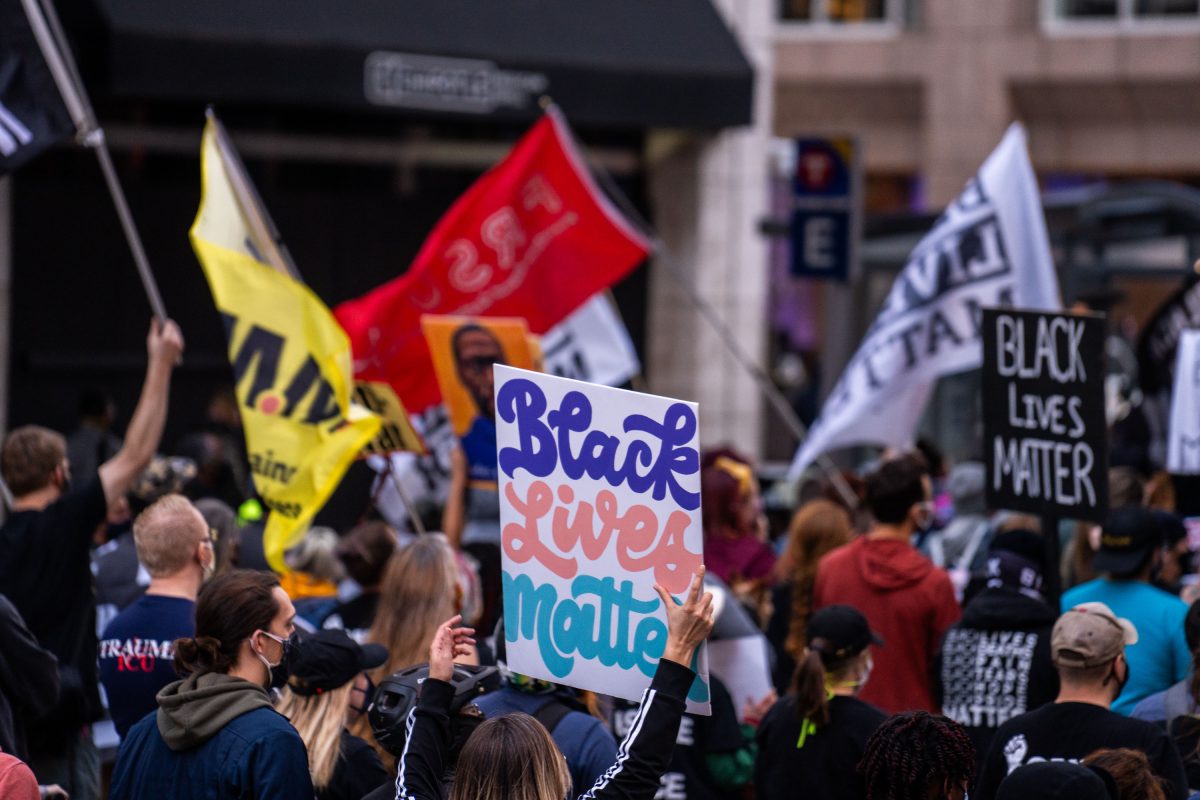
Chauvin Trial Opening Statements Protest and March, Minneapolis
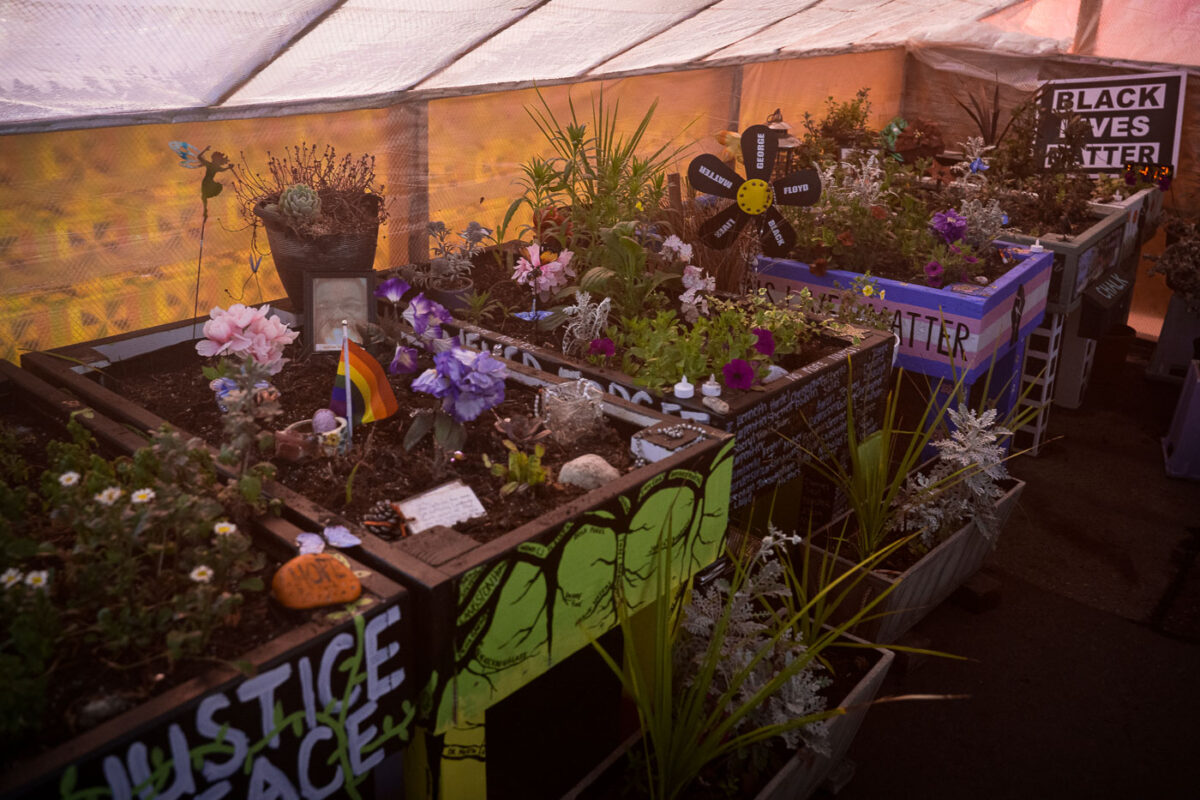
Protesters gathered in downtown Minneapolis on March 29, 2021, the day opening statements began in the trial of Derek Chauvin, the former Minneapolis police officer charged in the killing of George Floyd. Floyd died on May 25, 2020, after Chauvin knelt on his neck during an arrest, an incident that sparked demonstrations across the country. The trial was held at the Hennepin County Government Center, just blocks from where marchers carried signs and flags through the city's downtown streets. Chauvin was later convicted on charges of second-degree unintentional murder, third-degree murder, and second-degree manslaughter.

Chauvin Trial Opening Statements Protest and March, Minneapolis

George Floyd Square Greenhouse in March 2021
A greenhouse at George Floyd Square in Minneapolis, March 2021, served as a space for cultivating plants and flowers through the winter months. The square became a focal point for protests and activism following the murder of George Floyd in May 2020. This structure, adorned with signs and tributes such as "Black Lives Matter" and "Justice for George Floyd," reflects the community's ongoing commitment to remembrance and social justice.

George Floyd Square Greenhouse, Minneapolis, March 2021
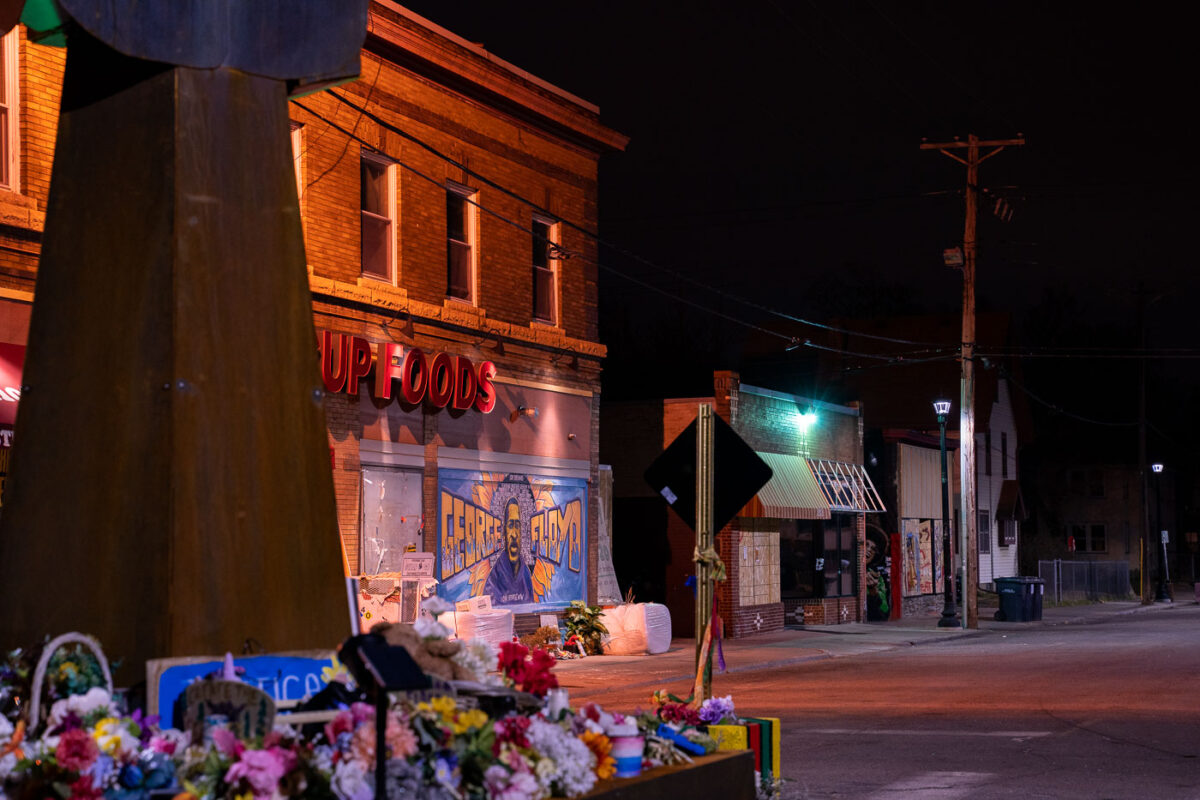
George Floyd mural at Cup Foods in Minneapolis
The George Floyd Memorial mural, located at Cup Foods on the corner of 38th Street and Chicago Avenue in South Minneapolis, was created in the aftermath of George Floyd's murder in May 2020. The mural serves as a focal point for remembrance and protest, situated at the epicenter of the "George Floyd Square" autonomous zone established by activists. This site became a significant gathering place for demonstrations and a symbol of the broader Black Lives Matter movement.

George Floyd Mural at Cup Foods, Minneapolis
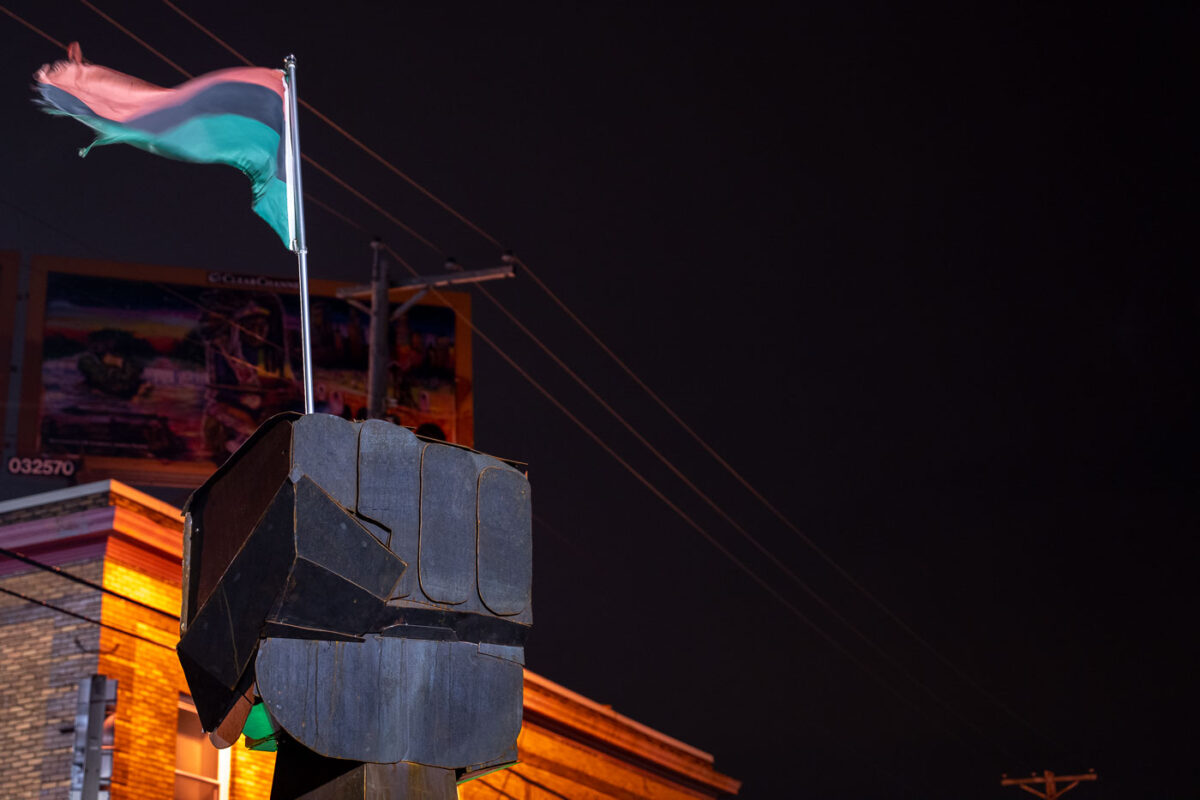
Fist at George Floyd Square in March 2021
A raised fist sculpture and the Pan-African flag fly at George Floyd Square in Minneapolis in March 2021. The square, located at the intersection of Chicago Avenue and 38th Street, became a focal point for protests following the murder of George Floyd by Minneapolis police officer Derek Chauvin in May 2020. The area was occupied by protesters for an extended period, transforming it into a space for community gathering and activism. The fist and flag symbolize Black Power and solidarity, reflecting the ongoing movement for racial justice.

George Floyd Square Fist and Pan-African Flag, March 2021
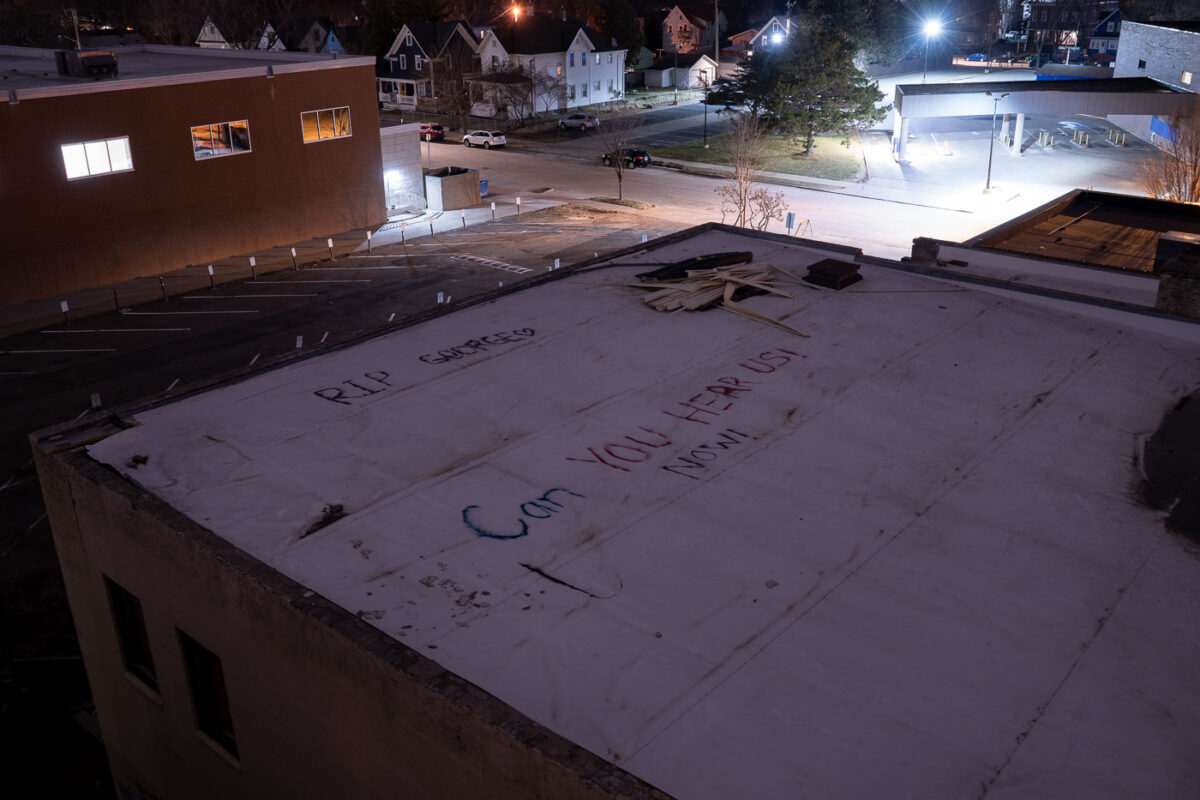
Can you hear us now written on roof
Messages reading "RIP George" and "Can you hear us now!" are spray-painted on the rooftop of a building across from the Minneapolis Police Third Precinct. The precinct building was set ablaze during civil unrest that followed the murder of George Floyd on May 25, 2020. The messages serve as a stark reminder of the public outcry and demands for accountability that characterized the Minneapolis Uprising.

Minneapolis Police Third Precinct Rooftop Message
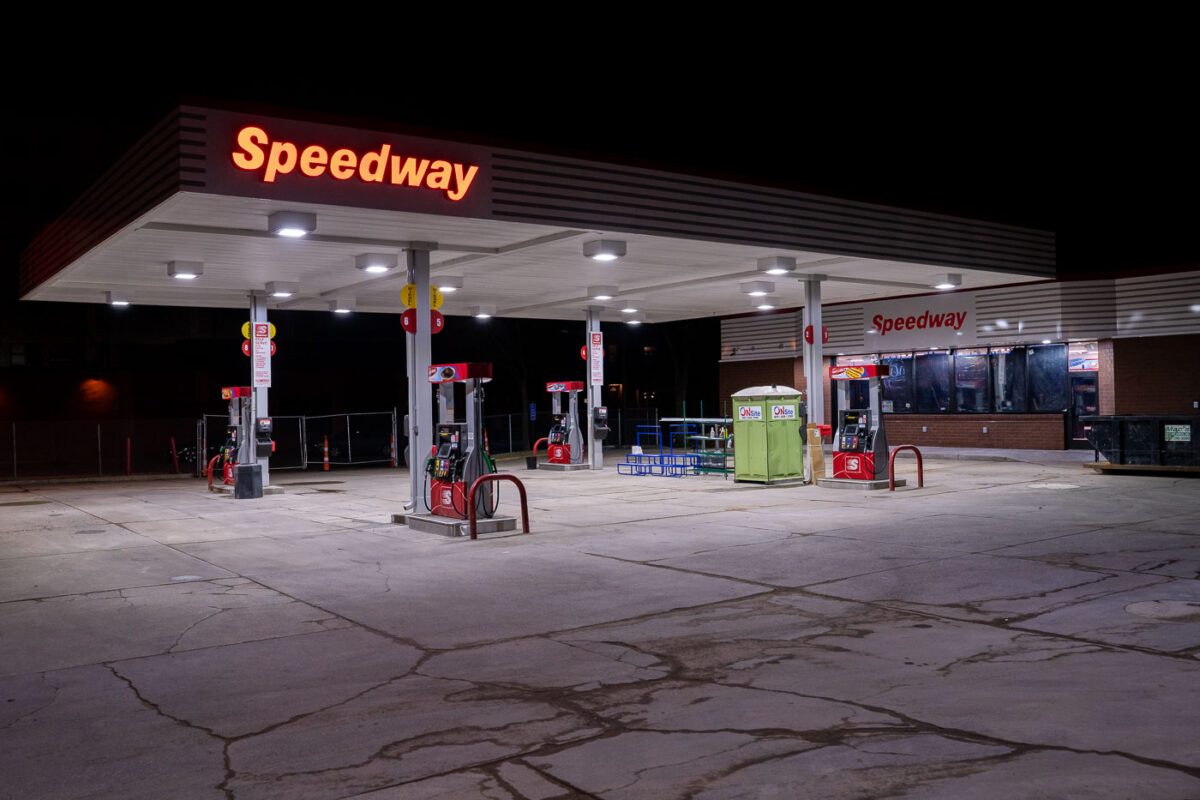
Speedway gas station reopens in Minneapolis
The Speedway gas station on Lake Street in South Minneapolis is shown preparing to reopen after being rebuilt. This location was significantly damaged during the unrest that followed the murder of George Floyd in May 2020. The rebuilding of this and other businesses in the area reflects the community's resilience and efforts to recover from the events of the Minneapolis Uprising.

Speedway Gas Station Reopens in South Minneapolis After Fire
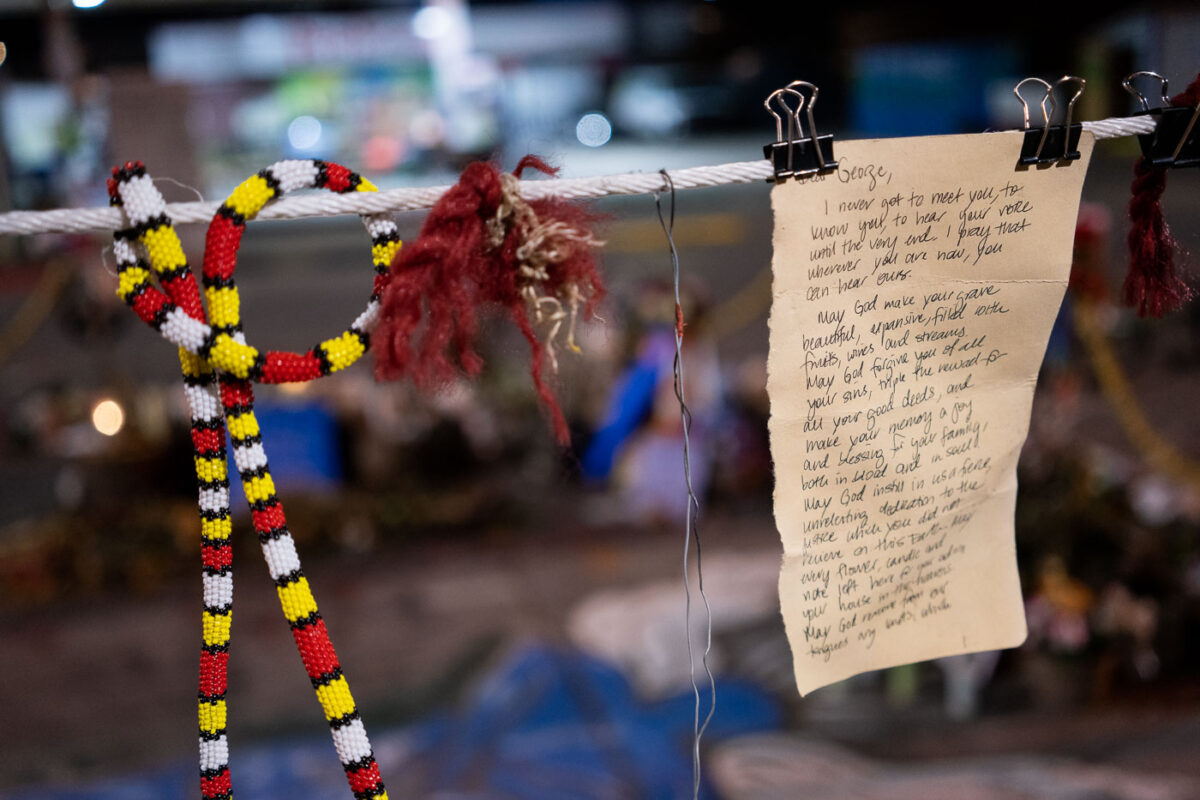
Items at George Floyd Square
A handwritten letter and beaded necklaces are displayed at George Floyd Square in Minneapolis, a site that became a focal point for protests following the murder of George Floyd in May 2020. The area, located at the intersection of 38th Street and Chicago Avenue, was occupied by protesters for months. This memorial serves as a space for remembrance, reflection, and continued activism related to racial justice and police brutality.

Letter and beads at George Floyd Square, Minneapolis
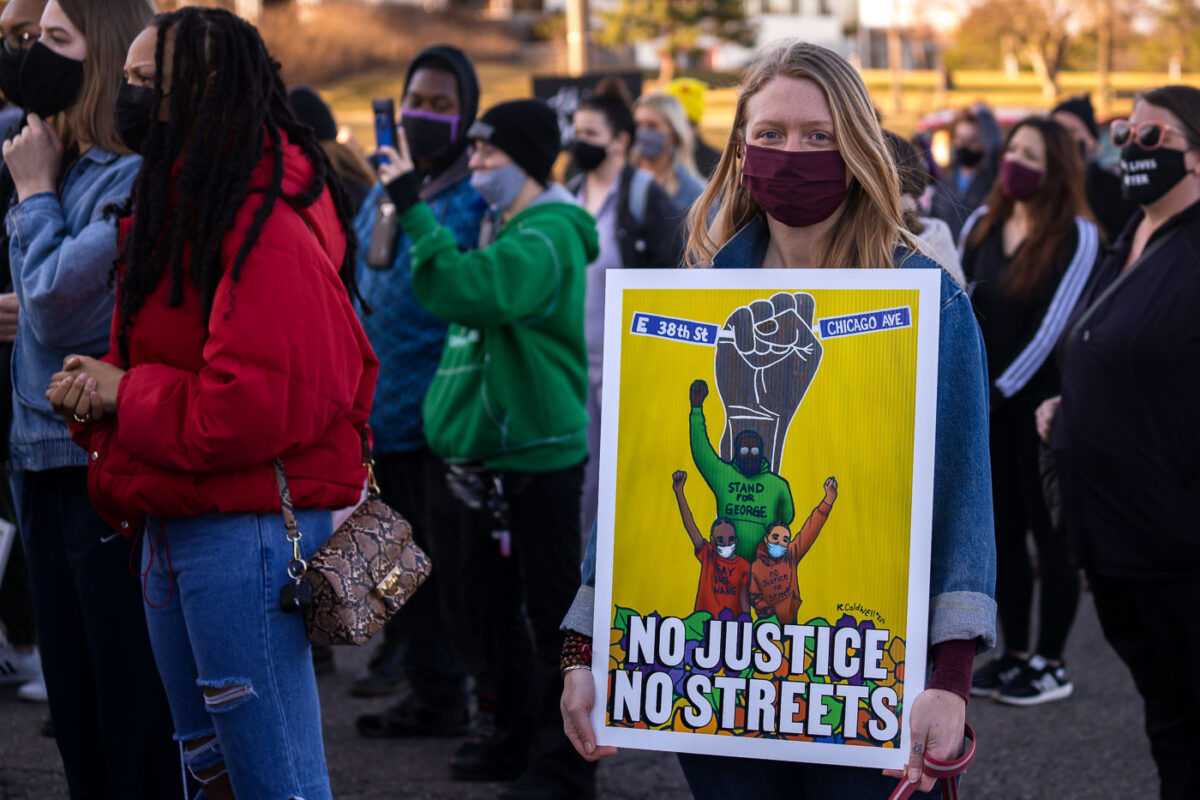
Woman holds up No Justice No Streets sign in St Paul
Protesters gathered in St. Paul, Minnesota, to demand justice for George Floyd and other victims of police brutality. The "No Justice No Streets" slogan, prominently displayed on a sign, reflects the widespread anger and calls for systemic change following Floyd's murder. This event was part of a larger national movement that brought attention to issues of racial inequality and police accountability. The protest took place near the Minnesota State Capitol, a significant site for political action and public assembly in the state.

Protest for George Floyd: No Justice No Streets, St. Paul
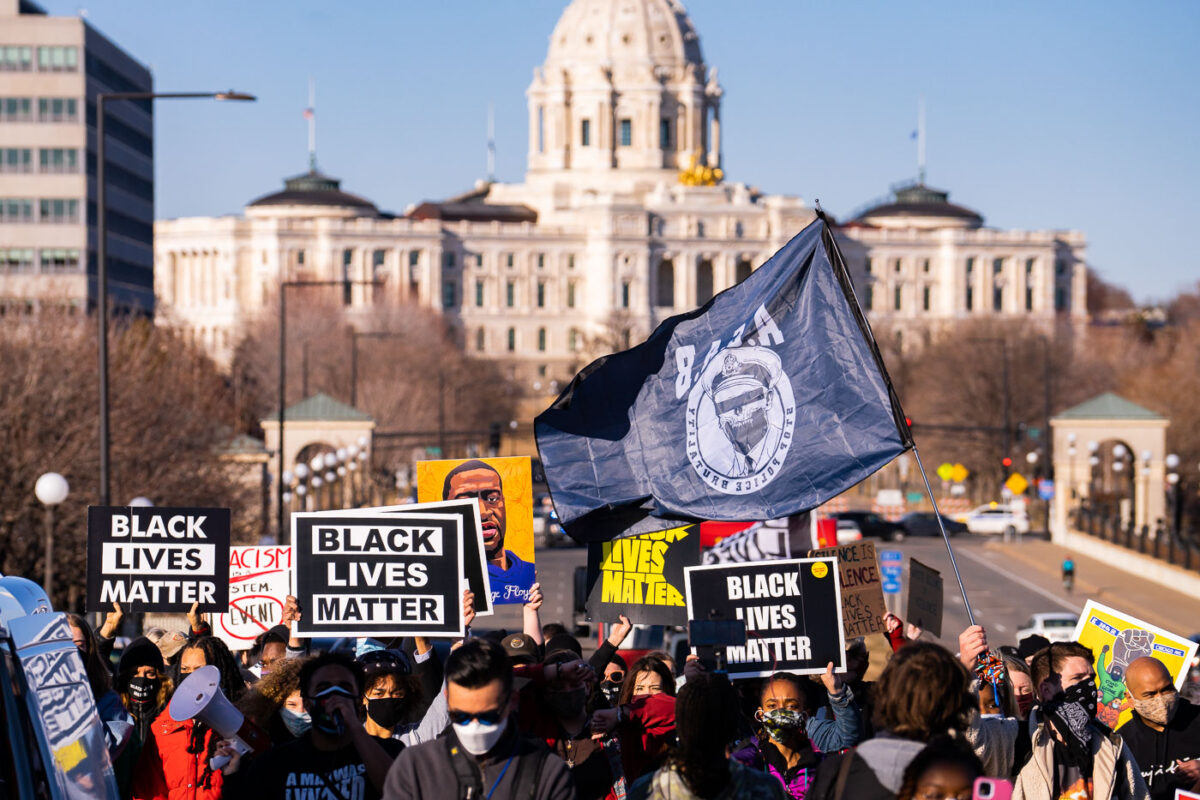
Protesters march at Minnesota State Capitol March 2021
Protesters gathered at the Minnesota State Capitol in St. Paul in March 2021 to demand justice for George Floyd and an end to police brutality. The demonstration occurred nearly a year after Floyd's murder by Minneapolis police, an event that sparked widespread protests across the nation and globally. The Minnesota State Capitol building, completed in 1905, serves as the seat of government for the state and is a prominent landmark in the Twin Cities.

Black Lives Matter Protest at Minnesota State Capitol, March 2021
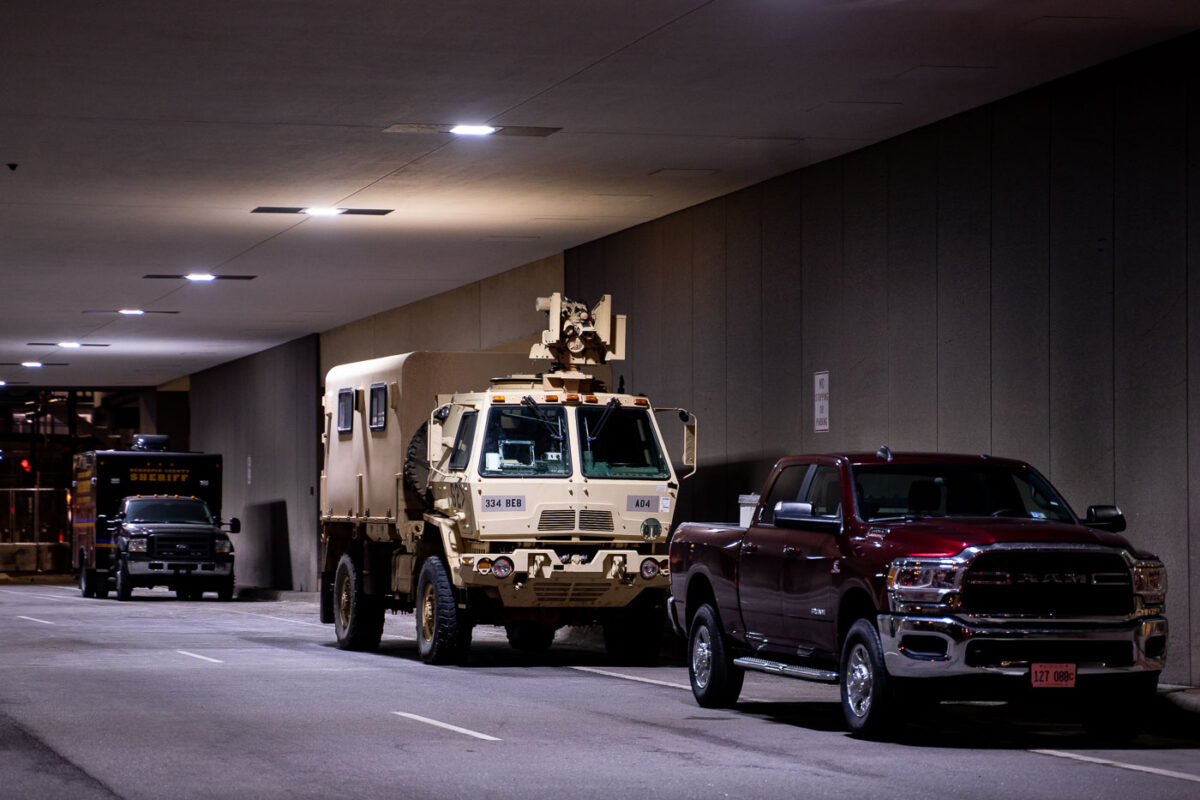
National Guard security at Derek Chauvin murder trial
National Guard vehicles and a Hennepin County Sheriff's vehicle were stationed near the Hennepin County Courthouse in Minneapolis during the trial of Derek Chauvin. The trial, held in April 2021, stemmed from the death of George Floyd in May 2020, an event that sparked widespread protests and unrest. The presence of military and law enforcement vehicles underscored the heightened security measures and the tense atmosphere surrounding the proceedings.

National Guard vehicle at Hennepin County Courthouse, Minneapolis
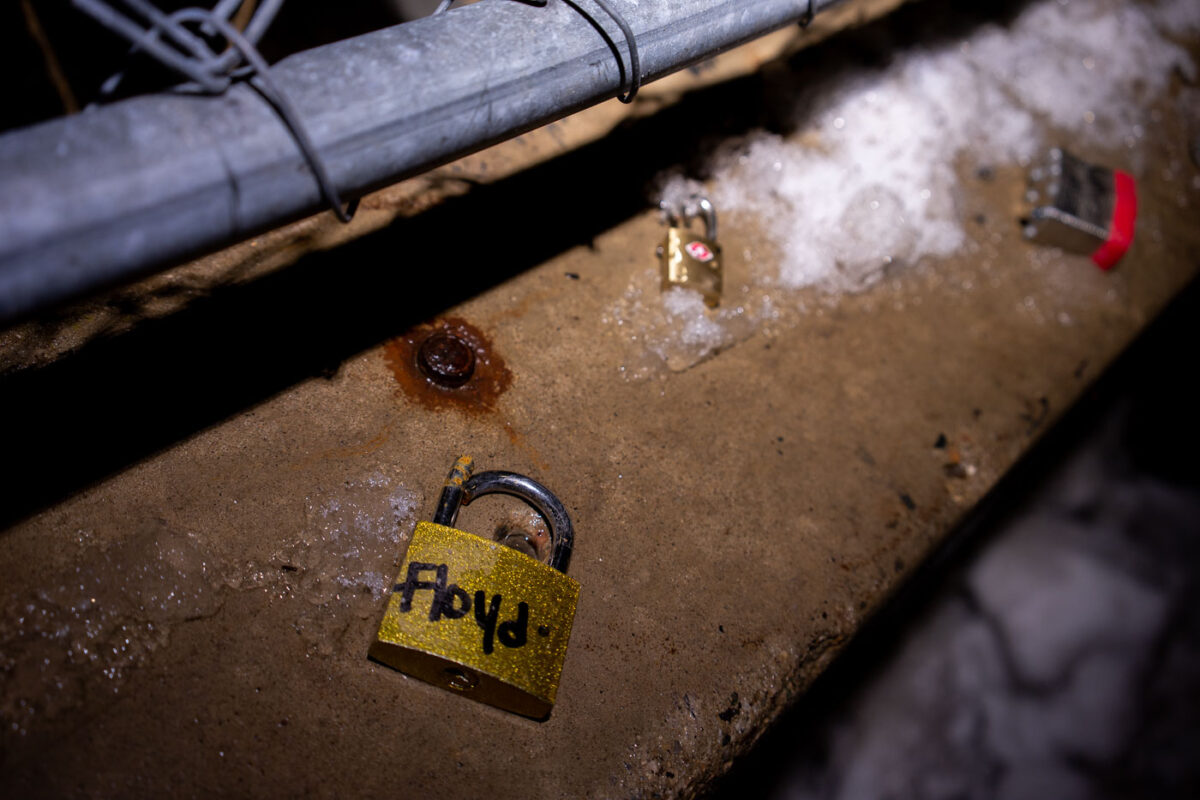
Floyd lock outside Hennepin County courthouse during Chauvin trial
Locks bearing the names of victims of police violence were placed on fencing surrounding the Hennepin County Government Center in Minneapolis during the trial of Derek Chauvin for the murder of George Floyd. The locks served as a memorial and a symbol of protest. They were removed from the fencing the following day, April 14, 2021, after being in place for approximately one week.

Floyd Lock at Hennepin County Courthouse During Chauvin Trial
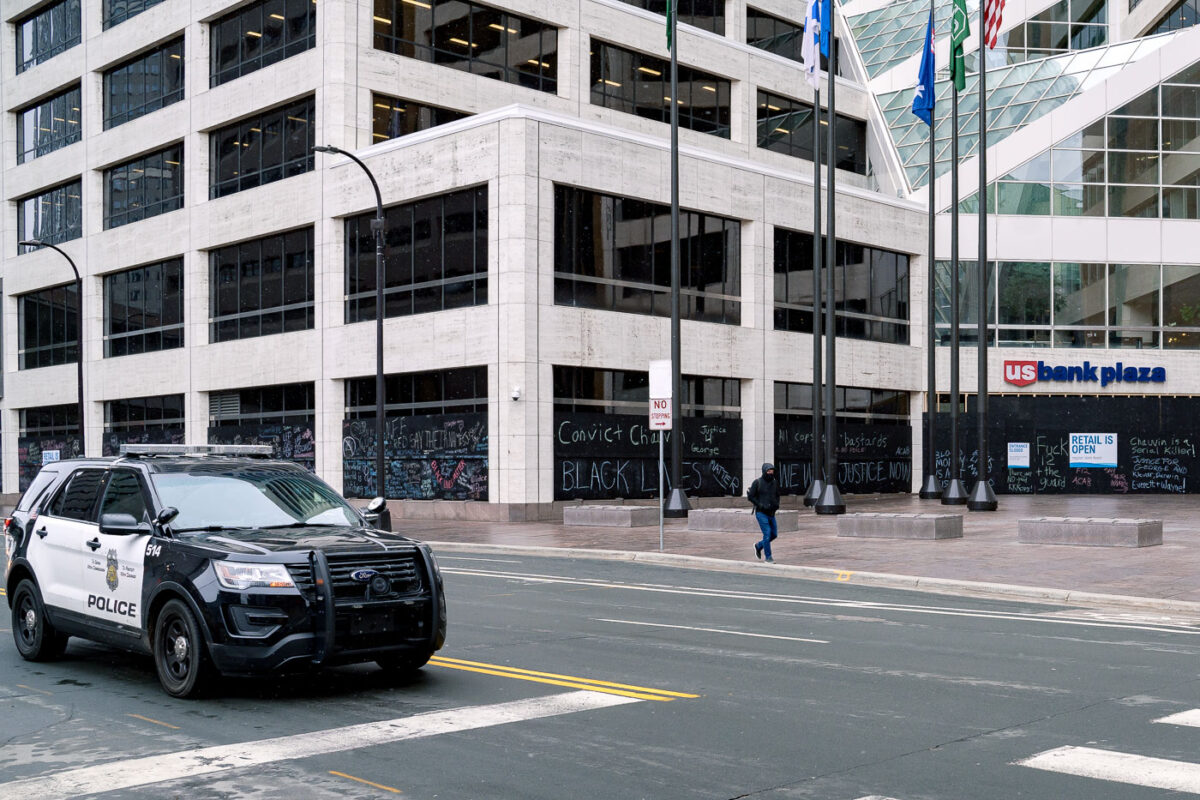
Minneapolis Police officer drives by US Bank Plaza
A Minneapolis Police vehicle is parked on 3rd Avenue in Downtown Minneapolis, adjacent to the US Bank Plaza. The plaza's windows and ground-level facade have been boarded up and covered with graffiti, including messages related to the Black Lives Matter movement and the Derek Chauvin trial. This scene reflects the heightened tensions and public response in Minneapolis following the murder of George Floyd in May 2020. The presence of the police car and the boarded-up buildings indicate the city's efforts to manage and respond to the widespread protests and civil unrest that occurred during that period.

Minneapolis Police car at boarded US Bank Plaza
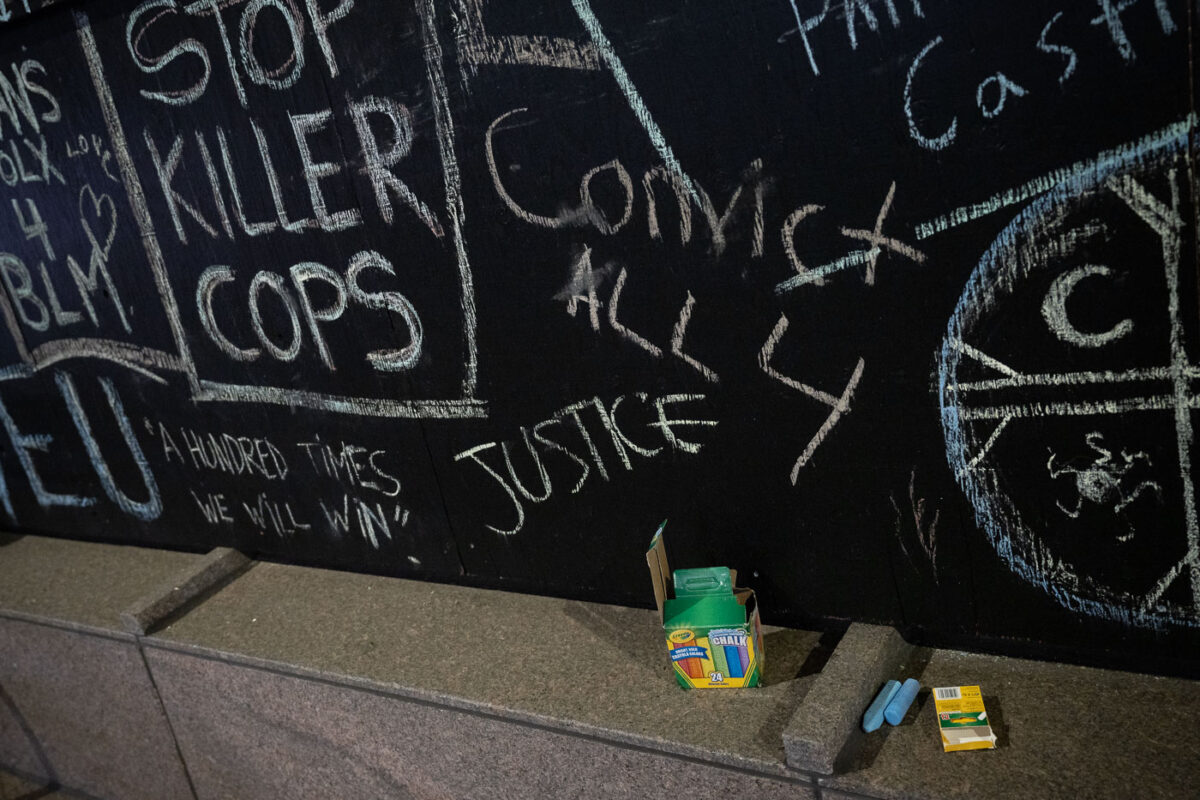
Chalk outside US Bank Plaza boards
Chalk messages, including "Stop Killer Cops" and "Justice," were written on a wall outside the Hennepin County Government Center in Minneapolis during the trial of Derek Chauvin. The trial, which began in March 2021, stemmed from the May 25, 2020 murder of George Floyd. The messages reflect the public sentiment and activism surrounding the case, which gained national and international attention.

Chalk messages outside Minneapolis courthouse during Chauvin trial

Roses in blood art installation at Chauvin trial
Roses, some appearing to be stained with red paint to resemble blood, were placed in a puddle outside the Hennepin County Government Center in Minneapolis. This installation occurred during the trial of Derek Chauvin, a former Minneapolis police officer charged with the murder of George Floyd. The trial, held in April 2021, drew significant national attention to issues of police brutality and racial justice.

Roses in paint outside Hennepin County Government Center during Chauvin trial

Reflect art installation outside Chauvin trial
An art installation reading "REFLECT" stands outside the Hennepin County Government Center in Minneapolis. The installation was present during the trial of Derek Chauvin, a former Minneapolis police officer charged with the murder of George Floyd on May 25, 2020. The trial, which began on March 8, 2021, drew significant public attention and protests related to police brutality and racial justice. The "REFLECT" installation, along with scattered roses and protest signs, served as a visual reminder of the ongoing discourse surrounding Floyd's death and its broader implications.

Reflect art installation outside Hennepin County Government Center

Protesters with mirrors and flowers outside Chauvin trial
Flowers and mirrors are placed on the street outside the Hennepin County Government Center in Minneapolis, Minnesota. This display occurred during the period of protests and unrest following the murder of George Floyd in May 2020 and the subsequent trial of Derek Chauvin. The mirrors, some bearing red paint, likely symbolize reflection and accountability, while the flowers serve as a memorial to victims of police brutality. The Hennepin County Government Center was a focal point for many demonstrations during this time.

Flowers and mirrors outside Hennepin County Government Center

Bringing In the National Guard flyer
A sign posted on a chain-link fence surrounding the Hennepin County Government Center in Minneapolis reads "Bringing in the National Guard. What Could Possibly Go Wrong?" The poster includes a photograph from the Kent State shootings on May 4, 1970, where the Ohio National Guard fired on unarmed students during a protest. This juxtaposition of historical imagery with the contemporary presence of the National Guard in Minneapolis, likely during the protests following the murder of George Floyd, serves as a pointed commentary on the potential for state-sanctioned violence. The inclusion of flowers suggests a memorial or a somber reflection on the events.

Hennepin County Government Center: National Guard Sign

Black Lives Matter chalk on black boards
Messages of protest and solidarity are chalked onto boarded-up windows of a building near the Hennepin County Government Center in Minneapolis. The messages, including "Justice for George Floyd," "Stop Killing Us," and "Black Lives Matter," were created in the context of the trial of former Minneapolis Police Officer Derek Chauvin. Chauvin was charged with murder in the death of George Floyd on May 25, 2020, an event that sparked widespread protests against police brutality and racial injustice.

Minneapolis: BLM messages on boarded-up building near Chauvin trial

Minnesota National Guard outside Hennepin Courthouse
A member of the Minnesota National Guard stands in front of a military vehicle outside the Hennepin County Government Center in Minneapolis. This deployment occurred during a period of heightened tension and unrest in the city, following the murder of George Floyd and the subsequent trial of Derek Chauvin. The National Guard was activated to support local law enforcement and maintain order amidst widespread protests against police brutality. The Hennepin County Government Center, a prominent civic building in downtown Minneapolis, served as a focal point during these events.

Minnesota National Guard at Hennepin County Government Center

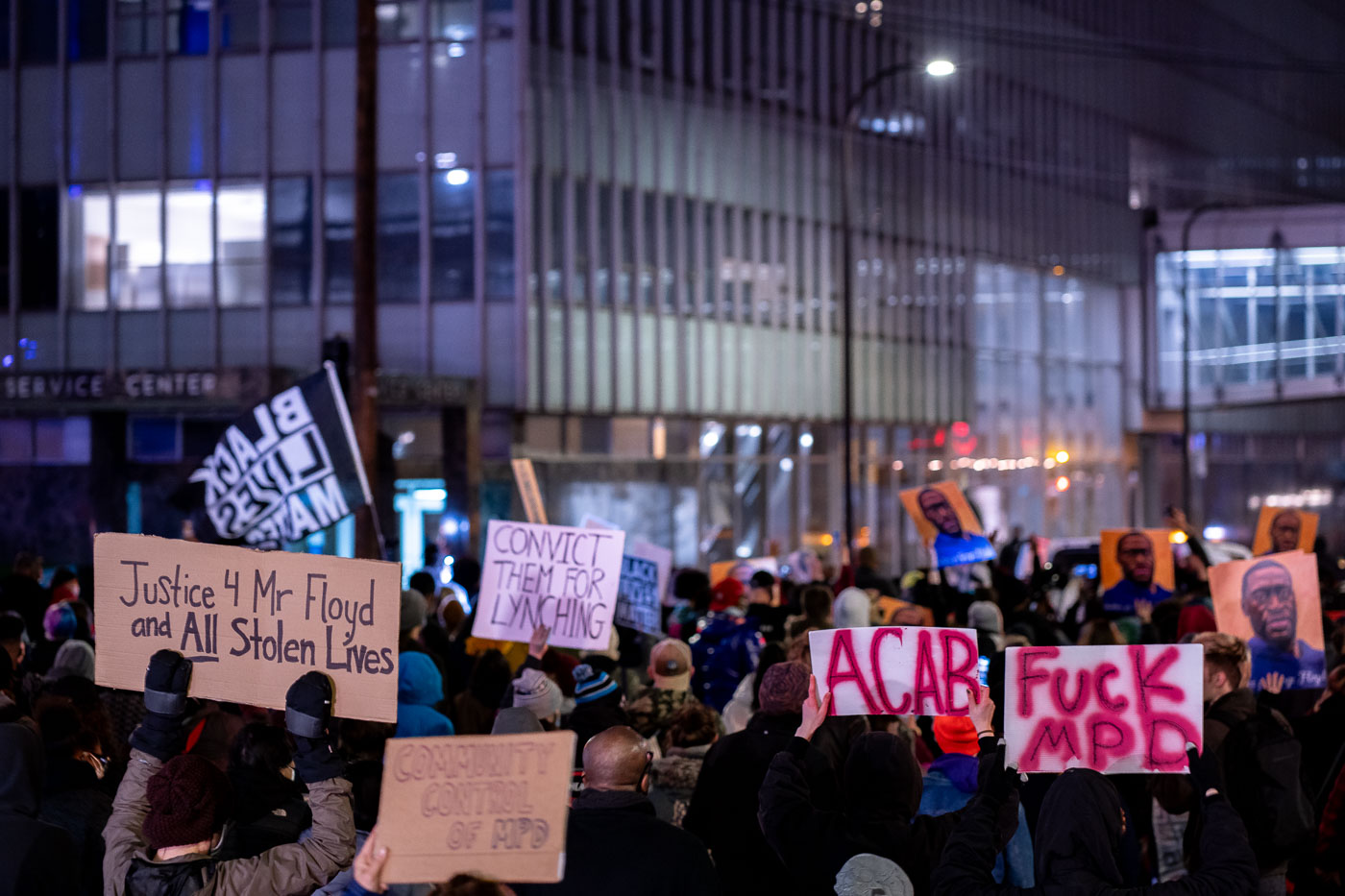
Justice 4 George Floyd and All Stolen Lives in Minneapolis
A large crowd gathered in downtown Minneapolis on March 8, 2021, to protest the murder of George Floyd and demand justice. The protest occurred outside the Hennepin County Government Center on the morning of the first day of the trial for former Minneapolis police officer Derek Chauvin. Chauvin was charged with second-degree murder and manslaughter in connection with Floyd's death on May 25, 2020. The "Black Lives Matter" movement gained significant momentum following Floyd's death, highlighting issues of police brutality and racial injustice.

Minneapolis Protest for George Floyd and Stolen Lives

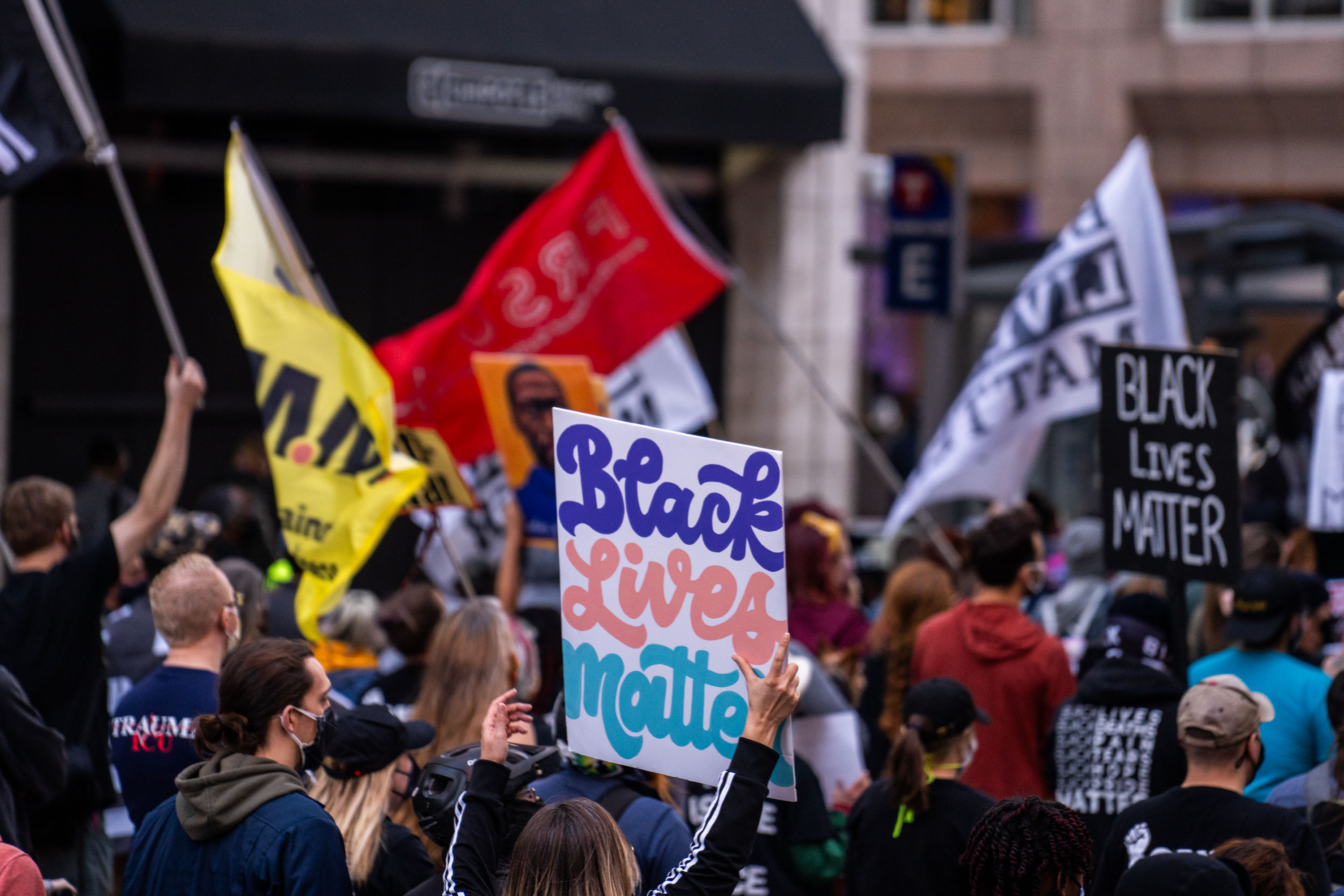
Protesters march through downtown at start of Chauvin trial
A large crowd gathered in downtown Minneapolis for a protest related to the trial of Derek Chauvin, the former Minneapolis Police Officer charged in the murder of George Floyd on May 25, 2020. The protest took place outside the Hennepin County Government Center prior to the start of the trial. Many carried signs with messages such as "Justice for George Floyd," "Convict Killer Cops," and "Black Lives Matter," reflecting the broader movement against police brutality and racial injustice.

Protesters march downtown Minneapolis for Derek Chauvin trial

George Floyd pins being sold outside courthouse
Pins commemorating George Floyd and bearing the slogan "I Can't Breathe" are displayed for sale outside the Hennepin County Courthouse in Minneapolis. This location was the site of the trial of Derek Chauvin, the former Minneapolis police officer convicted of Floyd's murder in April 2021. The sale of such merchandise reflects the broader cultural and political impact of Floyd's death and the subsequent Black Lives Matter movement, which gained significant momentum following the incident in May 2020. The courthouse itself is a significant civic building in downtown Minneapolis, serving as a central hub for legal proceedings in the county.

George Floyd Pins Sold Outside Hennepin County Courthouse

Minneapolis is under military occupation
Protesters gathered outside the Hennepin County Government Center in Minneapolis on March 8, 2021, the day the Derek Chauvin murder trial began. The sign, held by a protester, reads "Minneapolis is under military occupation," reflecting the sentiment of many during the widespread protests against police brutality that followed George Floyd's murder. The trial itself was a focal point for ongoing activism and calls for justice and accountability within the Minneapolis community and beyond.

Minneapolis Protest Sign: “Minneapolis is under military occupation”

Protester writes with chaulk at Chauvin trial
During the trial of Derek Chauvin, a protester writes messages in chalk outside the Hennepin County Courthouse in Minneapolis. The trial, which began in March 2021, centered on the murder of George Floyd, a Black man who died in police custody. The courthouse and surrounding areas became a focal point for protests and demonstrations related to police brutality and racial justice. The chalk messages serve as a form of public expression and a visual record of the community's response to the ongoing legal proceedings and broader social issues.

Chalk message at Hennepin County Courthouse during Chauvin trial

Protesters behind security fencing at Chauvin trial
Protesters gathered outside the Hennepin County Government Center in Minneapolis during the trial of Derek Chauvin. The courthouse was surrounded by security fencing, a measure implemented due to the high-profile nature of the trial and concerns about potential unrest. The trial, which began in March 2021, stemmed from the murder of George Floyd by Minneapolis police officer Derek Chauvin in May 2020. Protests against police brutality and racial injustice, often under the banner of Black Lives Matter, had been ongoing in Minneapolis and across the nation since Floyd's death.

Protesters at Hennepin County Government Center during Chauvin Trial

Large protest in Minneapolis at start of Chauvin trial
Protesters gathered outside the Hennepin County Government Center in Minneapolis on March 8, 2021, awaiting the start of the trial for former police officer Derek Chauvin. Chauvin was charged with murder and manslaughter in the death of George Floyd on May 25, 2020, an event that sparked widespread protests against police brutality and racial injustice. The Hennepin County Government Center serves as a key administrative and judicial hub for the county, and its proximity to the site of Floyd's murder made it a focal point for demonstrations.

Minneapolis Protest Outside Hennepin County Government Center

Abolish Police and Prisons protest sign
Protesters gathered outside the Hennepin County Government Center in Minneapolis on March 8, 2021, ahead of the Derek Chauvin trial. Chauvin, a former Minneapolis police officer, was charged in the murder of George Floyd on May 25, 2020. The sign "Abolish Police + Prisons" reflects a central demand of the Black Lives Matter movement, which gained widespread attention following Floyd's death and has continued to advocate for systemic reform of law enforcement and the justice system.

Minneapolis Protest: Abolish Police and Prisons Sign

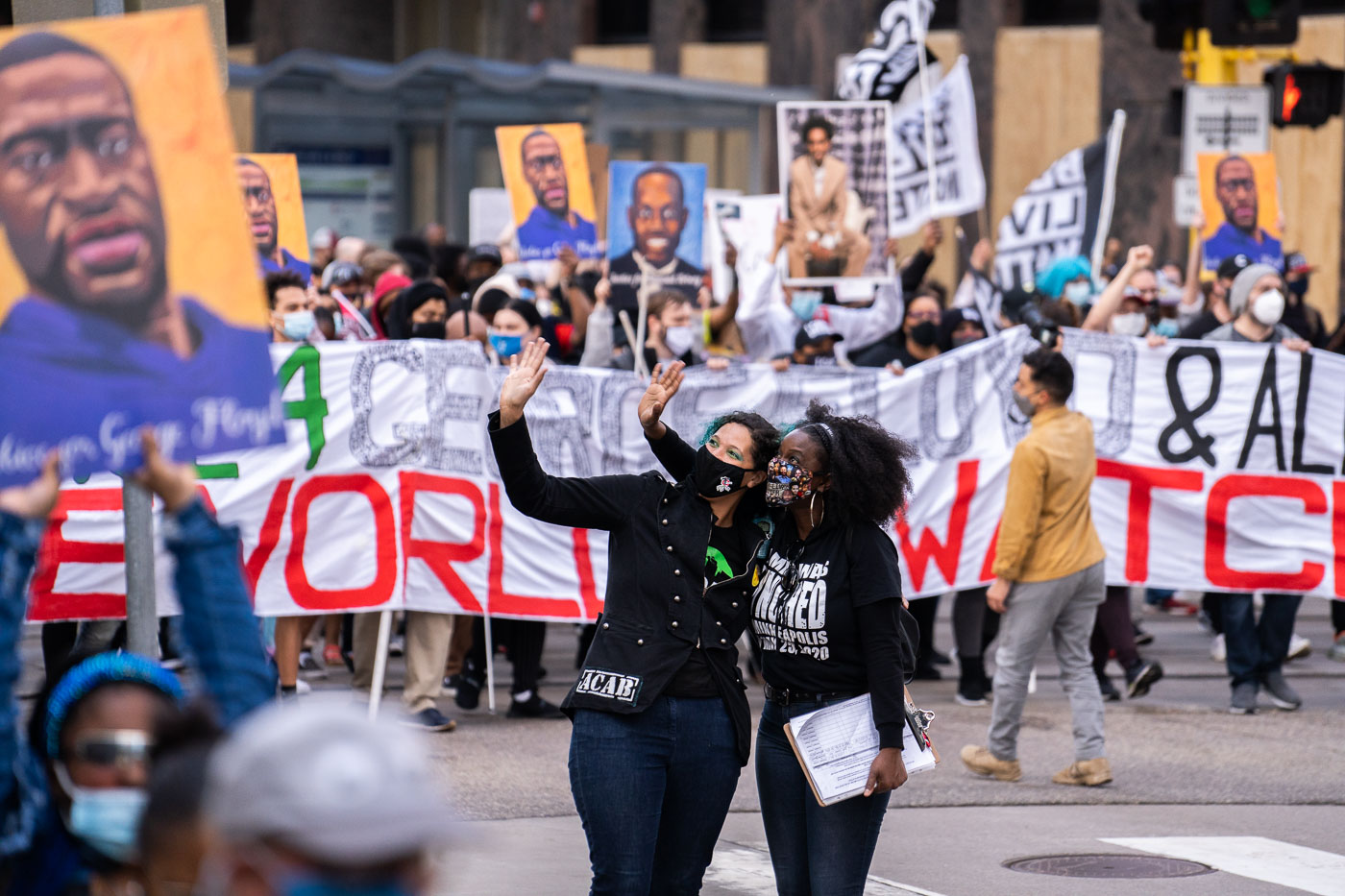
The World Is Watching protest in Minneapolis
Protesters gathered outside the Hennepin County Government Center in Minneapolis on March 8, 2021, the morning of the Derek Chauvin trial. Chauvin, a former Minneapolis police officer, was charged with the murder of George Floyd on May 25, 2020. The banner reads "Justice 4 George Floyd & All Stolen Lives. The World Is Watching." This event highlights the broader Black Lives Matter movement and calls for accountability in cases of police brutality.

Minneapolis Protest for George Floyd Outside Hennepin County Government Center

Military vehicles behind razor wire for Chauvin murder trial
National Guard vehicles are positioned outside the Hennepin County Government Center in Minneapolis during the overnight hours. The presence of military vehicles and barricades indicates heightened security measures, likely in response to the civil unrest and protests that occurred in the city. These events were largely sparked by the murder of George Floyd and the subsequent trial of Derek Chauvin, highlighting the complex relationship between law enforcement, the National Guard, and public demonstrations in urban environments.

National Guard vehicles at Hennepin County Government Center

Protesters put hands up outside courthouse during Chauvin trial
Protesters gather outside the Hennepin County Government Center in Minneapolis on March 7, 2021. The demonstration occurred the day before the start of jury selection in the trial of Derek Chauvin, the former Minneapolis police officer charged with the murder of George Floyd on May 25, 2020. The government center is a prominent civic building in downtown Minneapolis, serving as the seat of county government and a site for significant public events and protests.

Protesters raise fists outside Hennepin County Government Center, Minneapolis

Protesters enter a secured area around Chauvin trial
Protesters approach the Hennepin County Government Center in Minneapolis, Minnesota, during the trial of Derek Chauvin. The "Cage," a temporary security perimeter constructed with chain-link fencing, plywood, and barbed wire, was erected around the courthouse to manage crowds and ensure safety. This measure was implemented in response to widespread protests against police brutality and racial injustice that followed the murder of George Floyd in May 2020. The "Justice for All" signs carried by some individuals reflect the broader movement's demands for accountability and systemic change.

Protesters enter security perimeter at Hennepin County Government Center

Dismantle White Supremacy protest
Thousands marched in Downtown Minneapolis on March 7, 2021, the day before the start of jury selection in the trial of former Minneapolis Police officer Derek Chauvin. Chauvin was charged with the murder of George Floyd on May 25, 2020, an event that sparked widespread protests against police brutality and white supremacy. The marchers carried signs with messages such as "Dismantle White Supremacy" and "We Need Justice," reflecting the ongoing calls for racial equity and accountability.

Minneapolis Protest: Dismantle White Supremacy, March for Justice

Police are tools of white supremacy
Thousands marched in downtown Minneapolis the day before jury selection began in the trial of former police officer Derek Chauvin. Chauvin was charged with the murder of George Floyd on May 25, 2020, an event that sparked widespread protests against police brutality and racial injustice. The marchers carried signs with messages such as "Police = Tools of White Supremacy" and "Dismantle White Supremacy," reflecting the broader movement for Black Lives Matter. The protests highlighted deep-seated issues of systemic racism and police accountability in the United States.

Minneapolis Protest: “Police = Tools of White Supremacy” Sign

Thousands march at start of Chauvin trial
Thousands of protestors marched near the Hennepin County Government Center in Minneapolis on March 7, 2021. The march occurred the day before the start of jury selection in the trial of former Minneapolis police officer Derek Chauvin, who was charged with the murder of George Floyd on May 25, 2020. The event was part of ongoing protests against police brutality and racial injustice that followed Floyd's death.

Protestors march near Hennepin County Government Center, Minneapolis

Protesters in downtown Minneapolis in March 2021
A protest march took place in downtown Minneapolis on March 7, 2021, the day before Derek Chauvin's trial for the murder of George Floyd began. Participants carried a scroll listing over 470 names of individuals killed by Minnesota police officers. Organizers highlighted that Chauvin was involved in five of those cases, underscoring the broader issue of police brutality. The march proceeded from the Hennepin County Government Center down Hennepin Avenue, drawing attention to systemic issues of racial injustice and police accountability.

Minneapolis Protest for George Floyd Victims March 2021

Defund White Supremacy protest sign
Protesters gather outside the Hennepin County Government Center in downtown Minneapolis on March 7, 2021, during a march and rally held the day before jury selection began in the trial of former Minneapolis police officer Derek Chauvin for the murder of George Floyd. Demonstrators carry signs calling for justice for Floyd and denouncing white supremacy, while many participants wear masks during the ongoing COVID-19 pandemic. The Government Center was a regular assembly point for demonstrations tied to Floyd’s killing on May 25, 2020, and to court proceedings in the Chauvin case.

Minneapolis Protest: Defund White Supremacy Sign

Protesters sit during a march at start of Chauvin trial
Protesters gathered in downtown Minneapolis during the trial of Derek Chauvin, the police officer accused in the murder of George Floyd. The march and subsequent sit-in occurred in April 2021, reflecting ongoing activism and demands for justice following Floyd's death in May 2020. The event highlighted the community's continued engagement with issues of racial inequality and police accountability.

Protesters sit during Chauvin trial march in Minneapolis

Thousands march at the start of Derek Chauvin trial
Thousands marched in downtown Minneapolis on March 7, 2021, the day before jury selection began in the trial of Derek Chauvin. The former Minneapolis police officer was charged with the murder of George Floyd, who died on May 25, 2020, sparking widespread protests against police brutality and racial injustice. The marchers carried signs and a casket adorned with flowers, symbolizing their grief and demand for accountability.

Minneapolis Protest for George Floyd, Trial Begins

Red and white restricted area sign and detailed use of public spaces regulations posted on chain link fencing at Hennepin County Government Center.
Signage indicating a restricted area and "Authorized Personnel Only" is posted on secure fencing surrounding the Hennepin County Government Center in Minneapolis.

“Do Not Enter” Signs on Fencing at Hennepin County Government Center

Hennepin County Jail surrounded by chain link security fencing and metal poles at night in downtown Minneapolis.
Hennepin County Jail in downtown Minneapolis was surrounded by temporary security fencing in February 2021. Additional barriers were installed around government buildings in the area before the Derek Chauvin trial. The jail is part of the Hennepin County public safety and court complex.

Razor Wire Fencing Outside Hennepin County Jail at Night

Save the Boards protest on Lake Street in Minneapolis
Protesters marched down Lake Street in Minneapolis on February 21, 2021, organized by Save The Boards to Memorialize the Movement and Visual Black Justice. The group demanded federal action to abolish the death penalty, reopen all police brutality cases, and defund or demilitarize police departments.

Save the Boards protest on Lake Street, Minneapolis
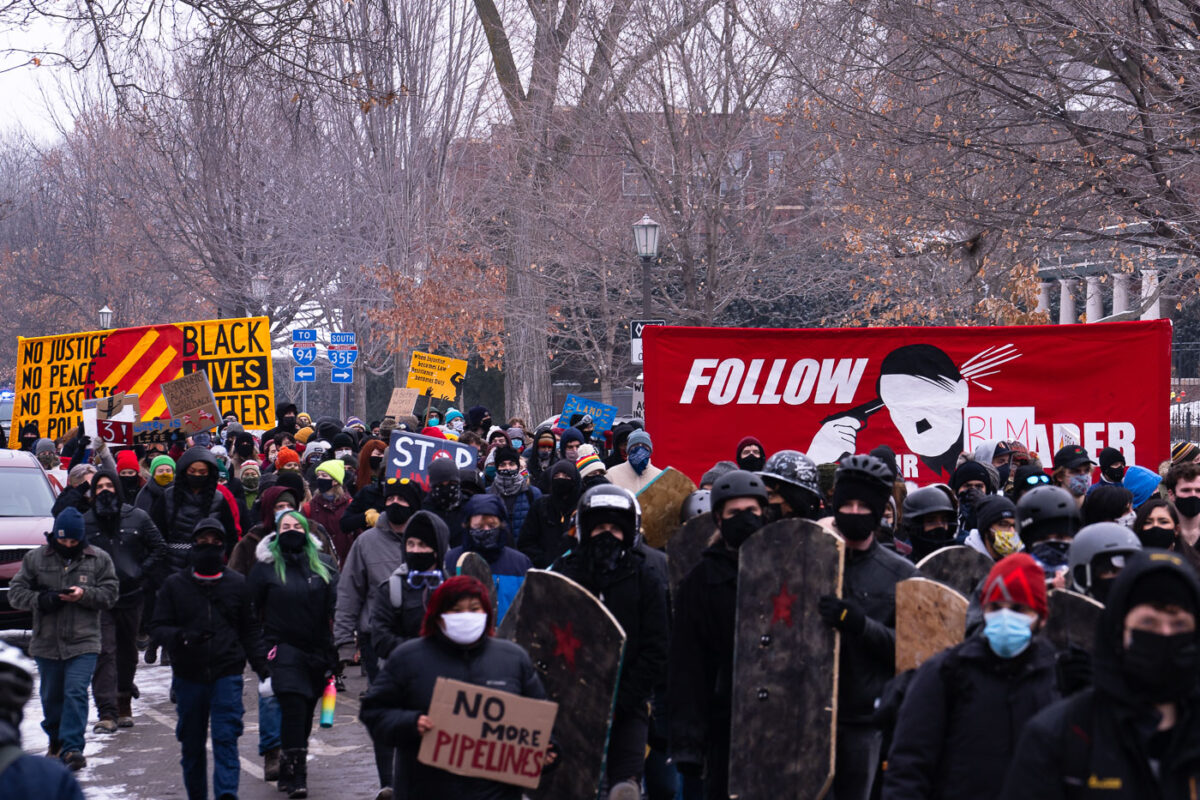
Protesters with shields arrive at a Stop The Steal protest
Protesters marched through St. Paul, Minnesota, carrying signs with slogans such as "Cash not Covid," "No More Pipelines," and "Black Lives Matter." The march, which occurred during a period of widespread social unrest and public health concerns, brought together various activist groups. The "No More Pipelines" signs indicate opposition to fossil fuel infrastructure projects, a common theme in environmental activism. The presence of "Black Lives Matter" banners highlights the ongoing movement for racial justice.

St. Paul Protest: “Cash not Covid” and “No More Pipelines” Signs
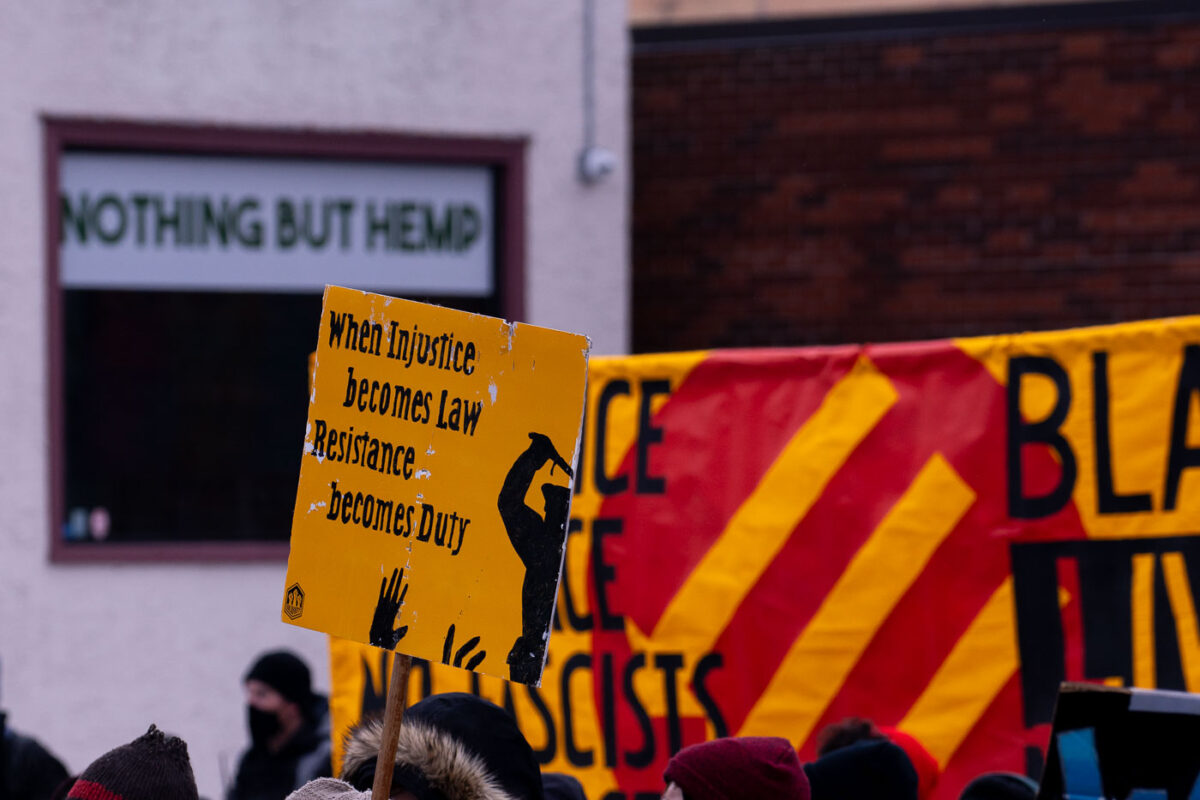
Counter Protest at Stop The Steal Rally in Minnesota
A protester holds a sign reading "When Injustice becomes Law Resistance becomes Duty" during a march in St. Paul, Minnesota. The sign's message reflects a sentiment of civil disobedience in response to perceived legal injustices. In the background, a banner displays "BLACK LIVES MATTER" and slogans such as "COMMUNITY NOT COPS" and "PEOPLE NOT PIPELINES," indicating the protest's alignment with broader social justice movements. The presence of these messages suggests the event was a counter-protest or a demonstration related to the Minneapolis Uprising and ongoing calls for police reform and racial equity.

St. Paul Counter Protest: “When Injustice Becomes Law” Sign
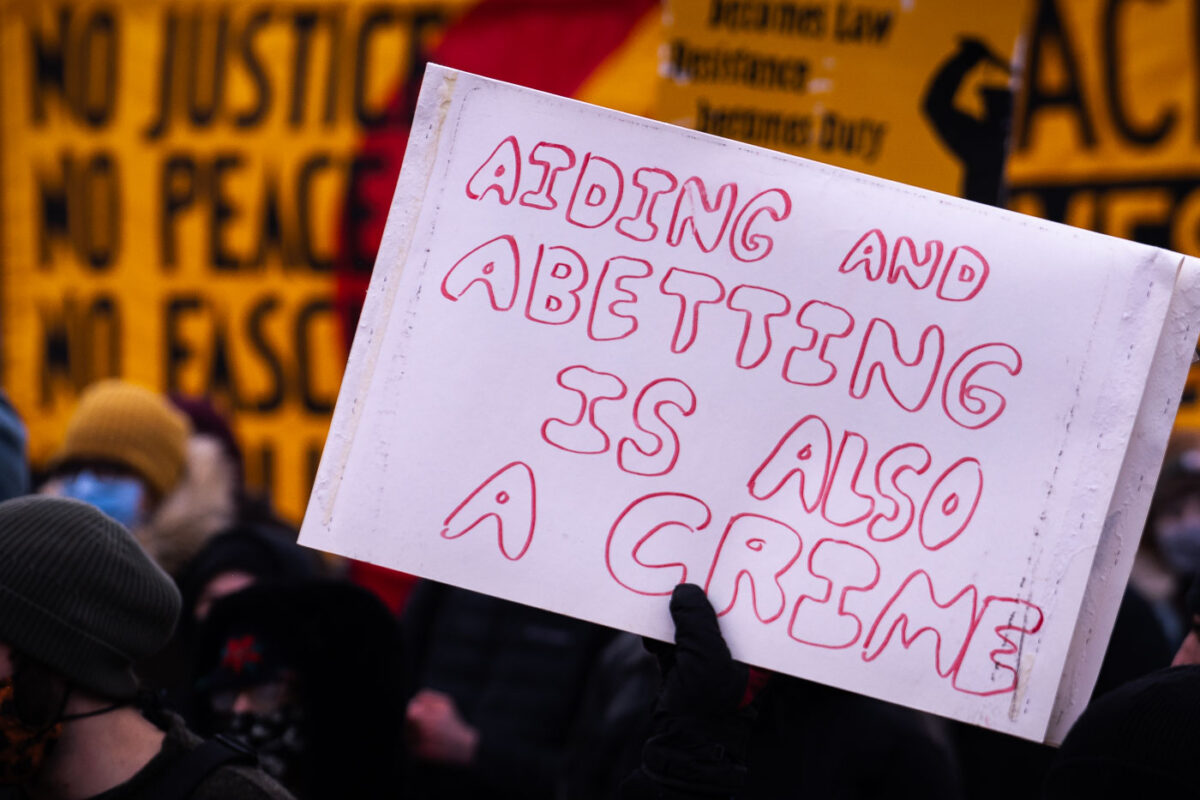
Counter protesters at a Stop The Steal rally in 2021
Protesters gathered in St. Paul, Minnesota, for "The People's March," carrying signs with slogans such as "Aiding and Abetting is Also a Crime." The marchers advocated for various causes, including "Cash not covid," "Community not cops," "People not pipelines," and "Politics without proud boys." The event was part of broader movements like Black Lives Matter and the Minneapolis Uprising, reflecting ongoing social and political activism in the region. The signs and chants indicate a complex set of grievances and demands related to public health, policing, environmental concerns, and political polarization.

St. Paul Protest: “Aiding and Abetting is Also a Crime” Sign
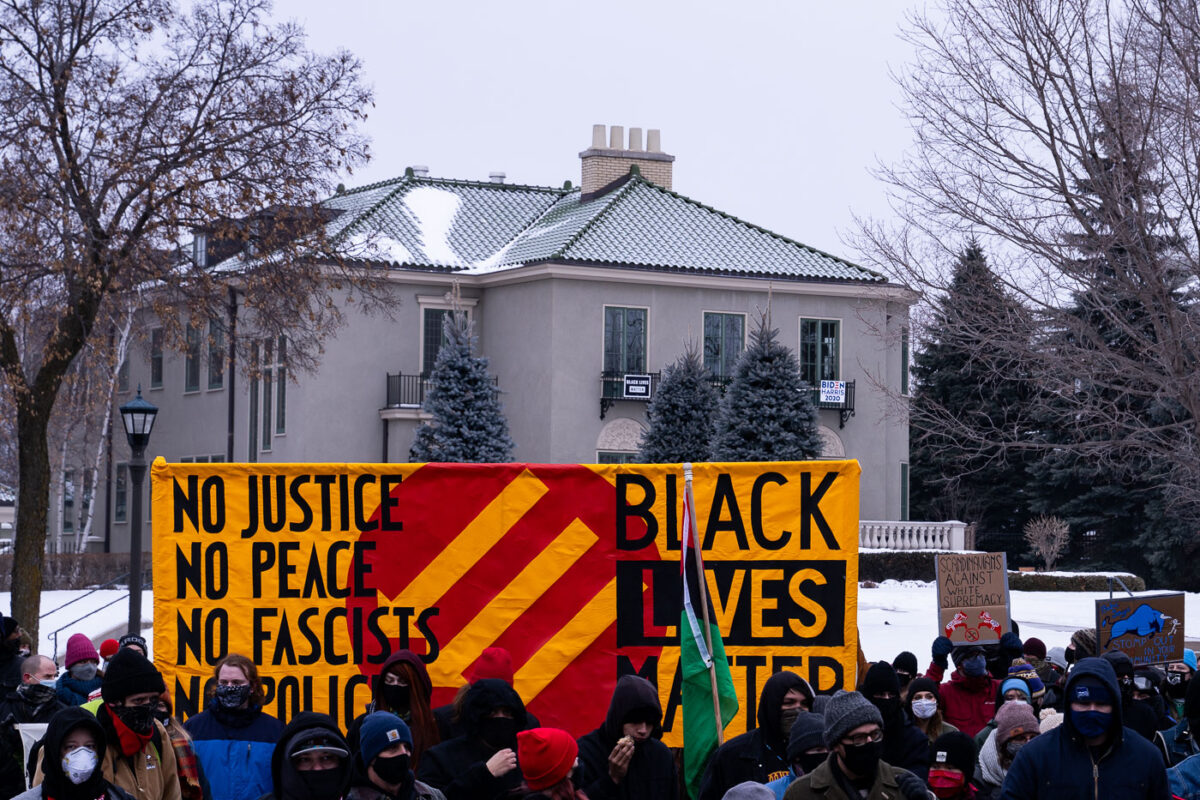
Counter protesters arrive at a Stop The Steal protest
Counter-protesters gathered outside the Minnesota Governor's Residence in St. Paul, carrying banners with slogans such as "No Justice, No Peace, No Fascists, No Cops" and "Black Lives Matter." The event, referred to as "The People's March," also featured signs advocating for "Cash not covid," "Community not cops," "People not pipelines," and "Politics without proud boys." This demonstration occurred amidst broader national movements advocating for racial justice and against police brutality, as well as political events surrounding the 2020 election.

Counter protesters at Minnesota Governor’s Residence, St. Paul
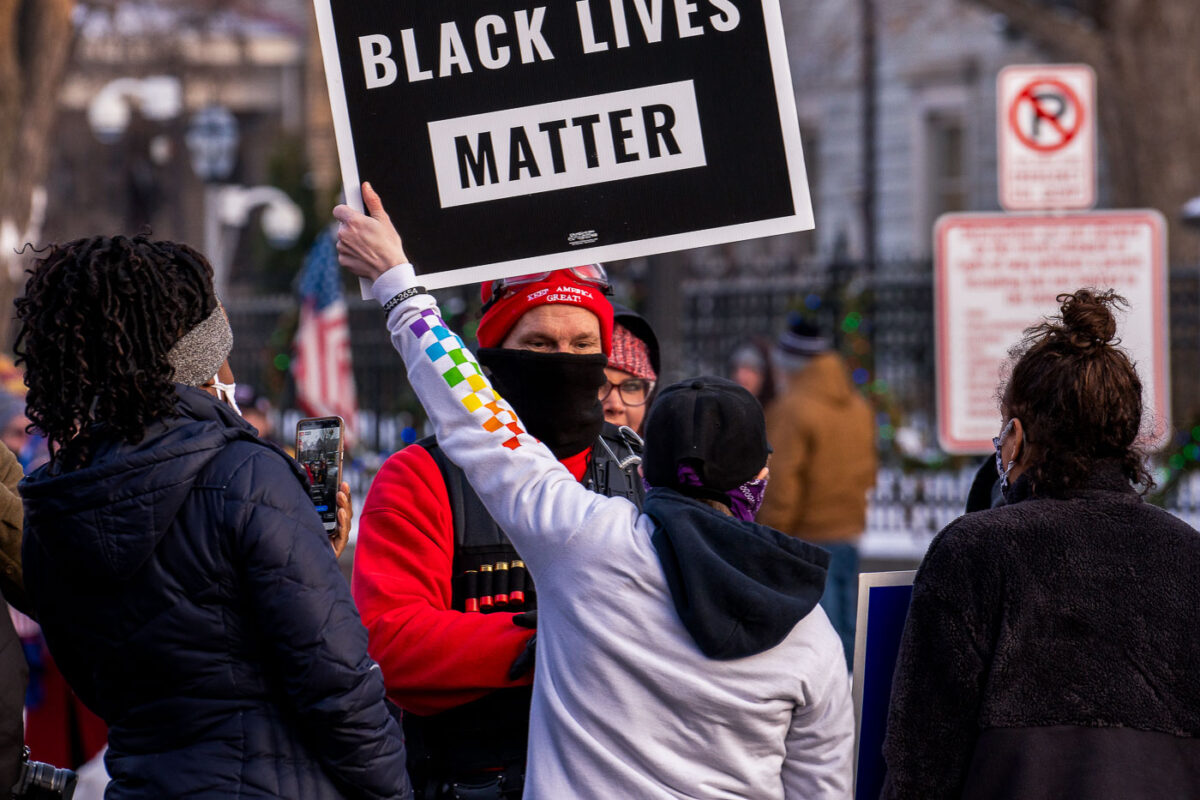
Black Lives Matter protesters at a Stop The Steal rally on January 6
Protesters gathered outside the Minnesota Governor's Residence in St. Paul on January 6, 2021. The "Black Lives Matter" sign indicates solidarity with the movement, while other individuals present appear to be Trump supporters, some wearing "Keep America Great" attire. This event occurred on the same day as the "Storm The Capitol" rally in Washington D.C., and counter-protests were also present at the Minnesota State Capitol. The Minnesota Governor's Residence serves as the official home and workplace for the state's governor.

Black Lives Matter Protestors at Minnesota Governor’s Residence
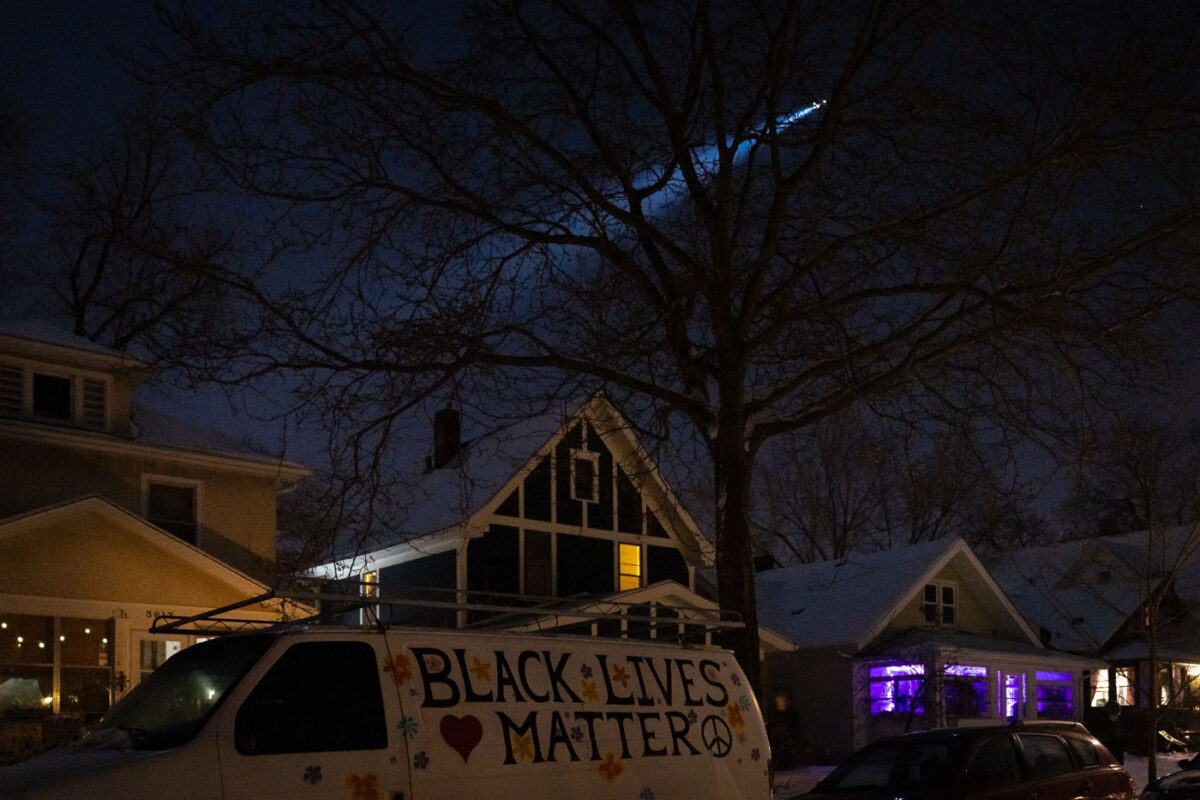
Helicopter over protesters outside 36th and Cedar Ave
A police helicopter's spotlight illuminates the night sky above 36th Street and Cedar Avenue in Minneapolis during a protest. This gathering took place outside the Holiday Gas station, the site where Dolal Idd was killed by Minneapolis Police on December 30, 2020.

Helicopter over Dolal Idd Protest, 36th & Cedar, Minneapolis
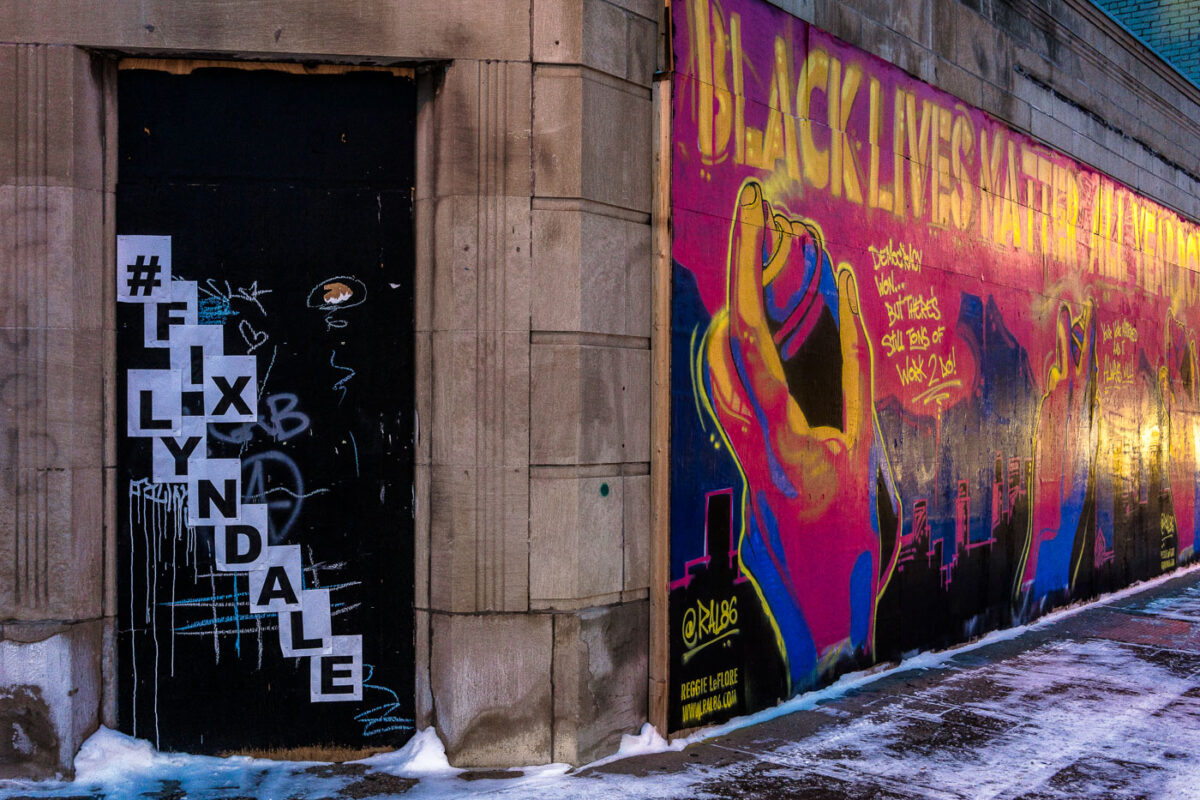
Fix Lyndale on a door on Lyndale Ave
A Black Lives Matter mural by Reggie LeFlore adorns boarded-up storefronts at the corner of Lyndale Avenue and Lake Street in Uptown Minneapolis. This artwork emerged in the aftermath of the 2020 Minneapolis Uprising, transforming damaged properties into public expressions of protest and solidarity. Adjacent to the mural, the #FixLyndale message advocates for the long-standing community effort to reconfigure Lyndale Avenue, a corridor known for high rates of vehicle and pedestrian accidents.

Fix Lyndale & Black Lives Matter Mural, Lyndale & Lake St
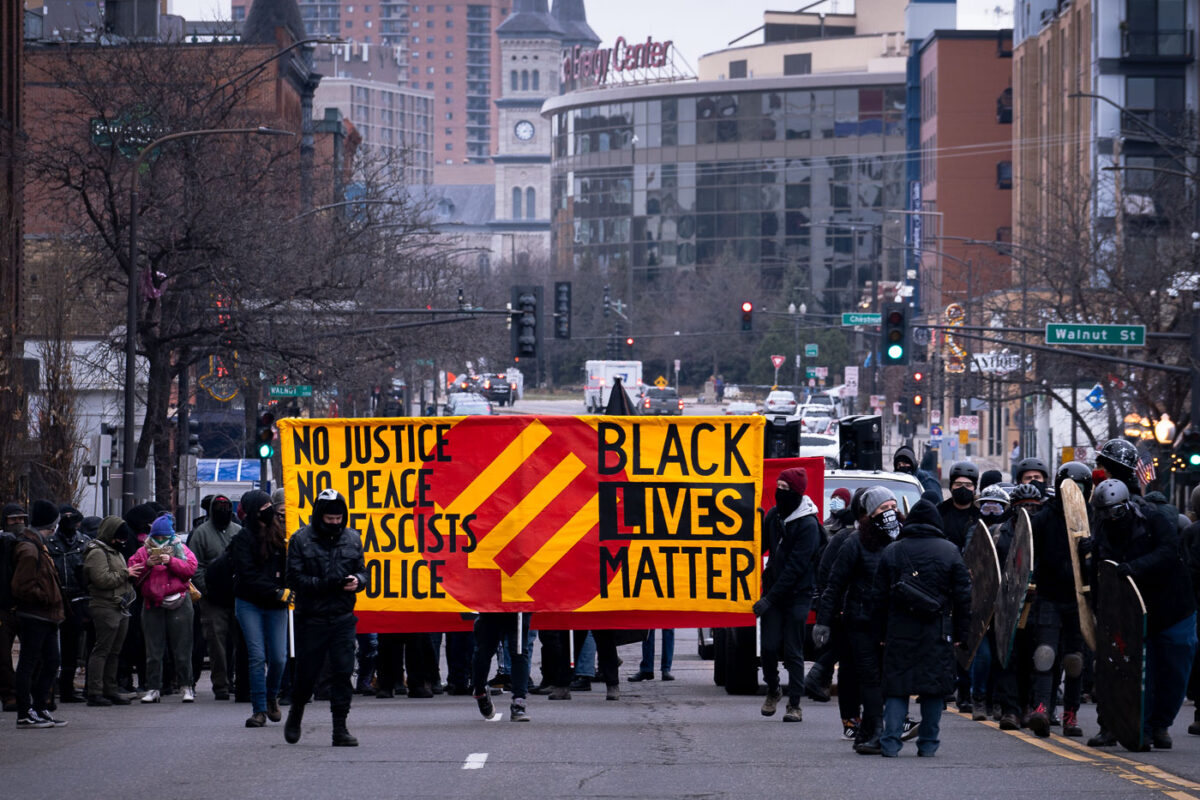
No Justice No peave No Fascists No Police
Protesters participate in a Black Lives Matter anti-fascist march in downtown St. Paul. The marchers carried a large banner proclaiming "NO JUSTICE NO PEACE NO FASCISTS NO POLICE" and "BLACK LIVES MATTER," reflecting the movement's core demands. The protest moved through the city streets, including the intersection of Walnut Street and Chestnut Street, as part of broader demonstrations addressing racial injustice and police accountability that gained prominence in the Twin Cities and nationwide.

Black Lives Matter Anti-Fascist March, St. Paul
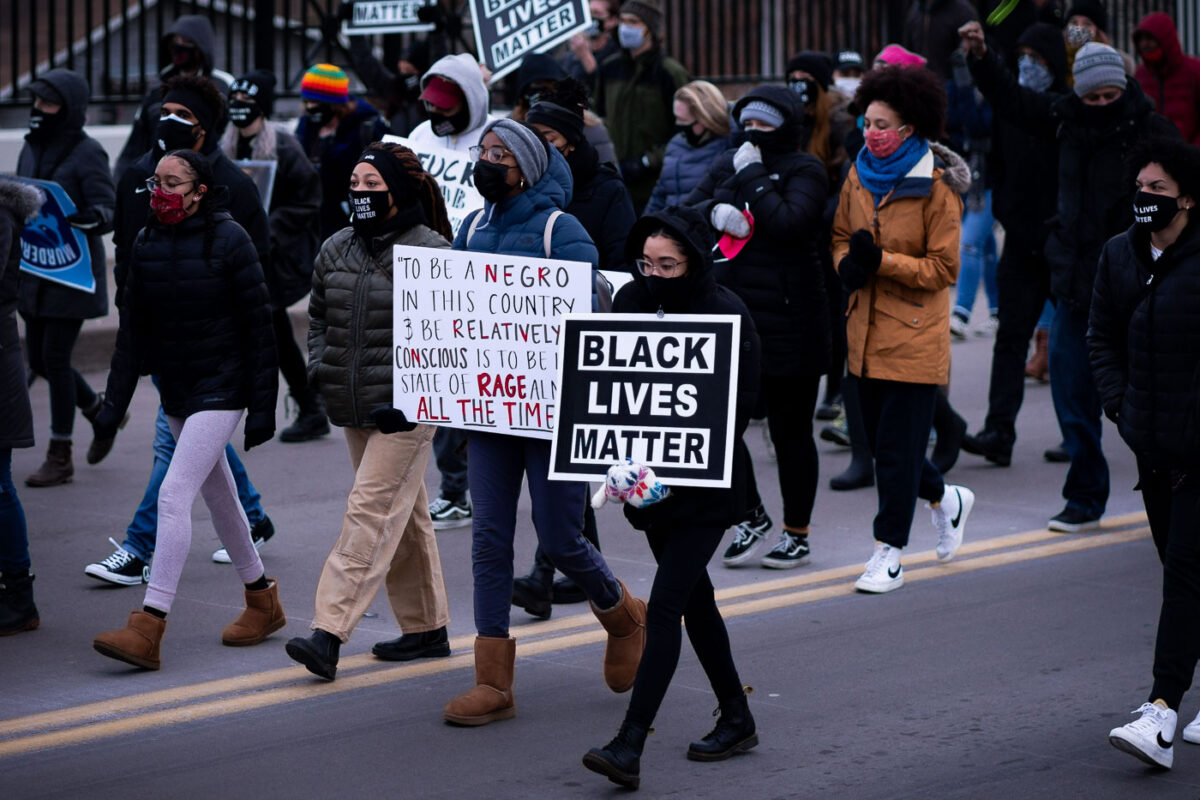
Protesters march to the St Paul Police Department
A Black Lives Matter march took place in St. Paul, Minnesota, with protesters gathering at Minnehaha & Payne. Participants marched from Wilder Playground to the St. Paul Police station, where speakers addressed racial inequality and advocated for police reform.

Black Lives Matter Protest at Minnehaha & Payne, St. Paul
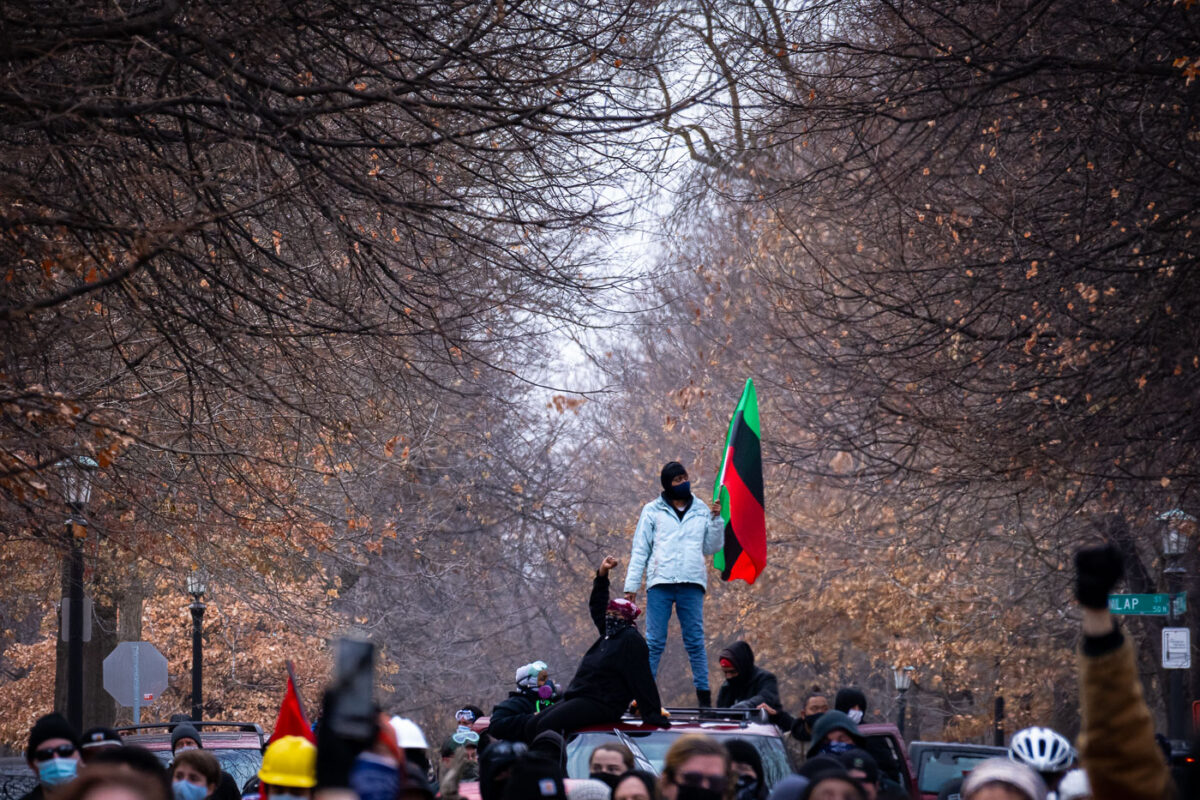
Stop The Steal counter protest in St Paul
A Black Lives Matter counter-protest marches towards the Minnesota Governor's Residence in St. Paul. This march was organized in response to a 'Stop The Steal' gathering, which had been attended by groups such as the Proud Boys at the Governor's Residence in prior weeks.

St. Paul BLM Counter-Protest vs. Stop The Steal

Black Lives Matter mural on Lyndale Avenue in Minneapolis displays "All Year Round" message during snowfall.
The mural reads "Black Lives Matter All Year Round," painted across plywood boards on a building along Lyndale Avenue in Minneapolis's Uptown neighborhood. The piece is one of many murals painted on boarded storefronts across Minneapolis following the unrest that followed George Floyd's killing in May 2020, when businesses across the city covered their windows and local artists turned the boards into canvases. Many of these murals remained in place for months afterward, becoming a lasting public record of that period even as boards came down elsewhere.

“Black Lives Matter All Year Round” Mural on Lyndale Avenue

Artist paints Black Lives Matter mural on boarded storefront along Lyndale Avenue in Uptown Minneapolis.
The mural reading "Black Lives Matter, All Year Round" covers boarded-up storefronts on Lyndale Avenue in Uptown Minneapolis. Plywood panels like these went up over windows and doors across the city after unrest broke out in the wake of George Floyd's killing in May 2020, and many were later painted by local artists rather than removed. Months after the initial unrest, murals such as this one remained in place, turning storm boards into lasting public artwork.

“Black Lives Matter, All Year Round” Mural on Lyndale Avenue

Black Lives matter protesters march through North Minneapolis
Protesters march during the 25th National Day of Protest to stop police brutality in North Minneapolis. Prior to the march, they gathered outside the Minneapolis police 4th precinct police station.

25th National Day of Protest to stop police brutality march in Minneapolis

Michelle Gross speaks outside the 4th precinct police station
Michelle Gross, founder of Communities United Against Police Brutality, addresses a gathering at the Minneapolis Fourth Precinct. The protest was organized as part of the 25th National Day of Protest to Stop Police Brutality. This location, the Minneapolis Police Fourth Precinct, has been a focal point for numerous protests against police misconduct and racial injustice in the city.

Michelle Gross addresses Minneapolis 4th Precinct Protest

Protesters holding up signs outside the 4th precinct
Protesters gather outside the Minneapolis Police 4th Precinct during the 25th annual National Day of Protest to Stop Police Brutality. Participants hold signs expressing dissent against the justice system and police, reflecting themes central to the Black Lives Matter movement. This annual protest, observed on October 22nd, addresses ongoing concerns regarding police conduct and systemic injustices.

Protesters with anti-police brutality signs, Minneapolis 4th Precinct

Nekima Levy Armstrong speaks outside the 4th precinct
Community activist Nekima Levy Armstrong addresses a protest outside the Minneapolis Police 4th Precinct. The gathering was part of the 25th annual National Day of Protest to Stop Police Brutality, Repression and the Criminalization of a Generation. The 4th Precinct, located in North Minneapolis, has historically been a significant site for protests concerning police conduct and accountability.

Nekima Levy Armstrong speaks at Minneapolis 4th Precinct Protest

Dismantling Racism on a church sign in Minneapolis
Hennepin Avenue United Methodist Church, a long-standing institution in Minneapolis, displays a sign promoting a "Dismantling Racism" sermon series. This initiative reflects the church's commitment to social justice, particularly in the wake of the Black Lives Matter movement and the Minneapolis Uprising. Located on Hennepin Avenue near Downtown, the church serves as a community hub. The presence of both the American and Pride flags on its grounds further underscores its inclusive mission and engagement with contemporary social issues.

Hennepin Avenue United Methodist Church: Dismantling Racism

Black Lives Matter rally near Lake of the Isles in Minneapolis
A Black Lives Matter solidarity rally took place on August 28, 2020, at Joanne R. Levin Park in Minneapolis. This public gathering near Lake of the Isles was part of the widespread protests for racial justice and police accountability that followed the murder of George Floyd. Attendees are seen sitting on the grass, listening to speakers, with signs advocating for specific local actions, such as the recall of Hennepin County Attorney Mike Freeman. Joanne R. Levin Park, a neighborhood green space, frequently serves as a site for community events and public assembly in Minneapolis.

BLM Rally, Joanne R. Levin Park, Minneapolis, Aug 2020

Black Lives Matter rally near Lake of the Isles park
Community members address attendees at a Black Lives Matter rally held in Joanne R. Levin Park, Minneapolis, on August 28, 2020. The event provided a platform for neighbors to discuss racial justice and community inclusivity in the wake of the Minneapolis Uprising. Speakers utilized a decorated truck as a temporary stage to engage with the assembled crowd. Joanne R. Levin Park, located near Lake of the Isles, served as a public gathering space for these important civic discussions.

Speakers at Black Lives Matter Rally, Joanne R. Levin Park, 2020
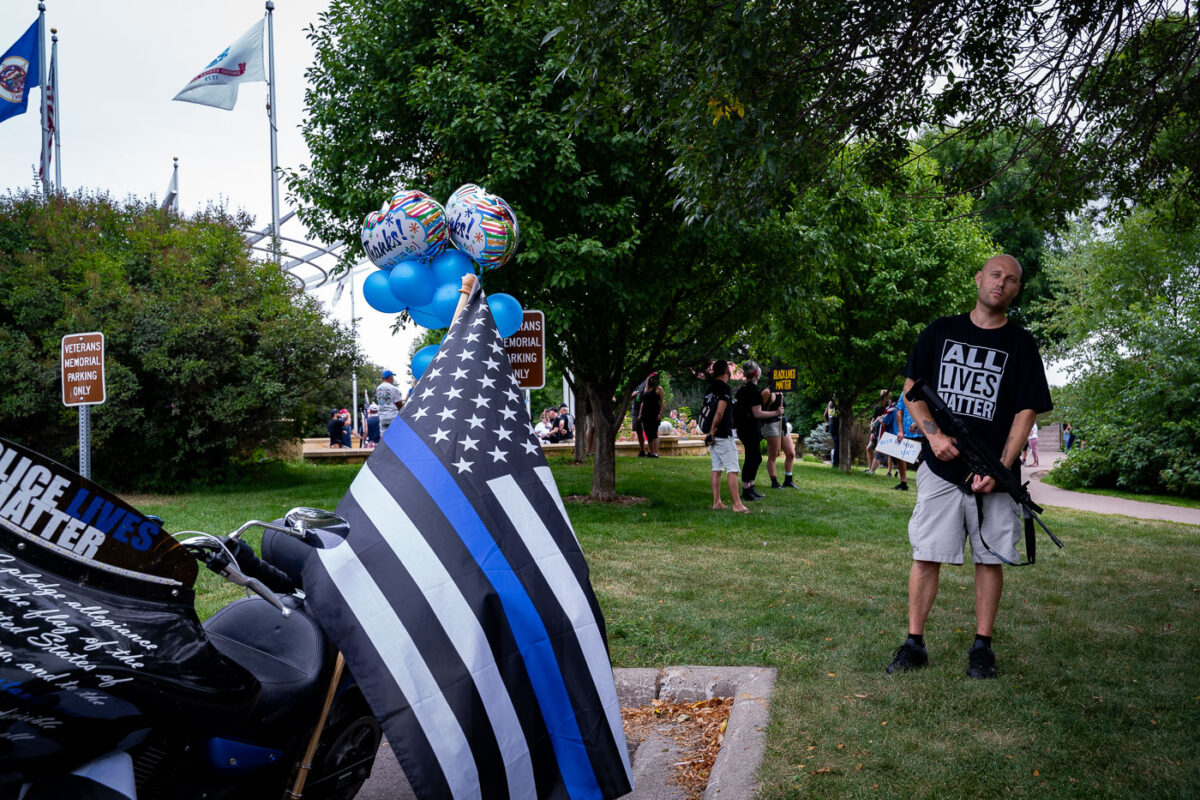
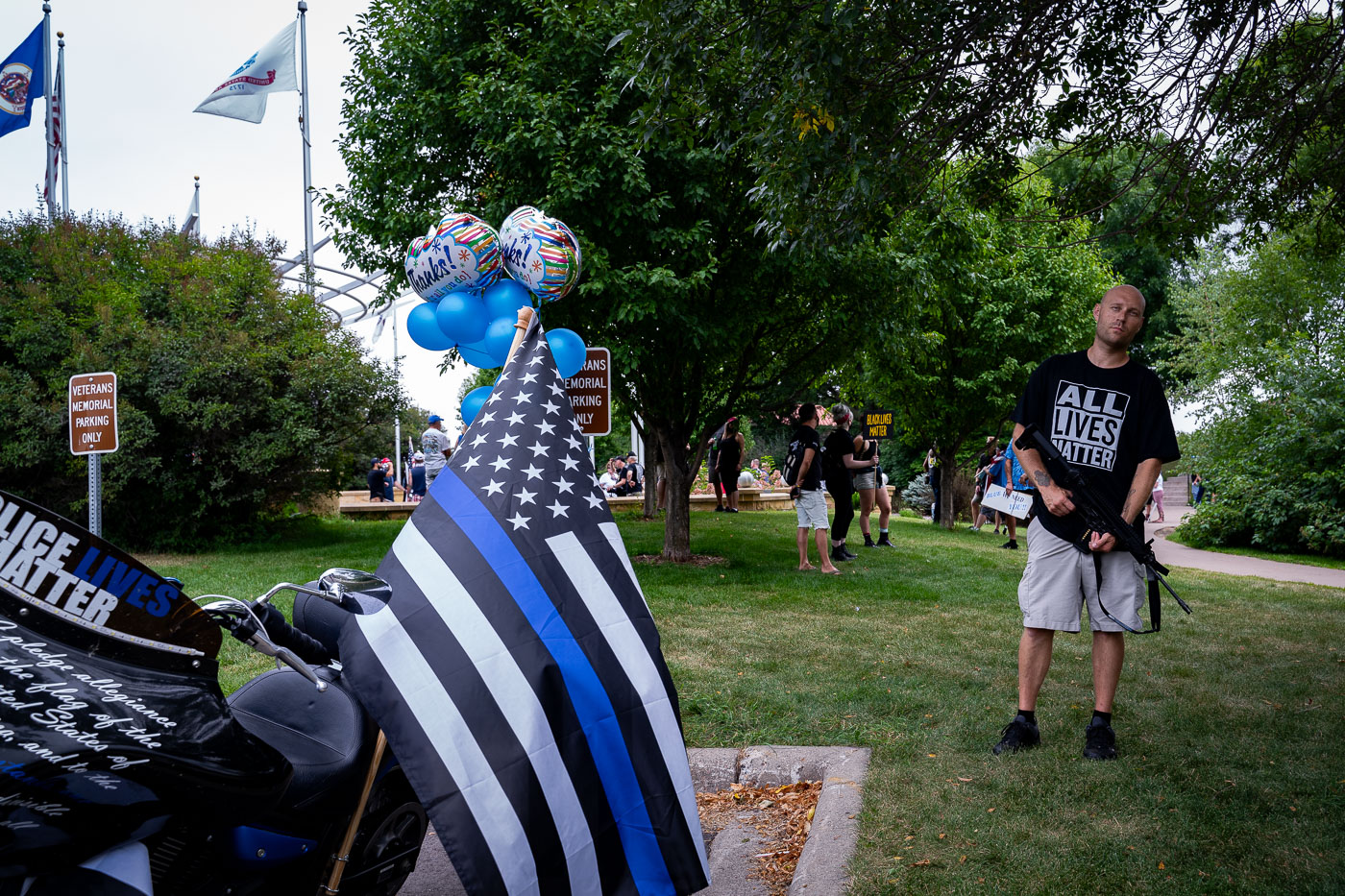
Man wearing "All Lives Matter" shirt holds rifle at Woodbury "Back The Blue" police support rally.
The rally took place in Woodbury, Minnesota, on August 8, 2020, organized to show support for law enforcement. A "Thin Blue Line" flag, a common symbol of pro-police solidarity, was mounted on a motorcycle near the gathering. Nearby, a "Police Lives Matter" message appeared alongside it, echoing the same theme. The event drew counter-demonstrators carrying "Black Lives Matter" signs, reflecting the broader tension between the two movements that summer.

Armed Man in “All Lives Matter” Shirt at Woodbury “Back The Blue” Rally
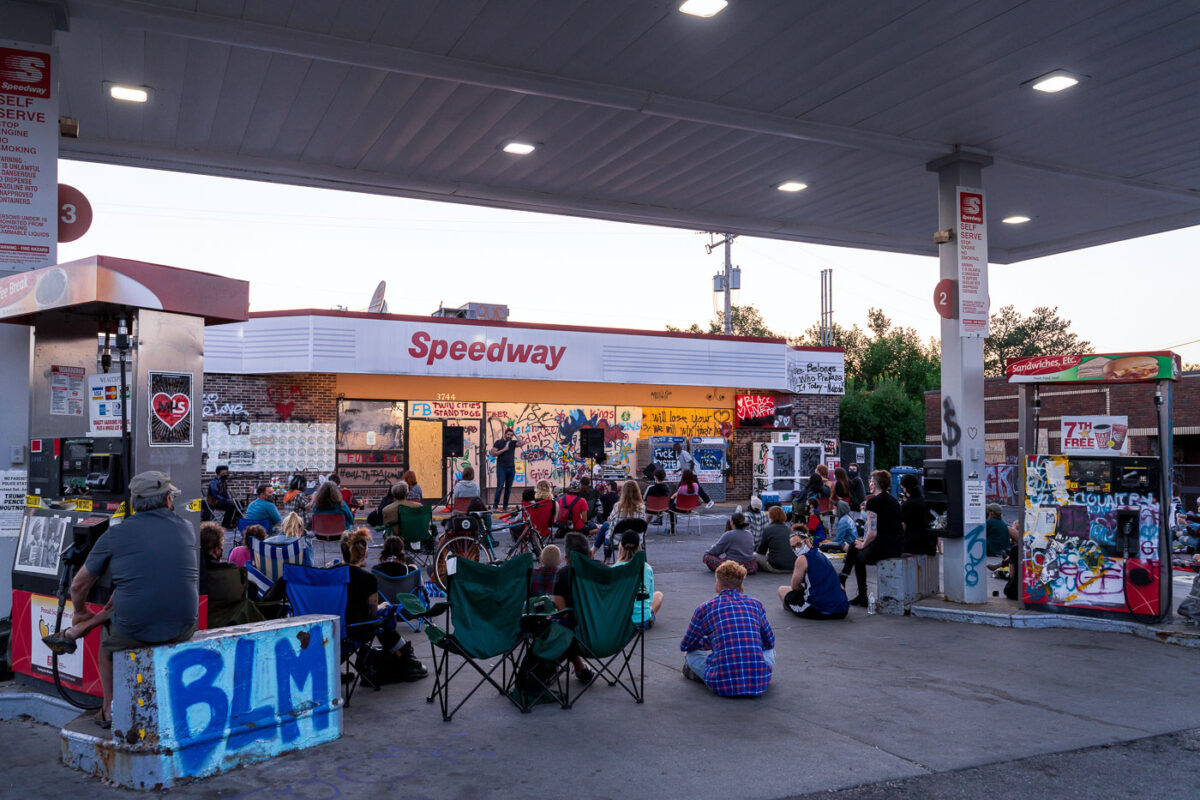
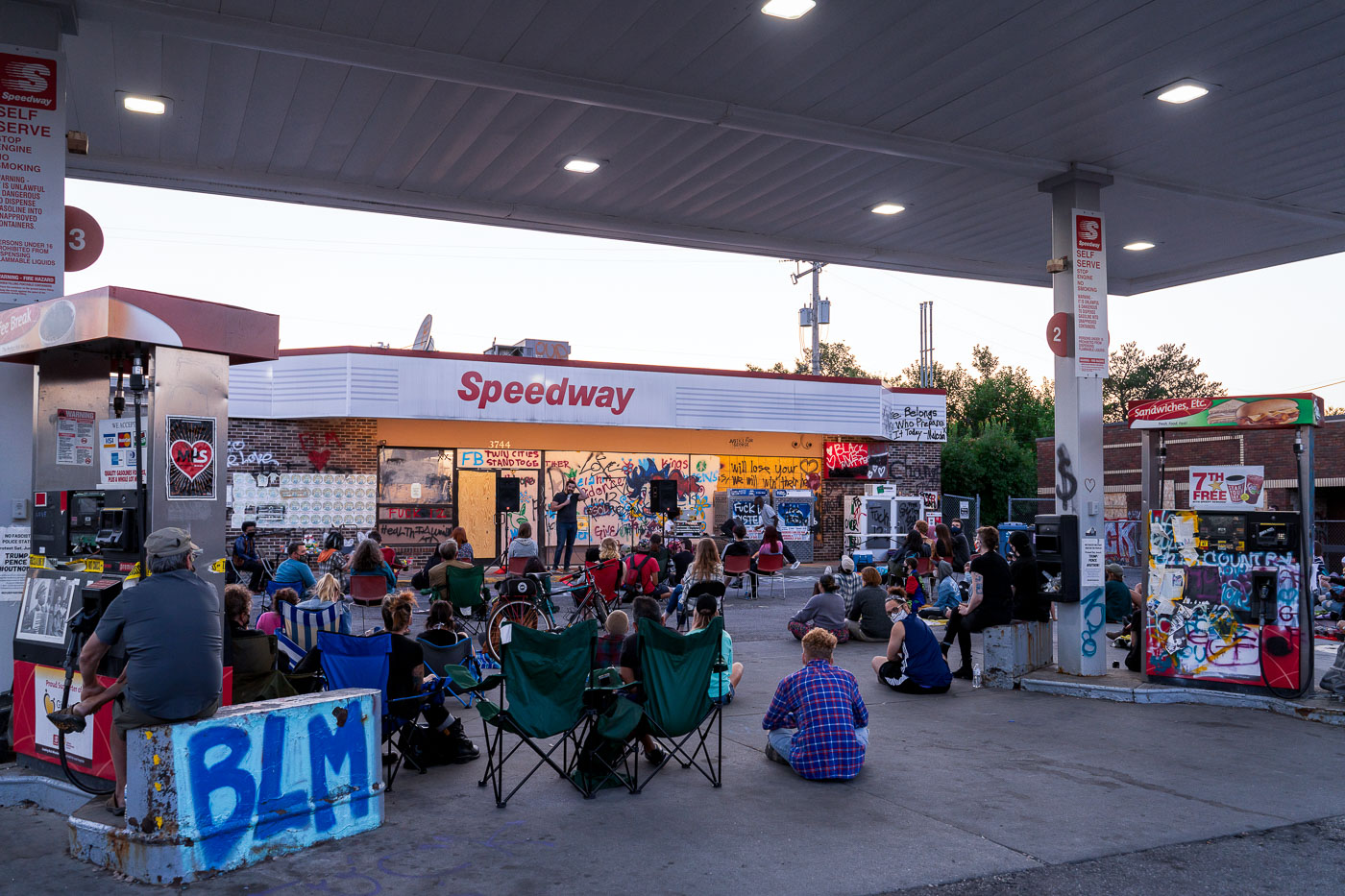
Community members gather for a comedy show at a Speedway gas station in George Floyd Square, Minneapolis.
A comedy show put on at the Speedway gas station at 38th Street and Chicago Avenue. The gas station is now known as The People's Way and has been a gathering place inside George Floyd Square since Floyd's May 2020 murder.

Evening Comedy Show at the Speedway Station in George Floyd Square
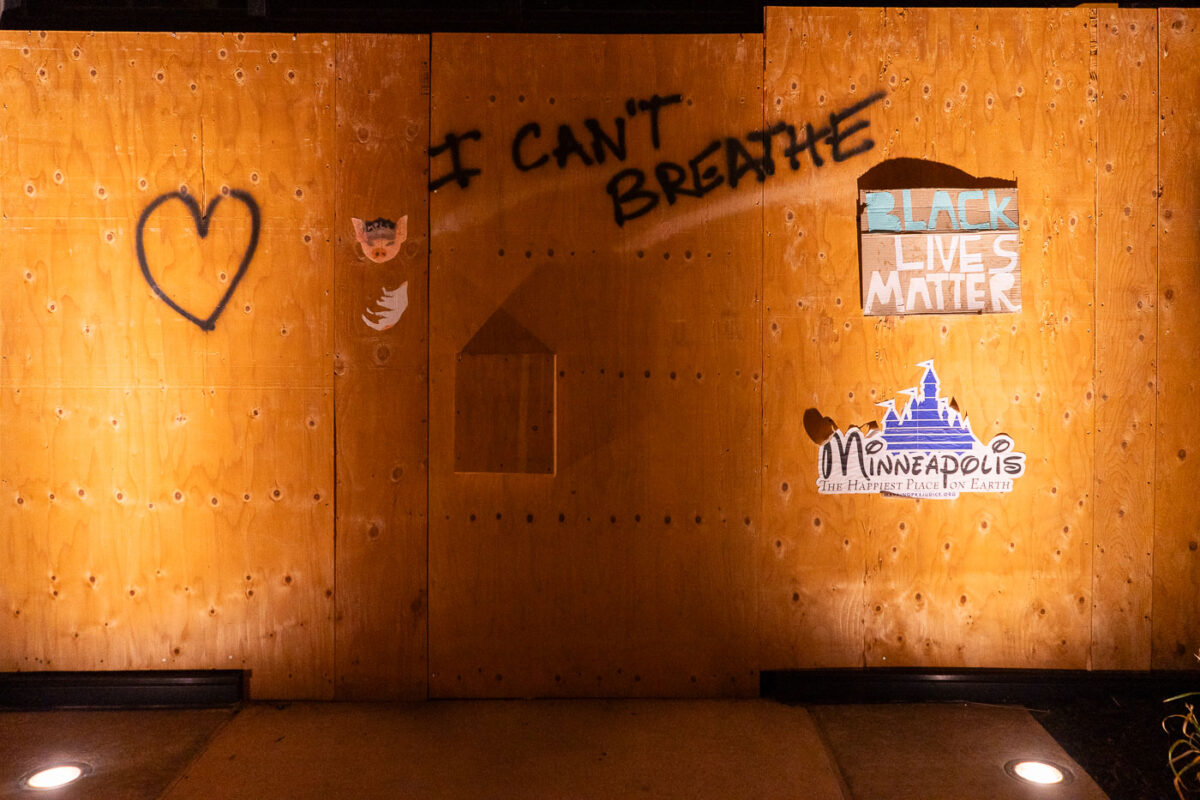
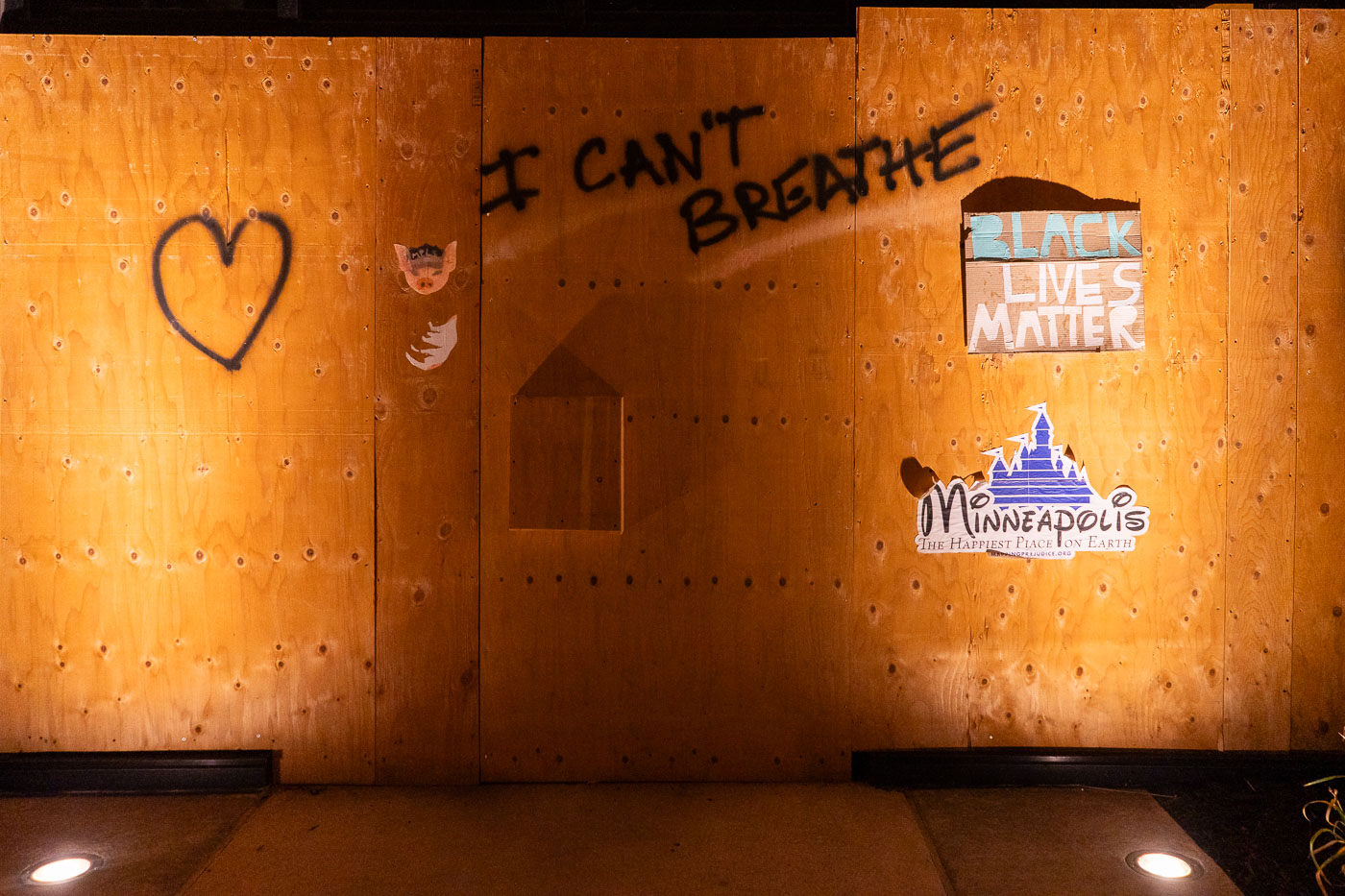
Plywood-boarded storefront on Hennepin Avenue displays "I CAN'T BREATHE," Black Lives Matter, and Minneapolis stickers.
"I Can't Breathe" became a rallying cry after Eric Garner's 2014 death in police custody and resurfaced nationally following George Floyd's killing in Minneapolis in May 2020. Business owners along Hennepin Avenue boarded up storefronts during the unrest that followed, and many of those panels became surfaces for spray-painted messages and stickers. Black Lives Matter, founded in 2013 by Alicia Garza, Patrisse Cullors, and Opal Tometi, is referenced directly on one board. The "Minneapolis: The Happiest Place on Earth" sticker ties to the Mapping Prejudice project at the University of Minnesota, which maps historic racial covenants that once barred Black residents from owning property in parts of the city.

“I Can’t Breathe” and BLM Messages on Hennepin Avenue Plywood
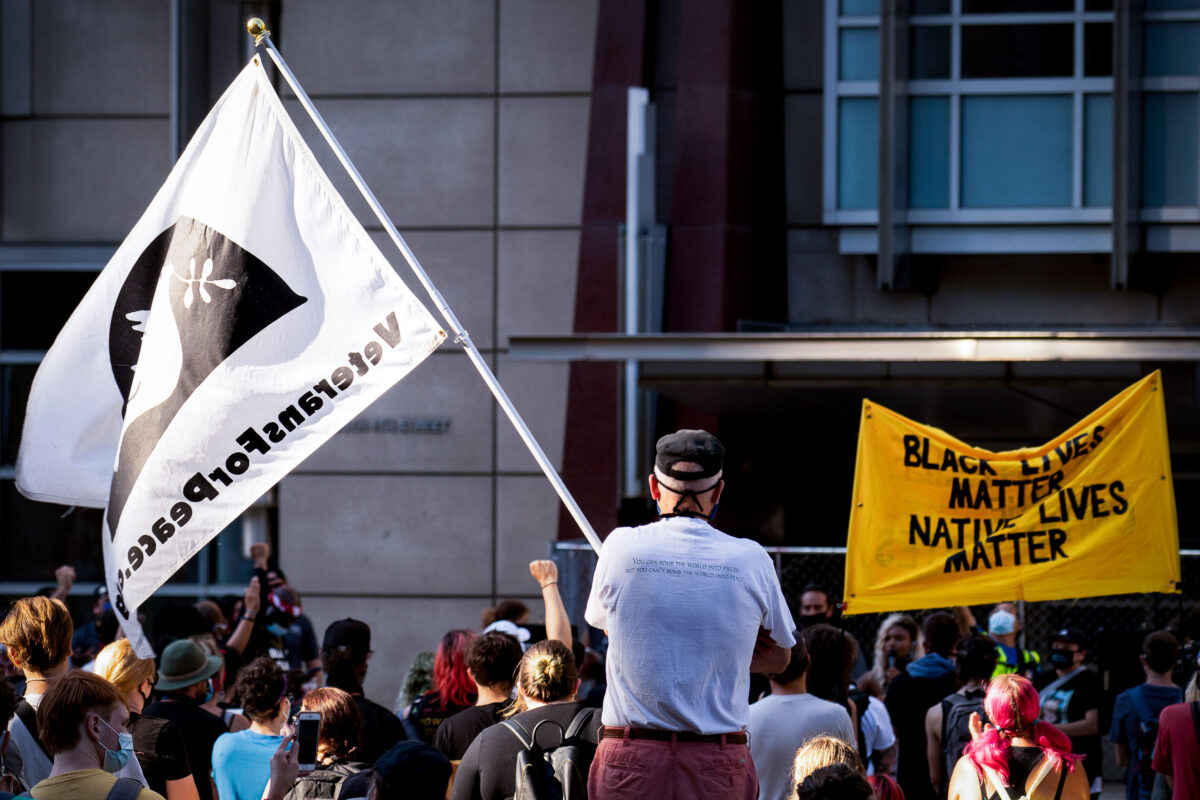
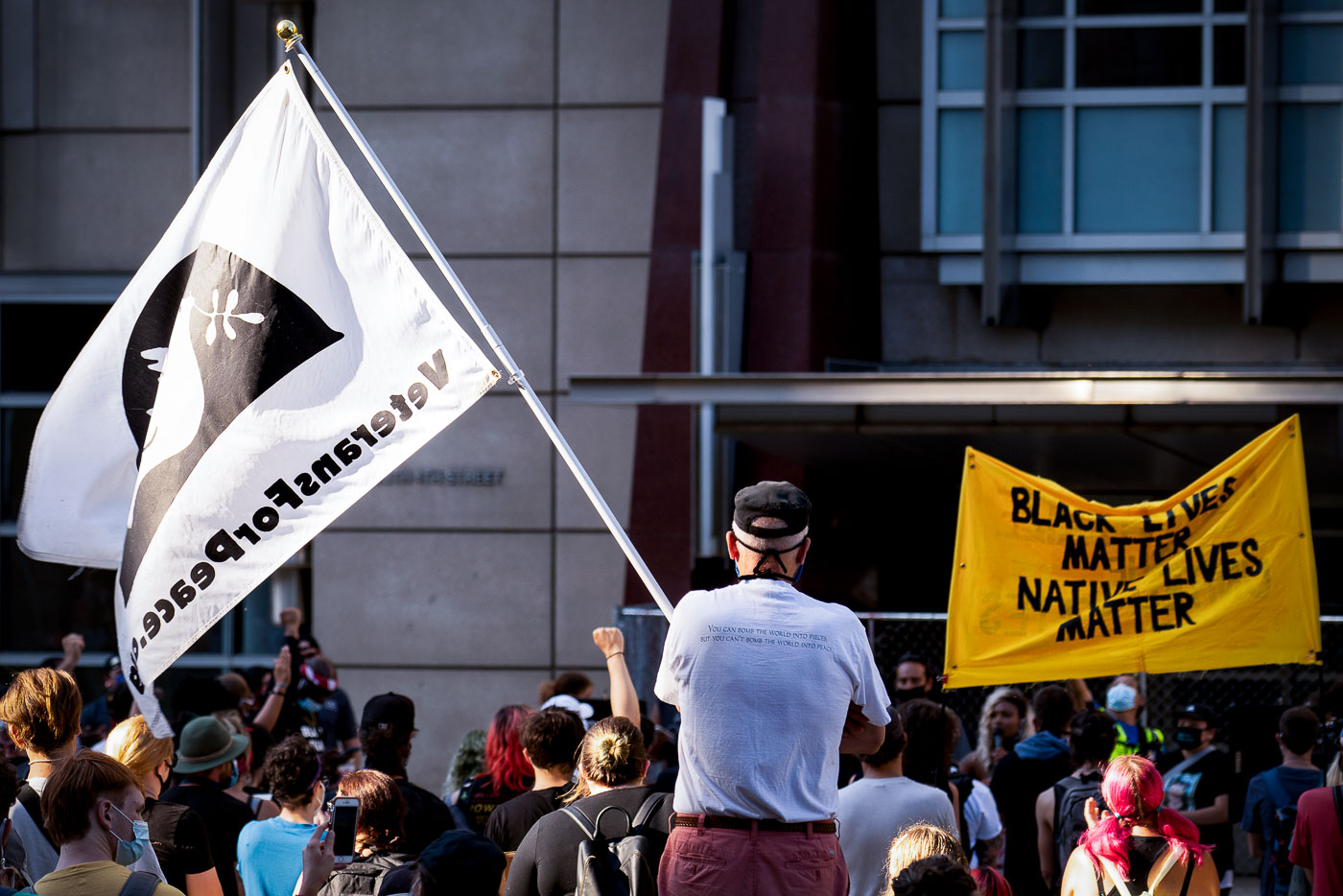
Veterans for Peace flag held up by a man
A protest occurred outside the Federal Courthouse in downtown Minneapolis on July 23rd, 2020. Participants gathered to oppose the deployment of federal officers to cities across the country, a contentious issue during the broader Black Lives Matter movement. A veteran held a Veterans For Peace flag, while a banner in the background proclaimed "Black Lives Matter Native Lives Matter," reflecting the diverse concerns of the attendees. The Federal Courthouse, a significant government building, served as a focal point for civic expression during this period of heightened social unrest.

Veterans For Peace Flag at Minneapolis Federal Courthouse Protest
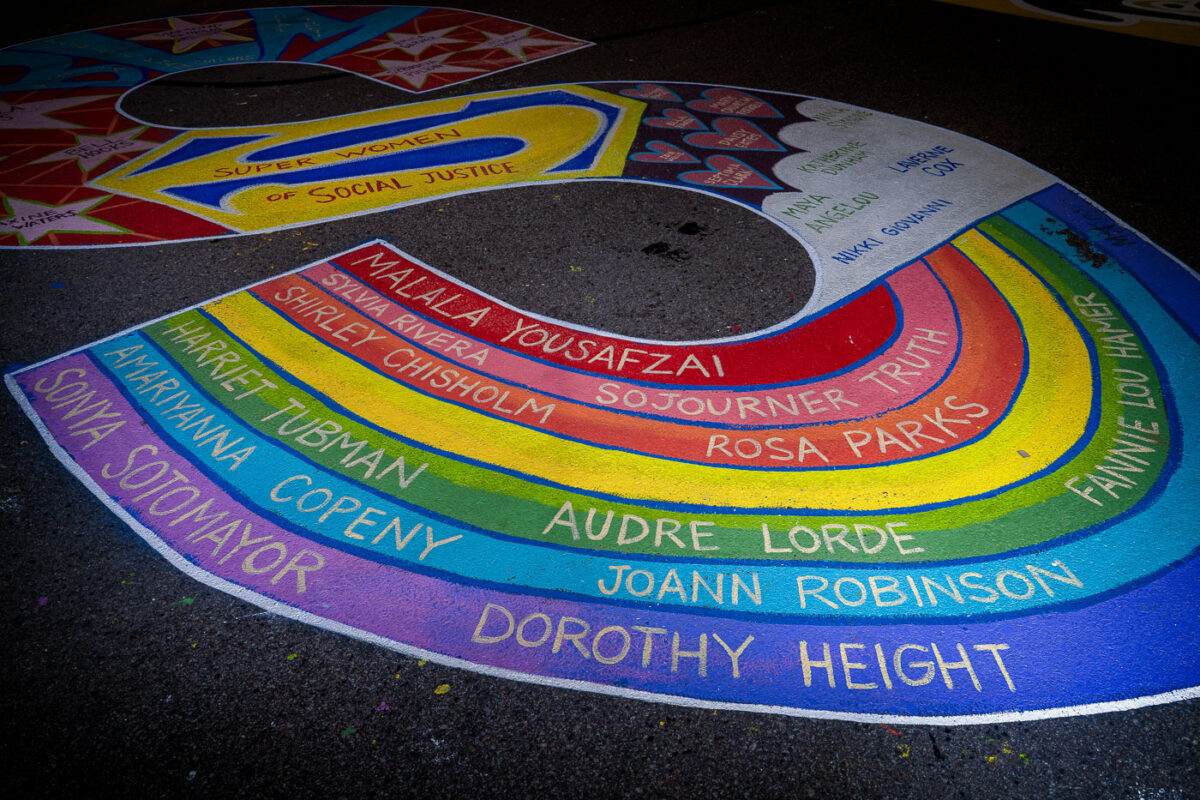
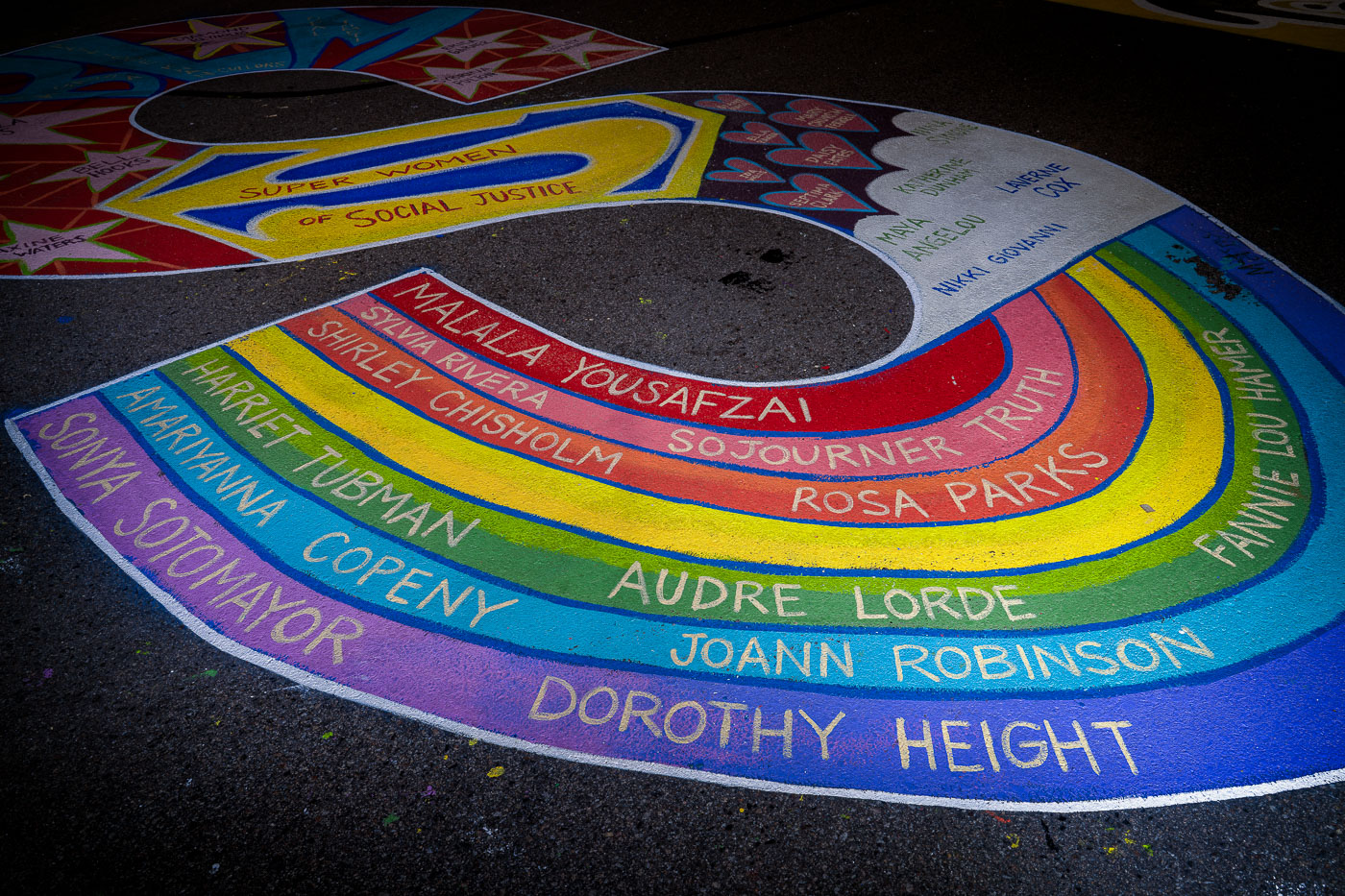
Close up of a Black Lives Matter street mural
The Black Lives Matter Mural on Plymouth Avenue in North Minneapolis features this segment dedicated to 'Super Women of Social Justice.' Completed on July 18th, 2020, the vibrant street art displays names of influential figures including Rosa Parks, Harriet Tubman, and Malala Yousafzai. This public art piece emerged in the wake of the Minneapolis Uprising, transforming the street into a site of remembrance and advocacy. It serves as a significant cultural marker, commemorating the ongoing movement for racial justice and equality within the urban environment.

Black Lives Matter Mural, Plymouth Ave, North Minneapolis
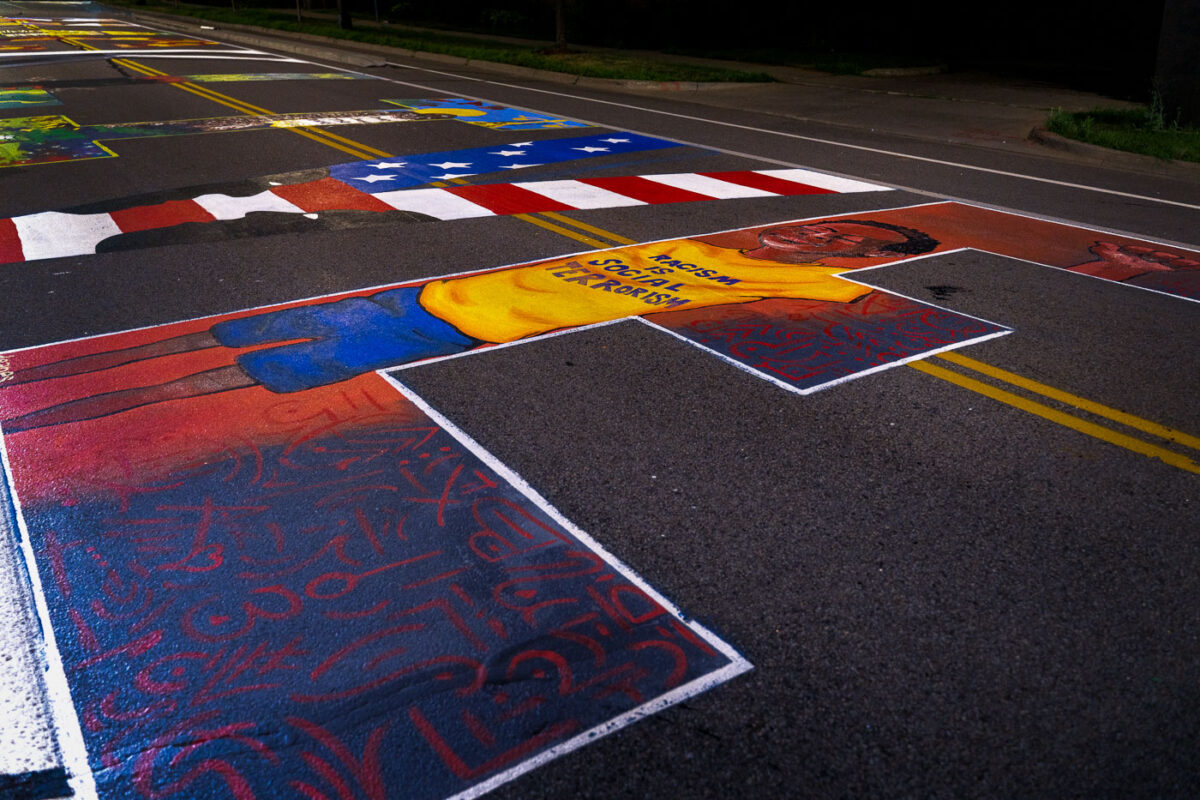
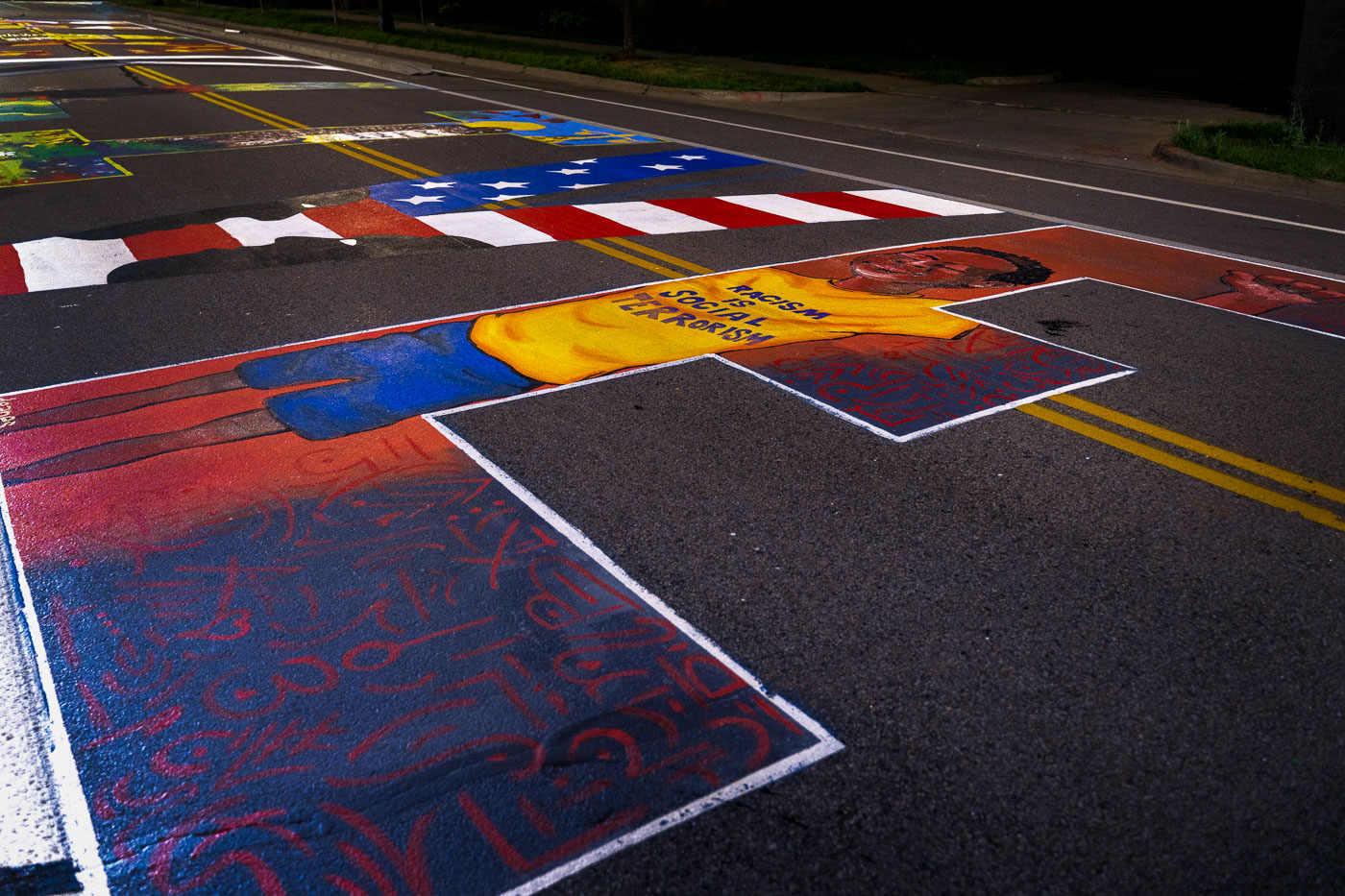
Racism is social terrorism on a street mural
The Black Lives Matter mural on Plymouth Avenue in North Minneapolis serves as a powerful public art installation. Created in the aftermath of the 2020 protests, this street art piece became a significant symbol during the Minneapolis Uprising. The mural incorporates diverse artistic expressions, including a figure wearing a shirt that reads "Racism is social terrorism." This artwork highlights the community's demand for racial justice and systemic change, transforming a public thoroughfare into a canvas for social commentary.

Black Lives Matter Mural on Plymouth Ave, North Minneapolis
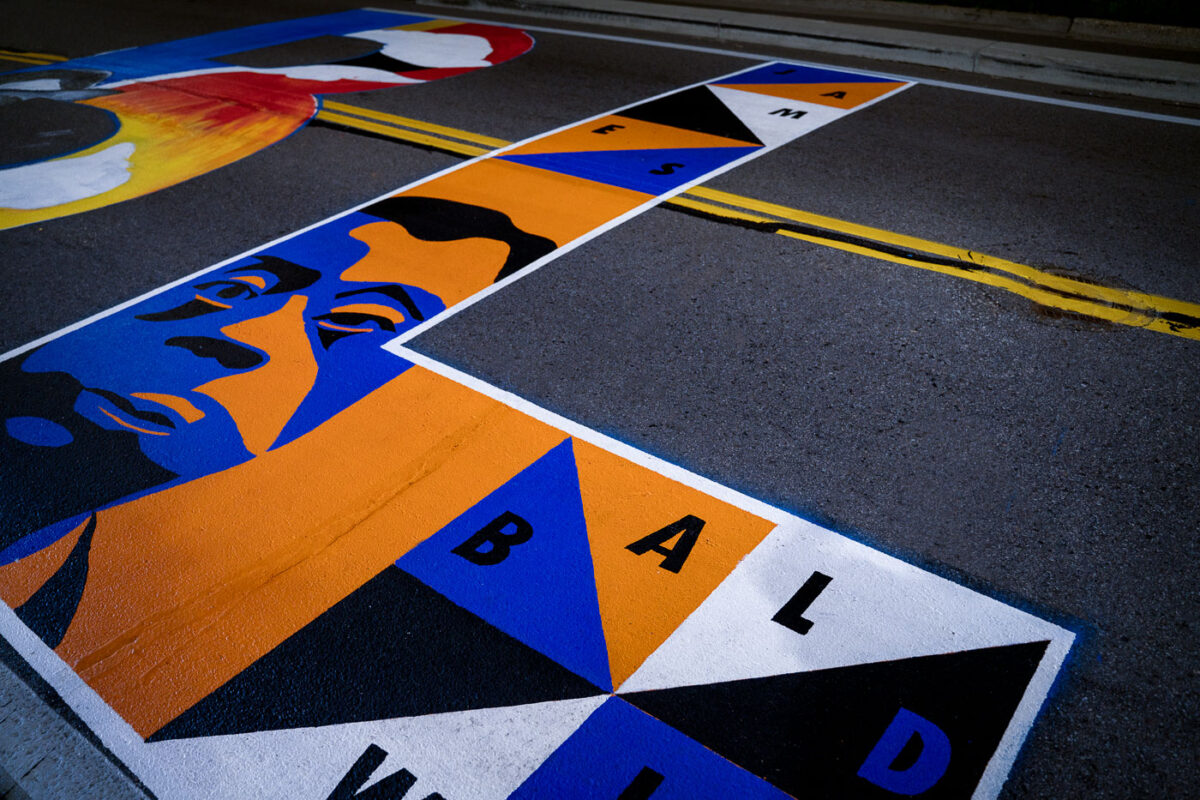
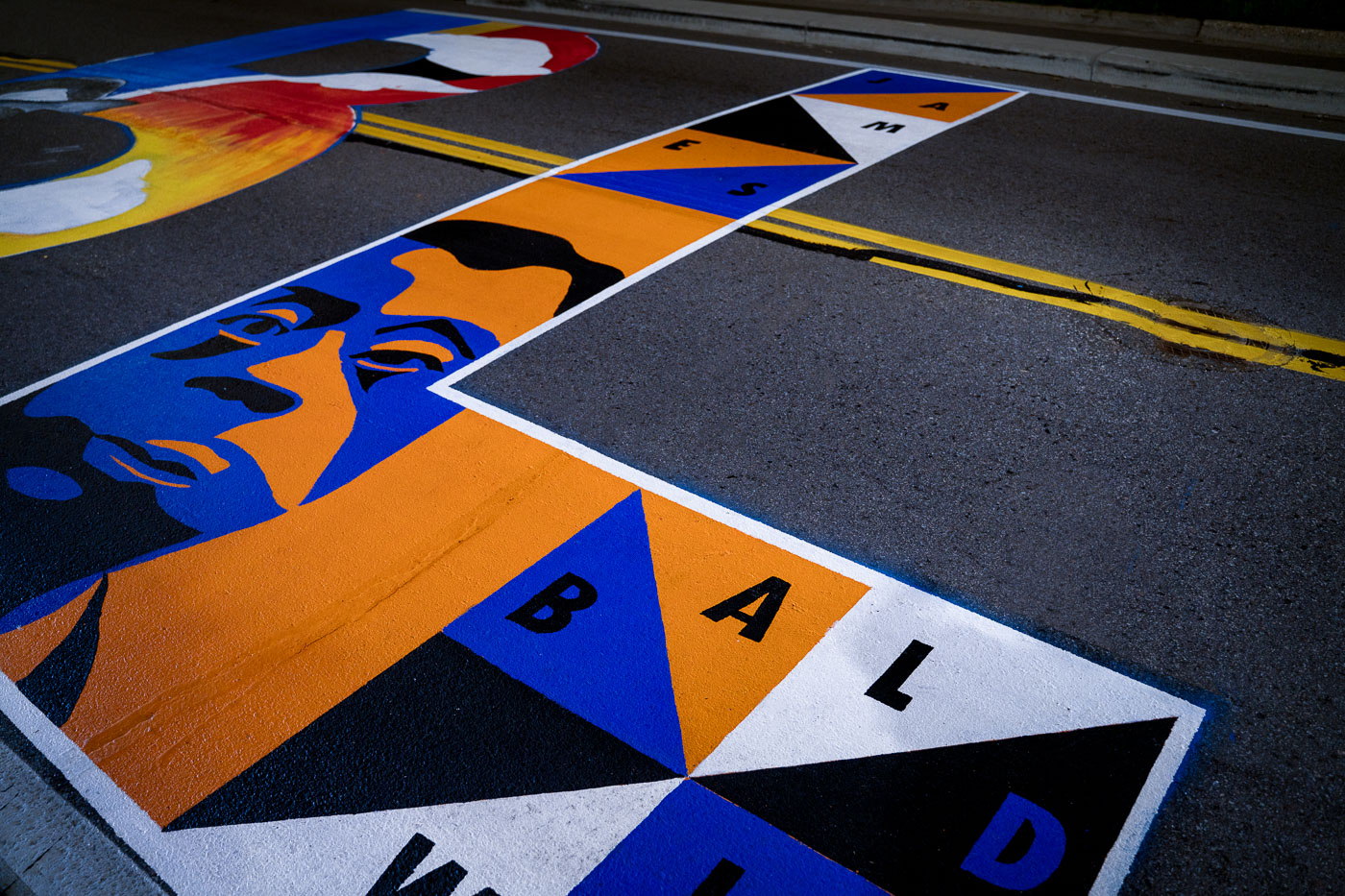
Close up of a Plymouth Ave street mural
A segment of the Black Lives Matter street mural on Plymouth Avenue in North Minneapolis features a portrait of writer and activist James Baldwin. This public art installation was completed on July 18, 2020, following the widespread protests for racial justice in Minneapolis and across the nation. The mural serves as a powerful statement of solidarity and a memorial, transforming the urban environment into a canvas for social commentary. It stands as a lasting symbol of the Minneapolis Uprising and the ongoing movement for Black liberation, reflecting the community's commitment to justice and equality.

James Baldwin Portrait, Black Lives Matter Mural, Plymouth Avenue
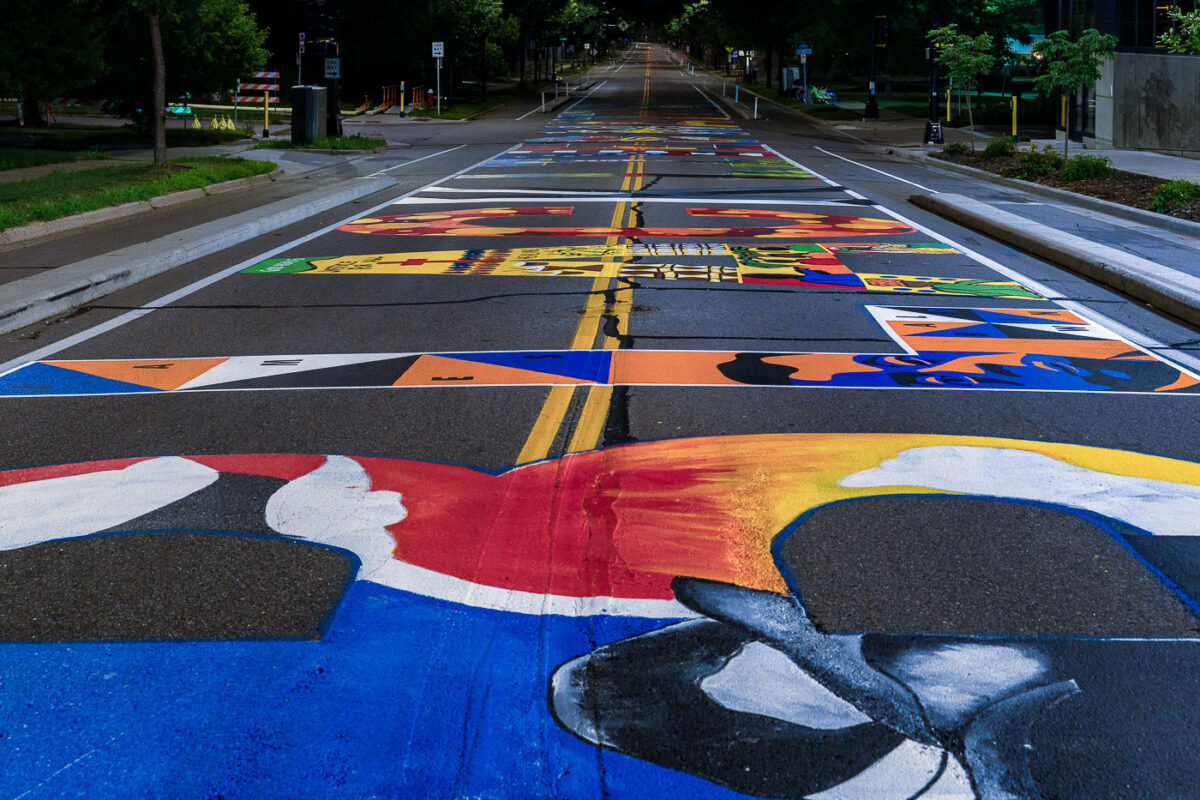
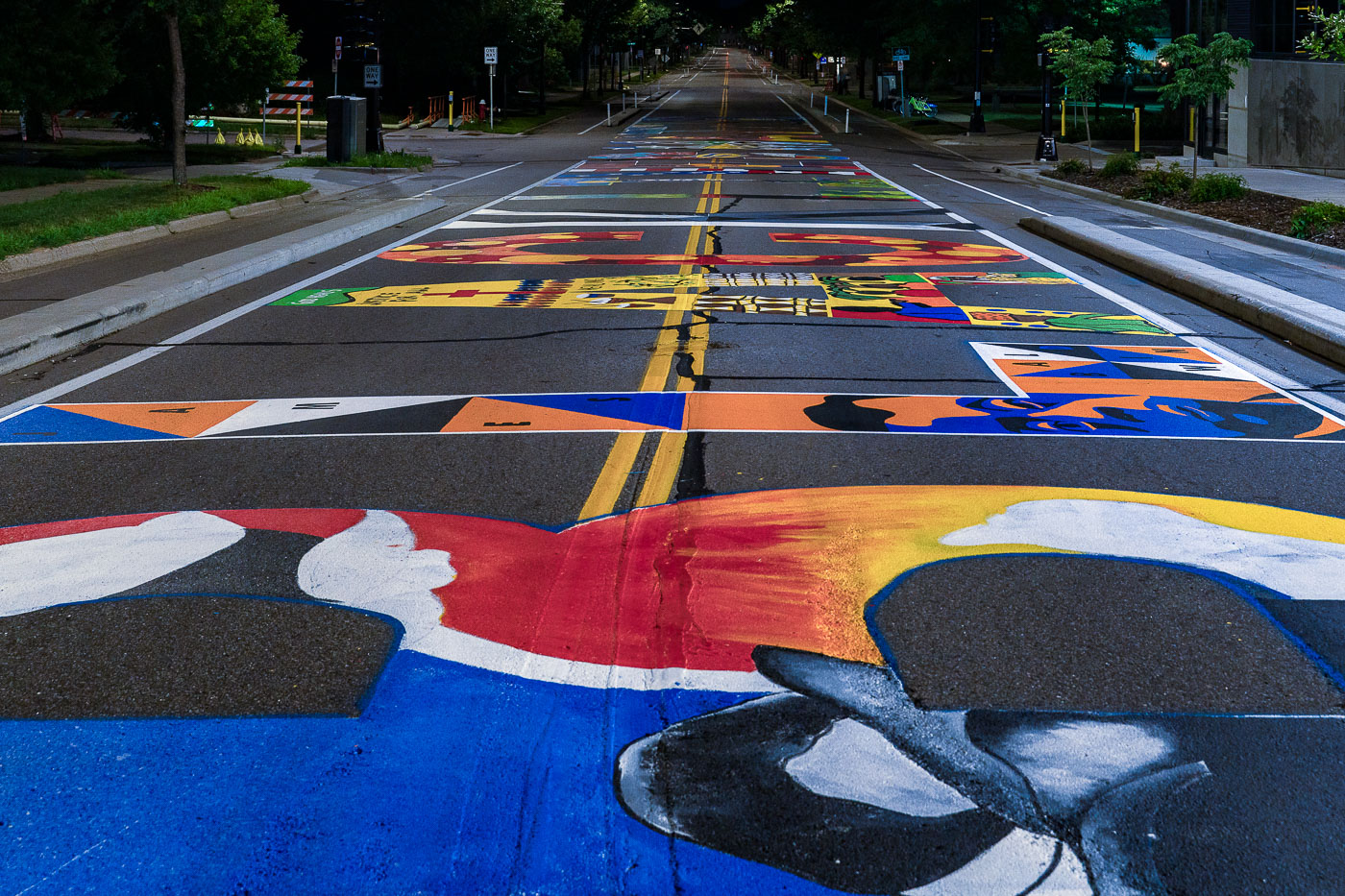
Black Lives Matter mural on Plymouth Ave at night
The Black Lives Matter street mural on Plymouth Avenue in North Minneapolis is a significant public art installation. Completed on July 18, 2020, this collaborative artwork was created in the aftermath of the Minneapolis Uprising and widespread protests against racial injustice. Each letter of "Black Lives Matter" was designed by different artists, transforming the street into a collective statement. The mural serves as a prominent cultural landmark in North Minneapolis, reflecting the community's ongoing commitment to racial equity and remembrance.

Plymouth Avenue Black Lives Matter Mural, North Minneapolis
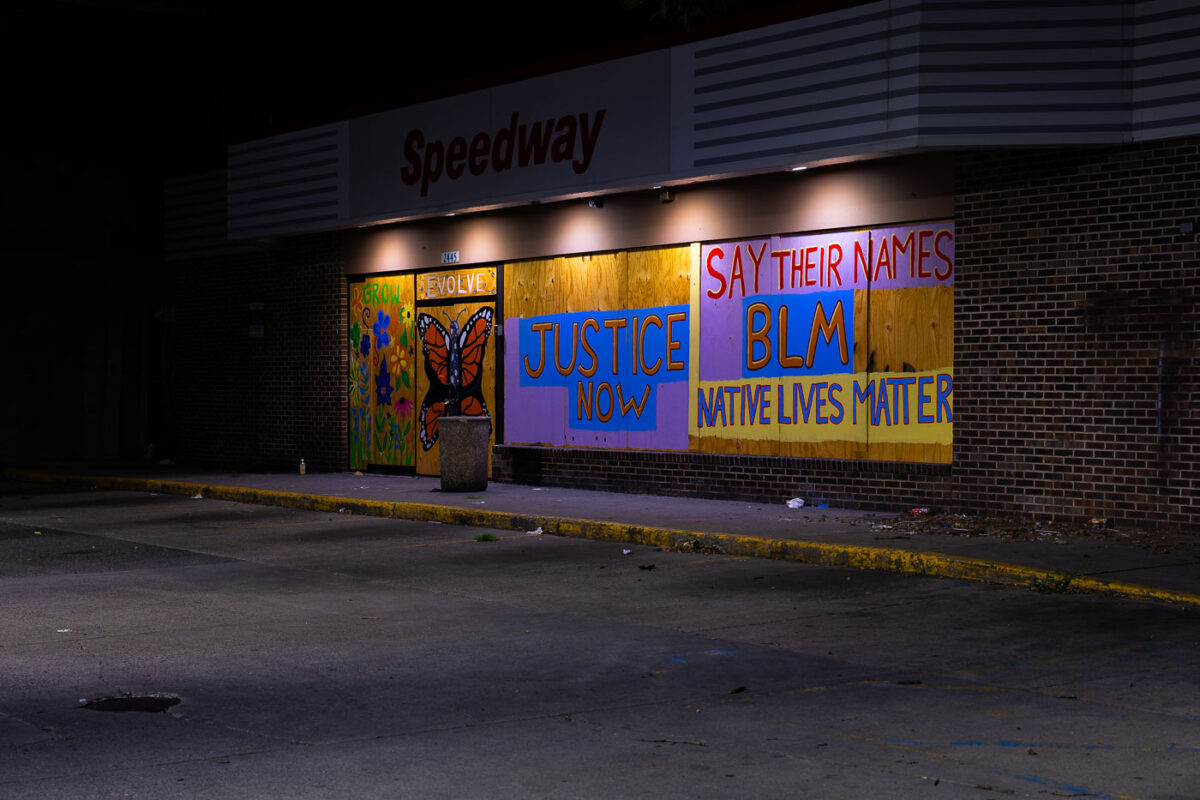
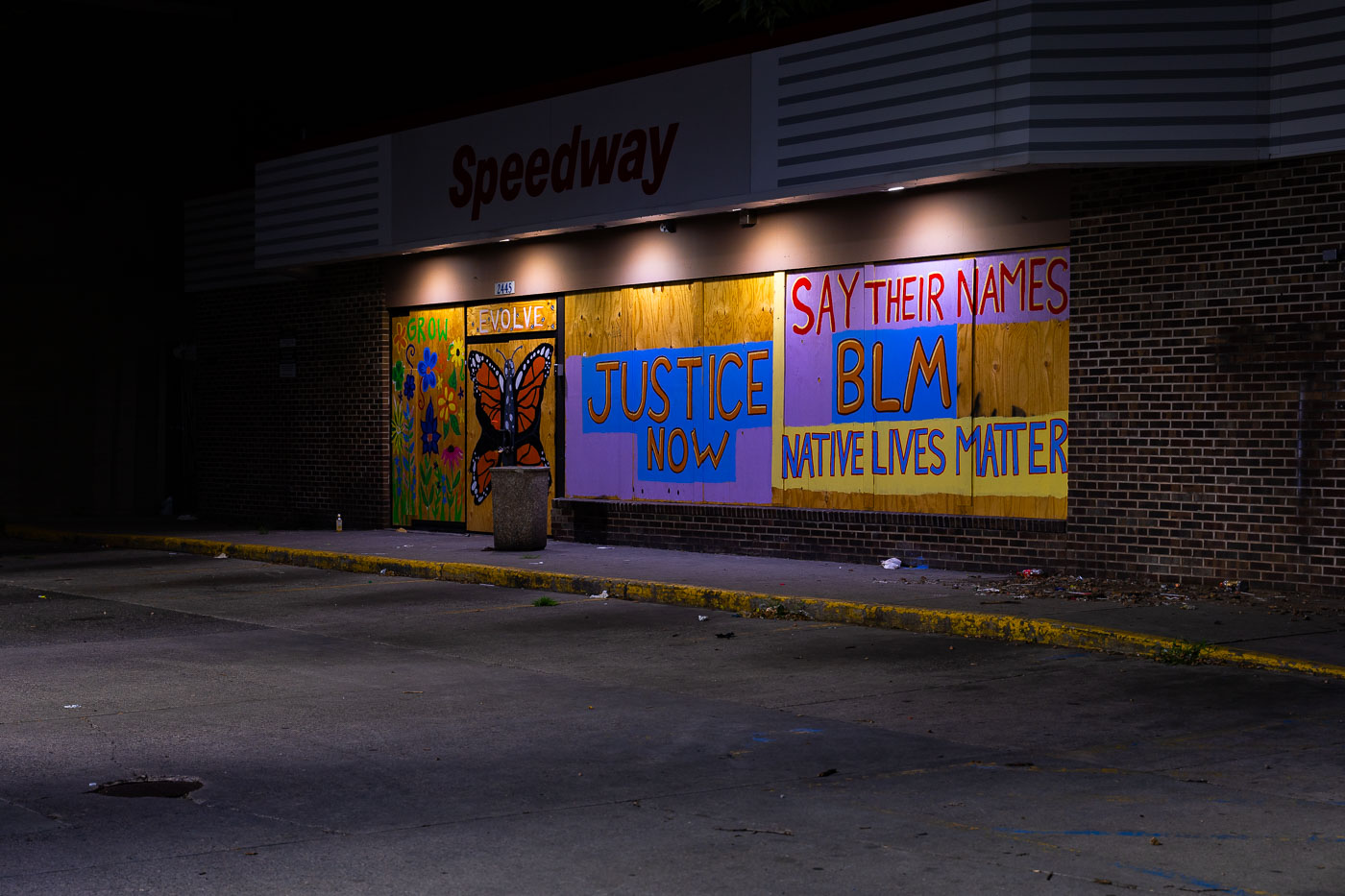
Say their names BLM Native Lives Matter boards
A Speedway gas station in South Minneapolis displays painted art boards covering its windows. These murals emerged during the Minneapolis Uprising, a period of widespread protest and unrest following the murder of George Floyd in May 2020. The plywood boards, initially installed for protection, became a public canvas for messages such as "Justice Now," "Say Their Names," "BLM," and "Native Lives Matter." This form of public art provided a means of community expression and remembrance, reflecting the social and political climate of the time.

Speedway Gas Station Murals, South Minneapolis
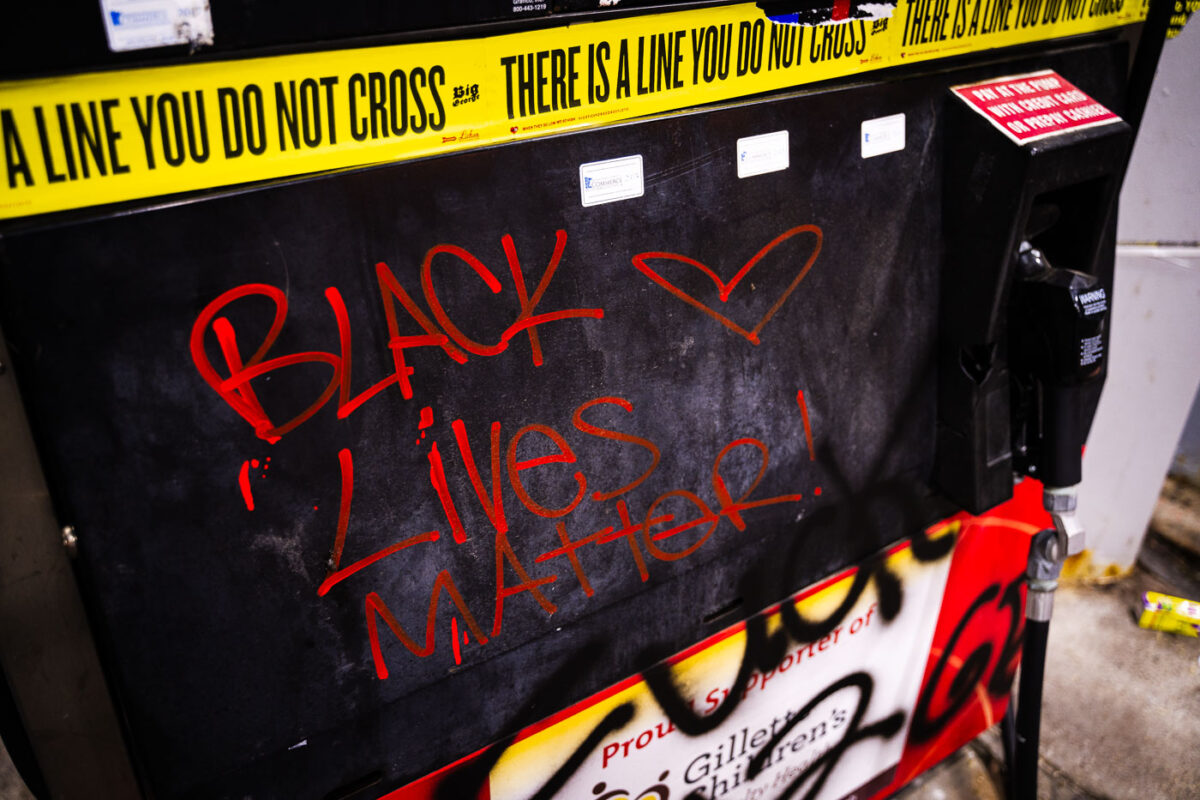
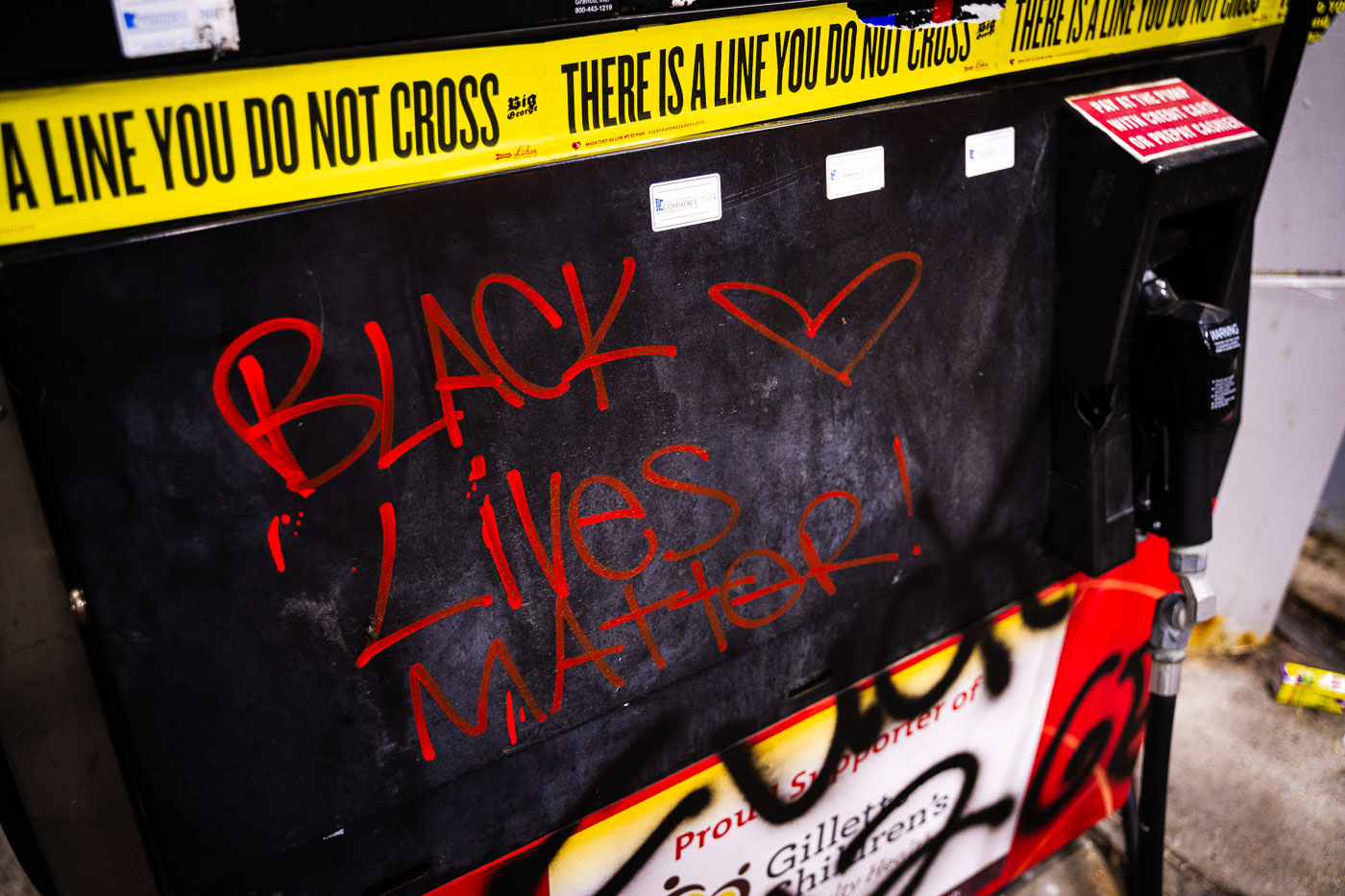
Black Lives Matter graffiti on a Speedway gas pump at George Floyd Square in Minneapolis.
A gas pump at the Speedway station in George Floyd Square, Minneapolis, is marked with red “Black Lives Matter” graffiti. The station stands across from the intersection where George Floyd was killed by Minneapolis police on May 25, 2020.

“Black Lives Matter” on Gas Pump, George Floyd Square, Minneapolis
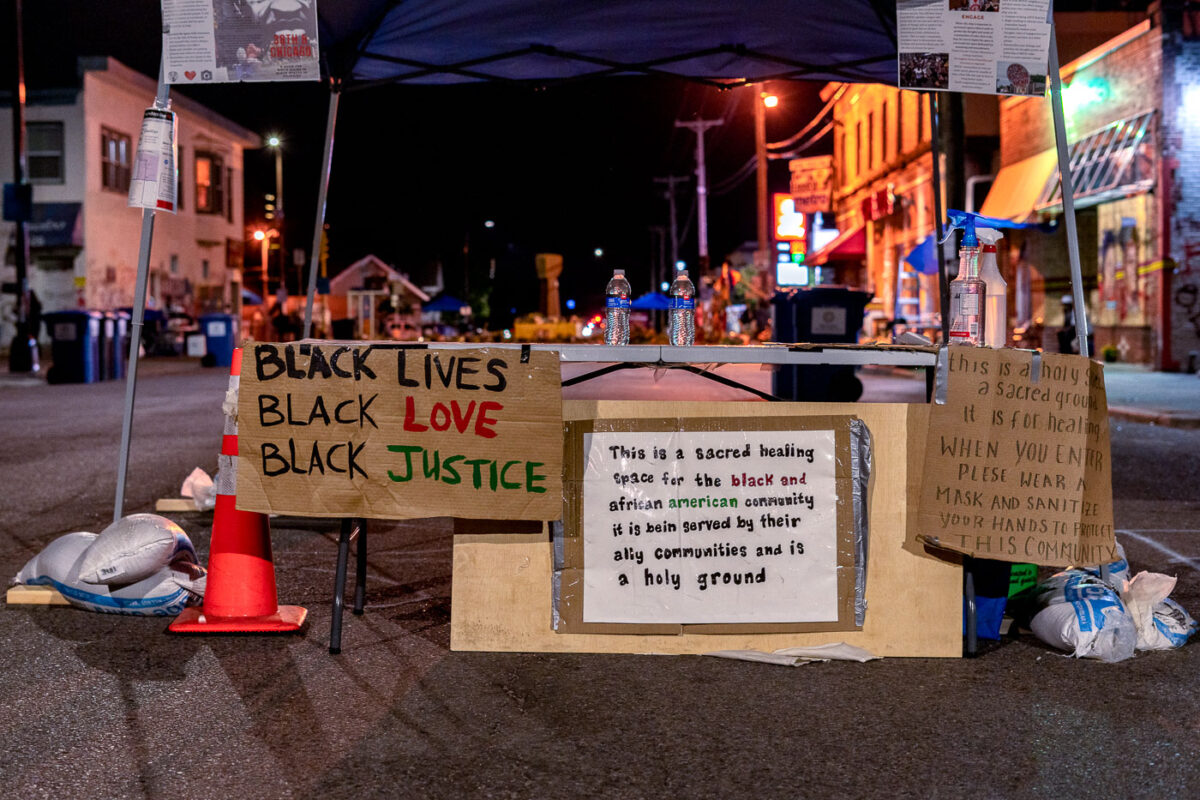
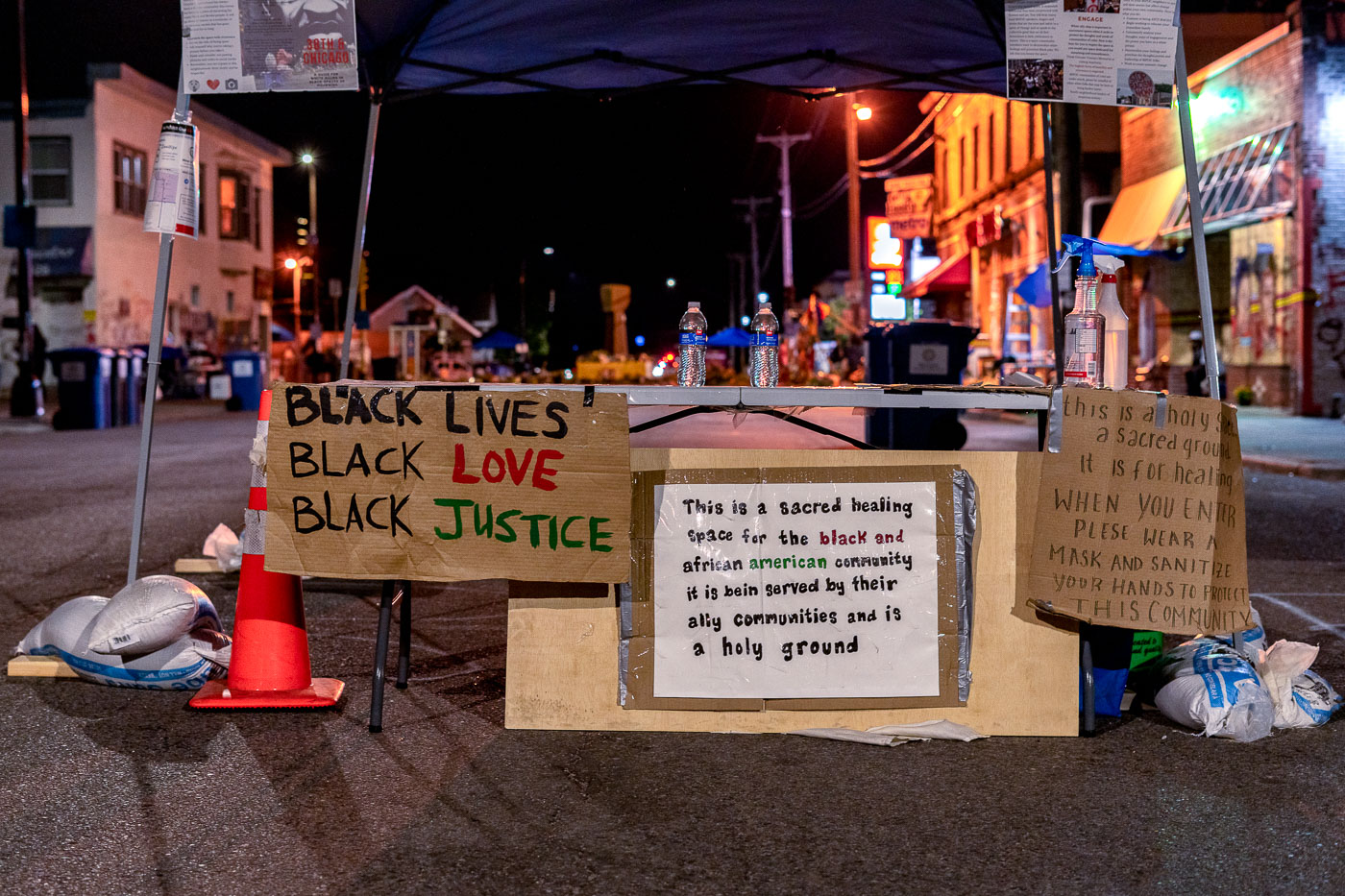
Welcome table at George Floyd Square in Minneapolis with signs reading “Black Lives, Black Love, Black Justice.”
A welcome table at George Floyd Square in Minneapolis stands at the crossroads of East 38th Street and Chicago Avenue, where a memorial and community healing space formed after George Floyd was killed by police in May 2020. Hand-lettered signs on the table read “Black Lives, Black Love, Black Justice” and describe the area as sacred ground for the Black and African American community and their allies.

George Floyd Square Welcome Table, Healing Space
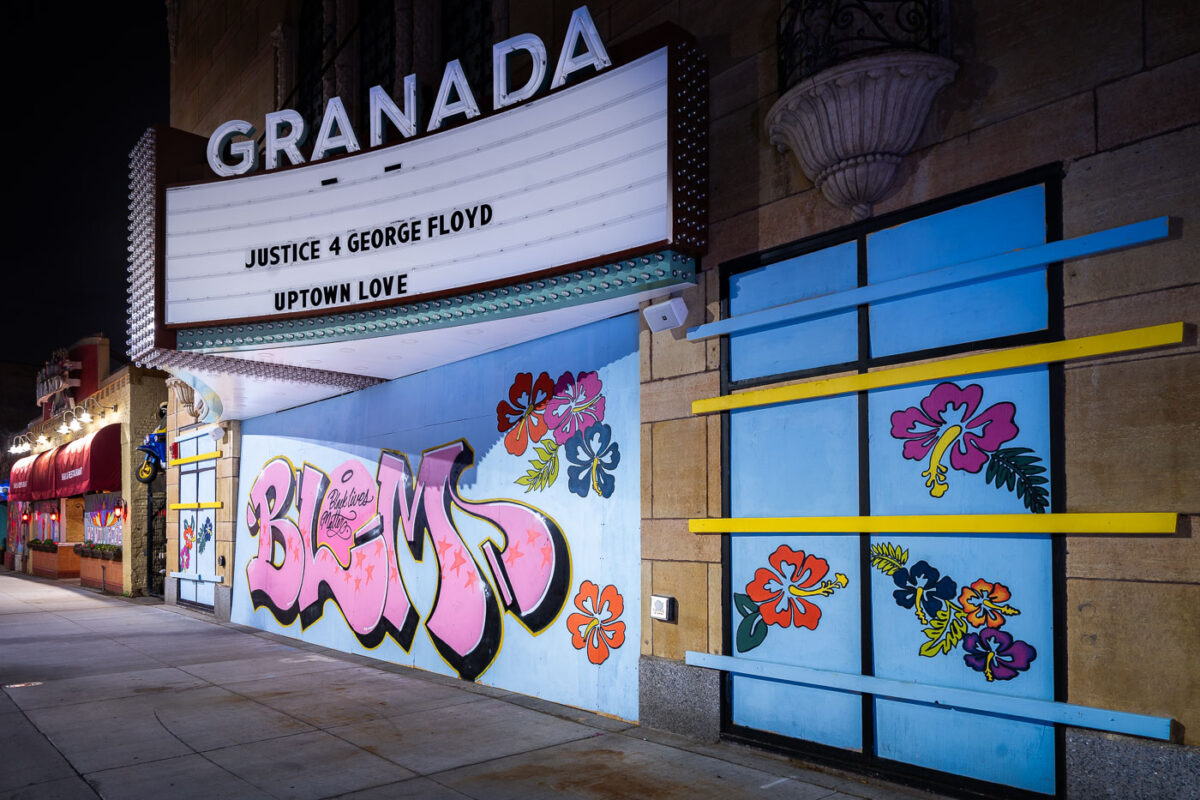
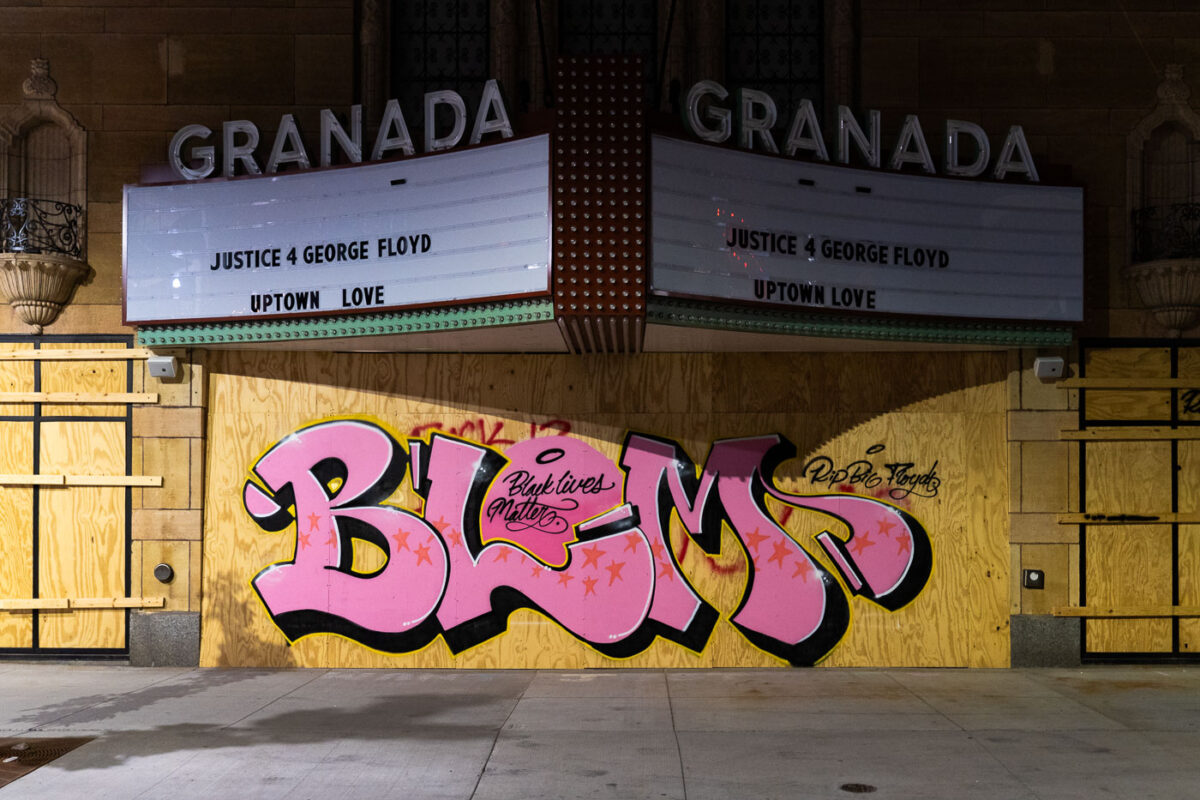
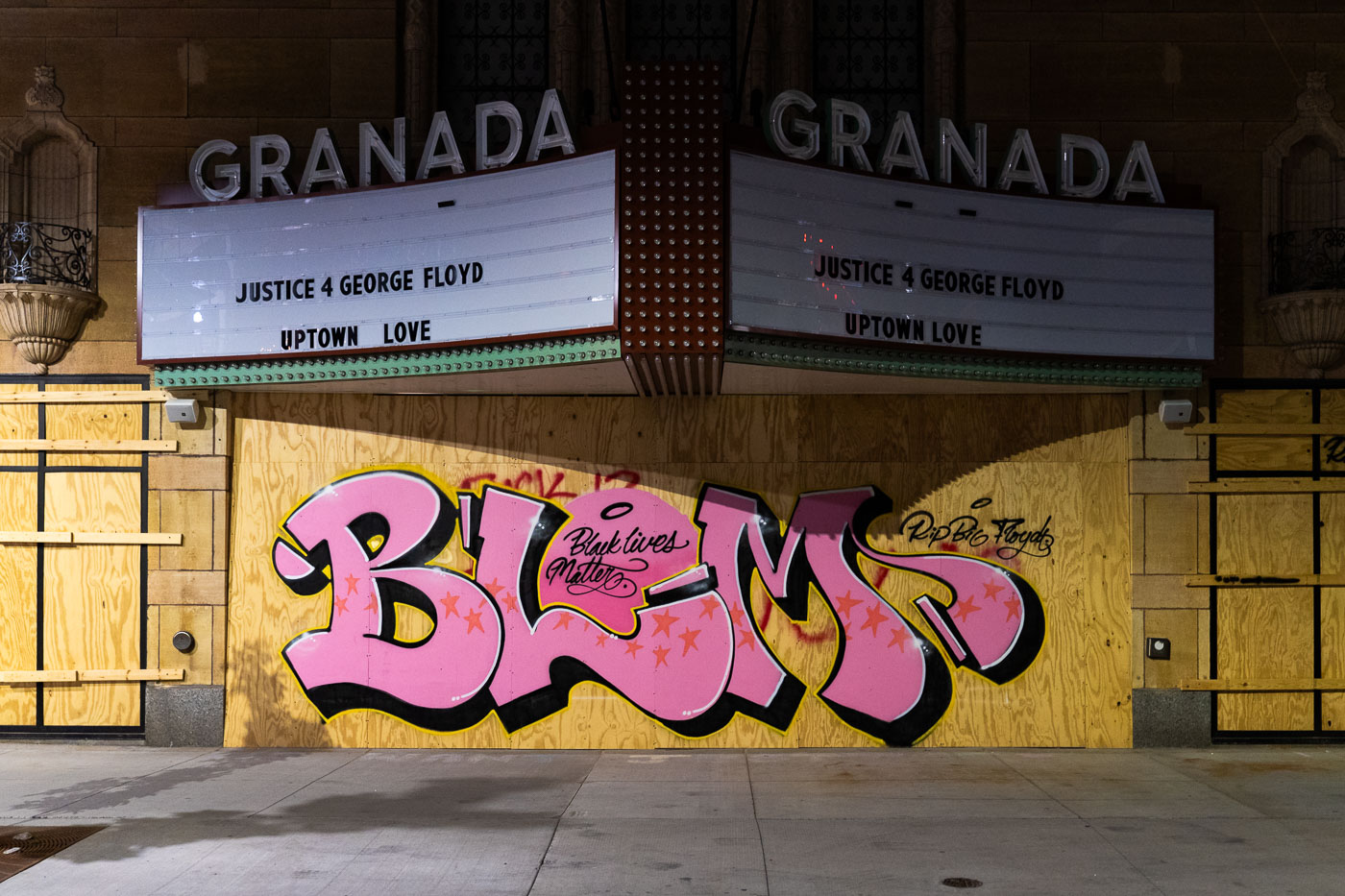
Granada Theater in Uptown Minneapolis with Justice 4 George Floyd marquee and boarded windows painted with BLM graffiti.
The Granada Theater on Hennepin Avenue in Uptown Minneapolis displays “Justice 4 George Floyd” and “Uptown Love” on its marquee. Painted plywood covers the theater’s ground-floor windows and doors, with large “BLM” graffiti and floral artwork visible across the facade. The boarding reflects security measures used by many Twin Cities businesses during protests and unrest following the police killing of George Floyd in May 2020. Built in 1928, the theater became a prominent public surface for messages during that period.

Granada Theatre Marquee: Justice 4 George Floyd, Uptown, Minneapolis
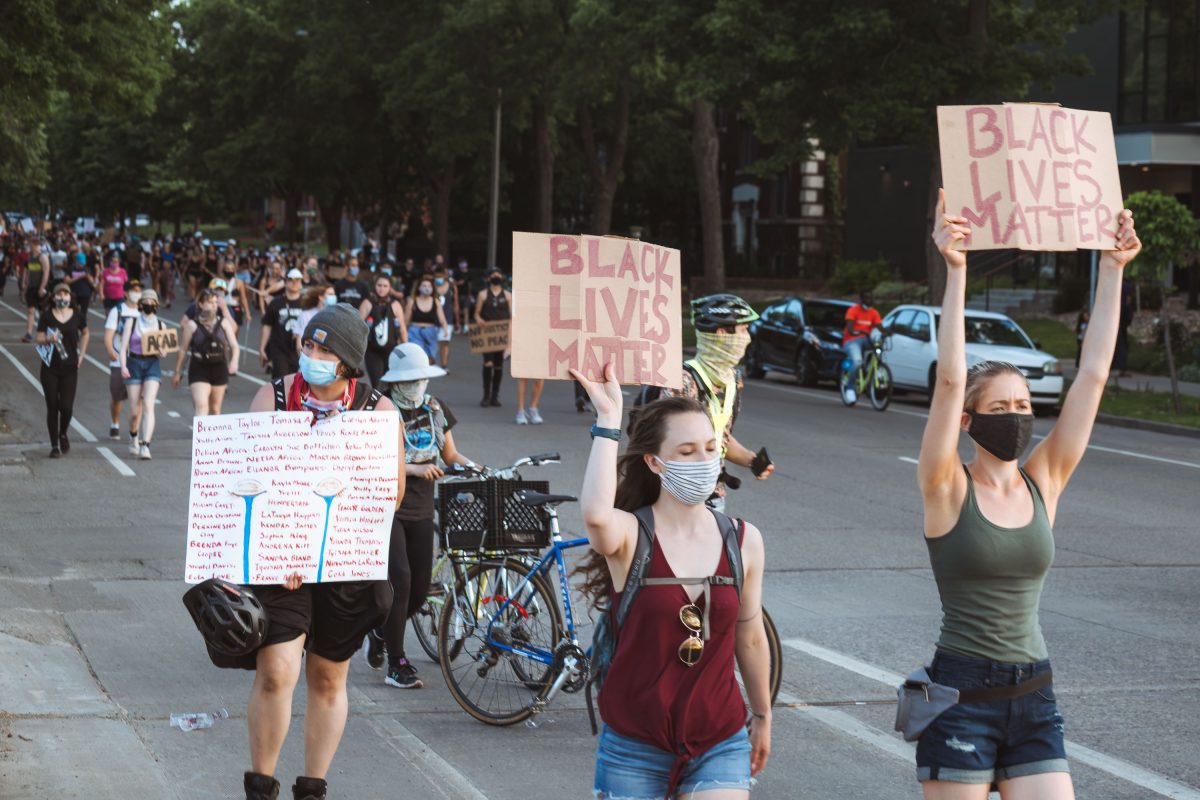
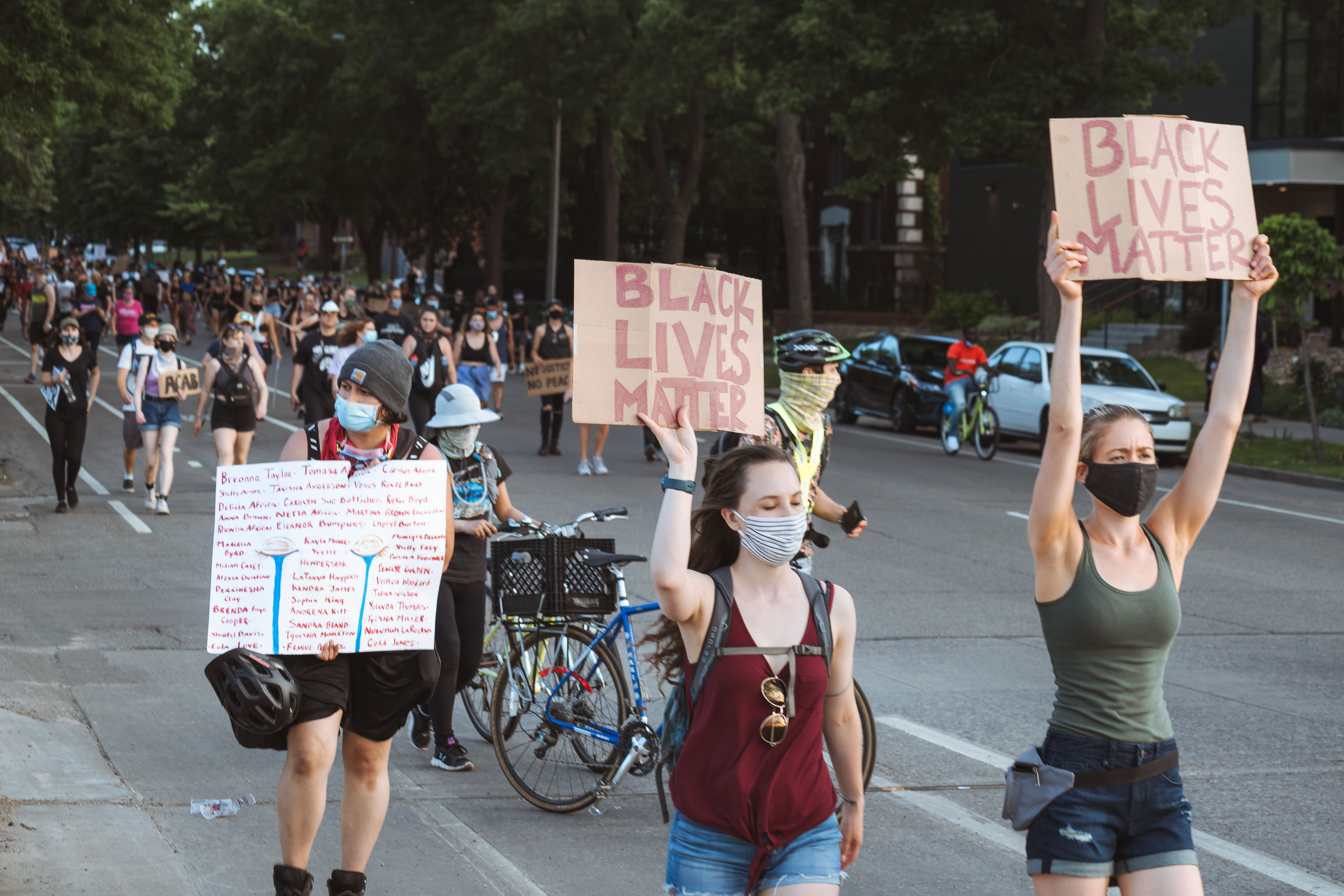
Protesters carrying "Black Lives Matter" signs march down Park Avenue in Minneapolis.
Protesters move down Park Avenue days after the killing of George Floyd in Minneapolis.

“Black Lives Matter” Signs Raised on Park Avenue

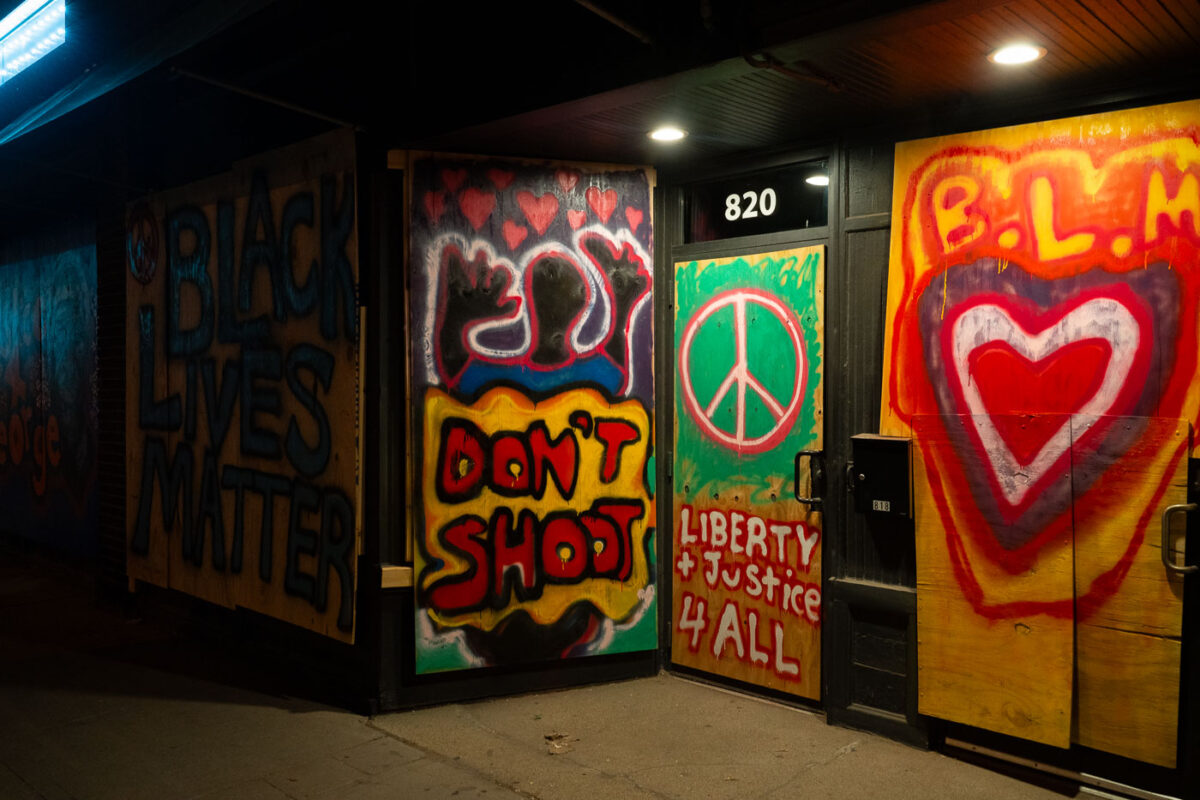
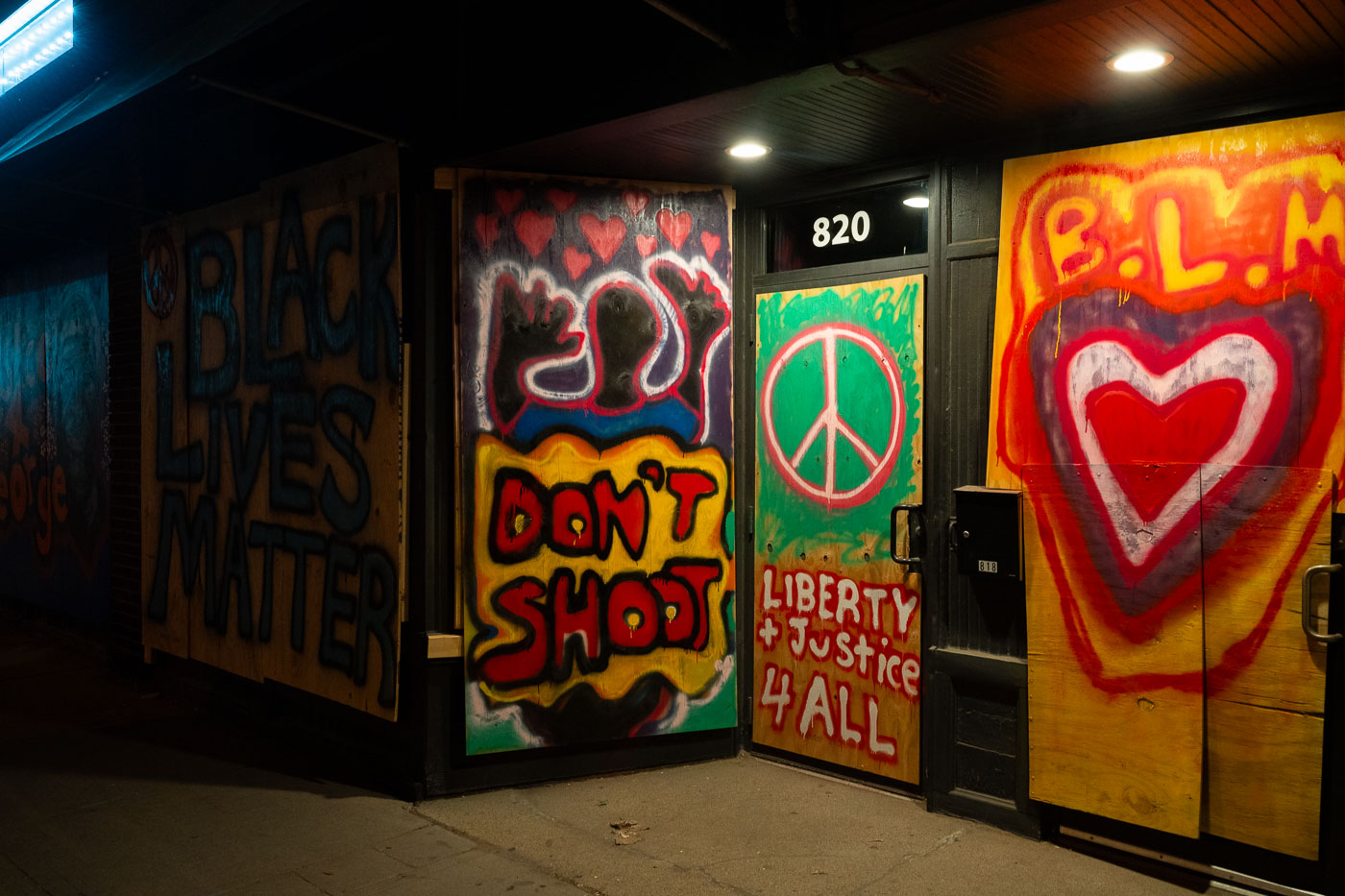
Boarded businesses on Lake Street in Minneapolis painted with Black Lives Matter and protest messages in June 2020.
Boarded storefronts on Lake Street in Minneapolis are covered with protest art and messages in early June 2020. Visible text and symbols include “Black Lives Matter,” “Don’t Shoot,” a peace sign, and “Liberty + Justice 4 All” painted across plywood panels protecting business entrances. The boards were installed after the murder of George Floyd and became surfaces for memorials, political messages, and neighborhood response along one of the city’s main commercial corridors.

BLM graffiti on boarded businesses, Lake Street, Minneapolis
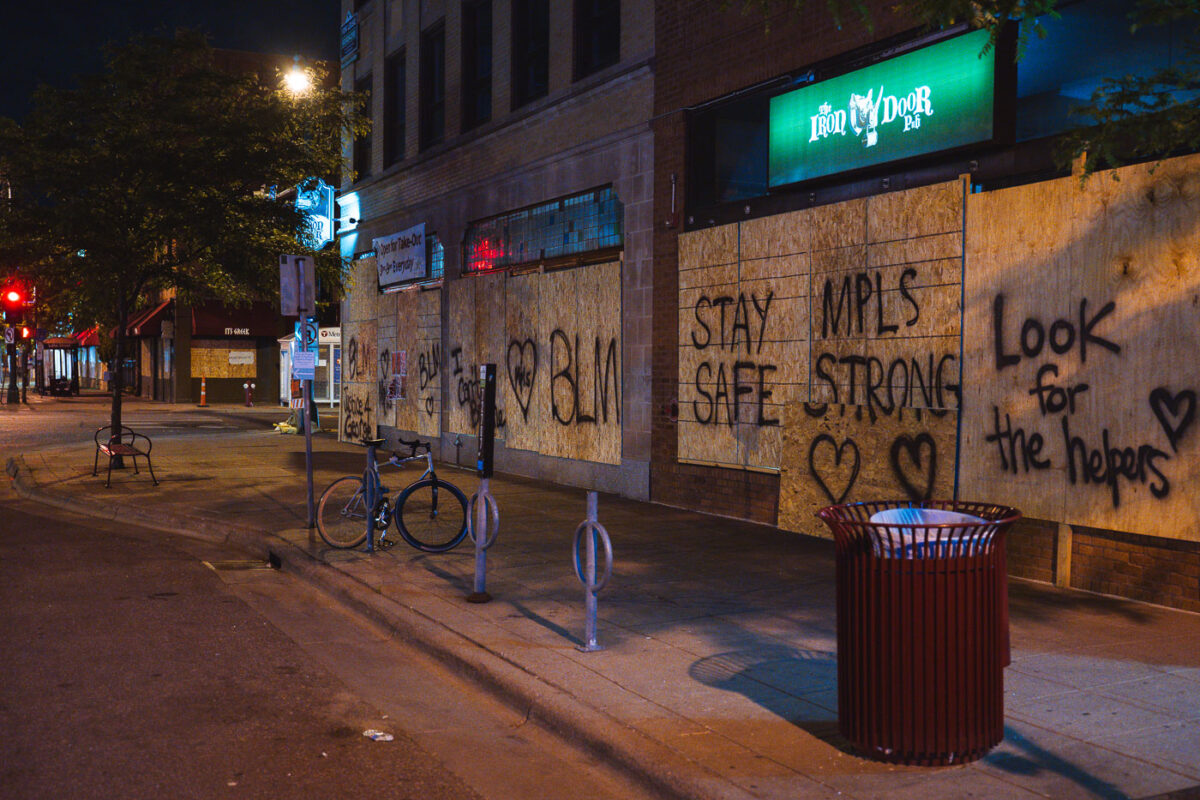
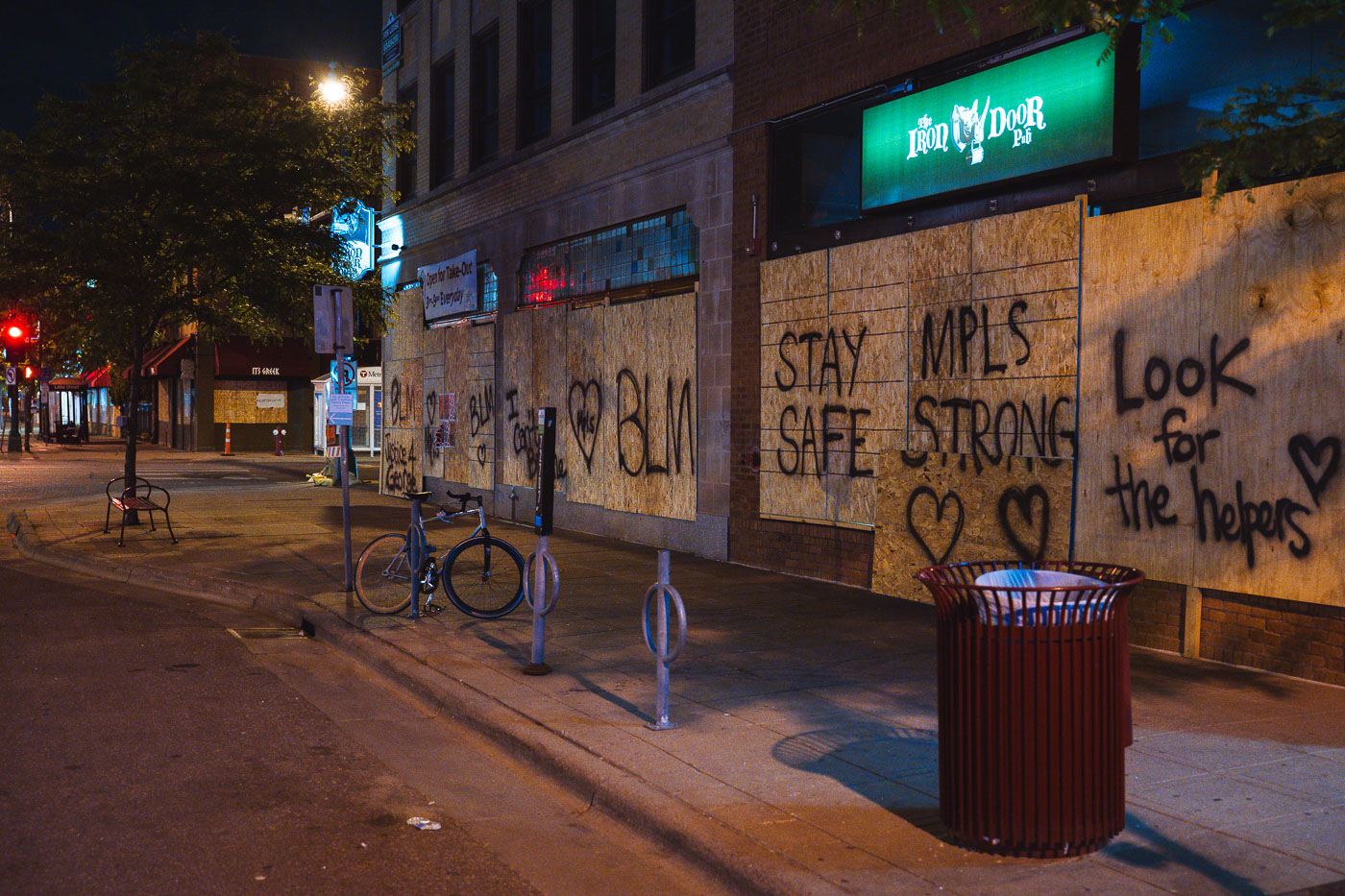
Boarded Iron Door Pub on Lyndale Avenue, Minneapolis, with BLM and protest graffiti in June 2020.
The Iron Door Pub on Lyndale Avenue in Uptown Minneapolis is boarded up in early June 2020, with plywood covering its windows and doors. Messages including “BLM,” “Stay Safe,” “MPLS Strong,” and “Look for the helpers” are spray-painted across the boards. Taken a week after the killing of George Floyd.
Iron Door Pub, Lyndale Ave, Minneapolis, Protest Graffiti

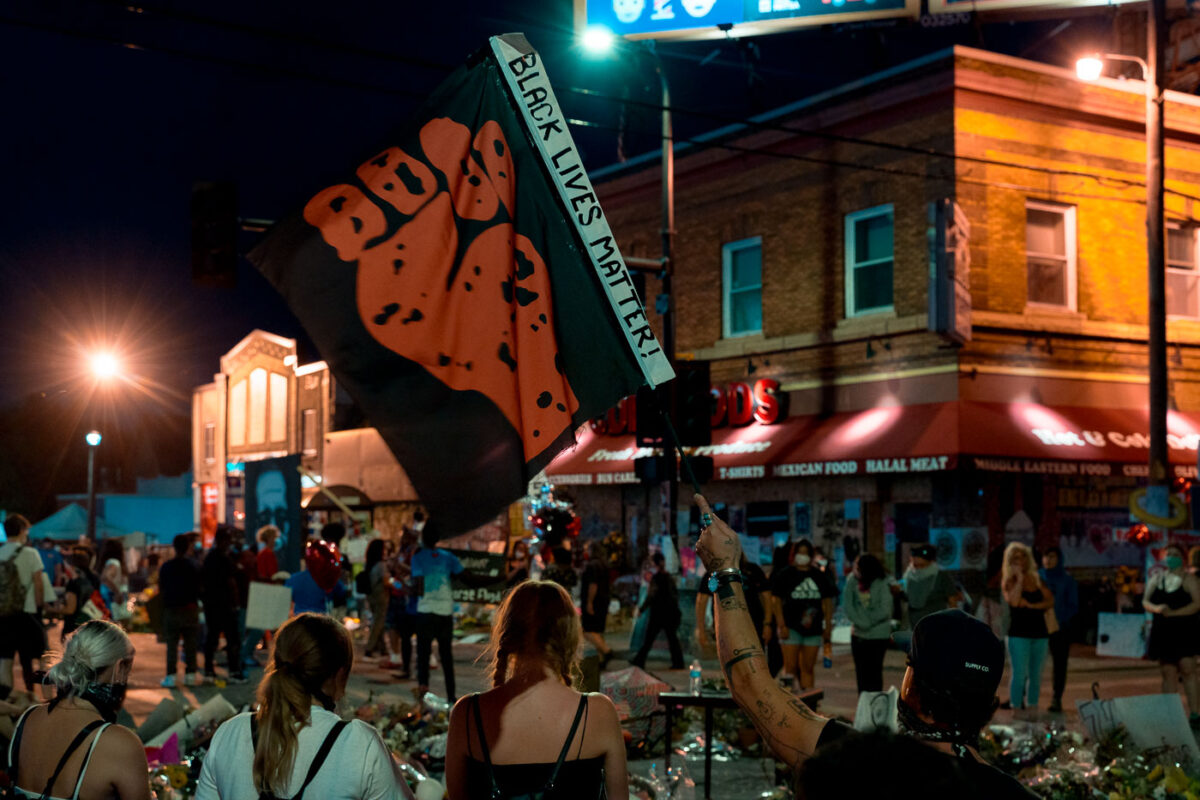
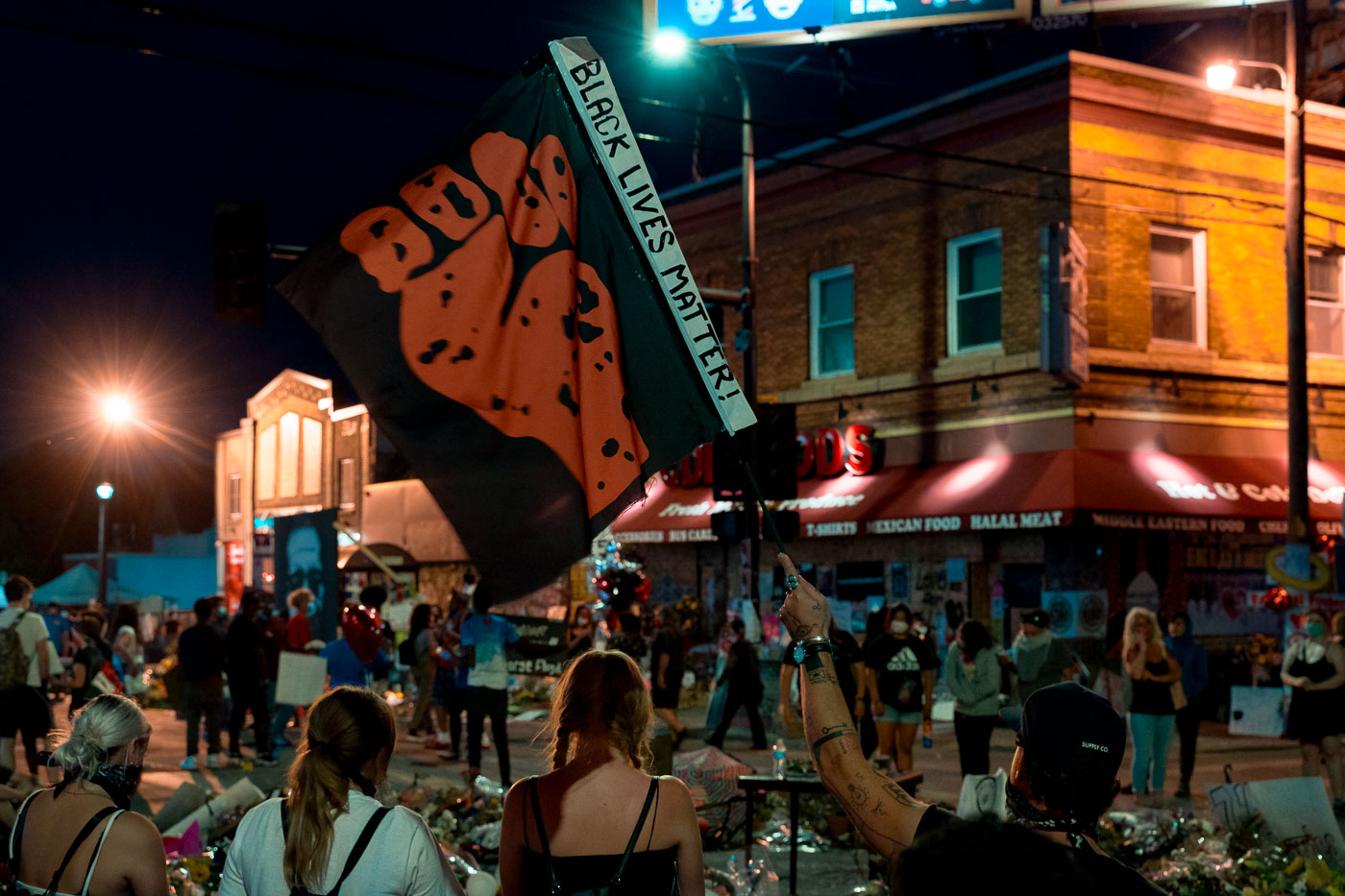
Protester with Black Lives Matter flag at George Floyd Square, Minneapolis, during a memorial gathering.
A protester raises a Black Lives Matter flag at George Floyd Square, the intersection of East 38th Street and Chicago Avenue in Minneapolis, Minnesota. The photograph was made on June 4, 2020, days after George Floyd was killed by Minneapolis police at this corner on May 25. People gather around the street memorial and protest site, where flowers, signs, and tributes filled the intersection during sustained calls for racial justice and police accountability.
Protester holds Black Lives Matter flag at George Floyd Square

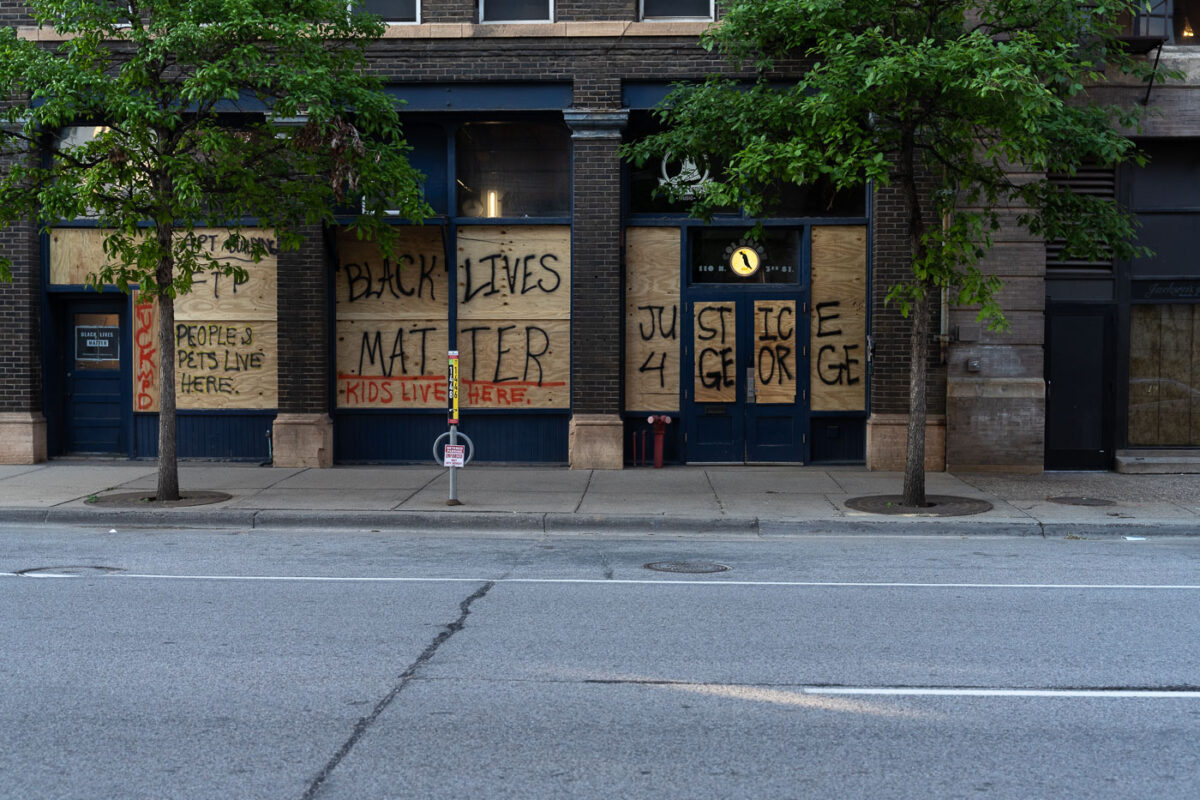
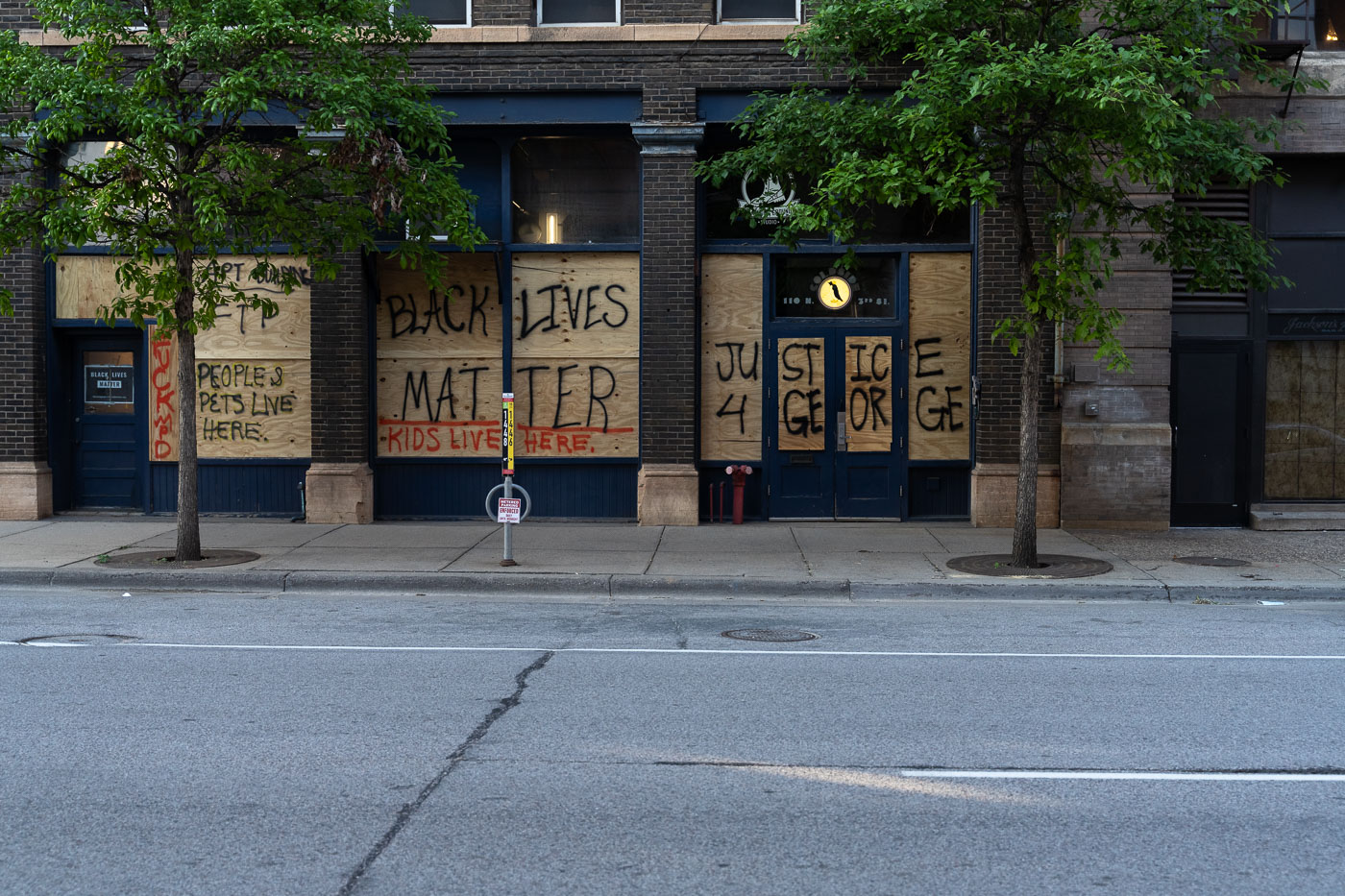
Boarded storefront at 110 N. 3rd St. in Minneapolis with Black Lives Matter and Justice 4 George messages.
Boards covering storefront windows at 110 N. 3rd Street in downtown Minneapolis bear hand-painted messages including “Black Lives Matter” and “Justice 4 George.” Photographed on June 4, 2020, the boarded facade also includes notes such as “People’s pets live here” and “Kids live here,” combining protest messages with notices to passersby in a mixed commercial and residential building. The markings appeared in the days after the murder of George Floyd, when plywood over downtown businesses became surfaces for mourning, demands for justice, and neighborhood communication.

Black Lives Matter & Justice 4 George Boards, Minneapolis

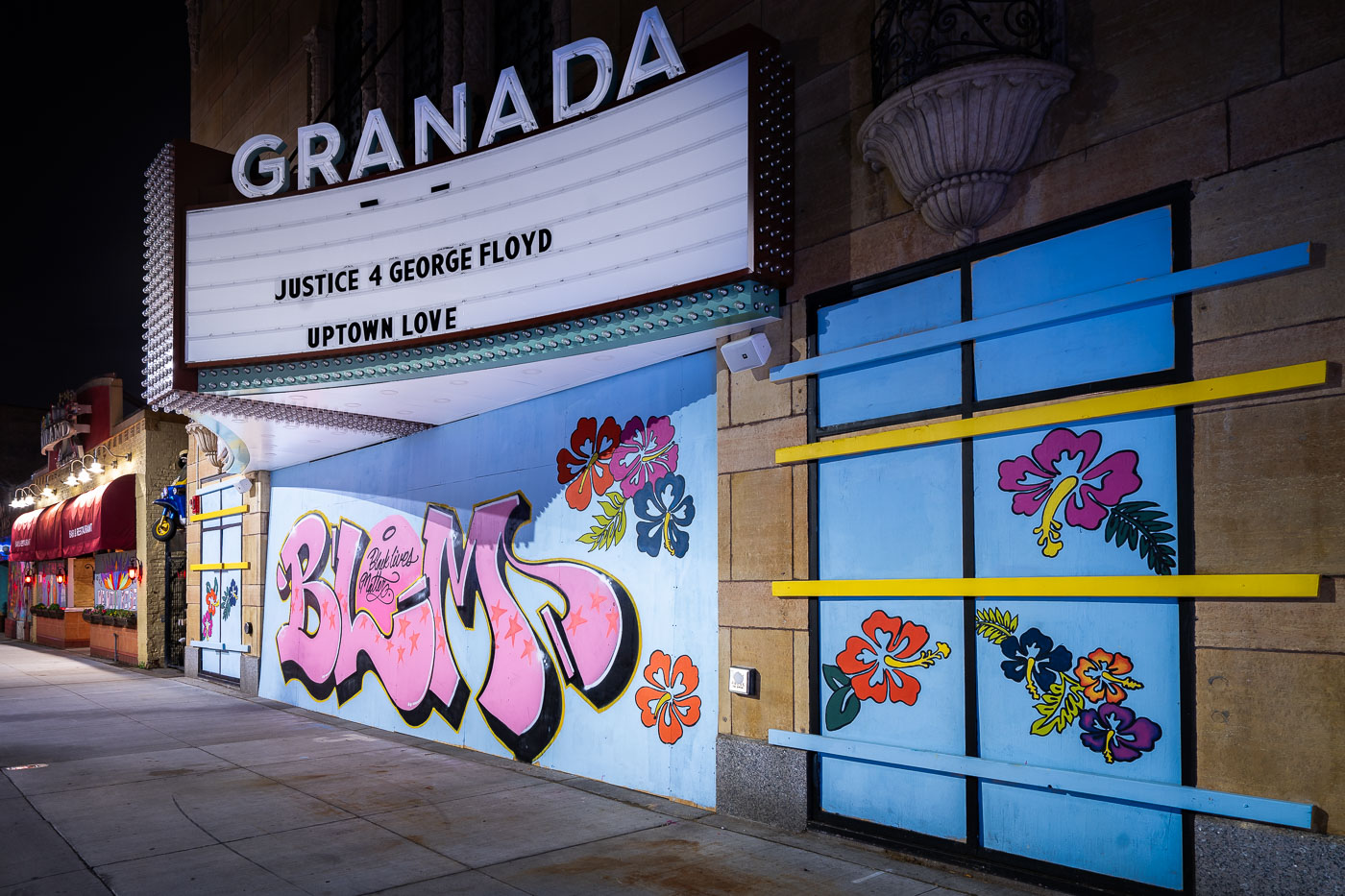
Granada Theatre in Uptown Minneapolis with Justice 4 George Floyd marquee and BLM mural on boarded facade.
The Granada Theatre on Hennepin Avenue in Uptown Minneapolis is shown boarded up with a marquee reading “Justice 4 George Floyd” and “Uptown Love.” A large pink “BLM” mural covers the plywood across the theater’s ground-floor facade. Photographed on June 4, 2020, the image documents how the theater’s exterior was used for messages tied to the protests and neighborhood response after the killing of George Floyd.

Granada Theatre, Justice 4 George Floyd Marquee & BLM, Uptown

Woman painting "Black Lives" on the street at George Floyd Square in Minneapolis.
A woman paints the words “Black Lives” on the pavement at George Floyd Square in Minneapolis on May 31, 2020. The site, at the intersection of East 38th Street and Chicago Avenue, became a gathering place for memorials and protest activity after the killing of George Floyd. Flowers and chalk markings visible around her reflect the informal tributes that covered the street during the early days of the memorial.
Woman Paints Black Lives Matter at George Floyd Square

Boarded storefronts in downtown Minneapolis marked with BLM and Black Owned graffiti.
Boarded storefronts in downtown Minneapolis are marked with the spray-painted messages “BLM” and “BLACK OWNED” on May 29, 2020. The plywood covers were installed to protect retail businesses during unrest following the killing of George Floyd by Minneapolis police earlier that week.

Boarded Businesses, Downtown Minneapolis

Protesters hold signs at the Hennepin County Government Center in downtown Minneapolis.
Protesters gather outside the Hennepin County Government Center in downtown Minneapolis on May 28, 2020, with signs including one reading “Black Lives Matter". The protest took place 3 days after George Floyd was killed.

“Black Lives Matter” Sign Raised Outside Hennepin County Government Center

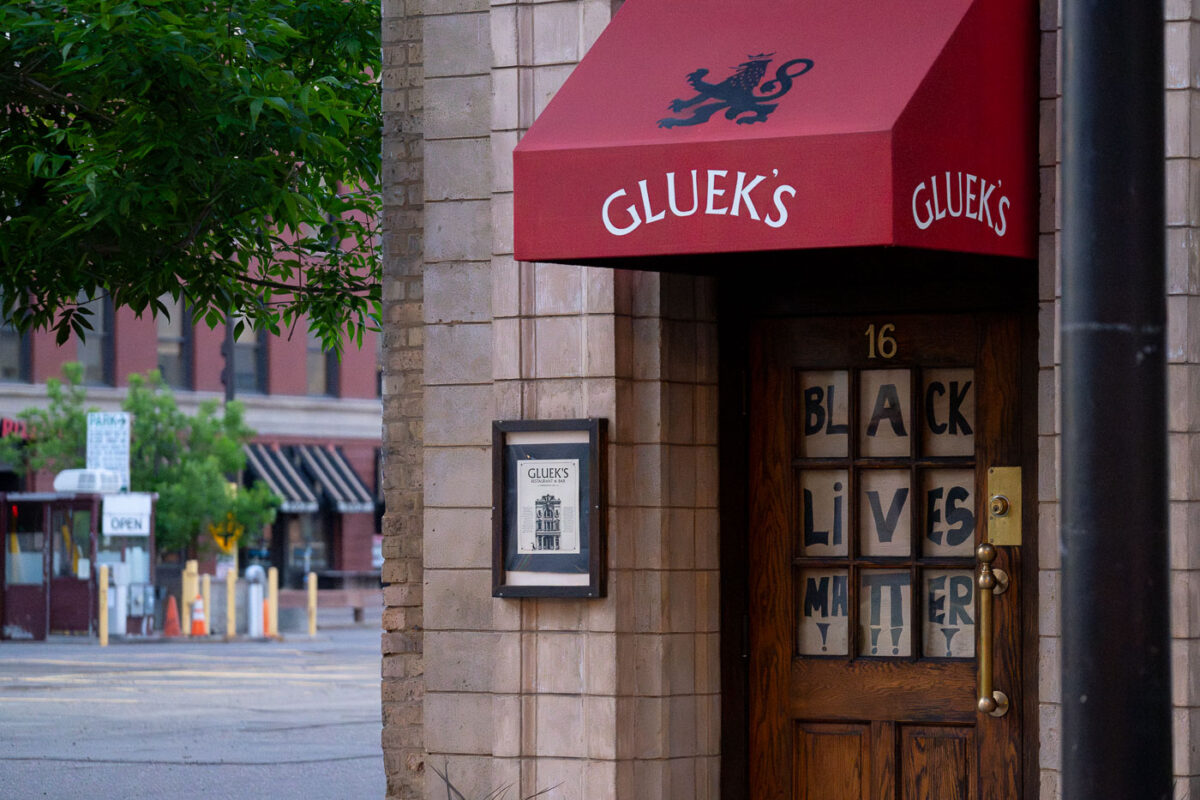
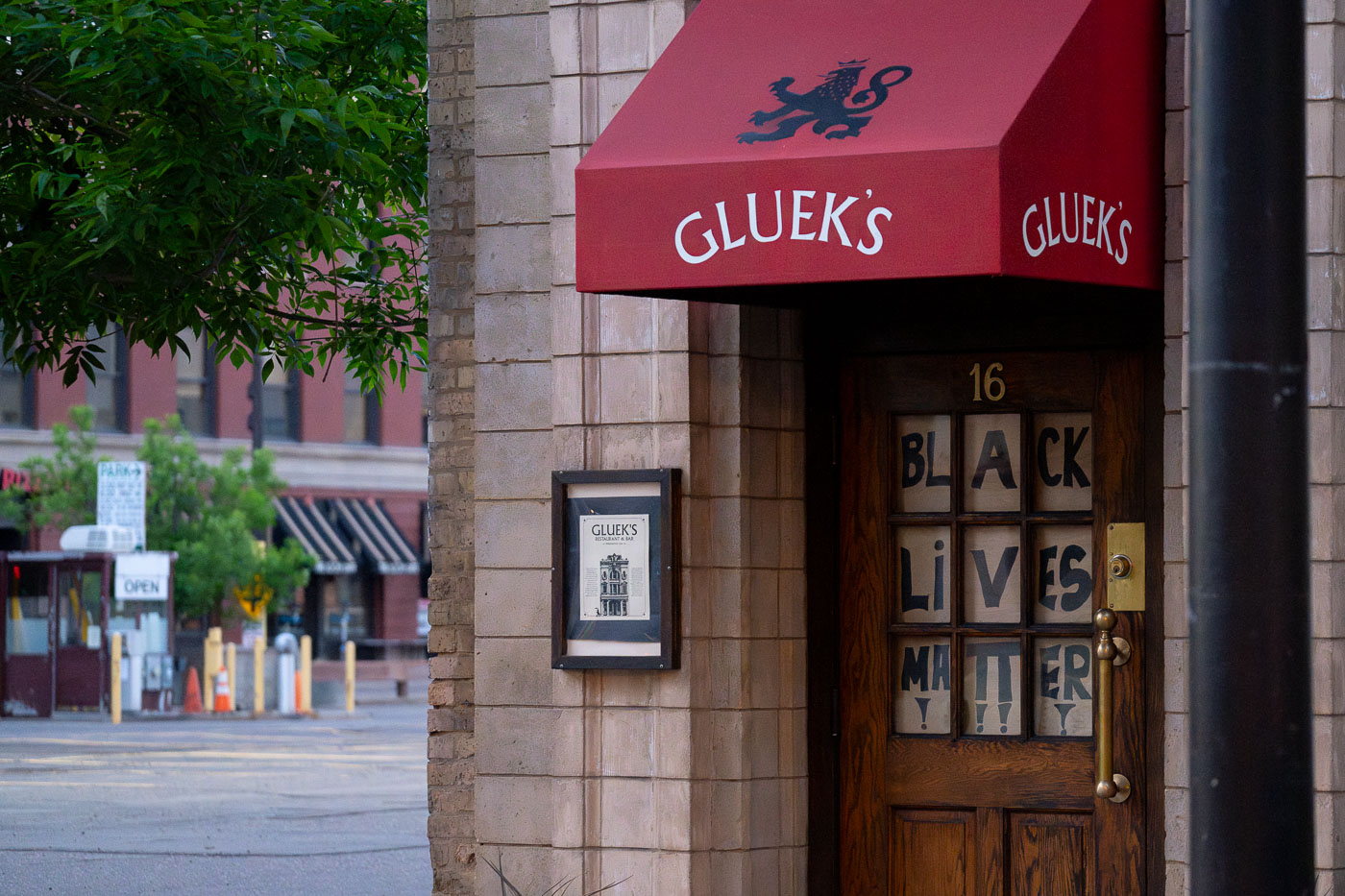
Gluek's Bar storefront in downtown Minneapolis displays "Black Lives Matter" lettering on its wooden entrance door below a red awning.
Gluek’s Bar & Restaurant in downtown Minneapolis displays a hand-lettered “Black Lives Matter” message across the glass panes of its entrance door. The photograph was made on May 28, 2020, during the protests and unrest that followed the killing of George Floyd.

“Black Lives Matter” Lettered on Gluek’s Door in Downtown Minneapolis

Boarded Wells Fargo on Lake Street in Minneapolis with protest graffiti and broken windows.
A Wells Fargo branch on Lake Street in Minneapolis stands boarded and spray-painted during the unrest that followed the murder of George Floyd in May 2020. Graffiti on the facade includes the messages “STEAL IT BACK!” and “KILL Bankers,” while broken glass and plywood cover parts of the entrance and windows.

Wells Fargo Bank, Lake Street, Minneapolis

GM Tobacco burns on East Lake Street in Minneapolis as people gather during George Floyd protests.
GM Tobacco and neighboring storefronts on East Lake Street in Minneapolis burn as people gather outside on the night of May 28, 2020. The fire occurred during protests and unrest that followed the death of George Floyd in Minneapolis police custody. Midori’s can also be seen along the block, part of a heavily damaged commercial corridor south of downtown.

GM Tobacco Burns on Lake Street, Minneapolis

Minneapolis Police 3rd Precinct on fire in Minneapolis during George Floyd protests.
The Minneapolis Police 3rd Precinct burns in Minneapolis, Minnesota, on May 28, 2020, as people gather outside the building during protests after the death of George Floyd. Flames engulf the station after officers withdrew from the site earlier that night. The fire at the precinct became one of the most widely recognized moments of the protests that spread across Minneapolis and other cities in the days following Floyd’s killing.
Minneapolis Police 3rd Precinct Fire
Minneapolis police on the 3rd Precinct roof in south Minneapolis during protests.
Minneapolis Police officers stand on the roof of the department’s 3rd Precinct station in south Minneapolis on May 27, 2020. Several officers are equipped with helmets, shields, and less-lethal launchers as the building became a flashpoint during protests that followed the killing of George Floyd two days earlier.
Minneapolis Police 3rd Precinct Rooftop

Minneapolis Police aims his less lethal weapon
A Minneapolis Police officer in gas mask and tactical gear aims a less-lethal launcher outside the Minneapolis Police 3rd Precinct in Minneapolis, Minnesota. The photograph was made on May 27, 2020, during protests following the killing of George Floyd by Minneapolis police officers.

Officer Aims Weapon at Minneapolis Police 3rd Precinct