Minneapolis

5,036 photos · 2008–2026

5,036 photographs tagged Minneapolis, 2008–2026.

Vote No On 3 Yard signs on Lyndale Avenue
Yard signs advocating a "Vote No On Question 3" stance are displayed along Lyndale Avenue in Minneapolis. This imagery likely dates to a period when Question 3 was a ballot measure, prompting public debate and campaign efforts. Such signs are a common feature of local elections, reflecting grassroots political engagement and the efforts of citizens to influence public opinion on specific issues. The presence of these signs on a public thoroughfare like Lyndale Avenue indicates a visible campaign to inform and persuade voters in the surrounding community.

Vote No On Question 3 Signs on Lyndale Avenue, Minneapolis

Lyndale Neighborhood Votes Yard Sign
A yard sign in the Lyndale Neighborhood of South Minneapolis encourages residents to vote. The sign, which reads "Lyndale Neighborhood Votes!" and directs viewers to "Visit mnvotes.org," reflects local civic engagement efforts. Such signs are common during election seasons, serving as a visible reminder of the importance of participation in democratic processes. The presence of this sign in a residential area highlights the neighborhood's commitment to voter turnout.

Lyndale Neighborhood Votes Yard Sign, South Minneapolis

Dont rank jacob frey yard sign in Minneapolis
Yard signs in Minneapolis reflect the political climate during an election cycle. One sign urges voters to "Don't Rank Jacob Frey," indicating opposition to the incumbent mayor and a potential shift in the city's leadership. The sign also presents three ballot questions: "NO TO A MAYORAL POWER GRAB," "YES TO A PUBLIC SAFETY DEPARTMENT," and "YES TO STRONG PROTECTIONS FOR RENTERS." These propositions suggest a public debate around the structure of city government, public safety, and housing policy. Additionally, signs for Londel French and Risa Hustad, candidates for Park Board at Large, are visible, highlighting local electoral contests.

Minneapolis Yard Signs: “Don’t Rank Jacob Frey” & Candidates
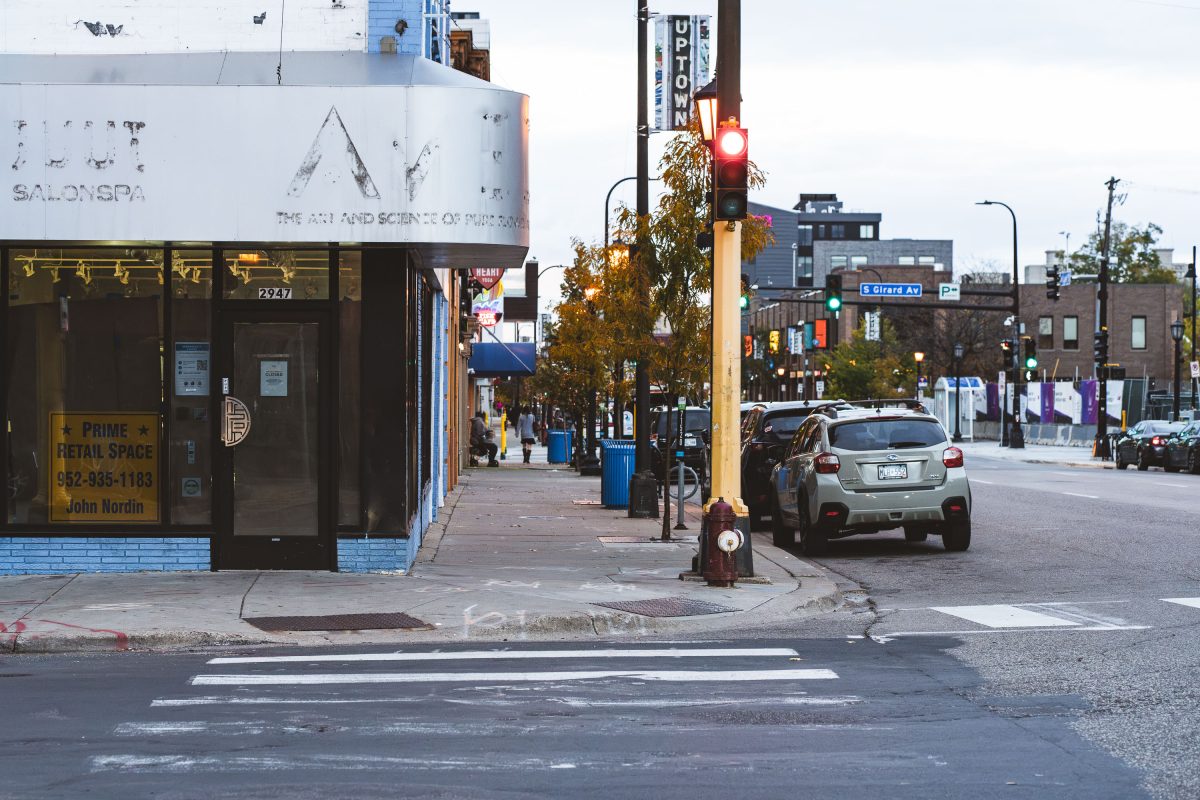
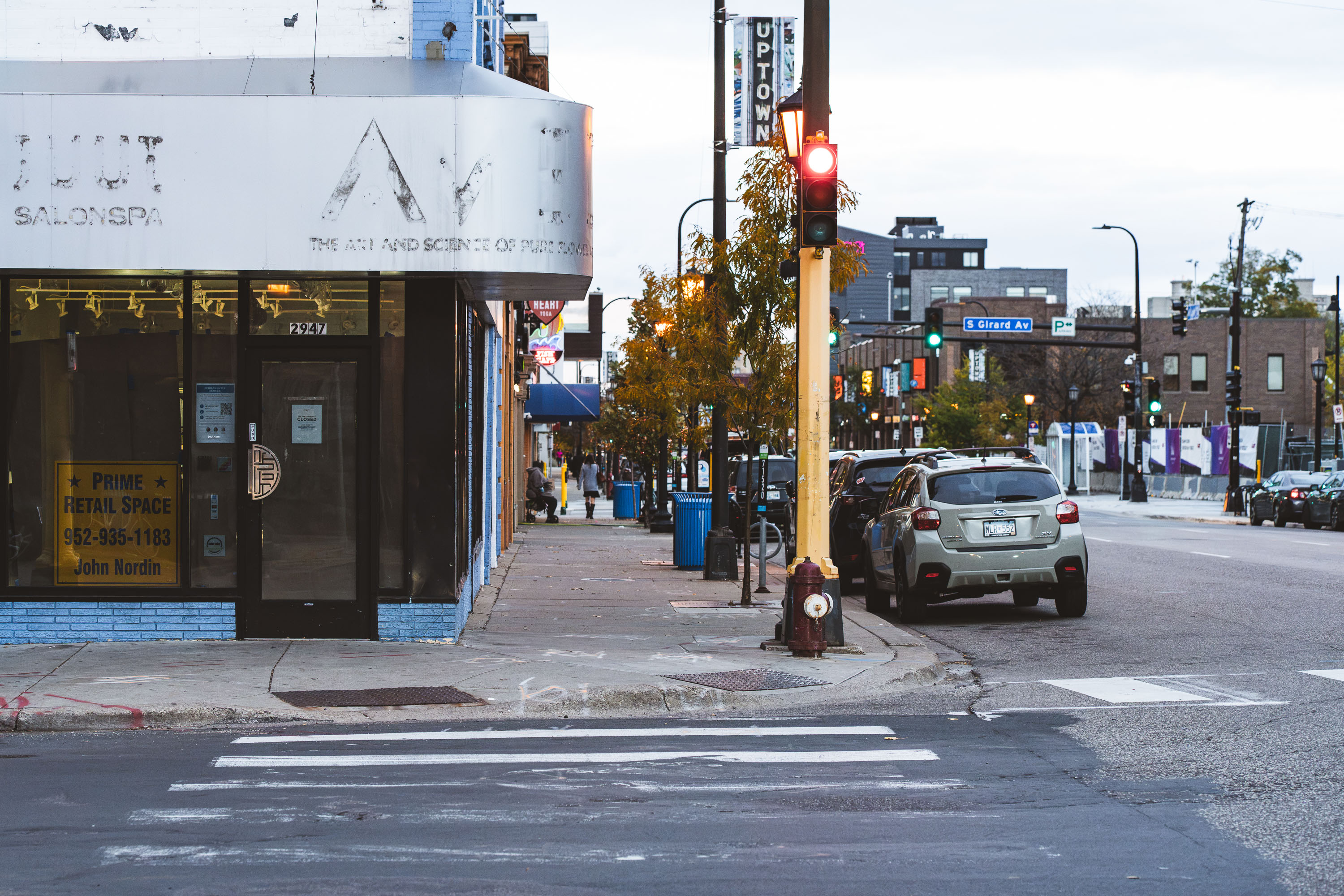
Vacant former JUUT Salonspa storefront on the corner of Hennepin Avenue and Lake Street in Uptown Minneapolis.
This corner building at Hennepin Avenue and Lake Street once housed JUUT Salonspa, a Minneapolis-based hair salon brand founded locally and later acquired by Aveda. The storefront sits in Uptown Minneapolis, near the intersection with Girard Avenue. By late 2021, the space was vacant and marketed as prime retail space, with a leasing sign listing agent John Nordin.

Former JUUT Salonspa Building, Hennepin Avenue and Lake Street

Don't rank Nezhad in Minneapolis mayoral election
A sticker reading "Don't Rank Nezhad" is affixed to a post along the Midtown Greenway in Minneapolis. This message likely refers to the 2021 Minneapolis mayoral election, where Sheila Nezhad was a candidate. The Midtown Greenway is a popular multi-use trail built on a former railroad corridor, serving as a vital transportation and recreational artery through the city. The presence of such political messaging on public infrastructure highlights the intersection of local politics and urban environments.

Minneapolis Election Sticker: Don’t Rank Nezhad on Greenway
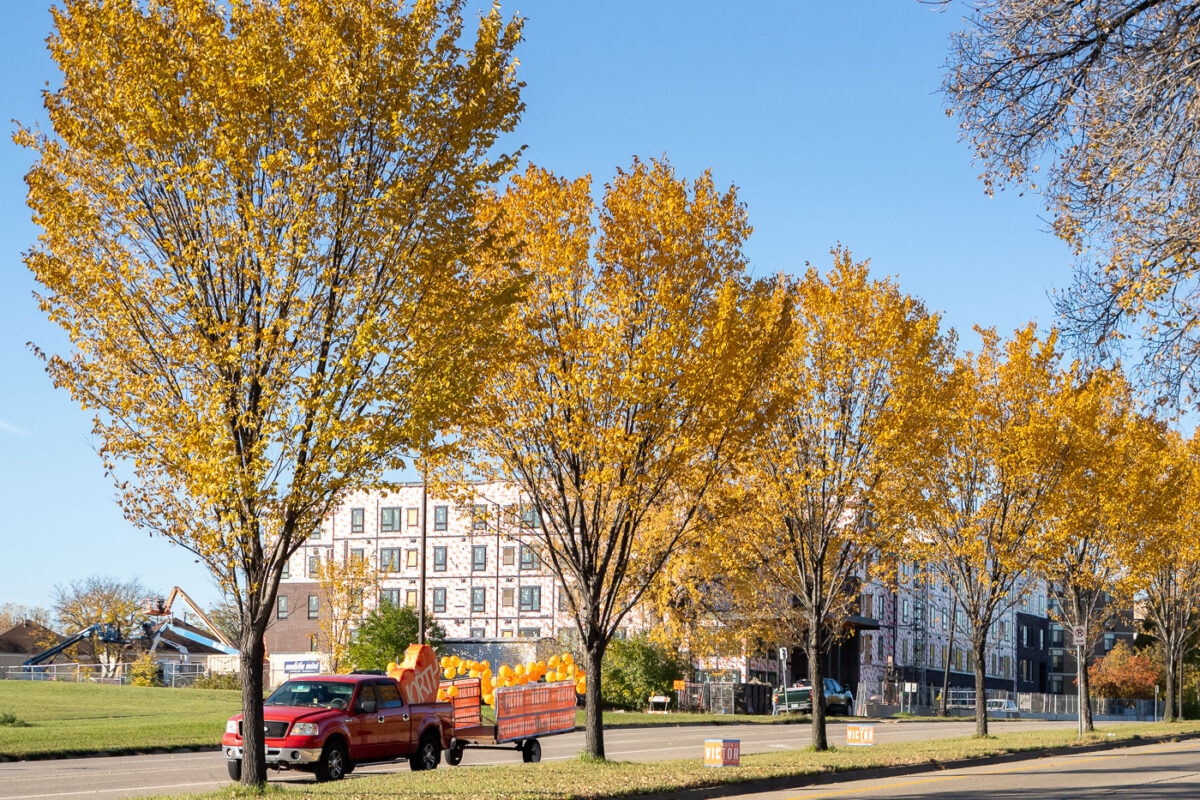
Victor Martinez yard signs in Minneapolis
A Victor Martinez "float" and campaign signs seen in North Minneapolis on election day.

Victor Martinez campaign float and signs, North Minneapolis

Mayor Jacob Frey at election party after he wins reelection
Minneapolis Mayor Jacob Frey attends a re-election victory celebration near downtown Minneapolis. He was declared the winner of the election the following day with 49% of the vote. The election took place in November 2021, a period marked by ongoing discussions about public safety and governance in Minneapolis, following the events of 2020. Frey's victory secured him a second term leading the city.

Jacob Frey re-election victory celebration in Minneapolis

Minneapolis Jacob Frey hugs supporter at election night party
Minneapolis Mayor Jacob Frey embraces a supporter at his re-election party, held near downtown Minneapolis. The event took place following the November 2021 election, where Frey secured a second term. His victory came amidst a period of significant civic engagement and political discourse in the city, following the 2020 Minneapolis uprising.

Mayor Jacob Frey at Minneapolis re-election party

Minneapolis Mayor Jacob Frey speaks to supporters
Minneapolis Mayor Jacob Frey speaks to supporters at his re-election party on November 5, 2019. This victory secured his second term leading the city. The event took place in Minneapolis, a significant hub for commerce and culture in the Upper Midwest. Frey's re-election occurred during a period of considerable civic engagement and public discourse within the city.

Jacob Frey Re-election Party, Minneapolis, 2019

Large yellow graffiti mural reading "Winston Smith" on a barrier at Lake Street Parking Ramp in Minneapolis.
Graffiti memorializing Winston Smith adorns the Lake Street Parking Ramp in Uptown Minneapolis. Smith was killed by a federal task force on top of the ramp in June 2021.

“Winston Smith FTP” Graffiti on Uptown Parking Ramp Barriers

Winston Smith Protest Notes at Seven Points Ramp
Protest signs hang on fencing around the parking ramp where Winston Smith was killed by law enforcement on June 3, 2021.

Winston Smith Protest Notes at Uptown Minneapolis Parking Ramp

Garbage cans on fire the day after election in Uptown Minneapolis
Garbage cans are ablaze on Lake Street in Uptown Minneapolis, the day following the 2020 U.S. Presidential Election. The fires occurred amidst unrest and protests that followed the election, and in the wake of the murder of George Floyd earlier that year. Uptown Minneapolis, a commercial and cultural hub, experienced significant damage and disruption during this period of civil unrest.

Garbage cans on fire in Uptown Minneapolis, day after election

Firefighter puts out garbage can fires in Uptown Minneapolis day after election
Minneapolis firefighters responded to a garbage can fire on Lake Street in the Uptown neighborhood on November 4, 2020, the day after the 2020 presidential election. The fire occurred amidst ongoing unrest and protests in the city following the murder of George Floyd. The presence of emergency services, including the fire department and police, was a common occurrence in this area during the period of civil unrest in Minneapolis.

Minneapolis Fire Department Responds to Garbage Can Fire on Lake Street

Protest fires on Lake Street the day after the election
Minneapolis Fire Department responded to multiple garbage can fires along Lake Street on the night following the 2020 election. The fires occurred amidst protests and unrest in the city, following the death of Winston Smith. Banners visible in the background reflect sentiments from the period, including "People Over Property" and "Buycott." Lake Street, a major commercial corridor in Minneapolis, has been a focal point for community activism and rebuilding efforts.

Minneapolis Fire Dept. responds to fires on Lake Street post-election

Winston Smith written on a dumpster
A dumpster marked with "Winston Smith" graffiti stands on a street in Uptown Minneapolis. This marking serves as a memorial to Winston Smith, who was killed by a federal task force on a parking garage across the street during the 2020 Minneapolis uprising. The uprising followed the murder of George Floyd and involved widespread protests. The dumpster, a temporary piece of infrastructure for construction or demolition debris, has become a canvas for public expression and remembrance.

Winston Smith Graffiti on Dumpster, Uptown Minneapolis

Stop The Cover Up graffiti behind Seven Points Mall
Protesters paint "Stop The Cover Up" outside the parking garage where Winston Smith was killed by law enforcement 5 months earlier.

Uptown Minneapolis Protest Graffiti: Stop The Cover Up

Paint covered No Trespassing sign
A "No Trespassing" sign, splattered with pink paint, is affixed to a chain-link fence outside a parking ramp in Uptown Minneapolis. This location is significant as the site where Winston Smith was killed by law enforcement on June 3, 2021. The incident occurred during protests that followed the killing of George Floyd, and the sign's defacement may reflect the broader unrest and public sentiment at the time. The area around the parking ramp has been a focal point for activism and remembrance.

Paint-Covered No Trespassing Sign, Uptown Minneapolis
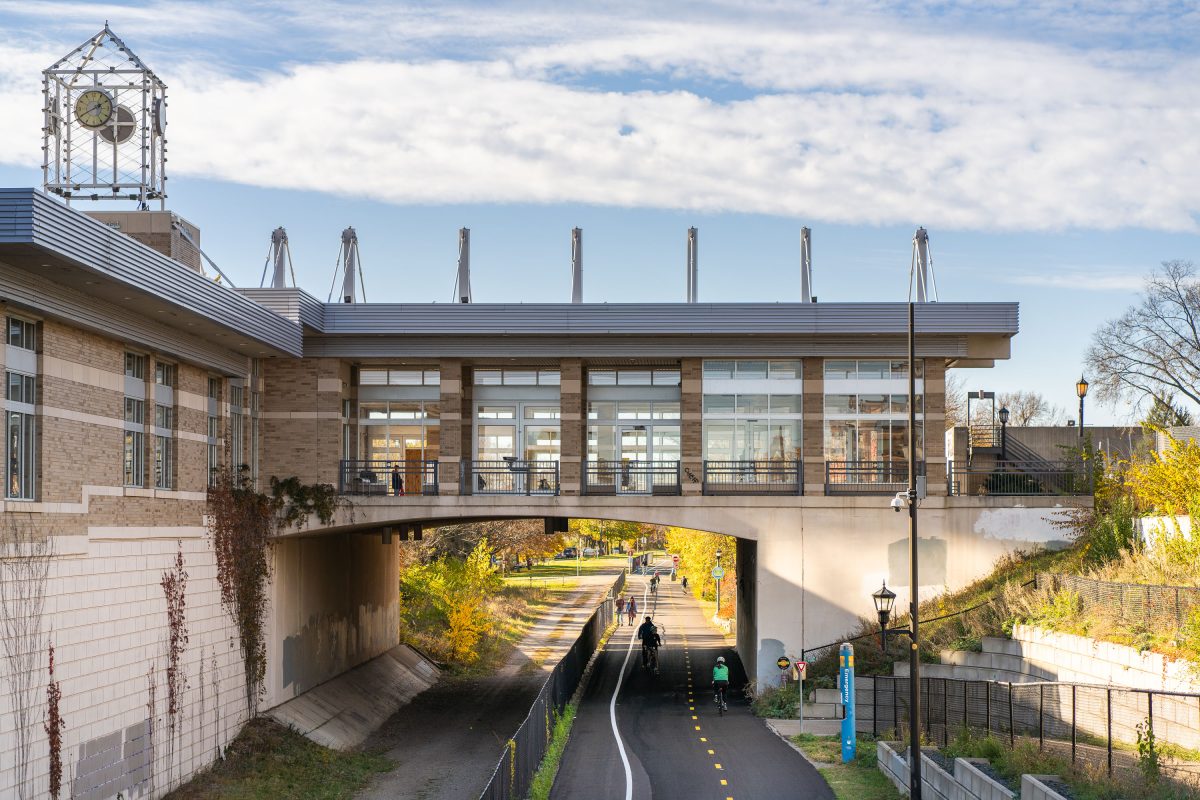
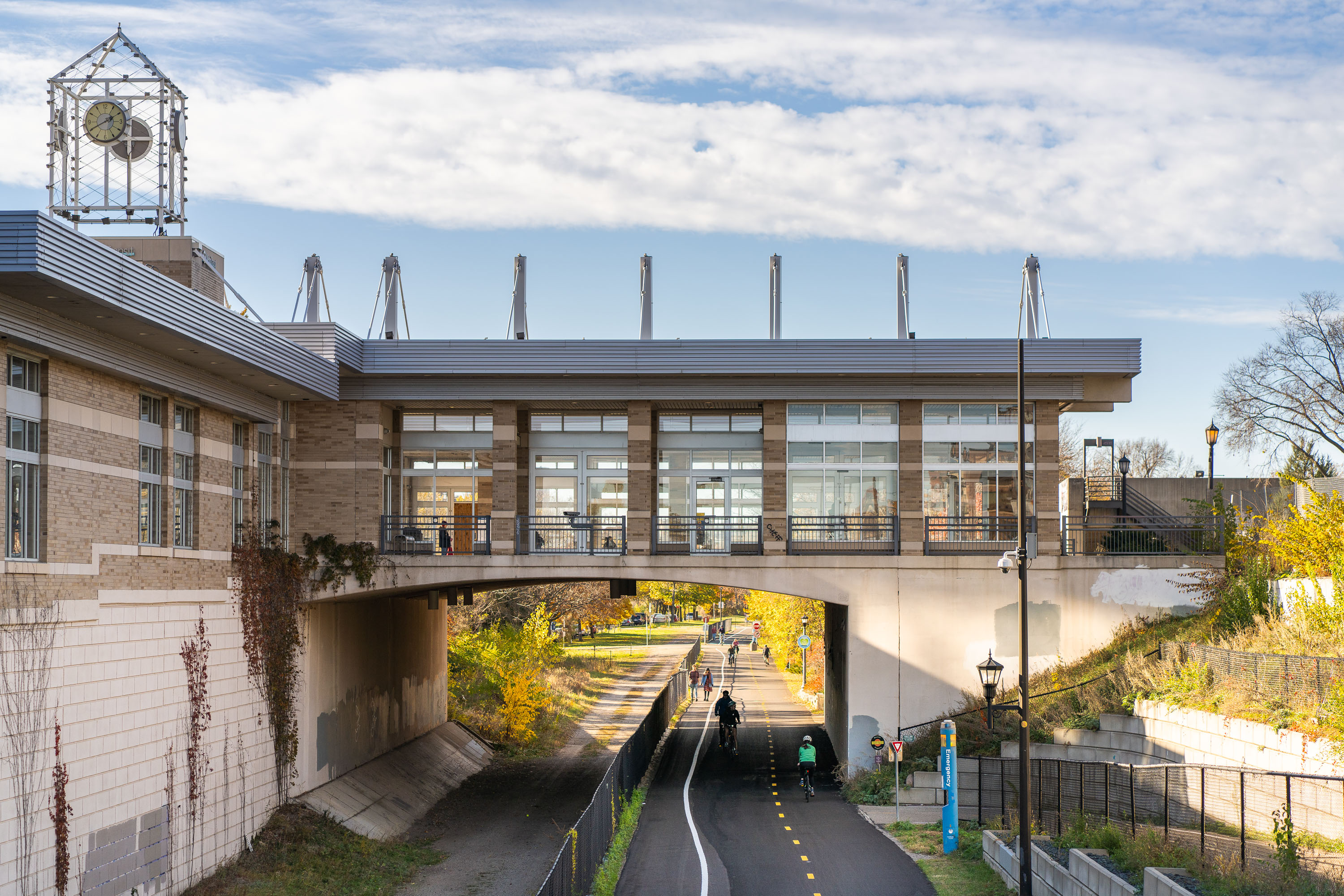
Cyclists and pedestrians travel the Midtown Greenway trail beneath the Hennepin Avenue bridge in Minneapolis.
The Midtown Greenway follows a former Milwaukee Road rail corridor that cuts below street level through south Minneapolis. The trail runs roughly 5.5 miles between the Mississippi River and the Chain of Lakes, opening in phases between 2000 and 2007. Hennepin Avenue crosses above the trail on a bridge near Uptown, one of more than 30 street crossings along the route. The nonprofit Midtown Greenway Coalition maintains the corridor for cyclists, walkers, and commuters year-round.

Hennepin Avenue Bridge, Midtown Greenway, Minneapolis

Bryant Square Park Sign at Night
Bryant Square Park sits in the heart of the Lowry Hill East neighborhood—better known as “The Wedge”—and has been part of Minneapolis’ park system since the early 20th century. The illuminated sign marks one of the city’s older community parks, which originally grew out of residential expansion along the streetcar lines that shaped much of South Minneapolis. The park has long served as a gathering place for the surrounding blocks, offering playgrounds, athletic courts, open green space, and a recreation center that has hosted everything from youth programs to neighborhood meetings. Historically, Bryant Square reflects the city’s early investment in small, walkable parks distributed throughout dense residential districts. Its development mirrored the Wedge’s transformation from a streetcar suburb into one of Minneapolis’ most eclectic and tightly knit urban neighborhoods, where parks continue to function as important public commons.

Bryant Square Park Sign at Night

Graffiti on the Uptown Theater in Minneapolis reads, “Do you know who Winston Smith is??”
Graffiti reading "DO YOU KNOW WHO WINSTON SMITH IS??" is spray-painted on the glass doors of the Uptown Theater in Minneapolis. The Uptown Theatre, a historic movie palace opened in 1926, has been a prominent landmark on Hennepin Avenue.

Winston Smith Graffiti on Uptown Theater, Minneapolis

Tarrot Readings on Lake Street
A neon sign advertises "Tarot Readings" with a phone number at 910 W Lake Street in Minneapolis's Uptown neighborhood. The storefront window displays books related to magic and tarot, alongside decorative items. This location has been a site of various businesses over time, reflecting the dynamic commercial landscape of Lake Street, an area that has also been a focal point for community events and activism, including during the Minneapolis Uprising.

Tarot Readings at 910 W Lake Street, Minneapolis

Treat Yo Self neon sign on Lake Street
A neon sign reading "Treat Yo Self" illuminates a retail space on Lake Street in Minneapolis. The sign is mounted on a wall covered in artificial pink flowers, creating a vibrant and inviting atmosphere for customers. The surrounding decor, including a hanging rattan chair and shelves stocked with beauty products, suggests the establishment is a boutique or spa. Lake Street is a major commercial corridor in Minneapolis, known for its diverse businesses and cultural significance.

Treat Yo Self Neon Sign, Lake Street, Minneapolis

Mural-covered alley in Uptown Minneapolis at night, with puddles reflecting streetlights.
This narrow Uptown alleyway comes alive after dark with the vibrant work of local artist Black Daze.

Black Daze in Uptown Alleyway

Lake Street in Uptown Minneapolis at night, lined with neon signs and storefronts along a wet roadway.
Lake Street is the main commercial strip through Uptown Minneapolis, running west from the Chain of Lakes toward the Mississippi River. This stretch, near Girard Avenue, holds a mix of shops, bars, and restaurants, including the smoke shop and Tenka ramen storefronts.

Neon Storefronts Along Lake Street in Uptown Minneapolis

Free Bikes For Protesters seen at a bike shop window
A handwritten notice taped to a Minneapolis bike shop window announces "Free Bikes For Protesters," an unscheduled giveaway of rebuilt bicycles. This initiative emerged as a grassroots mutual-aid effort during the city's protest movement following the killing of George Floyd. The shop, whose primary mission is to support young people experiencing homelessness, adapted its capacity to provide essential transportation for protesters navigating the city amidst street closures and fluctuating transit. These acts of community support, including the provision of bikes, food, and supplies, became vital infrastructure for participants during a period of intense civic mobilization.

Minneapolis Bike Shop Offers Free Bikes for Protesters

Artists remove George Floyd mural prior to snow
Community members carefully dismantle a mural dedicated to George Floyd at George Floyd Square in Minneapolis. The artwork, a significant symbol of remembrance and protest following Floyd's murder in May 2020, was removed as a winter storm approached. The square, located at the intersection of Chicago Avenue and 38th Street, became a focal point for demonstrations against racial injustice and police brutality. The removal of the mural signifies a complex chapter in the ongoing memorialization and community engagement at this historically charged location.

George Floyd mural removed from George Floyd Square before snow

Seven Points Mall at Hennepin Ave and W Lake St in Minneapolis, lit at night.
Seven Points Mall, located at Hennepin Avenue and West Lake Street in Minneapolis, is seen here with its protective boards removed. The mall had been covered since May 2020, following the murder of George Floyd and the subsequent civil unrest.

Seven Points Mall at Hennepin and Lake Lit Up at Night

Minneapolis police respond after car crashes into George Floyd Memorial
Minneapolis Police and Fire Department personnel responded to a vehicle crash at George Floyd Square on East 38th Street. The incident involved a medical emergency for a driver who crashed through a barricade. The area, known as George Floyd Square, has been a focal point for protests and activism since the murder of George Floyd in May 2020. The square has been occupied by activists and has become a symbol of community organizing and demands for justice.

Minneapolis Police at George Floyd Square After Vehicle Crash

Minneapolis Police and George Floyd Square Car Crash
Minneapolis Police and Rescue respond to a man having a medical emergency as he drove through the east side fist. No one on the scene was injured.

Minneapolis Police and George Floyd Square Car Crash

4th Avenue South in Minneapolis, Minnesota, looking north towards the downtown skyline. Snow dusts the street and parked cars on this major thoroughfare connecting residential areas to the business district.
4th Avenue South in Minneapolis, Minnesota, looking north toward the downtown skyline. This street functions as a major thoroughfare connecting the city's south side residential areas with its central business district. The light dusting of snow indicates the photograph was taken in late autumn or early winter. The architecture along the street ranges from typical urban housing to the distant skyscrapers that define the city's commercial core.

4th Avenue South, Minneapolis, Looking North in Early Winter
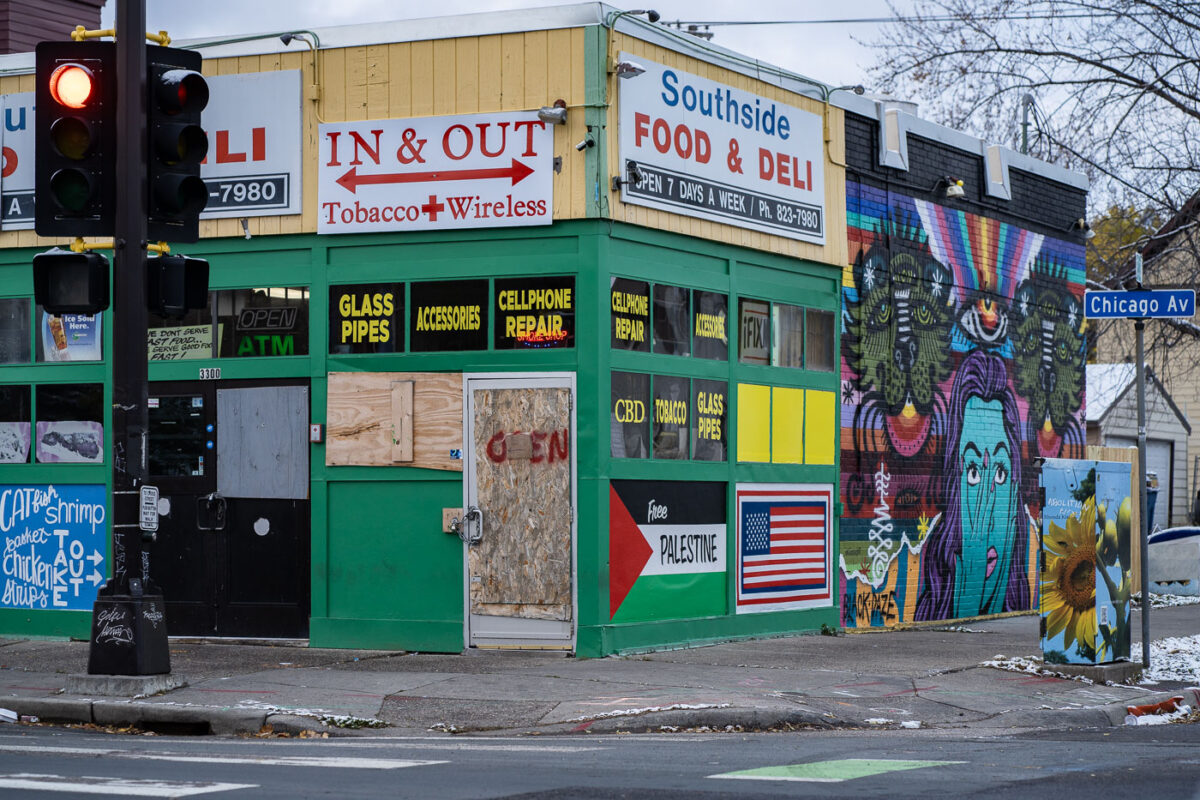
Southside Food & Deli In and Out Tobacco and Wireless
Southside Food & Deli, located at 3300 Chicago Avenue in South Minneapolis, is seen here with boarded-up windows and a "Free Palestine" flag displayed. The "In & Out Tobacco+Wireless" sign indicates the diverse retail offerings of the establishment. The presence of plywood over some storefronts and the flag suggest a context of recent unrest or protest, possibly related to the Minneapolis Uprising. The building's exterior is further adorned with vibrant street art, including a mural on the adjacent wall and a utility box featuring a sunflower design.

Southside Food & Deli, Chicago Ave, Minneapolis
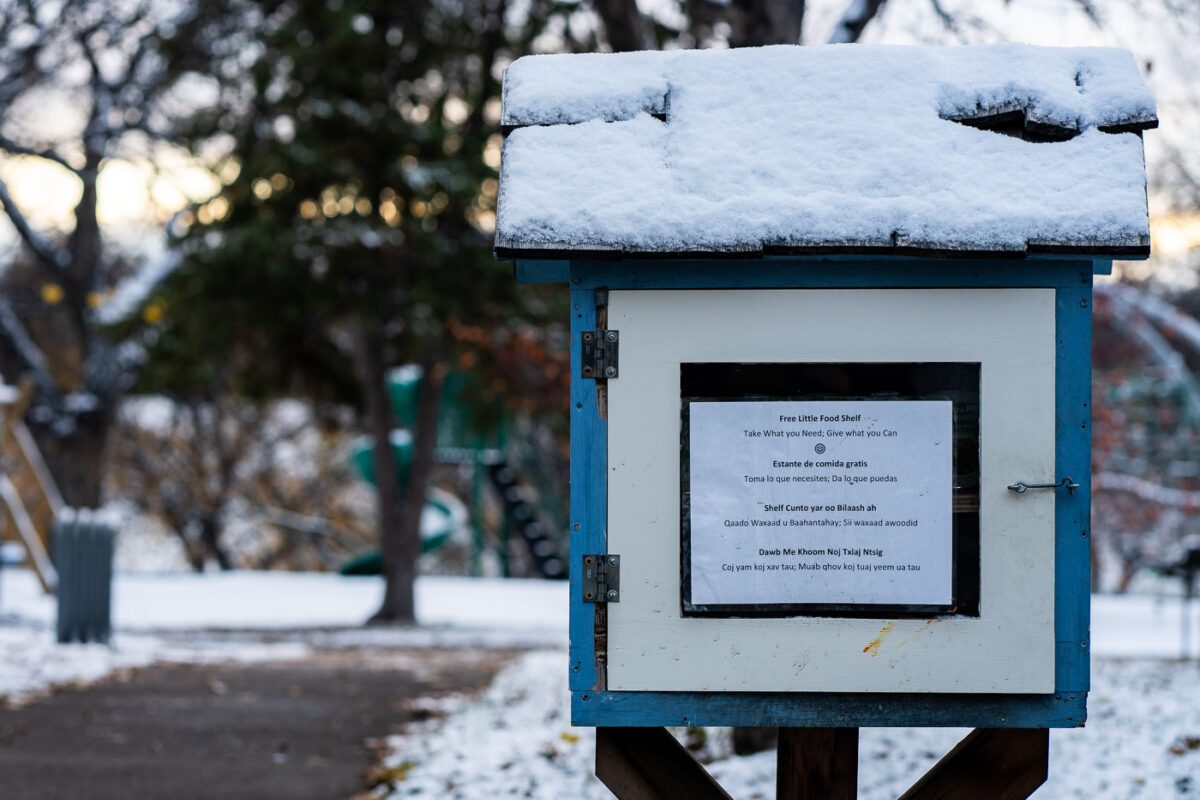
Free Little Food Shelf at Powderhorn Park
A Free Little Food Shelf stands in Powderhorn Park, Minneapolis, during the season's first snowfall. These community-run shelves operate on a

Free Little Food Shelf in Powderhorn Park During First Snowfall
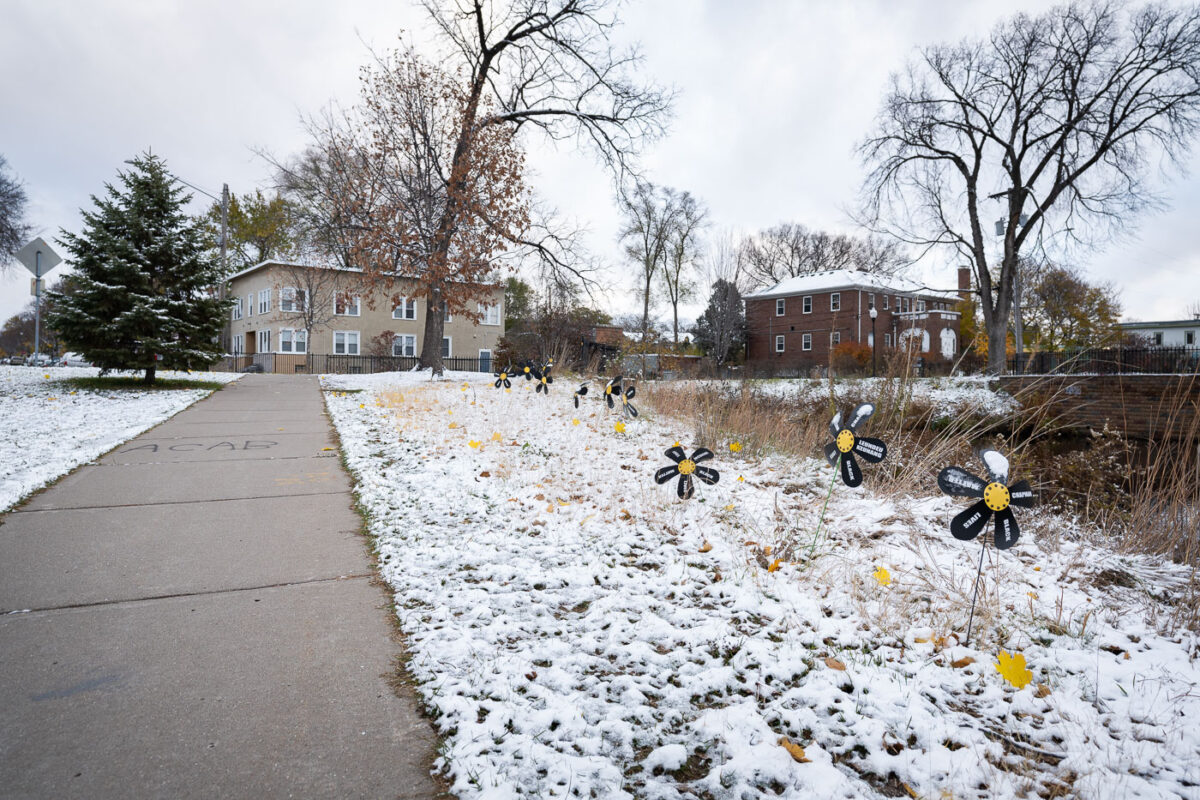
Say Their Names Memorial with seasons first snowfall
The Say Their Names Memorial, located in the vicinity of George Floyd Square in South Minneapolis, is seen here dusted with the first snowfall of the season. The memorial features black pinwheels, each inscribed with names of victims of racial injustice and police brutality, serving as a somber tribute. This site became a focal point for protests and activism following the murder of George Floyd in May 2020, and the memorial continues to be a place of remembrance and a symbol of the ongoing movement for racial equality.

First Snow at Say Their Names Memorial, George Floyd Square
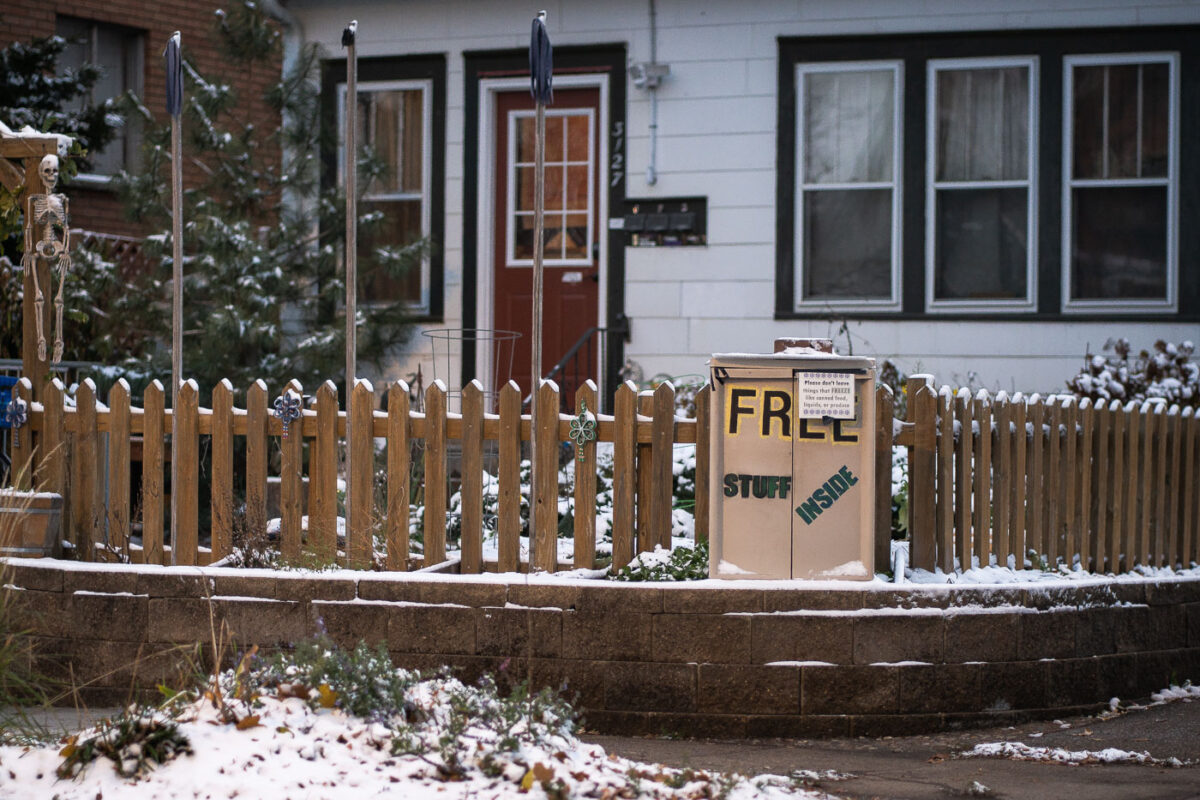
Neighborhood Free-Stuff Cabinet in Winter
A small handmade “Free Stuff Inside” cabinet sits beside a picket fence in a residential Minneapolis neighborhood, offering passersby clothing, household items, and other essentials at no cost. These volunteer-maintained boxes—modeled loosely after Little Free Pantries and similar mutual-aid projects—became common across the city in recent years as neighbors looked for practical ways to support one another. This particular cabinet shows signs of winter use, with a thin layer of snow on the ground and along the fence, emphasizing the year-round effort by residents to keep shared resources accessible. The rise of these informal exchange boxes reflects a broader culture of grassroots support systems that grew during the pandemic and the 2020 unrest. Neighbors created hyper-local networks for food, winter gear, and daily necessities, often improvising with whatever materials they had. Even a small cabinet like this served as a reliable touchpoint for people needing gloves, toiletries, or household supplies, helping strengthen the sense of community resilience in the city’s residential blocks.

Neighborhood Free-Stuff Cabinet in Winter

Powderhorn Park in Minneapolis on a snowy morning, with apartment buildings and the downtown skyline visible in the distance.
Powderhorn Park in South Minneapolis is seen here on the morning after the season's first snowfall. The park, established in 1889, is one of the city's oldest and most cherished public spaces, featuring a lake, playgrounds, and sports fields. The surrounding neighborhood includes a mix of historic homes and apartment buildings, with the downtown Minneapolis skyline visible in the distance. This early winter scene highlights the transition of the urban environment into its colder months.

Stairs at Powderhorn Park, Minneapolis: First Snowfall Morning

Powderhorn Park in Minneapolis on a snowy morning after the first snowfall of the season. The park, established in 1889, is a vital green space with a lake and walking paths.
Powderhorn Park in South Minneapolis is seen on the morning after the first snowfall of the season. Established in 1889, it is one of the city's oldest parks and a significant green space for the surrounding neighborhoods. The park features a lake, walking paths, and sports facilities, serving as a vital community hub throughout the year. This early winter scene highlights the park's natural beauty and its role in the daily lives of Minneapolis residents.

Powderhorn Park, Minneapolis: First Snowfall Morning

Powderhorn Park Playground in Minneapolis after the first snowfall, featuring a snow-covered insect-shaped spring rider.
Powderhorn Park Playground After First Snowfall, Minneapolis. The park, established in 1889, is one of Minneapolis's oldest and most cherished public spaces. Its playground equipment, including this spring rider shaped like an insect, provides a place for children's activity. The first snowfall of the season blankets the playground, offering a quiet contrast to its usual lively atmosphere.

Powderhorn Park Playground After First Snowfall, Minneapolis
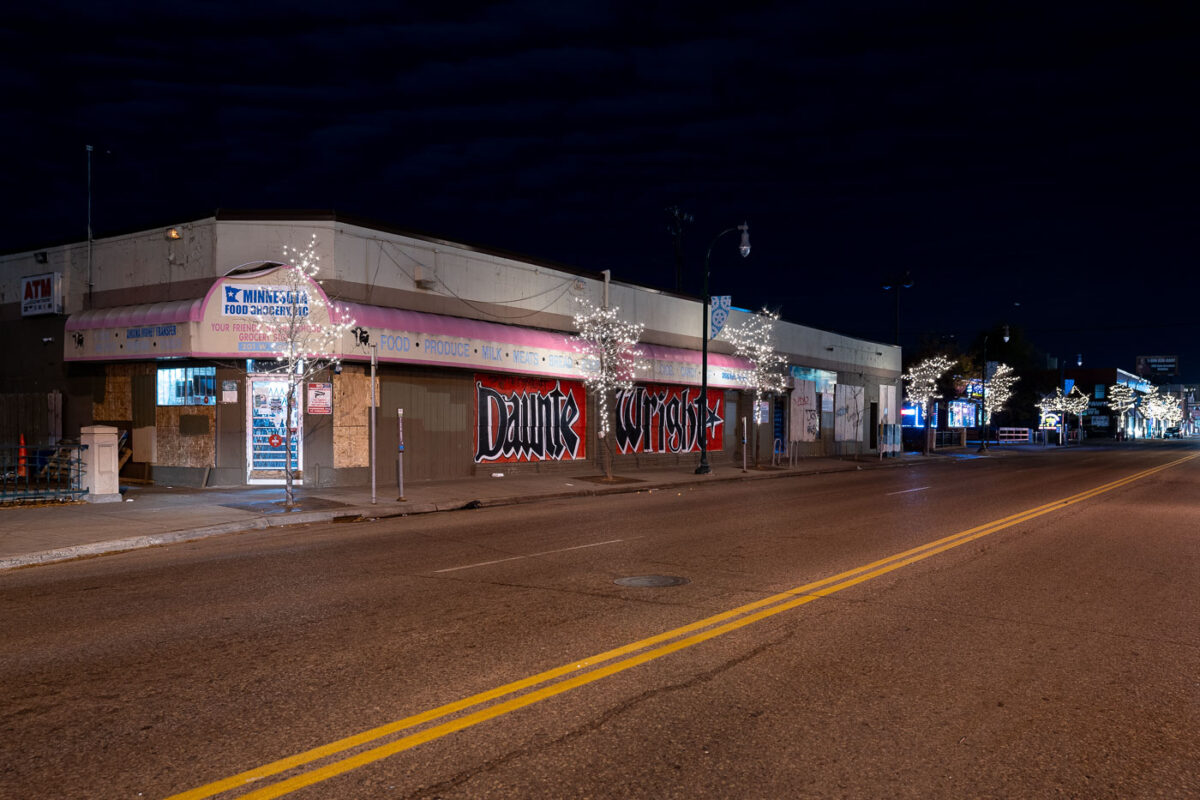
Daunte Wright Mural and Lake Street at night
A mural honoring Daunte Wright is displayed on Lake Street in Minneapolis. The mural appeared following Wright's death on April 11, 2021, during a traffic stop in nearby Brooklyn Center. The trial for former Brooklyn Center police officer Kimberly Potter, who was charged with first and second-degree manslaughter in connection with Wright's death, was scheduled to begin on November 30th of the same year. The mural is painted on the boarded-up storefront of a business on Lake Street, a commercial corridor that experienced significant damage and unrest following Wright's killing and the murder of George Floyd in 2020.

Daunte Wright Mural on Lake Street, Minneapolis at Night

Hum's Liquors neon sign on Lyndale Avenue in Minneapolis.
Hum's Liquors on Lyndale Avenue in Minneapolis is identified by a large neon sign with the words “FAST SERVICE.” The sign is mounted above the storefront and includes red lettering with a field of small white bulbs. A second neon sign is partially visible along the building edge.

Hum’s Liquors Neon Sign, Lyndale Avenue, Minneapolis

Electric Fetus sign at 2000 4th Ave S in Minneapolis.
Electric Fetus at 2000 4th Avenue South in Minneapolis is an independent record store established in 1968. The store is known for new and used vinyl records, CDs, and music memorabilia. Its large exterior sign includes the store name and address.

Electric Fetus Sign, 2000 4th Ave S, Minneapolis

The illuminated Minneapolis Hostel sign is visible at night, marking a location for affordable lodging in the city.
A sign for the Minneapolis Hostel is illuminated at night. Hostels provide affordable lodging, often to travelers and backpackers, serving as a communal space for visitors to a city. This establishment offers accommodation within Minneapolis, a major cultural and economic hub in the Upper Midwest. The sign's prominent placement indicates its function as a navigational marker for those seeking temporary housing.

Minneapolis Hostel Sign at Night

Speedway gas station and Hum's Liquors Wine & Spirits on Lyndale Ave, Minneapolis at night, with a Metro Transit bus shelter visible.
A Speedway gas station and "Hum's Liquors Wine & Spirits" store are visible at night on Lyndale Avenue in Minneapolis, Minnesota. The Speedway station displays current fuel prices, indicating its function as a retail fuel provider. Adjacent to it, the "Wine & Spirits" store, with its neon signage, serves as a local retail establishment. The presence of a Metro Transit bus shelter suggests this is a location with public transportation access, serving the daily needs of the surrounding community.

Speedway Gas Station and Wine & Spirits on Lyndale Ave, Minneapolis

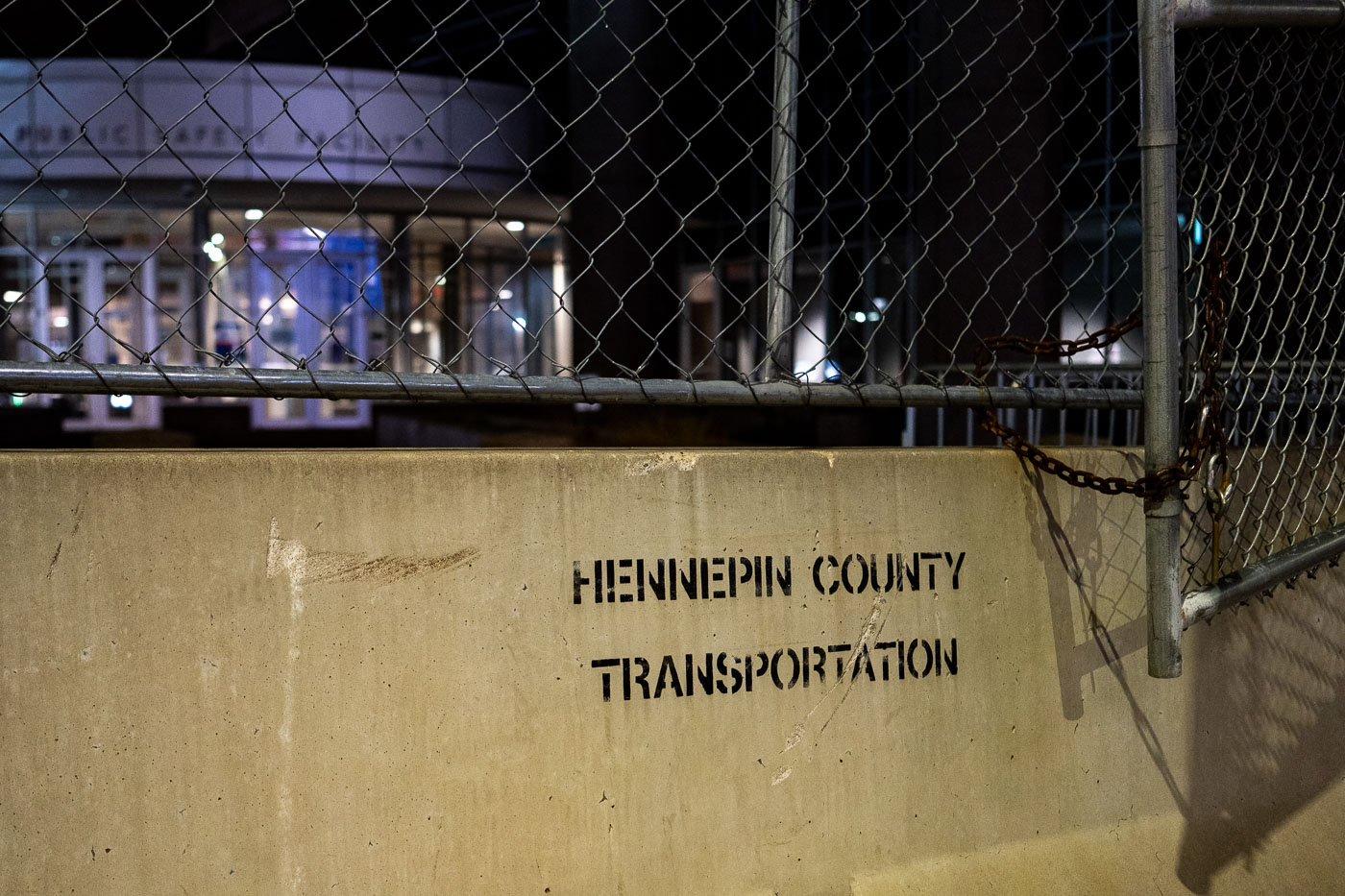
Fencing around Hennepin Public Safety Facility
Security fencing surrounds the Hennepin County Jail in downtown Minneapolis, as seen prior to the Kim Potter trial. The fencing was erected in anticipation of protests related to the trial of Kim Potter, who was accused of killing Daunte Wright. The concrete barrier in the foreground is marked "Hennepin County Transportation," indicating its proximity to transportation infrastructure or facilities managed by the county.

Hennepin County Jail Security Fencing, Minneapolis
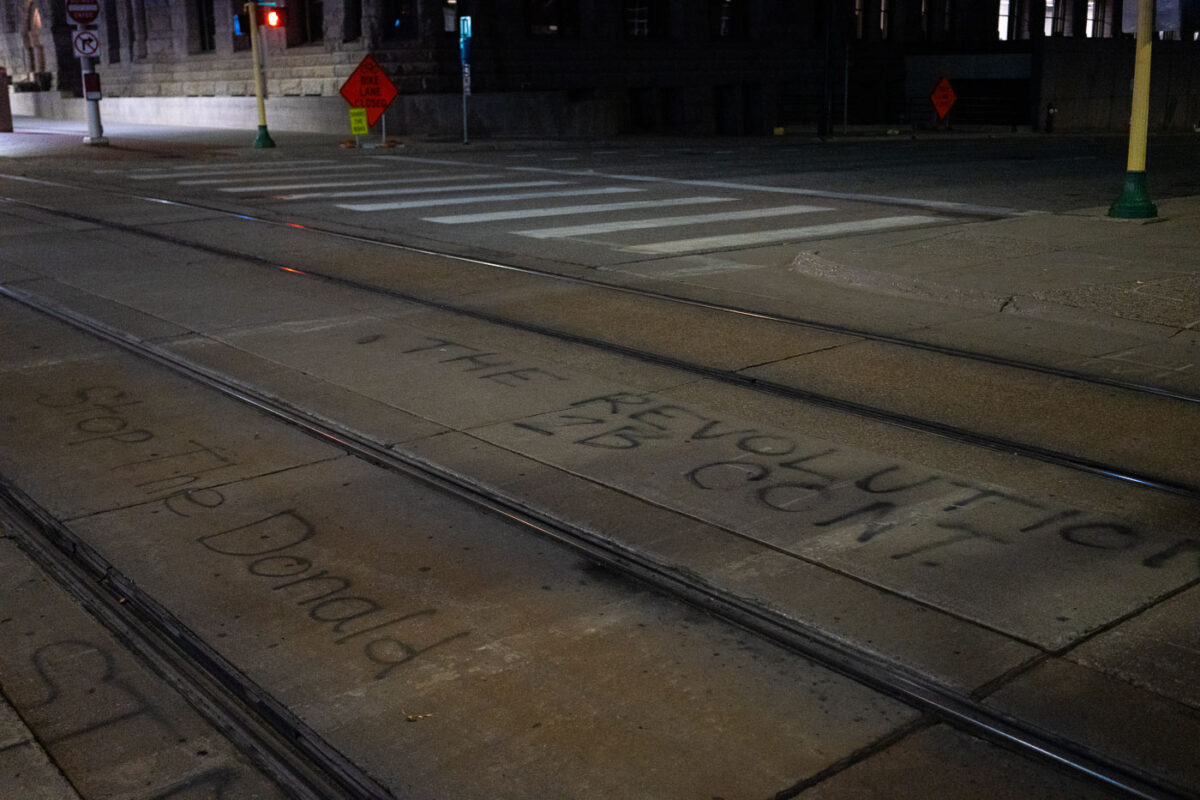
Graffiti on light rail tracks in Downtown Minneapolis
Graffiti reading "The Revolution Continues" and "Stop The Donald" is spray-painted on the light rail tracks outside the Hennepin County Public Safety Facility in downtown Minneapolis. These messages appeared during the period of civil unrest in the city following the murder of George Floyd in May 2020. The Minneapolis Uprising saw widespread protests and activism, with graffiti becoming a common form of expression on public spaces and infrastructure throughout the downtown area.

Graffiti on Minneapolis Light Rail Tracks: “The Revolution Continues”
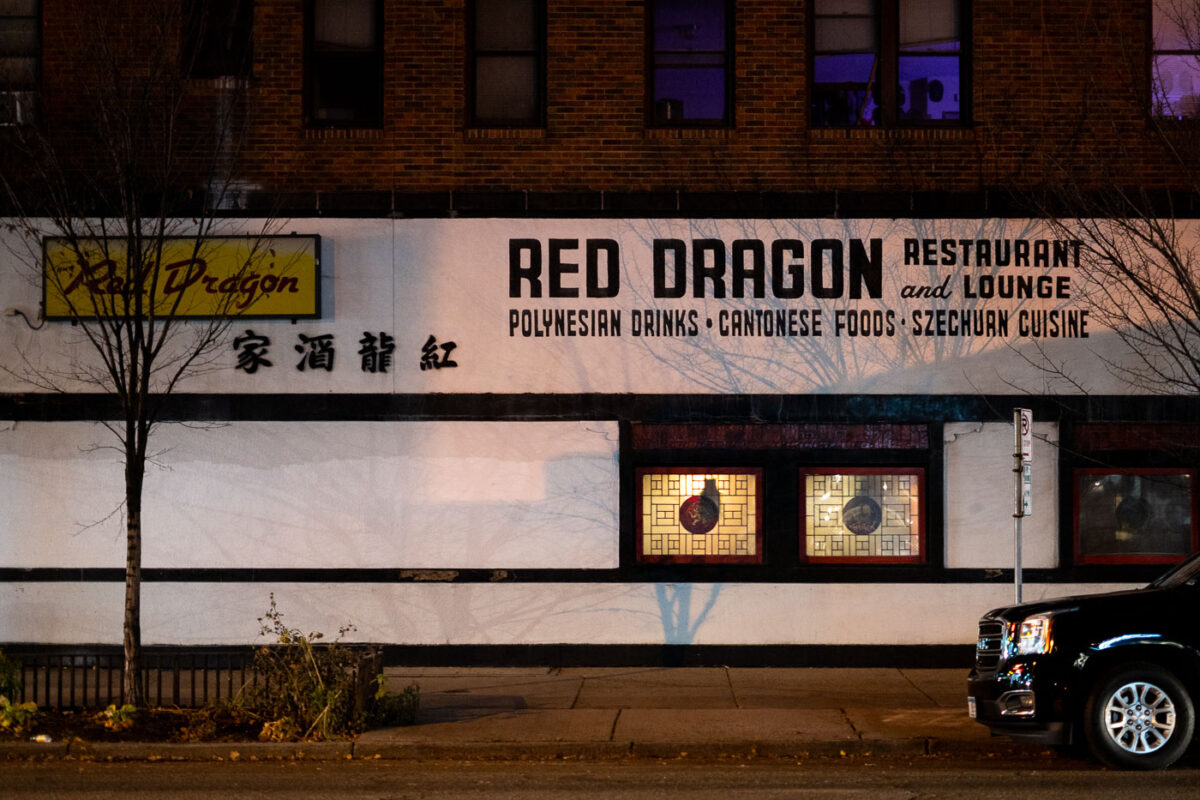
Red Dragon Restaurant and Lounge in Minneapolis
The Red Dragon Restaurant and Lounge, located on Lyndale Avenue in Minneapolis, offers Polynesian drinks, Cantonese foods, and Szechuan cuisine. The establishment's signage, featuring both English and Chinese characters, indicates its long-standing presence in the community. This building, with its brick facade and distinct storefront windows, contributes to the urban landscape of the area. The restaurant has been a part of the Lyndale Avenue corridor, a significant commercial and cultural artery in Minneapolis.

Red Dragon Restaurant and Lounge, Lyndale Ave, Minneapolis
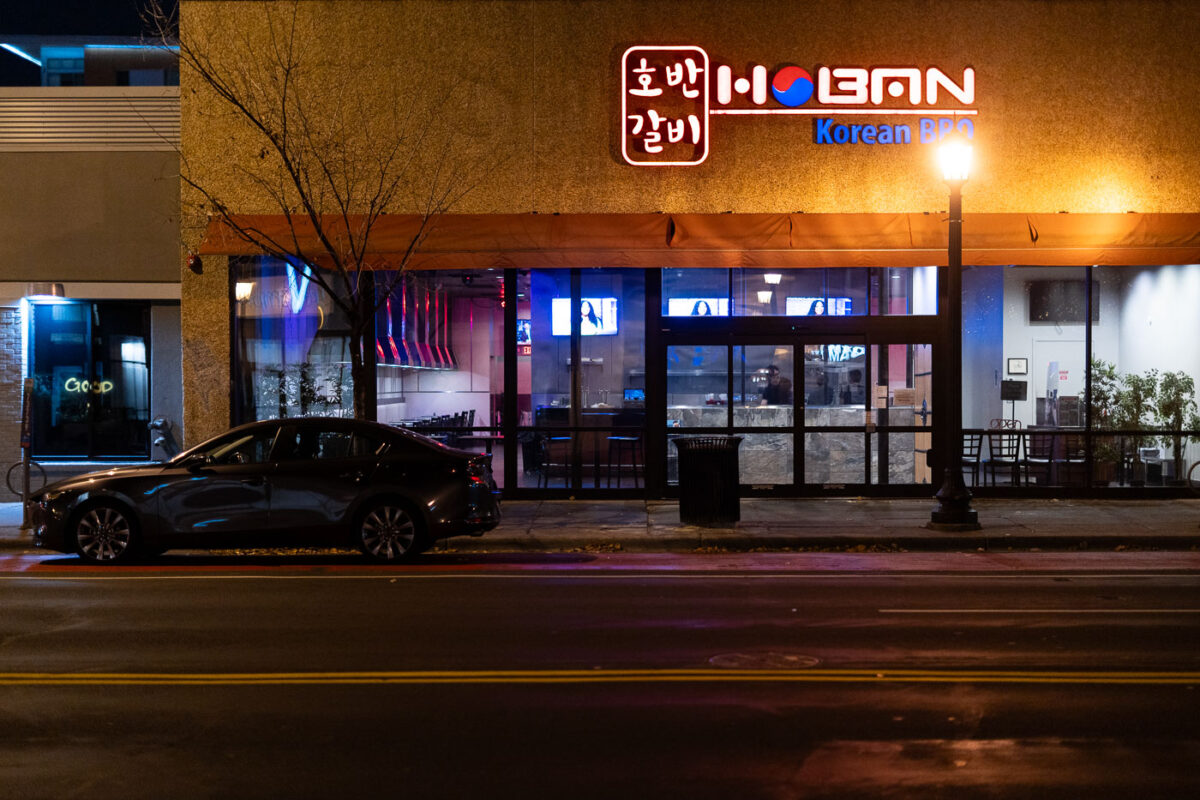
Hoban Korean BBQ in Uptown Minneapolis
Hoban Korean BBQ is located on Hennepin Avenue in the Uptown neighborhood of Minneapolis. The restaurant offers Korean barbecue, a dining experience where patrons grill marinated meats at their tables. Uptown Minneapolis is a vibrant commercial and residential district known for its eclectic mix of shops, restaurants, and entertainment venues. Hennepin Avenue serves as a major thoroughfare through the city, historically hosting a variety of businesses and cultural institutions.

Hoban Korean BBQ, Hennepin Ave, Uptown Minneapolis
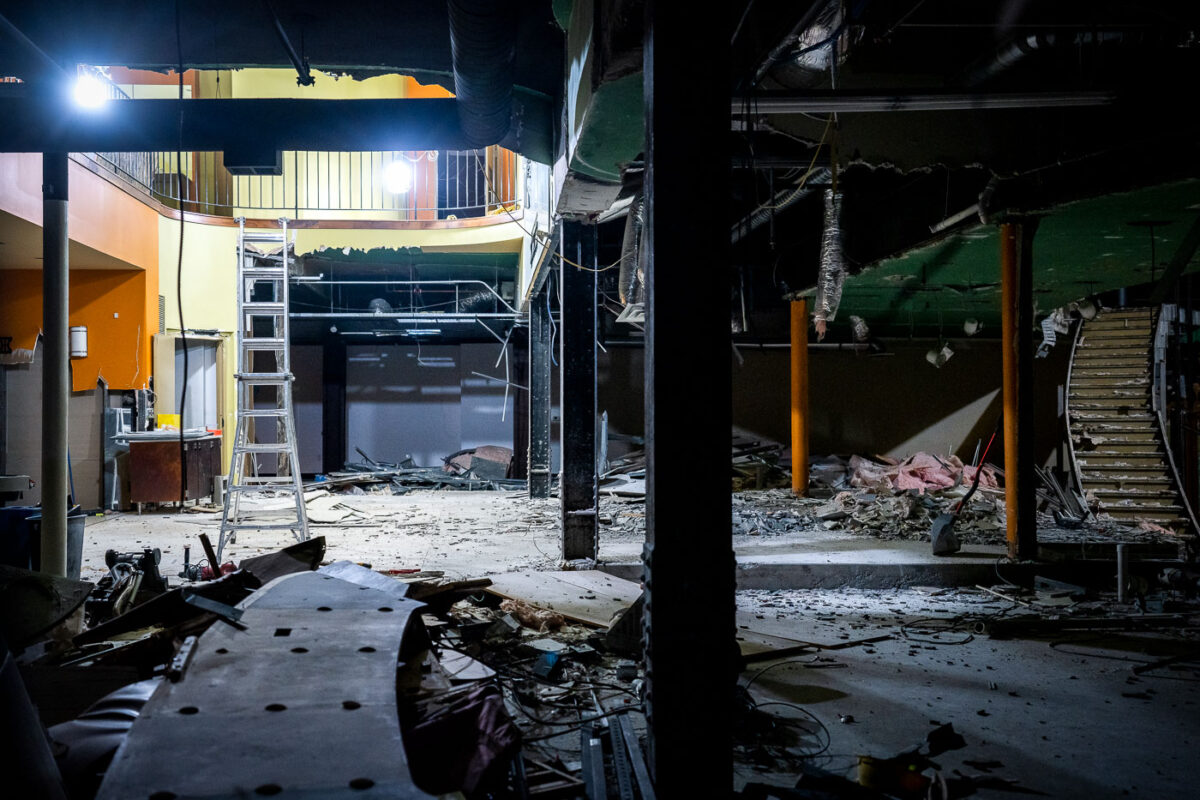
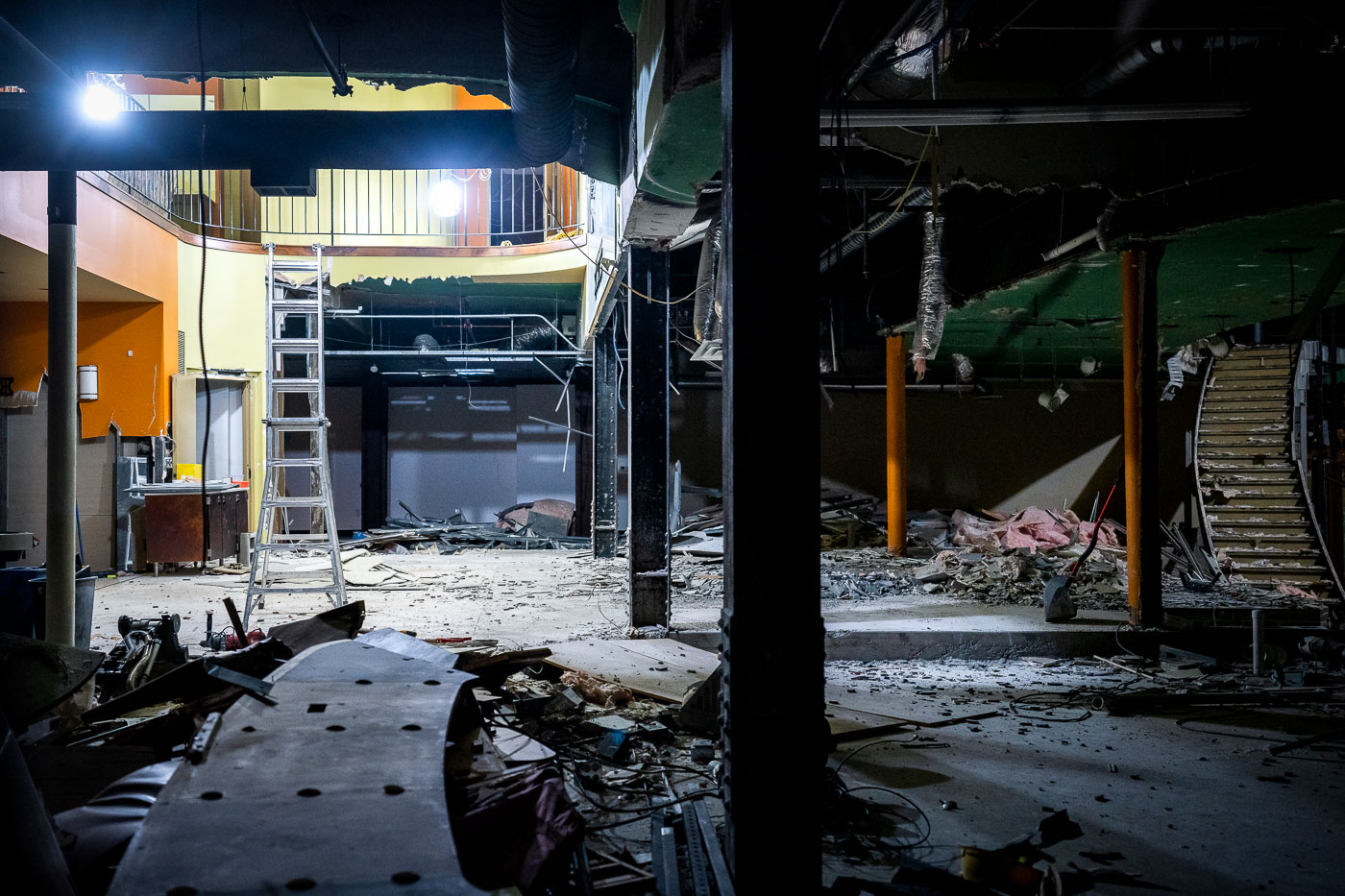
Construction ongoing at the Uptown Theater
Demolition is underway at the former Uptown Theater in Minneapolis, a landmark that opened in 1926. The theater, located on Hennepin Avenue, was a significant cultural hub for the Uptown neighborhood for decades. Its closure and subsequent demolition mark the end of an era for this historic entertainment venue. The ongoing construction signifies a transformation of the site, though the specific future use remains to be seen.

Uptown Theater interior demolition, Minneapolis
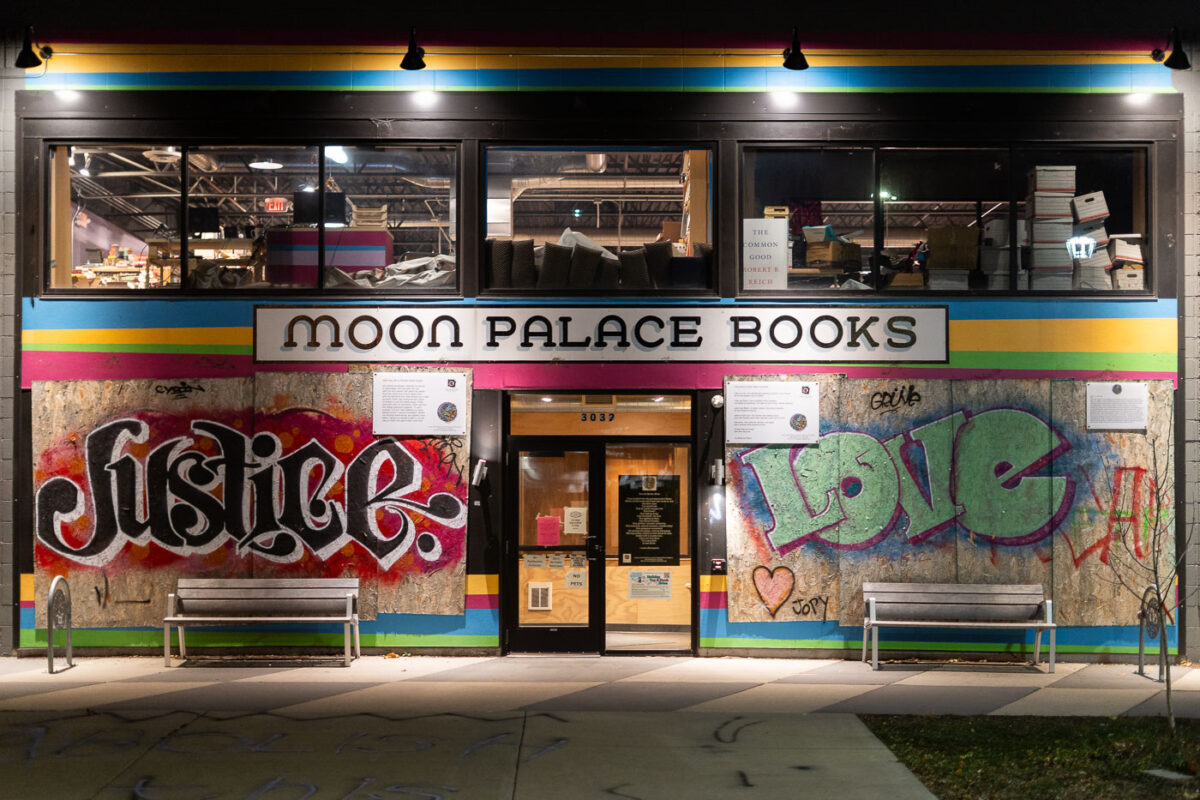
Justice and Love at Moon Palace Books Minneapolis
Graffiti art reading "Justice" and "Love" adorns the boarded-up facade of Moon Palace Books in South Minneapolis. The boards were installed in May 2020, following the murder of George Floyd, as a protective measure for businesses in the area. Moon Palace Books notably refused to allow police to stage on their property during the subsequent protests, instead offering their space as a medic station for injured individuals. The "Abolish The Police" message, previously displayed on banners and boards, reflects the sentiment of many during the Minneapolis Uprising.

Moon Palace Books Minneapolis: Justice and Love Graffiti
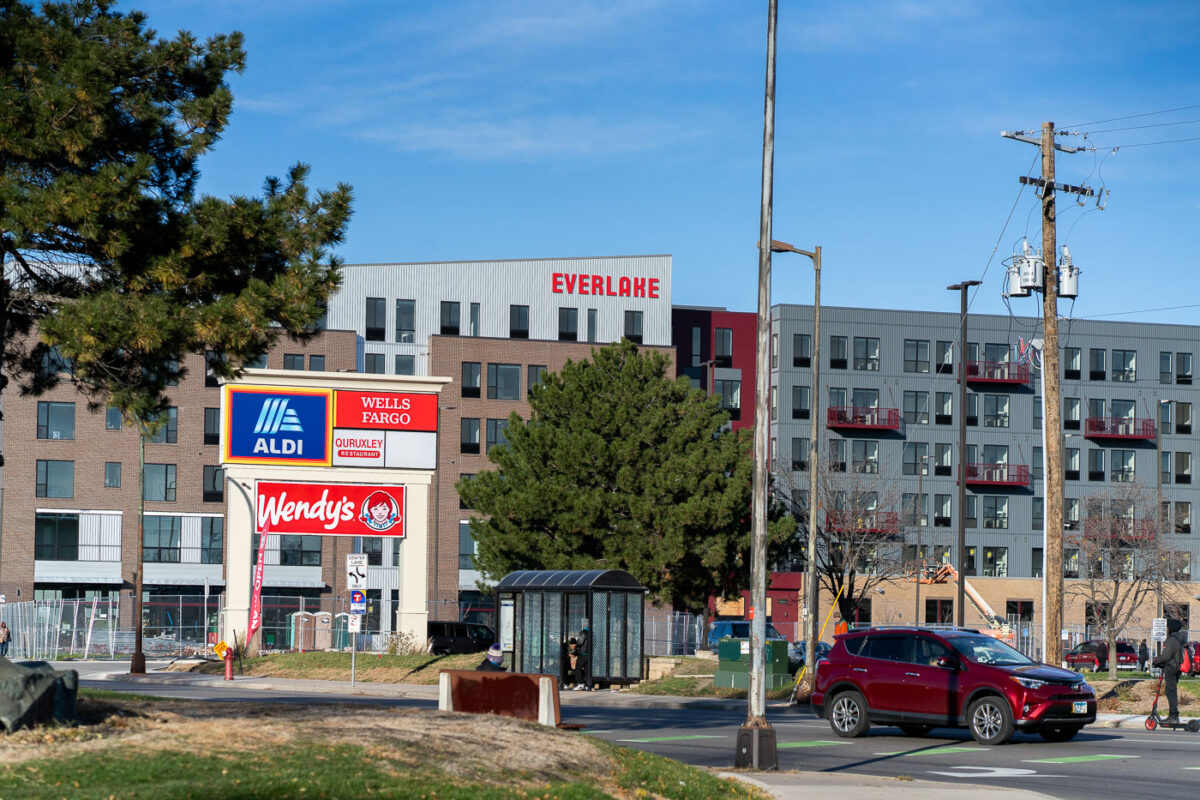
Everlake sign goes up at Midtown Corner
The Everlake apartment complex, located at Midtown Corner in Minneapolis, displays its prominent signage. This development was constructed on the site of buildings that were damaged or destroyed during the 2020 Minneapolis uprising. The Everlake apartments are marketed as offering "cultural charisma" and "urban connectivity" to residents, aiming to integrate into the Lake Street community.

Everlake Apartments Signage at Midtown Corner, Minneapolis
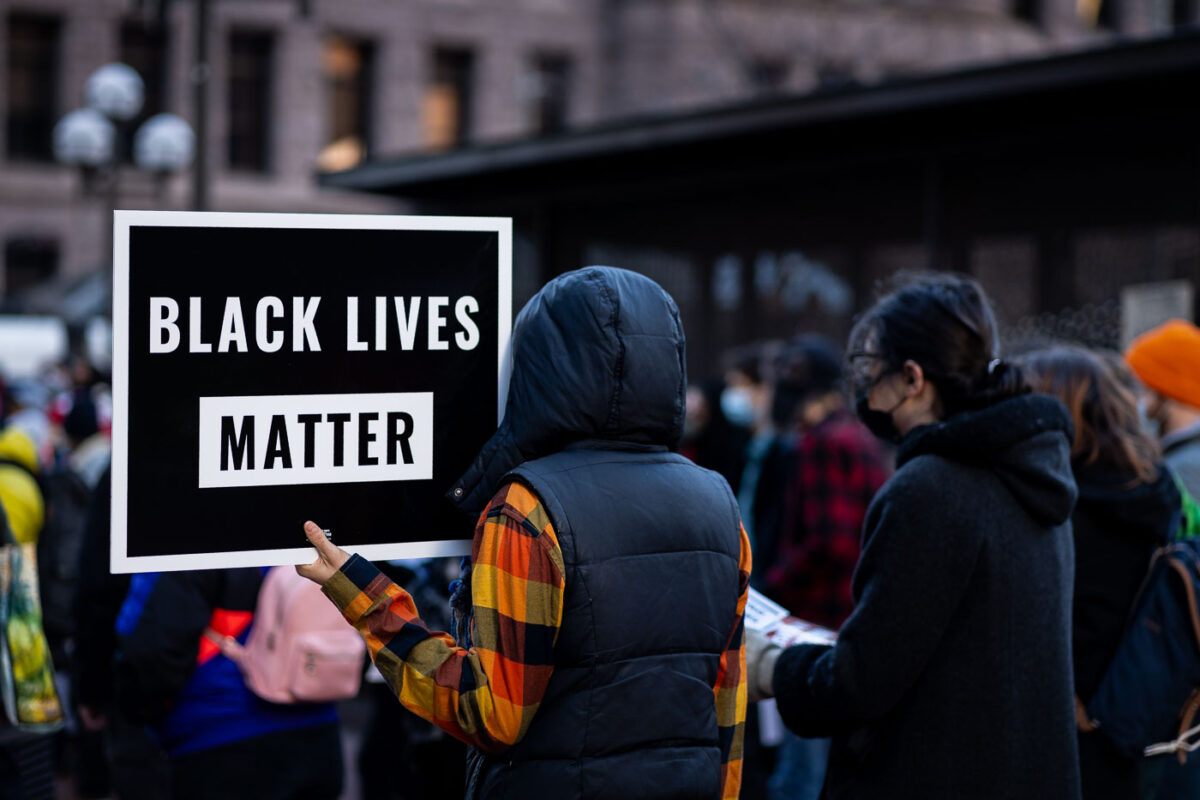
Protester holds Black Lives Matter sign in Downtown Minneapolis
Protesters gathered outside the Hennepin County Government Center in Minneapolis, holding signs that read "Black Lives Matter." This movement, which gained national prominence in 2013, advocates for the rights and liberation of Black people. The Government Center, a significant civic building in downtown Minneapolis, has been a focal point for various public gatherings and protests, reflecting its role as a center of local governance and public discourse.

Black Lives Matter Protest at Hennepin County Government Center, Minneapolis
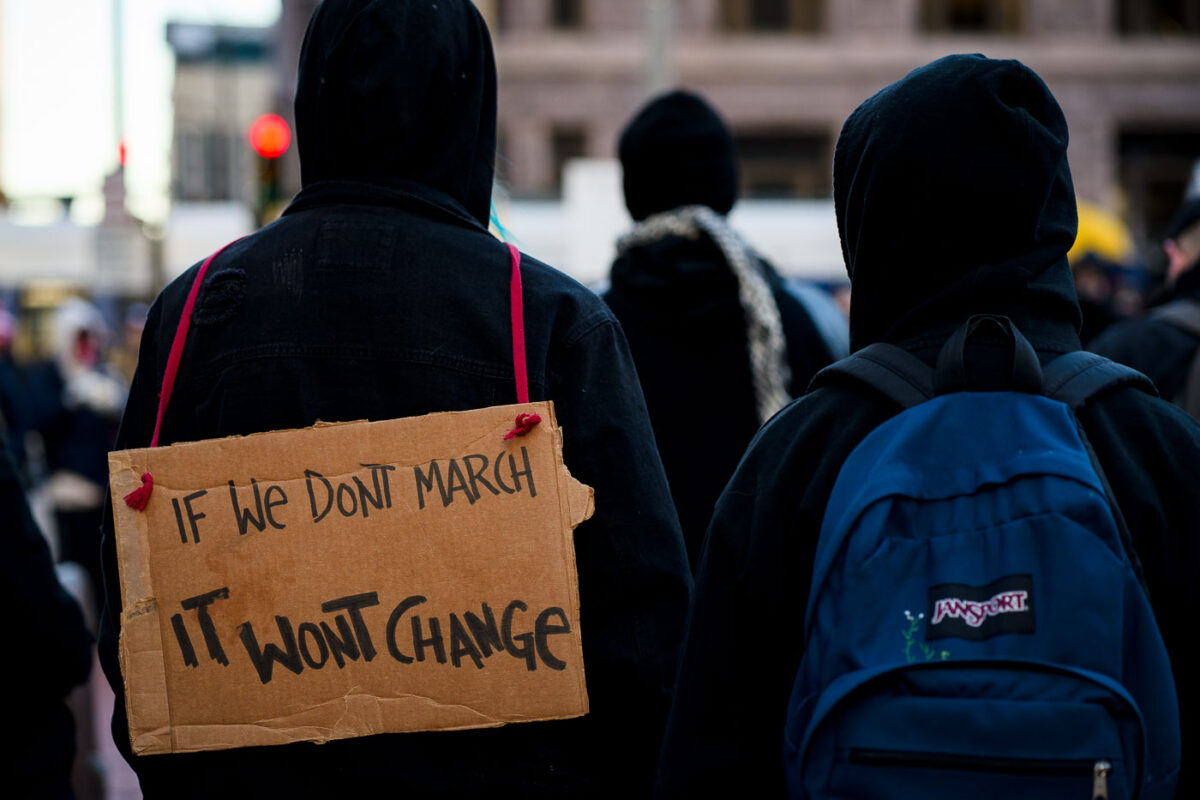
Kyle Rittenhouse protest in Downtown Minneapolis
Protesters gathered in downtown Minneapolis following the acquittal of Kyle Rittenhouse on November 19, 2021. The verdict in the Kenosha, Wisconsin trial came after Rittenhouse was charged with homicide and other offenses related to fatal shootings during protests in August 2020. The sign held by a protester reads, "IF WE DONT MARCH IT WONT CHANGE," reflecting a sentiment of continued activism and a demand for systemic change.

Minneapolis Protest After Rittenhouse Verdict
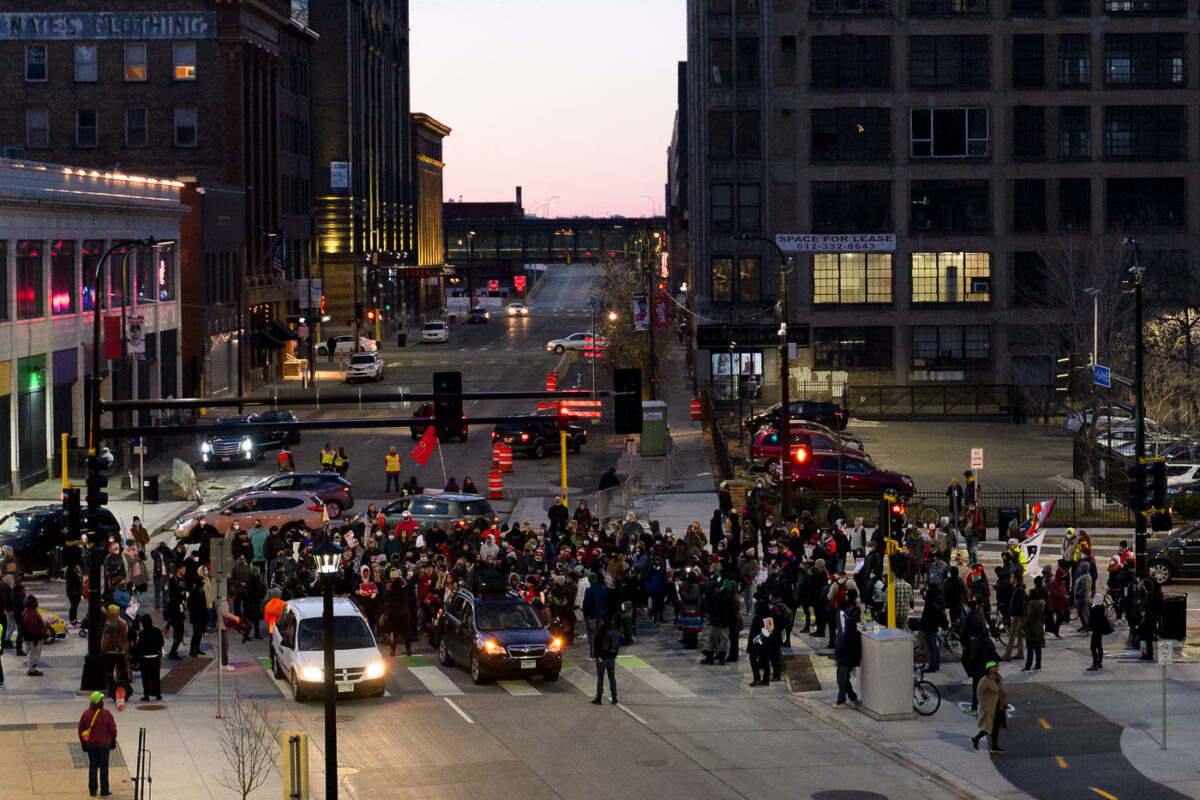
Kyle Rittenhouse protesters march in Downtown Minneapolis
Protesters gathered in downtown Minneapolis on November 20, 2021, following the acquittal of Kyle Rittenhouse. The march took place the day after the verdict was delivered in Kenosha, Wisconsin, where Rittenhouse was found not guilty of all charges related to the fatal shootings during protests in August 2020. This event in Minneapolis reflects the broader national reaction and ongoing discussions surrounding racial justice and self-defense laws.

Downtown Minneapolis Protest After Rittenhouse Verdict
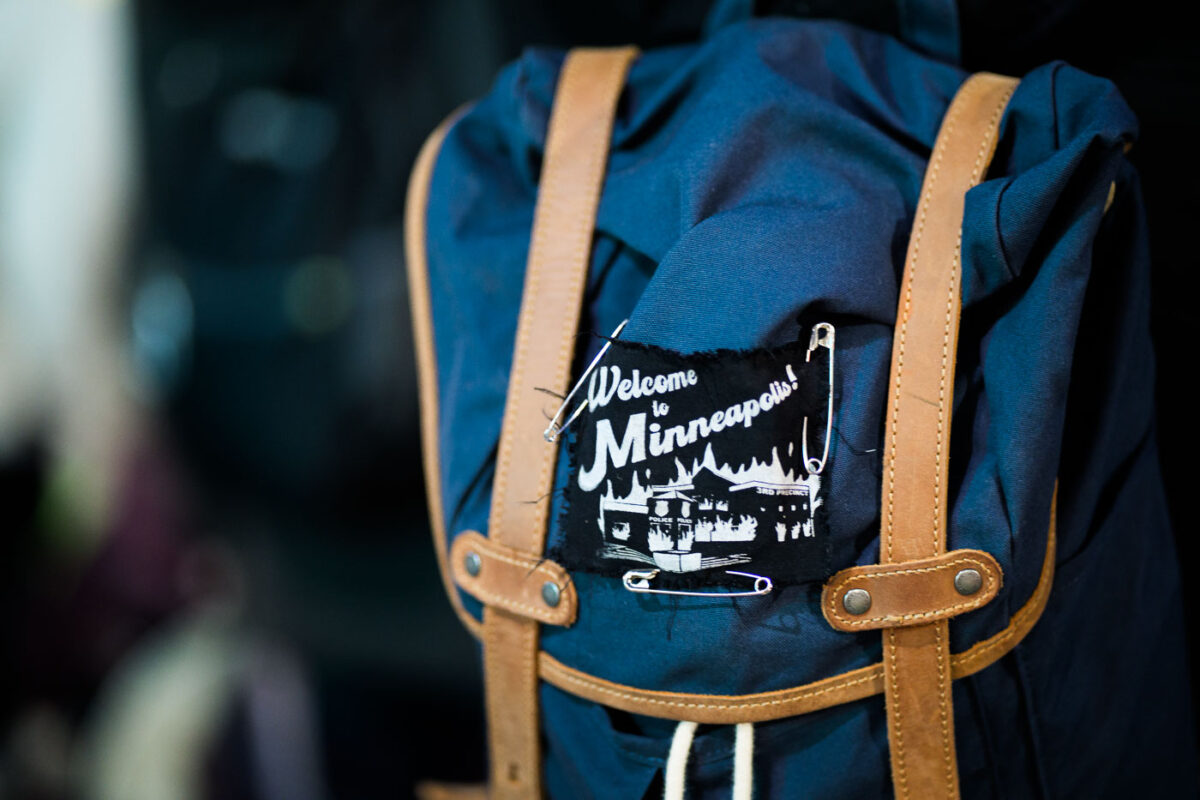
Welcome to Minneapolis patch on protesters backpack
A protester's backpack displays a patch reading "Welcome to Minneapolis!" above an image of the Minneapolis Police Department's 3rd Precinct building engulfed in flames. This patch was likely created in response to the unrest and protests that followed the murder of George Floyd in May 2020, and the subsequent burning of the 3rd Precinct building. The image was taken during a march in Downtown Minneapolis following the acquittal of Kyle Rittenhouse in November 2021, a period marked by continued public discourse and activism surrounding policing and justice in the city.

Minneapolis 3rd Precinct Patch on Protester Backpack
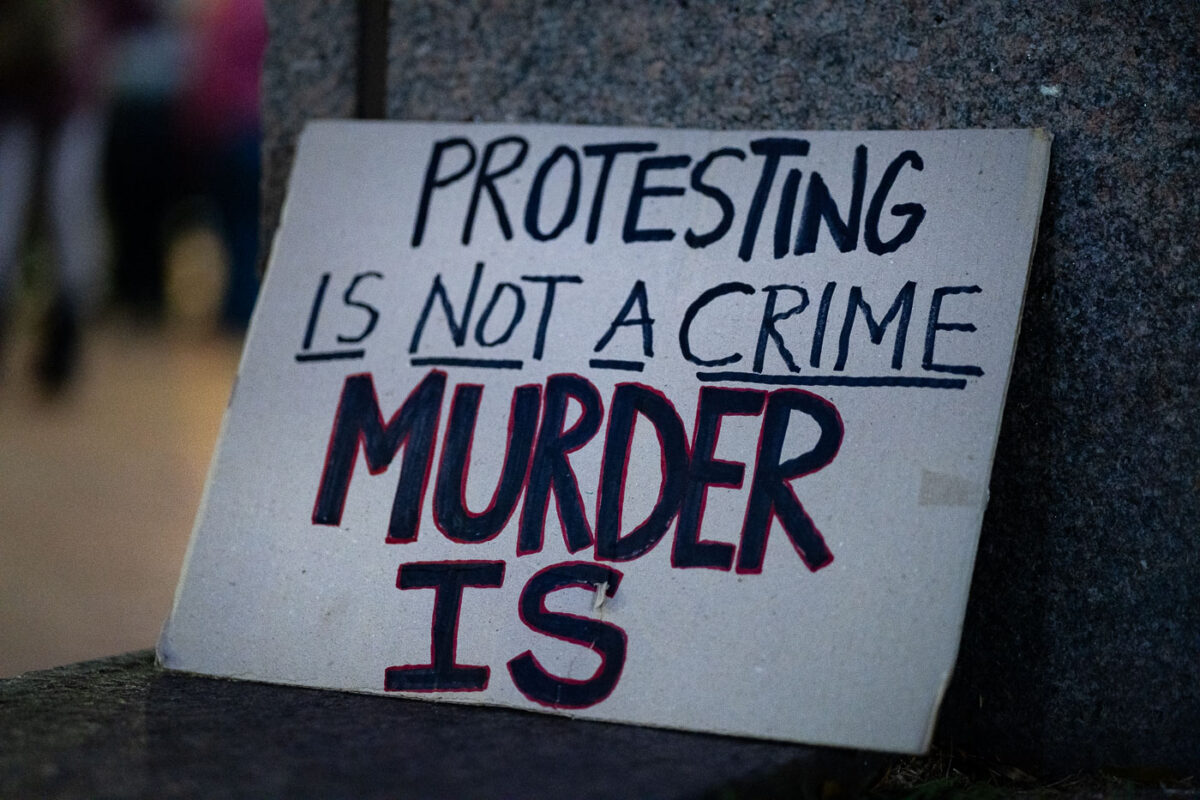
Protesting is not a crime protest sign
A handmade sign reading "Protesting is Not a Crime, Murder Is" was displayed during a protest in Downtown Minneapolis. The sign reflects sentiments expressed during protests related to the Kyle Rittenhouse trial, which took place in November 2021. The Rittenhouse case involved charges stemming from fatal shootings during protests in Kenosha, Wisconsin, in August 2020. This message highlights the protesters' view that exercising the right to protest is fundamental, contrasting it with acts of violence.

Minneapolis Protest Sign: Protesting is Not a Crime, Murder Is

An Antifascist Action flag is carried during a protest in downtown Minneapolis following the Kyle Rittenhouse verdict in November 2021.
An Antifascist Action flag is carried by a protester in Downtown Minneapolis following the November 2021 verdict in the Kyle Rittenhouse trial. The flag, a symbol of anti-fascist movements, was visible among demonstrators expressing their dissent. The protest took place in the urban environment of Minneapolis, a city that has seen numerous public gatherings and civic actions. The Rittenhouse verdict, which acquitted the teenager of charges related to the deaths of two men and the injury of another during protests in Kenosha, Wisconsin, sparked widespread reactions and protests across the United States.

Antifascist Action flag at Minneapolis protest after Rittenhouse verdict
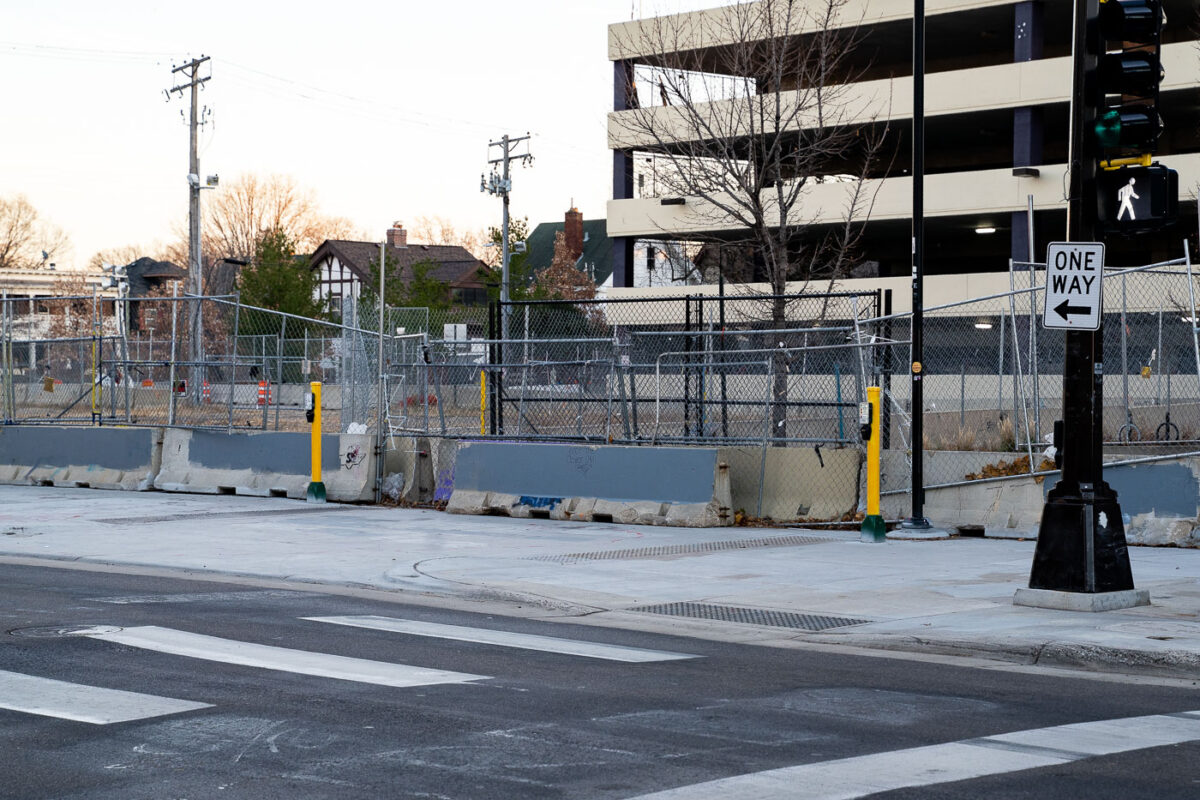
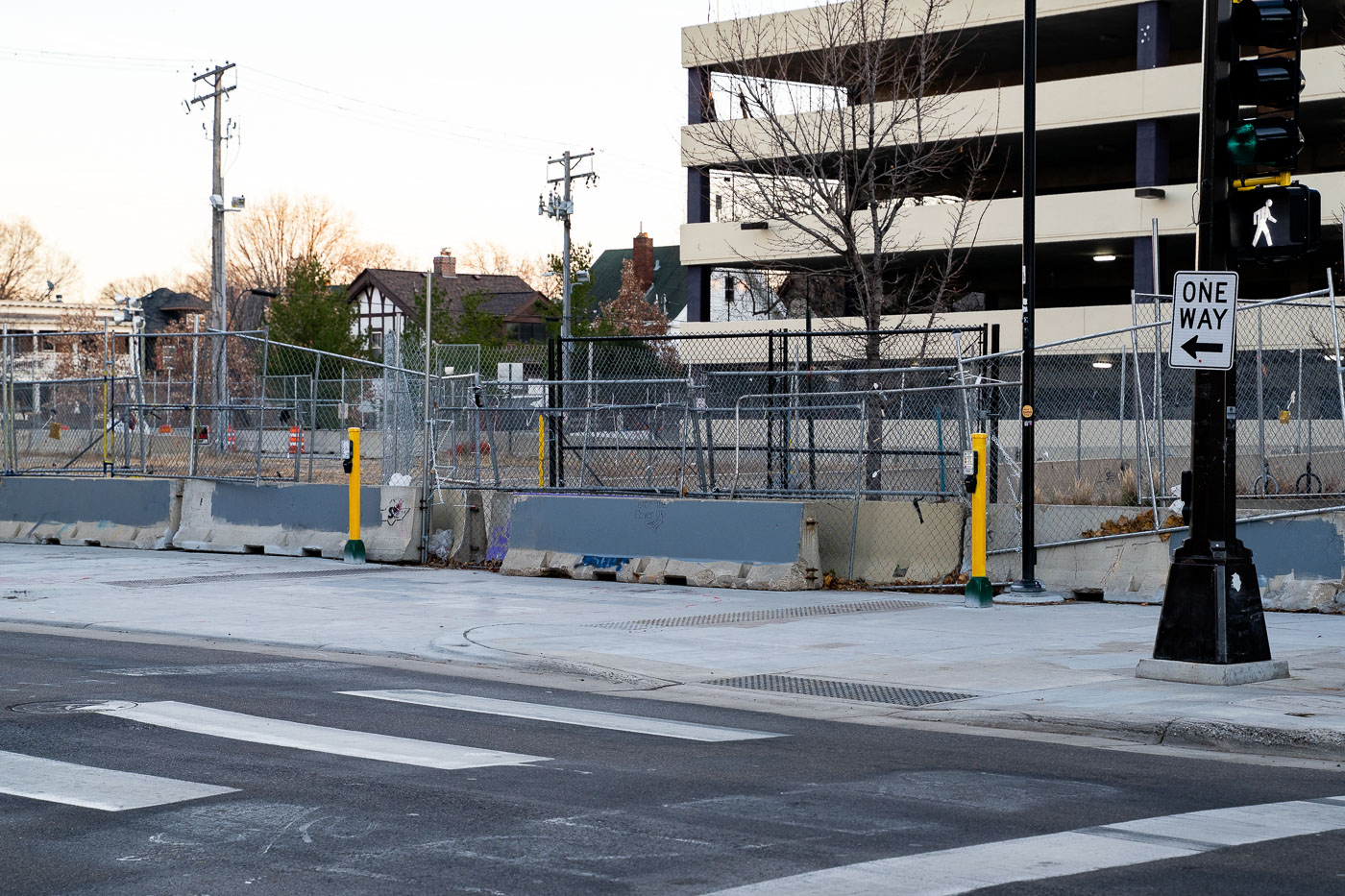
Security fencing around Seven Points Mall in November 2021
Temporary security fencing and concrete barriers were erected around the Lake & Girard parking garage in Minneapolis in November 2021. This structure, adjacent to Seven Points Mall, was the site where Winston Smith Jr. was killed by law enforcement in June 2021. The security measures were implemented following protests and unrest in the city, reflecting a heightened security presence in the area.

Seven Points Mall Parking Garage Security Fencing, Minneapolis
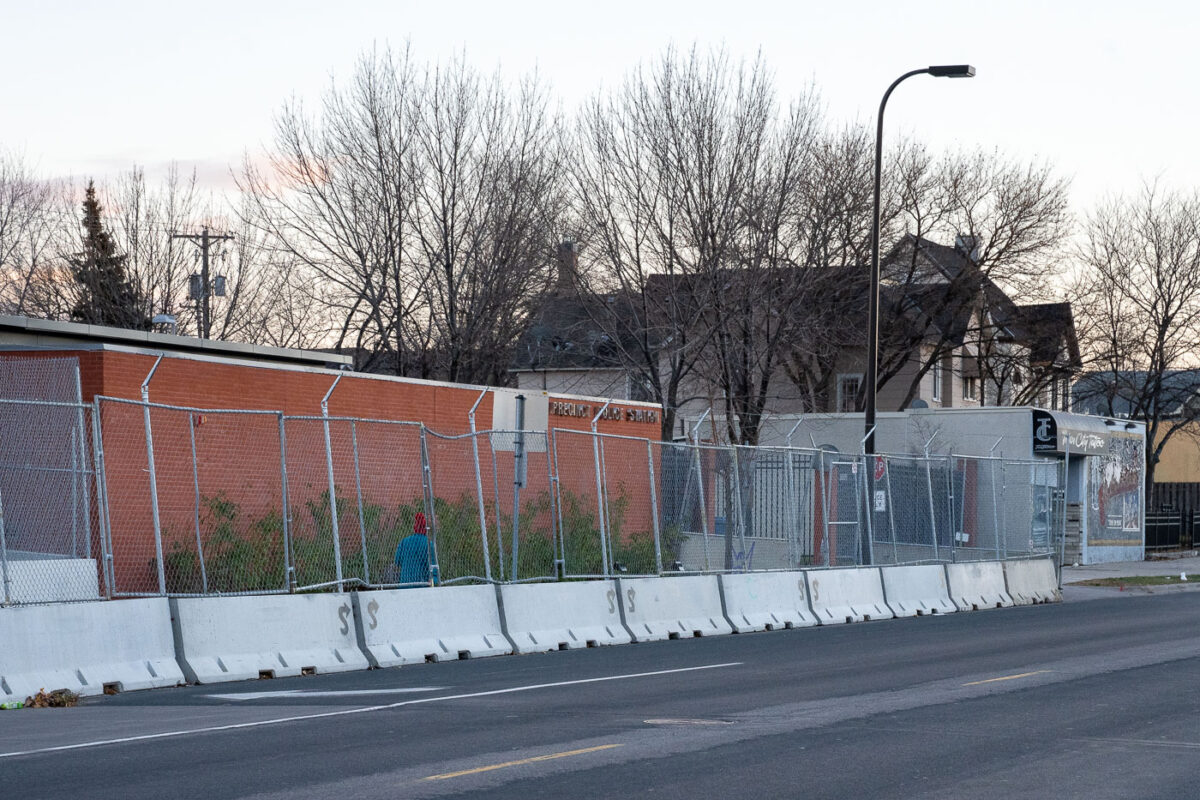
Minneapolis Police Fifth Precinct behind chain link fencing
The Minneapolis Police Fifth Precinct, located on Nicollet Avenue in South Minneapolis, is shown fortified with security fencing and concrete barriers. This measure was implemented in response to the civil unrest and protests that followed the murder of George Floyd in May 2020. The precinct, like many other public buildings in the area, became a focal point during the Minneapolis Uprising and required enhanced security to protect its facilities and personnel. The barriers serve as a physical deterrent and a symbol of the heightened security measures enacted during a period of significant social and political upheaval.

Minneapolis Police 5th Precinct Secured by Fencing and Barriers
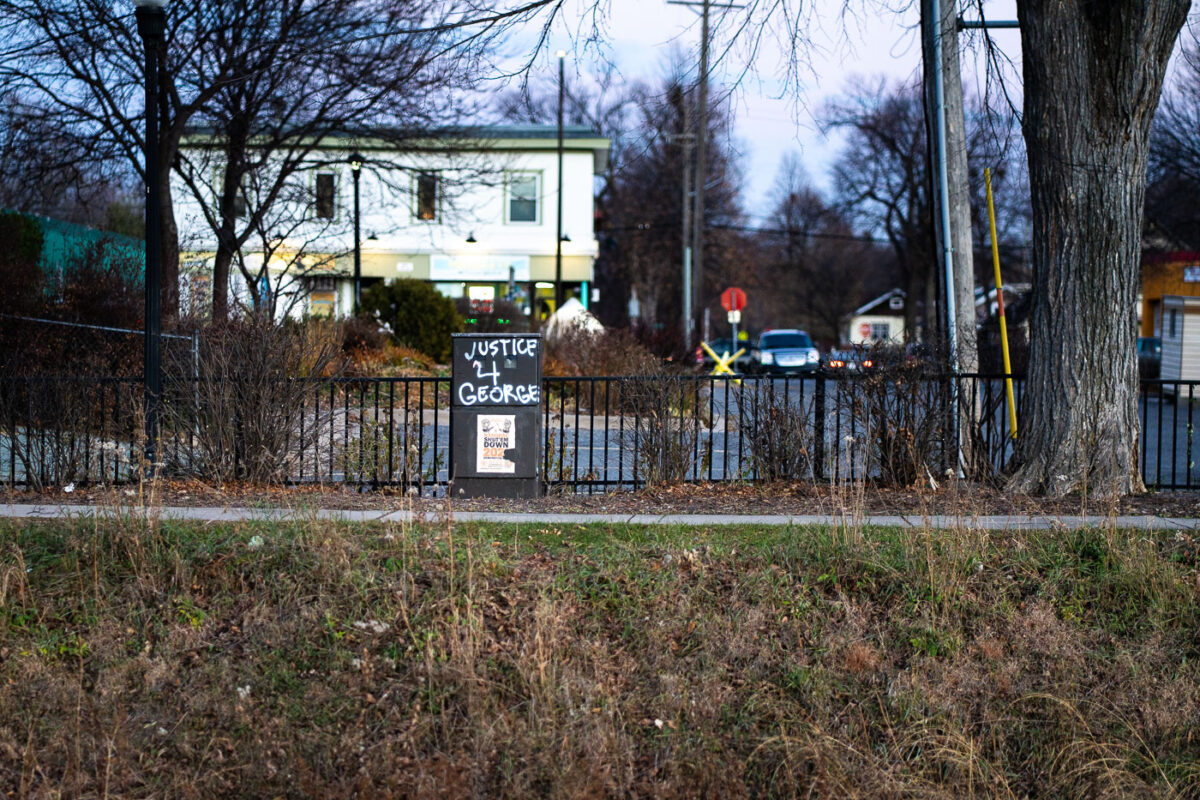
Justice 4 George at Columbus and 38th St
Graffiti reading "Justice 4 George" is spray-painted on a utility box in South Minneapolis. This message appeared in the context of widespread protests and unrest following the murder of George Floyd by Minneapolis police officers on May 25, 2020. The location, near 38th Street, is significant as it is close to the site of Floyd's death and became a focal point for activism and community organizing. Utility boxes, common elements of urban infrastructure, often become canvases for public expression during times of social and political upheaval.

Justice 4 George Graffiti on Utility Box, Minneapolis

Printed justice demands for George Floyd Square displayed in Minneapolis
A printed list of justice demands for George Floyd Square is displayed in Minneapolis. The document calls for the recall of Hennepin County Attorney Mike Freeman and for accountability from employees of the Minnesota Bureau of Criminal Apprehension. It also asks for accountability in several police killings cases, including those of Christopher Burns, Courtney Williams, Terrance Franklin, Jamar Clark, Philando Castile, and Thurman Blevins Jr.

George Floyd Square Justice Demands Notice, Minneapolis

George Floyd Square in Minneapolis with signs opposing police violence at night
Signs opposing police violence stand at George Floyd Square in Minneapolis. The memorial area surrounds the intersection of 38th Street and Chicago Avenue, where George Floyd was killed by Minneapolis police in May 2020. Community members have maintained signs, artwork, and other displays there since the protest occupation began in 2020.

George Floyd Square Anti-Police Violence Signs, Minneapolis

Hand-painted sign for Say Their Names Memorial Cemetery near 37th Street in Minneapolis.
A hand-painted sign points to the Say Their Names Memorial Cemetery near 37th Street in Minneapolis. The memorial is part of the area around George Floyd Square in South Minneapolis, where residents and visitors have created spaces of remembrance after Floyd’s death in 2020.

Say Their Names Memorial Cemetery Sign, 37th Street, Minneapolis

South Minneapolis home displays protest signs in windows
A home in South Minneapolis displays signs in its windows. One sign reads "Justice for George Floyd," referencing the murder of George Floyd by a Minneapolis police officer in May 2020. Other signs advocate for "Abolish the Police," "Stop Hate," and "Justice for Missing and Murdered Indigenous Women."

South Minneapolis Home with Protest Signs

Avenge Kenosha Fuck Kyle at Minneapolis Police Station
"Avenge Kenosha" and “Fuck Kyle” written on the barriers surrounding the third precinct.

Graffiti on barricade at Minneapolis Police 3rd Precinct

Call It Home by Anthony Ceballos
A poem by Anthony Ceballos, titled "Call It Home," is displayed on a storefront along Hennepin Avenue in Minneapolis. The poem reflects on childhood memories and the cultural landscape of South Minneapolis, referencing local landmarks and businesses. This display is part of Pangea World Theater's "Poetry in the Windows" initiative, which aims to integrate artistic expression into the urban environment and engage the community with local narratives.

Poem on Hennepin Ave Storefront by Anthony Ceballos

White Castle on Lake Street in Minneapolis is lit at night.
White Castle on Lake Street in Minneapolis is shown at night. The restaurant chain was founded in 1921 and is known for its castle-like design and late-night service.

White Castle on Lake Street, Minneapolis

Chinese Express restaurant dining room on Lake Street in Minneapolis, viewed through front windows at night
Chinese Express restaurant on Lake Street in Minneapolis is shown through its front windows at night. The dining room contains several empty tables and chairs inside the quick-service restaurant.

Chinese Express Restaurant Interior, Lake Street, Minneapolis

Minneapolis Nail & Spa neon signs advertise nails, facial waxing, and eyelash extension services.
Minneapolis Nail & Spa in Minneapolis is identified by neon window signs for nails, facial waxing, and eyelash extension services. The illuminated signage uses blue, green, red, and yellow lettering across the storefront windows.

Minneapolis Nail & Spa Neon Signs

Chicago Avenue Bridge over Interstate 94 in Minneapolis at night.
Chicago Avenue crosses Interstate 94 in Minneapolis, Minnesota. The bridge carries traffic over the freeway near downtown, with the city skyline visible beyond.

Chicago Avenue Bridge over Interstate 94, Minneapolis

Hennepin County Government Center, 300 South 6th Street, Minneapolis

The Hennepin County Government Center, located at 300 South 6th Street in downtown Minneapolis, serves as the primary administrative hub for county operations. Completed in 1977, the building was designed by architect Gunnar Birkerts and is known for its distinctive Brutalist architecture, featuring a large, imposing concrete structure. It houses various county departments, including courts, administrative offices, and public services.

Hennepin County Government Center, 300 South 6th Street, Minneapolis

Sunglasses in an Uptown Storefront
A storefront in Uptown Minneapolis.

Sunglasses in an Uptown Storefront

Milagro's Beauty Salon on Lake Street in Minneapolis.
Milagro's Beauty Salon on Lake Street in South Minneapolis. The salon advertises barber and stylist positions and serves the local neighborhood.

Milagro’s Beauty Salon, Lake Street, Minneapolis

Wooden benches line the sidewalk outside Bryant Lake Bowl on Lake Street in Minneapolis at night, illuminated by red neon signs and holiday lights.
Wooden benches sit outside Bryant Lake Bowl on Lake Street in the Uptown neighborhood of Minneapolis. The bar, restaurant, and bowling alley opened in 1993 in a building that once held a bowling alley dating to the 1930s.

Benches Outside Bryant Lake Bowl on Lake Street

Blue and white "Level D" sign on a red column inside a downtown Minneapolis hotel parking garage.
Parking structures attached to downtown hotels commonly use large letter-and-number markers to help guests find their vehicles across multiple levels. Level D signage of this kind is typically mounted on structural columns near elevators or stairwells, the main points where drivers re-enter after parking. Color-coding and oversized lettering, as seen in similar garages, reduce confusion in facilities that can span several stories and hundreds of spaces. Many downtown Minneapolis hotels operate or contract parking ramps of this type to serve guests and event visitors in the surrounding business district.

Level D Sign, Hotel Parking Garage, Downtown Minneapolis

Curving exit ramp with directional signage inside the Northstar Parking Garage in downtown Minneapolis.
The Northstar Parking Garage sits in downtown Minneapolis, one of several multilevel structures operated to serve nearby offices, hotels, and event venues. Its ramp system connects multiple parking levels with signage directing drivers to exits and cautioning about merging traffic. Facilities like this became common downtown additions as the area shifted toward car-dependent commuting in the postwar decades.

Curved Exit Ramp, Northstar Parking Garage, Minneapolis

Blue and white directional sign pointing to 2nd Ave S and 7th Ave inside a downtown Minneapolis parking garage.
This dual-arrow lightbox sign directs traffic toward 2nd Avenue South and 7th Avenue within a downtown Minneapolis parking ramp. Signs like this are common in multi-level garages where exits lead to different streets on opposite sides of the block.

Illuminated Wayfinding Sign, Downtown Minneapolis Parking Ramp

Kim Potter Trial Jury Selection at Hennepin County Government Center
Protest signs are displayed outside the Hennepin County Government Center in Minneapolis during the Kim Potter trial. The signs, including portraits of Daunte Wright and messages like "9MM = TASER" and "Justice for Daunte Wright," reflect community concerns and demands for accountability. The trial, which began with the selection of the first juror, focused on the actions of former Brooklyn Center police officer Kim Potter, who was charged in Wright's death. The presence of these signs highlights the ongoing public attention and activism surrounding the case.

Kim Potter Trial Protest Signs at Hennepin County Government Center
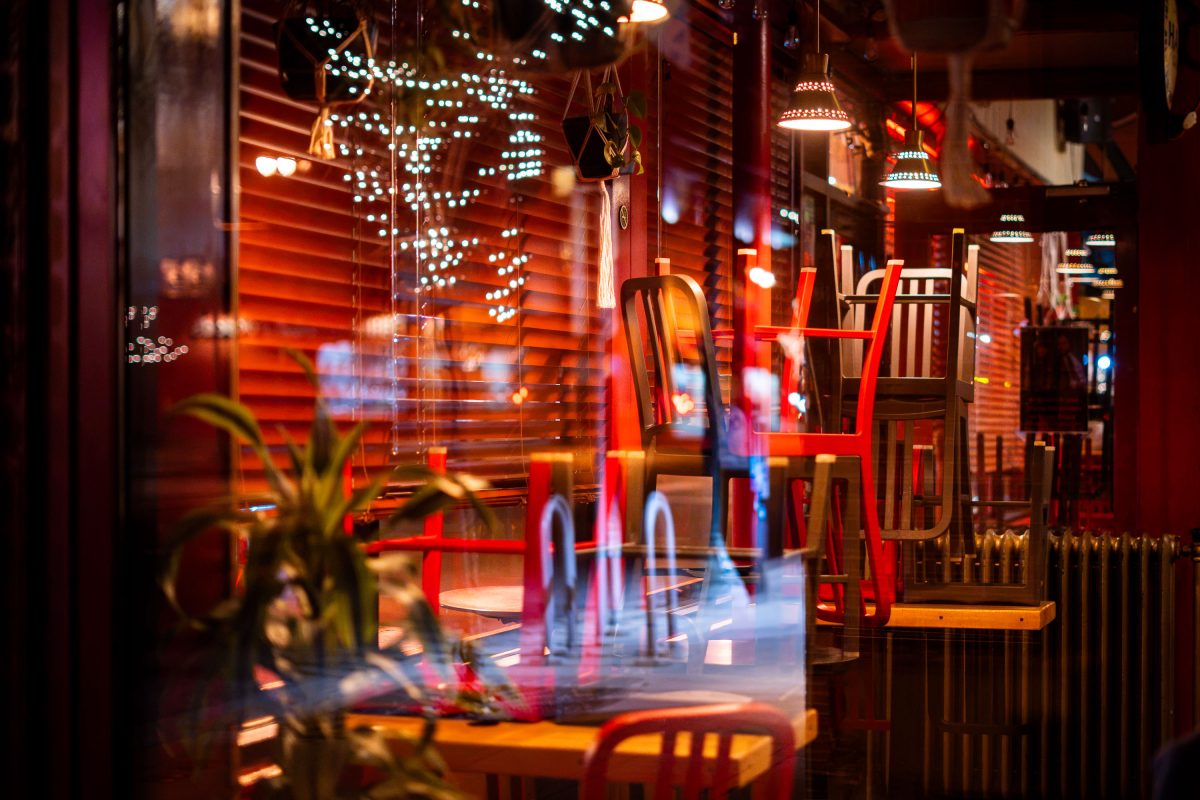
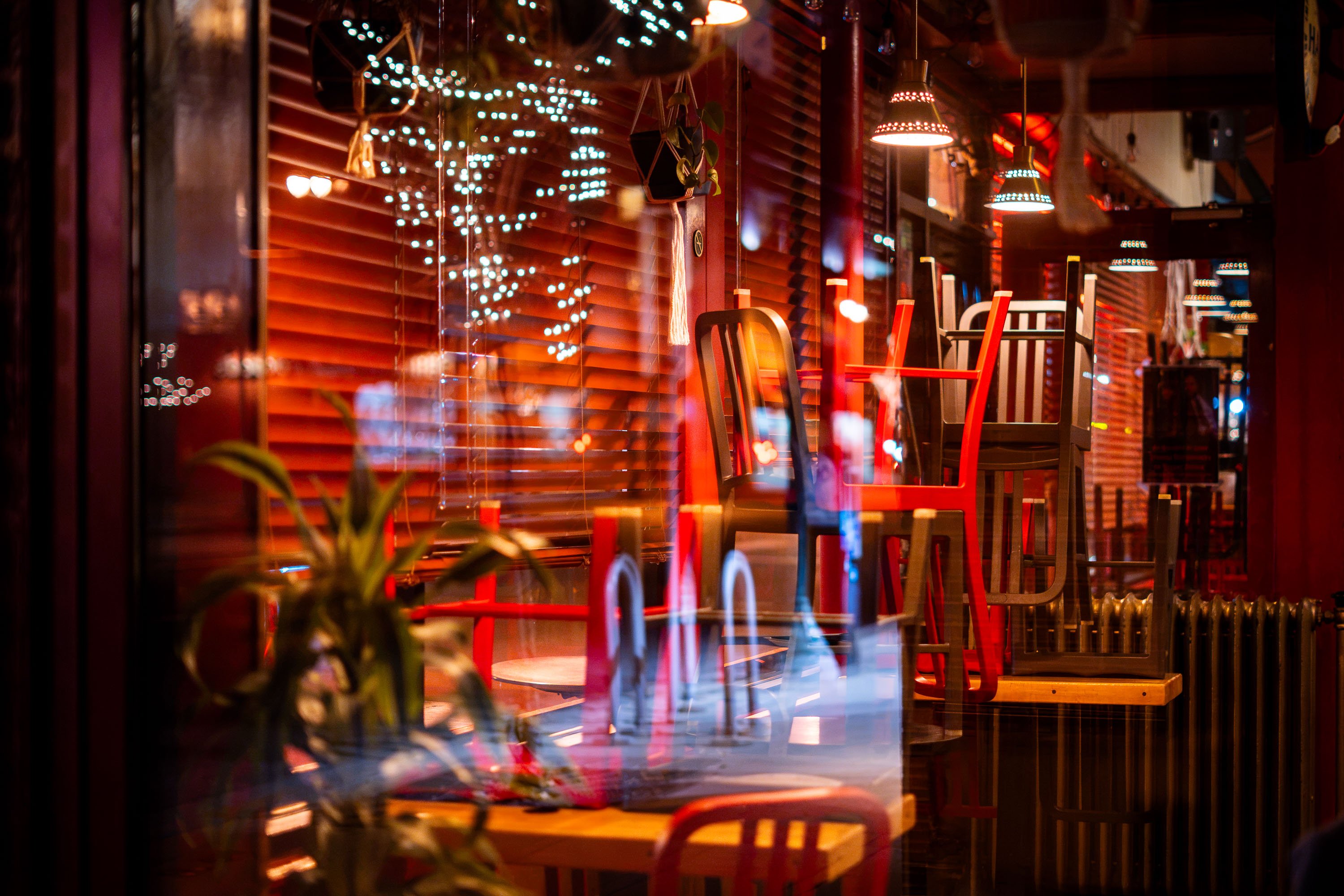
Chairs stacked on tables inside Bryant Lake Bowl restaurant and bar in Minneapolis.
Bryant Lake Bowl sits at 810 W. Lake Street in Minneapolis's Uptown neighborhood. The building dates to the 1930s, originally housing a bowling alley alongside its restaurant and bar operation. Today the venue combines a full-service restaurant, cocktail bar, and a small theater space used for comedy, cabaret, and live performances. It remains one of the few bowling alleys of its era still operating in the Twin Cities.

Bar Interior at Bryant Lake Bowl, Lake Street
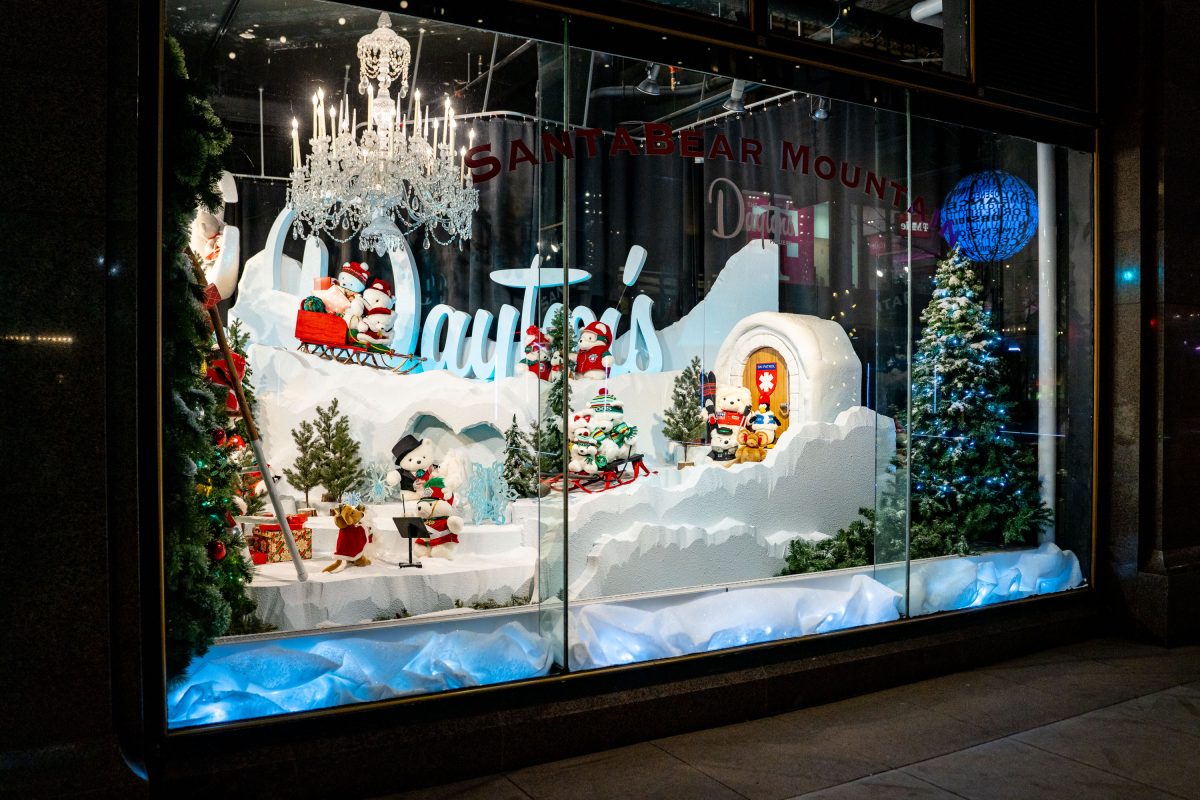
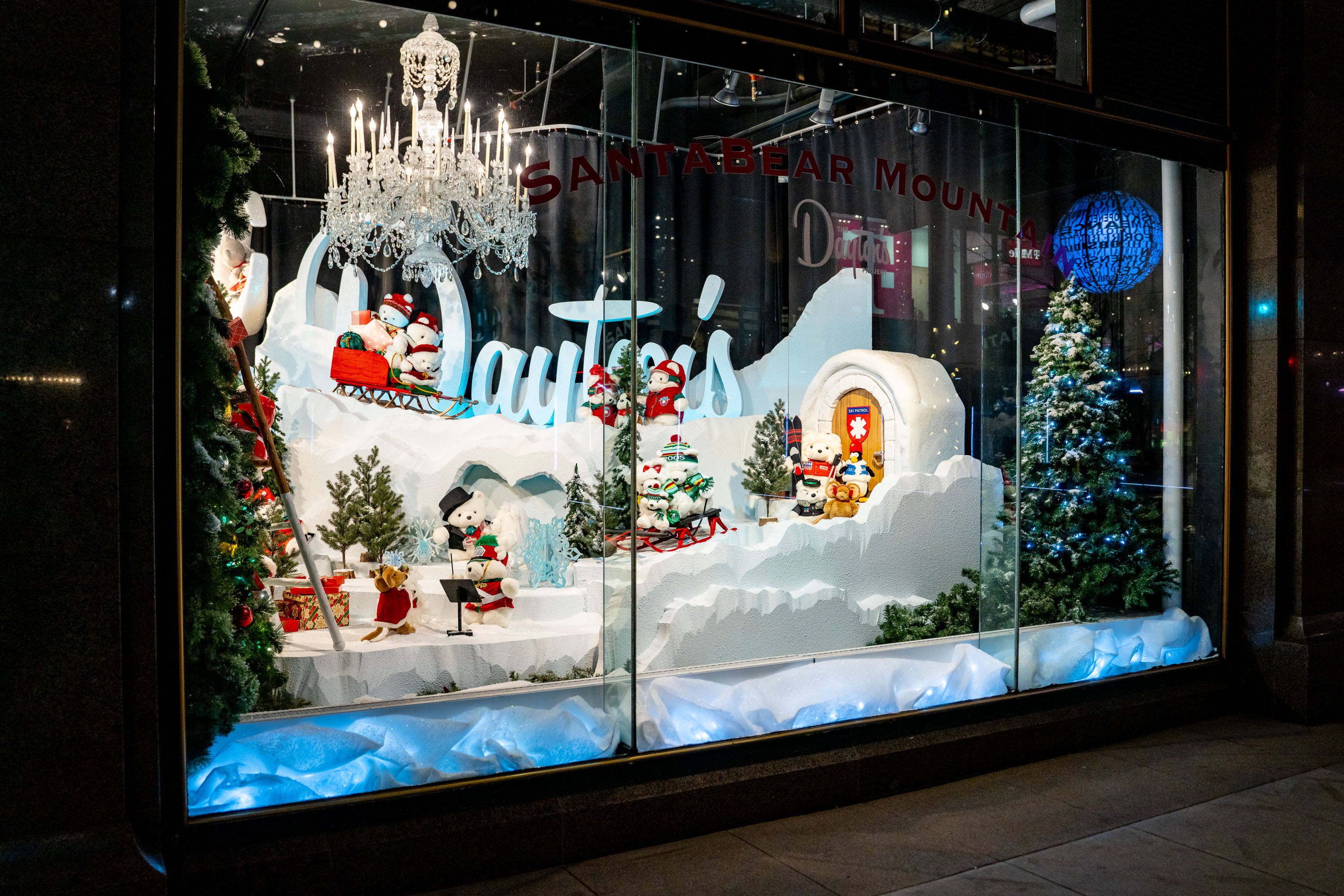
Santa Bear-themed Christmas window display at the former Dayton's department store in downtown Minneapolis.
Dayton's department store, founded in 1902 by George Draper Dayton, was long known for its elaborate Christmas window displays along Nicollet Mall in downtown Minneapolis. The flagship store's holiday windows became a seasonal tradition for generations of Minnesota families, drawing crowds each year to view animated figures and winter-themed dioramas. Santa Bear, a plush mascot introduced by Dayton's in 1985, became a signature part of the retailer's holiday marketing and merchandise line. The building later operated under the Marshall Field's and Macy's names before redevelopment into a mixed-use retail and office complex.

Santa Bear Mountain Holiday Window, Dayton’s Minneapolis
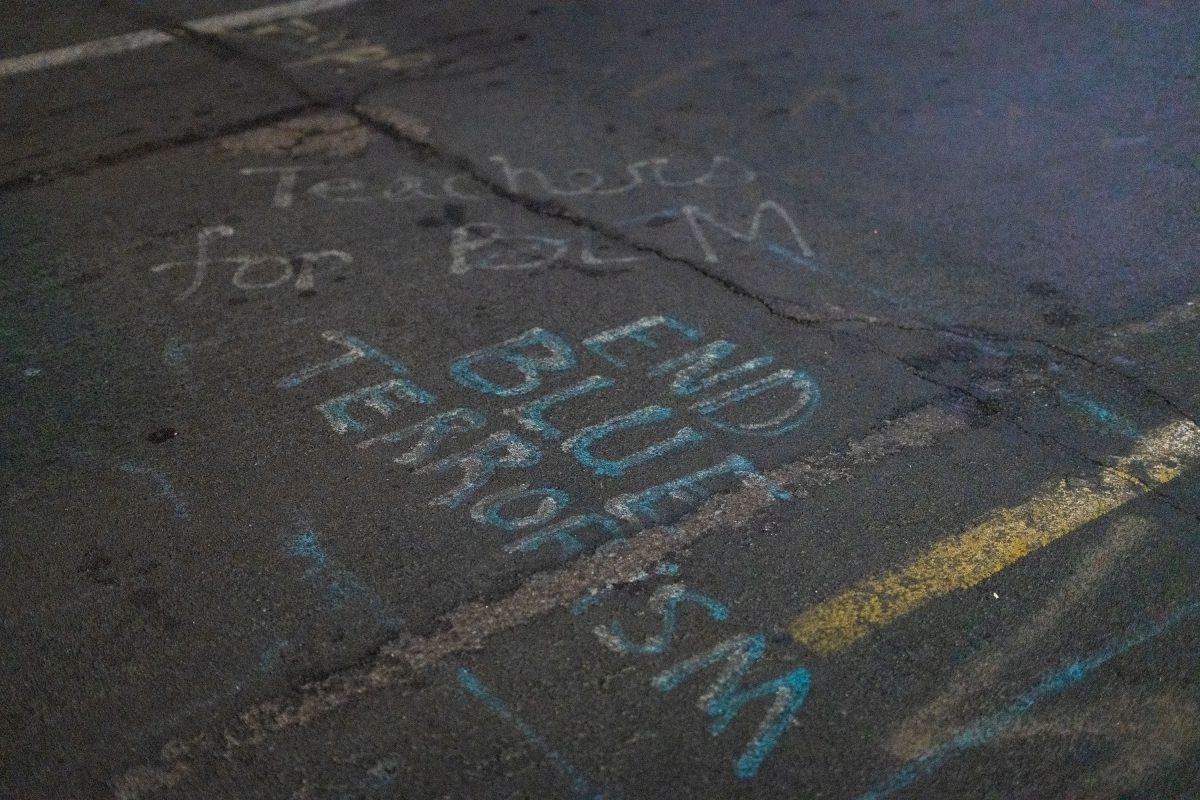
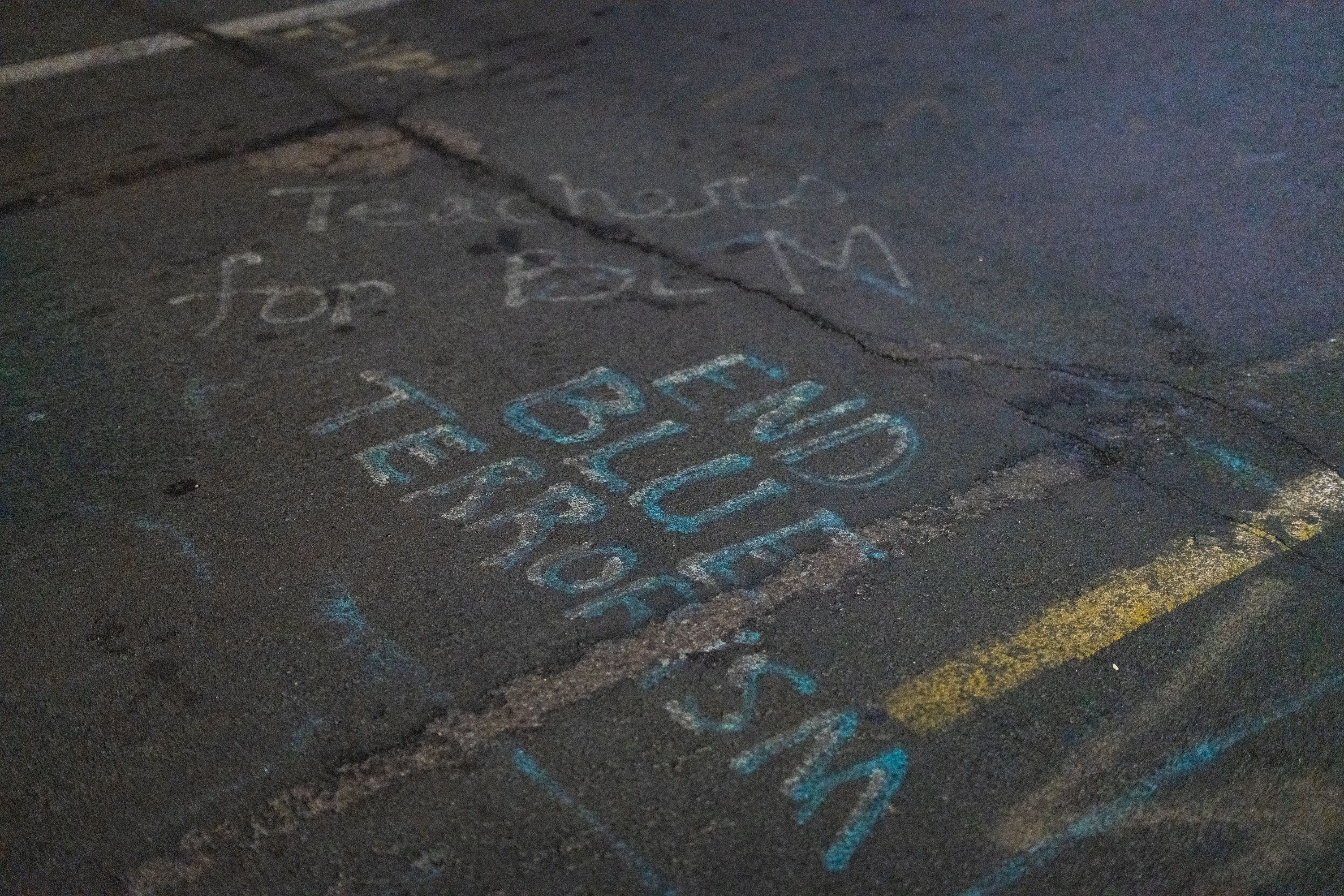
End Blue Terrorism
Graffiti on Chicago Avenue in South Minneapolis.

End Blue Terrorism Graffiti in Minneapolis

Black Lives Matter at Orchestra Hall in Minneapolis
A sign outside Orchestra Hall in Downtown Minneapolis displays a statement of solidarity with the Black Lives Matter movement. The message, "Music teaches us the value of listening. There is more for us to hear and more for us to do. Black Lives Matter," reflects the Minnesota Orchestra's commitment to addressing racial injustice. This statement was displayed during a period of heightened awareness and activism surrounding racial equity in the United States. Orchestra Hall, a prominent venue for the performing arts in Minneapolis, serves as a cultural anchor in the downtown area.

Orchestra Hall Minneapolis: Black Lives Matter Statement

Daytons Holiday Window in Downtown Minneapolis
The former Dayton's department store building on Nicollet Mall in Minneapolis is seen here during the 2021 holiday season. For many decades, Dayton's was a prominent retail anchor in downtown Minneapolis, and its elaborate holiday window displays were a significant cultural tradition that drew large crowds. Although the store closed in 2007, its historic building remains a notable structure on Nicollet Mall, and the tradition of holiday displays in its windows continued in 2021.

Dayton’s Holiday Window Display, Nicollet Mall, Minneapolis 2021

Heart shaped candles outside courthouse
Candles arranged in a heart shape on the lawn of the Hennepin County Government Center in Minneapolis serve as a memorial during the trial of Kim Potter. Potter, a former Brooklyn Center police officer, was charged in the April 2021 shooting death of Daunte Wright. The trial, which began with jury selection in late 2021, drew significant public attention and protests in the city. The Government Center is a prominent civic building in downtown Minneapolis, housing various county offices and courtrooms.

Candles at Hennepin County Government Center for Daunte Wright Trial

Read the Demands Justice for Daunte Wright at Peoples Way
A sign at George Floyd Square, also known as The People's Way, in Minneapolis displays a message demanding justice for Daunte Wright. The sign reads, "READ THE DEMANDS! JUSTICE FOR DAUNTE WRIGHT!" This message reflects the ongoing calls for police reform and accountability that gained prominence following Wright's death in April 2021. George Floyd Square became a significant site of protest and community organizing following the murder of George Floyd in May 2020, and it continued to serve as a focal point for activism.

George Floyd Square: Demands for Daunte Wright Justice

Wooden George Floyd sign in South Minneapolis
A "George Floyd" sign is affixed to a utility pole in South Minneapolis, a neighborhood that became a focal point of national attention following his murder in May 2020. A "No Justice No Streets" yard sign is visible nearby, reflecting the sentiments of protesters and activists. These markers serve as public memorials and expressions of ongoing demands for racial justice and police reform in the wake of the Minneapolis Uprising.

George Floyd Memorial Sign, South Minneapolis
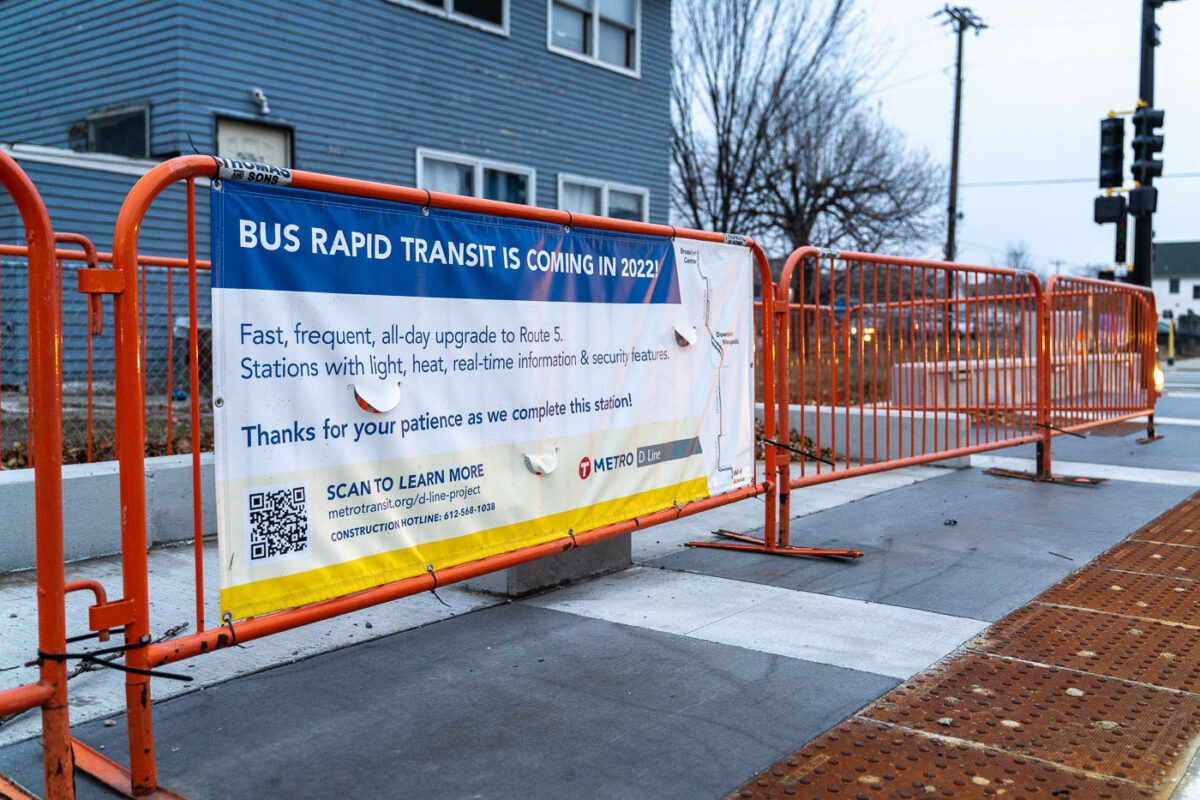
Metro Transit D Line Project Banner
Construction barriers line Chicago Avenue in Minneapolis, signaling the development of the Metro Transit D-Line Bus Rapid Transit. This project, slated for completion in 2022, aims to enhance public transportation by providing faster and more frequent service along the Route 5 corridor. The D-Line is designed to improve the commuter experience with modern amenities such as heated shelters and real-time arrival information. This investment in transit infrastructure reflects Minneapolis's commitment to expanding its public transportation network.

D-Line Bus Rapid Transit Construction on Chicago Ave, Minneapolis

Campfire at George Floyd Square December 2021
A campfire burns at George Floyd Square in Minneapolis in December 2021, providing a gathering space for community members. The square, established at the intersection of Chicago Avenue and 38th Street, became a significant site for protests and community organizing following the murder of George Floyd in May 2020. The mural "Peoples' Way" and other artwork adorn the adjacent building, symbolizing the ongoing activism and community presence. This space served as a hub for residents to connect and share resources during a period of social unrest.

George Floyd Square Campfire, Minneapolis, December 2021

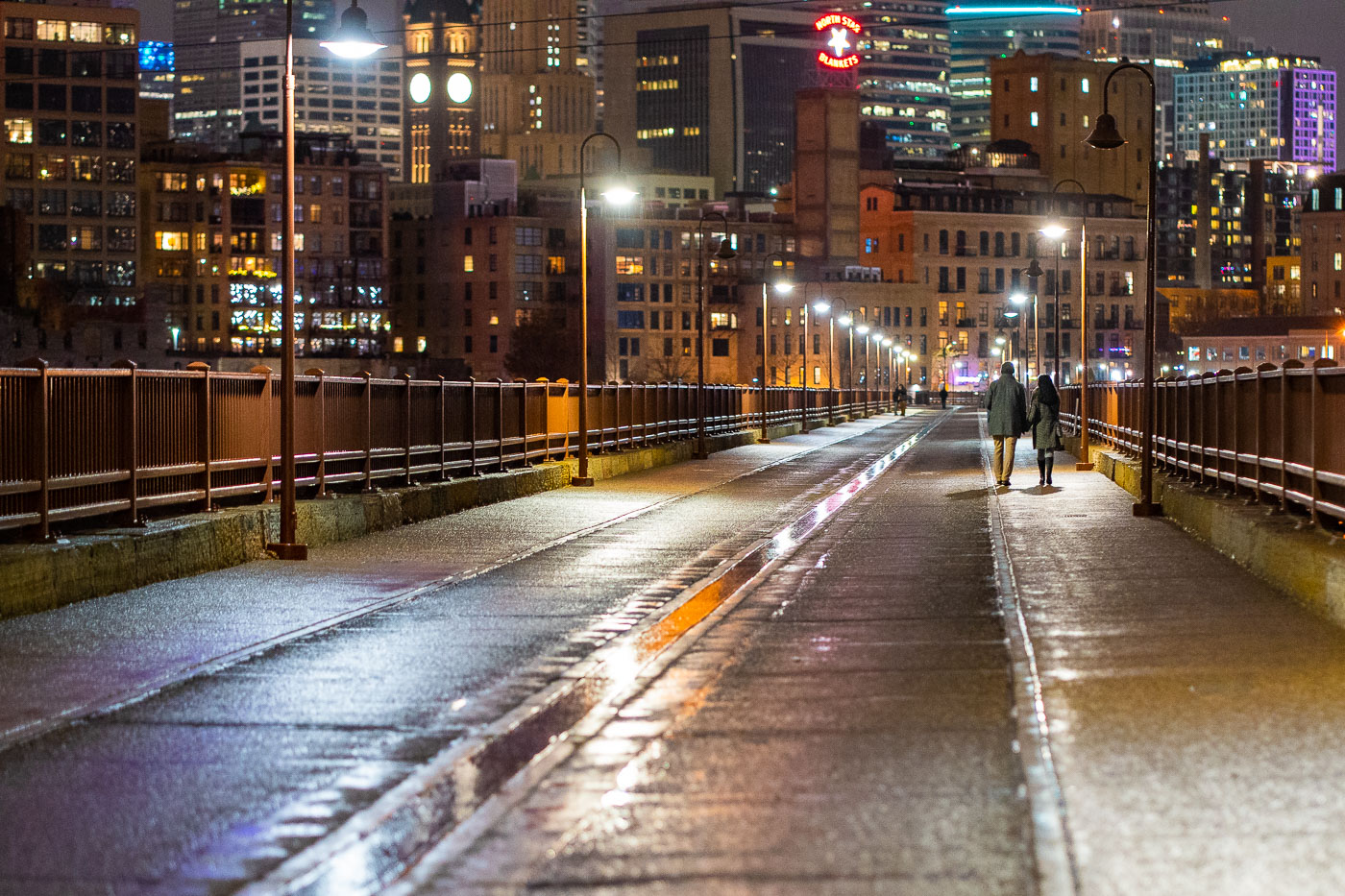
Couple walk the Stone Arch Bridge in December 2021
A couple walks across the Stone Arch Bridge in Minneapolis in December 2021. Constructed in 1883 for the Great Northern Railway, the bridge spans the Mississippi River and is one of the city's oldest railroad bridges. After ceasing rail operations, it was repurposed in 1999 as a pedestrian and bicycle bridge. The structure offers views of St. Anthony Falls and the downtown Minneapolis skyline, serving as a significant link to the city's industrial past and a popular public space today.

Couple on Stone Arch Bridge, Minneapolis, December 2021

Metro Transit Bus on Marquette Ave in the rain
A Metro Transit bus travels down Marquette Avenue in downtown Minneapolis on a rainy December night. Marquette Avenue is a central business district artery, vital for public transportation and vehicular traffic. The image highlights the continuous operation of public transit during adverse weather, underscoring its role in urban mobility. Reflections on the wet pavement illustrate the interplay of light and the city's built environment.

Metro Transit Bus on Rainy Marquette Ave, Minneapolis

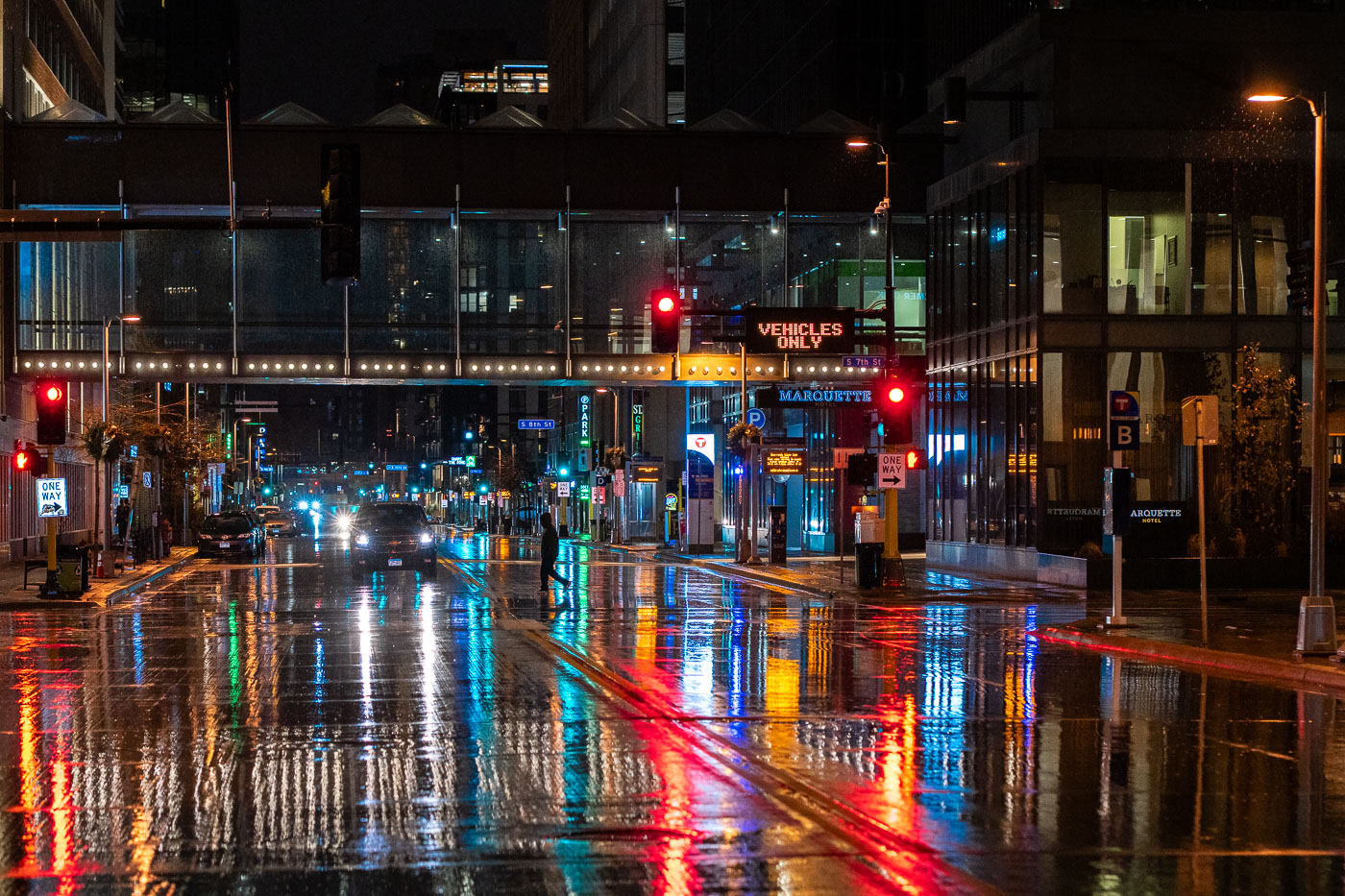
Rainy night on Marquette Ave in December 2021
Marquette Avenue in downtown Minneapolis is shown during a December rain in 2021, with reflections of traffic lights and building signage shimmering on the wet pavement. The Minneapolis Skyway system, a network of enclosed pedestrian bridges connecting buildings, is visible overhead, a characteristic feature of the city's downtown architecture designed to facilitate movement during inclement weather. This street serves as a major artery through the central business district, reflecting the city's ongoing development and its adaptation to climate conditions.

Marquette Ave, Minneapolis: December Rain Reflections 2021

Romantic night outside Brothers Bar in Minneapolis
A couple walks along 1st Avenue in downtown Minneapolis on a rainy December evening. The neon sign for Brothers Bar, a long-standing establishment in the city's entertainment district, is visible. This area of downtown Minneapolis has historically been a hub for nightlife and commerce, with 1st Avenue itself being a significant thoroughfare known for its music venues and theaters. The wet pavement reflects the vibrant city lights, creating a dynamic urban atmosphere.

Couple walks on wet 1st Avenue, Downtown Minneapolis

Third Avenue Food Market in Minneapolis
Third Avenue Food Market, located at 1905 3rd Ave S in Minneapolis, Minnesota, is a neighborhood grocery store. The market's prominent signage and illuminated interior suggest it serves as a local hub for convenience and essential goods. Its presence on Third Avenue South places it within a historically significant commercial corridor of the city. The store's operation, indicated by the "OPEN EVERY DAY" sign, highlights its role in providing continuous service to the community.

Third Avenue Food Market, Minneapolis – Open Every Day

Stella's Fish Cafe neon sign illuminates a brick building on Lake Street in Uptown Minneapolis during snowfall.
Stella's Fish Cafe was a seafood restaurant on Lake Street in the Uptown neighborhood of Minneapolis.

Stella’s Fish Cafe and Prestige Oyster Bar Neon on Lake Street

Fresh snow and taco taxi food truck
A Taco Taxi food truck is parked on Lagoon Avenue in Minneapolis during a snowfall. Food trucks have become a significant part of the urban culinary landscape, offering diverse and accessible food options. The "Taco Taxi" truck, a purveyor of street food, contributes to the city's dynamic food culture. Its presence in wintery conditions underscores the adaptability of small businesses that continue to serve their communities through various seasons and weather challenges.

Taco Taxi Food Truck in Snow, Minneapolis

Winston Smith Rest In Power Six Months Later
Six months after Winston Smith was killed by a federal task force, memorial signs were displayed on fencing outside the Lake & Girard parking ramp in Uptown Minneapolis. The signs, including a portrait of Smith and messages such as "Rest in Power Winston" and "Six Months We Remember," serve as a memorial and a continued call for justice. The location is near the site where Smith died, which became a focal point for protests and community remembrance.

Winston Smith Memorial, Six Months Later, Uptown Minneapolis

Violence interrupters walking through empty snowy Uptown Minneapolis
Members of the nonprofit organization We Push For Peace walk through Uptown Minneapolis on a snowy December evening.

We Push For Peace in Snowy Uptown Minneapolis

Man walks down a snowy Nicollet Mall
Nicollet Mall in downtown Minneapolis is shown during light snowfall in December 2021, with a pedestrian walking past storefronts and seasonal lighting installations. The transit-and-pedestrian corridor was redesigned in the 1960s to prioritize foot traffic along one of the city’s main commercial streets and later rebuilt in the 2010s.

Snowfall on Nicollet Mall with Illuminated Art Spheres, Minneapolis

Fresh snow outside fenced in Seven Points Mall
Fresh snow covers the ground and a chain-link fence surrounds the Seven Points Mall parking ramp on Girard Avenue and Lake Street in Minneapolis. The area was fenced off following protests that occurred after the law enforcement killing of Winston Smith on June 3rd, 2021. The Seven Points Mall, a significant commercial and community hub, has been a focal point for activism and unrest, reflecting broader social issues within the urban environment.

Seven Points Mall Fenced After Protests, Minneapolis
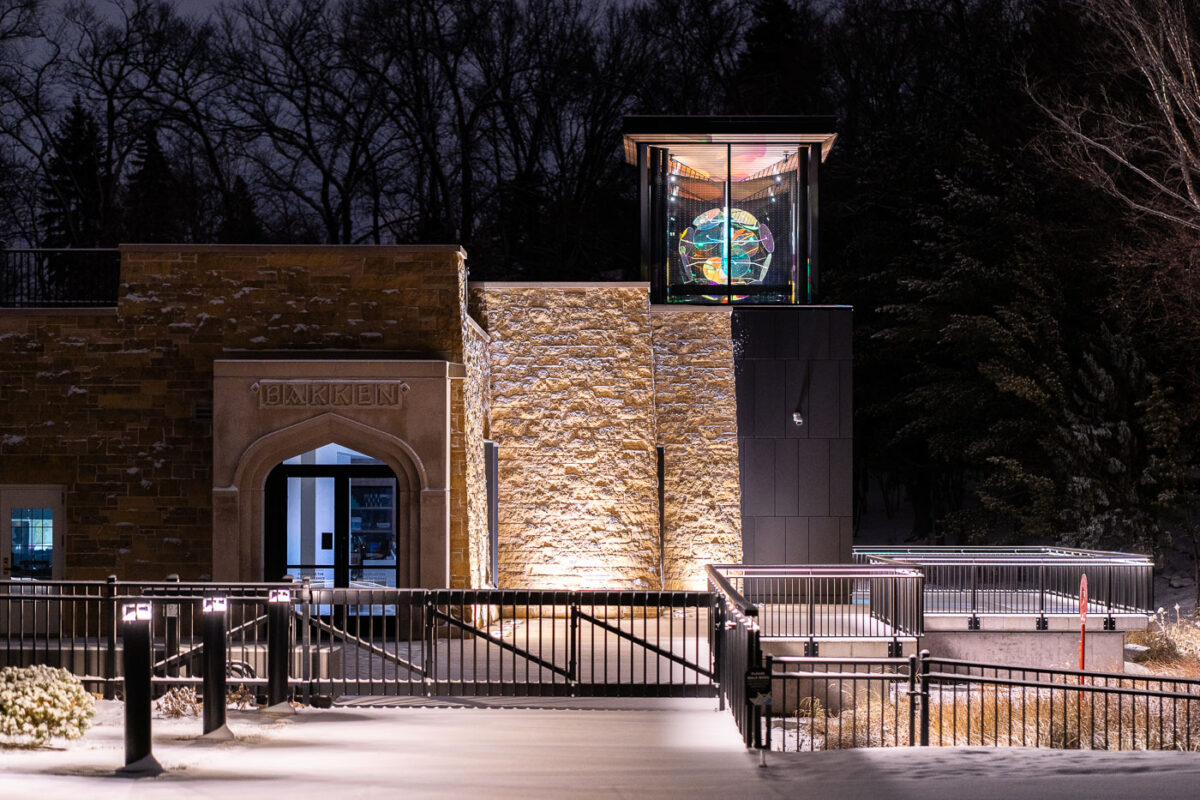
The Bakken Museum after a fresh snowfall
The Bakken Museum in Minneapolis, Minnesota, is dedicated to the history of innovation in medicine and technology. Founded in 1975 by Earl Bakken, co-founder of Medtronic, the museum houses exhibits on medical devices and the scientific principles behind them. The building's architecture combines historic stone elements with modern design, as seen here during a winter snowfall.

The Bakken Museum, Minneapolis, in Winter Snow

Wooden Ship Brewing Co storefront at night, with brewing tanks visible through the windows, Minneapolis.
Wooden Ship Brewing Co operates as a production brewery and taproom in Minneapolis. The storefront windows open directly onto the brewhouse, giving passersby a look at the stainless steel tanks used for brewing. A separate taproom area serves the beers produced on site, operating alongside the retail brewing operation.

Wooden Ship Brewing Co Storefront, Minneapolis

Were Open mural and Transtifa graffiti on Lake Street
The Hufan Restaurant & Cafe on Lake Street in Minneapolis displays a mural reading "We're Open" with an arrow, alongside graffiti art including "Transtifa" on the building's upper facade. This imagery reflects the period following the 2020 Minneapolis Uprising, when businesses often boarded up windows and doors for protection. The artwork serves as a visual record of resilience, solidarity, and community identity during a time of significant social and economic disruption in the city.

Hufan Restaurant & Cafe, Lake Street, Minneapolis Graffiti and Mural

I can't breathe on a South Minneapolis fence
A mural in South Minneapolis displays George Floyd's final words, "Please, please, please I can't breathe. Please man I can't breathe." These words became a rallying cry during the protests that followed his death in May 2020. The artwork, painted on a wall adjacent to a residential building, serves as a public memorial and a stark reminder of the events that sparked widespread calls for racial justice and police reform. The mural's presence in the neighborhood where Floyd lived underscores the profound impact of his death on the local community and the nation.

George Floyd Mural on Minneapolis Wall
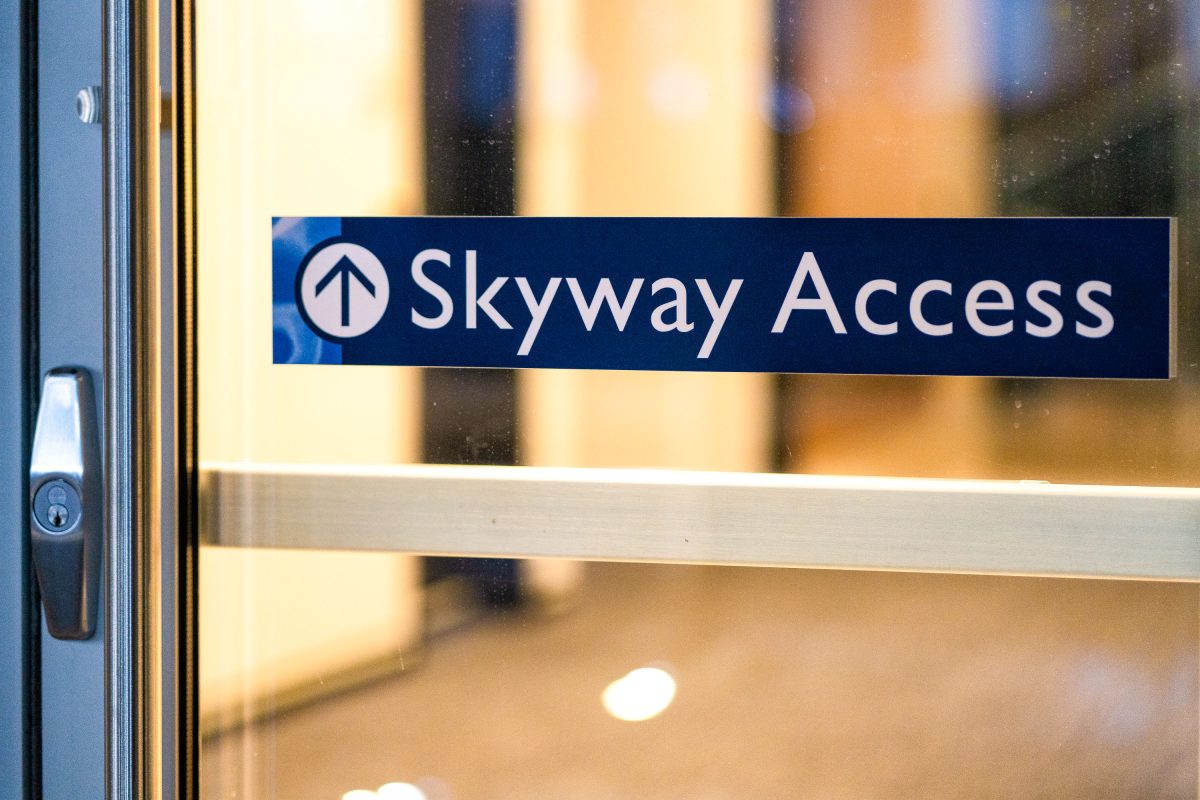
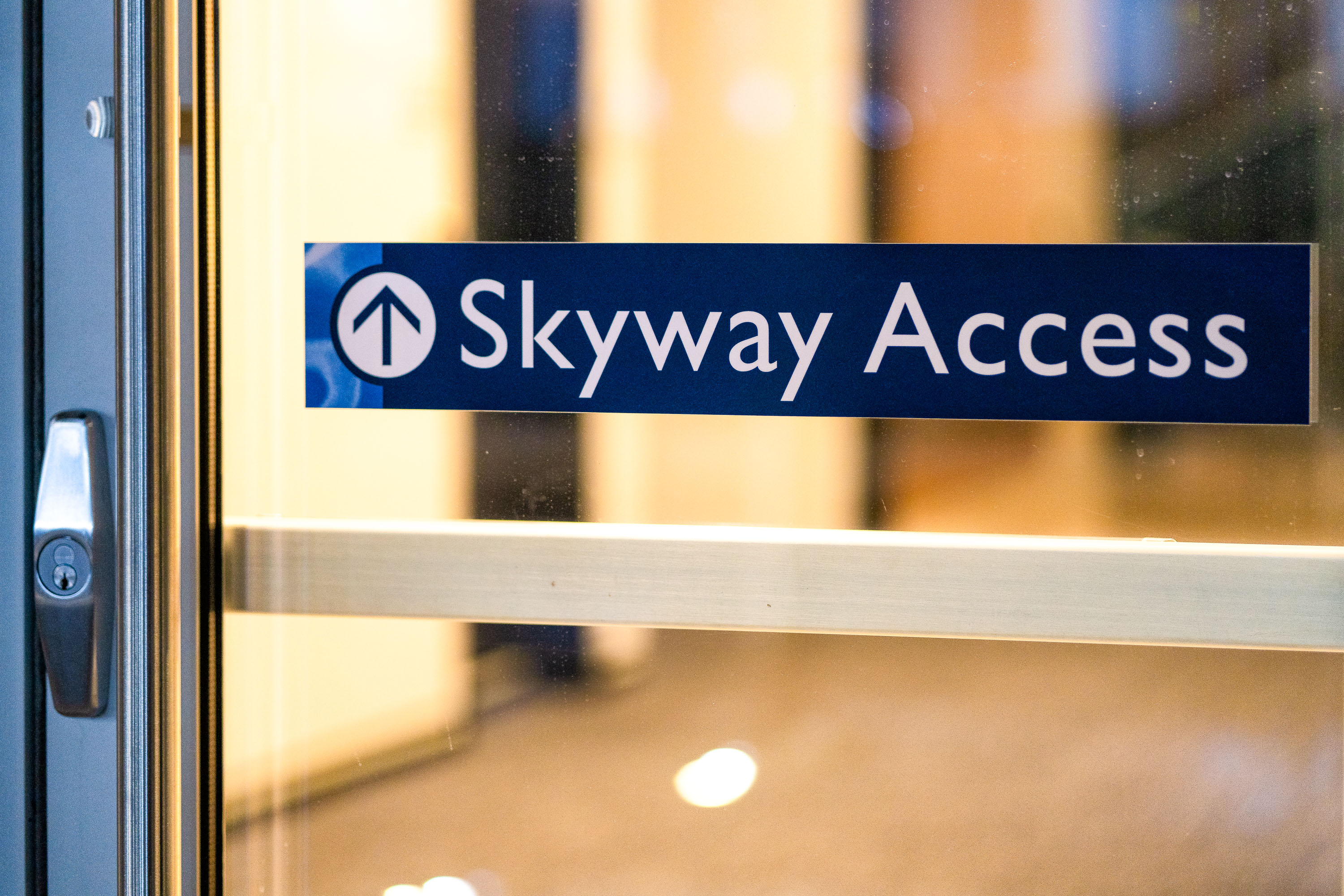
Skyway Access sign directs pedestrians into the enclosed walkway system at the Thrivent Financial building in downtown
The Minneapolis Skyway System connects more than 80 city blocks of downtown buildings via enclosed, elevated walkways, forming one of the largest networks of its kind in the world. Skyway entrances like this one direct pedestrians to the second-level walkway system, letting people move between buildings without going outside. The system dates to 1962.

Skyway Access Sign, Thrivent Financial Building, Minneapolis

Courteney Ross and Toshira Garraway speak outside courthouse
Courteney Ross and Toshira Garraway are among protesters in downtown Minneapolis following the first day of the Kim Potter manslaughter trial. Potter was on trial for the April 11, 2021, shooting death of Daunte Wright, a 20-year-old man, in Brooklyn Center, Minnesota.

Courteney Ross and Toshira Garraway at Daunte Wright protest, Minneapolis

Justice for Daunte Wright sign during a march
Protesters gathered in downtown Minneapolis on November 17, 2021, holding signs demanding justice for Daunte Wright. This march occurred on the first day of the Kim Potter manslaughter trial. Potter was on trial for the April 11, 2021, shooting death of 20-year-old Daunte Wright in Brooklyn Center, Minnesota, an incident that sparked widespread protests and calls for accountability.

Minneapolis Protest: Justice for Daunte Wright Sign

Justice for Daunte Wright sign on a truck
A sign reading "Justice for Daunte Wright" is displayed on a truck during a protest in downtown Minneapolis on November 16, 2021. This protest coincided with the first day of the manslaughter trial for former Brooklyn Center police officer Kim Potter, who was charged in the April 11, 2021, shooting death of Daunte Wright. The trial and related protests brought renewed attention to issues of police brutality and racial justice in the Minneapolis area.

Minneapolis Protest: Justice for Daunte Wright Sign on Truck

Daunte Wright protest through downtown Minneapolis
Protesters marched through downtown Minneapolis on November 17, 2021, coinciding with the first day of the Kim Potter manslaughter trial. The trial stemmed from the April 11, 2021, shooting death of Daunte Wright, a 20-year-old man, in Brooklyn Center, Minnesota. This march occurred as Minneapolis continued to confront the aftermath of Wright's death and broader issues of racial justice and police accountability.

Daunte Wright Protest March Downtown Minneapolis Nov 17 2021

Daunte Wright march on first day of Kim Potter trial
Protesters gathered outside the Hennepin County Government Center in downtown Minneapolis on November 15, 2021, coinciding with the first day of the Kim Potter manslaughter trial. Potter was accused of fatally shooting Daunte Wright, a 20-year-old Black man, in Brooklyn Center, Minnesota, on April 11, 2021. This event and the ongoing trial underscored the persistent issues of police brutality and racial injustice within the city.

Protest at Hennepin County Government Center for Daunte Wright

1 down 3 to go protest sign as Kim Potter goes on trial
Protesters march through downtown Minneapolis on December 15, 2021, the first day of the Kim Potter manslaughter trial. Potter is accused of shooting Daunte Wright, a 20-year-old Black man, on April 11, 2021, in Brooklyn Center, Minnesota. The sign held by a protester reads "1 Down 3 to Go!" and "Black Lives Matter," reflecting a demand for accountability and justice for Wright and other victims of police violence.

Minneapolis Protest: Kim Potter Trial Sign ‘1 Down 3 to Go’
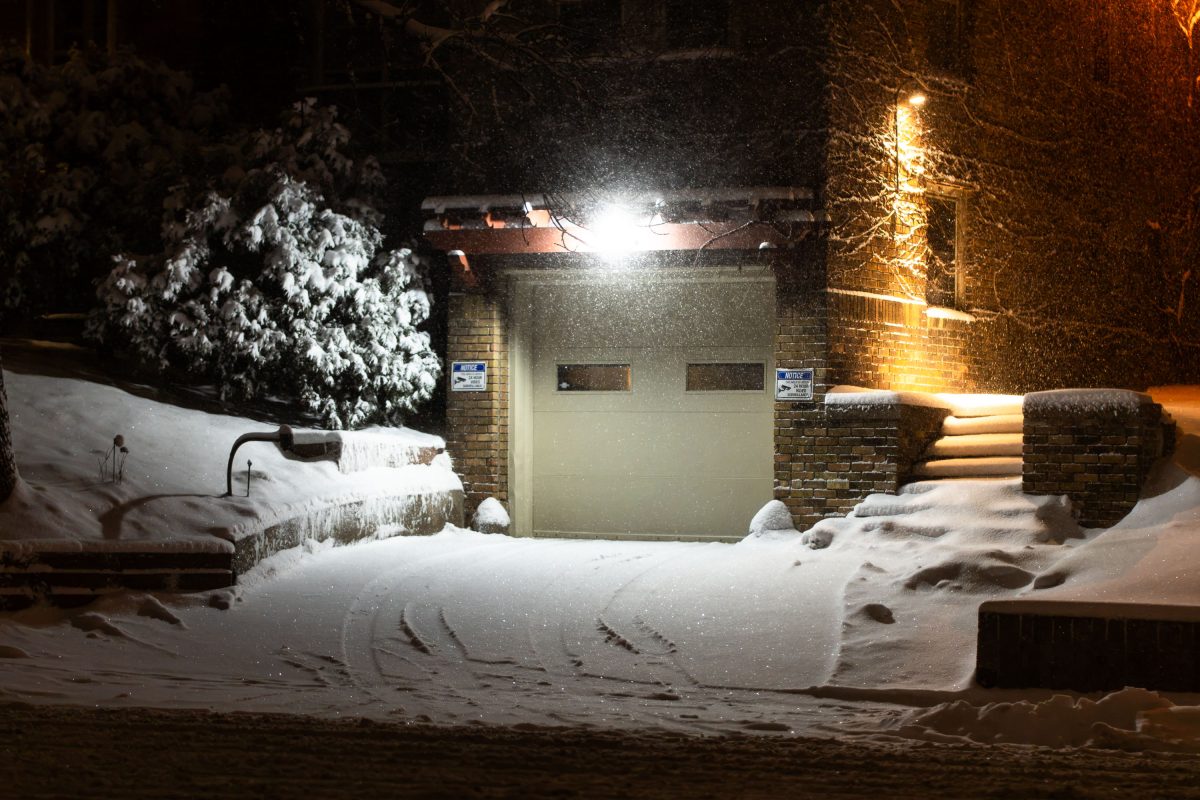
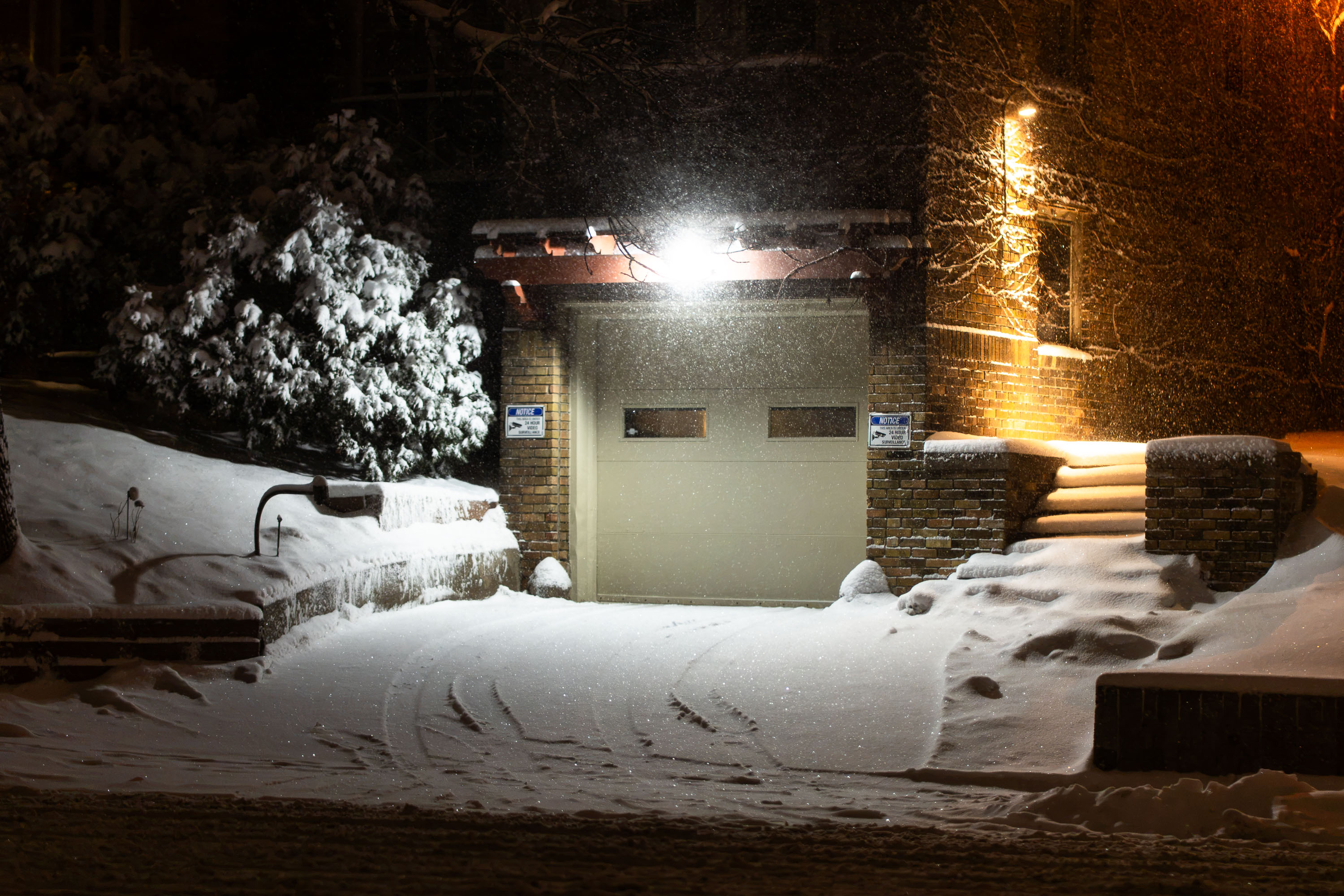
Minneapolis Snow and a garage on Lake Street
A garage during snowfall in Minneapolis.

Minneapolis Snow and a garage on Lake Street

Longfellow Family Foods corner store on Minnehaha Ave in Minneapolis during a December snowfall.

Longfellow Family Foods Corner Store in The Snow

Fresh snowfall in Kingfield Minneapolis
A "Welcome to Kingfield Neighborhood" sign stands in Minneapolis during a December snowstorm, indicating designated bicycle routes. Established in the late 19th century, Kingfield is a residential area known for its diverse housing and community engagement. The sign serves as a navigational marker for cyclists and drivers alike, highlighting the neighborhood's commitment to alternative transportation. The heavy snowfall is characteristic of Minnesota winters, impacting daily life and transportation throughout the region.

Kingfield Neighborhood Minneapolis Snowstorm with Bike Route Sign

Ice danger sign at Bde Maka Ska in Minneapolis
A "DANGER: KEEP OFF ICE NOT SAFE" sign is posted near Bde Maka Ska lake in Minneapolis during a winter snowstorm. The sign, attached to a red post marked "EMERGENCY ONLY," warns of hazardous conditions on the partially frozen lake. Bde Maka Ska is a prominent lake within Minneapolis's Chain of Lakes park system, historically a popular destination for year-round activities. During winter, the lake freezes over, but ice thickness can be unpredictable and unsafe for public access without proper safety assessments.

Bde Maka Ska Danger Sign During Minneapolis Snowstorm

Burley trailer in Minneapolis during a snowstorm
A cyclist pulls a trailer through a heavy snowfall in Uptown Minneapolis. The image documents the impact of winter weather on urban transportation and daily life in this commercial and residential district. Uptown Minneapolis is known for its active street life and businesses, which continue to function even during severe weather events, demonstrating the resilience of the community.

Biker with trailer in snowfall, Uptown Minneapolis

Longfellow Family Foods during snowstorm Minneapolis
Longfellow Family Foods, a neighborhood grocery store located at Minnehaha Avenue and East 35th Street in Minneapolis, is shown during a heavy snowstorm. The store serves as a vital retail hub for the surrounding community, offering essential goods such as cigarettes, ice cream, lottery tickets, chips, and milk. The "OPEN" sign indicates its continued operation despite the challenging winter weather, highlighting its importance to residents.

Longfellow Family Foods in Snowstorm, Minneapolis

Snowy Fractal Cactus in Minneapollis
The Fractal Cactus store, located at 3750 Minnehaha Avenue in Minneapolis, is pictured during a snowfall. This retail establishment specializes in houseplants, with a particular focus on cacti and succulents, and is recognized for its prominent neon cactus sign. Minnehaha Avenue is a significant commercial and historical corridor in Minneapolis, contributing to the character of its surrounding neighborhoods. The store's presence and distinctive branding add to the unique identity of this urban commercial district.

Fractal Cactus Store, Minnehaha Ave, Minneapolis in Snowfall

The Dripping Root in snow Minneapolis
The Dripping Root, a cold-pressed juice bar, is seen on Minnehaha Avenue in Minneapolis during a snowfall. The establishment, known for its vibrant interior murals and neon signage, operates within a brick building that reflects the city's architectural character. Minnehaha Avenue is a significant thoroughfare in Minneapolis, historically serving as a commercial and residential corridor.

The Dripping Root, Minneapolis, in Snowfall

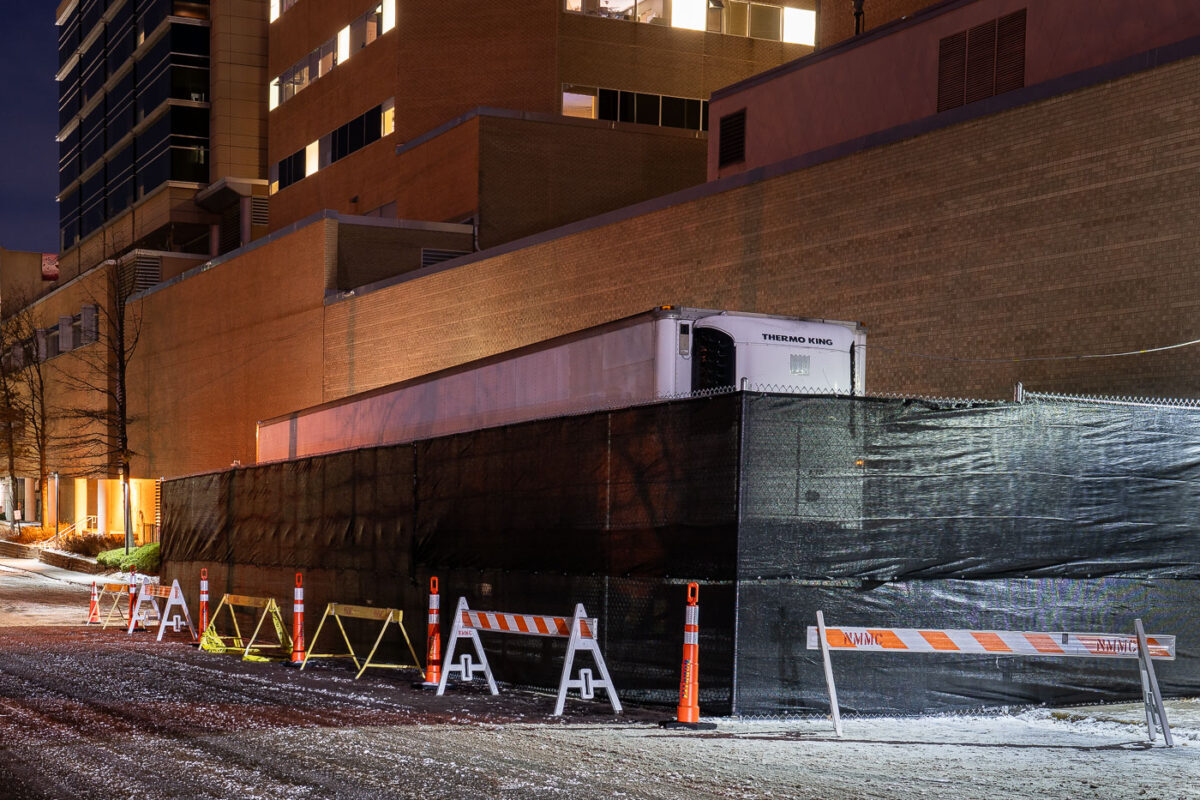
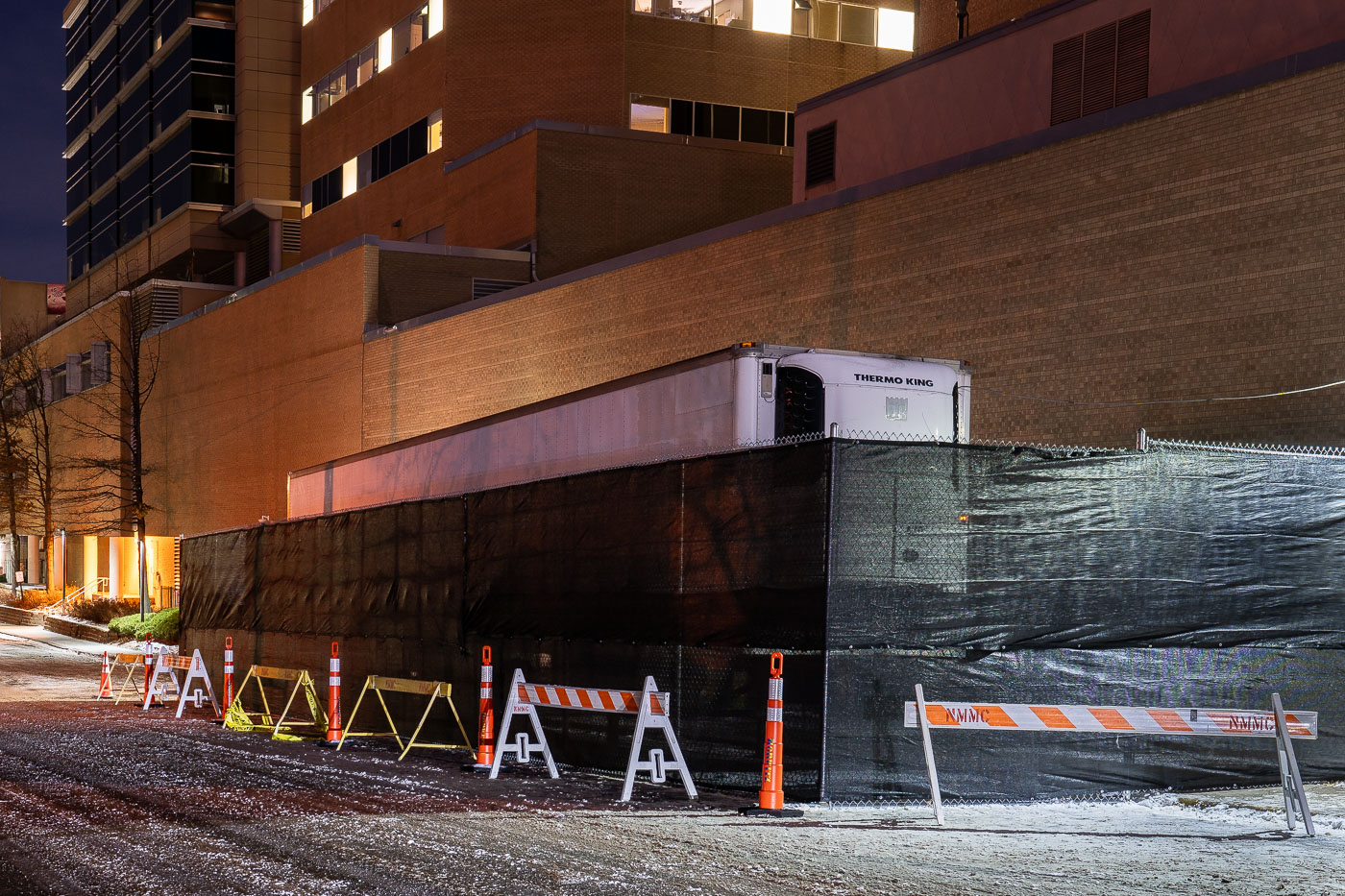
COVID Mobile Morgue in Minneapolis outside hospital
A refrigerated trailer, serving as a temporary morgue, is set up outside North Memorial Hospital in Robbinsdale, a suburb of Minneapolis. This measure was implemented during the COVID-19 pandemic, specifically during the spread of the Omicron variant in late 2021 or early 2022, when the state reported critically low ICU bed availability in the Twin Cities metro area. The presence of the mobile morgue underscored the immense strain on healthcare systems during the pandemic's surges.

Mobile Morgue at North Memorial Hospital, Minneapolis

Justice for Daunte Wright in a North Loop Window
A sign reading "Justice for Daunte" is displayed in a window of a brick building in Minneapolis's North Loop neighborhood. This message reflects the widespread calls for accountability following the death of Daunte Wright, a Black man killed by police in nearby Brooklyn Center in April 2021. The Minneapolis Uprising, which began in the summer of 2020, saw continued activism and protests throughout the city in response to racial injustice and police brutality. The sign's placement in a residential window signifies the personal impact and community engagement with these critical issues.

Minneapolis North Loop: “Justice for Daunte” Sign in Window

Accountability protest sign outside Kim Potter trial
A protest sign stands outside the Hennepin County Government Center in Minneapolis during the jury deliberations in the trial of former police officer Kim Potter. The sign reads, "Where there is no accountability there will be no responsibility. Convict Potter." The trial stemmed from the April 2021 shooting death of Daunte Wright during a traffic stop in nearby Brooklyn Center. The courthouse serves as the primary judicial building for Hennepin County, the most populous county in Minnesota.

Minneapolis: Protest Sign Outside Hennepin County Courthouse During Kim Potter Trial

CourtTV vans outside Kim Potter trial
CourtTV vans are parked outside the Hennepin County Government Center in Minneapolis. The center is a significant civic building that houses governmental offices and courtrooms. In December 2021, it was the site of the trial for Kim Potter, a former Brooklyn Center police officer charged in the killing of Daunte Wright. The presence of media vans indicates the high public interest and media coverage surrounding the trial.

CourtTV Vans Outside Hennepin County Government Center, Minneapolis