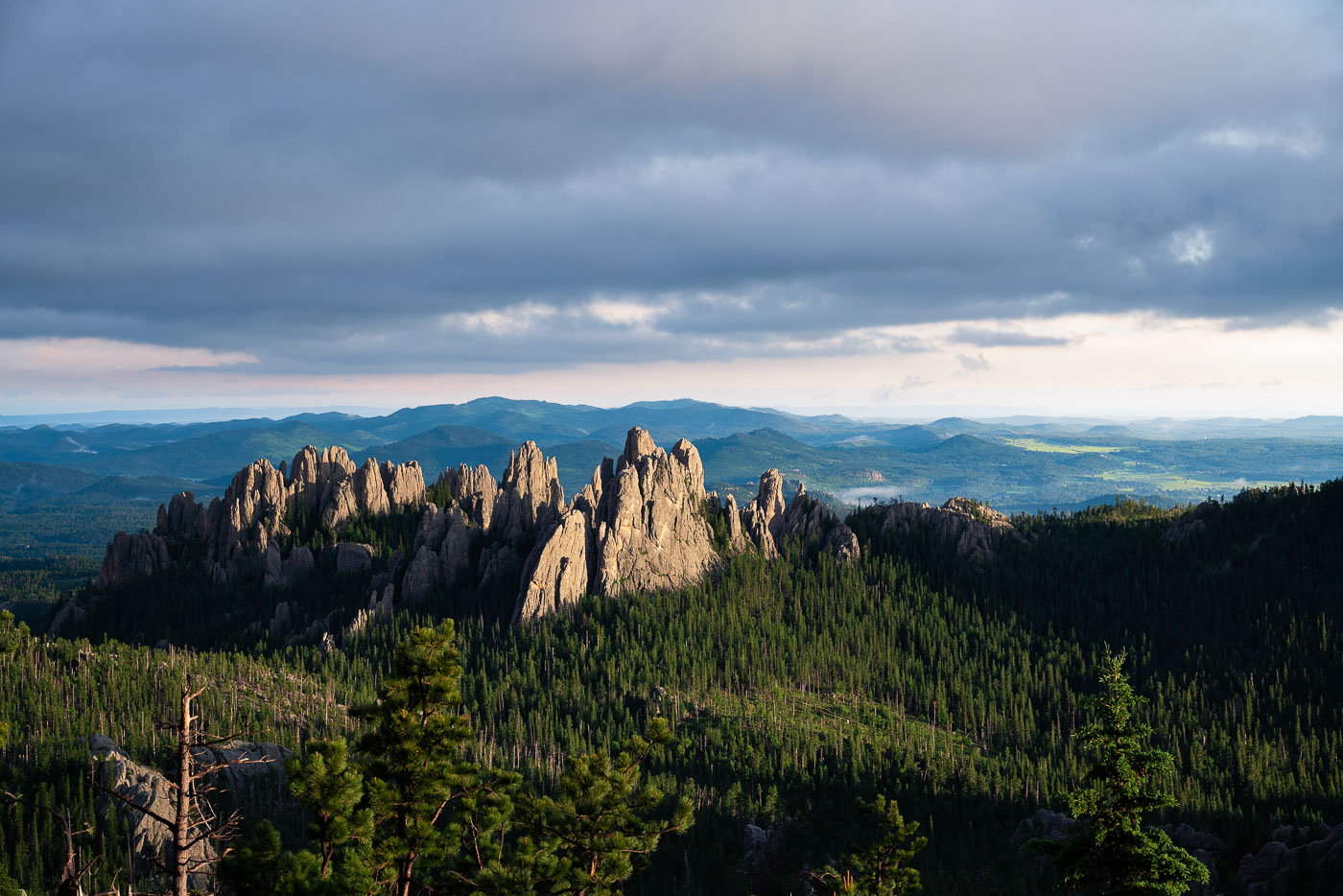
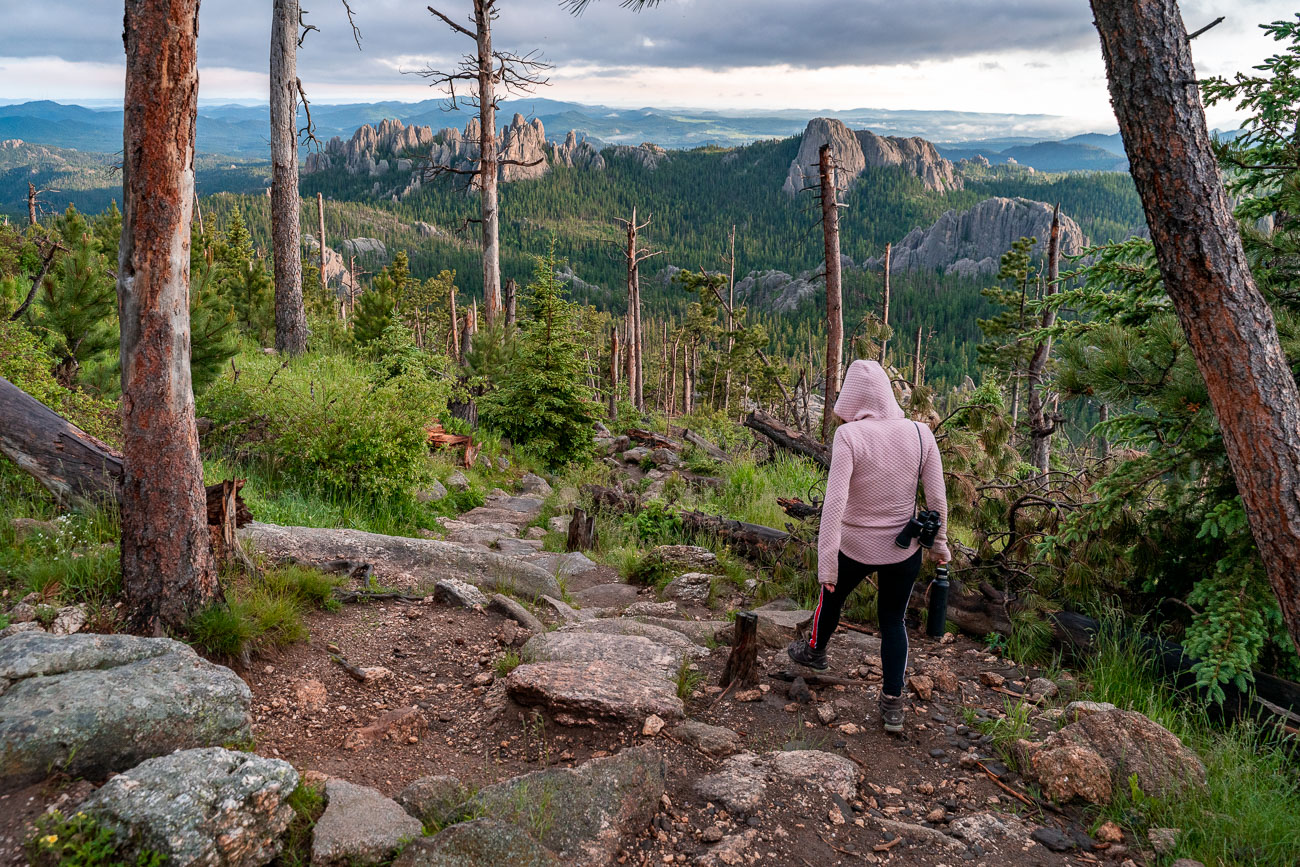
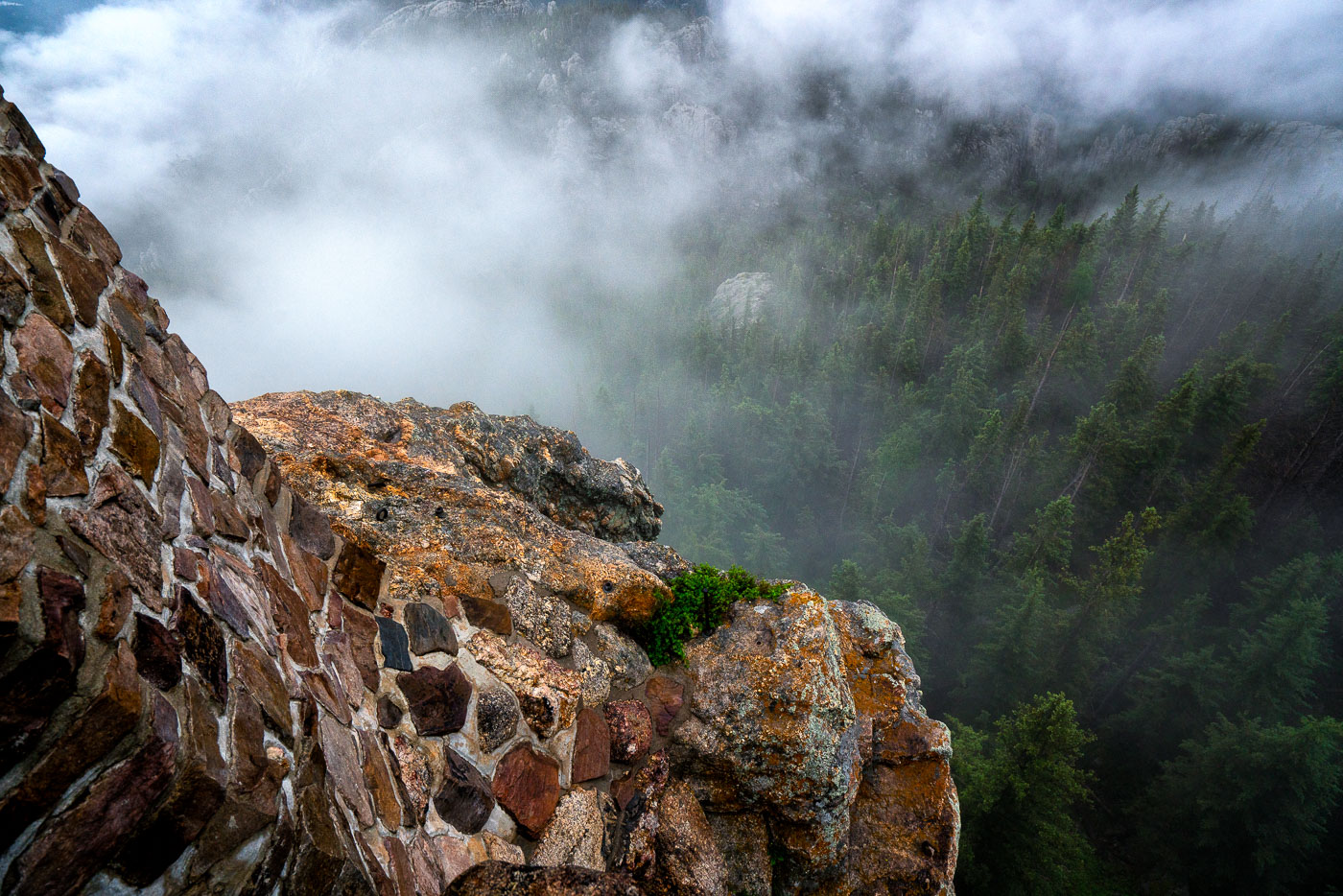
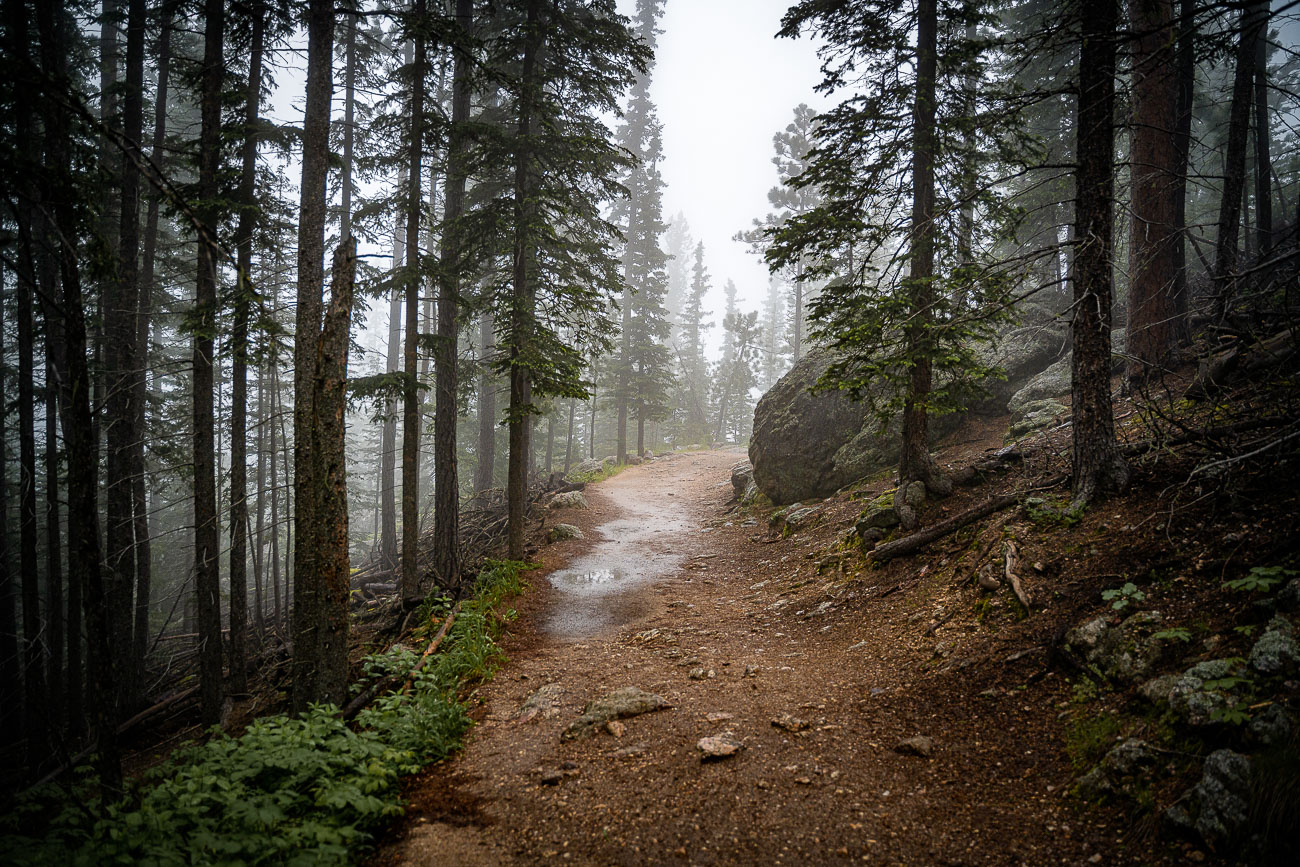
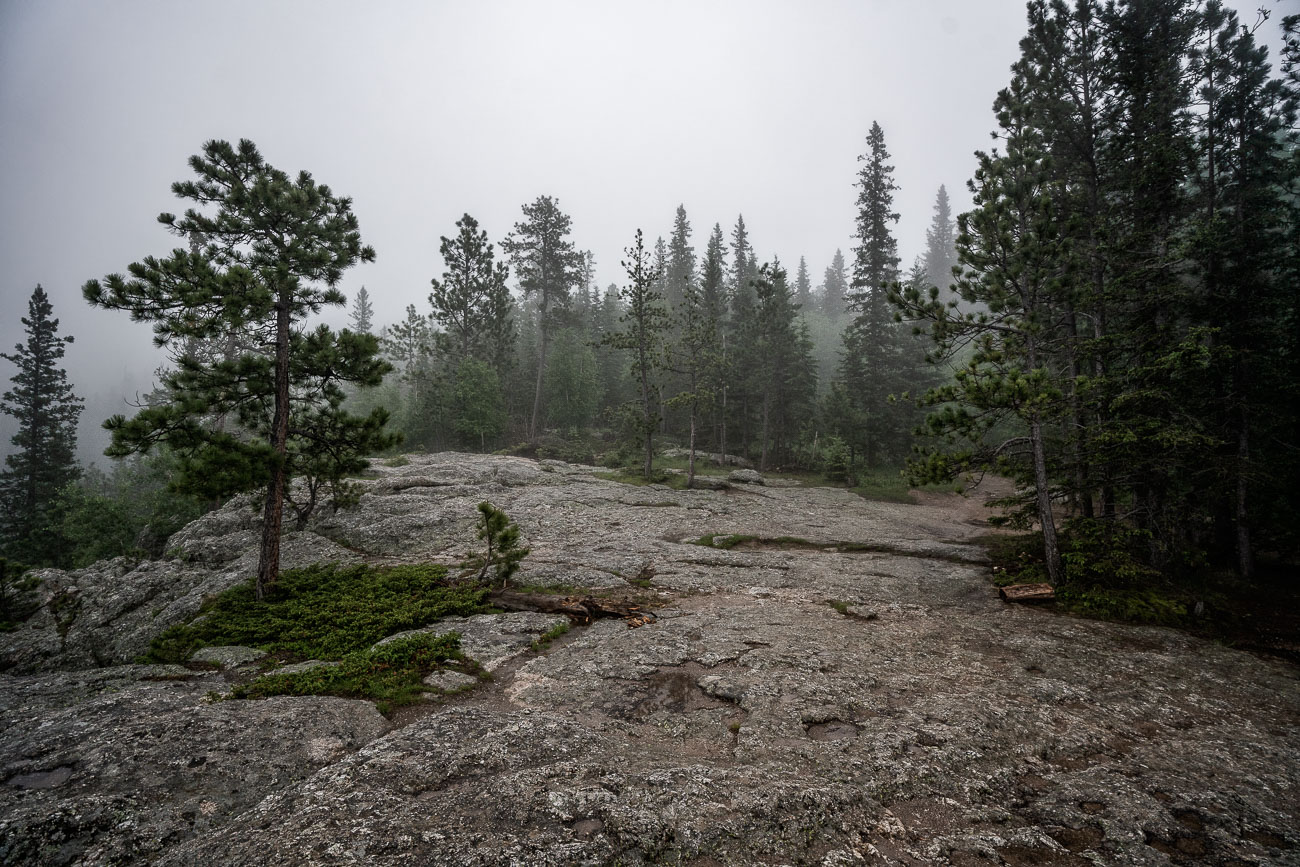
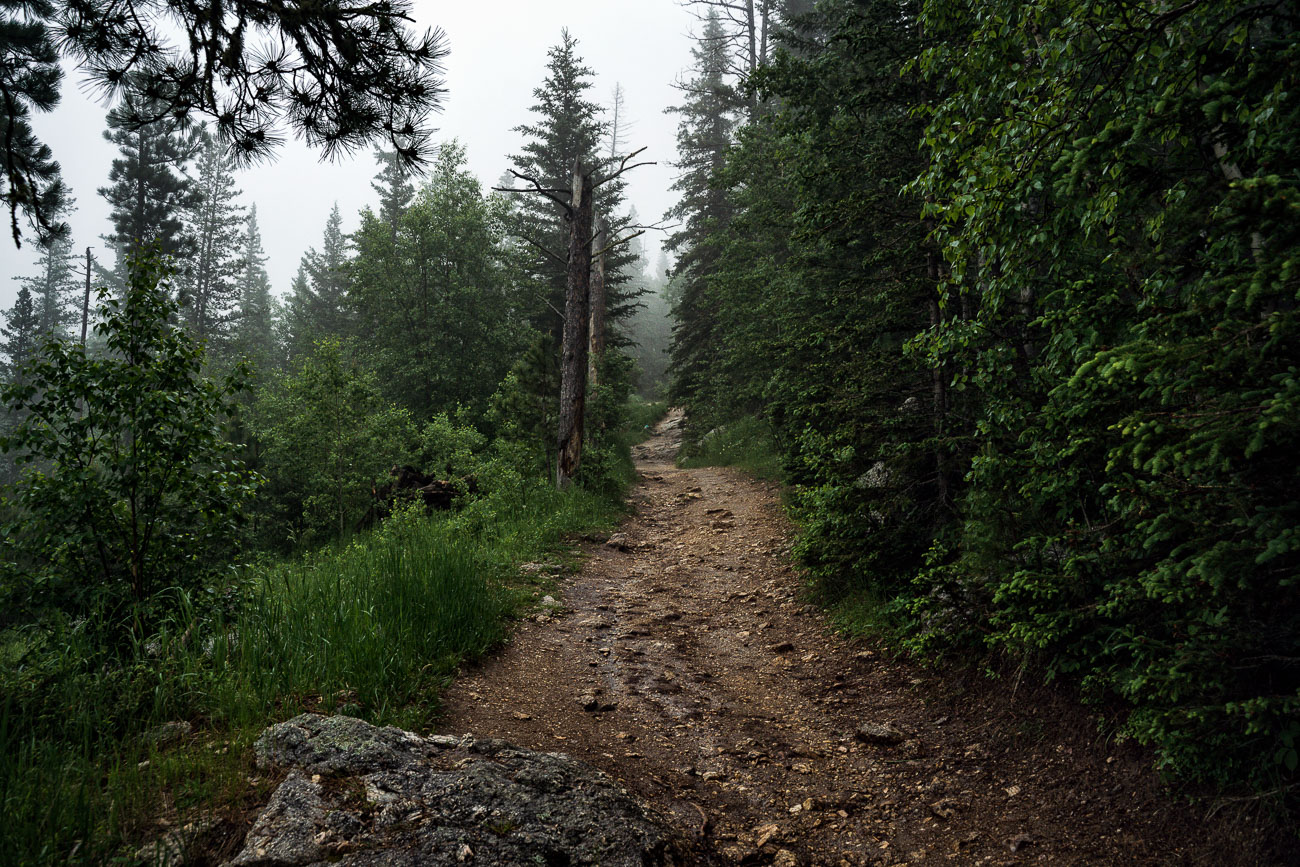
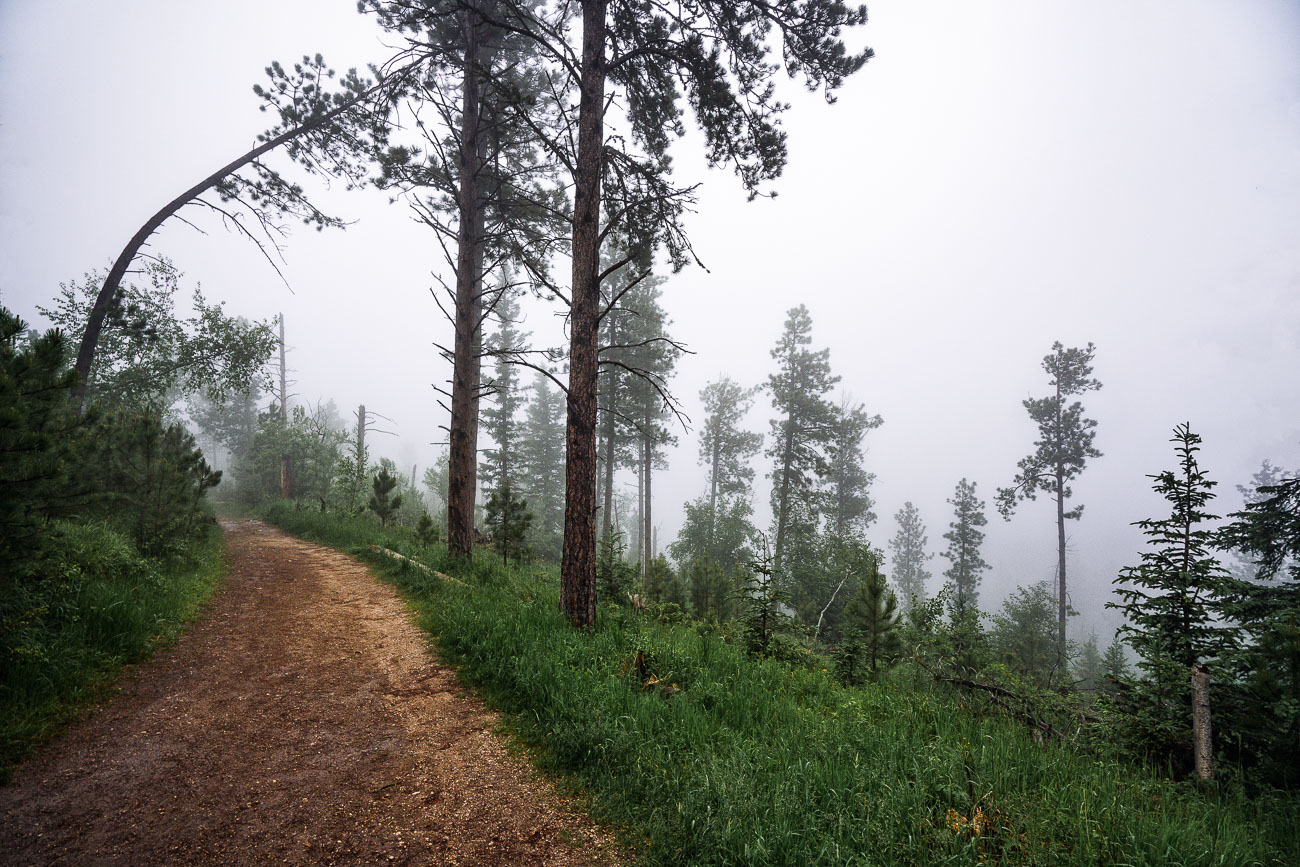
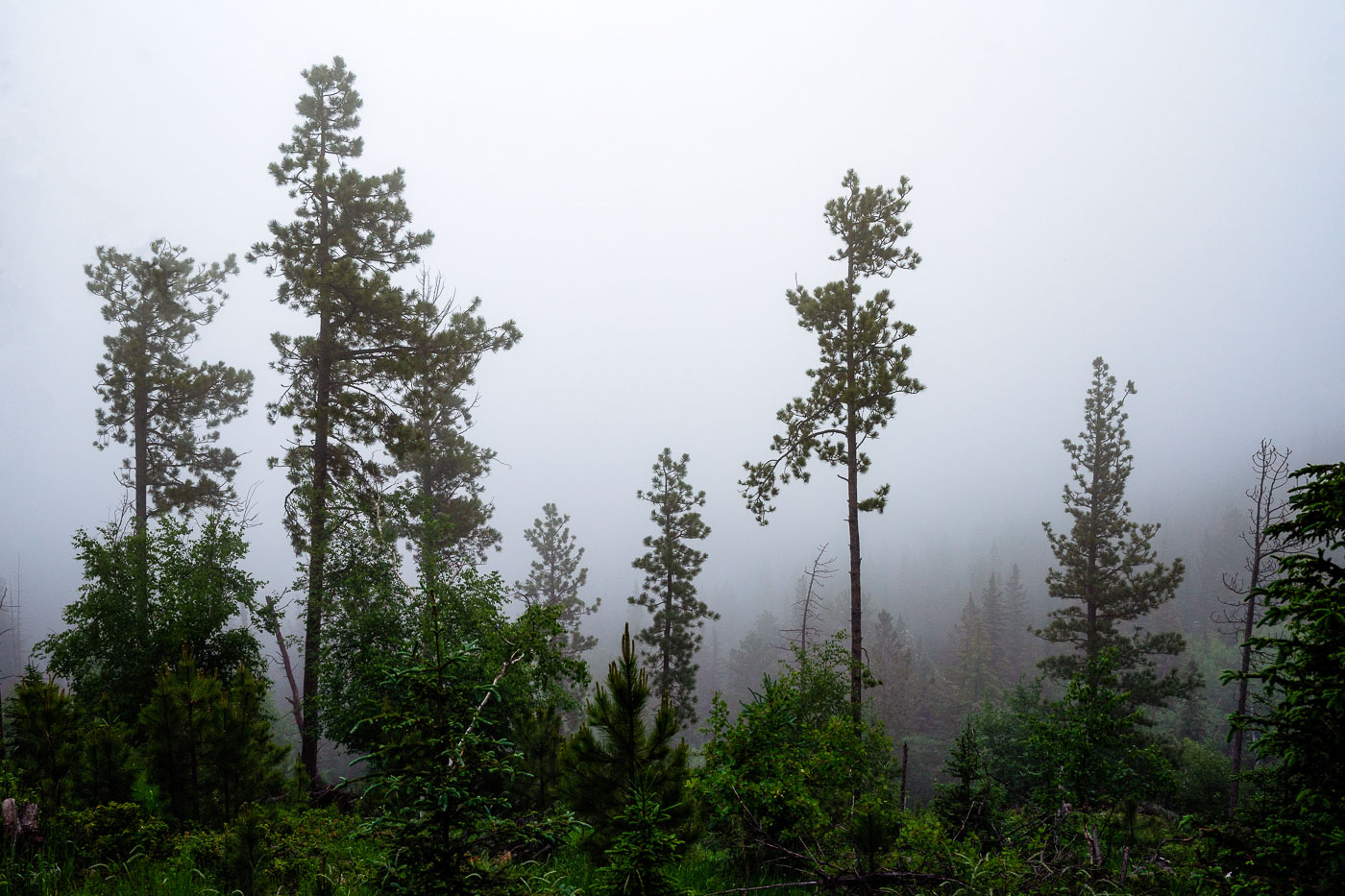
July 3, 2019 — The Needles, a prominent geological formation within Custer State Park, South Dakota, are illuminated by evening light. These granite spires, part of the Cathedral Spires, are ancient rock formations shaped by millions of years of erosion. The Needles Highway, a scenic route, provides access to this area, which holds cultural significance for the Lakota Sioux and is a popular destination for its natural beauty.July 3, 2019 — A hiker descends the trail from Black Elk Peak, the highest point in South Dakota, within Custer State Park. The Black Hills, a region of significant cultural and spiritual importance to the Lakota people, are characterized by ancient geological formations and a landscape shaped by uplift and erosion. This area, part of the Norbeck Wildlife Preserve, supports diverse flora, including ponderosa pines that grow on rocky outcrops, and has experienced cycles of forest fires and renewal.July 3, 2019 — The stone fire tower on Black Elk Peak, the highest point in South Dakota, was constructed by the Civilian Conservation Corps in the 1930s as part of early forest conservation efforts in the Black Hills. Situated amidst granite spires and dense pine forests, the tower offers panoramic views that can extend into neighboring states on clear days. However, on this misty morning, low clouds obscure the surrounding landscape, creating an isolated atmosphere at the summit. The tower remains a historical landmark, symbolizing the region's commitment to land management and preservation.July 3, 2019 — Low clouds and fog envelop the granite spires of the Cathedral Spires in South Dakota's Black Hills shortly after dawn. These formations, part of the Needles range within Custer State Park, are composed of Harney Peak granite and were shaped by millions of years of geological processes. The area is a significant natural landmark, known for its rugged beauty and popularity among climbers and hikers. The morning mist often creates an ethereal atmosphere, highlighting the dramatic topography of the region.July 3, 2019 — Horseback riders ascend a trail on Black Elk Peak in South Dakota's Black Hills, a landscape often shrouded in mist. The peak, renamed in 2016 to honor Lakota spiritual leader Black Elk, has been a significant site for Indigenous peoples and later a popular destination for hikers and equestrians. The trail winds through ponderosa pines and rugged terrain, offering views of the granite formations characteristic of the region.July 3, 2019 — Black Elk Peak, in the Black Hills of South Dakota, rises to 7,244 feet, making it the highest point in the state and the highest point in the United States east of the Rockies. The trail to its summit, part of the Black Elk Peak Trail system within Custer State Park and the Black Hills National Forest, climbs through stands of ponderosa pine and spruce over several miles of granite terrain. The peak, formerly known as Harney Peak, was renamed in 2016 to honor the Lakota holy man Black Elk. The Lakota and other Plains tribes regard the surrounding Black Hills, or He Sapa, as sacred ground central to their creation stories and spiritual practices. A stone fire lookout tower, built in 1938 by the Civilian Conservation Corps, still stands at the summit.July 3, 2019 — Black Elk Peak reaches 7,242 feet, making it the highest point in South Dakota and the highest peak in the United States east of the Rockies. It sits within Black Elk Wilderness, part of the Black Hills National Forest, and was known as Harney Peak until the U.S. Board on Geographic Names renamed it in 2016 to honor the Lakota holy man Black Elk. The summit's granite outcrops date to the Precambrian era, among the oldest exposed rock in North America. A fire lookout tower built in 1938 by the Civilian Conservation Corps still stands near the top, reachable by several trails from Custer State Park and Sylvan Lake.July 3, 2019 — Black Elk Peak, formerly named Harney Peak, rises to 7,244 feet in South Dakota's Black Hills, making it the highest natural point in the state and in the United States east of the Rockies. The summit trail climbs through stands of ponderosa pine, birch, and spruce before reaching a stone lookout tower built by the Civilian Conservation Corps in the 1930s. The peak carries deep spiritual meaning for the Lakota people, tied to Black Elk's recorded vision of the mountain as the center of the world. It sits within Custer State Park and the Black Elk Wilderness, drawing hikers year-round on a route that gains roughly 1,100 feet over its final approach.July 3, 2019 — Black Elk Peak, once named Harney Peak, rises to 7,244 feet in South Dakota's Black Hills, making it the highest point in the state and the highest natural point east of the Rockies. The Lakota consider the summit sacred ground, tied to Black Elk's vision as recounted in "Black Elk Speaks," and the peak was officially renamed in 2016 to reflect that history. A stone fire lookout tower, built by the Civilian Conservation Corps in 1938, still stands at the top. The trail up passes through stands of ponderosa pine, the dominant tree across the Black Hills, en route to a summit that offers views reaching into four states on clear days.July 3, 2019 — A dense morning fog blankets the Ponderosa pines of the Black Hills in South Dakota, obscuring the landscape near Black Elk Peak. This meteorological phenomenon is common in the higher elevations of the region, including areas around Custer State Park and the Needles Highway. The fog forms due to rapid temperature shifts, causing moisture to settle among the conifer stands and create an ethereal atmosphere. The Black Hills are a significant geological and cultural area, historically important to Native American tribes and later a site of mining and tourism.
Built in Minneapolis
Minneapolis Photographer
Browse by location, move through long-running series, or start with recent work.