Downtown Minneapolis

1,165 photos · 2009–2026

1,165 photographs tagged Downtown Minneapolis, 2009–2026.
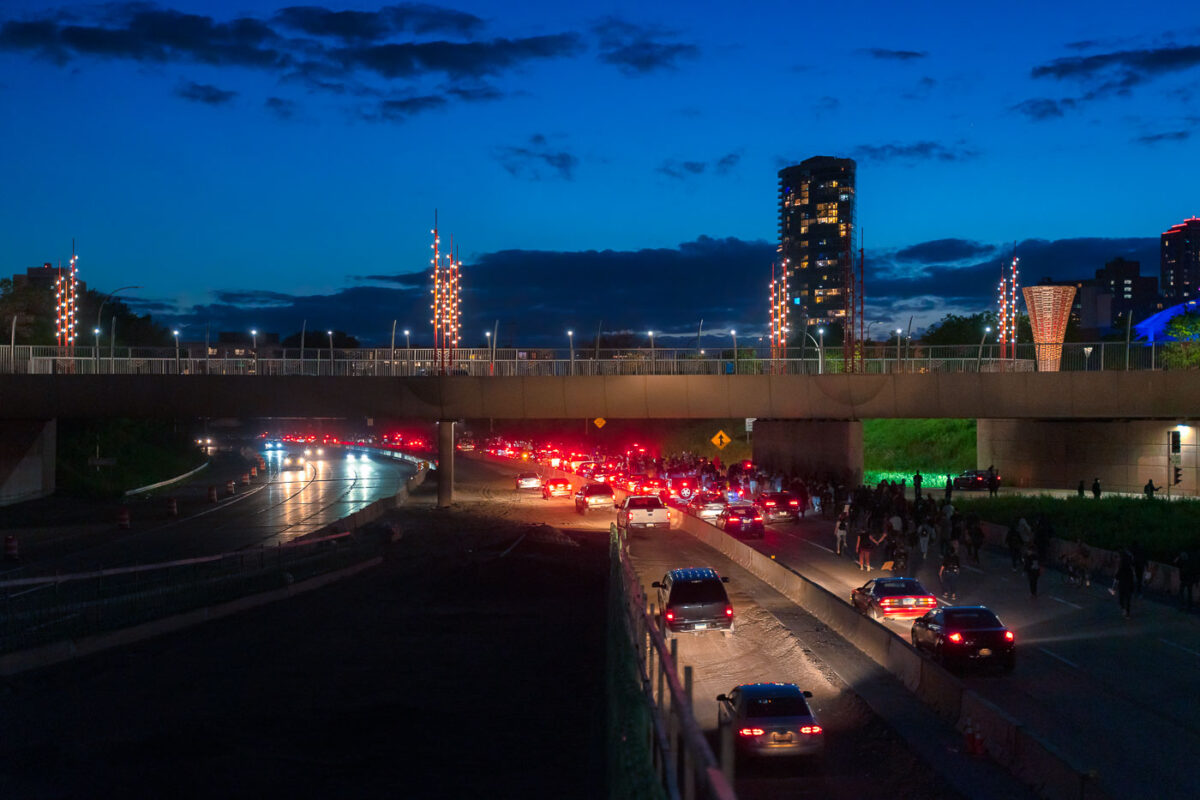
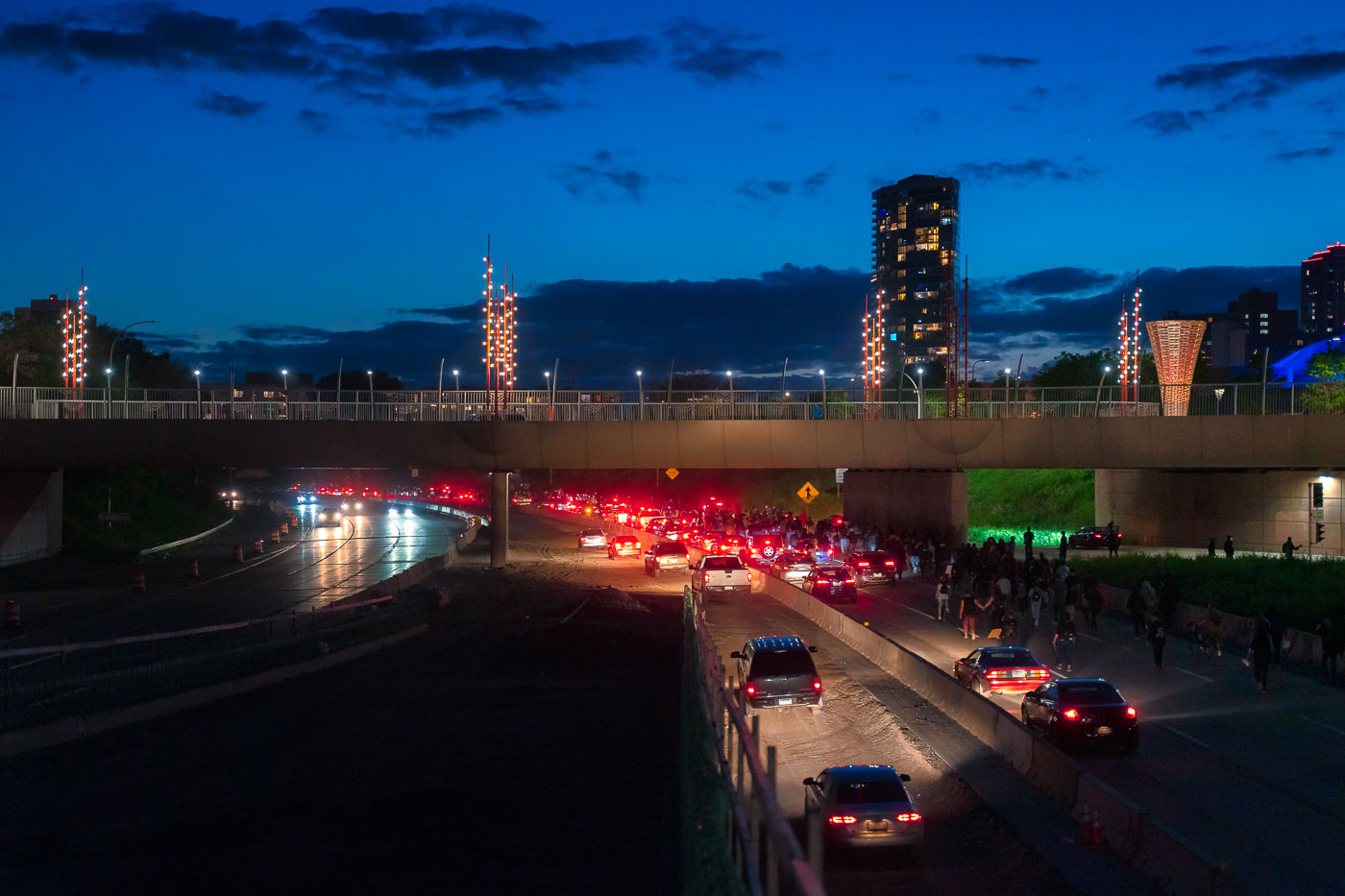
Protesters and backed-up traffic on Interstate 94 in Minneapolis at night.
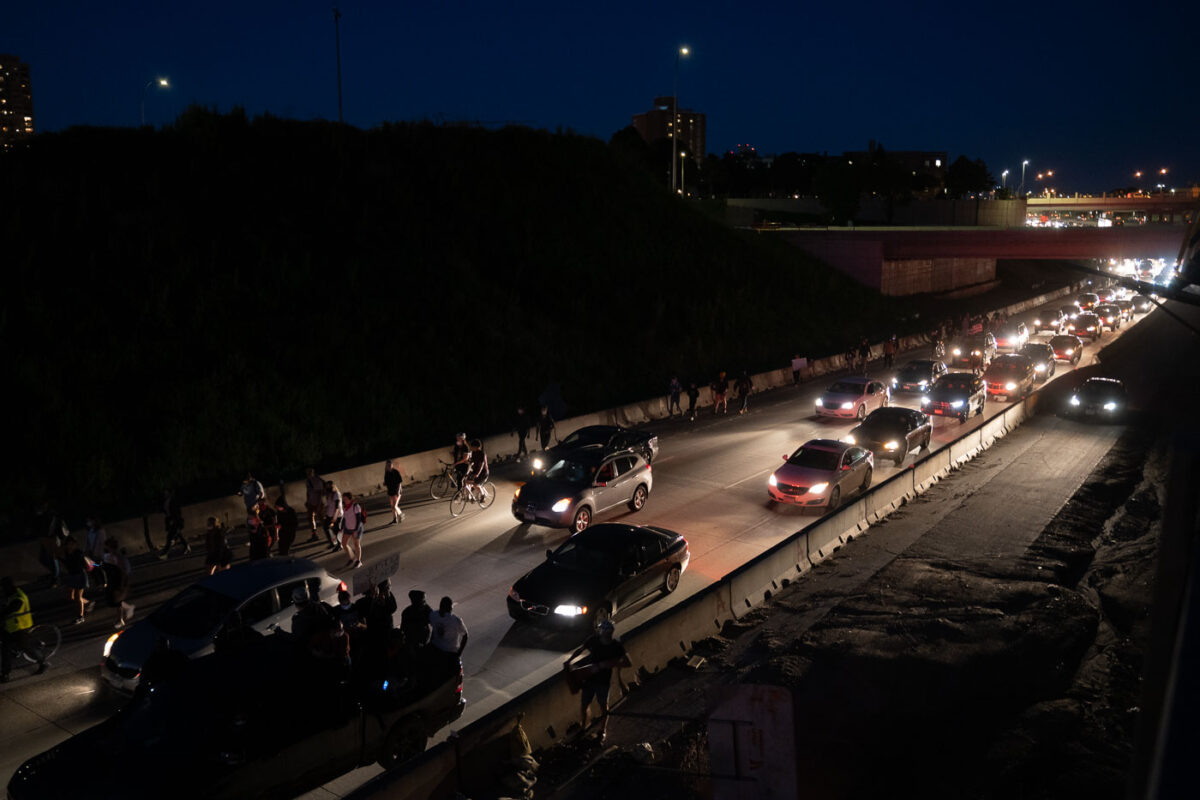
Protesters and halted traffic fill Interstate 94 in downtown Minneapolis on May 29, 2020, during the fourth day of demonstrations following the killing of George Floyd. The nighttime photograph shows marchers occupying the freeway lanes beneath a pedestrian bridge as vehicles back up along the corridor. I-94 is a major east-west route through Minneapolis and Saint Paul.

Protest on I-94 in Minneapolis

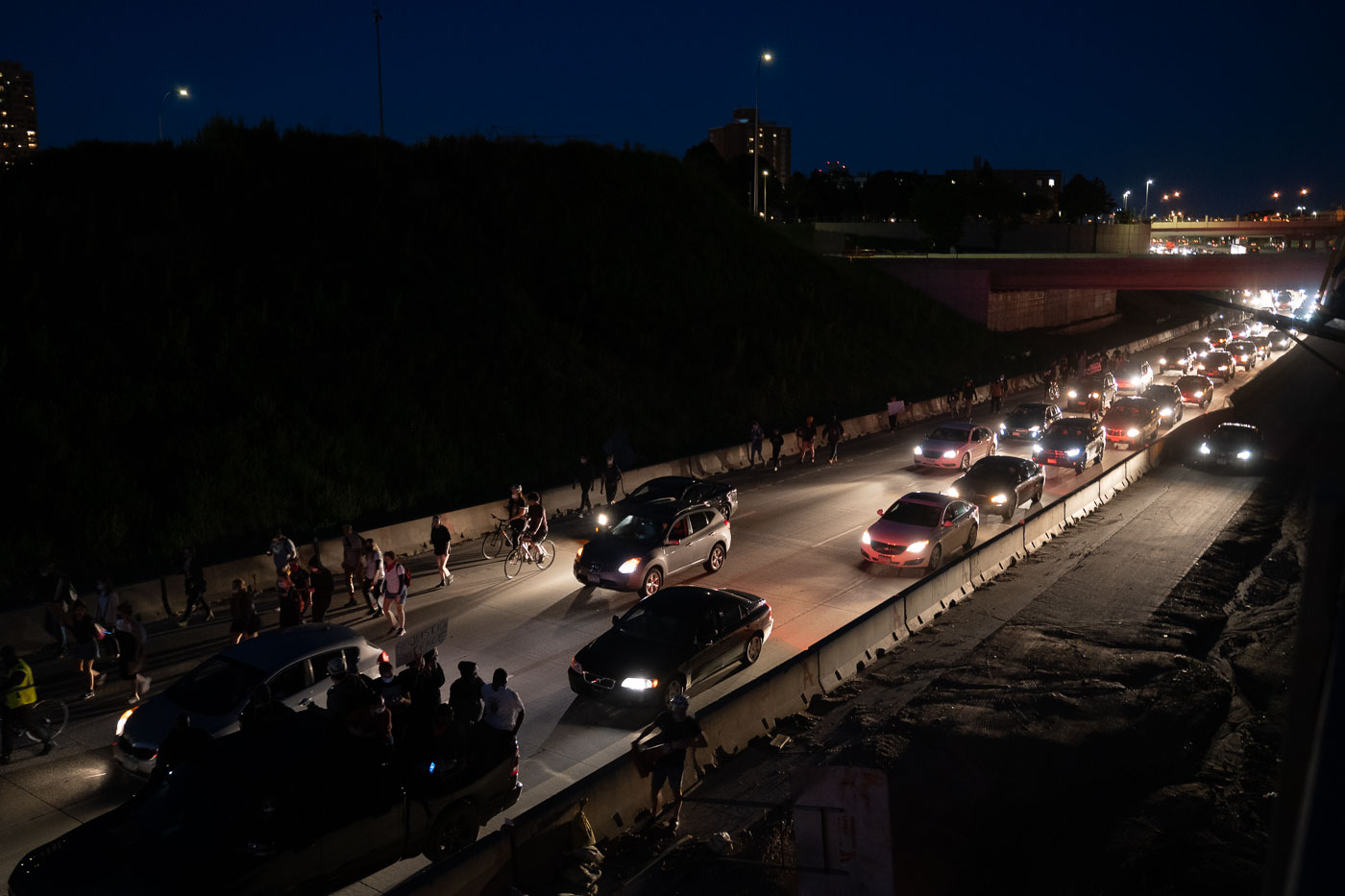
Protesters and stopped traffic on I-94 in Minneapolis at night.
Protesters and stopped traffic occupy Interstate 94 in Minneapolis on the night of May 29, 2020, during demonstrations following the killing of George Floyd. Photographed from an overpass, the image shows marchers moving along the freeway while cars queue in adjacent lanes under streetlights.

I-94 Protests Minneapolis

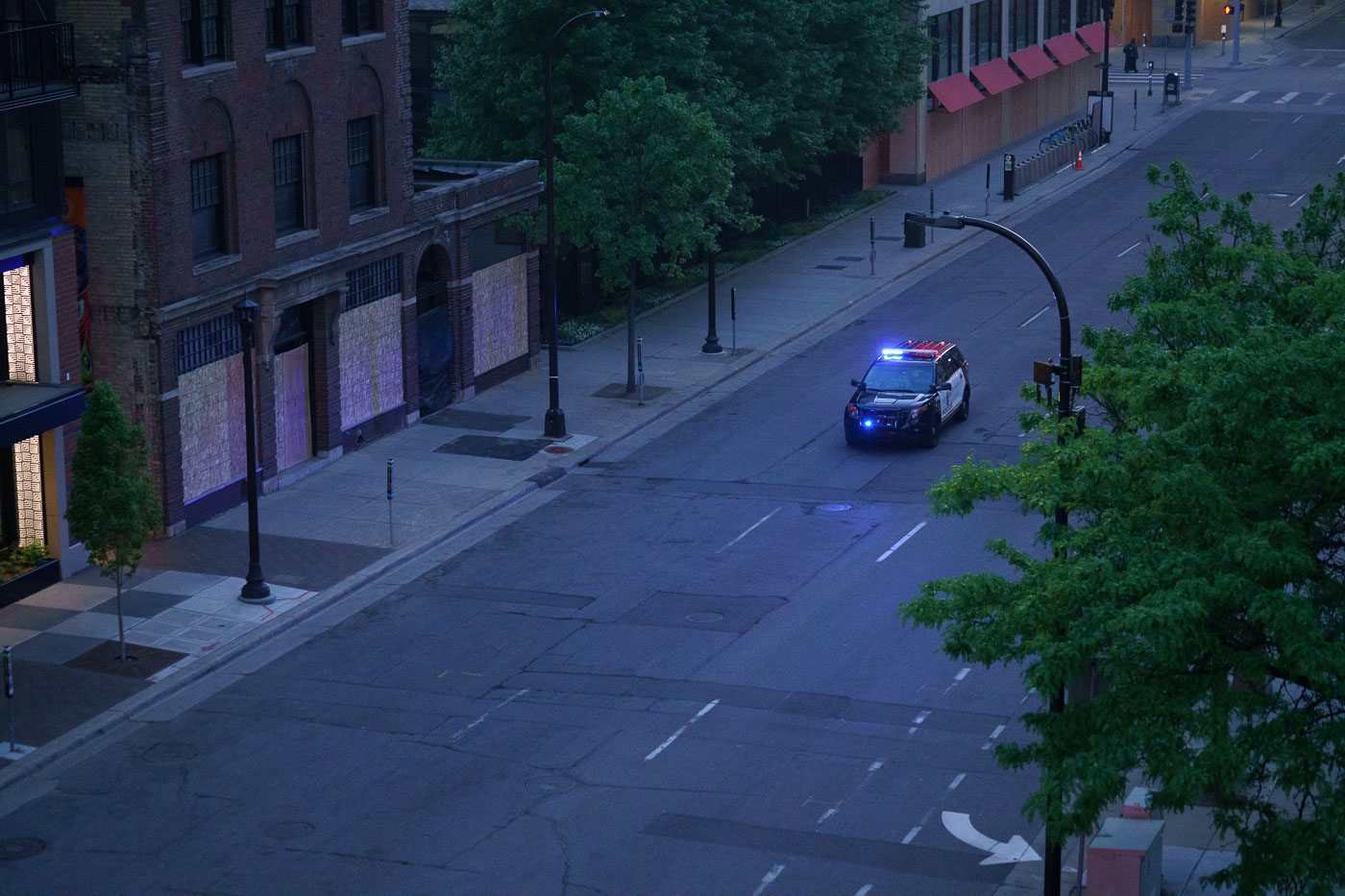
Minneapolis police SUV on South 10th Street beside boarded storefronts in downtown Minneapolis.
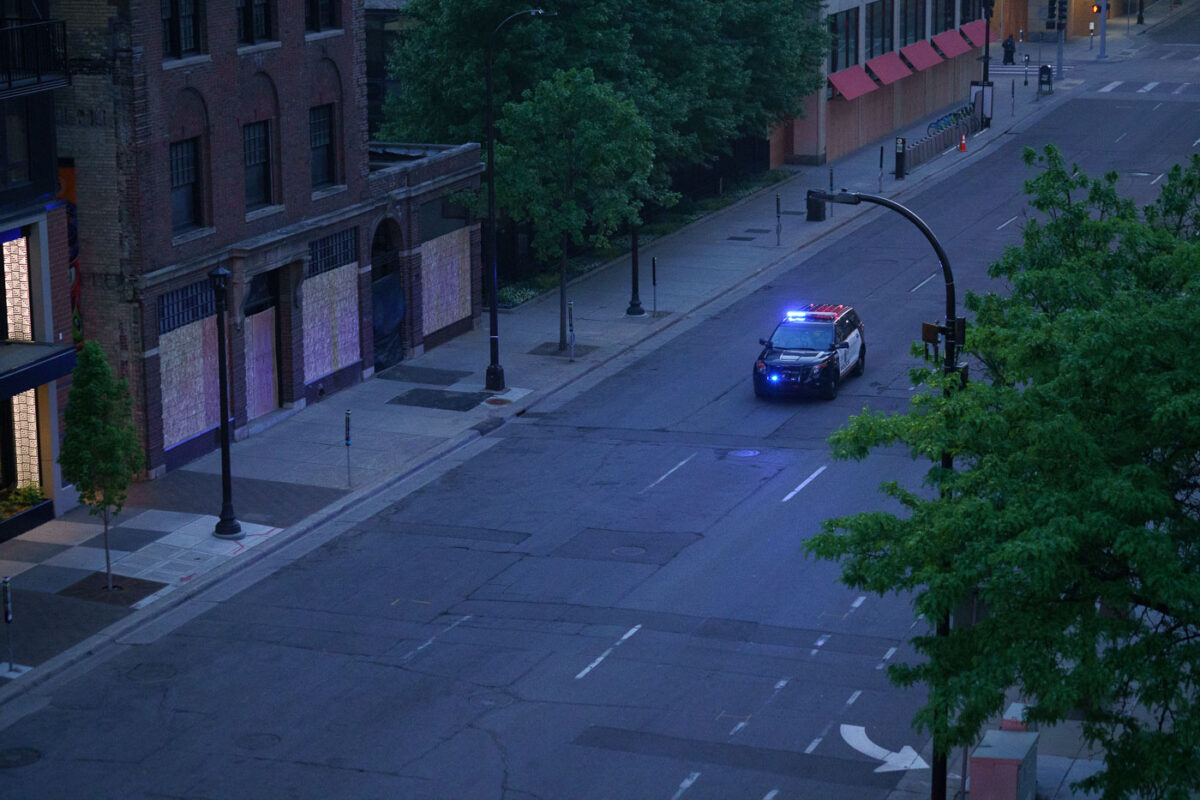
A Minneapolis Police squad car patrols South 10th Street in downtown Minneapolis on May 29, 2020, passing commercial buildings with plywood covering their ground-floor windows. The boarded storefronts document security measures taken by businesses during the unrest that followed the killing of George Floyd.

Police Car and Boarded Businesses, Minneapolis
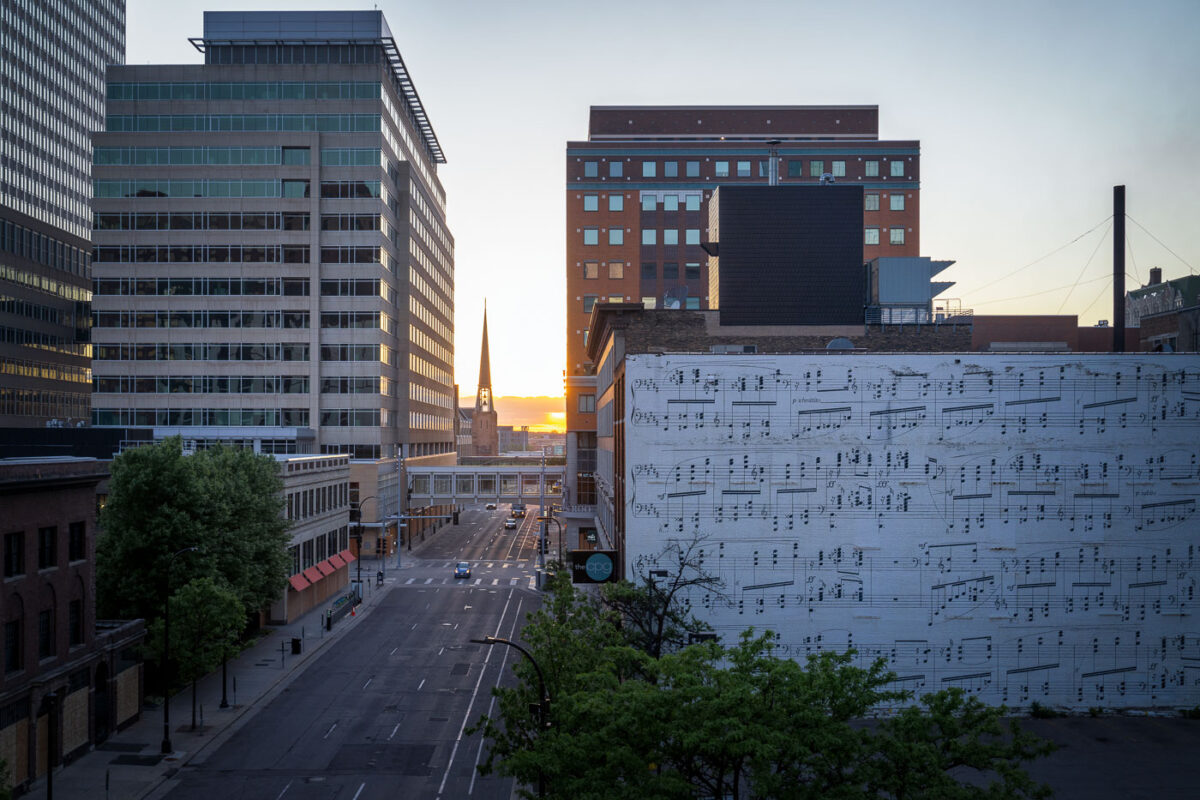
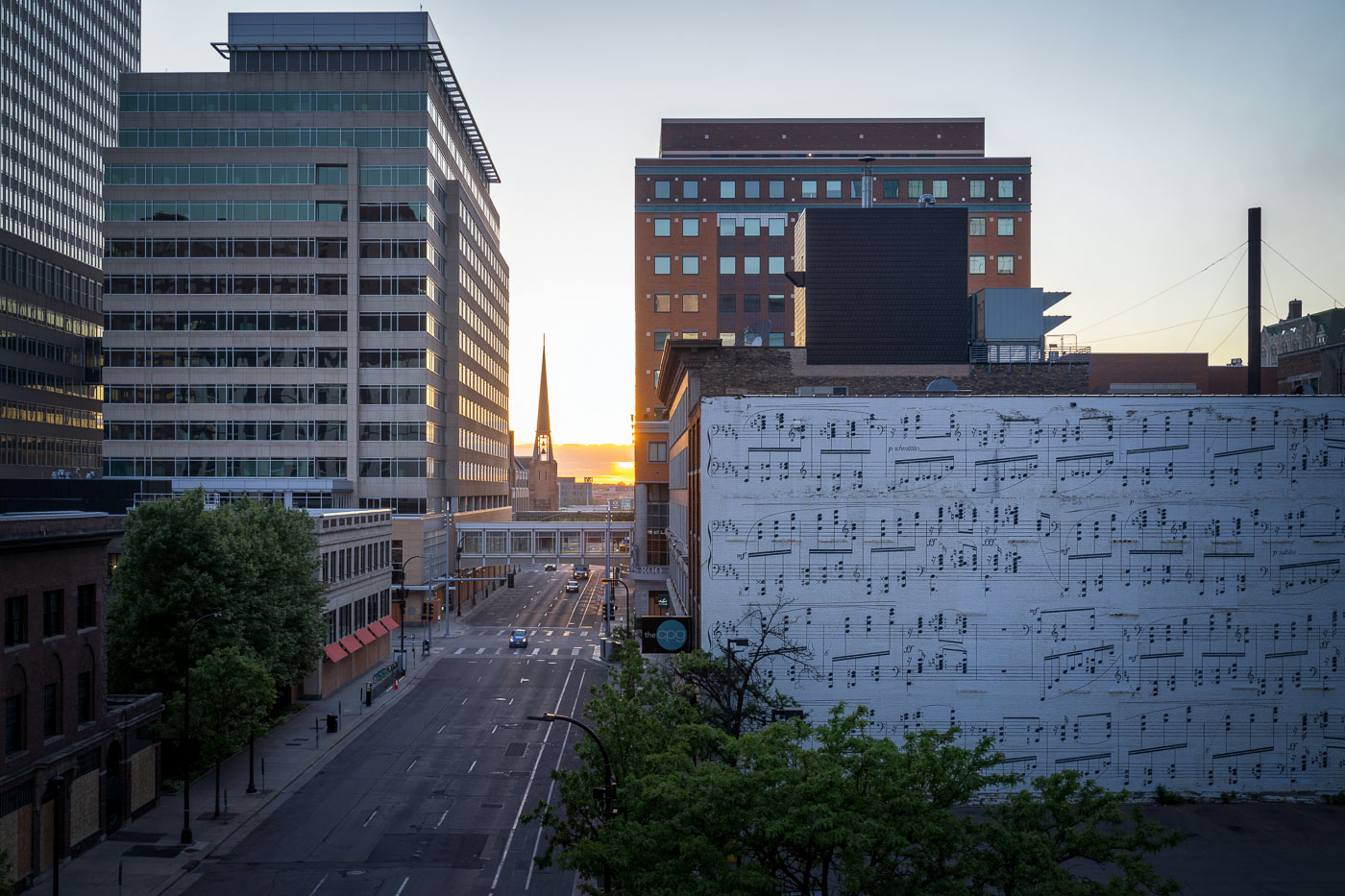
South 10th Street in downtown Minneapolis at sunset, with a music mural and sparse traffic.
S 10th Street in downtown Minneapolis is shown at sunset on May 29, 2020, with very light traffic and few people visible. Mid-rise office and commercial buildings line the corridor, and a large mural of musical notation covers the wall of the building at right, while a church spire rises in the distance. The photograph was made during the period of unrest in Minneapolis following the killing of George Floyd, when parts of the downtown street network were noticeably quieter than usual.

S 10th St Sunset, Downtown Minneapolis
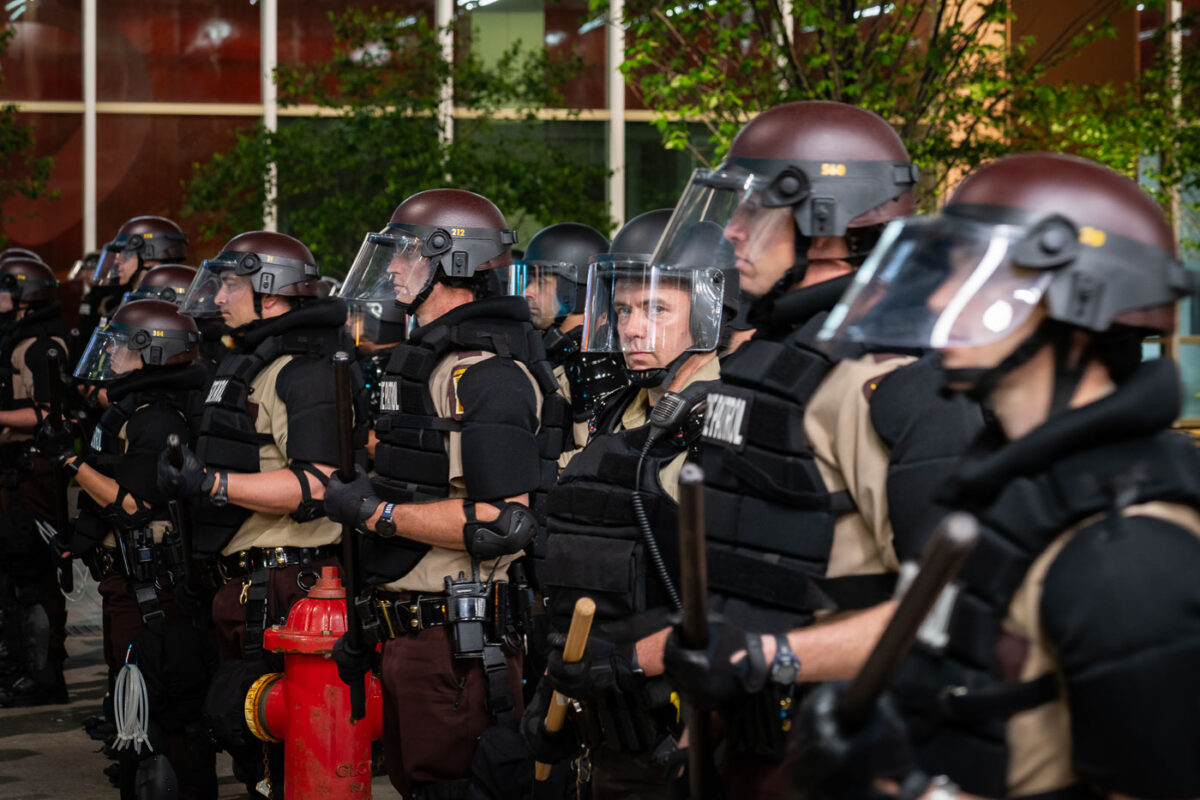
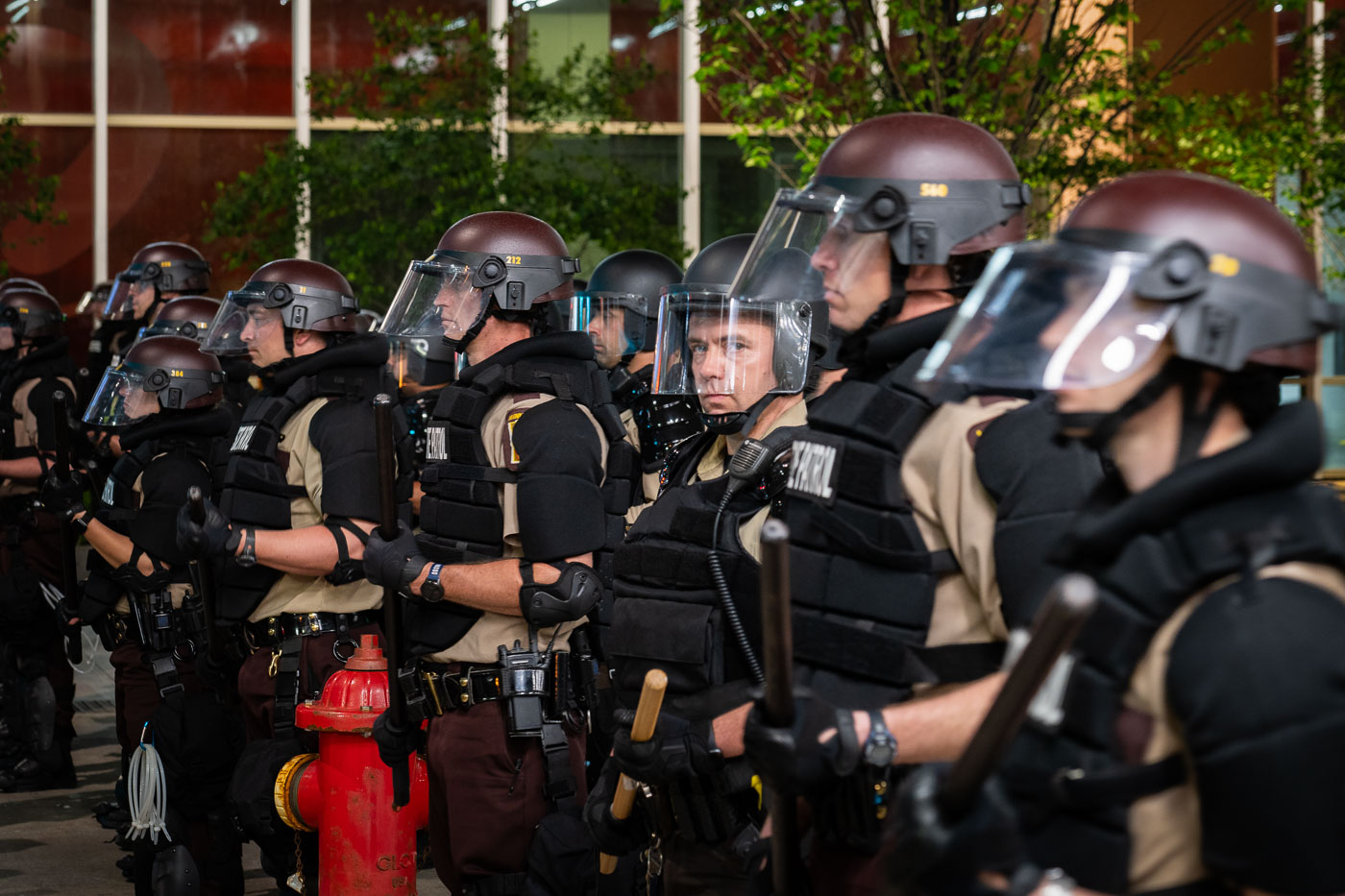
Minnesota State Patrol officers in riot gear on Nicollet Mall in downtown Minneapolis during protests.
Minnesota State Patrol officers in riot gear stand in formation on Nicollet Mall in downtown Minneapolis on May 29, 2020. The deployment took place during the third day of protests and unrest following the killing of George Floyd by Minneapolis police on May 25. Nicollet Mall is a major pedestrian and transit corridor in the city center, and state officers were mobilized there to reinforce law enforcement presence overnight.

State Patrol in Riot Gear, Nicollet Mall
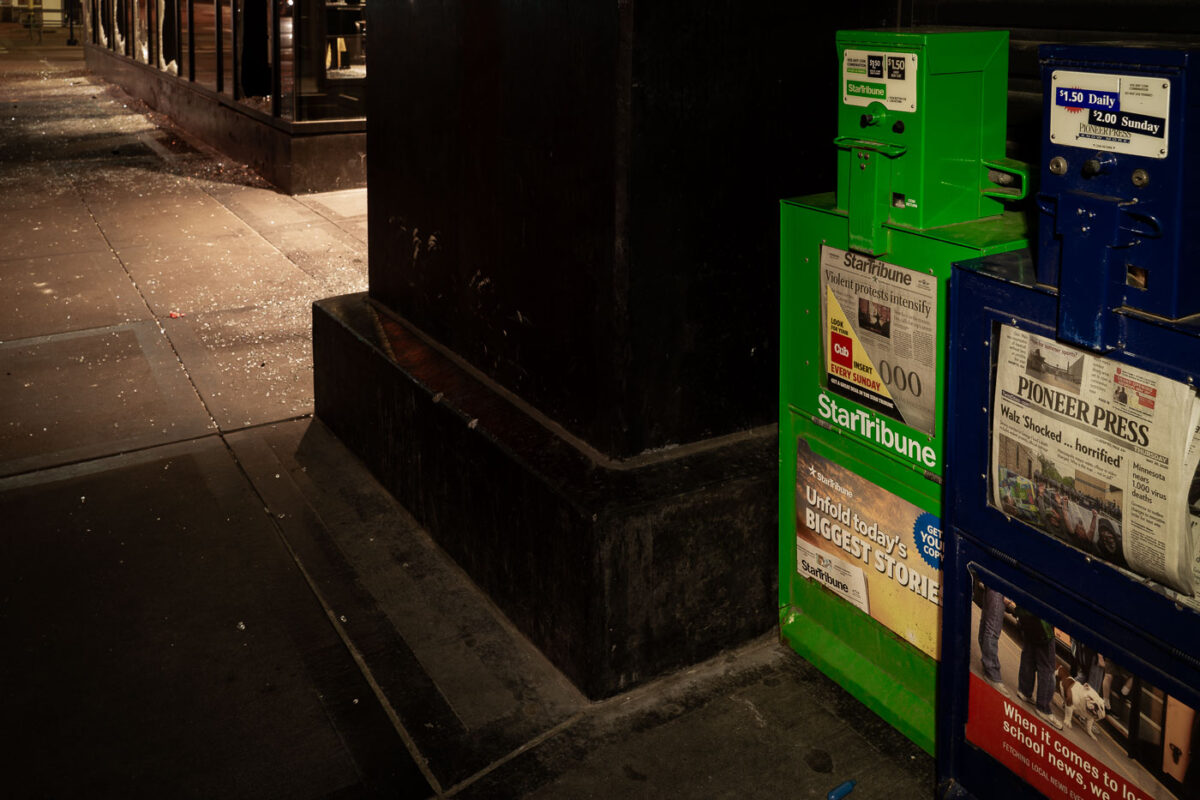
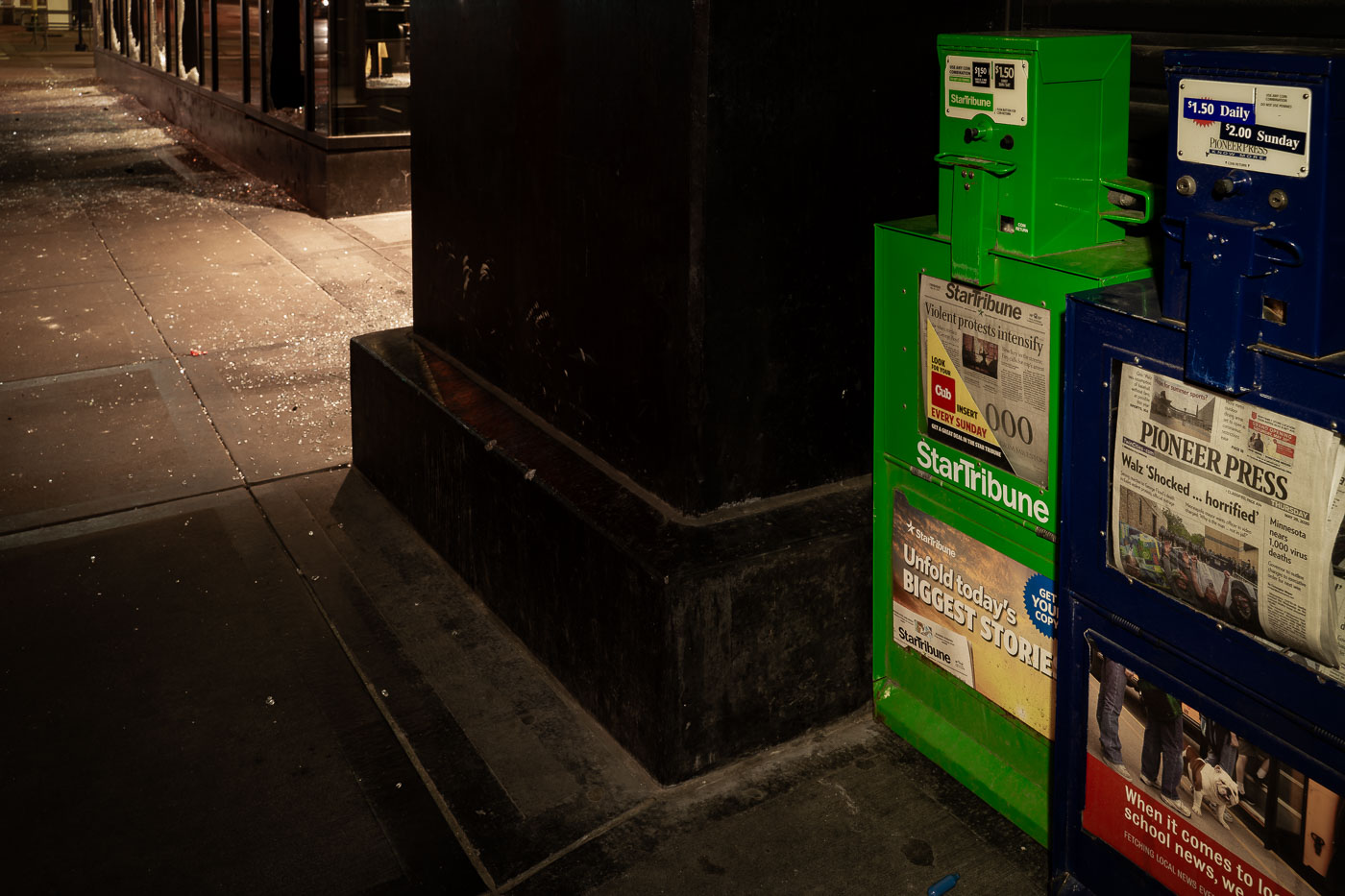
Star Tribune and Pioneer Press racks in downtown Minneapolis beside broken glass during May 2020 protests.
Star Tribune and Pioneer Press newspaper racks stand on a sidewalk in downtown Minneapolis in the early hours of May 29, 2020, with broken glass scattered across the pavement nearby. The visible Star Tribune front page reads “Violent protests intensify,” placing the photograph during unrest following the killing of George Floyd.

Newspaper Racks, Downtown Minneapolis Protests
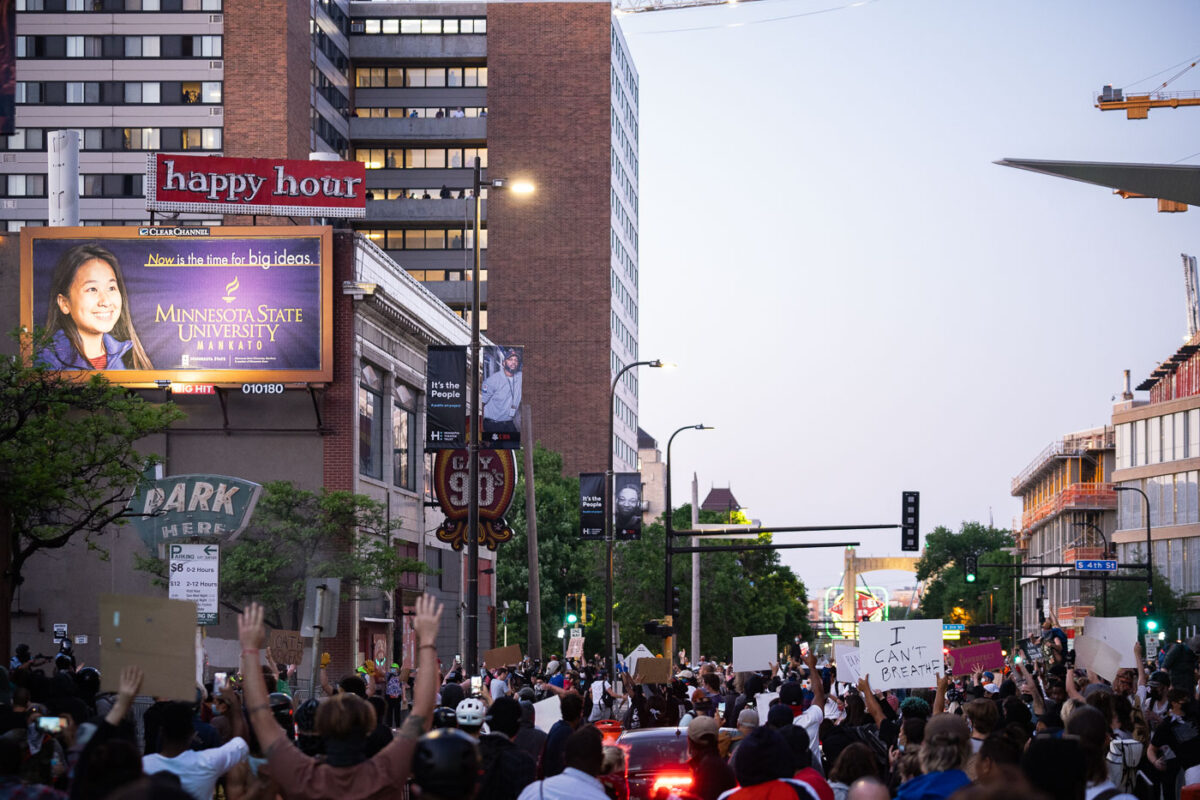
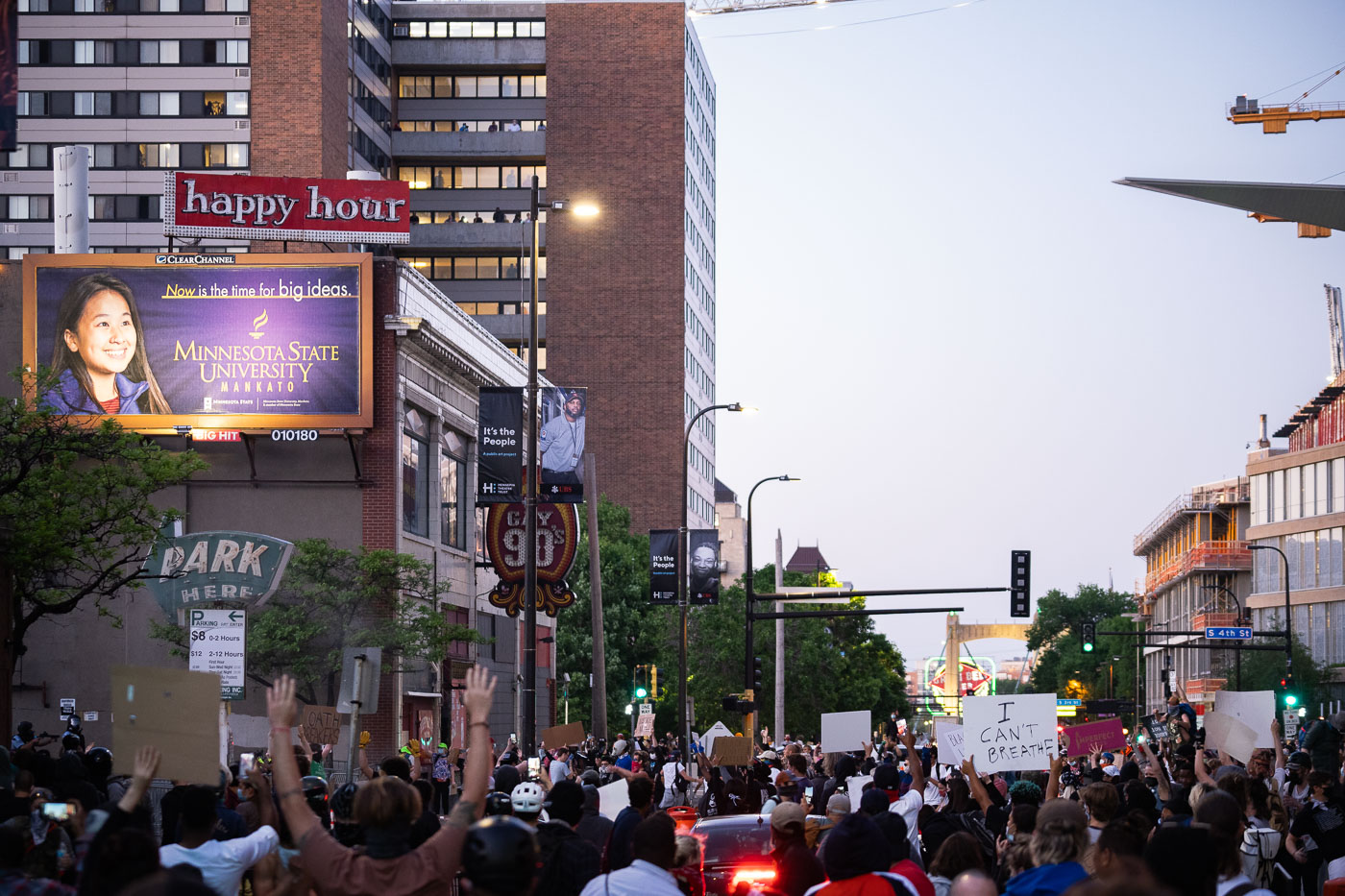
Hundreds of protesters fill Hennepin Avenue in downtown Minneapolis during a May 2020 demonstration following George Floyd's death.
Protesters march on Hennepin Avenue near the Minneapolis Police 1st Precinct in downtown Minneapolis on May 28, 2020, during demonstrations after the death of George Floyd.

George Floyd Protesters Fill Hennepin Avenue at Dusk
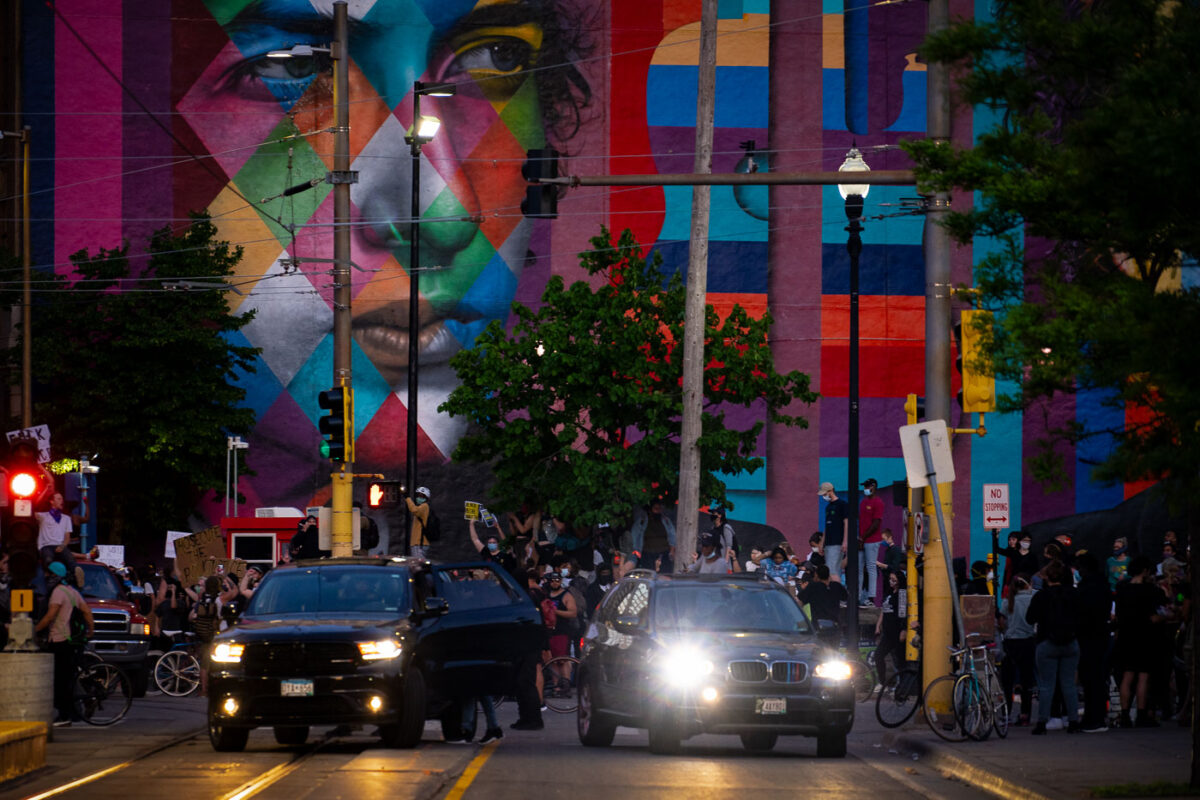
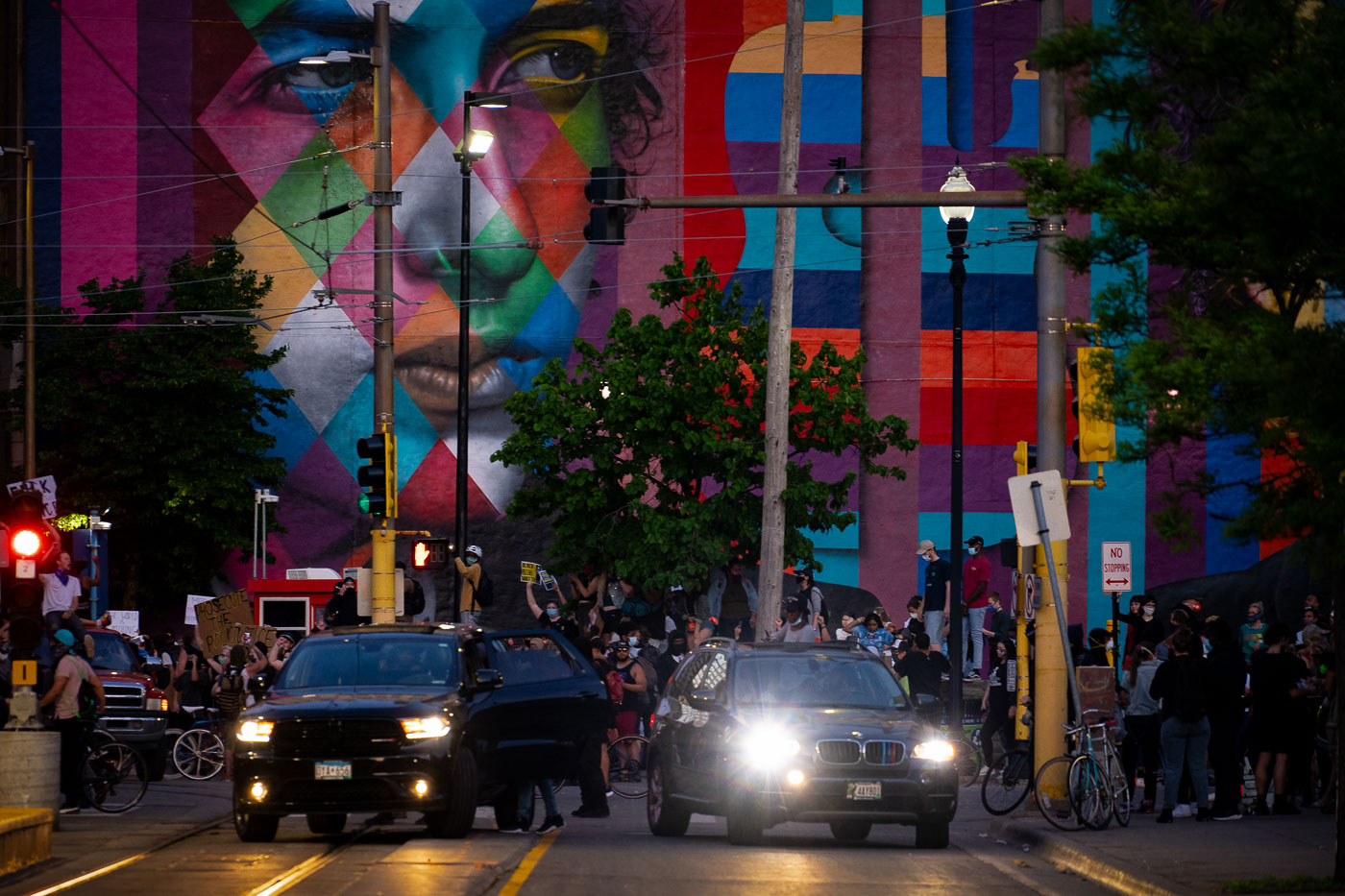
Protesters gather on Hennepin Avenue beside Eduardo Kobra's colorful Bob Dylan mural in downtown Minneapolis on May 28, 2020.
Protesters gather on Hennepin Avenue in downtown Minneapolis beside Eduardo Kobra’s Bob Dylan mural on May 28, 2020, during demonstrations following the death of George Floyd.

Vehicles Pass Protesters Beneath the Bob Dylan Mural on Hennepin Avenue
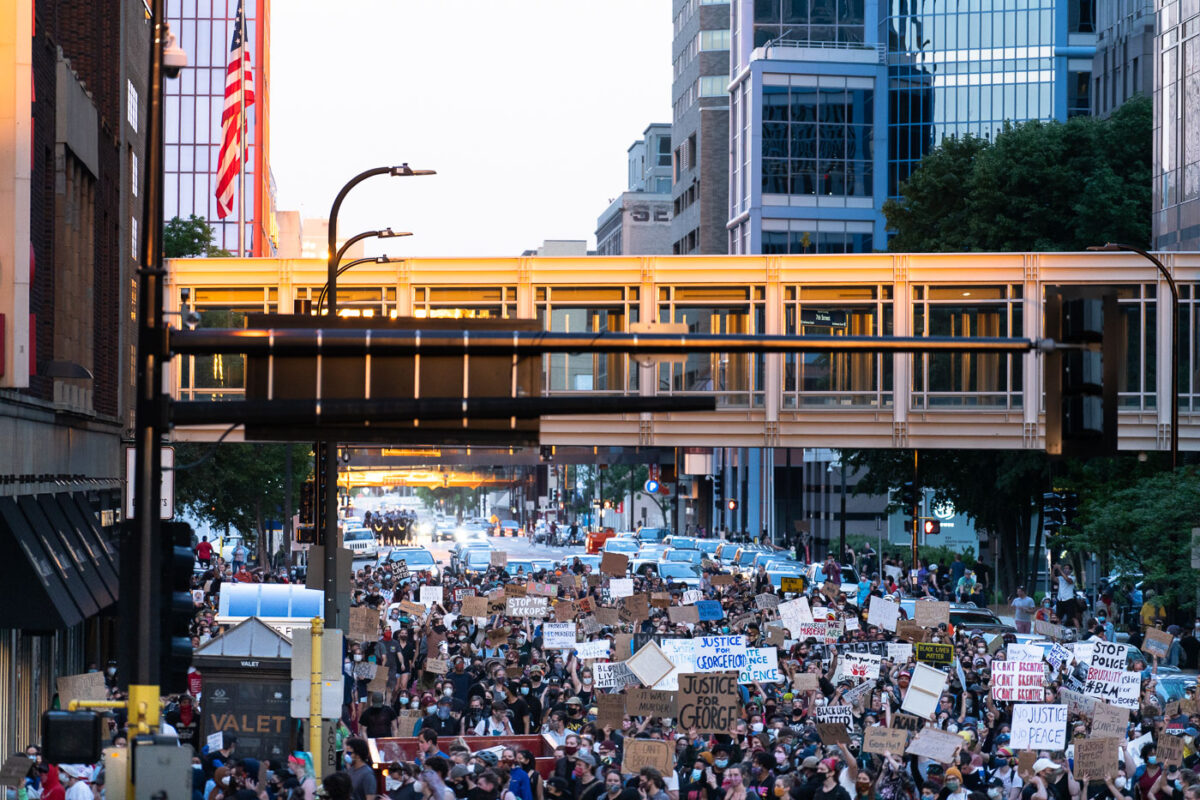
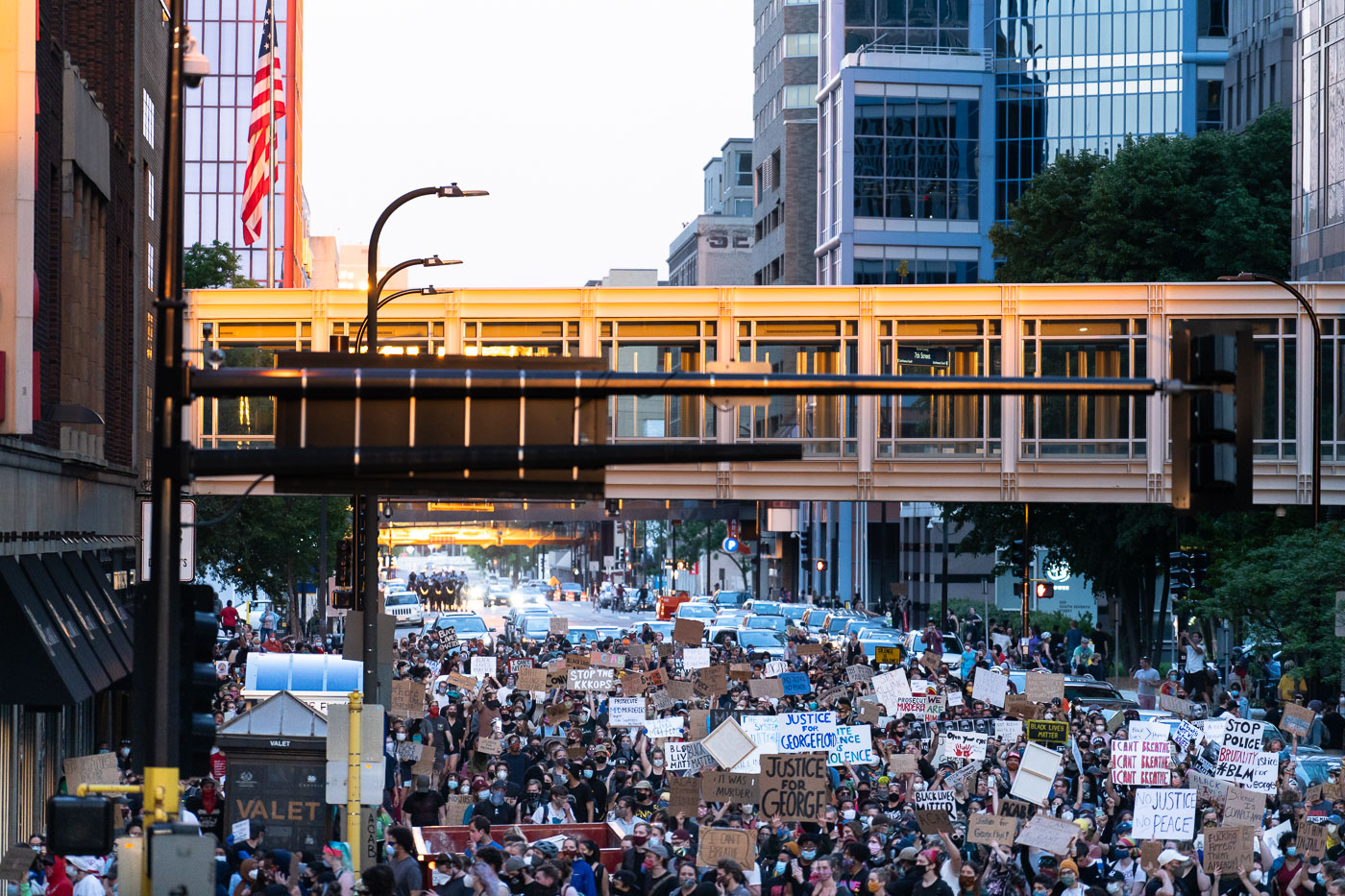
Thousands of protesters fill 7th Street in downtown Minneapolis during a march for George Floyd on May 28, 2020.
A protest march for George Floyd fills 7th Street in downtown Minneapolis on May 28, 2020. Protesters carry signs reading “Justice for George,” “Black Lives Matter,” and “Stop Police Brutality” as they move through downtown. The march took place on the third day of protests after George Floyd was killed by Minneapolis police.

George Floyd Protesters Fill 7th Street in Downtown Minneapolis
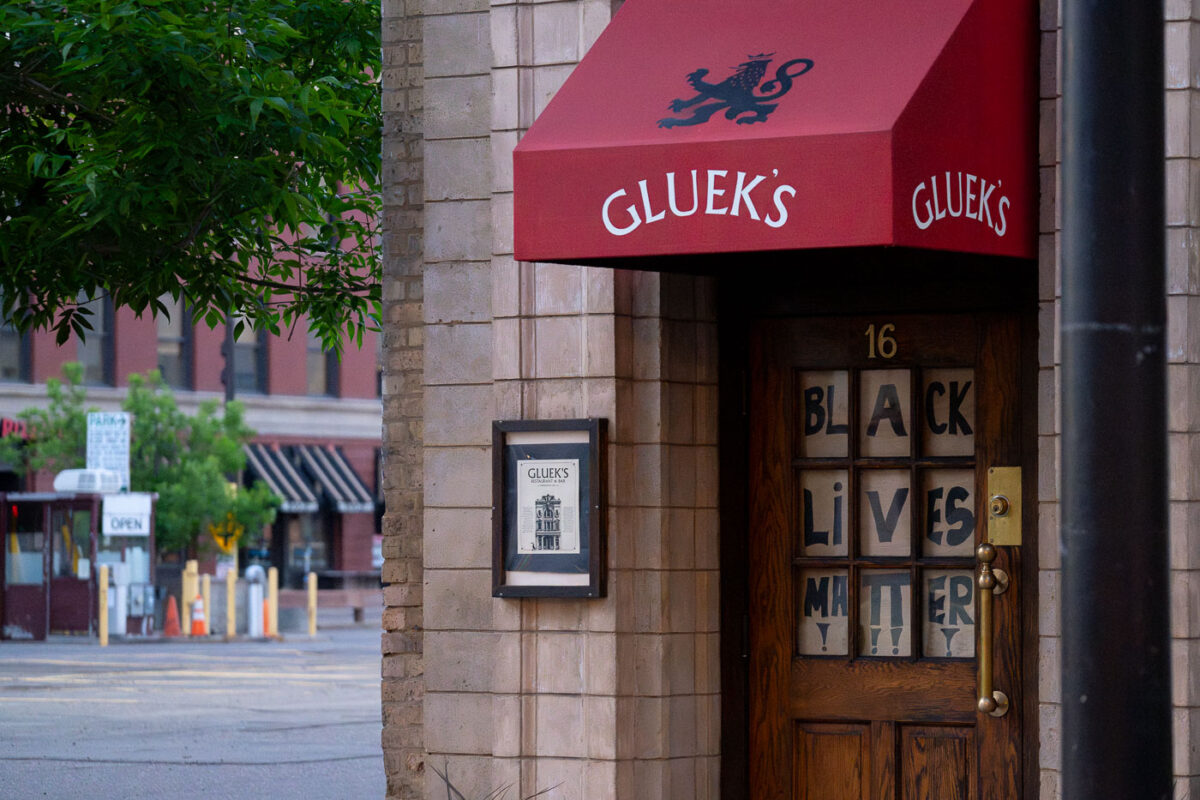
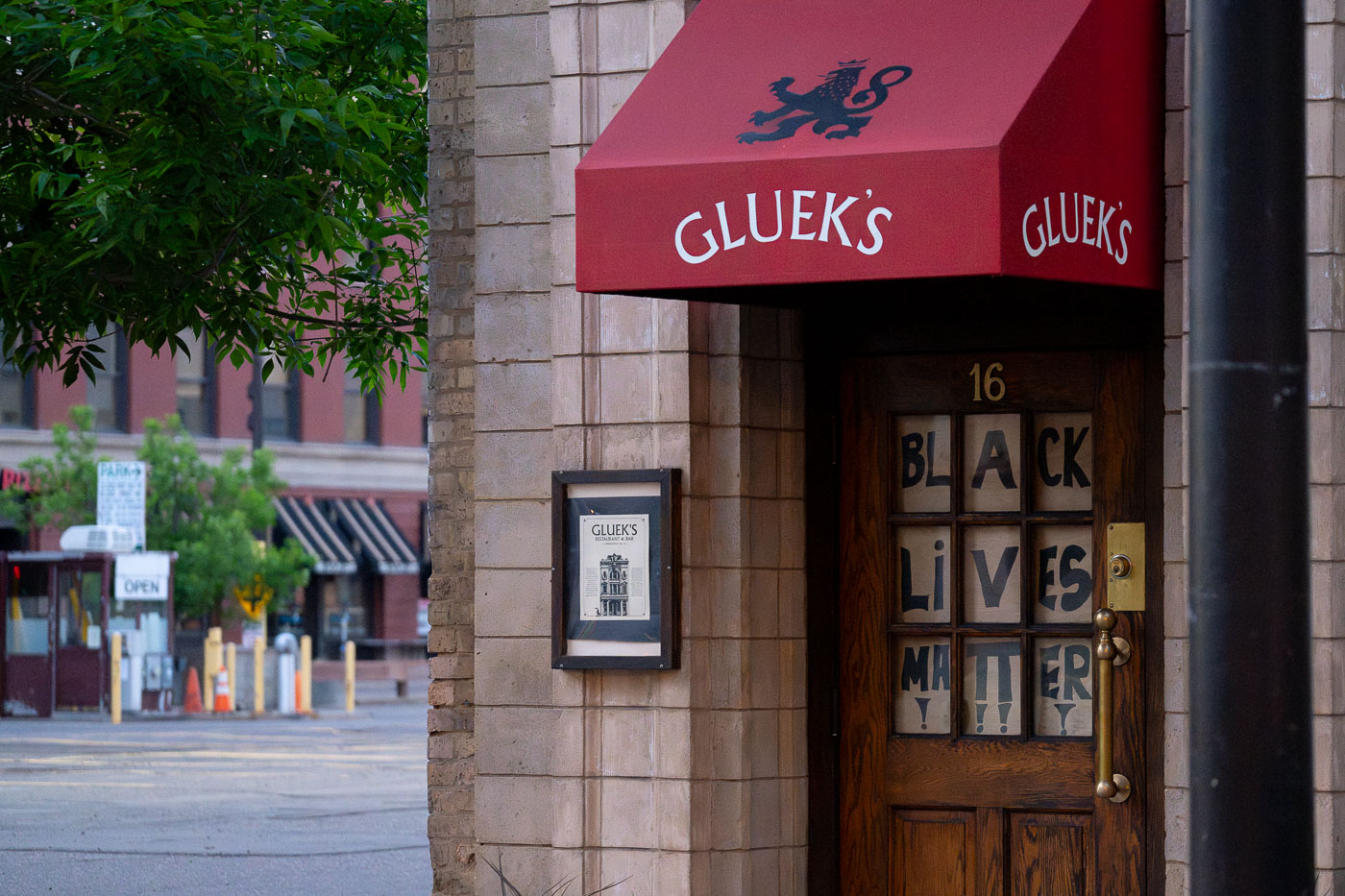
Gluek's Bar storefront in downtown Minneapolis displays "Black Lives Matter" lettering on its wooden entrance door below a red awning.
Gluek’s Bar & Restaurant in downtown Minneapolis displays a hand-lettered “Black Lives Matter” message across the glass panes of its entrance door. The photograph was made on May 28, 2020, during the protests and unrest that followed the killing of George Floyd.

“Black Lives Matter” Lettered on Gluek’s Door in Downtown Minneapolis
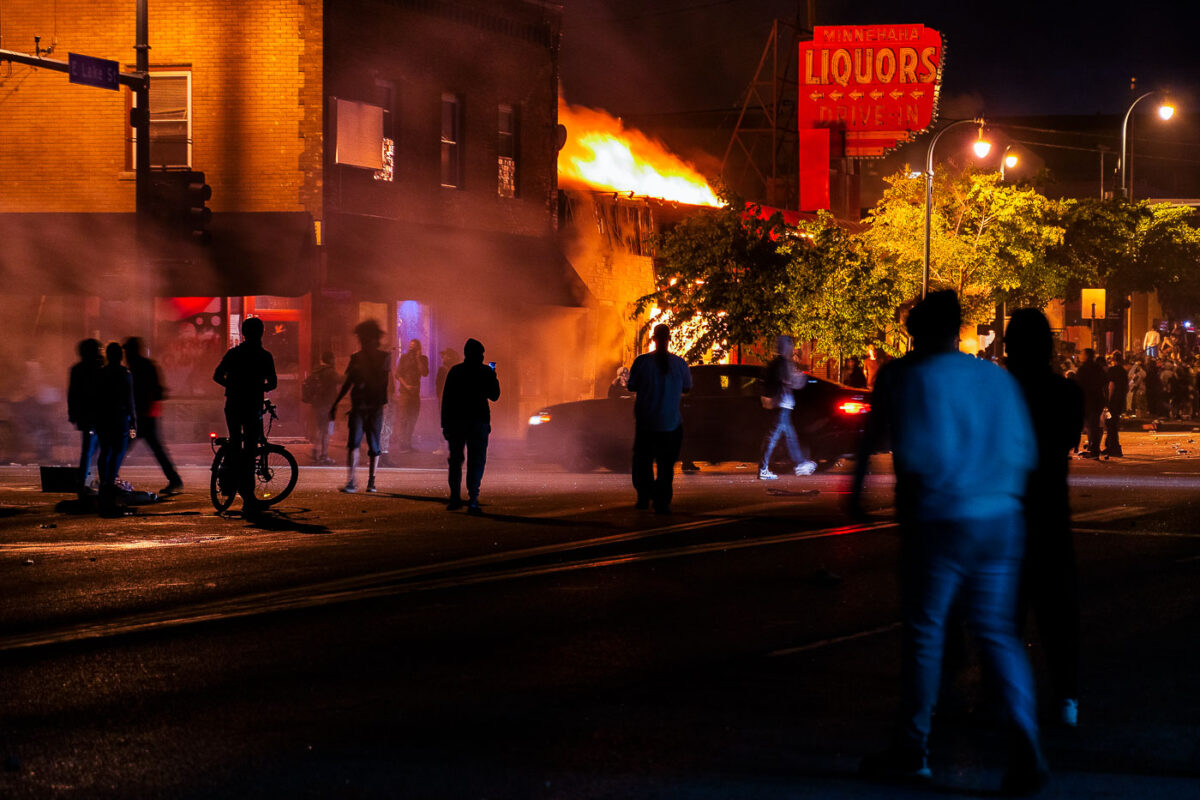
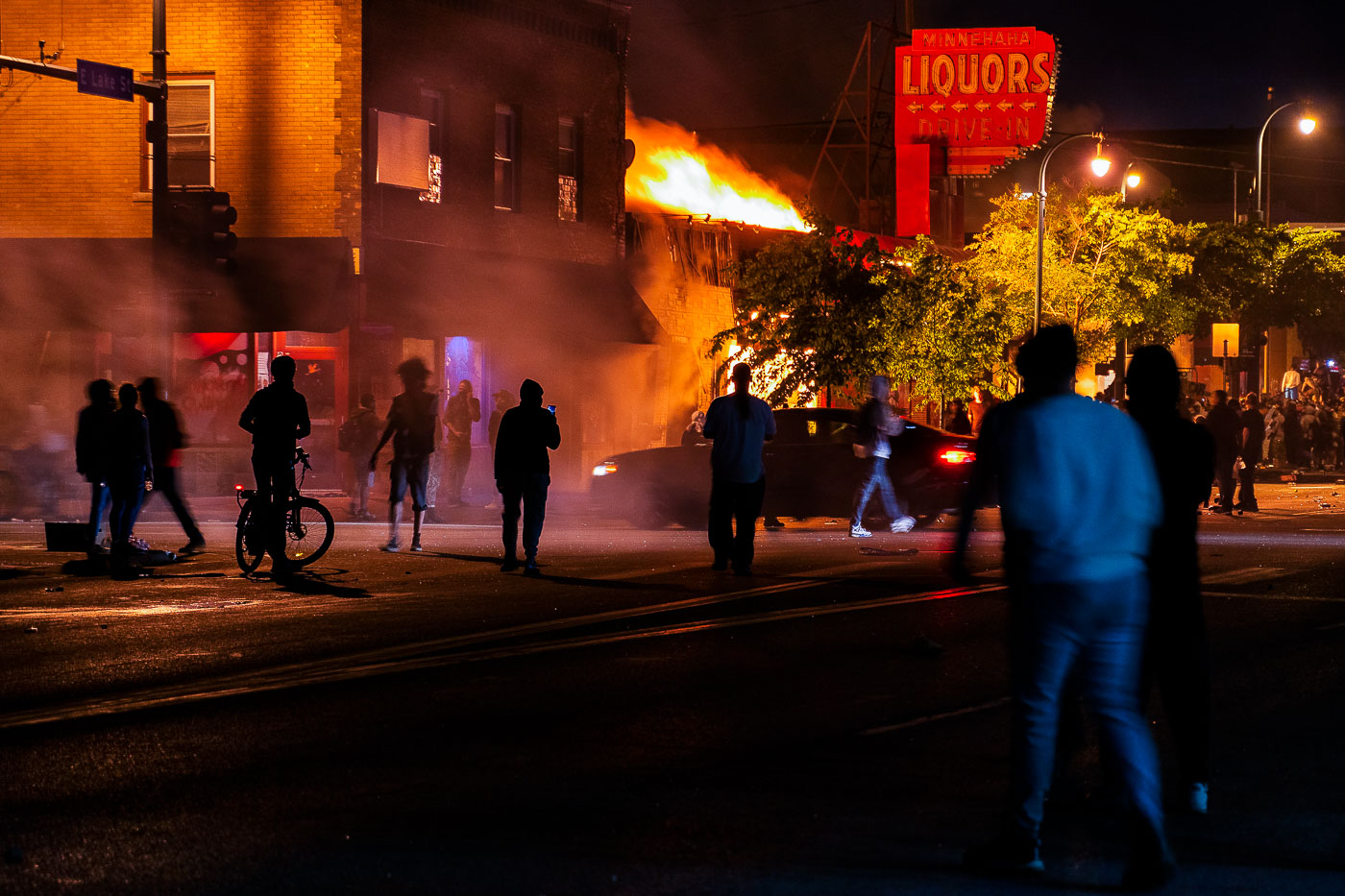
Minnehaha Liquors burns on East Lake Street in Minneapolis as people gather during protests.
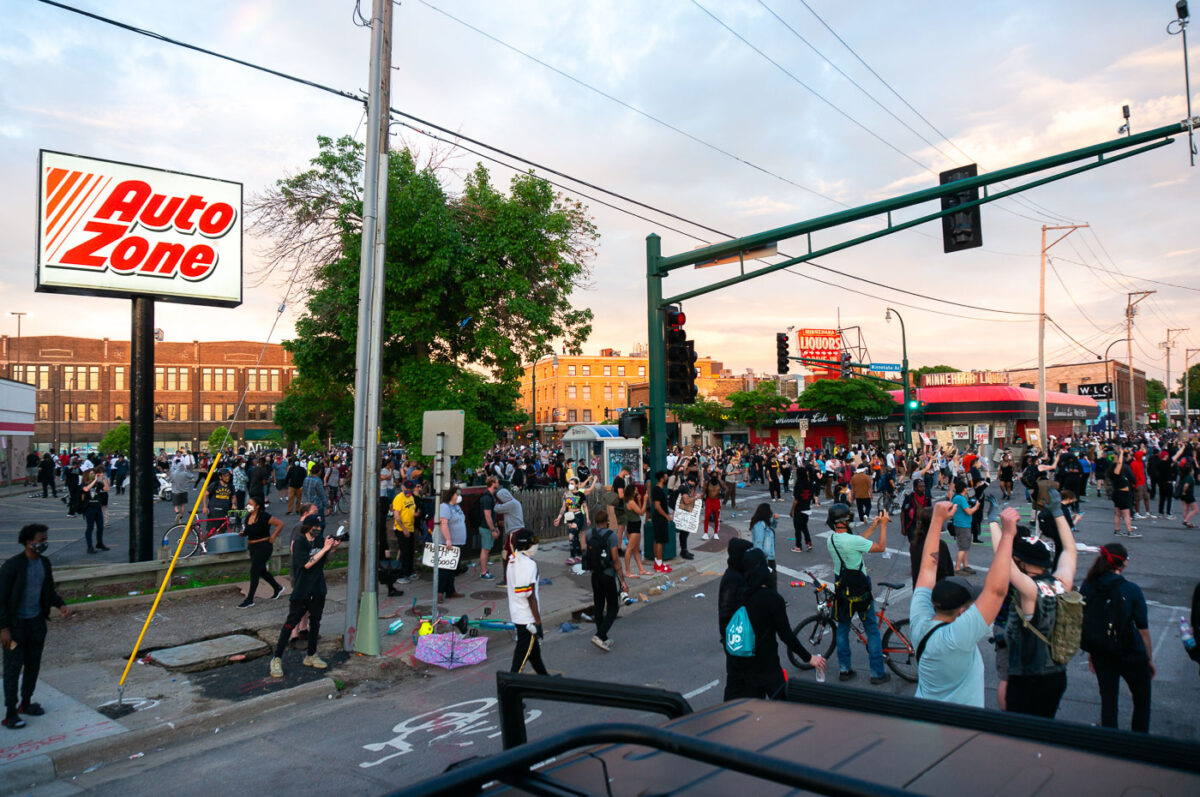
The Minnehaha Liquors building on East Lake Street in Minneapolis burns on the night of May 28, 2020, as people gather in the street during unrest following the murder of George Floyd. The commercial building, marked by the large Minnehaha Liquors Drive-In sign, also housed Midori’s Floating World Cafe. The fire was part of widespread damage along the Lake Street corridor during several nights of protests, confrontations, and property destruction in south Minneapolis.

Minnehaha Liquors Fire, Lake Street

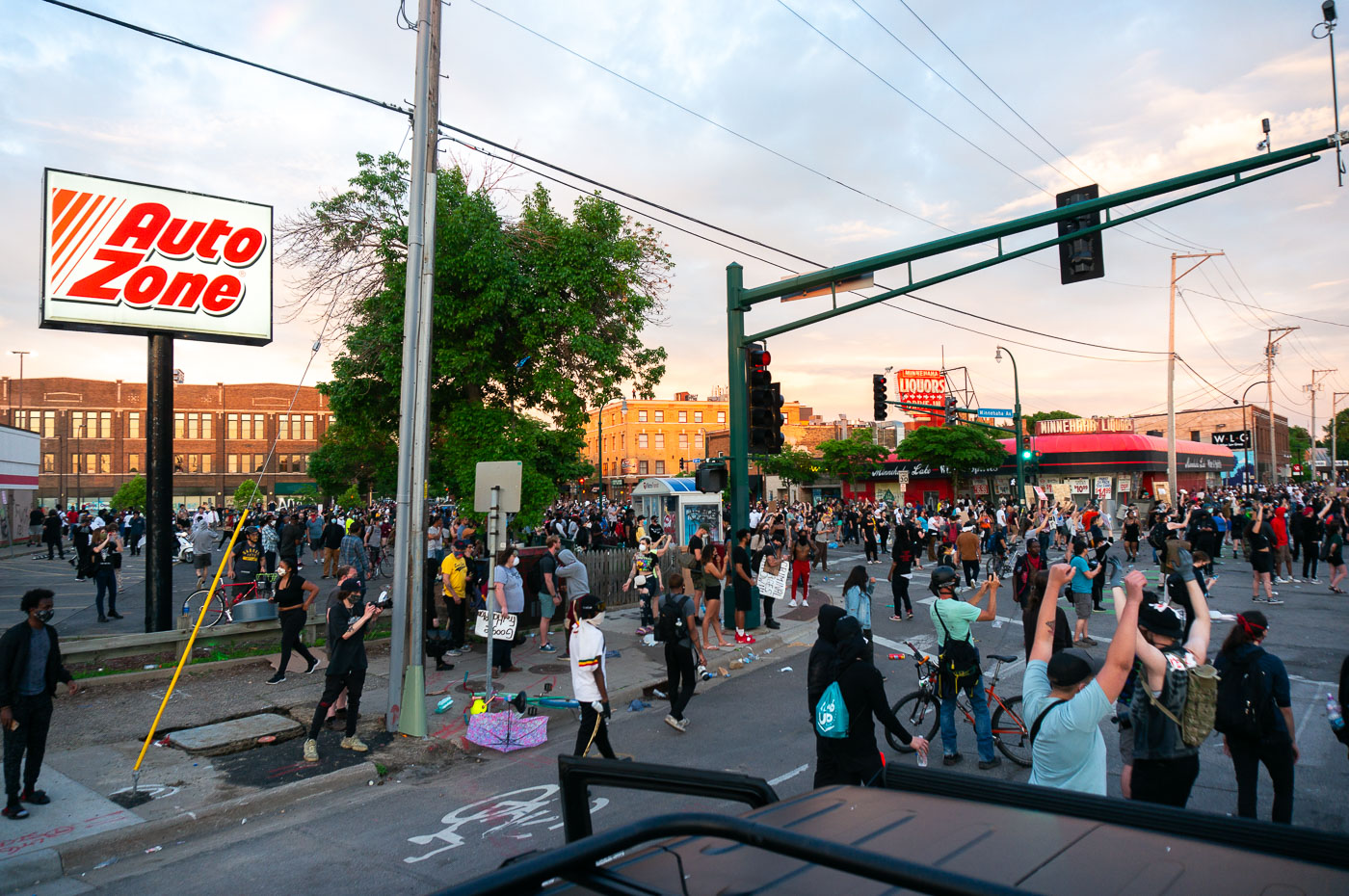
Protesters with their hands up at 3rd Precinct
Protesters gather at Lake Street and Minnehaha Avenue in south Minneapolis on May 27, 2020, during demonstrations following the killing of George Floyd. The intersection, directly across from the Minneapolis Police 3rd Precinct, became a major gathering point that evening.

Protest at Lake St & Minnehaha Ave, Minneapolis
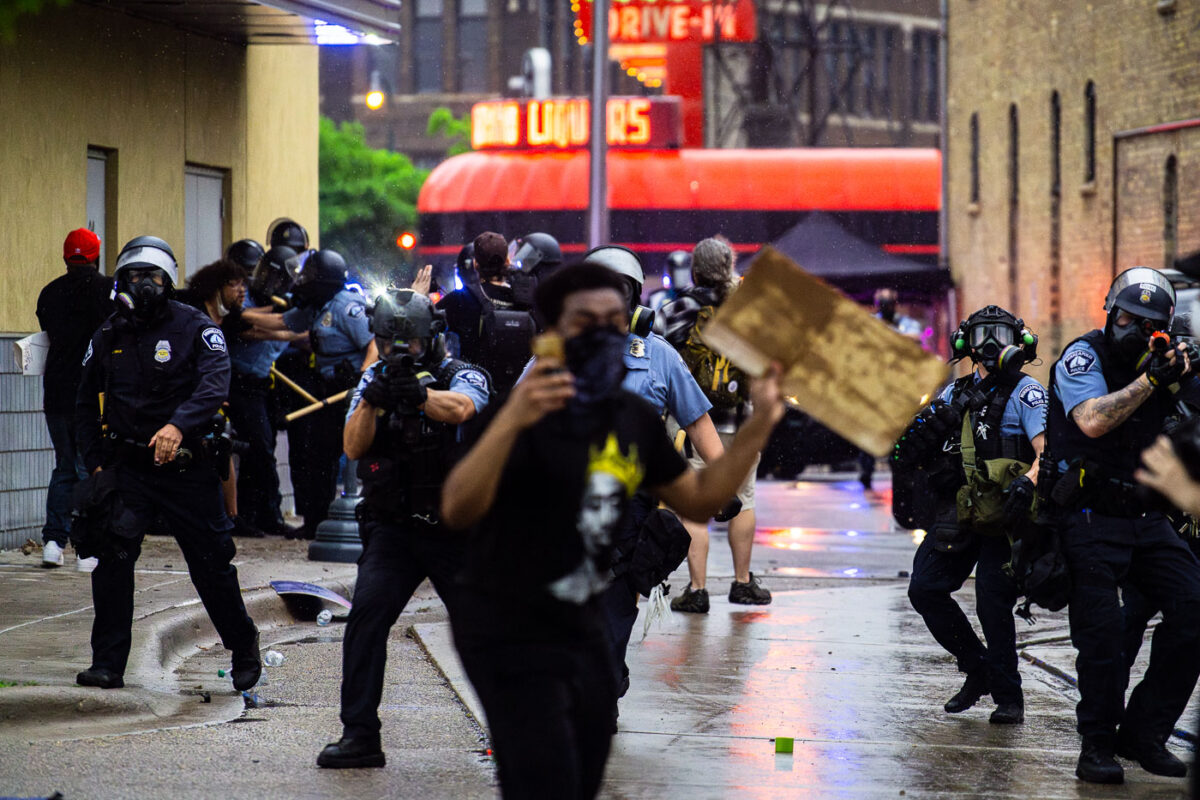
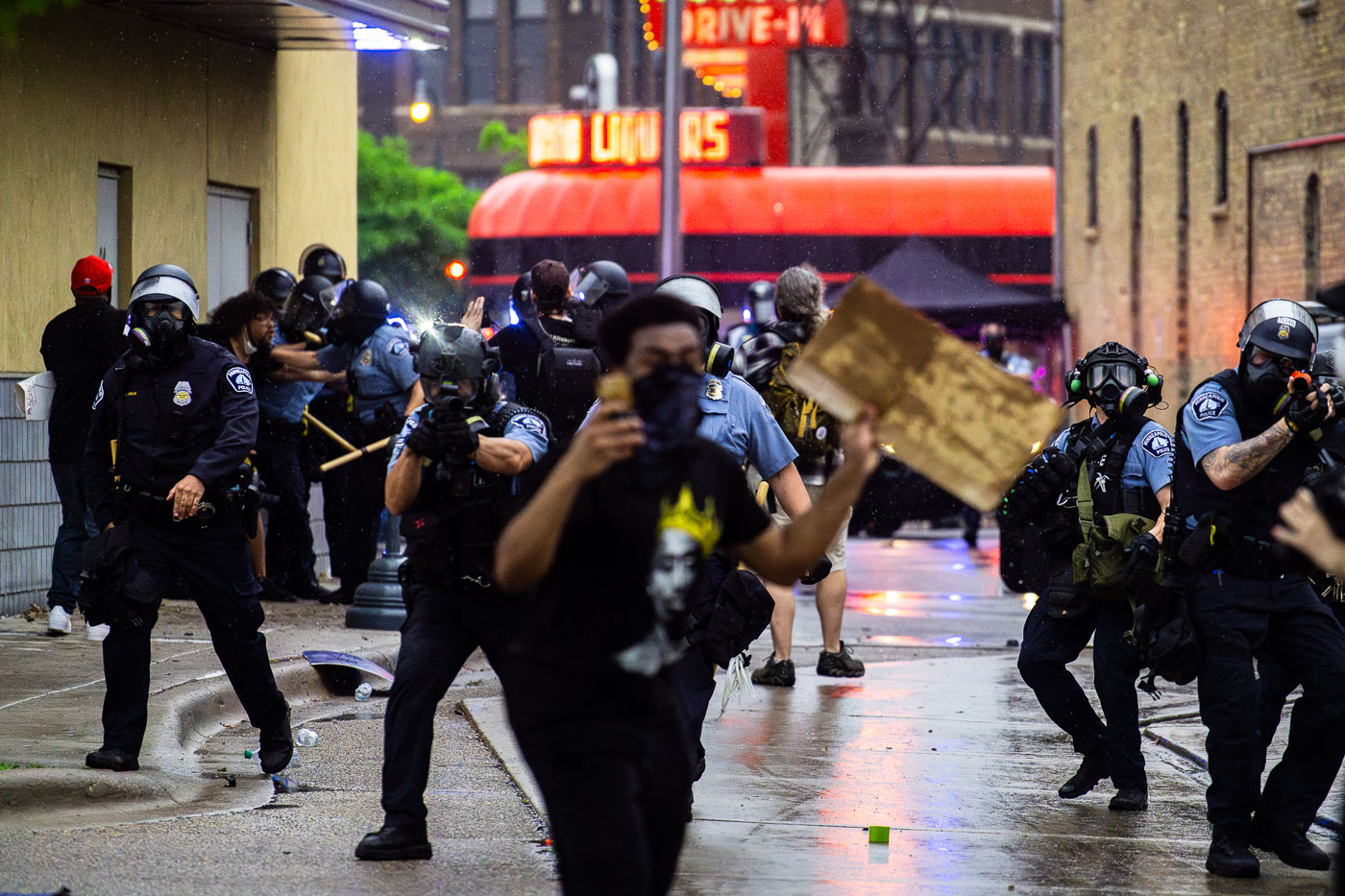
Minneapolis police fire less-lethal munitions near the 3rd Precinct as a protester runs past.
Minneapolis Police officers fire less-lethal munitions on a street near the 3rd Precinct station in Minneapolis on May 26, 2020, as a protester runs through the foreground holding a sign. The officers are wearing helmets and gas masks during demonstrations that followed the killing of George Floyd and intensified around the precinct.

Police Deploy Less-Lethal Weapons at Minneapolis Protest
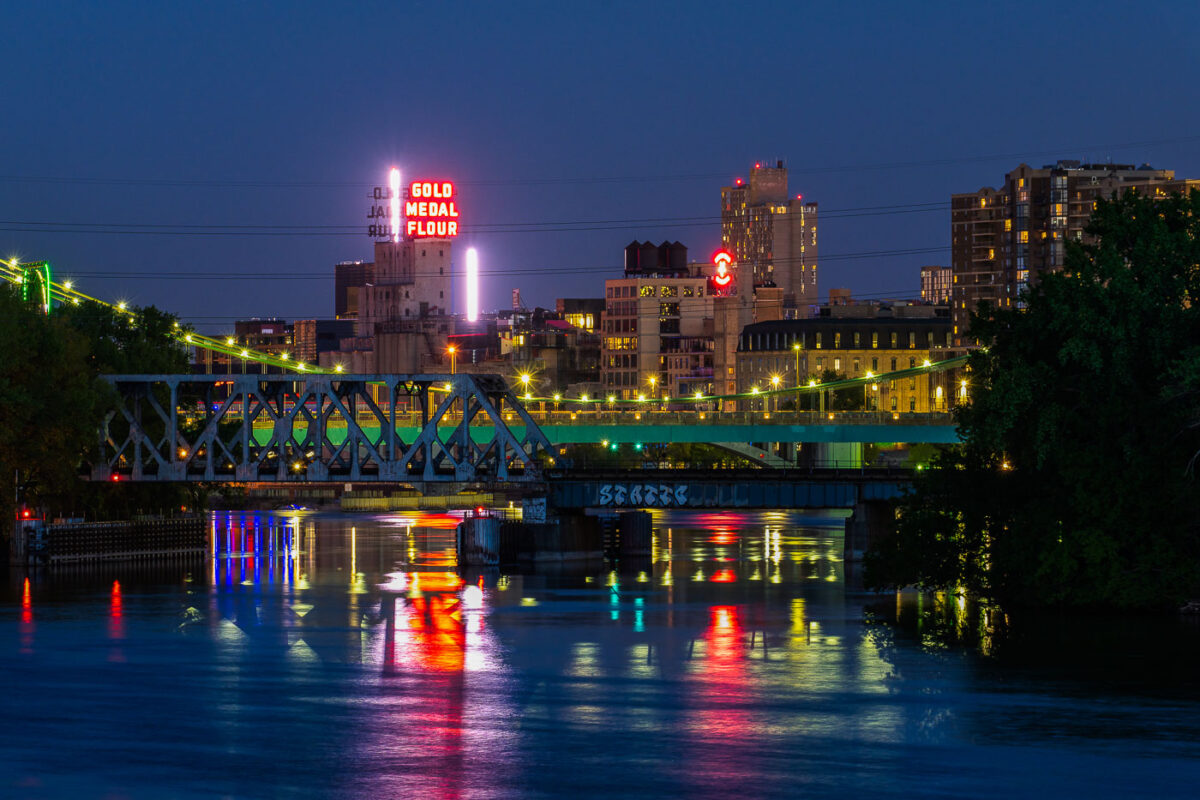
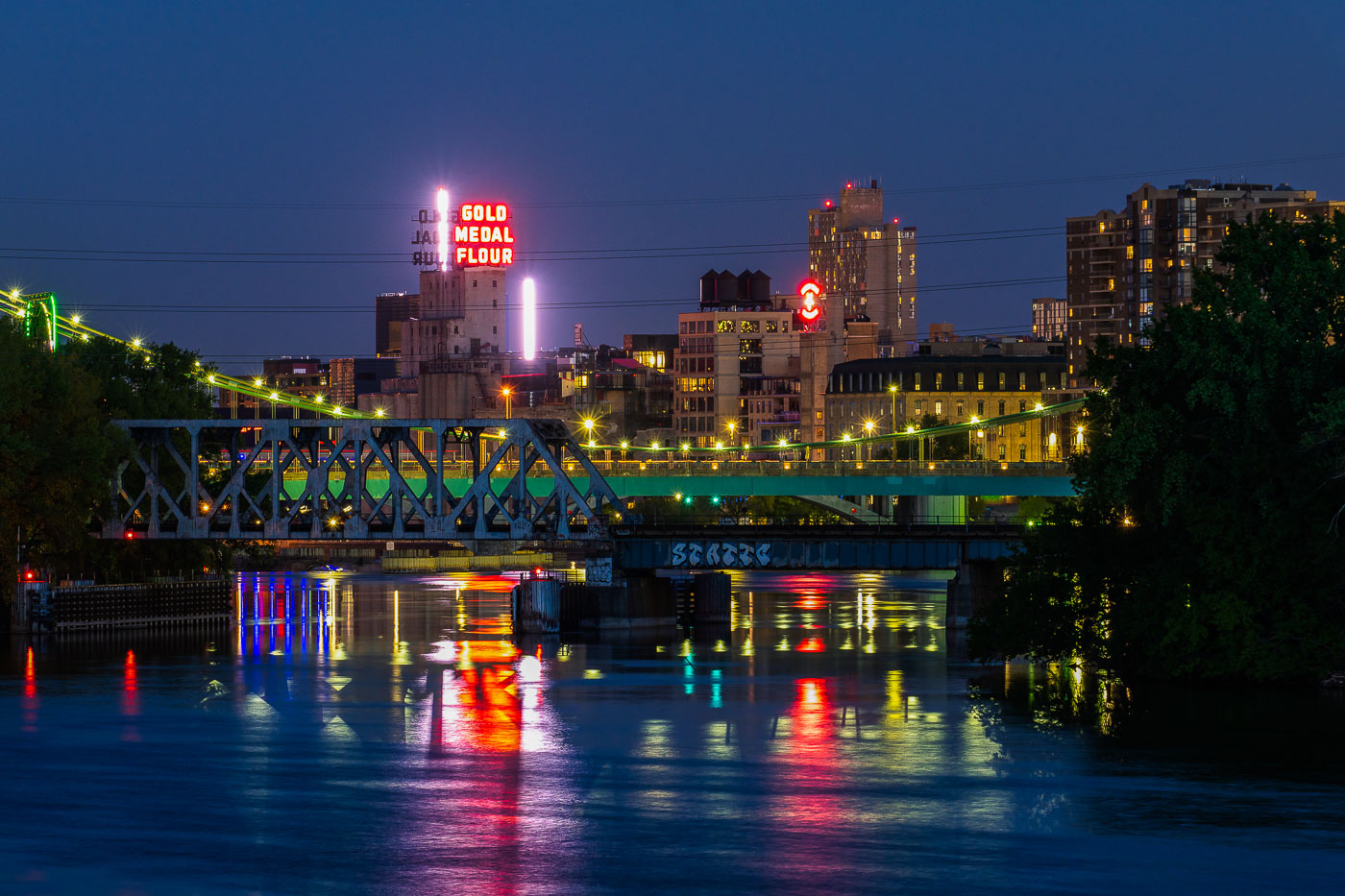
Gold Medal Flour seen from Boom Island in May 2020
Downtown Minneapolis as seen from Boom Island in May 2020. Gold Medal Flour and Northstar Blankets neon signs visible across the Mississippi River.

Neon signs of Downtown Minneapolis

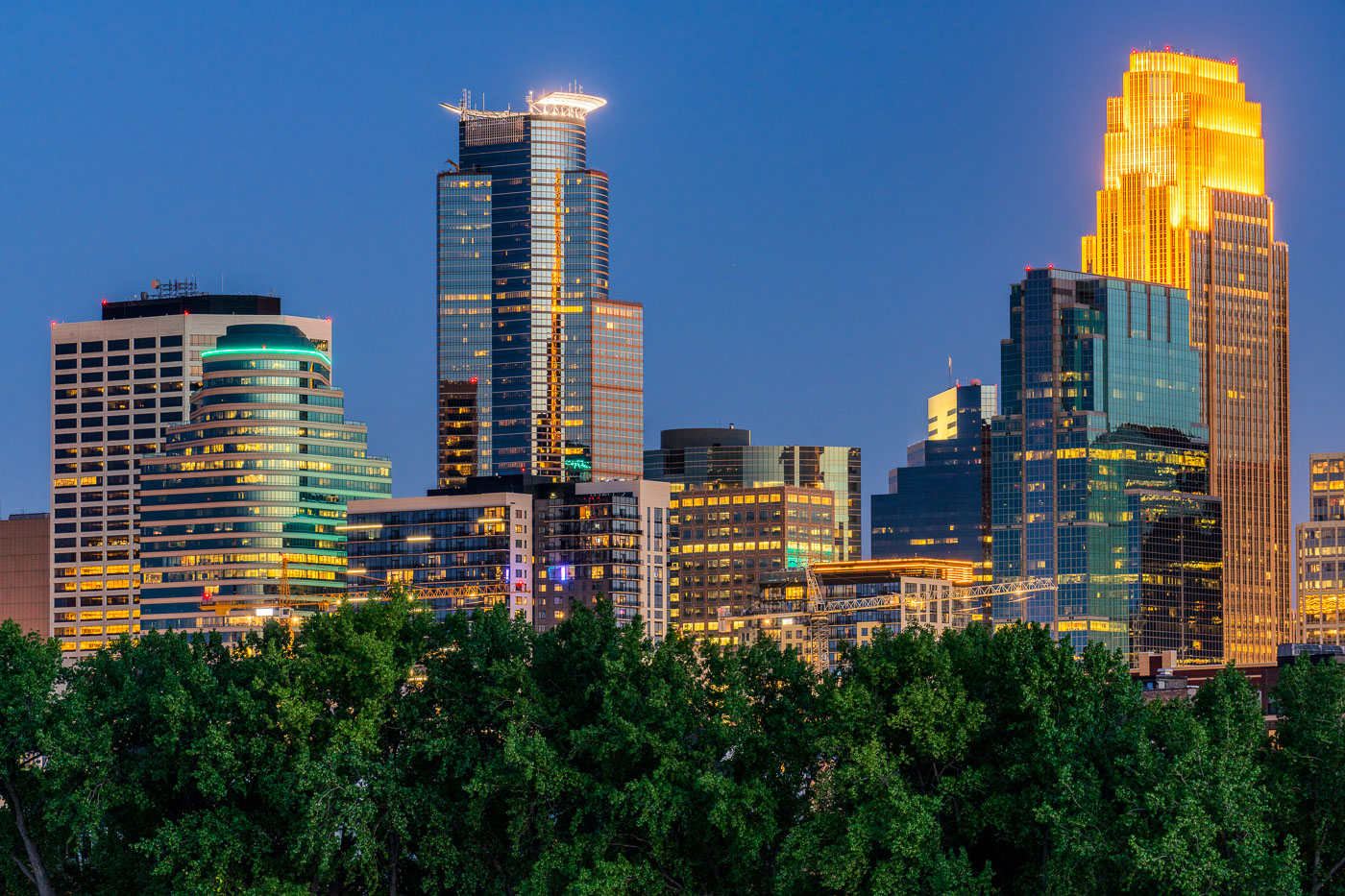
Downtown Minneapolis at dusk from Boom Island Park, with Wells Fargo Center and U.S. Bank Tower above treetops
Downtown Minneapolis is seen from Boom Island Park at dusk. The Wells Fargo Center and U.S. Bank Tower rise above the riverfront, with treetops in the foreground.

Downtown Minneapolis at dusk from Boom Island Park
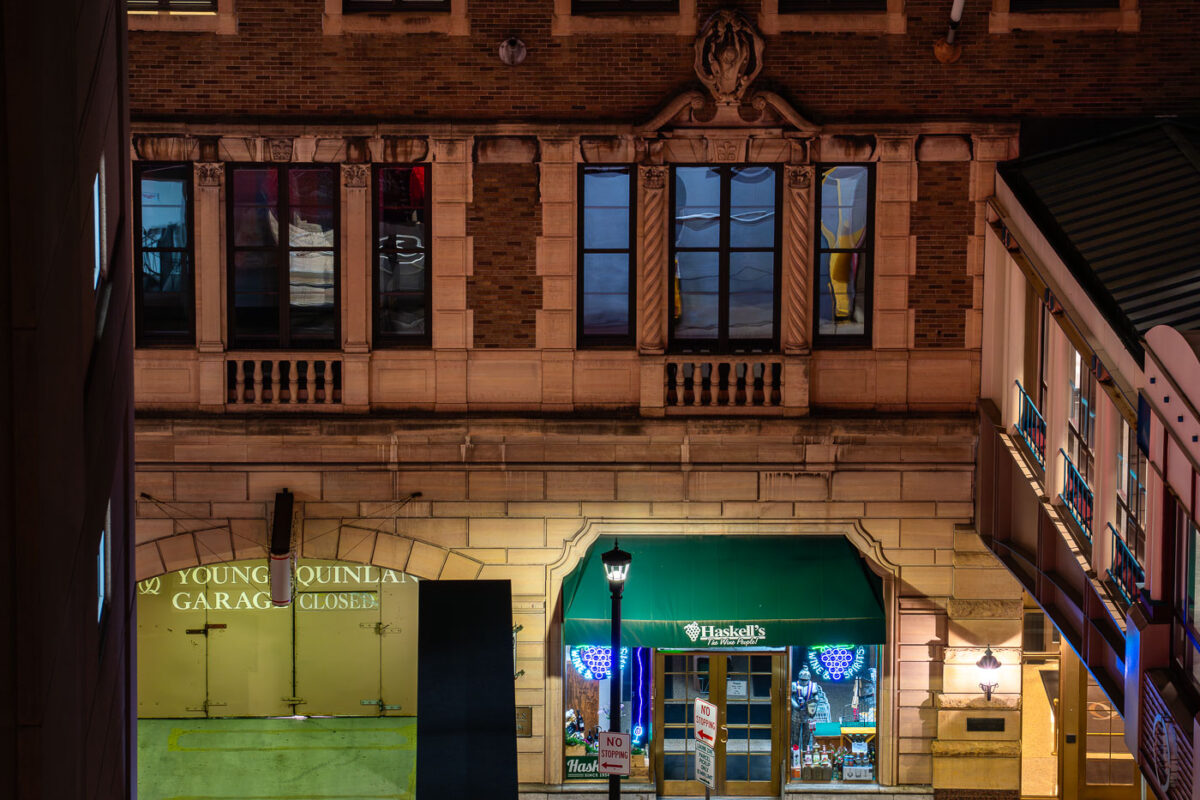
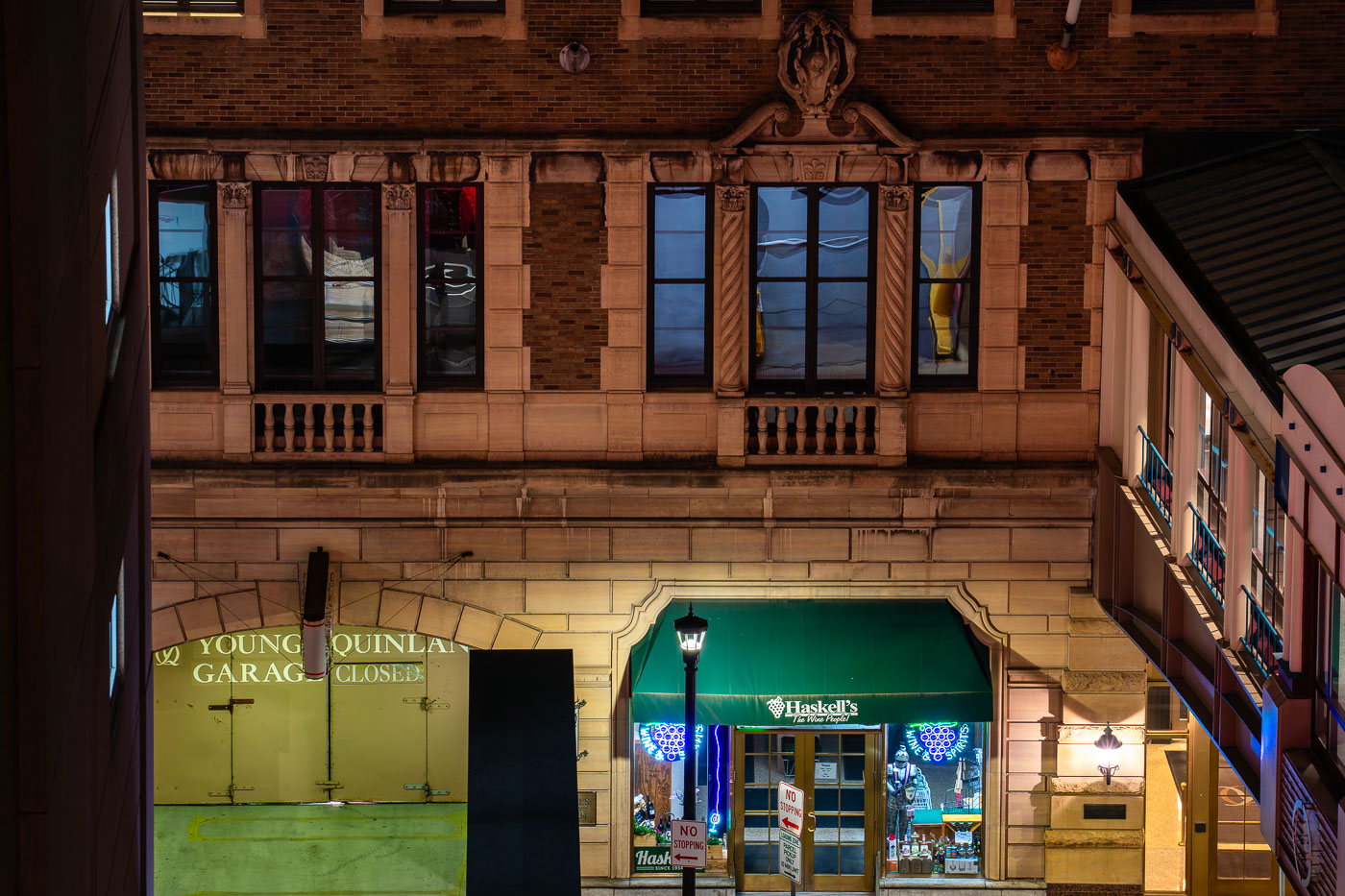
Haskell's liquor store storefront at street level in a historic brick building in downtown Minneapolis.
Haskell's is a liquor retailer located in downtown Minneapolis. The storefront occupies street-level space in a historic brick building with ornamental architectural details typical of early 20th-century commercial construction in the area.

Haskell’s Liquor Store, Downtown Minneapolis
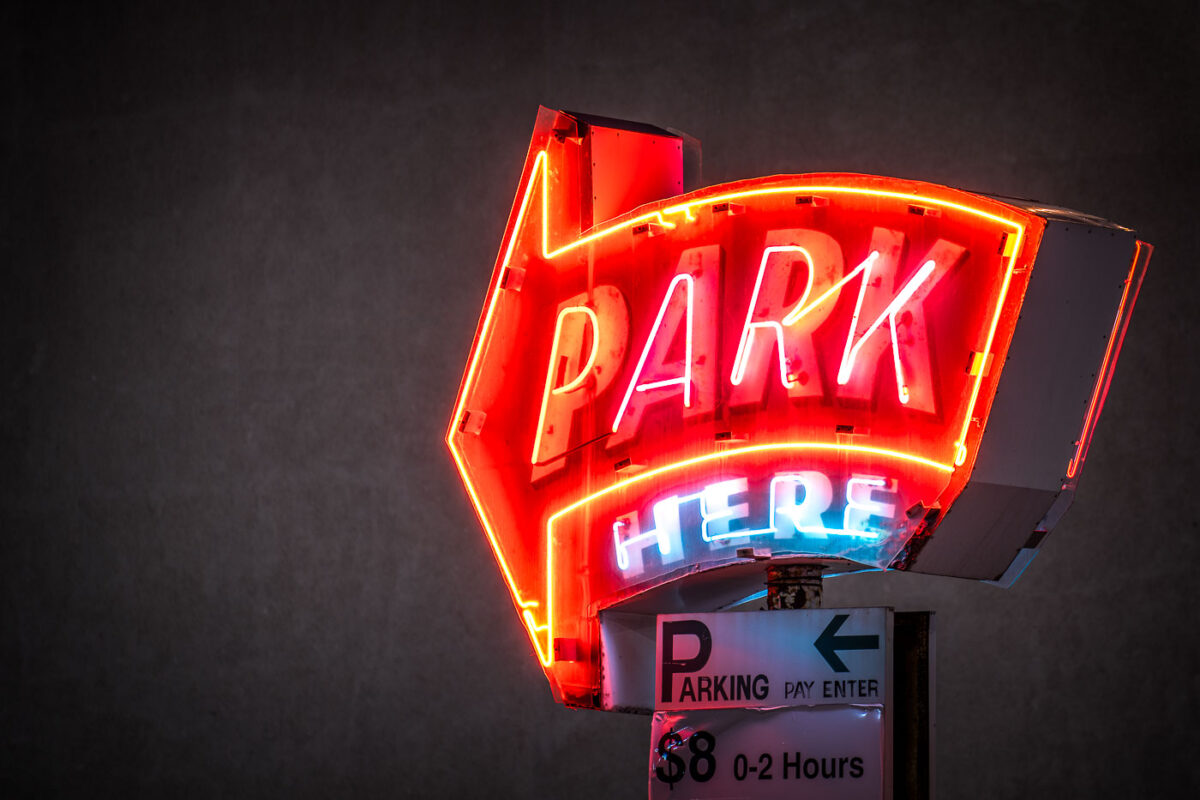
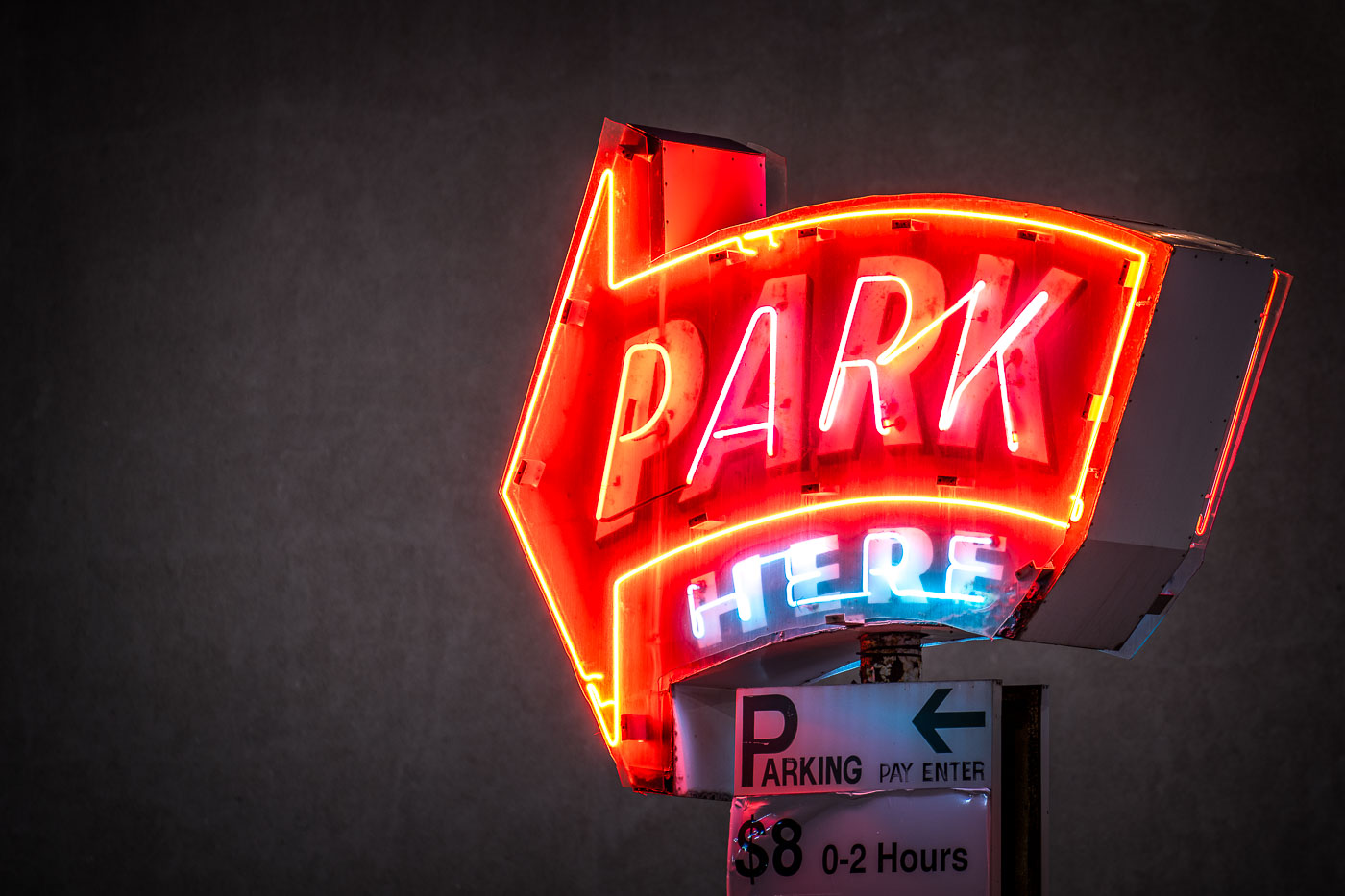
Red neon "Park Here" sign with arrow and parking rate board in downtown Minneapolis.
A vintage neon sign advertising parking in downtown Minneapolis. The red neon lettering reads "PARK HERE" with a directional arrow, typical of mid-20th-century commercial signage. Below the sign, a parking rate board s pricing for short-term parking, showing $8 for 0–2 hours.

Park Here neon sign, downtown Minneapolis
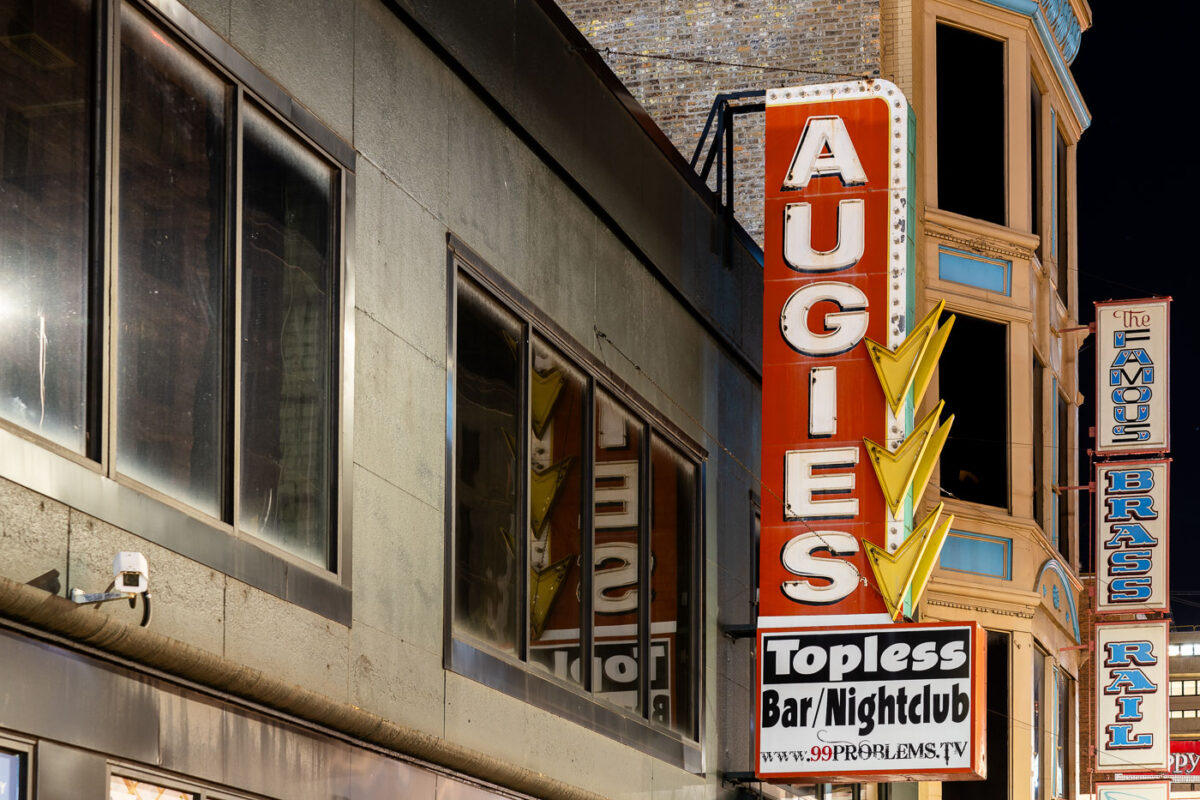
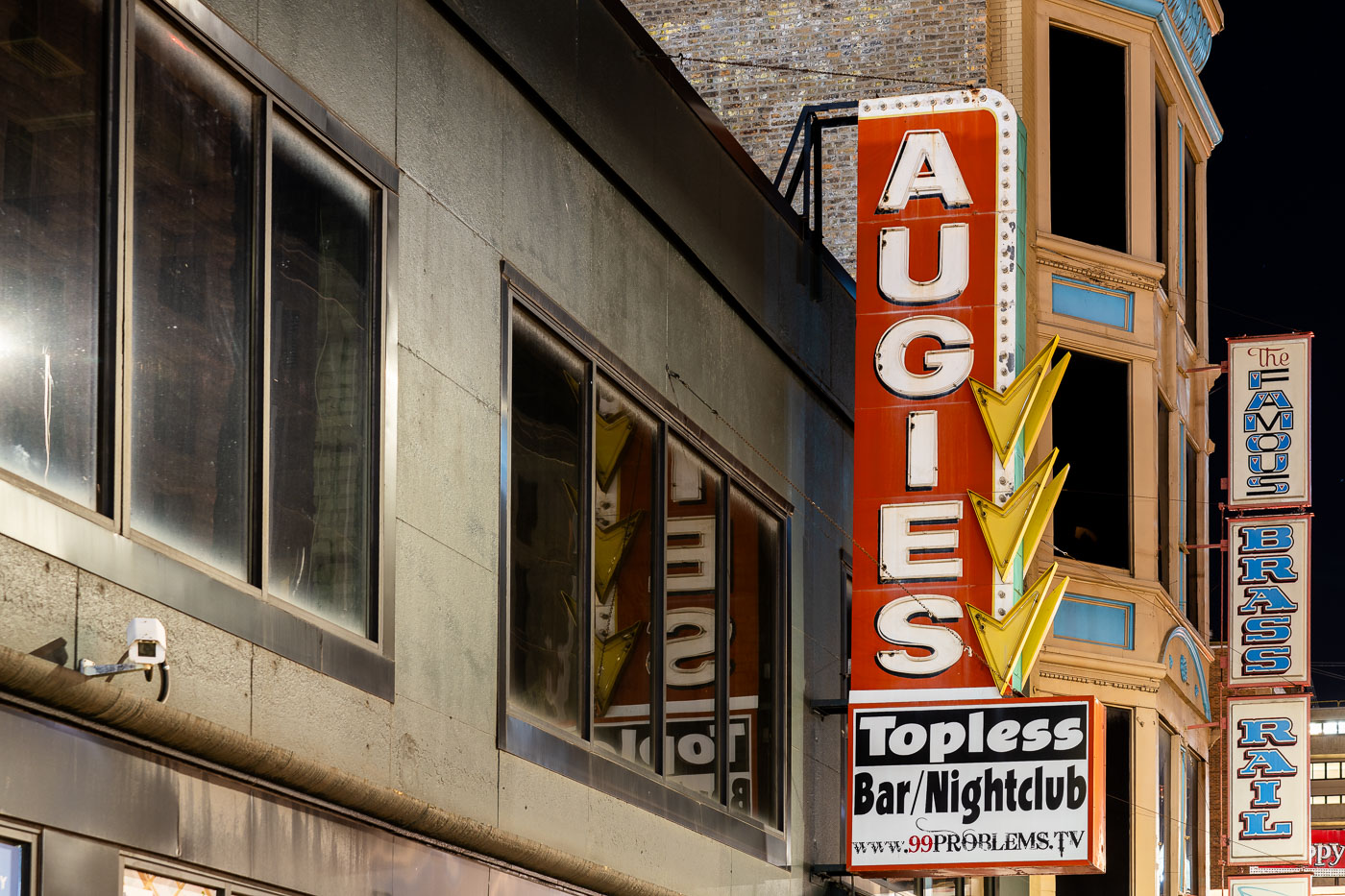
Vertical red neon Augies Topless Bar sign on downtown Minneapolis street at night.
Augies Topless Bar and Nightclub operated on Hennepin Avenue in downtown Minneapolis. The establishment's vertical neon sign, with its distinctive red background and white lettering, was a recognizable fixture in the entertainment district. The Famous Brass Rail sign is visible adjacent to it on the same block.

Augies Topless Bar sign, downtown Minneapolis
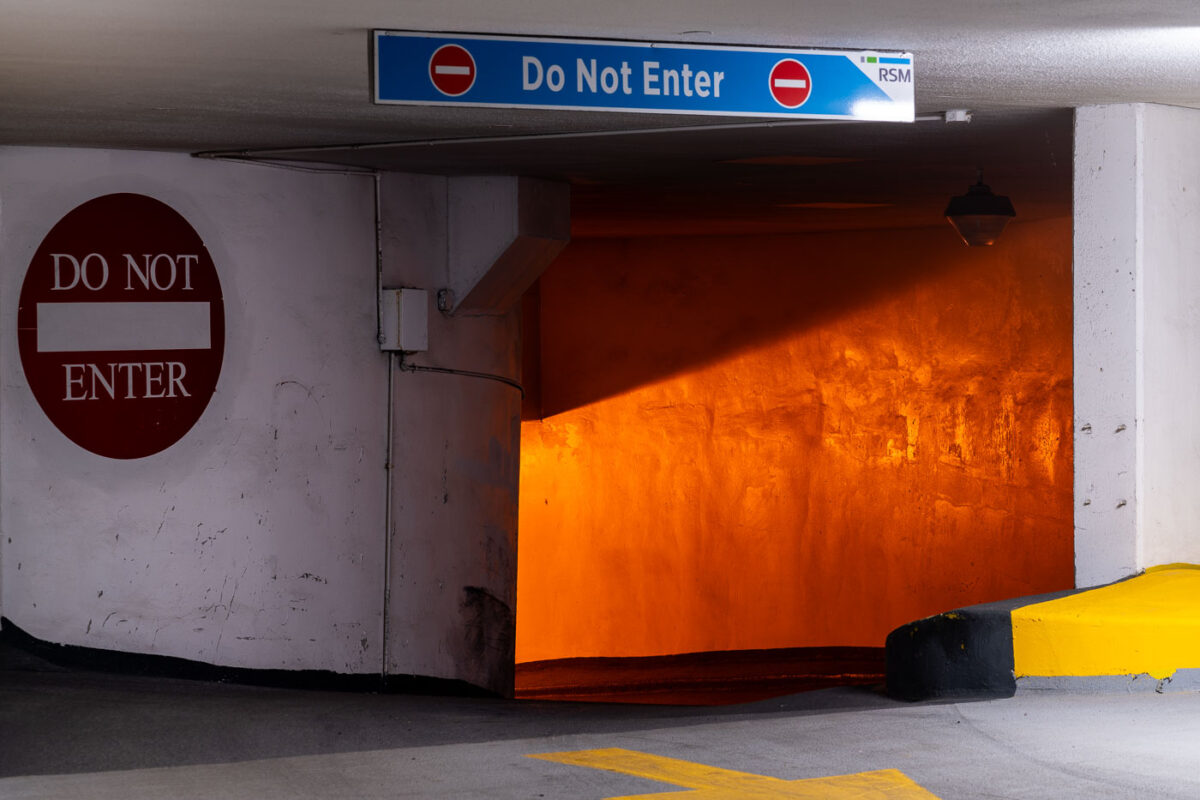
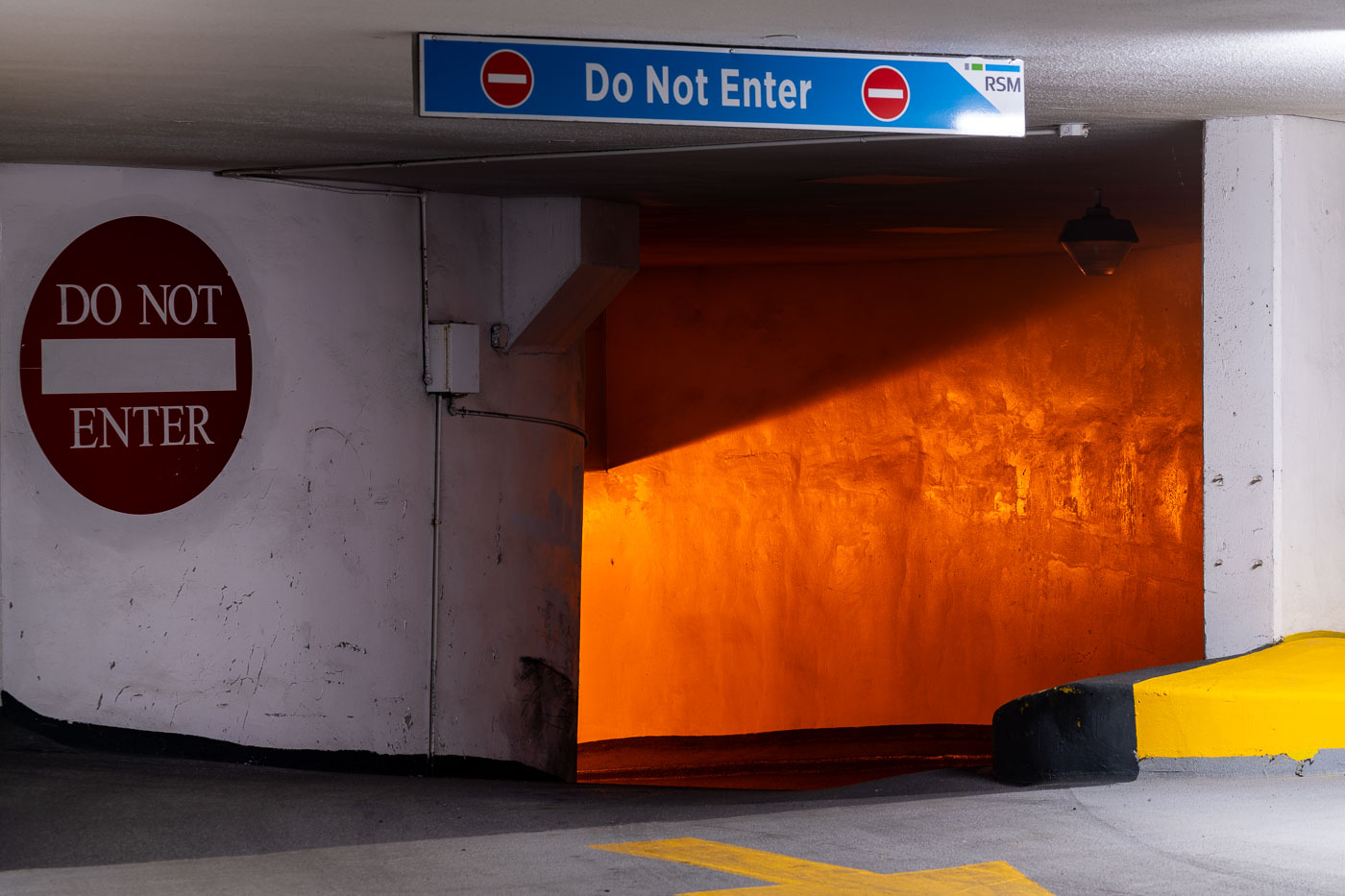
Orange safety barrier and "Do Not Enter" sign at RSM parking ramp entrance in downtown Minneapolis.
The RSM parking garage occupies a structure in downtown Minneapolis. The facility serves as commercial parking for the area's office and business district. An orange safety barrier marks an entrance, with "Do Not Enter" signage visible above.

RSM Parking Ramp Entrance, Downtown Minneapolis
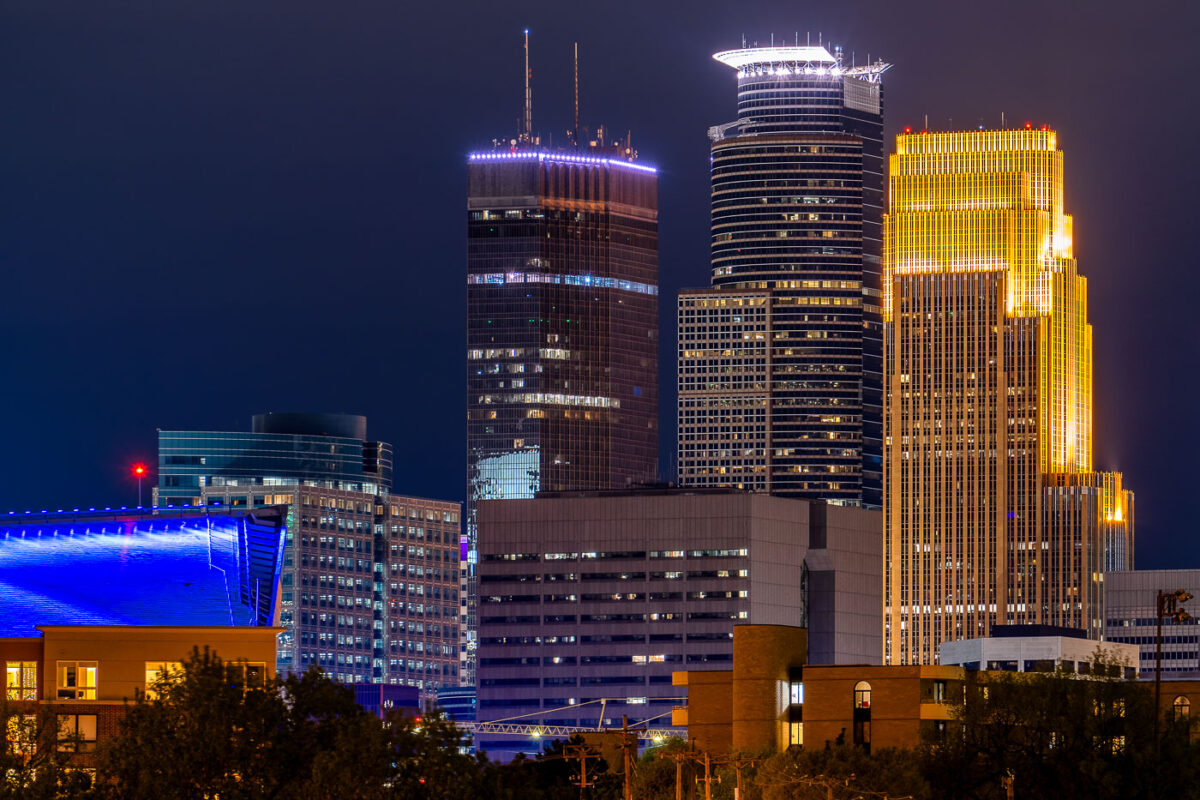
Skyscrapers in downtown Minneapolis on clear night
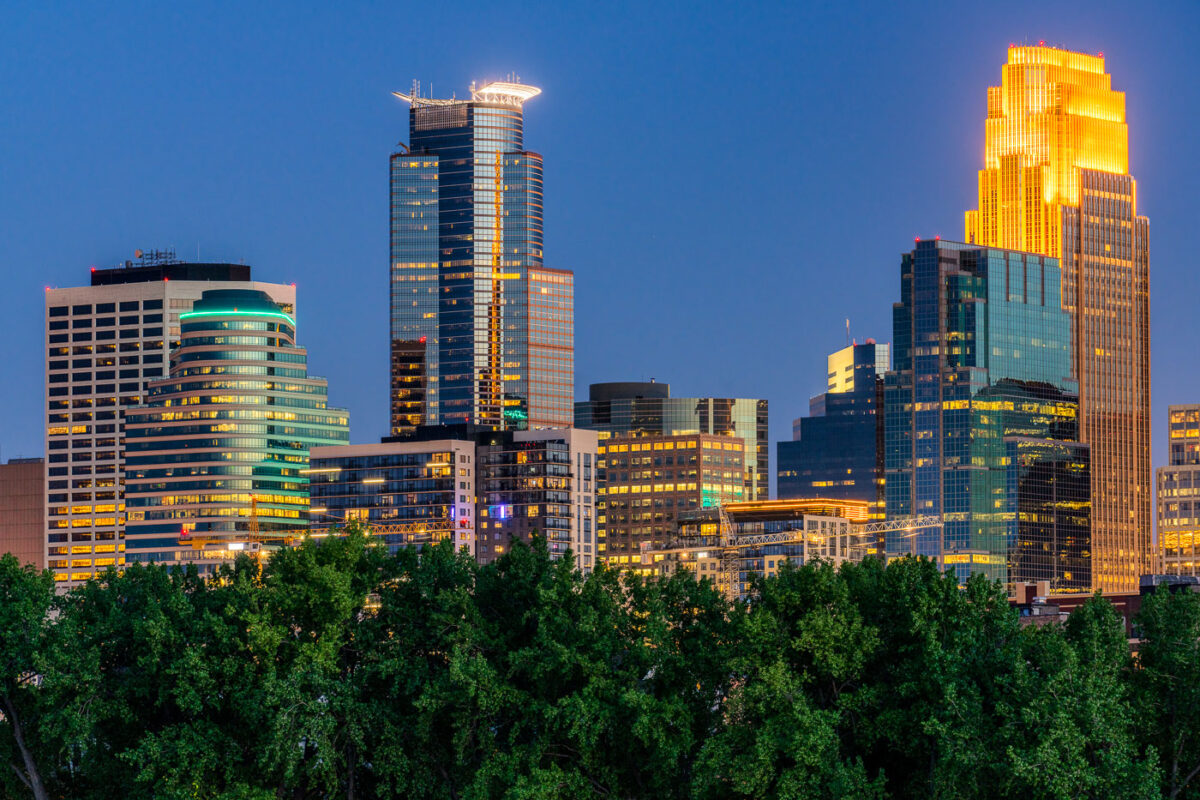
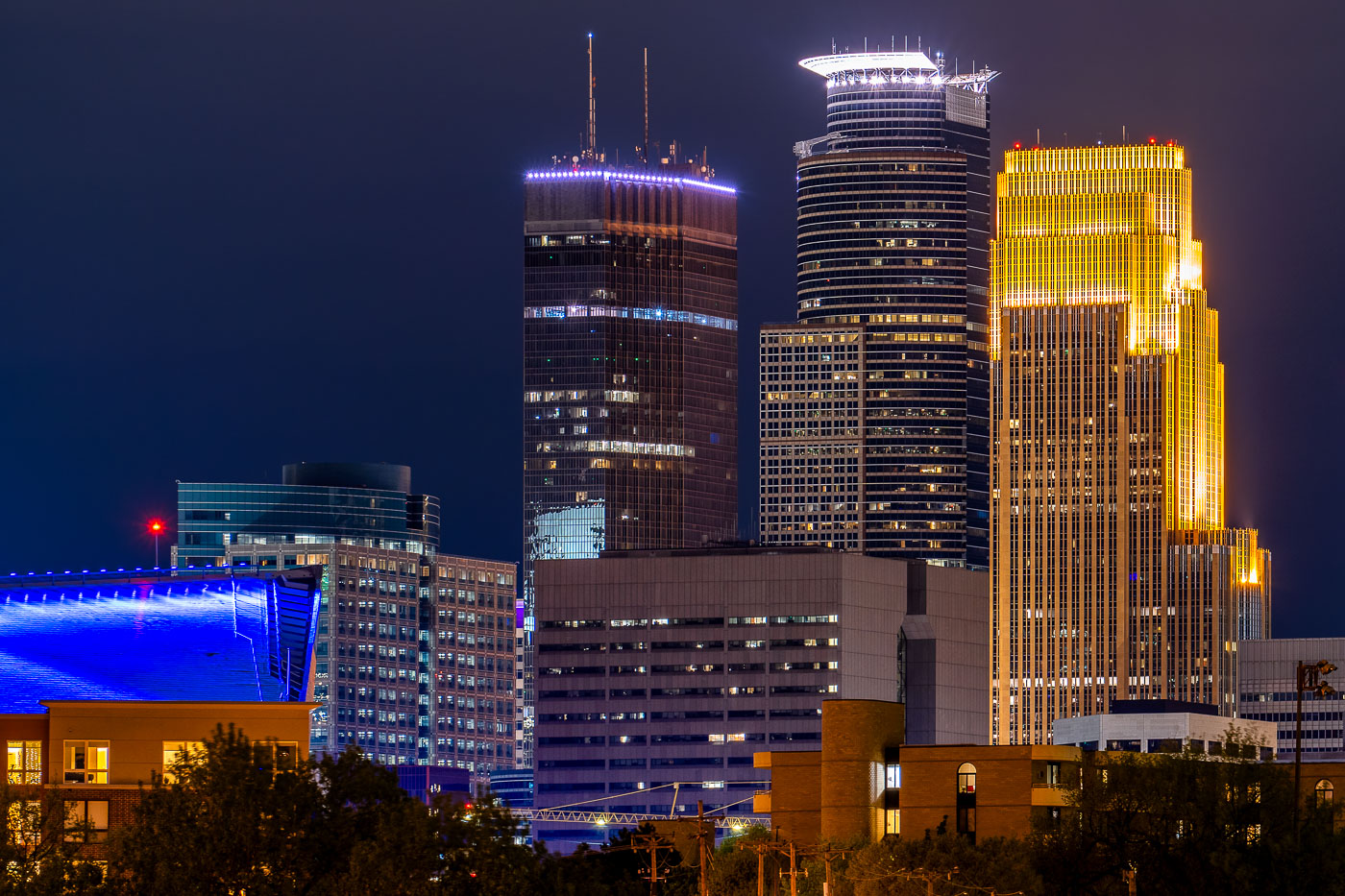
The Capella Tower, IDS Center, and Wells Fargo Center in Downtown Minneapolis at night.

Capella, IDS and Wells Fargo Center in Minneapolis
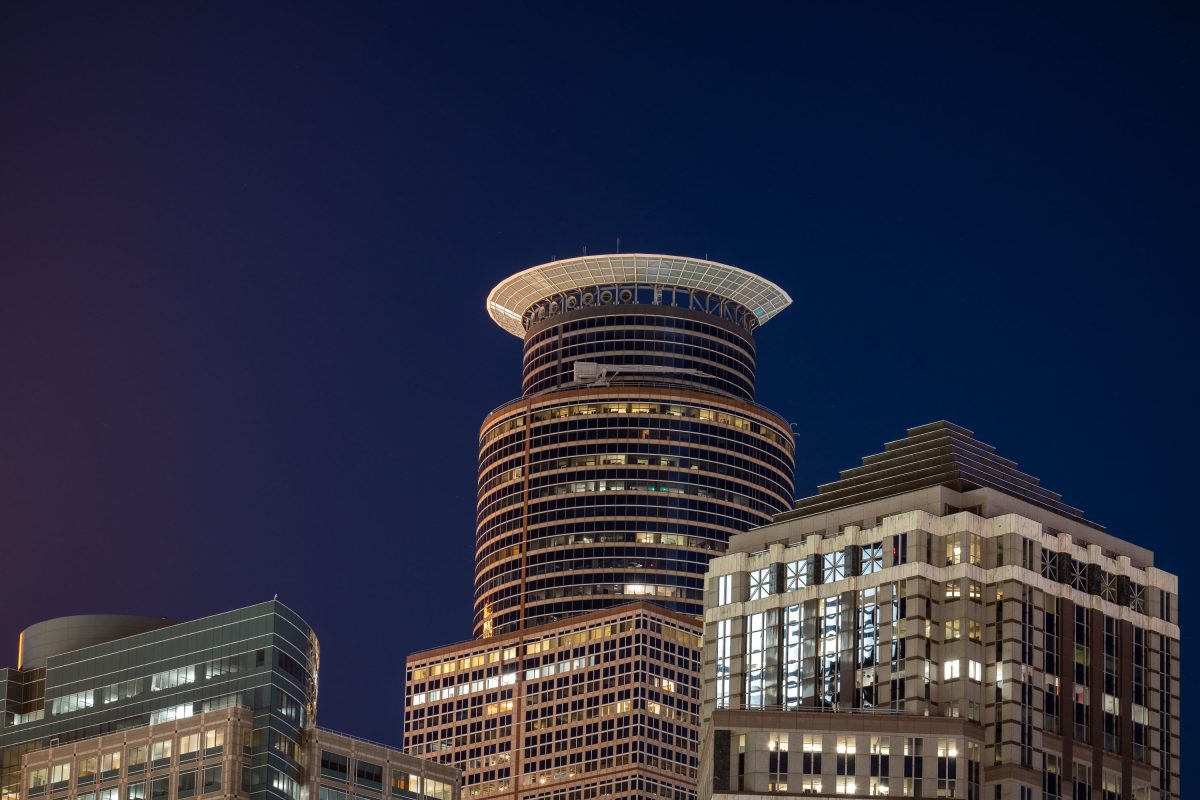
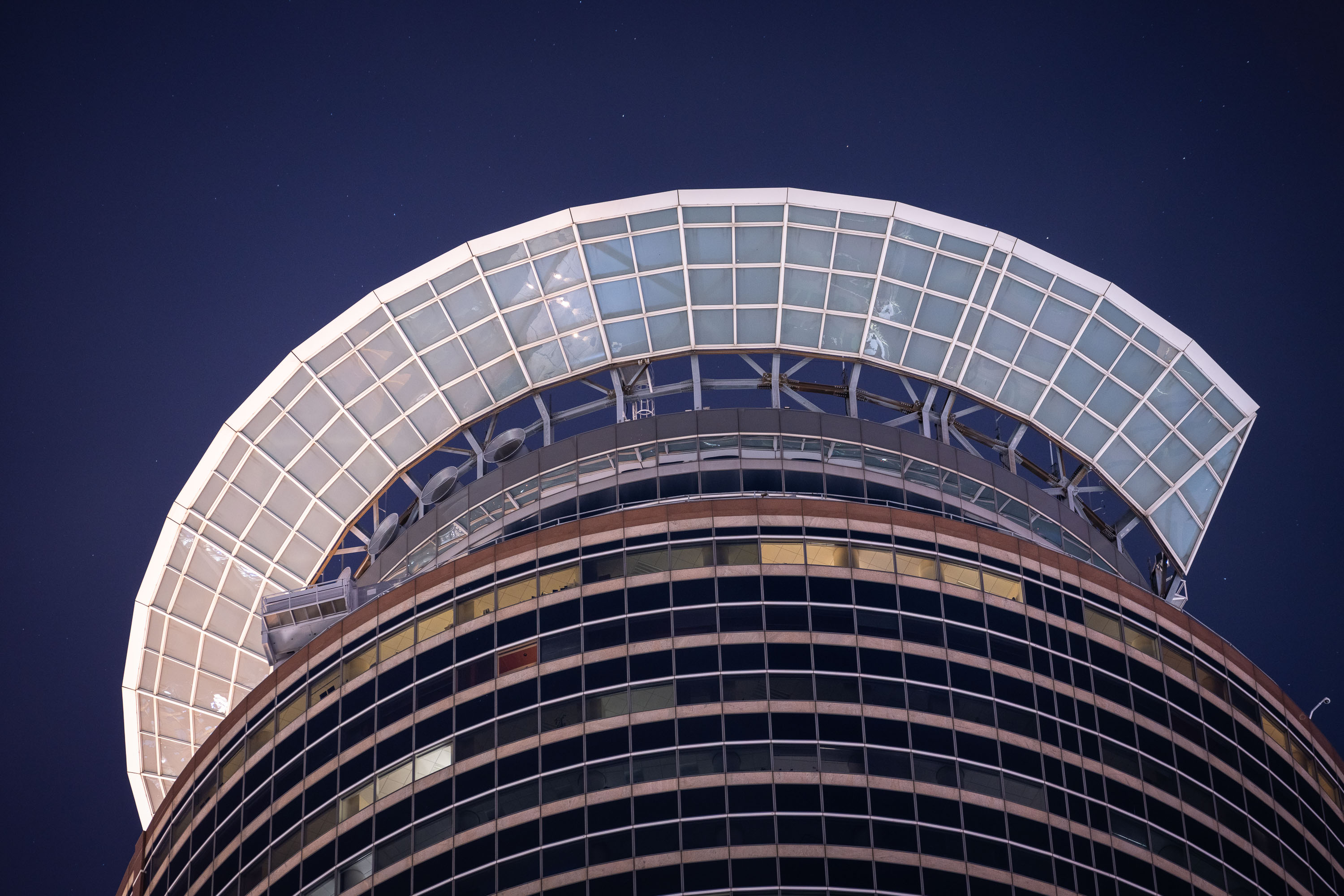
Capella Tower Crown In Downtown Minneapolis
The Capella Tower (center) in downtown Minneapolis.

Capella Tower Crown In Downtown Minneapolis

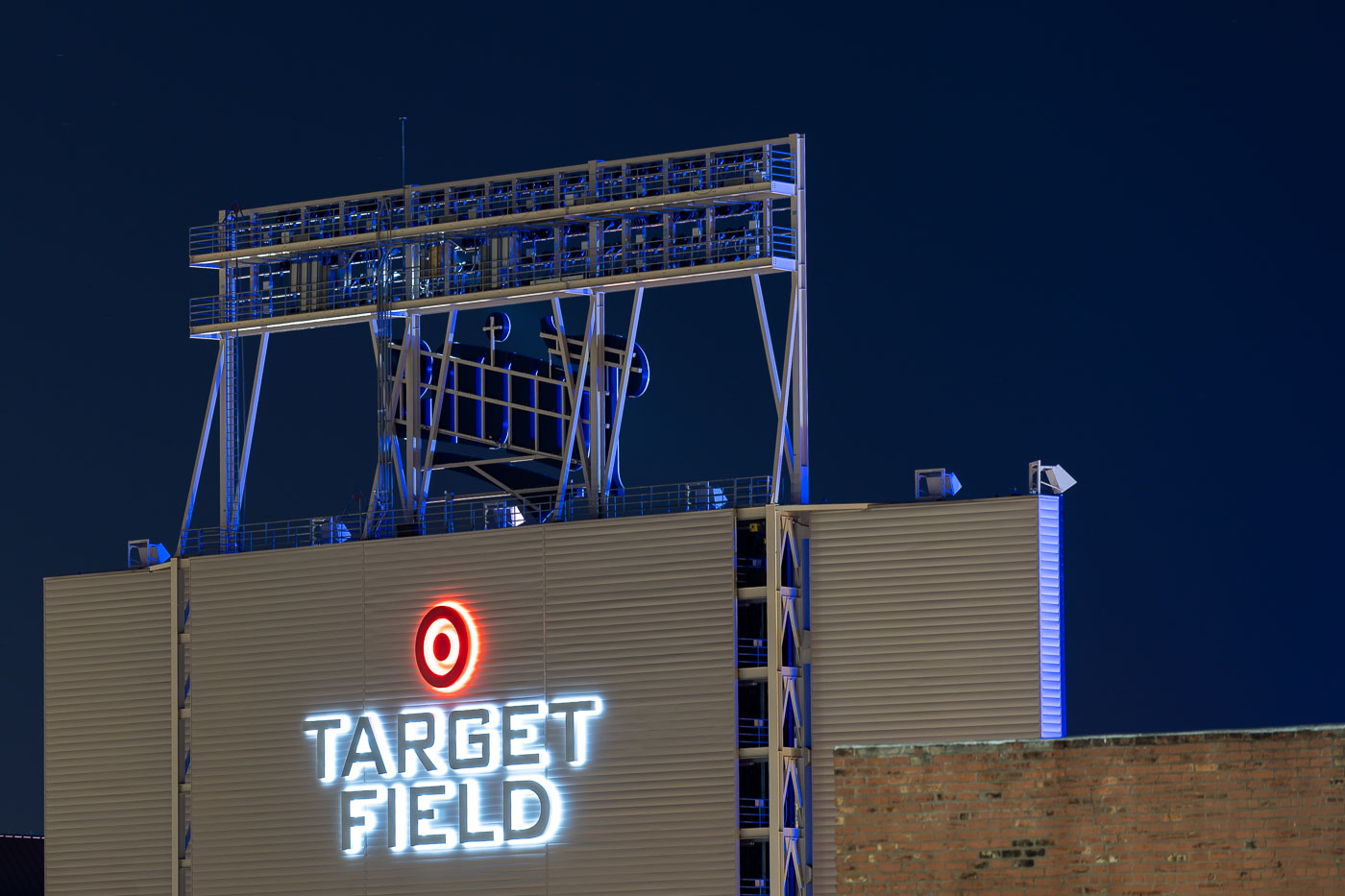
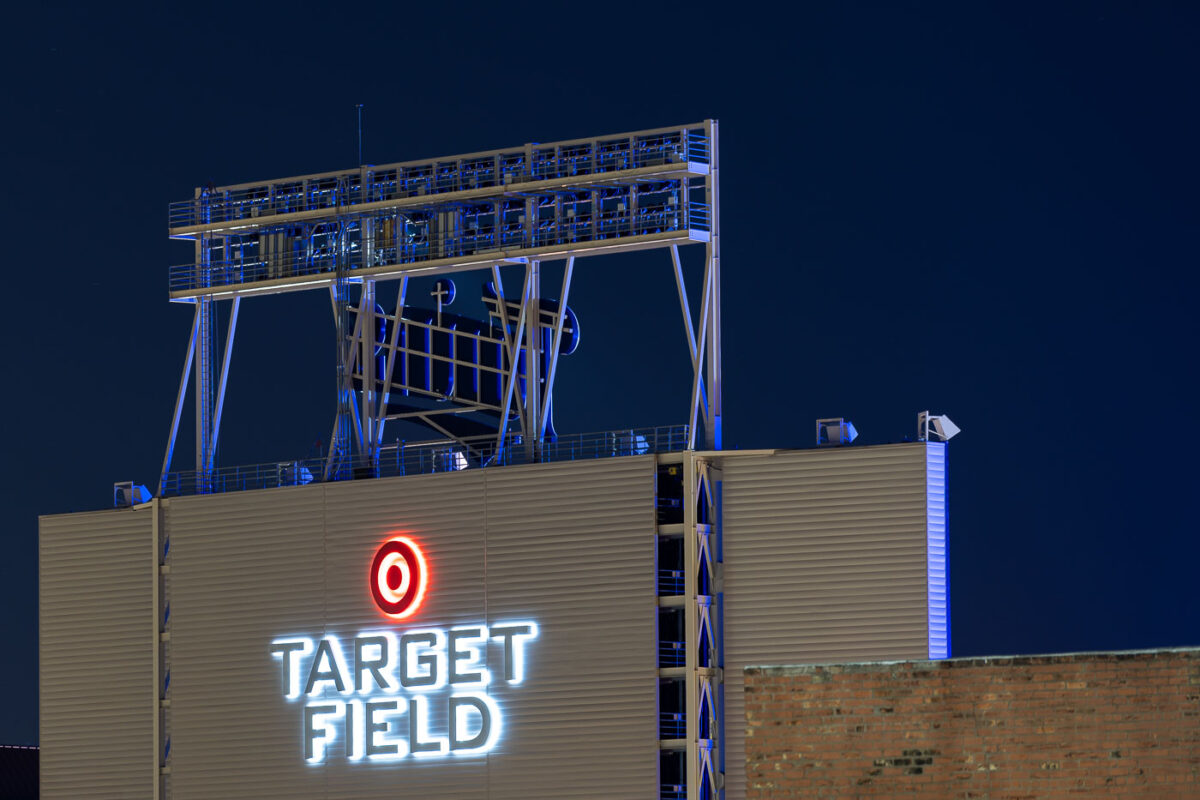
Target Field's illuminated sign and scoreboard structure at night in Minneapolis's North Loop neighborhood.
Target Field is the Minnesota Twins' ballpark in the North Loop neighborhood of Minneapolis. It opened in 2010, replacing the Hubert H. Humphrey Metrodome as the team's home and giving the Twins their first open-air stadium since Metropolitan Stadium closed in 1981.

Target Field’s Rooftop Sign at Night

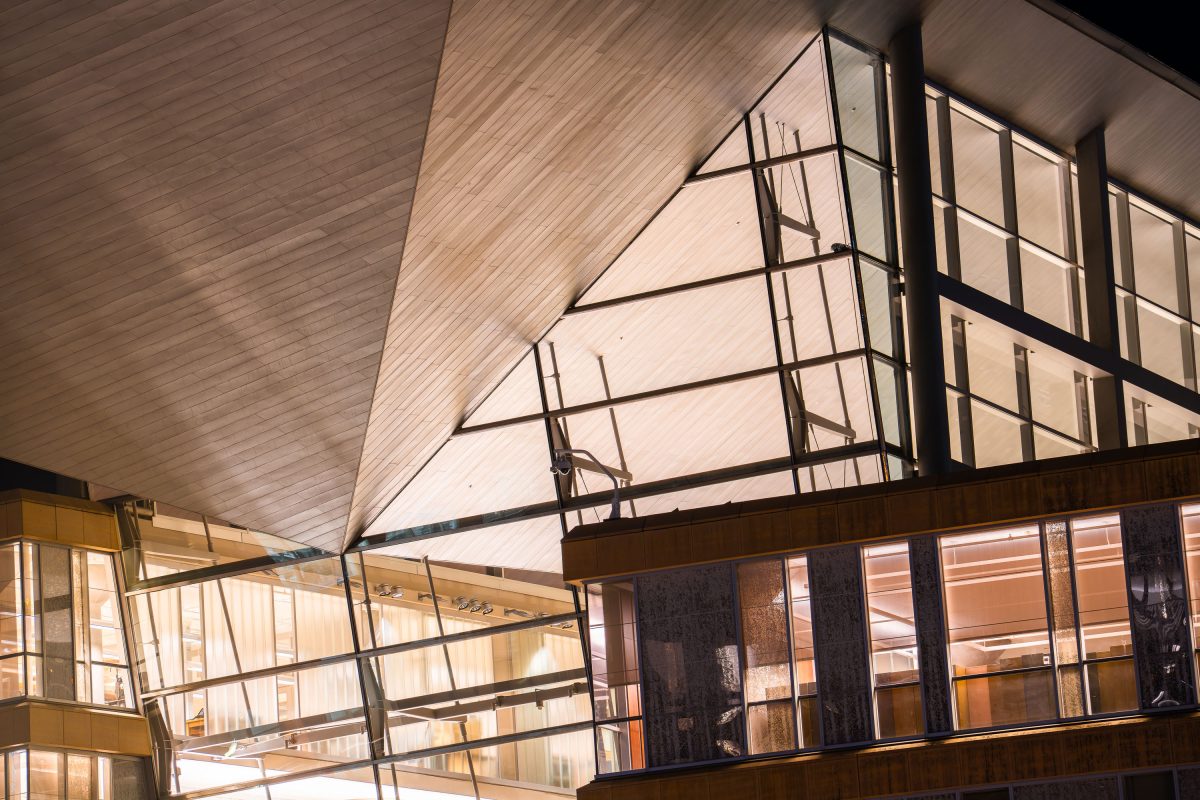
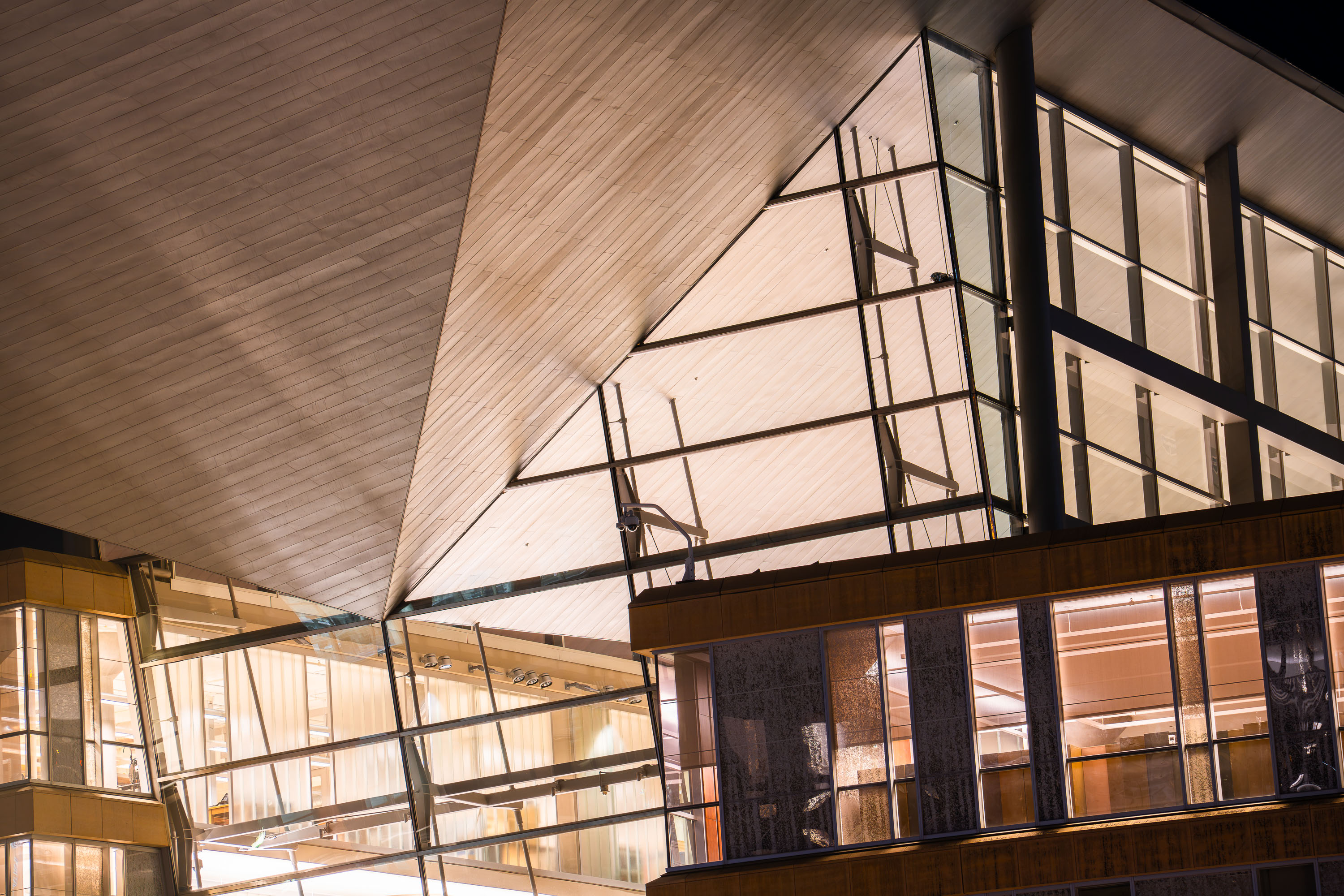
Minneapolis Central Library's interior skylight and metal framework structure illuminated from above.
The Minneapolis Central Library sits at 300 Nicollet Mall, serving as the flagship branch of the Hennepin County Library system. Designed by César Pelli and completed in 2006, the building replaced an earlier 1961 library on the same downtown site. Its cantilevered roof, clad in Kebony wood, extends over the building's glass curtain wall and was engineered to reduce solar heat gain on the reading areas below. The library holds close to 400,000 items and includes a rooftop garden above its lower levels. It also houses the Minneapolis Collection, an archive of historical materials documenting the city's development.

Cantilevered Roof of the Minneapolis Central Library at Night
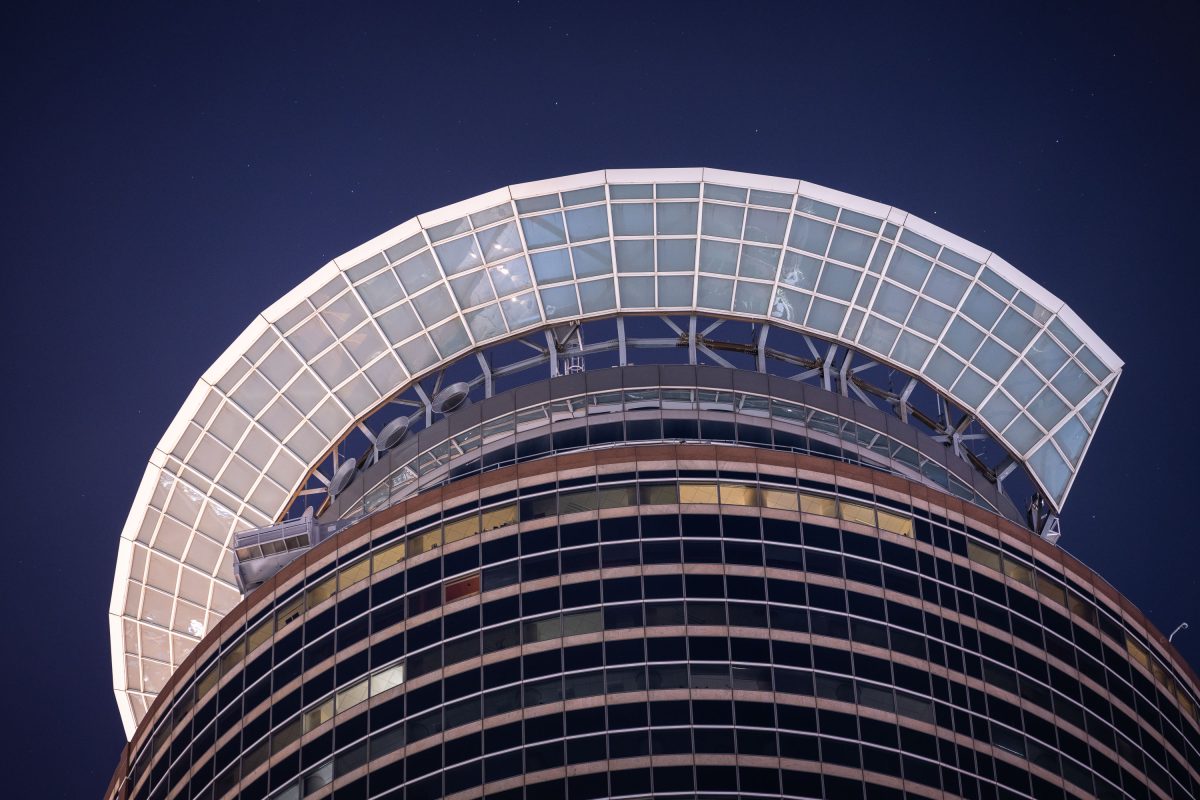
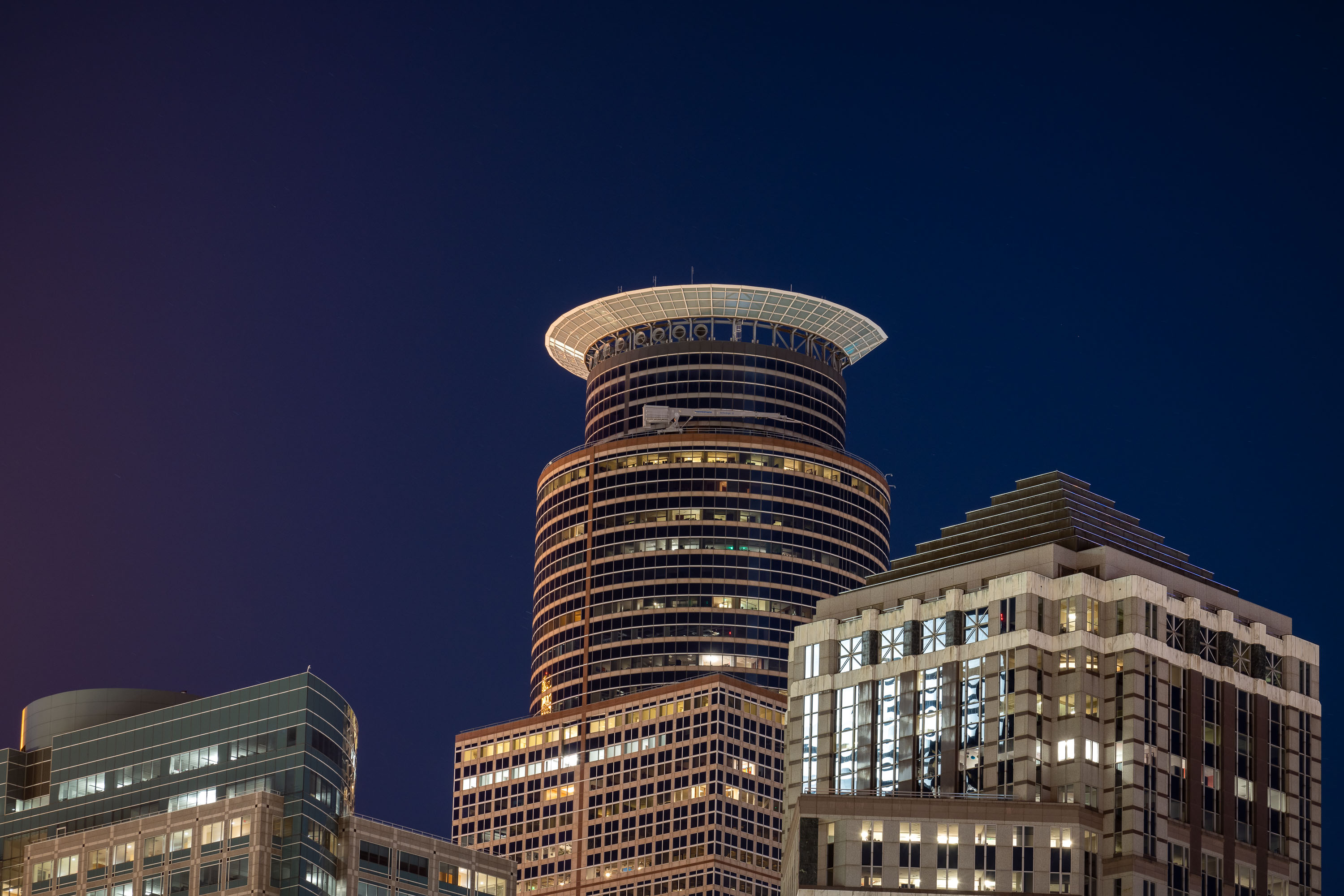
Capella Tower crown seen at night in Downtown Minneapolis
Capella Tower in Downtown Minneapolis

Capella Tower crown seen at night in Downtown Minneapolis

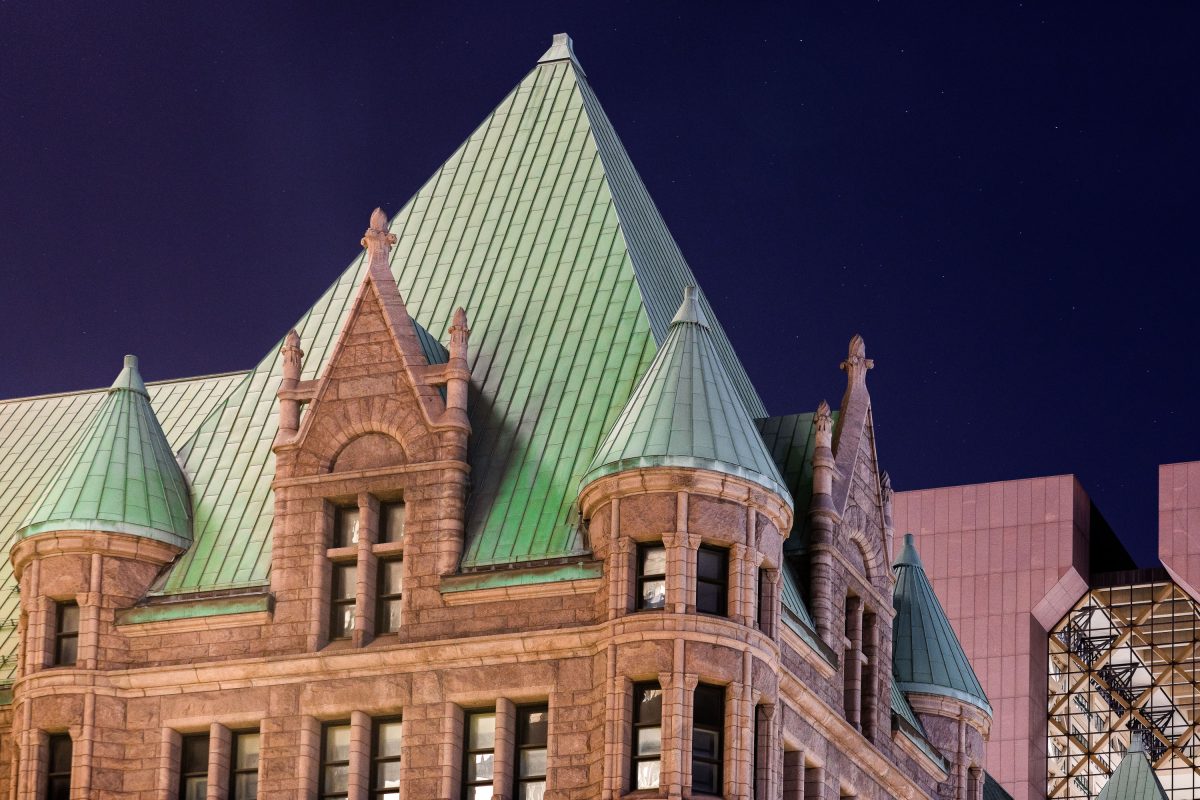
Minneapolis City Hall at night in May 2020
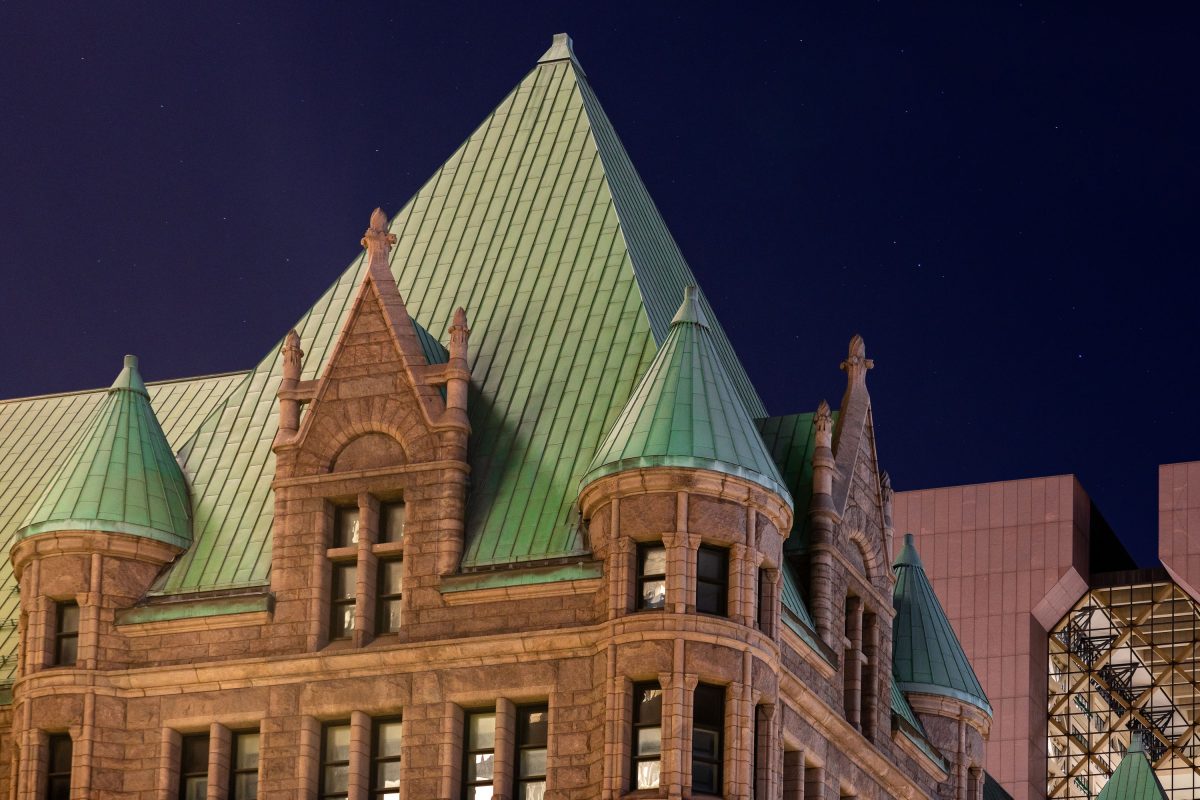
The Minneapolis City Hall and Hennepin County Government Center in the background.

Minneapolis City Hall at night in May 2020

Minneapolis City Hall and Hennepin County Government Center at night
Minneapolis City Hall and the Hennepin County Government Center in downtown Minneapolis on a clear night.

Downtown Minneapolis City Hall At Night
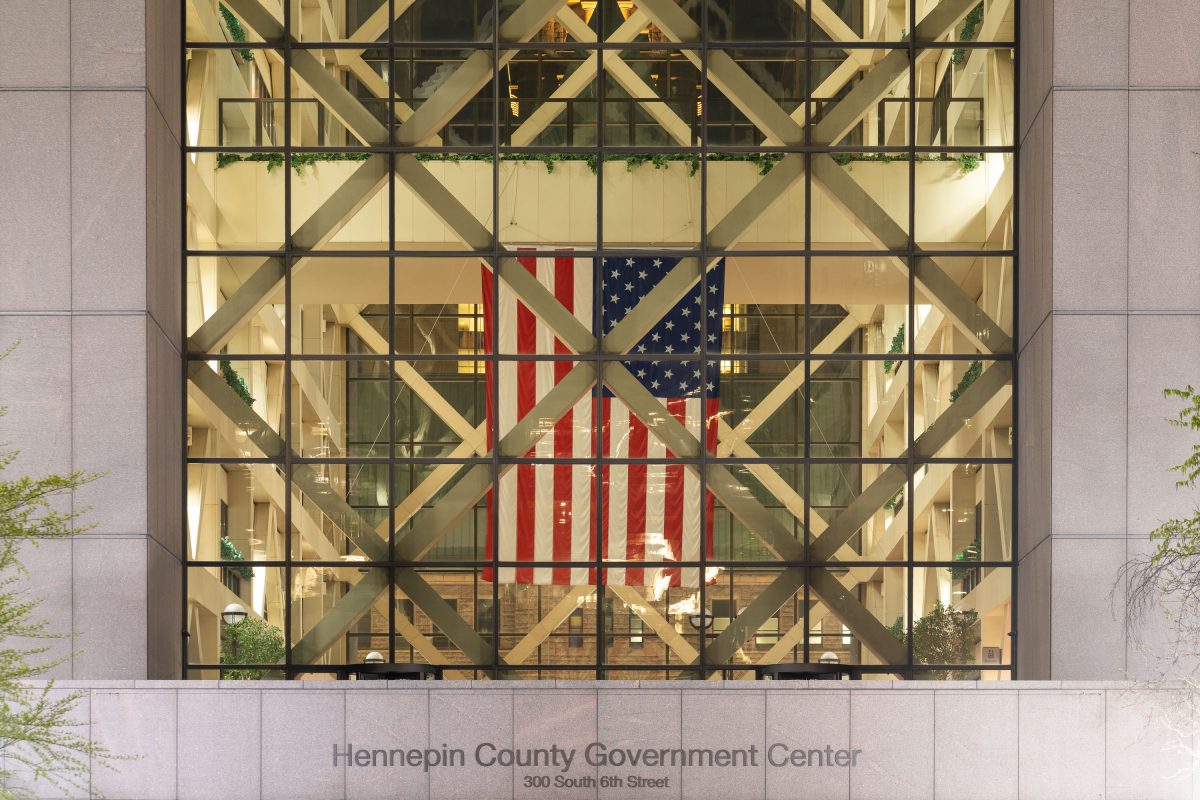
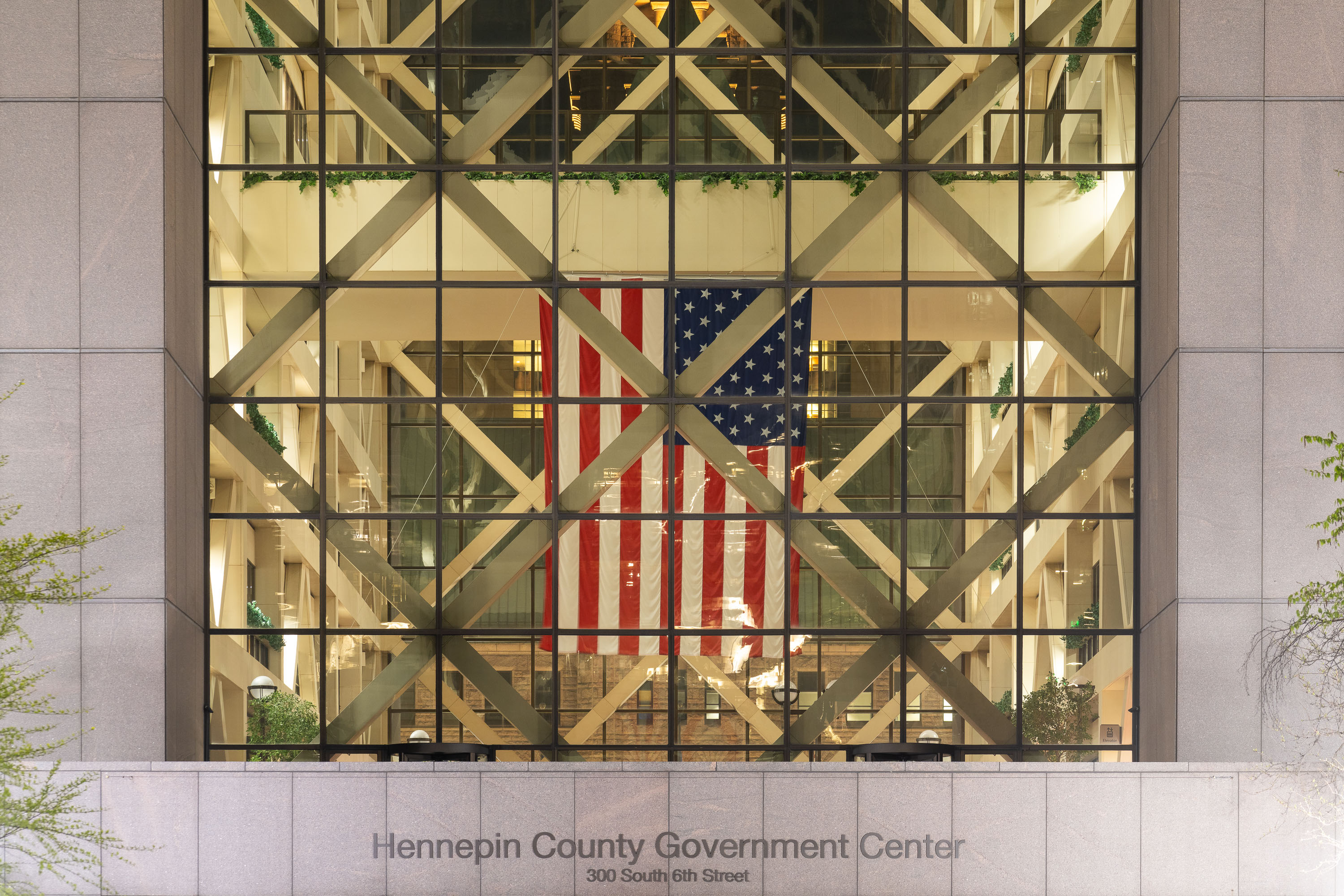
Hennepin County Government Center and the American Flag
An American Flag hangs inside the Hennepin County Courthouse in Downtown Minneapolis in May 2020.

Hennepin County Government Center and the American Flag

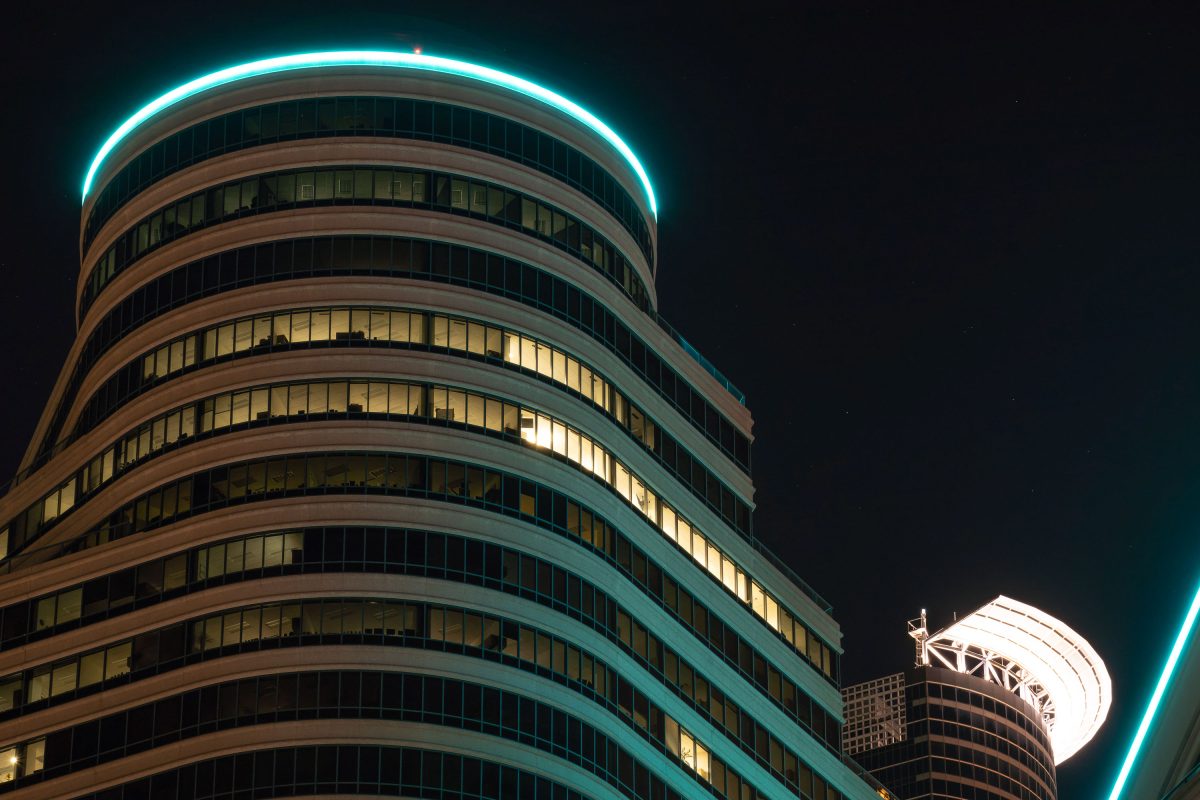
Fifth Street Towers in Downbtown Minneapolis at night
Fifth Street Towers and Capella Tower in Downtown Minneapolis.

Fifth Street Towers in Downbtown Minneapolis at night

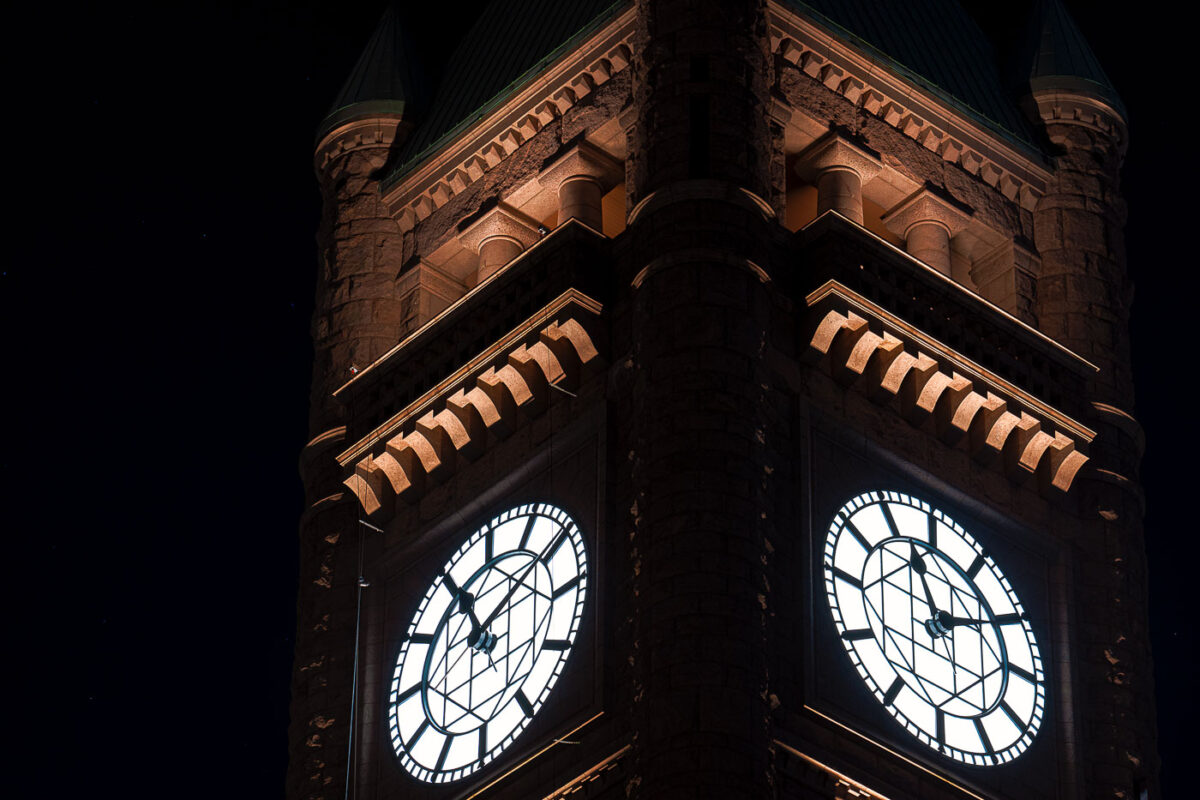
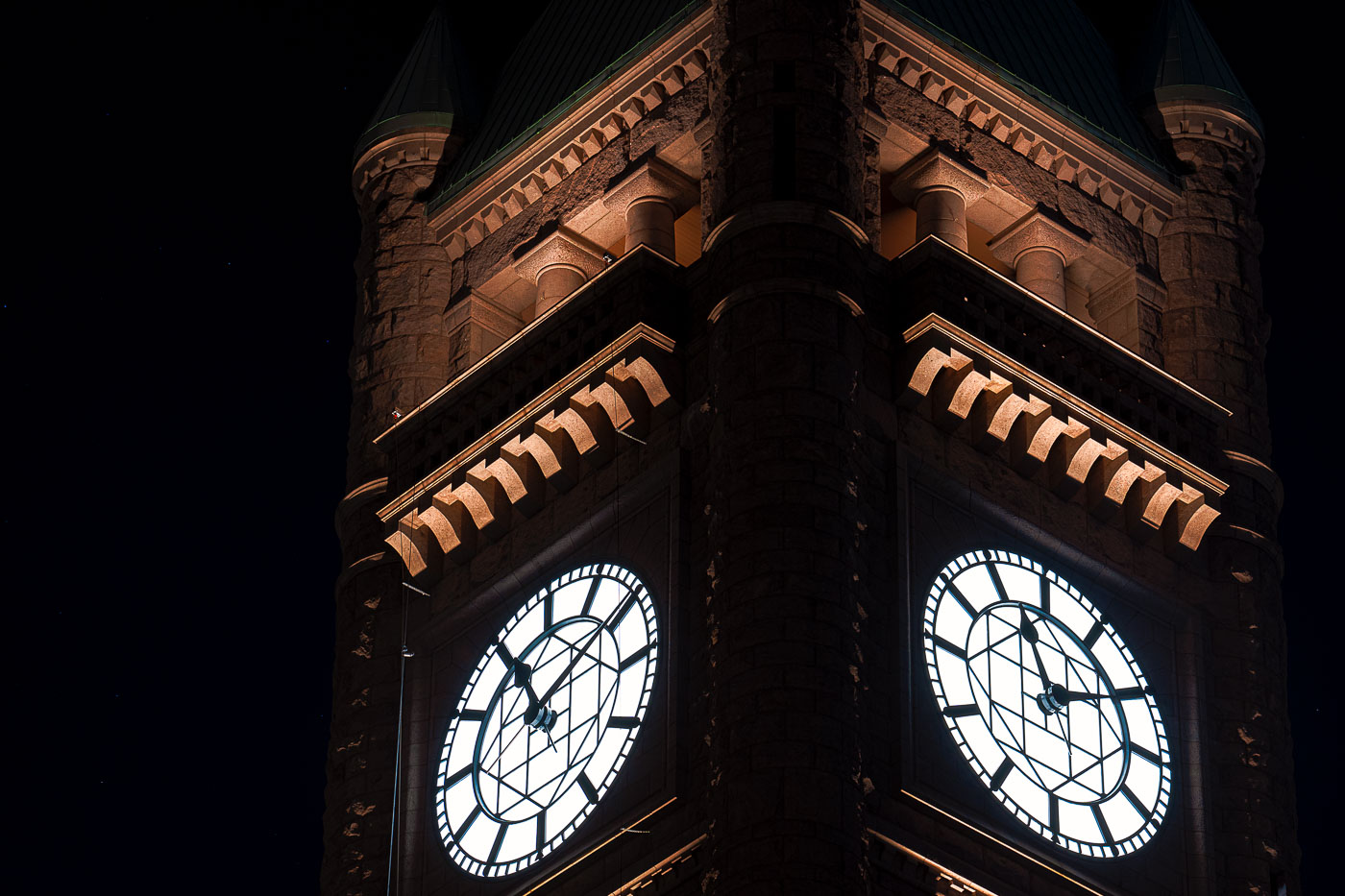
Minneapolis City Hall's illuminated clock tower displays two glowing faces against ornate Romanesque architecture at night.
The clock tower of Minneapolis City Hall glows at night, its illuminated faces visible across downtown.

Illuminated Clock Faces on Minneapolis City Hall’s Tower
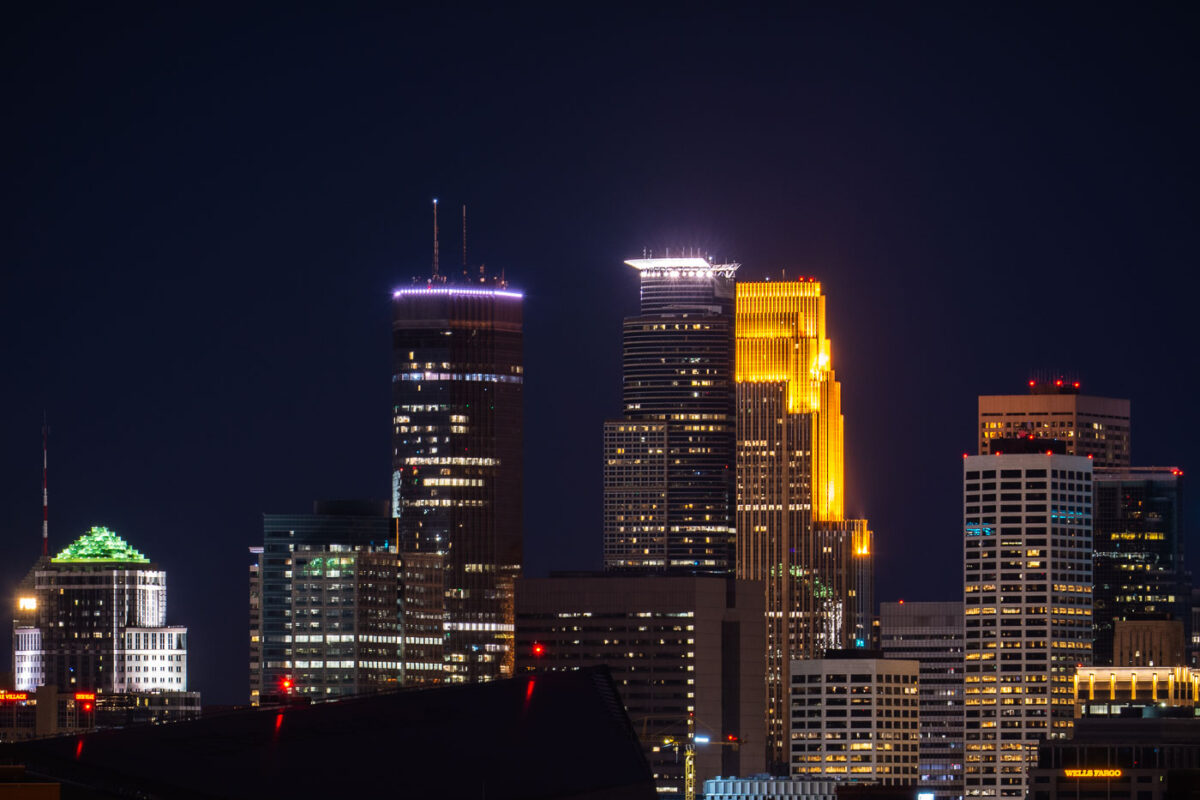
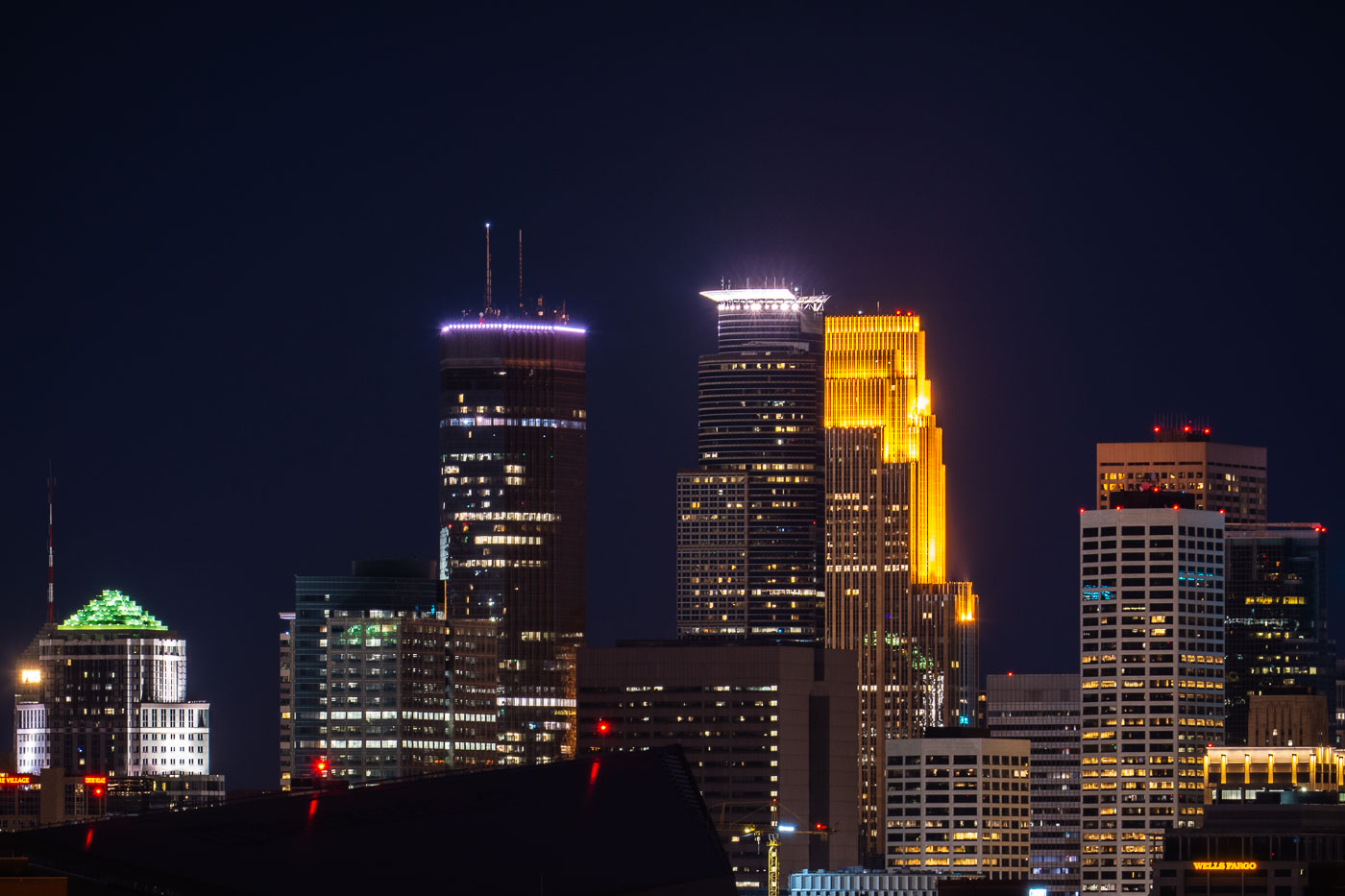
Downtown Minneapolis skyline with IDS Center, Wells Fargo Center, and Capella Tower at night.
Downtown Minneapolis skyline, Minnesota, includes IDS Center, Wells Fargo Center, and Capella Tower on May 6, 2020. The office towers are part of the city’s central business district, clustered around Nicollet Mall and the downtown core. IDS Center has long been Minnesota’s tallest building, while Wells Fargo Center is one of the city’s most recognizable high-rise office towers.

IDS Center and Wells Fargo Center, Minneapolis
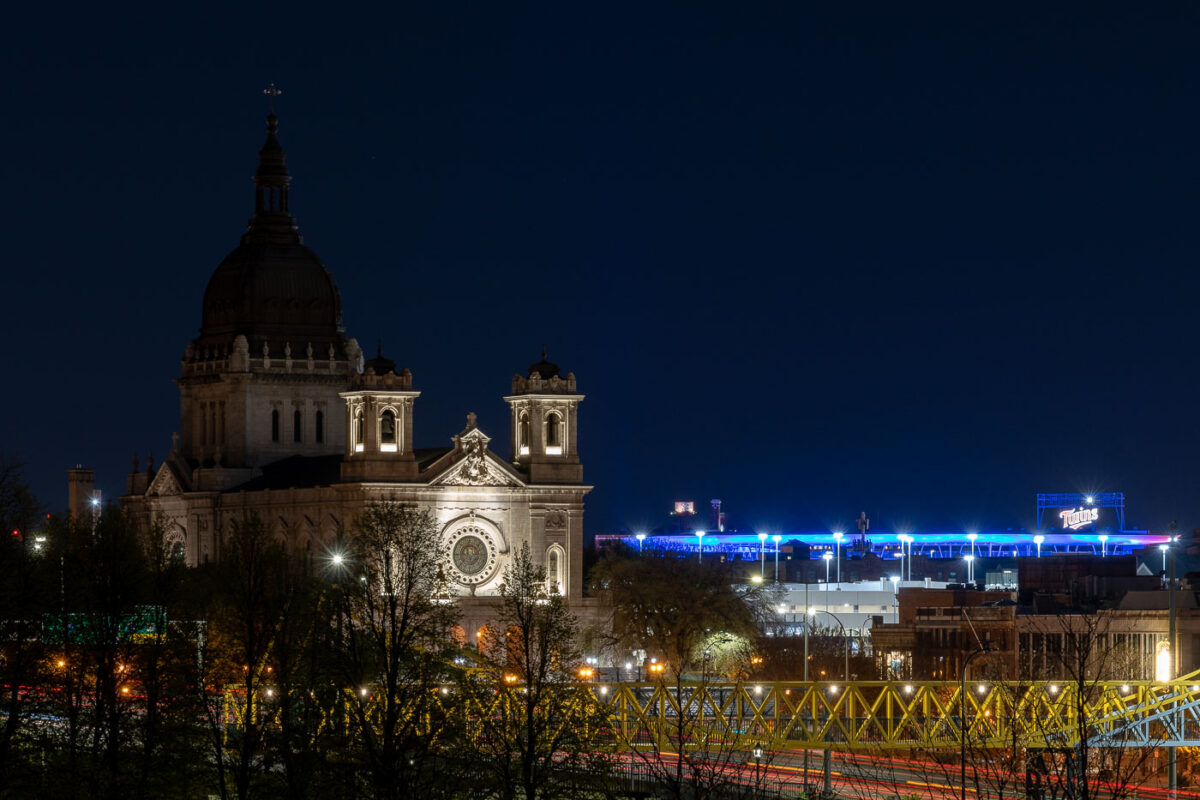
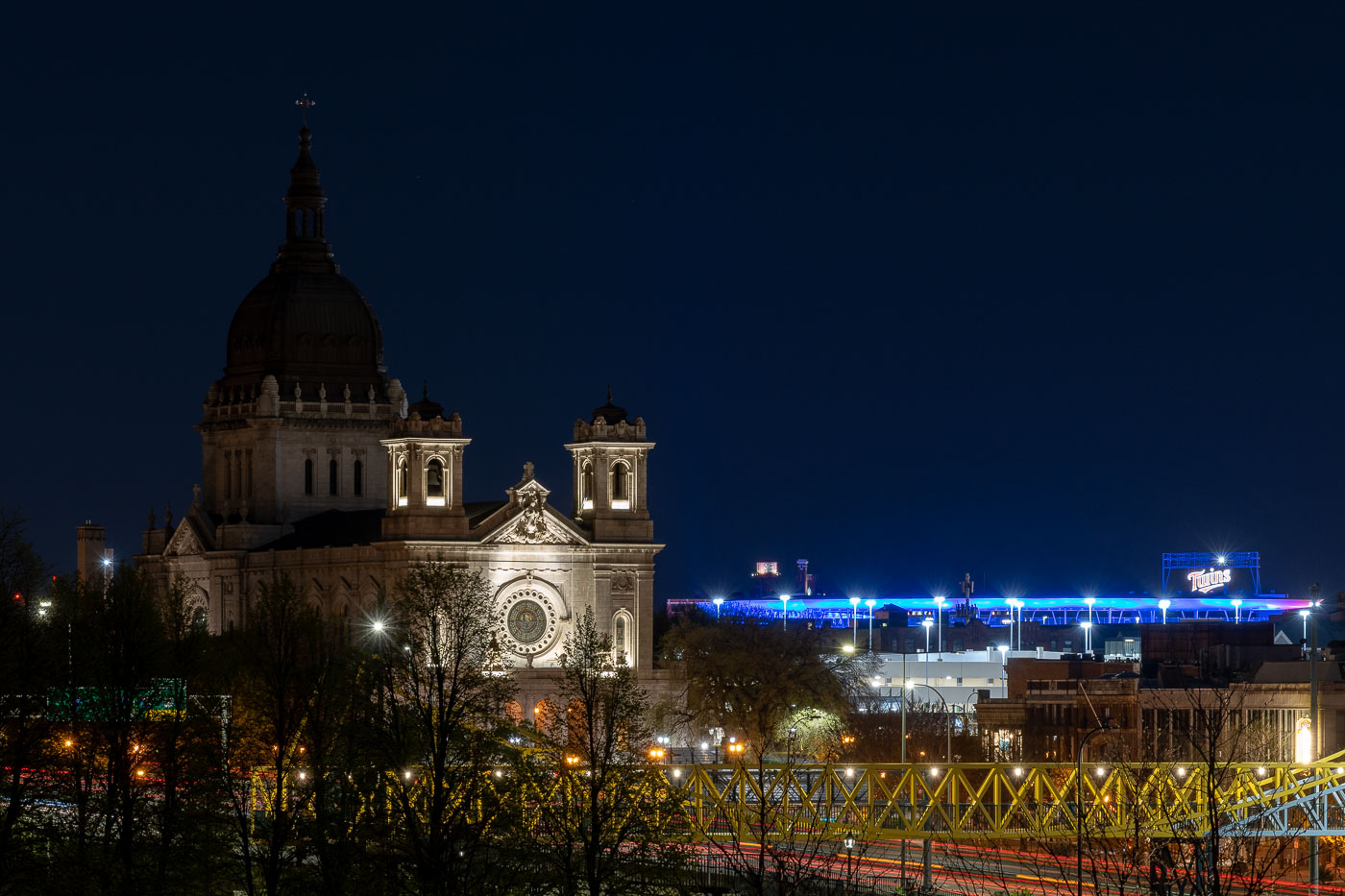
The Basilica of Saint Mary and Target Field illuminated at night in downtown Minneapolis.
The Basilica of Saint Mary stands at 1600 Hennepin Avenue in downtown Minneapolis, completed in 1926 as the first basilica designated in the United States. Target Field, home of the Minnesota Twins, opened in 2010 on the north side of downtown near the Mississippi River.

Basilica of Saint Mary Rises Over Target Field at Night
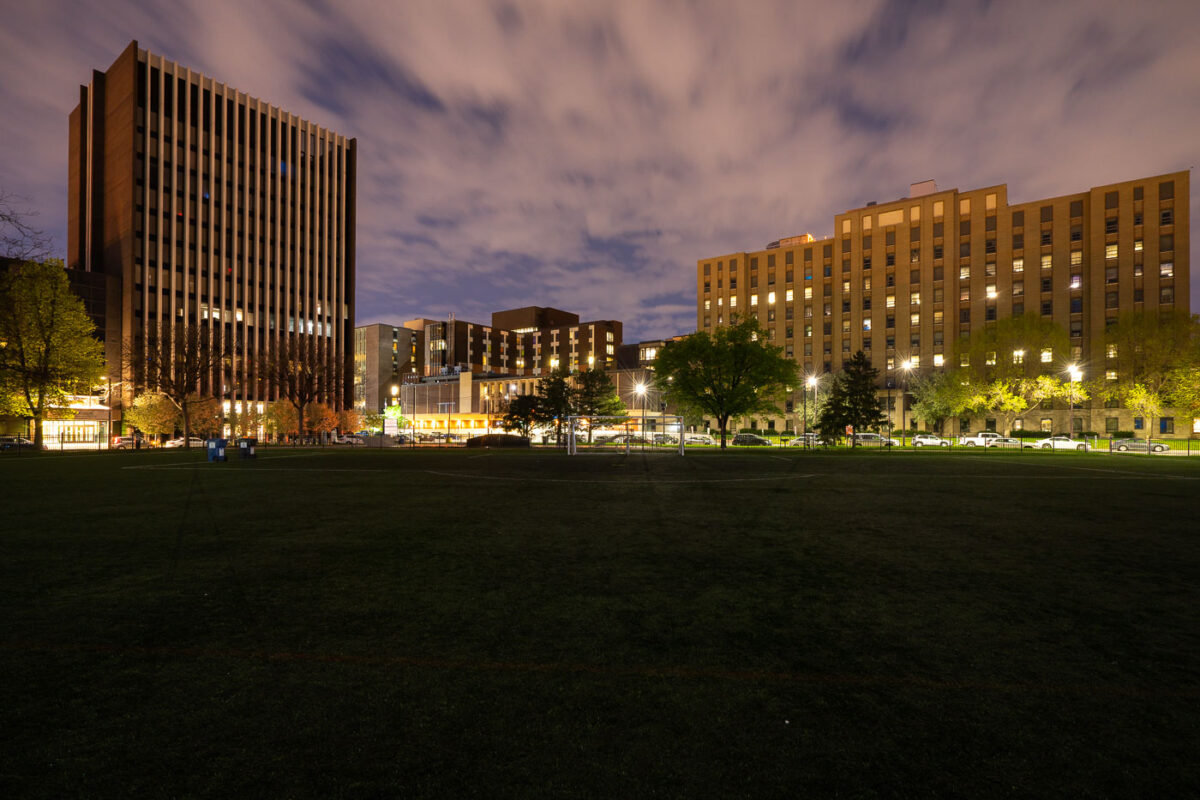
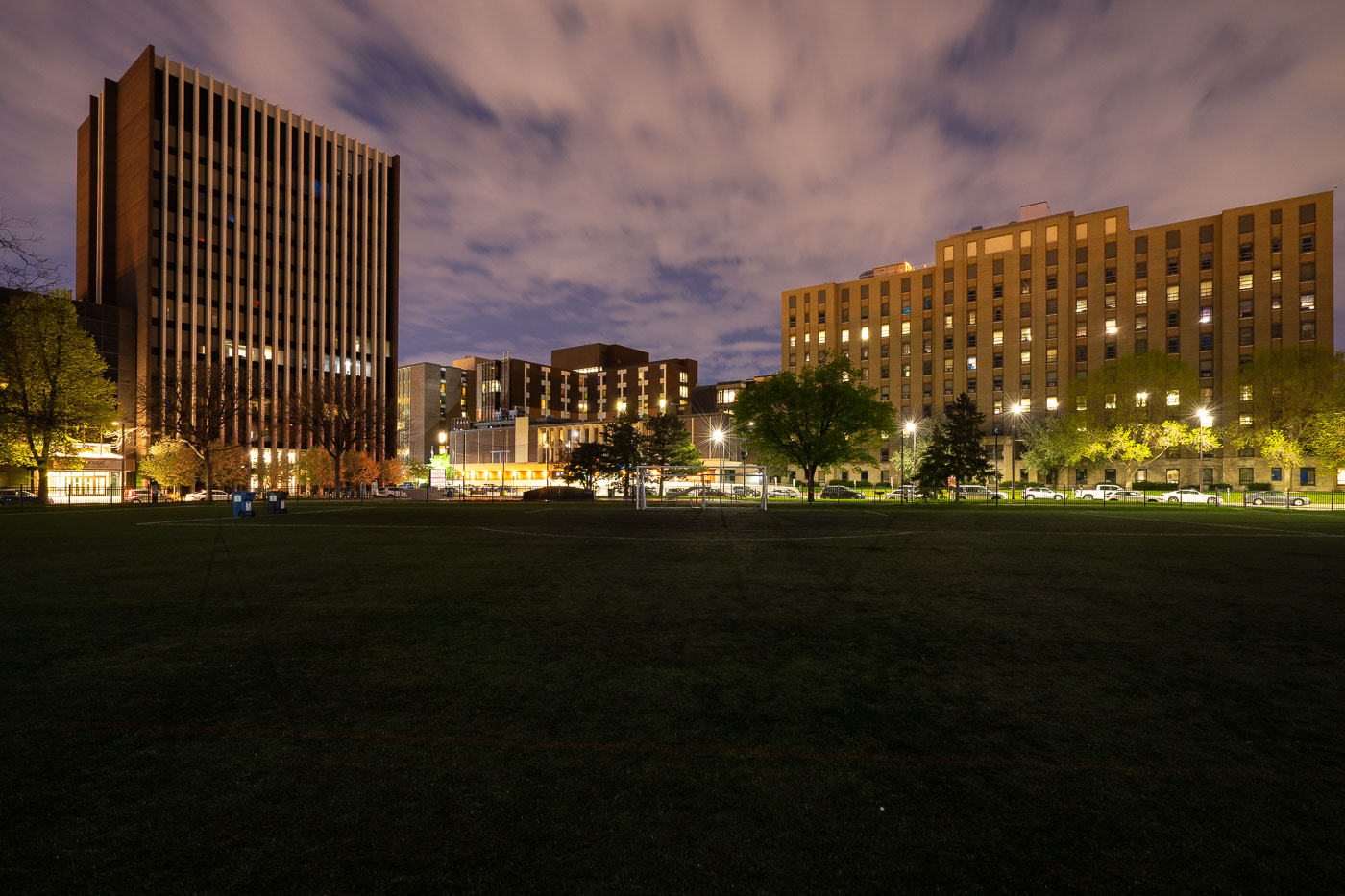
Elliot Park at night in downtown Minneapolis
Elliott Park in Downtown Minneapolis. One of my favorite parks downtown because of the skyline that's visible from the soccer fields.

Elliott Park in downtown Minneapolis at night
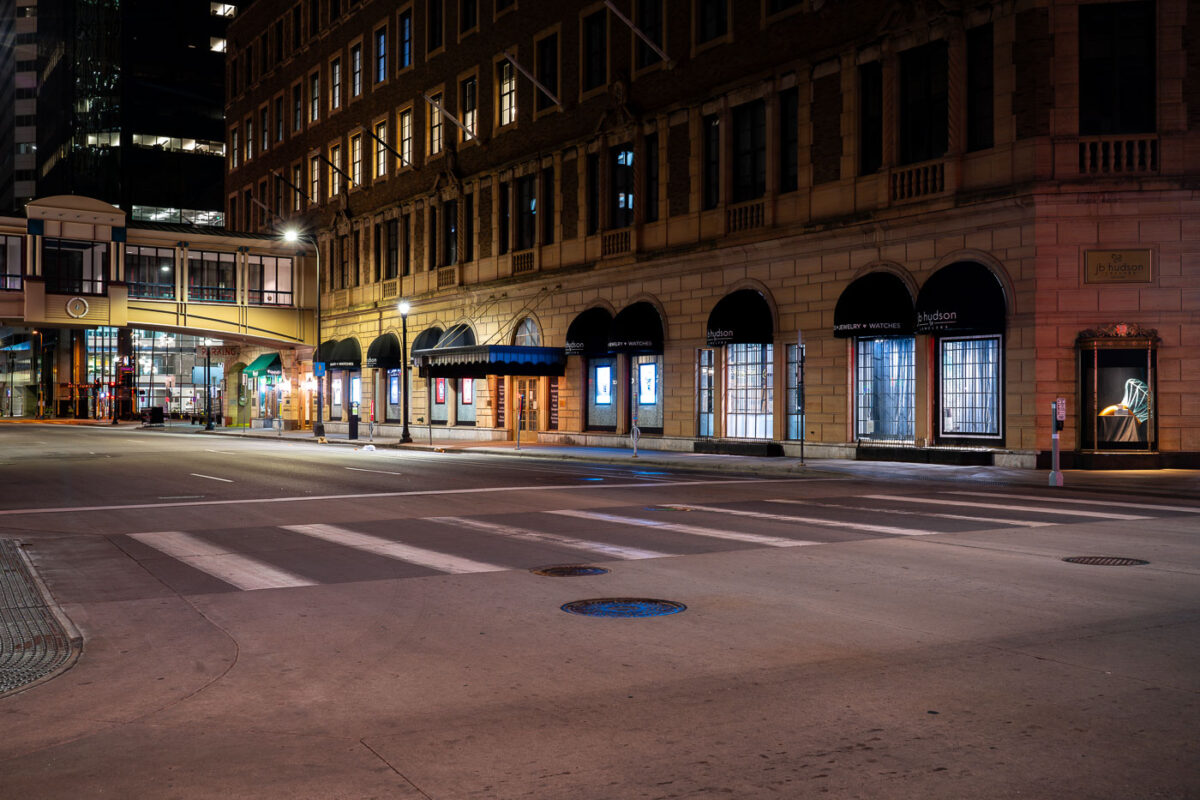
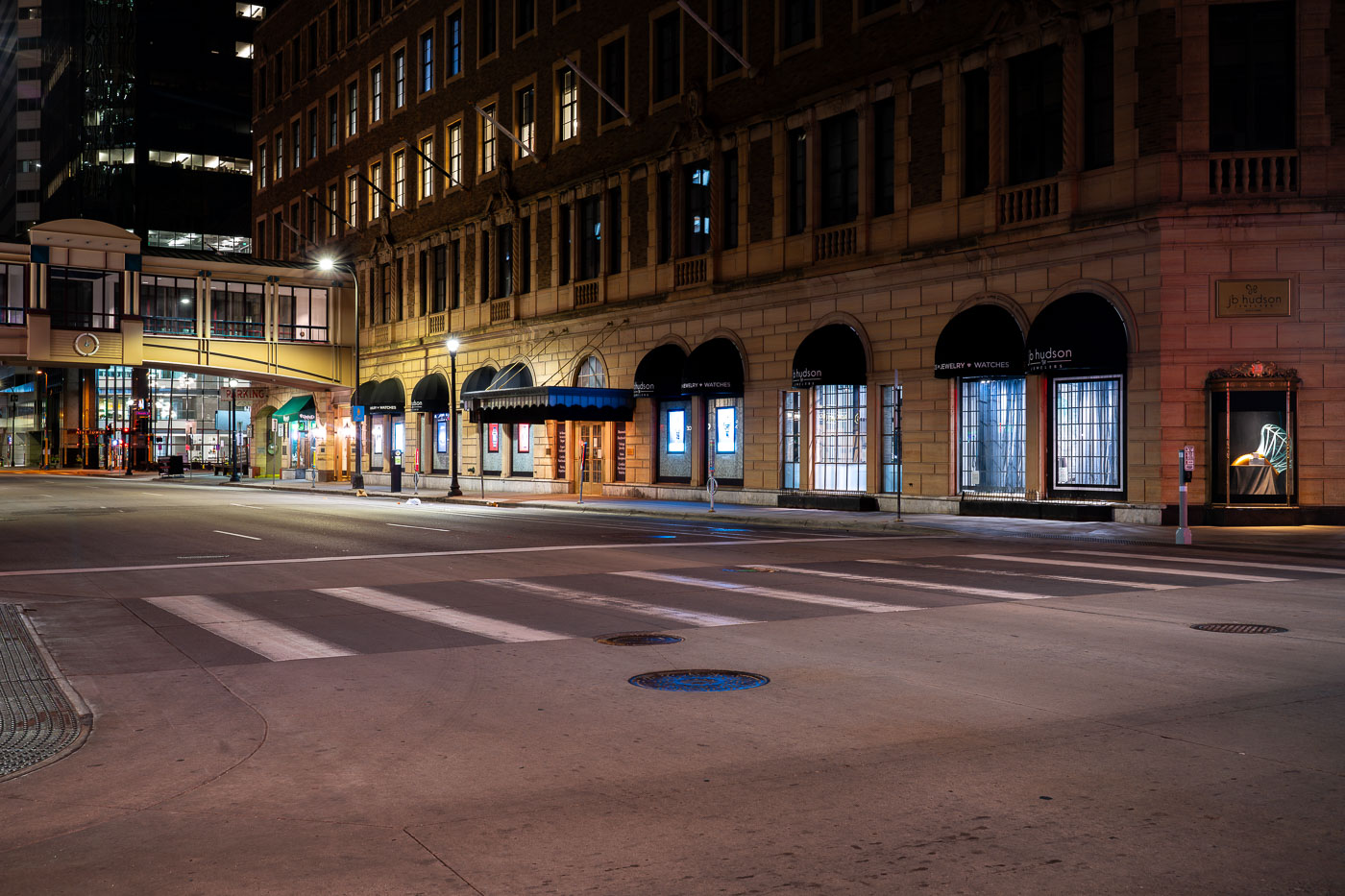
Nicollet Mall storefronts and retail businesses at night in downtown Minneapolis.
Nicollet Mall is a pedestrian shopping district in downtown Minneapolis featuring retail storefronts and restaurants along a tree-lined walkway. The mall, which opened in 1968, was designed as a mixed-use urban space connecting downtown businesses and offices. JB Hudson Jewelers operates among the various retailers along the mall, which has served as a commercial and gathering destination for decades.

Nicollet Mall storefronts at night, downtown Minneapolis
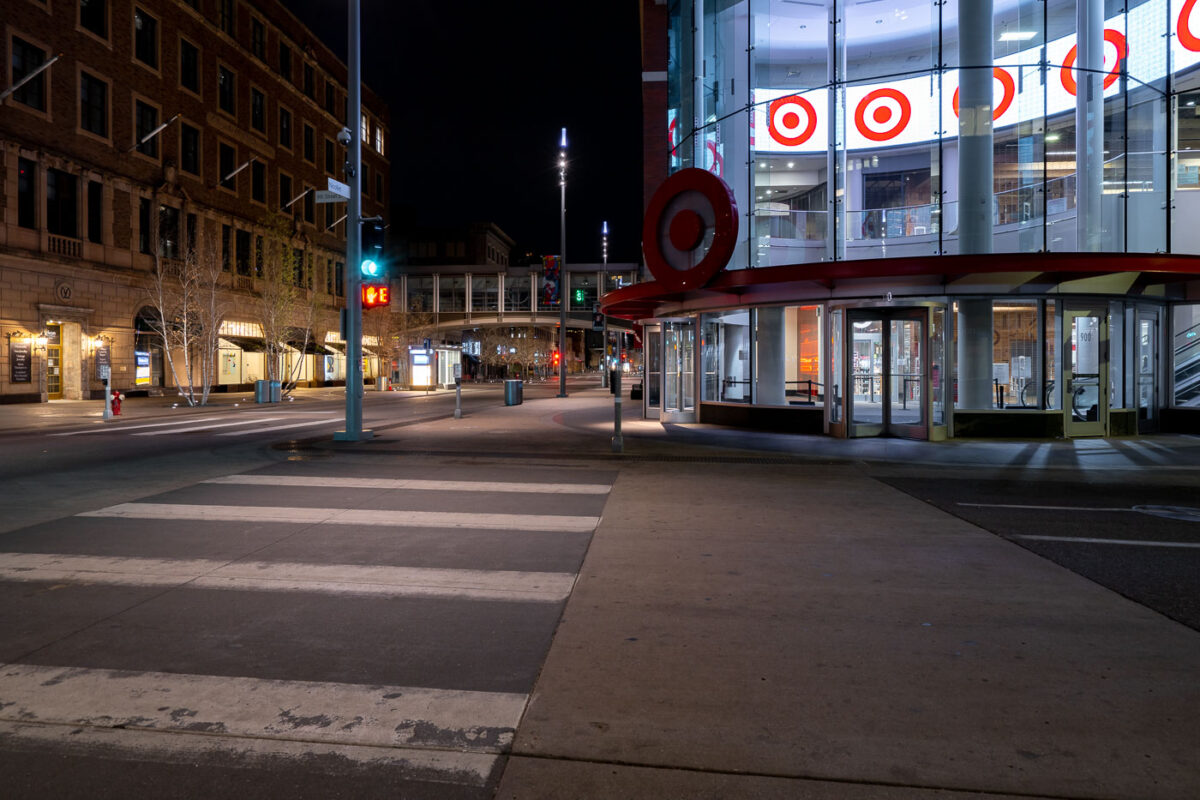
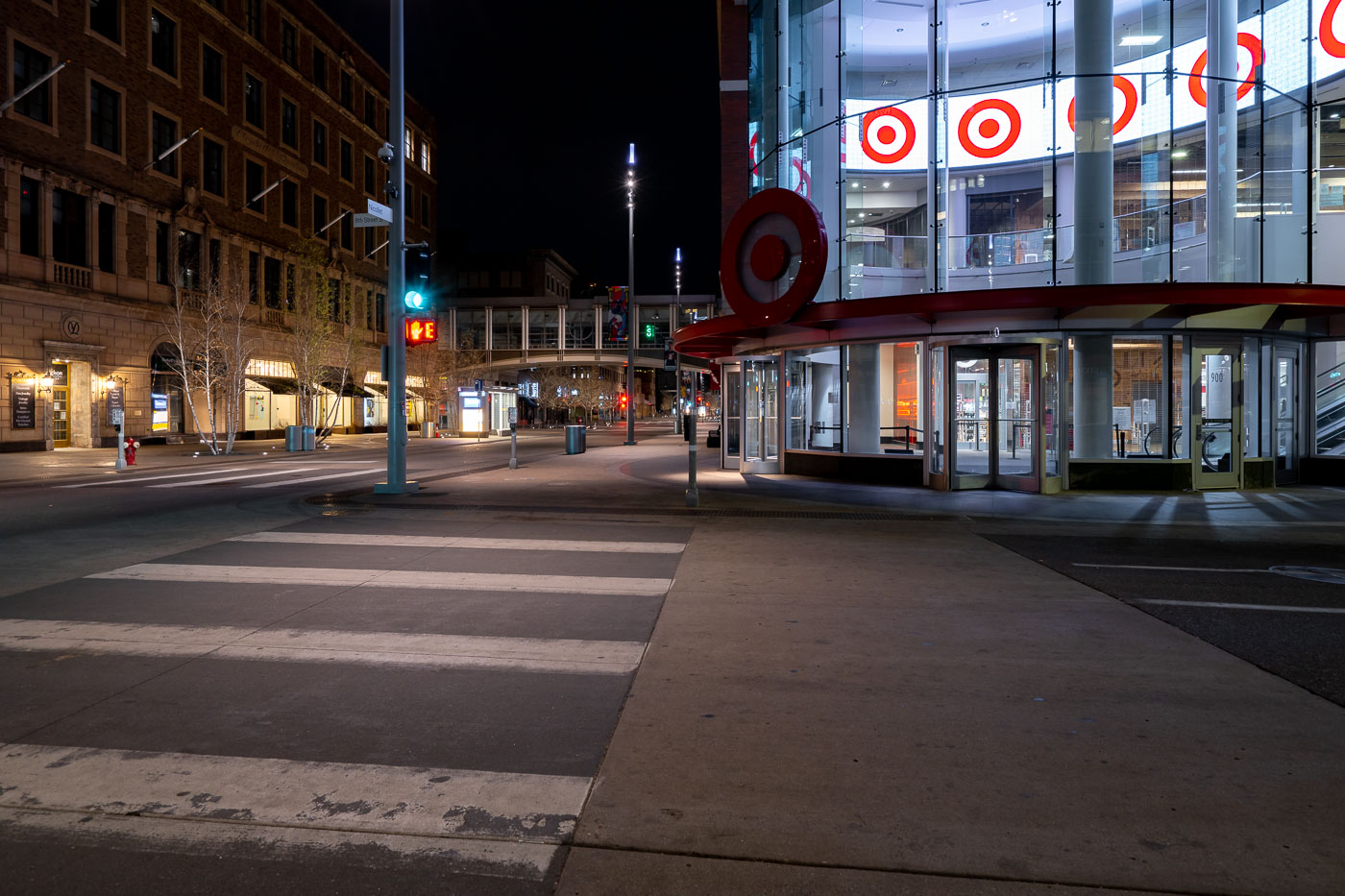
Target's flagship store illuminated at night on Nicollet Mall at South 9th Street in downtown Minneapolis.
Target's downtown Minneapolis store sits at the corner of Nicollet Mall and South 9th Street, its curved glass corner marked by the company's red bullseye logo. The flagship location anchors this stretch of the pedestrian mall, with a skyway overhead linking it to neighboring blocks.

Target Store on Nicollet Mall at night
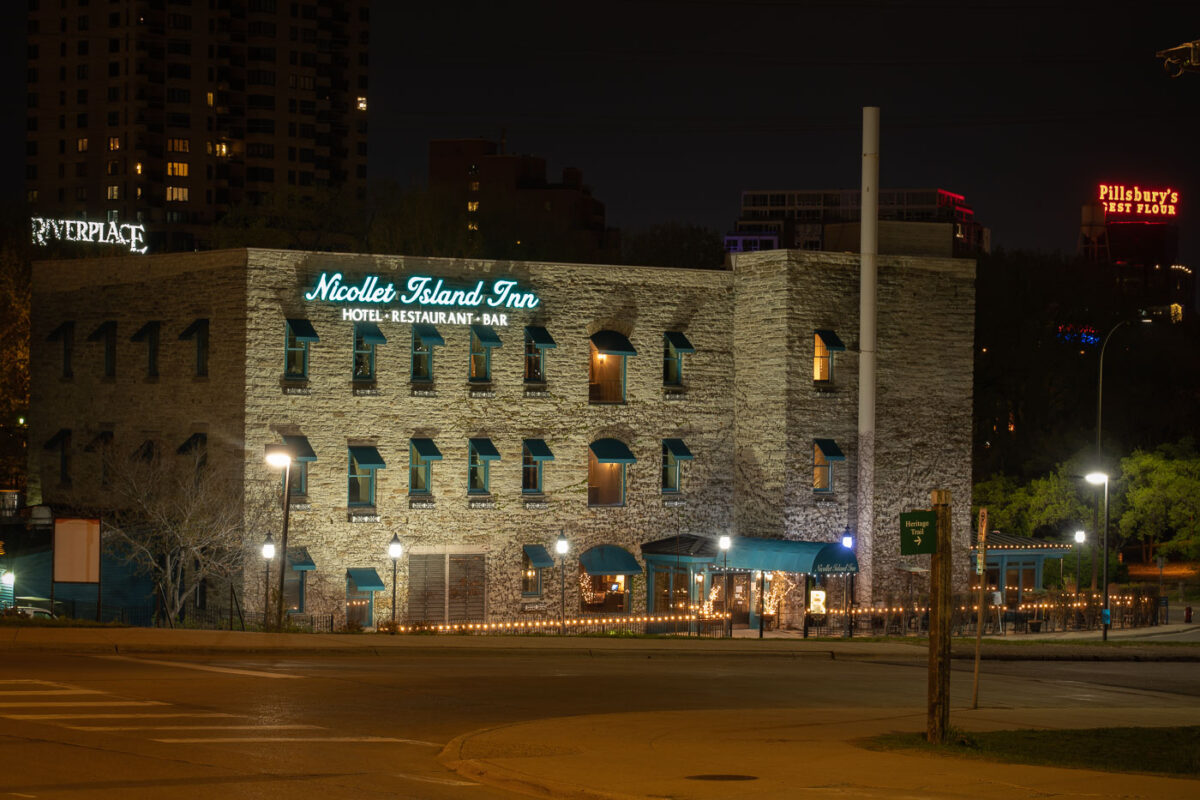
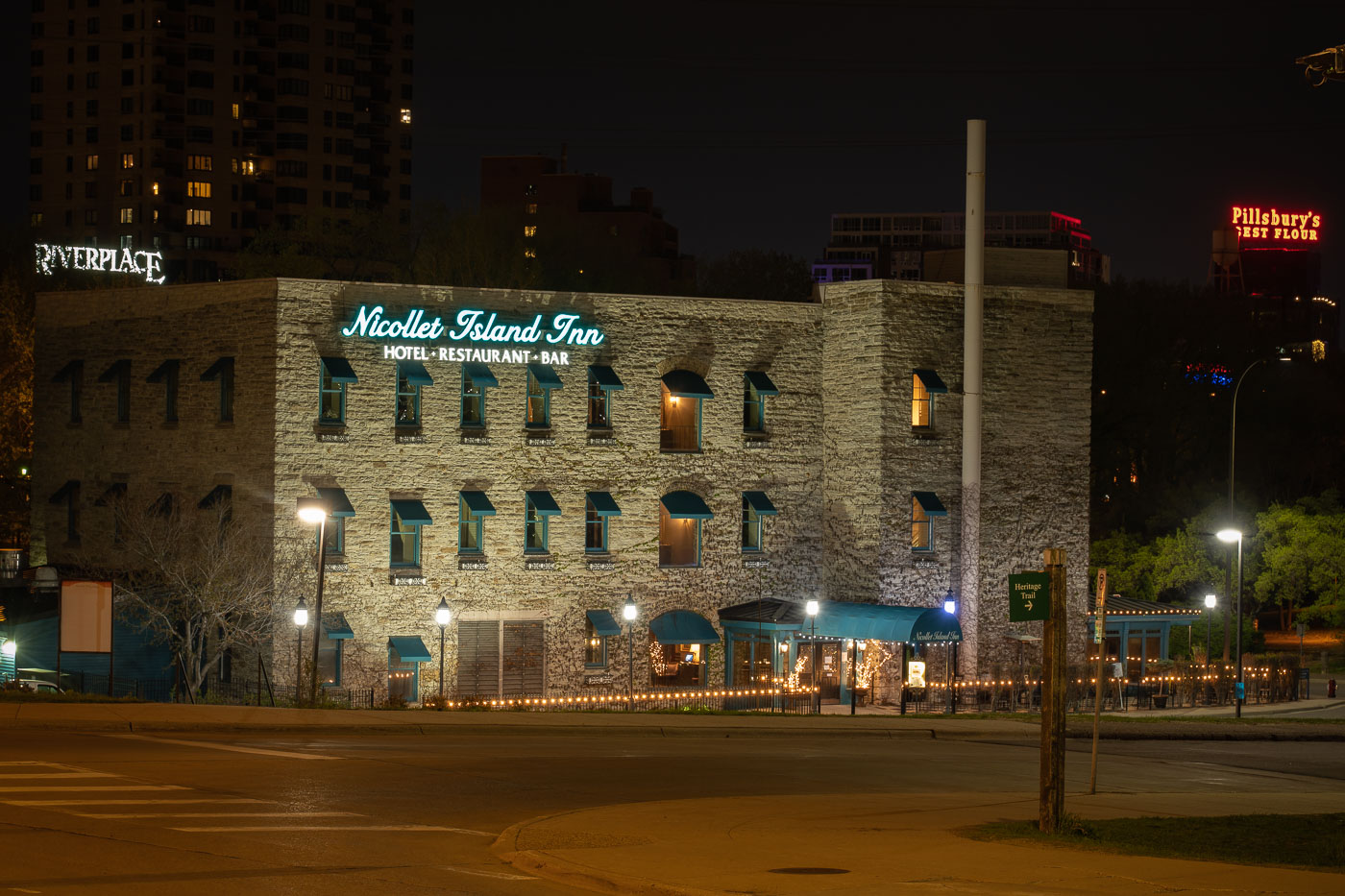
NIcollet Island Inn on Nicollet Island
The Nicollet Island Inn, a landmark along the Mississippi River in Minneapolis, occupies a 19th-century brick and limestone structure originally built in the 1890s as an industrial facility. Converted into a hotel and restaurant in the 1970s, it retains its historic character with exposed stone walls and vintage architectural details. Illuminated signage and soft outdoor lighting highlight the inn’s distinctive facade, with the iconic Pillsbury’s Best Flour sign visible across the river, linking the scene to the city’s milling heritage.

Nicollet Island Inn at Night, Minneapolis Riverfront
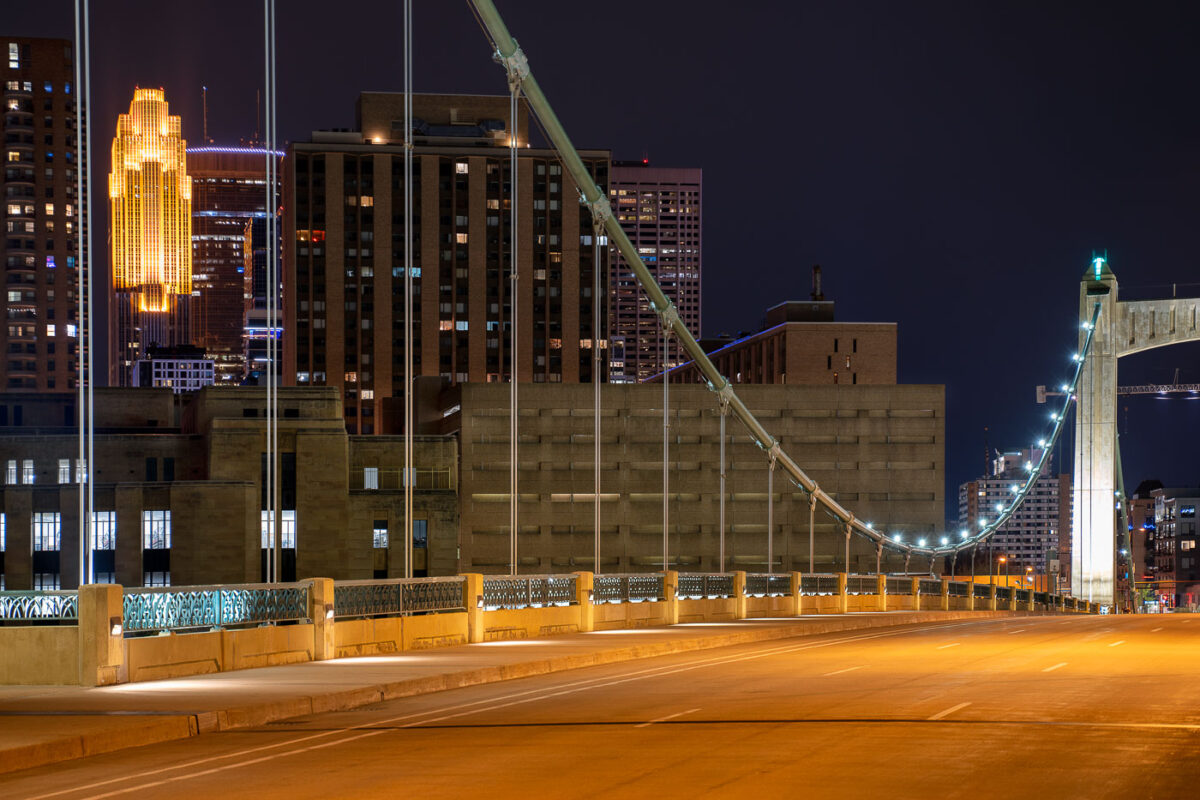
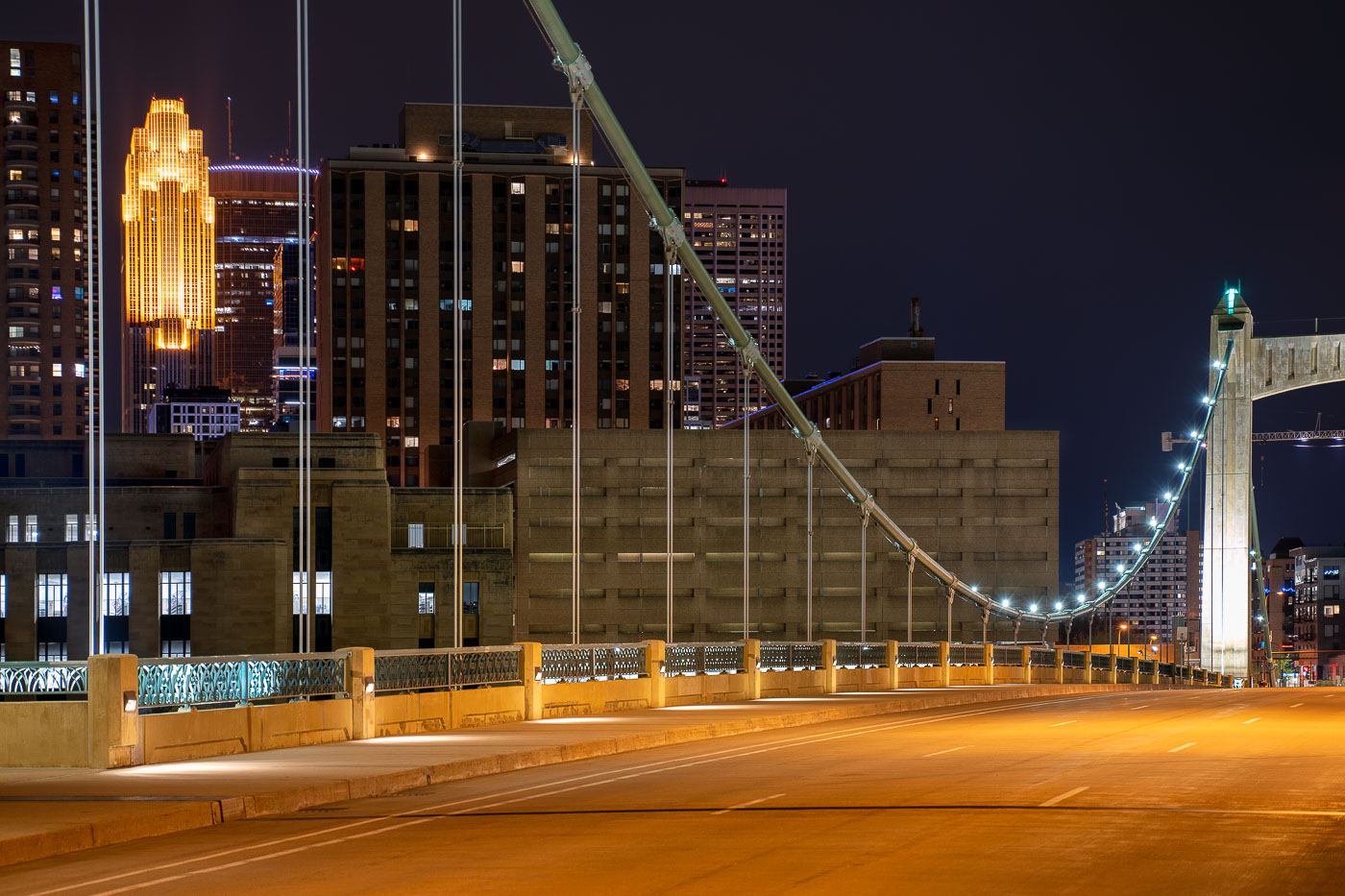
Hennepin Ave bridge at night during covid19
The Hennepin Avenue Bridge in Minneapolis, MN, is seen here during the COVID-19 pandemic.

Hennepin Avenue Bridge, Minneapolis, During COVID-19 Pandemic
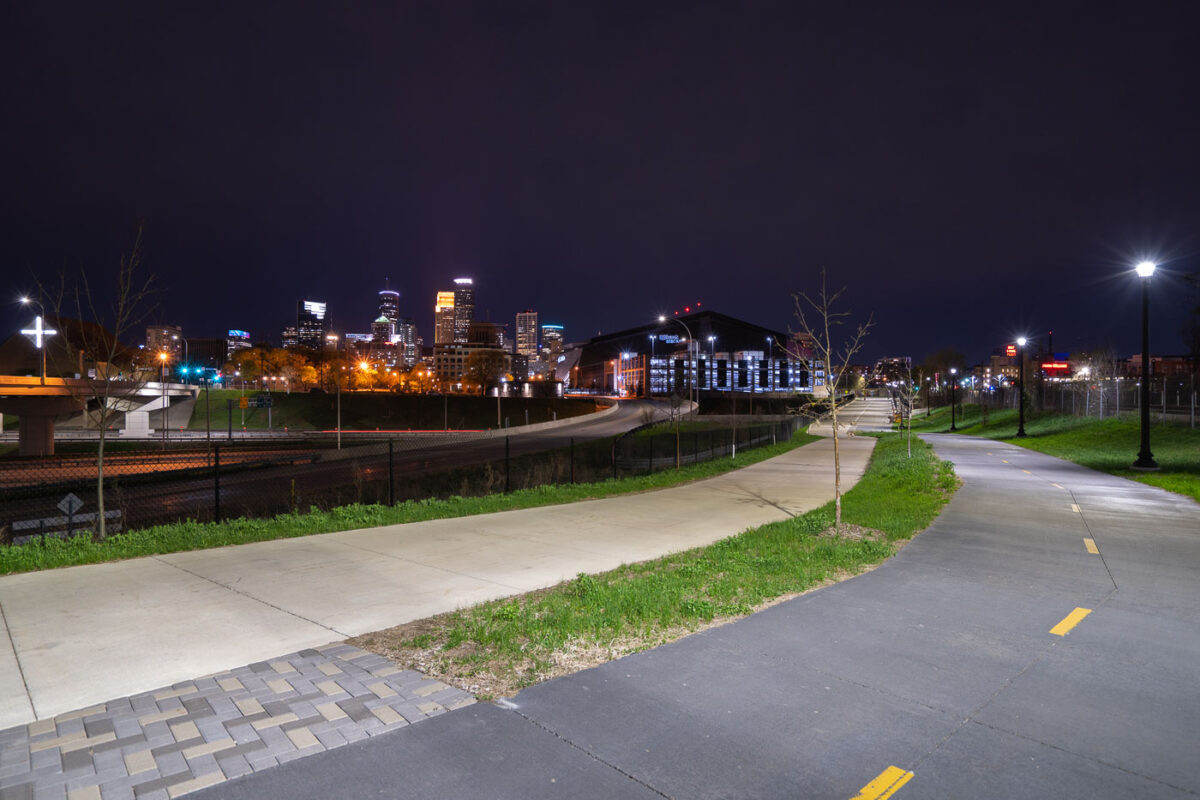
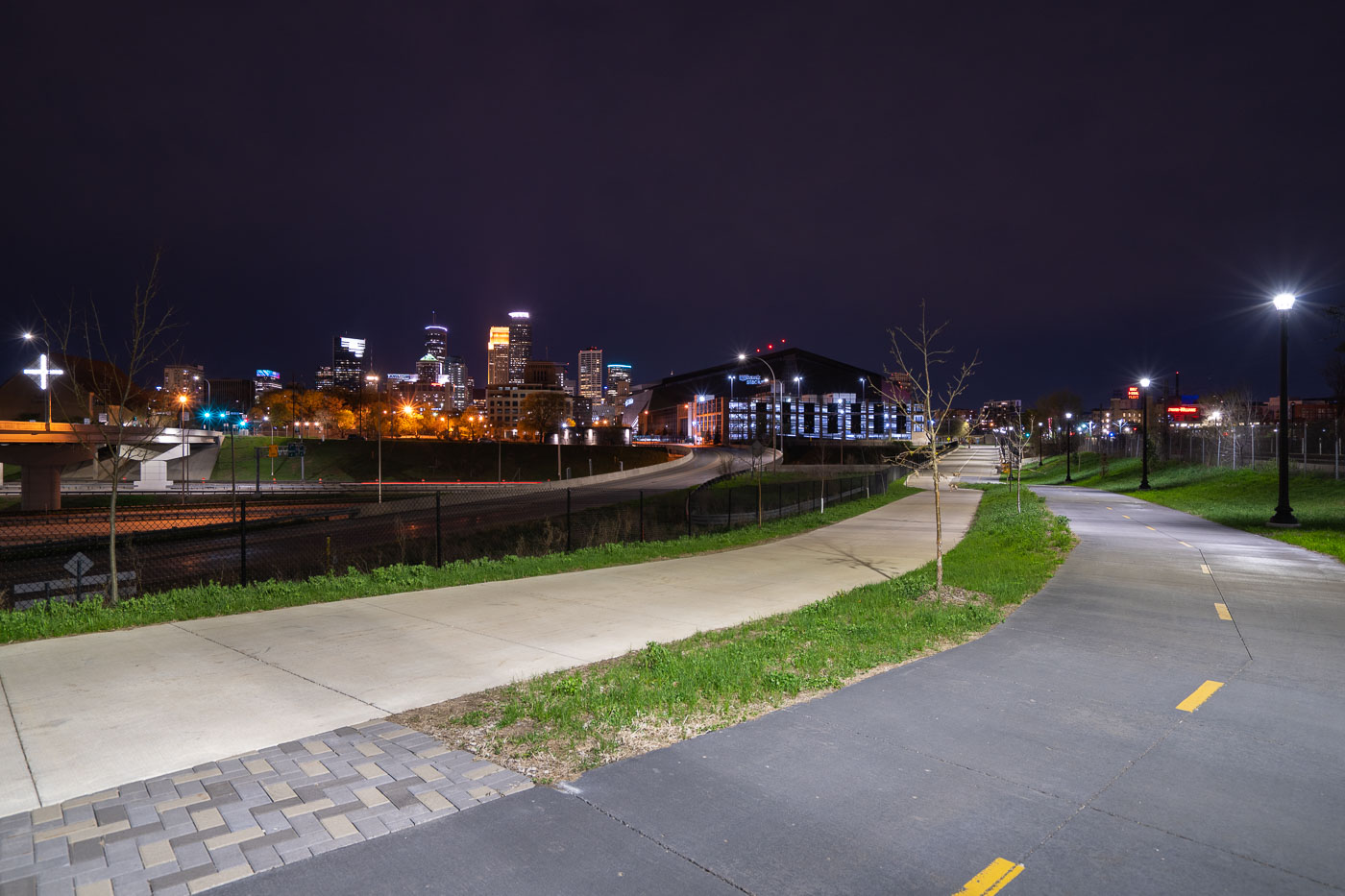
Samatar Crossing near Downtown Minneapolis
The Samatar Crossing shared use path near downtown Minneapolis. The path leads from Cedar Riverside to near US Bank Stadium.

Samatar Crossing near Downtown Minneapolis

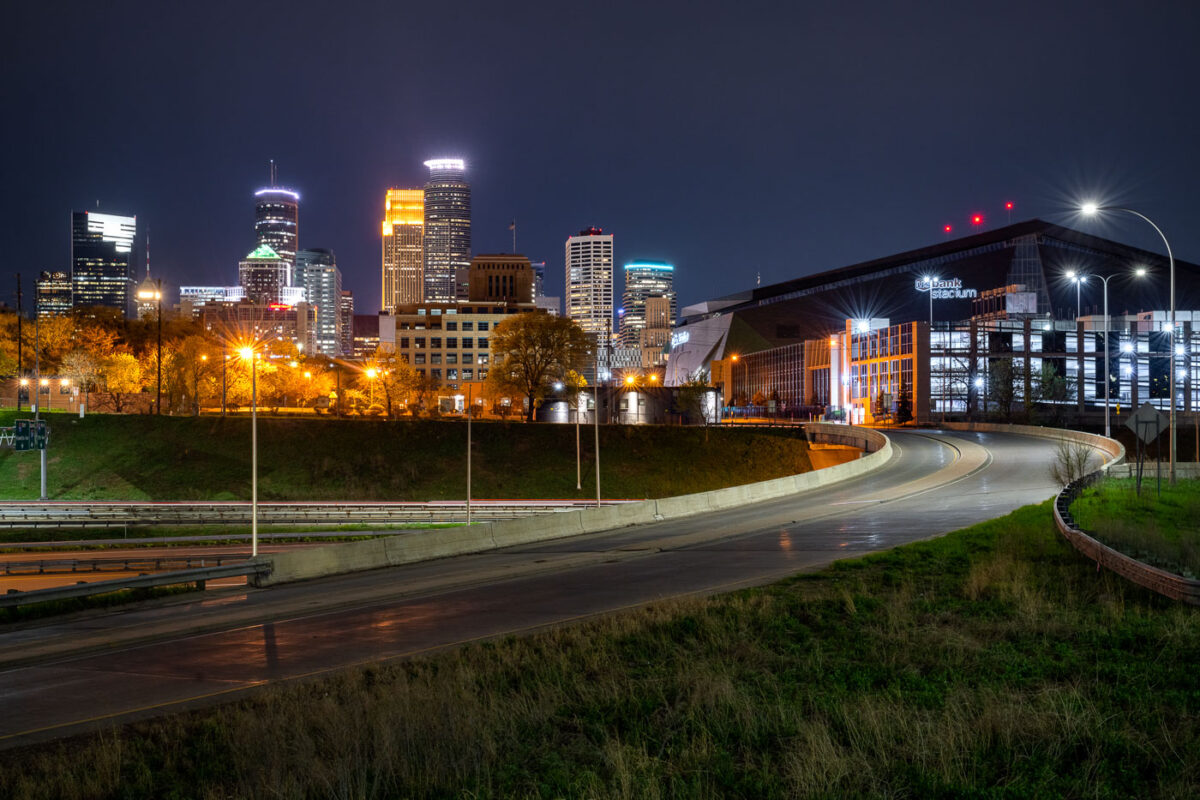
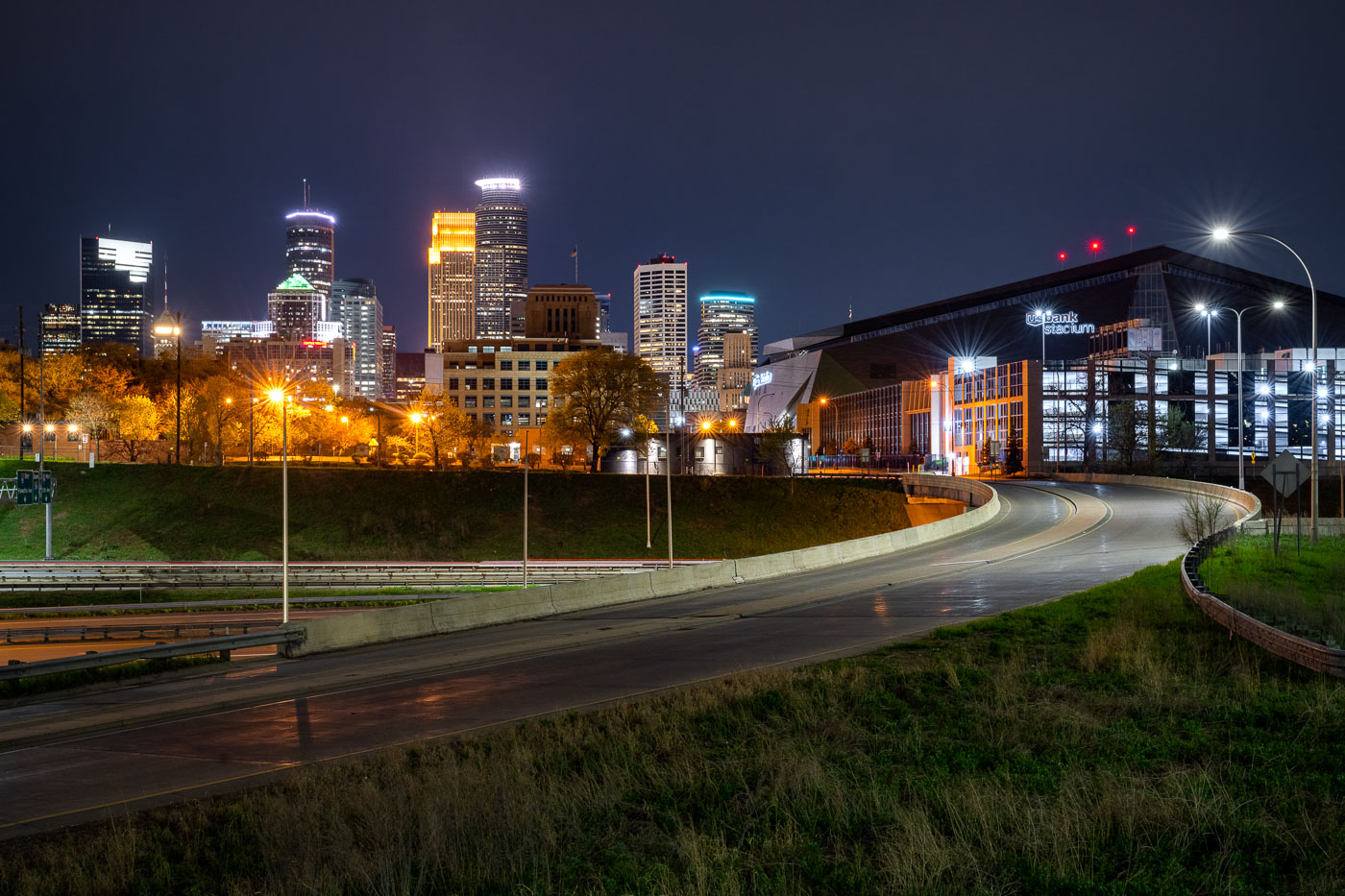
US Bank Stadium and the downtown Minneapolis skyline
US Bank Stadium, a multi-purpose venue in downtown Minneapolis, is illuminated at night. Opened in 2016, the stadium was built on the former site of the Metrodome and serves as the home for the Minnesota Vikings of the National Football League. Its distinctive architecture features a transparent ETFE roof and a faceted glass exterior, designed to reflect the city's sky and surrounding environment. The stadium hosts a variety of events, including professional football games, concerts, and other large-scale public gatherings.

US Bank Stadium and Minneapolis Skyline at Night
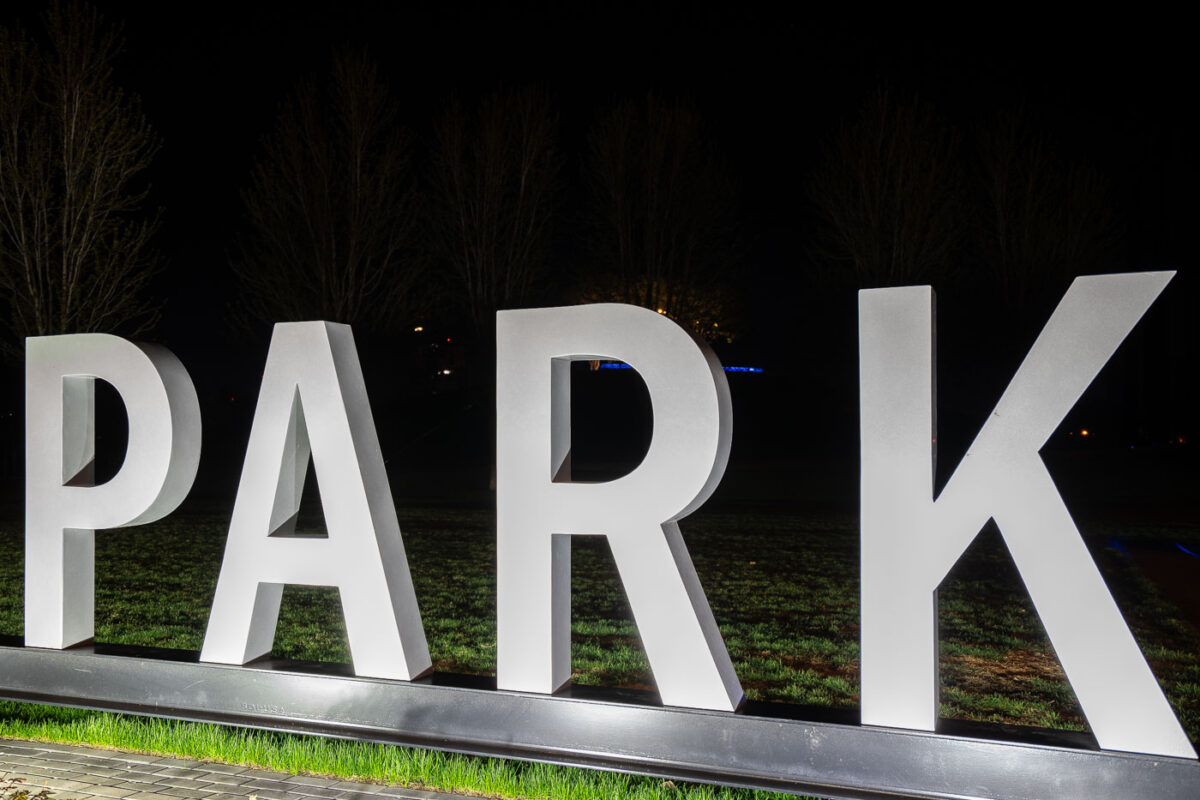
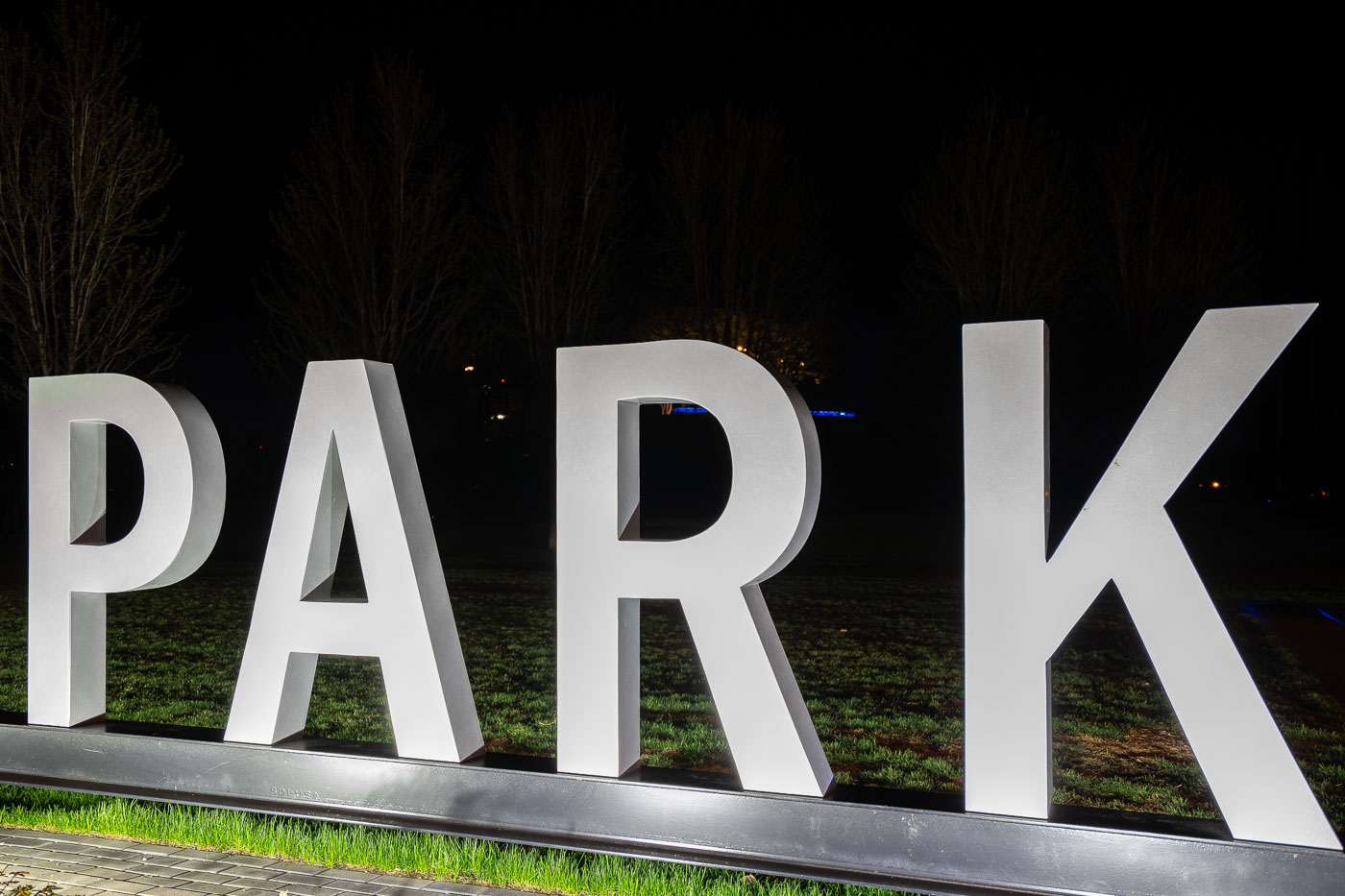
Illuminated "PARK" letters at Gold Medal Park near downtown Minneapolis.
Large illuminated letters spelling "PARK" stand at Gold Medal Park along the Mississippi River near downtown Minneapolis. The park occupies the site of the former Gold Medal Flour Mills, a major industrial landmark in the city's milling history. The signage serves as wayfinding and identification for the public green space.

Gold Medal Park Signage, Minneapolis

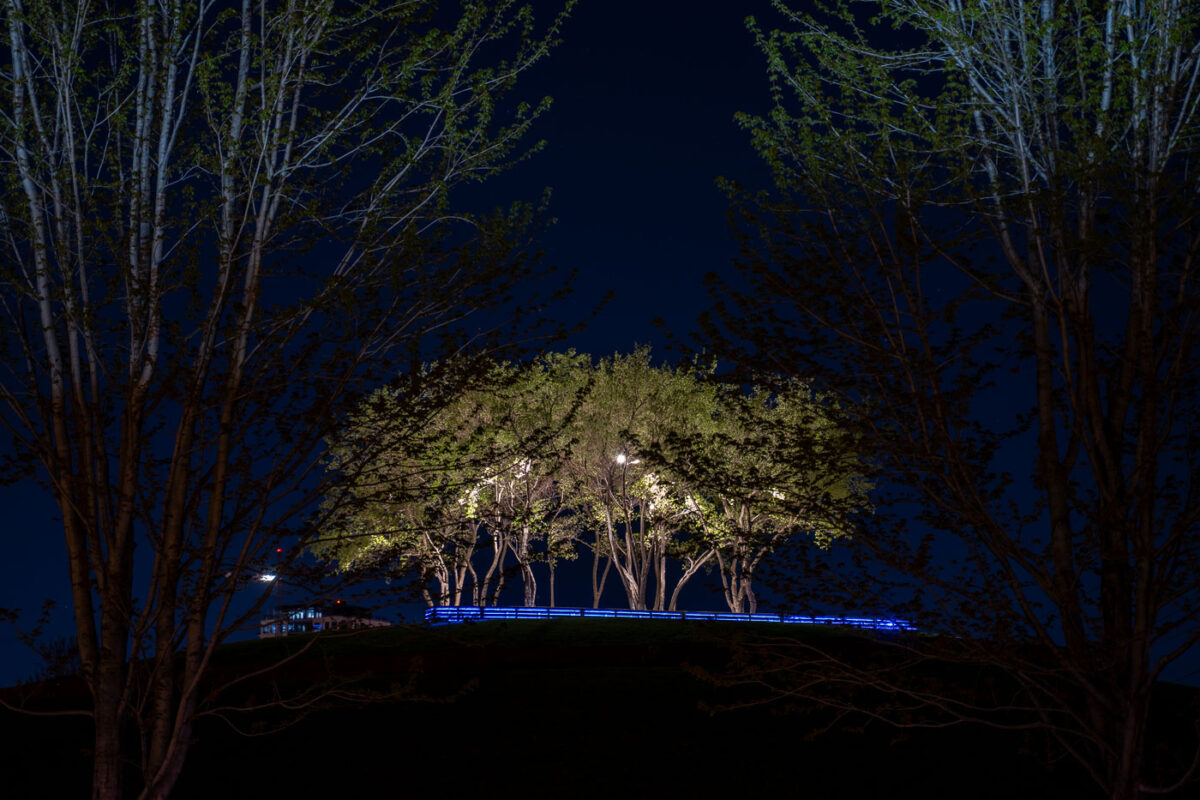
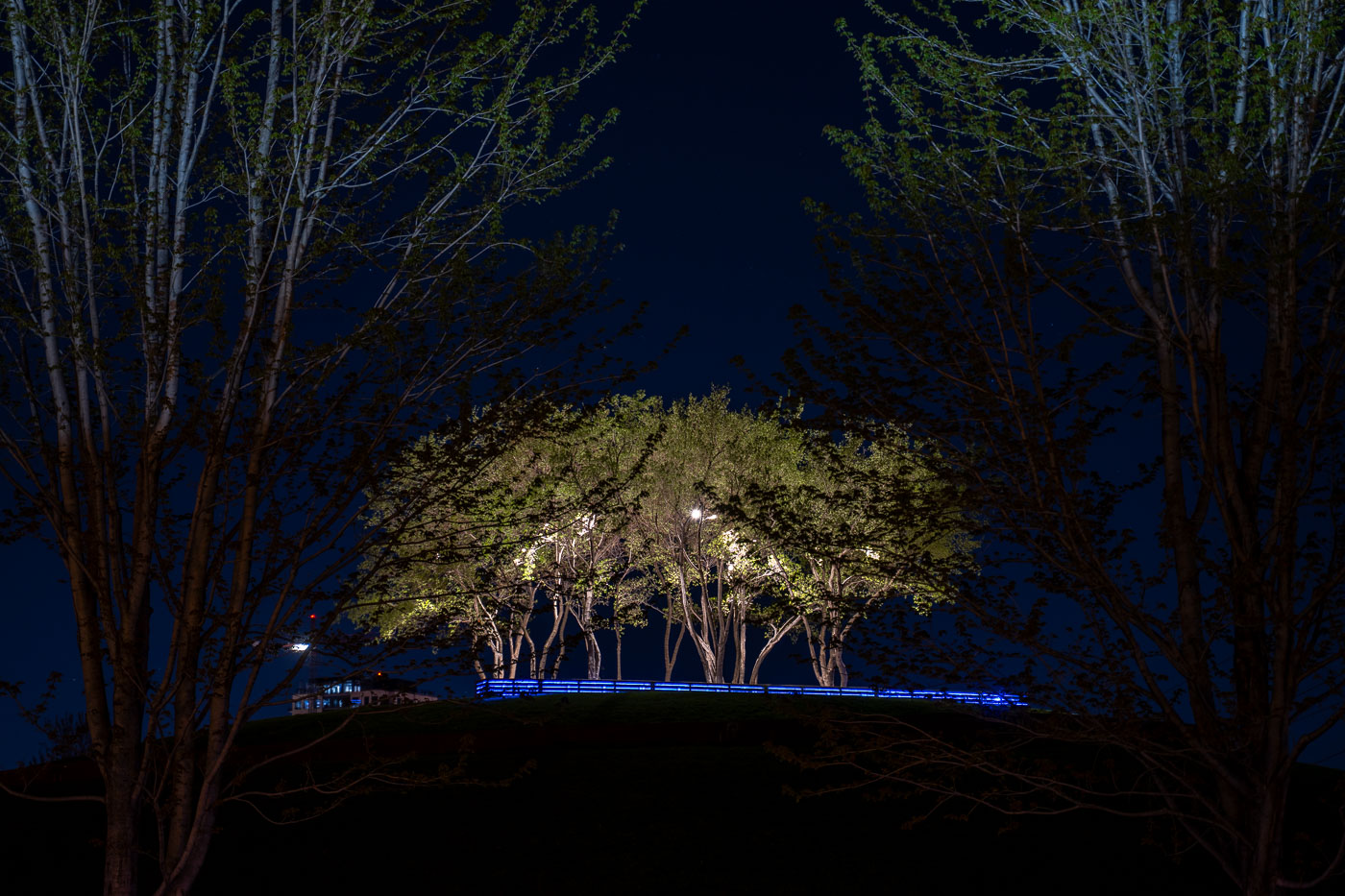
Trees in the middle of Gold Medal Park
Gold Medal Park in Minneapolis with the 40+ story "Eleven" rising in the background.

Trees in the middle of Gold Medal Park

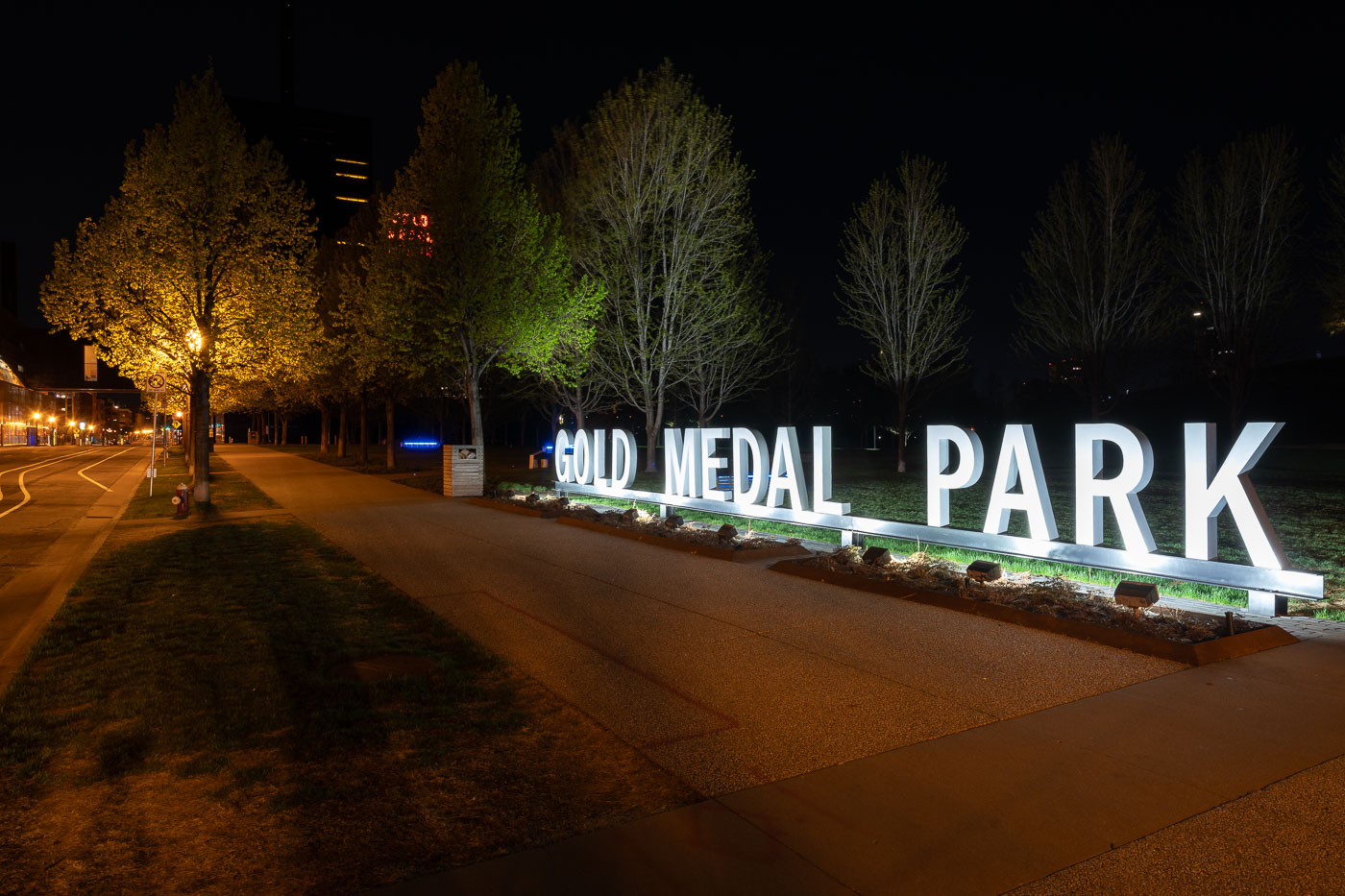
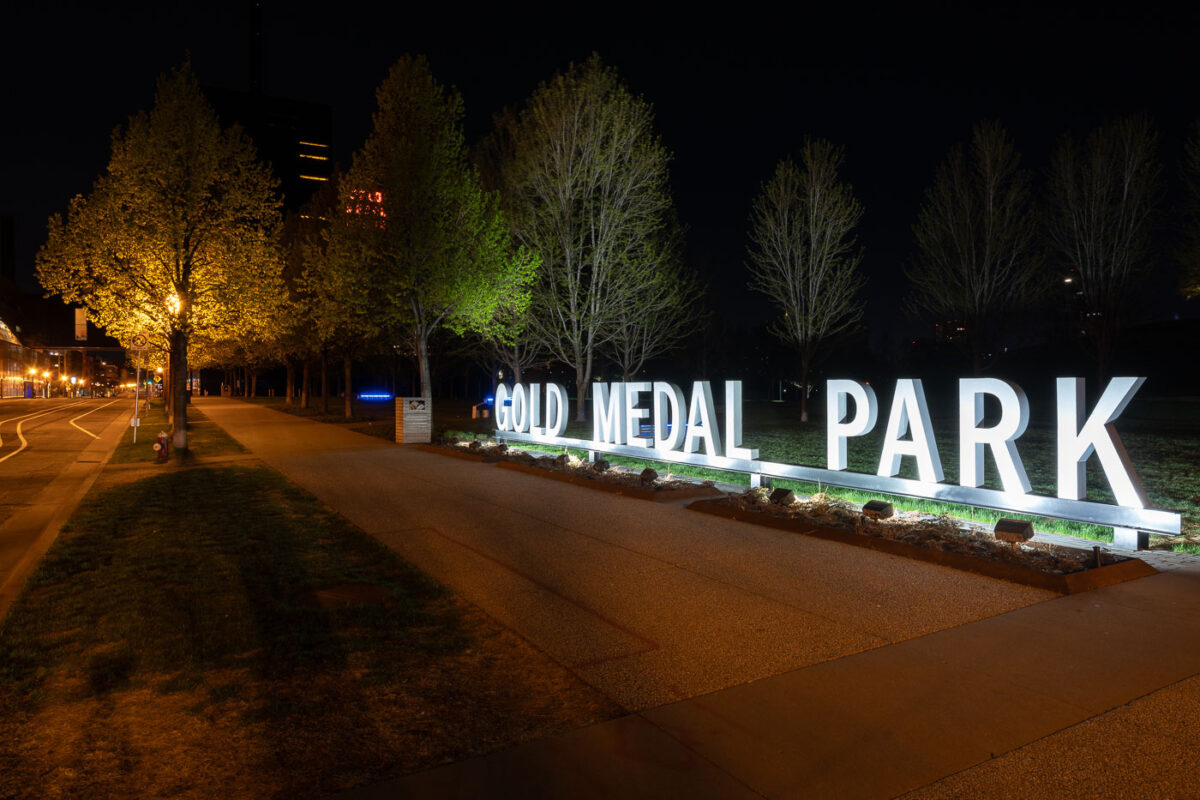
Gold Medal Park sign in Downtown Minneapolis park
Gold Medal Park sits along the Mississippi River near the Mill District in downtown Minneapolis, named in honor of the city’s flour-milling heritage and the iconic Gold Medal Flour brand. Designed by landscape architect Tom Oslund, the park opened in 2007 as part of the Guthrie Theater redevelopment and features a distinctive spiral mound at its center offering views of the river and city skyline. The illuminated park sign and tree-lined paths create a serene nighttime atmosphere against the industrial and cultural backdrop of the historic mill area.

Gold Medal Park at Night, Minneapolis Riverfront
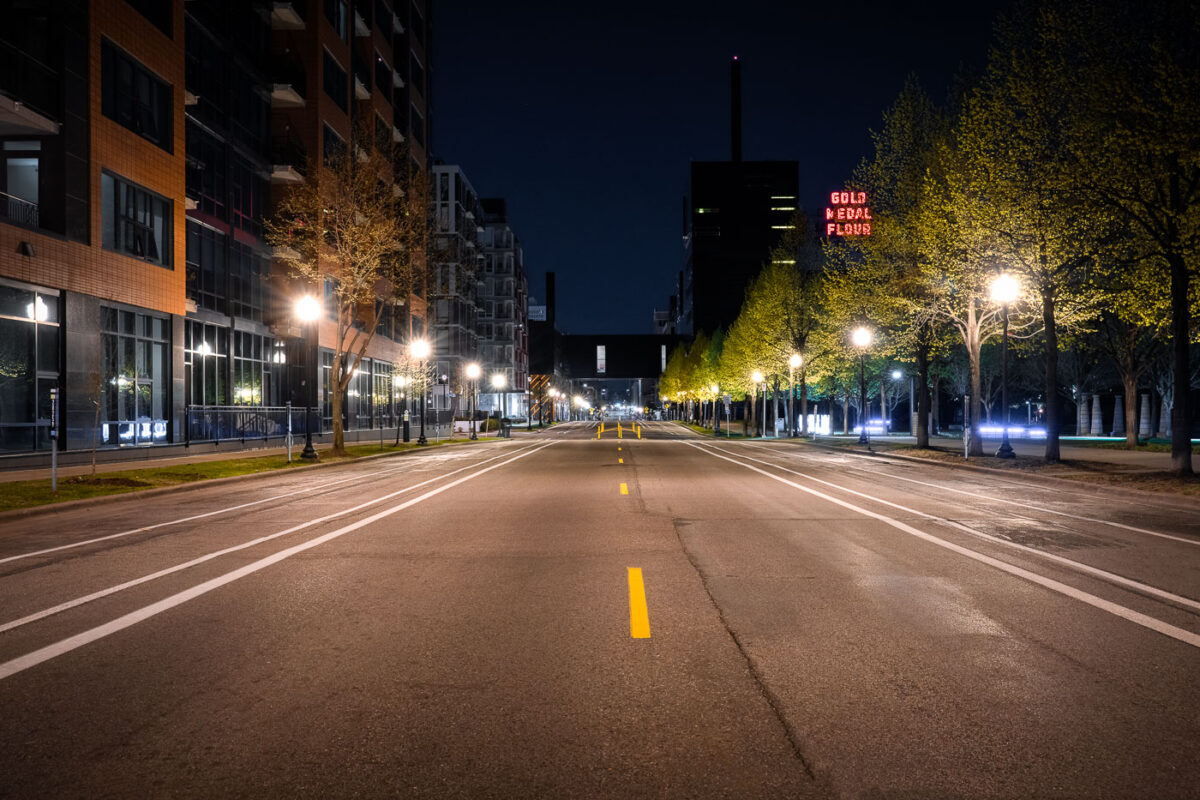
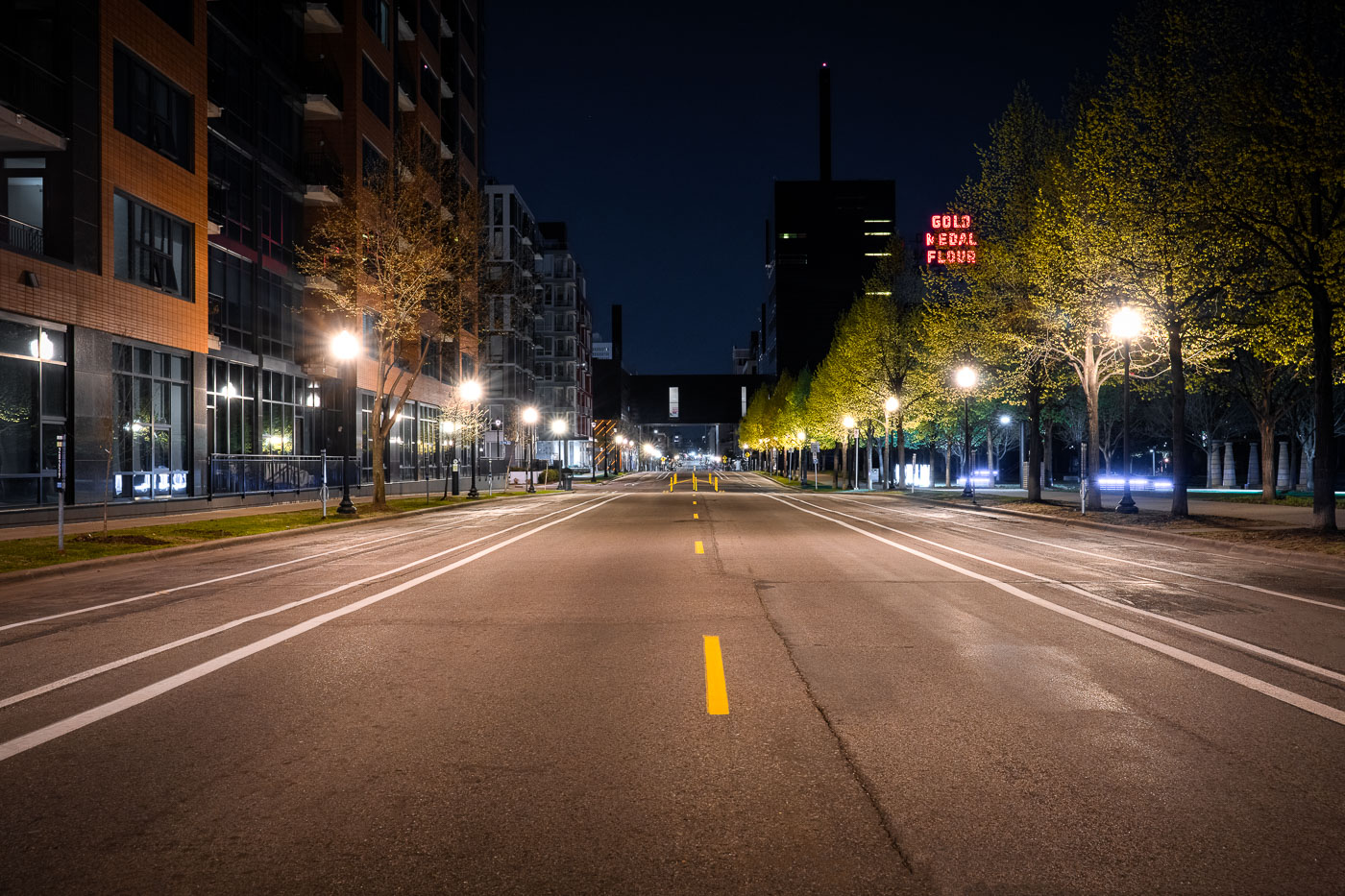
Gold Medal Flour neon sign as seen from 2nd st
South Second Street in downtown Minneapolis during the coronavirus (COVID-19) shutdown.

South Second Street in Downtown Minneapolis
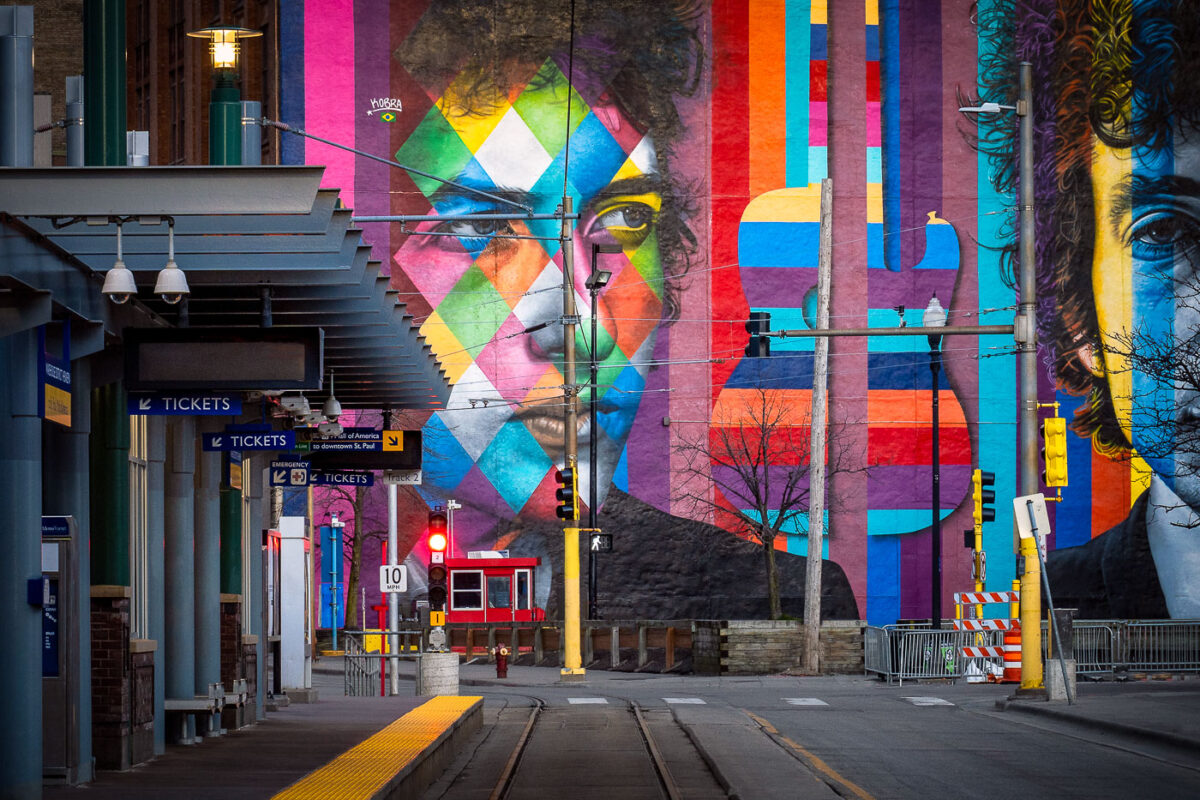
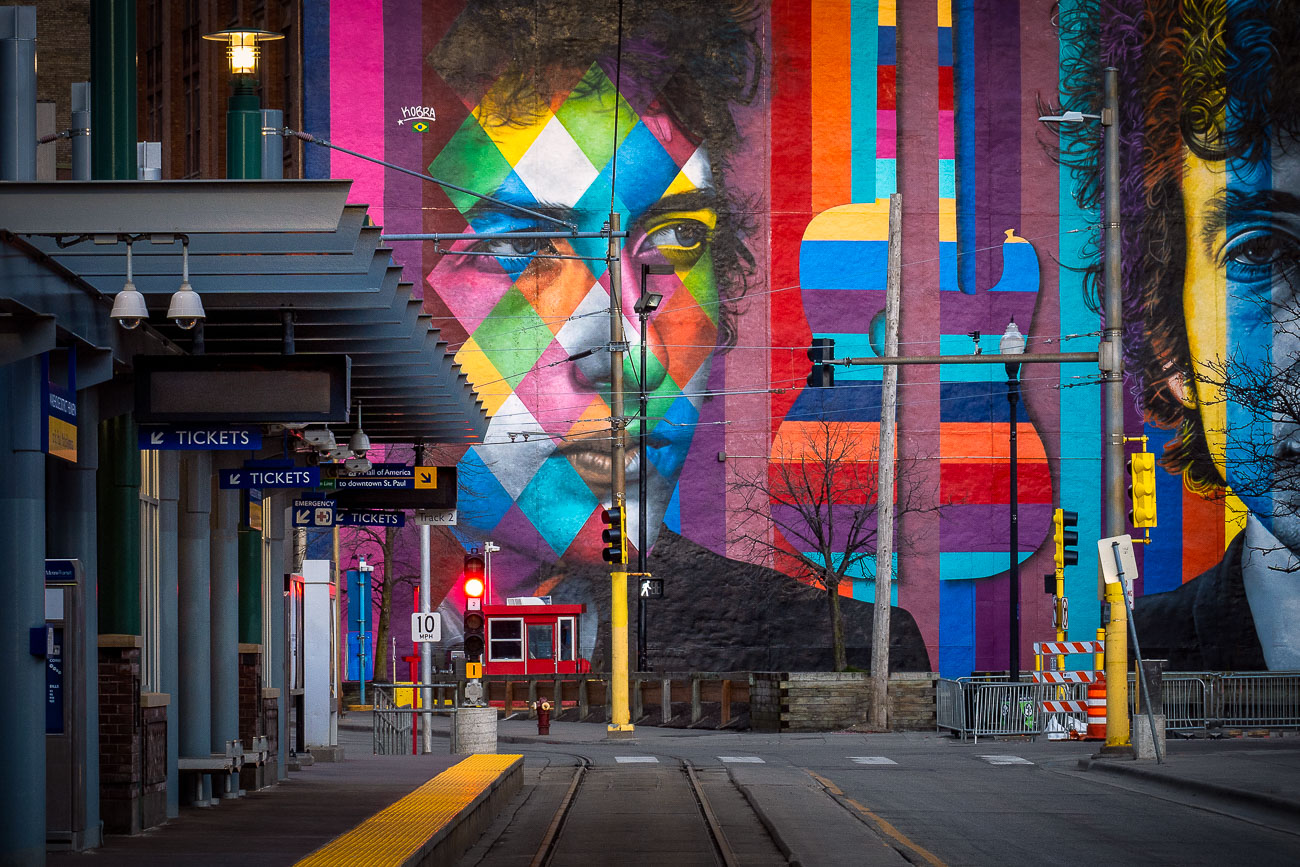
Eduardo Kobra's colorful Bob Dylan mural at Nicollet Mall station in downtown Minneapolis.
Eduardo Kobra painted this mural of Bob Dylan, titled "Face of Music," in 2015 for the Downtown Improvement District's Betsy-Ann Kane public art initiative. Brazilian street artist Kobra is known for his geometric, kaleidoscope-patterned portraits, which he has installed in cities worldwide. The mural covers roughly 90 feet of wall along the light rail corridor near Nicollet Mall Station, close to Hennepin Avenue in downtown Minneapolis. Dylan grew up in Hibbing, Minnesota, and began his music career in Dinkytown near the University of Minnesota before moving to New York in 1961.

Eduardo Kobra’s “Face of Music” Mural on Hennepin Avenue
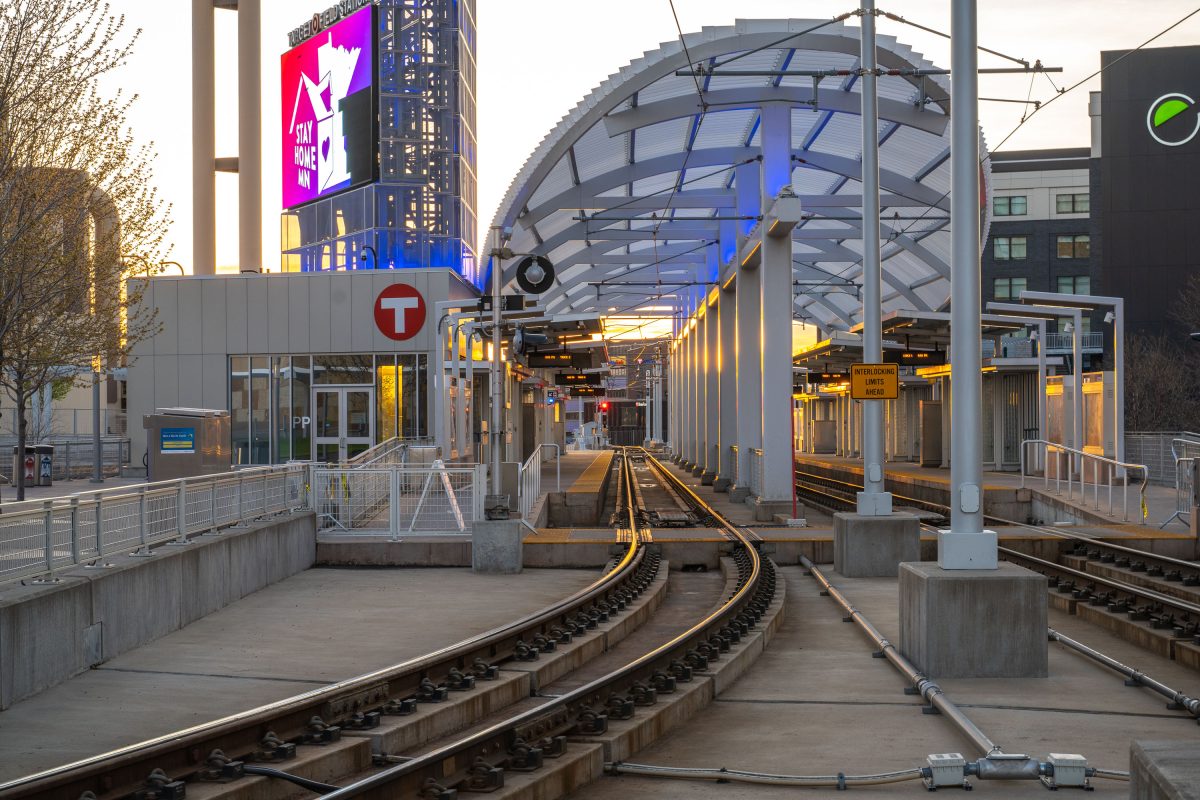
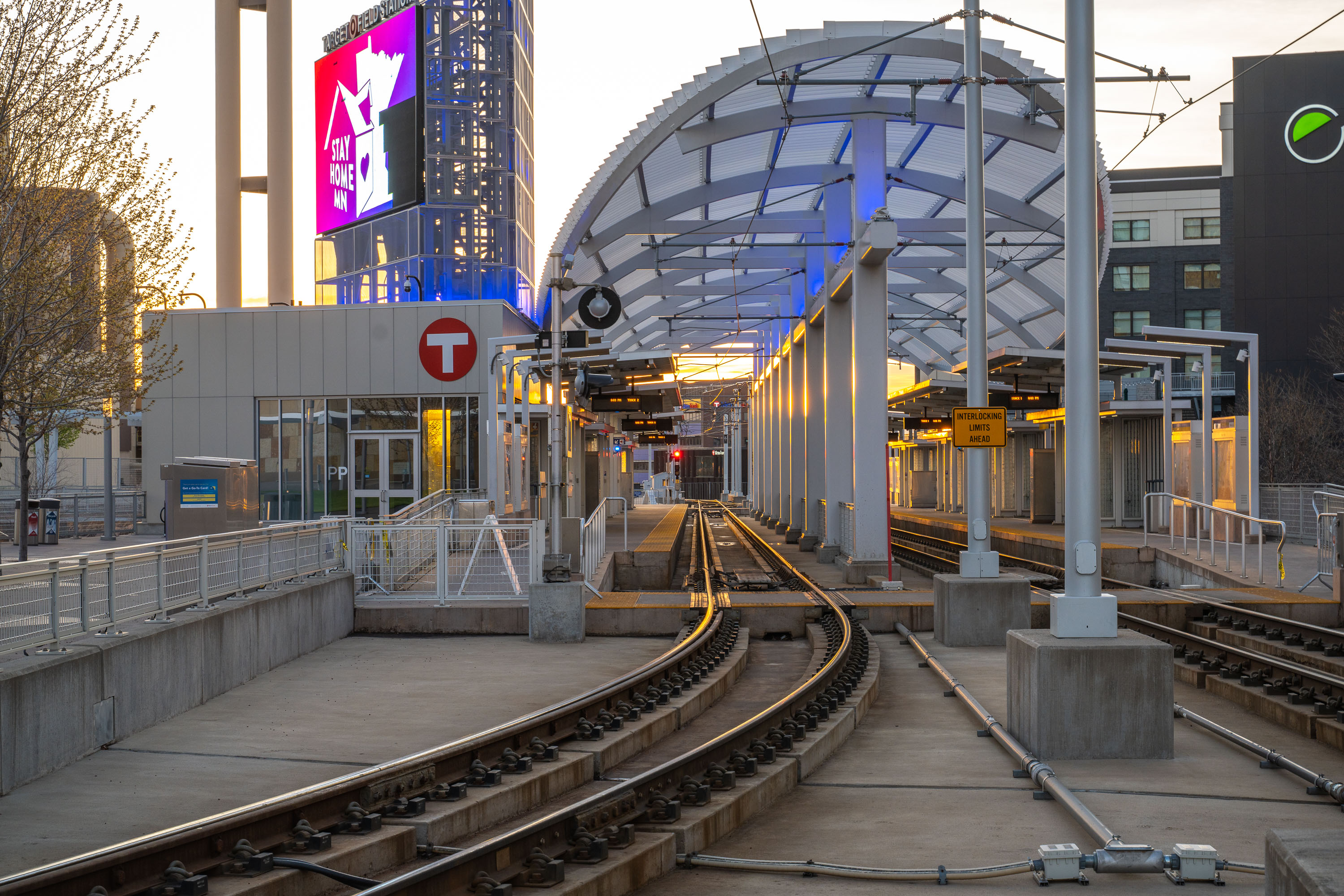
Empty platform at Target Field Station, a Minneapolis METRO light rail stop in the North Loop neighborhood.
Target Field Station sits in the North Loop neighborhood of downtown Minneapolis, serving as a stop on the METRO Blue and Green light rail lines. The station connects riders to Target Field, home of the Minnesota Twins, and links the North Loop to downtown Minneapolis and the broader METRO system.

“Stay Home MN” Sign Above Target Field Station at Dusk
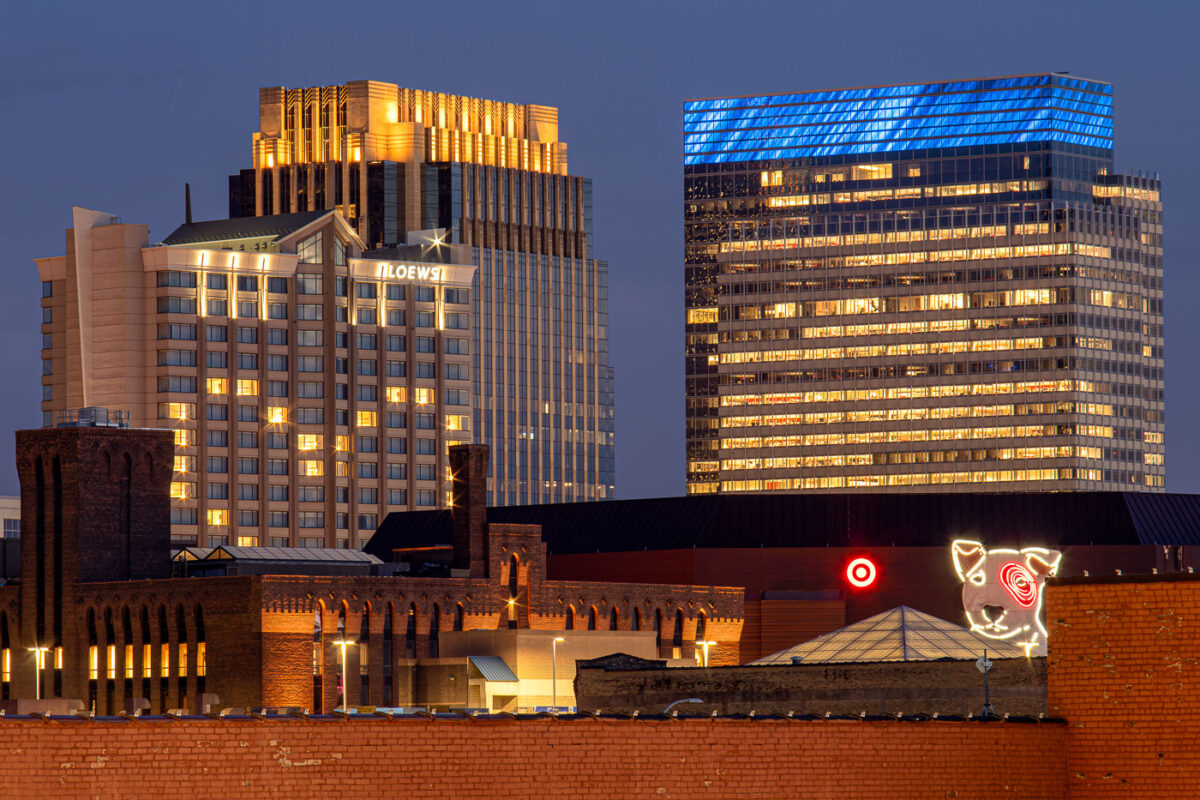
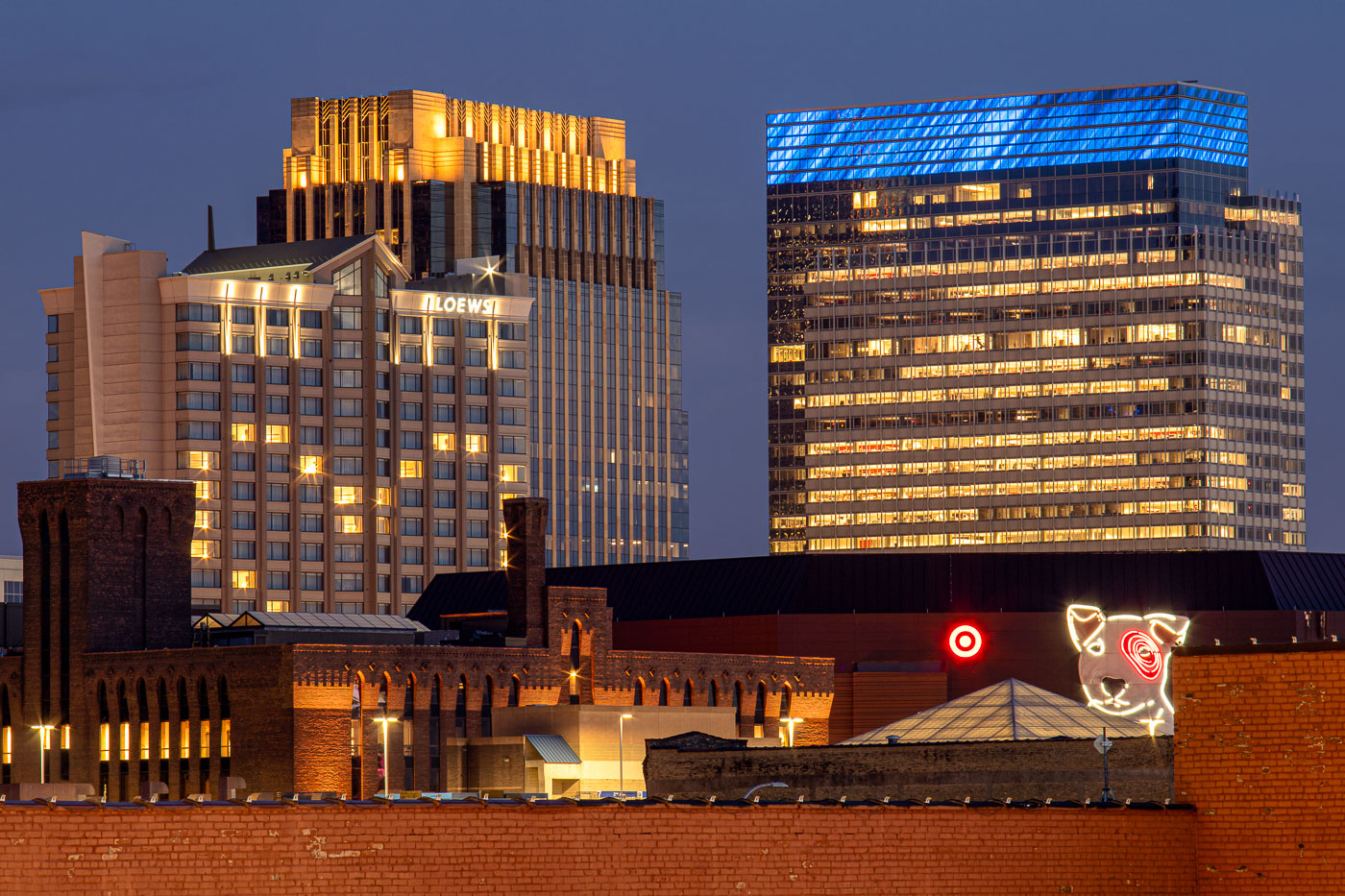
Loews Hotel and Target headquarters illuminated at night in downtown Minneapolis with Target Dog neon sign in foreground.
Target's corporate headquarters tower rises at 1000 Nicollet Mall, its glass exterior wrapped in a blue-lit crown near the top floors. The company has been based in downtown Minneapolis since its founding as a Dayton's discount offshoot in 1962, and its headquarters campus remains one of the largest employers in the city's core. The neon Bullseye dog sign near the building's base is a longstanding piece of Target's branding, drawn from the company's mascot, Bullseye. To the left, the Loews Minneapolis Hotel occupies part of the LaSalle Plaza complex, a mixed-use development completed in 1991 that also includes office space and street-level retail along Nicollet Mall.

Target’s Bullseye Dog Sign Beneath Its Minneapolis Headquarters
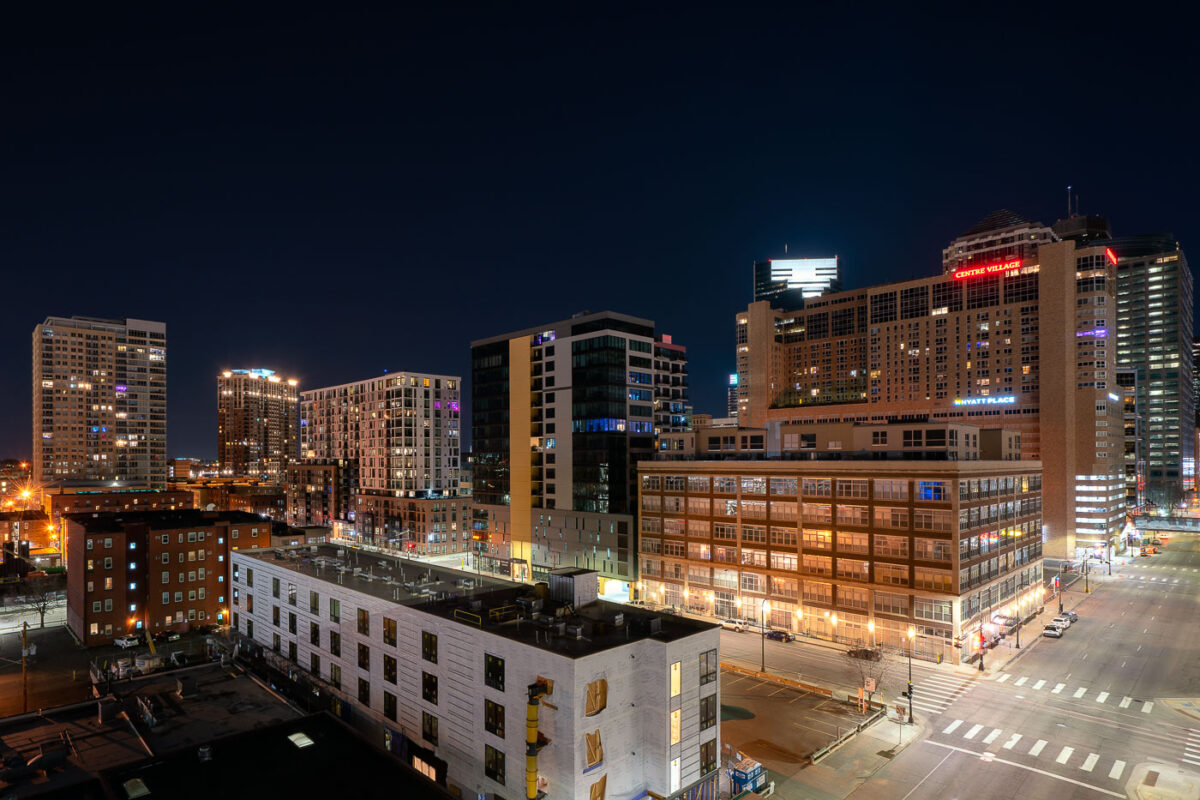
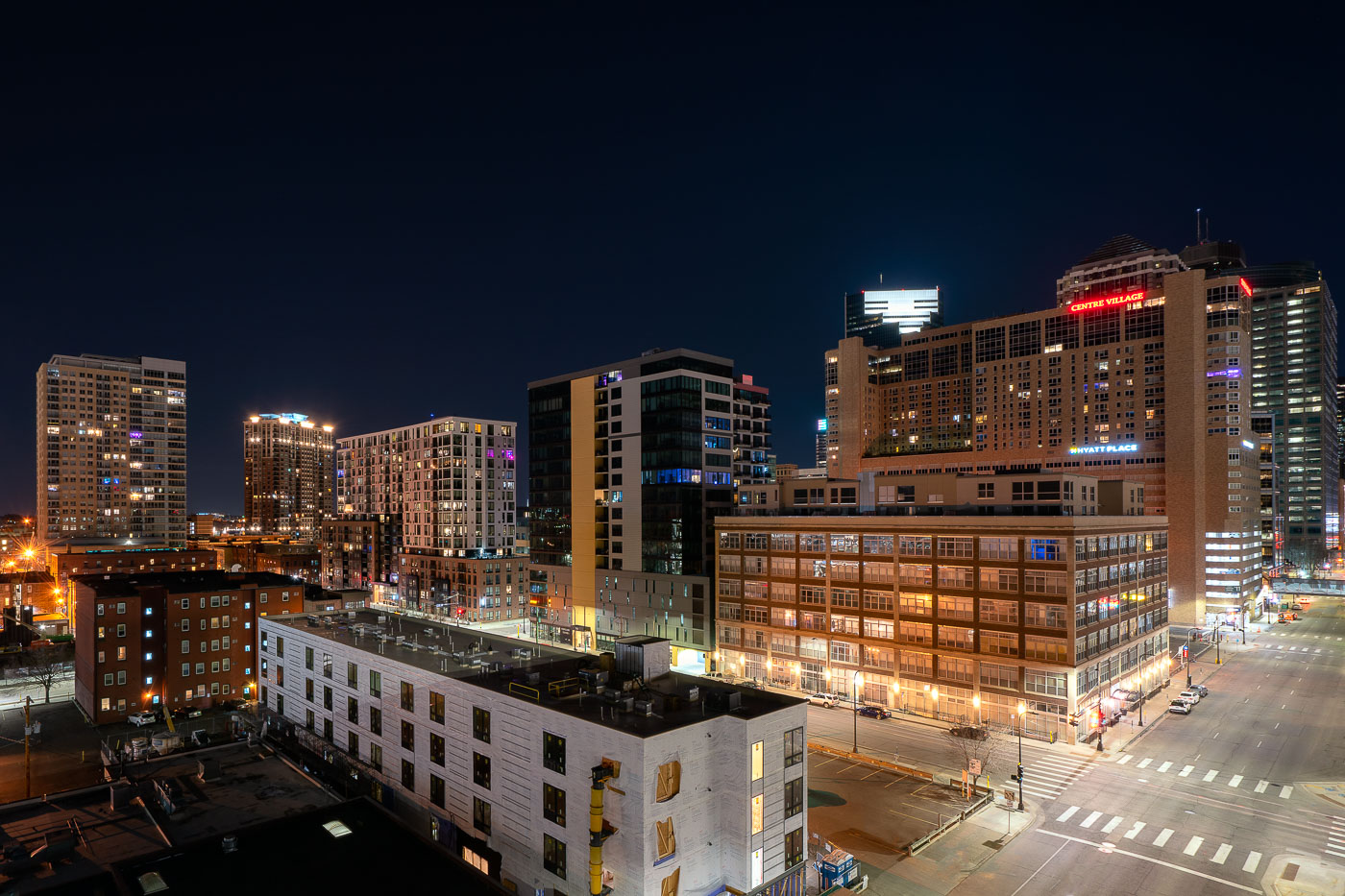
Downtown Minneapolis skyline at night showing Centre Village and Hyatt Place hotel buildings, April 2020.
Centre Village rises over downtown Minneapolis at Second Avenue South, a mixed-use high-rise completed in 1984 that combines residential units with commercial space. The Hyatt Place hotel occupies part of the same complex, serving business travelers and visitors to the city center. Both buildings sit within blocks of the Mississippi riverfront and the Central Business District, an area built up largely in the 1980s as downtown Minneapolis added residential towers alongside its office core.

Centre Village and Hyatt Place Above Downtown Minneapolis at Night
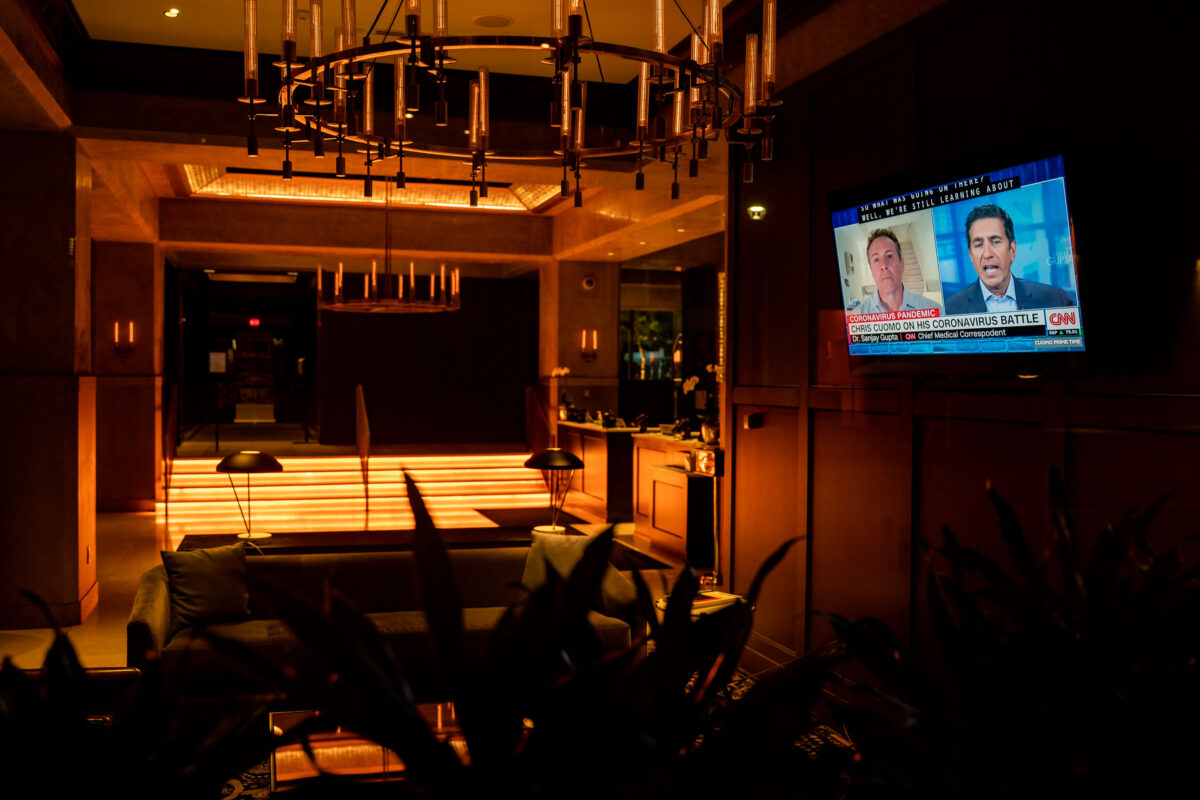
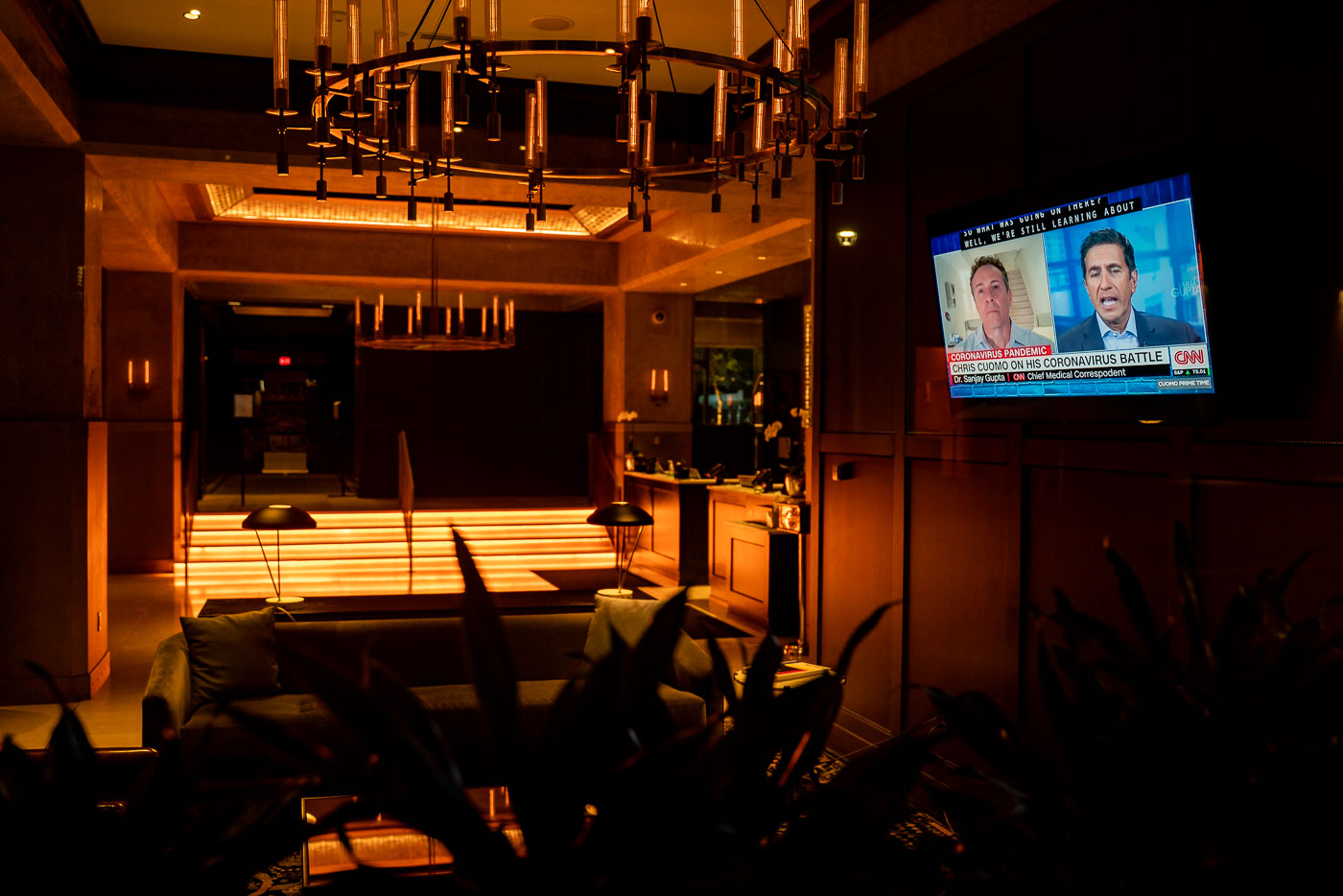
CNN broadcast with Chris Cuomo and Dr. Sanjay Gupta plays on television in the Marquette Hotel lobby, Minneapolis, April 2020.
Chris Cuomo discussed his own coronavirus diagnosis with CNN's chief medical correspondent, Dr. Sanjay Gupta, in an April 2020 segment that aired on the network amid the early weeks of the pandemic. The broadcast appeared on a lobby television at the Marquette Hotel in downtown Minneapolis, part of the Hilton-affiliated property on South Seventh Street near the IDS Center. Cuomo, then a primetime anchor for CNN, quarantined at home after testing positive and returned to reporting on air during his recovery.

Empty Marquette Hotel Lobby During Chris Cuomo’s CNN Interview
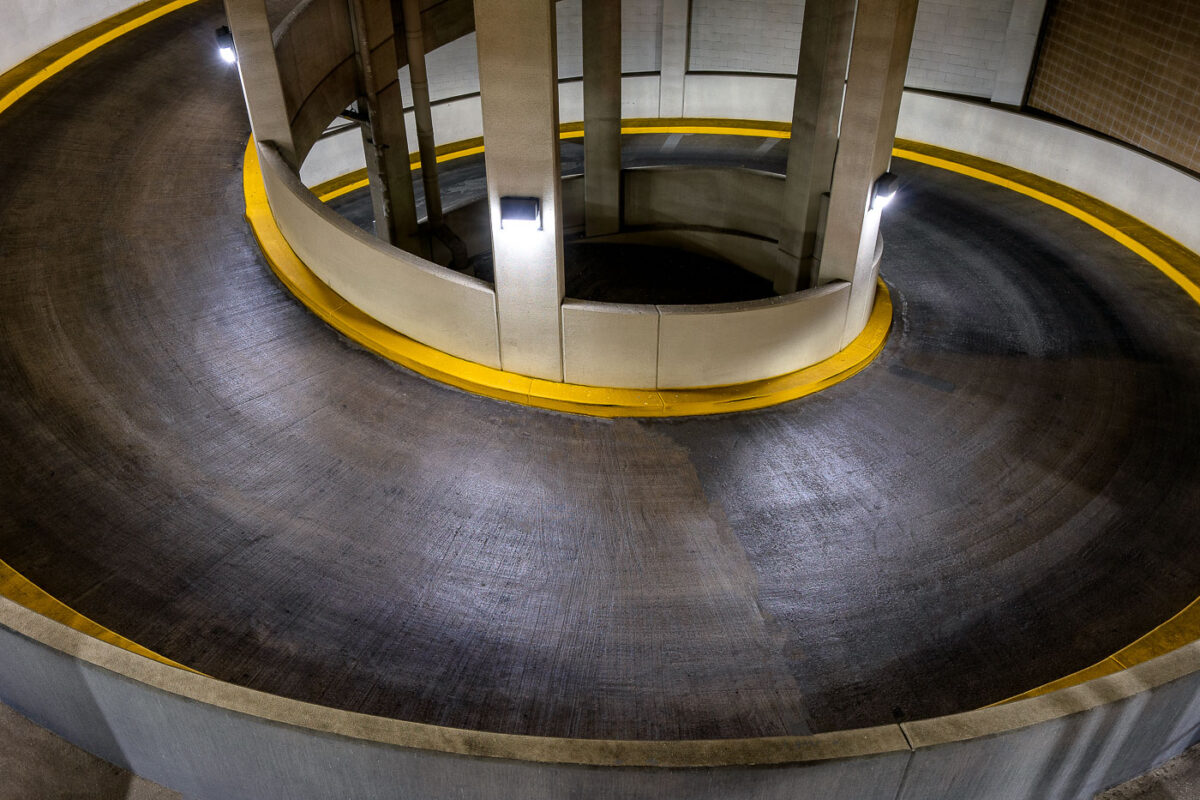
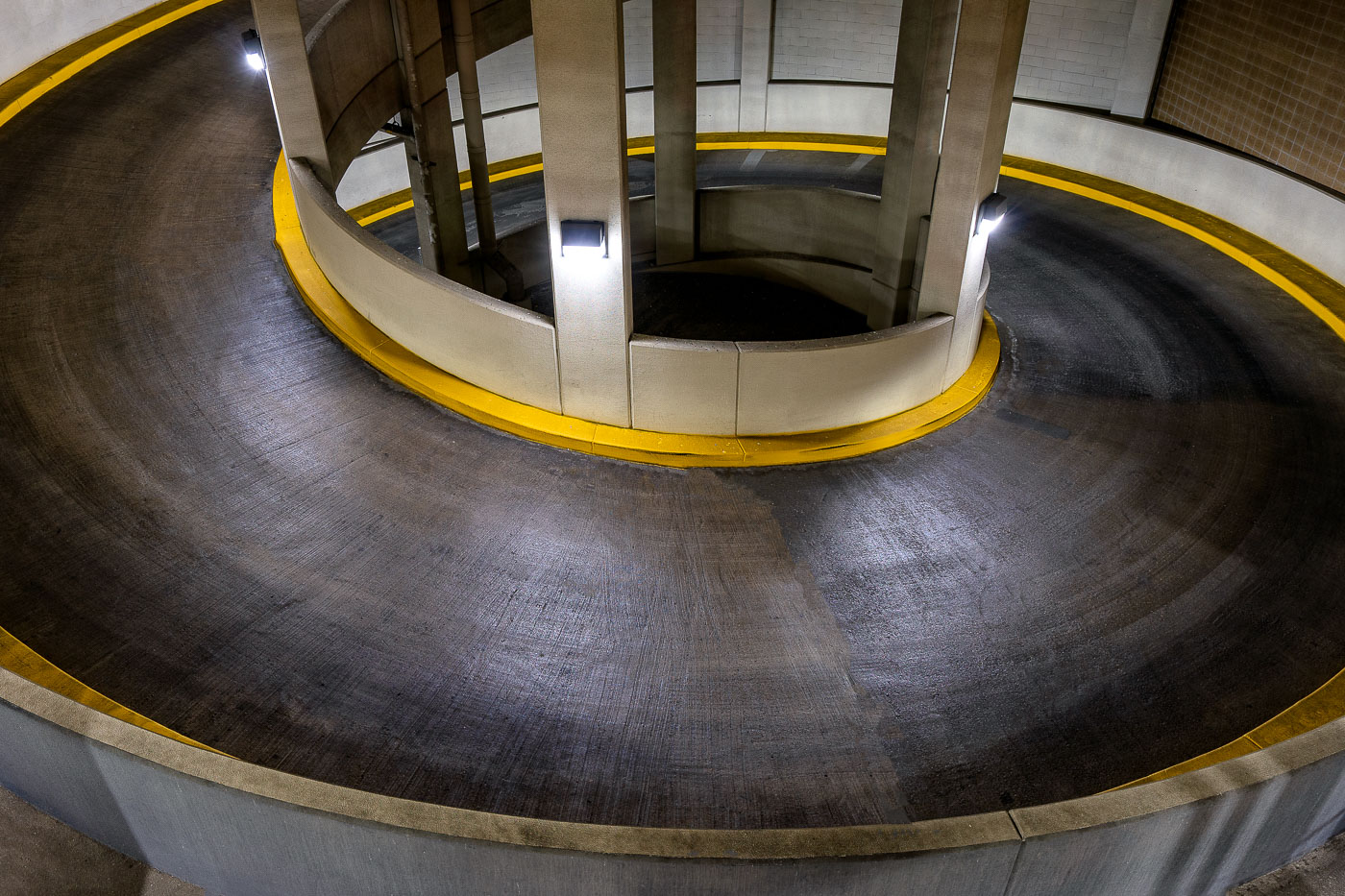
Spiral parking ramp with yellow-painted curbs and concrete support columns in downtown Minneapolis.
Ramp C is a municipal parking garage in downtown Minneapolis, operated by the city as part of its downtown parking system. The structure's central spiral connects its parking levels with a continuous curved roadway rather than straight ramps between floors, a common design solution for maximizing vehicle capacity on a compact urban site. Yellow curb markings delineate the traffic lane around the concrete support core. Facilities like Ramp C serve commuters, downtown employees, and visitors to nearby offices and entertainment venues in the central business district.

Spiral Ramp Inside Ramp C Parking Garage, Downtown Minneapolis
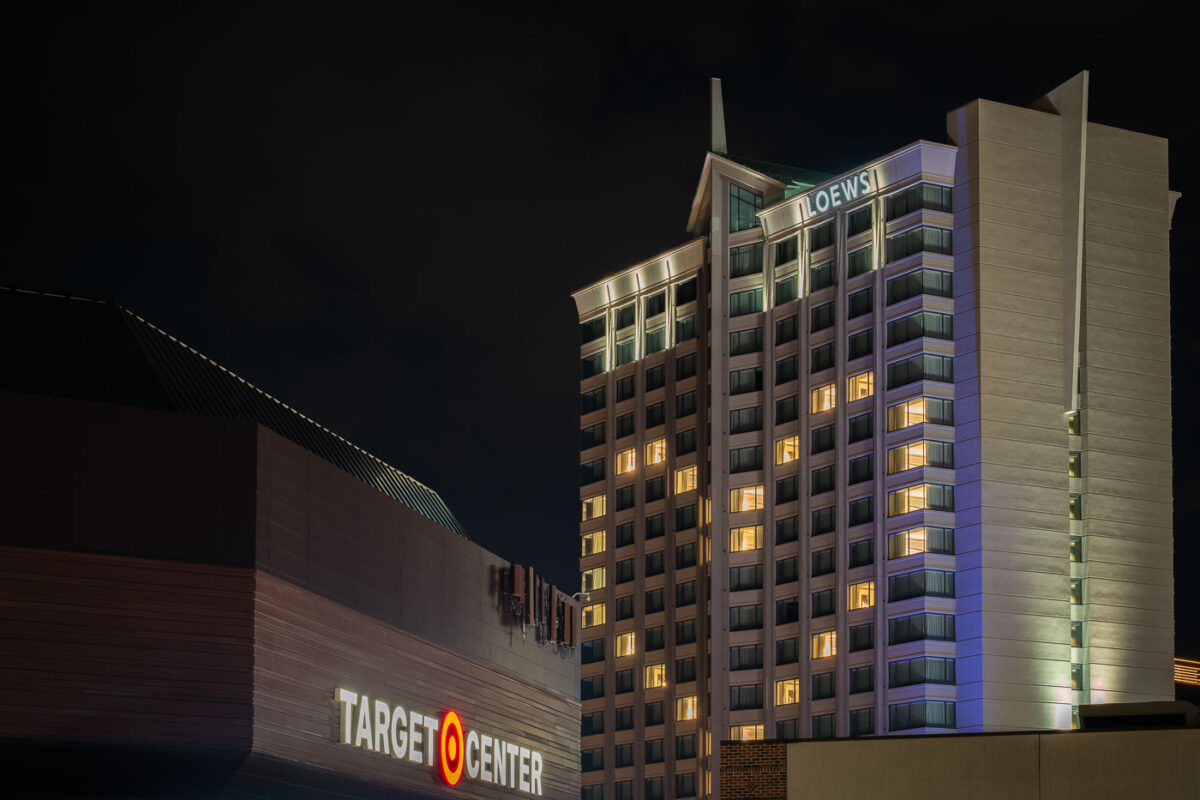
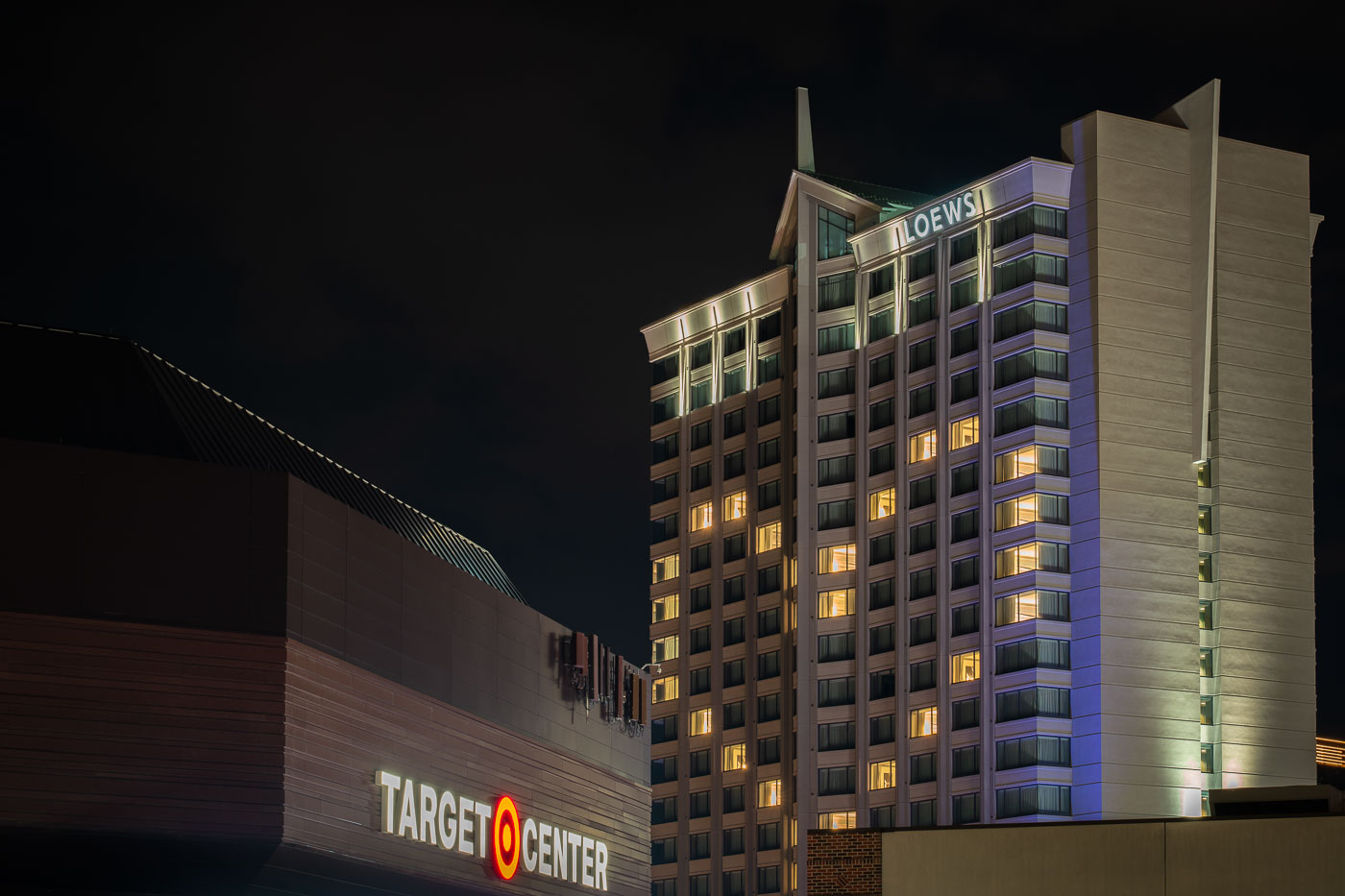
Loews Hotel and Target Center illuminated at night in downtown Minneapolis.
The Loews Minneapolis Hotel sits along First Avenue North next to the Target Center arena in downtown Minneapolis. Target Center opened in 1990 and has served as the home arena for the Minnesota Timberwolves and, since 1999, the Minnesota Lynx. The arena holds roughly 18,798 fans for basketball and has hosted concerts and other events since its debut. The Loews hotel occupies a tower built in 2000 as part of the same downtown block, giving visitors direct access to the arena's entertainment district.

Loews Minneapolis Hotel Beside Target Center at Night
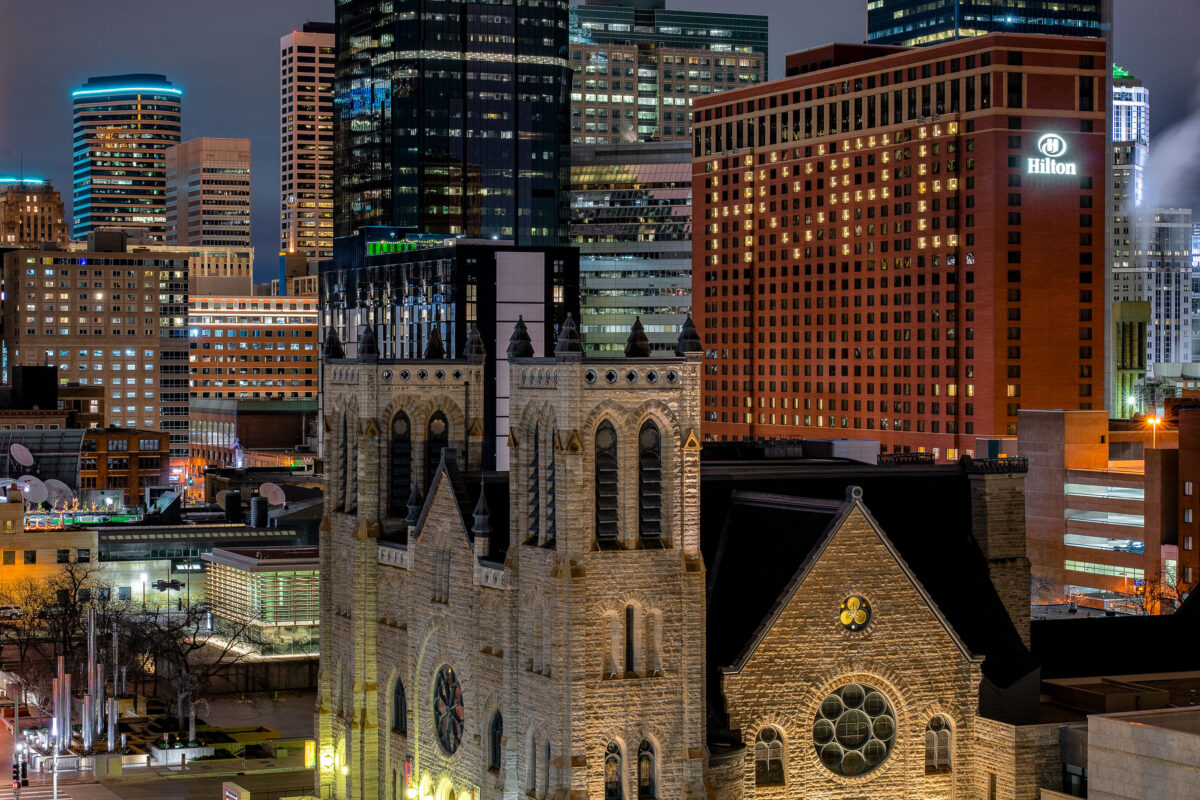
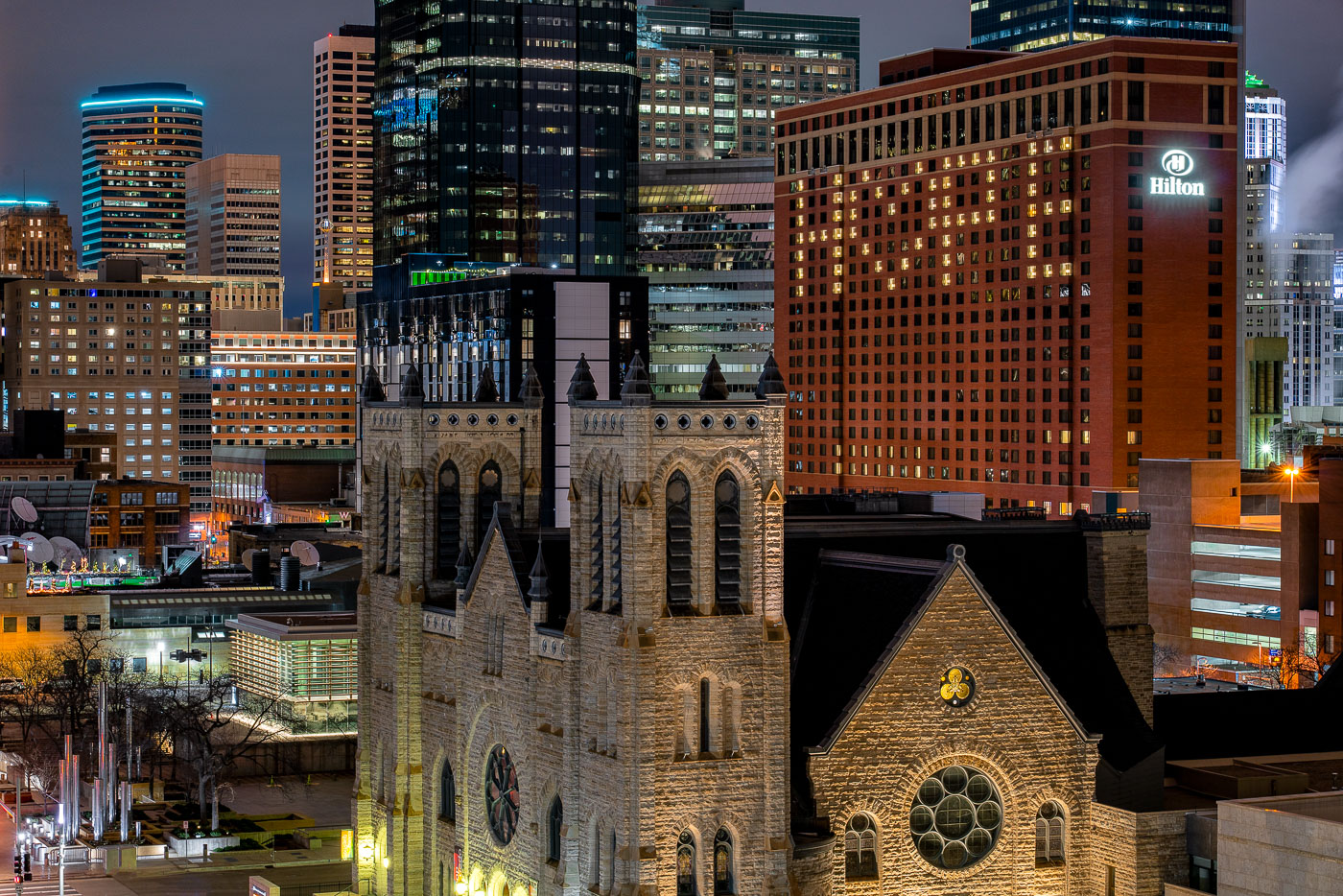
Hilton Minneapolis hotel displays "HOPE" message in illuminated windows during COVID-19 pandemic.
The Hilton Minneapolis, a 32-story tower at 1001 Marquette Avenue, spelled out the word "HOPE" and a heart in its guest-room windows on April 3, 2020, during the early weeks of Minnesota's COVID-19 stay-at-home order. The 821-room hotel opened in 1992 and remains one of the largest in the state. Just north of the hotel stands Westminster Presbyterian Church, a Gothic Revival building completed in 1897 for a congregation founded in 1857, making it one of downtown Minneapolis's oldest continuously operating churches.

Hilton Minneapolis Windows Spell “HOPE” During COVID-19
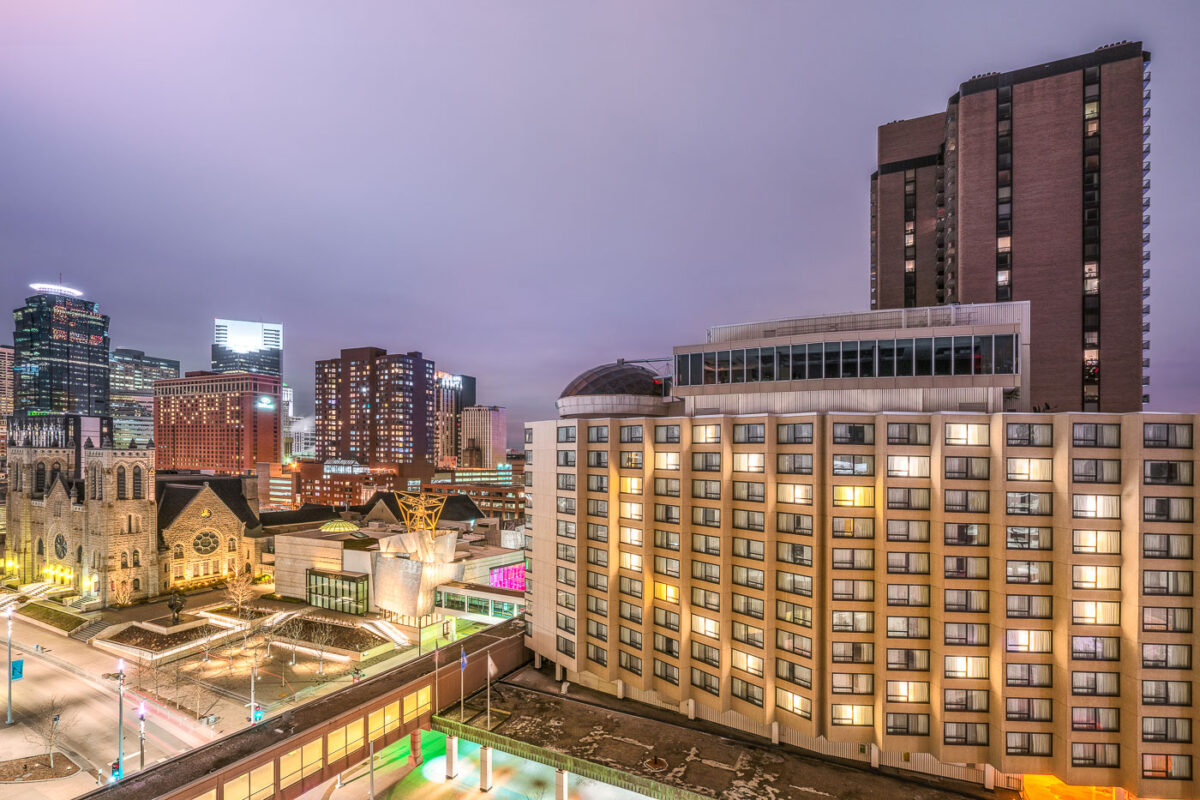
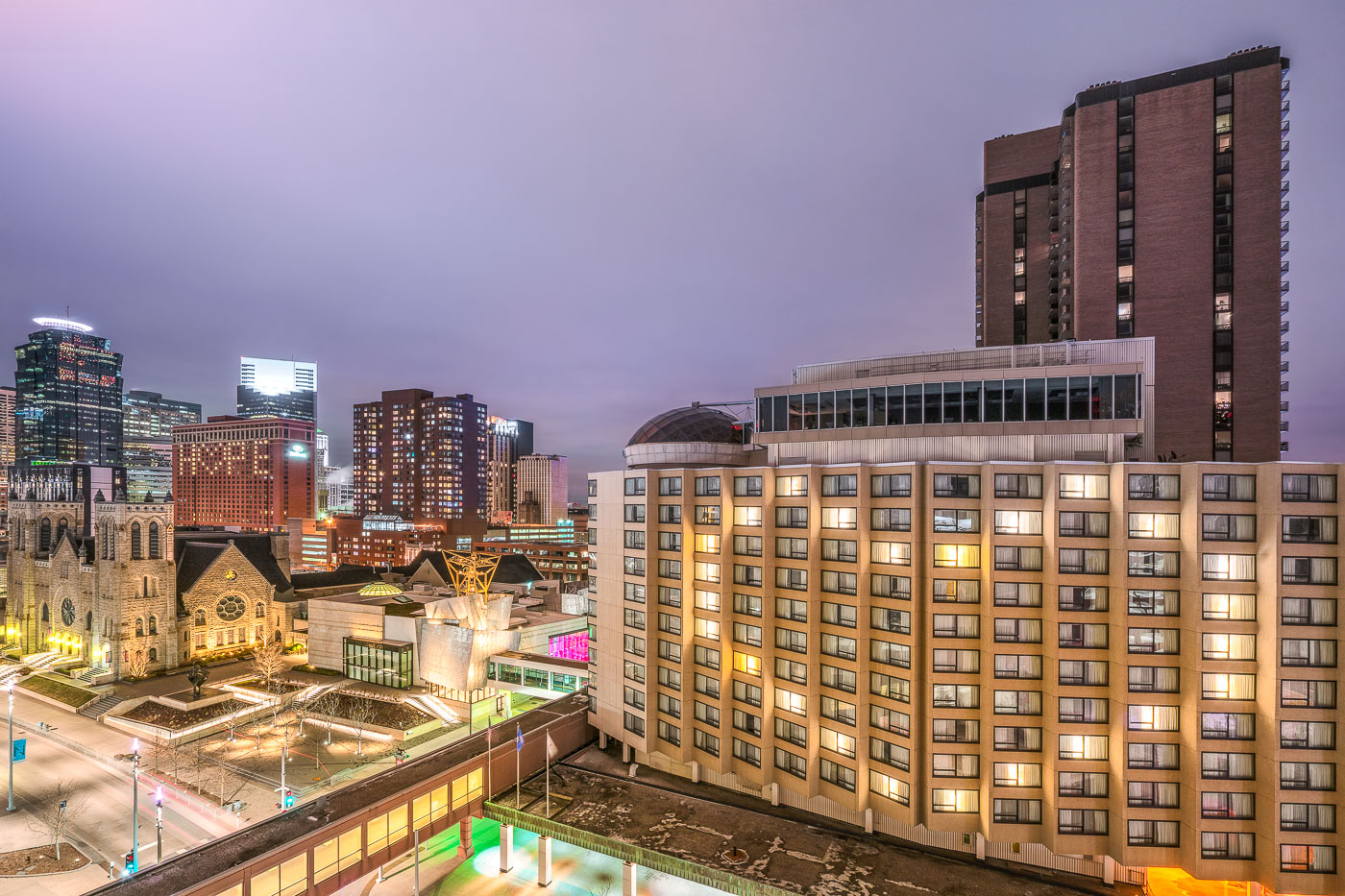
Millennium Hotel in downtown Minneapolis illuminated at twilight with lit windows forming a heart pattern during early COVID-19
The Millennium Hotel Minneapolis sits at 1313 Nicollet Mall, a high-rise a few blocks from the Minneapolis Convention Center. The tower opened in the 1970s under an earlier flag before joining the Millennium Hotels and Resorts chain, and its upper floors face north over downtown toward the Mississippi River. During the early weeks of the 2020 coronavirus shutdown, hotel occupancy across downtown Minneapolis fell sharply as conventions, sporting events, and business travel came to a halt.

Millennium Hotel Overlooking Downtown Minneapolis During COVID-19
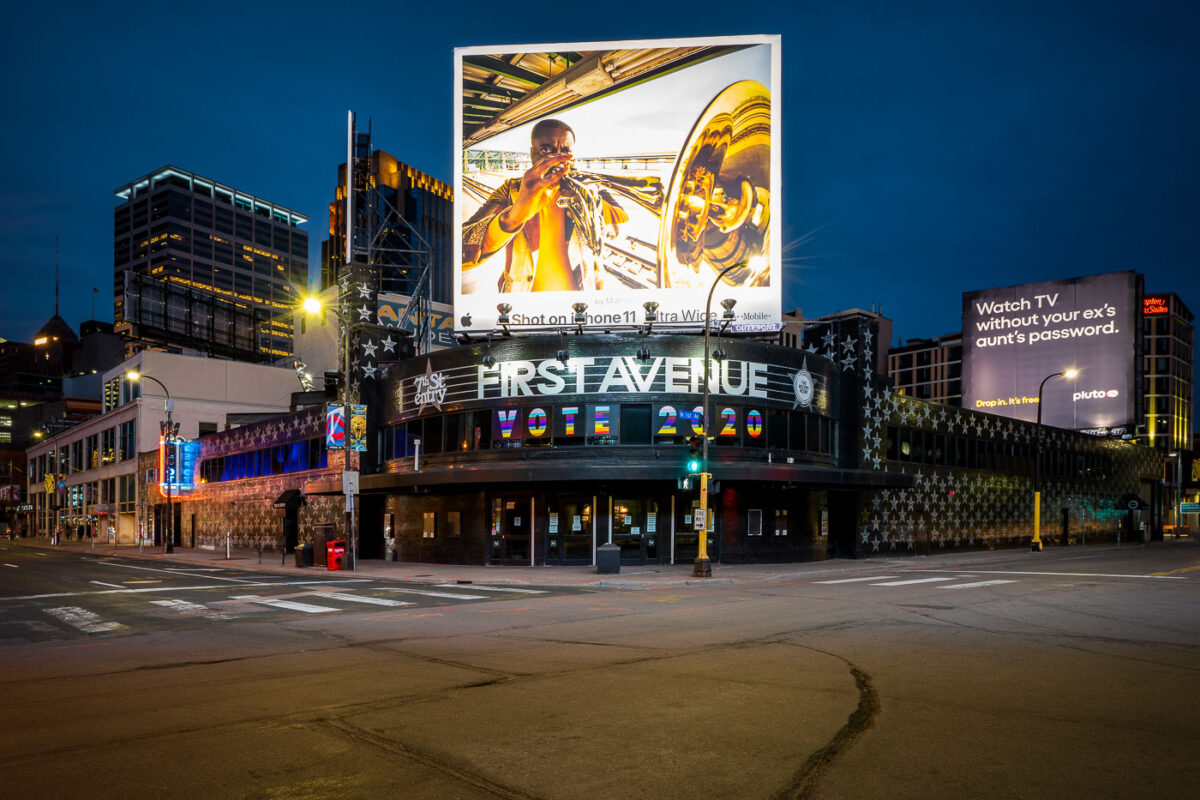
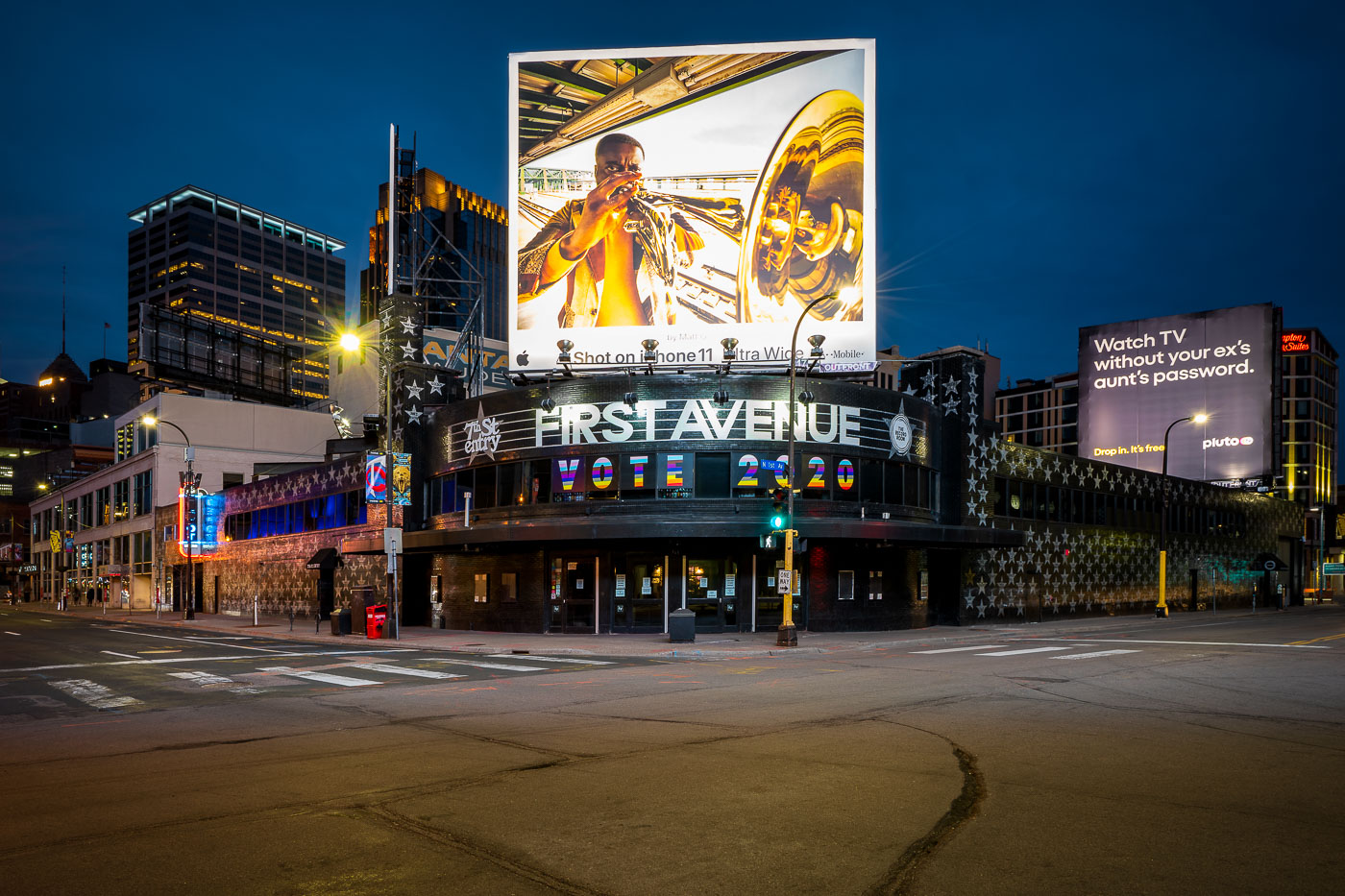
First Avenue music venue in downtown Minneapolis displays "VOTE 2020" on its marquee during COVID-19 shutdowns on April 2, 2020.
First Avenue, the nightclub at 701 First Avenue North, occupies a building that opened in 1937 as a Greyhound bus depot before its conversion to a music venue in 1970. Its Mainroom has hosted acts from Prince—who filmed key s of "Purple Rain" here—to touring bands across nearly every genre. The 7th Street Entry, the smaller adjoining room, opened in 1980 as a launching pad for punk and indie acts. The building's exterior stars, added over the years, each mark a musician who has performed there. On this night the marquee read "VOTE 2020" instead of a show listing, a message posted while the venue sat closed under Minnesota's statewide shutdown orders.

“VOTE 2020” Marquee at First Avenue During Empty Streets
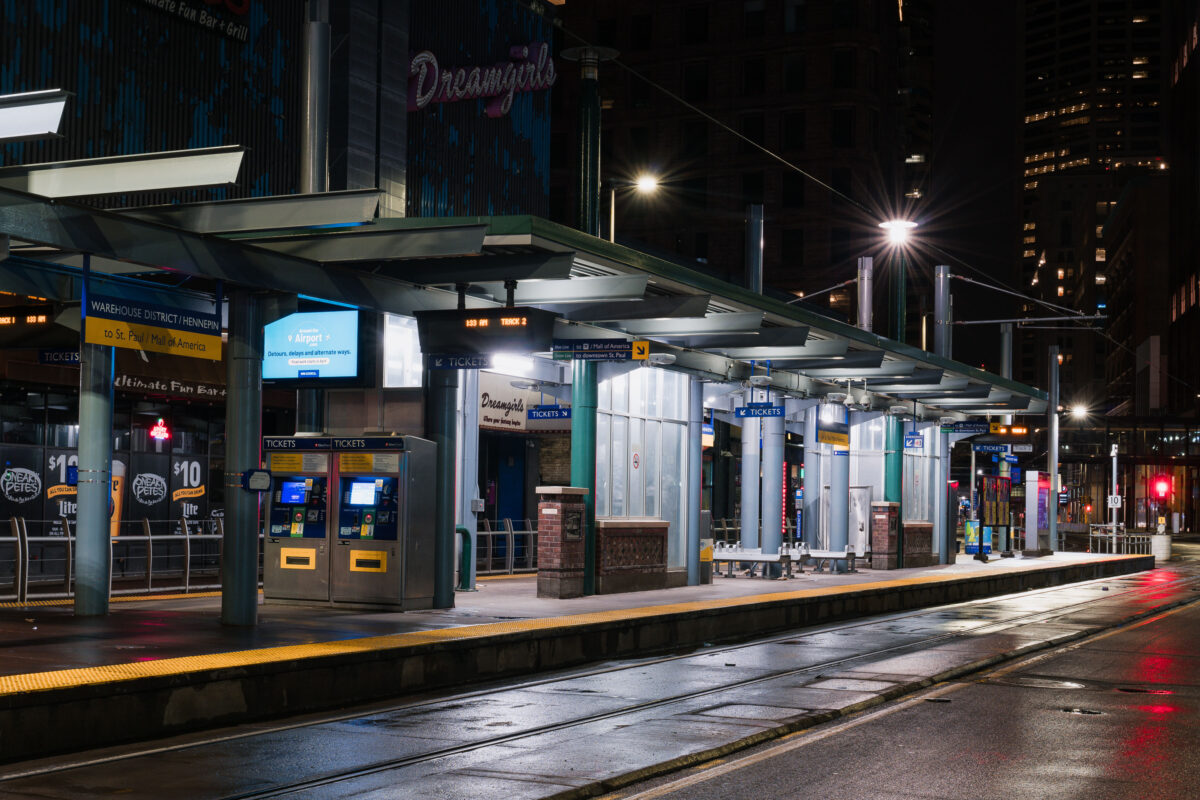
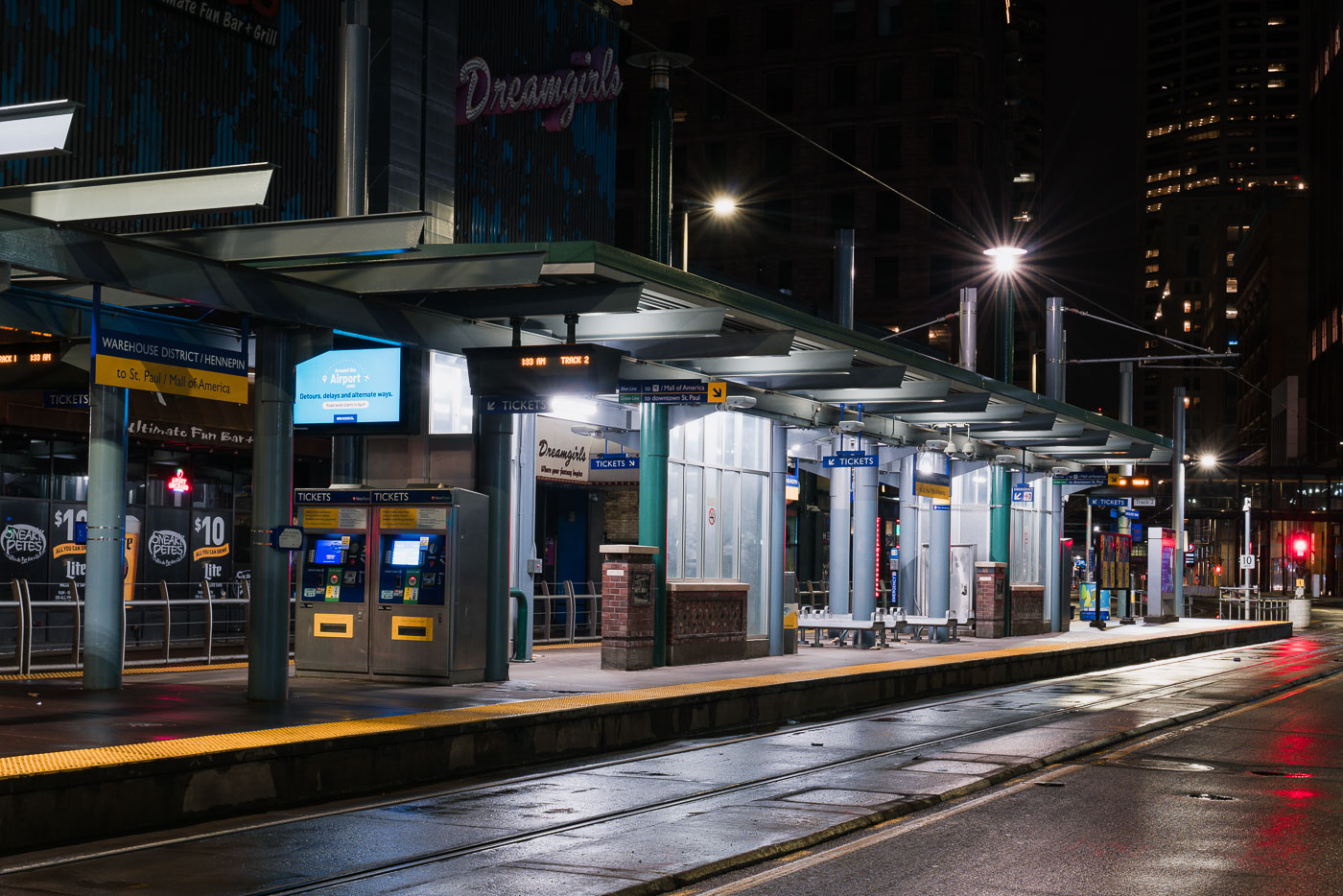
Warehouse District/Hennepin light rail station on North 5th Street in downtown Minneapolis, empty during early morning hours.
Warehouse District/Hennepin Station sits on North 5th Street in downtown Minneapolis, one of the stops serving Metro Transit's METRO Blue and Green Line trains. The station connects riders to downtown St. Paul and the Mall of America along one route, and to the Warehouse District's bars, theaters, and entertainment venues at street level. Metro Transit operates the regional light rail system, which opened its first line in 2004. This platform recorded far lower ridership in late March 2020, after Minnesota's statewide stay-at-home order took effect during the early weeks of the COVID-19 pandemic.

Warehouse District/Hennepin Station at Night, Minneapolis
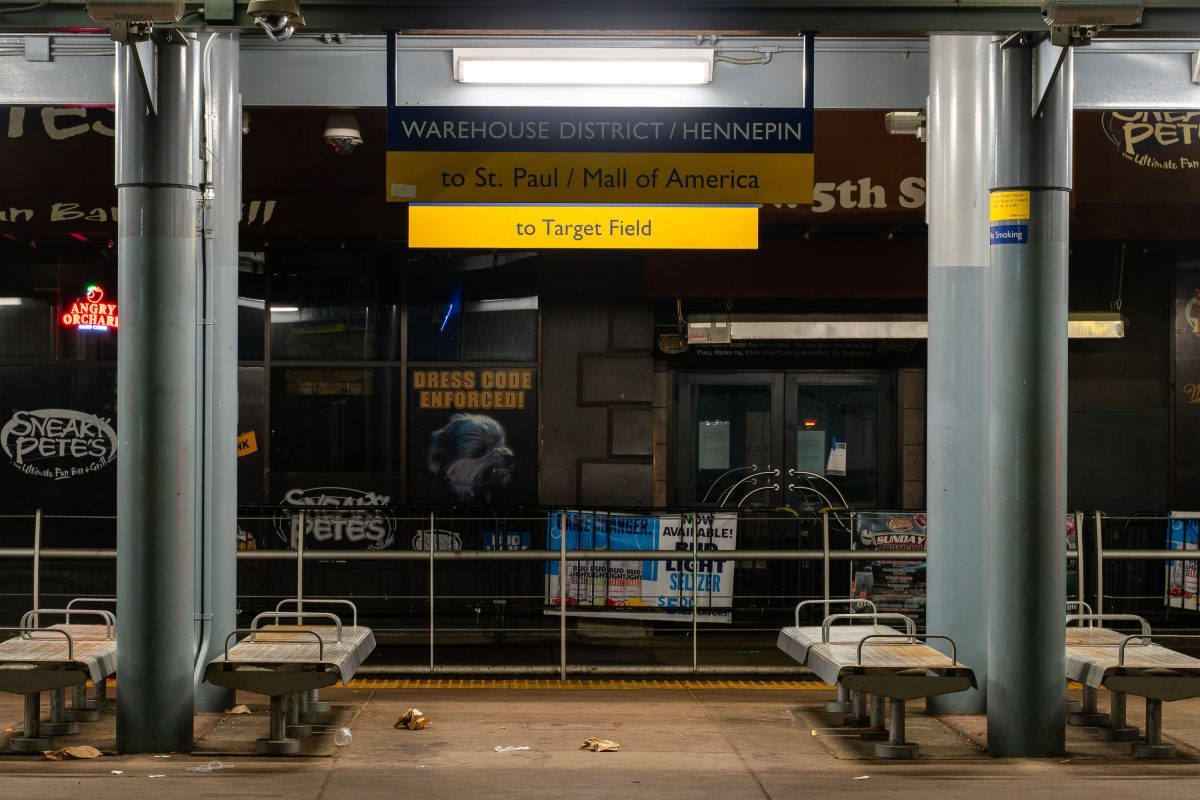
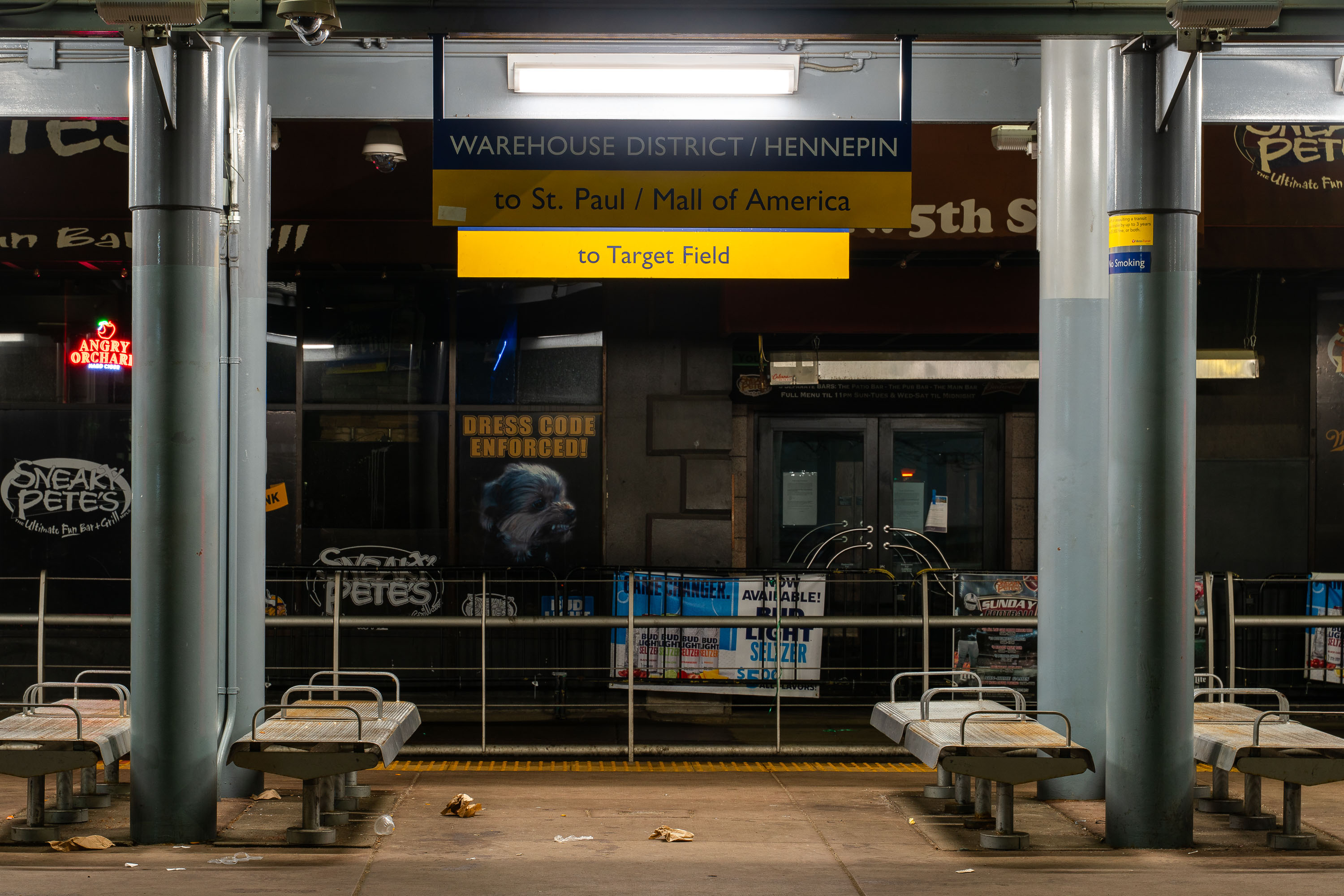
Warehouse District/Hennepin Avenue light rail station platform in downtown Minneapolis with directional signs to St. Paul.
The Warehouse District/Hennepin Avenue Station serves the METRO Blue and Green Lines in downtown Minneapolis, connecting riders to Target Field, St. Paul, and the Mall of America. Located near the Warehouse District entertainment area on 5th Street, the station provides transit access to nearby bars, clubs, and Target Field Station.

Empty Platform at Warehouse District/Hennepin Station, Minneapolis
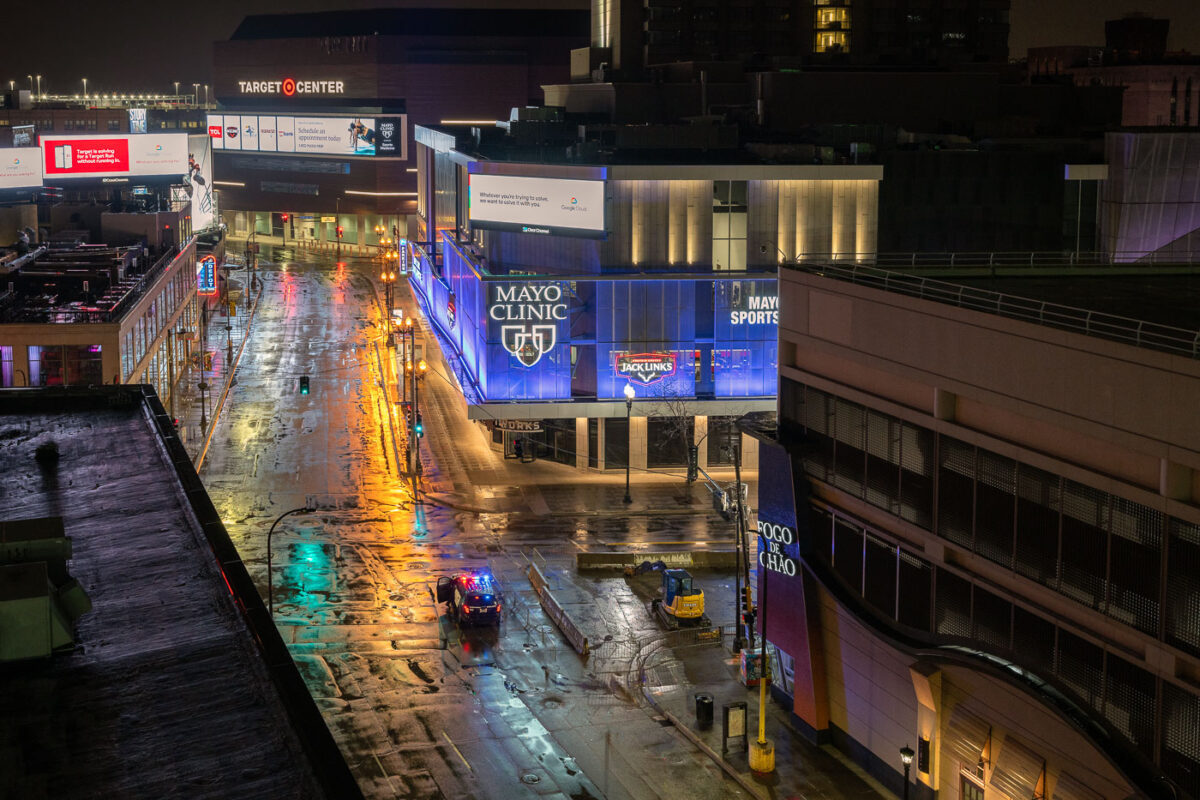
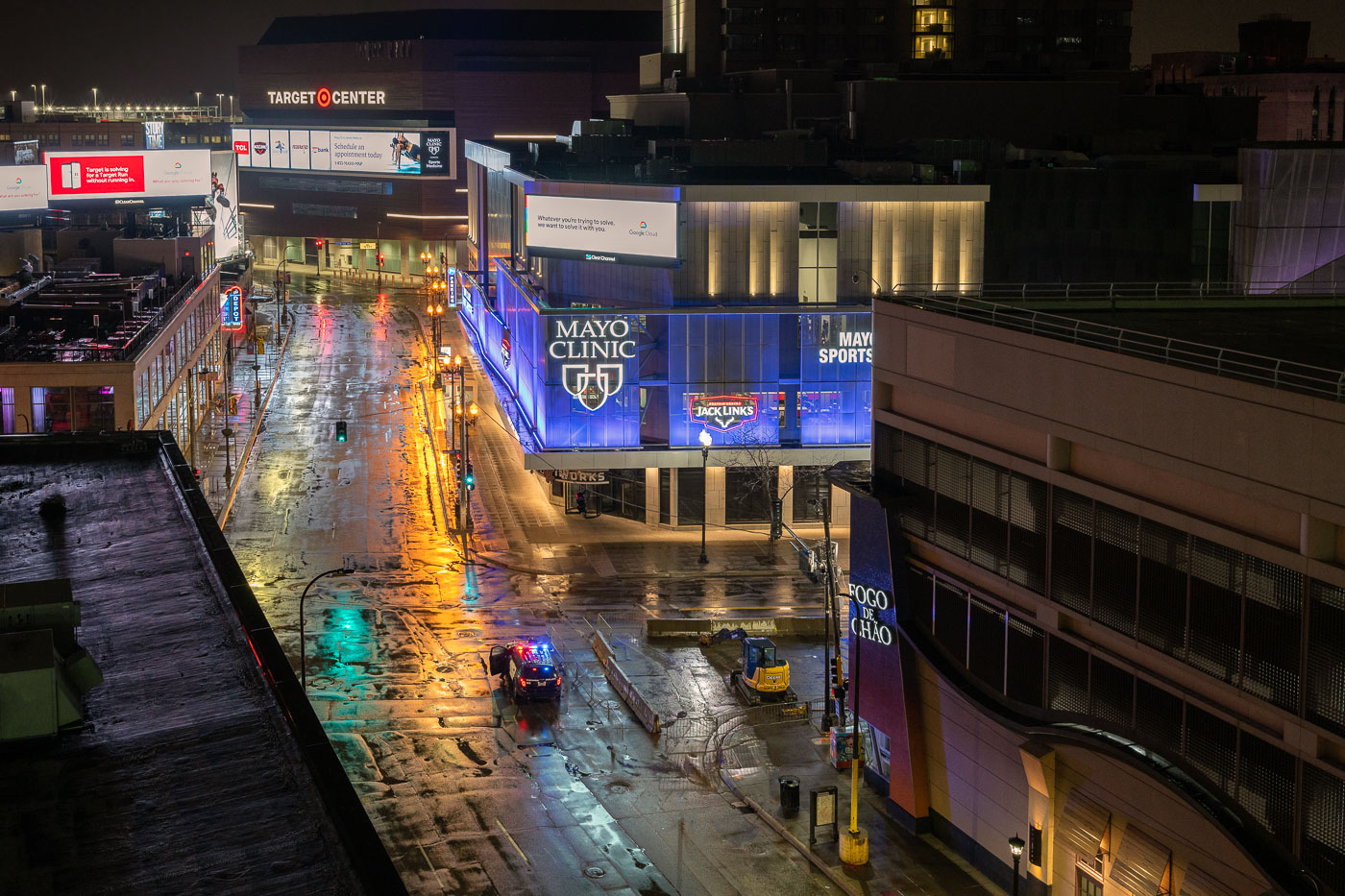
Police vehicle and excavator on wet Hennepin Avenue in downtown Minneapolis at night during COVID-19 shutdown.
Hennepin Avenue runs through downtown Minneapolis past Target Center, home of the Minnesota Timberwolves and Lynx, and Mayo Clinic Square, a mixed-use building housing retail space and the Minnesota Timberwolves' practice facility. The corridor sits at the center of the city's entertainment and sports district, connecting to First Avenue and the Warehouse District a few blocks south. In late March 2020, Minnesota's stay-at-home order emptied this stretch of its usual foot traffic, leaving only intermittent police and maintenance activity on the street.

Hennepin Avenue Near Target Center During Minneapolis’s COVID-19 Shutdown
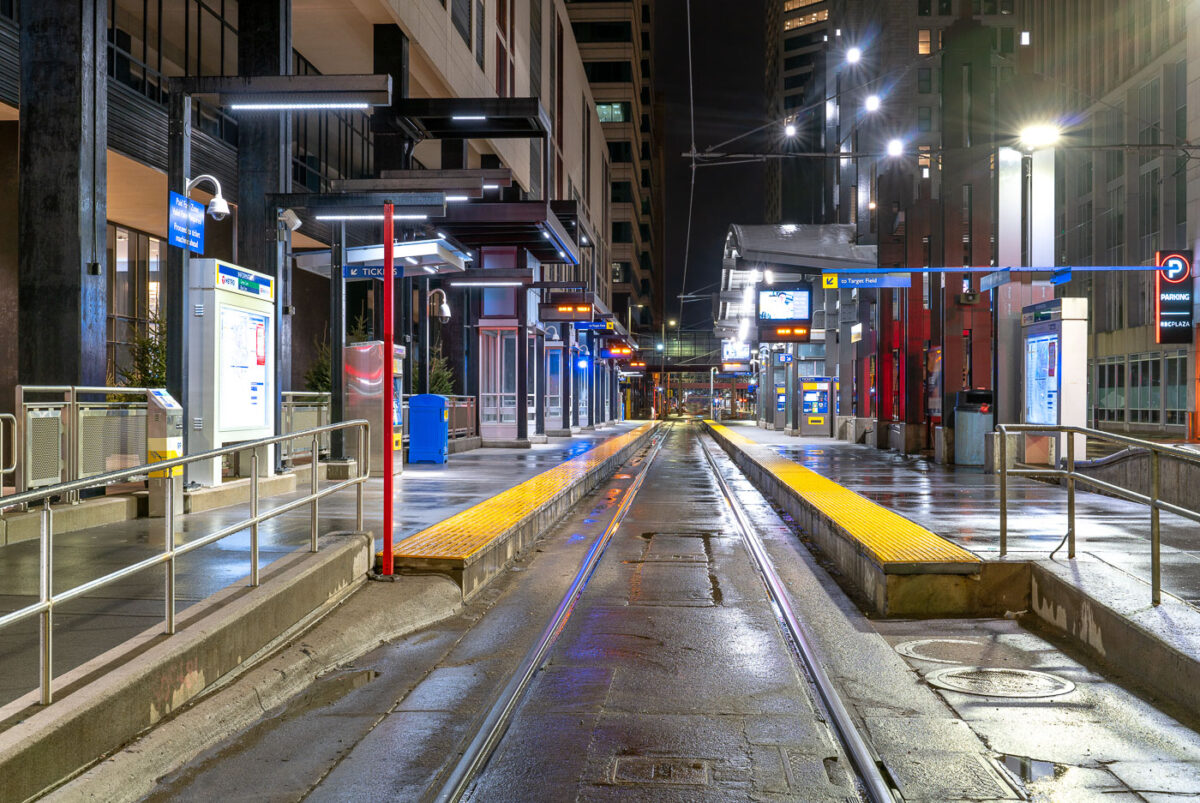
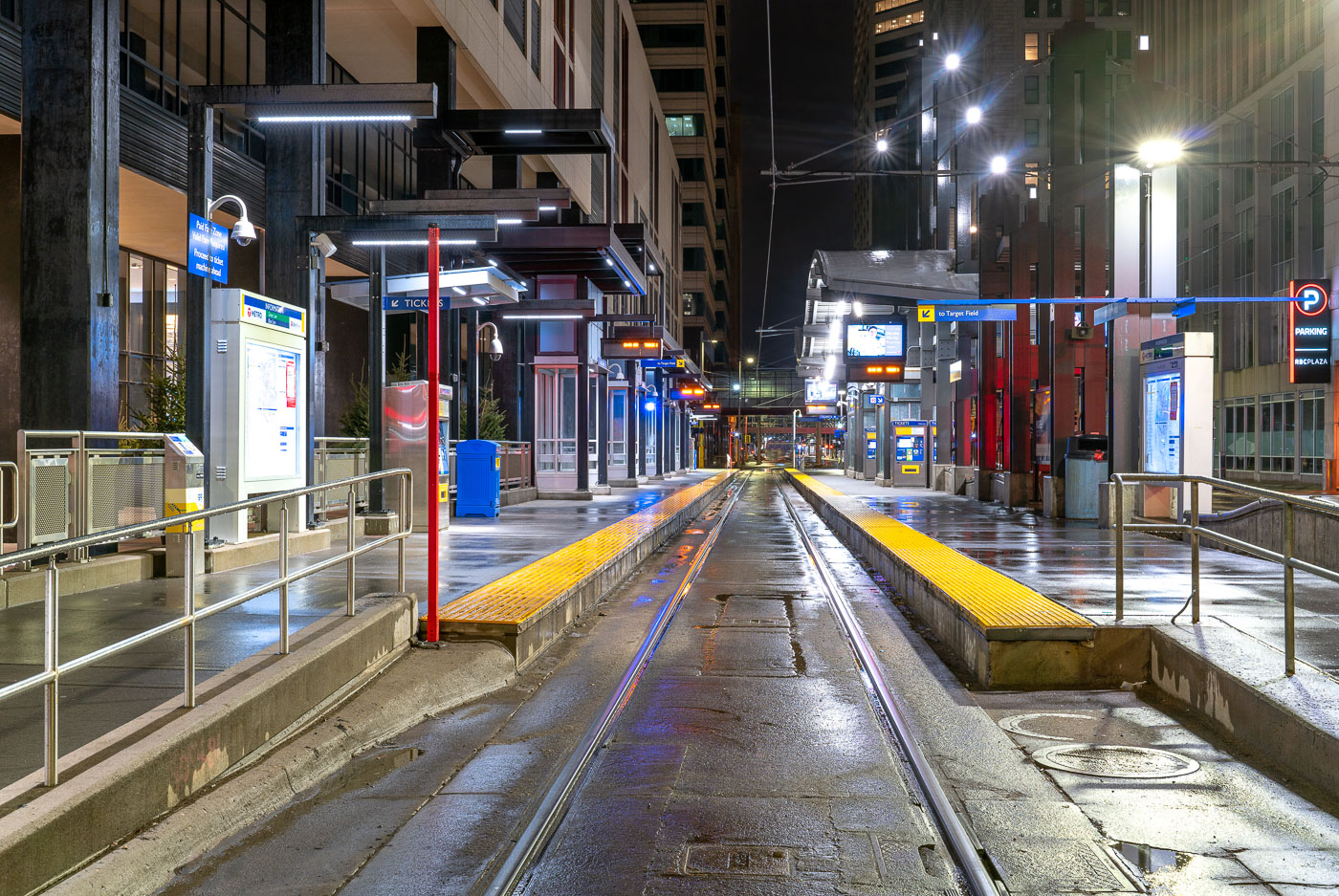
Nicollet Mall light rail station platform stretches empty at night during early COVID-19 pandemic closures in downtown
Nicollet Mall Station serves Metro Transit's Blue and Green Line trains along the transit mall in downtown Minneapolis. The Blue Line opened in 2004 as the region's first light rail line, running between downtown and the Mall of America; the Green Line, connecting downtown Minneapolis to downtown St. Paul, began service in 2014. The station sits along Nicollet Mall, a pedestrian and transit corridor that has restricted private vehicle traffic since the 1960s. Overhead signage points riders toward Target Field, home of the Minnesota Twins, a short walk to the north. This dates to late March 2020, during the early weeks of Minnesota's COVID-19 stay-at-home order, when ridership on the system dropped sharply from pre-pandemic levels.

A Rainy Night at Minneapolis’s Nicollet Mall Station
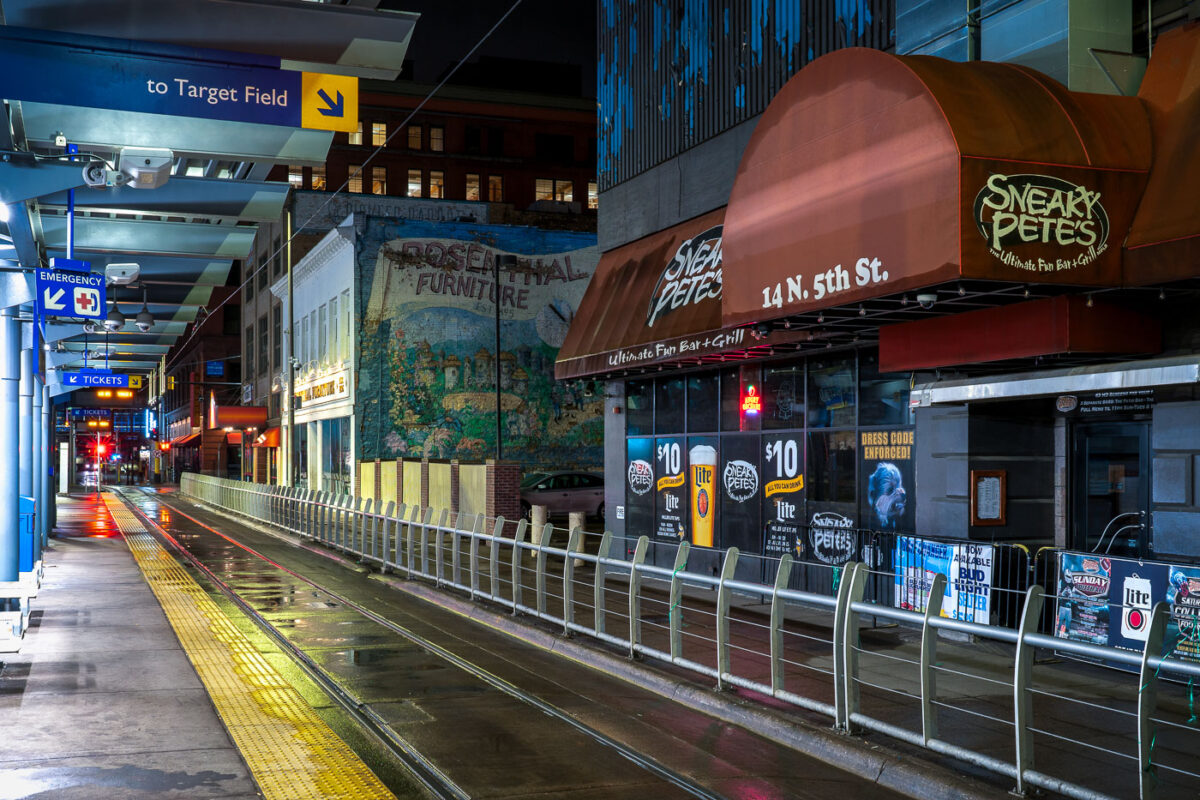
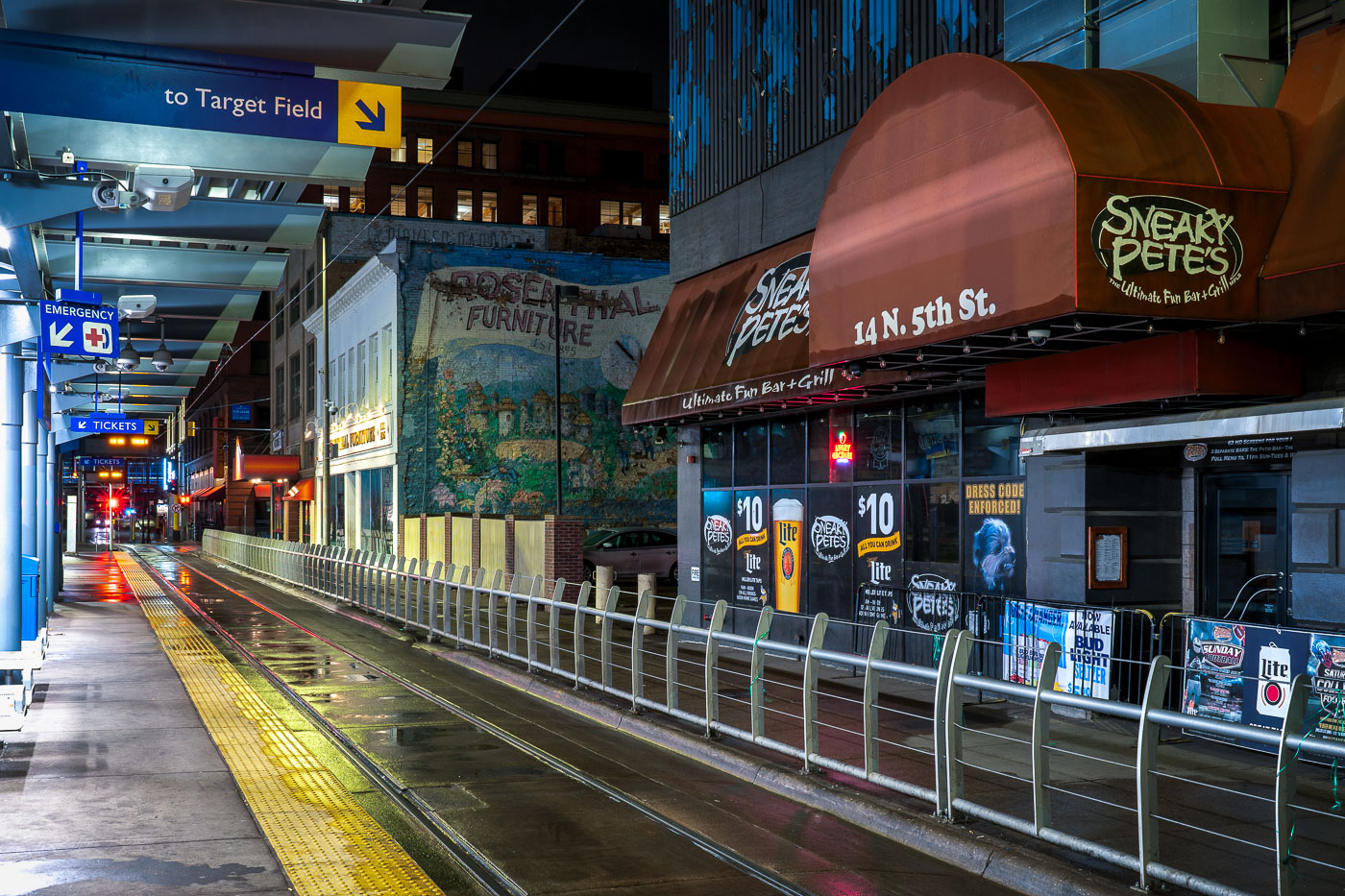
Sneaky Petes during covid19 stay at home orders
Sneaky Pete’s Bar at 14 N. 5th St. in downtown Minneapolis stands dark beside a METRO light rail platform on March 28, 2020, the first night of Minnesota’s COVID-19 stay-at-home order.

Sneaky Pete’s Bar, 14 N. 5th St., Minneapolis, COVID-19 Stay at Home Order
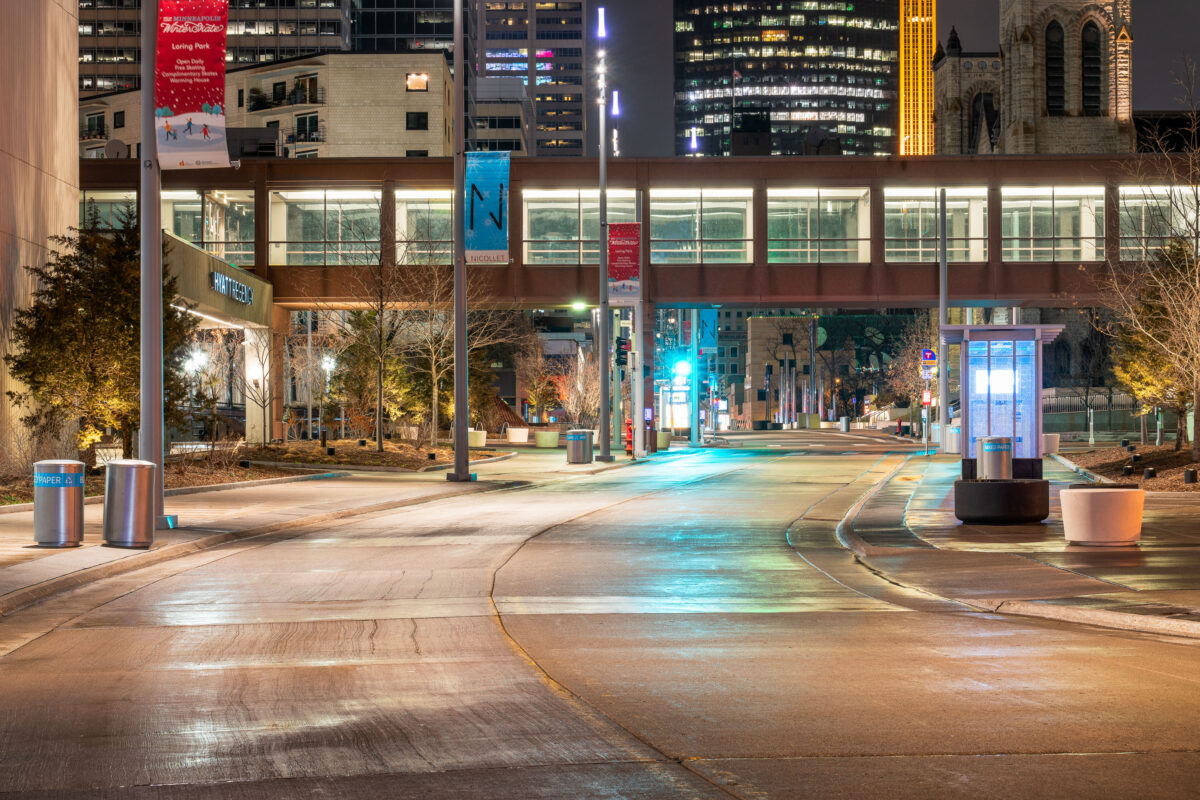
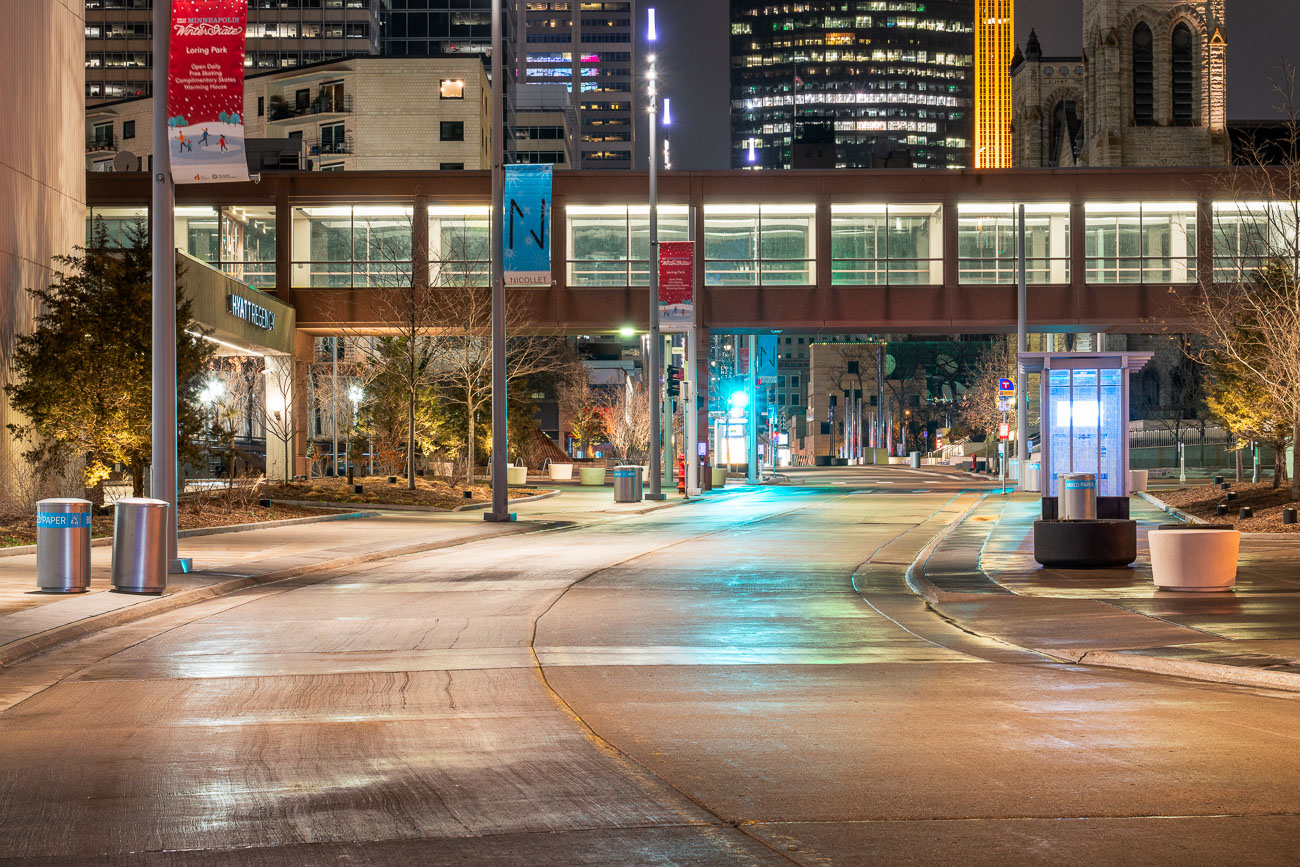
Nicollet Mall in Minneapolis during Stay At Home Orders
Nicollet Mall in downtown Minneapolis is seen during Minnesota's COVID-19 stay-at-home orders.

Nicollet Mall, Downtown Minneapolis During COVID-19 Stay-at-Home
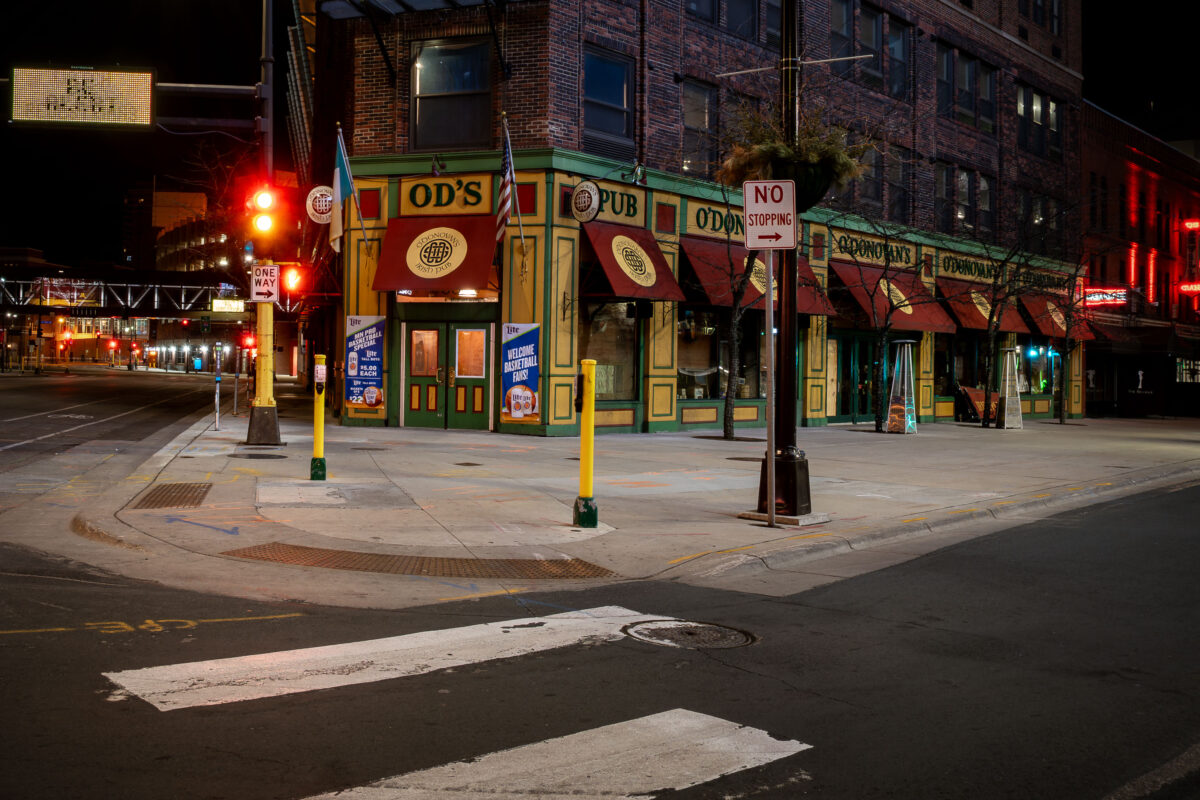
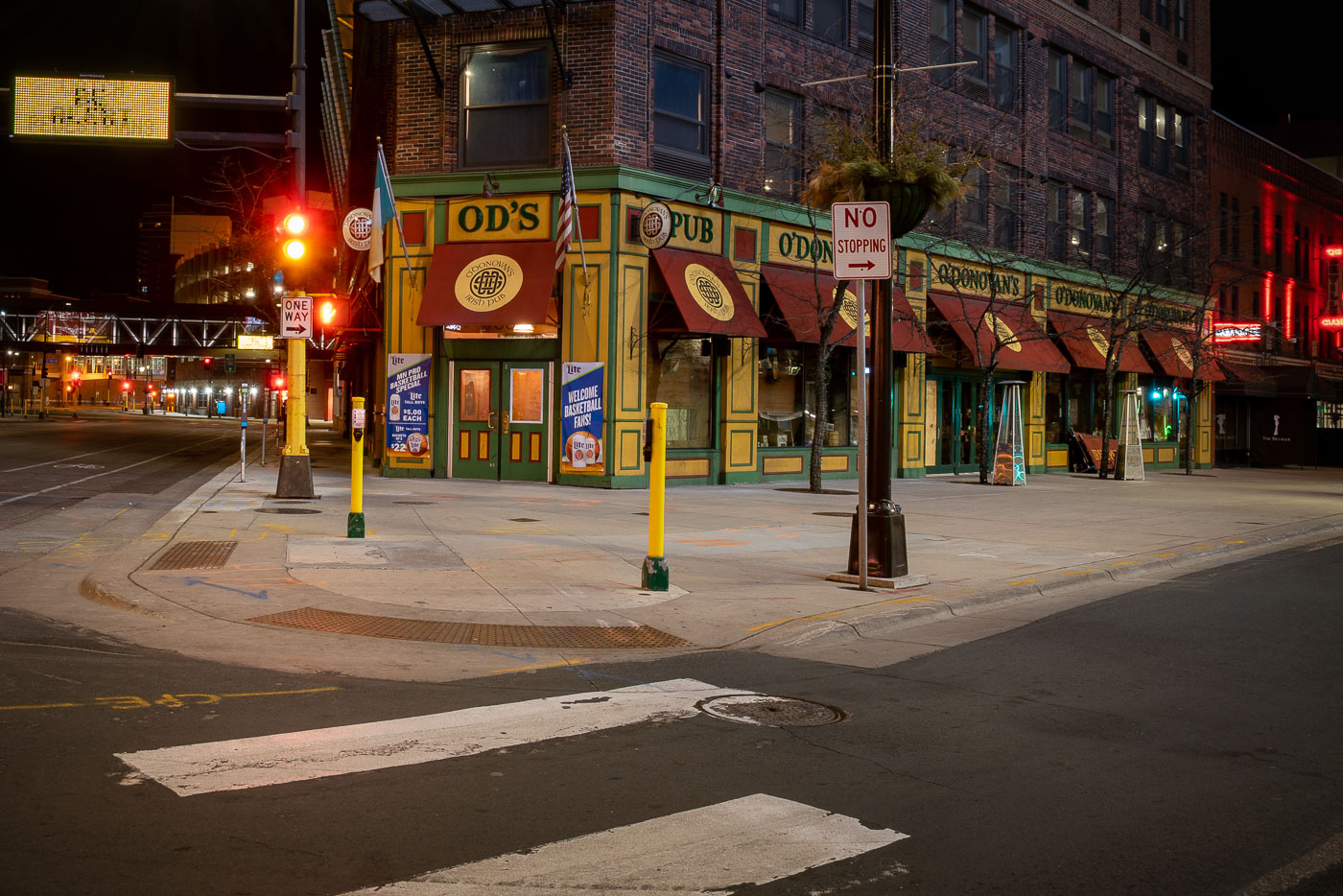
O'Donovan's Irish Pub, a yellow and green corner establishment in downtown Minneapolis, illuminated at night.
O'Donovan's Irish Pub occupies a corner storefront on First Avenue North in downtown Minneapolis, a few blocks from the First Avenue nightclub and the Warehouse District entertainment strip. The pub opened in 2004, and much of its interior — including the bar itself — was built in Ireland, then shipped and reassembled on site. It's part of a small local chain that also includes O'Donovan's locations elsewhere in the Twin Cities, though this Washington Avenue-area spot is the original.

O’Donovan’s Irish Pub on an Empty Downtown Minneapolis Corner
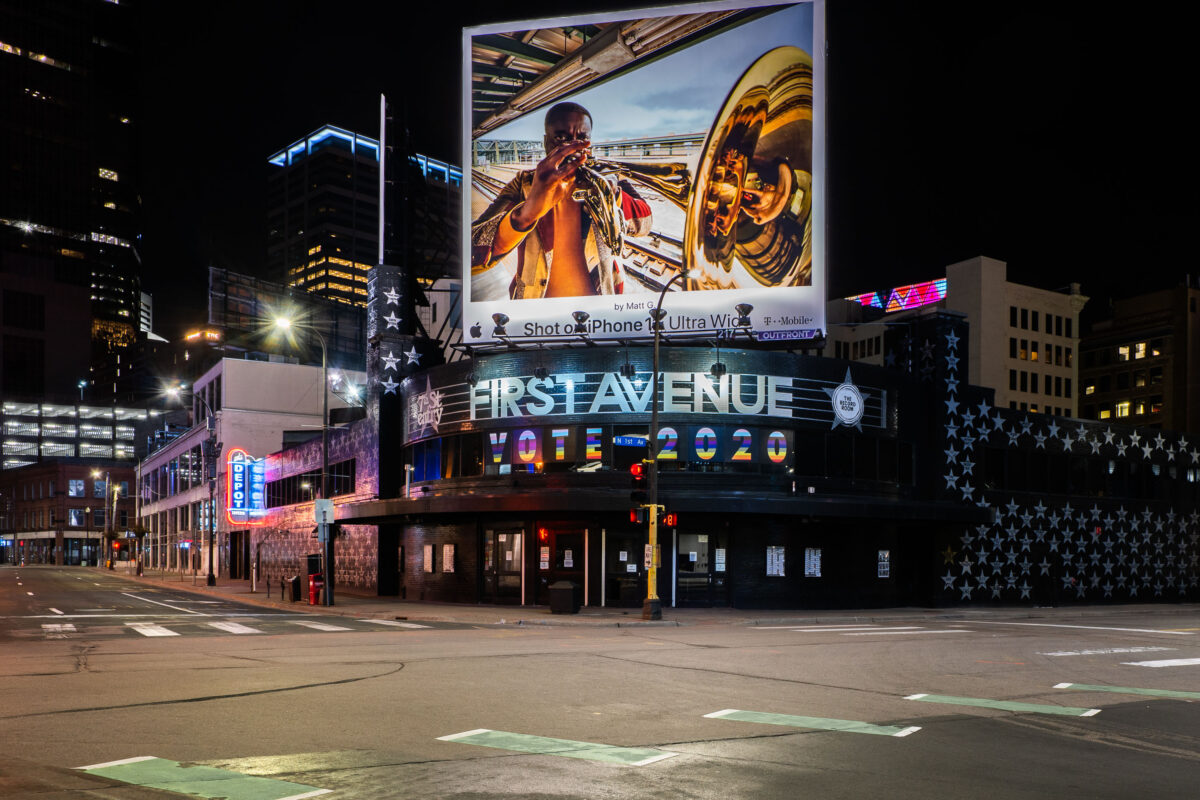
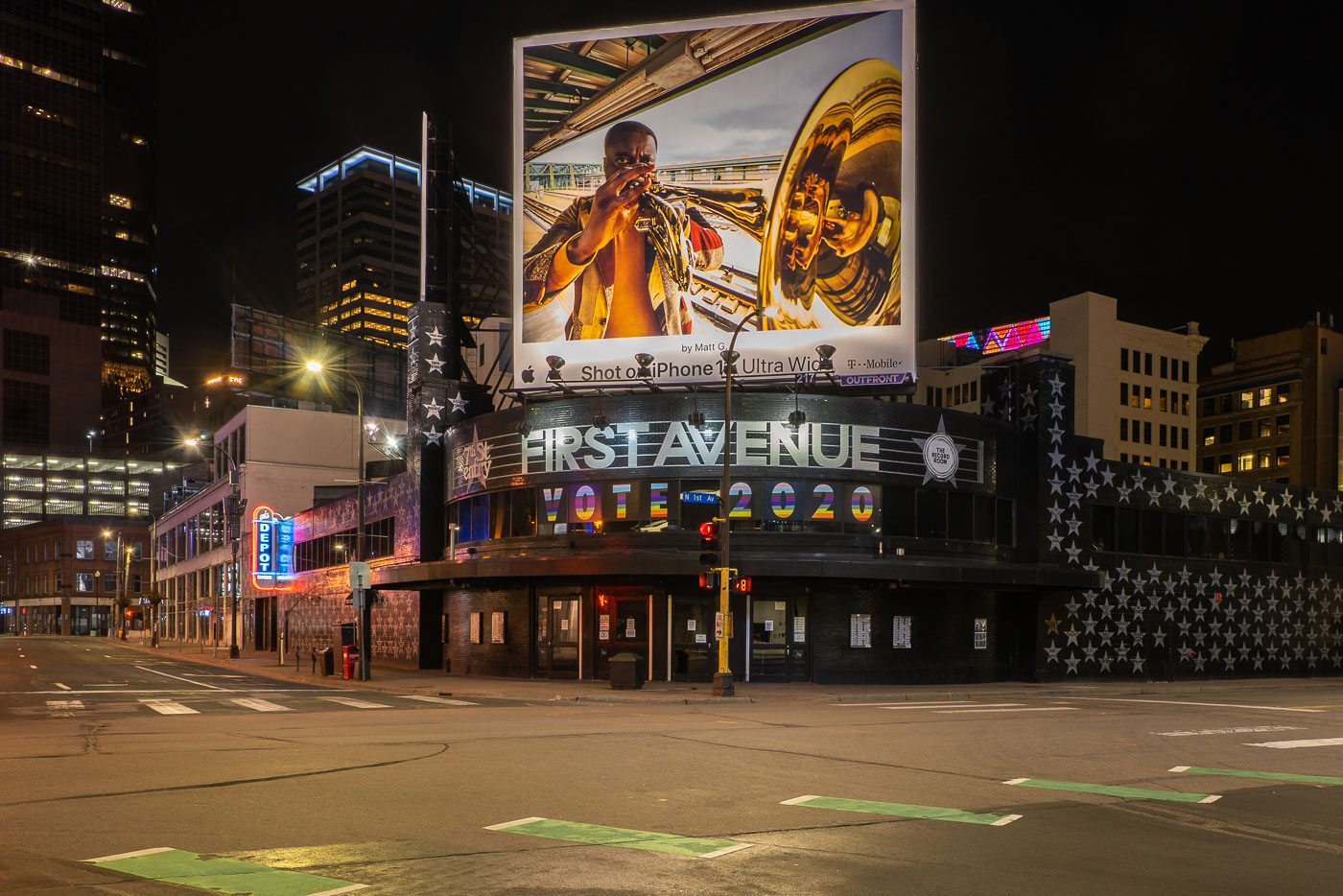
First Avenue concert venue displays large VOTE 2020 sign across its illuminated storefront in downtown Minneapolis.
First Avenue occupies a former Greyhound bus depot at 701 First Avenue North, built in 1937. The club opened in its current form in 1970 and has operated continuously except for a brief bankruptcy closure in 2004. Its exterior is covered in silver stars, each bearing the name of a musician who has performed there, a tradition that began in the 1980s. The venue gained international attention after Prince filmed key s of "Purple Rain" there in 1983, cementing its reputation as one of the country's best-known independent music clubs.

First Avenue’s “VOTE 2020” Marquee in Downtown Minneapolis
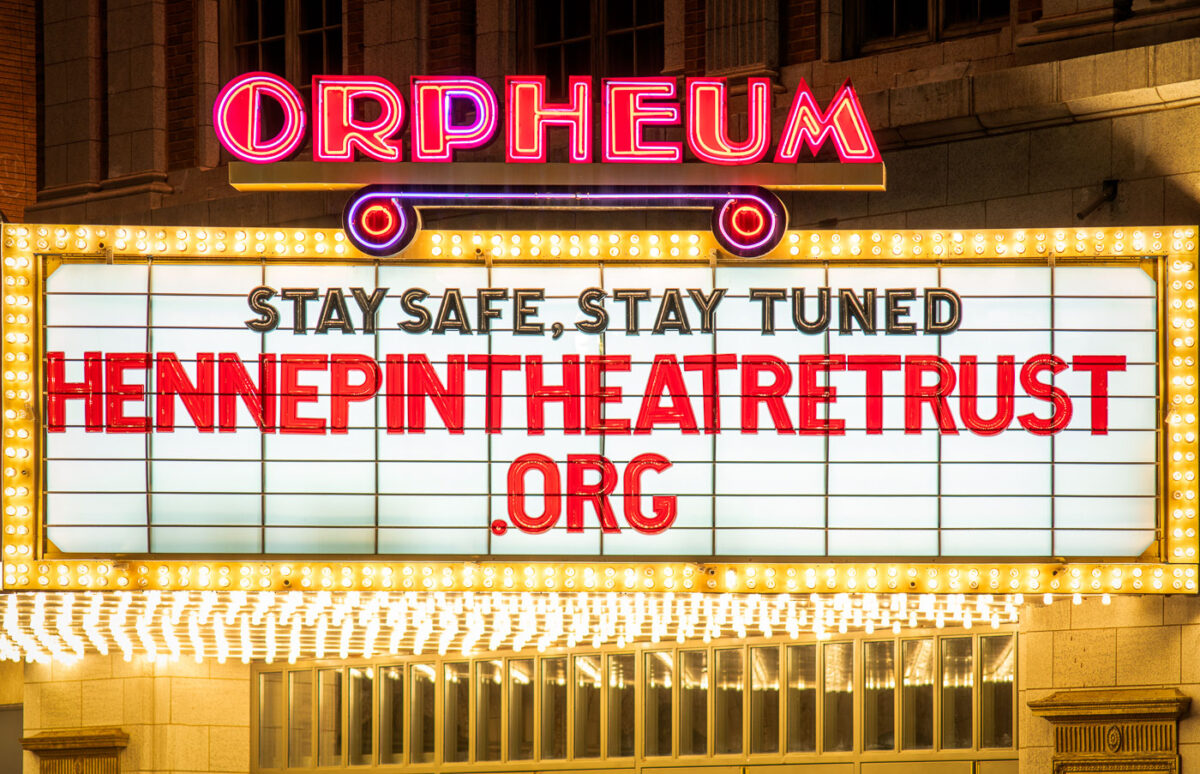
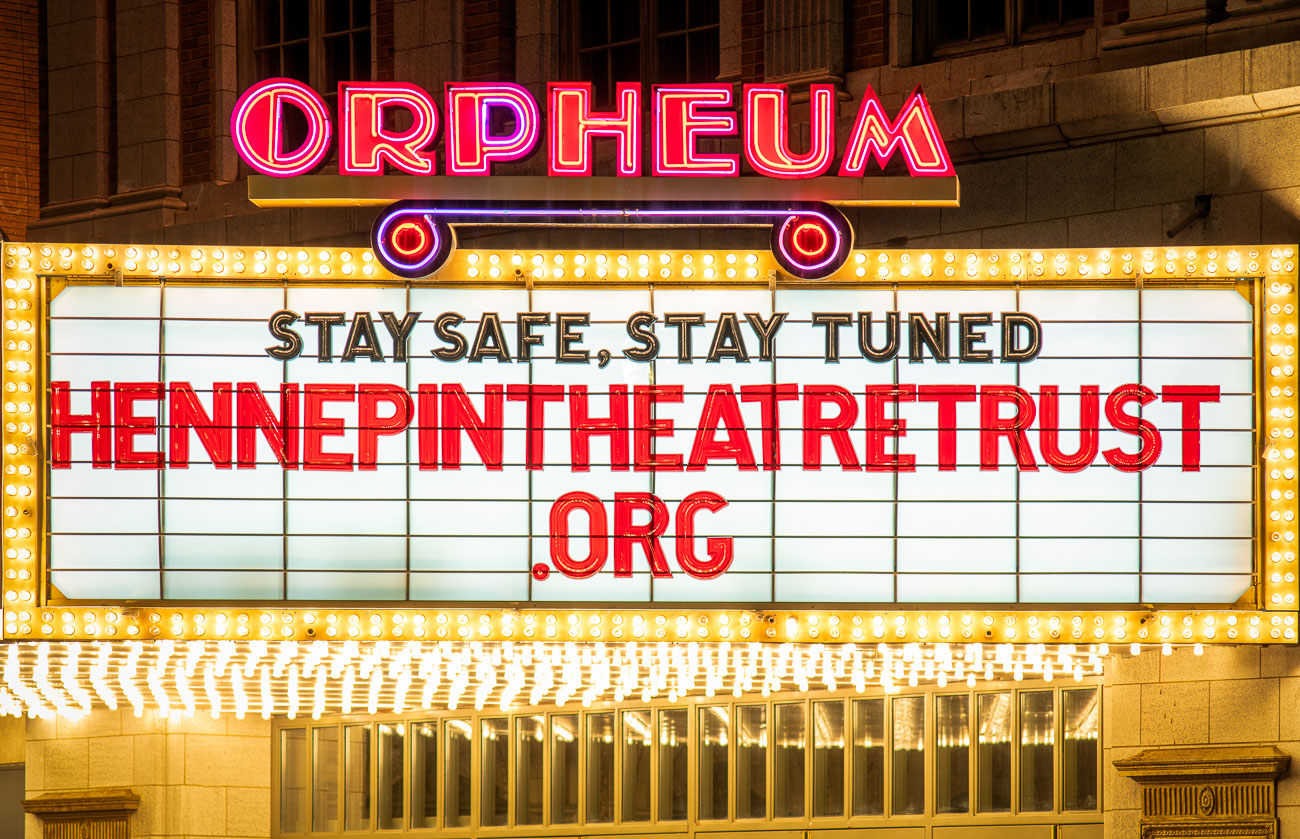
Orpheum Theatre marquee displays "Stay Safe, Stay Tuned" message on Hennepin Avenue during COVID-19 closure.
The Orpheum Theatre, at 910 Hennepin Avenue, opened in 1921 as the Hennepin Theatre and later operated as a vaudeville and movie house before its 1980s conversion to a live performance venue. It's now owned and operated by Hennepin Theatre Trust, part of the city's Hennepin Avenue theater district alongside the State and Pantages theaters. The marquee's message, directing passersby to HennepinTheatreTrust.org, went up during the closures ordered under Minnesota's COVID-19 stay-at-home order in the spring of 2020, when the Orpheum and other performance venues went dark to the public.

“Stay Safe, Stay Tuned” on the Orpheum Theatre Marquee
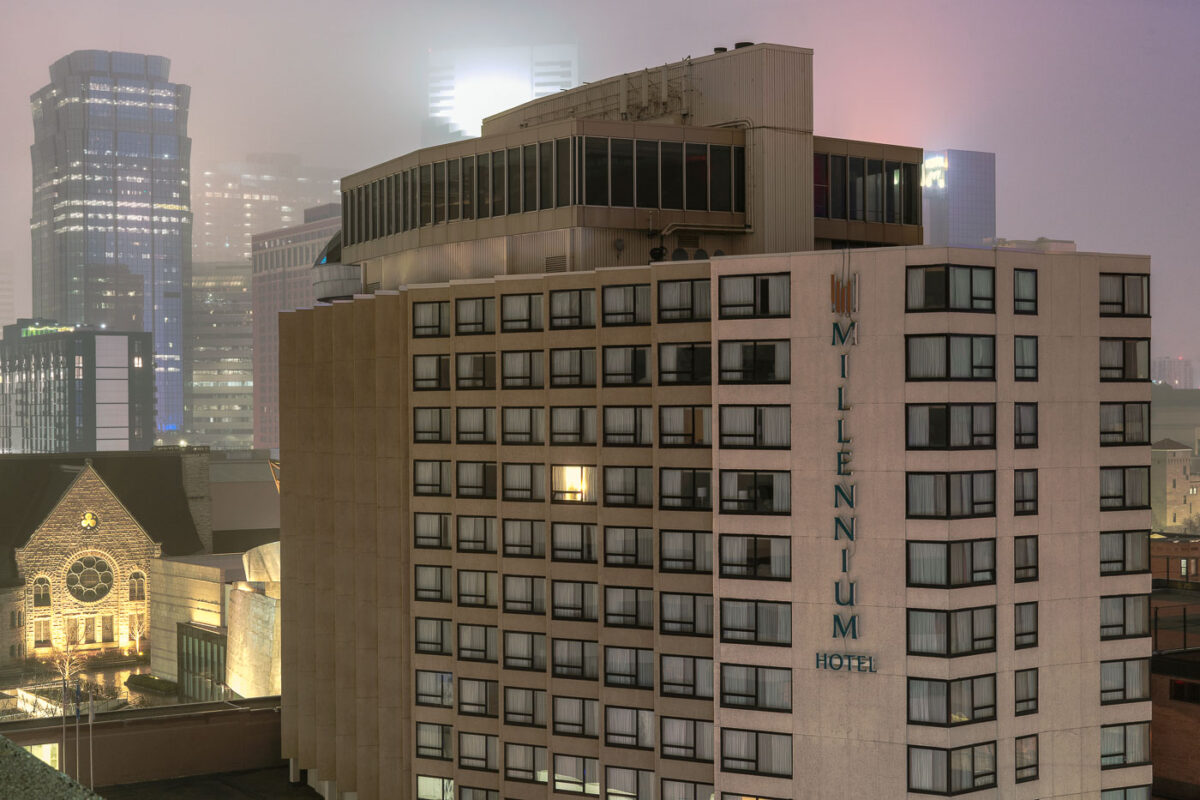
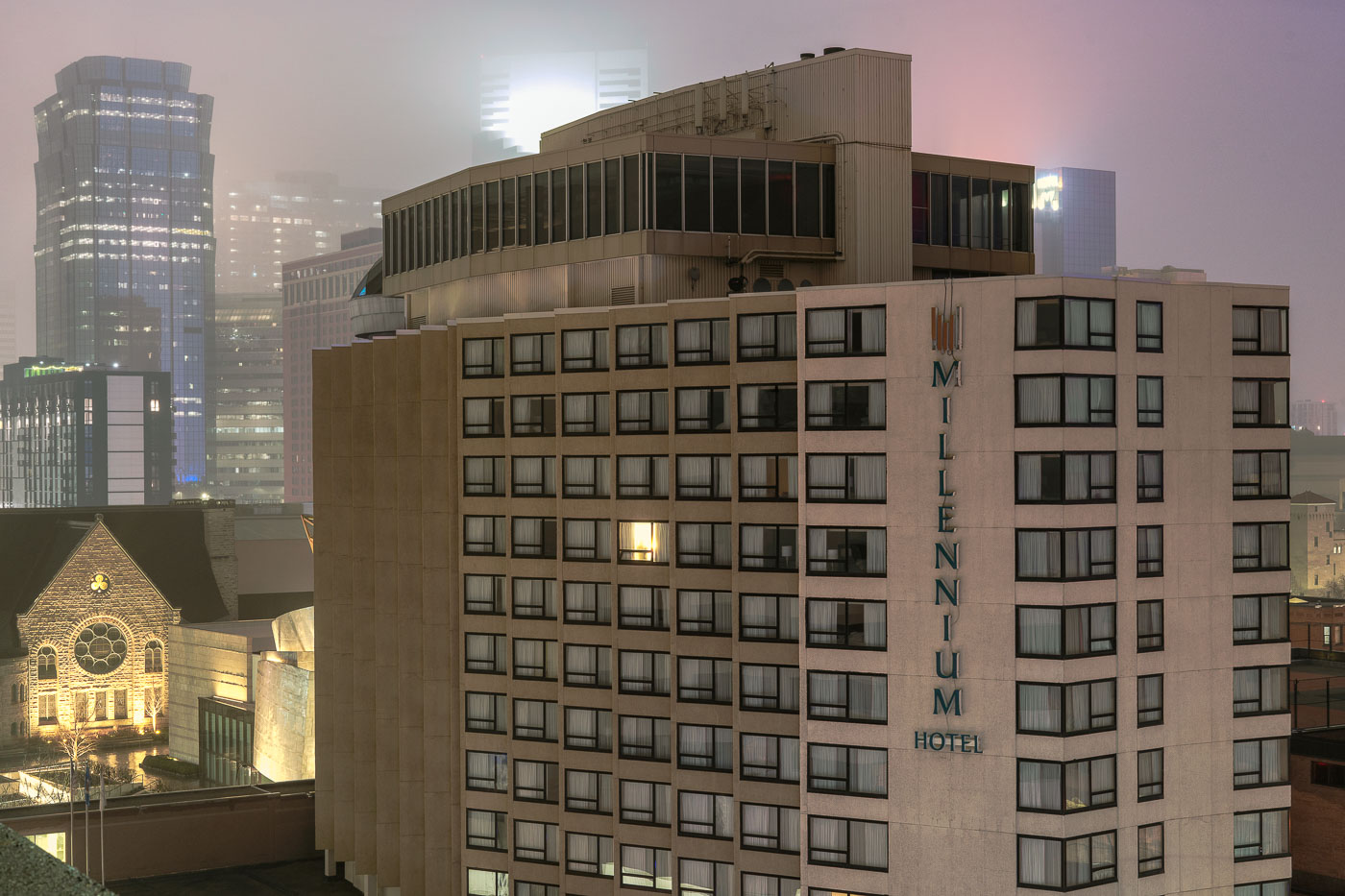
Millennium Hotel on Nicollet Mall in downtown Minneapolis with one lit window among darkened guest rooms during COVID-19 lockdown.
The Millennium Hotel stands at 1313 Nicollet Mall in downtown Minneapolis, a 14-story tower near the Minneapolis Convention Center. Nicollet Mall, the street it fronts, opened in 1967 as downtown Minneapolis's main pedestrian and transit street. Only one window lit up during COVID-19 lockdown.

Only One Light on at Millennium Hotel on Nicollet Mall
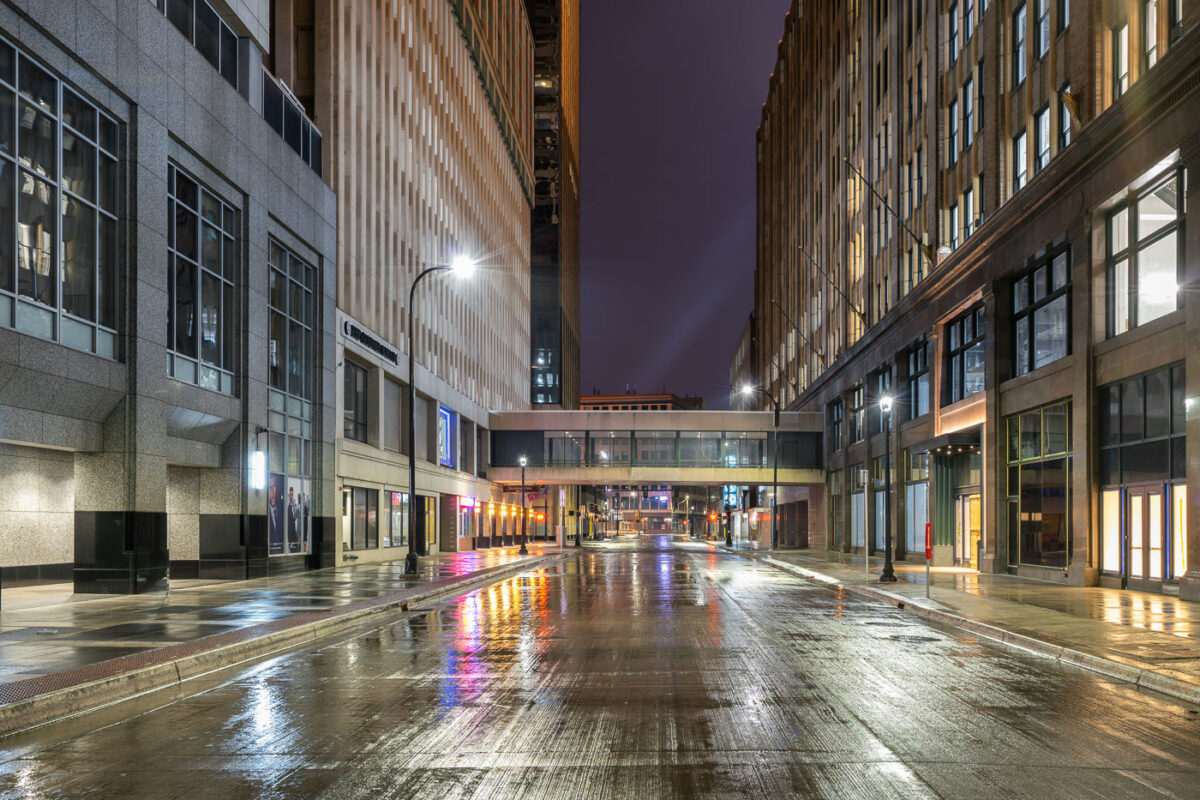
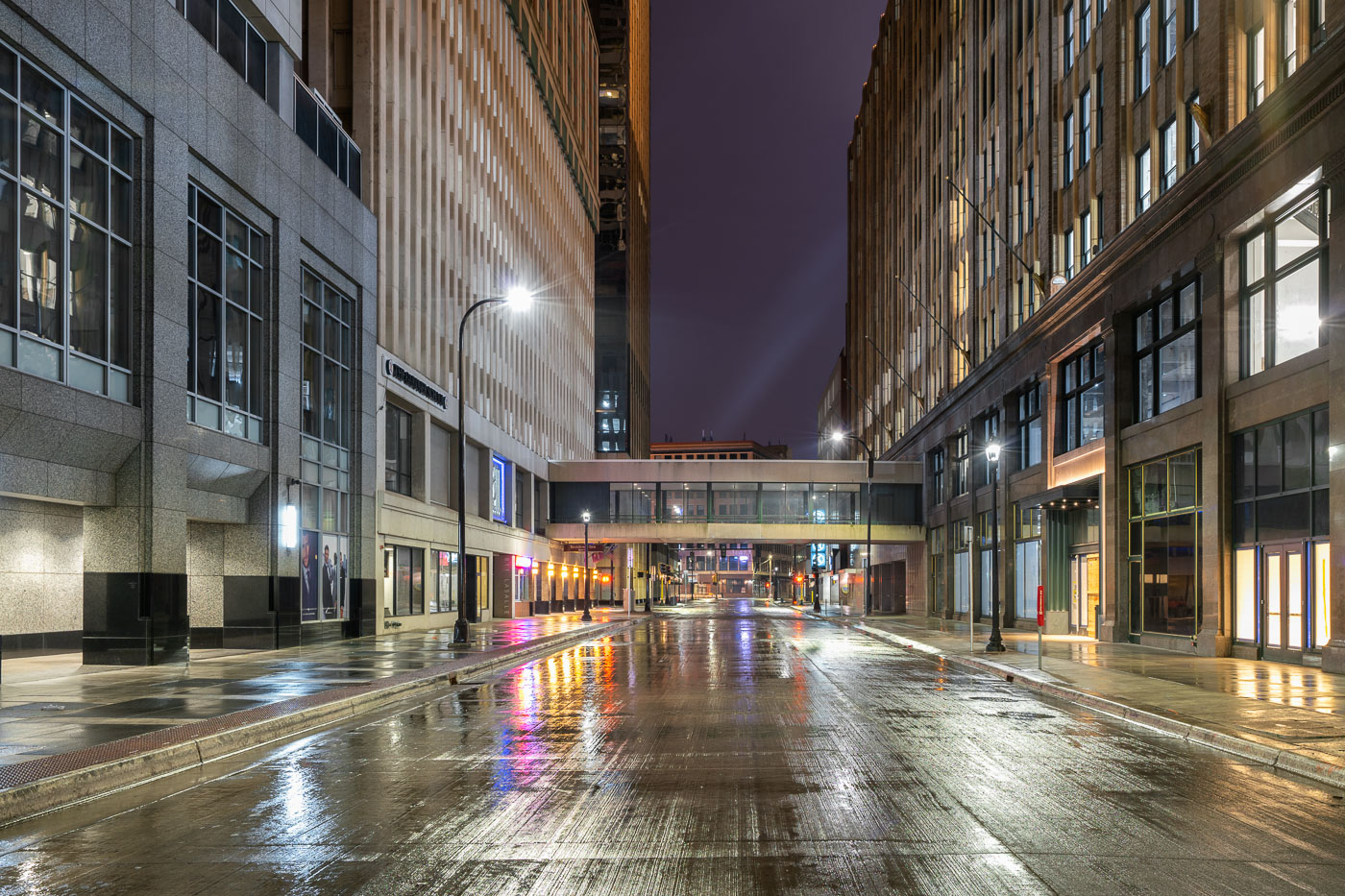
Looking down S 8th Street during COVID19 on rainy night
South 8th Street in downtown Minneapolis is seen on March 22, 2020, during the early stages of the COVID-19 pandemic. The street, typically bustling with activity, are empty.

Downtown Minneapolis S 8th St During COVID-19 Pandemic
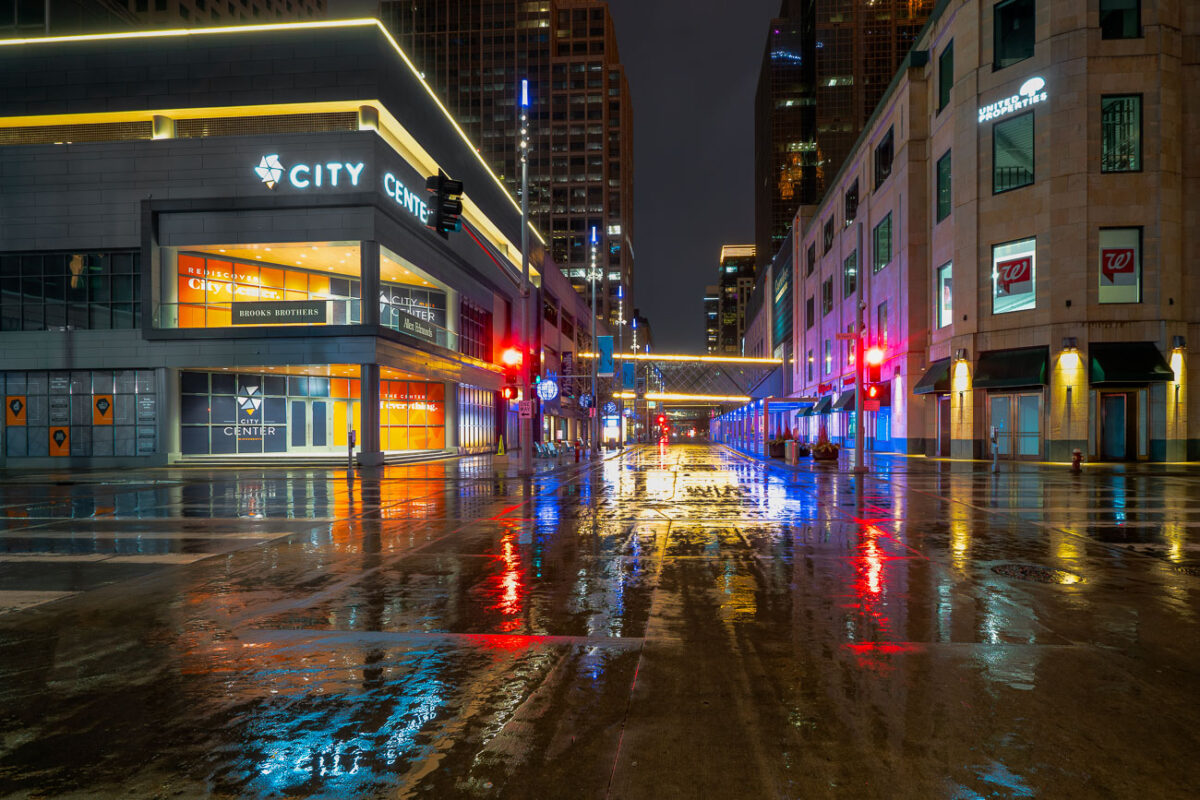
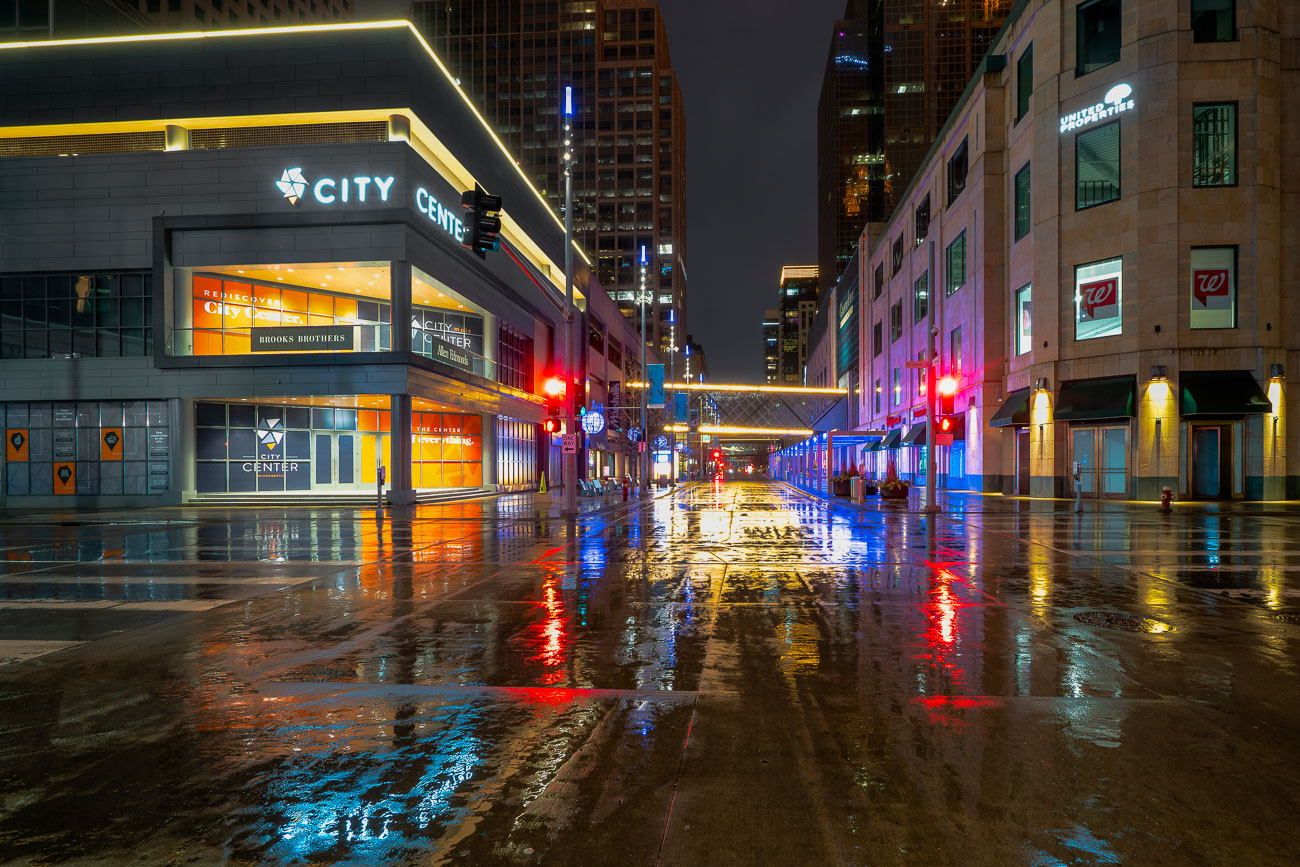
Rainy night outside CIty Center on Nicolelt Mall in Minneapolis.
Nicollet Mall in Downtown Minneapolis is reflected in the wet pavement on a rainy night in early 2020, during the initial phase of the COVID-19 pandemic.

Rainy Night on Nicollet Mall, Downtown Minneapolis, Early COVID-19
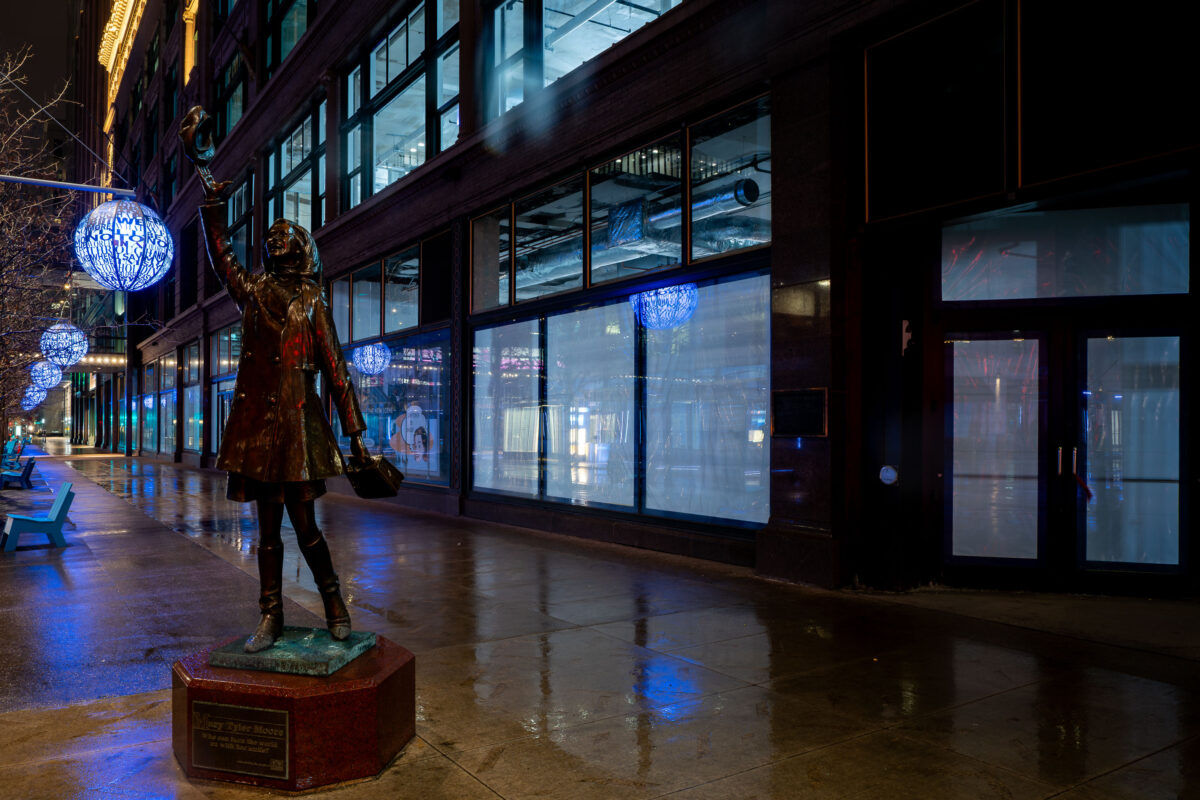
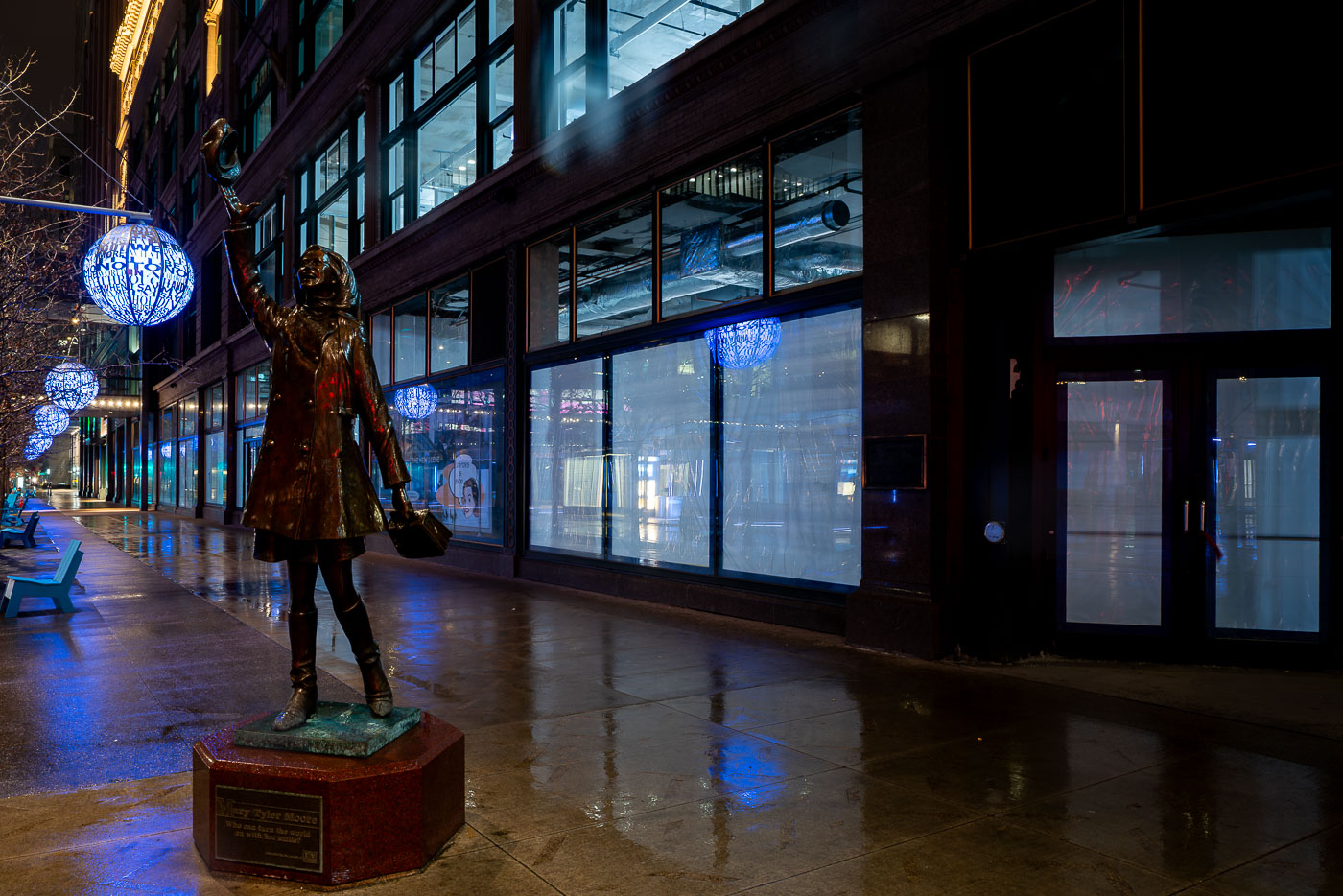
Mary Tyler Moore Statue on an Empty Nicollet Mall
The iconic bronze statue of Mary Tyler Moore along Nicollet Mall in downtown Minneapolis, depicting the memorable hat-tossing moment from the opening of The Mary Tyler Moore Show, which first aired in 1970 and helped cement Minneapolis in television history. Installed in 2002, the statue symbolizes the city’s cultural association with the show’s themes of independence and optimism. At the time of this photograph, Nicollet Mall—normally a busy pedestrian and transit corridor—appears unusually empty, reflecting the early days of COVID-19 shutdowns that drastically reduced public presence in city centers. Blue public art lanterns, added during street improvements completed in 2017, line the renovated streetscape, emphasizing Nicollet Mall’s evolution as both a commercial and cultural landmark.

Mary Tyler Moore Statue on an Empty Nicollet Mall

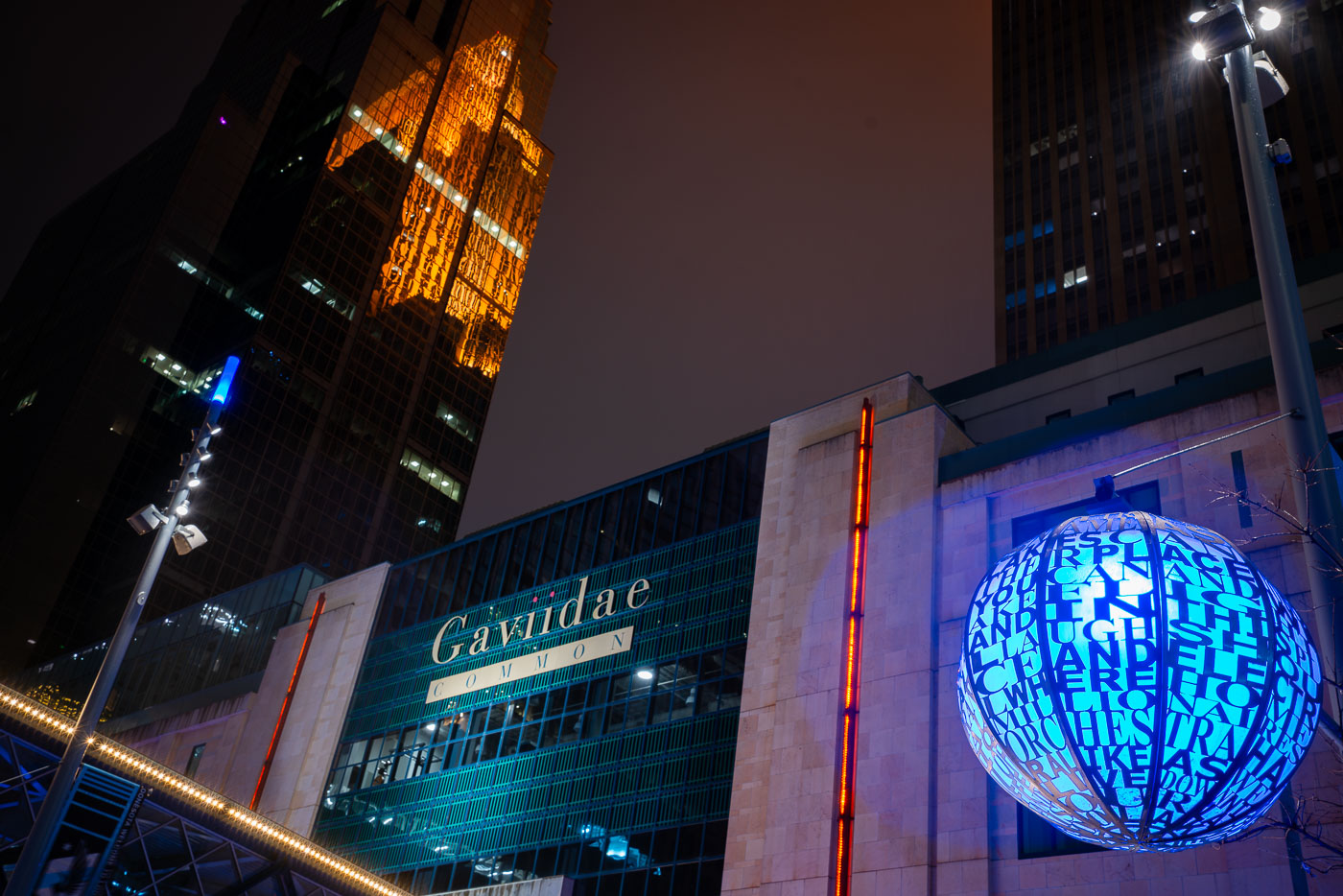
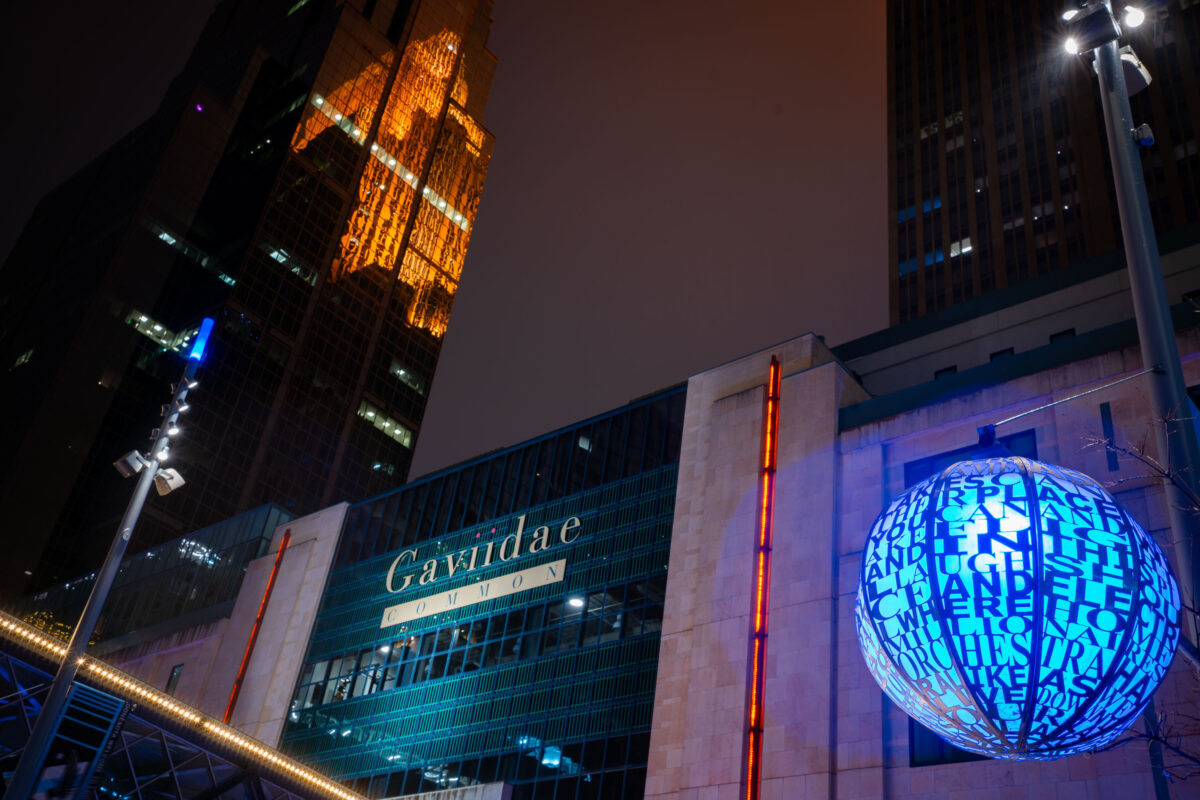
Gaviidae Common and Westin Reflection on Nicollet Mall
Downtown Minneapolis after dark, with the Gaviidae Common retail and office complex illuminated along Nicollet Mall. The metallic blue spherical public art installation in the foreground—inscribed with words referencing music, light, and community—adds a cultural element to the urban corridor. Reflected dramatically in the golden glass façade of the Westin building behind it is the historic Foshay Tower, one of Minneapolis’s earliest skyscrapers dating back to 1929. Today, Nicollet Mall serves as the city’s primary pedestrian and transit thoroughfare, blending modern commercial redevelopment, historic preservation, and public art into a central civic space.

Gaviidae Common and Westin Reflection on Nicollet Mall

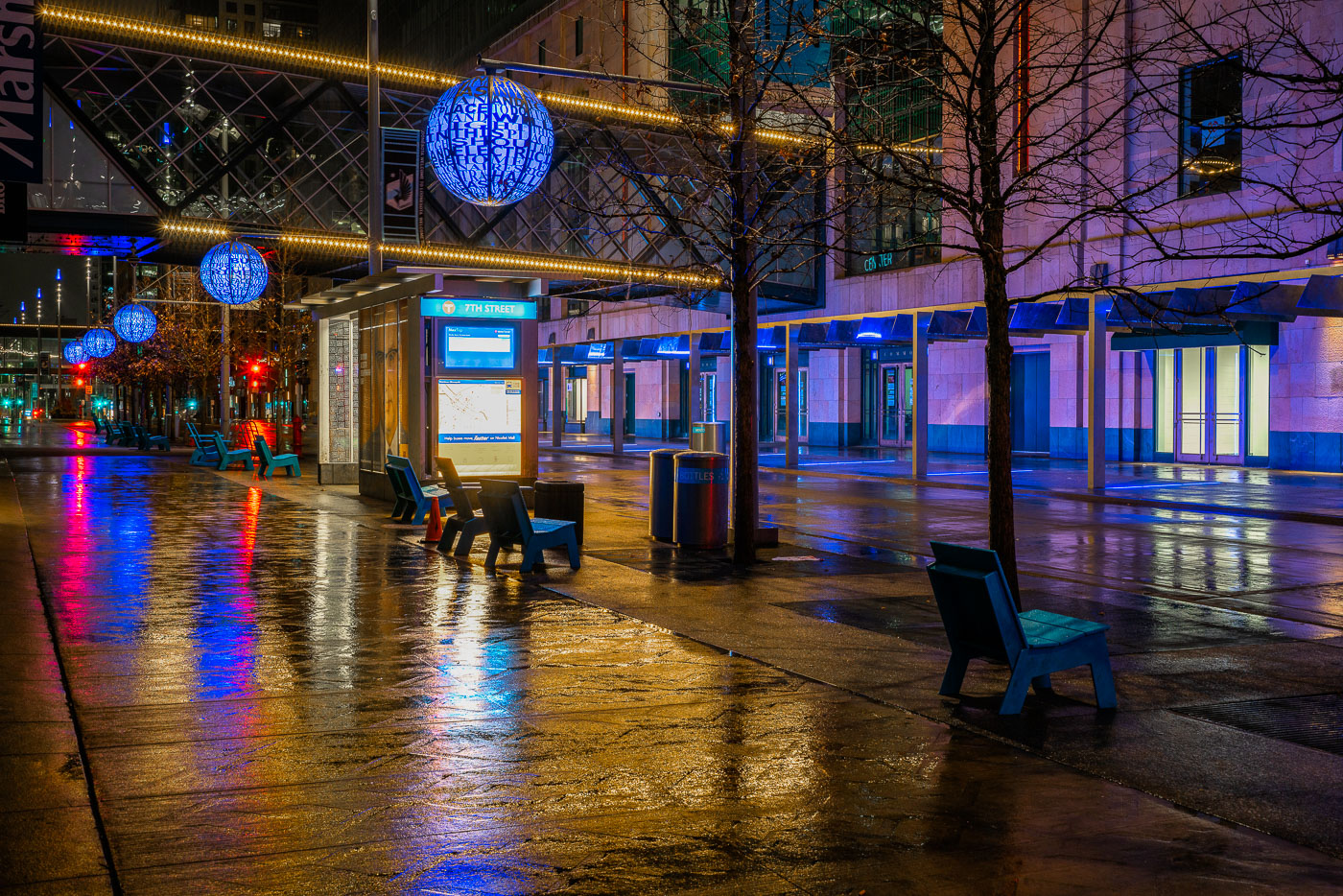
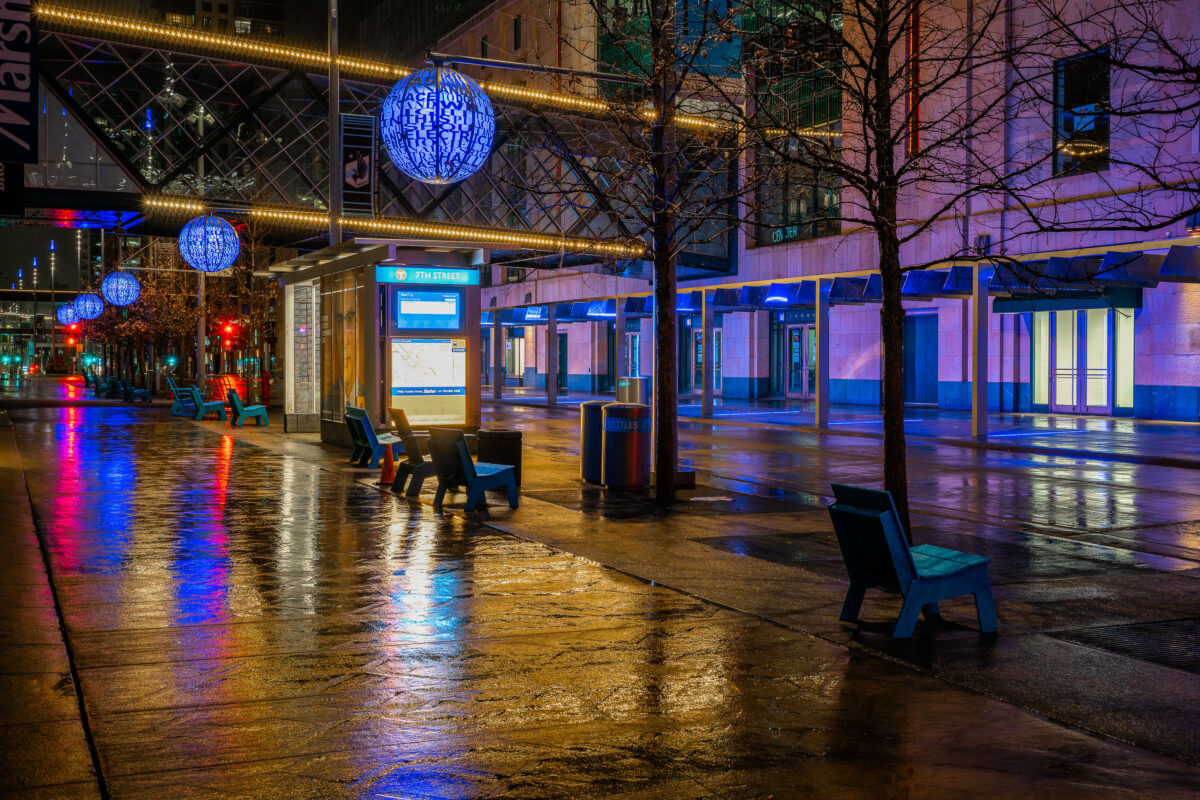
Chairs on Nicollet Mall during a rainy early COVID19 night
Nicollet Mall in Minneapolis is seen on a rainy night during the early stages of the COVID-19 pandemic.

Nicollet Mall, Minneapolis: Rainy Night During COVID-19
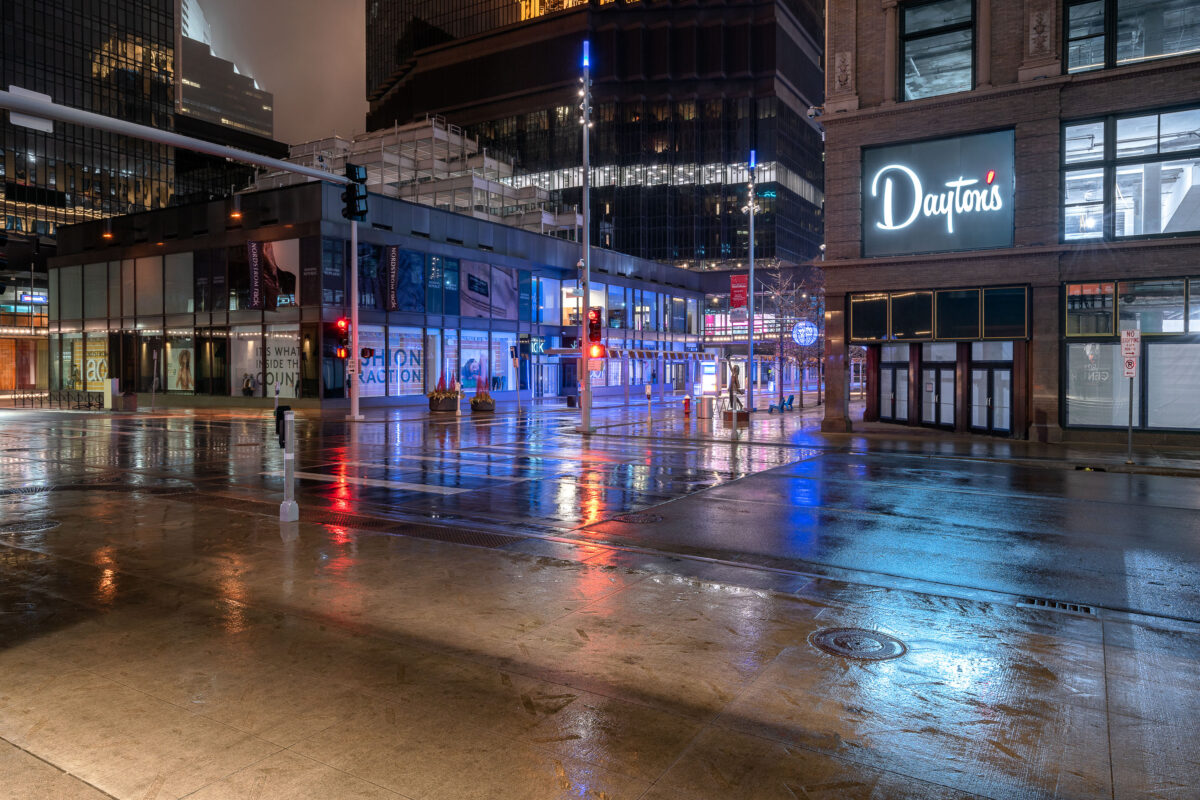
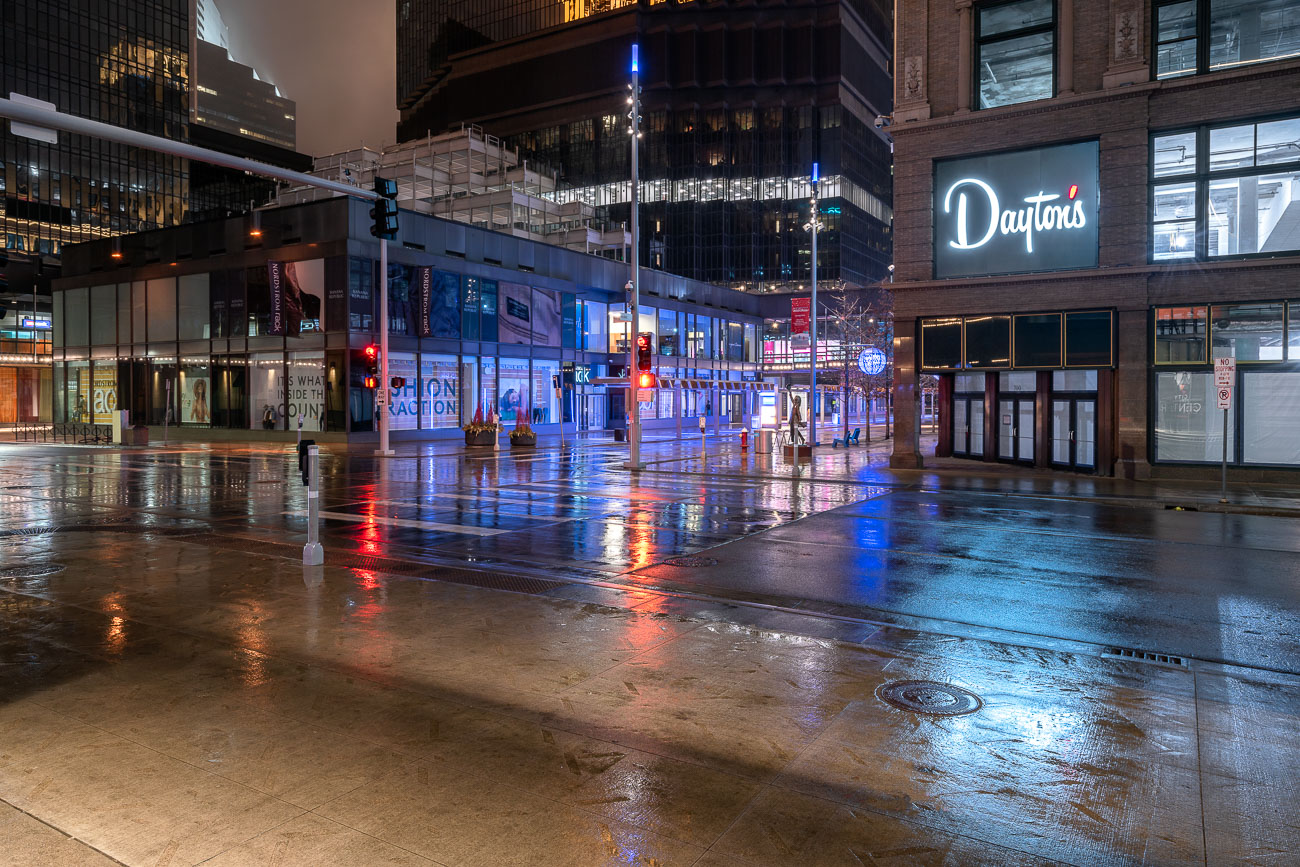
Daytons and IDS Center on Nicollet Mall in the rain
The Dayton's Project and the IDS Center stand on Nicollet Mall in Minneapolis during the early stages of the COVID-19 pandemic. The Dayton's building, a historic landmark in the city's retail landscape, was a prominent fixture on the mall for decades.

Dayton’s and IDS Center, Nicollet Mall, Minneapolis, Early COVID-19
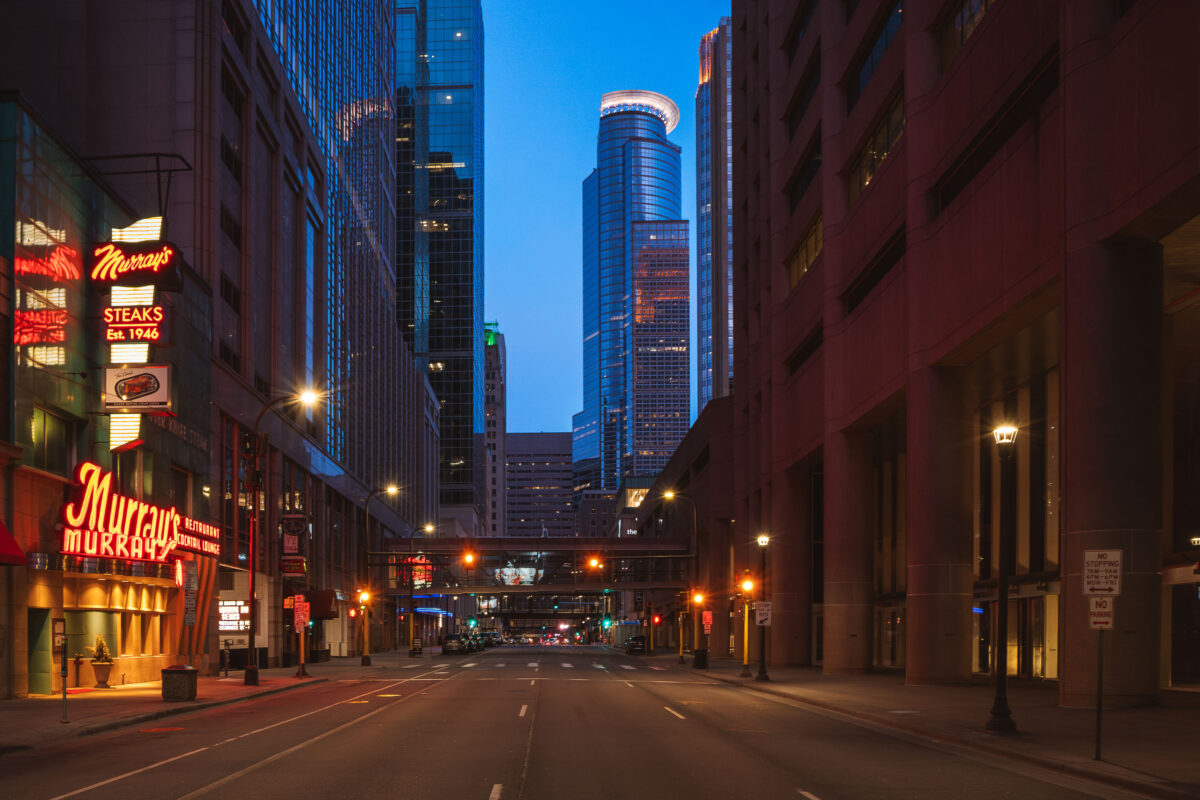
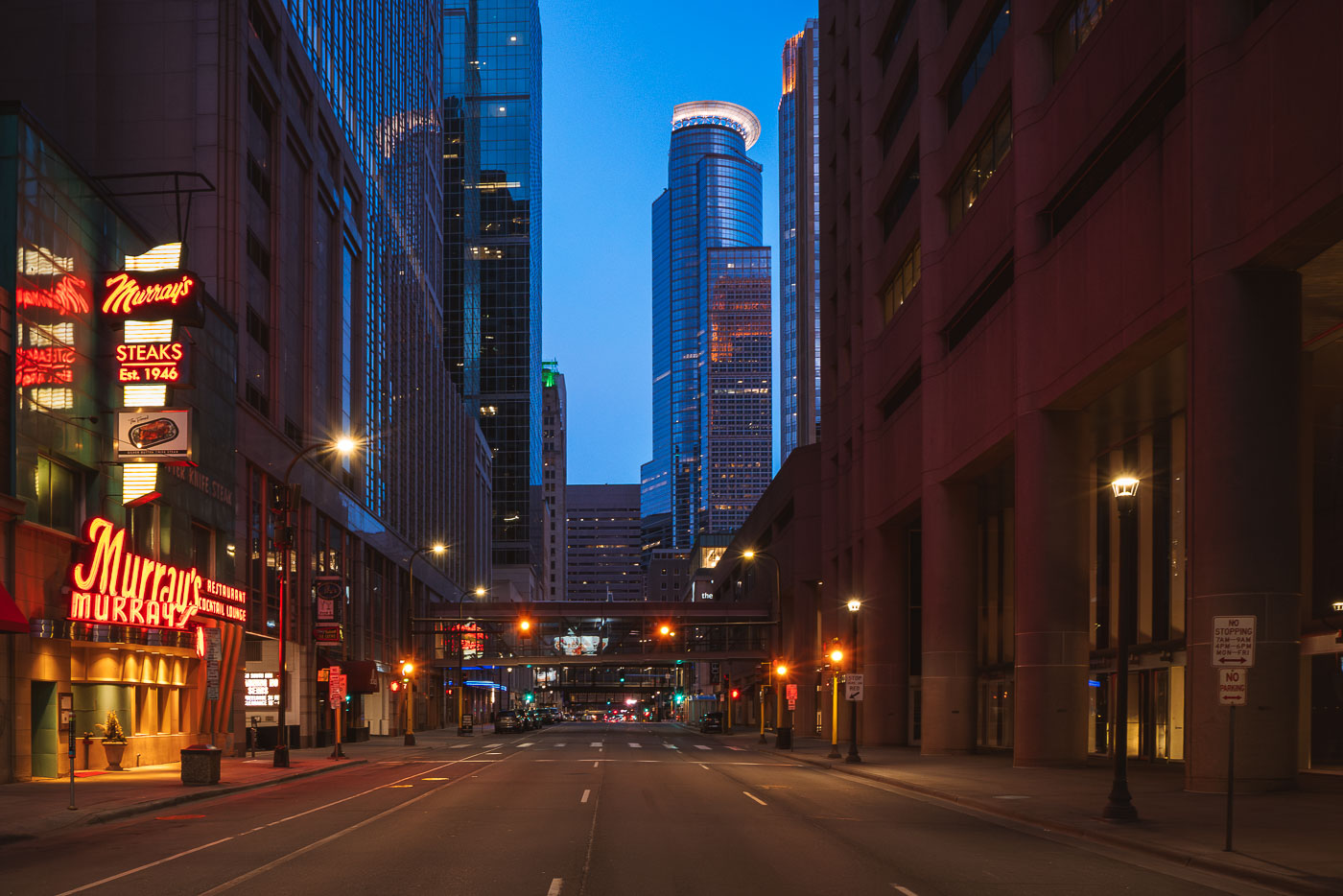
Murray's Steakhouse, Minneapolis Blue Hour
A north–south view through downtown Minneapolis during early evening, with illuminated office towers forming a dense street corridor and minimal traffic on the roadway below. The cylindrical crown of the IDS Center, completed in 1973, anchors the skyline in the distance as the city’s tallest building and a defining element of its modern profile. In the foreground, the neon signage of Murray’s, a Minneapolis institution since 1946, adds a warm counterpoint to the cooler glass-and-steel architecture surrounding Nicollet Mall.

Murray’s Steakhouse, Minneapolis Blue Hour
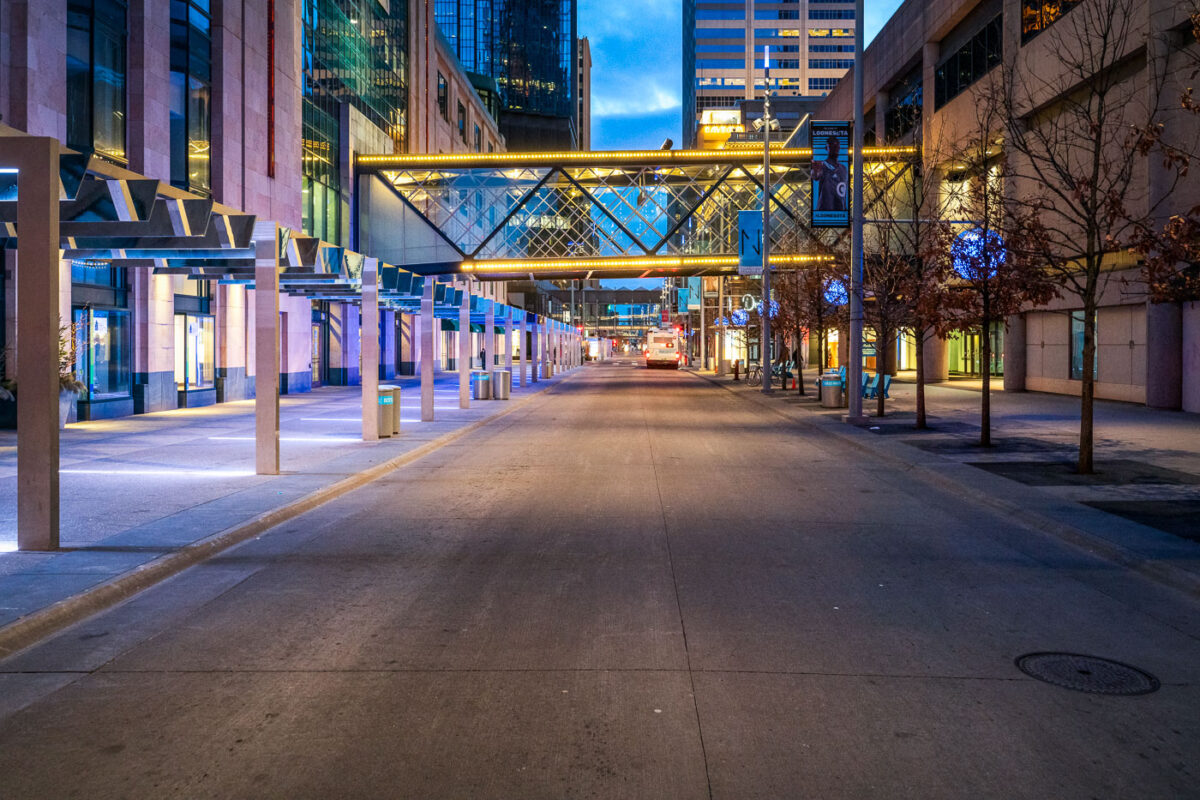
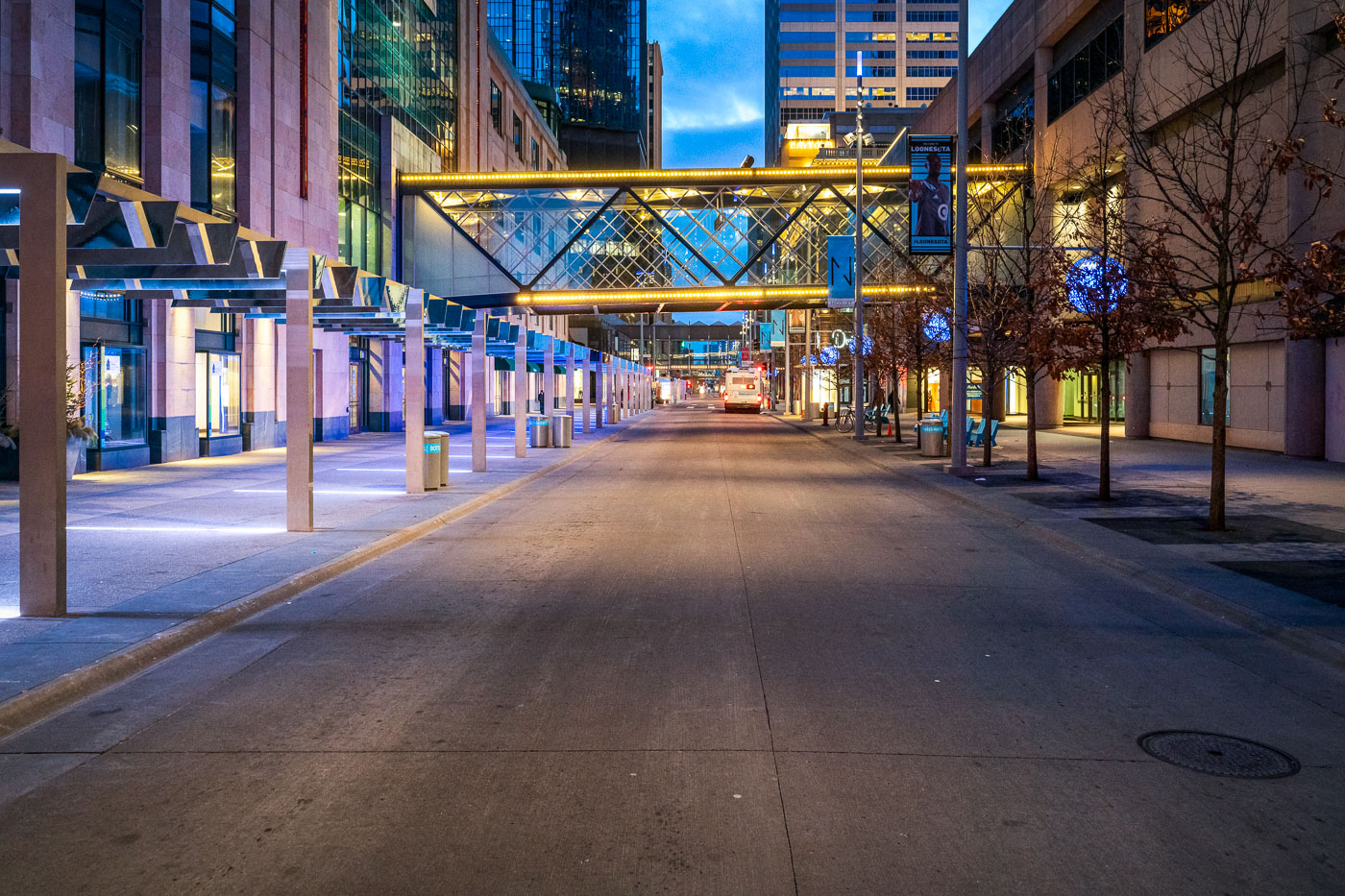
Empty Nicollet Mall pedestrian street in downtown Minneapolis at dusk during COVID-19 pandemic shutdowns.
Nicollet Mall is downtown Minneapolis's mile-long pedestrian and transit corridor, running between Washington Avenue and Grant Street. Cars have been barred from the mall since it opened in 1967, leaving the roadway to buses, taxis, and foot traffic. A $50 million redesign led by James Corner Field Operations, the firm behind New York's High Line, reopened the corridor in 2017 with wider sidewalks, new lighting, and updated bus shelters. Skyways link many of the office towers and retail buildings along the mall, letting workers move between blocks without going outside. In March 2020, Minnesota's stay-at-home order emptied the corridor of the office workers and shoppers who normally fill it on weekdays.

Nicollet Mall at Dusk During Minneapolis’s COVID-19 Shutdown
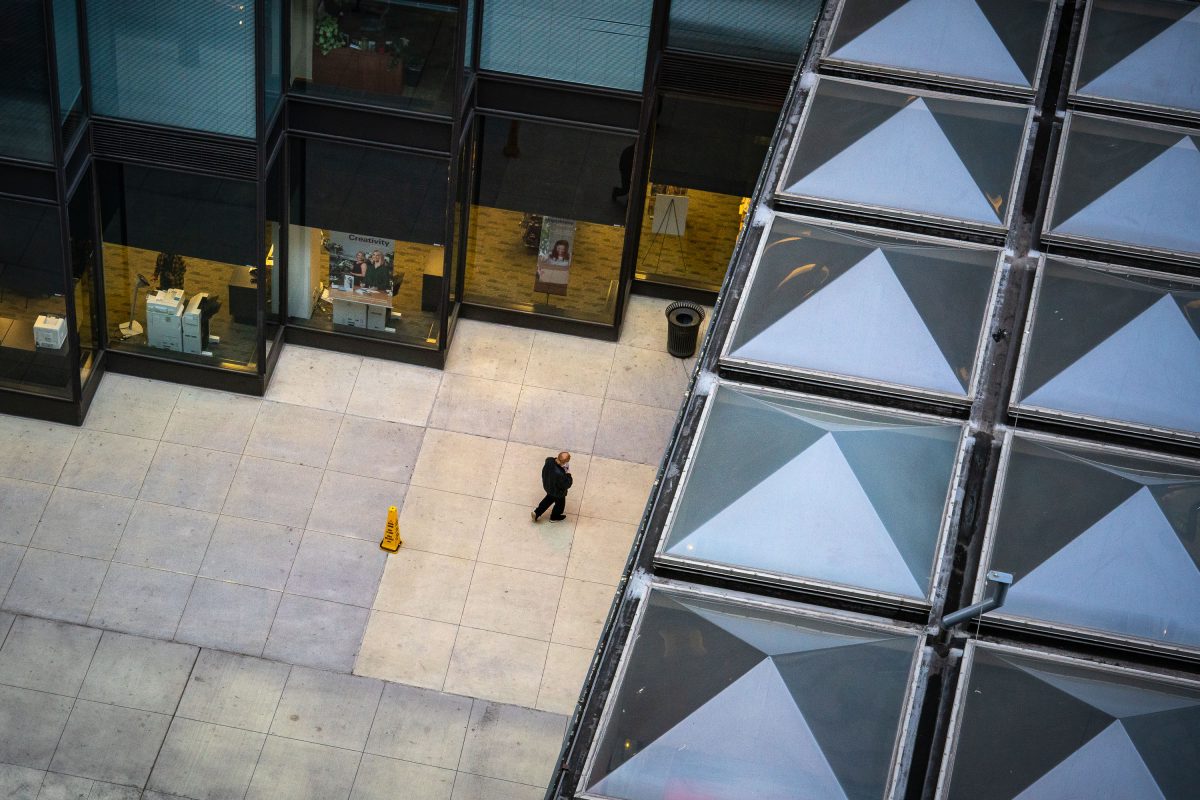
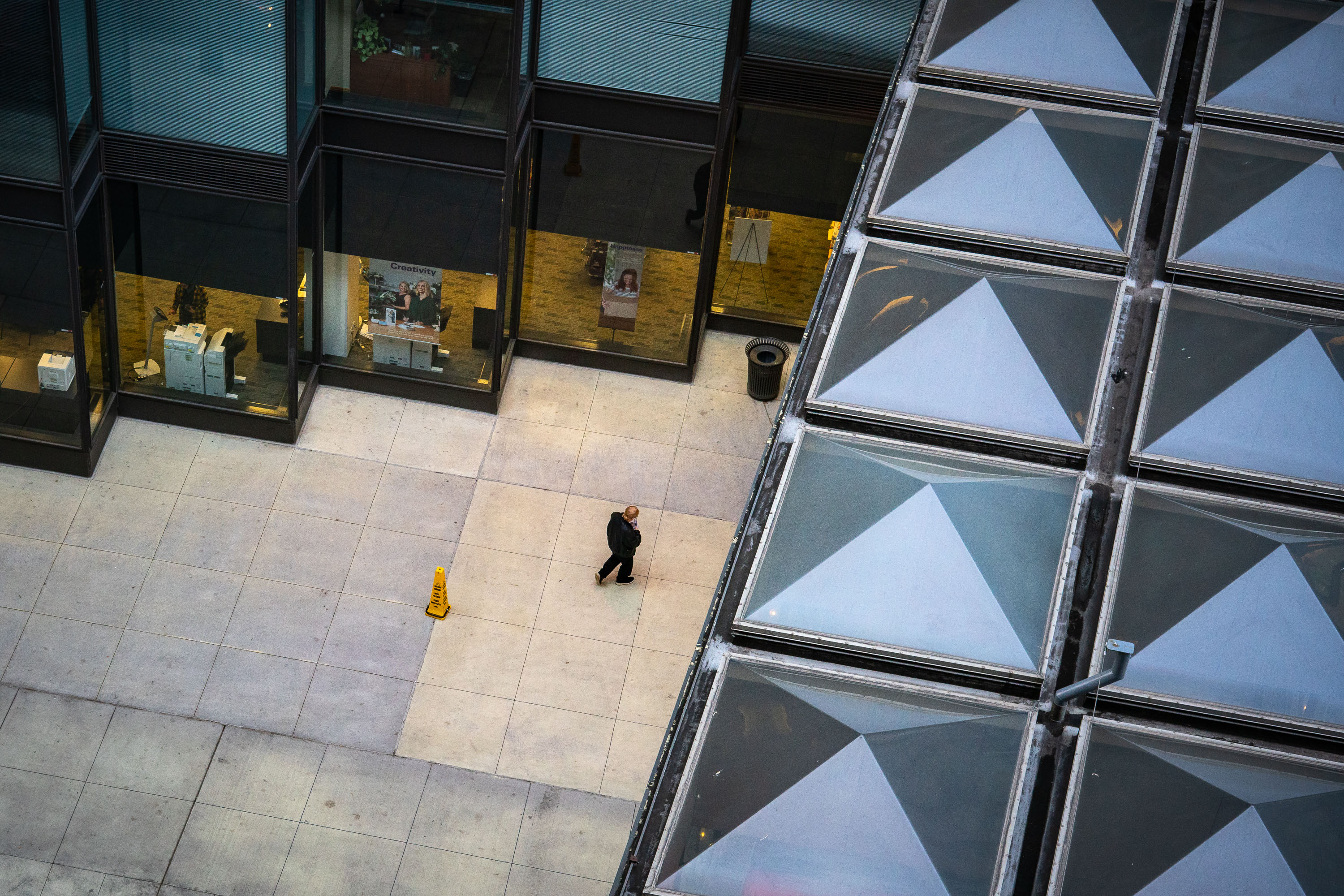
View from above the IDS Center Skyway
A man walks outside the IDS Center in Downtown Minneapolis. Seen from above the skyway.

Man walks outside the IDS Center, Minneapolis
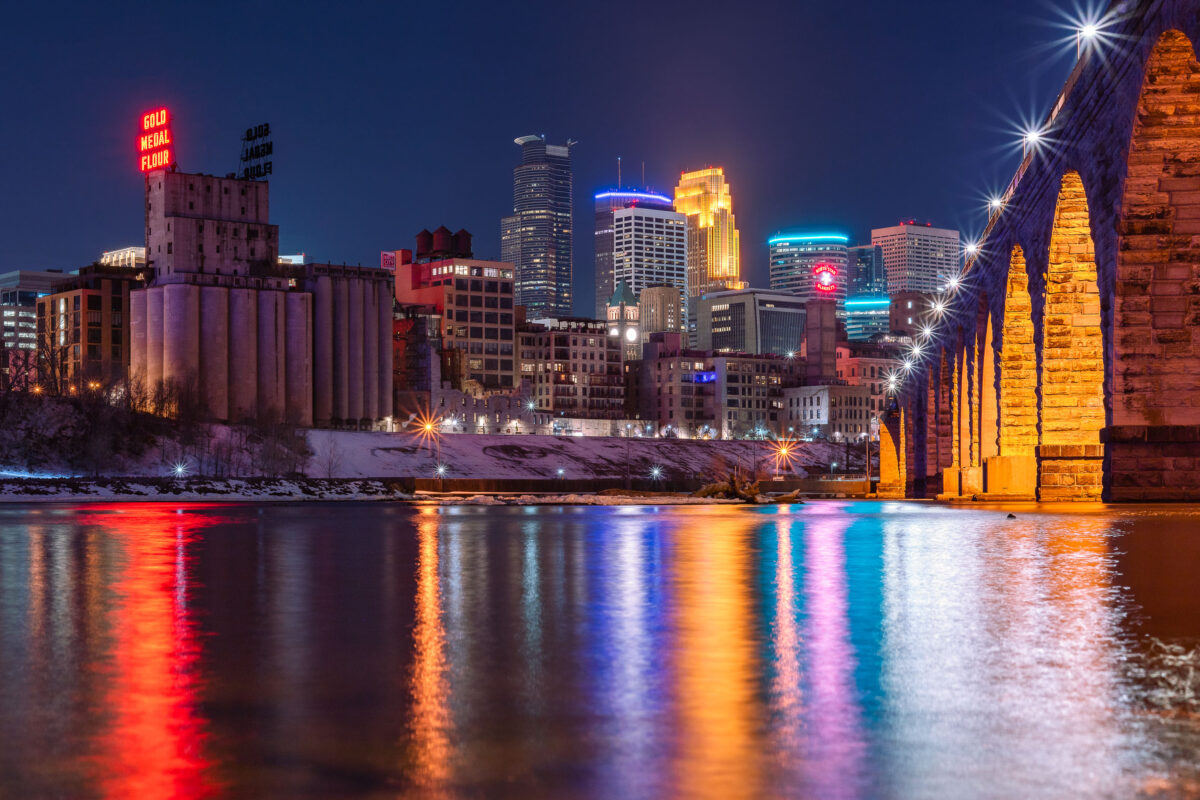
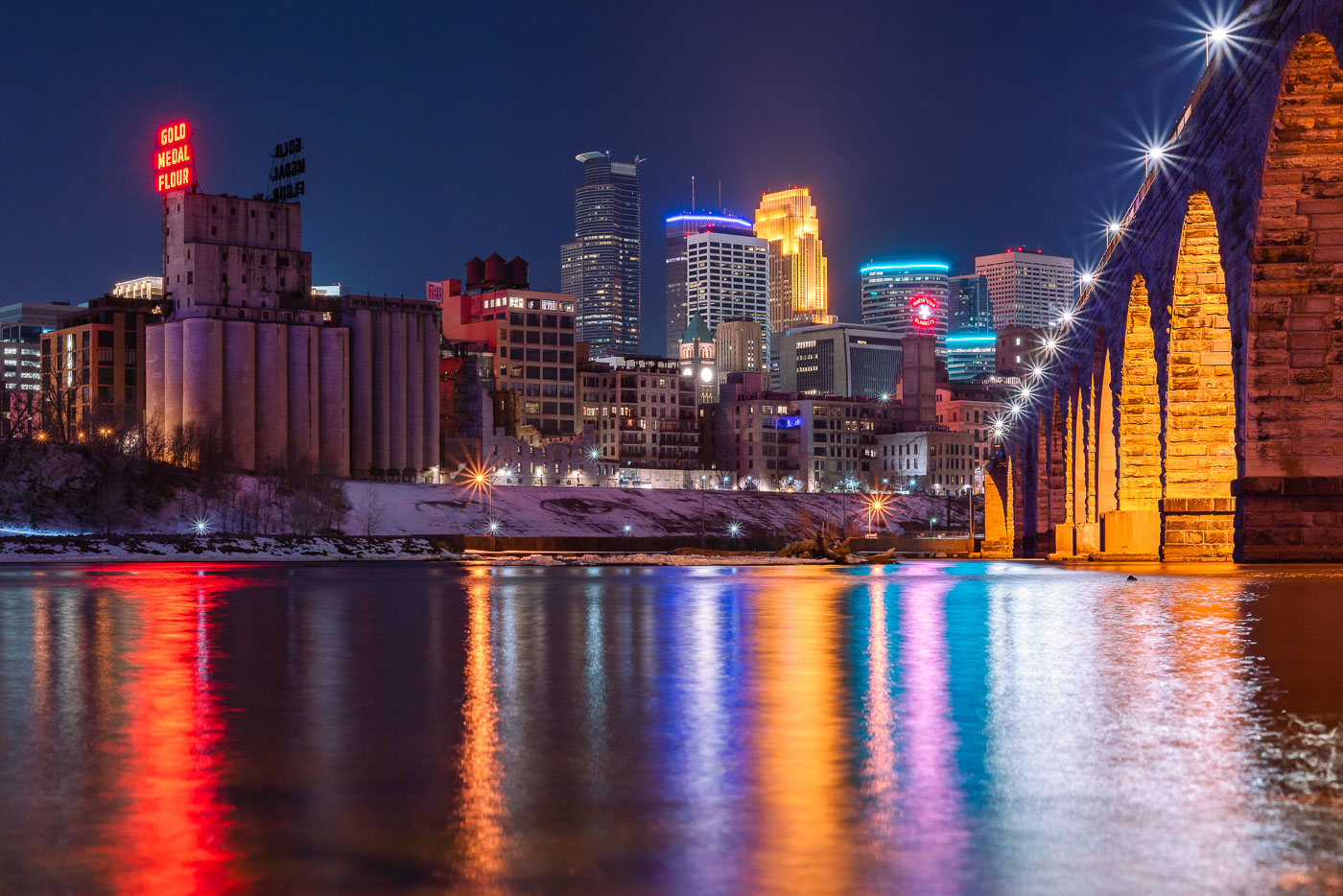
Stone Arch Bridge and Minneapolis skyline at night along the Mississippi River, with Gold Medal Flour mill sign visible.
The Gold Medal Flour sign sits atop the old Washburn-Crosby mill complex, a reminder of Minneapolis's decades as the flour-milling capital of the world. Washburn-Crosby, which later became General Mills, first put up the sign in 1910, and it has been relit and maintained as a fixture of the skyline ever since. The Stone Arch Bridge crosses the Mississippi just downstream, built in 1883 for the St. Paul, Minneapolis and Manitoba Railway to carry trains into the city's rail yards. Its limestone and granite piers were designed to withstand river ice, and the bridge now carries only pedestrians and cyclists between the riverfront and St. Anthony Main.

Gold Medal Flour Sign Above the Minneapolis Riverfront
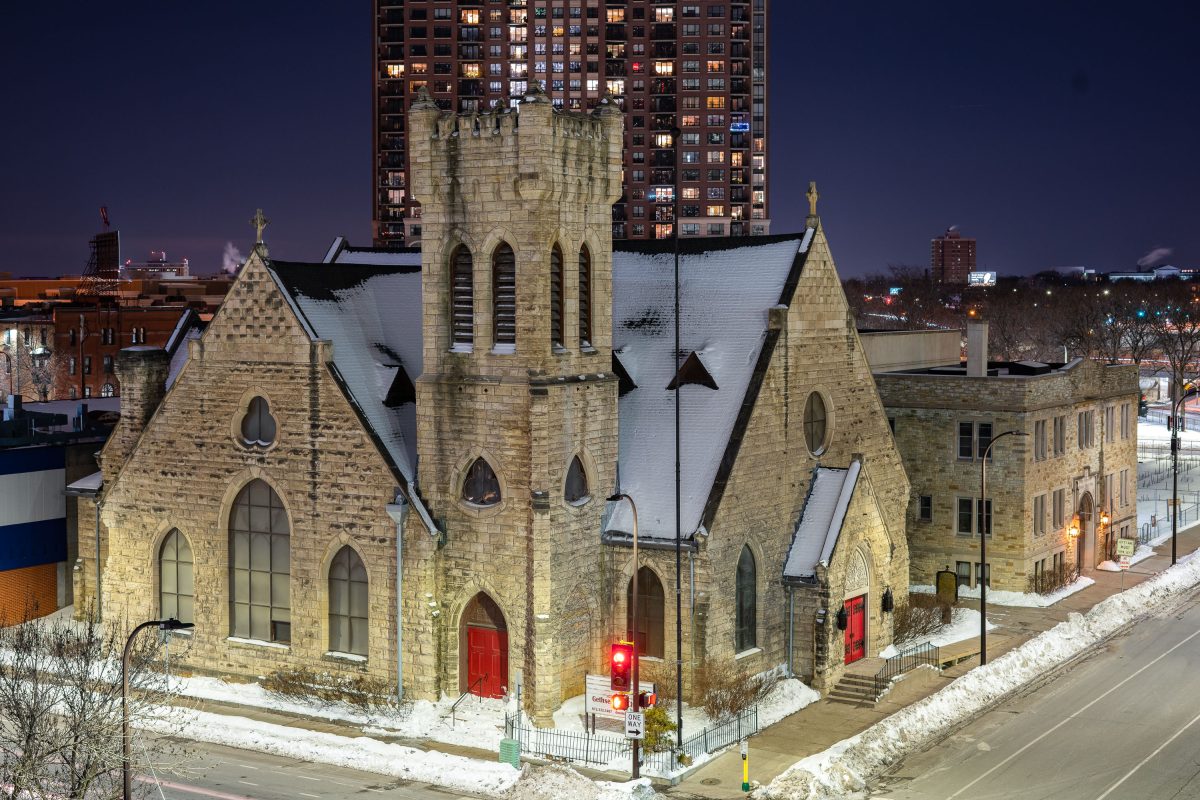
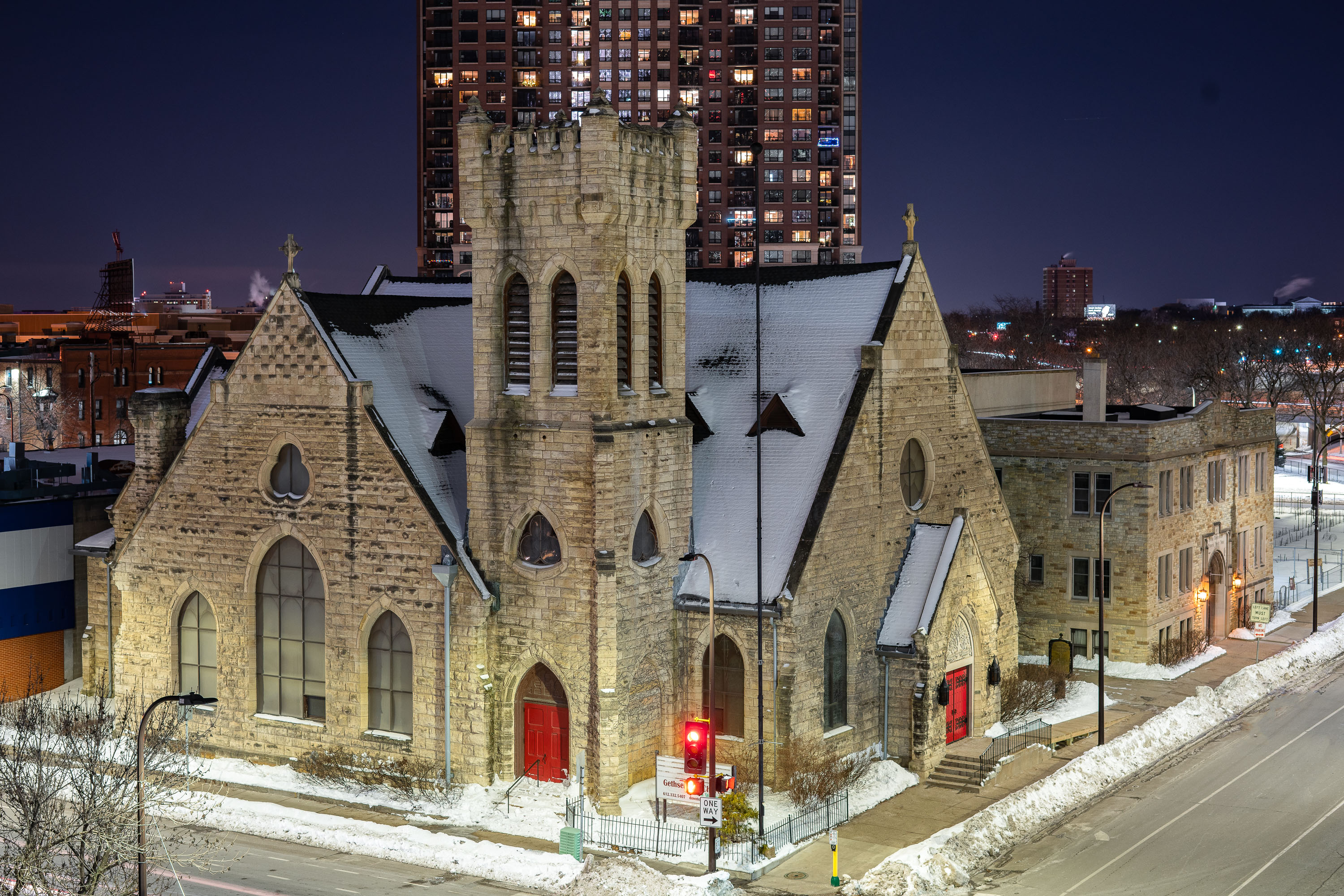
Gethsemane Episcopal Church's stone tower and snow-covered roof stand below a high-rise in downtown Minneapolis.
Gethsemane Episcopal Church stands at 905 4th Avenue South in downtown Minneapolis. The congregation was organized in 1856, making it one of the oldest Episcopal parishes in the city, and the current limestone building dates to the 1880s in a Gothic Revival style. The church has long served an urban parish role, offering outreach programs alongside regular worship. It sits within blocks of the Minneapolis Convention Center and the city's Loring Park neighborhood, surrounded in recent decades by high-rise residential towers built up around the older structure.

Gethsemane Episcopal Church Beneath Downtown Minneapolis High-Rise
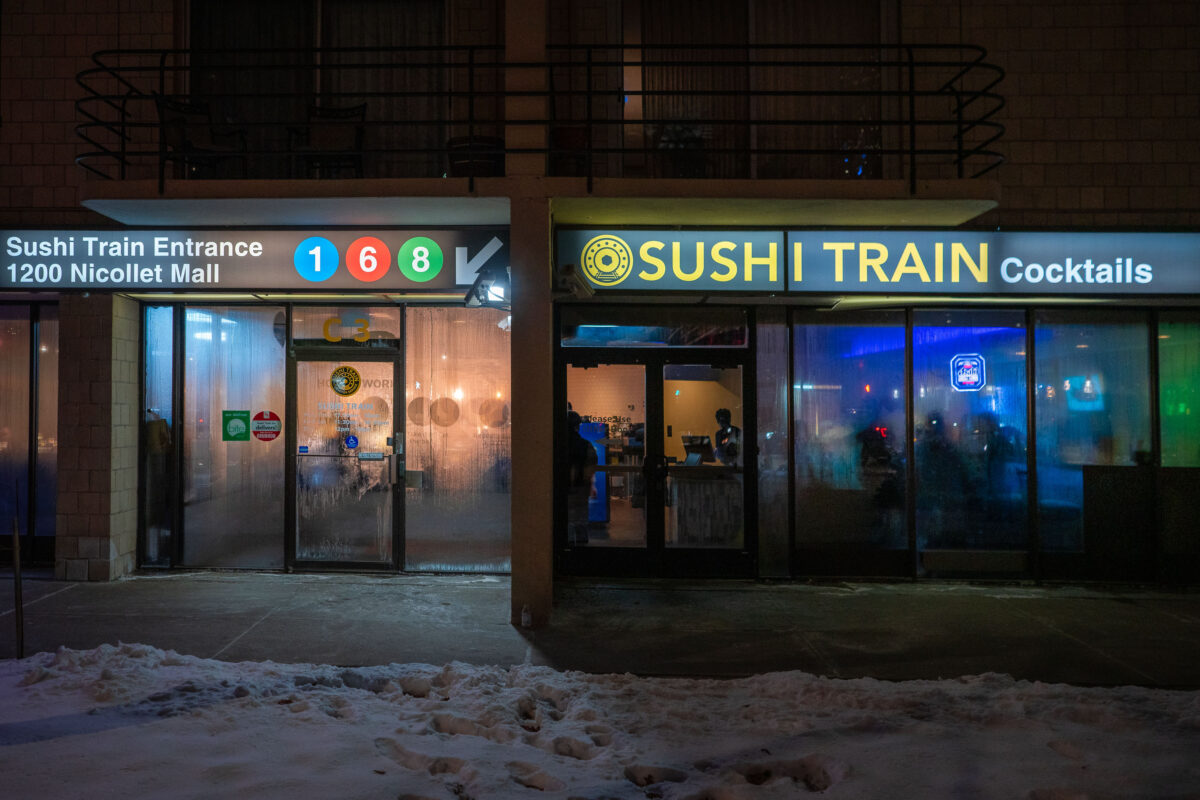
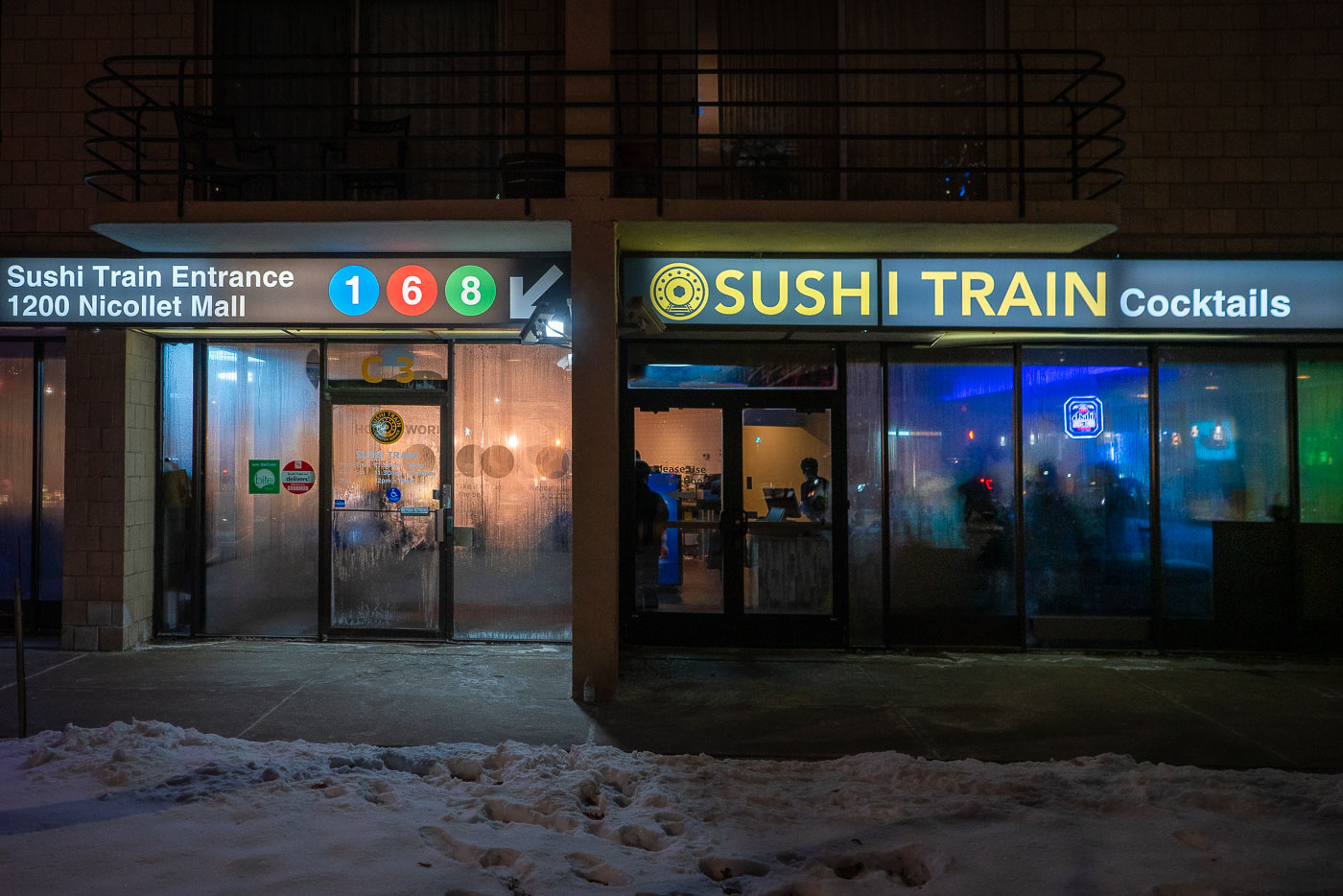
Sushi Train restaurant entrance at 1200 Nicollet Mall in downtown Minneapolis on a snowy evening.
Sushi Train is a conveyor-belt sushi restaurant at 1200 Nicollet Mall in downtown Minneapolis. The conveyor-belt format, where plates circle the dining counter for customers to pick up, began in Japan in the 1950s and later spread worldwide.

Sushi Train on Nicollet Mall on a Snowy Night
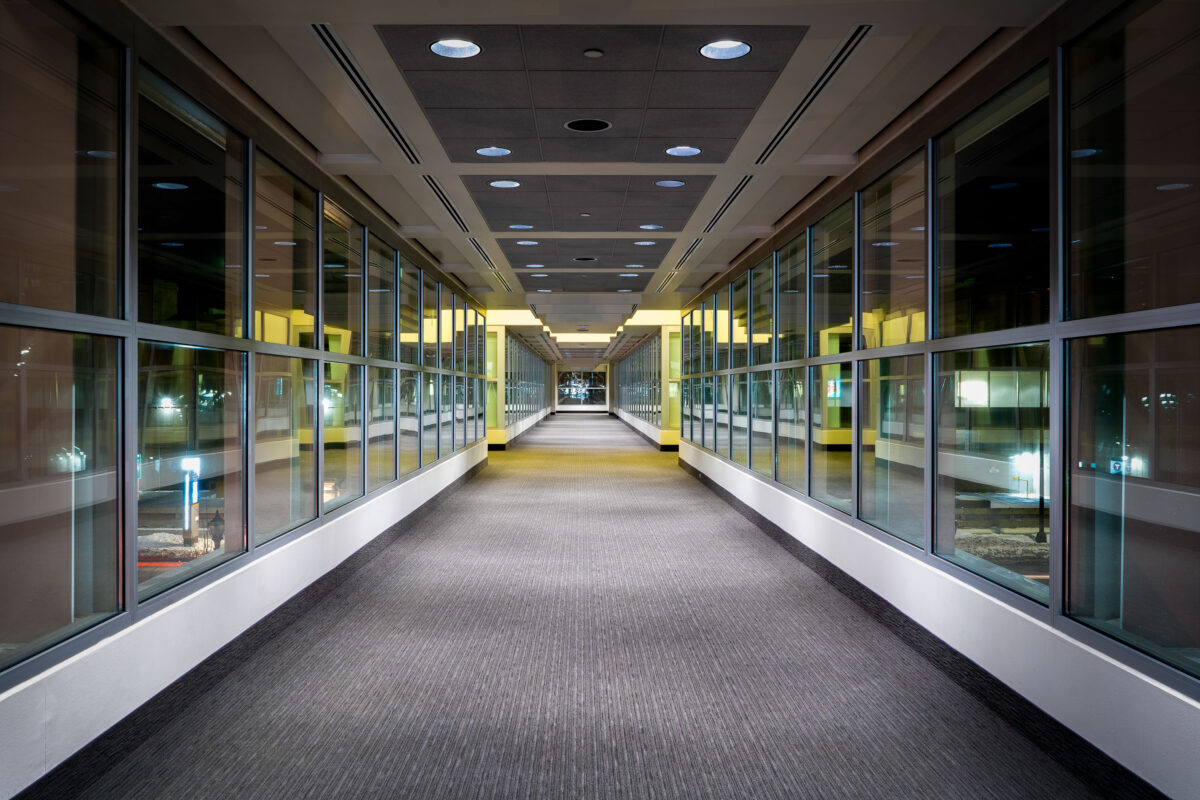
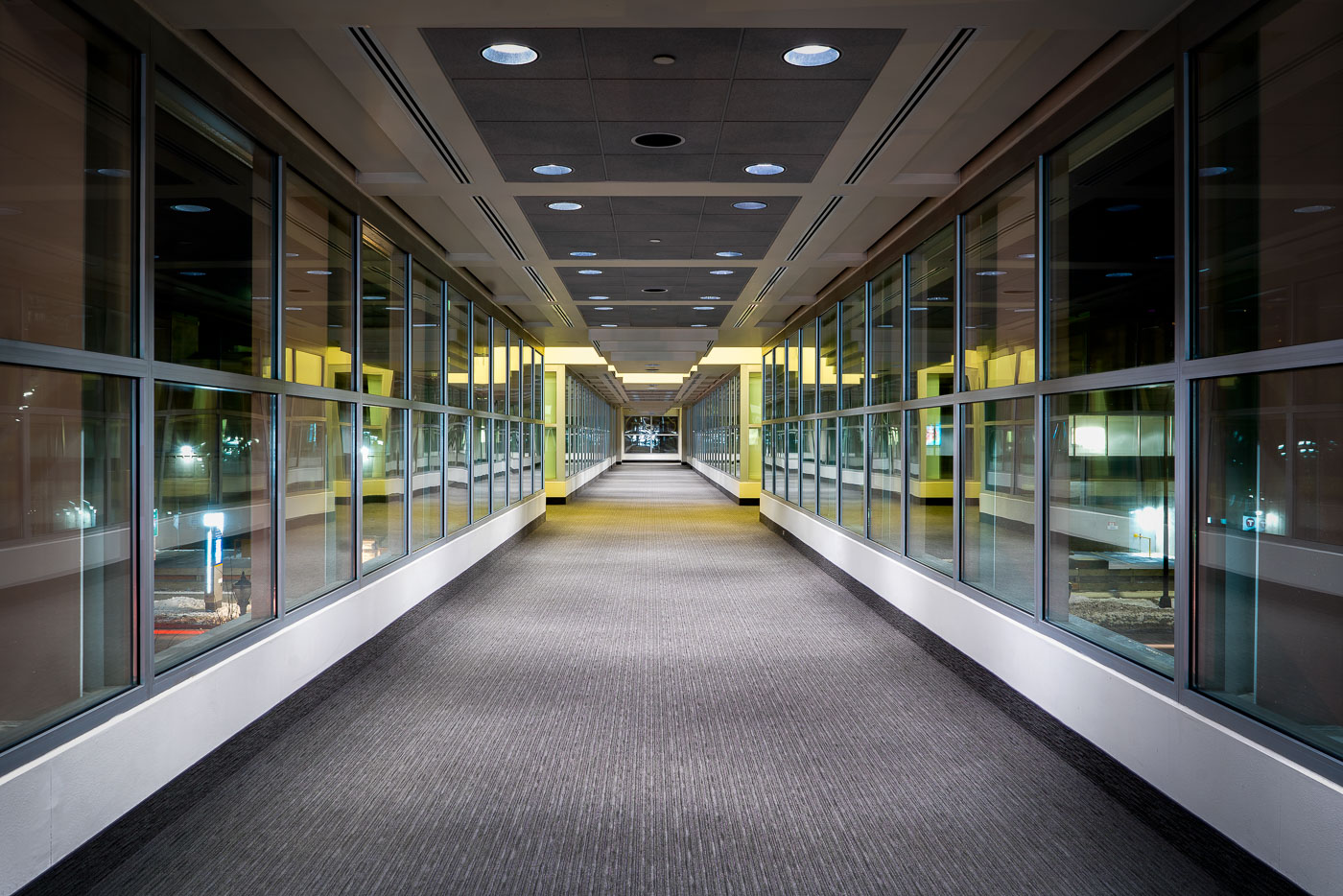
SPS Tower skyway corridor in downtown Minneapolis with windows lining the elevated walkway.
The SPS Tower skyway in downtown Minneapolis is part of the Minneapolis Skyway System. The enclosed elevated walkway connects downtown buildings above street level and supports pedestrian movement through the central business district.

SPS Tower Skyway, Downtown Minneapolis
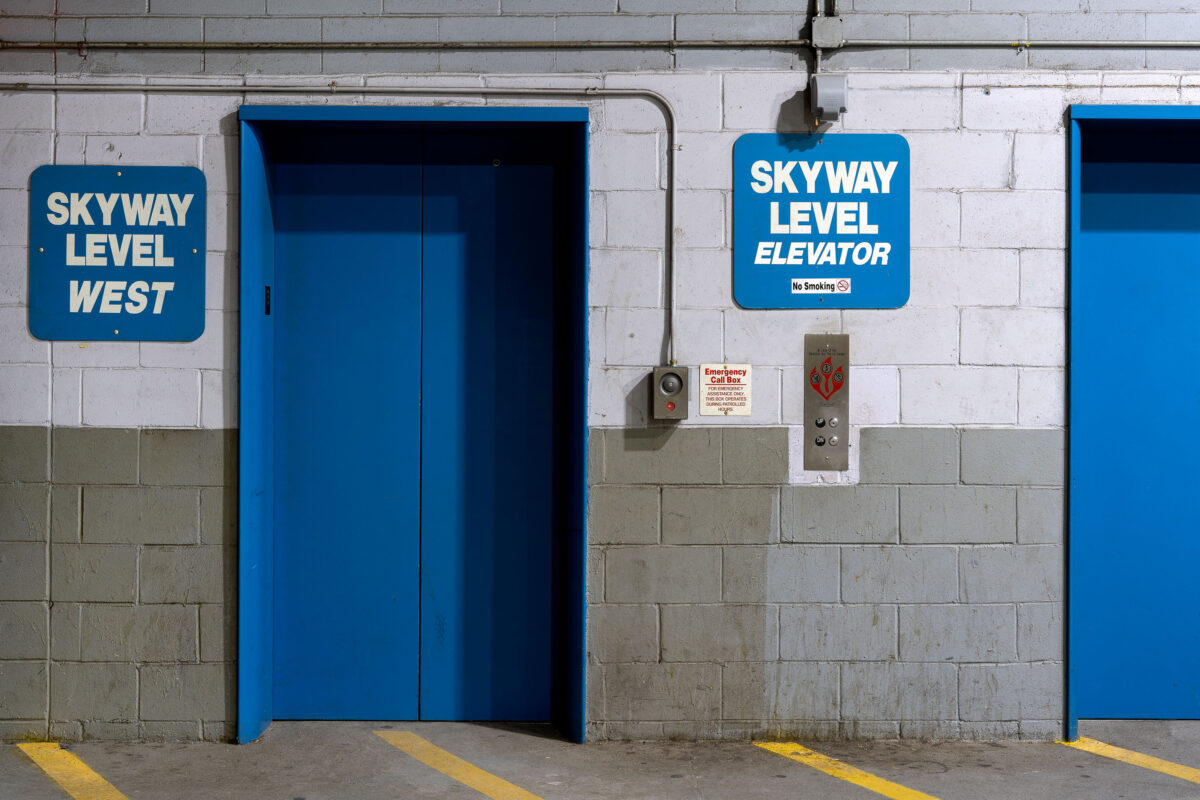
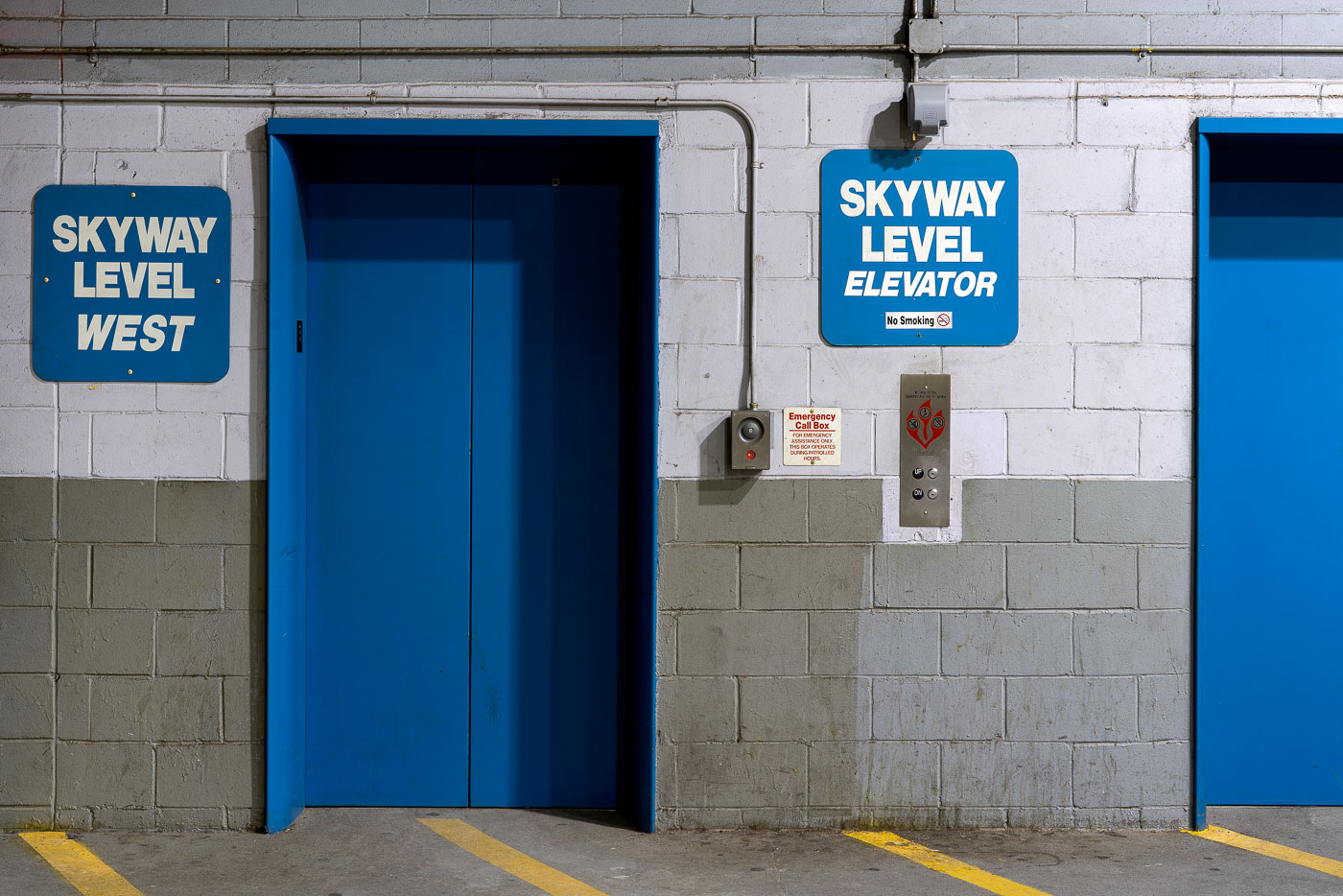
Blue directional signs for Skyway Level elevators in a downtown Minneapolis parking ramp.
Directional signs for Skyway Level elevators mark access points in a downtown Minneapolis parking ramp. The Minneapolis Skyway System connects downtown buildings at the second-floor level, allowing pedestrians to move between structures without exposure to weather. Elevator access from parking facilities is essential infrastructure for the skyway network's operation.

Skyway Level Elevator Signs, Minneapolis Parking Ramp
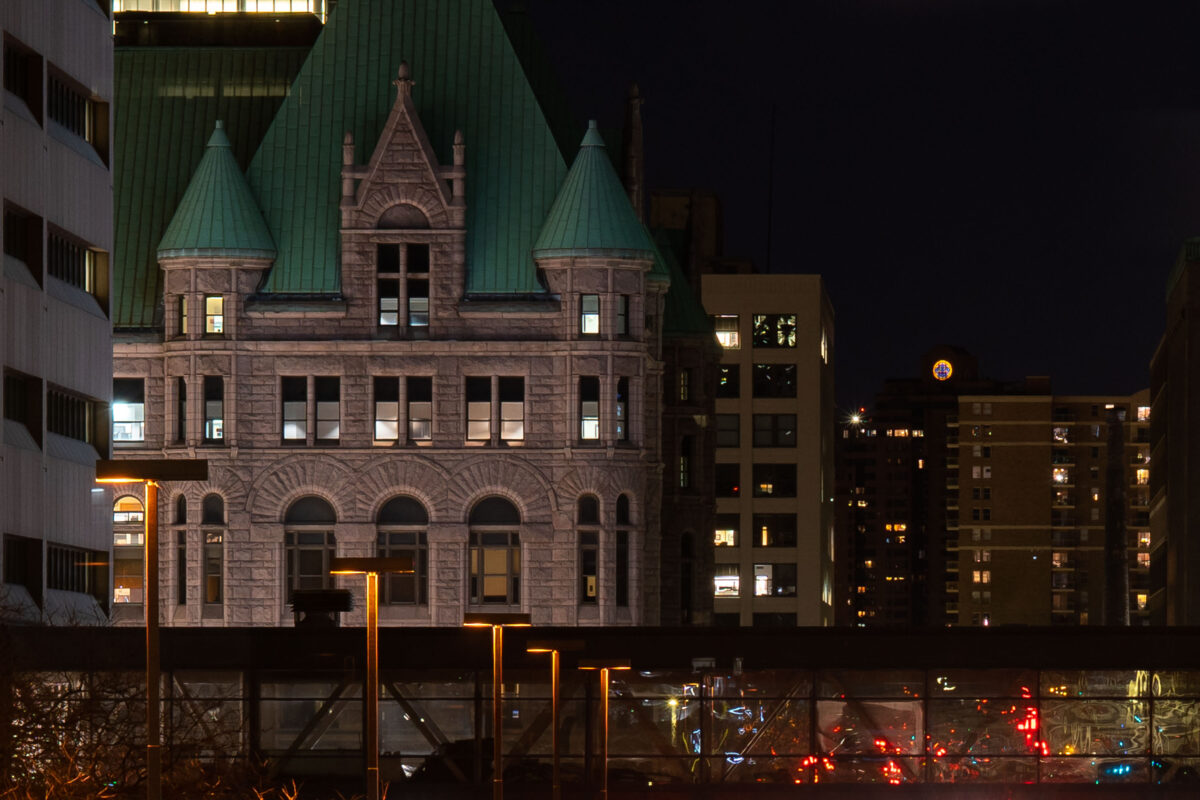
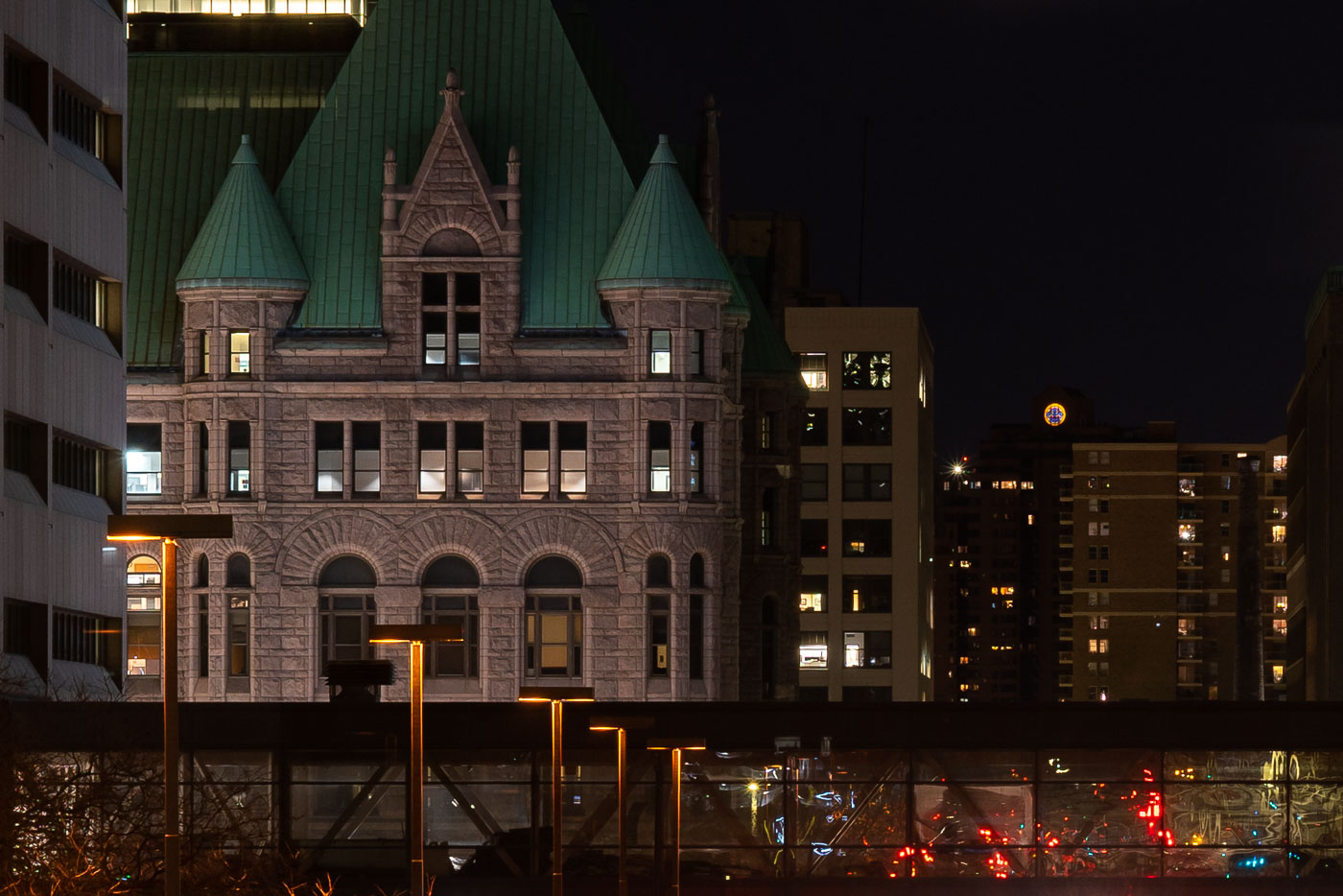
Minneapolis City Hall's green-roofed clock tower illuminated at night above downtown buildings and street lights.
Minneapolis City Hall rises behind a skyway in downtown Minneapolis at night. The historic building’s green roof and stone façade are lit against nearby apartment and office buildings.

Minneapolis City Hall Amid Downtown Towers at Night
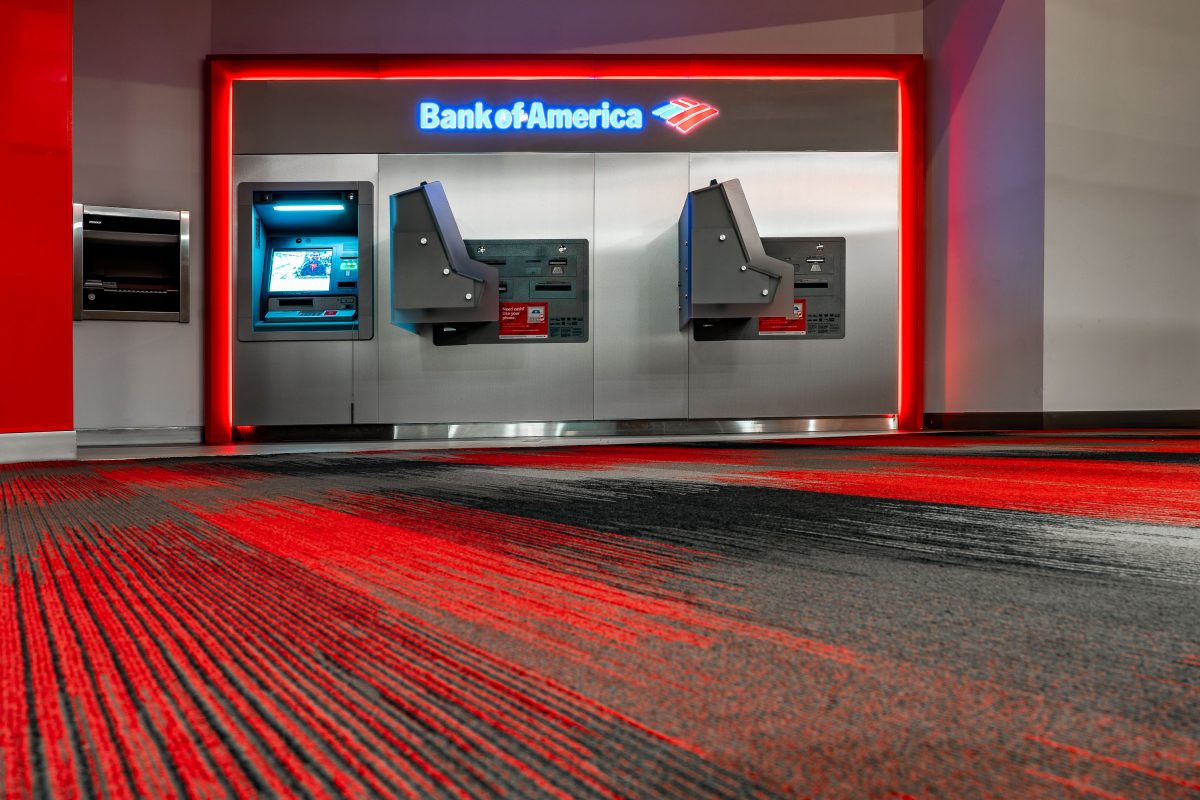
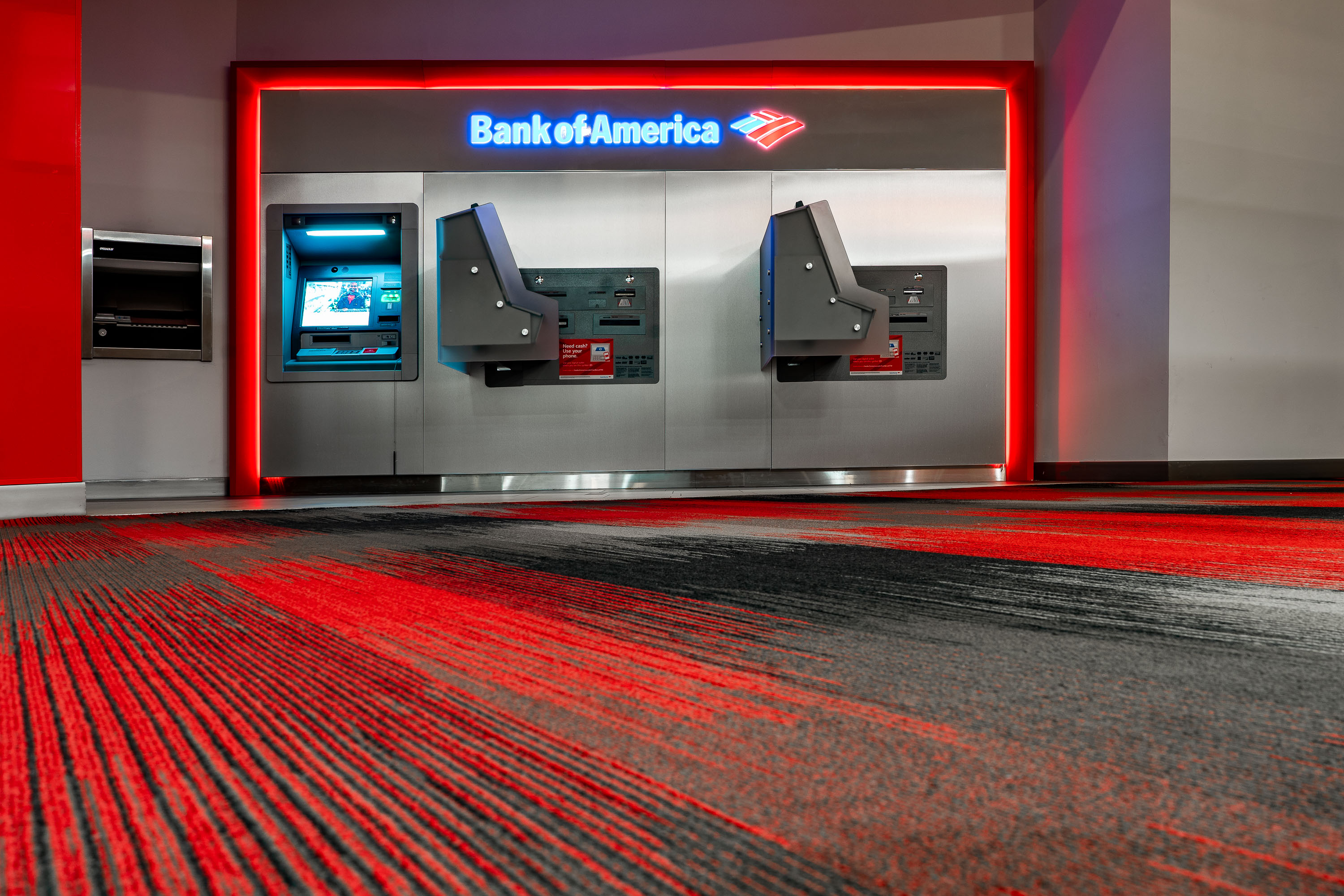
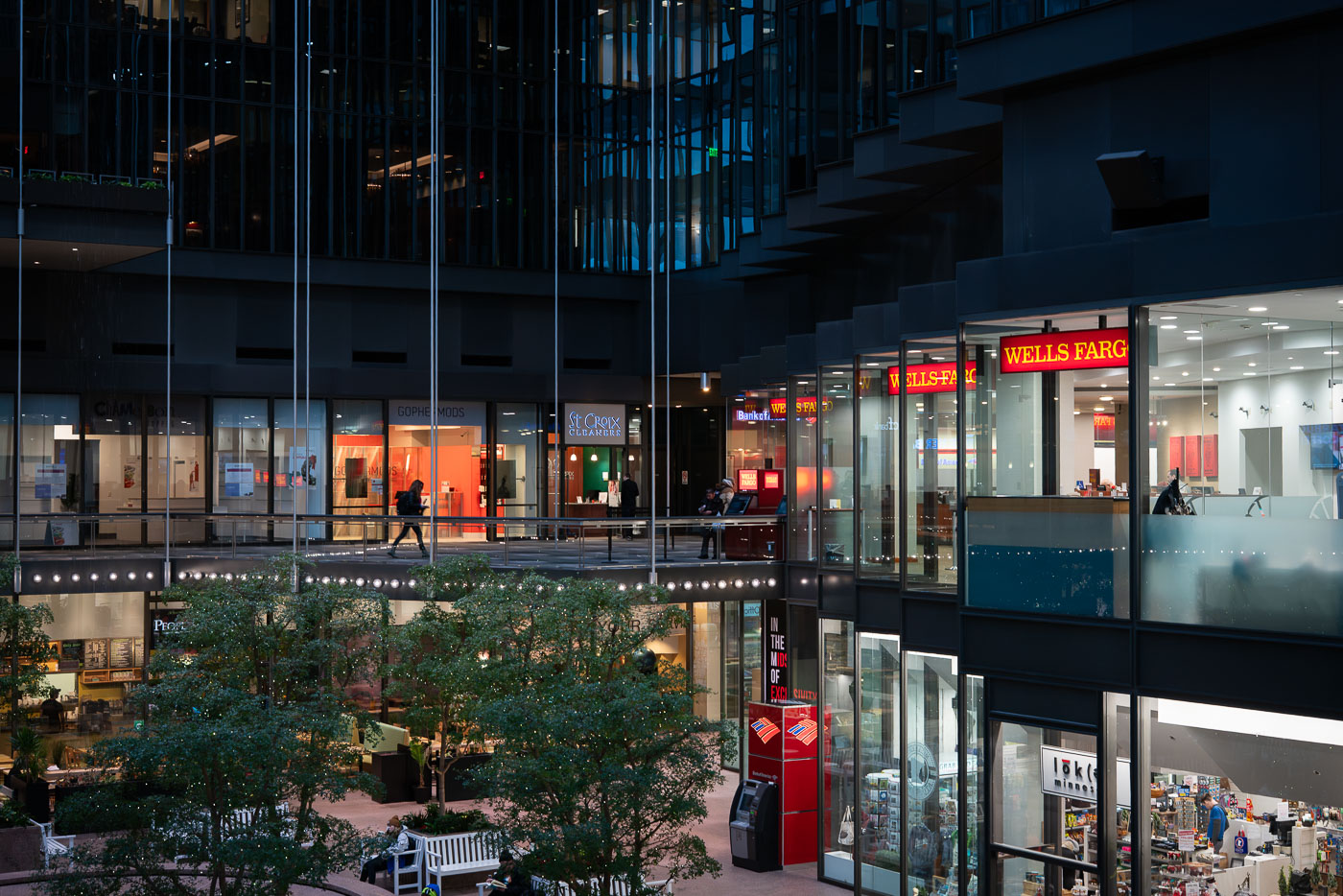
Bank Of America ATM Downtown Minneapolis
Bank Of America ATMs in the IDS Center in Downtown Minneapolis.

Bank Of America ATM Downtown Minneapolis

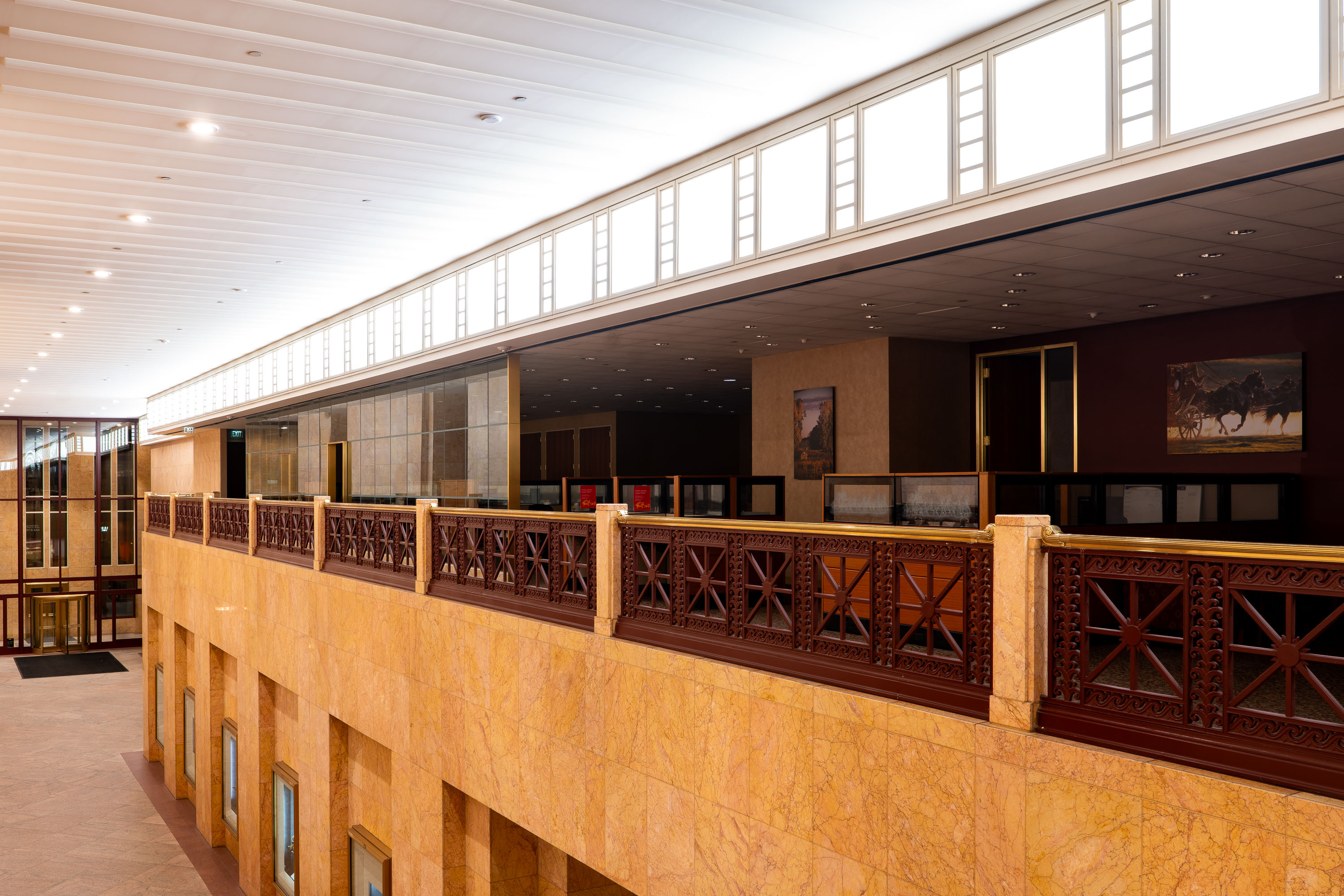
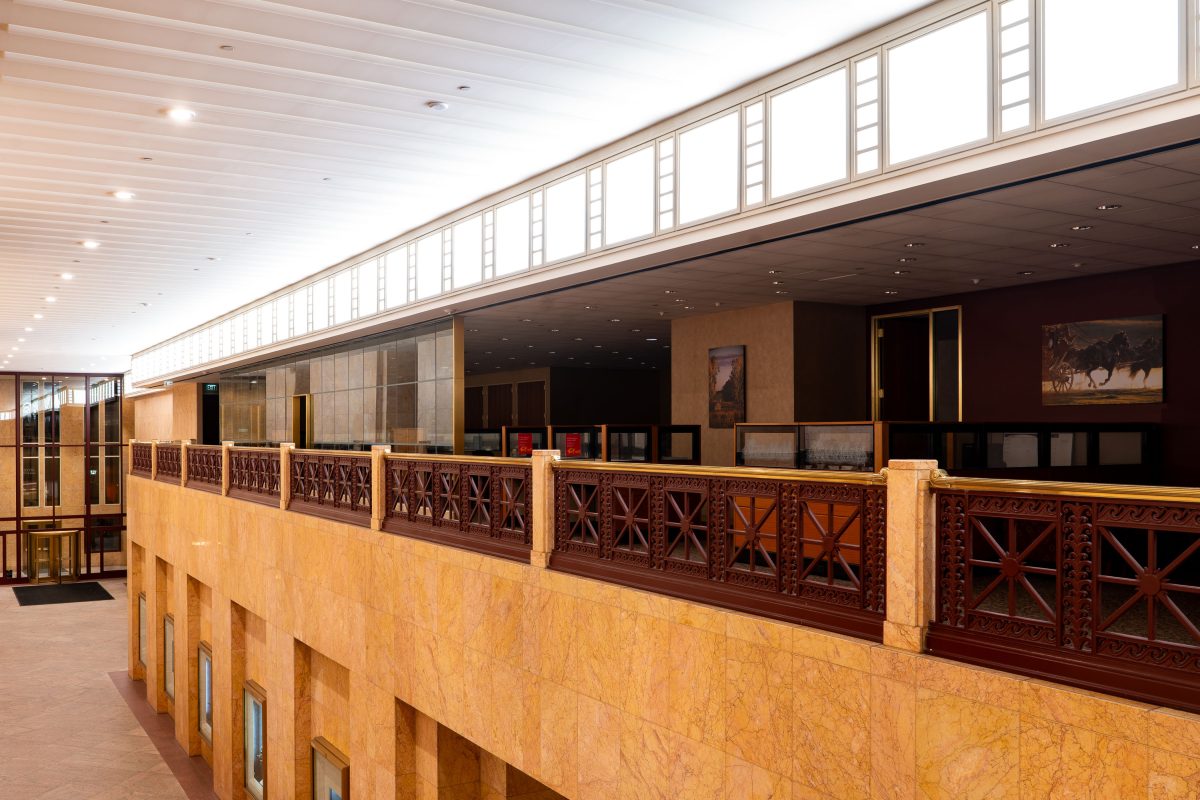
Interior of the Wells Fargo Center Museum in downtown Minneapolis featuring wooden railings and gallery spaces.
The Wells Fargo History Museum occupies the mezzanine level of the Wells Fargo Center at 90 South Seventh Street in downtown Minneapolis. Wells Fargo operates a small chain of these free museums in cities where it has a historic presence, using them to display stagecoaches, mining-era artifacts, and archival s tied to the company's founding in 1852. The exhibit cases along the balcony rail typically rotate items from the bank's corporate archives, including gold specimens and correspondence from the stagecoach express era. The Wells Fargo Center tower itself, completed in 1988 and designed by Cesar Pelli, rises 58 stories above the museum's perch overlooking the building's lobby.

Mezzanine Balcony, Wells Fargo History Museum, Minneapolis
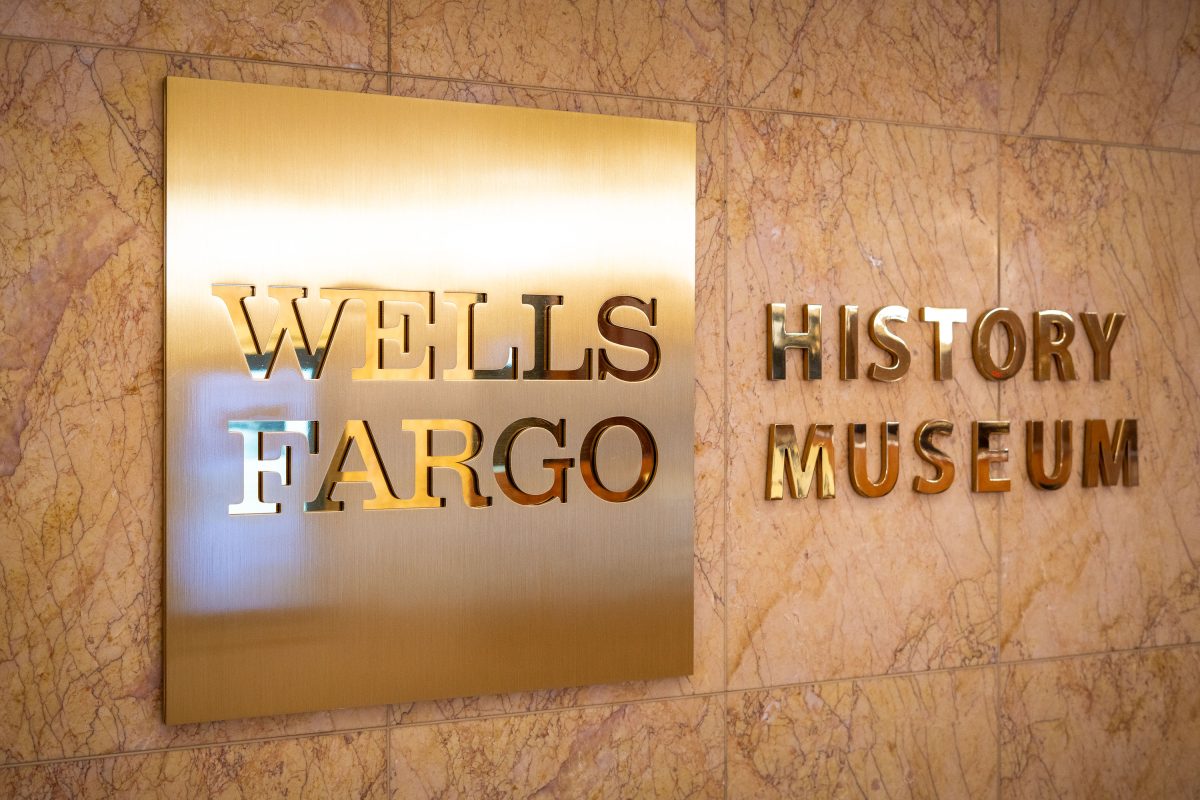
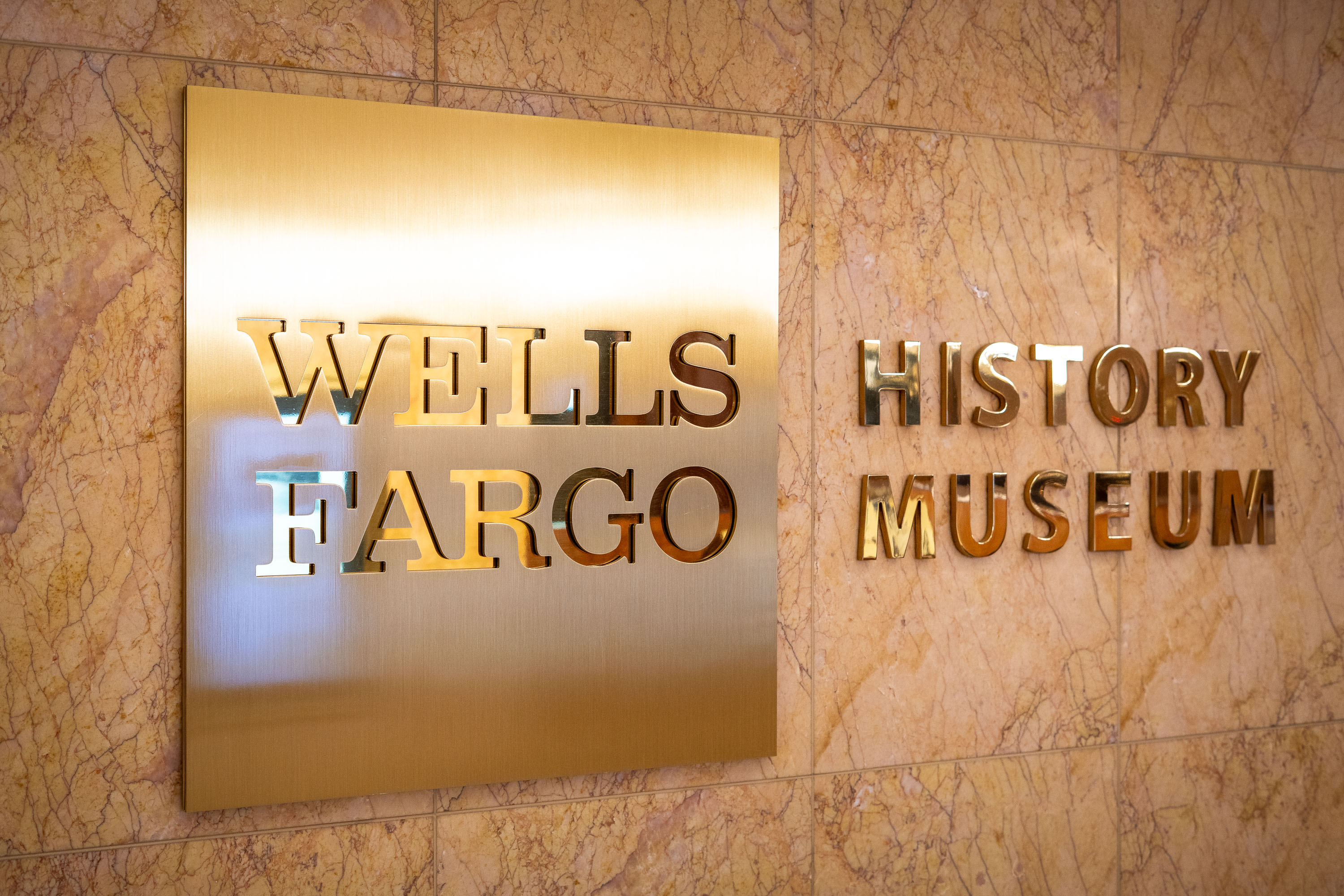
Wells Fargo History Museum signage mounted on marble wall in Minneapolis.
Wells Fargo operates several history museums across its footprint, including this one inside Wells Fargo Center in downtown Minneapolis. The museums showcase artifacts from the company's founding in 1852 by Henry Wells and William Fargo, when it began as an express delivery and banking service for customers headed to California during the Gold Rush. Exhibits typically include stagecoaches, mining-era currency, and telegraph equipment tracing the company's expansion across the American West. Wells Fargo Center itself, completed in 1988, is a 58-story skyscraper designed by César Pelli and remains one of the tallest buildings in Minneapolis.

Wells Fargo History Museum, Wells Fargo Center, Minneapolis
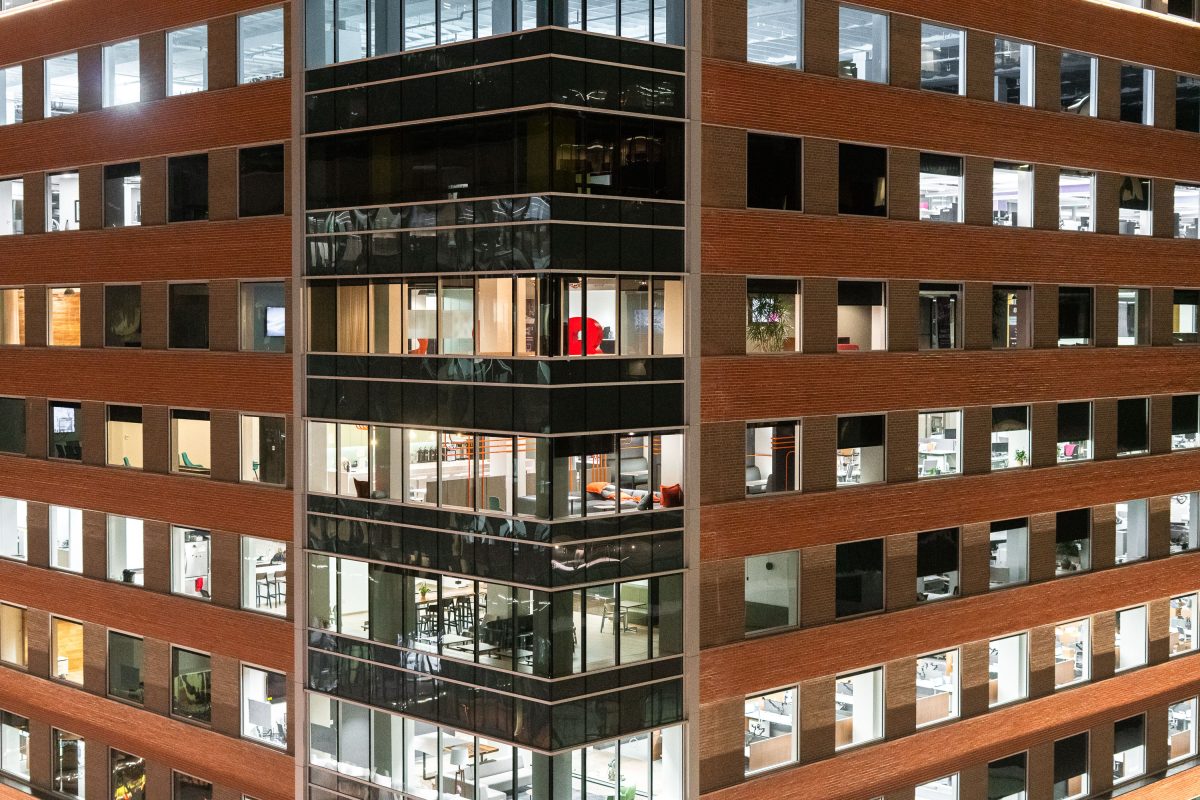
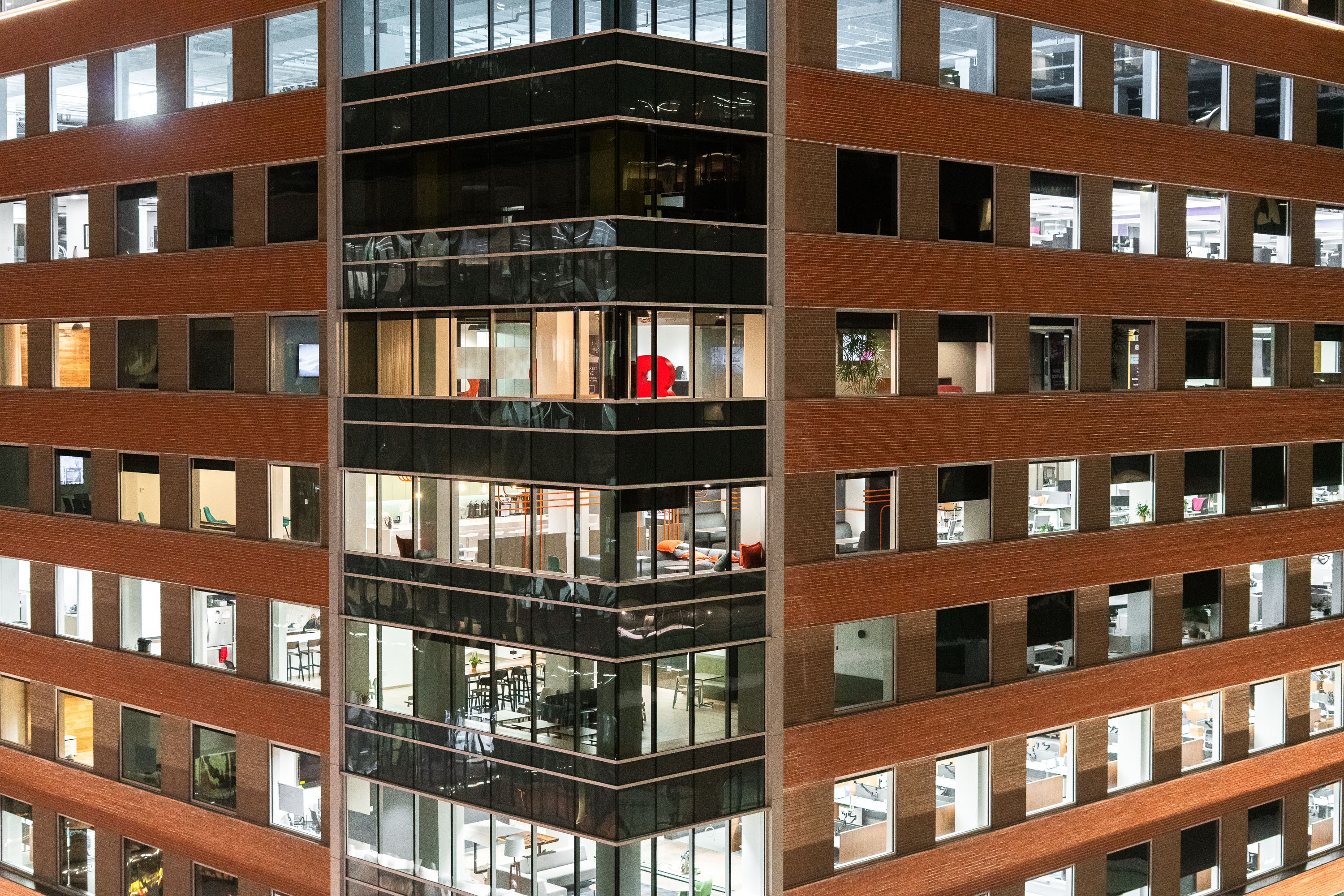
Baker Center Renovation in Downtown Minneapolis
The Baker Center office building in downtown Minneapolis after ungoing a large renovation both inside and outside.

Baker Center Renovation in Downtown Minneapolis

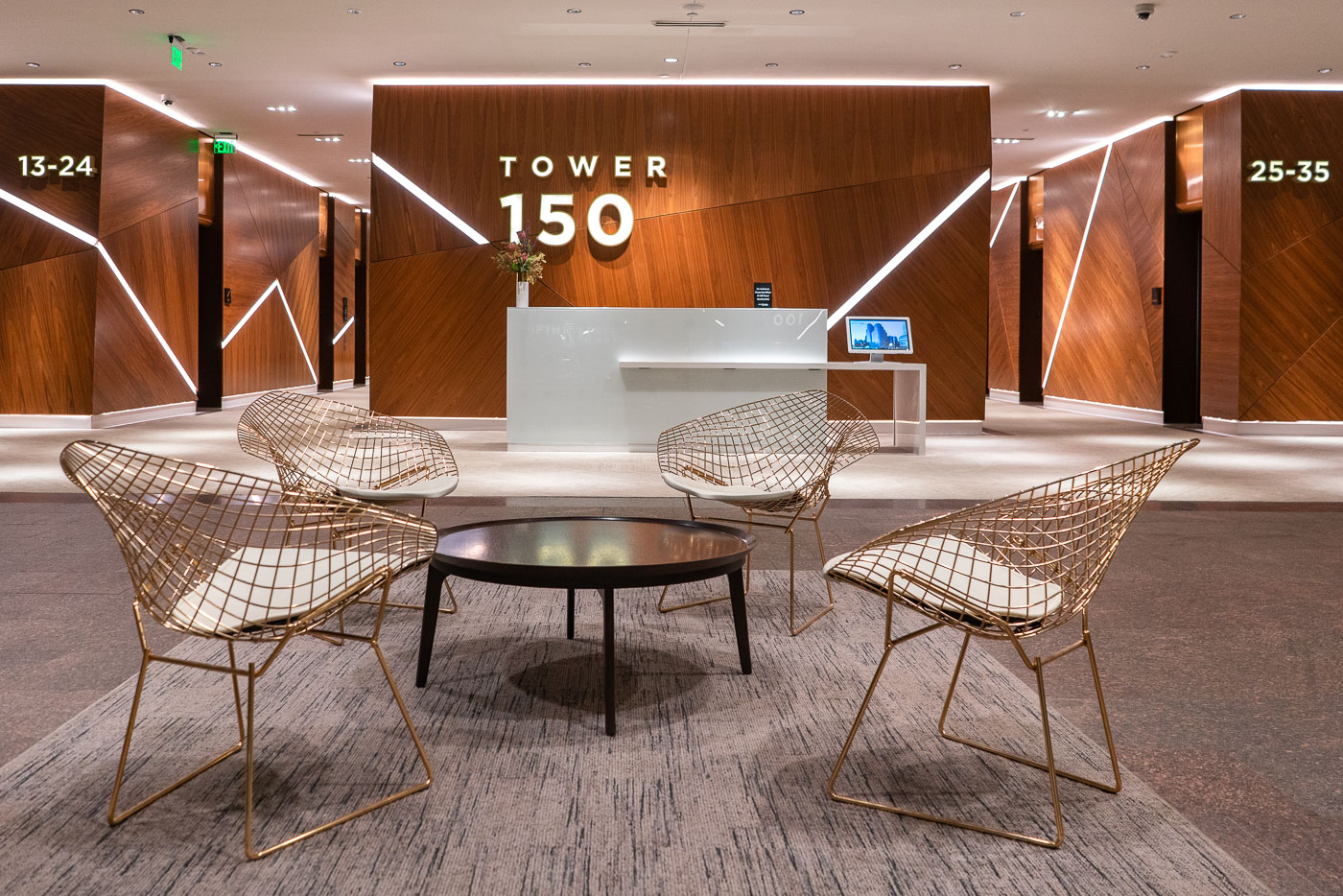
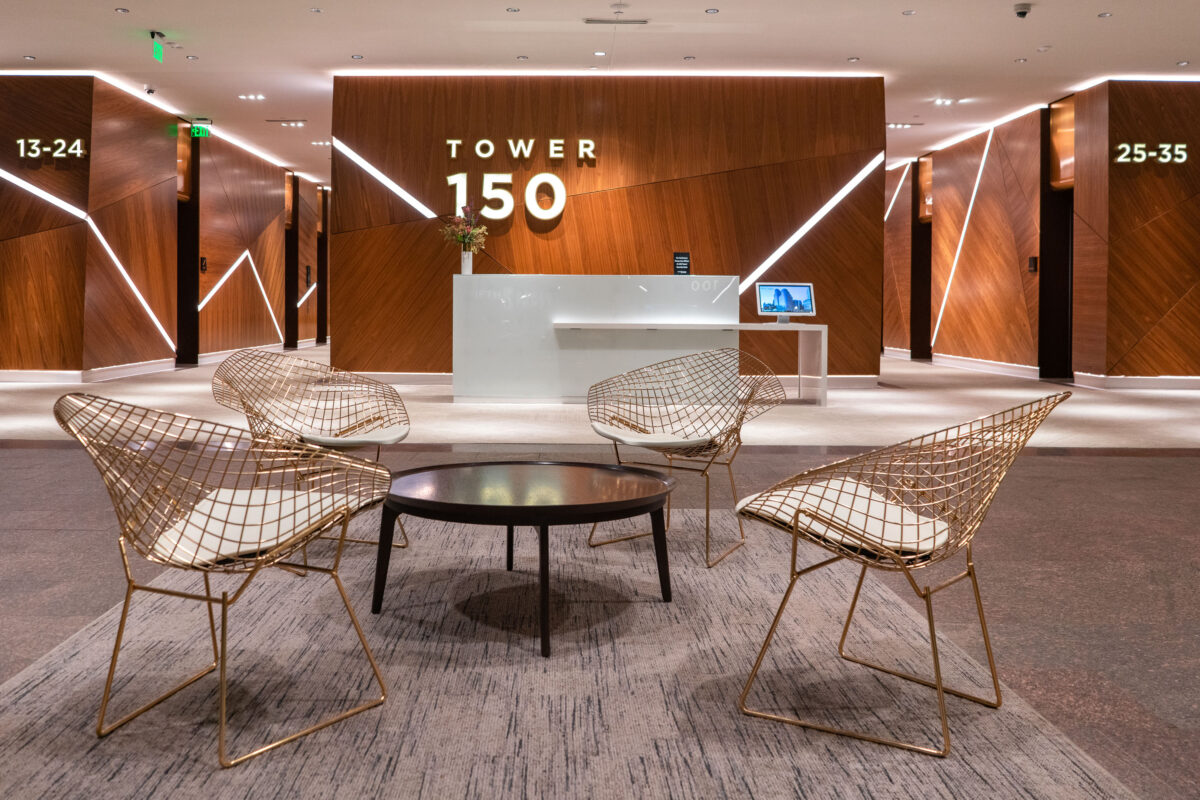
Tower 150 lobby at Fifth Street Towers in downtown Minneapolis with elevator banks and seating.
Tower 150 lobby at Fifth Street Towers in downtown Minneapolis. The office tower is part of the Fifth Street Towers complex, which connects to the Minneapolis Skyway system. The lobby provides elevator access to upper-floor offices and links building tenants and visitors with the downtown skyway network.

Tower 150 Lobby at Fifth Street Towers
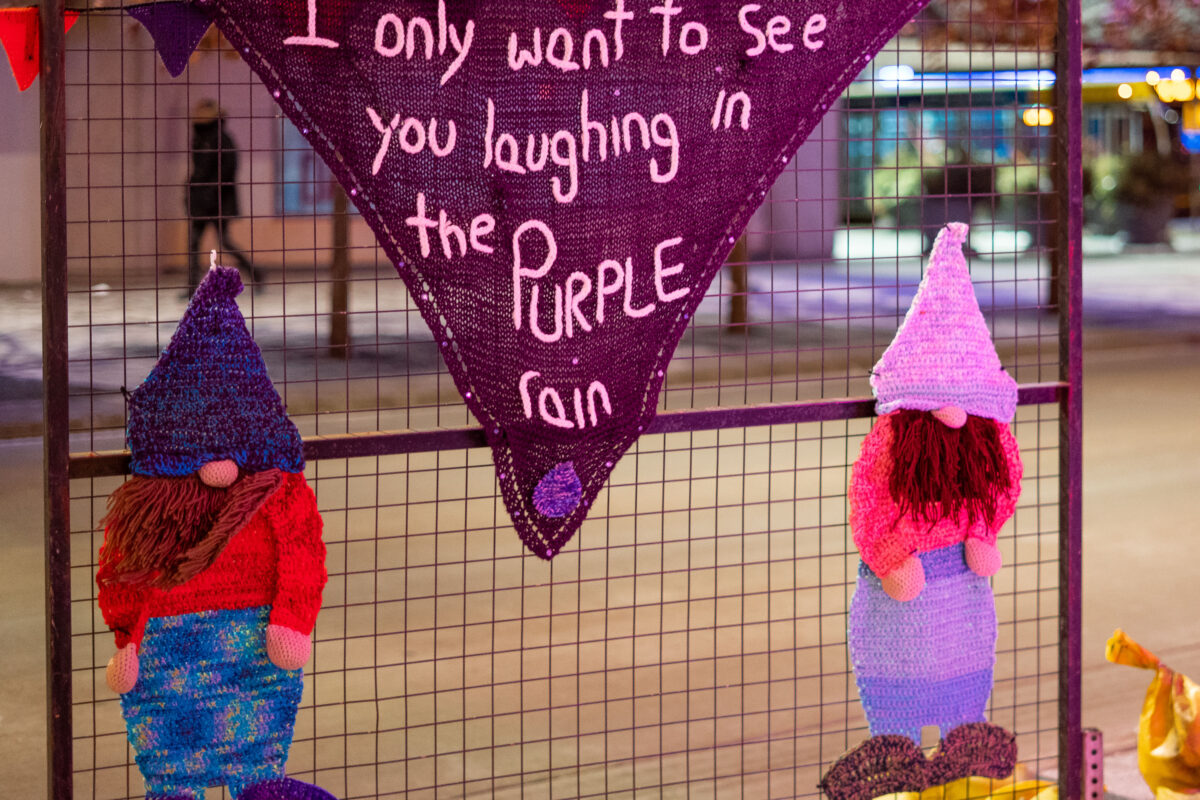
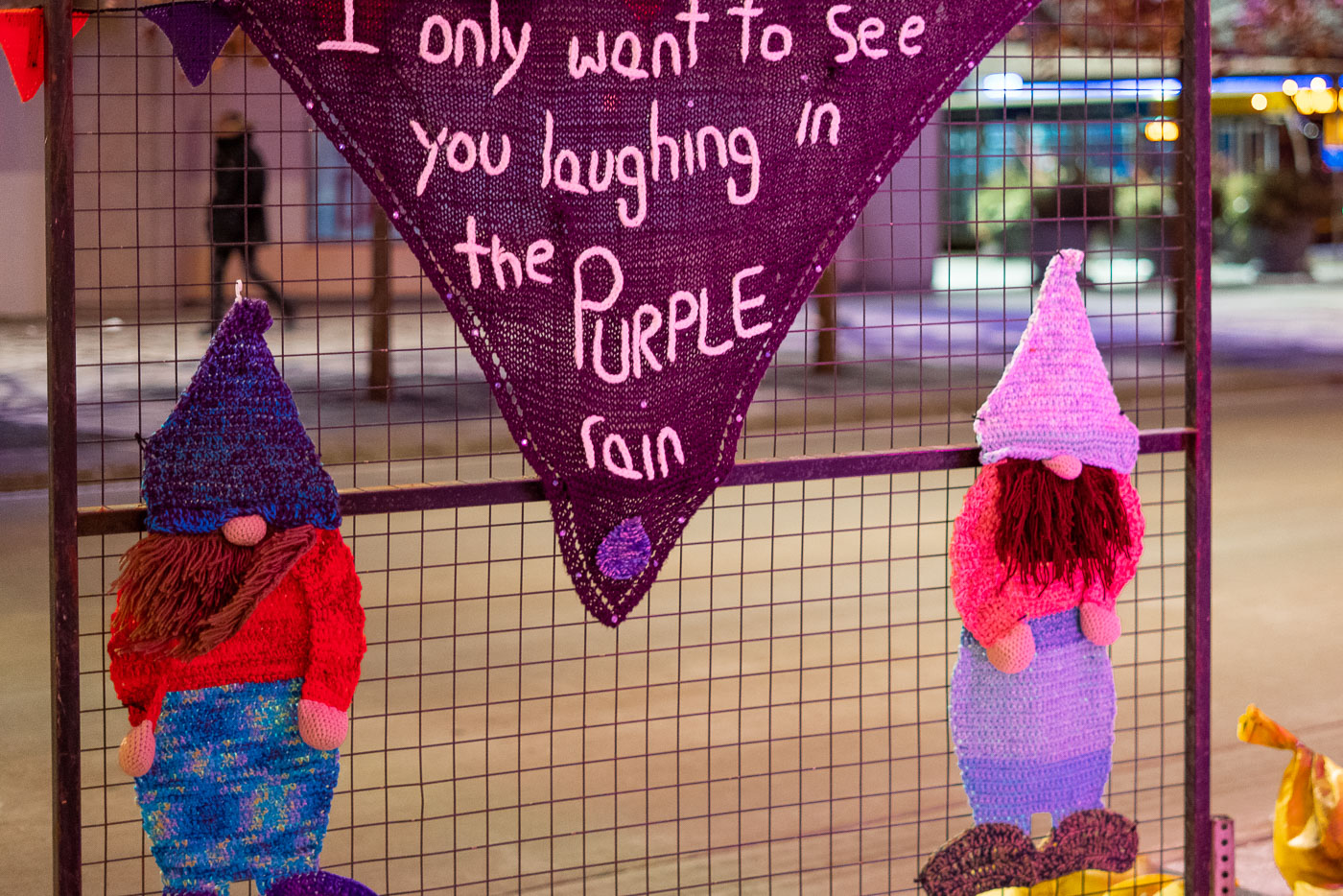
Knitted figures with a purple banner quoting Prince's "Purple Rain" hang from a downtown Minneapolis fence.
Fiber art installed on a fence in downtown Minneapolis on February 12, 2020 includes a stitched quotation from Prince’s “Purple Rain.”

Yarn-Bombed Gnomes with “Purple Rain” Quote on Nicollet Mall
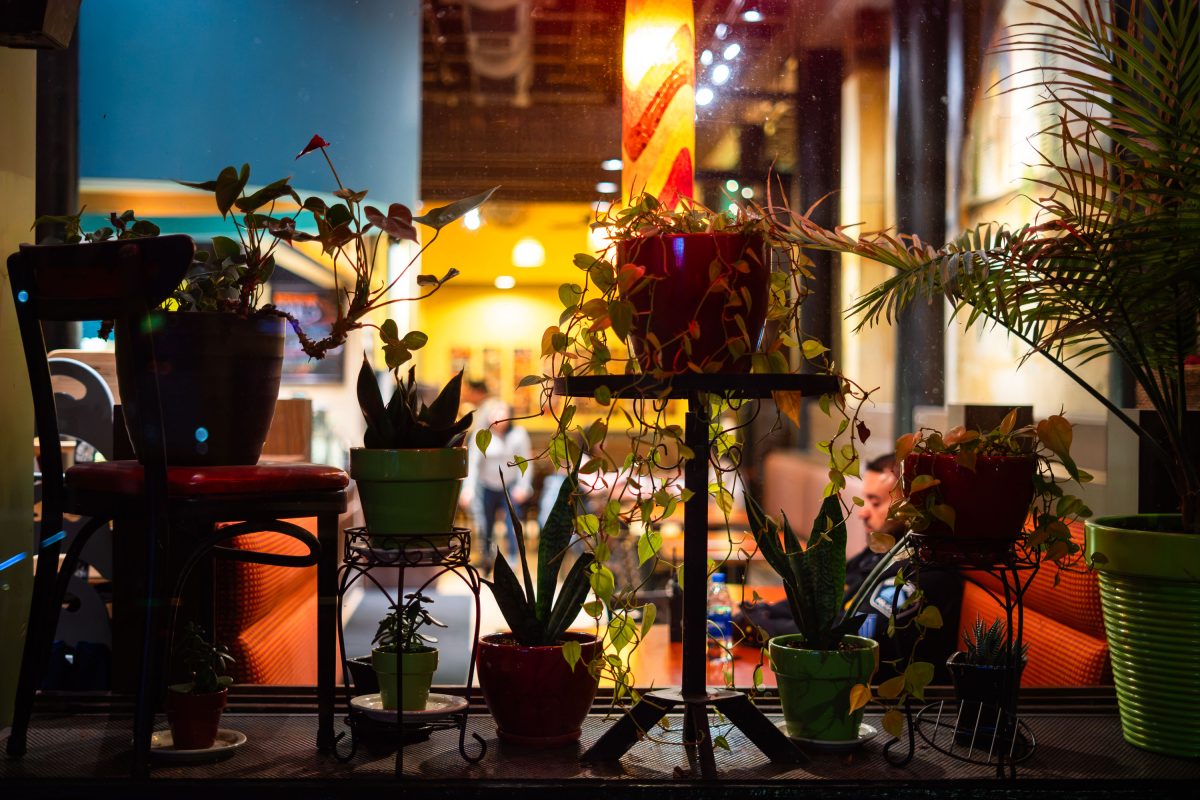
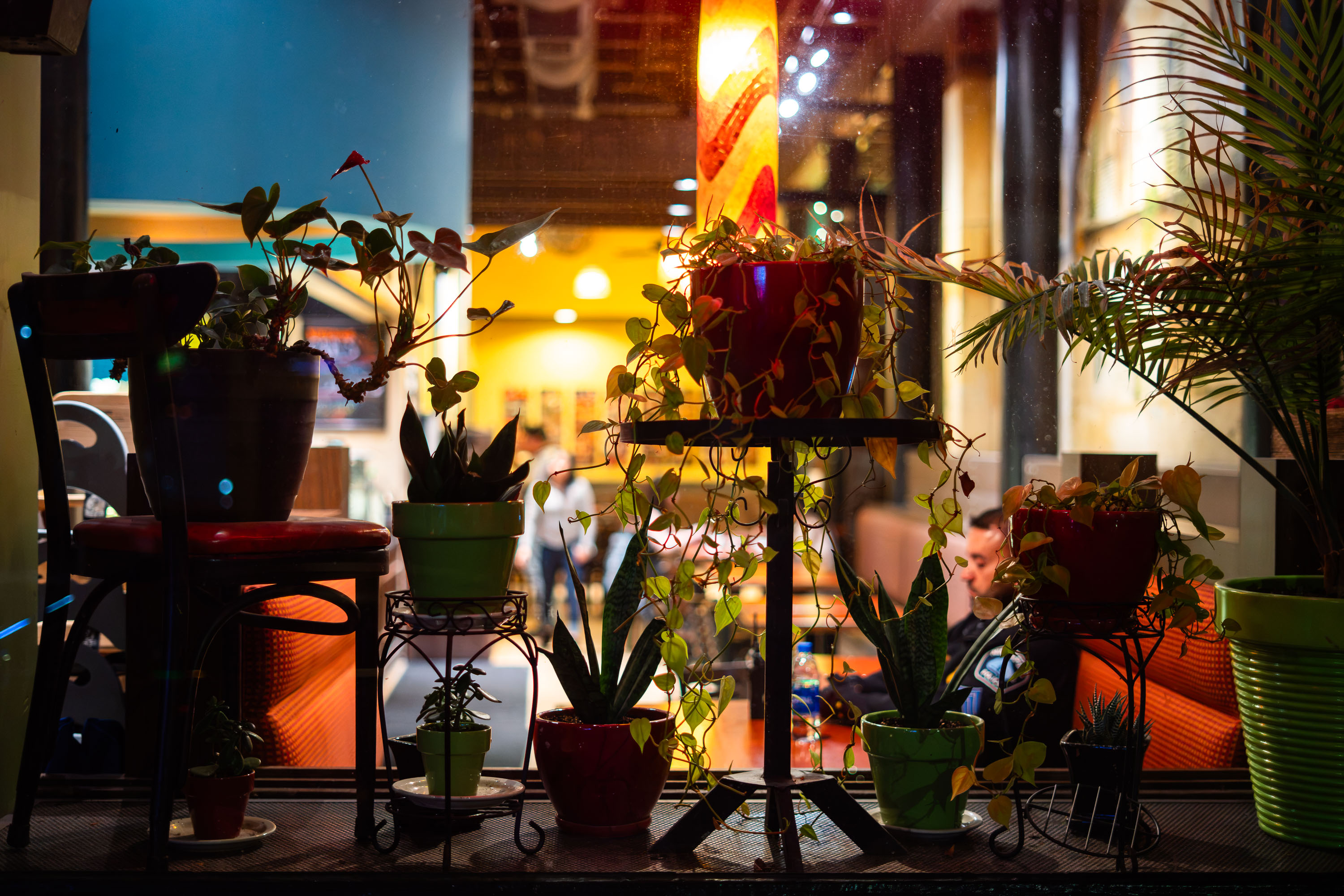
Window Plants at Pizza Luce in Downtown Minneapolis
Plants in the window of Pizza Luce in Downtown Minneapolis.

Window Plants at Pizza Luce in Downtown Minneapolis

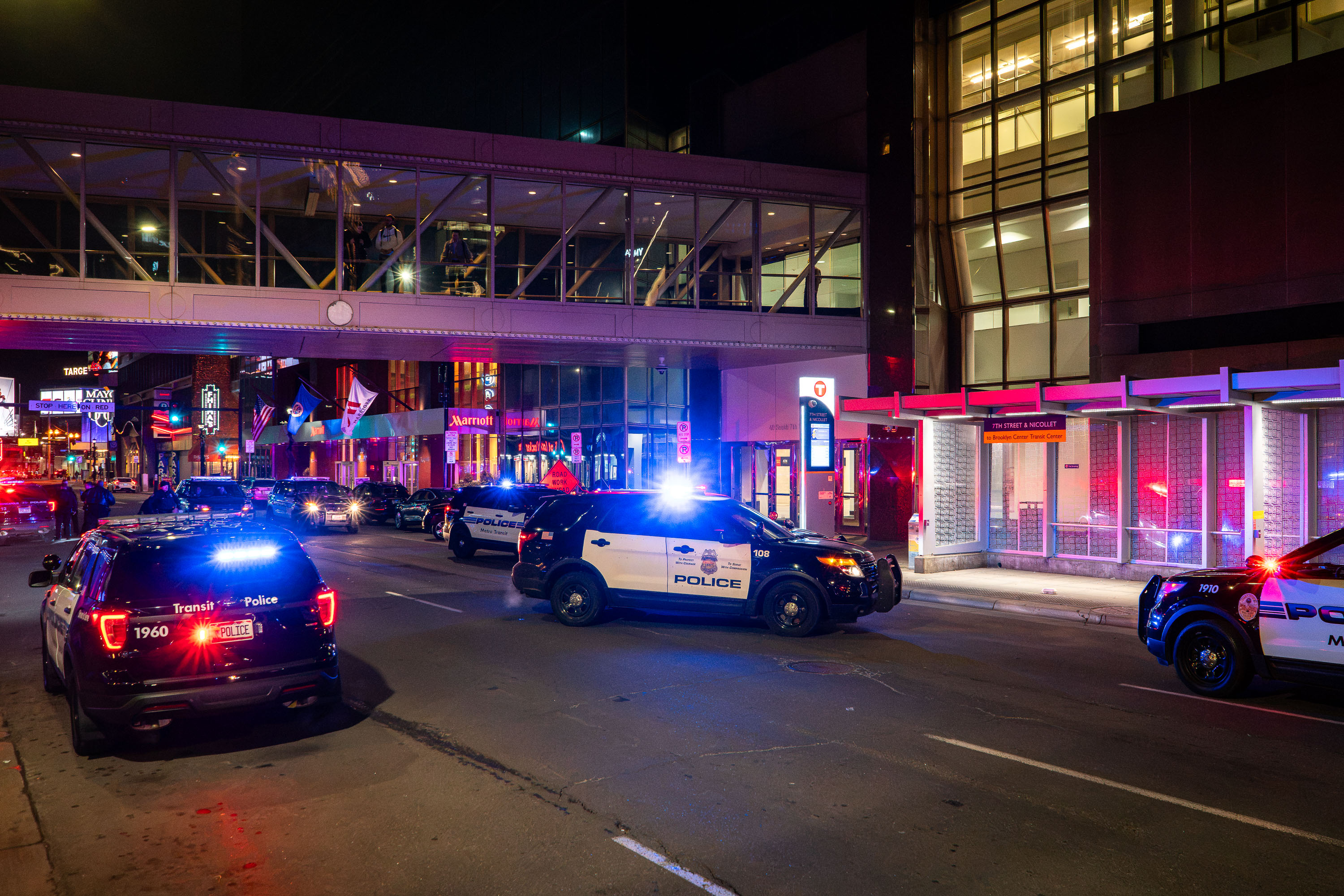
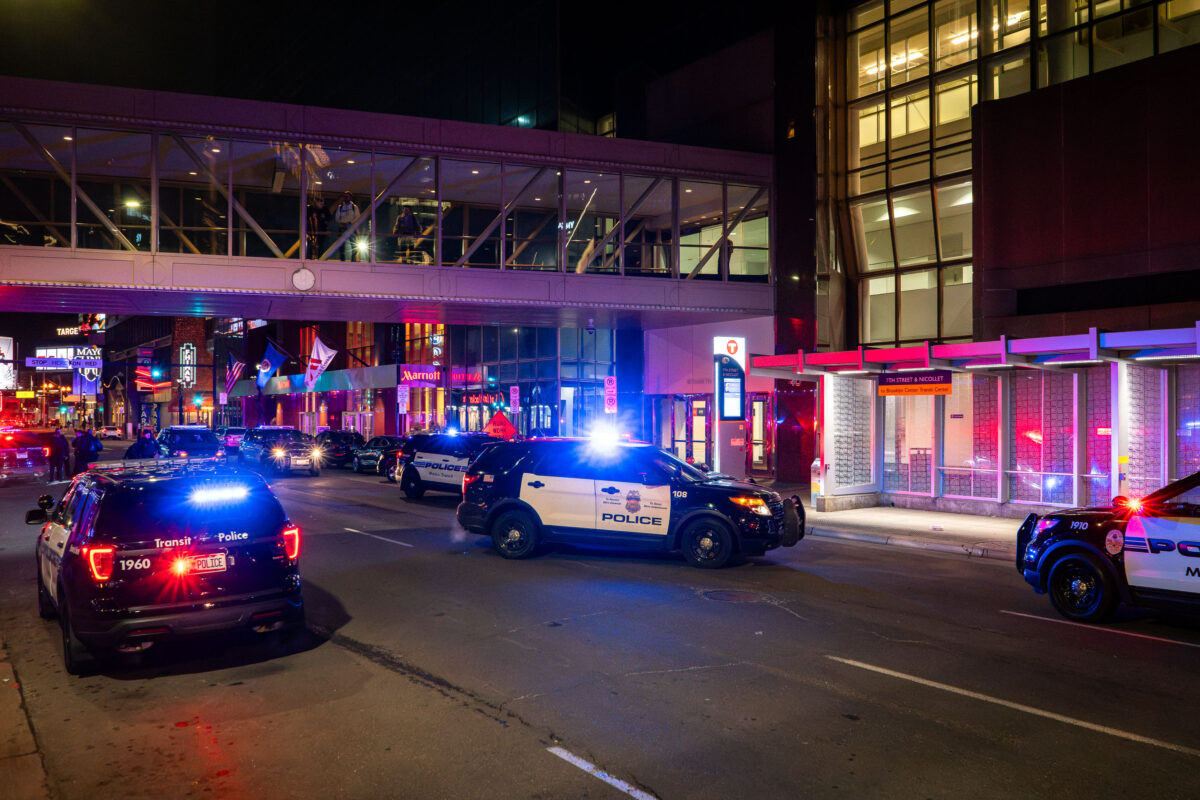
Minneapolis Police and Metro Transit Police, Downtown Minneapolis
Minneapolis Police and Metro Transit Police on 7th Street in Downtown Minneapolis.

Minneapolis Police and Metro Transit Police, Downtown Minneapolis

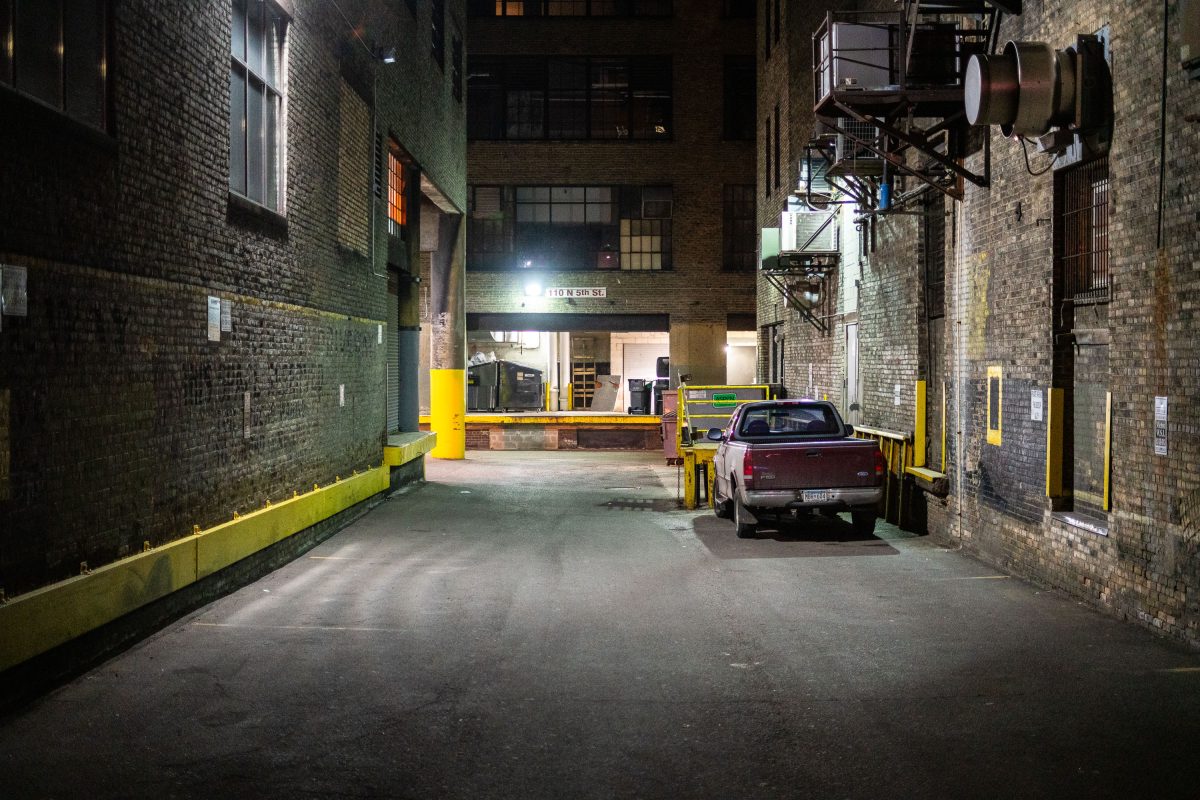
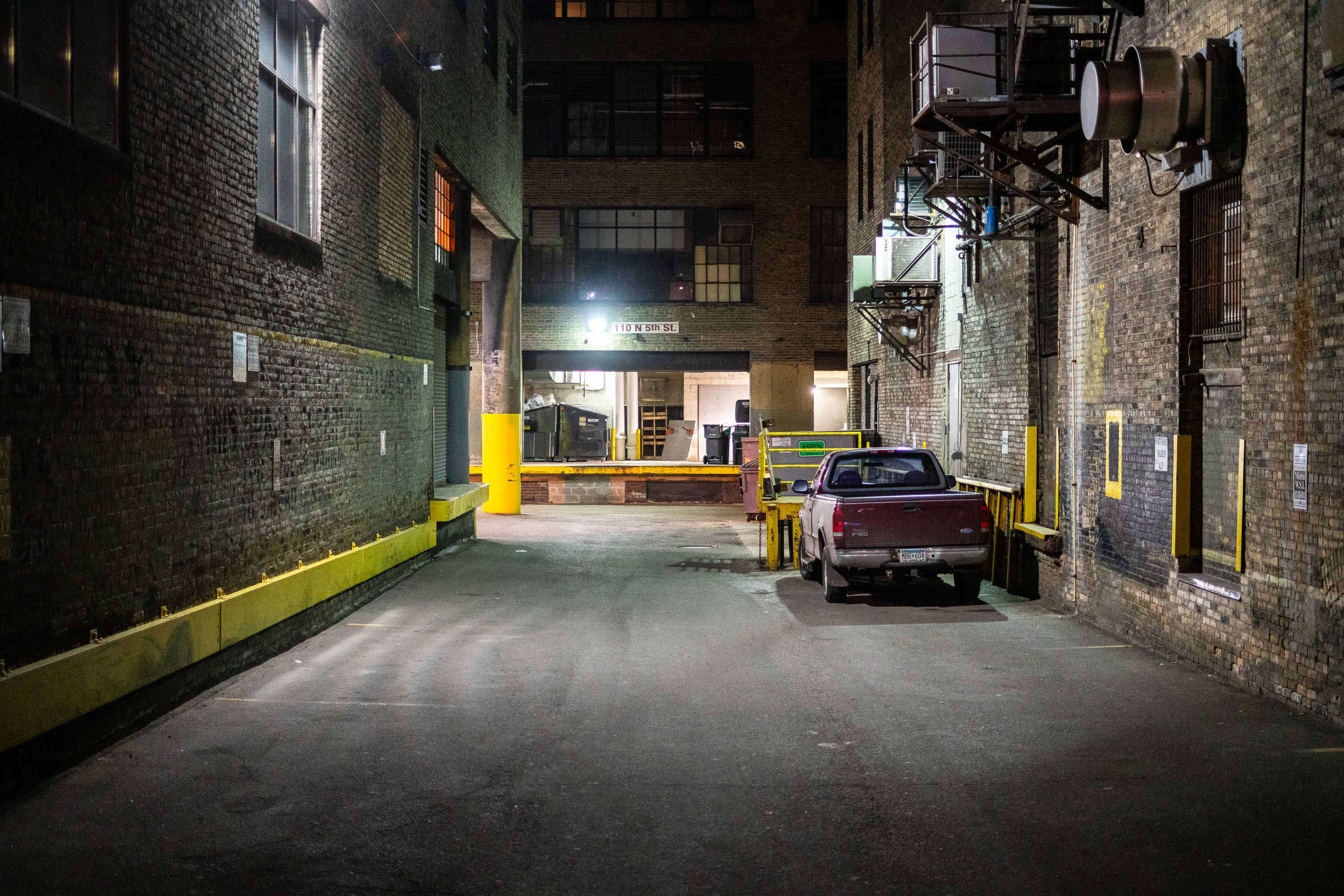
An Alley in Downtown Minneapolis
An alley in downtown Minneapolis.

An Alley in Downtown Minneapolis

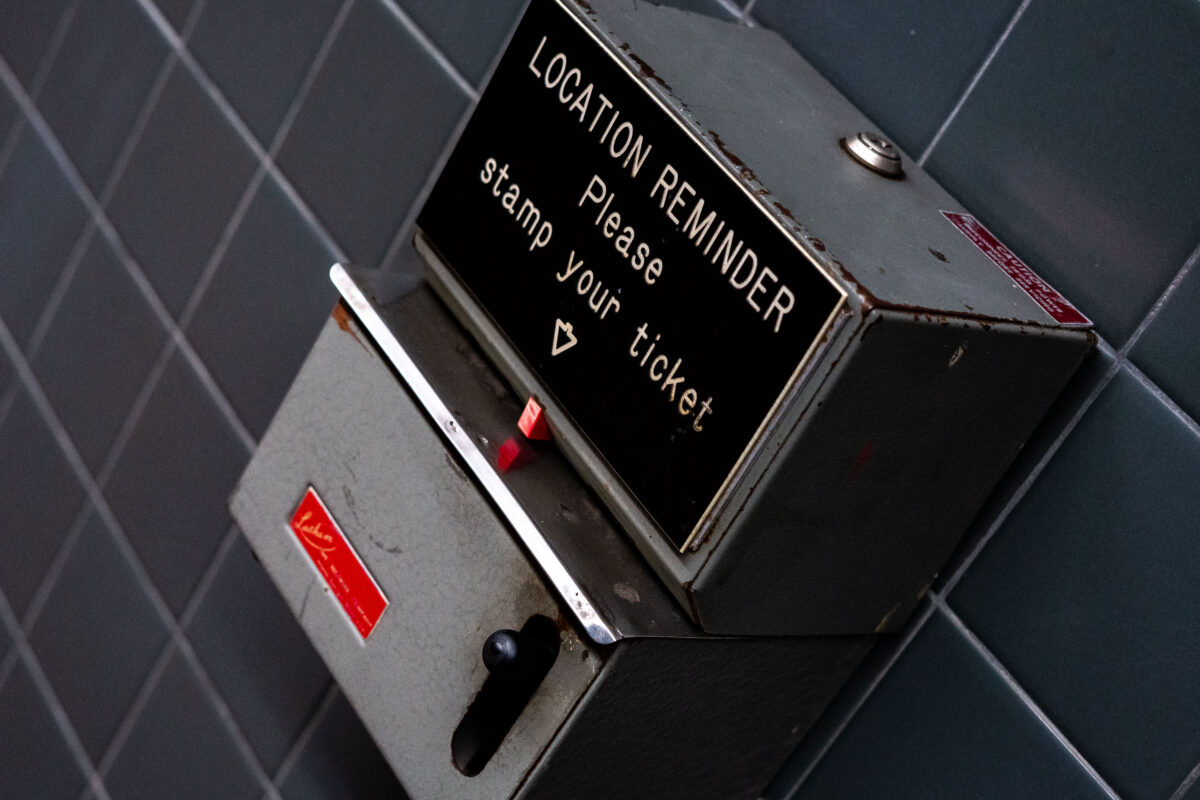
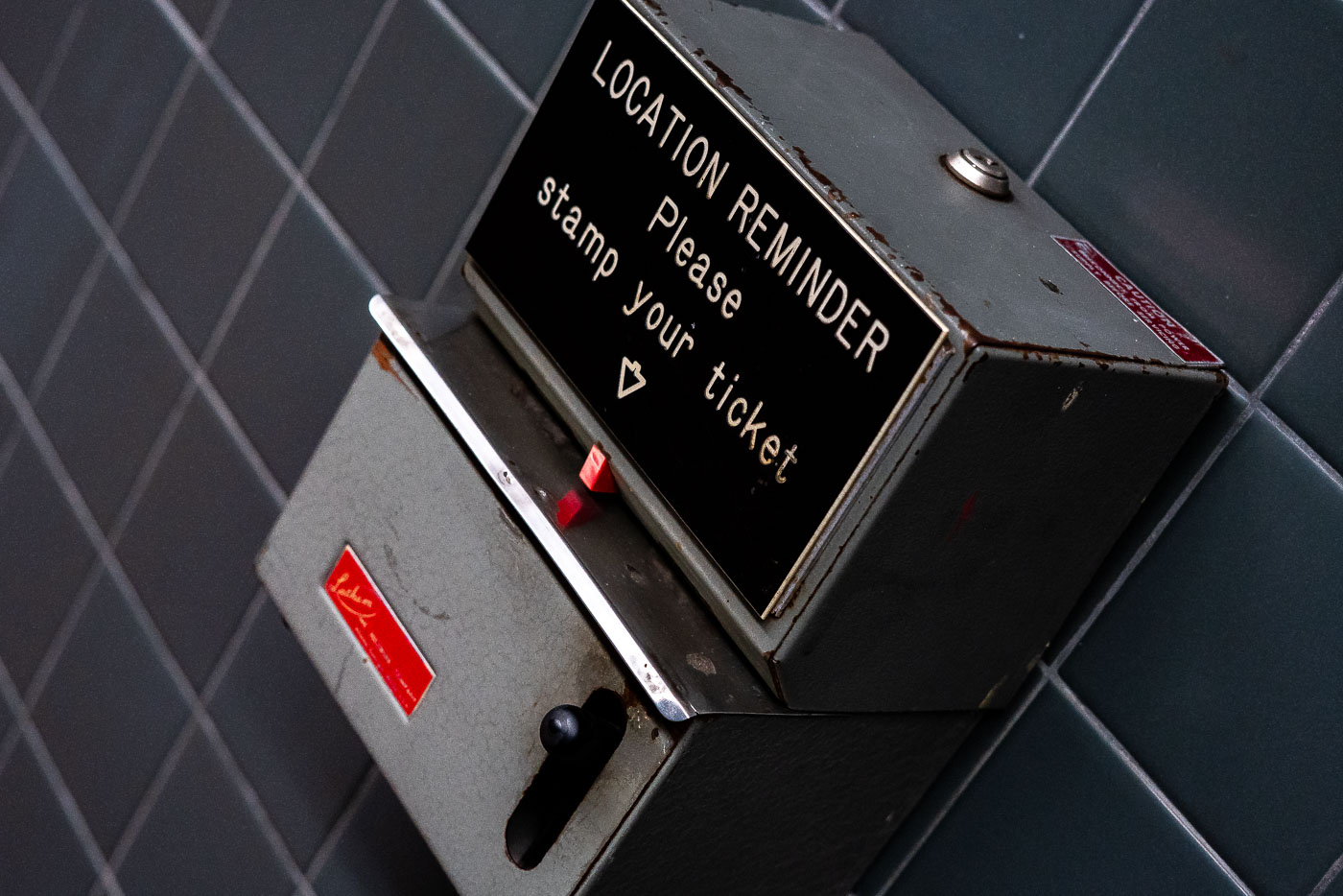
A "Location Reminder" ticket stamping machine, formerly in downtown Minneapolis transit stations, allowed passengers to mark tickets with arrival/departure times. This mid-20th-century device exemplifies transit infrastructure.
A "Location Reminder" ticket stamping machine, formerly installed in downtown Minneapolis transit stations, allowed passengers to mark their tickets with the time and place of their arrival or departure. This utilitarian device, with its lever-operated mechanism and faded instructional label, exemplifies mid-20th-century transit infrastructure. Such machines were essential for manual timestamping in parking facilities and public transit hubs before the widespread adoption of digital systems. The machine's robust, industrial design and its mounting on a tiled wall reflect the functional aesthetics of public transportation facilities of its era.

Location Reminder Ticket Stamping Machine, Downtown Minneapolis
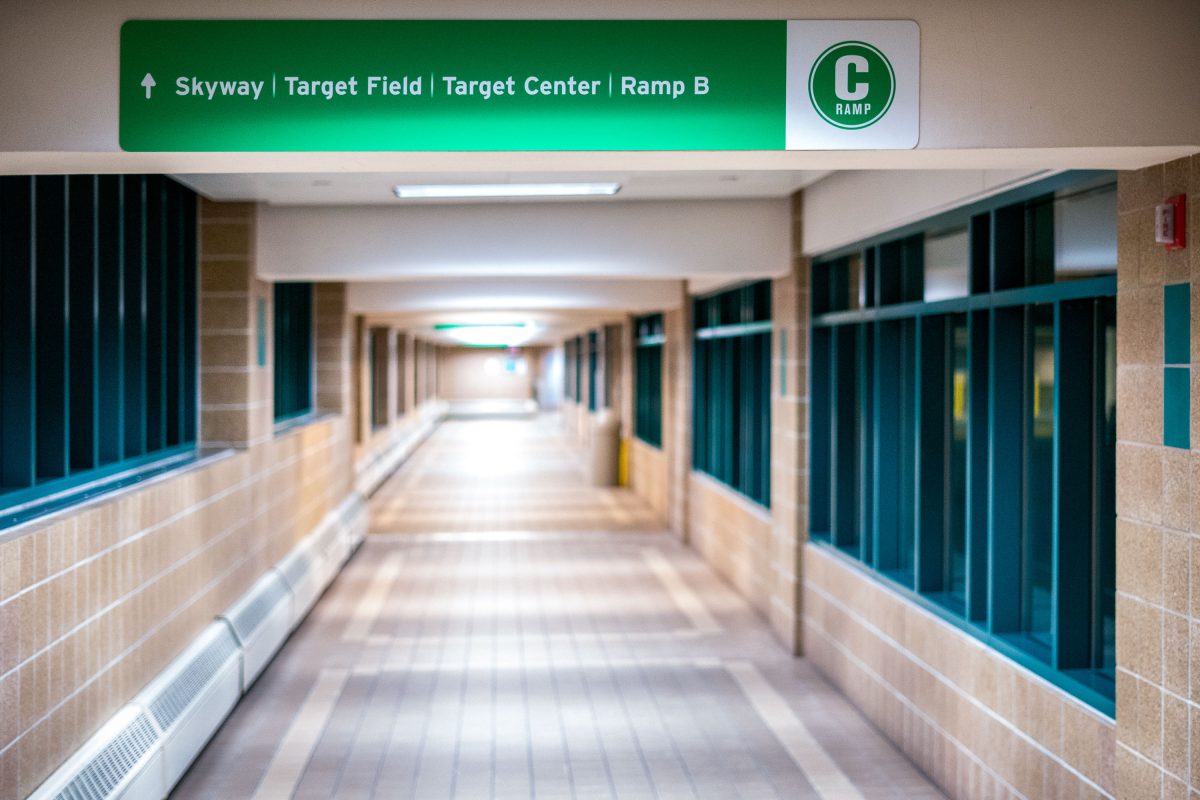
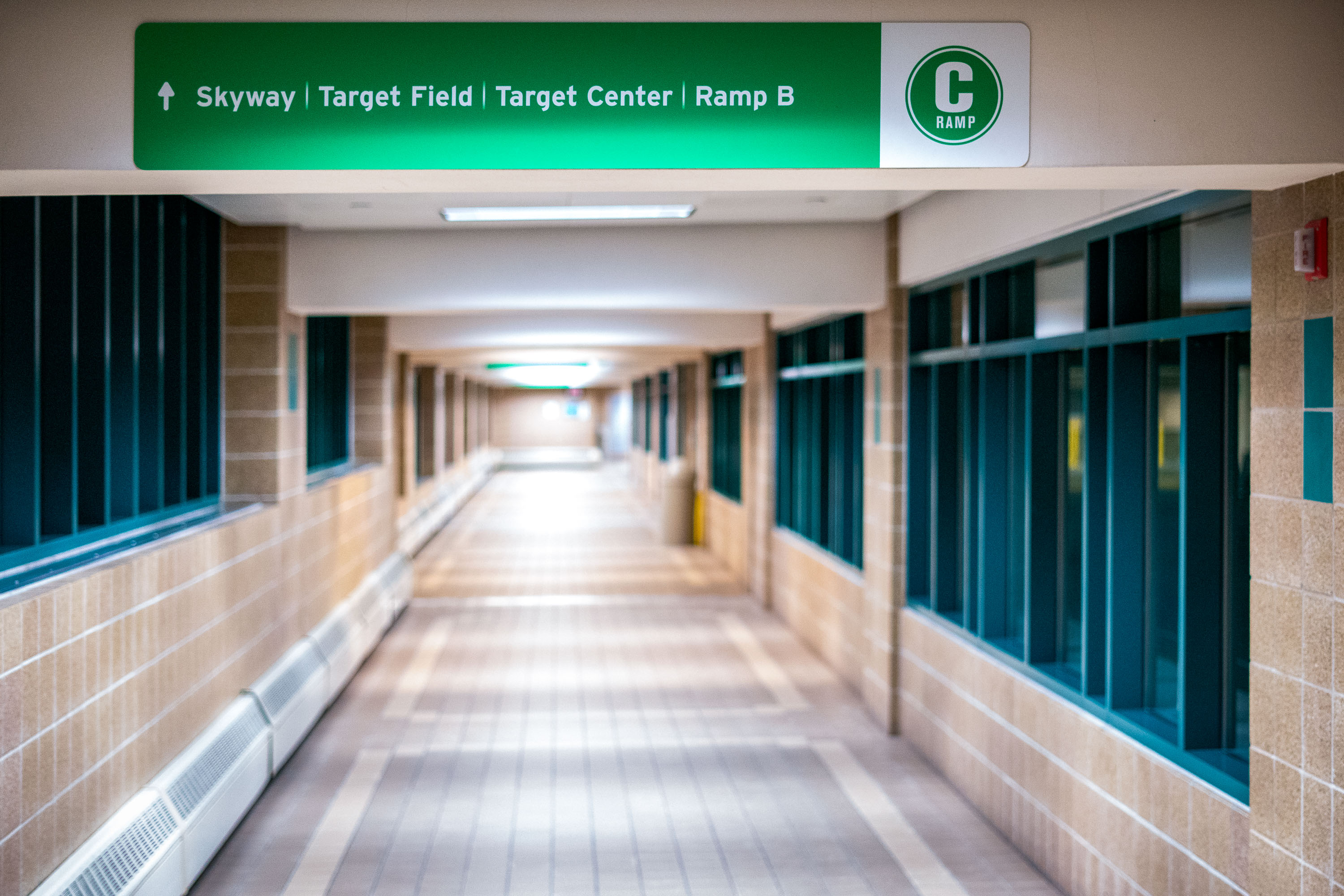
Interior corridor of Ramp C in the Minneapolis Skyway System with directional signage for Target Field and Target Center.
Minneapolis's Skyway System is the largest continuous skyway network in the world, linking more than 80 blocks of downtown through roughly 9.5 miles of enclosed, climate-controlled walkways. This particular corridor runs through Ramp C, a municipal parking structure, and directs pedestrians toward Target Field, home of the Minnesota Twins since 2010, and Target Center, the arena that has hosted the Minnesota Timberwolves since 1990.

Ramp C Skyway to Target Field and Target Center, Minneapolis
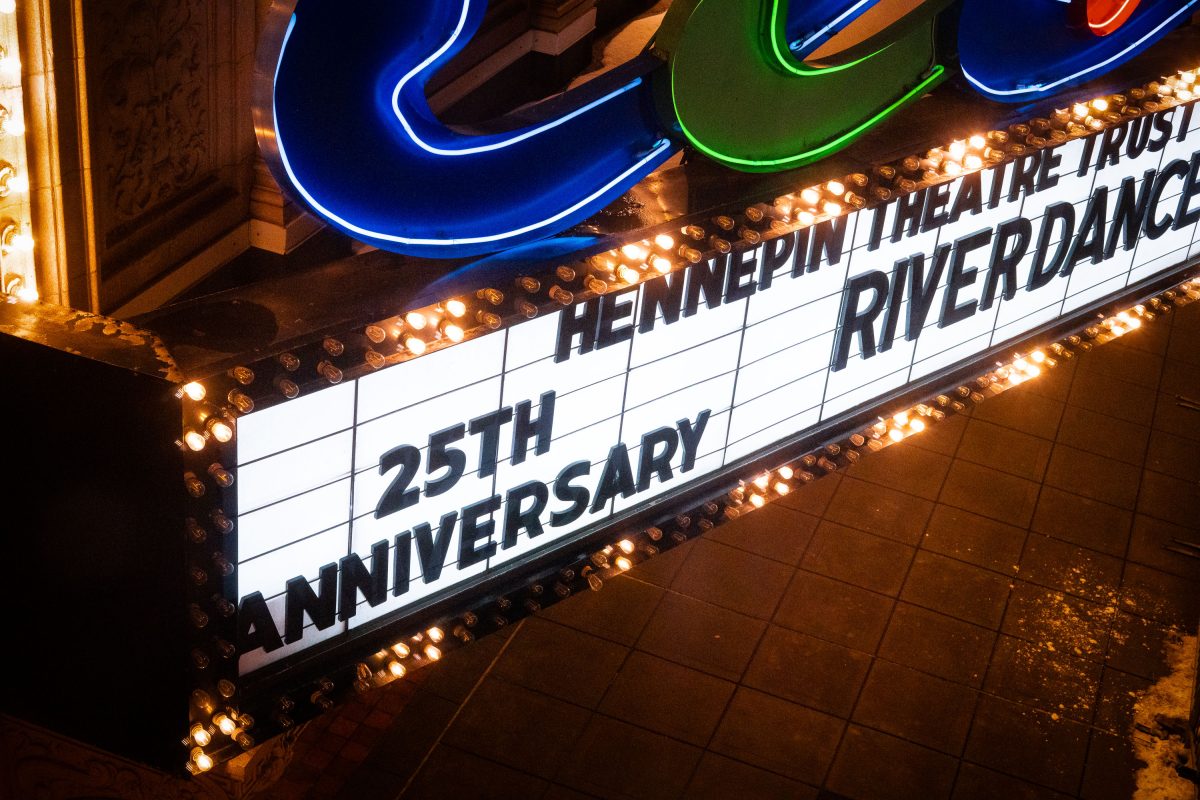
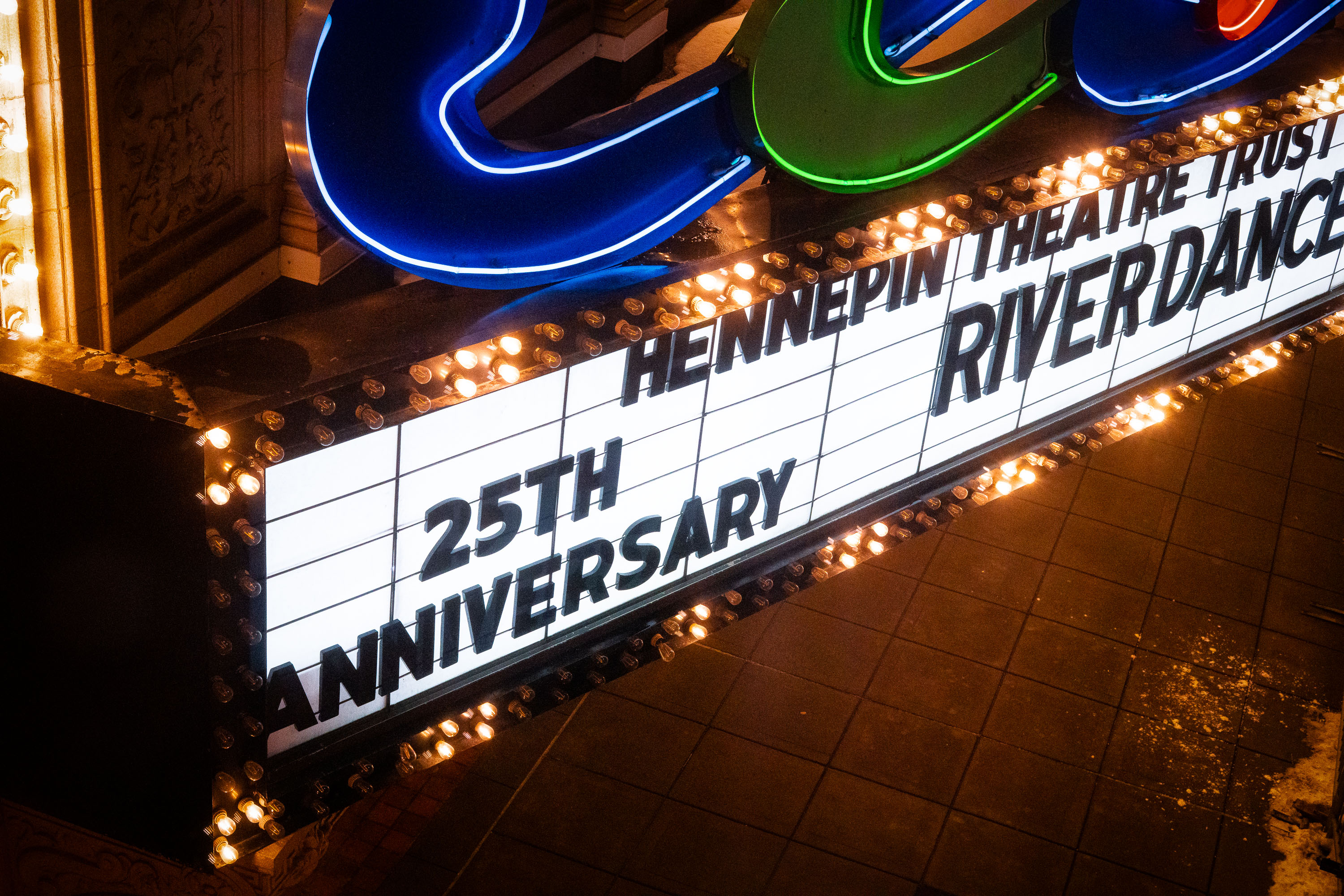
Riverdance 25th Anniversary Marquee
The marquee of the State Theater on Hennepin Avenue in Downtown Minneapolis.

Riverdance 25th Anniversary Marquee State Theater

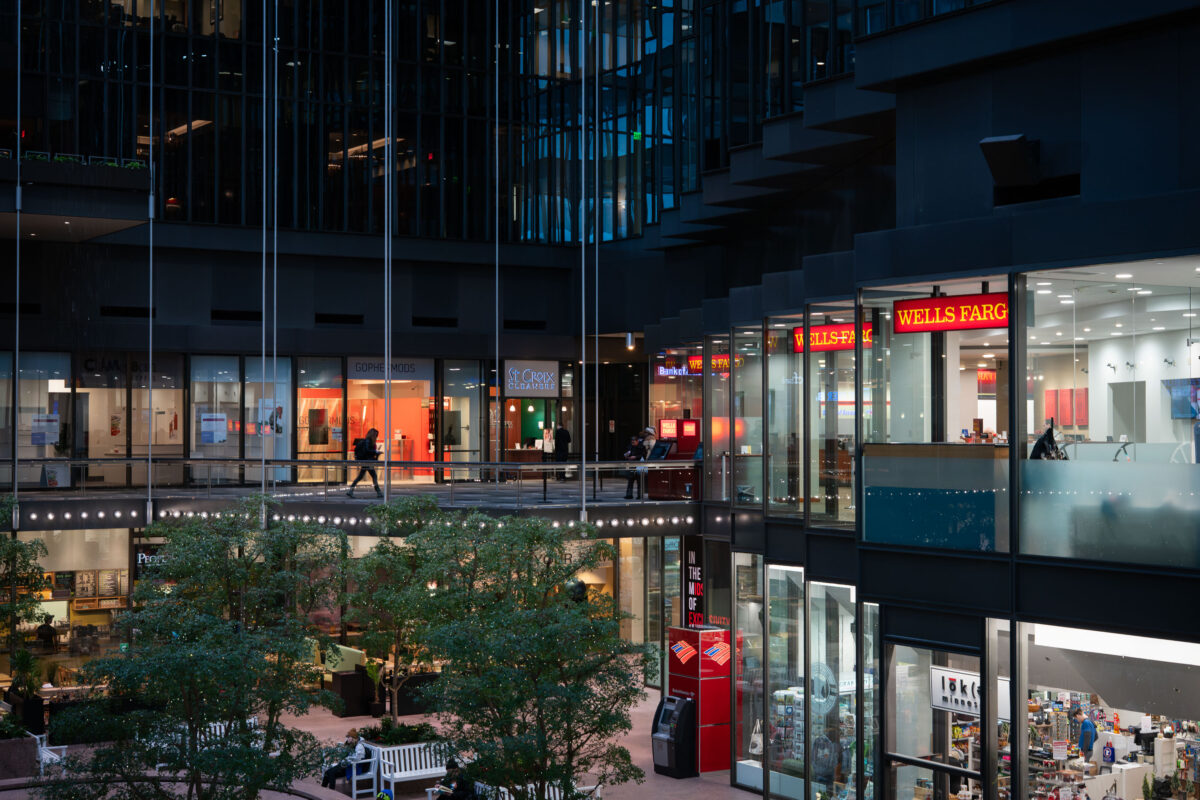
Storefronts and skyway walkway inside Crystal Court at the IDS Center in downtown Minneapolis.
Crystal Court is the eight-story glass atrium at the base of the IDS Center in downtown Minneapolis. Designed by Philip Johnson and John Burgee, the IDS Center opened in 1972 and rises 792 feet, making it the tallest building in Minnesota. Crystal Court connects to several downtown blocks via the Minneapolis Skyway System, the enclosed pedestrian network that links buildings throughout the city center. The atrium has long functioned as a public gathering space and retail concourse, with Wells Fargo among the tenants operating storefronts along its upper walkways.

Retail Level of Crystal Court, IDS Center, Minneapolis
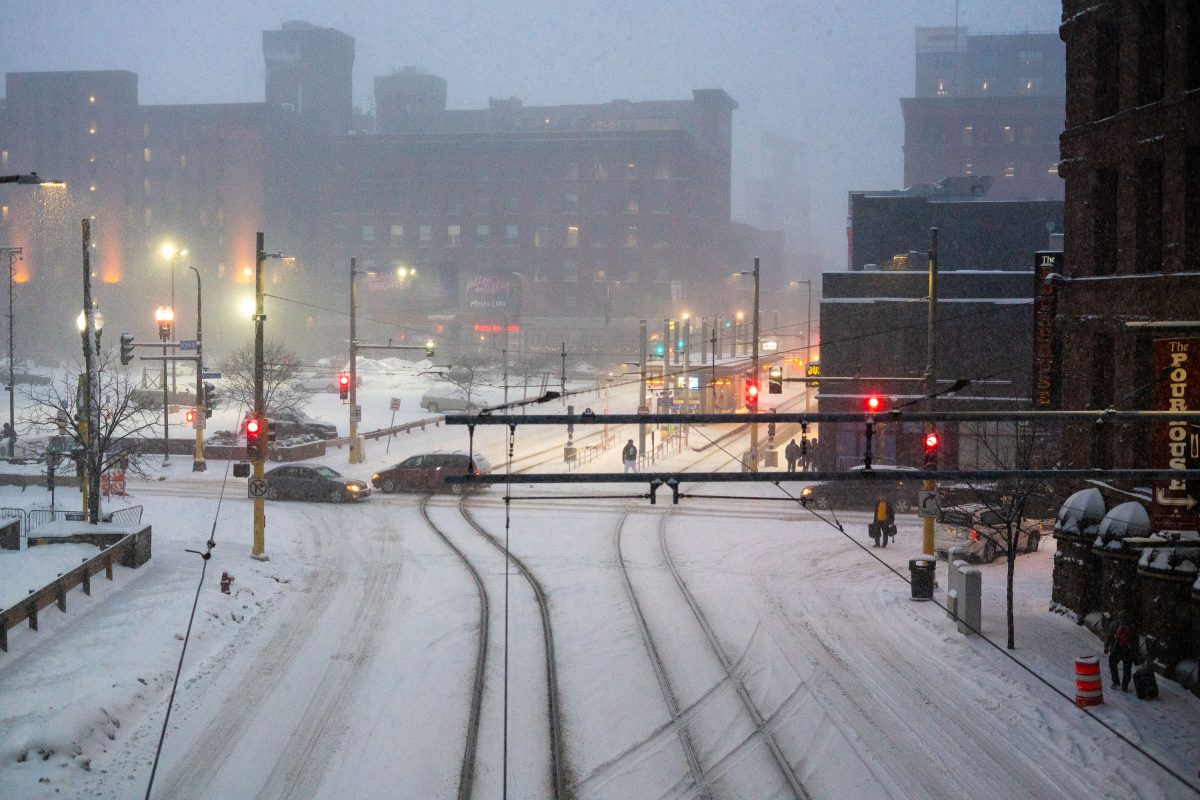
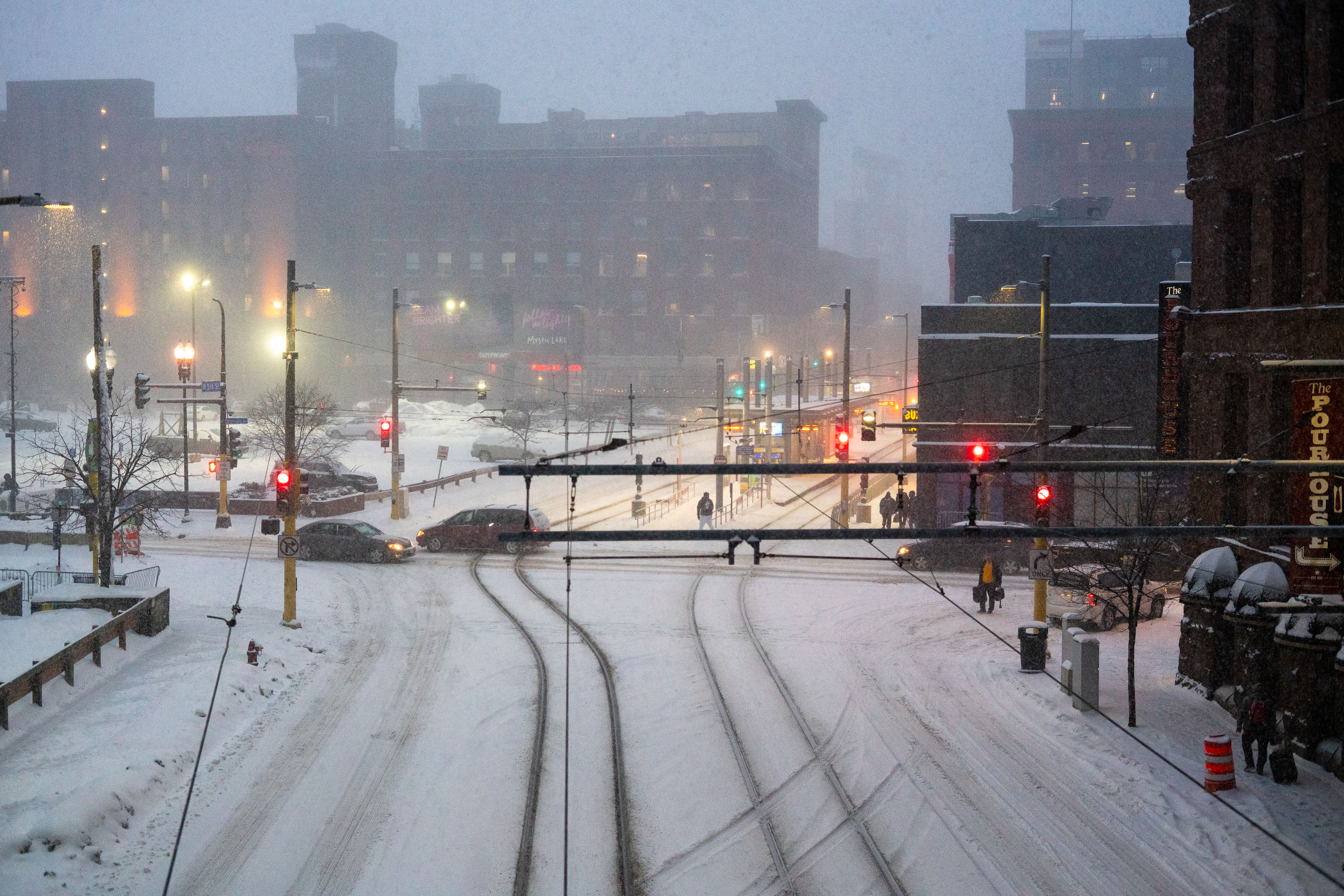
Snow-covered light rail tracks and traffic signals in downtown Minneapolis during a winter storm.
The METRO Blue and Green Line light rail tracks run through downtown Minneapolis along a shared corridor near the Warehouse District. Metro Transit operates the system, which connects downtown to the Mall of America, the airport, and the University of Minnesota. Overhead catenary wires power the trains along fixed rails embedded in the roadway. Snowstorms are common in the region between November and March, and Metro Transit crews use heated switches and de-icing equipment to keep the rail lines operational during winter weather.

Snowstorm Blankets METRO Light Rail Tracks, Downtown Minneapolis

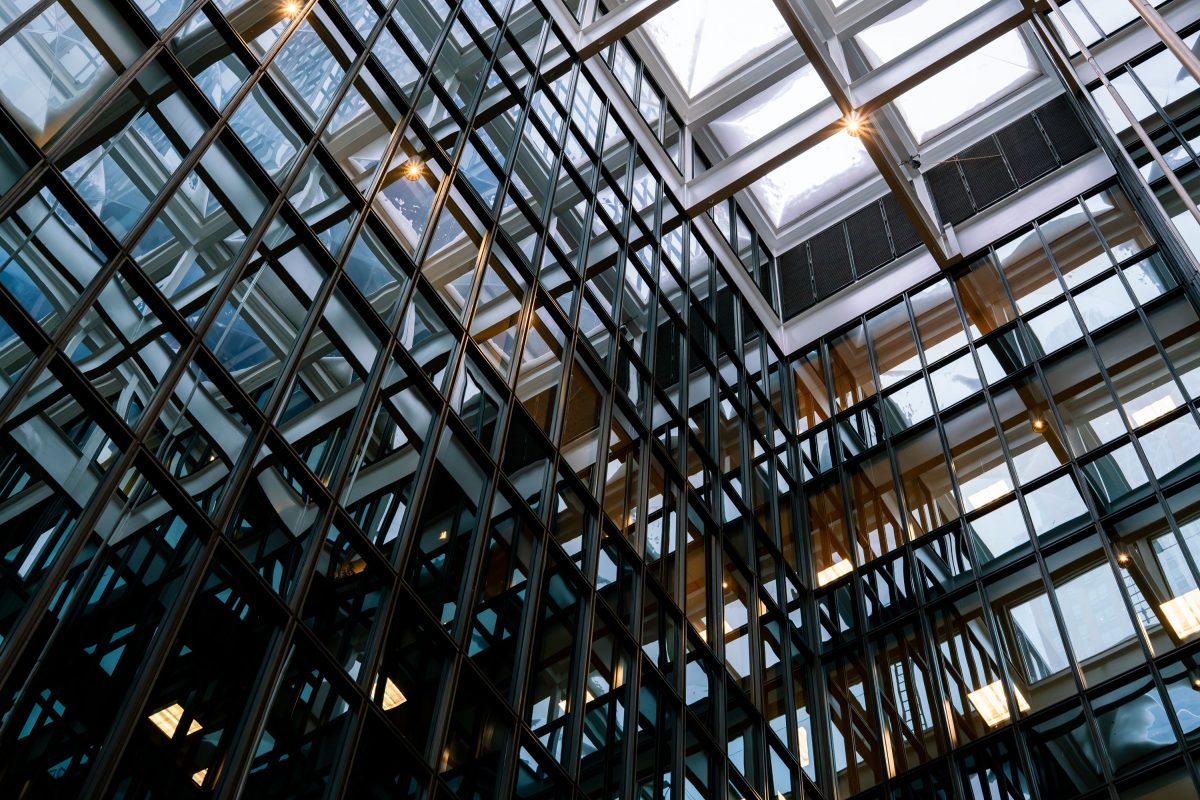
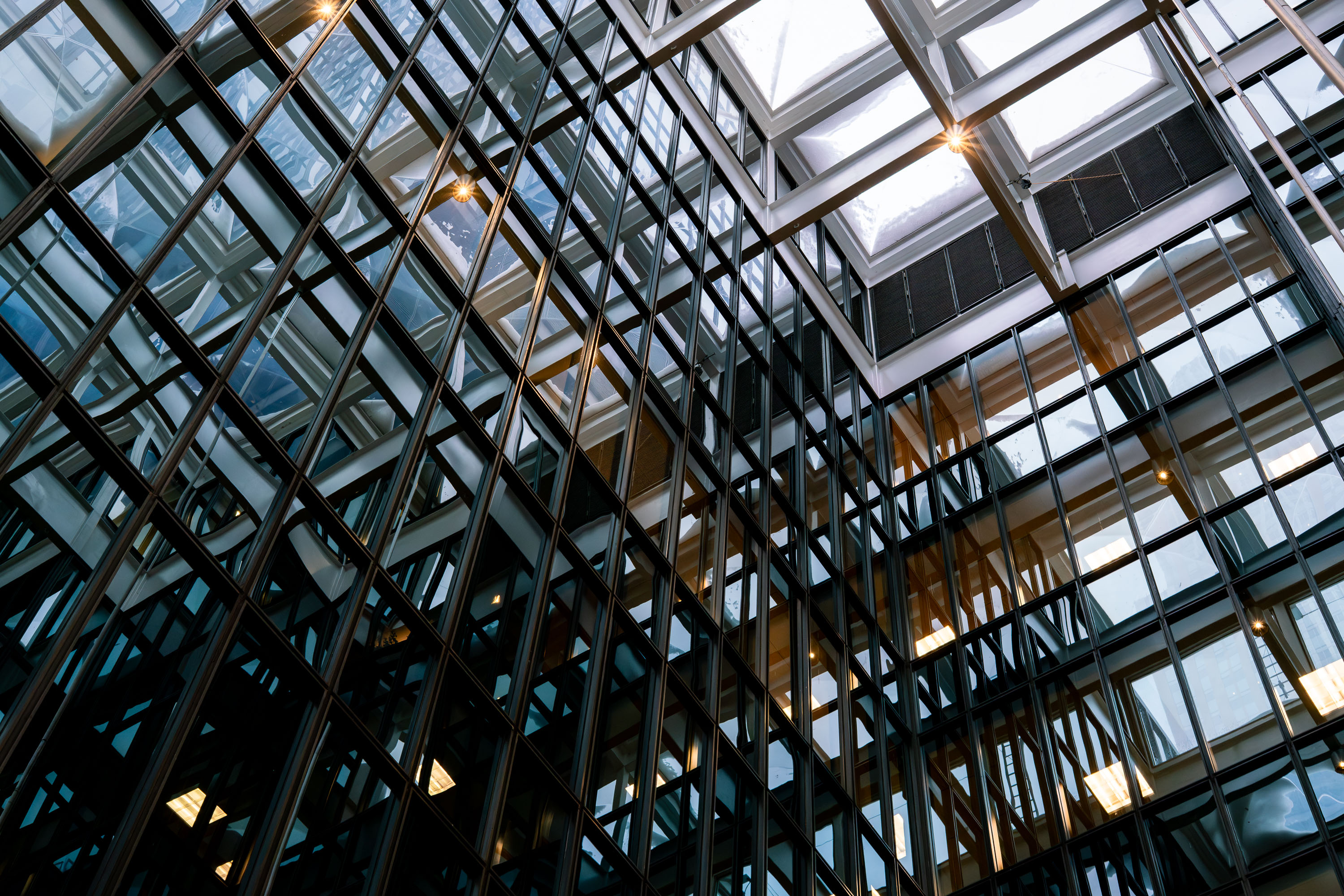
Steel-framed glass atrium ceiling inside the IDS Center's Crystal Court in downtown Minneapolis.
The IDS Center's Crystal Court sits at the base of the 792-foot IDS Tower, completed in 1972 to a design by Philip Johnson and John Burgee with Edward Baker. The eight-story atrium was built as a public gathering space linking the tower to the surrounding skyway system, which connects much of downtown Minneapolis. Its steel-and-glass roof structure covers roughly an acre, making it one of the largest enclosed public spaces of its kind in the city. The building remains the tallest in Minnesota and is listed on the National Register of Historic Places.

Glass Atrium Ceiling, IDS Center Crystal Court, Minneapolis
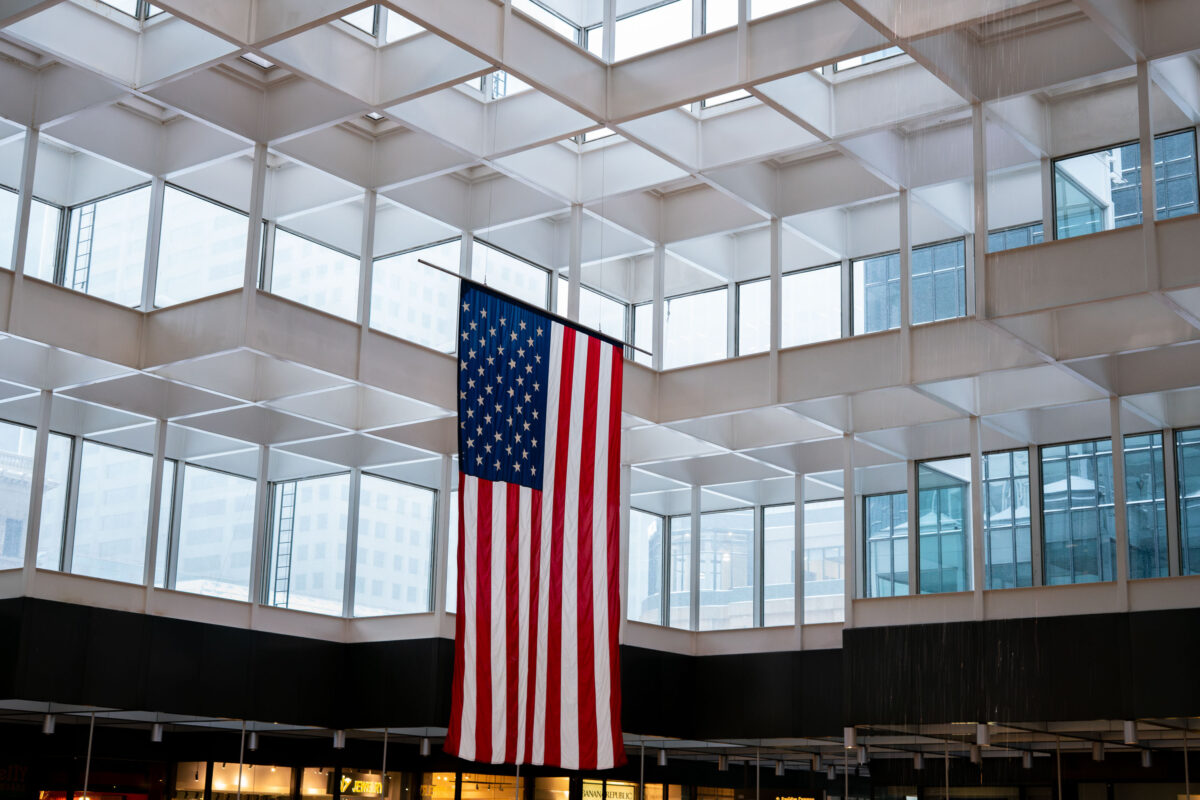
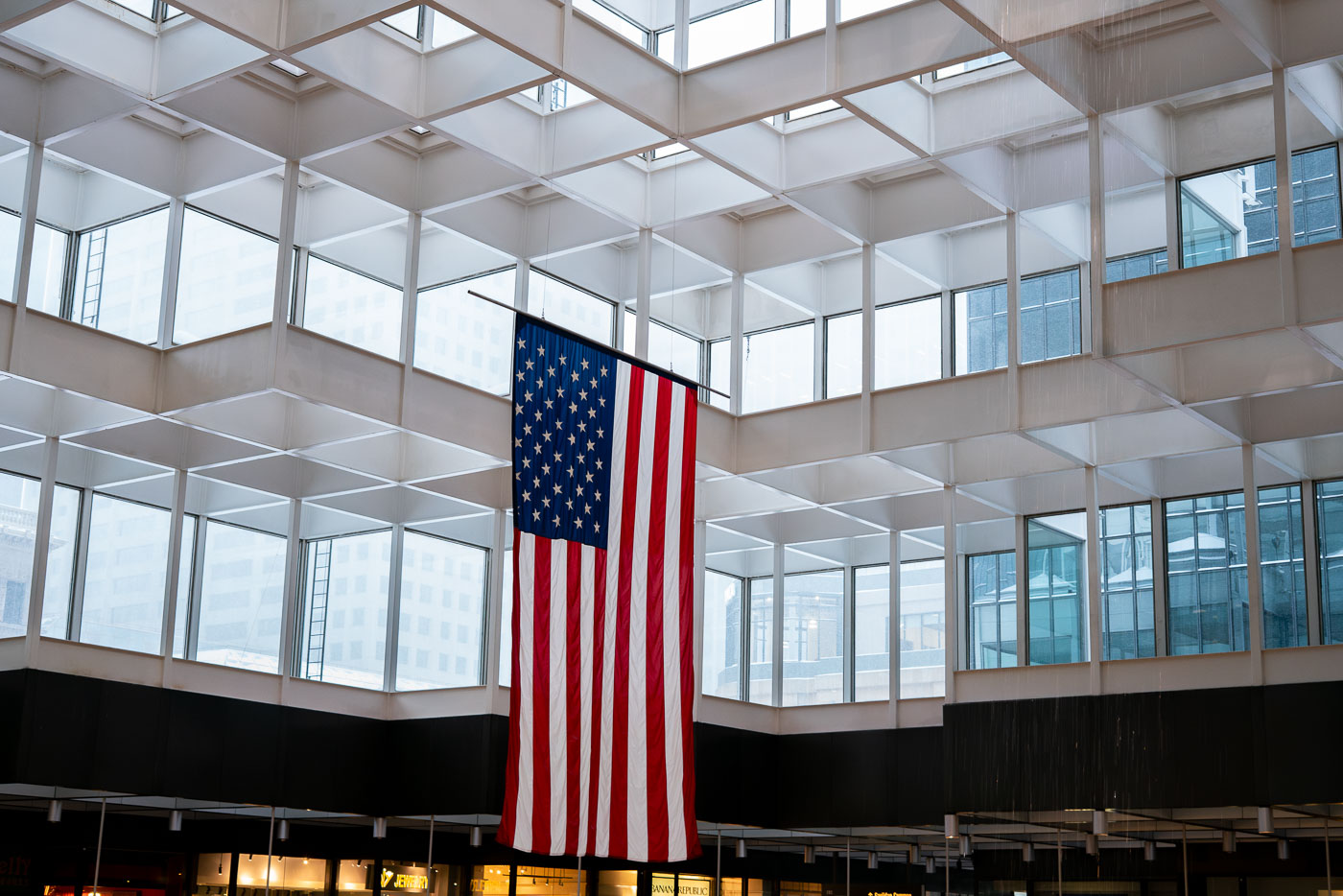
American flag suspended in the IDS Crystal Court atrium, downtown Minneapolis.
An American flag hangs in the IDS Crystal Court, the atrium of the IDS Center in downtown Minneapolis. The court is enclosed by a grid of skylights and surrounded by multiple levels of offices and commercial spaces. Completed in 1973, the IDS Center was Minnesota's tallest building at the time of construction.

American flag, IDS Crystal Court, Minneapolis
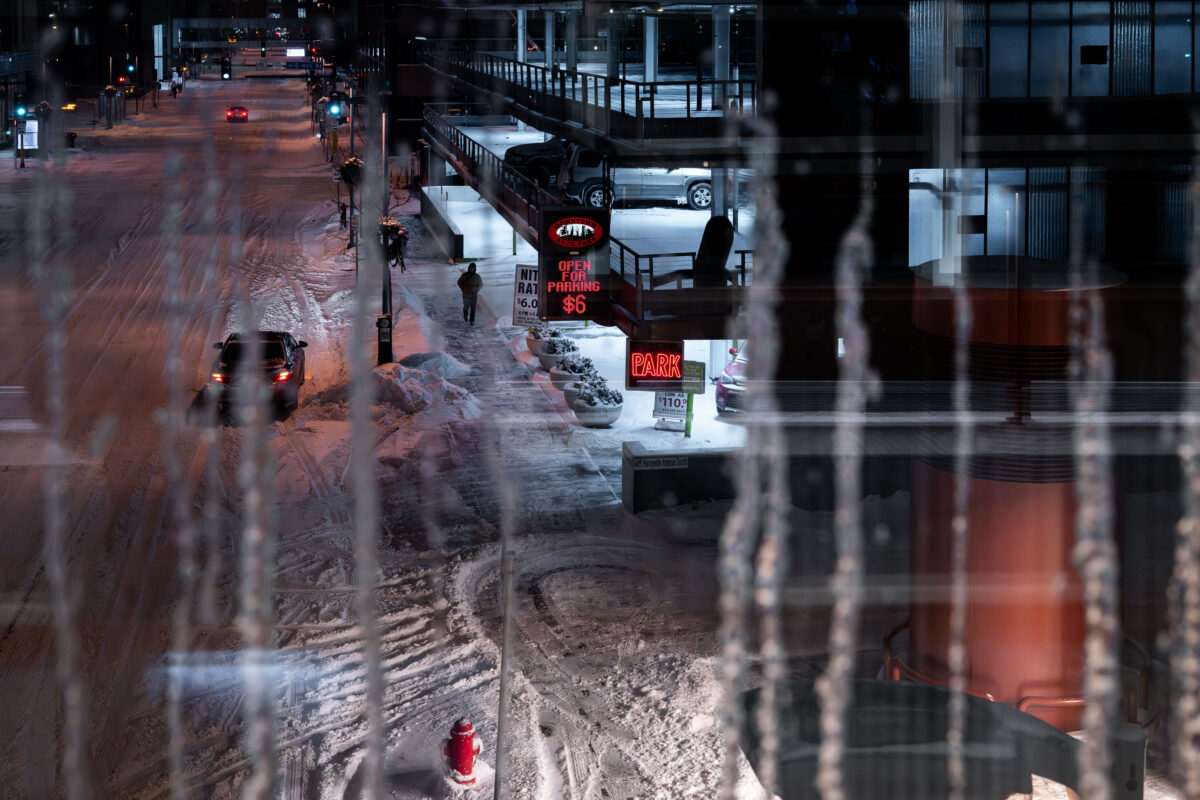
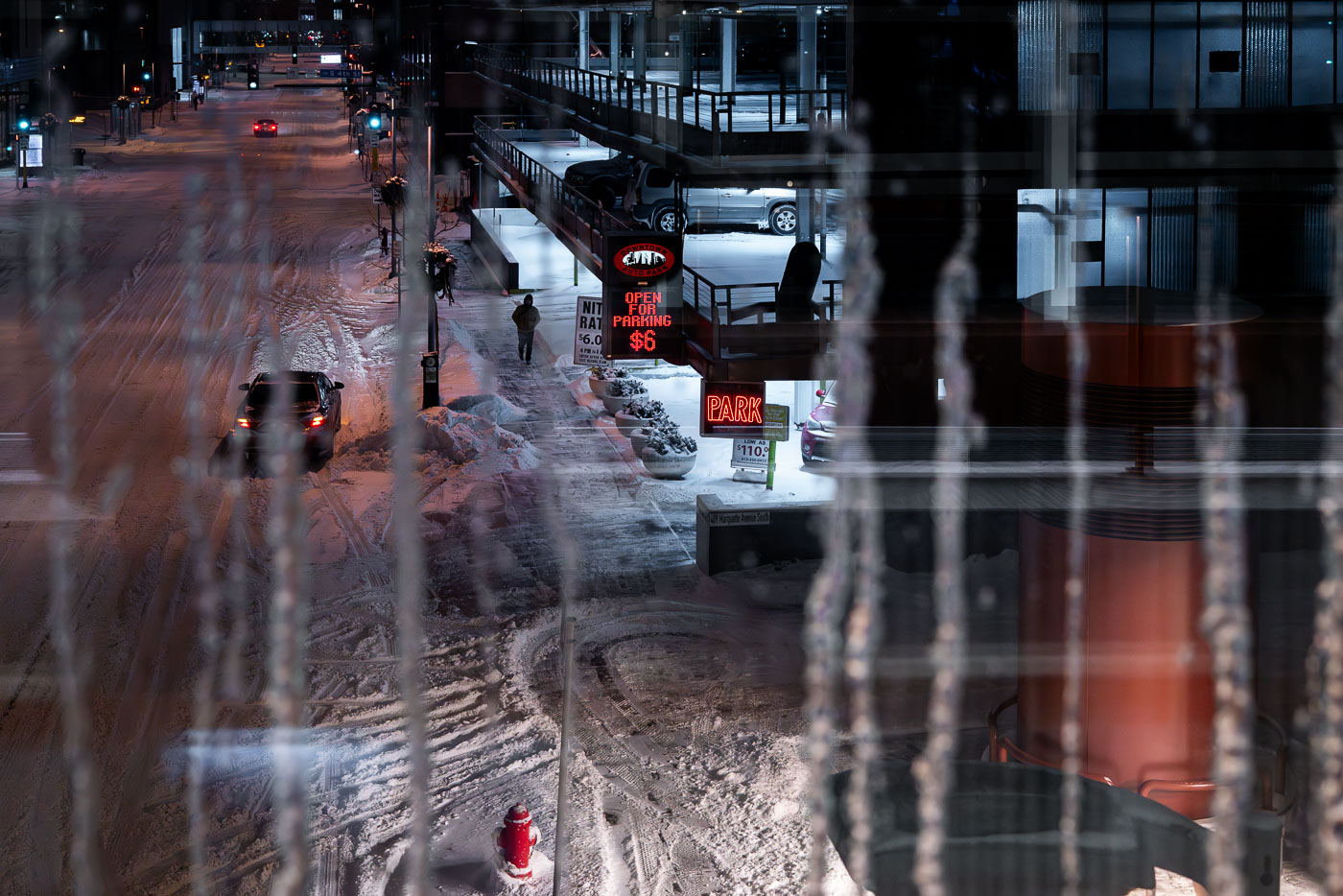
Icy downtown Minneapolis street beside a skyway parking ramp at night
A snow-covered street in downtown Minneapolis runs past a skyway-connected parking ramp at night. Icicles hang in the foreground, and neon signs mark the parking entrance and rate information.
Icy downtown Minneapolis street beside skyway parking ramp
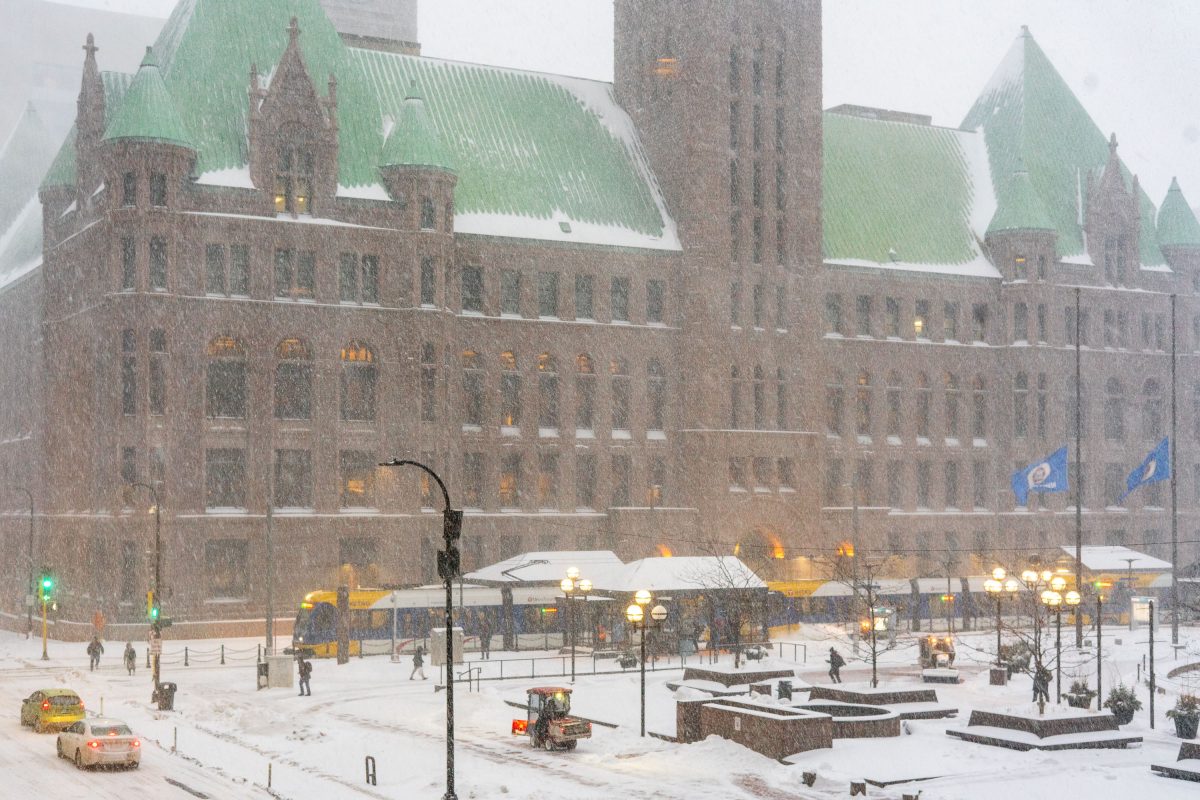
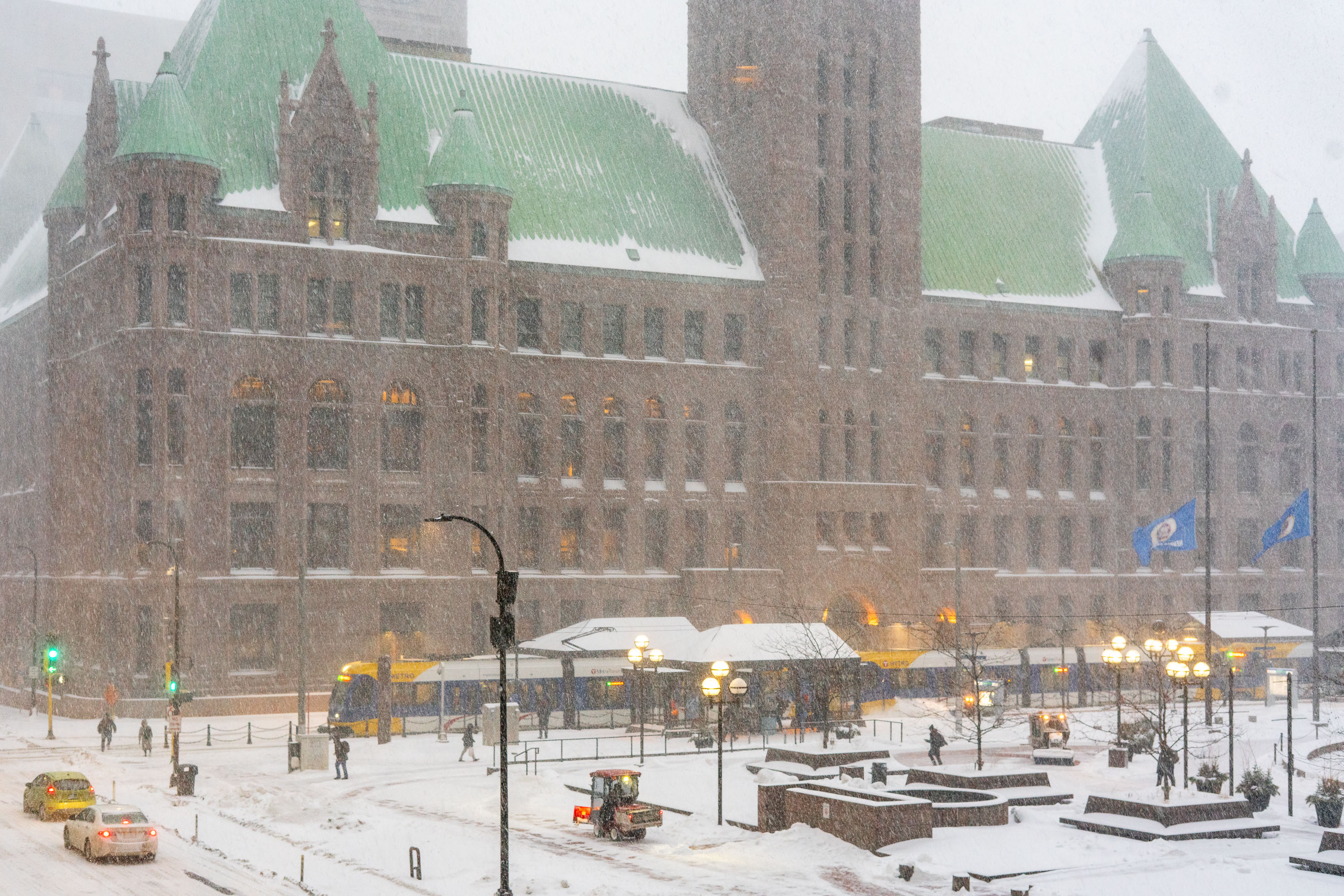
Minneapolis City Hall's Romanesque Revival tower with green copper roof dominates the snow-covered downtown plaza during a winter snowstorm.
Minneapolis City Hall opened in 1905 after nearly two decades of construction, designed by Long and Kees in Romanesque Revival style. The building rises twelve stories and is topped by a clock tower with a 15-foot minute hand, once among the largest four-faced clocks in the world.
Light Rail and Pedestrians Pass Minneapolis City Hall During Snowfall
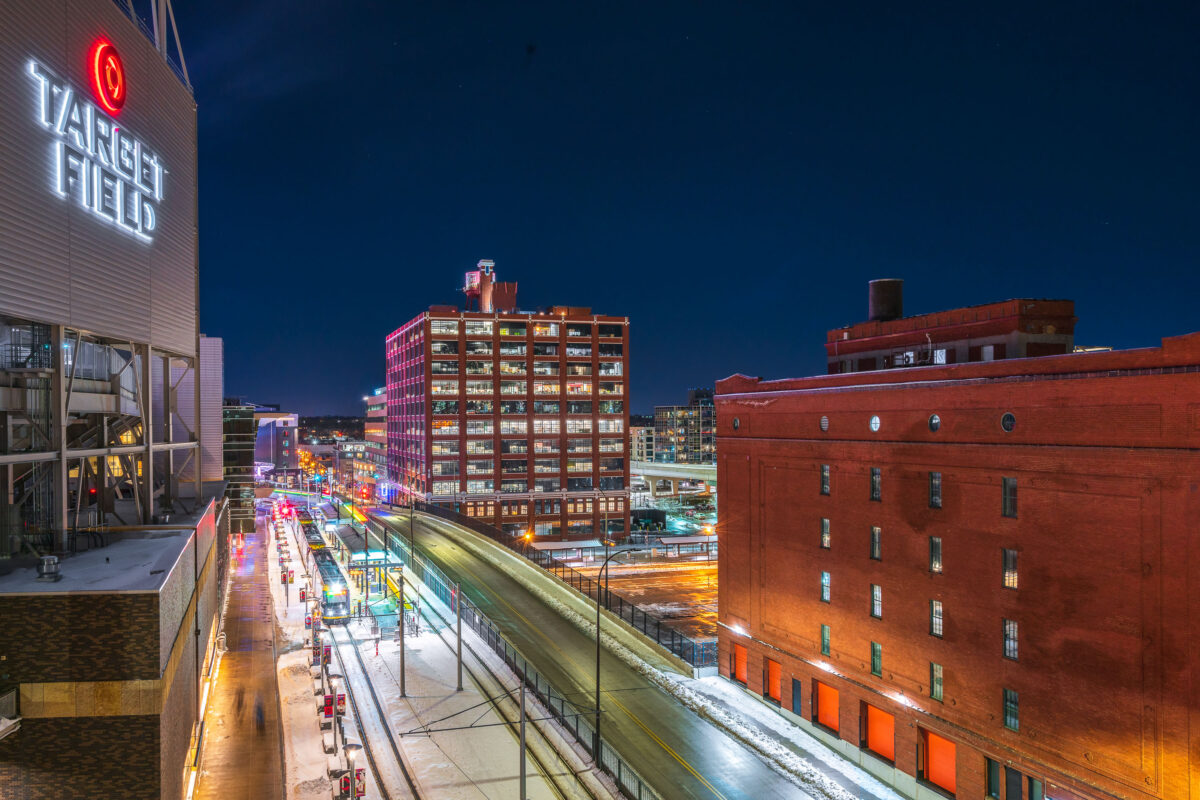
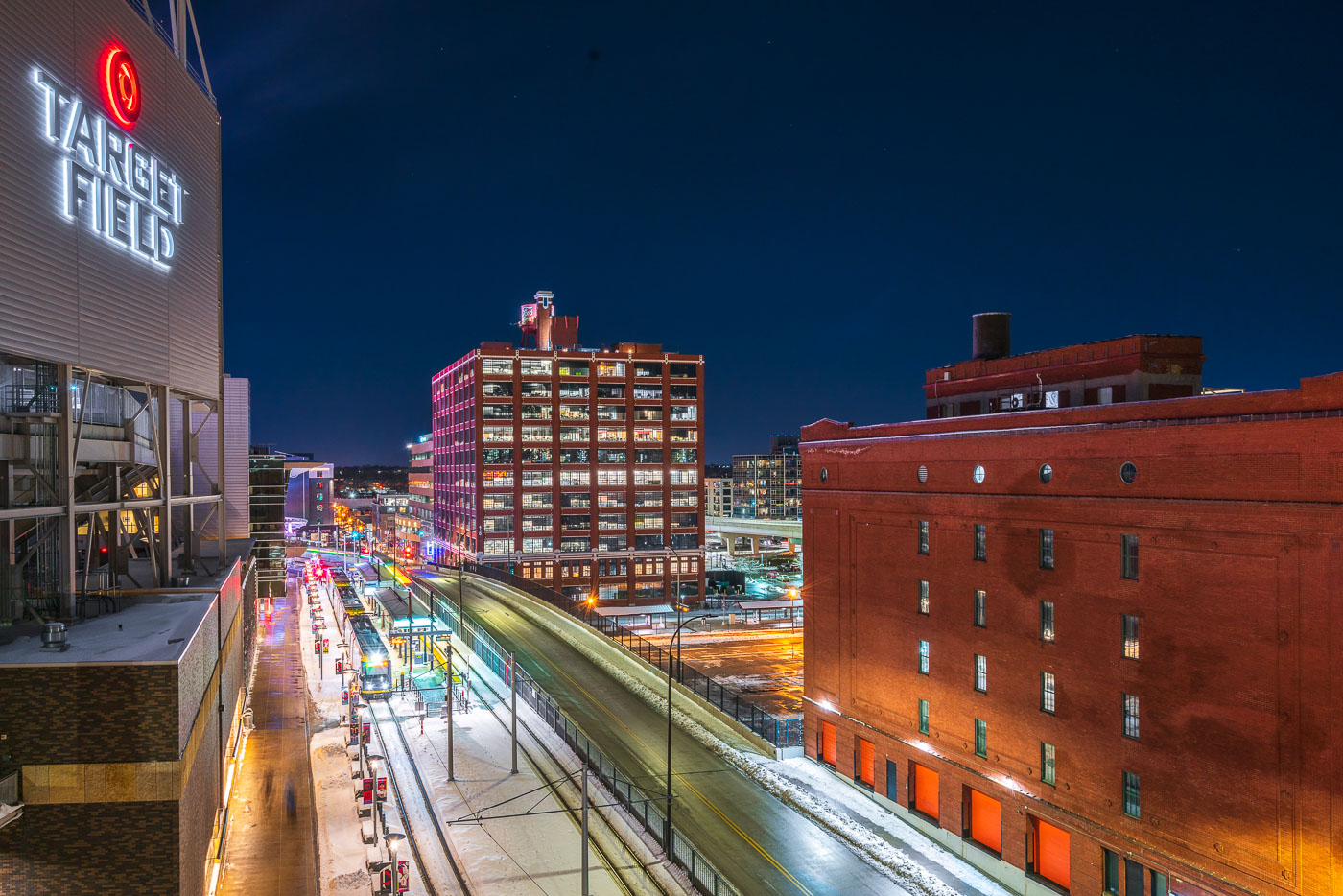
Target Field's illuminated sign overlooks downtown Minneapolis's Warehouse District with historic brick buildings and modern transit infrastructure at night.
Target Field, home of the Minnesota Twins, sits at the edge of the Warehouse District in downtown Minneapolis's North Loop. The ballpark opened in 2010 and stands next to Target Field Station, a transit hub serving the Metro Blue and Green Line light rail along with regional and commuter rail. Brick warehouses built in the early twentieth century for the district's wholesale and rail trade now hold apartments and offices near the ballpark.

Warehouse District Rooftops Near Target Field

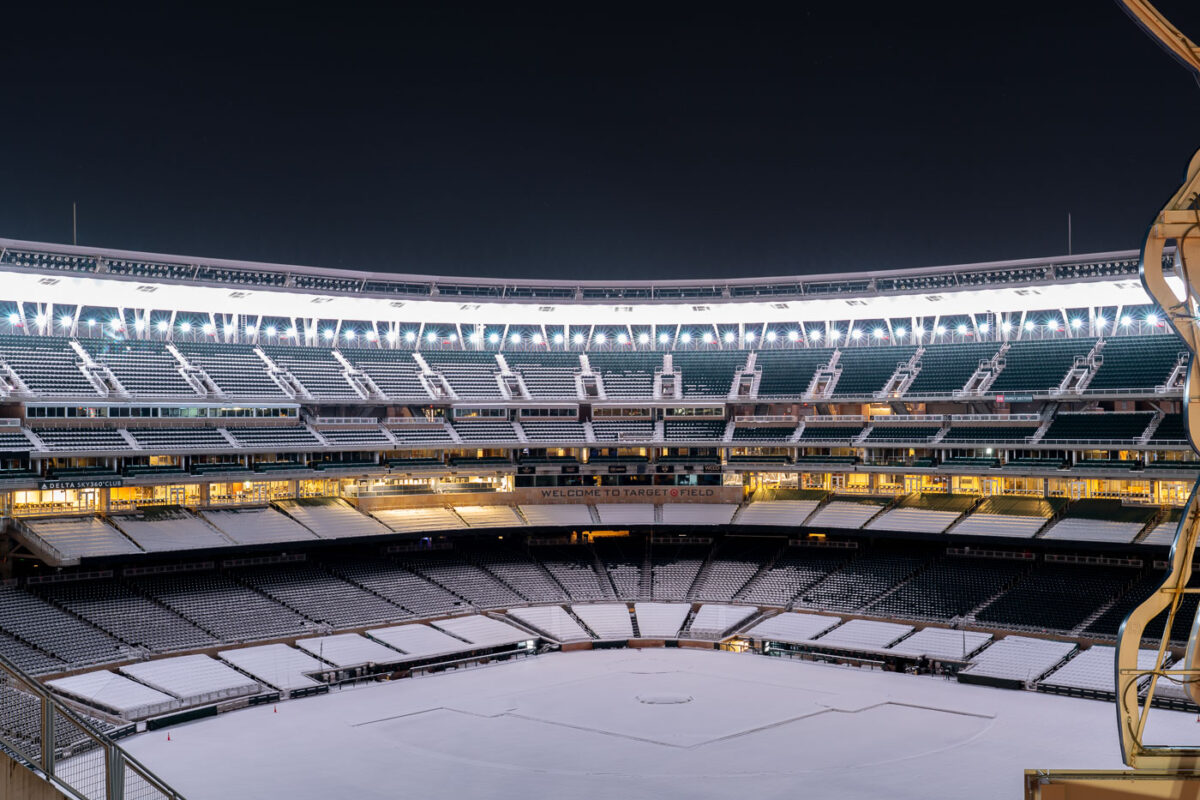
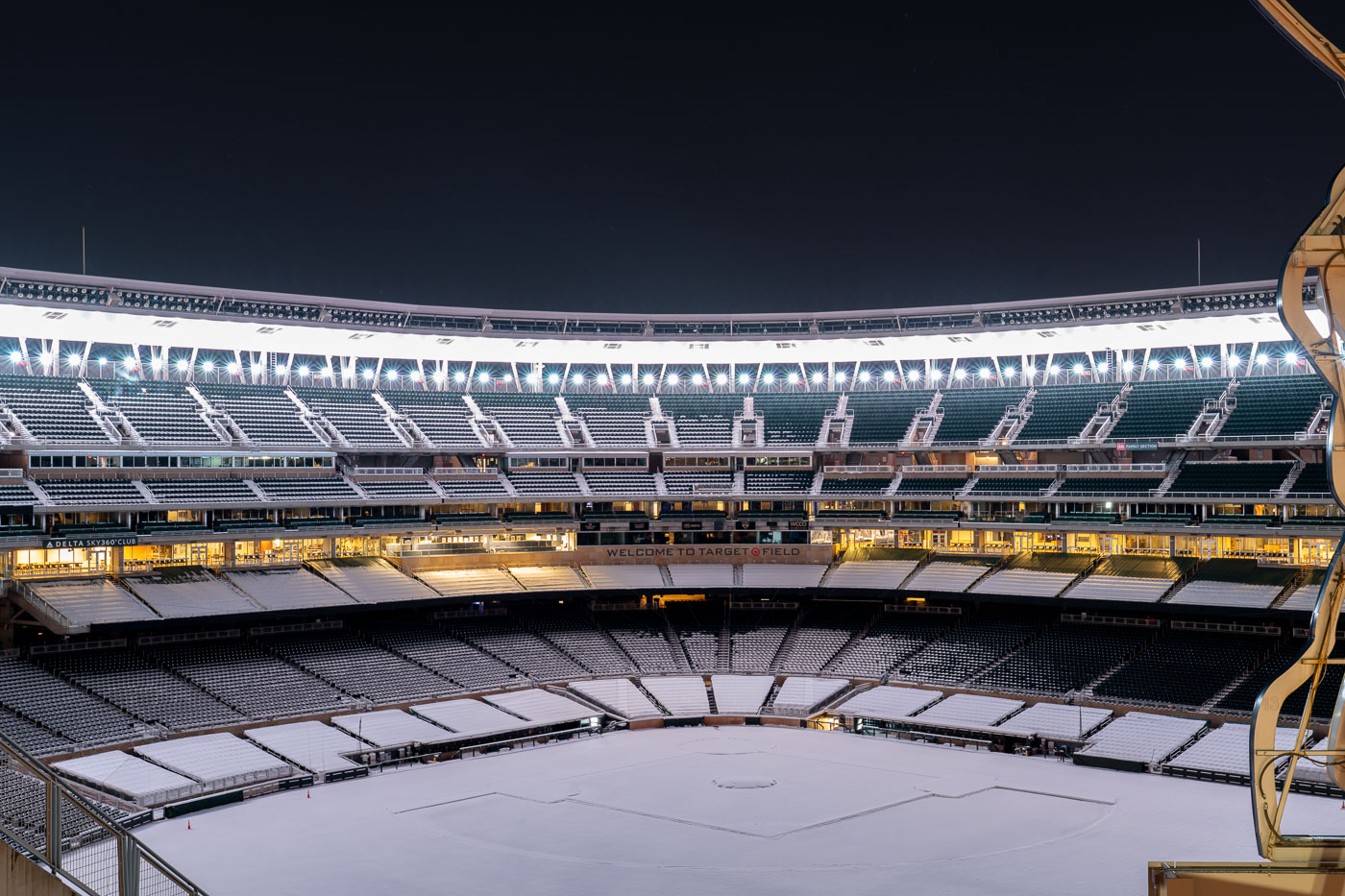
Target Field, home of the Minnesota Twins, sits snow-covered under night lighting in Minneapolis.
Target Field is the Minnesota Twins' ballpark in the North Loop of downtown Minneapolis, seating about 39,000 fans. It opened in 2010 as an open-air replacement for the Metrodome, where the Twins had played since 1982.

Snow Covers the Infield at Target Field

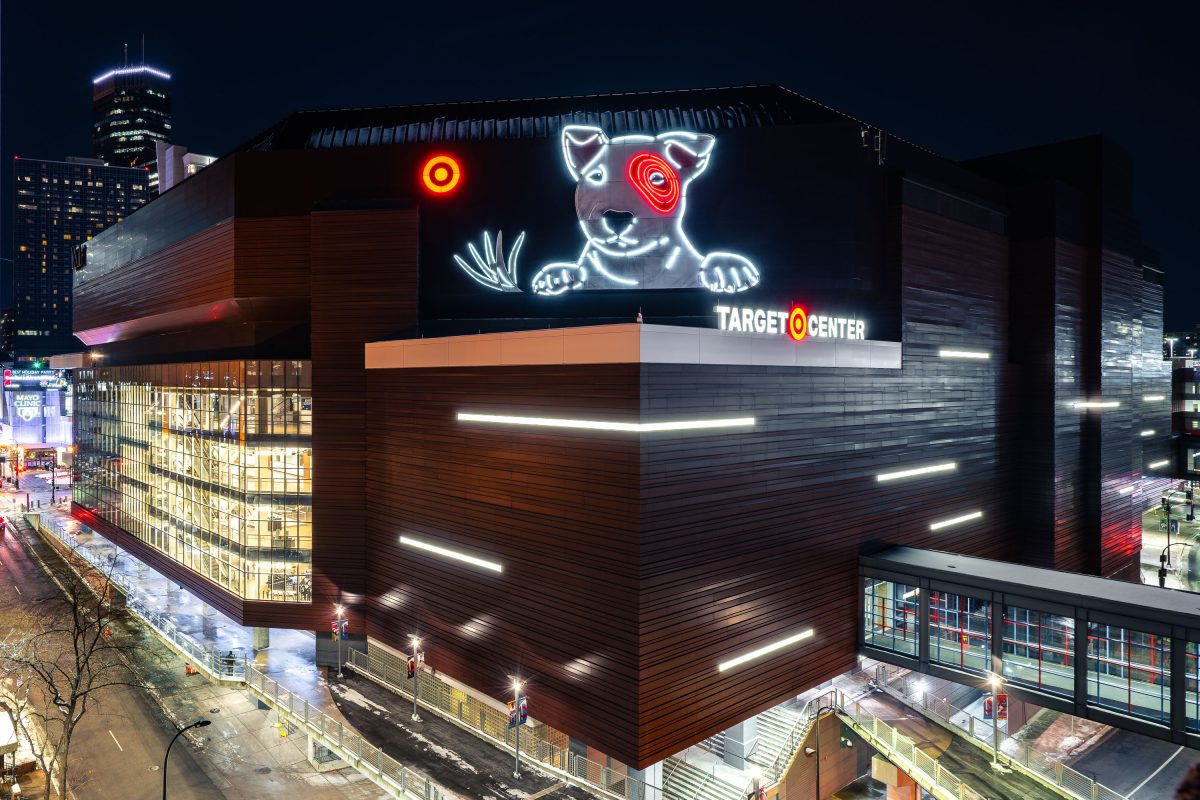
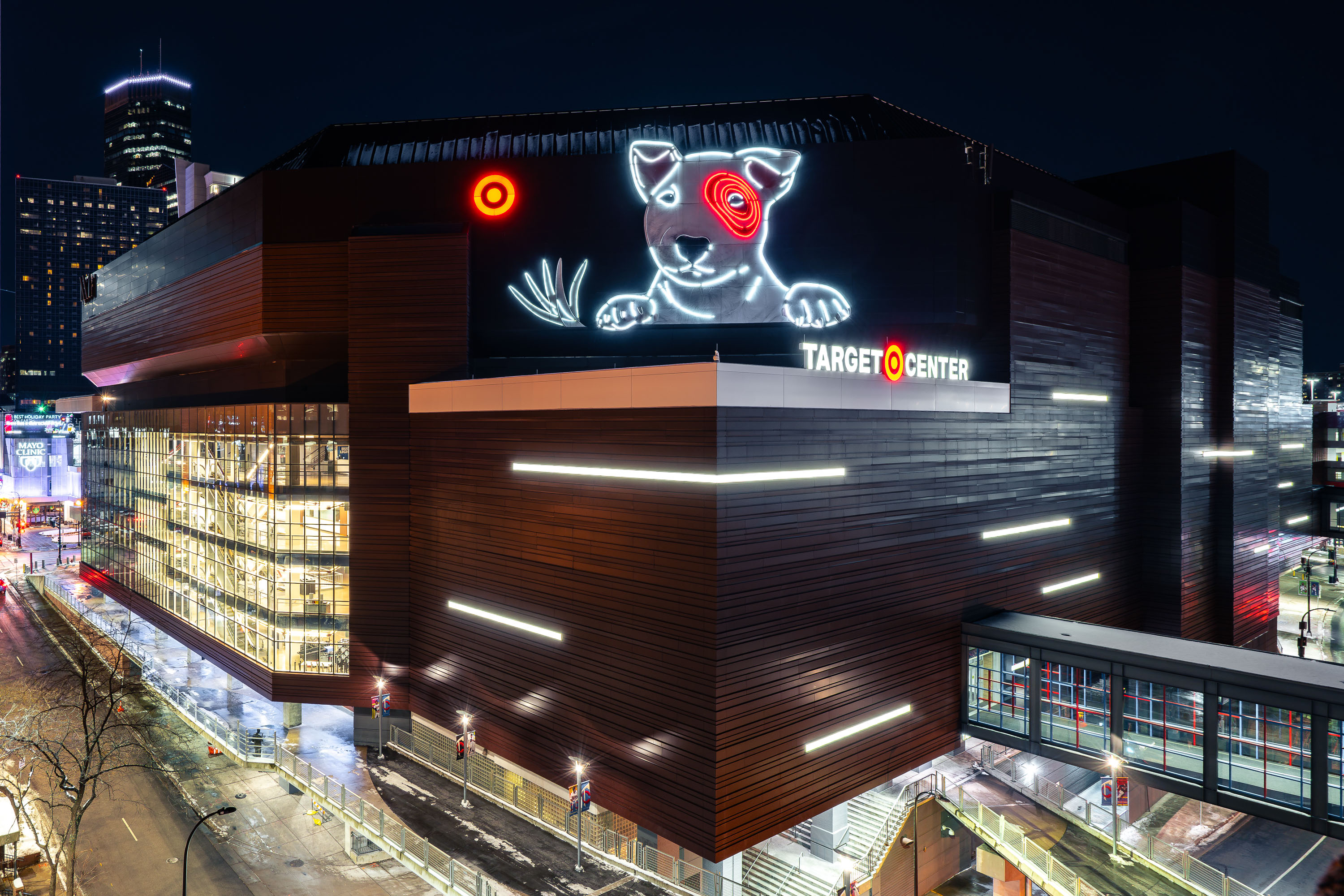
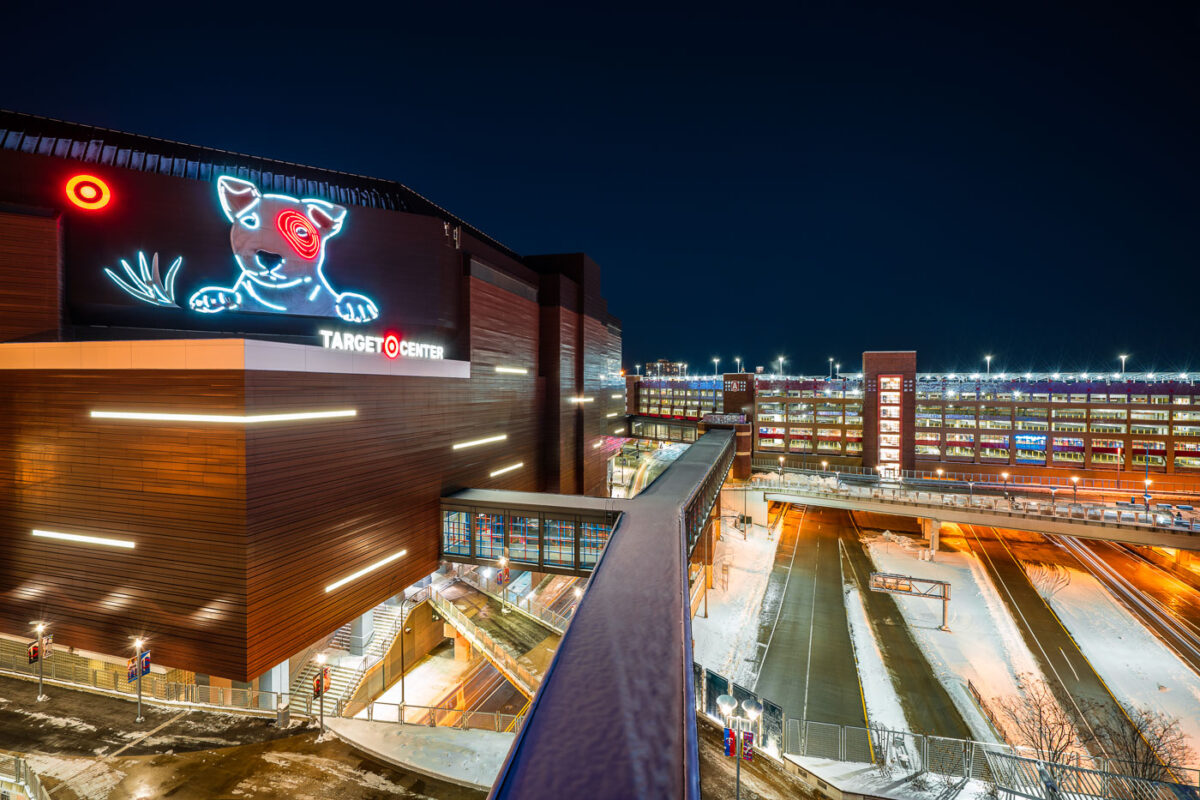
Target Center's illuminated neon bullseye dog logo displays above the arena entrance in downtown Minneapolis at night.
Target Center opened in downtown Minneapolis in 1990 as home to the NBA's Minnesota Timberwolves and, later, the WNBA's Minnesota Lynx. The arena seats roughly 19,000 for basketball and hosts concerts and other events year-round. A skyway connection links the building to the surrounding downtown buildings.
Neon Bullseye Dog Sign on Target Center at Night

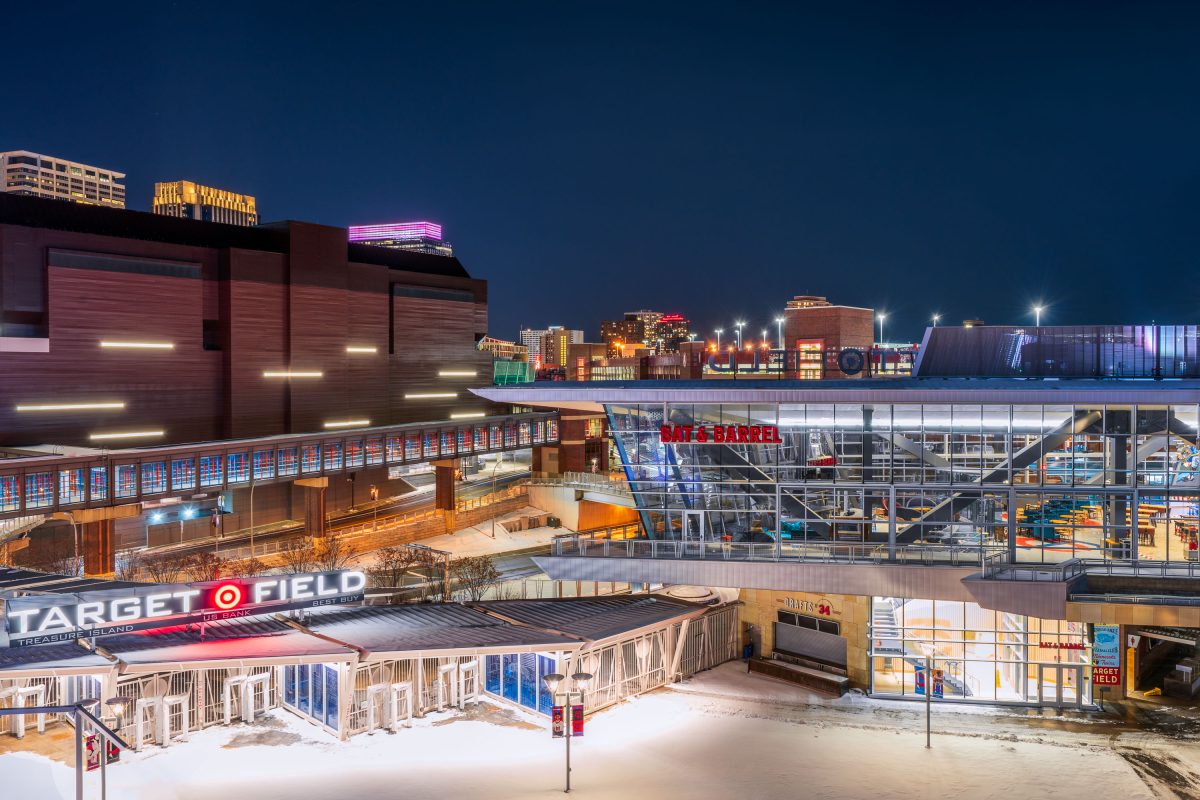
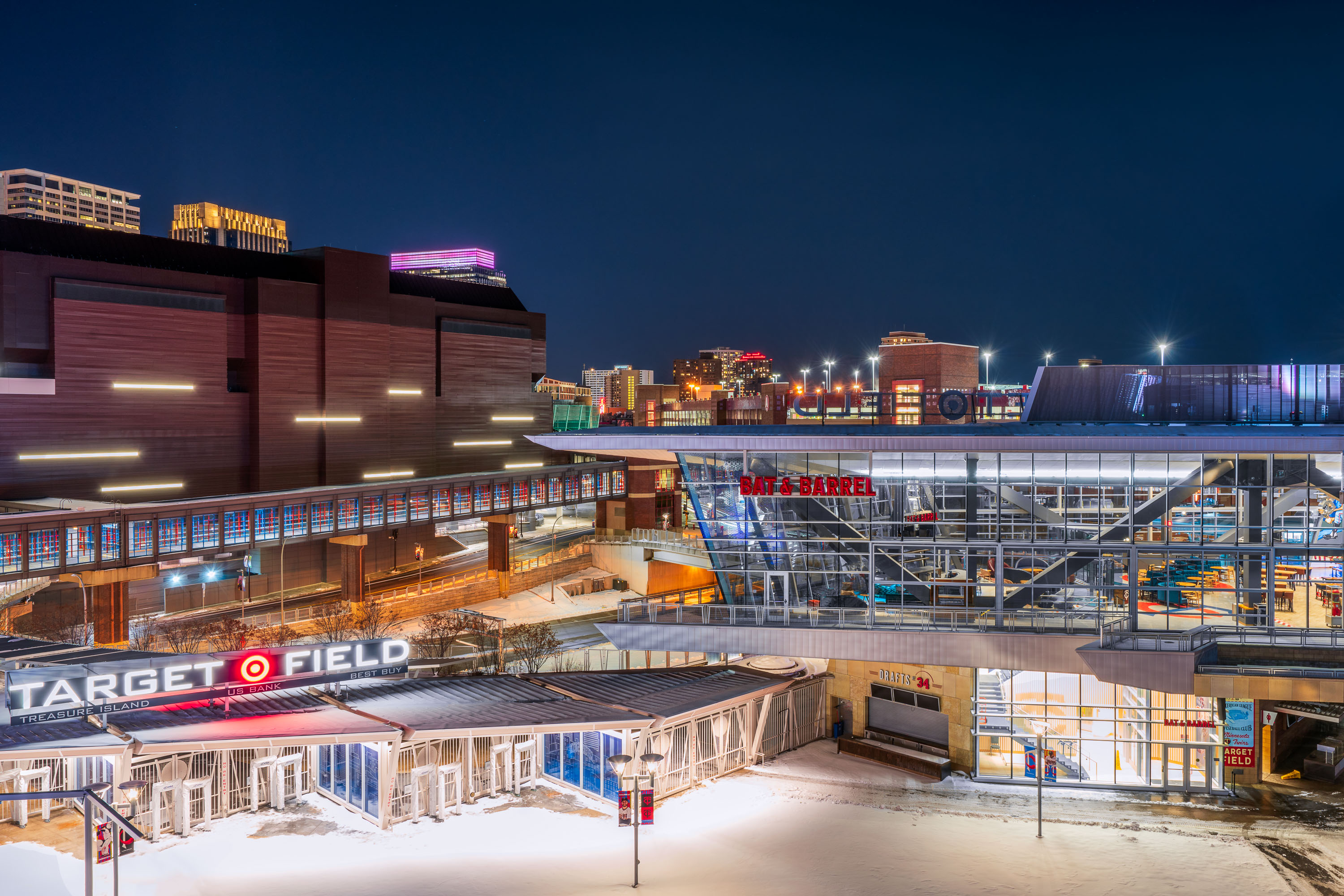
Target Field stadium and surrounding downtown Minneapolis buildings illuminated at night with snow on the ground.
Target Field, the home of the MLB Minnesota Twins. Located near the North Loop and Downtown Minneapolis.

Target Field and Bat & Barrel on a Snowy Night in Minneapolis
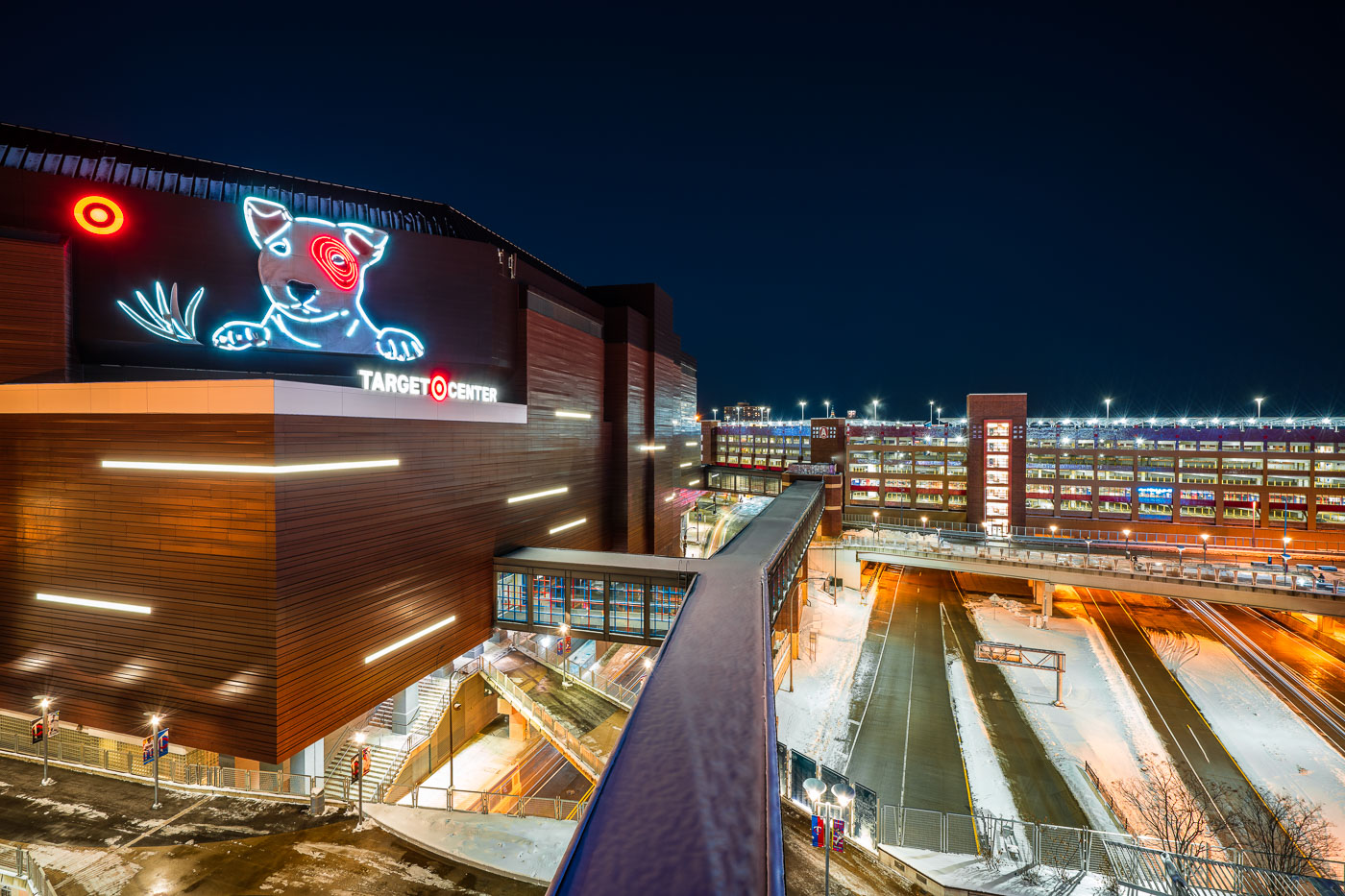
Target Center and Ramp A skyway in downtown Minneapolis at night.
Target Center in downtown Minneapolis is a multi-purpose arena opened in 1990 and renovated in 2017. It is the home court of the Minnesota Timberwolves and is connected to Ramp A by an enclosed skyway. The Minneapolis skyway system links buildings and parking ramps across the downtown core.

Target Center and Ramp A Skyway, Minneapolis
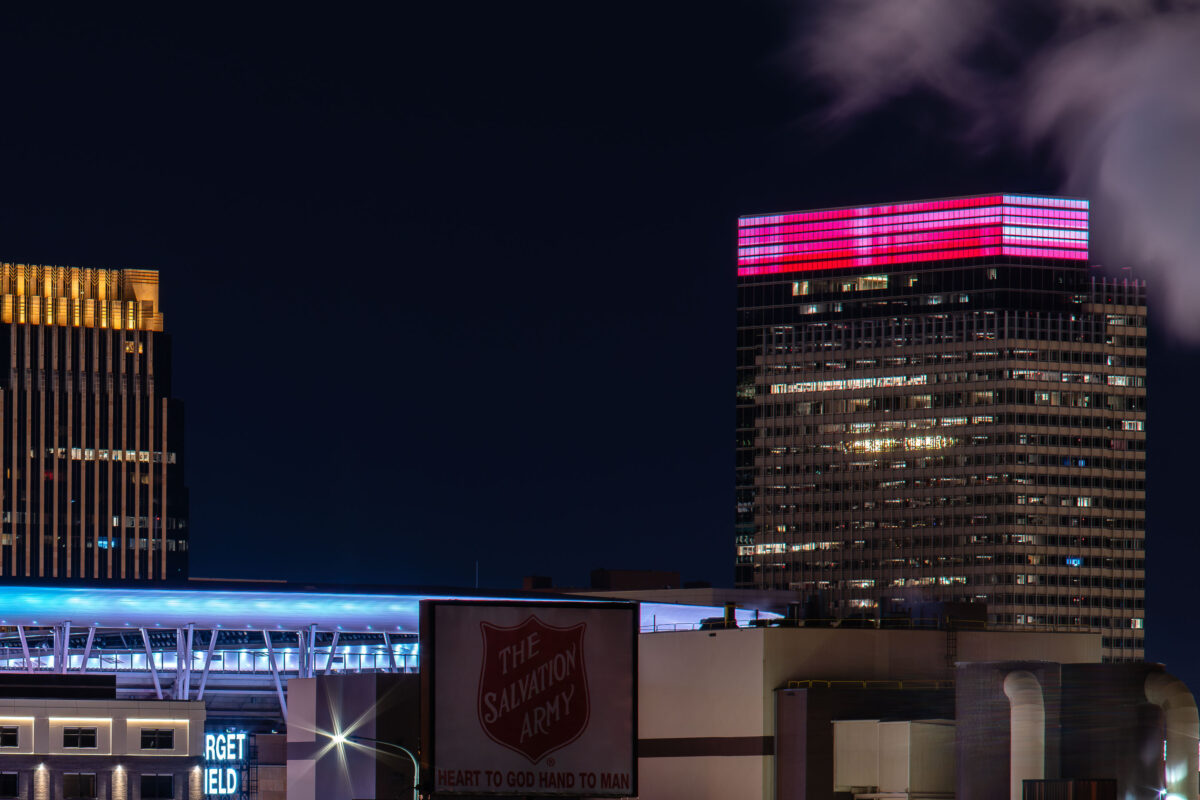
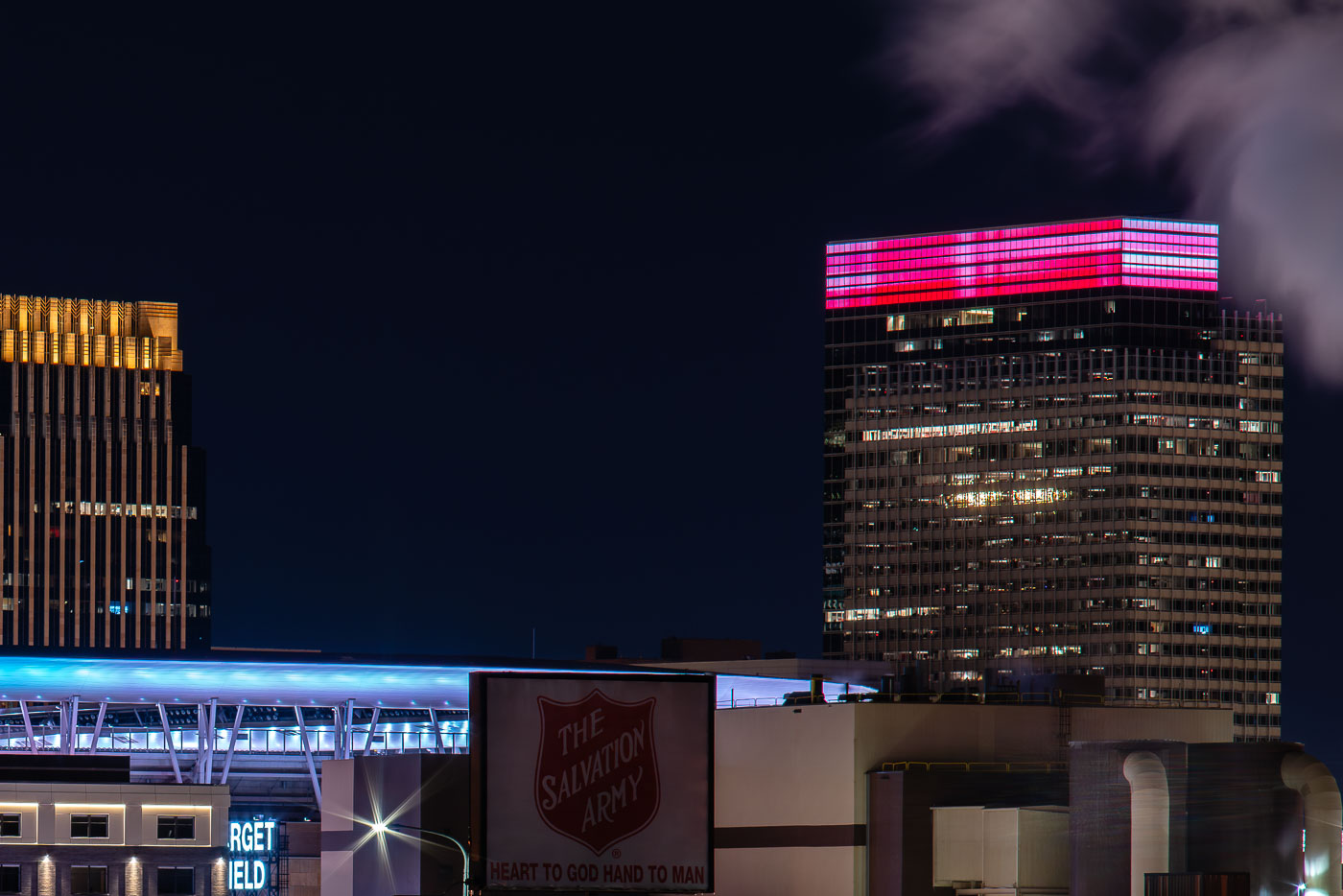
Salvation Army and Target Headquarters
The Minneapolis North Loop district is home to both corporate headquarters and community service organizations. The Target World Headquarters, a prominent feature of the city's business landscape, stands adjacent to Target Field, a baseball stadium. Also visible is a sign for The Salvation Army, a non-profit organization dedicated to providing social services.
Salvation Army and Target HQ, Minneapolis North Loop
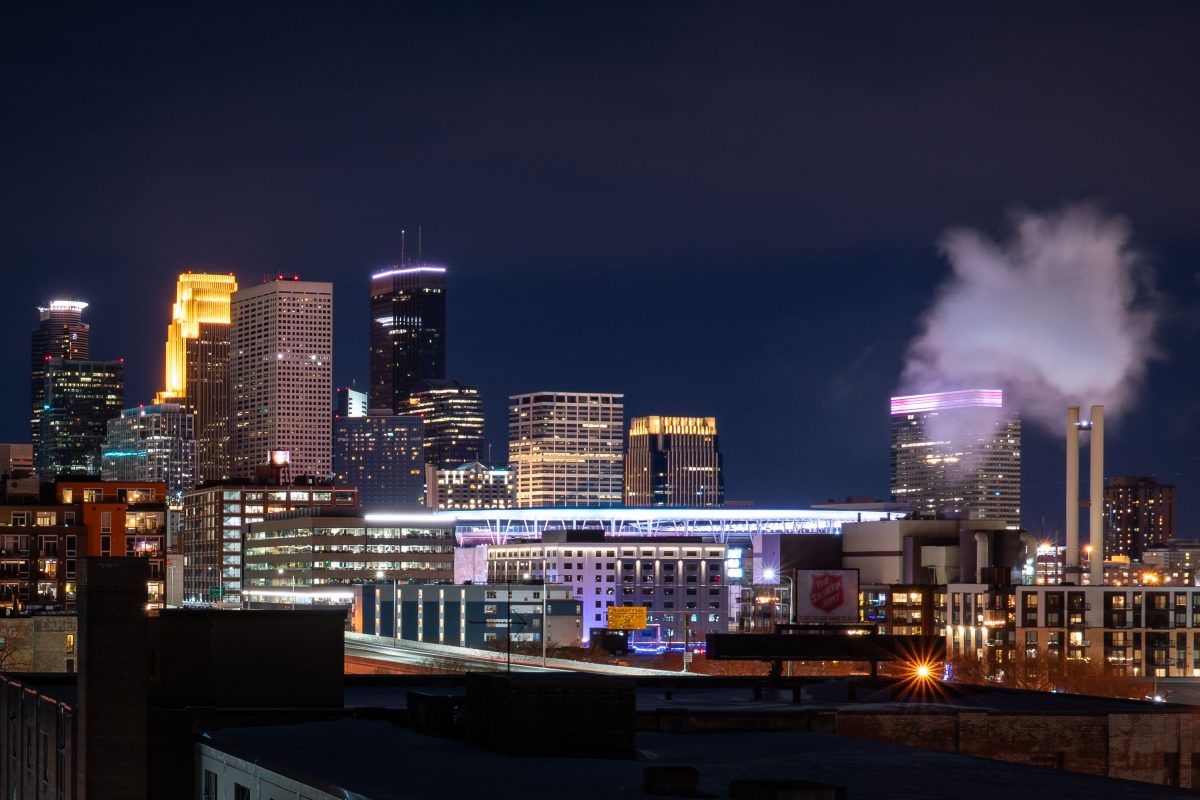
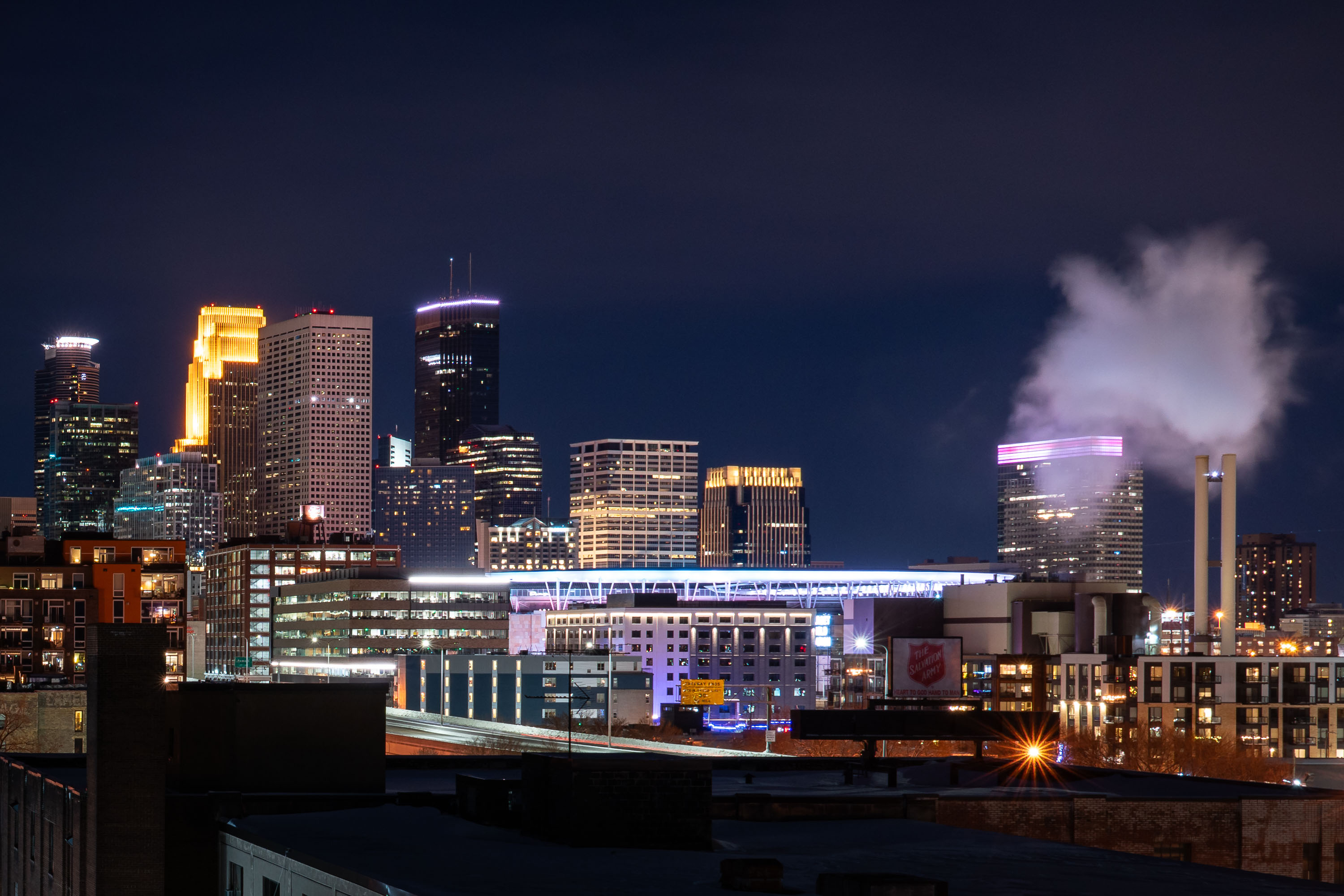
Target Field and downtown Minneapolis skyline at night, viewed from North Loop.
Target Field opened in 2010 as the home of the Minnesota Twins, ending the team's 28-year run at the Metrodome. The ballpark seats about 38,800 and was built from Minnesota-quarried limestone at a cost of roughly $545 million. Beyond the outfield, downtown Minneapolis rises with the 57-story Wells Fargo Center and the 775-foot IDS Center, the tallest building in the state since its 1972 completion. The twin smokestacks near the ballpark belong to a district energy plant that supplies steam heat to much of downtown.

Target Field Skyline at Night, Minneapolis
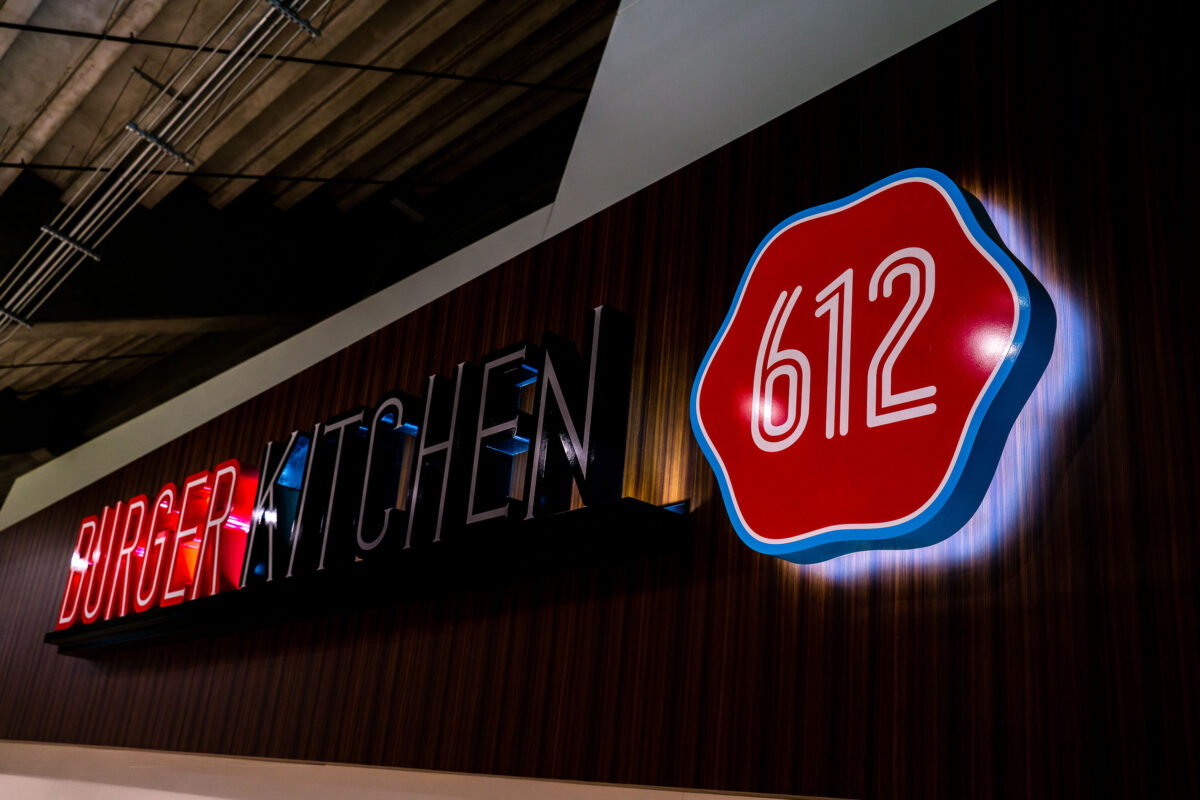
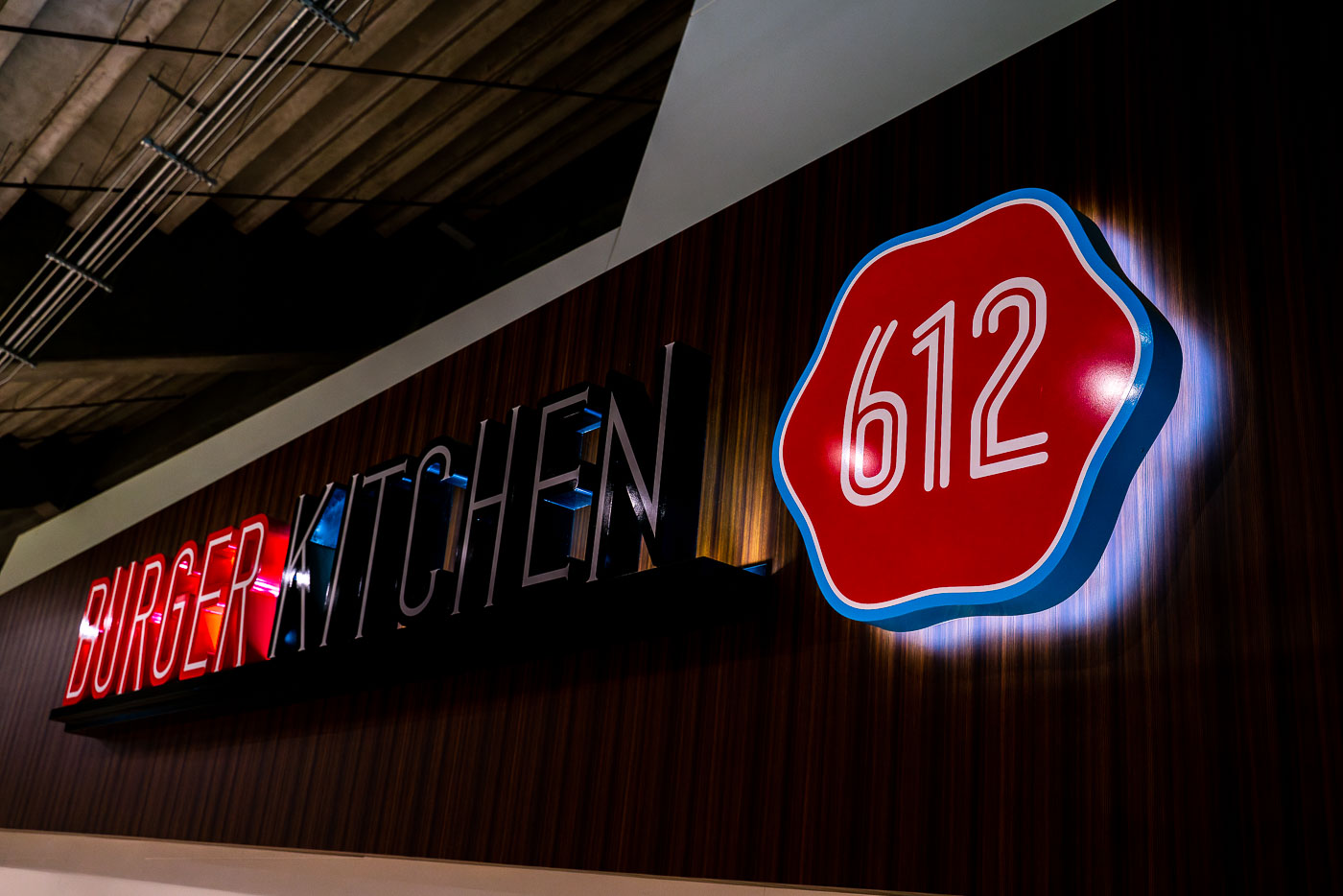
612 Burger Kitchen sign inside U.S. Bank Stadium in Minneapolis.
612 Burger Kitchen at U.S. Bank Stadium in Minneapolis is a concessions outlet inside the home of the Minnesota Vikings. The name references Minneapolis area code 612, a local identifier used in the stadium's food and beverage branding.

612 Burger Kitchen at U.S. Bank Stadium, Minneapolis
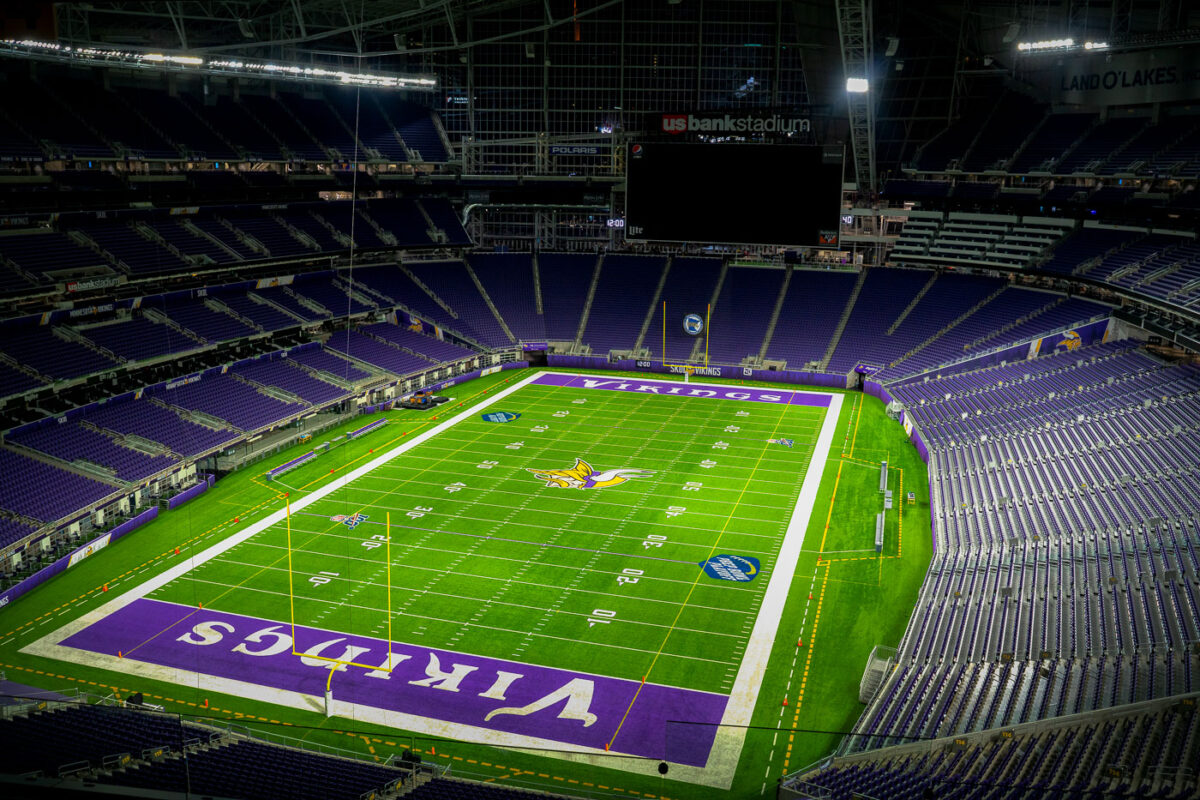
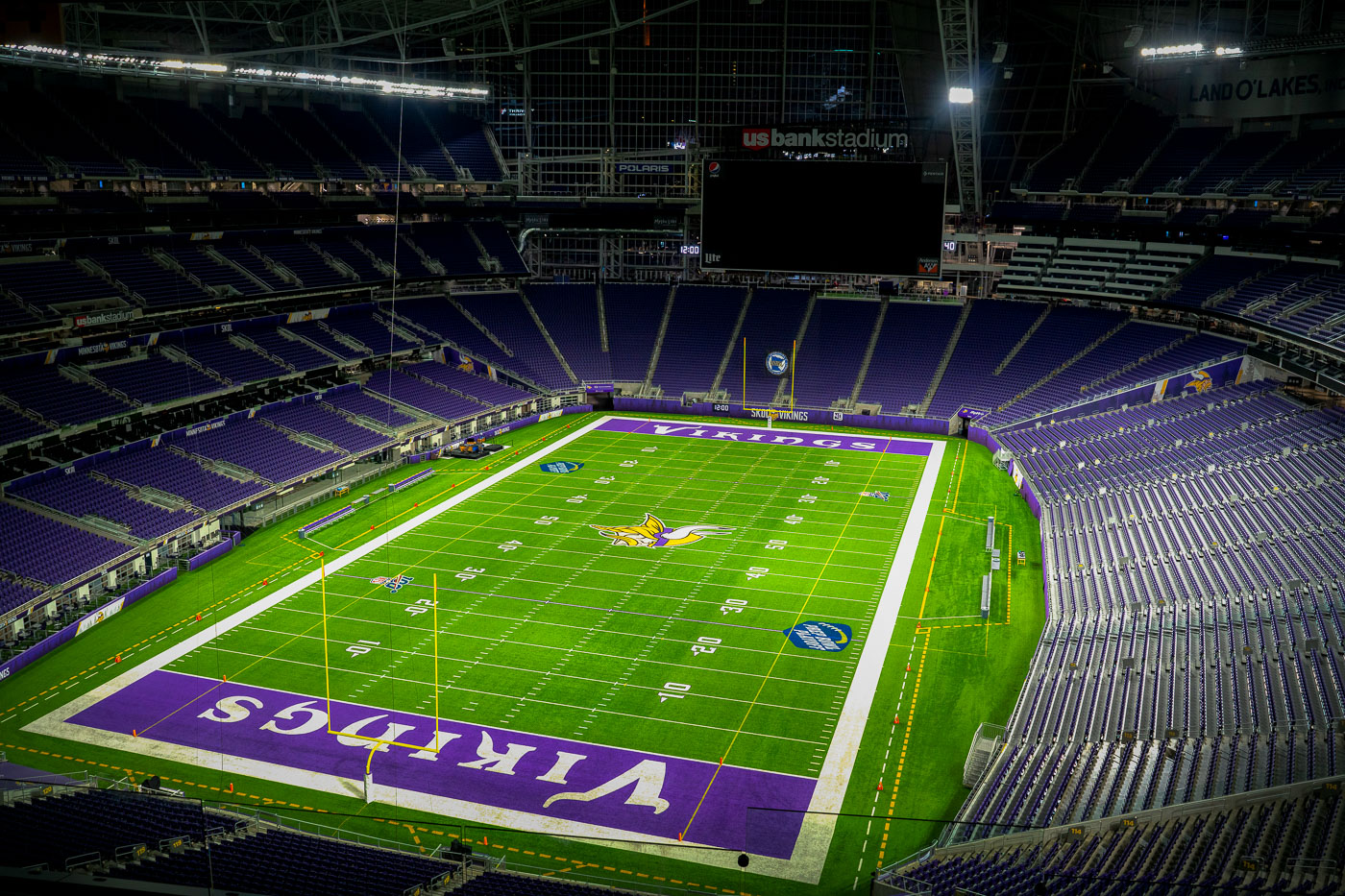
Inside US Bank Stadium at night
US Bank Stadium, located in downtown Minneapolis, serves as the home field for the NFL's Minnesota Vikings. Opened in 2016, the stadium replaced the Metrodome, which had been the Vikings' home since 1982.

US Bank Stadium, Home of the Minnesota Vikings, Minneapolis
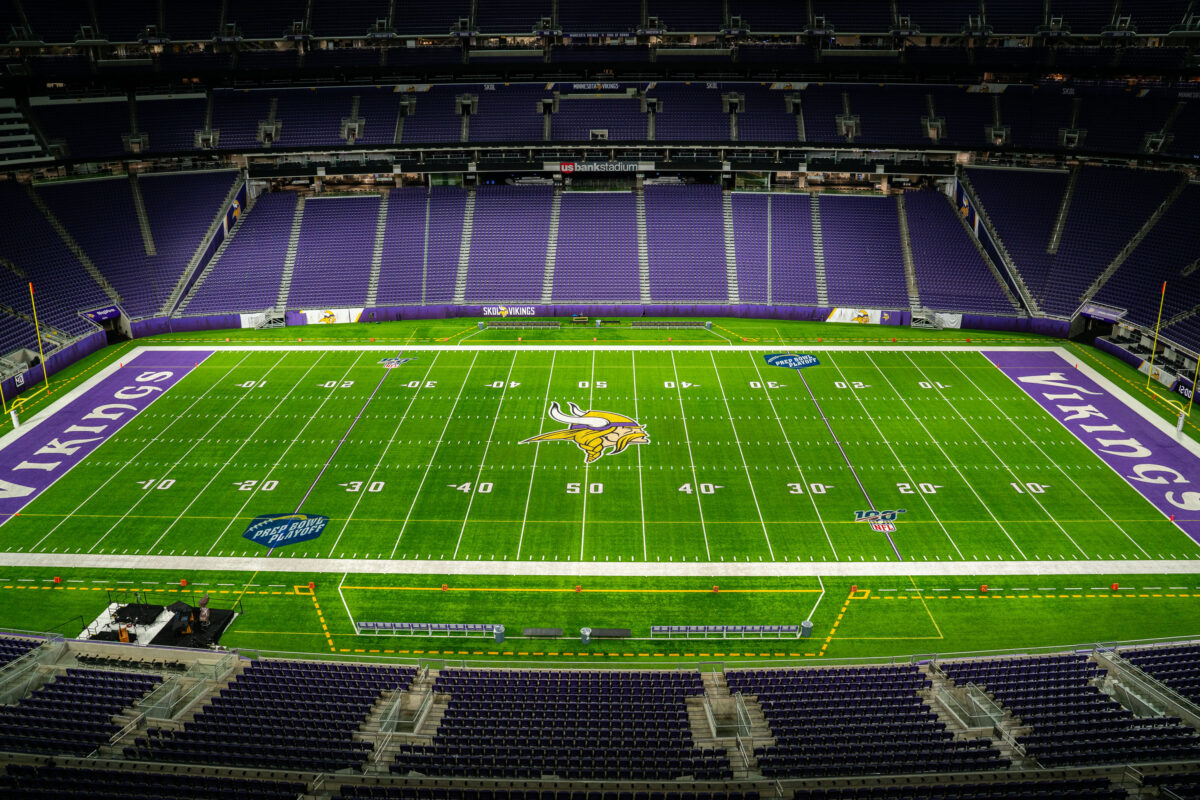
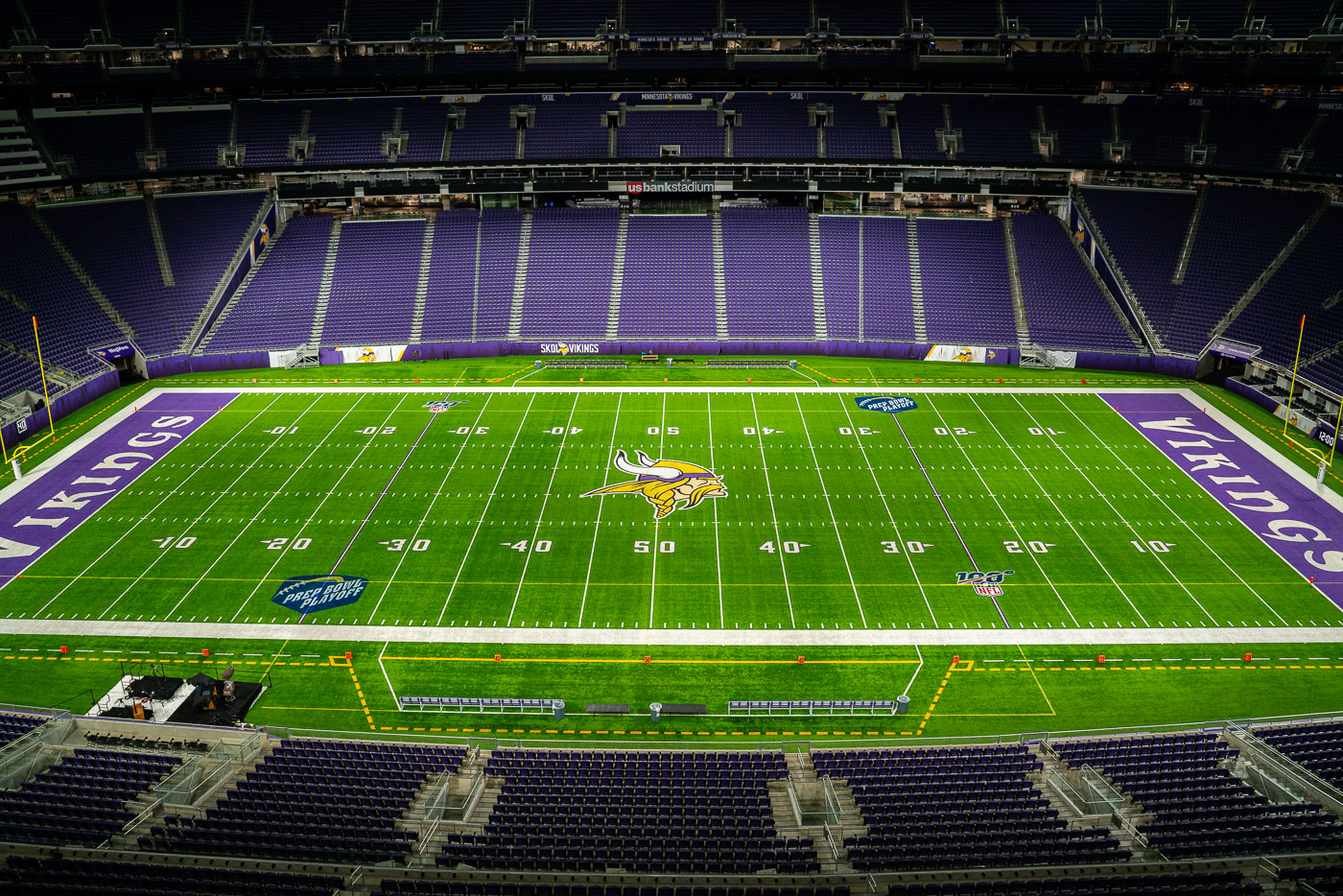
US Bank Stadium Field Home of the Minnesota Vikings
U.S. Bank Stadium, home of the NFL's Minnesota Vikings, is a multi-purpose venue in downtown Minneapolis. Completed in 2016, the $1.1 billion stadium replaced the Metrodome and features a translucent ETFE roof and steep seating.

U.S. Bank Stadium Field, Minneapolis, Home of the Minnesota Vikings
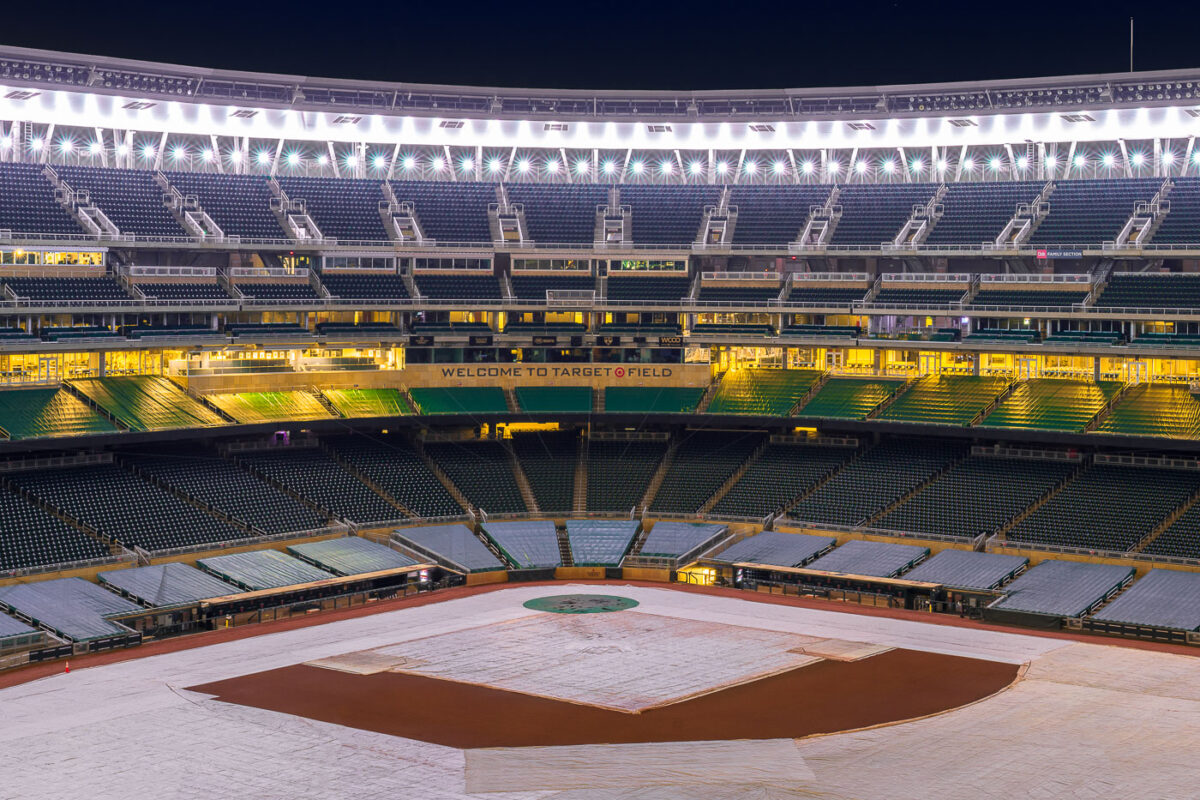
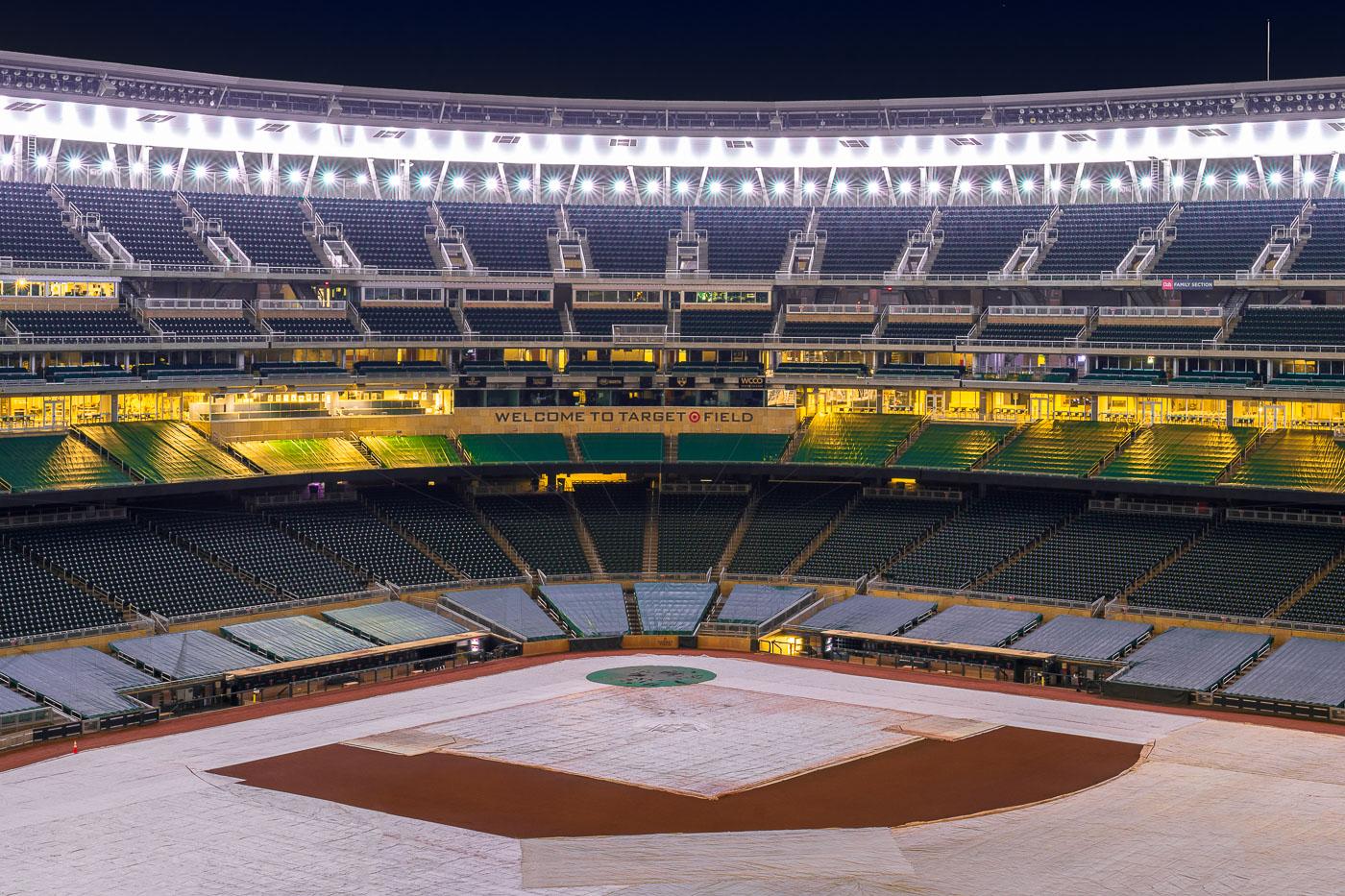
Target Field's baseball diamond covered in white tarps under stadium lights in Minneapolis.
Target Field is the Minnesota Twins' ballpark in downtown Minneapolis, built on a former railroad and warehouse site in the North Loop. It opened in 2010, replacing the Metrodome as the team's home after nearly three decades of indoor baseball. A tarp covers the infield during the off-season, with the diamond empty and the stands bare of fans.

Target Field’s Infield Tarp on a Winter Night
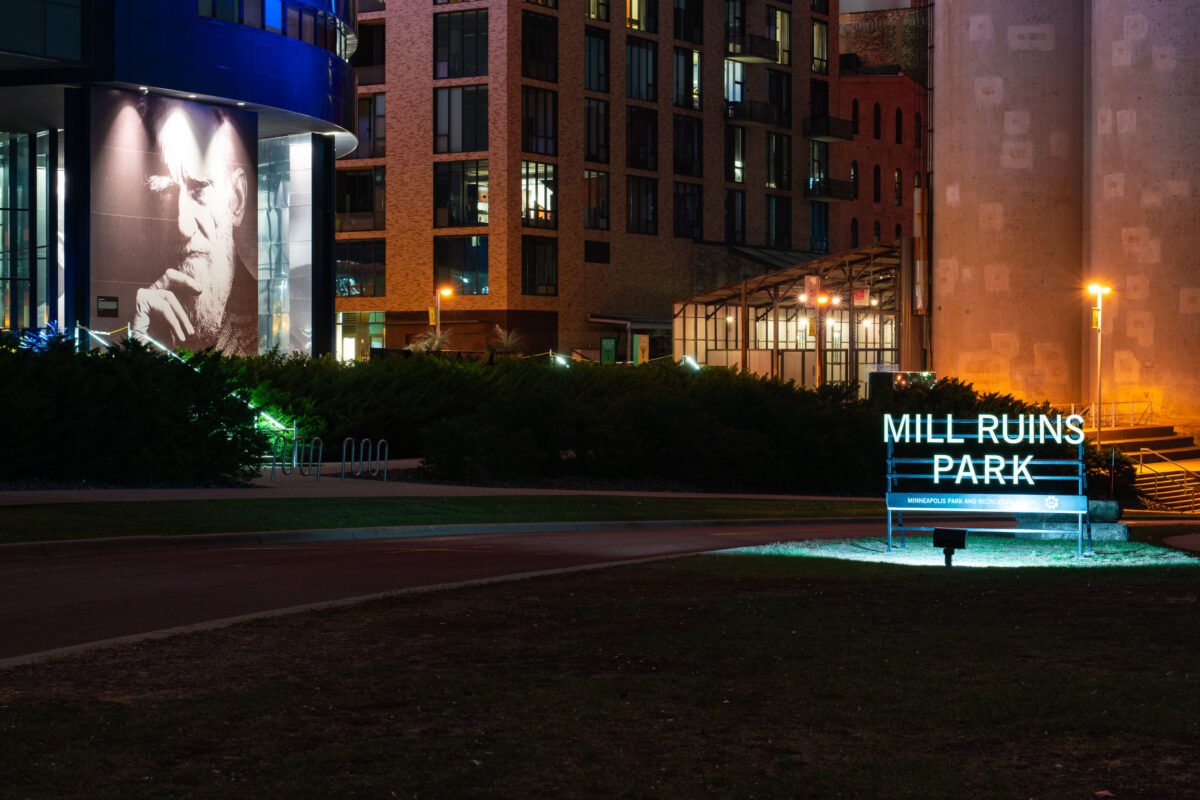
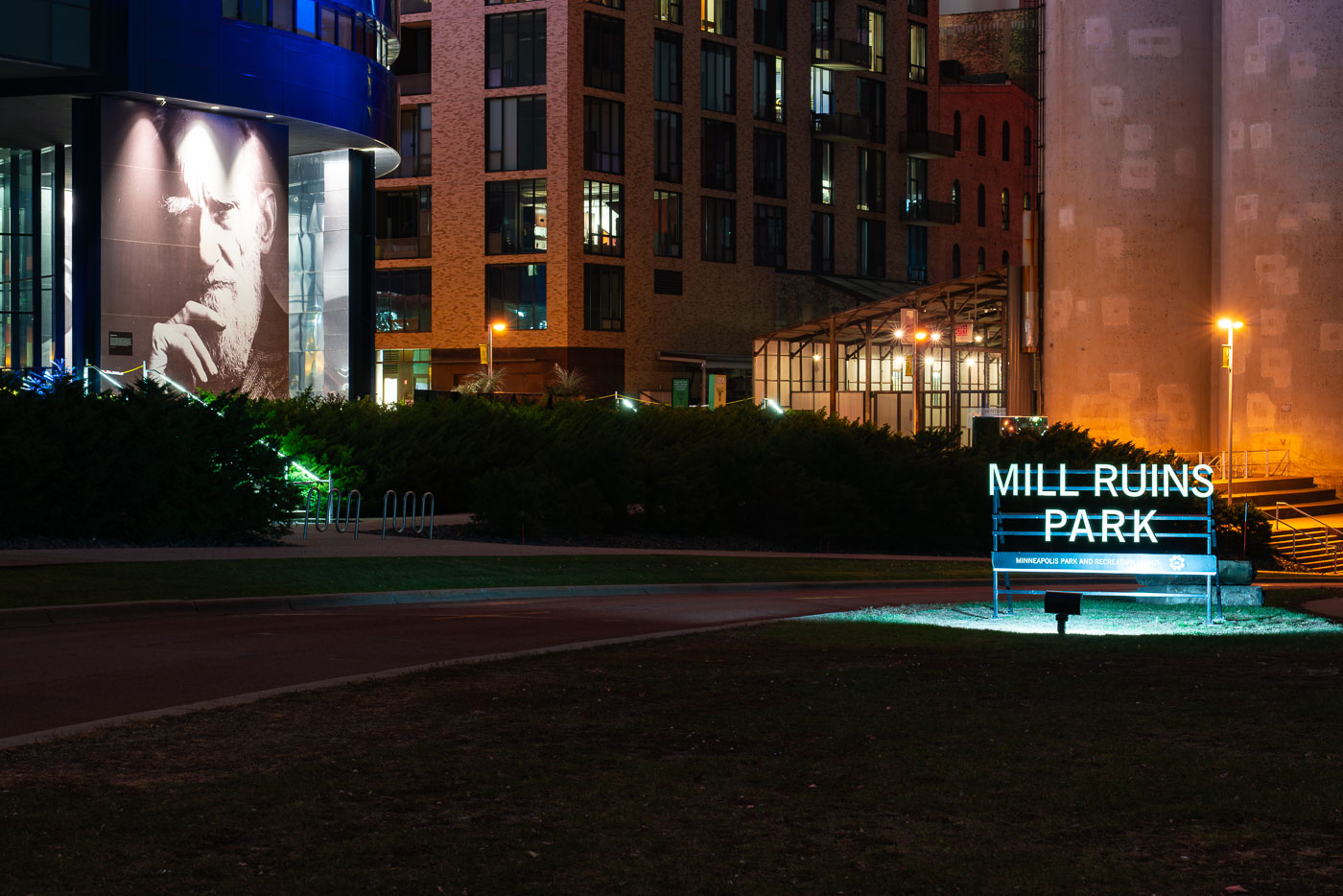
Mill Ruins Park sign in Minneapolis near the Guthrie Theater at night.
Mill Ruins Park in Minneapolis preserves the foundations of the city’s historic flour mills along the Mississippi riverfront. The park sits near the Guthrie Theater and modern residential development in the Mill District.

Mill Ruins Park Sign, Minneapolis

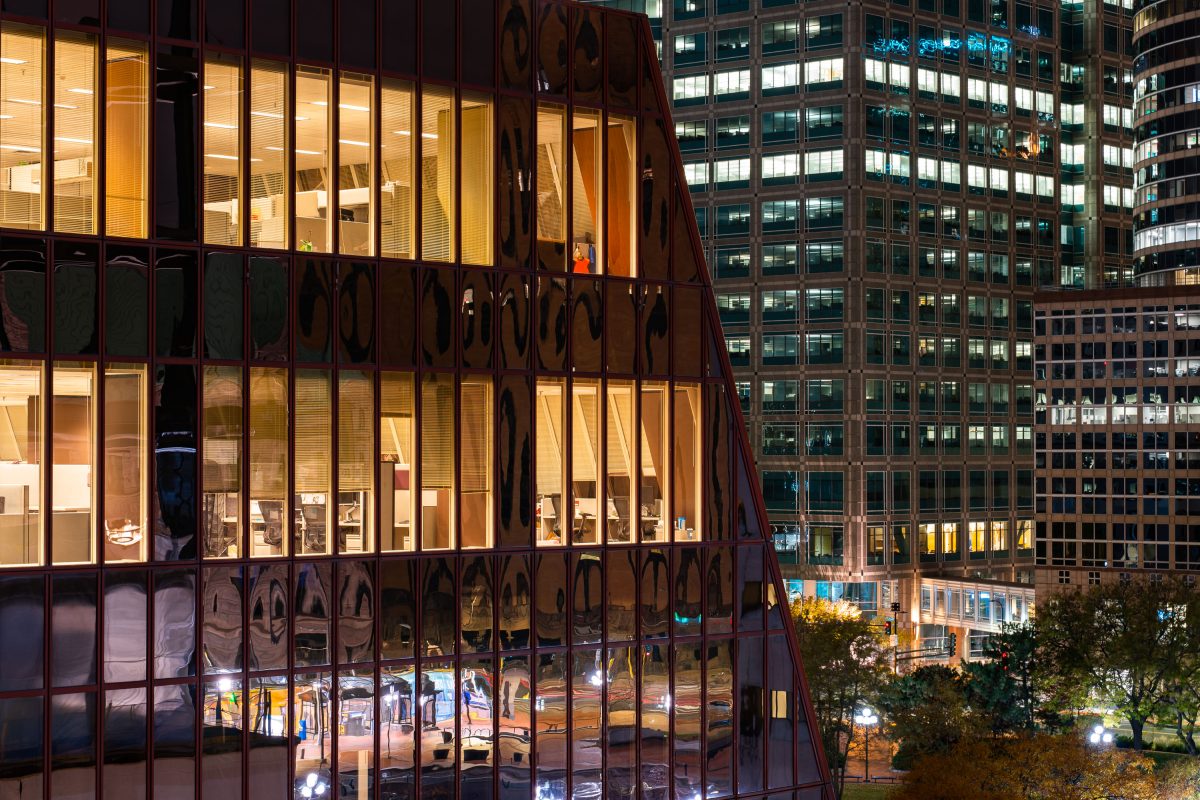
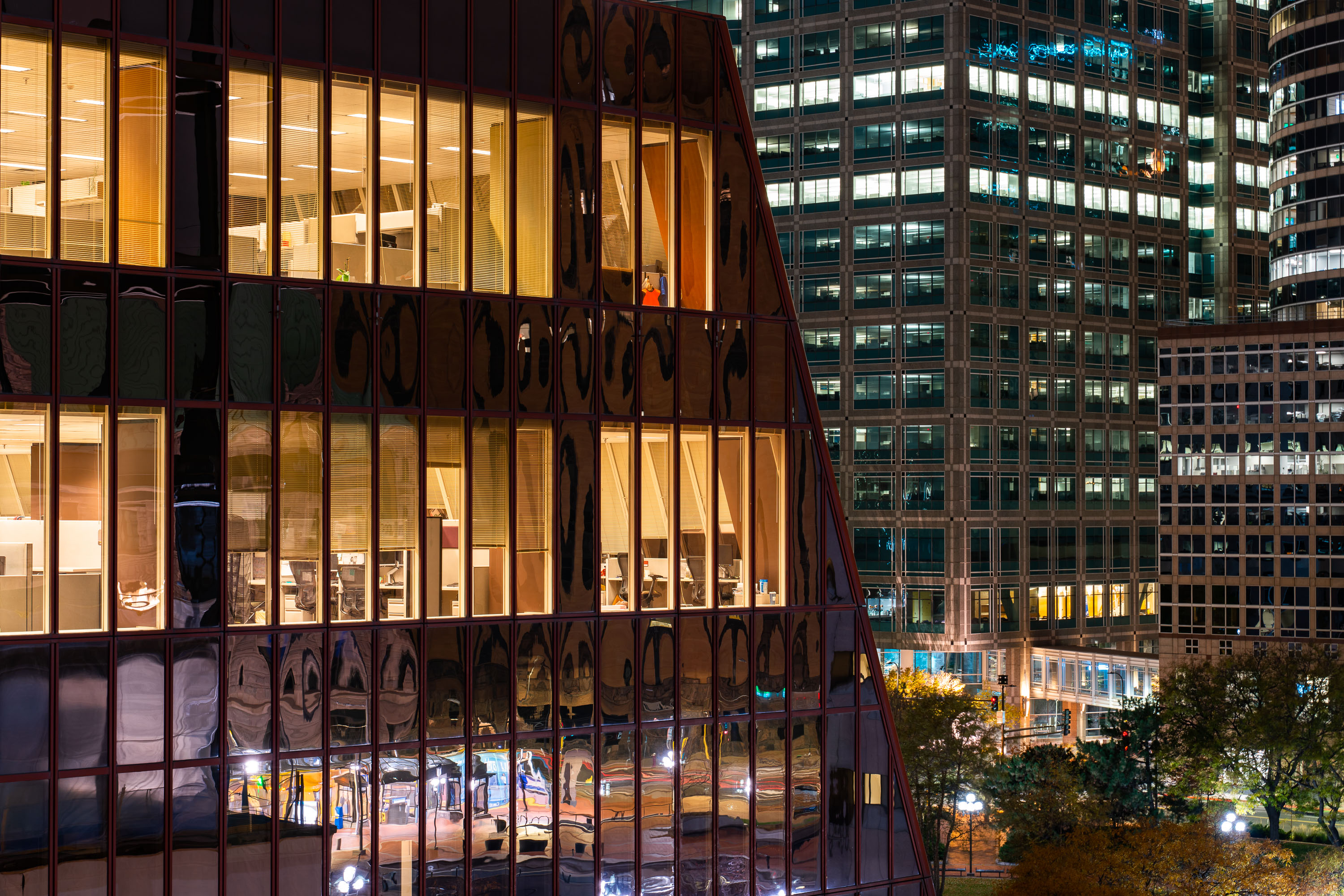
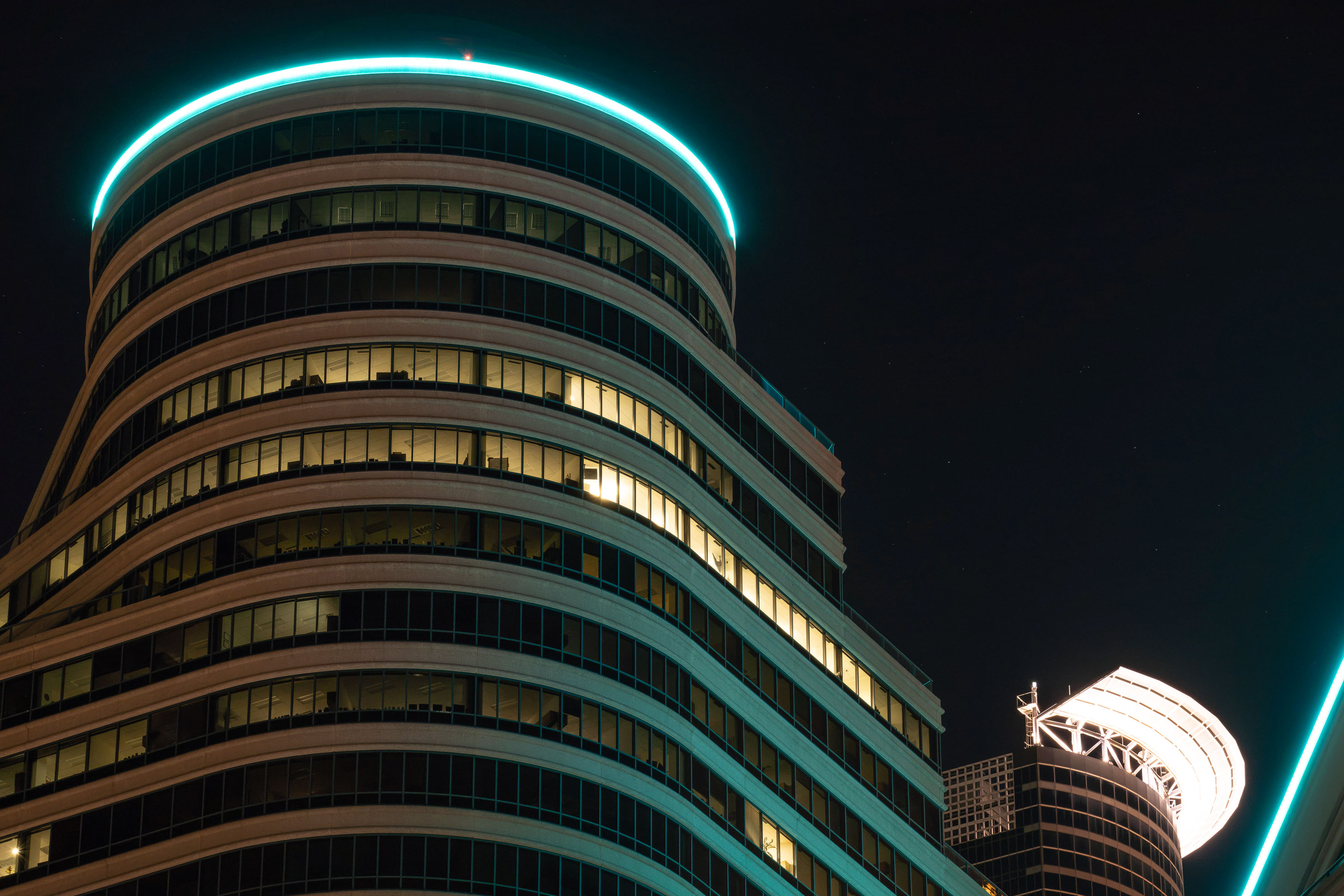
Glass office tower, the former Thrivent Financial headquarters, among high-rises in downtown Minneapolis at night.
This building at 625 Fourth Avenue South is the former Thrivent Financial headquarters in downtown Minneapolis. Thrivent, a Fortune 500 financial services organization, relocated its headquarters to a new downtown campus in 2020.

Former Thrivent Building, Downtown Minneapolis
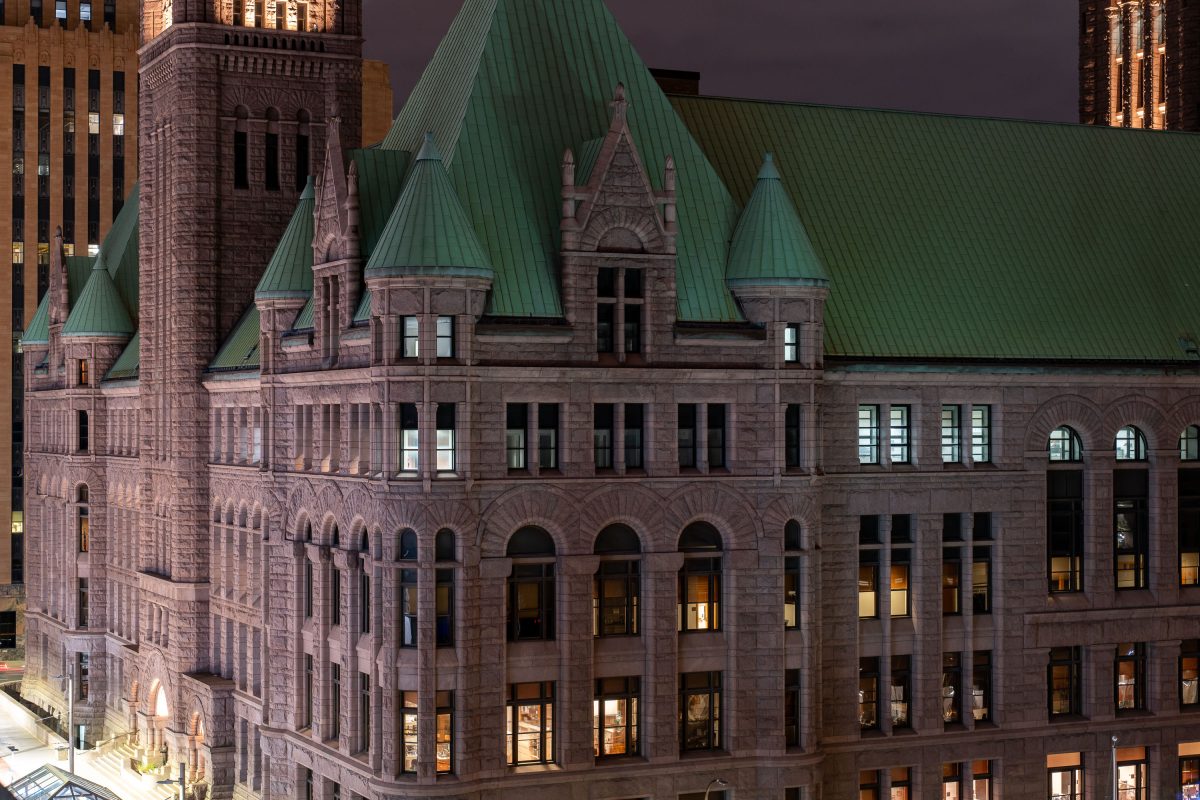
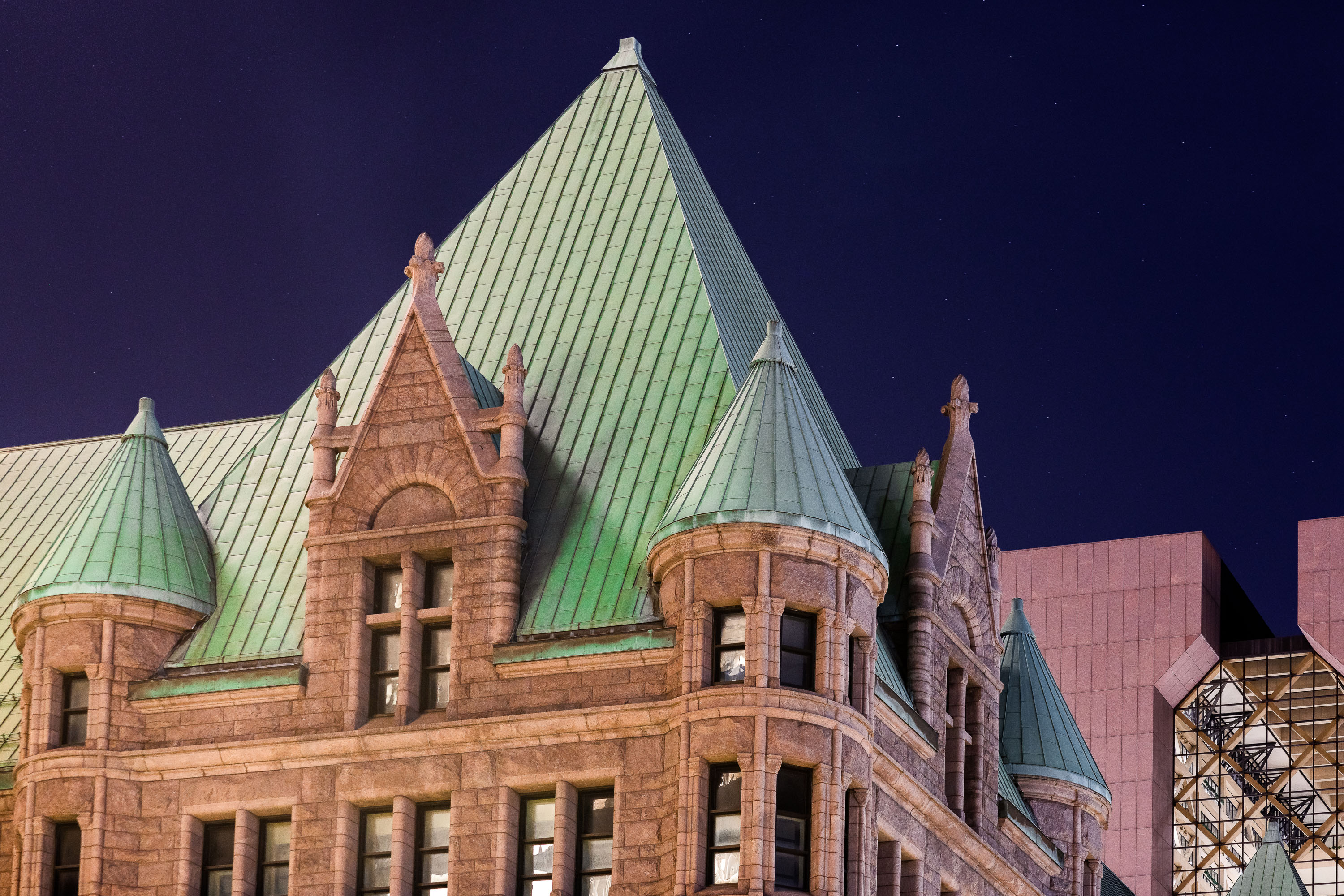
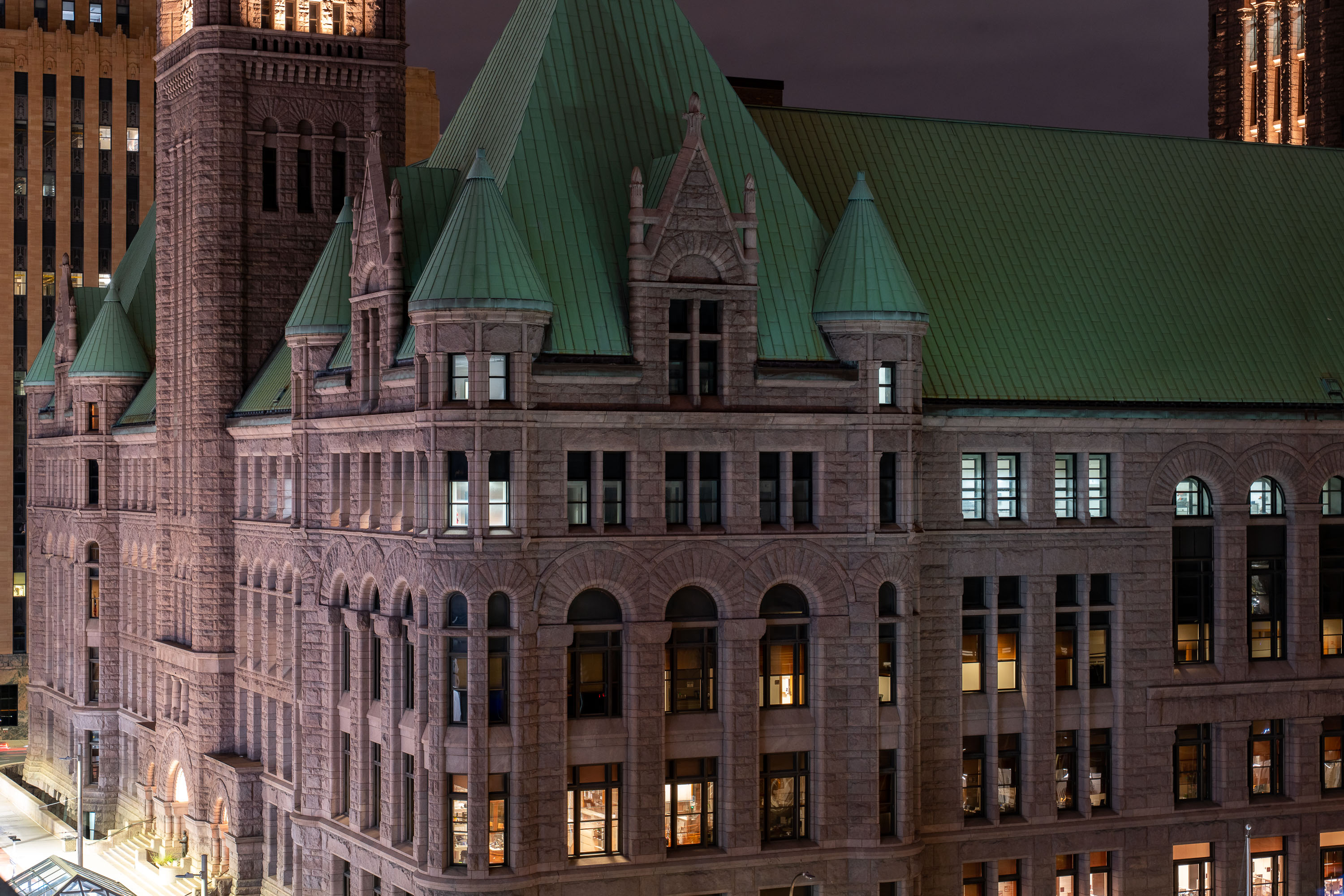
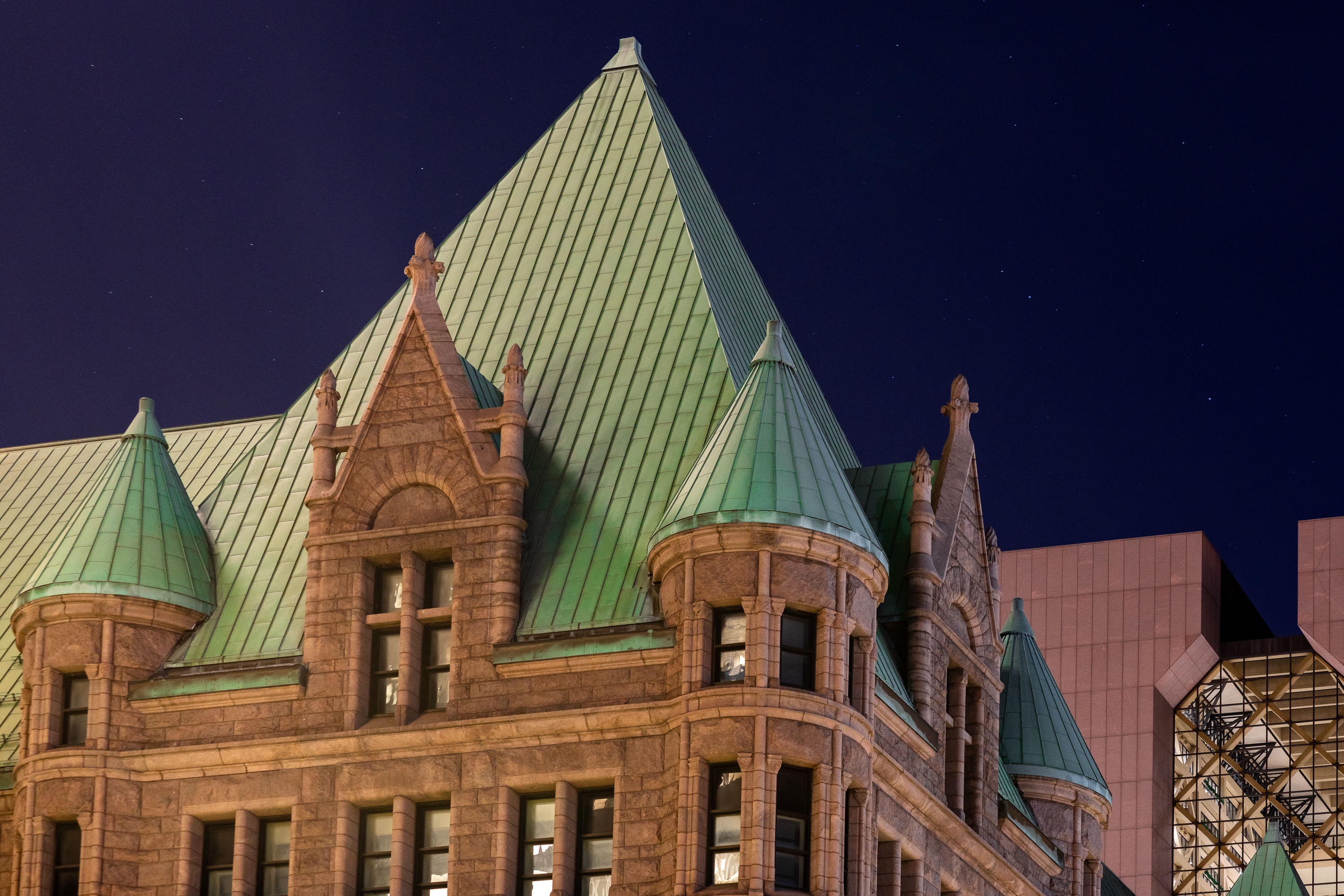
Minneapolis City Hall's Romanesque Revival facade with green copper roof turrets illuminated at night.
The Minneapolis City Hall and Hennepin County Courthouse building stands at 350 South 5th Street in downtown Minneapolis. Completed in 1905, the Romanesque Revival structure was designed by architects Long and Kees. It houses offices for the City of Minneapolis and Hennepin County, including courtrooms and municipal administration.

Green Rooflines of Minneapolis City Hall at Night
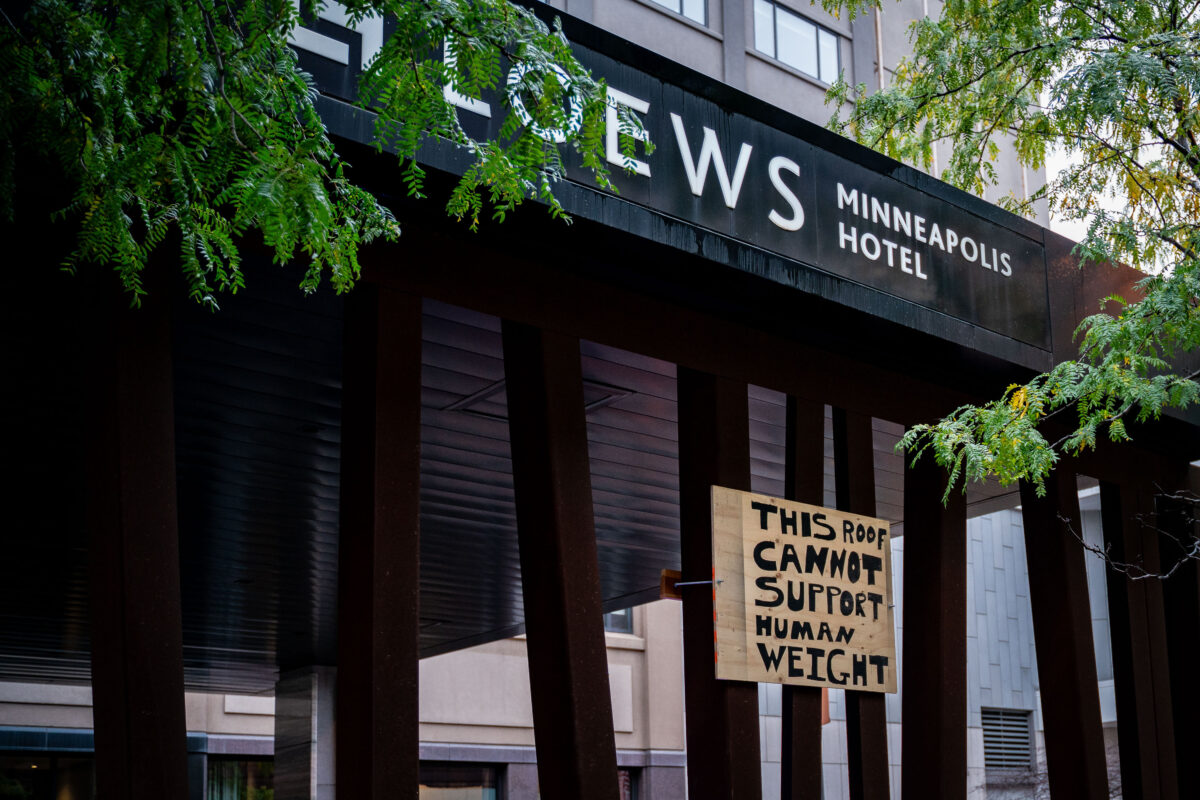
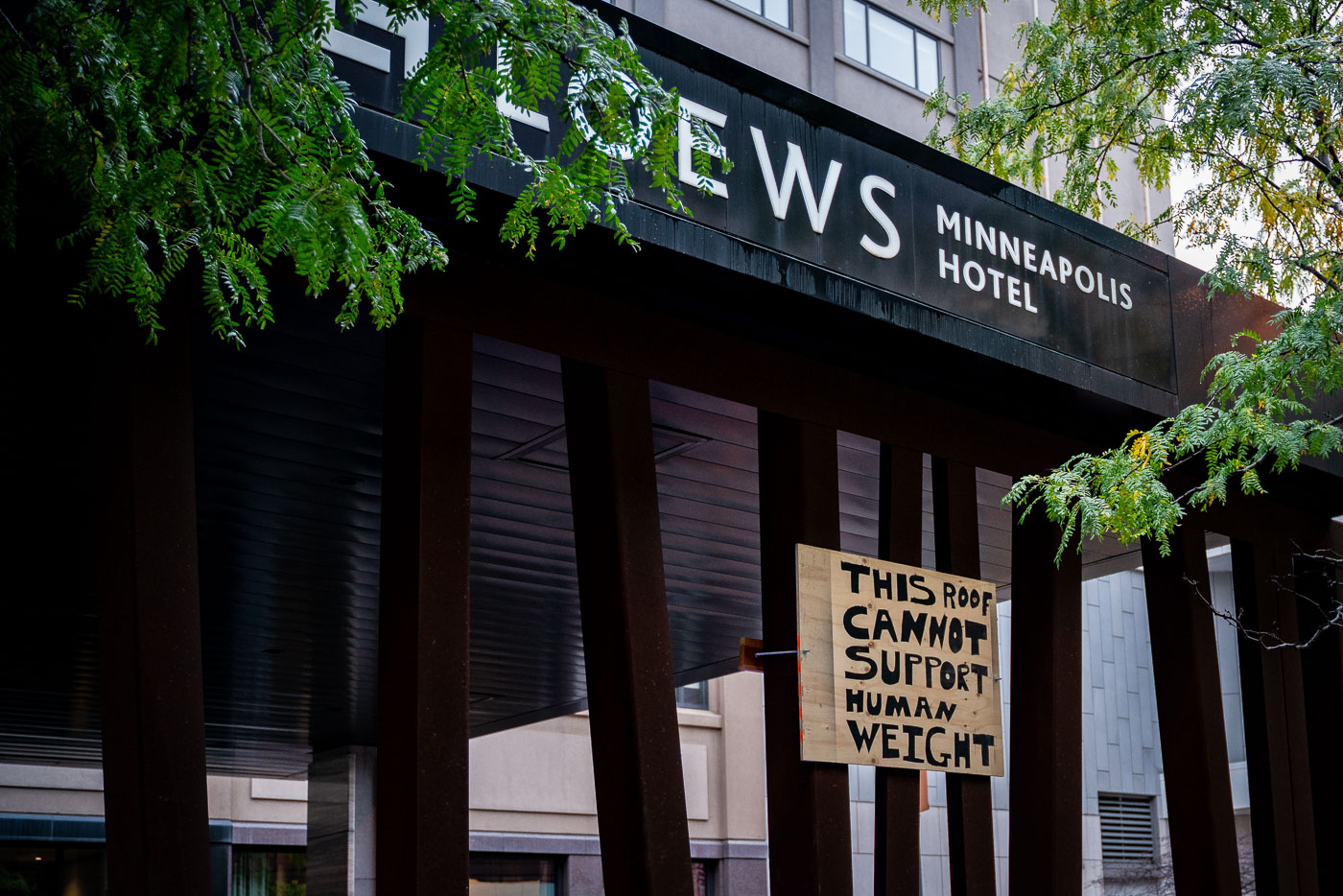
Handmade warning sign hangs under the Loews Minneapolis Hotel canopy during a Trump rally in downtown Minneapolis
A handmade sign reading “This Roof Cannot Support Human Weight” was posted beneath the Loews Minneapolis Hotel canopy on October 10, 2019. The hotel, adjacent to the Target Center, served as a focal point during a political rally and counter-protests that drew thousands to downtown Minneapolis. City officials placed similar signs throughout the area to deter individuals from climbing elevated structures amidst heavy police presence and street closures.

Minneapolis Hotel Safety Sign During 2019 Trump Rally
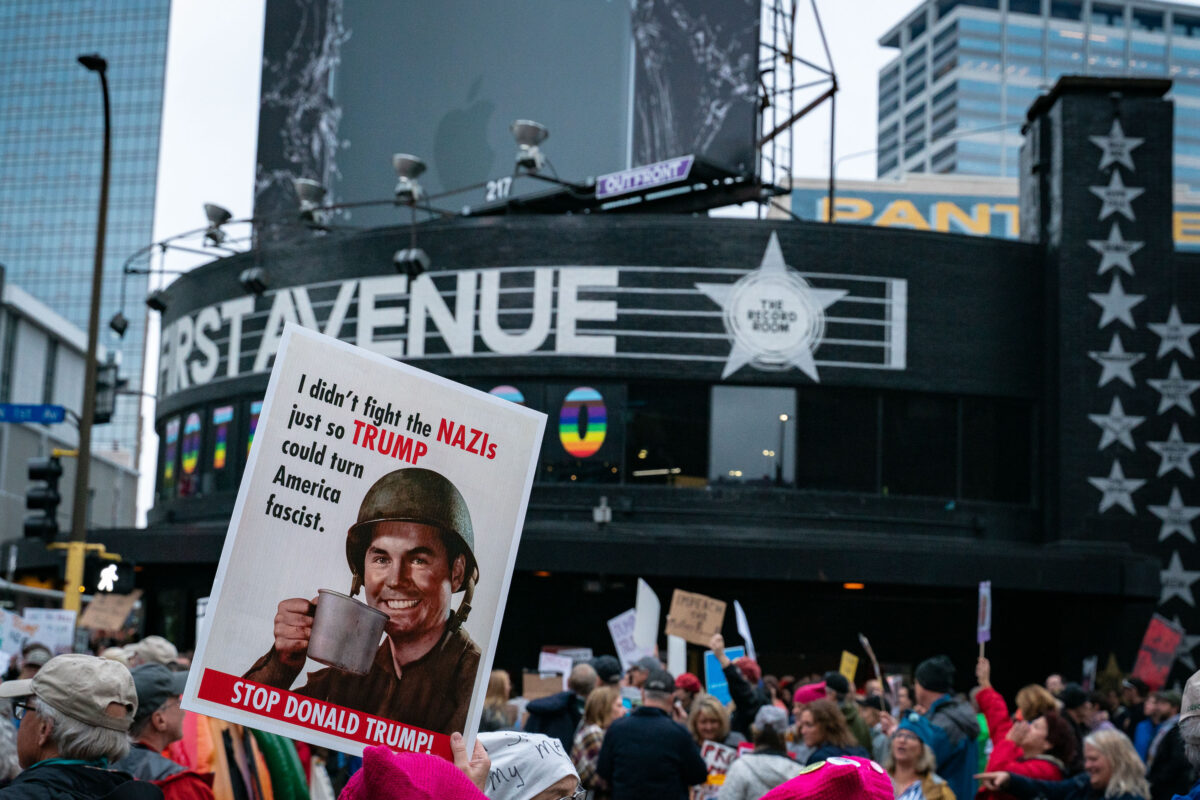
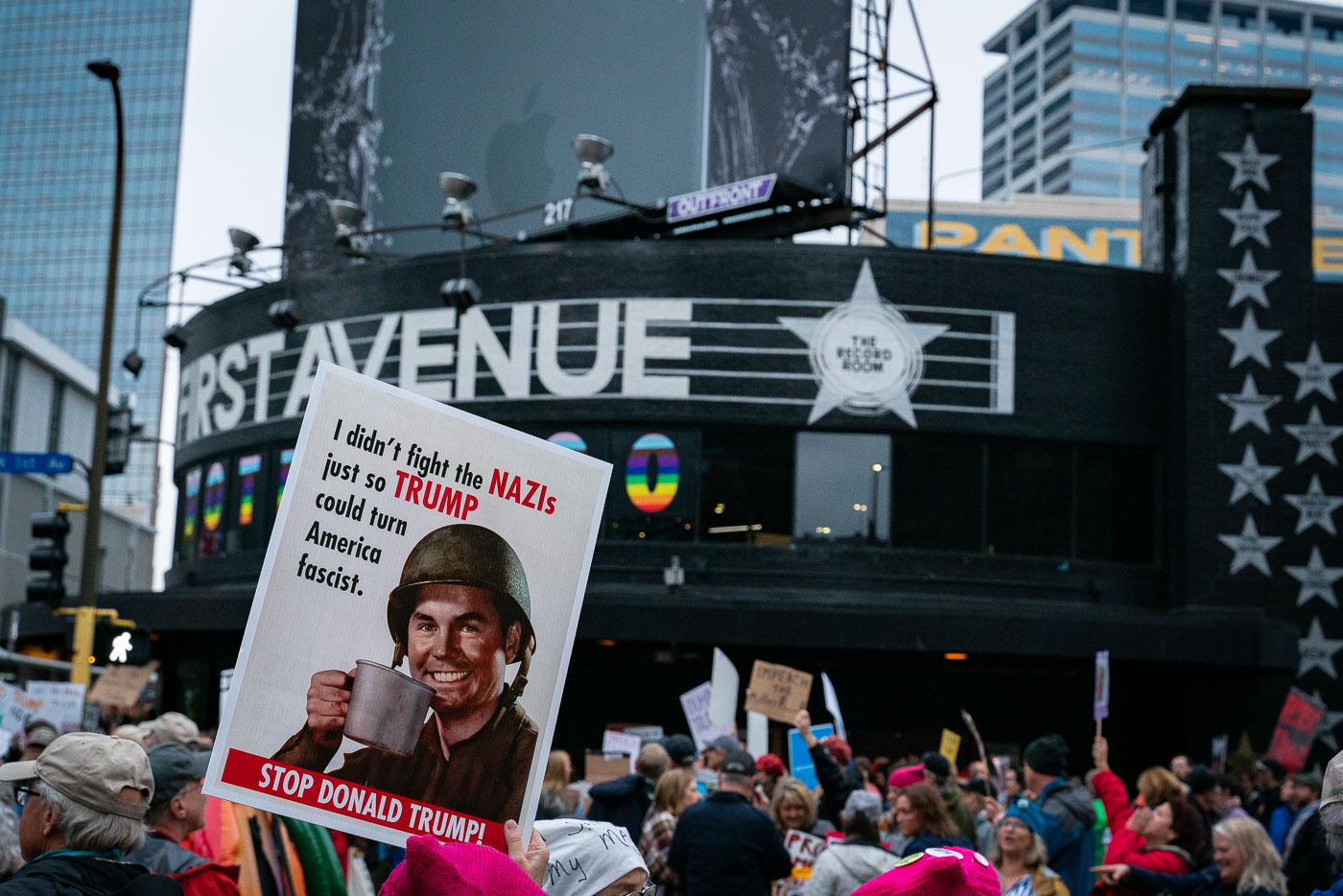
Protesters with anti-Trump signs outside First Avenue in downtown Minneapolis
Protesters gathered outside First Avenue in Minneapolis on October 10, 2019, during a rally for then-President Donald Trump. The sign prominently displayed reads, "I didn't fight the NAZIs just so TRUMP could turn America fascist." First Avenue is a historic entertainment venue in downtown Minneapolis, known for hosting concerts and other live events. The protest reflects the political divisions and public discourse surrounding the 2020 presidential election cycle.

Minneapolis Protest Sign Outside First Avenue: “Stop Donald Trump!”
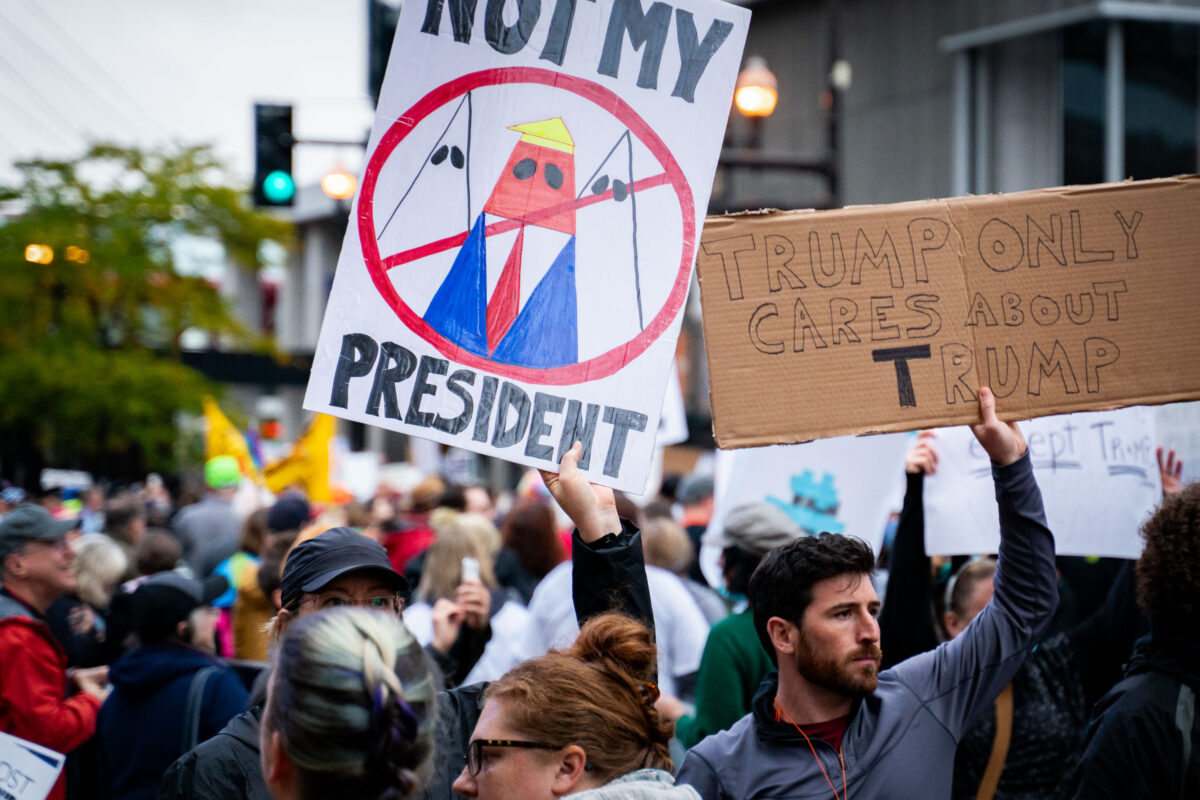
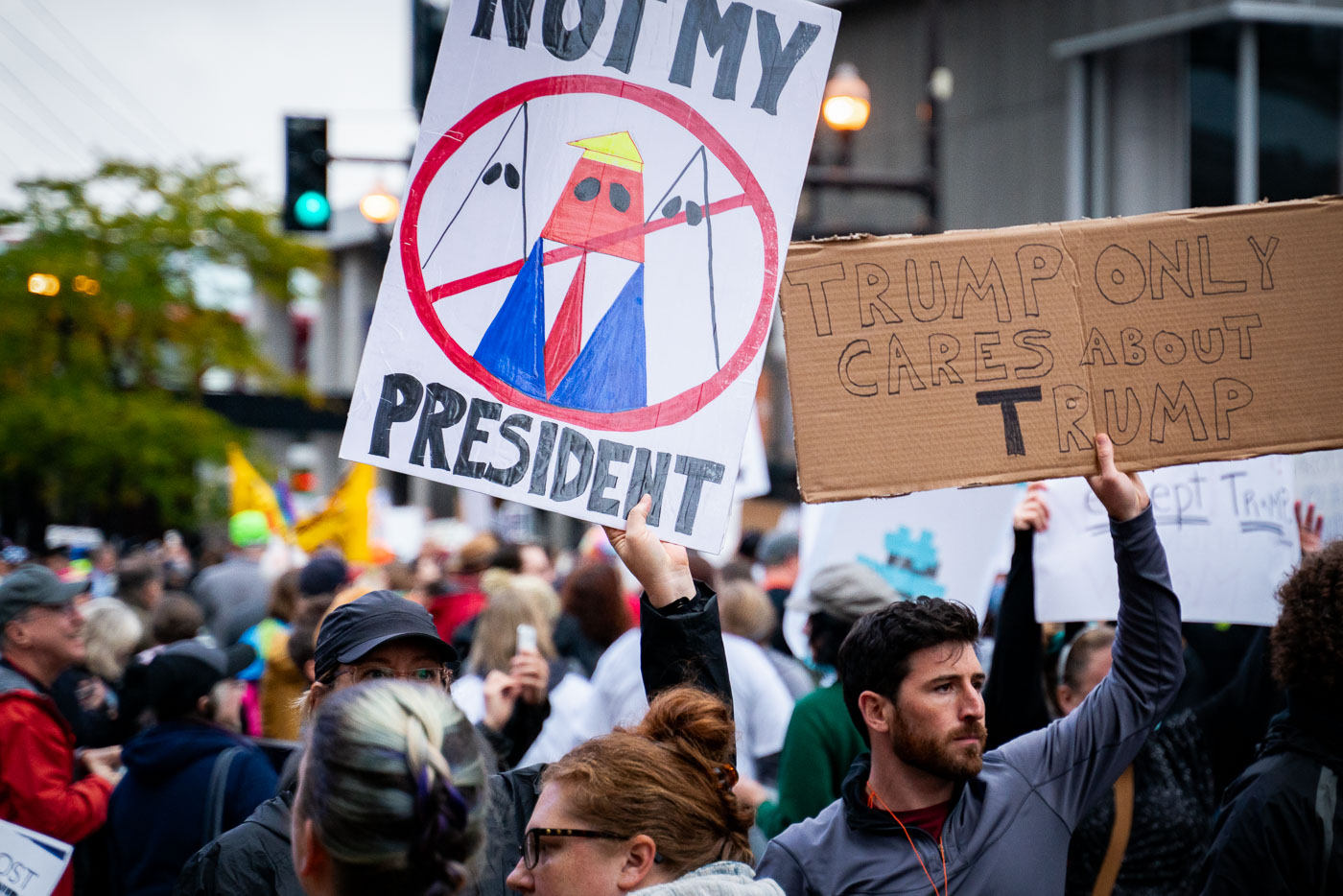
Protesters hold anti-Trump signs outside Target Center in downtown Minneapolis.
Protesters gathered outside the Target Center in Minneapolis on October 10, 2019, to voice their opposition to then-President Donald Trump's policies. The signs displayed reflect sentiments of dissent and criticism towards the administration. This event occurred during a period of significant political polarization surrounding the Trump presidency and his re-election campaign. The Target Center, a multi-purpose arena, has often been a site for major public events and gatherings in downtown Minneapolis.

Minneapolis Protest: ‘Not My President’ Sign, October 10, 2019
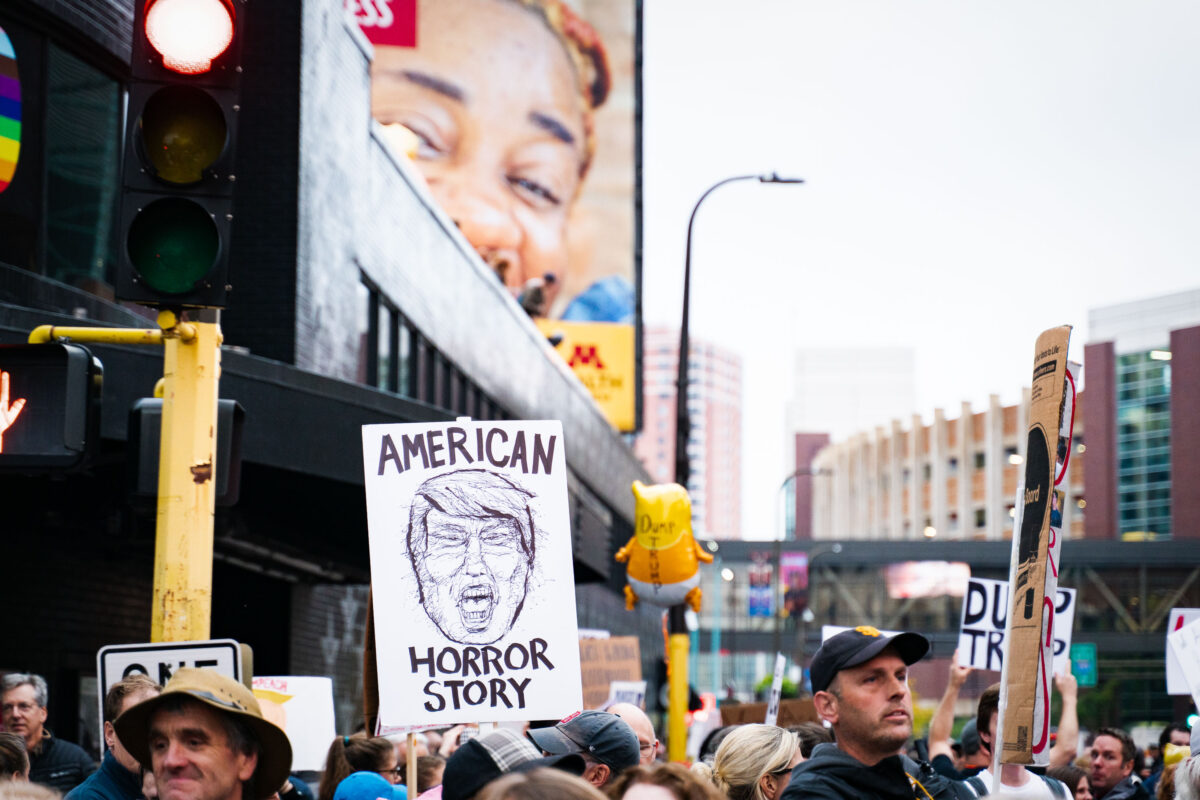
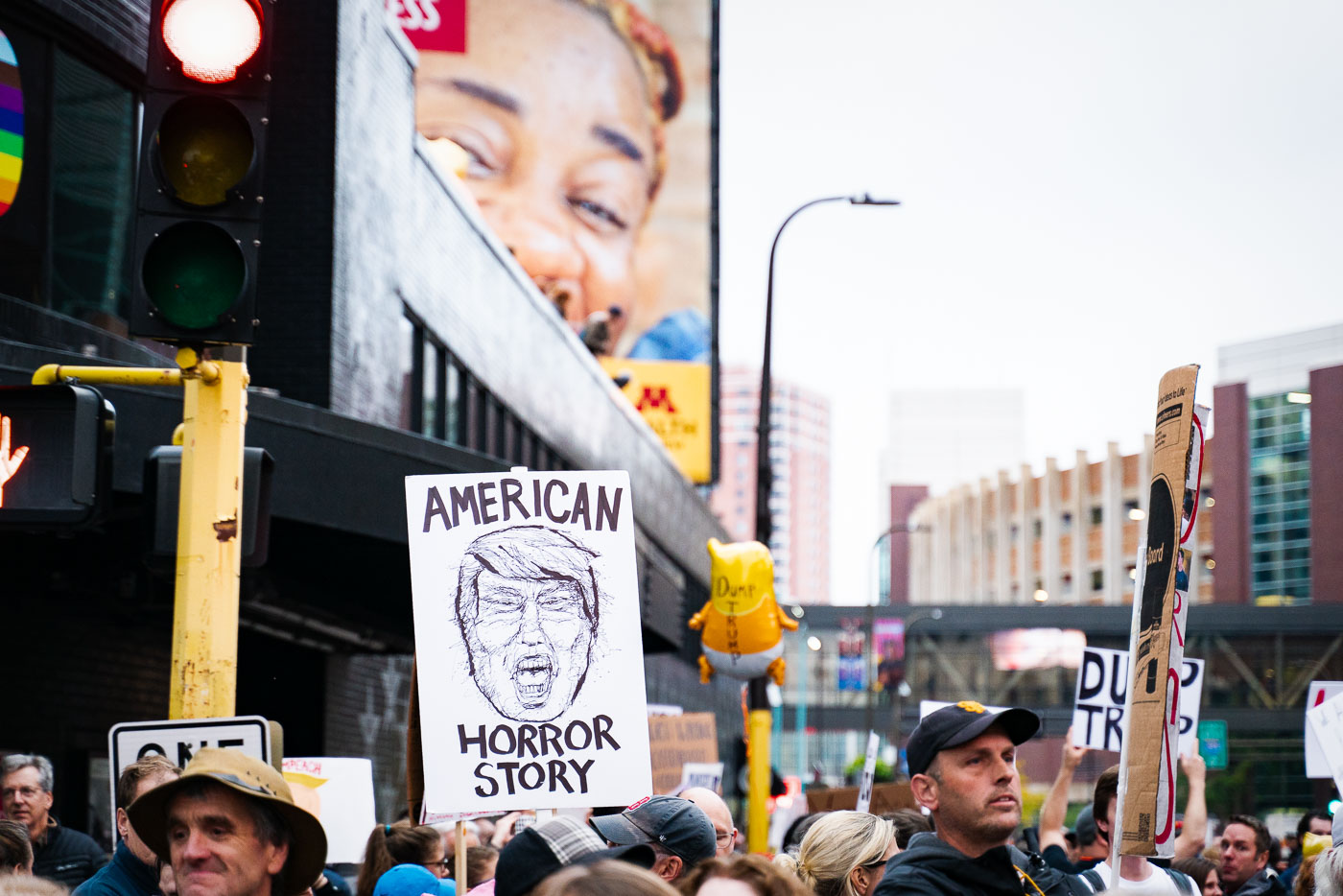
Protesters in downtown Minneapolis hold a sign reading "American Horror Story" beside a Trump caricature.
Protesters gathered in downtown Minneapolis on October 10, 2019, during a rally related to the 2020 presidential election. The sign prominently displayed reads "American Horror Story" with a caricature of then-President Donald Trump. This event occurred amidst a period of significant political polarization and public discourse surrounding the Trump administration and its policies. The protest reflects the broader national sentiment and engagement with political issues during that election cycle.

Minneapolis Protest Sign: “American Horror Story” – Oct 10, 2019
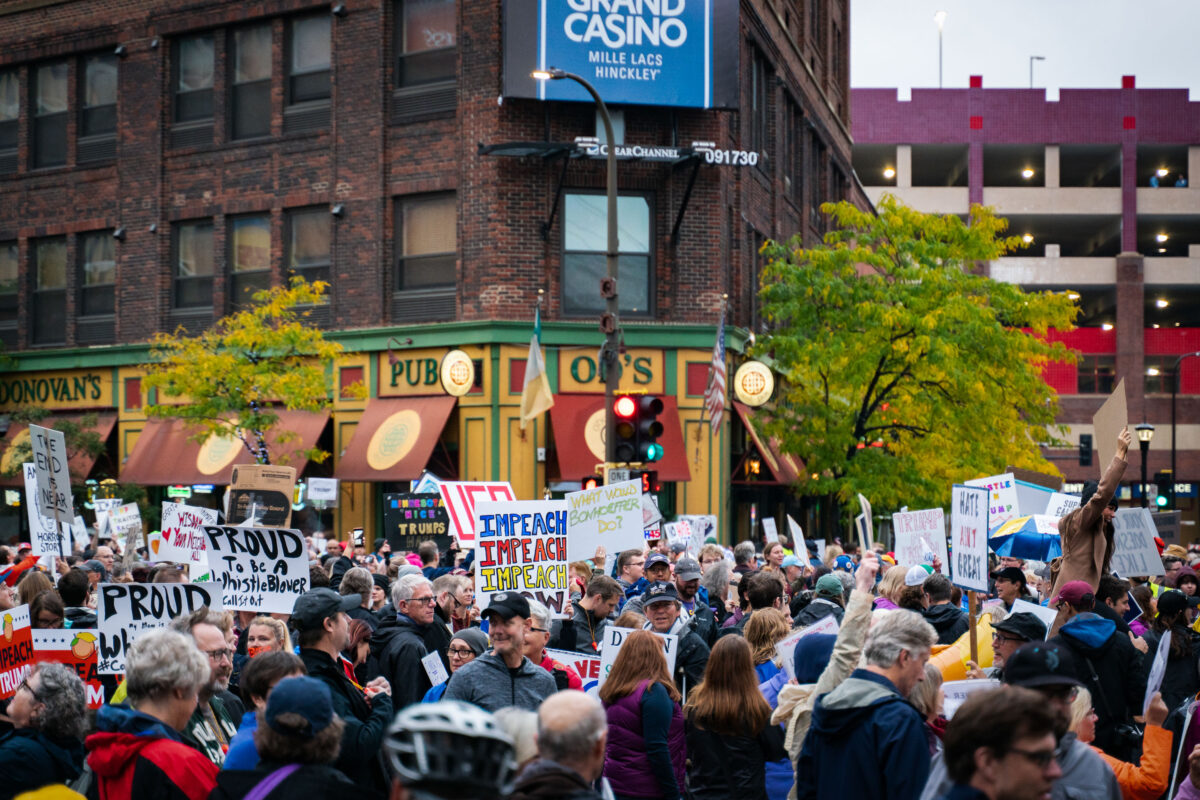
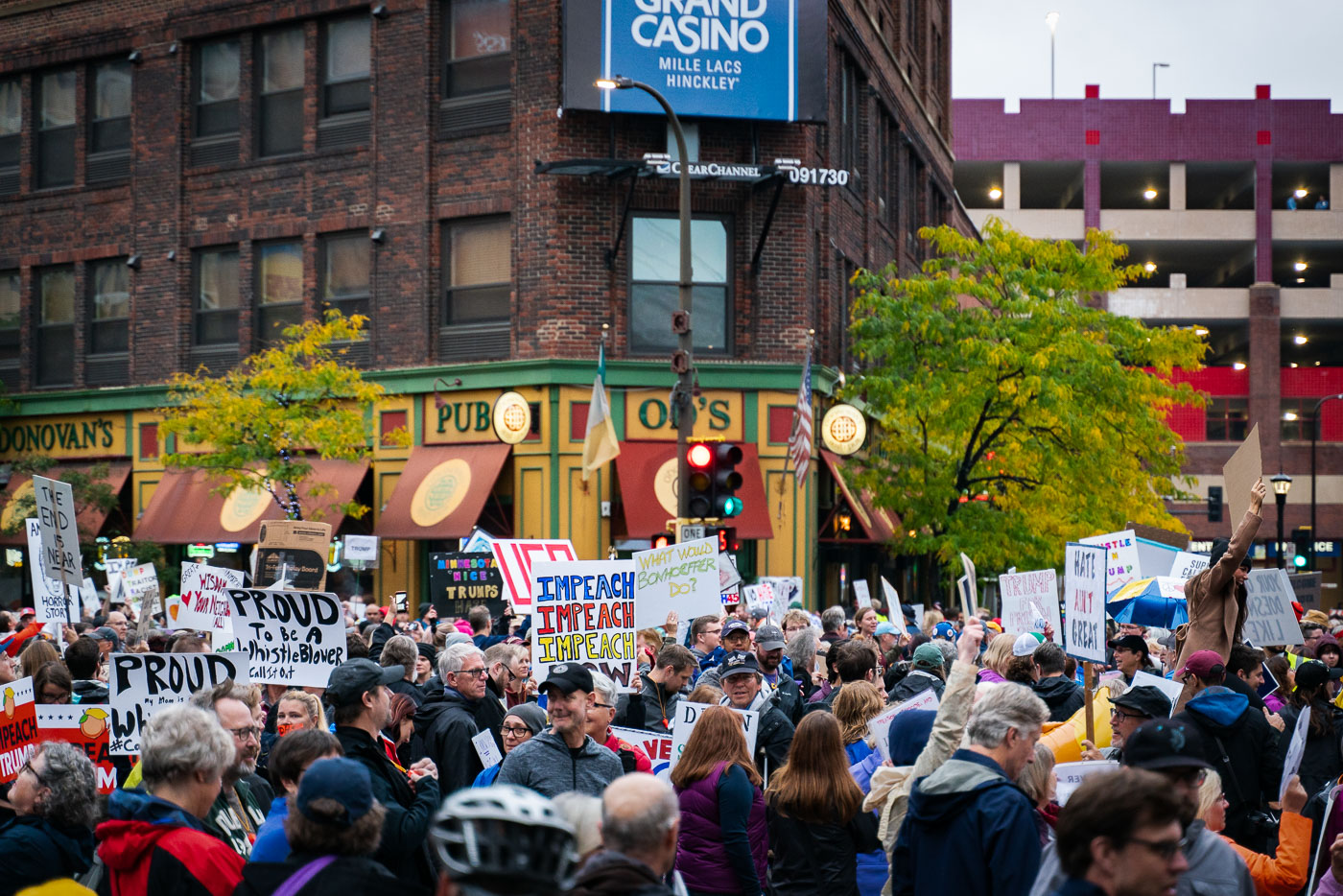
Protesters with impeachment signs outside O'Donovan's Pub in downtown Minneapolis.
Protesters gathered in downtown Minneapolis on October 10, 2019, holding signs calling for the impeachment of President Donald Trump. The protest took place outside the Target Center, a major indoor arena in the city. This event occurred during a period of significant political division and ongoing impeachment inquiries related to the Trump administration. The signs reflect the strong sentiments of opposition and calls for accountability among a segment of the public during that time.

Minneapolis Protestors Hold Impeach Trump Signs Oct 10 2019
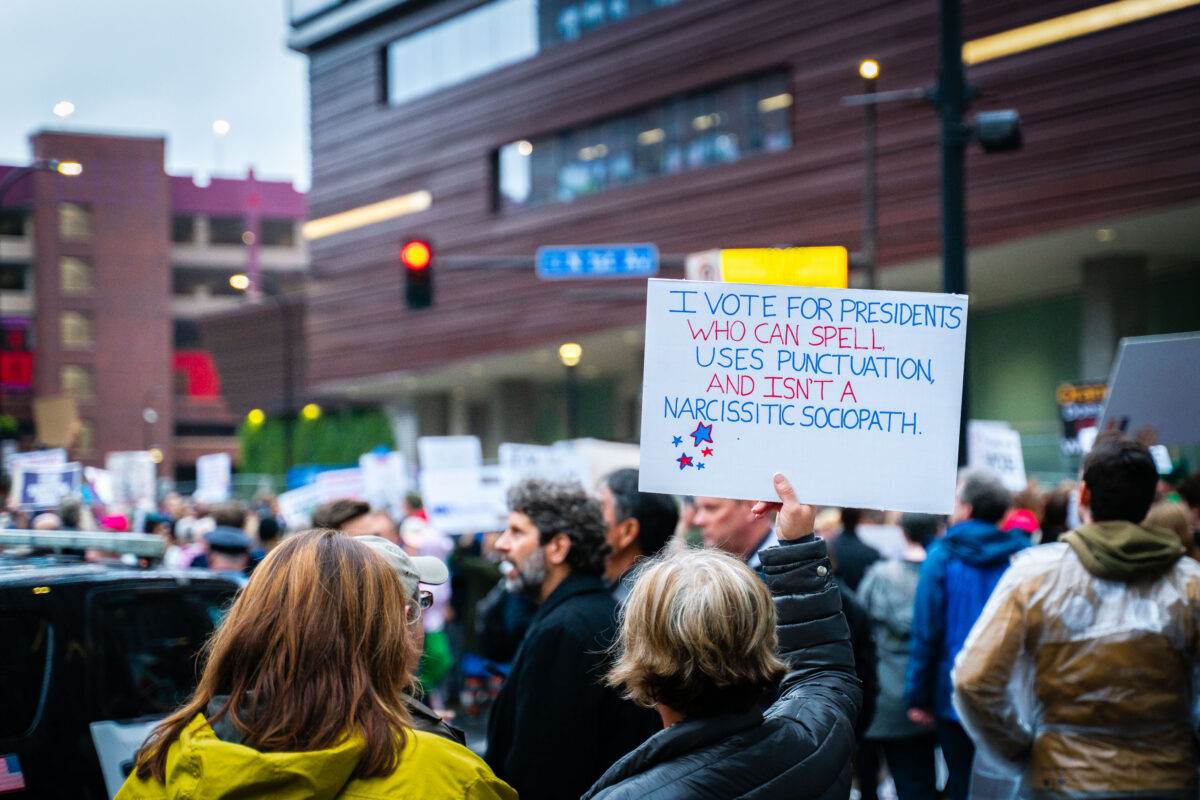
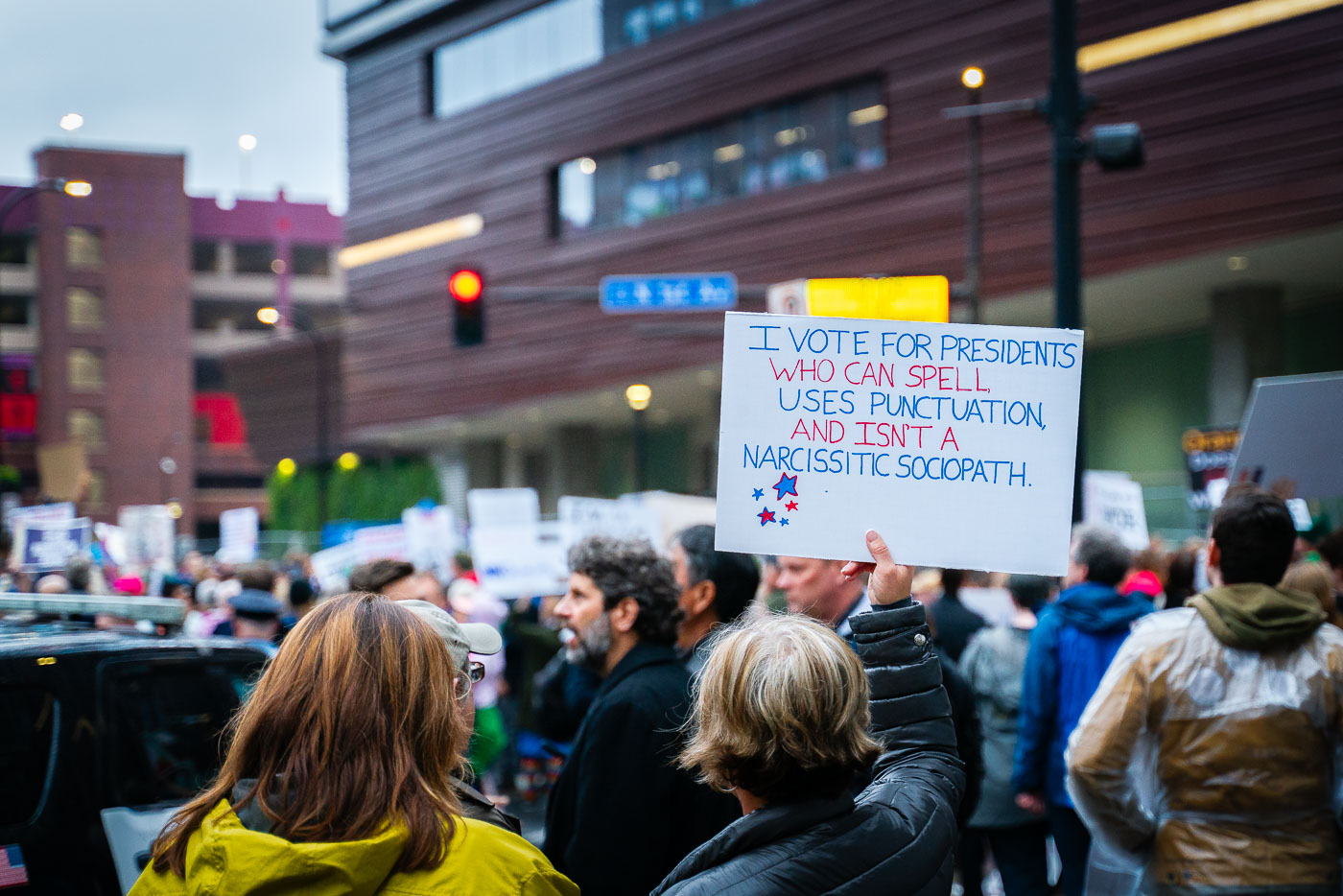
Protester holds a sign outside Target Center in Minneapolis during a Trump rally.
A protestor holds a sign reading "I VOTE FOR PRESIDENTS WHO CAN SPELL, USES PUNCTUATION AND ISN'T A NARCISSISTIC SOCIOPATH" outside the Target Center in Minneapolis on October 10, 2019. The sign reflects critical sentiment towards then-President Donald Trump during a rally held in the city. The Target Center, a multi-purpose arena, frequently hosts political events and public gatherings, making it a common site for both support and opposition rallies. This protest occurred during the 2020 presidential election cycle, a period marked by significant political polarization and public engagement.

Minneapolis Protest Sign at Trump Rally, Oct 10, 2019
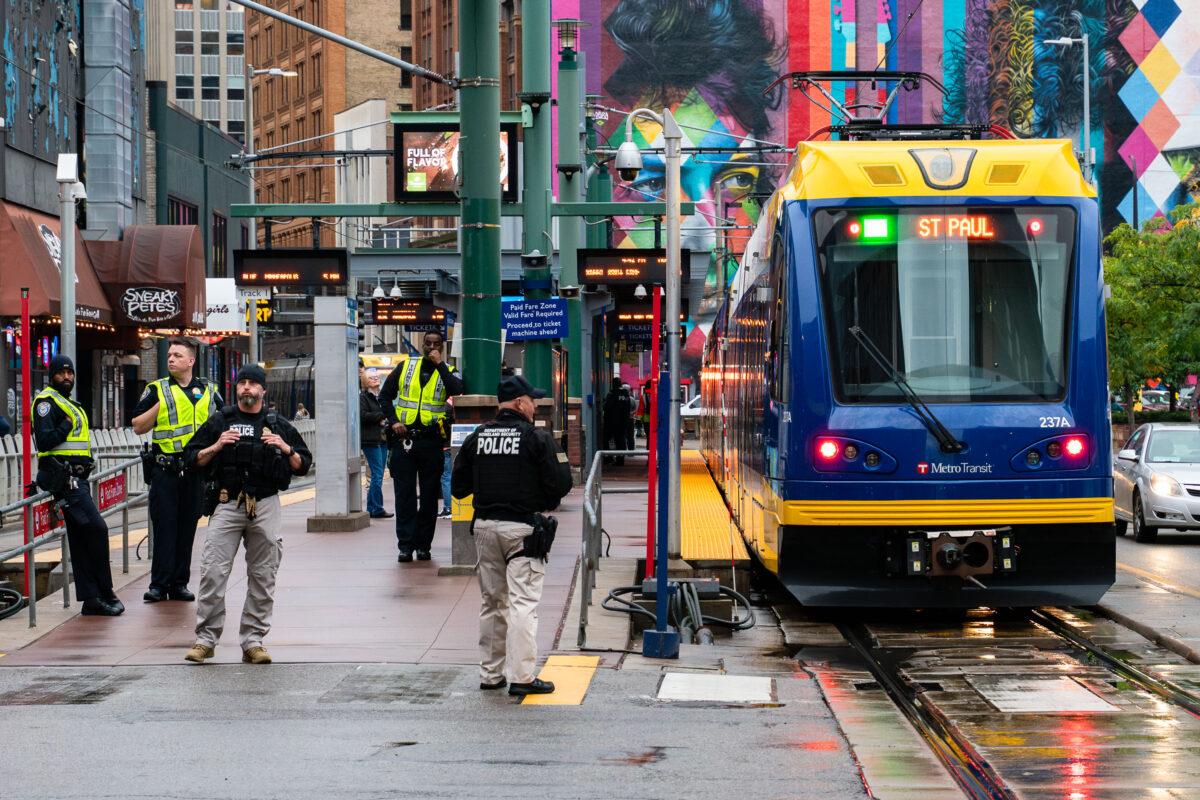
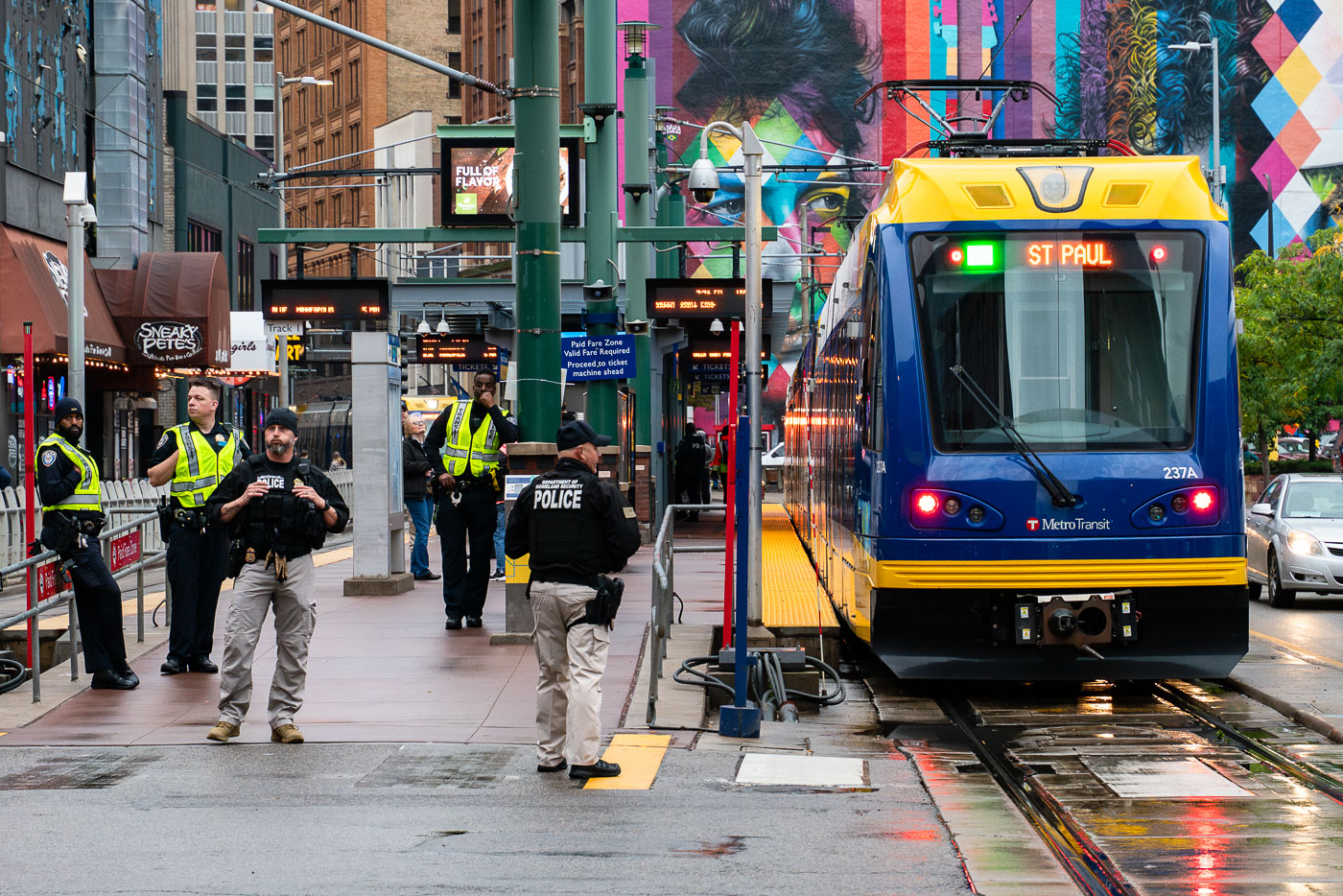
Homeland Security officers stand by a Metro Transit train at Minneapolis Warehouse District LRT station.
Department of Homeland Security officers were present at the Warehouse District LRT station in Minneapolis on October 10, 2019. Their deployment coincided with a rally held by then-President Donald Trump at the nearby Target Center. The light rail system serves as a vital transportation artery for the city, connecting residents and visitors to various districts. The presence of federal law enforcement at a public transit hub during a political event highlights the security considerations surrounding such gatherings.

Homeland Security at Minneapolis Warehouse District LRT during Trump Rally
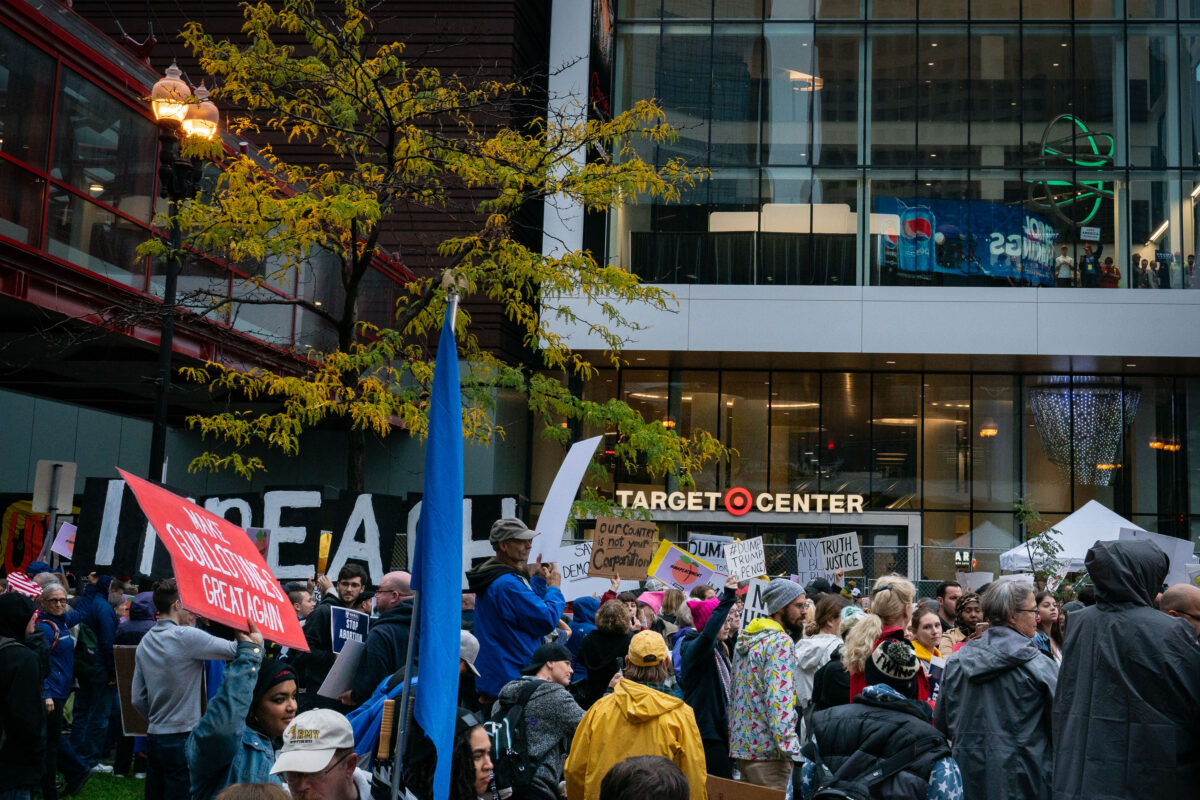
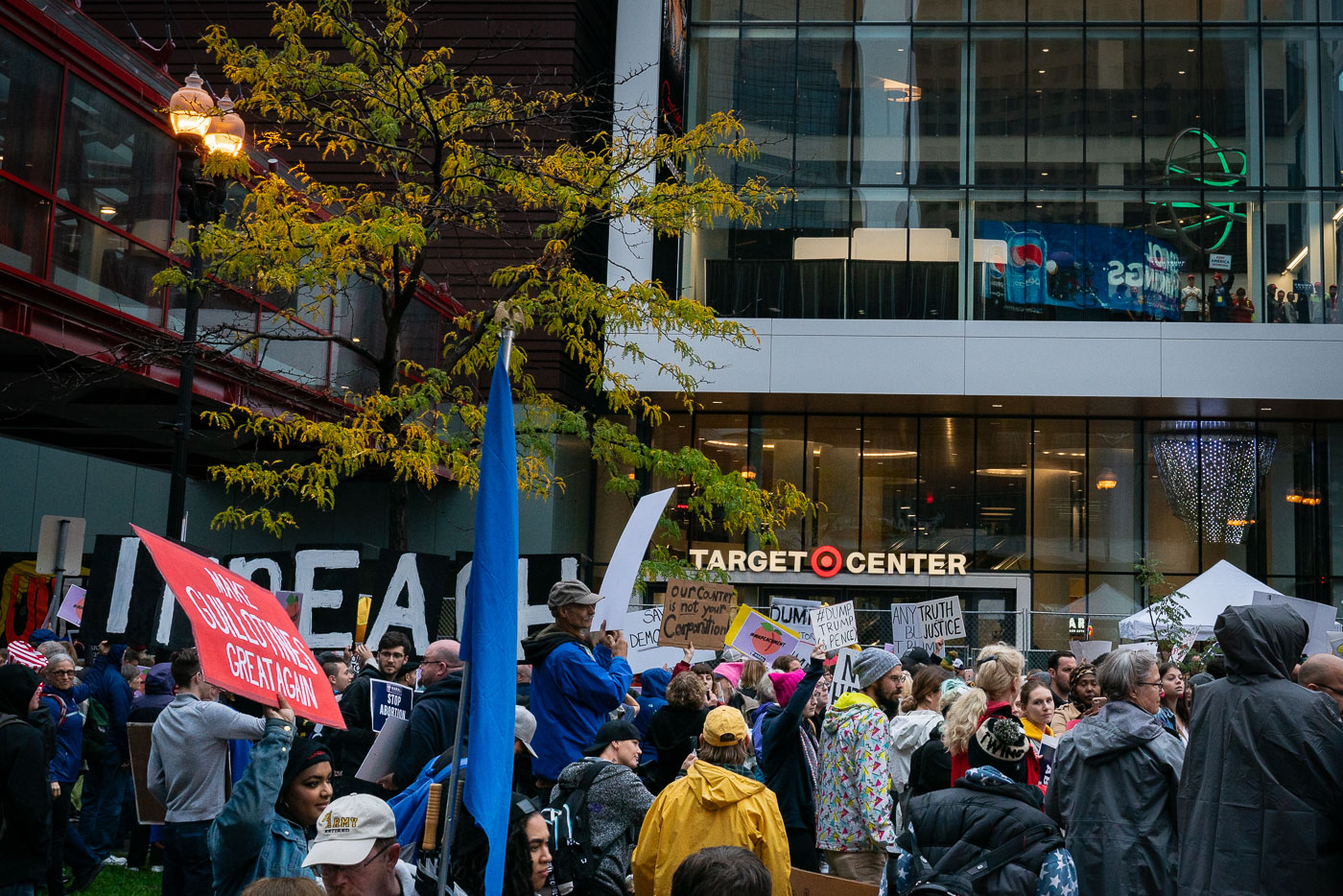
Protesters outside Target Center in Minneapolis during a Trump rally.
Protesters gathered outside the Target Center in Minneapolis on October 10, 2019, during a Trump rally. The Target Center, a multi-purpose arena, hosts sporting events, concerts, and political gatherings. The protest occurred amidst the 2020 presidential election cycle, reflecting the polarized political climate of the time. Signs held by protesters expressed opposition to the rally and the Trump administration, with some referencing impeachment proceedings.

Protesters at Trump Rally, Target Center, Minneapolis, 2019
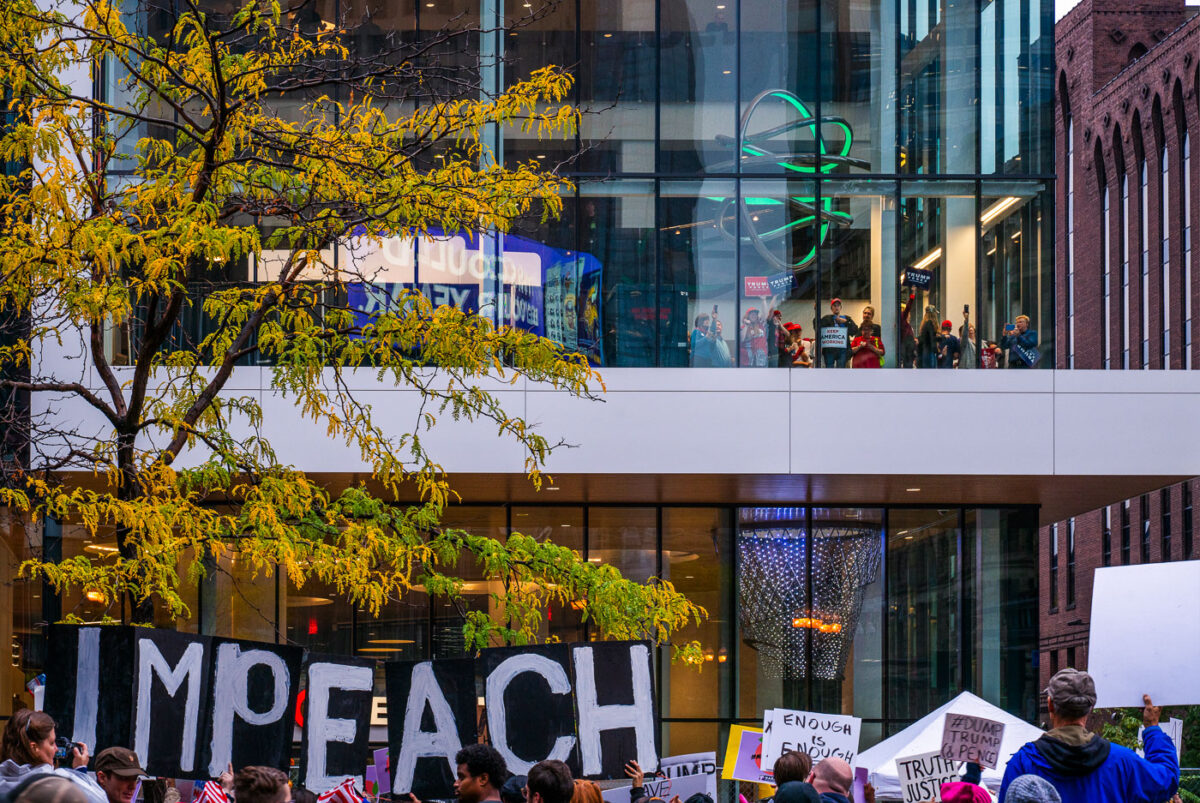
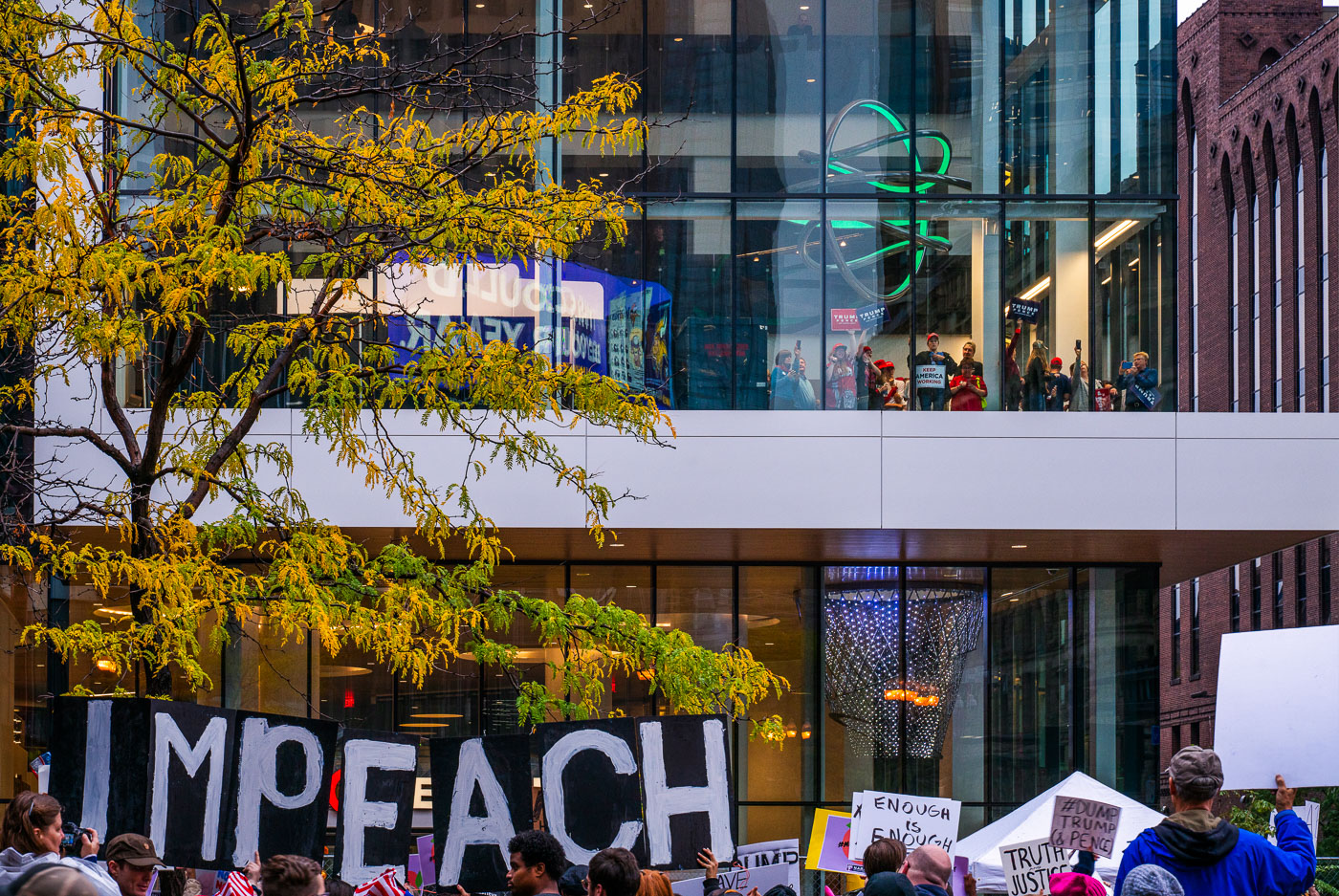
Protesters with IMPEACH signs outside Target Center in Minneapolis during Trump rally, 2019
Protesters gathered outside the Target Center in downtown Minneapolis on October 10, 2019, to rally against then-President Donald Trump's campaign event. The "IMPEACH" sign prominently displayed reflects the political climate of the time, as the House of Representatives was initiating impeachment proceedings against Trump. Inside the venue, supporters of the President could be seen, highlighting the division surrounding the event. The Target Center, a multi-purpose arena, regularly hosts sporting events, concerts, and political rallies, serving as a significant public gathering space in the city.

Minneapolis Protestors Rally Against Trump at Target Center, Oct 2019
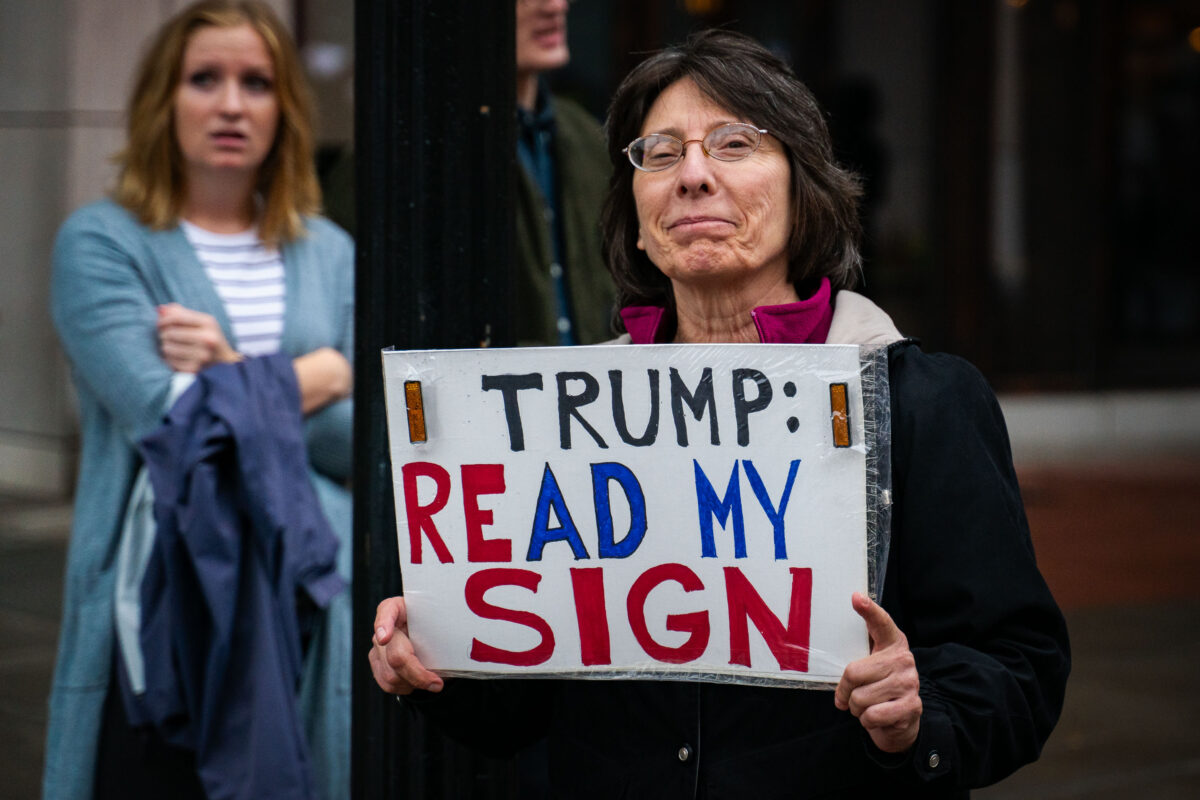
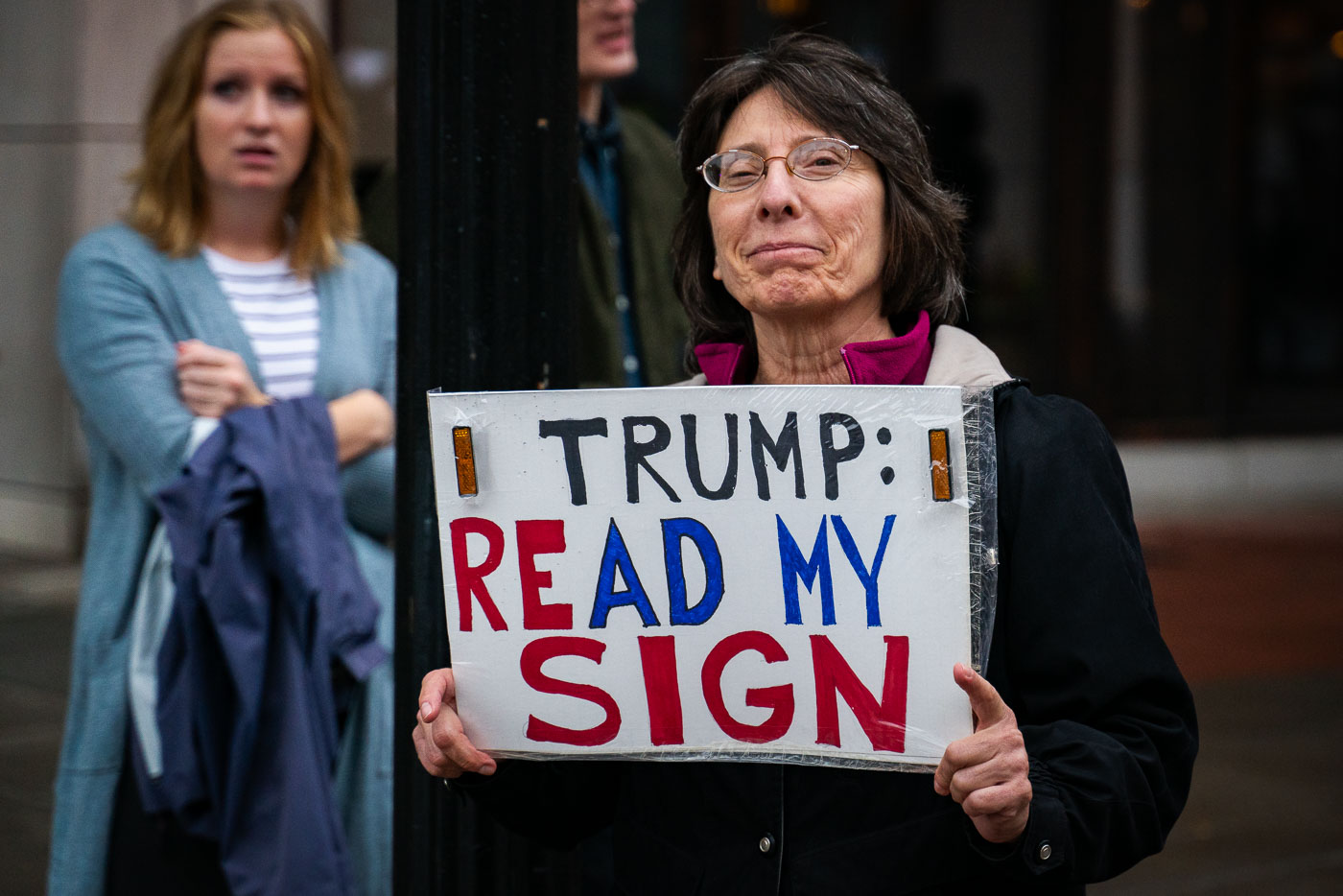
Woman holds a protest sign reading “Trump: Read My Sign” in downtown Minneapolis.
A protestor holds a sign reading "TRUMP: READ MY SIGN" during a rally in Minneapolis on October 10, 2019. The event coincided with a campaign rally for then-President Donald Trump. Such protests often occur during presidential election cycles, reflecting public engagement with political discourse and policy debates. The sign's message directly addresses the president, suggesting a desire for engagement or a critique of his administration's policies or communication.

Minneapolis Trump Rally Protestor Holds Sign
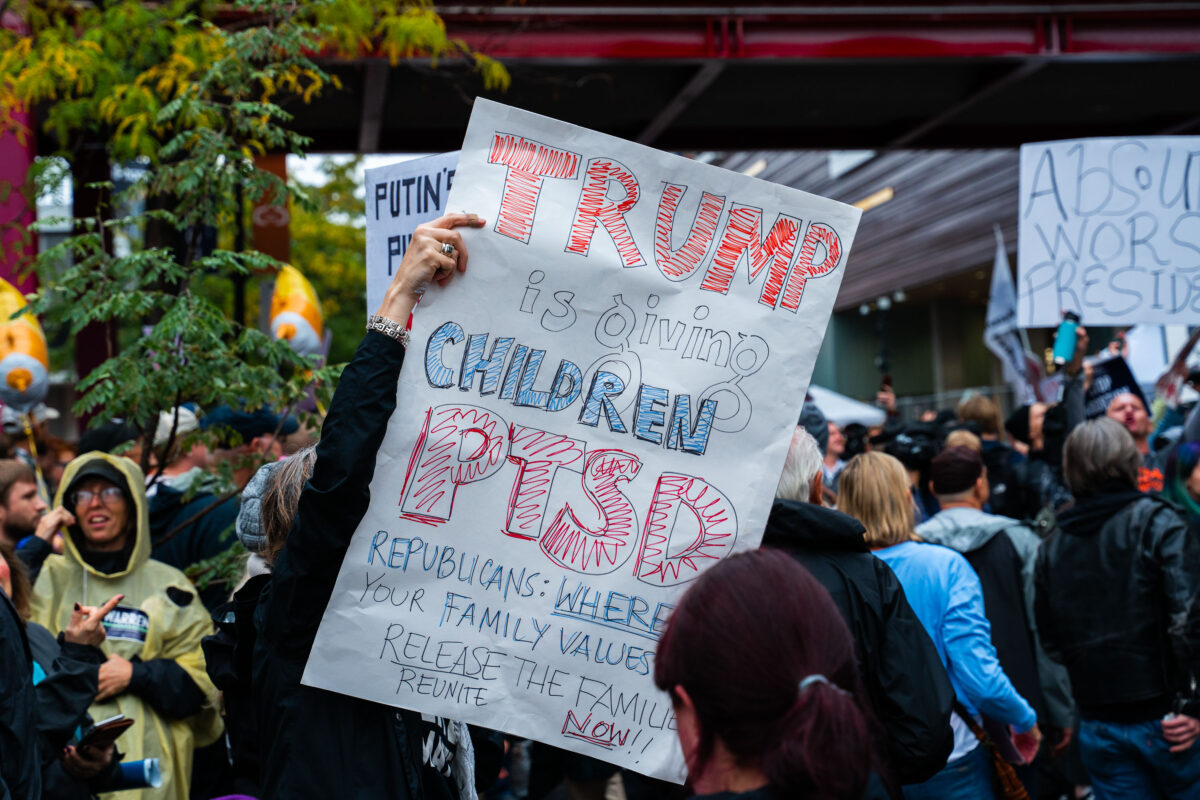
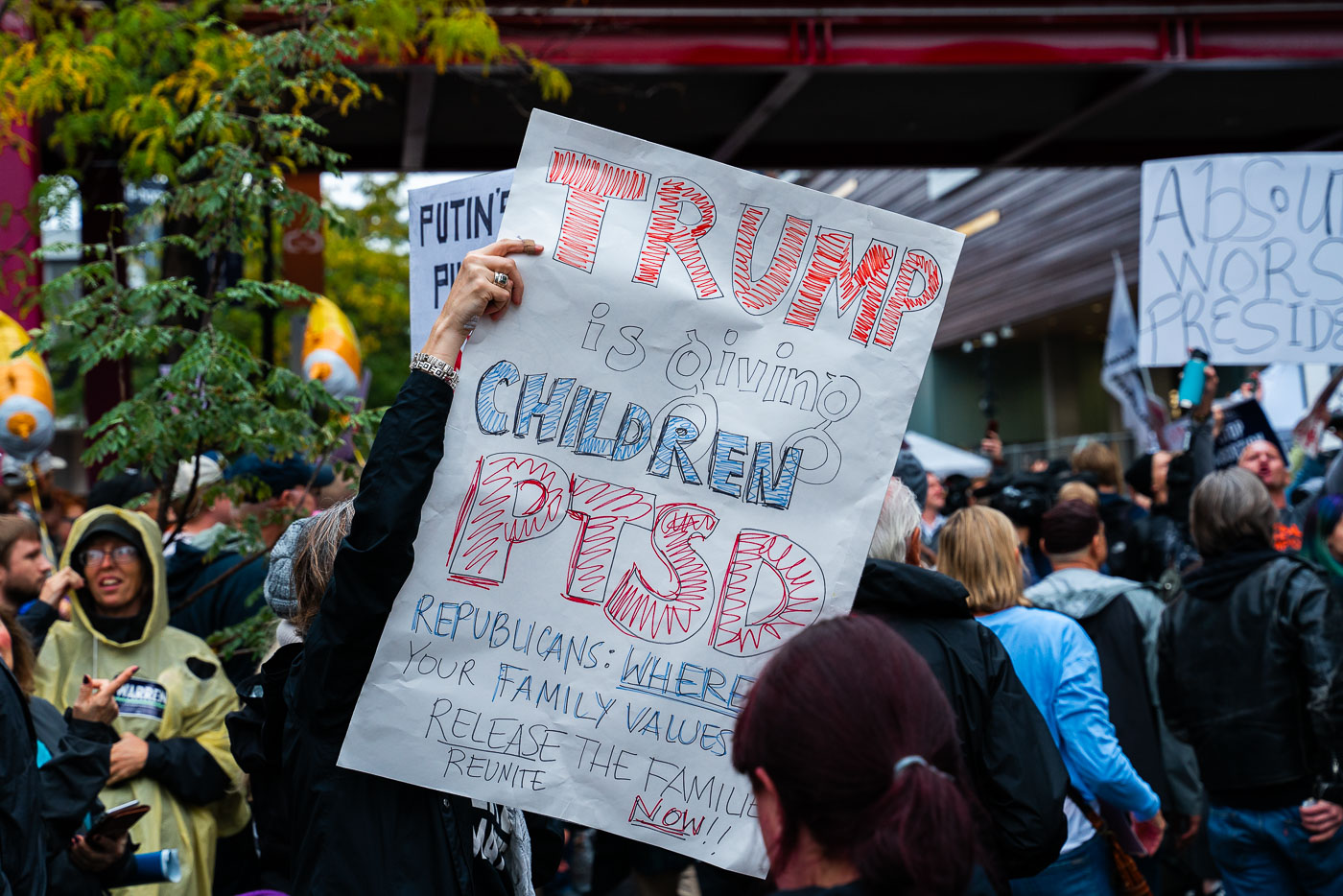
Protester holds a sign at the Target Center in Minneapolis reading “Trump is giving children PTSD.”
Protesters gathered outside the Target Center in Downtown Minneapolis on October 10, 2019, to voice their opposition to a rally held by then-President Donald Trump. The sign prominently displayed reads, "TRUMP is giving CHILDREN PTSD" and "REPUBLICANS: WHERE ARE YOUR FAMILY VALUES? RELEASE THE FAMILIES REUNITE NOW!!" This protest occurred during Trump's 2020 presidential campaign, reflecting significant public dissent regarding his administration's policies, particularly those concerning immigration and family separations at the U.S.-Mexico border.

Minneapolis Protest Sign: Trump is Giving Children PTSD

Built in Minneapolis

Minneapolis Photographer

Browse by location, move through long-running series, or start with recent work.