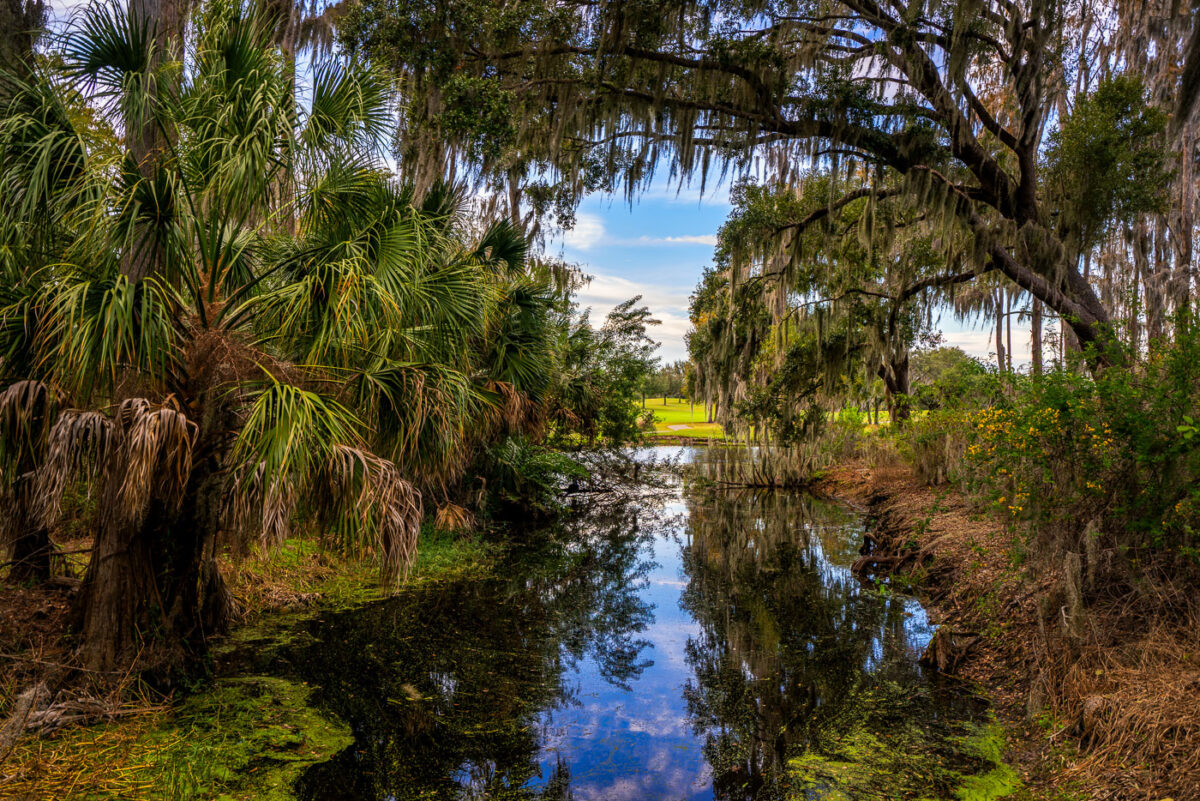
Innisbrook Resort Golf Course, Palm Harbor, Florida
December 2019 — Innisbrook Golf Resort in Palm Harbor Florida.
Explore photos in Uncategorized.
December 2019 — Innisbrook Golf Resort in Palm Harbor Florida.
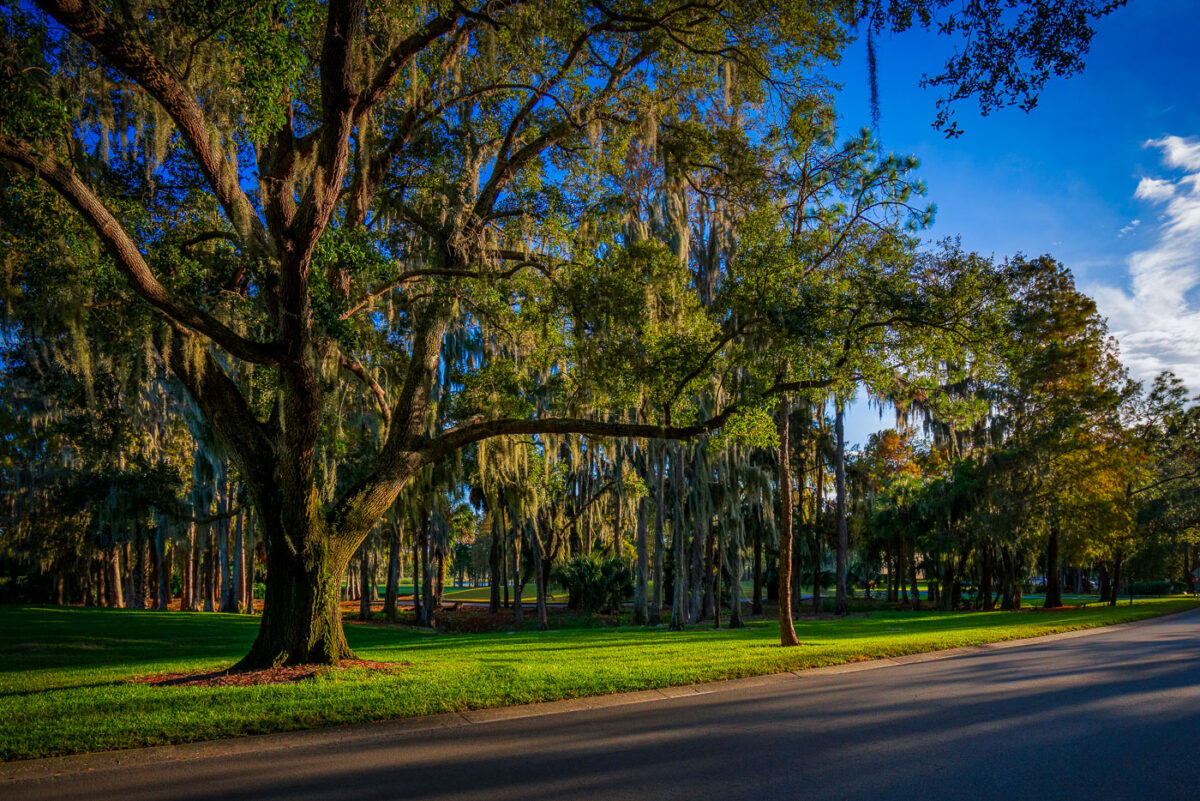
December 2019 — Innisbrook in Palm Harbor Florida.

December 2019 — Copperhead Course at Innisbrook in Palm Harbor, Florida.
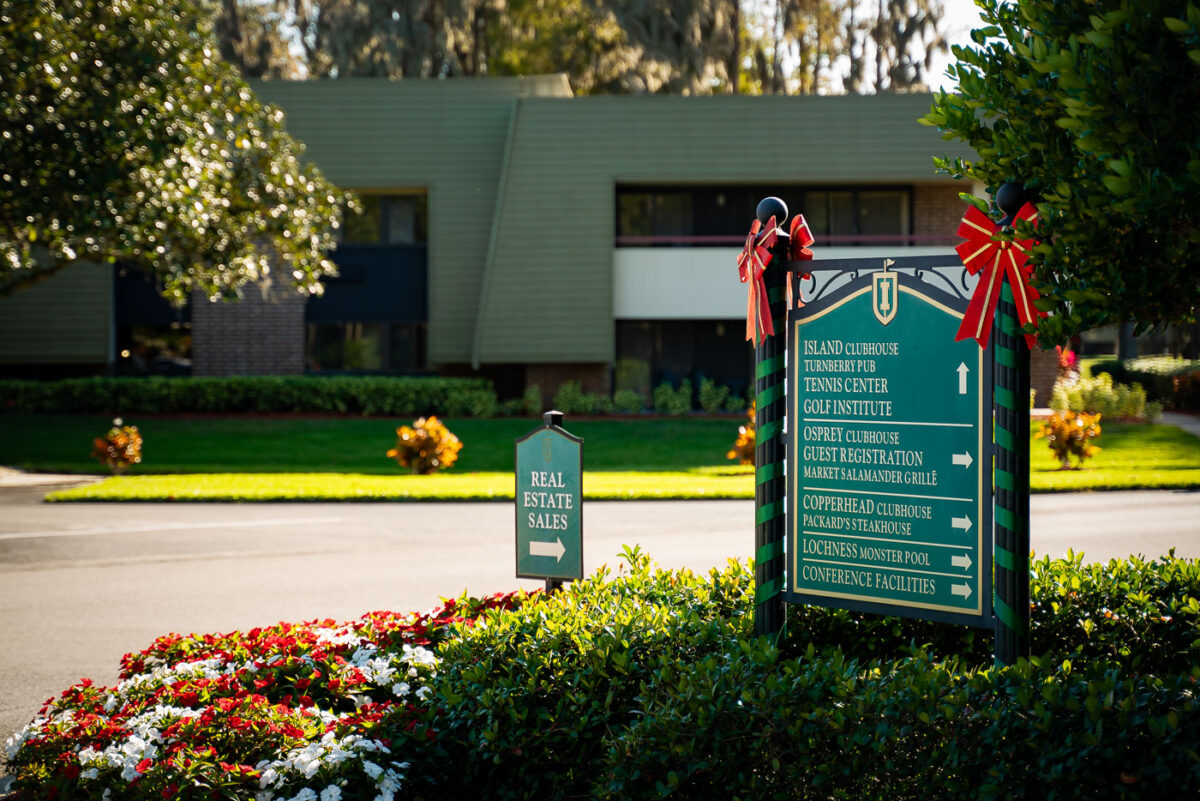
December 2019 — A sign directing visitors to various buildings around Innisbook Resort in Palm Harbor, Florida.
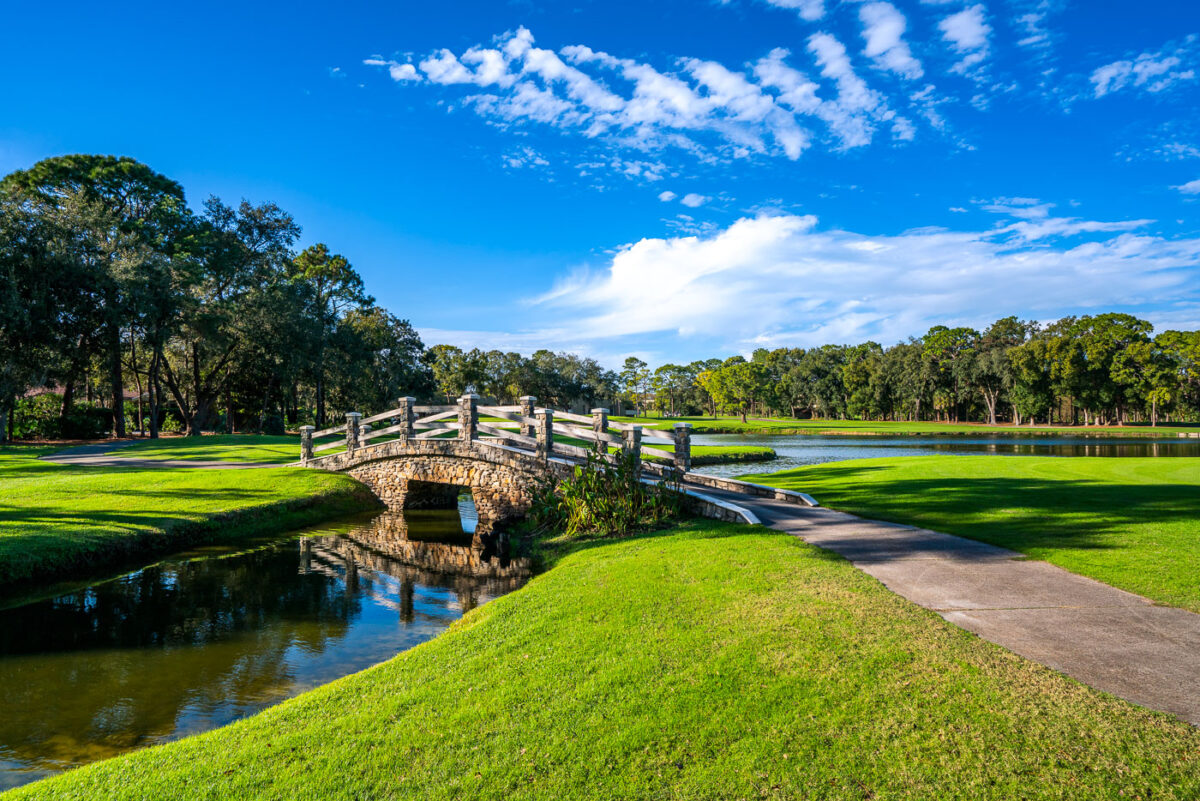
December 2019 — Bridge on the Copperhead Course at Innisbrook in Palm Harbor Florida.

December 2019 — Copperhead Course at Innisbrook in Palm Harbor, Florida.

December 2019 — The Sponge Diver Memorial in Tarpon Springs, Florida, honors the Greek immigrants who established the town’s sponge diving industry in the early 1900s. The bronze statue depicts a diver holding a traditional brass helmet, symbolizing the skill and danger of the underwater trade. Located near the historic Sponge Docks, it serves as a tribute to the workers who helped shape the community’s maritime heritage.

December 2019 — Sponge diving boat in Tarpon Springs, Florida.
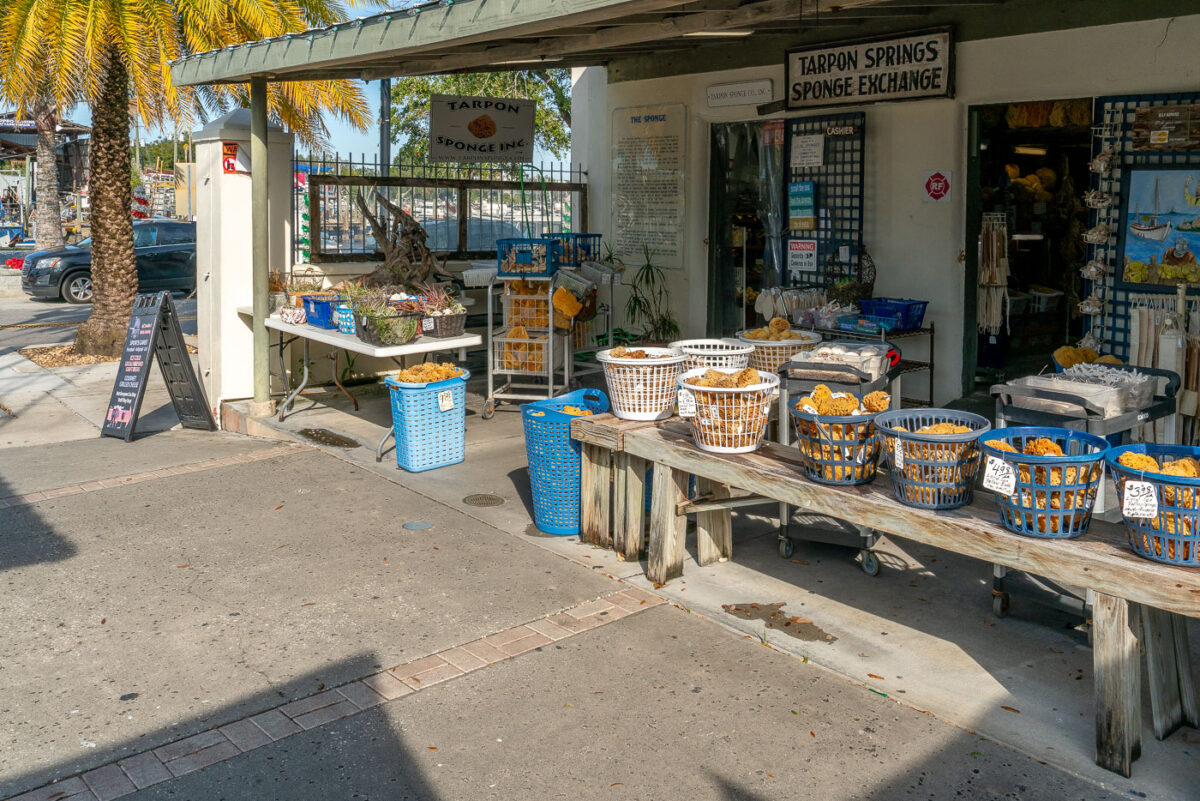
December 2019 — Shops selling sponges in Tarpon Springs, Florida.
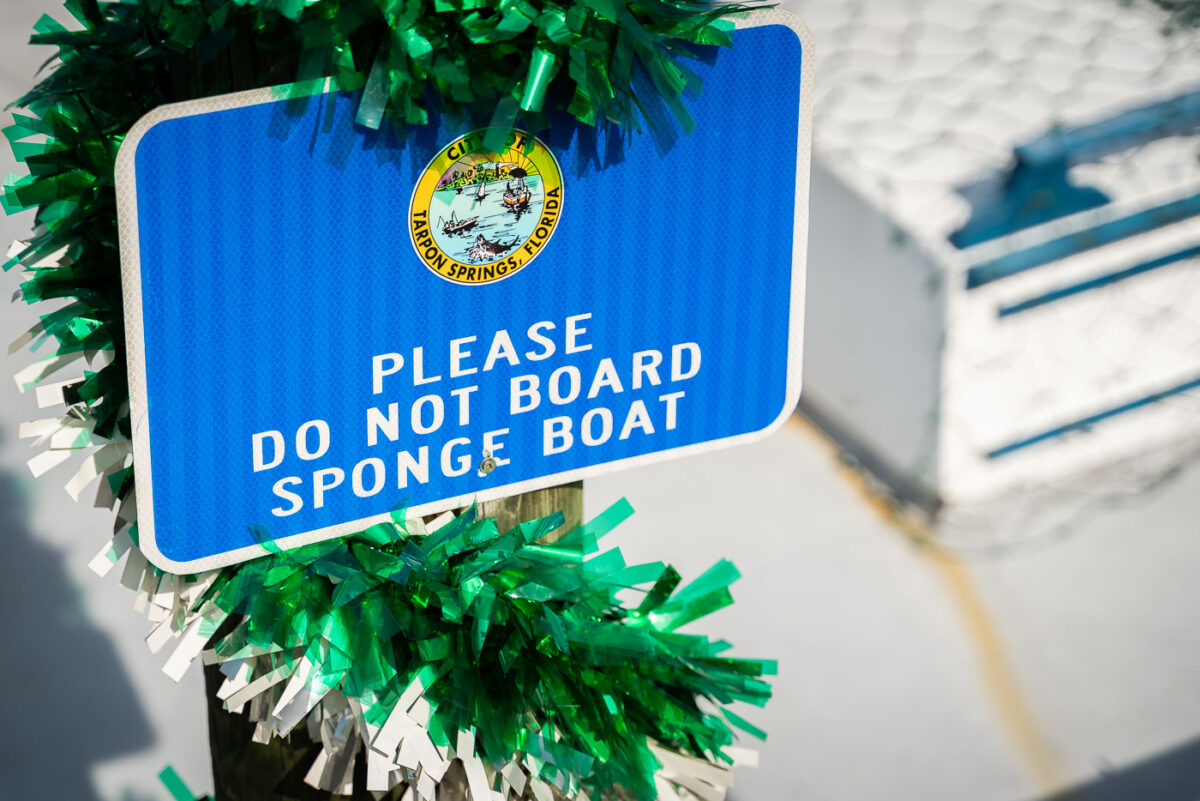
December 2019 — Sign on a sponge boat in Tarpon Springs, Florida. Please do not board sponge boat
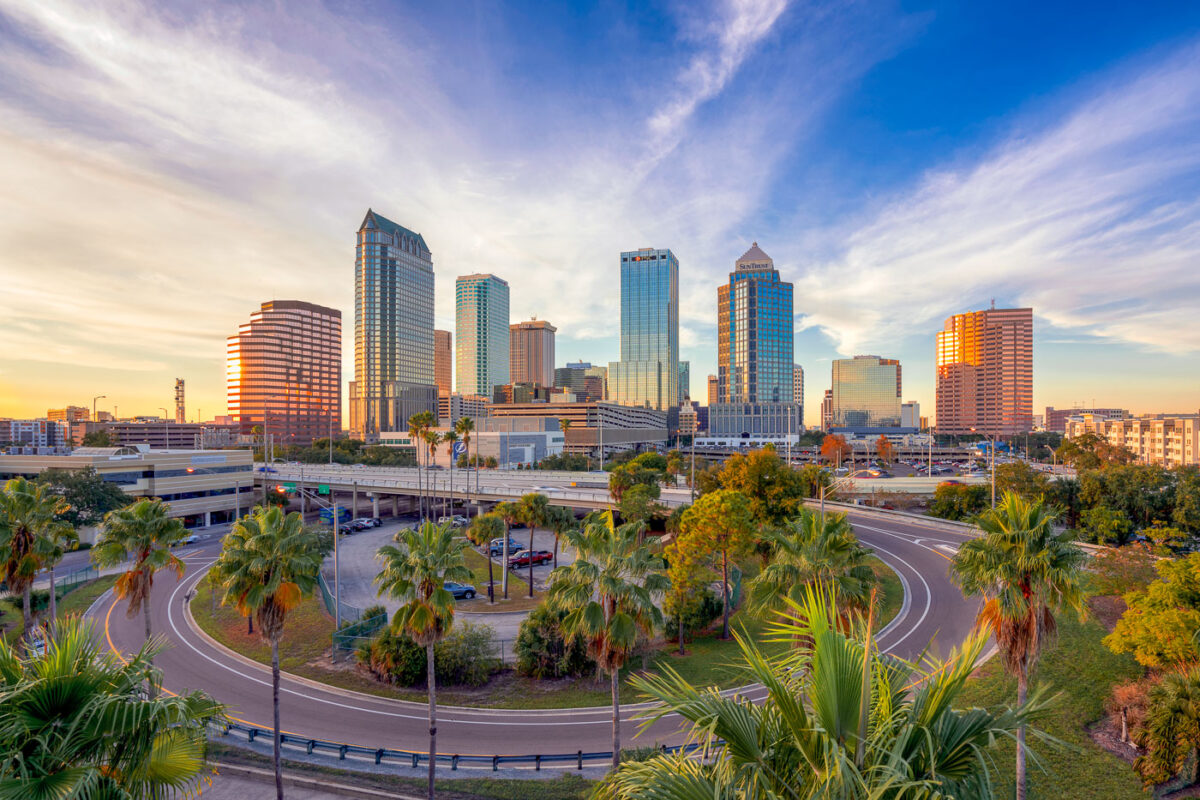
December 2019 — Tampa, Florida skyline at sunset.
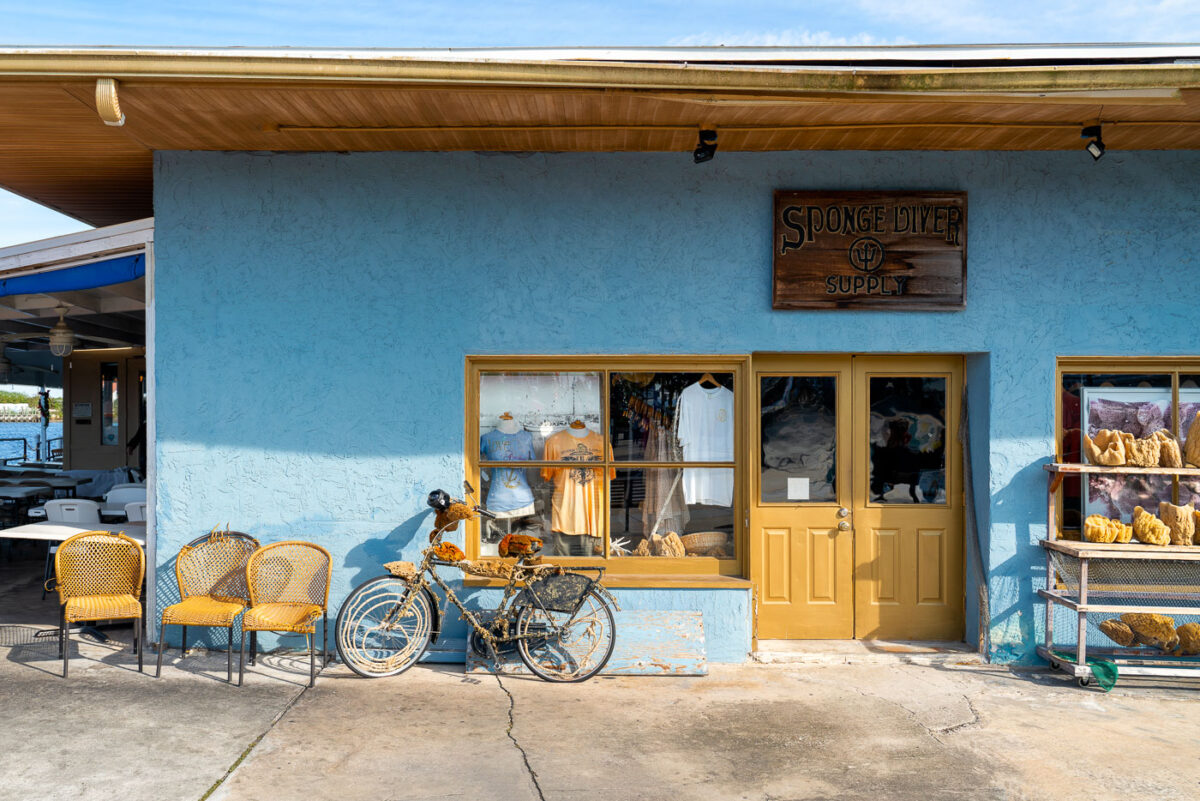
December 2019 — Sponge Diver Supply store in Tarpon Springs, Florida.

December 2019 — The entrance landscaping at the Innisbrook Resort in Palm Harbor, Florida, features the resort’s name sculpted in trimmed hedges along a manicured hill. Reflected in a nearby pond, the display welcomes guests to the golf and spa property known for its championship courses and natural setting. Tall pines and live oaks frame the scene, emphasizing the resort’s park-like character.
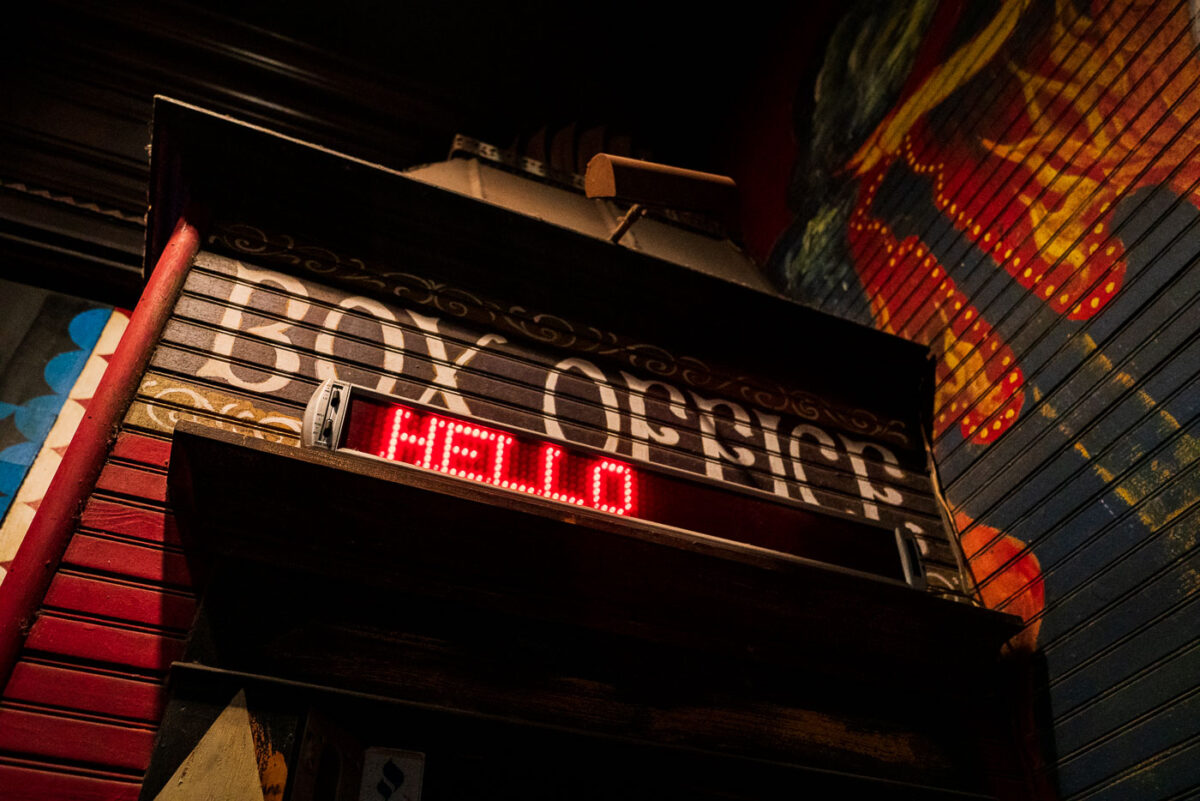
December 2019 — Box Office window in New Orleans.
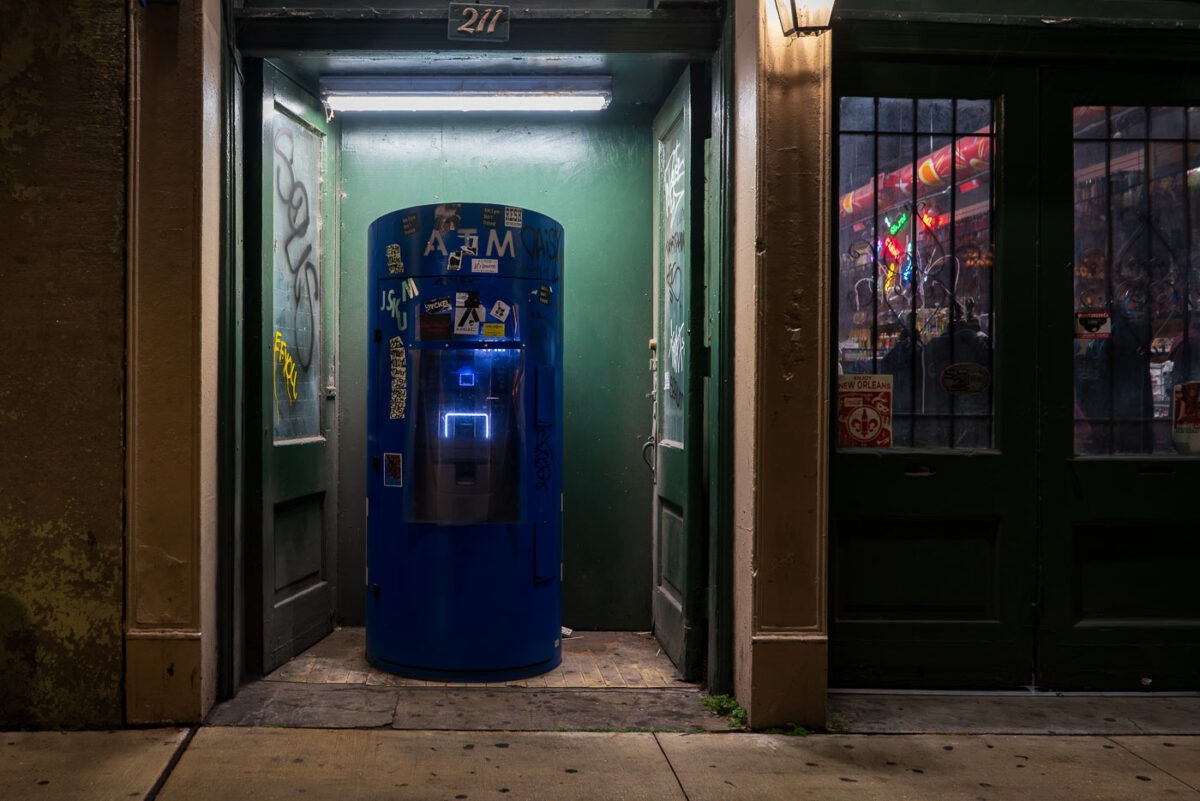
December 2019 — A blue ATM sits in a narrow doorway at 211 Decatur Street in New Orleans, surrounded by graffiti and stickers. T
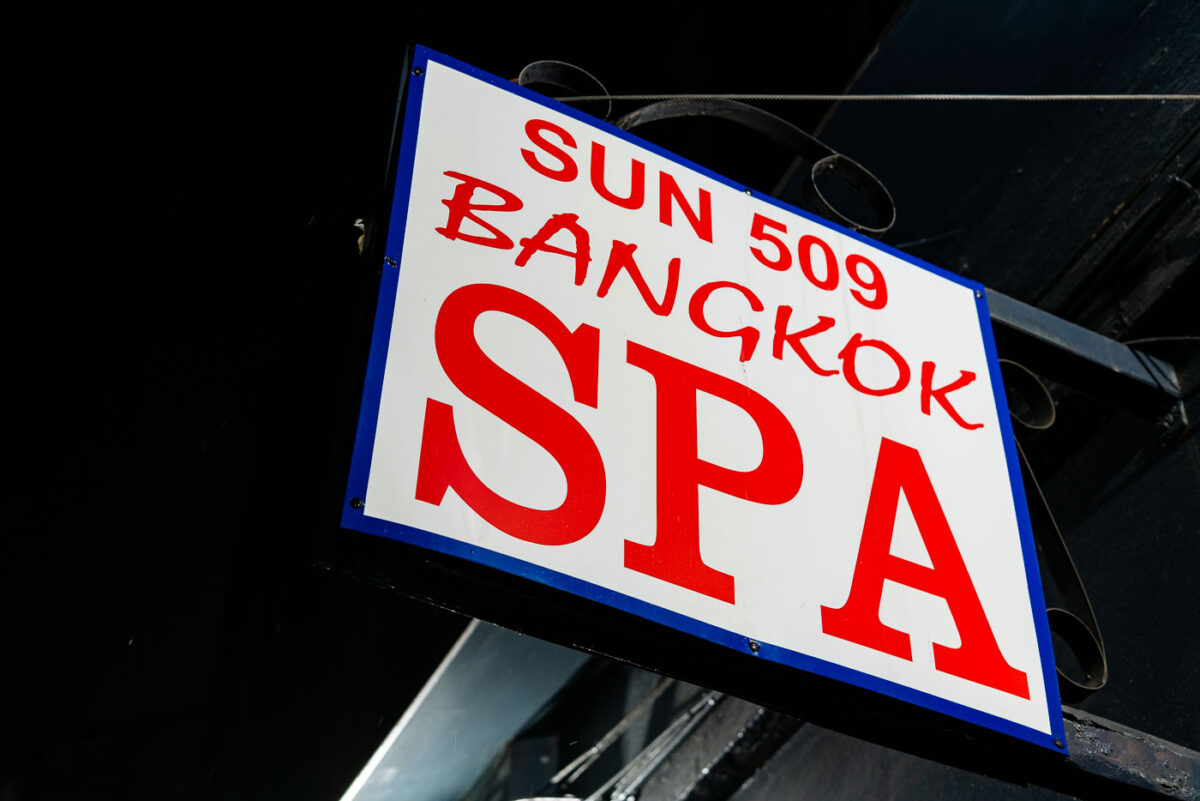
December 2019 — Sign for Bangkok Spa in New Orleans, Louisiana.
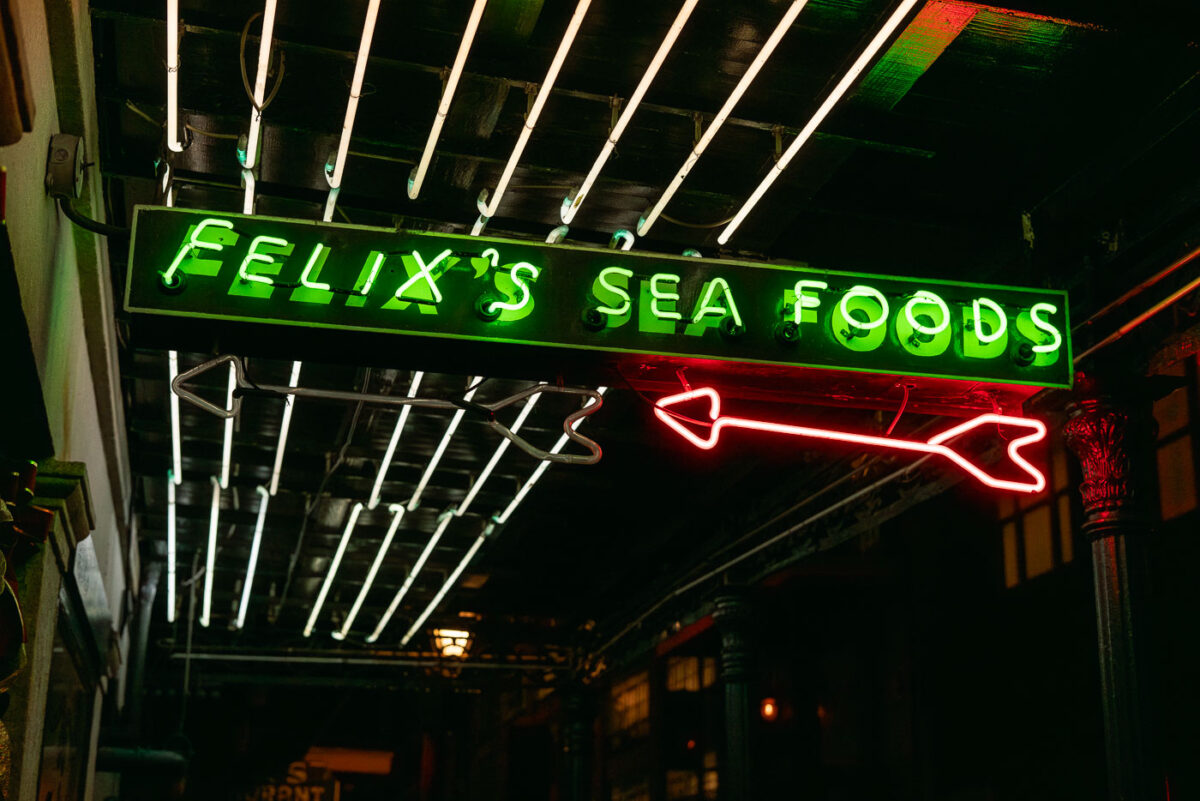
December 2019 — A neon sign glows above the entrance to Felix’s Sea Foods. The restaurant is a well-known spot in New Orleans’ French Quarter, recognized for its oysters and casual seafood dining.
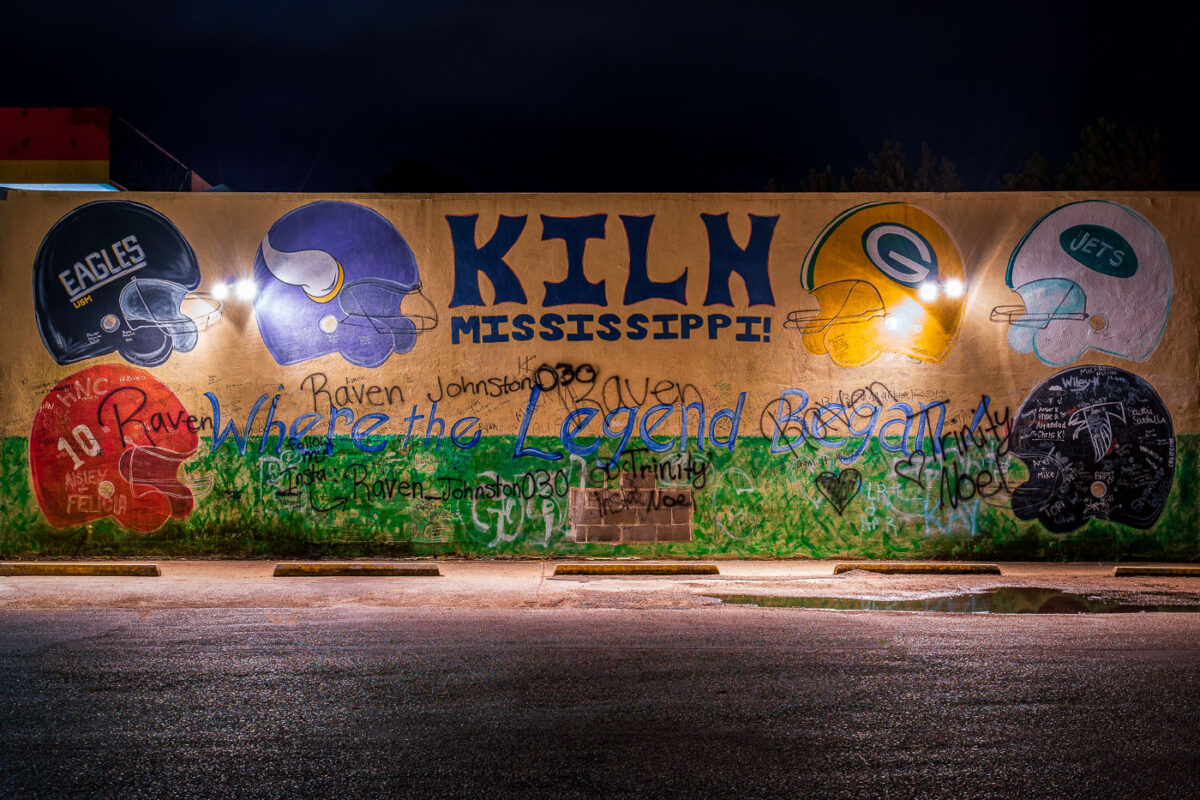
December 2019 — A mural painted on the wall of a gas station in Kiln Mississippi with all the helmets Brett Favre wore.
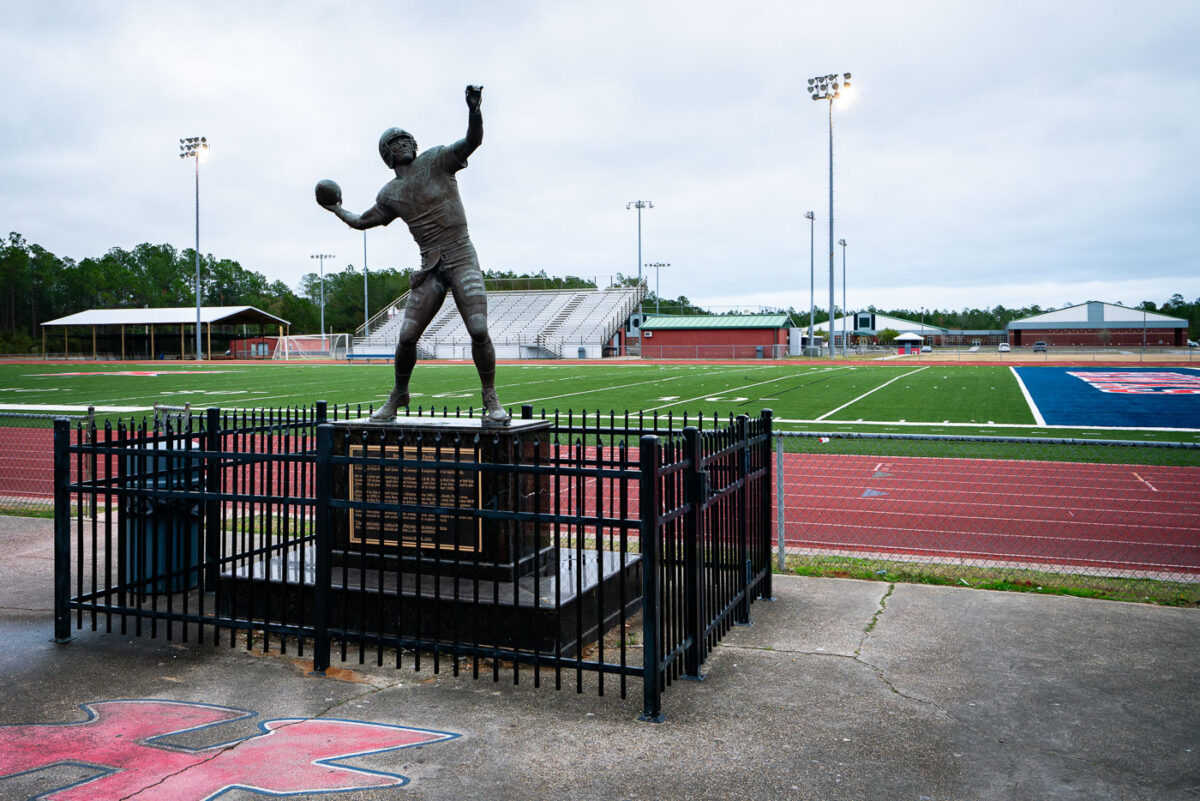
December 2019 — In Kiln, Mississippi, the legacy of Brett Favre looms large. Outside Hancock High School’s football stadium, a life-sized statue of the quarterback stands mid-throw, immortalizing the local athlete who went on to become one of the NFL’s most prolific passers. Set against the backdrop of the school’s red track and green turf, the monument reflects both community pride and the enduring place of football in Southern culture. For locals, it serves as a reminder that even from a small Gulf Coast town, greatness can reach the national stage.
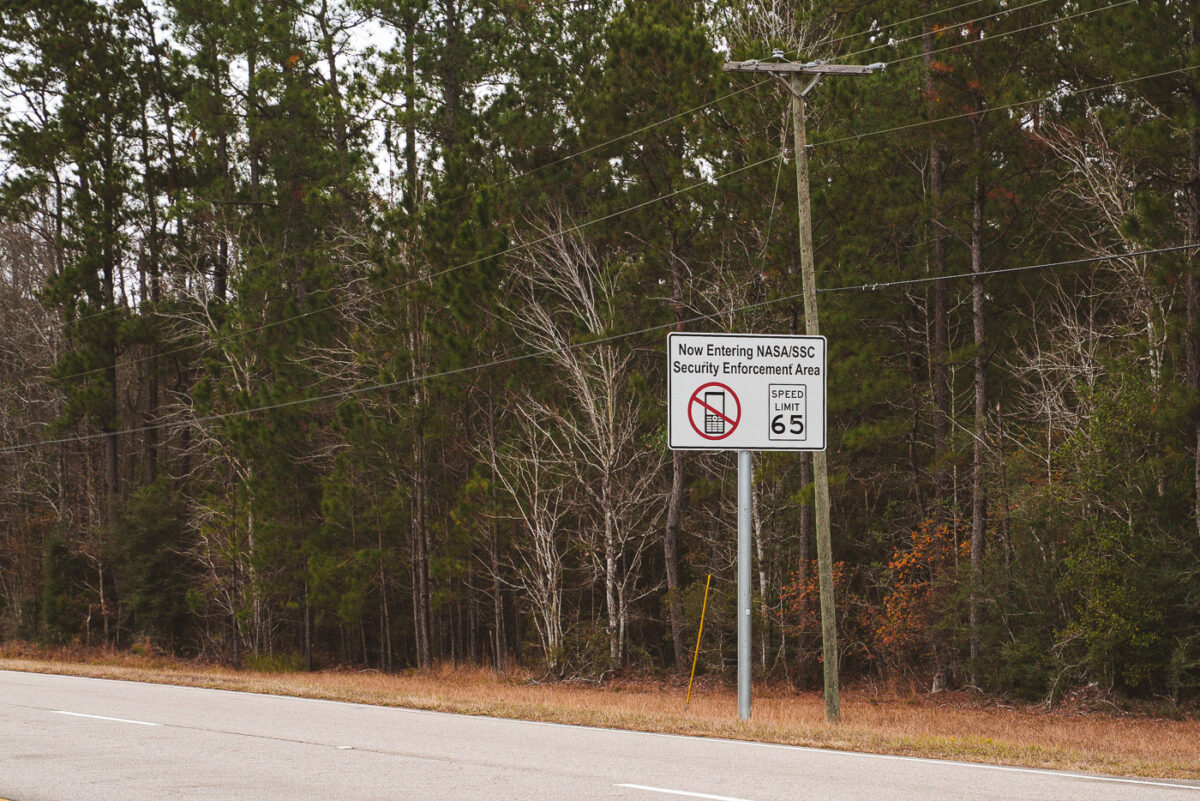
December 2019 — Along a quiet stretch of pine-lined Highway 607 in Hancock County, Mississippi, a sign alerts motorists: Now Entering NASA/SSC Security Enforcement Area. Beyond this point lies the vast Stennis Space Center, where engines for Apollo, the Space Shuttle, and Artemis have been tested at full throttle. The reminder of security restrictions — paired with the speed limit notice — reflects how an otherwise ordinary southern highway doubles as the gateway to one of the most advanced propulsion test facilities in the world.
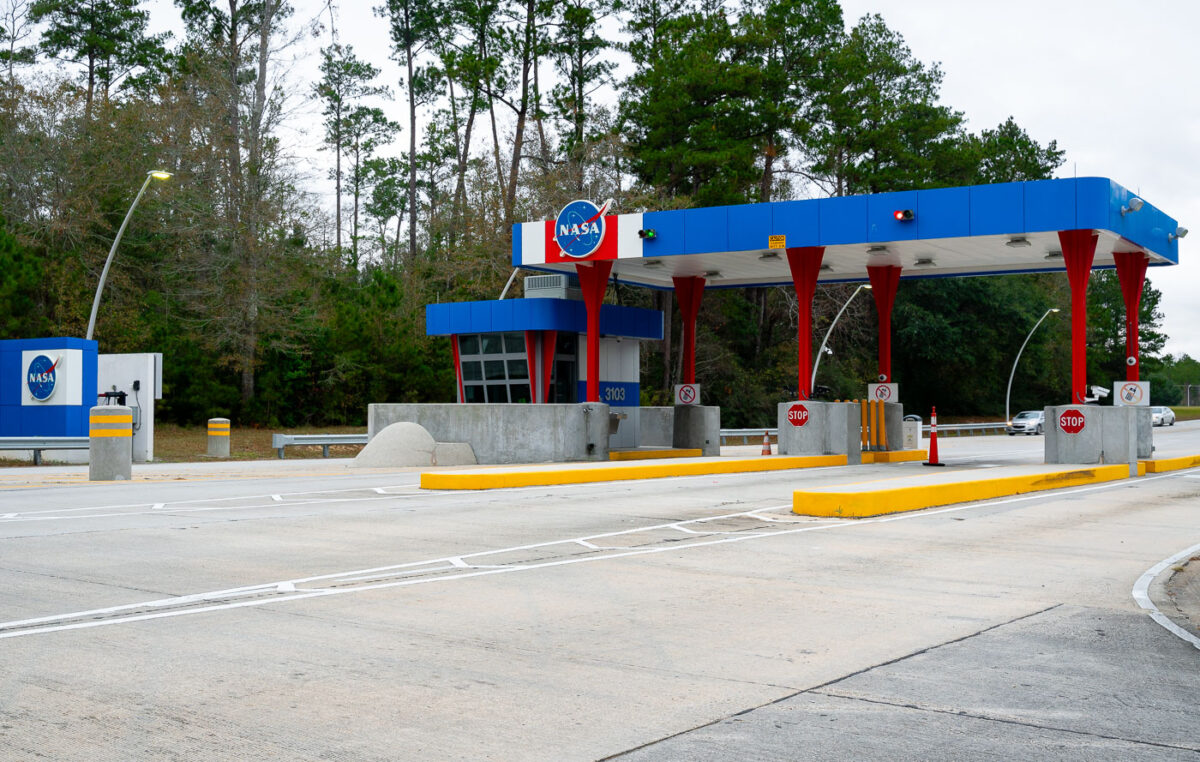
December 2019 — Nestled in the woods of Hancock County, Mississippi, the Stennis Space Center has been a cornerstone of NASA’s propulsion testing since the 1960s. The security gate, painted in the agency’s signature red, white, and blue, greets all who enter the sprawling complex where engines for Apollo, the Space Shuttle, and today’s Artemis missions have been put through their paces. The unassuming roadside checkpoint belies the scale of the technological achievements within, underscoring how a quiet patch of southern forest became central to America’s spaceflight history.
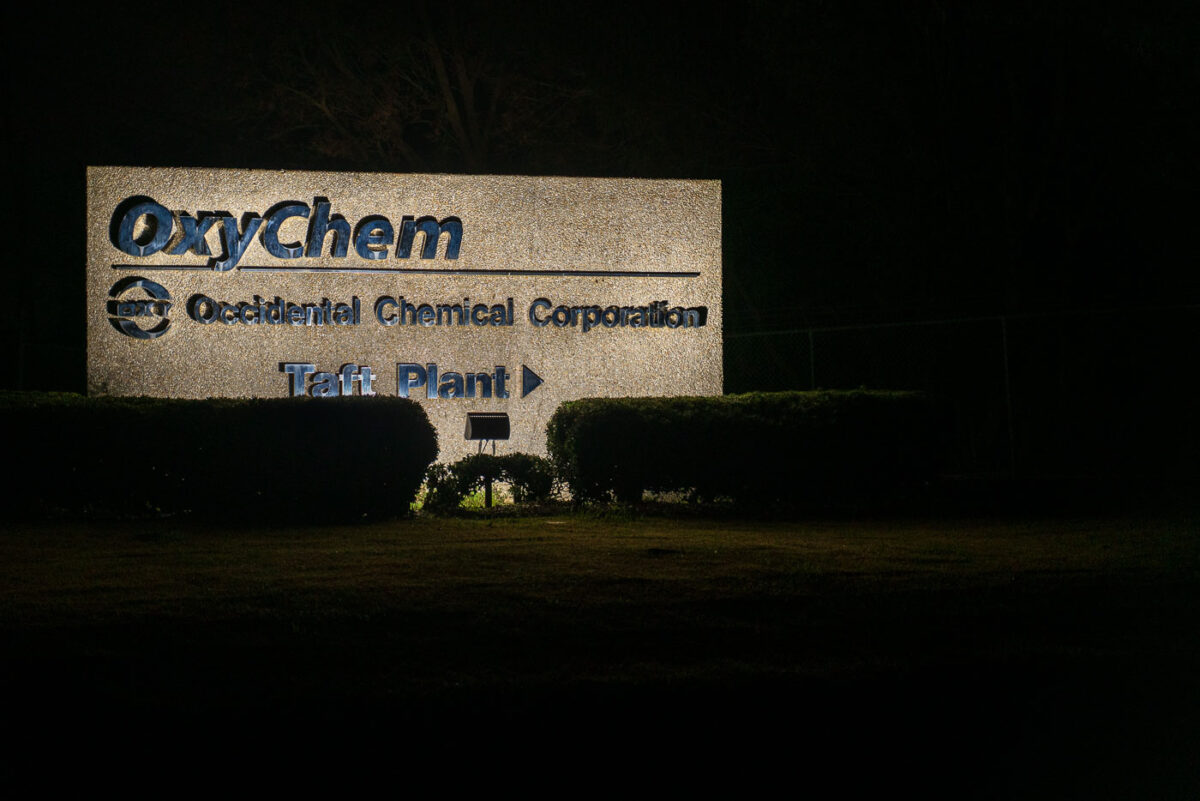
December 2019 — The Taft Plant, operated by Occidental Chemical Corporation (OxyChem), sits along Louisiana’s heavily industrialized river corridor between Baton Rouge and New Orleans. Like many facilities in the region, the plant plays a role in the state’s vast petrochemical network, producing essential compounds for plastics, coatings, and other materials that fuel modern life. At night, its illuminated sign cuts through the darkness, a quiet marker of the sprawling industry that has shaped both the economy and the environmental debates of the Mississippi River corridor.
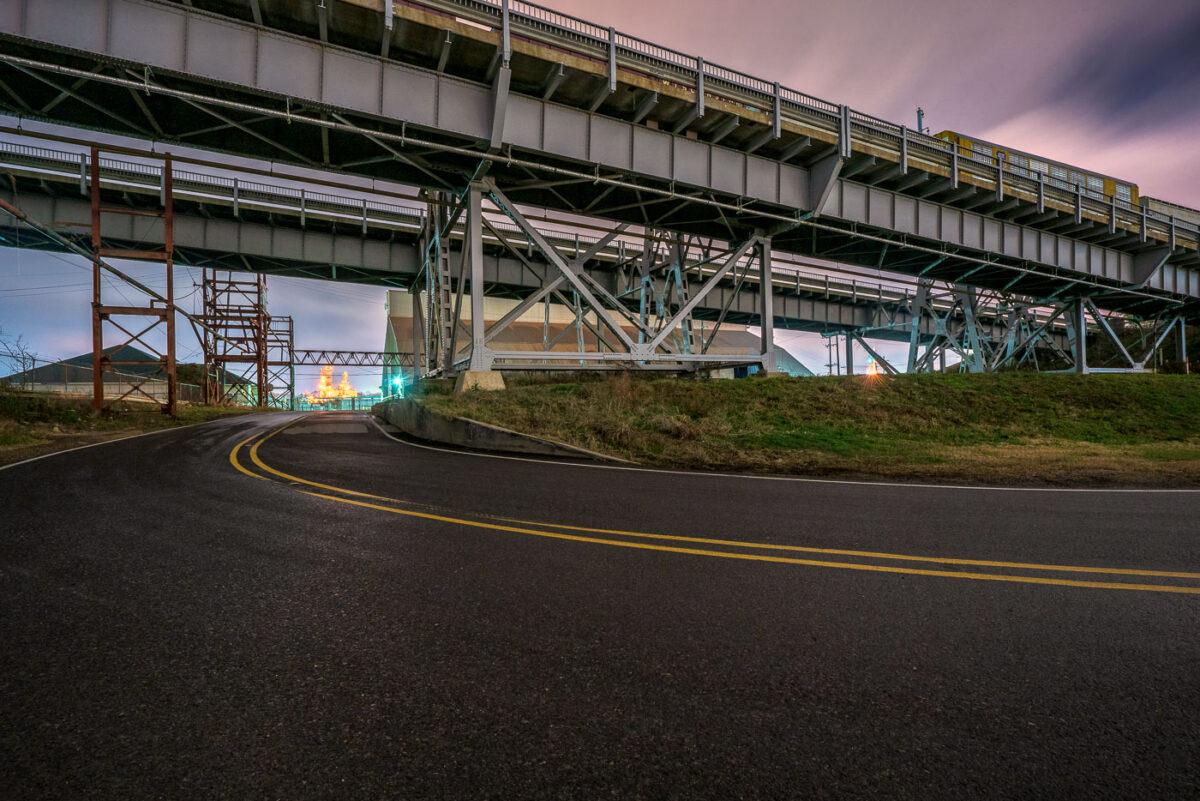
December 2019 — On Baton Rouge’s Airline Highway, the road snakes beneath a tangle of overpasses and steel supports, a striking symbol of mid-20th-century infrastructure. Originally developed as a major bypass route, Airline Highway became one of Louisiana’s busiest commercial arteries, linking petrochemical plants, warehouses, and neighborhoods across the capital region. At dusk, the glow of distant lights cuts through the industrial sprawl, underscoring how this corridor remains a vital — if gritty — backbone of the city’s economy and daily life.
December 2019 —
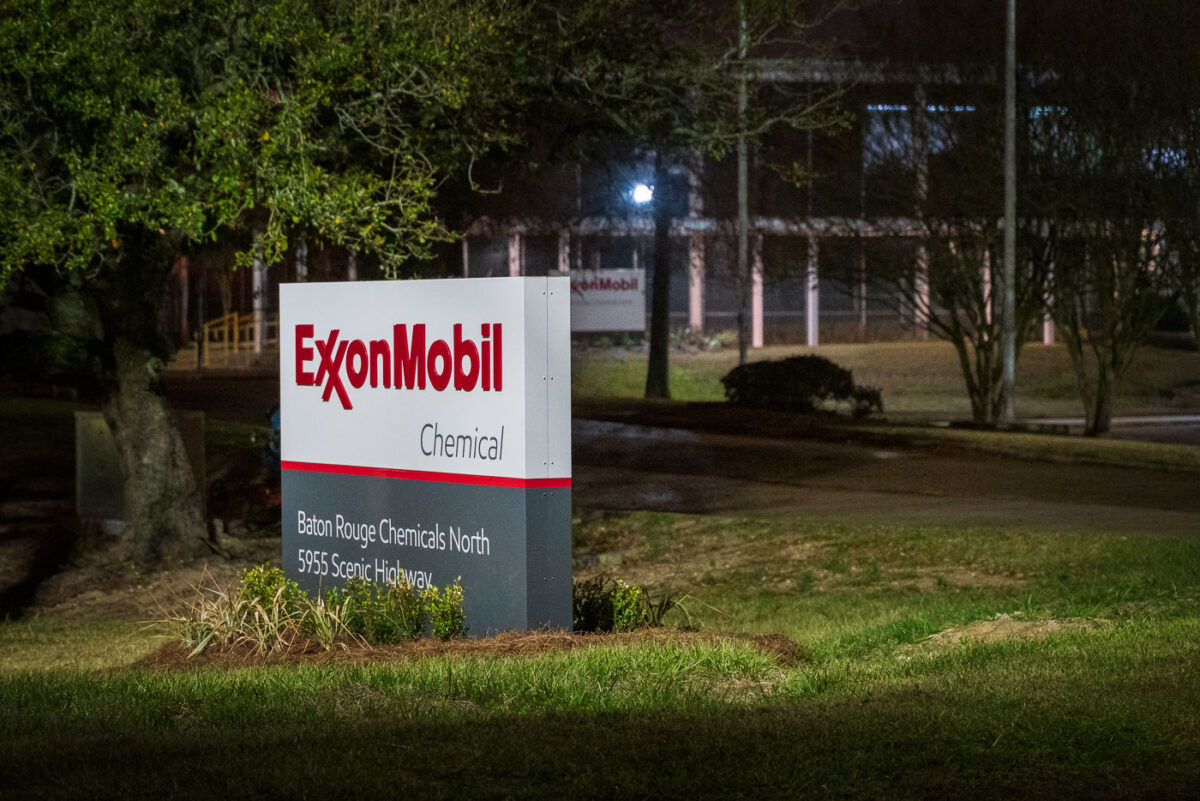
December 2019 — The Baton Rouge Chemicals North complex of ExxonMobil stands along Scenic Highway in Louisiana’s industrial corridor. Part of one of the largest integrated refining and petrochemical operations in the United States, this facility produces a wide range of industrial chemicals used globally. The illuminated sign reflects both the company’s deep roots in the Baton Rouge area and the economic and environmental legacy of the region’s petrochemical industry.
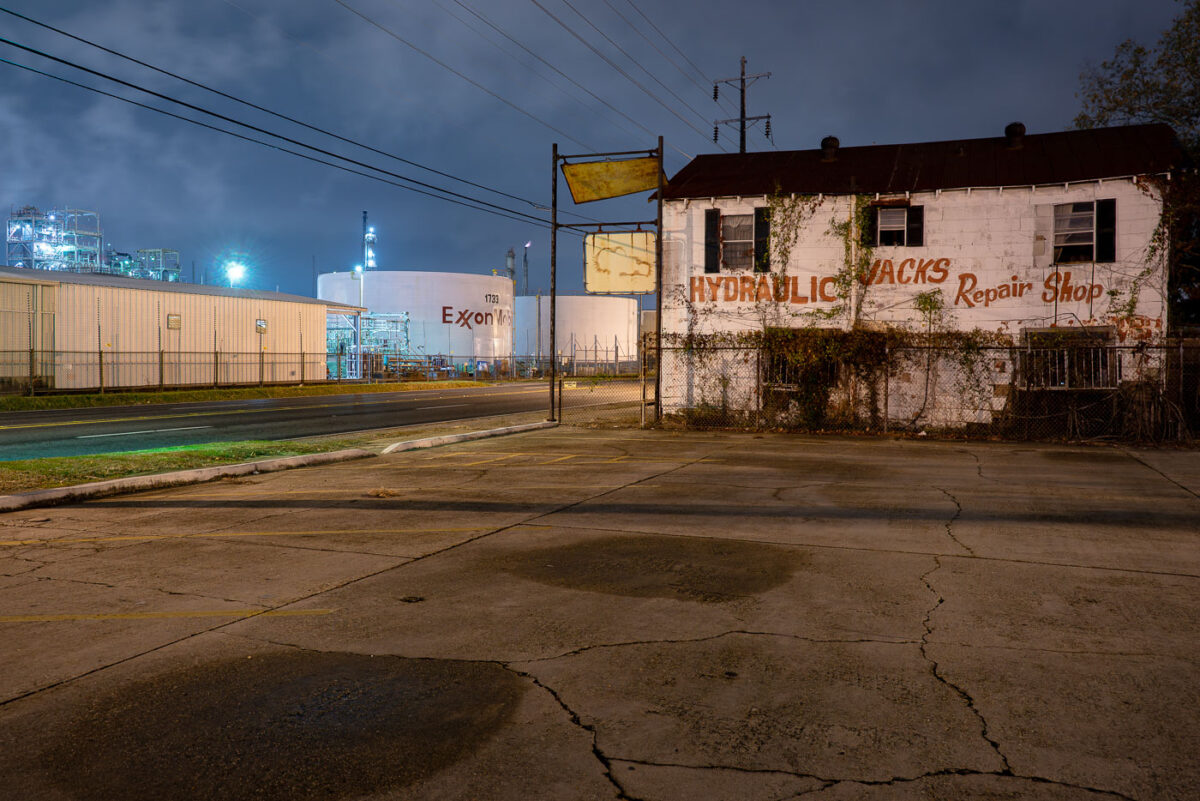
December 2019 — An abandoned hydraulic jack repair shop sits across from the massive ExxonMobil refinery complex in Baton Rouge, Louisiana. The plant, one of the largest oil refineries in the United States, has operated since 1909 and remains a central fixture of the city’s industrial identity. The decaying storefront in the foreground contrasts sharply with the illuminated refinery tanks and piping behind it — a visual divide between small-scale industry of the past and the enduring scale of the petrochemical operations that define the region’s economy.
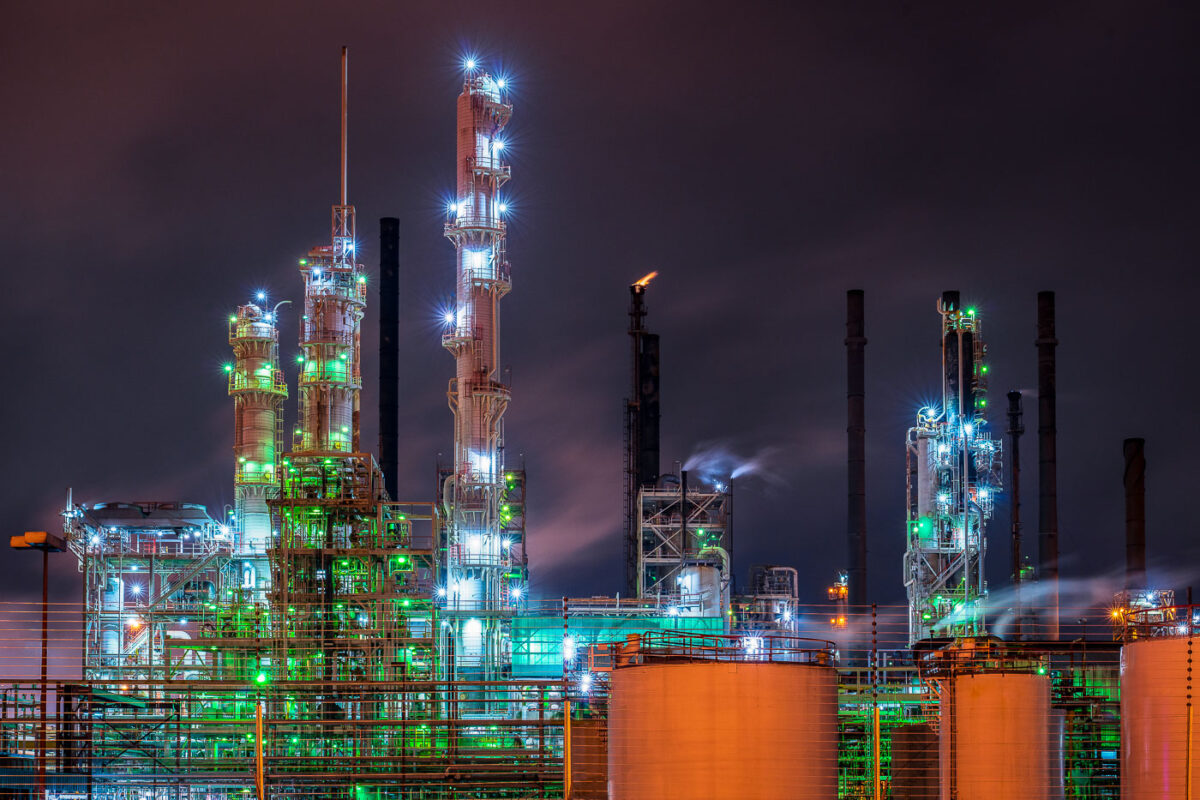
December 2019 — This nighttime industrial scene is from Baton Rouge, Louisiana, home to one of the largest oil refining and petrochemical hubs in the United States. The brightly lit towers and distillation columns belong to facilities along the Mississippi River Industrial Corridor, where refineries like ExxonMobil Baton Rouge operate around the clock. Steam and flares mark the ongoing refining processes that produce gasoline, diesel, and chemical feedstocks central to the region’s economy. The image captures the city’s long-standing connection to the energy and manufacturing industries.
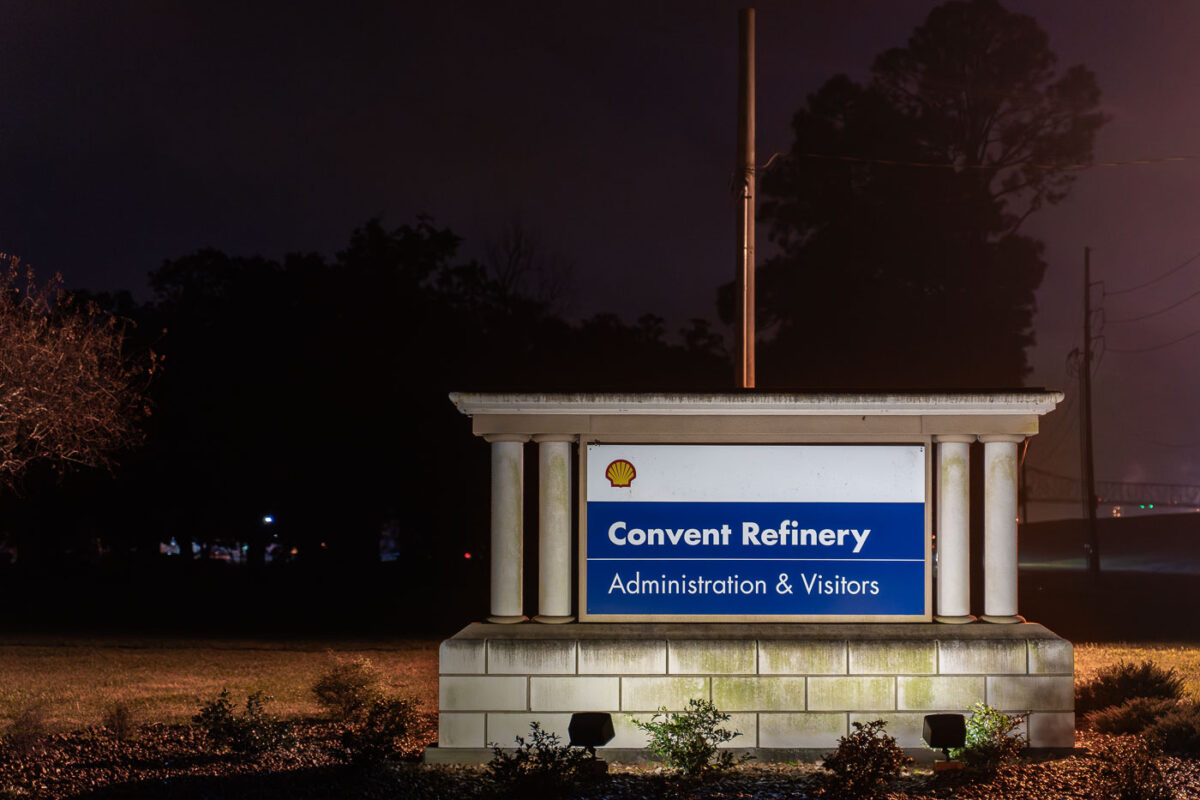
December 2019 — The entrance sign for Shell’s Convent Refinery in St. James Parish, Louisiana, stands illuminated against the night sky. Opened in 1967, the refinery was a major facility in the state’s “Petrochemical Corridor,” processing up to 240,000 barrels of crude oil per day at its peak. Shell permanently shut down operations in 2020 amid declining demand and corporate restructuring, marking the end of one of the region’s most significant industrial sites along the Mississippi River.
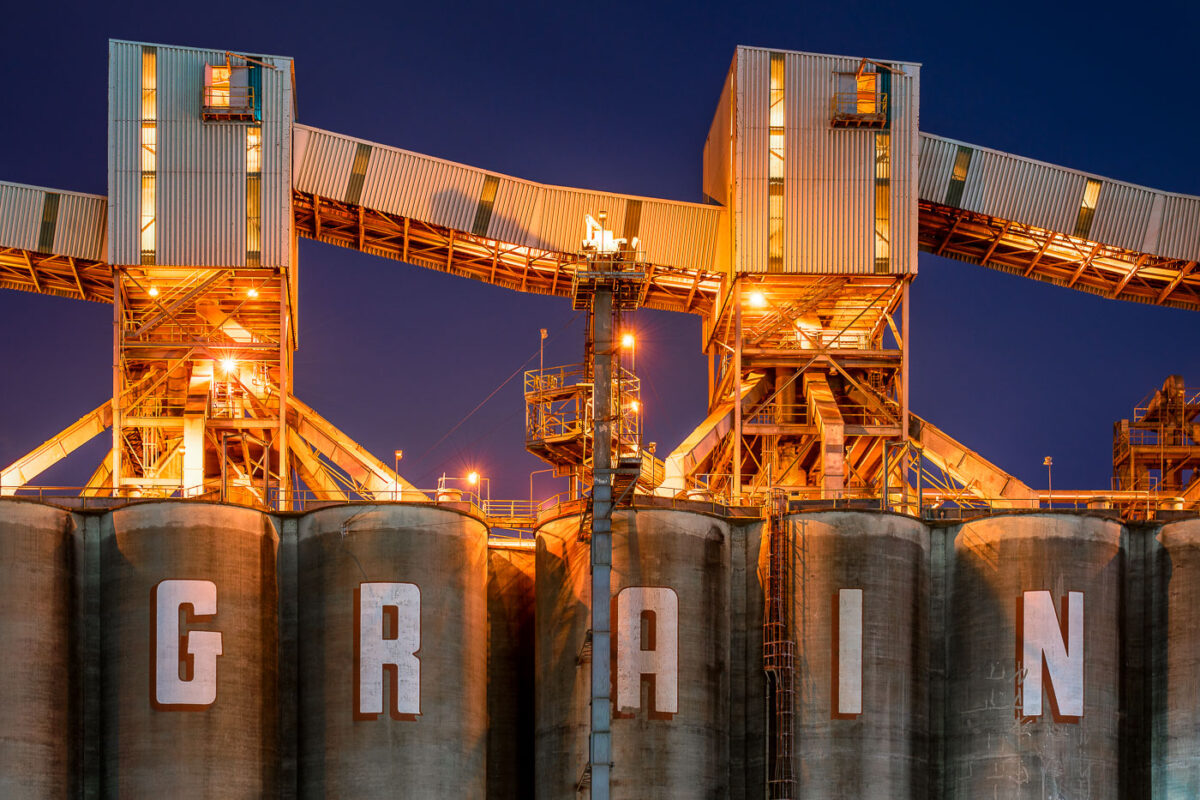
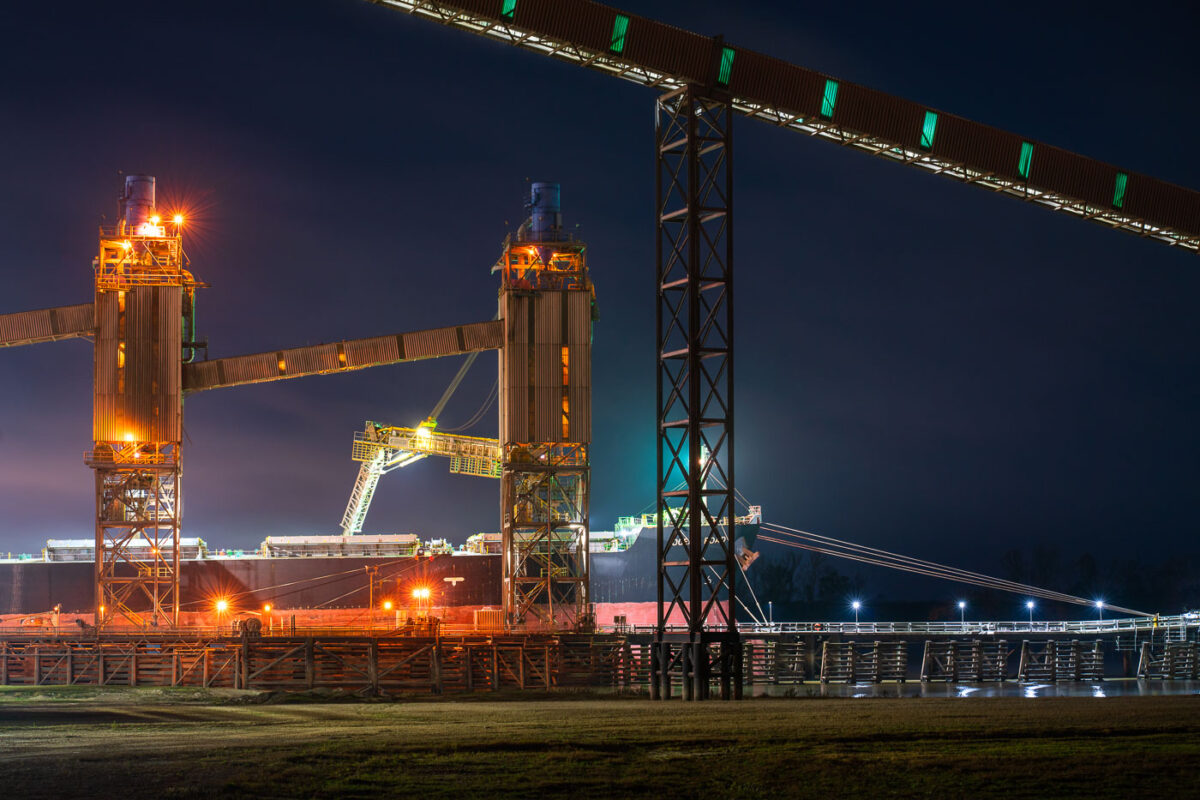
December 2019 — Illuminated under floodlights, the massive concrete grain silos of the Zen-Noh Grain Corporation terminal rise over the Mississippi River in Convent, Louisiana. Operated by a U.S. subsidiary of Japan’s Zen-Noh agricultural cooperative, this export facility plays a critical role in shipping Midwestern grain to international markets. The illuminated conveyors and loading structures highlight the region’s industrial link between river transport and global food supply chains.
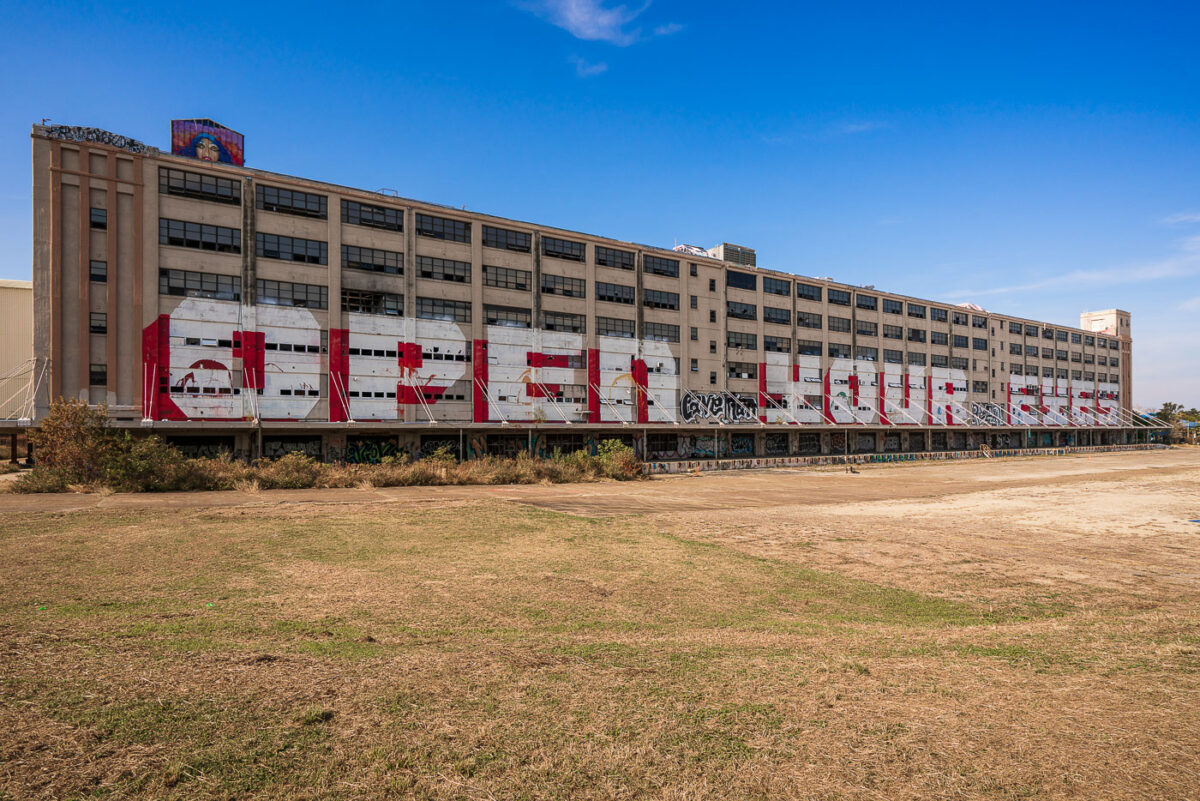
December 2019 — Large-scale graffiti covers the façade of a decommissioned warehouse at the former Naval Support Activity base in New Orleans, Louisiana. Once part of a sprawling military logistics hub along the Mississippi River, the site has since become an unofficial canvas for artists and taggers. The “Open House” mural stretches across multiple bays of the building, symbolizing both abandonment and transformation as the complex awaits redevelopment under civic revitalization plans.
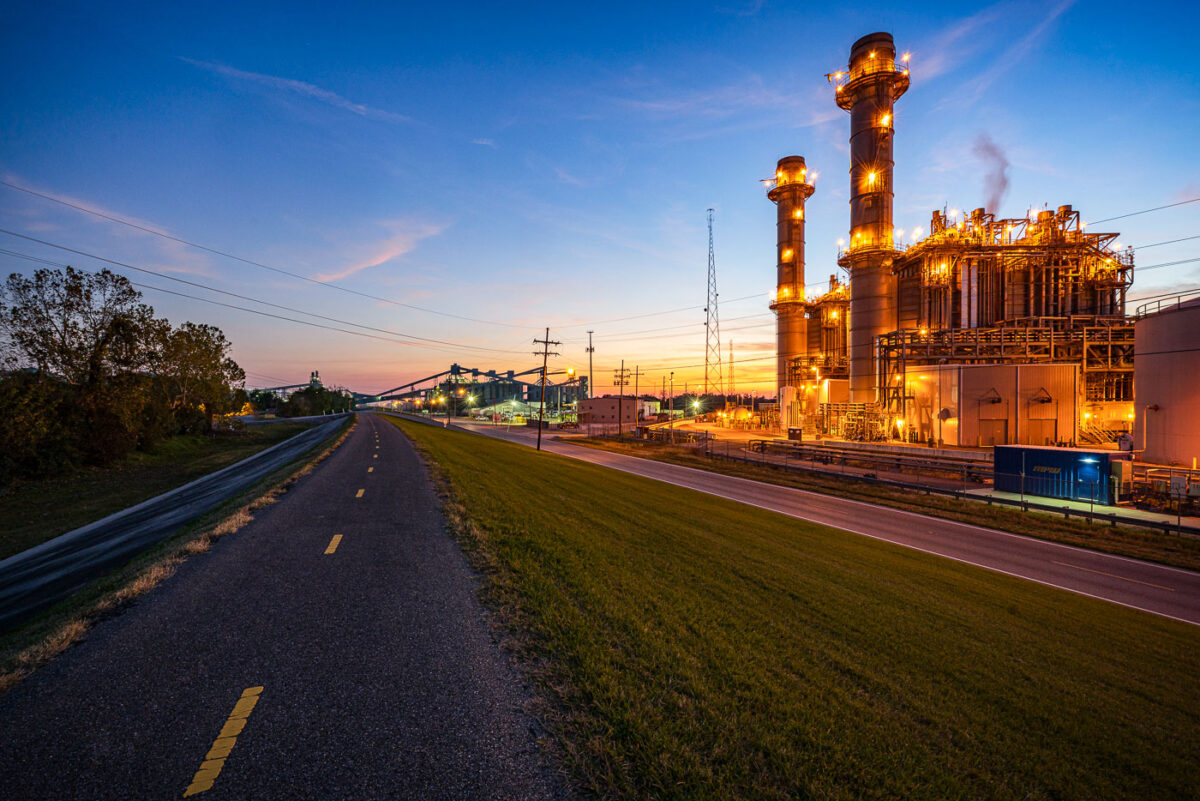
December 2019 — Entergy Corp’s natural gas-fired unit at the Ninemile power plant in Westwego. The 560-megawatt unit (known as Ninemile 6) went online in December of 2014 after a construction cost of $655 million.
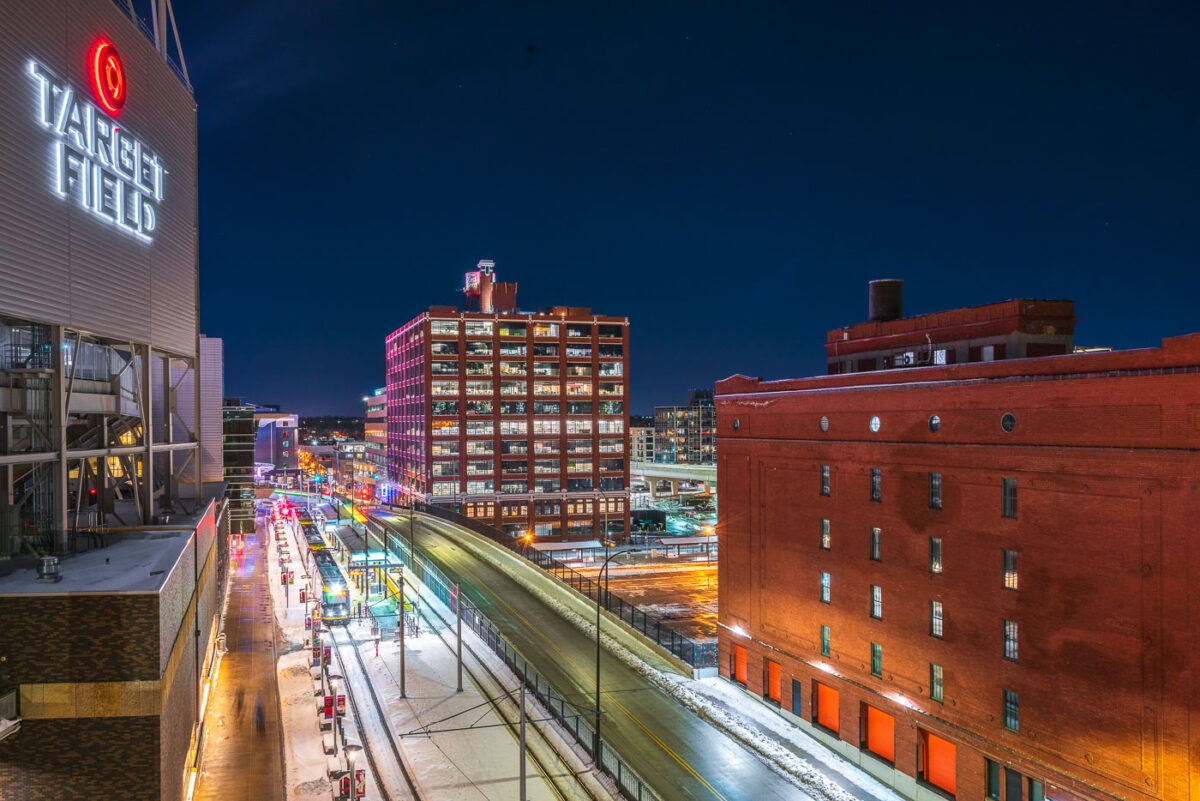
December 2019 — The illuminated Target Field sign overlooks the Warehouse District in downtown Minneapolis, where the city’s historic brick warehouses meet modern transit and redevelopment. Below, the Metro Green and Blue Line trains stop at Target Field Station, a multimodal hub linking light rail, commuter rail, and bike paths. The brightly lit Ford Center and preserved brick structures along 5th Street North illustrate the district’s mix of 20th-century industrial architecture and contemporary urban life, framed against the cold clarity of a Minnesota winter night.
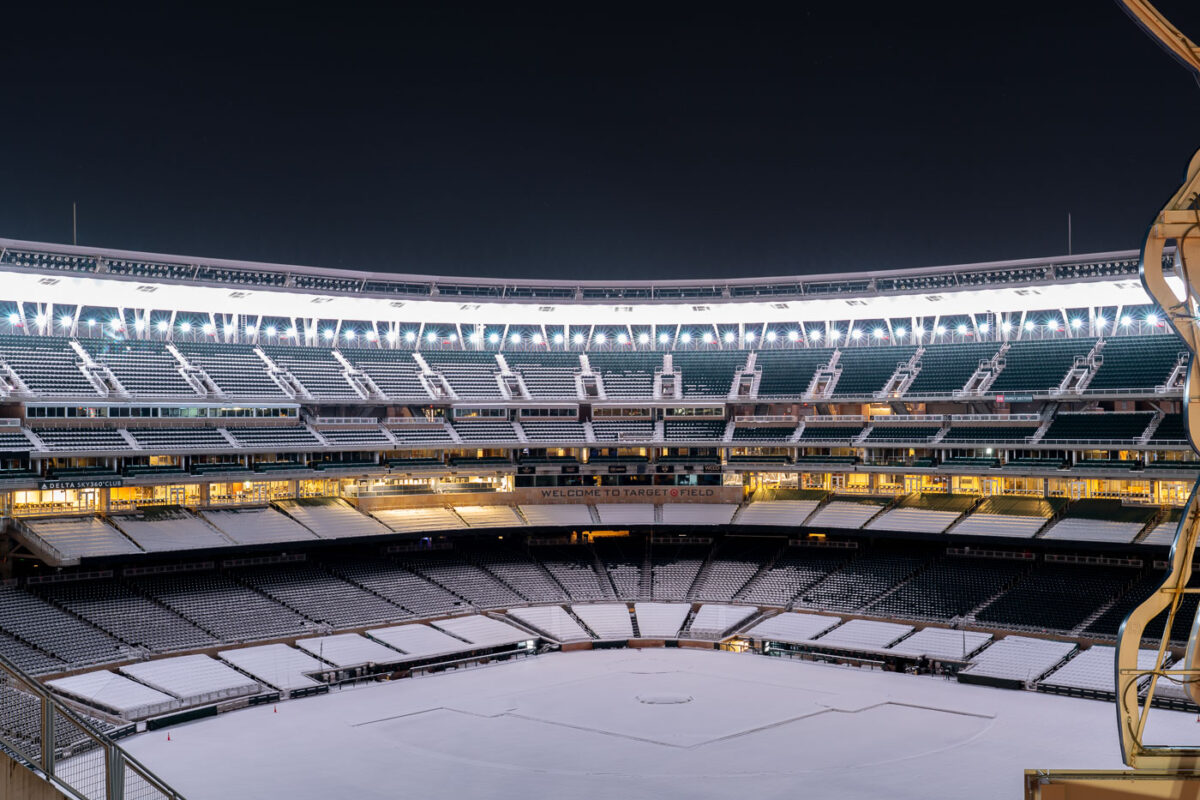
December 2019 — Snow covered Target Field, home of the Minnesota Twins MLB team.
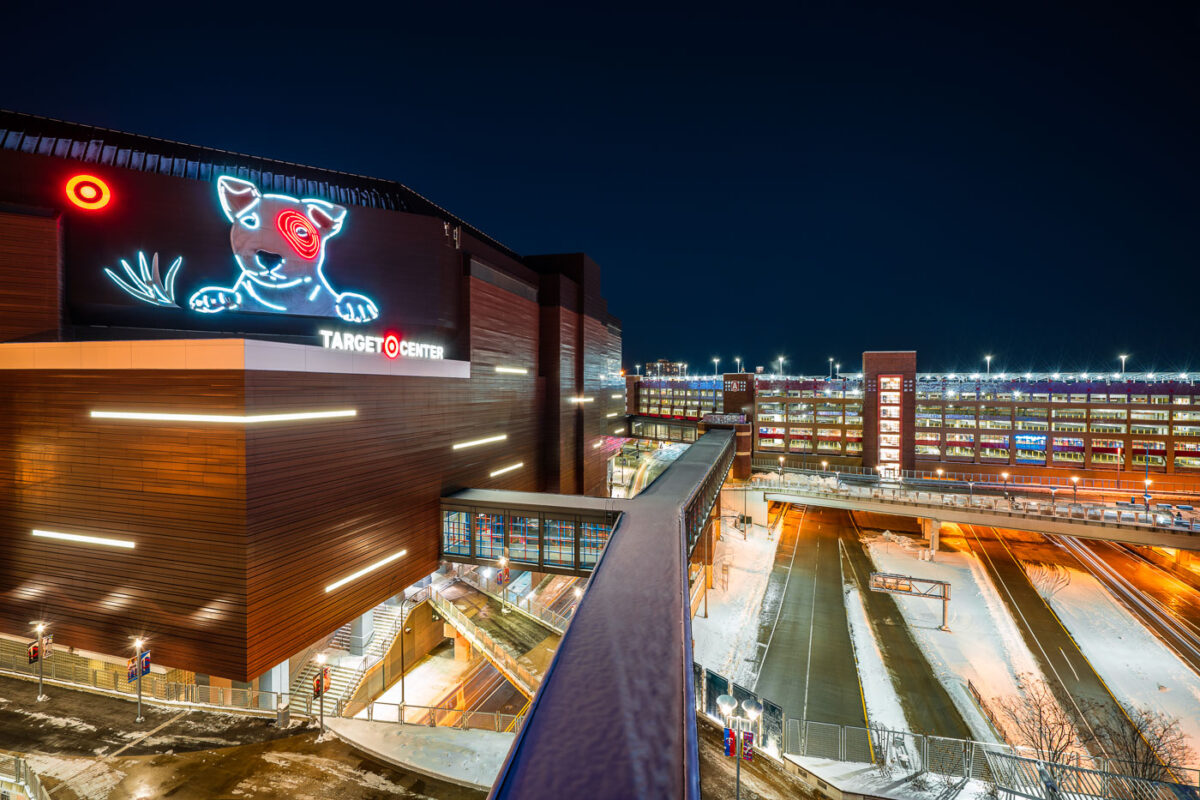
December 2019 — The Target Center’s neon Bullseye dog glows above 1st Avenue North, marking one of Minneapolis’ most recognizable downtown landmarks. Opened in 1990 and renovated in 2017 with a modern metal facade, the arena is home to the Minnesota Timberwolves and a hub for concerts and civic events. In the foreground, the enclosed skyway leads to Ramp A — part of the city’s expansive elevated walkway network that connects much of downtown. Snow-lined streets and the layered lighting of the ramps emphasize Minneapolis’ engineered adaptation to both density and winter.
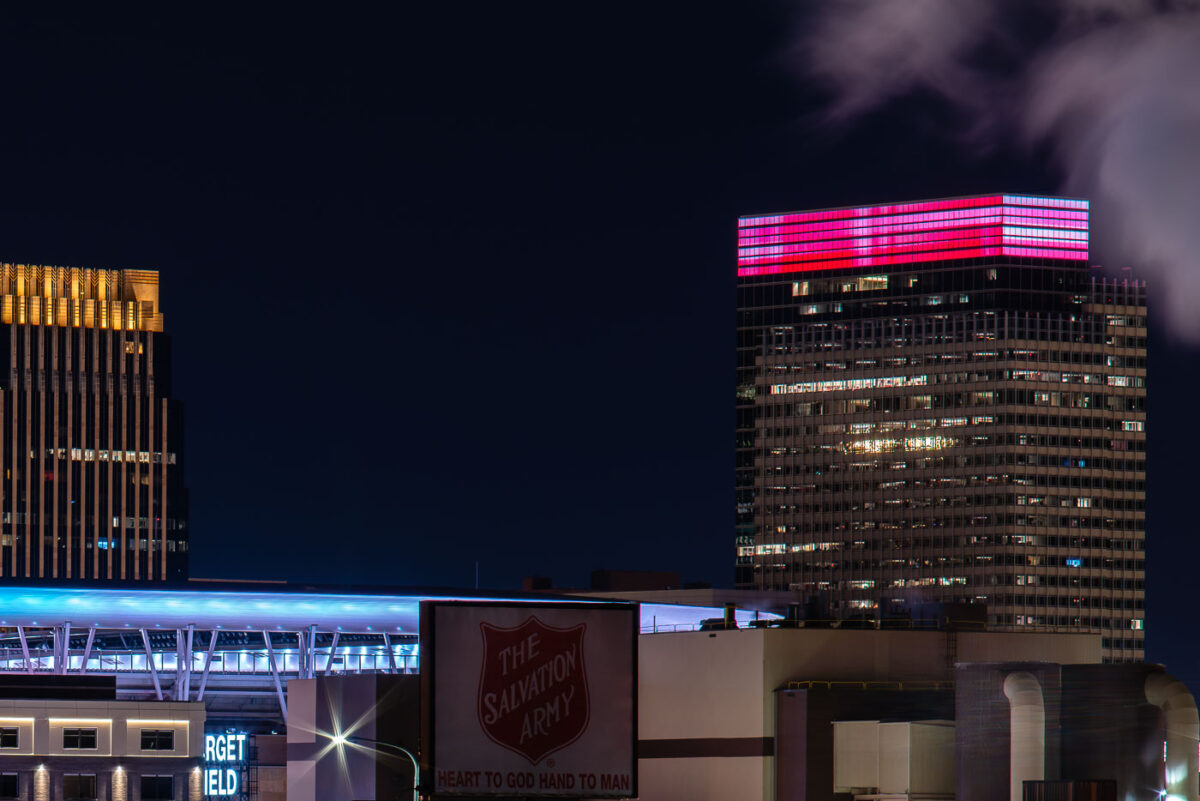
December 2019 — The Salvation Army sign with Target Field and Target Plaza South, Target World Headquarters, in the North Loop in Minneapolis.
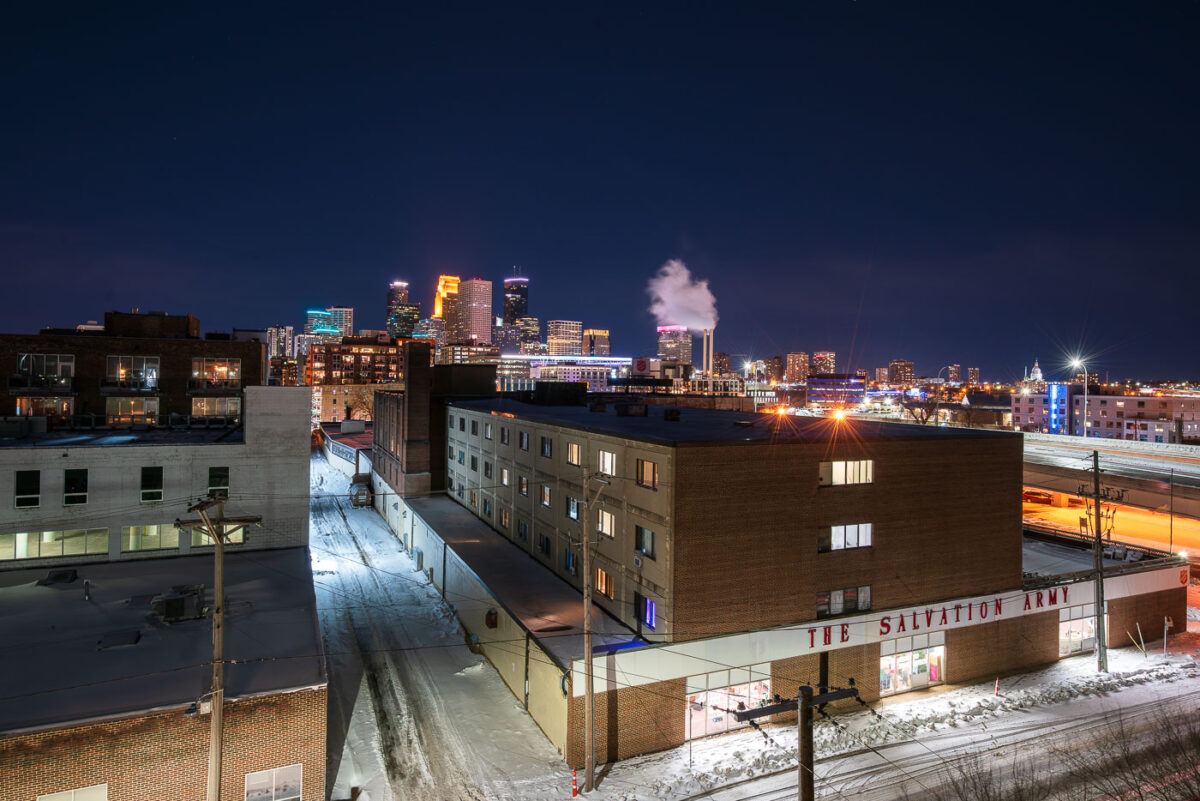
December 2019 — On a cold winter night in Minneapolis, the Salvation Army’s brick building stands in the foreground, a reminder of the nonprofit’s long presence serving those in need near the city’s downtown core. Beyond it, steam rises from the nearby power plant while the illuminated skyline glows with high-rise towers, blending industrial grit with modern glass. The juxtaposition of snowy side streets, mid-century warehouses, and gleaming skyscrapers reflects the city’s layered history — from its working-class roots to its contemporary role as a regional hub of commerce and culture.
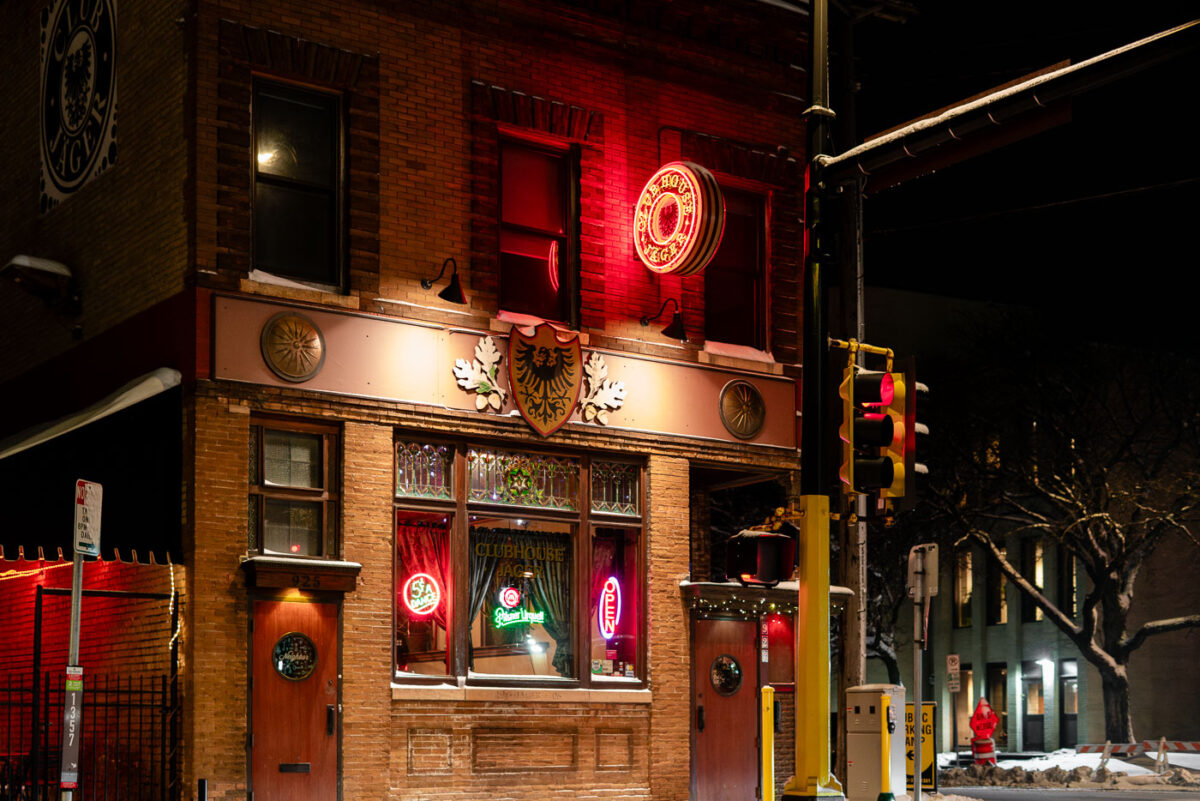
December 2019 — The now closed Clubhouse Jager bar in the North Loop Minneapolis.
November 2019 —
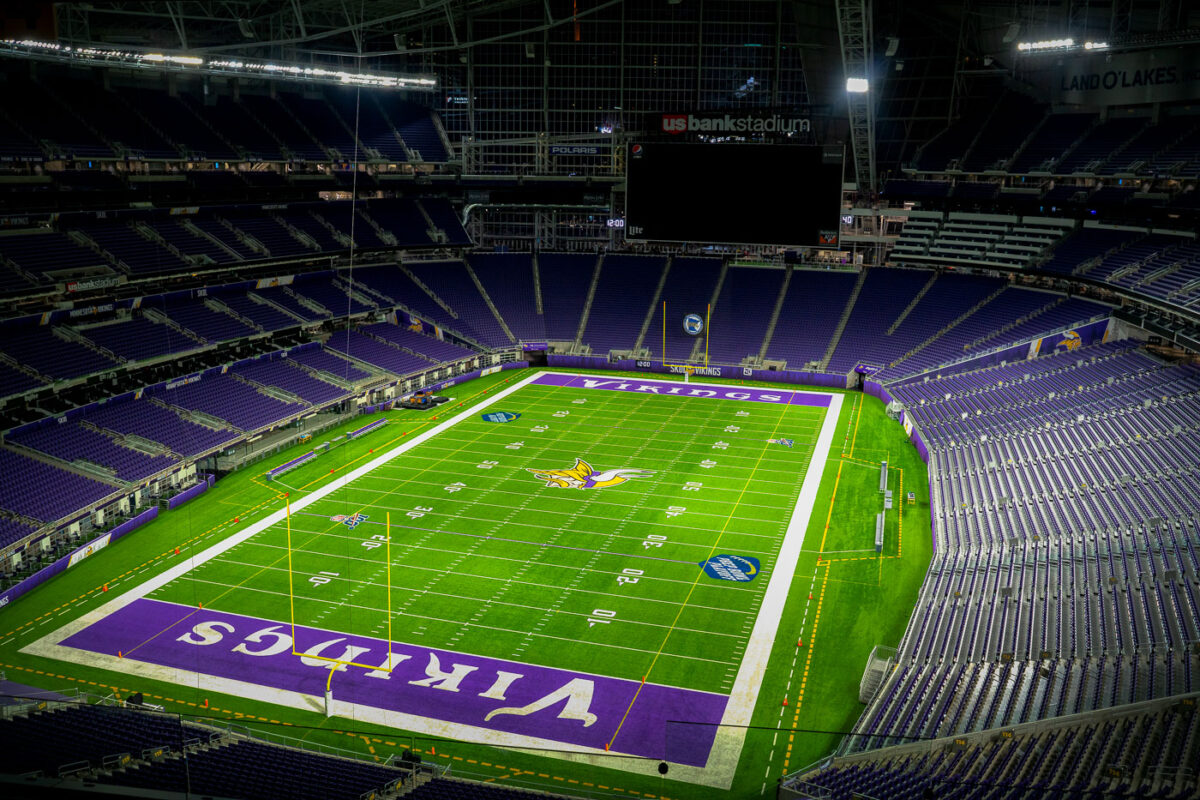
November 2019 — US Bank Stadium in Downtown Minneapolis. Home of the NFL's Minnesota Vikings.
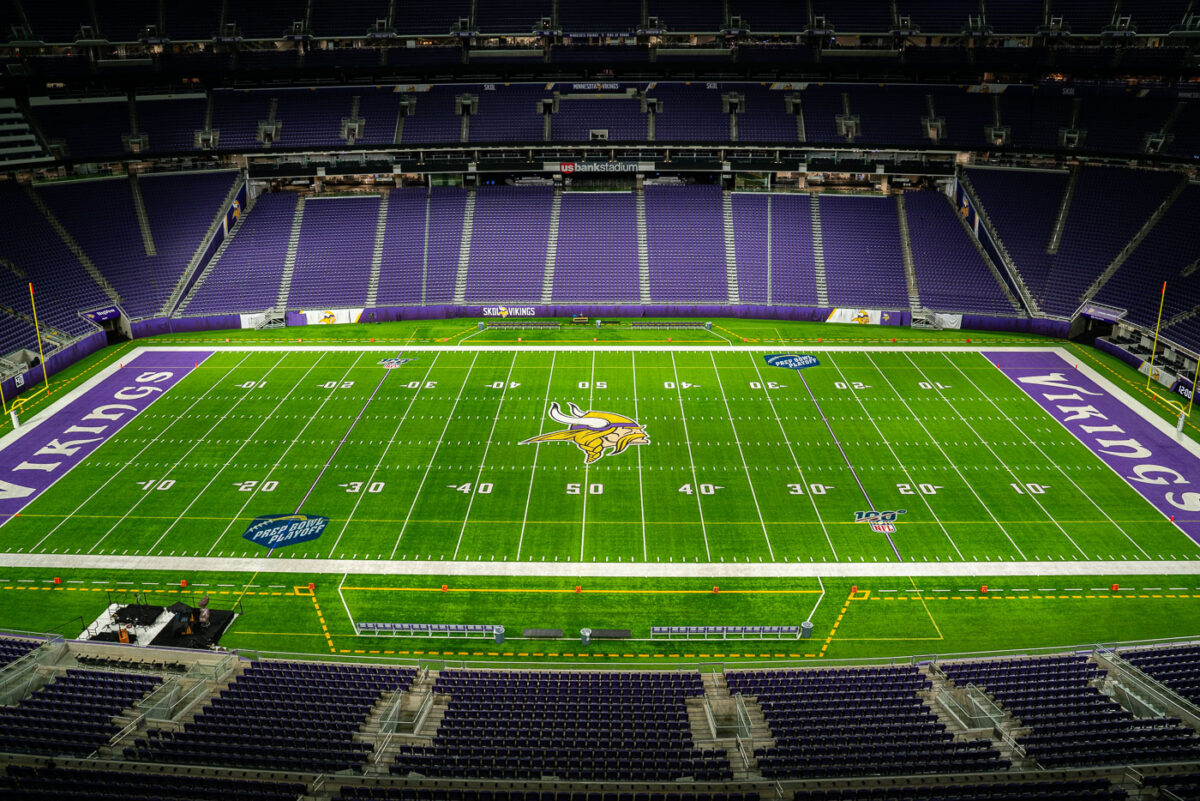
November 2019 — The interior of U.S. Bank Stadium in Minneapolis, home of the NFL’s Minnesota Vikings, shown from a high vantage point with an unobstructed view of the field. Completed in 2016 on the former site of the Metrodome, the $1.1 billion stadium features a fixed, translucent ETFE roof and steeply angled seating designed to evoke Nordic longhouses. The field displays the Vikings’ horned helmet logo at midfield, surrounded by vibrant purple end zones and the signature “SKOL” rally cry—a modern landmark of downtown Minneapolis and a hub for major sporting and entertainment events.
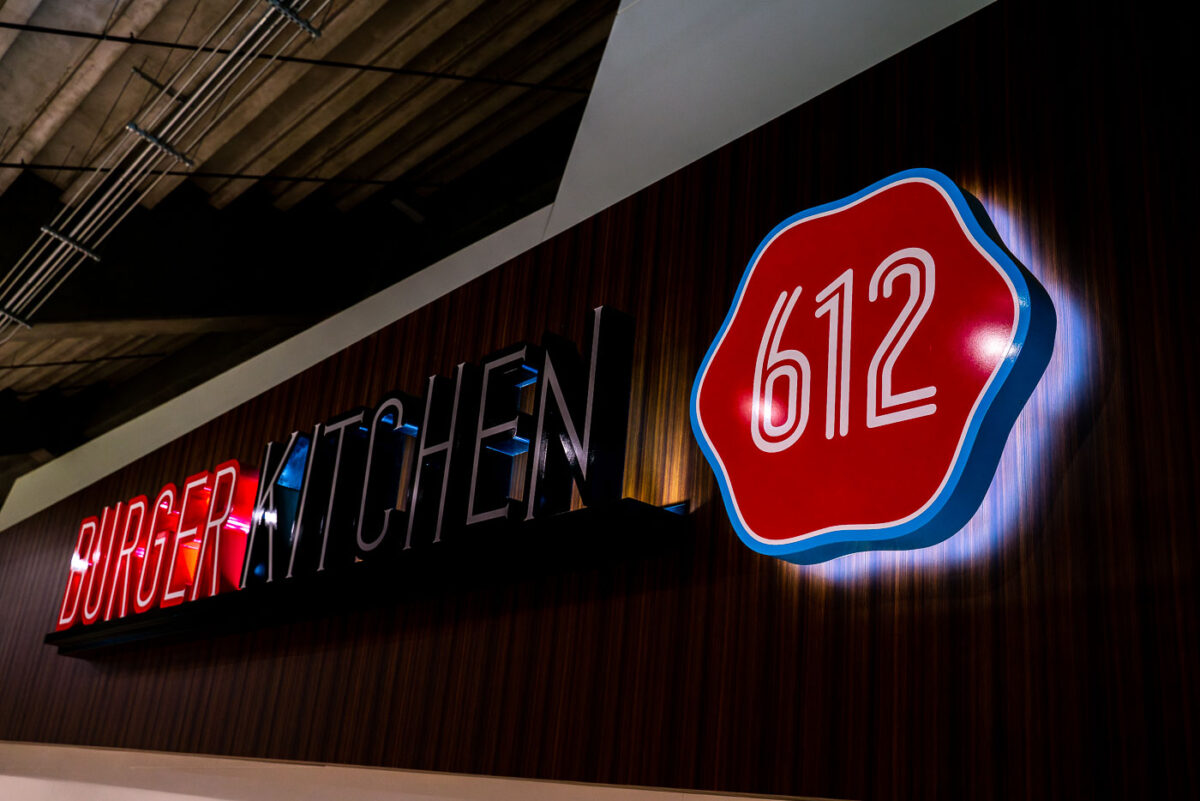
November 2019 — An illuminated “612 Burger Kitchen” sign inside U.S. Bank Stadium in Minneapolis, named after the city’s area code. The bold red-and-black typography and retro badge design reflect a blend of local identity and modern stadium branding. Located among the venue’s food and beverage concessions, 612 Burger Kitchen is part of the stadium’s effort to feature Minneapolis-based culinary offerings for fans attending Minnesota Vikings games and large-scale events.
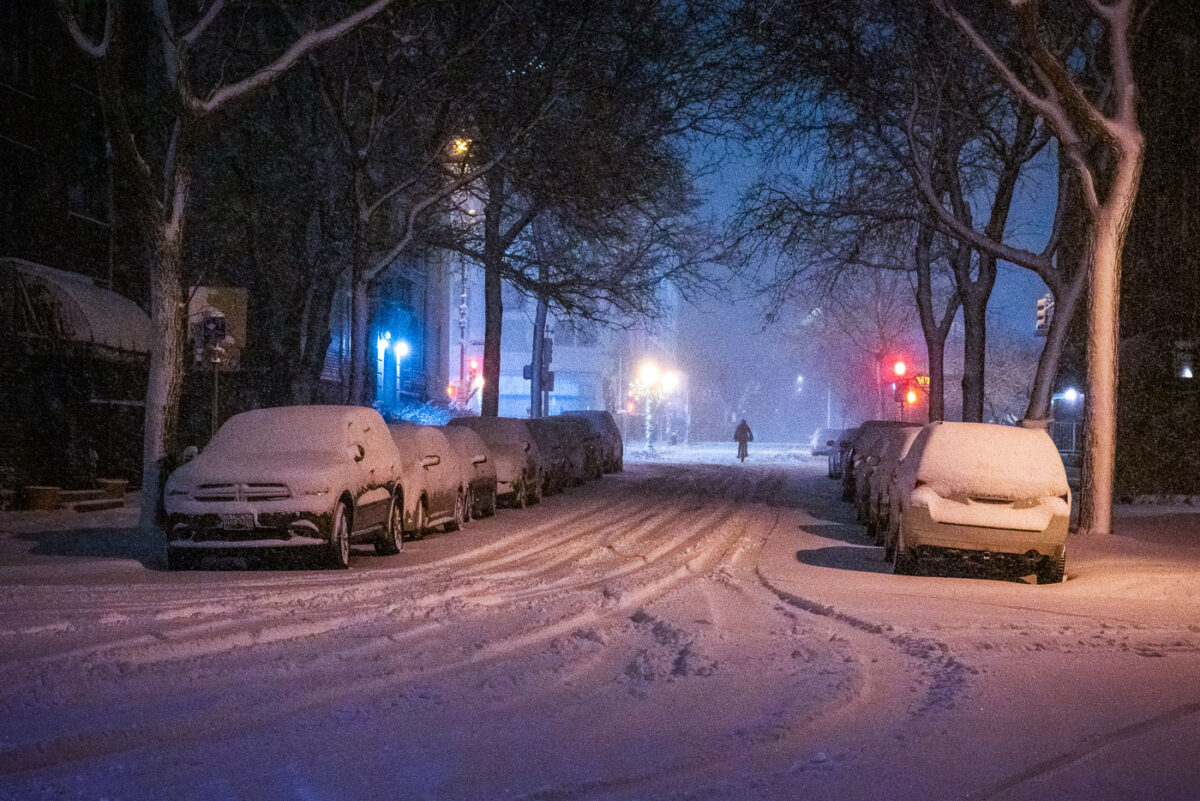
November 2019 — A lone cyclist rides through a snow-covered street in Minneapolis on November 26, 2019, as a major winter storm blankets the city. Streetlights and passing car headlights glow against the falling snow, illuminating parked cars buried in accumulation. The quiet, blue-tinged scene reflects the city’s resilience and rhythm during early-season blizzards that frequently test commuters across the Twin Cities.
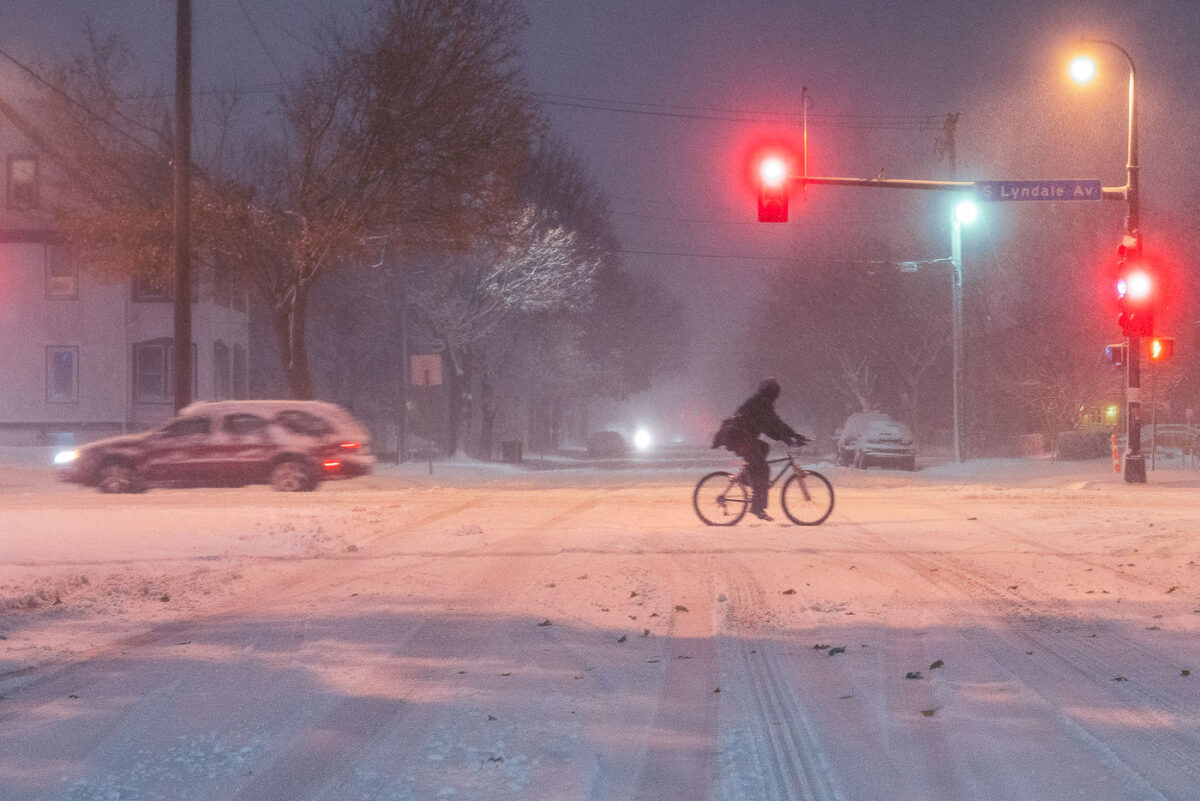
November 2019 — A cyclist crosses Lyndale Avenue South during the heavy November 26, 2019 snowstorm in Minneapolis. Despite low visibility and slick streets, a few commuters still braved the conditions, illuminated by red traffic lights and snow-diffused streetlamps. The image captures the perseverance of winter cycling culture in the Twin Cities, where even severe weather rarely stops movement through the urban grid.
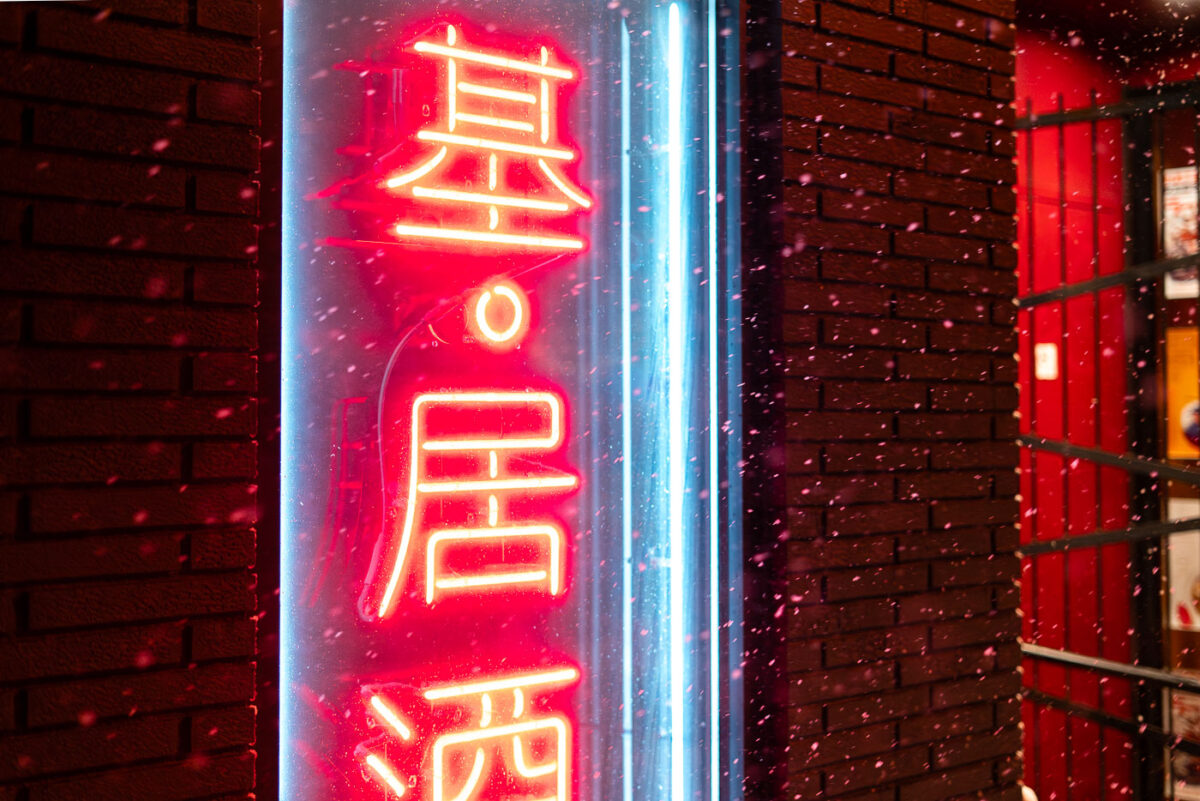
November 2019 — Moto-i on Lyndale in Uptown Minneapolis during the November 26th 2019 snowstorm.
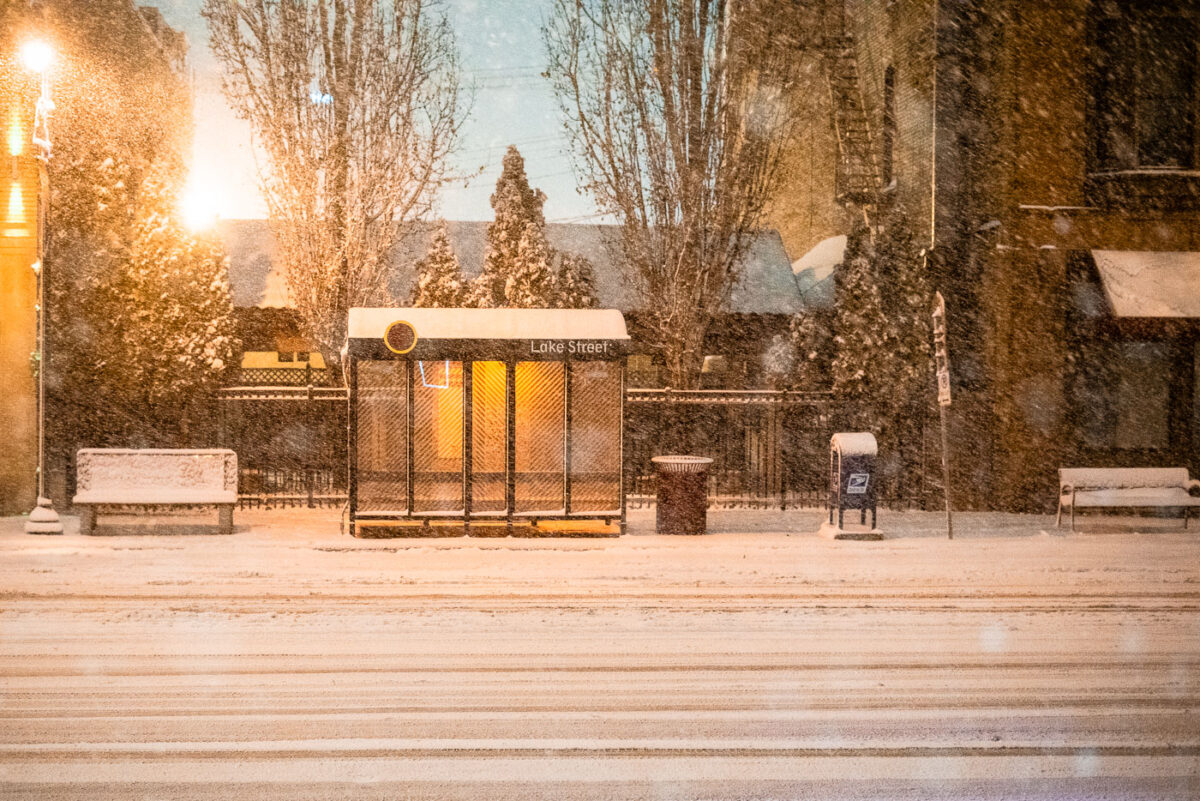
November 2019 — Lake Street in Minneapolis during a late November snowstorm in 2019.
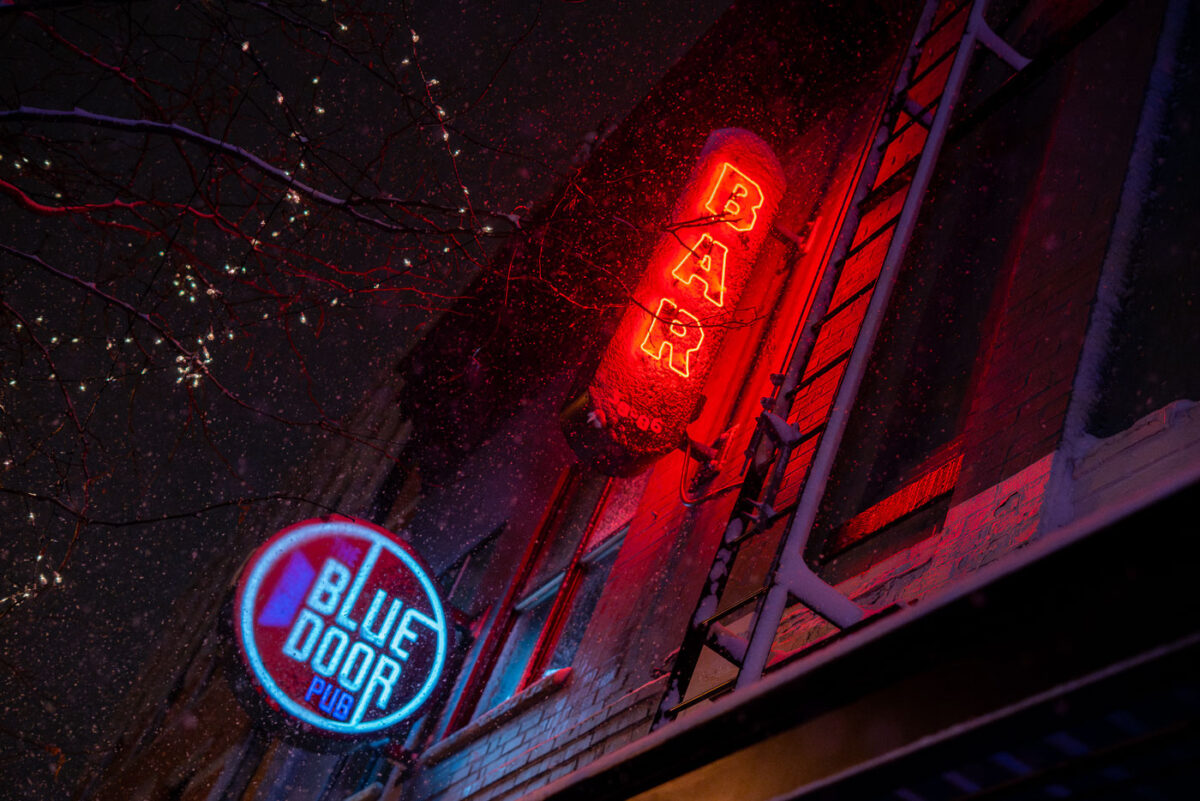
November 2019 — Blue Door Pub in Uptown Minneapolis during the November 26th, 2019 snowstorm.
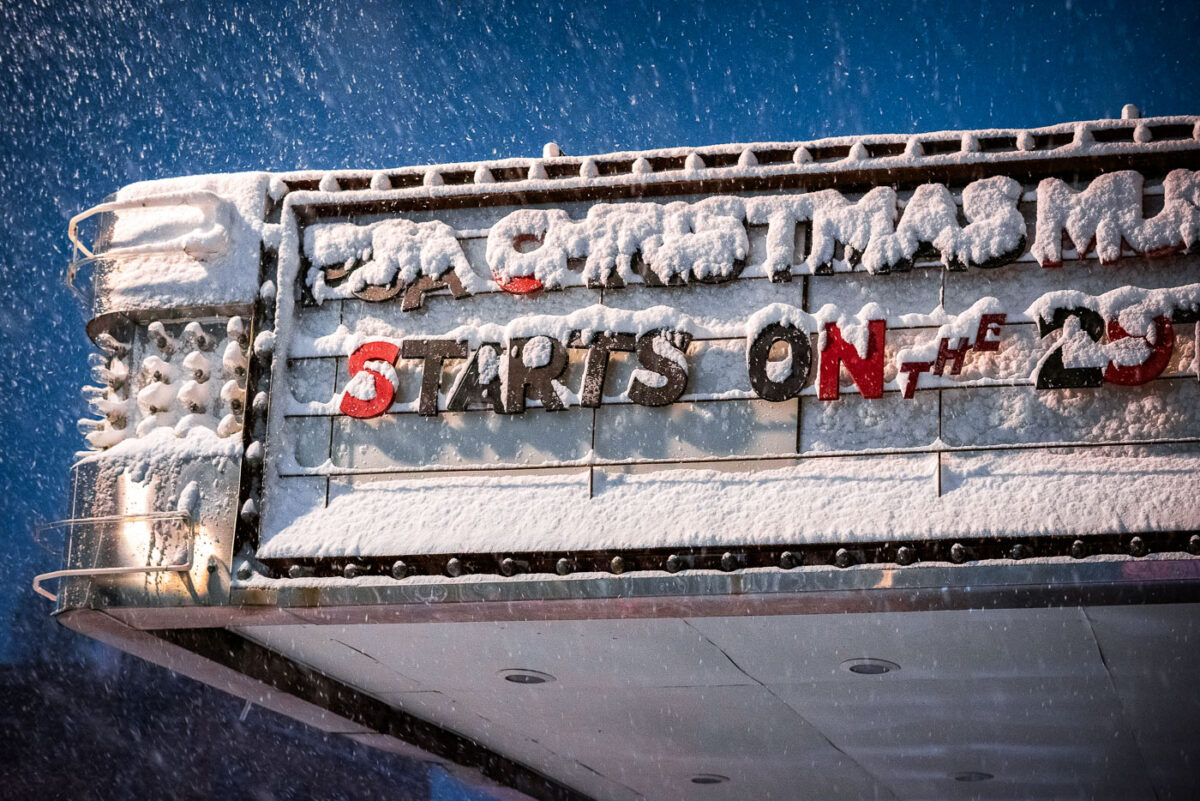
November 2019 — Lynlake Brewery in Uptown Minneapoilis during a November snowstorm.
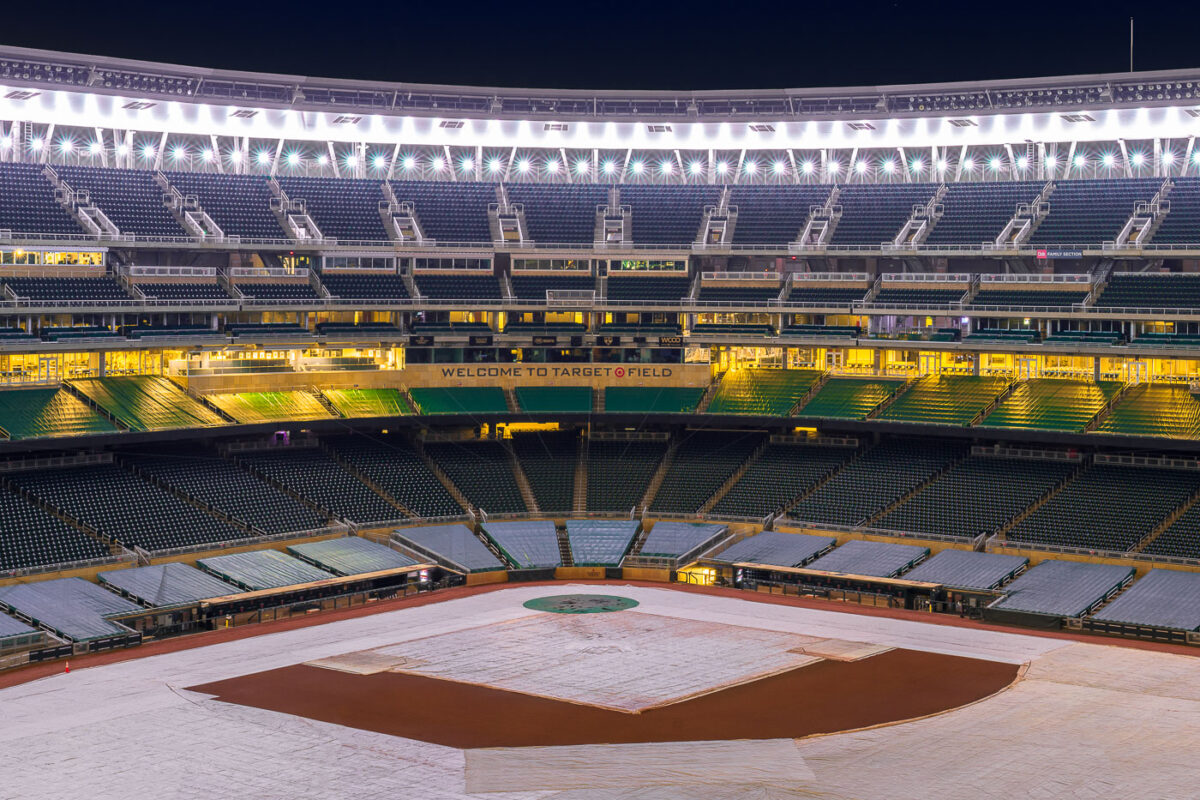
November 2019 —
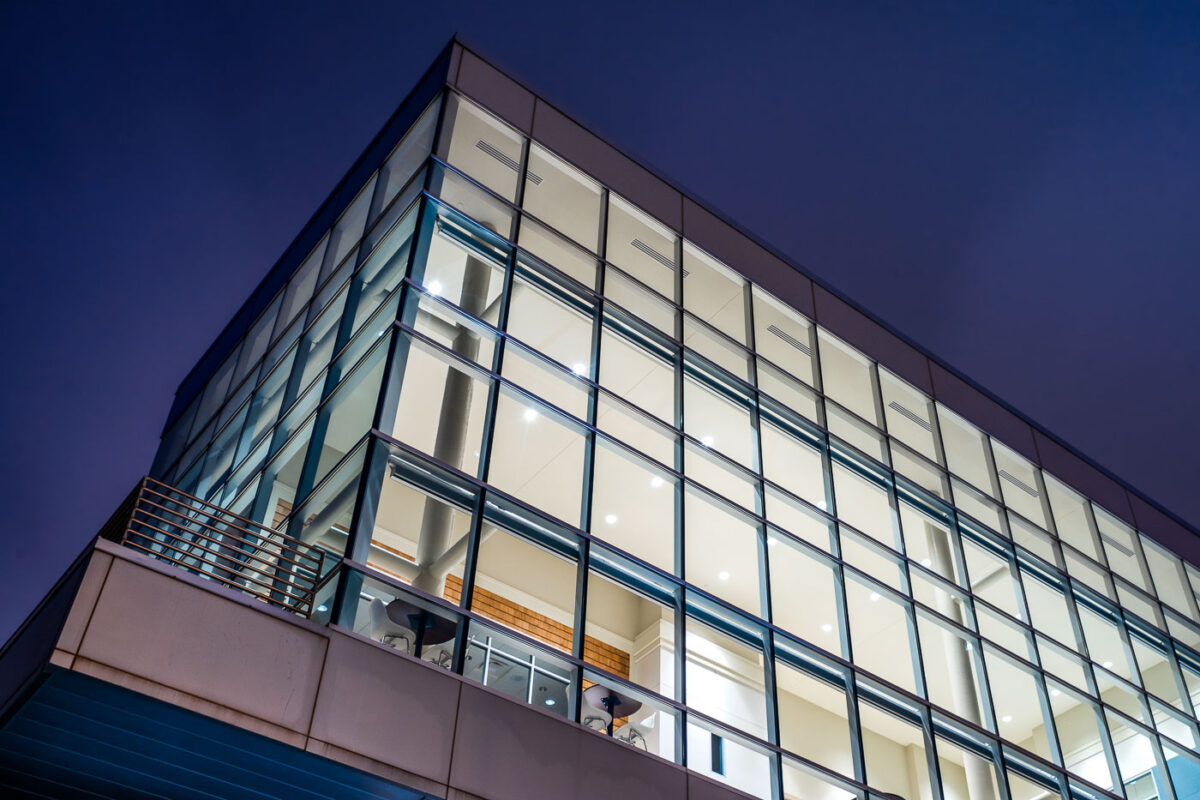
November 2019 — Located at 1101 West River Parkway. River Parkway Place sits right next to what will be the 48 story Eleven Condos.
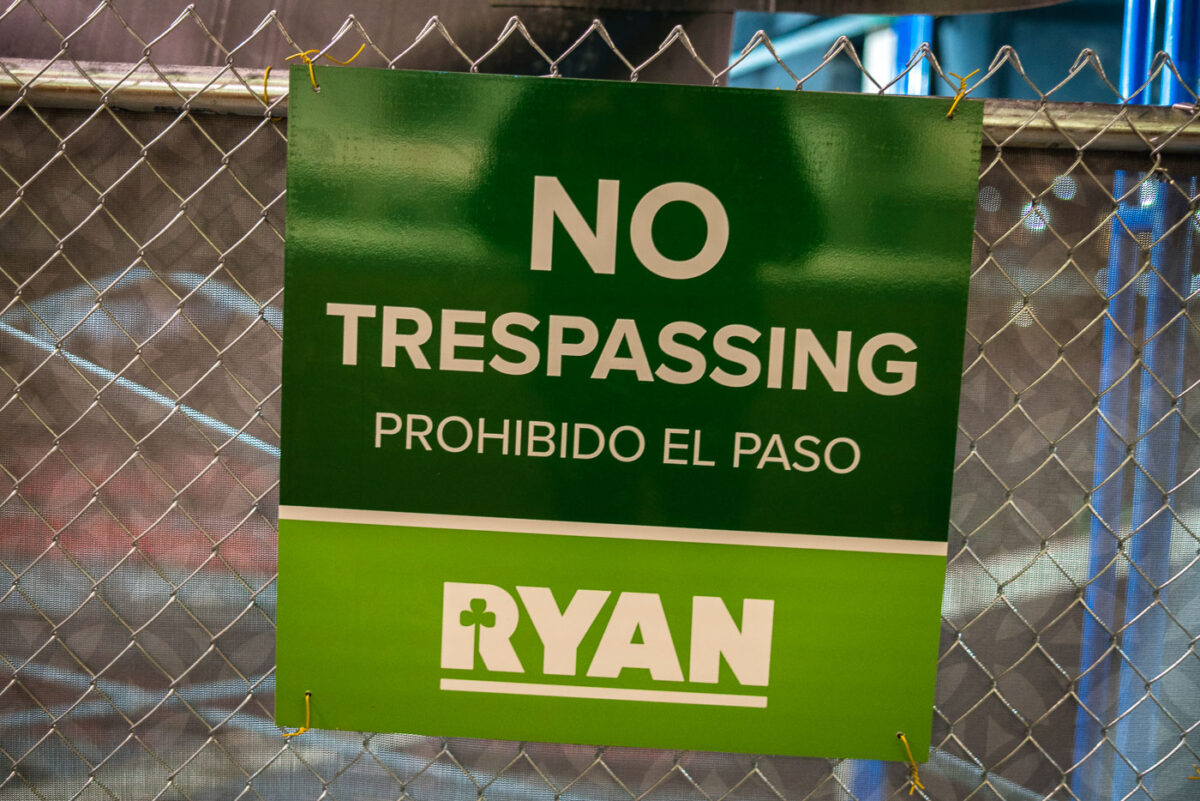
November 2019 — A bilingual “No Trespassing / Prohibido el Paso” sign from Ryan Companies hangs on a temporary chain-link fence surrounding an active construction site. The green and white color scheme with the company’s signature shamrock logo reflects the standardized branding used across many Midwest urban development projects. Signs like this are common throughout downtown Minneapolis, where Ryan has been involved in large-scale mixed-use and infrastructure redevelopment in recent years.

November 2019 — The illuminated sign for Mill Ruins Park glows at night along the Minneapolis riverfront, where historic flour mill foundations meet modern development. Behind it, a portrait mural and new residential buildings rise near the preserved remnants of the city’s milling heyday.
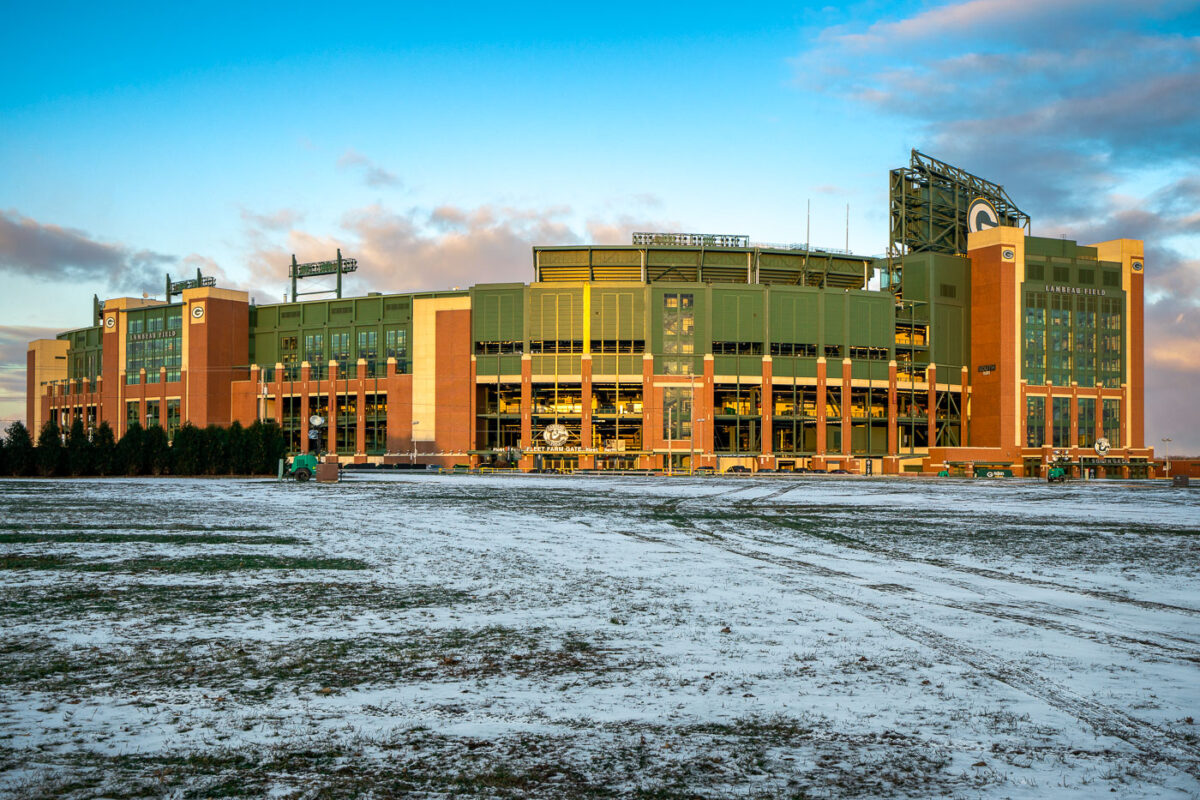
November 2019 — Lambeau Field, home of the Green Bay Packers.
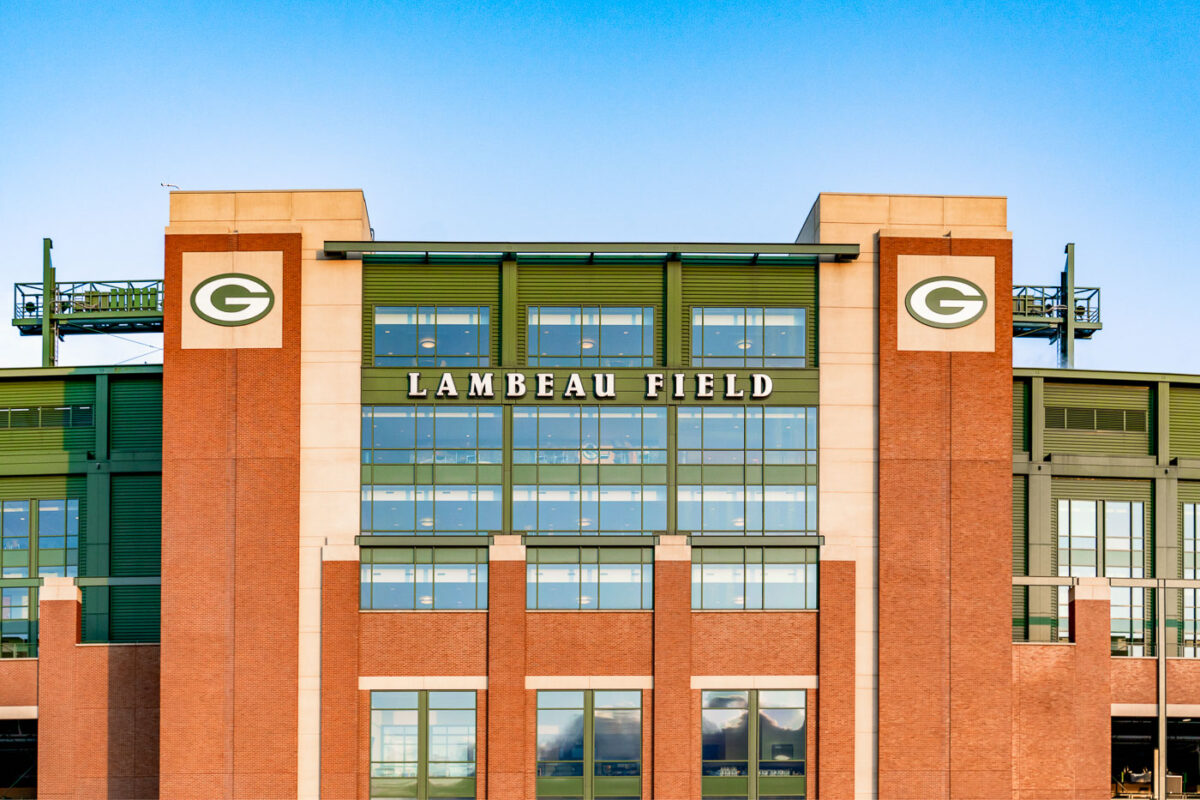
November 2019 — The north side of Lambeau Field in Green Bay, Wisconsin. Home of the NFL's Green Bay Packers.
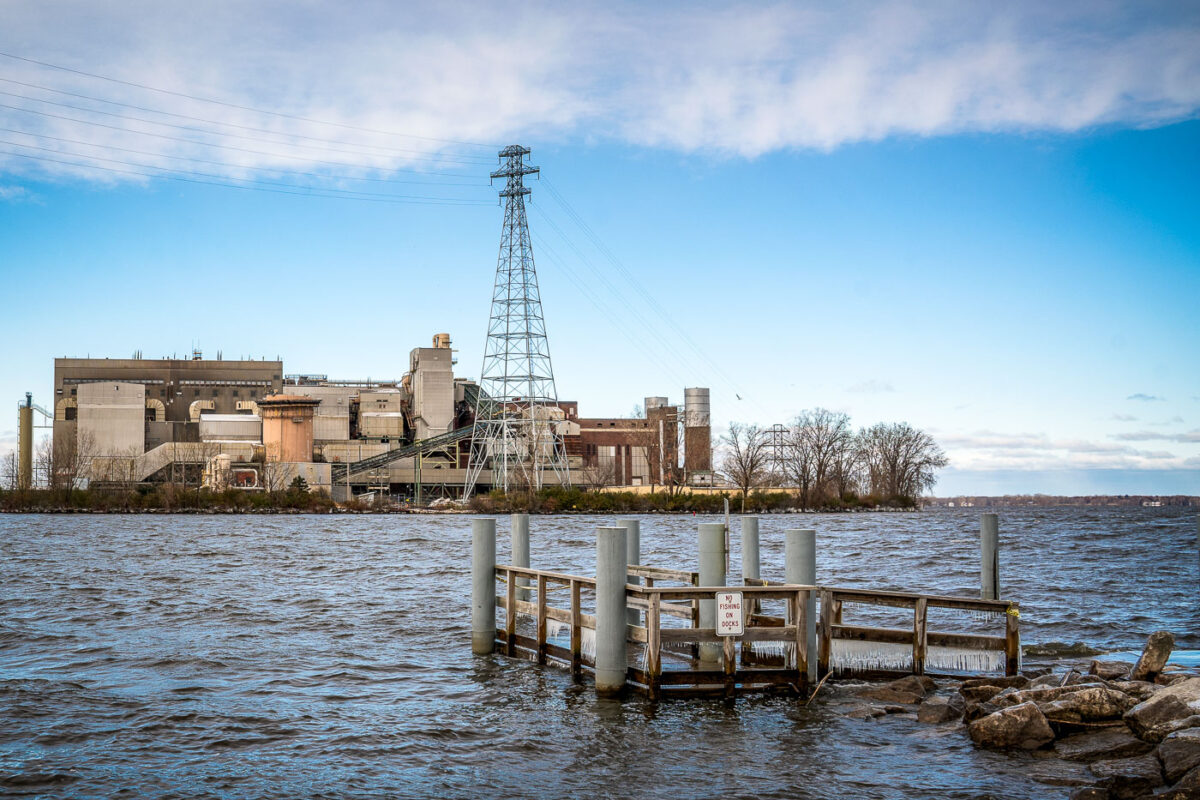
November 2019 — J. P. Pulliam Generating Station was an electrical power station powered by sub-bituminous coal, which could also be substituted by natural gas. It was located in Green Bay, Wisconsin in Brown County. The plant was named after the former Wisconsin Public Service Corporation president John Page Pulliam (–June 15, 1951). The plant units were connected to the power grid via 138 kV and 69 kV transmission lines. The remaining coal units on site were decommissioned in 2018 leaving only the natural gas fired P31 unit active at the site.
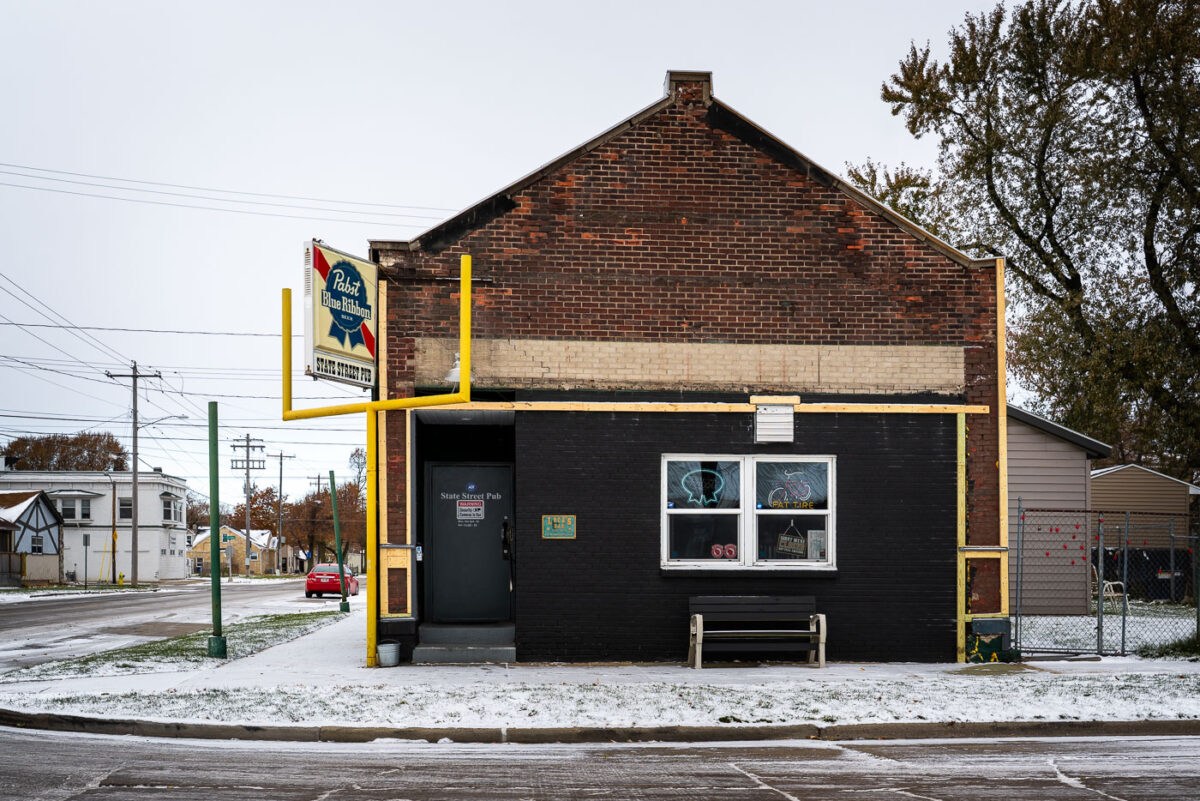
November 2019 — State Street Pub dive bar located at 1238 State St in Green Bay Wisconsin.
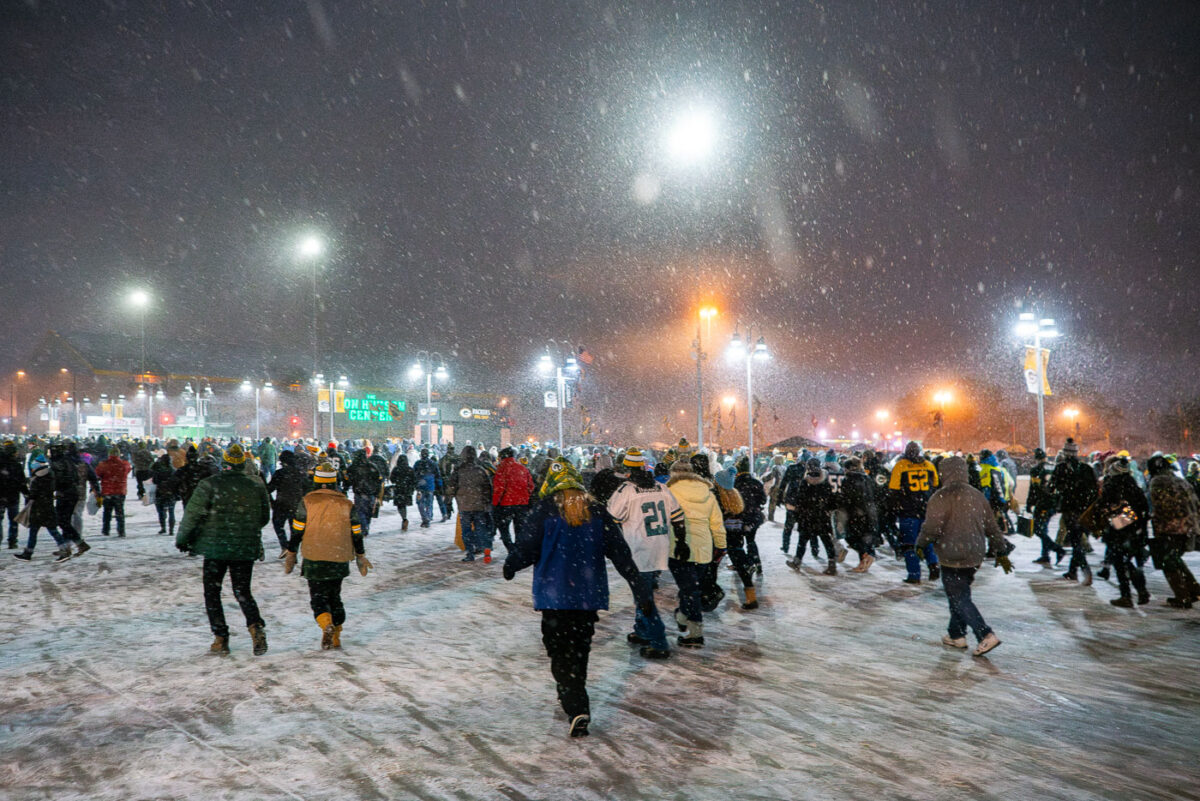
November 2019 — Fans leave Lambeau Field on a snowy evening at Lambeau Field in Green Bay, WI. The Packers defeated the Carolina Panthers 24-16.
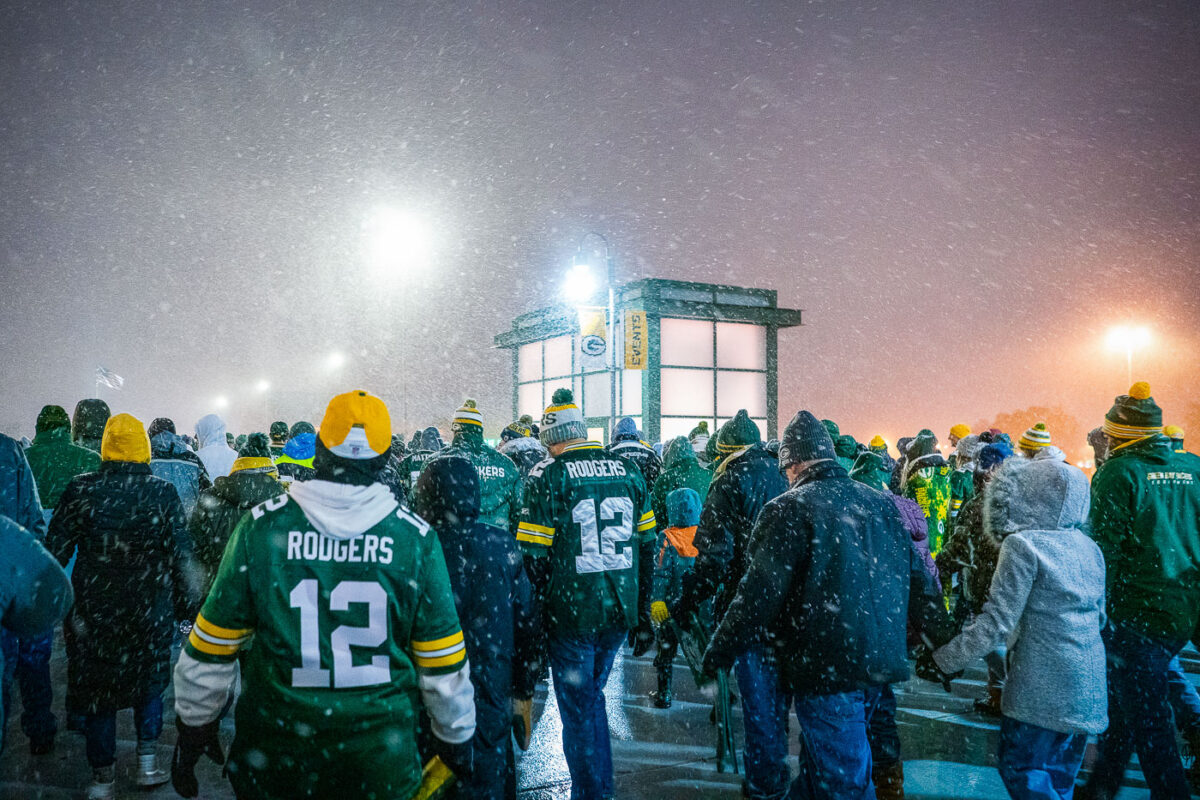
November 2019 — Fans wearing Aaron Rodgers jerseys leave Lambeau Field after the Packers beat the Carolina Panthers 24-16.
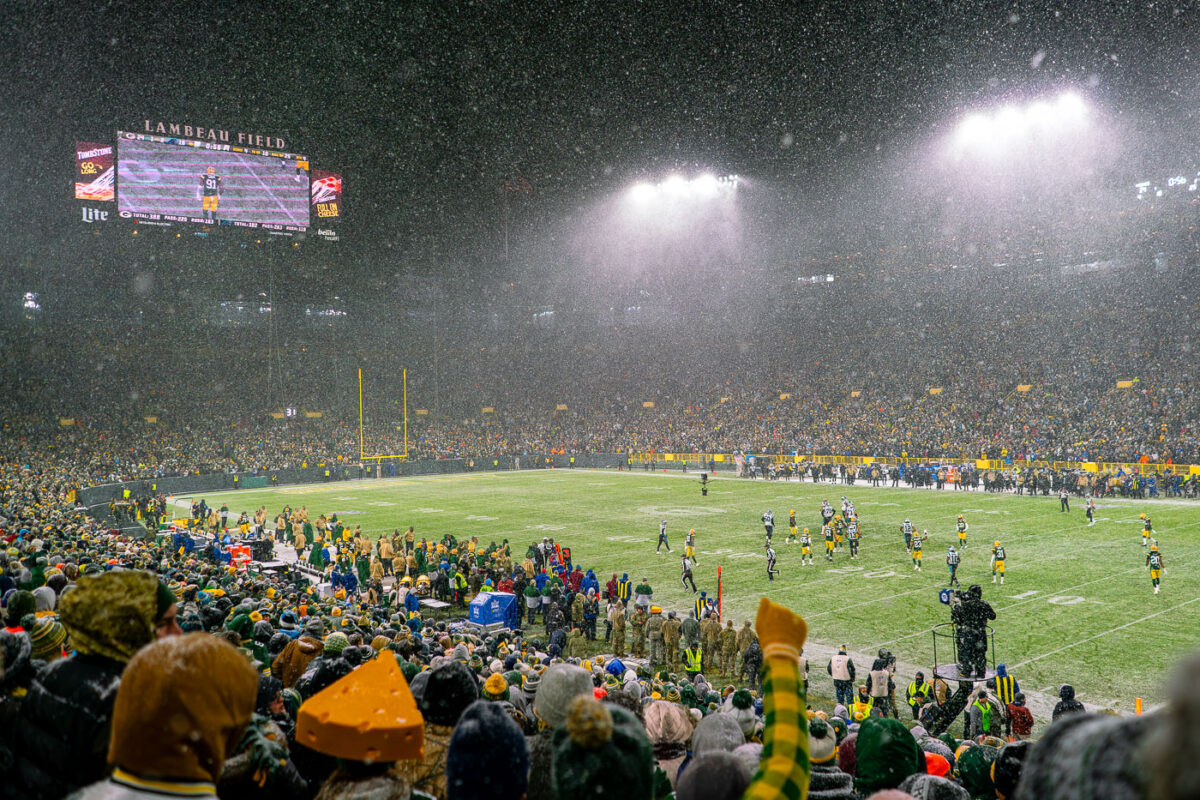
November 2019 — Heavy snow falling at Lambeau Field as the Green Bay Packers defeat the Carolina Panthers 24-16.

November 2019 — A fan at Lambeau Field wearing an Aaron Rodgers jersey with a cheesehead as the Green Bay Packers defeat the Carolina Panthers 24-16.

November 2019 — A fan wears a knit Packers hat at a snowy Lambeau Field as the Packers work to defeat the Carolina Panthers 24-16.

November 2019 — Green Bay Packers "G" found inside the players facility at 1265 Lombardi Avenue in Green Bay, Wisconsin.

November 2019 — The Lombardi Trophies won by the Green Bay Packers seen inside their headquarters.
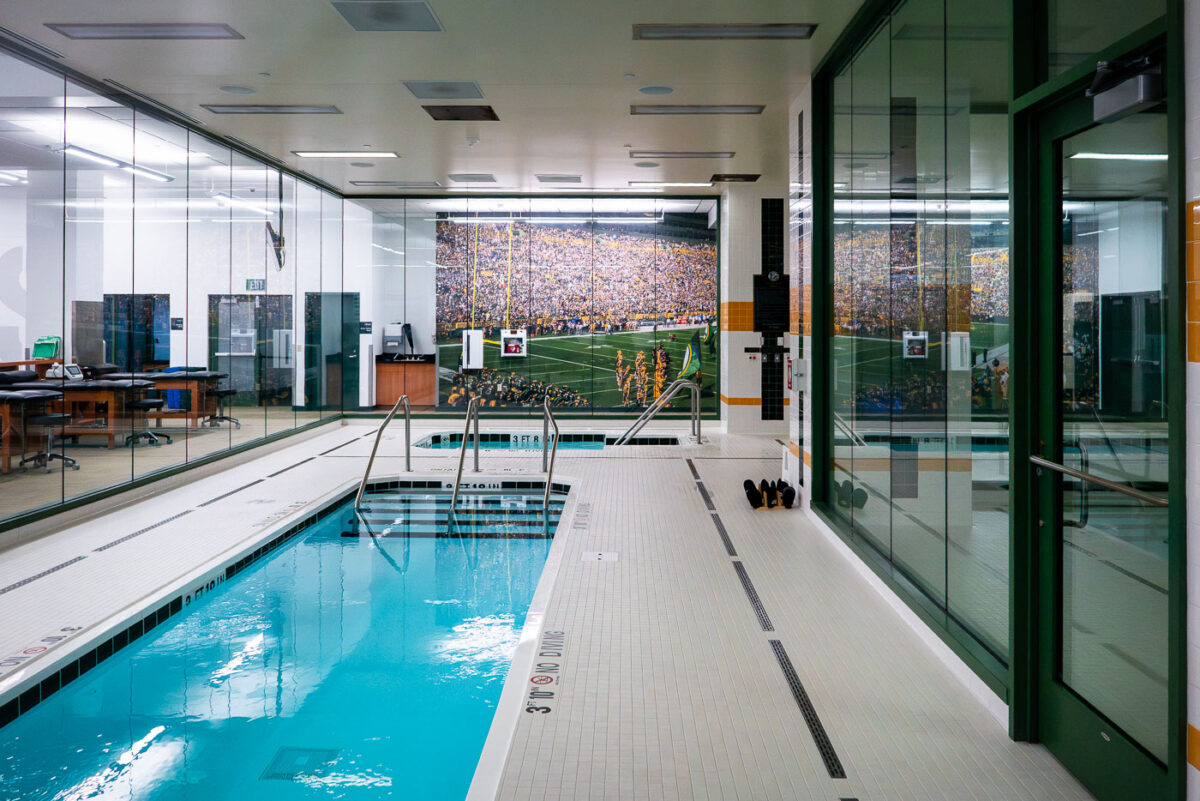
November 2019 — Pool inside the players workout area inside the Green Bay Packers Headquarters.
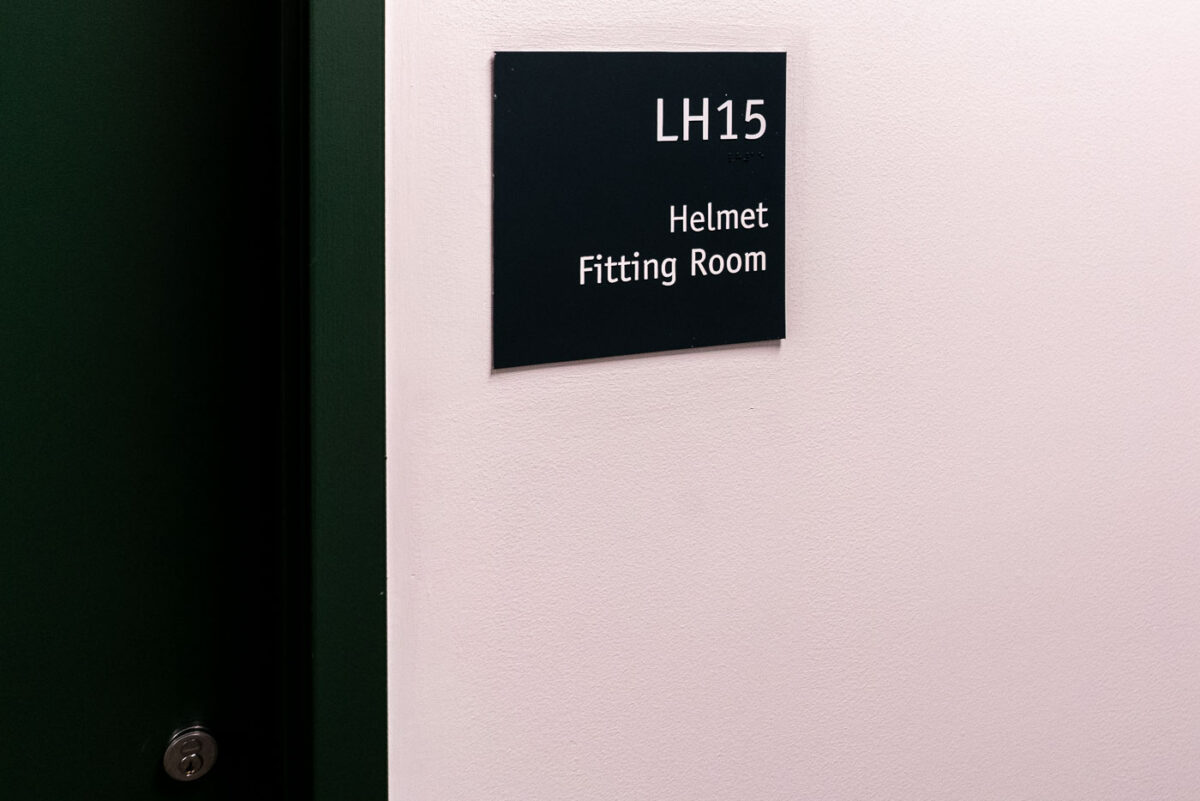
November 2019 — The Helmet Fitting Room inside the Green Bay Packers Headquarters.
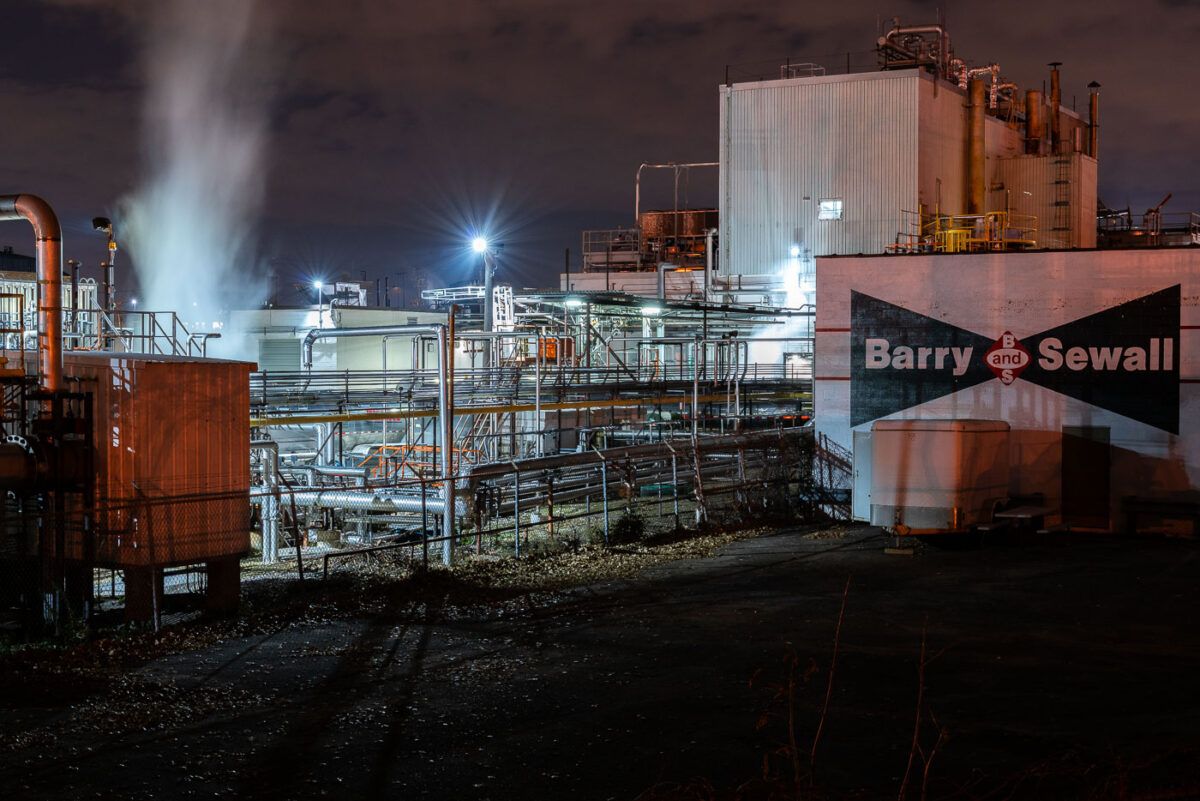
November 2019 — Steam rises from the Barry & Sewall Chemical Company complex in Northeast Minneapolis, a facility known for producing adhesives, coatings, and specialty chemicals for over a century. Illuminated by floodlights and framed by dense pipe networks, the site reflects the city’s enduring industrial infrastructure along the rail and river corridors. The hand-painted logo on the wall remains a remnant of mid-20th-century branding still visible across many older manufacturing sites in the Twin Cities.
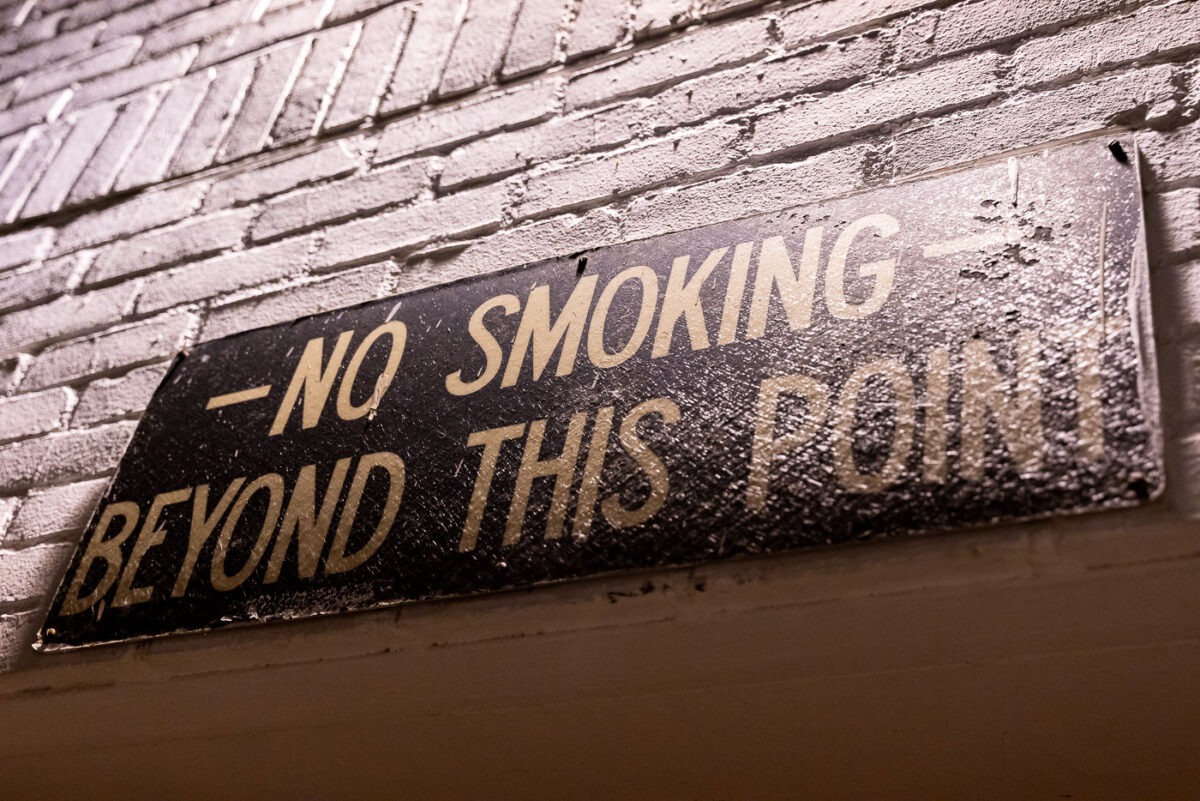
November 2019 — A weathered metal sign mounted on a brick wall warns “NO SMOKING BEYOND THIS POINT,” its paint cracked and dulled by decades of exposure. Signs like this were once common in milling and industrial facilities across Minneapolis, where airborne dust from grain or manufacturing posed a significant fire risk. The hand-lettered typography and aged surface reflect a bygone era of factory safety culture, preserving a small but telling fragment of the city’s industrial heritage.
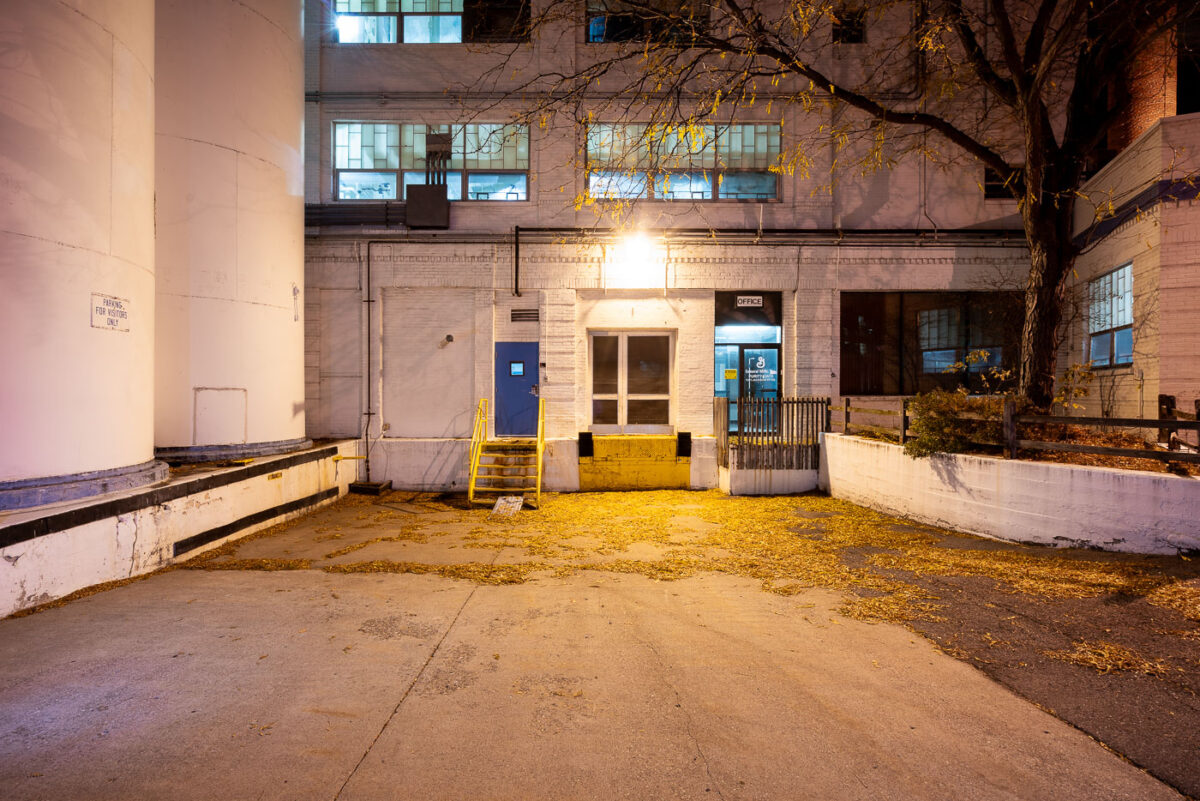
November 2019 — This view shows the rear loading and office entrance of the former General Mills Purity Oats facility in Northeast Minneapolis. Built during the city’s industrial boom, the complex once handled oat processing and packaging for one of the nation’s largest cereal producers. The structure’s painted brick walls, grain silos, and utilitarian layout are characteristic of mid-20th-century food-processing plants that supported the city’s reputation as the “Flour Milling Capital of the World.”
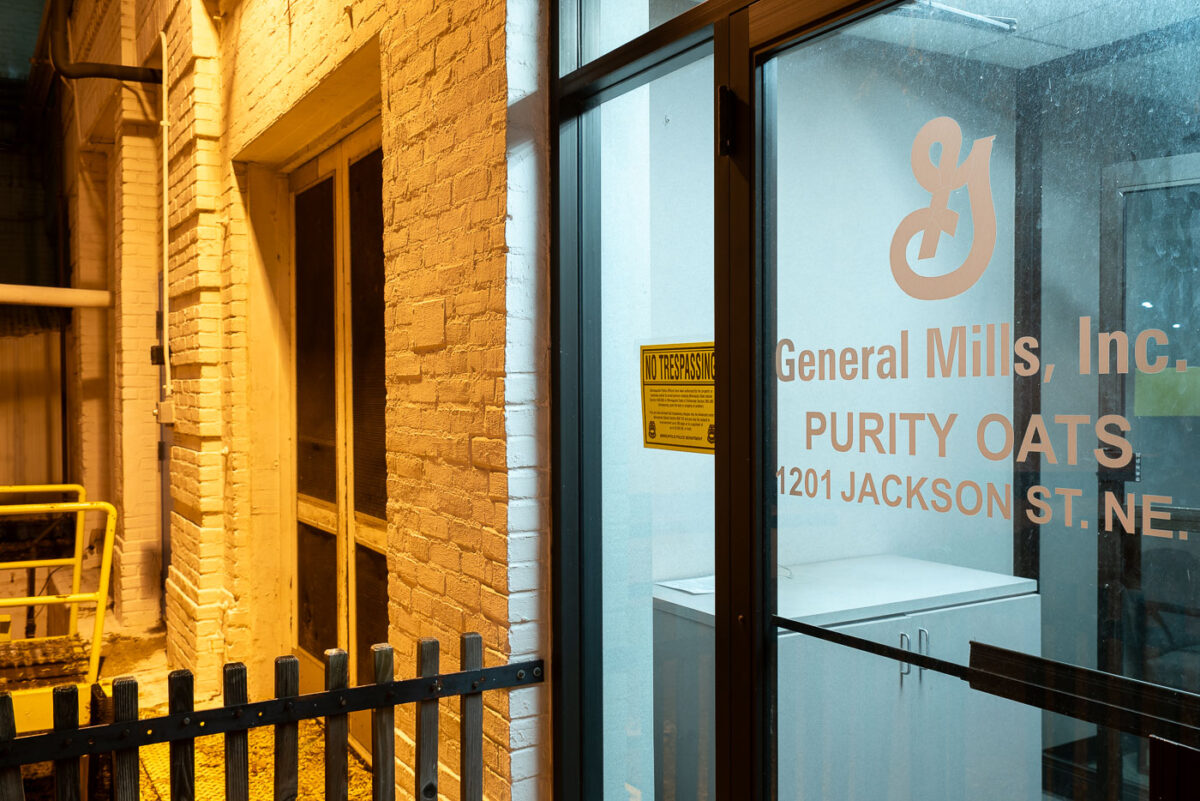
November 2019 — Once part of the vast milling network that shaped Minneapolis’s industrial identity, this now-closed General Mills Purity Oats plant at 1201 Jackson Street NE reflects the city’s transition from global grain hub to post-industrial reuse. The modest brick complex, still bearing its original signage, served as a specialized processing site within the company’s broader cereal operations before its eventual closure. Its preservation offers a glimpse into the city’s enduring ties to the flour and oat industries that once defined the Mississippi River corridor.

October 2019 — A young Cavalier King Charles Spaniel sits attentively on a couch, its long chestnut and white fur softly illuminated by indoor light. The breed, originally developed in the United Kingdom, is known for its expressive eyes and gentle demeanor. Frequently appearing in portrait photography and companion settings, the Cavalier embodies a mix of elegance and warmth, making it one of the most beloved toy breeds in the world.
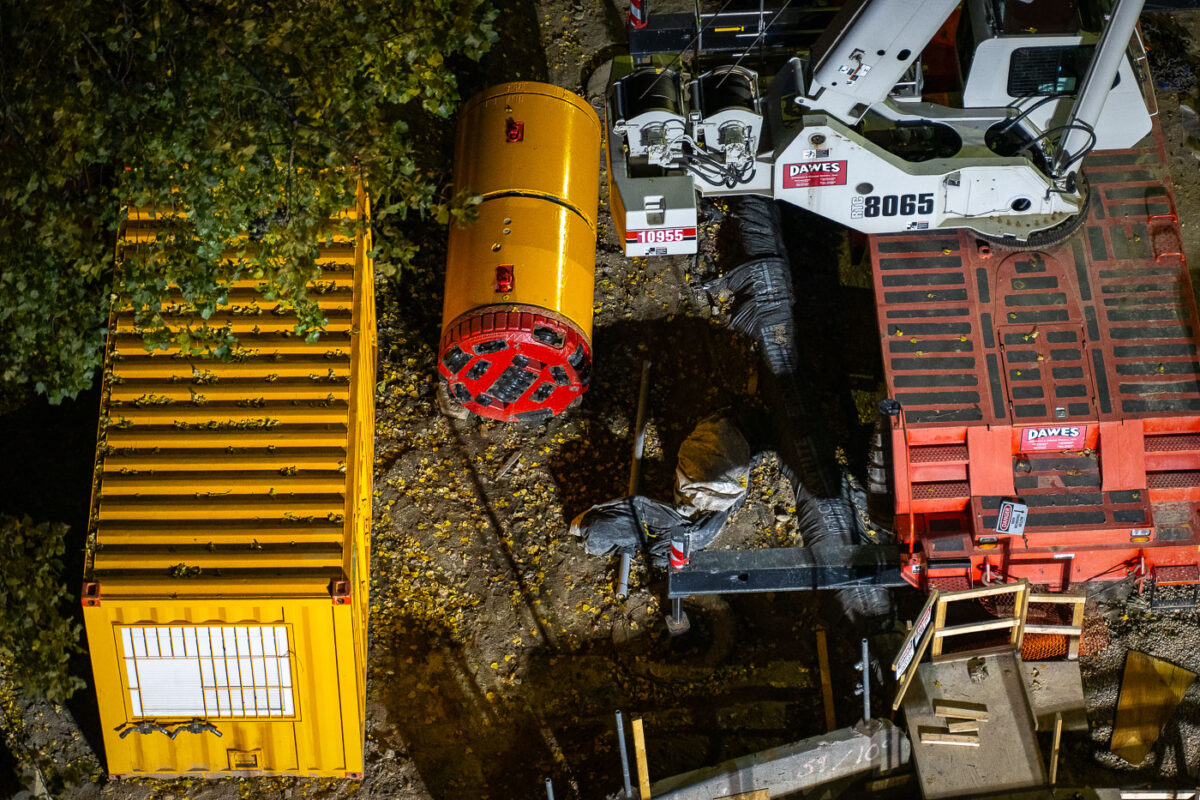
October 2019 — A tunnel boring machine (TBM) rests near the banks of the Mississippi River, staged for the start of a subsurface water main tunnel project. The machine’s circular cutting head and support equipment are visible beside heavy lifting cranes, part of a major infrastructure effort to modernize the city’s underground water distribution system
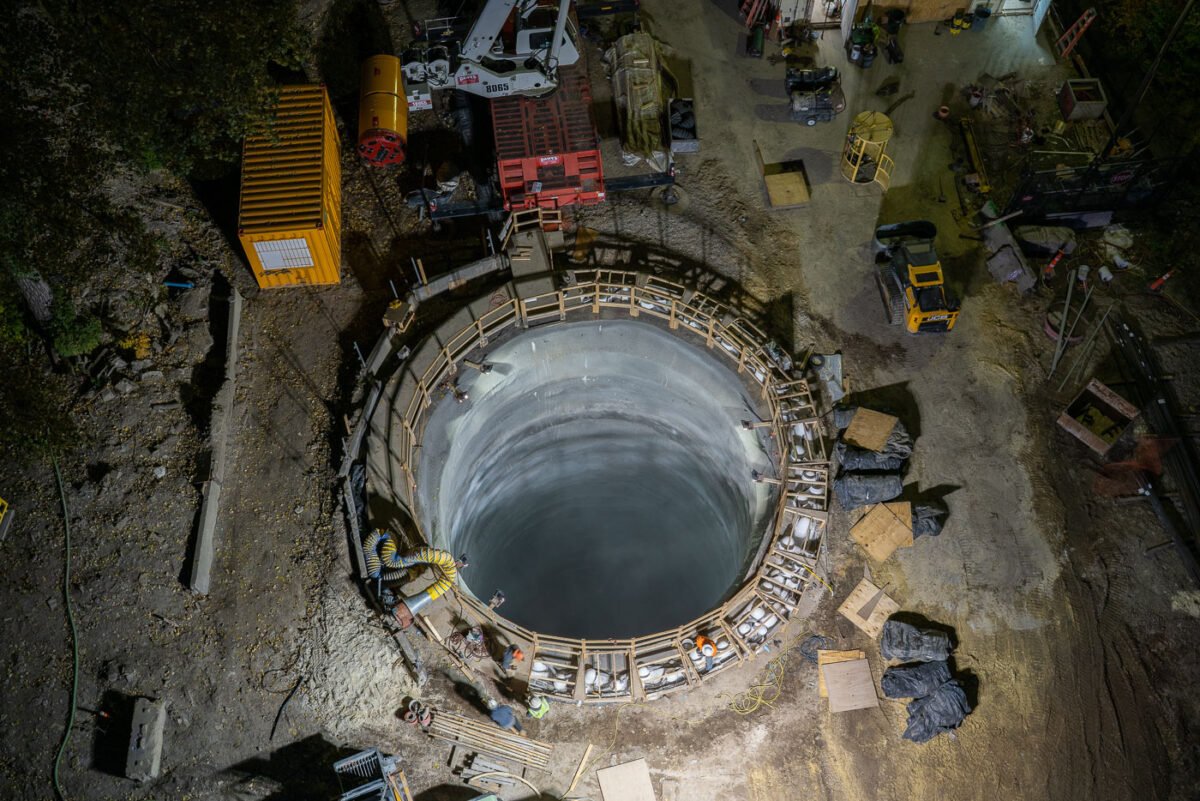
October 2019 — An aerial view captures the excavation shaft for a massive water main tunnel beneath the Mississippi River. The reinforced concrete cylinder serves as the launch point for a tunnel boring machine, visible nearby, which will cut through layers of limestone and shale to create a new conduit linking the city’s water systems. The project represents a critical upgrade to regional infrastructure, designed to improve reliability and resilience while accommodating future demand across Minneapolis and St. Paul.
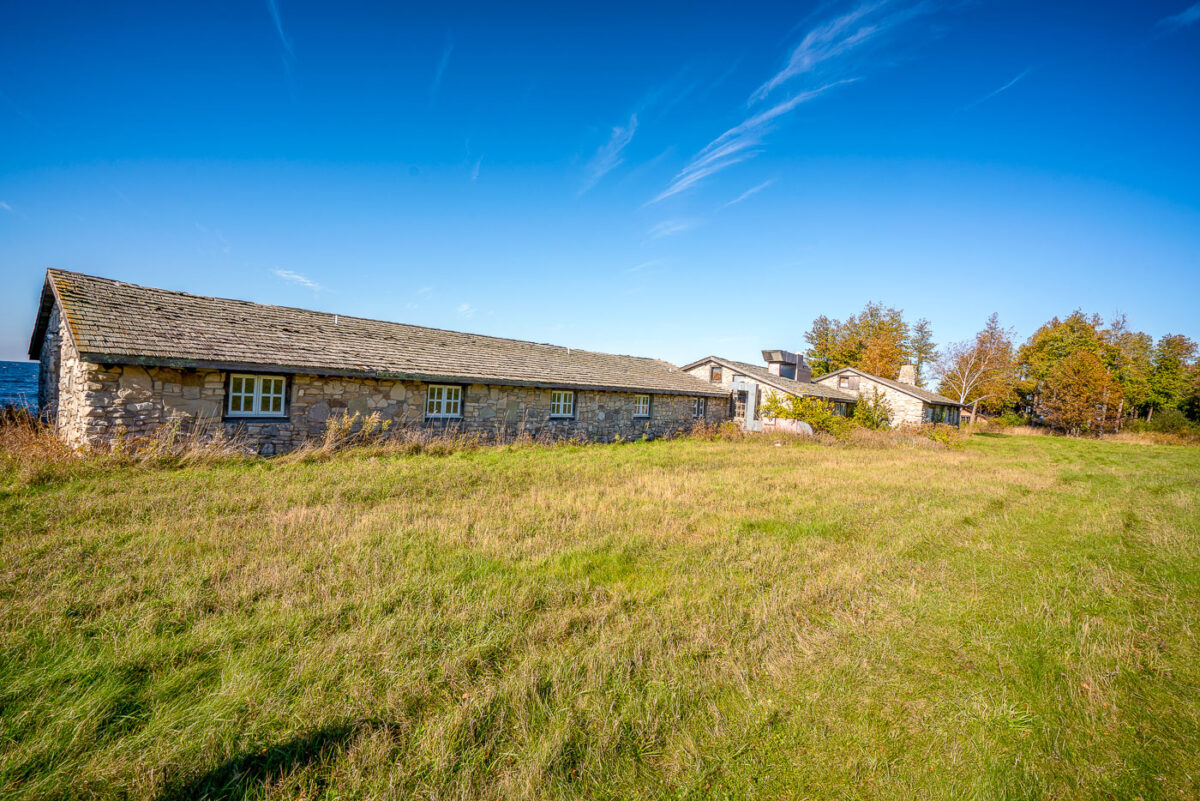
October 2019 — Built in the early 1930s, Chateau Hutter was originally envisioned as a European-style resort and winery overlooking Sturgeon Bay in Door County, Wisconsin. The stone building, designed with locally quarried limestone and heavy timber framing, has long been abandoned but still stands as a striking relic of pre-war leisure architecture. Its location on a bluff above Lake Michigan and its craftsmanship make it one of the region’s most enigmatic remnants of early tourism development.
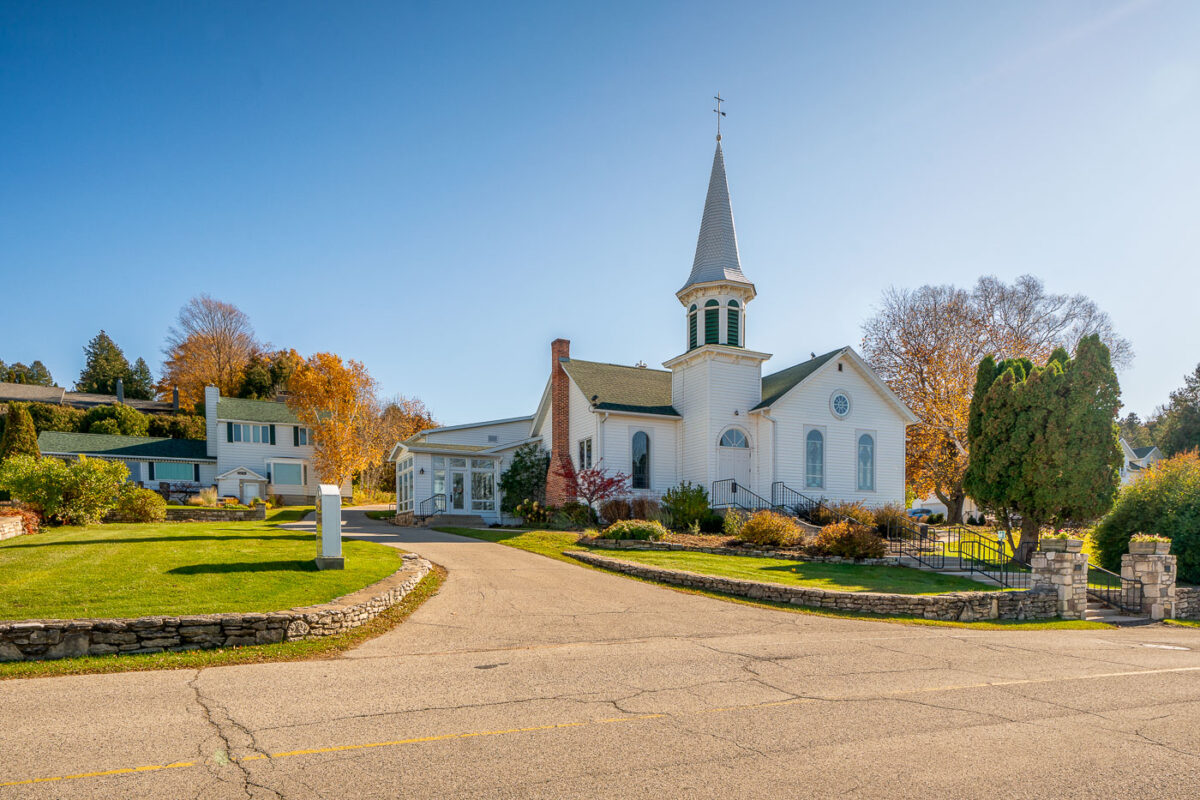
October 2019 — The Ephraim Moravian Church, located in the heart of Ephraim, Wisconsin, dates back to the mid-19th century and reflects the town’s deep Moravian heritage. Founded in 1853 by Norwegian settlers under the leadership of Reverend Andreas Iverson, the congregation built this white clapboard church overlooking Eagle Harbor as both a house of worship and a symbol of unity for the early Door County community. The building’s steeple, traditional in form yet understated in design, continues to define Ephraim’s skyline, linking the village’s modern charm with its Scandinavian and religious roots.
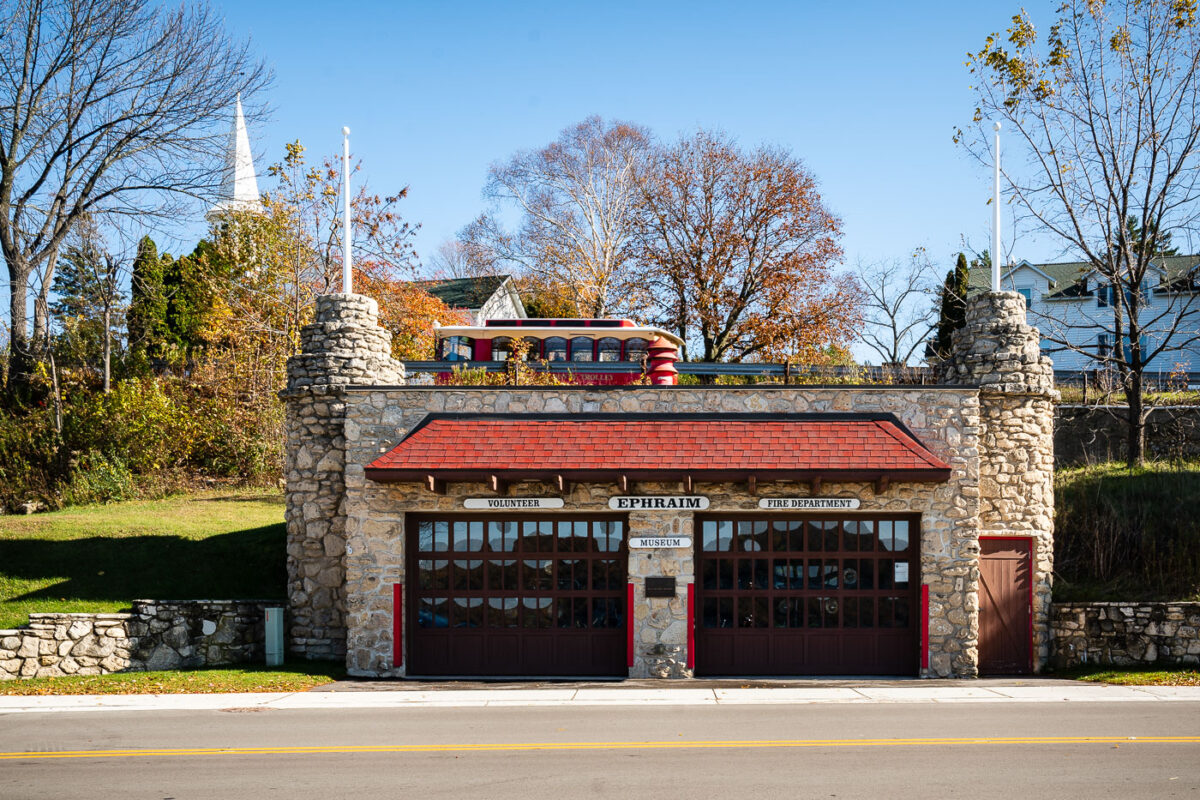
October 2019 — The historic Ephraim Volunteer Fire Department Museum, housed in a stone building with classic red doors, stands as a reminder of small-town service and heritage in Ephraim, Wisconsin.
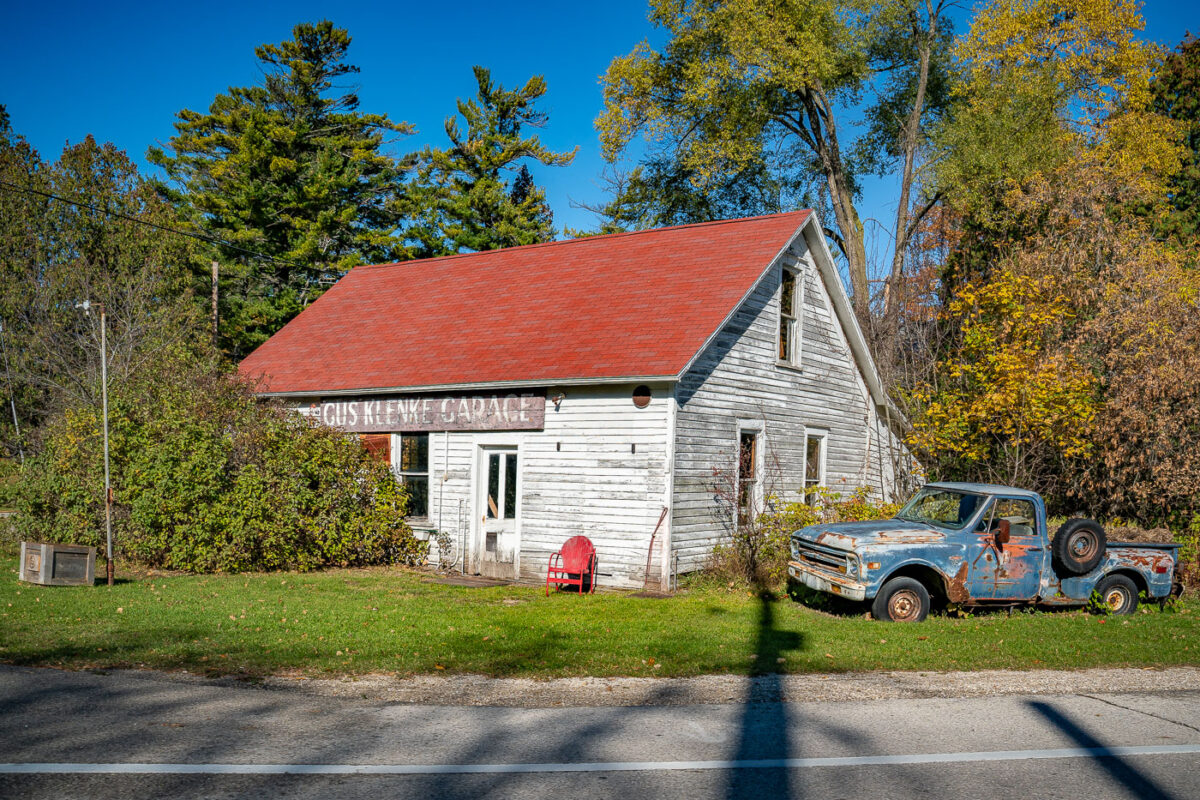
October 2019 — The Gus Klenke Garage, what was formerly a Standard Oil garage where Gus was known for helping farmers repair broken equipment from scrap metal. The Klenke’s were well known in the area for owning cottages and selling pounds of honey each year from the bees he raised. The garage stands in the place of what was once a cheese factory.

October 2019 — At Al Johnson’s Swedish Restaurant in Sister Bay, Wisconsin, goats graze atop the restaurant’s sod-covered roof—a long-running local tradition that began in the 1970s. The family-owned establishment, inspired by Scandinavian architecture, features a living roof that not only nods to Swedish design but also became a tourism icon in Door County. Each summer, the goats climb onto the roof via a wooden ramp, drawing visitors from around the Midwest who come as much for the novelty as for the restaurant’s traditional Swedish pancakes and lingonberries.
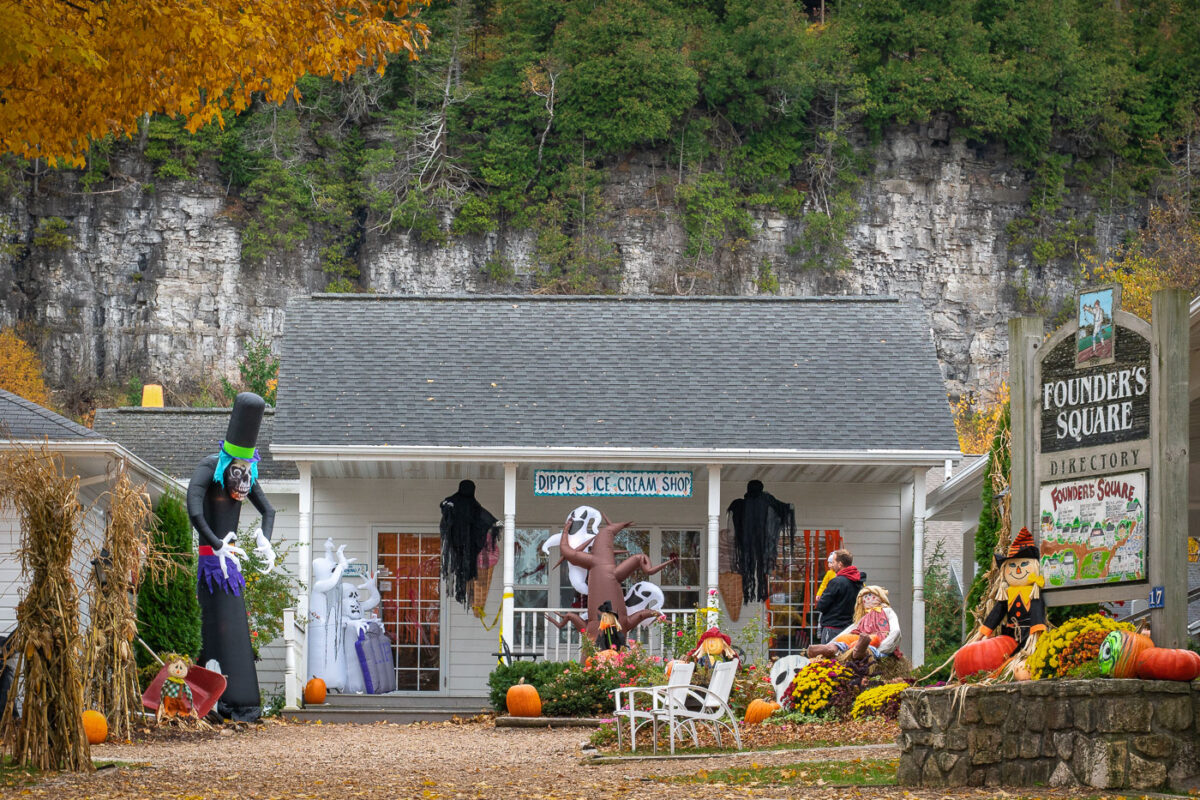
October 2019 — Dippy's Ice Cream in Fish Creek during Halloween in Door County, WI.
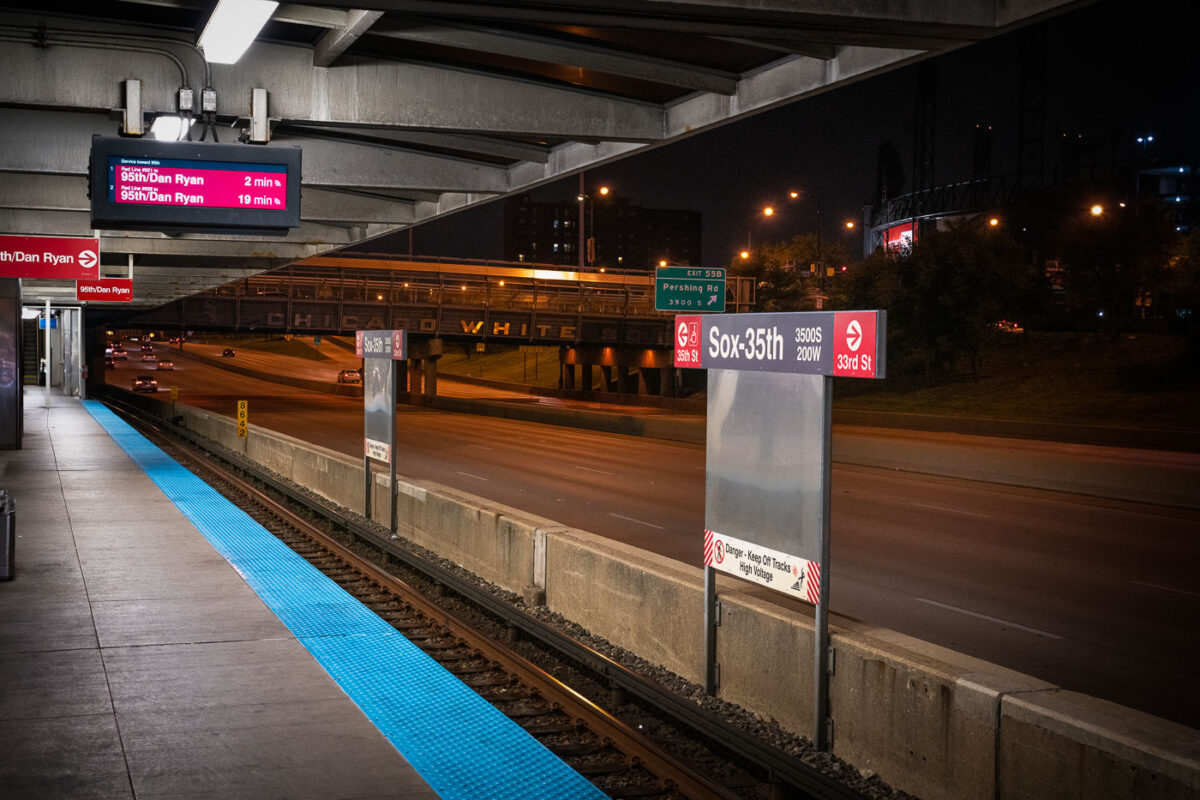
October 2019 — The Chicago Transit Authority’s Sox–35th station serves the Red Line on the city’s South Side, positioned above the Dan Ryan Expressway near Pershing Road. The station provides direct access to Guaranteed Rate Field, home of the Chicago White Sox, whose name can be seen across the pedestrian bridge in the background. Opened in 1969 as part of the Dan Ryan branch of the Red Line, the elevated structure was designed for efficiency amid highway traffic, symbolizing mid-century Chicago’s integration of mass transit and freeway infrastructure.
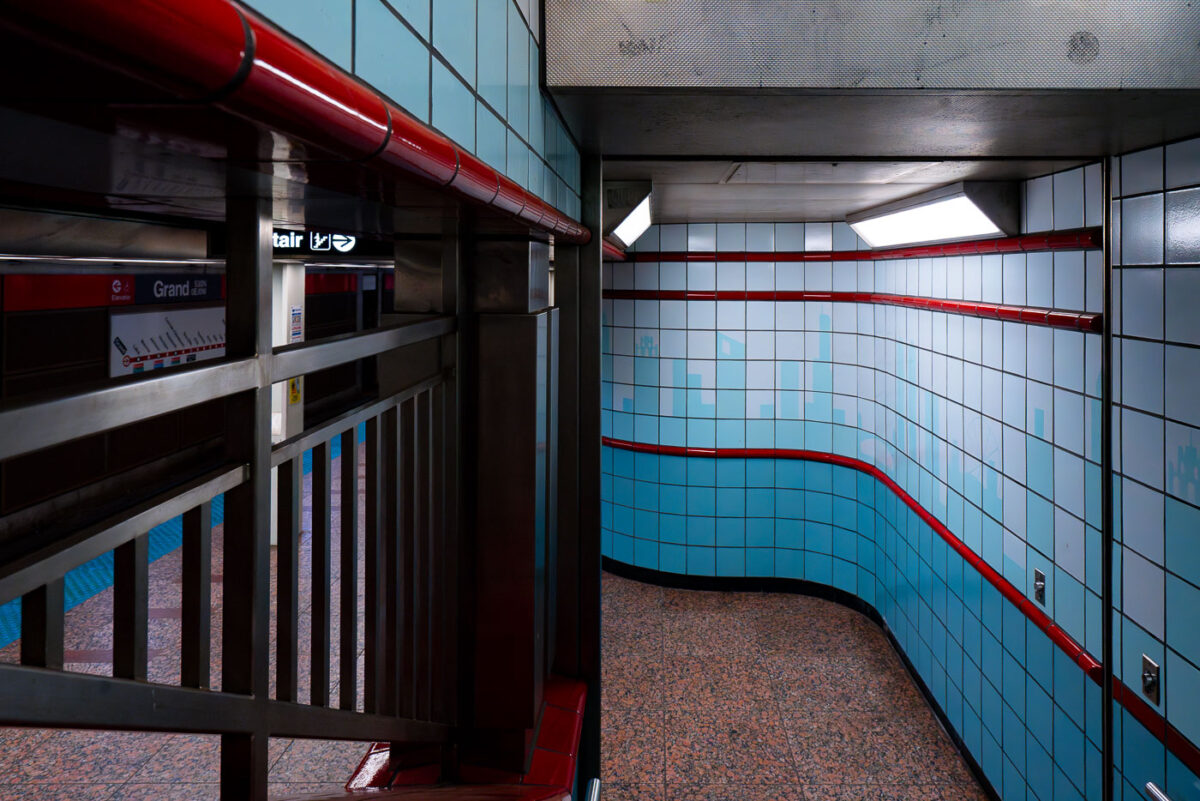
October 2019 — Inside a tiled subway passageway, light blue and red accents curve along the walls, leading commuters toward the platform below. The design is distinctly retro, with polished tiles and fluorescent lighting evoking a mid-20th-century aesthetic found in older metro systems. The turn of the corridor reveals a glimpse of signage and station names, grounding the space in the everyday flow of city life.
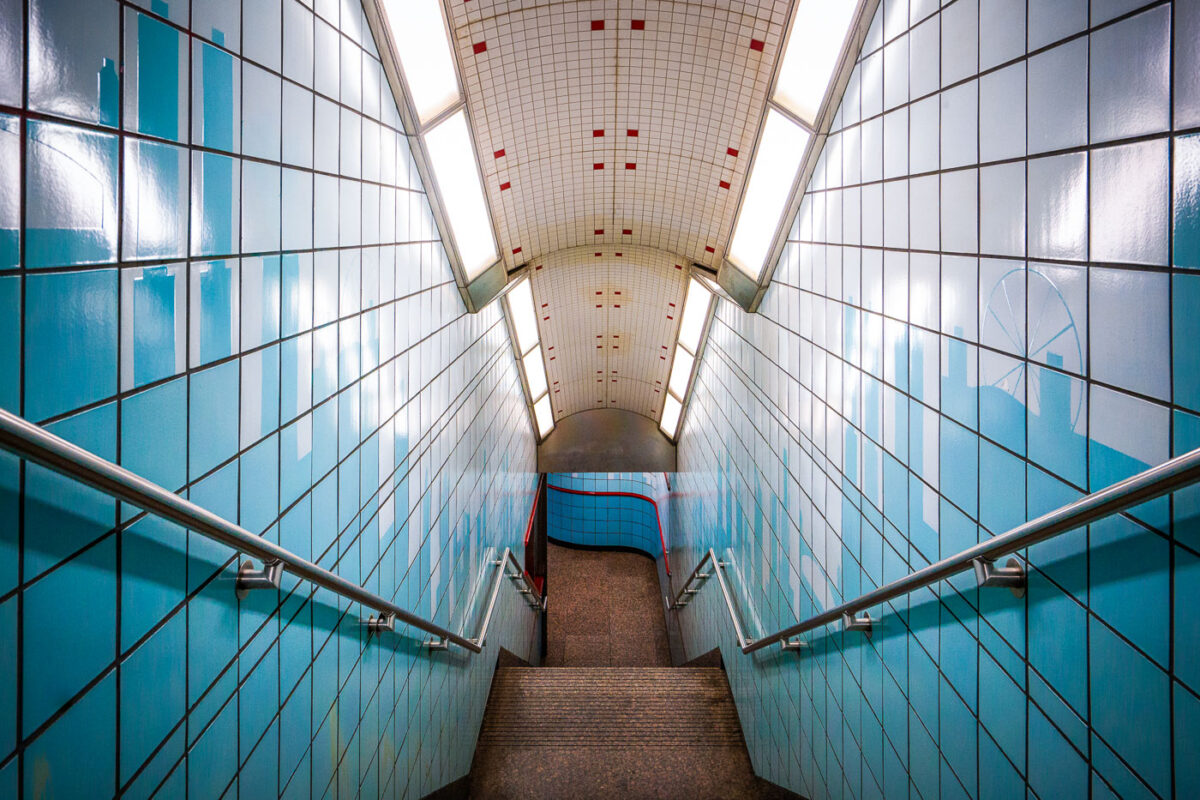
October 2019 — A stairway leads down to the platform at the Chicago Transit Authority’s Grand Station on the Red Line. The tiled corridor—lined with blue ceramic panels and stainless-steel railings—reflects the late-20th-century design style common to CTA subway renovations, emphasizing functionality and durable materials. The bright fluorescent lighting and tiled curvature guide commuters from street level into the subterranean rail network that connects Chicago’s North Side, Loop, and South Side neighborhoods. The subtle skyline motif on the tiles pays homage to the city’s architectural identity while marking one of the Red Line’s busiest downtown access points.
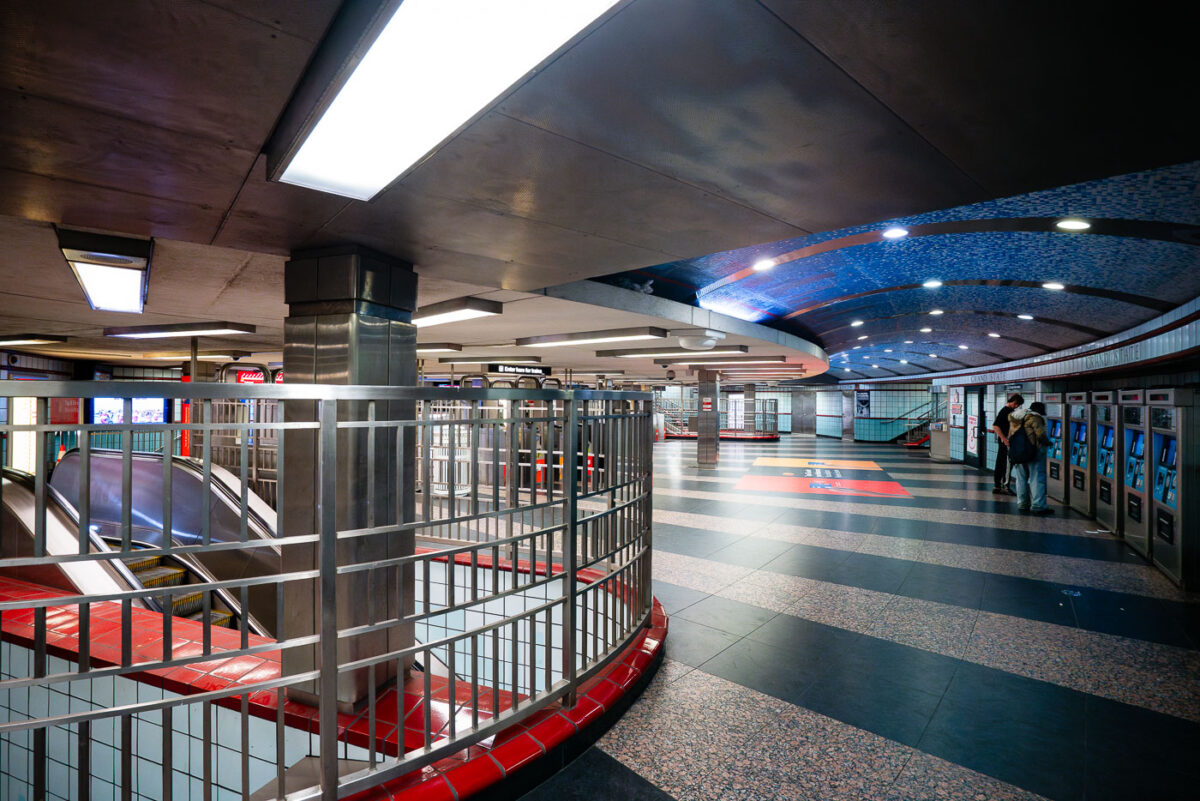
October 2019 — Passengers purchase tickets inside the Grand/State train station in Chicago.
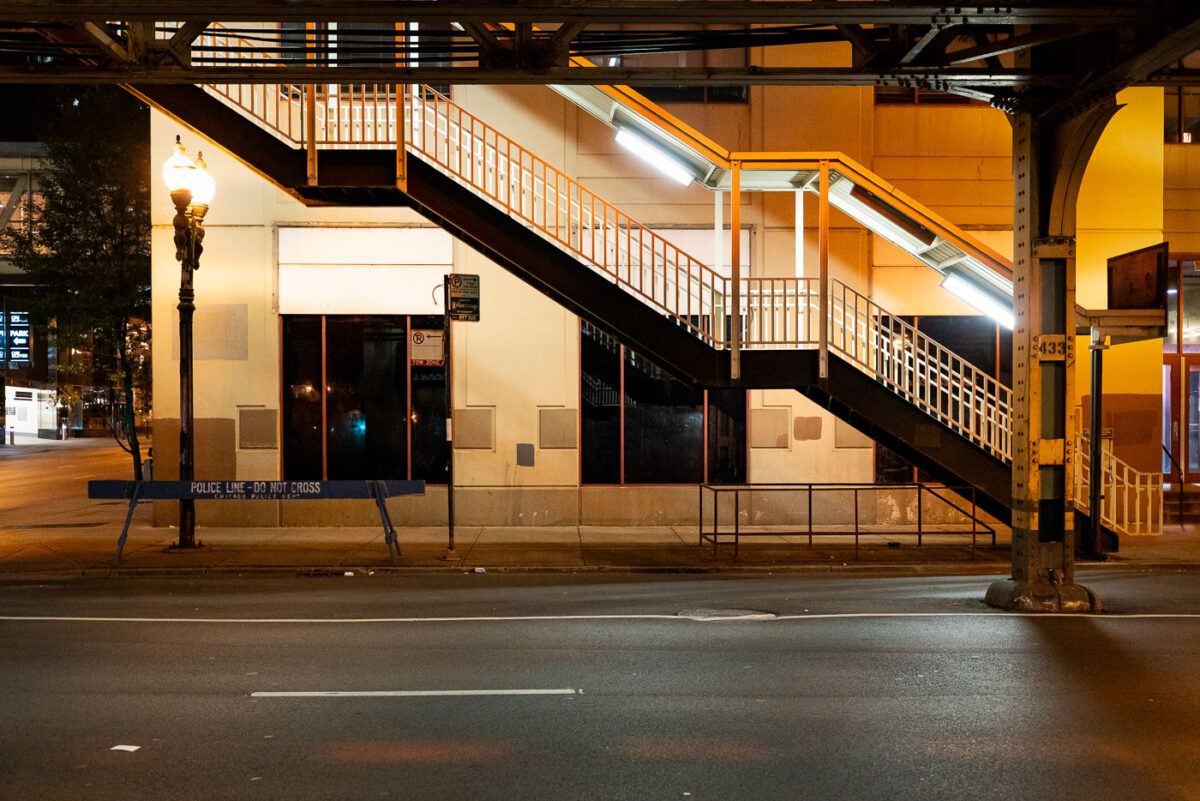
October 2019 — An illuminated stairway leads up to one of Chicago’s iconic “L” (elevated) train platforms in the Loop at night. The steel structure, marked with the system’s signature riveted beams, is part of the century-old elevated rail network that defines the city’s core transit identity. Below, a “Police Line – Do Not Cross” barricade and the quiet, empty street evoke a rare moment of stillness in an area usually dominated by the hum of trains and late-night traffic. This view highlights the utilitarian geometry and enduring presence of the Chicago Transit Authority’s elevated system, still serving as the backbone of the city’s rapid transit since the late 19th century.
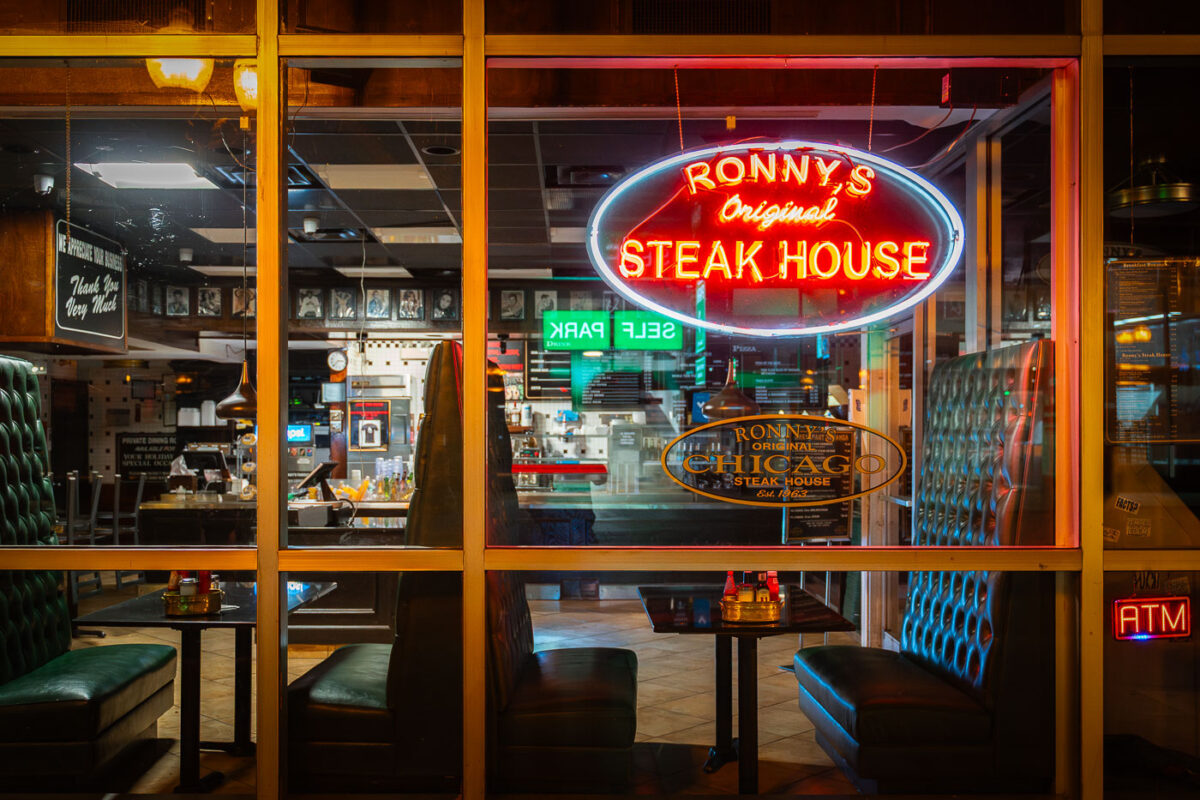
October 2019 — Ronny’s Original Steak House, a longtime fixture of Chicago’s Loop dining scene, glows under its vintage neon sign at night. Founded in 1963, the cafeteria-style steakhouse has served generations of downtown workers, theatergoers, and travelers from its no-frills location near the CTA Red Line and City Hall. Its tufted green booths, mirrored walls, and steady stream of regulars evoke an earlier era of affordable downtown dining—one of the few survivors of mid-century Loop eateries that once defined the city’s commercial core.
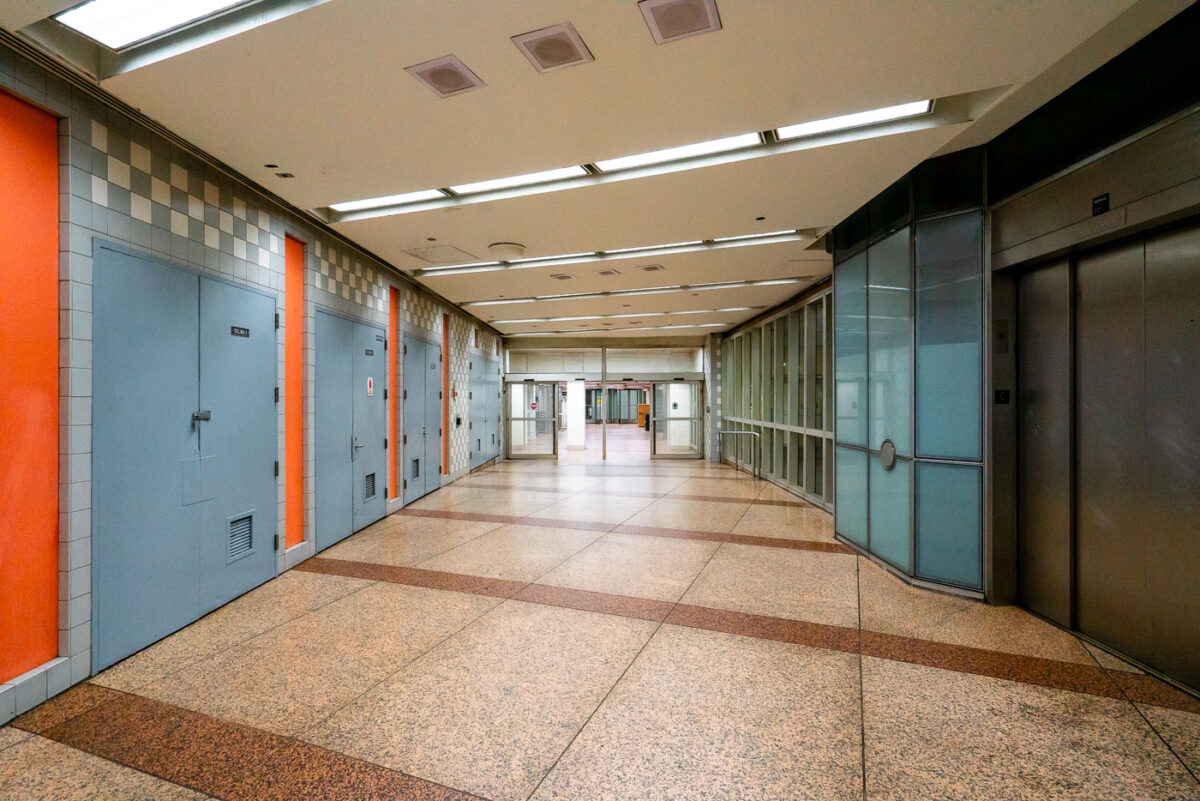
October 2019 — An empty corridor of the Chicago Pedway connects the Randolph/Washington subway station to surrounding office buildings and shopping centers beneath the Loop. The Pedway system, developed beginning in the 1950s, extends for more than 40 city blocks, linking major transit lines with civic and commercial spaces. Its mid-century design—terrazzo floors, tiled walls, and fluorescent lighting—reflects the city’s practical approach to all-weather pedestrian infrastructure, a defining feature of downtown Chicago’s urban core.
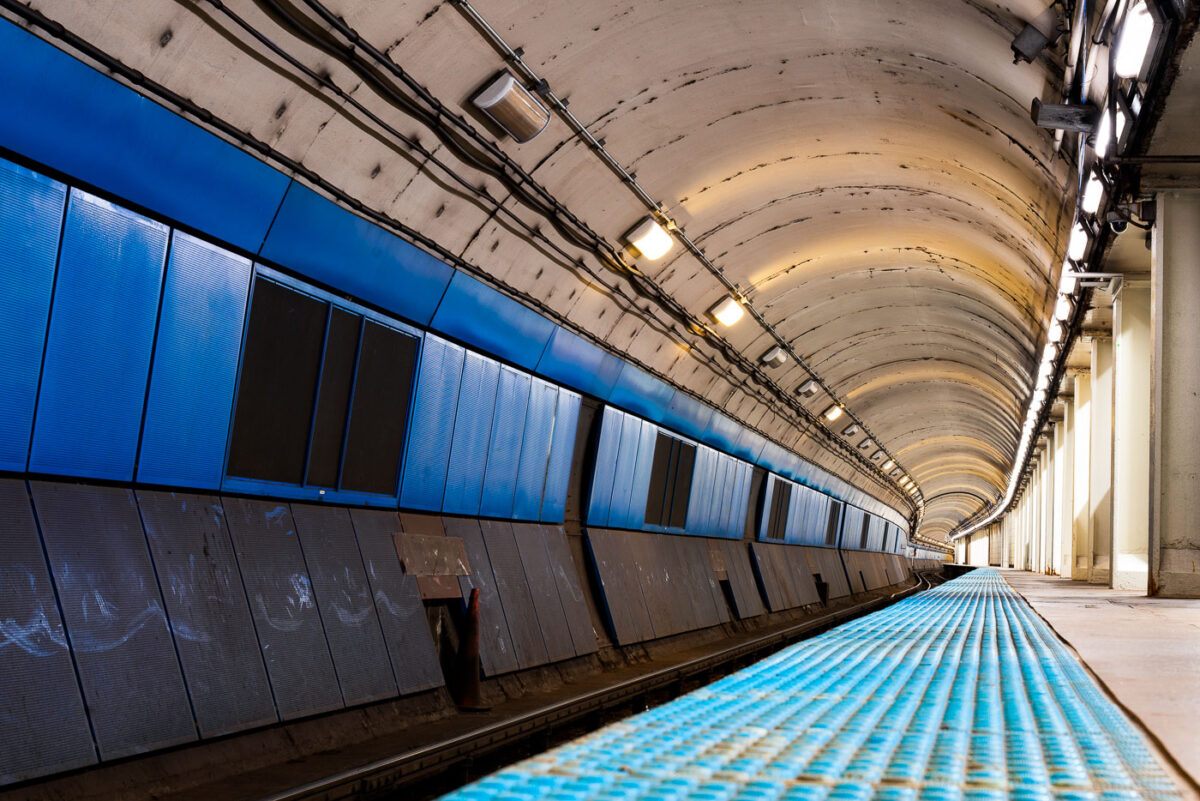
October 2019 — The curved platform of a Chicago Transit Authority Blue Line station reveals the utilitarian design of the city’s subway infrastructure, part of the Milwaukee–Dearborn subway opened in 1951. The tunnel’s tiled blue panels and low arched ceiling reflect the postwar engineering era that brought rapid transit beneath the Loop and the West Side, connecting O’Hare International Airport to downtown. Despite its age, this corridor remains a vital artery in Chicago’s daily commuter network, a symbol of mid-century urban mobility still in constant motion beneath the city streets.
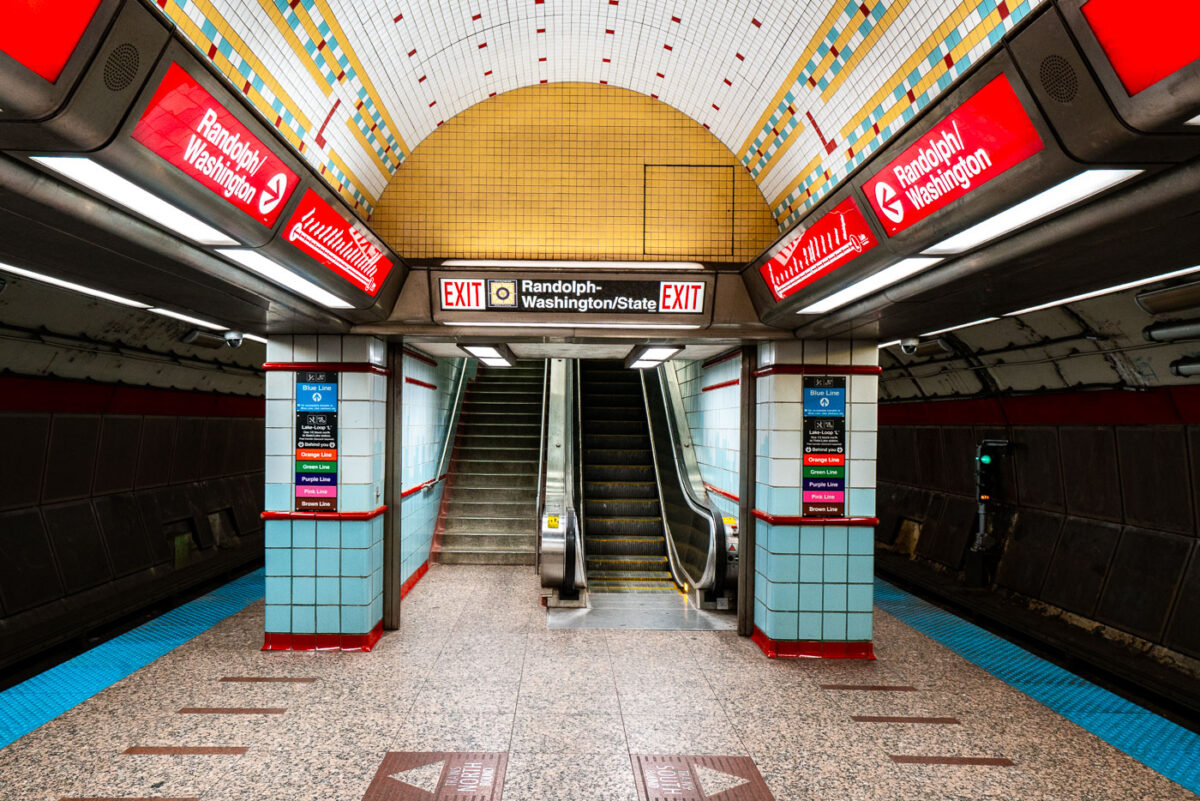
October 2019 — Randolph/Washington station sits beneath the heart of downtown Chicago, forming part of the CTA Red Line that runs through the State Street subway. Opened in 1943 as part of the city’s ambitious subway expansion, the station connects directly to the extensive Chicago Pedway system, linking offices, retail centers, and civic buildings underground. Its tiled vault and distinctive 1940s-era design remain largely intact, representing the Art Moderne phase of Chicago’s transit infrastructure.
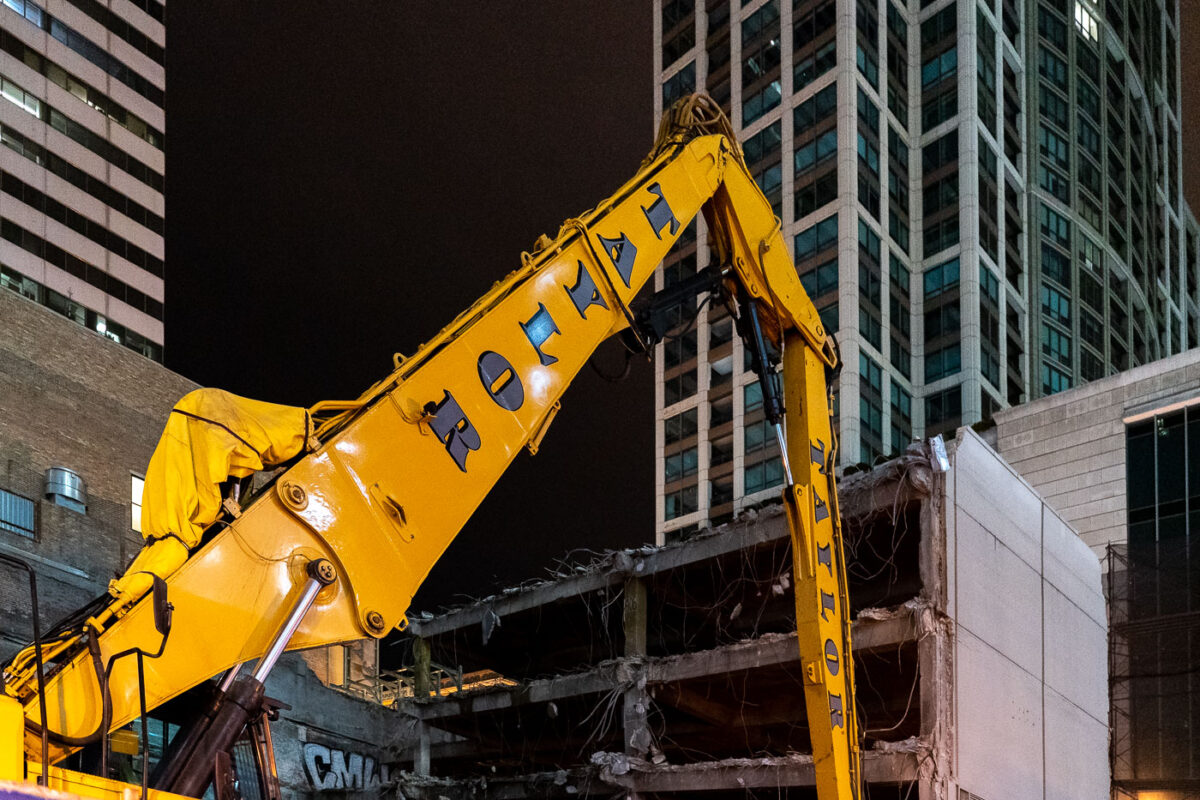
October 2019 — A Royal Taylor demolition excavator works overnight in downtown Chicago, dismantling the remains of a mid-century parking structure near North Wabash Avenue. The location, part of an area undergoing major redevelopment, reflects the city’s continual cycle of teardown and renewal. Once a dense cluster of low-rise commercial and industrial buildings, this district is being transformed by modern high-rise towers and mixed-use developments that are reshaping the skyline and urban streetscape of central Chicago.
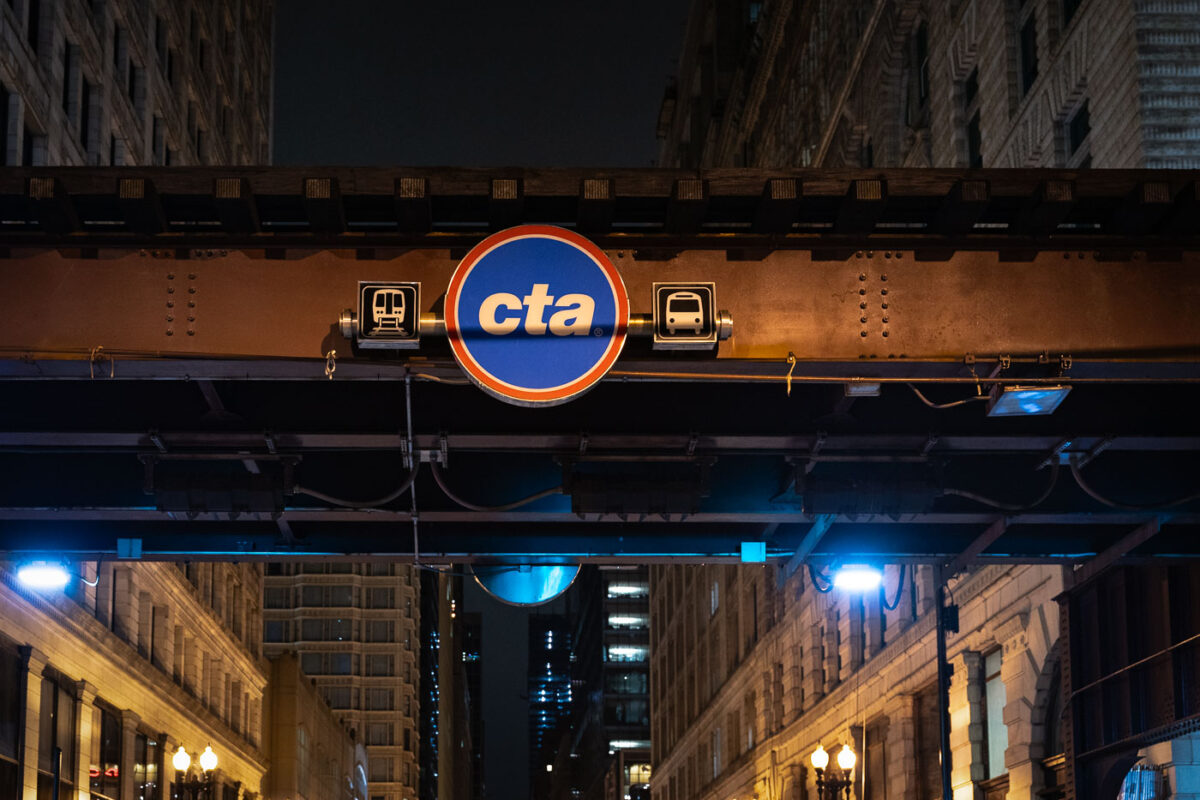
October 2019 — The Chicago Transit Authority (CTA) logo is displayed beneath the steel elevated tracks that define the Loop, the city’s central business district. The structure, part of the “L” system first built in the late 19th century, remains one of Chicago’s most enduring symbols of urban mobility. Overhead girders and riveted beams—many still original to the early 1900s—carry trains above streets lined with early skyscrapers and historic facades. The CTA continues to operate one of the largest and oldest public transit networks in the United States, moving more than a million riders daily through Chicago’s interconnected system of rail and bus lines.
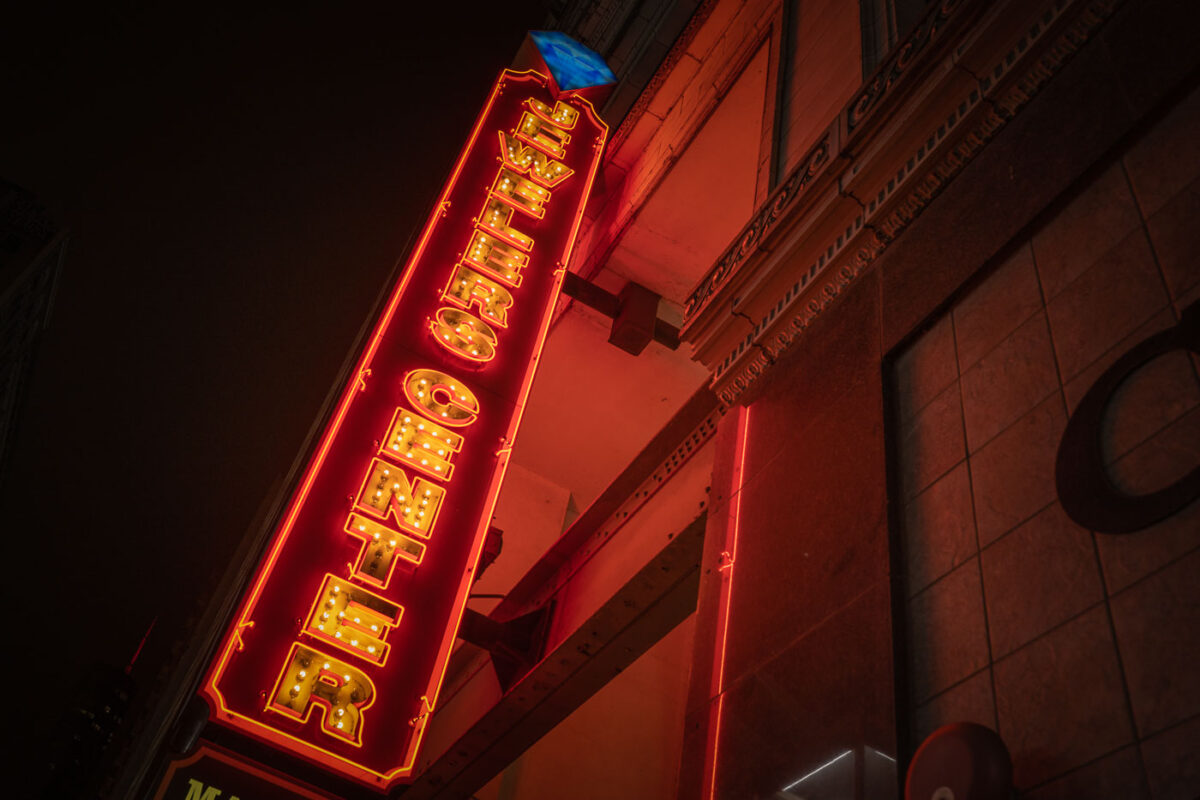
October 2019 — The illuminated marquee of the Jewelers Center glows along South Wabash Avenue in Chicago’s historic Jewelers Row District. Located at 5 S Wabash, this 1920s-era Art Deco building is home to more than 180 independent jewelers and gem traders, many specializing in custom design and repair. The tower, part of the landmark Mallers Building, stands within the Loop’s long tradition of craftsmanship and trade that dates back to the city’s early commercial boom. At night, the neon-lit sign continues to evoke Chicago’s mid-century downtown energy, linking the modern financial core with its industrial and artisanal past.
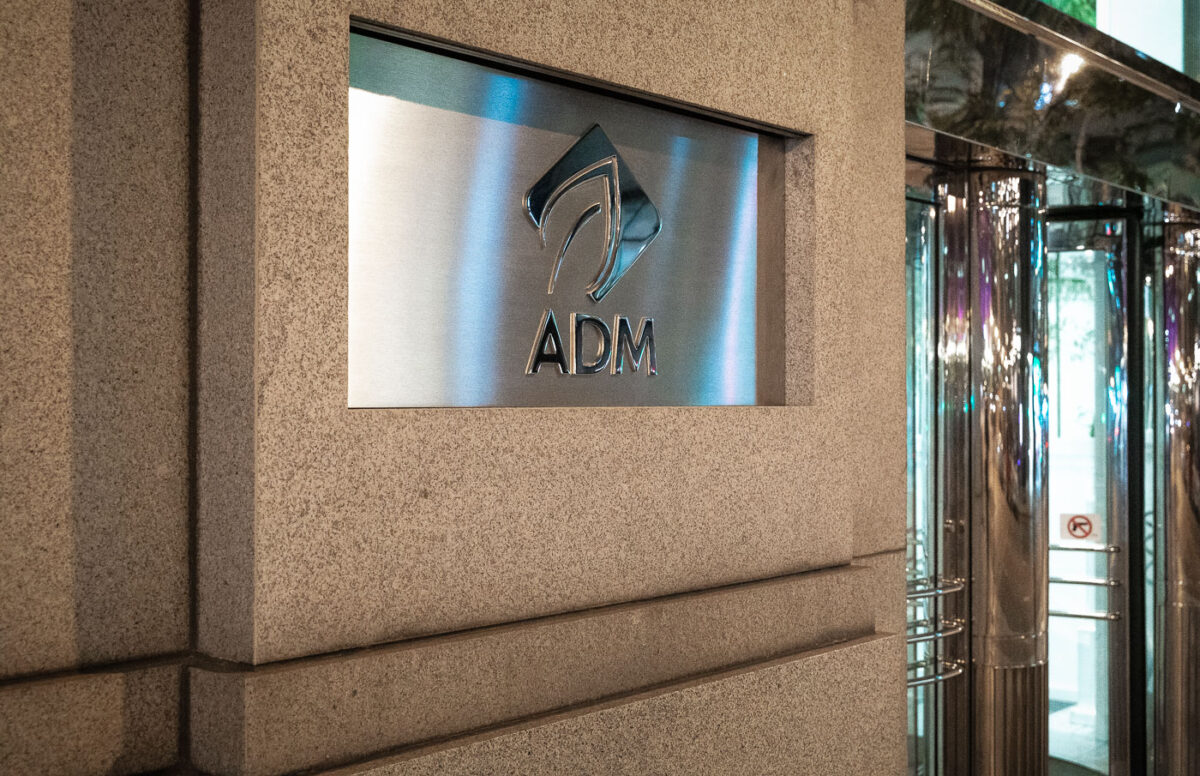
October 2019 — The Archer Daniels Midland (ADM) headquarters in downtown Chicago, Illinois, represents the global reach of one of the world’s largest agricultural and food processing corporations. Founded in 1902, ADM moved its main offices to Chicago in 2014 after more than a century in Decatur, Illinois. The company plays a major role in grain trading, oilseed processing, and biofuels, influencing commodity markets and global food supply chains. Its Chicago location, near the Chicago River and the city’s historic financial district, reflects the enduring link between Midwest agriculture and the global commodities trade that has long defined Chicago’s economic identity.
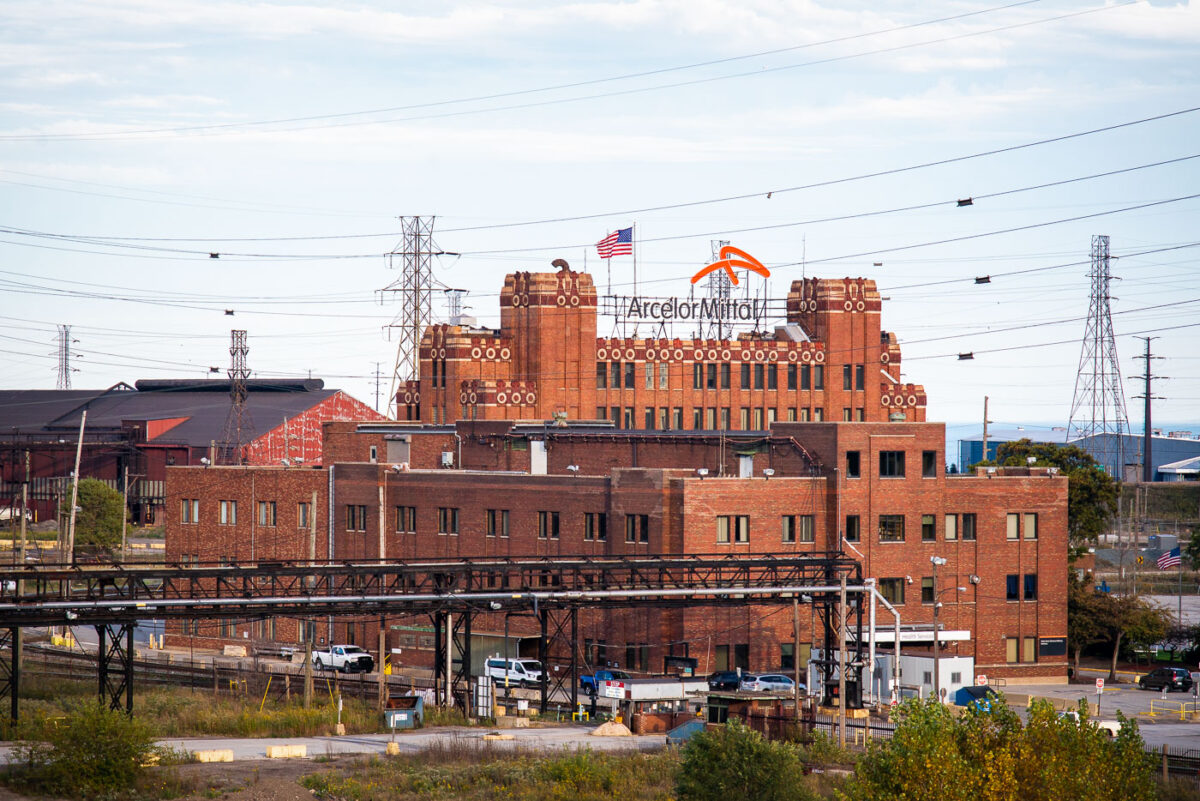
October 2019 — The ArcelorMittal Indiana Harbor steel mill in East Chicago, Indiana, is one of the largest integrated steelmaking facilities in the United States. The complex traces its origins to the Inland Steel Company, founded in 1893, and its massive brick headquarters—seen here—was built in the early 20th century to symbolize industrial power along Lake Michigan. Today, the plant remains a cornerstone of American steel production, encompassing multiple blast furnaces, coke batteries, and finishing lines. Now operated by Cleveland-Cliffs following its 2020 acquisition of ArcelorMittal USA, Indiana Harbor continues more than a century of continuous steelmaking on Chicago’s industrial lakeshore.
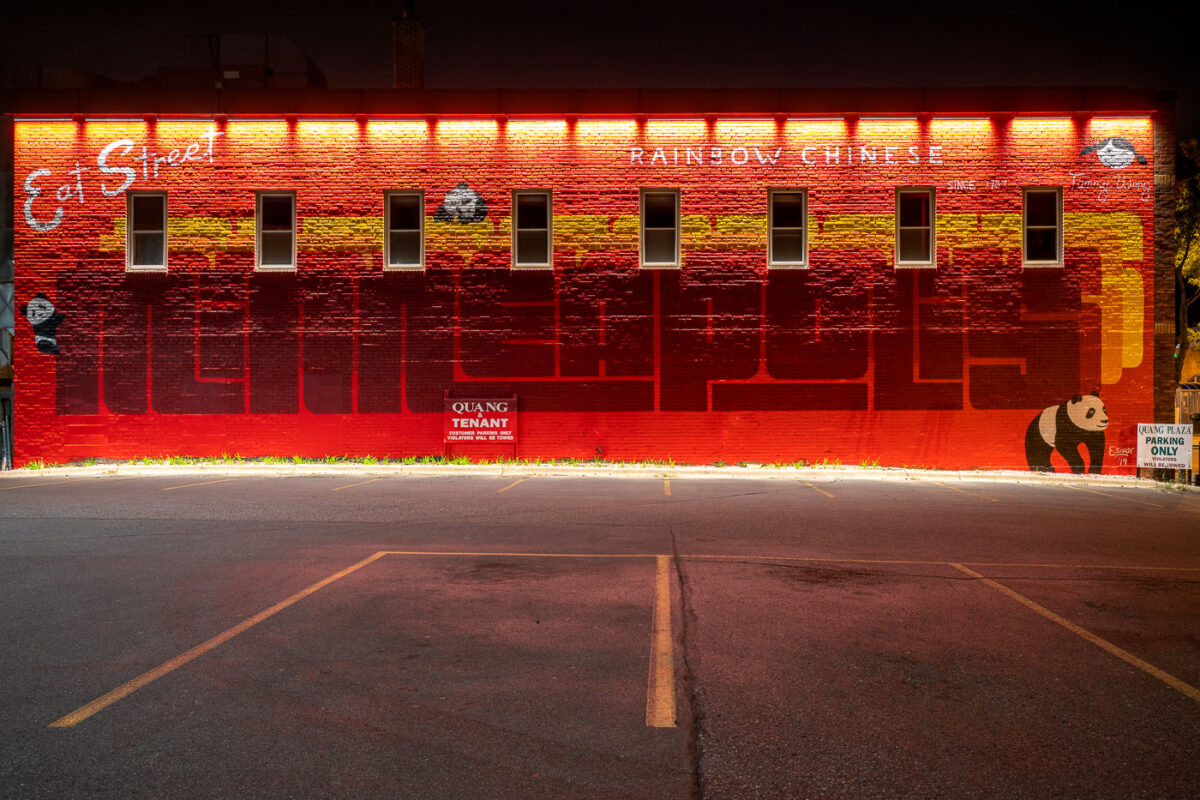
October 2019 — The bright red mural on the side of Rainbow Chinese Restaurant at 2739 Nicollet Avenue anchors Minneapolis’s iconic “Eat Street” corridor. Painted in bold geometric letters spelling “Minneapolis,” the work was designed to celebrate the neighborhood’s cultural diversity and long history as a hub for immigrant-owned restaurants. The panda motif and stylized lettering nod to the restaurant’s founder, Tammy Wong, whose establishment has been a local fixture since 1987. The mural, illuminated at night by warm overhead lighting, has become a recognizable landmark symbolizing the creative and culinary energy of Eat Street in the Whittier neighborhood.
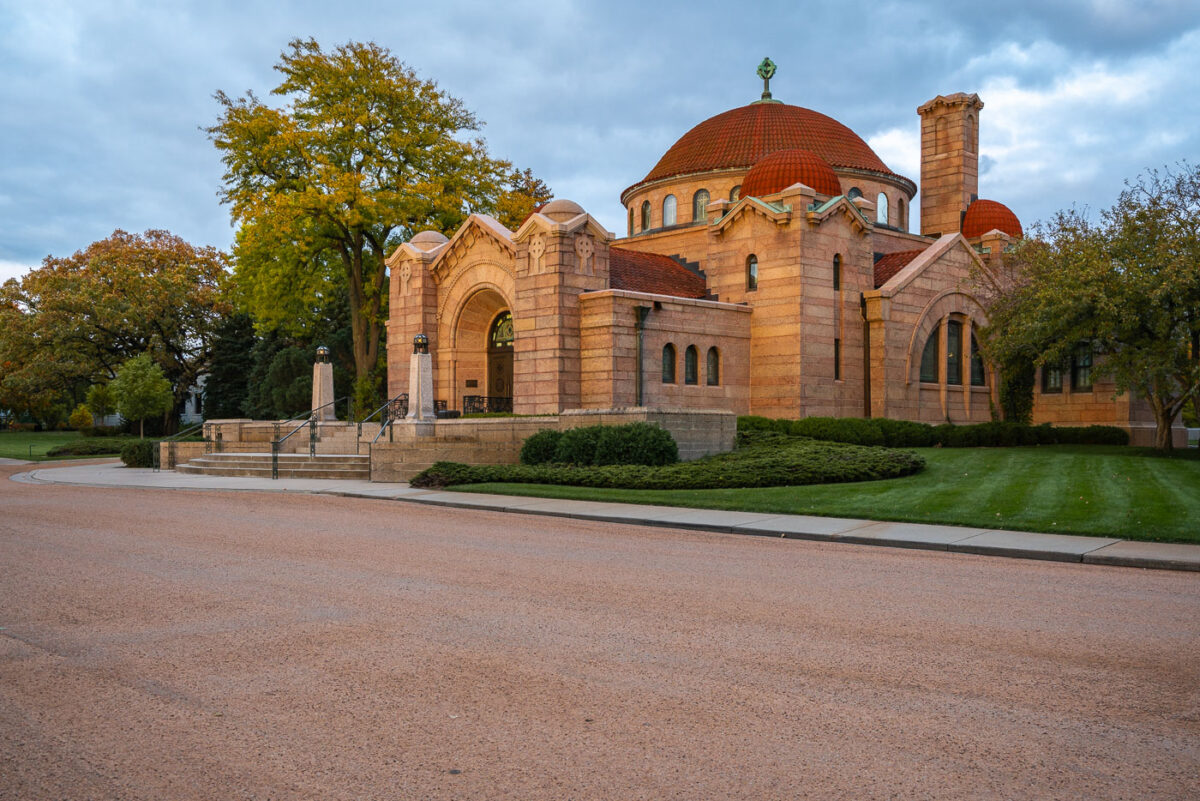
October 2019 — The Lakewood Cemetery Memorial Chapel in Minneapolis, completed in 1910 and inspired by Byzantine architecture, stands as one of Minnesota’s most significant funerary landmarks. Its interior mosaics—crafted with over ten million pieces of Venetian glass—were modeled after the Hagia Sophia in Istanbul. The surrounding landscape, designed in the late 19th century, reflects the “garden cemetery” movement that emphasized serenity and park-like beauty. Today, Lakewood remains both an active cemetery and a public green space, connecting generations through its art, architecture, and memorial traditions.
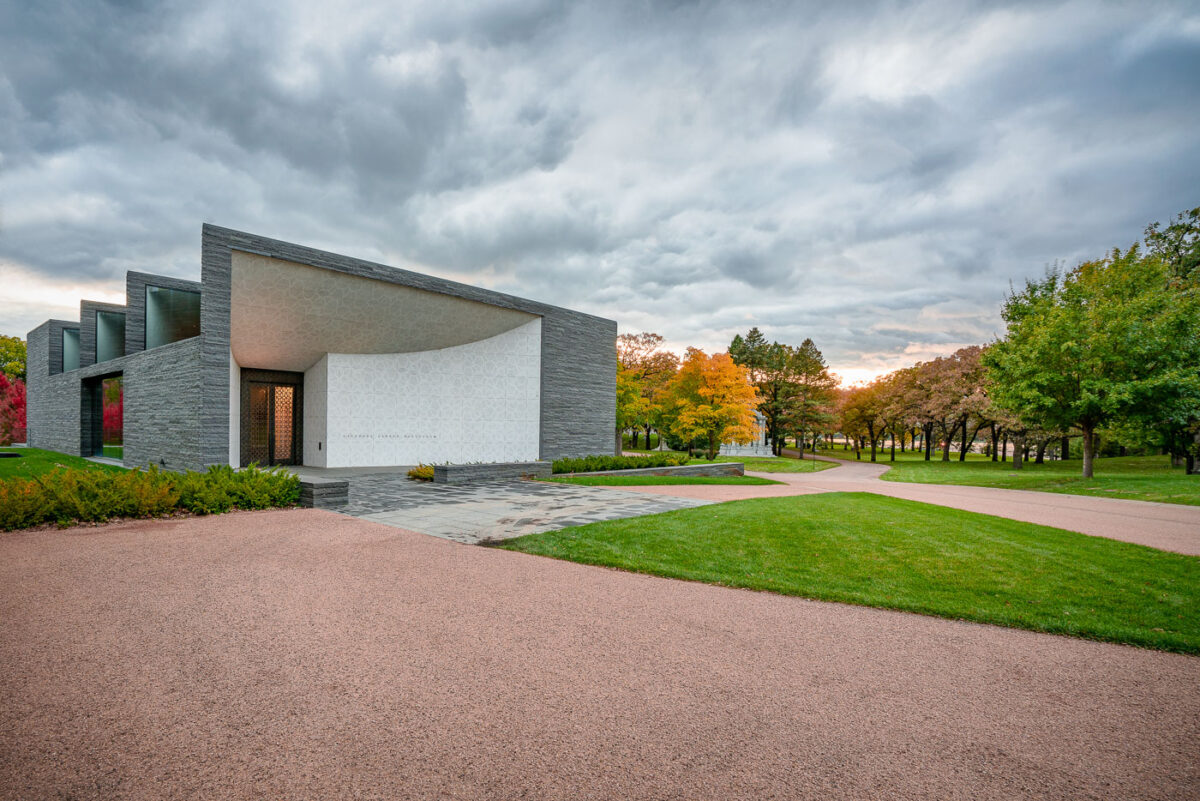
October 2019 — The Lakewood Cemetery Garden Mausoleum, completed in 2012 and designed by Joan Soranno and John Cook of HGA Architects, represents a modern counterpart to Lakewood’s historic chapel. Built into the natural slope of the cemetery grounds, the structure uses gray granite and white mosaic marble to evoke quiet reflection and permanence. Its minimalist form and interplay of light were conceived to harmonize with the surrounding landscape of Lake Calhoun (Bde Maka Ska). The mausoleum extends Lakewood’s 150-year tradition of blending architecture, art, and remembrance within a park-like setting in south Minneapolis.
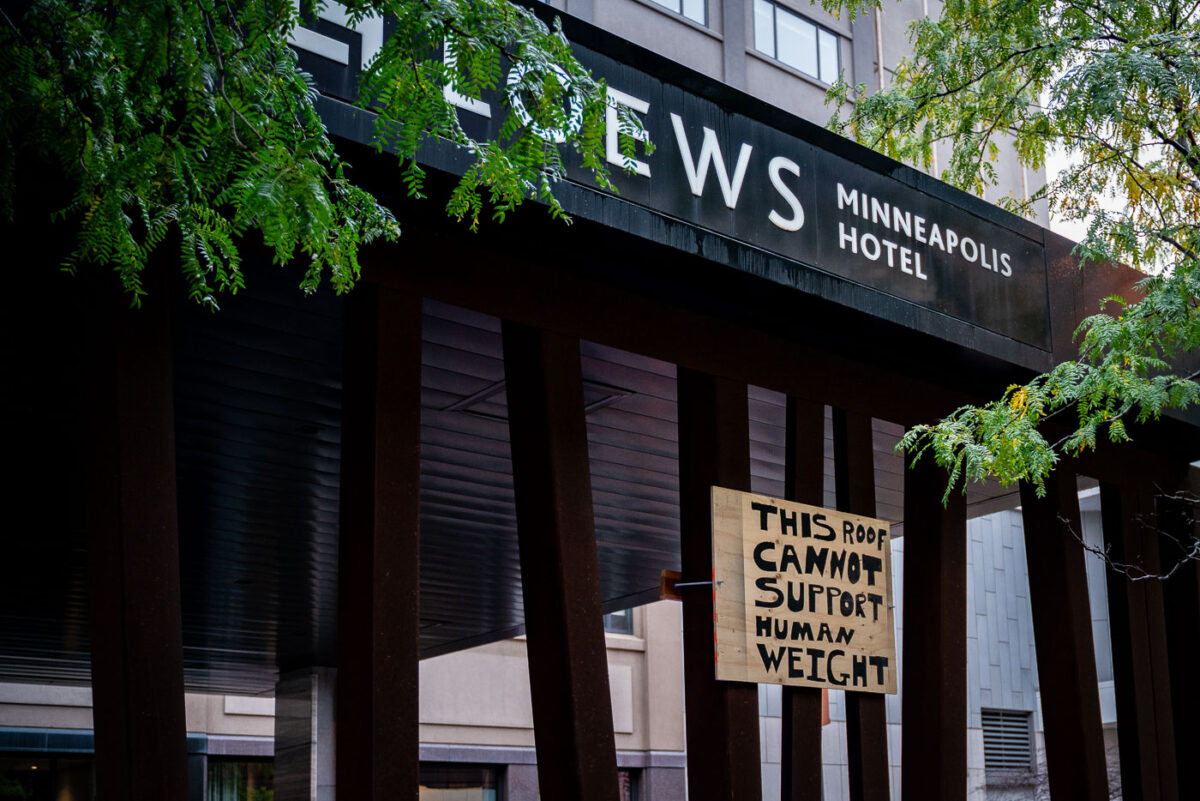
October 2019 —
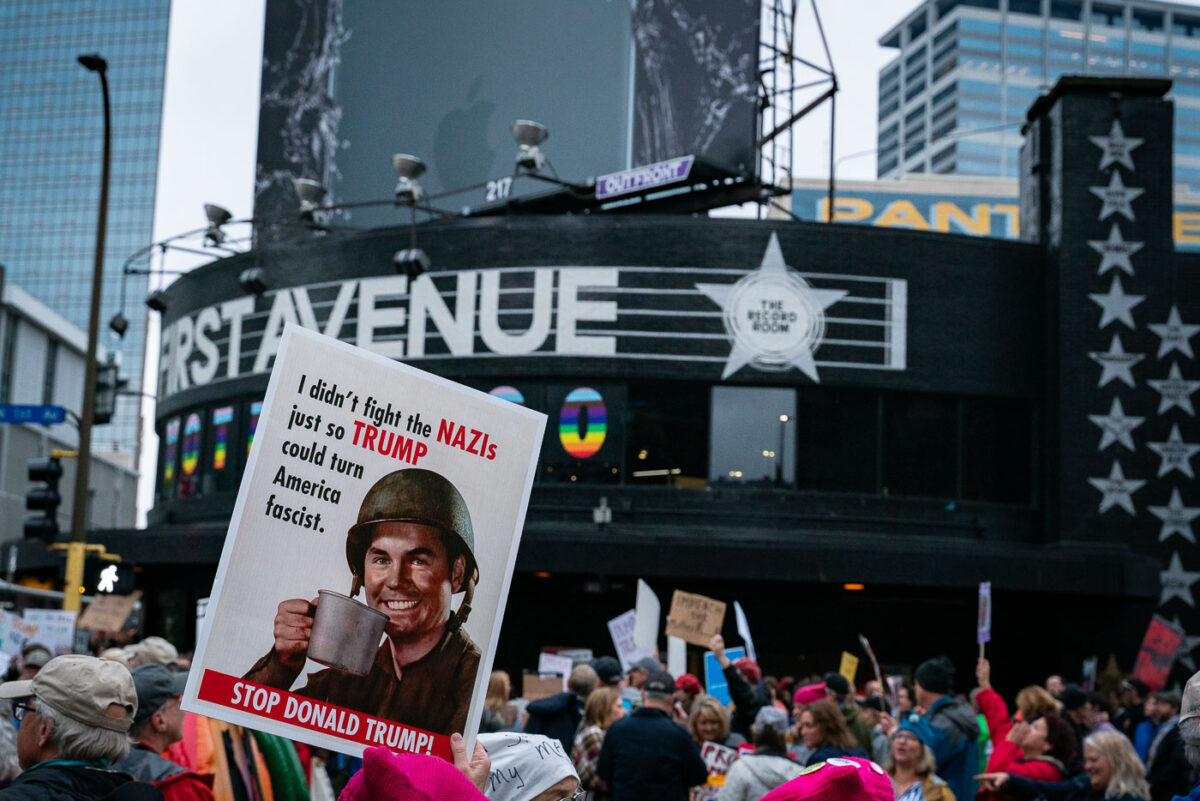
October 2019 — Sign reading "I didn't fight the nazi's just so Trump could turn America fascist" being held up outside First Avenue during a Trump protest in Minneapolis on October 10, 2019.

October 2019 — Protesers hold up signs outside the Target Center in Minneapolis on October 10, 2019.
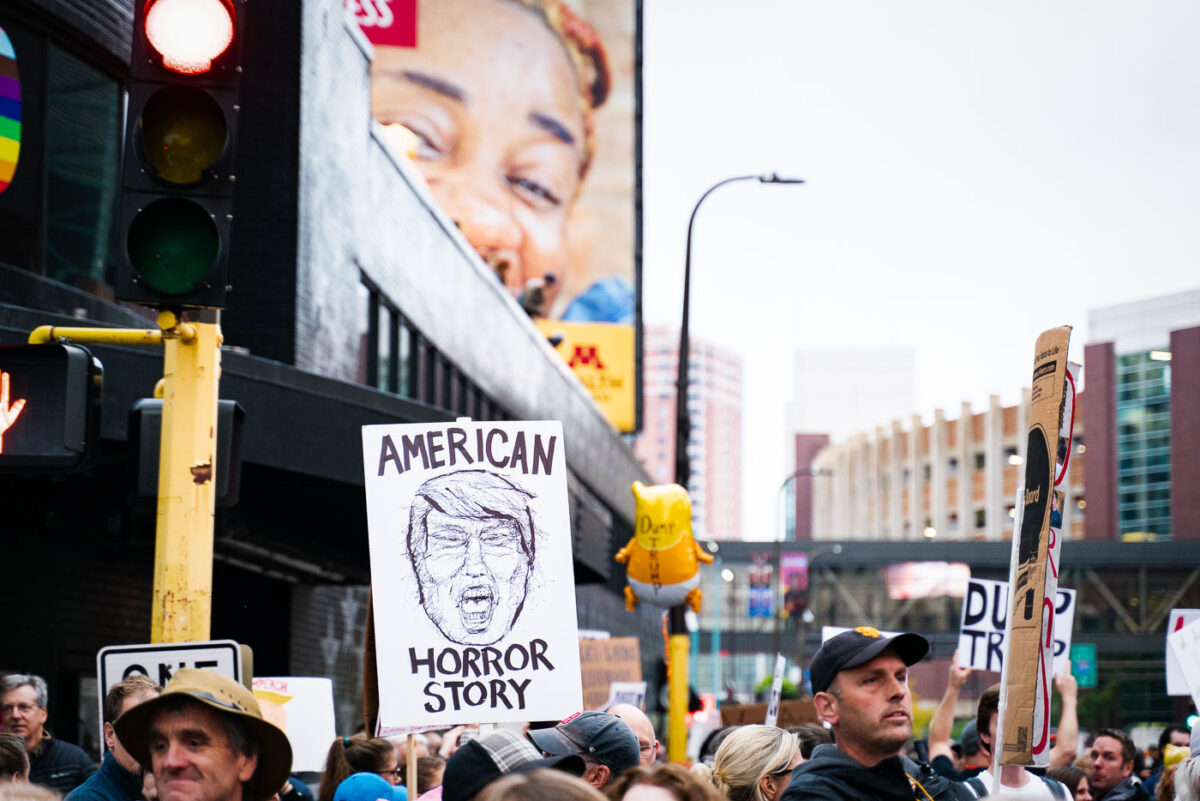
October 2019 — "American Horror Story" protest sign in Minneapolis on October 10, 2019.
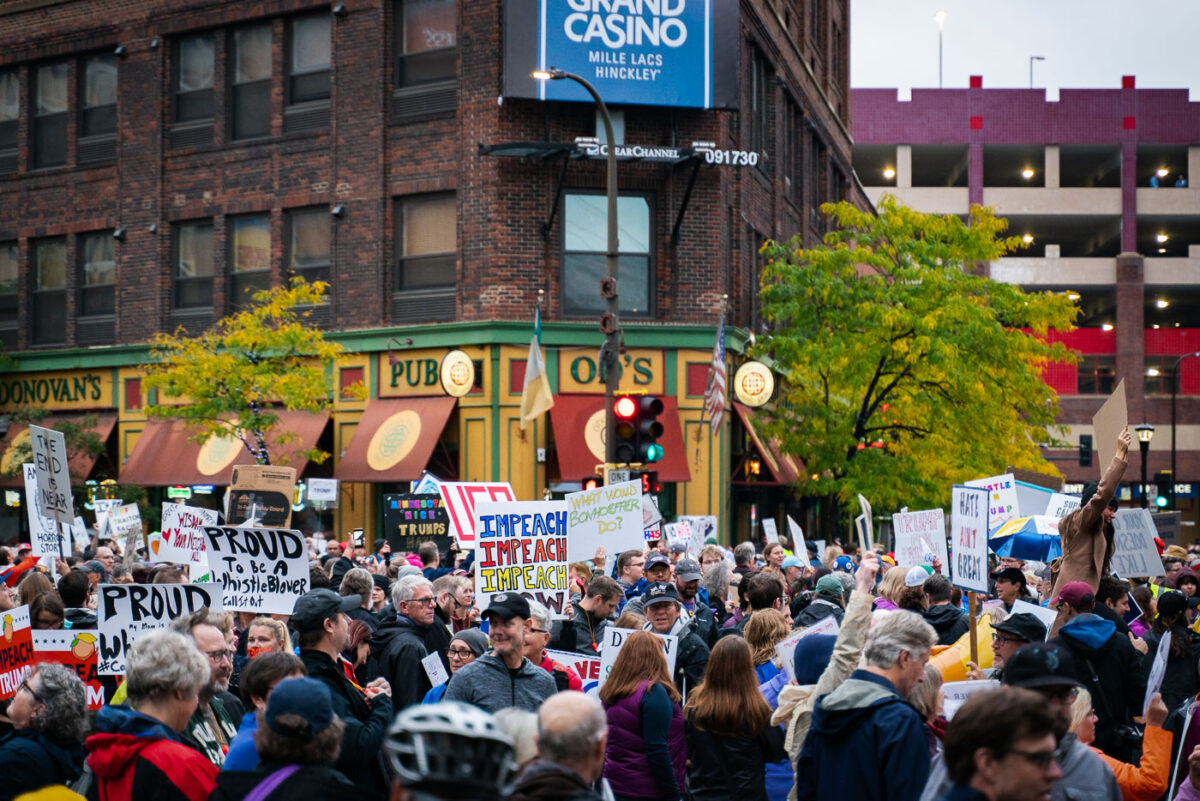
October 2019 — Protesters hold up signs outside the Target Center during a Trump protest in Minneapolis on October 10, 2019.
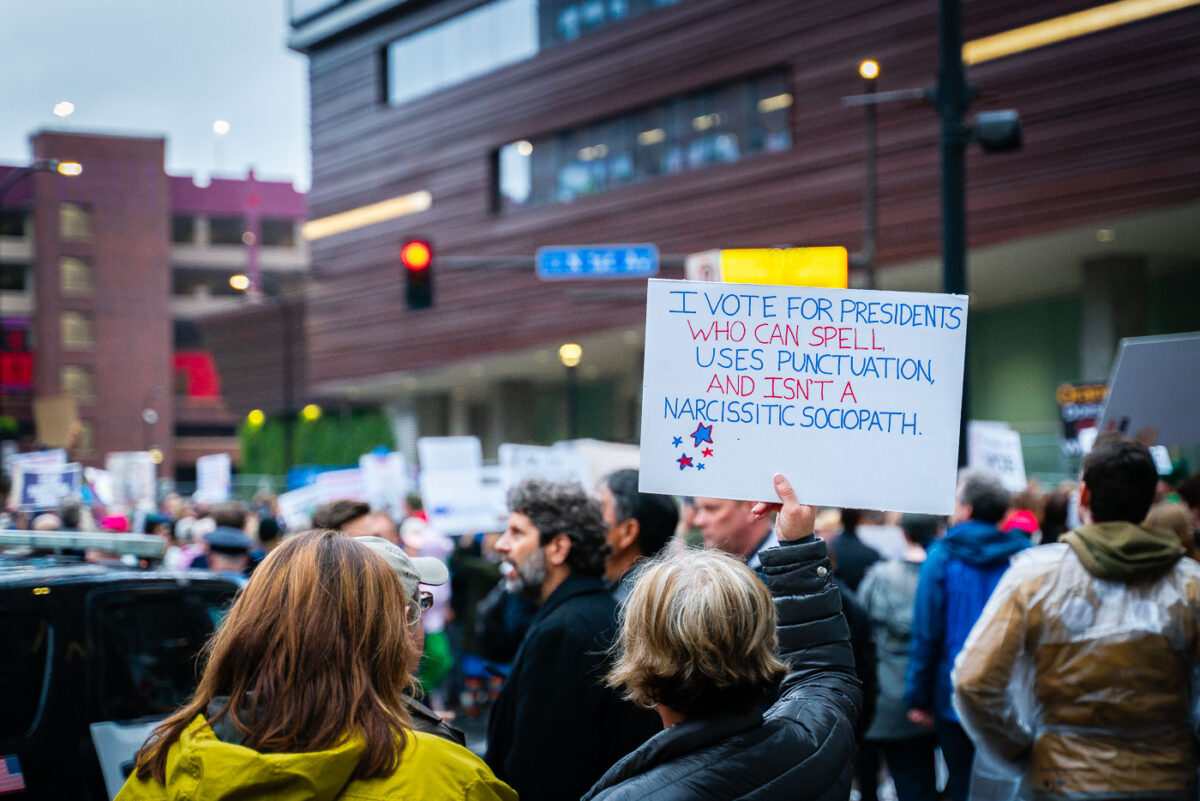
October 2019 — Man holds up a sign that reads "I vote for presidents who can spell, uses punctuation and isn't a narcissistic sociopath." outside the Target Center during a Trump protest on October 10, 2019.
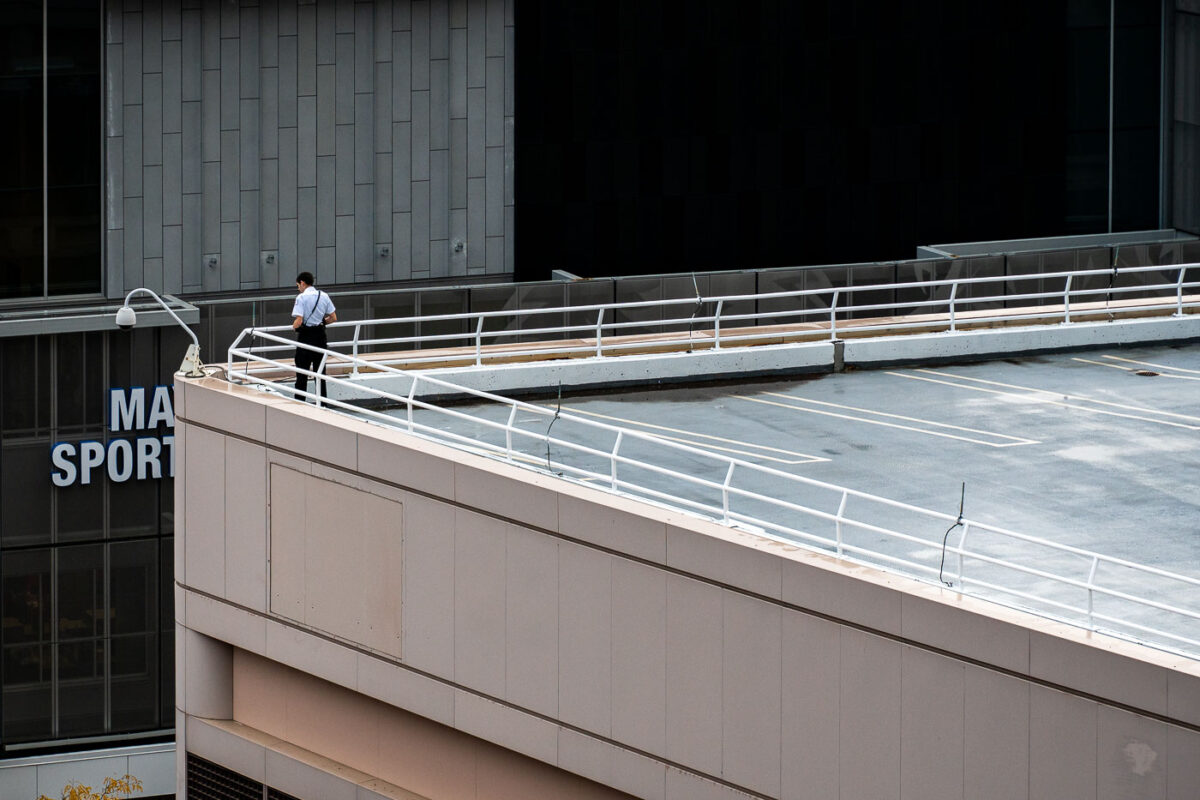
October 2019 — A security officer surveys the area from a parking ramp rooftop across from the Target Center in downtown Minneapolis on October 10, 2019. The elevated position provided an unobstructed view of streets surrounding the arena ahead of a campaign rally held by President Donald Trump. Local police, federal agents, and Homeland Security personnel maintained a visible presence throughout the entertainment district as thousands of attendees and protesters gathered nearby.
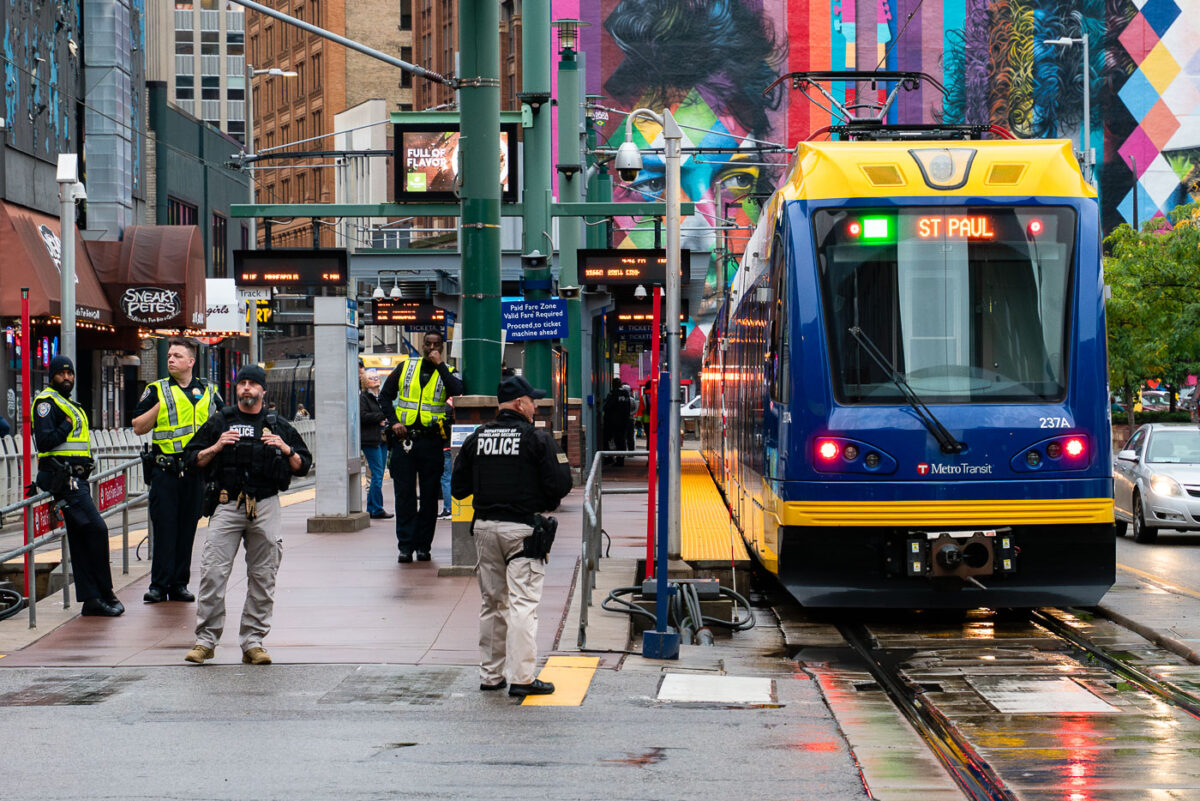
October 2019 — Department of Homeland Security at the Warehouse District LRT station on October 10, 2019 during a Donald Trump rally at the Target Center.
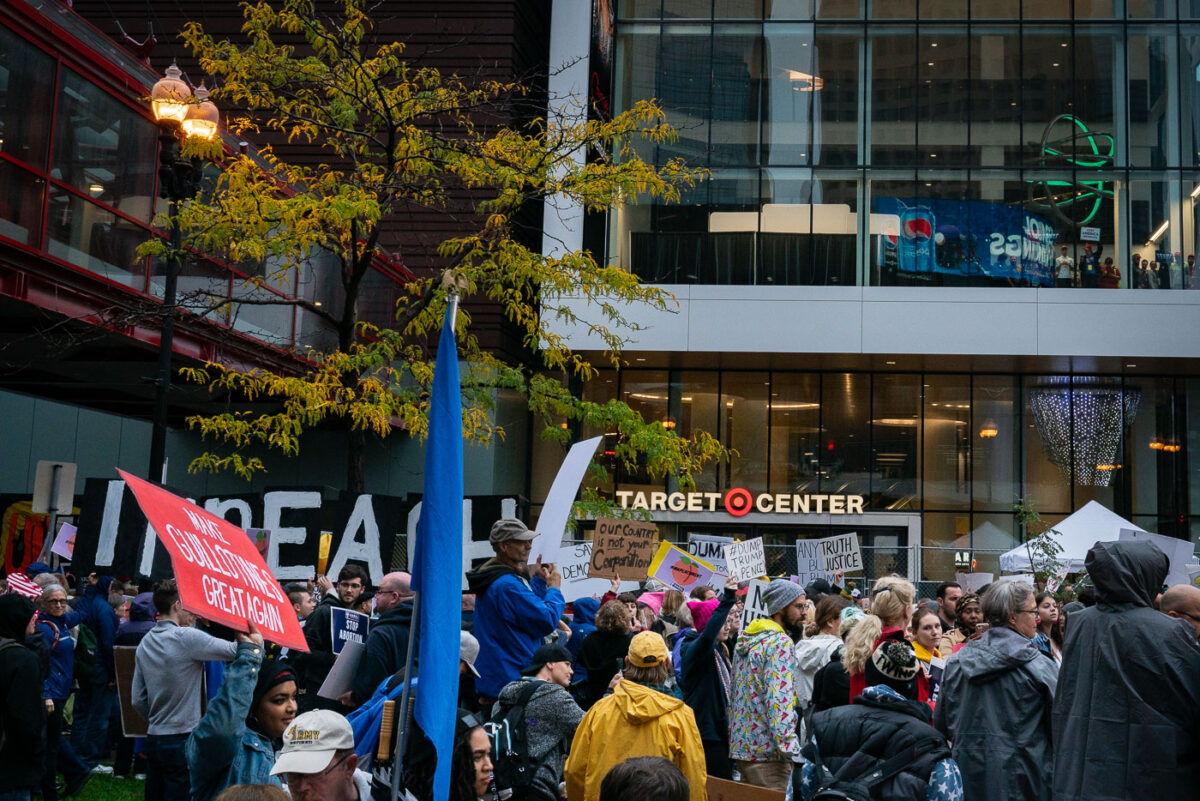
October 2019 — Protesters outside the Target Center in downtown Minneapolis. Trump supporters behind the glass. Campaign event October 10, 2019
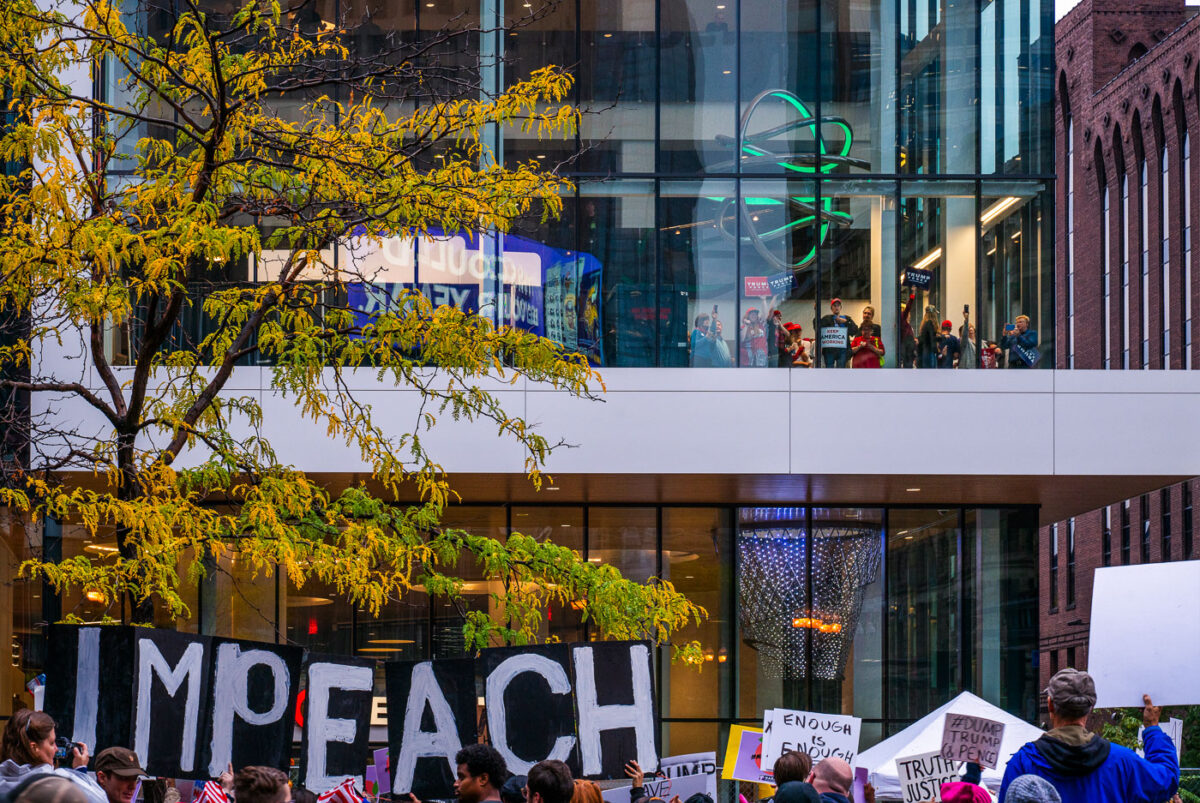
October 2019 — Protesters outside the Target Center in downtown Minneapolis. Trump supporters behind the glass. Campaign event October 10, 2019

October 2019 — Woman holds up a sign that reads "Trump read my sign" in Minneapolis on October 10, 2019.

October 2019 — A protester holds up protest sign outside the Target Center in Downtown Minneapolis where Trump was to speak in October 2019.
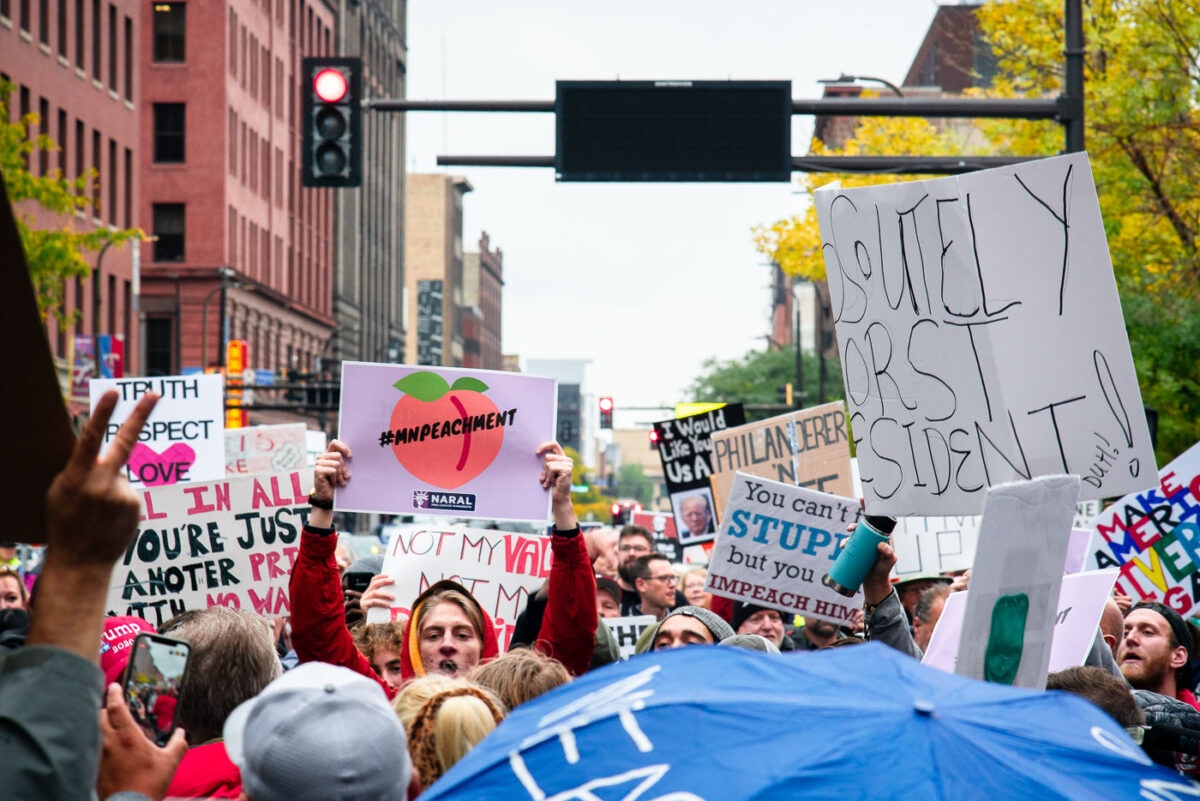
October 2019 — Protesters crowd Nicollet Mall in downtown Minneapolis carrying handmade signs during a demonstration against then-President Donald Trump on October 10, 2019. The rally, tagged online as #MNPEACHMENT, drew thousands of Minnesotans expressing opposition to Trump’s policies and calling for impeachment. The march began near the Target Center, where Trump was holding a campaign rally, and stretched across downtown under a heavy police presence.
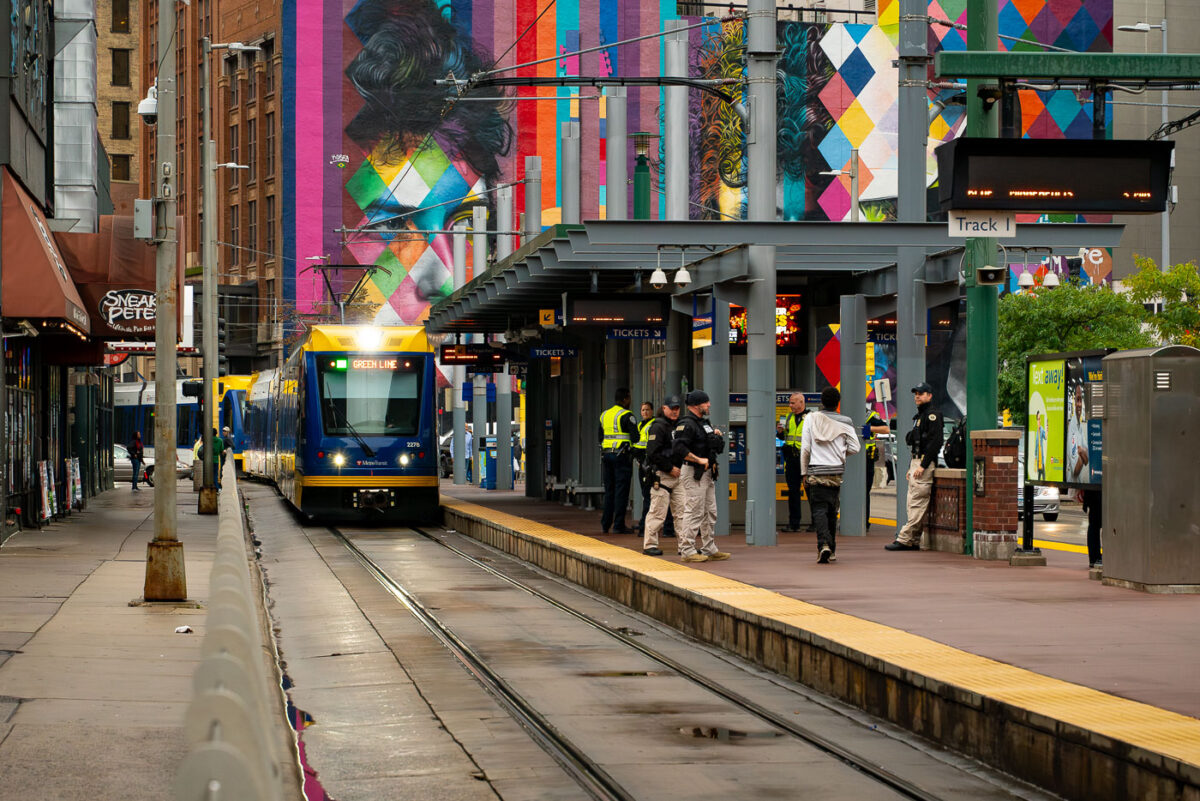
October 2019 — Located near the Target Center in downtown Minneapolis, the Target Field light rail station was patrolled by Homeland Security officers on October 10, 2019. The increased presence coincided with a major political rally at the nearby arena, leading to heightened security across the surrounding Warehouse District transit corridor.
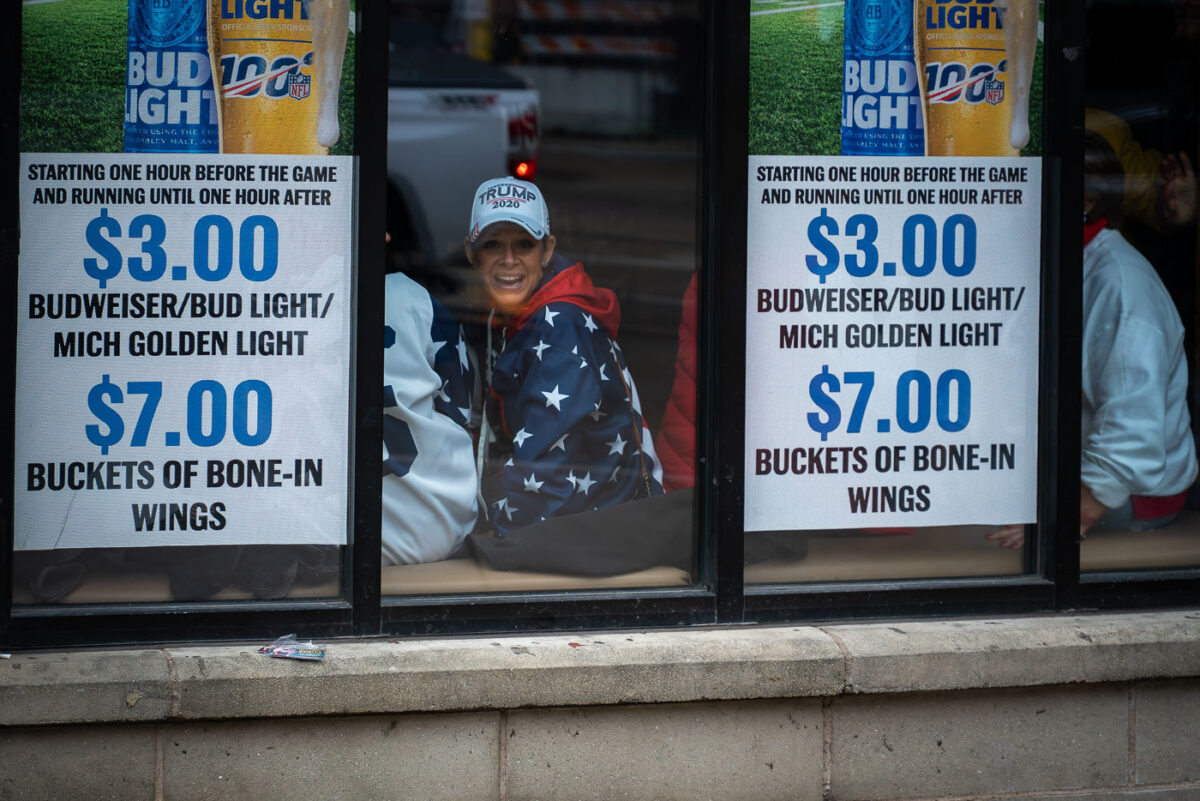
October 2019 — A woman wearing a “Trump 2020” hat smiles from inside a downtown Minneapolis bar near the Target Center on October 10, 2019. The establishment, decorated with promotional posters for discounted beer and wings, became a temporary gathering spot for attendees arriving early to the president’s evening campaign rally. The 2019 visit marked a rare appearance by a sitting U.S. president in Minneapolis and drew both supporters and demonstrators into the city’s entertainment district, where security and anticipation heightened throughout the afternoon.
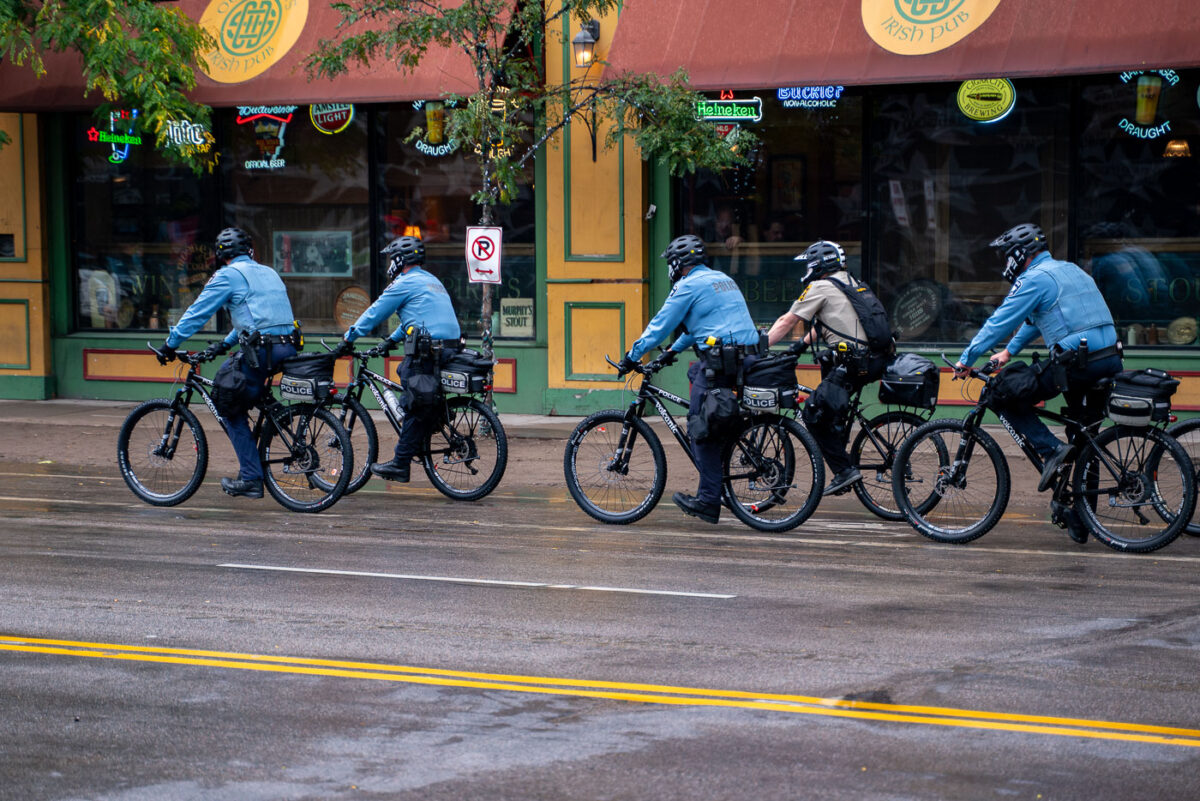
October 2019 — Police on bicycles patrol downtown Minneapolis outside the Target Center while protesters and rally-goers gather ahead of a 2019 Trump campaign event.
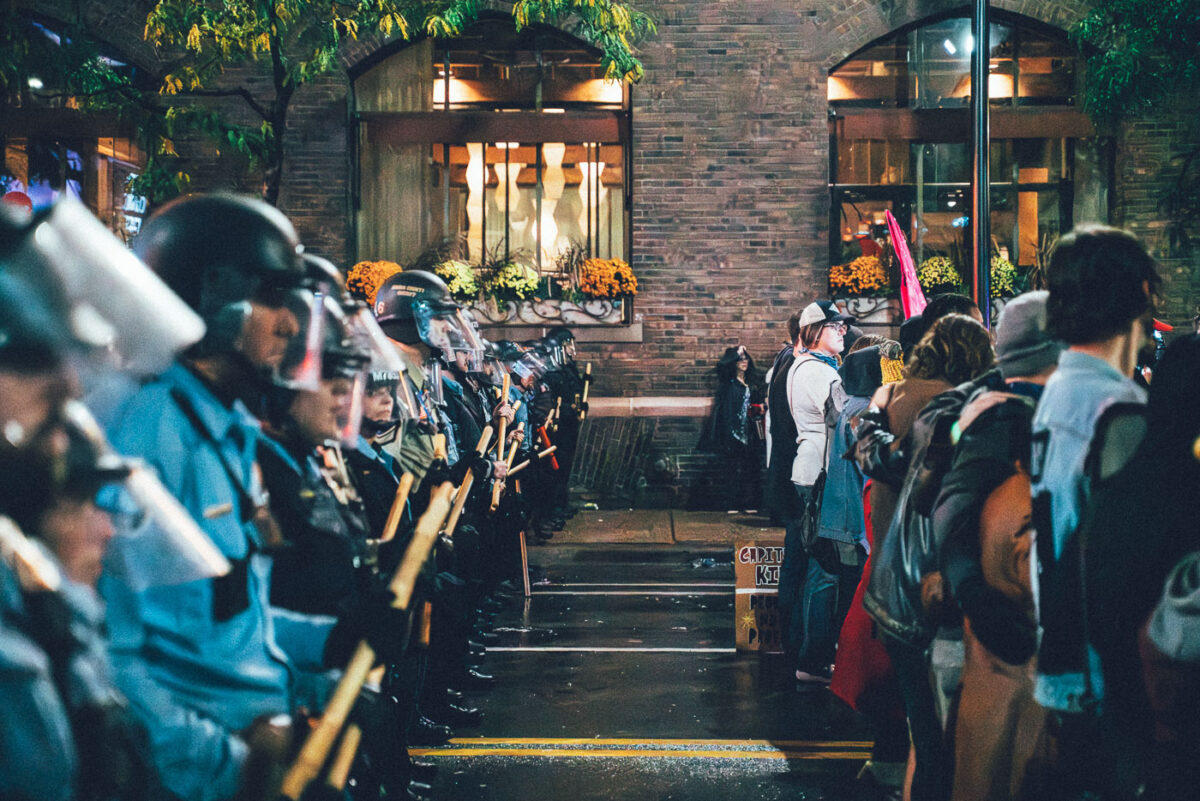
October 2019 — Minneapolis police officers in riot gear form a barricade opposite protesters outside the Target Center on October 10, 2019, during then-President Donald Trump’s campaign rally. The tightly organized police line extended along First Avenue, separating demonstrators from event attendees as tensions rose late into the evening. The rally drew thousands of protesters and supporters to downtown Minneapolis, prompting one of the largest coordinated law enforcement deployments in the city that year.
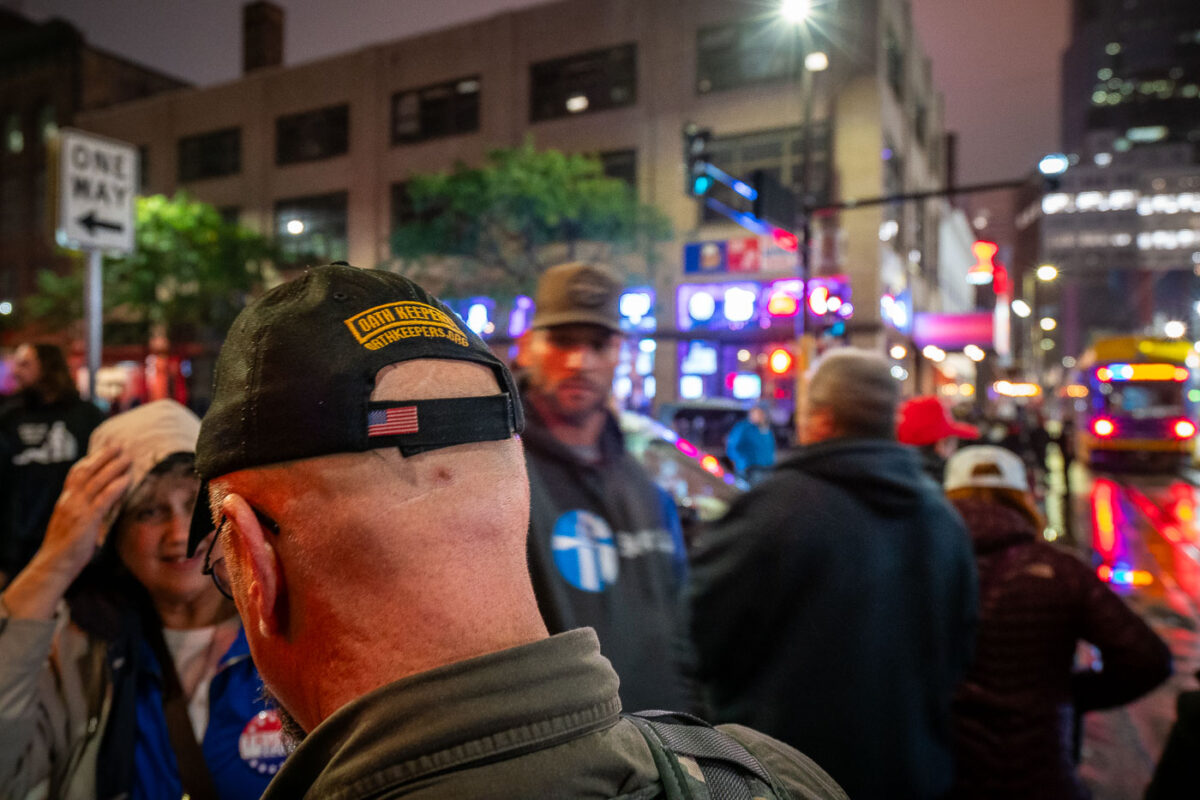
October 2019 — During demonstrations outside President Donald Trump’s campaign rally at the Target Center in downtown Minneapolis on October 10, 2019, a man wearing a hat bearing the Oath Keepers insignia asked for directions near the crowd. The rally drew both Trump supporters and counter-protesters, filling Hennepin Avenue with thousands of people and heavy police presence. The Oath Keepers, founded in 2009, is a far-right, anti-government militia organization whose members have been linked to armed protests and later to the January 6, 2021, U.S. Capitol attack.

October 2019 — A barricade outside the Target Center in downtown Minneapolis displays a T-shirt reading “Russia Made Me Do It” and a defaced cutout of Donald Trump’s face during protests on October 10, 2019. The demonstration coincided with Trump’s campaign rally at the arena, his first visit to Minnesota since the release of the Mueller report. Thousands of protesters gathered in the streets of the Warehouse District, voicing opposition to the president’s rhetoric and policies amid a heavy police presence and national media attention.
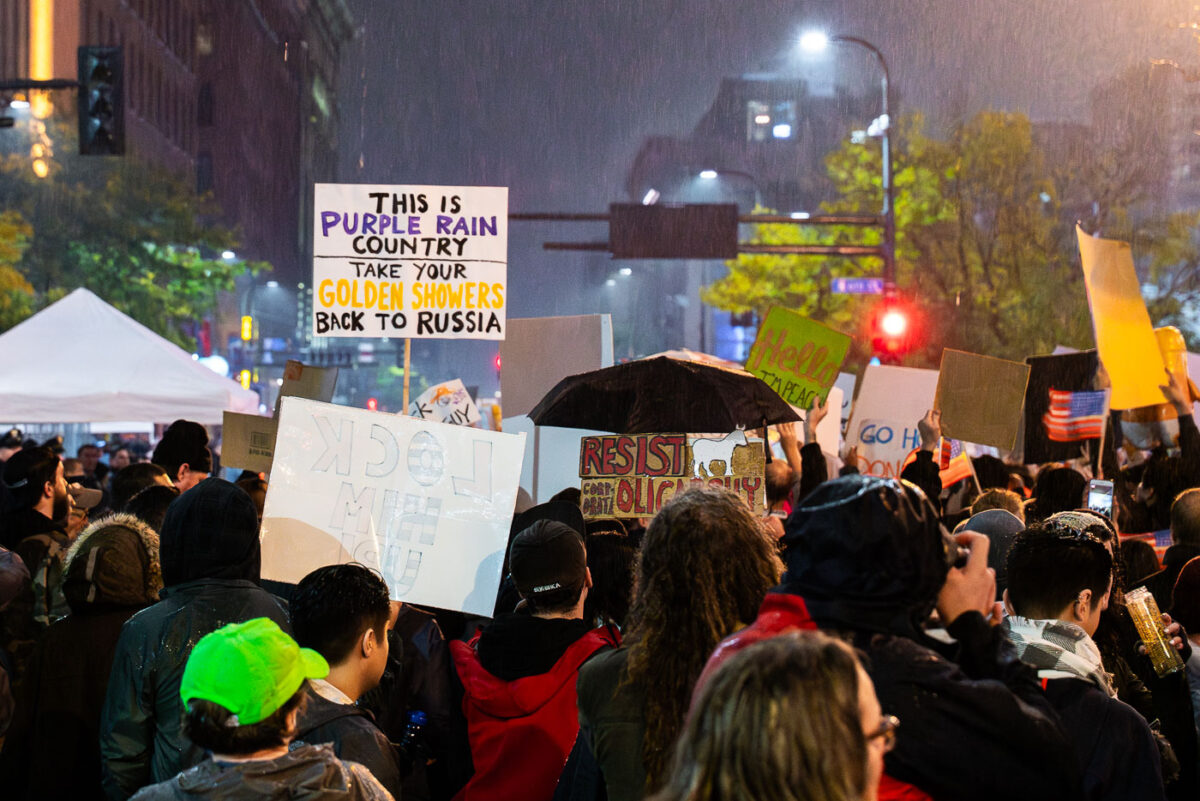
October 2019 — Protesters fill the intersection near the Target Center in downtown Minneapolis during Donald Trump’s campaign rally on October 10, 2019. Demonstrators carried homemade signs, including one reading “This is Purple Rain Country—Take Your Golden Showers Back to Russia,” referencing Minnesota’s musical icon Prince and the controversies surrounding Trump’s presidency. The rally drew thousands of protesters and supporters alike, marking one of the city’s largest political demonstrations since the 2016 election.
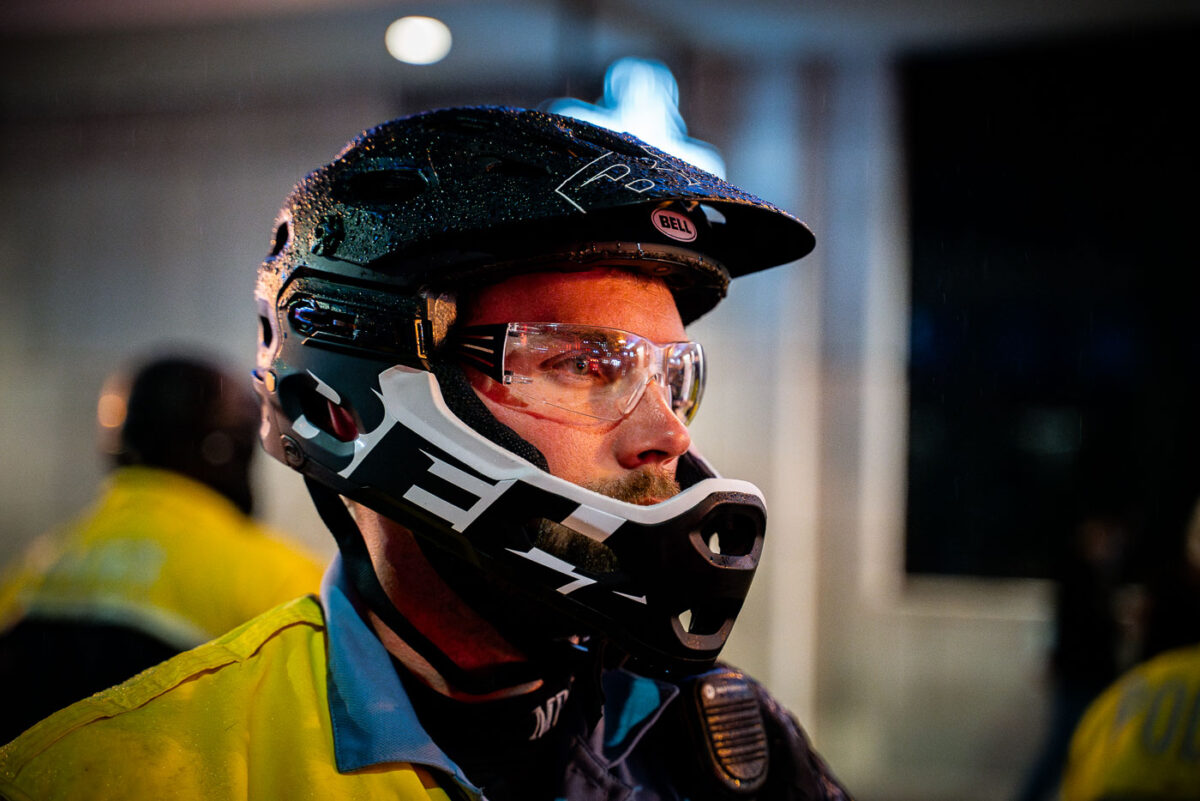
October 2019 — A Minneapolis Police officer wearing a helmet at a Donald Trump rally in Minneapolis on October 10, 2019.
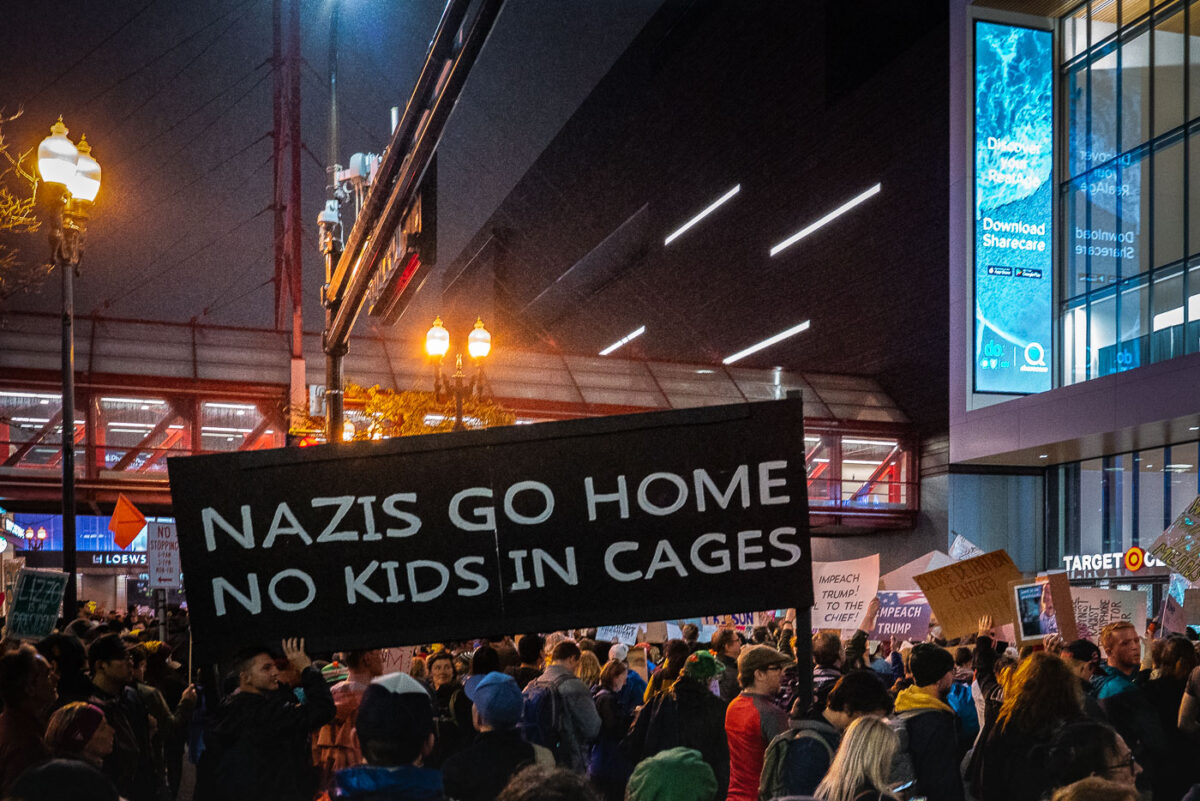
October 2019 — Crowds gathered outside the Target Center in downtown Minneapolis on October 10, 2019, during a Donald Trump campaign rally. Protesters held signs denouncing the administration’s immigration policies and far-right extremism, including one reading “Nazis Go Home – No Kids in Cages.” The event drew thousands of demonstrators and marked one of the city’s largest public displays of opposition during Trump’s presidency.
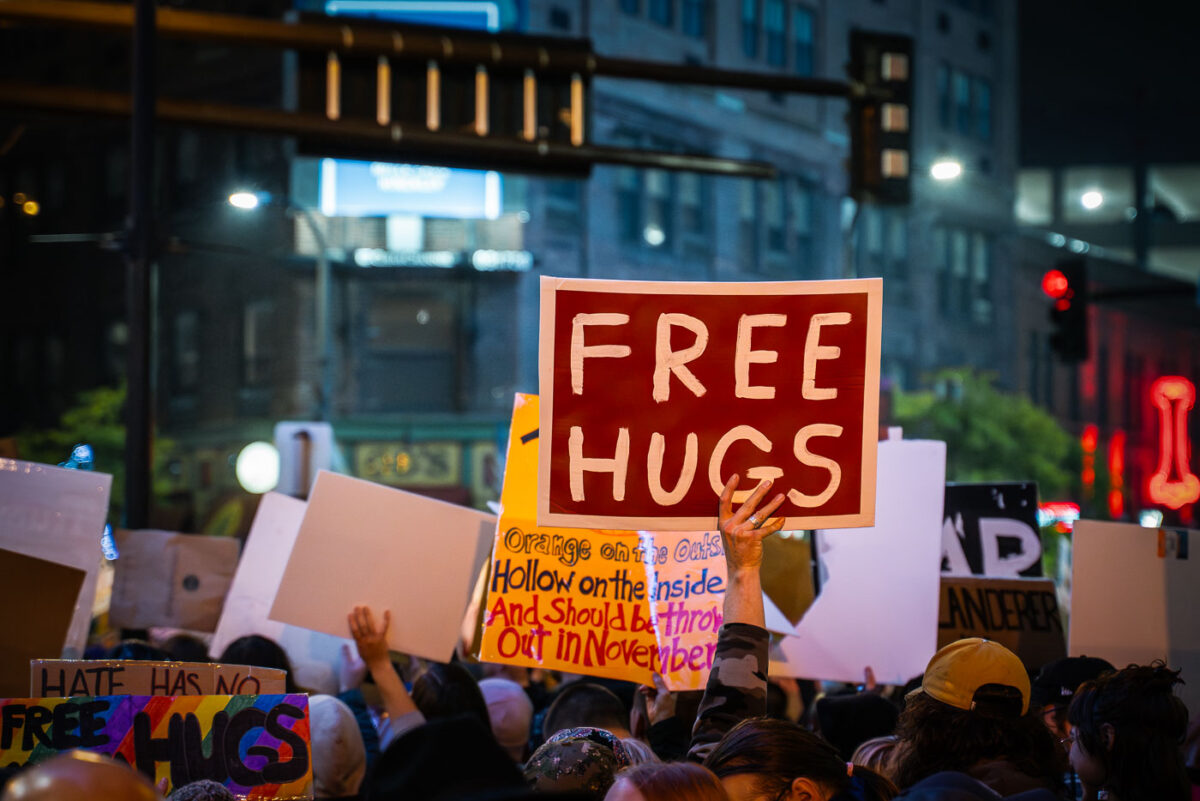
October 2019 — A protester holds a “Free Hugs” sign amid a large demonstration outside the Target Center in Minneapolis on October 10, 2019. The event coincided with Donald Trump’s campaign rally, drawing thousands who gathered in the rain to voice opposition to his administration’s rhetoric and policies. Despite the tense political atmosphere, moments of solidarity and humor emerged throughout the crowd.
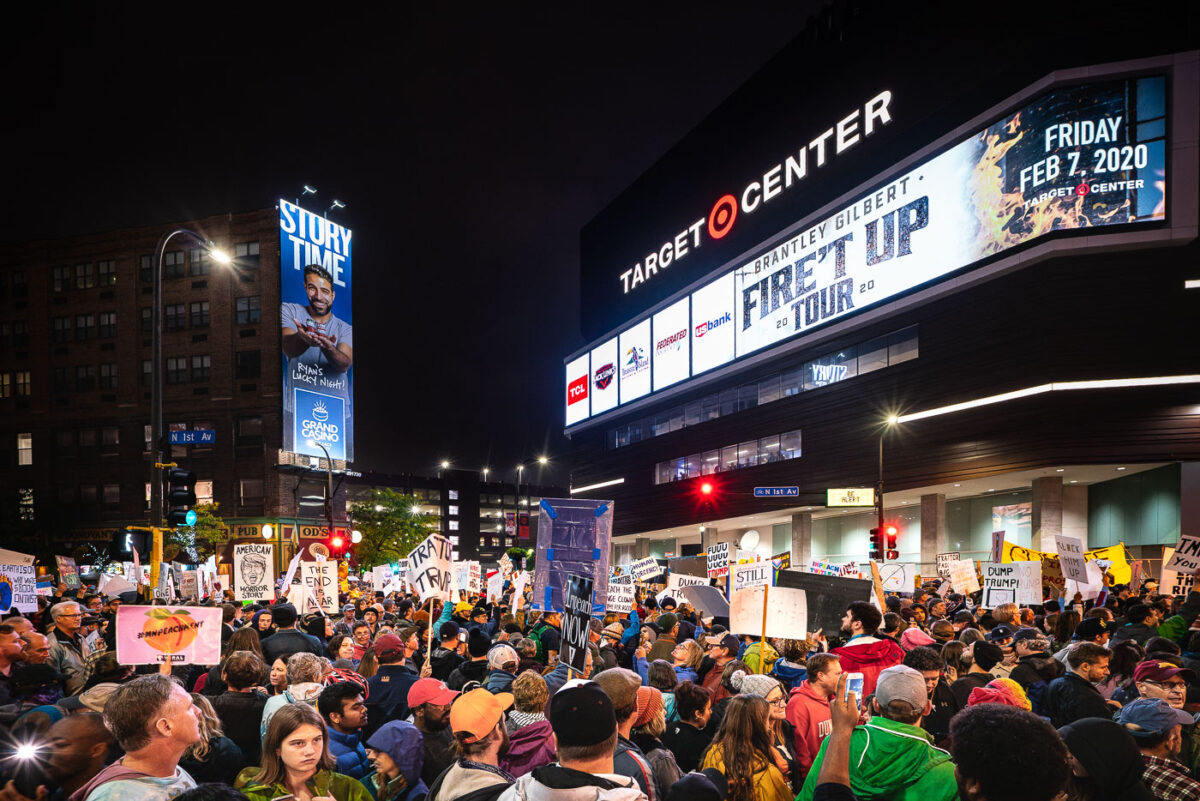
October 2019 — Protesters hold up signs outside the Target Center in downtown Minneapolis. The site of a Trump campaign rally on October 10, 2019.
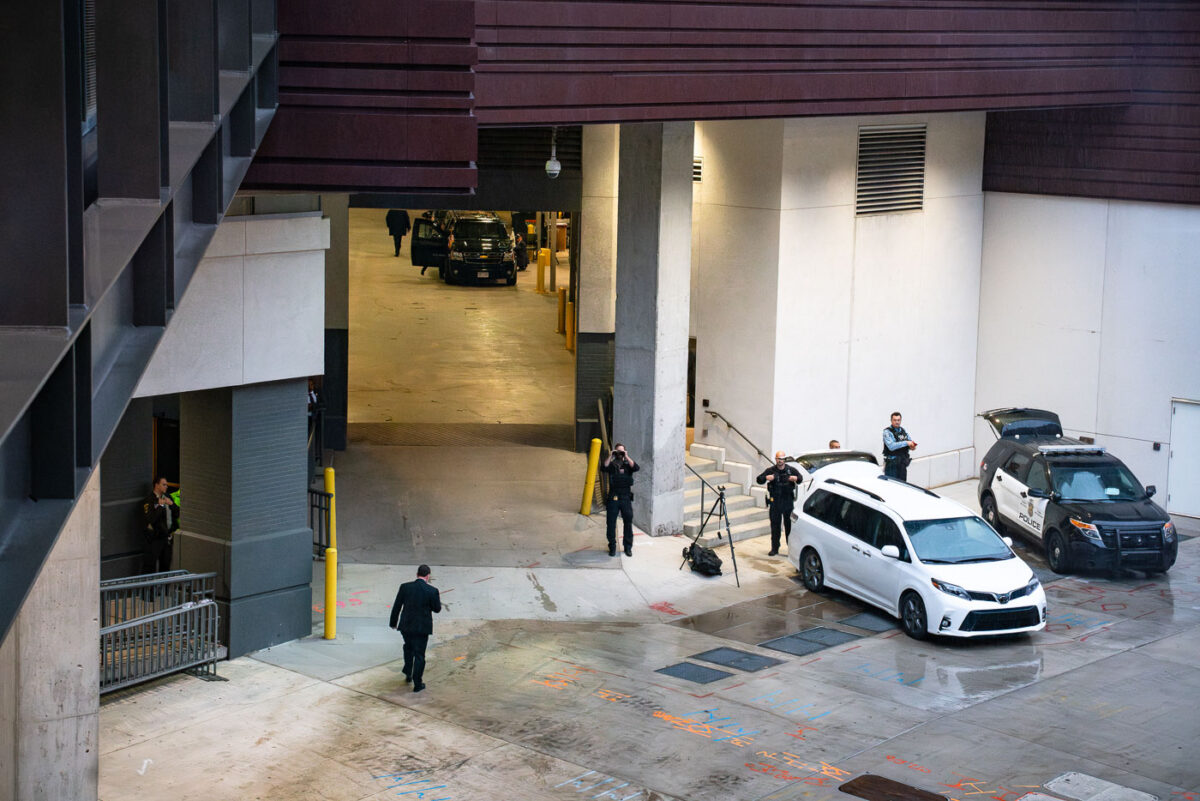
October 2019 — Secret Service looking through binoculars outside the Target Center in Minneapolis on October 10, 2019. He awaits the Presidential motorcade.
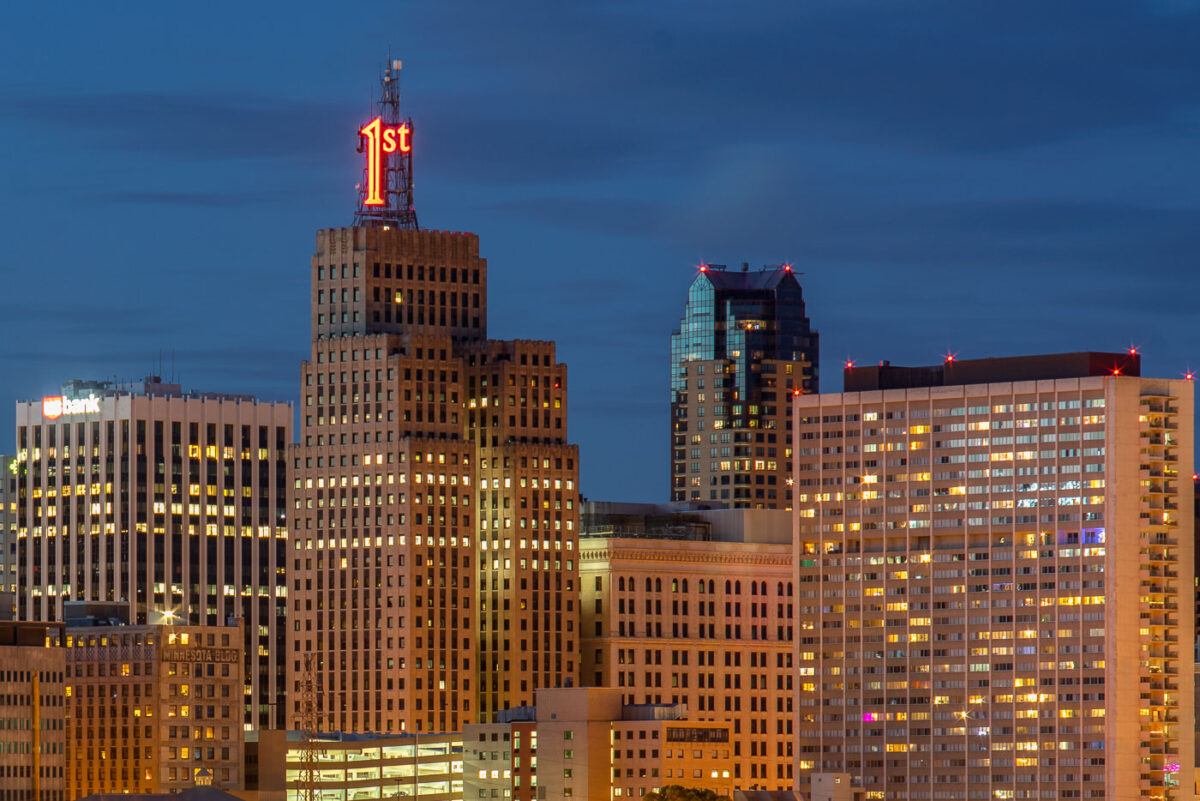
September 2019 — The First National Bank Building shown in Downtown Minneapolis.