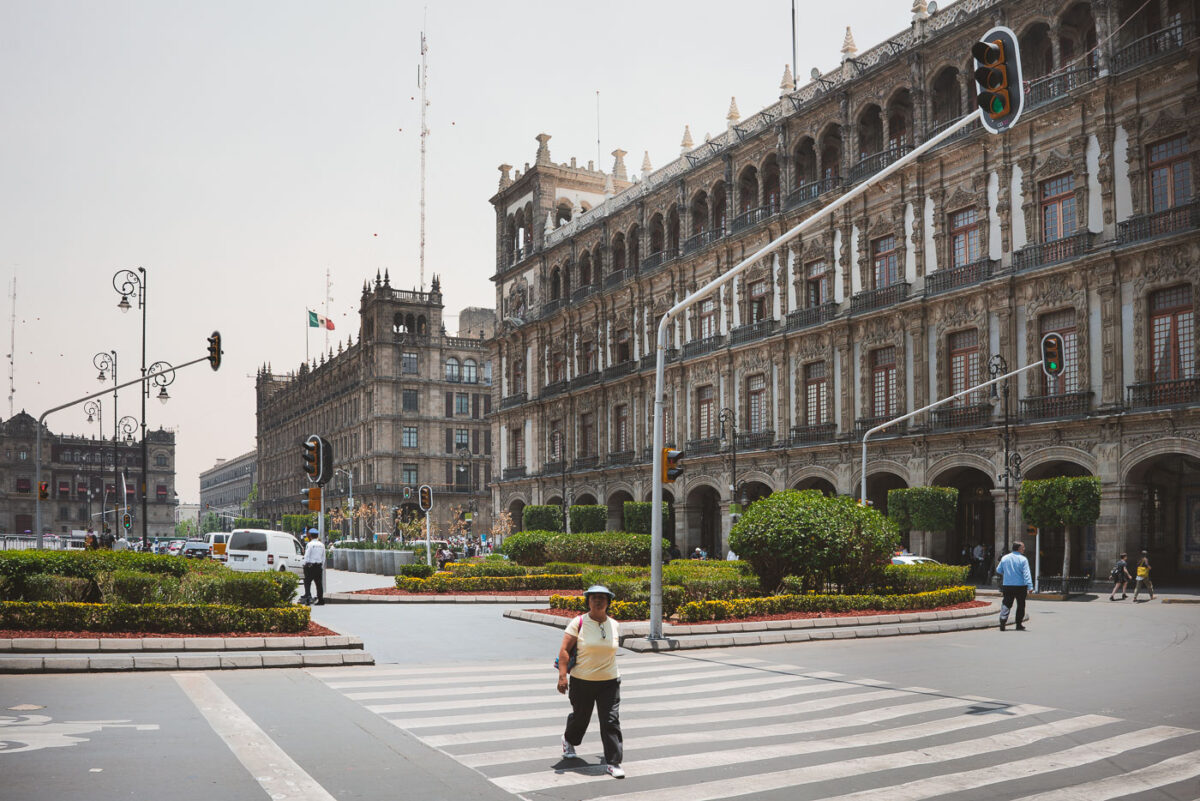
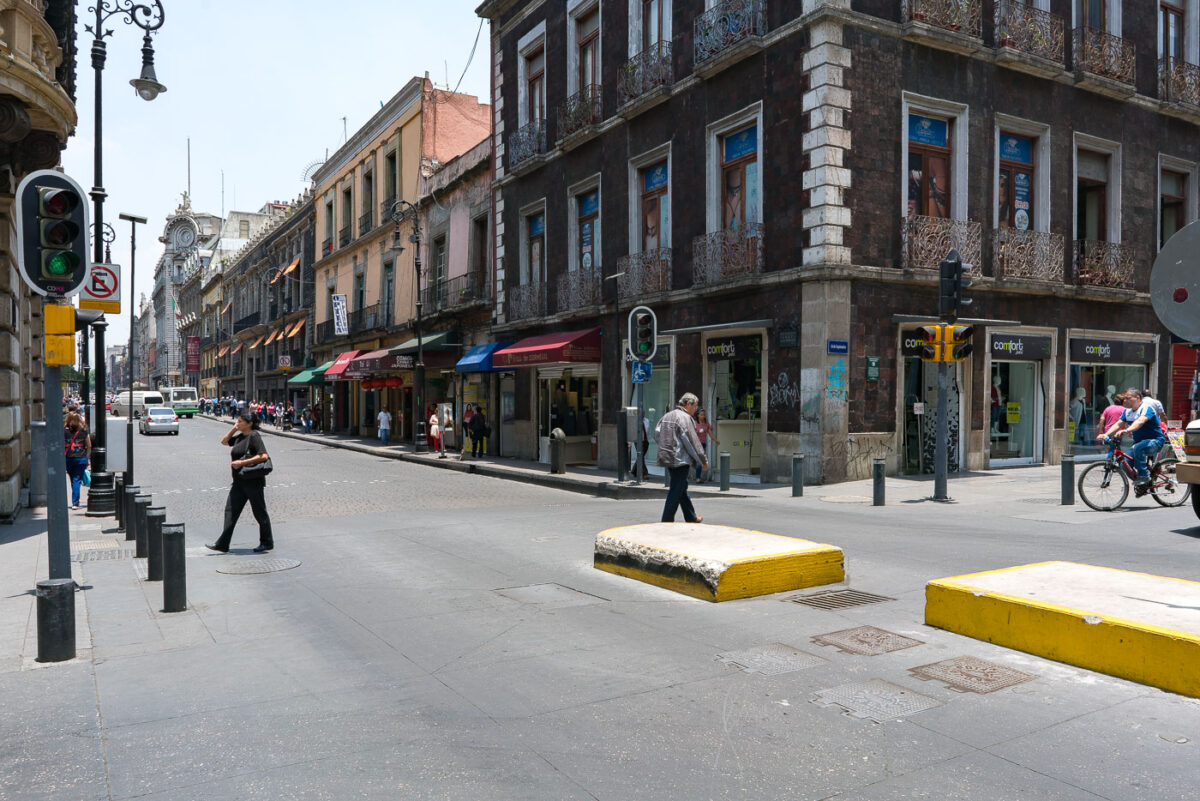
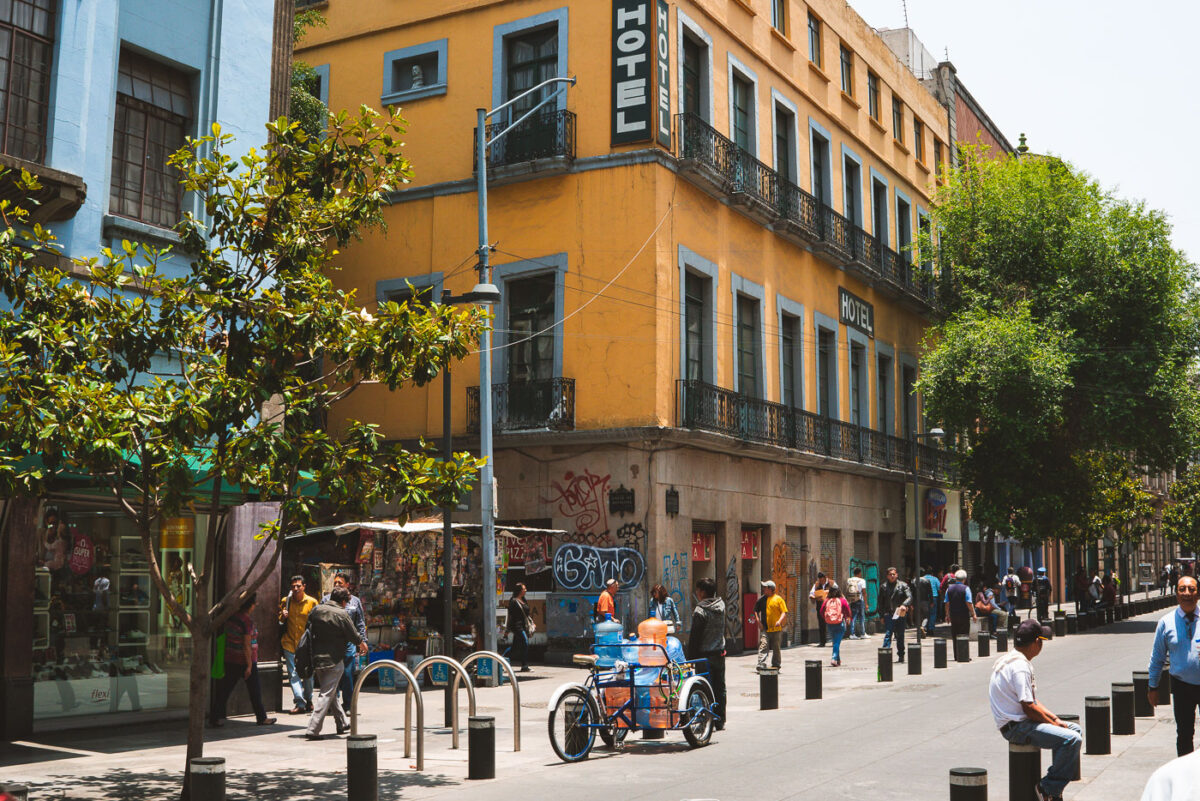
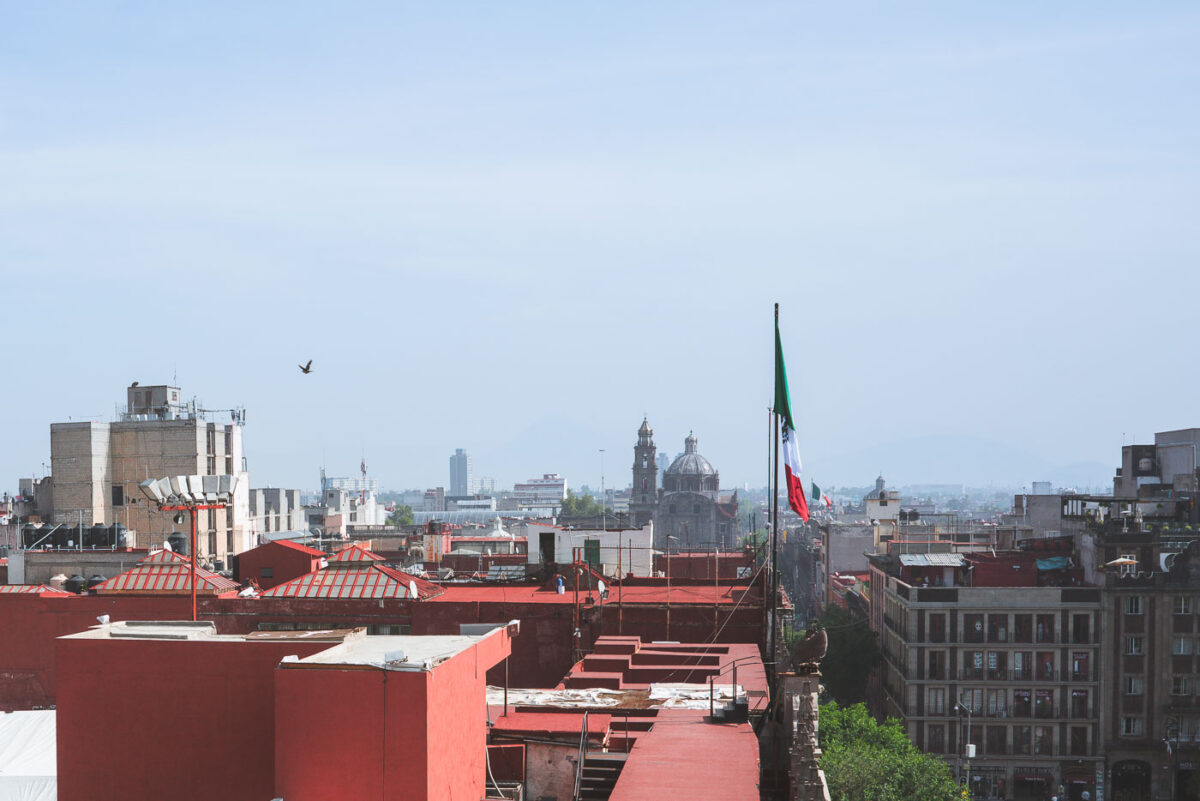
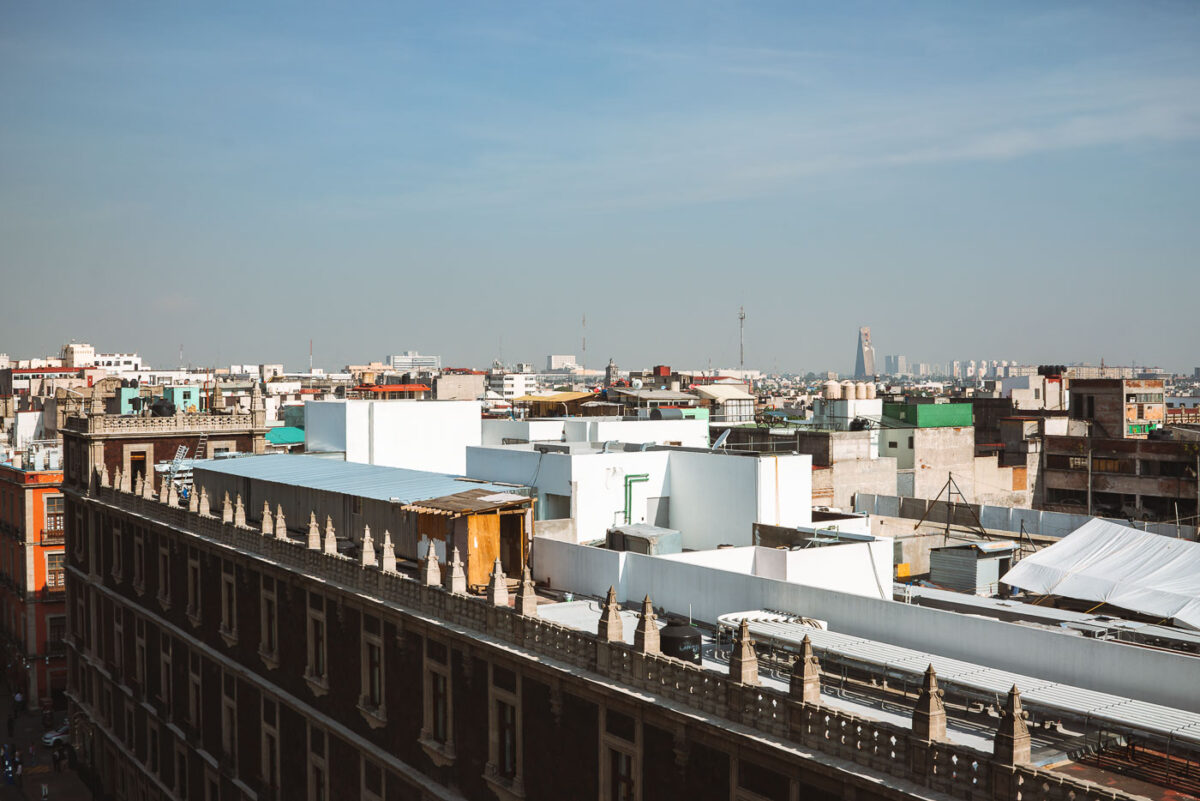
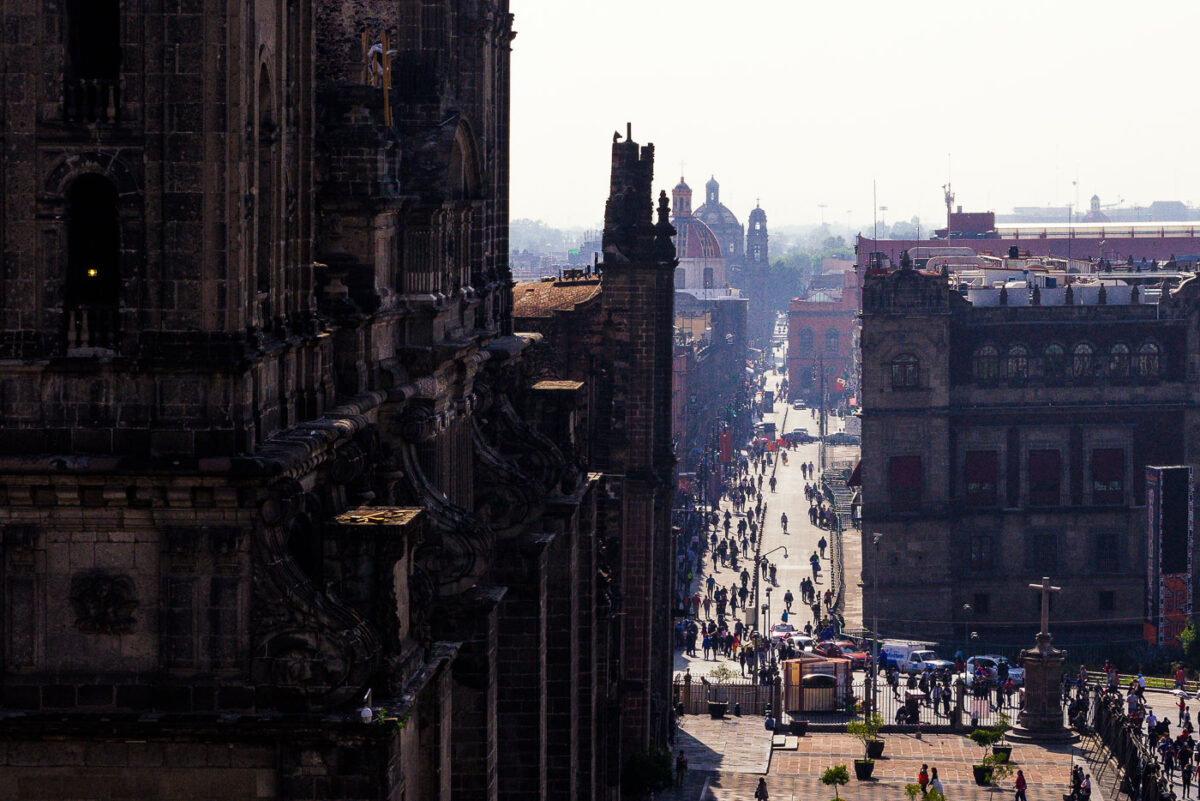
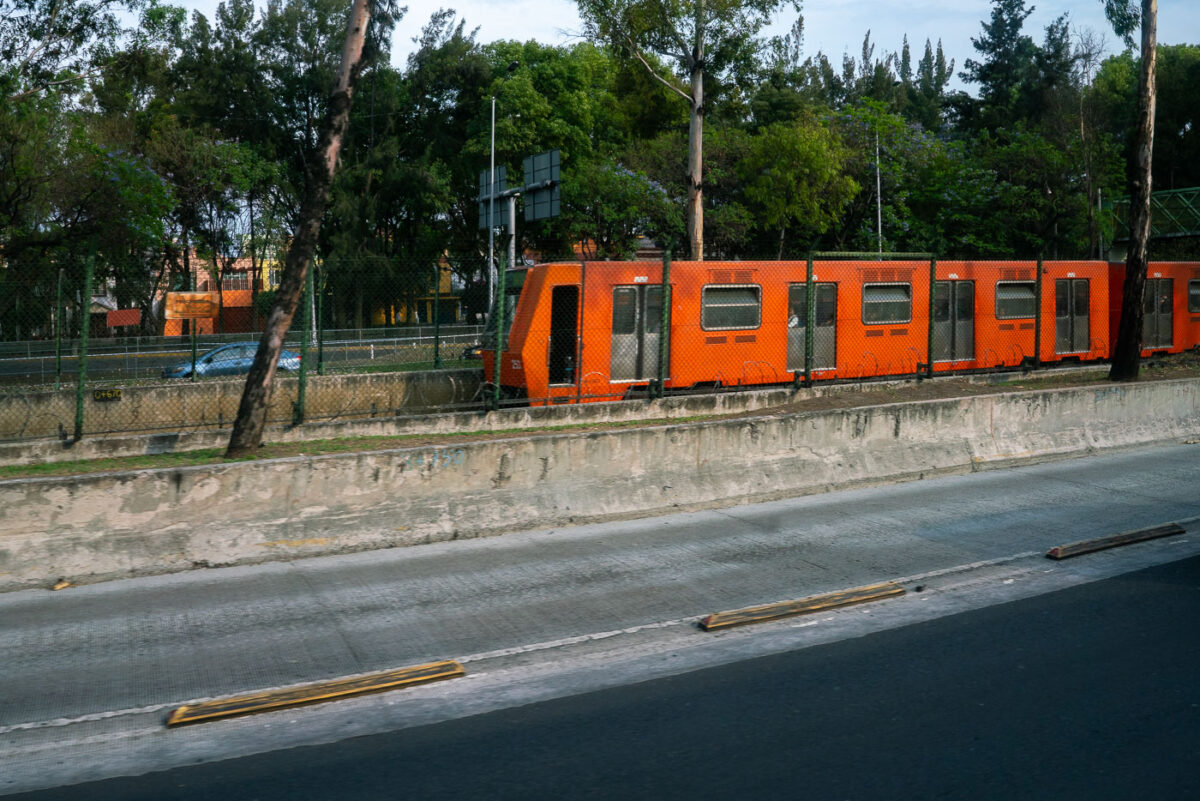
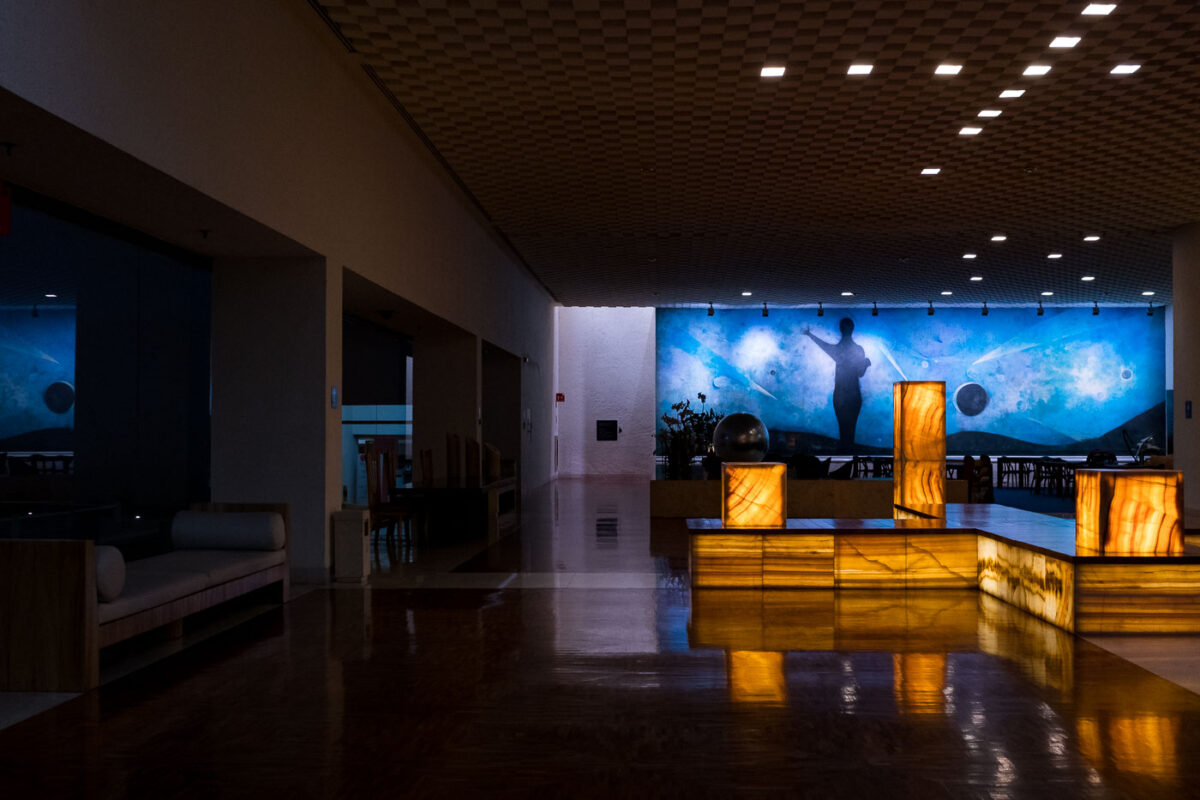
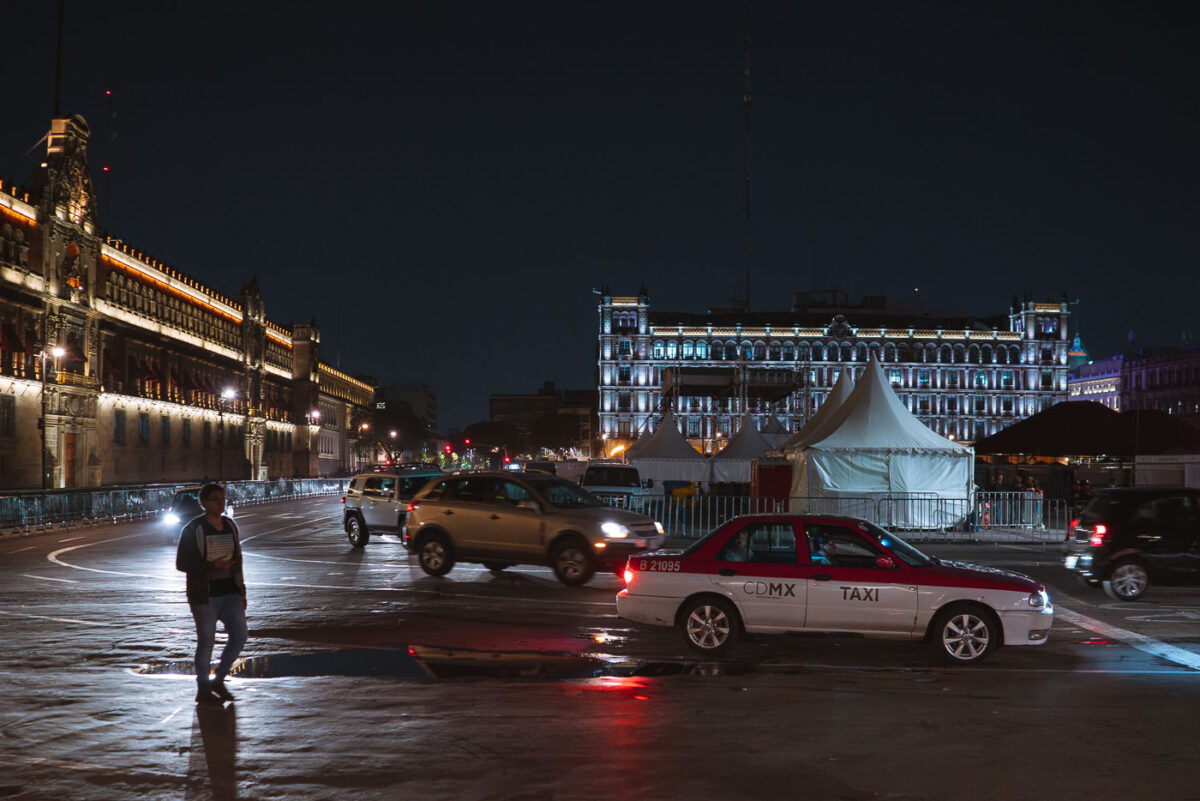
May 3, 2018 — Pedestrians cross a street at Mexico City’s Zócalo, with the ornate colonial-era Government Palace and other historic administrative buildings lining the square. The Mexican flag is visible flying above the rooftops, while traffic lights and landscaped roundabouts frame the busy intersection.May 3, 2018 — Intersection in Mexico City’s historic center with pedestrians crossing and cyclists moving along the street. Colonial-era buildings with balconies line the block, housing shops at street level. A bus and several storefronts with awnings are visible further down the road.May 3, 2018 — A street in Mexico City’s historic center with pedestrians walking past shops and vendors. A bright yellow hotel building with blue trim stands on the corner, while a tricycle cart carrying large water jugs moves through the scene. Trees line the walkway, and people gather along the shaded sidewalks.May 3, 2018 — View over the rooftops of central Mexico City, where a large Mexican flag is raised above the buildings near the Zócalo. In the distance, church domes and towers rise over the historic district, with modern high-rises visible further out along the skyline.May 3, 2018 — Rooftops of Mexico City’s historic center fill the foreground, with flat structures, water tanks, and makeshift additions visible across the skyline. Toward the horizon, modern high-rise buildings such as Torre Latinoamericana and Torre Reforma rise above the urban sprawl, contrasting with the older low-rise construction of the central district.May 3, 2018 — A busy street scene in Mexico City’s historic center, viewed from the steps of the Metropolitan Cathedral. Pedestrians fill the avenue leading eastward, lined with colonial-era buildings. In the background, the domes and towers of additional churches rise above the rooftops, marking the dense architectural landscape of the city’s downtown.May 1, 2018 — A bright orange Mexico City Metro train runs alongside the Viaducto highway, partially framed by trees and fencing that separate it from the busy traffic corridor. The train’s distinctive color has become a visual emblem of the city’s vast and aging transit network, originally launched in 1969. These rubber-tired trains serve millions of riders daily, threading through tunnels and elevated sections across the capital. Here, the contrast between greenery, concrete, and the orange carriages underscores the Metro’s integration into the urban landscape—an ever-moving artery of one of the world’s largest cities.April 30, 2018 — Inside a Mexico City hotel, warm amber lights from onyx columns reflect across a polished marble floor, creating a calm, cinematic glow. At the far end, a mural in rich blues depicts a silhouetted figure surrounded by celestial forms—part of the city’s long tradition of integrating public art into architectural spaces. The interior design blends modernist geometry with soft natural materials, emphasizing both luxury and restraint. Subtle symmetry, clean lines, and the interplay between shadow and illumination give the space a quiet sense of sophistication common in the capital’s mid-to-high-end hotels.April 30, 2018 — The dense vertical rhythm of Avenida Reforma captures Mexico City’s layered identity — a metropolis balancing past and future. In the foreground, aging residential blocks bear graffiti and sun-faded paint, symbols of mid-century urban life. Rising behind them are the glass and concrete spires of the city’s new financial core, including Torre Reforma, Torre BBVA, and Torre Mayor, among the tallest buildings in Latin America. The contrast is striking: the utilitarian decay of the 20th century meets the engineered ambition of the 21st. Beneath it all, traffic surges westward toward Chapultepec, reflecting the restless motion of a city forever under construction.April 29, 2018 — Seen from above, the Palacio de Bellas Artes reveals the full grandeur of its domed roof, glazed with fiery orange and yellow tiles that catch the fading afternoon light. Completed in 1934 after three decades of interrupted construction, the palace stands as Mexico City’s most celebrated cultural landmark, bridging the Art Nouveau exterior of marble and iron with the Art Deco interiors that host murals by Rivera, Orozco, and Tamayo. Below, crowds move through the Alameda Central, the city’s oldest public park, where the palace’s steps remain a constant gathering place for tourists, artists, and protestors alike — a living intersection of Mexico’s artistic and civic life.April 29, 2018 — Mexico City is shown from above at sunset, with the Paseo de la Reforma running diagonally through the right side of the image. To the left, the dense central districts display mid-rise buildings with red rooftops, while clusters of high-rise office towers dominate the skyline further west. The large green area on the right is the Alameda Central park. In the distance, the Sierra Madre mountains form the backdrop under a layer of clouds.April 28, 2018 — Rows of red Ecobici bicycles line a graffiti-marked wall in Mexico City’s historic center, their white fenders catching what little light remains from nearby street lamps. The city’s bike-share program, launched in 2010, represents one of Latin America’s most ambitious urban mobility projects, linking thousands of residents and commuters through sustainable transport. In the quiet of night, the empty docking station tells a different story — a pause between the day’s rush and the city’s nocturnal hum, where the blend of public art, infrastructure, and wear marks the pulse of daily urban life in the capital.April 28, 2018 — As evening settles over Mexico City’s Centro Histórico, informal vendors spread colorful textiles, pillows, and trinkets across the pedestrian walkway of Avenida Francisco I. Madero. The avenue, one of Latin America’s busiest foot corridors, connects the Zócalo to the Palacio de Bellas Artes and thrums with life well into the night. Illuminated storefronts and cafés like Vips cast reflections onto the restored stone façades of early 20th-century architecture. Beneath the glow of the streetlamps, the mingling of workers, families, and passersby captures the layered rhythm of Mexico City — a metropolis where commerce, tradition, and resilience coexist within its historic streetscape.