
Skip to content
Chad Davis Photography
Photo Archive
Photo Archive
  • Home
  • Minneapolis Uprising
  • Travel
    • Belize
    • Bruges, Belgium
    • Costa Rica
    • Dominican Republic
    • Guatemala
    • Las Vegas
    • London
    • Tampa, Florida
    • Tokyo
  • Series
    • Minneapolis Uprising
    • Minneapolis and COVID-19
    • NASA Michoud Assembly Facility
    • Outside the 2024 Republican National Convention
    • Tesla Takedown: Minneapolis
    • No Kings – Hands Off – 50501 Protests Minnesota
  • Contact
Photo Archive
Photo Archive
Chad Davis Photography
Photo Archive
Photo Archive
Photo Archive
Photo Archive
Chad Davis Photography
Photo Archive
Photo Archive
  • Home
  • Minneapolis Uprising
  • Travel
    • Belize
    • Bruges, Belgium
    • Costa Rica
    • Dominican Republic
    • Guatemala
    • Las Vegas
    • London
    • Tampa, Florida
    • Tokyo
  • Series
    • Minneapolis Uprising
    • Minneapolis and COVID-19
    • NASA Michoud Assembly Facility
    • Outside the 2024 Republican National Convention
    • Tesla Takedown: Minneapolis
    • No Kings – Hands Off – 50501 Protests Minnesota
  • Contact
Photo Archive
Photo Archive
Chad Davis Photography
Photo Archive
Photo Archive
Photo Archive
Photo Archive
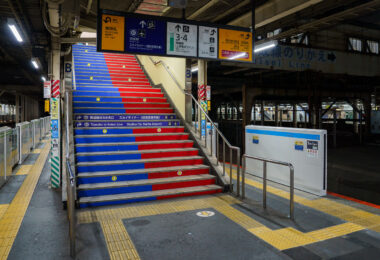
A color-coded stairway inside Nippori Station directs passengers to the Keisei Line platforms, the primary transfer point for travelers heading to Narita Airport on the high-speed Skyliner. Nippori serves as a major interchange between JR East lines, the Keisei Main Line, and the Nippori–Toneri Liner, linking northern Tokyo neighborhoods to the broader regional network. The mixed architecture—older steel passageways alongside newer safety upgrades like platform-edge barriers—reflects the station’s layered development since its opening in 1905. Today, Nippori remains one of Tokyo’s most important cross-rail transfer nodes, especially for airport-bound passengers navigating the city’s extensive transit system.

Transfer Stairway to the Keisei Line at Nippori Station

A color-coded stairway inside Nippori Station directs passengers to the Keisei Line platforms, the primary transfer point for travelers heading…
Japan, Keisei Line, Nippori Station, Subway, Tokyo, Train, Train Station
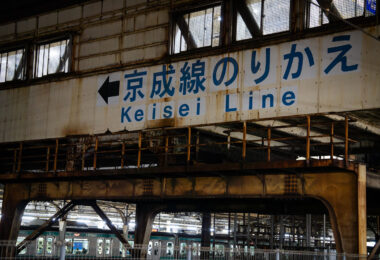
A weathered overhead passage at Nippori Station directs passengers toward the Keisei Line, one of Tokyo’s key links to Narita Airport via the Skyliner service. Nippori has served as a major interchange since the early 20th century, connecting JR East’s Yamanote, Keihin-Tōhoku, and Jōban lines with the private Keisei network.

The aging steelwork and faded signage reflect the layered construction of the station complex, where older elevated structures remain in daily use alongside modernized ticketing halls and platform edge barriers. Despite its utilitarian appearance, this transfer point moves thousands of airport-bound travelers each day, making it one of Tokyo’s busiest cross-rail connections.

Keisei Line Transfer Passage at Nippori Station

A weathered overhead passage at Nippori Station directs passengers toward the Keisei Line, one of Tokyo’s key links to Narita…
Japan, Keisei Line, Subway, Tokyo, Train
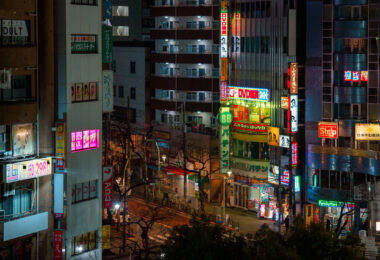
A nighttime view of the commercial streets southwest of Nippori Station in Tokyo’s Arakawa ward, where pachinko parlors, DVD shops, cafés, and convenience stores fill the dense blocks between Nippori and Nishi-Nippori stations. The brightly lit BB Pachinko building and the FamilyMart at street level serve as local landmarks, with narrow side streets branching off toward older residential buildings. The mix of neon signage, small restaurants, and multi-story entertainment businesses reflects the typical streetscape found along the fringe of Tokyo’s major commuter hubs.

This part of Nippori sits just outside the historic Yanaka district, one of the few neighborhoods that survived the 1923 Great Kantō Earthquake and wartime bombing. As the city expanded after the war, the areas around Nippori Station developed into a transit-oriented commercial zone—first serving textile shops and wholesalers, then gradually shifting toward pachinko centers, cafés, and commuter-friendly stores. Today the district remains a blend of old and new Tokyo: dense, walkable, illuminated late into the night, yet still closely connected to the quieter temple districts just a few blocks away.

Night Streets Near Nippori Station, Tokyo

A nighttime view of the commercial streets southwest of Nippori Station in Tokyo’s Arakawa ward, where pachinko parlors, DVD shops,…
Japan, Nippori Station, Tokyo
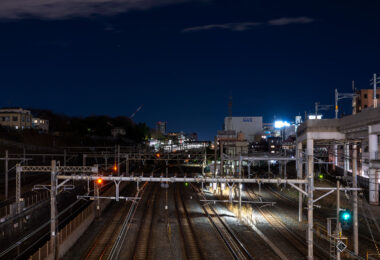
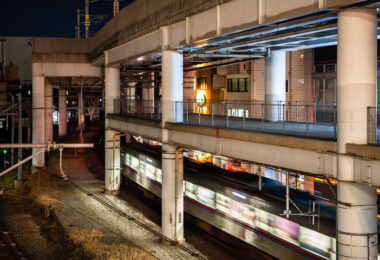
Multiple rail lines converge near Nippori Station in Tokyo, a key junction connecting the JR Yamanote, Keisei, and Joban lines. The illuminated signals and overhead power lines reveal the complexity of the city’s rail infrastructure as it weaves through residential and industrial zones. To the right, elevated expressway supports and nearby buildings frame the corridor, emphasizing Tokyo’s dense layering of transport systems and urban development.

Rails outside Nippori Station in Tokyo

Multiple rail lines converge near Nippori Station in Tokyo, a key junction connecting the JR Yamanote, Keisei, and Joban lines….
Japan, Nippori Station, Subway, Tokyo, Train, Train Station
A commuter train passes through Nippori Station in Tokyo beneath an elevated expressway. Nippori is a major interchange for the JR Yamanote, Keisei, and Joban lines, connecting central Tokyo with Narita Airport and surrounding neighborhoods. The scene reflects the district’s tightly integrated infrastructure, where multiple rail lines and highways converge within a compact urban corridor.

Nippori Station at night

A commuter train passes through Nippori Station in Tokyo beneath an elevated expressway. Nippori is a major interchange for the…
Japan, Nippori Station, Tokyo, Train Station
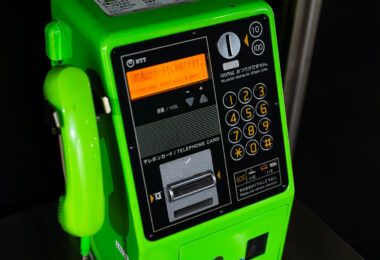
A bright green NTT public payphone, once a fixture of every Japanese street corner and train station, stands as a reminder of Japan’s pre-smartphone era. Its sturdy metal receiver, telephone card slot, and bilingual instructions highlight the country’s enduring attention to accessibility and precision. Still functional today, these phones remain a quiet symbol of Japan’s blend of reliability and retro technology.

NTT Pay Phone In Japan

A bright green NTT public payphone, once a fixture of every Japanese street corner and train station, stands as a…
Japan, NTT, Pay phone, phone, Tokyo
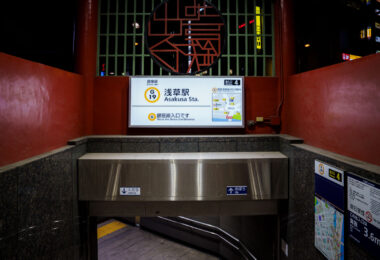
An entrance to Tokyo Metro’s Asakusa Station on the Ginza Line, marked with the station code G-19, leads commuters down a clean, tiled stairway under the red-painted gateway structure. The illuminated signage displays route maps and directional guidance, combining modern wayfinding with the surrounding area’s traditional aesthetic. Located near Sensō-ji Temple, this entrance reflects Asakusa’s balance of old Tokyo charm and contemporary transit design.

Asakusa Station Entrance Tokyo

An entrance to Tokyo Metro’s Asakusa Station on the Ginza Line, marked with the station code G-19, leads commuters down…
Asakusa Station, Japan, Subway, Tokyo, Train, Train Station
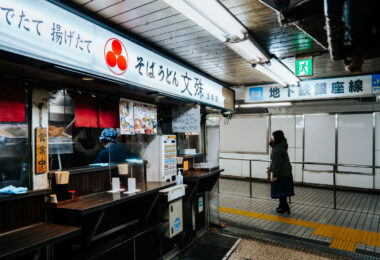
A small soba counter operates inside Asakusa Underground Street, one of Tokyo’s oldest surviving subterranean shopping arcades. Tucked beneath the streets near Asakusa Station, these compact eateries serve quick bowls of soba and udon to commuters and visitors moving between the metro and the surrounding neighborhood.

Opened in 1955, Asakusa Underground Street is considered the oldest underground shopping street in Japan. Its narrow corridors, low ceilings, and tightly packed storefronts preserve a postwar atmosphere that has largely vanished from Tokyo as major stations modernized. The passageway originally developed as a practical connection point for transit riders, but it evolved into a lively network of bars, snack counters, tobacconists, and small service shops. Today, despite gradual renovation, it remains one of the city’s most atmospheric relics of mid-20th-century urban life—an example of how Tokyo’s underground spaces doubled as both transportation infrastructure and neighborhood social hubs.

Asakusa Underground Street Soba Counter

A small soba counter operates inside Asakusa Underground Street, one of Tokyo’s oldest surviving subterranean shopping arcades. Tucked beneath the…
Asakusa, Asakusa Underground Street, Japan, Subway, Tokyo, Train Station
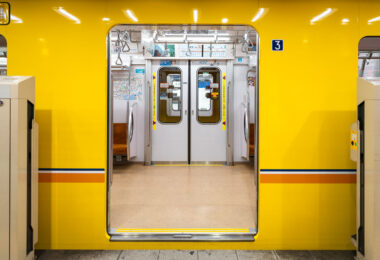
Tokyo’s Marunouchi Line is one of Japan’s oldest and busiest subway routes, linking major commercial and governmental districts through a network that dates back to 1954. This view shows the Series 2000 rolling stock, a modernized fleet introduced by Tokyo Metro beginning in 2019 to replace aging Series 02 cars.

The trains feature energy-efficient LED lighting, regenerative braking, and improved accessibility through wider doorways and level boarding. Their bright yellow exterior, trimmed with red and blue stripes, preserves the line’s traditional color while emphasizing the sleek, minimalist design typical of contemporary Japanese transit engineering.

Inside, the cabin layout prioritizes capacity and passenger flow, with longitudinal bench seating covered in patterned orange upholstery and overhead digital route displays in both Japanese and English. The Marunouchi Line operates on a 1,500 V DC overhead catenary and runs entirely underground except for a brief surface section near Nakano-Sakaue, connecting Ikebukuro to Ogikubo over a 24.2-kilometer route that handles hundreds of thousands of passengers daily.

Tokyo Metro Marunouchi Line Series 2000 Train Interior, Japan

Tokyo’s Marunouchi Line is one of Japan’s oldest and busiest subway routes, linking major commercial and governmental districts through a…
Asakusa, Ginza, Ginza Line, Japan, Station, Subway, Taito City, Tokyo, Train
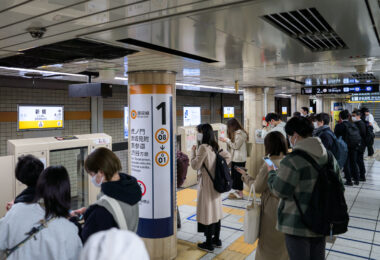
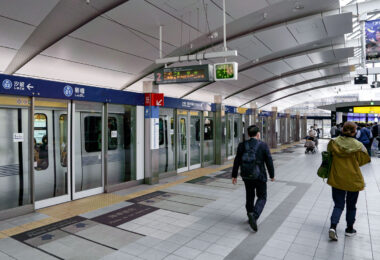
Commuters wait for the next train on the Tokyo Metro Ginza Line, Japan’s oldest underground subway line and one of the city’s most heavily traveled routes. This platform—serving trains toward Toranomon, Akasaka-mitsuke, Omote-sando, and Shibuya—captures a typical weekday scene with riders lining up at designated doors, phones in hand, as screen doors stand ready to open with the arriving train.

Opened progressively between 1927 and 1939, the Ginza Line was Asia’s first subway, modeled after London’s Underground and New York’s early lines. Its development helped shape modern Tokyo by linking emerging commercial districts—including Asakusa, Ginza, and Shibuya—into a cohesive urban network. Today, despite being nearly a century old, the line remains a backbone of the city’s transportation system, continually upgraded with platform doors, advanced signaling, and refreshed stations to meet the demands of one of the world’s busiest transit cities.

Morning Rush on the Tokyo Metro Ginza Line

Commuters wait for the next train on the Tokyo Metro Ginza Line, Japan’s oldest underground subway line and one of…
Ginza Line, Japan, Shimbashi Station, Tokyo, Tokyo Metro
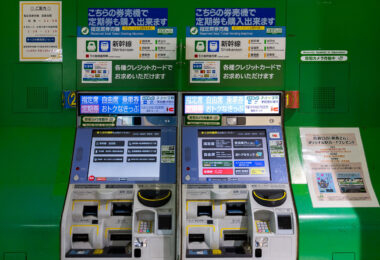
A pair of Shinkansen ticket vending machines at a Japanese railway station, featuring multilingual touchscreens and payment slots for both cash and IC cards. These machines allow travelers to purchase reserved and non-reserved tickets for Japan’s high-speed rail network, as well as commuter passes and regional fare cards. The bright green backdrop and clear signage reflect Japan Rail’s emphasis on efficiency and accessibility, enabling quick transactions even during the busiest travel hours.

Shinkansen ticket vending machines

A pair of Shinkansen ticket vending machines at a Japanese railway station, featuring multilingual touchscreens and payment slots for both…
Japan, Japan Rail, JR, Rail, Rail Pass, Shinkansen, Tokyo
Shiodome Station in Minato Tokyo Japan.

Shiodome Station, Tokyo Japan

Shiodome Station in Minato Tokyo Japan.

Japan, Minato, Shiodome Station, Subway, Tokyo, Train
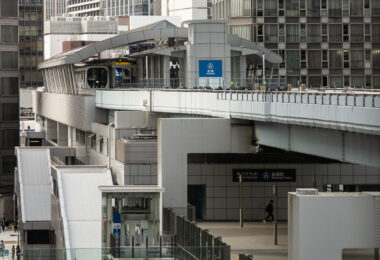
Shimbashi Station serves as a key interchange between Tokyo’s dense urban rail systems, connecting JR East lines with the Yurikamome automated transit route to Odaiba. The elevated Yurikamome track, seen here curving above the city streets, is a fully driverless, rubber-tired train line that opened in 1995 to link Tokyo’s central business districts with its reclaimed waterfront developments.

This structure’s sleek metallic architecture and tiered design reflect Japan’s approach to maximizing space efficiency in high-density transport corridors. The network below includes the JR Yamanote Line, Tokyo Metro Ginza Line, and the Toei Asakusa Line, making Shimbashi one of the most vertically integrated transit hubs in Japan.

Shimbashi Station and the Elevated Yurikamome Line in Tokyo

Shimbashi Station serves as a key interchange between Tokyo’s dense urban rail systems, connecting JR East lines with the Yurikamome…
Japan, Shimbashi Station, Subway, Tokyo, Train Station
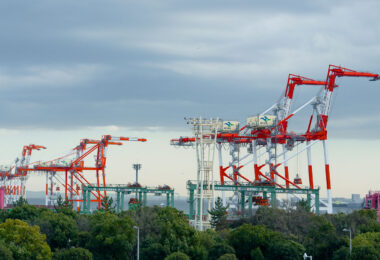
Towering gantry cranes line the waterfront at a Japanese container terminal, their red and white frames contrasting sharply against the overcast sky. The cranes, marked with “Evergreen” and “K” Line logos, are used to load and unload massive cargo ships that connect Japan to global trade routes. Surrounded by greenery and infrastructure, the scene reflects the blend of industry and environment common to Japan’s modern port cities—where precision logistics and advanced automation keep goods moving efficiently through one of the world’s busiest maritime networks.

Container cranes in Tokyo Japan

Towering gantry cranes line the waterfront at a Japanese container terminal, their red and white frames contrasting sharply against the…
Containers, Evergreen, Japan, Port, Shipping, Tokyo
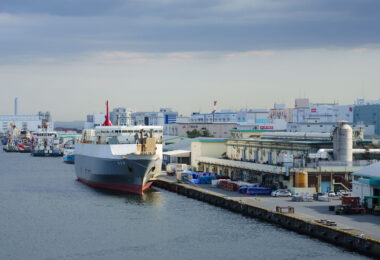
A cargo ship is docked at an industrial pier surrounded by warehouses and factory buildings, their signs bearing familiar Japanese corporate logos. The port’s calm waters and moored vessels hint at the steady rhythm of maritime logistics, with goods flowing in and out of Japan’s manufacturing heartlands. Overhead, a muted sky and the ship’s red funnel add contrast to the subdued industrial palette, capturing a typical day in one of the nation’s bustling coastal trade zones.

Shipping Port in Tokyo Japan

A cargo ship is docked at an industrial pier surrounded by warehouses and factory buildings, their signs bearing familiar Japanese…
Boat, Cargo Ship, Japan, Shipping Port, Tokyo
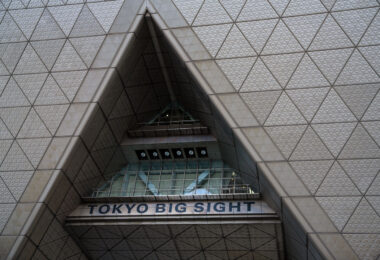
Tokyo Big Sight—officially known as the Tokyo International Exhibition Center—is Japan’s largest convention and exhibition complex, located in the Ariake district on the western edge of Tokyo Bay. Opened in 1996, the complex is best known for its iconic Conference Tower, composed of four massive inverted pyramids clad in reflective titanium panels that shimmer under changing light.

The architectural design, by AXS Satow, integrates advanced engineering with postmodern geometric motifs, balancing the heavy concrete and steel structure with triangular glass façades and intricate diamond-patterned surfaces. Standing 58 meters tall, the Conference Tower houses international meeting halls, press facilities, and observation decks overlooking Odaiba and the Rainbow Bridge.

Tokyo Big Sight regularly hosts global-scale events such as the Tokyo Motor Show, Comiket, and international technology expos, serving as a central hub for commerce and culture in modern Japan. The design reflects both the futuristic optimism of the 1990s and Tokyo’s ongoing commitment to bold, large-scale civic architecture.

Tokyo Big Sight’s Geometric Towers, Ariake, Tokyo Bay, Japan

Tokyo Big Sight—officially known as the Tokyo International Exhibition Center—is Japan’s largest convention and exhibition complex, located in the Ariake…
Convention Center, Japan, Tokyo, Tokyo Big Sight
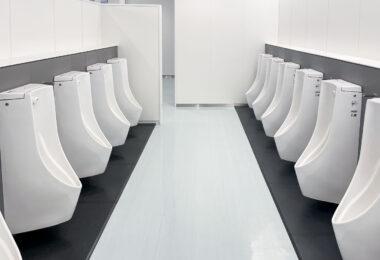
A perfectly symmetrical row of urinals inside a modern public restroom in Japan, where minimalist design meets meticulous cleanliness. The glossy white fixtures and pale reflective flooring emphasize balance and precision, creating an unexpectedly architectural sense of order in a utilitarian space. The visual rhythm of repetition — identical forms mirrored across the corridor — captures Japan’s cultural devotion to hygiene, geometry, and quiet functionality in even the most mundane public settings.

Symmetry in Clean Design

A perfectly symmetrical row of urinals inside a modern public restroom in Japan, where minimalist design meets meticulous cleanliness. The…
Architecture, Bathroom, Japan, Minimalism, Tokyo
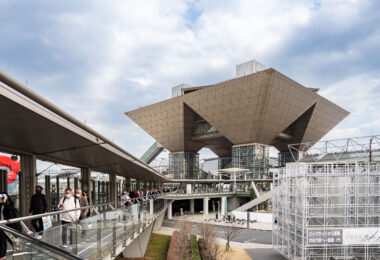
Tokyo Big Sight—officially the Tokyo International Exhibition Center—stands out with its striking inverted-pyramid conference towers, a landmark of the Odaiba and Ariake waterfront districts since its opening in 1996. Designed by architect AXS Satow, the building’s geometric titanium-clad forms and elevated walkways embody the futuristic aesthetic that defined Tokyo’s 1990s bay-area redevelopment. The elevated pedestrian route shown here leads toward the main entrance, filled with visitors streaming in for one of the venue’s frequent trade fairs, expos, and cultural events.

The convention center was built as part of a sweeping effort to revitalize reclaimed land along Tokyo Bay, transforming former industrial zones into hubs for technology, design, and international commerce. Its proximity to the automated Yurikamome transit line helped anchor Odaiba as a showcase for modern urban planning, connecting attractions like Rainbow Bridge, Fuji TV, and the waterfront parks. Today, Tokyo Big Sight remains one of Japan’s busiest exhibition complexes and a defining piece of the city’s contemporary architectural heritage.

Tokyo Big Sight, Ariake — February 2024

Tokyo Big Sight—officially the Tokyo International Exhibition Center—stands out with its striking inverted-pyramid conference towers, a landmark of the Odaiba…
Convention Center, Japan, Tokyo, Tokyo Big Sight
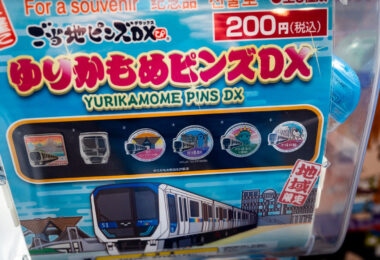
A souvenir capsule vending machine featuring “Yurikamome Pins DX” collectibles, themed after the Yurikamome Line—Tokyo’s automated, elevated transit system linking Shimbashi with the waterfront district of Toyosu via Odaiba. The pin set celebrates key stations and landmarks along the route, such as Fuji Television, Rainbow Bridge, and Tokyo Big Sight, reflecting the line’s blend of technology and tourism appeal.

Opened in 1995, the Yurikamome Line was Japan’s first fully automated guideway transit system, operating without onboard drivers. It was conceived to connect Tokyo’s redeveloped bayside area with the city center, helping transform Odaiba from a reclaimed industrial zone into a futuristic entertainment and business hub. Its name, “Yurikamome,” comes from the black-headed gull native to Tokyo Bay—a fitting emblem for this sleek, seafront line.

Yurikamome Line Souvenir Capsule Toy, Tokyo

A souvenir capsule vending machine featuring “Yurikamome Pins DX” collectibles, themed after the Yurikamome Line—Tokyo’s automated, elevated transit system linking…
Japan, Pins, Souvenir, Tokyo, Vending, Yurikamome Line Japan
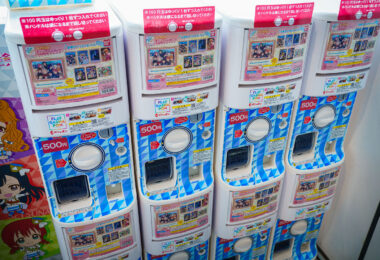
A neat row of colorful Gashapon capsule toy machines stands ready to dispense collectible surprises. Each unit, labeled with the Bandai logo and priced at 500 yen, features themed flat-pack items tied to anime or pop culture series. The bright geometric design and cheerful signage reflect Japan’s mastery of micro-entertainment—where vending and chance intersect to deliver small bursts of joy. These machines, common in train stations and malls, embody a blend of nostalgia, design precision, and everyday whimsy unique to modern Japanese street culture.

Gashapon capsule toy machines

A neat row of colorful Gashapon capsule toy machines stands ready to dispense collectible surprises. Each unit, labeled with the…
Bandai, Gachapon, Gashapon, Japan, Machine, otaku, Tokyo, Vending
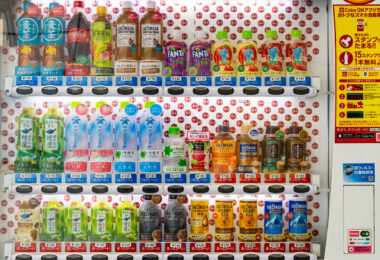
A brightly lit Japanese vending machine displays a meticulously arranged lineup of drinks—from Coca-Cola and Fanta to bottled teas, mineral waters, and Georgia coffee blends. Each row is clearly priced, some marked with blue “つめたい” (cold) or red “あったかい” (hot) labels, offering both chilled and warmed beverages. The right panel promotes the “Coke ON” smartphone app, merging tradition with tech-driven convenience. This snapshot captures Japan’s signature vending culture: accessible, efficient, and surprisingly aesthetic in its everyday precision.

Drinks in a Tokyo Vending Machine

A brightly lit Japanese vending machine displays a meticulously arranged lineup of drinks—from Coca-Cola and Fanta to bottled teas, mineral…
Japan, Tokyo, Vending Machine
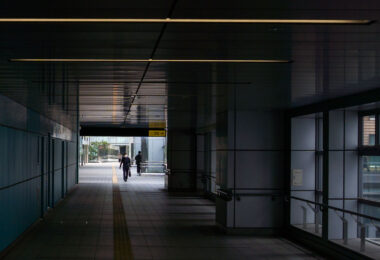
A quiet, modern pedestrian corridor connects parts of a Japanese transit hub, its metallic walls and ceiling panels reflecting soft daylight from the far exit. Yellow tactile paving guides commuters toward the outside, where a brief view of greenery contrasts with the tunnel’s rigid geometry. The minimalist design and clean lines reflect Japan’s approach to functional urban infrastructure—precise, orderly, and human-scaled.

Business man in Tokyo Japan

A quiet, modern pedestrian corridor connects parts of a Japanese transit hub, its metallic walls and ceiling panels reflecting soft…
Japan, Man, Tokyo, Walking
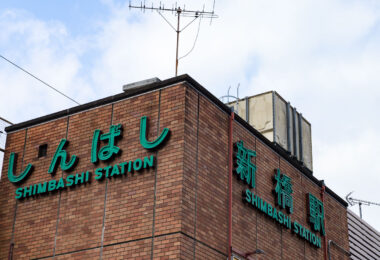
The brick exterior of Shimbashi Station displays its bold green lettering in both Japanese and English, marking one of Tokyo’s busiest commuter hubs. Opened in 1872 as Japan’s first railway terminal, Shimbashi holds deep historical significance while continuing to serve modern rail lines, including JR East and Tokyo Metro. The building’s retro façade contrasts with the skyscrapers surrounding it, symbolizing Tokyo’s seamless blend of heritage and contemporary transit infrastructure.

Shimbashi Station in Tokyo

The brick exterior of Shimbashi Station displays its bold green lettering in both Japanese and English, marking one of Tokyo’s…
Japan, Shimbashi Station, Tokyo, Train Station
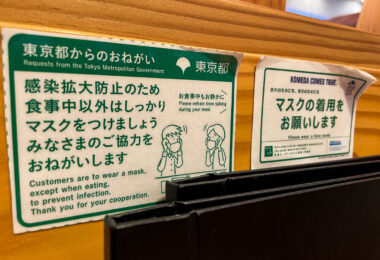
Printed notices from the Tokyo Metropolitan Government remind customers to wear masks except while eating, part of Japan’s ongoing public health etiquette during the pandemic era. The bilingual signs, featuring polite phrasing and simple illustrations, reflect Japan’s emphasis on community responsibility and quiet cooperation.

Tokyo Metropolitan Government Mask Sign

Printed notices from the Tokyo Metropolitan Government remind customers to wear masks except while eating, part of Japan’s ongoing public…
Covid, Covid Sign, Face Mask, Japan, Pandemic, Tokyo, Tokyo Metropolitan Government
← Previous 1 … 3 4 5 … 16 Next →
Collapse All | Expand All
  • Current Events  (6)
    • 2024 Republican National Convention  (1)
    • Annunciation Catholic Church Shooting  (1)
    • Minneapolis and COVID-19  (1)
    • No Kings, Hands Off, Good Trouble Protests  (1)
    • Tesla Takedown  (1)
  • Series  (1)
    • NASA Rocket Factory  (1)
  • Travel  (383)
    • Asia  (55)
      • Japan  (55)
        • Tokyo  (55)
    • Central America  (205)
      • Belize  (85)
      • Costa Rica  (51)
      • Guatemala  (69)
    • Europe  (19)
      • France  (19)
        • Paris  (19)
    • North America  (104)
      • United States  (104)
        • Massachusetts  (12)
          • Boston  (12)
        • Minnesota  (15)
          • Minneapolis  (15)
        • Nevada  (66)
          • Las Vegas  (66)
        • South Dakota  (10)
        • Wisconsin  (1)
          • Milwaukee  (1)

  • Home
  • Minneapolis Uprising
  • Travel
    • Belize
    • Bruges, Belgium
    • Costa Rica
    • Dominican Republic
    • Guatemala
    • Las Vegas
    • London
    • Tampa, Florida
    • Tokyo
  • Series
    • Minneapolis Uprising
    • Minneapolis and COVID-19
    • NASA Michoud Assembly Facility
    • Outside the 2024 Republican National Convention
    • Tesla Takedown: Minneapolis
    • No Kings – Hands Off – 50501 Protests Minnesota
  • Contact

© 1996-2025 Chad Davis
chad@chaddavis.photography


Built in Minneapolis.