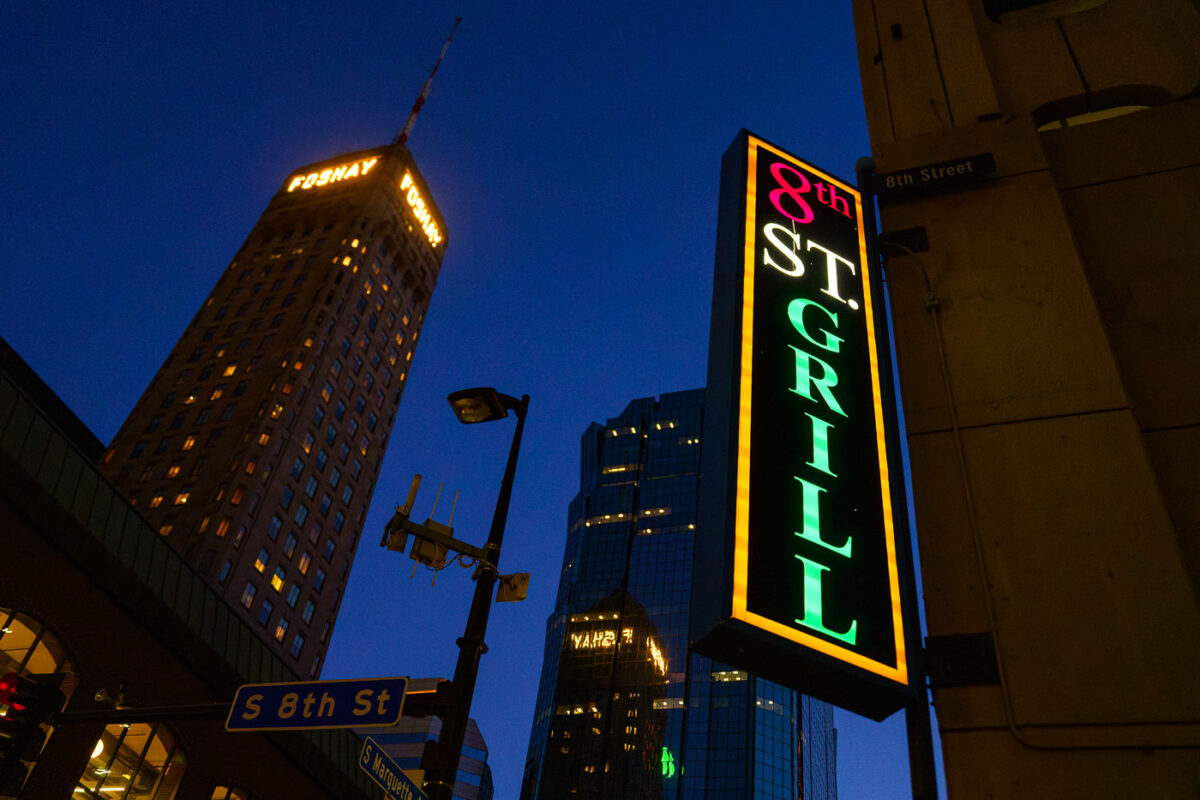
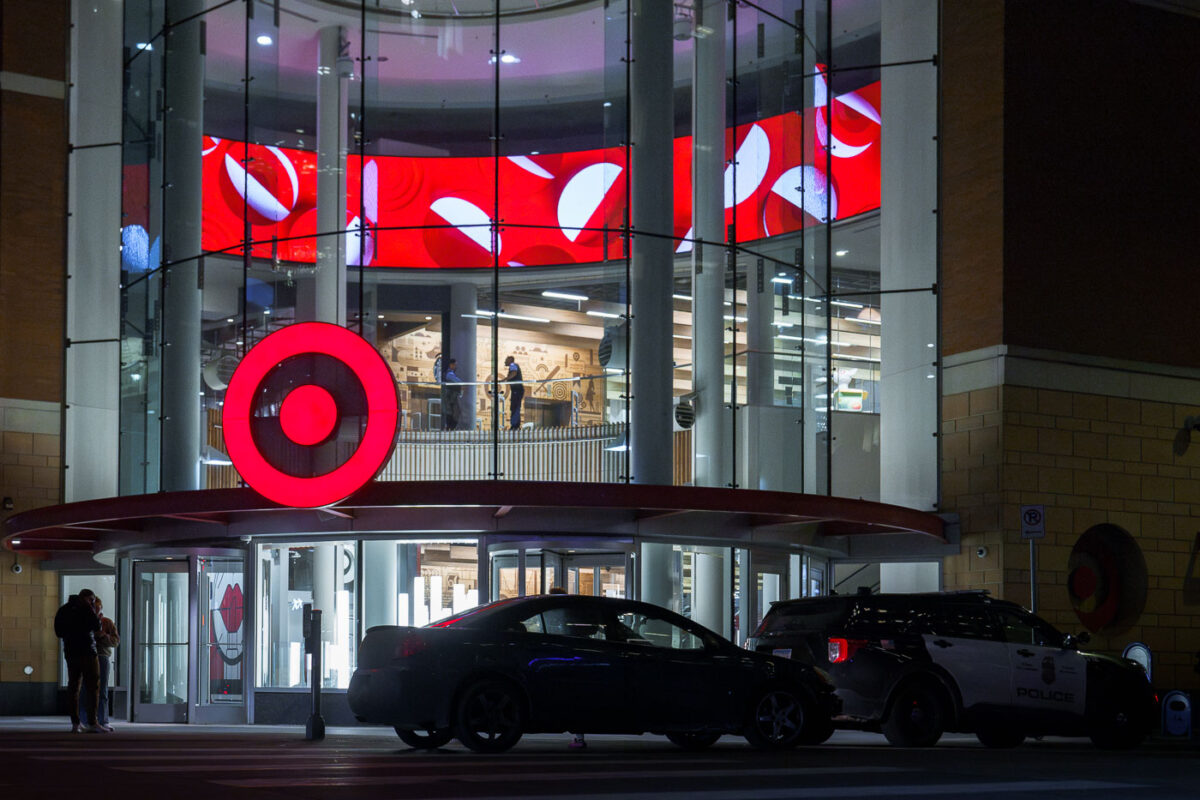
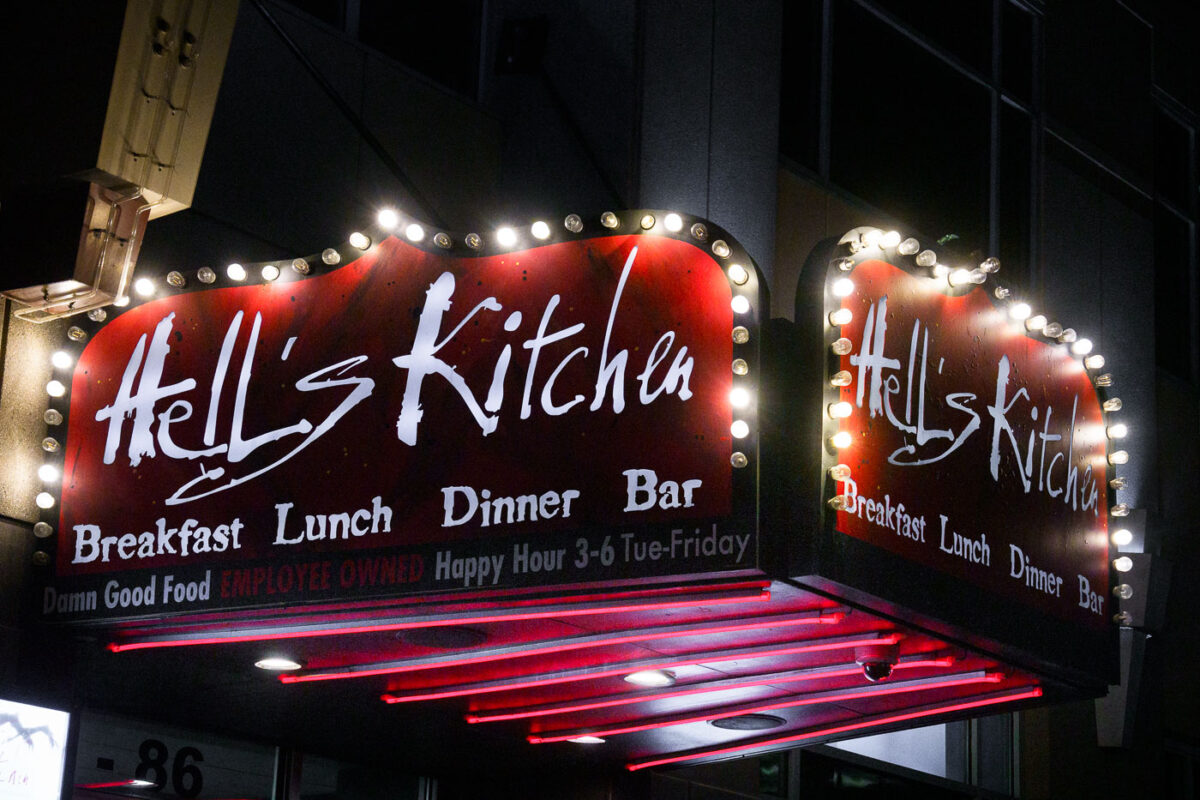
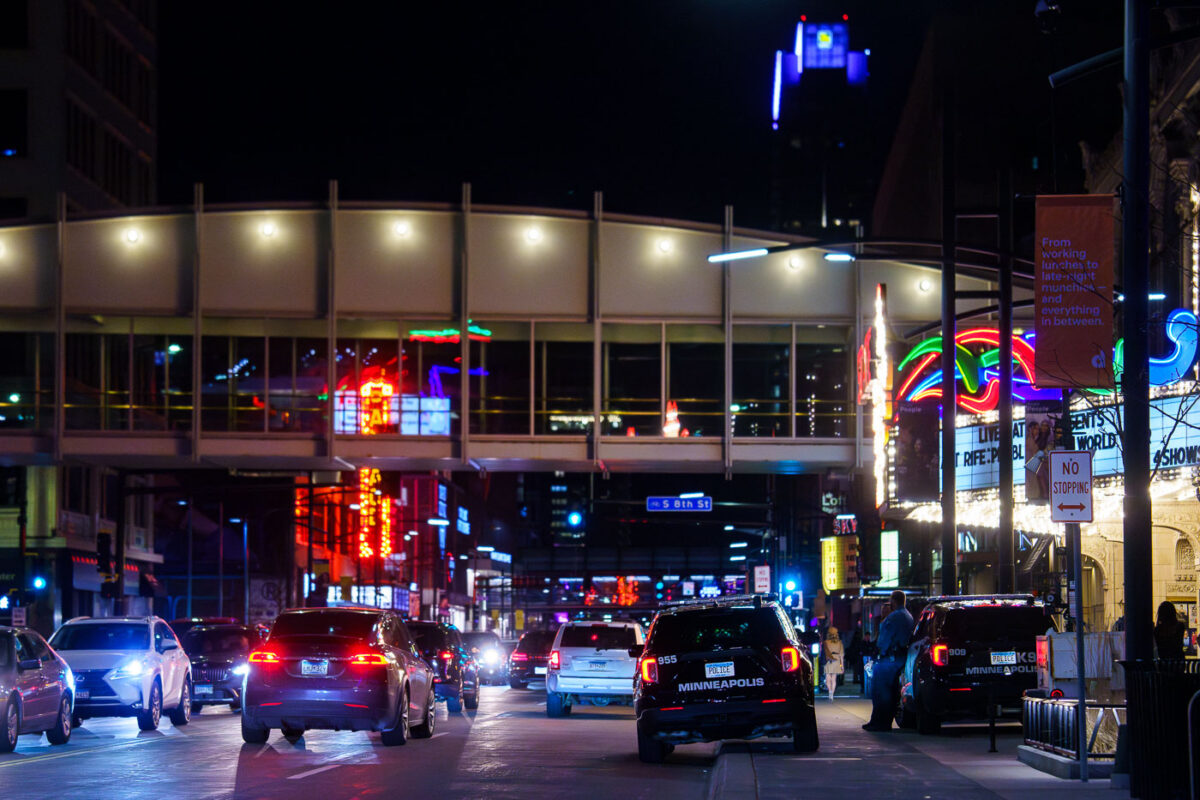
March 1, 2024 — The 8th St Grill, a restaurant and bar, stands illuminated at the corner of 8th Street and Marquette Avenue in Downtown Minneapolis. In the background, the Foshay Tower rises, a prominent architectural landmark completed in 1929. Designed by architect Wilbur Foshay, this skyscraper was inspired by the Washington Monument and served as a symbol of early 20th-century ambition. Today, the Foshay Tower houses a hotel and residences, contributing to the vibrant commercial and residential character of the city center.March 1, 2024 — Minneapolis police officers are visible inside the Target Corporate Headquarters building on Nicollet Mall in downtown Minneapolis at night. This building serves as both a flagship Target store and the corporate headquarters for the retail giant, a prominent fixture in the city's commercial landscape. The presence of law enforcement personnel in the downtown area during this period often related to heightened security or ongoing responses following the Minneapolis Uprising. Nicollet Mall, a pedestrian and transit mall, is a central artery of downtown Minneapolis, known for its retail and office spaces.March 1, 2024 — The illuminated sign for Hell's Kitchen restaurant stands on South 9th Street in downtown Minneapolis. This employee-owned establishment, known for its breakfast, lunch, dinner, and bar offerings, has been a prominent dining destination since its opening in 2002. The distinctive marquee, with its bright lights and bold lettering, serves as a recognizable feature within the city's urban landscape, attracting patrons to its "Damn Good Food" and daily happy hour.March 1, 2024 — Minneapolis Police squad cars are positioned on Hennepin Avenue near S 8th Street in Downtown Minneapolis on the night of March 1, 2024. Hennepin Avenue functions as a primary commercial and cultural artery, characterized by its array of entertainment venues and businesses. The presence of law enforcement vehicles is a common aspect of urban centers, serving to uphold public safety and order. This deployment reflects the ongoing commitment to security within a city that has navigated periods of significant social and civic change.March 1, 2024 — Patrons gather outside the Orpheum Theatre on Hennepin Avenue in downtown Minneapolis in March 2024. Opened in 1921 as a vaudeville house, the Orpheum Theatre is a significant part of Minneapolis's historic Hennepin Avenue theater district. Today, the theater continues to host a variety of live performances, contributing to the cultural vibrancy of the downtown area. The street, illuminated by theater marquees and traffic lights, serves as a central corridor for public events and nightlife.March 1, 2024 — Protest signs advocating for a ceasefire and social justice hang on a fence at the former Minneapolis Police Third Precinct. This site, located at Lake Street and Minnehaha Avenue, was abandoned after being burned in May 2020 during the Minneapolis Uprising, following the murder of George Floyd. Since then, the precinct has remained untouched, serving as a public space for community expression and protest art. The messages, including 'Cease Fire Now' and 'Pledge to Resist the Genocide,' reflect ongoing social and political concerns, transforming the damaged structure into a canvas for public discourse.March 1, 2024 — The Taco Taxi food truck serves customers on East Lake Street in South Minneapolis, photographed in March 2024. This commercial corridor is a vital hub for diverse businesses and cultural activity within the city. Food trucks like Taco Taxi contribute to the local economy by providing accessible culinary options to the community. East Lake Street carries historical significance as a central area impacted by the 2020 protests, and the continued operation of local enterprises underscores the neighborhood's ongoing revitalization.March 1, 2024 — A flyer from "Students for Socialist Revolution" advertises Spring 2024 events at the University of Minnesota. Found in March 2024, the flyer lists three events scheduled for February, March, and April, all to be held in Blegen Hall Room 120 on the university's Minneapolis campus. These events, focused on Marxist philosophy and communist revolution, aim to engage students in discussions about socialist ideology and activism. Such flyers are a common method for student organizations to disseminate information and recruit members, reflecting the ongoing presence of diverse political movements within academic institutions.March 1, 2024 — The Popeyes Louisiana Kitchen drive-thru on Chicago Avenue in South Minneapolis operates from a newly constructed building. This structure replaces the previous fast-food establishment that was burned during protests in May 2020, following the murder of George Floyd. The rebuilt Popeyes serves as a commercial fixture in the urban environment, providing fast-food services to the community.March 3, 2024 — A sign on Lyndale Avenue in Minneapolis advertises free rides on Metro Transit for St. Patrick's Day celebrations. Sponsored by Miller Lite, this public service initiative offered complimentary transportation on all Metro Transit routes from 6 p.m. through the end of service on Saturday, March 16. The program aimed to provide a safe alternative for revelers during the holiday period, reducing impaired driving. These partnerships between private companies and public transit agencies are a common strategy to enhance public safety during events associated with increased alcohol consumption.March 3, 2024 — The Bryant Lake Bowl neon sign illuminates Lake Street in South Minneapolis at sunset in March 2024. Located in the Lyn-Lake neighborhood, this establishment has served as a popular bowling alley, theater, and restaurant for decades. It stands as a cultural fixture along Lake Street, a significant commercial corridor that has experienced both growth and challenges, including the 2020 civil unrest. The building's enduring presence reflects the area's vibrant community life.March 3, 2024 — The Midtown Greenway, a 5.5-mile-long rail-with-trail corridor, traverses south Minneapolis, providing a dedicated path for cyclists and pedestrians. Developed from a former railway corridor, primarily the Milwaukee Road's Short Line, it officially opened as a multi-use path in 2000. This infrastructure serves as a vital transportation artery, connecting various neighborhoods and offering a car-free route across the city. The image shows a bridge carrying vehicular traffic over the Greenway, illustrating the integration of modern urban development with historical transportation routes in the Uptown Minneapolis area.March 4, 2024 — The Grain Belt Beer sign, a historic Minneapolis landmark, stands on Nicollet Island overlooking the Mississippi River. Originally installed in 1941, this illuminated sign once advertised the nearby Grain Belt Brewery, which operated in Northeast Minneapolis. In the background, the Hennepin Avenue Bridge, the first bridge to cross the Mississippi River at Minneapolis, connects downtown with the city's northeast side. The current cable-stayed bridge, completed in 1990, serves as a key transportation route and a visual marker of the city's riverfront development. This photograph was taken in March 2024.March 4, 2024 — The Northstar Line commuter train crosses a railway bridge over the Mississippi River in Minneapolis, as observed in March 2024. This bridge is an integral part of the Northstar Commuter Rail line, which connects downtown Minneapolis with communities to the northwest, providing public transportation. The Northstar Line began service in 2009, utilizing existing freight rail corridors and new infrastructure to establish a vital link in the region's transit network. The truss bridge structure facilitates the movement of passenger trains across the historic waterway, contributing to the city's transportation infrastructure. Its operation reflects ongoing efforts to expand public transit options and reduce traffic congestion in the greater Minneapolis-Saint Paul metropolitan area.March 4, 2024 — Our Lady of Lourdes Catholic Church, situated on Main Street in Minneapolis, is the city's oldest continuously used church building. Consecrated in 1857, this Gothic Revival structure features a prominent spire and stone facade. It remains an active place of worship and a significant landmark along the Mississippi Riverfront within the St. Anthony Falls Historic District. Adjacent to the church, the Main Hall at Riverplace reflects the area's mixed-use development. This photograph was taken in March 2024.March 4, 2024 — The 10th Avenue Bridge and the I-35W Bridge span the Mississippi River near downtown Minneapolis at sunset in March 2024. Completed in 1918, the 10th Avenue Bridge, also known as the Third Avenue Bridge, is a historic concrete arch structure connecting downtown with Northeast Minneapolis. Adjacent to it, the I-35W Bridge, a critical interstate highway link, was rebuilt and opened in 2008 following the collapse of its predecessor. Both bridges serve as essential transportation corridors for the city, with their structures illuminated in distinct colors against the evening sky.March 4, 2024 — The LynLake Brewery, located on Lyndale Avenue in Minneapolis, occupies a building known for its distinctive theater-like architecture. Adjacent to the brewery, a commercial billboard features an advertisement that has been marked with the graffiti 'ACAB'. This act of public expression, documented in March 2024, reflects the ongoing social and political commentary prevalent in the Lyn-Lake neighborhood, particularly in the context of the Minneapolis Uprising.March 5, 2024 — The exterior of the Gay 90's nightclub stands on Hennepin Avenue in downtown Minneapolis. This establishment has operated as a prominent LGBTQ+ nightclub and entertainment venue for decades, serving as a cultural landmark in the city's nightlife. The streetscape includes adjacent businesses and a parking area, reflecting the commercial character of this section of Hennepin Avenue. Known for its vibrant atmosphere, the Gay 90's continues to be a significant gathering place within the downtown area.March 6, 2024 — Construction barriers line the intersection of Hennepin Avenue and Lake Street in Uptown Minneapolis. This busy intersection serves as a central commercial and transportation hub within the Uptown district, a historically vibrant area of the city. The ongoing infrastructure work, documented in 2024, reflects continuous efforts to maintain and upgrade urban environments. The presence of graffiti on the construction barriers also hints at the area's recent history, including the widespread rebuilding and redevelopment initiatives following the 2020 Minneapolis Uprising.March 6, 2024 — A "Are you a Communist? Then Get Organized!" flyer, produced by Socialist Revolution, is affixed to an electrical box on Hennepin Avenue in Uptown Minneapolis. This public display of political messaging reflects ongoing ideological discourse within urban environments. The presence of such materials in areas like Uptown Minneapolis, near the Lowry Hill neighborhood, highlights the use of public infrastructure for grassroots communication. Such flyers serve as a direct call to action, aiming to mobilize individuals around socialist and communist principles.March 8, 2024 — Tom's Watch Bar on Hennepin Avenue in downtown Minneapolis draws large crowds during the Big Ten Tournaments. This establishment serves as a dedicated sports bar, providing a venue for fans to gather and watch collegiate athletic events. Its prominent location in the city center positions it as a key gathering point for spectators, contributing to the local entertainment landscape during major sporting occasions. The illuminated facade, featuring various sports motifs, highlights its purpose as a hub for sports enthusiasts.March 10, 2024 — The Breakfast Club restaurant, situated at 1300 Lagoon Avenue in Uptown Minneapolis, is a recently established eatery serving breakfast and lunch. Its presence contributes to the commercial landscape of Lagoon Avenue, a significant thoroughfare known for its retail and dining establishments. The building features a distinctive modern green facade, reflecting contemporary architectural trends in the urban environment. This new business adds to the array of local dining options available to residents and visitors in the Uptown neighborhood.March 10, 2024 — A vibrant graffiti mural honoring Minnesota Twins legend Kirby Puckett is displayed on a concrete block wall along Emerson Avenue South in Minneapolis. The artwork features Puckett's iconic number 34 jersey, set against a backdrop that includes a city skyline silhouette and colorful abstract lettering, with the year '1993' visible as part of the design. Kirby Puckett, a beloved Hall of Fame outfielder, played his entire career for the Minnesota Twins from 1984 to 1995, leading the team to two World Series championships. This mural serves as a public tribute to his legacy and impact on Minneapolis sports culture. This photograph was taken in March 2024.March 10, 2024 — The phrase "Black Lives Matter" is spray-painted in black and red on a weathered utility post in South Minneapolis. This public message serves as a lasting visual reminder of the Minneapolis Uprising and the broader movement for racial justice that gained prominence following the murder of George Floyd in May 2020. The peeling yellow paint on the post indicates the message has been present for an extended period, enduring as a form of urban expression. Such markings on infrastructure reflect ongoing community engagement and remembrance in areas significantly impacted by the protests. This photograph documents the graffiti in March 2024.March 10, 2024 — TRIP Outreach workers engage with riders at the Warehouse District/Hennepin Station, a key Light Rail Transit (LRT) stop in downtown Minneapolis. Opened in 2004 as part of Metro Transit's Blue Line, this station serves as a vital transportation hub connecting the Warehouse District to the wider metropolitan area. The TRIP Outreach program, which includes violence interrupters, operates within the Metro Transit system to foster a safer environment for passengers and address community concerns. This initiative reflects ongoing efforts to enhance public safety and community engagement across Minneapolis's public transit infrastructure, as observed in March 2024.March 10, 2024 — Transit Service Intervention Project (TSIP) outreach workers are stationed on a light rail platform in Downtown Minneapolis. The TSIP program, which includes "Violence Interrupters," operates within the Metro Transit system to enhance public safety and de-escalate conflicts. These workers engage with passengers and community members at vital transit hubs, such as this station, which serves as a key component of the city's public transportation network. The Metro Transit light rail system, established in the early 2000s, provides essential urban mobility, and programs like TSIP address contemporary challenges in maintaining secure and accessible public spaces.March 10, 2024 — Fans gather outside the 7th St Entry in downtown Minneapolis on March 10, 2024, awaiting a performance by The Snuts. Part of the larger First Avenue complex, the building originally served as a Greyhound bus station before its transformation into a prominent live music venue in 1970. The exterior brick wall, adorned with hundreds of white stars bearing the names of past performers, signifies the venue's enduring legacy in the music industry. Adjacent to the main First Avenue club, 7th St Entry and The Depot Tavern continue to operate as integral parts of Minneapolis's vibrant music and nightlife scene.March 10, 2024 — A billboard sponsored by the Anti-War Committee stands prominently on Lyndale Avenue in Minneapolis. It displays the message "END U.S. AID TO ISRAEL!" accompanied by an image of a hand making a peace sign against a Palestinian flag. This public display utilizes urban infrastructure to disseminate a political message to a broad audience traversing the busy thoroughfare. The billboard reflects ongoing public discourse and activism in Minneapolis concerning U.S. foreign policy and the Israeli-Palestinian conflict.March 12, 2024 — Pedestrians and cyclists traverse the Stone Arch Bridge in downtown Minneapolis during March 2024. Constructed in 1883 by railroad magnate James J. Hill, this historic structure was originally built for the Great Northern Railway and remains the only stone arch bridge spanning the Mississippi River. Today, it functions as a prominent pedestrian and bicycle route, connecting the city's downtown with the Marcy-Holmes neighborhood. The bridge offers expansive views of St. Anthony Falls and the surrounding urban landscape, serving as a significant landmark within the St. Anthony Falls Historic District.March 15, 2024 — The Century Plaza building on S 12th Street in Downtown Minneapolis is undergoing renovation. This structure is being adapted to serve as the new Minneapolis Police 1st Precinct police station. The relocation follows the destruction of the previous 1st Precinct headquarters during the 2020 Minneapolis Uprising. This project represents a significant effort to re-establish police operations and presence within the downtown core.March 15, 2024 — The Century Plaza building in Downtown Minneapolis is undergoing renovation to house the new Minneapolis Police 1st Precinct station. This facility will replace the previous 1st Precinct location, which was damaged during the 2020 Minneapolis Uprising. The adaptation of the Century Plaza building for this purpose reflects ongoing changes in the city's public safety infrastructure. Once completed, it will serve as a central hub for law enforcement operations in the downtown area.March 15, 2024 — Century Plaza in Downtown Minneapolis is undergoing renovation to become the new Minneapolis Police 1st Precinct station. This relocation provides the precinct with updated facilities and a new operational base following the destruction of its previous station during the 2020 Minneapolis Uprising. The building's transformation is a key development in the city's efforts to re-establish public services in the urban core. Situated near Interstate 35W, the site is part of a dense urban environment that includes the historic Foshay Tower.March 17, 2024 — Downtown Minneapolis, viewed from Interstate 35W in South Minneapolis during March 2024, showcases the city's central business district. Interstate 35W functions as a critical transportation artery, facilitating daily commutes and regional connectivity through the metropolitan area. The urban core features a collection of high-rise buildings, including the historic Foshay Tower and the prominent IDS Center, which define the city's commercial and architectural landscape. This infrastructure is essential for the movement of people and goods, supporting Minneapolis's role as a major economic hub in Minnesota.March 24, 2024 — The 4th St Saloon, a long-standing bar on West Broadway in North Minneapolis, is shown shortly before its permanent closure. After 37 years of operation, the establishment held a farewell event, marking the end of its tenure as a community gathering place. The building features a prominent mural celebrating North Minneapolis, reflecting the cultural identity of the neighborhood. Its closing represents a shift in the local business landscape of the area.March 28, 2024 — The Bassett Creek Valley Light Rail Transit (LRT) Station in Minneapolis, photographed in March 2024, is part of the Southwest LRT Green Line Extension project. This new station, including its connection to Van White Memorial Boulevard, is nearing completion, though the light rail line is not yet operational. Managed by MetCouncil and Metro Transit, the Southwest LRT project represents a significant expansion of public transit infrastructure in the Twin Cities metropolitan area. Once operational, the station will serve as a vital transportation hub, enhancing regional connectivity for residents and commuters in the Bassett Creek Valley area.March 28, 2024 — Snow removal operations are underway on Interstate 394 near downtown Minneapolis. Crews from the Minnesota Department of Transportation (MNDOT) work through the night to clear accumulated snow, ensuring safe passage for commuters and maintaining essential transportation routes. Interstate 394, a vital east-west freeway, connects the western suburbs to downtown Minneapolis, serving as a critical artery for daily traffic. This continuous winter maintenance is crucial for urban centers like Minneapolis, which experience significant snowfall, highlighting the ongoing effort required to keep metropolitan infrastructure functional year-round.March 28, 2024 — The Green Room, a prominent live music venue, is situated on Lagoon Avenue in Uptown Minneapolis, near the intersection with S Fremont Avenue. This concert hall, which opened in 2023, has become a significant cultural addition to the neighborhood. It functions as a destination for live music, food, and beverages, enhancing the vibrancy of Uptown's entertainment landscape.March 28, 2024 — The neon sign for William's Pub, a long-standing establishment in Uptown Minneapolis, is visible on Hennepin Avenue. For decades, William's Pub served as a local gathering place within the vibrant Uptown commercial district. The bar ceased operations in 2022, leaving the premises vacant. Its illuminated sign, a familiar landmark, now stands as a reminder of the business's past presence in the neighborhood.March 28, 2024 — The illuminated sign for Daisy's Bar & Rooftop, shaped like a horseshoe, stands prominently on Hennepin Avenue in Minneapolis. This establishment, known as Daisy's Uptown, is situated near a McDonald's, contributing to the commercial landscape of the area. Daisy's replaced Cowboy Slims, a previous cowboy-themed bar, marking a change in the local nightlife offerings. The location on Hennepin Avenue, near Lagoon Avenue, is a significant commercial corridor in Minneapolis, known for its diverse businesses and public activity.March 30, 2024 — An illuminated billboard for The Epoch Times newspaper stands atop a commercial building at the corner of Lake Street and South 2nd Avenue in Minneapolis. The building's facade also displays large protest banners calling to "Stop the genocide in Gaza." This juxtaposition highlights the urban environment as a platform for both commercial advertising and public political discourse. The presence of these banners reflects ongoing global events and local activism concerning the conflict in Gaza, Palestine. This intersection serves as a prominent location for public messaging within the city.March 30, 2024 — This flyer promotes the 2024 presidential campaign of Claudia De La Cruz and Karina Garcia, candidates for the Party for Socialism and Liberation, in Minneapolis. The campaign material prominently features the slogan "END CAPITALISM BEFORE IT ENDS US!" and outlines "OUR SOCIALIST PLATFORM," advocating for policies such as seizing major corporations, redistributing wealth, and reducing military spending. Such political flyers are a common method for campaigns to disseminate their platform and mobilize support, inviting individuals to volunteer or donate. This material reflects a socialist political movement active in Minneapolis, a city known for its history of political activism and social movements.March 30, 2024 — The former Whiskey Junction bar on Cedar Avenue in Minneapolis is visible at night, featuring a prominent yellow patch where its long-standing Jack Daniels mural was recently removed. This establishment, a known concert venue and nightclub in the Cedar Riverside neighborhood, ceased operations in 2017. Months later, the property was acquired by The Joint Bar, located adjacent to it. The image documents the building's facade following this alteration.March 31, 2024 — A flyer from the "Revolutionary Communists of America" is posted in Minneapolis, advertising a rally and march scheduled for Saturday, April 6th, 2024. The event is planned to begin at Minneapolis City Hall, calling for participants to "Join the Communists!" The flyer critiques the two major political parties, depicting their leaders as "war criminals, imperialists, capitalists." This public posting serves as a form of political communication, aiming to mobilize support for communist ideologies and express dissent against the established political system within the urban landscape of Minneapolis.