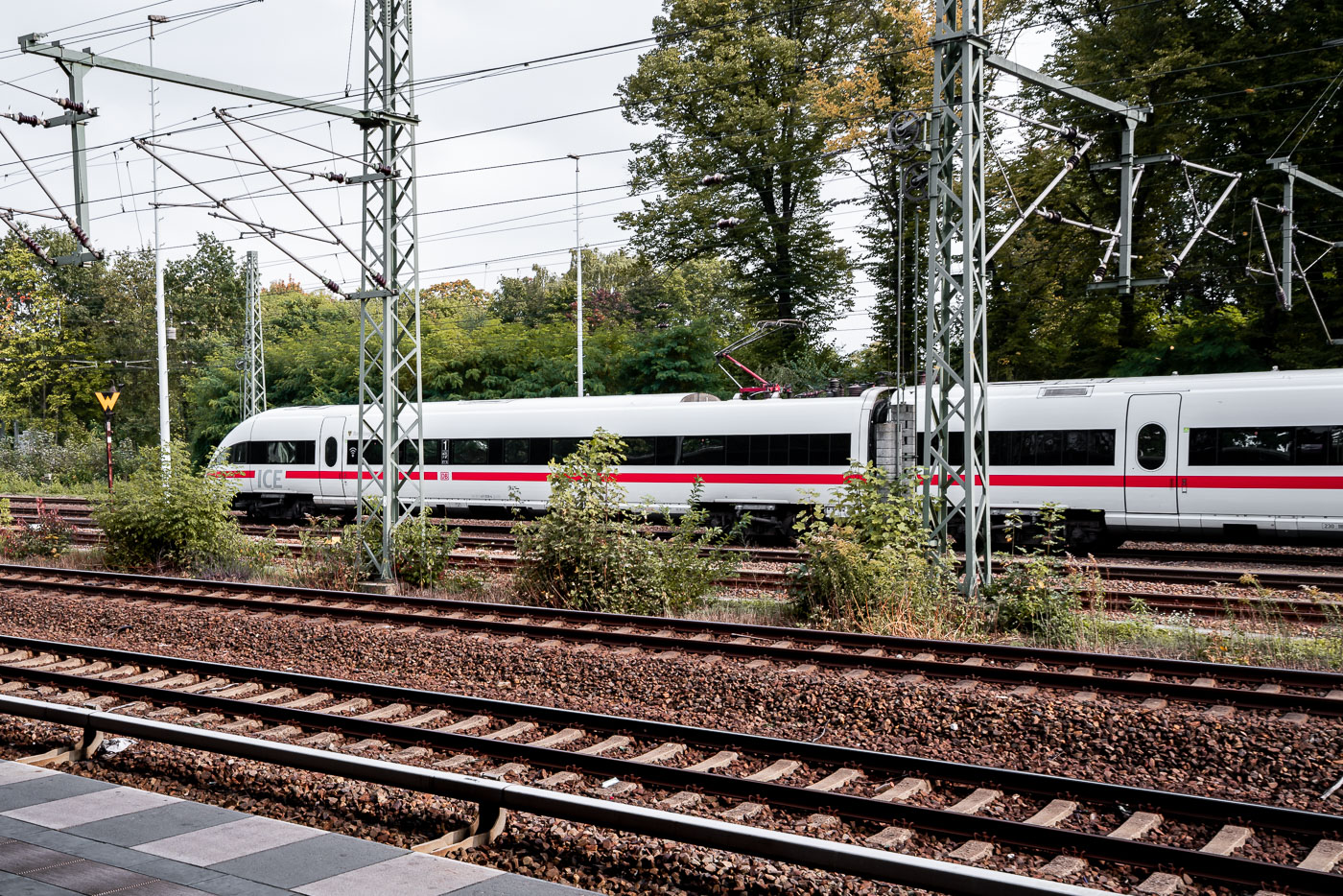
A Deutsche Bahn Intercity-Express (ICE) train moves through the rail network, distinguished by its white body and red horizontal stripe. The train belongs to the ICE 3 or ICE T family, units designed for high-speed operation up to 300 km/h and used on long-distance routes across Germany and neighboring countries. Overhead catenary lines supported by lattice-steel gantries deliver 15 kV AC power, the standard for Germany’s electrified mainlines. The ICE network, launched in the early 1990s, forms the backbone of long-distance rail travel in the country, linking cities such as Berlin, Frankfurt, Cologne, and Munich. These trains are built for both speed and efficiency, with lightweight aluminum bodies, regenerative braking, and pressure-sealed cabins for tunnel travel. The scene reflects the characteristic organization of German rail infrastructure—multiple tracks, overhead power, and vegetation at the margins—where local and international services share one of Europe’s busiest and most interconnected systems.
This photo is part of the ICE IN MINNEAPOLIS series covering “Operation Metro Surge”. The operation, which began in late December 2025 and intensified in January 2026, has drawn widespread local and national attention amid protests and confrontations.
On January 7, 2026, 37-year-old Minneapolis resident Renée Nicole Good was fatally shot by an ICE agent on Portland Ave — a killing that sparked immediate large scale protests. Less than three weeks later, on January 24, 2026, Alex Jeffrey Pretti, a 37-year-old ICU nurse and Minneapolis resident, was shot and killed by a U.S. Border Patrol agent on Nicollet Avenue. Between those incidents, federal agents also injured another man in North Minneapolis.