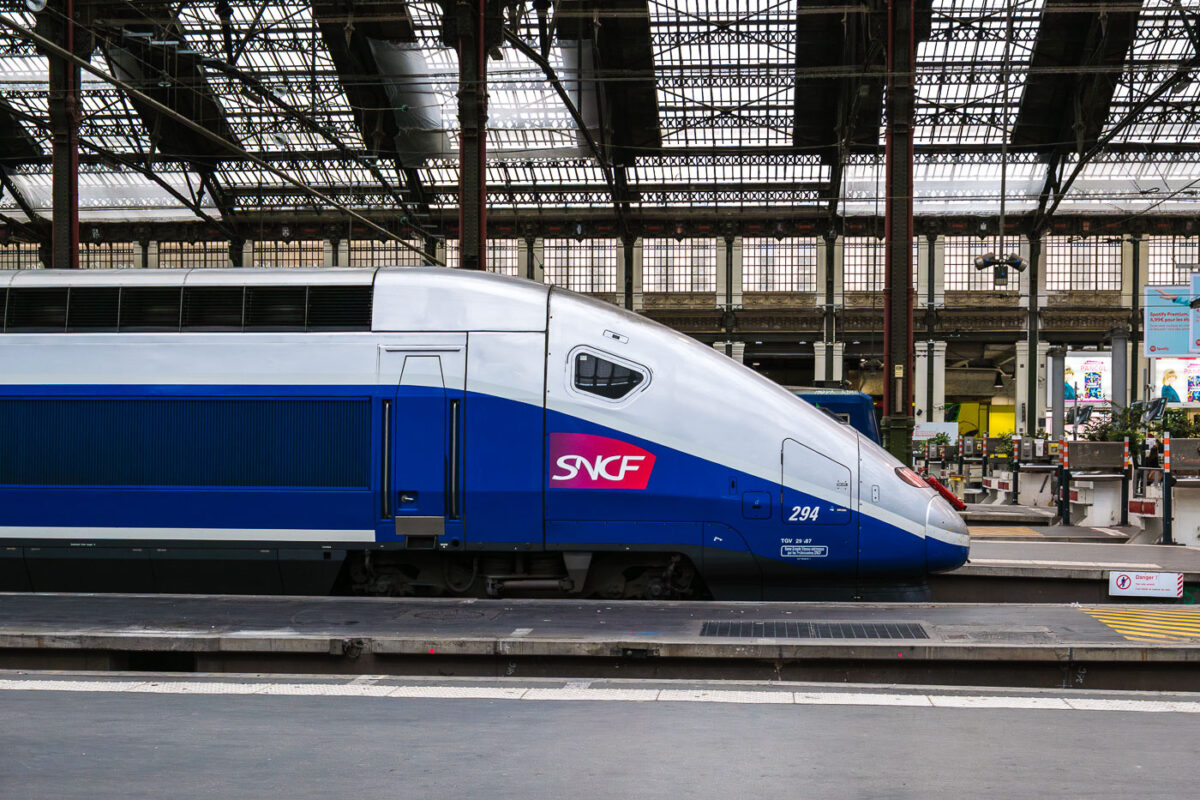
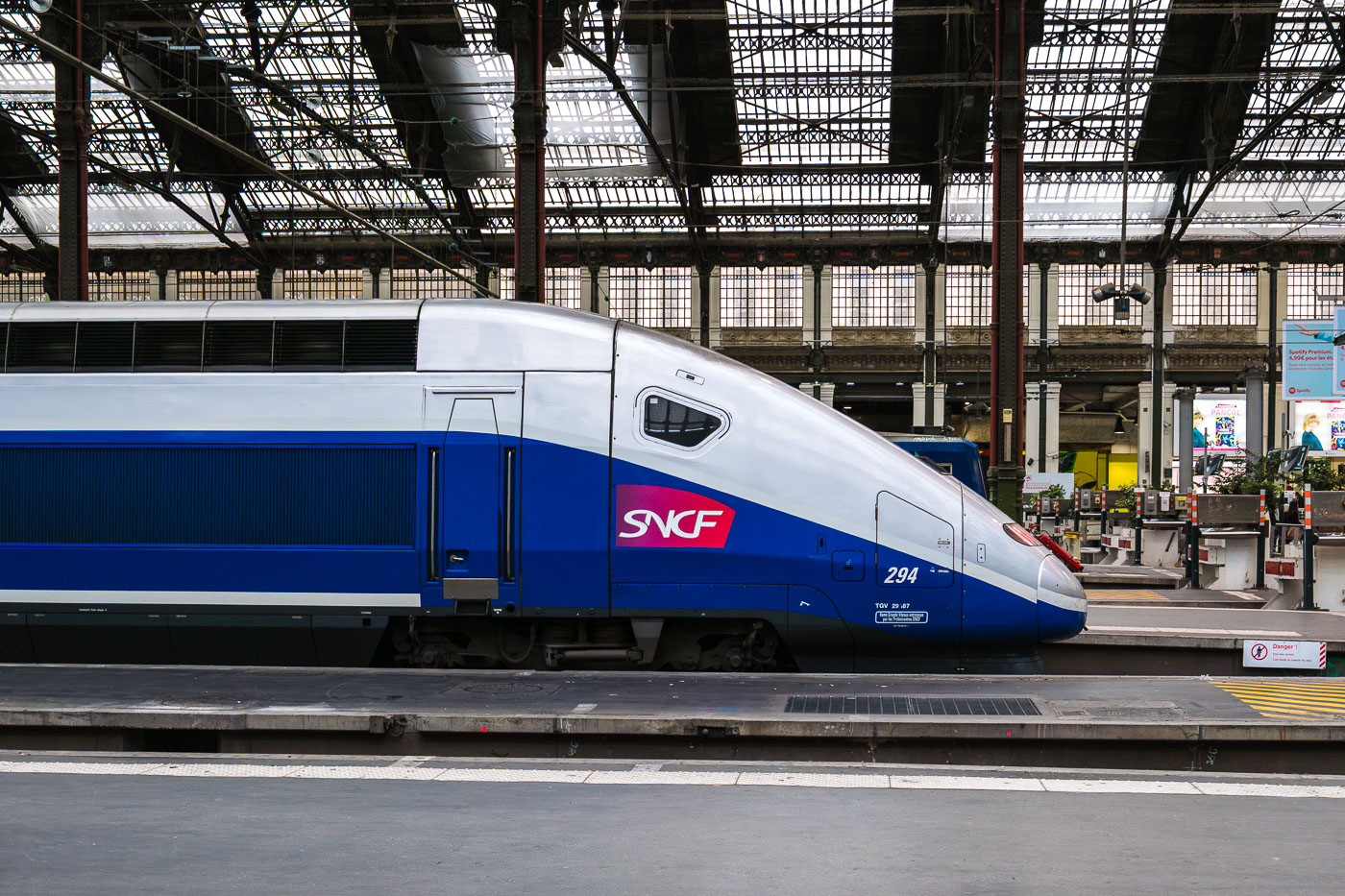
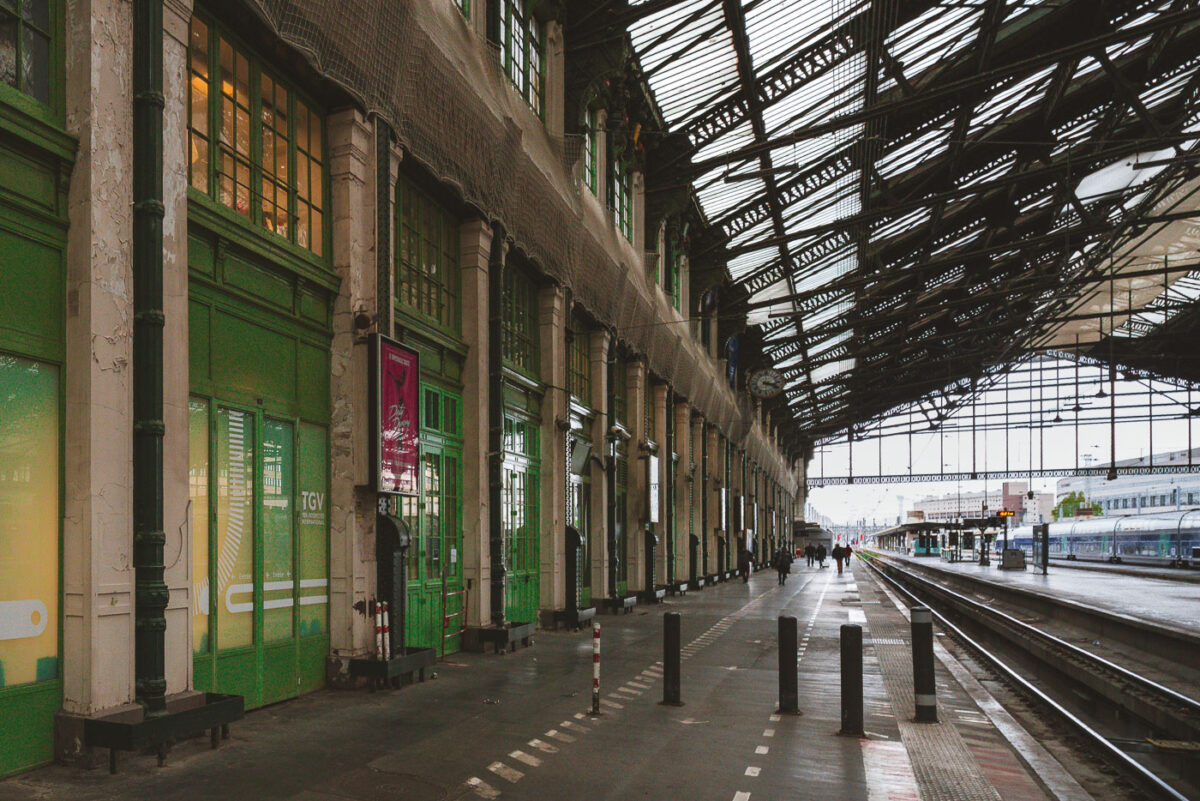
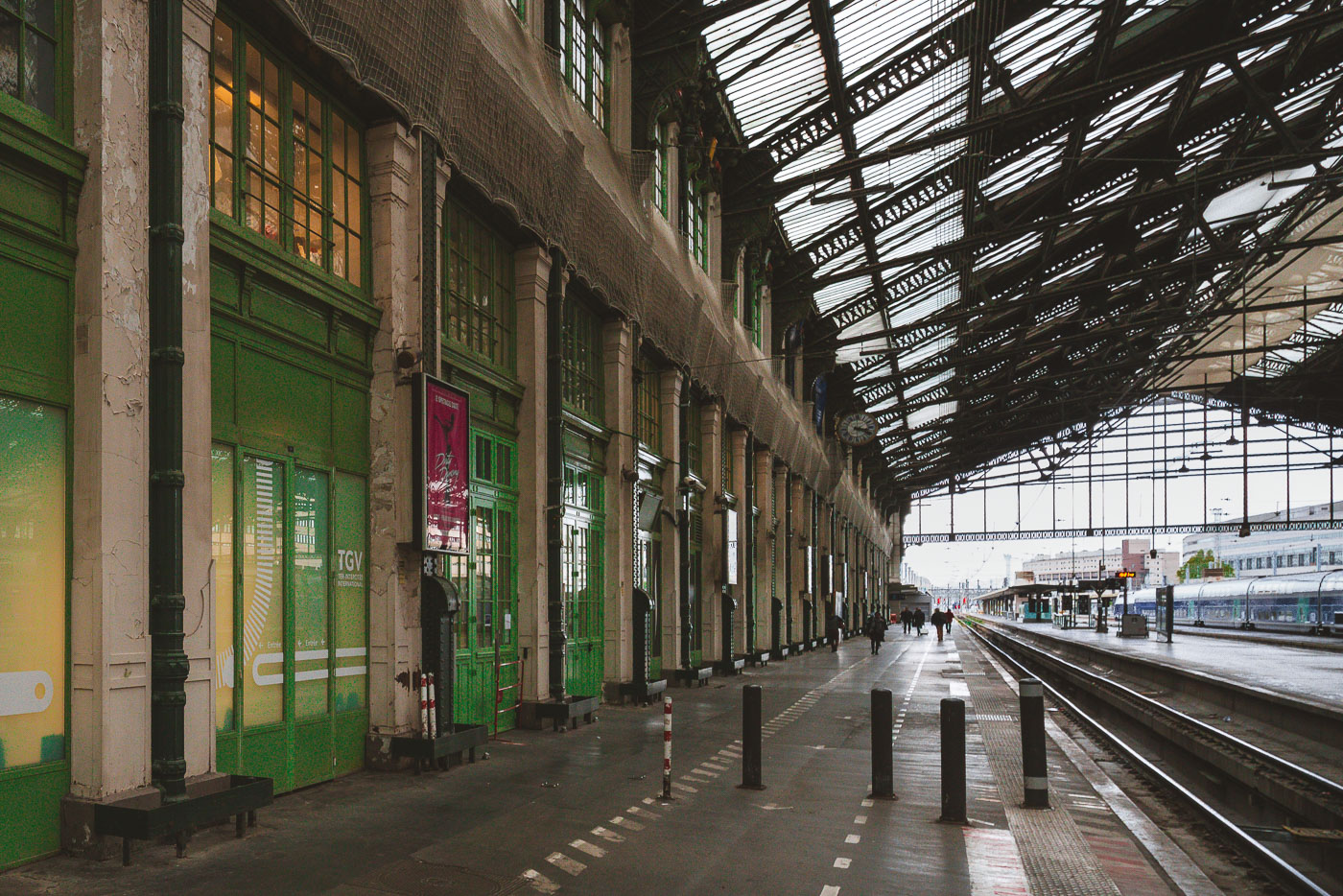
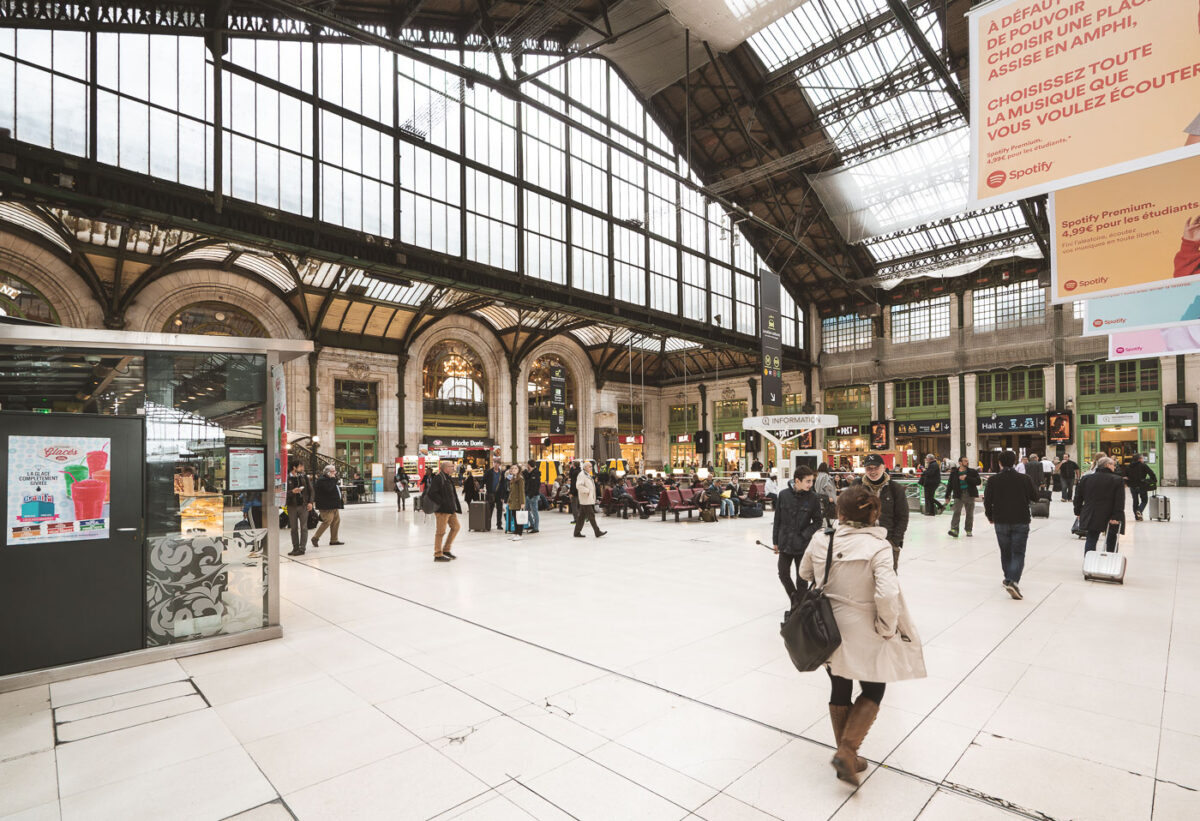
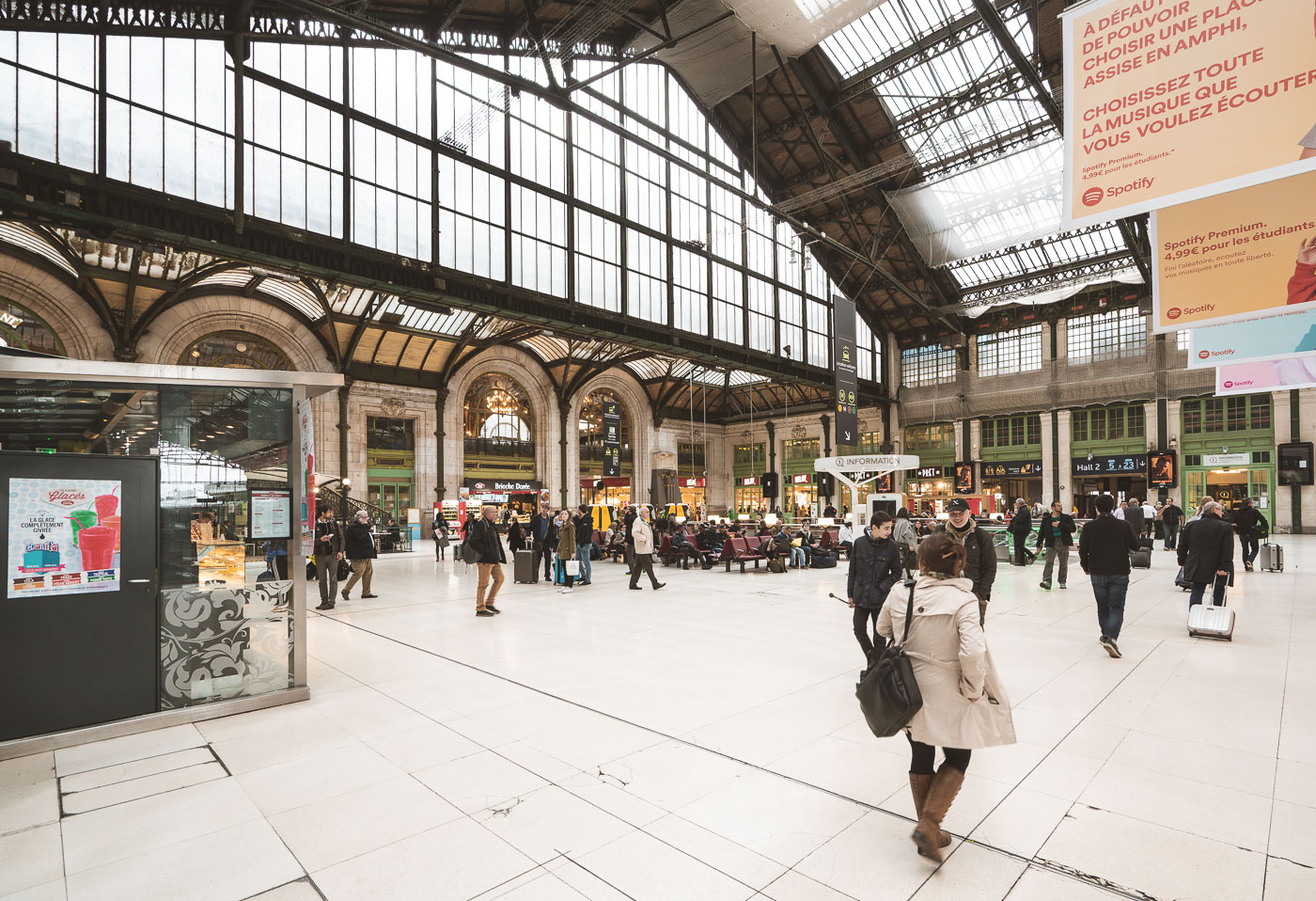
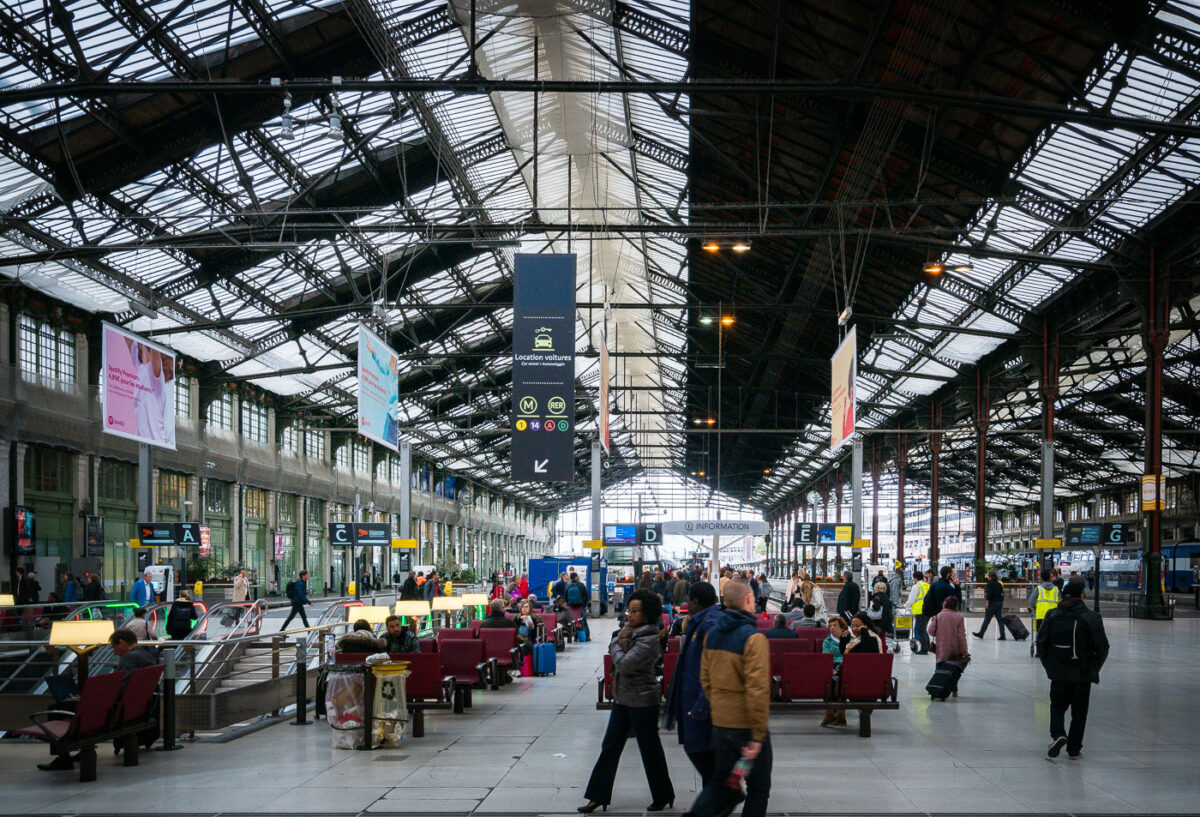
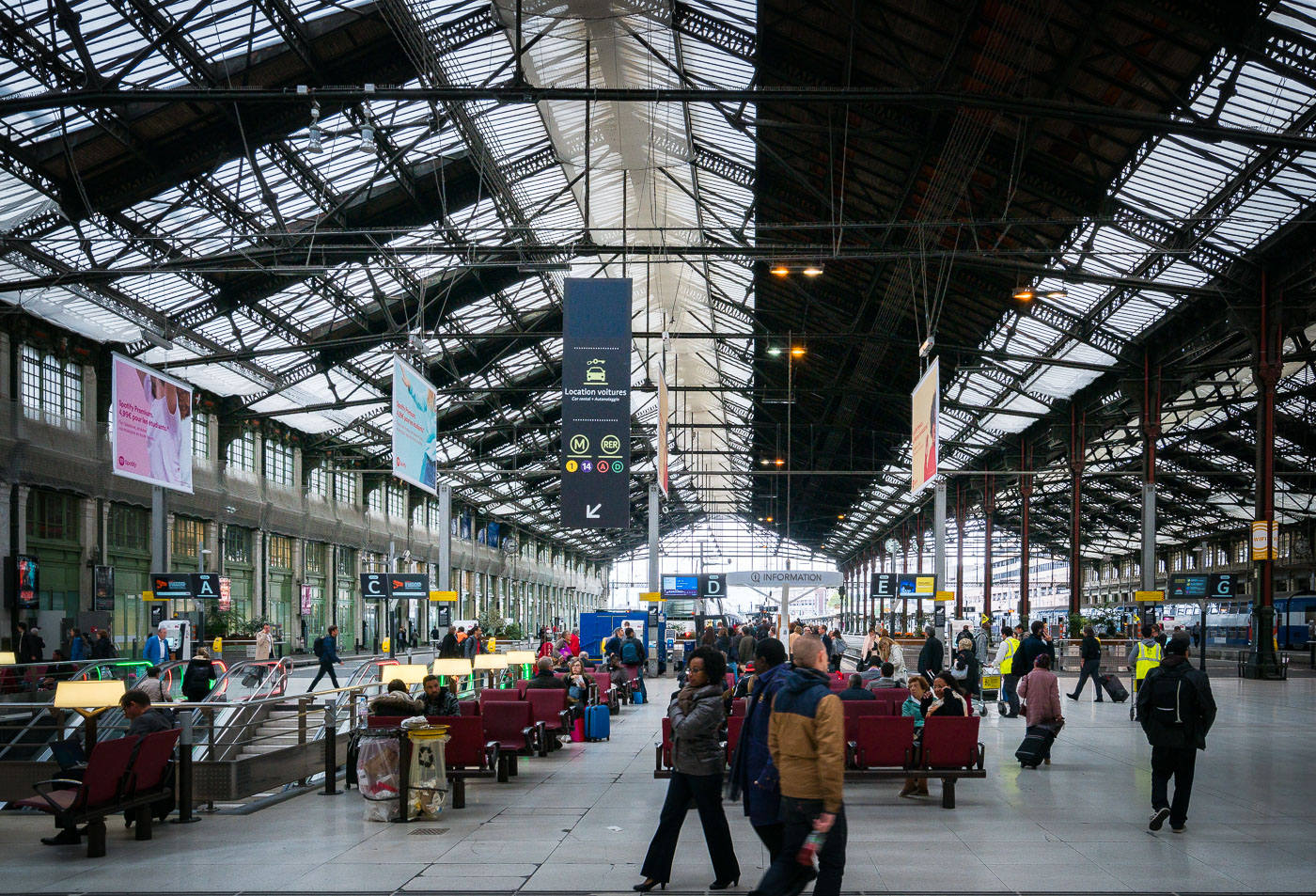
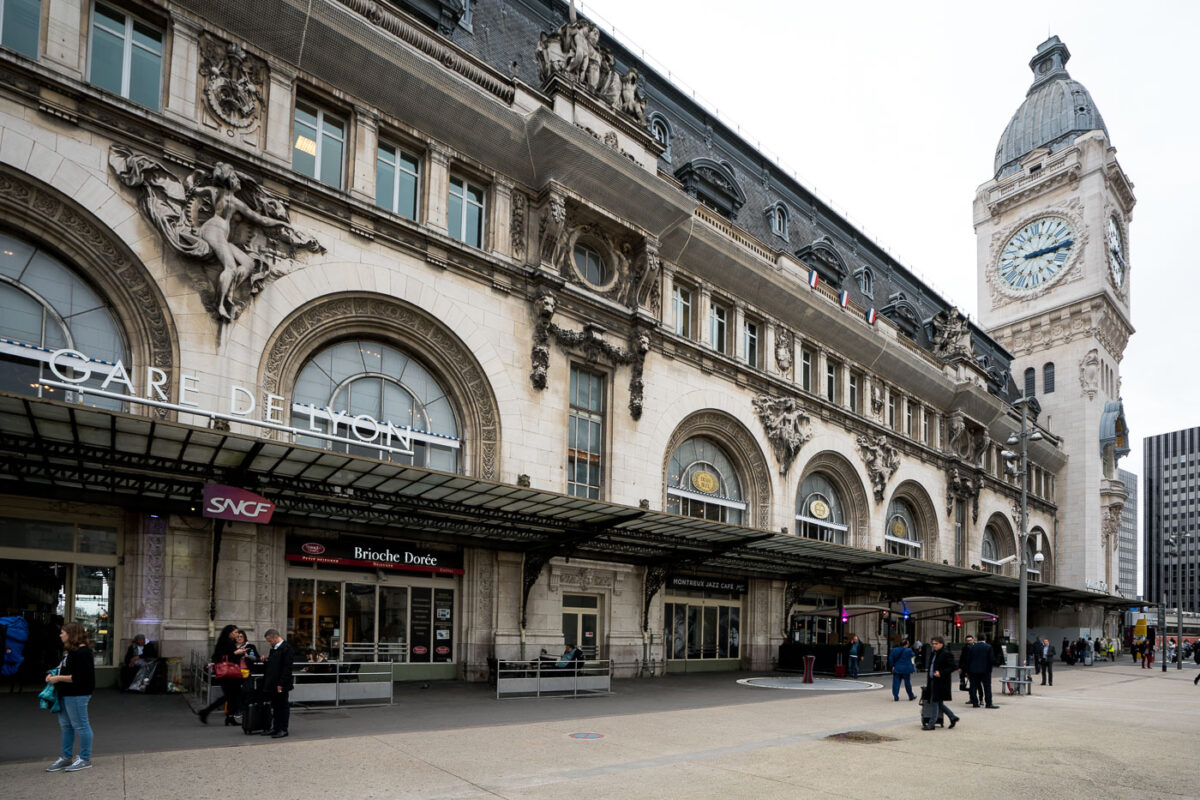
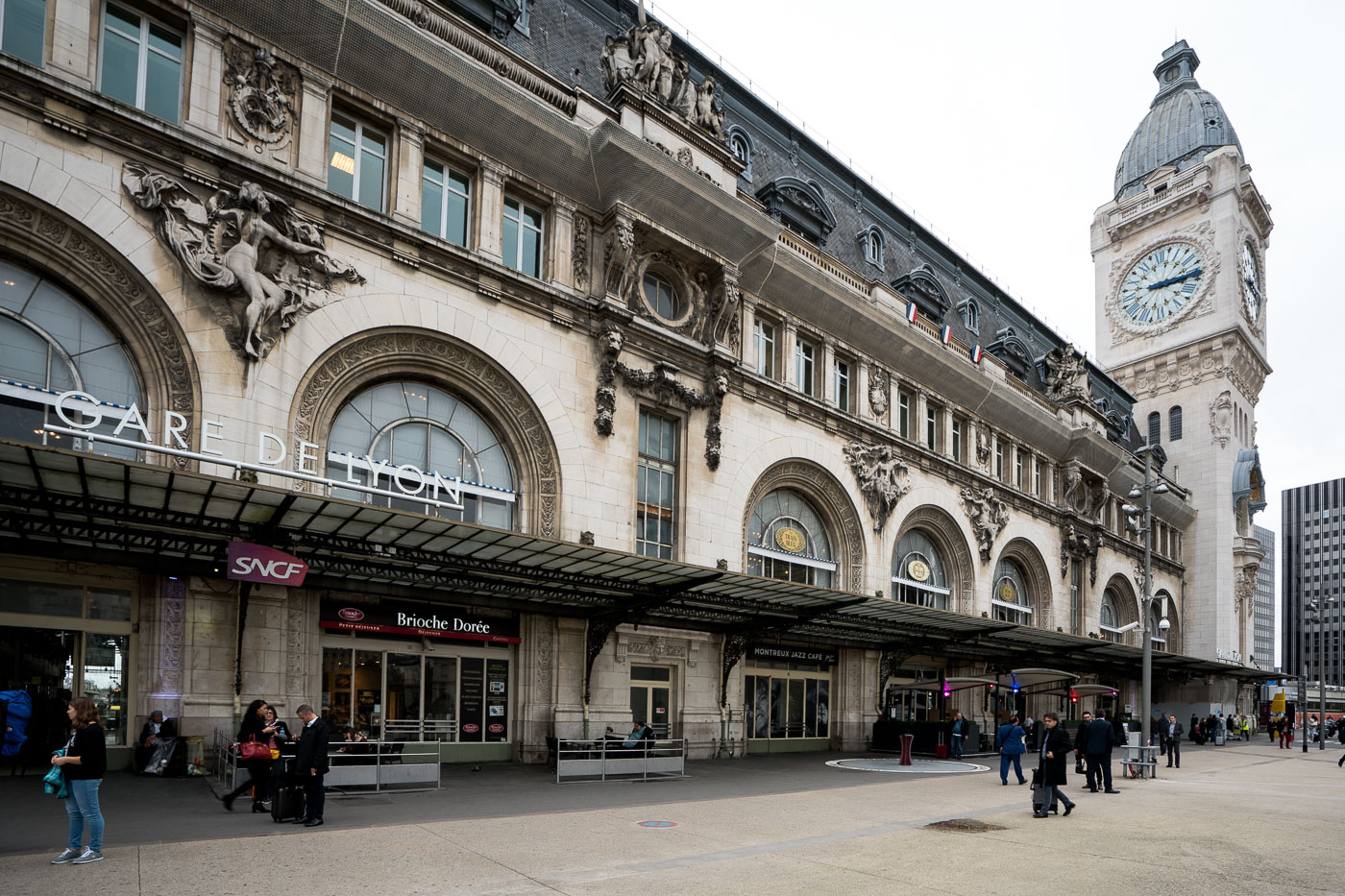
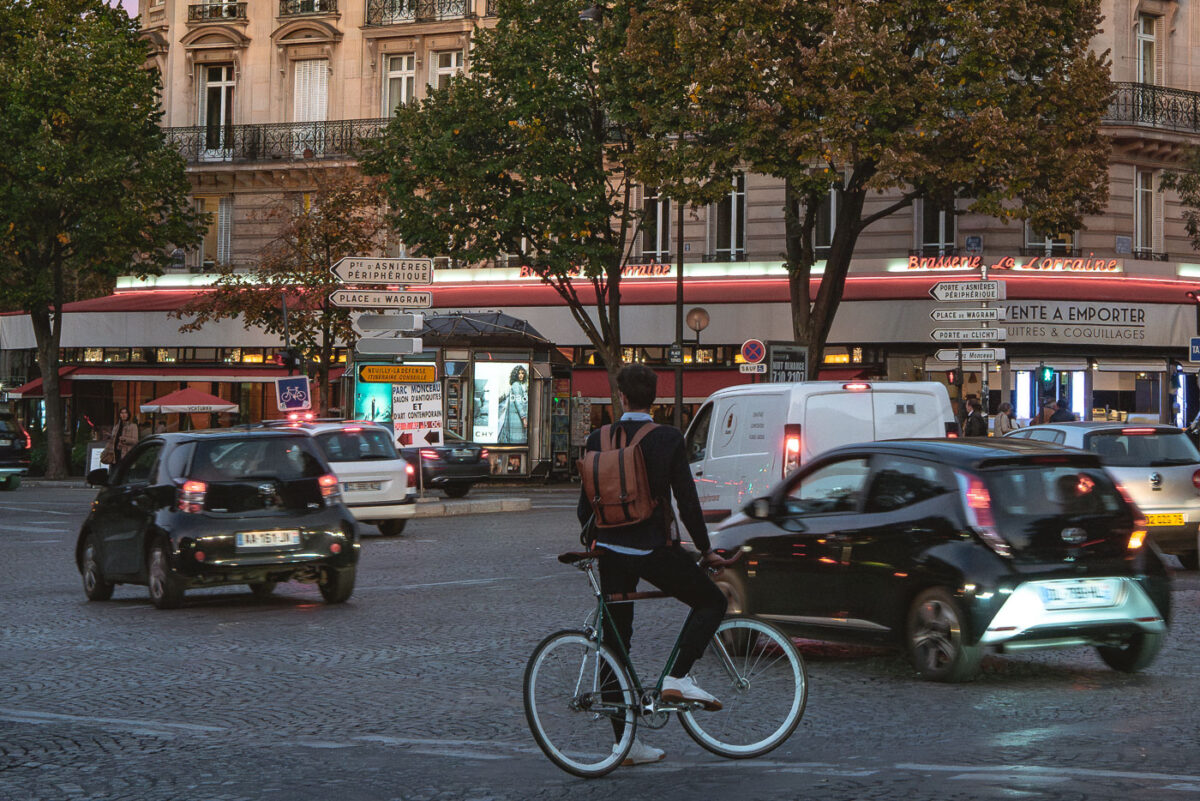
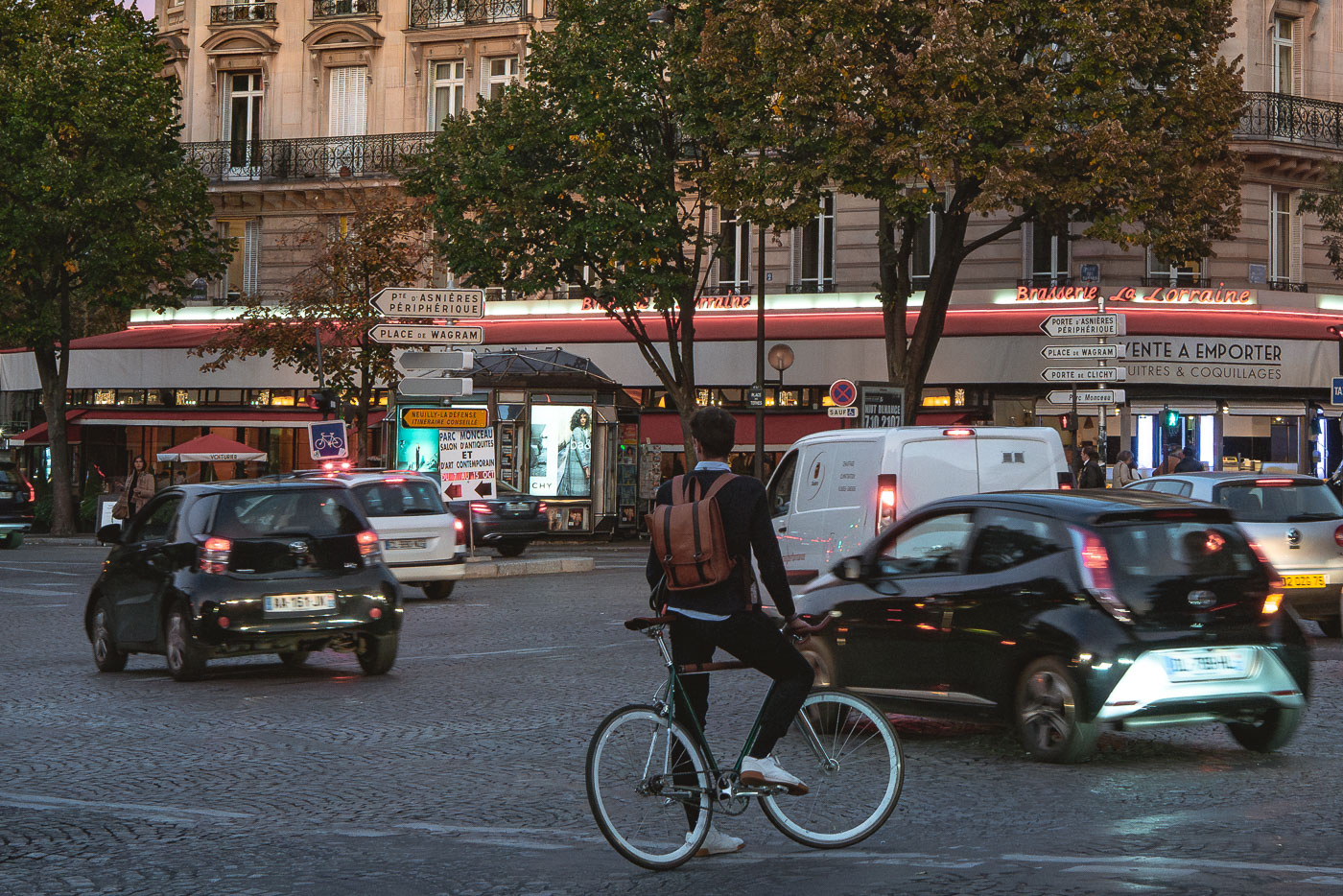
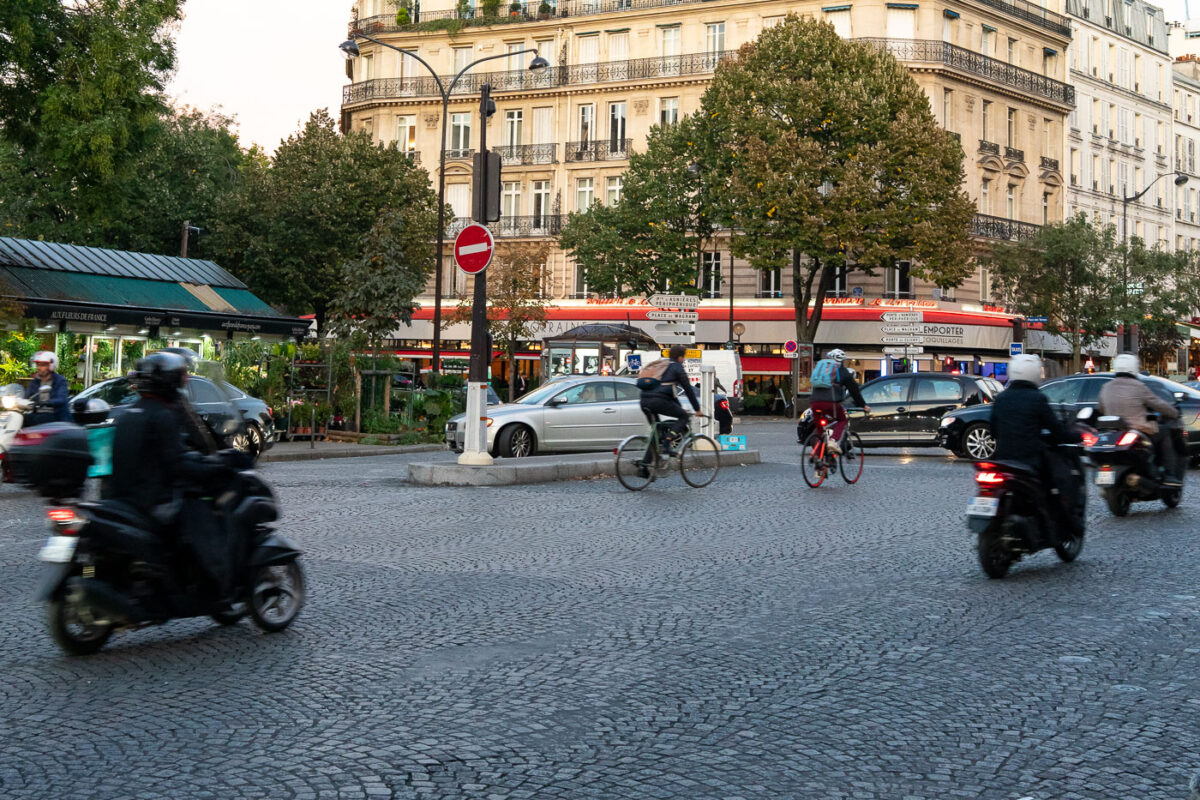
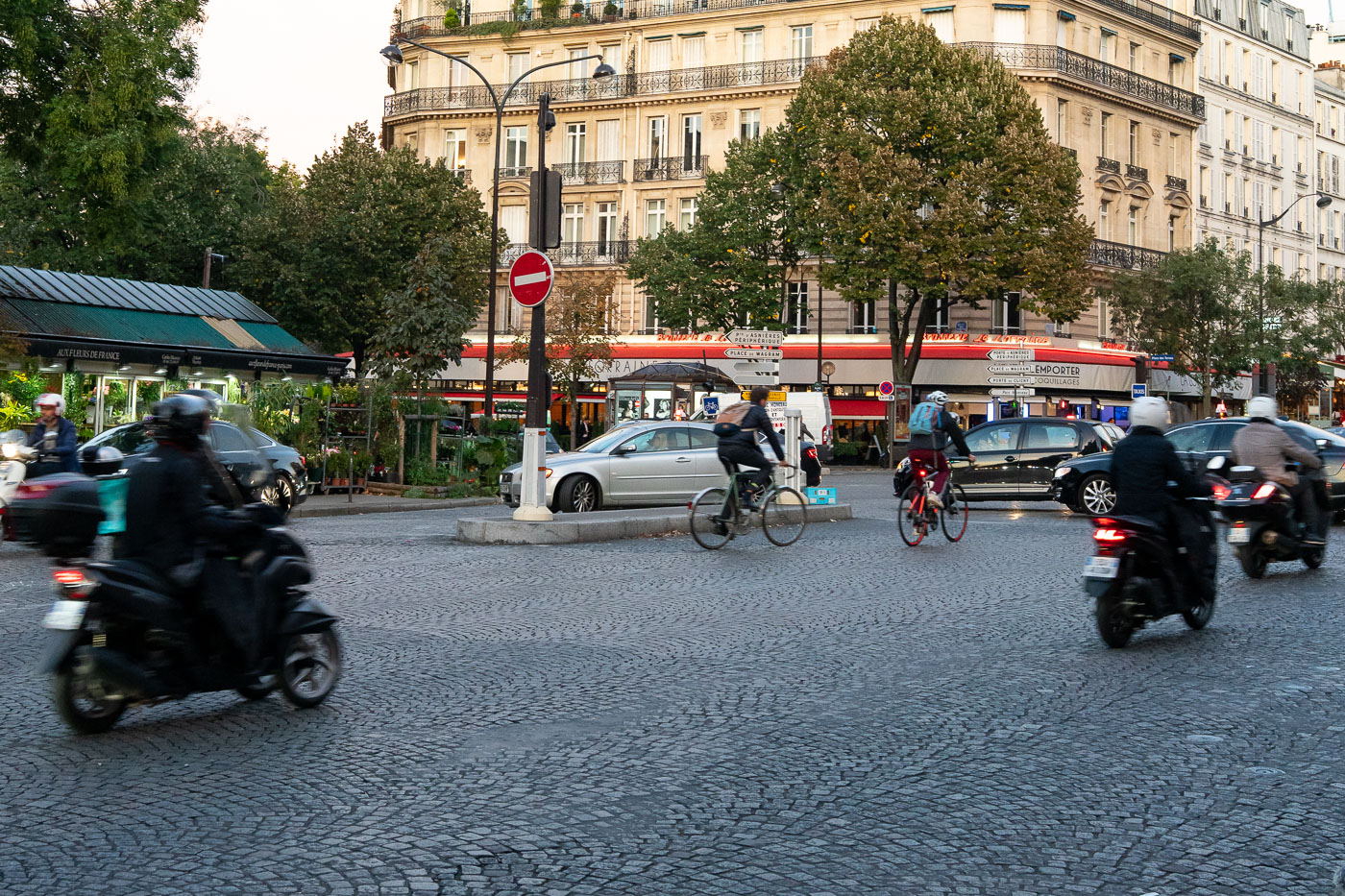
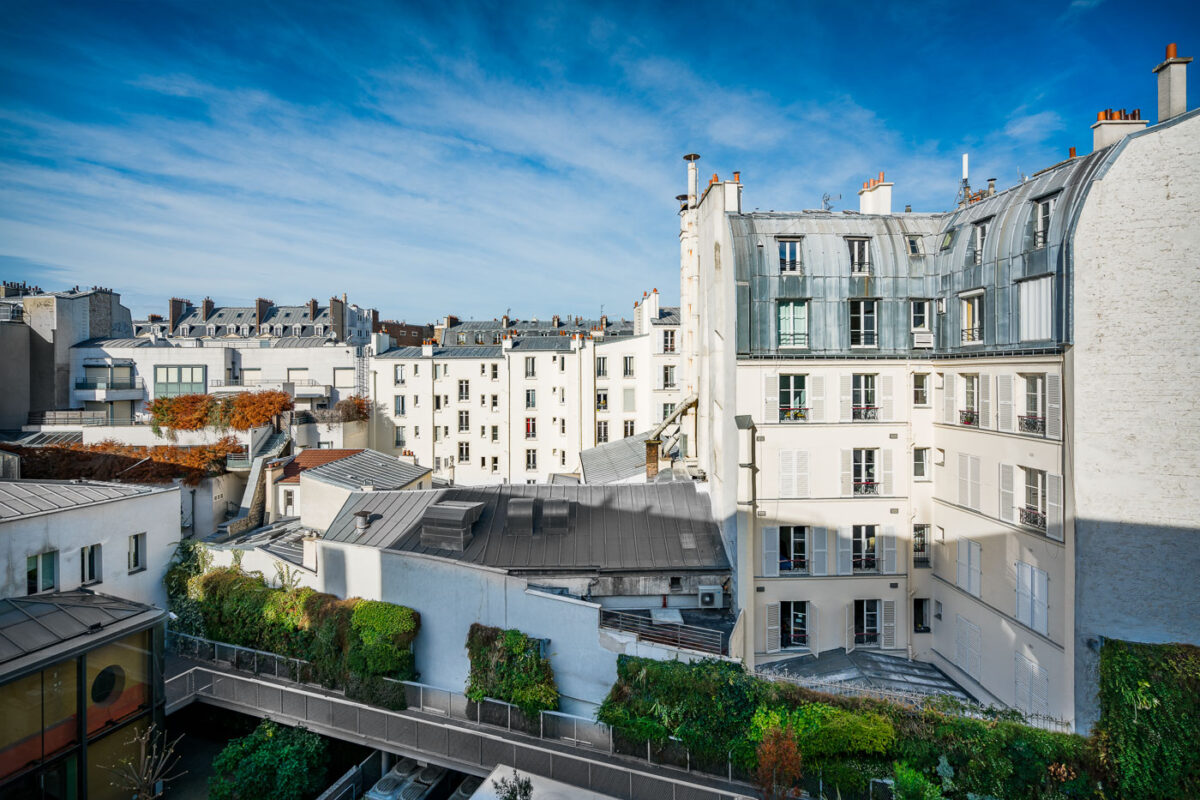
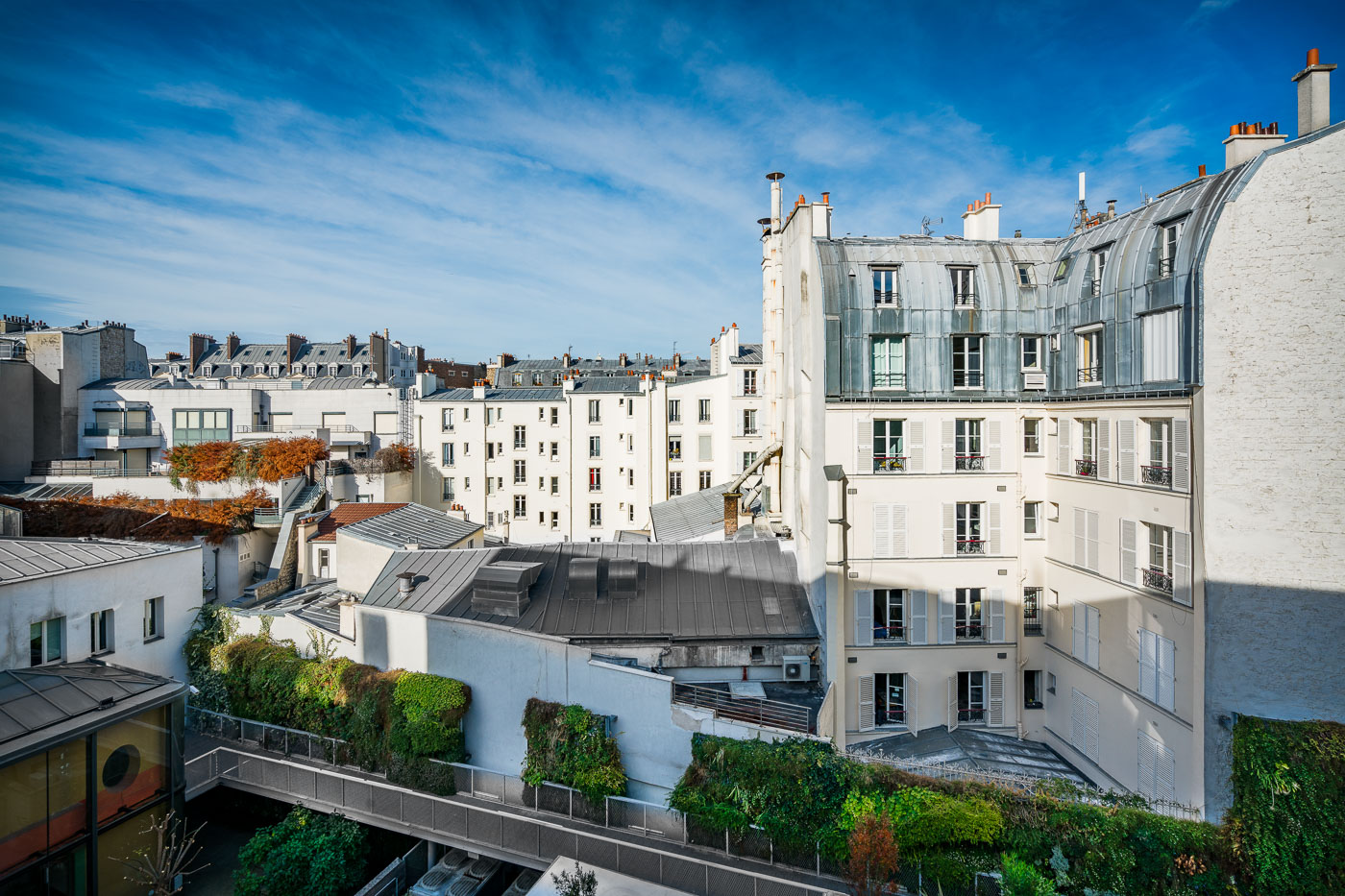
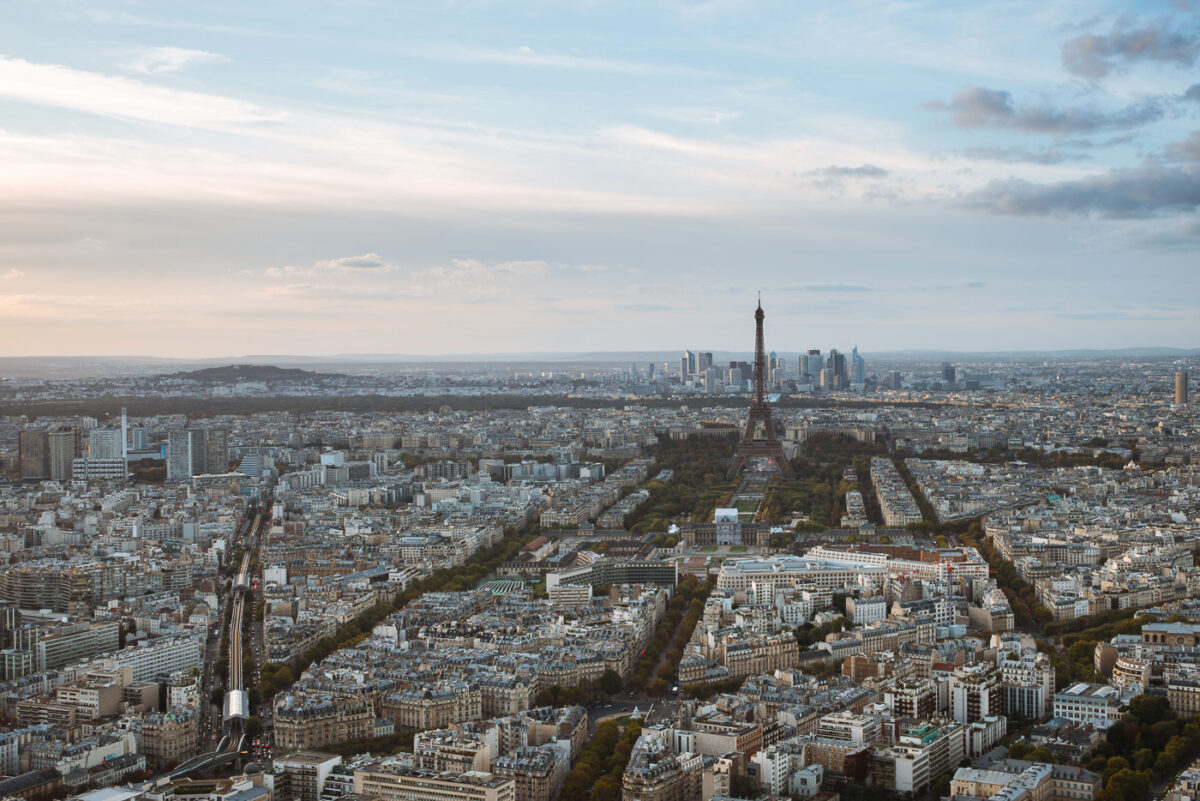
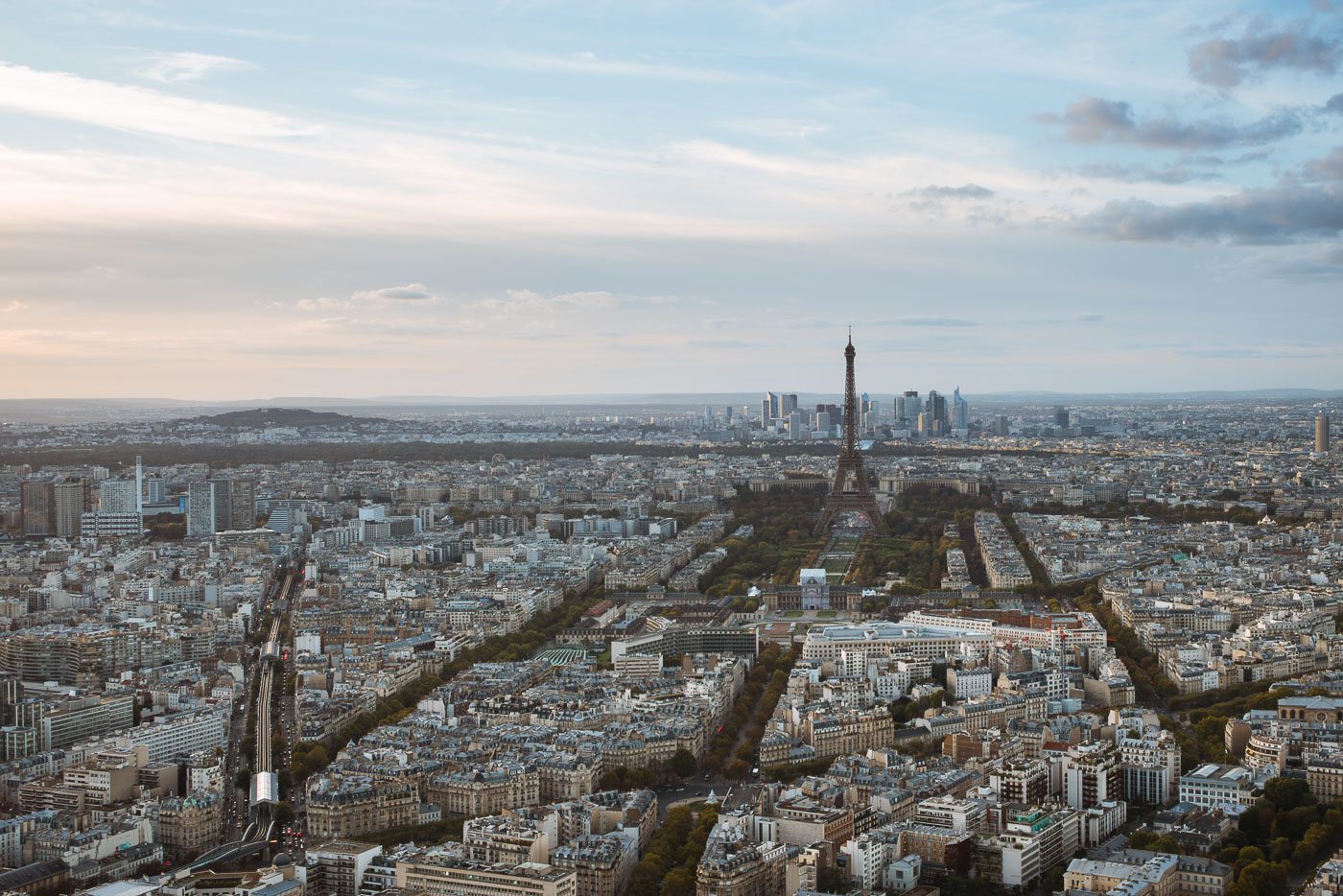
October 5, 2017 — SNCF high‑speed service at Paris’s Gare de Lyon. A blue‑and‑silver TGV unit marked with the SNCF logo and the number 294 stands at a platform beneath the station’s iron-and-glass train shed at Gare de Lyon in Paris, France. The streamlined nose of the train faces a row of barriers and signage, while maintenance equipment and timetable boards are visible in the concourse behind. Open work bays, columns, and tall windows define the historic terminal architecture, one of the capital’s main gateways to southeastern France. Operated by the national rail company SNCF, Gare de Lyon handles frequent high‑speed services toward Lyon, Marseille, the French Riviera, and cross‑border connections to Switzerland.October 5, 2017 — Platforms under the iron-and-glass train shed at Paris Gare de Lyon appear quiet as a few travelers walk along the concourse beside multiple sets of tracks. On the left, a row of weathered stone pillars and green-painted doors bears signage for TGV services, with protective netting strung high above the facade. Dark bollards line a marked pedestrian lane, and electronic displays and clocks hang near the platform edge. Through the canopy, an overcast sky is visible, and long-distance SNCF trains wait in the distance. Located in the 12th arrondissement, the station is one of France’s busiest hubs, connecting Paris to southeastern cities via high-speed lines since the late 20th century and serving conventional routes established long before.October 5, 2017 — Passengers cross the main concourse of Paris Gare de Lyon, 12th arrondissement, France, near coordinates. Under the iron-and-glass train shed, travelers wheel suitcases past an information point, rows of red seats, and storefronts with green-trimmed windows. Large banners in French promoting a music-streaming service hang from the rafters, while overhead signs direct people toward Hall 2 and other platforms. The Beaux-Arts arches and clerestory windows, part of a station complex inaugurated for the 1900 Exposition Universelle, frame the busy interior. Gare de Lyon is one of Paris’s principal rail hubs, serving TGV and regional lines to southeastern France and beyond, as well as RER and Métro connections for city transit.October 5, 2017 — Passengers wait and walk through the main concourse of Gare de Lyon in Paris, France, a major rail hub located in the 12th arrondissement. Rows of red seating, baggage trolleys, and electronic boards marked with concourse letters C through G line the iron-and-glass train hall, while SNCF trains are visible at the platforms to the right. Overhead signage points to “Information,” car rental, and connections to Paris Métro lines 1 and 14 and the RER A and D. The station, opened for the 1900 Exposition Universelle, serves high-speed TGV and regional services toward southeastern France and international destinations, making it one of the city’s busiest gateways.October 5, 2017 — The Gare de Lyon train station in Paris, France, is depicted in this photograph taken during daytime. The historic building features ornate architectural details, including sculptures and decorative stonework, with a prominent clock tower displaying the time. The station's entrance is visible, with signs indicating SNCF and other services, and people are seen walking and waiting outside. The scene captures the bustling activity typical of a major transportation hub in the city.October 4, 2017 — Cyclist at Place des Ternes, Paris evening traffic. A bicyclist with a backpack waits astride a single‑speed bike at a busy intersection at Place des Ternes on the border of Paris’s 8th and 17th arrondissements. Cars and a white delivery van circle the roundabout as storefronts and a news kiosk glow at dusk. The Belle Époque façade of Brasserie La Lorraine is visible across the square, along with direction signs to Porte d’Asnières, the Périphérique, Place de Wagram, and Porte de Clichy. Trees line the square’s cobblestones, and an illuminated ad for a luxury brand is posted on the kiosk, typical of evening rush hour near the Arc de Triomphe corridor. Keywords — Activities: Biking, Commuting, Waiting; Buildings: Brasserie La Lorraine, Haussmannian apartments, News kiosk; Location: Place des Ternes, Paris, France; Objects: Street signs, Backpack, Bicycle, Advertisements, Traffic lights; People: Bicyclist, Pedestrians (unidentified); Moods: Urban bustle, Dusk; Sceneries: City square, Tree‑lined boulevard; Texts: “Brasserie La Lorraine,” “Pte d’Asnières Périphérique,” “Place de Wagram,” “Porte de Clichy,” storefront signage; Companies: Givenchy (advertising); Weather: Clear, mild evening; Plants: Street trees; Animals: None; Vehicles: Compact cars, Delivery van.October 4, 2017 — A view of a typical Parisian apartment building in the 9th arrondissement, captured on a clear autumn day. The white facades of the buildings are contrasted by the gray, curved rooftops and chimneys, with some windows open and flower boxes visible. The scene includes a small courtyard with greenery and a modern glass extension, set against a bright blue sky with wispy clouds. The photograph was taken from an elevated position, showcasing the dense urban architecture characteristic of Paris, France.October 3, 2017 — An expansive view of Paris stretches toward the Eiffel Tower and the La Défense business district beyond. The photograph reveals the city’s Haussmannian grid — a pattern of symmetrical boulevards and stone façades that define the French capital’s architectural identity. The Champ de Mars park forms a long green corridor leading to the tower, while the modern high-rises of La Défense rise in sharp contrast to the 19th-century architecture in the foreground.
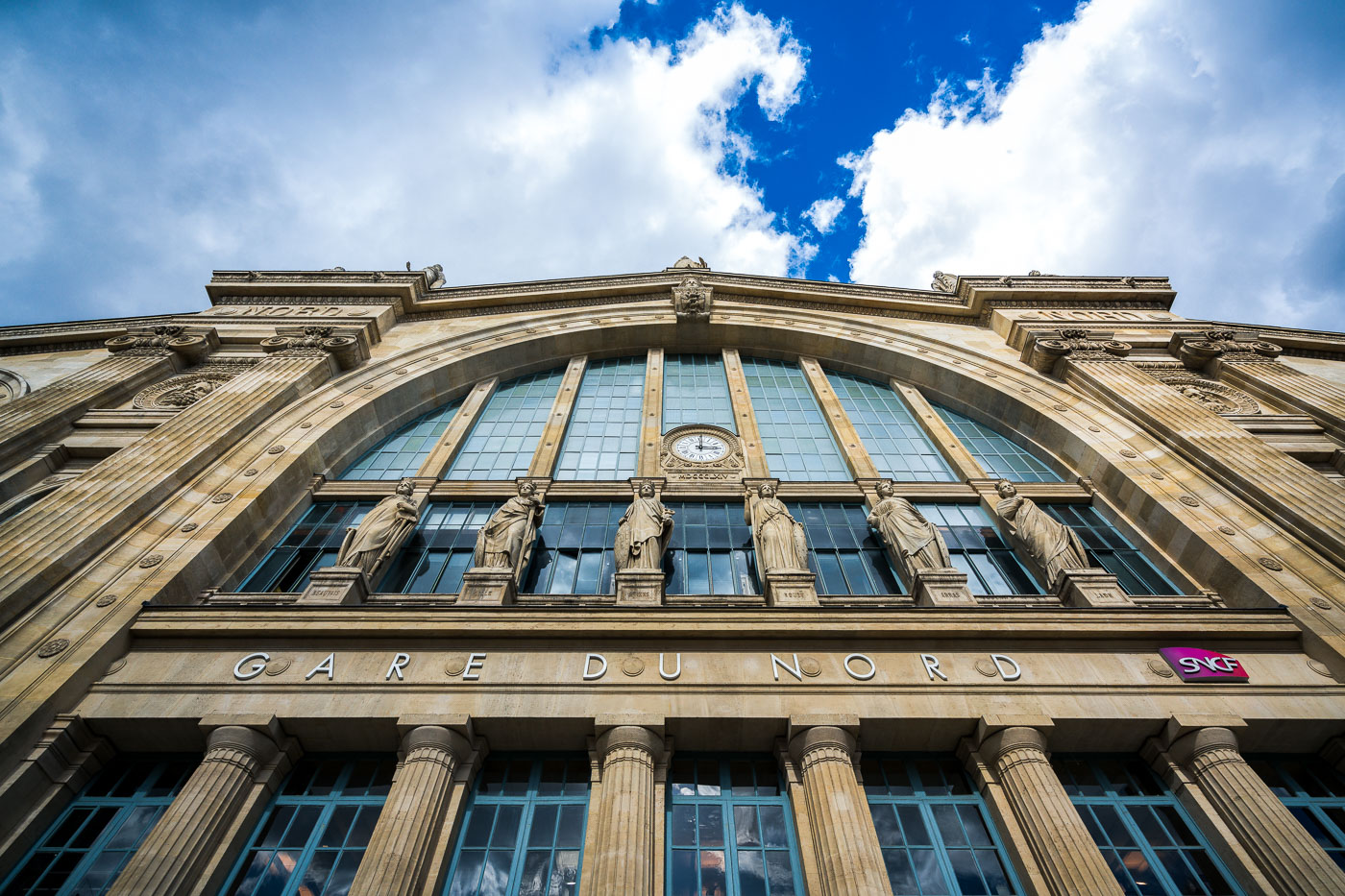
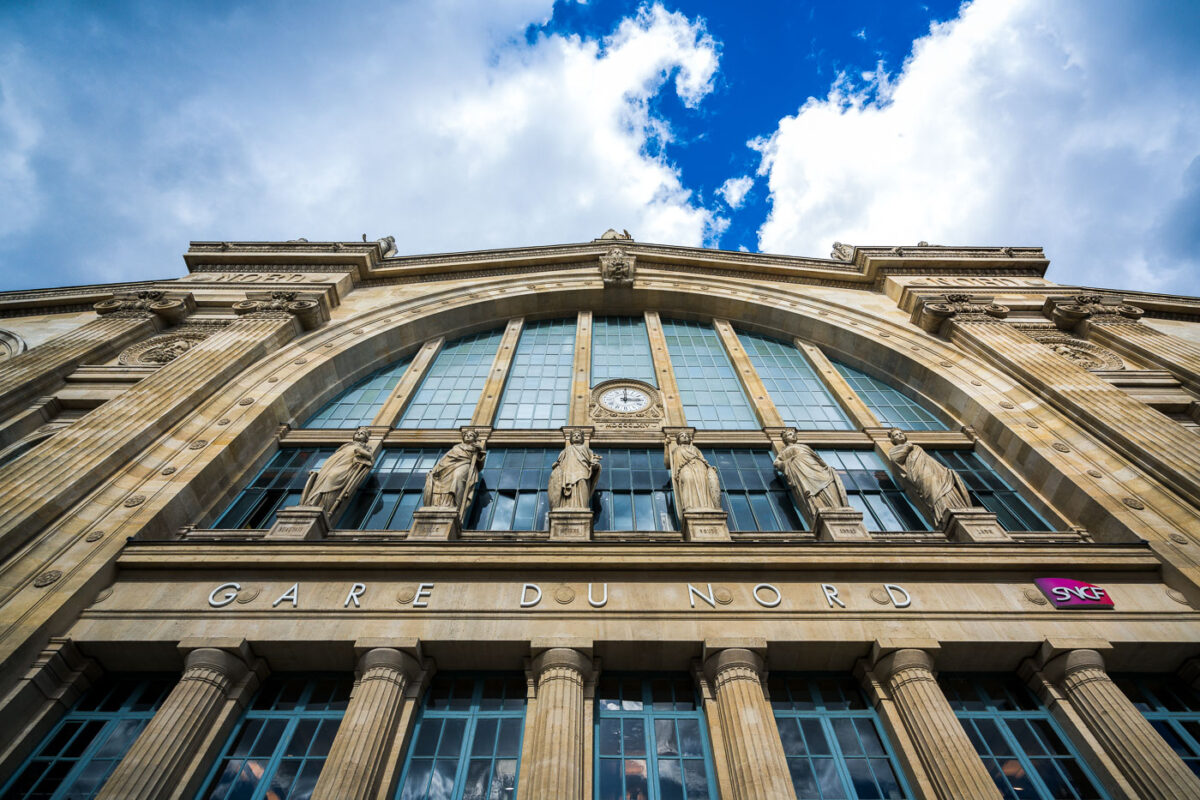
Taken in the late afternoon light, the scene highlights Paris’s urban planning legacy — a city that preserves its historic skyline even as it embraces modern commercial growth on its periphery. The Eiffel Tower, completed in 1889, remains a central anchor in the city’s layout and one of the most recognizable landmarks in the world.September 30, 2017 — Gare du Nord’s monumental Beaux‑Arts facade is pictured from street level in the 10th arrondissement of Paris, France. The stone frontage features tall arched windows, a central clock, and a row of allegorical statues that represent major European cities historically served by the station’s routes. The inscription “GARE DU NORD” is set above fluted columns, and a magenta SNCF logo marks the national rail operator; cumulus clouds break over a blue sky above the cornice. Opened in the 1860s and designed by architect Jacques-Ignace Hittorff, Paris-Nord is among Europe’s busiest rail hubs, linking regional Transilien lines, RER services, the Paris Métro, and international trains including the Eurostar to London. The station has long served as a gateway for commuters and cross‑border travelers, reflecting the growth of rail travel in northern Europe since the 19th century.