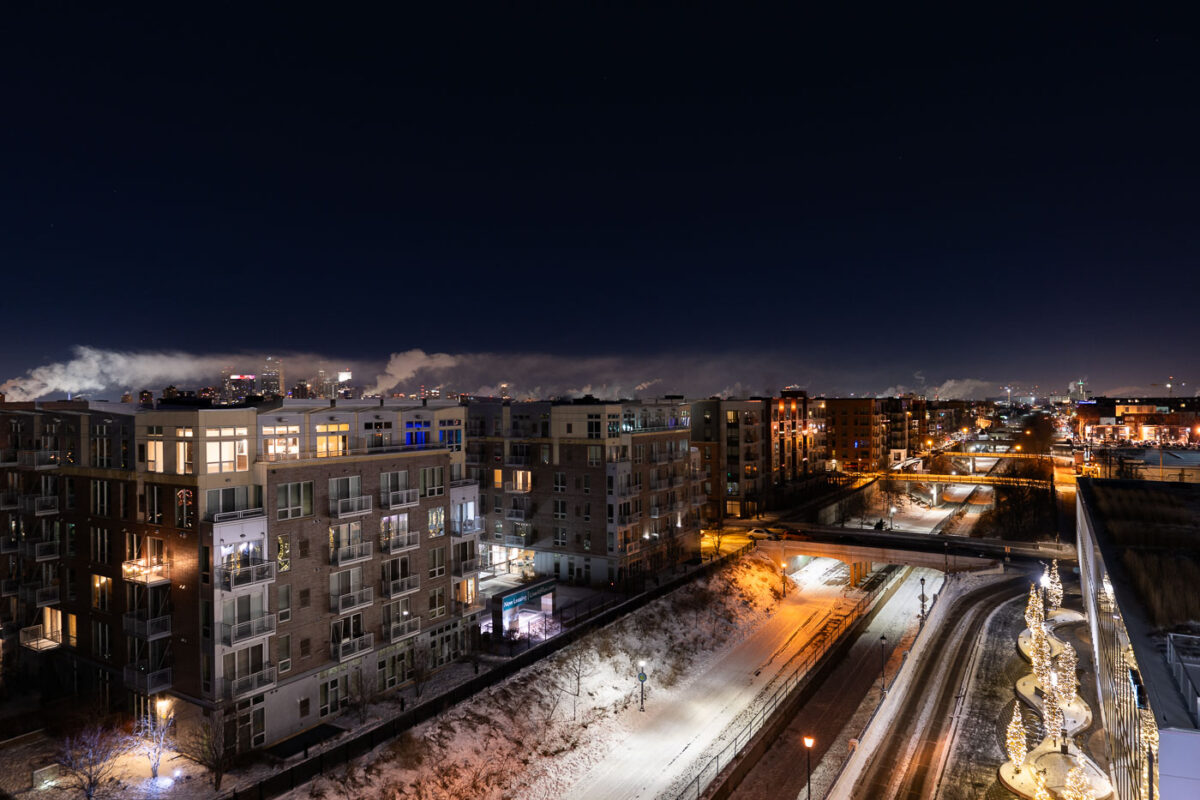
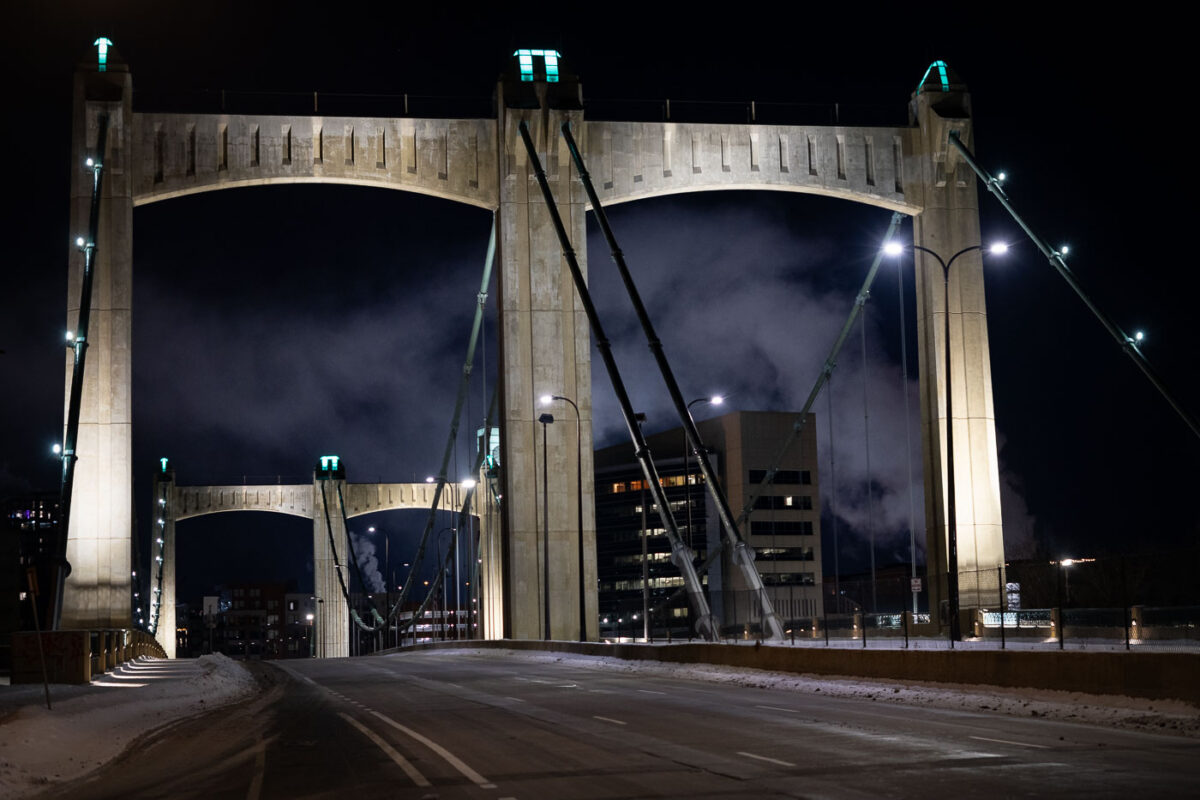
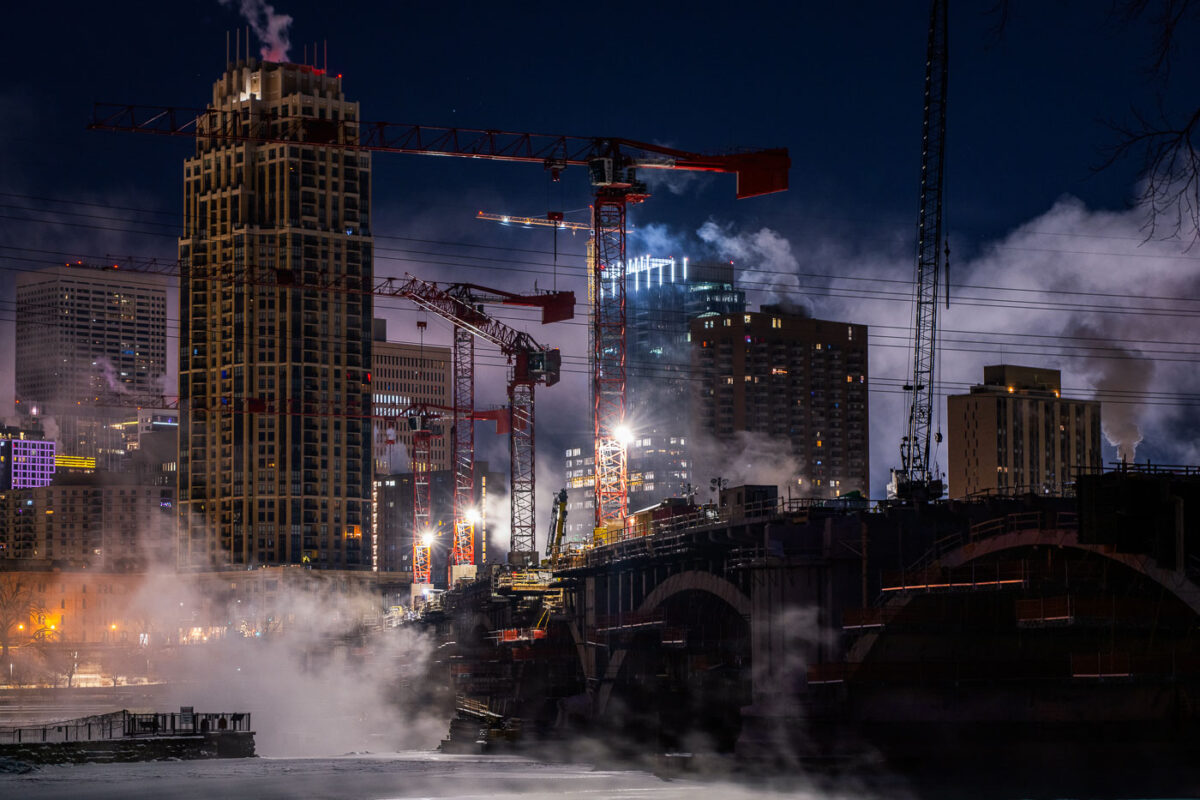
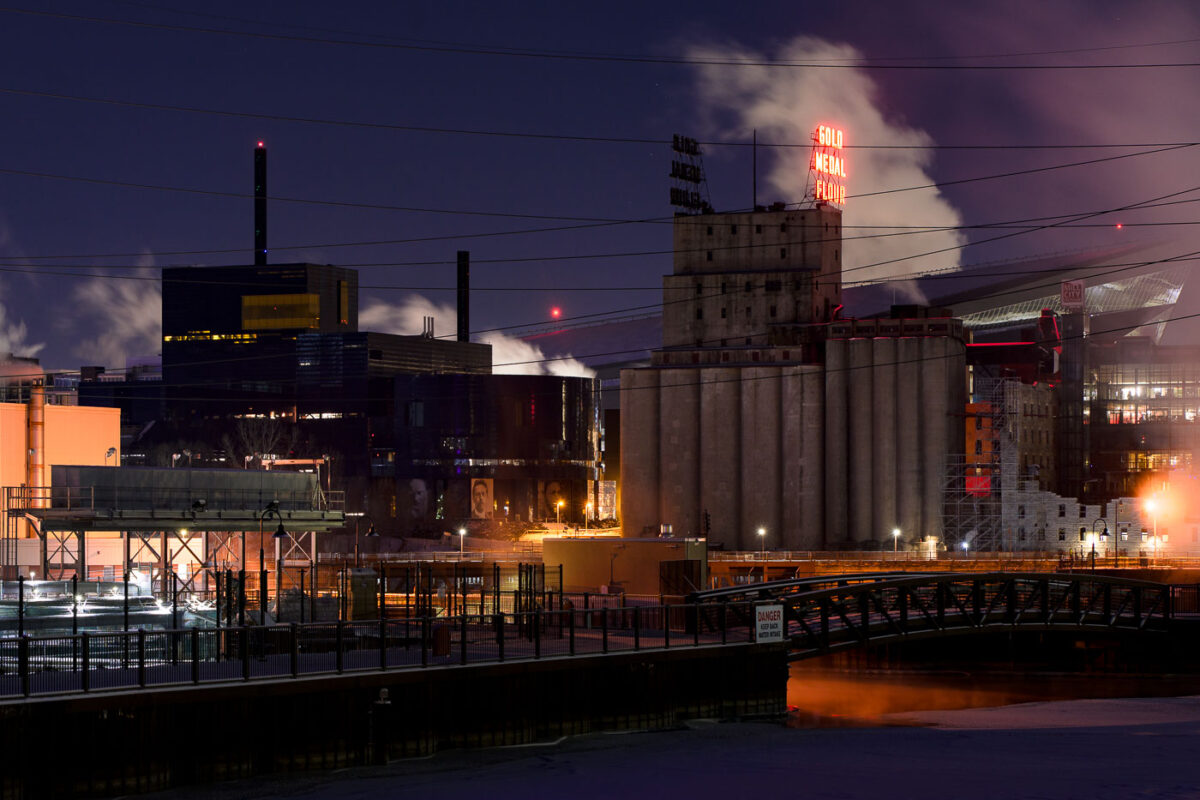
January 2, 2022 — The Midtown Greenway in Minneapolis, a 5.5-mile multi-use trail, traverses a former railroad corridor. This image shows the trail during a winter night, with steam rising from buildings due to sub-zero temperatures. Developed from an underutilized industrial route, the Greenway now serves as a critical transportation and recreational link, connecting neighborhoods and providing year-round access for cyclists and pedestrians.January 2, 2022 — Minneapolis gets hidden behind steam when it gets to -15F. Some photos from the early morning hours of January 2, 2022.January 2, 2022 — Construction continues on the Third Avenue Bridge in downtown Minneapolis during frigid winter conditions, with temperatures reaching -15°F. The image shows multiple tower cranes actively working on the bridge's structure, illuminated against the night sky. Steam rises from the nearby Mississippi River, adding to the atmospheric conditions of the construction site. This project is part of ongoing development in the Minneapolis cityscape, reflecting the city's continuous growth and infrastructure investment.January 2, 2022 — The historic Washburn Crosby Mill, a prominent structure in Minneapolis, is illuminated by its "Gold Medal Flour" sign on a frigid night with temperatures reaching -13°F. Originally built in the late 19th century, the mill was a cornerstone of the Pillsbury Company's operations and a significant contributor to Minneapolis's status as a global flour-producing center. The mill complex, situated along the Mississippi River, represents a key piece of the city's industrial heritage. While parts of the mill have been redeveloped, the sign remains a visible reminder of its past.January 5, 2022 — This memorial, located in Minneapolis, features graffiti that reads "No Cops In Heaven." The artwork and accompanying offerings, such as flowers and boots, serve as a tribute to a local activist. The phrase "No Cops In Heaven" gained prominence during the Minneapolis Uprising of 2020, a period of widespread protests following the murder of George Floyd. This site has become a focal point for remembrance and a statement against police brutality.January 6, 2022 — Liquor Lyle's Bar & Restaurant, a long-standing establishment on Hennepin Avenue in Minneapolis, is pictured here during winter. Founded in 1963, the venue has served as a neighborhood fixture, offering both liquor and food. The building's facade features prominent neon signage and is marked by graffiti, suggesting a complex history of public use and artistic expression. Its presence on Hennepin Avenue places it within a significant commercial corridor of the city.January 6, 2022 — Hennepin Avenue in Uptown Minneapolis is shown on a winter night in January. This street has historically been a central commercial and cultural corridor for the city, featuring a variety of businesses and entertainment venues. The area has also been a site of significant public gatherings and protests, including those following the murder of George Floyd in 2020, which occurred nearby. The photograph captures the quiet of the street after business hours, with snow covering the roadway and sidewalks, highlighting the seasonal atmosphere of the urban environment.January 6, 2022 — A "We're Moving to Edina!" sign is displayed on the window of Flanders Art Gallery at 5025 France Avenue South in Minneapolis. The gallery, which also has a location in Edina, is announcing its relocation to the latter suburb. The sign provides the new address, phone number, and website for the gallery. The surrounding street is covered in snow, indicating a winter scene in the Minneapolis metropolitan area. The presence of a Speedway gas station across the street suggests this is a commercial district.January 6, 2022 — The Uptown Theater, located at Hennepin Avenue and Lagoon Avenue in Minneapolis, is seen here during a winter snowfall. The building was undergoing a significant renovation to transform it into a concert venue. Originally opened in 1929 as a movie palace, the Uptown Theater has been a prominent landmark in the city's Uptown neighborhood for decades. Its conversion reflects a shift in entertainment venues and the ongoing adaptation of historic structures to contemporary uses.January 17, 2022 — The Minneapolis Police 5th Precinct station is shown behind security fencing at night in January 2022. The precinct serves the south Minneapolis area, and its presence is a key component of the city's public safety infrastructure. The fencing and barriers suggest a period of heightened security or ongoing repairs, potentially related to events such as the Minneapolis Uprising of 2020, which significantly impacted police facilities in the city. The station continues to operate as a central hub for law enforcement activities in its designated district.January 17, 2022 — The Minneapolis Police Department's 1st Precinct station is located in Downtown Minneapolis. This facility serves as a central hub for law enforcement operations in the downtown core, providing essential services and maintaining public safety. The precinct's presence is integral to the functioning of the city's central business district and surrounding neighborhoods. The building's design incorporates modern security features while maintaining a functional and accessible public interface.January 17, 2022 — The Minneapolis Police Department's 2nd Precinct Station, located at NE 19th Avenue, is shown in January 2022. The building, which bears the inscription "1911," indicating its construction year, is partially obscured by security fencing and concrete barriers. These measures were put in place following the civil unrest in Minneapolis in 2020. Despite the security enhancements, decorative Christmas lights adorn the trees on the property, creating a stark contrast between the festive illumination and the station's fortified appearance.January 18, 2022 — The Minneapolis Police Fourth Precinct station is shown fortified with security fencing and razor wire in January 2022. This precinct became a focal point during the 2020 Minneapolis uprising following the murder of George Floyd, which led to its temporary occupation and eventual abandonment by the Minneapolis Police Department. The presence of security measures and a sign reminding visitors to practice social distancing highlights the heightened tensions and public scrutiny surrounding law enforcement in the city during that period. The precinct has since been rebuilt and reopened.January 18, 2022 — A sign at the intersection of 37th Street and Chicago Avenue in Minneapolis reads, "You are now entering the free state of George Floyd." This area, known as George Floyd Square, became a focal point for protests and activism following the murder of George Floyd in May 2020. The "free state" designation reflects the community's assertion of autonomy and self-governance in the wake of the incident. The raised fist monument, a symbol of Black power and resistance, stands nearby, further emphasizing the area's significance as a site of remembrance and ongoing social justice advocacy.January 18, 2022 — Lagoon Avenue in Uptown Minneapolis is shown after a snowfall at night, with the "Taco Taxi" food truck parked along the street. Uptown is a vibrant commercial and residential district known for its eclectic mix of shops, restaurants, and entertainment venues. The area has undergone significant development over the decades, transforming from a more traditional commercial strip into a bustling urban hub. The presence of the food truck indicates the ongoing use of public spaces for local businesses, even during winter months.January 18, 2022 — A "PARKING" sign is illuminated above the entrance to a lot at 1438 W. Lake Street in Minneapolis's Uptown neighborhood. The lot appears to be a pay-to-park facility, with signage indicating payment by machine or phone in advance. The surrounding brick buildings and the snow-covered, rutted ground suggest a typical winter night in the urban environment. This area of Uptown Minneapolis is a commercial and residential hub, with parking facilities like this being essential for accessing businesses and residences.January 19, 2022 — Security fencing surrounds the Warren E. Burger Federal Building in downtown St. Paul, a federal courthouse serving the region. These temporary barriers were erected the night before jury selection began for the federal trial of former Minneapolis Police Officers accused of violating George Floyd's civil rights. The trial addressed charges stemming from the widespread protests and civil unrest that followed Floyd's murder in May 2020. The security measures underscore the building's role in significant legal proceedings and the intense public scrutiny surrounding this case.January 23, 2022 — Security infrastructure, including a U.S. Marshals barricade and perimeter fencing, surrounds the Warren E. Burger Federal Building in downtown St. Paul. This federal courthouse, located on Kellogg Boulevard, was placed under heightened security the night before opening statements in the federal trial of the officers accused of violating George Floyd's civil rights. The building serves as a vital judicial center for the district, hosting proceedings of significant national and historical importance. These measures underscore the critical nature of the legal proceedings and the building's role in the federal justice system.January 23, 2022 — A chain-link fence surrounds the Ramsey County Government Center East building in St. Paul, Minnesota. This security measure was implemented the night before opening statements in the federal trial of former Minneapolis police officers accused of violating George Floyd's civil rights. The building, which houses the Ramsey County Downtown Service Center, temporarily relocated its public services to Metro Square during the proceedings. This action underscores the significant public interest and security considerations surrounding the trial, which followed widespread protests for racial justice.January 23, 2022 — Security measures are in place around the Warren E. Burger Federal Building in downtown St. Paul, Minnesota. This federal courthouse was heavily secured on the night before opening statements in the trial of the officers accused of violating George Floyd's civil rights. Concrete barriers and fencing were erected to manage access and ensure safety during the high-profile proceedings. The building, which houses federal court operations, is located across the street from the Twin Cities PBS (TPT) headquarters.January 25, 2022 — George Floyd Square, located at the intersection of Chicago Avenue and East 38th Street in Minneapolis, Minnesota, is pictured on a night when temperatures dropped to -16 degrees Fahrenheit. This area became a focal point of protests and activism following the murder of George Floyd in May 2020. The square, established by protesters, was declared a "Free State of George Floyd" and served as a space for community organizing and remembrance. The image captures the enduring presence of the movement during harsh winter conditions.January 25, 2022 — Icicles hang from the awning of Stella's Fish Cafe in Uptown Minneapolis. The restaurant, a long-standing establishment in the city's Uptown neighborhood, is known for its vibrant neon signage. This photograph was taken on a night when temperatures dropped to -16 degrees Fahrenheit, highlighting the harsh winter conditions experienced in Minnesota. Stella's has been a fixture in the Uptown area for decades, contributing to the neighborhood's character and serving as a popular gathering spot.January 26, 2022 — Domino's pizza on Hennepin Avenue in Minneapolis on an evening where temperatures would hit -16F.January 26, 2022 — A Holiday gas station on Hennepin Avenue in Uptown Minneapolis is illuminated at night. The presence of snow and festive lights suggests the photograph was taken during the winter holiday season. Gas stations are essential components of the transportation infrastructure, facilitating daily commutes and longer journeys.January 26, 2022 — Security fencing and St. Paul police block roads outside the Warren E. Burger Federal Building in St. Paul, Minnesota, on Day 3 of the federal civil rights trial. Former officers Thou Thao, J Alexander Kueng, and Thomas Lane were accused of violating George Floyd's civil rights, a case that followed the Minneapolis Uprising. The Warren E. Burger Federal Building functions as a courthouse for the U.S. District Court for the District of Minnesota, hosting significant legal proceedings. During this period, a car caravan protest moved through downtown St. Paul, underscoring public attention to the trial.January 26, 2022 — An American flag flies outside the Warren E. Burger Federal Building in St. Paul, Minnesota. This federal courthouse, named after former Chief Justice of the United States Warren E. Burger, serves as a key judicial center for the district. The photograph was taken on Day 3 of the federal trial where former Minneapolis police officers Thou Thao, J Alexander Kueng, and Thomas Lane were accused of violating George Floyd's civil rights. This high-profile trial followed the widespread protests and calls for justice that arose after Floyd's death. Security fencing is visible around the building, reflecting the significant public and historical importance of the proceedings.January 26, 2022 — U.S. Marshals barricades line Kellogg Boulevard in St. Paul, Minnesota, establishing a security perimeter on a snowy day. These measures were implemented outside the Warren E. Burger Federal Building during the federal trial of former police officers Thou Thao, J Alexander Kueng, and Thomas Lane, who were accused of violating George Floyd's civil rights. On Day 3 of the trial, St. Paul police blocked the road as a car caravan protest made its way through downtown. The proceedings, which commenced in January 2022, highlighted the profound national conversation surrounding civil rights and police accountability.January 26, 2022 — St. Paul police vehicles provided security outside the Warren E. Burger Federal Building in St. Paul, Minnesota, on Day 3 of the federal civil rights trial. Former officers Tou Thao, J. Alexander Kueng, and Thomas Lane were accused of violating George Floyd's civil rights during the incident that led to his death. The police presence also managed traffic as a car caravan protest moved through downtown, reflecting public engagement with the judicial proceedings. The Warren E. Burger Federal Building, completed in 1967, serves as a significant federal courthouse for the district.January 29, 2022 — The Target store on East Lake Street in Minneapolis is shown with its security shutters lowered. This location became a focal point during the 2020 Minneapolis uprising following the murder of George Floyd. The building across the street housed the Minneapolis Police Department's Third Precinct, which was overrun and set ablaze by protesters. The lowered shutters suggest a period of closure or heightened security in response to the unrest.January 29, 2022 — A Haya Health COVID-19 testing site is pictured on Chicago Avenue in Minneapolis. The site offered rapid testing with same-day results and walk-in appointments. This location is situated near George Floyd Square, an area that became a focal point during the 2020 Minneapolis uprising following the murder of George Floyd. The presence of the testing site highlights the ongoing public health response to the pandemic in a neighborhood that experienced significant social and political upheaval.January 29, 2022 — Posters advocating for justice for George Floyd are displayed on the window of an art gallery within George Floyd Square in Minneapolis. The square, established in the summer of 2020 following Floyd's murder, became a focal point for protests against racial injustice and police brutality. This "Justice for George Floyd" poster, featuring his portrait and the hashtag #SayHisName, reflects the ongoing impact of his death and the broader movement for racial equity. The upper image shows a historical photograph of a protestor holding a sign that reads "Don't Mess with Reality."January 29, 2022 — George Floyd Square in Minneapolis is seen during winter, with snow covering the ground and memorial elements. The site, located at the intersection of Chicago Avenue and 38th Street, became a focal point for protests and activism following the murder of George Floyd in May 2020. It has since been maintained as a memorial and community space by local residents. The presence of holiday decorations, including stockings and a small Christmas tree, suggests the photograph was taken during the winter holiday season, while the ongoing federal civil rights trial of former officers involved in Floyd's death was underway in nearby St. Paul.January 29, 2022 — A handmade sign at George Floyd Square reads "THERE IS BLOOD ON THE LEAVES IN AUSTIN, MN" and "Justice 4 Kokou." The sign refers to Kokou Christopher Fiafonou, who was killed by law enforcement in Austin, Minnesota, on December 23, 2021. Authorities stated Fiafonou was armed with a knife and threatening others at the time of the incident. The presence of this sign at George Floyd Square, a site of ongoing protests and activism, connects Fiafonou's death to broader discussions about police conduct and justice.January 29, 2022 — A sign at George Floyd Square in Minneapolis reads "1 DOWN! 3 TO GO! THE WORLD IS WATCHING!" This message likely refers to the federal civil rights trial of former officers involved in George Floyd's murder, with one conviction already secured and three more trials pending. The square, established in the wake of Floyd's death in May 2020, has become a significant site of protest and remembrance. The "1 Down! 3 to Go!" slogan reflects the ongoing pursuit of justice and the broader attention on accountability for police misconduct.January 29, 2022 — A stop sign in South Minneapolis is defaced with graffiti, including the phrase "FTP" and "AND THINK." The "FTP" tag is a common abbreviation for "Fuck The Police," a slogan frequently used in protests against police brutality and misconduct. This act of vandalism occurred in the context of heightened social unrest and protests in Minneapolis, particularly following the murder of George Floyd in May 2020. The graffiti serves as a visual commentary on public sentiment towards law enforcement during a period of significant civil activism.