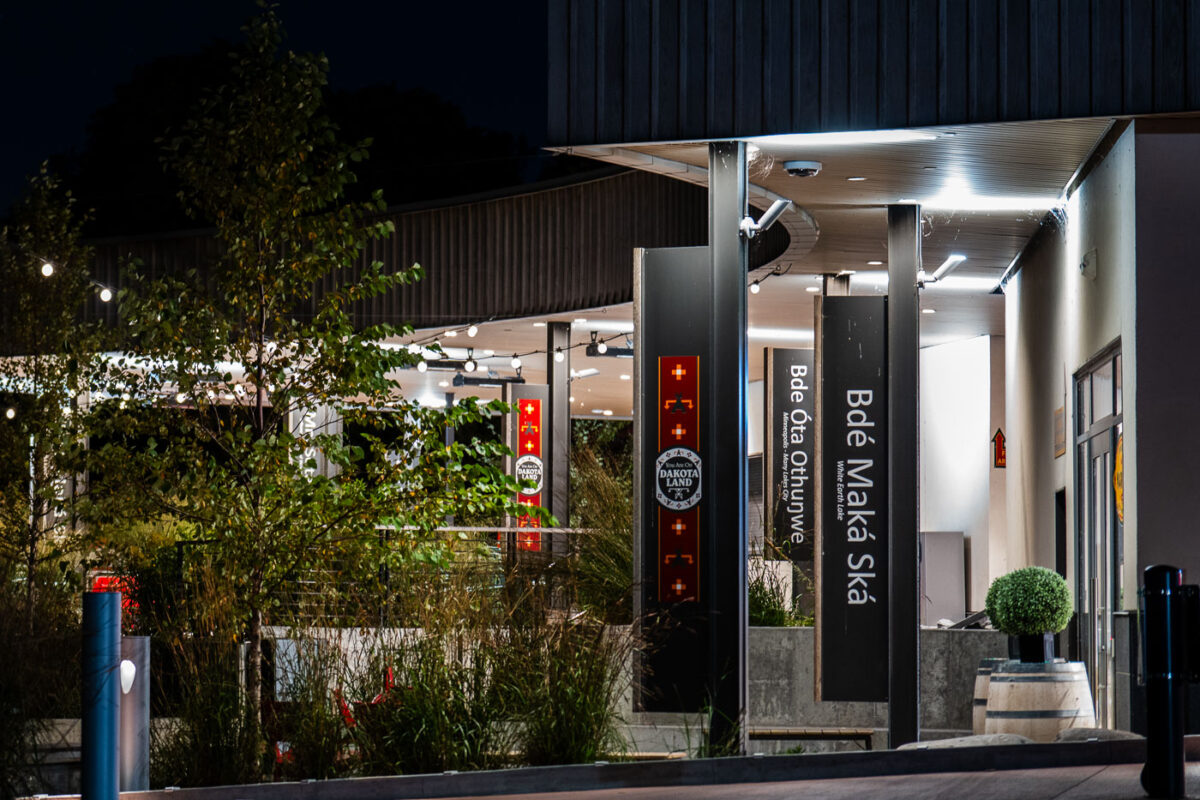
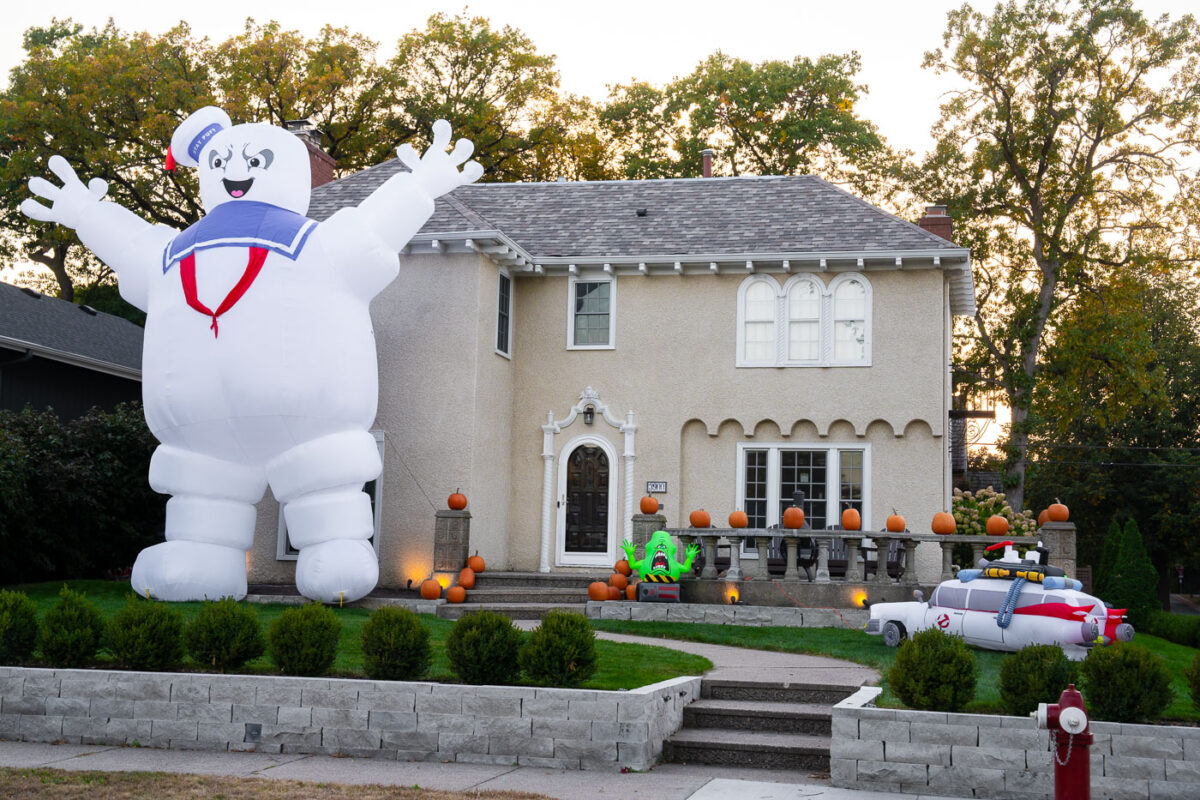
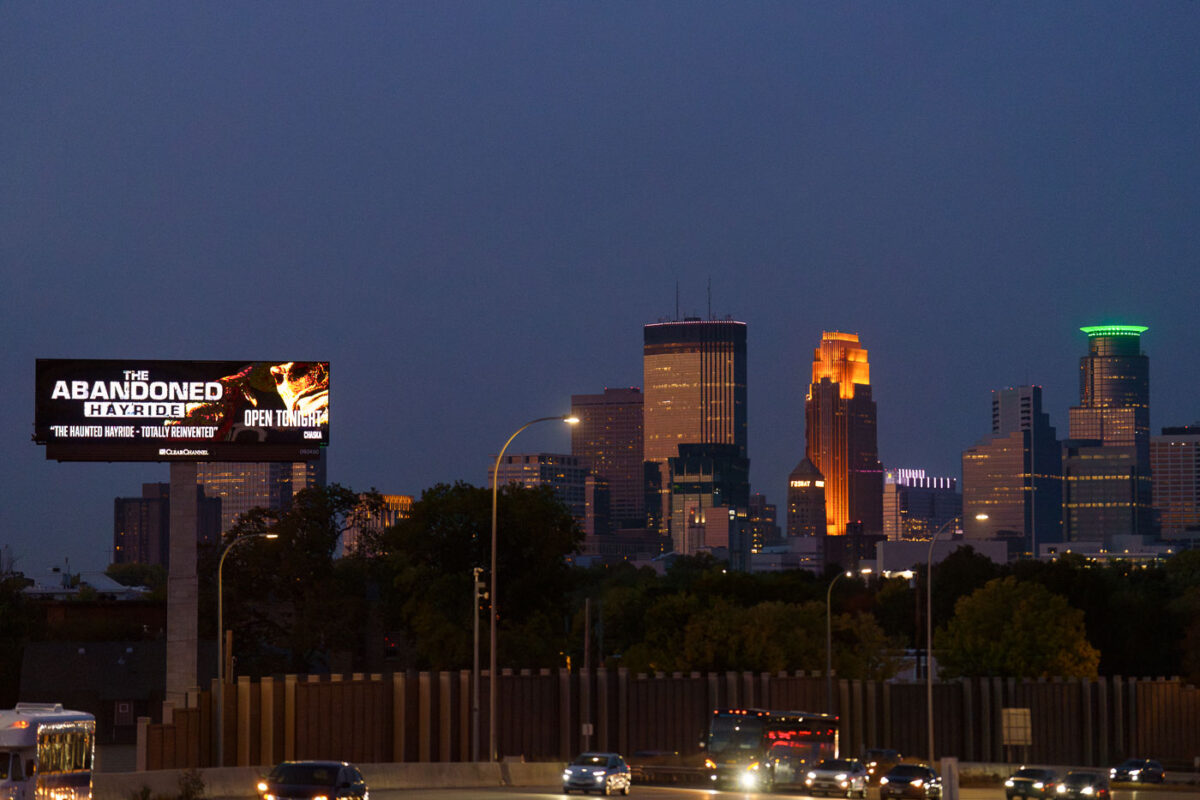
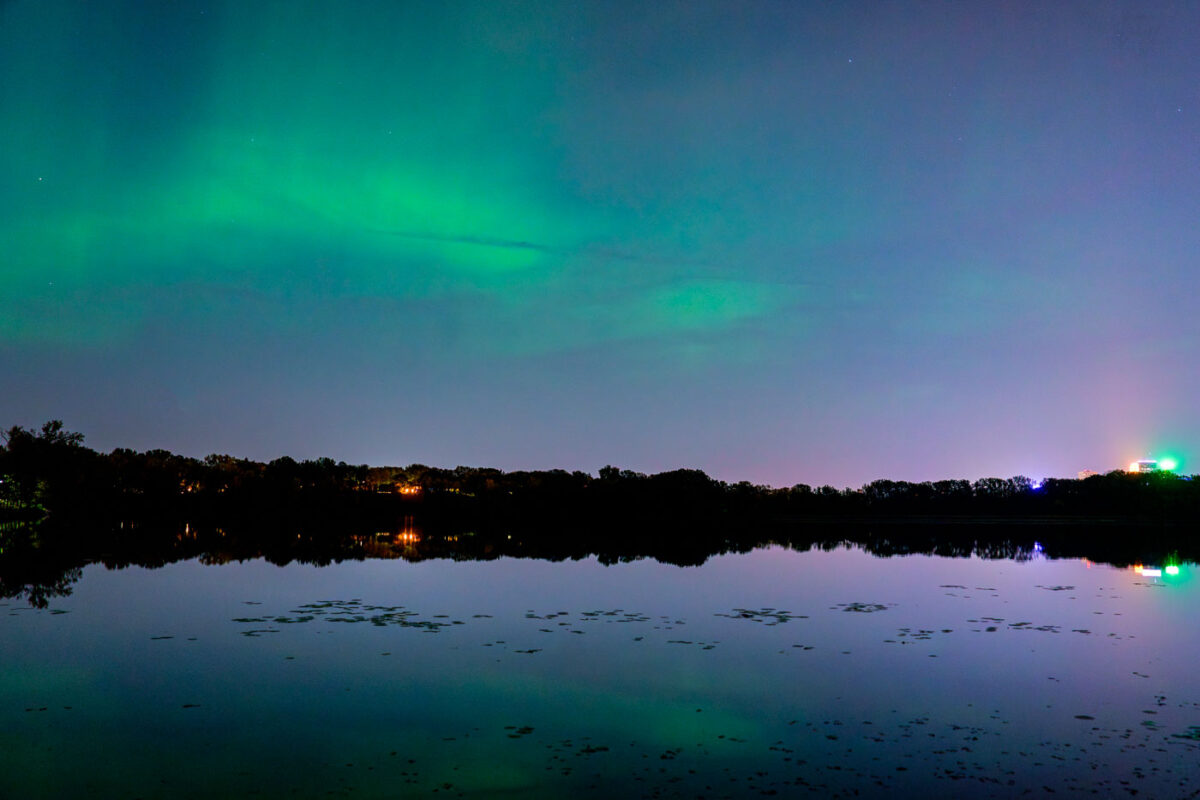
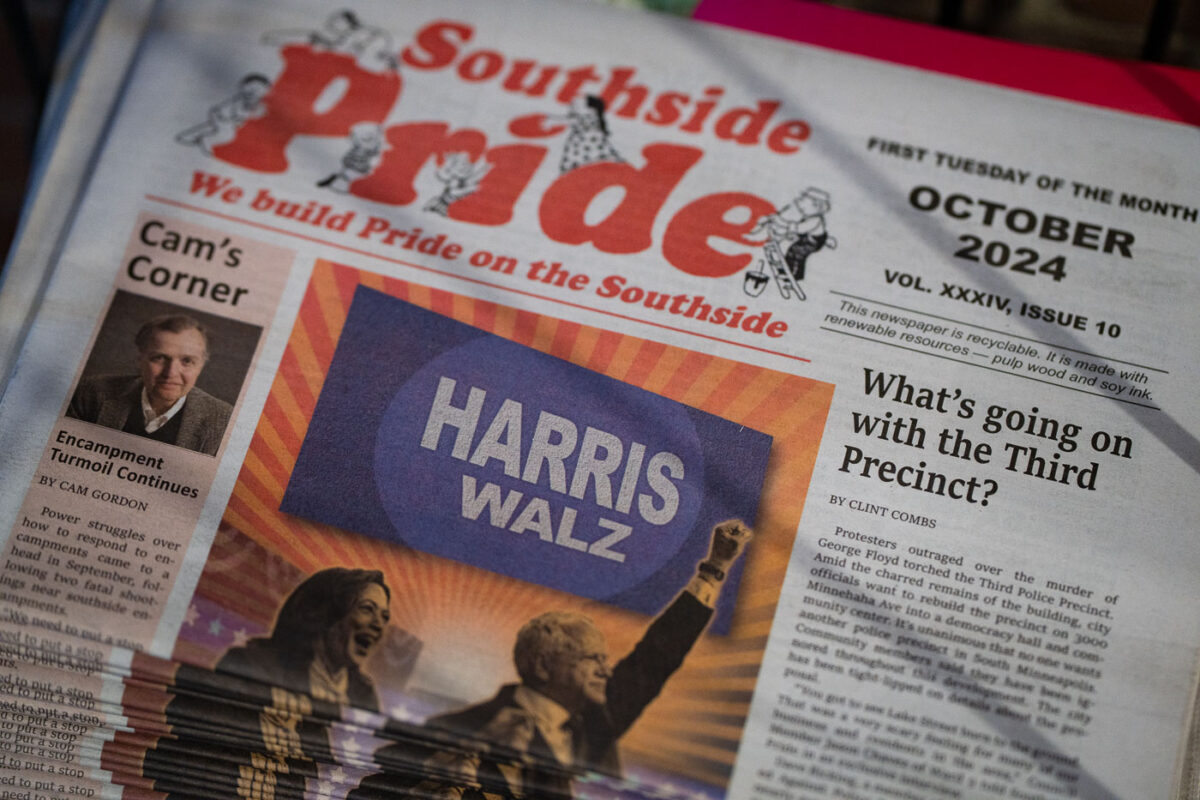
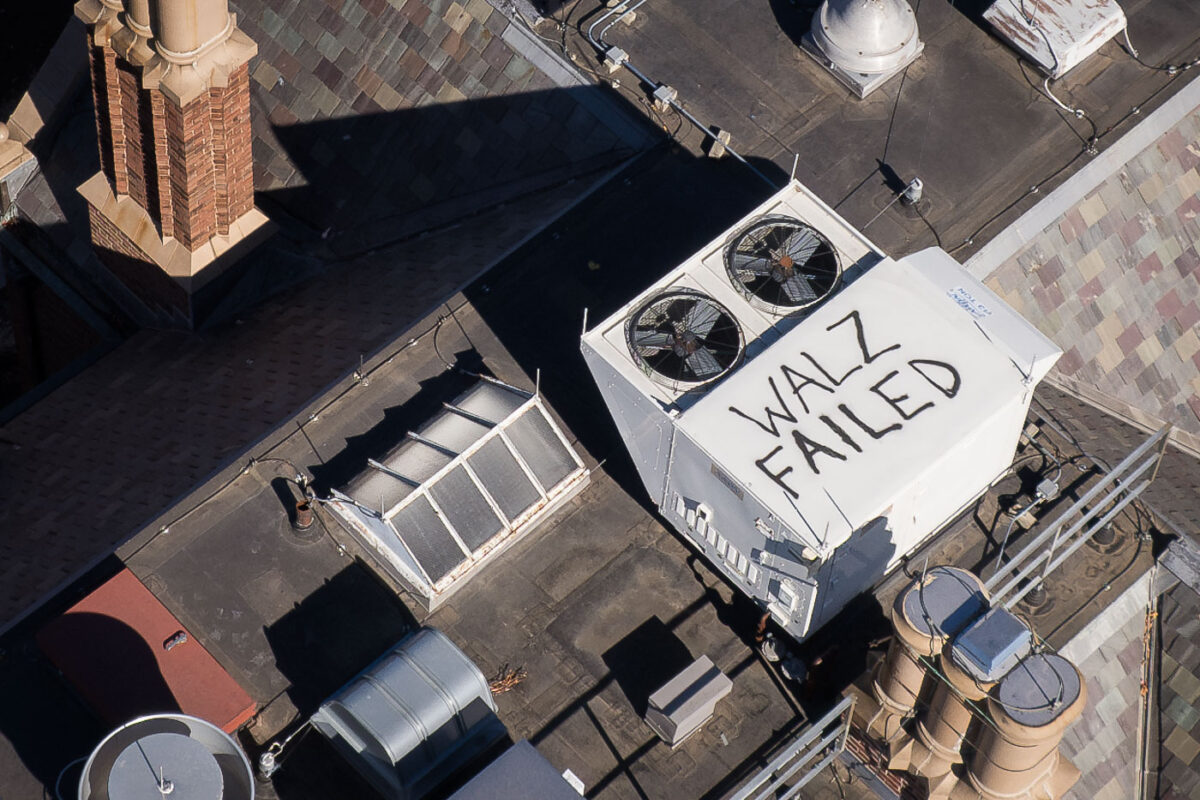
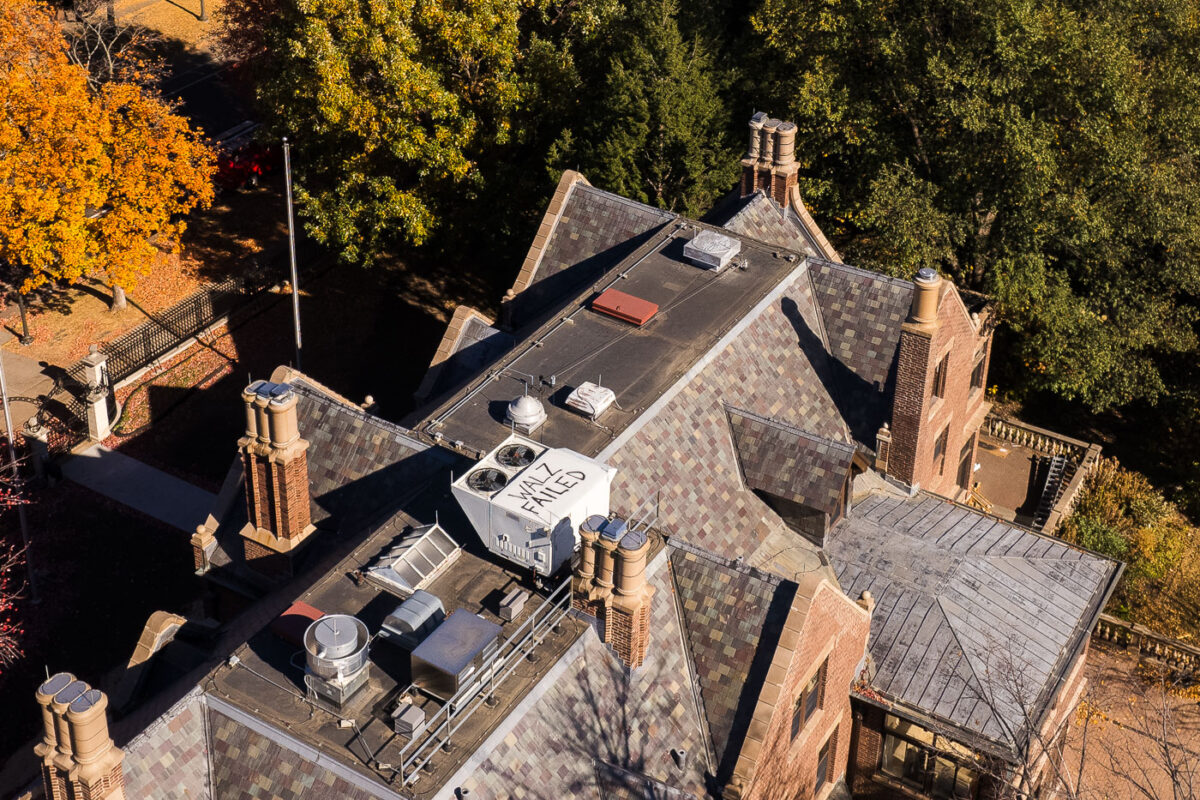
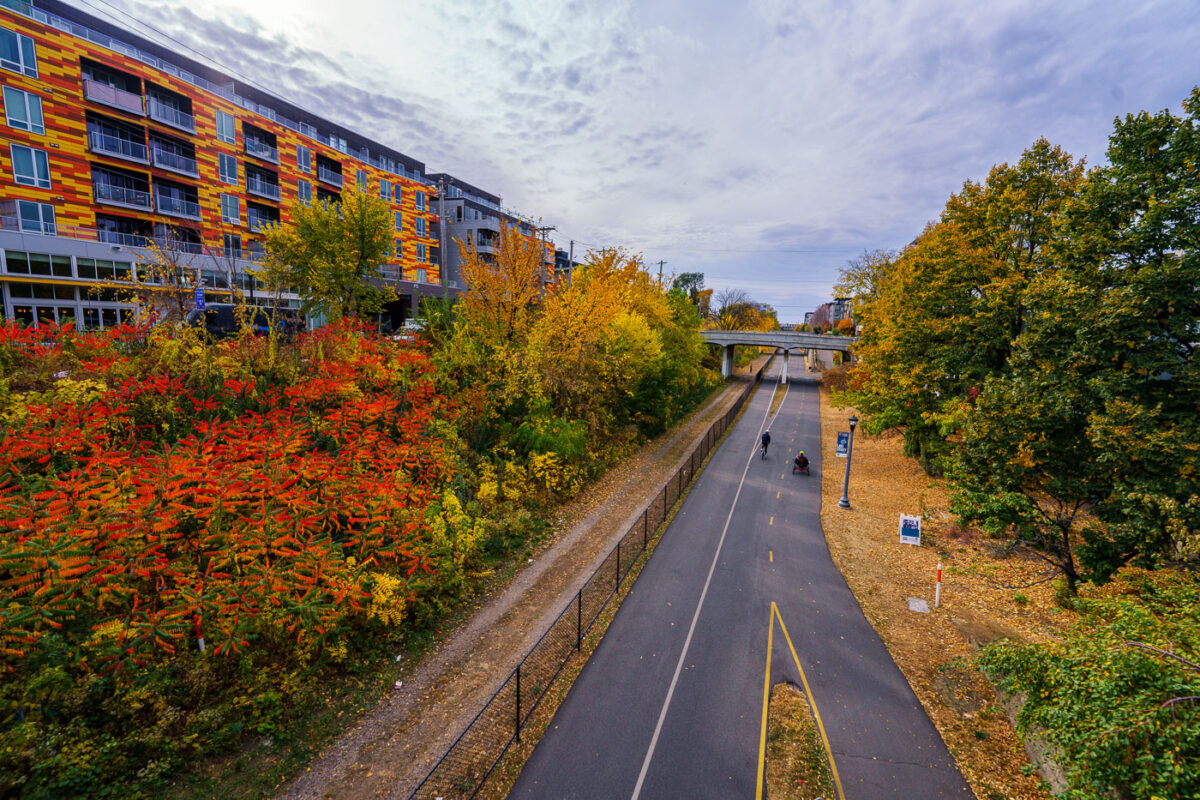
October 8, 2024 — The Bde Maka Ska Pavilion in Minneapolis, illuminated at night, features signage honoring the lake's Dakota name, "Bdé Óta Othúŋwe," meaning "Many Village Place." This location is situated on land historically significant to the Dakota people, predating its 19th-century renaming to Lake Calhoun. Following advocacy by Indigenous groups, the lake officially reverted to its Dakota name in 2018, acknowledging Minnesota's original inhabitants and languages. The pavilion now serves as a contemporary gathering space that also signifies cultural reclamation and respect for ancestral heritage.October 10, 2024 — A residential property in Minneapolis is adorned with elaborate Halloween decorations, featuring prominent figures from the "Ghostbusters" franchise. The display includes a large inflatable Stay Puft Marshmallow Man and a replica of the Ecto-1 vehicle, alongside numerous pumpkins and a Slimer decoration. This type of extensive home decoration for Halloween has become a cultural practice in many communities, transforming private residences into temporary public attractions during the holiday season. The "Ghostbusters" theme, popular since the 1984 film, continues to resonate, inspiring creative displays like this one.October 10, 2024 — A digital billboard advertising "The Abandoned Hayride" is illuminated at dusk along Interstate 35W, with the Minneapolis skyline visible in the background. The billboard promotes the attraction as "The Haunted Hayride - Totally Reimagined" and indicates it is "Open Tonight." The Abandoned Hayride is a seasonal event typically held in Chaska, Minnesota, offering a Halloween-themed experience. Billboards like this serve as a common form of advertising for local entertainment and events, placed strategically along major thoroughfares to reach a broad audience.October 10, 2024 — The Aurora Borealis is visible above Cedar Lake in Minneapolis, Minnesota. The lights of the downtown Minneapolis skyline are reflected in the water. Cedar Lake is one of the city's Chain of Lakes, a system of lakes and parkland that provides a significant natural and recreational resource within the urban environment. The Chain of Lakes was developed in the late 19th and early 20th centuries as part of Minneapolis's park system, designed to preserve natural areas and provide public access.October 15, 2024 — The Minneapolis skyline, photographed in October 2024, showcases the city's central business district. Prominent structures include the IDS Center, completed in 1973, which was Minneapolis's tallest building for decades, and the Capella Tower, finished in 1992. These buildings represent significant periods of commercial development and architectural ambition in the city. The view from South Minneapolis offers a perspective that frames the downtown core amidst the changing colors of autumn foliage.October 15, 2024 — A sticker reading "System Change - Not Climate Change" and "All Days For Future" is affixed to a pedestrian crossing signal in Minneapolis. The sticker reflects sentiments expressed during the Minneapolis Uprising, a period of civil unrest and protest that followed the murder of George Floyd in May 2020. The slogan "System Change - Not Climate Change" suggests a critique of broader societal structures, linking environmental concerns to systemic issues. The "All Days For Future" portion likely references climate activism, such as the Fridays for Future movement, indicating a connection between social justice and environmental justice.October 15, 2024 — George Floyd Square, also known as the "Autonomous Zone," in Minneapolis, is pictured here. The intersection of Chicago Avenue and 38th Street became a focal point for protests following the murder of George Floyd by Minneapolis police on May 25, 2020. The area was occupied by protesters for an extended period, transforming it into a space for community gathering and remembrance. A prominent banner on a nearby gas station reads "WHERE THERE'S PEOPLE THERE'S POWER."October 16, 2024 — Construction of the METRO Green Line Extension, also known as the Southwest Light Rail Transit (SWLRT) project, is underway in St. Louis Park, Minnesota. This expansion aims to connect St. Paul and Eden Prairie, enhancing public transportation options in the Twin Cities metropolitan area. The project involves significant infrastructure development, including new tracks, stations, and bridges, to integrate light rail service into the existing transit network. Completion of the Green Line Extension is anticipated to improve accessibility and reduce travel times for commuters.October 17, 2024 — The Target store on Nicollet Mall in Downtown Minneapolis is a prominent retail establishment located on a key urban thoroughfare. Nicollet Mall itself is a pedestrian-oriented street that serves as a central hub for commerce and public life in Minneapolis. This particular Target store, with its modern architecture and prominent signage, reflects the ongoing development and commercial activity within the downtown core. The presence of skyways, visible connecting buildings, indicates Minneapolis's characteristic urban design, facilitating pedestrian movement regardless of weather conditions.October 17, 2024 — A street vendor, identified by the "Butter Cookies For Days" sign on their cart, operates in downtown Minneapolis. The vendor is interacting with customers amidst urban traffic, with vehicles and buildings forming the backdrop. Street vending is a common practice in urban environments, providing goods and services directly to pedestrians and contributing to the city's commercial activity. This image captures a moment of everyday commerce within the downtown district, a hub for business and public life in Minneapolis.October 17, 2024 — A line of concertgoers waits outside the historic State Theatre in downtown Minneapolis for a performance by Anne Wilson. The marquee indicates the event took place on October 17th, featuring "Anne Wilson: The Rebel Tour" with Jordan Rowe. The State Theatre, a landmark on Hennepin Avenue, has hosted numerous performances and events since its opening. Adjacent to the theater is The Capital Grille, a restaurant, and the building also houses Bally Sports North, indicating a mix of entertainment and commercial uses in this urban core.October 17, 2024 — A crowd gathers outside the First Avenue concert hall in downtown Minneapolis, a venue that has hosted numerous musical acts since opening in 1970. The building, originally a bus depot, was renovated into a live music venue and has become a significant cultural landmark in the city. The "Let's Go Lynx" banner indicates support for the Minnesota Lynx, a professional basketball team, suggesting the photograph was taken during their season. The surrounding streetscape shows typical urban activity with buses and pedestrians, set against the backdrop of modern downtown architecture.October 17, 2024 — A supermoon rises behind prominent buildings in downtown Minneapolis, including the IDS Center, which is illuminated in gold, and the RBC Plaza, lit with purple accents. The IDS Center, completed in 1972, was Minneapolis's tallest building for decades and remains a significant architectural landmark. RBC Plaza, finished in 2001, is known for its distinctive lighting. The photograph captures these structures against the night sky during an astronomical event, highlighting the city's modern architecture.October 18, 2024 — A "Cats for Kamala" yard sign is displayed in South Minneapolis, Minnesota, less than a month before the 2024 Presidential election. Yard signs are a common form of political expression in residential areas during election cycles, indicating voter support for candidates or parties. This particular sign features a stylized cat and the word "Vote," aiming to garner attention and support for Kamala Harris's campaign.October 18, 2024 — Yard signs supporting Kamala Harris and Tim Walz, and opposing "Project 2025," are displayed on a residential lawn in South Minneapolis. The "Minnesotans for Harris Walz" sign indicates support for the Democratic ticket in a political election. The "Stop Project 2025" sign, featuring the slogan "Vote Blue," expresses opposition to a conservative policy agenda. Project 2025, also known as the Presidential Transition Project, is an initiative by the Heritage Foundation and other conservative organizations to prepare a policy agenda and personnel recommendations for a future Republican administration. The presence of these signs reflects local political engagement and the broader national discourse surrounding the upcoming presidential election and conservative policy proposals.October 18, 2024 — Construction is underway for the Royalston Avenue/Farmers Market Station, a key component of the Green Line Extension project in Minneapolis. This new station, situated near downtown, will serve as a vital transit hub, connecting residents and visitors to various parts of the city. The Green Line Extension aims to enhance public transportation accessibility and support the region's growth. The station's design incorporates modern architectural elements, reflecting its purpose as a functional and accessible transit facility.October 20, 2024 — The October 2024 issue of Southside Pride features a cover story on the Minneapolis Police Third Precinct and a separate article on the "Harris-Walz" ticket. The Third Precinct building was set ablaze by protesters following the murder of George Floyd in May 2020. The article discusses the ongoing efforts to rebuild the precinct into a community hall and democracy center, reflecting on the site's significance after the 2020 unrest.October 23, 2024 — As Governor Tim Walz is on the presidential campaign trail, graffiti has appeared on the roof of the Minnesota Governor's Residence. The Governor and his family temporarily moved to the University of Minnesota’s Eastcliff mansion last year while the residence is renovated. Graffiti reads "WALZ FAILED".October 23, 2024 — Graffiti reading "WALZ FAILED" is visible on the roof of the Minnesota Governor's Residence in St. Paul. The message appeared while Governor Tim Walz was campaigning. The residence, which is undergoing renovations, is temporarily being occupied by the Governor and his family at the University of Minnesota’s Eastcliff mansion. This act of vandalism occurred during a period of political activity and public discourse surrounding the Governor's tenure.October 24, 2024 — A rider on a motorized unicycle travels along the Midtown Greenway in Minneapolis during autumn. This multi-use trail, established on a former railroad corridor, provides a vital transportation and recreation link through the city. The Greenway is known for its scenic beauty, particularly during the fall when the surrounding trees display vibrant colors. It serves as a popular route for cyclists, walkers, and other non-motorized users, offering a safe and accessible way to navigate Minneapolis.October 24, 2024 — The Midtown Greenway in Minneapolis is a 5.5-mile-long multi-use trail built on a former railroad corridor. This path, which runs through the heart of the city, provides a vital connection for cyclists, pedestrians, and skaters. The surrounding urban environment, including the modern apartment buildings visible here, has developed around this important piece of infrastructure. The vibrant fall foliage highlights the path's integration with the natural landscape, even within a dense urban setting.October 24, 2024 — A yard sign supporting Kamala Harris and Tim Walz for President is displayed in South Minneapolis. The sign features cartoonish portraits of Harris, who was the Democratic nominee for Vice President, and Walz, the then-incumbent Governor of Minnesota. Such signs are common during U.S. presidential election campaigns, indicating local support for candidates and their platforms. This particular sign reflects the political landscape of the 2020 election cycle, a period marked by significant national and local political engagement.October 24, 2024 — In South Minneapolis, a "No Justice No Streets" sign, referencing the "George Floyd Square" area, stands near a yard sign supporting Kamala Harris and Tim Walz for president. The "No Justice No Streets" slogan emerged from protests following the murder of George Floyd in Minneapolis in 2020, which led to the establishment of a protest zone at the intersection of 38th Street and Chicago Avenue. The juxtaposition of these signs reflects the complex political and social landscape of the city during the 2020 presidential election, highlighting ongoing calls for racial justice alongside partisan political campaigning.October 24, 2024 — A "Recipe for Love" is painted in blue on a pink planter box in South Minneapolis. The recipe lists ingredients such as "2 scoops of Smile," "3 spoonful of Sharing," and "Loads of Love," with instructions to "mix well & bake for a lifetime." This artwork appeared during a period of social unrest in Minneapolis, following the murder of George Floyd in May 2020. Such community-driven art often emerged on sidewalks and public spaces as a form of expression, resilience, and a call for unity during that time.October 24, 2024 — In South Minneapolis, yard signs reflect contemporary political discourse and historical reflection. One sign displays a montage of past U.S. presidents, including George Washington, Abraham Lincoln, Theodore Roosevelt, Franklin D. Roosevelt, John F. Kennedy, and Barack Obama, with the question "Remember when presidents were presidential?". This juxtaposition invites contemplation on leadership and the perceived qualities of past presidencies. Adjacent signs express support for LGBTQ+ rights with "Say Gay Every" and a message about bodily autonomy, indicating a range of social and political viewpoints present in the neighborhood during the 2024 election cycle.October 24, 2024 — Harris Walz and other political yard signs prior to the 2024 presidential election. As seen in South Minneapolis.October 24, 2024 — Yard signs in South Minneapolis express political sentiments related to the 2024 presidential election and opposition to "Project 2025." The signs include "Kamala 2024" and "Harris & Walz 2024," indicating support for the Biden-Harris ticket and potentially Tim Walz, the current Governor of Minnesota. Another sign, "STOP PROJECT 2025," signals opposition to a conservative policy initiative. The presence of these signs in a residential yard reflects the active engagement of citizens in political discourse and electoral campaigns.October 24, 2024 — The Minneapolis Police 3rd Precinct building in October 2024, several years after it was significantly damaged by fire. The precinct was set ablaze by protesters in May 2020 following the murder of George Floyd by Minneapolis police officers. The building's charred facade and boarded-up windows serve as a visible reminder of the unrest that gripped the city. The 3rd Precinct is located in South Minneapolis and serves a large portion of the city's southern neighborhoods.October 26, 2024 — Harriet Avenue in Minneapolis is lined with trees displaying vibrant autumn foliage in late October. This residential street, located in the Uptown Minneapolis area, is characterized by its mature trees and on-street parking, typical of many older urban neighborhoods. The area experienced significant events during the Minneapolis Uprising in 2020, though this image focuses on the seasonal beauty of the streetscape.October 26, 2024 — The Midtown Greenway in Minneapolis is a 5.5-mile-long multi-use trail built on a former railroad corridor. Opened in 2003, it connects the Mississippi River to the Chain of Lakes, providing a vital transportation and recreation link through the city's south side. The trail is popular for biking, walking, and running, and its path is lined with trees that display vibrant fall colors, as seen here. The presence of the Minneapolis Uprising in 2020, which saw significant activity in the city, highlights the Greenway's role as a public space that can be utilized for various community purposes.October 26, 2024 — The Midtown Greenway in Minneapolis is a 5.5-mile paved multi-use trail built on a former railroad corridor. Opened in phases starting in 2000, it connects diverse neighborhoods across the city. The trail is a vital piece of urban infrastructure, providing a safe and accessible route for cyclists, walkers, and runners. Its conversion from a freight line to a public path demonstrates a commitment to active transportation and the repurposing of industrial land for community benefit.October 28, 2024 — Workers remove razor wire from the Minneapolis Police Department's Third Precinct building, which was damaged during protests following the murder of George Floyd in 2020. The precinct was subsequently fortified with concrete barricades and razor wire. The city is now redeveloping the site into a "Democracy Center" intended to house election services and community spaces, replacing the temporary security measures with standard construction fencing.October 28, 2024 — Workers remove razor wire from the exterior of the Minneapolis Police Department's Third Precinct building. The precinct was heavily damaged by fire during protests following the murder of George Floyd in May 2020. The razor wire and concrete barricades were installed as security measures during the subsequent unrest and the Derek Chauvin trial. The city plans to redevelop the site into a "Democracy Center" intended to house election services and community spaces.October 28, 2024 — Construction fencing and concrete barriers surround the Minneapolis Police Third Precinct building, which is undergoing redevelopment. The precinct was famously damaged by fire during protests following the murder of George Floyd in May 2020. The city plans to transform the site into a "Democracy Center" intended to house election services and community spaces. This redevelopment marks a significant shift for a building that became a focal point of public unrest and a symbol of community anger.