
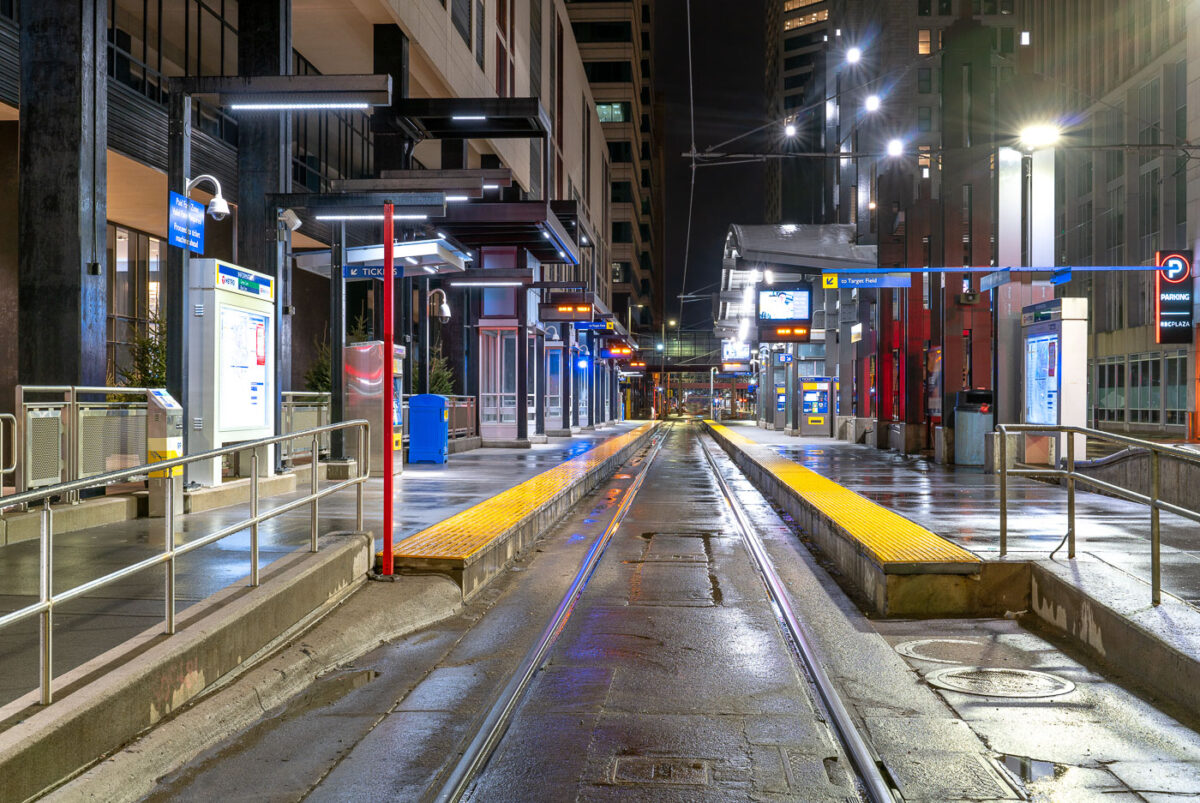
Nicollet Mall LRT Station during Stay At Home Orders
Nicollet Mall Light Rail Station on a rainy night in Downtown Minneapolis during Minnesota’s Stay At Home orders.
Explore photos and posts tagged Light Rail.
Nicollet Mall Light Rail Station on a rainy night in Downtown Minneapolis during Minnesota’s Stay At Home orders.
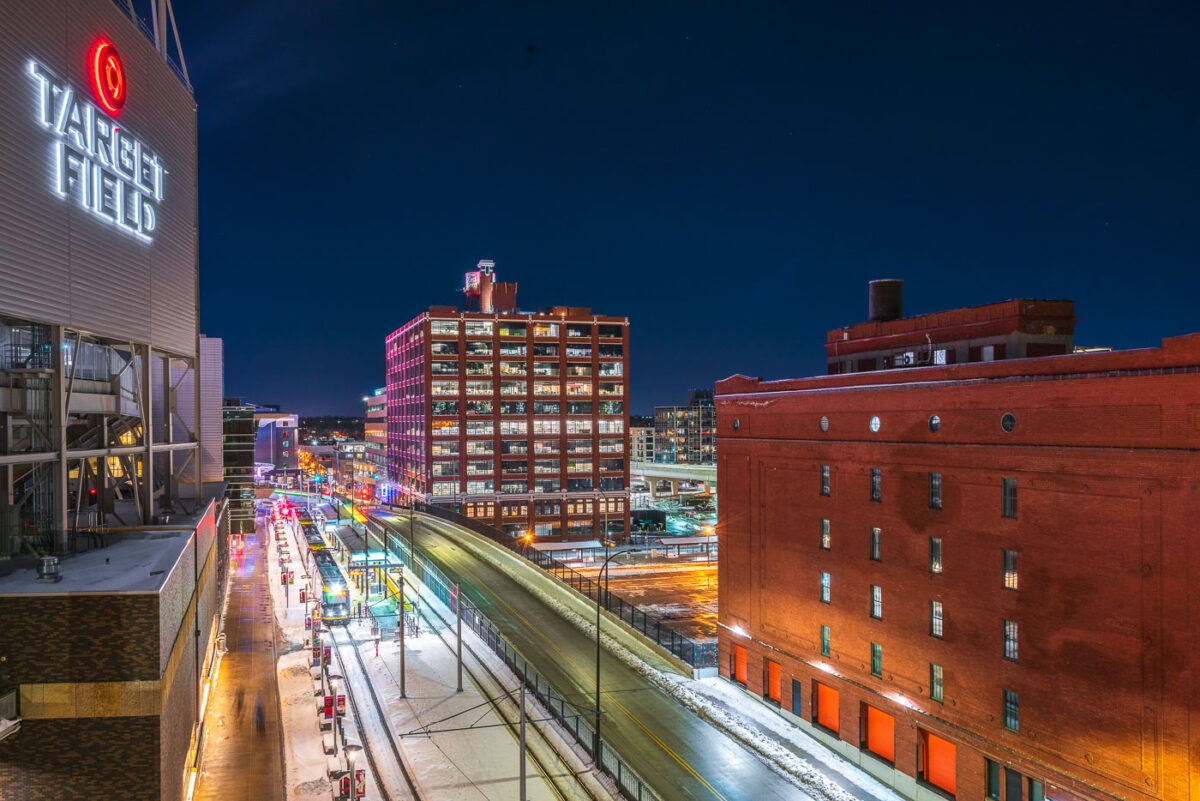
The illuminated Target Field sign overlooks the Warehouse District in downtown Minneapolis, where the city’s historic brick warehouses meet modern transit and redevelopment. Below, the Metro Green and Blue Line trains stop at Target Field Station, a multimodal hub linking light rail, commuter rail, and bike paths. The brightly lit Ford Center and preserved brick structures along 5th Street North illustrate the district’s mix of 20th-century industrial architecture and contemporary urban life, framed against the cold clarity of a Minnesota winter night.
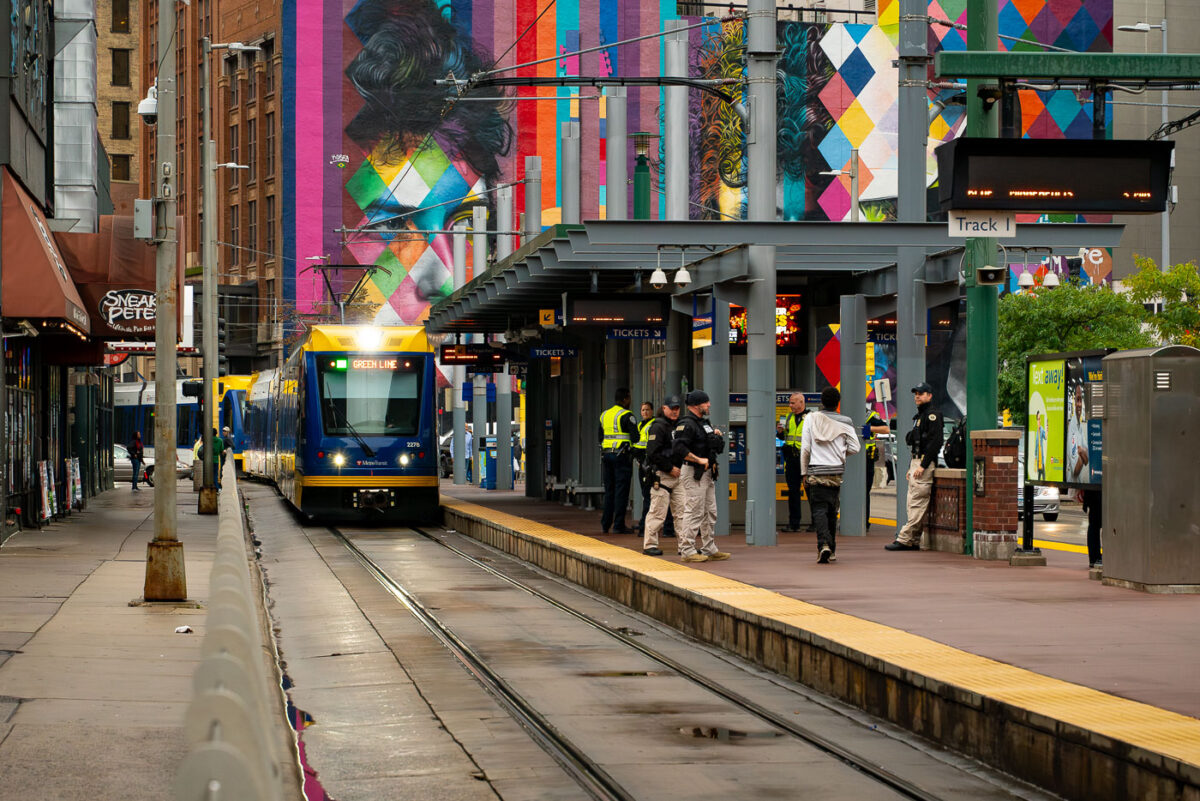
Located near the Target Center in downtown Minneapolis, the Target Field light rail station was patrolled by Homeland Security officers on October 10, 2019. The increased presence coincided with a major political rally at the nearby arena, leading to heightened security across the surrounding Warehouse District transit corridor.
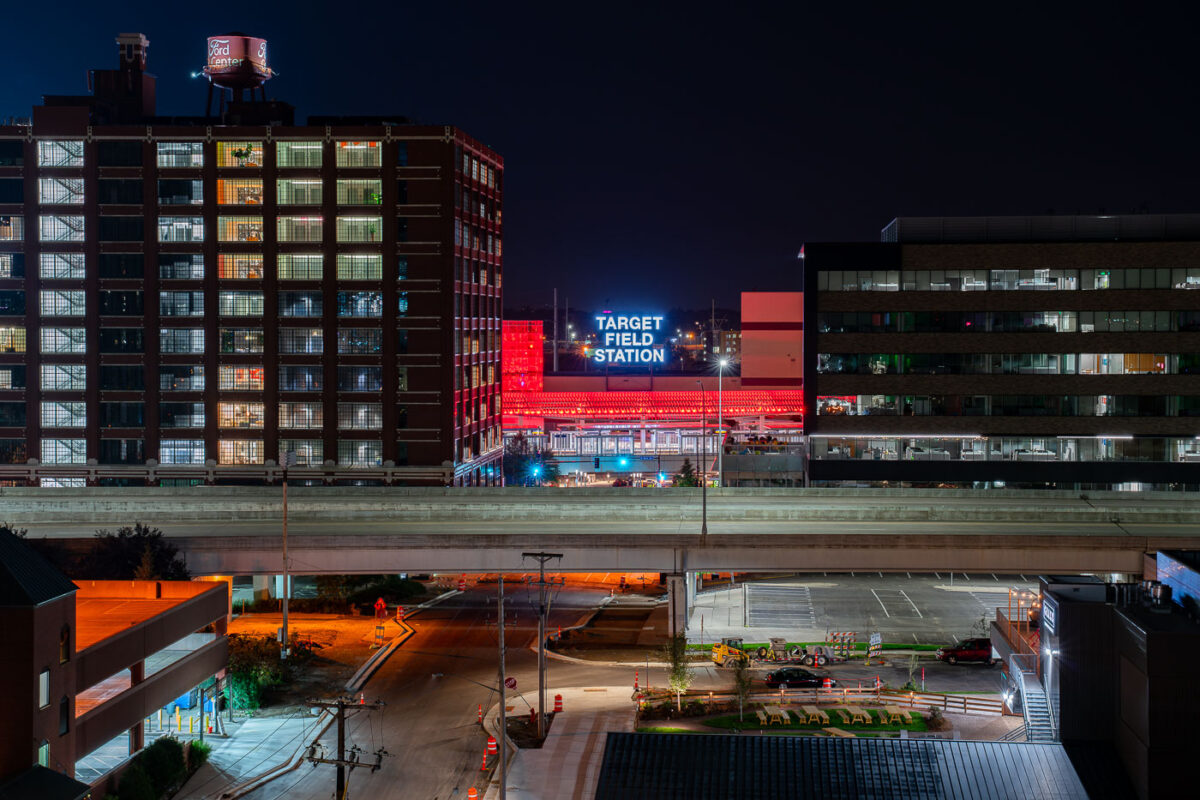
Opened in 2014, Target Field Station is a multimodal transit hub serving the METRO Blue and Green light rail lines, Northstar commuter rail, and several Metro Transit bus routes. It sits adjacent to Target Field, home of the Minnesota Twins, and doubles as a public gathering space with an amphitheater, green plaza, and year-round programming.
In this night view, the glowing red canopy and bold “Target Field Station” signage stand out against the dark sky, framed between the historic Ford Center (left, built in 1912 as an assembly plant) and a modern office building (right). A freeway bridge cuts through the foreground, symbolizing the layered infrastructure of the city.
This mix of historic brickwork, modern transit, and illuminated signage captures Minneapolis’s ongoing balance of industrial heritage and urban redevelopment.
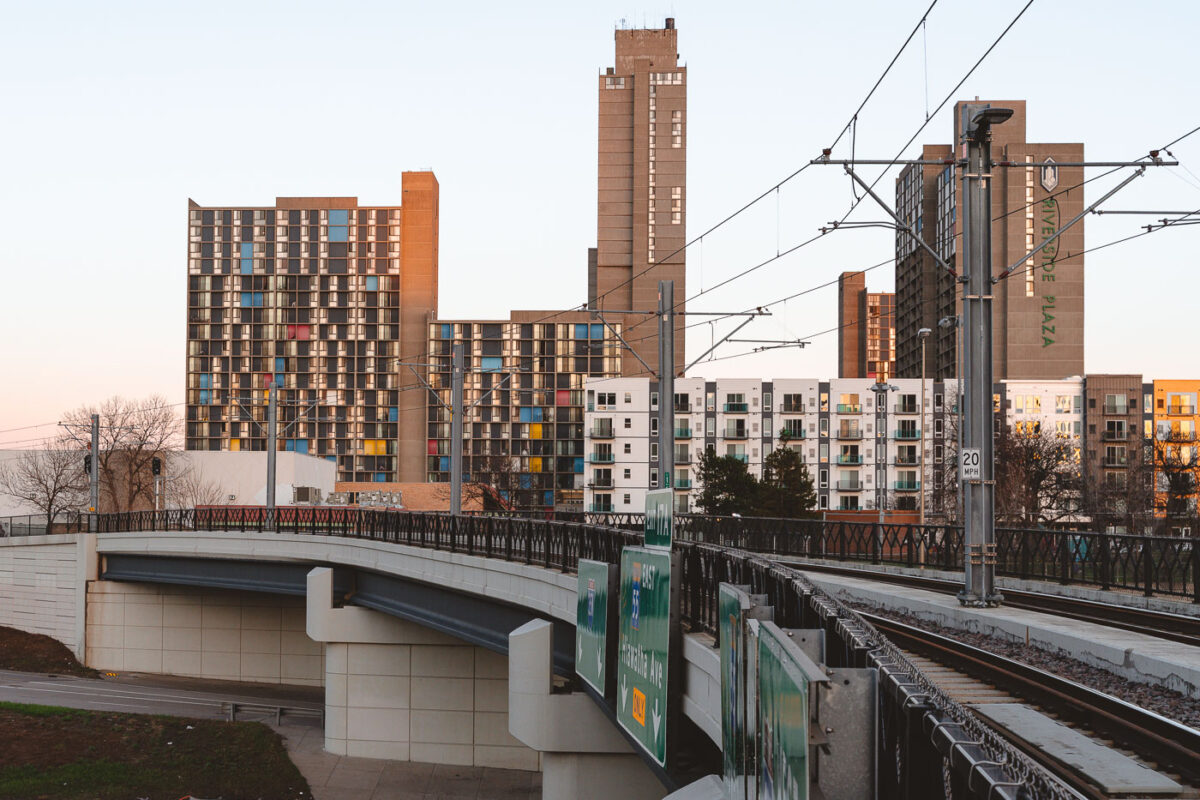
Riverside Plaza stands tall beyond the METRO Blue Line overpass in the Cedar–Riverside district of Minneapolis. The colorful panels of the 1970s residential towers contrast with the new mid-rise apartments and light rail infrastructure built decades later. This view captures the merging of eras—modern rail transit, Brutalist architecture, and the continuing evolution of one of Minneapolis’s most historically diverse neighborhoods.
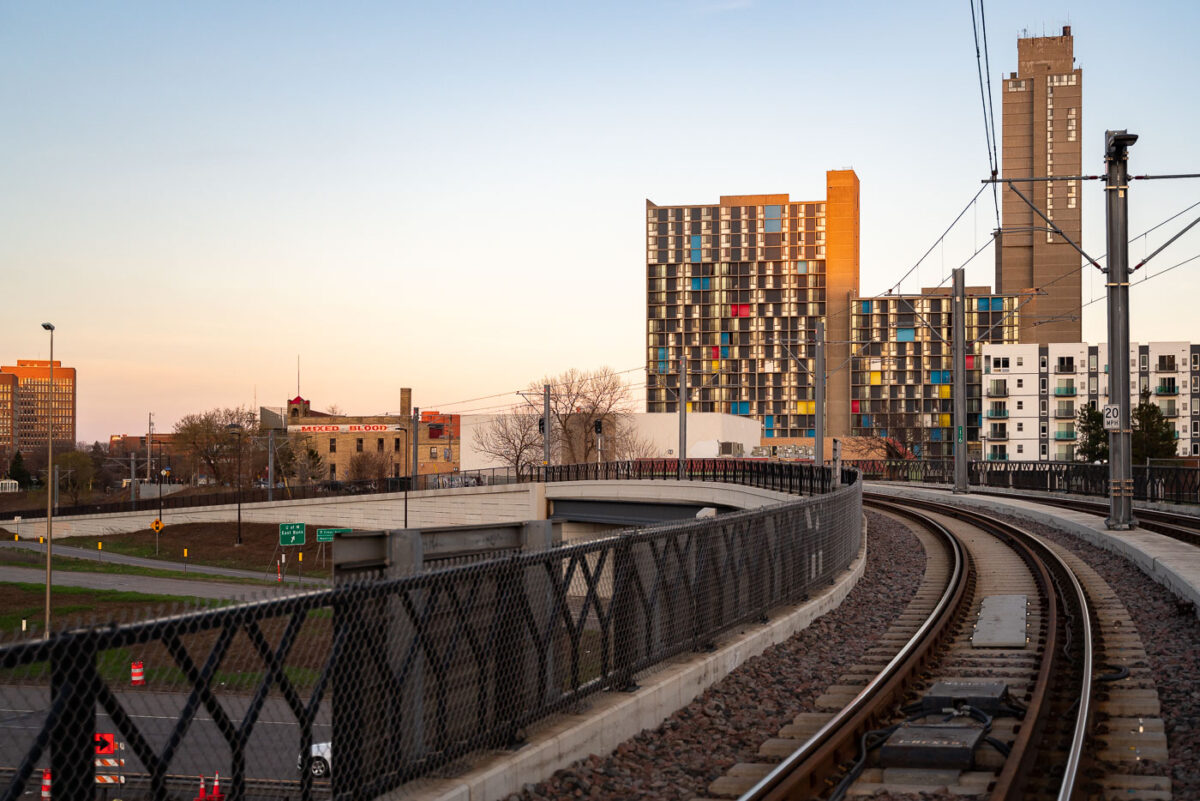
The METRO Blue Line curves toward downtown Minneapolis near the Cedar–Riverside neighborhood, passing below the colorful concrete towers of Riverside Plaza at sunset. The complex, designed by architect Ralph Rapson and completed in 1973, is one of the city’s most distinctive examples of Brutalist modernism. This area, once part of the immigrant gateway to Minneapolis, now blends historic structures like the Mixed Blood Theatre with the transit corridor connecting neighborhoods across the city.
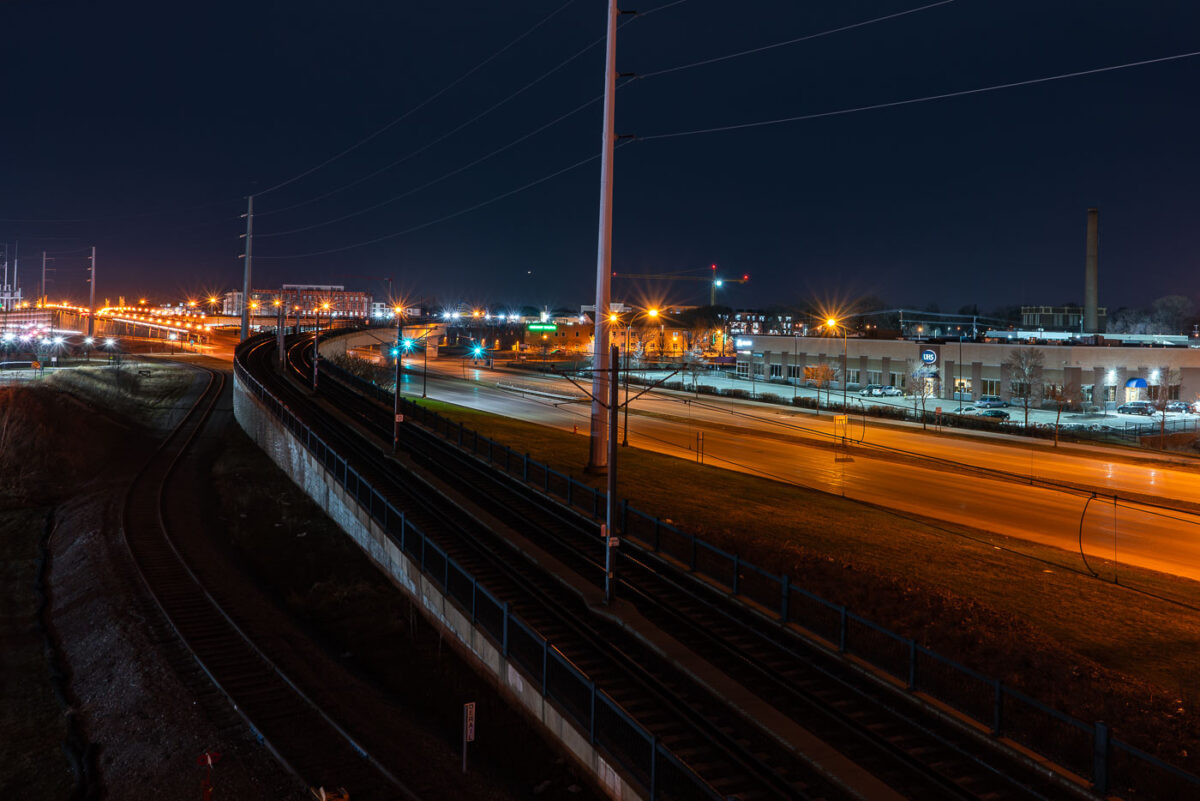
Metro Transit light rail bridge over Haiwatha Avenue in South Minneapolis.

An early morning S-Bahn train heads toward Zürich Hauptbahnhof, Switzerland’s busiest railway hub. The interior, illuminated by soft fluorescent lighting and digital displays, reflects the precision and cleanliness that define Swiss rail travel. With clearly marked stops and ergonomic seating, the S-Bahn system connects Zürich’s suburbs to the city center with remarkable efficiency and punctuality.
The Zürich S-Bahn network began operation in 1990 as one of Europe’s first regional rail systems to integrate multiple operators under a unified timetable. Zürich HB serves as its central interchange, handling over 400,000 passengers daily and linking regional, national, and international routes. This modernization transformed local commuting and reinforced Switzerland’s reputation for world-class rail infrastructure.
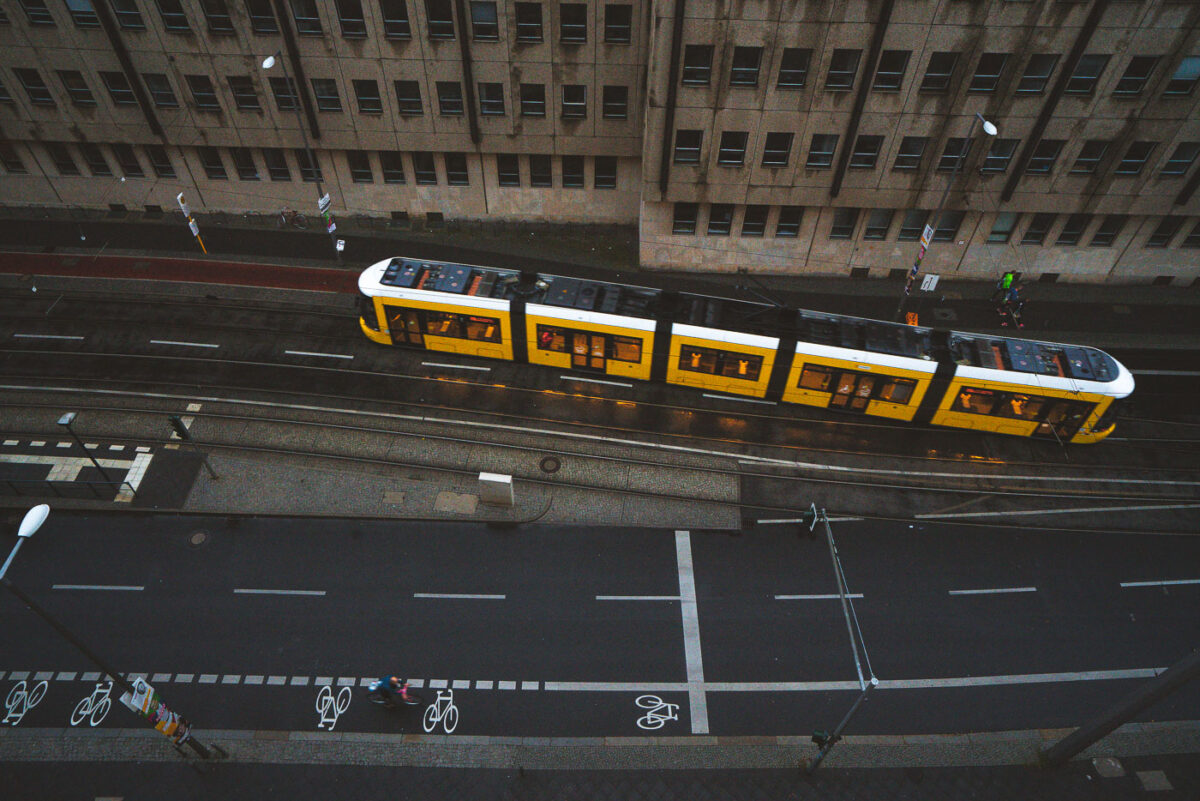
A yellow BVG tram glides through the wet streets of Berlin at dusk, its reflection faintly shimmering on the rain-darkened tracks. The city’s extensive tram system, one of the oldest in the world, continues to serve as a vital part of daily life — connecting neighborhoods across the capital with quiet precision. Cyclists share the street below, a hallmark of Berlin’s commitment to sustainable urban transport and rhythmically layered street design.
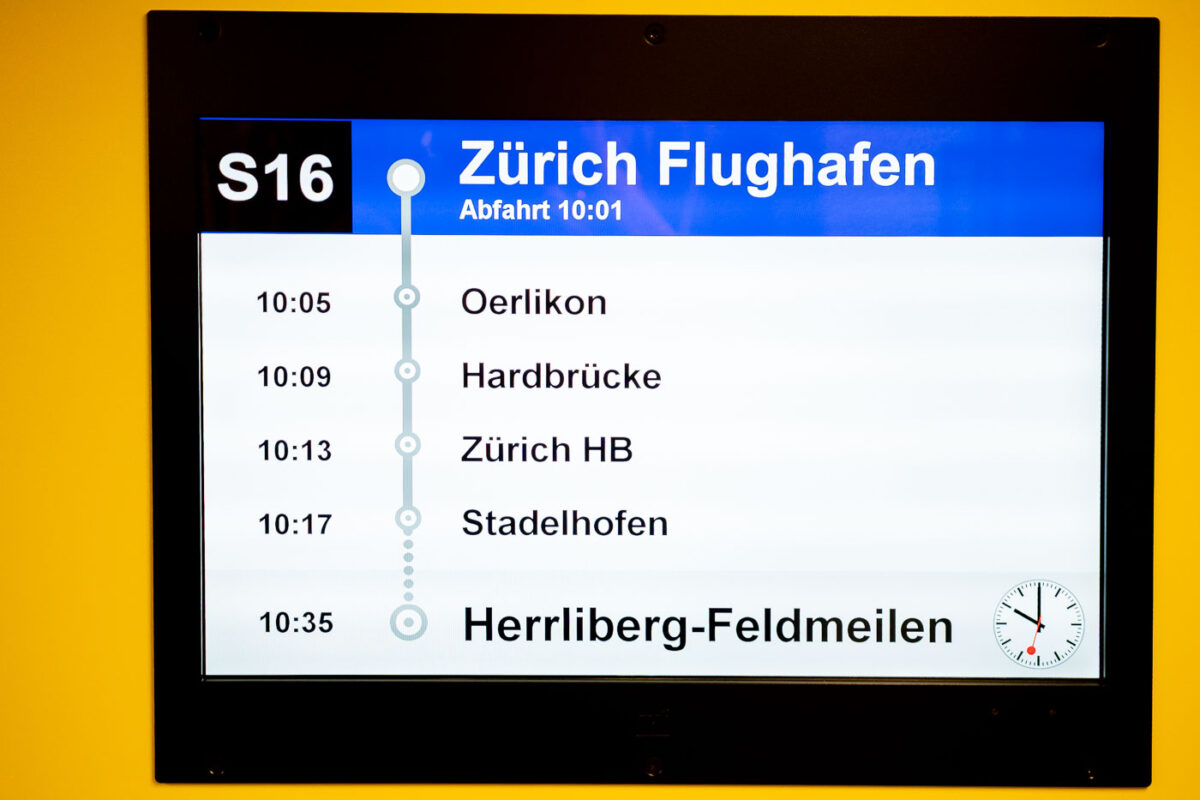
A digital train schedule display at Zurich Airport showing the departure times and stops for the S16 Light Rail train service. The screen indicates the train departs at 10:01, with stops including Oerlikon, Hardbrücke, Zürich HB, and Stadelhofen, before arriving at Herrliberg-Feldmeilen at 10:35. The display is mounted on a yellow wall, and a small analog clock is visible in the bottom right corner of the screen.