Skip to content
Chad Davis Photography
Photo Archive
Photo Archive
  • Home
  • Minneapolis Uprising
  • Travel
    • Belize
    • Bruges, Belgium
    • Costa Rica
    • Dominican Republic
    • Guatemala
    • Las Vegas
    • London
    • Tampa, Florida
    • Tokyo
  • Series
    • Minneapolis Uprising
    • Minneapolis and COVID-19
    • NASA Michoud Assembly Facility
    • Outside the 2024 Republican National Convention
    • Tesla Takedown: Minneapolis
    • No Kings – Hands Off – 50501 Protests Minnesota
  • Contact
Photo Archive
Photo Archive
Chad Davis Photography
Photo Archive
Photo Archive
Photo Archive
Photo Archive
Chad Davis Photography
Photo Archive
Photo Archive
  • Home
  • Minneapolis Uprising
  • Travel
    • Belize
    • Bruges, Belgium
    • Costa Rica
    • Dominican Republic
    • Guatemala
    • Las Vegas
    • London
    • Tampa, Florida
    • Tokyo
  • Series
    • Minneapolis Uprising
    • Minneapolis and COVID-19
    • NASA Michoud Assembly Facility
    • Outside the 2024 Republican National Convention
    • Tesla Takedown: Minneapolis
    • No Kings – Hands Off – 50501 Protests Minnesota
  • Contact
Photo Archive
Photo Archive
Chad Davis Photography
Photo Archive
Photo Archive
Photo Archive
Photo Archive
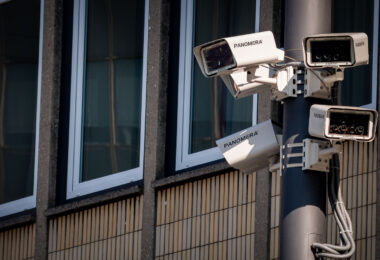
Panomera Surveillance Cameras found in Germany.

Panomera Surveillance Cameras

Panomera Surveillance Cameras found in Germany.
Panomera, Security, Security Camera, Surveillance
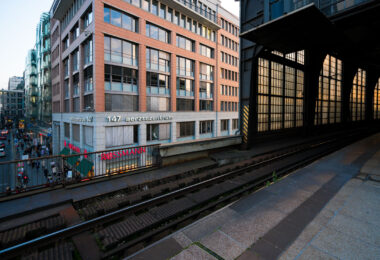
View from the platform at Berlin Friedrichstraße station overlooking Georgenstraße below. The elevated tracks run alongside a mix of modern and postwar office buildings, including the Aerztezentrum at No. 147. Pedestrians and cyclists move through the busy commercial street beneath, while the station’s glass and steel structure reflects the late-day light.

Elevated tracks at Berlin Friedrichstraße station

View from the platform at Berlin Friedrichstraße station overlooking Georgenstraße below. The elevated tracks run alongside a mix of modern…
Berlin, Berlin Friedrichstraße Station, Germany, Station, Subway, Train, Train Station
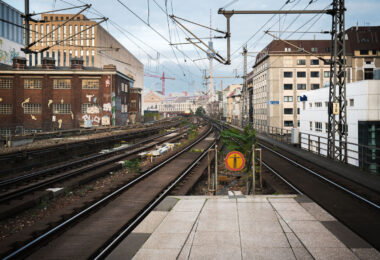
View east from Berlin Friedrichstraße station showing the elevated S-Bahn tracks leading toward Alexanderplatz. Overhead wires and supporting steel structures frame the route, with graffiti-covered industrial buildings on the left and mid-century offices on the right. The Berlin TV Tower (Fernsehturm) rises in the distance, a landmark visible across the city skyline.

Berlin Friedrichstraße train station S Bahn Tracks

View east from Berlin Friedrichstraße station showing the elevated S-Bahn tracks leading toward Alexanderplatz. Overhead wires and supporting steel structures…
Berlin, Berlin Friedrichstraße Station, Germany, Subway, Train, Train Station
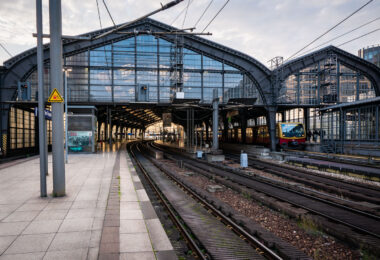
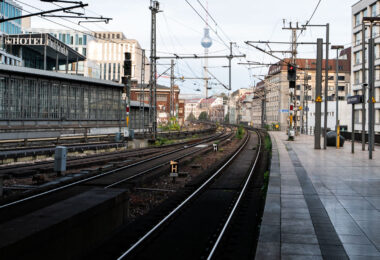
Berlin Friedrichstraße station in the early evening, with an S-Bahn BR 481 series train stopped under the steel and glass canopy. The curved elevated tracks lead into the main hall, a design characteristic of the city’s prewar rail architecture. Overhead wires and support structures frame the scene, while a few commuters move along the quiet platform as daylight fades into artificial light.

Berlin Friedrichstraße train station

Berlin Friedrichstraße station in the early evening, with an S-Bahn BR 481 series train stopped under the steel and glass…
Berlin, Berlin Friedrichstraße Station, Germany, Subway, Train, Train Station
Tracks curve eastward from Berlin Friedrichstraße station, one of the city’s busiest S-Bahn and regional rail interchanges. The elevated viaduct carries multiple lines, including the S3, S5, S7, and S9, which link central Berlin with its outer districts and neighboring cities. The view looks toward Alexanderplatz, with the Fernsehturm television tower visible in the distance — a defining landmark of the former East Berlin skyline.

Friedrichstraße station opened in 1882 and served as a symbolic and logistical border crossing during the Cold War, when it connected both East and West Berlin rail networks. Today, the station remains a major transit hub, handling thousands of passengers daily and sitting at the junction of the north–south and east–west S-Bahn corridors. The surrounding area has since been redeveloped with modern offices, hotels, and shops while retaining its role as one of Berlin’s central transport arteries.

Eastward Curve at Berlin Friedrichstraße

Tracks curve eastward from Berlin Friedrichstraße station, one of the city’s busiest S-Bahn and regional rail interchanges. The elevated viaduct…
Berlin, Berlin Friedrichstraße Station, Germany, Subway, Train, Train Station
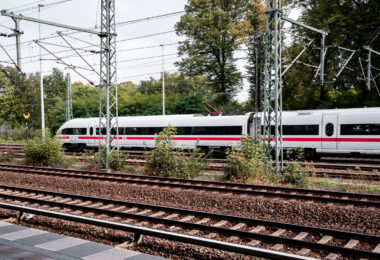
A Deutsche Bahn Intercity-Express (ICE) train moves through the rail network, distinguished by its white body and red horizontal stripe. The train belongs to the ICE 3 or ICE T family, units designed for high-speed operation up to 300 km/h and used on long-distance routes across Germany and neighboring countries. Overhead catenary lines supported by lattice-steel gantries deliver 15 kV AC power, the standard for Germany’s electrified mainlines.

The ICE network, launched in the early 1990s, forms the backbone of long-distance rail travel in the country, linking cities such as Berlin, Frankfurt, Cologne, and Munich. These trains are built for both speed and efficiency, with lightweight aluminum bodies, regenerative braking, and pressure-sealed cabins for tunnel travel. The scene reflects the characteristic organization of German rail infrastructure—multiple tracks, overhead power, and vegetation at the margins—where local and international services share one of Europe’s busiest and most interconnected systems.

Intercity Express (ICE) train in Berlin

A Deutsche Bahn Intercity-Express (ICE) train moves through the rail network, distinguished by its white body and red horizontal stripe….
Berlin, Deutsche Bahn, Germany, Ice, Intercity Express, Train
Entering a Berlin train station.

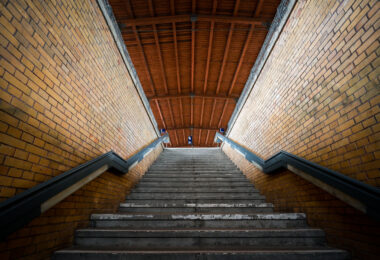
Stairs at a Berlin train station

Entering a Berlin train station.

Berlin, Germany, Stairs, Train Station
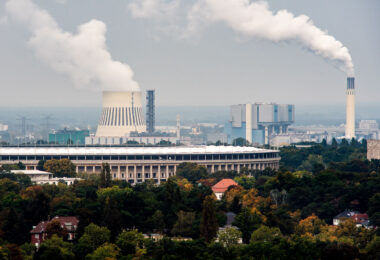
The Olympiastadion in Berlin stands in the foreground, framed by the dense tree cover of the Westend district. Behind it, the cooling towers and chimneys of the Reuter power plants dominate the skyline — part of Berlin’s long-standing energy infrastructure along the Spree River. The large natural-draft cooling tower at left belongs to the Reuter West plant, commissioned in the late 1980s and operated by Vattenfall, while the taller stack at right is part of the older Reuter facility dating back to 1930, later converted to modern combined-heat-and-power operation.

The contrast between the stone colonnades of the 1936 Olympic Stadium and the industrial silhouettes in the distance captures the layered character of Berlin’s western edge — where historic architecture, post-war redevelopment, and ongoing energy production coexist within a few kilometers. The area remains one of the city’s key power-generation corridors, supplying electricity and district heating to much of central and western Berlin.

Olympiastadion Berlin and Reuter Power Plant

The Olympiastadion in Berlin stands in the foreground, framed by the dense tree cover of the Westend district. Behind it,…
Berlin, Germany, Kraftwerk Reuter West, Olympiastadion, Olympics, Stadium
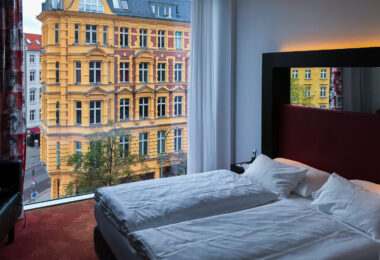
A modern hotel room in Berlin’s Mitte district looks out through a floor‑to‑ceiling window onto a restored 19th‑century residential block across the street. The room features two neatly made single beds with white linens, a dark-framed headboard with soft backlighting, a bedside table with a phone, and sheer curtains patterned with portrait graphics. Outside, the opposite building displays yellow stucco and red-brick detailing typical of Gründerzeit architecture, with tall windows, cornices, and balconies above a tree‑lined sidewalk. The scene is consistent with accommodations such as the Arcotel Velvet Berlin, located along a corridor of cafés, galleries, and tram routes that connect the Mitte neighborhood with nearby cultural sites. The image reflects the mix of contemporary hospitality design and historic streetscapes that characterize central Berlin decades after reunification.

Arcotel Velvet Berlin Hotel Room

Looking out from a room at the Arcotel Velvet Berlin.

Arcotel Berlin, Berlin, Germany, Hotel, Hotel Room
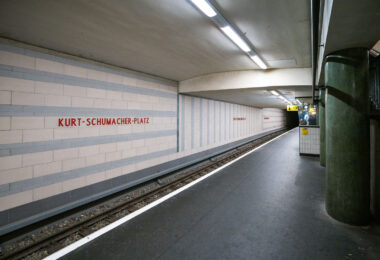
Kurt-Schumacher-Platz station serves Berlin’s U6 U-Bahn line in the Reinickendorf district, located in the city’s northwest. Opened on May 3, 1956, the station was part of the first postwar U-Bahn expansion and named after German statesman Kurt Schumacher, a key figure in rebuilding the Social Democratic Party after World War II.

The station features light-colored wall tiles with horizontal gray stripes and minimalist red lettering, reflecting mid-1950s West Berlin design. It includes a central island platform and two tracks, serving as an important stop between Afrikanische Straße and Scharnweberstraße. Above ground, the station connects to several bus routes and lies near the approach to the U6 tunnel under the former Tegel Airport area. Today, it remains a key link for northern Berlin commuters traveling toward the city center.

Kurt-Schumacher-Platz Train Station Berlin

Kurt-Schumacher-Platz station serves Berlin’s U6 U-Bahn line in the Reinickendorf district, located in the city’s northwest. Opened on May 3,…
Berlin, Germany, Kurt-Schumacher-Platz, Public Transit, Station, Subway, Train Station
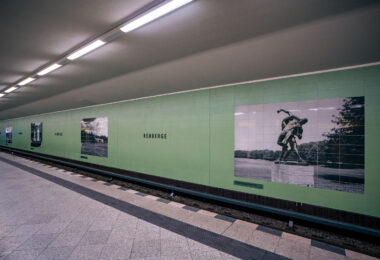
Rehberge U-Bahn Station, Wedding, Berlin. A mint-green tiled wall runs the length of the platform, marked with the station name “REHBERGE” in black lettering and punctuated by large tile-mounted photographs showing nearby park landscapes and public sculpture. The single visible track and empty platform suggest a lull between trains beneath continuous fluorescent fixtures. Part of Berlin’s BVG U6 line, Rehberge serves the Wedding district adjacent to Volkspark Rehberge and local sports grounds. The station opened in 1956 during the postwar northern extension of the U6, linking central Berlin with growing residential areas north of the city center.

Keywords
- Activities: commuting, waiting, traveling
- Buildings: subway station platform, tiled walls
- Location: Wedding, Berlin, Germany, Rehberge
- Objects: station signage, tiled photo murals, benches, lighting fixtures, rail tracks
- People: none visible
- Moods: quiet, orderly
- Sceneries: urban interior, transit corridor
- Texts: “REHBERGE” station name on wall
- Companies: BVG (Berliner Verkehrsbetriebe)
- Weather: not applicable (underground)
- Plants: depicted in murals (park trees)
- Animals: none
- Vehicles: subway trains (not in frame)

Rehberge U-Bahn Station in Berlin

Rehberge U-Bahn Station, Berlin

Berlin, Germany, Public Transit, Rehberge, Subway, Train, Train Station, U-Bahn
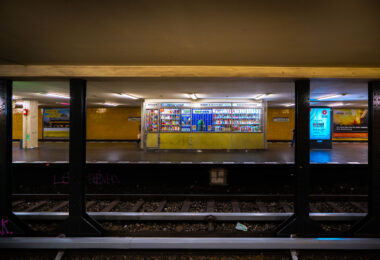
A kiosk filled with magazines, drinks, and snacks stands at the center of the Seestraße U-Bahn platforms in Berlin’s Wedding district. Yellow-tiled walls, riveted black columns, and twin tracks frame the underground scene, with the station name “Seestraße” visible on wall signage. A few commuters pass by digital advertising displays while the rails in the foreground separate the opposing platforms. Operated by BVG on the U6 line, Seestraße opened in 1923 and served as the northern terminus until the line was extended to Tegel in the late 1950s, making it a long-standing node in Berlin’s public transit network. Keywords — Activities: commuting, waiting, vending; Buildings: train station, subway platform, kiosk; Location: Berlin, Germany, Wedding, Seestraße Station, U6, U‑Bahn; Objects: newsstand, magazines, signs, advertising screens, rails, columns, fluorescent lights; People: commuters, pedestrians; Moods: routine, quiet, utilitarian; Sceneries: underground, urban transit; Texts: “Seestraße,” “BVG,” “Zeitschriften & Tabak,” “Tabak & Getränke,” “Journale • Eis & Snacks”; Companies: BVG, Lycamobile, PERMA; Weather: underground; Plants: none; Animals: none; Vehicles: subway (U‑Bahn).

Market at the Seestrabe Station in Berlin

A store at the Seestrabe Station in Berlin.

Berlin, Germany, Market, Public Transit, Seestrabe Station, Subway, Train Platform, Train Station, U-Bahn
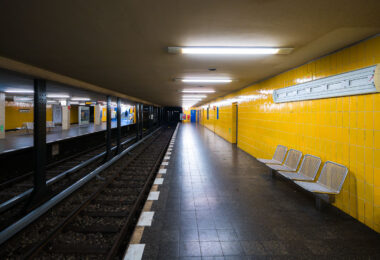
Seestraße U-Bahn platforms in Berlin’s Wedding district sit empty, their yellow-tiled walls and metal benches illuminated by ceiling fixtures. Twin side platforms flank two tracks, with black steel columns, track ballast, tactile edging, stairways, and signage reading “Seestraße” visible across the way. The station serves Line U6 of the Berliner Verkehrsbetriebe (BVG) network, a north–south route linking Tegel with the city center and beyond. Opened in 1923 on the former Line C, Seestraße reflects the interwar expansion of Berlin’s underground and remains a neighborhood transit hub connecting residents to tram and bus services at street level.

Seestrabe U-Bahn Station in Berlin

Seestraße U-Bahn Station, Berlin Germany

Berlin, Germany, Public Transit, Seestrabe Station, Subway, Train Platform, Train Station, U-Bahn
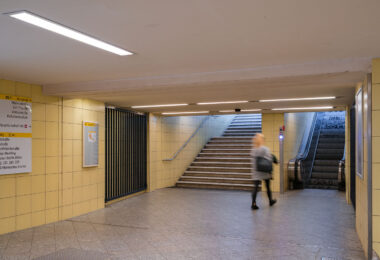
An underground passageway connects the platforms of Wedding U-Bahn station to its street-level exits on Müllerstraße in Berlin’s Mitte district. The corridor is tiled in light yellow ceramic, part of the BVG’s standardized postwar design used throughout many West Berlin stations rebuilt or renovated in the 1960s and 1970s.

Directional signage guides passengers toward exits, connecting bus routes, and public facilities, while an escalator and stairway lead to the main entrance. The faint graffiti on the walls and motion blur of a passing commuter emphasize the station’s everyday function within Berlin’s public transport network. Wedding station serves both the U6 line and the S-Bahn Ring, forming a key interchange point in the city’s northern transit system.

Leopoldplatz U-Bahn Station in Berlin

An underground passageway connects the platforms of Wedding U-Bahn station to its street-level exits on Müllerstraße in Berlin’s Mitte district….
Berlin, Germany, Leopoldplatz, Subway, Train, Train Station, U-Bahn
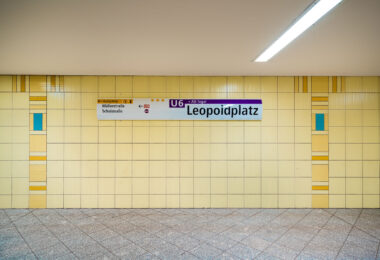
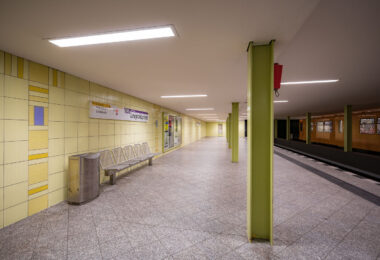
Leopoldplatz is a key interchange station in Berlin’s U-Bahn network, connecting the U6 and U9 lines beneath the bustling Wedding district. The wall’s yellow ceramic tiles with minimalist blue and ochre accents were installed during the 1960s modernization period, reflecting the BVG’s functional yet color-coded design philosophy. The clean geometry, restrained signage, and durable materials are hallmarks of mid-century German transit infrastructure, designed for clarity and longevity in high-traffic environments.

Leopoldplatz U-Bahn Station

The Leopoldplatz U-Bahn Station in Berlin Germany.

Berlin, BVG, Germany, Leopoldplatz, Subway, Train, Train Station, U-Bahn, U6, U9
This view of Leopoldplatz’s lower-level U9 platform highlights the minimalist postwar design typical of 1960s Berlin infrastructure. The use of pale yellow tiles, stainless steel seating, and green-painted support columns was chosen to create a bright, efficient environment for high-traffic commuter service. The station connects to major commercial and residential zones and is part of the BVG modernization program maintaining accessibility and structural updates across Berlin’s U-Bahn network.

Leopoldplatz U-Bahn Station Platform

The Leopoldplatz U-Bahn Station in Berlin Germany.

Berlin, BVG, Germany, Leopoldplatz, Subway, Train, Train Station, U-Bahn, U9
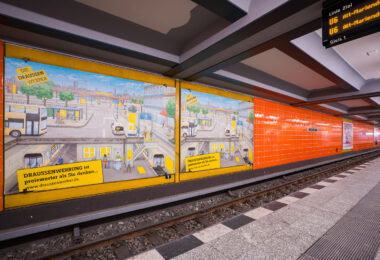
Wittenbergplatz station on Berlin’s U2 line features a distinctive orange-tiled design characteristic of the city’s postwar modernization of U-Bahn interiors. The platform level seen here includes advertising panels with hand-illustrated city scenes, part of a campaign promoting outdoor advertising (“Draussenwerbung”) by Wall GmbH, a longtime transit advertising company in Berlin.

Opened in 1902 as part of the city’s first underground railway, Wittenbergplatz is one of Berlin’s oldest stations and a key junction serving the U1, U2, and U3 lines. The orange tiles were installed during mid-20th-century refurbishments to brighten the subterranean space, contrasting with the original Jugendstil architecture preserved at the main hall above. The modern signage displays U6 connections, while the station’s layout—with three island platforms—continues to serve one of the busiest interchange points in Berlin’s U-Bahn network.

Berlin Wedding train station

Wittenbergplatz station on Berlin’s U2 line features a distinctive orange-tiled design characteristic of the city’s postwar modernization of U-Bahn interiors….
Berlin, Berlin-Wedding station, Brick, Germany, Public Transit, S-Bahn, Subway, Train, Train Station, U-Bahn, Wedding
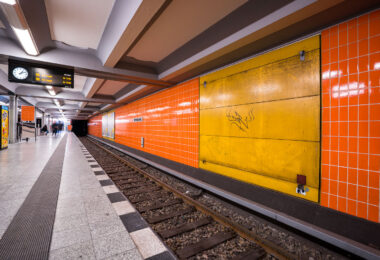
Wedding Station’s interior is defined by its vivid orange tile walls and contrasting yellow service panels, part of a mid-century renovation reflecting the BVG’s color-coded design language. The U6 platform connects northern districts to central Berlin and the former border zone at Kochstraße during the Cold War. Today, the station remains a link between diverse working-class and immigrant neighborhoods, emblematic of Berlin’s layered transit history.

Berlin-Wedding station

Berlin-Wedding station S-Bahn station in Berlin, Germany

Berlin, Berlin Metro, Berlin-Wedding station, Brick, BVG, Germany, Public Transit, S-Bahn, Subway, Train, Train Station, U-Bahn, U6 line, Wedding, Wedding Station
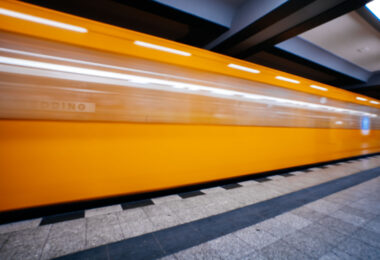
The U6 line of Berlin’s U-Bahn runs through central neighborhoods including Wedding, one of the city’s oldest working-class districts. The bright orange rolling stock, manufactured by Stadler and others for the BVG network, is a visual hallmark of Berlin’s underground system. Opened in 1923, the Wedding station has seen extensive modernization while retaining its early 20th-century layout. The long exposure emphasizes the U-Bahn’s continuous movement through Berlin’s post-industrial north.

Subway train at the Wedding station in Berlin

A train passes through the Wedding station in Berlin Germany.
Berlin, BVG, Germany, Subway, Train Station, U6, Wedding, Wedding Train Station
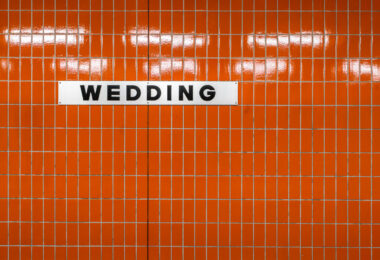
A white station sign reading “Wedding” in black block letters is mounted on an orange, small-rectangle tiled wall inside Wedding station in Berlin, Germany. The station serves the Wedding neighborhood in the Mitte district and functions as an interchange between the U6 U‑Bahn line and the Berlin Ringbahn S‑Bahn. The stark typography and modular tiles reflect the practical design found across much of Berlin’s postwar transit architecture. Operated by BVG for the U‑Bahn and S‑Bahn Berlin GmbH for suburban rail, Wedding is a local hub for commuters moving between the north of the city and central Berlin. No passengers are visible in the frame, emphasizing the graphic clarity of the station’s wayfinding.

Wedding station sign, Berlin

A white station sign reading “Wedding” in black block letters is mounted on an orange, small-rectangle tiled wall inside Wedding…
Berlin, Berlin-Wedding station, Brick, Germany, Public Transit, S-Bahn, Subway, Train, Train Station, U-Bahn, Wedding Station
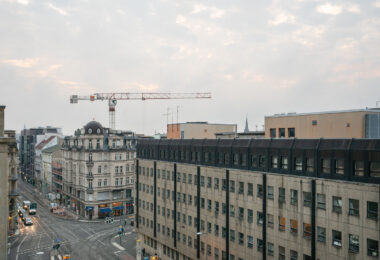
An early evening view over central Berlin captures the intersection of Friedrichstraße and Dorotheenstraße near the Spittelmarkt area. Traffic lights reflect off the damp pavement as trams and cars navigate the junction, while a construction crane rises above the rooftops—evidence of the city’s ongoing redevelopment and modernization efforts.

In the foreground, postwar concrete office buildings contrast with a restored 19th-century corner structure featuring a domed roof and classical detailing. The muted light and overcast sky lend the scene a subdued atmosphere typical of Berlin’s autumn season, illustrating the coexistence of historical architecture, socialist-era infrastructure, and contemporary urban growth.

Invalidenstrabe Berlin Germany

Looking down Invalidenstraße street in Berlin Germany.

Berlin, Germany, Invalidenstrabe
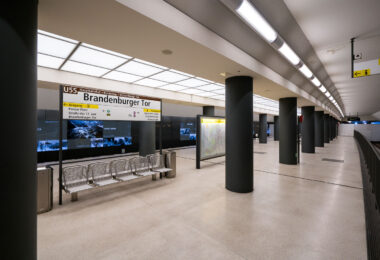
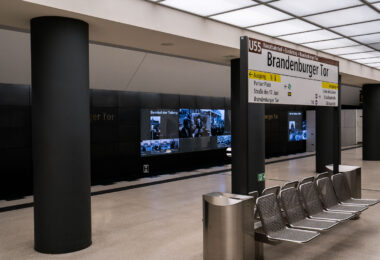
Brandenburger Tor station on Berlin’s U-Bahn line U5, located beneath Pariser Platz near the Brandenburg Gate, features a modern minimalist design with dark wall panels and integrated LED displays. The exhibits along the platform present historical imagery under the theme “Symbol der Teilung” (Symbol of Division), reflecting the area’s proximity to the Berlin Wall and its role in postwar history. Opened in 2009 as part of the short U55 shuttle and later connected to Alexanderplatz in December 2020, the station serves as both a transport hub and a small public exhibition space within central Berlin’s government district.

Benches At Brandenburger Tor Train Station

The Brandenburger Tor station in Berlin, Germany. Metal benches on the train platform.
Berlin, Brandenburger Tor, Germany, Public Transit, Subway, Train Station
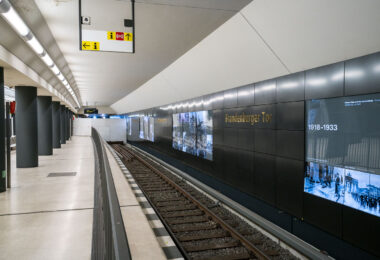
The Brandenburger Tor station on Berlin’s U5 line sits directly beneath Pariser Platz, adjacent to the Brandenburg Gate. The interior features dark composite wall panels inlaid with gold lettering and a series of illuminated displays tracing Berlin’s 20th-century history, including the city’s division and post-reunification development. Originally opened in 2009 as part of the short U55 shuttle between Hauptbahnhof and Bundestag, the station became a through stop in December 2020 when the U5 extension to Alexanderplatz was completed, reconnecting the eastern and western portions of the U-Bahn network after nearly six decades of separation.

Brandenburger Tor Train Station

The Brandenburger Tor station on Berlin’s U5 line sits directly beneath Pariser Platz, adjacent to the Brandenburg Gate. The interior…
Berlin, Brandenburger Tor, Germany, Public Transit, Subway, Train, Train Station
Brandenburger Tor station, once part of the short U55 shuttle line, connects major landmarks including the Reichstag, Unter den Linden, and Pariser Platz. Integrated into the extended U5 line in 2020, it features a minimalist architectural design with grey pillars, illuminated ceilings, and historical display panels documenting Berlin’s 20th-century events. The station’s clean geometry and subdued tones contrast with the symbolic weight of the district it serves.

Brandenburger Tor Train Station

The Brandenburger Tor station in Berlin, Germany.

Berlin, Brandenburger Tor, BVG, Germany, Public Transit, Subway, Train, Train Station, U5, U55
← Previous 1 2 3 4 Next →
Collapse All | Expand All
  • Current Events  (6)
    • 2024 Republican National Convention  (1)
    • Annunciation Catholic Church Shooting  (1)
    • Minneapolis and COVID-19  (1)
    • No Kings, Hands Off, Good Trouble Protests  (1)
    • Tesla Takedown  (1)
  • Series  (1)
    • NASA Rocket Factory  (1)
  • Travel  (384)
    • Asia  (55)
      • Japan  (55)
        • Tokyo  (55)
    • Central America  (206)
      • Belize  (85)
      • Costa Rica  (51)
      • Guatemala  (70)
    • Europe  (19)
      • France  (19)
        • Paris  (19)
    • North America  (104)
      • United States  (104)
        • Massachusetts  (12)
          • Boston  (12)
        • Minnesota  (15)
          • Minneapolis  (15)
        • Nevada  (66)
          • Las Vegas  (66)
        • South Dakota  (10)
        • Wisconsin  (1)
          • Milwaukee  (1)

Follow My Work

  • Flickr
  • Instagram
  • Threads
  • Home
  • Minneapolis Uprising
  • Travel
    • Belize
    • Bruges, Belgium
    • Costa Rica
    • Dominican Republic
    • Guatemala
    • Las Vegas
    • London
    • Tampa, Florida
    • Tokyo
  • Series
    • Minneapolis Uprising
    • Minneapolis and COVID-19
    • NASA Michoud Assembly Facility
    • Outside the 2024 Republican National Convention
    • Tesla Takedown: Minneapolis
    • No Kings – Hands Off – 50501 Protests Minnesota
  • Contact

© 1996-2025 Chad Davis
chad@chaddavis.photography


Built in Minneapolis.