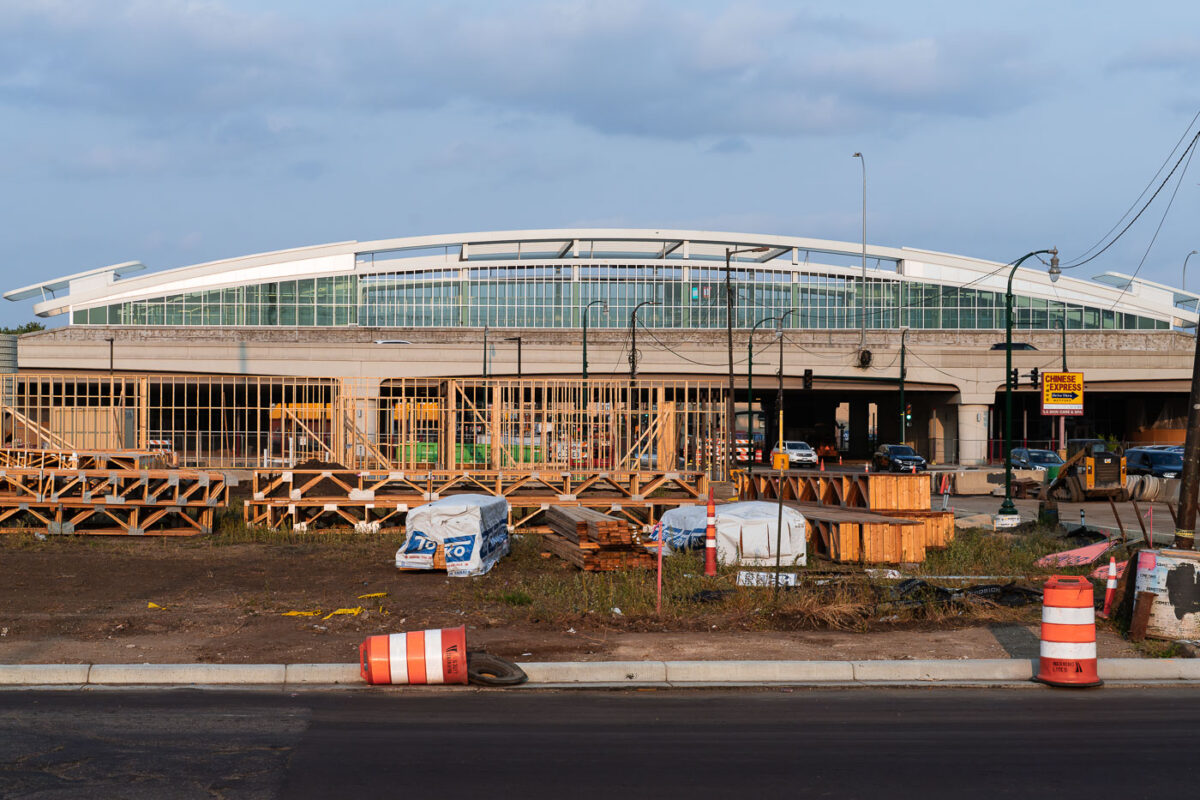
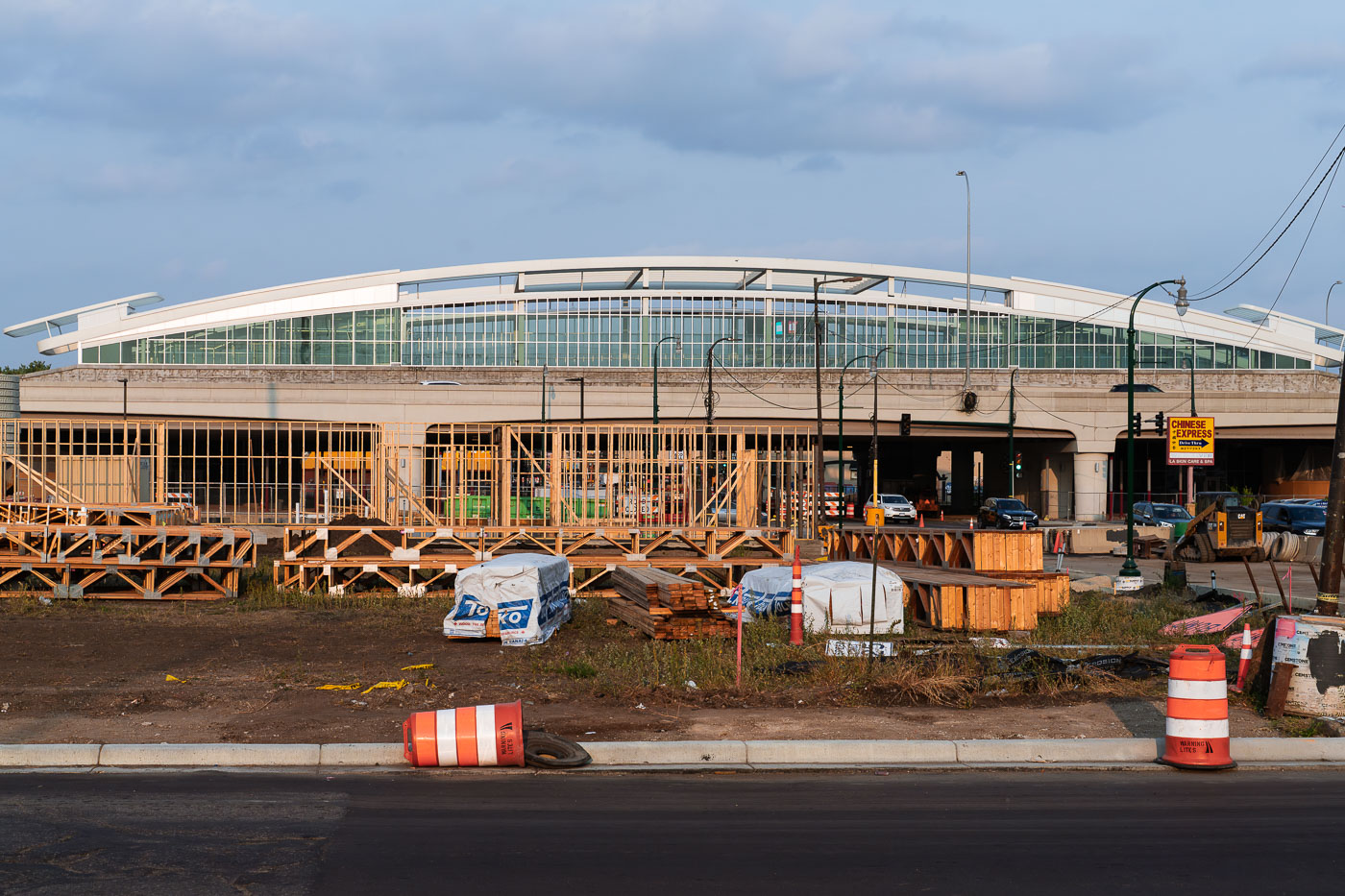
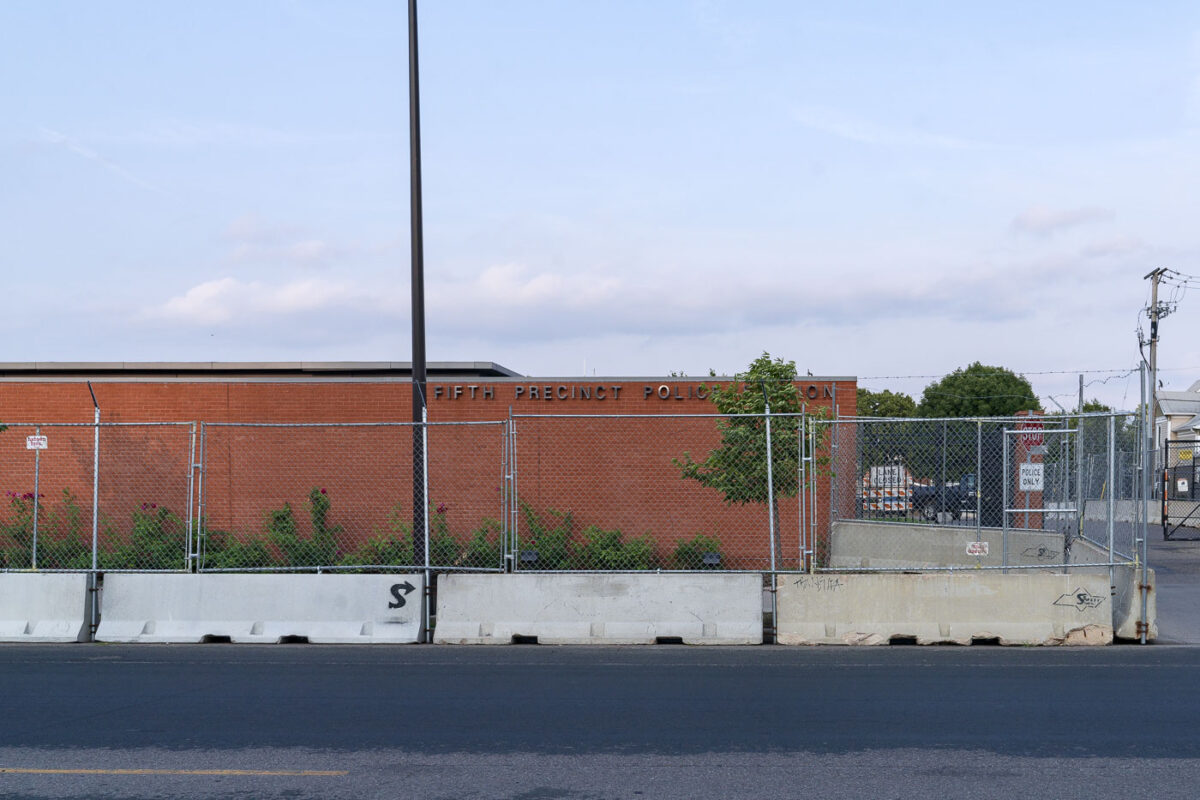
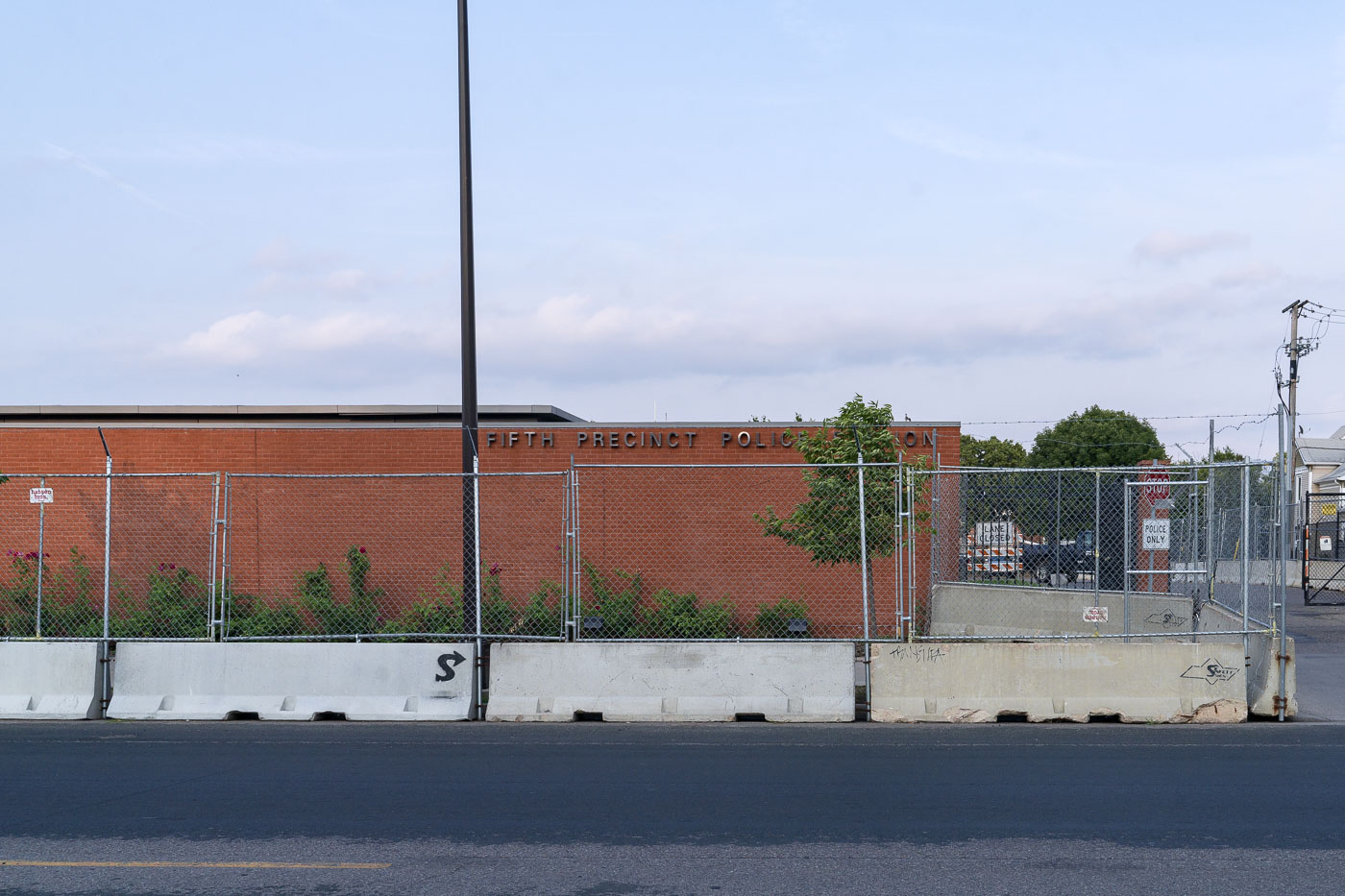
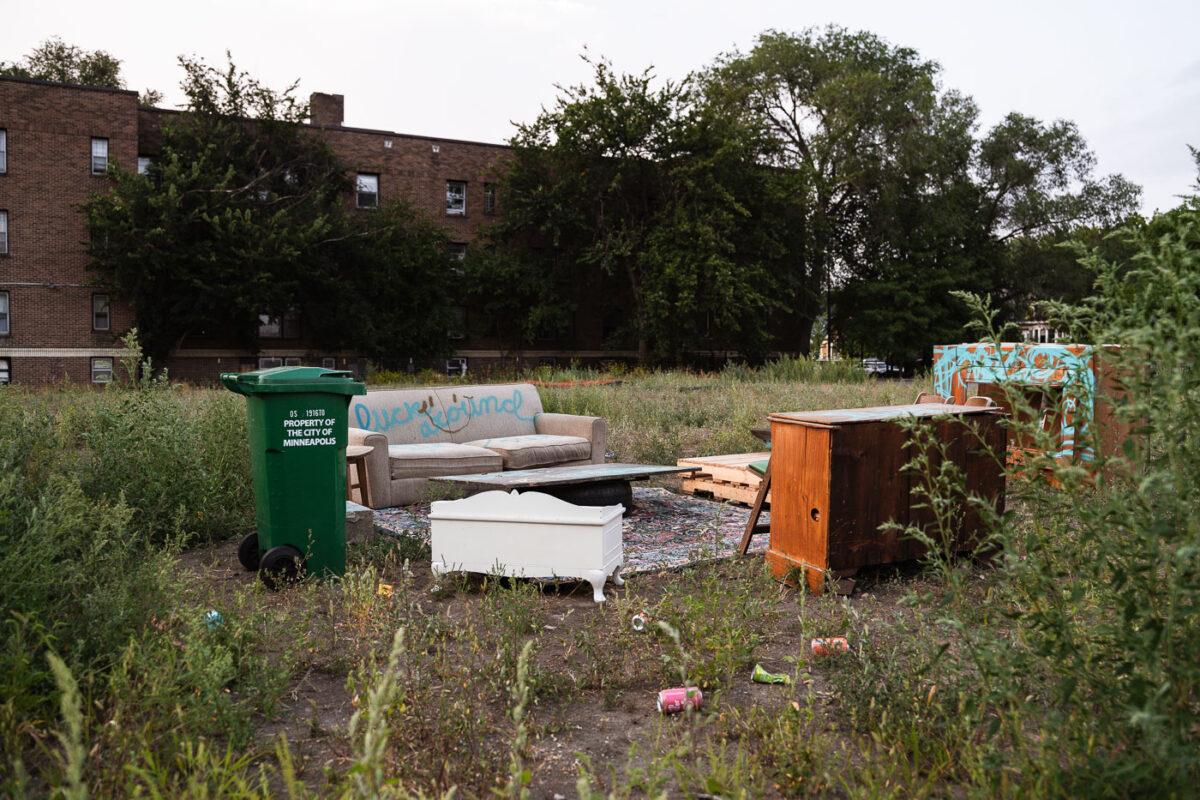
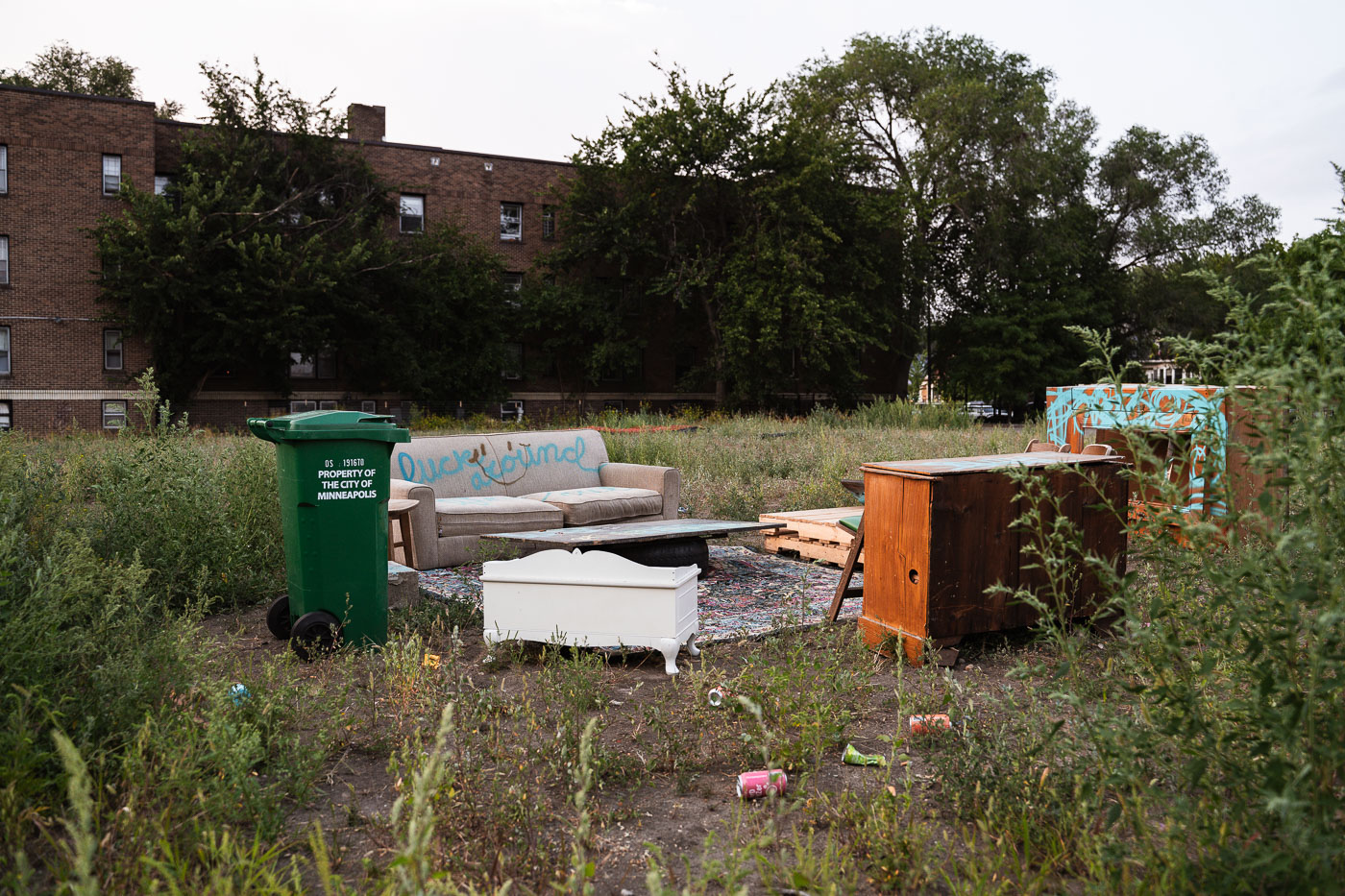
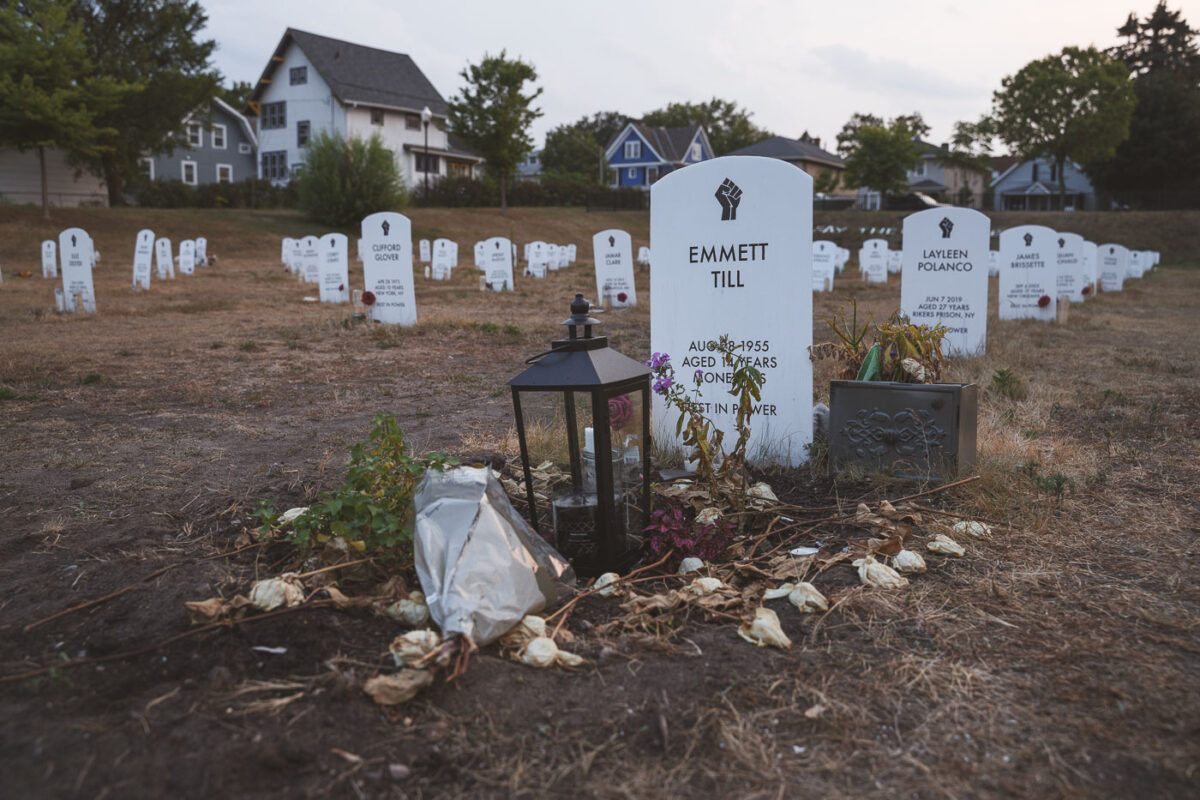
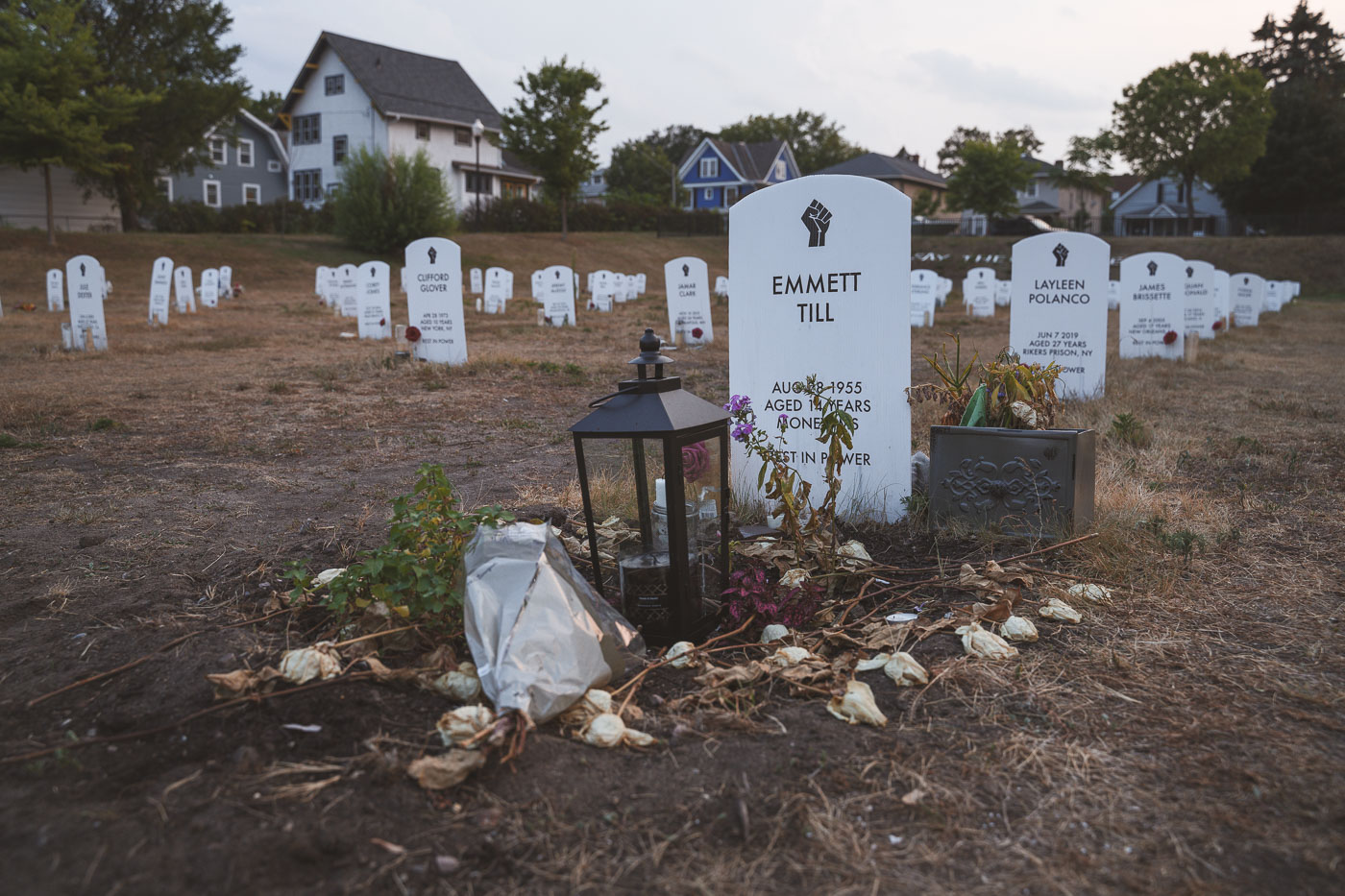
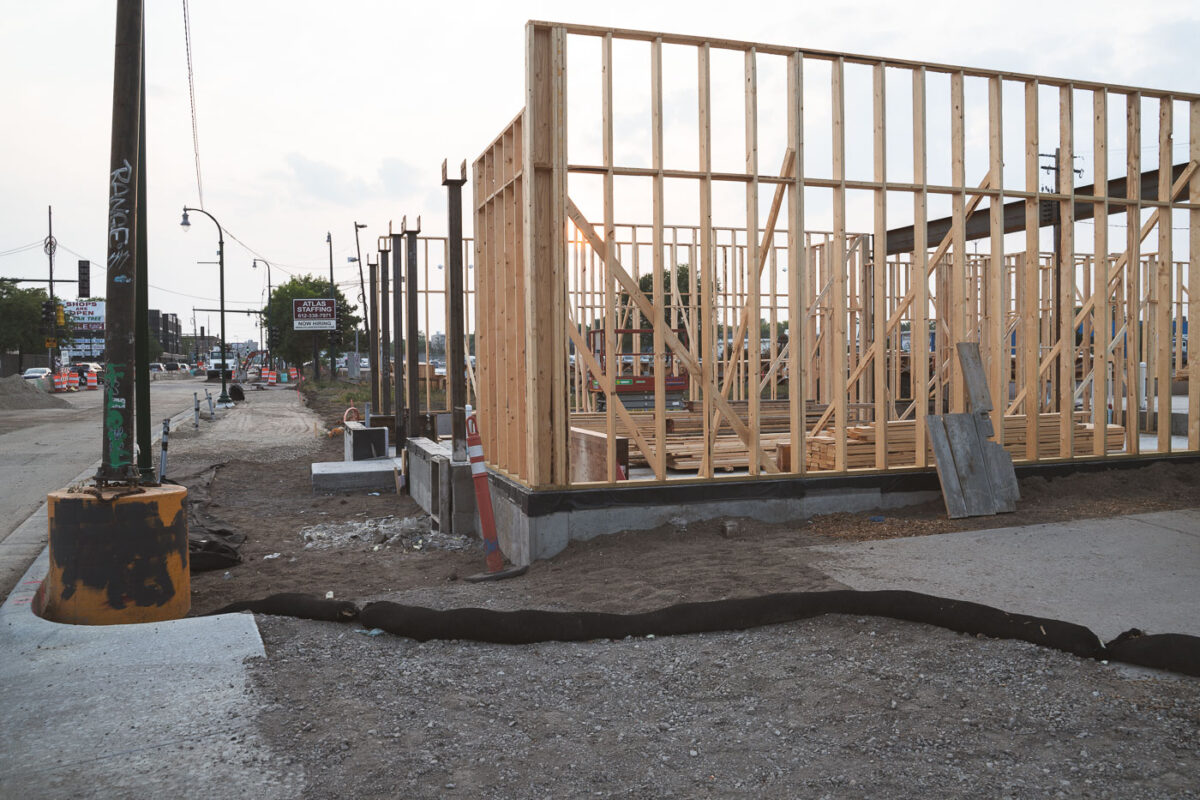
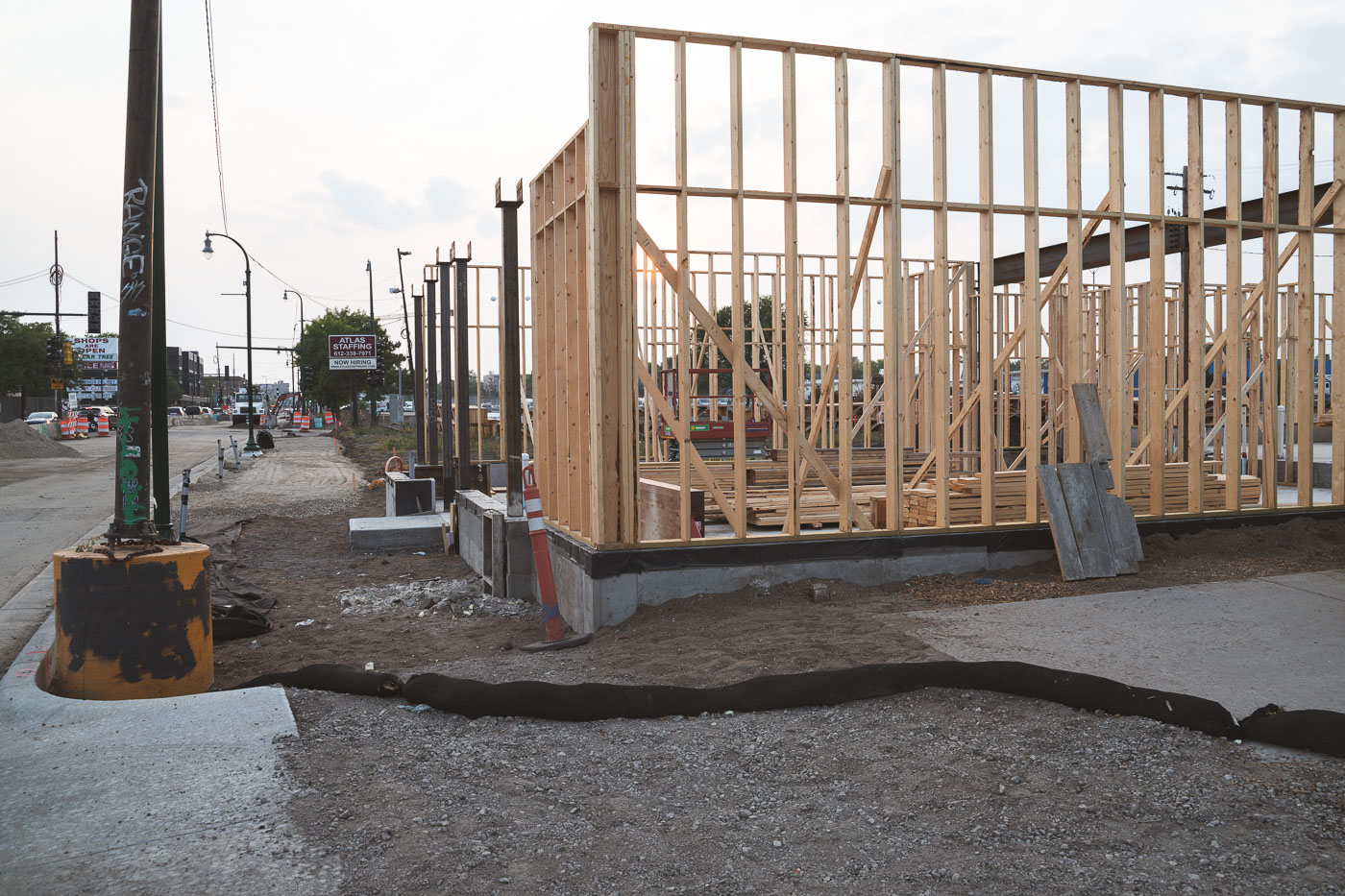
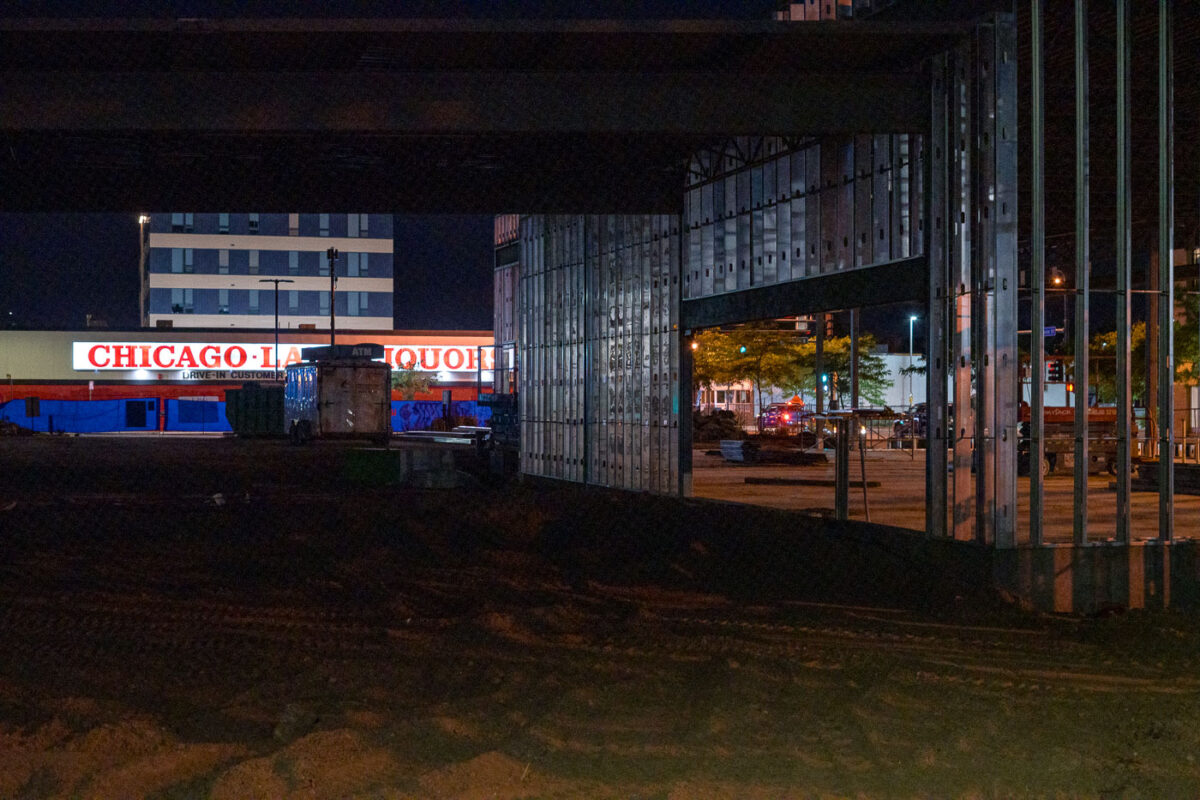
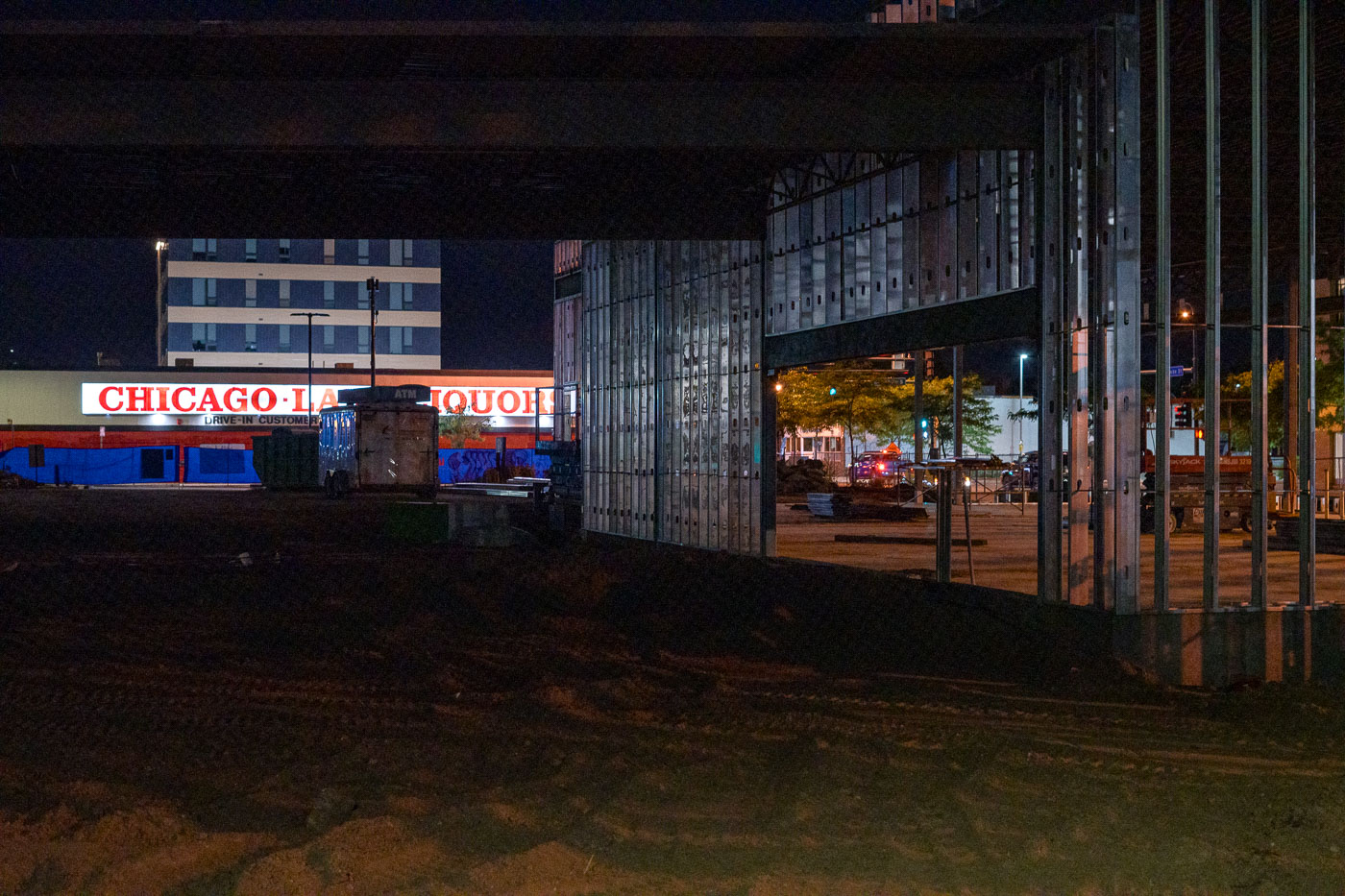
August 5, 2021 — Construction is underway at the site of the future Lake Street Station in Minneapolis, a transit hub designed to serve the I-35W corridor. The previous Atlas Staffing building on this location was destroyed during protests in the summer of 2020 following the murder of George Floyd. This project represents a significant development for the area, aiming to improve transportation access and connectivity.August 5, 2021 — Temporary fencing and concrete barriers surround the Minneapolis Fifth Precinct Police Station. These security measures were erected in response to protests and civil unrest that occurred in the city, notably following the murder of George Floyd in May 2020. The precinct, located in the Powderhorn neighborhood, became a focal point during these events. The barriers serve to protect the building and its personnel from potential damage or disruption.August 5, 2021 — This outdoor living space, dubbed the "Community Living Room," was established in the vacant lot formerly occupied by O'Reilly Auto Parts on Nicollet Avenue in Minneapolis. The space was created in the aftermath of the 2020 Minneapolis Uprising, serving as a gathering place and symbol of community resilience. It features salvaged furniture, including a sofa and chairs, arranged on a rug, with a coffee table made from repurposed materials. The presence of a green recycling bin, marked as property of the City of Minneapolis, indicates the site's temporary use and its integration into the urban environment.August 5, 2021 — The Say Their Names Memorial in Minneapolis features temporary markers honoring victims of racial injustice, including Emmett Till. Till, a 14-year-old Black boy from Chicago, was brutally murdered in Mississippi in 1955 after allegedly whistling at a white woman. His death and the subsequent acquittal of his murderers by an all-white jury galvanized the Civil Rights Movement. The memorial, located near George Floyd Square, serves as a space for remembrance and reflection on the ongoing struggle for racial equality.August 5, 2021 — A makeshift memorial stands at George Floyd Square in Minneapolis, honoring Leneesha Columbus. Columbus was killed on July 5, 2020, near the site that became a focal point for protests following the murder of George Floyd. The square, an area occupied by protesters for months after Floyd's death, has become a space for community remembrance and activism. This memorial, with its flowers, candles, and personal tributes, serves as a poignant reminder of the lives lost and the ongoing impact of racial injustice.August 5, 2021 — A sticker on a street sign in Minneapolis reads "BARRICADE MATERIAL." This reflects the resourcefulness employed during the 2020 civil unrest, when a wide variety of objects were repurposed to create barricades. The unrest followed the murder of George Floyd, a Black man who died in police custody. The protests and marches that ensued led to widespread demonstrations across the city and the nation. This sign, marked with graffiti, serves as a tangible reminder of that period of intense civic engagement and disruption.August 5, 2021 — A flyer posted on a utility pole in South Minneapolis reads "They Can't Cage Our Rage" and "Abolish Everything." The imagery on the flyer includes barbed wire and a figure behind bars, suggesting themes of protest and liberation. This type of street art and messaging often emerges during periods of social unrest, reflecting public sentiment and calls for systemic change. The specific phrases indicate a connection to abolitionist movements, which advocate for the dismantling of oppressive systems, including policing and incarceration.August 5, 2021 — Signs advocating for justice for George Floyd and opposing the Line 3 tar sands pipeline are displayed in a residential yard in Minneapolis. The "Justice for George Floyd" sign reflects the widespread protests and activism that followed Floyd's murder by a Minneapolis police officer in May 2020. The "Stop Line 3" sign highlights ongoing opposition to the expansion of the Enbridge Line 3 crude oil pipeline, a project that has faced significant environmental and Indigenous rights concerns. These signs, placed in front yards, represent a form of community expression and solidarity with broader social and environmental justice movements.August 5, 2021 — Graffiti reading "Fuck Proud Boys" and "ACAB" is spray-painted on a concrete support pillar beneath an overpass in South Minneapolis. The Midtown Greenway, a popular multi-use trail, runs through this area and has historically been a site for public art and political expression. The messages likely relate to social and political tensions, with "ACAB" being a common anti-police slogan. The presence of such graffiti reflects ongoing activism and dissent within the urban environment.August 6, 2021 — Graffiti reading "Abolish Prisons" is spray-painted on the concrete barrier of a bridge in South Minneapolis. This message reflects sentiments expressed during periods of social unrest and calls for reform within the justice system. The graffiti's placement on public infrastructure serves as a visible statement within the urban environment. The bridge itself is a functional structure facilitating transportation across the city.August 6, 2021 — Graffiti reading "Defund Police Please?" is spray-painted on a concrete curb in South Minneapolis, Minnesota. This message reflects sentiments expressed during the Minneapolis Uprising of 2020, a period of widespread protests and civil unrest following the murder of George Floyd. The graffiti on this urban infrastructure serves as a visual marker of the political climate and social activism prevalent in the city during that time.August 6, 2021 — Construction of a new apartment development is underway at 112 East Lake Street in Minneapolis. The site was previously occupied by a tobacco shop that was destroyed during the civil unrest of 2020. This project represents a significant redevelopment effort for the Lake Street corridor, aiming to rebuild and revitalize the area following the events of the Minneapolis Uprising.August 8, 2021 — The Coliseum Building, located on East Lake Street in Minneapolis, stands boarded up and fenced off in August 2021. The building's facade is covered with messages of peace and justice, painted by community members following the Minneapolis Uprising. The artwork reflects a collective desire for healing and social change in the wake of civil unrest. The Coliseum Building itself is a historic structure in the South Minneapolis neighborhood, with its current state of disrepair and community-driven artistic expression highlighting the area's recent history.August 8, 2021 — Debris litters the parking lot of the Coliseum Building in Minneapolis, a site that was damaged during protests in late May 2020. The building itself, a former auto dealership and event space, was destroyed by fire on May 28th. In the background, a Wendy's restaurant, which had been closed following the unrest, is seen with a "Now Open" banner, indicating a return to normalcy for some businesses in the area. The presence of scattered furniture and construction materials suggests the ongoing process of cleanup and rebuilding in the aftermath of the events.August 8, 2021 — The Midtown Exchange building, formerly the Sears, Roebuck and Company Mail-Order Warehouse, stands at the corner of Lake Street and Chicago Avenue in Minneapolis. This area became a focal point during the 2020 Minneapolis uprising, with community members transforming vacant lots into spaces for art and gardens. The murals visible in the background reflect the community's resilience and artistic expression in the wake of the unrest. The space continues to serve as a gathering place and a symbol of community revitalization.August 10, 2021 — A sign reading "Days Without Answers" and "Justice for Winston Smith" is displayed at George Floyd Square in Minneapolis. This location became a focal point for protests following the murder of George Floyd in May 2020. The sign serves as a memorial and a demand for accountability, specifically referencing Winston Smith, who was killed by Minneapolis police in 2021. The "days without answers" notation tracks the time elapsed since Smith's death without resolution or justice.August 10, 2021 — The I-35W & Lake Street Station in Minneapolis is a multimodal transit hub serving bus routes and connecting to Interstate 35W. Construction was ongoing at the time this photograph was taken, indicated by the safety cones and materials visible. This station is a key component of the transit network in South Minneapolis, facilitating travel for residents and commuters. Its development reflects the ongoing investment in public transportation infrastructure within the Twin Cities metropolitan area.August 10, 2021 — Graffiti reading "QUIT YOUR JOB! COPS ARE THE OPPS!" is spray-painted on the window of a car wash located across from the Minneapolis Police Department's Fifth Precinct. This act of vandalism occurred in the context of widespread protests and unrest following the murder of George Floyd in May 2020. The graffiti reflects a sentiment of anti-police sentiment prevalent during the Minneapolis Uprising, where the Fifth Precinct became a focal point of demonstrations.August 10, 2021 — A temporary Walgreens mobile pharmacy operates in front of a building under construction on Lake Street in Minneapolis. This structure will become a new Walgreens store, replacing the former Office Depot that was damaged during the Minneapolis Uprising in 2020. The mobile pharmacy provided essential services during the rebuilding and transition period following the unrest.August 13, 2021 — Storefronts along Hennepin Avenue in Uptown Minneapolis display murals and graffiti in August 2021, several months after the unrest that followed the murder of George Floyd. The murals, including messages like "#Justice For George Floyd" and "I Can't Breathe," reflect the community's response to racial injustice and police brutality. These artworks transformed boarded-up windows and damaged facades into powerful statements, serving as a visual record of a pivotal moment in the city's history. The area, known for its vibrant mix of businesses and cultural spaces, bore witness to both destruction and artistic resilience during this period.August 15, 2021 — A protester navigates a scooter over barricades in Uptown Minneapolis, a neighborhood known for its vibrant cultural and commercial activity. The barricades bear graffiti referencing "Winston Smith," a pseudonym used by an anonymous artist whose work often critiques consumerism and authority. This image was taken during a period of unrest in Minneapolis, following the murder of George Floyd in May 2020, which sparked widespread protests against police brutality and racial injustice. The graffiti and the presence of protesters highlight the complex social and political climate of the city during that time.August 15, 2021 — "Stop The Cover Up" is spray-painted in red on a concrete barrier outside the parking ramp where Winston Smith died after being shot by law enforcement. This message reflects the sentiment of protesters who believe the circumstances surrounding Smith's death were not fully investigated or disclosed. The graffiti appeared in the aftermath of the Minneapolis Uprising, a period of civil unrest that followed the murder of George Floyd and other instances of police brutality. The concrete barrier itself is a temporary structure, likely erected for security or construction purposes, now serving as a canvas for public expression and dissent.August 15, 2021 — Construction is underway on the US Bank branch located on Lake Street in Minneapolis. The building, adjacent to the Chicago-Lake Liquors store, was damaged during the civil unrest in the summer of 2020. The reconstruction efforts signify a return to normalcy and rebuilding for the commercial corridor.August 15, 2021 — A burned utility pole stands across from the Minneapolis Police Third Precinct building in South Minneapolis. This pole was damaged during the civil unrest that followed the murder of George Floyd in May 2020. The precinct building itself was a focal point of protests and was eventually set ablaze and abandoned by the Minneapolis Police Department. The damage to the surrounding infrastructure serves as a physical reminder of the intense events that transpired in this location.August 17, 2021 — The Stop-N-Shop gas station and convenience store in South Minneapolis is shown here after undergoing repairs. The building, located across from the Minneapolis Police Department's Fifth Precinct, was damaged during the civil unrest that followed the murder of George Floyd in May 2020. The unrest led to widespread protests and property damage throughout the city. This establishment serves as a local business providing essential goods and services to the surrounding community.August 17, 2021 — Graffiti reading "George Floyd Evict The Police" is spray-painted on the garage door of the Cyclone Car Wash, located across from the Minneapolis Police Department's Fifth Precinct. The car wash is a commercial establishment providing automated vehicle cleaning services. The graffiti reflects sentiments expressed during the Minneapolis Uprising of 2020, which followed the murder of George Floyd by a Minneapolis police officer. The Fifth Precinct was a focal point of protests and unrest during that period.August 17, 2021 — The "Raised Fist" monument stands at the intersection of 38th Street and Chicago Avenue in Minneapolis, a site that became known as George Floyd Square. This area was occupied by protesters for months following the murder of George Floyd in May 2020. The "Land Back" and "BIPOC" graffiti on the barricade reflects the broader social justice movements that converged at this location. The square served as a focal point for demonstrations against racial injustice and police brutality.August 18, 2021 — A "We're Open! During Construction" banner hangs in front of a Little Caesars in Minneapolis. The store was damaged and closed following unrest in the city. This sign indicates the business's efforts to resume operations and serve the community amidst ongoing repairs. The presence of construction fencing and the banner highlights the resilience of local businesses in the face of disruption.August 18, 2021 — Signs for the "Urban Farm Project" are displayed at the Roof Depot site in South Minneapolis. The project, promoted by EPNIFARM.ORG, likely aimed to transform the former industrial space into a community garden or agricultural hub. The Roof Depot site itself has a history tied to industrial use and was notably impacted during the Minneapolis Uprising of 2020, making its redevelopment into a green space a significant community initiative. The signs, adorned with yellow ribbons, suggest a connection to broader community support or awareness campaigns.August 19, 2021 — A "Foot Traffic Only" sign and a poster stating "Winston Smith Was Assassinated" are displayed at George Floyd Square in South Minneapolis. This area became a focal point of protests and community organizing following the murder of George Floyd in May 2020. The "Foot Traffic Only" sign emphasizes the transformation of the street into a pedestrian-focused space, intended to foster community and prevent vehicular intrusion. The poster memorializes Winston Smith, a Black man killed by police in 1992, highlighting ongoing concerns about police brutality and racial injustice that resonate with the events at George Floyd Square.August 19, 2021 — A sticker on a bench in Minneapolis reads "Welcome to Minneapolis!" and features an image of the 3rd Precinct police station engulfed in flames. This imagery directly references the events of May 28, 2020, when the Minneapolis Police Department's 3rd Precinct was set ablaze by protesters following the murder of George Floyd. The sticker serves as a stark commentary on the uprising and the public's response to police brutality. The graffiti visible in the background, though partially obscured, also suggests a context of protest and dissent within the urban environment.August 21, 2021 — Construction continues on the 35W Transit Center in South Minneapolis, a key component of the Interstate 35W corridor improvements. This facility is designed to serve as a major hub for Metro Transit bus routes, connecting commuters across the Twin Cities metropolitan area. The project aims to enhance public transportation efficiency and accessibility along one of the region's busiest highways. The image captures the structure at night, highlighting its modern architectural design and illuminated signage.August 21, 2021 — Greenway Liquors, a retail establishment in Minneapolis's Loring Park neighborhood, is shown with its security shutters lowered. The store, located near downtown, offers a variety of alcoholic beverages, as indicated by neon signs for brands like Tito's Vodka and Foster's. The presence of security shutters suggests a response to potential vandalism or theft, a measure that became particularly relevant in the context of the Minneapolis Uprising in 2020, which saw widespread damage to businesses across the city.August 24, 2021 — The "Community Living Room" was established on the former O'Reilly Auto Parts lot in Minneapolis, a space that became a gathering point during the Minneapolis Uprising. This informal setup, featuring salvaged furniture and a bonfire, served as a temporary hub for community interaction and reflection amidst the unrest. The presence of a children's play mat and graffiti on the furniture suggests a blend of everyday life and the extraordinary circumstances of the time. The site's transformation from a commercial space to a site of community assembly highlights its evolving significance.August 25, 2021 — Tipi Camp at Minnesota State Capitol Protests Line 3. Protesters gathered at the Minnesota State Capitol in St. Paul to oppose the Enbridge Line 3 pipeline. The camp, featuring tipis, served as a visible symbol of the protest against the pipeline's construction, which threatened sensitive areas and Indigenous treaty lands. Demonstrators urged Governor Walz and President Biden to halt the project, highlighting concerns over environmental impact and tribal sovereignty.August 25, 2021 — Protesters gathered at the Minnesota State Capitol in St. Paul to oppose the construction of Enbridge's Line 3 pipeline. The pipeline, which transports oil sands from Alberta, Canada, to Superior, Wisconsin, has been a subject of controversy due to environmental concerns and its potential impact on Indigenous lands. This protest specifically called for Governor Tim Walz and President Joe Biden to halt the project, which was nearing completion at the time.August 25, 2021 — Protesters gathered at the Minnesota State Capitol in St. Paul to oppose the Enbridge Line 3 pipeline. The demonstration called on Governor Tim Walz and President Joe Biden to halt construction of the pipeline, which transports tar sands oil. Concerns raised by activists include potential environmental damage, particularly to the Mississippi River, and the impact on Indigenous treaty rights. The Line 3 pipeline project has been a focal point of environmental and Indigenous activism in Minnesota.August 25, 2021 — Protesters gathered at the Minnesota State Capitol in St. Paul, Minnesota, to oppose the construction of the Enbridge Line 3 pipeline. The protest, which included a teepee erected on the capitol grounds, called for Governor Walz and President Biden to halt the project. The Line 3 pipeline project has been a significant point of contention, particularly concerning its environmental impact and implications for Indigenous treaty rights.August 25, 2021 — Protesters gathered at the Minnesota State Capitol in St. Paul on the night of September 27, 2021, to oppose the construction of Enbridge's Line 3 pipeline. The demonstration called on Governor Tim Walz and President Joe Biden to halt the project, which was nearing completion and faced significant opposition due to environmental concerns, particularly regarding tar sands oil transport. The Minnesota State Capitol building, completed in 1905, serves as the seat of government for the state and has been the site of numerous public gatherings and protests throughout its history.August 25, 2021 — Protesters gathered at the Minnesota State Capitol to oppose the construction of Enbridge's Line 3 pipeline. The signs, featuring slogans like "Water is Life" and "Stop Line 3," reflect concerns about environmental impact and Indigenous rights. The pipeline, which transports tar sands oil, has been a subject of significant controversy and legal challenges. The protest aimed to urge state and federal officials to halt the project, highlighting the ongoing debate over energy infrastructure and its consequences.August 25, 2021 — Protesters established an overnight camp at the Minnesota State Capitol in Saint Paul to voice opposition to the Enbridge Line 3 pipeline. The demonstration aimed to pressure Governor Walz and President Biden to halt construction of the pipeline, which was nearing completion. The camp, featuring tipis, symbolized Indigenous resistance and concerns over environmental impact and treaty rights related to the tar sands project.August 25, 2021 — Protesters gathered at the Minnesota State Capitol in Saint Paul to oppose the construction of Enbridge's Line 3 pipeline. The pipeline, which transports crude oil derived from tar sands, has been a subject of significant controversy due to environmental concerns and its potential impact on Indigenous lands and water resources. This protest specifically called for action from Governor Tim Walz and President Joe Biden to halt the pipeline's completion, highlighting the ongoing debate surrounding energy infrastructure and environmental protection in the region.August 27, 2021 — The Imez Wright Memorial is located at George Floyd Square in Minneapolis, a site that became a focal point for protests following the murder of George Floyd in May 2020. The square, an area formerly known as the intersection of Chicago Avenue and 38th Street, was occupied by protesters for an extended period. This memorial, painted on the street, serves as a tribute to Imez Wright and the broader movement for racial justice.August 27, 2021 — George Floyd Square, located at the intersection of Chicago Avenue and 38th Street in Minneapolis, became a focal point of protests following the murder of George Floyd in May 2020. This area, occupied by activists and community members, served as a space for remembrance, protest, and community organizing. The "Racism Kills" billboard visible in the background speaks to the broader issues that fueled the uprising. Despite its designation as a protest zone, the square remained a public street, albeit one transformed by art, memorials, and barricades.August 27, 2021 — Barricades line Chicago Avenue in Minneapolis's George Floyd Square in August 2021, over a year after the murder of George Floyd. The barricades, erected by community members, served to protect the occupied space and assert autonomous governance. Signs on the barricades reflect ongoing demands for justice, including accountability for law enforcement and opposition to the Line 3 pipeline. The "We Still Demand" message underscores the continued activism and the unresolved issues that fueled the protests.August 27, 2021 — East Lake Street in Minneapolis, Minnesota, is a vibrant commercial corridor known for its diverse businesses and cultural significance. The street experienced significant damage and unrest following the murder of George Floyd in May 2020, with many businesses on East Lake Street being damaged or destroyed. This image, taken at night during rainfall, shows temporary barriers and traffic cones, suggesting ongoing reconstruction or security measures in the aftermath of the events. The presence of these elements highlights the resilience and ongoing recovery of this important urban thoroughfare.August 27, 2021 — Protesters gathered outside the Minnesota State Capitol in St. Paul, continuing their opposition to the Line 3 pipeline project. The demonstration persisted even after the expiration of their permitted event, with approximately one hundred individuals remaining on the grounds. The Minnesota Department of Public Safety reported four arrests related to the protest. The Minnesota State Capitol, completed in 1905, serves as the seat of government for the state and is a significant architectural landmark.August 27, 2021 — Protesters gathered outside the Minnesota State Capitol in St. Paul to oppose the Line 3 pipeline project. The demonstration occurred after the permitted event had expired, with approximately one hundred individuals remaining on the grounds. The Minnesota Department of Public Safety reported four arrests made by the State Patrol during the event. The Line 3 pipeline, a significant infrastructure project, has been a focal point for environmental and Indigenous rights activism.August 27, 2021 — Minnesota State Patrol officers stand guard outside the Minnesota State Capitol building in St. Paul. The officers were present during a protest against the Line 3 pipeline, which was nearing completion at the time. Approximately one hundred individuals remained at the Capitol grounds after their permitted event expired, continuing their demonstration. The Minnesota Department of Public Safety reported four arrests related to the protest.